The slides from our popular webinar with expert Juha Mylläri on how to successfully implement TOGAF with LeanIX. Find out about TOGAF basics and how to support your Enterprise Architecture with it and LeanIX to create value for your stakeholders.
HOW TO IMPLEMENTTOGAF
WITH LEANIX
Juha Mylläri, 15 February 2017
2.
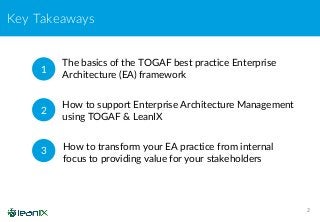
Key Takeaways
2
How tosupport Enterprise Architecture Management
using TOGAF & LeanIX
1
How to transform your EA practice from internal
focus to providing value for your stakeholders
The basics of the TOGAF best practice Enterprise
Architecture (EA) framework
2
3
3.
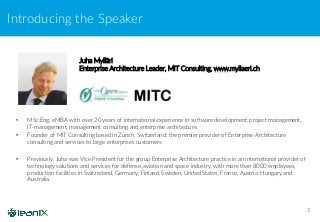
Juha Mylläri
Enterprise ArchitectureLeader, MIT Consulting, www.myllaeri.ch
Introducing the Speaker
3
• MSc.Eng, eMBA with over 20 years of international experience in software development, project management,
IT-management, management consulting and enterprise architecture.
• Founder of MIT Consulting based in Zurich, Switzerland: the premier provider of Enterprise Architecture
consulting and services to large enterprises customers
• Previously, Juha was Vice President for the group Enterprise Architecture practice in an international provider of
technology solutions and services for defense, aviation and space industry, with more than 8000 employees,
production facilities in Switzerland, Germany, Finland, Sweden, United States, France, Austria, Hungary and
Australia.
4.
What is TOGAF?
4
TOGAFis one of the most popular EA frameworks today and many
organizations consider it to be the de facto standard.
TOGAF provides a toolkit of best practices, processes, principles, rules,
guidelines and techniques for Enterprise Architects. However, you still need
to find a way to apply the framework in a pragmatic way that creates value
for your business.
As of 2016, the Open Group reports that TOGAF is employed by 80% of
Global 50 companies and 60% of Fortune 500 companies. Yet research
shows that often TOGAF recommendations are found to be inapplicable and
difficult to implement.
5.
TOGAF Overview
5
Source: TOGAFADM, The Open Group
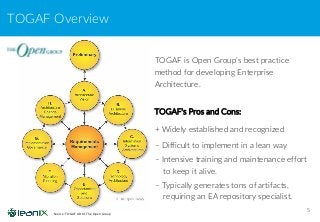
TOGAF is Open Group’s best practice
method for developing Enterprise
Architecture.
TOGAF’s Pros and Cons:
+ Widely established and recognized
– Difficult to implement in a lean way
– Intensive training and maintenance effort
to keep it alive.
– Typically generates tons of artifacts,
requiring an EA repository specialist.
6.
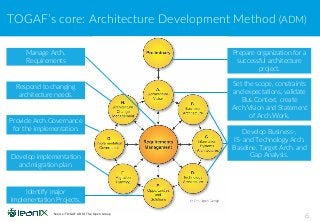
TOGAF’s core: ArchitectureDevelopment Method (ADM)
6Source: TOGAF ADM, The Open Group
Prepare organization for a
successful architecture
project.
Set the scope, constraints
and expectations, validate
Bus.Context, create
Arch.Vision and Statement
of Arch.Work.
Develop Business-,
IS- and Technology Arch.
Baseline, Target Arch. and
Gap Analysis.
Identify major
implementation Projects.
Develop implementation
and migration plan.
Provide Arch.Governance
for the implementation.
Respond to changing
architecture needs.
Manage Arch.
Requirements
7.
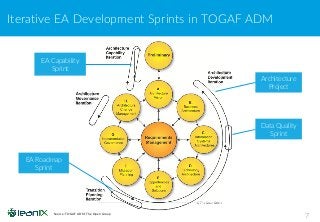
Iterative EA DevelopmentSprints in TOGAF ADM
7Source: TOGAF ADM, The Open Group
Data Quality
Sprint
EA Capability
Sprint
EA Roadmap
Sprint
Architecture
Project
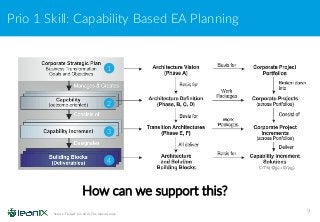
Prio 1 Skill:Capability Based EA Planning
9Source: TOGAF (Ch.32.4), The Open Group
2
1
3
4
How can we support this?
10.
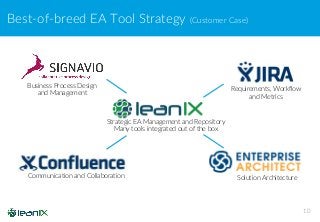
Best-of-breed EA ToolStrategy (Customer Case)
10
Solution Architecture
Strategic EA Management and Repository
Many tools integrated out of the box
Requirements, Workflow
and Metrics
Communication and Collaboration
Business Process Design
and Management
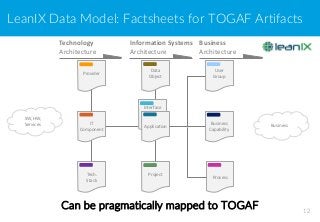
LeanIX Data Model:Factsheets for TOGAF Artifacts
12
Technology
Architecture
Information Systems
Architecture
Business
Architecture
SW, HW,
Services Business
Interface
Application
Provider
IT
Component
Project
User
Group
Data
Object
Tech.
Stack
Business
Capability
Process
Can be pragmatically mapped to TOGAF
13.
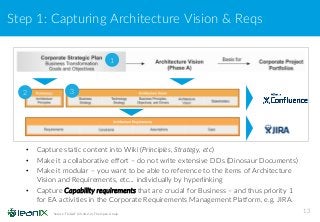
Step 1: CapturingArchitecture Vision & Reqs
13Source: TOGAF (Ch.34.2.2), The Open Group
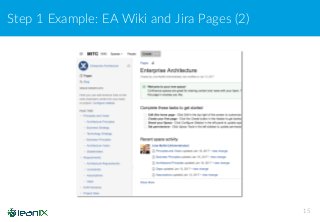
• Capture static content into Wiki (Principles, Strategy, etc)
• Make it a collaborative effort – do not write extensive DDs (Dinosaur Documents)
• Make it modular – you want to be able to reference to the items of Architecture
Vision and Requirements, etc… individually by hyperlinking
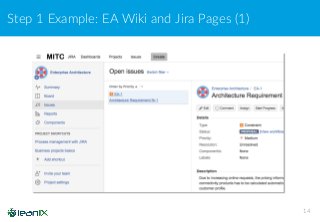
• Capture Capability requirements that are crucial for Business – and thus priority 1
for EA activities in the Corporate Requirements Management Platform, e.g. JIRA.
2 3
1
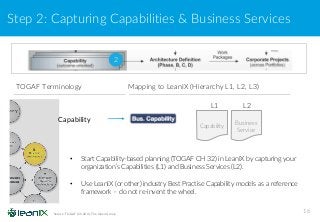
Step 2: CapturingCapabilities & Business Services
16
L1
Capability
Business
Service
TOGAF Terminology Mapping to LeanIX (Hierarchy L1, L2, L3)
L2
2
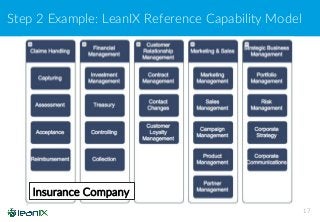
• Start Capability-based planning (TOGAF CH 32) in LeanIX by capturing your
organization’s Capabilities (L1) and Business Services (L2).
• Use LeanIX (or other) industry Best Practise Capability models as a reference
framework – do not re-invent the wheel.
Capability
Source: TOGAF (Ch.32.4), The Open Group
17.
Step 2 Example:LeanIX Reference Capability Model
17
Insurance Company
18.
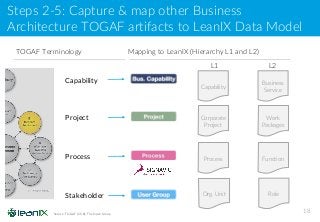
Steps 2-5: Capture& map other Business
Architecture TOGAF artifacts to LeanIX Data Model
18
Corporate
Project
Work
Packages
Process Function
Org. Unit Role
L1
Capability
Business
Service
Capability
Project
Process
Stakeholder
TOGAF Terminology Mapping to LeanIX (Hierarchy L1 and L2)
L2
Source: TOGAF (Ch.8), The Open Group
19.
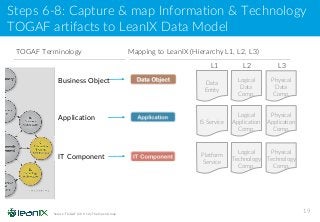
Steps 6-8: Capture& map Information & Technology
TOGAF artifacts to LeanIX Data Model
19
IS Service
Logical
Application
Comp.
Platform
Service
Logical
Technology
Comp.
L1
Data
Entity
Logical
Data
Comp.
Business Object
Application
IT Component
TOGAF Terminology Mapping to LeanIX (Hierarchy L1, L2, L3)
L2
Physical
Application
Comp.
Physical
Technology
Comp.
Physical
Data
Comp.
L3
Source: TOGAF (Ch.9, 12), The Open Group
20.
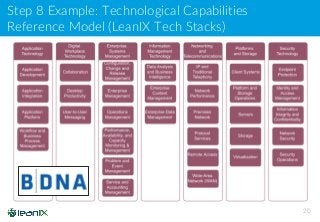
Step 8 Example:Technological Capabilities
Reference Model (LeanIX Tech Stacks)
20
21.
Summary: TOGAF ADMwith LeanIX
and selected best-of-breed, integrated tools
21Source: TOGAF (Ch.5), The Open Group
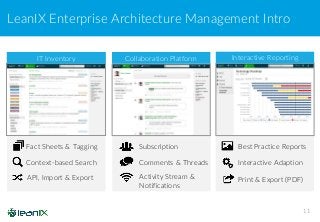
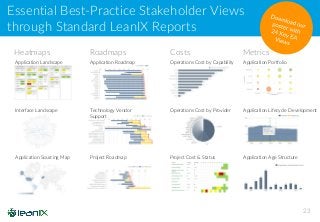
Essential Best-Practice StakeholderViews
through Standard LeanIX Reports
23
MetricsHeatmaps Roadmaps Costs
Application Landscape
Interface Landscape
Application Sourcing Map
Application Roadmap
Technology Vendor
Support
Project Roadmap
Operations Cost by Capability
Operations Cost by Provider
Project Cost & Status
Application Portfolio
Application Lifecycle Development
Application Age Structure
24.
Live Demo: TOGAFwith LeanIX
24
It’s time to see some action :-)
24
Live Demo: TOGAF with LeanIX
go to www.leanix.net to request a personal Demo
25.
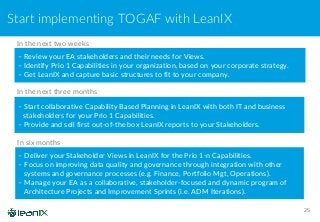
Start implementing TOGAFwith LeanIX
25
– Review your EA stakeholders and their needs for Views.
– Identify Prio 1 Capabilities in your organization, based on your corporate strategy.
– Get LeanIX and capture basic structures to fit to your company.
In the next two weeks
– Start collaborative Capability Based Planning in LeanIX with both IT and business
stakeholders for your Prio 1 Capabilities.
– Provide and sell first out-of-the box LeanIX reports to your Stakeholders.
In the next three months
– Deliver your Stakeholder Views in LeanIX for the Prio 1-n Capabilities.
– Focus on improving data quality and governance through integration with other
systems and governance processes (e.g. Finance, Portfolio Mgt, Operations).
– Manage your EA as a collaborative, stakeholder-focused and dynamic program of
Architecture Projects and Improvement Sprints (i.e. ADM Iterations).
In six months
HOW TO IMPLEMENTTOGAF WITH LEANIX
27
Did you like our presentation? Click below to:
Thank you!
Learn More about LeanIX
http://bit.ly/LeanIXDemoS
Request a free demo
http://bit.ly/LeanIXDemo