Android RIL - Radio Interface Layer


              Lifu Zhang


        Elektrobit Wireless(2011)


                                    Android RIL - Radio Interface Layer
                                                                          1 / 35
Outline

1   Android Telephony
    Big Picture
    Porting Work
    Interacton between Framework and Local Service
    Ril Initilize

2   Vender RIL
    Example I: Signal Strength
    Example II: Voice Call
    Experiences when IMPL telephony features

3   Data Connection

4   Reference


                                          Android RIL - Radio Interface Layer
                                                                                2 / 35
Terms


RIL Daemon: The RIL daemon initializes the Vendor RIL, processes
all communication from Android telephony services, and dispatches
calls to the Vendor RIL as solicited commands.
Vendor RIL: The radio-specific Vendor RIL of ril.h that processes all
communication with radio hardware and dispatches calls to the RIL
Daemon (rild) through unsolicited commands.


                                            Android RIL - Radio Interface Layer
                                                                                  3 / 35
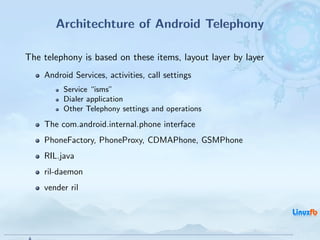
Architechture of Android Telephony

The telephony is based on these items, layout layer by layer
    Android Services, activities, call settings
         Service “isms”
         Dialer application
         Other Telephony settings and operations
    The com.android.internal.phone interface
    PhoneFactory, PhoneProxy, CDMAPhone, GSMPhone
    RIL.java
    ril-daemon
    vender ril


                                                   Android RIL - Radio Interface Layer
                                                                                         4 / 35
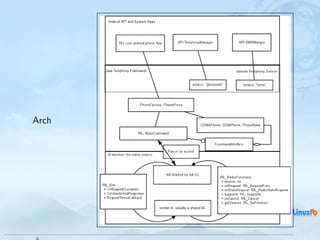
Arch


       Android RIL - Radio Interface Layer
                                             5 / 35
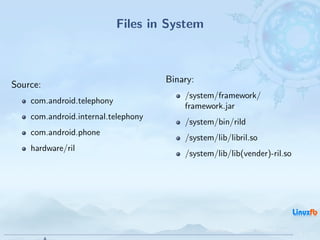
Files in System


                                     Binary:
Source:
                                         /system/framework/
    com.android.telephony
                                         framework.jar
    com.android.internal.telephony
                                         /system/bin/rild
    com.android.phone
                                         /system/lib/libril.so
    hardware/ril
                                         /system/lib/lib(vender)-ril.so


                                               Android RIL - Radio Interface Layer
                                                                                     6 / 35
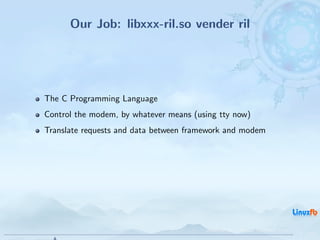
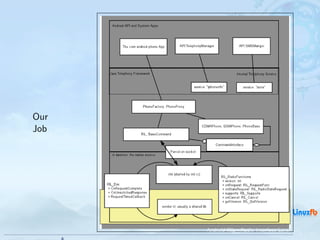
Our Job: libxxx-ril.so vender ril


The C Programming Language
Control the modem, by whatever means (using tty now)
Translate requests and data between framework and modem


                                        Android RIL - Radio Interface Layer
                                                                              7 / 35
Our
Job


      Android RIL - Radio Interface Layer
                                            8 / 35
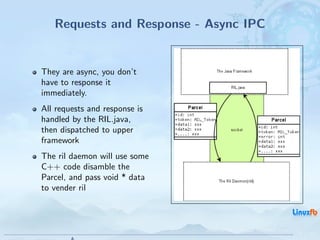
Requests and Response - Async IPC


They are async, you don’t
have to response it
immediately.
All requests and response is
handled by the RIL.java,
then dispatched to upper
framework
The ril daemon will use some
C++ code disamble the
Parcel, and pass void * data
to vender ril


                               Android RIL - Radio Interface Layer
                                                                     9 / 35
The Requests


requests is comming from the framework, packed as Parcel, trasfered
on local socket, dispatched by rild, and handled by vender ril.
request id: What do you want to do
request token: just a token, using when response it
request data: e.g. when sending sms, you have to specify address,
text in the data


                                            Android RIL - Radio Interface Layer
                                                                                  10 / 35
The Response


the response is generated by vender ril, packed as Parcel, transfered
on local socket, dispatched by CommandInterface, and handled by
those who register its handler.
id: same as the requests id
error id: success or something wrong
data: data is in format specify by the request, and if no data
needed, it would be ’NULL’
special: Some response is not to a request, we call they unsolicited
responses.


                                            Android RIL - Radio Interface Layer
                                                                                  11 / 35
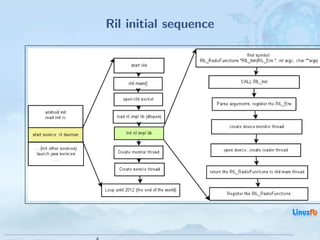
Ril initial sequence


                  Android RIL - Radio Interface Layer
                                                        12 / 35
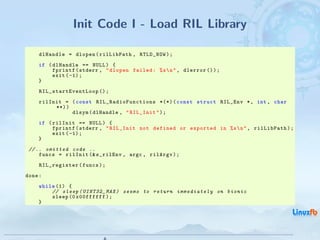
Init Code I - Load RIL Library

     dlHandle = dlopen ( rilLibPath , RTLD_NOW ) ;

    if ( dlHandle == NULL ) {
         fprintf ( stderr , " dlopen failed : % s  n " , dlerror () ) ;
         exit ( -1) ;
    }

     R I L _ s t ar t Ev e nt Lo o p () ;
     rilInit = ( const R I L_ Ra d io F un ct i on s *(*) ( const struct RIL_Env * , int , char
          **) )
                dlsym ( dlHandle , " RIL_Init " ) ;
    if ( rilInit == NULL ) {
         fprintf ( stderr , " RIL_Init not defined or exported in % s  n " , rilLibPath ) ;
         exit ( -1) ;
    }
 // .. omitted code ..
     funcs = rilInit (& s_rilEnv , argc , rilArgv ) ;
     RIL_register ( funcs ) ;
done :
    while (1) {
        // sleep ( U I N T 3 2 _ M A X ) seems to return i m m e d i a t e l y on bionic
        sleep (0 x00ffffff ) ;
    }


                                                                       Android RIL - Radio Interface Layer
                                                                                                             13 / 35
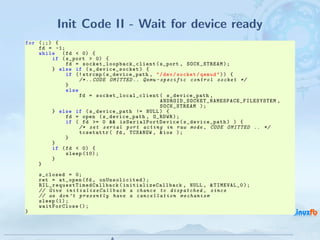
Init Code II - Wait for device ready
for (;;) {
    fd = -1;
    while ( fd < 0) {
        if ( s_port > 0) {
             fd = s o c k e t _ l o o p b a c k _ c l i e n t ( s_port , SOCK_STREAM ) ;
        } else if ( s_device_socket ) {
             if (! strcmp ( s_device_path , " / dev / socket / qemud " ) ) {
                  /* .. CODE OMITTED .. Qemu - specific control socket */
             }
             else
                  fd = s o ck e t _ l o c a l _c l i e n t ( s_device_path ,
                                                                A NDR OI D_ SO CK ET _N AM ESP AC E_ FI LE SY ST EM ,
                                                                SOCK_STREAM ) ;
        } else if ( s_device_path != NULL ) {
             fd = open ( s_device_path , O_RDWR ) ;
             if ( fd >= 0 && i sS e ri al P or t De vi c e ( s_device_path ) ) {
                  /* set serial port acting in raw mode , CODE OMITTED .. */
                  tcsetattr ( fd , TCSANOW , & ios ) ;
             }
        }
        if ( fd < 0) {
             sleep (10) ;
        }
    }
      s_closed = 0;
      ret = at_open ( fd , onUnsolicited ) ;
      R I L _ r e q u e s t T i m e d C a l l b a c k ( initializeCallback , NULL , & TIMEVAL_0 ) ;
      // Give i n i t i a l i z e C a l l b a c k a chance to dispatched , since
      // we don ’t p r e s e n t l y have a c a n c e l l a t i o n m e c h a n i s m
      sleep (1) ;
      waitForClose () ;
}


                                                                                   Android RIL - Radio Interface Layer
                                                                                                                         14 / 35
The Vender RIL


In this sections, we’ll have some examples about how the vender ril
works.
    The Vender RIL and RIL Daemon is interact with
    RIL RadioFunctions and RIL Env facility.
    The Vender RIL is the very part of system that handle radio
    operations.


                                               Android RIL - Radio Interface Layer
                                                                                     15 / 35
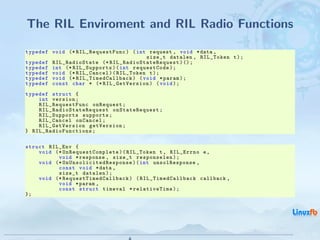
The RIL Enviroment and RIL Radio Functions

typedef void (* RIL_RequestFunc ) ( int request , void * data ,
                                                size_t datalen , RIL_Token t ) ;
typedef RIL_RadioState (* R I L _ R a d i o S t a t e R e q u e s t ) () ;
typedef int (* RIL_Supports ) ( int requestCode ) ;
typedef void (* RIL_Cancel ) ( RIL_Token t ) ;
typedef void (* R IL_T ime dCa llb ack ) ( void * param ) ;
typedef const char * (* RIL_GetVersion ) ( void ) ;
typedef struct {
      int version ;
      R IL _R equestFunc onRequest ;
      R I L _ R a d i o S t a t e R e q u e s t onStateRequest ;
      RIL_Supports supports ;
      RIL_Cancel onCancel ;
      RIL_ GetVersion getVersion ;
} R I L _ R a d io Fu n ct i on s ;


struct RIL_Env {
    void (* On Req ues tCo mple te ) ( RIL_Token t , RIL_Errno e ,
          void * response , size_t responselen ) ;
    void (* O n U n s o l i c i t e d R e s p o n s e ) ( int unsolResponse ,
          const void * data ,
          size_t datalen ) ;
    void (* R e q u e s t T i m e d C a l l b a c k ) ( R IL_ Tim edCa llb ack callback ,
          void * param ,
          const struct timeval * relativeTime ) ;
};


                                                                              Android RIL - Radio Interface Layer
                                                                                                                    16 / 35
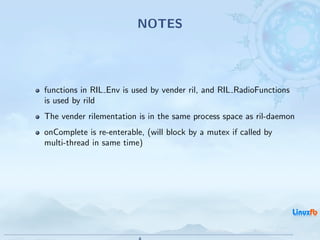
NOTES


functions in RIL Env is used by vender ril, and RIL RadioFunctions
is used by rild
The vender rilementation is in the same process space as ril-daemon
onComplete is re-enterable, (will block by a mutex if called by
multi-thread in same time)


                                            Android RIL - Radio Interface Layer
                                                                                  17 / 35
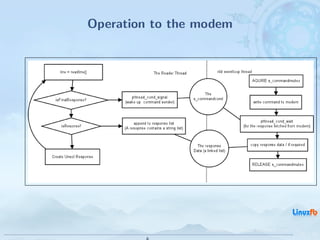
Operation to the modem


                  Android RIL - Radio Interface Layer
                                                        18 / 35
Summary: Threads in rild process space


rild main thread: parse argc, argv, open ril library, create event loop,
some timed call back is run in this thread.
rild event loop: handle requests from upper layer, and call
OnRequests of vender ril.
vender reader loop: read data comming from modem, packed as
response/unsol response.


                                              Android RIL - Radio Interface Layer
                                                                                    19 / 35
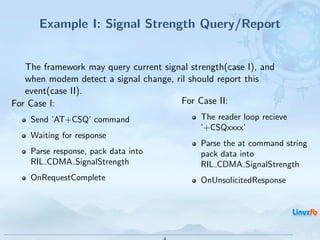
Example I: Signal Strength Query/Report


   The framework may query current signal strength(case I), and
   when modem detect a signal change, ril should report this
   event(case II).
For Case I:                            For Case II:
    Send ’AT+CSQ’ command                    The reader loop recieve
                                             ’+CSQxxxx’
    Waiting for response
                                             Parse the at command string
    Parse response, pack data into           pack data into
    RIL CDMA SignalStrength                  RIL CDMA SignalStrength
    OnRequestComplete                        OnUnsolicitedResponse


                                              Android RIL - Radio Interface Layer
                                                                                    20 / 35
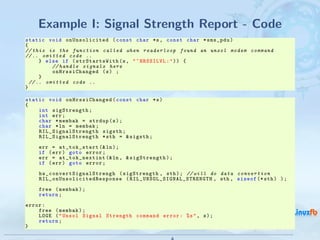
Example I: Signal Strength Report - Code
static void onUnsolicited ( const char *s , const char * sms_pdu )
{
// this is the function called when r e a d e r l o o p found an unsol modem command
// .. omitted code ..
      } else if ( strStartsWith (s , " ^ HRSSILVL : " ) ) {
          // handle signals here
          onHrssiChanged ( s ) ;
      }
  // .. omitted code ..
}

static void onHrssiChanged ( const char * s )
{
    int sigStrength ;
    int err ;
    char * membak = strdup ( s ) ;
    char * ln = membak ;
    R I L _ S i gn a lS t re ng t h sigsth ;
    R I L _ S i gn a lS t re ng t h * sth = & sigsth ;
     err = at_tok_start (& ln ) ;
     if ( err ) goto error ;
     err = at_tok_nextint (& ln , & sigStrength ) ;
     if ( err ) goto error ;
     h w _ c o n v e r t S i g n a l S t r e n g h ( sigStrength , sth ) ; // will do data c o n v e r t i o n
     R I L _ o n U n s o l i c i t e d R e s p o n s e ( RIL_UNSOL_SIGNAL_STRENGTH , sth , sizeof (* sth ) ) ;
     free ( membak ) ;
     return ;
error :
    free ( membak ) ;
    LOGE ( " Unsol Signal Strength command error : % s " , s ) ;
    return ;
}
                                                             Android RIL - Radio Interface Layer
                                                                                                                 21 / 35
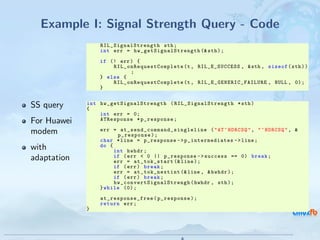
Example I: Signal Strength Query - Code
                   R IL _S i gn a l S t r e ng t h sth ;
                   int err = h w _ g e t S i g n a l S t r e n g t h (& sth ) ;
                   if (! err ) {
                       R I L _ o n R e q u e s t C o m p l e t e (t , RIL_E_SUCCESS , & sth , sizeof ( sth ) )
                                 ;
                   } else {
                       R I L _ o n R e q u e s t C o m p l e t e (t , RIL_E_GENERIC_FAILURE , NULL , 0) ;
                   }


SS query     int h w _ g e t S i g n a l S t r e n g t h ( R IL _ S i g na lS t r e n g t h * sth )
             {
                 int err = 0;
For Huawei       ATResponse * p_response ;

modem              err = a t _ s e n d _ c o m m a n d _ s i n g l e l i n e ( " AT ^ HDRCSQ " , " ^ HDRCSQ " , &
                          p_response ) ;
                   char * line = p_response - > p_intermediates - > line ;
with               do {
                        int hwhdr ;
adaptation              if ( err < 0 || p_response - > success == 0) break ;
                        err = at_tok_start (& line ) ;
                        if ( err ) break ;
                        err = at _tok_nex tint (& line , & hwhdr ) ;
                        if ( err ) break ;
                        h w _ c o n v e r t S i g n a l S t r e n g h ( hwhdr , sth ) ;
                   } while (0) ;

                    at_res po ns e_ free ( p_response ) ;
                    return err ;
             }


                                                                          Android RIL - Radio Interface Layer
                                                                                                                    22 / 35
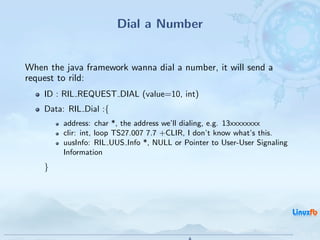
Dial a Number


When the java framework wanna dial a number, it will send a
request to rild:
    ID : RIL REQUEST DIAL (value=10, int)
    Data: RIL Dial :{
         address: char *, the address we’ll dialing, e.g. 13xxxxxxxx
         clir: int, loop TS27.007 7.7 +CLIR, I don’t know what’s this.
         uusInfo: RIL UUS Info *, NULL or Pointer to User-User Signaling
         Information
    }


                                                 Android RIL - Radio Interface Layer
                                                                                       23 / 35
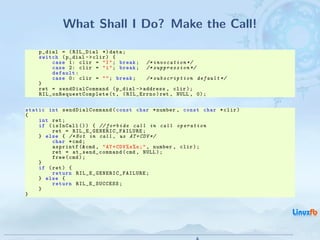
What Shall I Do? Make the Call!

    p_dial = ( RIL_Dial *) data ;
    switch ( p_dial - > clir ) {
            case 1: clir = " I " ; break ; /* i n v o c a t i o n */
            case 2: clir = " i " ; break ; /* s u p p r e s s i o n */
            default :
            case 0: clir = " " ; break ;                   /* s u b s c r i p t i o n default */
    }
    ret = sendDialCommand ( p_dial - > address , clir ) ;
    R I L _ o n R e q u e s t C o m p l e t e (t , ( RIL_Errno ) ret , NULL , 0) ;


static int sendDialCommand ( const char * number , const char * clir )
{
    int ret ;
    if ( isInCall () ) { // forbide call in call o p e r a t i o n
         ret = R I L _ E _ G E N E R I C _ F A I L U R E ;
    } else { /* Not in call , us AT + CDV */
         char * cmd ;
         asprintf (& cmd , " AT + CDV % s % s ; " , number , clir ) ;
         ret = at_send_command ( cmd , NULL ) ;
         free ( cmd ) ;
    }
    if ( ret ) {
         return R I L _ E _ G E N E R I C _ F A I L U R E ;
    } else {
         return RIL_E_SUCCESS ;
    }
}


                                                                                      Android RIL - Radio Interface Layer
                                                                                                                            24 / 35
What’s Your Call Status?
RIL_Call ** hw_getValidCalls ( void )
{
// .. omited code ..
     err = a t _ s e n d _ c o m m a n d _ m u l t i l i n e ( " AT + CLCC " , " + CLCC : " , & p_response ) ;
     // .. omited code ..
     atline = p_response - > p_intermediates ;
     while ( atline != NULL ) {
          err = r i l c a l lF r o m C l c c L in e ( p_callbuf , atline - > line ) ;
          if (! err ) {
               RIL_Call * curCall ;
               curCall = ( typeof ( curCall ) ) malloc ( sizeof (* curCall ) ) ;
               memcpy ( curCall , p_callbuf , sizeof (* p_callbuf ) ) ;
               pp_calls [ nValidCalls ] = curCall ;
                ++ nValidCalls ;
            } else {
                ebDebug ( " failed to parse one clcc line " ) ;
            }
           atline = atline - > p_next ;
      }
      // .. omitted code ..
}


    pp_calls = hw_getValidCalls () ;
// .. omitted code ..
       R I L _ o n R e q u e s t C o m p l e t e (t , RIL_E_SUCCESS , pp_calls ,
                 nValidCalls * sizeof (* pp_calls ) ) ;
// .. omitted code ..


                                                                                   Android RIL - Radio Interface Layer
                                                                                                                         25 / 35
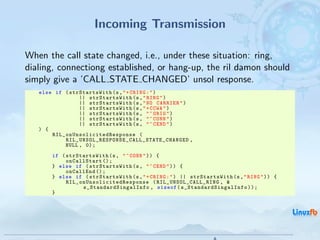
Incoming Transmission

When the call state changed, i.e., under these situation: ring,
dialing, connectiong established, or hang-up, the ril damon should
simply give a ’CALL STATE CHANGED’ unsol response.
   else if ( strStartsWith (s , " + CRING : " )
                  || strStartsWith (s , " RING " )
                  || strStartsWith (s , " NO CARRIER " )
                  || strStartsWith (s , " + CCWA " )
                  || strStartsWith (s , " ^ ORIG " )
                  || strStartsWith (s , " ^ CONN " )
                  || strStartsWith (s , " ^ CEND " )
   ) {
       RIL_onUnsolicitedResponse (
           R IL _ U N SO L _ RE S P ON S E _C A L L _S T A TE _ C HA N G ED ,
           NULL , 0) ;
         if ( strStartsWith (s , " ^ CONN " ) ) {
              onCallStart () ;
         } else if ( strStartsWith (s , " ^ CEND " ) ) {
              onCallEnd () ;
         } else if ( strStartsWith (s , " + CRING : " ) || strStartsWith (s , " RING " ) ) {
              R I L _ o n U n s o l i c i t e d R e s p o n s e ( RIL_UNSOL_CALL_RING , &
                        s_StandardSingalInfo , sizeof ( s _ S t a n d a r d S i n g a l I n f o ) ) ;
         }


                                                                                Android RIL - Radio Interface Layer
                                                                                                                      26 / 35
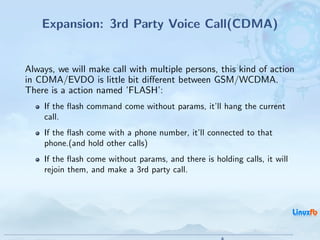
Expansion: 3rd Party Voice Call(CDMA)


Always, we will make call with multiple persons, this kind of action
in CDMA/EVDO is little bit different between GSM/WCDMA.
There is a action named ’FLASH’:
    If the flash command come without params, it’ll hang the current
    call.
    If the flash come with a phone number, it’ll connected to that
    phone.(and hold other calls)
    If the flash come without params, and there is holding calls, it will
    rejoin them, and make a 3rd party call.


                                                 Android RIL - Radio Interface Layer
                                                                                       27 / 35
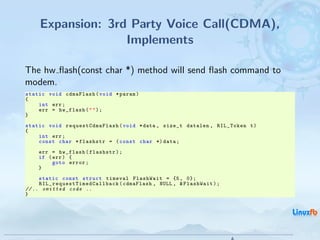
Expansion: 3rd Party Voice Call(CDMA),
                    Implements

The hw flash(const char *) method will send flash command to
modem.
static void cdmaFlash ( void * param )
{
    int err ;
    err = hw_flash ( " " ) ;
}
static void requestCdmaFlash ( void * data , size_t datalen , RIL_Token t )
{
    int err ;
    const char * flashstr = ( const char *) data ;
      err = hw_flash ( flashstr ) ;
      if ( err ) {
           goto error ;
      }
     static const struct timeval FlashWait = {5 , 0};
     R I L _ r e q u e s t T i m e d C a l l b a c k ( cdmaFlash , NULL , & FlashWait ) ;
// .. omitted code ..
}


                                                                                   Android RIL - Radio Interface Layer
                                                                                                                         28 / 35
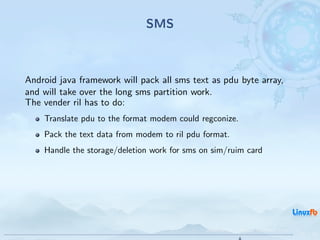
SMS


Android java framework will pack all sms text as pdu byte array,
and will take over the long sms partition work.
The vender ril has to do:
    Translate pdu to the format modem could regconize.
    Pack the text data from modem to ril pdu format.
    Handle the storage/deletion work for sms on sim/ruim card


                                              Android RIL - Radio Interface Layer
                                                                                    29 / 35
Call Forward and Call Waiting


Opensource android CDMA Telephony framework doesn’t surpport
these action.
It’s simple to add impl code to java framework and settings app
refer to gsm system.
For China Telecom, you have to make cvoice calls with special
number to register these service.


                                           Android RIL - Radio Interface Layer
                                                                                 30 / 35
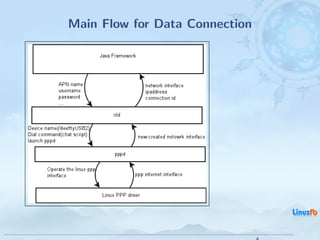
Main Flow for Data Connection


                     Android RIL - Radio Interface Layer
                                                           31 / 35
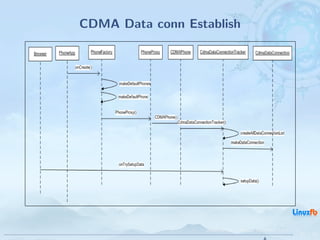
CDMA Data conn Establish


                  Android RIL - Radio Interface Layer
                                                        32 / 35
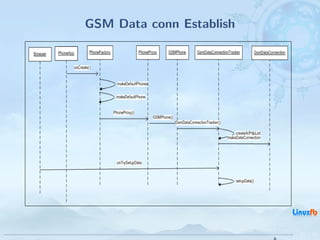
GSM Data conn Establish


                  Android RIL - Radio Interface Layer
                                                        33 / 35
NOTES


A modem always have two channel to operate, when established a
ppp link, one channel will be hold for ppp.
pppd will create interface, set dns/ip or dhcp them.


                                            Android RIL - Radio Interface Layer
                                                                                  34 / 35
Reference


An Android Website
Android RIL on SlideShare
Androi RIL on EVDO/CDMA


                                  Android RIL - Radio Interface Layer
                                                                        35 / 35

RIL and Android Telephony

  • 1.
    Android RIL -Radio Interface Layer Lifu Zhang Elektrobit Wireless(2011) Android RIL - Radio Interface Layer 1 / 35
  • 2.
    Outline 1 Android Telephony Big Picture Porting Work Interacton between Framework and Local Service Ril Initilize 2 Vender RIL Example I: Signal Strength Example II: Voice Call Experiences when IMPL telephony features 3 Data Connection 4 Reference Android RIL - Radio Interface Layer 2 / 35
  • 3.
    Terms RIL Daemon: TheRIL daemon initializes the Vendor RIL, processes all communication from Android telephony services, and dispatches calls to the Vendor RIL as solicited commands. Vendor RIL: The radio-specific Vendor RIL of ril.h that processes all communication with radio hardware and dispatches calls to the RIL Daemon (rild) through unsolicited commands. Android RIL - Radio Interface Layer 3 / 35
  • 4.
    Architechture of AndroidTelephony The telephony is based on these items, layout layer by layer Android Services, activities, call settings Service “isms” Dialer application Other Telephony settings and operations The com.android.internal.phone interface PhoneFactory, PhoneProxy, CDMAPhone, GSMPhone RIL.java ril-daemon vender ril Android RIL - Radio Interface Layer 4 / 35
  • 5.
    Arch Android RIL - Radio Interface Layer 5 / 35
  • 6.
    Files in System Binary: Source: /system/framework/ com.android.telephony framework.jar com.android.internal.telephony /system/bin/rild com.android.phone /system/lib/libril.so hardware/ril /system/lib/lib(vender)-ril.so Android RIL - Radio Interface Layer 6 / 35
  • 7.
    Our Job: libxxx-ril.sovender ril The C Programming Language Control the modem, by whatever means (using tty now) Translate requests and data between framework and modem Android RIL - Radio Interface Layer 7 / 35
  • 8.
    Our Job Android RIL - Radio Interface Layer 8 / 35
  • 9.
    Requests and Response- Async IPC They are async, you don’t have to response it immediately. All requests and response is handled by the RIL.java, then dispatched to upper framework The ril daemon will use some C++ code disamble the Parcel, and pass void * data to vender ril Android RIL - Radio Interface Layer 9 / 35
  • 10.
    The Requests requests iscomming from the framework, packed as Parcel, trasfered on local socket, dispatched by rild, and handled by vender ril. request id: What do you want to do request token: just a token, using when response it request data: e.g. when sending sms, you have to specify address, text in the data Android RIL - Radio Interface Layer 10 / 35
  • 11.
    The Response the responseis generated by vender ril, packed as Parcel, transfered on local socket, dispatched by CommandInterface, and handled by those who register its handler. id: same as the requests id error id: success or something wrong data: data is in format specify by the request, and if no data needed, it would be ’NULL’ special: Some response is not to a request, we call they unsolicited responses. Android RIL - Radio Interface Layer 11 / 35
  • 12.
    Ril initial sequence Android RIL - Radio Interface Layer 12 / 35
  • 13.
    Init Code I- Load RIL Library dlHandle = dlopen ( rilLibPath , RTLD_NOW ) ; if ( dlHandle == NULL ) { fprintf ( stderr , " dlopen failed : % s n " , dlerror () ) ; exit ( -1) ; } R I L _ s t ar t Ev e nt Lo o p () ; rilInit = ( const R I L_ Ra d io F un ct i on s *(*) ( const struct RIL_Env * , int , char **) ) dlsym ( dlHandle , " RIL_Init " ) ; if ( rilInit == NULL ) { fprintf ( stderr , " RIL_Init not defined or exported in % s n " , rilLibPath ) ; exit ( -1) ; } // .. omitted code .. funcs = rilInit (& s_rilEnv , argc , rilArgv ) ; RIL_register ( funcs ) ; done : while (1) { // sleep ( U I N T 3 2 _ M A X ) seems to return i m m e d i a t e l y on bionic sleep (0 x00ffffff ) ; } Android RIL - Radio Interface Layer 13 / 35
  • 14.
    Init Code II- Wait for device ready for (;;) { fd = -1; while ( fd < 0) { if ( s_port > 0) { fd = s o c k e t _ l o o p b a c k _ c l i e n t ( s_port , SOCK_STREAM ) ; } else if ( s_device_socket ) { if (! strcmp ( s_device_path , " / dev / socket / qemud " ) ) { /* .. CODE OMITTED .. Qemu - specific control socket */ } else fd = s o ck e t _ l o c a l _c l i e n t ( s_device_path , A NDR OI D_ SO CK ET _N AM ESP AC E_ FI LE SY ST EM , SOCK_STREAM ) ; } else if ( s_device_path != NULL ) { fd = open ( s_device_path , O_RDWR ) ; if ( fd >= 0 && i sS e ri al P or t De vi c e ( s_device_path ) ) { /* set serial port acting in raw mode , CODE OMITTED .. */ tcsetattr ( fd , TCSANOW , & ios ) ; } } if ( fd < 0) { sleep (10) ; } } s_closed = 0; ret = at_open ( fd , onUnsolicited ) ; R I L _ r e q u e s t T i m e d C a l l b a c k ( initializeCallback , NULL , & TIMEVAL_0 ) ; // Give i n i t i a l i z e C a l l b a c k a chance to dispatched , since // we don ’t p r e s e n t l y have a c a n c e l l a t i o n m e c h a n i s m sleep (1) ; waitForClose () ; } Android RIL - Radio Interface Layer 14 / 35
  • 15.
    The Vender RIL Inthis sections, we’ll have some examples about how the vender ril works. The Vender RIL and RIL Daemon is interact with RIL RadioFunctions and RIL Env facility. The Vender RIL is the very part of system that handle radio operations. Android RIL - Radio Interface Layer 15 / 35
  • 16.
    The RIL Enviromentand RIL Radio Functions typedef void (* RIL_RequestFunc ) ( int request , void * data , size_t datalen , RIL_Token t ) ; typedef RIL_RadioState (* R I L _ R a d i o S t a t e R e q u e s t ) () ; typedef int (* RIL_Supports ) ( int requestCode ) ; typedef void (* RIL_Cancel ) ( RIL_Token t ) ; typedef void (* R IL_T ime dCa llb ack ) ( void * param ) ; typedef const char * (* RIL_GetVersion ) ( void ) ; typedef struct { int version ; R IL _R equestFunc onRequest ; R I L _ R a d i o S t a t e R e q u e s t onStateRequest ; RIL_Supports supports ; RIL_Cancel onCancel ; RIL_ GetVersion getVersion ; } R I L _ R a d io Fu n ct i on s ; struct RIL_Env { void (* On Req ues tCo mple te ) ( RIL_Token t , RIL_Errno e , void * response , size_t responselen ) ; void (* O n U n s o l i c i t e d R e s p o n s e ) ( int unsolResponse , const void * data , size_t datalen ) ; void (* R e q u e s t T i m e d C a l l b a c k ) ( R IL_ Tim edCa llb ack callback , void * param , const struct timeval * relativeTime ) ; }; Android RIL - Radio Interface Layer 16 / 35
  • 17.
    NOTES functions in RILEnv is used by vender ril, and RIL RadioFunctions is used by rild The vender rilementation is in the same process space as ril-daemon onComplete is re-enterable, (will block by a mutex if called by multi-thread in same time) Android RIL - Radio Interface Layer 17 / 35
  • 18.
    Operation to themodem Android RIL - Radio Interface Layer 18 / 35
  • 19.
    Summary: Threads inrild process space rild main thread: parse argc, argv, open ril library, create event loop, some timed call back is run in this thread. rild event loop: handle requests from upper layer, and call OnRequests of vender ril. vender reader loop: read data comming from modem, packed as response/unsol response. Android RIL - Radio Interface Layer 19 / 35
  • 20.
    Example I: SignalStrength Query/Report The framework may query current signal strength(case I), and when modem detect a signal change, ril should report this event(case II). For Case I: For Case II: Send ’AT+CSQ’ command The reader loop recieve ’+CSQxxxx’ Waiting for response Parse the at command string Parse response, pack data into pack data into RIL CDMA SignalStrength RIL CDMA SignalStrength OnRequestComplete OnUnsolicitedResponse Android RIL - Radio Interface Layer 20 / 35
  • 21.
    Example I: SignalStrength Report - Code static void onUnsolicited ( const char *s , const char * sms_pdu ) { // this is the function called when r e a d e r l o o p found an unsol modem command // .. omitted code .. } else if ( strStartsWith (s , " ^ HRSSILVL : " ) ) { // handle signals here onHrssiChanged ( s ) ; } // .. omitted code .. } static void onHrssiChanged ( const char * s ) { int sigStrength ; int err ; char * membak = strdup ( s ) ; char * ln = membak ; R I L _ S i gn a lS t re ng t h sigsth ; R I L _ S i gn a lS t re ng t h * sth = & sigsth ; err = at_tok_start (& ln ) ; if ( err ) goto error ; err = at_tok_nextint (& ln , & sigStrength ) ; if ( err ) goto error ; h w _ c o n v e r t S i g n a l S t r e n g h ( sigStrength , sth ) ; // will do data c o n v e r t i o n R I L _ o n U n s o l i c i t e d R e s p o n s e ( RIL_UNSOL_SIGNAL_STRENGTH , sth , sizeof (* sth ) ) ; free ( membak ) ; return ; error : free ( membak ) ; LOGE ( " Unsol Signal Strength command error : % s " , s ) ; return ; } Android RIL - Radio Interface Layer 21 / 35
  • 22.
    Example I: SignalStrength Query - Code R IL _S i gn a l S t r e ng t h sth ; int err = h w _ g e t S i g n a l S t r e n g t h (& sth ) ; if (! err ) { R I L _ o n R e q u e s t C o m p l e t e (t , RIL_E_SUCCESS , & sth , sizeof ( sth ) ) ; } else { R I L _ o n R e q u e s t C o m p l e t e (t , RIL_E_GENERIC_FAILURE , NULL , 0) ; } SS query int h w _ g e t S i g n a l S t r e n g t h ( R IL _ S i g na lS t r e n g t h * sth ) { int err = 0; For Huawei ATResponse * p_response ; modem err = a t _ s e n d _ c o m m a n d _ s i n g l e l i n e ( " AT ^ HDRCSQ " , " ^ HDRCSQ " , & p_response ) ; char * line = p_response - > p_intermediates - > line ; with do { int hwhdr ; adaptation if ( err < 0 || p_response - > success == 0) break ; err = at_tok_start (& line ) ; if ( err ) break ; err = at _tok_nex tint (& line , & hwhdr ) ; if ( err ) break ; h w _ c o n v e r t S i g n a l S t r e n g h ( hwhdr , sth ) ; } while (0) ; at_res po ns e_ free ( p_response ) ; return err ; } Android RIL - Radio Interface Layer 22 / 35
  • 23.
    Dial a Number Whenthe java framework wanna dial a number, it will send a request to rild: ID : RIL REQUEST DIAL (value=10, int) Data: RIL Dial :{ address: char *, the address we’ll dialing, e.g. 13xxxxxxxx clir: int, loop TS27.007 7.7 +CLIR, I don’t know what’s this. uusInfo: RIL UUS Info *, NULL or Pointer to User-User Signaling Information } Android RIL - Radio Interface Layer 23 / 35
  • 24.
    What Shall IDo? Make the Call! p_dial = ( RIL_Dial *) data ; switch ( p_dial - > clir ) { case 1: clir = " I " ; break ; /* i n v o c a t i o n */ case 2: clir = " i " ; break ; /* s u p p r e s s i o n */ default : case 0: clir = " " ; break ; /* s u b s c r i p t i o n default */ } ret = sendDialCommand ( p_dial - > address , clir ) ; R I L _ o n R e q u e s t C o m p l e t e (t , ( RIL_Errno ) ret , NULL , 0) ; static int sendDialCommand ( const char * number , const char * clir ) { int ret ; if ( isInCall () ) { // forbide call in call o p e r a t i o n ret = R I L _ E _ G E N E R I C _ F A I L U R E ; } else { /* Not in call , us AT + CDV */ char * cmd ; asprintf (& cmd , " AT + CDV % s % s ; " , number , clir ) ; ret = at_send_command ( cmd , NULL ) ; free ( cmd ) ; } if ( ret ) { return R I L _ E _ G E N E R I C _ F A I L U R E ; } else { return RIL_E_SUCCESS ; } } Android RIL - Radio Interface Layer 24 / 35
  • 25.
    What’s Your CallStatus? RIL_Call ** hw_getValidCalls ( void ) { // .. omited code .. err = a t _ s e n d _ c o m m a n d _ m u l t i l i n e ( " AT + CLCC " , " + CLCC : " , & p_response ) ; // .. omited code .. atline = p_response - > p_intermediates ; while ( atline != NULL ) { err = r i l c a l lF r o m C l c c L in e ( p_callbuf , atline - > line ) ; if (! err ) { RIL_Call * curCall ; curCall = ( typeof ( curCall ) ) malloc ( sizeof (* curCall ) ) ; memcpy ( curCall , p_callbuf , sizeof (* p_callbuf ) ) ; pp_calls [ nValidCalls ] = curCall ; ++ nValidCalls ; } else { ebDebug ( " failed to parse one clcc line " ) ; } atline = atline - > p_next ; } // .. omitted code .. } pp_calls = hw_getValidCalls () ; // .. omitted code .. R I L _ o n R e q u e s t C o m p l e t e (t , RIL_E_SUCCESS , pp_calls , nValidCalls * sizeof (* pp_calls ) ) ; // .. omitted code .. Android RIL - Radio Interface Layer 25 / 35
  • 26.
    Incoming Transmission When thecall state changed, i.e., under these situation: ring, dialing, connectiong established, or hang-up, the ril damon should simply give a ’CALL STATE CHANGED’ unsol response. else if ( strStartsWith (s , " + CRING : " ) || strStartsWith (s , " RING " ) || strStartsWith (s , " NO CARRIER " ) || strStartsWith (s , " + CCWA " ) || strStartsWith (s , " ^ ORIG " ) || strStartsWith (s , " ^ CONN " ) || strStartsWith (s , " ^ CEND " ) ) { RIL_onUnsolicitedResponse ( R IL _ U N SO L _ RE S P ON S E _C A L L _S T A TE _ C HA N G ED , NULL , 0) ; if ( strStartsWith (s , " ^ CONN " ) ) { onCallStart () ; } else if ( strStartsWith (s , " ^ CEND " ) ) { onCallEnd () ; } else if ( strStartsWith (s , " + CRING : " ) || strStartsWith (s , " RING " ) ) { R I L _ o n U n s o l i c i t e d R e s p o n s e ( RIL_UNSOL_CALL_RING , & s_StandardSingalInfo , sizeof ( s _ S t a n d a r d S i n g a l I n f o ) ) ; } Android RIL - Radio Interface Layer 26 / 35
  • 27.
    Expansion: 3rd PartyVoice Call(CDMA) Always, we will make call with multiple persons, this kind of action in CDMA/EVDO is little bit different between GSM/WCDMA. There is a action named ’FLASH’: If the flash command come without params, it’ll hang the current call. If the flash come with a phone number, it’ll connected to that phone.(and hold other calls) If the flash come without params, and there is holding calls, it will rejoin them, and make a 3rd party call. Android RIL - Radio Interface Layer 27 / 35
  • 28.
    Expansion: 3rd PartyVoice Call(CDMA), Implements The hw flash(const char *) method will send flash command to modem. static void cdmaFlash ( void * param ) { int err ; err = hw_flash ( " " ) ; } static void requestCdmaFlash ( void * data , size_t datalen , RIL_Token t ) { int err ; const char * flashstr = ( const char *) data ; err = hw_flash ( flashstr ) ; if ( err ) { goto error ; } static const struct timeval FlashWait = {5 , 0}; R I L _ r e q u e s t T i m e d C a l l b a c k ( cdmaFlash , NULL , & FlashWait ) ; // .. omitted code .. } Android RIL - Radio Interface Layer 28 / 35
  • 29.
    SMS Android java frameworkwill pack all sms text as pdu byte array, and will take over the long sms partition work. The vender ril has to do: Translate pdu to the format modem could regconize. Pack the text data from modem to ril pdu format. Handle the storage/deletion work for sms on sim/ruim card Android RIL - Radio Interface Layer 29 / 35
  • 30.
    Call Forward andCall Waiting Opensource android CDMA Telephony framework doesn’t surpport these action. It’s simple to add impl code to java framework and settings app refer to gsm system. For China Telecom, you have to make cvoice calls with special number to register these service. Android RIL - Radio Interface Layer 30 / 35
  • 31.
    Main Flow forData Connection Android RIL - Radio Interface Layer 31 / 35
  • 32.
    CDMA Data connEstablish Android RIL - Radio Interface Layer 32 / 35
  • 33.
    GSM Data connEstablish Android RIL - Radio Interface Layer 33 / 35
  • 34.
    NOTES A modem alwayshave two channel to operate, when established a ppp link, one channel will be hold for ppp. pppd will create interface, set dns/ip or dhcp them. Android RIL - Radio Interface Layer 34 / 35
  • 35.
    Reference An Android Website AndroidRIL on SlideShare Androi RIL on EVDO/CDMA Android RIL - Radio Interface Layer 35 / 35