DPS Training 2009

Melissa Holcombe
Sarah Markland
Tony Nunn

Tasmanian Polytechnic
and Sublime Studio
programme


            1. creative thinking


            2. images part one


            3. images part two


            4. colour


            5. space


            6. tweaking


            7. fonts


            8. finishing
ab
                    ilit
                         y


                  pr
                    oc
                       e    ss

                  re
                       se
                          ar
                            ch

                  an
                    aly
                       sis

                  th
                    um
                      bn
                        ail

                  ty
                    po
                           gr
                             ap
             im                hy
               ag
                  e   ry
     co
       m
        po
          sit
              io
                n
m
    et
      ho
         d

st
   yle
an ability
•	to imagine/invent something new

•	to generate new ideas by combining,
  changing or reapplying existing ideas


                                                              hy
                                                   ail


                                                            ap
                             ch


                                       sis
                  ss


                                                 bn


                                                          gr
                           ar
           y


                    e


                                    aly


                                               um
      ilit


                 oc


                                                           po
                        se


                                                                ry
    ab


                                  an
               pr


                        re


                                             th


                                                         ty


                                                                              n
                                                                 e


                                                                            io
                                                              ag


                                                                        sit
                                                            im


                                                                      po
                                                                     m


                                                                                       d
                                                                                    ho
                                                                   co


                                                                                              yle
                                                                                  et


                                                                                           st
                                                                             m
a process
•	creative people work hard, continually improving
  ideas and solutions
•	making gradual alterations and refinements


                                                              hy
                                                   ail


                                                            ap
                             ch


                                       sis
                  ss


                                                 bn


                                                          gr
                           ar
           y


                    e


                                    aly


                                               um
      ilit


                 oc


                                                           po
                        se


                                                                ry
    ab


                                  an
               pr


                        re


                                             th


                                                         ty


                                                                              n
                                                                 e


                                                                            io
                                                              ag


                                                                        sit
                                                            im


                                                                      po
                                                                     m


                                                                                       d
                                                                                    ho
                                                                   co


                                                                                              yle
                                                                                  et


                                                                                           st
                                                                             m
research & discovery
•	don’t jump into a project or task without examining it
•	the job, big or small can benefit from research and planning
•	time spent on this phase is usually proportional to scope and
  planned duration


                                                              hy
                                                   ail


                                                            ap
                             ch


                                       sis
                  ss


                                                 bn


                                                          gr
                           ar
           y


                    e


                                    aly


                                               um
      ilit


                 oc


                                                           po
                        se


                                                                ry
    ab


                                  an
               pr


                        re


                                             th


                                                         ty


                                                                              n
                                                                 e


                                                                            io
                                                              ag


                                                                        sit
                                                            im


                                                                      po
                                                                     m


                                                                                       d
                                                                                    ho
                                                                   co


                                                                                              yle
                                                                                  et


                                                                                           st
                                                                             m
competitive analysis
•	identifying strengths and weaknesses of existing designs


                                                              hy
                                                   ail


                                                            ap
                             ch


                                       sis
                  ss


                                                 bn


                                                          gr
                           ar
           y


                    e


                                    aly


                                               um
      ilit


                 oc


                                                           po
                        se


                                                                ry
    ab


                                  an
               pr


                        re


                                             th


                                                         ty


                                                                              n
                                                                 e


                                                                            io
                                                              ag


                                                                        sit
                                                            im


                                                                      po
                                                                     m


                                                                                       d
                                                                                    ho
                                                                   co


                                                                                              yle
                                                                                  et


                                                                                           st
                                                                             m
thumbnail sketching
•	thumbnails are small sketches
•	intended to capture basic ideas of page composition:
  header placement, column structure, text alignment
•	don’t be tempted to focus on small details early in the process
•	thumbnails are like icons for thoughts


                                                              hy
                                                   ail


                                                            ap
                             ch


                                       sis
                  ss


                                                 bn


                                                          gr
                           ar
           y


                    e


                                    aly


                                               um
      ilit


                 oc


                                                           po
                        se


                                                                ry
    ab


                                  an
               pr


                        re


                                             th


                                                         ty


                                                                              n
                                                                 e


                                                                            io
                                                              ag


                                                                        sit
                                                            im


                                                                      po
                                                                     m


                                                                                       d
                                                                                    ho
                                                                   co


                                                                                              yle
                                                                                  et


                                                                                           st
                                                                             m
typography
•	typography affects the overall formality or informality of a design


                                                              hy
                                                   ail


                                                            ap
                             ch


                                       sis
                  ss


                                                 bn


                                                          gr
                           ar
           y


                    e


                                    aly


                                               um
      ilit


                 oc


                                                           po
                        se


                                                                ry
    ab


                                  an
               pr


                        re


                                             th


                                                         ty


                                                                              n
                                                                 e


                                                                            io
                                                              ag


                                                                        sit
                                                            im


                                                                      po
                                                                     m


                                                                                       d
                                                                                    ho
                                                                   co


                                                                                              yle
                                                                                  et


                                                                                           st
                                                                             m
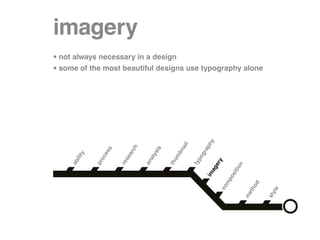
imagery
•	not always necessary in a design
•	some of the most beautiful designs use typography alone


                                                              hy
                                                   ail


                                                            ap
                             ch


                                       sis
                  ss


                                                 bn


                                                          gr
                           ar
           y


                    e


                                    aly


                                               um
      ilit


                 oc


                                                           po
                        se


                                                                ry
    ab


                                  an
               pr


                        re


                                             th


                                                         ty


                                                                              n
                                                                 e


                                                                            io
                                                              ag


                                                                        sit
                                                            im


                                                                      po
                                                                     m


                                                                                       d
                                                                                    ho
                                                                   co


                                                                                              yle
                                                                                  et


                                                                                           st
                                                                             m
composition
•	overuse of photography and illustration creates crowded, chaotic
  designs that obscures viewers from the intention and message


                                                              hy
                                                   ail


                                                            ap
                             ch


                                       sis
                  ss


                                                 bn


                                                          gr
                           ar
           y


                    e


                                    aly


                                               um
      ilit


                 oc


                                                           po
                        se


                                                                ry
    ab


                                  an
               pr


                        re


                                             th


                                                         ty


                                                                              n
                                                                 e


                                                                            io
                                                              ag


                                                                        sit
                                                            im


                                                                      po
                                                                     m


                                                                                       d
                                                                                    ho
                                                                   co


                                                                                              yle
                                                                                  et


                                                                                           st
                                                                             m
why have a method?
•	allows consistent creative process enabling you to make deadlines
  ensuring happy clients


                                                              hy
                                                   ail


                                                            ap
                             ch


                                       sis
                  ss


                                                 bn


                                                          gr
                           ar
           y


                    e


                                    aly


                                               um
      ilit


                 oc


                                                           po
                        se


                                                                ry
    ab


                                  an
               pr


                        re


                                             th


                                                         ty


                                                                              n
                                                                 e


                                                                            io
                                                              ag


                                                                        sit
                                                            im


                                                                      po
                                                                     m


                                                                                       d
                                                                                    ho
                                                                   co


                                                                                              yle
                                                                                  et


                                                                                           st
                                                                             m
establish the style
•	what’s your target audience?
•	does the type and imagery fit the style for the target audience?
•	think cultural references that appeal to the target audience


                                                              hy
                                                   ail


                                                            ap
                             ch


                                       sis
                  ss


                                                 bn


                                                          gr
                           ar
           y


                    e


                                    aly


                                               um
      ilit


                 oc


                                                           po
                        se


                                                                ry
    ab


                                  an
               pr


                        re


                                             th


                                                         ty


                                                                              n
                                                                 e


                                                                            io
                                                              ag


                                                                        sit
                                                            im


                                                                      po
                                                                     m


                                                                                       d
                                                                                    ho
                                                                   co


                                                                                              yle
                                                                                  et


                                                                                           st
                                                                             m
1
define the
design problem
•	 who?
•	 what?
•	 when?
•	 where?
•	 why?
•	 how?
2
investigate
•	 research
•	 analyse information
create your own
resources library
typefaces for all kinds of clients
www.dafont.com
stock photo libraries
www.sxc.hu (free)
colour themes, associations & meanings
swatch palette suggestions: adobe kuler
kuler.adobe.com
3
generate ideas
•	 brainstorm
•	 make lists
•	 make sketches
t
basic guidelines
for brainstorming
Brainstorming is useful for attacking specific
problems and where a collection of good,
fresh and new ideas are needed.

Brainstorming can take place either
individually or in a group of two to ten,
with four or seven being ideal.
suspend judgement
Ideas are said, no critical comment is
allowed, all ideas are written down.

“To think creatively and criticise at the same
time is like watering and pouring weed killer
onto seedlings at the same time.”
think freely
Wild, impossible, and unthinkable thoughts
are fine. Thinking outside the boundaries of
ordinary, normal thought, brilliant solutions
can arise.
tag on
Improve, modify, build on the ideas of others.
quantity of ideas
is important
Generate a large stock of ideas so that later on
they can be sifted through.
•	design scrapbook, place to dump ideas and experiment

•	develop creativity over time

•	storage for scraps/sketches and ideas that are valuable but scribbles on torn

 or otherwise occupied paper

•	non-conventional journal entries can inspire and extend creativity

 eg: painting, drawing, sketching (although it is very important not to waste too

 much time on your journal instead of your artwork)

•	entries can be easily revised and used as possible content/inspiration

 for later work

•	keeping a journal close at hand to record any unexpected ideas or thoughts

•	thumbnailing
•	 as a studio, establish
   a design scrapbook

•	 entries can be easily
   revised and used
evaluate the
design solution
•	 if steps 1-3 in the creative checklist have
   been accomplished a design solution
   will be apparent
•	 does the solution solve the design problem?
•	 does it need to be redesigned or modified?
•	 what improvements would I make?
1
Is the layout simple?
•	 Can elements of a design be removed whilst
  still getting the message across?
2
Does the layout
hold together?
•	 Test by squinting at the design.
  Is it seen as a single unified whole?
3
Does the most
important element
dominate?
•	 What catches the eye first?
4
Logical, obvious
visual flow
•	 Does eye flow from one element to the next?
•	 Quickly show the design to someone.
  What is the first thing they see?
  Is that what you want?
5
Are the graphic elements
visually balanced?
•	 Where is it heavy?
•	 Where is it light?
•	 Is the design top heavy, or the opposite?
•	 What is the item next to the heavy spot?
•	 Is that where you want the viewer
  to look next?
6
Is the space attractive?
•	 Is something too big or small?
•	 Are there holes in the layout?
•	 Does everything look eye sweet?
7
Is there white space?
•	 Is it positioned correctly?
•	 Is it balanced with the rest
  of the design elements?
8
Do the headlines
have impact?
•	 Broken correctly for quick reading?
•	 When read aloud, does it sound right?
•	 Is the illustration appropriate?
•	 Do the visuals support the personality
  of the message?
•	 Does it have a message,
  and is it the correct message?
8
Is there a
visual storyline?
•	 Is there a logical visual order, can the reader
  be comfortably led through the visual?
Thank you for
travelling with us.

Please retain your ticket
for the next boarding.
placement


eye path


           figure/ground


                       rule of thirds


                               design principles


                               design elements
design elements
colour
Has three properties: hue, intensity and value.
value
The lightness or darkness.
line
Straight, curved, thick, thin, solid, dashed,
dotted, blurred, fuzzy, etc.
shape
Lines that join.
format
A design’s relationship to its border.
texture
Flat, glossy, wet, furry, sandy, leathery, etc.
design principles
balance
The way elements are arranged.
emphasis
Dominance given to an element.
harmony
A union of aesthetically compatible elements.
movement
Produces the look of action.
movement
Produces the look of action.
pattern/rhythm
Repetition of an element.
proportion
Relationship of one part to another.
tension
Capable of causing anxiety or excitement.
unity
Combination of all elements into one whole.
variety
The use of diversity.
rule of thirds
golden section
The Fibonacci sequence is a number
sequence in which each number is the sum
of the two previous numbers. The golden
section is a measurement divided by Phi 1.618
which produces the larger of the two golden
sections.


1+1+2+3+5+8+13+21+34+55+89+144+233+377
rule of thirds
The rule of thirds states that by dividing a
design with two evenly spaced horizontal
and vertical lines to create 9 parts, the
intersections of these lines are the most
preferred focal points of a design. This is
because at these points, the eye has the best
perception of the main object in relation to the
surrounding objects.
rule of thirds
By applying the rule of thirds to your artwork,
you can stress the focal point.
figure/ground
figure/ground
The cognitive ability to separate elements.
eyepath
eyepath
The eye follows the path you create.
placement
placement
Centred.
placement
Off centre.
placement
Along an edge.
placement
Cover the whole ad.
placement
Cropped off by the format.
placement
Rotated.
Thank you for
travelling with us.

Please retain your ticket
for the next boarding.
type selection


                    image manipulation
                e
        y


              lu
   ilit


            va
 ab
ad
re
readability
readability
Using type over images effectively.
readability
readability
Placing a solid shape under type.
readability
Is it meant to be read?
value
value
Value gives emphasis to type.
value
value
image manipulation
image manipulation
Use Photoshop
image manipulation
Use inDesign
image manipulation
Use both
type selection
type selection
Type should suit the image.
type selection
type selection
Point size, leading, line length,
tracking and kerning.
Thank you for
travelling with us.

Please retain your ticket
for the next boarding.
ns              s
                                 ur
                tio            lo
             cia             co
           so             ol
         as             co                      ies
    ur                &                       on
  lo            ar
                  m                         rm
Co             W                          ha
                                     ur
                                   lo                     e          l
                                 Co                    he
                                                     rw
                                                   ou
                                                 ol
                                               ec
                                             Th                              es
                                                                         m
                                                                      he
                                                                    sc
                                                               ur
                                                             lo
                                                           co
                                                       g
                                                     in
                                              e   at
                                           Cr                           ou
                                                                          r
                                                                      ol
                                                                    fc
                                                                  eo
                                                                Us
Use of colour
Colour is one of the most important
elements of design.

It evokes emotions and has deep
psychological and cultural associations.

It is important as a designer to use these
to create an association between your client
and their target audience.
Warm      Cool
colours   colours
The colour wheel is the most basic tool for
creating harmonious colour schemes.

It can be divided into two distinct colour
schemes, cool and warm.

White, black and greys are considered
neutral colour schemes.

Colour schemes are formed in relation to
the colour’s position on the wheel.
Analogous                       Split
                            Complementary


            Complimentary
Square


Triad            Tetrad
Launceston’s largest range of pool and spa options
   128 Invermay Road, Launceston . 6300 4455
               www.prestigepools.com.au
Everything you need to get outdoors.


               Tasmania’s largest
               range of outdoor gear.
ALPINE   108 Charles St Launceston · 6326   4848
The true experience of Australia’s vast and beautiful outback.


108 Grenfell Street, Adelaide · (08) 8422 7799 · www.spinifex.com.au
want one?


e xclusi v e
autos          118 Hobart Road, Launceston · 6340 5590
                             www.exclusiveautos.com.au
hot
fun
fast
active
passion
adrenaline
attention grabbing
stimulates appetite
bright
cheerful
noticable
energetic
optimistic
imaginative
warm
gentle
informal
comforting
enthusiasm
affordable/cheap
appealing to children
calm
fertile
restful
natural
healthy
youthful
refreshing
environmental
cool
calm
serene
tranquil
relaxing
spiritual
peaceful
trustworthy
secure
dignified
confident
expensive
prestigious
dependable
professional
businesslike
regal
quality
wisdom
opulence
exclusive
luxurious
ceremonial
cute
sweet
loving
caring
tranquil
calming
feminine
romantic
strong
solemn
modern
powerful
intelligent
authoritative
sophistication
always in fashion!
security
stability
success
affluence
neutrality
professionalism
rustic
earthy
natural
mature
outdoors
wholesome
environmental
Colour associations are widely used in
developing brand identites.


natural, refreshing      fun, imaginative
strong, sophisticated, fashionable


attention grabbing, stimulates appetite, fun
Thank you for
travelling with us.

Please retain your ticket
for the next boarding.
economising space


                         space using type


         macro/micro space


whitespace                   space in design
space in design
space in design
Efficiently using space in design.
space in design
Space is added to a design to emphasize
information.
space in design
Balance
space in design
Harmony
whitespace
whitespace
Whitespace shouldn’t be considered
blank or empty space.
whitespace
Using whitespace can eliminate the chance of
a design appearing busy and cluttered.
whitespace
Using whitespace can make a design
easier to read.
macro/micro
  space
macro/micro space
Macro space is the space between major
elements in a design.
macro/micro space
Micro space is the space between smaller
elements.
macro/micro space
Using macro and/or micro space can be a
subtle way to enhance a design.
space using type
space using type
Space can be applied to a design
through the use of margins and leading.
space using type
Space can also be applied through the correct
use of type family and weight.
space using type
Type hierarchy.
economising
   space
economising space
Set up a basic grid.
economising space
Use margins.
economising space
Choose the correct point size.
economising space
Choose correct leading, kerning and tracking.
                    leading
                    Estibea dipsus que vel ipsandunt volupta volupta esequas am ut et quiae rerae molent et, voluptionse
                    nonsedione dolore voloritem auditati re audae at ad mo quidele nisque etur?
                    Conseque verum aut atiasperspid es veligen imporia ea sa sitia nullicit por re que volent, id mod maximi,
                    omnimin ulparchillor aut laut iunt, sus alis de nis perferum vendus et perem facerum quamenis aut re volupid
                    quam, audaeribus. Dus, sed magnis est, suntis consers pidelle nistrum re enihiciis alicitis expliaepra
                    coratiatiam aborepra et pressin nis nimusdae. Nem event, utatquos .

                    Estibea dipsus que vel ipsandunt volupta volupta esequas am ut et quiae rerae molent et, voluptionse
                    nonsedione dolore voloritem auditati re audae at ad mo quidele nisque etur?
                    Conseque verum aut atiasperspid es veligen imporia ea sa sitia nullicit por re que volent, id mod maximi,
                    omnimin ulparchillor aut laut iunt, sus alis de nis perferum vendus et perem facerum quamenis aut re volupid
                    quam, audaeribus. Dus, sed magnis est, suntis consers pidelle nistrum re enihiciis alicitis expliaepra
                    coratiatiam aborepra et pressin nis nimusdae. Nem event, utatquos .


                    kerning and tracking
                                             Typography
                                            Typography
                                            Typography
economising space
Crop images.
economising space
Use whitespace.
economising space
Use your creativity.
Thank you for
travelling with us.

Please retain your ticket
for the next boarding.
Index
1. Creative Thinking                                            Harmony................................................57         Forms of Colour..................................... 108
                                                                Movement..............................................58          Warm and Cool Colours........................... 109
                                                                More Movement......................................59             Cool Colour Chart................................... 110
Ability.................................................... 5
                                                                Pattern and Rhythm................................60              Prestige Pools........................................ 111
Process.................................................. 6
                                                                Proportion.............................................. 61       Alpine................................................... 112
Research	����������������������������������������������� 7
                                                                Tension..................................................62       Warm Colour Chart................................. 113
Analysis................................................. 8
                                                                Unity.....................................................63      Spinifex................................................ 114
Thumbnail.............................................. 9
                                                                Variety...................................................64      Ferrari.................................................. 115
Typography........................................... 10
                                                                Rule of Thirds.........................................65         Colour Associations................................ 116
Imagery................................................ 11
                                                                Golden Section.......................................66           Colour Associations in Western Culture..... 117
Composition.......................................... 12
                                                                Thirds Rule.............................................67        Red Colour............................................ 118
Method................................................. 13
                                                                Focal Point.............................................68        Yellow Colour......................................... 119
Style.................................................... 14
                                                                Figure and Ground..................................69             Orange Colour....................................... 120
Creative Checklist.................................. 15
                                                                Seperate Elements..................................70             Green Colour......................................... 121
Define the Design Problem...................... 16
                                                                Eyepath................................................. 71       Light Blue Colour.................................... 122
Investigate............................................ 17
                                                                Eyepath Creation....................................72            Blue Colour........................................... 123
Own Resource Library............................. 18
                                                                Placement..............................................73         Purple Colour......................................... 124
Typefaces for Clients.............................. 19
                                                                 - Centred..............................................74        Pink Colour............................................ 125
Stock Photo Library................................ 20
                                                                 - Off Centre...........................................75        Black Colour.......................................... 126
Colour Themes & Meanings..................... 21
                                                                 - Edge..................................................76       Grey Colour........................................... 127
Generate Ideas...................................... 22
                                                                 - Whole Ad............................................77         Brown Colour......................................... 128
Brainstorming........................................ 23
                                                                 - Cropped..............................................78        Colour with Brand Identity...................... 129
Basic Guidelines..................................... 24
                                                                 - Rotated..............................................79        Coca-Cola and Dolce & Gabbana.............. 130
Suspend Judgement............................... 25
                                                                 - Suica..................................................80      McDonald’s Logo Colour Comparison......... 131
Think Freely.......................................... 26
                                                                                                                                  Suica.................................................... 132
Tag On.................................................. 27
Quantity of Ideas................................... 28                         3. Images : Part Two                                                       5. Space
Resources Library.................................. 29                                                                            ........................................................... 133
Visual Diary........................................... 30      Part Two Images.....................................81            Space in Design..................................... 134
Thought Process.................................... 31          Readability.............................................82        Efficiently using Space............................ 135
Plan...................................................... 32   Type over Images....................................83            Why add Space to a Design?.................... 136
Design Scrapbook.................................. 33           I Love this Town......................................84          Balance................................................. 137
Evaluate Design..................................... 34         Solid Shape under Type...........................85               Harmony............................................... 138
Proof Reading........................................ 35        Meant to be Read....................................86            WhiteSpace........................................... 139
Simple Layout........................................ 36        Value.....................................................87      Is it Blank or Empty Space?..................... 140
Layout Hold........................................... 37       Emphasis to Type....................................88            Using Whitespace................................... 141
Dominate Element.................................. 38           Earthquake.............................................89         Whitespace with Readabilty..................... 142
Visual Flow............................................ 39      Street Edition.........................................90         Macro or Micro Space............................. 143
Visual Balance....................................... 40        Image Manipulation.................................91             Macro Space Definition........................... 144
Attractive Space.....................................41         Use Photoshop........................................92           Micro Space Definition............................ 145
Whitespace........................................... 42        Use InDesign..........................................93          Using Macro/Micro Space........................ 146
Headlines Impact................................... 43          Photoshop and InDesign combined............94                     Space Using Type................................... 147
Visual Storyline...................................... 44       Type Selection........................................95          Space, Margins and Leading.................... 148
Suica.....................................................45    Type Suit................................................96       Other ways to use Space......................... 149
                                                                                                                                  Type hierarchy....................................... 150
2. Images : Part One                                            Caulfied Race..........................................97
                                                                                                                                  Economising Space................................. 151
                                                                Point size, Leading, Line Length,................
                                                                Tracking and Kerning...............................98             Set up a basic Grid................................. 152
Part One : Images................................... 46                                                                           Use Margins........................................... 153
Design Elements..................................... 47         Suica.....................................................99
                                                                                                                                  Point Size.............................................. 154
Colour................................................... 48                            4. Colour                                 Leading, Kerning and Tracking................. 155
Value..................................................... 49   ........................................................... 100   Crop Images.......................................... 156
Line.......................................................50   Use of Colour......................................... 101        Use whitespace...................................... 157
Shape....................................................51     Colour Schemes..................................... 102           Creativity.............................................. 158
Format...................................................52     Colour Wheel......................................... 103         Suica......................................................
Texture..................................................53     Colour Deal........................................... 104                       Please retain your ticket
Design Principles.....................................54        Harmonious Colour Schemes................... 105                  for the next boarding.............................. 159
Balance..................................................55     Colour Harmonies................................... 106
Emphasis...............................................56       Colour Relationships............................... 107

Presentation

  • 1.
    DPS Training 2009 MelissaHolcombe Sarah Markland Tony Nunn Tasmanian Polytechnic and Sublime Studio
  • 2.
    programme 1. creative thinking 2. images part one 3. images part two 4. colour 5. space 6. tweaking 7. fonts 8. finishing
  • 3.
    ab ilit y pr oc e ss re se ar ch an aly sis th um bn ail ty po gr ap im hy ag e ry co m po sit io n m et ho d st yle
  • 5.
    an ability • to imagine/inventsomething new • to generate new ideas by combining, changing or reapplying existing ideas hy ail ap ch sis ss bn gr ar y e aly um ilit oc po se ry ab an pr re th ty n e io ag sit im po m d ho co yle et st m
  • 6.
    a process • creative peoplework hard, continually improving ideas and solutions • making gradual alterations and refinements hy ail ap ch sis ss bn gr ar y e aly um ilit oc po se ry ab an pr re th ty n e io ag sit im po m d ho co yle et st m
  • 7.
    research & discovery • don’tjump into a project or task without examining it • the job, big or small can benefit from research and planning • time spent on this phase is usually proportional to scope and planned duration hy ail ap ch sis ss bn gr ar y e aly um ilit oc po se ry ab an pr re th ty n e io ag sit im po m d ho co yle et st m
  • 8.
    competitive analysis • identifying strengthsand weaknesses of existing designs hy ail ap ch sis ss bn gr ar y e aly um ilit oc po se ry ab an pr re th ty n e io ag sit im po m d ho co yle et st m
  • 9.
    thumbnail sketching • thumbnails aresmall sketches • intended to capture basic ideas of page composition: header placement, column structure, text alignment • don’t be tempted to focus on small details early in the process • thumbnails are like icons for thoughts hy ail ap ch sis ss bn gr ar y e aly um ilit oc po se ry ab an pr re th ty n e io ag sit im po m d ho co yle et st m
  • 10.
    typography • typography affects theoverall formality or informality of a design hy ail ap ch sis ss bn gr ar y e aly um ilit oc po se ry ab an pr re th ty n e io ag sit im po m d ho co yle et st m
  • 11.
    imagery • not always necessaryin a design • some of the most beautiful designs use typography alone hy ail ap ch sis ss bn gr ar y e aly um ilit oc po se ry ab an pr re th ty n e io ag sit im po m d ho co yle et st m
  • 12.
    composition • overuse of photographyand illustration creates crowded, chaotic designs that obscures viewers from the intention and message hy ail ap ch sis ss bn gr ar y e aly um ilit oc po se ry ab an pr re th ty n e io ag sit im po m d ho co yle et st m
  • 13.
    why have amethod? • allows consistent creative process enabling you to make deadlines ensuring happy clients hy ail ap ch sis ss bn gr ar y e aly um ilit oc po se ry ab an pr re th ty n e io ag sit im po m d ho co yle et st m
  • 14.
    establish the style • what’syour target audience? • does the type and imagery fit the style for the target audience? • think cultural references that appeal to the target audience hy ail ap ch sis ss bn gr ar y e aly um ilit oc po se ry ab an pr re th ty n e io ag sit im po m d ho co yle et st m
  • 16.
    1 define the design problem • who? • what? • when? • where? • why? • how?
  • 17.
  • 18.
  • 19.
    typefaces for allkinds of clients www.dafont.com
  • 20.
  • 21.
    colour themes, associations& meanings swatch palette suggestions: adobe kuler kuler.adobe.com
  • 22.
    3 generate ideas • brainstorm • make lists • make sketches
  • 23.
  • 24.
    basic guidelines for brainstorming Brainstormingis useful for attacking specific problems and where a collection of good, fresh and new ideas are needed. Brainstorming can take place either individually or in a group of two to ten, with four or seven being ideal.
  • 25.
    suspend judgement Ideas aresaid, no critical comment is allowed, all ideas are written down. “To think creatively and criticise at the same time is like watering and pouring weed killer onto seedlings at the same time.”
  • 26.
    think freely Wild, impossible,and unthinkable thoughts are fine. Thinking outside the boundaries of ordinary, normal thought, brilliant solutions can arise.
  • 27.
    tag on Improve, modify,build on the ideas of others.
  • 28.
    quantity of ideas isimportant Generate a large stock of ideas so that later on they can be sifted through.
  • 31.
    • design scrapbook, placeto dump ideas and experiment • develop creativity over time • storage for scraps/sketches and ideas that are valuable but scribbles on torn or otherwise occupied paper • non-conventional journal entries can inspire and extend creativity eg: painting, drawing, sketching (although it is very important not to waste too much time on your journal instead of your artwork) • entries can be easily revised and used as possible content/inspiration for later work • keeping a journal close at hand to record any unexpected ideas or thoughts • thumbnailing
  • 33.
    • as astudio, establish a design scrapbook • entries can be easily revised and used
  • 34.
    evaluate the design solution • if steps 1-3 in the creative checklist have been accomplished a design solution will be apparent • does the solution solve the design problem? • does it need to be redesigned or modified? • what improvements would I make?
  • 36.
    1 Is the layoutsimple? • Can elements of a design be removed whilst still getting the message across?
  • 37.
    2 Does the layout holdtogether? • Test by squinting at the design. Is it seen as a single unified whole?
  • 38.
    3 Does the most importantelement dominate? • What catches the eye first?
  • 39.
    4 Logical, obvious visual flow • Does eye flow from one element to the next? • Quickly show the design to someone. What is the first thing they see? Is that what you want?
  • 40.
    5 Are the graphicelements visually balanced? • Where is it heavy? • Where is it light? • Is the design top heavy, or the opposite? • What is the item next to the heavy spot? • Is that where you want the viewer to look next?
  • 41.
    6 Is the spaceattractive? • Is something too big or small? • Are there holes in the layout? • Does everything look eye sweet?
  • 42.
    7 Is there whitespace? • Is it positioned correctly? • Is it balanced with the rest of the design elements?
  • 43.
    8 Do the headlines haveimpact? • Broken correctly for quick reading? • When read aloud, does it sound right? • Is the illustration appropriate? • Do the visuals support the personality of the message? • Does it have a message, and is it the correct message?
  • 44.
    8 Is there a visualstoryline? • Is there a logical visual order, can the reader be comfortably led through the visual?
  • 45.
    Thank you for travellingwith us. Please retain your ticket for the next boarding.
  • 46.
    placement eye path figure/ground rule of thirds design principles design elements
  • 47.
  • 48.
    colour Has three properties:hue, intensity and value.
  • 49.
  • 50.
    line Straight, curved, thick,thin, solid, dashed, dotted, blurred, fuzzy, etc.
  • 51.
  • 52.
  • 53.
    texture Flat, glossy, wet,furry, sandy, leathery, etc.
  • 54.
  • 55.
  • 56.
  • 57.
    harmony A union ofaesthetically compatible elements.
  • 58.
  • 59.
  • 60.
  • 61.
  • 62.
    tension Capable of causinganxiety or excitement.
  • 63.
    unity Combination of allelements into one whole.
  • 64.
  • 65.
  • 66.
    golden section The Fibonaccisequence is a number sequence in which each number is the sum of the two previous numbers. The golden section is a measurement divided by Phi 1.618 which produces the larger of the two golden sections. 1+1+2+3+5+8+13+21+34+55+89+144+233+377
  • 67.
    rule of thirds Therule of thirds states that by dividing a design with two evenly spaced horizontal and vertical lines to create 9 parts, the intersections of these lines are the most preferred focal points of a design. This is because at these points, the eye has the best perception of the main object in relation to the surrounding objects.
  • 68.
    rule of thirds Byapplying the rule of thirds to your artwork, you can stress the focal point.
  • 69.
  • 70.
  • 71.
  • 72.
    eyepath The eye followsthe path you create.
  • 73.
  • 74.
  • 75.
  • 76.
  • 77.
  • 78.
  • 79.
  • 80.
    Thank you for travellingwith us. Please retain your ticket for the next boarding.
  • 81.
    type selection image manipulation e y lu ilit va ab ad re
  • 82.
  • 83.
    readability Using type overimages effectively.
  • 84.
  • 85.
    readability Placing a solidshape under type.
  • 86.
  • 87.
  • 88.
  • 89.
  • 90.
  • 91.
  • 92.
  • 93.
  • 94.
  • 95.
  • 96.
  • 97.
  • 98.
    type selection Point size,leading, line length, tracking and kerning.
  • 99.
    Thank you for travellingwith us. Please retain your ticket for the next boarding.
  • 100.
    ns s ur tio lo cia co so ol as co ies ur & on lo ar m rm Co W ha ur lo e l Co he rw ou ol ec Th es m he sc ur lo co g in e at Cr ou r ol fc eo Us
  • 101.
    Use of colour Colouris one of the most important elements of design. It evokes emotions and has deep psychological and cultural associations. It is important as a designer to use these to create an association between your client and their target audience.
  • 104.
    Warm Cool colours colours
  • 105.
    The colour wheelis the most basic tool for creating harmonious colour schemes. It can be divided into two distinct colour schemes, cool and warm. White, black and greys are considered neutral colour schemes. Colour schemes are formed in relation to the colour’s position on the wheel.
  • 107.
    Analogous Split Complementary Complimentary
  • 108.
  • 111.
    Launceston’s largest rangeof pool and spa options 128 Invermay Road, Launceston . 6300 4455 www.prestigepools.com.au
  • 112.
    Everything you needto get outdoors. Tasmania’s largest range of outdoor gear. ALPINE 108 Charles St Launceston · 6326 4848
  • 114.
    The true experienceof Australia’s vast and beautiful outback. 108 Grenfell Street, Adelaide · (08) 8422 7799 · www.spinifex.com.au
  • 115.
    want one? e xclusiv e autos 118 Hobart Road, Launceston · 6340 5590 www.exclusiveautos.com.au
  • 118.
  • 119.
  • 120.
  • 121.
  • 122.
  • 123.
  • 124.
  • 125.
  • 126.
  • 127.
  • 128.
  • 129.
    Colour associations arewidely used in developing brand identites. natural, refreshing fun, imaginative
  • 130.
    strong, sophisticated, fashionable attentiongrabbing, stimulates appetite, fun
  • 132.
    Thank you for travellingwith us. Please retain your ticket for the next boarding.
  • 133.
    economising space space using type macro/micro space whitespace space in design
  • 134.
  • 135.
    space in design Efficientlyusing space in design.
  • 136.
    space in design Spaceis added to a design to emphasize information.
  • 137.
  • 138.
  • 139.
  • 140.
    whitespace Whitespace shouldn’t beconsidered blank or empty space.
  • 141.
    whitespace Using whitespace caneliminate the chance of a design appearing busy and cluttered.
  • 142.
    whitespace Using whitespace canmake a design easier to read.
  • 143.
  • 144.
    macro/micro space Macro spaceis the space between major elements in a design.
  • 145.
    macro/micro space Micro spaceis the space between smaller elements.
  • 146.
    macro/micro space Using macroand/or micro space can be a subtle way to enhance a design.
  • 147.
  • 148.
    space using type Spacecan be applied to a design through the use of margins and leading.
  • 149.
    space using type Spacecan also be applied through the correct use of type family and weight.
  • 150.
  • 151.
  • 152.
  • 153.
  • 154.
    economising space Choose thecorrect point size.
  • 155.
    economising space Choose correctleading, kerning and tracking. leading Estibea dipsus que vel ipsandunt volupta volupta esequas am ut et quiae rerae molent et, voluptionse nonsedione dolore voloritem auditati re audae at ad mo quidele nisque etur? Conseque verum aut atiasperspid es veligen imporia ea sa sitia nullicit por re que volent, id mod maximi, omnimin ulparchillor aut laut iunt, sus alis de nis perferum vendus et perem facerum quamenis aut re volupid quam, audaeribus. Dus, sed magnis est, suntis consers pidelle nistrum re enihiciis alicitis expliaepra coratiatiam aborepra et pressin nis nimusdae. Nem event, utatquos . Estibea dipsus que vel ipsandunt volupta volupta esequas am ut et quiae rerae molent et, voluptionse nonsedione dolore voloritem auditati re audae at ad mo quidele nisque etur? Conseque verum aut atiasperspid es veligen imporia ea sa sitia nullicit por re que volent, id mod maximi, omnimin ulparchillor aut laut iunt, sus alis de nis perferum vendus et perem facerum quamenis aut re volupid quam, audaeribus. Dus, sed magnis est, suntis consers pidelle nistrum re enihiciis alicitis expliaepra coratiatiam aborepra et pressin nis nimusdae. Nem event, utatquos . kerning and tracking Typography Typography Typography
  • 156.
  • 157.
  • 158.
  • 159.
    Thank you for travellingwith us. Please retain your ticket for the next boarding.
  • 160.
    Index 1. Creative Thinking Harmony................................................57 Forms of Colour..................................... 108 Movement..............................................58 Warm and Cool Colours........................... 109 More Movement......................................59 Cool Colour Chart................................... 110 Ability.................................................... 5 Pattern and Rhythm................................60 Prestige Pools........................................ 111 Process.................................................. 6 Proportion.............................................. 61 Alpine................................................... 112 Research ����������������������������������������������� 7 Tension..................................................62 Warm Colour Chart................................. 113 Analysis................................................. 8 Unity.....................................................63 Spinifex................................................ 114 Thumbnail.............................................. 9 Variety...................................................64 Ferrari.................................................. 115 Typography........................................... 10 Rule of Thirds.........................................65 Colour Associations................................ 116 Imagery................................................ 11 Golden Section.......................................66 Colour Associations in Western Culture..... 117 Composition.......................................... 12 Thirds Rule.............................................67 Red Colour............................................ 118 Method................................................. 13 Focal Point.............................................68 Yellow Colour......................................... 119 Style.................................................... 14 Figure and Ground..................................69 Orange Colour....................................... 120 Creative Checklist.................................. 15 Seperate Elements..................................70 Green Colour......................................... 121 Define the Design Problem...................... 16 Eyepath................................................. 71 Light Blue Colour.................................... 122 Investigate............................................ 17 Eyepath Creation....................................72 Blue Colour........................................... 123 Own Resource Library............................. 18 Placement..............................................73 Purple Colour......................................... 124 Typefaces for Clients.............................. 19 - Centred..............................................74 Pink Colour............................................ 125 Stock Photo Library................................ 20 - Off Centre...........................................75 Black Colour.......................................... 126 Colour Themes & Meanings..................... 21 - Edge..................................................76 Grey Colour........................................... 127 Generate Ideas...................................... 22 - Whole Ad............................................77 Brown Colour......................................... 128 Brainstorming........................................ 23 - Cropped..............................................78 Colour with Brand Identity...................... 129 Basic Guidelines..................................... 24 - Rotated..............................................79 Coca-Cola and Dolce & Gabbana.............. 130 Suspend Judgement............................... 25 - Suica..................................................80 McDonald’s Logo Colour Comparison......... 131 Think Freely.......................................... 26 Suica.................................................... 132 Tag On.................................................. 27 Quantity of Ideas................................... 28 3. Images : Part Two 5. Space Resources Library.................................. 29 ........................................................... 133 Visual Diary........................................... 30 Part Two Images.....................................81 Space in Design..................................... 134 Thought Process.................................... 31 Readability.............................................82 Efficiently using Space............................ 135 Plan...................................................... 32 Type over Images....................................83 Why add Space to a Design?.................... 136 Design Scrapbook.................................. 33 I Love this Town......................................84 Balance................................................. 137 Evaluate Design..................................... 34 Solid Shape under Type...........................85 Harmony............................................... 138 Proof Reading........................................ 35 Meant to be Read....................................86 WhiteSpace........................................... 139 Simple Layout........................................ 36 Value.....................................................87 Is it Blank or Empty Space?..................... 140 Layout Hold........................................... 37 Emphasis to Type....................................88 Using Whitespace................................... 141 Dominate Element.................................. 38 Earthquake.............................................89 Whitespace with Readabilty..................... 142 Visual Flow............................................ 39 Street Edition.........................................90 Macro or Micro Space............................. 143 Visual Balance....................................... 40 Image Manipulation.................................91 Macro Space Definition........................... 144 Attractive Space.....................................41 Use Photoshop........................................92 Micro Space Definition............................ 145 Whitespace........................................... 42 Use InDesign..........................................93 Using Macro/Micro Space........................ 146 Headlines Impact................................... 43 Photoshop and InDesign combined............94 Space Using Type................................... 147 Visual Storyline...................................... 44 Type Selection........................................95 Space, Margins and Leading.................... 148 Suica.....................................................45 Type Suit................................................96 Other ways to use Space......................... 149 Type hierarchy....................................... 150 2. Images : Part One Caulfied Race..........................................97 Economising Space................................. 151 Point size, Leading, Line Length,................ Tracking and Kerning...............................98 Set up a basic Grid................................. 152 Part One : Images................................... 46 Use Margins........................................... 153 Design Elements..................................... 47 Suica.....................................................99 Point Size.............................................. 154 Colour................................................... 48 4. Colour Leading, Kerning and Tracking................. 155 Value..................................................... 49 ........................................................... 100 Crop Images.......................................... 156 Line.......................................................50 Use of Colour......................................... 101 Use whitespace...................................... 157 Shape....................................................51 Colour Schemes..................................... 102 Creativity.............................................. 158 Format...................................................52 Colour Wheel......................................... 103 Suica...................................................... Texture..................................................53 Colour Deal........................................... 104 Please retain your ticket Design Principles.....................................54 Harmonious Colour Schemes................... 105 for the next boarding.............................. 159 Balance..................................................55 Colour Harmonies................................... 106 Emphasis...............................................56 Colour Relationships............................... 107