Utility archUnder supervision of
Prof.Dr. Ahmed el Bialy
Presented By .
Kholoud Mandour
Historical background
– Developed according to the biomechanical
principles as described by Burstone in 1977 and
refined by Ricketts for Bioprogressive therapy
– It was first developed for leveling deep curve of
spee in the mandibular arch but now it has many
other modifications and uses
Material And Dimension of
Wire
– Wire 0.016 x 0.016 or 0.016 x 0.022 in an 0.022
slot is the material of choice. It can even be
made with 0.014 or 0.018 round wires.
– They are available in three different metals:
stainless steel, Nitanium Super Elastic, and Bio-
Kinetix Thermal NiTi.
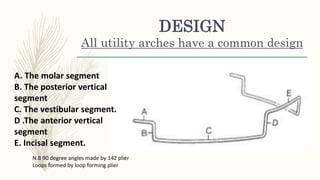
DESIGN
All utility arches have a common design
A. The molar segment
B. The posterior vertical
segment
C. The vestibular segment.
D .The anterior vertical
segment
E. Incisal segment.
N.B 90 degree angles made by 142 plier
Loops formed by loop forming plier
TYPES OF
UTILITY ARCH
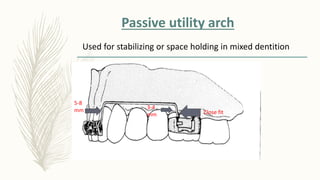
Passive utility arch
Close fit
3-4
mm
5-8
mm
Used for stabilizing or space holding in mixed dentition
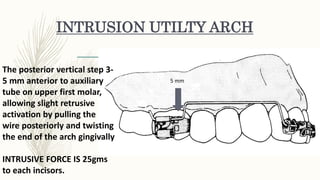
INTRUSION UTILTY ARCH
5 mm
The posterior vertical step 3-
5 mm anterior to auxiliary
tube on upper first molar,
allowing slight retrusive
activation by pulling the
wire posteriorly and twisting
the end of the arch gingivally
INTRUSIVE FORCE IS 25gms
to each incisors.
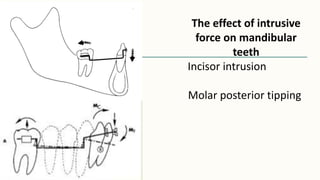
The effect of intrusive
force on mandibular
teeth
Incisor intrusion
Molar posterior tipping
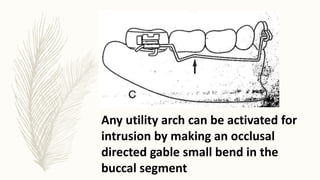
Any utility arch can be activated for
intrusion by making an occlusal
directed gable small bend in the
buccal segment
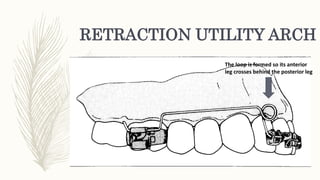
RETRACTION UTILITY ARCH
The loop is formed so its anterior
leg crosses behind the posterior leg
Uses of Retraction utility arch
a. Retraction and intrusion of upper
incisors in case of flaring
b. Closure of interproximal spaces
c. Correcting midline discrepancies
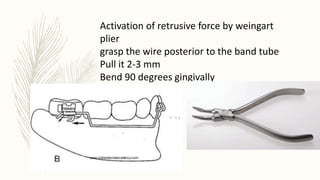
Activation of retrusive force by weingart
plier
grasp the wire posterior to the band tube
Pull it 2-3 mm
Bend 90 degrees gingivally
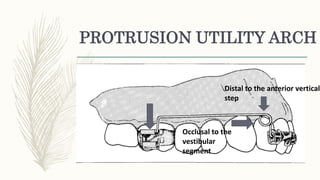
PROTRUSION UTILITY ARCH
Distal to the anterior vertical
step
Occlusal to the
vestibular
segment
Activation of protusive forces
Bending the posterior vertical step
forward instead of 90 to 45 degrees
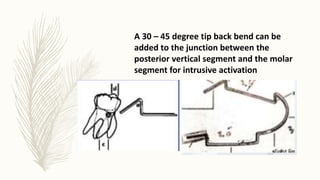
A 30 – 45 degree tip back bend can be
added to the junction between the
posterior vertical segment and the molar
segment for intrusive activation

Utility arch

  • 1.
    Utility archUnder supervisionof Prof.Dr. Ahmed el Bialy Presented By . Kholoud Mandour
  • 2.
    Historical background – Developedaccording to the biomechanical principles as described by Burstone in 1977 and refined by Ricketts for Bioprogressive therapy – It was first developed for leveling deep curve of spee in the mandibular arch but now it has many other modifications and uses
  • 3.
    Material And Dimensionof Wire – Wire 0.016 x 0.016 or 0.016 x 0.022 in an 0.022 slot is the material of choice. It can even be made with 0.014 or 0.018 round wires. – They are available in three different metals: stainless steel, Nitanium Super Elastic, and Bio- Kinetix Thermal NiTi.
  • 4.
    DESIGN All utility archeshave a common design A. The molar segment B. The posterior vertical segment C. The vestibular segment. D .The anterior vertical segment E. Incisal segment. N.B 90 degree angles made by 142 plier Loops formed by loop forming plier
  • 5.
  • 6.
    Passive utility arch Closefit 3-4 mm 5-8 mm Used for stabilizing or space holding in mixed dentition
  • 7.
    INTRUSION UTILTY ARCH 5mm The posterior vertical step 3- 5 mm anterior to auxiliary tube on upper first molar, allowing slight retrusive activation by pulling the wire posteriorly and twisting the end of the arch gingivally INTRUSIVE FORCE IS 25gms to each incisors.
  • 8.
    The effect ofintrusive force on mandibular teeth Incisor intrusion Molar posterior tipping
  • 9.
    Any utility archcan be activated for intrusion by making an occlusal directed gable small bend in the buccal segment
  • 10.
    RETRACTION UTILITY ARCH Theloop is formed so its anterior leg crosses behind the posterior leg
  • 11.
    Uses of Retractionutility arch a. Retraction and intrusion of upper incisors in case of flaring b. Closure of interproximal spaces c. Correcting midline discrepancies
  • 12.
    Activation of retrusiveforce by weingart plier grasp the wire posterior to the band tube Pull it 2-3 mm Bend 90 degrees gingivally
  • 13.
    PROTRUSION UTILITY ARCH Distalto the anterior vertical step Occlusal to the vestibular segment
  • 14.
    Activation of protusiveforces Bending the posterior vertical step forward instead of 90 to 45 degrees
  • 15.
    A 30 –45 degree tip back bend can be added to the junction between the posterior vertical segment and the molar segment for intrusive activation