Masking and its Types
by
Kavindra krishna
Research Scholar
AMU
Department of Electronics Engineering
1
Topics
• What is Masking
• Types of Masking
• Some special definition used in Masking
• Measuring of Masking curves
• Model for spreading of Masking
• Summary
• Refrences
2
What is Masking
• It is a process to make, weaker signal
inaudible, in the presence of louder signal.[7]
Louder signal = Masker
Weaker signal = Maskee
• Also we can say that-Masking of soft sound by
louder ones.[7]
• Masking basically a part of our everyday
experience.[7]
3
Example of Masking
• Suppose that, if we are engaged in a
conversation while walking on the street, we
typically cease conversation when a loud truck
passes, since we are not able to hear speech
over the truck noise.
this can be seen as an example of
masking. Here-
Truck sound = Masker
Conversation = Maskee
4
Types of Masking
• Two types of Masking[7,5]
– Simultaneous Masking
• Also called as frequency masking
– Non-simultaneous Masking
• Also called as temporal masking
5
Simultaneous Masking
• When both masker and maskee occurs at ,same time/close in frequency,
and it is no longer possible to hear the normally audible maskee, then this
phenomenon is called simultaneous or frequency masking.[5]
6
Temporal Masking
• Also called it as,Non-simultaneous masking
• Because the masker and maskee sound are not
present simultaneously.[4,5,7]
7
Temporal Masking(Con’d)
• Example
– If we hear a very loud sound then it stops and our
ear feel a little time gap , to hear a near by soft
tone.
– Such as thunder sound.
8
Temporal Masking(Con’d)
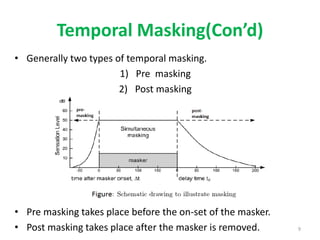
• Generally two types of temporal masking.
1) Pre masking
2) Post masking
• Pre masking takes place before the on-set of the masker.
• Post masking takes place after the masker is removed. 9
Pre masking
• Pre-masking is some what an unexpected
phenomenon since it takes place before the
masker is switched on.
• Basically an important issue in the design of
perceptual audio codecs because of reducing the
effect of pre-eco or pre-noise.
• This effect taken into consideration when dealing
with design of audio coding system, in terms of
psychoacoustic model and analysis/synthesis
signal adaptive filter design.
10
Post Masking
• Well defined and not an unexpected phenomenon.
• Post masking is a clear cut example of temporal
masking.
11
Some Special Definition
S tore lots of lo vely
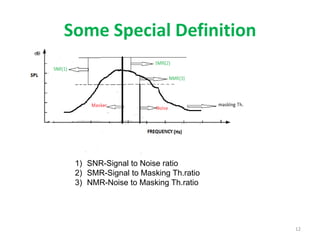
1) SNR-Signal to Noise ratio
2) SMR-Signal to Masking Th.ratio
3) NMR-Noise to Masking Th.ratio
12
Measuring of Masking Curves
• Basically of 3 types of masking curve
measurement :
1) Narrow band noise Masking Tone(NMT).
2) Tone Masking Tone(TMT).
3) Narrow band Noise or Tone Masking Narrow
band Noise(TMN).
13
1) Narrow band noise masking tone
Masker = Narrow band Noise
Maskee = Tone
• Narrow band means signal bandwidth is less than or equal to
bandwidth of critical band(CB).
• The masking Th.for narrow band noise centred at 1kHz is
shown for different masker SPL’s-[05]
14
NMT(Con’d)
Observation :-
1) At frequency lower than the masker , each of
the measured masking curve has a very steep
slope(that seems to be independent of the
masker SPL ).
2) But at the same, if we see towards higher
frequency than slope gets shallower but under
the condition is that if masking level is increases.
3) Minimum SMR 3dB , stay constant around
for all levels.[5,1,6]
15
2) Tone Masking Tone(TMT)
Masker = Tone
Maskee = Tone
• The masking Th.for tone centred at 1kHz is shown for
different masker SPL’s-[05]
16
TMT(Con’d)
Observation :-
1) greater spreading of masking curves towards
lower frequency than higher frequency, when
masking level is low (at maximum SPL = 50dB).
2) The situation gets reversed , when we increases
the masking level (greater than 50dB) means
greater spreading towards high frequency.
3) Minimum SMR 15dB , it is larger than, in the
experiment of NMT
so implication seems to be that, Noise is a
better masker than tone .[2][1][6][5] 17
TMT(Con’d)
• This concept is known as Asymmetry of Masking.[5]
18
3) Narrow band noise or Tone
Masking Narrow band noise(TMN)
Masker = Narrow band Noise/Tone
Maskee = Narrow band Noise
• According to Hall[03], if masker is wide band
noise,then minimum SMR of about 26dB.
• According to Early & Zwicker[04] suggest that,the
minimum SMR level in between 20-30dB,if masker
signal is Narrow band Noise/Tone masked the
Narrow band Noise.
19
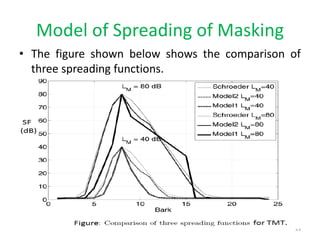
Model of Spreading of Masking
• Spreading of masking , determines the shape of
masking pattern of a masker to the lower frequency
and to the higher frequency of the masker.
• These spreading/curves are much simpler, when
describe on Bark-scale.
 bark scale converts the non-linear scale into
Linear scale.
• The very first model for spreading function(SF(Δz)), is
proposed by schroder[119]-
20
Model of Spreading of Masking
where
= difference in bark scale between masker &
maskee.
• The beauty of this model is,it is independent of
masker level (LM ).
• The 2nd spreading function (SF(Δz)) is known as
MODEL-2[53],proposed by ISO/IEC.
 this is basically derived from schroeder spreading function.
21
Model of Spreading of Masking
• The 3rd spreading function (SF(Δz)) is known as
MODEL-1[53],proposed by ISO/IEC.
 This model depend upon masker level (LM).
22
Model of Spreading of Masking
• The figure shown below shows the comparison of
three spreading functions.
23
Summary
• In this talk, the Masking has been discussed including
two types of masking, i.e. simultaneous and
temporal masking, have been reviewed. Two masker
types have been described in case of simultaneous
masking, including narrow-band noise and pure tone
maskers. Moreover, several models of the spreading
of masking have been examined.
24
References
[1] B. Moore, J. Alcantara, and T. Dau, “Masking patterns for sinusoidal and narrowband noise maskers,”
Journal of the Acoustical Society of America, vol. 104, pp. 1023–1038, August 1998. 19
[2] J. Alcantara, B. Moore, and D. Vickers, “The relative role of beats and combination tones in determining the
shapes of masking patterns at 2 kHz: I. Normal-hearing listeners,” Hearing Research, vol. 148, pp. 63–73,
October 2000. 09.
[3] J. Hall, “Auditory Psychophysics for Coding Applications,” in The Digital Signal Processing Handbook (V. M.
Williams and D., eds.), pp. 39.1–39.25, CRC Press, 1998. 21
[4] M. R. Schroeder, B. S. Atal, and J. L. Hall, “Optimizing digital speech coders by exploiting masking
properties of the human ear,” Journal of Acoustic Society of America, vol. 66, pp. 1647–1652, December 1979.
1, 21, 118
[5] E. Zwicker and H. Fastl, Psychoacoutics: Facts and Models. Berlin, Germany: Springer-Verlag, 1999. vii,
xii, 2, 16, 17, 18, 19, 20, 21, 26, 128, 141
[6] B. C. J. Moore, An Introduction to the Psychology of Hearing 5th Edition. Academic Press, 2003. vii, 2,
11, 12, 14, 17, 19, 21, 24, 25, 58, 128.
[7] Wia.C.Chu, Speech coding algorithm : foundation and evoluation of standardized coders 5th Edition.
Academic Press, 2003. vii, 21,22,23, 24, 25,26,27,28, 58, 128.
25
References
[8] ISO/IEC/JTC1, “IS11172-3 (MPEG-1), Coding of moving pictures and associated audio for digital storage
media at up to about 1.5 Mbit/s, Part 3: Audio,” ISO/IEC, 1991. 2, 21, 22, 36, 41, 42, 58, 64, 80, 83.
[9] M. R. Schroeder, B. S. Atal, and J. L. Hall, “Optimizing digital speech coders by exploiting masking properties
of the human ear,” Journal of Acoustic Society of America, vol. 66, pp. 1647–1652, December 1979. 1, 21, 118.
26
Thank-You
27

Masking and its type

  • 1.
    Masking and itsTypes by Kavindra krishna Research Scholar AMU Department of Electronics Engineering 1
  • 2.
    Topics • What isMasking • Types of Masking • Some special definition used in Masking • Measuring of Masking curves • Model for spreading of Masking • Summary • Refrences 2
  • 3.
    What is Masking •It is a process to make, weaker signal inaudible, in the presence of louder signal.[7] Louder signal = Masker Weaker signal = Maskee • Also we can say that-Masking of soft sound by louder ones.[7] • Masking basically a part of our everyday experience.[7] 3
  • 4.
    Example of Masking •Suppose that, if we are engaged in a conversation while walking on the street, we typically cease conversation when a loud truck passes, since we are not able to hear speech over the truck noise. this can be seen as an example of masking. Here- Truck sound = Masker Conversation = Maskee 4
  • 5.
    Types of Masking •Two types of Masking[7,5] – Simultaneous Masking • Also called as frequency masking – Non-simultaneous Masking • Also called as temporal masking 5
  • 6.
    Simultaneous Masking • Whenboth masker and maskee occurs at ,same time/close in frequency, and it is no longer possible to hear the normally audible maskee, then this phenomenon is called simultaneous or frequency masking.[5] 6
  • 7.
    Temporal Masking • Alsocalled it as,Non-simultaneous masking • Because the masker and maskee sound are not present simultaneously.[4,5,7] 7
  • 8.
    Temporal Masking(Con’d) • Example –If we hear a very loud sound then it stops and our ear feel a little time gap , to hear a near by soft tone. – Such as thunder sound. 8
  • 9.
    Temporal Masking(Con’d) • Generallytwo types of temporal masking. 1) Pre masking 2) Post masking • Pre masking takes place before the on-set of the masker. • Post masking takes place after the masker is removed. 9
  • 10.
    Pre masking • Pre-maskingis some what an unexpected phenomenon since it takes place before the masker is switched on. • Basically an important issue in the design of perceptual audio codecs because of reducing the effect of pre-eco or pre-noise. • This effect taken into consideration when dealing with design of audio coding system, in terms of psychoacoustic model and analysis/synthesis signal adaptive filter design. 10
  • 11.
    Post Masking • Welldefined and not an unexpected phenomenon. • Post masking is a clear cut example of temporal masking. 11
  • 12.
    Some Special Definition Store lots of lo vely 1) SNR-Signal to Noise ratio 2) SMR-Signal to Masking Th.ratio 3) NMR-Noise to Masking Th.ratio 12
  • 13.
    Measuring of MaskingCurves • Basically of 3 types of masking curve measurement : 1) Narrow band noise Masking Tone(NMT). 2) Tone Masking Tone(TMT). 3) Narrow band Noise or Tone Masking Narrow band Noise(TMN). 13
  • 14.
    1) Narrow bandnoise masking tone Masker = Narrow band Noise Maskee = Tone • Narrow band means signal bandwidth is less than or equal to bandwidth of critical band(CB). • The masking Th.for narrow band noise centred at 1kHz is shown for different masker SPL’s-[05] 14
  • 15.
    NMT(Con’d) Observation :- 1) Atfrequency lower than the masker , each of the measured masking curve has a very steep slope(that seems to be independent of the masker SPL ). 2) But at the same, if we see towards higher frequency than slope gets shallower but under the condition is that if masking level is increases. 3) Minimum SMR 3dB , stay constant around for all levels.[5,1,6] 15
  • 16.
    2) Tone MaskingTone(TMT) Masker = Tone Maskee = Tone • The masking Th.for tone centred at 1kHz is shown for different masker SPL’s-[05] 16
  • 17.
    TMT(Con’d) Observation :- 1) greaterspreading of masking curves towards lower frequency than higher frequency, when masking level is low (at maximum SPL = 50dB). 2) The situation gets reversed , when we increases the masking level (greater than 50dB) means greater spreading towards high frequency. 3) Minimum SMR 15dB , it is larger than, in the experiment of NMT so implication seems to be that, Noise is a better masker than tone .[2][1][6][5] 17
  • 18.
    TMT(Con’d) • This conceptis known as Asymmetry of Masking.[5] 18
  • 19.
    3) Narrow bandnoise or Tone Masking Narrow band noise(TMN) Masker = Narrow band Noise/Tone Maskee = Narrow band Noise • According to Hall[03], if masker is wide band noise,then minimum SMR of about 26dB. • According to Early & Zwicker[04] suggest that,the minimum SMR level in between 20-30dB,if masker signal is Narrow band Noise/Tone masked the Narrow band Noise. 19
  • 20.
    Model of Spreadingof Masking • Spreading of masking , determines the shape of masking pattern of a masker to the lower frequency and to the higher frequency of the masker. • These spreading/curves are much simpler, when describe on Bark-scale.  bark scale converts the non-linear scale into Linear scale. • The very first model for spreading function(SF(Δz)), is proposed by schroder[119]- 20
  • 21.
    Model of Spreadingof Masking where = difference in bark scale between masker & maskee. • The beauty of this model is,it is independent of masker level (LM ). • The 2nd spreading function (SF(Δz)) is known as MODEL-2[53],proposed by ISO/IEC.  this is basically derived from schroeder spreading function. 21
  • 22.
    Model of Spreadingof Masking • The 3rd spreading function (SF(Δz)) is known as MODEL-1[53],proposed by ISO/IEC.  This model depend upon masker level (LM). 22
  • 23.
    Model of Spreadingof Masking • The figure shown below shows the comparison of three spreading functions. 23
  • 24.
    Summary • In thistalk, the Masking has been discussed including two types of masking, i.e. simultaneous and temporal masking, have been reviewed. Two masker types have been described in case of simultaneous masking, including narrow-band noise and pure tone maskers. Moreover, several models of the spreading of masking have been examined. 24
  • 25.
    References [1] B. Moore,J. Alcantara, and T. Dau, “Masking patterns for sinusoidal and narrowband noise maskers,” Journal of the Acoustical Society of America, vol. 104, pp. 1023–1038, August 1998. 19 [2] J. Alcantara, B. Moore, and D. Vickers, “The relative role of beats and combination tones in determining the shapes of masking patterns at 2 kHz: I. Normal-hearing listeners,” Hearing Research, vol. 148, pp. 63–73, October 2000. 09. [3] J. Hall, “Auditory Psychophysics for Coding Applications,” in The Digital Signal Processing Handbook (V. M. Williams and D., eds.), pp. 39.1–39.25, CRC Press, 1998. 21 [4] M. R. Schroeder, B. S. Atal, and J. L. Hall, “Optimizing digital speech coders by exploiting masking properties of the human ear,” Journal of Acoustic Society of America, vol. 66, pp. 1647–1652, December 1979. 1, 21, 118 [5] E. Zwicker and H. Fastl, Psychoacoutics: Facts and Models. Berlin, Germany: Springer-Verlag, 1999. vii, xii, 2, 16, 17, 18, 19, 20, 21, 26, 128, 141 [6] B. C. J. Moore, An Introduction to the Psychology of Hearing 5th Edition. Academic Press, 2003. vii, 2, 11, 12, 14, 17, 19, 21, 24, 25, 58, 128. [7] Wia.C.Chu, Speech coding algorithm : foundation and evoluation of standardized coders 5th Edition. Academic Press, 2003. vii, 21,22,23, 24, 25,26,27,28, 58, 128. 25
  • 26.
    References [8] ISO/IEC/JTC1, “IS11172-3(MPEG-1), Coding of moving pictures and associated audio for digital storage media at up to about 1.5 Mbit/s, Part 3: Audio,” ISO/IEC, 1991. 2, 21, 22, 36, 41, 42, 58, 64, 80, 83. [9] M. R. Schroeder, B. S. Atal, and J. L. Hall, “Optimizing digital speech coders by exploiting masking properties of the human ear,” Journal of Acoustic Society of America, vol. 66, pp. 1647–1652, December 1979. 1, 21, 118. 26
  • 27.