Scientfc thinking with computatonal skills
Developing an undergraduate bioinformatcs course
Kate L Hertweck, Ph.D, Department of Biology, The University of Texas at Tyler
ABSTRACT
A challenge for undergraduate science educators is
meetng increasing demands for students to handle,
analyze, and interpret large-scale biological data.
Bioinformatcs (BIOL 4306/4106) is a newly developed
course being taught in spring 2015 through the
Department of Biology. During the lecture and lab,
students are taught how to integrate biological content
knowledge with computatonal methods. The use of
technology and focus on critcal scientfc thinking make
the class challenging but tractable for students from a
variety of educatonal backgrounds. Assessments are
designed to help students develop practcal,
transferable skills they can apply to a variety of
professions.
IMPLEMENTATION
●
Lecture highlights concepts and theory related to
analysis of large biological datasets, like from
genomic sequencing projects.
●
Lab focuses on technical skills, like implementng
computer code and statstcal analyses, to solve
problems.
●
Assessment is based on homework and projects,
rather than exams, to focus on applicaton of skills.
●
All materials developed for lab are publicly available:
htps://github.com/BioinformatcsSpring2015
●
Another new class, Bioinformatcs for Research, will
be ofered in Fall 2015 to assist Biology graduate
students in performing scientfc research.
●
Describe the scope of bioinformatcs research and
applicatons
●
Design and implement bioinformatcs pipelines to answer
pre-defned questons from a variety of biological
disciplines
●
Validate results from bioinformatcs algorithms using
hypothesis testng, correctng for multple comparisons,
etc.
●
Characterize the limitatons of data to answer questons
of interests
●
Obtain resources to learn new languages and algorithms
●
Code basic scripts to accomplish the goals above
COURSE OBJECTIVES COURSE CURRICULUM SUMMARY
Bioinformatcs Framework: fundamental skills
and knowledge for analyzing biological data
●
Data in biology
●
Workfows and pipelines
●
Statstcal inference
●
Data visualizaton
Applied Bioinformatcs: general topics that apply
learning from Bioinformatcs Framework
●
Sequence searching
●
Phylogenetcs and clustering
●
Genome assembly
●
Comparatve genomics
PRE-CLASS SURVEY RESULTS
●
All students were biology majors
●
All students agreed (strongly or moderately) that
they wanted to improve their data analysis
capabilites
●
Some students had previous experience with
computer programming.
●
Most students believed computatonal skills
would be important to their future careers
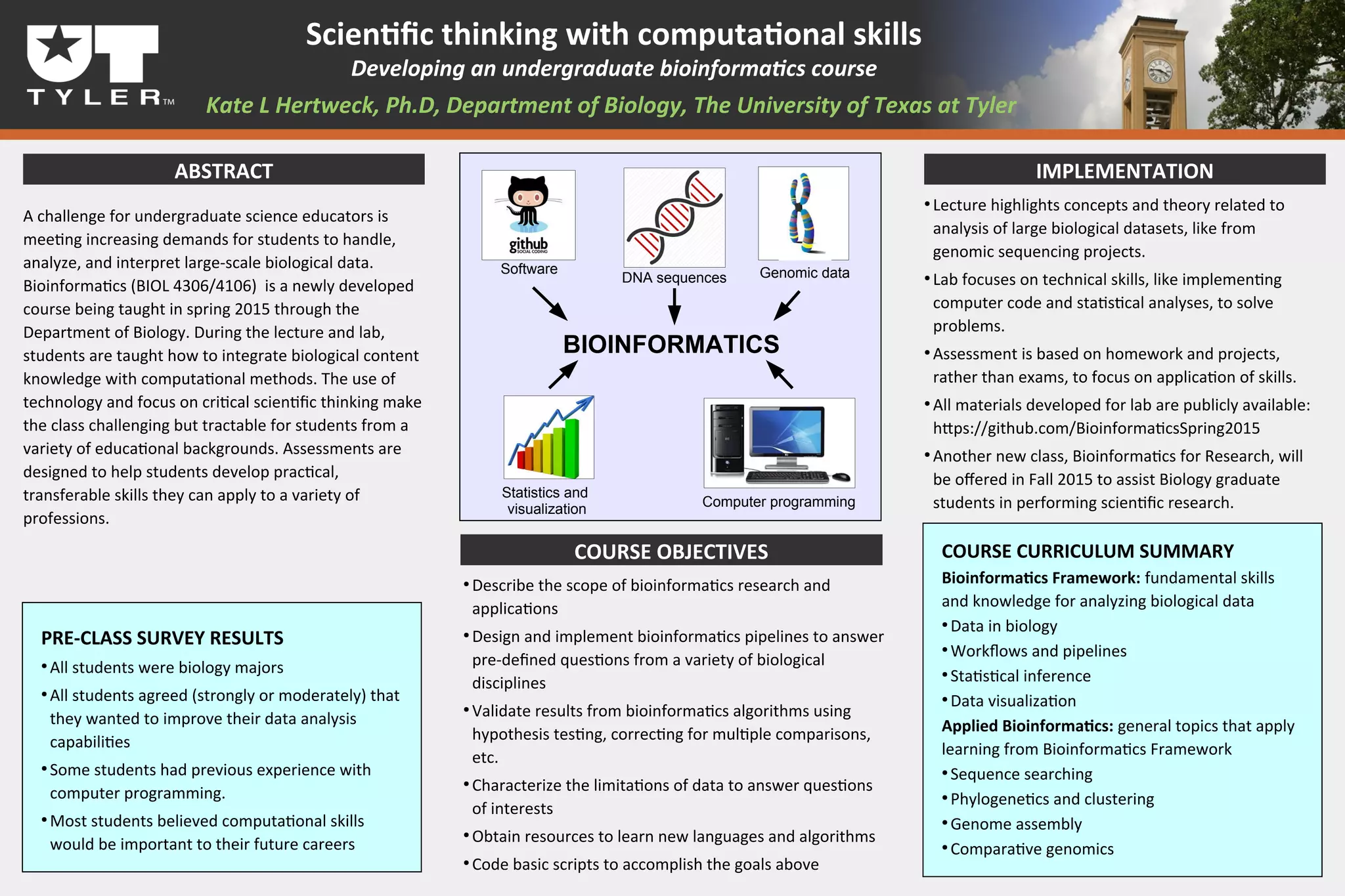
BIOINFORMATICS
Software
DNA sequences Genomic data
Computer programming
Statistics and
visualization

Developing an undergraduate bioinformatics course

  • 1.
    Scientfc thinking withcomputatonal skills Developing an undergraduate bioinformatcs course Kate L Hertweck, Ph.D, Department of Biology, The University of Texas at Tyler ABSTRACT A challenge for undergraduate science educators is meetng increasing demands for students to handle, analyze, and interpret large-scale biological data. Bioinformatcs (BIOL 4306/4106) is a newly developed course being taught in spring 2015 through the Department of Biology. During the lecture and lab, students are taught how to integrate biological content knowledge with computatonal methods. The use of technology and focus on critcal scientfc thinking make the class challenging but tractable for students from a variety of educatonal backgrounds. Assessments are designed to help students develop practcal, transferable skills they can apply to a variety of professions. IMPLEMENTATION ● Lecture highlights concepts and theory related to analysis of large biological datasets, like from genomic sequencing projects. ● Lab focuses on technical skills, like implementng computer code and statstcal analyses, to solve problems. ● Assessment is based on homework and projects, rather than exams, to focus on applicaton of skills. ● All materials developed for lab are publicly available: htps://github.com/BioinformatcsSpring2015 ● Another new class, Bioinformatcs for Research, will be ofered in Fall 2015 to assist Biology graduate students in performing scientfc research. ● Describe the scope of bioinformatcs research and applicatons ● Design and implement bioinformatcs pipelines to answer pre-defned questons from a variety of biological disciplines ● Validate results from bioinformatcs algorithms using hypothesis testng, correctng for multple comparisons, etc. ● Characterize the limitatons of data to answer questons of interests ● Obtain resources to learn new languages and algorithms ● Code basic scripts to accomplish the goals above COURSE OBJECTIVES COURSE CURRICULUM SUMMARY Bioinformatcs Framework: fundamental skills and knowledge for analyzing biological data ● Data in biology ● Workfows and pipelines ● Statstcal inference ● Data visualizaton Applied Bioinformatcs: general topics that apply learning from Bioinformatcs Framework ● Sequence searching ● Phylogenetcs and clustering ● Genome assembly ● Comparatve genomics PRE-CLASS SURVEY RESULTS ● All students were biology majors ● All students agreed (strongly or moderately) that they wanted to improve their data analysis capabilites ● Some students had previous experience with computer programming. ● Most students believed computatonal skills would be important to their future careers BIOINFORMATICS Software DNA sequences Genomic data Computer programming Statistics and visualization