EC-TEL 2015, Toledo
Developing Mathematical Thinking with Scratch
An Experiment with 6th Grade Students
Luis Alberto Calao, Jes´us Moreno Le´on, Heidy Ester Correa,
Gregorio Robles
jesus.moreno@programamos.es, grex@gsyc.urjc.es
GSyC/Libresoft, Universidad Rey Juan Carlos
EC-TEL 2015, Toledo
Luis Alberto Calao, Jes´us Moreno Le´on, Heidy Ester Correa, Gregorio RoblesDeveloping Mathematical Thinking with Scratch
EC-TEL 2015, Toledo
(cc) 2015 Gregorio Robles and Jes´us Moreno Le´on
Some rights reserved. This work licensed under Creative Commons
Attribution-ShareAlike License. To view a copy of full license, see
http://creativecommons.org/licenses/by-sa/3.0/ or write to
Creative Commons, 559 Nathan Abbott Way, Stanford,
California 94305, USA.
Some of the figures have been taken from the Internet
Source, and author and licence if known, is specified.
For those images, fair use applies.
Luis Alberto Calao, Jes´us Moreno Le´on, Heidy Ester Correa, Gregorio RoblesDeveloping Mathematical Thinking with Scratch
EC-TEL 2015, Toledo
Goal of our paper
Does the use of
programming with Scratch
in math classes improve
students’ learning
outcomes?
Luis Alberto Calao, Jes´us Moreno Le´on, Heidy Ester Correa, Gregorio RoblesDeveloping Mathematical Thinking with Scratch
EC-TEL 2015, Toledo
Colombian students and maths
PISA 2012 results
376 points in maths (OECD countries average: 494)
Ranked 61st (out of 65 participating countries)
Students showed high levels of anxiety towards maths
Luis Alberto Calao, Jes´us Moreno Le´on, Heidy Ester Correa, Gregorio RoblesDeveloping Mathematical Thinking with Scratch
EC-TEL 2015, Toledo
Code to learn (I)
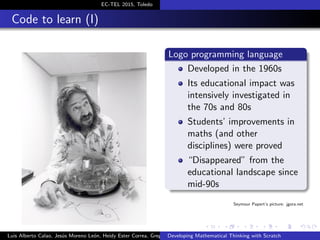
Logo programming language
Developed in the 1960s
Its educational impact was
intensively investigated in
the 70s and 80s
Students’ improvements in
maths (and other
disciplines) were proved
“Disappeared” from the
educational landscape since
mid-90s
Seymour Papert’s picture: jgora.net
Luis Alberto Calao, Jes´us Moreno Le´on, Heidy Ester Correa, Gregorio RoblesDeveloping Mathematical Thinking with Scratch
EC-TEL 2015, Toledo
Code to learn (and II)
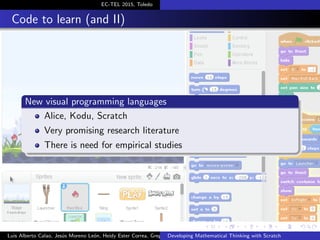
New visual programming languages
Alice, Kodu, Scratch
Very promising research literature
There is need for empirical studies
Luis Alberto Calao, Jes´us Moreno Le´on, Heidy Ester Correa, Gregorio RoblesDeveloping Mathematical Thinking with Scratch
EC-TEL 2015, Toledo
The study
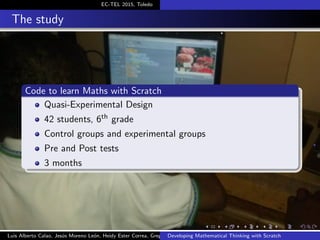
Code to learn Maths with Scratch
Quasi-Experimental Design
42 students, 6th grade
Control groups and experimental groups
Pre and Post tests
3 months
Luis Alberto Calao, Jes´us Moreno Le´on, Heidy Ester Correa, Gregorio RoblesDeveloping Mathematical Thinking with Scratch
EC-TEL 2015, Toledo
Mathematical processes investigated
Rubric
Modeling of processes and reality phenomena
Reasoning (making predictions and justifying
arguments)
Problem formulation and problem solving
Exercising (comparison and execution of
procedures and algorithms)
Following guidelines set by the Ministry of
National Education of Colombia
Luis Alberto Calao, Jes´us Moreno Le´on, Heidy Ester Correa, Gregorio RoblesDeveloping Mathematical Thinking with Scratch
EC-TEL 2015, Toledo
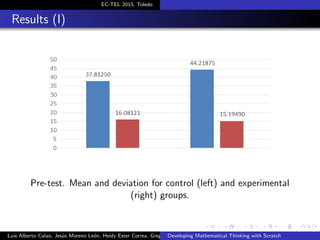
Results (I)
Pre-test. Mean and deviation for control (left) and experimental
(right) groups.
Luis Alberto Calao, Jes´us Moreno Le´on, Heidy Ester Correa, Gregorio RoblesDeveloping Mathematical Thinking with Scratch
EC-TEL 2015, Toledo
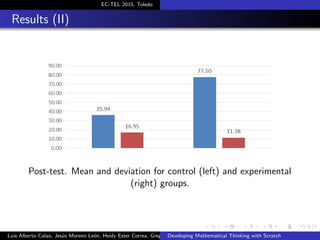
Results (II)
Post-test. Mean and deviation for control (left) and experimental
(right) groups.
Luis Alberto Calao, Jes´us Moreno Le´on, Heidy Ester Correa, Gregorio RoblesDeveloping Mathematical Thinking with Scratch
EC-TEL 2015, Toledo
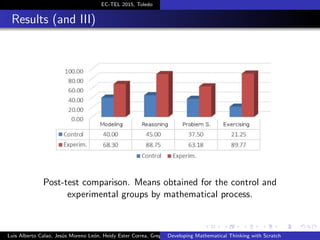
Results (and III)
Post-test comparison. Means obtained for the control and
experimental groups by mathematical process.
Luis Alberto Calao, Jes´us Moreno Le´on, Heidy Ester Correa, Gregorio RoblesDeveloping Mathematical Thinking with Scratch
EC-TEL 2015, Toledo
Conclusions
The development of CT using Scratch allows students of
primary education to improve their performance in terms of
mathematical processes of modeling, reasoning, problem
solving and exercising.
(At least some parts of) the math curriculum in Colombian
schools does not help in developing these skills.
Math learning at schools seems to be more focused on the
internals of mathematics, rather than on acquiring skills to
use math-based knowledge.
Luis Alberto Calao, Jes´us Moreno Le´on, Heidy Ester Correa, Gregorio RoblesDeveloping Mathematical Thinking with Scratch
EC-TEL 2015, Toledo
Future Work
1 Does computer programming foster reading and writing skills?
2 Programming with Scratch as an educational tool in different
subjects (social studies, language arts) and grades.
3 OK, but do the students really learn to code and develop
computational thinking?
Background picture: Simon Cunningham
Luis Alberto Calao, Jes´us Moreno Le´on, Heidy Ester Correa, Gregorio RoblesDeveloping Mathematical Thinking with Scratch
EC-TEL 2015, Toledo
Future Work
Luis Alberto Calao, Jes´us Moreno Le´on, Heidy Ester Correa, Gregorio RoblesDeveloping Mathematical Thinking with Scratch
EC-TEL 2015, Toledo
Developing Mathematical Thinking with Scratch
An Experiment with 6th Grade Students
Luis Alberto Calao, Jes´us Moreno Le´on, Heidy Ester Correa,
Gregorio Robles
jesus.moreno@programamos.es, grex@gsyc.urjc.es
GSyC/Libresoft, Universidad Rey Juan Carlos
EC-TEL 2015, Toledo
Luis Alberto Calao, Jes´us Moreno Le´on, Heidy Ester Correa, Gregorio RoblesDeveloping Mathematical Thinking with Scratch

Developing Mathematical Thinking with Scratch: An Experiment with 6th Grade Students

  • 1.
    EC-TEL 2015, Toledo DevelopingMathematical Thinking with Scratch An Experiment with 6th Grade Students Luis Alberto Calao, Jes´us Moreno Le´on, Heidy Ester Correa, Gregorio Robles jesus.moreno@programamos.es, grex@gsyc.urjc.es GSyC/Libresoft, Universidad Rey Juan Carlos EC-TEL 2015, Toledo Luis Alberto Calao, Jes´us Moreno Le´on, Heidy Ester Correa, Gregorio RoblesDeveloping Mathematical Thinking with Scratch
  • 2.
    EC-TEL 2015, Toledo (cc)2015 Gregorio Robles and Jes´us Moreno Le´on Some rights reserved. This work licensed under Creative Commons Attribution-ShareAlike License. To view a copy of full license, see http://creativecommons.org/licenses/by-sa/3.0/ or write to Creative Commons, 559 Nathan Abbott Way, Stanford, California 94305, USA. Some of the figures have been taken from the Internet Source, and author and licence if known, is specified. For those images, fair use applies. Luis Alberto Calao, Jes´us Moreno Le´on, Heidy Ester Correa, Gregorio RoblesDeveloping Mathematical Thinking with Scratch
  • 3.
    EC-TEL 2015, Toledo Goalof our paper Does the use of programming with Scratch in math classes improve students’ learning outcomes? Luis Alberto Calao, Jes´us Moreno Le´on, Heidy Ester Correa, Gregorio RoblesDeveloping Mathematical Thinking with Scratch
  • 4.
    EC-TEL 2015, Toledo Colombianstudents and maths PISA 2012 results 376 points in maths (OECD countries average: 494) Ranked 61st (out of 65 participating countries) Students showed high levels of anxiety towards maths Luis Alberto Calao, Jes´us Moreno Le´on, Heidy Ester Correa, Gregorio RoblesDeveloping Mathematical Thinking with Scratch
  • 5.
    EC-TEL 2015, Toledo Codeto learn (I) Logo programming language Developed in the 1960s Its educational impact was intensively investigated in the 70s and 80s Students’ improvements in maths (and other disciplines) were proved “Disappeared” from the educational landscape since mid-90s Seymour Papert’s picture: jgora.net Luis Alberto Calao, Jes´us Moreno Le´on, Heidy Ester Correa, Gregorio RoblesDeveloping Mathematical Thinking with Scratch
  • 6.
    EC-TEL 2015, Toledo Codeto learn (and II) New visual programming languages Alice, Kodu, Scratch Very promising research literature There is need for empirical studies Luis Alberto Calao, Jes´us Moreno Le´on, Heidy Ester Correa, Gregorio RoblesDeveloping Mathematical Thinking with Scratch
  • 7.
    EC-TEL 2015, Toledo Thestudy Code to learn Maths with Scratch Quasi-Experimental Design 42 students, 6th grade Control groups and experimental groups Pre and Post tests 3 months Luis Alberto Calao, Jes´us Moreno Le´on, Heidy Ester Correa, Gregorio RoblesDeveloping Mathematical Thinking with Scratch
  • 8.
    EC-TEL 2015, Toledo Mathematicalprocesses investigated Rubric Modeling of processes and reality phenomena Reasoning (making predictions and justifying arguments) Problem formulation and problem solving Exercising (comparison and execution of procedures and algorithms) Following guidelines set by the Ministry of National Education of Colombia Luis Alberto Calao, Jes´us Moreno Le´on, Heidy Ester Correa, Gregorio RoblesDeveloping Mathematical Thinking with Scratch
  • 9.
    EC-TEL 2015, Toledo Results(I) Pre-test. Mean and deviation for control (left) and experimental (right) groups. Luis Alberto Calao, Jes´us Moreno Le´on, Heidy Ester Correa, Gregorio RoblesDeveloping Mathematical Thinking with Scratch
  • 10.
    EC-TEL 2015, Toledo Results(II) Post-test. Mean and deviation for control (left) and experimental (right) groups. Luis Alberto Calao, Jes´us Moreno Le´on, Heidy Ester Correa, Gregorio RoblesDeveloping Mathematical Thinking with Scratch
  • 11.
    EC-TEL 2015, Toledo Results(and III) Post-test comparison. Means obtained for the control and experimental groups by mathematical process. Luis Alberto Calao, Jes´us Moreno Le´on, Heidy Ester Correa, Gregorio RoblesDeveloping Mathematical Thinking with Scratch
  • 12.
    EC-TEL 2015, Toledo Conclusions Thedevelopment of CT using Scratch allows students of primary education to improve their performance in terms of mathematical processes of modeling, reasoning, problem solving and exercising. (At least some parts of) the math curriculum in Colombian schools does not help in developing these skills. Math learning at schools seems to be more focused on the internals of mathematics, rather than on acquiring skills to use math-based knowledge. Luis Alberto Calao, Jes´us Moreno Le´on, Heidy Ester Correa, Gregorio RoblesDeveloping Mathematical Thinking with Scratch
  • 13.
    EC-TEL 2015, Toledo FutureWork 1 Does computer programming foster reading and writing skills? 2 Programming with Scratch as an educational tool in different subjects (social studies, language arts) and grades. 3 OK, but do the students really learn to code and develop computational thinking? Background picture: Simon Cunningham Luis Alberto Calao, Jes´us Moreno Le´on, Heidy Ester Correa, Gregorio RoblesDeveloping Mathematical Thinking with Scratch
  • 14.
    EC-TEL 2015, Toledo FutureWork Luis Alberto Calao, Jes´us Moreno Le´on, Heidy Ester Correa, Gregorio RoblesDeveloping Mathematical Thinking with Scratch
  • 15.
    EC-TEL 2015, Toledo DevelopingMathematical Thinking with Scratch An Experiment with 6th Grade Students Luis Alberto Calao, Jes´us Moreno Le´on, Heidy Ester Correa, Gregorio Robles jesus.moreno@programamos.es, grex@gsyc.urjc.es GSyC/Libresoft, Universidad Rey Juan Carlos EC-TEL 2015, Toledo Luis Alberto Calao, Jes´us Moreno Le´on, Heidy Ester Correa, Gregorio RoblesDeveloping Mathematical Thinking with Scratch