Better Essays and
Persuasive Techniques
by Dr Jennifer Minter
Part Two: Year 8
Chapter 3:
Persuasive Techniques
Part 2: Year 8
Chapter 3: Persuasive
Techniques
The chapter focuses on:
•the author’s views, tone,
style and choice of words;
•the author’s appeals and
values and
•the author’s attacking
techniques.
Better Essays and Persuasive Techniques: pp. 43-70.
Part 2: Year 8 goals
• Students will identify a range
of persuasive strategies.
• Students will use persuasive
strategies in their essays.
• Students will use appeals to
write better topic sentences
• Students will use “attacking
devices” to write better
rebuttals.
Better Essays and Persuasive Techniques: pp. 43-70.
Part 2: Year 8 goals
Better Essays and Persuasive Techniques: pp. 43-70.
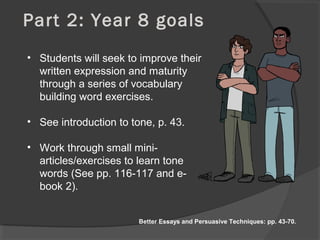
• Students will seek to improve their
written expression and maturity
through a series of vocabulary
building word exercises.
• See introduction to tone, p. 43.
• Work through small mini-
articles/exercises to learn tone
words (See pp. 116-117 and e-
book 2).
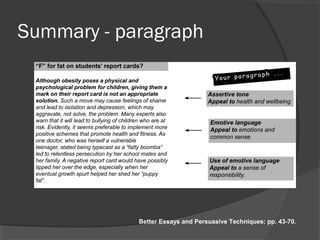
Summary – paragraph, p. 43
Better Essays and Persuasive Techniques: pp. 43-70.
The task of
analysis
 Focus on:
What the author says (views)
How the author says it
(their tone and style).
The author’s choice of words.
The author’s evidence and reasons.
The author’s appeals and values.
The author’s purpose and impact: see the “why”
comments for each technique.
Better Essays and Persuasive Techniques: pp. 43-70.
Your tone and style
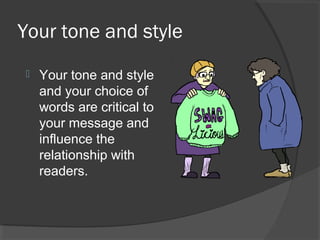
 Your tone and style
and your choice of
words are critical to
your message and
influence the
relationship with
readers.
The author’s
tone
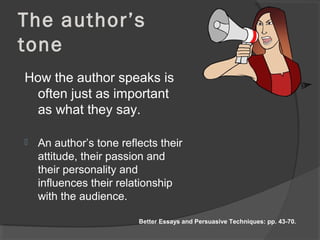
How the author speaks is
often just as important
as what they say.
 An author’s tone reflects their
attitude, their passion and
their personality and
influences their relationship
with the audience.
Better Essays and Persuasive Techniques: pp. 43-70.
Extending your
tone word vocabulary
Tone descriptors: See tone descriptors and definitions on
pp. 116-117.
Tone words are modelled in the “Suggested Responses”.
See E-book 3: Better Sentences :
 word games
 tone test matchups.
 extended tone list and definitions.
Better Essays and Persuasive Techniques: pp. 116-117
The author’s
style
The author’s style
complements their
message and their tone.
Is the text formal or
informal or a
combination
of both?
Better Essays and Persuasive Techniques: pp. 43-70.
The author’s style
Look for:
 Colloquial language: closely imitates
spoken language. (He doesn’t give a
stuff!)
 Questions: interrogative sentences
versus rhetorical questions
 Repetition: the author often repeats
words or phrases for an effect. (Tripling
and listing are often used for effect.)
Better Essays and Persuasive Techniques: pp. 43-70.
The author’s
words
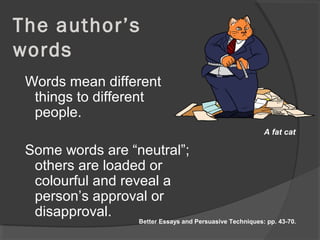
Words mean different
things to different
people.
Some words are “neutral”;
others are loaded or
colourful and reveal a
person’s approval or
disapproval.
A fat cat
Better Essays and Persuasive Techniques: pp. 43-70.
The author’s words
• Words have connotations:
that is, extra meanings apart
from the literal, dictionary
meaning.
• Words may be inclusive or
exclusive.
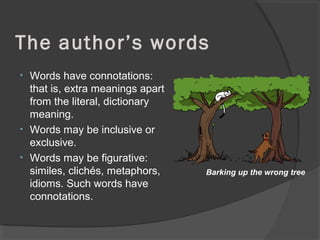
• Words may be figurative:
similes, clichés, metaphors,
idioms. Such words have
connotations.
Barking up the wrong tree
Common appeals
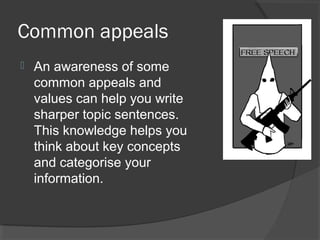
 An awareness of some
common appeals and
values can help you write
sharper topic sentences.
This knowledge helps you
think about key concepts
and categorise your
information.
The author’s
appeals
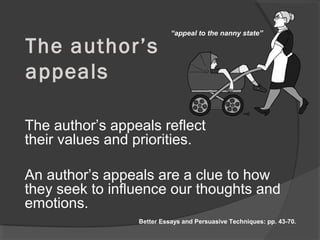
The author’s appeals reflect
their values and priorities.
An author’s appeals are a clue to how
they seek to influence our thoughts and
emotions.
“appeal to the nanny state”
Better Essays and Persuasive Techniques: pp. 43-70.
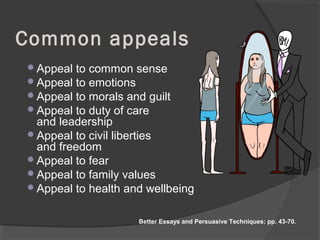
Common appeals
Appeal to common sense
Appeal to emotions
Appeal to morals and guilt
Appeal to duty of care
and leadership
Appeal to civil liberties
and freedom
Appeal to fear
Appeal to family values
Appeal to health and wellbeing
Better Essays and Persuasive Techniques: pp. 43-70.
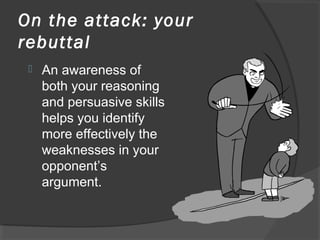
On the attack: your
rebuttal
 An awareness of
both your reasoning
and persuasive skills
helps you identify
more effectively the
weaknesses in your
opponent’s
argument.
The author’s
attack
Authors often attack or criticise opponents in
order to show the superiority of their views.
How does the author criticise opponents?
What words do they use?
Better Essays and Persuasive Techniques: pp. 43-70.
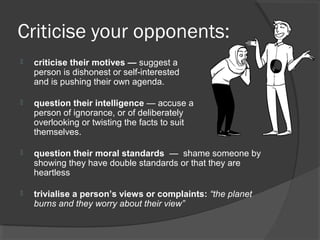
Criticise your opponents:
 criticise their motives — suggest a
person is dishonest or self-interested
and is pushing their own agenda.
 question their intelligence — accuse a
person of ignorance, or of deliberately
overlooking or twisting the facts to suit
themselves.
 question their moral standards — shame someone by
showing they have double standards or that they are
heartless
 trivialise a person’s views or complaints: “the planet
burns and they worry about their view”
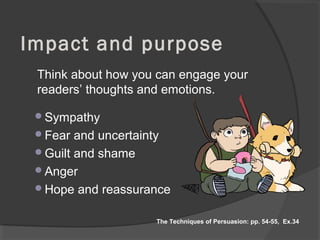
Impact and purpose
Sympathy
Fear and uncertainty
Guilt and shame
Anger
Hope and reassurance
The Techniques of Persuasion: pp. 54-55, Ex.34
Think about how you can engage your
readers’ thoughts and emotions.
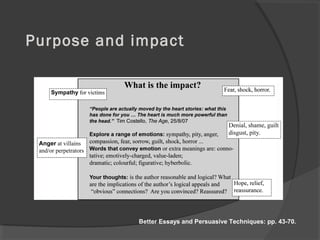
Purpose and impact, p.
66.
Better Essays and Persuasive Techniques: pp. 43-70.
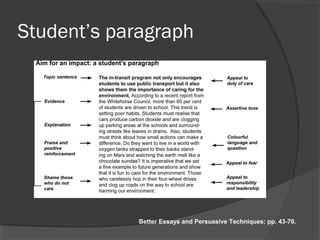
Student’s paragraph, p. 69
Better Essays and Persuasive Techniques: pp. 43-70.
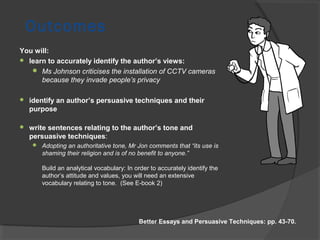
Outcomes
You will:
 learn to accurately identify the author’s views:
 Ms Johnson criticises the installation of CCTV cameras
because they invade people’s privacy
 identify an author’s persuasive techniques and their
purpose
 write sentences relating to the author’s tone and
persuasive techniques:
 Adopting an authoritative tone, Mr Jon comments that “its use is
shaming their religion and is of no benefit to anyone.”
Build an analytical vocabulary: In order to accurately identify the
author’s attitude and values, you will need an extensive
vocabulary relating to tone. (See E-book 2)
Better Essays and Persuasive Techniques: pp. 43-70.
Outcomes:
analytical precision
 Students will recognise the difference
between generic and analytically-precise
sentences.
 Generic sentences:
 The speech is in a forthright tone, getting straight to the point to
show you how serious he is.
 He uses his first-hand experience to build credibility and to
show an unbiased and reasonable perspective.
 He uses an expert who can be trusted because he has
experience in the field.
Outcomes: aim for
analytical precision
 Students will rewrite their sentences:
 “Sharing the fat load”, p. 30
Evidence/technique; The expert, Mr Webber who is
a trusted economist with experience in the airline
industry, states that obese jetsetters must contribute
fairly to the cost of airline travel. He adopts a logical
tone to suggest that the heavier a person is, the
heavier the aircraft and therefore the cost of fuel
increases.
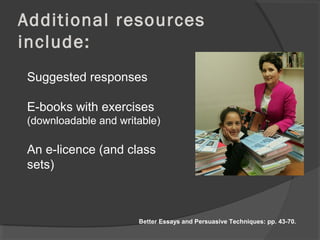
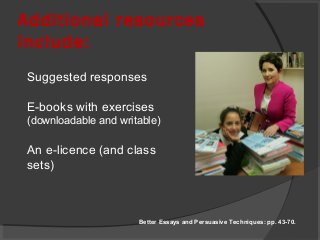
Additional resources
include:
Suggested responses
E-books with exercises
(downloadable and writable)
An e-licence (and class
sets)
Better Essays and Persuasive Techniques: pp. 43-70.

Better essays and techniques part 2

  • 1.
    Better Essays and PersuasiveTechniques by Dr Jennifer Minter Part Two: Year 8 Chapter 3: Persuasive Techniques
  • 2.
    Part 2: Year8 Chapter 3: Persuasive Techniques The chapter focuses on: •the author’s views, tone, style and choice of words; •the author’s appeals and values and •the author’s attacking techniques. Better Essays and Persuasive Techniques: pp. 43-70.
  • 3.
    Part 2: Year8 goals • Students will identify a range of persuasive strategies. • Students will use persuasive strategies in their essays. • Students will use appeals to write better topic sentences • Students will use “attacking devices” to write better rebuttals. Better Essays and Persuasive Techniques: pp. 43-70.
  • 4.
    Part 2: Year8 goals Better Essays and Persuasive Techniques: pp. 43-70. • Students will seek to improve their written expression and maturity through a series of vocabulary building word exercises. • See introduction to tone, p. 43. • Work through small mini- articles/exercises to learn tone words (See pp. 116-117 and e- book 2).
  • 5.
    Summary – paragraph,p. 43 Better Essays and Persuasive Techniques: pp. 43-70.
  • 6.
    The task of analysis Focus on: What the author says (views) How the author says it (their tone and style). The author’s choice of words. The author’s evidence and reasons. The author’s appeals and values. The author’s purpose and impact: see the “why” comments for each technique. Better Essays and Persuasive Techniques: pp. 43-70.
  • 7.
    Your tone andstyle  Your tone and style and your choice of words are critical to your message and influence the relationship with readers.
  • 8.
    The author’s tone How theauthor speaks is often just as important as what they say.  An author’s tone reflects their attitude, their passion and their personality and influences their relationship with the audience. Better Essays and Persuasive Techniques: pp. 43-70.
  • 9.
    Extending your tone wordvocabulary Tone descriptors: See tone descriptors and definitions on pp. 116-117. Tone words are modelled in the “Suggested Responses”. See E-book 3: Better Sentences :  word games  tone test matchups.  extended tone list and definitions. Better Essays and Persuasive Techniques: pp. 116-117
  • 10.
    The author’s style The author’sstyle complements their message and their tone. Is the text formal or informal or a combination of both? Better Essays and Persuasive Techniques: pp. 43-70.
  • 11.
    The author’s style Lookfor:  Colloquial language: closely imitates spoken language. (He doesn’t give a stuff!)  Questions: interrogative sentences versus rhetorical questions  Repetition: the author often repeats words or phrases for an effect. (Tripling and listing are often used for effect.) Better Essays and Persuasive Techniques: pp. 43-70.
  • 12.
    The author’s words Words meandifferent things to different people. Some words are “neutral”; others are loaded or colourful and reveal a person’s approval or disapproval. A fat cat Better Essays and Persuasive Techniques: pp. 43-70.
  • 13.
    The author’s words •Words have connotations: that is, extra meanings apart from the literal, dictionary meaning. • Words may be inclusive or exclusive. • Words may be figurative: similes, clichés, metaphors, idioms. Such words have connotations. Barking up the wrong tree
  • 14.
    Common appeals  Anawareness of some common appeals and values can help you write sharper topic sentences. This knowledge helps you think about key concepts and categorise your information.
  • 15.
    The author’s appeals The author’sappeals reflect their values and priorities. An author’s appeals are a clue to how they seek to influence our thoughts and emotions. “appeal to the nanny state” Better Essays and Persuasive Techniques: pp. 43-70.
  • 16.
    Common appeals Appeal tocommon sense Appeal to emotions Appeal to morals and guilt Appeal to duty of care and leadership Appeal to civil liberties and freedom Appeal to fear Appeal to family values Appeal to health and wellbeing Better Essays and Persuasive Techniques: pp. 43-70.
  • 17.
    On the attack:your rebuttal  An awareness of both your reasoning and persuasive skills helps you identify more effectively the weaknesses in your opponent’s argument.
  • 18.
    The author’s attack Authors oftenattack or criticise opponents in order to show the superiority of their views. How does the author criticise opponents? What words do they use? Better Essays and Persuasive Techniques: pp. 43-70.
  • 19.
    Criticise your opponents: criticise their motives — suggest a person is dishonest or self-interested and is pushing their own agenda.  question their intelligence — accuse a person of ignorance, or of deliberately overlooking or twisting the facts to suit themselves.  question their moral standards — shame someone by showing they have double standards or that they are heartless  trivialise a person’s views or complaints: “the planet burns and they worry about their view”
  • 20.
    Impact and purpose Sympathy Fearand uncertainty Guilt and shame Anger Hope and reassurance The Techniques of Persuasion: pp. 54-55, Ex.34 Think about how you can engage your readers’ thoughts and emotions.
  • 21.
    Purpose and impact,p. 66. Better Essays and Persuasive Techniques: pp. 43-70.
  • 22.
    Student’s paragraph, p.69 Better Essays and Persuasive Techniques: pp. 43-70.
  • 23.
    Outcomes You will:  learnto accurately identify the author’s views:  Ms Johnson criticises the installation of CCTV cameras because they invade people’s privacy  identify an author’s persuasive techniques and their purpose  write sentences relating to the author’s tone and persuasive techniques:  Adopting an authoritative tone, Mr Jon comments that “its use is shaming their religion and is of no benefit to anyone.” Build an analytical vocabulary: In order to accurately identify the author’s attitude and values, you will need an extensive vocabulary relating to tone. (See E-book 2) Better Essays and Persuasive Techniques: pp. 43-70.
  • 24.
    Outcomes: analytical precision  Studentswill recognise the difference between generic and analytically-precise sentences.  Generic sentences:  The speech is in a forthright tone, getting straight to the point to show you how serious he is.  He uses his first-hand experience to build credibility and to show an unbiased and reasonable perspective.  He uses an expert who can be trusted because he has experience in the field.
  • 25.
    Outcomes: aim for analyticalprecision  Students will rewrite their sentences:  “Sharing the fat load”, p. 30 Evidence/technique; The expert, Mr Webber who is a trusted economist with experience in the airline industry, states that obese jetsetters must contribute fairly to the cost of airline travel. He adopts a logical tone to suggest that the heavier a person is, the heavier the aircraft and therefore the cost of fuel increases.
  • 26.
    Additional resources include: Suggested responses E-bookswith exercises (downloadable and writable) An e-licence (and class sets) Better Essays and Persuasive Techniques: pp. 43-70.