Information Literacy Plan
Jeanna Edge
FRIT 7136
Instructor: Dr. Repman
http://biographypathfinder.weebly.com/
Grade: 5th
Content Topic: Biographies
SLMS: JJ Edge
Teacher: Laura Hill
STANDARDS FOR THE 21ST-CENTURY LEARNER GOALS:
Standards:
1. Inquire, Think Critically, and Gain Knowledge
2. Draw Conclusions, Make Informed Decisions, Apply Knowledge to new
situations, and Create New Knowledge
3. Share Knowledge and Participate ethically and productively as members
of our democratic society
Skills Indicator(s):
1.1.4 Find, evaluate, and select appropriate sources to answer questions
1.1.5 Evaluate information found in selected sources on the basis of
accuracy, validity, appropriateness for needs, importance, and social and
cultural context.
1.1.6 Read, view, and listen for information presented in any format in order
to make inferences and gather meaning.
1.1.7 Make sense of information gathered from diverse sources by
identifying misconceptions, main and supporting ideas, conflicting
information, and point of view or bias.
1.1.8 Demonstrate mastery of technology tools for accessing information
and pursuing inquiry.
1.1.9 Collaborate with others to broaden and deepen understanding.
2.1.1 Continue an inquiry-based research process by applying critical
thinking skills (analysis, synthesis, evaluation, organization) to information
and knowledge in order to construct new understandings, draw conclusions,
and create new knowledge.
2.1.2 Organize knowledge so that it is useful.
2.1.4 Use technology and other information tools to analyze and organize
information.
2.1.5 Collaborate with others to exchange ideas, develop new
understandings, make decisions, and solve problems
2.1.6 Use the writing process, media and visual literacy, and technology
skills to create products that express new understandings.
3.1.4 Use technology and other information tools to organize and display
knowledge and understanding in ways that others can view, use, and assess.
3.1.6 Use information and technology ethically and responsibly.
Benchmark(s): Grade 5
1.1.1 Generate questions and practice different ways to locate and
evaluate sources that provide needed information
1.1.2 Identify and use appropriate sources to acquire background
information
1.1.4 Understand the library’s scheme and what main topics are
included in each section
Select and use appropriate sources, including specialized
reference sources and databases, to answer questions
Use multiple resources to locate information
1.1.5 Evaluate facts for accuracy
Distinguish between fact and opinion
Select information to answer questions or solve a problem
1.1.6 Paraphrase or summarize information in various formats
1.1.7 Recognize facts when two different sources conflict and seek
additional sources to verify accuracy
1.1.8 Search an online catalogue to locate information
Use selected websites and periodical databases to find
appropriate information
Use selected search engines to find appropriate information
Use software or online tools to record and organize information
1.1.9 Work in teams to produce original works or solve problems
Respect others’ opinions through active listening and questioning
2.1.2 Organize information in a way that is appropriate for the
assignment or question
2.1.4 Use word processing, drawing, presentation, graphing, and
other productivity tools to illustrate concepts and convey ideas.
2.1.5 Work in groups to create and evaluate pictures, images, charts,
for reports and presentations
2.1.6 Experiment with text and visual media to create products
Check for correctness, completeness, and citation of sources
3.1.4 Use various technology tools to retrieve and organize
information
Use a variety of media and formats to create and edit products
that communicate syntheses of information and ideas
3.1.6 Credit all sources properly with title, author, and page number
Practice responsible use of technology and describe personal
consequences of inappropriate use
Dispositions Indicator(s):
1.2.3 Demonstrate creativity by using multiple resources and formats.
1.2.4 Maintain a critical stance by questioning the validity and accuracy of all
information.
2.2.1 Demonstrate flexibility in use of resources by adapting information
strategies to each specific resource and by seeking additional resources
when clear conclusions cannot be drawn.
3.2.3 Demonstrate teamwork by working productively with others.
Responsibilities Indicator(s):
1.3.1 Respect copyright/intellectual property rights of creators and
producers.
1.3.3 Follow ethical and legal guidelines in gathering and using information.
1.3.5 Use information technology responsibly.
Self-Assessment Strategies Indicator(s):
1.4.2 Use interaction with and feedback from teachers and peers to guide
own inquiry process.
2.4.1 Determine how to act on information (accept, reject, modify).
CONNECTION TO LOCAL OR STATE STANDARDS:
NCTE/IRA National Standards for the English Language Arts
7. Students conduct research on issues and interests by generating ideas
and questions, and by posing problems. They gather, evaluate, and
synthesize data from a variety of sources (e.g., print and nonprint texts,
artifacts, people) to communicate their discoveries in ways that suit their
purpose and audience.
8. Students use a variety of technological and information resources (e.g.,
libraries, databases, computer networks, video) to gather and synthesize
information and to create and communicate knowledge.
12. Students use spoken, written, and visual language to accomplish their
own purposes (e.g., for learning, enjoyment, persuasion, and the exchange
of information).
NETS for Students
1. Creativity and Innovation
Students demonstrate creative thinking, construct knowledge, and develop
innovative products and processes using technology.
a. Apply existing knowledge to generate new ideas, products, or processes
b. Create original works as a means of personal or group expression
c. Use models and simulations to explore complex systems and issues
2. Communication and Collaboration
Students use digital media and environments to communicate and work
collaboratively, including at a distance, to support individual learning and
contribute to the learning of others.
a. Interact, collaborate, and publish with peers, experts, or others employing
a variety of digital environments and media
b. Communicate information and ideas effectively to multiple audiences
using a variety of media and formats
d. Contribute to project teams to produce original works or solve problems
3. Research and Information Fluency
Students apply digital tools to gather, evaluate, and use information.
a. Plan strategies to guide inquiry
b. Locate, organize, analyze, evaluate, synthesize, and ethically use
information from a variety of sources and media
c. Evaluate and select information sources and digital tools based on the
appropriateness to specific tasks
d. Process data and report results
Common Core Standards
CC.5.R.L.1 Key Ideas and Details: Quote accurately from a text when
explaining what the text says explicitly and when drawing inferences from
the text.
CC.5.R.I.7 Integration of Knowledge and Ideas: Draw on information from
multiple print or digital sources, demonstrating the ability to locate an
answer to a question quickly or to solve a problem efficiently.
CC.5.R.I.9 Integration of Knowledge and Ideas: Integrate information from
several texts on the same topic in order to write or speak about the subject
knowledgeably.
CC.5.SL.5 Presentation of Knowledge and Ideas: Include multimedia
components (e.g., graphics, sound) and visual displays in presentations
when appropriate to enhance the development of main ideas or themes.
CC.5.W.2.b Text Types and Purposes: Develop the topic with facts,
definitions, concrete details, quotations, or other information and examples
related to the topic.
CC.5.W.4 Production and Distribution of Writing: Produce clear and coherent
writing in which the development and organization are appropriate to task,
purpose, and audience.
CC.5.W.7 Research to Build and Present Knowledge: Conduct short research
projects that use several sources to build knowledge through investigation of
different aspects of a topic.
CC.5.W.8 Research to Build and Present Knowledge: Recall relevant
information from experiences or gather relevant information from print and
digital sources; summarize or paraphrase information in notes and finished
work, and provide a list of sources.
OVERVIEW:
5th grade students will work in groups in order to create a digital biography
that will be presented to the class. Students will use research skills in order
to identify appropriate sources to gather and organize the information they
find. Students will also use technology tools to design a digital presentation
for their assignment.
FINAL PRODUCT: Students will present a digital biography to the class.
LIBRARY LESSON(S):
1) The SLMS will give students an overview of how to locate sources in the
library. The SLMS will also cover finding and evaluating online sources. The
SLMS will also discuss ethical use of information and online safety. The
Pathfinder will be presented as a tool for students to use during their
research.
2) The SLMS will instruct students on how to use PhotoStory to create a
digital biography.
ASSESSMENT:
• Product
Students will complete an source evaluation tool to assess their sources
validity. These online evaluation worksheets will be reviewed by the SLMS.
The final product, the digital biography, will be assessed using a rubric by
both the teacher and the SLMS. Students will also use a list of questions to
“grade” other groups’ work as they present. Feedback will be shared with
the teacher and the group itself. Students will also use the rubric to self-
assess their own presentations.
• Process
The teacher and the SLMS will observe students throughout the lessons
ensuring understanding of lesson concepts as well as conduct in the library
to ensure they are able to find resources in a timely manner.
The teacher and SLMS will also observe how students are working in groups
and note any issues they find.
The SLMS and teacher will also move throughout the classroom to ensure
ethical use and online safety are being met.
• Student self-questioning
Students will also complete a self-reflection questionnaire at the end of the
lesson to assess their understanding of biographies. Another self-
assessment will be in the form of a rubric to assess their performance as
part of their group.
• Tools: Attachments for Assessment can be found at the end of the plan
INSTRUCTIONAL PLAN:
• Resources students will use:
 Online subscription database(s)
 Websites
 Books
 Reference
 Nonprint
 Periodicals/newspapers
 Other (list): Pathfinder: http://biographypathfinder.weebly.com/
• Instruction/activities
Lesson 1: Locating and Assessing Sources
o Direct instruction: The SLMS will review the areas of the library with
students. She will remind students of the steps to use Destiny. The SLMS
will distribute information to help students evaluate sources and discuss
ethical use of information they find.
o Modeling and guided practice: The SLMS will project on the Smartboard
websites and sources and have students help her to evaluate them according
to the website evaluation tool. She will also model taking a quote from a
reliable source and citing or paraphrasing it for the students in a report. The
SLMS will also showcase the Pathfinder for students.
o Independent practice: Students will be allowed to begin the research
process of finding sources. Students will begin to evaluate sources.
o Sharing and reflecting: The SLMS will encourage students to share the
sources that they thought were helpful in their research with the rest of the
class. She will also ask if any students came across information they felt to
be untrue or biased.
Lesson 2: Designing a Digital Biography
o Direct instruction: The SLMS will review what the students have worked on
so far. She will ask some questions about biographies and about finding
sources for review. She will introduce the next step of the lesson - the
digital presentation. A previous student’s work or a story the SLMS has
created herself will be shown to the class.
o Modeling and guided practice: The SLMS will project a PhotoStory tutorial
to the class. She will also work the room along with the teacher to aid
students in creating and organizing their presentations.
o Independent practice: Students will begin work in groups to start planning
and designing their PhotoStory.
o Sharing and reflecting: Students will share their presentations at the end
of the lesson with the rest of the class in a “movie day” setting.
Modifications:
The SLMS may provide a pre-written tool with step by step instructions for
students who are new to using a tool like PhotoStory. Also, the teacher and
SLMS will work together to help evenly distribute groups so that peer to peer
learning can take place and to ensure strong reading comprehension. One
on one assistance and one teacher to one group support can also be
provided.
Reflection:
The collaboration was touch and go with this lesson. I was working with a
teacher in the afterschool program which I supervise so there was time to
plan together and get organized, however, due to medical issues, we had to
postpone the instruction twice. Most of the planning took place in brief
conversations and over email. Because it was in an afterschool setting, we
were able to reschedule without much difficulty.
I feel the students enjoyed the lesson, and I wish I had more time to devote
to spreading it out a bit. We were able to start the PhotoStory lesson, but
students still haven’t had a chance to complete them - they are still working,
but we will have a “movie day” soon. Gathering information and scripting
the biographies took longer than first expected.
Working in groups for the locating and evaluation of resources seemed to
work. Students were able to spread out among computers and locate
resources individually and then bring group members over to evaluate
whether it was one that would be used. The groups working on PhotoStory
was a different experience. There were a few times that the teacher and I
had to remind students to share the controls of the computer.
Completing this assignment helped in my growth as an educator and a
student. I have developed lesson plans for school before but have never
implemented them in collaboration with a teacher acting as a SLMS. Using
the AASL standards in a lesson was very eye-opening. With this one lesson,
as you can see from the first section, several standards, strands, and
benchmarks were reviewed. I never knew how many skills can be covered
in one lesson - this was great for the teacher to see as well. The crosswalk
used to help identify the standards surprised even her - it shows how more
collaboration among teachers and SLMSs can really support both the
educators in their work and the students in their learning.
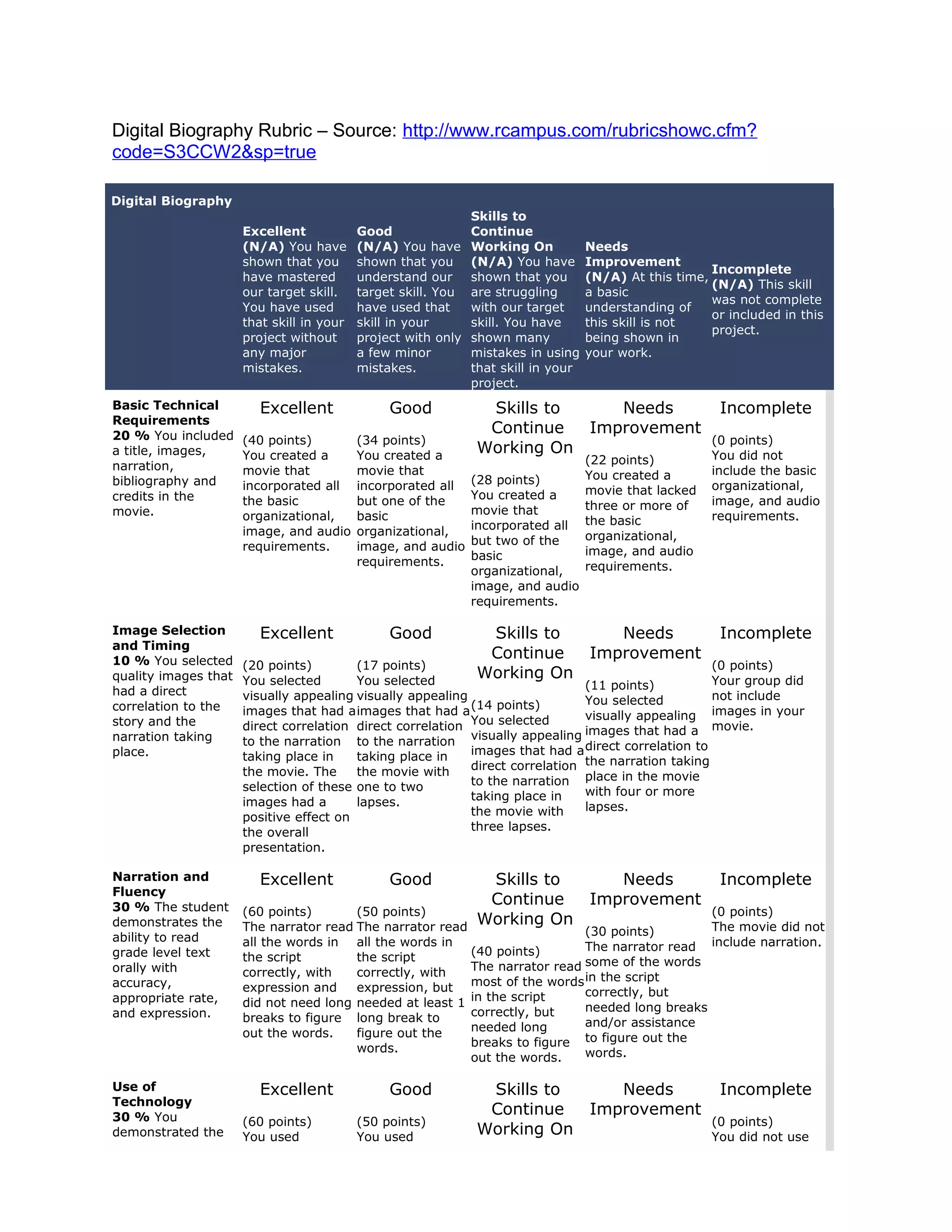
Digital Biography Rubric – Source: http://www.rcampus.com/rubricshowc.cfm?
code=S3CCW2&sp=true
Digital Biography
Excellent
(N/A) You have
shown that you
have mastered
our target skill.
You have used
that skill in your
project without
any major
mistakes.
Good
(N/A) You have
shown that you
understand our
target skill. You
have used that
skill in your
project with only
a few minor
mistakes.
Skills to
Continue
Working On
(N/A) You have
shown that you
are struggling
with our target
skill. You have
shown many
mistakes in using
that skill in your
project.
Needs
Improvement
(N/A) At this time,
a basic
understanding of
this skill is not
being shown in
your work.
Incomplete
(N/A) This skill
was not complete
or included in this
project.
Basic Technical
Requirements
20 % You included
a title, images,
narration,
bibliography and
credits in the
movie.
Excellent
(40 points)
You created a
movie that
incorporated all
the basic
organizational,
image, and audio
requirements.
Good
(34 points)
You created a
movie that
incorporated all
but one of the
basic
organizational,
image, and audio
requirements.
Skills to
Continue
Working On
(28 points)
You created a
movie that
incorporated all
but two of the
basic
organizational,
image, and audio
requirements.
Needs
Improvement
(22 points)
You created a
movie that lacked
three or more of
the basic
organizational,
image, and audio
requirements.
Incomplete
(0 points)
You did not
include the basic
organizational,
image, and audio
requirements.
Image Selection
and Timing
10 % You selected
quality images that
had a direct
correlation to the
story and the
narration taking
place.
Excellent
(20 points)
You selected
visually appealing
images that had a
direct correlation
to the narration
taking place in
the movie. The
selection of these
images had a
positive effect on
the overall
presentation.
Good
(17 points)
You selected
visually appealing
images that had a
direct correlation
to the narration
taking place in
the movie with
one to two
lapses.
Skills to
Continue
Working On
(14 points)
You selected
visually appealing
images that had a
direct correlation
to the narration
taking place in
the movie with
three lapses.
Needs
Improvement
(11 points)
You selected
visually appealing
images that had a
direct correlation to
the narration taking
place in the movie
with four or more
lapses.
Incomplete
(0 points)
Your group did
not include
images in your
movie.
Narration and
Fluency
30 % The student
demonstrates the
ability to read
grade level text
orally with
accuracy,
appropriate rate,
and expression.
Excellent
(60 points)
The narrator read
all the words in
the script
correctly, with
expression and
did not need long
breaks to figure
out the words.
Good
(50 points)
The narrator read
all the words in
the script
correctly, with
expression, but
needed at least 1
long break to
figure out the
words.
Skills to
Continue
Working On
(40 points)
The narrator read
most of the words
in the script
correctly, but
needed long
breaks to figure
out the words.
Needs
Improvement
(30 points)
The narrator read
some of the words
in the script
correctly, but
needed long breaks
and/or assistance
to figure out the
words.
Incomplete
(0 points)
The movie did not
include narration.
Use of
Technology
30 % You
demonstrated the
Excellent
(60 points)
You used
Good
(50 points)
You used
Skills to
Continue
Working On
Needs
Improvement
Incomplete
(0 points)
You did not use
ability to utilize the
features in
Photostory to
create an
appealing (visual
and audio) movie.
transition and
motion features
consistently to
create interest in
your movie. The
audio was clear
and could be
easily
understood.
transition and
motion features
to create interest
in your movie.
The audio was
clear and could
be easily
understood with a
single lapse.
(40 points)
You used
transition and
motion features
to create interest
in your movie
with a lapse or
two. The audio
was clear and
could be easily
understood with
two to three
lapses.
(30 points)
You did not use
transition and
motion features.
The audio contained
distractions that
made it hard to
understand.
transitions or
record audio.
Overall
Presentation
10 % The
biography was
factual and
detailed. Major
events of historical
significance were
appropriately
included.
Excellent
(20 points) You
utilized your
research to create
a factual account
of your subject's
life. Your
presentation
included events of
historical
significance.
Good
(17 points)
You utilized your
research to create
a factual account
of your subject's
life. Your
presentation
included events of
historical
significance, with
one lapse.
Skills to
Continue
Working On
(14 points)
You utilized your
research to create
a factual account
of your subject's
life. Your
presentation
included most of
the events of
historical
significance, with
one or two
lapses.
Needs
Improvement
(11 points)
You utilized your
research to create a
mostly factual
account of your
subject's life. Your
presentation
included events of
historical
significance, with
one or two lapses.
Incomplete
(0 points)
You did not utilize
research in
completing this
project.
Student Teamwork Rubric - Source:
http://edtech2.boisestate.edu/hermanb/edtech506/Unit/Rubric/Rubric_Teamwork.pdf
Teamwork- I listened to team
members.
I shared many
ideas.
I helped solve
problems.
I did my own work
and helped others.
I listened to team
members.
I shared many
ideas.
I did my own work
and helped others.
I listened to team
members.
I shared some
ideas.
I did own work.
I did not try to help
others.
I did not listen or
talk with team
members.
I did not do work.
I did not try to help
others.
Behavior-
I followed all
directions.
I took part in all
activities.
I was helpful to
others and shared
many ideas.
I tried new things.
I followed most
directions.
I took part in all
activities.
I was helpful to
others.
I said many nice
things to other
students.
I did not follow all
directions.
I took part in most
activities.
I was helpful to
others.
I said some
negative things
about others.
I did not follow
directions.
I said negative
things about other
people and the
project.
I was not helpful.
Organization
I had all of the
things needed for
class work.
I had most of the
things they needed
for class work.
I had some
papers or books for
class work.
I did not bring
papers or book for
class work.
Time Management
I used time well.
My work was
turned in on time or
before it was due.
I used time well.
Most of my work
was done on time.
I did not use time
well.
Some of my work
was not done on
time.
I did not use time
well.
Little or none of
my work was done
on time.
Evaluating Sources Worksheet: Source:
http://library.ndsu.edu/research-help/ndla-documents/
 What is the author’s name(s)? What are the author’s qualifications (if given)? Have you
heard of this author before / are you familiar with other works by the author?
 Who is the intended audience? What age group/knowledge level is the author writing
at? Would the source be considered popular or scholarly?
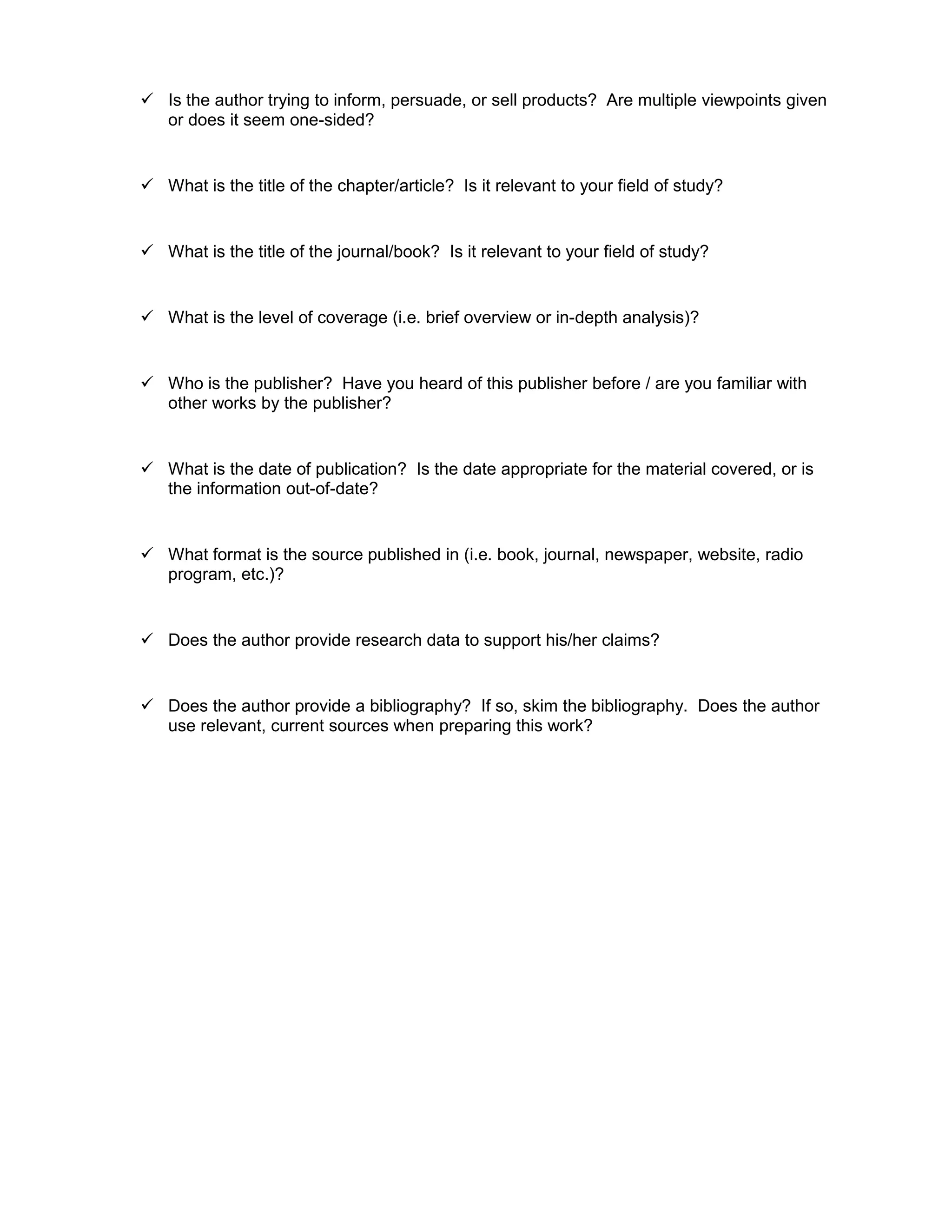
 Is the author trying to inform, persuade, or sell products? Are multiple viewpoints given
or does it seem one-sided?
 What is the title of the chapter/article? Is it relevant to your field of study?
 What is the title of the journal/book? Is it relevant to your field of study?
 What is the level of coverage (i.e. brief overview or in-depth analysis)?
 Who is the publisher? Have you heard of this publisher before / are you familiar with
other works by the publisher?
 What is the date of publication? Is the date appropriate for the material covered, or is
the information out-of-date?
 What format is the source published in (i.e. book, journal, newspaper, website, radio
program, etc.)?
 Does the author provide research data to support his/her claims?
 Does the author provide a bibliography? If so, skim the bibliography. Does the author
use relevant, current sources when preparing this work?
 What is the author’s name(s)? What are the author’s qualifications (if given)? Have you
heard of this author before / are you familiar with other works by the author?
 Who is the intended audience? What age group/knowledge level is the author writing
at? Would the source be considered popular or scholarly?
 Is the author trying to inform, persuade, or sell products? Are multiple viewpoints given
or does it seem one-sided?
 What is the title of the chapter/article? Is it relevant to your field of study?
 What is the title of the journal/book? Is it relevant to your field of study?
 What is the level of coverage (i.e. brief overview or in-depth analysis)?
 Who is the publisher? Have you heard of this publisher before / are you familiar with
other works by the publisher?
 What is the date of publication? Is the date appropriate for the material covered, or is
the information out-of-date?
 What format is the source published in (i.e. book, journal, newspaper, website, radio
program, etc.)?
 Does the author provide research data to support his/her claims?
 Does the author provide a bibliography? If so, skim the bibliography. Does the author
use relevant, current sources when preparing this work?
Student Self-Reflection Questions:
Students will complete a self-refection and assessment questionnaire at the end of the
lesson, after all the presentations have been presented. This questionnaire will include
some of the following questions:
• Can you explain what a biography is to your parents?
• Did you learn anything new about the person you chose to research?
• Can you write a well organized biography?
• How did your biography compare with the other classmates?
• Was it easy to organize the information you collected?
• What strategies did you find most helpful in your research?
• Were there any sources you wish you had or had not included?
• How well did you work as a team with your partners? Were you fair? Did you
listen to their ideas? Can you say that you are certain you did your part to help
your team?
• If the teacher asked you to complete research on your favorite animal and write a
report, how would what you did in this assignment help you with the report?
• What surprised you about the person you chose to research?
• What surprised you about working with your partners?
• Did you learn anything new by doing this assignment?
• How will what you have learned about the person you researched change about
your life?
• Did you have fun learning about the person?
• Did you think this assignment would be fun when you began?
Peer Evaluation Questions:
The teacher will let the audience know that they will be able to ask questions of the
group and will also fill out an evaluation of the presentation in order to provide feedback.
Questions will include:
• Was this presentation interesting? Why?
• Did you learn something new about this person?
• Did their presentation make you want to learn more about the person? Why?
• Was their presentation easy to understand?

Information Literacy Plan

  • 1.
    Information Literacy Plan JeannaEdge FRIT 7136 Instructor: Dr. Repman http://biographypathfinder.weebly.com/
  • 2.
    Grade: 5th Content Topic:Biographies SLMS: JJ Edge Teacher: Laura Hill STANDARDS FOR THE 21ST-CENTURY LEARNER GOALS: Standards: 1. Inquire, Think Critically, and Gain Knowledge 2. Draw Conclusions, Make Informed Decisions, Apply Knowledge to new situations, and Create New Knowledge 3. Share Knowledge and Participate ethically and productively as members of our democratic society Skills Indicator(s): 1.1.4 Find, evaluate, and select appropriate sources to answer questions 1.1.5 Evaluate information found in selected sources on the basis of accuracy, validity, appropriateness for needs, importance, and social and cultural context. 1.1.6 Read, view, and listen for information presented in any format in order to make inferences and gather meaning. 1.1.7 Make sense of information gathered from diverse sources by identifying misconceptions, main and supporting ideas, conflicting information, and point of view or bias. 1.1.8 Demonstrate mastery of technology tools for accessing information and pursuing inquiry. 1.1.9 Collaborate with others to broaden and deepen understanding. 2.1.1 Continue an inquiry-based research process by applying critical thinking skills (analysis, synthesis, evaluation, organization) to information and knowledge in order to construct new understandings, draw conclusions, and create new knowledge. 2.1.2 Organize knowledge so that it is useful. 2.1.4 Use technology and other information tools to analyze and organize information.
  • 3.
    2.1.5 Collaborate withothers to exchange ideas, develop new understandings, make decisions, and solve problems 2.1.6 Use the writing process, media and visual literacy, and technology skills to create products that express new understandings. 3.1.4 Use technology and other information tools to organize and display knowledge and understanding in ways that others can view, use, and assess. 3.1.6 Use information and technology ethically and responsibly. Benchmark(s): Grade 5 1.1.1 Generate questions and practice different ways to locate and evaluate sources that provide needed information 1.1.2 Identify and use appropriate sources to acquire background information 1.1.4 Understand the library’s scheme and what main topics are included in each section Select and use appropriate sources, including specialized reference sources and databases, to answer questions Use multiple resources to locate information 1.1.5 Evaluate facts for accuracy Distinguish between fact and opinion Select information to answer questions or solve a problem 1.1.6 Paraphrase or summarize information in various formats 1.1.7 Recognize facts when two different sources conflict and seek additional sources to verify accuracy 1.1.8 Search an online catalogue to locate information Use selected websites and periodical databases to find appropriate information Use selected search engines to find appropriate information Use software or online tools to record and organize information 1.1.9 Work in teams to produce original works or solve problems
  • 4.
    Respect others’ opinionsthrough active listening and questioning 2.1.2 Organize information in a way that is appropriate for the assignment or question 2.1.4 Use word processing, drawing, presentation, graphing, and other productivity tools to illustrate concepts and convey ideas. 2.1.5 Work in groups to create and evaluate pictures, images, charts, for reports and presentations 2.1.6 Experiment with text and visual media to create products Check for correctness, completeness, and citation of sources 3.1.4 Use various technology tools to retrieve and organize information Use a variety of media and formats to create and edit products that communicate syntheses of information and ideas 3.1.6 Credit all sources properly with title, author, and page number Practice responsible use of technology and describe personal consequences of inappropriate use Dispositions Indicator(s): 1.2.3 Demonstrate creativity by using multiple resources and formats. 1.2.4 Maintain a critical stance by questioning the validity and accuracy of all information. 2.2.1 Demonstrate flexibility in use of resources by adapting information strategies to each specific resource and by seeking additional resources when clear conclusions cannot be drawn. 3.2.3 Demonstrate teamwork by working productively with others. Responsibilities Indicator(s): 1.3.1 Respect copyright/intellectual property rights of creators and producers. 1.3.3 Follow ethical and legal guidelines in gathering and using information. 1.3.5 Use information technology responsibly. Self-Assessment Strategies Indicator(s):
  • 5.
    1.4.2 Use interactionwith and feedback from teachers and peers to guide own inquiry process. 2.4.1 Determine how to act on information (accept, reject, modify). CONNECTION TO LOCAL OR STATE STANDARDS: NCTE/IRA National Standards for the English Language Arts 7. Students conduct research on issues and interests by generating ideas and questions, and by posing problems. They gather, evaluate, and synthesize data from a variety of sources (e.g., print and nonprint texts, artifacts, people) to communicate their discoveries in ways that suit their purpose and audience. 8. Students use a variety of technological and information resources (e.g., libraries, databases, computer networks, video) to gather and synthesize information and to create and communicate knowledge. 12. Students use spoken, written, and visual language to accomplish their own purposes (e.g., for learning, enjoyment, persuasion, and the exchange of information). NETS for Students 1. Creativity and Innovation Students demonstrate creative thinking, construct knowledge, and develop innovative products and processes using technology. a. Apply existing knowledge to generate new ideas, products, or processes b. Create original works as a means of personal or group expression c. Use models and simulations to explore complex systems and issues 2. Communication and Collaboration Students use digital media and environments to communicate and work collaboratively, including at a distance, to support individual learning and contribute to the learning of others. a. Interact, collaborate, and publish with peers, experts, or others employing a variety of digital environments and media b. Communicate information and ideas effectively to multiple audiences using a variety of media and formats d. Contribute to project teams to produce original works or solve problems 3. Research and Information Fluency Students apply digital tools to gather, evaluate, and use information. a. Plan strategies to guide inquiry b. Locate, organize, analyze, evaluate, synthesize, and ethically use information from a variety of sources and media
  • 6.
    c. Evaluate andselect information sources and digital tools based on the appropriateness to specific tasks d. Process data and report results Common Core Standards CC.5.R.L.1 Key Ideas and Details: Quote accurately from a text when explaining what the text says explicitly and when drawing inferences from the text. CC.5.R.I.7 Integration of Knowledge and Ideas: Draw on information from multiple print or digital sources, demonstrating the ability to locate an answer to a question quickly or to solve a problem efficiently. CC.5.R.I.9 Integration of Knowledge and Ideas: Integrate information from several texts on the same topic in order to write or speak about the subject knowledgeably. CC.5.SL.5 Presentation of Knowledge and Ideas: Include multimedia components (e.g., graphics, sound) and visual displays in presentations when appropriate to enhance the development of main ideas or themes. CC.5.W.2.b Text Types and Purposes: Develop the topic with facts, definitions, concrete details, quotations, or other information and examples related to the topic. CC.5.W.4 Production and Distribution of Writing: Produce clear and coherent writing in which the development and organization are appropriate to task, purpose, and audience. CC.5.W.7 Research to Build and Present Knowledge: Conduct short research projects that use several sources to build knowledge through investigation of different aspects of a topic. CC.5.W.8 Research to Build and Present Knowledge: Recall relevant information from experiences or gather relevant information from print and digital sources; summarize or paraphrase information in notes and finished work, and provide a list of sources. OVERVIEW: 5th grade students will work in groups in order to create a digital biography that will be presented to the class. Students will use research skills in order to identify appropriate sources to gather and organize the information they find. Students will also use technology tools to design a digital presentation for their assignment. FINAL PRODUCT: Students will present a digital biography to the class.
  • 7.
    LIBRARY LESSON(S): 1) TheSLMS will give students an overview of how to locate sources in the library. The SLMS will also cover finding and evaluating online sources. The SLMS will also discuss ethical use of information and online safety. The Pathfinder will be presented as a tool for students to use during their research. 2) The SLMS will instruct students on how to use PhotoStory to create a digital biography. ASSESSMENT: • Product Students will complete an source evaluation tool to assess their sources validity. These online evaluation worksheets will be reviewed by the SLMS. The final product, the digital biography, will be assessed using a rubric by both the teacher and the SLMS. Students will also use a list of questions to “grade” other groups’ work as they present. Feedback will be shared with the teacher and the group itself. Students will also use the rubric to self- assess their own presentations. • Process The teacher and the SLMS will observe students throughout the lessons ensuring understanding of lesson concepts as well as conduct in the library to ensure they are able to find resources in a timely manner. The teacher and SLMS will also observe how students are working in groups and note any issues they find. The SLMS and teacher will also move throughout the classroom to ensure ethical use and online safety are being met. • Student self-questioning Students will also complete a self-reflection questionnaire at the end of the lesson to assess their understanding of biographies. Another self- assessment will be in the form of a rubric to assess their performance as part of their group. • Tools: Attachments for Assessment can be found at the end of the plan
  • 8.
    INSTRUCTIONAL PLAN: • Resourcesstudents will use:  Online subscription database(s)  Websites  Books  Reference  Nonprint  Periodicals/newspapers  Other (list): Pathfinder: http://biographypathfinder.weebly.com/ • Instruction/activities Lesson 1: Locating and Assessing Sources o Direct instruction: The SLMS will review the areas of the library with students. She will remind students of the steps to use Destiny. The SLMS will distribute information to help students evaluate sources and discuss ethical use of information they find. o Modeling and guided practice: The SLMS will project on the Smartboard websites and sources and have students help her to evaluate them according to the website evaluation tool. She will also model taking a quote from a reliable source and citing or paraphrasing it for the students in a report. The SLMS will also showcase the Pathfinder for students. o Independent practice: Students will be allowed to begin the research process of finding sources. Students will begin to evaluate sources. o Sharing and reflecting: The SLMS will encourage students to share the sources that they thought were helpful in their research with the rest of the class. She will also ask if any students came across information they felt to be untrue or biased. Lesson 2: Designing a Digital Biography o Direct instruction: The SLMS will review what the students have worked on so far. She will ask some questions about biographies and about finding sources for review. She will introduce the next step of the lesson - the digital presentation. A previous student’s work or a story the SLMS has created herself will be shown to the class. o Modeling and guided practice: The SLMS will project a PhotoStory tutorial to the class. She will also work the room along with the teacher to aid students in creating and organizing their presentations.
  • 9.
    o Independent practice:Students will begin work in groups to start planning and designing their PhotoStory. o Sharing and reflecting: Students will share their presentations at the end of the lesson with the rest of the class in a “movie day” setting. Modifications: The SLMS may provide a pre-written tool with step by step instructions for students who are new to using a tool like PhotoStory. Also, the teacher and SLMS will work together to help evenly distribute groups so that peer to peer learning can take place and to ensure strong reading comprehension. One on one assistance and one teacher to one group support can also be provided. Reflection: The collaboration was touch and go with this lesson. I was working with a teacher in the afterschool program which I supervise so there was time to plan together and get organized, however, due to medical issues, we had to postpone the instruction twice. Most of the planning took place in brief conversations and over email. Because it was in an afterschool setting, we were able to reschedule without much difficulty. I feel the students enjoyed the lesson, and I wish I had more time to devote to spreading it out a bit. We were able to start the PhotoStory lesson, but students still haven’t had a chance to complete them - they are still working, but we will have a “movie day” soon. Gathering information and scripting the biographies took longer than first expected. Working in groups for the locating and evaluation of resources seemed to work. Students were able to spread out among computers and locate resources individually and then bring group members over to evaluate whether it was one that would be used. The groups working on PhotoStory was a different experience. There were a few times that the teacher and I had to remind students to share the controls of the computer. Completing this assignment helped in my growth as an educator and a student. I have developed lesson plans for school before but have never implemented them in collaboration with a teacher acting as a SLMS. Using the AASL standards in a lesson was very eye-opening. With this one lesson, as you can see from the first section, several standards, strands, and benchmarks were reviewed. I never knew how many skills can be covered in one lesson - this was great for the teacher to see as well. The crosswalk used to help identify the standards surprised even her - it shows how more collaboration among teachers and SLMSs can really support both the educators in their work and the students in their learning.
  • 10.
    Digital Biography Rubric– Source: http://www.rcampus.com/rubricshowc.cfm? code=S3CCW2&sp=true Digital Biography Excellent (N/A) You have shown that you have mastered our target skill. You have used that skill in your project without any major mistakes. Good (N/A) You have shown that you understand our target skill. You have used that skill in your project with only a few minor mistakes. Skills to Continue Working On (N/A) You have shown that you are struggling with our target skill. You have shown many mistakes in using that skill in your project. Needs Improvement (N/A) At this time, a basic understanding of this skill is not being shown in your work. Incomplete (N/A) This skill was not complete or included in this project. Basic Technical Requirements 20 % You included a title, images, narration, bibliography and credits in the movie. Excellent (40 points) You created a movie that incorporated all the basic organizational, image, and audio requirements. Good (34 points) You created a movie that incorporated all but one of the basic organizational, image, and audio requirements. Skills to Continue Working On (28 points) You created a movie that incorporated all but two of the basic organizational, image, and audio requirements. Needs Improvement (22 points) You created a movie that lacked three or more of the basic organizational, image, and audio requirements. Incomplete (0 points) You did not include the basic organizational, image, and audio requirements. Image Selection and Timing 10 % You selected quality images that had a direct correlation to the story and the narration taking place. Excellent (20 points) You selected visually appealing images that had a direct correlation to the narration taking place in the movie. The selection of these images had a positive effect on the overall presentation. Good (17 points) You selected visually appealing images that had a direct correlation to the narration taking place in the movie with one to two lapses. Skills to Continue Working On (14 points) You selected visually appealing images that had a direct correlation to the narration taking place in the movie with three lapses. Needs Improvement (11 points) You selected visually appealing images that had a direct correlation to the narration taking place in the movie with four or more lapses. Incomplete (0 points) Your group did not include images in your movie. Narration and Fluency 30 % The student demonstrates the ability to read grade level text orally with accuracy, appropriate rate, and expression. Excellent (60 points) The narrator read all the words in the script correctly, with expression and did not need long breaks to figure out the words. Good (50 points) The narrator read all the words in the script correctly, with expression, but needed at least 1 long break to figure out the words. Skills to Continue Working On (40 points) The narrator read most of the words in the script correctly, but needed long breaks to figure out the words. Needs Improvement (30 points) The narrator read some of the words in the script correctly, but needed long breaks and/or assistance to figure out the words. Incomplete (0 points) The movie did not include narration. Use of Technology 30 % You demonstrated the Excellent (60 points) You used Good (50 points) You used Skills to Continue Working On Needs Improvement Incomplete (0 points) You did not use
  • 11.
    ability to utilizethe features in Photostory to create an appealing (visual and audio) movie. transition and motion features consistently to create interest in your movie. The audio was clear and could be easily understood. transition and motion features to create interest in your movie. The audio was clear and could be easily understood with a single lapse. (40 points) You used transition and motion features to create interest in your movie with a lapse or two. The audio was clear and could be easily understood with two to three lapses. (30 points) You did not use transition and motion features. The audio contained distractions that made it hard to understand. transitions or record audio. Overall Presentation 10 % The biography was factual and detailed. Major events of historical significance were appropriately included. Excellent (20 points) You utilized your research to create a factual account of your subject's life. Your presentation included events of historical significance. Good (17 points) You utilized your research to create a factual account of your subject's life. Your presentation included events of historical significance, with one lapse. Skills to Continue Working On (14 points) You utilized your research to create a factual account of your subject's life. Your presentation included most of the events of historical significance, with one or two lapses. Needs Improvement (11 points) You utilized your research to create a mostly factual account of your subject's life. Your presentation included events of historical significance, with one or two lapses. Incomplete (0 points) You did not utilize research in completing this project.
  • 12.
    Student Teamwork Rubric- Source: http://edtech2.boisestate.edu/hermanb/edtech506/Unit/Rubric/Rubric_Teamwork.pdf Teamwork- I listened to team members. I shared many ideas. I helped solve problems. I did my own work and helped others. I listened to team members. I shared many ideas. I did my own work and helped others. I listened to team members. I shared some ideas. I did own work. I did not try to help others. I did not listen or talk with team members. I did not do work. I did not try to help others. Behavior- I followed all directions. I took part in all activities. I was helpful to others and shared many ideas. I tried new things. I followed most directions. I took part in all activities. I was helpful to others. I said many nice things to other students. I did not follow all directions. I took part in most activities. I was helpful to others. I said some negative things about others. I did not follow directions. I said negative things about other people and the project. I was not helpful. Organization I had all of the things needed for class work. I had most of the things they needed for class work. I had some papers or books for class work. I did not bring papers or book for class work. Time Management I used time well. My work was turned in on time or before it was due. I used time well. Most of my work was done on time. I did not use time well. Some of my work was not done on time. I did not use time well. Little or none of my work was done on time.
  • 13.
    Evaluating Sources Worksheet:Source: http://library.ndsu.edu/research-help/ndla-documents/  What is the author’s name(s)? What are the author’s qualifications (if given)? Have you heard of this author before / are you familiar with other works by the author?  Who is the intended audience? What age group/knowledge level is the author writing at? Would the source be considered popular or scholarly?  Is the author trying to inform, persuade, or sell products? Are multiple viewpoints given or does it seem one-sided?  What is the title of the chapter/article? Is it relevant to your field of study?  What is the title of the journal/book? Is it relevant to your field of study?  What is the level of coverage (i.e. brief overview or in-depth analysis)?  Who is the publisher? Have you heard of this publisher before / are you familiar with other works by the publisher?  What is the date of publication? Is the date appropriate for the material covered, or is the information out-of-date?  What format is the source published in (i.e. book, journal, newspaper, website, radio program, etc.)?  Does the author provide research data to support his/her claims?  Does the author provide a bibliography? If so, skim the bibliography. Does the author use relevant, current sources when preparing this work?  What is the author’s name(s)? What are the author’s qualifications (if given)? Have you heard of this author before / are you familiar with other works by the author?  Who is the intended audience? What age group/knowledge level is the author writing at? Would the source be considered popular or scholarly?
  • 14.
     Is theauthor trying to inform, persuade, or sell products? Are multiple viewpoints given or does it seem one-sided?  What is the title of the chapter/article? Is it relevant to your field of study?  What is the title of the journal/book? Is it relevant to your field of study?  What is the level of coverage (i.e. brief overview or in-depth analysis)?  Who is the publisher? Have you heard of this publisher before / are you familiar with other works by the publisher?  What is the date of publication? Is the date appropriate for the material covered, or is the information out-of-date?  What format is the source published in (i.e. book, journal, newspaper, website, radio program, etc.)?  Does the author provide research data to support his/her claims?  Does the author provide a bibliography? If so, skim the bibliography. Does the author use relevant, current sources when preparing this work?
  • 15.
    Student Self-Reflection Questions: Studentswill complete a self-refection and assessment questionnaire at the end of the lesson, after all the presentations have been presented. This questionnaire will include some of the following questions: • Can you explain what a biography is to your parents? • Did you learn anything new about the person you chose to research? • Can you write a well organized biography? • How did your biography compare with the other classmates? • Was it easy to organize the information you collected? • What strategies did you find most helpful in your research? • Were there any sources you wish you had or had not included? • How well did you work as a team with your partners? Were you fair? Did you listen to their ideas? Can you say that you are certain you did your part to help your team? • If the teacher asked you to complete research on your favorite animal and write a report, how would what you did in this assignment help you with the report? • What surprised you about the person you chose to research? • What surprised you about working with your partners? • Did you learn anything new by doing this assignment? • How will what you have learned about the person you researched change about your life? • Did you have fun learning about the person? • Did you think this assignment would be fun when you began? Peer Evaluation Questions: The teacher will let the audience know that they will be able to ask questions of the group and will also fill out an evaluation of the presentation in order to provide feedback. Questions will include: • Was this presentation interesting? Why? • Did you learn something new about this person?
  • 16.
    • Did theirpresentation make you want to learn more about the person? Why? • Was their presentation easy to understand?