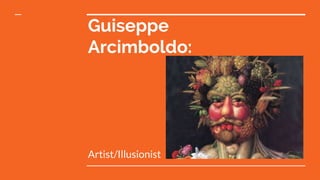

Guiseppe
Arcimboldo:
Artist/Illusionist
Background on the artist
● born in 1526, at the end of the Renaissance
○ to family of painters, in Northern Italy (Milan)
■ Milan was considered cradle of naturalism = artistic
expression based on direct observation of nature
● in 1563, at age 53, he left Italy to work in imperial courts
○ worked for 25 years in courts of the Habsburg rulers as
court painter
■ Emperor Ferdinand I
■ Emperor Maximilian II in Vienna
■ Emperor Rudolf II in Prague
Background on the artist
● most known for original “portraits”
○ also designed tapestries, stained glass,
costumes
● To celebrate Emperor Maximilian II’s reign, he
presented two series of allegorical paintings of
composite heads
○ The Four Seasons
○ The Elements
○ also created itty composite portraits of
different professions
Why Nature?
○ Renaissance
■ art considered a means of exploring nature, a record of
discoveries
■ time of exploration of new continents
● study of flora and fauna flourished
● explorers returned with exotic plants & animals
○ Maximilian II was passionate about biological sciences
(botany and zoology)
■ his court became center for scientific study
■ had botanical gardens and zoological parks
Why Nature con’t
● Arcimboldo has access to the vast collections of rare
plants and animals
○ He studied nature & was a knowledgeable
naturalist
○ His paintings are a fusion of science and art
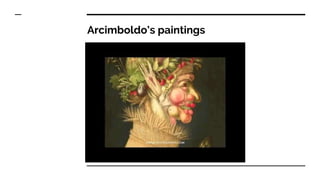
Arcimboldo’s paintings
His Technique
● What do his paintings look like at a distance?
● What do they look like up close?
● What do you notice about the materials
Arcimboldo uses in his portraits?
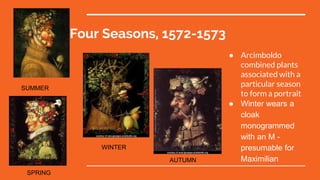
Four Seasons, 1572-1573
● Arcimboldo
combined plants
associated with a
particular season
to form a portrait
● Winter wears a
cloak
monogrammed
with an M -
presumable for
Maximilian
SPRING
SUMMER
WINTER
AUTUMN
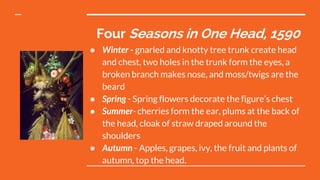
Four Seasons in One Head, 1590
● Winter - gnarled and knotty tree trunk create head
and chest, two holes in the trunk form the eyes, a
broken branch makes nose, and moss/twigs are the
beard
● Spring - Spring flowers decorate the figure’s chest
● Summer- cherries form the ear, plums at the back of
the head, cloak of straw draped around the
shoulders
● Autumn - Apples, grapes, ivy, the fruit and plants of
autumn, top the head.
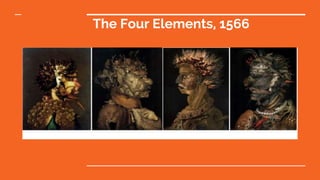
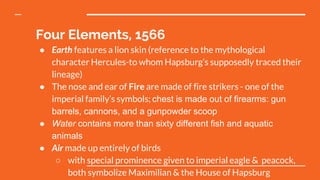
The Four Elements, 1566
Four Elements, 1566
● Earth features a lion skin (reference to the mythological
character Hercules-to whom Hapsburg’s supposedly traced their
lineage)
● The nose and ear of Fire are made of fire strikers - one of the
imperial family’s symbols; chest is made out of firearms: gun
barrels, cannons, and a gunpowder scoop
● Water contains more than sixty different fish and aquatic
animals
● Air made up entirely of birds
○ with special prominence given to imperial eagle & peacock,
both symbolize Maximilian & the House of Hapsburg
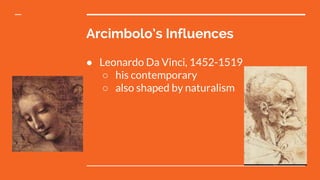
● Leonardo Da Vinci, 1452-1519
○ his contemporary
○ also shaped by naturalism
Arcimbolo’s Influences
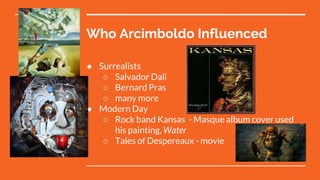
Who Arcimboldo Influenced
● Surrealists
○ Salvador Dali
○ Bernard Pras
○ many more
● Modern Day
○ Rock band Kansas - Masque album cover used
his painting, Water
○ Tales of Despereaux - movie
Materials
•Self portrait: Color or black and white
photo/print
• Glue Stick, Scissors, colored pencils
• 9 x 12 drawing paper, bristol weight
• magazine clippings of food, plants, flowers,
nature
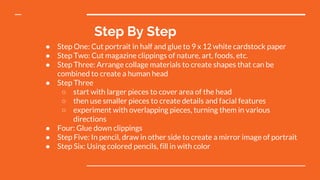
Step By Step
● Step One: Cut portrait in half and glue to 9 x 12 white cardstock paper
● Step Two: Cut magazine clippings of nature, art, foods, etc.
● Step Three: Arrange collage materials to create shapes that can be
combined to create a human head
● Step Three
○ start with larger pieces to cover area of the head
○ then use smaller pieces to create details and facial features
○ experiment with overlapping pieces, turning them in various
directions
● Four: Glue down clippings
● Step Five: In pencil, draw in other side to create a mirror image of portrait
● Step Six: Using colored pencils, fill in with color
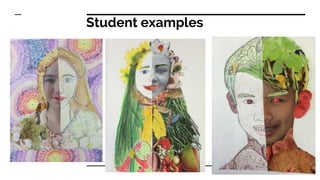
Student examples
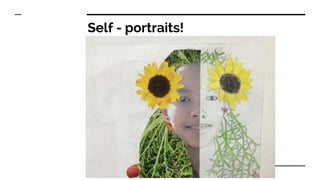
Self - portraits!
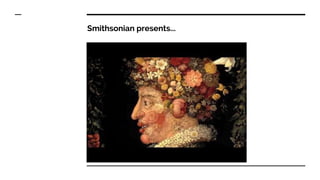
Smithsonian presents...
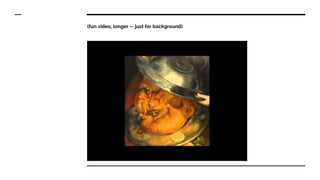
(fun video, longer -- just for background)

Arcimboldo and Renaissance illusion

  • 1.
  • 2.
    Background on theartist ● born in 1526, at the end of the Renaissance ○ to family of painters, in Northern Italy (Milan) ■ Milan was considered cradle of naturalism = artistic expression based on direct observation of nature ● in 1563, at age 53, he left Italy to work in imperial courts ○ worked for 25 years in courts of the Habsburg rulers as court painter ■ Emperor Ferdinand I ■ Emperor Maximilian II in Vienna ■ Emperor Rudolf II in Prague
  • 3.
    Background on theartist ● most known for original “portraits” ○ also designed tapestries, stained glass, costumes ● To celebrate Emperor Maximilian II’s reign, he presented two series of allegorical paintings of composite heads ○ The Four Seasons ○ The Elements ○ also created itty composite portraits of different professions
  • 4.
    Why Nature? ○ Renaissance ■art considered a means of exploring nature, a record of discoveries ■ time of exploration of new continents ● study of flora and fauna flourished ● explorers returned with exotic plants & animals ○ Maximilian II was passionate about biological sciences (botany and zoology) ■ his court became center for scientific study ■ had botanical gardens and zoological parks
  • 5.
    Why Nature con’t ●Arcimboldo has access to the vast collections of rare plants and animals ○ He studied nature & was a knowledgeable naturalist ○ His paintings are a fusion of science and art
  • 6.
  • 7.
    His Technique ● Whatdo his paintings look like at a distance? ● What do they look like up close? ● What do you notice about the materials Arcimboldo uses in his portraits?
  • 8.
    Four Seasons, 1572-1573 ●Arcimboldo combined plants associated with a particular season to form a portrait ● Winter wears a cloak monogrammed with an M - presumable for Maximilian SPRING SUMMER WINTER AUTUMN
  • 9.
    Four Seasons inOne Head, 1590 ● Winter - gnarled and knotty tree trunk create head and chest, two holes in the trunk form the eyes, a broken branch makes nose, and moss/twigs are the beard ● Spring - Spring flowers decorate the figure’s chest ● Summer- cherries form the ear, plums at the back of the head, cloak of straw draped around the shoulders ● Autumn - Apples, grapes, ivy, the fruit and plants of autumn, top the head.
  • 10.
  • 11.
    Four Elements, 1566 ●Earth features a lion skin (reference to the mythological character Hercules-to whom Hapsburg’s supposedly traced their lineage) ● The nose and ear of Fire are made of fire strikers - one of the imperial family’s symbols; chest is made out of firearms: gun barrels, cannons, and a gunpowder scoop ● Water contains more than sixty different fish and aquatic animals ● Air made up entirely of birds ○ with special prominence given to imperial eagle & peacock, both symbolize Maximilian & the House of Hapsburg
  • 12.
    ● Leonardo DaVinci, 1452-1519 ○ his contemporary ○ also shaped by naturalism Arcimbolo’s Influences
  • 13.
    Who Arcimboldo Influenced ●Surrealists ○ Salvador Dali ○ Bernard Pras ○ many more ● Modern Day ○ Rock band Kansas - Masque album cover used his painting, Water ○ Tales of Despereaux - movie
  • 14.
    Materials •Self portrait: Coloror black and white photo/print • Glue Stick, Scissors, colored pencils • 9 x 12 drawing paper, bristol weight • magazine clippings of food, plants, flowers, nature
  • 15.
    Step By Step ●Step One: Cut portrait in half and glue to 9 x 12 white cardstock paper ● Step Two: Cut magazine clippings of nature, art, foods, etc. ● Step Three: Arrange collage materials to create shapes that can be combined to create a human head ● Step Three ○ start with larger pieces to cover area of the head ○ then use smaller pieces to create details and facial features ○ experiment with overlapping pieces, turning them in various directions ● Four: Glue down clippings ● Step Five: In pencil, draw in other side to create a mirror image of portrait ● Step Six: Using colored pencils, fill in with color
  • 16.
  • 17.
  • 18.
  • 19.
    (fun video, longer-- just for background)