An adaptative framework for tracking Web-based Learning Environments Valentin Butoianu, Phillipe Vidal, Julien Broisin Institut de Recherche en Informatique de Toulouse, France {butoianu, vidal, broisin}@irit.fr
Context Mass personalization Students: adapt learning scenarios to each user  Instructors and designers: adapt their courseware to various users’ learning paths => Need to collect a large amount of attention metadata from Web-based Learning Environments
Research issues Existing tracking systems Students’ online activities within LMS Discussion forums Chat, instant messaging, … Main drawbacks: Specificity  Attention metadata enclosed into systems being traced    Prevents attention share, thus mass personalization Uniform representation of attention metadata An architecture promoting the share and reuse of attention metadata
Plan 1.Uniform representation 2. An opened and distributed architecture 3.Experimentation with Learning Objects 4.Conclusions and future works
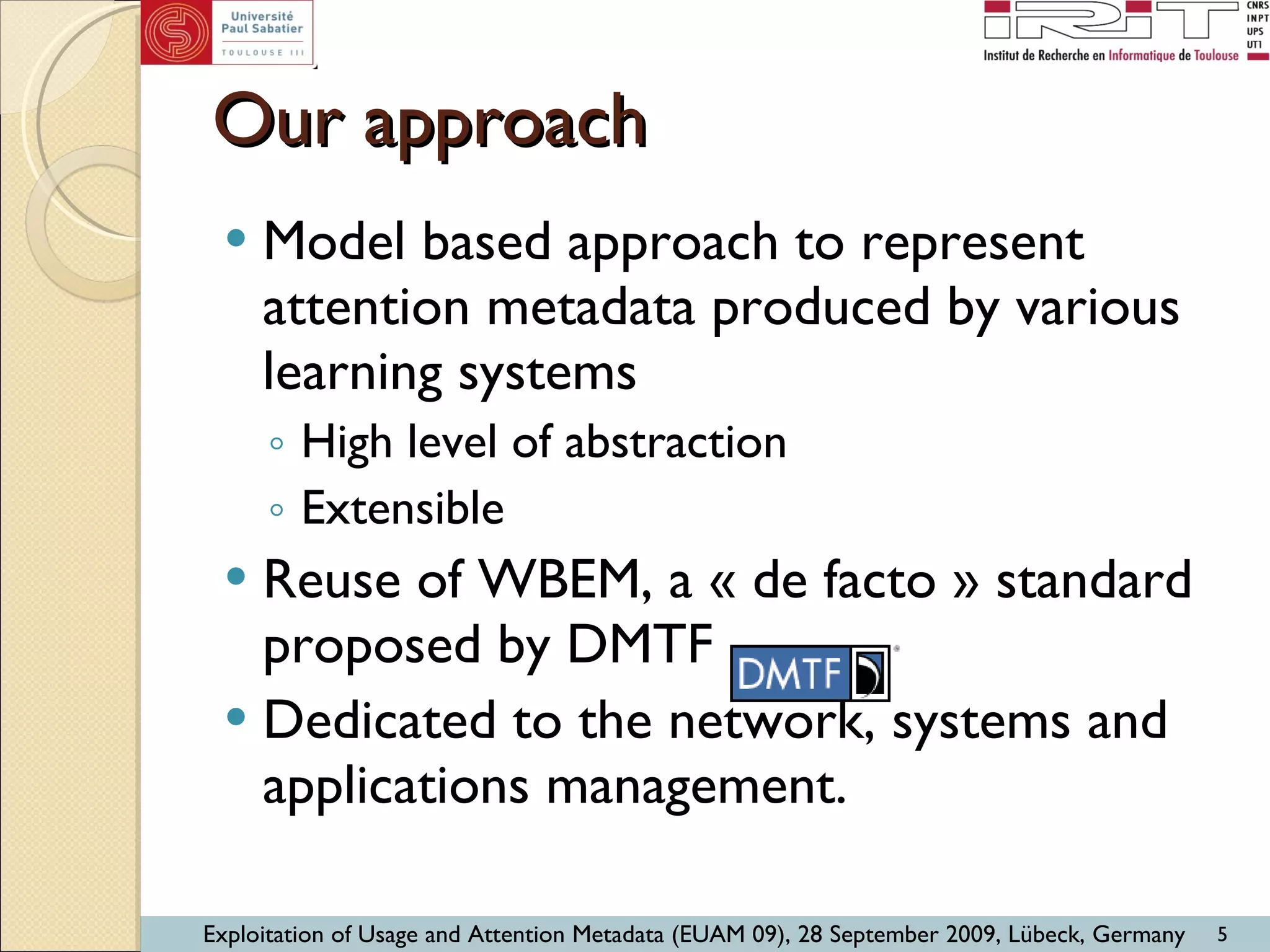
Our approach  Model based approach to represent attention metadata produced by various learning systems High level of abstraction Extensible Reuse of WBEM, a « de facto » standard proposed by DMTF Dedicated to the network, systems and applications management.
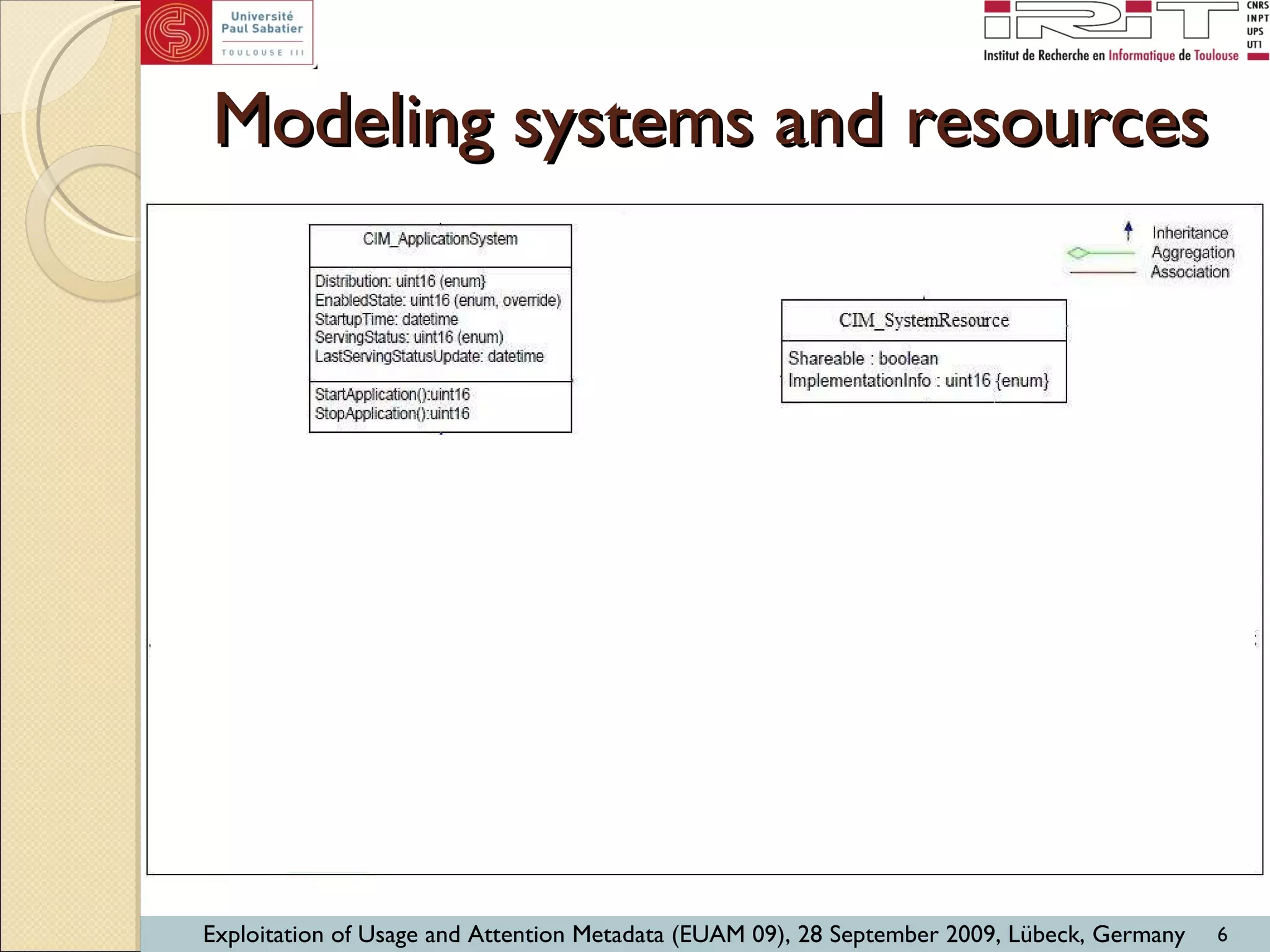
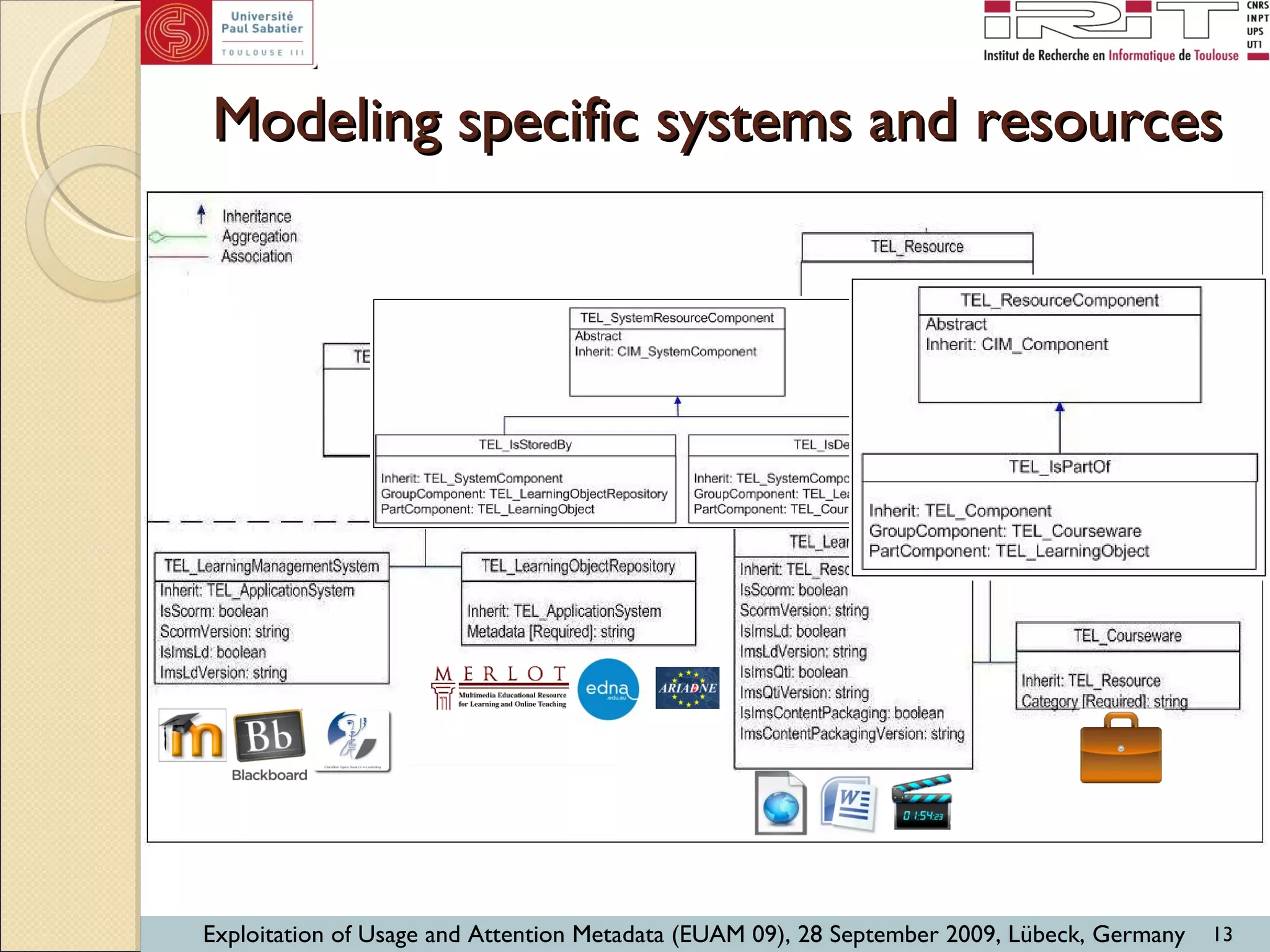
Modeling systems and resources
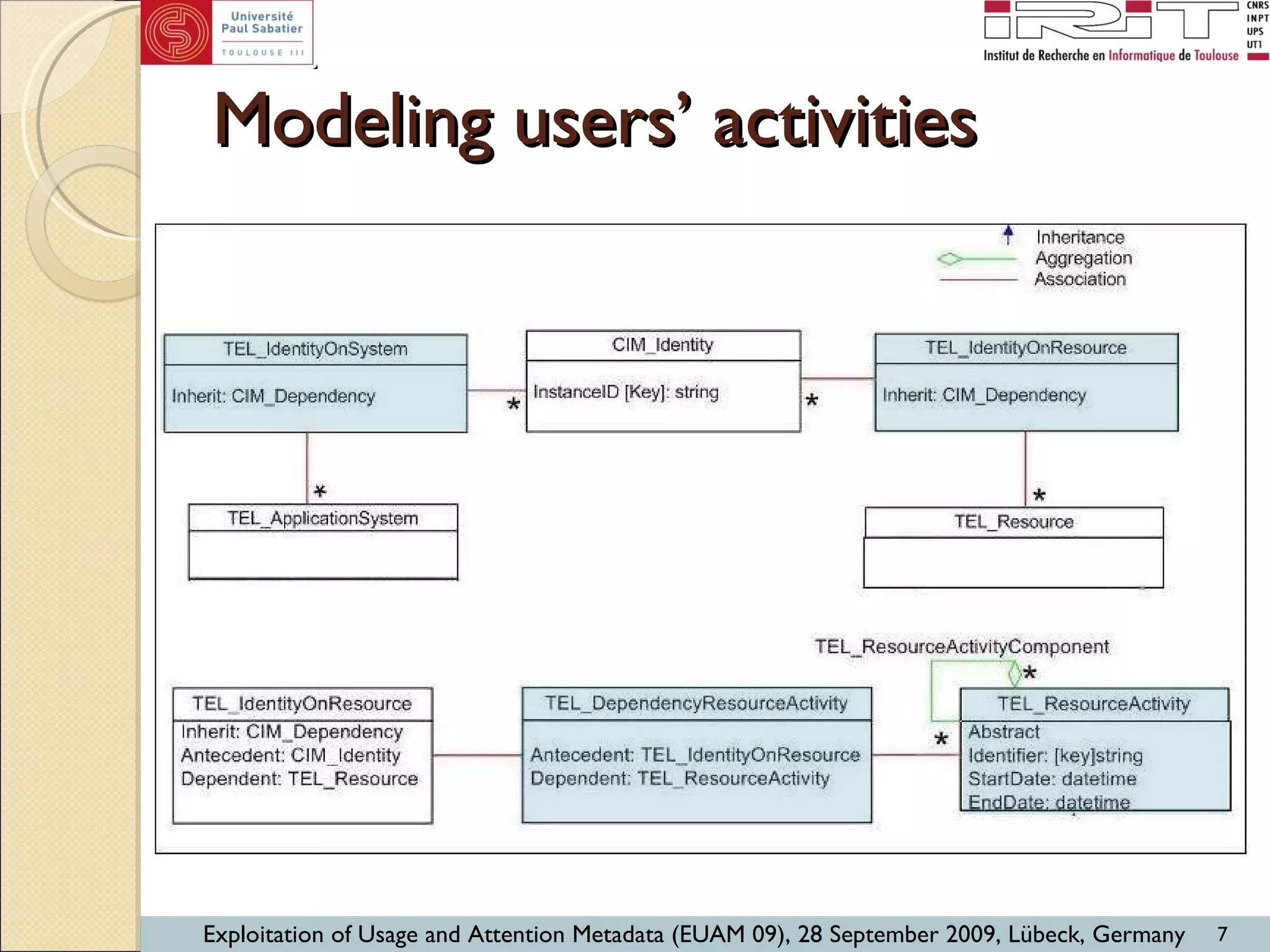
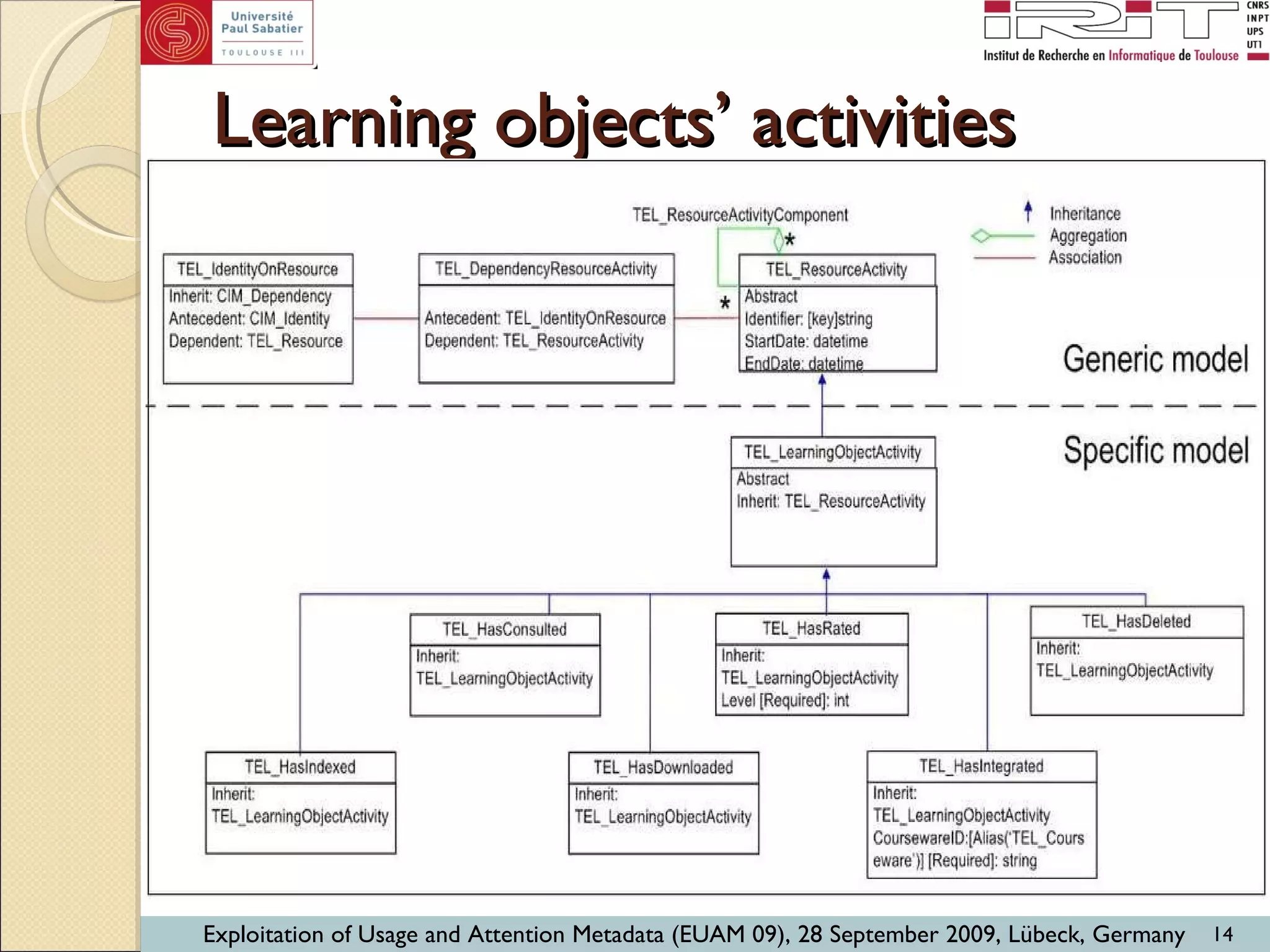
Modeling users’ activities
Plan 1.Uniform representation 2. An opened and distributed architecture 3.Experimentation with Learning Objects 4.Conclusions and future works
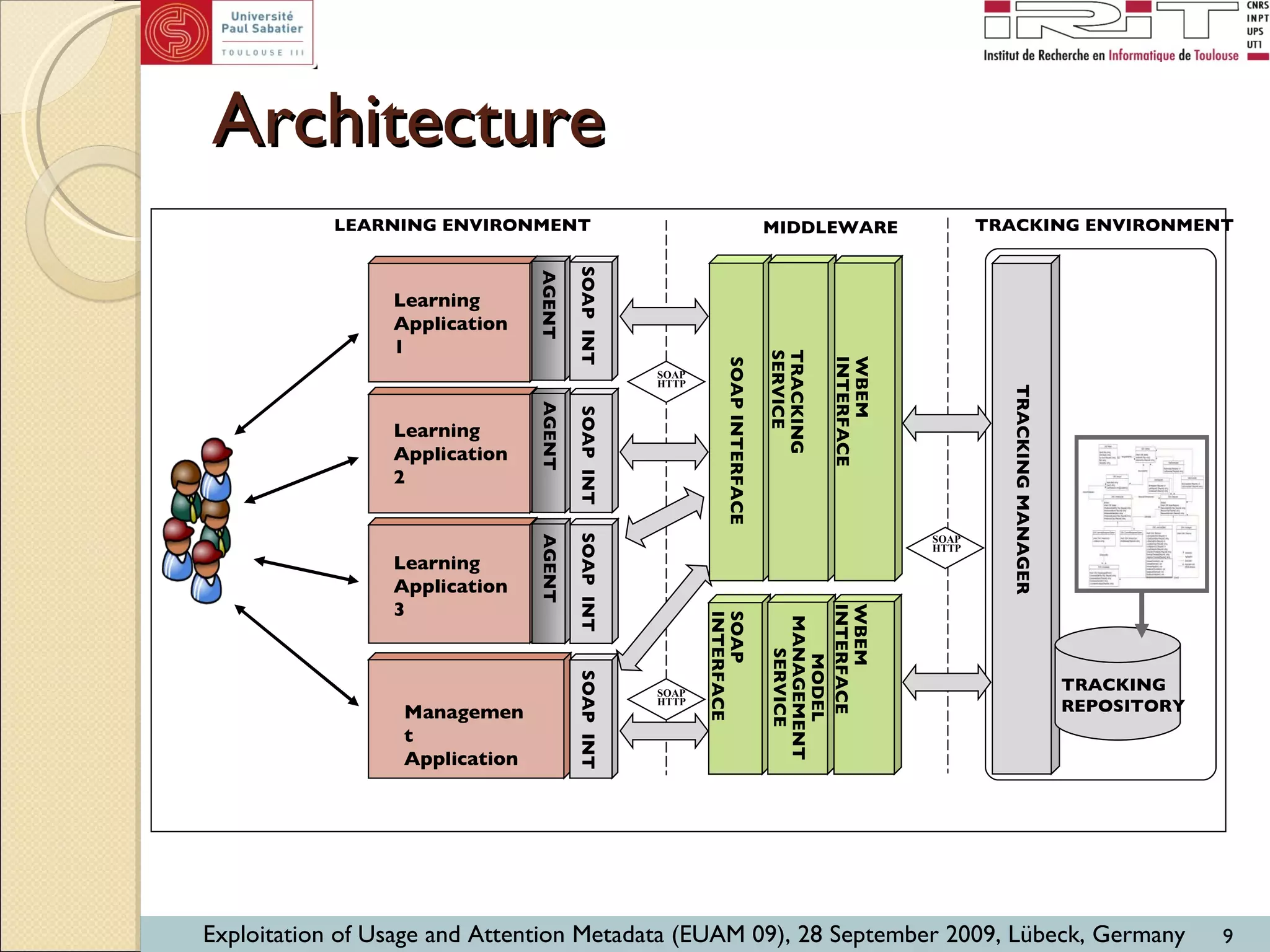
Architecture  LEARNING ENVIRONMENT TRACKING ENVIRONMENT MIDDLEWARE SOAP HTTP TRACKING REPOSITORY TRACKING MANAGER Learning Application 1 Learning Application 2 Learning Application 3 Management Application SOAP HTTP SOAP HTTP SOAP  INT AGENT AGENT AGENT SOAP  INT SOAP  INT SOAP  INT TRACKING SERVICE WBEM INTERFACE SOAP INTERFACE MODEL MANAGEMENT  SERVICE SOAP INTERFACE WBEM INTERFACE
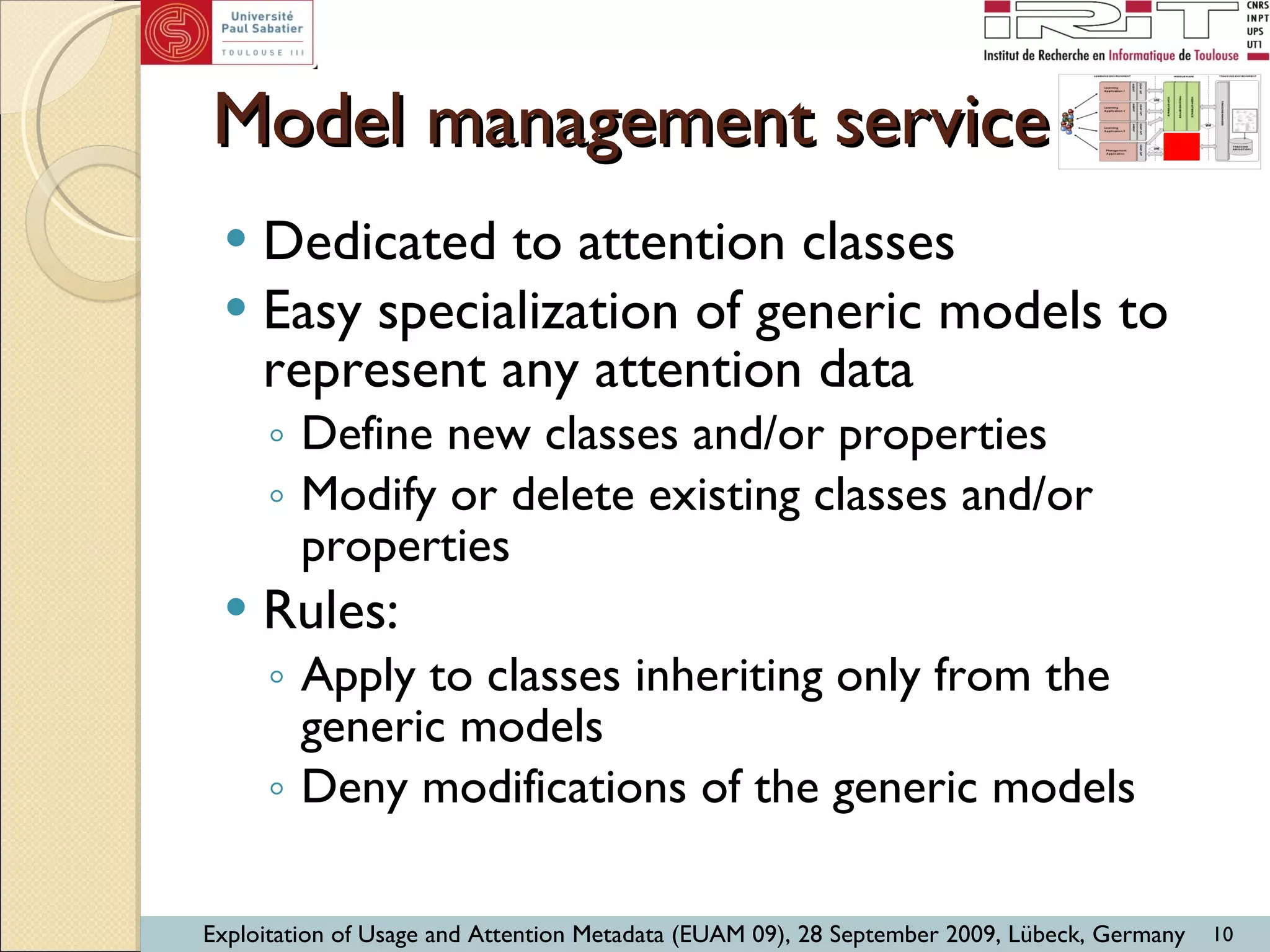
Model management service Dedicated to attention classes Easy specialization of generic models to represent any attention data Define new classes and/or properties Modify or delete existing classes and/or properties Rules:  Apply to classes inheriting only from the generic models Deny modifications of the generic models
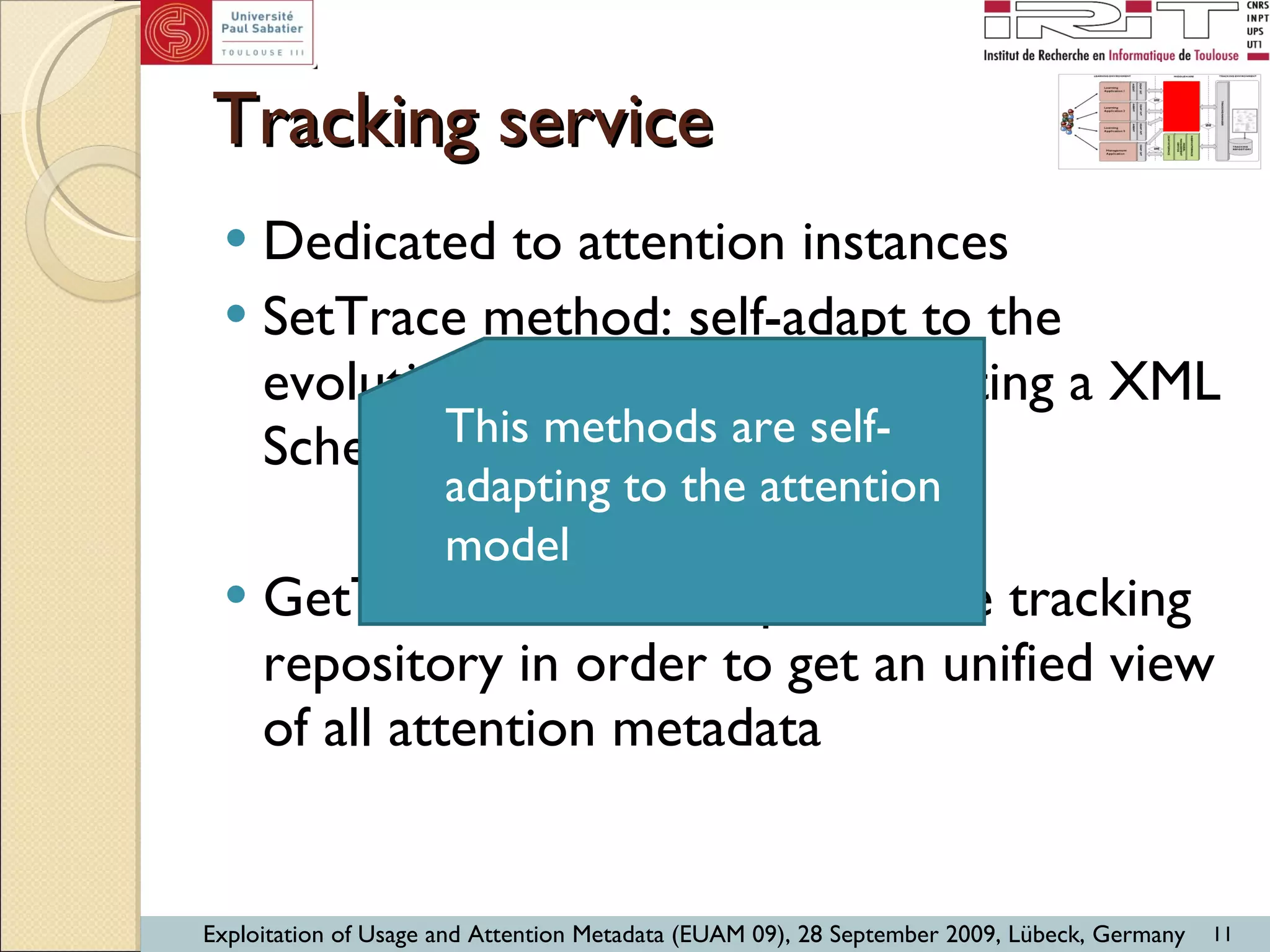
Tracking service Dedicated to attention instances SetTrace method: self-adapt to the evolution of the model by creating a XML Schema conform to the model. GetTrace method: explores the tracking repository in order to get an unified view of all attention metadata This methods are self-adapting to the attention model
Plan 1.Uniform representation 2. An opened and distributed architecture 3.Experimentation with Learning Objects 4.Conclusions and future works
Modeling specific systems and resources
Learning objects’ activities
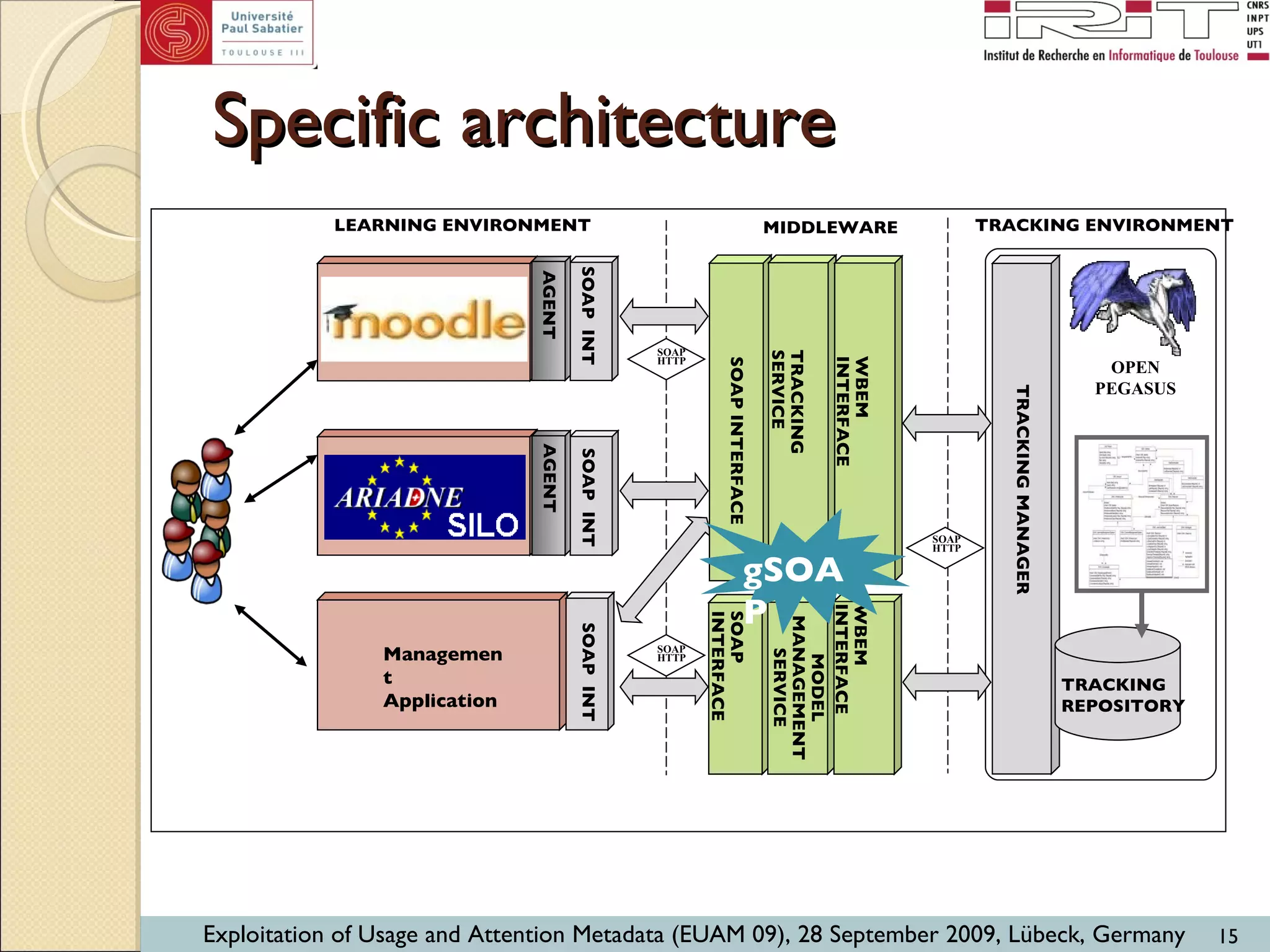
Specific architecture LEARNING ENVIRONMENT TRACKING ENVIRONMENT Management Application MIDDLEWARE SOAP HTTP SOAP  INT AGENT AGENT SOAP  INT SOAP  INT Learning Application 1 Learning Application 2 TRACKING REPOSITORY TRACKING MANAGER SOAP HTTP SOAP HTTP TRACKING SERVICE WBEM INTERFACE SOAP INTERFACE MODEL MANAGEMENT  SERVICE SOAP INTERFACE WBEM INTERFACE OPEN PEGASUS gSOAP
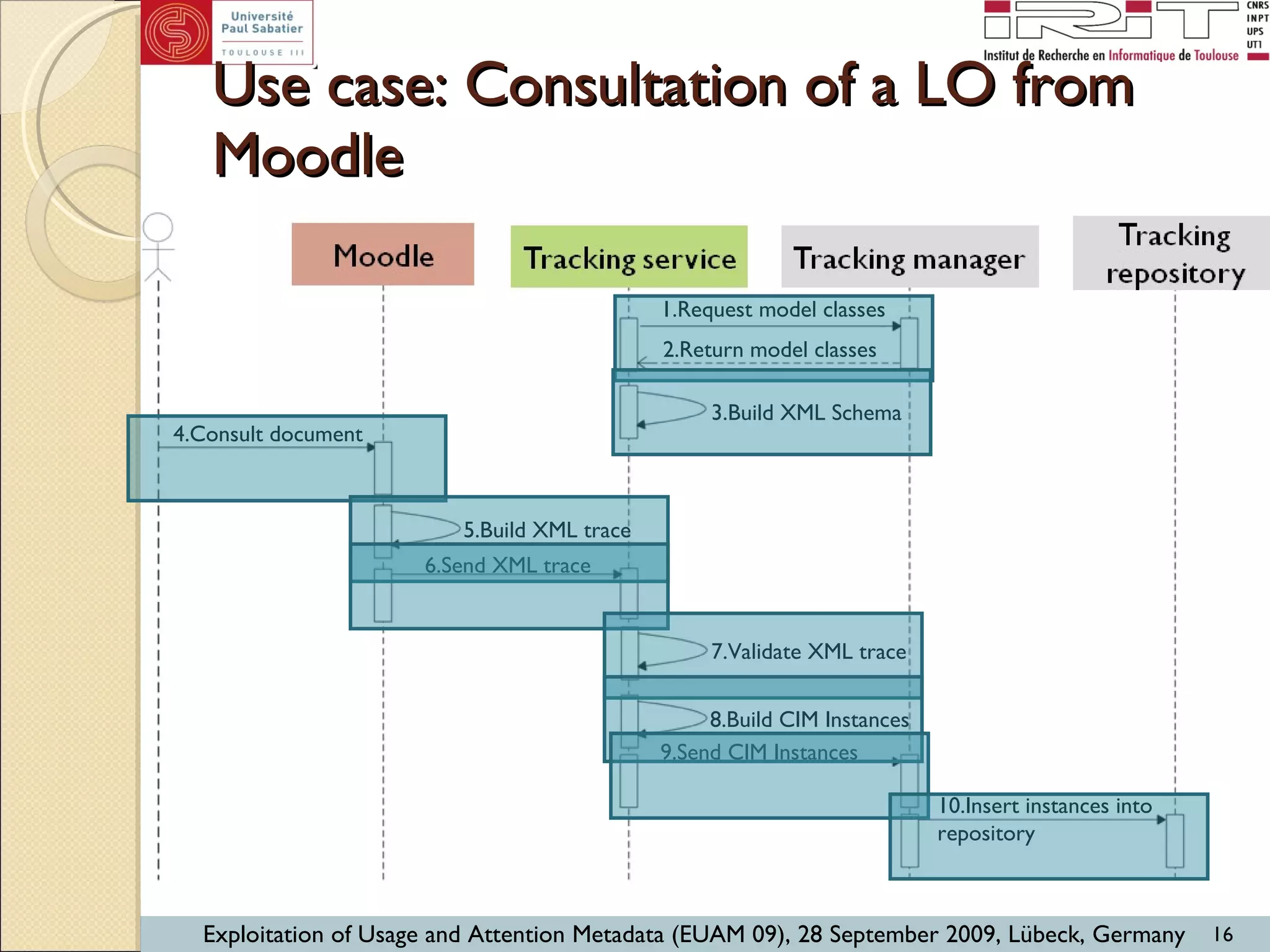
Use case: Consultation of a LO from Moodle Moodle Tracking service Tracking manager Tracking  repository 1.Request model classes 2.Return model classes 3.Build XML Schema 4.Consult document 5.Build XML trace 6.Send XML trace 7.Validate XML trace 8.Build CIM Instances 9.Send CIM Instances 10.Insert instances into repository
Plan 1.Uniform representation 2. An opened and distributed architecture 3.Experimentation with Learning Objects 4.Conclusions and future works
Conclusions and future works A framework to manage attention metadata Integrated within ubiquitous operating systems (Windows XP, Linux) Easy to satisfy multiple objectives: model management service Facilitates share and reuse :  Externalisation of attention metadata Self - adapting tracking service  Automated update of agents according to the model Use Manager to Manager communication Exploit the collected traces: intelligent tutoring systems, recommendation systems
Questions

An adaptative framework for tracking Web–based Learning Environments

  • 1.
    An adaptative frameworkfor tracking Web-based Learning Environments Valentin Butoianu, Phillipe Vidal, Julien Broisin Institut de Recherche en Informatique de Toulouse, France {butoianu, vidal, broisin}@irit.fr
  • 2.
    Context Mass personalizationStudents: adapt learning scenarios to each user Instructors and designers: adapt their courseware to various users’ learning paths => Need to collect a large amount of attention metadata from Web-based Learning Environments
  • 3.
    Research issues Existingtracking systems Students’ online activities within LMS Discussion forums Chat, instant messaging, … Main drawbacks: Specificity Attention metadata enclosed into systems being traced  Prevents attention share, thus mass personalization Uniform representation of attention metadata An architecture promoting the share and reuse of attention metadata
  • 4.
    Plan 1.Uniform representation2. An opened and distributed architecture 3.Experimentation with Learning Objects 4.Conclusions and future works
  • 5.
    Our approach Model based approach to represent attention metadata produced by various learning systems High level of abstraction Extensible Reuse of WBEM, a « de facto » standard proposed by DMTF Dedicated to the network, systems and applications management.
  • 6.
  • 7.
  • 8.
    Plan 1.Uniform representation2. An opened and distributed architecture 3.Experimentation with Learning Objects 4.Conclusions and future works
  • 9.
    Architecture LEARNINGENVIRONMENT TRACKING ENVIRONMENT MIDDLEWARE SOAP HTTP TRACKING REPOSITORY TRACKING MANAGER Learning Application 1 Learning Application 2 Learning Application 3 Management Application SOAP HTTP SOAP HTTP SOAP INT AGENT AGENT AGENT SOAP INT SOAP INT SOAP INT TRACKING SERVICE WBEM INTERFACE SOAP INTERFACE MODEL MANAGEMENT SERVICE SOAP INTERFACE WBEM INTERFACE
  • 10.
    Model management serviceDedicated to attention classes Easy specialization of generic models to represent any attention data Define new classes and/or properties Modify or delete existing classes and/or properties Rules: Apply to classes inheriting only from the generic models Deny modifications of the generic models
  • 11.
    Tracking service Dedicatedto attention instances SetTrace method: self-adapt to the evolution of the model by creating a XML Schema conform to the model. GetTrace method: explores the tracking repository in order to get an unified view of all attention metadata This methods are self-adapting to the attention model
  • 12.
    Plan 1.Uniform representation2. An opened and distributed architecture 3.Experimentation with Learning Objects 4.Conclusions and future works
  • 13.
  • 14.
  • 15.
    Specific architecture LEARNINGENVIRONMENT TRACKING ENVIRONMENT Management Application MIDDLEWARE SOAP HTTP SOAP INT AGENT AGENT SOAP INT SOAP INT Learning Application 1 Learning Application 2 TRACKING REPOSITORY TRACKING MANAGER SOAP HTTP SOAP HTTP TRACKING SERVICE WBEM INTERFACE SOAP INTERFACE MODEL MANAGEMENT SERVICE SOAP INTERFACE WBEM INTERFACE OPEN PEGASUS gSOAP
  • 16.
    Use case: Consultationof a LO from Moodle Moodle Tracking service Tracking manager Tracking repository 1.Request model classes 2.Return model classes 3.Build XML Schema 4.Consult document 5.Build XML trace 6.Send XML trace 7.Validate XML trace 8.Build CIM Instances 9.Send CIM Instances 10.Insert instances into repository
  • 17.
    Plan 1.Uniform representation2. An opened and distributed architecture 3.Experimentation with Learning Objects 4.Conclusions and future works
  • 18.
    Conclusions and futureworks A framework to manage attention metadata Integrated within ubiquitous operating systems (Windows XP, Linux) Easy to satisfy multiple objectives: model management service Facilitates share and reuse : Externalisation of attention metadata Self - adapting tracking service Automated update of agents according to the model Use Manager to Manager communication Exploit the collected traces: intelligent tutoring systems, recommendation systems
  • 19.

Editor's Notes

  • #3 As the number of materials stored in a system grows, it becomes more and more difficult for users to find the resources that he’s looking for. It become necessary to adapt the result to fit individual differences, expectations, and needs, thus personalization! In the e-learning area, on one hand, students need that learning scenarios self adapts to their way of learning, knowledge level and preferences, on the other hand, instructors and designers need to adapt their courseware to various users’ learning paths. To perform personalization it is needed to collect attention metadata from WLE!
  • #4 The nowadays tracking systems suffers of two main drawbacks: the first one is specificity, they track users activities within some specific applications as : discussion forums or Learning Management System, and the second one is that attention metadata is encolsed into the systems to be tracked. These drawbacks prevent share of attention metadata, thus personalization! To solve these issues it is needed for an uniform representation of attention metadata and an architecture promoting their share and reuse!
  • #5 First of all I’ll present the attention metadata uniform representation and I’ll continue with it’s associated opened and distributed architecure. To validate our aproach I’ll presnet an experimentation with Learning Objects and I’ll finished with the conclusions and future works!
  • #6 The idea of tracing it’s not new, basically it was used to track systems and networks states. Our approach reuse such an initiative as the WBEM standard proposed by DMTF dedicated to network, systems and application management. This standard is integrated in nowadays operating systems, it propose an unified and extensible model (CIM Common information model), and offers distributed tracking components.
  • #7 Using WBEMs’ CIM we defined our generic model for representing resources, applications and users-s interactions with these resources and applications. To represent applications and resources we extended the already existing CIM classes: CIM_ApplicationSystem respectively CIM_SystemResource. The TEL_SystemComponent composition relationship translate that an application can be composed of other applications. The Tel_ResourceComponent has the same role but for resources. To represent that a resource is part of an application we use the TEL_SystemResourceCOmponent class. We can model any kind of applications as skype, word, moodle and resources as web pages, video or music files.
  • #8 To model users we are using pre-defined CIM_Identity class. To associate an user with an application or resource we defined the association classes TEL_IdentityOnSystem, respectively Tel_IdentityOnResource. For representing activities we defined the class TEL_ResourceActivity. To uniquely associate an user, resource and an activity we defined the class tel_dependencyResourceActivity which associate a pair user/resource with an activity!
  • #9 After seeing the attention metadata uniform representation I’ll continue with it’s asscoiated opened and distributed architecture.
  • #10 On one hand we have the learning environment wich comprises users interacting with learning applications, and on the other hand we have the tracking environment composed by a tracking rrepository which stores our model and the associated instances; and an tracking manager which interacts with the tracking repository. We have also the agents integrated within learning applications responsible for collecting attention metadata. Since the tracking repository is not wide accesible, to facilitate the acces to the repository we introduced the midleware layer. As our model is abstract, it will be specialized for particulary objectives , thus the MIDD need to self adapt to the attention metadata defined into the model. We have 2 services: the first one, model management service manipulates the model classes and offeres the posibility to specialize the abstarct classes described earlier; and the second one, tracking service, interacts with the model instances in order to create new instances or update the existing ones.
  • #11 The model management service gives the posibility to define which attention metdata to be tracked by creating new classes into the model, modify or delete existing classes or properties.
  • #12 The tracking service contains 2 methods: one to insert new attention data into repository and the other to retreive these data from repository.