Hypnotist Framing
Hypnotic Practice as a Resource for Poetic
Interaction Design
Rung-Huei Liang
Taiwan Tech
Huang-Ming Chang
TU/Eindhoven
Sep., 2013
13年10月9⽇日星期三
outlines
• Introduction
• Method
• Framing Poetic Interaction Design
• Hypnotic Practice
• Design Implications
• Reflection & Discussion
• Conclusion
13年10月9⽇日星期三
Introduction
13年10月9⽇日星期三
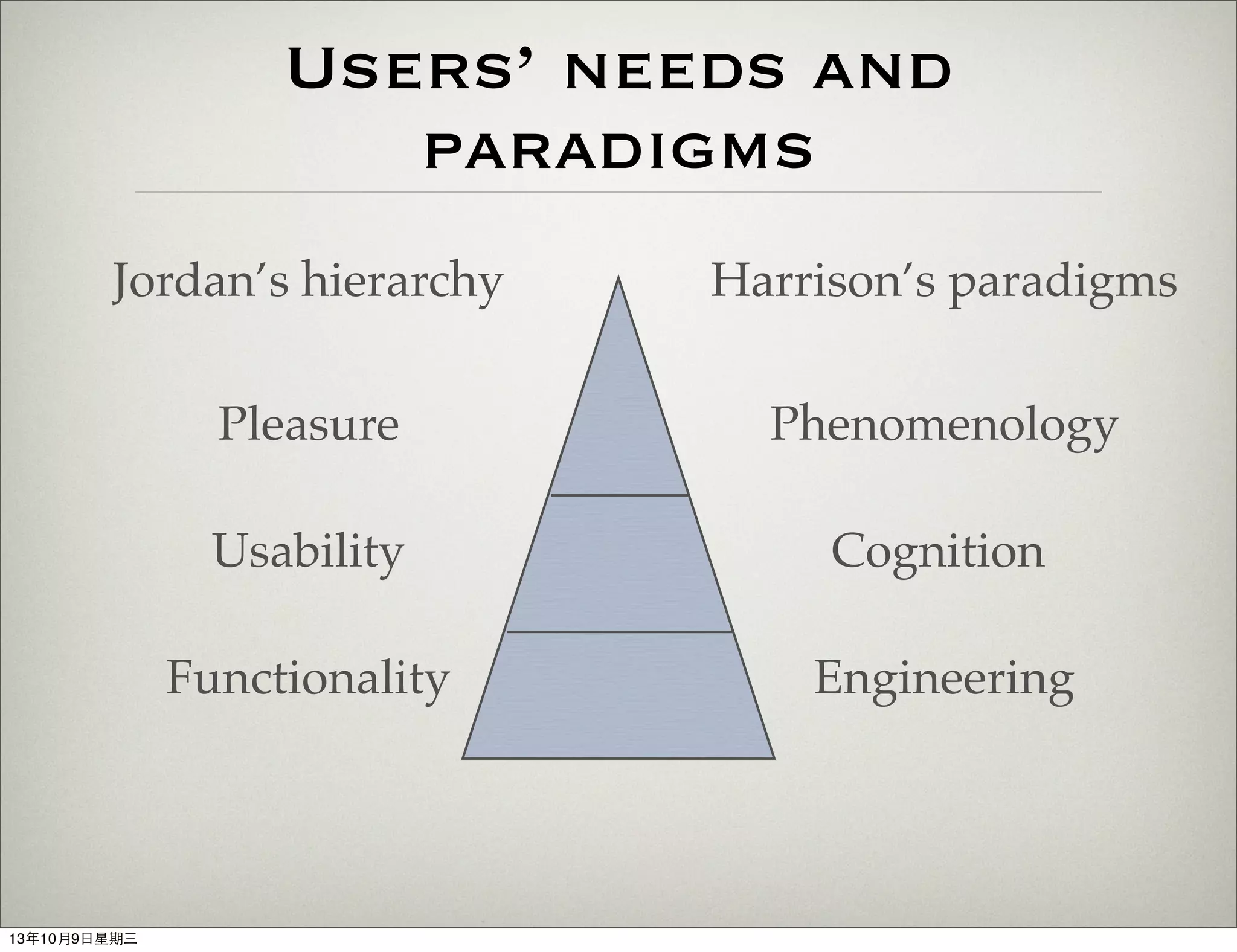
Users’ needs and
paradigms
Functionality
Usability
Pleasure
Engineering
Cognition
Phenomenology
Jordan’s hierarchy Harrison’s paradigms
13年10月9⽇日星期三
Different Notions of
Users
• Task-Oriented Operators
• Cognitive Users
• Phenomenological Individuals
13年10月9⽇日星期三
Problems
• What is the notion of users in “non-
task-oriented” interaction design?
• Is a user always in a fixed mental state?
13年10月9⽇日星期三
Interaction Design
Addressing Higher Needs
• Aesthetic Interaction
• Reflective Design
• Ludic Design
• Critical Design
• Poetic Interaction Design
13年10月9⽇日星期三
What Are The Unique
Features about Poetic
Interaction Design
13年10月9⽇日星期三
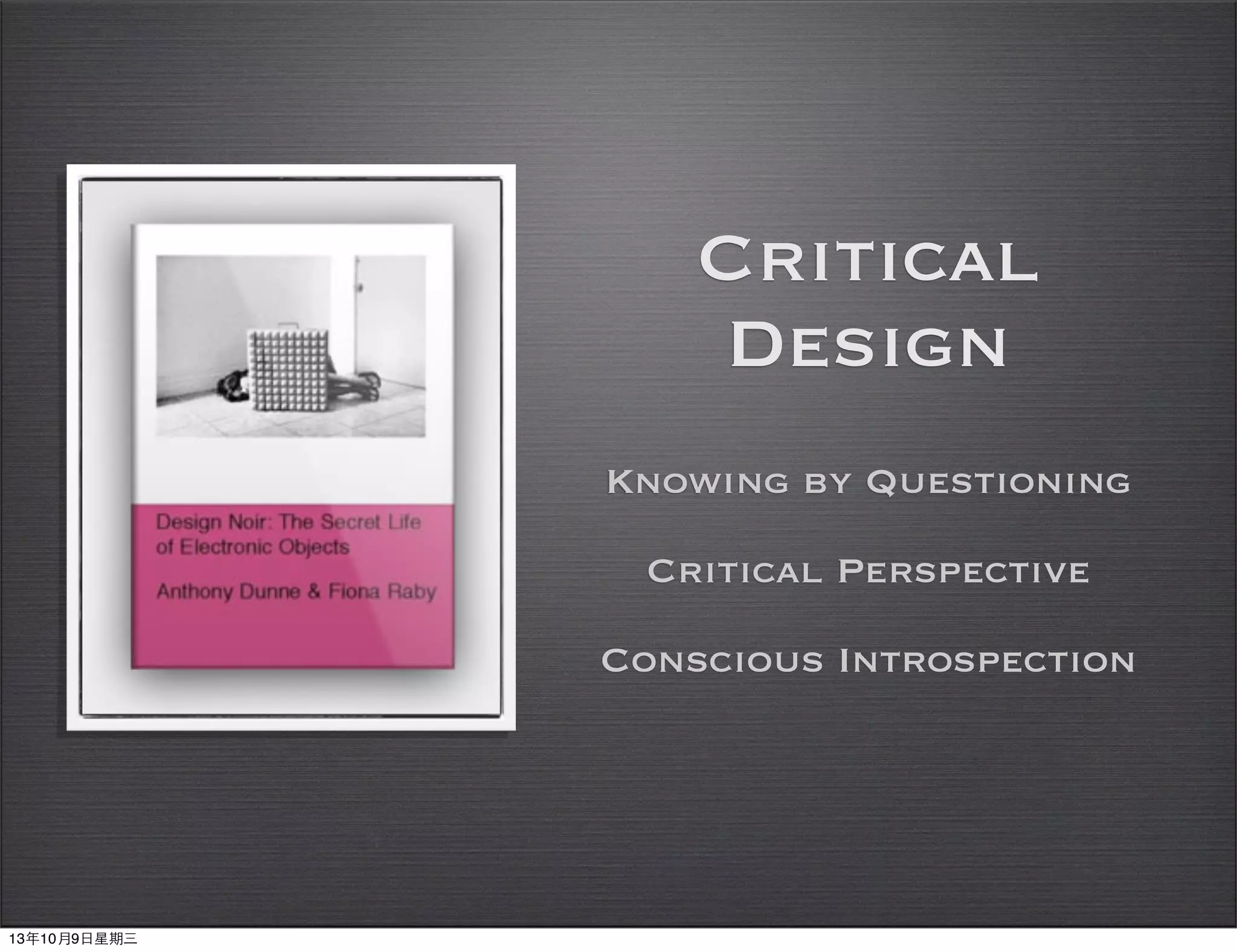
Critical
Design
Knowing by Questioning
Critical Perspective
Conscious Introspection
13年10月9⽇日星期三
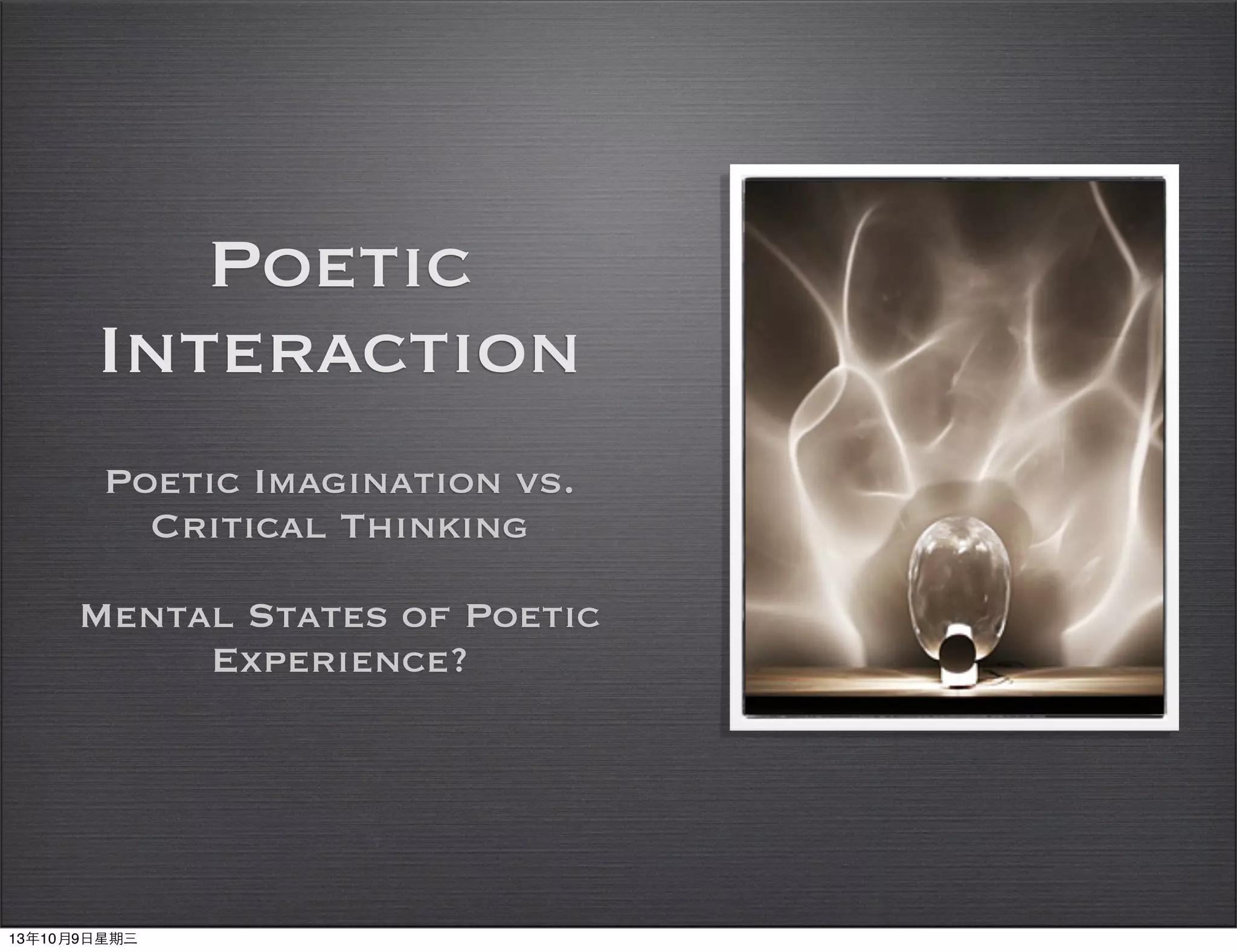
Poetic
Interaction
Poetic Imagination vs.
Critical Thinking
Mental States of Poetic
Experience?
13年10月9⽇日星期三
Research Questions
• What is the mental state when we experience poetics?
• What is the characteristic that differentiates poetic
interaction design from other interaction designs?
• How does the experience of reading poems inform us to
design ‘embodied poetics’?
• What is the similarity between a man in a hypnosis state
and a user experiencing poetics?
• How does a hypnotist frame the world?
• How can the hypnotic perspective as well as techniques
inform interaction design?
13年10月9⽇日星期三
Method
13年10月9⽇日星期三
• Seeing poetic interaction design as a
constructivist project
• Reflexive methodology: personal/subjective
observation, thoughts, stories to understand
felt experience
• Two months of apprenticeship of hypnotism,
with a NGH instructor
• Auto-ethnographic approach: empirical study,
self-observation, master-apprentice
conversation.
13年10月9⽇日星期三
Framing Poetic
Interaction Design
13年10月9⽇日星期三
Reflexivity on Poetics
• Not providing definite conceptual
framing
• Retrospect the socio-cultural root of
poetics in Chinese culture
13年10月9⽇日星期三
13年10月9⽇日星期三
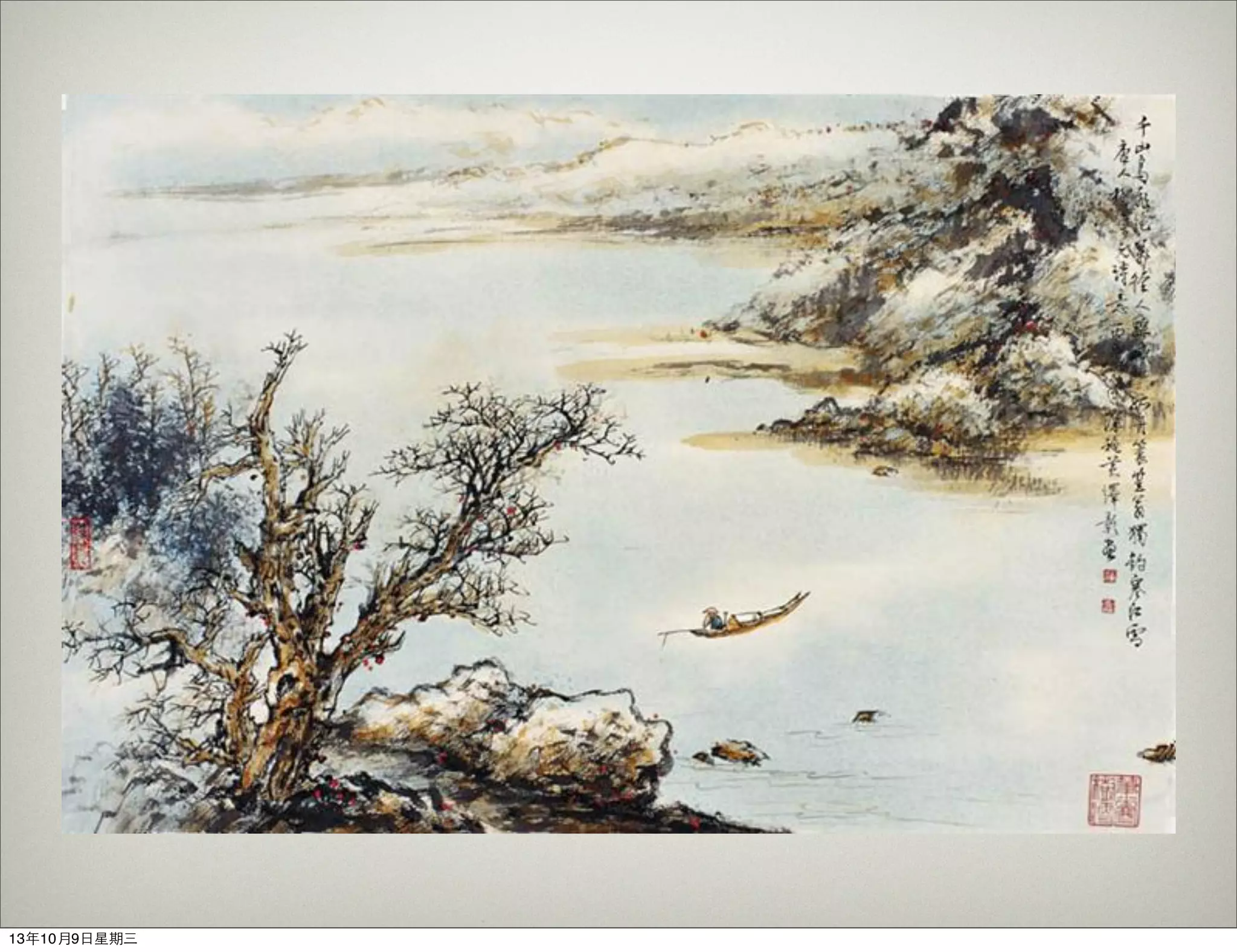
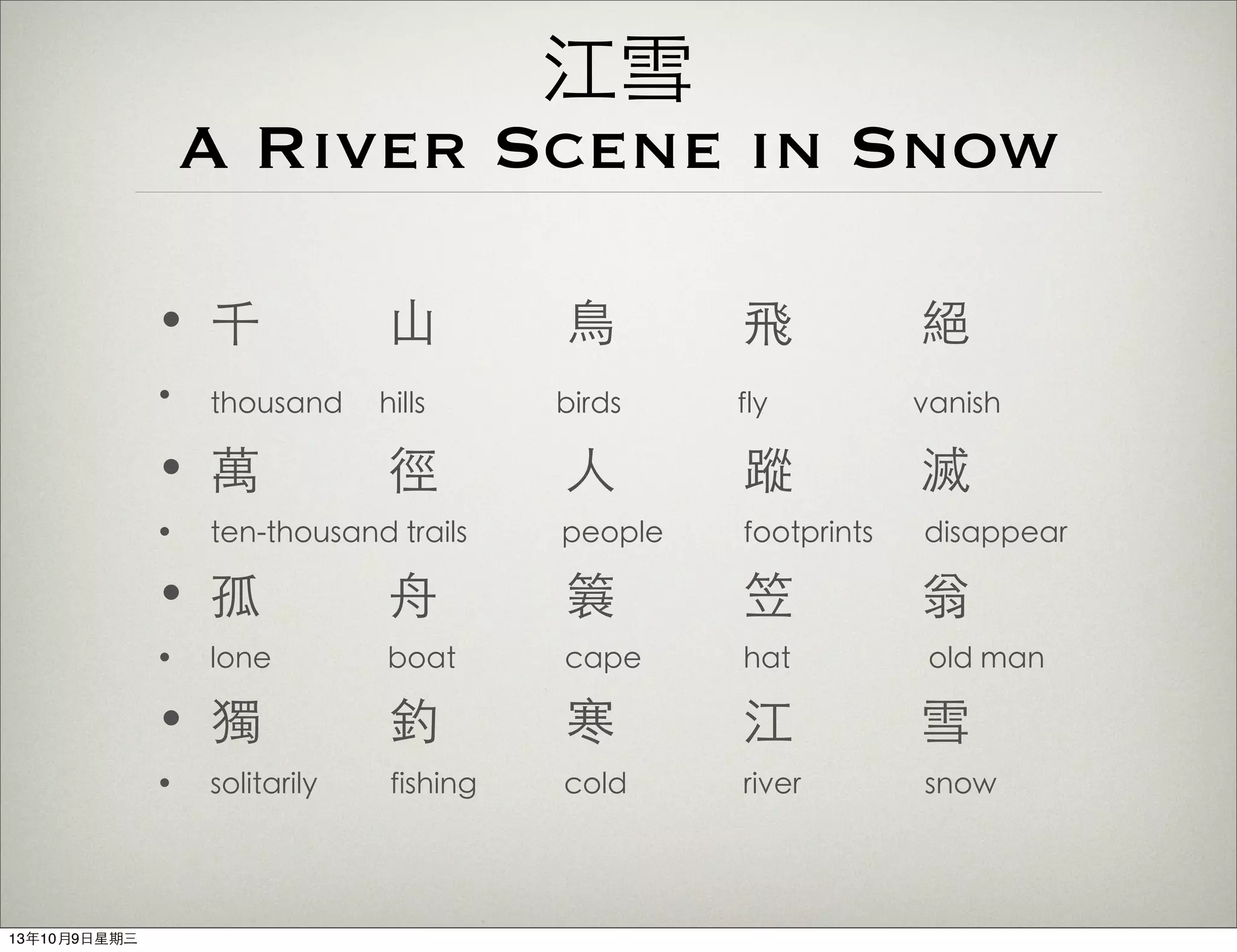
江雪
A River Scene in Snow
• 千 ⼭山 ⿃鳥 飛 絕
• thousand hills birds fly vanish
• 萬 徑 ⼈人 蹤 滅
• ten-thousand trails people footprints disappear
• 孤 ⾈舟 簑 笠 翁
• lone boat cape hat old man
• 獨 釣 寒 江 雪
• solitarily fishing cold river snow
13年10月9⽇日星期三
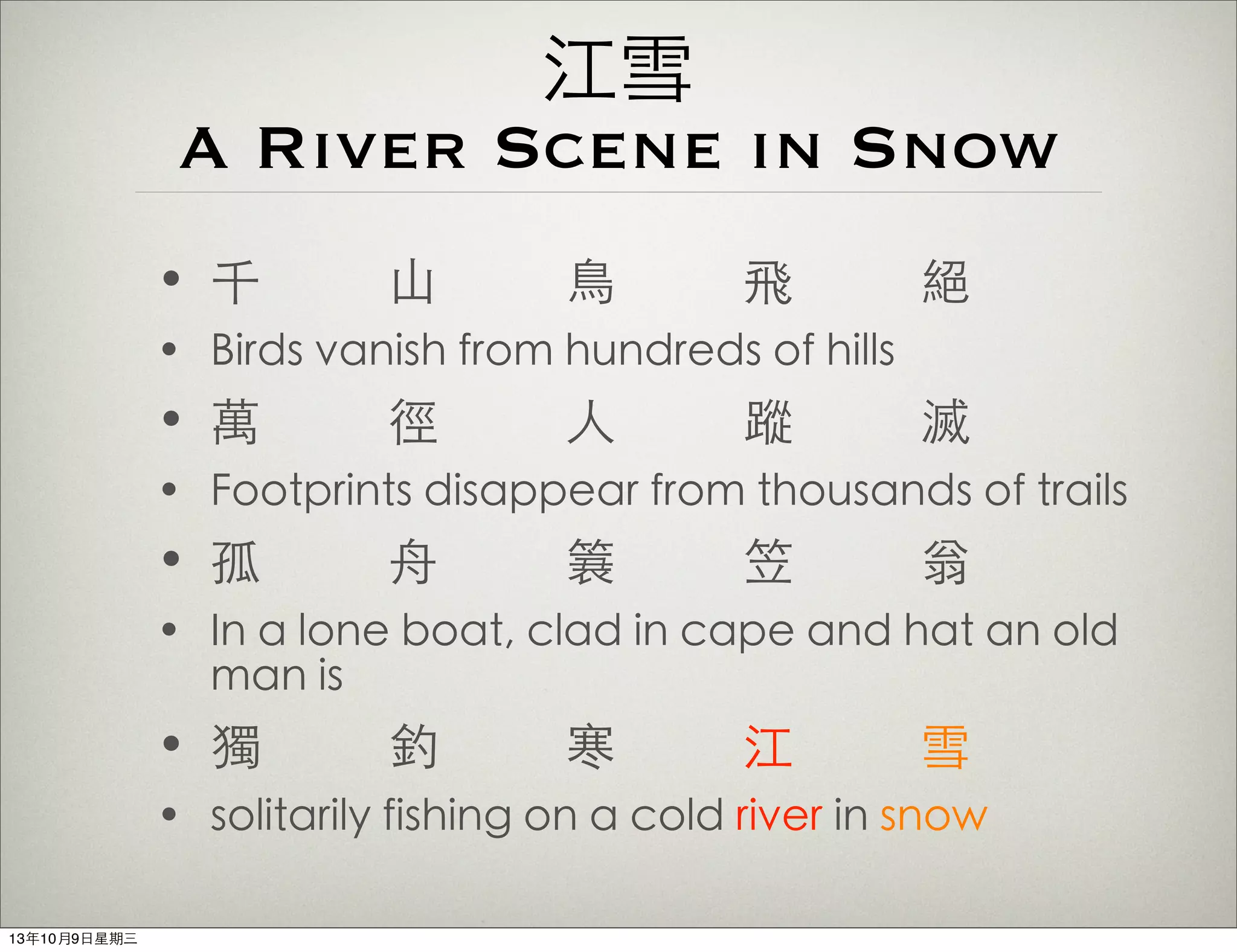
江雪
A River Scene in Snow
• 千 ⼭山 ⿃鳥 飛 絕
• Birds vanish from hundreds of hills
• 萬 徑 ⼈人 蹤 滅
• Footprints disappear from thousands of trails
• 孤 ⾈舟 簑 笠 翁
• In a lone boat, clad in cape and hat an old
man is
• 獨 釣 寒 江 雪
• solitarily fishing on a cold river in snow
13年10月9⽇日星期三
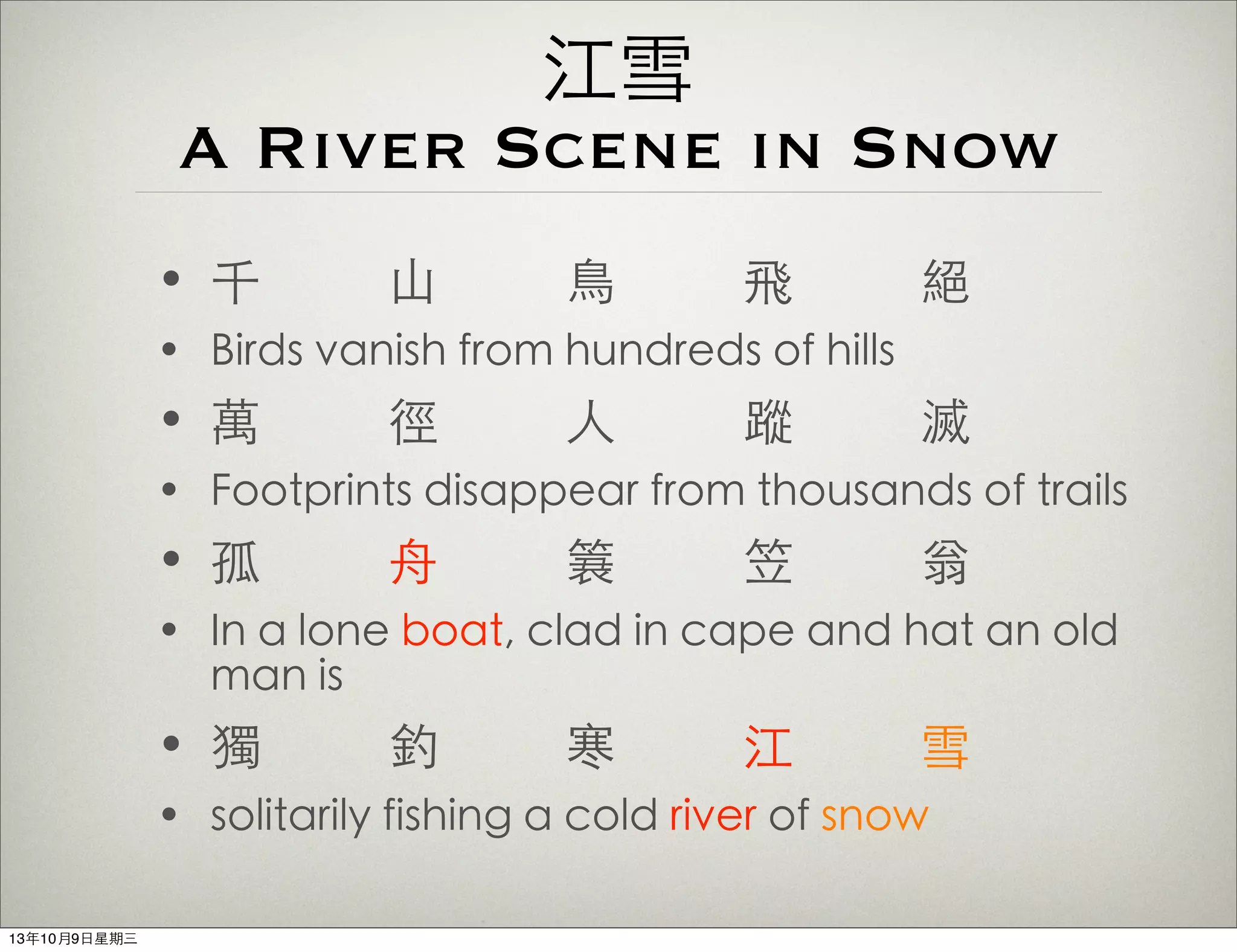
江雪
A River Scene in Snow
• 千 ⼭山 ⿃鳥 飛 絕
• Birds vanish from hundreds of hills
• 萬 徑 ⼈人 蹤 滅
• Footprints disappear from thousands of trails
• 孤 ⾈舟 簑 笠 翁
• In a lone boat, clad in cape and hat an old
man is
• 獨 釣 寒 江 雪
• solitarily fishing a cold river of snow
13年10月9⽇日星期三
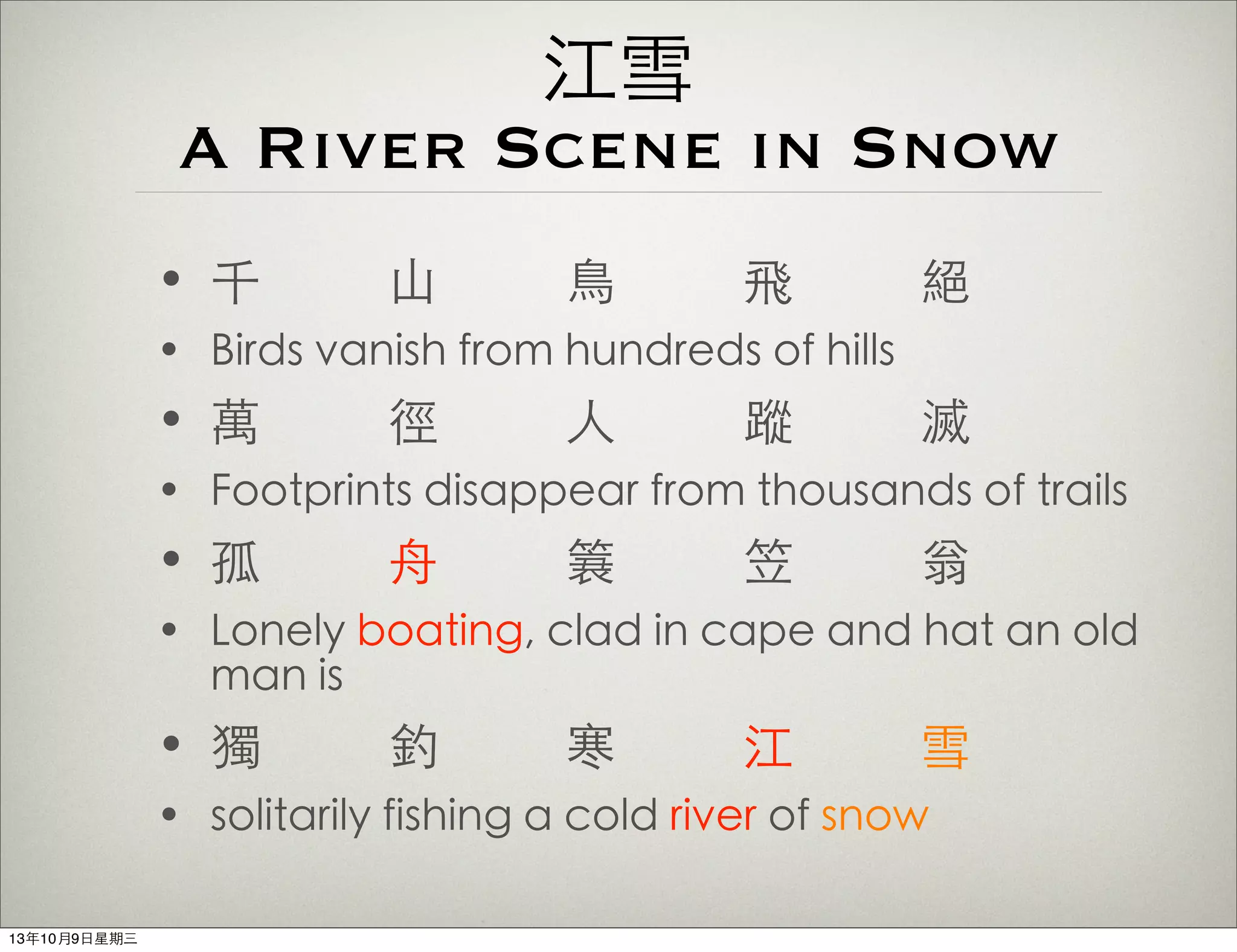
江雪
A River Scene in Snow
• 千 ⼭山 ⿃鳥 飛 絕
• Birds vanish from hundreds of hills
• 萬 徑 ⼈人 蹤 滅
• Footprints disappear from thousands of trails
• 孤 ⾈舟 簑 笠 翁
• Lonely boating, clad in cape and hat an old
man is
• 獨 釣 寒 江 雪
• solitarily fishing a cold river of snow
13年10月9⽇日星期三
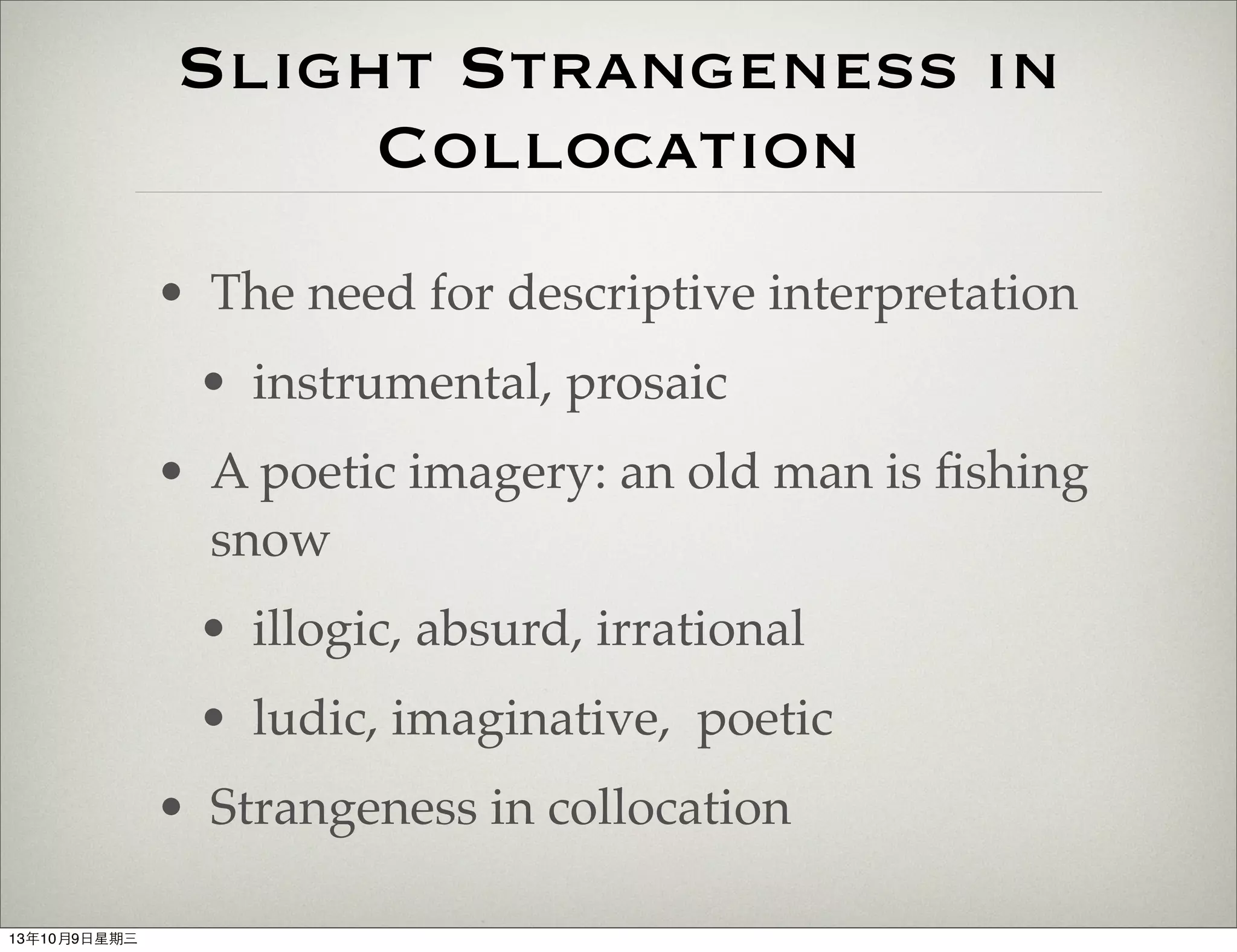
Slight Strangeness in
Collocation
• The need for descriptive interpretation
• instrumental, prosaic
• A poetic imagery: an old man is fishing
snow
• illogic, absurd, irrational
• ludic, imaginative, poetic
• Strangeness in collocation
13年10月9⽇日星期三
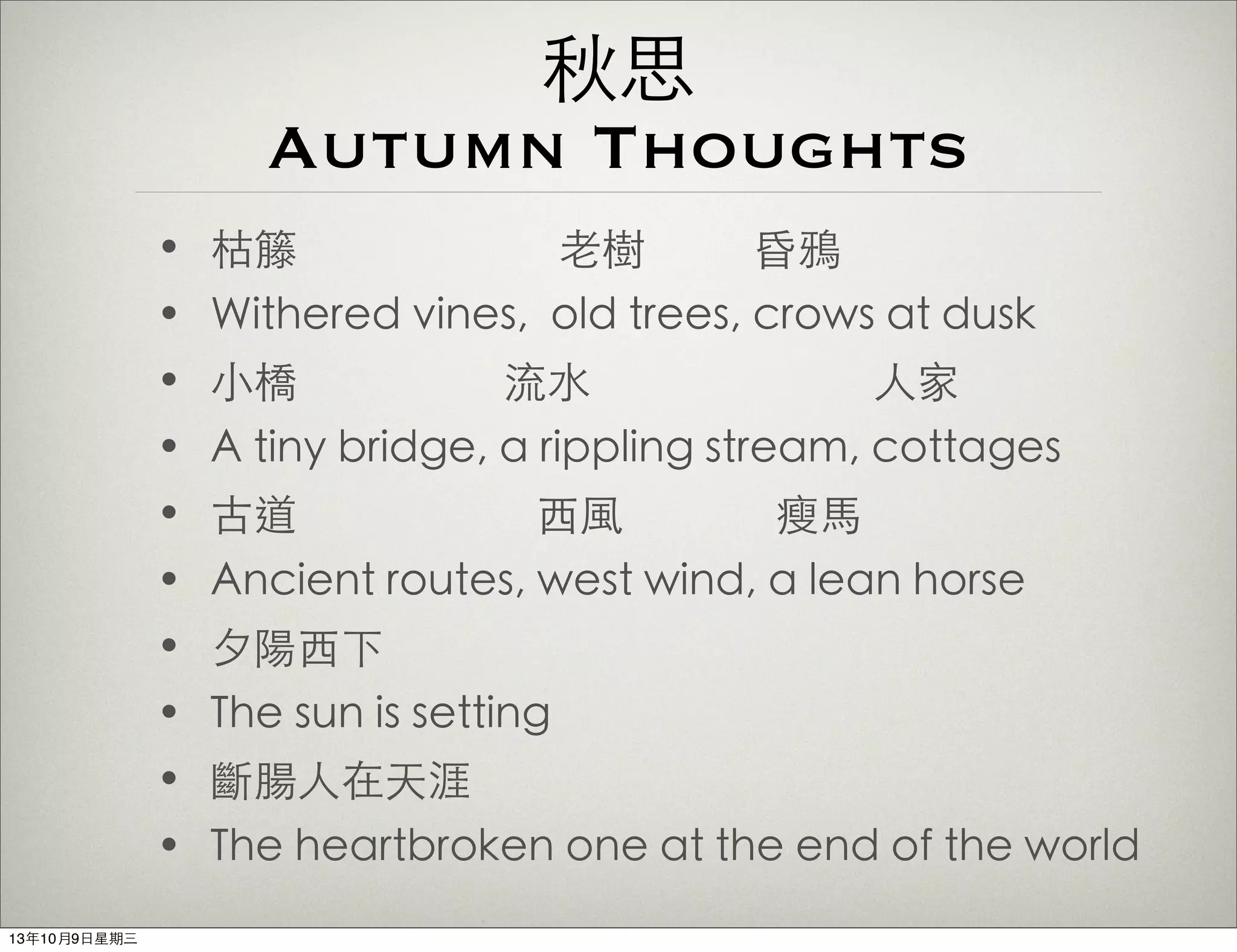
秋思
Autumn Thoughts
• 枯籐 ⽼老樹 昏鴉
• Withered vines, old trees, crows at dusk
• ⼩小橋 流⽔水 ⼈人家
• A tiny bridge, a rippling stream, cottages
• 古道 ⻄西⾵風 瘦⾺馬
• Ancient routes, west wind, a lean horse
• ⼣夕陽⻄西下
• The sun is setting
• 斷腸⼈人在天涯
• The heartbroken one at the end of the world
13年10月9⽇日星期三
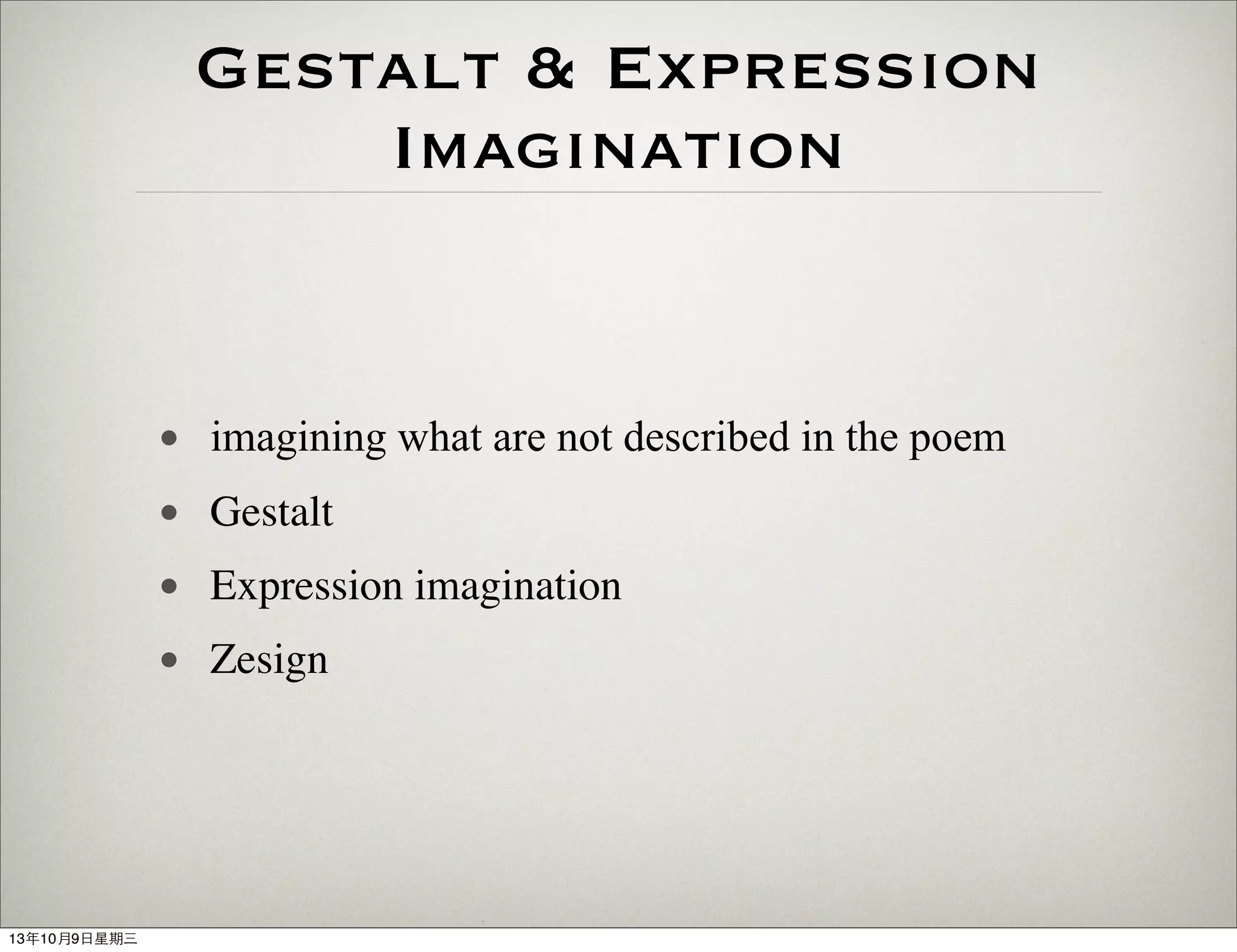
Gestalt & Expression
Imagination
• imagining what are not described in the poem
• Gestalt
• Expression imagination
• Zesign
13年10月9⽇日星期三
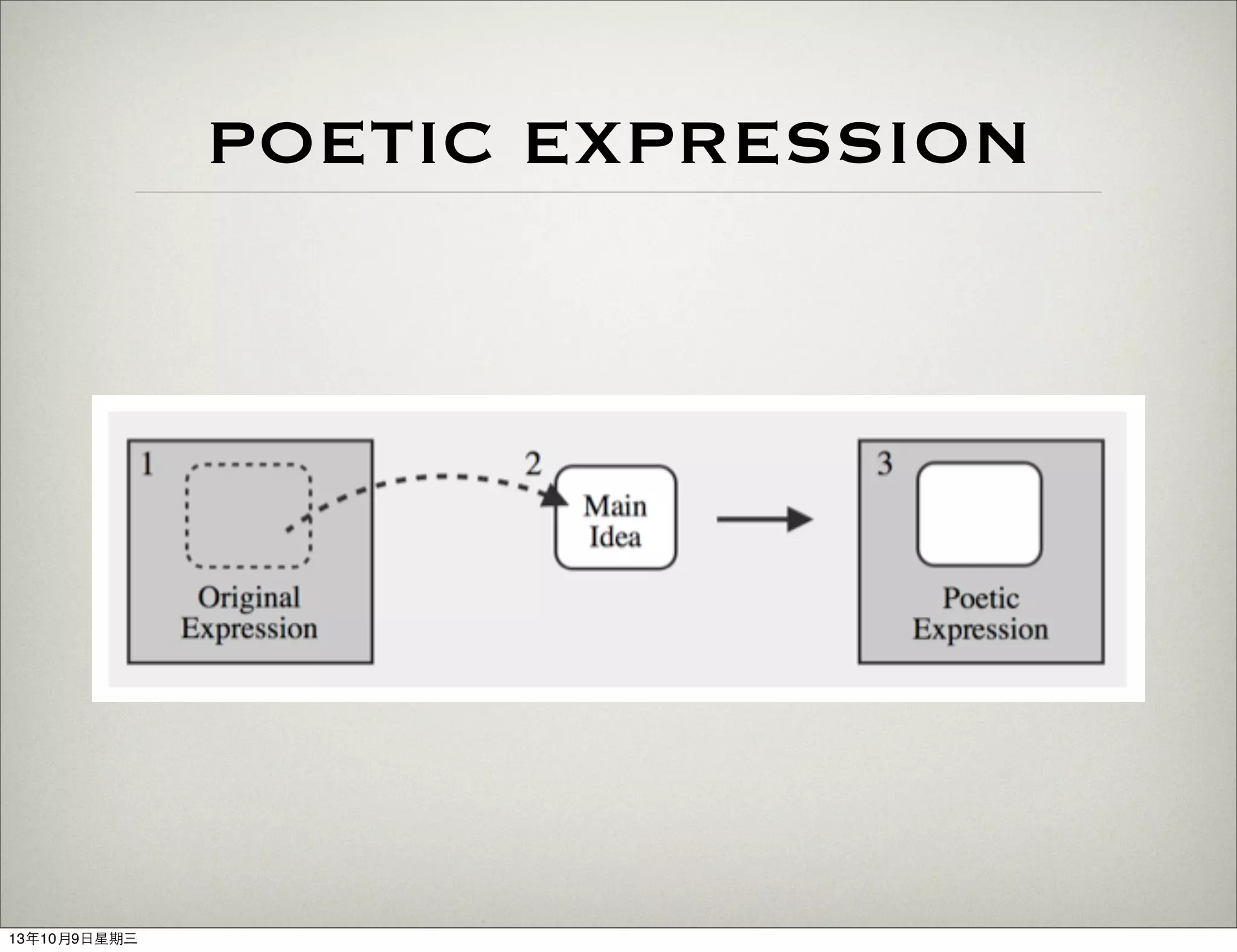
POETIC EXPRESSION
13年10月9⽇日星期三
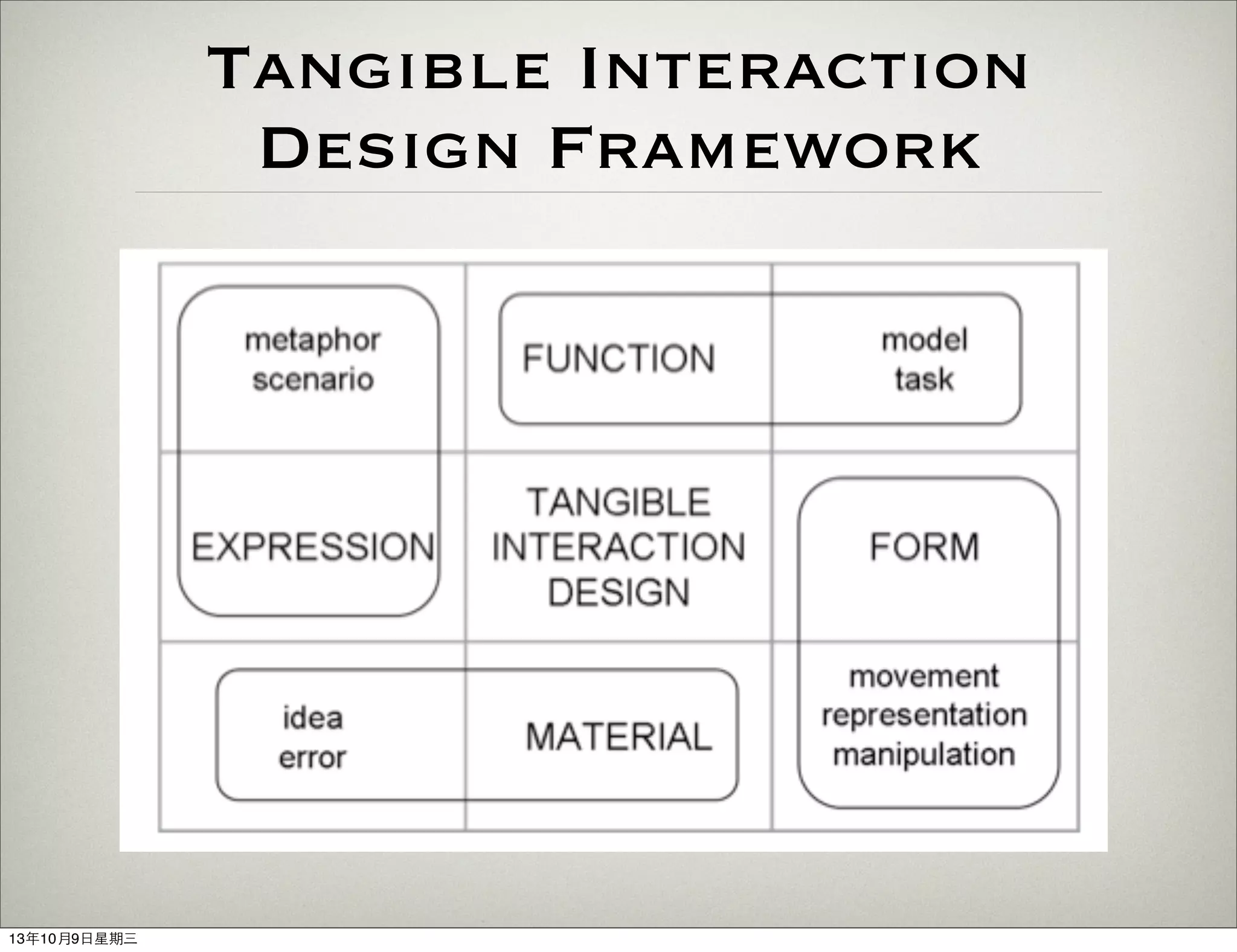
Tangible Interaction
Design Framework
13年10月9⽇日星期三
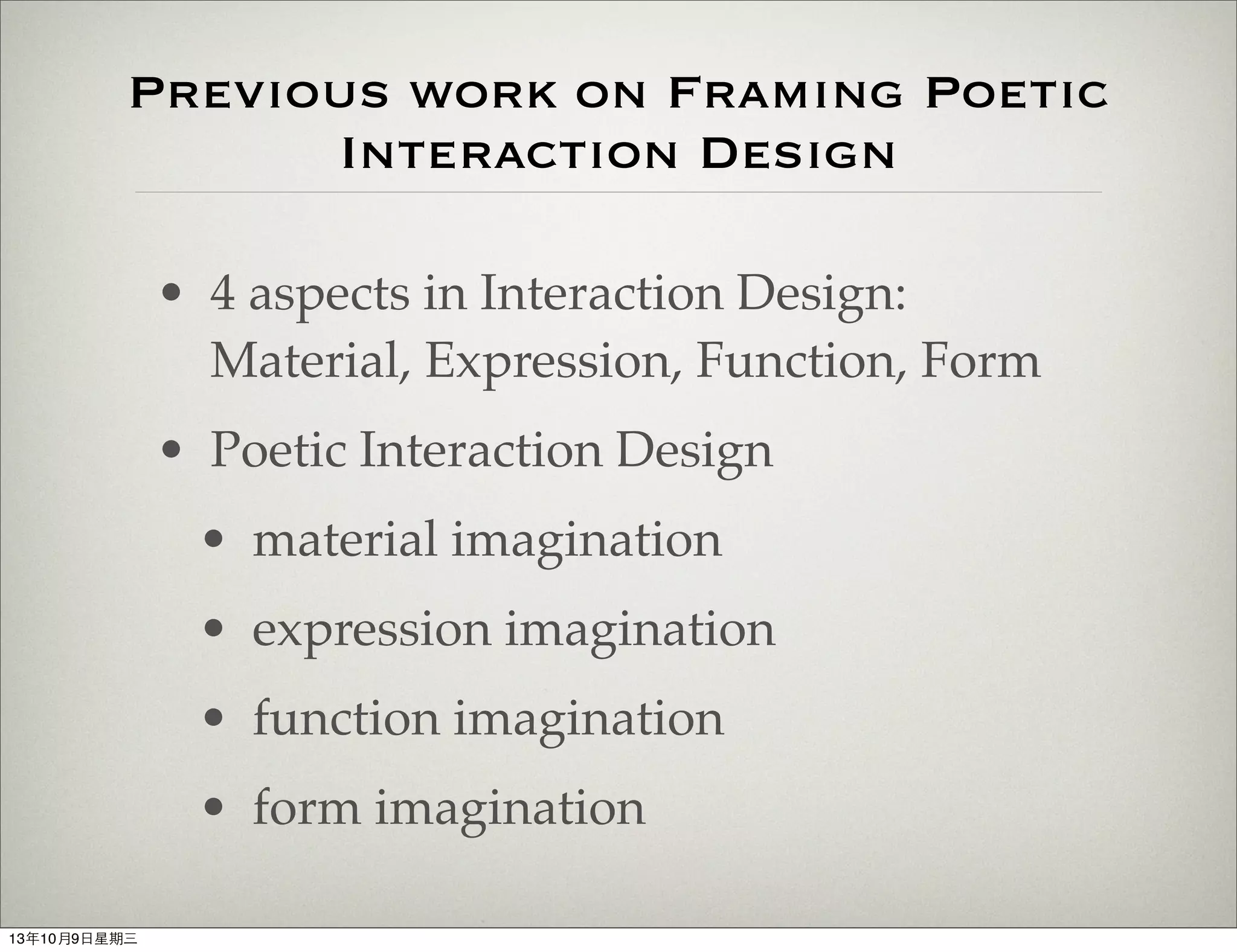
Previous work on Framing Poetic
Interaction Design
• 4 aspects in Interaction Design:
Material, Expression, Function, Form
• Poetic Interaction Design
• material imagination
• expression imagination
• function imagination
• form imagination
13年10月9⽇日星期三
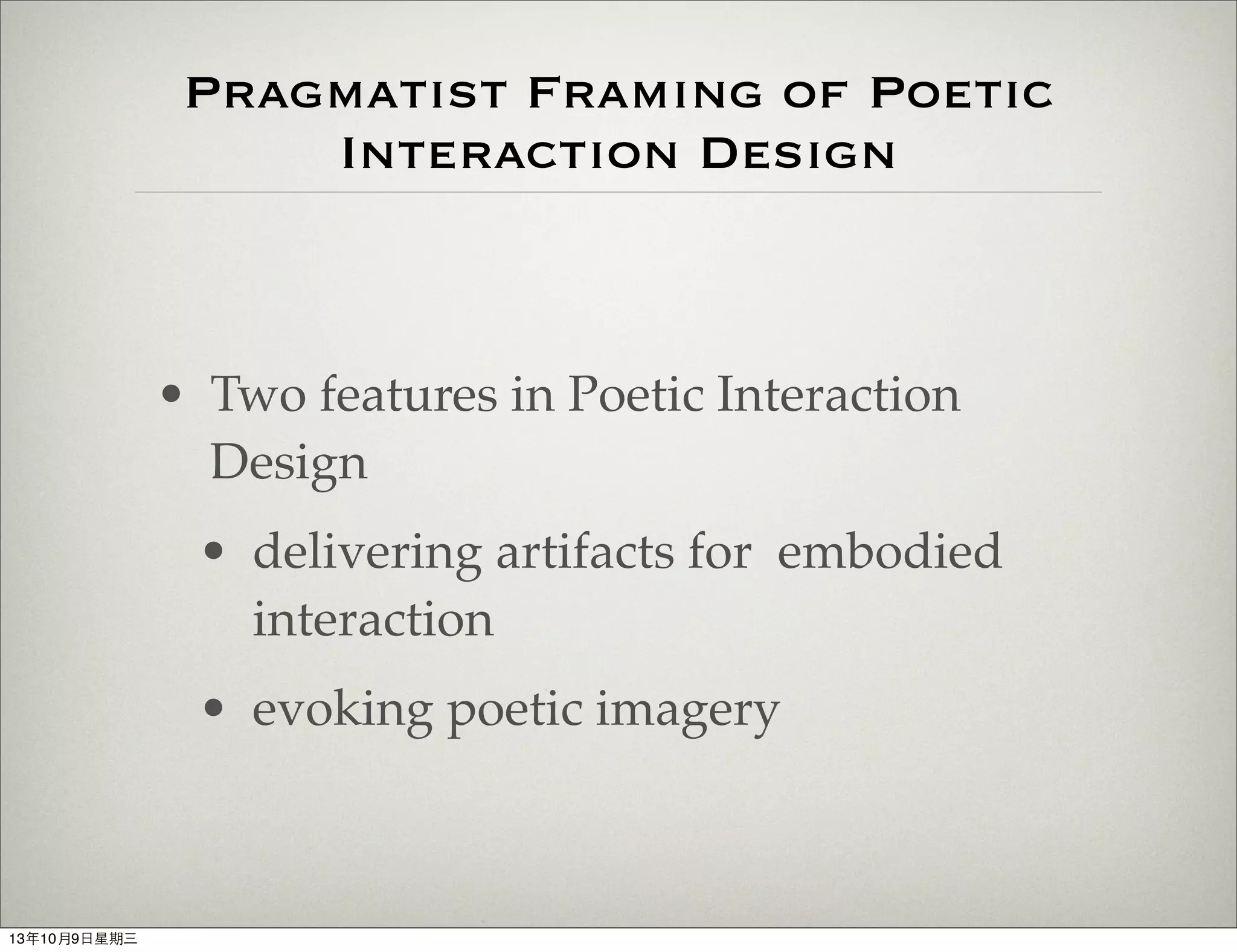
Pragmatist Framing of Poetic
Interaction Design
• Two features in Poetic Interaction
Design
• delivering artifacts for embodied
interaction
• evoking poetic imagery
13年10月9⽇日星期三
Hypnotic Practice
13年10月9⽇日星期三
Why Hypnosis?
• Different mindsets in interaction design
• functionality: instrumental
• usability: cognitive
• ludic design: sense of humor, playfulness
• critical design: critical mind
• poetic interaction: imagination (Bachelard)
13年10月9⽇日星期三
Why Hypnosis?
• Poetic interaction needs a different
mental state
• Successful poetic interaction depends
on whether poetic imagery is experienced
• Hypnotism masters in guiding imagery
and changing mental state
13年10月9⽇日星期三
Methods of Learning
Hypnotic Practice
• An apprenticeship-based activity with
an NGH (National Guild of Hypnotists)
certified instructor, Ben
• An auto-ethnographic approach
13年10月9⽇日星期三
What is Hypnosis?
“Hypnosis is a special mental state that frequently
appears in our daily life. We slip into and out of this
state for many times in a day unconsciously, ...... This
is what I see hypnosis in a broader sense: a state of
hyper-suggestibility.”
13年10月9⽇日星期三
What is Hypnosis?
a mental state that accepts suggestions easily and deeply
13年10月9⽇日星期三
Bypassing Critical Mind
“In general, the conscious mind is responsible
for critical thinking, and the subconscious
mind controls our body and responds to those
messages passing through critical mind. ......
We hypnotists talk to your subconscious mind
rather than the conscious mind. Deliberately
using inductive methods, hypnosis process
deactivates critical mind so that suggestions
can affect our subconscious mind.”
13年10月9⽇日星期三
Bypassing Critical Mind
A hypnotist always creates dialogues with the subconscious
mind of an individual.
13年10月9⽇日星期三
Bypassing Critical Mind
“If you want to persuade somebody, you have to say
‘acceptable words’, ......., a conscious mind often gets
stronger when facing challenges.”
13年10月9⽇日星期三
Imagination
“If you want to empower a suggestion, you should try to
make it acceptable by the subconscious mind rather than by
‘will power’, since will power would further activate
conscious mind and suppress subconscious mind. ......
Remember that subconscious mind is where our imagination
and expectation reside. Thus, in my experience, whenever
imagination conflicts with will power, imagination wins.”
13年10月9⽇日星期三
Suggestibility
“Whether an individual is easy to get hypnotized depends
on suggestibility, the degrees that one listens to and
accepts the suggestions. Hypnosis is a state of heightened
suggestibility with concentrated attention. ”
13年10月9⽇日星期三
Techniques in Hypnotic
Practice
• Resonance
• Overload of Message Units
• Metaphor
• Ambiguity
• Anchoring
13年10月9⽇日星期三
Resonance
“Intentionally asking the subject to do what she has just
already done creates confirmation that she believes your
instruction made it happen. ......
The more resonance you create, the easier a subject gives
up resisting.”
13年10月9⽇日星期三
Overload of message
Units
“When the critical mind is overloaded, ..., with message
units, one might feel overwhelmed. When reaching such
a saturation point, one might become overwhelmed and
hyper-suggestible.”
13年10月9⽇日星期三
Metaphor
“...metaphor is the logic of the subconscious mind
with very fast and rich association. ...
Since the critical mind subsides, not only imaginative
metaphors but also illogical statements could be
acceptable and work well, ...”
13年10月9⽇日星期三
Metaphor (illogical
statements)
“Feel that your body is getting lighter and lighter as a
balloon sinks into the mud.”
13年10月9⽇日星期三
Ambiguity
“... due to the limited resource of our attention,
ambiguity holds the conscious mind. Deliberately using
ambiguity to confuse and engage the conscious mind of
a listener, a hypnotist can do the real work, while the
conscious mind being engaged.”
“...ambiguity keeps the guard busy so that suggestion
can slip into the subconscious mind...”
13年10月9⽇日星期三
Ambiguity
‘buy-one-get-one-free’...I would say a sentence with
ambiguous meanings and then immediately another
sentence with precise meanings.
Repeating this pattern for a few times would keep the
conscious mind busy and confused so that I could
quickly create a hypnosis state.
13年10月9⽇日星期三
Anchoring
“Anchor provides a focus for discussion and imagination.”
13年10月9⽇日星期三
Design Implications
13年10月9⽇日星期三
Design Implications
from Hypnotic Practice
• Poetic interaction could start from resonance
• Deliberately use multiple sensory elements
without consensus
• Boldly apply metaphors of different types in a
mash-up style
• Purposefully deploy ambiguity in four aspects
of interaction design
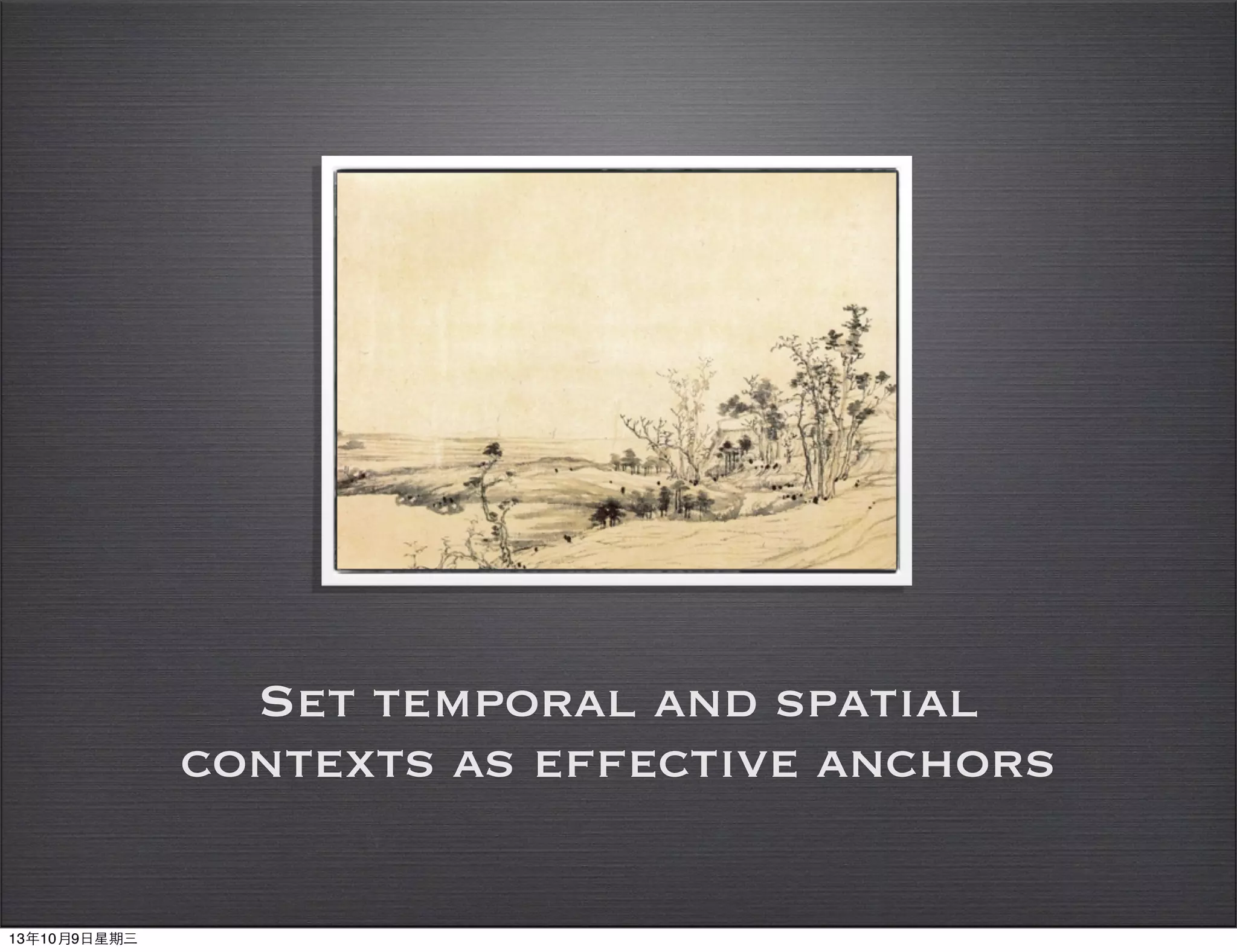
• Set temporal and spatial contexts as effective
anchors
13年10月9⽇日星期三
!
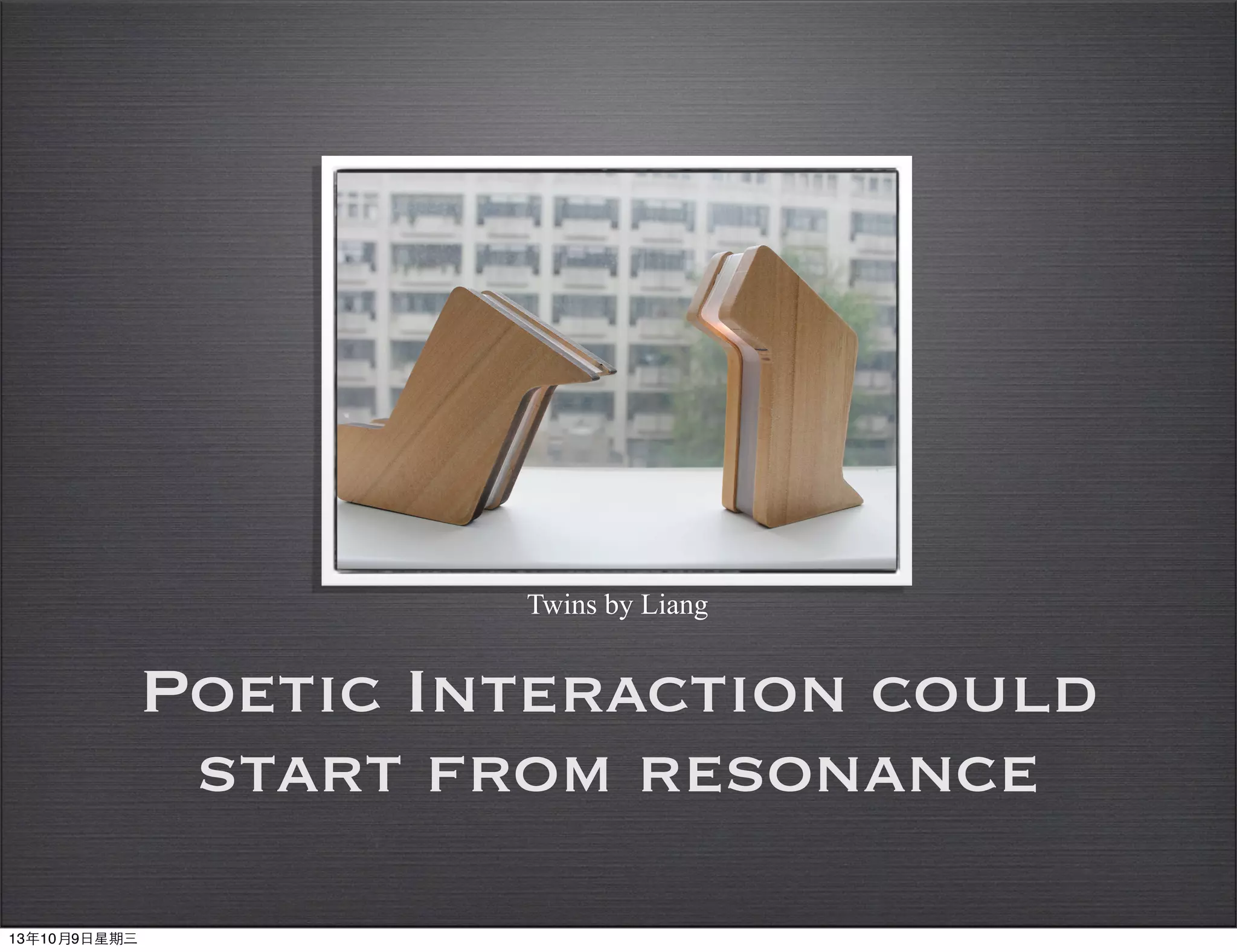
Poetic Interaction could
start from resonance
Twins by Liang
13年10月9⽇日星期三
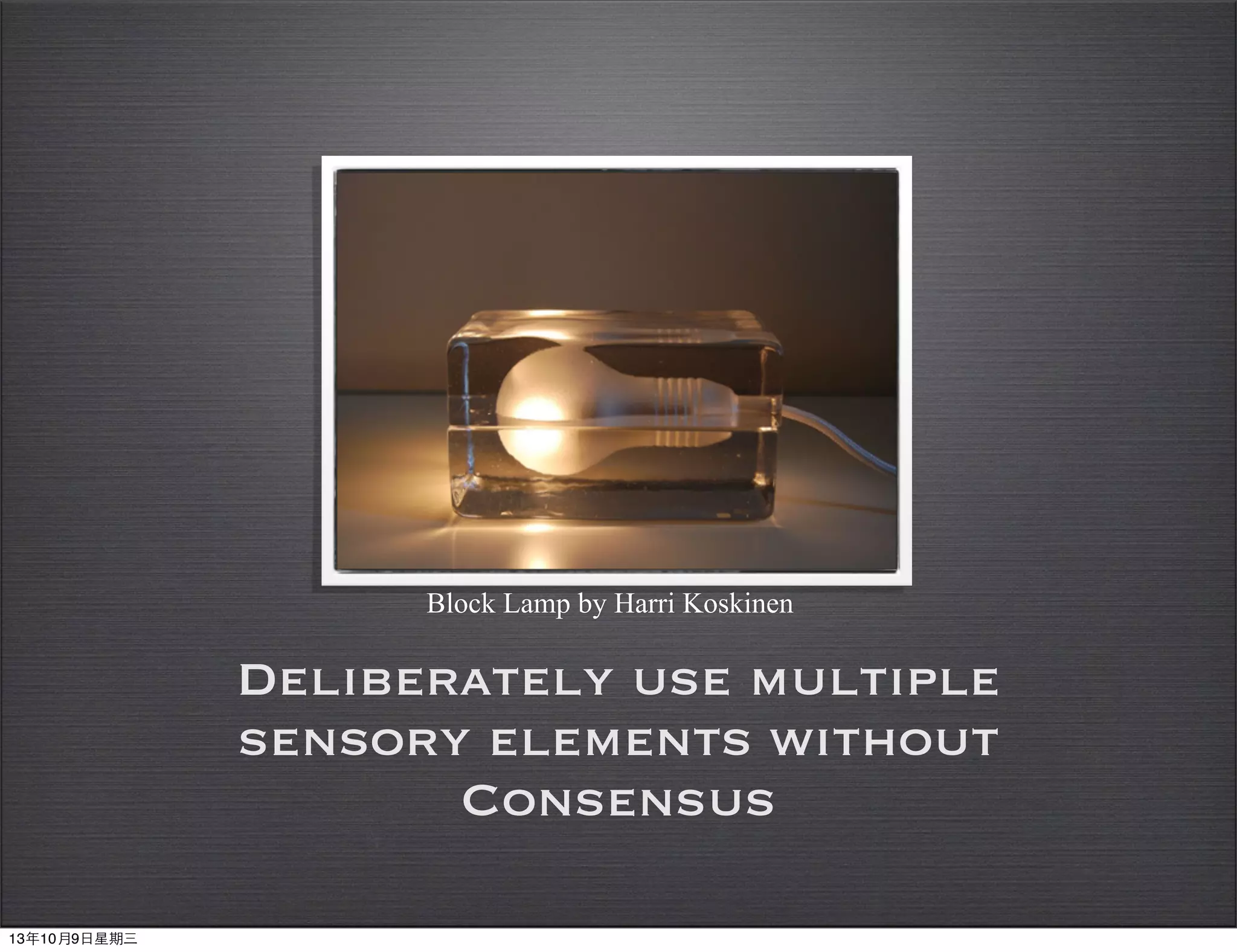
Deliberately use multiple
sensory elements without
Consensus
Block Lamp by Harri Koskinen
13年10月9⽇日星期三
!
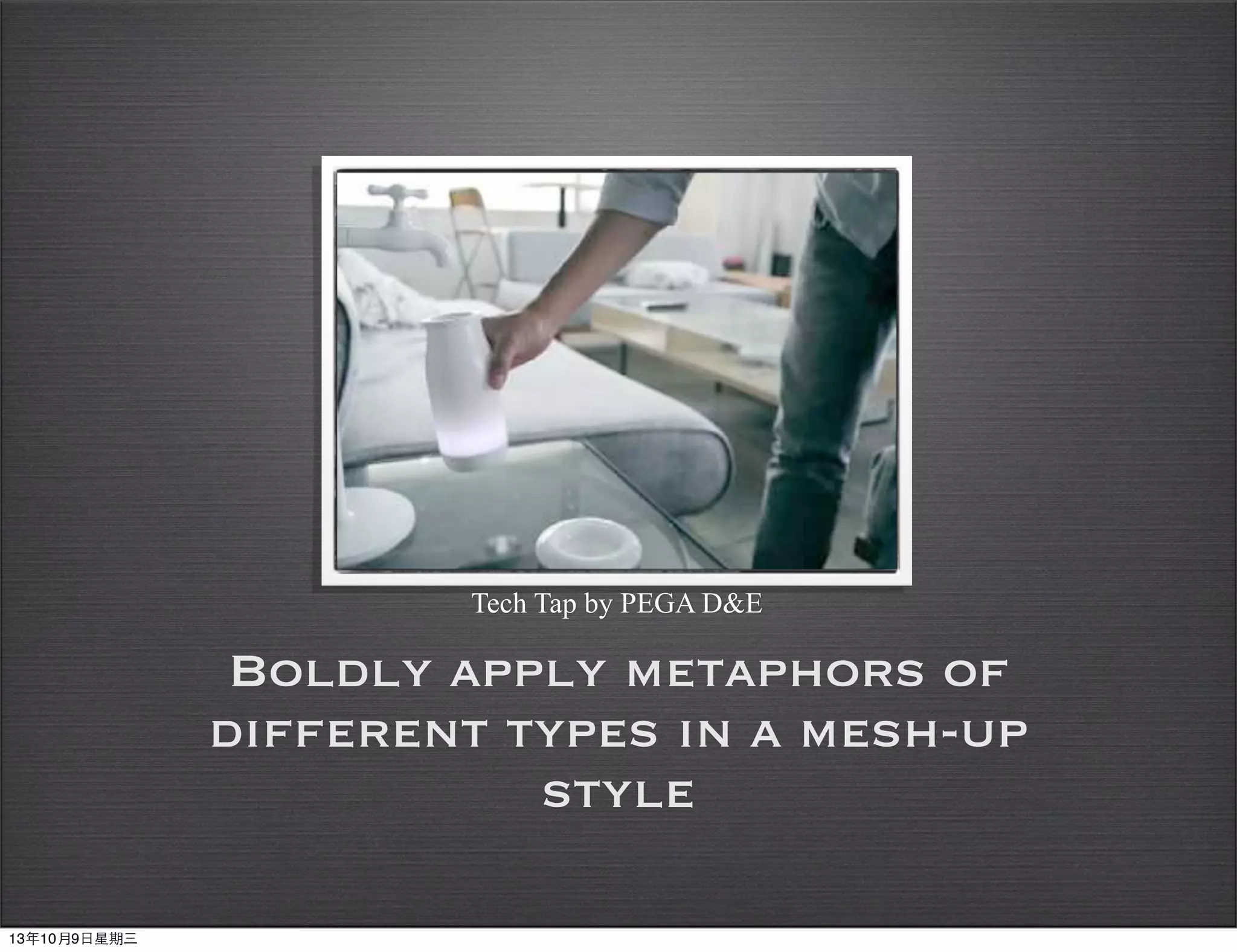
Boldly apply metaphors of
different types in a mesh-up
style
Tech Tap by PEGA D&E
13年10月9⽇日星期三
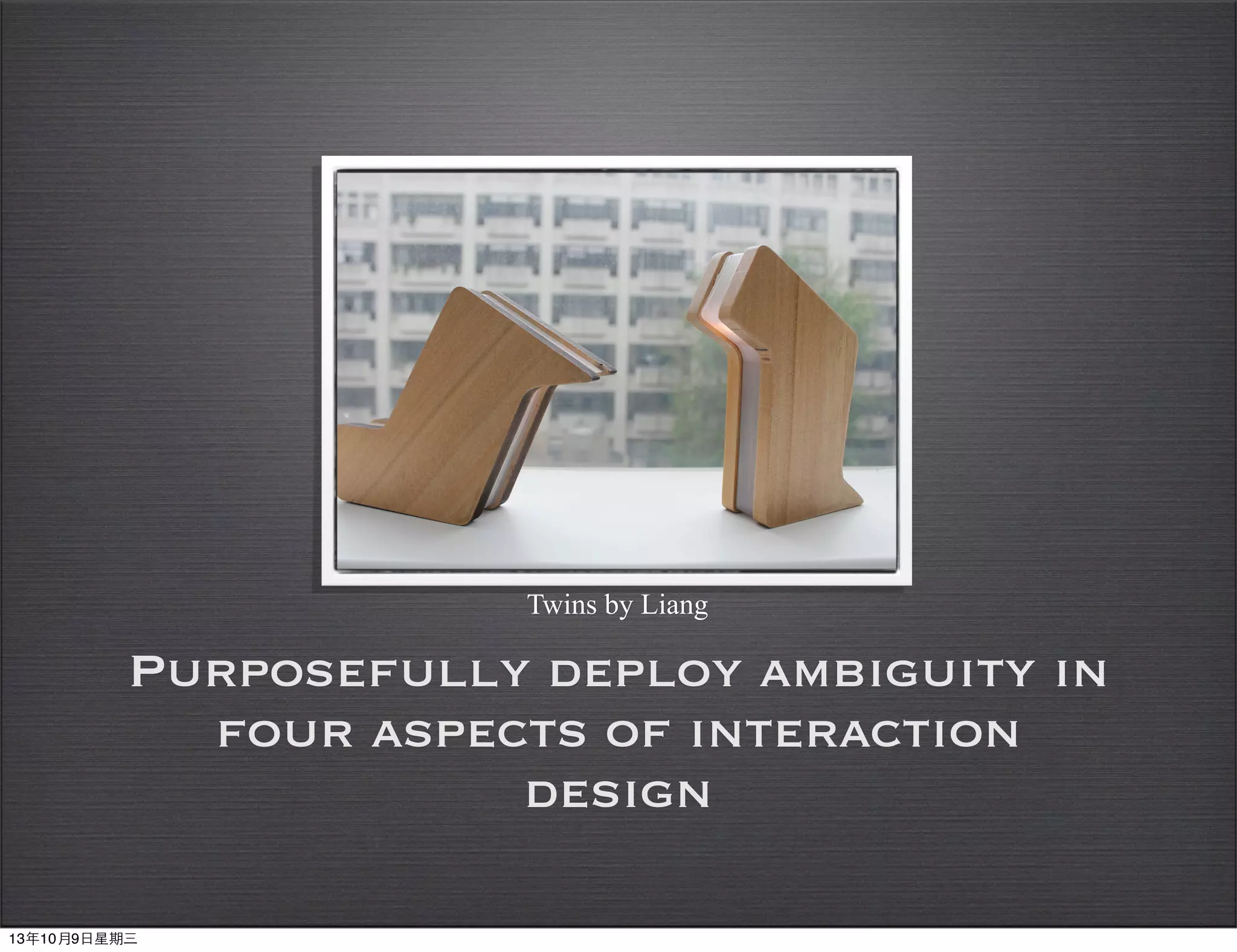
Purposefully deploy ambiguity in
four aspects of interaction
design
!
Twins by Liang
13年10月9⽇日星期三
Set temporal and spatial
contexts as effective anchors
13年10月9⽇日星期三
Reflection and
Discussion
13年10月9⽇日星期三
Poetic Interaction
Design (Kolko)
• A type of reflective and emotional design
• (It) “resonates immediately but continues to inform
later”
• “nearly always subtle, yet mindful.”
• reflection ? reasoning activity about poetics
• I argue: felt experience of poetics itself
13年10月9⽇日星期三
Phenomenology of
poetics (Bachelard)
• “a sincere impulse toward admiration is always
necessary if we are to receive phenomenological
benefit of a poetic image”
13年10月9⽇日星期三
Reframing Poetic
Interaction Design
Make the poetic imagery perceivable
13年10月9⽇日星期三
Poetic imagery
• How to make imagery perceivable
• Hypnotism provides practical
techniques and tacit knowledge
13年10月9⽇日星期三
Ethics Issue
• assistive devices for hypnotism vs. hypnotic
practice informed interaction design
• wake-up process needed?
13年10月9⽇日星期三
Conclusion
13年10月9⽇日星期三
• Chinese poetry as a sensitizing means
for poetic interaction design
• An auto-ethnographic approach to
knowledge and techniques of
hypnotism
• Relating hypnotic practice to poetic
interaction design with a constructivist
stance
13年10月9⽇日星期三

Hypnotist Framing: Hypnotic Practice as a Resource for Poetic Interaction Design

  • 1.
    Hypnotist Framing Hypnotic Practiceas a Resource for Poetic Interaction Design Rung-Huei Liang Taiwan Tech Huang-Ming Chang TU/Eindhoven Sep., 2013 13年10月9⽇日星期三
  • 2.
    outlines • Introduction • Method •Framing Poetic Interaction Design • Hypnotic Practice • Design Implications • Reflection & Discussion • Conclusion 13年10月9⽇日星期三
  • 3.
  • 4.
  • 5.
    Different Notions of Users •Task-Oriented Operators • Cognitive Users • Phenomenological Individuals 13年10月9⽇日星期三
  • 6.
    Problems • What isthe notion of users in “non- task-oriented” interaction design? • Is a user always in a fixed mental state? 13年10月9⽇日星期三
  • 7.
    Interaction Design Addressing HigherNeeds • Aesthetic Interaction • Reflective Design • Ludic Design • Critical Design • Poetic Interaction Design 13年10月9⽇日星期三
  • 8.
    What Are TheUnique Features about Poetic Interaction Design 13年10月9⽇日星期三
  • 9.
    Critical Design Knowing by Questioning CriticalPerspective Conscious Introspection 13年10月9⽇日星期三
  • 10.
    Poetic Interaction Poetic Imagination vs. CriticalThinking Mental States of Poetic Experience? 13年10月9⽇日星期三
  • 11.
    Research Questions • Whatis the mental state when we experience poetics? • What is the characteristic that differentiates poetic interaction design from other interaction designs? • How does the experience of reading poems inform us to design ‘embodied poetics’? • What is the similarity between a man in a hypnosis state and a user experiencing poetics? • How does a hypnotist frame the world? • How can the hypnotic perspective as well as techniques inform interaction design? 13年10月9⽇日星期三
  • 12.
  • 13.
    • Seeing poeticinteraction design as a constructivist project • Reflexive methodology: personal/subjective observation, thoughts, stories to understand felt experience • Two months of apprenticeship of hypnotism, with a NGH instructor • Auto-ethnographic approach: empirical study, self-observation, master-apprentice conversation. 13年10月9⽇日星期三
  • 14.
  • 15.
    Reflexivity on Poetics •Not providing definite conceptual framing • Retrospect the socio-cultural root of poetics in Chinese culture 13年10月9⽇日星期三
  • 16.
  • 17.
    江雪 A River Scenein Snow • 千 ⼭山 ⿃鳥 飛 絕 • thousand hills birds fly vanish • 萬 徑 ⼈人 蹤 滅 • ten-thousand trails people footprints disappear • 孤 ⾈舟 簑 笠 翁 • lone boat cape hat old man • 獨 釣 寒 江 雪 • solitarily fishing cold river snow 13年10月9⽇日星期三
  • 18.
    江雪 A River Scenein Snow • 千 ⼭山 ⿃鳥 飛 絕 • Birds vanish from hundreds of hills • 萬 徑 ⼈人 蹤 滅 • Footprints disappear from thousands of trails • 孤 ⾈舟 簑 笠 翁 • In a lone boat, clad in cape and hat an old man is • 獨 釣 寒 江 雪 • solitarily fishing on a cold river in snow 13年10月9⽇日星期三
  • 19.
    江雪 A River Scenein Snow • 千 ⼭山 ⿃鳥 飛 絕 • Birds vanish from hundreds of hills • 萬 徑 ⼈人 蹤 滅 • Footprints disappear from thousands of trails • 孤 ⾈舟 簑 笠 翁 • In a lone boat, clad in cape and hat an old man is • 獨 釣 寒 江 雪 • solitarily fishing a cold river of snow 13年10月9⽇日星期三
  • 20.
    江雪 A River Scenein Snow • 千 ⼭山 ⿃鳥 飛 絕 • Birds vanish from hundreds of hills • 萬 徑 ⼈人 蹤 滅 • Footprints disappear from thousands of trails • 孤 ⾈舟 簑 笠 翁 • Lonely boating, clad in cape and hat an old man is • 獨 釣 寒 江 雪 • solitarily fishing a cold river of snow 13年10月9⽇日星期三
  • 21.
    Slight Strangeness in Collocation •The need for descriptive interpretation • instrumental, prosaic • A poetic imagery: an old man is fishing snow • illogic, absurd, irrational • ludic, imaginative, poetic • Strangeness in collocation 13年10月9⽇日星期三
  • 22.
    秋思 Autumn Thoughts • 枯籐⽼老樹 昏鴉 • Withered vines, old trees, crows at dusk • ⼩小橋 流⽔水 ⼈人家 • A tiny bridge, a rippling stream, cottages • 古道 ⻄西⾵風 瘦⾺馬 • Ancient routes, west wind, a lean horse • ⼣夕陽⻄西下 • The sun is setting • 斷腸⼈人在天涯 • The heartbroken one at the end of the world 13年10月9⽇日星期三
  • 23.
    Gestalt & Expression Imagination •imagining what are not described in the poem • Gestalt • Expression imagination • Zesign 13年10月9⽇日星期三
  • 24.
  • 25.
  • 26.
    Previous work onFraming Poetic Interaction Design • 4 aspects in Interaction Design: Material, Expression, Function, Form • Poetic Interaction Design • material imagination • expression imagination • function imagination • form imagination 13年10月9⽇日星期三
  • 27.
    Pragmatist Framing ofPoetic Interaction Design • Two features in Poetic Interaction Design • delivering artifacts for embodied interaction • evoking poetic imagery 13年10月9⽇日星期三
  • 28.
  • 29.
    Why Hypnosis? • Differentmindsets in interaction design • functionality: instrumental • usability: cognitive • ludic design: sense of humor, playfulness • critical design: critical mind • poetic interaction: imagination (Bachelard) 13年10月9⽇日星期三
  • 30.
    Why Hypnosis? • Poeticinteraction needs a different mental state • Successful poetic interaction depends on whether poetic imagery is experienced • Hypnotism masters in guiding imagery and changing mental state 13年10月9⽇日星期三
  • 31.
    Methods of Learning HypnoticPractice • An apprenticeship-based activity with an NGH (National Guild of Hypnotists) certified instructor, Ben • An auto-ethnographic approach 13年10月9⽇日星期三
  • 32.
    What is Hypnosis? “Hypnosisis a special mental state that frequently appears in our daily life. We slip into and out of this state for many times in a day unconsciously, ...... This is what I see hypnosis in a broader sense: a state of hyper-suggestibility.” 13年10月9⽇日星期三
  • 33.
    What is Hypnosis? amental state that accepts suggestions easily and deeply 13年10月9⽇日星期三
  • 34.
    Bypassing Critical Mind “Ingeneral, the conscious mind is responsible for critical thinking, and the subconscious mind controls our body and responds to those messages passing through critical mind. ...... We hypnotists talk to your subconscious mind rather than the conscious mind. Deliberately using inductive methods, hypnosis process deactivates critical mind so that suggestions can affect our subconscious mind.” 13年10月9⽇日星期三
  • 35.
    Bypassing Critical Mind Ahypnotist always creates dialogues with the subconscious mind of an individual. 13年10月9⽇日星期三
  • 36.
    Bypassing Critical Mind “Ifyou want to persuade somebody, you have to say ‘acceptable words’, ......., a conscious mind often gets stronger when facing challenges.” 13年10月9⽇日星期三
  • 37.
    Imagination “If you wantto empower a suggestion, you should try to make it acceptable by the subconscious mind rather than by ‘will power’, since will power would further activate conscious mind and suppress subconscious mind. ...... Remember that subconscious mind is where our imagination and expectation reside. Thus, in my experience, whenever imagination conflicts with will power, imagination wins.” 13年10月9⽇日星期三
  • 38.
    Suggestibility “Whether an individualis easy to get hypnotized depends on suggestibility, the degrees that one listens to and accepts the suggestions. Hypnosis is a state of heightened suggestibility with concentrated attention. ” 13年10月9⽇日星期三
  • 39.
    Techniques in Hypnotic Practice •Resonance • Overload of Message Units • Metaphor • Ambiguity • Anchoring 13年10月9⽇日星期三
  • 40.
    Resonance “Intentionally asking thesubject to do what she has just already done creates confirmation that she believes your instruction made it happen. ...... The more resonance you create, the easier a subject gives up resisting.” 13年10月9⽇日星期三
  • 41.
    Overload of message Units “Whenthe critical mind is overloaded, ..., with message units, one might feel overwhelmed. When reaching such a saturation point, one might become overwhelmed and hyper-suggestible.” 13年10月9⽇日星期三
  • 42.
    Metaphor “...metaphor is thelogic of the subconscious mind with very fast and rich association. ... Since the critical mind subsides, not only imaginative metaphors but also illogical statements could be acceptable and work well, ...” 13年10月9⽇日星期三
  • 43.
    Metaphor (illogical statements) “Feel thatyour body is getting lighter and lighter as a balloon sinks into the mud.” 13年10月9⽇日星期三
  • 44.
    Ambiguity “... due tothe limited resource of our attention, ambiguity holds the conscious mind. Deliberately using ambiguity to confuse and engage the conscious mind of a listener, a hypnotist can do the real work, while the conscious mind being engaged.” “...ambiguity keeps the guard busy so that suggestion can slip into the subconscious mind...” 13年10月9⽇日星期三
  • 45.
    Ambiguity ‘buy-one-get-one-free’...I would saya sentence with ambiguous meanings and then immediately another sentence with precise meanings. Repeating this pattern for a few times would keep the conscious mind busy and confused so that I could quickly create a hypnosis state. 13年10月9⽇日星期三
  • 46.
    Anchoring “Anchor provides afocus for discussion and imagination.” 13年10月9⽇日星期三
  • 47.
  • 48.
    Design Implications from HypnoticPractice • Poetic interaction could start from resonance • Deliberately use multiple sensory elements without consensus • Boldly apply metaphors of different types in a mash-up style • Purposefully deploy ambiguity in four aspects of interaction design • Set temporal and spatial contexts as effective anchors 13年10月9⽇日星期三
  • 49.
    ! Poetic Interaction could startfrom resonance Twins by Liang 13年10月9⽇日星期三
  • 50.
    Deliberately use multiple sensoryelements without Consensus Block Lamp by Harri Koskinen 13年10月9⽇日星期三
  • 51.
    ! Boldly apply metaphorsof different types in a mesh-up style Tech Tap by PEGA D&E 13年10月9⽇日星期三
  • 52.
    Purposefully deploy ambiguityin four aspects of interaction design ! Twins by Liang 13年10月9⽇日星期三
  • 53.
    Set temporal andspatial contexts as effective anchors 13年10月9⽇日星期三
  • 54.
  • 55.
    Poetic Interaction Design (Kolko) •A type of reflective and emotional design • (It) “resonates immediately but continues to inform later” • “nearly always subtle, yet mindful.” • reflection ? reasoning activity about poetics • I argue: felt experience of poetics itself 13年10月9⽇日星期三
  • 56.
    Phenomenology of poetics (Bachelard) •“a sincere impulse toward admiration is always necessary if we are to receive phenomenological benefit of a poetic image” 13年10月9⽇日星期三
  • 57.
    Reframing Poetic Interaction Design Makethe poetic imagery perceivable 13年10月9⽇日星期三
  • 58.
    Poetic imagery • Howto make imagery perceivable • Hypnotism provides practical techniques and tacit knowledge 13年10月9⽇日星期三
  • 59.
    Ethics Issue • assistivedevices for hypnotism vs. hypnotic practice informed interaction design • wake-up process needed? 13年10月9⽇日星期三
  • 60.
  • 61.
    • Chinese poetryas a sensitizing means for poetic interaction design • An auto-ethnographic approach to knowledge and techniques of hypnotism • Relating hypnotic practice to poetic interaction design with a constructivist stance 13年10月9⽇日星期三