Getting Started with Decision Discovery 
James Taylor 
CEO
©2014 Decision Management Solutions 
Your Presenters 
James Taylor 
I’m a passionate believer in the power of Decision Management to deliver simpler, smarter and more agile processes. I write, speak, consult and work on Decision Management and Decision Modeling. 
Juergen Pitschke 
I‘m a coach, consultant, speaker, writer, … 
Engineer 
Helping customers to apply Decision Management successfully
Agenda 
Identify Decisions 
Scope Decisions 
Decompose Decisions 
Decision Context 
Automating Decisions 
Manual Decisions 
Next Steps 
©2014 Decision Management Solutions
©2014 Decision Management Solutions 
3 steps to decision management 
Identify and model the decisions that are most important to your operational processes 
Design and build independent decision services using business rules and advanced analytics 
Create a “closed loop” between operations and analytics to measure results and drive improvement
©2014 Decision Management Solutions 
Why Identify and Model Decisions? 
Simplify processes 
Effectively deploy business rules 
Flexibly define automation boundaries 
Effectively deploy predictive analytics
Different Types of Decisions 
Decision Points 
Do we need a Business Process Model? 
1. How do you identify decisions? 
© BCS - Dr. Juergen Pitschke 2003 - 2014 
5
Strategic Decisions 
Tactical 
Decisions 
Operational 
Decisions 
Different Kinds of Decisions 
©2014 Decision Management Solutions 
6
©2014 Decision Management Solutions 
7 
Many Ways To Discover Decisions 
Business Events 
Legacy Systems 
Business Processes 
Business Intelligence 
Brainstorm 
KPIs 
Micro and hidden Decisions
©2014 Decision Management Solutions 
Processes Can Hide Decisions
©2014 Decision Management Solutions 
Simplify By Making Decisions Explicit
A business process cannot progress any further unless they are made 
A particular event has occurred and must be handled 
A person must choose between a number of options 
©2014 Decision Management Solutions 
Decisions Are Made Because 
10
2. How do we scope the decisions we identify?
Scope a Decision 
© BCS - Dr. Juergen Pitschke 2003 - 2014 
12 
•What is the question to answer? 
•E.g. 
•Is this student eligible for an award? 
•Is this student eligible for this specific award? 
•Which product should we offer to this customer? 
•What are the possible answers? 
•Specify the possible answers 
•Single value 
•Value Range 
•List of Values
Scope a Decision 
© BCS - Dr. Juergen Pitschke 2003 - 2014 
13 
•What is the object of the decision? 
•E.g. 
•What is an ”award“? 
•What does “Which product should we offer to this customer?” mean? – Only a product type? A specific product for a specific price?
Decision Scope and Process 
© BCS - Dr. Juergen Pitschke 2003 - 2014 
14 
•Process and Decision scope are mutually dependent.
What information contributes to the decision? 
Where does the knowledge come from? 
What about information from other decisions? 
Reuse and the decision network 
3. How do you decompose Decisions? 
© BCS - Dr. Juergen Pitschke 2003 - 2014 
15
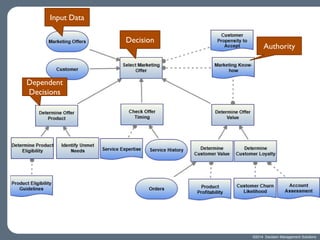
Decision 
Input Data 
Dependent Decisions 
Authority 
©2014 Decision Management Solutions
Decisions Require Information “Determine Parts Availability” requires BOM and Inventory information “Validate Tax Return” requires Return and Citizen information “Refer claim for fraud” requires Claim and Provider information 
©2014 Decision Management Solutions
Decisions Require Knowledge “Reorder parts” requires supplier capabilities, shortage risks “Validate Tax Return” requires Tax Regulations “Refer claim for fraud” requires likelihood of fraud 
©2014 Decision Management Solutions
Decisions Require Decisions These decisions must be made first Is this a good time to make an offer? Which product should the offer be for? How valuable an offer? 
©2014 Decision Management Solutions
4. What’s the context for a decision?
Decision Context 
© BCS - Dr. Juergen Pitschke 2003 - 2014 
22 
•What is the business value of the decision? 
•Frequency 
•Financial Value 
•Risk 
•… 
•Business Motivation 
•What is the motivation for the decision activity? 
•Analytical vs. Predictive 
•How can we measure decisions?
Decision Context 
© BCS - Dr. Juergen Pitschke 2003 - 2014 
23 
•Where is the decision used? 
•Impact Analysis 
•Who is involved? 
•RACI Charts for Decisions 
•Meta information for Project Management, Operations, …
Specifying decision logic with various metaphors: Decision Tables, Natural Language and everything between 
Decision Tables: The devil is in the detail 
Linking models to implementation 
5. How do you prepare Decisions for automation? 
© BCS - Dr. Juergen Pitschke 2003 - 2014 
24
Define Automation Boundaries 
©2014 Decision Management Solutions
Specify Logic with Decision Tables Most common rule format A set of rules in a tabular layout Look up tables, comparing attribute values Various formats 
Applicant Risk 
U 
Applicant Age 
Medical History 
Applicant Risk Rating 
1 
> 60 
good 
Medium 
2 
bad 
High 
3 
[25..60] 
- 
Medium 
4 
< 25 
good 
Low 
5 
bad 
Medium 
Special Discount 
Type of Order 
Web 
- 
Customer Location 
US 
- 
Type of Customer 
Wholesaler 
Retailer 
- 
Special Discount % 
10 
5 
0 
F 
1 
2 
3 
Credit Limit Assignment 
Credit Limit 
Income 
< $40,000 
>= $40,000 
Card Type 
Standard 
$1,000 
$2,000 
Gold 
$1,500 
$2,500 
©2014 Decision Management Solutions
©2014 Decision Management Solutions 
Variety of Implementation Formats 
Rule Flow or Decision Flow 
Rule Sheet or Decision Table 
Decision Tree 
Decision Table
Link To Automation 
©2014 Decision Management Solutions
6. What other uses are there besides automation?
Describing Manual Decisions 
© BCS - Dr. Juergen Pitschke 2003 - 2014 
30
Describing Manual Decisions 
© BCS - Dr. Juergen Pitschke 2003 - 2014 
31 
•Model ≠ Model Output 
•What deliverables do we expect from our Decision Modeling project? SOPs, Checklists, Work Orders, Guidelines, Documentation, … 
•How do we create such deliverables?
Describing Manual Decisions 
© BCS - Dr. Juergen Pitschke 2003 - 2014 
32 
•What does the business user understand? 
•Decision Tables or Natural Language 
•Other metaphors 
•What problems does the Decision Analyst face? 
•Analyzing a Decision Table versus Analyzing Natural Language 
•How can we formalize ”gut feeling“?
Describing Manual Decisions 
© BCS - Dr. Juergen Pitschke 2003 - 2014 33 
Analyze Decision 
Tables 
Source: DMN Specification (bmi-13-08-01) 
Transform into 
Desired Output
Next Steps
Succeed with Decisions
©2014 Decision Management Solutions 
3 steps to decision management 
Identify and model the decisions that are most important to your operational processes 
Design and build independent decision services using business rules and advanced analytics 
Create a “closed loop” between operations and analytics to measure results and drive improvement
©2014 Decision Management Solutions 
Learn More about Decision Discovery Training and Workshops Live, online training 
Free Resources & Tutorials 
decisionmanagementsolutions.com james@decisionmanagementsolutions.com BPM in Practice 2014, October 10, Hamburg Pre-Conference Workshop “Decision Management”, October 9 www.bpmpractice.de 
www.enterprise-design.eu 
jpitschke@enterprise-design.eu

Getting started with decision discovery

  • 1.
    Getting Started withDecision Discovery James Taylor CEO
  • 2.
    ©2014 Decision ManagementSolutions Your Presenters James Taylor I’m a passionate believer in the power of Decision Management to deliver simpler, smarter and more agile processes. I write, speak, consult and work on Decision Management and Decision Modeling. Juergen Pitschke I‘m a coach, consultant, speaker, writer, … Engineer Helping customers to apply Decision Management successfully
  • 3.
    Agenda Identify Decisions Scope Decisions Decompose Decisions Decision Context Automating Decisions Manual Decisions Next Steps ©2014 Decision Management Solutions
  • 4.
    ©2014 Decision ManagementSolutions 3 steps to decision management Identify and model the decisions that are most important to your operational processes Design and build independent decision services using business rules and advanced analytics Create a “closed loop” between operations and analytics to measure results and drive improvement
  • 5.
    ©2014 Decision ManagementSolutions Why Identify and Model Decisions? Simplify processes Effectively deploy business rules Flexibly define automation boundaries Effectively deploy predictive analytics
  • 6.
    Different Types ofDecisions Decision Points Do we need a Business Process Model? 1. How do you identify decisions? © BCS - Dr. Juergen Pitschke 2003 - 2014 5
  • 7.
    Strategic Decisions Tactical Decisions Operational Decisions Different Kinds of Decisions ©2014 Decision Management Solutions 6
  • 8.
    ©2014 Decision ManagementSolutions 7 Many Ways To Discover Decisions Business Events Legacy Systems Business Processes Business Intelligence Brainstorm KPIs Micro and hidden Decisions
  • 9.
    ©2014 Decision ManagementSolutions Processes Can Hide Decisions
  • 10.
    ©2014 Decision ManagementSolutions Simplify By Making Decisions Explicit
  • 11.
    A business processcannot progress any further unless they are made A particular event has occurred and must be handled A person must choose between a number of options ©2014 Decision Management Solutions Decisions Are Made Because 10
  • 12.
    2. How dowe scope the decisions we identify?
  • 13.
    Scope a Decision © BCS - Dr. Juergen Pitschke 2003 - 2014 12 •What is the question to answer? •E.g. •Is this student eligible for an award? •Is this student eligible for this specific award? •Which product should we offer to this customer? •What are the possible answers? •Specify the possible answers •Single value •Value Range •List of Values
  • 14.
    Scope a Decision © BCS - Dr. Juergen Pitschke 2003 - 2014 13 •What is the object of the decision? •E.g. •What is an ”award“? •What does “Which product should we offer to this customer?” mean? – Only a product type? A specific product for a specific price?
  • 15.
    Decision Scope andProcess © BCS - Dr. Juergen Pitschke 2003 - 2014 14 •Process and Decision scope are mutually dependent.
  • 16.
    What information contributesto the decision? Where does the knowledge come from? What about information from other decisions? Reuse and the decision network 3. How do you decompose Decisions? © BCS - Dr. Juergen Pitschke 2003 - 2014 15
  • 17.
    Decision Input Data Dependent Decisions Authority ©2014 Decision Management Solutions
  • 18.
    Decisions Require Information“Determine Parts Availability” requires BOM and Inventory information “Validate Tax Return” requires Return and Citizen information “Refer claim for fraud” requires Claim and Provider information ©2014 Decision Management Solutions
  • 19.
    Decisions Require Knowledge“Reorder parts” requires supplier capabilities, shortage risks “Validate Tax Return” requires Tax Regulations “Refer claim for fraud” requires likelihood of fraud ©2014 Decision Management Solutions
  • 20.
    Decisions Require DecisionsThese decisions must be made first Is this a good time to make an offer? Which product should the offer be for? How valuable an offer? ©2014 Decision Management Solutions
  • 21.
  • 22.
    4. What’s thecontext for a decision?
  • 23.
    Decision Context ©BCS - Dr. Juergen Pitschke 2003 - 2014 22 •What is the business value of the decision? •Frequency •Financial Value •Risk •… •Business Motivation •What is the motivation for the decision activity? •Analytical vs. Predictive •How can we measure decisions?
  • 24.
    Decision Context ©BCS - Dr. Juergen Pitschke 2003 - 2014 23 •Where is the decision used? •Impact Analysis •Who is involved? •RACI Charts for Decisions •Meta information for Project Management, Operations, …
  • 25.
    Specifying decision logicwith various metaphors: Decision Tables, Natural Language and everything between Decision Tables: The devil is in the detail Linking models to implementation 5. How do you prepare Decisions for automation? © BCS - Dr. Juergen Pitschke 2003 - 2014 24
  • 26.
    Define Automation Boundaries ©2014 Decision Management Solutions
  • 27.
    Specify Logic withDecision Tables Most common rule format A set of rules in a tabular layout Look up tables, comparing attribute values Various formats Applicant Risk U Applicant Age Medical History Applicant Risk Rating 1 > 60 good Medium 2 bad High 3 [25..60] - Medium 4 < 25 good Low 5 bad Medium Special Discount Type of Order Web - Customer Location US - Type of Customer Wholesaler Retailer - Special Discount % 10 5 0 F 1 2 3 Credit Limit Assignment Credit Limit Income < $40,000 >= $40,000 Card Type Standard $1,000 $2,000 Gold $1,500 $2,500 ©2014 Decision Management Solutions
  • 28.
    ©2014 Decision ManagementSolutions Variety of Implementation Formats Rule Flow or Decision Flow Rule Sheet or Decision Table Decision Tree Decision Table
  • 29.
    Link To Automation ©2014 Decision Management Solutions
  • 30.
    6. What otheruses are there besides automation?
  • 31.
    Describing Manual Decisions © BCS - Dr. Juergen Pitschke 2003 - 2014 30
  • 32.
    Describing Manual Decisions © BCS - Dr. Juergen Pitschke 2003 - 2014 31 •Model ≠ Model Output •What deliverables do we expect from our Decision Modeling project? SOPs, Checklists, Work Orders, Guidelines, Documentation, … •How do we create such deliverables?
  • 33.
    Describing Manual Decisions © BCS - Dr. Juergen Pitschke 2003 - 2014 32 •What does the business user understand? •Decision Tables or Natural Language •Other metaphors •What problems does the Decision Analyst face? •Analyzing a Decision Table versus Analyzing Natural Language •How can we formalize ”gut feeling“?
  • 34.
    Describing Manual Decisions © BCS - Dr. Juergen Pitschke 2003 - 2014 33 Analyze Decision Tables Source: DMN Specification (bmi-13-08-01) Transform into Desired Output
  • 35.
  • 36.
  • 37.
    ©2014 Decision ManagementSolutions 3 steps to decision management Identify and model the decisions that are most important to your operational processes Design and build independent decision services using business rules and advanced analytics Create a “closed loop” between operations and analytics to measure results and drive improvement
  • 38.
    ©2014 Decision ManagementSolutions Learn More about Decision Discovery Training and Workshops Live, online training Free Resources & Tutorials decisionmanagementsolutions.com james@decisionmanagementsolutions.com BPM in Practice 2014, October 10, Hamburg Pre-Conference Workshop “Decision Management”, October 9 www.bpmpractice.de www.enterprise-design.eu jpitschke@enterprise-design.eu