The 10 Steps of Mummification An Ancient Egyptian Art Presented by Ms. Williams
Learning Objectives By viewing this presentation, you will discover the different steps and processes of   mummification , including the   embalming processes   and the   wrapping processes .   This will help you to fully understand the importance of mummification in the Egyptian culture.
Before we get started… Be sure to watch the Mummification video found here:  http://jackiequinton.pbworks.com/Mummification-Video It is located on the PBworks site found here:  http://jackiequinton.pbworks.com/FrontPage ! Also, be sure you have your skeleton notes opened up as a Word document. You can find them here:  http://jackiequinton.pbworks.com/Skeleton-Notes  Follow along with the notes as you view this PowerPoint presentation. Once you have completed the notes, email them to your teacher at  [email_address] . Be sure to include your name and course number.
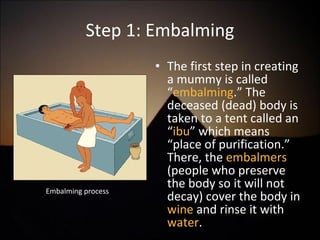
Step 1: Embalming The first step in creating a mummy is called “ embalming .” The deceased (dead) body is taken to a tent called an “ ibu ” which means “place of purification.” There, the  embalmers  (people who preserve the body so it will not decay) cover the body in  wine  and rinse it with  water . Embalming process
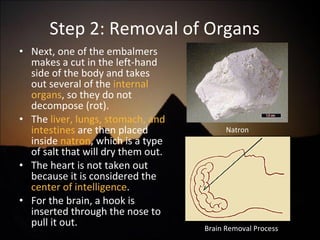
Next, one of the embalmers makes a cut in the left-hand side of the body and takes out several of the  internal organs , so they do not decompose (rot).  The  liver, lungs, stomach, and intestines  are then placed inside  natron , which is a type of salt that will dry them out. The heart is not taken out because it is considered the  center of intelligence . For the brain, a hook is inserted through the nose to pull it out. Step 2: Removal of Organs Natron Brain Removal Process
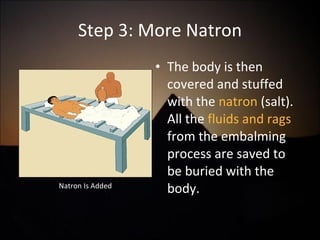
Step 3: More Natron The body is then covered and stuffed with the  natron  (salt). All the  fluids and rags  from the embalming process are saved to be buried with the body. Natron Is Added
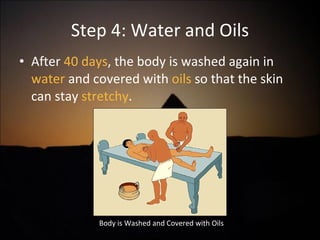
Step 4: Water and Oils After  40 days , the body is washed again in  water  and covered with  oils  so that the skin can stay  stretchy . Body is Washed and Covered with Oils
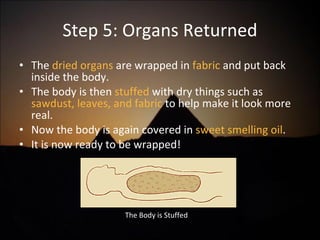
Step 5: Organs Returned The  dried organs  are wrapped in  fabric  and put back inside the body.  The body is then  stuffed  with dry things such as  sawdust, leaves, and fabric  to help make it look more real. Now the body is again covered in  sweet smelling oil . It is now ready to be wrapped! The Body is Stuffed
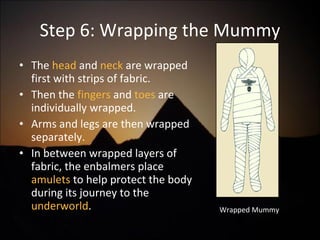
Step 6: Wrapping the Mummy The  head  and  neck  are wrapped first with strips of fabric. Then the  fingers  and  toes  are individually wrapped. Arms and legs are then wrapped separately.  In between wrapped layers of fabric, the enbalmers place  amulets  to help protect the body during its journey to the  underworld .  Wrapped Mummy
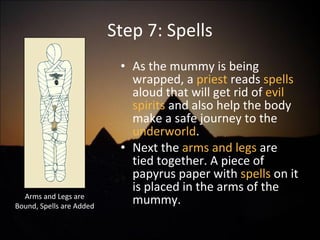
Step 7: Spells As the mummy is being wrapped, a  priest  reads  spells  aloud that will get rid of  evil spirits  and also help the body make a safe journey to the  underworld . Next the  arms and legs  are tied together. A piece of papyrus paper with  spells  on it is placed in the arms of the mummy. Arms and Legs are Bound, Spells are Added
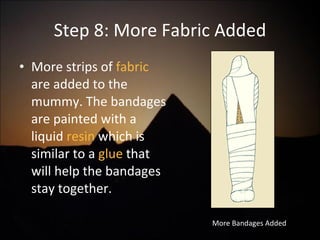
Step 8: More Fabric Added More strips of  fabric  are added to the mummy. The bandages are painted with a liquid  resin  which is similar to a  glue  that will help the bandages stay together. More Bandages Added
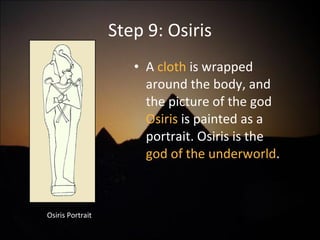
Step 9: Osiris A  cloth  is wrapped around the body, and the picture of the god  Osiris  is painted as a portrait. Osiris is the  god of the underworld . Osiris Portrait
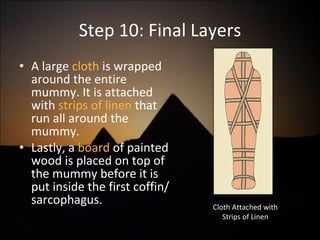
Step 10: Final Layers A large  cloth  is wrapped around the entire mummy. It is attached with  strips of linen  that run all around the mummy. Lastly, a  board  of painted wood is placed on top of the mummy before it is put inside the first coffin/sarcophagus. Cloth Attached with Strips of Linen
Don’t forget!!! Once you have completed the skeleton notes, email them to your teacher at  [email_address] . Be sure to include your name and course number. For your assessments over this lesson, click  here . And thank you to the British Museum for the wonderful information and images:  http://www.ancientegypt.co.uk/mummies/story/main.html

Mummification

  • 1.
    The 10 Stepsof Mummification An Ancient Egyptian Art Presented by Ms. Williams
  • 2.
    Learning Objectives Byviewing this presentation, you will discover the different steps and processes of mummification , including the embalming processes and the wrapping processes . This will help you to fully understand the importance of mummification in the Egyptian culture.
  • 3.
    Before we getstarted… Be sure to watch the Mummification video found here: http://jackiequinton.pbworks.com/Mummification-Video It is located on the PBworks site found here: http://jackiequinton.pbworks.com/FrontPage ! Also, be sure you have your skeleton notes opened up as a Word document. You can find them here: http://jackiequinton.pbworks.com/Skeleton-Notes Follow along with the notes as you view this PowerPoint presentation. Once you have completed the notes, email them to your teacher at [email_address] . Be sure to include your name and course number.
  • 4.
    Step 1: EmbalmingThe first step in creating a mummy is called “ embalming .” The deceased (dead) body is taken to a tent called an “ ibu ” which means “place of purification.” There, the embalmers (people who preserve the body so it will not decay) cover the body in wine and rinse it with water . Embalming process
  • 5.
    Next, one ofthe embalmers makes a cut in the left-hand side of the body and takes out several of the internal organs , so they do not decompose (rot). The liver, lungs, stomach, and intestines are then placed inside natron , which is a type of salt that will dry them out. The heart is not taken out because it is considered the center of intelligence . For the brain, a hook is inserted through the nose to pull it out. Step 2: Removal of Organs Natron Brain Removal Process
  • 6.
    Step 3: MoreNatron The body is then covered and stuffed with the natron (salt). All the fluids and rags from the embalming process are saved to be buried with the body. Natron Is Added
  • 7.
    Step 4: Waterand Oils After 40 days , the body is washed again in water and covered with oils so that the skin can stay stretchy . Body is Washed and Covered with Oils
  • 8.
    Step 5: OrgansReturned The dried organs are wrapped in fabric and put back inside the body. The body is then stuffed with dry things such as sawdust, leaves, and fabric to help make it look more real. Now the body is again covered in sweet smelling oil . It is now ready to be wrapped! The Body is Stuffed
  • 9.
    Step 6: Wrappingthe Mummy The head and neck are wrapped first with strips of fabric. Then the fingers and toes are individually wrapped. Arms and legs are then wrapped separately. In between wrapped layers of fabric, the enbalmers place amulets to help protect the body during its journey to the underworld . Wrapped Mummy
  • 10.
    Step 7: SpellsAs the mummy is being wrapped, a priest reads spells aloud that will get rid of evil spirits and also help the body make a safe journey to the underworld . Next the arms and legs are tied together. A piece of papyrus paper with spells on it is placed in the arms of the mummy. Arms and Legs are Bound, Spells are Added
  • 11.
    Step 8: MoreFabric Added More strips of fabric are added to the mummy. The bandages are painted with a liquid resin which is similar to a glue that will help the bandages stay together. More Bandages Added
  • 12.
    Step 9: OsirisA cloth is wrapped around the body, and the picture of the god Osiris is painted as a portrait. Osiris is the god of the underworld . Osiris Portrait
  • 13.
    Step 10: FinalLayers A large cloth is wrapped around the entire mummy. It is attached with strips of linen that run all around the mummy. Lastly, a board of painted wood is placed on top of the mummy before it is put inside the first coffin/sarcophagus. Cloth Attached with Strips of Linen
  • 14.
    Don’t forget!!! Onceyou have completed the skeleton notes, email them to your teacher at [email_address] . Be sure to include your name and course number. For your assessments over this lesson, click here . And thank you to the British Museum for the wonderful information and images: http://www.ancientegypt.co.uk/mummies/story/main.html