Downloaded 154 times
![14
OECD Horizontal Project on DDI
Find out more about our work at http://oe.cd/bigdata
Contact: Christian.Reimsbach-Kounatze [aatt] oecd.org
• Ch.1 The Phenomenon of data-driven innovation
• Ch.2 Mapping the global data ecosystem and its
points of control
• Ch.3 How data now drive innovation
• Ch.4 Drawing value from data as an infrastructure
• Ch.5 Building trust for data-driven innovation
• Ch.6 Skills and employment for a data-driven
economy
• Ch.7 Promoting data-driven scientific research
• Ch.8 The evolution of health care in a data-rich
environment
• Ch.9 Cities as hubs of data-driven innovation
• Ch.10 Governments leading by example with
public sector data](https://image.slidesharecdn.com/datadriveninnovationforgrowthandwell-being-151007100454-lva1-app6891/85/Data-driven-innovation-for-growth-and-well-being-14-320.jpg)

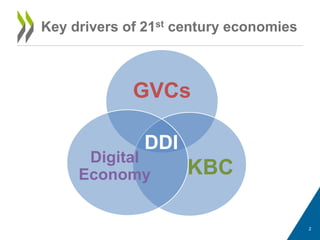
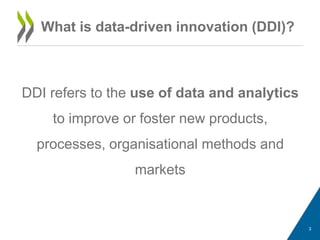
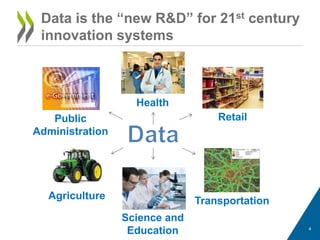
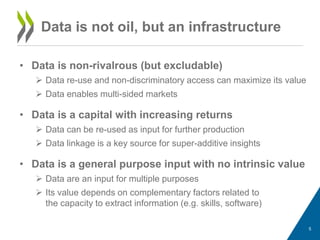
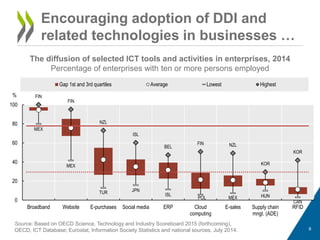
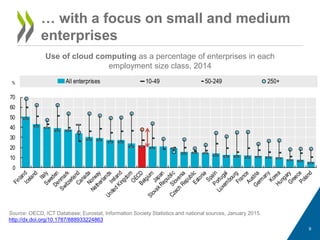
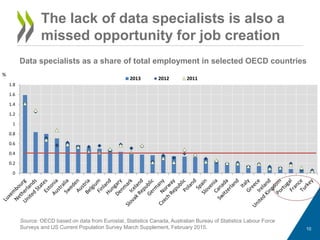
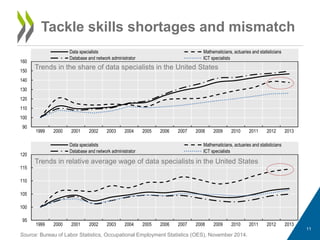
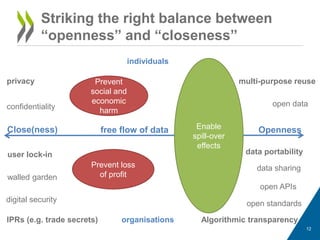
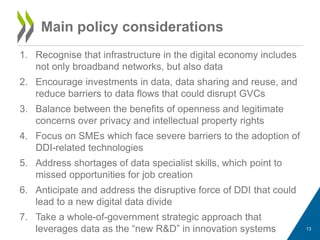
1) Data-driven innovation refers to using data and analytics to improve or create new products, processes, organizations and markets. It represents the "new R&D" for 21st century innovation systems across many sectors like health, education and transportation. 2) While data is not a traditional commodity, it functions as a non-rivalrous and general purpose input that is an infrastructure for innovation with increasing returns. Its value depends on access and the ability to extract useful insights. 3) Key challenges include encouraging adoption of data-driven technologies especially among small and medium enterprises, addressing shortages of data specialist skills, and balancing open data and reuse with privacy, security and intellectual property concerns.


