The Library is Open
Librarians and Information Professionals as
Open Practitioners
Josie Fraser LILAC 10 April 2017
@josiefraser
LILAC 2017 Josie Fraser @josiefraser
#YEAROFOPEN
Happy Year of Open!
​15 years ago:
• UNESCO adopt the term ‘Open Educational Resources’
• The Budapest Open Access Initiative was launched
• The first Creative Commons licenses were released
10 years ago:
• The Cape Town Open Education Declaration was written
5 years ago:
• The first Open Education Week took place
• The first OER World Congress was held, resulting in the Paris OER
Declaration
LILAC 2017 Josie Fraser @josiefraser
Justin Grimes
Library Love (2011)
Attribution-ShareAlike
2.0 Generic (CC-BY-SA
2.0)
LILAC 2017 Josie Fraser @josiefraser
Mat Fascione
St Barnabas
Library, Leicester
(2007)
shared under a
Creative
Commons
Attribution-
ShareAlike 2.0
(CC-BY-SA)
licence.
LILAC 2017 Josie Fraser @josiefraser
SpiderWeb-MarketingSystems Oh-Yes-its-
FREE---iStock.gif
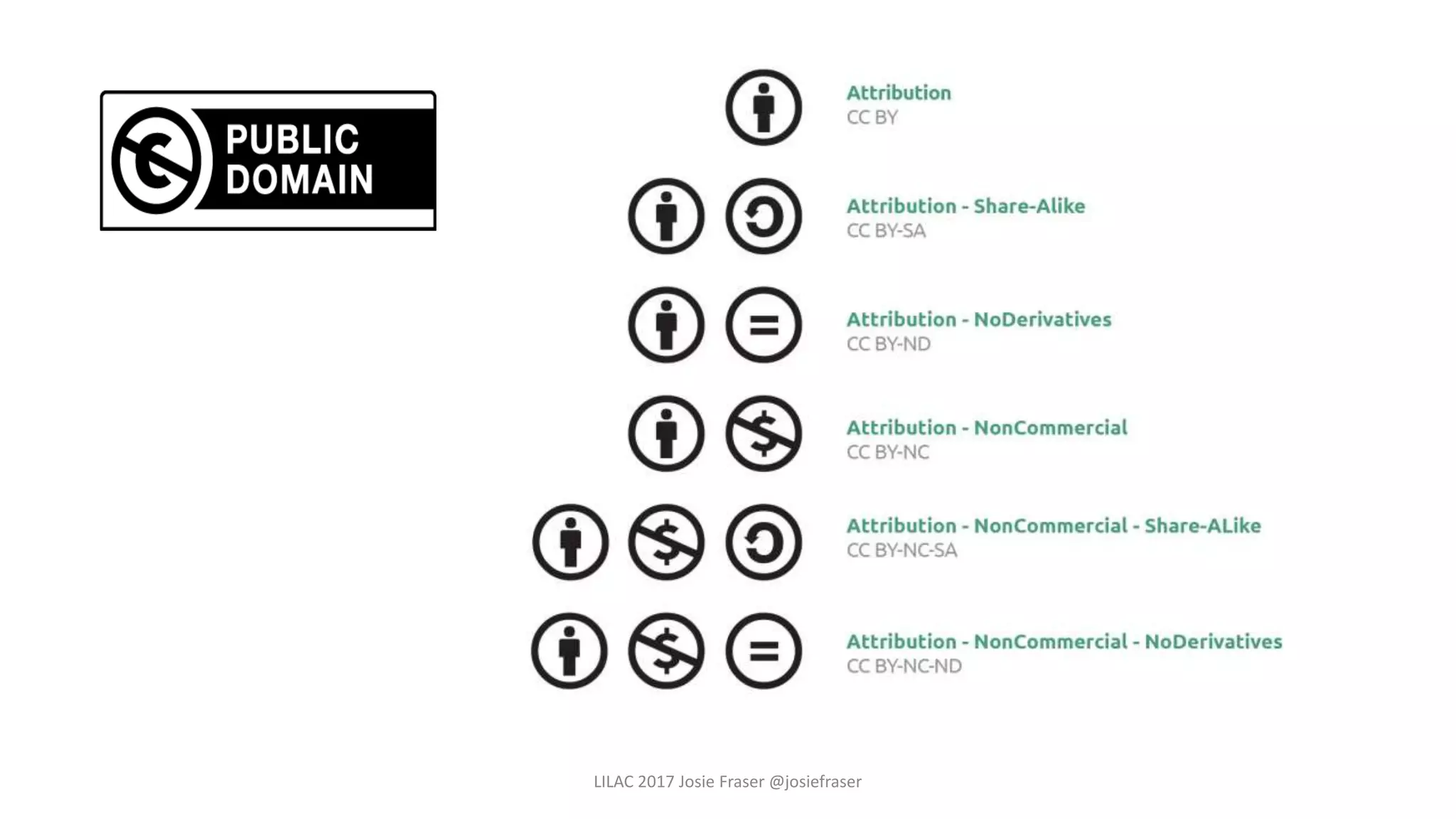
Attribution-Share Alike
(CC BY-SA)
FraserElliot Yes, We’re Open
Attribution-NonCommercial
(CC BY-NC)
LILAC 2017 Josie Fraser @josiefraser
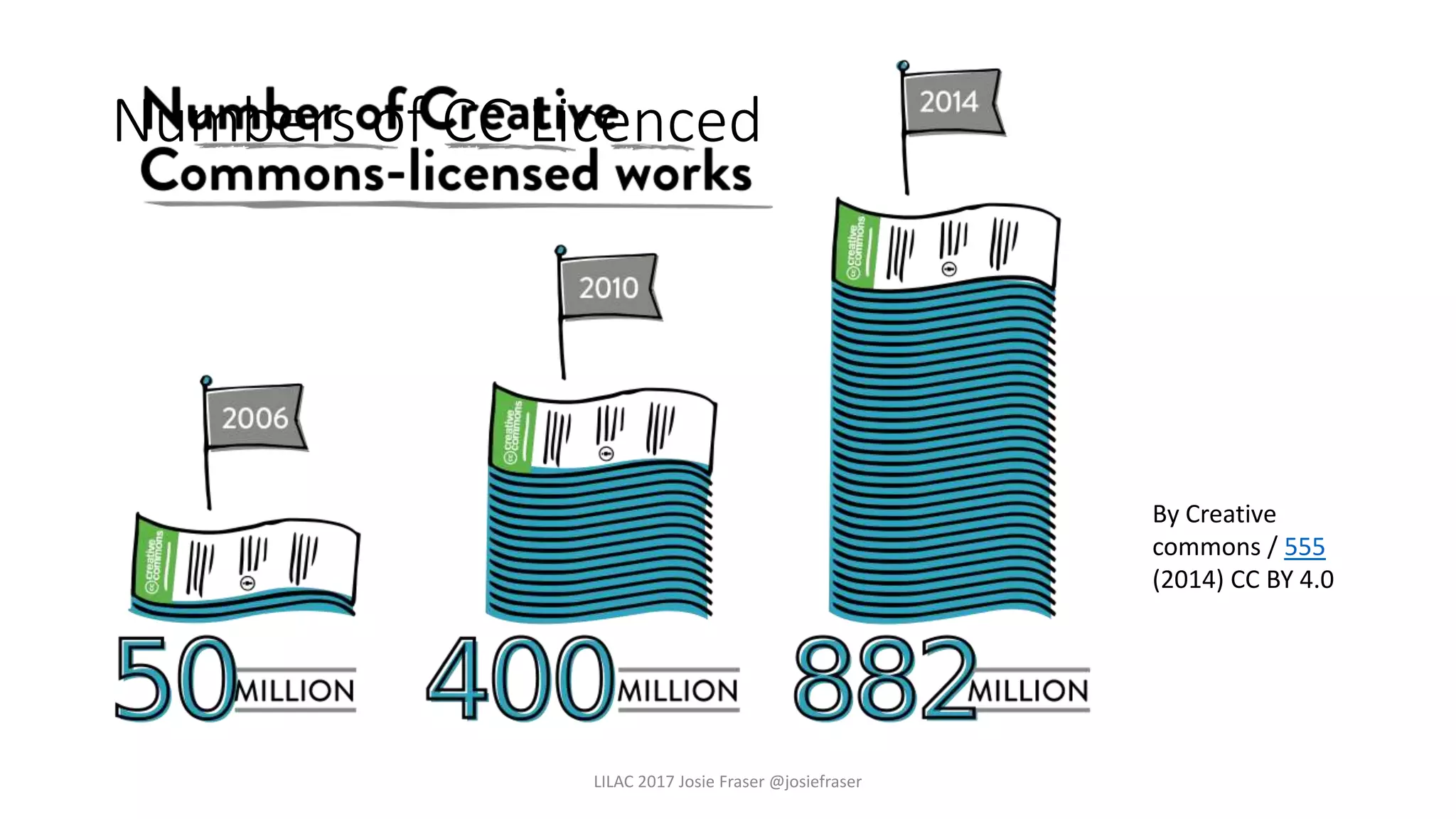
Numbers of CC Licenced
LILAC 2017 Josie Fraser @josiefraser
By Creative
commons / 555
(2014) CC BY 4.0
“Wikipedia is the greatest open educational
resource of all time”
- Jim Groom, #oer16
LILAC 2017 Josie Fraser @josiefraser
Spelling out freedoms and restrictions
“Open licences, including the Creative Commons
licences, provide educators and everyone else
with a clear, simple way to specify how resources
can be used and reused, and how the work
should be credited.”
LILAC 2017 Josie Fraser @josiefraser
What does an openly
licensed resource look like?
Creative Commons Attribution 4.0
International (CC BY 4.0)
LILAC 2017 Josie Fraser @josiefraser
The Library is Open: Librarians and Information Professionals as Open Practitioners,
Josie Fraser LILAC 10 April 2017.
Content is shared under a Creative Commons Attribution 4.0 International (CC BY 4.0)
licence, unless otherwise indicated.
LILAC 2017 Josie Fraser @josiefraser
What makes an educational resource open?
Cable Green (2016): “two conditions
that should guide your
determination as to whether or not
an item is considered ‘open’:
• Do you have ‘free and unfettered
access’ to the resource? If you have
to pay to retain or use a resource,
it isn't open.
• Is use of the resource governed by
David Wiley's 5Rs of
Openness permissions?”
LILAC 2017 Josie Fraser @josiefraser
The UNESCO 2012 Paris Declaration recommends that
member states should:
Foster awareness and use of OER.
Promote and use OER to widen access to education at all
levels, both formal and non-formal, in a perspective of
lifelong learning, thus contributing to social inclusion,
gender equity and special needs education. Improve both
cost-efficiency and quality of teaching and learning
outcomes through greater use of OER.
LILAC 2017 Josie Fraser @josiefraser
Are open licences enough?
LILAC 2017 Josie Fraser @josiefraser
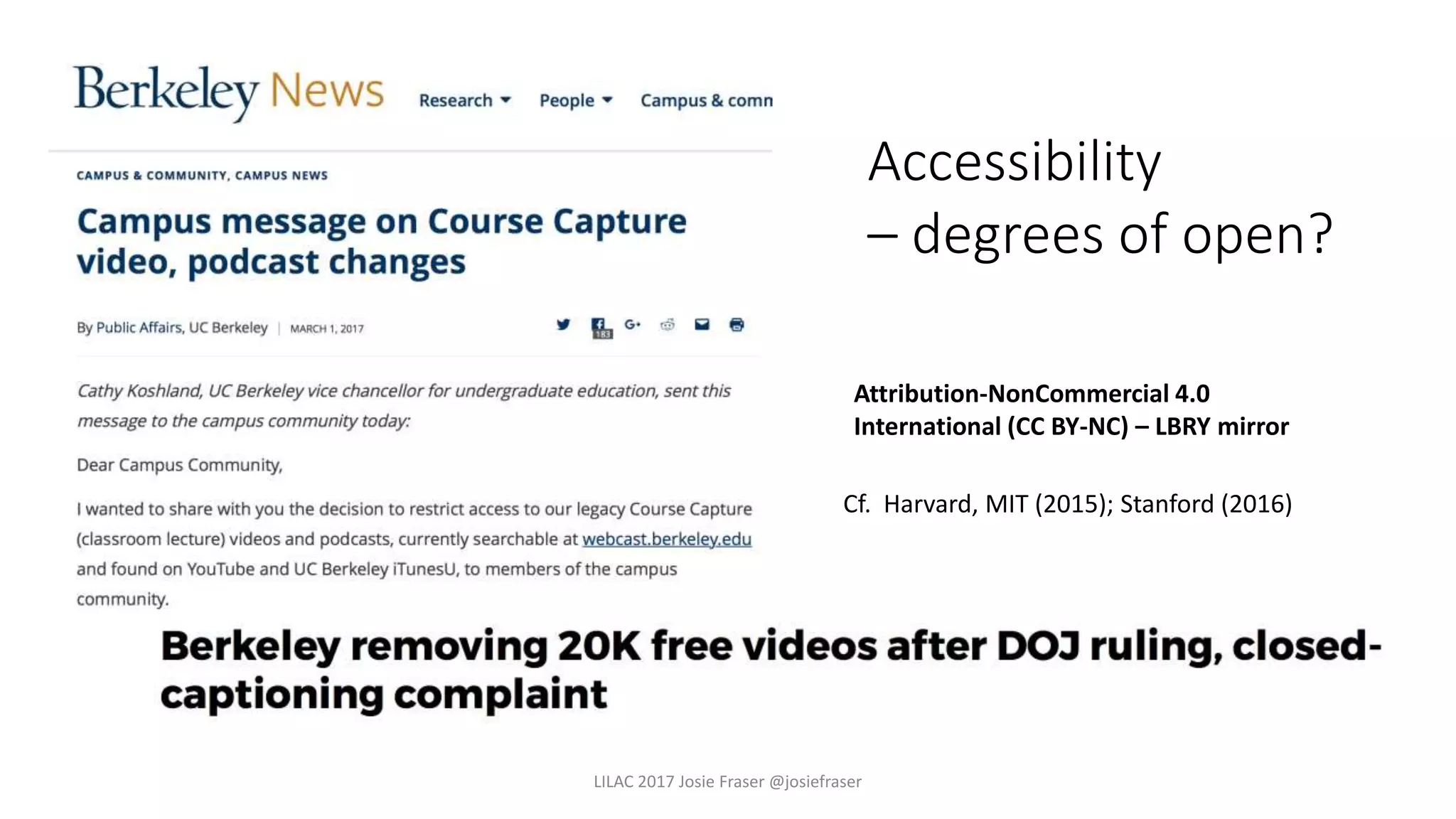
Attribution-NonCommercial 4.0
International (CC BY-NC) – LBRY mirror
Cf. Harvard, MIT (2015); Stanford (2016)
Accessibility
– degrees of open?
• Freedom to teach without breaking the
law
• Ability to use materials that will tell
stories in an unbiased way
• The same freedoms for all educators in
the EU
• Law that will allow you to embrace
digital opportunities
• Law that recognises museums, libraries
and NGOs as having an educational
function
https://rightcopyright.eu
LILAC 2017 Josie Fraser @josiefraser
Digital literacy
LILAC 2017 Josie Fraser @josiefraser
JISC Digital capacity framework
Helen Beetham
What about open practice?
LILAC 2017 Josie Fraser @josiefraser
“Open educational practices, known as OEP, have a range of
definitions. In the narrowest sense, OEP are "practices which support
the production, use and reuse of high quality OER" (International
Council for Open & Distance Education). A broader view is espoused in
the Capetown Open Education Declaration: "Open education is not
limited to just open educational resources. It also draws upon open
technologies that facilitate collaborative, flexible learning and the open
sharing of teaching practices that empower educators to benefit from
the best ideas of their colleagues. It may also grow to include new
approaches to assessment, accreditation and collaborative learning."
- GoOPEN Wiki Vivien Rolfe & Catherine Cronin (2015)
LILAC 2017 Josie Fraser @josiefraser
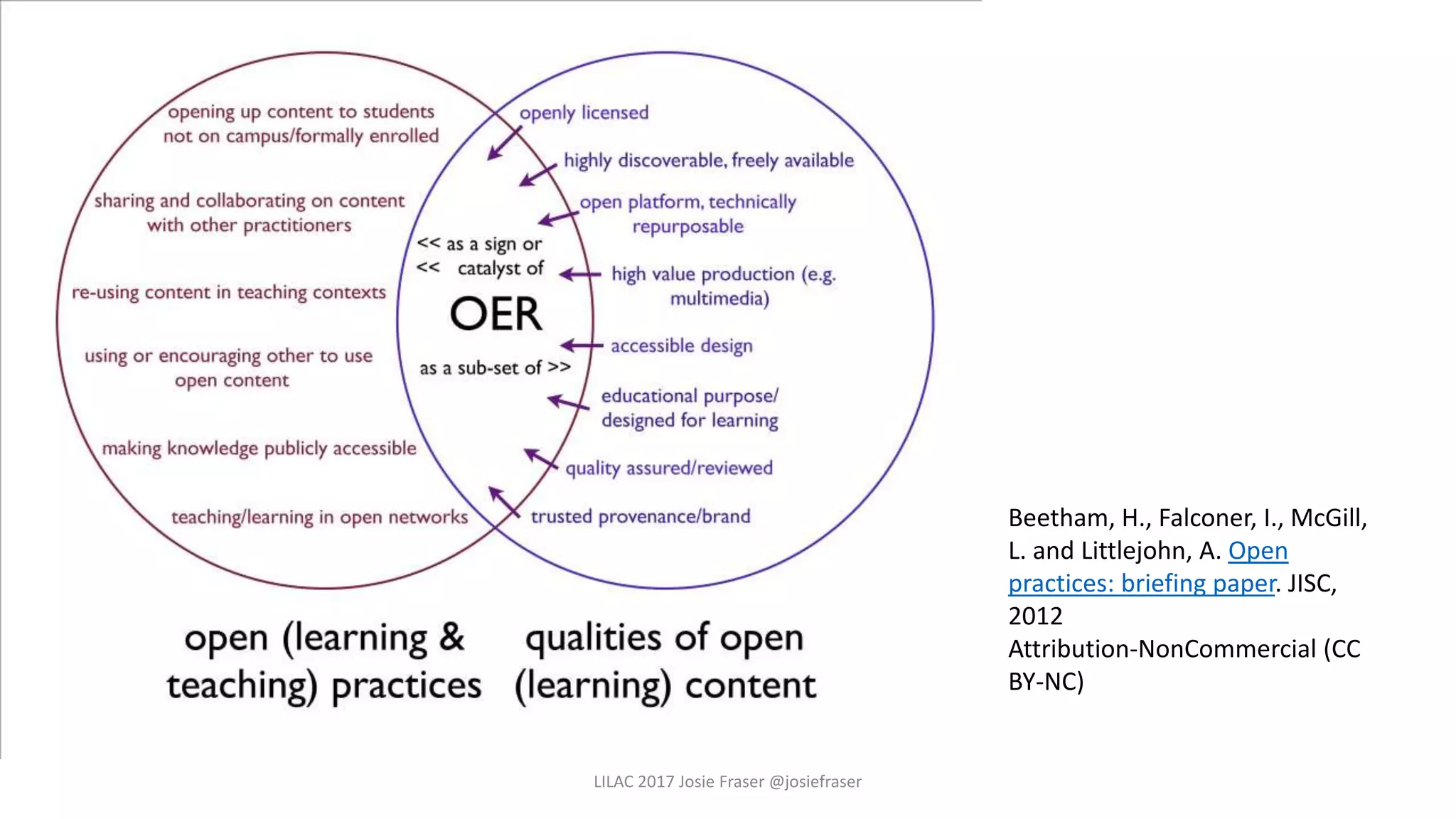
Beetham, H., Falconer, I., McGill,
L. and Littlejohn, A. Open
practices: briefing paper. JISC,
2012
Attribution-NonCommercial (CC
BY-NC)
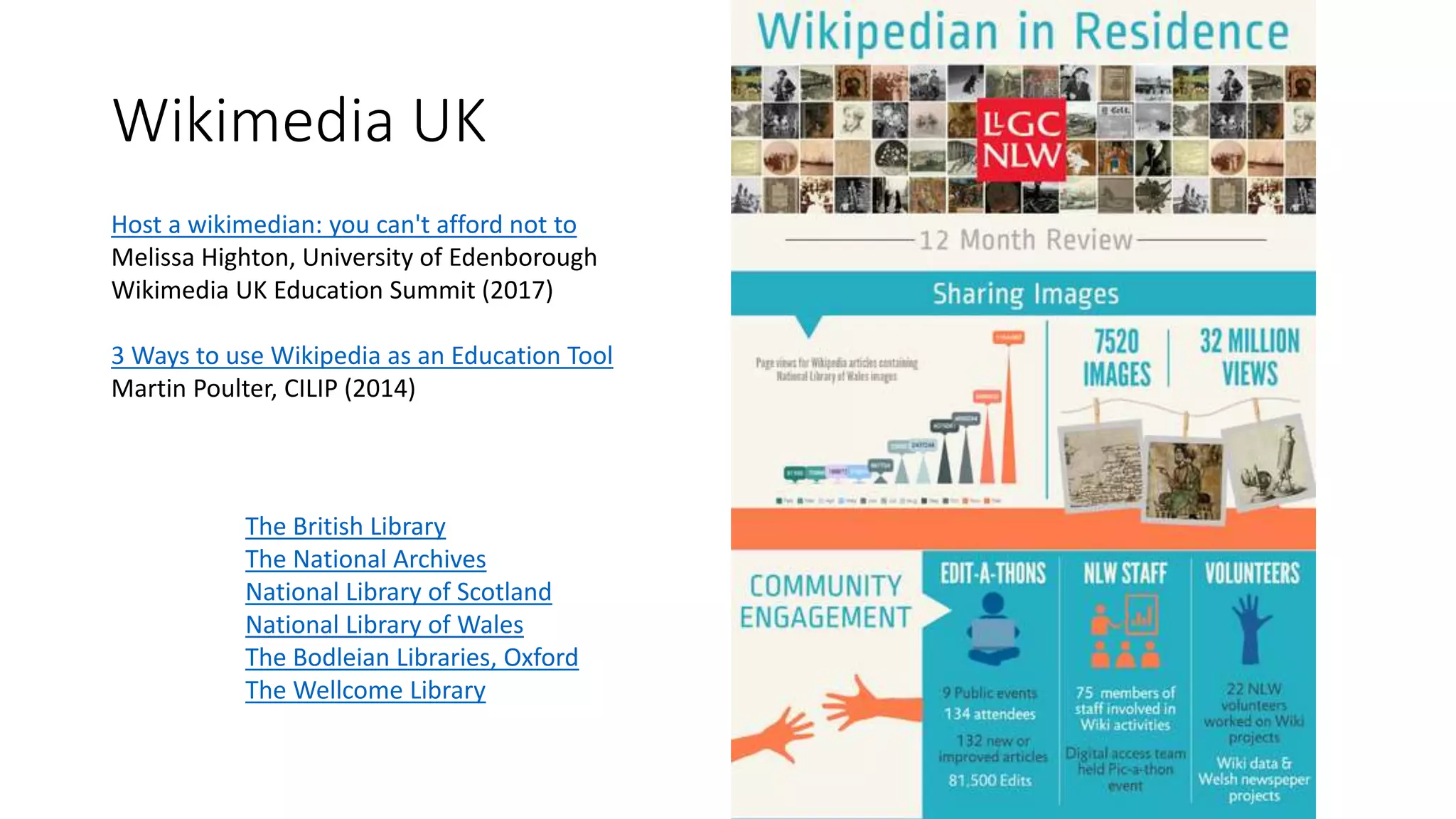
Wikimedia UK
The British Library
The National Archives
National Library of Scotland
National Library of Wales
The Bodleian Libraries, Oxford
The Wellcome Library
Host a wikimedian: you can't afford not to
Melissa Highton, University of Edenborough
Wikimedia UK Education Summit (2017)
3 Ways to use Wikipedia as an Education Tool
Martin Poulter, CILIP (2014)
LILAC 2017 Josie Fraser @josiefraser
“open can improve access and equity…but it
can also exacerbate inequality as we know.
Openness is negotiated on an individual
basis. So open education practice, as I have
found in my own work, is always personal, is
always contextual, and its always
continuously negotiated. So we can be
advocates for openness on an social and
institutional level, but still be very cognisant
of the risks we may be asking people to take
when we are advocating for open.”
- Catherine Cronin, OER17 (2017)
LILAC 2017 Josie Fraser @josiefraser
"We try to be inclusive but we fail a lot. We
need to design for inclusivity, it doesn't just
happen”
- Maha Bali, #OER17 (2017)
Open practice
• Supporting the use and
production of OER
• Accessibility
• Collaboration
• Development
• Co-production
• Inclusion
• Sustainability
• Privacy
• Public Value
• Flexibility
• Customisation/personalisation/relevance
• Quality
• Legal
LILAC 2017 Josie Fraser @josiefraser
Open keynote
Please tweet using #lilac17op
or head over to http://goo.gl/dr19a8
Question:
In what way(s) do you consider your practice, as a
librarian or information professional, open?
LILAC 2017 Josie Fraser @josiefraser
Some questions:
• Do staff & students understand their own position?
• Do staff & students know about OER?
• Does the organisation have a policy regarding OER/open
licencing?
• Do staff & students understand how to find, evaluate,
acknowledge and reuse OER?
• Do staff and the organisation consider open practice in
relation to provision & production?
LILAC 2017 Josie Fraser @josiefraser
FraserElliot Yes, We’re Open Attribution-
NonCommercial (CC BY-NC)
Daniel Solis Cutting Libraries in a Recession is like
Cutting Hospitals in a Plague (2010) Attribution 2.0
(CC BY)
LILAC 2017 Josie Fraser @josiefraser
Open education is the philosophy of ensuring equity and quality of
access to education to all, regardless of gender, economic means,
location, disability, age, sexuality, race, ethnicity, or religion
Open practice is the act of creating and supporting learning
experiences and resources that acknowledge contexts of discrimination
and inequality
Open practice is the enactment of equitable, ethical, and sustainable
learning experiences and resources
LILAC 2017 Josie Fraser @josiefraser
Thank you!
@josiefraser
LILAC 2017 Josie Fraser @josiefraser

The Library is Open: Librarians and Information Professionals as Open Practitioners - Josie Fraser (LILAC Keynote Speaker)

  • 1.
    The Library isOpen Librarians and Information Professionals as Open Practitioners Josie Fraser LILAC 10 April 2017 @josiefraser
  • 2.
    LILAC 2017 JosieFraser @josiefraser #YEAROFOPEN
  • 3.
    Happy Year ofOpen! ​15 years ago: • UNESCO adopt the term ‘Open Educational Resources’ • The Budapest Open Access Initiative was launched • The first Creative Commons licenses were released 10 years ago: • The Cape Town Open Education Declaration was written 5 years ago: • The first Open Education Week took place • The first OER World Congress was held, resulting in the Paris OER Declaration LILAC 2017 Josie Fraser @josiefraser
  • 4.
    LILAC 2017 JosieFraser @josiefraser
  • 5.
    LILAC 2017 JosieFraser @josiefraser Justin Grimes Library Love (2011) Attribution-ShareAlike 2.0 Generic (CC-BY-SA 2.0)
  • 6.
    LILAC 2017 JosieFraser @josiefraser
  • 7.
    LILAC 2017 JosieFraser @josiefraser
  • 9.
    LILAC 2017 JosieFraser @josiefraser Mat Fascione St Barnabas Library, Leicester (2007) shared under a Creative Commons Attribution- ShareAlike 2.0 (CC-BY-SA) licence.
  • 10.
    LILAC 2017 JosieFraser @josiefraser SpiderWeb-MarketingSystems Oh-Yes-its- FREE---iStock.gif Attribution-Share Alike (CC BY-SA) FraserElliot Yes, We’re Open Attribution-NonCommercial (CC BY-NC)
  • 11.
    LILAC 2017 JosieFraser @josiefraser
  • 12.
    Numbers of CCLicenced LILAC 2017 Josie Fraser @josiefraser By Creative commons / 555 (2014) CC BY 4.0
  • 13.
    “Wikipedia is thegreatest open educational resource of all time” - Jim Groom, #oer16 LILAC 2017 Josie Fraser @josiefraser
  • 15.
    Spelling out freedomsand restrictions “Open licences, including the Creative Commons licences, provide educators and everyone else with a clear, simple way to specify how resources can be used and reused, and how the work should be credited.” LILAC 2017 Josie Fraser @josiefraser
  • 16.
    What does anopenly licensed resource look like?
  • 17.
    Creative Commons Attribution4.0 International (CC BY 4.0) LILAC 2017 Josie Fraser @josiefraser The Library is Open: Librarians and Information Professionals as Open Practitioners, Josie Fraser LILAC 10 April 2017. Content is shared under a Creative Commons Attribution 4.0 International (CC BY 4.0) licence, unless otherwise indicated.
  • 18.
    LILAC 2017 JosieFraser @josiefraser
  • 20.
    What makes aneducational resource open? Cable Green (2016): “two conditions that should guide your determination as to whether or not an item is considered ‘open’: • Do you have ‘free and unfettered access’ to the resource? If you have to pay to retain or use a resource, it isn't open. • Is use of the resource governed by David Wiley's 5Rs of Openness permissions?” LILAC 2017 Josie Fraser @josiefraser
  • 21.
    The UNESCO 2012Paris Declaration recommends that member states should: Foster awareness and use of OER. Promote and use OER to widen access to education at all levels, both formal and non-formal, in a perspective of lifelong learning, thus contributing to social inclusion, gender equity and special needs education. Improve both cost-efficiency and quality of teaching and learning outcomes through greater use of OER. LILAC 2017 Josie Fraser @josiefraser
  • 23.
    Are open licencesenough? LILAC 2017 Josie Fraser @josiefraser
  • 24.
    LILAC 2017 JosieFraser @josiefraser Attribution-NonCommercial 4.0 International (CC BY-NC) – LBRY mirror Cf. Harvard, MIT (2015); Stanford (2016) Accessibility – degrees of open?
  • 25.
    • Freedom toteach without breaking the law • Ability to use materials that will tell stories in an unbiased way • The same freedoms for all educators in the EU • Law that will allow you to embrace digital opportunities • Law that recognises museums, libraries and NGOs as having an educational function https://rightcopyright.eu LILAC 2017 Josie Fraser @josiefraser
  • 26.
    Digital literacy LILAC 2017Josie Fraser @josiefraser JISC Digital capacity framework Helen Beetham
  • 27.
    What about openpractice? LILAC 2017 Josie Fraser @josiefraser
  • 28.
    “Open educational practices,known as OEP, have a range of definitions. In the narrowest sense, OEP are "practices which support the production, use and reuse of high quality OER" (International Council for Open & Distance Education). A broader view is espoused in the Capetown Open Education Declaration: "Open education is not limited to just open educational resources. It also draws upon open technologies that facilitate collaborative, flexible learning and the open sharing of teaching practices that empower educators to benefit from the best ideas of their colleagues. It may also grow to include new approaches to assessment, accreditation and collaborative learning." - GoOPEN Wiki Vivien Rolfe & Catherine Cronin (2015) LILAC 2017 Josie Fraser @josiefraser
  • 29.
    LILAC 2017 JosieFraser @josiefraser Beetham, H., Falconer, I., McGill, L. and Littlejohn, A. Open practices: briefing paper. JISC, 2012 Attribution-NonCommercial (CC BY-NC)
  • 30.
    Wikimedia UK The BritishLibrary The National Archives National Library of Scotland National Library of Wales The Bodleian Libraries, Oxford The Wellcome Library Host a wikimedian: you can't afford not to Melissa Highton, University of Edenborough Wikimedia UK Education Summit (2017) 3 Ways to use Wikipedia as an Education Tool Martin Poulter, CILIP (2014)
  • 31.
    LILAC 2017 JosieFraser @josiefraser “open can improve access and equity…but it can also exacerbate inequality as we know. Openness is negotiated on an individual basis. So open education practice, as I have found in my own work, is always personal, is always contextual, and its always continuously negotiated. So we can be advocates for openness on an social and institutional level, but still be very cognisant of the risks we may be asking people to take when we are advocating for open.” - Catherine Cronin, OER17 (2017)
  • 32.
    LILAC 2017 JosieFraser @josiefraser "We try to be inclusive but we fail a lot. We need to design for inclusivity, it doesn't just happen” - Maha Bali, #OER17 (2017)
  • 33.
    Open practice • Supportingthe use and production of OER • Accessibility • Collaboration • Development • Co-production • Inclusion • Sustainability • Privacy • Public Value • Flexibility • Customisation/personalisation/relevance • Quality • Legal LILAC 2017 Josie Fraser @josiefraser
  • 34.
    Open keynote Please tweetusing #lilac17op or head over to http://goo.gl/dr19a8 Question: In what way(s) do you consider your practice, as a librarian or information professional, open? LILAC 2017 Josie Fraser @josiefraser
  • 35.
    Some questions: • Dostaff & students understand their own position? • Do staff & students know about OER? • Does the organisation have a policy regarding OER/open licencing? • Do staff & students understand how to find, evaluate, acknowledge and reuse OER? • Do staff and the organisation consider open practice in relation to provision & production? LILAC 2017 Josie Fraser @josiefraser
  • 36.
    FraserElliot Yes, We’reOpen Attribution- NonCommercial (CC BY-NC) Daniel Solis Cutting Libraries in a Recession is like Cutting Hospitals in a Plague (2010) Attribution 2.0 (CC BY) LILAC 2017 Josie Fraser @josiefraser
  • 37.
    Open education isthe philosophy of ensuring equity and quality of access to education to all, regardless of gender, economic means, location, disability, age, sexuality, race, ethnicity, or religion Open practice is the act of creating and supporting learning experiences and resources that acknowledge contexts of discrimination and inequality Open practice is the enactment of equitable, ethical, and sustainable learning experiences and resources LILAC 2017 Josie Fraser @josiefraser
  • 38.
    Thank you! @josiefraser LILAC 2017Josie Fraser @josiefraser