MACHINE LEARNING
TRENDS
Machine Learning Meetup, Sofia
OPENING MEETUP
What to expect?
open format
exchange knowledge/ideas
everyone can be on stage
be tolerant, respect the others
COGNITIVE COMPUTING
		 “A cognitive computer combines
artificial intelligence and machine-
learning algorithms, in an approach which
attempts to reproduce the behavior of the
human brain.”
Wikipedia
COGNITIVE COMPUTING
addresses complex situations that are
characterized by ambiguity and
uncertainty;
handles human kinds of problems
COGNITIVE COMPUTING
“The smart machine era will be the most
disruptive in the history of IT.”
Gartner
COGNITIVE COMPUTING
“By 2018 half of all consumers will interact
with services based on cognitive computing
on a regular basis.”
IDC
COGNITIVE COMPUTING
Why now?
Advances in enabling technology
Increasingly large complex datasets	
Emerging Platforms – Cloud, Mobile, Big
Data, Analytics, Social
COGNITIVE COMPUTING
Enabling Technologies
Natural Language Processing
Semantic Analysis
Informational Retrieval
Automated Reasoning
Machine Learning / AI
TRENDS
Computers That Learn
Computers That Think
Computers That Interact with Humans
Computers That Interact with Computers
Research and Use Cases
Education and Training
TRENDS
Siri, Google Now, Cortana
Workplace Disruption
Industry Transformation
Window of Opportunity
ML Practically Means
Algorithms that can learn from and make
predictions on data
Building a model from example inputs in
order to make data-driven predictions or
decisions
ML Broad Categories
Supervised learning
Unsupervised learning
Reinforcement learning
ML Tasks by Desired Output
Classification (typically supervised)
Regression (typically supervised)
Clustering (typically unsupervised)
Density estimation
Dimensionality reduction
ML Approaches
Decision tree learning
Artificial neural networks (ANN)
Support vector machines (SVM)
Clustering
Bayesian networks
Sparse dictionary learning
Genetic algorithms
What We at Imagga Do
Image classification (supervised learning)
Use ANN
More precisely - Deep Learning
Even more precisely - CNN (not the TV
station)
Convolutional Neural Networks (CNN)
Get raster data as input
Typically deep networks - multiple
convolutional and hidden layers
Very useful for images - the convolution
parameters are produced as a result of the
learning
Why NOW
GPUs have thousands of cores
Big amount of data, lots of data sources
Affordable utility computing (e.g. AWS, Azure,
Google Cloud)
Demand for ML solutions
Challenges
Very data greedy
Requires clean data
Requires data variety
Still takes a lot of time (1-4 weeks until the
model converges)
Solutions
Data augmentation (increase robustness)
Auto-cleaning of data (remove outliers and re-
train)
Designing the model architecture for multiple
GPUs
Topic for Next Meetup?
Overview/Presentations of the Bulgarian
companies using ML
Commercial applications and use-cases
Open-source software packages for ML
other . . .
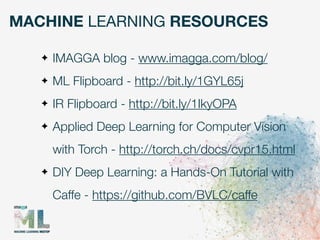
MACHINE LEARNING RESOURCES
IMAGGA blog - www.imagga.com/blog/
ML Flipboard - http://bit.ly/1GYL65j
IR Flipboard - http://bit.ly/1IkyOPA
Applied Deep Learning for Computer Vision
with Torch - http://torch.ch/docs/cvpr15.html
DIY Deep Learning: a Hands-On Tutorial with
Caffe - https://github.com/BVLC/caffe
QUESTIONS
Q & A
Machine Learning Meetup SOF: Intro to ML

Machine Learning Meetup SOF: Intro to ML

  • 2.
  • 3.
    OPENING MEETUP What toexpect? open format exchange knowledge/ideas everyone can be on stage be tolerant, respect the others
  • 4.
    COGNITIVE COMPUTING “Acognitive computer combines artificial intelligence and machine- learning algorithms, in an approach which attempts to reproduce the behavior of the human brain.” Wikipedia
  • 5.
    COGNITIVE COMPUTING addresses complexsituations that are characterized by ambiguity and uncertainty; handles human kinds of problems
  • 6.
    COGNITIVE COMPUTING “The smartmachine era will be the most disruptive in the history of IT.” Gartner
  • 7.
    COGNITIVE COMPUTING “By 2018half of all consumers will interact with services based on cognitive computing on a regular basis.” IDC
  • 8.
    COGNITIVE COMPUTING Why now? Advancesin enabling technology Increasingly large complex datasets Emerging Platforms – Cloud, Mobile, Big Data, Analytics, Social
  • 9.
    COGNITIVE COMPUTING Enabling Technologies NaturalLanguage Processing Semantic Analysis Informational Retrieval Automated Reasoning Machine Learning / AI
  • 10.
    TRENDS Computers That Learn ComputersThat Think Computers That Interact with Humans Computers That Interact with Computers Research and Use Cases Education and Training
  • 11.
    TRENDS Siri, Google Now,Cortana Workplace Disruption Industry Transformation Window of Opportunity
  • 12.
    ML Practically Means Algorithmsthat can learn from and make predictions on data Building a model from example inputs in order to make data-driven predictions or decisions
  • 13.
    ML Broad Categories Supervisedlearning Unsupervised learning Reinforcement learning
  • 14.
    ML Tasks byDesired Output Classification (typically supervised) Regression (typically supervised) Clustering (typically unsupervised) Density estimation Dimensionality reduction
  • 15.
    ML Approaches Decision treelearning Artificial neural networks (ANN) Support vector machines (SVM) Clustering Bayesian networks Sparse dictionary learning Genetic algorithms
  • 16.
    What We atImagga Do Image classification (supervised learning) Use ANN More precisely - Deep Learning Even more precisely - CNN (not the TV station)
  • 17.
    Convolutional Neural Networks(CNN) Get raster data as input Typically deep networks - multiple convolutional and hidden layers Very useful for images - the convolution parameters are produced as a result of the learning
  • 18.
    Why NOW GPUs havethousands of cores Big amount of data, lots of data sources Affordable utility computing (e.g. AWS, Azure, Google Cloud) Demand for ML solutions
  • 19.
    Challenges Very data greedy Requiresclean data Requires data variety Still takes a lot of time (1-4 weeks until the model converges)
  • 20.
    Solutions Data augmentation (increaserobustness) Auto-cleaning of data (remove outliers and re- train) Designing the model architecture for multiple GPUs
  • 21.
    Topic for NextMeetup? Overview/Presentations of the Bulgarian companies using ML Commercial applications and use-cases Open-source software packages for ML other . . .
  • 22.
    MACHINE LEARNING RESOURCES IMAGGAblog - www.imagga.com/blog/ ML Flipboard - http://bit.ly/1GYL65j IR Flipboard - http://bit.ly/1IkyOPA Applied Deep Learning for Computer Vision with Torch - http://torch.ch/docs/cvpr15.html DIY Deep Learning: a Hands-On Tutorial with Caffe - https://github.com/BVLC/caffe
  • 23.