How “gross emitting” vehicles
can spoil local air quality
Mark Peckham & Jamie Parnell
Why worry about gross emitters?
2
• 3.9% of trucks emit 50% of all NOx *
• Significant contribution to urban pollution hot spots
• Modern diesel vehicles can be very clean
• Even “good” vehicles can emit high levels of NOx under certain conditions
• Some gross emitters may be “legitimate” (older models), some may have been tampered with
• Nominally clean Euro 6 vehicles may gain access to CAZ on the basis of their number plate but then
produce large amounts of pollution
* CARB 2020 PEAQS project
Cambustion’s background (founded 1987)
3
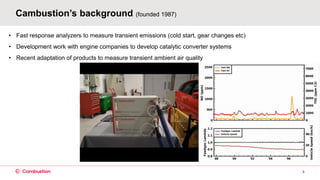
• Fast response analyzers to measure transient emissions (cold start, gear changes etc)
• Development work with engine companies to develop catalytic converter systems
• Recent adaptation of products to measure transient ambient air quality
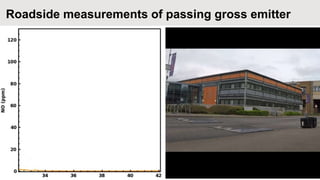
Roadside measurements of passing gross emitter
4
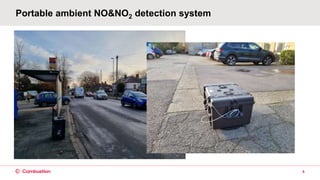
Portable ambient NO&NO2 detection system
5
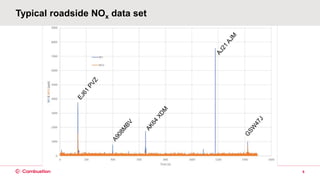
Typical roadside NOx data set
6
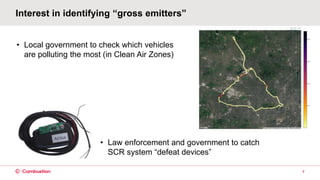
Interest in identifying “gross emitters”
7
• Law enforcement and government to catch
SCR system “defeat devices”
• Local government to check which vehicles
are polluting the most (in Clean Air Zones)
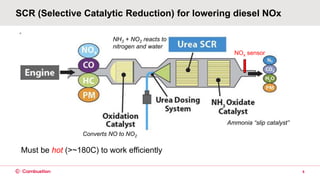
SCR (Selective Catalytic Reduction) for lowering diesel NOx
8
Converts NO to NO2
NH3 + NO2 reacts to
nitrogen and water
Ammonia “slip catalyst”
NOx sensor
Must be hot (>~180C) to work efficiently
NOx tailpipe ppm comparisons, TfL West London route
9
Instantaneous [NOx] (ppm)
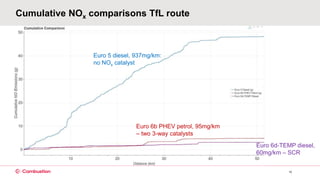
Cumulative NOx comparisons TfL route
10
Euro 5 diesel, 937mg/km:
no NOx catalyst
Euro 6b PHEV petrol, 95mg/km
– two 3-way catalysts
Euro 6d-TEMP diesel,
60mg/km – SCR
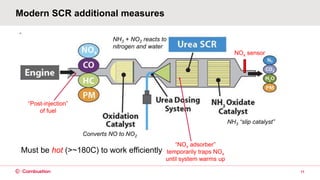
Modern SCR additional measures
11
Converts NO to NO2
NH3 + NO2 reacts to
nitrogen and water
NH3 “slip catalyst”
NOx sensor
Must be hot (>~180C) to work efficiently
“Post-injection”
of fuel
“NOx adsorber”
temporarily traps NOx
until system warms up
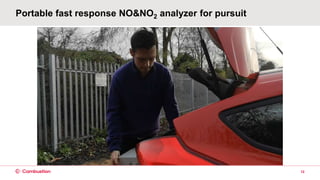
Portable fast response NO&NO2 analyzer for pursuit
12
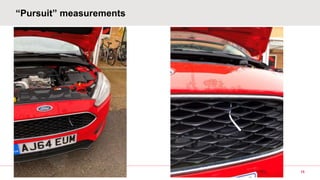
“Pursuit” measurements
13
Chase study of bus stop manoeuvre
14
When & where legit SCR systems can emit…
15
Cold start and first few minutes of driving
• Leaving home
• Leaving place of work
• Leaving car parks
• Leaving bus depot (e.g. 60% of NOx from a 2 hour journey emitted within first 5 mins)
After long periods of deceleration or idle
• Accelerating away from the foot of a hill
• Bus stops (!)
• Pulling away from traffic lights
• Sudden acceleration in congested traffic
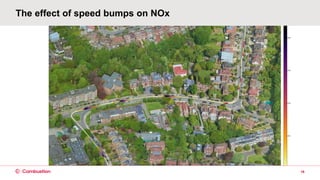
The effect of speed bumps on NOx
16
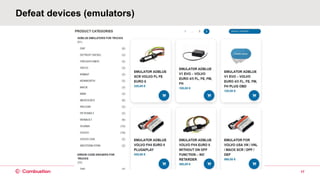
Defeat devices (emulators)
17
Why tamper with an SCR system?
18
• No more SCR maintenance costs
• Pass MOT (warning lights suppressed)
• No need to buy any more AdBlue
• Claims of better fuel economy (save fuel) through disabling of catalyst heating etc
…but can still enter CAZs if number plate allows
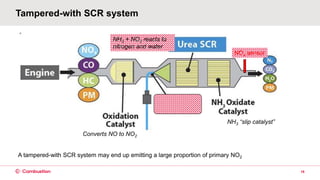
Tampered-with SCR system
19
Converts NO to NO2
NH3 + NO2 reacts to
nitrogen and water
NH3 “slip catalyst”
NOx sensor
A tampered-with SCR system may end up emitting a large proportion of primary NO2
Cyclist NOx exposure
20
Child exposure to NOx
21
msp@cambustion.com
jparnell@cambustion.com
Thank you
https://www.cambustion.com/industries/air-quality

10.30 Mark Peckham.pdf

  • 1.
    How “gross emitting”vehicles can spoil local air quality Mark Peckham & Jamie Parnell
  • 2.
    Why worry aboutgross emitters? 2 • 3.9% of trucks emit 50% of all NOx * • Significant contribution to urban pollution hot spots • Modern diesel vehicles can be very clean • Even “good” vehicles can emit high levels of NOx under certain conditions • Some gross emitters may be “legitimate” (older models), some may have been tampered with • Nominally clean Euro 6 vehicles may gain access to CAZ on the basis of their number plate but then produce large amounts of pollution * CARB 2020 PEAQS project
  • 3.
    Cambustion’s background (founded1987) 3 • Fast response analyzers to measure transient emissions (cold start, gear changes etc) • Development work with engine companies to develop catalytic converter systems • Recent adaptation of products to measure transient ambient air quality
  • 4.
    Roadside measurements ofpassing gross emitter 4
  • 5.
    Portable ambient NO&NO2detection system 5
  • 6.
  • 7.
    Interest in identifying“gross emitters” 7 • Law enforcement and government to catch SCR system “defeat devices” • Local government to check which vehicles are polluting the most (in Clean Air Zones)
  • 8.
    SCR (Selective CatalyticReduction) for lowering diesel NOx 8 Converts NO to NO2 NH3 + NO2 reacts to nitrogen and water Ammonia “slip catalyst” NOx sensor Must be hot (>~180C) to work efficiently
  • 9.
    NOx tailpipe ppmcomparisons, TfL West London route 9 Instantaneous [NOx] (ppm)
  • 10.
    Cumulative NOx comparisonsTfL route 10 Euro 5 diesel, 937mg/km: no NOx catalyst Euro 6b PHEV petrol, 95mg/km – two 3-way catalysts Euro 6d-TEMP diesel, 60mg/km – SCR
  • 11.
    Modern SCR additionalmeasures 11 Converts NO to NO2 NH3 + NO2 reacts to nitrogen and water NH3 “slip catalyst” NOx sensor Must be hot (>~180C) to work efficiently “Post-injection” of fuel “NOx adsorber” temporarily traps NOx until system warms up
  • 12.
    Portable fast responseNO&NO2 analyzer for pursuit 12
  • 13.
  • 14.
    Chase study ofbus stop manoeuvre 14
  • 15.
    When & wherelegit SCR systems can emit… 15 Cold start and first few minutes of driving • Leaving home • Leaving place of work • Leaving car parks • Leaving bus depot (e.g. 60% of NOx from a 2 hour journey emitted within first 5 mins) After long periods of deceleration or idle • Accelerating away from the foot of a hill • Bus stops (!) • Pulling away from traffic lights • Sudden acceleration in congested traffic
  • 16.
    The effect ofspeed bumps on NOx 16
  • 17.
  • 18.
    Why tamper withan SCR system? 18 • No more SCR maintenance costs • Pass MOT (warning lights suppressed) • No need to buy any more AdBlue • Claims of better fuel economy (save fuel) through disabling of catalyst heating etc …but can still enter CAZs if number plate allows
  • 19.
    Tampered-with SCR system 19 ConvertsNO to NO2 NH3 + NO2 reacts to nitrogen and water NH3 “slip catalyst” NOx sensor A tampered-with SCR system may end up emitting a large proportion of primary NO2
  • 20.
  • 21.
  • 22.