Need for Recovery, Off-Job Activities
and Well-being:
A Day Reconstruction Study
Master Thesis Research Project
Ivan V. Valev
28-Aug-13 2Ivan V. Valev, MSc Organisational Psychology
Agenda
• Purpose of Research
• Theoretical Background
• Theoretical Model
• Sample
• Method
• Empirical Findings
• Empirical Model
• Conclusions
• Limitations & Future Research
28-Aug-13 3Ivan V. Valev, MSc Organisational Psychology
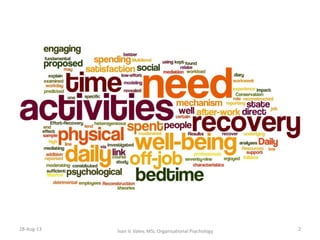
Well-Being: always en vogue
28-Aug-13 4Ivan V. Valev, MSc Organisational Psychology
Purpose of Research
• To examine the direct effect Daily Need for Recovery
has on time spent in specific off-job activities
• To investigate how Daily Need for Recovery moderates
the link between off-job activities and Daily Well-being
• To propose Psychological Need Satisfaction (PNS) as a
mediating mechanism explaining how engaging in
certain activities in off-job time affects Well-being
28-Aug-13 5Ivan V. Valev, MSc Organisational Psychology
Theoretical Background I
28-Aug-13 Ivan V. Valev, MSc Organisational Psychology 6
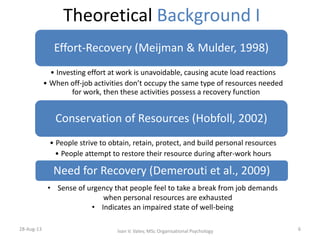
Effort-Recovery (Meijman & Mulder, 1998)
• Investing effort at work is unavoidable, causing acute load reactions
• When off-job activities don’t occupy the same type of resources needed
for work, then these activities possess a recovery function
Conservation of Resources (Hobfoll, 2002)
• People strive to obtain, retain, protect, and build personal resources
• People attempt to restore their resource during after-work hours
Need for Recovery (Demerouti et al., 2009)
• Sense of urgency that people feel to take a break from job demands
when personal resources are exhausted
• Indicates an impaired state of well-being
Theoretical Background II
28-Aug-13 7
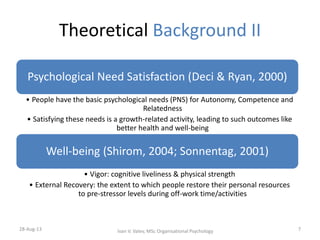
Psychological Need Satisfaction (Deci & Ryan, 2000)
• People have the basic psychological needs (PNS) for Autonomy, Competence and
Relatedness
• Satisfying these needs is a growth-related activity, leading to such outcomes like
better health and well-being
Well-being (Shirom, 2004; Sonnentag, 2001)
• Vigor: cognitive liveliness & physical strength
• External Recovery: the extent to which people restore their personal resources
to pre-stressor levels during off-work time/activities
Ivan V. Valev, MSc Organisational Psychology
Theoretical Model
28-Aug-13 8
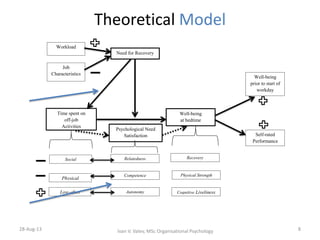
Physical Strength
Low-effort Autonomy
Workload
Job
Characteristics
Need for Recovery
Time spent on
off-job
Activities
Well-being
at bedtime
Social
Well-being
prior to start of
workday
Self-rated
Performance
Psychological Need
Satisfaction
Relatedness Recovery
Physical
Competence
Cognitive Liveliness
Ivan V. Valev, MSc Organisational Psychology
Method
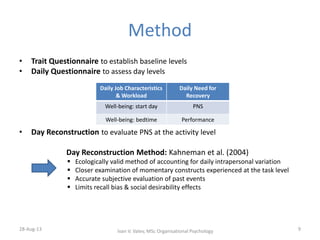
• Trait Questionnaire to establish baseline levels
• Daily Questionnaire to assess day levels
• Day Reconstruction to evaluate PNS at the activity level
Day Reconstruction Method: Kahneman et al. (2004)
 Ecologically valid method of accounting for daily intrapersonal variation
 Closer examination of momentary constructs experienced at the task level
 Accurate subjective evaluation of past events
 Limits recall bias & social desirability effects
28-Aug-13 9
Daily Job Characteristics
& Workload
Daily Need for
Recovery
Well-being: start day PNS
Well-being: bedtime Performance
Ivan V. Valev, MSc Organisational Psychology
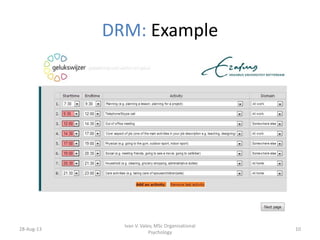
DRM: Example
28-Aug-13
Ivan V. Valev, MSc Organisational
Psychology
10
Sample
• 112 participants logged at least 1 day
87 multiple days 79 selected for analysis
– Mean age: 32.01 (SD = 11.19)
– Gender: 43 M, 62 W, 7 undisclosed
• 351 days reconstructed
• 2,556 logged activities overall
• Working hours, weekly average: 37.58 (SD = 13)
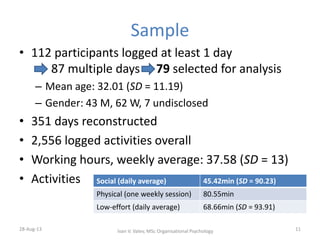
• Activities
28-Aug-13 11
Social (daily average) 45.42min (SD = 90.23)
Physical (one weekly session) 80.55min
Low-effort (daily average) 68.66min (SD = 93.91)
Ivan V. Valev, MSc Organisational Psychology
Empirical Findings I
28-Aug-13 12Ivan V. Valev, MSc Organisational Psychology
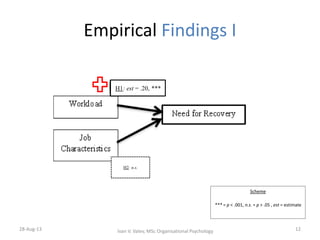
H1: est = .20, ***
a
Scheme
*** = p < .001, n.s. = p > .05 , est = estimate
H2: n.s.
Empirical Findings II
28-Aug-13
Ivan V. Valev, MSc Organisational
Psychology
13
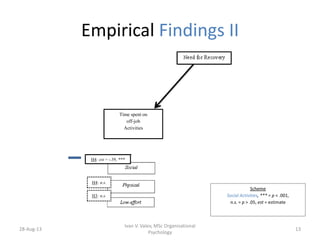
Scheme
Social Activities, *** = p < .001,
n.s. = p > .05, est = estimate
H4: est = -.39, ***
H3: n.s.
H4: n.s.
Time spent on
off-job
Activities
Empirical Findings III
28-Aug-13
Ivan V. Valev, MSc Organisational
Psychology
14
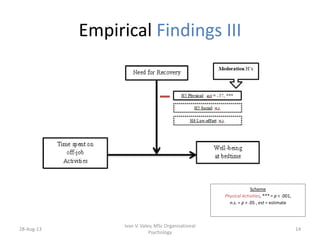
a a
Scheme
Physical Activities, *** = p < .001,
n.s. = p > .05 , est = estimate
Empirical Findings IV
28-Aug-13
Ivan V. Valev, MSc Organisational
Psychology
15
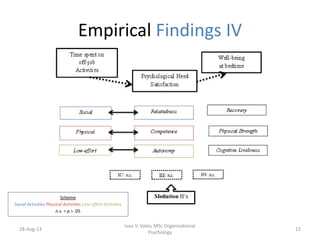
Scheme
Social Activities Physical Activities Low-effort Activities
n.s. = p > .05
Empirical Model
28-Aug-13 16
Workload
Job
Characteristics
Need for Recovery
Time spent on
off-job
Activities
Well-being
at bedtime
Social
Well-being
prior to start of
workday
Self-rated
Performance
Psychological Need
Satisfaction
Physical
Low-effort
Relatedness
Competence
Autonomy
Recovery
Physical Strength
Cognitive Liveliness
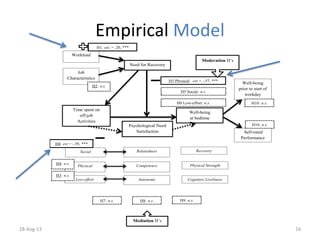
H1: est. = .20, ***
H4: est = -.39, ***
H6 Low-effort: n.s.
H5 Social: n.s.
H5 Physical: est = -.57, ***
H7: n.s. H8: n.s. H9: n.s.
Moderation H’s
H10: n.s.
H10: n.s.
H3: n.s.
H4: n.s.
H2: n.s.
Mediation H’s
Conclusions
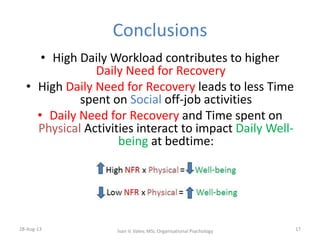
• High Daily Workload contributes to higher
Daily Need for Recovery
• High Daily Need for Recovery leads to less Time
spent on Social off-job activities
• Daily Need for Recovery and Time spent on
Physical Activities interact to impact Daily Well-
being at bedtime:
28-Aug-13 17Ivan V. Valev, MSc Organisational Psychology
Limitations & Future Research
• External recovery only: internal recovery to be
considered
• PNS: low Reliability (internal consistency issues)
• Dispositional characteristics not included: the
role of personality in the process?
• Participants’ Commitment
• Further Constructs:
– Relaxation Techniques (Behavioral)
– Detachment (Psychological)
– Sleep (Both?)
28-Aug-13 18Ivan V. Valev, MSc Organisational Psychology
Thank You for Your attention!
28-Aug-13
Ivan V. Valev, MSc Organisational
Psychology
19
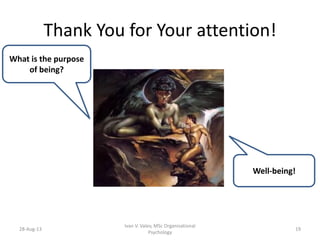
Well-being!
What is the purpose
of being?

Need for Recovery, Off-Job Activities and Well-being: A Day Reconstruction Study

  • 1.
    Need for Recovery,Off-Job Activities and Well-being: A Day Reconstruction Study Master Thesis Research Project Ivan V. Valev
  • 2.
    28-Aug-13 2Ivan V.Valev, MSc Organisational Psychology
  • 3.
    Agenda • Purpose ofResearch • Theoretical Background • Theoretical Model • Sample • Method • Empirical Findings • Empirical Model • Conclusions • Limitations & Future Research 28-Aug-13 3Ivan V. Valev, MSc Organisational Psychology
  • 4.
    Well-Being: always envogue 28-Aug-13 4Ivan V. Valev, MSc Organisational Psychology
  • 5.
    Purpose of Research •To examine the direct effect Daily Need for Recovery has on time spent in specific off-job activities • To investigate how Daily Need for Recovery moderates the link between off-job activities and Daily Well-being • To propose Psychological Need Satisfaction (PNS) as a mediating mechanism explaining how engaging in certain activities in off-job time affects Well-being 28-Aug-13 5Ivan V. Valev, MSc Organisational Psychology
  • 6.
    Theoretical Background I 28-Aug-13Ivan V. Valev, MSc Organisational Psychology 6 Effort-Recovery (Meijman & Mulder, 1998) • Investing effort at work is unavoidable, causing acute load reactions • When off-job activities don’t occupy the same type of resources needed for work, then these activities possess a recovery function Conservation of Resources (Hobfoll, 2002) • People strive to obtain, retain, protect, and build personal resources • People attempt to restore their resource during after-work hours Need for Recovery (Demerouti et al., 2009) • Sense of urgency that people feel to take a break from job demands when personal resources are exhausted • Indicates an impaired state of well-being
  • 7.
    Theoretical Background II 28-Aug-137 Psychological Need Satisfaction (Deci & Ryan, 2000) • People have the basic psychological needs (PNS) for Autonomy, Competence and Relatedness • Satisfying these needs is a growth-related activity, leading to such outcomes like better health and well-being Well-being (Shirom, 2004; Sonnentag, 2001) • Vigor: cognitive liveliness & physical strength • External Recovery: the extent to which people restore their personal resources to pre-stressor levels during off-work time/activities Ivan V. Valev, MSc Organisational Psychology
  • 8.
    Theoretical Model 28-Aug-13 8 PhysicalStrength Low-effort Autonomy Workload Job Characteristics Need for Recovery Time spent on off-job Activities Well-being at bedtime Social Well-being prior to start of workday Self-rated Performance Psychological Need Satisfaction Relatedness Recovery Physical Competence Cognitive Liveliness Ivan V. Valev, MSc Organisational Psychology
  • 9.
    Method • Trait Questionnaireto establish baseline levels • Daily Questionnaire to assess day levels • Day Reconstruction to evaluate PNS at the activity level Day Reconstruction Method: Kahneman et al. (2004)  Ecologically valid method of accounting for daily intrapersonal variation  Closer examination of momentary constructs experienced at the task level  Accurate subjective evaluation of past events  Limits recall bias & social desirability effects 28-Aug-13 9 Daily Job Characteristics & Workload Daily Need for Recovery Well-being: start day PNS Well-being: bedtime Performance Ivan V. Valev, MSc Organisational Psychology
  • 10.
    DRM: Example 28-Aug-13 Ivan V.Valev, MSc Organisational Psychology 10
  • 11.
    Sample • 112 participantslogged at least 1 day 87 multiple days 79 selected for analysis – Mean age: 32.01 (SD = 11.19) – Gender: 43 M, 62 W, 7 undisclosed • 351 days reconstructed • 2,556 logged activities overall • Working hours, weekly average: 37.58 (SD = 13) • Activities 28-Aug-13 11 Social (daily average) 45.42min (SD = 90.23) Physical (one weekly session) 80.55min Low-effort (daily average) 68.66min (SD = 93.91) Ivan V. Valev, MSc Organisational Psychology
  • 12.
    Empirical Findings I 28-Aug-1312Ivan V. Valev, MSc Organisational Psychology H1: est = .20, *** a Scheme *** = p < .001, n.s. = p > .05 , est = estimate H2: n.s.
  • 13.
    Empirical Findings II 28-Aug-13 IvanV. Valev, MSc Organisational Psychology 13 Scheme Social Activities, *** = p < .001, n.s. = p > .05, est = estimate H4: est = -.39, *** H3: n.s. H4: n.s. Time spent on off-job Activities
  • 14.
    Empirical Findings III 28-Aug-13 IvanV. Valev, MSc Organisational Psychology 14 a a Scheme Physical Activities, *** = p < .001, n.s. = p > .05 , est = estimate
  • 15.
    Empirical Findings IV 28-Aug-13 IvanV. Valev, MSc Organisational Psychology 15 Scheme Social Activities Physical Activities Low-effort Activities n.s. = p > .05
  • 16.
    Empirical Model 28-Aug-13 16 Workload Job Characteristics Needfor Recovery Time spent on off-job Activities Well-being at bedtime Social Well-being prior to start of workday Self-rated Performance Psychological Need Satisfaction Physical Low-effort Relatedness Competence Autonomy Recovery Physical Strength Cognitive Liveliness H1: est. = .20, *** H4: est = -.39, *** H6 Low-effort: n.s. H5 Social: n.s. H5 Physical: est = -.57, *** H7: n.s. H8: n.s. H9: n.s. Moderation H’s H10: n.s. H10: n.s. H3: n.s. H4: n.s. H2: n.s. Mediation H’s
  • 17.
    Conclusions • High DailyWorkload contributes to higher Daily Need for Recovery • High Daily Need for Recovery leads to less Time spent on Social off-job activities • Daily Need for Recovery and Time spent on Physical Activities interact to impact Daily Well- being at bedtime: 28-Aug-13 17Ivan V. Valev, MSc Organisational Psychology
  • 18.
    Limitations & FutureResearch • External recovery only: internal recovery to be considered • PNS: low Reliability (internal consistency issues) • Dispositional characteristics not included: the role of personality in the process? • Participants’ Commitment • Further Constructs: – Relaxation Techniques (Behavioral) – Detachment (Psychological) – Sleep (Both?) 28-Aug-13 18Ivan V. Valev, MSc Organisational Psychology
  • 19.
    Thank You forYour attention! 28-Aug-13 Ivan V. Valev, MSc Organisational Psychology 19 Well-being! What is the purpose of being?