
HSA Programmer’s Reference Manual: HSAIL
Virtual ISA and Programming Model,
Compiler Writer’s Guide, and Object Format
(BRIG)
  HSA Foundation Proprietary  
   
 
Publication #: 49828 ∙ Rev: Version 1.0 Provisional ∙ Issue Date: 5 June 2014
 
   
© 2014 HSA Foundation. All rights reserved.
The contents of this document are provided in connection with the HSA Foundation specifications. This
specification is protected by copyright laws and contains material proprietary to the HSA Foundation. It or any
components may not be reproduced, republished, distributed, transmitted, displayed, broadcast or otherwise
exploited in any manner without the express prior written permission of HSA Foundation. You may use this
specification for implementing the functionality therein, without altering or removing any trademark,
copyright or other notice from the specification, but the receipt or possession of this specification does not
convey any rights to reproduce, disclose, or distribute its contents, or to manufacture, use, or sell anything that
it may describe, in whole or in part.
HSA Foundation grants express permission to any current Founder, Promoter, Supporter Contributor,
Academic or Associate member of HSA Foundation to copy and redistribute UNMODIFIED versions of this
specification in any fashion, provided that NO CHARGE is made for the specification and the latest available
update of the specification for any version of the API is used whenever possible. Such distributed specification
may be re-formatted AS LONG AS the contents of the specification are not changed in any way. The specification
may be incorporated into a product that is sold as long as such product includes significant independent work
developed by the seller. A link to the current version of this specification on the HSA Foundation web-site should
be included whenever possible with specification distributions.
HSA Foundation makes no, and expressly disclaims any, representations or warranties, express or implied,
regarding this specification, including, without limitation, any implied warranties of merchantability or fitness
for a particular purpose or non-infringement of any intellectual property. HSA Foundation makes no, and
expressly disclaims any, warranties, express or implied, regarding the correctness, accuracy, completeness,
timeliness, and reliability of the specification. Under no circumstances will the HSA Foundation, or any of its
Founders, Promoters, Supporters, Academic, Contributors, and Associates members or their respective
partners, officers, directors, employees, agents or representatives be liable for any damages, whether direct,
indirect, special or consequential damages for lost revenues, lost profits, or otherwise, arising from or in
connection with these materials.
HSA Foundation Proprietary  
HSA Programmer’s Reference Manual: HSAIL Virtual ISA and Programming
Model, Compiler Writer’s Guide, and Object Format (BRIG)
PID: 49828 ∙ Rev: Version 1.0 Provisional ∙ 5 June 2014
ii  
Acknowledgements
The HSAIL specification is the result of the contributions of many people. Here is a
partial list of the contributors, including the company that they represented at the time
of their contribution:
• Paul Blinzer AMD
• Mark Fowler AMD
• Mike Houston AMD
• Lee Howes AMD
• Bill Licea-Kane AMD
• Leonid Lobachev AMD
• Mike Mantor AMD
• Vicki Meagher AMD
• Dmitry Preobrazhensky AMD
• Phil Rogers AMD
• Norm Rubin AMD
• Benjamin Sander AMD
• Elizabeth Sanville AMD
• Oleg Semenov AMD
• Brian Sumner AMD
• Yaki Tebeka AMD
• Vinod Tipparaju AMD
• Tony Tye AMD (Spec. Editor)
• Micah Villmow AMD
• Jem Davies ARM
• Ian Devereux ARM
  HSA Foundation Proprietary
PID: 49828 ∙ Rev: Version 1.0 Provisional ∙ 5 June 2014 HSA Programmer’s Reference Manual: HSAIL Virtual ISA and Programming
Model, Compiler Writer’s Guide, and Object Format (BRIG)
  Acknowledgements iii
• Robert Elliott ARM
• Alexander Galazin ARM
• Rune Holm ARM
• Kurt Shuler Arteris
• Andrew Richards Codeplay
• John Glossner General Processor Technologies
• Greg Stoner HSA Foundation
• Theo Drane Imagination Technologies
• Yoong-Chert Foo Imagination Technologies
• John Howson Imagination Technologies
• Georg Kolling Imagination Technologies
• James McCarthy Imagination Technologies
• Jason Meridith Imagination Technologies
• Mark Rankilor Imagination Technologies
• Richard Bagley MediaTek Inc.
• Roy Ju MediaTek Inc.
• Trent Lo MediaTek Inc.
• Chien-Ping Lu MediaTek Inc. (Workgroup Chair)
• Thomas Jablin MulticoreWare Inc.
• Chuang Na MulticoreWare Inc.
• Greg Bellows Qualcomm
• P.J. Bostley Qualcomm
• Alex Bourd Qualcomm
• Ken Dockser Qualcomm
• Jamie Esliger Qualcomm
• Ben Gaster Qualcomm
• Andrew Gruber Qualcomm
• Wilson Kwan Qualcomm
• Bob Rychlik Qualcomm
• Ignacio Llamas Samsung Electronics Co, Ltd
• Soojung Ryu Samsung Electronics Co, Ltd
• Matthew Locke Texas Instruments
• Chelsi Odegaard VTM Group
HSA Foundation Proprietary  
HSA Programmer’s Reference Manual: HSAIL Virtual ISA and Programming
Model, Compiler Writer’s Guide, and Object Format (BRIG)
PID: 49828 ∙ Rev: Version 1.0 Provisional ∙ 5 June 2014
iv Acknowledgements  
About the HSA Programmer's Reference
Manual
This document describes the Heterogeneous System Architecture Intermediate
Language (HSAIL), which is a virtual machine and an intermediate language.
This document serves as the specification for the HSAIL language for HSA
implementers. Note that there are a wide variety of methods for implementing these
requirements.
Audience
This document is written for developers involved in developing an HSA
implementation.
Document Conventions
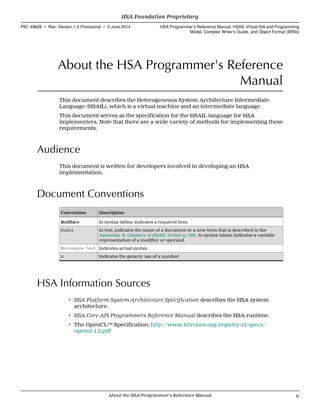
Convention Description
Boldface In syntax tables, indicates a required item.
Italics In text, indicates the name of a document or a new term that is described in the
Appendix B Glossary of HSAIL Terms (p. 395). In syntax tables, indicates a variable
representation of a modifier or operand.
Monospace text Indicates actual syntax.
n Indicates the generic use of a number.
HSA Information Sources
• HSA Platform System Architecture Specification describes the HSA system
architecture.
• HSA Core API Programmers Reference Manual describes the HSA runtime.
• The OpenCL™ Specification: http://www.khronos.org/registry/cl/specs/
opencl-1.2.pdf
  HSA Foundation Proprietary
PID: 49828 ∙ Rev: Version 1.0 Provisional ∙ 5 June 2014 HSA Programmer’s Reference Manual: HSAIL Virtual ISA and Programming
Model, Compiler Writer’s Guide, and Object Format (BRIG)
  About the HSA Programmer's Reference Manual v
HSA Foundation Proprietary  
HSA Programmer’s Reference Manual: HSAIL Virtual ISA and Programming
Model, Compiler Writer’s Guide, and Object Format (BRIG)
PID: 49828 ∙ Rev: Version 1.0 Provisional ∙ 5 June 2014
vi About the HSA Programmer's Reference Manual  
Contents
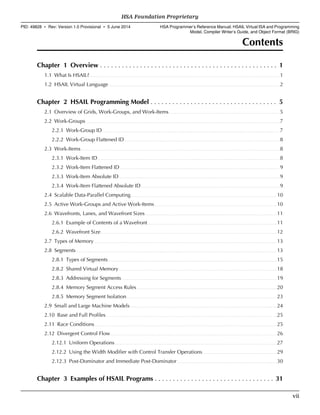
Chapter 1 Overview . . . . . . . . . . . . . . . . . . . . . . . . . . . . . . . . . . . . . . . . . . . . . . . . . 1
1.1 What Is HSAIL?. . . . . . . . . . . . . . . . . . . . . . . . . . . . . . . . . . . . . . . . . . . . . . . . . . . . . . . . . . . . . . . . . . . . . . . . . . . . . . . . . . . . . . . . . . . . . . . . . . . . . . . . . . . . . . . . . . . . . . . . . . . . . . . . . . . 1
1.2 HSAIL Virtual Language. . . . . . . . . . . . . . . . . . . . . . . . . . . . . . . . . . . . . . . . . . . . . . . . . . . . . . . . . . . . . . . . . . . . . . . . . . . . . . . . . . . . . . . . . . . . . . . . . . . . . . . . . . . . . . . . . . . . . . 2
Chapter 2 HSAIL Programming Model . . . . . . . . . . . . . . . . . . . . . . . . . . . . . . . . . . . 5
2.1 Overview of Grids, Work-Groups, and Work-Items. . . . . . . . . . . . . . . . . . . . . . . . . . . . . . . . . . . . . . . . . . . . . . . . . . . . . . . . . . . . . . . . . . . . . . . . . . . . 5
2.2 Work-Groups. . . . . . . . . . . . . . . . . . . . . . . . . . . . . . . . . . . . . . . . . . . . . . . . . . . . . . . . . . . . . . . . . . . . . . . . . . . . . . . . . . . . . . . . . . . . . . . . . . . . . . . . . . . . . . . . . . . . . . . . . . . . . . . . . . . . . .7
2.2.1 Work-Group ID. . . . . . . . . . . . . . . . . . . . . . . . . . . . . . . . . . . . . . . . . . . . . . . . . . . . . . . . . . . . . . . . . . . . . . . . . . . . . . . . . . . . . . . . . . . . . . . . . . . . . . . . . . . . . . . . . . . . . . . . . . 7
2.2.2 Work-Group Flattened ID. . . . . . . . . . . . . . . . . . . . . . . . . . . . . . . . . . . . . . . . . . . . . . . . . . . . . . . . . . . . . . . . . . . . . . . . . . . . . . . . . . . . . . . . . . . . . . . . . . . . . . . . . . . 8
2.3 Work-Items. . . . . . . . . . . . . . . . . . . . . . . . . . . . . . . . . . . . . . . . . . . . . . . . . . . . . . . . . . . . . . . . . . . . . . . . . . . . . . . . . . . . . . . . . . . . . . . . . . . . . . . . . . . . . . . . . . . . . . . . . . . . . . . . . . . . . . . . . 8
2.3.1 Work-Item ID. . . . . . . . . . . . . . . . . . . . . . . . . . . . . . . . . . . . . . . . . . . . . . . . . . . . . . . . . . . . . . . . . . . . . . . . . . . . . . . . . . . . . . . . . . . . . . . . . . . . . . . . . . . . . . . . . . . . . . . . . . . . . 8
2.3.2 Work-Item Flattened ID. . . . . . . . . . . . . . . . . . . . . . . . . . . . . . . . . . . . . . . . . . . . . . . . . . . . . . . . . . . . . . . . . . . . . . . . . . . . . . . . . . . . . . . . . . . . . . . . . . . . . . . . . . . . . . 9
2.3.3 Work-Item Absolute ID. . . . . . . . . . . . . . . . . . . . . . . . . . . . . . . . . . . . . . . . . . . . . . . . . . . . . . . . . . . . . . . . . . . . . . . . . . . . . . . . . . . . . . . . . . . . . . . . . . . . . . . . . . . . . . . 9
2.3.4 Work-Item Flattened Absolute ID. . . . . . . . . . . . . . . . . . . . . . . . . . . . . . . . . . . . . . . . . . . . . . . . . . . . . . . . . . . . . . . . . . . . . . . . . . . . . . . . . . . . . . . . . . . . . . . .9
2.4 Scalable Data-Parallel Computing. . . . . . . . . . . . . . . . . . . . . . . . . . . . . . . . . . . . . . . . . . . . . . . . . . . . . . . . . . . . . . . . . . . . . . . . . . . . . . . . . . . . . . . . . . . . . . . . . . . . 10
2.5 Active Work-Groups and Active Work-Items. . . . . . . . . . . . . . . . . . . . . . . . . . . . . . . . . . . . . . . . . . . . . . . . . . . . . . . . . . . . . . . . . . . . . . . . . . . . . . . . . . . . 10
2.6 Wavefronts, Lanes, and Wavefront Sizes. . . . . . . . . . . . . . . . . . . . . . . . . . . . . . . . . . . . . . . . . . . . . . . . . . . . . . . . . . . . . . . . . . . . . . . . . . . . . . . . . . . . . . . . . . .11
2.6.1 Example of Contents of a Wavefront. . . . . . . . . . . . . . . . . . . . . . . . . . . . . . . . . . . . . . . . . . . . . . . . . . . . . . . . . . . . . . . . . . . . . . . . . . . . . . . . . . . . . . . . . 11
2.6.2 Wavefront Size. . . . . . . . . . . . . . . . . . . . . . . . . . . . . . . . . . . . . . . . . . . . . . . . . . . . . . . . . . . . . . . . . . . . . . . . . . . . . . . . . . . . . . . . . . . . . . . . . . . . . . . . . . . . . . . . . . . . . . . . . 12
2.7 Types of Memory. . . . . . . . . . . . . . . . . . . . . . . . . . . . . . . . . . . . . . . . . . . . . . . . . . . . . . . . . . . . . . . . . . . . . . . . . . . . . . . . . . . . . . . . . . . . . . . . . . . . . . . . . . . . . . . . . . . . . . . . . . . . . . 13
2.8 Segments. . . . . . . . . . . . . . . . . . . . . . . . . . . . . . . . . . . . . . . . . . . . . . . . . . . . . . . . . . . . . . . . . . . . . . . . . . . . . . . . . . . . . . . . . . . . . . . . . . . . . . . . . . . . . . . . . . . . . . . . . . . . . . . . . . . . . . . . . . 13
2.8.1 Types of Segments. . . . . . . . . . . . . . . . . . . . . . . . . . . . . . . . . . . . . . . . . . . . . . . . . . . . . . . . . . . . . . . . . . . . . . . . . . . . . . . . . . . . . . . . . . . . . . . . . . . . . . . . . . . . . . . . . . . . 15
2.8.2 Shared Virtual Memory. . . . . . . . . . . . . . . . . . . . . . . . . . . . . . . . . . . . . . . . . . . . . . . . . . . . . . . . . . . . . . . . . . . . . . . . . . . . . . . . . . . . . . . . . . . . . . . . . . . . . . . . . . . . . 18
2.8.3 Addressing for Segments. . . . . . . . . . . . . . . . . . . . . . . . . . . . . . . . . . . . . . . . . . . . . . . . . . . . . . . . . . . . . . . . . . . . . . . . . . . . . . . . . . . . . . . . . . . . . . . . . . . . . . . . . . . 19
2.8.4 Memory Segment Access Rules. . . . . . . . . . . . . . . . . . . . . . . . . . . . . . . . . . . . . . . . . . . . . . . . . . . . . . . . . . . . . . . . . . . . . . . . . . . . . . . . . . . . . . . . . . . . . . . . .20
2.8.5 Memory Segment Isolation. . . . . . . . . . . . . . . . . . . . . . . . . . . . . . . . . . . . . . . . . . . . . . . . . . . . . . . . . . . . . . . . . . . . . . . . . . . . . . . . . . . . . . . . . . . . . . . . . . . . . . . 23
2.9 Small and Large Machine Models. . . . . . . . . . . . . . . . . . . . . . . . . . . . . . . . . . . . . . . . . . . . . . . . . . . . . . . . . . . . . . . . . . . . . . . . . . . . . . . . . . . . . . . . . . . . . . . . . . . . . 24
2.10 Base and Full Profiles. . . . . . . . . . . . . . . . . . . . . . . . . . . . . . . . . . . . . . . . . . . . . . . . . . . . . . . . . . . . . . . . . . . . . . . . . . . . . . . . . . . . . . . . . . . . . . . . . . . . . . . . . . . . . . . . . . . . . .25
2.11 Race Conditions. . . . . . . . . . . . . . . . . . . . . . . . . . . . . . . . . . . . . . . . . . . . . . . . . . . . . . . . . . . . . . . . . . . . . . . . . . . . . . . . . . . . . . . . . . . . . . . . . . . . . . . . . . . . . . . . . . . . . . . . . . . . . 25
2.12 Divergent Control Flow. . . . . . . . . . . . . . . . . . . . . . . . . . . . . . . . . . . . . . . . . . . . . . . . . . . . . . . . . . . . . . . . . . . . . . . . . . . . . . . . . . . . . . . . . . . . . . . . . . . . . . . . . . . . . . . . . . 26
2.12.1 Uniform Operations. . . . . . . . . . . . . . . . . . . . . . . . . . . . . . . . . . . . . . . . . . . . . . . . . . . . . . . . . . . . . . . . . . . . . . . . . . . . . . . . . . . . . . . . . . . . . . . . . . . . . . . . . . . . . . . .27
2.12.2 Using the Width Modifier with Control Transfer Operations. . . . . . . . . . . . . . . . . . . . . . . . . . . . . . . . . . . . . . . . . . . . . . . . . . . 29
2.12.3 Post-Dominator and Immediate Post-Dominator. . . . . . . . . . . . . . . . . . . . . . . . . . . . . . . . . . . . . . . . . . . . . . . . . . . . . . . . . . . . . . . . . . . . . 30
Chapter 3 Examples of HSAIL Programs . . . . . . . . . . . . . . . . . . . . . . . . . . . . . . . . . 31
  HSA Foundation Proprietary
PID: 49828 ∙ Rev: Version 1.0 Provisional ∙ 5 June 2014 HSA Programmer’s Reference Manual: HSAIL Virtual ISA and Programming
Model, Compiler Writer’s Guide, and Object Format (BRIG)
  vii
3.1 Vector Add Translated to HSAIL. . . . . . . . . . . . . . . . . . . . . . . . . . . . . . . . . . . . . . . . . . . . . . . . . . . . . . . . . . . . . . . . . . . . . . . . . . . . . . . . . . . . . . . . . . . . . . . . . . . . . . . 31
3.2 Transpose Translated to HSAIL. . . . . . . . . . . . . . . . . . . . . . . . . . . . . . . . . . . . . . . . . . . . . . . . . . . . . . . . . . . . . . . . . . . . . . . . . . . . . . . . . . . . . . . . . . . . . . . . . . . . . . . . . 32
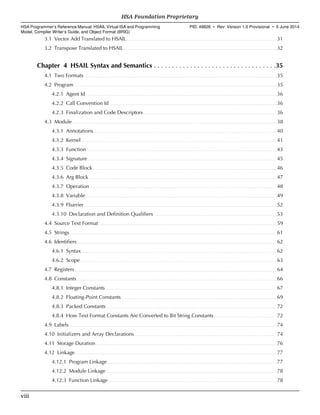
Chapter 4 HSAIL Syntax and Semantics . . . . . . . . . . . . . . . . . . . . . . . . . . . . . . . . . .35
4.1 Two Formats. . . . . . . . . . . . . . . . . . . . . . . . . . . . . . . . . . . . . . . . . . . . . . . . . . . . . . . . . . . . . . . . . . . . . . . . . . . . . . . . . . . . . . . . . . . . . . . . . . . . . . . . . . . . . . . . . . . . . . . . . . . . . . . . . . . . . 35
4.2 Program. . . . . . . . . . . . . . . . . . . . . . . . . . . . . . . . . . . . . . . . . . . . . . . . . . . . . . . . . . . . . . . . . . . . . . . . . . . . . . . . . . . . . . . . . . . . . . . . . . . . . . . . . . . . . . . . . . . . . . . . . . . . . . . . . . . . . . . . . . . . 35
4.2.1 Agent Id. . . . . . . . . . . . . . . . . . . . . . . . . . . . . . . . . . . . . . . . . . . . . . . . . . . . . . . . . . . . . . . . . . . . . . . . . . . . . . . . . . . . . . . . . . . . . . . . . . . . . . . . . . . . . . . . . . . . . . . . . . . . . . . . . . . . 36
4.2.2 Call Convention Id. . . . . . . . . . . . . . . . . . . . . . . . . . . . . . . . . . . . . . . . . . . . . . . . . . . . . . . . . . . . . . . . . . . . . . . . . . . . . . . . . . . . . . . . . . . . . . . . . . . . . . . . . . . . . . . . . . . .36
4.2.3 Finalization and Code Descriptors. . . . . . . . . . . . . . . . . . . . . . . . . . . . . . . . . . . . . . . . . . . . . . . . . . . . . . . . . . . . . . . . . . . . . . . . . . . . . . . . . . . . . . . . . . . . 36
4.3 Module. . . . . . . . . . . . . . . . . . . . . . . . . . . . . . . . . . . . . . . . . . . . . . . . . . . . . . . . . . . . . . . . . . . . . . . . . . . . . . . . . . . . . . . . . . . . . . . . . . . . . . . . . . . . . . . . . . . . . . . . . . . . . . . . . . . . . . . . . . . . . 38
4.3.1 Annotations. . . . . . . . . . . . . . . . . . . . . . . . . . . . . . . . . . . . . . . . . . . . . . . . . . . . . . . . . . . . . . . . . . . . . . . . . . . . . . . . . . . . . . . . . . . . . . . . . . . . . . . . . . . . . . . . . . . . . . . . . . . . . . 40
4.3.2 Kernel. . . . . . . . . . . . . . . . . . . . . . . . . . . . . . . . . . . . . . . . . . . . . . . . . . . . . . . . . . . . . . . . . . . . . . . . . . . . . . . . . . . . . . . . . . . . . . . . . . . . . . . . . . . . . . . . . . . . . . . . . . . . . . . . . . . . . . . 41
4.3.3 Function. . . . . . . . . . . . . . . . . . . . . . . . . . . . . . . . . . . . . . . . . . . . . . . . . . . . . . . . . . . . . . . . . . . . . . . . . . . . . . . . . . . . . . . . . . . . . . . . . . . . . . . . . . . . . . . . . . . . . . . . . . . . . . . . . . . 43
4.3.4 Signature. . . . . . . . . . . . . . . . . . . . . . . . . . . . . . . . . . . . . . . . . . . . . . . . . . . . . . . . . . . . . . . . . . . . . . . . . . . . . . . . . . . . . . . . . . . . . . . . . . . . . . . . . . . . . . . . . . . . . . . . . . . . . . . . . . 45
4.3.5 Code Block. . . . . . . . . . . . . . . . . . . . . . . . . . . . . . . . . . . . . . . . . . . . . . . . . . . . . . . . . . . . . . . . . . . . . . . . . . . . . . . . . . . . . . . . . . . . . . . . . . . . . . . . . . . . . . . . . . . . . . . . . . . . . . . 46
4.3.6 Arg Block. . . . . . . . . . . . . . . . . . . . . . . . . . . . . . . . . . . . . . . . . . . . . . . . . . . . . . . . . . . . . . . . . . . . . . . . . . . . . . . . . . . . . . . . . . . . . . . . . . . . . . . . . . . . . . . . . . . . . . . . . . . . . . . . . .47
4.3.7 Operation. . . . . . . . . . . . . . . . . . . . . . . . . . . . . . . . . . . . . . . . . . . . . . . . . . . . . . . . . . . . . . . . . . . . . . . . . . . . . . . . . . . . . . . . . . . . . . . . . . . . . . . . . . . . . . . . . . . . . . . . . . . . . . . . . 48
4.3.8 Variable. . . . . . . . . . . . . . . . . . . . . . . . . . . . . . . . . . . . . . . . . . . . . . . . . . . . . . . . . . . . . . . . . . . . . . . . . . . . . . . . . . . . . . . . . . . . . . . . . . . . . . . . . . . . . . . . . . . . . . . . . . . . . . . . . . . . 49
4.3.9 Fbarrier. . . . . . . . . . . . . . . . . . . . . . . . . . . . . . . . . . . . . . . . . . . . . . . . . . . . . . . . . . . . . . . . . . . . . . . . . . . . . . . . . . . . . . . . . . . . . . . . . . . . . . . . . . . . . . . . . . . . . . . . . . . . . . . . . . . . . 52
4.3.10 Declaration and Definition Qualifiers. . . . . . . . . . . . . . . . . . . . . . . . . . . . . . . . . . . . . . . . . . . . . . . . . . . . . . . . . . . . . . . . . . . . . . . . . . . . . . . . . . . . . 53
4.4 Source Text Format. . . . . . . . . . . . . . . . . . . . . . . . . . . . . . . . . . . . . . . . . . . . . . . . . . . . . . . . . . . . . . . . . . . . . . . . . . . . . . . . . . . . . . . . . . . . . . . . . . . . . . . . . . . . . . . . . . . . . . . . . . . 59
4.5 Strings. . . . . . . . . . . . . . . . . . . . . . . . . . . . . . . . . . . . . . . . . . . . . . . . . . . . . . . . . . . . . . . . . . . . . . . . . . . . . . . . . . . . . . . . . . . . . . . . . . . . . . . . . . . . . . . . . . . . . . . . . . . . . . . . . . . . . . . . . . . . . . .61
4.6 Identifiers. . . . . . . . . . . . . . . . . . . . . . . . . . . . . . . . . . . . . . . . . . . . . . . . . . . . . . . . . . . . . . . . . . . . . . . . . . . . . . . . . . . . . . . . . . . . . . . . . . . . . . . . . . . . . . . . . . . . . . . . . . . . . . . . . . . . . . . . . .62
4.6.1 Syntax. . . . . . . . . . . . . . . . . . . . . . . . . . . . . . . . . . . . . . . . . . . . . . . . . . . . . . . . . . . . . . . . . . . . . . . . . . . . . . . . . . . . . . . . . . . . . . . . . . . . . . . . . . . . . . . . . . . . . . . . . . . . . . . . . . . . . . .62
4.6.2 Scope. . . . . . . . . . . . . . . . . . . . . . . . . . . . . . . . . . . . . . . . . . . . . . . . . . . . . . . . . . . . . . . . . . . . . . . . . . . . . . . . . . . . . . . . . . . . . . . . . . . . . . . . . . . . . . . . . . . . . . . . . . . . . . . . . . . . . . . 63
4.7 Registers. . . . . . . . . . . . . . . . . . . . . . . . . . . . . . . . . . . . . . . . . . . . . . . . . . . . . . . . . . . . . . . . . . . . . . . . . . . . . . . . . . . . . . . . . . . . . . . . . . . . . . . . . . . . . . . . . . . . . . . . . . . . . . . . . . . . . . . . . . . 64
4.8 Constants. . . . . . . . . . . . . . . . . . . . . . . . . . . . . . . . . . . . . . . . . . . . . . . . . . . . . . . . . . . . . . . . . . . . . . . . . . . . . . . . . . . . . . . . . . . . . . . . . . . . . . . . . . . . . . . . . . . . . . . . . . . . . . . . . . . . . . . . . . 66
4.8.1 Integer Constants. . . . . . . . . . . . . . . . . . . . . . . . . . . . . . . . . . . . . . . . . . . . . . . . . . . . . . . . . . . . . . . . . . . . . . . . . . . . . . . . . . . . . . . . . . . . . . . . . . . . . . . . . . . . . . . . . . . . . . 67
4.8.2 Floating-Point Constants. . . . . . . . . . . . . . . . . . . . . . . . . . . . . . . . . . . . . . . . . . . . . . . . . . . . . . . . . . . . . . . . . . . . . . . . . . . . . . . . . . . . . . . . . . . . . . . . . . . . . . . . . . . 69
4.8.3 Packed Constants. . . . . . . . . . . . . . . . . . . . . . . . . . . . . . . . . . . . . . . . . . . . . . . . . . . . . . . . . . . . . . . . . . . . . . . . . . . . . . . . . . . . . . . . . . . . . . . . . . . . . . . . . . . . . . . . . . . . . .72
4.8.4 How Text Format Constants Are Converted to Bit String Constants. . . . . . . . . . . . . . . . . . . . . . . . . . . . . . . . . . . . . . . . . . . 72
4.9 Labels. . . . . . . . . . . . . . . . . . . . . . . . . . . . . . . . . . . . . . . . . . . . . . . . . . . . . . . . . . . . . . . . . . . . . . . . . . . . . . . . . . . . . . . . . . . . . . . . . . . . . . . . . . . . . . . . . . . . . . . . . . . . . . . . . . . . . . . . . . . . . . . 74
4.10 Initializers and Array Declarations. . . . . . . . . . . . . . . . . . . . . . . . . . . . . . . . . . . . . . . . . . . . . . . . . . . . . . . . . . . . . . . . . . . . . . . . . . . . . . . . . . . . . . . . . . . . . . . . . . 74
4.11 Storage Duration. . . . . . . . . . . . . . . . . . . . . . . . . . . . . . . . . . . . . . . . . . . . . . . . . . . . . . . . . . . . . . . . . . . . . . . . . . . . . . . . . . . . . . . . . . . . . . . . . . . . . . . . . . . . . . . . . . . . . . . . . . . . .76
4.12 Linkage. . . . . . . . . . . . . . . . . . . . . . . . . . . . . . . . . . . . . . . . . . . . . . . . . . . . . . . . . . . . . . . . . . . . . . . . . . . . . . . . . . . . . . . . . . . . . . . . . . . . . . . . . . . . . . . . . . . . . . . . . . . . . . . . . . . . . . . . . . . 77
4.12.1 Program Linkage. . . . . . . . . . . . . . . . . . . . . . . . . . . . . . . . . . . . . . . . . . . . . . . . . . . . . . . . . . . . . . . . . . . . . . . . . . . . . . . . . . . . . . . . . . . . . . . . . . . . . . . . . . . . . . . . . . . . . 77
4.12.2 Module Linkage. . . . . . . . . . . . . . . . . . . . . . . . . . . . . . . . . . . . . . . . . . . . . . . . . . . . . . . . . . . . . . . . . . . . . . . . . . . . . . . . . . . . . . . . . . . . . . . . . . . . . . . . . . . . . . . . . . . . . . 78
4.12.3 Function Linkage. . . . . . . . . . . . . . . . . . . . . . . . . . . . . . . . . . . . . . . . . . . . . . . . . . . . . . . . . . . . . . . . . . . . . . . . . . . . . . . . . . . . . . . . . . . . . . . . . . . . . . . . . . . . . . . . . . . . 78
HSA Foundation Proprietary  
HSA Programmer’s Reference Manual: HSAIL Virtual ISA and Programming
Model, Compiler Writer’s Guide, and Object Format (BRIG)
PID: 49828 ∙ Rev: Version 1.0 Provisional ∙ 5 June 2014
viii  
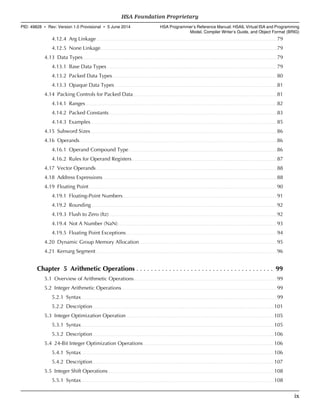
4.12.4 Arg Linkage. . . . . . . . . . . . . . . . . . . . . . . . . . . . . . . . . . . . . . . . . . . . . . . . . . . . . . . . . . . . . . . . . . . . . . . . . . . . . . . . . . . . . . . . . . . . . . . . . . . . . . . . . . . . . . . . . . . . . . . . . . . . 79
4.12.5 None Linkage. . . . . . . . . . . . . . . . . . . . . . . . . . . . . . . . . . . . . . . . . . . . . . . . . . . . . . . . . . . . . . . . . . . . . . . . . . . . . . . . . . . . . . . . . . . . . . . . . . . . . . . . . . . . . . . . . . . . . . . . . 79
4.13 Data Types. . . . . . . . . . . . . . . . . . . . . . . . . . . . . . . . . . . . . . . . . . . . . . . . . . . . . . . . . . . . . . . . . . . . . . . . . . . . . . . . . . . . . . . . . . . . . . . . . . . . . . . . . . . . . . . . . . . . . . . . . . . . . . . . . . . . . 79
4.13.1 Base Data Types. . . . . . . . . . . . . . . . . . . . . . . . . . . . . . . . . . . . . . . . . . . . . . . . . . . . . . . . . . . . . . . . . . . . . . . . . . . . . . . . . . . . . . . . . . . . . . . . . . . . . . . . . . . . . . . . . . . . . 79
4.13.2 Packed Data Types. . . . . . . . . . . . . . . . . . . . . . . . . . . . . . . . . . . . . . . . . . . . . . . . . . . . . . . . . . . . . . . . . . . . . . . . . . . . . . . . . . . . . . . . . . . . . . . . . . . . . . . . . . . . . . . . . 80
4.13.3 Opaque Data Types. . . . . . . . . . . . . . . . . . . . . . . . . . . . . . . . . . . . . . . . . . . . . . . . . . . . . . . . . . . . . . . . . . . . . . . . . . . . . . . . . . . . . . . . . . . . . . . . . . . . . . . . . . . . . . . . 81
4.14 Packing Controls for Packed Data. . . . . . . . . . . . . . . . . . . . . . . . . . . . . . . . . . . . . . . . . . . . . . . . . . . . . . . . . . . . . . . . . . . . . . . . . . . . . . . . . . . . . . . . . . . . . . . . . . . 81
4.14.1 Ranges. . . . . . . . . . . . . . . . . . . . . . . . . . . . . . . . . . . . . . . . . . . . . . . . . . . . . . . . . . . . . . . . . . . . . . . . . . . . . . . . . . . . . . . . . . . . . . . . . . . . . . . . . . . . . . . . . . . . . . . . . . . . . . . . . . . . 82
4.14.2 Packed Constants. . . . . . . . . . . . . . . . . . . . . . . . . . . . . . . . . . . . . . . . . . . . . . . . . . . . . . . . . . . . . . . . . . . . . . . . . . . . . . . . . . . . . . . . . . . . . . . . . . . . . . . . . . . . . . . . . . . .83
4.14.3 Examples. . . . . . . . . . . . . . . . . . . . . . . . . . . . . . . . . . . . . . . . . . . . . . . . . . . . . . . . . . . . . . . . . . . . . . . . . . . . . . . . . . . . . . . . . . . . . . . . . . . . . . . . . . . . . . . . . . . . . . . . . . . . . . . . 85
4.15 Subword Sizes. . . . . . . . . . . . . . . . . . . . . . . . . . . . . . . . . . . . . . . . . . . . . . . . . . . . . . . . . . . . . . . . . . . . . . . . . . . . . . . . . . . . . . . . . . . . . . . . . . . . . . . . . . . . . . . . . . . . . . . . . . . . . . . . 86
4.16 Operands. . . . . . . . . . . . . . . . . . . . . . . . . . . . . . . . . . . . . . . . . . . . . . . . . . . . . . . . . . . . . . . . . . . . . . . . . . . . . . . . . . . . . . . . . . . . . . . . . . . . . . . . . . . . . . . . . . . . . . . . . . . . . . . . . . . . . . . .86
4.16.1 Operand Compound Type. . . . . . . . . . . . . . . . . . . . . . . . . . . . . . . . . . . . . . . . . . . . . . . . . . . . . . . . . . . . . . . . . . . . . . . . . . . . . . . . . . . . . . . . . . . . . . . . . . . . . . 86
4.16.2 Rules for Operand Registers. . . . . . . . . . . . . . . . . . . . . . . . . . . . . . . . . . . . . . . . . . . . . . . . . . . . . . . . . . . . . . . . . . . . . . . . . . . . . . . . . . . . . . . . . . . . . . . . . . . . 87
4.17 Vector Operands. . . . . . . . . . . . . . . . . . . . . . . . . . . . . . . . . . . . . . . . . . . . . . . . . . . . . . . . . . . . . . . . . . . . . . . . . . . . . . . . . . . . . . . . . . . . . . . . . . . . . . . . . . . . . . . . . . . . . . . . . . . . 88
4.18 Address Expressions. . . . . . . . . . . . . . . . . . . . . . . . . . . . . . . . . . . . . . . . . . . . . . . . . . . . . . . . . . . . . . . . . . . . . . . . . . . . . . . . . . . . . . . . . . . . . . . . . . . . . . . . . . . . . . . . . . . . . . . . 88
4.19 Floating Point. . . . . . . . . . . . . . . . . . . . . . . . . . . . . . . . . . . . . . . . . . . . . . . . . . . . . . . . . . . . . . . . . . . . . . . . . . . . . . . . . . . . . . . . . . . . . . . . . . . . . . . . . . . . . . . . . . . . . . . . . . . . . . . . . 90
4.19.1 Floating-Point Numbers. . . . . . . . . . . . . . . . . . . . . . . . . . . . . . . . . . . . . . . . . . . . . . . . . . . . . . . . . . . . . . . . . . . . . . . . . . . . . . . . . . . . . . . . . . . . . . . . . . . . . . . . . . 91
4.19.2 Rounding. . . . . . . . . . . . . . . . . . . . . . . . . . . . . . . . . . . . . . . . . . . . . . . . . . . . . . . . . . . . . . . . . . . . . . . . . . . . . . . . . . . . . . . . . . . . . . . . . . . . . . . . . . . . . . . . . . . . . . . . . . . . . . . . 92
4.19.3 Flush to Zero (ftz). . . . . . . . . . . . . . . . . . . . . . . . . . . . . . . . . . . . . . . . . . . . . . . . . . . . . . . . . . . . . . . . . . . . . . . . . . . . . . . . . . . . . . . . . . . . . . . . . . . . . . . . . . . . . . . . . . . .92
4.19.4 Not A Number (NaN). . . . . . . . . . . . . . . . . . . . . . . . . . . . . . . . . . . . . . . . . . . . . . . . . . . . . . . . . . . . . . . . . . . . . . . . . . . . . . . . . . . . . . . . . . . . . . . . . . . . . . . . . . . . . 93
4.19.5 Floating Point Exceptions. . . . . . . . . . . . . . . . . . . . . . . . . . . . . . . . . . . . . . . . . . . . . . . . . . . . . . . . . . . . . . . . . . . . . . . . . . . . . . . . . . . . . . . . . . . . . . . . . . . . . . . . 94
4.20 Dynamic Group Memory Allocation. . . . . . . . . . . . . . . . . . . . . . . . . . . . . . . . . . . . . . . . . . . . . . . . . . . . . . . . . . . . . . . . . . . . . . . . . . . . . . . . . . . . . . . . . . . . . . .95
4.21 Kernarg Segment. . . . . . . . . . . . . . . . . . . . . . . . . . . . . . . . . . . . . . . . . . . . . . . . . . . . . . . . . . . . . . . . . . . . . . . . . . . . . . . . . . . . . . . . . . . . . . . . . . . . . . . . . . . . . . . . . . . . . . . . . . . . .96
Chapter 5 Arithmetic Operations . . . . . . . . . . . . . . . . . . . . . . . . . . . . . . . . . . . . . . 99
5.1 Overview of Arithmetic Operations. . . . . . . . . . . . . . . . . . . . . . . . . . . . . . . . . . . . . . . . . . . . . . . . . . . . . . . . . . . . . . . . . . . . . . . . . . . . . . . . . . . . . . . . . . . . . . . . . . 99
5.2 Integer Arithmetic Operations. . . . . . . . . . . . . . . . . . . . . . . . . . . . . . . . . . . . . . . . . . . . . . . . . . . . . . . . . . . . . . . . . . . . . . . . . . . . . . . . . . . . . . . . . . . . . . . . . . . . . . . . . . . 99
5.2.1 Syntax. . . . . . . . . . . . . . . . . . . . . . . . . . . . . . . . . . . . . . . . . . . . . . . . . . . . . . . . . . . . . . . . . . . . . . . . . . . . . . . . . . . . . . . . . . . . . . . . . . . . . . . . . . . . . . . . . . . . . . . . . . . . . . . . . . . . . . .99
5.2.2 Description. . . . . . . . . . . . . . . . . . . . . . . . . . . . . . . . . . . . . . . . . . . . . . . . . . . . . . . . . . . . . . . . . . . . . . . . . . . . . . . . . . . . . . . . . . . . . . . . . . . . . . . . . . . . . . . . . . . . . . . . . . . . . 101
5.3 Integer Optimization Operation. . . . . . . . . . . . . . . . . . . . . . . . . . . . . . . . . . . . . . . . . . . . . . . . . . . . . . . . . . . . . . . . . . . . . . . . . . . . . . . . . . . . . . . . . . . . . . . . . . . . . . 105
5.3.1 Syntax. . . . . . . . . . . . . . . . . . . . . . . . . . . . . . . . . . . . . . . . . . . . . . . . . . . . . . . . . . . . . . . . . . . . . . . . . . . . . . . . . . . . . . . . . . . . . . . . . . . . . . . . . . . . . . . . . . . . . . . . . . . . . . . . . . . . .105
5.3.2 Description. . . . . . . . . . . . . . . . . . . . . . . . . . . . . . . . . . . . . . . . . . . . . . . . . . . . . . . . . . . . . . . . . . . . . . . . . . . . . . . . . . . . . . . . . . . . . . . . . . . . . . . . . . . . . . . . . . . . . . . . . . . . . 106
5.4 24-Bit Integer Optimization Operations. . . . . . . . . . . . . . . . . . . . . . . . . . . . . . . . . . . . . . . . . . . . . . . . . . . . . . . . . . . . . . . . . . . . . . . . . . . . . . . . . . . . . . . . . . 106
5.4.1 Syntax. . . . . . . . . . . . . . . . . . . . . . . . . . . . . . . . . . . . . . . . . . . . . . . . . . . . . . . . . . . . . . . . . . . . . . . . . . . . . . . . . . . . . . . . . . . . . . . . . . . . . . . . . . . . . . . . . . . . . . . . . . . . . . . . . . . . .106
5.4.2 Description. . . . . . . . . . . . . . . . . . . . . . . . . . . . . . . . . . . . . . . . . . . . . . . . . . . . . . . . . . . . . . . . . . . . . . . . . . . . . . . . . . . . . . . . . . . . . . . . . . . . . . . . . . . . . . . . . . . . . . . . . . . . . 107
5.5 Integer Shift Operations. . . . . . . . . . . . . . . . . . . . . . . . . . . . . . . . . . . . . . . . . . . . . . . . . . . . . . . . . . . . . . . . . . . . . . . . . . . . . . . . . . . . . . . . . . . . . . . . . . . . . . . . . . . . . . . . . . 108
5.5.1 Syntax. . . . . . . . . . . . . . . . . . . . . . . . . . . . . . . . . . . . . . . . . . . . . . . . . . . . . . . . . . . . . . . . . . . . . . . . . . . . . . . . . . . . . . . . . . . . . . . . . . . . . . . . . . . . . . . . . . . . . . . . . . . . . . . . . . . . .108
  HSA Foundation Proprietary
PID: 49828 ∙ Rev: Version 1.0 Provisional ∙ 5 June 2014 HSA Programmer’s Reference Manual: HSAIL Virtual ISA and Programming
Model, Compiler Writer’s Guide, and Object Format (BRIG)
  ix
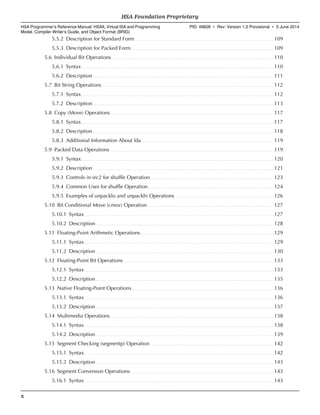
5.5.2 Description for Standard Form. . . . . . . . . . . . . . . . . . . . . . . . . . . . . . . . . . . . . . . . . . . . . . . . . . . . . . . . . . . . . . . . . . . . . . . . . . . . . . . . . . . . . . . . . . . . . . . . 109
5.5.3 Description for Packed Form. . . . . . . . . . . . . . . . . . . . . . . . . . . . . . . . . . . . . . . . . . . . . . . . . . . . . . . . . . . . . . . . . . . . . . . . . . . . . . . . . . . . . . . . . . . . . . . . . . 109
5.6 Individual Bit Operations. . . . . . . . . . . . . . . . . . . . . . . . . . . . . . . . . . . . . . . . . . . . . . . . . . . . . . . . . . . . . . . . . . . . . . . . . . . . . . . . . . . . . . . . . . . . . . . . . . . . . . . . . . . . . . . . 110
5.6.1 Syntax. . . . . . . . . . . . . . . . . . . . . . . . . . . . . . . . . . . . . . . . . . . . . . . . . . . . . . . . . . . . . . . . . . . . . . . . . . . . . . . . . . . . . . . . . . . . . . . . . . . . . . . . . . . . . . . . . . . . . . . . . . . . . . . . . . . . .110
5.6.2 Description. . . . . . . . . . . . . . . . . . . . . . . . . . . . . . . . . . . . . . . . . . . . . . . . . . . . . . . . . . . . . . . . . . . . . . . . . . . . . . . . . . . . . . . . . . . . . . . . . . . . . . . . . . . . . . . . . . . . . . . . . . . . . 111
5.7 Bit String Operations. . . . . . . . . . . . . . . . . . . . . . . . . . . . . . . . . . . . . . . . . . . . . . . . . . . . . . . . . . . . . . . . . . . . . . . . . . . . . . . . . . . . . . . . . . . . . . . . . . . . . . . . . . . . . . . . . . . . . . .112
5.7.1 Syntax. . . . . . . . . . . . . . . . . . . . . . . . . . . . . . . . . . . . . . . . . . . . . . . . . . . . . . . . . . . . . . . . . . . . . . . . . . . . . . . . . . . . . . . . . . . . . . . . . . . . . . . . . . . . . . . . . . . . . . . . . . . . . . . . . . . . .112
5.7.2 Description. . . . . . . . . . . . . . . . . . . . . . . . . . . . . . . . . . . . . . . . . . . . . . . . . . . . . . . . . . . . . . . . . . . . . . . . . . . . . . . . . . . . . . . . . . . . . . . . . . . . . . . . . . . . . . . . . . . . . . . . . . . . . 113
5.8 Copy (Move) Operations. . . . . . . . . . . . . . . . . . . . . . . . . . . . . . . . . . . . . . . . . . . . . . . . . . . . . . . . . . . . . . . . . . . . . . . . . . . . . . . . . . . . . . . . . . . . . . . . . . . . . . . . . . . . . . . . .117
5.8.1 Syntax. . . . . . . . . . . . . . . . . . . . . . . . . . . . . . . . . . . . . . . . . . . . . . . . . . . . . . . . . . . . . . . . . . . . . . . . . . . . . . . . . . . . . . . . . . . . . . . . . . . . . . . . . . . . . . . . . . . . . . . . . . . . . . . . . . . . .117
5.8.2 Description. . . . . . . . . . . . . . . . . . . . . . . . . . . . . . . . . . . . . . . . . . . . . . . . . . . . . . . . . . . . . . . . . . . . . . . . . . . . . . . . . . . . . . . . . . . . . . . . . . . . . . . . . . . . . . . . . . . . . . . . . . . . . 118
5.8.3 Additional Information About lda. . . . . . . . . . . . . . . . . . . . . . . . . . . . . . . . . . . . . . . . . . . . . . . . . . . . . . . . . . . . . . . . . . . . . . . . . . . . . . . . . . . . . . . . . . . 119
5.9 Packed Data Operations. . . . . . . . . . . . . . . . . . . . . . . . . . . . . . . . . . . . . . . . . . . . . . . . . . . . . . . . . . . . . . . . . . . . . . . . . . . . . . . . . . . . . . . . . . . . . . . . . . . . . . . . . . . . . . . . . 119
5.9.1 Syntax. . . . . . . . . . . . . . . . . . . . . . . . . . . . . . . . . . . . . . . . . . . . . . . . . . . . . . . . . . . . . . . . . . . . . . . . . . . . . . . . . . . . . . . . . . . . . . . . . . . . . . . . . . . . . . . . . . . . . . . . . . . . . . . . . . . . .120
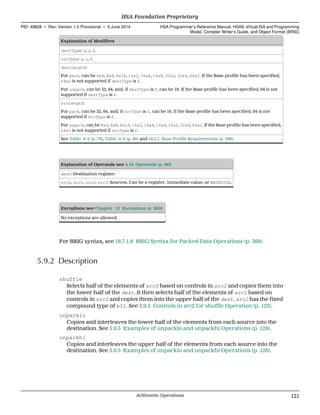
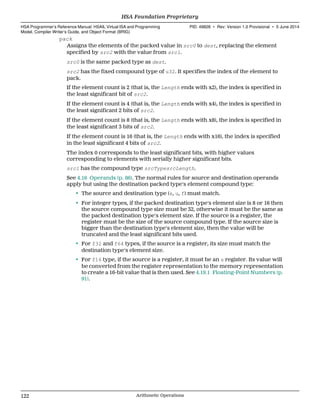
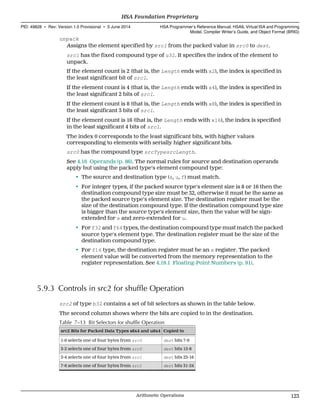
5.9.2 Description. . . . . . . . . . . . . . . . . . . . . . . . . . . . . . . . . . . . . . . . . . . . . . . . . . . . . . . . . . . . . . . . . . . . . . . . . . . . . . . . . . . . . . . . . . . . . . . . . . . . . . . . . . . . . . . . . . . . . . . . . . . . . 121
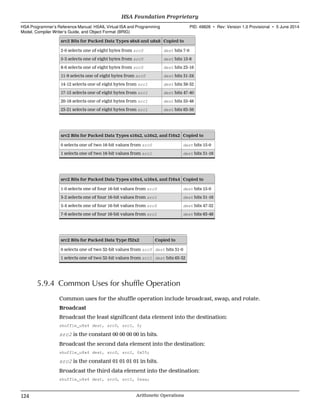
5.9.3 Controls in src2 for shuffle Operation. . . . . . . . . . . . . . . . . . . . . . . . . . . . . . . . . . . . . . . . . . . . . . . . . . . . . . . . . . . . . . . . . . . . . . . . . . . . . . . . . . . . . 123
5.9.4 Common Uses for shuffle Operation. . . . . . . . . . . . . . . . . . . . . . . . . . . . . . . . . . . . . . . . . . . . . . . . . . . . . . . . . . . . . . . . . . . . . . . . . . . . . . . . . . . . . . . 124
5.9.5 Examples of unpacklo and unpackhi Operations. . . . . . . . . . . . . . . . . . . . . . . . . . . . . . . . . . . . . . . . . . . . . . . . . . . . . . . . . . . . . . . . . . . . 126
5.10 Bit Conditional Move (cmov) Operation. . . . . . . . . . . . . . . . . . . . . . . . . . . . . . . . . . . . . . . . . . . . . . . . . . . . . . . . . . . . . . . . . . . . . . . . . . . . . . . . . . . . . . . 127
5.10.1 Syntax. . . . . . . . . . . . . . . . . . . . . . . . . . . . . . . . . . . . . . . . . . . . . . . . . . . . . . . . . . . . . . . . . . . . . . . . . . . . . . . . . . . . . . . . . . . . . . . . . . . . . . . . . . . . . . . . . . . . . . . . . . . . . . . . . . .127
5.10.2 Description. . . . . . . . . . . . . . . . . . . . . . . . . . . . . . . . . . . . . . . . . . . . . . . . . . . . . . . . . . . . . . . . . . . . . . . . . . . . . . . . . . . . . . . . . . . . . . . . . . . . . . . . . . . . . . . . . . . . . . . . . . . 128
5.11 Floating-Point Arithmetic Operations. . . . . . . . . . . . . . . . . . . . . . . . . . . . . . . . . . . . . . . . . . . . . . . . . . . . . . . . . . . . . . . . . . . . . . . . . . . . . . . . . . . . . . . . . . . . 129
5.11.1 Syntax. . . . . . . . . . . . . . . . . . . . . . . . . . . . . . . . . . . . . . . . . . . . . . . . . . . . . . . . . . . . . . . . . . . . . . . . . . . . . . . . . . . . . . . . . . . . . . . . . . . . . . . . . . . . . . . . . . . . . . . . . . . . . . . . . . .129
5.11.2 Description. . . . . . . . . . . . . . . . . . . . . . . . . . . . . . . . . . . . . . . . . . . . . . . . . . . . . . . . . . . . . . . . . . . . . . . . . . . . . . . . . . . . . . . . . . . . . . . . . . . . . . . . . . . . . . . . . . . . . . . . . . . 130
5.12 Floating-Point Bit Operations. . . . . . . . . . . . . . . . . . . . . . . . . . . . . . . . . . . . . . . . . . . . . . . . . . . . . . . . . . . . . . . . . . . . . . . . . . . . . . . . . . . . . . . . . . . . . . . . . . . . . . . . 133
5.12.1 Syntax. . . . . . . . . . . . . . . . . . . . . . . . . . . . . . . . . . . . . . . . . . . . . . . . . . . . . . . . . . . . . . . . . . . . . . . . . . . . . . . . . . . . . . . . . . . . . . . . . . . . . . . . . . . . . . . . . . . . . . . . . . . . . . . . . . .133
5.12.2 Description. . . . . . . . . . . . . . . . . . . . . . . . . . . . . . . . . . . . . . . . . . . . . . . . . . . . . . . . . . . . . . . . . . . . . . . . . . . . . . . . . . . . . . . . . . . . . . . . . . . . . . . . . . . . . . . . . . . . . . . . . . . 135
5.13 Native Floating-Point Operations. . . . . . . . . . . . . . . . . . . . . . . . . . . . . . . . . . . . . . . . . . . . . . . . . . . . . . . . . . . . . . . . . . . . . . . . . . . . . . . . . . . . . . . . . . . . . . . . . . 136
5.13.1 Syntax. . . . . . . . . . . . . . . . . . . . . . . . . . . . . . . . . . . . . . . . . . . . . . . . . . . . . . . . . . . . . . . . . . . . . . . . . . . . . . . . . . . . . . . . . . . . . . . . . . . . . . . . . . . . . . . . . . . . . . . . . . . . . . . . . . .136
5.13.2 Description. . . . . . . . . . . . . . . . . . . . . . . . . . . . . . . . . . . . . . . . . . . . . . . . . . . . . . . . . . . . . . . . . . . . . . . . . . . . . . . . . . . . . . . . . . . . . . . . . . . . . . . . . . . . . . . . . . . . . . . . . . . 137
5.14 Multimedia Operations. . . . . . . . . . . . . . . . . . . . . . . . . . . . . . . . . . . . . . . . . . . . . . . . . . . . . . . . . . . . . . . . . . . . . . . . . . . . . . . . . . . . . . . . . . . . . . . . . . . . . . . . . . . . . . . . . 138
5.14.1 Syntax. . . . . . . . . . . . . . . . . . . . . . . . . . . . . . . . . . . . . . . . . . . . . . . . . . . . . . . . . . . . . . . . . . . . . . . . . . . . . . . . . . . . . . . . . . . . . . . . . . . . . . . . . . . . . . . . . . . . . . . . . . . . . . . . . . .138
5.14.2 Description. . . . . . . . . . . . . . . . . . . . . . . . . . . . . . . . . . . . . . . . . . . . . . . . . . . . . . . . . . . . . . . . . . . . . . . . . . . . . . . . . . . . . . . . . . . . . . . . . . . . . . . . . . . . . . . . . . . . . . . . . . . 139
5.15 Segment Checking (segmentp) Operation. . . . . . . . . . . . . . . . . . . . . . . . . . . . . . . . . . . . . . . . . . . . . . . . . . . . . . . . . . . . . . . . . . . . . . . . . . . . . . . . . . . . . 142
5.15.1 Syntax. . . . . . . . . . . . . . . . . . . . . . . . . . . . . . . . . . . . . . . . . . . . . . . . . . . . . . . . . . . . . . . . . . . . . . . . . . . . . . . . . . . . . . . . . . . . . . . . . . . . . . . . . . . . . . . . . . . . . . . . . . . . . . . . . . .142
5.15.2 Description. . . . . . . . . . . . . . . . . . . . . . . . . . . . . . . . . . . . . . . . . . . . . . . . . . . . . . . . . . . . . . . . . . . . . . . . . . . . . . . . . . . . . . . . . . . . . . . . . . . . . . . . . . . . . . . . . . . . . . . . . . . 143
5.16 Segment Conversion Operations. . . . . . . . . . . . . . . . . . . . . . . . . . . . . . . . . . . . . . . . . . . . . . . . . . . . . . . . . . . . . . . . . . . . . . . . . . . . . . . . . . . . . . . . . . . . . . . . . . . 143
5.16.1 Syntax. . . . . . . . . . . . . . . . . . . . . . . . . . . . . . . . . . . . . . . . . . . . . . . . . . . . . . . . . . . . . . . . . . . . . . . . . . . . . . . . . . . . . . . . . . . . . . . . . . . . . . . . . . . . . . . . . . . . . . . . . . . . . . . . . . .143
HSA Foundation Proprietary  
HSA Programmer’s Reference Manual: HSAIL Virtual ISA and Programming
Model, Compiler Writer’s Guide, and Object Format (BRIG)
PID: 49828 ∙ Rev: Version 1.0 Provisional ∙ 5 June 2014
x  
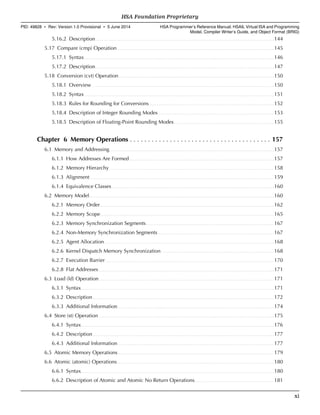
5.16.2 Description. . . . . . . . . . . . . . . . . . . . . . . . . . . . . . . . . . . . . . . . . . . . . . . . . . . . . . . . . . . . . . . . . . . . . . . . . . . . . . . . . . . . . . . . . . . . . . . . . . . . . . . . . . . . . . . . . . . . . . . . . . . 144
5.17 Compare (cmp) Operation. . . . . . . . . . . . . . . . . . . . . . . . . . . . . . . . . . . . . . . . . . . . . . . . . . . . . . . . . . . . . . . . . . . . . . . . . . . . . . . . . . . . . . . . . . . . . . . . . . . . . . . . . . . . 145
5.17.1 Syntax. . . . . . . . . . . . . . . . . . . . . . . . . . . . . . . . . . . . . . . . . . . . . . . . . . . . . . . . . . . . . . . . . . . . . . . . . . . . . . . . . . . . . . . . . . . . . . . . . . . . . . . . . . . . . . . . . . . . . . . . . . . . . . . . . . .146
5.17.2 Description. . . . . . . . . . . . . . . . . . . . . . . . . . . . . . . . . . . . . . . . . . . . . . . . . . . . . . . . . . . . . . . . . . . . . . . . . . . . . . . . . . . . . . . . . . . . . . . . . . . . . . . . . . . . . . . . . . . . . . . . . . . 147
5.18 Conversion (cvt) Operation. . . . . . . . . . . . . . . . . . . . . . . . . . . . . . . . . . . . . . . . . . . . . . . . . . . . . . . . . . . . . . . . . . . . . . . . . . . . . . . . . . . . . . . . . . . . . . . . . . . . . . . . . . . 150
5.18.1 Overview. . . . . . . . . . . . . . . . . . . . . . . . . . . . . . . . . . . . . . . . . . . . . . . . . . . . . . . . . . . . . . . . . . . . . . . . . . . . . . . . . . . . . . . . . . . . . . . . . . . . . . . . . . . . . . . . . . . . . . . . . . . . . .150
5.18.2 Syntax. . . . . . . . . . . . . . . . . . . . . . . . . . . . . . . . . . . . . . . . . . . . . . . . . . . . . . . . . . . . . . . . . . . . . . . . . . . . . . . . . . . . . . . . . . . . . . . . . . . . . . . . . . . . . . . . . . . . . . . . . . . . . . . . . . .151
5.18.3 Rules for Rounding for Conversions. . . . . . . . . . . . . . . . . . . . . . . . . . . . . . . . . . . . . . . . . . . . . . . . . . . . . . . . . . . . . . . . . . . . . . . . . . . . . . . . . . . . . . 152
5.18.4 Description of Integer Rounding Modes. . . . . . . . . . . . . . . . . . . . . . . . . . . . . . . . . . . . . . . . . . . . . . . . . . . . . . . . . . . . . . . . . . . . . . . . . . . . . . . . 153
5.18.5 Description of Floating-Point Rounding Modes. . . . . . . . . . . . . . . . . . . . . . . . . . . . . . . . . . . . . . . . . . . . . . . . . . . . . . . . . . . . . . . . . . . . . 155
Chapter 6 Memory Operations . . . . . . . . . . . . . . . . . . . . . . . . . . . . . . . . . . . . . . . 157
6.1 Memory and Addressing. . . . . . . . . . . . . . . . . . . . . . . . . . . . . . . . . . . . . . . . . . . . . . . . . . . . . . . . . . . . . . . . . . . . . . . . . . . . . . . . . . . . . . . . . . . . . . . . . . . . . . . . . . . . . . . . . 157
6.1.1 How Addresses Are Formed. . . . . . . . . . . . . . . . . . . . . . . . . . . . . . . . . . . . . . . . . . . . . . . . . . . . . . . . . . . . . . . . . . . . . . . . . . . . . . . . . . . . . . . . . . . . . . . . . . . .157
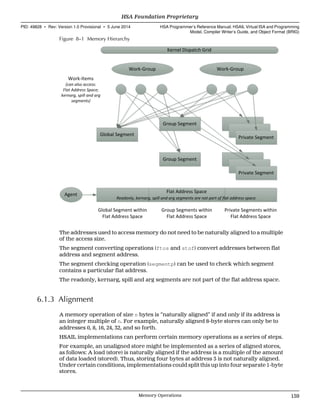
6.1.2 Memory Hierarchy. . . . . . . . . . . . . . . . . . . . . . . . . . . . . . . . . . . . . . . . . . . . . . . . . . . . . . . . . . . . . . . . . . . . . . . . . . . . . . . . . . . . . . . . . . . . . . . . . . . . . . . . . . . . . . . . . 158
6.1.3 Alignment. . . . . . . . . . . . . . . . . . . . . . . . . . . . . . . . . . . . . . . . . . . . . . . . . . . . . . . . . . . . . . . . . . . . . . . . . . . . . . . . . . . . . . . . . . . . . . . . . . . . . . . . . . . . . . . . . . . . . . . . . . . . . . . 159
6.1.4 Equivalence Classes. . . . . . . . . . . . . . . . . . . . . . . . . . . . . . . . . . . . . . . . . . . . . . . . . . . . . . . . . . . . . . . . . . . . . . . . . . . . . . . . . . . . . . . . . . . . . . . . . . . . . . . . . . . . . . . . 160
6.2 Memory Model. . . . . . . . . . . . . . . . . . . . . . . . . . . . . . . . . . . . . . . . . . . . . . . . . . . . . . . . . . . . . . . . . . . . . . . . . . . . . . . . . . . . . . . . . . . . . . . . . . . . . . . . . . . . . . . . . . . . . . . . . . . . . . . 160
6.2.1 Memory Order. . . . . . . . . . . . . . . . . . . . . . . . . . . . . . . . . . . . . . . . . . . . . . . . . . . . . . . . . . . . . . . . . . . . . . . . . . . . . . . . . . . . . . . . . . . . . . . . . . . . . . . . . . . . . . . . . . . . . . . .162
6.2.2 Memory Scope. . . . . . . . . . . . . . . . . . . . . . . . . . . . . . . . . . . . . . . . . . . . . . . . . . . . . . . . . . . . . . . . . . . . . . . . . . . . . . . . . . . . . . . . . . . . . . . . . . . . . . . . . . . . . . . . . . . . . . . 165
6.2.3 Memory Synchronization Segments. . . . . . . . . . . . . . . . . . . . . . . . . . . . . . . . . . . . . . . . . . . . . . . . . . . . . . . . . . . . . . . . . . . . . . . . . . . . . . . . . . . . . . . . 167
6.2.4 Non-Memory Synchronization Segments. . . . . . . . . . . . . . . . . . . . . . . . . . . . . . . . . . . . . . . . . . . . . . . . . . . . . . . . . . . . . . . . . . . . . . . . . . . . . . . . 167
6.2.5 Agent Allocation. . . . . . . . . . . . . . . . . . . . . . . . . . . . . . . . . . . . . . . . . . . . . . . . . . . . . . . . . . . . . . . . . . . . . . . . . . . . . . . . . . . . . . . . . . . . . . . . . . . . . . . . . . . . . . . . . . . . . 168
6.2.6 Kernel Dispatch Memory Synchronization. . . . . . . . . . . . . . . . . . . . . . . . . . . . . . . . . . . . . . . . . . . . . . . . . . . . . . . . . . . . . . . . . . . . . . . . . . . . . . 168
6.2.7 Execution Barrier. . . . . . . . . . . . . . . . . . . . . . . . . . . . . . . . . . . . . . . . . . . . . . . . . . . . . . . . . . . . . . . . . . . . . . . . . . . . . . . . . . . . . . . . . . . . . . . . . . . . . . . . . . . . . . . . . . . . 170
6.2.8 Flat Addresses. . . . . . . . . . . . . . . . . . . . . . . . . . . . . . . . . . . . . . . . . . . . . . . . . . . . . . . . . . . . . . . . . . . . . . . . . . . . . . . . . . . . . . . . . . . . . . . . . . . . . . . . . . . . . . . . . . . . . . . . . 171
6.3 Load (ld) Operation. . . . . . . . . . . . . . . . . . . . . . . . . . . . . . . . . . . . . . . . . . . . . . . . . . . . . . . . . . . . . . . . . . . . . . . . . . . . . . . . . . . . . . . . . . . . . . . . . . . . . . . . . . . . . . . . . . . . . . . . 171
6.3.1 Syntax. . . . . . . . . . . . . . . . . . . . . . . . . . . . . . . . . . . . . . . . . . . . . . . . . . . . . . . . . . . . . . . . . . . . . . . . . . . . . . . . . . . . . . . . . . . . . . . . . . . . . . . . . . . . . . . . . . . . . . . . . . . . . . . . . . . . .171
6.3.2 Description. . . . . . . . . . . . . . . . . . . . . . . . . . . . . . . . . . . . . . . . . . . . . . . . . . . . . . . . . . . . . . . . . . . . . . . . . . . . . . . . . . . . . . . . . . . . . . . . . . . . . . . . . . . . . . . . . . . . . . . . . . . . . 172
6.3.3 Additional Information. . . . . . . . . . . . . . . . . . . . . . . . . . . . . . . . . . . . . . . . . . . . . . . . . . . . . . . . . . . . . . . . . . . . . . . . . . . . . . . . . . . . . . . . . . . . . . . . . . . . . . . . . . . .174
6.4 Store (st) Operation. . . . . . . . . . . . . . . . . . . . . . . . . . . . . . . . . . . . . . . . . . . . . . . . . . . . . . . . . . . . . . . . . . . . . . . . . . . . . . . . . . . . . . . . . . . . . . . . . . . . . . . . . . . . . . . . . . . . . . . . . 175
6.4.1 Syntax. . . . . . . . . . . . . . . . . . . . . . . . . . . . . . . . . . . . . . . . . . . . . . . . . . . . . . . . . . . . . . . . . . . . . . . . . . . . . . . . . . . . . . . . . . . . . . . . . . . . . . . . . . . . . . . . . . . . . . . . . . . . . . . . . . . . .176
6.4.2 Description. . . . . . . . . . . . . . . . . . . . . . . . . . . . . . . . . . . . . . . . . . . . . . . . . . . . . . . . . . . . . . . . . . . . . . . . . . . . . . . . . . . . . . . . . . . . . . . . . . . . . . . . . . . . . . . . . . . . . . . . . . . . . 177
6.4.3 Additional Information. . . . . . . . . . . . . . . . . . . . . . . . . . . . . . . . . . . . . . . . . . . . . . . . . . . . . . . . . . . . . . . . . . . . . . . . . . . . . . . . . . . . . . . . . . . . . . . . . . . . . . . . . . . .177
6.5 Atomic Memory Operations. . . . . . . . . . . . . . . . . . . . . . . . . . . . . . . . . . . . . . . . . . . . . . . . . . . . . . . . . . . . . . . . . . . . . . . . . . . . . . . . . . . . . . . . . . . . . . . . . . . . . . . . . . . 179
6.6 Atomic (atomic) Operations. . . . . . . . . . . . . . . . . . . . . . . . . . . . . . . . . . . . . . . . . . . . . . . . . . . . . . . . . . . . . . . . . . . . . . . . . . . . . . . . . . . . . . . . . . . . . . . . . . . . . . . . . . . . 180
6.6.1 Syntax. . . . . . . . . . . . . . . . . . . . . . . . . . . . . . . . . . . . . . . . . . . . . . . . . . . . . . . . . . . . . . . . . . . . . . . . . . . . . . . . . . . . . . . . . . . . . . . . . . . . . . . . . . . . . . . . . . . . . . . . . . . . . . . . . . . . .180
6.6.2 Description of Atomic and Atomic No Return Operations. . . . . . . . . . . . . . . . . . . . . . . . . . . . . . . . . . . . . . . . . . . . . . . . . . . . . . 181
  HSA Foundation Proprietary
PID: 49828 ∙ Rev: Version 1.0 Provisional ∙ 5 June 2014 HSA Programmer’s Reference Manual: HSAIL Virtual ISA and Programming
Model, Compiler Writer’s Guide, and Object Format (BRIG)
  xi
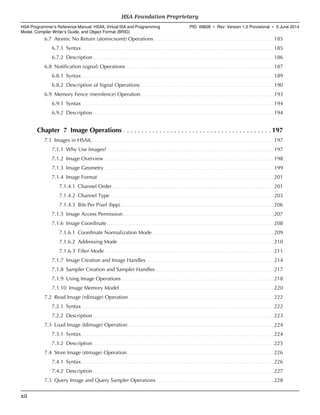
6.7 Atomic No Return (atomicnoret) Operations. . . . . . . . . . . . . . . . . . . . . . . . . . . . . . . . . . . . . . . . . . . . . . . . . . . . . . . . . . . . . . . . . . . . . . . . . . . . . . . . . . . 185
6.7.1 Syntax. . . . . . . . . . . . . . . . . . . . . . . . . . . . . . . . . . . . . . . . . . . . . . . . . . . . . . . . . . . . . . . . . . . . . . . . . . . . . . . . . . . . . . . . . . . . . . . . . . . . . . . . . . . . . . . . . . . . . . . . . . . . . . . . . . . . .185
6.7.2 Description. . . . . . . . . . . . . . . . . . . . . . . . . . . . . . . . . . . . . . . . . . . . . . . . . . . . . . . . . . . . . . . . . . . . . . . . . . . . . . . . . . . . . . . . . . . . . . . . . . . . . . . . . . . . . . . . . . . . . . . . . . . . . 186
6.8 Notification (signal) Operations. . . . . . . . . . . . . . . . . . . . . . . . . . . . . . . . . . . . . . . . . . . . . . . . . . . . . . . . . . . . . . . . . . . . . . . . . . . . . . . . . . . . . . . . . . . . . . . . . . . . . . 187
6.8.1 Syntax. . . . . . . . . . . . . . . . . . . . . . . . . . . . . . . . . . . . . . . . . . . . . . . . . . . . . . . . . . . . . . . . . . . . . . . . . . . . . . . . . . . . . . . . . . . . . . . . . . . . . . . . . . . . . . . . . . . . . . . . . . . . . . . . . . . . .189
6.8.2 Description of Signal Operations. . . . . . . . . . . . . . . . . . . . . . . . . . . . . . . . . . . . . . . . . . . . . . . . . . . . . . . . . . . . . . . . . . . . . . . . . . . . . . . . . . . . . . . . . . . . 190
6.9 Memory Fence (memfence) Operation. . . . . . . . . . . . . . . . . . . . . . . . . . . . . . . . . . . . . . . . . . . . . . . . . . . . . . . . . . . . . . . . . . . . . . . . . . . . . . . . . . . . . . . . . . . .193
6.9.1 Syntax. . . . . . . . . . . . . . . . . . . . . . . . . . . . . . . . . . . . . . . . . . . . . . . . . . . . . . . . . . . . . . . . . . . . . . . . . . . . . . . . . . . . . . . . . . . . . . . . . . . . . . . . . . . . . . . . . . . . . . . . . . . . . . . . . . . . .194
6.9.2 Description. . . . . . . . . . . . . . . . . . . . . . . . . . . . . . . . . . . . . . . . . . . . . . . . . . . . . . . . . . . . . . . . . . . . . . . . . . . . . . . . . . . . . . . . . . . . . . . . . . . . . . . . . . . . . . . . . . . . . . . . . . . . . 194
Chapter 7 Image Operations . . . . . . . . . . . . . . . . . . . . . . . . . . . . . . . . . . . . . . . . . 197
7.1 Images in HSAIL. . . . . . . . . . . . . . . . . . . . . . . . . . . . . . . . . . . . . . . . . . . . . . . . . . . . . . . . . . . . . . . . . . . . . . . . . . . . . . . . . . . . . . . . . . . . . . . . . . . . . . . . . . . . . . . . . . . . . . . . . . . . . 197
7.1.1 Why Use Images?. . . . . . . . . . . . . . . . . . . . . . . . . . . . . . . . . . . . . . . . . . . . . . . . . . . . . . . . . . . . . . . . . . . . . . . . . . . . . . . . . . . . . . . . . . . . . . . . . . . . . . . . . . . . . . . . . . . 197
7.1.2 Image Overview. . . . . . . . . . . . . . . . . . . . . . . . . . . . . . . . . . . . . . . . . . . . . . . . . . . . . . . . . . . . . . . . . . . . . . . . . . . . . . . . . . . . . . . . . . . . . . . . . . . . . . . . . . . . . . . . . . . . . 198
7.1.3 Image Geometry. . . . . . . . . . . . . . . . . . . . . . . . . . . . . . . . . . . . . . . . . . . . . . . . . . . . . . . . . . . . . . . . . . . . . . . . . . . . . . . . . . . . . . . . . . . . . . . . . . . . . . . . . . . . . . . . . . . . . 199
7.1.4 Image Format. . . . . . . . . . . . . . . . . . . . . . . . . . . . . . . . . . . . . . . . . . . . . . . . . . . . . . . . . . . . . . . . . . . . . . . . . . . . . . . . . . . . . . . . . . . . . . . . . . . . . . . . . . . . . . . . . . . . . . . . . .201
7.1.4.1 Channel Order. . . . . . . . . . . . . . . . . . . . . . . . . . . . . . . . . . . . . . . . . . . . . . . . . . . . . . . . . . . . . . . . . . . . . . . . . . . . . . . . . . . . . . . . . . . . . . . . . . . . . . . . . . . . . . . 201
7.1.4.2 Channel Type. . . . . . . . . . . . . . . . . . . . . . . . . . . . . . . . . . . . . . . . . . . . . . . . . . . . . . . . . . . . . . . . . . . . . . . . . . . . . . . . . . . . . . . . . . . . . . . . . . . . . . . . . . . . . . . . . 203
7.1.4.3 Bits Per Pixel (bpp). . . . . . . . . . . . . . . . . . . . . . . . . . . . . . . . . . . . . . . . . . . . . . . . . . . . . . . . . . . . . . . . . . . . . . . . . . . . . . . . . . . . . . . . . . . . . . . . . . . . . . . . . 206
7.1.5 Image Access Permission. . . . . . . . . . . . . . . . . . . . . . . . . . . . . . . . . . . . . . . . . . . . . . . . . . . . . . . . . . . . . . . . . . . . . . . . . . . . . . . . . . . . . . . . . . . . . . . . . . . . . . . . 207
7.1.6 Image Coordinate. . . . . . . . . . . . . . . . . . . . . . . . . . . . . . . . . . . . . . . . . . . . . . . . . . . . . . . . . . . . . . . . . . . . . . . . . . . . . . . . . . . . . . . . . . . . . . . . . . . . . . . . . . . . . . . . . . . 208
7.1.6.1 Coordinate Normalization Mode. . . . . . . . . . . . . . . . . . . . . . . . . . . . . . . . . . . . . . . . . . . . . . . . . . . . . . . . . . . . . . . . . . . . . . . . . . . . . . . . . . . . 209
7.1.6.2 Addressing Mode. . . . . . . . . . . . . . . . . . . . . . . . . . . . . . . . . . . . . . . . . . . . . . . . . . . . . . . . . . . . . . . . . . . . . . . . . . . . . . . . . . . . . . . . . . . . . . . . . . . . . . . . . . . .210
7.1.6.3 Filter Mode. . . . . . . . . . . . . . . . . . . . . . . . . . . . . . . . . . . . . . . . . . . . . . . . . . . . . . . . . . . . . . . . . . . . . . . . . . . . . . . . . . . . . . . . . . . . . . . . . . . . . . . . . . . . . . . . . . . . . 211
7.1.7 Image Creation and Image Handles. . . . . . . . . . . . . . . . . . . . . . . . . . . . . . . . . . . . . . . . . . . . . . . . . . . . . . . . . . . . . . . . . . . . . . . . . . . . . . . . . . . . . . . . 214
7.1.8 Sampler Creation and Sampler Handles. . . . . . . . . . . . . . . . . . . . . . . . . . . . . . . . . . . . . . . . . . . . . . . . . . . . . . . . . . . . . . . . . . . . . . . . . . . . . . . . . . 217
7.1.9 Using Image Operations. . . . . . . . . . . . . . . . . . . . . . . . . . . . . . . . . . . . . . . . . . . . . . . . . . . . . . . . . . . . . . . . . . . . . . . . . . . . . . . . . . . . . . . . . . . . . . . . . . . . . . . . . 218
7.1.10 Image Memory Model. . . . . . . . . . . . . . . . . . . . . . . . . . . . . . . . . . . . . . . . . . . . . . . . . . . . . . . . . . . . . . . . . . . . . . . . . . . . . . . . . . . . . . . . . . . . . . . . . . . . . . . . . . 220
7.2 Read Image (rdimage) Operation. . . . . . . . . . . . . . . . . . . . . . . . . . . . . . . . . . . . . . . . . . . . . . . . . . . . . . . . . . . . . . . . . . . . . . . . . . . . . . . . . . . . . . . . . . . . . . . . . . . . 222
7.2.1 Syntax. . . . . . . . . . . . . . . . . . . . . . . . . . . . . . . . . . . . . . . . . . . . . . . . . . . . . . . . . . . . . . . . . . . . . . . . . . . . . . . . . . . . . . . . . . . . . . . . . . . . . . . . . . . . . . . . . . . . . . . . . . . . . . . . . . . . .222
7.2.2 Description. . . . . . . . . . . . . . . . . . . . . . . . . . . . . . . . . . . . . . . . . . . . . . . . . . . . . . . . . . . . . . . . . . . . . . . . . . . . . . . . . . . . . . . . . . . . . . . . . . . . . . . . . . . . . . . . . . . . . . . . . . . . . 223
7.3 Load Image (ldimage) Operation. . . . . . . . . . . . . . . . . . . . . . . . . . . . . . . . . . . . . . . . . . . . . . . . . . . . . . . . . . . . . . . . . . . . . . . . . . . . . . . . . . . . . . . . . . . . . . . . . . . . .224
7.3.1 Syntax. . . . . . . . . . . . . . . . . . . . . . . . . . . . . . . . . . . . . . . . . . . . . . . . . . . . . . . . . . . . . . . . . . . . . . . . . . . . . . . . . . . . . . . . . . . . . . . . . . . . . . . . . . . . . . . . . . . . . . . . . . . . . . . . . . . . .224
7.3.2 Description. . . . . . . . . . . . . . . . . . . . . . . . . . . . . . . . . . . . . . . . . . . . . . . . . . . . . . . . . . . . . . . . . . . . . . . . . . . . . . . . . . . . . . . . . . . . . . . . . . . . . . . . . . . . . . . . . . . . . . . . . . . . . 225
7.4 Store Image (stimage) Operation. . . . . . . . . . . . . . . . . . . . . . . . . . . . . . . . . . . . . . . . . . . . . . . . . . . . . . . . . . . . . . . . . . . . . . . . . . . . . . . . . . . . . . . . . . . . . . . . . . . . . 226
7.4.1 Syntax. . . . . . . . . . . . . . . . . . . . . . . . . . . . . . . . . . . . . . . . . . . . . . . . . . . . . . . . . . . . . . . . . . . . . . . . . . . . . . . . . . . . . . . . . . . . . . . . . . . . . . . . . . . . . . . . . . . . . . . . . . . . . . . . . . . . .226
7.4.2 Description. . . . . . . . . . . . . . . . . . . . . . . . . . . . . . . . . . . . . . . . . . . . . . . . . . . . . . . . . . . . . . . . . . . . . . . . . . . . . . . . . . . . . . . . . . . . . . . . . . . . . . . . . . . . . . . . . . . . . . . . . . . . . 227
7.5 Query Image and Query Sampler Operations. . . . . . . . . . . . . . . . . . . . . . . . . . . . . . . . . . . . . . . . . . . . . . . . . . . . . . . . . . . . . . . . . . . . . . . . . . . . . . . . . 228
HSA Foundation Proprietary  
HSA Programmer’s Reference Manual: HSAIL Virtual ISA and Programming
Model, Compiler Writer’s Guide, and Object Format (BRIG)
PID: 49828 ∙ Rev: Version 1.0 Provisional ∙ 5 June 2014
xii  
7.5.1 Syntax. . . . . . . . . . . . . . . . . . . . . . . . . . . . . . . . . . . . . . . . . . . . . . . . . . . . . . . . . . . . . . . . . . . . . . . . . . . . . . . . . . . . . . . . . . . . . . . . . . . . . . . . . . . . . . . . . . . . . . . . . . . . . . . . . . . . .228
7.5.2 Description. . . . . . . . . . . . . . . . . . . . . . . . . . . . . . . . . . . . . . . . . . . . . . . . . . . . . . . . . . . . . . . . . . . . . . . . . . . . . . . . . . . . . . . . . . . . . . . . . . . . . . . . . . . . . . . . . . . . . . . . . . . . . 229
Chapter 8 Branch Operations . . . . . . . . . . . . . . . . . . . . . . . . . . . . . . . . . . . . . . . . 231
8.1 Syntax. . . . . . . . . . . . . . . . . . . . . . . . . . . . . . . . . . . . . . . . . . . . . . . . . . . . . . . . . . . . . . . . . . . . . . . . . . . . . . . . . . . . . . . . . . . . . . . . . . . . . . . . . . . . . . . . . . . . . . . . . . . . . . . . . . . . . . . . . . . . .231
8.2 Description. . . . . . . . . . . . . . . . . . . . . . . . . . . . . . . . . . . . . . . . . . . . . . . . . . . . . . . . . . . . . . . . . . . . . . . . . . . . . . . . . . . . . . . . . . . . . . . . . . . . . . . . . . . . . . . . . . . . . . . . . . . . . . . . . . . . . 232
Chapter 9 Parallel Synchronization and Communication Operations . . . . . . . . . . 235
9.1 Barrier Operations. . . . . . . . . . . . . . . . . . . . . . . . . . . . . . . . . . . . . . . . . . . . . . . . . . . . . . . . . . . . . . . . . . . . . . . . . . . . . . . . . . . . . . . . . . . . . . . . . . . . . . . . . . . . . . . . . . . . . . . . . . 235
9.1.1 Syntax. . . . . . . . . . . . . . . . . . . . . . . . . . . . . . . . . . . . . . . . . . . . . . . . . . . . . . . . . . . . . . . . . . . . . . . . . . . . . . . . . . . . . . . . . . . . . . . . . . . . . . . . . . . . . . . . . . . . . . . . . . . . . . . . . . . . .235
9.1.2 Description. . . . . . . . . . . . . . . . . . . . . . . . . . . . . . . . . . . . . . . . . . . . . . . . . . . . . . . . . . . . . . . . . . . . . . . . . . . . . . . . . . . . . . . . . . . . . . . . . . . . . . . . . . . . . . . . . . . . . . . . . . . . . 235
9.2 Fine-Grain Barrier (fbar) Operations. . . . . . . . . . . . . . . . . . . . . . . . . . . . . . . . . . . . . . . . . . . . . . . . . . . . . . . . . . . . . . . . . . . . . . . . . . . . . . . . . . . . . . . . . . . . . . . .236
9.2.1 Overview: What Is an Fbarrier?. . . . . . . . . . . . . . . . . . . . . . . . . . . . . . . . . . . . . . . . . . . . . . . . . . . . . . . . . . . . . . . . . . . . . . . . . . . . . . . . . . . . . . . . . . . . . . .236
9.2.2 Syntax. . . . . . . . . . . . . . . . . . . . . . . . . . . . . . . . . . . . . . . . . . . . . . . . . . . . . . . . . . . . . . . . . . . . . . . . . . . . . . . . . . . . . . . . . . . . . . . . . . . . . . . . . . . . . . . . . . . . . . . . . . . . . . . . . . . . .237
9.2.3 Description. . . . . . . . . . . . . . . . . . . . . . . . . . . . . . . . . . . . . . . . . . . . . . . . . . . . . . . . . . . . . . . . . . . . . . . . . . . . . . . . . . . . . . . . . . . . . . . . . . . . . . . . . . . . . . . . . . . . . . . . . . . . . 238
9.2.4 Additional Information About Fbarrier Operations. . . . . . . . . . . . . . . . . . . . . . . . . . . . . . . . . . . . . . . . . . . . . . . . . . . . . . . . . . . . . . . . . . 241
9.2.5 Pseudocode Examples. . . . . . . . . . . . . . . . . . . . . . . . . . . . . . . . . . . . . . . . . . . . . . . . . . . . . . . . . . . . . . . . . . . . . . . . . . . . . . . . . . . . . . . . . . . . . . . . . . . . . . . . . . . . 242
9.3 Execution Barrier. . . . . . . . . . . . . . . . . . . . . . . . . . . . . . . . . . . . . . . . . . . . . . . . . . . . . . . . . . . . . . . . . . . . . . . . . . . . . . . . . . . . . . . . . . . . . . . . . . . . . . . . . . . . . . . . . . . . . . . . . . . . 246
9.4 Cross-Lane Operations. . . . . . . . . . . . . . . . . . . . . . . . . . . . . . . . . . . . . . . . . . . . . . . . . . . . . . . . . . . . . . . . . . . . . . . . . . . . . . . . . . . . . . . . . . . . . . . . . . . . . . . . . . . . . . . . . . . .248
9.4.1 Syntax. . . . . . . . . . . . . . . . . . . . . . . . . . . . . . . . . . . . . . . . . . . . . . . . . . . . . . . . . . . . . . . . . . . . . . . . . . . . . . . . . . . . . . . . . . . . . . . . . . . . . . . . . . . . . . . . . . . . . . . . . . . . . . . . . . . . .249
9.4.2 Description. . . . . . . . . . . . . . . . . . . . . . . . . . . . . . . . . . . . . . . . . . . . . . . . . . . . . . . . . . . . . . . . . . . . . . . . . . . . . . . . . . . . . . . . . . . . . . . . . . . . . . . . . . . . . . . . . . . . . . . . . . . . . 249
Chapter 10 Function Operations . . . . . . . . . . . . . . . . . . . . . . . . . . . . . . . . . . . . . . 253
10.1 Functions in HSAIL. . . . . . . . . . . . . . . . . . . . . . . . . . . . . . . . . . . . . . . . . . . . . . . . . . . . . . . . . . . . . . . . . . . . . . . . . . . . . . . . . . . . . . . . . . . . . . . . . . . . . . . . . . . . . . . . . . . . . . . 253
10.1.1 Example of a Simple Function. . . . . . . . . . . . . . . . . . . . . . . . . . . . . . . . . . . . . . . . . . . . . . . . . . . . . . . . . . . . . . . . . . . . . . . . . . . . . . . . . . . . . . . . . . . . . . .253
10.1.2 Example of a More Complex Function. . . . . . . . . . . . . . . . . . . . . . . . . . . . . . . . . . . . . . . . . . . . . . . . . . . . . . . . . . . . . . . . . . . . . . . . . . . . . . . . . . 254
10.1.3 Functions That Do Not Return a Result. . . . . . . . . . . . . . . . . . . . . . . . . . . . . . . . . . . . . . . . . . . . . . . . . . . . . . . . . . . . . . . . . . . . . . . . . . . . . . . . . 254
10.2 Function Call Argument Passing. . . . . . . . . . . . . . . . . . . . . . . . . . . . . . . . . . . . . . . . . . . . . . . . . . . . . . . . . . . . . . . . . . . . . . . . . . . . . . . . . . . . . . . . . . . . . . . . . . . 254
10.3 Function Declarations, Function Definitions, and Function Signatures. . . . . . . . . . . . . . . . . . . . . . . . . . . . . . . . . . . . . . . . . . 257
10.3.1 Function Declaration. . . . . . . . . . . . . . . . . . . . . . . . . . . . . . . . . . . . . . . . . . . . . . . . . . . . . . . . . . . . . . . . . . . . . . . . . . . . . . . . . . . . . . . . . . . . . . . . . . . . . . . . . . . . 257
10.3.2 Function Definition. . . . . . . . . . . . . . . . . . . . . . . . . . . . . . . . . . . . . . . . . . . . . . . . . . . . . . . . . . . . . . . . . . . . . . . . . . . . . . . . . . . . . . . . . . . . . . . . . . . . . . . . . . . . . . .258
10.3.3 Function Signature. . . . . . . . . . . . . . . . . . . . . . . . . . . . . . . . . . . . . . . . . . . . . . . . . . . . . . . . . . . . . . . . . . . . . . . . . . . . . . . . . . . . . . . . . . . . . . . . . . . . . . . . . . . . . . . . 258
10.4 Variadic Functions. . . . . . . . . . . . . . . . . . . . . . . . . . . . . . . . . . . . . . . . . . . . . . . . . . . . . . . . . . . . . . . . . . . . . . . . . . . . . . . . . . . . . . . . . . . . . . . . . . . . . . . . . . . . . . . . . . . . . . . . 259
10.5 align Qualifier. . . . . . . . . . . . . . . . . . . . . . . . . . . . . . . . . . . . . . . . . . . . . . . . . . . . . . . . . . . . . . . . . . . . . . . . . . . . . . . . . . . . . . . . . . . . . . . . . . . . . . . . . . . . . . . . . . . . . . . . . . . . . . 259
10.6 Direct Call (call) Operation. . . . . . . . . . . . . . . . . . . . . . . . . . . . . . . . . . . . . . . . . . . . . . . . . . . . . . . . . . . . . . . . . . . . . . . . . . . . . . . . . . . . . . . . . . . . . . . . . . . . . . . . . . .260
10.6.1 Syntax. . . . . . . . . . . . . . . . . . . . . . . . . . . . . . . . . . . . . . . . . . . . . . . . . . . . . . . . . . . . . . . . . . . . . . . . . . . . . . . . . . . . . . . . . . . . . . . . . . . . . . . . . . . . . . . . . . . . . . . . . . . . . . . . . . .260
10.6.2 Description. . . . . . . . . . . . . . . . . . . . . . . . . . . . . . . . . . . . . . . . . . . . . . . . . . . . . . . . . . . . . . . . . . . . . . . . . . . . . . . . . . . . . . . . . . . . . . . . . . . . . . . . . . . . . . . . . . . . . . . . . . . 261
10.7 Switch Call (scall) Operations. . . . . . . . . . . . . . . . . . . . . . . . . . . . . . . . . . . . . . . . . . . . . . . . . . . . . . . . . . . . . . . . . . . . . . . . . . . . . . . . . . . . . . . . . . . . . . . . . . . . . . . 261
  HSA Foundation Proprietary
PID: 49828 ∙ Rev: Version 1.0 Provisional ∙ 5 June 2014 HSA Programmer’s Reference Manual: HSAIL Virtual ISA and Programming
Model, Compiler Writer’s Guide, and Object Format (BRIG)
  xiii
10.7.1 Syntax. . . . . . . . . . . . . . . . . . . . . . . . . . . . . . . . . . . . . . . . . . . . . . . . . . . . . . . . . . . . . . . . . . . . . . . . . . . . . . . . . . . . . . . . . . . . . . . . . . . . . . . . . . . . . . . . . . . . . . . . . . . . . . . . . . .262
10.7.2 Description. . . . . . . . . . . . . . . . . . . . . . . . . . . . . . . . . . . . . . . . . . . . . . . . . . . . . . . . . . . . . . . . . . . . . . . . . . . . . . . . . . . . . . . . . . . . . . . . . . . . . . . . . . . . . . . . . . . . . . . . . . . 262
10.8 Indirect Call (icall, ldi) Operations. . . . . . . . . . . . . . . . . . . . . . . . . . . . . . . . . . . . . . . . . . . . . . . . . . . . . . . . . . . . . . . . . . . . . . . . . . . . . . . . . . . . . . . . . . . . . . . . 263
10.8.1 Syntax. . . . . . . . . . . . . . . . . . . . . . . . . . . . . . . . . . . . . . . . . . . . . . . . . . . . . . . . . . . . . . . . . . . . . . . . . . . . . . . . . . . . . . . . . . . . . . . . . . . . . . . . . . . . . . . . . . . . . . . . . . . . . . . . . . .264
10.8.2 Description. . . . . . . . . . . . . . . . . . . . . . . . . . . . . . . . . . . . . . . . . . . . . . . . . . . . . . . . . . . . . . . . . . . . . . . . . . . . . . . . . . . . . . . . . . . . . . . . . . . . . . . . . . . . . . . . . . . . . . . . . . . 265
10.9 Return (ret) Operation. . . . . . . . . . . . . . . . . . . . . . . . . . . . . . . . . . . . . . . . . . . . . . . . . . . . . . . . . . . . . . . . . . . . . . . . . . . . . . . . . . . . . . . . . . . . . . . . . . . . . . . . . . . . . . . . . . . 267
10.9.1 Syntax. . . . . . . . . . . . . . . . . . . . . . . . . . . . . . . . . . . . . . . . . . . . . . . . . . . . . . . . . . . . . . . . . . . . . . . . . . . . . . . . . . . . . . . . . . . . . . . . . . . . . . . . . . . . . . . . . . . . . . . . . . . . . . . . . . .267
10.9.2 Description. . . . . . . . . . . . . . . . . . . . . . . . . . . . . . . . . . . . . . . . . . . . . . . . . . . . . . . . . . . . . . . . . . . . . . . . . . . . . . . . . . . . . . . . . . . . . . . . . . . . . . . . . . . . . . . . . . . . . . . . . . . 268
10.10 Allocate Memory (alloca) Operation. . . . . . . . . . . . . . . . . . . . . . . . . . . . . . . . . . . . . . . . . . . . . . . . . . . . . . . . . . . . . . . . . . . . . . . . . . . . . . . . . . . . . . . . . . . 268
10.10.1 Syntax. . . . . . . . . . . . . . . . . . . . . . . . . . . . . . . . . . . . . . . . . . . . . . . . . . . . . . . . . . . . . . . . . . . . . . . . . . . . . . . . . . . . . . . . . . . . . . . . . . . . . . . . . . . . . . . . . . . . . . . . . . . . . . . . .268
10.10.2 Description. . . . . . . . . . . . . . . . . . . . . . . . . . . . . . . . . . . . . . . . . . . . . . . . . . . . . . . . . . . . . . . . . . . . . . . . . . . . . . . . . . . . . . . . . . . . . . . . . . . . . . . . . . . . . . . . . . . . . . . . . 269
Chapter 11 Special Operations . . . . . . . . . . . . . . . . . . . . . . . . . . . . . . . . . . . . . . . 271
11.1 Dispatch Packet Operations. . . . . . . . . . . . . . . . . . . . . . . . . . . . . . . . . . . . . . . . . . . . . . . . . . . . . . . . . . . . . . . . . . . . . . . . . . . . . . . . . . . . . . . . . . . . . . . . . . . . . . . . . .271
11.1.1 Syntax. . . . . . . . . . . . . . . . . . . . . . . . . . . . . . . . . . . . . . . . . . . . . . . . . . . . . . . . . . . . . . . . . . . . . . . . . . . . . . . . . . . . . . . . . . . . . . . . . . . . . . . . . . . . . . . . . . . . . . . . . . . . . . . . . . .271
11.1.2 Description. . . . . . . . . . . . . . . . . . . . . . . . . . . . . . . . . . . . . . . . . . . . . . . . . . . . . . . . . . . . . . . . . . . . . . . . . . . . . . . . . . . . . . . . . . . . . . . . . . . . . . . . . . . . . . . . . . . . . . . . . . . 272
11.2 Exception Operations. . . . . . . . . . . . . . . . . . . . . . . . . . . . . . . . . . . . . . . . . . . . . . . . . . . . . . . . . . . . . . . . . . . . . . . . . . . . . . . . . . . . . . . . . . . . . . . . . . . . . . . . . . . . . . . . . . . 274
11.2.1 Syntax. . . . . . . . . . . . . . . . . . . . . . . . . . . . . . . . . . . . . . . . . . . . . . . . . . . . . . . . . . . . . . . . . . . . . . . . . . . . . . . . . . . . . . . . . . . . . . . . . . . . . . . . . . . . . . . . . . . . . . . . . . . . . . . . . . .274
11.2.2 Description. . . . . . . . . . . . . . . . . . . . . . . . . . . . . . . . . . . . . . . . . . . . . . . . . . . . . . . . . . . . . . . . . . . . . . . . . . . . . . . . . . . . . . . . . . . . . . . . . . . . . . . . . . . . . . . . . . . . . . . . . . . 275
11.2.3 Additional Information. . . . . . . . . . . . . . . . . . . . . . . . . . . . . . . . . . . . . . . . . . . . . . . . . . . . . . . . . . . . . . . . . . . . . . . . . . . . . . . . . . . . . . . . . . . . . . . . . . . . . . . . . .275
11.3 User Mode Queue Operations. . . . . . . . . . . . . . . . . . . . . . . . . . . . . . . . . . . . . . . . . . . . . . . . . . . . . . . . . . . . . . . . . . . . . . . . . . . . . . . . . . . . . . . . . . . . . . . . . . . . . . 277
11.3.1 Syntax. . . . . . . . . . . . . . . . . . . . . . . . . . . . . . . . . . . . . . . . . . . . . . . . . . . . . . . . . . . . . . . . . . . . . . . . . . . . . . . . . . . . . . . . . . . . . . . . . . . . . . . . . . . . . . . . . . . . . . . . . . . . . . . . . . .277
11.3.2 Description. . . . . . . . . . . . . . . . . . . . . . . . . . . . . . . . . . . . . . . . . . . . . . . . . . . . . . . . . . . . . . . . . . . . . . . . . . . . . . . . . . . . . . . . . . . . . . . . . . . . . . . . . . . . . . . . . . . . . . . . . . . 278
11.4 Miscellaneous Operations. . . . . . . . . . . . . . . . . . . . . . . . . . . . . . . . . . . . . . . . . . . . . . . . . . . . . . . . . . . . . . . . . . . . . . . . . . . . . . . . . . . . . . . . . . . . . . . . . . . . . . . . . . . . 280
11.4.1 Syntax. . . . . . . . . . . . . . . . . . . . . . . . . . . . . . . . . . . . . . . . . . . . . . . . . . . . . . . . . . . . . . . . . . . . . . . . . . . . . . . . . . . . . . . . . . . . . . . . . . . . . . . . . . . . . . . . . . . . . . . . . . . . . . . . . . .280
11.4.2 Description. . . . . . . . . . . . . . . . . . . . . . . . . . . . . . . . . . . . . . . . . . . . . . . . . . . . . . . . . . . . . . . . . . . . . . . . . . . . . . . . . . . . . . . . . . . . . . . . . . . . . . . . . . . . . . . . . . . . . . . . . . . 281
Chapter 12 Exceptions . . . . . . . . . . . . . . . . . . . . . . . . . . . . . . . . . . . . . . . . . . . . . .285
12.1 Kinds of Exceptions. . . . . . . . . . . . . . . . . . . . . . . . . . . . . . . . . . . . . . . . . . . . . . . . . . . . . . . . . . . . . . . . . . . . . . . . . . . . . . . . . . . . . . . . . . . . . . . . . . . . . . . . . . . . . . . . . . . . . . .285
12.2 Hardware Exceptions. . . . . . . . . . . . . . . . . . . . . . . . . . . . . . . . . . . . . . . . . . . . . . . . . . . . . . . . . . . . . . . . . . . . . . . . . . . . . . . . . . . . . . . . . . . . . . . . . . . . . . . . . . . . . . . . . . . . 285
12.3 Hardware Exception Policies. . . . . . . . . . . . . . . . . . . . . . . . . . . . . . . . . . . . . . . . . . . . . . . . . . . . . . . . . . . . . . . . . . . . . . . . . . . . . . . . . . . . . . . . . . . . . . . . . . . . . . . . 287
12.4 Debugger Exceptions. . . . . . . . . . . . . . . . . . . . . . . . . . . . . . . . . . . . . . . . . . . . . . . . . . . . . . . . . . . . . . . . . . . . . . . . . . . . . . . . . . . . . . . . . . . . . . . . . . . . . . . . . . . . . . . . . . . . 289
12.5 Handling Signaled Exceptions. . . . . . . . . . . . . . . . . . . . . . . . . . . . . . . . . . . . . . . . . . . . . . . . . . . . . . . . . . . . . . . . . . . . . . . . . . . . . . . . . . . . . . . . . . . . . . . . . . . . . . .289
12.5.1 HSA Runtime Debugger Interface Not Active. . . . . . . . . . . . . . . . . . . . . . . . . . . . . . . . . . . . . . . . . . . . . . . . . . . . . . . . . . . . . . . . . . . . . . . .289
12.5.2 HSA Runtime Debugger Interface Active. . . . . . . . . . . . . . . . . . . . . . . . . . . . . . . . . . . . . . . . . . . . . . . . . . . . . . . . . . . . . . . . . . . . . . . . . . . . . . 289
Chapter 13 Directives . . . . . . . . . . . . . . . . . . . . . . . . . . . . . . . . . . . . . . . . . . . . . . 291
13.1 extension Directive. . . . . . . . . . . . . . . . . . . . . . . . . . . . . . . . . . . . . . . . . . . . . . . . . . . . . . . . . . . . . . . . . . . . . . . . . . . . . . . . . . . . . . . . . . . . . . . . . . . . . . . . . . . . . . . . . . . . . . . 291
HSA Foundation Proprietary  
HSA Programmer’s Reference Manual: HSAIL Virtual ISA and Programming
Model, Compiler Writer’s Guide, and Object Format (BRIG)
PID: 49828 ∙ Rev: Version 1.0 Provisional ∙ 5 June 2014
xiv  
13.1.1 extension CORE. . . . . . . . . . . . . . . . . . . . . . . . . . . . . . . . . . . . . . . . . . . . . . . . . . . . . . . . . . . . . . . . . . . . . . . . . . . . . . . . . . . . . . . . . . . . . . . . . . . . . . . . . . . . . . . . . . . .291
13.1.2 extension IMAGE. . . . . . . . . . . . . . . . . . . . . . . . . . . . . . . . . . . . . . . . . . . . . . . . . . . . . . . . . . . . . . . . . . . . . . . . . . . . . . . . . . . . . . . . . . . . . . . . . . . . . . . . . . . . . . . . . . 292
13.1.3 How to Set Up Finalizer Extensions. . . . . . . . . . . . . . . . . . . . . . . . . . . . . . . . . . . . . . . . . . . . . . . . . . . . . . . . . . . . . . . . . . . . . . . . . . . . . . . . . . . . . . 292
13.2 loc Directive. . . . . . . . . . . . . . . . . . . . . . . . . . . . . . . . . . . . . . . . . . . . . . . . . . . . . . . . . . . . . . . . . . . . . . . . . . . . . . . . . . . . . . . . . . . . . . . . . . . . . . . . . . . . . . . . . . . . . . . . . . . . . . . . . 293
13.3 pragma Directive. . . . . . . . . . . . . . . . . . . . . . . . . . . . . . . . . . . . . . . . . . . . . . . . . . . . . . . . . . . . . . . . . . . . . . . . . . . . . . . . . . . . . . . . . . . . . . . . . . . . . . . . . . . . . . . . . . . . . . . . . . 294
13.4 Control Directives for Low-Level Performance Tuning. . . . . . . . . . . . . . . . . . . . . . . . . . . . . . . . . . . . . . . . . . . . . . . . . . . . . . . . . . . . . . . . . . 295
Chapter 14 version Statement . . . . . . . . . . . . . . . . . . . . . . . . . . . . . . . . . . . . . . . . 303
14.1 Syntax of the version Statement. . . . . . . . . . . . . . . . . . . . . . . . . . . . . . . . . . . . . . . . . . . . . . . . . . . . . . . . . . . . . . . . . . . . . . . . . . . . . . . . . . . . . . . . . . . . . . . . . . . . 303
Chapter 15 Libraries . . . . . . . . . . . . . . . . . . . . . . . . . . . . . . . . . . . . . . . . . . . . . . . 305
15.1 Library Restrictions. . . . . . . . . . . . . . . . . . . . . . . . . . . . . . . . . . . . . . . . . . . . . . . . . . . . . . . . . . . . . . . . . . . . . . . . . . . . . . . . . . . . . . . . . . . . . . . . . . . . . . . . . . . . . . . . . . . . . . . 305
15.2 Library Example. . . . . . . . . . . . . . . . . . . . . . . . . . . . . . . . . . . . . . . . . . . . . . . . . . . . . . . . . . . . . . . . . . . . . . . . . . . . . . . . . . . . . . . . . . . . . . . . . . . . . . . . . . . . . . . . . . . . . . . . . . . . 305
Chapter 16 Profiles . . . . . . . . . . . . . . . . . . . . . . . . . . . . . . . . . . . . . . . . . . . . . . . . 307
16.1 What Are Profiles?. . . . . . . . . . . . . . . . . . . . . . . . . . . . . . . . . . . . . . . . . . . . . . . . . . . . . . . . . . . . . . . . . . . . . . . . . . . . . . . . . . . . . . . . . . . . . . . . . . . . . . . . . . . . . . . . . . . . . . . . 307
16.2 Profile-Specific Requirements. . . . . . . . . . . . . . . . . . . . . . . . . . . . . . . . . . . . . . . . . . . . . . . . . . . . . . . . . . . . . . . . . . . . . . . . . . . . . . . . . . . . . . . . . . . . . . . . . . . . . . . 308
16.2.1 Base Profile Requirements. . . . . . . . . . . . . . . . . . . . . . . . . . . . . . . . . . . . . . . . . . . . . . . . . . . . . . . . . . . . . . . . . . . . . . . . . . . . . . . . . . . . . . . . . . . . . . . . . . . . 309
16.2.2 Full Profile Requirements. . . . . . . . . . . . . . . . . . . . . . . . . . . . . . . . . . . . . . . . . . . . . . . . . . . . . . . . . . . . . . . . . . . . . . . . . . . . . . . . . . . . . . . . . . . . . . . . . . . . . . 310
Chapter 17 Guidelines for Compiler Writers . . . . . . . . . . . . . . . . . . . . . . . . . . . . .311
17.1 Register Pressure. . . . . . . . . . . . . . . . . . . . . . . . . . . . . . . . . . . . . . . . . . . . . . . . . . . . . . . . . . . . . . . . . . . . . . . . . . . . . . . . . . . . . . . . . . . . . . . . . . . . . . . . . . . . . . . . . . . . . . . . . . . 311
17.2 Using Lower-Precision Faster Operations. . . . . . . . . . . . . . . . . . . . . . . . . . . . . . . . . . . . . . . . . . . . . . . . . . . . . . . . . . . . . . . . . . . . . . . . . . . . . . . . . . . . . .311
17.3 Functions. . . . . . . . . . . . . . . . . . . . . . . . . . . . . . . . . . . . . . . . . . . . . . . . . . . . . . . . . . . . . . . . . . . . . . . . . . . . . . . . . . . . . . . . . . . . . . . . . . . . . . . . . . . . . . . . . . . . . . . . . . . . . . . . . . . . . . 311
17.4 Frequent Rounding Mode Changes. . . . . . . . . . . . . . . . . . . . . . . . . . . . . . . . . . . . . . . . . . . . . . . . . . . . . . . . . . . . . . . . . . . . . . . . . . . . . . . . . . . . . . . . . . . . . . . 312
17.5 Wavefront Size. . . . . . . . . . . . . . . . . . . . . . . . . . . . . . . . . . . . . . . . . . . . . . . . . . . . . . . . . . . . . . . . . . . . . . . . . . . . . . . . . . . . . . . . . . . . . . . . . . . . . . . . . . . . . . . . . . . . . . . . . . . . . 312
17.6 Control Flow Optimization. . . . . . . . . . . . . . . . . . . . . . . . . . . . . . . . . . . . . . . . . . . . . . . . . . . . . . . . . . . . . . . . . . . . . . . . . . . . . . . . . . . . . . . . . . . . . . . . . . . . . . . . . . . 312
17.7 Memory Access. . . . . . . . . . . . . . . . . . . . . . . . . . . . . . . . . . . . . . . . . . . . . . . . . . . . . . . . . . . . . . . . . . . . . . . . . . . . . . . . . . . . . . . . . . . . . . . . . . . . . . . . . . . . . . . . . . . . . . . . . . . . 313
17.8 Unaligned Access. . . . . . . . . . . . . . . . . . . . . . . . . . . . . . . . . . . . . . . . . . . . . . . . . . . . . . . . . . . . . . . . . . . . . . . . . . . . . . . . . . . . . . . . . . . . . . . . . . . . . . . . . . . . . . . . . . . . . . . . . 314
17.9 Constant Access. . . . . . . . . . . . . . . . . . . . . . . . . . . . . . . . . . . . . . . . . . . . . . . . . . . . . . . . . . . . . . . . . . . . . . . . . . . . . . . . . . . . . . . . . . . . . . . . . . . . . . . . . . . . . . . . . . . . . . . . . . . .314
17.10 Segment Address Conversion. . . . . . . . . . . . . . . . . . . . . . . . . . . . . . . . . . . . . . . . . . . . . . . . . . . . . . . . . . . . . . . . . . . . . . . . . . . . . . . . . . . . . . . . . . . . . . . . . . . . . . 314
17.11 When to Use Flat Addressing. . . . . . . . . . . . . . . . . . . . . . . . . . . . . . . . . . . . . . . . . . . . . . . . . . . . . . . . . . . . . . . . . . . . . . . . . . . . . . . . . . . . . . . . . . . . . . . . . . . . . . 315
17.12 Arg Arguments. . . . . . . . . . . . . . . . . . . . . . . . . . . . . . . . . . . . . . . . . . . . . . . . . . . . . . . . . . . . . . . . . . . . . . . . . . . . . . . . . . . . . . . . . . . . . . . . . . . . . . . . . . . . . . . . . . . . . . . . . . . . 315
17.13 Exceptions. . . . . . . . . . . . . . . . . . . . . . . . . . . . . . . . . . . . . . . . . . . . . . . . . . . . . . . . . . . . . . . . . . . . . . . . . . . . . . . . . . . . . . . . . . . . . . . . . . . . . . . . . . . . . . . . . . . . . . . . . . . . . . . . . . 315
Chapter 18 BRIG: HSAIL Binary Format . . . . . . . . . . . . . . . . . . . . . . . . . . . . . . . . 317
18.1 What Is BRIG?. . . . . . . . . . . . . . . . . . . . . . . . . . . . . . . . . . . . . . . . . . . . . . . . . . . . . . . . . . . . . . . . . . . . . . . . . . . . . . . . . . . . . . . . . . . . . . . . . . . . . . . . . . . . . . . . . . . . . . . . . . . . . . 317
18.2 BrigModule. . . . . . . . . . . . . . . . . . . . . . . . . . . . . . . . . . . . . . . . . . . . . . . . . . . . . . . . . . . . . . . . . . . . . . . . . . . . . . . . . . . . . . . . . . . . . . . . . . . . . . . . . . . . . . . . . . . . . . . . . . . . . . . . . . .318
  HSA Foundation Proprietary
PID: 49828 ∙ Rev: Version 1.0 Provisional ∙ 5 June 2014 HSA Programmer’s Reference Manual: HSAIL Virtual ISA and Programming
Model, Compiler Writer’s Guide, and Object Format (BRIG)
  xv
18.2.1 Format of Entries in the BRIG Sections. . . . . . . . . . . . . . . . . . . . . . . . . . . . . . . . . . . . . . . . . . . . . . . . . . . . . . . . . . . . . . . . . . . . . . . . . . . . . . . . . . 318
18.3 Support Types. . . . . . . . . . . . . . . . . . . . . . . . . . . . . . . . . . . . . . . . . . . . . . . . . . . . . . . . . . . . . . . . . . . . . . . . . . . . . . . . . . . . . . . . . . . . . . . . . . . . . . . . . . . . . . . . . . . . . . . . . . . . . . . 319
18.3.1 Section Offsets. . . . . . . . . . . . . . . . . . . . . . . . . . . . . . . . . . . . . . . . . . . . . . . . . . . . . . . . . . . . . . . . . . . . . . . . . . . . . . . . . . . . . . . . . . . . . . . . . . . . . . . . . . . . . . . . . . . . . . 319
18.3.2 BrigAlignment. . . . . . . . . . . . . . . . . . . . . . . . . . . . . . . . . . . . . . . . . . . . . . . . . . . . . . . . . . . . . . . . . . . . . . . . . . . . . . . . . . . . . . . . . . . . . . . . . . . . . . . . . . . . . . . . . . . . . . .320
18.3.3 BrigAllocation. . . . . . . . . . . . . . . . . . . . . . . . . . . . . . . . . . . . . . . . . . . . . . . . . . . . . . . . . . . . . . . . . . . . . . . . . . . . . . . . . . . . . . . . . . . . . . . . . . . . . . . . . . . . . . . . . . . . . . .320
18.3.4 BrigAluModifierMask. . . . . . . . . . . . . . . . . . . . . . . . . . . . . . . . . . . . . . . . . . . . . . . . . . . . . . . . . . . . . . . . . . . . . . . . . . . . . . . . . . . . . . . . . . . . . . . . . . . . . . . . . . . . 320
18.3.5 BrigAtomicOperation. . . . . . . . . . . . . . . . . . . . . . . . . . . . . . . . . . . . . . . . . . . . . . . . . . . . . . . . . . . . . . . . . . . . . . . . . . . . . . . . . . . . . . . . . . . . . . . . . . . . . . . . . . . .321
18.3.6 BrigBase. . . . . . . . . . . . . . . . . . . . . . . . . . . . . . . . . . . . . . . . . . . . . . . . . . . . . . . . . . . . . . . . . . . . . . . . . . . . . . . . . . . . . . . . . . . . . . . . . . . . . . . . . . . . . . . . . . . . . . . . . . . . . . . 321
18.3.7 BrigCompareOperation. . . . . . . . . . . . . . . . . . . . . . . . . . . . . . . . . . . . . . . . . . . . . . . . . . . . . . . . . . . . . . . . . . . . . . . . . . . . . . . . . . . . . . . . . . . . . . . . . . . . . . . . .322
18.3.8 BrigControlDirective. . . . . . . . . . . . . . . . . . . . . . . . . . . . . . . . . . . . . . . . . . . . . . . . . . . . . . . . . . . . . . . . . . . . . . . . . . . . . . . . . . . . . . . . . . . . . . . . . . . . . . . . . . . . . 322
18.3.9 BrigExecutableModifierMask. . . . . . . . . . . . . . . . . . . . . . . . . . . . . . . . . . . . . . . . . . . . . . . . . . . . . . . . . . . . . . . . . . . . . . . . . . . . . . . . . . . . . . . . . . . . . . . . 323
18.3.10 BrigImageChannelOrder. . . . . . . . . . . . . . . . . . . . . . . . . . . . . . . . . . . . . . . . . . . . . . . . . . . . . . . . . . . . . . . . . . . . . . . . . . . . . . . . . . . . . . . . . . . . . . . . . . . . . 323
18.3.11 BrigImageChannelType. . . . . . . . . . . . . . . . . . . . . . . . . . . . . . . . . . . . . . . . . . . . . . . . . . . . . . . . . . . . . . . . . . . . . . . . . . . . . . . . . . . . . . . . . . . . . . . . . . . . . . .324
18.3.12 BrigImageGeometry. . . . . . . . . . . . . . . . . . . . . . . . . . . . . . . . . . . . . . . . . . . . . . . . . . . . . . . . . . . . . . . . . . . . . . . . . . . . . . . . . . . . . . . . . . . . . . . . . . . . . . . . . . . . 324
18.3.13 BrigImageQuery. . . . . . . . . . . . . . . . . . . . . . . . . . . . . . . . . . . . . . . . . . . . . . . . . . . . . . . . . . . . . . . . . . . . . . . . . . . . . . . . . . . . . . . . . . . . . . . . . . . . . . . . . . . . . . . . . 324
18.3.14 BrigKind. . . . . . . . . . . . . . . . . . . . . . . . . . . . . . . . . . . . . . . . . . . . . . . . . . . . . . . . . . . . . . . . . . . . . . . . . . . . . . . . . . . . . . . . . . . . . . . . . . . . . . . . . . . . . . . . . . . . . . . . . . . . . 325
18.3.15 BrigLinkage. . . . . . . . . . . . . . . . . . . . . . . . . . . . . . . . . . . . . . . . . . . . . . . . . . . . . . . . . . . . . . . . . . . . . . . . . . . . . . . . . . . . . . . . . . . . . . . . . . . . . . . . . . . . . . . . . . . . . . . . .326
18.3.16 BrigMachineModel. . . . . . . . . . . . . . . . . . . . . . . . . . . . . . . . . . . . . . . . . . . . . . . . . . . . . . . . . . . . . . . . . . . . . . . . . . . . . . . . . . . . . . . . . . . . . . . . . . . . . . . . . . . . . 326
18.3.17 BrigMemoryModifierMask. . . . . . . . . . . . . . . . . . . . . . . . . . . . . . . . . . . . . . . . . . . . . . . . . . . . . . . . . . . . . . . . . . . . . . . . . . . . . . . . . . . . . . . . . . . . . . . . . . 326
18.3.18 BrigMemoryOrder. . . . . . . . . . . . . . . . . . . . . . . . . . . . . . . . . . . . . . . . . . . . . . . . . . . . . . . . . . . . . . . . . . . . . . . . . . . . . . . . . . . . . . . . . . . . . . . . . . . . . . . . . . . . . . 326
18.3.19 BrigMemoryScope. . . . . . . . . . . . . . . . . . . . . . . . . . . . . . . . . . . . . . . . . . . . . . . . . . . . . . . . . . . . . . . . . . . . . . . . . . . . . . . . . . . . . . . . . . . . . . . . . . . . . . . . . . . . . . 326
18.3.20 BrigOpcode. . . . . . . . . . . . . . . . . . . . . . . . . . . . . . . . . . . . . . . . . . . . . . . . . . . . . . . . . . . . . . . . . . . . . . . . . . . . . . . . . . . . . . . . . . . . . . . . . . . . . . . . . . . . . . . . . . . . . . . . 327
18.3.21 BrigPack. . . . . . . . . . . . . . . . . . . . . . . . . . . . . . . . . . . . . . . . . . . . . . . . . . . . . . . . . . . . . . . . . . . . . . . . . . . . . . . . . . . . . . . . . . . . . . . . . . . . . . . . . . . . . . . . . . . . . . . . . . . . . 330
18.3.22 BrigProfile. . . . . . . . . . . . . . . . . . . . . . . . . . . . . . . . . . . . . . . . . . . . . . . . . . . . . . . . . . . . . . . . . . . . . . . . . . . . . . . . . . . . . . . . . . . . . . . . . . . . . . . . . . . . . . . . . . . . . . . . . . .330
18.3.23 BrigRegister. . . . . . . . . . . . . . . . . . . . . . . . . . . . . . . . . . . . . . . . . . . . . . . . . . . . . . . . . . . . . . . . . . . . . . . . . . . . . . . . . . . . . . . . . . . . . . . . . . . . . . . . . . . . . . . . . . . . . . . . 330
18.3.24 BrigRound. . . . . . . . . . . . . . . . . . . . . . . . . . . . . . . . . . . . . . . . . . . . . . . . . . . . . . . . . . . . . . . . . . . . . . . . . . . . . . . . . . . . . . . . . . . . . . . . . . . . . . . . . . . . . . . . . . . . . . . . . . 330
18.3.25 BrigSamplerAddressing. . . . . . . . . . . . . . . . . . . . . . . . . . . . . . . . . . . . . . . . . . . . . . . . . . . . . . . . . . . . . . . . . . . . . . . . . . . . . . . . . . . . . . . . . . . . . . . . . . . . . . . 331
18.3.26 BrigSamplerCoordNormalization. . . . . . . . . . . . . . . . . . . . . . . . . . . . . . . . . . . . . . . . . . . . . . . . . . . . . . . . . . . . . . . . . . . . . . . . . . . . . . . . . . . . . . . . 331
18.3.27 BrigSamplerFilter. . . . . . . . . . . . . . . . . . . . . . . . . . . . . . . . . . . . . . . . . . . . . . . . . . . . . . . . . . . . . . . . . . . . . . . . . . . . . . . . . . . . . . . . . . . . . . . . . . . . . . . . . . . . . . . . 332
18.3.28 BrigSamplerQuery. . . . . . . . . . . . . . . . . . . . . . . . . . . . . . . . . . . . . . . . . . . . . . . . . . . . . . . . . . . . . . . . . . . . . . . . . . . . . . . . . . . . . . . . . . . . . . . . . . . . . . . . . . . . . . 332
18.3.29 BrigSectionIndex. . . . . . . . . . . . . . . . . . . . . . . . . . . . . . . . . . . . . . . . . . . . . . . . . . . . . . . . . . . . . . . . . . . . . . . . . . . . . . . . . . . . . . . . . . . . . . . . . . . . . . . . . . . . . . . . .332
18.3.30 BrigSectionHeader. . . . . . . . . . . . . . . . . . . . . . . . . . . . . . . . . . . . . . . . . . . . . . . . . . . . . . . . . . . . . . . . . . . . . . . . . . . . . . . . . . . . . . . . . . . . . . . . . . . . . . . . . . . . . . 332
18.3.31 BrigSegCvtModifierMask. . . . . . . . . . . . . . . . . . . . . . . . . . . . . . . . . . . . . . . . . . . . . . . . . . . . . . . . . . . . . . . . . . . . . . . . . . . . . . . . . . . . . . . . . . . . . . . . . . . . .333
18.3.32 BrigSegment. . . . . . . . . . . . . . . . . . . . . . . . . . . . . . . . . . . . . . . . . . . . . . . . . . . . . . . . . . . . . . . . . . . . . . . . . . . . . . . . . . . . . . . . . . . . . . . . . . . . . . . . . . . . . . . . . . . . . . . 333
18.3.33 BrigType. . . . . . . . . . . . . . . . . . . . . . . . . . . . . . . . . . . . . . . . . . . . . . . . . . . . . . . . . . . . . . . . . . . . . . . . . . . . . . . . . . . . . . . . . . . . . . . . . . . . . . . . . . . . . . . . . . . . . . . . . . . . . 333
18.3.34 BrigUint64. . . . . . . . . . . . . . . . . . . . . . . . . . . . . . . . . . . . . . . . . . . . . . . . . . . . . . . . . . . . . . . . . . . . . . . . . . . . . . . . . . . . . . . . . . . . . . . . . . . . . . . . . . . . . . . . . . . . . . . . . . 336
18.3.35 BrigVariableModifierMask. . . . . . . . . . . . . . . . . . . . . . . . . . . . . . . . . . . . . . . . . . . . . . . . . . . . . . . . . . . . . . . . . . . . . . . . . . . . . . . . . . . . . . . . . . . . . . . . . . 336
18.3.36 BrigVersion. . . . . . . . . . . . . . . . . . . . . . . . . . . . . . . . . . . . . . . . . . . . . . . . . . . . . . . . . . . . . . . . . . . . . . . . . . . . . . . . . . . . . . . . . . . . . . . . . . . . . . . . . . . . . . . . . . . . . . . . . 336
HSA Foundation Proprietary  
HSA Programmer’s Reference Manual: HSAIL Virtual ISA and Programming
Model, Compiler Writer’s Guide, and Object Format (BRIG)
PID: 49828 ∙ Rev: Version 1.0 Provisional ∙ 5 June 2014
xvi  
18.3.37 BrigWidth. . . . . . . . . . . . . . . . . . . . . . . . . . . . . . . . . . . . . . . . . . . . . . . . . . . . . . . . . . . . . . . . . . . . . . . . . . . . . . . . . . . . . . . . . . . . . . . . . . . . . . . . . . . . . . . . . . . . . . . . . . . 337
18.4 hsa_data Section. . . . . . . . . . . . . . . . . . . . . . . . . . . . . . . . . . . . . . . . . . . . . . . . . . . . . . . . . . . . . . . . . . . . . . . . . . . . . . . . . . . . . . . . . . . . . . . . . . . . . . . . . . . . . . . . . . . . . . . . . . . 338
18.5 hsa_code Section. . . . . . . . . . . . . . . . . . . . . . . . . . . . . . . . . . . . . . . . . . . . . . . . . . . . . . . . . . . . . . . . . . . . . . . . . . . . . . . . . . . . . . . . . . . . . . . . . . . . . . . . . . . . . . . . . . . . . . . . . . 339
18.5.1 Directive Entries. . . . . . . . . . . . . . . . . . . . . . . . . . . . . . . . . . . . . . . . . . . . . . . . . . . . . . . . . . . . . . . . . . . . . . . . . . . . . . . . . . . . . . . . . . . . . . . . . . . . . . . . . . . . . . . . . . . 339
18.5.1.1 Declarations and Definitions in the Same Module. . . . . . . . . . . . . . . . . . . . . . . . . . . . . . . . . . . . . . . . . . . . . . . . . . . . . . . . 340
18.5.1.2 BrigDirectiveArgBlock. . . . . . . . . . . . . . . . . . . . . . . . . . . . . . . . . . . . . . . . . . . . . . . . . . . . . . . . . . . . . . . . . . . . . . . . . . . . . . . . . . . . . . . . . . . . . . . . . . 340
18.5.1.3 BrigDirectiveComment. . . . . . . . . . . . . . . . . . . . . . . . . . . . . . . . . . . . . . . . . . . . . . . . . . . . . . . . . . . . . . . . . . . . . . . . . . . . . . . . . . . . . . . . . . . . . . . . . 341
18.5.1.4 BrigDirectiveControl. . . . . . . . . . . . . . . . . . . . . . . . . . . . . . . . . . . . . . . . . . . . . . . . . . . . . . . . . . . . . . . . . . . . . . . . . . . . . . . . . . . . . . . . . . . . . . . . . . . . .341
18.5.1.5 BrigDirectiveExecutable. . . . . . . . . . . . . . . . . . . . . . . . . . . . . . . . . . . . . . . . . . . . . . . . . . . . . . . . . . . . . . . . . . . . . . . . . . . . . . . . . . . . . . . . . . . . . . . 341
18.5.1.6 BrigDirectiveExtension. . . . . . . . . . . . . . . . . . . . . . . . . . . . . . . . . . . . . . . . . . . . . . . . . . . . . . . . . . . . . . . . . . . . . . . . . . . . . . . . . . . . . . . . . . . . . . . . . 343
18.5.1.7 BrigDirectiveFbarrier. . . . . . . . . . . . . . . . . . . . . . . . . . . . . . . . . . . . . . . . . . . . . . . . . . . . . . . . . . . . . . . . . . . . . . . . . . . . . . . . . . . . . . . . . . . . . . . . . . . . 343
18.5.1.8 BrigDirectiveLabel. . . . . . . . . . . . . . . . . . . . . . . . . . . . . . . . . . . . . . . . . . . . . . . . . . . . . . . . . . . . . . . . . . . . . . . . . . . . . . . . . . . . . . . . . . . . . . . . . . . . . . . . 344
18.5.1.9 BrigDirectiveLoc. . . . . . . . . . . . . . . . . . . . . . . . . . . . . . . . . . . . . . . . . . . . . . . . . . . . . . . . . . . . . . . . . . . . . . . . . . . . . . . . . . . . . . . . . . . . . . . . . . . . . . . . . . .344
18.5.1.10 BrigDirectiveNone. . . . . . . . . . . . . . . . . . . . . . . . . . . . . . . . . . . . . . . . . . . . . . . . . . . . . . . . . . . . . . . . . . . . . . . . . . . . . . . . . . . . . . . . . . . . . . . . . . . . . .345
18.5.1.11 BrigDirectivePragma. . . . . . . . . . . . . . . . . . . . . . . . . . . . . . . . . . . . . . . . . . . . . . . . . . . . . . . . . . . . . . . . . . . . . . . . . . . . . . . . . . . . . . . . . . . . . . . . . . .345
18.5.1.12 BrigDirectiveVariable. . . . . . . . . . . . . . . . . . . . . . . . . . . . . . . . . . . . . . . . . . . . . . . . . . . . . . . . . . . . . . . . . . . . . . . . . . . . . . . . . . . . . . . . . . . . . . . . . 346
18.5.1.13 BrigDirectiveVersion. . . . . . . . . . . . . . . . . . . . . . . . . . . . . . . . . . . . . . . . . . . . . . . . . . . . . . . . . . . . . . . . . . . . . . . . . . . . . . . . . . . . . . . . . . . . . . . . . . 348
18.5.2 Instruction Entries. . . . . . . . . . . . . . . . . . . . . . . . . . . . . . . . . . . . . . . . . . . . . . . . . . . . . . . . . . . . . . . . . . . . . . . . . . . . . . . . . . . . . . . . . . . . . . . . . . . . . . . . . . . . . . . . . 349
18.5.2.1 BrigInstBase. . . . . . . . . . . . . . . . . . . . . . . . . . . . . . . . . . . . . . . . . . . . . . . . . . . . . . . . . . . . . . . . . . . . . . . . . . . . . . . . . . . . . . . . . . . . . . . . . . . . . . . . . . . . . . . . . . 350
18.5.2.2 BrigInstAddr. . . . . . . . . . . . . . . . . . . . . . . . . . . . . . . . . . . . . . . . . . . . . . . . . . . . . . . . . . . . . . . . . . . . . . . . . . . . . . . . . . . . . . . . . . . . . . . . . . . . . . . . . . . . . . . . . 350
18.5.2.3 BrigInstAtomic. . . . . . . . . . . . . . . . . . . . . . . . . . . . . . . . . . . . . . . . . . . . . . . . . . . . . . . . . . . . . . . . . . . . . . . . . . . . . . . . . . . . . . . . . . . . . . . . . . . . . . . . . . . . . . 351
18.5.2.4 BrigInstBasic. . . . . . . . . . . . . . . . . . . . . . . . . . . . . . . . . . . . . . . . . . . . . . . . . . . . . . . . . . . . . . . . . . . . . . . . . . . . . . . . . . . . . . . . . . . . . . . . . . . . . . . . . . . . . . . . . 352
18.5.2.5 BrigInstBr. . . . . . . . . . . . . . . . . . . . . . . . . . . . . . . . . . . . . . . . . . . . . . . . . . . . . . . . . . . . . . . . . . . . . . . . . . . . . . . . . . . . . . . . . . . . . . . . . . . . . . . . . . . . . . . . . . . . . .352
18.5.2.6 BrigInstCmp. . . . . . . . . . . . . . . . . . . . . . . . . . . . . . . . . . . . . . . . . . . . . . . . . . . . . . . . . . . . . . . . . . . . . . . . . . . . . . . . . . . . . . . . . . . . . . . . . . . . . . . . . . . . . . . . . .353
18.5.2.7 BrigInstCvt. . . . . . . . . . . . . . . . . . . . . . . . . . . . . . . . . . . . . . . . . . . . . . . . . . . . . . . . . . . . . . . . . . . . . . . . . . . . . . . . . . . . . . . . . . . . . . . . . . . . . . . . . . . . . . . . . . . . 353
18.5.2.8 BrigInstImage. . . . . . . . . . . . . . . . . . . . . . . . . . . . . . . . . . . . . . . . . . . . . . . . . . . . . . . . . . . . . . . . . . . . . . . . . . . . . . . . . . . . . . . . . . . . . . . . . . . . . . . . . . . . . . . .353
18.5.2.9 BrigInstLane. . . . . . . . . . . . . . . . . . . . . . . . . . . . . . . . . . . . . . . . . . . . . . . . . . . . . . . . . . . . . . . . . . . . . . . . . . . . . . . . . . . . . . . . . . . . . . . . . . . . . . . . . . . . . . . . . .354
18.5.2.10 BrigInstMem. . . . . . . . . . . . . . . . . . . . . . . . . . . . . . . . . . . . . . . . . . . . . . . . . . . . . . . . . . . . . . . . . . . . . . . . . . . . . . . . . . . . . . . . . . . . . . . . . . . . . . . . . . . . . . . 354
18.5.2.11 BrigInstMemFence. . . . . . . . . . . . . . . . . . . . . . . . . . . . . . . . . . . . . . . . . . . . . . . . . . . . . . . . . . . . . . . . . . . . . . . . . . . . . . . . . . . . . . . . . . . . . . . . . . . . . . 355
18.5.2.12 BrigInstMod. . . . . . . . . . . . . . . . . . . . . . . . . . . . . . . . . . . . . . . . . . . . . . . . . . . . . . . . . . . . . . . . . . . . . . . . . . . . . . . . . . . . . . . . . . . . . . . . . . . . . . . . . . . . . . . . 356
18.5.2.13 BrigInstQueryImage. . . . . . . . . . . . . . . . . . . . . . . . . . . . . . . . . . . . . . . . . . . . . . . . . . . . . . . . . . . . . . . . . . . . . . . . . . . . . . . . . . . . . . . . . . . . . . . . . . . . 357
18.5.2.14 BrigInstQuerySampler. . . . . . . . . . . . . . . . . . . . . . . . . . . . . . . . . . . . . . . . . . . . . . . . . . . . . . . . . . . . . . . . . . . . . . . . . . . . . . . . . . . . . . . . . . . . . . . . .357
18.5.2.15 BrigInstQueue. . . . . . . . . . . . . . . . . . . . . . . . . . . . . . . . . . . . . . . . . . . . . . . . . . . . . . . . . . . . . . . . . . . . . . . . . . . . . . . . . . . . . . . . . . . . . . . . . . . . . . . . . . . . 357
18.5.2.16 BrigInstSeg. . . . . . . . . . . . . . . . . . . . . . . . . . . . . . . . . . . . . . . . . . . . . . . . . . . . . . . . . . . . . . . . . . . . . . . . . . . . . . . . . . . . . . . . . . . . . . . . . . . . . . . . . . . . . . . . . .358
18.5.2.17 BrigInstSegCvt. . . . . . . . . . . . . . . . . . . . . . . . . . . . . . . . . . . . . . . . . . . . . . . . . . . . . . . . . . . . . . . . . . . . . . . . . . . . . . . . . . . . . . . . . . . . . . . . . . . . . . . . . . . . 358
18.5.2.18 BrigInstSignal. . . . . . . . . . . . . . . . . . . . . . . . . . . . . . . . . . . . . . . . . . . . . . . . . . . . . . . . . . . . . . . . . . . . . . . . . . . . . . . . . . . . . . . . . . . . . . . . . . . . . . . . . . . . . .359
18.5.2.19 BrigInstSourceType. . . . . . . . . . . . . . . . . . . . . . . . . . . . . . . . . . . . . . . . . . . . . . . . . . . . . . . . . . . . . . . . . . . . . . . . . . . . . . . . . . . . . . . . . . . . . . . . . . . . . 359
18.6 hsa_operand Section. . . . . . . . . . . . . . . . . . . . . . . . . . . . . . . . . . . . . . . . . . . . . . . . . . . . . . . . . . . . . . . . . . . . . . . . . . . . . . . . . . . . . . . . . . . . . . . . . . . . . . . . . . . . . . . . . . . . .359
  HSA Foundation Proprietary
PID: 49828 ∙ Rev: Version 1.0 Provisional ∙ 5 June 2014 HSA Programmer’s Reference Manual: HSAIL Virtual ISA and Programming
Model, Compiler Writer’s Guide, and Object Format (BRIG)
  xvii
18.6.1 BrigOperandAddress. . . . . . . . . . . . . . . . . . . . . . . . . . . . . . . . . . . . . . . . . . . . . . . . . . . . . . . . . . . . . . . . . . . . . . . . . . . . . . . . . . . . . . . . . . . . . . . . . . . . . . . . . . . . .360
18.6.2 BrigOperandCodeList. . . . . . . . . . . . . . . . . . . . . . . . . . . . . . . . . . . . . . . . . . . . . . . . . . . . . . . . . . . . . . . . . . . . . . . . . . . . . . . . . . . . . . . . . . . . . . . . . . . . . . . . . . . 361
18.6.3 BrigOperandCodeRef. . . . . . . . . . . . . . . . . . . . . . . . . . . . . . . . . . . . . . . . . . . . . . . . . . . . . . . . . . . . . . . . . . . . . . . . . . . . . . . . . . . . . . . . . . . . . . . . . . . . . . . . . . . .361
18.6.4 BrigOperandData. . . . . . . . . . . . . . . . . . . . . . . . . . . . . . . . . . . . . . . . . . . . . . . . . . . . . . . . . . . . . . . . . . . . . . . . . . . . . . . . . . . . . . . . . . . . . . . . . . . . . . . . . . . . . . . . . 362
18.6.5 BrigOperandImageProperties. . . . . . . . . . . . . . . . . . . . . . . . . . . . . . . . . . . . . . . . . . . . . . . . . . . . . . . . . . . . . . . . . . . . . . . . . . . . . . . . . . . . . . . . . . . . . . . . 362
18.6.6 BrigOperandOperandList. . . . . . . . . . . . . . . . . . . . . . . . . . . . . . . . . . . . . . . . . . . . . . . . . . . . . . . . . . . . . . . . . . . . . . . . . . . . . . . . . . . . . . . . . . . . . . . . . . . . . . 363
18.6.7 BrigOperandReg. . . . . . . . . . . . . . . . . . . . . . . . . . . . . . . . . . . . . . . . . . . . . . . . . . . . . . . . . . . . . . . . . . . . . . . . . . . . . . . . . . . . . . . . . . . . . . . . . . . . . . . . . . . . . . . . . . . 364
18.6.8 BrigOperandSamplerProperties. . . . . . . . . . . . . . . . . . . . . . . . . . . . . . . . . . . . . . . . . . . . . . . . . . . . . . . . . . . . . . . . . . . . . . . . . . . . . . . . . . . . . . . . . . . . . 364
18.6.9 BrigOperandString. . . . . . . . . . . . . . . . . . . . . . . . . . . . . . . . . . . . . . . . . . . . . . . . . . . . . . . . . . . . . . . . . . . . . . . . . . . . . . . . . . . . . . . . . . . . . . . . . . . . . . . . . . . . . . . . 365
18.6.10 BrigOperandWavesize. . . . . . . . . . . . . . . . . . . . . . . . . . . . . . . . . . . . . . . . . . . . . . . . . . . . . . . . . . . . . . . . . . . . . . . . . . . . . . . . . . . . . . . . . . . . . . . . . . . . . . . . 365
18.7 BRIG Syntax for Operations. . . . . . . . . . . . . . . . . . . . . . . . . . . . . . . . . . . . . . . . . . . . . . . . . . . . . . . . . . . . . . . . . . . . . . . . . . . . . . . . . . . . . . . . . . . . . . . . . . . . . . . . . . 366
18.7.1 BRIG Syntax for Arithmetic Operations. . . . . . . . . . . . . . . . . . . . . . . . . . . . . . . . . . . . . . . . . . . . . . . . . . . . . . . . . . . . . . . . . . . . . . . . . . . . . . . . . 366
18.7.1.1 BRIG Syntax for Integer Arithmetic Operations. . . . . . . . . . . . . . . . . . . . . . . . . . . . . . . . . . . . . . . . . . . . . . . . . . . . . . . . . . . . . 366
18.7.1.2 BRIG Syntax for Integer Optimization Operation. . . . . . . . . . . . . . . . . . . . . . . . . . . . . . . . . . . . . . . . . . . . . . . . . . . . . . . . . . 366
18.7.1.3 BRIG Syntax for 24-Bit Integer Optimization Operations. . . . . . . . . . . . . . . . . . . . . . . . . . . . . . . . . . . . . . . . . . . . . . 367
18.7.1.4 BRIG Syntax for Integer Shift Operations. . . . . . . . . . . . . . . . . . . . . . . . . . . . . . . . . . . . . . . . . . . . . . . . . . . . . . . . . . . . . . . . . . . . . . .367
18.7.1.5 BRIG Syntax for Individual Bit Operations. . . . . . . . . . . . . . . . . . . . . . . . . . . . . . . . . . . . . . . . . . . . . . . . . . . . . . . . . . . . . . . . . . . . 367
18.7.1.6 BRIG Syntax for Bit String Operations. . . . . . . . . . . . . . . . . . . . . . . . . . . . . . . . . . . . . . . . . . . . . . . . . . . . . . . . . . . . . . . . . . . . . . . . . . . 368
18.7.1.7 BRIG Syntax for Copy (Move) Operations. . . . . . . . . . . . . . . . . . . . . . . . . . . . . . . . . . . . . . . . . . . . . . . . . . . . . . . . . . . . . . . . . . . . . 368
18.7.1.8 BRIG Syntax for Packed Data Operations. . . . . . . . . . . . . . . . . . . . . . . . . . . . . . . . . . . . . . . . . . . . . . . . . . . . . . . . . . . . . . . . . . . . . 369
18.7.1.9 BRIG Syntax for Bit Conditional Move (cmov) Operation. . . . . . . . . . . . . . . . . . . . . . . . . . . . . . . . . . . . . . . . . . . . . .369
18.7.1.10 BRIG Syntax for Floating-Point Arithmetic Operations. . . . . . . . . . . . . . . . . . . . . . . . . . . . . . . . . . . . . . . . . . . . . . . . 369
18.7.1.11 BRIG Syntax for Floating-Point Bit Operations. . . . . . . . . . . . . . . . . . . . . . . . . . . . . . . . . . . . . . . . . . . . . . . . . . . . . . . . . . . . 370
18.7.1.12 BRIG Syntax for Native Floating-Point Operations. . . . . . . . . . . . . . . . . . . . . . . . . . . . . . . . . . . . . . . . . . . . . . . . . . . . . . 371
18.7.1.13 BRIG Syntax for Multimedia Operations. . . . . . . . . . . . . . . . . . . . . . . . . . . . . . . . . . . . . . . . . . . . . . . . . . . . . . . . . . . . . . . . . . . . . 371
18.7.1.14 BRIG Syntax for Segment Checking (segmentp) Operation. . . . . . . . . . . . . . . . . . . . . . . . . . . . . . . . . . . . . . . . . .371
18.7.1.15 BRIG Syntax for Segment Conversion Operations. . . . . . . . . . . . . . . . . . . . . . . . . . . . . . . . . . . . . . . . . . . . . . . . . . . . . . . 372
18.7.1.16 BRIG Syntax for Compare (cmp) Operation. . . . . . . . . . . . . . . . . . . . . . . . . . . . . . . . . . . . . . . . . . . . . . . . . . . . . . . . . . . . . . . . 372
18.7.1.17 BRIG Syntax for Conversion (cvt) Operation. . . . . . . . . . . . . . . . . . . . . . . . . . . . . . . . . . . . . . . . . . . . . . . . . . . . . . . . . . . . . . . 372
18.7.2 BRIG Syntax for Memory Operations. . . . . . . . . . . . . . . . . . . . . . . . . . . . . . . . . . . . . . . . . . . . . . . . . . . . . . . . . . . . . . . . . . . . . . . . . . . . . . . . . . . . 372
18.7.3 BRIG Syntax for Image Operations. . . . . . . . . . . . . . . . . . . . . . . . . . . . . . . . . . . . . . . . . . . . . . . . . . . . . . . . . . . . . . . . . . . . . . . . . . . . . . . . . . . . . . . .374
18.7.4 BRIG Syntax for Branch Operations. . . . . . . . . . . . . . . . . . . . . . . . . . . . . . . . . . . . . . . . . . . . . . . . . . . . . . . . . . . . . . . . . . . . . . . . . . . . . . . . . . . . . . 374
18.7.5 BRIG Syntax for Parallel Synchronization and Communication Operations. . . . . . . . . . . . . . . . . . . . . . . . . . 375
18.7.6 BRIG Syntax for Function Operations. . . . . . . . . . . . . . . . . . . . . . . . . . . . . . . . . . . . . . . . . . . . . . . . . . . . . . . . . . . . . . . . . . . . . . . . . . . . . . . . . . . 376
18.7.7 BRIG Syntax for Special Operations. . . . . . . . . . . . . . . . . . . . . . . . . . . . . . . . . . . . . . . . . . . . . . . . . . . . . . . . . . . . . . . . . . . . . . . . . . . . . . . . . . . . . . 376
18.7.7.1 BRIG Syntax for Dispatch Packet Operations. . . . . . . . . . . . . . . . . . . . . . . . . . . . . . . . . . . . . . . . . . . . . . . . . . . . . . . . . . . . . . . . 376
18.7.7.2 BRIG Syntax for Exception Operations. . . . . . . . . . . . . . . . . . . . . . . . . . . . . . . . . . . . . . . . . . . . . . . . . . . . . . . . . . . . . . . . . . . . . . . . . .377
18.7.7.3 BRIG Syntax for User Mode Queue Operations. . . . . . . . . . . . . . . . . . . . . . . . . . . . . . . . . . . . . . . . . . . . . . . . . . . . . . . . . . . . 377
HSA Foundation Proprietary  
HSA Programmer’s Reference Manual: HSAIL Virtual ISA and Programming
Model, Compiler Writer’s Guide, and Object Format (BRIG)
PID: 49828 ∙ Rev: Version 1.0 Provisional ∙ 5 June 2014
xviii  
18.7.7.4 BRIG Syntax for Miscellaneous Operations. . . . . . . . . . . . . . . . . . . . . . . . . . . . . . . . . . . . . . . . . . . . . . . . . . . . . . . . . . . . . . . . . . .378
Chapter 19 HSAIL Grammar in Extended Backus-Naur Form . . . . . . . . . . . . . . . . 379
19.1 HSAIL Lexical Grammar in Extended Backus-Naur Form (EBNF). . . . . . . . . . . . . . . . . . . . . . . . . . . . . . . . . . . . . . . . . . . . . . . . . . .379
19.2 HSAIL Syntax Grammar in Extended Backus-Naur Form (EBNF). . . . . . . . . . . . . . . . . . . . . . . . . . . . . . . . . . . . . . . . . . . . . . . . . . . 381
Appendix A Limits . . . . . . . . . . . . . . . . . . . . . . . . . . . . . . . . . . . . . . . . . . . . . . . . . 393
Appendix B Glossary of HSAIL Terms . . . . . . . . . . . . . . . . . . . . . . . . . . . . . . . . . . 395
Index . . . . . . . . . . . . . . . . . . . . . . . . . . . . . . . . . . . . . . . . . . . . . . . . . . . . . . . . . . . . 401
  HSA Foundation Proprietary
PID: 49828 ∙ Rev: Version 1.0 Provisional ∙ 5 June 2014 HSA Programmer’s Reference Manual: HSAIL Virtual ISA and Programming
Model, Compiler Writer’s Guide, and Object Format (BRIG)
  xix
HSA Foundation Proprietary  
HSA Programmer’s Reference Manual: HSAIL Virtual ISA and Programming
Model, Compiler Writer’s Guide, and Object Format (BRIG)
PID: 49828 ∙ Rev: Version 1.0 Provisional ∙ 5 June 2014
xx  
Figures
Chapter 2 HSAIL Programming Model
Figure 4–1 A Grid and Its Work-Groups and Work-Items . . . . . . . . . . . . . . . . . . . . . . . . . . . . . . . . . . 5
Figure 4–2 TOKEN_WAVESIZE Syntax Diagram . . . . . . . . . . . . . . . . . . . . . . . . . . . . . . . . . . . . . . . . 12
Chapter 4 HSAIL Syntax and Semantics
Figure 6–1 module Syntax Diagram . . . . . . . . . . . . . . . . . . . . . . . . . . . . . . . . . . . . . . . . . . . . . . . . . 39
Figure 6–2 version Syntax Diagram . . . . . . . . . . . . . . . . . . . . . . . . . . . . . . . . . . . . . . . . . . . . . . . . . .39
Figure 6–3 profile Syntax Diagram . . . . . . . . . . . . . . . . . . . . . . . . . . . . . . . . . . . . . . . . . . . . . . . . . . 39
Figure 6–4 machineModel Syntax Diagram . . . . . . . . . . . . . . . . . . . . . . . . . . . . . . . . . . . . . . . . . . . 39
Figure 6–5 moduleDirective Syntax Diagram . . . . . . . . . . . . . . . . . . . . . . . . . . . . . . . . . . . . . . . . . . 40
Figure 6–6 moduleStatement Syntax Diagram . . . . . . . . . . . . . . . . . . . . . . . . . . . . . . . . . . . . . . . . . .40
Figure 6–7 annotations Syntax Diagram . . . . . . . . . . . . . . . . . . . . . . . . . . . . . . . . . . . . . . . . . . . . . . 40
Figure 6–8 annotation Syntax Diagram . . . . . . . . . . . . . . . . . . . . . . . . . . . . . . . . . . . . . . . . . . . . . . . 41
Figure 6–9 TOKEN_COMMENT Syntax Diagram . . . . . . . . . . . . . . . . . . . . . . . . . . . . . . . . . . . . . . . 41
Figure 6–10 kernel Syntax Diagram . . . . . . . . . . . . . . . . . . . . . . . . . . . . . . . . . . . . . . . . . . . . . . . . . 42
Figure 6–11 kernelHeader Syntax Diagram . . . . . . . . . . . . . . . . . . . . . . . . . . . . . . . . . . . . . . . . . . . .42
Figure 6–12 kernFormalArgumentList Syntax Diagram . . . . . . . . . . . . . . . . . . . . . . . . . . . . . . . . . . . 43
Figure 6–13 kernFormalArgument Syntax Diagram . . . . . . . . . . . . . . . . . . . . . . . . . . . . . . . . . . . . . .43
Figure 6–14 function Syntax Diagram . . . . . . . . . . . . . . . . . . . . . . . . . . . . . . . . . . . . . . . . . . . . . . . .44
Figure 6–15 functionHeader Syntax Diagram . . . . . . . . . . . . . . . . . . . . . . . . . . . . . . . . . . . . . . . . . . 44
Figure 6–16 funcOutputFormalArgumentList Syntax Diagram . . . . . . . . . . . . . . . . . . . . . . . . . . . . . .44
Figure 6–17 funcInputFormalArgumentList Syntax Diagram . . . . . . . . . . . . . . . . . . . . . . . . . . . . . . . 45
Figure 6–18 funcFormalArgumentList Syntax Diagram . . . . . . . . . . . . . . . . . . . . . . . . . . . . . . . . . . . 45
Figure 6–19 funcFormalArgument Syntax Diagram . . . . . . . . . . . . . . . . . . . . . . . . . . . . . . . . . . . . . .45
Figure 6–20 signature Syntax Diagram . . . . . . . . . . . . . . . . . . . . . . . . . . . . . . . . . . . . . . . . . . . . . . . 45
Figure 6–21 sigOutputFormalArgumentList . . . . . . . . . . . . . . . . . . . . . . . . . . . . . . . . . . . . . . . . . . . .46
Figure 6–22 sigInputFormalArgumentList Syntax Diagram . . . . . . . . . . . . . . . . . . . . . . . . . . . . . . . . 46
Figure 6–23 sigFormalArgumentList Syntax Diagram . . . . . . . . . . . . . . . . . . . . . . . . . . . . . . . . . . . . 46
Figure 6–24 sigFormalArgument Syntax Diagram . . . . . . . . . . . . . . . . . . . . . . . . . . . . . . . . . . . . . . . 46
Figure 6–25 codeBlock Syntax Diagram . . . . . . . . . . . . . . . . . . . . . . . . . . . . . . . . . . . . . . . . . . . . . . 46
Figure 6–26 codeBlockDirective Syntax Diagram . . . . . . . . . . . . . . . . . . . . . . . . . . . . . . . . . . . . . . . 47
Figure 6–27 codeBlockDefinition . . . . . . . . . . . . . . . . . . . . . . . . . . . . . . . . . . . . . . . . . . . . . . . . . . . 47
Figure 6–28 codeBlockStatement Syntax Diagram . . . . . . . . . . . . . . . . . . . . . . . . . . . . . . . . . . . . . . 47
Figure 6–29 argBlock Syntax Diagram . . . . . . . . . . . . . . . . . . . . . . . . . . . . . . . . . . . . . . . . . . . . . . . 48
Figure 6–30 argBlockDefinition . . . . . . . . . . . . . . . . . . . . . . . . . . . . . . . . . . . . . . . . . . . . . . . . . . . . 48
Figure 6–31 argBlockStatement Syntax Diagram . . . . . . . . . . . . . . . . . . . . . . . . . . . . . . . . . . . . . . . .48
  HSA Foundation Proprietary
PID: 49828 ∙ Rev: Version 1.0 Provisional ∙ 5 June 2014 HSA Programmer’s Reference Manual: HSAIL Virtual ISA and Programming
Model, Compiler Writer’s Guide, and Object Format (BRIG)
  xxi
Figure 6–32 moduleVariable Syntax Diagram . . . . . . . . . . . . . . . . . . . . . . . . . . . . . . . . . . . . . . . . . .51
Figure 6–33 codeBlockVariable Syntax Diagram . . . . . . . . . . . . . . . . . . . . . . . . . . . . . . . . . . . . . . . 51
Figure 6–34 argBlockVariable Syntax Diagram . . . . . . . . . . . . . . . . . . . . . . . . . . . . . . . . . . . . . . . . . 51
Figure 6–35 variable Syntax Diagram . . . . . . . . . . . . . . . . . . . . . . . . . . . . . . . . . . . . . . . . . . . . . . . . 51
Figure 6–36 variableSegment Syntax Diagram . . . . . . . . . . . . . . . . . . . . . . . . . . . . . . . . . . . . . . . . . 52
Figure 6–37 moduleFbarrier Syntax Diagram . . . . . . . . . . . . . . . . . . . . . . . . . . . . . . . . . . . . . . . . . . 53
Figure 6–38 codeBlockFbarrier Syntax Diagram . . . . . . . . . . . . . . . . . . . . . . . . . . . . . . . . . . . . . . . . 53
Figure 6–39 fbarrier Syntax Diagram . . . . . . . . . . . . . . . . . . . . . . . . . . . . . . . . . . . . . . . . . . . . . . . . .53
Figure 6–40 optDeclQual Syntax Diagram . . . . . . . . . . . . . . . . . . . . . . . . . . . . . . . . . . . . . . . . . . . . 54
Figure 6–41 declQual Syntax Diagram . . . . . . . . . . . . . . . . . . . . . . . . . . . . . . . . . . . . . . . . . . . . . . . 54
Figure 6–42 linkageQual Syntax Diagram . . . . . . . . . . . . . . . . . . . . . . . . . . . . . . . . . . . . . . . . . . . . .54
Figure 6–43 optAlignQual Syntax Diagram . . . . . . . . . . . . . . . . . . . . . . . . . . . . . . . . . . . . . . . . . . . .54
Figure 6–44 optAllocQual Syntax Diagram . . . . . . . . . . . . . . . . . . . . . . . . . . . . . . . . . . . . . . . . . . . .54
Figure 6–45 optConstQual Syntax Diagram . . . . . . . . . . . . . . . . . . . . . . . . . . . . . . . . . . . . . . . . . . . 55
Figure 6–46 TOKEN_STRING Syntax Diagram . . . . . . . . . . . . . . . . . . . . . . . . . . . . . . . . . . . . . . . . . 61
Figure 6–47 TOKEN_GLOBAL_IDENTIFIER Syntax Diagram . . . . . . . . . . . . . . . . . . . . . . . . . . . . . . 62
Figure 6–48 TOKEN_LOCAL_IDENTIFIER Syntax Diagram . . . . . . . . . . . . . . . . . . . . . . . . . . . . . . . .62
Figure 6–49 TOKEN_LABEL_IDENTIFIER Syntax Diagram . . . . . . . . . . . . . . . . . . . . . . . . . . . . . . . . 62
Figure 6–50 identifier Syntax Diagram . . . . . . . . . . . . . . . . . . . . . . . . . . . . . . . . . . . . . . . . . . . . . . . 62
Figure 6–51 TOKEN_CREGISTER Syntax Diagram . . . . . . . . . . . . . . . . . . . . . . . . . . . . . . . . . . . . . . 64
Figure 6–52 TOKEN_SREGISTER Syntax Diagram . . . . . . . . . . . . . . . . . . . . . . . . . . . . . . . . . . . . . . .64
Figure 6–53 TOKEN_DREGISTER Syntax Diagram . . . . . . . . . . . . . . . . . . . . . . . . . . . . . . . . . . . . . . 65
Figure 6–54 TOKEN_QREGISTER Syntax Diagram . . . . . . . . . . . . . . . . . . . . . . . . . . . . . . . . . . . . . . 65
Figure 6–55 registerNumber Syntax Diagram . . . . . . . . . . . . . . . . . . . . . . . . . . . . . . . . . . . . . . . . . . 65
Figure 6–56 TOKEN_INTEGER_CONSTANT Syntax Diagram . . . . . . . . . . . . . . . . . . . . . . . . . . . . . .67
Figure 6–57 decimalIntegerConstant Syntax Diagram . . . . . . . . . . . . . . . . . . . . . . . . . . . . . . . . . . . . 67
Figure 6–58 hexIntegerConstant Syntax Diagram . . . . . . . . . . . . . . . . . . . . . . . . . . . . . . . . . . . . . . . 67
Figure 6–59 octalIntegerConstant Syntax Diagram . . . . . . . . . . . . . . . . . . . . . . . . . . . . . . . . . . . . . . 68
Figure 6–60 TOKEN_HALF_CONSTANT Syntax Diagram . . . . . . . . . . . . . . . . . . . . . . . . . . . . . . . . 69
Figure 6–61 TOKEN_SINGLE_CONSTANT Syntax Diagram . . . . . . . . . . . . . . . . . . . . . . . . . . . . . . . 69
Figure 6–62 TOKEN_DOUBLE_CONSTANT Syntax Diagram . . . . . . . . . . . . . . . . . . . . . . . . . . . . . .69
Figure 6–63 decimalFloatConstant Syntax Diagram . . . . . . . . . . . . . . . . . . . . . . . . . . . . . . . . . . . . . 70
Figure 6–64 hexFloatConstant Syntax Diagram . . . . . . . . . . . . . . . . . . . . . . . . . . . . . . . . . . . . . . . . .70
Figure 6–65 ieeeHalfConstant Syntax Diagram . . . . . . . . . . . . . . . . . . . . . . . . . . . . . . . . . . . . . . . . . 70
Figure 6–66 ieeeSingleConstant Syntax Diagram . . . . . . . . . . . . . . . . . . . . . . . . . . . . . . . . . . . . . . . 70
Figure 6–67 ieeeDoubleConstant Syntax Diagram . . . . . . . . . . . . . . . . . . . . . . . . . . . . . . . . . . . . . . 70
Figure 6–68 packedConstant Syntax Diagram . . . . . . . . . . . . . . . . . . . . . . . . . . . . . . . . . . . . . . . . . .83
Figure 6–69 integerList Syntax Diagram . . . . . . . . . . . . . . . . . . . . . . . . . . . . . . . . . . . . . . . . . . . . . . 83
HSA Foundation Proprietary  
HSA Programmer’s Reference Manual: HSAIL Virtual ISA and Programming
Model, Compiler Writer’s Guide, and Object Format (BRIG)
PID: 49828 ∙ Rev: Version 1.0 Provisional ∙ 5 June 2014
xxii  
Figure 6–70 integerConstant Syntax Diagram . . . . . . . . . . . . . . . . . . . . . . . . . . . . . . . . . . . . . . . . . . 83
Figure 6–71 halfList Syntax Diagram . . . . . . . . . . . . . . . . . . . . . . . . . . . . . . . . . . . . . . . . . . . . . . . . .83
Figure 6–72 halfConstant Syntax Diagram . . . . . . . . . . . . . . . . . . . . . . . . . . . . . . . . . . . . . . . . . . . . 84
Figure 6–73 singleList Syntax Diagram . . . . . . . . . . . . . . . . . . . . . . . . . . . . . . . . . . . . . . . . . . . . . . . 84
Figure 6–74 singleConstant Syntax Diagram . . . . . . . . . . . . . . . . . . . . . . . . . . . . . . . . . . . . . . . . . . . 84
Figure 6–75 doubleList Syntax Diagram . . . . . . . . . . . . . . . . . . . . . . . . . . . . . . . . . . . . . . . . . . . . . . 84
Figure 6–76 doubleConstant Syntax Diagram . . . . . . . . . . . . . . . . . . . . . . . . . . . . . . . . . . . . . . . . . . 84
Chapter 5 Arithmetic Operations
Figure 7–1 Example of Broadcast . . . . . . . . . . . . . . . . . . . . . . . . . . . . . . . . . . . . . . . . . . . . . . . . . . 125
Figure 7–2 Example of Rotate . . . . . . . . . . . . . . . . . . . . . . . . . . . . . . . . . . . . . . . . . . . . . . . . . . . . . 126
Figure 7–3 Example of Unpack . . . . . . . . . . . . . . . . . . . . . . . . . . . . . . . . . . . . . . . . . . . . . . . . . . . .126
Chapter 6 Memory Operations
Figure 8–1 Memory Hierarchy . . . . . . . . . . . . . . . . . . . . . . . . . . . . . . . . . . . . . . . . . . . . . . . . . . . . 159
Chapter 13 Directives
Figure 15–1 pragma Syntax Diagram . . . . . . . . . . . . . . . . . . . . . . . . . . . . . . . . . . . . . . . . . . . . . . . 294
  HSA Foundation Proprietary
PID: 49828 ∙ Rev: Version 1.0 Provisional ∙ 5 June 2014 HSA Programmer’s Reference Manual: HSAIL Virtual ISA and Programming
Model, Compiler Writer’s Guide, and Object Format (BRIG)
  xxiii
HSA Foundation Proprietary  
HSA Programmer’s Reference Manual: HSAIL Virtual ISA and Programming
Model, Compiler Writer’s Guide, and Object Format (BRIG)
PID: 49828 ∙ Rev: Version 1.0 Provisional ∙ 5 June 2014
xxiv  
Tables
Chapter 2 HSAIL Programming Model
Table 4–1 Wavefronts 0 Through 6 . . . . . . . . . . . . . . . . . . . . . . . . . . . . . . . . . . . . . . . . . . . . . . . . . .11
Table 4–2 Memory Segment Access Rules . . . . . . . . . . . . . . . . . . . . . . . . . . . . . . . . . . . . . . . . . . . . 21
Table 4–3 Machine Model Data Sizes . . . . . . . . . . . . . . . . . . . . . . . . . . . . . . . . . . . . . . . . . . . . . . . .25
Chapter 4 HSAIL Syntax and Semantics
Table 6–1 Text Constants and Results of the Conversion . . . . . . . . . . . . . . . . . . . . . . . . . . . . . . . . . .73
Table 6–2 Base Data Types . . . . . . . . . . . . . . . . . . . . . . . . . . . . . . . . . . . . . . . . . . . . . . . . . . . . . . . .79
Table 6–3 Packed Data Types and Possible Lengths . . . . . . . . . . . . . . . . . . . . . . . . . . . . . . . . . . . . . 80
Table 6–4 Opaque Data Types . . . . . . . . . . . . . . . . . . . . . . . . . . . . . . . . . . . . . . . . . . . . . . . . . . . . . 81
Table 6–5 Packing Controls for Operations With One Source Input . . . . . . . . . . . . . . . . . . . . . . . . . 82
Table 6–6 Packing Controls for Operations With Two Source Inputs . . . . . . . . . . . . . . . . . . . . . . . . 82
Chapter 5 Arithmetic Operations
Table 7–1 Syntax for Integer Arithmetic Operations . . . . . . . . . . . . . . . . . . . . . . . . . . . . . . . . . . . . . 99
Table 7–2 Syntax for Packed Versions of Integer Arithmetic Operations . . . . . . . . . . . . . . . . . . . . . 100
Table 7–3 Syntax for Integer Optimization Operation . . . . . . . . . . . . . . . . . . . . . . . . . . . . . . . . . . .105
Table 7–4 Syntax for 24-Bit Integer Optimization Operations . . . . . . . . . . . . . . . . . . . . . . . . . . . . . 106
Table 7–5 Syntax for Integer Shift Operations . . . . . . . . . . . . . . . . . . . . . . . . . . . . . . . . . . . . . . . . . 108
Table 7–6 Syntax for Individual Bit Operations . . . . . . . . . . . . . . . . . . . . . . . . . . . . . . . . . . . . . . . .110
Table 7–7 Inputs and Results for popcount Operation . . . . . . . . . . . . . . . . . . . . . . . . . . . . . . . . . . .112
Table 7–8 Syntax for Bit String Operations . . . . . . . . . . . . . . . . . . . . . . . . . . . . . . . . . . . . . . . . . . . 112
Table 7–9 Inputs and Results for firstbit and lastbit Operations . . . . . . . . . . . . . . . . . . . . . . . . . . . . 116
Table 7–10 Syntax for Copy (Move) Operations . . . . . . . . . . . . . . . . . . . . . . . . . . . . . . . . . . . . . . . 117
Table 7–11 Syntax for Shuffle and Interleave Operations . . . . . . . . . . . . . . . . . . . . . . . . . . . . . . . . 120
Table 7–12 Syntax for Pack and Unpack Operations . . . . . . . . . . . . . . . . . . . . . . . . . . . . . . . . . . . 120
Table 7–13 Bit Selectors for shuffle Operation . . . . . . . . . . . . . . . . . . . . . . . . . . . . . . . . . . . . . . . . 123
Table 7–14 Syntax for Bit Conditional Move (cmov) Operation . . . . . . . . . . . . . . . . . . . . . . . . . . . 127
Table 7–15 Syntax for Floating-Point Arithmetic Operations . . . . . . . . . . . . . . . . . . . . . . . . . . . . . .129
Table 7–16 Syntax for Packed Versions of Floating-Point Arithmetic Operations . . . . . . . . . . . . . . .130
Table 7–17 Syntax for Floating-Point Bit Operations . . . . . . . . . . . . . . . . . . . . . . . . . . . . . . . . . . . .133
Table 7–18 Class Operation Source Operand Condition Bits . . . . . . . . . . . . . . . . . . . . . . . . . . . . . 134
Table 7–19 Syntax for Packed Versions of Floating-Point Bit Operations . . . . . . . . . . . . . . . . . . . . .134
Table 7–20 Syntax for Native Floating-Point Operations . . . . . . . . . . . . . . . . . . . . . . . . . . . . . . . . .136
Table 7–21 Syntax for Multimedia Operations . . . . . . . . . . . . . . . . . . . . . . . . . . . . . . . . . . . . . . . . 138
Table 7–22 Syntax for Segment Checking (segmentp) Operation . . . . . . . . . . . . . . . . . . . . . . . . . . .142
  HSA Foundation Proprietary
PID: 49828 ∙ Rev: Version 1.0 Provisional ∙ 5 June 2014 HSA Programmer’s Reference Manual: HSAIL Virtual ISA and Programming
Model, Compiler Writer’s Guide, and Object Format (BRIG)
  xxv
Table 7–23 Syntax for Segment Conversion Operations . . . . . . . . . . . . . . . . . . . . . . . . . . . . . . . . . 143
Table 7–24 Syntax for Compare (cmp) Operation . . . . . . . . . . . . . . . . . . . . . . . . . . . . . . . . . . . . . . 146
Table 7–25 Syntax for Packed Version of Compare (cmp) Operation . . . . . . . . . . . . . . . . . . . . . . . 146
Table 7–26 Floating-Point Comparisons . . . . . . . . . . . . . . . . . . . . . . . . . . . . . . . . . . . . . . . . . . . . . 148
Table 7–27 Conversion Methods . . . . . . . . . . . . . . . . . . . . . . . . . . . . . . . . . . . . . . . . . . . . . . . . . . 150
Table 7–28 Notation for Conversion Methods . . . . . . . . . . . . . . . . . . . . . . . . . . . . . . . . . . . . . . . . .151
Table 7–29 Syntax for Conversion (cvt) Operation . . . . . . . . . . . . . . . . . . . . . . . . . . . . . . . . . . . . . 151
Table 7–30 Rules for Rounding for Conversions . . . . . . . . . . . . . . . . . . . . . . . . . . . . . . . . . . . . . . . 152
Table 7–31 Integer Rounding Modes . . . . . . . . . . . . . . . . . . . . . . . . . . . . . . . . . . . . . . . . . . . . . . . 154
Chapter 6 Memory Operations
Table 8–1 Syntax for Load (ld) Operation . . . . . . . . . . . . . . . . . . . . . . . . . . . . . . . . . . . . . . . . . . . . 171
Table 8–2 Syntax for Store (st) Operation . . . . . . . . . . . . . . . . . . . . . . . . . . . . . . . . . . . . . . . . . . . . 176
Table 8–3 Syntax for Atomic Operations . . . . . . . . . . . . . . . . . . . . . . . . . . . . . . . . . . . . . . . . . . . . .180
Table 8–4 Syntax for Atomic No Return Operations . . . . . . . . . . . . . . . . . . . . . . . . . . . . . . . . . . . . 185
Table 8–5 Syntax for Signal Operations . . . . . . . . . . . . . . . . . . . . . . . . . . . . . . . . . . . . . . . . . . . . . 189
Table 8–6 Syntax for memfence Operation . . . . . . . . . . . . . . . . . . . . . . . . . . . . . . . . . . . . . . . . . . .194
Chapter 7 Image Operations
Table 9–1 Image Geometry Properties . . . . . . . . . . . . . . . . . . . . . . . . . . . . . . . . . . . . . . . . . . . . . . 199
Table 9–2 Channel Order Properties . . . . . . . . . . . . . . . . . . . . . . . . . . . . . . . . . . . . . . . . . . . . . . . .201
Table 9–3 Channel Type Properties . . . . . . . . . . . . . . . . . . . . . . . . . . . . . . . . . . . . . . . . . . . . . . . . 203
Table 9–4 Channel Order, Channel Type and Image Geometry Combinations . . . . . . . . . . . . . . . . 207
Table 9–5 Image Handle Properties . . . . . . . . . . . . . . . . . . . . . . . . . . . . . . . . . . . . . . . . . . . . . . . . 215
Table 9–6 Image Operation Combinations . . . . . . . . . . . . . . . . . . . . . . . . . . . . . . . . . . . . . . . . . . . 219
Table 9–7 Syntax for Read Image Operation . . . . . . . . . . . . . . . . . . . . . . . . . . . . . . . . . . . . . . . . . .222
Table 9–8 Syntax for Load Image Operation . . . . . . . . . . . . . . . . . . . . . . . . . . . . . . . . . . . . . . . . . . 224
Table 9–9 Syntax for Store Image Operation . . . . . . . . . . . . . . . . . . . . . . . . . . . . . . . . . . . . . . . . . .226
Table 9–10 Syntax for Query Image and Query Sampler Operations . . . . . . . . . . . . . . . . . . . . . . . 228
Table 9–11 Query Image Properties . . . . . . . . . . . . . . . . . . . . . . . . . . . . . . . . . . . . . . . . . . . . . . . . 229
Table 9–12 Query Sampler Properties . . . . . . . . . . . . . . . . . . . . . . . . . . . . . . . . . . . . . . . . . . . . . . .229
Chapter 8 Branch Operations
Table 10–1 Syntax for Branch Operations . . . . . . . . . . . . . . . . . . . . . . . . . . . . . . . . . . . . . . . . . . . .231
Chapter 9 Parallel Synchronization and Communication Operations
Table 11–1 Syntax for Barrier Operations . . . . . . . . . . . . . . . . . . . . . . . . . . . . . . . . . . . . . . . . . . . . 235
Table 11–2 Syntax for fbar Operations . . . . . . . . . . . . . . . . . . . . . . . . . . . . . . . . . . . . . . . . . . . . . . 237
Table 11–3 Syntax for Cross-Lane Operations . . . . . . . . . . . . . . . . . . . . . . . . . . . . . . . . . . . . . . . . .249
HSA Foundation Proprietary  
HSA Programmer’s Reference Manual: HSAIL Virtual ISA and Programming
Model, Compiler Writer’s Guide, and Object Format (BRIG)
PID: 49828 ∙ Rev: Version 1.0 Provisional ∙ 5 June 2014
xxvi  
Chapter 10 Function Operations
Table 12–1 Syntax for direct call Operation . . . . . . . . . . . . . . . . . . . . . . . . . . . . . . . . . . . . . . . . . . 260
Table 12–2 Syntax for switch call Operation . . . . . . . . . . . . . . . . . . . . . . . . . . . . . . . . . . . . . . . . . .262
Table 12–3 Syntax for indirect call Operations . . . . . . . . . . . . . . . . . . . . . . . . . . . . . . . . . . . . . . . . 264
Table 12–4 Syntax for ret Operation . . . . . . . . . . . . . . . . . . . . . . . . . . . . . . . . . . . . . . . . . . . . . . . . 267
Table 12–5 Syntax for Allocate Memory (alloca) Operation . . . . . . . . . . . . . . . . . . . . . . . . . . . . . . 268
Chapter 11 Special Operations
Table 13–1 Syntax for Dispatch Packet Operations . . . . . . . . . . . . . . . . . . . . . . . . . . . . . . . . . . . . .271
Table 13–2 Syntax for Exception Operations . . . . . . . . . . . . . . . . . . . . . . . . . . . . . . . . . . . . . . . . . .274
Table 13–3 Syntax for Exception Operations . . . . . . . . . . . . . . . . . . . . . . . . . . . . . . . . . . . . . . . . . .277
Table 13–4 Syntax for Miscellaneous Operations . . . . . . . . . . . . . . . . . . . . . . . . . . . . . . . . . . . . . . 281
Chapter 13 Directives
Table 15–1 Control Directives for Low-Level Performance Tuning . . . . . . . . . . . . . . . . . . . . . . . . . 295
Chapter 18 BRIG: HSAIL Binary Format
Table 20–1 Formats of Directives in the hsa_code Section . . . . . . . . . . . . . . . . . . . . . . . . . . . . . . . 340
Table 20–2 Formats of Instructions in the hsa_code Section . . . . . . . . . . . . . . . . . . . . . . . . . . . . . . 349
Table 20–3 Formats of Operands in the hsa_operand Section . . . . . . . . . . . . . . . . . . . . . . . . . . . . .360
Table 20–4 BRIG Syntax for Integer Arithmetic Operations . . . . . . . . . . . . . . . . . . . . . . . . . . . . . . .366
Table 20–5 BRIG Syntax for Integer Optimization Operation . . . . . . . . . . . . . . . . . . . . . . . . . . . . . 366
Table 20–6 BRIG Syntax for 24-Bit Integer Optimization Operations . . . . . . . . . . . . . . . . . . . . . . . 367
Table 20–7 BRIG Syntax for Integer Optimization Operation . . . . . . . . . . . . . . . . . . . . . . . . . . . . . 367
Table 20–8 BRIG Syntax for Individual Bit Operations . . . . . . . . . . . . . . . . . . . . . . . . . . . . . . . . . . 367
Table 20–9 BRIG Syntax for Bit String Operations . . . . . . . . . . . . . . . . . . . . . . . . . . . . . . . . . . . . . .368
Table 20–10 BRIG Syntax for Copy (Move) Operations . . . . . . . . . . . . . . . . . . . . . . . . . . . . . . . . . .368
Table 20–11 BRIG Syntax for Packed Data Operations . . . . . . . . . . . . . . . . . . . . . . . . . . . . . . . . . .369
Table 20–12 BRIG Syntax for Bit Conditional Move (cmov) Operation . . . . . . . . . . . . . . . . . . . . . . 369
Table 20–13 BRIG Syntax for Floating-Point Arithmetic Operations . . . . . . . . . . . . . . . . . . . . . . . . 369
Table 20–14 BRIG Syntax for Floating-Point Classify (class) Operation . . . . . . . . . . . . . . . . . . . . . . 370
Table 20–15 BRIG Syntax for Native Floating-Point Operations . . . . . . . . . . . . . . . . . . . . . . . . . . . 371
Table 20–16 BRIG Syntax for Multimedia Operations . . . . . . . . . . . . . . . . . . . . . . . . . . . . . . . . . . .371
Table 20–17 BRIG Syntax for Segment Checking (segmentp) Operation . . . . . . . . . . . . . . . . . . . . . 371
Table 20–18 BRIG Syntax for Segment Conversion Operations . . . . . . . . . . . . . . . . . . . . . . . . . . . .372
Table 20–19 BRIG Syntax for Compare (cmp) Operation . . . . . . . . . . . . . . . . . . . . . . . . . . . . . . . . 372
Table 20–20 BRIG Syntax for Conversion (cvt) Operation . . . . . . . . . . . . . . . . . . . . . . . . . . . . . . . .372
Table 20–21 BRIG Syntax for Memory Operations . . . . . . . . . . . . . . . . . . . . . . . . . . . . . . . . . . . . . 372
Table 20–22 BRIG Syntax for Image Operations . . . . . . . . . . . . . . . . . . . . . . . . . . . . . . . . . . . . . . . 374
  HSA Foundation Proprietary
PID: 49828 ∙ Rev: Version 1.0 Provisional ∙ 5 June 2014 HSA Programmer’s Reference Manual: HSAIL Virtual ISA and Programming
Model, Compiler Writer’s Guide, and Object Format (BRIG)
  xxvii
Table 20–23 BRIG Syntax for Branch Operations . . . . . . . . . . . . . . . . . . . . . . . . . . . . . . . . . . . . . . 374
Table 20–24 BRIG Syntax for Parallel Synchronization and Communication Operations . . . . . . . . 375
Table 20–25 BRIG Syntax for Operations Related to Functions . . . . . . . . . . . . . . . . . . . . . . . . . . . .376
Table 20–26 BRIG Syntax for Dispatch Packet Operations . . . . . . . . . . . . . . . . . . . . . . . . . . . . . . . 376
Table 20–27 BRIG Syntax for Exception Operations . . . . . . . . . . . . . . . . . . . . . . . . . . . . . . . . . . . . 377
Table 20–28 BRIG Syntax for User Mode Queue Operations . . . . . . . . . . . . . . . . . . . . . . . . . . . . . 377
Table 20–29 BRIG Syntax for Miscellaneous Operations . . . . . . . . . . . . . . . . . . . . . . . . . . . . . . . . 378
HSA Foundation Proprietary  
HSA Programmer’s Reference Manual: HSAIL Virtual ISA and Programming
Model, Compiler Writer’s Guide, and Object Format (BRIG)
PID: 49828 ∙ Rev: Version 1.0 Provisional ∙ 5 June 2014
xxviii  
Chapter 1
Overview
This chapter provides an overview of Heterogeneous System Architecture
Intermediate Language (HSAIL).
1.1 What Is HSAIL?
The Heterogeneous System Architecture (HSA) is designed to efficiently support a
wide assortment of data-parallel and task-parallel programming models. A single HSA
system can support multiple instruction sets based on CPU(s), GPU(s), and specialized
processor(s).
HSA supports two machine models: large mode (64-bit address space) and small mode
(32-bit address space).
Programmers normally build code for HSA in a virtual machine and intermediate
language called HSAIL (Heterogeneous System Architecture Intermediate Language).
Using HSAIL allows a single program to execute on a wide range of platforms, because
the native instruction set has been abstracted away.
HSAIL is required for parallel computing on an HSA platform.
This manual describes the HSAIL virtual machine and the HSAIL intermediate
language.
An HSA implementation consists of:
• Hardware components that execute one or more machine instruction set
architectures (ISAs). Supporting multiple ISAs is a key component of HSA.
• A compiler, linker, and loader.
• A finalizer that translates HSAIL code into the appropriate native ISA if the
hardware components cannot support HSAIL natively.
• A runtime system.
Each implementation is able to execute the same HSAIL virtual machine and language,
though different implementations might run at different speeds.
A device that participates in the HSA memory model is called an agent.
  HSA Foundation Proprietary
PID: 49828 ∙ Rev: Version 1.0 Provisional ∙ 5 June 2014 HSA Programmer’s Reference Manual: HSAIL Virtual ISA and Programming
Model, Compiler Writer’s Guide, and Object Format (BRIG)
  Overview 1
An HSAIL virtual machine consists of multiple agents including at least one host CPU
and one HSA component:
• A host CPU is an agent that also supports the native CPU instruction set and runs
the host operating system and the HSA runtime. As an agent, the host CPU can
dispatch commands to an HSA component using memory operations to
construct and enqueue AQL packets. In some systems, a host CPU can also act as
an HSA component (with appropriate HSAIL finalizer and AQL mechanisms).
• An HSA component is an agent that supports the HSAIL instruction set and the
AQL packet format. As an agent, an HSA component can dispatch commands to
any HSA component (including itself) using memory operations to construct and
enqueue AQL packets.
• Other agents that can participate in the HSA memory model. These include
dedicated hardware to perform specialized tasks such as video encoding and
decoding.
An HSA component does not need to execute HSAIL code directly: it can execute ISA
generated from HSAIL code by a finalizer provided by the runtime. Different
implementations can choose to invoke the finalizer at various times: statically at the
same time the application is built, when the application is installed, when it is loaded,
or even during execution.
An HSA-enabled application is an amalgam of both of the following:
• Code that can execute only on host CPUs
• HSAIL code, which can execute only on HSA components
Certain sections of code, called kernels, are executed in a data-parallel way by HSA
components. Kernels are written in HSAIL and then separately translated (statically,
at install time, at load time, or dynamically) by a finalizer to the target instruction set.
A kernel does not return a value.
HSAIL supports two machine models:
• Large mode (global addresses are 64 bits)
• Small mode (global addresses are 32 bits)
For more information, see 2.9 Small and Large Machine Models (p. 24).
1.2 HSAIL Virtual Language
HSAIL is a virtual instruction set designed for parallel processing which can be
translated on-the-fly into many native instruction sets. Internally, each
implementation of HSA might be quite different, yet all implementations will run any
program written in HSAIL, provided it supports the profile used. See
Chapter 16 Profiles (p. 307). HSAIL has no explicit parallel constructs; instead, each
kernel contains operations for a single work-item.
When the kernel starts, a multidimensional cube-shaped grid is defined and one work-
item is launched for each point in the grid. A typical grid will be large, so a single kernel
might launch thousands of work-items. Each launched work-item executes the same
kernel code, but might take different control flow paths. Execution of the kernel is
complete when all work-items of the grid have been launched and have completed
their execution.
HSA Foundation Proprietary  
HSA Programmer’s Reference Manual: HSAIL Virtual ISA and Programming
Model, Compiler Writer’s Guide, and Object Format (BRIG)
PID: 49828 ∙ Rev: Version 1.0 Provisional ∙ 5 June 2014
2 Overview  
Work-items are extremely lightweight, meaning that the overhead of context
switching among work-items is not a costly operation.
An HSAIL program looks like a simple assembly language program for a RISC
machine, with text written as a sequence of characters.
See Chapter 3 Examples of HSAIL Programs (p. 31).
Most lines of source text contain operations made up of an opcode with a set of suffixes
specifying data type, length, and other attributes. Operations in HSAIL are simple
three-operand, RISC-like constructs. There are also assorted pseudo-operations used
to declare variables.
All mathematical operations are register-to-register only. For example, to multiply
two numbers, the values are loaded into registers and one of the multiply operations
(mul_s32, mul_u32, mul_s64, mul_u64, mul_f32, or mul_f64) is used.
Each HSAIL program has its own set of resources. For example, each work-item has
a private set of registers.
HSA has a unified memory model, where all HSAIL work-items and agents can use
the same pointers, and a pointer can address any kind of HSA memory. Programmers
are relieved of much of the burden of memory management. The HSA system
determines if a load or store address should be visible to all agents in the system (global
memory), visible only to work-items in a group (group memory), or private to a work-
item (private memory). The same pointer can be used by all agents in the system
including all host CPUs and all HSA components. Global memory (but not group
memory or private memory) is coherent between all agents.
  HSA Foundation Proprietary
PID: 49828 ∙ Rev: Version 1.0 Provisional ∙ 5 June 2014 HSA Programmer’s Reference Manual: HSAIL Virtual ISA and Programming
Model, Compiler Writer’s Guide, and Object Format (BRIG)
  Overview 3
HSA Foundation Proprietary  
HSA Programmer’s Reference Manual: HSAIL Virtual ISA and Programming
Model, Compiler Writer’s Guide, and Object Format (BRIG)
PID: 49828 ∙ Rev: Version 1.0 Provisional ∙ 5 June 2014
4 Overview  
Chapter 2
HSAIL Programming Model
This chapter describes the HSAIL programming model.
2.1 Overview of Grids, Work-Groups, and Work-Items
The figure below shows a graphical view of the concepts that affect an HSAIL
implementation.
Figure 4–1 A Grid and Its Work-Groups and Work-Items
Programmers, compilers, and tools identify a portion of an application that is executed
many times, but independently on different data. They can structure that code into a
kernel that will be executed by many different work-items.
  HSA Foundation Proprietary
PID: 49828 ∙ Rev: Version 1.0 Provisional ∙ 5 June 2014 HSA Programmer’s Reference Manual: HSAIL Virtual ISA and Programming
Model, Compiler Writer’s Guide, and Object Format (BRIG)
  HSAIL Programming Model 5
The kernel language runtime can be used to invoke the kernel language compiler that
will produce HSAIL. The HSA runtime can then be used by the language runtime to
execute the finalizer for the HSA component that will execute the kernel. The finalizer
takes the HSAIL and produces kernel ISA that will execute on that HSA component. If
the HSAIL requires more resources than are available on the device, it will return a
failure result. For example, the kernel might require more group memory, or more
fbarriers than are available on the device.
An HSA component can have multiple AQL queues associated with it. Each queue has
a queue ID, which is unique across all the queues currently created by the process
executing the program.
A request to execute a kernel is made by appending an AQL dispatch packet on a queue
associated with an HSA component. Each dispatch packet is assigned a dispatch ID that
is unique for each queue.
An HSA implementation ensures that all queues are serviced and dispatches the
kernel ISA associated with the queued dispatch packets on the HSA component with
which the queue is associated, causing the kernel to be executed. If the HSA
component has insufficient resources to execute at least one work-group, then the
dispatch fails, no kernel execution occurs, and the dispatch completion object
indicates a failure. For example, the dispatch might request more dynamic group
memory than is available. A dispatch may, but is not required to, fail if the dispatch
arguments are not compatible with any control directives specified when the kernel
was finalized. For example, the dispatch work-group size might not match the values
specified by a requiredworkgroupsize control directive.
The combination of the dispatch ID and the queue ID can be used to identify a kernel
dispatch within the application. Operations in a kernel can access these IDs by means
of the packetid and queueid special operations. See 11.1 Dispatch Packet Operations
(p. 271) and 11.3 User Mode Queue Operations (p. 277).
The dispatch forms a grid. The grid can be composed of one, two, or three dimensions.
The dimension components are referred to as X, Y, and Z. If the grid has one
dimension, then it has only an X component, if it has two dimensions, then it has X and
Y components, and if it has three dimensions, then it has X, Y, and Z components.
A grid is a collection of work-items. See 2.3 Work-Items (p. 8).
The work-items in the grid are partitioned into work-groups that have the same
number of dimensions as the grid. See 2.2 Work-Groups (p. 7).
A work-group is an instance of execution on the HSA component. Execution is
performed by a compute unit. An HSA component can have one or more compute
units.
When a kernel is dispatched, the number of dimensions of the grid (which is also the
number of dimensions of the work-group), the size of each grid dimension, the size of
each work-group dimension, and the kernel argument values must be specified. If the
number of dimensions specified for a kernel dispatch is 1, then the Y and Z
components for the grid and work-group size must be specified as 1; if the number of
dimensions specified for a kernel dispatch is 2, then the Z component for the grid and
work-group size must be specified as 1; all other grid and work-group size
components must be non-0.
As execution proceeds, the work-groups in the grid are distributed to compute units.
All work-items of a work-group are executed on the same compute unit at the same
time, each work-item running the kernel. Execution can be either concurrent, or
through some form of scheduling. See 2.6 Wavefronts, Lanes, and Wavefront Sizes (p.
11).
HSA Foundation Proprietary  
HSA Programmer’s Reference Manual: HSAIL Virtual ISA and Programming
Model, Compiler Writer’s Guide, and Object Format (BRIG)
PID: 49828 ∙ Rev: Version 1.0 Provisional ∙ 5 June 2014
6 HSAIL Programming Model  
The grid size is not required to be an integral multiple of the work-group size, so the
grid might contain partial work-groups. In a partial work-group, only some of the
work-items are valid. The compute unit will only execute the valid work-items in a
partial work-group.
A compute unit may execute multiple work-groups at the same time. The resources
used by a work-group (such as group memory, barrier and fbarrier resources, and
number of wavefronts that can be scheduled) and work-items within the work-group
(such as registers) may limit the number of work-groups that a compute unit can
execute at the same time. However, a compute unit must be able to execute at least
one work-group. If an HSA component has more than one compute unit, different
work-groups may execute on different compute units.
In the figure, the grid is composed of 24 work-groups. (Dimension X = 2, dimension Y
= 4, and dimension Z = 3.)
In the figure, each work-group is a three-dimensional work-group, and each work-
group is composed of 105 work-items. (Dimension X = 7, dimension Y = 5, and
dimension Z = 3.)
For information about wavefronts, see 2.6 Wavefronts, Lanes, and Wavefront Sizes (p.
11).
2.2 Work-Groups
A work-group is an instance of execution in a compute unit. A compute unit must have
enough resources to execute at least one work-group at a time. Thus, it is not possible
for a compute unit to be too small.
Assorted synchronization operations can be used to control communication within a
work-group. For example, it is possible to mark barrier synchronization points where
work-items wait until other work-items in the work-group have arrived.
All implementations can execute at least the number of work-items in a work-group
such that they are all guaranteed to make forward progress in the presence of work-
group barriers.
Implementations that provide multiple compute units or more capable compute units
can execute multiple work-groups simultaneously.
2.2.1 Work-Group ID
Every work-group has a multidimensional identifier containing up to three integer
values (for the three dimensions) called the work-group ID. The work-group ID is
calculated by dividing each component of the work-item absolute ID by the
corresponding work-group size component and ignoring the remainder. See 2.3.3
Work-Item Absolute ID (p. 9).
Work-group size is the product of the three dimensions:
work-group size = workgroupsize0 * workgroupsize1 * workgroupsize2
Each work-group can access assorted predefined read-only values such as work-
group ID, work-group size, and so forth through the use of dispatch packet operations.
See 11.1 Dispatch Packet Operations (p. 271).
The value of the work-group ID is returned by the workgroupid operation.
  HSA Foundation Proprietary
PID: 49828 ∙ Rev: Version 1.0 Provisional ∙ 5 June 2014 HSA Programmer’s Reference Manual: HSAIL Virtual ISA and Programming
Model, Compiler Writer’s Guide, and Object Format (BRIG)
  HSAIL Programming Model 7
The size of the work-group specified when the kernel was dispatched is returned by
the workgroupsize operation.
Because the grid is not required to be an integral multiple of the work-group size, there
can be partial work-groups. The currentworkgroupsize operation returns the work-
group size that the current work-item belongs to. The value returned by this operation
will only be different from that returned by workgroupsize operation if the current
work-item belongs to a partial work-group.
2.2.2 Work-Group Flattened ID
Each work-group has a work-group flattened ID.
The work-group flattened ID is defined as:
work-group flattened ID = workgroupid0 +
workgroupid1 * workgroupsize0 +
workgroupid2 * workgroupsize0 * workgroupsize1
HSAIL implementations need to ensure forward progress. That is, any program can
count on one-way communication and later work-groups (in work-group flattened ID
order) can wait for values written by earlier work-groups without deadlock.
2.3 Work-Items
Each work-item has its own set of registers, has private memory, and can access
assorted predefined read-only values such as work-item ID, work-group ID, and so
forth through the use of special operations. See Chapter 11 Special Operations (p.
271).)
To access private memory, work-items use regular loads and stores, and the HSA
hardware will examine addresses and detect the ranges that are private to the work-
item. One of the system-generated values tells the work-item the address range for
private data.
Work-items are able to share data with other work-items in the same work-group
through a memory segment called the group segment. Memory in a group segment is
accessed using loads and stores. This memory is not accessible outside its associated
work-group (that is, it is not seen by other work-groups or agents). See 2.8 Segments
(p. 13).
2.3.1 Work-Item ID
Each work-item has a multidimensional identifier containing up to three integer
values (for the three dimensions) within the work-group called the work-item ID.
max is the size of the work-group or 1.
For each dimension i, the set of values of IDi is the dense set [0, 1, 2, ... maxi −
1].
The value of maxi can be accessed by means of the special operation workgroupsize.
The work-item ID can be accessed by means of the special operation workitemid.
HSA Foundation Proprietary  
HSA Programmer’s Reference Manual: HSAIL Virtual ISA and Programming
Model, Compiler Writer’s Guide, and Object Format (BRIG)
PID: 49828 ∙ Rev: Version 1.0 Provisional ∙ 5 June 2014
8 HSAIL Programming Model  
2.3.2 Work-Item Flattened ID
The work-item ID can be flattened into one dimension, which is relative to the
containing work-group. This is called the work-item flattened ID.
The work-item flattened ID is defined as:
work-item flattened ID = ID0 + ID1 * max0 + ID2 * max0 * max1
where:
ID0 = workitemid (dimension 0)
ID1 = workitemid (dimension 1)
ID2 = workitemid (dimension 2)
max0 = workgroupsize (dimension 0)
max1 = workgroupsize (dimension 1)
The work-item flattened ID can be accessed by means of the special operation
workitemflatid.
2.3.3 Work-Item Absolute ID
Each work-item has a unique multidimensional identifier containing up to three
integer values (for the three dimensions) called the work-item absolute ID. The work-
item absolute ID is unique within the grid.
Programs can use the work-item absolute IDs to partition data input and work across
the work-items.
For each dimension i, the set of values of absolute IDi are the dense set [0, 1, 2, ...
maxi − 1].
The value of maxi can be accessed by means of the special operation gridsize.
The work-item absolute ID can be accessed by means of the special operation
workitemabsid.
2.3.4 Work-Item Flattened Absolute ID
The work-item absolute ID can be flattened into one dimension into an identifier called
the work-item flattened absolute ID. The work-item flattened absolute ID enumerates
all the work-items in a grid.
The work-item flattened absolute ID is defined as:
work-item flattened absolute ID = ID0 + ID1 * max0 + ID2 * max0 * max1
where:
ID0 = workitemabsid (dimension 0)
ID1 = workitemabsid (dimension 1)
ID2 = workitemabsid (dimension 2)
max0 = gridsize (dimension 0)
max1 = gridsize (dimension 1)
The work-item flattened absolute ID can be accessed by means of the special operation
workitemflatabsid.
  HSA Foundation Proprietary
PID: 49828 ∙ Rev: Version 1.0 Provisional ∙ 5 June 2014 HSA Programmer’s Reference Manual: HSAIL Virtual ISA and Programming
Model, Compiler Writer’s Guide, and Object Format (BRIG)
  HSAIL Programming Model 9
2.4 Scalable Data-Parallel Computing
For CPU developers, the idea of work-items and work-groups might seem odd,
because one level of threads has traditionally been enough.
Work-items are similar in some ways to traditional CPU threads, because they have
local data and a program counter. But they differ in a couple of important ways:
• Work-items can be gang-scheduled while CPU threads are scheduled separately.
• Work-items are extremely lightweight. Thus, a context change between two
work-items is not a costly operation.
The number of work-groups that can be processed at once is dependent on the amount
of hardware resources. Adding work-groups makes it possible to abstract away this
concept so that developers can apply a kernel to a large grid without worrying about
fixed resources. If hardware has few resources, it executes the work-groups
sequentially. But if it has a large number of compute units, it can process them in
parallel.
2.5 Active Work-Groups and Active Work-Items
At any instance of time, the work-groups executing in compute units are called the
active work-groups. When a work-group finishes execution, it stops being active and
another work-group can start. The work-items in the active work-groups are called
active work-items. Resource limits, including group memory, can constrain the
number of active work-groups.
An active work-item at an operation is one that executes the current operation. For
example:
if (condition) {
operation;
}
The active work-items at this operation are the work-items where condition was
true.
Resource limits might constrain the number of active work-items. However, every
HSAIL implementation must be able to support enough active work-items to be able
to execute at least one maximum-size work-group. Resources such as private memory
and registers are not persistent over work-items, so implementations are allowed to
reuse resources. When a work-group finishes, it and all its work-items stop being
active and the resources they used (private memory, registers, group memory,
hardware resources used to implement barriers, and so forth) might be reassigned.
Work-group (i +j) might start after work-group (i) finishes, so it is not valid for a work-
group to wait on an operation performed by a later work-group.
When a work-group finishes, the associated resources become free so that another
work-group can start.
HSA Foundation Proprietary  
HSA Programmer’s Reference Manual: HSAIL Virtual ISA and Programming
Model, Compiler Writer’s Guide, and Object Format (BRIG)
PID: 49828 ∙ Rev: Version 1.0 Provisional ∙ 5 June 2014
10 HSAIL Programming Model  
2.6 Wavefronts, Lanes, and Wavefront Sizes
Work-items within a work-group can be executed in an extended SIMD (single
instruction, multiple data) style. That is, work-items are gang-scheduled in chunks
called wavefronts. Executing work-items in wavefronts can allow implementations to
improve computational density.
Work-items are assigned to wavefronts in work-item flattened absolute ID order: X
then Y then Z. This can be useful to expert programmers. See 2.3.4 Work-Item
Flattened Absolute ID (p. 9).
A lane is an element of a wavefront. The wavefront size is the number of lanes in a
wavefront. Wavefront size is an implementation-defined constant, and must be a
power of 2 in the range from 1 to 64 inclusive. Thus, a wavefront with a wavefront size
of 64 has 64 lanes.
If the work-group size is not a multiple of the wavefront size, the last wavefront will
have extra lanes that do not contribute to the computation.
Two work-items in the same work-group will be in the same wavefront if the floor of
work-item flattened ID / wavefront size is the same.
2.6.1 Example of Contents of a Wavefront
Assume that the work-group size is 13 (X dimension) by 3 (Y dimension) by 11 (Z
dimension) and the wavefront size is 64. Thus, a work-group would need 13 * 3 * 11 =
429 work-items. The number of work-items divided by 64 = 6 with a remainder of 45.
Six wavefronts (wavefronts 0, 1, 2, 3, 4, and 5) would hold 384 work-items. The
remaining 45 work-items would be in the seventh wavefront (wavefront 6), which
would be partially filled.
See the tables below.
Table 4–1 Wavefronts 0 Through 6
Wavefront 0
Dimensions X, Y, Z 0-12, 0, 0 0-12, 1, 0 0-12, 2, 0 0-12, 0, 1 0-11, 1, 1
Work-Item Absolute Flattened IDs 0-12 13-25 26-38 39-51 52-63
Lane IDs 0-12 13-25 26-38 39-51 52-63
Wavefront 1
Dimensions X, Y, Z 12, 1, 1 0-12, 2, 1 0-12, 0, 2 0-12, 1, 2 0-12, 2, 2 0-10, 0, 3
Work-Item Absolute Flattened IDs 64 65-77 78-90 91-103 104-116 117-127
Lane IDs 0 1-13 14-26 27-39 40-52 53-63
  HSA Foundation Proprietary
PID: 49828 ∙ Rev: Version 1.0 Provisional ∙ 5 June 2014 HSA Programmer’s Reference Manual: HSAIL Virtual ISA and Programming
Model, Compiler Writer’s Guide, and Object Format (BRIG)
  HSAIL Programming Model 11
Wavefront 2
Dimensions X, Y, Z 11-12, 0, 3 0-12, 1, 3 0-12, 2, 3 0-12, 0, 4 0-12, 1, 4 0-9, 2, 4
Work-Item Absolute Flattened IDs 128-129 130-142 143-155 156-168 169-181 182-191
Lane IDs 0-1 2-14 15-27 28-40 41-53 54-63
Wavefront 3
Dimensions X, Y, Z 10-12, 2, 4 0-12, 0, 5 0-12, 1, 5 0-12, 2, 5 0-12, 0, 6 0-8, 2, 4
Work-Item Absolute Flattened IDs 192-194 195-207 208-220 221-233 234-246 247-255
Lane IDs 0-2 3-15 16-28 29-41 42-54 55-63
Wavefront 4
Dimensions X, Y, Z 9-12, 1, 6 0-12, 2, 6 0-12, 0, 7 0-12, 1, 7 0-12, 2, 7 0-7, 0, 8
Work-Item Absolute Flattened IDs 256-259 260-272 273-285 286-298 299-311 312-319
Lane IDs 0-3 4-16 17-29 30-42 43-55 56-63
Wavefront 5
Dimensions X, Y, Z 8-12, 0, 8 0-12, 1, 8 0-12, 2, 8 0-12, 0, 9 0-12, 1, 9 0-6, 2, 9
Work-Item Absolute Flattened IDs 320-324 325-337 338-350 351-363 364-376 377-383
Lane IDs 0-4 5-17 18-30 31-43 44-56 57-63
Wavefront 6
Dimensions X, Y, Z 7-12, 2, 9 0-12, 0, 10 0-12, 1, 10 0-12, 2, 10
Work-Item Absolute Flattened IDs 384-389 390-402 403-415 416-428
Lane IDs 0-5 6-18 19-31 32-44
The rest of wavefront 6 is unused.
2.6.2 Wavefront Size
Figure 4–2 TOKEN_WAVESIZE Syntax Diagram
HSA Foundation Proprietary  
HSA Programmer’s Reference Manual: HSAIL Virtual ISA and Programming
Model, Compiler Writer’s Guide, and Object Format (BRIG)
PID: 49828 ∙ Rev: Version 1.0 Provisional ∙ 5 June 2014
12 HSAIL Programming Model  
On some implementations, a kernel might be more efficient if it is written with
knowledge of the wavefront size. Thus, HSAIL includes a compile-time macro,
WAVESIZE. This can be used in any operation operand where an integer or bit
immediate value is allowed, and as the argument to the width modifier. It is not
supported for directive operands unless indicated otherwise. See 2.12 Divergent
Control Flow (p. 26).
WAVESIZE is only available inside the HSAIL code.
In Extended Backus-Naur Form, WAVESIZE is called TOKEN_WAVESIZE.
Developers need to be careful about wavefront size assumptions, because programs
coded for a single wavefront size could generate wrong answers or deadlock if the
code is executed on implementations with a different wavefront size.
The grid size does not need to be an integral multiple of the wavefront size.
2.7 Types of Memory
HSAIL memory is organized into three types:
• Flat memory
Flat memory is a simple interface using byte addresses. Loads and stores can be
used to reference any visible location in the flat memory.
For more information, see 2.8 Segments (p. 13).
• Registers
There are four register sizes:
• 1-bit
• 32-bit
• 64-bit
• 128-bit
Registers are untyped.
For more information, see 4.7 Registers (p. 64).
• Image memory
Image memory is a special kind of memory access that can make use of dedicated
hardware often provided for graphics. Only programmers seeking extreme
performance need to understand image memory.
For more information, see Chapter 7 Image Operations (p. 197).
All HSAIL implementations support all three types of memory.
2.8 Segments
Flat memory is divided into segments based on:
• The way data can be shared
• The intended usage
  HSA Foundation Proprietary
PID: 49828 ∙ Rev: Version 1.0 Provisional ∙ 5 June 2014 HSA Programmer’s Reference Manual: HSAIL Virtual ISA and Programming
Model, Compiler Writer’s Guide, and Object Format (BRIG)
  HSAIL Programming Model 13
A segment is a block of memory. The characteristics of a segment space include its
size, addressability, access speed, access rights, and level of sharing between both
work-items executed by HSA components and threads executed by other agents.
The segment determines the part of memory that will hold the object, how long the
storage allocation exists, and the properties of the memory. The finalizer uses the
segment to determine the intended usage of the memory.
No access protection between segments is provided. That is, the behavior is undefined
when memory operations generate addresses that are outside the bounds of a
segment.
No isolation guarantee between segments is provided. See 2.8.5 Memory Segment
Isolation (p. 23).
HSA Foundation Proprietary  
HSA Programmer’s Reference Manual: HSAIL Virtual ISA and Programming
Model, Compiler Writer’s Guide, and Object Format (BRIG)
PID: 49828 ∙ Rev: Version 1.0 Provisional ∙ 5 June 2014
14 HSAIL Programming Model  
2.8.1 Types of Segments
There are seven types of segments:
• Global
The global segment can be used to hold variables that are shared by all agents.
Global segment variables can either have program or agent allocation. See the
alloc qualifier description in section 4.3.10 Declaration and Definition Qualifiers
(p. 53).
• Global memory variables with program allocation has a single allocation
for the variable which is visible to all agents, including all HSA components
executing an application. The address of the variable allocation in global
memory can be read and written by any agent, including any work-item
of any kernel dispatch executed by any HSA component.
• Global memory variables with agent allocation have multiple allocations,
one for each HSA component that is a member of the HAIL program. Each
allocation has a distinct global segment address and is only visible to the
associated HSA component. The address of each variable allocation in
global memory can only be read and written by work-items of any kernel
dispatch executed by the associated HSA component. In addition, the host
CPU agent can access all allocations by using the HSA runtime and
specifying the HSA component.
The visibility of global memory is further constrained by the memory model (see
6.2 Memory Model (p. 160)). See 4.10 Initializers and Array Declarations (p.
74) for a description of the visibility of variable initializers.
All global memory is persistent across the application execution.
Global memory can be set before the execution of a kernel dispatch, either
explicitly by HSAIL variable definition initializers, by the HSA runtime variable
definition API, by the execution of other kernel dispatches, by the application
executing on a host CPU agent, or by other agents.
Global segment variables can be marked const in which case their value must
not be changed for their storage duration after they have been allocated and
initialized. A const variable HSAIL definition must have an initializer. A non-
const HSAIL variable definition can optionally have an initializer. See 4.3.10
Declaration and Definition Qualifiers (p. 53).
Standard page protections (for example, read-only, read-write, and protected)
apply to global memory. See the HSA Platform System Architecture
Specification for information.
Global memory can be accessed using a flat address that is not in the range
reserved for the group or private memory.
• Group
The group segment is used to hold variables that are shared by the work-items
of a work-group.
Group memory is visible to the work-items of a single work-group of a kernel
dispatch. An address of a variable in group memory can be read and written by
any work-item in the work-group with which it is associated, but not by work-
items in other work-groups or by other agents. Visibility of group memory is
further constrained by the memory model. See 6.2 Memory Model (p. 160).
  HSA Foundation Proprietary
PID: 49828 ∙ Rev: Version 1.0 Provisional ∙ 5 June 2014 HSA Programmer’s Reference Manual: HSAIL Virtual ISA and Programming
Model, Compiler Writer’s Guide, and Object Format (BRIG)
  HSAIL Programming Model 15
Group memory is persistent across the execution of the work-items in the work-
group of the kernel dispatch with which it is associated.
Group memory is uninitialized when the work-group starts execution.
One specific implementation-defined range of flat addresses is reserved for
group memory. See 2.8.3 Addressing for Segments (p. 19).
• Private
The private segment can be used to hold variables that are local to a single work-
item.
Private memory is visible only to a single work-item of a kernel dispatch. An
address of a variable in private memory can be read and written only by the
work-item with which it is associated, but not by any other work-items or other
agents.
Private memory is persistent across the execution of the work-item with which
it is associated.
Private memory is uninitialized when the work-item starts.
One specific implementation-defined range of flat addresses is reserved for
private memory. See 2.8.3 Addressing for Segments (p. 19).
• Kernarg
Read-only memory is used to pass arguments into a kernel.
Kernarg memory is visible to all work-items of the kernel dispatch with which
it is associated. An address of a variable in kernarg memory can be read by any
work-item in the kernel dispatch with which it is associated, but not by work-
items in other kernel dispatches. Other agents must not modify the kernarg
memory while the kernel dispatch it is associated with is executing.
Kernarg memory is persistent across the execution of the kernel dispatch with
which it is associated.
Kernarg memory is initialized to the values specified by the agent that dispatches
the kernel.
Kernarg memory cannot be accessed using a flat address.
HSA Foundation Proprietary  
HSA Programmer’s Reference Manual: HSAIL Virtual ISA and Programming
Model, Compiler Writer’s Guide, and Object Format (BRIG)
PID: 49828 ∙ Rev: Version 1.0 Provisional ∙ 5 June 2014
16 HSAIL Programming Model  
• Readonly
The readonly segment can be used to hold variables that remain constant during
the execution of a kernel dispatch. However, the values can be changed from
one kernel dispatch execution to another by the host CPU agent using the HSA
runtime. Accesses to the readonly segment might perform better than accesses
to global memory on some implementations.
HSA components are only permitted to perform read operations on the
addresses of variables that reside in readonly memory.
All readonly memory is persistent across the application.
Readonly segment variables have agent allocation. Each variable has multiple
allocations, one for each HSA component that is a member of the HAIL program,
each allocation with a distinct address. Each HSA component can only access its
associated allocation. The host CPU agent can access all allocations by using the
HSA runtime and specifying the HSA component. See the alloc qualifier
description in section 4.3.10 Declaration and Definition Qualifiers (p. 53).
Readonly memory can be set and made visible before the execution of a kernel
dispatch, either explicitly by HSAIL variable definition initializers, by the HSA
runtime variable definition API, or by the application executing on a host CPU
agent using the HSA runtime. However, it is undefined if a readonly variable
allocation value for an HSA component is changed while a kernel dispatch that
uses that variable is executing on that HSA component. See 4.10 Initializers and
Array Declarations (p. 74).
Readonly segment variables can be marked const in which case their value must
not be changed for their storage duration after they have been allocated and
initialized. A const variable HSAIL definition must have an initializer. A non-
const HSAIL variable definition can optionally have an initializer. See 4.3.10
Declaration and Definition Qualifiers (p. 53).
Readonly memory cannot be accessed using a flat address.
It is implementation-defined whether read-only memory protections are
applied to the readonly segment variables while a kernel dispatch is executing.
• Spill
HSAIL has a fixed number of registers, and the spill segment can be used to load
or store register spills. This also serves as a hint to the finalizer, which might be
able to generate better code by promoting spills into available ISA registers.
Spill memory is visible only to a single work-item of a kernel dispatch. A spill
segment variable can be read and written only by the work-item with which it
is associated, but not by any other work-items or other agents.
Spill segment variables can only be defined in a kernel or function code block,
not outside a kernel or function. The address of a spill segment variable cannot
be taken with an lda operation. These restrictions make it easier for a finalizer
to promote spill segment variables to ISA registers.
If temporary variables for a single work-item are required that do require their
address to be taken, then they can be defined in the private segment. Such
variables would not be easy for a finalizer to promote into ISA registers.
Spill memory is persistent across the execution of the work-item with which it
is associated.
Spill memory is uninitialized when the work-item starts.
  HSA Foundation Proprietary
PID: 49828 ∙ Rev: Version 1.0 Provisional ∙ 5 June 2014 HSA Programmer’s Reference Manual: HSAIL Virtual ISA and Programming
Model, Compiler Writer’s Guide, and Object Format (BRIG)
  HSAIL Programming Model 17
Spill memory cannot be accessed using a flat address.
• Arg
The arg segment is used to pass arguments into and out of functions.
Arg memory is visible only to a single work-item of a kernel dispatch while it
executes an arg block and the corresponding function call. An arg segment
variable defined in an arg block can be accessed only by the work-item with
which it is associated, but not by any other work-items or other agents. In an arg
block it can be written if it corresponds to a call input actual argument, and read
if it corresponds to a call output actual argument; in the called function the input
formal arguments can only be read and the called function output formal
argument can only be written.
The address of an arg segment variable cannot be taken with an lda operation.
This makes it easier for a finalizer to allocate arg segment variables to ISA
registers.
Arg memory is persistent across the execution of an arg block and associated
called function of a work-item of a kernel dispatch with which it is associated.
Arg memory is uninitialized when the work-item starts execution of an arg
block.
Arg memory cannot be accessed using a flat address.
For more information, see 10.2 Function Call Argument Passing (p. 254).
Also see:
• 4.6.2 Scope (p. 63)
• 4.11 Storage Duration (p. 76)
• 4.3.10 Declaration and Definition Qualifiers (p. 53)
2.8.2 Shared Virtual Memory
HSA Foundation Proprietary  
HSA Programmer’s Reference Manual: HSAIL Virtual ISA and Programming
Model, Compiler Writer’s Guide, and Object Format (BRIG)
PID: 49828 ∙ Rev: Version 1.0 Provisional ∙ 5 June 2014
18 HSAIL Programming Model  
Shared virtual memory is a basis of HSA. It means:
• A single work-item sees a flat address space.
Within that address space, certain address ranges are group memory, other
ranges are private, and so on. Implementations use the address to determine the
kind of memory. Consequently, compilers need not generate special forms of
loads and stores for each type of memory. Pointers to memory can be freely cast
to integer and back without problems.
• Non-shared objects are hidden.
This means that each object is declared to be in one of four sharing levels: shared
over all work-items (global), shared over all work-items of a single dispatch
(kernarg), shared over the work-group (group), or never shared (private).
The private segments for each work-item overlay. Overlaying means that reads
and writes to address X in work-item 1 access work-item 1's private data, while
reads and writes to the same address X in work-item 2 access different storage.
Thus, if work-item 1 declares a private variable at address X, then work-item 2
cannot read or write the variable.
Similarly, every work-group sees only its own group segment, which is shared
by the work-items within the work-group, so no work-group can access the
group memory of another work-group.
Likewise, every dispatch sees only its own kernarg segment, which is shared by
the work-items within the dispatch grid, so no dispatch can access the kernarg
memory of another dispatch.
Every work-item and agent sees the same global memory.
2.8.3 Addressing for Segments
Memory operations can use a flat address or specify the particular segment used.
If they use flat addresses, implementations will recognize when an address is within
a particular segment.
If they specify the particular segment used, the address is relative to the start of the
segment.
If an address in group memory for work-group A is stored in global memory and then
is accessed by a different work-group B, the results are undefined.
  HSA Foundation Proprietary
PID: 49828 ∙ Rev: Version 1.0 Provisional ∙ 5 June 2014 HSA Programmer’s Reference Manual: HSAIL Virtual ISA and Programming
Model, Compiler Writer’s Guide, and Object Format (BRIG)
  HSAIL Programming Model 19
When a flat memory operation addresses location P, the address P is translated to an
effective address Q as follows:
1. If P is inside the flat address bounds of the private segment, then Q is set to an
implementation-defined function of (P − start of the segment) and the work-item
absolute ID. The implementation-defined function is intended to enable
optimized memory layouts such as interleaving the memory locations accessible
by each work-item to improve the memory access pattern of the gang-scheduled
execution of work-items in wavefronts.
2. If P is inside the flat address bounds of the group memory segment, then Q is set
to an implementation-defined function of (P − start of the group segment) and the
work-group absolute ID.
3. If P is not inside the flat address bounds of the private or group memory
segments, then Q is set to an implementation-defined function of P. The
implementation-defined function is intended to enable optimized memory
layouts such as interleaving or tiling.
Implementations can provide special hardware to accelerate this translation.
If two work-items try to reference the same address in private memory, step 1 above
will ensure that the effective addresses are different. This guarantees that private
really is private, and allows programs to address private memory without complex
addressing.
For example, if the private segment started at address 1000 and ended at 2000, then the
private segment for work-group A might be from 1000 to 1255, while work-group B
might use 1256 to 1511, and so forth.
If work-item 0 in work-group A used segment-relative address 100, it would address
1100, while if work-item 0 in work-group B used the same relative address 100, it would
address 1356.
A memory operation can be marked with a segment. In that case, the address in the
operation is treated as segment-relative.
For more information, see 6.1 Memory and Addressing (p. 157).
See also:
• 5.15 Segment Checking (segmentp) Operation (p. 142)
• 5.16 Segment Conversion Operations (p. 143)
2.8.4 Memory Segment Access Rules
The persistence of a memory segment specifies how stores in the segment can be seen
by other loads. See Table 4–2 (p. 21).
HSA Foundation Proprietary  
HSA Programmer’s Reference Manual: HSAIL Virtual ISA and Programming
Model, Compiler Writer’s Guide, and Object Format (BRIG)
PID: 49828 ∙ Rev: Version 1.0 Provisional ∙ 5 June 2014
20 HSAIL Programming Model  
Table 4–2 Memory Segment Access Rules
Segment HSA
Component
interaction
(HSAIL)
Non-HSA
Component
Agent
interaction
Persistence Allocation Definition can
be initialized?
Where
can
variables
be
defined?
Can be
accessed
by a flat
address?
Global General global
space; non-
const variables
read-write;
const variables
read-only and
value must not
change during
storage
duration of
variable.
Read-write
by all agents.
Application Program
or agent
Optional for
non-const
variables;
required for
const variables
module;
kernel or
function
code block
Yes
Readonly Read-only;
value must not
change during
execution of
kernel
dispatch.
Can be
written by
host CPU
agent using
HSA
runtime,
provided no
kernel
dispatch is
executing
that is using
variable.
Application Agent Optional module;
kernel or
function
code block
No
Kernarg Holds kernel
arguments;
read-only;
value must not
change during
execution of
kernel
dispatch.
Initial values
provided by
the agent
when the
kernel
dispatch is
queued.
Initial values
must not be
changed
while kernel
dispatch is
executing.
Kernel Automatic No kernel
formal
argument
list
No
  HSA Foundation Proprietary
PID: 49828 ∙ Rev: Version 1.0 Provisional ∙ 5 June 2014 HSA Programmer’s Reference Manual: HSAIL Virtual ISA and Programming
Model, Compiler Writer’s Guide, and Object Format (BRIG)
  HSAIL Programming Model 21
Segment HSA
Component
interaction
(HSAIL)
Non-HSA
Component
Agent
interaction
Persistence Allocation Definition can
be initialized?
Where
can
variables
be
defined?
Can be
accessed
by a flat
address?
Group Read-write. Inaccessible. Work-
group
Automatic No module;
kernel or
function
code block
Yes
Arg Holds function
input and
output
arguments;
actual input
arguments can
be written,
actual output
argument can
be read, formal
input
arguments can
be read and
formal output
argument can
be written;
cannot have
address taken
with lda
operation.
Inaccessible. Work-item Automatic No kernel or
function
arg block;
function
formal
arguments
No
Private Holds work-
item local
variables; read-
write.
Inaccessible. Work-item Automatic No module;
kernel or
function
code block
Yes
Spill Holds spilled
register values;
read-write;
cannot have
address taken
with lda
operation.
Inaccessible. Work-item Automatic No kernel or
function
code block
No
Each segment has one of the following persistence values:
• Application: If the allocation is program, then stores in one kernel dispatch or
agent thread can be seen by loads of another kernel dispatch or agent thread in
the same application execution. If the allocation is agent, then stores in one
kernel dispatch execution, or performed by the host CPU agent using the HSA
runtime and specifying the HSA component, can be seen by any kernel dispatch
executing on the same HSA component in the same application execution. Note,
the readonly segment variables for an HSA component cannot be changed while
a kernel dispatch that access the variables is executing on that HSA component.
• Kernel: stores in one kernel dispatch execution can be seen by loads in the same
kernel dispatch execution. Note, the kernarg segment values cannot be changed
while kernel dispatch is executing.
• Work-group: stores in work-items in one work-group can only be seen by loads
in work-items in the same work-group.
• Work-item: stores in one work-item can only be seen by loads in the same work-
item.
HSA Foundation Proprietary  
HSA Programmer’s Reference Manual: HSAIL Virtual ISA and Programming
Model, Compiler Writer’s Guide, and Object Format (BRIG)
PID: 49828 ∙ Rev: Version 1.0 Provisional ∙ 5 June 2014
22 HSAIL Programming Model  
In addition, the scope of the declaration can further restrict if its value can be accessed.
Private and spill variables declared in a function, and the function argument list arg
variables, can only be accessed while the function is being executed by the work-item.
Arg variables declared in an argument scope can only be accessed while the
containing argument scope is being executed by the work-item. See 4.6.2 Scope (p.
63) and 4.11 Storage Duration (p. 76).
The persistence also specifies if it is defined whether a segment address can be used
in a memory access. It can only be used in the same persistence entity that created it.
For example, if the persistence is application, then the address can be used to access
the memory value in any work item in any kernel dispatched by the application or
other agent thread executed by the application. If the persistence is work-item, then
only the work-item that created the address can access it.
The variable referenced by a segment address is only defined if the value it references
is defined. For example, it is not defined if a group segment address created in a work-
item of one work-group will access the same named variable in a work-item of another
work-group.
If a segment address is converted to a flat address, it is only defined to convert the flat
address back to a segment address of the original segment kind. This allows a
segmentp operation to be used to determine a valid segment address to which the flat
address can be converted. This can then be used to perform segment address accesses,
which might perform better on some implementations than flat address accesses. See
5.15 Segment Checking (segmentp) Operation (p. 142).
The persistence rules also apply to flat addresses. A flat address memory access is only
defined if the memory access is defined for the original segment address.
It is only defined to convert a flat address to a segment address if the value accessed
by the flat address is defined. For example, it is not defined to convert a private
segment address into a flat address in one work-item, and then convert the flat address
back to a private segment address in another work-item. It is not defined to access the
private value in the first work-item, nor is it defined to access the value of the same
named variable in the second work-item.
For further information on:
• Allocation, see the alloc qualifier description in section 4.3.10 Declaration and
Definition Qualifiers (p. 53).
• Initializers, see 4.10 Initializers and Array Declarations (p. 74).
2.8.5 Memory Segment Isolation
An implementation is not required to isolate the memory for each segment. This
means it may be possible to access the memory of one segment using addresses in
another segment. This may permit work-items or other agents to use the aliased
addresses to access variables in segments that are defined as being inaccessible.
However, while the kernel dispatch executes, results are undefined if a variable
allocated in one segment is accessed in another segment:
• Results are undefined whether the variable is defined explicitly in HSAIL or is
allocated dynamically by any agent including a host CPU.
• Results are undefined whether the variable is accessed using a segment address
or a corresponding flat address.
  HSA Foundation Proprietary
PID: 49828 ∙ Rev: Version 1.0 Provisional ∙ 5 June 2014 HSA Programmer’s Reference Manual: HSAIL Virtual ISA and Programming
Model, Compiler Writer’s Guide, and Object Format (BRIG)
  HSAIL Programming Model 23
• Results are undefined whether the access is done by another work-item in the
same kernel dispatch, the work-items in other kernel dispatches, or by other
agents, including a host CPU.
• An implementation is not required to detect or generate an exception if such an
access occurs.
This allows an implementation considerable freedom in how it can implement
segments:
• An implementation could use special dedicated hardware:
• Readonly and/or kernarg variables could be allocated in a specialized read-
only cache.
• Special hardware could be used to accelerate arg and spill memory. For
example, by promoting them to ISA registers.
• Group addresses could be mapped to special scratch-pad memory
allocated for each HSA component compute unit.
• An implementation could use addresses in global memory:
• If used to implement group memory, the implementation must adjust the
group segment and flat addresses used by work-items in one work-group
so that accesses by work-items in a different work-group access different
memory locations for the same address.
• If used to implement private memory, the implementation must adjust the
segment or flat addresses used by each work-item so that different work-
items access different memory locations for the same private segment
address. For example, this could be done:
∘ By using separate contiguous memory areas for each work-item.
∘ By expanding the segment or flat address into multiple interleaved
addresses, one for every work-item in a wavefront. This could be
implemented by special hardware.
2.9 Small and Large Machine Models
HSAIL supports two machine models. Machine models determine the size of certain
data values and are not compatible. Table 4–3 (p. 25) shows the sizes used for the two
models supported by HSAIL.
The machine model of the HSAIL code executed by an HSA component must match
the address space size of the process that owns the queue on which the kernel was
dispatched. A process executing with a 32-bit address space size requires the HSAIL
code to have the small machine model. A process executing with a 64-bit address space
requires the HSAIL code to have the large machine model.
The small model might be appropriate for a legacy CPU 32-bit application that wants
to use program data-parallel sections.
The model must be specified using the version statement. See 14.1 Syntax of the
version Statement (p. 303).
HSA Foundation Proprietary  
HSA Programmer’s Reference Manual: HSAIL Virtual ISA and Programming
Model, Compiler Writer’s Guide, and Object Format (BRIG)
PID: 49828 ∙ Rev: Version 1.0 Provisional ∙ 5 June 2014
24 HSAIL Programming Model  
Table 4–3 Machine Model Data Sizes
Small Large
Flat address 32-bit 64-bit
Global segment address 32-bit 64-bit
Readonly segment address 32-bit 64-bit
Kernarg segment address 32-bit 64-bit
Group segment address 32-bit 32-bit
Arg segment address 32-bit 32-bit
Private segment address 32-bit 32-bit
Spill segment address 32-bit 32-bit
Fbarrier address 32-bit 32-bit
Address expression offset 32-bit 64-bit
Atomic value 32-bit 32-bit & 64-bit
Signal value 32-bit 64-bit
The small machine model has these constraints:
• 64-bit atomic operations are not supported.
• 64-bit signal value operations are not supported.
• For register plus offset addressing, the offset is truncated to 32 bits.
The large machine model has these constraints:
• 32-bit signal value operations are not supported.
2.10 Base and Full Profiles
HSAIL provides two kinds of profiles:
• Base
• Full
HSAIL profiles are provided to guarantee that the implementation supports a required
feature set and meets a given set of program limits. The strictly defined set of HSAIL
profile requirements provides portability assurance to users that a certain level of
support is present.
The profile must be specified using the version statement. See 14.1 Syntax of the
version Statement (p. 303).
For more information, see Chapter 16 Profiles (p. 307).
2.11 Race Conditions
If multiple work-items access the same addresses in group or global memory and one
of the accesses is a store, then it is possible to have a race condition.
  HSA Foundation Proprietary
PID: 49828 ∙ Rev: Version 1.0 Provisional ∙ 5 June 2014 HSA Programmer’s Reference Manual: HSAIL Virtual ISA and Programming
Model, Compiler Writer’s Guide, and Object Format (BRIG)
  HSAIL Programming Model 25
In general, programs should add synchronization to avoid race conditions. See 6.2.1
Memory Order (p. 162).
2.12 Divergent Control Flow
On HSA components with a wavefront size greater than 1, control flow operations can
introduce a performance issue called divergent control flow.
When a wavefront executes a branch that can transfer to multiple targets (namely a
conditional branch cbr or switch branch sbr, see Chapter 8 Branch Operations (p.
231)), or a function call that can invoke multiple functions (namely a switch call
scall or indirect call icall, see Chapter 10 Function Operations (p. 253)), it is possible
that the work-items in the wavefront take different paths. This causes the wavefront
to enter divergent control flow.
For example, a single cbr operation will transfer control to the label for work-items
where the source condition is true and to the operation after the cbr for work-items
where the source condition is false. Similarly, a sbr or scall operation might transfer
to different labels or functions respectively for work-items which have different
values for the source index. Finally, an icall operation could transfer to different
functions for work-items that have different values for the indirect function
descriptor. In these cases, the wavefront is said to diverge, and the code is inside
divergent control flow.
Because SIMD implementations cannot execute different instructions in the same
cycle, executing in divergent control flow might be less efficient. An implementation
can improve performance in divergent control flow by reconverging the work-items.
For example, given an IF/THEN/ELSE/ENDIF, the wavefront could diverge at the IF
and reconverge at the ENDIF.
For example, in divergent control flow, an implementation may execute all the work-
items that transfer to the same target up to a reconvergence point, with the other
work-items waiting, followed by execution of the all the work-items that transfer to
the next target, and so forth until all the possible targets are processed. Then execution
can continue by all work-items from the reconvergence point.
In the case of a cbr there can only be up to two possible targets, but an sbr, scall and
icall could potentially have many more. For example, a conditional branch could be
written in pseudocode as:
if (condition) {
// then statements
} else {
// else statements
}
and might be translated into HSAIL as:
// compute the condition into $c0
cbr_b1 $c0, @k1;
// code for the else statements
br @join;
@k1:
// code the then statements
@join:
The time to execute this would be the sum of the time it takes to execute the THEN
block plus the time it takes to execute the ELSE block, if the cbr diverged. If the cbr
does not diverge, then the time to execute the example would only be the time it takes
HSA Foundation Proprietary  
HSA Programmer’s Reference Manual: HSAIL Virtual ISA and Programming
Model, Compiler Writer’s Guide, and Object Format (BRIG)
PID: 49828 ∙ Rev: Version 1.0 Provisional ∙ 5 June 2014
26 HSAIL Programming Model  
for the non-divergent path to execute. That is, either the THEN block or the ELSE block
but not both.
HSAIL requires that implementations reconverge control flow no later than the
immediate post-dominator (as described in 2.12.3 Post-Dominator and Immediate
Post-Dominator (p. 30)), but may reconverge earlier. This requirement can limit
certain optimizations that involve cloning control flow (see 17.6 Control Flow
Optimization (p. 312)).
Divergent control flow can also occur within control flow that is already divergent. In
this case there are the same issues and requirements, except they only apply to the
work-items that are active in the parent divergent path being executed.
Because implementations are allowed to execute the work-items in a wavefront in
lockstep, it is illegal for a work-item in a wavefront to spin wait for a value written by
a second work-item in the same wavefront.
Reliable communication between work-items requires synchronization. If one work-
item writes into a location and a different work-item reads back the same location
without using synchronization, the result is undefined. See 6.2.1 Memory Order (p.
162).
2.12.1 Uniform Operations
If the set of work-items that make up the dispatch grid can be partitioned into a set of
slices, and if for each independent slice an operation behaves the same for each work-
item in the slice each time it is evaluated for a particular evaluation property, then the
operation is termed a uniform operation with respect to the slice and evaluation
property. Note that the operation does not have to behave the same for the work-items
of different slices, and does not have to behave the same each time the same operation
is evaluated. The operation only has to behave the same for the work-items in a single
slice for a single evaluation of the operation.
Certain HSAIL memory, image, control flow, function and parallel synchronization
and communication operations allow the uniformity of the operation to be specified
by an optional width modifier. These operations specify the evaluation property and
default slice algorithm that will be used if the width modifier is omitted. In addition,
some special operations are required to be uniform.
There are three kinds of uniform evaluation properties:
  HSA Foundation Proprietary
PID: 49828 ∙ Rev: Version 1.0 Provisional ∙ 5 June 2014 HSA Programmer’s Reference Manual: HSAIL Virtual ISA and Programming
Model, Compiler Writer’s Guide, and Object Format (BRIG)
  HSAIL Programming Model 27
result uniform
Specifies that all active work-items in the slice will produce the same result value.
Note that the operation may be in divergent code and only some of the work-items
in the slice may be active. Only the active work-items are required to produce the
same result value, the inactive work-items are not executing the operation and so
do not use the result of the operation even if it is result uniform.
For example, a load operation is result uniform if all active work-items in the slice
will load the same value, independent of each work-item's source operand address.
This may allow a finalizer to generate more efficient code by executing the load
once and broadcasting the result to all active work-items in the slice.
For another example, a conditional branch operation is result uniform if all work-
items in the slice either take the branch or do not take the branch. Conceptually the
result value of the conditional branch is the code address of the next instruction.
This may allow a finalizer to deduce that operations in divergent code are execution
uniform if the control flow is reducible and all conditional control flow in the control
flow nest is result uniform. See also 2.12.2 Using the Width Modifier with Control
Transfer Operations (p. 29).
execution uniform
Specifies that all work-items in the slice will either be active or inactive. It will never
be the case that some are active and some are inactive. Therefore, if the operation
is executed, it will be executed by all work-items in the slice. Note, execution
uniform does not specify that each work-item in the same slice will have the same
values for the source operands, and produce the same values when the operation
is executed.
For example, a cross-lane operation is execution uniform if all work-items in the
slice will execute it. This may allow a finalizer to use special ISA instructions.
communication uniform
Specifies that all active work-items in the slice will only communicate with other
active work-items in the slice. No communication will happen between work-items
that are in different slices. Communication between work-items can be
accomplished by using atomic memory operations (to both the global and group
segments), signal operations, the clock operation, the DETECT exception special
operations, and the execution synchronization operations (barrier and fbarrier).
For example, a barrier_width(n) indicates that only the work-items in a work-
group's slice are participating in some form of communication. If an
implementation has a wavefront size that is greater than or equal to n, it is free to
optimize the ISA generated for the barrier because the gang-scheduled execution
of work-items in wavefronts will ensure execution synchronization of the
communicating work-items.
The uniform slice algorithm can be specified by the width modifier:
width(all)
Each slice is comprised of all the work-items of a single work-group.
width(n)
The value of n must be a power of 2 between 1 and 231
inclusive. Work-items are in
the same slice if they are in the same work-group and if the integral part of the
work-items' flattened ID (see 2.3.2 Work-Item Flattened ID (p. 9)) divided by n are
the same. Note that all slices will not be of size n if the size of all work-groups is not
a multiple of n.
HSA Foundation Proprietary  
HSA Programmer’s Reference Manual: HSAIL Virtual ISA and Programming
Model, Compiler Writer’s Guide, and Object Format (BRIG)
PID: 49828 ∙ Rev: Version 1.0 Provisional ∙ 5 June 2014
28 HSAIL Programming Model  
width(WAVESIZE)
Same as width(n) where n is set to the implementation-defined number of work-
items in a wavefront (see 2.6 Wavefronts, Lanes, and Wavefront Sizes (p. 11)).
Note that the width modifier does not cause the finalizer to group work-items into
wavefronts in a different way. The assignment of work-items to wavefronts is fixed.
See 2.6 Wavefronts, Lanes, and Wavefront Sizes (p. 11).
If a slice is not a multiple of WAVESIZE, then the last wavefront of the slice is partial.
Any lanes that do not correspond to work-items are treated as inactive for result
uniform, and only the lanes corresponding to work-items are considered for
execution uniform.
The default for the width modifier if it is omitted depends on the operation, and can
either be width(1), width(WAVESIZE), or width(all).
The width modifier is only a performance hint, and can be ignored by an
implementation.
2.12.2 Using the Width Modifier with Control Transfer Operations
Sometimes a finalizer can generate more efficient code if it knows details about how
divergent control flow might be.
Sometimes it is possible to know that a subset of the work-items will transfer to the
same target, even when all the work-items will not. HSAIL uses the width modifier to
specify the result uniformity of the target of conditional and switch branches. All
active work-items in the same slice are guaranteed to branch to the same target.
If the width modifier is omitted for control transfer operations, it defaults to
width(1), indicating each active work-item can transfer to a target independently.
If active work-items specified by the width modifier do not transfer to the same target,
the behavior is undefined.
If a width modifier is used, then:
• If a conditional branch (cbr), then the value in src must be the same for all active
work-items in the same slice as it is used to determine the target of the branch.
• If a switch branch (sbr) or switch call (scall), then the index value in src does
not have to be the same for all active work-items in the same slice, but the label
or function selected by those index values must be the same for all active work-
items in the same slice. It is the target that must be uniform, not the index value.
• If an indirect call (icall), then the value in src must be the same for all active
work-items in the same slice as it is used to determine the indirect function being
called.
For example, see the following pseudocode (part of a reduction):
for (unsigned int s = 512; s>=64; s>>=1) {
int id = workitemid(0);
if (id < s) {
sdata[id] += sdata[id + s];
}
barrier;
}
s will have the values 512, 256, 128, 64, and consecutive work-items in groups of 64 will
always go the same way.
  HSA Foundation Proprietary
PID: 49828 ∙ Rev: Version 1.0 Provisional ∙ 5 June 2014 HSA Programmer’s Reference Manual: HSAIL Virtual ISA and Programming
Model, Compiler Writer’s Guide, and Object Format (BRIG)
  HSAIL Programming Model 29
For best performance, the if should be coded with a width modifier of width(64).
width(all) indicates that all work-items in the work-group will transfer to the same
target. If a developer knows, or a compiler can determine, that the condition in the
example above was independent of the work-item ID, then a possibly more efficient
way to code the example would be to use the width(all) modifier which specifies
that either all active work-items will go to the target label or none of them will.
width(WAVESIZE) can be used to indicate that all work-items in the implementation-
defined wavefront size will transfer to the same target. This requires that the kernel
algorithm has been explicitly written to use WAVESIZE appropriately. This in turn may
require that the kernel is dispatched using values dependent on the wavefront size.
For example, the algorithm may require that the work-group size and dynamic group
memory allocation be a function of the wavefront size. The wavefront size for a
particular HSA component can be obtained by a runtime query. Using
width(WAVESIZE) may allow the finalizer to optimize.
2.12.3 Post-Dominator and Immediate Post-Dominator
The post-dominator of a branch operation b is defined as a point p in the program such
that every path from the operation b that reaches the end of the function or kernel
must go through p. No matter which path is taken out of b, control will eventually reach
p. The immediate post-dominator is the unique point that does not post-dominate any
other post-dominator of b.
For example:
cbr_b1 $c1, @x; // a conditional branch
// ...
@x: // all code that leaves the cbr must eventually reach @x
// ...
@y: // and that code must reach @y
In this example, both @x and @y are post-dominators of the branch, but only x is the
immediate post-dominator.
HSA Foundation Proprietary  
HSA Programmer’s Reference Manual: HSAIL Virtual ISA and Programming
Model, Compiler Writer’s Guide, and Object Format (BRIG)
PID: 49828 ∙ Rev: Version 1.0 Provisional ∙ 5 June 2014
30 HSAIL Programming Model  
Chapter 3
Examples of HSAIL Programs
This chapter provides examples of HSAIL programs.
The syntax and semantics and operations are explained in subsequent chapters. These
examples are provided early in this manual so you can see what an HSAIL program
looks like.
3.1 Vector Add Translated to HSAIL
The “hello world” of data parallel processing is a vector add.
Suppose the high-level compiler has identified a section of code containing a vector
add operation, as shown below:
__kernel void vec_add(__global const float *a,
__global const float *b,
__global float *c,
const unsigned int n)
{
// Get our global thread ID
int id = get_global_id(0);
// Make sure we do not go out of bounds
if (id < n)
c[id] = a[id] + b[id];
}
The code below shows one possible translation to HSAIL:
  HSA Foundation Proprietary
PID: 49828 ∙ Rev: Version 1.0 Provisional ∙ 5 June 2014 HSA Programmer’s Reference Manual: HSAIL Virtual ISA and Programming
Model, Compiler Writer’s Guide, and Object Format (BRIG)
  Examples of HSAIL Programs 31
version 1:0:$full:$small;
kernel &__OpenCL_vec_add_kernel(
kernarg_u32 %arg_val0,
kernarg_u32 %arg_val1,
kernarg_u32 %arg_val2,
kernarg_u32 %arg_val3)
{
@__OpenCL_vec_add_kernel_entry:
// BB#0: // %entry
ld_kernarg_u32 $s0, [%arg_val3];
workitemabsid_u32 $s1, 0;
cmp_lt_b1_u32 $c0, $s1, $s0;
ld_kernarg_u32 $s0, [%arg_val2];
ld_kernarg_u32 $s2, [%arg_val1];
ld_kernarg_u32 $s3, [%arg_val0];
cbr_b1 $c0, @BB0_2;
br @BB0_1;
@BB0_1: // %if.end
ret;
@BB0_2: // %if.then
shl_u32 $s1, $s1, 2;
add_u32 $s2, $s2, $s1;
ld_global_f32 $s2, [$s2];
add_u32 $s3, $s3, $s1;
ld_global_f32 $s3, [$s3];
add_f32 $s2, $s3, $s2;
add_u32 $s0, $s0, $s1;
st_global_f32 $s2, [$s0];
br @BB0_1;
};
3.2 Transpose Translated to HSAIL
The code below shows one way to write a transpose.
HSA Foundation Proprietary  
HSA Programmer’s Reference Manual: HSAIL Virtual ISA and Programming
Model, Compiler Writer’s Guide, and Object Format (BRIG)
PID: 49828 ∙ Rev: Version 1.0 Provisional ∙ 5 June 2014
32 Examples of HSAIL Programs  
version 1:0:$full:$small;
kernel &__OpenCL_matrixTranspose_kernel(
kernarg_u32 %arg_val0,
kernarg_u32 %arg_val1,
kernarg_u32 %arg_val2,
kernarg_u32 %arg_val3,
kernarg_u32 %arg_val4,
kernarg_u32 %arg_val5)
{
@__OpenCL_matrixTranspose_kernel_entry:
// BB#0: // %entry
workitemabsid_u32 $s0, 0;
workitemabsid_u32 $s1, 1;
ld_kernarg_u32 $s2, [%arg_val5];
workitemid_u32 $s3, 0;
workitemid_u32 $s4, 1;
mad_u32 $s5, $s4, $s2, $s3;
shl_u32 $s5, $s5, 2;
ld_kernarg_u32 $s6, [%arg_val2];
add_u32 $s5, $s6, $s5;
ld_kernarg_u32 $s6, [%arg_val3];
mad_u32 $s0, $s1, $s6, $s0;
shl_u32 $s0, $s0, 2;
ld_kernarg_u32 $s1, [%arg_val1];
add_u32 $s0, $s1, $s0;
ld_global_f32 $s0, [$s0];
st_group_f32 $s0, [$s5];
barrier;
workgroupid_u32 $s0, 0;
mad_u32 $s0, $s0, $s2, $s3;
workgroupid_u32 $s1, 1;
mad_u32 $s1, $s1, $s2, $s4;
ld_kernarg_u32 $s2, [%arg_val4];
mad_u32 $s0, $s0, $s2, $s1;
shl_u32 $s0, $s0, 2;
ld_kernarg_u32 $s1, [%arg_val0];
add_u32 $s0, $s1, $s0;
ld_group_f32 $s1, [$s5];
st_global_f32 $s1, [$s0];
ret;
};
  HSA Foundation Proprietary
PID: 49828 ∙ Rev: Version 1.0 Provisional ∙ 5 June 2014 HSA Programmer’s Reference Manual: HSAIL Virtual ISA and Programming
Model, Compiler Writer’s Guide, and Object Format (BRIG)
  Examples of HSAIL Programs 33
HSA Foundation Proprietary  
HSA Programmer’s Reference Manual: HSAIL Virtual ISA and Programming
Model, Compiler Writer’s Guide, and Object Format (BRIG)
PID: 49828 ∙ Rev: Version 1.0 Provisional ∙ 5 June 2014
34 Examples of HSAIL Programs  
Chapter 4
HSAIL Syntax and Semantics
This chapter describes the HSAIL syntax and semantics.
4.1 Two Formats
HSAIL modules can be represented in either of two formats:
• Text format
• Binary format (BRIG)
This chapter describes the text format.
The chapters describing HSAIL operations show syntax for the text format.
For more information about BRIG, see Chapter 18 BRIG: HSAIL Binary Format (p.
317).
The HSA runtime finalizer operates on the BRIG format.
4.2 Program
An application can use the HSA runtime to create zero or more HSAIL programs, to
which it can add zero or more HSAIL modules. The HSAIL module is the unit of HSAIL
generation, and can contain multiple symbol declarations and definitions. Linking of
symbol declarations to symbol definitions between modules is done within the context
of the HSAIL program (see 4.12 Linkage (p. 77)). In addition, the application can
provide symbol definitions to an HSAIL program, and can obtain the address of
symbols defined by the HSAIL program, using the HSA runtime.
An HSAIL module can be added to zero or more HSAIL programs. Distinct instances
of the symbols it defines are created within each program, and symbol declarations
are only linked to the definitions provided by other modules in the same program.
When an HSAIL program is created, one or more HSA components that are part of the
HSA platform must be specified, together with the machine model (see 2.9 Small and
Large Machine Models (p. 24)) and profile (see Chapter 16 Profiles (p. 307)). The
machine model address size for the global segment must match the size used by the
application (see Table 4–3 (p. 25)). All modules added to the program must have the
same machine model and profile as the program.
  HSA Foundation Proprietary
PID: 49828 ∙ Rev: Version 1.0 Provisional ∙ 5 June 2014 HSA Programmer’s Reference Manual: HSAIL Virtual ISA and Programming
Model, Compiler Writer’s Guide, and Object Format (BRIG)
  HSAIL Syntax and Semantics 35
4.2.1 Agent Id
When an HSAIL program is created, one or more HSA components that are part of the
HSA platform must be specified. The set of agents associated with a program cannot
be changed after it has been created.
Within a program, each of these HSA component members has a unique identifier in
the range 0 to the number of agent members minus one. The same HSA component
may have a different agent identifier in different HSAIL programs that it is a member.
4.2.2 Call Convention Id
Each HSA component can support one or more call conventions. For example, an HSA
component may have different call conventions that each use a different number of
isa registers to allow different numbers of wavefronts to execute on a compute unit.
When the HSA runtime is used to create an HSAIL program (see 4.2 Program (p. 35))
the set of agents that are members of the program must be specified. The HSA runtime
determines a dense call convention id ordering for the program. The first agent is
assigned call convention ids 0 to the number of call conventions it supports minus one.
The next agent is assigned the next range of call conventions according to the number
it supports, and so on. Note that the same agent may have a different range of call
convention ids in different programs of which it is a member.
When finalizing a kernel or indirect function, the specific call convention required can
be specified, or the finalizer can be requested to choose the best call convention based
on the kernel. The call convention used by the code produced by the finalizer is
recorded in the code descriptor produced by the finalizer.
An HSA runtime query is available to determine the range of call convention ids used
for a particular agent of a particular program.
4.2.3 Finalization and Code Descriptors
The HSA runtime finalizer can be used to generate code for kernels and indirect
functions from a specific program for a specific HSA component. A kernel can only
be finalized once per program per agent. An indirect function can only be finalized
once per program per agent per call convention. Only code for the HSA components
specified when the program was created can be requested.
The program must contain a definition for the requested kernels and indirect
functions amongst the modules that have been added to the program. The modules of
the program must collectively define all variables, fbarriers, kernels and functions
referenced by operations in the code block of:
• The kernel and indirect functions being finalized.
• The transitive closure of all functions specified by call or scall operations
starting with the kernel and indirect functions being finalized. See
Chapter 10 Function Operations (p. 253).
When invoking the finalizer, one or more kernels and indirect functions can be
requested. On some implementations specifying multiple kernels and indirect
functions can produce code with better performance than finalizing the kernels and
indirect function individually. For example, it can allow the finalizer to generate
HSA Foundation Proprietary  
HSA Programmer’s Reference Manual: HSAIL Virtual ISA and Programming
Model, Compiler Writer’s Guide, and Object Format (BRIG)
PID: 49828 ∙ Rev: Version 1.0 Provisional ∙ 5 June 2014
36 HSAIL Syntax and Semantics  
common code for shared functions which can reduce code footprint and improve
instruction cache performance.
The HSA runtime allocates a kernel descriptor for every kernel definition in a
program, and an indirect function descriptor for every indirect function definition in
the program. Both kinds of descriptors are represented as an array of code descriptors
in global segment memory. Each code descriptor provides the information about a
finalization of the kernel or indirect function for a specific HSA component, and for
indirect functions, a specific call convention of that HSA component.
The kernel descriptor array is indexed by the agent id. The kernel descriptor and agent
id are available by the ldk and agentid operations respectively, or by an HSA runtime
query. See 4.2.1 Agent Id (p. 36) and 11.3 User Mode Queue Operations (p. 277).
The indirect function descriptor is indexed by the call convention id which is
performed implicitly by the icall operation. The indirect function descriptor address
is available by the ldi operation or an HSA runtime query. See 4.2.2 Call Convention
Id (p. 36) and 10.8 Indirect Call (icall, ldi) Operations (p. 263)).
The finalizer updates the code descriptor corresponding to the agent or call
convention for each kernel or indirect function that it finalizers.
The layout of a code descriptor is defined by the HSA runtime. It includes a kind field
that indicates whether the code descriptor contains finalized code. If it has been
finalized, then for kernels the information needed to create a User Mode Queue kernel
dispatch packet is available, including:
• The byte size of the group segment for a single work-group. This includes:
• Module scope and function scope group segment variables used by the
kernel or any functions it calls directly or indirectly.
• Any finalizer allocated temporary space. For example, in the implement of
exception operations or fbarriers.
This does not include any dynamically allocated group segment space (see 4.20
Dynamic Group Memory Allocation (p. 95)).
• The byte size of the private segment for a single work-item. This includes:
• Module scope and function scope private segment variables.
• Space for function scope spill segment variables allocated in memory.
• Space for argument scope arg segment variables allocated in memory.
• Any space needed for saved HSAIL or ISA registers due to calls.
• Any other finalizer introduced temporaries including spilled ISA registers
and space for function call stack.
These include those both objects used directly by the kernel as well as any
functions it calls directly or indirectly.
This size may need to be increased appropriately for kernels that call indirect
functions using signatures or have recursive function calls.
• The 64-bit opaque code handle to the finalized code that includes the executable
ISA for the HSA component. It can be used for the kernel dispatch packet kernel
object address field.
The code descriptor also includes other information that may be useful to a high-level
language runtime to invoke and manage the kernel's execution. For example, the size
  HSA Foundation Proprietary
PID: 49828 ∙ Rev: Version 1.0 Provisional ∙ 5 June 2014 HSA Programmer’s Reference Manual: HSAIL Virtual ISA and Programming
Model, Compiler Writer’s Guide, and Object Format (BRIG)
  HSAIL Syntax and Semantics 37
and alignment of the kernarg segment and the call convention used by the code of the
kernel.
For an indirect function, a code descriptor includes:
• The 64-bit opaque code handle to the finalized code that includes the executable
ISA for a single call convention of the HSA component.
The HSA runtime updates the kernel descriptor as kernel and indirect functions are
finalized. The update is done as follows:
1. The code generated is made available for execution on the associated agent for
kernel dispatches launched after the HSA runtime has completed finalization.
2. All the fields in the global segment code descriptor are set.
3. Finally, a store release at system scope of the code descriptor kind field to
indicate that the kernel or indirect function code is available.
Once code has been generated for a kernel for a specific HSA component, it can be
executed by adding a kernel dispatch packet to a User Mode Queue associated with
the HSA component. The information required to create the kernel dispatch packet is
available in the code descriptor addressed by using the agent id to index the kernel
descriptor.
For an indirect function, the code is only made available to kernel dispatches launched
after the indirect function has been finalized. Therefore, prior to executing a kernel,
all indirect functions that it will call must have been finalized for the HSA component
with the call convention used by the kernel code. The icall operation, used to call
indirect functions, implicitly access the code descriptor addressed by using the call
convention id of the executing kernel to index the indirect function descriptor. See
10.8 Indirect Call (icall, ldi) Operations (p. 263) and 4.2.2 Call Convention Id (p. 36).
Appropriate memory synchronization is needed to access the code descriptor since
it is updated concurrently by the HSA runtime. Memory synchronization may include
using an acquire fence at system scope on the kernel dispatch packet if the code
descriptor may have changed since the HSA component executed the last packet
acquire fence at system scope, or using a load acquire at system scope on the code
descriptor kind field if the code descriptor may change during the execution of the
kernel dispatch. This applies both to accesses performed explicitly to create kernel
dispatch packets, and implicitly by the icall operation.
The code will remain available to execute until the HSA runtime is used to destroy the
HSAIL program with which the code is associated. All HSAIL programs created by the
application are implicitly destroyed when the application terminates.
4.3 Module
A module is the basic building block for HSAIL programs. When HSAIL is generated
it is represented as a module.
A module begins with a version statement, is followed by zero or more module
directives, and ends with zero or more module statements.
HSA Foundation Proprietary  
HSA Programmer’s Reference Manual: HSAIL Virtual ISA and Programming
Model, Compiler Writer’s Guide, and Object Format (BRIG)
PID: 49828 ∙ Rev: Version 1.0 Provisional ∙ 5 June 2014
38 HSAIL Syntax and Semantics  
Figure 6–1 module Syntax Diagram
The version statement specifies the HSAIL language version and the required target
architecture. For more information, see Chapter 14 version Statement (p. 303).
Figure 6–2 version Syntax Diagram
Figure 6–3 profile Syntax Diagram
Figure 6–4 machineModel Syntax Diagram
A module directive can be the extension directive which must precede other HSAIL
statements and applies to the whole module. See Chapter 13 Directives (p. 291).
  HSA Foundation Proprietary
PID: 49828 ∙ Rev: Version 1.0 Provisional ∙ 5 June 2014 HSA Programmer’s Reference Manual: HSAIL Virtual ISA and Programming
Model, Compiler Writer’s Guide, and Object Format (BRIG)
  HSAIL Syntax and Semantics 39
Figure 6–5 moduleDirective Syntax Diagram
A module statement can be a module variable, module fbarrier, kernel, function or
signature.
Figure 6–6 moduleStatement Syntax Diagram
4.3.1 Annotations
Comments, file and line number location information, and pragmas can be interleaved
with other HSAIL statements.
Figure 6–7 annotations Syntax Diagram
HSA Foundation Proprietary  
HSA Programmer’s Reference Manual: HSAIL Virtual ISA and Programming
Model, Compiler Writer’s Guide, and Object Format (BRIG)
PID: 49828 ∙ Rev: Version 1.0 Provisional ∙ 5 June 2014
40 HSAIL Syntax and Semantics  
Figure 6–8 annotation Syntax Diagram
Comments that can span multiple lines use non-nested /* and */. The comment starts
at the /* and extends to the next */, which might be on a different line.
Comments use // to begin a comment that extends to the end of the current line.
Comments are treated as white-space.
In Extended Backus-Naur Form, TOKEN_COMMENT is used for both types of comment.
Figure 6–9 TOKEN_COMMENT Syntax Diagram
For more information on location and pragma directives, see Chapter 13 Directives
(p. 291).
4.3.2 Kernel
A kernel can either be a declaration or a definition.
A kernel declaration establishes the name, formal arguments and linkage of a kernel.
A kernel definition establishes the same characteristics as a declaration, and in
addition defines the kernel's code block. A definition causes memory for the kernel
descriptor to be allocated, and initialized to indicate no finalized code is available for
any HSA component that is a member of the program, when the module is added to a
program. The memory is destroyed when the HSA runtime is used to destroy the
program. All HSAIL programs created by the application are implicitly destroyed
when the application terminates. See 4.2.3 Finalization and Code Descriptors (p. 36).
A kernel with the same name can be declared in a module zero or more times, but can
be defined at most once.
  HSA Foundation Proprietary
PID: 49828 ∙ Rev: Version 1.0 Provisional ∙ 5 June 2014 HSA Programmer’s Reference Manual: HSAIL Virtual ISA and Programming
Model, Compiler Writer’s Guide, and Object Format (BRIG)
  HSAIL Syntax and Semantics 41
All kernels with the same name in a module denote the same kernel and must be
compatible.
Kernel declaration and definitions are compatible if they:
• have the same kernel formal arguments,
• and have the same linkage.
If the kernel has program linkage, then there can be at most one definition of a kernel
with program linkage with that name amongst all the modules in the same program.
All kernels with program linkage in any module of the same program that have the
same name denote the same kernel and must be compatible. This allows a kernel to
be defined in one module, but used in another module of the same program.
Otherwise, the kernel has module linkage and can only be referenced within the same
module. See 4.12 Linkage (p. 77).
At the time a kernel is finalized, or is referenced by an ldk operation of another kernel
or indirect function being finalized, there must be a definition for it in one of the
modules that belong to the program.
A single module can contain multiple kernel declarations and definitions.
A kernel declaration or definition consists of decl if a declaration, followed by its
linkage, the kernel keyword, the kernel name, the kernel formal argument list, the
code block if a definition, and terminated by a semicolon (;).
The arguments of a kernel declaration have no linkage as they are not referenced by
any operations.
The arguments of a kernel definition have function linkage and can only be referenced
within the function scope they are defined.
Figure 6–10 kernel Syntax Diagram
Figure 6–11 kernelHeader Syntax Diagram
HSA Foundation Proprietary  
HSA Programmer’s Reference Manual: HSAIL Virtual ISA and Programming
Model, Compiler Writer’s Guide, and Object Format (BRIG)
PID: 49828 ∙ Rev: Version 1.0 Provisional ∙ 5 June 2014
42 HSAIL Syntax and Semantics  
Figure 6–12 kernFormalArgumentList Syntax Diagram
Figure 6–13 kernFormalArgument Syntax Diagram
4.3.3 Function
A function can either be a declaration or a definition.
A function declaration establishes the name, output formal arguments, input formal
arguments, whether it is an indirect function and linkage of a function.
A function definition establishes the same characteristics as a declaration, and in
addition defines the function's code block. A definition of an indirect function causes
memory for the indirect function descriptor to be allocated, and initialized to indicate
no finalized code is available for any call convention of the program, when the module
is added to a program. The memory is destroyed when the HSA runtime is used to
destroy the program. All HSAIL programs created by the application are implicitly
destroyed when the application terminates. See 4.2.3 Finalization and Code
Descriptors (p. 36).
A function with the same name can be declared in a module zero or more times, but
can be defined at most once.
All functions with the same name in a module denote the same function and must be
compatible.
Function declaration and definitions are compatible if they:
• have the same function output and input formal arguments,
• match whether they are indirect or not,
• and have the same linkage.
If the function has program linkage, then there can be at most one definition of a
function with program linkage with that name amongst all the modules in the same
program. All functions with program linkage in any module of the same program that
have the same name denote the same function and must be compatible. This allows a
function to be defined in one module, but used in another module of the same
program. Otherwise, the function has module linkage and can only be referenced
within the same module. See 4.12 Linkage (p. 77).
  HSA Foundation Proprietary
PID: 49828 ∙ Rev: Version 1.0 Provisional ∙ 5 June 2014 HSA Programmer’s Reference Manual: HSAIL Virtual ISA and Programming
Model, Compiler Writer’s Guide, and Object Format (BRIG)
  HSAIL Syntax and Semantics 43
At the time an indirect function is finalized, or a function is referenced by a call,
scall or, for an indirect function, an ldi operation of another kernel or indirect
function being finalized (including any indirect references from functions they call by
call and scall operations), there must be a definition for it in one of the modules that
belong to the program. It is not required that an indirect function called by an icall
operation has a definition since the actual indirect function will not be determined
until the kernel is executed. An indirect function has limitations on the symbols it can
reference. See 10.8 Indirect Call (icall, ldi) Operations (p. 263)
A single module can contain multiple function declarations and definitions.
A function declaration or definition consists of decl if a declaration, followed by its
linkage, an optional indirect keyword to specify an indirect function, the function
keyword, the function name, the function output formal argument list, the function
input formal argument list, the code block if a definition, and terminated by a
semicolon (;).
The arguments of a function declaration have no linkage as they are not referenced
by any operations.
The arguments of a function definition have function linkage and can only be
referenced within the function scope they are defined.
Figure 6–14 function Syntax Diagram
Figure 6–15 functionHeader Syntax Diagram
Figure 6–16 funcOutputFormalArgumentList Syntax Diagram
HSA Foundation Proprietary  
HSA Programmer’s Reference Manual: HSAIL Virtual ISA and Programming
Model, Compiler Writer’s Guide, and Object Format (BRIG)
PID: 49828 ∙ Rev: Version 1.0 Provisional ∙ 5 June 2014
44 HSAIL Syntax and Semantics  
Figure 6–17 funcInputFormalArgumentList Syntax Diagram
Figure 6–18 funcFormalArgumentList Syntax Diagram
Figure 6–19 funcFormalArgument Syntax Diagram
For more information, see Chapter 10 Function Operations (p. 253).
4.3.4 Signature
A function signature does not describe a single function: it defines a type of function
which describes a set of functions that have the same types of arguments. It therefore
cannot be called directly, but instead is used to describe the target of an indirect
function call icall operation.
Syntactically, a signature is much like a function.
The arguments of a signature have no linkage as they are not referenced by any
operations.
Figure 6–20 signature Syntax Diagram
  HSA Foundation Proprietary
PID: 49828 ∙ Rev: Version 1.0 Provisional ∙ 5 June 2014 HSA Programmer’s Reference Manual: HSAIL Virtual ISA and Programming
Model, Compiler Writer’s Guide, and Object Format (BRIG)
  HSAIL Syntax and Semantics 45
Figure 6–21 sigOutputFormalArgumentList
Figure 6–22 sigInputFormalArgumentList Syntax Diagram
Figure 6–23 sigFormalArgumentList Syntax Diagram
Figure 6–24 sigFormalArgument Syntax Diagram
For more information, see Chapter 10 Function Operations (p. 253).
4.3.5 Code Block
A code block consists of zero or more code block directives, followed by zero or more
code block definitions, followed by zero or more code block statements, all
surrounded by curly braces ({}).
Figure 6–25 codeBlock Syntax Diagram
HSA Foundation Proprietary  
HSA Programmer’s Reference Manual: HSAIL Virtual ISA and Programming
Model, Compiler Writer’s Guide, and Object Format (BRIG)
PID: 49828 ∙ Rev: Version 1.0 Provisional ∙ 5 June 2014
46 HSAIL Syntax and Semantics  
A code block directive can be a control directive which must proceed other HSAIL
statements in the code block and applies to the kernel or function with which the code
block is associated.
Figure 6–26 codeBlockDirective Syntax Diagram
A code block definition can be a code block variable or code block fbarrier.
Figure 6–27 codeBlockDefinition
A code block statement can be an arg block, label or operation (except a call operation
which is only allowed in an arg block). The code block statements contain the bulk of
the code in an HSAIL module.
Figure 6–28 codeBlockStatement Syntax Diagram
For more information on:
• Control directives, see Chapter 13 Directives (p. 291).
• Labels, see 4.9 Labels (p. 74).
4.3.6 Arg Block
An arg block consists of zero or more arg block definitions, followed by zero or more
arg block statements, all surrounded by curly braces ({}). An arg block is used to pass
  HSA Foundation Proprietary
PID: 49828 ∙ Rev: Version 1.0 Provisional ∙ 5 June 2014 HSA Programmer’s Reference Manual: HSAIL Virtual ISA and Programming
Model, Compiler Writer’s Guide, and Object Format (BRIG)
  HSAIL Syntax and Semantics 47
argument values into and out of a call to a function. See 10.2 Function Call Argument
Passing (p. 254).
Figure 6–29 argBlock Syntax Diagram
An arg block definition can be an arg block variable.
Figure 6–30 argBlockDefinition
An arg block statement can be a label or operation (including a call operation).
Figure 6–31 argBlockStatement Syntax Diagram
For more information, see 10.2 Function Call Argument Passing (p. 254).
4.3.7 Operation
An operation is an executable HSAIL instruction.
The example below shows four operations:
global_f32 %array[256];
@start: workitemid_u32 $s1, 0;
shl_u32 $s1, $s1, 2; // multiply by 4
ld_global_u32 $s2, [%array][$s1]; // reads array[4 * workid]
add_f32 $s2, $s2, 0.5F; // add 1/2
HSA Foundation Proprietary  
HSA Programmer’s Reference Manual: HSAIL Virtual ISA and Programming
Model, Compiler Writer’s Guide, and Object Format (BRIG)
PID: 49828 ∙ Rev: Version 1.0 Provisional ∙ 5 June 2014
48 HSAIL Syntax and Semantics  
Operations consist of an opcode usually followed by an underscore followed by a type
followed by a comma-separated list of zero or more operands and ending with a
semicolon (;). Some operations use special syntax for certain operands.
Operands can be registers, constants, address expressions or the identifier of a label,
kernel, function, signature or fbarrier. Some operations also support lists of operands
surrounded by parenthesis (()) or square braces([]). The destination operand is first,
followed by source operands. See 4.16 Operands (p. 86).
HSAIL allows a finalizer implementation to implement extensions that add additional
features to HSAIL which may include operations. A finalizer extension is enabled
using the extension directive. Any operations enabled by a finalizer extension are
accessed like all other HSAIL operations. For more information, see 13.1.3 How to Set
Up Finalizer Extensions (p. 292).
For more information, see:
• Chapter 5 Arithmetic Operations (p. 99)
• Chapter 6 Memory Operations (p. 157)
• Chapter 7 Image Operations (p. 197)
• Chapter 8 Branch Operations (p. 231)
• Chapter 9 Parallel Synchronization and Communication Operations (p. 235)
• Chapter 10 Function Operations (p. 253)
• Chapter 11 Special Operations (p. 271)
4.3.8 Variable
A module variable can either be a declaration or a definition. A code block or arg block
variable can only be a definition.
A variable declaration establishes the name, segment, data type, array dimensions,
linkage and variable qualifiers of a variable.
A variable definition establishes the same characteristics as a declaration, and in
addition for some segments can specify an initializer. For global and readonly segment
variables, a definition causes memory for the variable to be allocated, and initialized
if it has an initializer, when the module is added to a program. The memory is
destroyed when the HSA runtime is used to destroy the program. All HSAIL programs
created by the application are implicitly destroyed when the application terminates.
A module variable with the same name can be declared in a module zero or more
times, but can be defined at most once.
All module variables with the same name in a module denote the same variable and
must be compatible.
Variable declaration and definitions are compatible if they:
• have the same segment,
• have the same data type,
  HSA Foundation Proprietary
PID: 49828 ∙ Rev: Version 1.0 Provisional ∙ 5 June 2014 HSA Programmer’s Reference Manual: HSAIL Virtual ISA and Programming
Model, Compiler Writer’s Guide, and Object Format (BRIG)
  HSAIL Syntax and Semantics 49
• have the same linkage,
• have the same variable qualifiers.
• have matching array dimension declarations:
• have no array dimension specified, or
• have an array dimension specified with matching array dimension size:
∘ A definition with an initializer that has an array dimension that is
empty has an array dimension size equal to the number of elements
in the array initializer.
∘ A declaration with an array dimension that is empty matches a
declaration or definition with an array dimension of any size.
∘ Otherwise the array dimension sizes must be the same.
There can only be one code block or arg block variable with a specific name in the
scope of its identifier. The same name is allowed as a code block or arg block variable
in a different scope. For example, there can be multiple function scope variables with
the same name if they are defined in different functions or kernels. See 4.6.2 Scope (p.
63).
A code block variable has function linkage and can only be referenced within the
function scope it is defined.
An arg block variable has arg linkage and can only be referenced withing the arg block
it is defined.
If the module variable has program linkage, then there can be at most one definition
of a module variable with program linkage with that name amongst all the modules
in the same program. All module variables with program linkage in any module of the
same program that have the same name denote the same variable and must be
compatible. This allows a module variable to be defined in one module, but used in
another module. Otherwise, the module variable has module linkage and can only be
referenced within the same module. See 4.12 Linkage (p. 77).
At the time a kernel or indirect function is finalized, there must be a definition for all
the variables referenced by address expressions of operations that are part of the
kernel or indirect function (including any indirect references from operations in
functions they call by call and scall operations) in one of the modules that belong to
the program.
A single module can contain multiple variable declarations and definitions.
A module variable declaration or definition consists of decl if it is a declaration,
followed by its linkage, the optional variable qualifiers, a segment, a data type, the
variable name, an optional array dimension, an optional initializer if a definition for a
segment that allows initializers, and terminated by a semicolon (;).
A code block or arg block variable can only be a definition and has function and arg
linkage respectively. Therefore, it is defined the same as a module variable except
decl and linkage are not specified.
HSA Foundation Proprietary  
HSA Programmer’s Reference Manual: HSAIL Virtual ISA and Programming
Model, Compiler Writer’s Guide, and Object Format (BRIG)
PID: 49828 ∙ Rev: Version 1.0 Provisional ∙ 5 June 2014
50 HSAIL Syntax and Semantics  
Figure 6–32 moduleVariable Syntax Diagram
Figure 6–33 codeBlockVariable Syntax Diagram
Figure 6–34 argBlockVariable Syntax Diagram
Figure 6–35 variable Syntax Diagram
A variable segment can be one of the following:
• Readonly (only allowed for module and code block variables)
• Global (only allowed for module and code block variables)
• Group (only allowed for module and code block variables)
• Private (only allowed for module and code block variables)
• Spill (only allowed for code block variables)
• Arg (only allowed for arg block variables)
The syntax for kernarg and arg segment formal argument variables is defined in
4.3.2 Kernel (p. 41) and 4.3.3 Function (p. 43) respectively.
  HSA Foundation Proprietary
PID: 49828 ∙ Rev: Version 1.0 Provisional ∙ 5 June 2014 HSA Programmer’s Reference Manual: HSAIL Virtual ISA and Programming
Model, Compiler Writer’s Guide, and Object Format (BRIG)
  HSAIL Syntax and Semantics 51
Figure 6–36 variableSegment Syntax Diagram
An initializer is only allowed for variable definitions for the following segments:
• Global
• Readonly
The data type can be one of the data types described in 4.13 Data Types (p. 79), except
for b1.
For more information on:
• Variable initializers and array dimensions, see 4.10 Initializers and Array
Declarations (p. 74).
• Identifier scopes, see 4.6.2 Scope (p. 63).
• Variable storage duration, see 4.11 Storage Duration (p. 76).
4.3.9 Fbarrier
A module fbarrier can either be a declaration or a definition. A code block fbarrier
can only be a definition.
An fbarrier declaration or definition establishes the name of a fine-grain barrier.
A module fbarrier with the same name can be declared in a module zero or more
times, but can be defined at most once.
All module fbarriers with the same name in a module denote the same fine-grain
barrier.
If a module fbarrier has program linkage, then there can be at most one definition of
an fbarrier with program linkage with that name amongst all the modules in the same
program. All module fbarriers with program linkage in any module of the same
program that have the same name denote the same fine-grain barrier. This allows a
module fbarrier to be defined in one module, but used in another module of the same
program. Otherwise, the module fbarrier has module linkage and can only be
referenced within the same module. See 4.12 Linkage (p. 77).
HSA Foundation Proprietary  
HSA Programmer’s Reference Manual: HSAIL Virtual ISA and Programming
Model, Compiler Writer’s Guide, and Object Format (BRIG)
PID: 49828 ∙ Rev: Version 1.0 Provisional ∙ 5 June 2014
52 HSAIL Syntax and Semantics  
There can only be one code block fbarrier with a specific name in the scope of its
identifier. The same name is allowed as a code block fbarrier in a different scope. For
example, there can be multiple function scope fbarriers with the same name if they
are defined in different functions or kernels. See 4.6.2 Scope (p. 63).
A code block fbarrier has function linkage and can only be referenced within the
function scope it is defined.
At the time a kernel is finalized, there must be a definition for all the fine-grain barriers
referenced by fbarrier operations that are part of the kernel (including any indirect
references from operations in functions they call by call and scall operations) in one
of the modules that belong to the program.
A single module can contain multiple fbarrier declarations and definitions.
A module fbarrier declaration or definition consists of decl if a declaration, followed
by its linkage, the fbarrier name and terminated by a semicolon (;).
A code block fbarrier can only be a definition and has function linkage. Therefore, it
is defined the same as a module fbarrier except decl and linkage are not specified.
Figure 6–37 moduleFbarrier Syntax Diagram
Figure 6–38 codeBlockFbarrier Syntax Diagram
Figure 6–39 fbarrier Syntax Diagram
For more information, see 9.2 Fine-Grain Barrier (fbar) Operations (p. 236).
4.3.10 Declaration and Definition Qualifiers
There are multiple qualifiers that can be used with certain declarations and
definitions.
  HSA Foundation Proprietary
PID: 49828 ∙ Rev: Version 1.0 Provisional ∙ 5 June 2014 HSA Programmer’s Reference Manual: HSAIL Virtual ISA and Programming
Model, Compiler Writer’s Guide, and Object Format (BRIG)
  HSAIL Syntax and Semantics 53
Figure 6–40 optDeclQual Syntax Diagram
Figure 6–41 declQual Syntax Diagram
Figure 6–42 linkageQual Syntax Diagram
Figure 6–43 optAlignQual Syntax Diagram
Figure 6–44 optAllocQual Syntax Diagram
HSA Foundation Proprietary  
HSA Programmer’s Reference Manual: HSAIL Virtual ISA and Programming
Model, Compiler Writer’s Guide, and Object Format (BRIG)
PID: 49828 ∙ Rev: Version 1.0 Provisional ∙ 5 June 2014
54 HSAIL Syntax and Semantics  
Figure 6–45 optConstQual Syntax Diagram
decl
Specifies that the symbol is being declared and not defined. Only allowed for
kernels, functions, module variables and module fbarriers. If omitted then the
symbol is being defined. Note, code block variables, code block fbariers and arg
block variables are always implicitly definitions.
prog
Specifies that the symbol has program linkage. Only allowed for kernels, functions,
module variables and module fbarriers. If omitted:
• Kernels, functions, module variables and module fbarriers default to module
linkage.
• Code block variables, code block fbarriers, kernel and function definition
formal arguments default to function linkage.
• Arg block variables default to arg linkage.
• Signature definition, kernel declaration and function declaration formal
arguments default to none linkage.
See 4.12 Linkage (p. 77).
  HSA Foundation Proprietary
PID: 49828 ∙ Rev: Version 1.0 Provisional ∙ 5 June 2014 HSA Programmer’s Reference Manual: HSAIL Virtual ISA and Programming
Model, Compiler Writer’s Guide, and Object Format (BRIG)
  HSAIL Syntax and Semantics 55
alloc(allocationKind)
Specifies the allocation for a variable. Only available for global segment variables,
in both module and function scopes. Valid value of allocationKind is agent. If
omitted defaults to: agent allocation for readonly segment variables; program
allocation for global segment variables; none allocation for kernel declaration,
function declaration and signature definition formal argument variables; and
automatic allocation for all other segment variables.
program allocation
Causes the HSA runtime to perform a single allocation for the variable definition.
In HSAIL all references to the variable access the same single allocation. An
lda operation performed on the variable returns a segment address that can be
used by any agent.
The variable's global segment address can be converted to a flat address and
used by any agent.
An HSA runtime query can be used to obtain the segment address of the variable
which can be used to access it by any agent.
The definition of the variable may have an initializer. However, image and
sampler initializers are not allowed (see 7.1.7 Image Creation and Image Handles
(p. 214) and 7.1.8 Sampler Creation and Sampler Handles (p. 217)).
agent allocation
Causes the HSA runtime to perform a separate allocation for the variable for
each agent that is a member of the program. Each separate allocation will have
a distinct unique global segment address. It is undefined to access the variable
from any agent other than the one it is associated with, except by HSA runtime
copy operations. An implementation may allocate such variables on special
agent local memory that is not directly accessible from other agents.
In HSAIL, any access to the variable by a kernel executing on an HSA component
will access the variable allocation that is associated with that agent. An lda
operation performed on the variable will obtain the distinct segment address
for the allocation associated with the HSA component on which it is executed,
but it is undefined for any other agent to access that address. The variable's
global segment address can be converted to a flat address, but it is undefined for
any other agent to access that address.
An HSA runtime query can be used to obtain the segment address of the variable
for a specified agent.
The definition of the variable may have an initializer. Every separate allocation
will be initialized. For image and sampler initializers, the format of the agent with
which the allocation is associated will be used (see 7.1.7 Image Creation and
Image Handles (p. 214) and 7.1.8 Sampler Creation and Sampler Handles (p.
217)).
automatic allocation
Causes variables to be automatically allocated at the start of the variable's storage
duration. See 4.11 Storage Duration (p. 76).
none allocation
Causes no allocation and is used for declarations.
HSA Foundation Proprietary  
HSA Programmer’s Reference Manual: HSAIL Virtual ISA and Programming
Model, Compiler Writer’s Guide, and Object Format (BRIG)
PID: 49828 ∙ Rev: Version 1.0 Provisional ∙ 5 June 2014
56 HSAIL Syntax and Semantics  
align(n)
Specifies that the storage for the variable must be aligned on a segment address that
is an integer multiple of n. Valid values of n are 1, 2, 4, 8, 16, 32, 64, 128 and 256.
For arrays, alignment specifies the alignment of the base address of the entire
array, not the alignment of individual elements.
Without an align qualifier, the variable will be naturally aligned. That is, the
segment address assigned to the variable will be a multiple of the variable's base
type length.
Packed data types are naturally aligned to the size of the entire packed type (not the
size of the each element). For example, the s32x4 packed type (four 32-bit integers)
is naturally aligned to a 128-bit boundary.
If an alignment is specified, it must be equal to or greater than the variable's natural
alignment. Thus, global_f64 &x[10] must be aligned on a 64-bit (8-byte) boundary.
For example, align(8) global_f64 &x[10] is valid, but smaller values of n are not
valid.
If the segment of the variable can be accessed by a flat address, then the alignment
also specifies that the flat address is a multiple of the variable's alignment.
The lda operation cannot be used to obtain the address of an arg or spill segment
variable. However, any align variable qualifier can serve as a hint of how the
variable is accessed, and the finalizer may choose to honor the alignment if
allocating the variable in memory.
const
Specifies that the variable is a constant variable. A constant variable cannot be
written to after it has been defined and initialized. Only global and readonly
segment variable definition and declarations can be marked const. Kernarg
segment variables are implicitly constant variables.
Global and readonly segment variable definitions with the const qualifier must
have an initializer. If the initial value needs to be specified by the host application,
then only provide variable declarations in HSAIL modules, and use the HSA
runtime to specify the variable definition together with an initial value.
Memory for constant variables remains constant during the storage duration of the
variable. See 4.11 Storage Duration (p. 76).
It is undefined to use a store or atomic operation with a constant variable, whether
using a segment or flat address expression. It is undefined if implementations will
detect stores or atomic operations to constant variables.
The finalizer might place constant variables in specialized read-only caches.
See 17.9 Constant Access (p. 314).
The supported segments are:
Global and readonly
The storage for the variable can be accessed by all work-items in the grid.
Declarations for global and readonly can appear either inside or outside of a
kernel or function. Such variables that appear outside of a kernel or function have
module scope. Those defined inside a kernel or function have function scope. See
4.6.2 Scope (p. 63).
The memory layout of multiple variables in the global and readonly segments is
implementation defined, except that the memory address is required to honor the
alignment requirements of the variable's type and any align type qualifier.
  HSA Foundation Proprietary
PID: 49828 ∙ Rev: Version 1.0 Provisional ∙ 5 June 2014 HSA Programmer’s Reference Manual: HSAIL Virtual ISA and Programming
Model, Compiler Writer’s Guide, and Object Format (BRIG)
  HSAIL Syntax and Semantics 57
Group
The storage for the variable can be accessed by all work-items in a work-group, but
not by work-items in other work-groups. Each work-group will get an independent
copy of any variable assigned to the group segment.
Declarations for group can appear either inside or outside of a kernel or function.
Such variables that appear outside of a kernel or function have module scope.
Those defined inside a kernel or function have function scope. See 4.6.2 Scope (p.
63).
The memory layout of multiple variables in the group segment is implementation
defined, except that the memory address is required to honor the alignment
requirements of the variable's type and any align type qualifier.
Private
The storage for the variable is accessible only to one work-item and is not accessible
to other work-items.
Declarations for private can appear either inside or outside of a kernel or function.
Such variables that appear outside of a kernel or function have module scope.
Those defined inside a kernel or function have function scope. See 4.6.2 Scope (p.
63).
The memory layout of multiple variables in the private segment is implementation
defined, except that the memory address is required to honor the alignment
requirements of the variable's type and any align type qualifier.
Kernarg
The value of the variable can be accessed by all work-items in the grid. It is a formal
argument of the kernel.
Declarations for kernarg must be in a kernel argument list. Such variables in a
kernel definition have function scope, and those in a kernel declaration have
signature scope. See 4.6.2 Scope (p. 63).
The memory layout of variables in the kernarg segment is defined in 4.21 Kernarg
Segment (p. 96).
Spill
The storage for the variable is accessible only to one work-item and is not accessible
to other work-items. Such variables are used to save and restore registers.
Declarations for spill must appear inside a kernel or function. Such variables have
function scope. See 4.6.2 Scope (p. 63).
The memory layout of multiple variables in the spill segment is implementation
defined, and a finalizer may promote them to ISA registers. The lda operation
cannot be used to obtain the address of a spill segment variable. However, any
align variable qualifier can serve as a hint of how the variable is accessed, and the
finalizer may choose to honor the alignment if allocating the variable in memory.
HSA Foundation Proprietary  
HSA Programmer’s Reference Manual: HSAIL Virtual ISA and Programming
Model, Compiler Writer’s Guide, and Object Format (BRIG)
PID: 49828 ∙ Rev: Version 1.0 Provisional ∙ 5 June 2014
58 HSAIL Syntax and Semantics  
Arg
The storage for the variable is accessible only to one work-item and is not accessible
to other work-items. Such variables are used to pass per work-item arguments to
functions.
Declarations for arg must appear inside an arg block within a kernel or function
code block, within a function formal argument list, or within a function signature.
Such variables that appear inside an argument scope have argument scope. Those
that appear inside a function definition formal argument list have function scope.
Those that appear in a function declaration or function signature formal argument
list have signature scope. See 4.6.2 Scope (p. 63).
The memory layout of multiple variables in the arg segment is implementation
defined, and a finalizer may be promote them to ISA registers. The lda operation
cannot be used to obtain the address of an arg segment variable. However, any
align variable qualifier can serve as a hint of how the variable is accessed, and the
finalizer may choose to honor the alignment if allocating the variable in memory.
See 4.11 Storage Duration (p. 76) for a description of when storage is allocated for
variables.
Also see:
• 7.1.7 Image Creation and Image Handles (p. 214)
• 7.1.8 Sampler Creation and Sampler Handles (p. 217)
Here is an example:
function &fib(arg_s32 %r)(arg_s32 %n)
{
private_s32 %p; // allocate a private variable
// to hold the partial result
ld_arg_s32 $s1, [%n];
cmp_lt_b1_s32 $c1, $s1, 3; // if n < 3 go to return
cbr_b1 $c1, @return;
{
arg_s32 %nm2;
arg_s32 %res;
sub_s32 $s2, $s1, 2; // compute fib (n-2)
st_arg_s32 $s2, [%nm2];
call &fib (%res)(%nm2);
ld_arg_s32 $s2, [%res];
}
st_private_s32 $s2, [%p]; // save the result in p
{
arg_s32 %nm2;
arg_s32 %res;
sub_s32 $s2, $s1, 1; // compute fib (n-1)
st_arg_s32 $s2, [%nm2];
call &fib (%res)(%nm2);
ld_arg_u32 $s2, [%res];
}
ld_private_u32 $s3, [%p]; // add in the saved result
add_u32 $s2, $s2, $s3;
st_arg_s32 $s2, [%r];
@return: ret;
};
4.4 Source Text Format
Source text sequences are ASCII characters.
  HSA Foundation Proprietary
PID: 49828 ∙ Rev: Version 1.0 Provisional ∙ 5 June 2014 HSA Programmer’s Reference Manual: HSAIL Virtual ISA and Programming
Model, Compiler Writer’s Guide, and Object Format (BRIG)
  HSAIL Syntax and Semantics 59
The source text character set consists of 96 characters: the space character, the control
characters representing horizontal tab, vertical tab, form feed, and new-line, plus the
following 91 graphical characters:
a b c d e f g h i j k l m n o p q r s t u v w x y z
A B C D E F G H I J K L M N O P Q R S T U V W X Y Z
0 1 2 3 4 5 6 7 8 9
_ { } [ ] # ( ) < > % : ; . ? * + - / ^ & | ~ ! = ,  " ’
HSAIL is case-sensitive.
Lines are separated by the newline character ('n').
The source text is broken into the following lexical tokens:
• TOKEN_COMMENT (see 4.3.1 Annotations (p. 40))
• TOKEN_GLOBAL_IDENTIFIER (see 4.6 Identifiers (p. 62))
• TOKEN_LOCAL_IDENTIFIER (see 4.6 Identifiers (p. 62))
• TOKEN_LABEL_IDENTIFIER (see 4.6 Identifiers (p. 62))
• TOKEN_CREGISTER (see 4.6 Identifiers (p. 62))
• TOKEN_SREGISTER (see 4.6 Identifiers (p. 62))
• TOKEN_DREGISTER (see 4.6 Identifiers (p. 62))
• TOKEN_QREGISTER (see 4.6 Identifiers (p. 62))
• TOKEN_INTEGER_CONSTANT (see 4.8.1 Integer Constants (p. 67))
• TOKEN_HALF_CONSTANT (see 4.8.2 Floating-Point Constants (p. 69))
• TOKEN_SINGLE_CONSTANT (see 4.8.1 Integer Constants (p. 67))
• TOKEN_DOUBLE_CONSTANT (see 4.8.1 Integer Constants (p. 67))
• TOKEN_WAVESIZE (see 2.6.2 Wavefront Size (p. 12))
• TOKEN_STRING (see 4.5 Strings (p. 61))
• Tokens for all the terminal symbols of the HSAIL syntax (see 19.2 HSAIL Syntax
Grammar in Extended Backus-Naur Form (EBNF) (p. 381))
Lexical tokens can be separated by zero or more white space characters: space,
horizontal tab, new-line, vertical tab and form-feed.
See 19.1 HSAIL Lexical Grammar in Extended Backus-Naur Form (EBNF) (p. 379).
HSA Foundation Proprietary  
HSA Programmer’s Reference Manual: HSAIL Virtual ISA and Programming
Model, Compiler Writer’s Guide, and Object Format (BRIG)
PID: 49828 ∙ Rev: Version 1.0 Provisional ∙ 5 June 2014
60 HSAIL Syntax and Semantics  
4.5 Strings
Figure 6–46 TOKEN_STRING Syntax Diagram
A string is a sequence of characters and escape sequences enclosed in double quotes
(such as "abc").
Any character except for double quote ("), backslash () or newline can appear in the
sequence.
A backslash in the character string is treated specially. It starts an escape sequence.
Escape sequences are used for character patterns that are difficult to enter using a
regular keyboard and do not display in a consistent way.
There are three kinds of escape sequences:
• A backslash followed by up to three octal numbers (leading 0 not needed). For
example, '012' is a newline.
• A backslash followed by an x (or X) and a hexadecimal number.
• A backslash followed by one of the following characters:
•  - backslash character (octal 134)
• ' - single quote character (octal 047)
• " - double quote character (octal 042)
• ? - question mark character (octal 077)
• a - alarm or bell character (octal 007)
• b - backspace character (octal 010)
• f - formfeed character (octal 006)
• n - newline character (octal 012)
• r - carriage-return character (octal 015)
• t - tab character (octal 011)
• v - vertical tab character (octal 013)
This is a subset of the full C character-string constants, because Unicode forms
u,U,L are not supported.
  HSA Foundation Proprietary
PID: 49828 ∙ Rev: Version 1.0 Provisional ∙ 5 June 2014 HSA Programmer’s Reference Manual: HSAIL Virtual ISA and Programming
Model, Compiler Writer’s Guide, and Object Format (BRIG)
  HSAIL Syntax and Semantics 61
In Extended Backus-Naur Form, a string is called a TOKEN_STRING.
4.6 Identifiers
An identifier is a sequence of characters used to identify an HSAIL object.
Figure 6–47 TOKEN_GLOBAL_IDENTIFIER Syntax Diagram
Figure 6–48 TOKEN_LOCAL_IDENTIFIER Syntax Diagram
Figure 6–49 TOKEN_LABEL_IDENTIFIER Syntax Diagram
Figure 6–50 identifier Syntax Diagram
4.6.1 Syntax
Identifiers that are register names must start with a dollar sign ($). See 4.7 Registers
(p. 64).
Identifiers that are labels must start with an at sign (@). See 4.9 Labels (p. 74).
Identifiers that are not labels cannot contain an at sign (@).
Non-label identifiers with function scope start with a percent sign (%).
Non-label identifiers with module scope start with an ampersand (&).
HSA Foundation Proprietary  
HSA Programmer’s Reference Manual: HSAIL Virtual ISA and Programming
Model, Compiler Writer’s Guide, and Object Format (BRIG)
PID: 49828 ∙ Rev: Version 1.0 Provisional ∙ 5 June 2014
62 HSAIL Syntax and Semantics  
Identifiers must not start with the characters __hsa.
The Extended Backus-Naur Form syntax is:
• A global identifier is referred to as a TOKEN_GLOBAL_IDENTIFIER.
• A local identifier is referred to as a TOKEN_LOCAL_IDENTIFIER.
• A label is referred to as a TOKEN_LABEL.
• A register is referred to as a TOKEN_CREGISTER, TOKEN_SREGISTER,
TOKEN_DREGISTER, or TOKEN_QREGISTER. See 4.7 Registers (p. 64).
The second character of an identifier must be a letter (either lowercase a-z or
uppercase A-Z) or the special character _.
The remaining characters of an identifier can be either letters, _, or digits.
All characters in the name of an identifier are significant.
Every HSAIL implementation must support identifiers with names whose size ranges
from 1 to 1024 characters. Implementations are allowed to support longer names.
The same identifier can denote different things at different points in the module. See
also 4.3.8 Variable (p. 49).
4.6.2 Scope
An identifier is visible (that is, can be used) only within a section of program text called
a scope. Different objects named by the same identifier with in a single module must
have different scopes.
There are four kinds of scopes:
• Module
• Function
• Argument
• Signature
Every identifier has scope determined by the placement of the declaration or
definition that it names:
• If the declaration or definition appears outside of any function or kernel code
block, the identifier has module scope, which extends from the point of
declaration or definition to the end of the module.
• If an identifier appears as a formal argument definition in a kernel or function
definition, it has function scope, which extends from the point of declaration to
the end of the kernel or function's code block.
• If an identifier appears as an arg segment variable definition in an arg block, it
has argument scope, which extends from the point of definition to the end of the
arg block. See 10.2 Function Call Argument Passing (p. 254).
• Label definitions have function scope which extends from the start to the end of
the enclosing code block (even if defined in a nested arg block).
  HSA Foundation Proprietary
PID: 49828 ∙ Rev: Version 1.0 Provisional ∙ 5 June 2014 HSA Programmer’s Reference Manual: HSAIL Virtual ISA and Programming
Model, Compiler Writer’s Guide, and Object Format (BRIG)
  HSAIL Syntax and Semantics 63
• Any registers used in a kernel or function code block are implicitly defined.
Registers have function scope which extends from the start to the end of the
enclosing code block (even if used in a nested arg block).
• If the definition appears inside a kernel or function code block, the identifier has
function scope, which extends from the point of definition to the end of the code
block.
• If an identifier appears as a formal argument definition of a kernel declaration,
function declaration or signature definition, then it has signature scope, which
extends from the point of definition to the end of the kernel declaration, function
declaration or signature definition respectively.
HSAIL uses a single name space for each scope for all object kinds. In HSAIL the
following object kinds can be named by an identifier: kernel, function, signature,
variable, fbarrier, label and register.
Kernels, functions, signatures, variables and fbarriers declared or defined outside a
kernel or function with module scope must have unique names within the enclosing
module, but are not required to be unique with respect to the module scopes of other
modules. The exception is that there can be zero or more declarations and at most one
definition of the same object by specifying the same name for matching objects.
Additionally, the linkage rules require there only be at most one module scope name
that is the definition of an object with program linkage amongst all the modules that
belong to the same program.
Variables, fbarriers, labels and registers defined inside a kernel or function must have
unique names within the enclosing function scope, but are not required to be unique
with respect to other function scopes that can define distinct objects with the same
name.
Arg segment variable names defined inside an arg block with argument scope must
be unique within the argument scope, but can have the same name as the arg segment
variables in other argument scopes, or the names of objects in the enclosing function
scope (in which case the arg segment variable name hides the function scope name).
4.7 Registers
Figure 6–51 TOKEN_CREGISTER Syntax Diagram
Figure 6–52 TOKEN_SREGISTER Syntax Diagram
HSA Foundation Proprietary  
HSA Programmer’s Reference Manual: HSAIL Virtual ISA and Programming
Model, Compiler Writer’s Guide, and Object Format (BRIG)
PID: 49828 ∙ Rev: Version 1.0 Provisional ∙ 5 June 2014
64 HSAIL Syntax and Semantics  
Figure 6–53 TOKEN_DREGISTER Syntax Diagram
Figure 6–54 TOKEN_QREGISTER Syntax Diagram
Figure 6–55 registerNumber Syntax Diagram
There are four types of registers:
• Control registers (c registers)
These hold a single bit value.
Compare operations write into control registers. Conditional branches test
control register values.
Control registers are similar to CPU condition codes.
Every HSAIL implementation supports eight control registers.
These registers are named $c0 to $c7.
In the Extended Backus-Naur Form syntax, a control register is referred to as a
TOKEN_CREGISTER.
• 32-bit registers (s registers)
These can hold signed integers, unsigned integers, or floating-point values.
Every HSAIL implementation supports 128 32-bit registers.
These registers are named $s0 to $s127.
In the Extended Backus-Naur Form syntax, a 32-bit register is referred to as a
TOKEN_SREGISTER.
  HSA Foundation Proprietary
PID: 49828 ∙ Rev: Version 1.0 Provisional ∙ 5 June 2014 HSA Programmer’s Reference Manual: HSAIL Virtual ISA and Programming
Model, Compiler Writer’s Guide, and Object Format (BRIG)
  HSAIL Syntax and Semantics 65
• 64-bit registers (d registers)
These can hold signed long integers, unsigned long integers, or double float
values.
Every HSAIL implementation supports 64 64-bit registers.
These registers are named$d0 to $d63.
In the Extended Backus-Naur Form syntax, a 64-bit register is referred to as a
TOKEN_DREGISTER.
• 128-bit registers (q registers)
These hold packed data.
Every HSAIL implementation supports 32 128-bit registers.
These registers are named$q0 to $q31.
In the Extended Backus-Naur Form syntax, a 128-bit register is referred to as a
TOKEN_QREGISTER.
Registers follow these rules:
• Registers are not declared in HSAIL.
• All registers have function scope, so there is no way to pass an argument into a
function through a register.
• All registers are preserved at call sites.
• Every work-item has its own set of registers.
• No registers are shared between work-items.
• It is not possible to take the address of a register.
The s, d, and q registers in HSAIL share a single pool of resources per function scope.
It is an error if the value ((smax+1) + 2*(dmax+1) + 4*(qmax+1)) exceeds 128 for any
kernel or function definition, where smax, dmax, and qmax are the highest register number
in the kernel or function code block for the corresponding register type, or −1 if no
registers of that type are used. For example, if a function code block only uses registers
$s0 and $s7, then smax is 7 not 2. Some architectures have an inverse relationship
between register usage and occupancy, and high-level compilers may choose to target
fewer than 128 registers to optimize for performance.
Registers are a limited resource in HSAIL, so high-level compilers are expected to
manage registers carefully.
4.8 Constants
In text format, HSAIL supports three kinds of constants: integer, floating-point, and
packed.
In BRIG, the binary format, all constants are stored as bit strings.
HSA Foundation Proprietary  
HSA Programmer’s Reference Manual: HSAIL Virtual ISA and Programming
Model, Compiler Writer’s Guide, and Object Format (BRIG)
PID: 49828 ∙ Rev: Version 1.0 Provisional ∙ 5 June 2014
66 HSAIL Syntax and Semantics  
All constants have a type determined by where they are used. Constant values are
used for:
• Data initialization directives: the constant type is the element type of the variable
being initialized.
• Operation source operands: the constant type is the type of the operand, which
can be specified by the operation or be a fixed type defined by the operation.
• Operation address expressions: the type is an unsigned integer of the address
size. See Table 4–3 (p. 25). This is true for both an absolute address and the
address offset.
• Directive and version statement operands: the type of each operand is specified
by the directive.
• Other usage: the type used is u64. These include array dimensions, image size
properties, alignment, equivalence class, and so forth.
4.8.1 Integer Constants
Figure 6–56 TOKEN_INTEGER_CONSTANT Syntax Diagram
Figure 6–57 decimalIntegerConstant Syntax Diagram
Figure 6–58 hexIntegerConstant Syntax Diagram
  HSA Foundation Proprietary
PID: 49828 ∙ Rev: Version 1.0 Provisional ∙ 5 June 2014 HSA Programmer’s Reference Manual: HSAIL Virtual ISA and Programming
Model, Compiler Writer’s Guide, and Object Format (BRIG)
  HSAIL Syntax and Semantics 67
Figure 6–59 octalIntegerConstant Syntax Diagram
Integer constants are 64-bit unsigned values. In the Extended Backus-Naur Form
syntax, an integer constant is referred to as a TOKEN_INTEGER_CONSTANT.
Integer constants are only valid for integer types, and for bit types and packed types
less than or equal to 64 bits. See 4.13.1 Base Data Types (p. 79) and 4.8.4 How Text
Format Constants Are Converted to Bit String Constants (p. 72). The type size
determines the number of least significant bits of the 64-bit integer constant value that
are used; any remaining bits are ignored. For signed integer types, the bits are treated
as a two's complement signed value. The exception is the b1 type used in controls,
which is interpreted as in C and C++: a zero 64-bit value is treated as 0 and a non-zero
64-bit value is treated as 1 (that is, zero values are False and non-zero values are True).
Some uses of integer constants allow an optional + and − sign before the integer
constant. For −, the integer constant value is treated as a two's complement value and
negated, regardless of whether the constant type is a signed integer type, and the
resulting bits used as the value.
In BRIG, the size of an integer constant immediate operand value must be the number
of bytes needed by the constant type. For b1, a single byte is used and must be 0 or 1.
It is possible in text format to write immediate values that are bigger than needed. For
example, in both of the following operations, the 24 and 25 are 64-bit unsigned values,
but the operation expects 32-bit signed types. The least signficant 32 bits of the 64-bit
integer constant are treated as a 32-bit signed value:
global_s32 %someident[] = {24, 25};
add_s32 $s1, 24, 25;
Integer constants can be written in decimal, hexadecimal, or octal form, following the
C++ syntax:
• A decimal integer constant starts with a non-zero digit. See Figure 6–57 (p. 67).
• A hexadecimal integer constant starts with 0x or 0X. See Figure 6–58 (p. 67).
• An octal integer constant starts with 0. See Figure 6–59 (p. 68).
HSA Foundation Proprietary  
HSA Programmer’s Reference Manual: HSAIL Virtual ISA and Programming
Model, Compiler Writer’s Guide, and Object Format (BRIG)
PID: 49828 ∙ Rev: Version 1.0 Provisional ∙ 5 June 2014
68 HSAIL Syntax and Semantics  
4.8.2 Floating-Point Constants
Figure 6–60 TOKEN_HALF_CONSTANT Syntax Diagram
Figure 6–61 TOKEN_SINGLE_CONSTANT Syntax Diagram
Figure 6–62 TOKEN_DOUBLE_CONSTANT Syntax Diagram
  HSA Foundation Proprietary
PID: 49828 ∙ Rev: Version 1.0 Provisional ∙ 5 June 2014 HSA Programmer’s Reference Manual: HSAIL Virtual ISA and Programming
Model, Compiler Writer’s Guide, and Object Format (BRIG)
  HSAIL Syntax and Semantics 69
Figure 6–63 decimalFloatConstant Syntax Diagram
Figure 6–64 hexFloatConstant Syntax Diagram
Figure 6–65 ieeeHalfConstant Syntax Diagram
Figure 6–66 ieeeSingleConstant Syntax Diagram
Figure 6–67 ieeeDoubleConstant Syntax Diagram
HSA Foundation Proprietary  
HSA Programmer’s Reference Manual: HSAIL Virtual ISA and Programming
Model, Compiler Writer’s Guide, and Object Format (BRIG)
PID: 49828 ∙ Rev: Version 1.0 Provisional ∙ 5 June 2014
70 HSAIL Syntax and Semantics  
Floating-point constants are represented as either:
• 16-bit single-precision
It is an error to use a half-precision float constant unless the constant type is
f16 or b16. See 4.8.4 How Text Format Constants Are Converted to Bit String
Constants (p. 72). In Extended Backus-Naur Form syntax, a half-precision float
constant is referred to as a TOKEN_HALF_CONSTANT.
• 32-bit single-precision
It is an error to use a single-precision float constant unless the constant type is
f32 or b32. See 4.8.4 How Text Format Constants Are Converted to Bit String
Constants (p. 72). In Extended Backus-Naur Form syntax, a single-precision
float constant is referred to as a TOKEN_SINGLE_CONSTANT.
• 64-bit double-precision
It is an error to use a double-precision float constant unless the constant type is
f64 or b64. See 4.8.4 How Text Format Constants Are Converted to Bit String
Constants (p. 72). In Extended Backus-Naur Form syntax, a double-precision
float constant is referred to as a TOKEN_DOUBLE_CONSTANT. Neither the 64-bit
floating-point type (f64) nor the 64-bit double-precision floating-point constant
formats are supported by the Base profile (see 16.2.1 Base Profile Requirements
(p. 309)).
Some uses of floating-point constants allow an optional + and − sign before the floating-
point constant. For −, the sign bit of the floating-point representation of the constant
type is inverted, no other bits are changed, and the resulting bits are used as the value.
In BRIG, the size of a floating-point constant immediate operand value must be the
number of bytes needed by the constant type.
  HSA Foundation Proprietary
PID: 49828 ∙ Rev: Version 1.0 Provisional ∙ 5 June 2014 HSA Programmer’s Reference Manual: HSAIL Virtual ISA and Programming
Model, Compiler Writer’s Guide, and Object Format (BRIG)
  HSAIL Syntax and Semantics 71
Floating-point constants can be written in decimal or hexadecimal form following the
C++ syntax. In addition, they can be specified using the IEEE/ANSI Standard 754-2008
binary interchange format:
• A decimal floating-point constant can be written with a significand part, a
decimal exponent part, and a float size suffix. The significand part represents a
rational number and consists of a sequence of decimal digits (the whole number)
followed by an optional fraction part (a period followed by a sequence of decimal
digits). The decimal exponent part is an optionally signed decimal integer that
indicates the power of 10. The significand is raised to that power of 10. The float
size suffix indicates the type: h or H indicates 16 bits; f or F indicates 32 bits; d or
D indicates 64 bits. The float size suffix can be omitted for double-precision
decimal float constants, but is required for half-precision and single-precision
decimal float constants. The decimal floating-point constant is converted to the
memory representation using convert to nearest even (see 4.19.2 Rounding (p.
92)). See Figure 6–63 (p. 70).
• A hexadecimal floating-point constant can be written using the C99 format. It
consists of a hexadecimal prefix of 0x or 0X, a significand part, a binary exponent
part, and a float size suffix. The significand part represents a rational number
and consists of a sequence of hexadecimal digits (the whole number) followed
by an optional fraction part (a period followed by a sequence of hexadecimal
digits). The binary exponent part is an optionally signed decimal integer that
indicates the power of 2. The significand is raised to that power of 2. The float
size suffix indicates the type: h or H indicates 16 bits; f or F indicates 32 bits; d or
D indicates 64 bits. The float size suffix can be omitted for double-precision
hexadecimal float constants, but is required for half-precision and single-
precision hexadecimal float constants. See Figure 6–64 (p. 70).
• An IEEE/ANSI Standard 754-2008 binary interchange double-precision floating-
point constant begins with 0d or 0D followed by 16 hexadecimal digits. A single-
precision floating-point constant begins with 0f or 0F followed by eight
hexadecimal digits. A half-precision floating-point constant begins with 0h or 0H
followed by four hexadecimal digits.
A double like 12.345 can be written as 0d4028b0a3d70a3d71 or 0x1.8b0a3d70a3d71p+3.
4.8.3 Packed Constants
For information, see 4.14.2 Packed Constants (p. 83).
4.8.4 How Text Format Constants Are Converted to Bit String Constants
HSAIL assemblers convert from text format to binary format, changing each constant
to a bit string. The conversion rules are determined by the kind of the constant
provided and by the type the operation wants.
See the following table, which describes how text format constants are converted to
bit string constants used in BRIG. What happens with the conversion depends on the
data type expected by the operation.
HSA Foundation Proprietary  
HSA Programmer’s Reference Manual: HSAIL Virtual ISA and Programming
Model, Compiler Writer’s Guide, and Object Format (BRIG)
PID: 49828 ∙ Rev: Version 1.0 Provisional ∙ 5 June 2014
72 HSAIL Syntax and Semantics  
Table 6–1 Text Constants and Results of the Conversion
Kind of text format
constant provided (see
4.8 Constants (p. 66))
Data type of expected value (see 4.13 Data Types (p. 79))
Signed/unsigned
integer
Bit Floating-point Packed
Integer constant Truncate Truncate Error Truncate
Floating-point constant Error Length-only rule Type and length
rule
Error
Packed constant Error Length-only rule Error Type and length
rule
Truncation for an integer value in the text is as follows: the value is input as 64 bits,
then the length needed is compared to the size the operation needs:
• If the operation needs 64 bits or fewer, the 64-bit value is truncated if necessary.
• If the operation needs more than 64 bits, it is an error.
For example:
add_s32x2 $d0, $d0, 0xfffffffff; // Legal: 9 f's stored as 0x0000000fffffffff.
The 9 f's is a 64-bit integer constant with 36 non-zero bits. The operation uses a packed
type s32x2 (two 32-bit signed integers), so the number of bits match identically in BRIG.
This would be stored as b64 0x0000000fffffffff.
add_s8x4 $s0, $s0, 0xfffffffff; // Legal: 9 f's truncated and stored as 0xffffffff.
The s8x4 is four signed 8-bit elements, for a total of 32 bits, the constant would be
truncated and stored as b32 0xffffffff.
It is not possible to provide an integer constant to a 128-bit data type:
mov_b128 $q0, 0xfffffffff; // Illegal: integer constant is evaluated as 64 bits
// and operation requires 128 bits.
add_s32x4 $q0, $q0, 0xfffffffff; // Illegal: four elements each a signed 32-bit
// number is 128 bits, there is not be enough
// data so it is an error.
However, a packed constant can be used for a 128-bit data type. For example, these
operations are legal:
mov_b128 $q1, _u32x4(1, 2, 3, 4); // Legal to use packed constant of same size.
mov_b128 $q1, _u64x2(1, 2); // Legal to use packed constant of same size.
The type and length match rule is the following: the number of bits and the type must
be the same; otherwise this is an error.
mov_u64x2 $q1, _u64x2(1, 2); // Legal as packed types match.
mov_u64x2 $q1, _u32x4(1, 2, 3, 4); // Illegal as packed types do not match even
// though size does.
mov_f32 $s1, 1.0f; // Legal as floating-point constant size matches operand size.
mov_f32 $s1, 1.0d; // Illegal as floating-point constant size does not match operand size.
The length-only rule is the following: the bits in the constant are used provided the
number of bits is the same.
mov_b32 $s1, 3.7f; // Legal as size of floating-point constant and operand type are 32.
mov_b32 $s1, 3.7d; // Illegal as floating-point constant and operand type size mismatch.
For mov_b32 $s1, 3.7f, although the types do not match, the lengths do match, so the
binary representation of value 3.7f is used.
  HSA Foundation Proprietary
PID: 49828 ∙ Rev: Version 1.0 Provisional ∙ 5 June 2014 HSA Programmer’s Reference Manual: HSAIL Virtual ISA and Programming
Model, Compiler Writer’s Guide, and Object Format (BRIG)
  HSAIL Syntax and Semantics 73
When WAVESIZE is allowed as a constant, it is treated exactly the same as an integer
constant with a 64 bit value that is equal to the value of WAVESIZE. See 2.6.2 Wavefront
Size (p. 12).
4.9 Labels
Label identifiers consist of an at sign (@) followed by the name of the identifier (see
4.6 Identifiers (p. 62)).
Label definitions consist of a label identifier followed by a colon (:).
Label identifiers cannot be used in any operations except br, cbr, and sbr.
Label identifiers cannot appear in an address expression.
See Chapter 8 Branch Operations (p. 231).
4.10 Initializers and Array Declarations
Variable definitions in the global and readonly segments can specify an initial value.
The variable name is followed by an equals (=) sign and the initial value or values for
the variable.
It is not possible to initialize variables in segments other than the global and readonly
segments.
For a global or readonly segment variable definition with the const qualifier, an
initializer is required. For a global and readonly segment variable without the const
qualifier, an initializer is optional.
When a global segment or readonly segment variable is defined it is allocated and an
initial value assigned if it has an initializer.
When a global segment variable is initialized a release memory fence on the global
segment at system memory scope is performed. Initialization can either be by adding
a module that contains a definition with an initializer to a program, or by adding a
definition to the program by an HSA runtime operation. It is undefined if a kernel
dispatch does not use appropriate memory synchronization to access the variable
after it has been initialized.
A readonly segment variable has agent allocation, and so has distinct memory
allocations for each agent that is a member of the program (see 4.3.10 Declaration and
Definition Qualifiers (p. 53)). When a readonly segment variable is defined and
initialized, either by adding a module with a definition to a program, or by adding a
definition to the program by an HSA runtime operation, the HSA runtime makes each
agent allocation value visible to all subsequent dispatches on the corresponding agent.
The HSA runtime can also be used to change the value of a non-const readonly
variable after it has been defined for a specific agent that is a member of the program:
this also makes the value visible to all subsequent dispatches on the corresponding
agent. It is undefined to access the agent allocation by kernel dispatches that were
executing before the variable's definition initialization, or HSA runtime update.
For the initialization of image and sampler handles, see 7.1.7 Image Creation and
Image Handles (p. 214) and 7.1.8 Sampler Creation and Sampler Handles (p. 217).
For the initialization of signal handles, the initial value must be the constant value 0 to
indicate the null signal handle.
HSA Foundation Proprietary  
HSA Programmer’s Reference Manual: HSAIL Virtual ISA and Programming
Model, Compiler Writer’s Guide, and Object Format (BRIG)
PID: 49828 ∙ Rev: Version 1.0 Provisional ∙ 5 June 2014
74 HSAIL Syntax and Semantics  
For all other types, any constant value can appear in the initializer. However,
WAVESIZE is not allowed.
The values of an initializer are converted to the size needed to fit into the destination.
If an immediate value is not the same type or size as the element, then the rules in
Table 6–1 (p. 73) apply. For example, the following initializes the identifier &x to the 32-
bit value 0x40400000:
global_b32 &x = 3.0f;
Variables that hold addresses of variables, kernel descriptors or indirect function
descriptors should be of type u and of size 32 or 64 depending on the machine model
(see 2.9 Small and Large Machine Models (p. 24)).
Array variables are provided to allow the high-level compiler to reserve space. To
declare or define an array variable, the variable name is followed with an array
dimension declaration. The size of the dimension is either an integer constant of type
u64 or is left empty. WAVESIZE is not allowed.
Note that the array declaration is similar to C++.
The size of the array specifies how many elements should be reserved. Each element
is aligned on the base type length, so no padding is necessary.
If the variable does not specify an array dimension, then the initial value can be
specified as a single value. If the variable does specify an array dimension, then the
initial value can be specified as a comma separated list of one or more values inside
curly braces.
The array dimension of a variable definition can be left empty and set by the length
of the initialization list (note that this follows the C++ rules):
readonly_u32 &days[] = {31,28,31,30,31,30,31,31,30,31,30,31};
If there is no initializer, the value of the variable is undefined. If some, but not all of
the elements of an array variable are initialized, then:
• If the variable has an image or sampler type then the rest of the elements are
undefined.
• Otherwise, the rest of the elements are initialized to zero.
For example:
global_u32 &x1[10]; // no initializer (values start
// as undefined)
global_u32 &y1[10]= {1,2,3,4,5,6,7,8}; // elements 0,1,2,3,4,5,6,7
// are initialized
It is an error if the size of the initializer is larger than the array dimension size.
The array size of a global or readonly segment variable declaration can be left empty,
in which case the size is specified by the variable definition (note that this follows the
C++ rules).
The last formal argument of a function or signature can be an array without a specified
size. The size passed is determined by the size of the arg segment variable definition
passed to the function by the call operation. This is used to support variadic function
calls. See 10.4 Variadic Functions (p. 259).
  HSA Foundation Proprietary
PID: 49828 ∙ Rev: Version 1.0 Provisional ∙ 5 June 2014 HSA Programmer’s Reference Manual: HSAIL Virtual ISA and Programming
Model, Compiler Writer’s Guide, and Object Format (BRIG)
  HSAIL Syntax and Semantics 75
Examples
global_u32 &loc1;
global_f32 &size = 1.0;
global_f32 &bias[] = {-1.0, 1.0};
global_u8 &bg[4] = {0, 0, 0, 0};
const align(8) global_b8 &willholddouble [8] = {0,0,0,0,0,0,0,0};
decl global_u32 &c[];
global_u32 &c[4];
global_sig64 &s1 = 0; // Signal handles must be initialized with 0.
global_sig64 &sa[2] = {0, 0x00};
global_sig64 &sa[4] = {0, 0x00}; // All 4 signal handles are initialized to null handle.
global_sig64 &se[] = {0, 0x00, 0}; // Equivalent to &se[3].
4.11 Storage Duration
Global and readonly segment variable definitions can be used to allocate blocks of
memory. The memory is allocated when the HSAIL module containing the definition
is added to the HSAIL program and lasts until the HSAIL program is destroyed. This
corresponds to the C++ notion of static storage duration. (See the C++ specification ISO/
IEC 14882:2011.)
Kernarg segment variable definitions that appear in a kernel's formal arguments are
allocated when a kernel dispatch starts and released when the kernel dispatch
finishes.
Group segment variable definitions that appear inside a kernel, or at module scope,
and are used by the kernel or any of the functions it can call are allocated when a work-
group starts executing the kernel, and last until the work-group exits the kernel.
Group segment variable definitions that appear inside any function that can be called
by the kernel are allocated the same way. This is because group segment memory is
shared between all work-items in a work-group, and the work-items within the work-
group might execute the same function at different times. A consequence of this is that,
if a function is called recursively by a work-item, the work-item's multiple activations
of the function will be accessing the same group segment memory. Dynamically
allocated group segment memory is also allocated the same way (see 4.20 Dynamic
Group Memory Allocation (p. 95)).
Private and spill segment variable definitions that appear inside a kernel are allocated
when a work-item starts executing the kernel, and last until the work-item exits the
kernel.
Private segment variable definitions that appear at module scope (spill cannot appear
at module scope) and are used by a kernel, or any of the functions it can call, are
allocated when a work-item starts executing the kernel, and last until the work-item
exits the kernel.
Private and spill segment variable definitions that appear inside a function are
allocated each time the function is entered by a work-item, and last until the work-
item exits the function.
Arg segment variable definitions inside an arg block are allocated each time the arg
block is entered by a work-item, and last until the work-item exits the arg block.
Recursive calls to a function will allocate multiple copies of private, spill and arg
segment variables defined in the function's code block. This allows full support for
recursive functions and corresponds to the C++ notion of automatic storage duration.
HSA Foundation Proprietary  
HSA Programmer’s Reference Manual: HSAIL Virtual ISA and Programming
Model, Compiler Writer’s Guide, and Object Format (BRIG)
PID: 49828 ∙ Rev: Version 1.0 Provisional ∙ 5 June 2014
76 HSAIL Syntax and Semantics  
(See the C++ specification ISO/IEC 14882:2011.) If a finalizer determines there is no
recursion, it can choose to allocate these statically and avoid requiring a stack.
Fbarrier definitions have the same allocation as group segment variables.
Kernel and indirect function definitions allocate a kernel descriptor and indirect
function descriptor respectively the same way as global segment variable definitions.
For more information see 4.2 Program (p. 35) and 4.3 Module (p. 38).
4.12 Linkage
Linkage determines the rules that specify how a name (kernel, function, variable or
fbarrier) refers to an object. If can allow the same name within a single module, or in
multiple modules, to refer to the same object.
See 4.6.2 Scope (p. 63).
4.12.1 Program Linkage
A name of a kernel, function, variable or fbarrier in one module can refer to an object
with the same name defined in a different module. The two names are linked together.
Only one module in a program is allowed to have a definition for the name, and must
be marked prog. In all other modules that refer to the same object, the name must be
a declaration, and must be marked decl prog. Objects that can be linked together in
this way are said to have program linkage.
A name can be both declared and defined in the same module.
Only module scope program linkage declarations can be marked decl prog.
Only module scope program linkage definitions can be marked prog.
A kernel or function declaration marked decl prog cannot have a body, because that
would make it a definition.
A variable marked decl prog is not a definition, so it cannot have an initializer.
No definition or declaration for the same name can have both module and program
linkage in the same module.
Module scope objects are: global, group, private and readonly segment variables;
kernel, function and fbarriers.
The finalizer does not allocate space for names marked decl prog, only for those
marked prog.
For example:
decl prog function &foo()(); // program linkage declaration:
// says it is defined elsewhere
// in the same module or is
// defined in another module.
// ...
prog function &foo()() // program linkage definition: contains the body
{
// ... the body
};
  HSA Foundation Proprietary
PID: 49828 ∙ Rev: Version 1.0 Provisional ∙ 5 June 2014 HSA Programmer’s Reference Manual: HSAIL Virtual ISA and Programming
Model, Compiler Writer’s Guide, and Object Format (BRIG)
  HSAIL Syntax and Semantics 77
4.12.2 Module Linkage
A name of a kernel, function, variable or fbarrier in one module can be restricted to
only be visible in a single module. All declarations and definitions with the same name
in a single module refer to the same object, and declarations must be marked decl.
The same name can appear in other modules but refers to a different object. Objects
that are linked together in this way are said to have module linkage.
A module must have at most one module linkage definition for the name.
A module can have zero or more module linkage declarations for the name.
Only module scope module linkage declarations can be marked decl.
Only module scope module linkage definitions can omit decl.
A kernel or function declaration marked decl cannot have a body, because that would
make it a definition.
A variable marked decl is not a definition, so it cannot have an initializer.
No definition or declaration for the same name can have both module and program
linkage in the same module.
Module scope objects are: global, group, private and readonly segment variables;
kernel, function and fbarriers.
The finalizer does not allocate space for names marked decl, only for those that are
definitions.
For example:
decl function &foo()(); // module linkage declaration:
// says it is defined elsewhere
// in the same module.
// ...
function &foo()()
{ // module linkage definition: contains the body
// ... the body
};
4.12.3 Function Linkage
Definitions in function scope are only visible in the corresponding code block. The
same name can appear in different function scopes and refers to different objects.
Only definitions are allowed in function scope.
Function scope objects are: global, group, private, spill and readonly segment
variables; kernarg segment variables that are kernel definition formal arguments; arg
segment variables that are function definition formal arguments; labels and fbarriers.
For example:
function &foo()()
{
global_u32 %v; // function linkage definition:
// only visible in function &foo.
// ...
};
HSA Foundation Proprietary  
HSA Programmer’s Reference Manual: HSAIL Virtual ISA and Programming
Model, Compiler Writer’s Guide, and Object Format (BRIG)
PID: 49828 ∙ Rev: Version 1.0 Provisional ∙ 5 June 2014
78 HSAIL Syntax and Semantics  
4.12.4 Arg Linkage
Definitions in argument scope are only visible in the corresponding arg block. The
same name can appear in function scopes and different arg scopes and refers to
different objects. Only definitions are allowed in argument scope.
Argument scope objects are: arg segment variables in an arg block.
For example:
function &foo()()
{
// ...
{ // Start or arg block
arg_u32 %v; // arg linkage definition:
// only visible in arg block.
// ...
} // end of arg block
// ...
};
4.12.5 None Linkage
Definitions in signature scope are only visible in the associated formal argument lists.
They do not refer to any object. The same name can appear in other scopes and refer
to different objects.
Signature scope objects are: arg segment variables in the formal argument list of
kernel declaration, function declarations and signature definitions.
For example:
// none linkage: %x only visible in signature and has no allocation.
signature &foo()(arg_u32 %x);
4.13 Data Types
4.13.1 Base Data Types
HSAIL has four base data types, each of which supports a number of bit lengths. See
Table 6–2 (p. 79).
Table 6–2 Base Data Types
Type Description Possible lengths in bits
b Bit type 1, 8, 16, 32, 64, 128
s Signed integer type 8, 16, 32, 64
u Unsigned integer type 8, 16, 32, 64
f Floating-point type 16, 32, 64
A compound type is made up of a base data type and a length.
  HSA Foundation Proprietary
PID: 49828 ∙ Rev: Version 1.0 Provisional ∙ 5 June 2014 HSA Programmer’s Reference Manual: HSAIL Virtual ISA and Programming
Model, Compiler Writer’s Guide, and Object Format (BRIG)
  HSAIL Syntax and Semantics 79
The 64-bit floating-point type (f64) is not supported by the Base profile (see 16.2.1 Base
Profile Requirements (p. 309)). This includes segment variable declarations, segment
variable definitions, double-precision floating-point constants and operations.
Most operations specify a single compound type, used for both destinations and
sources. However, the conversion operations (cvt, ftos, stof, and segmentp) specify
an additional compound type for the sources. The order is destination compound type
followed by the source compound type.
The finalizer might perform some checking on operand sizes.
4.13.2 Packed Data Types
Packed data allows multiple small values to be treated as a single object.
Packed data lengths are specified as an element size in bits followed by an x followed
by a count. For example, 8x4 indicates that there are four elements, each of size 8 bits.
See Table 6–3 (p. 80).
Table 6–3 Packed Data Types and Possible Lengths
Type Description Lengths for 32-bit types Lengths for 64-bit types Lengths for 128-bit types
s Signed integer 8x4, 16x2 8x8, 16x4, 32x2 8x16, 16x8, 32x4, 64x2
u Unsigned integer 8x4, 16x2 8x8, 16x4, 32x2 8x16, 16x8, 32x4, 64x2
f Floating-point 16x2 16x4, 32x2 16x8, 32x4, 64x2
32-bit sizes are:
• 8x4 — four bytes; can be used with s and u types
• 16x2 — two shorts or half-floats; can be used with s, u, and f types
64-bit sizes are:
• 8x8 — eight bytes; can be used with s and u types
• 16x4 — four shorts or half-floats; can be used with s, u, and f types
• 32x2 — two integers or floats; can be used with s, u, and f types
128-bit sizes are:
• 8x16 — 16 bytes; can be used with s and u types
• 16x8 — eight shorts or half-floats; can be used with s or u, and f types
• 32x4 — four integers or floats; can be used with s, u, and f types
• 64x2 — two 64-bit integers or two doubles; can be used with s, u, and f types
The 64-bit floating-point packed type (f64x2) is not supported by the Base profile (see
16.2.1 Base Profile Requirements (p. 309)). This includes segment variable
declarations, segment variable definitions, packed constants and operations.
HSA Foundation Proprietary  
HSA Programmer’s Reference Manual: HSAIL Virtual ISA and Programming
Model, Compiler Writer’s Guide, and Object Format (BRIG)
PID: 49828 ∙ Rev: Version 1.0 Provisional ∙ 5 June 2014
80 HSAIL Syntax and Semantics  
4.13.3 Opaque Data Types
HSAIL also has the following opaque types:
Table 6–4 Opaque Data Types
Type Description Length in bits
roimg Read-only image handle 64
woimg Write-only image handle 64
rwimg Read-write image handle 64
samp Sampler handle 64
sig32 Signal handle for signal with 32 bit signal value 64
sig64 Signal handle for signal with 64 bit signal value 64
An opaque type has a fixed size, but its representation is implementation-defined.
The image handle (roimg, woimg, rwimg) and sampler handle (samp) types are only
supported if the "IMAGE" extension directive has been specified (see 13.1.2 extension
IMAGE (p. 292)). This includes segment variable declarations, segment variable
definitions and operations.
The signal handle type for signals with a 64-bit signal value (sig64) is not supported
by the small machine model, and the signal handle type for signals with a 32-bit signal
value (sig32) is not supported by the large machine model (see 2.9 Small and Large
Machine Models (p. 24)). This includes segment variable declarations, segment variable
definitions and operations.
For more information see:
• 7.1.7 Image Creation and Image Handles (p. 214)
• 7.1.8 Sampler Creation and Sampler Handles (p. 217)
• 6.8 Notification (signal) Operations (p. 187)
4.14 Packing Controls for Packed Data
Certain HSAIL operations operate on packed data. Packed data allows multiple small
values to be treated as a single object. For example, the u8x4 data type uses 32 bits to
hold four unsigned 8-bit bytes.
Operations on packed data have both a data type and a packing control. The packing
control indicates how the operation selects elements.
See 4.13.2 Packed Data Types (p. 80).
The packing controls differ depending on whether an operation has one source input
or two.
See the tables below.
  HSA Foundation Proprietary
PID: 49828 ∙ Rev: Version 1.0 Provisional ∙ 5 June 2014 HSA Programmer’s Reference Manual: HSAIL Virtual ISA and Programming
Model, Compiler Writer’s Guide, and Object Format (BRIG)
  HSAIL Syntax and Semantics 81
Table 6–5 Packing Controls for Operations With One Source Input
Control Description
p The single source is treated as packed. The operation is applied to each element separately.
p_sat Same as p, except that each result is saturated. (Cannot be used with floating-point values.)
s The lower element of the source is used. The result is written into the lower element of the
destination. The other bits of the destination are not modified.
s_sat Same as s, except that the result is saturated. (Cannot be used with floating-point values.)
Table 6–6 Packing Controls for Operations With Two Source Inputs
Control Description
pp Both sources are treated as packed. The operation is applied pairwise to corresponding elements
independently.
pp_sat Same as pp, except that each result is saturated. (Cannot be used with floating-point values.)
ps The first source operand is treated as packed and the lower element of the second source
operand is broadcast and used for all its element positions. The operation is applied
independently pairwise between the elements of the first packed source operand and the lower
element of the second packed operand. The result is stored in the corresponding element of the
packed destination operand.
ps_sat Same as ps, except that each result is saturated. (Cannot be used with floating-point values.)
sp The lower element of the first source operand is broadcast and used for all its element positions,
and the second source operand is treated as packed. The operation is applied independently
pairwise between the lower element of the first packed operand and the elements of the second
packed operand. The result is stored in the corresponding element of the packed destination
operand.
sp_sat Same as sp, except that each result is saturated. (Cannot be used with floating-point values.)
ss The lower element of both sources is used. The result is written into the lower element of the
destination. The other bits of the destination are not modified.
ss_sat Same as ss, except that the result is saturated. (Cannot be used with floating-point values.)
4.14.1 Ranges
For all packing controls, the following applies:
• For u8x4 and u8x8, the range of an element is 0 to 255.
• For s8x4 and s8x8, the range of an element is −128 to + 127.
• For u16x2 and u16x4, the range of an element is 0 to 65536.
• For s16x2 and s16x4, the range of an element is −32768 to 32767.
For packing controls with the _sat suffix, the following applies:
• If the result value is larger than the range of an element, it is set to the maximum
representable value.
• If the result value is less than the range of an element, it is set to the minimum
representable value.
HSA Foundation Proprietary  
HSA Programmer’s Reference Manual: HSAIL Virtual ISA and Programming
Model, Compiler Writer’s Guide, and Object Format (BRIG)
PID: 49828 ∙ Rev: Version 1.0 Provisional ∙ 5 June 2014
82 HSAIL Syntax and Semantics  
4.14.2 Packed Constants
Figure 6–68 packedConstant Syntax Diagram
Figure 6–69 integerList Syntax Diagram
Figure 6–70 integerConstant Syntax Diagram
Figure 6–71 halfList Syntax Diagram
  HSA Foundation Proprietary
PID: 49828 ∙ Rev: Version 1.0 Provisional ∙ 5 June 2014 HSA Programmer’s Reference Manual: HSAIL Virtual ISA and Programming
Model, Compiler Writer’s Guide, and Object Format (BRIG)
  HSAIL Syntax and Semantics 83
Figure 6–72 halfConstant Syntax Diagram
Figure 6–73 singleList Syntax Diagram
Figure 6–74 singleConstant Syntax Diagram
Figure 6–75 doubleList Syntax Diagram
Figure 6–76 doubleConstant Syntax Diagram
HSA Foundation Proprietary  
HSA Programmer’s Reference Manual: HSAIL Virtual ISA and Programming
Model, Compiler Writer’s Guide, and Object Format (BRIG)
PID: 49828 ∙ Rev: Version 1.0 Provisional ∙ 5 June 2014
84 HSAIL Syntax and Semantics  
HSAIL provides a simple notation for writing packed constant values: an operand that
consists of an underscore ( _) followed by a packed type and length followed by a
parenthesized list of constant values is converted to a single packed constant.
For s and u types, the values must be integer. If a value is too large to fit in the format,
the lower-order bits are used.
For f types, the values must be floating-point. The floating-point constant is required
to be the same size as the packed element type and is read as described in 4.8.2
Floating-Point Constants (p. 69). The 64-bit packed floating-point type (f64x2) is not
supported by the Base profile (see 16.2.1 Base Profile Requirements (p. 309)).
Bit types are not allowed.
Packed constants are only valid for bit types with the same size as the packed constant,
and for packed types with the same packed type. See 4.8.4 How Text Format Constants
Are Converted to Bit String Constants (p. 72).
In the following examples, each pair of lines generates the same constant value:
add_pp_s16x2 $s1, $s2, _s16x2(-23,56);
add_pp_s16x2 $s1, $s2, 0xffe90038;
add_pp_u16x2 $s1, $s2, _u16x2(23,56);
add_pp_u16x2 $s1, $s2, 0x170038;
add_pp_s16x4 $d1, $d2, _s16x4(23,56,34,10);
add_pp_s16x4 $d1, $d2, 0x1700380022000a;
add_pp_u16x4 $d1, $d2, _u16x4(1,0,1,0);
add_pp_u16x4 $d1, $d2, 0x1000000010000;
add_pp_s8x4 $s1, $s2, _s8x4(23,56,34,10);
add_pp_s8x4 $s1, $s2, 0x1738220a;
add_pp_u8x4 $s1, $s2, _u8x4(1,0,1,0);
add_pp_u8x4 $s1, $s2, 0x1000100;
add_pp_s8x8 $d1, $d2, _s8x8(23,56,34,10,0,0,0,0);
add_pp_s8x8 $d1, $d2, 1673124687913156608;
add_pp_s8x8 $d1, $d2, _s8x8(23,56,34,10,0,0,0,0);
add_pp_s8x8 $d1, $d2, 0x1738220a00000000;
add_pp_f32x2 $d1, $d2, _f32x2(2.0f, 1.0f);
add_pp_f32x2 $d1, $d2, 0x3f80000040000000;
4.14.3 Examples
The following example does four separate 8-bit signed adds:
add_pp_s8x4 $s1, $s2, $s3;
s1 = the logical OR of:
s2[0-7] + s3[0-7]
s2[8-15] + s3[8-15]
s2[16-23] + s3[16-23]
s2[24-31] + s3[24-31]
The following example does four separate signed adds, adding the lower byte of $s3
(bits 0-7) to each of the four bytes in $s2:
add_ps_s8x4 $s1, $s2, $s3;
  HSA Foundation Proprietary
PID: 49828 ∙ Rev: Version 1.0 Provisional ∙ 5 June 2014 HSA Programmer’s Reference Manual: HSAIL Virtual ISA and Programming
Model, Compiler Writer’s Guide, and Object Format (BRIG)
  HSAIL Syntax and Semantics 85
4.15 Subword Sizes
The b8, b16, s8, s16, u8, and u16 types are allowed only in loads/stores and
conversions.
4.16 Operands
HSAIL is a classic load-store machine, with most ALU operands being either in
registers or immediate values. In addition, there are several other kinds of operands.
The operation specifies the valid kind of each operand using these rules:
• A source operand and a destination operand can be a register. The rules for
register operands are described below.
• A source operand can be an immediate. Immediate values can be either a
constant or WAVESIZE. See 4.8 Constants (p. 66) and 2.6.2 Wavefront Size (p. 12).
• Memory, image, segment checking, segment conversion, and lda operations
take an address expression as a source operand. See 4.18 Address Expressions
(p. 88).
• Memory, image, and some copy (move) operations allow a vector register as
source and destination operands. These comprise a list of registers. See 4.17
Vector Operands (p. 88).
• Branch operations can take a label and list of labels as a source operand. See
Chapter 8 Branch Operations (p. 231).
• Call operations can take a function identifier, list of function identifiers, and
signature identifier as a source operand. See Chapter 10 Function Operations
(p. 253).
The source operands are usually denoted in the operation descriptions by the names
src0, src1, src2, and so forth.
The destination operand of an operation must be a register. It is denoted in the
operation descriptions by the name dest. A destination operand can also be a vector
register, in which case it is denoted as a list of registers with names dest0, dest1, and
so forth.
4.16.1 Operand Compound Type
Register, immediate, and address expression operands have an associated compound
type. See 4.13 Data Types (p. 79). This defines the size and representation of the value
provided by the source operand or stored in the destination operand.
For most operations, the compound type used is the operation's compound type.
However, some operations have two compound types, the first for the destination
operand and the second for the source operands. In addition, for some operations,
certain operands have a fixed compound type defined by the operation.
For address expressions, the compound type refers to the value in memory, not the
compound type of the address, which is always u32 or u64 according to the address
size. See Table 4–3 (p. 25).
HSA Foundation Proprietary  
HSA Programmer’s Reference Manual: HSAIL Virtual ISA and Programming
Model, Compiler Writer’s Guide, and Object Format (BRIG)
PID: 49828 ∙ Rev: Version 1.0 Provisional ∙ 5 June 2014
86 HSAIL Syntax and Semantics  
For vector registers, the compound type applies to each register, and the rules for
register operands below apply to each individual register. The individual registers do
not need to be different for source operands, but do need to be different for destination
operands.
The rules for converting constant values to the source operand compound type are
given in 4.8.4 How Text Format Constants Are Converted to Bit String Constants (p.
72).
WAVESIZE is allowed only if the source operand is an integer or bit compound type.
4.16.2 Rules for Operand Registers
The following rules apply to operand registers:
• If the operand compound type is b1 then it must be a c register.
• If the operand compound type is f16then it must be an s register. The s register
representation of f16 is implementation-defined and might not match the
memory representation, so care should be taken to use operations that correctly
convert to and from s register representation if arithmetic is to be performed.
See 4.19.1 Floating-Point Numbers (p. 91).
The ld and unpack operations will convert the source value from the memory
representation of f16 into the s register representation. The st and pack
operations will convert the source value from the s register representation of
f16 into the memory representation. All other operations will operate on the s
register representation.
Despite using an s register, an f16 value is not converted to an f32 value. The
cvt operation must be used to explicitly perform such a conversion. Note that
packed f16, such as f16x2, is not the same type as f16, and the packed
components will be operated on using the memory representation of f16.
• If the operand type is u or s with a size less than 32 bits then it must be a s register.
(There are no other types less than 32 bits except for b1 and f16 which are
described above.)
For source operands the size of the compound type dictates the number of least
significant bits of the s register that are used.
For destination operands the operation is performed in the size of the operand
compound type. The result is then zero-extended for u types, and sign-extended
for s types, to 32 bits. For example, an ld_u16 operation must have an s
destination register: a 16-bit value is loaded from memory, zero-extended to 32
bits, and stored in the s register.
• Otherwise the source operand register size must match the size of its compound
type.
If it is necessary to transfer an integer value in a d register into an s register, or vice
versa, the cvt operation must be used to do the appropriate truncation or zero/sign
extension. Similarly, if it is necessary to transfer a b1 value in a c register into an s or
d register, or vice versa, the cvt operation must be used to do the appropriate testing
to a b1 value or conversion to a signed or unsigned integer value or a float value. See
5.18 Conversion (cvt) Operation (p. 150).
  HSA Foundation Proprietary
PID: 49828 ∙ Rev: Version 1.0 Provisional ∙ 5 June 2014 HSA Programmer’s Reference Manual: HSAIL Virtual ISA and Programming
Model, Compiler Writer’s Guide, and Object Format (BRIG)
  HSAIL Syntax and Semantics 87
4.17 Vector Operands
Several operations support vector operands.
Both destination and source vector operands are written as a comma-separated list of
component operands enclosed in parentheses.
A v2 vector operand contains two component operands, a v3 vector operand contains
three component operands, and a v4 vector operand contains four component
operands.
It is not valid to omit a component operand from the vector operand list.
For a destination vector operand, each component operand must be a register.
For a source vector operand, each component operand can be a register, immediate
operand or WAVESIZE.
The type of the vector operand applies to each component operand:
• The rules for each register in a vector operand follow the same rules as registers
in non-vector operands. Therefore, they must all be the same register type. In a
vector operand used as a destination, it is not valid to repeat a register.
• The rules for each constant in a vector operand follow the same rules as
constants in non-vector operands. See 4.8.4 How Text Format Constants Are
Converted to Bit String Constants (p. 72).
In BRIG, the type of the vector operand is the type of each component operand. See
4.16 Operands (p. 86).
Loads and stores with vector operands can be used to implement loading and storing
of contiguous multiple bytes of memory, which can improve memory performance.
Examples:
group_u32 %x;
readonly_s32 %tbl[256];
ld_group_u16 $s0, [%x]; // via offset
ld_group_u32 $s0, [%x];
ld_group_f32 $s2, [%x][0]; // treat result as floating-point
ld_v4_readonly_f32 ($s0, $s3, $s1, $s2), [%tbl];
ld_readonly_s32 $s1, [%tbl][12];
ld_v4_readonly_width(all)_f32 ($s0, $s3, $s9, $s1), [%tbl][2]; // broadcast form
ld_v2_f32 ($s9, $s2), [$s1+8];
st_v2_f32 ($s9, 1.0f), [$s1+16];
st_v4_u32 ($s9, 2, 0xfffffffff, WAVESIZE), [$s1+32];
combine_v4_b128_b32 $q0, (3.14f, _f16x2(0.0h, 1.0h), -1, WAVESIZE);
See 6.3 Load (ld) Operation (p. 171).
4.18 Address Expressions
Most variables have two addresses:
• Flat address
• Segment address
A flat address is a general address that can be used to address any HSAIL memory.
Flat addresses are in bytes.
HSA Foundation Proprietary  
HSA Programmer’s Reference Manual: HSAIL Virtual ISA and Programming
Model, Compiler Writer’s Guide, and Object Format (BRIG)
PID: 49828 ∙ Rev: Version 1.0 Provisional ∙ 5 June 2014
88 HSAIL Syntax and Semantics  
A segment address is an offset within the segment in bytes.
An operation that uses an address expression operand specifies if it is a flat or segment
address by the segment modifier on the operation. If the segment modifier is omitted,
the operand it is a flat address, otherwise it is a segment address for the segment
specified by the modifier.
Address expressions consist of one of the following:
• A variable name in square brackets
• An address in square brackets
• A variable name in square brackets followed by an address in square brackets
An address is one of the following:
• register
• integer constant
• + integer constant
• − integer constant
• register + integer constant
• register − integer constant
If a variable name is specified, the variable must be declared or defined with the same
segment as the address expression operand. Therefore, a flat address expression
operand cannot use a variable name as variables are always declared or defined in a
specific segment. For information about how to declare a variable, see 4.3.8 Variable
(p. 49).
Addresses are always in bytes. For information about how addresses are formed from
an address expression, see 6.1.1 How Addresses Are Formed (p. 157).
Some examples of addresses are:
global_f32 %g1[10]; // allocate an array in a global segment
group_f32 %x[10]; // allocate an array in a group segment
ld_global_f32 $s2, [%g1][2]; // global segment address
ld_global_f32 $s1, [%g1][0]; // the [0] is optional
ld_global_f32 $s2, [%g1][+4];
lda_global_u64 $d0, [%g1][-4];
ld_global_u32 $s3, [%g1][$s2]; // read the float bits as an unsigned integer
ld_global_u32 $s4, [%g1][$s2+4];
ld_global_u32 $s5, [100]; // read from absolute global segment address 100
ld_group_f32 $s3, [%x][$s2]; // group segment-relative address
ld_group_f16 $s5, [100]; // read 16 bits at absolute global segment address 100
See 6.3 Load (ld) Operation (p. 171).
  HSA Foundation Proprietary
PID: 49828 ∙ Rev: Version 1.0 Provisional ∙ 5 June 2014 HSA Programmer’s Reference Manual: HSAIL Virtual ISA and Programming
Model, Compiler Writer’s Guide, and Object Format (BRIG)
  HSAIL Syntax and Semantics 89
4.19 Floating Point
HSAIL provides a rich set of floating-point operations. Most follow the IEEE/ANSI
Standard 754-2008 for floating-point operations. However, there are important
differences:
• If the Base profile (see 16.2.1 Base Profile Requirements (p. 309)) has been
specified:
• The 64-bit floating-point type (f64) is not supported (see 16.2.1 Base Profile
Requirements (p. 309)).
• The DETECT and BREAK exception policies are not supported for the five
floating point exceptions specified in 12.2 Hardware Exceptions (p. 285),
therefore operations do not have to generate them as they have no
observable effect (see 4.19.5 Floating Point Exceptions (p. 94)).
• Floating-point values are stored in IEEE/ANSI Standard 754-2008 binary
interchange format encoding except for f16. See 4.19.1 Floating-Point Numbers
(p. 91).
• For operations that follow the IEEE/ANSI Standard 754-2008, the exceptions
generated are those corresponding to the set of IEEE/ANSI Standard 754-2008
status flags raised by IEEE/ANSI Standard 754-2008 default exception handling.
See 12.2 Hardware Exceptions (p. 285).
• When exceptions are generated the result is that produced by IEEE/ANSI
Standard 754-2008 default exception handling.
• IEEE/ANSI Standard 754-2008 flags are supported using the DETECT
exception policy and related operations. See 11.2 Exception Operations (p.
274).
• Four IEEE/ANSI Standard 754-2008 rounding modes are supported for some
floating-point operations. See 4.19.2 Rounding (p. 92).
• The ftz (flush to zero) modifier, which forces subnormal values to zero, is
supported on most operations. See 4.19.3 Flush to Zero (ftz) (p. 92).
• Operations that produce NaN results have certain requirements. See 4.19.4 Not
A Number (NaN) (p. 93).
• Some operations are fast approximations (the nsqrt operation is an example).
See 5.13 Native Floating-Point Operations (p. 136).
• Many operations that are not in the IEEE/ANSI Standard 754-2008 are provided.
• HSAIL supports packed versions of some floating-point operations.
• The value for each element of the packed result is the same as would be
produced by the non-packed version of the operation, including handling
of the ftz, rounding modifiers, and exceptions.
• The exceptions generated by the packed operation is the union of the
exceptions generated for each element of the packed result.
• For the packed f16 types, both the source and destination elements are
represented using the 16-bit memory representation, but the result
elements are still computed using the f16 implementation-defined register
representation. See 4.19.1 Floating-Point Numbers (p. 91)).
HSA Foundation Proprietary  
HSA Programmer’s Reference Manual: HSAIL Virtual ISA and Programming
Model, Compiler Writer’s Guide, and Object Format (BRIG)
PID: 49828 ∙ Rev: Version 1.0 Provisional ∙ 5 June 2014
90 HSAIL Syntax and Semantics  
4.19.1 Floating-Point Numbers
Floating-point data is stored in IEEE/ANSI Standard 754-2008 binary interchange
format encoding:
• An f16 number is stored in memory as 1 bit of sign, 5 bits of exponent, and 10
bits of mantissa. The exponent is biased with an excess value of 15. The
representation of an f16 value stored in an s register is implementation-defined
and need not match the memory representation. For example, it is allowed to
use all 32 bits of the s register.
The IEEE/ANSI Standard 754-2008 precision requirements for f16 are a
minimum requirement, and register operations may be performed at greater
precision and greater range, only converting to the f16 memory representation
when stored. Therefore, f16 results are not required to be bit-reproducible
across different HSA implementations.
The conversion between memory representation and register representation
might lead to unexpected results. For example, if the fract operation is
performed on an s register and the result stored into memory, the memory
value might have the value 1.0 due to the rounding from the register
representation to the memory representation.
• An f32 number is stored in memory and in an s register as 1 bit of sign, 8 bits of
exponent, and 23 bits of mantissa. The exponent is biased with an excess value
of 127.
• An f64 number is stored in memory and in a d register as 1 bit of sign, 11 bits of
exponent, and 52 bits of mantissa. The exponent is biased with an excess value
of 1023.
In all cases, if the exponent is all 1's and the mantissa is not 0, the number is a NaN.
If the exponent is all 1's and the mantissa is 0, then the value is either Infinity (sign ==
0) or −Infinity (sign == 1).
There are two representations for 0: positive zero has all bits 0; negative zero has a 1
in the sign bit and all other bits 0.
The first bit of the mantissa is used to distinguish between signaling NaNs (first bit 0)
and quiet Nans (first bit 1).
Signaling NaNs are never the result of arithmetic operations.
The remaining bits of the mantissa of a NaN can be used to carry a payload
(information about what caused the NaN).
The sign of a NaN has no meaning, but it can be predictable in some circumstances.
HSAIL programs can use hex formats to indicate the exact bit pattern to be used for a
floating-point constant.
  HSA Foundation Proprietary
PID: 49828 ∙ Rev: Version 1.0 Provisional ∙ 5 June 2014 HSA Programmer’s Reference Manual: HSAIL Virtual ISA and Programming
Model, Compiler Writer’s Guide, and Object Format (BRIG)
  HSAIL Syntax and Semantics 91
4.19.2 Rounding
Four IEEE/ANSI Standard 754-2008 rounding modes are supported for some floating-
point operations:
• up specifies that the operation should be rounded to positive infinity.
• down specifies that the operation should be rounded to negative infinity.
• zero specifies that the operation should be rounded to zero.
• near specifies that the operation should be rounded to the nearest representable
number and that ties should be broken by selecting the value with an even least
significant bit.
If the round modifier is omitted, and the operation supports a rounding mode, near is
assumed. If the Base profile has been specified, it is an error to use any rounding mode
except near. See 16.2.1 Base Profile Requirements (p. 309).
Floating-point operations that support the rounding modifier first compute the
infinitely precise result, and then round it to the destination floating-point type.
Rounding is performed according to the IEEE/ANSI Standard 754-2008 including the
generation of overflow, underflow and inexact exceptions (see 12.2 Hardware
Exceptions (p. 285)):
• As specified by IEEE/ANSI Standard 754-2008 Section 7.5, it is implementation-
defined if tinniness (a tiny non-zero result) is detected before or after rounding,
but an implementation must use the same method for all operations.
• If the result is a NaN then the destination is set to a quiet NaN. See 4.19.4 Not A
Number (NaN) (p. 93).
• Else if the result is infinity then the destination is set to an infinity with the same
sign. No exceptions are generated.
• Else if the result is outside the range of representable numbers then the overflow
and inexact exceptions are generated. The destination is set to either an
appropriately signed infinity or appropriately signed largest representable
number according to the rounding mode. near always rounds to infinity.
• Else if tinniness is detected and ftz is specified, then the destination is set to 0.0
and the underflow exception generated. It is implementation defined if the
inexact exception is also generated. See 4.19.3 Flush to Zero (ftz) (p. 92).
• Else the destination is set to the rounded result. In addition:
• If the rounded result does not exactly equal the value before rounding then
the inexact exception is generated.
• If the rounded result does not exactly equal the value before rounding and
tinniness was detected then the underflow exception is generated.
4.19.3 Flush to Zero (ftz)
HSAIL supports the flush to zero ftz modifier on many floating-point operations that
controls the flushing of source subnormal values, and tiny results to zero.
HSA Foundation Proprietary  
HSA Programmer’s Reference Manual: HSAIL Virtual ISA and Programming
Model, Compiler Writer’s Guide, and Object Format (BRIG)
PID: 49828 ∙ Rev: Version 1.0 Provisional ∙ 5 June 2014
92 HSAIL Syntax and Semantics  
If an operation supports the ftz modifier then:
• If the Base profile has been specified then the ftz modifier must be specified.
See 16.2.1 Base Profile Requirements (p. 309).
• Otherwise, the ftz modifier, is optional.
If ftz is specified on an operation that has floating-point source operands::
• For each floating-point source operand that has a subnormal value, the
operation is performed using the value 0.0 instead.
• The result of the operation and any exceptions generated by the operation and
any subsequent rounding are based on the flushed source values.
If ftz is specified on an operation that has a floating-point destination operand:
• The operation result before rounding is computed as defined by the IEEE/ANSI
Standard 754-2008.
• If tinniness is detected (see 4.19.2 Rounding (p. 92)), then the destination operand
must be set to 0.0 and the underflow exception generated. It is implementation
defined if the inexact exception is also generated. These exceptions are in
addition to any other exception generated by the operation.
• Otherwise, the result is rounded according to the rounding modifier and stored
in the destination operand. See 4.19.2 Rounding (p. 92).
4.19.4 Not A Number (NaN)
As required by IEEE/ANSI Standard 754-2008, for all floating-point operations, except
the floating-point bit operations (see 5.12 Floating-Point Bit Operations (p. 133)) and
native floating-point operations (see 5.13 Native Floating-Point Operations (p. 136)):
• If one or more of the floating-point source operands is a signaling NaN, an invalid
operation exception must be generated. Additionally, if the operation is a
signalling comparison form (see 5.17 Compare (cmp) Operation (p. 145)) and one
or more of the source operands is a quiet NaN, then an invalid operation
exception must be generated. See 12.2 Hardware Exceptions (p. 285).
• If an operation has a floating-point destination operand and produces a NaN, it
must produce a quiet NaN.
• If one or more of the floating-point source operands are NaNs, and the operation
has a floating-point destination operand, then the result must be a quiet NaN.
• The exception to this rule is min and max when one of the inputs is a quiet
NaN and the other is a number, in which case the result is the number.
  HSA Foundation Proprietary
PID: 49828 ∙ Rev: Version 1.0 Provisional ∙ 5 June 2014 HSA Programmer’s Reference Manual: HSAIL Virtual ISA and Programming
Model, Compiler Writer’s Guide, and Object Format (BRIG)
  HSAIL Syntax and Semantics 93
In addition HSAIL requires that when a NaN is produced by these operations, it must
be one of the following:
• If the Base profile has been specified, it is implementation-defined what value
quiet NaN is returned. It is not required to be bit-identical, after converting a
signaling NaN to a quiet NaN, to one of the NaN inputs. See 16.2.1 Base Profile
Requirements (p. 309).
• If the Full profile has been specified then NaN source operands must be
propagated as IEEE/ANSI Standard 754-2008 Section 6.2.3 defines should happen:
• The quiet NaN produced must be bit-identical to one of the NaN inputs,
after converting signalling NaNs to quiet NaNs, except that the sign bits may
differ. If multiple inputs are a NaN, it is implementation-defined which NaN
will be used. See 16.2.2 Full Profile Requirements (p. 310).
• The cvt operation is an exception to this rule when both the source and
the destination are a floating-point type. In this case the source and
destination operands are different sizes, and it is implementation defined
what quiet NaN is returned. However, if a NaN is converted from a larger
floating-point type to a small one and then back to the original larger
floating-point type, then the final quiet NaN produced must be bit-identical
to the original NaN, after converting signalling NaNs to quiet NaNs, except
that the sign bits may differ.
The image operations are an exception these rules, both when converting component
values (see 7.1.4.2 Channel Type (p. 203)), and when using a sampler with normalized
coordinates (see 7.1.6.1 Coordinate Normalization Mode (p. 209)) or a linear filter (see
7.1.6.3 Filter Mode (p. 211)). They must not generate an invalid operation exception for
signalling NaNs. For both profiles it is implementation defined if NaN values are
propagated, or signaling NaNs are converted to quiet NaNs.
4.19.5 Floating Point Exceptions
HSAIL defines the five floating-point exceptions specified in IEEE/ANSI Standard
754-2008 (see 12.2 Hardware Exceptions (p. 285)). It also provides a mechanism to
control these exceptions by means of the DETECT and BREAK exception policies (see
12.3 Hardware Exception Policies (p. 287)). The exception policies are specified when
a kernel is finalized and cannot be changed at runtime. An implementation can choose
to not generate hardware exceptions that correspond to HSAIL exceptions that are not
enabled for the DETECT or BREAK exception policy since their effect is not observable
in HSAIL.
• For the Full profile (see 16.2.1 Base Profile Requirements (p. 309)), the DETECT
and BREAK exception policies for the five floating-point exceptions must be
supported.
• For the Base profile (see 16.2.1 Base Profile Requirements (p. 309)), it is not
permitted to enable the DETECT or BREAK exception policies for any of the five
floating-point exceptions. Therefore, no floating-point operation has to generate
any exception as they have no observable effect in HSAIL.
HSA Foundation Proprietary  
HSA Programmer’s Reference Manual: HSAIL Virtual ISA and Programming
Model, Compiler Writer’s Guide, and Object Format (BRIG)
PID: 49828 ∙ Rev: Version 1.0 Provisional ∙ 5 June 2014
94 HSAIL Syntax and Semantics  
4.20 Dynamic Group Memory Allocation
Some developers like to write code using dynamically sized group memory. For
example, in the following code there are four arrays allocated to group memory, two
of known size and two of unknown size:
kernel &k1(kernarg_u32 %dynamic_size, kernarg_u32 %more_dynamic_size)
{
group_u32 %known[2];
group_u32 %more_known[4];
group_u32 %dynamic[%dynamic_size]; // illegal: %dynamic_size not a constant value
group_u32 %more_dynamic[%more_dynamic_size];
// illegal: %more_dynamic_size not a constant value
st_group_f32 1.0f, [%dynamic][8];
st_group_f32 2.0f, [%more_dynamic];
// ...
}
Internally, group memory might be organized as:
start of group memory
offset 0, known
offset 8, more_known
offset 24, dynamic
offset ?, more_dynamic
end of group memory ?
The question marks indicate information that is not available at finalization time.
HSAIL does not support this sort of dynamically sized array because of two problems:
• The finalizer cannot emit code that addresses the arrays dynamic and
more_dynamic.
• The dispatch cannot launch the kernel because it does not know the amount of
group space required for a work-group.
In order to provide equivalent functionality, dynamic allocation of group memory
uses these steps:
1. The application declares the HSAIL kernel with additional arguments, which are
group segment offsets for the dynamically sized group memory. The kernel adds
these offsets to the group segment base address returned by groupbaseptr, and
uses the result to access the dynamically sized group memory.
2. The finalizer calculates the amount of group segment memory used by the
kernel and the functions it calls directly or indirectly, and reports the size when
the kernel is finalized.
3. The application computes the size and alignment of each of the dynamically
allocated group segment variables that correspond to each of the additional
kernel arguments. It uses this information to compute the group segment offset
for each of the additional kernel arguments by starting at the group segment size
reported by the finalizer for the kernel. The offsets must be rounded up to meet
any alignment requirements.
4. The application dispatches the kernel using the group segment offsets it
computed, and specifies the amount of group memory as the sum of the amount
reported by the finalizer plus the amount required for the dynamic group
memory.
Using this mechanism, the previous example would be coded as follows:
  HSA Foundation Proprietary
PID: 49828 ∙ Rev: Version 1.0 Provisional ∙ 5 June 2014 HSA Programmer’s Reference Manual: HSAIL Virtual ISA and Programming
Model, Compiler Writer’s Guide, and Object Format (BRIG)
  HSAIL Syntax and Semantics 95
kernel &k1(kernarg_u32 %dynamic_offset, kernarg_u32 %more_dynamic_offset)
{
group_u32 %known[2];
group_u32 %more_known[4];
groupbaseptr_u32 $s0;
ld_kernarg_u32 $s1, [%dynamic_offset];
add_u32 $s1, $s0, $s1;
ld_kernarg_u32 $s2, [%more_dynamic_offset];
add_u32 $s2, $s0, $s2;
st_group_f32 1.0f, [$s1 + 8];
st_group_f32 2.0f, [$s2];
//...
};
4.21 Kernarg Segment
The kernarg segment is used to hold kernel formal arguments as kernarg segment
variables. Kernarg segment variables:
• Are always constant, because all work-items get the same values.
• Are read-only.
• Can only be declared in the list of kernel formal arguments.
• Cannot have initializers, because they get their values from the kernel's dispatch
packet.
The memory layout of variables in the kernarg segment is required to be in the same
order as the list of kernel formal arguments, starting at offset 0 from the kernel's
kernarg segment base address, with no padding between variables except to honor
the natural alignment requirements of the variable's type and any align qualifier. For
information about the align qualifier, see 4.3.10 Declaration and Definition Qualifiers
(p. 53).
The base address of the kernarg segment variables for the currently executing kernel
dispatch can be obtained by the kernargbaseptr operation. The size of the kernel's
kernarg segment variables is the size required for the kernarg segment variables and
padding, rounded up to be a multiple of 16. The alignment of the base address of the
kernel's kernarg segment variables is the larger of 16 and the maximum alignment of
the kernel's kernarg segment variables.
HSA requires that the agent dispatching the kernel and the HSA component executing
the dispatch have the same endian format.
When a kernel is dispatched, the dispatch packet that is added to the User Mode Queue
must point to global segment memory that provides the values for the dispatch's
kernarg segment. The global segment memory is required to be allocated using the
runtime kernarg memory allocator specifying the HSA component with which the
User Mode Queue is associated. It is allowed for a single allocation to be used for
multiple dispatch packets on the same HSA component, either by sub-dividing it, or
reusing it, provided the following restrictions are observed for the global segment
memory pointed at by each dispatch packet:
• The memory must have the kernel's kernarg segment size and alignment.
• The memory must be initialized with the values of the kernel's formal arguments
using the same memory layout as the kernel's kernarg segment, starting from
offset 0.
HSA Foundation Proprietary  
HSA Programmer’s Reference Manual: HSAIL Virtual ISA and Programming
Model, Compiler Writer’s Guide, and Object Format (BRIG)
PID: 49828 ∙ Rev: Version 1.0 Provisional ∙ 5 June 2014
96 HSAIL Syntax and Semantics  
• It must be ensured that the memory's initialized values are visible to a thread
that performs a load acquire at system scope on the dispatch packet format field
and it gets the DISPATCH value. For example, this could be achieved using a store
release at system scope on the format field by the same thread that previously
did the initialization.
• The memory must not be modified once the dispatch packet is enqueued until
the dispatch has completed execution.
Therefore, the layout, size and alignment of the global segment memory used to pass
values to the kernarg segment of a kernel can be statically determined, in a device
independent manner, by examining the kernel's signature. An implementation is not
permitted to require this memory to be any larger, or have greater alignment: for
example, to hold additional implementation-specific data used during the execution
of the kernel.
For example, the first kernel argument is stored at the base address, the second is
stored at the base address + sizeof(first kernarg) aligned based on the type and optional
align qualifier of the second argument, and so forth. Arrays are passed by value (see
4.10 Initializers and Array Declarations (p. 74)).
It is implementation defined if the machine instructions generated to access the
kernel's kernarg segment directly access this global segment memory, or if the values
are used to initialize some other implementation-specific memory within the HSA
component.
In the following code, the load (ld) operation reads the contents of the address z into
the register $s1:
kernel &top(kernarg_u32 %z)
{
ld_kernarg_u32 $s1, [%z]; // read z into $s1
//...
};
It is possible to obtain the address of z with an lda operation:
lda_kernarg_u64 $d2, [%z]; // get the 64-bit pointer to z (a kernarg segment address)
Such addresses must not be used in store operations.
For more information, see 6.3 Load (ld) Operation (p. 171) and 5.8 Copy (Move)
Operations (p. 117).
  HSA Foundation Proprietary
PID: 49828 ∙ Rev: Version 1.0 Provisional ∙ 5 June 2014 HSA Programmer’s Reference Manual: HSAIL Virtual ISA and Programming
Model, Compiler Writer’s Guide, and Object Format (BRIG)
  HSAIL Syntax and Semantics 97
HSA Foundation Proprietary  
HSA Programmer’s Reference Manual: HSAIL Virtual ISA and Programming
Model, Compiler Writer’s Guide, and Object Format (BRIG)
PID: 49828 ∙ Rev: Version 1.0 Provisional ∙ 5 June 2014
98 HSAIL Syntax and Semantics  
Chapter 5
Arithmetic Operations
This chapter describes the HSAIL arithmetic operations.
5.1 Overview of Arithmetic Operations
Unless stated otherwise, arithmetic operations expect all inputs to be in registers,
immediate values, or WAVESIZE (see 2.6.2 Wavefront Size (p. 12)), and to produce a
single result in a register (see 4.16 Operands (p. 86)).
Consider this operation:
max_s32 $s1, $s2, $s3;
In this case, the max operation is followed by a base type s and a length 32.
Next there is a destination operand s1.
Finally, there are zero or more source operands, in this case s2 and s3.
The type expands on the operation. For example, a max operation could be signed
integer, unsigned integer, or floating-point.
The length determines the size of the register used. In the descriptions of the
operations in this manual, a size n operation expects all input registers to be of length
n bits. For more information on the rules concerning operands, see 4.16 Operands (p.
86).
5.2 Integer Arithmetic Operations
Integer arithmetic operations treat the data as signed (two's complement) or unsigned
data types of 32-bit or 64-bit lengths.
HSAIL supports packed versions of some integer arithmetic operations.
5.2.1 Syntax
Table 7–1 Syntax for Integer Arithmetic Operations
Opcodes and Modifiers Operands
abs_sLength dest, src0
add_TypeLength dest, src0, src1
borrow_TypeLength dest, src0, src1
carry_TypeLength dest, src0, src1
div_TypeLength dest, src0, src1
  HSA Foundation Proprietary
PID: 49828 ∙ Rev: Version 1.0 Provisional ∙ 5 June 2014 HSA Programmer’s Reference Manual: HSAIL Virtual ISA and Programming
Model, Compiler Writer’s Guide, and Object Format (BRIG)
  Arithmetic Operations 99
Opcodes and Modifiers Operands
max_TypeLength dest, src0, src1
min_TypeLength dest, src0, src1
mul_TypeLength dest, src0, src1
mulhi_TypeLength dest, src0, src1
neg_sLength dest, src0
rem_TypeLength dest, src0, src1
sub_TypeLength dest, src0, src1
Explanation of Modifiers (see Table 6–2 (p. 79))
Type: s, u.
Length: 32, 64.
Explanation of Operands (see 4.16 Operands (p. 86))
dest: Destination register.
src0, src1: Sources. Can be a register, immediate value, or WAVESIZE.
Exceptions (see Chapter 12 Exceptions (p. 285))
The only exceptions allowed are for div and rem, which are permitted to generate a divide by zero
exception or an implementation-defined exception for a 0 divisor.
Table 7–2 Syntax for Packed Versions of Integer Arithmetic Operations
Opcodes and Modifiers Operand
abs_Control_sLength dest, src0
add_Control_TypeLength dest, src0, src1
max_Control_TypeLength dest, src0, src1
min_Control_TypeLength dest, src0, src1
mul_Control_TypeLength dest, src0, src1
mulhi_Control_TypeLength dest, src0, src1
neg_Control_sLength dest, src0
sub_Control_TypeLength dest, src0, src1
HSA Foundation Proprietary  
HSA Programmer’s Reference Manual: HSAIL Virtual ISA and Programming
Model, Compiler Writer’s Guide, and Object Format (BRIG)
PID: 49828 ∙ Rev: Version 1.0 Provisional ∙ 5 June 2014
100 Arithmetic Operations  
Explanation of Modifiers (see 4.14 Packing Controls for Packed Data (p. 81))
Control for abs and neg: p or s.
Control for add, mul, and sub: pp, pp_sat, ps, ps_sat, sp, sp_sat, ss, or ss_sat.
Control for max, min, and mulhi: pp, ps, sp, or ss.
Type: s, u.
Length: 8x4, 8x8, 8x16, 16x2, 16x4, 16x8, 32x2, 32x4, or 64x2.
See 4.13.2 Packed Data Types (p. 80).
Explanation of Operands (see 4.16 Operands (p. 86))
dest: Destination register.
src0, src1: Sources. Can be a register or immediate value.
Exceptions (see Chapter 12 Exceptions (p. 285))
No exceptions are allowed.
For BRIG syntax, see 18.7.1.1 BRIG Syntax for Integer Arithmetic Operations (p. 366).
5.2.2 Description
abs
The abs operation computes the absolute value of the source src0 and stores the
result into the destination dest. There are no unsigned versions of abs, so only
abs_sLength is valid.
abs(−231
) returns −231
for 32-bit operands. abs(−263
) returns −263
for 64-bit
operands.
add
The add operation computes the sum of the two sources src0 and src1 and stores
the result into the destination dest. The add operation supports both signed and
unsigned forms to aid readers of the code, though both forms compute the same
result.
borrow
The borrow operation subtracts source src1 from source src0. If the subtraction
requires a borrow into the most significant (leftmost) bit, it sets the destination
dest to 1; otherwise it sets the dest to 0.
The borrow operation supports both signed and unsigned forms to aid readers of
the code, though both forms compute the same result.
  HSA Foundation Proprietary
PID: 49828 ∙ Rev: Version 1.0 Provisional ∙ 5 June 2014 HSA Programmer’s Reference Manual: HSAIL Virtual ISA and Programming
Model, Compiler Writer’s Guide, and Object Format (BRIG)
  Arithmetic Operations 101
carry
The carry operation adds the two sources src0 and src1. If the addition causes a
carry out of the most significant (leftmost) bit, it sets the destination dest to 1;
otherwise it sets the dest to 0.
The carry operation supports both signed and unsigned forms to aid readers of the
code, though both forms compute the same result.
div
The div operation divides source src0 by source src1 and stores the quotient in
destination dest.
The div operation follows the c99 model for signed division: the result has the same
sign as the dividend, and divide always truncates toward zero (−22/7 produces −3).
The result of integer divide with a divisor of zero is undefined, and it is
implementation-defined if: no exception is generated; a divide by zero exception is
generated; or some other implementation-defined exception is generated.
The result of dividing −231
for s32 types, or −263
for s64 types, by −1 is undefined, and
it is implementation-defined if: no exception is generated; or an implementation-
defined exception is generated.
rem
The rem operation divides source src0 by source src1 and stores the remainder in
destination dest.
The rem operation follows the c99 model for signed remainder: the remainder has
the same sign as the dividend, and divide always truncates toward zero (−22/7
produces −1). The result of integer remainder with a divisor of zero is undefined,
and it is implementation-defined if: no exception is generated; a divide by zero
exception is generated; or some other implementation-defined exception is
generated.
rem(−231
, -1) returns 0 for s32 types. rem(−263
, -1) returns 0 for s64 types.
max
The max operation computes the maximum of source src0 and source src1 and
stores the result into the destination dest.
min
The min operation computes the minimum of source src0 and source src1 and
stores the result into the destination dest.
mul
The mul operation produces the lower bits of the product. mul supports both signed
and unsigned forms to aid readers of the code, though both forms compute the
same result.
mul(−231
, -1) returns −231
for 32-bit operands. mul(−263
, -1) returns −263
for 64-
bit operands.
HSA Foundation Proprietary  
HSA Programmer’s Reference Manual: HSAIL Virtual ISA and Programming
Model, Compiler Writer’s Guide, and Object Format (BRIG)
PID: 49828 ∙ Rev: Version 1.0 Provisional ∙ 5 June 2014
102 Arithmetic Operations  
mulhi
mulhi_s32 produces the upper bits of the 64-bit signed product; mulhi_u32
produces the upper bits of the 64-bit unsigned product.
mulhi_s64 produces the upper bits of the 128-bit signed product; mulhi_u64
produces the upper bits of the 128-bit unsigned product.
For example: In the operation −1 x 1, the upper 32 bits of the signed integer product
are all 1's while the upper 32 bits of the unsigned product are all 0's.
Similarly, for packed operands M x N, the top M bits of each of the N signed or
unsigned products is placed in the packed M x N result.
To generate a 128-bit product from 64-bit sources, compilers can generate both 64-
bit half results using mul_u64/mul_s64 and mulhi_u64/mulhi_s64 and then
combine the partial results using a combine operation. See 5.8 Copy (Move)
Operations (p. 117).
neg
The neg operation computes 0 minus source src0 and stores the result into the
destination dest. There are no unsigned versions of neg, so only neg_sLength is
valid.
neg(−231
) returns −231
for 32-bit operands. neg(−263
) returns −263
for 64-bit
operands.
sub
The sub operation subtracts source src1 from source src0 and places the result in
the destination dest.
The sub operation supports both signed and unsigned forms to aid readers of the
code, though both forms compute the same result.
  HSA Foundation Proprietary
PID: 49828 ∙ Rev: Version 1.0 Provisional ∙ 5 June 2014 HSA Programmer’s Reference Manual: HSAIL Virtual ISA and Programming
Model, Compiler Writer’s Guide, and Object Format (BRIG)
  Arithmetic Operations 103
Examples of Regular (Nonpacked) Operations
abs_s32 $s1, $s2;
abs_s64 $d1, $d2;
add_s32 $s1, 42, $s2;
add_u32 $s1, $s2, 0x23;
add_s64 $d1, $d2, 23;
add_u64 $d1, 61, 0x233412349456;
borrow_s64 $d1, $d2, 23;
carry_s64 $d1, $d2, 23;
div_s32 $s1, 100, 10;
div_u32 $s1, $s2, 0x23;
div_s64 $d1, $d2, 23;
div_u64 $d1, $d3, 0x233412349456;
max_s32 $s1, 100, 10;
max_u32 $s1, $s2, 0x23;
max_s64 $d1, $d2, 23;
max_u64 $d1, $d3, 0x233412349456;
min_s32 $s1, 100, 10;
min_u32 $s1, $s2, 0x23;
min_s64 $d1, $d2, 23;
min_u64 $d1, $d3, 0x233412349456;
mul_s32 $s1, 100, 10;
mul_u32 $s1, $s2, 0x23;
mul_s64 $d1, $d2, 23;
mul_u64 $d1, $d3, 0x233412349456;
mulhi_s32 $s1, $s3, $s3;
mulhi_u32 $s1, $s2, $s9;
neg_s32 $s1, 100;
neg_s64 $d1, $d2;
rem_s32 $s1, 100, 10;
rem_u32 $s1, $s2, 0x23;
rem_s64 $d1, $d2, 23;
rem_u64 $d1, $d3, 0x233412349456;
sub_s32 $s1, 100, 10;
sub_u32 $s1, $s2, 0x23;
sub_s64 $d1, $d2, 23;
sub_u64 $d1, $d3, 0x233412349456;
HSA Foundation Proprietary  
HSA Programmer’s Reference Manual: HSAIL Virtual ISA and Programming
Model, Compiler Writer’s Guide, and Object Format (BRIG)
PID: 49828 ∙ Rev: Version 1.0 Provisional ∙ 5 June 2014
104 Arithmetic Operations  
Examples of Packed Operations
abs_p_s8x4 $s1, $s2;
abs_p_s32x2 $d1, $d1;
add_pp_sat_u16x2 $s1, $s0, $s3;
add_pp_sat_u16x4 $d1, $d0, $d3;
max_pp_u8x4 $s1, $s0, $s3;
min_pp_u8x4 $s1, $s0, $s3;
mul_pp_u16x4 $d1, $d0, $d3;
mulhi_pp_u8x8 $d1, $d3, $d4;
neg_s_s8x4 $s1, $s2;
sub_sp_u8x8 $d1, $d0, $d3;
5.3 Integer Optimization Operation
Integer optimizations are intended to improve performance. High-level compilers
should attempt to generate these whenever possible.
See also 5.4 24-Bit Integer Optimization Operations (p. 106).
5.3.1 Syntax
Table 7–3 Syntax for Integer Optimization Operation
Opcode and Modifiers Operands
mad_TypeLength dest, src0, src1, src2
Explanation of Modifiers (see Table 6–2 (p. 79))
Type: s, u.
Length: 32, 64.
Explanation of Operands (see 4.16 Operands (p. 86))
dest: Destination register.
src0, src1, src2: Sources. Can be a register, immediate value, or WAVESIZE.
Exceptions (see Chapter 12 Exceptions (p. 285))
No exceptions are allowed.
  HSA Foundation Proprietary
PID: 49828 ∙ Rev: Version 1.0 Provisional ∙ 5 June 2014 HSA Programmer’s Reference Manual: HSAIL Virtual ISA and Programming
Model, Compiler Writer’s Guide, and Object Format (BRIG)
  Arithmetic Operations 105
For BRIG syntax, see 18.7.1.2 BRIG Syntax for Integer Optimization Operation (p.
366).
5.3.2 Description
The integer mad (multiply add) operation multiplies source src0 times source src1 and
then adds source src2. The least significant bits of the result are then stored in the
destination dest.
Integer mad supports both signed and unsigned forms to aid readers of the code,
though both forms compute the same result.
The math is: ((s0 * s1) + s2) & ((1 << length) − 1).
Examples
mad_s32 $s1, $s2, $s3, $s5;
mad_s64 $d1, $d2, $d3, $d2;
mad_u32 $s1, $s2, $s3, $s3;
mad_u64 $d1, $d2, $d3, $d1;
5.4 24-Bit Integer Optimization Operations
Integer optimizations are intended to improve performance. High-level compilers
should attempt to generate these whenever possible. These operations operate on 24-
bit integer data held in 32-bit registers.
For s types, the 24 least significant bits of the source values are treated as a two's
complement signed value. The result is computed as a 48-bit two's complement value,
and is undefined if the two's complement 32-bit source values are outside the range
of −223
..223
−1. This allows an implementation to use equivalent 32-bit signed operations
if it does not support native 24-bit signed operations.
For u types, the 24 least significant bits of the source values are treated as an unsigned
value. The result is computed as a 48-bit unsigned value, and is undefined if the
unsigned 32-bit source values are outside the range of 0..224
−1. This allows an
implementation to use equivalent 32-bit unsigned operations if it does not support
native 24-bit unsigned operations.
See also 5.3 Integer Optimization Operation (p. 105).
5.4.1 Syntax
Table 7–4 Syntax for 24-Bit Integer Optimization Operations
Opcode and Modifiers Operands
mad24_TypeLength dest, src0, src1, src2
mad24hi_TypeLength dest, src0, src1, src2
mul24_TypeLength dest, src0, src1
mul24hi_TypeLength dest, src0, src1
HSA Foundation Proprietary  
HSA Programmer’s Reference Manual: HSAIL Virtual ISA and Programming
Model, Compiler Writer’s Guide, and Object Format (BRIG)
PID: 49828 ∙ Rev: Version 1.0 Provisional ∙ 5 June 2014
106 Arithmetic Operations  
Explanation of Modifiers (see Table 6–2 (p. 79))
Type: s, u
Length: 32
Explanation of Operands (see 4.16 Operands (p. 86))
dest: Destination register.
src0, src1, src2: Sources: Can be a register, immediate value, or WAVESIZE.
Exceptions (see Chapter 12 Exceptions (p. 285))
No exceptions are allowed.
For BRIG syntax, see 18.7.1.3 BRIG Syntax for 24-Bit Integer Optimization Operations
(p. 367).
5.4.2 Description
mad24
Computes the 48-bit product of the two 24-bit integer sources src0 and src1. It then
adds the 32 bits of src2 to the result and stores the least significant 32 bits of the
result in the destination.
mad24hi
Computes mul24hi(src0, src1) + src2 and stores the least significant 32 bits of
the result in the destination.
mul24
Computes the 48-bit product of the two 24-bit integer sources src0 and src1 and
stores the least significant 32 bits of the result in the destination.
mul24hi
Uses the same computation as mul24, but stores the most significant 16 bits of the
48-bit product in the destination. s32 sign-extends the result and u32 zero-extends
the result.
  HSA Foundation Proprietary
PID: 49828 ∙ Rev: Version 1.0 Provisional ∙ 5 June 2014 HSA Programmer’s Reference Manual: HSAIL Virtual ISA and Programming
Model, Compiler Writer’s Guide, and Object Format (BRIG)
  Arithmetic Operations 107
Examples
mad24_s32 $s1, $s2, -12, 23;
mad24_u32 $s1, $s2, 12, 2;
mad24hi_s32 $s1, $s2, -12, 23;
mad24hi_u32 $s1, $s2, 12, 2;
mul24_s32 $s1, $s2, -12;
mul24_u32 $s1, $s2, 12;
mul24hi_s32 $s1, $s2, -12;
mul24hi_u32 $s1, $s2, 12;
5.5 Integer Shift Operations
These operations perform right or left shifts of bits.
These operations have a packed form.
5.5.1 Syntax
Table 7–5 Syntax for Integer Shift Operations
Opcode and Modifiers Operands
shl_TypeLength dest, src0, src1
shr_TypeLength dest, src0, src1
Explanation of Modifiers (see Table 6–2 (p. 79))
Type: s, u.
Length: For regular form: 32, 64; for packed form: 8x4, 8x8, 8x16, 16x2, 16x4, 16x8, 32x2, 32x4, or 64x2.
Explanation of Operands (see 4.16 Operands (p. 86))
dest: Destination register.
src0, src1: Sources. Can be a register, immediate value, or WAVESIZE. Regardless of TypeLength, src1 is
always u32.
Exceptions (see Chapter 12 Exceptions (p. 285))
No exceptions are allowed.
For BRIG syntax, see 18.7.1.4 BRIG Syntax for Integer Shift Operations (p. 367).
HSA Foundation Proprietary  
HSA Programmer’s Reference Manual: HSAIL Virtual ISA and Programming
Model, Compiler Writer’s Guide, and Object Format (BRIG)
PID: 49828 ∙ Rev: Version 1.0 Provisional ∙ 5 June 2014
108 Arithmetic Operations  
5.5.2 Description for Standard Form
If the Length is 32, then the amount to shift ignores all but the lower five bits of src1.
For example, shifts of 33 and 1 are treated identically.
If the Length is 64, then the amount to shift ignores all but the lower six bits of src1.
shl
Shifts source src0 left by the least significant bits of source src1 and stores the
result into the destination dest. This is the left arithmetic shift, adding zeros to the
least significant bits. The value in src1 is treated as unsigned.
The shl operation supports both signed and unsigned forms to aid readers of the
code, though both forms compute the same result.
shr_s
Shifts source src0 right by the least significant bits of source src1 and stores the
result into the destination dest. This is the right arithmetic shift, filling the exposed
positions (the most significant bits) with the sign of src0. The value in src1 is treated
as unsigned.
shr_u
Shifts source src0 right by the least significant bits of source src1 and stores the
result into the destination dest. This is the right logical shift, filling the exposed
positions (the most significant bits) with zeros. The value in src1 is treated as
unsigned.
Both shr_s and shr_u produce the same result if src0 is non-negative or if the least
significant bits of the shift amount (src1) is zero.
5.5.3 Description for Packed Form
Each element in src0 is shifted by the same amount. The amount is in src1.
If the element size is 8 (that is, the Length starts with 8x), the shift amount is specified
in the least significant 3 bits of src1.
If the element size is 16 (that is, the Length starts with 16x), the shift amount is specified
in the least significant 4 bits of src1.
If the element size is 32 (that is, the Length starts with 32x), the shift amount is specified
in the least significant 5 bits of src1.
If the element size is 64 (that is, the Length starts with 64x), the shift amount is specified
in the least significant 6 bits of src1.
  HSA Foundation Proprietary
PID: 49828 ∙ Rev: Version 1.0 Provisional ∙ 5 June 2014 HSA Programmer’s Reference Manual: HSAIL Virtual ISA and Programming
Model, Compiler Writer’s Guide, and Object Format (BRIG)
  Arithmetic Operations 109
Examples
shl_u32 $s1, $s2, 2;
shl_u64 $d1, $d2, 2;
shl_s32 $s1, $s2, 2;
shl_s64 $d1, $d2, 2;
shr_u32 $s1, $s2, 2;
shr_u64 $d1, $d2, 2;
shr_s32 $s1, $s2, 2;
shr_s64 $d1, $d2, 2;
shl_u8x8 $d0, $d1, 2;
shl_u8x4 $s1, $s2, 2;
shl_u8x8 $d1, $d2, 1;
shr_u8x4 $s1, $s2, 1;
shr_u8x8 $d1, $d2, 2;
5.6 Individual Bit Operations
It is often useful to consider a 32-bit or 64-bit register as 32 or 64 individual bits and to
perform operations simultaneously on each of the bits of two sources.
5.6.1 Syntax
Table 7–6 Syntax for Individual Bit Operations
Opcode and Modifiers Operands
and_TypeLength dest, src0, src1
or_TypeLength dest, src0, src1
xor_TypeLength dest, src0, src1
not_TypeLength dest, src0
popcount_u32_TypeLength dest, src0
Explanation of Modifiers (see Table 6–2 (p. 79))
Type: b
Length: 1, 32, 64; popcount does not support b1.
Explanation of Operands (see 4.16 Operands (p. 86))
dest: Destination register.
src0, src1: Sources. Can be a register, immediate value, or WAVESIZE.
HSA Foundation Proprietary  
HSA Programmer’s Reference Manual: HSAIL Virtual ISA and Programming
Model, Compiler Writer’s Guide, and Object Format (BRIG)
PID: 49828 ∙ Rev: Version 1.0 Provisional ∙ 5 June 2014
110 Arithmetic Operations  
Exceptions (see Chapter 12 Exceptions (p. 285))
No exceptions are allowed.
For BRIG syntax, see 18.7.1.5 BRIG Syntax for Individual Bit Operations (p. 367).
5.6.2 Description
The b1 form is used with control (c) register sources. It can only be used with the
operations and, or, xor, and not.
and
Performs the bitwise AND operation on the two sources src0 and src1 and places
the result in the destination dest. The and operation can be applied to 1-, 32-, and
64-bit values.
or
Performs the bitwise OR operation on the two sources src0 and src1 and places
the result in the destination dest. The or operation can be applied to 1-, 32-, and 64-
bit values.
xor
Performs the bitwise XOR operation on the two sources src0 and src1 and places
the result in the destination dest. The xor operation can be applied to 1-, 32-, and
64-bit values.
not
Performs the bitwise NOT operation on the source src0 and places the result in the
destination dest. The not operation can be applied to 1-, 32-, and 64-bit values.
popcount
Counts the number of 1 bits in src0. Only b32 and b64 inputs are supported. The
Type and Length fields specify the type and size of src0. dest has a fixed compound
type of u32 and must be a 32-bit register.
See this pseudocode:
int popcount(unsigned int a)
{
int d = 0;
while (a != 0) {
if (a & 1) d++;
a >>= 1;
}
return d;
}
See Table 7–7 (p. 112).
  HSA Foundation Proprietary
PID: 49828 ∙ Rev: Version 1.0 Provisional ∙ 5 June 2014 HSA Programmer’s Reference Manual: HSAIL Virtual ISA and Programming
Model, Compiler Writer’s Guide, and Object Format (BRIG)
  Arithmetic Operations 111
Table 7–7 Inputs and Results for popcount Operation
Input Result
00000000 0
00ffffff 24
7fffffff 31
01ffffff 25
ffffffff 32
ffff0f00 20
Examples
and_b1 $c0, $c2, $c3;
and_b32 $s0, $s2, $s3;
and_b64 $d0, $d1, $d2;
or_b1 $c0, $c2, $c3;
or_b32 $s0, $s2, $s3;
or_b64 $d0, $d1, $d2;
xor_b1 $c0, $c2, $c3;
xor_b32 $s0, $s2, $s3;
xor_b64 $d0, $d1, $d2;
not_b1 $c1, $c2;
not_b32 $s0, $s2;
not_b64 $d0, $d1;
popcount_u32_b32 $s1, $s2;
popcount_u32_b64 $s1, $d2;
5.7 Bit String Operations
A common operation on elements is packing or unpacking a bit string. HSAIL provides
bit string operations to access bit and byte strings within elements.
5.7.1 Syntax
Table 7–8 Syntax for Bit String Operations
Opcode and Modifiers Operands
bitextract_TypeLength dest, src0, src1, src2
bitinsert_TypeLength dest, src0, src1, src2, src3
bitmask_TypeLength dest, src0, src1
bitrev_TypeLength dest, src0
bitselect_TypeLength dest, src0, src1, src2
firstbit_u32_TypeLength dest, src0
lastbit_u32_TypeLength dest, src0
HSA Foundation Proprietary  
HSA Programmer’s Reference Manual: HSAIL Virtual ISA and Programming
Model, Compiler Writer’s Guide, and Object Format (BRIG)
PID: 49828 ∙ Rev: Version 1.0 Provisional ∙ 5 June 2014
112 Arithmetic Operations  
Explanation of Modifiers (see Table 6–2 (p. 79))
Type: b for bitmask, bitrev, and bitselect; s and u for bitextract, bitinsert, firstbit, and lastbit.
Length: 32, 64.
Explanation of Operands (see 4.16 Operands (p. 86))
dest: Destination register. Must match the size of Length.
src0, src1, src2: Sources. Can be a register, immediate value, or WAVESIZE.
Exceptions (see Chapter 12 Exceptions (p. 285))
No exceptions are allowed.
For BRIG syntax, see 18.7.1.6 BRIG Syntax for Bit String Operations (p. 368).
5.7.2 Description
bitextract
Extracts a range of bits.
src0 and dest are treated as the TypeLength of the operation. src1 and src2 are
treated as u32.
The least significant 5 (for 32-bit) or 6 (for 64-bit) bits of src1 specify bit offset from
bit 0. The least significant 5 (for 32-bit) or 6 (for 64-bit) of src2 specify a bit-field width.
src0 specifies the replacement bits.
The bits are extracted from src0 starting at bit position offset and extending for
width bits and placed into the destination dest.
The result is undefined if the bit offset plus bit-field width is greater than the dest
operand length.
bitextract_s sign-extends the most significant bit of the extracted bit field.
bitextract_u zero-extends the extracted bit field.
offset = src1 & (operation.length == 32 ? 31 : 63);
width = src2 & (operation.length == 32 ? 31 : 63);
if (width == 0) {
dest = 0;
} else {
dest = (src0 << (operation.length - width - offset))
>> (operation.length - width);
// signed or unsigned >>, depending on operation.type
}
  HSA Foundation Proprietary
PID: 49828 ∙ Rev: Version 1.0 Provisional ∙ 5 June 2014 HSA Programmer’s Reference Manual: HSAIL Virtual ISA and Programming
Model, Compiler Writer’s Guide, and Object Format (BRIG)
  Arithmetic Operations 113
bitinsert
Replaces a range of bits.
src0, src1, and dest are treated as the TypeLength of the operation. src2 and
src3 are treated as u32.
The least significant 5 (for 32-bit) or 6 (for 64-bit) bits of src2 specify bit offset from
bit 0. The least significant 5 (for 32-bit) or 6 (for 64-bit) of src3 specify a bit-field width.
src0 specifies the bits into which the replacement bits specified by src1 are
inserted.
The result is undefined if the bit offset plus bit-field width is greater than the dest
operand length.
The bitinsert operation supports both signed and unsigned forms to aid readers
of the code, though both forms compute the same result.
offset = src2 & (operation.length == 32 ? 31 : 63);
width = src3 & (operation.length == 32 ? 31 : 63);
mask = (1 << width) - 1;
dest = (src0 & ~(mask << offset)) | ((src1 & mask) << offset);
bitmask
Creates a bit mask that can be used with bitselect.
dest is treated as the TypeLength of the operation. src0 and src1 are treated as
u32.
The least significant 5 (for 32-bit) or 6 (for 64-bit) bits of src0 specify bit offset from
bit 0. The least significant 5 (for 32-bit) or 6 (for 64-bit) of src1 specify a bit-mask
width. dest is set to a bit mask that contains width consecutive 1 bits starting at
offset.
The result is undefined if the bit offset plus bit mask width is greater than the
dest operand length.
offset = src0 & (operation.length == 32 ? 31 : 63);
width = src1 & (operation.length == 32 ? 31 : 63);
mask = (1 << width) - 1;
dest = mask << offset;
bitrev
Reverses the bits in a register. For example, given 0x12345678, the result would be
0x1e6a2c48.
bitselect
Bit field select. This operation sets the destination dest to selected bits of src1 and
src2. The source src0 is a mask used to select bits from src1 or src2, using this
formula:
dest = (src1 & src0) | (src2 & ~src0)
HSA Foundation Proprietary  
HSA Programmer’s Reference Manual: HSAIL Virtual ISA and Programming
Model, Compiler Writer’s Guide, and Object Format (BRIG)
PID: 49828 ∙ Rev: Version 1.0 Provisional ∙ 5 June 2014
114 Arithmetic Operations  
firstbit_u
For unsigned inputs, firstbit finds the first bit set to 1 in a number starting from
the most significant bit. For example:
• firstbit_u32_u32 of 0xffffff (all 1's) returns 0
• firstbit_u32_u32 of 0x7fffffff (one 0 followed by 31 1's) returns 1
• firstbit_u32_u32 of 0x01ffffff (seven 0's followed by 25 1's) returns 7
If no bits or all bits in src0 are set, then dest is set to −1. The result is always a 32-
bit register.
Length applies only to the source.
See this pseudocode:
int firstbit_u(uint a)
{
if (a == 0)
return -1;
int pos = 0;
while ((int)a > 0) {
a <<= 1; pos++;
}
return pos;
}
See Table 7–9 (p. 116).
firstbit_s
For signed inputs, firstbit finds the first bit set in a positive integer starting from
the most significant bit, or finds the first bit clear in a negative integer from the most
significant bit.
If no bits in src0 are set, then dest is set to −1. The result is always a 32-bit register.
Length applies only to the source.
See this pseudocode:
int firstbit_s (int a)
{
uint u = a >= 0? a: ~a; // complement negative numbers
return firstbit_u(u);
}
See Table 7–9 (p. 116).
  HSA Foundation Proprietary
PID: 49828 ∙ Rev: Version 1.0 Provisional ∙ 5 June 2014 HSA Programmer’s Reference Manual: HSAIL Virtual ISA and Programming
Model, Compiler Writer’s Guide, and Object Format (BRIG)
  Arithmetic Operations 115
lastbit
Finds the first bit set to 1 in a number starting from the least significant bit. For
example, lastbit of 0x00000001 produces 0. If no bits in src0 are set, then dest is
set to −1. The result is always a 32-bit register.
Length applies only to the source.
The lastbit operation supports both signed and unsigned forms to aid readers of
the code, though both forms compute the same result.
See this pseudocode:
int lastbit(uint a)
{
if (a == 0) return -1;
int pos = 0;
while ((a&1) != 1) {
a >>= 1; pos++;
}
return pos;
}
See Table 7–9 (p. 116).
Table 7–9 Inputs and Results for firstbit and lastbit Operations
Input Result for firstbit Result for lastbit
00000000 −1 −1
00ffffff 8 0
7fffffff 1 0
01ffffff 7 0
ffffffff 0 0
ffff0f00 0 8
Examples
bitrev_b32 $s1, $s2;
bitrev_b64 $d1, 0x234;
bitextract_s32 $s1, $s1, 2, 3;
bitextract_u64 $d1, $d1, $s1, $s2;
bitinsert_s32 $s1, $s1, $s2, 2, 3;
bitinsert_u64 $d1, $d2, $d3, $s1, $s2;
bitmask_b32 $s0, $s1, $s2;
bitselect_b32 $s3, $s0, $s3, $s4;
firstbit_u32_s32 $s0, $s0;
firstbit_u32_u64 $s0, $d6;
lastbit_u32_u32 $s0, $s0;
lastbit_u32_s64 $s0, $d6;
HSA Foundation Proprietary  
HSA Programmer’s Reference Manual: HSAIL Virtual ISA and Programming
Model, Compiler Writer’s Guide, and Object Format (BRIG)
PID: 49828 ∙ Rev: Version 1.0 Provisional ∙ 5 June 2014
116 Arithmetic Operations  
5.8 Copy (Move) Operations
These operations perform copy or move operations.
If the Base profile has been specified then the 64-bit floating-point type (f64 ) is not
supported (see 16.2.1 Base Profile Requirements (p. 309)).
For the small machine model sig64 is not supported, and for the large machine model
sig32 is not supported (see 2.9 Small and Large Machine Models (p. 24)).
5.8.1 Syntax
Table 7–10 Syntax for Copy (Move) Operations
Opcode and Modifiers Operands
combine_v2_b64_b32 dest, (src0,src1)
combine_v4_b128_b32 dest, (src0,src1,src2,src3)
combine_v2_b128_b64 dest, (src0,src1)
expand_v2_b32_b64 (dest0,dest1), src0
expand_v4_b32_b128 (dest0,dest1,dest2,dest3), src0
expand_v2_b64_b128 (dest0,dest1), src0
lda_segment_uLength dest, address
mov_moveType dest, src0
Explanation of Modifiers
segment: Optional segment: global, group, private, kernarg or readonly. If omitted, flat is used. See 2.8
Segments (p. 13).
Length: 1, 32, 64, 128 (see Table 6–2 (p. 79)). For lda must match the address size (see Table 4–3 (p. 25)).
moveType: b1, b32, b64, b128, u32, u64, s32, s64, f16, f32, roimg, woimg, rwimg, samp. In addition, can be
f64 if the Base profile is not specified, sig32 for small machine model, and sig64 for large machine model.
See 2.9 Small and Large Machine Models (p. 24) and 16.2.1 Base Profile Requirements (p. 309).
Explanation of Operands (see 4.16 Operands (p. 86))
dest, dest0, dest1, dest2, dest3: Destination.
src0, src1, src2, src3: Sources. Can be a register, immediate value, or WAVESIZE.
address: An address expression. See 4.18 Address Expressions (p. 88).
Exceptions (see Chapter 12 Exceptions (p. 285))
No exceptions are allowed.
For BRIG syntax, see 18.7.1.7 BRIG Syntax for Copy (Move) Operations (p. 368).
  HSA Foundation Proprietary
PID: 49828 ∙ Rev: Version 1.0 Provisional ∙ 5 June 2014 HSA Programmer’s Reference Manual: HSAIL Virtual ISA and Programming
Model, Compiler Writer’s Guide, and Object Format (BRIG)
  Arithmetic Operations 117
5.8.2 Description
combine
Combines the values in the multiple source registers src0, src1, and so forth to
form a single result, which is stored in the destination register dest. src0 becomes
the least significant bits, src1 the next least significant bits, and so forth.
This operation has a vector source made up of two or four registers. The length of
each source multiplied by the number of source registers must equal the length of
the destination register.
expand
Splits the value in the source operand src0 into multiple parts and stores them in
the multiple destination registers dest0, dest1, and so forth. The least significant
bits of the value are stored in dest0, the next least significant bits in dest1, and so
forth.
This operation has a vector destination made up of two or four registers. The length
of each destination multiplied by the number of destination registers must equal
the length of the source operand.
lda
This operation sets the destination dest to the address of the source.
If segment is present, the address is a segment address of that kind. If segment is
omitted, the address is a flat address.
The address kind must match the source address expression. See 6.1.1 How
Addresses Are Formed (p. 157). The size of dest must match the address size of the
segment. See Table 4–3 (p. 25).
The address of a kernel, function or label cannot be taken. Instead, the ldk operation
can be used to get the address of a kernel descriptor, the ldi operation can be used
to get the address of an indirect function descriptor, and the sbr operation can be
used to achieve the equivalent of indirect branches.
The address of a spill segment variable cannot be taken.
The address of an arg segment variable cannot be taken: neither a function formal
argument, nor arg block actual argument.
This operation can also be used to take the byte address of a kernel's formal
arguments in the kernarg segment.
This operation can be followed by an stof or ftos operation to convert to a flat or
segment address if necessary.
mov
Copies a value of type moveType from source src0 into the destination dest. It is
required that, when moving a value that is of type roimg, woimg, rwimg, samp,
sig32 or sig64, moveType should be specified accordingly (see 7.1.9 Using Image
Operations (p. 218) and 6.8 Notification (signal) Operations (p. 187)). If moveType is
f16, an implementation is allowed to move only the number of bytes in the register
representation of the f16 type. See 4.19.1 Floating-Point Numbers (p. 91).
HSA Foundation Proprietary  
HSA Programmer’s Reference Manual: HSAIL Virtual ISA and Programming
Model, Compiler Writer’s Guide, and Object Format (BRIG)
PID: 49828 ∙ Rev: Version 1.0 Provisional ∙ 5 June 2014
118 Arithmetic Operations  
5.8.3 Additional Information About lda
Assume the following:
• There is a variable %g in the group segment with group segment address 20.
• The group segment starts at flat address x.
• Register $d0 contains the following flat address: x + 10.
If the address contains an identifier, then the segment for the identifier must agree
with the segment used in the operation. lda only computes addresses. It does not
convert between segments and flat addressing.
lda_u64 $d1, [$d0 + 10]; // sets $d1 to the flat address x + 20
mov_b64 $d1, $d0; // sets $d1 to the flat address x + 10
lda_group_u32 $s1, [%g]; // loads the segment address of %g into $s1
stof_group_u64_u32 $d1, $s1; // convert $s1 to flat address in large machine
// model; result is (x + 20)
Examples
combine_v2_b64_b32 $d0, ($s0, $s1);
combine_v4_b128_b32 $q0, ($s0, $s1, $s2, $s3);
combine_v2_b128_b64 $q0, ($d0, $d1);
expand_v2_b32_b64 ($s0, $s1), $d0;
expand_v4_b32_b128 ($s0, $s1, $s2, $s3), $q0;
expand_v2_b64_b128 ($d0, $d1), $q0;
lda_private_u32 $s1, [&p];
global_u32 %g[3];
lda_global_u64 $d1, [%g];
stof_global_u64_u64 $d0, $d1;
lda_global_u64 $d1, [$d1 + 8];
mov_b1 $c1, 0;
mov_b32 $s1, 0;
mov_b32 $s1, 0.0f;
mov_b64 $d1, 0;
mov_b64 $d1, 0.0;
5.9 Packed Data Operations
These operations perform shuffle, interleave, pack, and unpack operations on packed
data. In addition, many of the integer and floating-point operations support packed
data as does the cmp operation.
If the Base profile has been specified then the 64-bit packed floating-point type
(2xf64) is not supported (see 16.2.1 Base Profile Requirements (p. 309)).
  HSA Foundation Proprietary
PID: 49828 ∙ Rev: Version 1.0 Provisional ∙ 5 June 2014 HSA Programmer’s Reference Manual: HSAIL Virtual ISA and Programming
Model, Compiler Writer’s Guide, and Object Format (BRIG)
  Arithmetic Operations 119
See also:
• 5.2 Integer Arithmetic Operations (p. 99)
• 5.11 Floating-Point Arithmetic Operations (p. 129)
• 5.17 Compare (cmp) Operation (p. 145)
See Table 7–11 (p. 120) and Table 7–12 (p. 120).
5.9.1 Syntax
Table 7–11 Syntax for Shuffle and Interleave Operations
Opcodes and Modifiers Operands
shuffle_TypeLength dest, src0, src1, src2
unpacklo_TypeLength dest, src0, src1
unpackhi_TypeLength dest, src0, src1
Explanation of Modifiers (see 4.13.2 Packed Data Types (p. 80))
Type: s, u, f.
Length: 8x4, 8x8, 16x2, 16x4, 32x2
Explanation of Operands (see 4.16 Operands (p. 86))
dest: Destination. See the Description below.
src0, src1: Sources. Must be a packed register or a constant value.
src2: Source. Must be a constant value used to select elements. See Table 7–13 (p. 123).
Exceptions (see Chapter 12 Exceptions (p. 285))
No exceptions are allowed.
For BRIG syntax, see 18.7.1.8 BRIG Syntax for Packed Data Operations (p. 369).
Table 7–12 Syntax for Pack and Unpack Operations
Opcodes and Modifiers Operands
pack_destTypedestLength_srcTypesrcLength dest, src0, src1, src2
unpack_destTypedestLength_srcTypesrcLength dest, src0, src1
HSA Foundation Proprietary  
HSA Programmer’s Reference Manual: HSAIL Virtual ISA and Programming
Model, Compiler Writer’s Guide, and Object Format (BRIG)
PID: 49828 ∙ Rev: Version 1.0 Provisional ∙ 5 June 2014
120 Arithmetic Operations  
Explanation of Modifiers
destType: s, u, f.
srcType: s, u, f.
destLength:
For pack, can be 8x4, 8x8, 8x16, 16x2, 16x4, 16x8, 32x2, 32x4, 64x2. If the Base profile has been specified,
64x2 is not supported if destType is f.
For unpack, can be 32, 64, and, if destType is f, can be 16. If the Base profile has been specified, 64 is not
supported if destType is f.
srcLength:
For pack, can be 32, 64, and, if srcType is f, can be 16. If the Base profile has been specified, 64 is not
supported if srcType is f.
For unpack, can be 8x4, 8x8, 8x16, 16x2, 16x4, 16x8, 32x2, 32x4, 64x2. If the Base profile has been specified,
64x2 is not supported if srcType is f.
See Table 6–2 (p. 79), Table 6–3 (p. 80) and 16.2.1 Base Profile Requirements (p. 309).
Explanation of Operands (see 4.16 Operands (p. 86))
dest: Destination register.
src0, src1, src2, src3: Sources. Can be a register, immediate value, or WAVESIZE.
Exceptions (see Chapter 12 Exceptions (p. 285))
No exceptions are allowed.
For BRIG syntax, see 18.7.1.8 BRIG Syntax for Packed Data Operations (p. 369).
5.9.2 Description
shuffle
Selects half of the elements of src0 based on controls in src2 and copies them into
the lower half of the dest. It then selects half of the elements of src1 based on
controls in src2 and copies them into the upper half of the dest. src2 has the fixed
compound type of b32. See 5.9.3 Controls in src2 for shuffle Operation (p. 123).
unpacklo
Copies and interleaves the lower half of the elements from each source into the
destination. See 5.9.5 Examples of unpacklo and unpackhi Operations (p. 126).
unpackhi
Copies and interleaves the upper half of the elements from each source into the
destination. See 5.9.5 Examples of unpacklo and unpackhi Operations (p. 126).
  HSA Foundation Proprietary
PID: 49828 ∙ Rev: Version 1.0 Provisional ∙ 5 June 2014 HSA Programmer’s Reference Manual: HSAIL Virtual ISA and Programming
Model, Compiler Writer’s Guide, and Object Format (BRIG)
  Arithmetic Operations 121
pack
Assigns the elements of the packed value in src0 to dest, replacing the element
specified by src2 with the value from src1.
src0 is the same packed type as dest.
src2 has the fixed compound type of u32. It specifies the index of the element to
pack.
If the element count is 2 (that is, the Length ends with x2), the index is specified in
the least significant bit of src2.
If the element count is 4 (that is, the Length ends with x4), the index is specified in
the least significant 2 bits of src2.
If the element count is 8 (that is, the Length ends with x8), the index is specified in
the least significant 3 bits of src2.
If the element count is 16 (that is, the Length ends with x16), the index is specified
in the least significant 4 bits of src2.
The index 0 corresponds to the least significant bits, with higher values
corresponding to elements with serially higher significant bits.
src1 has the compound type srcTypesrcLength.
See 4.16 Operands (p. 86). The normal rules for source and destination operands
apply but using the destination packed type's element compound type:
• The source and destination type (s, u, f) must match.
• For integer types, if the packed destination type's element size is 8 or 16 then
the source compound type size must be 32, otherwise it must be the same as
the packed destination type's element size. If the source is a register, the
register must be the size of the source compound type. If the source size is
bigger than the destination type's element size, then the value will be
truncated and the least significant bits used.
• For f32 and f64 types, if the source is a register, its size must match the
destination type's element size.
• For f16 type, if the source is a register, it must be an s register. Its value will
be converted from the register representation to the memory representation
to create a 16-bit value that is then used. See 4.19.1 Floating-Point Numbers (p.
91).
HSA Foundation Proprietary  
HSA Programmer’s Reference Manual: HSAIL Virtual ISA and Programming
Model, Compiler Writer’s Guide, and Object Format (BRIG)
PID: 49828 ∙ Rev: Version 1.0 Provisional ∙ 5 June 2014
122 Arithmetic Operations  
unpack
Assigns the element specified by src1 from the packed value in src0 to dest.
src1 has the fixed compound type of u32. It specifies the index of the element to
unpack.
If the element count is 2 (that is, the Length ends with x2), the index is specified in
the least significant bit of src1.
If the element count is 4 (that is, the Length ends with x4), the index is specified in
the least significant 2 bits of src1.
If the element count is 8 (that is, the Length ends with x8), the index is specified in
the least significant 3 bits of src1.
If the element count is 16 (that is, the Length ends with x16), the index is specified
in the least significant 4 bits of src1.
The index 0 corresponds to the least significant bits, with higher values
corresponding to elements with serially higher significant bits.
src0 has the compound type srcTypesrcLength.
See 4.16 Operands (p. 86). The normal rules for source and destination operands
apply but using the packed type's element compound type:
• The source and destination type (s, u, f) must match.
• For integer types, if the packed source type's element size is 8 or 16 then the
destination compound type size must be 32, otherwise it must be the same as
the packed source type's element size. The destination register must be the
size of the destination compound type. If the destination compound type size
is bigger than the source type's element size, then the value will be sign-
extended for s and zero-extended for u.
• For f32 and f64 types, the destination compound type must match the packed
source type's element type. The destination register must be the size of the
destination compound type.
• For f16 type, the destination register must be an s register. The packed
element value will be converted from the memory representation to the
register representation. See 4.19.1 Floating-Point Numbers (p. 91).
5.9.3 Controls in src2 for shuffle Operation
src2 of type b32 contains a set of bit selectors as shown in the table below.
The second column shows where the bits are copied to in the destination.
Table 7–13 Bit Selectors for shuffle Operation
src2 Bits for Packed Data Types s8x4 and u8x4 Copied to
1-0 selects one of four bytes from src0 dest bits 7-0
3-2 selects one of four bytes from src0 dest bits 15-8
5-4 selects one of four bytes from src1 dest bits 23-16
7-6 selects one of four bytes from src1 dest bits 31-24
  HSA Foundation Proprietary
PID: 49828 ∙ Rev: Version 1.0 Provisional ∙ 5 June 2014 HSA Programmer’s Reference Manual: HSAIL Virtual ISA and Programming
Model, Compiler Writer’s Guide, and Object Format (BRIG)
  Arithmetic Operations 123
src2 Bits for Packed Data Types s8x8 and u8x8 Copied to
2-0 selects one of eight bytes from src0 dest bits 7-0
5-3 selects one of eight bytes from src0 dest bits 15-8
8-6 selects one of eight bytes from src0 dest bits 23-16
11-9 selects one of eight bytes from src0 dest bits 31-24
14-12 selects one of eight bytes from src1 dest bits 39-32
17-15 selects one of eight bytes from src1 dest bits 47-40
20-18 selects one of eight bytes from src1 dest bits 55-48
23-21 selects one of eight bytes from src1 dest bits 63-56
src2 Bits for Packed Data Types s16x2, u16x2, and f16x2 Copied to
0 selects one of two 16-bit values from src0 dest bits 15-0
1 selects one of two 16-bit values from src1 dest bits 31-16
src2 Bits for Packed Data Types s16x4, u16x4, and f16x4 Copied to
1-0 selects one of four 16-bit values from src0 dest bits 15-0
3-2 selects one of four 16-bit values from src1 dest bits 31-16
5-4 selects one of four 16-bit values from src0 dest bits 47-32
7-6 selects one of four 16-bit values from src1 dest bits 63-48
src2 Bits for Packed Data Type f32x2 Copied to
0 selects one of two 32-bit values from src0 dest bits 31-0
1 selects one of two 32-bit values from src1 dest bits 63-32
5.9.4 Common Uses for shuffle Operation
Common uses for the shuffle operation include broadcast, swap, and rotate.
Broadcast
Broadcast the least significant data element into the destination:
shuffle_u8x4 dest, src0, src1, 0;
src2 is the constant 00 00 00 00 in bits.
Broadcast the second data element into the destination:
shuffle_u8x4 dest, src0, src1, 0x55;
src2 is the constant 01 01 01 01 in bits.
Broadcast the third data element into the destination:
shuffle_u8x4 dest, src0, src1, 0xaa;
HSA Foundation Proprietary  
HSA Programmer’s Reference Manual: HSAIL Virtual ISA and Programming
Model, Compiler Writer’s Guide, and Object Format (BRIG)
PID: 49828 ∙ Rev: Version 1.0 Provisional ∙ 5 June 2014
124 Arithmetic Operations  
src2 is the constant 10 10 10 10 in bits.
Broadcast the most significant data element into the destination:
shuffle_u8x4 dest, src0, src0, 0xff;
src2 is the constant 11 11 11 11 in bits.
See the figure below.
Figure 7–1 Example of Broadcast
Swap
Swap (switch the order of data elements; the reverse is 0x1b):
shuffle_u8x4 dest, src0, src0, 0x1b;
src2 is the constant 00 01 10 11 in bits.
Rotate
To rotate:
• 0x93 is the left rotate (shifting data to the left); the most significant data element
is moved to the least significant position.
• 0x39 is the right rotate (shifting data to the right); the least significant data element
is moved to the most significant position.
See the figure below, which is an example of a shuffle with two specific masks.
  HSA Foundation Proprietary
PID: 49828 ∙ Rev: Version 1.0 Provisional ∙ 5 June 2014 HSA Programmer’s Reference Manual: HSAIL Virtual ISA and Programming
Model, Compiler Writer’s Guide, and Object Format (BRIG)
  Arithmetic Operations 125
Figure 7–2 Example of Rotate
5.9.5 Examples of unpacklo and unpackhi Operations
See the figure below.
Figure 7–3 Example of Unpack
HSA Foundation Proprietary  
HSA Programmer’s Reference Manual: HSAIL Virtual ISA and Programming
Model, Compiler Writer’s Guide, and Object Format (BRIG)
PID: 49828 ∙ Rev: Version 1.0 Provisional ∙ 5 June 2014
126 Arithmetic Operations  
Examples
shuffle_u8x4 $s10, $s12, $s12, 0x55;
unpacklo_u8x4 $s1, $s2, 72;
unpackhi_f16x2 $s3, $s3,$s4;
// Packing with no conversions:
pack_f32x2_f32 $d1, $d1, $s2, 1;
pack_f32x4_f32 $q1, $q2, $s2, 3;
pack_u32x2_u32 $d1, $d2, $s1, 2;
pack_s64x2_s64 $q1, $q1, $d1, $s1;
// Packing with integer truncation:
pack_u8x4_u32 $s1, $s2, $s3, 2;
pack_s16x4_s64 $d1, $d1, $d2, 0;
pack_u32x2_u64 $d1, $d2, $d3, 0;
// Packing an f16 and converting from the
// implementation-defined register representation:
pack_f16x2_f16 $s1, $s2, $s3, 1;
pack_f16x4_f16 $d1, $d2, $s3, 3;
// Unpacking with no conversions:
unpack_f32_f32x2 $s1, $d2, 1;
unpack_f32_f32x4 $s1, $q2, 3;
unpack_u32_u32x4 $s1, $q1, 2;
unpack_s64_s64x2 $d1, $q1, 0;
// Unpacking with integer sign or zero extension:
unpack_u32_u8x4 $s1, $s2, 2;
unpack_s32_s16x4 $s1, $d1, 0;
unpack_u64_u32x4 $d1, $q1, 2;
unpack_s64_s32x2 $d1, $d2, 0;
// Unpacking an f16 and converting to the
// implementation-defined register representation:
unpack_f16_f16x2 $s1, $s2, 1;
unpack_f16_f16x4 $s1, $d2, 3;
5.10 Bit Conditional Move (cmov) Operation
The cmov operation performs a bit conditional move.
There is a packed form of this operation.
5.10.1 Syntax
Table 7–14 Syntax for Bit Conditional Move (cmov) Operation
Opcode and Modifiers Operands
cmov_TypeLength dest, src0, src1, src2
  HSA Foundation Proprietary
PID: 49828 ∙ Rev: Version 1.0 Provisional ∙ 5 June 2014 HSA Programmer’s Reference Manual: HSAIL Virtual ISA and Programming
Model, Compiler Writer’s Guide, and Object Format (BRIG)
  Arithmetic Operations 127
Explanation of Modifiers (see Table 6–2 (p. 79))
Type: For the regular operation: b. For the packed operation: s, u, f.
Length: For the regular operation, Length can be 1, 32, 64. Applies to src1, and src2. For the packed
operation, Length can be any packed type.
Explanation of Operands (see 4.16 Operands (p. 86))
dest: Destination register. For the packed form, if the length is 32 bits, then dest must be an s register; if
the length is 64 bits, then dest must be a d register; if the length is 128 bits, then dest must be a q register.
src0, src1, src2: Sources. For the regular operation, src0 must be a control (c) register or an immediate
value and is of type b1. For the packed operation, if the Length is 32 bits, then src0 must be an s register
or constant value of type uLength; if the Length is 64 bits, then src0 must be a d register or constant value
of type uLength; if the Length is 128 bits, then src0 must be a q register or constant value of type
uLength. For the packed operation, each element in src0 is assumed to contain either all 1's (true) or all
0's (false); results are undefined for other src0 values.
Exceptions (see Chapter 12 Exceptions (p. 285))
No exceptions are allowed.
For BRIG syntax, see 18.7.1.9 BRIG Syntax for Bit Conditional Move (cmov) Operation
(p. 369).
5.10.2 Description
The regular form of cmov conditionally moves either of two 1-bit, 32-bit, 64-bit, or 128-
bit values into the destination register dest. If the source src0 is false (0), the
destination is set to the value of src2; otherwise, the destination is set to the value of
src1.
The packed form of cmov conditionally moves each element of the packed type
independently. If the element in src0 is false (0), the corresponding destination
element is set to the corresponding element of src2; otherwise, the destination is set
to the corresponding element of src1.
Examples
cmov_b32 $s1, $c3, $s1, $s2;
cmov_b64 $d1, $c3, $d1, $d2;
cmov_b32 $s1, $c0, $s1, $s2;
cmov_u8x4 $s1, $s0, $s1, $s2;
cmov_s8x4 $s1, $s0, $s1, $s2;
cmov_s8x8 $d1, $d0, $d1, $d2;
HSA Foundation Proprietary  
HSA Programmer’s Reference Manual: HSAIL Virtual ISA and Programming
Model, Compiler Writer’s Guide, and Object Format (BRIG)
PID: 49828 ∙ Rev: Version 1.0 Provisional ∙ 5 June 2014
128 Arithmetic Operations  
5.11 Floating-Point Arithmetic Operations
These operations perform floating-point arithmetic and follow the IEEE/ANSI
Standard 754-2008. However, there are some important differences. See 4.19 Floating
Point (p. 90).
5.11.1 Syntax
Table 7–15 Syntax for Floating-Point Arithmetic Operations
Opcode and Modifiers Operands
add_ftz_round_TypeLength dest, src0, src1
ceil_ftz_TypeLength dest, src0
div_ftz_round_TypeLength dest, src0, src1
floor_ftz_TypeLength dest, src0
fma_ftz_round_TypeLength dest, src0, src1, src2
fract_ftz_TypeLength dest, src0
max_ftz_TypeLength dest, src0, src1
min_ftz_TypeLength dest, src0, src1
mul_ftz_round_TypeLength dest, src0, src1
rint_ftz_TypeLength dest, src0
sqrt_ftz_round_TypeLength dest, src0
sub_ftz_round_TypeLength dest, src0, src1
trunc_ftz_TypeLength dest, src0
Explanation of Modifiers
ftz: Required if the Base profile has been specified, otherwise optional. If specified, subnormal source
values and tiny result values are flushed to zero. See 4.19.3 Flush to Zero (ftz) (p. 92).
round: Optional rounding mode. If the Base profile has been specified, only near; otherwise up, down,
zero, or near. See 4.19.2 Rounding (p. 92).
Type: f. See Table 6–2 (p. 79).
Length: 16, 32, and, if the Base profile has not been specified, 64. See Table 6–2 (p. 79) and 16.2.1 Base Profile
Requirements (p. 309).
Explanation of Operands (see 4.16 Operands (p. 86))
dest: Destination register.
src0, src1, src2: Sources. Can be a register or immediate value.
Exceptions (see Chapter 12 Exceptions (p. 285))
Floating-point exceptions are allowed.
  HSA Foundation Proprietary
PID: 49828 ∙ Rev: Version 1.0 Provisional ∙ 5 June 2014 HSA Programmer’s Reference Manual: HSAIL Virtual ISA and Programming
Model, Compiler Writer’s Guide, and Object Format (BRIG)
  Arithmetic Operations 129
Table 7–16 Syntax for Packed Versions of Floating-Point Arithmetic Operations
Opcode and Modifiers Operands
add_ftz_round_Control_TypeLength dest, src0, src1
ceil_ftz_Control_TypeLength dest, src0
div_ftz_round_Control_TypeLength dest, src0, src1
floor_ftz_Control_TypeLength dest, src0
fract_ftz_Control_TypeLength dest, src0
max_ftz_Control_TypeLength dest, src0
min_ftz_Control_TypeLength dest, src0, src1
mul_ftz_round_Control_TypeLength dest, src0, src1
rint_ftz_Control_TypeLength dest, src0
sqrt_ftz_round_Control_TypeLength dest, src0
sub_ftz_round_Control_TypeLength dest, src0, src1
trunc_ftz_Control_TypeLength dest, src0
Explanation of Modifiers
ftz: Required if the Base profile has been specified, otherwise optional. If specified, subnormal source
values and tiny result values are flushed to zero. See 4.19.3 Flush to Zero (ftz) (p. 92).
round: Optional rounding mode. If the Base profile has been specified, only near; otherwise up, down,
zero, or near. See 4.19.2 Rounding (p. 92).
Control for ceil, floor, fract, rint, sqrt, and trunc: p or s.
Control for add, div, max, min, mul, and sub: pp, ps, sp, or ss.
See 4.14 Packing Controls for Packed Data (p. 81).
TypeLength: f16x2, f16x4, f16x8, f32x2, f32x4, and, if the Base profile has not been specified, f64x2. See
4.13.2 Packed Data Types (p. 80) and 16.2.1 Base Profile Requirements (p. 309).
Explanation of Operands (see 4.16 Operands (p. 86))
dest: Destination register.
src0, src1: Sources. Can be a register or immediate value.
Exceptions (see Chapter 12 Exceptions (p. 285))
Floating-point exceptions are allowed.
For BRIG syntax, see 18.7.1.10 BRIG Syntax for Floating-Point Arithmetic Operations
(p. 369).
5.11.2 Description
HSA Foundation Proprietary  
HSA Programmer’s Reference Manual: HSAIL Virtual ISA and Programming
Model, Compiler Writer’s Guide, and Object Format (BRIG)
PID: 49828 ∙ Rev: Version 1.0 Provisional ∙ 5 June 2014
130 Arithmetic Operations  
add
Performs the IEEE/ANSI Standard 754-2008 standard floating-point add.
ceil
Rounds the floating-point source src0 toward positive infinity to produce a floating-
point integral number that is assigned to the destination dest. If the source has an
infinity value, the result will be the same infinity value. No exceptions are generated
besides invalid operation for a signaling NaN source.
div
Computes source src0 divided by source src1 and stores the result in the
destination dest. This operation follows IEEE/ANSI Standard 754-2008 rules.
div must return a correctly rounded result in the Full profile and return a result
within 2.5 ULP (unit of least precision) of the mathematically accurate value in the
Base profile. See Chapter 16 Profiles (p. 307).
floor
Rounds the floating-point source src0 toward negative infinity to produce a
floating-point integral number that is assigned to the destination dest. If the source
has an infinity value, the result will be the same infinity value. No exceptions are
generated besides invalid operation for a signaling NaN source.
fma
The floating-point fma (fused multiply add) computes src0 * src1 + src2 with
unbounded range and precision. The resulting value is then rounded once using
the specified rounding mode.
No underflow, overflow, or inexact exception can be generated for the multiply.
However, these exceptions can be generated by the addition. Thus, fma differs from
a mul followed by an add.
fma is not supported as a packed operation, because it takes three source operands.
fract
Sets the destination dest to the fractional part of source src0.
fract_f16 returns min_f16(x – floor(x), implementation-defined.
fract_f32 returns min_f32(x – floor(x), 0x1.fffffep-1f).
fract_f64 returns min_f64(x - floor(x), 0x1.fffffffffffffp-1).
In all cases, the min is used to ensure that the result of the fract operation of a small
negative number is not 1 so that the result is in the half-open interval [0, 1).
Because the register format for f16 is implementation-defined, the value used in
the min_f16 operation must be the largest value that can be exactly represented
that is less than 1.0. For example, if the register representation of f16 is the same as
the memory representation, then 0x1.ffcp-1 must be used. Note that if the result
of fract is stored to memory, it might become 1.0 due to the conversion to the
memory format of f16.
See 4.19.1 Floating-Point Numbers (p. 91).
  HSA Foundation Proprietary
PID: 49828 ∙ Rev: Version 1.0 Provisional ∙ 5 June 2014 HSA Programmer’s Reference Manual: HSAIL Virtual ISA and Programming
Model, Compiler Writer’s Guide, and Object Format (BRIG)
  Arithmetic Operations 131
max
Computes the maximum of source src0 and source src1 and stores the result in
the destination dest.
max implements the maxNum operation as described in IEEE/ANSI Standard
754-2008. If one of the inputs is a quiet NaN and the other input is not a NaN, then
the non-NaN input is returned; otherwise NaN inputs are handled as described in
4.19.4 Not A Number (NaN) (p. 93).
min
Computes the minimum of source src0 and source src1 and stores the result in
the destination dest.
min implements the minNum operation as described in IEEE/ANSI Standard
754-2008. If one of the inputs is a quiet NaN and the other input is not a NaN, then
the non-NaN input is returned; otherwise NaN inputs are handled as described in
4.19.4 Not A Number (NaN) (p. 93).
mul
Multiplies source src0 by source src1 (following IEEE/ANSI Standard 754-2008
rules) and stores the result in the destination dest.
rint
Rounds the floating-point source src0 toward the nearest integral number,
choosing the even integral value if there is a tie, to produce a floating-point integral
number that is assigned to the destination dest. If the source has an infinity value,
the result will be the same infinity value. No exceptions are generated besides
invalid operation for a signaling NaN source.
sub
Subtracts source src1 from source src0 and places the result in the destination
dest. The answer is computed according to IEEE/ANSI Standard 754-2008 rules.
sqrt
Sets the destination dest to the square root of source src0.
If src0 is negative, must return a quiet NaN and generate the invalid operation
exception.
sqrt returns the correctly rounded result for the Full profile and a result within 1
ULP of the mathematically accurate value for the Base profile. See
Chapter 16 Profiles (p. 307).
trunc
Rounds the floating-point source src0 toward zero to produce a floating-point
integral number that is assigned to the destination dest. If the source has an infinity
value, the result will be the same infinity value. No exceptions are generated besides
invalid operation for a signaling NaN source.
HSA Foundation Proprietary  
HSA Programmer’s Reference Manual: HSAIL Virtual ISA and Programming
Model, Compiler Writer’s Guide, and Object Format (BRIG)
PID: 49828 ∙ Rev: Version 1.0 Provisional ∙ 5 June 2014
132 Arithmetic Operations  
Examples of Regular (Nonpacked) Operations
add_f32 $s3,$s2,$s1;
add_f64 $d3,$d2,$d1;
div_f32 $s3,1.0f,$s1;
div_f64 $d3,1.0,$d0;
fma_f32 $s3,1.0f,$s1,23.0f;
fma_f64 $d3,1.0,$d0, $d3;
max_f32 $s3,1.0f,$s1;
max_f64 $d3,1.0,$d0;
min_f32 $s3,1.0f,$s1;
min_f64 $d3,1.0,$d0;
mul_f32 $s3,1.0f,$s1;
mul_f64 $d3,1.0,$d0;
sub_f32 $s3,1.0f,$s1;
sub_f64 $d3,1.0,$d0;
fract_f32 $s0, 3.2f;
Examples of Packed Operations
add_pp_f16x2 $s1, $s0, $s3;
sub_pp_f16x2 $s1, $s0, $s3;
5.12 Floating-Point Bit Operations
These operations are performed as floating-point bit operations and follow the IEEE/
ANSI Standard 754-2008. See 4.19 Floating Point (p. 90).
Since they are bit operations:
• They do not generate any exceptions, including underflow or inexact, nor
invalid operation if any of their inputs are signaling NaNs.
• They do not convert signaling NaNs to quiet NaNs.
• The ftz modifier is not supported and they do not flush subnormal values to 0.0.
• The rounding modifier is not supported and no rounding is performed.
5.12.1 Syntax
Table 7–17 Syntax for Floating-Point Bit Operations
Opcode and Modifiers Operands
abs_TypeLength dest, src0
class_b1_TypeLength dest, src0, cond
copysign_TypeLength dest, src0, src1
neg_TypeLength dest, src0
  HSA Foundation Proprietary
PID: 49828 ∙ Rev: Version 1.0 Provisional ∙ 5 June 2014 HSA Programmer’s Reference Manual: HSAIL Virtual ISA and Programming
Model, Compiler Writer’s Guide, and Object Format (BRIG)
  Arithmetic Operations 133
Explanation of Modifiers (see 4.16 Operands (p. 86)) (see Table 6–2 (p. 79))
Type: f. See Table 6–2 (p. 79).
Length: 16, 32, and, if the Base profile has not been specified, 64. See Table 6–2 (p. 79) and 16.2.1 Base Profile
Requirements (p. 309).
Explanation of Operands (see 4.16 Operands (p. 86))
dest: Destination register.
src0, src1: Sources. Can be a register or immediate value.
cond: Source bit set specifying the conditions being tested. Must be a register or immediate value of
compound type u32. See Table 7–18 (p. 134).
Table 7–18 Class Operation Source Operand Condition Bits
Condition being tested Bit value
Signaling NaN 0x001
Quiet NaN 0x002
Negative infinity 0x004
Negative normal 0x008
Negative subnormal 0x010
Negative zero 0x020
Positive zero 0x040
Positive subnormal 0x080
Positive normal 0x100
Positive infinity 0x200
Exceptions (see Chapter 12 Exceptions (p. 285))
No exceptions are allowed.
Table 7–19 Syntax for Packed Versions of Floating-Point Bit Operations
Opcode and Modifiers Operands
abs_Control_TypeLength dest, src0
copysign_Control_TypeLength dest, src0, src1
neg_Control_TypeLength dest, src0
HSA Foundation Proprietary  
HSA Programmer’s Reference Manual: HSAIL Virtual ISA and Programming
Model, Compiler Writer’s Guide, and Object Format (BRIG)
PID: 49828 ∙ Rev: Version 1.0 Provisional ∙ 5 June 2014
134 Arithmetic Operations  
Explanation of Modifiers
Control for abs, and neg: p or s.
Control for copysign: pp, ps, sp, or ss.
See 4.14 Packing Controls for Packed Data (p. 81).
TypeLength: f16x2, f16x4, f16x8, f32x2, f32x4, and, if the Base profile has not been specified, f64x2. See
4.13.2 Packed Data Types (p. 80) and 16.2.1 Base Profile Requirements (p. 309).
Explanation of Operands (see 4.16 Operands (p. 86))
dest: Destination register.
src0, src1: Sources. Can be a register or immediate value.
Exceptions (see Chapter 12 Exceptions (p. 285))
No exceptions are allowed.
For BRIG syntax, see 18.7.1.11 BRIG Syntax for Floating-Point Bit Operations (p. 370).
5.12.2 Description
abs
Copies a floating-point operand src0 to the destination dest, setting the sign bit to
0 (positive). No rounding is performed.
class
Tests the properties of a floating-point number in source src0, storing a 1 in the
destination dest if any of the conditions specified in cond are true. If all properties
are false, dest is set to 0. destmust be a control (c) register.
cond is interpreted using the values of Table 7–18 (p. 134) which can be combined
using bitwise OR. All other bits are ignored. Thus, the following code will set the
register c1 to 1 if $s1 is either a signaling or quiet NaN:
class_b1_f32 $c1, $s1, 3;
copysign
Copies a floating-point operand src0 to the destination dest, setting the sign bit to
the sign bit of src1.
neg
Copies a floating-point operand src0 to a destination dest, reversing the sign bit.
neg is not the same as sub(0, x). Consider neg of +0.0.
  HSA Foundation Proprietary
PID: 49828 ∙ Rev: Version 1.0 Provisional ∙ 5 June 2014 HSA Programmer’s Reference Manual: HSAIL Virtual ISA and Programming
Model, Compiler Writer’s Guide, and Object Format (BRIG)
  Arithmetic Operations 135
Examples
abs_f32 $s1,$s2;
abs_f64 $d1,$d2;
class_b1_f32 $c1, $s1, 3;
class_b1_f32 $c1, $s1, $s2;
class_b1_f64 $c1, $d1, $s2;
class_b1_f64 $c1, $d1, 3;
copysign_f32 $s3,$s2,$s1;
copysign_f64 $d3,$d2,$d1;
neg_f32 $s3,1.0f;
neg_f64 $d3,1.0;
Examples of Packed Operations
abs_p_f16x2 $s1, $s2;
abs_p_f32x2 $d1, $d1;
neg_p_f16x2 $s1, $s2;
add_pp_f16x2 $s1, $s0, $s3;
5.13 Native Floating-Point Operations
The floating-point native functions operations provide fast approximate
implementation values. They are expected to take advantage of hardware acceleration
and are intended to be used where speed is preferred over accuracy.
For example, they can be used in device-specific libraries which know the accuracy
of the native operations on that device. They can also be used in code that first
performs tests to ensure they meet the accuracy requirements for every value in the
range required by the algorithm.
These operations do not support rounding modes or the flush to zero (ftz) modifier.
It is implementation-defined how they round the result, whether or not subnormal
source operand values are flushed to zero, whether or not tiny result values are
flushed to zero, if NaN payloads are preserved (regardless of the profile specified), or
if exceptions are generated (including those resulting from signaling NaNs).
See 4.19 Floating Point (p. 90).
5.13.1 Syntax
Table 7–20 Syntax for Native Floating-Point Operations
Opcode and Modifiers Operands
ncos_f32 dest, src
nexp2_f32 dest, src
nfma_TypeLength dest, src0, src1, src2
nlog2_f32 dest, src
HSA Foundation Proprietary  
HSA Programmer’s Reference Manual: HSAIL Virtual ISA and Programming
Model, Compiler Writer’s Guide, and Object Format (BRIG)
PID: 49828 ∙ Rev: Version 1.0 Provisional ∙ 5 June 2014
136 Arithmetic Operations  
Opcode and Modifiers Operands
nrcp_TypeLength dest, src
nrsqrt_TypeLength dest, src
nsin_f32 dest, src
nsqrt_TypeLength dest, src
Explanation of Modifiers (see Table 6–2 (p. 79))
Type: f.
Length: 16, 32, and, if the Base profile has not been specified, 64. See 16.2.1 Base Profile Requirements (p.
309).
Explanation of Operands (see 4.16 Operands (p. 86))
dest: Destination register.
src, src0, src1, src2: Sources. Can be a register or immediate value.
Exceptions (see Chapter 12 Exceptions (p. 285))
Standard floating-point exceptions are allowed.
For BRIG syntax, see 18.7.1.12 BRIG Syntax for Native Floating-Point Operations (p.
371).
5.13.2 Description
ncos
Computes the cosine of the angle in source src and stores the result in the
destination dest. The angle src is in radians.
nexp2
Computes the base-2 exponential of a value.
nfma
The floating-point nfma (native fused multiply add) computes a src0 * src1 + src2
and stores the result in the destination dest.
nlog2
Finds the base-2 logarithm of a value.
nrcp
Computes the floating-point reciprocal.
nrsqrt
Computes the reciprocal of the square root.
  HSA Foundation Proprietary
PID: 49828 ∙ Rev: Version 1.0 Provisional ∙ 5 June 2014 HSA Programmer’s Reference Manual: HSAIL Virtual ISA and Programming
Model, Compiler Writer’s Guide, and Object Format (BRIG)
  Arithmetic Operations 137
nsin
Computes the sine of the angle in source src and stores the result in the destination
dest. The angle src is in radians.
nsqrt
Computes the square root.
Examples
ncos_f32 $s1, $s0;
nexp2_f32 $s1, $s0;
nfma_f32 $s3, 1.0f, $s1, 23.0f;
nfma_f64 $d3, 1.0D, $d0, $d3;
nlog2_f32 $s1, $s0;
nrcp_f32 $s1, $s0;
nrsqrt_f32 $s1, $s0;
nsin_f32 $s1, $s0;
5.14 Multimedia Operations
These operations support fast multimedia operations. The operations work on special
packed formats that have up to four values packed into a single 32-bit register.
5.14.1 Syntax
Table 7–21 Syntax for Multimedia Operations
Opcode Operands
bitalign_b32 dest, src0, src1, src2
bytealign_b32 dest, src0, src1, src2
lerp_u8x4 dest, src0, src1, src2
packcvt_u8x4_f32 dest, src0, src1, src2, src3
unpackcvt_f32_u8x4 dest, src0, src1
sad_u32_u32 dest, src0, src1, src2
sad_u32_u16x2 dest, src0, src1, src2
sad_u32_u8x4 dest, src0, src1, src2
sadhi_u16x2_u8x4 dest, src0, src1, src2
HSA Foundation Proprietary  
HSA Programmer’s Reference Manual: HSAIL Virtual ISA and Programming
Model, Compiler Writer’s Guide, and Object Format (BRIG)
PID: 49828 ∙ Rev: Version 1.0 Provisional ∙ 5 June 2014
138 Arithmetic Operations  
Explanation of Operands (see 4.16 Operands (p. 86))
dest: The destination must be an s register.
src0, src1, src2, src3: Sources. Can be a register, immediate value, or WAVESIZE, except src1 for
unpackcvt must be an immediate with value 0, 1, 2, or 3.
Exceptions (see Chapter 12 Exceptions (p. 285))
No exceptions are allowed.
For BRIG syntax, see 18.7.1.13 BRIG Syntax for Multimedia Operations (p. 371).
5.14.2 Description
bitalign
Used to align 32-bits within 64-bits of data on an arbitrary bit boundary. src2 is
treated as a u32 value and the least significant 5 bits used to specify a shift amount.
The 32-bit src0 and src1 are treated as the least significant and most significant bits
of a 64-bit value respectively, which is shifted right by the shift amount of bits, and
the least significant 32 bits returned.
uint32 shift = src2 & 31;
uint64_t value = (((uint64_t)src1) << 32) | ((uint64_t)src0);
uint32_t dest = (uint32_t)((value >> shift) & 0xffffffff);
If src0 contains 0xA3A2A1A0 and src1 contains 0xB3B2B1B0, then:
• bitalign dest, src0, src1, 8 results in destination dest containing
0xB0A3A2A1.
• bitalign dest, src0, src1, 16 results in destination dest containing
0xB1B0A3A2.
• bitalign dest, src0, src1, 24 results in destination dest containing
0xB2B1B0A3.
  HSA Foundation Proprietary
PID: 49828 ∙ Rev: Version 1.0 Provisional ∙ 5 June 2014 HSA Programmer’s Reference Manual: HSAIL Virtual ISA and Programming
Model, Compiler Writer’s Guide, and Object Format (BRIG)
  Arithmetic Operations 139
bytealign
Used to align 32-bits within 64-bits of data on an arbitrary byte boundary. src2 is
treated as a u32 value and the least significant 2 bits used to specify a shift amount.
The 32-bit src0 and src1 are treated as the least significant and most significant bits
of a 64-bit value respectively, which is shifted right by the shift amount of bytes,
and the least significant 32 bits returned.
uint32 shift = (src2 & 3) * 8;
uint64_t value = (((uint64_t)src1) << 32) | ((uint64_t)src0);
uint32_t dest = (uint32_t)((value >> shift) & 0ffffffff);
If src0 contains 0xA3A2A1A0 and src1 contains 0xB3B2B1B0, then:
• bytealign dest, src0, src1, 1 results in destination dest containing
0xB0A3A2A1.
• bytealign dest, src0, src1, 2 results in destination dest containing
0xB1B0A3A2.
• bytealign dest, src0, src1, 3 results in destination dest containing
0xB2B1B0A3.
lerp
Linear interpolation (lerp) for multimedia format data. Computes the unsigned 8-
bit pixel average.
Treating the sources as four 8-bit packed unsigned values, this operation adds each
byte of src0 and src1 and the least significant bit of each byte of src2 and then
divides each result by 2.
dest = (((((src0 >> 24) & 0xff) + ((src1 >> 24) & 0xff) +
((src2 >> 24) & 0x1)) >> 1)) & 0xff) << 24) |
(((((src0 >> 16) & 0xff) + ((src1 >> 16) & 0xff) +
((src2 >> 16) & 0x1)) >> 1)) & 0xff) << 16) |
(((((src0 >> 8) & 0xff) + ((src1 >> 8) & 0xff) +
((src2 >> 8) & 0x1)) >> 1)) & 0xff) << 8) |
(((src0 & 0xff) + (src1 & 0xff) + (src2 & 0x1)) >> 1)) & 0xff)
packcvt
Takes four floating-point numbers, converts them to unsigned integer values, and
packs them into a packed u8x4 value. Conversion is performed using round to
nearest even. Values greater than 255.0 are converted to 255. Values less than 0.0
are converted to 0.
dest = (((uint32_t)(cvt_neari_sat_u8_f32(src0))) << 0) |
(((uint32_t)(cvt_neari_sat_u8_f32(src1))) << 8) |
(((uint32_t)(cvt_neari_sat_u8_f32(src2))) << 16) |
(((uint32_t)(cvt_neari_sat_u8_f32(src3))) << 24);
unpackcvt
Unpacks a single element from a packed u8x4 value and converts it to an f32.
src1 specifies the element and must be an immediate u32 with a value of 0, 1, 2, or
3.
shift = src1 * 8;
dest = cvt_f32_u8((src0 >> shift) & 0xff);
sad
Computes the sum of the absolute differences of src0 and src1 and then adds
src2 to the result. src0 and src1 are either u32, u16x2, or u8x4 and the absolute
difference is performed treating the values as unsigned. The dest and src2 are
u32 .
• sad_u32_u32:
HSA Foundation Proprietary  
HSA Programmer’s Reference Manual: HSAIL Virtual ISA and Programming
Model, Compiler Writer’s Guide, and Object Format (BRIG)
PID: 49828 ∙ Rev: Version 1.0 Provisional ∙ 5 June 2014
140 Arithmetic Operations  
uint32_t abs_diff(uint32_t a, uint32_t b) {
return a < b ? b - a : a - b;
}
dest = abs_diff(src0, src1) + src2;
• sad_u32_u16x2:
uint32_t abs_diff(uint16_t a, uint16_t b) {
return a < b ? b - a : a - b;
}
dest = abs_diff((src0 >> 16) & 0xffff, (src1 >> 16) & 0xffff) +
abs_diff((src0 >> 0) & 0xffff, (src1 >> 0) & 0xffff) + src2;
• sad_u32_u8x4:
uint32_t abs_diff(uint8_t a, uint8_t b) {
return a < b ? b - a : a - b;
}
dest = abs_diff((src0 >> 24) & 0xff, (src1 >> 24) & 0xff) +
abs_diff((src0 >> 16) & 0xff, (src1 >> 16) & 0xff) +
abs_diff((src0 >> 8) & 0xff, (src1 >> 8) & 0xff) +
abs_diff((src0 >> 0) & 0xff, (src1 >> 0) & 0xff) + src2;
sadhi
Same as sad except the sum of absolute differences is added to the most significant
16 bits of dest. dest and src2 are treated as a u16x2. src0 and src1 are treated as
u8x4.
sadhi_u16x2_u8x4 can be used in combination with sad_u32_u8x4 to store two sets
of sum of absolute differences results in a single s register as a u16x2. In this case,
care must be taken that the sad_u32_u8x4 will not overflow the least significant 16
bits, and that adding src2 (which is treated as the type u16x2) also does not overflow
the least significant 16 bits.
• sadhi_u16x2_u8x4:
uint32_t abs_diff(uint8_t a, uint8_t b) {
return a < b ? b - a : a - b;
}
dest = (abs_diff((src0 >> 24) & 0xff, (src1 >> 24) & 0xff) << 16) +
(abs_diff((src0 >> 16) & 0xff, (src1 >> 16) & 0xff) << 16) +
(abs_diff((src0 >> 8) & 0xff, (src1 >> 8) & 0xff) << 16) +
(abs_diff((src0 >> 0) & 0xff, (src1 >> 0) & 0xff) << 16) +
src2;
  HSA Foundation Proprietary
PID: 49828 ∙ Rev: Version 1.0 Provisional ∙ 5 June 2014 HSA Programmer’s Reference Manual: HSAIL Virtual ISA and Programming
Model, Compiler Writer’s Guide, and Object Format (BRIG)
  Arithmetic Operations 141
Examples
bitalign_b32 $s5, $s0, $s1, $s2;
bytealign_b32 $s5, $s0, $s1, $s2;
lerp_u8x4 $s5, $s0, $s1, $s2;
packcvt_u8x4_f32 $s1, $s2, $s3, $s9, $s3;
unpackcvt_f32_u8x4 $s5, $s0, 0;
unpackcvt_f32_u8x4 $s5, $s0, 1;
unpackcvt_f32_u8x4 $s5, $s0, 2;
unpackcvt_f32_u8x4 $s5, $s0, 3;
sad_u32_u32 $s5, $s0, $s1, $s6;
sad_u32_u16x2 $s5, $s0, $s1, $s6;
sad_u32_u8x4 $s5, $s0, $s1, $s6;
sadhi_u16x2_u8x4 $s5, $s0, $s1, $s6;
5.15 Segment Checking (segmentp) Operation
The segmentp operation tests whether or not a given flat address is within a specific
memory segment.
See also 5.16 Segment Conversion Operations (p. 143).
5.15.1 Syntax
Table 7–22 Syntax for Segment Checking (segmentp) Operation
Opcode and Modifiers Operands
segmentp_segment_nonull_b1_srcTypesrcLength dest, src
Explanation of Modifiers (see Table 6–2 (p. 79))
segment: Can be global, group or private. See 2.8 Segments (p. 13).
nonull: Optional. If present, indicates that the src operand will not be the nullptr address value for the
segment. See the Description below.
srcType: u.
srcLength: 32, 64. The size of the source address. Must match the address size of flat addresses. See
Table 4–3 (p. 25).
Explanation of Operands (see 4.16 Operands (p. 86))
dest: Destination register. Must be a control (c) register.
src: Source for the flat address that is being checked. Can be a register or immediate value. See Table 4–
3 (p. 25).
HSA Foundation Proprietary  
HSA Programmer’s Reference Manual: HSAIL Virtual ISA and Programming
Model, Compiler Writer’s Guide, and Object Format (BRIG)
PID: 49828 ∙ Rev: Version 1.0 Provisional ∙ 5 June 2014
142 Arithmetic Operations  
Exceptions (see Chapter 12 Exceptions (p. 285))
No exceptions are allowed.
For BRIG syntax, see 18.7.1.14 BRIG Syntax for Segment Checking (segmentp)
Operation (p. 371).
5.15.2 Description
This operation sets the destination dest to true (1) if the flat address in source src is
either the nullptr value for the flat address, or is within the address range of the
specified segment. If the source is a register, it must match the size of a flat address.
See 2.9 Small and Large Machine Models (p. 24).
If it is known that the src operand can never have the flat address null pointer value,
then the nonull modifier can be specified. On some implementations this might be
more efficient. The result is undefined if the nonull modifier is specified and src is
the nullptr value for the flat address. On some implementations this might result in
incorrect values. See 17.10 Segment Address Conversion (p. 314).
See 2.8.4 Memory Segment Access Rules (p. 20).
Examples
segmentp_private_b1_u32 $c1, $s0; // small machine model
segmentp_global_b1_u32 $c1, $s0; // small machine model
segmentp_global_nonull_b1_u32 $c1, $s0; // small machine model
segmentp_group_b1_u64 $c1, $d0; // large machine model
5.16 Segment Conversion Operations
The segment conversion operations convert a flat address into a segment address, or
a segment address into a flat address.
See also 5.15 Segment Checking (segmentp) Operation (p. 142).
5.16.1 Syntax
Table 7–23 Syntax for Segment Conversion Operations
Opcodes and Modifiers Operands
ftos_segment_nonull_destTypedestLength_srcTypesrcLength dest, src
stof_segment_nonull_destTypedestLength_srcTypesrcLength dest, src
  HSA Foundation Proprietary
PID: 49828 ∙ Rev: Version 1.0 Provisional ∙ 5 June 2014 HSA Programmer’s Reference Manual: HSAIL Virtual ISA and Programming
Model, Compiler Writer’s Guide, and Object Format (BRIG)
  Arithmetic Operations 143
Explanation of Modifiers
segment: global, group or private. See 2.8 Segments (p. 13).
nonull: Optional. If present, indicates that the src operand will not be the nullptr address value for the
segment. See the Description below.
destType: u. See Table 6–2 (p. 79).
destLength: 32, 64. The size of the destination address. For ftos, must be the address size of segment; for
stof, must be the flat address size. See Table 4–3 (p. 25).
srcType: u. See Table 6–2 (p. 79).
srcLength: 32, 64. The size of the source address. For ftos, must be the flat address size; for stof, must be
the address size of segment. See Table 4–3 (p. 25)).
Explanation of Operands (see 4.16 Operands (p. 86))
dest: Destination register.
src: Source to be converted. Can be a register or immediate value.
Exceptions (see Chapter 12 Exceptions (p. 285))
No exceptions are allowed.
For BRIG syntax, see 18.7.1.15 BRIG Syntax for Segment Conversion Operations (p.
372).
5.16.2 Description
ftos
Converts the flat address specified by src into a segment address and stores the
result in the destination register dest. If src is the flat address nullptr value, then
dest is set to the segment address nullptr value. The destination register size must
match the size of the segment address. If the source is a register, it must match the
size of a flat address. See 2.9 Small and Large Machine Models (p. 24).
If the source is not in the specified segment, the result is undefined. See 2.8.4
Memory Segment Access Rules (p. 20).
If it is known that the src operand can never have the flat address null pointer
value, then the nonull modifier can be specified. On some implementations this
might be more efficient. The result is undefined if the nonull modifier is specified
and src is the nullptr value for the flat address. On some implementations this
might result in incorrect values. See 17.10 Segment Address Conversion (p. 314).
HSA Foundation Proprietary  
HSA Programmer’s Reference Manual: HSAIL Virtual ISA and Programming
Model, Compiler Writer’s Guide, and Object Format (BRIG)
PID: 49828 ∙ Rev: Version 1.0 Provisional ∙ 5 June 2014
144 Arithmetic Operations  
stof
Converts the segment address specified by src into a flat address and stores the
result in the destination register dest. The destination register size must match the
flat address size. If the source is a register, it must match the size of the segment
address. See 2.9 Small and Large Machine Models (p. 24).
If it is known that the src operand can never have the segment address null pointer
value, then the nonull modifier can be specified. On some implementations this
might be more efficient. The result is undefined if the nonull modifier is specified
and src is the nullptr value for the segment address. On some implementations
this might result in incorrect values. See 17.10 Segment Address Conversion (p.
314).
Examples
// large machine model conversions
stof_private_u64_u32 $d1, $s1;
stof_private_nonull_u64_u32 $d1, $s1;
ftos_group_u32_u64 $s1, $d2;
ftos_global_u64_u64 $d1, $d2;
ftos_global_nonull_u64_u64 $d1, $d2;
// small machine model conversions
stof_private_u32_u32 $s1, $s2;
stof_private_nonull_u32_u32 $s1, $s2;
ftos_group_u32_u32 $s1, $s2;
ftos_global_u32_u32 $s1, $s2;
ftos_global_nonull_u32_u32 $s1, $s2;
5.17 Compare (cmp) Operation
The compare (cmp) operation compares two numeric values. The value written
depends on the type of destination dest.
cmp compares register-sized values, with one exception: for f16, cmp uses the
implementation-defined f16 register format for register operands, and immediate
f16 values are converted to the implementation-defined register format before the
comparison. See 4.19.1 Floating-Point Numbers (p. 91).
cmp also supports packed operands, returning one result per element.
Floating-point comparison is required to follow IEEE/ANSI Standard 754-2008. See
4.19 Floating Point (p. 90).
If the source operands are floating-point, and one or more of them is a signaling NaN,
then an invalid operation exception must be generated. Additionally, if the operation
is a signalling comparison form and one or more of the source operands is a quiet NaN,
then an invalid operation exception must be generated. See 12.2 Hardware Exceptions
(p. 285).
The ftz modifier is supported if the source operand type is floating-point. See 4.19.3
Flush to Zero (ftz) (p. 92).
See Table 7–24 (p. 146) and Table 7–25 (p. 146).
  HSA Foundation Proprietary
PID: 49828 ∙ Rev: Version 1.0 Provisional ∙ 5 June 2014 HSA Programmer’s Reference Manual: HSAIL Virtual ISA and Programming
Model, Compiler Writer’s Guide, and Object Format (BRIG)
  Arithmetic Operations 145
5.17.1 Syntax
Table 7–24 Syntax for Compare (cmp) Operation
Opcode and Modifiers Operands
cmp_op_ftz_destTypedestLength_srcTypesrcLength dest, src0, src1
Explanation of Modifiers (see Table 6–2 (p. 79))
op for bit types: eq and ne.
op for integer source types: eq, ne, lt, le, gt, ge.
op for floating-point source types: eq, ne, lt, le, gt, ge, equ, neu, ltu, leu, gtu, geu, num, nan and signaling
NaN forms seq, sne, slt, sle, sgt, sge, sequ, sneu, sltu, sleu, sgtu, sgeu, snum, snan.
ftz: Only valid for floating-point source types. Required if the Base profile has been specified, otherwise
optional. If specified, subnormal source values are flushed to zero. See 4.19.3 Flush to Zero (ftz) (p. 92).
destTypedestLength: Describes the destination.
destType: u, s, f; b if destLength is 1.
destLength: 32, 64; 1 if source type is b; 16 if source type is f. If the Base profile has been specified, 64 is not
supported if destType is f. See 16.2.1 Base Profile Requirements (p. 309).
srcTypesrcLength: Describes the two sources.
srcType: b, u, s, f.
srcLength: 32, 64; 1 if source type is b; 16 if source type is f. If the Base profile has been specified, 64 is not
supported if srcType is f. See 16.2.1 Base Profile Requirements (p. 309).
Explanation of Operands (see 4.16 Operands (p. 86))
dest: Destination register.
src0, src1: Sources. Each source can be a register, immediate value, or WAVESIZE.
Exceptions (see Chapter 12 Exceptions (p. 285))
sNaN floating-point numbers generate the invalid operation exception. The s comparison forms also
generate the invalid operation exception for qNaN floating-point numbers.
Table 7–25 Syntax for Packed Version of Compare (cmp) Operation
Opcode and Modifiers Operands
cmp_op_ftz_pp_uLength_TypeLength dest, src0, src1
HSA Foundation Proprietary  
HSA Programmer’s Reference Manual: HSAIL Virtual ISA and Programming
Model, Compiler Writer’s Guide, and Object Format (BRIG)
PID: 49828 ∙ Rev: Version 1.0 Provisional ∙ 5 June 2014
146 Arithmetic Operations  
Explanation of Modifiers (see 4.13.2 Packed Data Types (p. 80))
op: See Explanation of Modifiers table above.
ftz: Only valid for floating-point source types. Required if the Base profile has been specified, otherwise
optional. If specified, subnormal source values are flushed to zero. See 4.19.3 Flush to Zero (ftz) (p. 92).
Type: s, u, f.
Length: 8x4, 8x8, 8x16, 16x2, 16x4, 16x8, 32x2, 32x4, 64x2. If the Base profile has been specified, 64x2 is not
supported if Type is f. See 16.2.1 Base Profile Requirements (p. 309).
Explanation of Operands (see 4.16 Operands (p. 86))
dest: Destination register. This operation performs an element-by-element compare and puts the result
in the destination. dest must be a packed register of equal dimension as the sources. Each element in the
packed destination is written to either all 1's (for true) or all 0's (for false) based on the result of each
element-wise compare.
src0, src1: Sources. Must be a packed register or a constant value.
Exceptions (see Chapter 12 Exceptions (p. 285))
sNaN floating-point numbers generate the invalid operation exception. The s comparison forms also
generate the invalid operation exception for qNaN floating-point numbers.
For BRIG syntax, see 18.7.1.16 BRIG Syntax for Compare (cmp) Operation (p. 372).
5.17.2 Description
The table below shows the value written into the destination dest. For packed types,
the value for the comparison of each element is written into the corresponding
element in the destination dest.
Type of dest True False
f16, f32, f64 1.0 0.0
u8 0xff 0x00
u16 0xffff 0x0000
u32, s32 0xffffffff 0x00000000
u64, s64 0xffffffffffffffff 0x0000000000000000
b1 1 0
num
Numeric. Only supported for floating point source operand types. Returns true if
both floating-point source operands are numeric values (not a NaN).
nan
Not A Number. Only supported for floating point source operand types. Returns
true if either floating-point source operand is a NaN.
  HSA Foundation Proprietary
PID: 49828 ∙ Rev: Version 1.0 Provisional ∙ 5 June 2014 HSA Programmer’s Reference Manual: HSAIL Virtual ISA and Programming
Model, Compiler Writer’s Guide, and Object Format (BRIG)
  Arithmetic Operations 147
eq, ne, lt, le, gt, ge
Ordered comparisons. These correspond to equal, not equal, less than, less than or
equal, greater than and greater than or equal respectively. All support both integer
and floating point source operand types. Additionally, eq and ne support the b1 bit
source operand type. For floating-point source operands, if either is a NaN, then
the result is false. Otherwise, returns the corresponding comparison performed on
the source operands.
equ, neu, ltu, leu, gtu, geu
Unordered comparisons. There are unordered forms of all the ordered
comparisons. For example, leu is the unordered form of le. Only supported for
floating point source operand types. If either operand is a NaN, then the result is
true. Otherwise, returns the same result as the corresponding ordered comparison.
seq, sne, slt, sle, sgt, sge, sequ, sneu, sltu, sleu, sgtu, sgeu, snum, snan
Signalling comparisons. There are signalling forms of the ordered, unordered,
num and nan comparisons. For example, sle is the signalling form of le. Only
supported for floating point source operand types. Returns the same result as the
corresponding non-signalling comparison, except that the invalid operation
exception must also be generated if either source operand is a quiet NaN.
For the floating point comparisons see Table 7–26 (p. 148):
• The table gives a mapping from the HSAIL floating-point comparisons to the
corresponding IEEE/ANSI Standard 754-2008 four mutually exclusive relations
less than (LT), equal (EQ), greater than (GT) and unordered (UN).
• The HSAIL comparison is true if any of the IEEE/ANSI Standard 754-2008
relations are true.
• The sign of zero is ignored so +0.0 compares equal to −0.0.
• Infinite operands of the same sign compare as equal.
• Every NaN compares unordered with everything, including itself.
• The table also gives the IEEE/ANSI Standard 754-2008 equivalent operation name
if available.
Table 7–26 Floating-Point Comparisons
HSAIL IEEE/ANSI Standard 754-2008
Comparison Operation True Relations Operation
num EQ, LT, GT compareQuietOrdered
nan UN compareQuietUnordered
eq EQ compareQuietEqual
ne LT, GT
lt LT compareQuietLess
le EQ, LT compareQuietLessEqual
gt GT compareQuietGreater
ge EQ, GT compareQuietGreaterEqual
equ EQ, UN
neu LT, GT, UN compareQuietNotEqual
ltu LT, UN compareQuietLessUnordered
leu EQ, LT, UN compareQuietNotGreater
gtu GT, UN compareQuietGreaterUnordered
HSA Foundation Proprietary  
HSA Programmer’s Reference Manual: HSAIL Virtual ISA and Programming
Model, Compiler Writer’s Guide, and Object Format (BRIG)
PID: 49828 ∙ Rev: Version 1.0 Provisional ∙ 5 June 2014
148 Arithmetic Operations  
HSAIL IEEE/ANSI Standard 754-2008
Comparison Operation True Relations Operation
geu EQ, GT, UN compareQuietNotLess
snum EQ, LT, GT
snan UN
seq EQ compareSignalingEqual
sne LT, GT
slt LT compareSignalingLess
sle EQ, LT compareSignalingLessEqual
sgt GT compareSignalingGreater
sge EQ, GT compareSignalingGreaterEqual
sequ EQ, UN
sneu LT, GT, UN compareSignalingNotEqual
sltu LT, UN compareSignalingLessUnordered
sleu EQ, LT, UN compareSignalingNotGreater
sgtu GT, UN compareSignalingGreaterUnordered
sgeu EQ, GT, UN compareSignalingNotLess
Examples
cmp_eq_b1_b1 $c1, $c2, 0;
cmp_eq_u32_b1 $s1, $c2, 0;
cmp_eq_s32_b1 $s1, $c2, 1;
cmp_eq_f32_b1 $s1, $c2, 1;
cmp_ne_b1_b1 $c1, $c2, 0;
cmp_ne_u32_b1 $s1, $c2, 0;
cmp_ne_s32_b1 $s1, $c2, 0;
cmp_ne_f32_b1 $s1, $c2, 1;
cmp_lt_b1_u32 $c1, $s2, 0;
cmp_lt_u32_s32 $s1, $s2, 0;
cmp_lt_s32_s32 $s1, $s2, 0;
cmp_lt_f32_f32 $s1, $s2, 0.0f;
cmp_gt_b1_u32 $c1, $s2, 0;
cmp_gt_u32_s32 $s1, $s2, 0;
cmp_gt_s32_s32 $s1, $s2, 0;
cmp_gt_f32_f32 $s1, $s2, 0.0f;
cmp_equ_b1_f32 $c1, $s2, 0.0f;
cmp_equ_b1_f64 $c1, $d1, $d2;
cmp_sltu_b1_f32 $c1, $s2, 0.0f;
cmp_sltu_b1_f64 $c1, $d1, $d2;
cmp_lt_pp_u8x4_u8x4 $s1, $s2, $s3;
cmp_lt_pp_u16x2_f16x2 $s1, $s2, $s3;
cmp_lt_pp_u32x2_f32x2 $d1, $d2, $d3;
  HSA Foundation Proprietary
PID: 49828 ∙ Rev: Version 1.0 Provisional ∙ 5 June 2014 HSA Programmer’s Reference Manual: HSAIL Virtual ISA and Programming
Model, Compiler Writer’s Guide, and Object Format (BRIG)
  Arithmetic Operations 149
5.18 Conversion (cvt) Operation
5.18.1 Overview
The conversion (cvt) operation converts a value with a particular type and length to
another value with a different type and/or length, or applies rounding to a value with
a particular type and length to another value with the same type and length.
Conversion operations specify different types and/or lengths for the destination and
the source operands.
The source and destination operands are not allowed to have the same type and length.
If the source operand is an integer type, then the destination type is not allowed to be
an integer type with the same size. Use a mov operation instead because these cases
involve no conversion.
If the source or destination is a floating-point type the conversion is required to follow
IEEE/ANSI Standard 754-2008. See 4.19 Floating Point (p. 90).
For register operands:
• If the source or destination operand type is b1 then it must be a c register.
• If the source operand has an integer type less than 32 bits in size, then it must be
an s register. In this case, the least significant source type length bits are used.
• If the destination operand has an integer type less than 32 bit is size, then it must
be an s register. In this case, the conversion operations first transform the source
to the destination type. The converted result is then zero-extended for u types,
and sign-extended for s types, to 32 bits.
No packed formats are supported.
Table 7–27 (p. 150) shows how the first step of the conversion operation does the
transformation. The table uses the notation defined in Table 7–28 (p. 151).
Table 7–27 Conversion Methods
Source
b1
Source
u8
Source
s8
Source
u16
Source
s16
Source
f16
Source
u32
Source
s32
Source
f32
Source
u64
Source
s64
Source
f64
Destina
tion b1
- ztest ztest ztest ztest ztest ztest ztest ztest ztest ztest ztest
Destina
tion u8
zext - - chop chop h2u chop chop f2u chop chop d2u
Destina
tion s8
zext - - chop chop h2s chop chop f2s chop chop d2s
Destina
tion u16
zext zext sext - - h2u chop chop f2u chop chop d2u
Destina
tion s16
zext zext sext - - h2s chop chop f2s chop chop d2s
Destina
tion f16
u2h u2h s2h u2h s2h - u2h s2h f2h u2h s2h d2h
Destina
tion u32
zext zext sext zext sext h2u - - f2u chop chop d2u
Destina
tion s32
b2s zext sext zext sext h2s - - f2s chop chop d2s
HSA Foundation Proprietary  
HSA Programmer’s Reference Manual: HSAIL Virtual ISA and Programming
Model, Compiler Writer’s Guide, and Object Format (BRIG)
PID: 49828 ∙ Rev: Version 1.0 Provisional ∙ 5 June 2014
150 Arithmetic Operations  
Source
b1
Source
u8
Source
s8
Source
u16
Source
s16
Source
f16
Source
u32
Source
s32
Source
f32
Source
u64
Source
s64
Source
f64
Destina
tion f32
u2f u2f s2f u2f s2f h2f u2f s2f - u2f s2f d2f
Destina
tion u64
zext zext sext zext sext h2u zext sext f2u - - d2u
Destina
tion s64
b2s zext sext zext sext h2s zext sext f2s - - d2s
Destina
tion f64
u2d u2d s2d u2d s2d h2d u2d s2d f2d u2d s2d -
Table 7–28 Notation for Conversion Methods
ztest For integer types, 1 if any input bit is 1, 0 if all bits are 0. For floating-point types, 1 if a non-zero
number, NaN, +inf or −inf; 0 if +0.0 or −0.0.
b2s If 0 then all zeros; else all ones.
chop Delete all upper bits till the value fits.
zext Extend the value adding zeros on the left.
sext Extend the value, using sign extension.
f2u Convert 32-bit floating-point to unsigned.
f2h Convert 32-bit floating-point to 16-bit floating-point (half).
d2h Convert 64-bit floating-point (double) to 16-bit floating-point (half).
h2f Convert 16-bit floating-point (half) to 32-bit floating-point.
h2u Convert 16-bit floating-point (half) to unsigned.
h2d Convert 16-bit floating-point (half) to 64-bit floating-point (double).
d2u Convert 64-bit floating-point (double) to unsigned.
f2s Convert 32-bit floating-point to signed.
h2s Convert 16-bit floating-point (half) to signed.
d2s Convert 64-bit floating-point (double) to signed.
d2f Convert 64-bit floating-point (double) to 32-bit floating-point.
s2f Convert signed to 32-bit floating-point.
s2h Convert signed to 16-bit floating-point (half).
s2d Convert signed to 64-bit floating-point (double).
u2f Convert unsigned to 32-bit floating-point.
u2h Convert unsigned to 16-bit floating-point (half).
u2d Convert unsigned to 64-bit floating-point (double).
- Not allowed.
5.18.2 Syntax
Table 7–29 Syntax for Conversion (cvt) Operation
Opcode and Modifiers Operands
cvt_ftz_round_destTypedestLength_srcTypesrcLength dest, src
  HSA Foundation Proprietary
PID: 49828 ∙ Rev: Version 1.0 Provisional ∙ 5 June 2014 HSA Programmer’s Reference Manual: HSAIL Virtual ISA and Programming
Model, Compiler Writer’s Guide, and Object Format (BRIG)
  Arithmetic Operations 151
Explanation of Modifiers (see Table 6–2 (p. 79))
ftz: Only valid if srcType is floating-point. Required if the Base profile has been specified, otherwise
optional. If specified, subnormal source values and tiny result values are flushed to zero. See 4.19.3 Flush
to Zero (ftz) (p. 92).
round: Only valid if destType and/or srcType is floating-point, unless both are floating-point types and
destType size is equal to or larger than srcType size. Possible values are up, down, zero, near, upi ,
downi, zeroi, neari, upi_sat, downi_sat, zeroi_sat, neari_sat, supi, sdowni, szeroi, sneari,
supi_sat, sdowni_sat, szeroi_sat, and sneari_sat. However, the allowed values depend on the
destType, srcType, and whether the Base profile has been specified. See 4.19.2 Rounding (p. 92) and
16.2.1 Base Profile Requirements (p. 309). In some cases, round can be omitted, and defaults to near or
zeroi as appropriate. See 5.18.3 Rules for Rounding for Conversions (p. 152), 5.18.4 Description of Integer
Rounding Modes (p. 153), and 5.18.5 Description of Floating-Point Rounding Modes (p. 155).
destType: b, u, s, f.
destLength: 1, 8, 16, 32, 64. 1 is only allowed for destType of b. 1 and 8 are not allowed for destType of f. If
the Base profile has been specified, 64 is not supported if destType is f. See 16.2.1 Base Profile
Requirements (p. 309).
srcType: b, u, s, f.
srcLength: 1, 8, 16, 32, 64. 1 is only allowed for srcType of b. 1 and 8 are not allowed for srcType of f. If the
Base profile has been specified, 64 is not supported if srcType is f. See 16.2.1 Base Profile Requirements
(p. 309).
Explanation of Operands (see 4.16 Operands (p. 86))
dest: Destination register.
src: Source. Can be a register, immediate value, or (if srcType is an integer type) WAVESIZE.
Exceptions (see Chapter 12 Exceptions (p. 285))
Floating-point exceptions are allowed.
For BRIG syntax, see 18.7.1.17 BRIG Syntax for Conversion (cvt) Operation (p. 372).
5.18.3 Rules for Rounding for Conversions
Rounding for conversions follows the rules shown in Table 7–30 (p. 152).
If the type of rounding is “floating-point,” the rounding mode can be omitted, in which
case it defaults to near.
If the type of rounding is “integer,” the rounding mode can be omitted, in which case
it defaults to zeroi.
If the type of rounding is “none,” then no rounding mode must be specified.
Table 7–30 Rules for Rounding for Conversions
From To Type of rounding Default rounding
f f (smaller size) floating-point near
f f (larger size) none (must not specify rounding) none (no rounding performed)
s or u f floating-point near
HSA Foundation Proprietary  
HSA Programmer’s Reference Manual: HSAIL Virtual ISA and Programming
Model, Compiler Writer’s Guide, and Object Format (BRIG)
PID: 49828 ∙ Rev: Version 1.0 Provisional ∙ 5 June 2014
152 Arithmetic Operations  
From To Type of rounding Default rounding
f s or u integer zeroi
f b1 none (must not specify rounding) none (always converts using ztest)
b1 f none (must not specify rounding) none (always converts to 0.0 or 1.0)
b1, s, or u b1, s, or u none (must not specify rounding) none (no rounding performed)
5.18.4 Description of Integer Rounding Modes
Integer rounding modes are used for floating-point to integer conversions. Integer
rounding modes are invalid in all other cases. See Table 7–31 (p. 154).
The integer rounding mode can be omitted, in which case it defaults to zeroi. If the
Base profile has been specified, only zeroi, zeroi_sat, szeroi and szeroi_sat are
allowed.
If the source operand is a signaling NaN, an invalid operation exception must be
generated. See 4.19.4 Not A Number (NaN) (p. 93).
The ftz modifier is supported. See 4.19.3 Flush to Zero (ftz) (p. 92).
There are both regular and saturating integer rounding modes. For example,
upi_sat is the saturating integer rounding mode that corresponds to the upi regular
integer rounding mode. They differ in the way they handle numeric results that are
outside the range of the destination integer type. The floating-point source, after any
flush to zero, is first rounded to an integral value according to the rounding mode.
Then this rounded result is checked to determine if it is in range of the destination
integer type.
A value is outside the range if it is a NaN, +inf, −inf, less than the smallest value that can
be represented by the destination integer type, or greater than the largest value that
can be represented by the destination integer type:
• For regular integer rounding modes, if the value is out of range, the result is
undefined and will generate an invalid operation exception.
• For saturating integer rounding modes, if the value is out of range, the value is
clamped to the range of the destination type, with NaN converted to 0.
The regular integer rounding modes might execute faster than the saturating integer
rounding modes.
  HSA Foundation Proprietary
PID: 49828 ∙ Rev: Version 1.0 Provisional ∙ 5 June 2014 HSA Programmer’s Reference Manual: HSAIL Virtual ISA and Programming
Model, Compiler Writer’s Guide, and Object Format (BRIG)
  Arithmetic Operations 153
For the saturating integer rounding modes:
• If the source is a NaN, then the result is 0.
• If the source is not a NaN, the corresponding regular integer rounding mode is
first performed. Then:
• For unsigned destination types:
∘ If the rounded result is −inf or less than 0.0, then 0 is stored.
∘ If the rounded result is +inf or greater than 2destLength
−1, then 2destLength
−1 is stored.
• For signed destination types:
∘ If the rounded result is −inf or less than −2destLength−1
, then −2destLength
−1
is stored.
∘ If the rounded result is +inf or greater than 2destLength−1
−1, then
2destLength−1
−1 is stored.
There are both non-signalling and signalling forms of the regular and saturating
integer rounding modes. For example, supi is the signalling form of upi. They differ
in whether they generate the inexact exception if the source value, after any flush to
zero, is in range but not an integral value. The non-signalling forms do not generate
an inexact exception and correspond to the IEEE/ANSI Standard 754-2008 inexact
conversions. The signalling forms do generate an inexact exception and correspond
to the IEEE/ANSI Standard 754-2008 exact conversions. If no exception policy is
enabled for the inexact exception, then both forms behave the same way.
Table 7–31 Integer Rounding Modes
Regular Integer Rounding Modes Saturating Integer Rounding Modes Regular Integer
Rounding Mode
DescriptionNon-Signalling
Form
Signalling Form Non-Signalling Form Signalling Form
upi supi upi_sat supi_sat Rounds up to the
nearest integer greater
than or equal to the
exact result.
downi sdowni downi_sat sdowni_sat Rounds down to the
nearest integer less
than or equal to the
exact result.
zeroi szeroi zeroi_sat szeroi_sat Rounds to the nearest
integer toward zero.
neari sneari neari_sat sneari_sat Rounds to the nearest
integer. If there is a tie,
chooses an even
integer.
Examples are:
If $s1 has the value 1.6, then:
cvt_upi_s32_f32 $s2, $s1; // sets $s2 = 2
cvt_downi_s32_f32 $s2, $s1; // sets $s2 = 1
cvt_zeroi_s32_f32 $s2, $s1; // sets $s2 = 1
cvt_neari_s32_f32 $s2, $s1; // sets $s2 = 2
If $s1 has the value −1.6, then:
HSA Foundation Proprietary  
HSA Programmer’s Reference Manual: HSAIL Virtual ISA and Programming
Model, Compiler Writer’s Guide, and Object Format (BRIG)
PID: 49828 ∙ Rev: Version 1.0 Provisional ∙ 5 June 2014
154 Arithmetic Operations  
cvt_upi_s32_f32 $s2, $s1; // sets $s2 = -1
cvt_downi_s32_f32 $s2, $s1; // sets $s2 = -2
cvt_zeroi_s32_f32 $s2, $s1; // sets $s2 = -1
cvt_neari_s32_f32 $s2, $s1; // sets $s2 = -2
5.18.5 Description of Floating-Point Rounding Modes
The floating-point rounding modes are (see 4.19.2 Rounding (p. 92)):
• up — Rounds up to the nearest representable value that is greater than the
infinitely precise result.
• down — Rounds down to the nearest representable value that is less than the
infinitely precise result.
• zero — Rounds to the nearest representable value that is no greater in magnitude
than the infinitely precise result.
• near — Rounds to the nearest representable value. If there is a tie, chooses the
one with an even least significant digit.
Floating-point rounding modes are allowed in the following cases:
• A floating-point rounding mode is allowed for conversions from a floating-point
type to a smaller floating-point type. These conversions can lose precision.
The floating-point rounding mode can be omitted, in which case it defaults to
near. If the Base profile has been specified, then only near is allowed. See 4.19.2
Rounding (p. 92).
The ftz modifier is supported. See 4.19.3 Flush to Zero (ftz) (p. 92).
If the source operand is a NaN, then the result must be a quiet NaN. The NaN
payload is not preserved, because the types are different sizes. It is
implementation-defined if the sign is preserved. If a signaling NaN, then an
invalid operation exception must be generated. See 4.19.4 Not A Number (NaN)
(p. 93).
Otherwise, the infinitely precise source value, after any flush to zero, is rounded
to the destination type and stored in the destination operand. The exceptions
generated include those produced by rounding. See 4.19.2 Rounding (p. 92).
• A floating-point rounding mode is allowed for integer to floating-point
conversions.
The floating-point rounding mode can be omitted, in which case it defaults to
near. If the Base profile has been specified, then only near is allowed. See 4.19.2
Rounding (p. 92).
The ftz modifier is not supported. See 4.19.3 Flush to Zero (ftz) (p. 92).
Otherwise, the infinitely precise source value is rounded to the destination type
and stored in the destination operand. The exceptions generated include those
produced by rounding. See 4.19.2 Rounding (p. 92).
Floating-point rounding modes are invalid in all other cases.
  HSA Foundation Proprietary
PID: 49828 ∙ Rev: Version 1.0 Provisional ∙ 5 June 2014 HSA Programmer’s Reference Manual: HSAIL Virtual ISA and Programming
Model, Compiler Writer’s Guide, and Object Format (BRIG)
  Arithmetic Operations 155
Examples
cvt_f32_f64 $s1, $d1;
cvt_upi_u32_f32 $s1, $s2;
cvt_u32_f32 $s1, $s2;
cvt_f16_f32 $s1, $s2;
cvt_s32_u8 $s1, $s2;
cvt_s32_b1 $s1, $c2;
cvt_f32_f16 $s1, $s2;
cvt_s32_f32 $s1, $s2;
cvt_ftz_upi_sat_s8_f32 $s1, $s2;
HSA Foundation Proprietary  
HSA Programmer’s Reference Manual: HSAIL Virtual ISA and Programming
Model, Compiler Writer’s Guide, and Object Format (BRIG)
PID: 49828 ∙ Rev: Version 1.0 Provisional ∙ 5 June 2014
156 Arithmetic Operations  
Chapter 6
Memory Operations
This chapter describes the HSAIL memory operations.
6.1 Memory and Addressing
Memory operations transfer data between registers and memory and can define
memory synchronization between work-items and other agents:
• The ordinary load and atomic load operations move contents from memory to
a register.
• The ordinary store and atomic store operations move contents of a register into
memory.
• The atomic read-modify-write memory operations update the contents of a
memory location based on the original value of the memory location and the
value in a register. Most read-modify-write operations have two forms: one that
returns the original value of the memory location into a register; and one that
does not return a value and so has no destination operand.
• The memory fence operation defines the memory synchronization between
work-items and other agents.
A flat memory, global segment, readonly segment, or kernarg segment address is a
32- or 64-bit value, depending on the machine model. A group segment, private
segment, spill segment, or arg segment address is always 32 bits regardless of machine
model. See 2.9 Small and Large Machine Models (p. 24)). Each operation indicates the
type of address.
Memory operations can do either of the following:
• Specify the particular segment used, in which case the address is relative to the
start of the segment.
• Use flat addresses, in which case hardware will recognize when an address is
within a particular segment.
See 2.8.3 Addressing for Segments (p. 19).
6.1.1 How Addresses Are Formed
The format of an address expression is described in 4.18 Address Expressions (p. 88).
  HSA Foundation Proprietary
PID: 49828 ∙ Rev: Version 1.0 Provisional ∙ 5 June 2014 HSA Programmer’s Reference Manual: HSAIL Virtual ISA and Programming
Model, Compiler Writer’s Guide, and Object Format (BRIG)
  Memory Operations 157
Every address expression has one or both of the following:
• Name in square brackets.
If the operation uses segment addressing, the name is converted to the
corresponding segment address. The behavior is undefined if the name is not in
the same segment specified in the memory operation.
• Register plus or minus an offset in square brackets.
Either the register or the offset can be optional. The size of the register must
match the size of the address required by the operation. For example, an s
register must be used for a group segment address, a d register must be used for
a global segment address in the large machine model, and an s register must be
used for a global address in the small machine model. See Table 4–3 (p. 25).
An address is formed from an address expression as follows:
1. Start with address 0.
2. If there is an identifier, add the byte offset of the variable referred to by the
identifier within its segment to the address. The segment of the variable must be
the same as the segment specified in the operation using the address.
3. If there is a register, add the value of the register to the address.
4. If there is an offset, add or subtract the offset. The offset is read as a 64 bit integer
constant. See 4.8.1 Integer Constants (p. 67).
All address arithmetic is done using unsigned two's complement arithmetic truncated
to the size of the address.
The address formed is then translated to an effective address to determine which
memory location is accessed. See 2.8.3 Addressing for Segments (p. 19).
If the resulting effective address value is outside the memory segment specified by
the operation, or is a flat address that is outside any segment, the result of the memory
segment operation is undefined.
For more information, see 4.18 Address Expressions (p. 88).
6.1.2 Memory Hierarchy
Figure 8–1 (p. 159) shows an example of the memory used by an agent executing a
kernel dispatch grid.
HSA Foundation Proprietary  
HSA Programmer’s Reference Manual: HSAIL Virtual ISA and Programming
Model, Compiler Writer’s Guide, and Object Format (BRIG)
PID: 49828 ∙ Rev: Version 1.0 Provisional ∙ 5 June 2014
158 Memory Operations  
Figure 8–1 Memory Hierarchy
The addresses used to access memory do not need to be naturally aligned to a multiple
of the access size.
The segment converting operations (ftos and stof) convert addresses between flat
address and segment address.
The segment checking operation (segmentp) can be used to check which segment
contains a particular flat address.
The readonly, kernarg, spill and arg segments are not part of the flat address space.
6.1.3 Alignment
A memory operation of size n bytes is “naturally aligned” if and only if its address is
an integer multiple of n. For example, naturally aligned 8-byte stores can only be to
addresses 0, 8, 16, 24, 32, and so forth.
HSAIL implementations can perform certain memory operations as a series of steps.
For example, an unaligned store might be implemented as a series of aligned stores,
as follows: A load (store) is naturally aligned if the address is a multiple of the amount
of data loaded (stored). Thus, storing four bytes at address 3 is not naturally aligned.
Under certain conditions, implementations could split this up into four separate 1-byte
stores.
  HSA Foundation Proprietary
PID: 49828 ∙ Rev: Version 1.0 Provisional ∙ 5 June 2014 HSA Programmer’s Reference Manual: HSAIL Virtual ISA and Programming
Model, Compiler Writer’s Guide, and Object Format (BRIG)
  Memory Operations 159
6.1.4 Equivalence Classes
Equivalence classes can be used to provide alias information to the finalizer.
Equivalence classes are specified with the ld and st operations.
There are 256 equivalence classes.
Class 0, the default, is general memory. It can interact with all other classes.
The finalizer will assume that any two memory operations in different classes N > 0
and M > 0 (with N not equal to M) do not overlap and can be reordered. Equivalence
classes in different segments never overlap.
For example, memory specified by the ld or st operations as class 1 can only interact
with class 1 and class 0 memory.
Memory specified as class 2 can only interact with class 2 and class 0 memory.
Memory specified as class 3 can only interact with class 3 and class 0 memory. And so
on.
6.2 Memory Model
This section maps the HSAIL operations and modifiers to the HSA Memory Model
formally defined in the HSA Platform System Architecture Specification chapter 3 HSA
Memory Consistency Model. It also provides an overall informal definition of the
memory model.
The ordinary memory operations do not specify any memory synchronization. In
contrast the atomic memory operations can optionally specify memory
synchronization. Memory synchronization can be used to ensure that different work-
items or agents never access the same memory location at the same time.
Ordinary memory operations support unaligned access and do not guarantee
atomicity of access. Atomic memory operations are only supported for naturally
aligned accesses to 32 bits, and for the large machine model (see 2.9 Small and Large
Machine Models (p. 24)) naturally aligned accesses to 64 bits, and do guarantee
atomicity of access.
If two memory operations by different work-items or agents can access a single
memory location at the same time, one or both of those accesses is an ordinary
memory operation, and one or both modifies the memory location, then the access is
defined as a data race. Conversely, if the accesses cannot happen at the same time, or
if both accesses to the memory location are reads, or if both accesses are atomic,
whether or not the atomic operation specifies memory synchronization, then there is
no data race. A program with a data race is undefined, including the results of
operations done before the operation that caused the data race. A data race free
program must execute as if all work-items and agents observe the same modification
order for every memory location accessed.
The atomic memory operations specify both the segment they access and a scope. The
scope specifies a set of work-items and agents. Each atomic memory access belongs
to a specific segment scope instance based on the segment being accessed, the scope
specified by the operation and the scope instance to which the work-item or agent
executing it belongs.
HSA Foundation Proprietary  
HSA Programmer’s Reference Manual: HSAIL Virtual ISA and Programming
Model, Compiler Writer’s Guide, and Object Format (BRIG)
PID: 49828 ∙ Rev: Version 1.0 Provisional ∙ 5 June 2014
160 Memory Operations  
There are relaxed atomic operations and synchronizing atomic memory operations:
• The value of a memory location made visible by a relaxed atomic memory
operation must become visible to all work-items and agents that belong to the
segment scope instance in finite time. However, the value may be made visible
to different work-items and agents at different times. So different work-items
and agents may observe different relative orders between different memory
locations, but they will always see an order of values that is consistent with the
single modification order of the memory location.
• The value of a memory location made visible by a synchronizing atomic memory
operation is made visible to all work-items and agents that belong to the same
scope instance at the same time (sequentially consistent). So different work-
items and agents that are members of the same scope instance, observe the same
relative orders between different memory locations that have all been updated
by synchronizing atomic memory operations belonging to the same segment
scope instance.
Memory operations are the load, store, atomic and memory fence operations defined
in this chapter. Read/write image operations are the rdimage, ldimage and stimage
operations defined in Chapter 7 Image Operations (p. 197) which use a separate image
memory model defined in 7.1.10 Image Memory Model (p. 220).
  HSA Foundation Proprietary
PID: 49828 ∙ Rev: Version 1.0 Provisional ∙ 5 June 2014 HSA Programmer’s Reference Manual: HSAIL Virtual ISA and Programming
Model, Compiler Writer’s Guide, and Object Format (BRIG)
  Memory Operations 161
6.2.1 Memory Order
The memory synchronization of an operation is specified by the memory order
modifier which can have the following values:
• scacq specifies the operation is a sequentially consistent acquire memory
operation. An acquire memory operation is a synchronizing memory operation.
It creates a downward fence. This means that non-synchronizing memory
operations by the same work-item can be moved (by the implementation) down
after the operation, but no memory operation by the same work-item can be
moved before the operation. It is allowed on atomic load, atomic read-modify-
write and memory fence operations.
• For acquire atomic memory operations, whether atomic load or atomic
read-modify-write, the value of the location accessed will be no earlier in
that location's modification order than those made visible by release
operations executed before the acquire memory operation by any work-
item or agent. In addition, all subsequent memory operations by the same
work-item, whether ordinary or atomic, to any location, will access values
no earlier in the location's modification order than those made visible by
release operations, by any work-item or agent, executed before the
acquire memory operation.
• For acquire memory fence operations, all subsequent memory operations
by the same work-item, whether ordinary or atomic, to any location, will
access values no earlier in the location's modification order than those
made visible by release operations, by any work-item or agent, executed
before the acquire memory fence operation. In addition, any previous
atomic load by the same work-item, whether synchronizing or relaxed,
will access the value of the location no later in that location's modification
order than those made visible by release operations executed before the
acquire memory fence operation by any work-item or agent. That is,
ordinary memory (but not atomic memory, neither synchronizing nor
relaxed) operations by the same work-item can be moved down after the
memory fence operation but no memory operations by the same work-
item can be moved up before the acquire fence.
• screl specifies the operation is a sequentially consistent release memory
operation. A release memory operation is a synchronizing memory operation.
It creates an upward fence. It is allowed on atomic store, atomic read-modify-
write and memory fence operations.
• For release atomic memory operations, whether atomic store or atomic
read-modify-write, all previous memory update operations by the same
work-item, whether atomic or ordinary, to any location, will be made
visible to other work-items and agents before the value of the location
updated by the release memory operation is made visible. That is, memory
operations by the same work-item can be moved up before the operation
but no memory operations by the same work-item can be moved down
after the operation.
• For release memory fence operations, all previous memory update
operations by the same work-item, whether atomic or ordinary, to any
location, will be made visible to other work-items and agents before the
values of any locations updated by atomic operations by the same work-
item, whether synchronizing or relaxed, are made visible. In addition, any
subsequent atomic memory operation by the same work-item, whether
synchronizing or relaxed, will be made visible to other work-items and
HSA Foundation Proprietary  
HSA Programmer’s Reference Manual: HSAIL Virtual ISA and Programming
Model, Compiler Writer’s Guide, and Object Format (BRIG)
PID: 49828 ∙ Rev: Version 1.0 Provisional ∙ 5 June 2014
162 Memory Operations  
agents after the memory fence operation. That is, ordinary memory (but
not atomic memory, neither synchronizing nor relaxed) operations by the
same work-item can be moved up before the memory fence operation but
no memory operations by the same work-item can be moved down after
the release fence.
  HSA Foundation Proprietary
PID: 49828 ∙ Rev: Version 1.0 Provisional ∙ 5 June 2014 HSA Programmer’s Reference Manual: HSAIL Virtual ISA and Programming
Model, Compiler Writer’s Guide, and Object Format (BRIG)
  Memory Operations 163
• scar specifies the operation is both a sequentially consistent acquire and
sequentially consistent release memory operation. It creates a full fence
(basically a two-way fence operation). That is, memory operations by the same
work-item can neither be moved up before or down after the operation. It is
allowed on atomic read-modify-write and memory fence operations. It has the
properties of both an acquire and release operation, and so is a synchronizing
memory operation.
• rlx specifies the operation is a relaxed memory operation. A relaxed memory
operation is not a synchronizing memory operation. This means that non-
synchronizing memory operations to other memory locations by the same
work-item can be moved (by the implementation) both down after and up before
the operation. It is allowed on atomic load, atomic store and atomic read-modify-
write memory operations.
• For atomic store and read-modify-write operations, relaxed atomic
updates will be made visible to other work-items and agents in finite time,
but can be made visible to different work-items and agent threads at
different times.
• For atomic load memory operations, the value accessed must be no earlier
in the location's modification order than required by the preceding acquire
memory operation of the same work-item. If subsequent atomic memory
operations, whether synchronizing or non-synchronizing, by other work-
items or agents, update the same location after the preceding acquire
memory operation, then one of those values may be returned.
Additionally, such subsequent values must be returned by an atomic
relaxed load in finite time from when they were performed.
• For atomic read-modify-write the rules for both atomic load and atomic
store memory operations apply. In addition, the rules for all read-modify
write operations described below apply.
Consequently:
• If a work-item or agent thread accesses the value produced by a relaxed
memory operation, any following memory operation, whether ordinary
or atomic, by the same work-item or agent thread, must not access an
earlier value in the location's modification order. This is a restatement of
the single modification order requirement for all memory locations.
• In addition, if subsequent relaxed memory operations, by the same work-
item or agent thread, accesses the same location after the location has been
updated by atomic operations, whether synchronizing or non-
synchronizing, by other work-items or agents, then one of the subsequent
relaxed memory operations will see a value later in the modification order
of the location. This is implied by the requirement that relaxed memory
operations become visible in finite time.
• However, there is no guarantee about the values seen for other memory
locations. This is a consequence of a relaxed memory operation not being
a synchronizing memory operation.
• Nor is there a guarantee about the values seen for the location by other
work-items or agent threads for this memory location. The value of a
relaxed atomic update must become visible to other work-items and agents
in finite time, but can happen at different times for different work-items
or agent threads.
HSA Foundation Proprietary  
HSA Programmer’s Reference Manual: HSAIL Virtual ISA and Programming
Model, Compiler Writer’s Guide, and Object Format (BRIG)
PID: 49828 ∙ Rev: Version 1.0 Provisional ∙ 5 June 2014
164 Memory Operations  
An ordinary update memory operation is made visible to other work-items and agents
by a release memory operation executed by the same work-item, or a release
performed by the packet processor of the HSA component on which it executes. Note
that the value updated by an ordinary store may become accessible by other work-
items or agents at any time before it is made visible, but it is a data race if any other
work-item or agent accesses the memory location before it is made visible. Therefore,
a finalizer or hardware can optimize ordinary memory operations provided it
ensures the final value of memory locations modified by them is made visible by the
associated release memory operation. Such optimizations include reordering loads
and stores provided data dependence requirements are met, and common
subexpression elimination to avoid multiple loads and stores of the same location.
It is not a data race if a read-modify-write atomic operation consumes an ordinary
store of the same work-item provided no other work-item can access or update the
location. It is not a data race for a read-modify-write atomic operation to consume the
value produced by a relaxed atomic operation of any work-item or agent since the
value was updated by an atomic operation. However, since relaxed atomic operations
can become visible to different work-items and agents at different times, and it is
required that each work-item and agent see the same modification order for each
location, the value produced by a relaxed atomic operation can only be used as the
source of an atomic read-modify-write operation if it will precede the value produced
by the read-modify-write atomic operation in the location modification order. One
way an implementation can achieve this is by ensuring that the value produced by a
relaxed atomic operation is made visible to all work-items and agents before it is used
as the source of a read-modify-write atomic operation.
An implementation must behave as if all synchronizing memory operations stay in
order. Every work-item and agent thread must observe the same total ordering of
synchronizing memory operations. Therefore, if sequential consistency is required
on atomic memory operations it is only necessary to ensure that the memory
operation re-orderings allow within a work-item by acquire and release operations
are prevented. This can be achieved by:
• using scar on a read-modify-write operations,
• preceding a load acquire with a release memory fence,
• and following a store release with an acquire memory fence.
One common use of acquire and release memory ordering is to implement a lock for
synchronization. In this case, no memory operations in a critical section bracketed by
the acquire and release memory operations can be moved out of the section. An
acquire access of a global variable ensures that the subsequent memory operations in
the critical section will read values no older than the value loaded. The update release
of a global variable at the end of the critical section will ensure that all the memory
updates done in the critical section have been made visible before the value of that
variable is made visible. The global variables can therefore be used to control entry of
the critical section, and to communicate that the critical section has completed
updating memory.
6.2.2 Memory Scope
The scope of an atomic operation and memory fence can also be specified. An
operation is only defined as atomic, and a memory fence is only defined as
synchronizing, for other work-items and agents that are members of the same scope
and specify the same scope in the operations they execute. Otherwise, it is as if the
  HSA Foundation Proprietary
PID: 49828 ∙ Rev: Version 1.0 Provisional ∙ 5 June 2014 HSA Programmer’s Reference Manual: HSAIL Virtual ISA and Programming
Model, Compiler Writer’s Guide, and Object Format (BRIG)
  Memory Operations 165
atomic memory operation was an ordinary memory operation, and a memory fence
has no affect.
Consequently, an atomic operation can result in a race condition if an atomic operation
in another work-item or agent thread accesses the same memory location using a
different scope, or if the other work-item or agent thread is not a member of the same
scope. Also, synchronizing memory operations and memory fence operations only
ensure updates become visible to other work-items and agent threads that are
members of the same scope and access them specifying the same scope.
A release memory operation or release memory fence, can be used to make previous
atomic update memory operations by the same work-item visible to other work-items
and agents at a scope different to the one they specified. This is no different than the
rules for making any ordinary update memory operation visible to other work-items
and agents.
The scope of an atomic memory operation or memory fence is specified by the
memory scope modifier which can have the following values:
• wi specifies work-item scope which includes only the executing work-item. Only
supported by the memory fence operation for the image segment.
• wv specifies wavefront scope which includes all work-items in the same
wavefront as the executing work-item.
• wg specifies work-group scope which includes all work-items in the same work-
group as the executing work-item.
• cmp specifies HSA component scope which includes all work-items on the same
HSA component executing kernel dispatches for the same application process
as the executing work-item. Only supported for the global segment.
• sys specifies the entire HSA system scope which includes all work-items on all
HSA components executing kernel dispatches for the same application process,
together with all agents executing the same application process as the executing
work-item. Only supported for the global segment.
An implementation may only support sys scope on certain ranges of virtual
addresses. Also, an implementation may support the use of both cmp and sys
scopes more efficiently on certain ranges of virtual addresses. The runtime will
provide a memory allocation operation that allows the scope that will be used
to access it to be specified: either cmp, sys or both. Such memory can be used to
implement agent allocation (see 6.2.5 Agent Allocation (p. 168)). If a memory
operation with sys scope is performed on a location with an address in the range
allocated by the runtime for allocations that only support cmp scope:
• To all work-items executing on the same HSA component, the operation
behaves as if it was performed with sys scope.
• To work-items executing on other HSA Components and other agents the
operation behaves as if it was performed with cmp scope. Therefore, it is a
data race if a work-item in another HSA component or other agent accesses
the location.
A narrower memory scope is appropriate when work-items will write to global
segment memory, and other work-items will read back those values, but all
communication will only happen between members of the narrower scope. Using a
narrower memory scope might be more efficient on some implementations than a
wider memory scope.
HSA Foundation Proprietary  
HSA Programmer’s Reference Manual: HSAIL Virtual ISA and Programming
Model, Compiler Writer’s Guide, and Object Format (BRIG)
PID: 49828 ∙ Rev: Version 1.0 Provisional ∙ 5 June 2014
166 Memory Operations  
For example, the amount of data the work-items within a work-group are exchanging
might be too large to fit into the group segment. In this case, they could use the global
segment, and wg memory scope, because the data is only being shared by work-items
in the same work-group. In implementations that share an L1 cache over a work-
group, the use of wg memory scope might allow an implementation to reduce memory
traffic and so would be more efficient than using a wider memory scope. However,
note that the work-items of different work-groups must access different global
memory locations otherwise it is a data race. This is because the updates of one work-
group are ordinary updates to another work-group since they are not both members
of the same wg scope.
The wi scope is only supported for the memory fence operation with the image
segment. See 6.9 Memory Fence (memfence) Operation (p. 193).
6.2.3 Memory Synchronization Segments
A synchronizing memory operation and memory fence only affects memory
operations to the segments specified by the operation. This includes both the rules for
reordering and visibility specified by the operation's memory order modifier. The
segment of an atomic memory operation and memory fence is specified by the
segment modifier of the operation and can have the following values:
• group specifies the group segment.
• global specifies the global segment.
• image specifies the image segment. This is not a regular segment, and can only
be used with the memory fence operation. It includes all the memory that holds
image data, and is implicitly accessed by the image operations. It is only
supported if the "IMAGE" extension directive has been specified (see 13.1.2
extension IMAGE (p. 292)).
If the memory segment is omitted for an atomic memory operation, it specifies that a
flat memory address is being used. See 6.2.8 Flat Addresses (p. 171).
For a memory fence operation, a list of one or more segments must be given,
specifying for each one the memory scope. If multiple segments are specified, then
for all synchronizing memory operations with a segment and scope that matches one
of those specified by the memory fence, performed by work-items or agents that are
members of the scope: all operations before the memory fence in program order are
made visible before all operations after the memory fence. See 6.9 Memory Fence
(memfence) Operation (p. 193).
See 2.8 Segments (p. 13).
6.2.4 Non-Memory Synchronization Segments
This section specifies the memory model rules for memory accesses to segments that
are not memory synchronization segments (see 6.2.3 Memory Synchronization
Segments (p. 167)). Only ordinary memory operations are supported for these
segments.
The private, spill and arg segments can only be accessed by a single work-item and
all accesses behave as if in program order.
  HSA Foundation Proprietary
PID: 49828 ∙ Rev: Version 1.0 Provisional ∙ 5 June 2014 HSA Programmer’s Reference Manual: HSAIL Virtual ISA and Programming
Model, Compiler Writer’s Guide, and Object Format (BRIG)
  Memory Operations 167
The kernarg segment values are initialized and made visible before a kernel dispatch
starts executing, and their values cannot be changed during the execution of the
kernel dispatch. Only load operations are allowed.
readonly segment locations have agent allocation (see 6.2.5 Agent Allocation (p. 168))
and it is undefined if the locations accessed by a kernel dispatch change value during
its execution. Only load operations are allowed. The values can only be changed by
the host CPU agent using the HSA runtime operations, which makes the values visible
to all subsequent kernel dispatch executions on the associated HSA component. See
4.10 Initializers and Array Declarations (p. 74).
See 2.8 Segments (p. 13).
6.2.5 Agent Allocation
The global segment allows variables to have agent allocation, which results in distinct
allocations of the variable for each HSA component, each with a distinct global
segment address. All readonly segment variables have agent allocation. It is undefined
to access a location that is part of an agent allocation except from the HSA component
that the allocation is associated. See 4.3.10 Declaration and Definition Qualifiers (p.
53).
6.2.6 Kernel Dispatch Memory Synchronization
Before a work-item starts executing, no implicit acquire memory fence is performed.
So any ordinary memory operation executed by a work-item, that precedes the first
acquire operation executed by the same work-item, may access values in the
modification order as old as the value made visible by the last acquire fence performed
by the packet processor of the HSA component on which it is executing.
When a work-item completes execution, no implicit release memory fence is
performed. So any ordinary memory operations after the last release operation
executed by a work-item are not made visible to other work-items in the same kernel
dispatch. Neither are they made visible to work-items in other kernel dispatches
unless they are made visible by a subsequent release fence performed by the packet
processor of the HSA component that executed the work-item.
The dispatch packets processed by the packet processor can specify an acquire and
release fence scope of either:
• cmp
• cmp and sys.
The barrier packets processed by the packet processor can specify a release fence
scope of either:
• cmp
• cmp and sys.
Barrier packets do not support an acquire fence.
Two packets are members of the same cmp scope if they are executed on the same
HSA component for the same application. Two packets are members of the same
sys scope if they are executed on any HSA component for the same application. In
HSA Foundation Proprietary  
HSA Programmer’s Reference Manual: HSAIL Virtual ISA and Programming
Model, Compiler Writer’s Guide, and Object Format (BRIG)
PID: 49828 ∙ Rev: Version 1.0 Provisional ∙ 5 June 2014
168 Memory Operations  
addition, any sys scope memory operations done by other agents for the same
application are members of the sys scope.
The packet processor executes packets on a queue in order. A packet processor can
execute packets from multiple queues in parallel. A dispatch packet is used to start the
execution of a kernel. Subsequent packet processing of a queue does not have to wait
for a dispatch packet to complete execution of the kernel. A barrier packet can be used
to ensure previous dispatch packets on the same queue have completed execution.
For more information on the packet processor see HSA Platform System Architecture
Specification.
For the packet acquire fence, all values previously made visible at any of the specified
scopes will be made visible to subsequent work-items at all of the specified scopes.
A value is previously visible to a packet acquire fence if:
• a preceding release operation with one of the specified scopes was executed by
a work-item that is a member of that scope, by either a currently executing, or
previously completed, kernel dispatch;
• one of the specified scopes is sys and a preceding sys release operation was
executed by an agent for the same application;
• a preceding packet was executed that made it visible because the packet: was a
member of one of the scopes and specified a release fence with one of the
specified scopes;
• or the current packet being executed is a barrier packet that makes it visible
because the packet specifies a release fence with one of the specified scopes.
The subsequent work-items of a packet acquire fence are:
• If the current packet is a dispatch packet, then the subsequent work-items
include all the work-items of the dispatch. Note that the acquire happens before
any work-item of the dispatch executes an operation, not at the time a particular
work-item starts executing. Therefore, any ordinary loads done by a work-item
that may see a value updated by another work-item of the same dispatch will be
a data race. Each work-item must execute an acquire operation, or use atomic
operations, to access values updated by other work-items of the same dispatch.
• In addition, the subsequent work-items include the work-items of all subsequent
dispatch packets that are members of the scope.
For the packet release fence, all values updated by previous memory operations are
made visible to subsequent memory operations at the specified scopes.
  HSA Foundation Proprietary
PID: 49828 ∙ Rev: Version 1.0 Provisional ∙ 5 June 2014 HSA Programmer’s Reference Manual: HSAIL Virtual ISA and Programming
Model, Compiler Writer’s Guide, and Object Format (BRIG)
  Memory Operations 169
The previous memory operations of a packet release fence are:
• If the current packet is a dispatch packet, then the previous memory operations
include those executed by all the work-items of the dispatch. Note that the
release happens after all work-items of the dispatch complete execution, not at
the time a particular work-item completes execution. Therefore, any ordinary
stores done by a work-item that may be accessed by another work-item of the
same dispatch will be a data race. Each work-item must execute a release
operation, or use atomic operations, to update values accessed by other work-
items of the same dispatch.
• In addition, the previous memory operations include those executed by work-
items of all previous dispatch packets that have completed and are members of
the scope.
• For memory operations executed by work-items belonging to dispatch packets
that have not completed execution, only the memory operations that have been
made visible by synchronizing memory operations and memory fences are
included. Note that any ordinary memory operations that have been previously
executed, but not made visible by the work-item that executed them, are not
made visible, and it would be a data race to access them.
The subsequent memory operations of a packet release fence are:
• Any memory operation subsequently executed by a work-item or agent in the
same scope. In the case of a work-item, it can belong to a currently executing
dispatch packet, or a future dispatch packet.
Because global memory update operations of a kernel can be made visible by the
release fence of the dispatch packet that executes it, or by some future packet executed
on the same HSA component, an implementation (both hardware and finalizer) cannot
delete the update of the final value of global memory locations by the ordinary
memory operations of a work-item, even if it can prove it cannot be accessed by any
work-item in the kernel dispatch. For example, using ordinary memory operations,
or atomic memory operations with a memory scope of work-group or wavefront,
does not give an implementation permission to delete a global memory update
operation even if it can determine that no work-item in the work-group or wavefront
will access the changed location.
To avoid a data race, a memory location updated by an ordinary memory operation,
or an atomic memory operation at a scope less than sys, must be made visible by a
release to sys scope before it can be re-allocated by the runtime for use as a system
global variable. Consider that an implementation is allowed to make such values
accessible to other work-items and agents at any time between the memory operation
and a release at sys scope. Similarly for locations used for device only coherent
variables being released to cmp and sys scopes.
6.2.7 Execution Barrier
A barrier operation is used to synchronize the execution of the work-items that
participate in an associated execution barrier instance. In addition, an execution
barrier operation defines a memory ordering of synchronizing memory operations
executed by work-items participating in the execution barrier instance with respect
to the synchronizing memory operations executed by the other work-items
participating in the same execution barrier instance. See 9.3 Execution Barrier (p.
246).
HSA Foundation Proprietary  
HSA Programmer’s Reference Manual: HSAIL Virtual ISA and Programming
Model, Compiler Writer’s Guide, and Object Format (BRIG)
PID: 49828 ∙ Rev: Version 1.0 Provisional ∙ 5 June 2014
170 Memory Operations  
6.2.8 Flat Addresses
Synchronizing memory operations that use a flat address are defined as the equivalent
segment address synchronizing memory operation using:
• A segment and segment address corresponding to actual flat address when the
flat synchronizing memory operation is executed at runtime.
• A memory scope that is the minimum of the memory scope specified by the flat
synchronizing memory operation and the widest scope supported by the
segment of the actual flat address when the flat synchronizing memory
operation is executed at runtime.
• A memory order corresponding to that specified by the flat synchronizing
memory operation.
6.3 Load (ld) Operation
The load (ld) operation loads from memory using a segment or flat address expression
(see 4.18 Address Expressions (p. 88)) and places the result into one or more registers.
It is an ordinary non-synchronizing memory operation (see 6.2 Memory Model (p.
160)).
There are four variants of the ld operation, depending on the number of destinations:
one, two, three, or four.
The size of the value loaded is specified by the operation's compound type. The value
is stored into the destination register following the rules in 4.16 Operands (p. 86).
Integer values are sign-extended or zero-extended to fit the destination register size.
f16 values are converted to the implementation-defined register format. See 4.19.1
Floating-Point Numbers (p. 91). No conversions are performed on other types. Use an
explicit cvt operation if floating-point conversion is required.
If the Base profile has been specified then the 64-bit floating-point type (f64) is not
supported (see 16.2.1 Base Profile Requirements (p. 309)).
6.3.1 Syntax
Table 8–1 Syntax for Load (ld) Operation
Opcode and Modifiers Operands
ld_segment_align(n)_const_equiv(n)_width_TypeLength dest0, address
ld_v2_segment_align(n)_const_equiv(n)_width_TypeLength (dest0,dest1), address
ld_v3_segment_align(n)_const_equiv(n)_width_TypeLength (dest0,dest1,dest2), address
ld_v4_segment_align(n)_const_equiv(n)_width_TypeLength (dest0,dest1,dest2,dest3),
address
  HSA Foundation Proprietary
PID: 49828 ∙ Rev: Version 1.0 Provisional ∙ 5 June 2014 HSA Programmer’s Reference Manual: HSAIL Virtual ISA and Programming
Model, Compiler Writer’s Guide, and Object Format (BRIG)
  Memory Operations 171
Explanation of Modifiers
v2, v3, and v4: Optional vector element count. Used to specify that multiple contiguous memory locations,
each of type TypeLength, are being loaded. See the Description below.
segment: Optional segment: global, group, private, kernarg, readonly, spill, or arg. If omitted, flat is
used. See 2.8 Segments (p. 13).
align(n): Optional. Used to specify the byte alignment of the base of the memory being loaded. If omitted,
1 is used indicating no alignment. See the Description below.
const: Optional. Used to indicate if the memory loaded is constant. Only allowed for global and flat
segment. See the Description below.
equiv(n): Optional: n is an equivalence class. Used to specify the equivalence class of the memory locations
being accessed. If omitted, class 0 is used indicating may alias any memory location. See 6.1.4 Equivalence
Classes (p. 160).
width: Optional: width(n), width(WAVESIZE), or width(all). Used to specify the result uniformity of the
loaded values. All active work-items in the same slice are guaranteed to load the same value(s). If the width
modifier is omitted, it defaults to width(1), indicating each active work-item can load different value(s).
See the Description below.
Type: u, s, f. The Type specifies how the value is expanded to the size of the destination. See Table 6–2 (p.
79).
Length: 8, 16, 32, 64. If the Base profile has been specified, 64 is not supported if Type is f. The Length
specifies the amount of data fetched from memory, and the amount to increment the address when the
destination is a vector operand. See Table 6–2 (p. 79) and 16.2.1 Base Profile Requirements (p. 309).
TypeLength can also be b128, in which case destn must be a q register; or roimg, woimg, rwimg, samp,
sig32, or sig64, in which case destn must be a d register.
Explanation of Operands (see 4.16 Operands (p. 86))
dest0, dest1, dest2, dest3: Destination registers.
address: Address to be loaded from. Must be an address expression for an address in segment (see 4.18
Address Expressions (p. 88)).
Exceptions (see Chapter 12 Exceptions (p. 285))
Invalid address exceptions are allowed. May generate a memory exception if address is unaligned and the
aligned modifier has been specified.
For BRIG syntax, see 18.7.2 BRIG Syntax for Memory Operations (p. 372).
6.3.2 Description
HSA Foundation Proprietary  
HSA Programmer’s Reference Manual: HSAIL Virtual ISA and Programming
Model, Compiler Writer’s Guide, and Object Format (BRIG)
PID: 49828 ∙ Rev: Version 1.0 Provisional ∙ 5 June 2014
172 Memory Operations  
v2, v3, and v4
When v2, v3, or v4 is used, HSAIL will load consecutive values into multiple
registers. The address is incremented by the size of the TypeLength specified the
operation.
Front ends should generate vector forms whenever possible. The following forms
are equivalent but the vector form is often faster.
Slow form:
ld_s32 $d0, [$s1];
ld_s32 $d1, [$s1+4];
Fast form using the vector:
ld_v2_s32 ($d0,$d1), [$s1];
align(n)
If specified, indicates that the implementation can rely on the address operand
having an address that is an integer multiple of n. Valid values of n are 1, 2, 4, 8, 16,
32, 64, 128 and 256. On some implementations, this may allow the load to be
performed more efficiently. It is undefined if a memory load marked as aligned is
in fact not unaligned to the specified n: on some implementations this might result
in incorrect values being loaded or memory exceptions being generated. If align
is omitted, the value 1 is used for n, and the implementation must correctly handle
the source address being unaligned. Note, for v2, v3, and v4 only the alignment of
the first value is specified: the subsequent values are still loaded contiguously
according to the size of TypeLength. See 17.8 Unaligned Access (p. 314).
const
If specified, indicates that the load is accessing constant memory. An
implementation can rely on the memory locations loaded not being written to for
the lifetime of the variable in the program. Only global and readonly segment loads,
and flat addresses that refer to constant global segment memory, can be marked
const. Note, kernarg segment accesses are implicitly constant memory accesses.
On some implementations, knowing a load is accessing constant memory might be
more efficient. It is undefined if a memory load marked as constant is changed
during the execution of any kernels that are part of the program: on some
implementations this might result in incorrect values being loaded. See 17.9
Constant Access (p. 314).
  HSA Foundation Proprietary
PID: 49828 ∙ Rev: Version 1.0 Provisional ∙ 5 June 2014 HSA Programmer’s Reference Manual: HSAIL Virtual ISA and Programming
Model, Compiler Writer’s Guide, and Object Format (BRIG)
  Memory Operations 173
width
Because work-items are executed in wavefronts, a single load can access multiple
memory locations if the address operand evaluates to different addresses in
different work-items. The optional width modifier specifies the result uniformity
of the loaded value (see 2.12 Divergent Control Flow (p. 26)). It can be width(n),
width(WAVESIZE), or width(all). All active work-items in the same slice are
guaranteed to load the same result. If the width modifier is omitted, it defaults to
width(1), indicating each active work-item can load different values.
In the case of v2, v3, and v4, each work-item produces multiple results. The loads
of the work-items in a slice are only result uniform if each corresponding result is
the same.
Note that a load operation is considered result uniform if the result(s) of all active
work-items in the slice are the same, regardless of whether the address operand
evaluates to the same addresses in each of the work-items.
If active work-items specified by the width modifier do not load the same values,
the behavior is undefined.
Implementations are allowed to have a single active work-item read the value and
then broadcast the result to the other active work-items. Some implementations
can use this modifier to speed up computations.
6.3.3 Additional Information
If segment is present, the address expression must be a segment address of the same
kind. If segment is omitted, the address expression must be a flat address. See 6.1.1
How Addresses Are Formed (p. 157).
It is not valid to use a flat load operation with an identifier. The following code is not
valid:
ld_b64 $s1, [&g]; // not valid because address expression is a segment
// address, but a flat address is required.
If ld_v2, ld_v3, or ld_v4 is used, then all the registers must be the same size.
Subword integer type values (s8, u8, s16 and u16) are extended to fill the destination
s register. s types are sign-extended, u types are zero-extended. Rules for this are:
• ld_s8 — Loads a value between −128 and 127 inclusive into the destination
register.
• ld_u8 — Loads a value between 0 and 255 inclusive into the destination register.
• ld_s16 — Loads a value between −32768 and 32767 into the destination register.
• ld_u16 — Loads a value between 0 and 65535 inclusive into the destination
register.
For example, ld_u8 $s2, $d0 loads one byte and zero-extends to 32 bits.
For other integer types, the size of the source and destination must match, and so
ld_s and ld_u operations result in identical results, because no sign extension or zero
extension is required. A front-end compiler should use ld_s when the sign is relevant
and ld_u when it is not. Then readers of the program can better understand the
significance of what is being loaded.
HSA Foundation Proprietary  
HSA Programmer’s Reference Manual: HSAIL Virtual ISA and Programming
Model, Compiler Writer’s Guide, and Object Format (BRIG)
PID: 49828 ∙ Rev: Version 1.0 Provisional ∙ 5 June 2014
174 Memory Operations  
For f32 and f64, the size of the source and destination must match. If a conversion is
required, then it should be done explicitly using a cvt operation.
For f16, the destination must be an s register. The memory representation is
converted to the implementation-defined register representation after the load. See
4.19.1 Floating-Point Numbers (p. 91).
For roimg, woimg, rwimg, samp, sig32, or sig64 value types, it is required that the
compound type specified on the load must match the value type (see 7.1.9 Using Image
Operations (p. 218) and 6.8 Notification (signal) Operations (p. 187)).
The ld operation is an ordinary non-synchronizing memory operation. It can be
reordered by either the finalizer or hardware, and can cause data races. Load
reordering and data races can be prevented by using a synchronizing memory
operations or memory fences in conjunction with a synchronizing memory
operations. For example, a atomic_ld_acq acts like a partial fence; no memory
operation after the atomic_ld_acq can be moved before the atomic_ld_acq. See 6.2
Memory Model (p. 160).
Examples
ld_global_f32 $s1, [&x];
ld_global_s32 $s1, [&x];
ld_global_f16 $s1, [&x];
ld_global_f64 $d1, [&x];
ld_global_align(8)_f64 $d1, [&x];
ld_global_width(WAVESIZE)_f16 $s1, [&x];
ld_global_align(2)_const_width(all)_f16 $s1, [&x];
ld_arg_equiv(2)_f32 $s1, [%y];
ld_private_f32 $s1, [$s3+4];
ld_spill_f32 $s1, [$s3+4];
ld_f32 $s1, [$s3+4];
ld_align(16)_f32 $s1, [$s3+4];
ld_v3_s32 ($s1,$s2,$s6), [$s3+4];
ld_v4_f32 ($s1,$s3,$s6,$s2), [$s3+4];
ld_v2_equiv(9)_f32 ($s1,$s2), [$s3+4];
ld_group_equiv(0)_u32 $s0, [$s2];
ld_equiv(1)_u64 $d3, [$s4+32];
ld_v2_equiv(1)_u64 ($d1,$d2), [$s0+32];
ld_v4_width(8)_f32 ($s1,$s3,$s6,$s2), [$s3+4];
ld_equiv(1)_u64 $d6, [128];
ld_v2_equiv(9)_width(4)_f32 ($s1,$s2), [$s3+4];
ld_width(64)_u32 $s0, [$s2];
ld_equiv(1)_width(1024)_u64 $d6, [128];
ld_equiv(1)_width(all)_u64 $d6, [128];
ld_global_rwimg $d1, [&rwimage1];
ld_readonly_roimg $d2, [&roimage1];
ld_global_woimg $d2, [&woimage1];
ld_kernarg_samp $d3, [%sampler1];
ld_global_sig32 $d3, [&signal32];
ld_global_sig64 $d3, [&signal64];
6.4 Store (st) Operation
The store (st) operation stores a value from one or more registers, or an immediate,
(see 4.16 Operands (p. 86)) into memory using a segment or flat address expression
(see 4.18 Address Expressions (p. 88)). It is an ordinary non-synchronizing memory
operation (see 6.2 Memory Model (p. 160)).
  HSA Foundation Proprietary
PID: 49828 ∙ Rev: Version 1.0 Provisional ∙ 5 June 2014 HSA Programmer’s Reference Manual: HSAIL Virtual ISA and Programming
Model, Compiler Writer’s Guide, and Object Format (BRIG)
  Memory Operations 175
There are four variants of the store operation, depending on the number of sources:
one, two, three, or four.
If the Base profile has been specified then the 64-bit floating-point type (f64) is not
supported (see 16.2.1 Base Profile Requirements (p. 309)).
6.4.1 Syntax
Table 8–2 Syntax for Store (st) Operation
Opcode and Modifiers Operands
st_segment_align(n)_equiv(n)_TypeLength src0, address
st_v2_segment_align(n)_equiv(n)_TypeLength (src0,src1), address
st_v3_segment_align(n)_equiv(n)_TypeLength (src0,src1,src2), address
st_v4_segment_align(n)_equiv(n)_TypeLength (src0,src1,src2,src3), address
Explanation of Modifiers
v2, v3, and v4: Optional vector element count. Used to specify that multiple contiguous memory locations,
each of type TypeLength, are being stored. See the Description below.
segment: Optional segment: global, group, private, spill, or arg. If omitted, flat is used. See 2.8 Segments
(p. 13).
align(n): Optional. Used to specify the byte alignment of the base of the memory being stored. If omitted,
1 is used indicating no alignment. See the Description below.
equiv(n): Optional: n is an equivalence class. Used to specify the equivalence class of the memory locations
being accessed. If omitted, class 0 is used indicating may alias any memory location. See 6.1.4 Equivalence
Classes (p. 160).
Type: u, s, f. The Type specifies how the value is extracted from the source to match the size of the
destination. See Table 6–2 (p. 79).
Length: 8, 16, 32, 64. If the Base profile has been specified, 64 is not supported if Type is f. The Length
specifies the amount of data stored, and the amount to increment the address when the destination is a
vector operand. See Table 6–2 (p. 79) and 16.2.1 Base Profile Requirements (p. 309).
TypeLength can also be b128, in which case srcn must be a q register; or roimg, woimg, rwimg, samp,
sig32, or sig64, in which case srcn must be a d register. If roimg, woimg, rwimg or samp then segment must
be arg.
Explanation of Operands (see 4.16 Operands (p. 86))
src0, src1, src2, src3: Sources. Can be register, immediate, or WAVESIZE.
address: Address to be stored into. Must be an address expression for an address in segment (see 4.18
Address Expressions (p. 88)).
Exceptions (see Chapter 12 Exceptions (p. 285))
Invalid address exceptions are allowed. May generate a memory exception if address is unaligned and the
aligned modifier has been specified.
HSA Foundation Proprietary  
HSA Programmer’s Reference Manual: HSAIL Virtual ISA and Programming
Model, Compiler Writer’s Guide, and Object Format (BRIG)
PID: 49828 ∙ Rev: Version 1.0 Provisional ∙ 5 June 2014
176 Memory Operations  
For BRIG syntax, see 18.7.2 BRIG Syntax for Memory Operations (p. 372).
6.4.2 Description
v2, v3, and v4
When v2, v3, or v4 is used, HSAIL will store consecutive values from multiple
registers, immediate values or WAVESIZE. The address is incremented by the size of
the TypeLength specified the operation.
Front ends should generate vector forms whenever possible. The following forms
are equivalent but the vector form is often faster.
Slow form:
st_s32 $d0, [$s1];
st_s32 $d1, [$s1+4];
Fast form using the vector:
st_v2_s32 ($d0,$d1), [$s1];
For example, this code:
st_v4_u8 ($s1, $s2, $s3, $s4), [120];
does the following:
• Stores the lower 8 bits of $s1 into address 120.
• Stores the lower 8 bits of $s2 into address 121.
• Stores the lower 8 bits of $s3 into address 122.
• Stores the lower 8 bits of $s4 into address 123.
On certain hardware implementations, it is faster to write 64 or 128 bits in a single
operation.
align(n)
If specified, indicates that the implementation can rely on the address operand
having an address that is an integer multiple of n. Valid values of n are 1, 2, 4, 8, 16,
32, 64, 128 and 256. On some implementations, this may allow the store to be
performed more efficiently. It is undefined if a memory store marked as aligned is
in fact not unaligned to the specified n: on some implementations this might result
in incorrect values being stored, values in other memory locations being modified
or memory exceptions being generated. If align is omitted, the value 1 is used for
n, and the implementation must correctly handle the source address being
unaligned. Note, for v2, v3, and v4 only the alignment of the first value is specified:
the subsequent values are still stored contiguously according to the size of
TypeLength. See 17.8 Unaligned Access (p. 314).
6.4.3 Additional Information
If segment is present, the address expression must be a segment address of the same
kind. If segment is omitted, the address expression must be a flat address. See 6.1.1
How Addresses Are Formed (p. 157).
It is not valid to use a flat store operation with an identifier. The following code is not
valid:
  HSA Foundation Proprietary
PID: 49828 ∙ Rev: Version 1.0 Provisional ∙ 5 June 2014 HSA Programmer’s Reference Manual: HSAIL Virtual ISA and Programming
Model, Compiler Writer’s Guide, and Object Format (BRIG)
  Memory Operations 177
st_b64 $s1, [&g]; // not valid because address expression is a segment
// address, but a flat address is required.
If st_v2, st_v3, or st_v4 is used, then all the registers must be the same size.
Subword integer type values (s8, u8, s16 and u16) are extracted from the least
significant bits of the source s register. Storing a 256 with a st_s8 writes a zero (least
significant 8 bits) into memory. For other integer types, the size of the source and
destination must match.
For f32 and f64, the size of the source and destination must match. If a conversion is
required, then it should be done explicitly using a cvt operation.
For f16, if the source is a register, it must be an s register. It is converted from the
implementation-defined register representation to the memory representation
before the store. See 4.19.1 Floating-Point Numbers (p. 91).
For roimg, woimg, rwimg, samp, sig32, or sig64 value types, it is required that the
compound type specified on the store must match the value type (see 7.1.9 Using
Image Operations (p. 218) and 6.8 Notification (signal) Operations (p. 187)).
The roimg, woimg, rwimg and samp value types are only allowed if segment is arg (see
7.1.7 Image Creation and Image Handles (p. 214) and 7.1.8 Sampler Creation and
Sampler Handles (p. 217)).
The st operation is an ordinary non-synchronizing memory operation. It can be
reordered by either the finalizer or hardware, and can cause data races. Store
reordering and data races can be prevented by using a synchronizing memory
operations or memory fences in conjunction with a synchronizing memory
operations. For example, a atomic_st_rel acts like a partial fence; no memory
operation before the atomic_st_rel can be moved after the atomic_st_rel. See 6.2
Memory Model (p. 160).
HSA Foundation Proprietary  
HSA Programmer’s Reference Manual: HSAIL Virtual ISA and Programming
Model, Compiler Writer’s Guide, and Object Format (BRIG)
PID: 49828 ∙ Rev: Version 1.0 Provisional ∙ 5 June 2014
178 Memory Operations  
Examples
st_global_f32 $s1, [&x];
st_global_align(4)_f32 $s1, [&x];
st_global_u8 $s1, [&x];
st_global_u16 $s1, [&x];
st_global_u32 $s1, [&x];
st_global_u32 200, [&x];
st_global_u32 WAVESIZE, [&x];
st_global_f16 $s1, [&x];
st_global_f64 $d1, [&x];
st_global_align(8)_f64 $d1, [&x];
st_private_f32 $s1, [$s3+4];
st_global_f32 $s1, [$s3+4];
st_spill_f32 $s1, [$s3+4];
st_arg_f32 $s1, [$s3+4];
st_f32 $s1, [$s3+4];
st_align(4)_f32 $s1, [$s3+4];
st_v4_f32 ($s1,$s1,$s6,$s2), [$s3+4];
st_v2_align(8)_equiv(9)_f32 ($s1,$s2), [$s3+4];
st_v3_s32 ($s1,$s1,$s6), [$s3+4];
st_group_equiv(0)_u32 $s0, [$s2];
st_equiv(1)_u64 $d3, [$s4+32];
st_align(16)_equiv(1)_u64 $d3, [$s4+32];
st_v2_equiv(1)_u64 ($d1,$d2), [$s0+32];
st_equiv(1)_u64 $d6, [128];
st_arg_roimg $d2, [&roimage2];
st_arg_rwimg $d1, [&rwimage2];
st_arg_woimg $d2, [&woimage2];
st_arg_samp $d3, [&sampler2];
st_global_sig32 $d3, [&signal32];
st_global_sig64 $d3, [&signal64];
6.5 Atomic Memory Operations
Atomic memory operations are executed atomically such that it is not possible for any
work-item or agent in the system to observe or modify the memory location at the
same memory scope during the atomic sequence.
It is guaranteed that when a work-item issues an atomic read-modify-write memory
operation on a memory location, no write to the same memory location using the same
memory scope from outside the current atomic operation by any work-item or agent
can occur between the read and write performed by the operation.
If multiple atomic memory operations from different work-items or agents target the
same memory location, the operations are serialized in an undefined order. In
particular, if multiple work-items in the same wavefront target the same memory
location, they will be serialized in an undefined order.
The address of atomic memory operations must be naturally aligned to a multiple of
the access size. If the address is not naturally aligned, then the result is undefined and
might generate a memory exception.
Atomic memory operations only allow global segment, group segment and flat
addresses. Accesses to segments other than global and group by means of a flat
address is undefined behavior.
  HSA Foundation Proprietary
PID: 49828 ∙ Rev: Version 1.0 Provisional ∙ 5 June 2014 HSA Programmer’s Reference Manual: HSAIL Virtual ISA and Programming
Model, Compiler Writer’s Guide, and Object Format (BRIG)
  Memory Operations 179
Most atomic read-modify-write memory operations have two forms:
• atomic operations which return the value that was read before the modification.
These operations require the dest (destination) operand.
• atomicnoret operations which do not return a value. These operations do not
have a destination operand.
An implementation may execute atomicnoret read-modify-write memory
operations faster than the corresponding atomic read-modify-write memory
operations. Therefore, compilers should identify cases where the result of read-
modify-write memory operations is not needed and whenever possible, should
generate atomicnoret operations.
Both atomic and atomicnoret operations can specify a memory order and memory
scope.
For more information, see:
• 6.2 Memory Model (p. 160)
• 6.6 Atomic (atomic) Operations (p. 180)
• 6.7 Atomic No Return (atomicnoret) Operations (p. 185)
6.6 Atomic (atomic) Operations
The atomic memory (atomic) operations atomically load the value at address into
dest, and, except for atomic_ld, store the result of a reduction operation at address,
overwriting the original value. The reduction operation is performed on the loaded
value and src0 (and for atomic_cas, also with src1). atomic operations are atomic
memory operations that can either be synchronizing or non-synchronizing, all except
atomic_ld are read-modify-write operations (see 6.2 Memory Model (p. 160)).
6.6.1 Syntax
Table 8–3 Syntax for Atomic Operations
Opcode and Modifiers Operands
atomic_ld_segment_order_scope_equiv(n)_TypeLength dest, address
atomic_and_segment_order_scope_equiv(n)_TypeLength dest, address, src0
atomic_or_segment_order_scope_equiv(n)_TypeLength dest, address, src0
atomic_xor_segment_order_scope_equiv(n)_TypeLength dest, address, src0
atomic_exch_segment_order_scope_equiv(n)_TypeLength dest, address, src0
atomic_add_segment_order_scope_equiv(n)_TypeLength dest, address, src0
atomic_sub_segment_order_scope_equiv(n)_TypeLength dest, address, src0
atomic_wrapinc_segment_order_scope_equiv(n)_TypeLength dest, address, src0
HSA Foundation Proprietary  
HSA Programmer’s Reference Manual: HSAIL Virtual ISA and Programming
Model, Compiler Writer’s Guide, and Object Format (BRIG)
PID: 49828 ∙ Rev: Version 1.0 Provisional ∙ 5 June 2014
180 Memory Operations  
Opcode and Modifiers Operands
atomic_wrapdec_segment_order_scope_equiv(n)_TypeLength dest, address, src0
atomic_max_segment_order_scope_equiv(n)_TypeLength dest, address, src0
atomic_min_segment_order_scope_equiv(n)_TypeLength dest, address, src0
atomic_cas_segment_order_scope_equiv(n)_TypeLength dest, address, src0, src1
Explanation of Modifiers
segment: Optional segment: global or group. If omitted, flat is used, and address must be in the global or
group segment. See 2.8 Segments (p. 13).
order: Memory order used to specify synchronization. Can be rlx (relaxed) and scacq (sequentially
consistent acquire) for all operations, and for all operations except ld can also be screl (sequentially
consistent release) or scar (sequentially consistent acquire and release). See 6.2.1 Memory Order (p. 162).
scope: Memory scope used to specify synchronization. Can be wv (wavefront) and wg (work-group) for
global or group segments, and for global segment can also be cmp (HSA component) or sys (system). For
a flat address, any value can be used, but if the address references the group segment, cmp and sys behave
as if wg was specified. See 6.2.2 Memory Scope (p. 165).
equiv(n): Optional: n is an equivalence class. Used to specify the equivalence class of the memory locations
being accessed. If omitted, class 0 is used indicating may alias any memory location. See 6.1.4 Equivalence
Classes (p. 160).
Type: b for ld, and, or, xor, exch, cas; u and s for add, sub, max, min; u for wrapinc, wrapdec. See Table 6–2
(p. 79).
Length: 32, 64. See Table 6–2 (p. 79). 64 is not allowed for small machine model. See 2.9 Small and Large
Machine Models (p. 24).
Explanation of Operands (see 4.16 Operands (p. 86))
dest: Destination register.
address: Source location in the specified segment. Must be an address expression for an address in
segment (see 4.18 Address Expressions (p. 88)).
src0, src1: Sources. Can be a register, immediate value, or WAVESIZE.
Exceptions (see Chapter 12 Exceptions (p. 285))
Invalid address exceptions are allowed. May generate a memory exception if address is unaligned.
For Brig syntax, see 18.7.2 BRIG Syntax for Memory Operations (p. 372).
6.6.2 Description of Atomic and Atomic No Return Operations
  HSA Foundation Proprietary
PID: 49828 ∙ Rev: Version 1.0 Provisional ∙ 5 June 2014 HSA Programmer’s Reference Manual: HSAIL Virtual ISA and Programming
Model, Compiler Writer’s Guide, and Object Format (BRIG)
  Memory Operations 181
ld
Loads the contents of the address into dest.
dest = [address];
Note: There is no atomicnoret version of this operation.
st
Stores the value in src0 to address.
[address] = src0;
Note: There is only an atomicnoret version of this operation.
and
ANDs the contents of the address with the value in src0.
For the atomic operation, sets dest to the original contents of the address.
original = [address];
[address] = original & src0;
dest = original; // Only if atomic operation
or
ORs the contents of the address with the value in src0.
For the atomic operation, sets dest to the original contents of the address.
original = [address];
[address] = original | src0;
dest = original; // Only if atomic operation
xor
XORs the contents of the address with the value in src0.
For the atomic operation, sets dest to the original contents of the address.
original = [address];
[address] = original ^ src0;
dest = original; // Only if atomic operation
exch
Replaces the contents of the address with src0. Sets dest to the original contents
of the address.
original = [address];
[address] = src0;
dest = original;
Note: There is no atomicnoret version of this operation.
add
Adds (using integer arithmetic) the value in src0 to the contents of the memory
location with address address. For the atomic operation, sets dest to the original
contents of the address.
original = [address];
[address] = original + src0;
dest = original; // Only if atomic operation
sub
Subtracts (using integer arithmetic) the value in src0 from the contents of the
memory location with address address. For the atomic operation, sets dest to the
original contents of the address.
original = [address];
[address] = original - src0;
dest = original; // Only for atomic operation
HSA Foundation Proprietary  
HSA Programmer’s Reference Manual: HSAIL Virtual ISA and Programming
Model, Compiler Writer’s Guide, and Object Format (BRIG)
PID: 49828 ∙ Rev: Version 1.0 Provisional ∙ 5 June 2014
182 Memory Operations  
min, max
Sets the memory location with address to the minimum/maximum of the original
value and src0. For the atomic operations, sets dest to the original contents of the
address.
original = [address];
[address] = min/max(original, src0);
dest = original; // Only if atomic operation
wrapinc
Increments, with wrapping, the contents of the address using the formula:
original = [address];
[address] = (original >= src0) ? 0 : (original + 1);
dest = original; // Only for atomic operation
After the operation, the contents of the address will be in the range [0, src0]
inclusive. For the atomic operation, sets dest to the original contents of the
address.
Note: Only unsigned increment is available.
Note: If a non-wrapping increment is required, then use add with the immediate of
1. On some implementations this may perform significantly better than a wrapinc.
wrapdec
Decrements, with wrapping, the contents of the address using the formula:
original = [address];
[address] = ((original == 0) || (original > src0)) ? src0 : (original - 1);
dest = original; // Only for atomic operation
After the operation, the contents of the address will be in the range [0, src0]
inclusive. For the atomic operation, sets dest to the original contents of the
address.
Note: Only unsigned decrement is available.
Note: If a non-wrapping decrement is required, then use sub with the immediate
of 1. On some implementations this may perform significantly better than a
wrapdec.
cas
Compare and swap. If the original contents of the address are equal to src0, then
the contents of the location are replaced with src1. For the atomic operation, sets
dest to the original contents of the address, regardless of whether the replacement
was done.
original = [address];
[address] = (original == src0) ? src1 : original;
dest = original; // Only for atomic operation
  HSA Foundation Proprietary
PID: 49828 ∙ Rev: Version 1.0 Provisional ∙ 5 June 2014 HSA Programmer’s Reference Manual: HSAIL Virtual ISA and Programming
Model, Compiler Writer’s Guide, and Object Format (BRIG)
  Memory Operations 183
Examples
atomic_ld_global_rlx_sys_equiv(49)_b32 $s1, [&x];
atomic_ld_global_scacq_cmp_b32 $s1, [&x];
atomic_ld_group_scacq_wg_b32 $s1, [&x];
atomic_ld_scacq_sys_b64 $d1, [$d0];
atomic_and_global_ar_wg_u32 $s1, [&x], 23;
atomic_and_global_rlx_wv_u32 $s1, [&x], 23;
atomic_and_group_rlx_wg_u32 $s1, [&x], 23;
atomic_and_rlx_sys_u32 $s1, [$d0], 23;
atomic_or_global_scar_sys_u64 $d1, [&x], 23;
atomic_or_global_screl_sys_u64 $d1, [&x], 23;
atomic_or_group_scacq_wv_u64 $d1, [&x], 23;
atomic_or_rlx_sys_u64 $d1, [$d0], 23;
atomic_xor_global_scar_sys_b64 $d1, [&x], 23;
atomic_xor_global_rlx_sys_b64 $d1, [&x], 23;
atomic_xor_group_rlx_wg_u64 $d1, [&x], 23;
atomic_xor_screl_cmp_u64 $d1, [$d0], 23;
atomic_cas_global_scar_sys_b64 $d1, [&x], 23, 12;
atomic_cas_global_rlx_sys_b64 $d1, [&x], 23, 1;
atomic_cas_group_rlx_wg_u64 $d1, [&x], 23, 9;
atomic_cas_rlx_sys_u64 $d1, [$d0], 23, 12;
atomic_exch_global_scar_sys_b64 $d1, [&x], 23;
atomic_exch_global_rlx_sys_b64 $d1, [&x], 23;
atomic_exch_group_rlx_wg_u64 $d1, [&x], 23;
atomic_exch_rlx_sys_u64 $d1, [$d0], 23;
atomic_add_global_scar_sys_b64 $d1, [&x], 23;
atomic_add_global_rlx_sys_b64 $d1, [&x], 23;
atomic_add_group_rlx_wg_u64 $d1, [&x], 23;
atomic_add_screl_sys_u64 $d1, [$d0], 23;
atomic_sub_global_scar_sys_b64 $d1, [&x], 23;
atomic_sub_global_rlx_sys_b64 $d1, [&x], 23;
atomic_sub_group_rlx_wg_u64 $d1, [&x], 23;
atomic_sub_rlx_cmp_u64 $d1, [$d0], 23;
atomic_wrapinc_global_scar_sys_b64 $d1, [&x], 23;
atomic_wrapinc_global_rlx_sys_b64 $d1, [&x], 23;
atomic_wrapinc_group_rlx_wg_u64 $d1, [&x], 23;
atomic_wrapinc_rlx_sys_u64 $d1, [$d0], 23;
atomic_wrapdec_global_scar_sys_b64 $d1, [&x], 23;
atomic_wrapdec_global_rlx_sys_b64 $d1, [&x], 23;
atomic_wrapdec_group_rlx_wg_u64 $d1, [&x], 23;
atomic_wrapdec_rlx_sys_u64 $d1, [$d0], 23;
atomic_max_global_scar_sys_s64 $d1, [&x], 23;
atomic_max_global_rlx_sys_s64 $d1, [&x], 23;
atomic_max_group_rlx_wg_u64 $d1, [&x], 23;
atomic_max_rlx_sys_u64 $d1, [$d0], 23;
atomic_min_global_scar_sys_s64 $d1, [&x], 23;
atomic_min_global_rlx_sys_s64 $d1, [&x], 23;
atomic_min_group_rlx_wg_u64 $d1, [&x], 23;
atomic_min_rlx_sys_u64 $d1, [$d0], 23;
HSA Foundation Proprietary  
HSA Programmer’s Reference Manual: HSAIL Virtual ISA and Programming
Model, Compiler Writer’s Guide, and Object Format (BRIG)
PID: 49828 ∙ Rev: Version 1.0 Provisional ∙ 5 June 2014
184 Memory Operations  
6.7 Atomic No Return (atomicnoret) Operations
The atomic no return memory (atomicnoret) operations, except atomicnoret_st,
atomically load the value at location address, and store the result of a reduction
operation at address, overwriting the original value. The reduction operation is
performed on the loaded value and src0 (and for atomicnoret_cas, also with src1).
The atomicnoret_st operation atomically stores the value in src0at address. The
atomicnoret operations do not have a destination, are atomic memory operations that
can either be synchronizing or non-synchronizing, and all except atomicnoret_st are
read-modify-write operations (see 6.2 Memory Model (p. 160)).
6.7.1 Syntax
Table 8–4 Syntax for Atomic No Return Operations
Opcodes and Modifiers Operands
atomicnoret_st_segment_order_scope_equiv(n)_TypeLength address, src0
atomicnoret_and_segment_order_scope_equiv(n)_TypeLength address, src0
atomicnoret_or_segment_order_scope_equiv(n)_TypeLength address, src0
atomicnoret_xor_segment_order_scope_equiv(n)_TypeLength address, src0
atomicnoret_add_segment_order_scope_equiv(n)_TypeLength address, src0
atomicnoret_sub_segment_order_scope_equiv(n)_TypeLength address, src0
atomicnoret_wrapinc_segment_order_scope_equiv(n)_TypeLength address, src0
atomicnoret_wrapdec_segment_order_scope_equiv(n)_TypeLength address, src0
atomicnoret_max_segment_order_scope_equiv(n)_TypeLength address, src0
atomicnoret_min_segment_order_scope_equiv(n)_TypeLength address, src0
atomicnoret_cas_segment_order_scope_equiv(n)_TypeLength address, src0, src1
Explanation of Modifiers
segment: Optional segment: global or group. If omitted, flat is used, and address must be in the global or
group segment. See 2.8 Segments (p. 13).
order: Memory order used to specify synchronization. Can be rlx (relaxed) and screl (sequentially
consistent release) for all operations, and for all operations except st can also be scacq (sequentially
consistent acquire) or scar (sequentially consistent acquire and release). See 6.2.1 Memory Order (p.
162).
scope: Memory scope used to specify synchronization. Can be wv (wavefront) and wg (work-group) for
global or group segments, and for global segment can also be cmp (HSA component) or sys (system). For
a flat address, any value can be used, but if the address references the group segment, cmp and sys behave
as if wg was specified. See 6.2.2 Memory Scope (p. 165).
equiv(n): Optional: n is an equivalence class. Used to specify the equivalence class of the memory locations
being accessed. If omitted, class 0 is used indicating may alias any memory location. See 6.1.4 Equivalence
Classes (p. 160).
Type: b for st, and, or, xor, cas; u and s for add, sub, max, min; u for wrapinc, wrapdec. See Table 6–2 (p.
79).
Length: 32, 64. See Table 6–2 (p. 79). 64 is not allowed for small machine model. See 2.9 Small and Large
Machine Models (p. 24).
  HSA Foundation Proprietary
PID: 49828 ∙ Rev: Version 1.0 Provisional ∙ 5 June 2014 HSA Programmer’s Reference Manual: HSAIL Virtual ISA and Programming
Model, Compiler Writer’s Guide, and Object Format (BRIG)
  Memory Operations 185
Explanation of Operands (see 4.16 Operands (p. 86))
address:
Source location in the specified segment. Must be an address expression for an address in segment (see
4.18 Address Expressions (p. 88)).
src0, src1: Sources. Can be a register, immediate value, or WAVESIZE.
Exceptions (see Chapter 12 Exceptions (p. 285))
Invalid address exceptions are allowed. May generate a memory exception if address is unaligned.
For BRIG syntax, see 18.7.2 BRIG Syntax for Memory Operations (p. 372).
6.7.2 Description
See 6.6.2 Description of Atomic and Atomic No Return Operations (p. 181).
The atomicnoret operations change memory in the same way as the atomic
operations but do not have a destination.
HSA Foundation Proprietary  
HSA Programmer’s Reference Manual: HSAIL Virtual ISA and Programming
Model, Compiler Writer’s Guide, and Object Format (BRIG)
PID: 49828 ∙ Rev: Version 1.0 Provisional ∙ 5 June 2014
186 Memory Operations  
Examples
atomicnoret_st_global_rlx_sys_equiv(49)_b32 [&x], $s1;
atomicnoret_st_global_screl_cmp_b32 [&x], $s1;
atomicnoret_st_group_screl_wg_b32 [&x], $s1;
atomicnoret_st_screl_sys_b64 [$d0], $d1;
atomicnoret_and_global_scar_wg_b32 [&x], 23;
atomicnoret_and_global_rlx_wv_b32 [&x], 23;
atomicnoret_and_group_rlx_wg_b32 [&x], 23;
atomicnoret_and_rlx_sys_b32 [$d0], 23;
atomicnoret_or_global_scar_sys_b64 [&x], 23;
atomicnoret_or_global_screl_sys_b64 [&x], 23;
atomicnoret_or_group_scacq_wv_b64 [&x], 23;
atomicnoret_or_rlx_sys_b64 [$d0], 23;
atomicnoret_xor_global_scar_sys_b64 [&x], 23;
atomicnoret_xor_global_rlx_sys_b64 [&x], 23;
atomicnoret_xor_group_rlx_wg_b64 [&x], 23;
atomicnoret_xor_screl_cmp_b64 [$d0], 23;
atomicnoret_cas_global_scar_sys_b64 [&x], 23, 12;
atomicnoret_cas_global_rlx_sys_b64 [&x], 23, 1;
atomicnoret_cas_group_rlx_wg_u64 [&x], 23, 9;
atomicnoret_cas_rlx_sys_u64 [$d0], 23, 12;
atomicnoret_add_global_scar_sys_u64 [&x], 23;
atomicnoret_add_global_rlx_sys_s64 [&x], 23;
atomicnoret_add_group_rlx_wg_u64 [&x], 23;
atomicnoret_add_screl_sys_s64 [$d0], 23;
atomicnoret_sub_global_scar_sys_u64 [&x], 23;
atomicnoret_sub_global_rlx_sys_s64 [&x], 23;
atomicnoret_sub_group_rlx_wg_u64 [&x], 23;
atomicnoret_sub_rlx_cmp_s64 [$d0], 23;
atomicnoret_wrapinc_global_scar_sys_u64 [&x], 23;
atomicnoret_wrapinc_global_rlx_sys_u64 [&x], 23;
atomicnoret_wrapinc_group_rlx_wg_u64 [&x], 23;
atomicnoret_wrapinc_rlx_sys_u64 [$d0], 23;
atomicnoret_wrapdec_global_scar_sys_u64 [&x], 23;
atomicnoret_wrapdec_global_rlx_sys_u64 [&x], 23;
atomicnoret_wrapdec_group_rlx_wg_u64 [&x], 23;
atomicnoret_wrapdec_rlx_sys_u64 [$d0], 23;
atomicnoret_max_global_scar_sys_u64 [&x], 23;
atomicnoret_max_global_rlx_sys_s64 [&x], 23;
atomicnoret_max_group_rlx_wg_u64 [&x], 23;
atomicnoret_max_rlx_sys_s64 [$d0], 23;
atomicnoret_min_global_scar_sys_u64 [&x], 23;
atomicnoret_min_global_rlx_sys_s64 [&x], 23;
atomicnoret_min_group_rlx_wg_u64 [&x], 23;
atomicnoret_min_rlx_wg_s64 [$d0], 23;
6.8 Notification (signal) Operations
Signal operations are used for notification between threads and work-items belonging
to a single process potentially executing on different agents in the HSA system. While
notification can be performed with regular atomic memory operations, the HSA
  HSA Foundation Proprietary
PID: 49828 ∙ Rev: Version 1.0 Provisional ∙ 5 June 2014 HSA Programmer’s Reference Manual: HSAIL Virtual ISA and Programming
Model, Compiler Writer’s Guide, and Object Format (BRIG)
  Memory Operations 187
platform architecture signals allow implementations to optimize for power and
performance during signal operations. For example, spin loops involving atomic
memory operations can be replaced with signal wait operations that can be
implemented using more efficient hardware features.
Signals are used in the HSA User Mode Queue architecture for notification of packet
submission, completion and dependencies. See HSA Platform System Architecture
Specification for more information on User Mode Queuing. Signals can also be used
for user communication between work-items and threads within the same agent and
between different agents.
A signal can only be created and destroyed by HSA Runtime operations. It cannot be
created or destroyed directly in HSAIL. Only signals that have been created and not
destroyed can be used with signal operations.
A signal is referenced by a signal handle. The value of a signal handle is
implementation defined, except that the value 0 is reserved and used to represent the
null signal handle. The HSA runtime will never create a signal with the null signal
handle. The null signal handle must not be used with signal operations.
A signal is opaque, but includes a signal value. The signal value size is 32 bits for the
small machine model, and 64 bits for the large machine model (see 2.9 Small and Large
Machine Models (p. 24)). When a signal is created, the size of the signal value is implied
by the machine model. A signal handle that references a signal with a 32 bit signal value
is of type sig32, and one that references a signal with a 64 bit signal value is of type
sig64. Both signal handle types are 64 bits in size.
The signal value can only be manipulated by the signal operations provided by the
HSA Runtime and by the HSAIL signal operations described in this section. It is
undefined to access or update a signal value by any other operation, including both
ordinary and atomic memory operations. A signal operation specifies the size of the
signal value. A signal operation is undefined if the signal handle provided does not
reference a signal with the same size of signal value as specified by the signal
operation.
Signals are generally intended for notification between agents. Therefore, signal
operations interact with the memory model (see 6.2 Memory Model (p. 160)) as if the
signal value resides in global segment memory, is naturally aligned (see 6.1.3
Alignment (p. 159)) and is accessed using atomic memory operations at system scope.
However, an implementation is permitted to allocate the signal value in any memory,
provided all operations interact with the memory model as if it was allocated in global
segment memory.
Signal operations allow a memory ordering to be specified which is used by the atomic
memory operation that accesses the signal value. The memory ordering affects how
other global segment memory operations performed by the same work-item or
thread are made visible.
Signal handles can be passed as kernel and function arguments and can be copied
between memory and registers using ld, st, and mov operations. Note that these
operations are copying the signal handle that references the signal, not the signal. The
memory address of a signal handle can be taken using the lda operation, but again
this is the address of the signal handle, not the signal.
A signal handle global or readonly segment variable can have an initializer, but only
the constant value 0 is allowed, which represents the null signal handle.
HSA Foundation Proprietary  
HSA Programmer’s Reference Manual: HSAIL Virtual ISA and Programming
Model, Compiler Writer’s Guide, and Object Format (BRIG)
PID: 49828 ∙ Rev: Version 1.0 Provisional ∙ 5 June 2014
188 Memory Operations  
6.8.1 Syntax
Table 8–5 Syntax for Signal Operations
Opcode and Modifiers Operands
signal_ld_order_TypeLength_signalType dest, signalHandle
signal_and_order_TypeLength_signalType dest, signalHandle, src0
signal_or_order_TypeLength_signalType dest, signalHandle, src0
signal_xor_order_TypeLength_signalType dest, signalHandle, src0
signal_exch_order_TypeLength_signalType dest, signalHandle, src0
signal_add_order_TypeLength_signalType dest, signalHandle, src0
signal_sub_order_TypeLength_signalType dest, signalHandle, src0
signal_cas_order_TypeLength_signalType dest, signalHandle, src0, src1
signal_wait_waitOp_order_TypeLength_signalType dest, signalHandle, src0
signal_waittimeout_waitOp_order_TypeLength_signalType dest, signalHandle, src0, timeout
signalnoret_st_order_TypeLength_signalType signalHandle, src0
signalnoret_and_order_TypeLength_signalType signalHandle, src0
signalnoret_or_order_TypeLength_signalType signalHandle, src0
signalnoret_xor_order_TypeLength_signalType signalHandle, src0
signalnoret_add_order_TypeLength_signalType signalHandle, src0
signalnoret_sub_order_TypeLength_signalType signalHandle, src0
signalnoret_cas_order_TypeLength_signalType signalHandle, src0, src1
Explanation of Modifiers
order: Memory order used to specify synchronization. Can be rlx (relaxed) for all operations; scacq
(sequentially consistent acquire) for all operations except st; screl (sequentially consistent release) for all
operations except ld, wait and waittimeout; or scar (sequentially consistent acquire and release) for all
operations except st, ld, wait and waittimeout. See 6.2.1 Memory Order (p. 162).
waitOp: The comparison operation to perform. Can be eq (equal) ne (not equal), lt (less than) and gte
(greater than or equal).
Type: b for ld, st, and, or, xor, exch, cas; u and s for add, sub; s for wait, waittimeout. See Table 6–2 (p.
79).
Length: 32, 64. See Table 6–2 (p. 79). Must match the signal value size of signalType. See 2.9 Small and Large
Machine Models (p. 24).
signalType: sig32, sig64. See Table 6–4 (p. 81). Must be sig32 for small machine model and sig64 for
large machine model. See 2.9 Small and Large Machine Models (p. 24).
  HSA Foundation Proprietary
PID: 49828 ∙ Rev: Version 1.0 Provisional ∙ 5 June 2014 HSA Programmer’s Reference Manual: HSAIL Virtual ISA and Programming
Model, Compiler Writer’s Guide, and Object Format (BRIG)
  Memory Operations 189
Explanation of Operands (see 4.16 Operands (p. 86))
dest: Destination register of type TypeLength.
signalHandle: A source operand d register that contains a value of a signal handle of type signalType. It
is undefined if the value was not originally loaded from a global, readonly, private, spill, or kernarg
segment variable of type signalType, or from an arg segment variable that is of type signalType that was
initialized with a value that is of type signalType. Must be a signal handle for a signal created by the HSA
runtime that has not been destroyed. Must not be the null signal value of 0.
src0, src1: Sources of type TypeLength. Can be a register, immediate value, or WAVESIZE.
timeout: Timeout value of type u64. Specified in same units as the system timestamp . Can be a register,
immediate value, or WAVESIZE.
Exceptions (see Chapter 12 Exceptions (p. 285))
Invalid address exceptions are allowed. May generate a memory exception if signal handle is null or
invalid.
For Brig syntax, see 18.7.2 BRIG Syntax for Memory Operations (p. 372).
6.8.2 Description of Signal Operations
ld, st, and, or, xor, exch, add, sub, cas
The signal operations have the same definition as the corresponding atomic
operations, with the segment as global, scopeas system, the same TypeLength, the
address operand corresponding to the global segment address of the signal value
specified by the signalHandle operand and the same other operands. See 6.6
Atomic (atomic) Operations (p. 180).
The signalnoret operations have the same definition as the corresponding
atomicnoret operations in a similar manner. See 6.7 Atomic No Return
(atomicnoret) Operations (p. 185)
However, an implementation may use special hardware to cause any suspended
work-items or threads that are waiting on the signal to be resumed. The exception
is the signal_ld which does not change the signal value.
HSA Foundation Proprietary  
HSA Programmer’s Reference Manual: HSAIL Virtual ISA and Programming
Model, Compiler Writer’s Guide, and Object Format (BRIG)
PID: 49828 ∙ Rev: Version 1.0 Provisional ∙ 5 June 2014
190 Memory Operations  
wait
The wait operation suspends a work-item's execution until a signal value satisfies
a specified condition, a certain amount of time has elapsed or it spuriously returns.
The conditions supported are: equal; not equal; less than; and greater than or equal.
The signal value is conceptually read using an atomic_ld operation, with the
segment as global, scope as system, and the address operand corresponding to
the global segment address of the signal value specified by the signalHandle
operand. The read value is compared to the value specified by src0 operand using
the signed comparison specified by waitOp. When the wait operation resumes, the
last signal value read is returned in dest operand.
A wait operation is required to timeout and resume execution, even if the condition
has not been met, no longer than a time interval that is reasonably close to the signal
timeout value defined by the HSA runtime. The HSA runtime provides an operation
to obtain this value. Additionally, a wait operation can spuriously resume at any
time sooner than the timeout (for example, due to system or other external factors)
even when the condition has not been met. Conceptually the wait operation
behaves as:
timer.init(hsa_signal_get_timeout());
do {
original = [signal_value_address(signalHandle)];
} while (!(original waitOp src0) && !timer.expired() && !spurious_signal_return());
dest = original;
However, an implementation can use special hardware to save power and improve
performance. For example, a wait operation may suspend thread or work-item
execution, and resume it in response to another signal operation that changes the
value of a signal value.
Since the wait operation can return spuriously, it is necessary to test the returned
value to see if the condition was met. For this reason a wait operation is often used
in a loop. For example:
// Wait for signal $d1 to be equal to 10
do {
signal_wait_eq_scacq_s64_sig64 $d0, $d1, 10;
} while ($d0 != 10);
A wait operation can be used in divergent code. However, because it suspends
execution of a work-item, care should be taken when waiting on a signal that may
be updated by a work-item executing in the same wavefront, or a work-item later
in the flattened work-item order, as deadlock may occur.
The signal values seen by a wait operation are guaranteed to make forward
progress in the modification order of the signal value memory location. However,
it is not guaranteed that the wait operation will see all values in the modification
order. It is therefore possible that a signal value can be updated such that it satisfies
the condition of a suspended wait operation, but the wait operation does not
observe it before it is changed to a value that does not satisfy its condition, and
therefore the wait operation does not resume. By extension, if this scenario
happens while multiple threads or work-items are waiting on a signal, some may
resume while some may not. It is up to the application to use signals in a way that
accounts for this behavior, for example by ensuring signal values only advance, or
using multiple signals to coordinate such multiple updates.
A wait operation is not required to resume immediately the signal value satisfies
the condition, even if the wait operation does observe a satisfying value.
  HSA Foundation Proprietary
PID: 49828 ∙ Rev: Version 1.0 Provisional ∙ 5 June 2014 HSA Programmer’s Reference Manual: HSAIL Virtual ISA and Programming
Model, Compiler Writer’s Guide, and Object Format (BRIG)
  Memory Operations 191
waittimeout
Same as wait except src1 is used as the timeout value. src1 is treated as a u64 and
specified in the same units as the system timestamp (see HSA Platform System
Architecture Specification. The src1 value is only a hint, and an implementation
can choose to timeout either before or after the specified value, but no longer than
a time interval that is reasonably close to the signal timeout value defined by the
HSA runtime.
timer.init(implementation_defined_signal_timeout(src1, hsa_signal_get_timeout()));
do {
original = [signal_value_address(signalHandle)];
} while (!(original waitOp src0) && !timer.expired() && !spurious_signal_return());
dest = original;
HSA Foundation Proprietary  
HSA Programmer’s Reference Manual: HSAIL Virtual ISA and Programming
Model, Compiler Writer’s Guide, and Object Format (BRIG)
PID: 49828 ∙ Rev: Version 1.0 Provisional ∙ 5 June 2014
192 Memory Operations  
Examples
signal_ld_rlx_b64_sig64 $d2, $d0;
signal_ld_scacq_b32_sig32 $s2, $d1;
signal_and_scar_u64_sig64 $d2, $d0, 23;
signal_and_u32_sig32 $s2, $d1, 23;
signal_or_scar_u64_sig64 $d2, $d0, 23;
signal_or_screl_u32_sig32_sig32 $s2, $d1, 23;
signal_xor_scar_b64_sig64 $d2, $d0, 23;
signal_xor_rlx_b32_sig32 $s2, $d1, 23;
signal_cas_scar_b64_sig64 $d2, $d0, 23, 12;
signal_cas_rlx_b32_sig32 $s2, $d1, 23, 1;
signal_exch_scar_b64_sig64 $d2, $d0, 23;
signal_exch_rlx_b32_sig32 $s2, $d1, 23;
signal_add_scar_b64_sig64 $d2, $d0, 23;
signal_add_rlx_b32_sig32 $s2, $d1, 23;
signal_sub_scar_b64_sig64 $d2, $d0, 23;
signal_sub_rlx_b32_sig32 $s2, $d1, 23;
signal_wait_eq_rlx_s64_sig64 $d2, $d0, 23;
signal_wait_ne_rlx_s64_sig64 $d2, $d0, $d3;
signal_wait_lt_rlx_s32_sig32 $s2, $d1, WAVESIZE;
signal_wait_gte_rlx_s32_sig32 $s2, $d1, 23;
signal_waittimeout_eq_rlx_s64_sig64 $d2, $d0, 23, $d4;
signal_waittimeout_ne_rlx_s64_sig64 $d2, $d0, $d3, 1000;
signal_waittimeout_lt_rlx_s32_sig32 $s2, $d1, WAVESIZE, $d4;
signal_waittimeout_gte_rlx_s32_sig32 $s2, $d1, 23, $d4;
signalnoret_st_rlx_b64_sig64 $d0, $d2;
signalnoret_st_screl_b32_sig32 $d1, $s2;
signalnoret_and_scar_b64_sig64 $d0, 23;
signalnoret_and_rlx_b32_sig32 $d1, 23;
signalnoret_or_scar_b64_sig64 $d0, 23;
signalnoret_or_screl_b32_sig32 $d1, 23;
signalnoret_xor_scar_b64_sig64 $d0, 23;
signalnoret_xor_rlx_b32_sig32 $d1, 23;
signalnoret_cas_scar_b64_sig64 $d0, 23, 12;
signalnoret_cas_rlx_b32_sig32 $d1, 23, 1;
signalnoret_add_scar_u64_sig64 $d0, 23;
signalnoret_add_rlx_s32_sig32 $d1, 23;
signalnoret_sub_scar_u64_sig64 $d0, 23;
signalnoret_sub_rlx_s32_sig32 $d1, 23;
6.9 Memory Fence (memfence) Operation
The memory fence (memfence) operation can either be a release memory fence, an
acquire memory fence, or both an acquire and a release memory fence. memfence
operations are synchronizing memory operations (see 6.2 Memory Model (p. 160)).
  HSA Foundation Proprietary
PID: 49828 ∙ Rev: Version 1.0 Provisional ∙ 5 June 2014 HSA Programmer’s Reference Manual: HSAIL Virtual ISA and Programming
Model, Compiler Writer’s Guide, and Object Format (BRIG)
  Memory Operations 193
6.9.1 Syntax
Table 8–6 Syntax for memfence Operation
Opcode and Modifier
memfence_order_global(scope)_group(scope)_image(scope)
Explanation of Modifier
order: Memory order used to specify synchronization. Can be scacq (sequentially consistent acquire),
screl (sequentially consistent release) or scar (sequentially consistent acquire and release). If the image
segment is specified, must be scar. See 6.2.1 Memory Order (p. 162).
global, group, image: Optional segments. Must specify at least one. Can appear in any order. The image
segment is only allowed if the "IMAGE" extension directive has been specified (see 13.1.2 extension IMAGE
(p. 292)). If image is specified, no other segment can be specified. See 6.2.3 Memory Synchronization
Segments (p. 167).
scope: Memory scope used to specify synchronization for each segment specified. Can be wv (wavefront)
and wg (work-group) for global, group or image segments. For global segment can also be cmp (HSA
component) or sys (system). For image segment can also be wi (work-item). See 6.2.2 Memory Scope (p.
165).
Exceptions (see Chapter 12 Exceptions (p. 285))
No exceptions are allowed.
For BRIG syntax, see 18.7.5 BRIG Syntax for Parallel Synchronization and
Communication Operations (p. 375).
6.9.2 Description
The memfence operation allows memory access and updates to be synchronized
between work-items and other agents. See 6.2 Memory Model (p. 160).
For example:
st_global_u32 1, [&x];
memfence_screl_global(sys); // Will ensure 1 is visible to work-items that
// subsequently perform an acquire of the global
// segment at sys scope.
The memfence operation can be used in conditional code.
Multiple segments can be specified in the same memfence operation to establish a
memory ordering between memory operations of the specified segments. This is
different to specifying separate memfence operations for each segment which only
establishes a memory ordering of the memory operations of each segment
independent of the other segments: in particular the separate memory fences can be
reordered relative to the memory fences of other segments. See 6.2 Memory Model
(p. 160).
If the image segment is specified then the global and group segments cannot also be
specified in the same memfence operation. The only way to order image operations
HSA Foundation Proprietary  
HSA Programmer’s Reference Manual: HSAIL Virtual ISA and Programming
Model, Compiler Writer’s Guide, and Object Format (BRIG)
PID: 49828 ∙ Rev: Version 1.0 Provisional ∙ 5 June 2014
194 Memory Operations  
with global or group segment operations is by an execution barrier or a User Mode
Queue packet fence. The image segment is only supported if the "IMAGE" extension
directive has been specified (see 13.1.2 extension IMAGE (p. 292)).
The wi scope is only supported for the image segment. Image read operations are
conceptually performed at a read-work-item scope, and image write operations at a
write-work-item scope. So to make the image writes performed by a single work-item
visible to the image reads it performs, it must perform an acquire and release memory
fence on the image segment using the wi or larger scope.
Examples
memfence_scacq_global(sys);
memfence_screl_group(wg);
memfence_scacq_global(cmp)_group(wg);
memfence_scar_image(wi);
memfence_scar_group(wg)_global(wg);
  HSA Foundation Proprietary
PID: 49828 ∙ Rev: Version 1.0 Provisional ∙ 5 June 2014 HSA Programmer’s Reference Manual: HSAIL Virtual ISA and Programming
Model, Compiler Writer’s Guide, and Object Format (BRIG)
  Memory Operations 195
HSA Foundation Proprietary  
HSA Programmer’s Reference Manual: HSAIL Virtual ISA and Programming
Model, Compiler Writer’s Guide, and Object Format (BRIG)
PID: 49828 ∙ Rev: Version 1.0 Provisional ∙ 5 June 2014
196 Memory Operations  
Chapter 7
Image Operations
This chapter describes how images and samplers are used in HSAIL and also describes
the associated read, load, store, memory fence and query operations.
The image operations defined in this chapter are only allowed if the "IMAGE"
extension directive has been specified. See 13.1.2 extension IMAGE (p. 292).
The minimum limits with respect to images are specified in Appendix A Limits (p.
393).
Note: For background information, see:
• The OpenCL™ Specification Version 2.0:
• 5.3 Image Objects
• http://www.khronos.org/registry/cl/specs/opencl-2.0.pdf
• The OpenCL C Specification Version 2.0:
• 6.13.14 Image Read and Write Functions
• 8. Image Addressing and Filtering
• http://www.khronos.org/registry/cl/specs/opencl-2.0-openclc.pdf
• The OpenCL Extension Specification Version 2.0:
• http://www.khronos.org/registry/cl/specs/opencl-2.0-extensions.pdf
7.1 Images in HSAIL
7.1.1 Why Use Images?
Images are a graphics feature that can sometimes be useful in data-parallel computing.
Images can be accessed in one, two, or three dimensions. Image memory is a special
kind of memory access that can make use of dedicated hardware often provided for
graphics. Many implementations will provide such dedicated hardware to speed up
image operations:
• Special caches and tiling modes that reorder the memory locations of 2D and 3D
images. Implementations can also insert gaps in the memory layout to improve
alignment. These can save bandwidth by improving data locality and cache line
usage compared to traditional linear arrays.
• Image implementations can create caching hints using read-only images.
  HSA Foundation Proprietary
PID: 49828 ∙ Rev: Version 1.0 Provisional ∙ 5 June 2014 HSA Programmer’s Reference Manual: HSAIL Virtual ISA and Programming
Model, Compiler Writer’s Guide, and Object Format (BRIG)
  Image Operations 197
• Hardware support for out-of-bounds coordinates.
• Image coordinates can be unnormalized, or normalized floating-point values.
When a normalized coordinate is used, it is scaled to the image size of the
corresponding dimension, allowing values in the range 0.0 to +1.0 to access the
entire image.
• The values read and written to an image can be stored in memory as integer
values, but returned as unsigned or signed normalized floating-point values in
the range 0.0 to +1.0. or −1.0 to +1.0 respectively.
• Values can be converted between linear RGB and sRGB color spaces.
• Image memory offers different addressing modes, as well as data filtering, for
some specific image formats. For example, linear filtering is a way to determine
a value for a normalized floating-point coordinate by averaging the values in the
image that are around the coordinate. Mathematically, this tends to smooth out
the values or “filter” out high-frequency changes.
While images are frequently used to hold visual data, an HSAIL program can use an
image to hold any kind of data.
In all HSAIL implementations, the use of images provides a collection of capabilities
that extend the simple CPU memory view.
Images can also be used to optimize write operations by delaying them until the next
kernel execution.
7.1.2 Image Overview
An image consists of the following information:
• Image geometry
• Image format
• Image size
• Reference to the actual image data
An image is conceptually an array of image elements (also known as pixels). The image
elements can either be organized as a single one, two or three dimensional image
layer, or as an array of one or two dimensional image layers. The organization is
termed the image geometry. An image is indexed by one, two or three coordinates
accordingly. The coordinates are named x, y and z. Additionally, there is a one
dimensional image buffer geometry that allows image data to be allocated in the global
segment. See 7.1.3 Image Geometry (p. 199).
The image format specifies the properties of the image elements in terms of their
channel order and channel type. Each element in the image has the same image
format. See 7.1.4 Image Format (p. 201).
There can be implementation dependent restrictions on how an image can be a
accessed and there are a minimum set of required access permissions for different
image formats and geometries. See 7.1.5 Image Access Permission (p. 207).
Images are accessed using image coordinates. See 7.1.6 Image Coordinate (p. 208).
Images are created by the HSA runtime for a specific agent by specifying the image
properties that include the image geometry, image size, image format, image access
HSA Foundation Proprietary  
HSA Programmer’s Reference Manual: HSAIL Virtual ISA and Programming
Model, Compiler Writer’s Guide, and Object Format (BRIG)
PID: 49828 ∙ Rev: Version 1.0 Provisional ∙ 5 June 2014
198 Image Operations  
permission and image data. Images are referenced by image operations using an
opaque image handle. See 7.1.7 Image Creation and Image Handles (p. 214).
The rdimage image operation uses a sampler to specify how the image coordinates
are processed to access the image data. Samplers are created by the HSA runtime for
a specific agent by specifying the coordinate processing properties. Samplers are
referenced by image operations using an opaque sampler handle. See 7.1.8 Sampler
Creation and Sampler Handles (p. 217).
There are a set of image operations that access images, and these have certain
limitations on which images they can operate, and how samplers can be used. There
are also requirements on how image and sampler handles are used. See 7.1.9 Using
Image Operations (p. 218).
The image memory model defines the interaction of image operations between
different work-items and other agents. See 7.1.10 Image Memory Model (p. 220).
7.1.3 Image Geometry
Each image has an associated geometry. See Table 9–1 (p. 199) for a list of the image
geometries supported.
Table 9–1 Image Geometry Properties
Image
Geometry
Coordinates Channel Orders Image Operations Description
x y z
1d width unused unused a, r, rx, rg, rgx, ra, rgba,
rgb, rgbx, bgra, argb,
abgr, srgb, srgbx, srgba,
sbgra, intensity,
luminance
rdimage_1d,
ldimage_1d,
stimage_1d
one-
dimensional
image
2d width height unused rdimage_2d,
ldimage_2d,
stimage_2d
two-
dimensional
image
3d width height depth rdimage_3d,
ldimage_3d,
stimage_3d
three-
dimensional
image
1da width array
index
unused rdimage_1da,
ldimage_1da,
stimage_1da
one-
dimensional
image array
2da width height array
index
rdimage_2da,
ldimage_2da,
stimage_2da
two-
dimensional
image array
1db width unused unused ldimage_1db,
stimage_1db
one-
dimensional
image buffer
2ddepth width height unused depth, depth_stencil rdimage_2ddepth,
ldimage_2ddepth,
stimage_2ddepth
two-
dimensional
depth image
2dadepth width height array
index
rdimage_2dadepth,
ldimage_2dadepth,
stimage_2dadepth
two-
dimensional
depth image
array
  HSA Foundation Proprietary
PID: 49828 ∙ Rev: Version 1.0 Provisional ∙ 5 June 2014 HSA Programmer’s Reference Manual: HSAIL Virtual ISA and Programming
Model, Compiler Writer’s Guide, and Object Format (BRIG)
  Image Operations 199
1D
A 1D image contains image data that is organized in one dimension with a size
specified by width. It can be addressed with a single coordinate x.
2D
A 2D image contains image data that is organized in two dimensions with a size
specified by width and height. It can be addressed by two coordinates (x, y)
corresponding to the width and height respectively.
3D
A 3D image contains image data that is organized in three dimensions with a size
specified by width, height and depth. It can be addressed by three coordinates (x,
y, z) corresponding to the width, height and depth respectively.
1DA
A 1DA image contains an array of a homogeneous collection of one-dimensional
images, all with the same size, format and order, with a size specified by width and
array index. It can be addressed by two coordinates (x, y) corresponding to the
width and array index respectively.
If a sampler is used, special rules apply to the array index y coordinate. It is always
treated as unnormalized even if the sampler specifies normalized. It is rounded to
an integral value using round to nearest even integer, and clamped to the range 0
to array size − 1.
An important difference between 1DA and 2D images is that samplers never cause
values in different images layers of the array to be combined when computing the
returned image element.
2DA
A 2DA image contains an array of a homogeneous collection of two-dimensional
images, all with the same size, format and order, with a size specified by width,
height and array size. It can be addressed by three coordinates (x, y, z)
corresponding to the width, height and array index respectively.
If a sampler is used, special rules apply to the array index z coordinate. It is always
treated as unnormalized even if the sampler specifies normalized. It is rounded to
an integral value using round to nearest even integer, and clamped to the range 0
to array size − 1.
An important difference between 2DA and 3D images is that samplers never cause
values in different images layers of the array to be combined when computing the
returned image element.
1DB
A 1DB image contains image data that is organized in one dimension with a size
specified by width. It can be addressed with a single coordinate x.
Samplers cannot be used with 1DB images so they cannot be used with the
rdimage image operation.
An important difference between 1DB and 1D images is that the image data can be
allocated in the global segment and can have larger limits on the maximum image
size supported. On some implementations this may result in a 1DB image having
lower performance than an equivalent 1D image. The image data layout is
implementation dependent. Access to the image data using both global segment
addressing and image operations is undefined unless the image segment, which is
used when image operations access image data, is made coherent with the global
segment by appropriate acquire and release memory fences. See 7.1.10 Image
Memory Model (p. 220)
HSA Foundation Proprietary  
HSA Programmer’s Reference Manual: HSAIL Virtual ISA and Programming
Model, Compiler Writer’s Guide, and Object Format (BRIG)
PID: 49828 ∙ Rev: Version 1.0 Provisional ∙ 5 June 2014
200 Image Operations  
2DDEPTH
Same as the 2D geometry except the image operations only have a single access
component instead of four. Requires that the image component order be depth or
depth_stencil.
2DADEPTH
Same as the 2DA geometry except the image operations only have a single access
component instead of four. Requires that the image component order be depth or
depth_stencil.
Note: Graphic systems frequently support many additional image formats,
cubemaps, three-dimensional arrays, and so forth. HSAIL has just enough graphics
to support common programming languages like OpenCL. The BRIG enumeration for
geometry includes additional geometry values that can be used by extensions. See
18.3.12 BrigImageGeometry (p. 324).
7.1.4 Image Format
The image format specifies the properties of the image elements in terms of their
channel order and channel type. Each element in the image has the same image
format. Associated with an image format there is a number called the bits per pixel
(bpp) which is the number of bits needed to hold one element of an image.
7.1.4.1 Channel Order
Each image element in the image data has one, two, three or four values called
memory components (also known as channels). Typically the memory components
are named r, g, b and a (for red, green, blue, and alpha respectively, which can
correspond to the color and transparency of the pixel), although some image orders
use other names such as i, L and d (for intensity, luminance and depth respectively).
The image access operations always specify four access components regardless of the
number of memory components present in the image data. The exception is the
2DDEPTH and 2DADEPTH image geometries which only have one access component.
The channel order specifies how many memory components each image element has
and how those memory components are mapped to the four access components. The
mapping is also referred to as swizzling. See Table 9–2 (p. 201) for a list of the channel
orders supported.
Table 9–2 Channel Order Properties
Channel Order Memory
Components
Access
Components
Border
Color
Channel Types Image
Geometries
a (a) (0,0,0,a) (0,0,0,0) snorm_int8, snorm_int16,
unorm_int8, unorm_int16,
signed_int8, signed_int16,
signed_int32, unsigned_int8,
unsigned_int16,
unsigned_int32, half_float,
float
1D, 2D, 3D,
1DA, 2DA,
1DB
r (r) (r,0,0,1) (0,0,0,1)
rx (r) (r,0,0,1) (0,0,0,0)
rg (r,g) (r,g,0,1) (0,0,0,1)
rgx (r,g) (r,g,0,1) (0,0,0,0)
ra (r,a) (r,0,0,a) (0,0,0,0)
rgba (r,g,b,a) (r,g,b,a) (0,0,0,0)
rgb (r,g,b) (r,g,b,1) (0,0,0,1) unorm_short_565,
unorm_short_555,
unorm_int_101010
rgbx (r,g,b) (r,g,b,1) (0,0,0,0)
  HSA Foundation Proprietary
PID: 49828 ∙ Rev: Version 1.0 Provisional ∙ 5 June 2014 HSA Programmer’s Reference Manual: HSAIL Virtual ISA and Programming
Model, Compiler Writer’s Guide, and Object Format (BRIG)
  Image Operations 201
Channel Order Memory
Components
Access
Components
Border
Color
Channel Types Image
Geometries
bgra (b,g,r,a) (r,g,b,a) (0,0,0,0) unorm_int8, snorm_int8,
signed_int8, unsigned_int8
argb (a,r,g,b) (r,g,b,a) (0,0,0,0)
abgr (a,b,g,r) (r,g,b,a) (0,0,0,0)
srgb (r,g,b) (r,g,b,1) (0,0,0,1) unorm_int8 (Component
memory type representation
uses sRGB, and access type
representation uses linear RGB.
The conversion is done before
computing the weighted average
when a sampler with linear
filtering is used.)
srgbx (r,g,b) (r,g,b,1) (0,0,0,0)
srgba (r,g,b,a) (r,g,b,a) (0,0,0,0)
sbgra (b,g,r,a) (r,g,b,a) (0,0,0,0)
intensity (i) (i,i,i,i) (0,0,0,0) unorm_int8, unorm_int16,
snorm_int8, snorm_int16,
half_float, float
luminance (L) (L,L,L,1) (0,0,0,1)
depth (d) (d) (1) unorm_int16, unorm_int24,
float
2DDEPTH,
2DADEPTH
depth_stencil (d,s) (d) (1) unorm_int24, float (The stencil
value s is not available in HSAIL.)
7.1.4.1.1 x-Form Channel Orders
The x-form channel orders differ from the corresponding non-x-form channel
orders only in the value of the a component used for the border color. The x-forms
use 0, resulting in transparent white, and the non-x forms use 1, resulting in opaque
white. Thus an x-form conceptually behaves the same as the corresponding non-x-
form image order with an a component, such that the a component is set to 1 for all
elements that are in range of the image dimensions, and 0 for any elements outside
the range of the image dimensions. Thus the x-form avoids the expense of actually
storing the a component in the image data. This also allows a sampler with linear
filtering and clamp_to_border addressing mode to anti-alias the edge of an image with
an x-form channel order. For example, an xrgb channel order behaves like the an
rgba channel order which has the alpha component set to 1 for in-range elements and
0 for out-of-range elements, but only requires the same amount of image data memory
as the rgb channel order.
7.1.4.1.2 Standard RGB (s-Form) Channel Orders
Standard RGB (sRGB) data roughly displays colors in a linear ramp of luminosity levels
such that an average observer, under average viewing conditions, can view them as
perceptually equal steps on an average display. For more information see the SRGB
color standard, IEC 61996-2-1, at IEC (International Electrotechnical Commission).
The srgb, srgbx, srgba, sbgra channel orders differ from the corresponding non-s-
forms in that they convert the r, g and b components from linear RGB to sRGB values
when storing to memory, and from sRGB to linear RGB on read. The a channel, if
present, is not converted and is always treated as linear. When a sampler is used with
linear filtering, the conversion is done before the weighted average is computed.
When reading an s-form channel order, the r, g and b memory component values are
first converted to sRGB access component values using the channel type conversion
method (see 7.1.4.2 Channel Type (p. 203)), and then the resulting sRGB access values
are converted to a linear RGB access values by evaluating the following formula:
HSA Foundation Proprietary  
HSA Programmer’s Reference Manual: HSAIL Virtual ISA and Programming
Model, Compiler Writer’s Guide, and Object Format (BRIG)
PID: 49828 ∙ Rev: Version 1.0 Provisional ∙ 5 June 2014
202 Image Operations  
access_component = (access_component ≤ 0.04045) ? (access_component / 12.92)
: (((access_component + 0.055) / 1.055)2.4
);
This conversion must be done such that the infinitely precise inverse conversion
applied to the result is within 0.5 ulp of the original value, with the additional
requirement that an sRGB access component value of 0.0 or 1.0 is converted to the same
linear RGB access component value.
When storing an s-form channel order, the linear RGB r, g and b access component
values are first converted to sRGB access component values using the following
formula, and then the channel type conversion method is used to convert the resulting
sRGB access component values to the memory component value:
access_component = (access_componentis_nan) ? 0.0
: (access_component > 1.0) ? 1.0
: (access_component < 0.0) ? 0.0
: (access_component < 0.0031308) ? (access_component * 12.92)
: ((1.055 * c1.0/2.4
) - 0.055);
This conversion must be done such the result is less than or equal to 0.6 of the infinitely
precise result, with the additional requirements that a linear access component value
of 0.0 or 1.0 is converted to the same sRGB access component value, and that the result
is in the closed interval [0.0, 1.0]. No invalid operation exception is generated if the value
is a signalling NaN.
No inexact exception is generated for either conversion.
The HSA runtime allows the same image data to be referenced by a 2D image handle
created specifying the s-form channel order and one that was created with the same
image geometry, size and format except that the corresponding non-s-form of the
channel order was specified. This allows the same image data to be accesses using
either sRGB values or linear RGB values. Only one of the handles can be used at a time
in a single kernel dispatch if writes are performed.
7.1.4.2 Channel Type
The channel type specifies both the component memory type and the component
access type. The component memory type specifies how the value of the memory
component is encoded in the image data. The component access type specifies how
the value of the memory component is returned by image read operations, or
specified to image store operations. Each channel type has a conversion method that
is used to converted from the component memory type to the component access type
by image read operations, and from the component access type to the component
memory type by image write operations. See Table 9–3 (p. 203) for a list of the channel
types supported together with their properties.
Table 9–3 Channel Type Properties
Channel Type Memory Type Access Type Conversion Method
Bit Size Encoding
snorm_int8 8 signed integer f32 SignedNormalize(27
−1)
snorm_int16 16 signed integer SignedNormalize(215
−1)
unorm_int8 8 unsigned integer UnsignedNormalize(28
−1)
unorm_int16 16 unsigned integer UnsignedNormalize(216
−1)
unorm_int24 24 unsigned integer UnsignedNormalize(224
−1)
unorm_short_565 r=5 bits[15:11] unsigned integer UnsignedNormalize(25
−1)
g=6 bits[10:05] UnsignedNormalize(26
−1)
b=5 bits[04:00] UnsignedNormalize(25
−1)
  HSA Foundation Proprietary
PID: 49828 ∙ Rev: Version 1.0 Provisional ∙ 5 June 2014 HSA Programmer’s Reference Manual: HSAIL Virtual ISA and Programming
Model, Compiler Writer’s Guide, and Object Format (BRIG)
  Image Operations 203
Channel Type Memory Type Access Type Conversion Method
Bit Size Encoding
unorm_short_555 r=5 bits[14:10] unsigned integer
g=5 bits[09:05]
b=5 bits[04:00]
ignored bit[15]
unorm_int_101010 r=10 bits[29:20] unsigned integer UnsignedNormalize(210
−1)
g=10 bits[19:10]
b=10 bits[09:00]
ignored bits[31:30]
signed_int8 8 signed integer s32 SignedClamp(−28
, 28
−1)
signed_int16 16 signed integer SignedClamp(−215
, 215
−1)
signed_int32 32 signed integer Identity()
unsigned_int8 8 unsigned integer u32 UnsignedClamp(28
−1)
unsigned_int16 16 unsigned integer UnsignedClamp(216
−1)
unsigned_int32 32 unsigned integer Identity()
half_float 16 float f32 HalfFloat()
float 32 float Float()
The memory type is specified as the number of bits occupied by the component (also
known as the bit depth), and whether the value is represented as a two's complement
signed or unsigned integer or as an IEEE/ANSI Standard 754-2008 for floating-point
value (see 4.19.1 Floating-Point Numbers (p. 91)). For the packed representations of
unorm_short_555 , unorm_short_565 and unorm_short_101010, the components are
the specified bit fields within the image element. For unorm_short_565 the bit size
varies according to whether the r, g or b component.
The access type is the HSAIL type used in the operands of the image operations that
specify the image component (see Table 6–2 (p. 79)).
The conversion method can be one of:
Identity()
No conversion is performed. On read or write all values are preserved.
Float()
On a read or write image operation, it is implementation defined if subnormal
values are flushed to zero, if NaN values are propagated in either profile or if
signalling NaNs are converted to quiet NaNs (see 4.19.4 Not A Number (NaN) (p.
93)). All other values are preserved. No invalid operation exception is generated if
the value is a signalling NaN. No inexact exception is generated.
HSA Foundation Proprietary  
HSA Programmer’s Reference Manual: HSAIL Virtual ISA and Programming
Model, Compiler Writer’s Guide, and Object Format (BRIG)
PID: 49828 ∙ Rev: Version 1.0 Provisional ∙ 5 June 2014
204 Image Operations  
HalfFloat()
On a read image operation, the memory component value is converted from f16
to f32. The conversion must be exact for both normal and subnormal values. The
infinity value must be converted to the corresponding infinity value. It is
implementation defined if NaN values are propagated in either profile or if
signalling NaNs are converted to quiet NaNs (see 4.19.4 Not A Number (NaN) (p.
93)). No invalid operation exception is generated if the value is a signalling NaN.
On write image operations, the access component value is converted from f32 to
f16. It is implementation defined whether near or zero rounding mode is used (see
4.19.2 Rounding (p. 92)). It is implementation defined if subnormal values resulting
from the conversion are flushed to zero. The infinity value must be converted to
the corresponding infinity value. It is implementation defined if NaN values are
propagated in either profile or if signalling NaNs are converted to quiet NaNs (see
4.19.4 Not A Number (NaN) (p. 93)). No invalid operation exception is generated if
the value is a signalling NaN. No inexact exception is generated.
UnsignedClamp(upper)
The unsigned integer access component value is clamped to be in the unsigned
integer memory component value closed interval [0, upper].
On a read image operation, the access component is set to the memory component
value zero extended to u32.
On write image operations, the memory component value is set to:
memory_component = min(access_component, upper);
SignedClamp(lower, upper)
The signed integer access component value is clamped to be in the signed integer
memory component value closed interval [lower, upper].
On a read image operation, the access component is set to the memory component
value sign extended to s32.
On write image operations, the memory component value is set to:
memory_component = min(max(access_component, lower), upper);
  HSA Foundation Proprietary
PID: 49828 ∙ Rev: Version 1.0 Provisional ∙ 5 June 2014 HSA Programmer’s Reference Manual: HSAIL Virtual ISA and Programming
Model, Compiler Writer’s Guide, and Object Format (BRIG)
  Image Operations 205
UnsignedNormalize(scale)
A floating-point access component value in the closed internal [0.0, 1.0] is scaled to
the unsigned integer memory component value closed interval [0, scale], with
values outside that range (including infinity) being clamped to the memory
component range and NaN values treated as 0.
On a read image operation, the access component is set to:
access_component = min(max(float(memory_component) / float(scale), 0.0), 1.0);
This must be done with less than or equal to 1.5 ulp, with the additional
requirements:
• If memory component is 0 must return 0.0.
• If memory component is scale then must return 1.0.
• Must return a value in the closed interval [0.0, 1.0].
On write image operations, the memory component value is set to:
memory_component = min(max(intneari(access_component * float(scale)), 0), scale);
The conversion to integer uses neari rounding mode (see 5.18.4 Description of
Integer Rounding Modes (p. 153)). The result must be in the closed interval of the
precise result produced for the access component value ±(0.6 / float(scale)).
No invalid operation exception is generated if the value is a signalling NaN.
No inexact exception is generated for either conversion.
SignedNormalize(scale)
A floating-point access component value in the closed interval [−1.0 to +1.0] is scaled
to the signed integer memory component value closed interval [−scale−1, +scale],
with values outside that range (including infinity) being clamped to the memory
component range and NaN values treated as 0.
On a read image operation, the access component is set to:
access_component = min(max(float(memory_component) / float(scale), −1.0), 1.0);
This must be done with less than or equal to 1.5 ulp, with the additional
requirements:
• If memory component is −scale or −scale−1 then must return −1.0.
• If memory component is 0 must return 0.0.
• If memory component is scale then must return 1.0.
• Must return a value in the closed interval [-1.0, +1.0].
On write image operations, the memory component value is set to:
memory_component = min(max(intneari(access_component * float(scale)), −scale − 1), scale);
The conversion to integer uses neari rounding mode (see 5.18.4 Description of
Integer Rounding Modes (p. 153)). The result must be in the closed interval of the
precise result produced for the access component value ±(0.6 / float(scale)).
No invalid operation exception is generated if the value is a signalling NaN.
No inexact exception is generated for either conversion.
7.1.4.3 Bits Per Pixel (bpp)
Associated with each image format there is a number called the bits per pixel (bpp)
which is the number of bits needed to hold one element of an image. The bpp value is
HSA Foundation Proprietary  
HSA Programmer’s Reference Manual: HSAIL Virtual ISA and Programming
Model, Compiler Writer’s Guide, and Object Format (BRIG)
PID: 49828 ∙ Rev: Version 1.0 Provisional ∙ 5 June 2014
206 Image Operations  
obtained by adding the size of each image component plus any unused bits. The image
format channel type specifies the component size, and the channel order specifies the
number of components. For example, if the channel order is rg (two components per
element) and if the channel type is half_float (16-bit) then the bpp value is 2*16 = 32
bits. See the bpp column of Table 9–4 (p. 207).
7.1.5 Image Access Permission
The image access permissions refer to how an image can be accessed using image
operations. If the access permissions of a specific image include:
• read-only, then image read operations are allowed
• write-only, then write operations are allowed
• read-write, then both read and write operations are allowed
Not all combinations of image geometry, channel order and channel type are legal in
HSAIL. Furthermore, of the legal combinations, it is implementation defined what
access permissions, if any, are supported by a specific HSA component. However, for
every HSA component that supports images, there is a minimal set of access
permissions that must be supported for specific combinations. The HSA runtime
provides a query to determine what access permissions, if any, are supported for a
given combination on a particular HSA component. It is undefined if an image
operation requires an access permission not supported by the HSA component for a
specific image. See Table 9–4 (p. 207) for the legal combinations, and for the minimal
required access permissions:
• Y means the combination of image geometry, channel order and channel type
is legal. All other combinations are not legal.
• ro means an HSA component that supports images is required to support the
combination for the read-only access permission. Otherwise, it may optionally
support it if legal.
• wo means an HSA component that supports images is required to support the
combination for the write-only access permission. Otherwise, it may optionally
support it if legal.
• rw means an HSA component that supports images is required to support the
combination for the read-write access permission. Otherwise, it may optionally
support it if legal.
Table 9–4 Channel Order, Channel Type and Image Geometry Combinations
Channel Order Channel Type Image
Geometry
bpp
Bits unorm snorm uint sint float
r 8 Y (ro,wo,rw) Y (ro,wo) Y (ro,wo,rw) Y (ro,wo,rw) 1D, 2D, 3D,
1DA, 2D2, 1DB
8
16 Y (ro,wo) Y (ro,wo) Y (ro,wo,rw) Y (ro,wo,rw) Y (ro,wo,rw) 16
32 Y (ro,wo,rw) Y (ro,wo,rw) Y (ro,wo,rw) 32
rx, a 8 Y Y Y Y 8
16 Y Y Y Y Y 16
32 Y Y Y 32
rg 8, 8 Y (ro,wo) Y (ro,wo) Y (ro,wo) Y (ro,wo) 16
16, 16 Y (ro,wo) Y (ro,wo) Y (ro,wo) Y (ro,wo) Y (ro,wo) 32
  HSA Foundation Proprietary
PID: 49828 ∙ Rev: Version 1.0 Provisional ∙ 5 June 2014 HSA Programmer’s Reference Manual: HSAIL Virtual ISA and Programming
Model, Compiler Writer’s Guide, and Object Format (BRIG)
  Image Operations 207
Channel Order Channel Type Image
Geometry
bpp
Bits unorm snorm uint sint float
32, 32 Y (ro,wo) Y (ro,wo) Y (ro,wo) 64
rgx, ra 8, 8 Y Y Y Y 16
16, 16 Y Y Y Y Y 32
32, 32 Y Y Y 64
rgb, rgbx 5, 6, 5, 1 Y 16
5, 5, 5 Y 16
10, 10,
10, 2
Y 32
rgba 8, 8, 8, 8 Y (ro,wo,rw) Y (ro,wo) Y (ro,wo,rw) Y (ro,wo,rw) 32
16, 16,
16, 16
Y (ro,wo) Y (ro,wo) Y (ro,wo,rw) Y (ro,wo,rw) Y (ro,wo,rw) 64
32, 32,
32, 32
Y (ro,wo,rw) Y (ro,wo,rw) Y (ro,wo,rw) 128
bgra 8, 8, 8, 8 Y (ro,wo) Y Y Y 32
argb, abgr 8, 8, 8, 8 Y Y Y Y 32
srgb, srgbx 8, 8, 8 Y 24
srgba 8, 8, 8, 8 Y (ro) 32
sbgra 8, 8, 8, 8 Y 32
intensity,
luminance
8 Y Y 8
16 Y Y Y 16
32 Y 32
depth 16 Y (ro,wo) 2DDEPTH,
2DADEPTH
16
24 Y 24
32 Y (ro,wo) 32
depth_stencil 24, 8 Y 32
32 Y 64
7.1.6 Image Coordinate
Image operations use image coordinates to specify which image element, and for
image arrays, which image layer, to access. An image geometry uses either one, two
or three coordinates, named x, y and z. These correspond to the width, height, depth
and array indices of the image geometry as specified in Table 9–1 (p. 199).
The processing of each image coordinate is controlled by three properties:
• Coordinate normalization mode
• Coordinate addressing mode
• Coordinate filter mode
These properties are specified by a sampler when using an rdimage image operation
(see 7.1.8 Sampler Creation and Sampler Handles (p. 217)). For the ldimage and
stimage image operations, fixed modes are used (see 7.1.6.3 Filter Mode (p. 211)). The
1DB image geometry does not support samplers and so cannot be used with the
rdimage image operation.
HSA Foundation Proprietary  
HSA Programmer’s Reference Manual: HSAIL Virtual ISA and Programming
Model, Compiler Writer’s Guide, and Object Format (BRIG)
PID: 49828 ∙ Rev: Version 1.0 Provisional ∙ 5 June 2014
208 Image Operations  
7.1.6.1 Coordinate Normalization Mode
The coordinate normalization mode controls how a coordinate value coord is
converted to an unnormalized coordinate that is used to access an image element. An
unnormalized coordinate is a signed value that includes a fractional part. (The pseudo
code uses an unspecified floating-point type, but an implementation may use a range
reduced signed integer together with a fixed point fractional part.) The conversion
depends on the coordinate filter mode (see 7.1.6.3 Filter Mode (p. 211)). A coordinate
may specify an image element that is outside the range of the corresponding image
dimension: the coordinate addressing mode controls how an out of range coordinate
is processed (see 7.1.6.2 Addressing Mode (p. 210)).
The coordinate normalization mode can be:
unnormalized
An unnormalized coordinate specifies the index of the image element as either a
u32, s32 or f32 data type value:
u32
This is always used for ldimage and stimage image operations which only allow
nearest filter mode and unnormalized coordinate normalization mode.
s32
This can be used when the sampler for the rdimage image operation specifies
an unnormalized coordinate normalization mode. For an array index
coordinate the nearest filter mode is always used regardless of what is specified
by the sampler.
f32
This can be used when the sampler for the rdimage image operation specifies
an unnormalized coordinate normalization mode. It is also used for the array
index coordinate for the rdimage image operation when the normalized
coordinate normalization mode is specified by the sampler, in which case the
nearest filter mode is always used regardless of what is specified by the
sampler. The coordinate is considered undefined if it has a NaN or Infinity value.
normalized
A normalized coordinate uses a scaled image element index such that the half-open
interval [0.0, 1.0) spans the image element index half-open interval of [0, coorddim)
where coorddim is the size of the corresponding dimension. It is specified as an
f32 coordinate data type value. The value is multiplied by coorddim to determine
the image element index. This is used for non-array index coordinates when the
sampler for the rdimage image operation specifies a normalized coordinate
normalization mode. The coordinate is considered undefined if it has a NaN or
Infinity value.
A coordinate is converted as follows:
  HSA Foundation Proprietary
PID: 49828 ∙ Rev: Version 1.0 Provisional ∙ 5 June 2014 HSA Programmer’s Reference Manual: HSAIL Virtual ISA and Programming
Model, Compiler Writer’s Guide, and Object Format (BRIG)
  Image Operations 209
normalization(coord) {
switch (coordis_array_index ? unnormalized : normalization_mode) {
case unnormalized:
switch (coorddata_type) {
case u32:
switch (filter_mode) {
case nearest: return float(coord);
}
case s32:
switch (coordis_array_index ? nearest : filter_mode) {
case nearest: return float(coord);
case linear: return float(coord) - 0.5;
}
case f32:
if (coordis_nan or coordis_infinity) return is_undefined;
switch (coordis_array_index ? nearest : filter_mode) {
case nearest: return coord;
case linear: return coord - 0.5;
}
}
}
case normalized:
switch (coorddata_type) {
case f32:
if (coordis_nan or coordis_infinity) return is_undefined;
switch (filter_mode) {
case nearest: return coord * coorddim;
case linear: return (coord * coorddim) - 0.5;
}
}
}
}
7.1.6.2 Addressing Mode
The coordinate addressing mode controls how out of range coordinates are processed:
undefined
The image operation is undefined if the coordinate value is out of range. This mode
is always used for all coordinates of stimage, and for the non-array coordinates of
ldimage image operations.
If the coordinates are always known to be inside the image, then using undefined
can result in improved performance as it allows the implementation to use the most
efficient addressing mode. Note that linear filter mode can result in coordinates
being accessed outside the image even if the coordinates specified to the image
operation are inside the image, so using an addressing mode of undefined may
result in unpredictable values at the edge of the image.
clamp_to_edge
Out of range coordinates are clamped to the edge of the image. This mode is always
used by the rdimage image operation for an array index coordinate regardless of
the addressing mode specified by the sampler. It is also always used for an array
index coordinate of the ldimage image operation.
clamp_to_border
If any coordinate used to access an image element is out of range then the border
color associated with the channel order of the image is used (see Table 9–2 (p.
201)).
HSA Foundation Proprietary  
HSA Programmer’s Reference Manual: HSAIL Virtual ISA and Programming
Model, Compiler Writer’s Guide, and Object Format (BRIG)
PID: 49828 ∙ Rev: Version 1.0 Provisional ∙ 5 June 2014
210 Image Operations  
repeat
Out of range coordinates wrap around the image, making the image appear as
repeated tiles. It is undefined to specify repeat addressing mode unless the
normalization mode is normalized.
mirrored_repeat
Out of range coordinates are wrapped in the opposite direction of the previous
image repetition, making the image appear as repeated tiles with every other tile a
reflection. It is undefined to specify mirrored_repeat addressing mode unless the
normalization mode is normalized.
The conversions to an integer image element index for non-array index coordinates
uses downi, whereas neari is used for array index coordinates (see 5.18.4 Description
of Integer Rounding Modes (p. 153)).
The addressing mode is computed as follows:
addressing(coord) {
if (coordis_undefined) return is_undefined;
out_of_range = (intdowni(coord) < 0) or (intdowni(coord) > coorddim - 1);
if (coordis_array_index) {
if ((operation == stimage) and out_of_range) return is_undefined;
return max(0, min(intneari(coord), coorddim - 1));
}
if ((normalization_mode == unnormalized) and
((addressing_mode == repeat) or (addressing_mode == mirrored_repeat)) return is_undefined;
if (not out_of_range) return intdowni(coord);
switch(addressing_mode) {
case undefined: return is_undefined;
case clamp_to_edge: return intdowni(max(0, min(coord, coorddim - 1)));
case clamp_to_border: return is_border;
case repeat:
tile = (coord < 0) ? intdowni(-(-coord / coorddim) : intdowni(coord / coorddim);
return intdowni(coord - (tile * coorddim));
case mirrored_repeat:
mirrored_coord = (coord < 0) ? -coord - 1; : coord;
tile = intdowni(mirrored_coord / coorddim);
mirrored_coord = intdowni(mirrored_coord - (tile * coorddim));
if (tile & 1) {
mirrored_coord = (coorddim - 1) - mirrored_coord;
}
return mirrored_coord;
}
}
7.1.6.3 Filter Mode
The coordinate filter mode controls how image elements are selected:
nearest
Specifies that the image element selected is the one with the nearest integral index
(in Manhattan distance) that is less than or equal to the specified coordinates. This
is also known as point sampling.
  HSA Foundation Proprietary
PID: 49828 ∙ Rev: Version 1.0 Provisional ∙ 5 June 2014 HSA Programmer’s Reference Manual: HSAIL Virtual ISA and Programming
Model, Compiler Writer’s Guide, and Object Format (BRIG)
  Image Operations 211
linear
Selects a line block of two elements (for 1D and 1DA images), a 2x2 square block of
elements (for 2D, 2DA, 2DDEPTH and 2DADEPTH images), or a 2x2x2 cube block of
elements (for 3D images) around the input coordinate, and combines the selected
values using linear interpolation. The result is formed as the weighted average of
the values in each element in the block. The weights are the fractional distance from
the element center to the coordinate. The weighted average is computed for each
image element component independently. Note that for image arrays, the weighted
average is only computed within the image layer selected by the array index
coordinate, not between different image layers. linear filter mode is not supported
for the 1DB geometry.
The filter mode can result in more than one image element being accessed: these
elements are known as texels. In the pseudo code below, each texel is accessed using
load_texel and store_texel which take three image coordinate indices x_index,
y_index and z_index. These operations ignore any coordinate indices that are unused
by the image geometry (see Table 9–1 (p. 199)). Of the used coordinate indices, if any
are is_undefined, then the image operation is undefined. For load_texel, if any used
coordinate index is is_border then the border color associated with the channel order
of the image is returned (see Table 9–2 (p. 201)). Otherwise, load_texel returns the
value of the image element with the specified used coordinate indices and
store_texel stores the value src to the image element with the specified used
coordinate indices.
load_texel converts each memory component of the image element loaded from the
memory type to the access type (including conversion from sRGB to linear RGB for
the SRGB channel types). Similarly, store_texel converts each access component
from the access type to the memory type (including conversion from linear RGB to
sRGB for the SRGB channel types) before storing in the image element. See Table 9–
3 (p. 203) and 7.1.4.1.2 Standard RGB (s-Form) Channel Orders (p. 202).
load_texel and store_texel map between memory components and access
components as shown in Table 9–2 (p. 201). If the image channel order has fewer than
four memory components:
• load_texel returns the fixed value from Table 9–2 (p. 201) for any missing
memory components
• store_texel ignores any access components that have no corresponding
memory component
The coordinate properties used by each image operation are:
• stimage always uses unnormalized normalization mode, undefined addressing
mode and near filter mode.
• ldimage always uses unnormalized normalization mode, undefined addressing
mode and near filter mode.
• rdimage uses the values for normalization mode, addressing mode and filter
mode specified by the sampler operand (see 7.1.8 Sampler Creation and Sampler
Handles (p. 217)).
The filter mode is computed as follows:
HSA Foundation Proprietary  
HSA Programmer’s Reference Manual: HSAIL Virtual ISA and Programming
Model, Compiler Writer’s Guide, and Object Format (BRIG)
PID: 49828 ∙ Rev: Version 1.0 Provisional ∙ 5 June 2014
212 Image Operations  
nearest (stimage)
x_index = addressing(normalization(x));
y_index = addressing(normalization(y));
z_index = addressing(normalization(z));
store_texel(x_index, y_index, z_index, src);
nearest (rdimage, ldimage)
x_index = addressing(normalization(x));
y_index = addressing(normalization(y));
z_index = addressing(normalization(z));
return load_texel(x_index, y_index, z_index);
linear (rdimage)
x0_index = addressing(normalization(x));
x1_index = addressing(normalization(x) + 1);
x_frac = normalization(x) - floor(normalization(x));
y0_index = addressing(normalization(y));
y1_index = addressing(normalization(y) + 1);
y_frac = normalization(y) - floor(normalization(y));
z0_index = addressing(normalization(z));
z1_index = addressing(normalization(z) + 1);
z_frac = normalization(z) - floor(normalization(z));
switch (geometry) {
case 1d:
case 1da:
return (1 – x_fract) * load_texel(x0_index, y0_index, z0_index)
+ x_fract * load_texel(x1_index, y0_index, z0_index);
case 2d:
case 2da:
case 2ddepth:
case 2dadepth:
return (1 – x_fract) * (1 – y_fract) * load_texel(x0_index, y0_index, z0_index)
+ x_fract * (1 – y_fract) * load_texel(x1_index, y0_index, z0_index)
+ (1 – x_fract) * y_fract * load_texel(x0_index, y1_index, z0_index)
+ x_fract * y_fract * load_texel(x1_index, y1_index, z0_index);
case 3d:
return (1 – x_fract) * (1 – y_fract) * (1 – z_fract) * load_texel(x0_index, y0_index, z0_index)
+ x_fract * (1 – y_fract) * (1 – z_fract) * load_texel(x1_index, y0_index, z0_index)
+ (1 – x_fract) * y_fract * (1 – z_fract) * load_texel(x0_index, y1_index, z0_index)
+ x_fract * y_fract * (1 – z_fract) * load_texel(x1_index, y1_index, z0_index)
+ (1 – x_fract) * (1 – y_fract) * z_fract * load_texel(x0_index, y0_index, z1_index)
+ x_fract * (1 – y_fract) * z_fract * load_texel(x1_index, y0_index, z1_index)
+ (1 – x_fract) * y_fract * z_fract * load_texel(x0_index, y1_index, z1_index)
+ x_fract * y_fract * z_fract * load_texel(x1_index, y1_index, z1_index);
case 1db:
return not_supported;
}
If the coordinate normalization mode is unnormalized (whether u32, s32 or f32), the
addressing mode is undefined, clamp_to_edge or clamp_to_border and the filter
mode is nearest, the image element index must be computed with no loss of precision.
For all other combinations, the precision of the computations is implementation
defined. To ensure a minimum precision, explicit operations can be used to convert
to unnormalized coordinates, and to perform the equivalent of any linear filter mode
using component values accessed by image operations that do guarantee a precision.
  HSA Foundation Proprietary
PID: 49828 ∙ Rev: Version 1.0 Provisional ∙ 5 June 2014 HSA Programmer’s Reference Manual: HSAIL Virtual ISA and Programming
Model, Compiler Writer’s Guide, and Object Format (BRIG)
  Image Operations 213
7.1.7 Image Creation and Image Handles
Each image has a fixed size. The size includes the number of elements for each image
layer dimension and number of image layers for image arrays:
• Width size: in elements for one, two and three dimensional image data
geometries.
• Height size: in elements for two and three dimensional image data geometries.
• Depth size: in elements for three dimensional image data geometries.
• Array size: in number of image layers for image array geometries.
The HSA runtime can be used to query the image data size and alignment required
for an image of a specific size, geometry, format and access permission on a specific
agent. This size is implementation dependent for each agent and may include
additional padding between the image rows and slices. For example, additional
padding may ensure alignment that improves performance.
The row pitch is the size in bytes for a single row, including padding between rows,
and must be greater than or equal to the width * bpp/8. For 2D and 3D images, the
slice pitch is the size of a single 2D slice, including padding between slices, and must
be greater than or equal to row_pitch * height.
The HSA runtime can be used to allocate image data of the appropriate size and
alignment, that is accessible to image operations executed on a specific agent using a
specific access permission.
The HSA runtime can be used to create an opaque image handle by specifying:
• Image geometry
• Image size
• Image format
• Image access permission
• Agent
• Address of image data
An image handle representation is implementation dependent for each agent. The
combinations of image geometry, access permission and format supported by an
agent are implementation defined, but there is a minimal set that every agent must
support (see Table 9–4 (p. 207)). The maximum image size supported for an image
geometry, and the total number of created image handles for a specific access
permission, is implementation dependent for each agent, but there are minimum
limits that all agents must support (see Appendix A Limits (p. 393)). An HSA runtime
query is available to obtain the maximum limits supported by an agent.
It is implementation defined if the same image data layout is used for different access
permissions to images with the same image geometry, size and format on a specific
agent. There is an HSA runtime query to determine if the same data layout is used.
It is undefined to create multiple image handles to the same image data unless:
• The agent is the same.
• The image data was allocated using the HSA runtime such that it is accessible to
the agent.
HSA Foundation Proprietary  
HSA Programmer’s Reference Manual: HSAIL Virtual ISA and Programming
Model, Compiler Writer’s Guide, and Object Format (BRIG)
PID: 49828 ∙ Rev: Version 1.0 Provisional ∙ 5 June 2014
214 Image Operations  
• The image geometry, size and format are the same. The one exception is that if
the image format channel type is an s-form it can be the corresponding non-s-
form and vice versa (see 7.1.4.1.2 Standard RGB (s-Form) Channel Orders (p.
202)).
• The image access permission must also match unless the agent uses the same
image data layout for all image access permissions with the specified image
geometry, size and format.
The HSA runtime can be used to destroy an image handle which reduces the number
of created handles. It is undefined to use an image handle after it has been destroyed.
The HSA runtime provides operations to convert between a linear image data layout
and the implementation defined image data layout, and to copy and erase portions of
the image data. See the HSA runtime.
In HSAIL there are three opaque image handle types, roimg, woimg and rwimg (see
Table 6–4 (p. 81)). These correspond to the three image access permissions (see 7.1.5
Image Access Permission (p. 207)). See Table 9–5 (p. 215).
• A read-only image handle (roimg) can only be used to read the image data.
• A write-only image handle (woimg) can only be used to write the image data.
• A read-write image handle (rwimg) can only be used to both read and write the
image data.
Table 9–5 Image Handle Properties
Image Handle Type Image Access Permission Image Operations
roimg ro rdimage , ldimage
woimg wo stimage
rwimg rw ldimage , stimage
The only access to the image data referenced by an image handle in a kernel dispatch
is through the HSAIL image operations rdimage, ldimage and stimage, not through
the memory operations ld, st, atomic, or atomicnoret. It is undefined to use an image
handle that was created by the HSA runtime with a different access permission than
is required by the HSAIL type. It is undefined to use HSAIL image operations on an
HSA component for which the image handle was not created, or with an image handle
that has an access permission that is not supported by the HSA component for the
image's properties. Different HSA components may use different representations for
image handles, and their image operations may not be able to access each other's
image data allocations. Also see 7.1.10 Image Memory Model (p. 220).
Image handle variables can be declared and defined:
• As a global or readonly segment variable declaration or definition, either inside
or outside of a function or kernel.
• As an arg segment variable definition in an arg block.
• As a function formal argument definition in the arg segment.
• As a kernel formal argument definition in the kernarg segment.
An image handle type always has a size of 8 bytes and a natural alignment of 8 bytes,
but the format is implementation dependent for each agent.
  HSA Foundation Proprietary
PID: 49828 ∙ Rev: Version 1.0 Provisional ∙ 5 June 2014 HSA Programmer’s Reference Manual: HSAIL Virtual ISA and Programming
Model, Compiler Writer’s Guide, and Object Format (BRIG)
  Image Operations 215
An image handle variable definition in the global or readonly segment can have its
properties defined by providing an initializer. For the a global or readonly segment
variable definition with the const qualifier, an initializer is required. For a global or
readonly segment variable without the const qualifier, an initializer is optional. Since
the representation of image handles and image data is agent specific, it is required that
such initialized variables have agent allocation. This ensures that each agent has its
own allocation for the variable that is initialized with an image handle for an image
with the specified properties using the representation appropriate for that agent.
Readonly segment variables are implicitly agent allocation, but the alloc(agent)
qualifier is required for global segment variables. See 4.3.10 Declaration and
Definition Qualifiers (p. 53).
An image initializer is an image handle type prefixed by an underscore, followed by
a parenthesized list containing pairs of keyword = value. The variable type must
match the initializer image handle type. The geometry of the image and all the
properties that apply to that geometry must be specified. The properties can be
specified in any order, with no duplications and no properties that do not apply to the
specified image geometry.
When a variable definition with an image initializer is added to a program, an image
with the specified properties is created for each HSA component that is a member of
the program and supports images. The HSA component's image handle is allocated
and initialized to reference the corresponding image. The image data is not initialized.
When the program is destroyed, both the image and image handle are destroyed.
The image handle variable can be declared as an array. An image handle declared as
a global or readonly segment variable array can have an array initializer. If the array
is larger than the initializer, then the properties of the remaining elements are
undefined. It is an error if the size of the initializer is larger than the array. The size of
the array can be omitted and will default to the size of the initializer.
For example, the following defines 3 read-only image handles and 6 read-write image
handles:
alloc(agent) global_roimg &name0 = _roimg(geometry = 3d,
width = 5, height = 4, depth = 6,
channel_type = unorm_int_101010,
channel_order = rgbx);
decl prog global_roimg &name1;
decl prog global_roimg &ArrayOfroimgs[10];
alloc(agent) global_woimg &name3 = _woimg(geometry = 3d,
width = 5, height = 4, depth = 6,
channel_type = unorm_int_101010,
channel_order = rgbx);
decl prog global_rwimg &namedrwimg12;
decl prog global_rwimg &namedrwimg2;
decl prog global_rwimg &namedrwimg3;
decl prog global_rwimg &ArrayOfrwimgs[10];
alloc(agent) global_rwimg &namedrwimgWithInit[2] =
{ _rwimg(geometry = 3d,
width = 5, height = 4, depth = 6,
channel_type = unorm_int_101010,
channel_order = rgbx),
_rwimg(geometry = 2d,
width = 5, height = 4,
channel_type = unorm_short_555,
channel_order = rgb)
};
The query operations can be used to query the attributes of an image. See 7.5 Query
Image and Query Sampler Operations (p. 228).
HSA Foundation Proprietary  
HSA Programmer’s Reference Manual: HSAIL Virtual ISA and Programming
Model, Compiler Writer’s Guide, and Object Format (BRIG)
PID: 49828 ∙ Rev: Version 1.0 Provisional ∙ 5 June 2014
216 Image Operations  
7.1.8 Sampler Creation and Sampler Handles
Samplers are used to specify how to process image coordinates by the rdimage image
operation (see 7.1.6 Image Coordinate (p. 208)).
The HSA runtime can be used to create an opaque sampler handle by specifying:
• Coordinate normalization mode
• Coordinate addressing mode
• Coordinate filter mode
A sampler handle representation is implementation dependent for each agent. The
total number of created sampler handles is implementation dependent for each agent,
but there are minimum limits that all agents must support (see Appendix A Limits (p.
393)). An HSA runtime query is available to obtain the maximum limits supported by
an agent. The HSA runtime can be used to destroy a sampler handle which reduces
the number of created handles. It is undefined to use a sampler handle after it has been
destroyed. See the HSA runtime.
In HSAIL there is an opaque sampler handle type samp (see Table 6–4 (p. 81)). It is
undefined to use the rdimage image operation on an HSA component for which the
sampler handle was not created. Different HSA components may use different
representations for sampler handles.
Sampler handle variables can be declared and defined:
• As a global or readonly segment variable declaration or definition inside or
outside of a function or kernel.
• As a arg segment variable definition in an arg block.
• As a function formal argument definition in the arg segment.
• As a kernel formal argument definition in the kernarg segment.
A sampler handle type always has a size of 8 bytes and a natural alignment of 8 bytes,
but the format is implementation dependent for each agent.
A sampler handle variable definition in the global or readonly segment can have its
properties defined by providing an initializer. For the a global or readonly segment
variable definition with the const qualifier, an initializer is required. For a global or
readonly segment variable without the const qualifier, an initializer is optional. Since
the representation of sampler handles is agent specific, it is required that such
initialized variables have agent allocation. This ensures that each agent has its own
allocation for the variable that is initialized with a sampler handle for a sampler with
the specified properties using the representation appropriate for that agent. Readonly
segment variables are implicitly agent allocation, but the alloc(agent) qualifier is
required for global segment variables. See 4.3.10 Declaration and Definition Qualifiers
(p. 53).
A sampler initializer is _samp, followed by a parenthesized list containing pairs of
keyword = value. The variable type must match the initializer samp type. All the
properties of a sampler must be specified, in any order, with no duplications. It is an
error if unnormalized normalization mode is specified with an addressing mode of
repeat or mirrored_repeat.
When a variable definition with a sampler initializer is added to a program, a sampler
with the specified properties is created for each HSA component that is a member of
  HSA Foundation Proprietary
PID: 49828 ∙ Rev: Version 1.0 Provisional ∙ 5 June 2014 HSA Programmer’s Reference Manual: HSAIL Virtual ISA and Programming
Model, Compiler Writer’s Guide, and Object Format (BRIG)
  Image Operations 217
the program and supports images. The HSA component's sampler handle is allocated
and initialized to reference the corresponding sampler. When the program is
destroyed, both the sampler and sampler handle are destroyed.
The sampler handle variable can be declared as an array. A sampler handle declared
as a global or readonly segment variable array can have an array initializer. If the
array is larger than the initializer, then the properties of the remaining elements are
undefined. It is an error if the size of the initializer is larger than the array. The size of
the array can be omitted and will default to the size of the initializer.
For array image geometries (1DA, 2DA, 2DADEPTH), the array index coordinate
ignores the sampler values and is always processed using the unnormalized
normalization mode, nearest filter mode and an addressing mode of
clamp_to_edge but using neari instead of downi rounding mode (see 7.1.6.3 Filter
Mode (p. 211)).
Samplers cannot be used with 1DB images which are not supported by the rdimage
image operation.
An example of a sampler handler is:
alloc(agent) global_samp &y1 = _samp(coord = normalized,
filter = nearest,
addressing = clamp_to_edge);
alloc(agent) global_samp &y2[2] = { _samp(coord = unnormalized,
filter = nearest,
addressing = clamp_to_border),
_samp(coord = normalized,
filter = linear,
addressing = mirrored_repeat) };
The query operations can be used to query the attributes of a sampler. See 7.5 Query
Image and Query Sampler Operations (p. 228).
7.1.9 Using Image Operations
The image operations are listed in Table 9–6 (p. 219).
• It is undefined to use an image operation with an image geometry modifier that
does not match the geometry of the image. See Table 9–1 (p. 199).
• It is undefined to use the image operations with a combination of image handle
type, coordinate type, access type, image geometry and sampler properties not
listed in Table 9–6 (p. 219).
• It is undefined to use the image operations on an image with a channel order,
channel type and image geometry not specified in Table 9–4 (p. 207).
• It is undefined if the access type of the image operation does not match the access
type required by the image's channel type specified in Table 9–4 (p. 207).
HSA Foundation Proprietary  
HSA Programmer’s Reference Manual: HSAIL Virtual ISA and Programming
Model, Compiler Writer’s Guide, and Object Format (BRIG)
PID: 49828 ∙ Rev: Version 1.0 Provisional ∙ 5 June 2014
218 Image Operations  
Table 9–6 Image Operation Combinations
Image
Operation
Image
Handle
Type
Coordinate
Type
Access
Type
Sampler Image
Geometry
coord filter addressing
rdimage roimg s32 u32,
s32,
f32
unnormalized nearest undefined,
clamp_to_edge,
clamp_to_border
1D, 2D, 3D, 1DA,
2DA, 2DDEPTH,
2DADEPTH (1DA,
2DA, 2DADEPTH
array index
coordinate
always treated
as
unnormalized,
clamp_to_edge)
f32 u32,
s32
f32 nearest,
linear
u32,
s32
normalized nearest undefined,
clamp_to_edge,
clamp_to_border,
repeat,
mirrored_repeat
f32 nearest,
linear
ldimage roimg,
rwimg
u32 u32,
s32,
f32
Sampler not allowed (undefined if coordinate
not in range 0 to dimension size − 1)
1D, 2D, 3D, 1DA,
2DA, 1DB,
2DDEPTH,
2DADEPTH
stimage woimg,
rwimg
To access the data in an image, a kernel loads an image handle into a d register using
a load (ld) operation with a source type of roimg, woimg or rwimg. This does not load
the image data; instead, it loads an opaque handle that can be used to access the image
data. It then uses this register as the source of the read image (rdimage), load image
(ldimage) or store image (stimage) operations.
The differences between the rdimage operation and the ldimage operation are:
• rdimage takes a sampler and therefore supports additional coordinate
processing modes.
• The value returned for out-of-bounds references for rdimage depends on the
sampler.
A sampler is provided to the rdimage image operation by using an opaque sampler
handle which is loaded into a d register with a source type of samp.
  HSA Foundation Proprietary
PID: 49828 ∙ Rev: Version 1.0 Provisional ∙ 5 June 2014 HSA Programmer’s Reference Manual: HSAIL Virtual ISA and Programming
Model, Compiler Writer’s Guide, and Object Format (BRIG)
  Image Operations 219
Both an image and sampler handle in a d register can be:
• Moved to another d register using the move (mov) operation with the
corresponding roimg, woimg, rwimg or samp type.
• Stored to an arg segment variable using a store (st) operation with the
corresponding roimg, woimg, rwimg or samp type. The arg segment variable must
be:
• An input actual argument of a call operation in an arg block.
• An output formal argument of a function in a function code block.
This allows image and sampler handles to be passed by value into a function,
and returned by value from a function.
A store operation is not allowed on any other segment. This restriction ensures
that the actual image or sampler used by an image operation can be statically
determined if function calls are inlined. Note, true bindless textures are not
supported.
It is undefined if the d register used in an image operation was not loaded with a value
that ultimately originated from a global, readonly, or kernel argument variable. For
image handles, the original variable type (roimg, woimg or rwimg) must match in all
operations that use the value. For sampler handles, the original variable and all
operations that use the value must specify the sampler handle type (samp). These
operations include load (ld), store (st), move (mov), the image operations (rdimage,
ldimage and stimage), and the image and sampler query operations (queryimage and
querysampler). A function's arguments that are of type roimg, woimg, rwimg or samp,
must be accessed in the arg scope of all calls that invoke it using load (ld) and store
(st) operations with the type of the corresponding function argument.
It is undefined to use an image operation (rdimage, ldimage and stimage) or
imagequery operation with an image handle value that is not currently created by the
HSA runtime for the agent with an image access permission that matches the image
type (roimg, woimg or rwimg) of the operation. See 7.1.7 Image Creation and Image
Handles (p. 214).
It is undefined to use an rdimage operation or samplerquery operation with an
sampler handle value that is not currently created by the HSA runtime for the agent.
See 7.1.8 Sampler Creation and Sampler Handles (p. 217).
The address of an image or sampler handle variable can be taken using the lda
operation. This allows them to be passed by reference. It is undefined if the address
returned is used by a load or store operation that does not specify the same type as
the original image or sampler handler. Note that this is the address of a handle: in
particular, for an image handle it is not the address of the image data.
7.1.10 Image Memory Model
This section maps the HSAIL image operations to the HSA Image Memory Model
formally defined in the HSA Platform System Architecture Specification section 2.13
HSA Foundation Proprietary  
HSA Programmer’s Reference Manual: HSAIL Virtual ISA and Programming
Model, Compiler Writer’s Guide, and Object Format (BRIG)
PID: 49828 ∙ Rev: Version 1.0 Provisional ∙ 5 June 2014
220 Image Operations  
Requirement: Images. It also provides an overall informal definition of the memory
model.
1. It is undefined to use an image or sampler handler that is invalid:
a. It is undefined to access an image using an image or sampler handle that
was not created, or was created and subsequently destroyed, by the HSA
runtime.
b. It is undefined to use an image or sampler handle that was not created by
the HSA runtime for the HSA component executing the kernel dispatch.
c. It is undefined to use an image handle with an HSAIL type that does not
match the access capability used when it was created by the HSA runtime.
See Table 9–5 (p. 215).
2. The image elements accessed by an rdimage operation with a sampler with a
linear filter mode includes all locations accessed to perform the weighted
average (see 7.1.6.3 Filter Mode (p. 211) ).
3. Within a single kernel dispatch:
a. It is undefined to use multiple image handles that reference the same image
data to access the same image elements unless all accesses are reads.
Accesses to image elements using different image handles are not allowed
to alias unless all access are reads.
b. It is undefined to access the same image element using both image
operations (which use the image segment) and memory operations using
the global segment, unless all access are reads.
4. Within a single work-item:
a. It is undefined to read the same image element that has been written,
without the execution of an intervening memfence_scar_image(wi) or
memfence_scar_image(wg) operation (see 6.9 Memory Fence (memfence)
Operation (p. 193)).
5. Between different work-items in the same work-group:
a. It is undefined for work-item A to read or write the same image element
that has been written by work-item B in the same work-group, without B
executing a memfence_scar_image(wg) operation after the write, followed
by A executing a memfence_scar_image(wg) before the read (see 6.9
Memory Fence (memfence) Operation (p. 193)).
6. Between different work-items in different work-groups of the same kernel
dispatch:
a. It is undefined for work-item A to read or write the same image element
that has been written by work-item B in a different work-group. The
widest memory scope that image elements can be shared is work-group.
  HSA Foundation Proprietary
PID: 49828 ∙ Rev: Version 1.0 Provisional ∙ 5 June 2014 HSA Programmer’s Reference Manual: HSAIL Virtual ISA and Programming
Model, Compiler Writer’s Guide, and Object Format (BRIG)
  Image Operations 221
7. Between different kernel dispatches or agents:
a. It is undefined to use the same, or different image handles that reference
the same image data, to access the same image elements unless all accesses
are reads, or there is intervening synchronization using User Mode Queue
packet memory fences (see HSA Platform System Architecture
Specification section 2.7.1 Packet header). Image data sharing between
different kernel dispatches and other agents is only at kernel dispatch
granularity. The packet fences must specify correctly paired release and
acquire, and have matching memory scopes of which both are members.
b. The HSA runtime image operations implicitly perform an acquire when
they start and a release before they report completion at system memory
scope.
c. The image segment and global segment are only made coherent at kernel
dispatch granularity using the User Mode Queue packet fences.
8. Any access to image data using the global segment must use acquire and release
memory ordering at an appropriate memory scope in order to allow sharing.
See 6.2 Memory Model (p. 160).
7.2 Read Image (rdimage) Operation
The read image (rdimage) operation performs an image memory lookup using an
image coordinate vector.
7.2.1 Syntax
Table 9–7 Syntax for Read Image Operation
Opcode and Modifiers Operands
rdimage_v4_1d_equiv(n)_destType_imageType_coordType (destR, destG, destB, destA),
image, sampler, coordWidth
rdimage_v4_2d_equiv(n)_destType_imageType_coordType (destR, destG, destB, destA),
image, sampler, (coordWidth,
coordHeight)
rdimage_v4_3d_equiv(n)_destType_imageType_coordType (destR, destG, destB, destA),
image, sampler, (coordWidth,
coordHeight, coordDepth)
rdimage_v4_1da_equiv(n)_destType_imageType_coordType (destR, destG, destB, destA),
image, sampler, (coordWidth,
coordArrayIndex)
rdimage_v4_2da_equiv(n)_destType_imageType_coordType (destR, destG, destB, destA),
image, sampler, (coordWidth,
coordHeight, coordArrayIndex)
rdimage_2ddepth_equiv(n)_destType_imageType_coordType destR, image, sampler,
(coordWidth, coordHeight)
rdimage_2dadepth_equiv(n)_destType_imageType_coordType destR, image, sampler,
(coordWidth, coordHeight,
coordArrayIndex)
HSA Foundation Proprietary  
HSA Programmer’s Reference Manual: HSAIL Virtual ISA and Programming
Model, Compiler Writer’s Guide, and Object Format (BRIG)
PID: 49828 ∙ Rev: Version 1.0 Provisional ∙ 5 June 2014
222 Image Operations  
Explanation of Modifiers
v4: If present, specifies the operation returns 4 components, otherwise only 1 component is returned.
1d, 2d, 3d, 1da, 2da, 2ddepth, 2dadepth: Image geometry. Specifies the number and meaning of coordinates
required to access an image element. Can be 1d (width); 2d or 2ddepth (width and height); 3d (width, height,
and depth); 1da (width and array index); or 2da or 2dadepth (width, height and array index). 1db is not
supported. See 7.1.3 Image Geometry (p. 199).
equiv(n): Optional: n is an equivalence class. Used to specify the equivalence class of the image data
memory locations being accessed. If omitted, class 0 is used indicating may alias any memory location. See
6.1.4 Equivalence Classes (p. 160).
destType: Destination type: u32, s32, or f32. See Table 6–2 (p. 79).
imageType: Image object type: roimg. See Table 6–4 (p. 81).
coordType: Source coordinate element type: s32 or f32. See Table 6–2 (p. 79).
Explanation of Operands (see 4.16 Operands (p. 86))
destR, destG, destB, destA: Destination. Must be an s register.
image: A source operand d register that contains a value of an image object of type imageType. See 7.1.7
Image Creation and Image Handles (p. 214) and 7.1.9 Using Image Operations (p. 218).
sampler: A source operand d register that contains a value of a sampler object. It is always of type samp.
See 7.1.8 Sampler Creation and Sampler Handles (p. 217) and 7.1.9 Using Image Operations (p. 218).
coordWidth, coordHeight, coordDepth, coordArrayIndex: A source s register, immediate value or
WAVESIZE of type coordType that specifies the coordinates being read.
Exceptions (see Chapter 12 Exceptions (p. 285))
Invalid address exceptions are allowed. May generate a memory exception if image data is unaligned.
For BRIG syntax, see 18.7.3 BRIG Syntax for Image Operations (p. 374).
7.2.2 Description
The read image (rdimage) operation performs an image memory lookup using an
image coordinate vector. The operation loads data from a read-only image, specified
by source operand image at coordinates given by source operands coordWidth,
coordHeight, coordDepth, and coordArrayIndex, into destination operands destR,
destG, destB, and destA. A sampler specified by source operand sampler defines how
to process the read.
rdimage used with integer coordinates has restrictions on the sampler:
• coord must be unnormalized.
• filter must be nearest.
• The boundary mode must be undefined, clamp_to_edge or clamp_to_border.
1DB images are not supported.
  HSA Foundation Proprietary
PID: 49828 ∙ Rev: Version 1.0 Provisional ∙ 5 June 2014 HSA Programmer’s Reference Manual: HSAIL Virtual ISA and Programming
Model, Compiler Writer’s Guide, and Object Format (BRIG)
  Image Operations 223
Examples
ld_global_roimg $d1, [&roimg1];
ld_kernarg_roimg $d2, [%roimg2];
ld_readonly_samp $d3, [&samp1];
rdimage_v4_1d_equiv(12)_s32_roimg_f32 ($s0, $s1, $s5, $s3), $d1, $d3, $s6;
rdimage_v4_2d_s32_roimg_f32 ($s0, $s1, $s3, $s4), $d2, $d3, ($s6, $s9);
rdimage_v4_3d_s32_roimg_f32 ($s0, $s1, $s3, $s4), $d2, $d3, ($s6, $s9, $s2);
rdimage_v4_1da_s32_roimg_f32 ($s0, $s1, $s2, $s3), $d1, $d3, ($s6, $s7);
rdimage_v4_2da_s32_roimg_f32 ($s0, $s1, $s3, $s4), $d1, $d3, ($s6, $s9, $s12);
rdimage_2ddepth_s32_roimg_f32 $s0, $d2, $d3, ($s6, $s9);
rdimage_2dadepth_s32_roimg_f32 $s0, $d2, $d3, ($s6, $s9, $s10);
7.3 Load Image (ldimage) Operation
The load image (ldimage) operation loads from image memory using an image
coordinate vector.
7.3.1 Syntax
Table 9–8 Syntax for Load Image Operation
Opcode and Modifiers Operands
ldimage_v4_1d_equiv(n)_destType_imageType_coordType (destR, destG, destB, destA),
image, coordWidth
ldimage_v4_2d_equiv(n)_destType_imageType_coordType (destR, destG, destB, destA),
image, (coordWidth, coordHeight)
ldimage_v4_3d_equiv(n)_destType_imageType_coordType (destR, destG, destB, destA),
image, (coordWidth, coordHeight,
coordDepth)
ldimage_v4_1da_equiv(n)_destType_imageType_coordType (destR, destG, destB, destA),
image, (coordWidth,
coordArrayIndex)
ldimage_v4_2da_equiv(n)_destType_imageType_coordType (destR, destG, destB, destA),
image, (coordWidth, coordHeight,
coordArrayIndex)
ldimage_v4_1db_equiv(n)_destType_imageType_coordType (destR, destG, destB, destA),
image, coordByteIndex
ldimage_2ddepth_equiv(n)_destType_imageType_coordType destR, image, (coordWidth,
coordHeight)
ldimage_2dadepth_equiv(n)_destType_imageType_coordType destR, image, (coordWidth,
coordHeight, coordArrayIndex)
HSA Foundation Proprietary  
HSA Programmer’s Reference Manual: HSAIL Virtual ISA and Programming
Model, Compiler Writer’s Guide, and Object Format (BRIG)
PID: 49828 ∙ Rev: Version 1.0 Provisional ∙ 5 June 2014
224 Image Operations  
Explanation of Modifiers
v4: If present, specifies the operation returns 4 components, otherwise only 1 component is returned.
1d, 2d, 3d, 1da, 2da, 1db, 2ddepth, 2dadepth: Image geometry. Specifies the number and meaning of
coordinates required to access an image element. Can be 1d or 1db (width); 2d or 2ddepth (width and
height); 3d (width, height, and depth); 1da (width and array index); or 2da or 2dadepth (width, height and
array index). See 7.1.3 Image Geometry (p. 199).
equiv(n): Optional: n is an equivalence class. Used to specify the equivalence class of the image data
memory locations being accessed. If omitted, class 0 is used indicating may alias any memory location. See
6.1.4 Equivalence Classes (p. 160).
destType: Destination type: u32, s32, or f32. See Table 6–2 (p. 79).
imageType: Image object type: roimg, rwimg. See Table 6–4 (p. 81).
coordType: Source coordinate element type: u32. See Table 6–2 (p. 79).
Explanation of Operands (see 4.16 Operands (p. 86))
destR, destG, destB, destA: Destination. Must be an s register.
image: A source operand d register that contains a value of an image object of type imageType. See 7.1.7
Image Creation and Image Handles (p. 214) and 7.1.9 Using Image Operations (p. 218).
coordWidth, coordHeight, coordDepth, coordArrayIndex: A source s register, immediate value or
WAVESIZE of type coordType that specifies the coordinates being read.
Exceptions (see Chapter 12 Exceptions (p. 285))
Invalid address exceptions are allowed. May generate a memory exception if image data is unaligned.
For BRIG syntax, see 18.7.3 BRIG Syntax for Image Operations (p. 374).
7.3.2 Description
The load image (ldimage) operation loads from image memory using an image
coordinate vector. The operation loads data from a read-write or read-only image,
specified by source operand image at integer coordinates given by source operands
coordWidth, coordHeight, coordDepth, and coordArrayIndex, into destination
operands destR, destG, destB, and destA.
While ldimage does not have a sampler, it works as though there is a sampler with
coord = unnormalized, filter = nearest and address_mode = undefined. It is
undefined if a coordinate is out of bounds (that is, greater than the dimension of the
image or less than 0).
The differences between the ldimage operation and the rdimage operation are:
• rdimage takes a sampler and therefore supports additional modes.
• The value returned if a coordinate is out of bounds (that is, greater than the
dimension of the image or less than 0) for rdimage depends on the sampler; for
ldimage it is undefined.
  HSA Foundation Proprietary
PID: 49828 ∙ Rev: Version 1.0 Provisional ∙ 5 June 2014 HSA Programmer’s Reference Manual: HSAIL Virtual ISA and Programming
Model, Compiler Writer’s Guide, and Object Format (BRIG)
  Image Operations 225
For all geometries, coordinates are in elements.
Examples
ld_global_rwimg $d1, [&rwimg1];
ld_kernarg_roimg $d2, [%roimg2];
ldimage_v4_1d_equiv(12)_f32_rwimg_u32 ($s1, $s2, $s3, $s4), $d1, $s4;
ldimage_v4_2d_f32_rwimg_u32 ($s1, $s2, $s3, $s4), $d1, ($s4, $s5);
ldimage_v4_3d_f32_rwimg_u32 ($s1, $s2, $s3, $s4), $d1, ($s4, $s5, $s6);
ldimage_v4_1da_f32_rwimg_u32 ($s1, $s2, $s3, $s4), $d1, ($s4, $s5);
ldimage_v4_2da_f32_roimg_u32 ($s1, $s2, $s3, $s4), $d2, ($s4, $s1, $s2);
ldimage_v4_1db_f32_roimg_u32 ($s1, $s2, $s3, $s4), $d2, $s4;
ldimage_2ddepth_f32_rwimg_u32 $s1, $d1, ($s4, $s5);
ldimage_2dadepth_f32_rwimg_u32 $s1, $d1, ($s4, $s5, $s6);
7.4 Store Image (stimage) Operation
The store image (stimage) operation stores to image memory using an image
coordinate vector.
7.4.1 Syntax
Table 9–9 Syntax for Store Image Operation
Opcode and Modifiers Operands
stimage_v4_1d_equiv(n)_srcType_imageType_coordType (srcR, srcG, srcB, srcA), image,
coordWidth
stimage_v4_2d_equiv(n)_srcType_imageType_coordType (srcR, srcG, srcB, srcA), image,
(coordWidth, coordHeight)
stimage_v4_3d_equiv(n)_srcType_imageType_coordType (srcR, srcG, srcB, srcA), image,
(coordWidth, coordHeight,
coordDepth)
stimage_v4_1da_equiv(n)_srcType_imageType_coordType (srcR, srcG, srcB, srcA), image,
(coordWidth, coordArrayIndex)
stimage_v4_2da_equiv(n)_srcType_imageType_coordType (srcR, srcG, srcB, srcA), image,
(coordWidth, coordHeight,
coordArrayIndex)
stimage_v4_1db_equiv(n)_srcType_imageType_coordType (srcR, srcG, srcB, srcA), image,
coordArrayIndex
stimage_2ddepth_equiv(n)_srcType_imageType_coordType srcR, image, (coordWidth,
coordHeight)
stimage_2dadepth_equiv(n)_srcType_imageType_coordType srcR, image, (coordWidth,
coordHeight, coordArrayIndex)
HSA Foundation Proprietary  
HSA Programmer’s Reference Manual: HSAIL Virtual ISA and Programming
Model, Compiler Writer’s Guide, and Object Format (BRIG)
PID: 49828 ∙ Rev: Version 1.0 Provisional ∙ 5 June 2014
226 Image Operations  
Explanation of Modifiers
v4: If present, specifies the operation takes 4 components, otherwise only 1 component is taken.
1d, 2d, 3d, 1da, 2da, 1db, 2ddepth, 2dadepth: Image geometry. Specifies the number and meaning of
coordinates required to access an image element. Can be 1d or 1db (width); 2d or 2ddepth (width and
height); 3d (width, height, and depth); 1da (width and array index); or 2da or 2dadepth (width, height and
array index). See 7.1.3 Image Geometry (p. 199).
equiv(n): Optional: n is an equivalence class. Used to specify the equivalence class of the image data
memory locations being accessed. If omitted, class 0 is used indicating may alias any memory location. See
6.1.4 Equivalence Classes (p. 160).
srcType: Source type: u32, s32, or f32. See Table 6–2 (p. 79).
imageType: Image object type: woimg, rwimg.See Table 6–4 (p. 81).
coordType: Source coordinate element type: u32. See Table 6–2 (p. 79).
Explanation of Operands (see 4.16 Operands (p. 86))
srcR, srcG, srcB, srcA: Source data. Must be an s register, immediate value or WAVESIZE.
image: A source operand d register that contains a value of an image object of type imageType. See 7.1.7
Image Creation and Image Handles (p. 214) and 7.1.9 Using Image Operations (p. 218).
coordWidth, coordHeight, coordDepth, coordArrayIndex: A source s register, immediate value or
WAVESIZE of type coordType that specifies the coordinates being read.
Exceptions (see Chapter 12 Exceptions (p. 285))
Invalid address exceptions are allowed. May generate a memory exception if image data is unaligned.
For BRIG syntax, see 18.7.3 BRIG Syntax for Image Operations (p. 374).
7.4.2 Description
The store image (stimage) operation stores to image memory using an image
coordinate vector. The operation stores data specified by source operands srcR,
srcG, srcB, and srcA to a write-only or read-write image specified by source operand
image at integer coordinates given by source operands coordWidth, coordHeight,
coordDepth, coordArrayIndex, and coordByteIndex.
It is undefined if a coordinate is out of bounds (that is, greater than the dimension of
the image or less than 0).
The source elements are interpreted left-to-right as r, g, b, and a components of the
image format. These elements are written to the corresponding components of the
image element. Source elements that do not occur in the image element are ignored.
For example, an image format of r has only one component in each element, so only
source operand srcR is stored.
For all geometries, coordinates are in elements.
Type conversions are performed as needed between the source data type specified
by srcType (s32, u32, or f32) and the destination image data element type and format.
  HSA Foundation Proprietary
PID: 49828 ∙ Rev: Version 1.0 Provisional ∙ 5 June 2014 HSA Programmer’s Reference Manual: HSAIL Virtual ISA and Programming
Model, Compiler Writer’s Guide, and Object Format (BRIG)
  Image Operations 227
Examples
ld_global_woimg $d1, [&roimg1];
ld_global_rwimg $d2, [&rwimg1];
stimage_v4_1d_equiv(12)_f32_woimg_u32 ($s1, $s2, $s3, $s4), $d1, $s4;
stimage_v4_2d_f32_woimg_u32 ($s1, $s2, $s3, $s4), $d1, ($s4, $s5);
stimage_v4_3d_f32_woimg_u32 ($s1, $s2, $s3, $s4), $d1, ($s4, $s5, $s6);
stimage_v4_1da_f32_rwimg_u32 ($s1, $s2, $s3, $s4), $d2, ($s4, $s5);
stimage_v4_2da_f32_rwimg_u32 ($s1, $s2, $s3, $s4), $d2, ($s4, $s5, $s6);
stimage_v4_1db_f32_rwimg_u32 ($s1, $s2, $s3, $s4), $d2, $s4;
stimage_2ddepth_f32_rwimg_u32 $s1, $d2, ($s4, $s5);
stimage_2dadepth_f32_rwimg_u32 $s1, $d2, ($s4, $s5, $s6);
st_arg_rwimg $d2, [%rwimg_arg1];
7.5 Query Image and Query Sampler Operations
The query image and query sampler operations query an attribute of an image object
or a sampler object.
7.5.1 Syntax
Table 9–10 Syntax for Query Image and Query Sampler Operations
Opcode Operands
queryimage_geometry_imageProperty_destType_imageType dest, image
querysampler_samplerProperty_destType dest, sampler
Explanation of Modifiers
geometry: Image geometry: 1d, 2d, 3d, 1da, 2da, 1db, 2ddepth, 2dadepth. See 7.1.3 Image Geometry (p.
199).
imageProperty: Image property: width, height, depth, array, channelorder, channeltype. height only
allowed if geometry is 2D, 3D, 2DA, 2DDEPTH or 2DADEPTH; depth only allowed if geometry is 3D; array
only allowed if geometry is 1DA, 2DA or 2DADEPTH. See Table 9–11 (p. 229).
samplerProperty: Sampler property: addressing, coord, filter. See Table 9–12 (p. 229).
destType: Destination type: u32. See Table 6–2 (p. 79).
imageType: Image object type: roimg, woimg, rwimg. See Table 6–4 (p. 81).
Explanation of Operands (see 4.16 Operands (p. 86))
dest: Destination register of type u32.
image: A source operand d register that contains a value of an image object of type imageType. See 7.1.7
Image Creation and Image Handles (p. 214) and 7.1.9 Using Image Operations (p. 218).
sampler: A source operand d register that contains a value of a sampler object. It is always of type samp.
See 7.1.8 Sampler Creation and Sampler Handles (p. 217) and 7.1.9 Using Image Operations (p. 218).
HSA Foundation Proprietary  
HSA Programmer’s Reference Manual: HSAIL Virtual ISA and Programming
Model, Compiler Writer’s Guide, and Object Format (BRIG)
PID: 49828 ∙ Rev: Version 1.0 Provisional ∙ 5 June 2014
228 Image Operations  
Exceptions (see Chapter 12 Exceptions (p. 285))
No exceptions are allowed.
For BRIG syntax, see 18.7.3 BRIG Syntax for Image Operations (p. 374).
7.5.2 Description
Each query returns a 32-bit value giving a property of the source:
Table 9–11 Query Image Properties
Image Query Returns
width Image width in elements. Allowed for all image geometries.
height Image height in elements. Only allowed for 2D, 3D, 2DA, 2DDEPTH or 2DADEPTH image
geometries.
depth Image depth in elements. Only allowed for 3D image geometry.
array The number of image layers. Only allowed for 1DA, 2DA or 2DADEPTH image geometries.
channelorder An image channel order property encoded as an integer according to 18.3.10
BrigImageChannelOrder (p. 323).
channeltype An image channel type property encoded as an integer according to 18.3.11
BrigImageChannelType (p. 324).
Table 9–12 Query Sampler Properties
Sampler
Query
Returns
addressing A sampler addressing mode property encoded as an integer according to 18.3.25
BrigSamplerAddressing (p. 331). If undefined was specified when the sampler was
initialized, it is implementation defined what addressing mode is returned. It may be any
of the addressing modes, including undefined.
coord A sampler coordinate property encoded as an integer according to 18.3.26
BrigSamplerCoordNormalization (p. 331).
filter A sampler filter property encoded as an integer according to 18.3.27 BrigSamplerFilter
(p. 332).
  HSA Foundation Proprietary
PID: 49828 ∙ Rev: Version 1.0 Provisional ∙ 5 June 2014 HSA Programmer’s Reference Manual: HSAIL Virtual ISA and Programming
Model, Compiler Writer’s Guide, and Object Format (BRIG)
  Image Operations 229
Examples
ld_global_rwimg $d1, [&rwimg1];
ld_kernarg_roimg $d2, [%roimg2];
ld_kernarg_woimg $d3, [%woimg2];
ld_readonly_samp $d4, [&samp1];
queryimage_1d_width_u32_rwimg $s1, $d1;
queryimage_2d_height_u32_rwimg $s0, $d1;
queryimage_3d_depth_u32_rwimg $s0, $d1;
queryimage_1da_array_u32_roimg $s1, $d2;
queryimage_2da_channelorder_u32_roimg $s0, $d2;
queryimage_1db_channeltype_u32_roimg $s0, $d2;
queryimage_2ddepth_channeltype_u32_woimg $s0, $d3;
querysampler_addressing_u32 $s0, $d4;
querysampler_coord_u32 $s0, $d4;
querysampler_filter_u32 $s0, $d4;
HSA Foundation Proprietary  
HSA Programmer’s Reference Manual: HSAIL Virtual ISA and Programming
Model, Compiler Writer’s Guide, and Object Format (BRIG)
PID: 49828 ∙ Rev: Version 1.0 Provisional ∙ 5 June 2014
230 Image Operations  
Chapter 8
Branch Operations
Like many programming languages, HSAIL supports branch operations that can alter
the control flow.
8.1 Syntax
Table 10–1 Syntax for Branch Operations
Opcode and Modifier Operands
br label
cbr_width_b1 src, label
sbr_width_uLength src [labelList]
Explanation of Modifiers
width: Optional: width(n), width(WAVESIZE), or width(all). The width modifier specifies the result
uniformity of the target for branches. All active work-items in the same slice are guaranteed to branch to
the same target. If the width modifier is omitted, it defaults to width(1), indicating each active work-item
can branch independently. See 2.12.2 Using the Width Modifier with Control Transfer Operations (p. 29).
Length: 32, 64.
Explanation of Operands (see 4.16 Operands (p. 86))
src: Source. Can be a register, immediate value, or WAVESIZE.
label: Must be an identifier of a label in the same code block as the branch operation.
labelList: Must be a comma-separated list of one or more label identifiers that are all in the same code
block as the branch operation.
Exceptions (see Chapter 12 Exceptions (p. 285))
No exceptions are allowed.
For BRIG syntax, see 18.7.4 BRIG Syntax for Branch Operations (p. 374).
  HSA Foundation Proprietary
PID: 49828 ∙ Rev: Version 1.0 Provisional ∙ 5 June 2014 HSA Programmer’s Reference Manual: HSAIL Virtual ISA and Programming
Model, Compiler Writer’s Guide, and Object Format (BRIG)
  Branch Operations 231
8.2 Description
The label or labels specified in the branch operation must be in the code block, which
includes any nested arg blocks, of the kernel or function containing the branch
operation. However, the label definition can either be lexically before or after the
branch operation. For restrictions on using branches with respect to arg blocks see
10.2 Function Call Argument Passing (p. 254).
br
An unconditional branch which transfers control to the label specified.
cbr
A conditional branch which transfers execution to the label specified if the
condition value in src is true (non-zero), otherwise will fall through and execution
will continue with the next operation after the cbr operation. src must be of type
b1.
Since a conditional branch can potentially transfer to more than one target, it can
result in control flow divergence which can introduce a performance issue. The
width modifier can be used to specify properties about the control flow divergence
that may result in the finalizer producing more efficient code. See 2.12 Divergent
Control Flow (p. 26).
sbr
A switch branch which transfers control to the label in the labelList that
corresponds to the index value in src. If the index value is 0 then the first label is
selected, if 1 then the second label, and so forth. It is undefined if the number of
labels in labelList is less than or equal to the index value. src can either be of type
u32 or u64.
Since a switch branch can potentially transfer to more than one target, it can result
in control flow divergence which can introduce a performance issue. The width
modifier can be used to specify properties about the control flow divergence that
may result in the finalizer producing more efficient code. See 2.12 Divergent
Control Flow (p. 26).
It is implementation-defined how a switch branch is finalized to machine
instructions. For example: by a cascade of compare and conditional branches; by
an indirect branch through a jump table; or a combination of these approaches. The
performance of switch branches can therefore potentially be slow for long label
lists.
HSA Foundation Proprietary  
HSA Programmer’s Reference Manual: HSAIL Virtual ISA and Programming
Model, Compiler Writer’s Guide, and Object Format (BRIG)
PID: 49828 ∙ Rev: Version 1.0 Provisional ∙ 5 June 2014
232 Branch Operations  
Examples
br @label1;
cbr_b1 $c0, @label1;
cbr_width(2)_b1 $c0, @label2;
cbr_width(all)_b1 $c0, @label3;
sbr_u32 $s1 [@label1, @label2, @label3];
sbr_width(2)_u32 $s1, [@label1, @label2, @label3];
sbr_width(all)_u32 $s1, [@label1, @label2, @label3];
// ...
@label1:
// ...
@label2:
// ...
@label3:
// ...
  HSA Foundation Proprietary
PID: 49828 ∙ Rev: Version 1.0 Provisional ∙ 5 June 2014 HSA Programmer’s Reference Manual: HSAIL Virtual ISA and Programming
Model, Compiler Writer’s Guide, and Object Format (BRIG)
  Branch Operations 233
HSA Foundation Proprietary  
HSA Programmer’s Reference Manual: HSAIL Virtual ISA and Programming
Model, Compiler Writer’s Guide, and Object Format (BRIG)
PID: 49828 ∙ Rev: Version 1.0 Provisional ∙ 5 June 2014
234 Branch Operations  
Chapter 9
Parallel Synchronization and
Communication Operations
This chapter describes operations used for cross work-item communication.
9.1 Barrier Operations
The barrier and wavebarrier operations are used to synchronize work-item
execution in a work-group and wavefront respectively.
9.1.1 Syntax
Table 11–1 Syntax for Barrier Operations
Opcode and Modifiers
barrier_width
wavebarrier
Explanation of Modifiers
width: Optional: width(n), width(WAVESIZE), or width(all). Used to specify the communication
uniformity among the work-items of a work-group. If omitted, defaults to width(all). See the Description
below.
Exceptions (see Chapter 12 Exceptions (p. 285))
No exceptions are allowed.
For BRIG syntax, see 18.7.5 BRIG Syntax for Parallel Synchronization and
Communication Operations (p. 375).
9.1.2 Description
The barrier and wavebarrier operations are execution barriers. See 9.3 Execution
Barrier (p. 246).
The barrier operation supports the width modifier:
  HSA Foundation Proprietary
PID: 49828 ∙ Rev: Version 1.0 Provisional ∙ 5 June 2014 HSA Programmer’s Reference Manual: HSAIL Virtual ISA and Programming
Model, Compiler Writer’s Guide, and Object Format (BRIG)
  Parallel Synchronization and Communication Operations 235
width
A barrier operation can have an optional width modifier that can specify the
communication uniformity (see 2.12 Divergent Control Flow (p. 26)). If omitted it
defaults to width(all). For example, a barrier_width(n) can be performed only
between the n work-items in the same slice. There is no requirement for the work-
items in other slices of the same work-group to participate in the barrier at the same
time, and no guarantees are made in this respect, provided all work-items of the
same work-group do eventually execute it (due to the work-group execution
uniform requirement).
If an implementation has a wavefront size that is greater than or equal to n, it is free
to optimize the ISA generated for the barrier when the gang-scheduled execution
of work-items in wavefronts will ensure execution synchronization of the
communicating work-items. However, even if the barrier is optimized,
synchronizing atomic memory operations cannot be moved over the barrier
location.
An implementation is allowed to ignore the width modifier and always synchronize
execution with all work-items of the work-group.
See also 9.2 Fine-Grain Barrier (fbar) Operations (p. 236).
Examples
barrier;
barrier_width(64);
barrier_width(WAVESIZE);
wavebarrier;
9.2 Fine-Grain Barrier (fbar) Operations
9.2.1 Overview: What Is an Fbarrier?
In certain situations, barrier synchronization (which is synchronization over all work-
items in a work-group) is too coarse. Applications might find it convenient to
synchronize at a finer level, over a subset of the work-items within the work-group.
A fine-grain barrier object called an fbarrier is needed for this subset. The work-items
in the subset are said to be members of the fbarrier.
An fbarrier is defined using the fbarrier statement which can appear either in
module scope or in function scope (see 4.3.9 Fbarrier (p. 52)). For example:
fbarrier &fb;
Fbarriers are used to synchronize only between work-items within a work-group that
are wavefront uniform. As such, an fbarrier has work-group persistence (see 2.8.4
Memory Segment Access Rules (p. 20)): it has the same allocation, persistence, and
addressability rules as a group segment variable. The naming and visibility of an
fbarrier follows the same rules as variables.
An fbarrier is an opaque entity and its size and representation are implementation-
defined. It is also implementation-defined in which kind of memory fbarriers are
allocated. For example, an fbarrier can use dedicated hardware, or can use memory
in the group or global segments. An implementation is allowed to limit the number of
HSA Foundation Proprietary  
HSA Programmer’s Reference Manual: HSAIL Virtual ISA and Programming
Model, Compiler Writer’s Guide, and Object Format (BRIG)
PID: 49828 ∙ Rev: Version 1.0 Provisional ∙ 5 June 2014
236 Parallel Synchronization and Communication Operations  
fbarriers it supports, but must support a minimum of 32 per work-group. The total
number of fbarriers supported by a compute unit might limit the number of work-
groups that can be executed simultaneously. An implementation can use group
segment memory to implement fbarriers, which will reduce the amount of group
segment memory available to group segment variables. If a kernel uses more fbarriers
than an HSA component supports, then an error must be reported by the finalizer.
An fbarrier conceptually contains three fields:
• Unsigned integer member_count — the number of wavefronts in the work-group
that are members of the fbarrier.
• Unsigned integer arrive_count — the number of wavefronts in the work-group
that are either currently waiting on the fbarrier or have arrived at the fbarrier.
• SetOfWavefrontId wait_set — the set of wavefronts currently waiting on the
fbarrier.
An fbarrier is an opaque object and can only be accessed using fbarrier operations.
An implementation is free to implement the semantics implied by these conceptual
fields in any way it chooses, and is not restricted to having these exact fields.
The fbarrier operations are described below. They can refer to the fbarrier they
operate on by the identifier of the fbarrier statement.
The address of an fbarrier can be taken with the ldf operation. This returns a u32
value in a register that can also be used by fbarrier operations to specify which
fbarrier to operate on.
9.2.2 Syntax
Table 11–2 Syntax for fbar Operations
Opcodes Operands
initfbar src
joinfbar_width src
waitfbar_width src
arrivefbar_width src
leavefbar_width src
releasefbar src
ldf_u32 dest, fbarrierName
Explanation of Modifier
width: Optional: width(n), width(WAVESIZE), or width(all). Used to specify the execution uniformity
among the work-items of a work-group. If n is specified, it must be a multiple of WAVESIZE. If the width
modifier is omitted, it defaults to width(WAVESIZE). See 2.12 Divergent Control Flow (p. 26).
  HSA Foundation Proprietary
PID: 49828 ∙ Rev: Version 1.0 Provisional ∙ 5 June 2014 HSA Programmer’s Reference Manual: HSAIL Virtual ISA and Programming
Model, Compiler Writer’s Guide, and Object Format (BRIG)
  Parallel Synchronization and Communication Operations 237
Explanation of Operands (see 4.16 Operands (p. 86))
src: Either the name of an fbarrier, or an s register containing a value produced by an ldf operation. If a
register, its compound type is u32.
fbarrierName: Name of the fbarrier on which to operate.
dest: An s register.
Exceptions (see Chapter 12 Exceptions (p. 285))
No exceptions are allowed.
For BRIG syntax, see 18.7.5 BRIG Syntax for Parallel Synchronization and
Communication Operations (p. 375).
9.2.3 Description
initfbar
Before an fbarrier can be used by any work-item in the work-group, it must be
initialized.
The src operand specifies the fbarrier to initialize.
initfbar conceptually sets the member_count and arrive_count to 0, and the
wait_set to empty. On some implementations, this operation might perform
allocation of additional resources associated with the fbarrier.
An fbarrier must not be initialized if it is already initialized. This implies only one
work-item of the work-group must perform the initfbar operation at a time.
An fbarrier must be initialized because a finalizer cannot know the full set of
fbarriers used by a work-group in the presence of dynamic group memory
allocation.
There must not be a race condition between the work-item that executes the
initfbar and any other work-items in the work-group that execute fbarrier
operations on the same fbarrier. This requirement can be satisfied by using the
barrier operation, or the waitfbaroperation (on another fbarrier) between the
initfbar and the fbarrier operations that use it.
Once an fbarrier has been initialized, its memory cannot be modified by any
operation except fbarrier operations until it is released by an releasefbar
operation.
Every fbarrier that has been initialized must be released by an releasefbar
operation. Once released, the fbarrier is no longer considered initialized.
HSA Foundation Proprietary  
HSA Programmer’s Reference Manual: HSAIL Virtual ISA and Programming
Model, Compiler Writer’s Guide, and Object Format (BRIG)
PID: 49828 ∙ Rev: Version 1.0 Provisional ∙ 5 June 2014
238 Parallel Synchronization and Communication Operations  
joinfbar
Causes the work-item to become a member of the fbarrier.
The src operand specifies the fbarrier to join.
This operation (which includes the value of the src operand) must be wavefront
execution uniform (see 2.12 Divergent Control Flow (p. 26)). This implies that all
active work-items of a wavefront must be members of the same fbarriers.
joinfbar conceptually atomically increments the member_count for the wavefront.
A work-item must not join an fbarrier that has not been initialized, nor join an
fbarrier of which it is already a member.
waitfbar
Is an execution barrier, see 9.3 Execution Barrier (p. 246).
Indicates that the work-item has arrived at the fbarrier, and causes execution of
the work-item to wait until all other work-items of the same work-group that are
members of the same fbarrier have arrived at the fbarrier.
The src operand specifies the fbarrier on which to wait.
This operation (which includes the value of the src operand) must be wavefront
execution uniform (see 2.12 Divergent Control Flow (p. 26)). This implies that all
active work-items of a wavefront arrive at an waitfbar together.
waitfbar conceptually atomically increments the arrive_count for the wavefront,
and adds the wavefront to the wait_set. It then atomically checks and waits until
the arrive_count equals the member_count, at which point any wavefronts in the
wait_set are allowed to proceed, the arrive_count is reset to 0, and the
wait_set reset to empty.
A work-item must not wait on an fbarrier that has not been initialized, nor wait on
an fbarrier of which it is not a member.
arrivefbar
Is an execution barrier, see 9.3 Execution Barrier (p. 246).
Indicates that the work-item has arrived at the fbarrier, but does not wait for other
work-items that are members of the fbarrier to arrive at the same fbarrier. If the
work-item is the last of the fbarrier members to arrive, then any work-items
waiting on the fbarrier can proceed and the fbarrier is reset.
The src operand specifies the fbarrier on which to arrive.
This operation (which includes the value of the src operand) must be wavefront
execution uniform (see 2.12 Divergent Control Flow (p. 26)). This implies that all
active work-items of a wavefront arrive at an arrivefbar together.
arrivefbar conceptually atomically increments the arrive_count for the
wavefront, and checks if the arrive_count equals the member_count. If it does, then
atomically any wavefronts in the wait_set are allowed to proceed, the
arrive_count is reset to 0, and the wait_set is reset to empty.
A work-item must not arrive at an fbarrier that has not been initialized, nor arrive
at an fbarrier of which it is not a member.
After a work-item has arrived at an fbarrier, it cannot wait, arrive, or leave the
same fbarrier unless the fbarrier has been satisfied and the arrive_count has been
reset to 0.
  HSA Foundation Proprietary
PID: 49828 ∙ Rev: Version 1.0 Provisional ∙ 5 June 2014 HSA Programmer’s Reference Manual: HSAIL Virtual ISA and Programming
Model, Compiler Writer’s Guide, and Object Format (BRIG)
  Parallel Synchronization and Communication Operations 239
leavefbar
Indicates that the work-item is no longer a member of the fbarrier. It does not wait
for other work-items that are members of the fbarrier to arrive. If the work-item
is the last of the fbarrier members to arrive, then any work-items waiting on the
fbarrier can proceed and the fbarrier is reset.
The src operand specifies the fbarrier to leave.
Every work-item that joins an fbarrier must leave the fbarrier before it exits.
An leavefbar operation does not perform a memory fence before proceeding. An
explicit sync operation can be used if that is required in order to make any data
being communicated visible.
This operation (which includes the value of the src operand) must be wavefront
execution uniform (see 2.12 Divergent Control Flow (p. 26)). This implies that all
active work-items of a wavefront must be members of the same fbarriers.
leavefbar conceptually atomically decrements the member_count for the
wavefront, and checks if the arrive_count equals the member_count . If it does, then
atomically any wavefronts in the wait_set are allowed to proceed, the
arrive_count is reset to 0, and the wait_set is reset to empty.
A work-item must not leave an fbarrier that has not been initialized, nor leave an
fbarrier of which it is not a member.
releasefbar
Before all work-items of a work-group exit, every fbarrier that has been initialized
by a work-item of the work-group using initfbar must be released.
The src operand specifies the fbarrier to release.
Once released, the fbarrier is no longer considered initialized. An fbarrier must not
be released if it is not already initialized. This implies that only one work-item of
the work-group must perform the releasefbar operation at a time.
An fbarrier must have no members when released. This implies that every work-
item that joins an fbarrier must leave the fbarrier before it exits.
An fbarrier must be released, because some implementations might need to
deallocate the additional resources allocated to an fbarrier when it was initialized.
There must not be a race condition between the other work-items in the work-
group that execute fbarrier operations on the same fbarrier and the work-item that
executes the releasefbar. This requirement can be satisfied by using the
barrier operation, or the waitfbar operation (on another fbarrier) between the
fbarrier operations that use it and the releasefbar.
ldf
Places the address of an fbarrier into the destination dest. The address has work-
group persistence (see 2.8.4 Memory Segment Access Rules (p. 20)) and the value
can only be used in work-items that belong to the same work-group as the work-
item that executed the ldf operation. The compound type dest is always u32
regardless of the machine model (see 2.9 Small and Large Machine Models (p. 24)).
The value returned can be used with fbarrier operations to specify which fbarrier
they are to operate on.
HSA Foundation Proprietary  
HSA Programmer’s Reference Manual: HSAIL Virtual ISA and Programming
Model, Compiler Writer’s Guide, and Object Format (BRIG)
PID: 49828 ∙ Rev: Version 1.0 Provisional ∙ 5 June 2014
240 Parallel Synchronization and Communication Operations  
9.2.4 Additional Information About Fbarrier Operations
Additional information about the use of fbarrier operations:
• Fbarrier operations are allowed in divergent code. In fact, this is a primary
reason to use fbarriers rather than the barrier operation, which can only be
used in work-group uniform code. However, fbarrier usage must be wavefront
uniform.
• The fbarrier operation that arrives at an fbarrier does not need to be the same
operation in each wavefront. The operation simply needs to reference the same
fbarrier.
• The fbarrier operations that operate on a particular fbarrier do not need to be
in the same code block. They are allowed to be in both the kernel body and
different function bodies.
• Fbarriers can be used in functions. If the function is called in divergent code,
then an fbarrier can be passed by reference as an argument so the function has
an fbarrier that has all the work-items that are calling it as members. The
function can use this to synchronize usage of its own fbarriers.
• An fbarrier can be initialized and released multiple times. While not initialized,
the group memory associated with an fbarrier can be used for other purposes.
However, on some implementations, the cost to initialize and release an fbarrier
might make it preferable to only perform these operations once per work-group
fbarrier, and then reuse the same fbarrier by using joinfbar and leavefbar. A
barrier operation, or waitfbar (to another fbarrier) operation can be used
between the leavefbar and joinfbar operations to avoid race conditions
between the fbarrier operations that use the fbarrier for different purposes.
• A preceding release memory operation must not be moved (by the
implementation) after a waitfbar or arrivefbar operation by the same work-
item. An acquire memory operation must not be moved (by the implementation)
before a preceding waitfbar or arrivefbar operation by the same work-item.
However, a non-synchronizing or ordinary memory operation can be moved
(by the implementation) across a waitfbar or arrivefbar operation. See 6.2
Memory Model (p. 160).
Because a waitfbar or arrivefbar ensures that execution of all work-items of
a work-group are synchronized, this also ensures:
• that all work-items that are members of the fbarrier perform any
preceding release memory operation before any work-item that is
performing a waitfbar that are member of the fbarrier continues
execution after the waitfbar,
• and that any acquire memory operation after a waitfbar will make all
values made visible by release operations performed by any work-item
that is a member of the fbarrier before the waitfbar or arrivefbar that
allowed the waitfbar to continue.
  HSA Foundation Proprietary
PID: 49828 ∙ Rev: Version 1.0 Provisional ∙ 5 June 2014 HSA Programmer’s Reference Manual: HSAIL Virtual ISA and Programming
Model, Compiler Writer’s Guide, and Object Format (BRIG)
  Parallel Synchronization and Communication Operations 241
When using fbarrier operations, the following rules must be satisfied or the execution
behavior is undefined:
• All work-items that are members of an fbarrier must perform either an
waitfbar, arrivefbar, or leavefbar on the fbarrier; otherwise, deadlock will
occur when a work-item performs an waitfbar on the fbarrier.
• No work-item is allowed to be a member of any fbarrier when it exits. It must
perform an leavefbar on every fbarrier on which it performs an joinfbar.
• While a work-item is waiting on an fbarrier, it is allowed for other work-items
in the same work-group to perform joinfbar, waitfbar, arrivefbar, and
leavefbar operations. All but joinfbar can cause the waiting work-items to be
allowed to proceed, either because the arrive_count is incremented to match
the member_count, or the member_count is decremented to match the
arrive_count.
However, there must not be a race condition between joinfbar operations and
waitfbar, arrivefbar, and leavefbar, operations such that the order in which
they are performed might affect the number of members the fbarrier has when
a wait is satisfied.
One way to satisfy this requirement is by using the barrier operation, or the
waitfbar operation (on another fbarrier), between the joinfbar and waitfbar,
arrivefbar, and leavefbar operations. This ensures that all work-items have
become members before any start arriving at the fbarrier. However, other uses
of barrier and waitfbar (on another fbarrier) operations can also ensure the
race condition free requirement.
• Similarly, there cannot be a race condition between an arrivefbar operation
and other fbarrier operations that could result in the same work-item
performing more than one fbarrier operation on the same fbarrier without the
fbarrier having been satisfied and the arrive_count being reset to 0.
This requirement can also be satisfied by using a barrier or waitfbar (on
another fbarrier) operation after the arrivefbar operation.
9.2.5 Pseudocode Examples
To use fbarriers in divergent code, it is necessary to create an fbarrier with only the
work-items that are executing the divergent code. This can be done by creating an
fbarrier with all the work-items and then using leavefbar on the non-interesting
divergent paths as shown in Example 1.
HSA Foundation Proprietary  
HSA Programmer’s Reference Manual: HSAIL Virtual ISA and Programming
Model, Compiler Writer’s Guide, and Object Format (BRIG)
PID: 49828 ∙ Rev: Version 1.0 Provisional ∙ 5 June 2014
242 Parallel Synchronization and Communication Operations  
Example 1: Using leavefbar to create an fbarrier that only contains
divergent work-items.
01: fbarrier %fb1;
02: if (workitemflatid_u32 == 0) {
03: initfbar %fb1;
04: }
05: barrier;
06: joinfbar %fb1; // start with all work-items
07: barrier;
08: if (cond1) { // cond1 must be WAVESIZE uniform
09: ...
10: if (cond2) { // cond2 must be WAVESIZE uniform
11: ...
12: memfence_screl_global(sys);
13: waitfbar %fb1; // fb1 only has work-items for which
// cond1 && cond2 is true as other
// work-items have left on
// lines 18 and 21.
14: memfence_scacq_global(sys);
15: ...
16: leavefbar %fb1;
17: } else {
18: leavefbar %fb1;
19: }
20: } else {
21: leavefbar %fb1;
22: }
23: barrier;
24: if (workitemflatid_u32 == 0) {
25: releasefbar %fb1;
26: }
Or an fbarrier can be created that has all the work-items on all divergent paths, and
then using this to synchronize creating another fbarrier that only the work-items
executing the desired divergent path join as shown in Example 2.
  HSA Foundation Proprietary
PID: 49828 ∙ Rev: Version 1.0 Provisional ∙ 5 June 2014 HSA Programmer’s Reference Manual: HSAIL Virtual ISA and Programming
Model, Compiler Writer’s Guide, and Object Format (BRIG)
  Parallel Synchronization and Communication Operations 243
Example 2: Using joinfbar to create an fbarrier that only contains
divergent work-items.
01: fbarrier %fb0;
02: fbarrier %fb1;
03: if (workitemflatid_u32 == 0) {
05: initfbar %fb0;
06: initfbar %fb1;
07: }
08: barrier;
09: joinfbar %fb0; // fb0 has all work-items of work-group
10: barrier;
11: if (cond1) { // cond1 must be WAVESIZE uniform
12: ...
13: if (cond2) { // cond2 must be WAVESIZE uniform
14: joinfbar %fb1;
15: waitfbar %fb0; // wait for all work-items to either
// join fb1 on line 14 or arrive at
// line 23 or 26
16: ...
17: memfence_screl_global(sys);
18: waitfbar %fb1; // fb1 only has work-items for which
// cond1 && cond2 is true
19: memfence_scacq_global(sys);
20: ...
21: leavefbar %fb1;
22: } else {
23: waitfbar %fb0;
24: }
25: } else {
26: waitfbar %fb0;
27: }
28: leavefbar %fb0;
29: barrier;
30: if (workitemflatid_u32 == 0) {
31: releasefbar %fb0;
30: releasefbar %fb1;
31: }
The following example uses two fbarriers to allow producer and consumer
wavefronts to overlap execution.
HSA Foundation Proprietary  
HSA Programmer’s Reference Manual: HSAIL Virtual ISA and Programming
Model, Compiler Writer’s Guide, and Object Format (BRIG)
PID: 49828 ∙ Rev: Version 1.0 Provisional ∙ 5 June 2014
244 Parallel Synchronization and Communication Operations  
Example 3: Producer/consumer using two fbarriers that allow
producer and consumer wavefront executions to overlap.
kernel producerConsumer(data_item_count)
{
// Declare the fbarriers.
fbarrier %produced_fb;
fbarrier %consumed_fb;
// Use a single work-item to initialize the fbarriers.
if (workitemflatid_u32 == 0) {
initfbar [%produced_fb];
initfbar [%consumed_fb];
}
// Wait for fbarriers to be initialized before using them.
// No memory fence required as no data has been produced yet.
barrier;
// All work-items join both fbarriers.
joinfbar [%fb_produced];
joinfbar [%fb_consumed];
// Wait for all fbarriers to join to prevent a race condition
// between join and subsequent wait.
// No memory fence required as no data has been produced yet.
barrier;
// Ensure all produces and consumers are in the same wavefront
// so that the fbarrier operations are wavefront uniform.
producer = ((workitemflatid_u32 / WAVESIZE) & 1) == 1;
if (producer) {
for (i = 1 to data_item_count) {
// Producer compute new data.
// Wait until all consumers have processed the previous
// data before storing the new data.
// No need for a memory fence as consumer is producing no data
// used by the consumer.
waitfbar [%consumed_fb];
// fill in new data in some group segment buffer data.
// Tell the consumers the data is ready.
// Using arrive allows the producer to continue computing new data
// before all consumers have read this data.
// Memory fence should correspond to segment holding data to
// make sure it is visible to consumer.
memfence_screl_group(wg);
arrivefbar [%produced_fb];
}
} else {
// Tell producer ready to receive new data. This is the
// initial state of a consumer.
// No memory barrier required as consumer is not producing any data.
arrivefbar [%consumed_fb];
for (j = 1 to data_item_count) {
// Wait for all producers to store new data.
// Memory fence should correspond to segment holding data to make
// sure it is visible to consumer.
waitfbar [%produced_fb];
memfence_scacq_group(wg);
// Consumer reads the new data
// Only need to tell producer have read data if there is
// another value to be produced.
if (j != data_item_count) {
// Tell producer have read new data.
// Using arrive allows the consumer to start processing the data
// before all consumers have read the data.
// No memory barrier required as consumer is not producing any data.
  HSA Foundation Proprietary
PID: 49828 ∙ Rev: Version 1.0 Provisional ∙ 5 June 2014 HSA Programmer’s Reference Manual: HSAIL Virtual ISA and Programming
Model, Compiler Writer’s Guide, and Object Format (BRIG)
  Parallel Synchronization and Communication Operations 245
arrivefbar [%consumed_fb];
}
// Consumer processes new data.
}
}
// Ensure each work-item leaves the fbarriers it has
// joined before it terminates.
leavefbar %producer_fb;
leavefbar %consumer_fb;
// Wait for fbarriers to be finished with before releasing them.
// No memory fence required as no data has been produced.
barrier;
// Use a single work-item to release the fbarriers.
if (workitemflatid_u32 == 0) {
releasefbar %produced_fb;
releasefbar %consumed_fb;
}
}
Examples
fbarrier %fb;
initfbar %fb;
joinfbar %fb;
waitfbar %fb;
arrivefbar %fb;
leavefbar %fb;
releasefbar %fb;
ldf_u32 $s0, %fb;
joinfbar $s0;
9.3 Execution Barrier
A barrier operation is used to synchronize the execution of the work-items that
participate in an associated execution barrier instance:
• For the barrier operation the participating work-items are those that are
members of the same work-group and each work-group has a distinct execution
barrier instance per barrier operation.
• For the wavebarrier operation the participating work-items are those that are
members of the same wavefront and each wavefront has a distinct execution
barrier instance per wavebarrier operation.
• For the waitfbar and arrivefbar operations the participating work-items are
those that are members of the specified fbarrier and each work-group has a
distinct execution barrier instance per fbarrier definition.
An execution barrier instance is satisfied when all participating work-items have
executed a barrier operation that specifies the execution barrier instance.
HSA Foundation Proprietary  
HSA Programmer’s Reference Manual: HSAIL Virtual ISA and Programming
Model, Compiler Writer’s Guide, and Object Format (BRIG)
PID: 49828 ∙ Rev: Version 1.0 Provisional ∙ 5 June 2014
246 Parallel Synchronization and Communication Operations  
A communication operation is one that can be used to transfer information between
different work-items. These operations are:
• atomic memory (see 6.5 Atomic Memory Operations (p. 179))
• memfence (see 6.9 Memory Fence (memfence) Operation (p. 193))
• signals (see 6.8 Notification (signal) Operations (p. 187))
• cross-lane operations (see Chapter 9 Parallel Synchronization and
Communication Operations (p. 235))
• barrier and wavebarrier (see 9.1 Barrier Operations (p. 235))
• fbarriers (see 9.2 Fine-Grain Barrier (fbar) Operations (p. 236))
• clock (see 11.4 Miscellaneous Operations (p. 280))
• cleardetectexcept, getdetectexcept and setdetectexcept (see 11.2
Exception Operations (p. 274))
• or calls to functions that contain any of these (see Chapter 10 Function
Operations (p. 253)).
A work-item that executes a barrier, wavebarrier or waitfbar barrier operation
must not proceed with execution until the associated execution barrier instance is
satisfied. Within a work-item:
• All communication operations, except relaxed atomics, that proceed the barrier
operation in program order, must have completed execution and be visible to
other work-items and other agents, before executing the barrier operation.
• All communication operations, except relaxed atomics, that follow the barrier
operation in program order must be executed and become visible after the
execution barrier instance specified by the barrier operation has been satisfied.
A work-item that executes an arrivefbar barrier operation can proceed with
execution without waiting for the specified execution barrier instance to be satisfied.
However, the work-item must not execute any barrier operation that specifies the
same execution barrier instance until it has been satisfied. Within a work-item:
• All communication operations, except relaxed atomics, that proceed the barrier
operation in program order, must have completed execution and be visible to
other work-items and other agents, before executing the barrier operation.
• All communication operations, except relaxed atomics, that follow the barrier
operation in program order must be executed and become visible after the
barrier operation has executed. Note, the execution barrier instance does not
have to be satisfied in this case.
For memory related operations, visibility is defined by the memory model (see 6.2
Memory Model (p. 160)). Because a barrier operation ensures that execution of all
participating work-items are synchronized and prevents synchronizing memory
operations from being reordered, this also ensures:
• that all participating work-items perform any preceding release memory
operation before any of them continue execution after the barrier,
• and that any acquire memory operation after the barrier, executed by a work-
item participating in the barrier, will make all values made visible by release
operations performed before the barrier by any work-item that is participating
in the same barrier.
  HSA Foundation Proprietary
PID: 49828 ∙ Rev: Version 1.0 Provisional ∙ 5 June 2014 HSA Programmer’s Reference Manual: HSAIL Virtual ISA and Programming
Model, Compiler Writer’s Guide, and Object Format (BRIG)
  Parallel Synchronization and Communication Operations 247
For non-memory related communicating operations, visibility is defined as the side
effects of the operation have been completed.
Note, a relaxed atomic and ordinary memory operation can be moved (by the
implementation) across a barrier operation in either direction unless prevented by an
intervening synchronizing memory operation. It is therefore important to use
memory fences and other synchonizing memory operations to avoid undefined
behavior due to data races. See 6.2 Memory Model (p. 160).
Operations not otherwise specified above can be moved across a barrier since their
execution order is not detectable from other work-items or other agents.
Therefore, a barrier operation is always required to be execution uniform for the
participating work-items: all participating work-items must either execute it, or not
execute it. The result is undefined if a barrier operation is used in divergent code with
respect to the participating work-items. The underlying threading model is undefined
by the specification, so some architectures might reach deadlock in the presence of
divergent barriers while others might not correctly synchronize. See 2.12 Divergent
Control Flow (p. 26).
A barrier operation can be used in a loop provided the loop introduces no divergent
control flow with respect to the participating work-items. This requires that all
participating work-items execute the loop the same number of iterations.
The number of work-items participating in a barrier operation may be less than or
equal to the wavefront size either because the operation is wavebarrier or is
barrier when the work-group size is less than or equal to the wavefront size. In such
cases all participating work-items will be members of the same wavefront, and an
implementation is free to optimize the ISA generated for the barrier when the gang-
scheduled execution of work-items in wavefronts will ensure execution
synchronization. However, even if such an optimization is performed, synchronizing
atomic memory operations cannot be moved over the barrier location.
Note it is undefined to omit a barrier operation and simply rely on gang scheduling to
ensure execution synchronization. If execution synchronization is required, even if
the number of participating work-item is less than or equal to the wavefront size, a
barrier operation must be used. The implementation should automatically produce
optimized code for such barriers. The requiredworkgroupsize and
maxflatworkgroupsize control directives (see 13.4 Control Directives for Low-Level
Performance Tuning (p. 295)) can be used to specify the work-group size. This can
allow the implementation to optimize the barrier operation when the size is less than
or equal to the implementation's wavefront size.
9.4 Cross-Lane Operations
These operations perform work across lanes in a wavefront. These operations only
apply to active work-items within a wavefront (see 2.5 Active Work-Groups and
Active Work-Items (p. 10)).
HSA Foundation Proprietary  
HSA Programmer’s Reference Manual: HSAIL Virtual ISA and Programming
Model, Compiler Writer’s Guide, and Object Format (BRIG)
PID: 49828 ∙ Rev: Version 1.0 Provisional ∙ 5 June 2014
248 Parallel Synchronization and Communication Operations  
9.4.1 Syntax
Table 11–3 Syntax for Cross-Lane Operations
Opcodes Operands
activelanecount_width_u32_b1 dest, src
activelaneid_width_u32 dest
activelanemask_v4_width_b64_b1 (dest0, dest1, dest2, dest3), src
activelaneshuffle_width_bLength dest, src, laneId, identity, useIdentity
Explanation of Modifier
width: Optional: width(n), width(WAVESIZE), or width(all). Used to specify the execution uniformity
among the work-items of a work-group. Each active lane in a wavefront can have different values for the
source operands, and produce a different value, regardless of the width modifier. If the width modifier is
omitted, it defaults to width(1), indicating each lane of the wavefront can be independently active or
inactive. See 2.12 Divergent Control Flow (p. 26).
Length: 1, 32, 64, 128.
Explanation of Operands (see 4.16 Operands (p. 86))
dest, dest0, dest1, dest2, dest3 : Destination register.
src, laneId, identity, useIdentity: Sources. Can be a register, an immediate value, or WAVESIZE.
Exceptions (see Chapter 12 Exceptions (p. 285))
No exceptions are allowed.
For BRIG syntax, see 18.7.5 BRIG Syntax for Parallel Synchronization and
Communication Operations (p. 375).
9.4.2 Description
activelanecount
Counts the number of active work-items in the current wavefront that have a non-
zero source src and puts the result in dest. The operation returns a value in the
range 0 to WAVESIZE.
src is treated as a b1 and dest is treated as a u32.
  HSA Foundation Proprietary
PID: 49828 ∙ Rev: Version 1.0 Provisional ∙ 5 June 2014 HSA Programmer’s Reference Manual: HSAIL Virtual ISA and Programming
Model, Compiler Writer’s Guide, and Object Format (BRIG)
  Parallel Synchronization and Communication Operations 249
activelaneid
Sets the destination dest in each active work-item to the count of the number of
earlier (in flattened work-item order) active work-items within the same
wavefront. The result will be in the range 0 to WAVESIZE − 1.
dest is treated as a u32.
Because activelaneid gives each active work-item in the wavefront a unique
value, it is often used in compaction. It can be thought of as a prefix sum of the
number of active work-items in the current wavefront.
activelanemask
Returns a bit mask in a vector of four d registers that shows which active work-
items in the wavefront have a non-zero source src. The affected bit position within
the registers of dest corresponds to each work-item’s lane ID. The first register
covers lane IDs 0 to 63, the second register 64 to 127, and so on. Any bits
corresponding to lane IDs that are greater than or equal to the actual
implementations wavefront size must be set to 0.
src is treated as a b1. dest0, dest1, dest2 and dest3 are a vector of four registers
each treated as a b64.
activelaneshuffle
If the lane laneId (in the same wavefront) is inactive or useIdentity is 1, the value
in identity is transfered to dest. Otherwsie, the value in src of the lane (in the
same wavefront) specified by laneIdis transfered to dest. laneId must be between
0 and WAVESIZE − 1, otherwise the result is undefined.
src, identity and dest are treated as a b type of size Length; laneId is treated as
a u32; and useIdentity is treated as a b1.
If a lane is not active, it does not receive a value.
It is valid for an active lane to specify itself as the sending lane.
It is valid for multiple active lanes to specify the same active lane as the sending
lane.
Conceptually the dest operands are updated in parallel, using values for the src,
laneId, identity and useIdentity operands prior to executing the
activelaneshuffle operation. This allows any of the source operands and
destination operands to be the same register.
See this pseudocode:
type result[WAVESIZE];
for(l = 0; l < WAVESIZE; ++l) {
result[l] = identity;
if (lane[l].active &&
!lane[l].useIdentity &&
lane[lane[l].laneId % WAVESIZE].active) {
result[l] = lane[lane[l].laneId % WAVESIZE].src;
}
}
for(l = 0; l < WAVESIZE; ++l) {
if (lane[l].active) lane[l].dest = result[l];
}
HSA Foundation Proprietary  
HSA Programmer’s Reference Manual: HSAIL Virtual ISA and Programming
Model, Compiler Writer’s Guide, and Object Format (BRIG)
PID: 49828 ∙ Rev: Version 1.0 Provisional ∙ 5 June 2014
250 Parallel Synchronization and Communication Operations  
Examples
activelanecount_u32_b1 $s1, $c0;
activelaneid_u32 $s1;
activelaneid_width(WAVESIZE)_u32 $s1;
activelanemask_v4_b64_b1 ($d0, $d1, $d2, $d3), $c0;
activelaneshuffle_b32 $s1, $s2, $s2, $s3, $c1;
activelaneshuffle_b64 $d1, $d2, 0, 0, 0;
activelaneshuffle_width(ALL)_b128 $q1, $q2, $s2, $q3, $c1;
  HSA Foundation Proprietary
PID: 49828 ∙ Rev: Version 1.0 Provisional ∙ 5 June 2014 HSA Programmer’s Reference Manual: HSAIL Virtual ISA and Programming
Model, Compiler Writer’s Guide, and Object Format (BRIG)
  Parallel Synchronization and Communication Operations 251
HSA Foundation Proprietary  
HSA Programmer’s Reference Manual: HSAIL Virtual ISA and Programming
Model, Compiler Writer’s Guide, and Object Format (BRIG)
PID: 49828 ∙ Rev: Version 1.0 Provisional ∙ 5 June 2014
252 Parallel Synchronization and Communication Operations  
Chapter 10
Function Operations
This chapter describes how to use functions in HSAIL and the related operations.
10.1 Functions in HSAIL
Like other programming languages, HSAIL provides support for user functions. A call
operation transfers control to the start of the code block of the user function. Once the
function's code block has completed execution, either by reaching the end or by
executing a ret operation, control is transfered back to the operation immediately
after the call operation.
In order that HSAIL can execute efficiently on a wide range of compute units, an
abstract method is used for passing arguments, with the finalizer determining what
to do. This is necessary because, on a GPU, stacks are not a good use of resources,
especially if each work-item has its own stack. If an application is simultaneously
running, for example, 30,000 work-items, then the stack-per-work-item is very limited.
Having one return address per wavefront (not one address per work-item) is
desirable.
Implementations should map the abstractions into appropriate hardware.
Function definitions cannot be nested, but functions can be called recursively.
10.1.1 Example of a Simple Function
The simplest function has no arguments and does not return a value. It is written in
HSAIL as follows:
function &foo()()
{
ret;
};
function &bar()()
{
{ //start argument scope
call &foo()();
} //end argument scope
};
Execution of the call operation transfers control to foo, implicitly saving the return
address. Execution of the ret operation within foo transfers control to the operation
following the call.
  HSA Foundation Proprietary
PID: 49828 ∙ Rev: Version 1.0 Provisional ∙ 5 June 2014 HSA Programmer’s Reference Manual: HSAIL Virtual ISA and Programming
Model, Compiler Writer’s Guide, and Object Format (BRIG)
  Function Operations 253
10.1.2 Example of a More Complex Function
Here is a more complex example of a function:
// Call a compare function with two floating-point arguments
// Allocate multiple arg variables to hold arguments
function &compare(arg_f32 %res)(arg_f32 %left, arg_f32 %right)
{
ld_arg_f32 $s0, [%left];
ld_arg_f32 $s1, [%right];
cmp_eq_f32_f32 $s0, $s1, $s0;
st_arg_f32 $s0, [%res];
ret;
};
kernel &main()
{
// ...
{ //start argument scope
arg_f32 %a;
arg_f32 %b;
arg_f32 %res;
// Fill in the arguments
st_arg_f32 4.0f, [%a];
st_arg_f32 $s0, [%b];
call &compare(%res)(%a, %b);
ld_arg_f32 $s0, [%res];
} // End argument scope
// ...
};
The function header specifies the output formal argument, followed by the list of input
formal arguments. The call operation specifies a corresponding output actual
argument, followed by a list of input actual arguments.
10.1.3 Functions That Do Not Return a Result
Functions that do not return a result are declared with an empty output arguments
list:
function &foo()(arg_u32 %in)
{ // does not return a value
ret;
};
10.2 Function Call Argument Passing
The argument values passed in and out of a call to a function are termed the actual
arguments. Operations in the function definition code block access the actual
argument values using the formal arguments of the function definition.
Actual argument definitions are variable definitions in an arg block that specify the
arg segment. Formal argument definitions are variable definitions in the function
header that specify the arg segment. Variable declaration and definitions that specify
the arg segment cannot appear in any other place. See 4.3.6 Arg Block (p. 47) and
4.3.3 Function (p. 43).
HSA Foundation Proprietary  
HSA Programmer’s Reference Manual: HSAIL Virtual ISA and Programming
Model, Compiler Writer’s Guide, and Object Format (BRIG)
PID: 49828 ∙ Rev: Version 1.0 Provisional ∙ 5 June 2014
254 Function Operations  
A function specifies a list of zero or more output formal arguments and a list of zero
or more input formal arguments. A call operation provides a corresponding list of zero
or more output actual arguments and zero or more input actual arguments.
Currently, HSAIL supports only a single output argument from a function. Additional
results can always be passed by allocating space in the caller and passing an address.
For example, by defining a function scope private segment variable. Later versions
might allow additional output parameters.
A function can declare an arbitrary number of formal arguments. Each
implementation is allowed to limit the number of bytes used for the allocation of arg
variables, but must support a minimum of 64 bytes.
Actual arguments are passed into and out of a call to a function using an arg block
together with a call operation.
Arguments are pass-by-value. This includes arguments that are defined as arrays.
Within an arg block:
• There are zero or more actual argument definitions.
• Operations to assign values to actual arguments used as input formal arguments
of the function being called.
• Exactly one call operation that uses those actual arguments.
• Operations to retrieve a value from the actual argument used as the output
formal argument of the function being called.
• In addition, an arg block can have other operations including control flow and
label definitions.
Actual argument, and formal argument identifiers must start with a percent (%) sign.
Actual arguments have argument scope which starts from the point of definition to
the end of the enclosing arg block, and their lifetime extends to the end of the enclosing
arg block. An argument scope name hides a definition with the same name outside the
arg block in the enclosing function scope. Each arg block defines a distinct argument
scope: the same name can be used for actual arguments in different arg blocks.
Function definition formal arguments have function scope which starts from the point
of definition in the function header to the end of the function's code block. See 4.6.2
Scope (p. 63).
Each work-item can set a different value into its own arg segment variables. Arg
segment variables cannot be read or written by other work-items.
Arg blocks cannot be nested.
Arg blocks can include multiple basic blocks.
It is an error to branch into or out of an arg block.
It is not valid to use an alloca operation in an arg block.
It is not legal to use lda to take the address of an actual argument in an arg block.
There must be a one to one correspondence between the actual arguments of an arg
block, and the formal arguments of the function called by the single call operation in
the arg block. Each actual argument must appear exactly once as either an input actual
argument or output actual argument of the call operation. It is an error if an actual
argument does not appear as one of the call operations input or output arguments,
appears more than once as an input or output argument, or appears as both an input
and output argument. This requirement applies even if the called function does not
  HSA Foundation Proprietary
PID: 49828 ∙ Rev: Version 1.0 Provisional ∙ 5 June 2014 HSA Programmer’s Reference Manual: HSAIL Virtual ISA and Programming
Model, Compiler Writer’s Guide, and Object Format (BRIG)
  Function Operations 255
use an input formal argument, or the arg block does not use the output actual
argument.
The actual arguments of a call operation must be compatible with the corresponding
formal parameters of the function being called. The arguments are compatible if there
are the same number of actual and formal input arguments, the same number of actual
and formal output arguments, and for each argument one of these properties holds:
• The two have identical type, array dimensions and alignment. The array
dimension matches if both do not specify an array dimension, or both specify
the same array dimension size.
• The argument is the last input argument and both are arrays with elements that
have identical type and alignment, and the formal is an array with unspecified
size. See 10.4 Variadic Functions (p. 259).
The alignment matches if it has the same value regardless of whether it is explicitly
specified by an align type qualifier, or has implicit default natural alignment.
For indirect function calls, the formal arguments are specified by a function signature
and must match the formal arguments of the function that is actually called at runtime
(see 10.3.3 Function Signature (p. 258)).
An arg segment variable declared as an array is useful in the following cases:
• To pass a structure to a function.
• To pass a large number of arguments to a function
• To pass a variable number of arguments to a function
• To pass argument values of different types to a function
For actual arguments that correspond to the input formal arguments, it is undefined
if they are accessed by any operation other than a st operation that is post-dominated
(see 2.12.3 Post-Dominator and Immediate Post-Dominator (p. 30)) by the call
operation.
For the actual argument that corresponds to the output formal argument, it is
undefined if it is accessed by any operation other than a ld operation that is dominated
by the call operation.
It is undefined if the single call operation contained in the arg block is not executed
exactly once while executing the arg block. Therefore, it is not allowed to conditionally
execute the call operation within the arg block, or loop within the arg block to execute
the call operation multiple times. If that is required then the control flow should be
placed outside the arg block.
In the code block of the called function definition:
• For input formal arguments, it is undefined if they are accessed by any operation
other than a st operation.
• For the output formal argument, it is undefined if it is accessed by any operation
other than a ld operation.
• It is not legal to use lda to take the address of a formal argument.
At the start of execution of the function code block, the input formal arguments have
the final value stored to the corresponding actual argument of the call operation in the
arg block. The input formal argument value for any bytes not stored in the
corresponding input actual argument in the calling arg block are undefined.
HSA Foundation Proprietary  
HSA Programmer’s Reference Manual: HSAIL Virtual ISA and Programming
Model, Compiler Writer’s Guide, and Object Format (BRIG)
PID: 49828 ∙ Rev: Version 1.0 Provisional ∙ 5 June 2014
256 Function Operations  
At the start of execution of the function code block, the output formal argument value
is undefined. When execution of the function code block returns to the calling arg
block, the output actual argument has the final value stored in the output formal
argument. The output actual argument value for any bytes not stored in the called
function definition code block are undefined.
An arg segment variable can be used to hold the address of an array that is allocated
to private segment memory. The private segment variable can be used to bundle up
a sequence of actual arguments and then pass the variable to the function by
reference.
A typical call to a function operates as described below:
• In the caller arg block:
a. Define actual arguments to hold input and output function arguments.
b. Store the values into the input actual arguments.
c. Make the call specifying the actual arguments as the input and output
function arguments.
d. Optionally load the result from the output actual argument after the call.
• In the callee function definition:
a. The input arguments come into the function as input formal arguments.
b. Code can use loads to access the input formal arguments.
c. The callee can copy the formal arguments into private segment variables
in order to use lda to obtaine a private segment address that can be passed
to additional functions.
d. Store the result into the output formal argument.
The finalizer can implement arg segment variables as physical registers or can map
them into memory.
10.3 Function Declarations, Function Definitions, and
Function Signatures
Functions definitions cannot be nested, but functions can be called recursively.
Every function must be declared or defined prior to being called.
After a function has been declared, a call operation can use the function as a target.
See 10.6 Direct Call (call) Operation (p. 260), 10.7 Switch Call (scall) Operations (p.
261) and 10.8 Indirect Call (icall, ldi) Operations (p. 263).
10.3.1 Function Declaration
A function declaration is a function header, prefixed by decl, without a code block. A
function declaration declares a function, providing attributes, the function name, and
names and types of the output and input arguments. See 4.3.3 Function (p. 43).
For example:
decl function &fun(arg_u32 %out)(arg_u32 %in0, arg_u32 %in1);
  HSA Foundation Proprietary
PID: 49828 ∙ Rev: Version 1.0 Provisional ∙ 5 June 2014 HSA Programmer’s Reference Manual: HSAIL Virtual ISA and Programming
Model, Compiler Writer’s Guide, and Object Format (BRIG)
  Function Operations 257
10.3.2 Function Definition
A function definition defines a function. It is a function header, followed by a code
block. See 4.3.3 Function (p. 43).
For example:
function &fnWithTwoArgs(arg_u32 %out)(arg_u32 %in0, arg_u32 %in1)
{
ld_arg_u32 $s0, [%in0];
ld_arg_u32 $s1, [%in1];
add_u32 $s2, $s0, $s1;
st_arg_u32 $s2, [%out];
ret;
};
function &caller()()
{
// ...
{
arg_u32 %input1;
arg_u32 %input2;
arg_u32 %res;
st_arg_u32 $s1, [%input1];
st_arg_u32 42, [%input2];
call &fnWithTwoArgs(%res)(%input1, %input2); // call of a function
// all work-items called
ld_arg_u32 $s2, [%res];
}
// ...
};
10.3.3 Function Signature
A signature is used to describe the type of a function. It cannot be called directly, but
instead is used to specify the target of an indirect function call icall operation.
Syntactically, a signature is much like a function. See 4.3.4 Signature (p. 45).
In the following example, assume that $d2 in each work-item contains the address of
an indirect function descriptor whose arguments meet this signature:
signature &bar_t(arg_u32)(align(8) arg_f32, arg_f32 %x[10]);
signature &fun_t(arg_u32)(arg_u32, arg_u32);
function &caller1()()
{
// ...
{
arg_u32 %in1;
arg_u32 %in2;
arg_u32 %out;
// ...
icall $d2(%out)(%in1, %in2) &fun_t;
}
};
This is a call of some indirect function that takes two u32 arguments and returns a
u32 result. The particular target function is selected by the contents of register $d2.
Each work-item has its own $d2, so this might call many different indirect functions.
The behavior is undefined if the register does not contain the address of an indirect
function descriptor that matches the signature.
HSA Foundation Proprietary  
HSA Programmer’s Reference Manual: HSAIL Virtual ISA and Programming
Model, Compiler Writer’s Guide, and Object Format (BRIG)
PID: 49828 ∙ Rev: Version 1.0 Provisional ∙ 5 June 2014
258 Function Operations  
10.4 Variadic Functions
A variadic function is a function that accepts a variable number of arguments.
In HSAIL, variadic functions are declared by specifying the last formal argument as
an array with no specified size (for example, uint32 extra_args[]). The matching
actual argument passed by a call operation must be an arg segment variable defined
as a fixed-size array.
The example function below computes the sum of a list of floating-point values. The
first argument to the function is the size of the list and the second argument is an array
of floating-point values.
function &sumofN(arg_f32 %r)(arg_u32 %n, align(8) arg_u8 %last[])
{
ld_arg_u32 $s0, [%n]; // s0 holds the number to add
mov_b32 $s1, 0; // s1 holds the sum
mov_b32 $s3, 0; // s3 is the offset into last
@loop:
cmp_eq_b1_u32 $c1, $s0, 0; // see if the count is zero
cbr_b1 $c1, @done; // if it is, jump to done
ld_arg_f32 $s4, [%last][$s3]; // load a value
add_f32 $s1, $s1, $s4; // add the value
add_u32 $s3, $s3, 4; // advance the offset to the next element
sub_u32 $s0, $s0, 1; // decrement the count
br @loop;
@done:
st_arg_f32 $s1, [%r];
ret;
};
kernel &adder()
{ // here is an example caller passing in 4 32-bit floats
{
align(8) arg_u8 %n[16];
arg_u32 %count;
arg_f32 %sum;
st_arg_f32 1.2f, [%n][0];
st_arg_f32 2.4f, [%n][4];
st_arg_f32 3.6f, [%n][8];
st_arg_f32 6.1f, [%n][12];
st_arg_u32 4, [%count];
call &sumofN(%sum)(%count, %n);
ld_arg_f32 $s0, [%sum];
}
// ... %s0 holds the sum
};
10.5 align Qualifier
align is an optional qualifier indicating the alignment of the arg variable in bytes. For
information about the align qualifier, see 4.3.10 Declaration and Definition Qualifiers
(p. 53).
Without align, the variable is naturally aligned. That is, it is allocated at an address
that is a multiple of the variable's type.
For example:
  HSA Foundation Proprietary
PID: 49828 ∙ Rev: Version 1.0 Provisional ∙ 5 June 2014 HSA Programmer’s Reference Manual: HSAIL Virtual ISA and Programming
Model, Compiler Writer’s Guide, and Object Format (BRIG)
  Function Operations 259
{
arg_u32 %x; // holds one 32-bit integer value
arg_f64 %y[3]; // holds three 64-bit float doubles
align(8) arg_b8 %a[16]; // holds 16 bytes on an 8-byte boundary
// ...
}
align is useful when you want to pass values of different types to the same function.
Consider a function &foo that is a simplified version of printf. &foo takes in two
formal arguments. The first argument is an integer 0 or 1. That argument determines
the type of the second argument, which is either a double or a character:
function &foo()(align(8) arg_b8 %z[])
{
// ...
ret;
};
function &top()()
{
// ...
global_f64 %d;
global_u8 %c[4];
ld_global_f64 $d0, [%d];
ld_global_u8 $s0, [%c];
{
align(8) arg_b8 %sk[12]; // ensures that sk starts on an 8-byte
// boundary so that both 32-bit and
// 64-bit stores are naturally aligned
st_arg_u32 $s0, [%sk][8]; // stores 32 bits into the back of sk
st_arg_u64 $d0, [%sk][0]; // stores 64 bits into the front of sk
call &foo()(%sk);
}
// ...
};
10.6 Direct Call (call) Operation
The call operation transfers control to a specific function.
10.6.1 Syntax
Table 12–1 Syntax for direct call Operation
Opcode and Modifiers Operands
call function (outputArgs) (inputArgs)
Explanation of Operands (see 4.16 Operands (p. 86))
function: Must be the identifier of a function (either non-indirect or indirect). The function output and
input formal arguments must match the outputArgs and inputArgs specified.
outputArgs: List of zero or one call argument.
inputArgs: List of zero or more comma-separated call arguments.
HSA Foundation Proprietary  
HSA Programmer’s Reference Manual: HSAIL Virtual ISA and Programming
Model, Compiler Writer’s Guide, and Object Format (BRIG)
PID: 49828 ∙ Rev: Version 1.0 Provisional ∙ 5 June 2014
260 Function Operations  
Exceptions (see Chapter 12 Exceptions (p. 285))
No exceptions are allowed.
For BRIG syntax, see 18.7.6 BRIG Syntax for Function Operations (p. 376).
10.6.2 Description
A direct call operation transfers control to a specific function specified by the
function operand. function can be the identifier of a function declaration or
definition. The function can be either a non-indirect function or an indirect function.
At the time of finalizing, the transitive closure of all functions specified by a call or
scall operation starting at the kernel or indirect function being finalized, must have
a definition in some module in the HSAIL program. In addition, all variables and
fbarriers they reference must have a definition in some module in the HSAIL program.
See 4.2 Program (p. 35).
Calls must appear inside of an arg block which is used to pass arguments in and out
of the function being called. This is required even if the function has no arguments.
See 10.2 Function Call Argument Passing (p. 254).
Direct calls are the most efficient form of function calls. An implementation may
implement them using a function call stack which can store the arguments, function
scope private segment variables and return instruction address so execution can
resume after the call operation. The calling convention used could be specialized to a
specific call site. It is also allowed to inline the function code block.
Example
decl function &foo(arg_u32 %r)(arg_f32 %a);
function &example_call(arg_u32 %res)(arg_u32 %arg1)
{
{
arg_u32 %a;
arg_u32 %r;
st_arg_f32 2.0f, [%a];
// call &foo
call_width(all) &foo(%r)(%a);
ld_arg %s1, [%r];
st_arg %s1, [%res];
}
};
10.7 Switch Call (scall) Operations
The scall operation uses an integer index to select the specific function to which
control is transferred.
  HSA Foundation Proprietary
PID: 49828 ∙ Rev: Version 1.0 Provisional ∙ 5 June 2014 HSA Programmer’s Reference Manual: HSAIL Virtual ISA and Programming
Model, Compiler Writer’s Guide, and Object Format (BRIG)
  Function Operations 261
10.7.1 Syntax
Table 12–2 Syntax for switch call Operation
Opcode and Modifiers Operands
scall_width_uLength src (outputArgs) (inputArgs) [functionList]
Explanation of Modifier
width: Optional: width(n), width(WAVESIZE), or width(all). Used to specify the result uniformity of the
target for switch calls. All active work-items in the same slice are guaranteed to call the same target. If the
width modifier is omitted, it defaults to width(1), indicating each active work-item can call a different
target. See 2.12.2 Using the Width Modifier with Control Transfer Operations (p. 29).
Length: 32, 64.
Explanation of Operands (see 4.16 Operands (p. 86))
src: Source. Can be a register, immediate value, or WAVESIZE.
outputArgs: List of zero or one call argument.
inputArgs: List of zero or more comma-separated call arguments.
functionList: Comma-separated list of global identifiers of both non-indirect and indirect functions. All
functions must have the same input and output formal arguments, but do not have to match whether they
are indirect functions or not. The functions output and input formal arguments must match the
outputArgs and inputArgs specified.
Exceptions (see Chapter 12 Exceptions (p. 285))
No exceptions are allowed.
For BRIG syntax, see 18.7.6 BRIG Syntax for Function Operations (p. 376).
10.7.2 Description
A switch call transfers control to the function in the functionList that corresponds
to the index value in src. If the index value is 0 then the first function is selected, if 1
then the second function, and so forth. It is undefined if the number of functions in
functionList is less than or equal to the index value. src can either be of type u32 or
u64.
The functions in functionList can be either a non-indirect or an indirect functions.
They must all have the same input and output arguments. At the time of finalizing, the
transitive closure of all functions specified by a call or scall operation starting at the
kernel or indirect function being finalized, must have a definition in some module in
the HSAIL program. In addition, all variables and fbarriers they reference must have
a definition in some module in the HSAIL program. See 4.2 Program (p. 35).
HSA Foundation Proprietary  
HSA Programmer’s Reference Manual: HSAIL Virtual ISA and Programming
Model, Compiler Writer’s Guide, and Object Format (BRIG)
PID: 49828 ∙ Rev: Version 1.0 Provisional ∙ 5 June 2014
262 Function Operations  
Since a switch call can potentially transfer to more than one target, it can result in
control flow divergence which can introduce a performance issue. The width
modifier can be used to specify properties about the control flow divergence that may
result in the finalizer producing more efficient code. See 2.12 Divergent Control Flow
(p. 26).
Calls must appear inside of an arg block which is used to pass arguments in and out
of the function being called. This is required even if the functions have no arguments.
See 10.2 Function Call Argument Passing (p. 254).
It is implementation-defined how a switch call is finalized to machine instructions. For
example: by a cascade of compare and conditional branches to direct calls; by an
indirect call through a jump table, or a combination of these approaches. The
performance of switch calls can therefore potentially be slow for long function lists.
An implementation may implement the selected call using a function call stack which
can store the arguments, function scope private segment variables and return
instruction address so execution can resume after the switch call operation. The
calling convention used could be specialized to a specific call site. If cascaded control
flow with direct calls is used, it is also allowed to inline any or all of the function code
blocks.
Example
decl function &foo(arg_u32 %r)(arg_f32 %a);
decl function &bar(arg_u32 %r)(arg_f32 %a);
function &example_scall(arg_u32 %res)(arg_u32 %arg1)
{
ld_kernarg_u32 $s1, [%arg1];
{
arg_u32 %a;
arg_u32 %r;
st_arg_f32 2.0f, [%a];
// call &foo or &bar.
scall_width(all)_u32 $s1(%r)(%a) [&foo, &bar];
ld_arg %s1, [%r];
st_arg %s1, [%res];
}
};
10.8 Indirect Call (icall, ldi) Operations
Indirect functions allow an application to incrementally finalize the code for functions
that can be called by kernels that have already been finalized. For example, this may
be useful for languages that can incrementally load and finalize derived classes. The
virtual function table for the derived class will then have indirect function descriptor
addresses for the derived class virtual functions that override those of the base class.
That may result in a previously finalized kernel calling the derived class functions if
passed an object of the derived class.
  HSA Foundation Proprietary
PID: 49828 ∙ Rev: Version 1.0 Provisional ∙ 5 June 2014 HSA Programmer’s Reference Manual: HSAIL Virtual ISA and Programming
Model, Compiler Writer’s Guide, and Object Format (BRIG)
  Function Operations 263
An indirect function is declared and defined in the same way as a non-indirect function
except:
• The function header must use the indirect qualifier.
• Indirect functions have limitations to allow them to be called by kernels that have
already been finalized. They therefore cannot result in the kernel requiring
additional group segment or private segment memory for variables, or
additional fbarriers. Therefore the transitive closure of all functions specified by
a call or scall operation starting at the indirect function definition code block,
must not:
• Reference any module scope group or private segment variables.
• Define any function scope group segment variables.
• Reference any module scope fbarriers.
• Define any function scope fbarriers.
10.8.1 Syntax
Table 12–3 Syntax for indirect call Operations
Opcode and Modifiers Operands
icall_width_uLength src (outputArgs) (inputArgs) signature
ldi_uLength dest, indirectFunction
Explanation of Modifier
width: Optional: width(n), width(WAVESIZE), or width(all). Used to specify the result uniformity of the
target for indirect calls. All active work-items in the same slice are guaranteed to call the same target. If
the width modifier is omitted, it defaults to width(1), indicating each active work-item can call a different
target. See 2.12.2 Using the Width Modifier with Control Transfer Operations (p. 29).
Length: 32, 64. Must match the address size for the global segment (see Table 4–3 (p. 25)).
Explanation of Operands (see 4.16 Operands (p. 86))
outputArgs: List of zero or one call argument.
inputArgs: List of zero or more comma-separated call arguments.
src: A register.
dest: A register.
indirectFunction: Must be the identifier of an indirect function.
signature: Global identifier of a signature. The signature output and input formal arguments must match
the outputArgs and inputArgs specified.
Exceptions (see Chapter 12 Exceptions (p. 285))
No exceptions are allowed.
HSA Foundation Proprietary  
HSA Programmer’s Reference Manual: HSAIL Virtual ISA and Programming
Model, Compiler Writer’s Guide, and Object Format (BRIG)
PID: 49828 ∙ Rev: Version 1.0 Provisional ∙ 5 June 2014
264 Function Operations  
For BRIG syntax, see 18.7.6 BRIG Syntax for Function Operations (p. 376).
10.8.2 Description
ldi
Set dest to the global segment address of the indirect function descriptor, within
the same HSAIL program as the kernel dispatch being executed, for the indirect
function indirectFunction. indirectFunction can be the identifier of an indirect
function declaration or definition. At the time of finalization, the HSAIL program
must contain an HSAIL module with a definition for the specified indirect function.
The indirect function descriptor address can be used to specify which indirect
function an icall operation should call. See 4.2.3 Finalization and Code Descriptors
(p. 36).
  HSA Foundation Proprietary
PID: 49828 ∙ Rev: Version 1.0 Provisional ∙ 5 June 2014 HSA Programmer’s Reference Manual: HSAIL Virtual ISA and Programming
Model, Compiler Writer’s Guide, and Object Format (BRIG)
  Function Operations 265
icall
An indirect call transfers control to the indirect function that corresponds to the
indirect function descriptor global segment address in src. The indirect function
being called has formal arguments matching those of signature.
An indirect function descriptor address can be obtained in two ways:
• A host CPU agent can use an HSA runtime query to obtain the address of an
indirect function descriptor. That address can then be passed into a kernel as
a kernel argument or through global segment memory.
• An ldi operation.
It is undefined if:
• src is not a valid indirect function descriptor address for the same program
as the code for the kernel currently executing.
• src refers to an indirect function with formal input and output arguments
that do not match signature.
• src refers to an indirect function that was not finalized with the same call
convention as the currently executing kernel before the current kernel was
launched.
• No global segment acquire at system scope has been performed since the
src code descriptor for the call convention of the currently executing kernel
was updated by the finalizer.
See 4.2.3 Finalization and Code Descriptors (p. 36).
At the time of finalizing, the actual indirect function that an icall will call at runtime
does not have to be finalized.
An indirect function descriptor can contain information about the finalized code
for all call conventions supported by the HSA components of a program. Therefore,
the same indirect function descriptor address can be used with an icall executed
by any HSA component that is a member of the same program, provided the
indirect function has been appropriately finalized. This makes them suitable to
support virtual functions that may be called by kernels executing on any HSA
component that is part of the program.
Since an indirect call can potentially transfer to more than one target, it can result
in control flow divergence which can introduce a performance issue. The width
modifier can be used to specify properties about the control flow divergence that
may result in the finalizer producing more efficient code. See 2.12 Divergent
Control Flow (p. 26).
Calls must appear inside of an arg block which is used to pass arguments in and out
of the function being called. This is required even if the functions have no
arguments. See 10.2 Function Call Argument Passing (p. 254).
Since the exact indirect function that will be called is not known until runtime,
indirect calls are the least efficient form of function calls.
HSA Foundation Proprietary  
HSA Programmer’s Reference Manual: HSAIL Virtual ISA and Programming
Model, Compiler Writer’s Guide, and Object Format (BRIG)
PID: 49828 ∙ Rev: Version 1.0 Provisional ∙ 5 June 2014
266 Function Operations  
Example
signature &bar_or_foo_t(arg_u32 %r)(arg_f32 %a);
decl indirect function &bar(arg_u32 %r)(arg_f32 %a);
decl indirect function &foo(arg_u32 %r)(arg_f32 %a);
global_u64 &i;
// First execute kernel to save indirect function descriptor
// address in a global variable.
kernel &example_ldi(kernarg_u32 %arg1)
{
ld_kernarg_u32 $s0, [%arg1];
cmp_b1_u32 $c1, $s0, 0;
ldi_u64 $d1, &foo;
cbr_b1 $c0, @lab;
ldi_u64 $d1, &bar;
@lab:
st_global_u64 $d1, [&i];
};
// Then execute a kernel that uses the global variable to call the
// indirect function. The kernels do not have to execute on the same
// agent. The actual indirect function called must have been
// finalized for the same agent and call convention as the
// finalization of this kernel that will be dispatched, before this
// kernel is launched.
kernel &example_icall(kernarg_u64 %res)
{
ld_global_u64 $d1, [&i];
{
arg_u32 %a;
arg_u32 %r;
st_arg_f32 2.0f, [%a];
// $d1 must contain an indirect function descriptor address
// of an indirect function that matches the signature &bar_or_foo_t.
// In this case &foo or &bar are the two potential targets.
icall_width(all) $d1(%r)(%a) &bar_or_foo_t;
ld_arg $s1, [%r];
ld_kernarg_u64 $d1, [%res];
st_global_u32 $s1, [$d1];
}
};
10.9 Return (ret) Operation
The return (ret) operation returns from a function back to the caller's environment.
ret can also be used to exit a kernel.
If the program does not have a ret operation before the exit of the kernel or function's
code block, the finalizer will act as if a ret operation was present at the end of the
function.
10.9.1 Syntax
Table 12–4 Syntax for ret Operation
Opcode
ret
  HSA Foundation Proprietary
PID: 49828 ∙ Rev: Version 1.0 Provisional ∙ 5 June 2014 HSA Programmer’s Reference Manual: HSAIL Virtual ISA and Programming
Model, Compiler Writer’s Guide, and Object Format (BRIG)
  Function Operations 267
Exceptions (see Chapter 12 Exceptions (p. 285))
No exceptions are allowed.
For BRIG syntax, see 18.7.6 BRIG Syntax for Function Operations (p. 376).
10.9.2 Description
Within a function, a ret operation inside of divergent control flow causes control to
transfer to the end of the function, where the work-item waits for all the other work-
items in the same wavefront. Once all work-items in a wavefront have reached the
end of the function, the function returns.
Within a kernel, a ret operation inside of divergent control flow causes control to
transfer to the end of the kernel, where the work-item waits for all the other work-
items in the same work-group. Once all work-items in a work-group have reached the
end of the kernel, the work-group finishes.
As the return is executed for a function, all values in the return arguments list are
copied to the corresponding actual arguments in the call site.
Example
ret;
10.10 Allocate Memory (alloca) Operation
The allocate memory (alloca) operation is used by kernels or functions to allocate per-
work-item private memory at run time.
The allocated memory is freed automatically when the kernel or function exits.
10.10.1 Syntax
Table 12–5 Syntax for Allocate Memory (alloca) Operation
Opcode Operands
alloca_align(n)_u32 dest, src
Explanation of Modifiers
align(n): Optional. Used to specify the byte alignment of the base of the memory being allocated. If
omitted, 1 is used indicating no alignment. See the Description below.
HSA Foundation Proprietary  
HSA Programmer’s Reference Manual: HSAIL Virtual ISA and Programming
Model, Compiler Writer’s Guide, and Object Format (BRIG)
PID: 49828 ∙ Rev: Version 1.0 Provisional ∙ 5 June 2014
268 Function Operations  
Explanation of Operands (see 4.16 Operands (p. 86))
dest: Destination. Must be a 32-bit register.
src: Source. Can be a 32-bit register, immediate value, or WAVESIZE. The value of src is the minimum
amount of space (in bytes) requested.
Exceptions (see Chapter 12 Exceptions (p. 285))
No exceptions are allowed.
For BRIG syntax, see 18.7.6 BRIG Syntax for Function Operations (p. 376).
10.10.2 Description
The alloca operation sets the destination dest to the private segment address of the
allocated memory. The memory can then be accessed with ld_private and
st_private operations.
Whenever a particular alignment of the allocated memory is required, it can be
specified by the align(n) modifier. Valid values of n are 1, 2, 4, 8, 16, 32, 64, 128 and 256.
The private segment address returned in dest is required to be a multiple of n. If
align is omitted, the value 1 is used for n, and the returned address will have no
guaranteed alignment. It is recommended to specify an alignment that corresponds to
the natural alignment of the types used to access the memory returned. Using an
alignment larger than necessary may result in lower performance and increased
memory usage on some implementations. See 17.8 Unaligned Access (p. 314).
The size is specified in bytes. However, an implementation is allowed to allocate more
than requested. For example, the request can be rounded up to ensure that a stack
pointer maintains a certain alignment, or to satisfy the alignment requested. An
implementation may also choose to allocate the maximum size amongst the active
work-items in the wavefront so only a single stack pointer per wavefront has to be
maintained. This can result in more private segment memory being required than
expected.
The behavior is undefined if not enough private memory is available to satisfy the
requested size.
It is not valid to use an alloca operation in an argument scope. See 10.2 Function Call
Argument Passing (p. 254).
Example
alloca_u32 $s1, 24;
alloca_align(8)_u32 $s1, 24;
  HSA Foundation Proprietary
PID: 49828 ∙ Rev: Version 1.0 Provisional ∙ 5 June 2014 HSA Programmer’s Reference Manual: HSAIL Virtual ISA and Programming
Model, Compiler Writer’s Guide, and Object Format (BRIG)
  Function Operations 269
HSA Foundation Proprietary  
HSA Programmer’s Reference Manual: HSAIL Virtual ISA and Programming
Model, Compiler Writer’s Guide, and Object Format (BRIG)
PID: 49828 ∙ Rev: Version 1.0 Provisional ∙ 5 June 2014
270 Function Operations  
Chapter 11
Special Operations
This chapter describes special operations that can be used to perform various
miscellaneous actions and queries.
11.1 Dispatch Packet Operations
The dispatch packet operations can be used to obtain information about the currently
executing kernel dispatch packet.
11.1.1 Syntax
The table below shows the syntax for the dispatch packet operations in alphabetical
order.
Table 13–1 Syntax for Dispatch Packet Operations
Opcodes and Modifier Operands
currentworkgroupsize_u32 dest, dimNumber
dim_u32 dest
gridgroups_u32 dest, dimNumber
gridsize_u32 dest, dimNumber
packetcompletionsig_signalType dest
packetid_u64 dest
workgroupid_u32 dest, dimNumber
workgroupsize_u32 dest, dimNumber
workitemabsid_uLength dest, dimNumber
workitemflatabsid_uLength dest
workitemflatid_u32 dest
workitemid_u32 dest, dimNumber
Explanation of Modifiers
signalType: Must be sig32 for small machine model and sig64 for large machine model. See Table 6–4
(p. 81) and 2.9 Small and Large Machine Models (p. 24).
Length: 32, 64.
  HSA Foundation Proprietary
PID: 49828 ∙ Rev: Version 1.0 Provisional ∙ 5 June 2014 HSA Programmer’s Reference Manual: HSAIL Virtual ISA and Programming
Model, Compiler Writer’s Guide, and Object Format (BRIG)
  Special Operations 271
Explanation of Operands (see 4.16 Operands (p. 86))
dest: Destination. For packetcompletionsig and packetid must be a d register; otherwise must be an s
register. See Table 4–3 (p. 25).
dimNumber: Source that selects the dimension (X, Y, or Z). 0, 1, and 2 are used for X, Y, and Z, respectively.
Must be an immediate value of data type u32.
Exceptions (see Chapter 12 Exceptions (p. 285))
No exceptions are allowed.
For BRIG syntax, see 18.7.7.1 BRIG Syntax for Dispatch Packet Operations (p. 376).
11.1.2 Description
currentworkgroupsize
Accesses the work-group size that the currently executing work-item belongs to
for the dimNumber dimension (see 2.2 Work-Groups (p. 7)) and stores the result in
the destination dest.
Because the grid is not required to be a multiple of the work-group size, there can
be partial work-groups. The currentworkgroupsize operation returns the work-
group size that the current work-item belongs to. The value returned by this
operation will only be different from that returned by the workgroupsize operation
if the current work-item belongs to a partial work-group.
If it is known that the kernel is always dispatched without partial work-groups, then
it might be more efficient to use the workgroupsize operation.
If the kernel was dispatched with fewer dimensions than dimNumber, then
currentworkgroupsize returns 1 for the unused dimensions.
dim
Returns the number of dimensions in use by this dispatch and stores the result in
the destination dest. See 2.1 Overview of Grids, Work-Groups, and Work-Items (p.
5).
gridgroups
Returns the upper bound for work-group identifiers (IDs) (that is, the number of
work-groups) within the grid for the dimNumber dimension and stores the result in
the destination dest.
If the grid was launched with fewer dimensions than dimNumber, then
gridgroups stores 1 in destination dest.
gridgroups is always equal to gridsize divided by workgroupsize rounded up to
the nearest integer.
gridsize
Returns the upper bound for work-item absolute identifiers (IDs) within the grid
for the dimNumber dimension and stores the result in the destination dest.
If the grid was launched with fewer dimensions than dimNumber, then gridsize
stores 1 in destination dest.
HSA Foundation Proprietary  
HSA Programmer’s Reference Manual: HSAIL Virtual ISA and Programming
Model, Compiler Writer’s Guide, and Object Format (BRIG)
PID: 49828 ∙ Rev: Version 1.0 Provisional ∙ 5 June 2014
272 Special Operations  
packetcompletionsig
Returns the signal handle of the completion signal specified for this dispatch in
dest. The value may be 0 indicating there is no associated completion signal (see
6.8 Notification (signal) Operations (p. 187)). See HSA Platform System Architecture
Specification for more information on User Mode Queuing.
packetid
Returns a 64-bit User Mode queue packet identifier (packet ID) that is unique for the
User Mode Queue used for this dispatch and stores the result in the destination
dest. See HSA Platform System Architecture Specification for more information on
User Mode Queues.
The combination of the queue ID and the packet ID can be used to identify a kernel
dispatch within an application. Debugging tools might find this useful.
workgroupid
Accesses the work-group identifier (ID) within the grid.
This operation computes the three-dimensional ID of the work-group, selects the
dimNumber dimension, and stores the result in the destination dest.
If the grid was launched with fewer than three dimensions, workgroupid returns
0 for the unused dimensions.
workgroupsize
Accesses the work-group size specified when the kernel was dispatched for the
dimNumber dimension (see 2.2 Work-Groups (p. 7)) and stores the result in the
destination dest.
Because the grid is not required to be a multiple of the work-group size, there can
be partial work-groups. If there can be partial work-groups, the
currentworkgroupsize operation should be used to get the work-group size for
the work-group that the currently executing work-item belongs to.
If it is known that the kernel is always dispatched without partial work-groups, then
currentworkgroupsize and workgroupsize will always be the same, and it might
be more efficient to use workgroupsize.
If the kernel was dispatched with fewer dimensions than dimNumber, then
workgroupsize stores 1 in destination dest.
workitemabsid
Accesses the work-item absolute identifier (ID) within the entire grid and stores the
result for the dimNumber dimension in the destination dest. Can either be returned
as a u32 or u64. If u32 then the lower 32 bits of the ID are returned.
If the work-group was launched with fewer dimensions than dimNumber,
workitemabsid stores 0 in destination dest.
workitemflatabsid
Accesses the flattened form of the work-item absolute identifier (ID) within the
entire grid and stores the result in the destination dest. Can either be returned as
a u32 or u64. If u32 then the lower 32 bits of the ID are returned.
workitemflatid
Accesses the flattened form of the work-item identifier (ID) within the work-group
and stores the result in the destination dest.
  HSA Foundation Proprietary
PID: 49828 ∙ Rev: Version 1.0 Provisional ∙ 5 June 2014 HSA Programmer’s Reference Manual: HSAIL Virtual ISA and Programming
Model, Compiler Writer’s Guide, and Object Format (BRIG)
  Special Operations 273
workitemid
Accesses the work-item identifier (ID) within the work-group and stores the result
for the dimNumber dimension in the destination dest.
If the work-group was launched with fewer dimensions than dimNumber,
workitemid stores 0 in the destination dest.
Examples
currentworkgroupsize_u32 $s1, 0; // access the number of work-items in
// the current work-group in the X
// dimension, which might be partial
dim_u32 $s3; // dispatch dimensions
gridgroups_u32 $s2, 2; // access the number of work-groups in the
// grid Z dimension
gridsize_u32 $s2, 2; // access the number of work-items in the
// grid Z dimension
packetcompletionsig_sig64 $d6; // get current dispatch packet
// completion signal handle
packetid_u64 $d0; // access the dispatch packet ID
workgroupid_u32 $s1, 0; // access the work-group ID in the X dimension
workgroupid_u32 $s1, 1; // access the work-group ID in the Y dimension
workgroupid_u32 $s1, 2; // access the work-group ID in the Z dimension
workgroupsize_u32 $s1, 0; // access the number of work-items in the
// non-partial work-groups in the X dimension
workitemabsid_u32 $s1, 0; // access the work-item absolute ID in the
// X dimension
workitemabsid_u64 $d1, 1; // access the work-item absolute ID in the
// Y dimension
workitemflatabsid_u32 $s1; // access the work-item flat absolute ID
workitemflatabsid_u64 $d1; // access the work-item flat absolute ID
workitemflatid_u32 $s1; // access the work-item flat ID
workitemid_u32 $s1, 0; // access the work-item ID in the X dimension
workitemid_u32 $s1, 1; // access the work-item ID in the Y dimension
workitemid_u32 $s1, 2; // access the work-item ID in the Z dimension
11.2 Exception Operations
The exception operations can be used to determine what exceptions have been
generated.
11.2.1 Syntax
The table below shows the syntax for the exception operations in alphabetical order.
Table 13–2 Syntax for Exception Operations
Opcodes and Modifier Operands
cleardetectexcept_u32 exceptionsNumber
getdetectexcept_u32 dest
setdetectexcept_u32 exceptionsNumber
HSA Foundation Proprietary  
HSA Programmer’s Reference Manual: HSAIL Virtual ISA and Programming
Model, Compiler Writer’s Guide, and Object Format (BRIG)
PID: 49828 ∙ Rev: Version 1.0 Provisional ∙ 5 June 2014
274 Special Operations  
Explanation of Operands (see 4.16 Operands (p. 86))
dest: Destination. Must be an s register. See Table 4–3 (p. 25).
exceptionsNumber: Source that specifies the set of exceptions. bit:0=INVALID_OPERATION, bit:
1=DIVIDE_BY_ZERO, bit:2=OVERFLOW, bit:3=UNDERFLOW, bit:4=INEXACT; all other bits are ignored. Must
be an immediate value of data type u32.
Exceptions (see Chapter 12 Exceptions (p. 285))
No exceptions are allowed.
For BRIG syntax, see 18.7.7.2 BRIG Syntax for Exception Operations (p. 377).
11.2.2 Description
cleardetectexcept
Clears DETECT exception flags specified in exceptionsNumber for the work-group
containing the work-item. The result is undefined if the operation is not work-
group execution uniform (see 2.12 Divergent Control Flow (p. 26)), and might lead
to deadlock.
getdetectexcept
Returns the current value of DETECT exception flags, which is a summarization for
all work-items in the work-group containing the work-item, and stores the result
in the destination dest. The bits in the result indicate if that exception has been
generated in any work-item within the work-group containing the current work-
item, as modified by any preceding cleardetectexcept or cleardetectexcept
operations executed by any work-item in the work-group containing the current
work-item. The bits correspond to the exceptions as follows: bit 0 is
INVALID_OPERATION, bit 1 is DIVIDE_BY_ZERO, bit 2 is OVERFLOW, bit 3 is
UNDERFLOW, bit 4 is INEXACT, and other bits are ignored. The result is undefined
if the operation is not work-group execution uniform (see 2.12 Divergent Control
Flow (p. 26)), and might lead to deadlock.
setdetectexcept
Sets DETECT exception flags specified in exceptionsNumber for the work-group
containing the current work-item. The result is undefined if the operation is not
work-group execution uniform (see 2.12 Divergent Control Flow (p. 26)), and might
lead to deadlock.
11.2.3 Additional Information
DETECT exception processing operates on the five exceptions specified in 12.2
Hardware Exceptions (p. 285)).
DETECT exception processing is performed independently for each work-group.
Each work-group conceptually maintains a 5-bit exception_detected field which is
initialized to 0 before any wavefront in the work-group starts executing. This field can
be implemented in group memory and so might reduce the amount of memory
available for group segment variables. However, an implementation is free to
  HSA Foundation Proprietary
PID: 49828 ∙ Rev: Version 1.0 Provisional ∙ 5 June 2014 HSA Programmer’s Reference Manual: HSAIL Virtual ISA and Programming
Model, Compiler Writer’s Guide, and Object Format (BRIG)
  Special Operations 275
implement the semantics implied by the cleardetectexcept, setdetectexcept, and
getdetectexcept operations in any way it chooses, including by using dedicated
hardware.
If any of the five exceptions occurs in any work-item of the work-group, the bit
corresponding to the exception is conceptually set in the exception_detected field.
The cleardetectexcept, setdetectexcept, and getdetectexcept operations
conceptually operate on the exception_detected field, and their execution must be
work-group uniform. If they are used inside of divergent control flow, the result is
undefined, and might lead to deadlock. These operations can be used in a loop,
provided the loop introduces no divergent control flow. This requires that all work-
items in the work-group execute the loop the same number of iterations. See 2.12
Divergent Control Flow (p. 26).
The work-group exception_detected field is not implicitly saved when the work-
items of the work-group complete execution. If the user wants to save the value, then
explicit HSAIL code must be used. For example, the kernel might perform a
getdetectexcept operation at the end and atomically or the result into a global
memory location specified by a kernel argument. This will accumulate the results
from all work-groups of a kernel dispatch.
When a kernel is finalized, the set of exceptions that are enabled for DETECT can be
specified. In addition, they can be specified in the kernel by the
enabledetectexceptions control directive. The exceptions enabled for DETECT is
the union of both these sources.
If any function that the kernel calls, either directly or indirectly, has an
enabledetectexceptions control directive that includes exceptions not specified by
either the kernel's enabledetectexceptions control directive or the finalizer option,
then it is undefined if those exceptions will be enabled for DETECT.
An implementation is only required to correctly report DETECT exceptions that were
enabled when the kernel was finalized. It is implementation-defined if exceptions not
enabled for DETECT when the kernel was finalized are correctly reported.
On some implementations, if one or more exceptions are enabled for DETECT, the
code produced might have lower performance than if no exceptions were enabled for
DETECT. However, an implementation should attempt to make the performance near
that of a kernel finalized with no exceptions enabled for DETECT.
If any exceptions are enabled for the DETECT policy, there are some restrictions on
the optimizations that are permitted by the finalizer. In general, the intent is that
effective optimization can still be performed according to the optimization level
specified to the finalizer. See 17.13 Exceptions (p. 315).
Examples
cleardetectexcept_u32 1; // clear DETECT policy flags
getdetectexcept_u32 $s1; // get DETECT policy flags
setdetectexcept_u32 2; // set DETECT policy flags
HSA Foundation Proprietary  
HSA Programmer’s Reference Manual: HSAIL Virtual ISA and Programming
Model, Compiler Writer’s Guide, and Object Format (BRIG)
PID: 49828 ∙ Rev: Version 1.0 Provisional ∙ 5 June 2014
276 Special Operations  
11.3 User Mode Queue Operations
The User Mode Queue operations can be used to enqueue work to be executed by
other agents. See HSA Platform System Architecture Specification for more
information on User Mode Queuing.
11.3.1 Syntax
The table below shows the syntax for the User Mode Queue operations in alphabetical
order.
Table 13–3 Syntax for Exception Operations
Opcodes and Modifier Operands
agentcount_u32 dest
agentid_u32 dest
addqueuewriteindex_segment_order_u64 dest, address, src
casqueuewriteindex_segment_order_u64 dest, address, src0, src1
ldk_uLength dest, kernelName
ldqueuereadindex_segment_order_u64 dest, address
ldqueuewriteindex_segment_order_u64 dest, address
queueid_u32 dest
queueptr_uLength dest
stqueuereadindex_segment_order_u64 address, src
stqueuewriteindex_segment_order_u64 address, src
Explanation of Modifiers
segment: Optional segment. If omitted, flat is used. Only flat and global is allowed. See 2.8 Segments (p.
13).
order: Memory order used to specify synchronization. See 6.2.1 Memory Order (p. 162).
Length: 32, 64. Must match the address size for the global segment (see Table 4–3 (p. 25)).
Explanation of Operands (see 4.16 Operands (p. 86))
dest: Destination. For ldk and queueptr must be a register with a size that matches the address size of the
global segment or flat address; for agentcount, agentid, and queueid must be an s register; otherwise
must be a d register. See Table 4–3 (p. 25).
src, src0, src1: Source. Can be register, immediate or WAVESIZE.
address: Address expression for an address in the specified segment for a User Mode queue created by
the HSA runtime (see 4.18 Address Expressions (p. 88)).
kernelName: Name of a kernel.
  HSA Foundation Proprietary
PID: 49828 ∙ Rev: Version 1.0 Provisional ∙ 5 June 2014 HSA Programmer’s Reference Manual: HSAIL Virtual ISA and Programming
Model, Compiler Writer’s Guide, and Object Format (BRIG)
  Special Operations 277
Exceptions (see Chapter 12 Exceptions (p. 285))
No exceptions are allowed.
For BRIG syntax, see 18.7.7.3 BRIG Syntax for User Mode Queue Operations (p. 377).
11.3.2 Description
agentcount
Returns the number of agents, that are members of the same HSAIL program as
the currently executing kernel dispatch, in dest as a 32-bit unsigned integer. See
4.2.1 Agent Id (p. 36).
agentid
Returns the 32-bit agent identifier of the HSA component executing the current
kernel dispatch, in the same HSAIL program as the executing kernel, in dest as a
32-bit unsigned integer. Each HSA component has a unique identifier, in the range
0 to agentcount−1, within an HSAIL program of which it is a member. See 4.2.1
Agent Id (p. 36).
addqueuewriteindex
Atomically adds the unsigned 64 bit value in src to the current value of the write
index associated with the User Mode Queue with address specified by address.
Returns the original unsigned 64 bit User Mode Queue Packet ID (Packet ID) value
of the write index in dest. The new value of the write index must be greater than
or equal to the original value: adding a value that causes the write index to wrap is
undefined. The add is performed as if a read-modify-write atomic memory
operation, to the global segment, at system scope, with memory ordering specified
by order which can be rlx (relaxed), scacq (sequentially consistent acquire),
screl (sequentially consistent release) or scar (sequentially consistent acquire
release). Can be used to allocate zero or more packet slots in a User Mode Queue
when there are multiple producer agents.
casqueuewriteindex
Atomically compares src0 to the current value of the write index associated with
the User Mode Queue with address specified by address, and if the values are the
same sets the write index to src1. Returns the original value of the write index in
dest. The src0, src1 and dest are unsigned 64 bit User Mode Queue Packet IDs
(Packet ID). src1 must be greater than or equal to src0. The compare-and-swap is
performed as a read-modify-write atomic memory operation, to the global
segment, at system scope, with memory ordering specified by order which can be
rlx (relaxed), scacq (sequentially consistent acquire), screl (sequentially
consistent release) or scar (sequentially consistent acquire release). Can be used to
allocate zero or more packet slots in a User Mode Queue in conjunction with the
ldqueuewriteindex when there are multiple producer agents.
HSA Foundation Proprietary  
HSA Programmer’s Reference Manual: HSAIL Virtual ISA and Programming
Model, Compiler Writer’s Guide, and Object Format (BRIG)
PID: 49828 ∙ Rev: Version 1.0 Provisional ∙ 5 June 2014
278 Special Operations  
ldk
Set dest to the global segment address of the kernel descriptor, within the same
HSAIL program as the kernel dispatch being executed, for the kernel kernelName.
kernelName can be the identifier of a kernel declaration or definition. At the time
of finalization, the HSAIL program must contain an HSAIL module with a definition
for the specified kernel. The kernel descriptor can be indexed by an agent identifier
to obtain the information needed to create a User Mode Queue kernel dispatch
packet. See 4.2.3 Finalization and Code Descriptors (p. 36).
ldqueuereadindex
Atomically loads the current value of the read index associated with the User Mode
Queue with address specified by address into dest. The value is an unsigned 64 bit
User Mode Queue Packet ID (Packet ID) for the next packet slot in the User Mode
Queue to be consumed. The load is performed as an atomic memory operation, to
the global segment, at system scope, with memory ordering specified by order
which can be rlx (relaxed) or scacq (sequentially consistent acquire). Can be used
in conjunction with ldqueuewriteindex to determine how may User Mode Queue
slots are available.
ldqueuewriteindex
Atomically loads the current value of the write index associated with the User Mode
Queue with address specified by address into dest. The value is an unsigned 64 bit
User Mode Queue Packet ID (Packet ID) for the next packet slot in the User Mode
Queue to be allocated. The load is performed as an atomic memory operation, to
the global segment, at system scope, with memory ordering specified by order
which can be rlx (relaxed) or scacq (sequentially consistent acquire). Can be used
in conjunction with ldqueuereadindex to determine how many User Mode Queue
slots are available.
queueid
Returns a 32-bit User Mode Queue Identifier (Queue ID) for the queue that the
currently executing kernel's dispatch packet was submitted to, and stores the result
in the destination dest.
A queue ID is unique for the User Mode Queues that currently exist within an
application. They may be reused during the lifetime of the application, and are not
guaranteed to be unique between processes. See HSA Platform System Architecture
Specification for more information on User Mode Queues.
The combination of the queue ID and the packet ID can be used to identify a kernel
dispatch within an application. Debuggers might find this useful.
queueptr
Sets the destination dest to either the global segment or flat address of the User
Mode Queue object on which the dispatch packet that invoked this kernel execution
is queued. The format of the queue object is defined in the HSA Platform System
Architecture Specification.
  HSA Foundation Proprietary
PID: 49828 ∙ Rev: Version 1.0 Provisional ∙ 5 June 2014 HSA Programmer’s Reference Manual: HSAIL Virtual ISA and Programming
Model, Compiler Writer’s Guide, and Object Format (BRIG)
  Special Operations 279
stqueuereadindex
Atomically stores src into the read index associated with the User Mode Queue with
address specified by address. The value is an unsigned 64 bit User Mode Queue
Packet ID (Packet ID) and must be greater than or equal to the current value of the
read index. The store is performed as an atomic memory operation, to the global
segment, at system scope, with memory ordering specified by order which can be
rlx (relaxed) or screl (sequentially consistent release). Only permitted on User
Mode Queues that are not associated with an HSA component to indicate zero or
more packet slots are being processed or have been completed. For example, to
implement a User Mode Queue that supports agent dispatch packets for use as a
service queue. Not permitted with User Mode Queues that are associated with an
HSA component for which only the associated packet processor is permitted to
update the read index.
stqueuewriteindex
Atomically stores src into the write index associated with the User Mode Queue
with address specified by address. The value is an unsigned 64 bit User Mode Queue
Packet ID (Packet ID) and must be greater than or equal to the current value of the
write index. The store is performed as an atomic memory operation, to the global
segment, at system scope, with memory ordering specified by order which can be
rlx (relaxed) or screl (sequentially consistent release). Can be used to allocate zero
or more packet slots in a User Mode Queue when there is only a single producer
agent.
Examples
agentcount_u32 $s0; // access number of agents within the
// same HSAIL program
agentid_u32 $s0; // access the agent ID within the same
// HSAIL program
ldk_u64 $d0, &kernel_one; // get address of kernel descriptor
queueid_u32 $s0; // access the queue ID
queueptr_u64 $d2; // access the queue address
ldqueuewriteindex_global_rlx_u64 $d3, [$d2]; // load queue write index
add_u64 $d4, $d3, 1;
casqueuewriteindex_global_scar_u64 $d1, [$d2], $d3, $d4;
// compare-and-swap queue write index
addqueuewriteindex_global_rlx_u64 $d1, [$d2], 2; // add to queue write index
ldqueuereadindex_global_scacq_u64 $d5, [$d2]; // load queue read index
stqueuereadindex_global_screl_u64 [$d2], $d4; // store queue read index to a non-HSA
// component User Mode Queue
stqueuewriteindex_global_screl_u64 [$d2], $d4; // store queue write index
11.4 Miscellaneous Operations
The miscellaneous operations include various query and special operations.
11.4.1 Syntax
The table below shows the syntax for the miscellaneous operations in alphabetical
order.
HSA Foundation Proprietary  
HSA Programmer’s Reference Manual: HSAIL Virtual ISA and Programming
Model, Compiler Writer’s Guide, and Object Format (BRIG)
PID: 49828 ∙ Rev: Version 1.0 Provisional ∙ 5 June 2014
280 Special Operations  
Table 13–4 Syntax for Miscellaneous Operations
Opcodes and Modifier Operands
clock_u64 dest
cuid_u32 dest
debugtrap_u32 src
groupbaseptr_uLength dest
kernargbaseptr_uLength dest
laneid_u32 dest
maxcuid_u32 dest
maxwaveid_u32 dest
nop
nullptr_segment_uLength dest
waveid_u32 dest
Explanation of Modifiers
Length: 32, 64. Must match the address size for the associated segment: for nullptr it is the segment
specified; for groupbaseptr it is the group segment; and for kernargbaseptr if is the kernarg segment (see
Table 4–3 (p. 25)).
segment: Optional segment. If omitted, flat is used. Can be flat, global, readonly, group, private and kernarg.
See 2.8 Segments (p. 13).
Explanation of Operands (see 4.16 Operands (p. 86))
dest: Destination. For nullptr must be a register with a size that matches the address size of the segment
or flat address; for clock must be a d register; otherwise must be an s register. See Table 4–3 (p. 25).
src: Source. Can be register, immediate or WAVESIZE.
Exceptions (see Chapter 12 Exceptions (p. 285))
No exceptions are allowed.
For BRIG syntax, see 18.7.7.4 BRIG Syntax for Miscellaneous Operations (p. 378).
11.4.2 Description
  HSA Foundation Proprietary
PID: 49828 ∙ Rev: Version 1.0 Provisional ∙ 5 June 2014 HSA Programmer’s Reference Manual: HSAIL Virtual ISA and Programming
Model, Compiler Writer’s Guide, and Object Format (BRIG)
  Special Operations 281
clock
Stores the current value of a 64-bit unsigned system timestamp in a d register
specified by the destination dest. All agents in the HSA system are required to
provide a uniform view of time which must not roll over. The system timestamp
must count at a constant increment rate in the range 1−400MHz, and the HSA
runtime can be queried to determine the frequency. The system timestamp is
defined in the HSA Platform System Architecture Specification.
The clock operation is treated as if it is a read-modify-write relaxed atomic
memory operation (see 6.2 Memory Model (p. 160)). This ensures that the clock
operation will not give unexpected results due to being drastically moved as a result
of optimization, but still allows optimization to be performed. Consequently:
• A clock operation cannot be moved (by the implementation) before a
preceding acquire memory operation in the same work-item.
• A clock operation cannot be moved (by the implementation) after a following
release memory operation in the same work-item.
• The order of two clock operations cannot be changed (by the
implementation).
• Multiple clock operations cannot be combined (by the implementation) to a
single operation, including hoisting out of a loop.
cuid
Returns a 32-bit unsigned number identifying the compute unit on which the work-
item is currently executing and stores the result in the destination dest a number
between 0 and maxcuid. cuid is helpful in determining the load balance of a kernel.
Implementations are allowed to move in-flight computations between compute
units, so the value returned can be different each time cuid is executed.
debugtrap
Can be used to halt the current wavefront and transfer control to the debugger. See
12.4 Debugger Exceptions (p. 289). The source src is passed to the debugger and
can be used to identify the trap.
groupbaseptr
Returns the group segment address of the base of the group segment for the work-
group of the work-item executing the operation, and stores the result in the
destination dest. All group segment variables used by the kernel, and the functions
it calls directly or indirectly, are allocated within the group segment address range
starting at offset 0 from the group segment base up to the group segment size
reported when the kernel was finalized. Note, since all variables must have a
segment and flat address that is naturally aligned or specified by the alloc variable
qualifier (see 4.3.10 Declaration and Definition Qualifiers (p. 53)), the group segment
base address will always be aligned to the maximum alignment of the group
segment variables used by the kernel.
If the kernel dispatch uses dynamic group memory, it is allocated by setting a group
segment size in the kernel dispatch packet that is larger than the size reported when
the kernel was finalized. The base of the dynamically allocated group memory for
the work-group of a work-item is obtained by adding the group segment size
reported when the kernel was finalized, to the group segment address returned by
this operation. See 4.20 Dynamic Group Memory Allocation (p. 95).
HSA Foundation Proprietary  
HSA Programmer’s Reference Manual: HSAIL Virtual ISA and Programming
Model, Compiler Writer’s Guide, and Object Format (BRIG)
PID: 49828 ∙ Rev: Version 1.0 Provisional ∙ 5 June 2014
282 Special Operations  
kernargbaseptr
Returns the kernarg segment address of the base of the kernarg segment for the
kernel dispatch being executed, and stores the result in the destination dest. The
first kernarg segment variable is allocated at offset 0 relative to this base address.
The address will be at least 16 byte aligned. Additionally, if any of the kernarg
segment variables have align(n) qualifiers (see 4.3.10 Declaration and Definition
Qualifiers (p. 53)) with n larger than 16, then the returned address will have
alignment at least the maximum n specified. See 4.21 Kernarg Segment (p. 96).
For example, can be used in functions called directly or indirectly by a kernel
dispatch to directly access the kernel arguments.
laneid
Returns the identifier (ID) of the work-item's lane within the wavefront, a number
between 0 and WAVESIZE − 1, and stores the result in the destination dest.
The compile-time macro WAVESIZE can be used to generate code that depends on
the wavefront size.
maxcuid
Returns the number of compute units −1 for this HSA component and stores the
result in the destination dest. For example, if an HSA component has four compute
units, maxcuid will be 3.
maxwaveid
Returns the number of wavefronts −1 that can run at the same time on a compute
unit and stores the result in the destination dest. All compute units of an HSA
component must support the same value for maxwaveid. For example, if a
maximum of four wavefronts can execute at the same time on a compute unit,
maxwaveid will be 3.
nop
A NOP (no operation). Used to leave space in an HSAIL program.
nullptr
Sets the destination dest to a value that is not a legal address within the segment. If
segment is omitted, dest is set to the value of the null pointer value for a flat address.
The implementation will ensure no variable is allocated, and no memory allocator
will return an address, with the null pointer address.
The null pointer value for the global segment and flat address is dependent on the
host operating system. All agents must use the same values, including host CPU
agents. The arg and spill segments do not have a null pointer value since the address
of variables in these segments cannot be obtained with the lda operation. The value
for each other segment is agent dependent and different agents may use different
values.
The runtime will provide API calls so that agents can determine the value returned
by nullptr for each segment for each agent.
  HSA Foundation Proprietary
PID: 49828 ∙ Rev: Version 1.0 Provisional ∙ 5 June 2014 HSA Programmer’s Reference Manual: HSAIL Virtual ISA and Programming
Model, Compiler Writer’s Guide, and Object Format (BRIG)
  Special Operations 283
waveid
Returns an identifier (ID) for the wavefront on this compute unit, a number
between 0 and maxwaveid, and stores the result in the destination dest.
For example, if a maximum of four wavefronts can execute at the same time on a
compute unit, the possible waveid values will be 0, 1, 2, and 3.
The value is unique across all currently executing wavefronts on the same compute
unit. The number will be reused when the wavefront is finished and a new
wavefront starts.
Implementations are allowed to move in-flight computations within and between
compute units, so the value returned can be different each time waveid is executed.
Programs might use this value to address non-persistent global storage.
Examples
clock_u64 $d6; // return the current time access the compute unit id within the
// HSA component
debugtrap_u32 $s1; // halt and transfer control to debugger
groupbaseptr_u32 $d2; // base address for group segment
kernargbaseptr_u64 $d2; // base address for kernarg segment
laneid_u32 $s1; // access the lane ID
maxcuid_u32 $s6; // access number of compute units on the HSA component
maxwaveid_u32 $s4; // access the maximum number of waves that can be executing at the
// same time by the HSA component
nop; // no operation
nullptr_group_u32 $s0; // null pointer value for group segment
nullptr_global_u64 $d1; // null pointer value for global segment
waveid_u32 $s3; // access the wavefront ID within the HSA component
HSA Foundation Proprietary  
HSA Programmer’s Reference Manual: HSAIL Virtual ISA and Programming
Model, Compiler Writer’s Guide, and Object Format (BRIG)
PID: 49828 ∙ Rev: Version 1.0 Provisional ∙ 5 June 2014
284 Special Operations  
Chapter 12
Exceptions
This chapter describes HSA exception processing.
12.1 Kinds of Exceptions
Three kinds of exceptions are supported:
• Hardware-detected exceptions such as divide by zero.
See 12.2 Hardware Exceptions (p. 285).
• Software-triggered exceptions corresponding to higher-level catch and throw
operations.
HSAIL provides no special operations for handling software exceptions. They
can be implemented in terms of the HSAIL branch operations.
• Debug-related exceptions generated by debugtrap or as a consequence of
actions performed by the HSA Runtime debugger interface.
See 12.4 Debugger Exceptions (p. 289).
12.2 Hardware Exceptions
HSAIL defines a set of exceptions, and provides a mechanism to control these
exceptions by means of hardware exception policies (see 12.3 Hardware Exception
Policies (p. 287)). The exception policies are specified when a kernel is finalized and
cannot be changed at runtime.
HSAIL requires the hardware to generate the exceptions, as defined by the HSAIL
operations, that are enabled for at least one of the exception policies. The hardware is
not required to generate exceptions that are not enabled for any exception policy.
The exceptions include the five floating-point exceptions specified in IEEE/ANSI
Standard 754-2008. HSAIL also allows, but does not require, an implementation to
generate a divide by zero exception if integer division or remainder with a divisor of
zero is performed.
For the Base profile (see 16.2.1 Base Profile Requirements (p. 309)), it is not permitted
to enable any of the exception policies for the five floating-point exceptions.
HSAIL also allows, but does not require, an implementation to generate other
exceptions, such as invalid address and memory exception. However, HSAIL does not
provide support to control these exceptions by means of the HSAIL exception policies.
If such exceptions are generated, it is implementation defined if the exception is
signaled. See 12.5 Handling Signaled Exceptions (p. 289). If the implementation does
not signal the exception, or if execution is resumed after being halted due to signaling
the exception, the value returned by the associated operation is undefined. For
  HSA Foundation Proprietary
PID: 49828 ∙ Rev: Version 1.0 Provisional ∙ 5 June 2014 HSA Programmer’s Reference Manual: HSAIL Virtual ISA and Programming
Model, Compiler Writer’s Guide, and Object Format (BRIG)
  Exceptions 285
example, a load from an address of a non-existent memory page can return an
undefined value.
The exceptions supported by the HSAIL exception policies are:
• Overflow
The floating-point exponent of a value is too large to be represented. See 4.19.2
Rounding (p. 92).
• Underflow
A non-zero tiny floating-point value is computed and either:
• the ftz modifier was specified,
• or the ftz modifier was not specified and the value cannot be represented
exactly.
See 4.19.2 Rounding (p. 92).
HSA Foundation Proprietary  
HSA Programmer’s Reference Manual: HSAIL Virtual ISA and Programming
Model, Compiler Writer’s Guide, and Object Format (BRIG)
PID: 49828 ∙ Rev: Version 1.0 Provisional ∙ 5 June 2014
286 Exceptions  
• Division by zero
A finite non-zero floating-point value is divided by zero.
It is implementation defined if integer div or rem operations with a divisor of
zero will generate a divide by zero exception.
• Invalid operation
Operations are performed on values for which the results are not defined. These
are:
• Operations on signaling NaN (sNaN) floating-point values.
• Signalling comparisons: comparisons on quiet NaN (qNaN) floating point
values.
• Multiplication: mul(0.0, infinity) or mul(infinity, 0.0).
• Fused multiply add: fma(0.0, infinity, c) or fma(infinity, 0.0, c) unless c is a
quiet NaN, in which case it is implementation-defined if an exception is
generated.
• Addition, subtraction, or fused multiply add: magnitude subtraction of
infinities, such as: add(positive infinity, negative infinity), sub(positive
infinity, positive infinity).
• Division: div(0.0, 0.0) or div(infinity, infinity).
• Square root: sqrt(negative).
• Conversion: A cvt with a floating-point source type, an integer destination
type, and a nonsaturating rounding mode, when the source value is a NaN,
infinity, or the rounded value, after any flush to zero, cannot be
represented precisely in the integer type of the destination.
• Inexact
A computed floating-point value is not represented exactly in the destination.
This can occur:
• Due to rounding. See 4.19.2 Rounding (p. 92).
• In addition, it is implementation defined if operations with the ftz modifier
that cause a value to be flushed to zero generate the inexact exception. See
4.19.3 Flush to Zero (ftz) (p. 92).
This exception is very common.
In addition, the native floating point operations may generate exceptions. However, it
is implementation defined if, and which, exceptions they generate. For example, the
nlog2 operation may generate a divide by zero exception when given the value 0.
12.3 Hardware Exception Policies
HSA supports DETECT and BREAK policies for each of the five exceptions specified in
12.2 Hardware Exceptions (p. 285). For the Base profile (see 16.2.1 Base Profile
  HSA Foundation Proprietary
PID: 49828 ∙ Rev: Version 1.0 Provisional ∙ 5 June 2014 HSA Programmer’s Reference Manual: HSAIL Virtual ISA and Programming
Model, Compiler Writer’s Guide, and Object Format (BRIG)
  Exceptions 287
Requirements (p. 309)), it is not permitted to enable the DETECT or BREAK exception
policies for any of the five floating-point exceptions.
• DETECT
A compute unit must maintain a status bit for each of the five supported
hardware exceptions for each work-group it is executing. All status bits are set
to 0 at the start of a work-group. If an exception is generated in any work-item,
the corresponding status bit will be set for its work-group. The
cleardetectexcept, getdetectexcept, and setdetectexcept operations can
be used to read and write the per work-group status bits.
The DETECT policy is independent of the BREAK policy.
In order that DETECT exceptions are correctly reported, it is necessary to specify
them when the finalizer is invoked, or in an enabledetectexceptions control
directive in the kernel.
See 11.2 Exception Operations (p. 274).
• BREAK
A work-item must signal an exception if it executes an instruction that generates
an exception that is enabled by the BREAK policy. See 12.5 Handling Signaled
Exceptions (p. 289).
When the finalizer is invoked, or in an enablebreakexceptions control directive
in the kernel, it must be specified which exceptions can be enabled for BREAK
when it is dispatched. It is undefined if an exception enabled for BREAK when a
kernel was finalized will correctly signal an exception if it occurs, unless all
external functions called directly or indirectly by the kernel are also finalized
with that exception enabled for BREAK.
Specifying one or more exceptions to be enabled for the BREAK policy might
result in code that executes with lower performance.
If any exceptions are enabled for the BREAK policy, there are some restrictions
on the optimizations that are permitted by the finalizer. In general, the intent is
that effective optimization can still be performed according to the optimization
level specified to the finalizer. See 17.13 Exceptions (p. 315).
If an exception is generated that is not enabled for the BREAK policy, or if execution
is resumed after having been halted due to generation of either the same or different
exception that is enabled for the BREAK policy, then execution continues after
updating of the DETECT status bit if the DETECT policy is enabled for that exception.
The operation generating the exception completes and produces the result specified
for that exceptional case. Generating an exception does not affect execution unless the
BREAK policy is enabled for that exception, and execution is not resumed, except for
the side effect of updating the corresponding DETECT bit if the DETECT policy is
enabled for that exception, or any side effects resulting from halting execution due to
an exception enabled for the BREAK policy.
No HSAIL operations can be used to change which exceptions are enabled for the
DETECT or BREAK policy at runtime. That can only be specified at finalize time
through the enable detect and enable break exceptions arguments specified when the
finalizer is invoked, or an enabledetectexceptions or enabledetectexceptions
control directive in the kernel, or any functions it calls directly or indirectly, being
finalized.
HSA Foundation Proprietary  
HSA Programmer’s Reference Manual: HSAIL Virtual ISA and Programming
Model, Compiler Writer’s Guide, and Object Format (BRIG)
PID: 49828 ∙ Rev: Version 1.0 Provisional ∙ 5 June 2014
288 Exceptions  
12.4 Debugger Exceptions
Debug exceptions include those generated by the debugtrap operation (see
Chapter 11 Special Operations (p. 271)), and those the HSA Runtime debugger interface
causes to be generated (for example, due to inserted breakpoints or single stepping
machine instructions).
When a debugger exception is generated it always signals the exception. See section
12.5 Handling Signaled Exceptions (p. 289). If execution is resumed after being halted
due to signaling the exception, execution continues as if the exception had not been
signaled, except for any side effects resulting from halting execution.
12.5 Handling Signaled Exceptions
If an exception is signaled, the behavior depends on if the HSA Runtime debugger
interface is active.
12.5.1 HSA Runtime Debugger Interface Not Active
If the HSA Runtime debugger interface is not active, a wavefront that executes an
instruction that signals an exception must halt execution of the wavefront. In
reasonable time, the HSA Component executing the wavefront must stop initiating
new wavefronts for all dispatches executing on the on the same User Mode queue, and
must ensure that all wavefronts currently being executed for those dispatches either
complete, or are halted. Any dispatches that complete will have their completion
signal updated as normal, however, any dispatch that do not complete the execution
of all their associated wavefronts will not have their completion signal updated. The
User Mode queue will then be put into the error state. It is not possible to resume the
wavefronts of any of the affected dispatches.
12.5.2 HSA Runtime Debugger Interface Active
If the HSA Runtime debugger interface is active, a signaled exception causes the
wavefront that executed the instruction to be halted and information about the
exception communicated to the HSA Runtime through the debugger interface. The
debugger interface can be used to halt other wavefronts, inspect the execution state
of halted wavefronts, modify the execution state of halted wavefronts, or resume the
execution of halted wavefronts. In addition, the HSA Runtime can put a User Mode
queue into an error state which will terminate all wavefronts associated with dispatch
packets currently executing on it whether or not they are halted. The following text
provides more details.
When a machine instruction is executed by the enabled work-items of a wavefront,
the wavefront must be halted if any enabled work-item of the wavefront signals an
exception. The machine instruction that signaled the exception is termed the
excepting machine instruction. If a wavefront is halted, it does not affect the execution
of other wavefronts.
Execution is halted at a machine instruction boundary; this is not required to be at an
HSAIL operation boundary. The machine instruction that a wavefront was executing
when the wavefront was halted is termed the halted machine instruction.
  HSA Foundation Proprietary
PID: 49828 ∙ Rev: Version 1.0 Provisional ∙ 5 June 2014 HSA Programmer’s Reference Manual: HSAIL Virtual ISA and Programming
Model, Compiler Writer’s Guide, and Object Format (BRIG)
  Exceptions 289
The halted machine instruction for all work-items that executed an excepting machine
instruction must be the excepting machine instruction. The work-items that execute
an excepting machine instruction are termed the excepting work-items. The
wavefronts containing the excepting work-items are termed the excepting
wavefronts. The enabled work-items of the excepting wavefronts that are not
excepting work-items are termed non-excepting work-items.
The HSA Runtime debugger interface provides the ability to also halt other
wavefronts. For example, it could halt all the other wavefronts currently executing
the same kernel dispatch as the excepting wavefronts. These wavefronts are termed
non-excepting wavefronts. The work-items they contain are also termed non-
excepting work-items. This functionality might be useful to a high level debugger.
For each of the excepting work-items, it is required that the machine state must be as
if the excepting machine instruction had never executed. This includes updating of
machine registers, writing to memory, setting the DETECT exception bits, and
updating any other machine state. It is required to indicate the set of excepting work-
items, together with the set of exceptions each signaled.
A single excepting work-item may generate more than one exception. All exceptions
enabled for the BREAK policy must be included, together with any other exceptions
that the excepting instruction signaled. For the debugtrap exception, the value of the
work-item's source operand must also be specified.
All non-excepting work-items, whether in an excepting wavefront or nonexcepting
wavefront, that are enabled are required to behave as if either: they had not executed
the halted machine instruction and therefore not modified machine state, including
setting any DETECT exception status bits; or they had completed execution of the
halted machine instruction and modified the machine state including any DETECT
exception status bits. They are not allowed to only partially update the machine state.
For both excepting and non-excepting wavefronts, it is required to provide an
indication of which work-items are enabled, and for enabled work-items which have
completed execution of the halted machine instruction, and which are as if they had
not executed the halted machine instruction. It is allowed for a wavefront to have some
enabled work-items that have completed, and some that have not completed, the
halted machine instruction.
The HSA Runtime debugger interface can be used to modify the machine state of
work-items in a halted wavefront. This includes updating of machine registers,
writing to memory, setting the DETECT exception bits, updating any other machine
state. For enabled work-items it also includes changing the work-item to indicate that
it is as if the excepting machine instruction had completed execution.
The HSA Runtime debugger interface can be used to resume the execution of halted
wavefronts. For each wavefront resumed, it is required that all enabled work-items
that are as if the halted machine instruction had not been completed, will first complete
execution of the halted machine instruction, before all enabled work-items in the
wavefront continue execution with the next machine instruction.
HSA Foundation Proprietary  
HSA Programmer’s Reference Manual: HSAIL Virtual ISA and Programming
Model, Compiler Writer’s Guide, and Object Format (BRIG)
PID: 49828 ∙ Rev: Version 1.0 Provisional ∙ 5 June 2014
290 Exceptions  
Chapter 13
Directives
This chapter describes the directives.
13.1 extension Directive
The extension directive enables additional opcodes that can be used in the module.
It must appear after the version directive but before the first HSAIL module statement
(see 4.3 Module (p. 38)). This allows a finalizer to identify all extensions by only
inspecting the directives at the start of a module: it does not need to scan the entire
module.
An extension directive applies to all kernels and functions in the module. An
extension only applies to the module in which it appears. Other modules are allowed
to have different extensions.
The syntax is:
extension string
The string is the name of the extension. An extension with an empty string is ignored.
For example, if a finalizer from a vendor named foo was to support an extension
named bar, an application could enable it using code like this:
extension "foo:bar";
If an HSA component does not support an extension that is enabled in a module, then
the finalizer for that HSA component must report an error.
A runtime operation can be used to query if an HSA component supports a particular
extension, and to get the list of extensions it supports.
13.1.1 extension CORE
The "CORE" extension specifies that no extensions are allowed in the module in which
it appears:
extension "CORE";
If the "CORE" extension directive is present, the only other extension directives
allowed in the same module are other "CORE" directives. Otherwise, multiple
non-"CORE" extension directives are allowed in a module: a finalizer must enable all
opcodes for all extension directives that specify the vendor of the finalizer for the
module.
  HSA Foundation Proprietary
PID: 49828 ∙ Rev: Version 1.0 Provisional ∙ 5 June 2014 HSA Programmer’s Reference Manual: HSAIL Virtual ISA and Programming
Model, Compiler Writer’s Guide, and Object Format (BRIG)
  Directives 291
13.1.2 extension IMAGE
The "IMAGE" extension specifies that the HSAIL image operations defined in Chapter
7 are allowed in the module in which it appears:
extension "IMAGE";
If the "IMAGE" extension directive is not present, then the following HSAIL operations
are not allowed in the module in which it appears:
• rdimage
• ldimage
• stimage
• queryimage
• querysampler
In addition, the data types of roimg, woimg, rwimg and samp are also not allowed. They
cannot be used: to declare and define variables or specify initializers; cannot be used
in kernel, function and signature declarations; and cannot be used with the ld, st and
mov operations, including passing function arguments.
The image segment can also not be used with the memfence operation.
13.1.3 How to Set Up Finalizer Extensions
HSAIL opcodes are 32 bits in the binary format. Each extension uses the upper 16 bits
as an identifier for the extension and the lower 16 bits to identify the specific opcode.
For example, assume that a particular finalizer named xyz has implemented an
extension called newext. The finalizer could choose to number this extension target as
extension 0x23, with a max3_f32 operation (with number 0x00230001). The operation
could return the maximum value of three floating-point inputs.
The code would be:
HSA Foundation Proprietary  
HSA Programmer’s Reference Manual: HSAIL Virtual ISA and Programming
Model, Compiler Writer’s Guide, and Object Format (BRIG)
PID: 49828 ∙ Rev: Version 1.0 Provisional ∙ 5 June 2014
292 Directives  
version 1:0:$full:$large;
extension "xyz:newext";
kernel &max3Vector(kernarg_u32 %A,
kernarg_u32 %B,
kernarg_u32 %C,
kernarg_u32 %D)
{
workitemabsid_u32 $s0, 0; // s0 is the absolute ID
mul_u32 $s0, $s0, 4; // 4* absolute ID (into bytes)
ld_kernarg_u32 $s4, [%A];
add_u32 $s1, $s0, $s4;
ld_global_f32 $s10, [$s1];
ld_kernarg_u32 $s4, [%B];
add_u32 $s1, $s0, $s4;
ld_global_f32 $s11, [$s1];
ld_kernarg_u32 $s4, [%C];
add_u32 $s1, $s0, $s4;
ld_global_f32 $s12, [$s1];
// The finalizer supports new opcode:
newext_max3_f32 $s11, $s10, $s11, $s12;
ld_kernarg_u32 $s4, [%D];
add_u32 $s10, $s0, $s4;
st_global_f32 $s10, [$s10];
ret;
};
If the finalizer does not support the extension, it must return an error when finalizing
the module.
13.2 loc Directive
Use the loc directive to specify the line and column number in a source file that
corresponds to the following HSAIL. The source line number specified is not
incremented in response to new lines in the following HSAIL text. Instead, the same
source position applies to all the following HSAIL, regardless of line breaks, up to the
next loc directive or end of the module.
The syntax is:
loc linenum [column] [filename];
linenum is the line number within that file. It is specified as an integer constant of type
u64 and must be in the right-open interval [0, 232
). WAVESIZE is not allowed. The first
line of the file is numbered 1. A value of 0 is not allowed.
column is an optional column within the line. It is specified as an integer constant of
type u64 and must be in the right-open interval [0, 232
). WAVESIZE is not allowed. The
first column of a line is numbered 1. A column of 0 is not allowed. If omitted defaults
to 1.
filename is a string surrounded by quotes. If omitted defaults to the file name used in
the nearest preceding loc directive within the module that does specify a file name,
or the empty string if there is no such loc directive.
For example:
loc 20 "file.hsail" ; // Line 20, column 1 in file with name file.hsail.
loc 20 10 "file.hsail"; // Line 20, column 10 in file with name file.hsail.
loc 30; // Line 30, column 1 in the file mentioned by the previous loc directive.
  HSA Foundation Proprietary
PID: 49828 ∙ Rev: Version 1.0 Provisional ∙ 5 June 2014 HSA Programmer’s Reference Manual: HSAIL Virtual ISA and Programming
Model, Compiler Writer’s Guide, and Object Format (BRIG)
  Directives 293
13.3 pragma Directive
The pragma directive can be used to pass information to the finalizer, or used by other
components that process HSAIL. For example, it could be used to encode information
about kernel arguments and symbolic variable initializers that is used by a high level
language runtime.
Figure 15–1 pragma Syntax Diagram
The pragma directive can appear anywhere in the HSAIL code that an annotation can
appear (see 4.3.1 Annotations (p. 40)). A pragma that is not recognized by the finalizer
or other HSAIL consumer must be ignored and does not cause an error.
A pragma operand can be a string, a integer constant of data type u64 or an identifier.
WAVESIZE is not allowed.
Note, that any identifier used in a pragma operand must be in scope. For example,
pragmas that reference formal argument identifiers must be in the code block of the
corresponding function or kernel; and pragmas that reference the identifier of a
variable must come after a declaration or definition of the variable. See 4.6.2 Scope (p.
63).
If the pragma applies to a kernel or function, then it must be placed in the kernel or
function scope, and only applies to that kernel or function. This allows the finalizer to
locate all pragmas for a kernel or function without having to read all module scope
directives. It also allows an HAIL linker to process functions independently, because
no pragmas outside the function can alter its behavior.
The finalizer or other HSAIL consumer implementation defines rules for what portion
of the kernel or function the pragma applies to and what happens if the same pragma
appears multiple times.
The finalizer or other HSAIL consumer implementation determines the interpretation
of pragma directives.
You cannot use this directive to change the semantics of the HSAIL virtual machine.
HSA Foundation Proprietary  
HSA Programmer’s Reference Manual: HSAIL Virtual ISA and Programming
Model, Compiler Writer’s Guide, and Object Format (BRIG)
PID: 49828 ∙ Rev: Version 1.0 Provisional ∙ 5 June 2014
294 Directives  
Example
global_u32 &i[2];
global_u64 &i_p; // int *i_p = &i[1];
pragma "rti", "init", "symbolic", &i_p, &i, 4;
kernel &pragma_example(kernarg_u64 %float_buf)
{
pragma "rti", "kernel", "arg", %float_buf, "*float";
// ...
};
13.4 Control Directives for Low-Level Performance
Tuning
HSAIL provides control directives to allow implementations to pass information to the
finalizer. These directives are used for low-level performance tuning. See Table 15–1
(p. 295).
Table 15–1 Control Directives for Low-Level Performance Tuning
Directive Arguments
enablebreakexceptions exceptionsNumber
enabledetectexceptions exceptionsNumber
maxdynamicgroupsize size
maxflatgridsize count
maxflatworkgroupsize count
requestedworkgroupspercu nc
requireddim nd
requiredgridsize nx, ny, nz
requiredworkgroupsize nx, ny, nz
requirenopartialworkgroups
  HSA Foundation Proprietary
PID: 49828 ∙ Rev: Version 1.0 Provisional ∙ 5 June 2014 HSA Programmer’s Reference Manual: HSAIL Virtual ISA and Programming
Model, Compiler Writer’s Guide, and Object Format (BRIG)
  Directives 295
Explanation of Arguments
exceptionsNumber: Source that specifies the set of exceptions. bit:0=INVALID_OPERATION, bit:
1=DIVIDE_BY_ZERO, bit:2=OVERFLOW, bit:3=UNDERFLOW, bit:4=INEXACT; all other bits are ignored. Must
be an immediate value of data type u32. WAVESIZE is not allowed. For the Base profile, the five exceptions
are not supported and bits 0 to 4 must be 0 (see 16.2.1 Base Profile Requirements (p. 309)).
size: The number of bytes. Must be an immediate value of data type u32. WAVESIZE is not allowed.
count: The number of work-items. Must be an immediate value, greater than 0, of data type u32 for
maxflatworkgroupsize and u64 for maxflatgridsize. WAVESIZE is allowed.
nc: The number of work-groups. Must be an immediate value, greater than 0, of data type u32. WAVESIZE
is not allowed.
nd: The number of dimensions. Must be an immediate value, with the value 1, 2, or 3, of data type u32.
WAVESIZE is not allowed.
nx, ny, nz: The size for the X, Y and Z dimensions of the grid or work-group respectively. Must be an
immediate value, greater than 0, of data type u32 for requiredworkgroupsize and u64 for
requiredgridsize. WAVESIZE is allowed.
See also 18.3.8 BrigControlDirective (p. 322).
The control directives must appear in the code block of a kernel or function and only
apply to that kernel or function. This allows an HAIL finalizer and linker to process
kernels and functions independently, since control directives in one kernel or
function can not alter another.
Control directives must appear before the first HSAIL code block definition or
statement (see 4.3.5 Code Block (p. 46)). This allows a finalizer to locate all control
directives for a kernel or function without having to read the entire code block.
The rules for what happens if the same control directive appears multiple times, or in
functions called by the code block, are specified by each control directive.
If the runtime library also supports arguments for the limits specified by the
directives, the directives take precedence over any constraints passed to the finalizer
by the runtime.
HSA Foundation Proprietary  
HSA Programmer’s Reference Manual: HSAIL Virtual ISA and Programming
Model, Compiler Writer’s Guide, and Object Format (BRIG)
PID: 49828 ∙ Rev: Version 1.0 Provisional ∙ 5 June 2014
296 Directives  
enablebreakexceptions
Specifies the set of exceptions that must be enabled for the BREAK policy. See 12.3
Hardware Exception Policies (p. 287). exceptionsNumber must be an immediate
value of data type u32 and WAVESIZE is not allowed. The bits correspond to the
exceptions as follows: bit 0 is INVALID_OPERATION, bit 1 is DIVIDE_BY_ZERO, bit
2 is OVERFLOW, bit 3 is UNDERFLOW, bit 4 is INEXACT, and other bits are ignored.
It can be placed in either a kernel or a function code block.
The exceptions enabled for the BREAK policy is the union of the exceptions
specified by all the enablebreakexceptions control directives in the kernel or
indirect function code block and the enable break exceptions argument specified
when the finalizer is invoked. The setting applies to the kernel or indirect function
being finalized and all functions it calls through non-indirect calls in the same
module.
If the functions called directly or indirectly by the kernel contain
enablebreakexceptions control directives, then it is undefined if exceptions
specified in them are enabled if they are not also enabled by the kernel or finalizer
option.
It is undefined if enabled BREAK exceptions are correctly updated in functions
called directly or indirectly by the kernel that are defined in other modules, or
indirect functions called by an indirect call regardless of what module in which they
are defined, unless they contain enablebreakexceptions control directives or the
finalizer was invoked specifying them in the enable break exceptions argument
when they were finalized.
The BREAK exception policy for the five exceptions is not supported for the Base
profile (see 16.2.1 Base Profile Requirements (p. 309)). The finalizer is required to
report an error if any of these five exceptions are enabled for the BREAK policy
either through an enablebreakexceptions control directive for the kernel or any
of the functions it calls directly or indirectly that are being finalized, or the enable
break exceptions argument specified when the finalizer is invoked. See 4.19.5
Floating Point Exceptions (p. 94).
  HSA Foundation Proprietary
PID: 49828 ∙ Rev: Version 1.0 Provisional ∙ 5 June 2014 HSA Programmer’s Reference Manual: HSAIL Virtual ISA and Programming
Model, Compiler Writer’s Guide, and Object Format (BRIG)
  Directives 297
enabledetectexceptions
Specifies the set of exceptions that must be enabled for the DETECT policy. See
12.3 Hardware Exception Policies (p. 287). exceptionsNumber must be an
immediate value of data type u32 and WAVESIZE is not allowed. The bits correspond
to the exceptions as follows: bit 0 is INVALID_OPERATION, bit 1 is DIVIDE_BY_ZERO,
bit 2 is OVERFLOW, bit 3 is UNDERFLOW, bit 4 is INEXACT, and other bits are
ignored. It can be placed in either a kernel or a function code block.
The exceptions enabled for the DETECT policy is the union of the exceptions
specified by all the enabledetectexceptions control directives in the kernel or
indirect function code block and the enable detect exceptions argument specified
when the finalizer is invoked. The setting applies to the kernel or indirect function
being finalized and all functions it calls through non-indirect calls in the same
module.
If the functions called directly or indirectly by the kernel contain
enabledetectexceptions control directives, then it is undefined if exceptions
specified in them are enabled if they are not also enabled by the kernel or finalizer
option.
It is undefined if enabled DETECT exceptions are correctly updated in functions
called directly or indirectly by the kernel that are defined in other modules, or
indirect functions called by an indirect call regardless of what module in which they
are defined, unless they contain enabledetectexceptions control directives or the
finalizer was invoked specifying them in the enable detect exceptions argument
when they were finalized.
The DETECT exception policy for the five exceptions is not supported for the Base
profile (see 16.2.1 Base Profile Requirements (p. 309)). The finalizer is required to
report an error if any of these five exceptions are enabled for the BREAK policy
either through an enabledetectexceptions control directive for the kernel or any
of the functions it calls directly or indirectly that are being finalized, or the enable
break exceptions argument specified when the finalizer is invoked. See 4.19.5
Floating Point Exceptions (p. 94).
HSA Foundation Proprietary  
HSA Programmer’s Reference Manual: HSAIL Virtual ISA and Programming
Model, Compiler Writer’s Guide, and Object Format (BRIG)
PID: 49828 ∙ Rev: Version 1.0 Provisional ∙ 5 June 2014
298 Directives  
maxdynamicgroupsize
Specifies the maximum number of bytes of dynamic group memory (see 4.20
Dynamic Group Memory Allocation (p. 95)) that will be allocated for a dispatch of
the kernel. size must be an immediate value of data type u32, with a value greater
than or equal to 0, and WAVESIZE is not allowed. It can be placed in either a kernel
or a function code block. This is only a hint and can be ignored by the finalizer.
This value can be used by the finalizer to determine the maximum number of bytes
of group memory used by each work-group. The finalizer can add this value to the
group memory required for all group segment variables used by the kernel and all
functions it calls and to the group memory used to implement other HSAIL features
such as fbarriers and the detect exception operations. This can allow the finalizer
to determine the expected number of work-groups that can be executed by a
compute unit and allow more resources to be allocated to the work-items if it is
known that fewer work-groups can be executed due to group memory limitations.
This can also allow the finalizer to determine that there is free group memory that
it can use for other purposes such as spilling.
The control directive applies to the whole kernel and all functions it calls. If multiple
control directives are present in the kernel or the functions it calls, they must all
have the same value.
If the value for maximum dynamic group size is specified when the finalizer is
invoked, it must match the value given in any maxdynamicgroupsize control
directive.
maxflatgridsize
Specifies the maximum number of work-items that will be in the grid when the
kernel is dispatched. count must be an immediate value of data type u64, with a
value greater than 0, and WAVESIZE is allowed. It can be placed in either a kernel or
a function code block. This is only a hint and can be ignored by the finalizer. It is
undefined if the kernel is dispatched with a grid size that has a product of the X, Y,
and Z components greater than this value.
A finalizer might be able to generate better code for the workitemabsid,
workitemflatid, and workitemflatabsid operations if the absolute grid size is less
than 224
−1, because faster mul24 operations can be used. The control directive
applies to the whole kernel and all functions it calls. If multiple control directives
are present in the kernel or the functions it calls, they must all have the same values.
If the value for maximum absolute grid size is specified when the finalizer is
invoked, the value must be less than or equal to the corresponding value given in
any maxflatgridsize control directive, and will override the control directive
value.
The value specified for maximum absolute grid size must be greater than or equal
to the product of the values specified by requiredgridsize.
  HSA Foundation Proprietary
PID: 49828 ∙ Rev: Version 1.0 Provisional ∙ 5 June 2014 HSA Programmer’s Reference Manual: HSAIL Virtual ISA and Programming
Model, Compiler Writer’s Guide, and Object Format (BRIG)
  Directives 299
maxflatworkgroupsize
Specifies the maximum number of work-items that will be in the work-group when
the kernel is dispatched. count must be an immediate value of data type u32, with
a value greater than 0, and WAVESIZE is allowed. It can be placed in either a kernel
or a function code block. This is only a hint and can be ignored by the finalizer. It is
undefined if the kernel is dispatched with a work-group size that has a product of
the X, Y, and Z components greater than this value.
A finalizer might be able to generate better code for barriers if it knows that the
work-group size is less than or equal to the wavefront size. A finalizer might be able
to generate better code for the workitemflatid operation if the total work-group
size is less than 224
−1, because faster mul24 operations can be used. The control
directive applies to the whole kernel and all functions it calls. If multiple control
directives are present in the kernel or the functions it calls, they must all have the
same values.
If the value for maximum absolute work-group size is specified when the finalizer
is invoked, the value must be less than or equal to the corresponding value given
by any maxflatgroupsize control directive, and will override the control directive
value.
The value specified for maximum absolute work-group size must be greater than
or equal to the product of the values specified by requiredworkgroupsize.
requestedworkgroupspercu
Specifies the desired number of work-groups that can execute on a single compute
unit. nc must be an immediate value of data type u32, with a value greater than 0,
and WAVESIZE is not allowed. It can be placed in either a kernel or a function code
block. The finalizer should attempt to generate code that will meet this request. It
can be placed in either a kernel or a function code block. This is only a hint and can
be ignored by the finalizer.
This can be used by the finalizer to determine the number of resources that should
be allocated to a single work-group and work-item. For example, a low value might
allow more resources to be allocated, resulting in higher per work-item
performance, as it is known there will never be more than the specified number
of work-groups actually executing on the compute unit. Conversely, a high value
might allocate fewer resources, resulting in lower per work-item performance,
which is offset by the fact that it allows more work-groups to actually execute on
the compute unit.
The control directive applies to the whole kernel and all functions it calls. If multiple
control directives are present in the kernel or the functions it calls, they must all
have the same value.
If the value for requested work-groups per compute unit is specified when the
finalizer is invoked, the value must match the value given in any
requestedworkgroupspercu control directive.
HSA Foundation Proprietary  
HSA Programmer’s Reference Manual: HSAIL Virtual ISA and Programming
Model, Compiler Writer’s Guide, and Object Format (BRIG)
PID: 49828 ∙ Rev: Version 1.0 Provisional ∙ 5 June 2014
300 Directives  
requireddim
Specifies the number of dimensions that will be used when the kernel is dispatched.
nd must be an immediate value of data type u32 with the value 1, 2, or 3, and
WAVESIZE is not allowed. It can be placed in either a kernel or a function code block.
This is only a hint and can be ignored by the finalizer.
It is undefined if the kernel is dispatched with a dimensions value that does not
match nd.
With the use of this operation, a finalizer might be able to generate better code for
the workitemid, workitemabsid, workitemflatid, and workitemflatabsid
operations, because the terms for dimensions above the value specified can be
treated as 1.
The control directive applies to the whole kernel and all functions it calls. If multiple
control directives are present in the kernel or the functions it calls, they must all
have the same value.
If requireddim is specified (either by a control directive or when the finalizer
was invoked), it must be consistent with requiredgridsize and
requiredworkgroupsize if specified: if the value is 1, then their Y and Z dimensions
must be 1; if 2, then their Z dimension must be 1; and all other dimensions must be
non-0.
If the value for required dimensions is specified when the finalizer is invoked, the
value must match the value in any requireddim control directive.
requiredgridsize
Specifies the grid size that will be used when the kernel is dispatched. The X, Y, Z
components of the grid size correspond to nx, ny, nz respectively. They must be an
immediate value of data type u64, with a value greater than 0, and WAVESIZE is
allowed. It can be placed in either a kernel or a function code block. This is only a
hint and can be ignored by the finalizer.
It is undefined if the kernel is dispatched with a grid size that does not match these
values. A finalizer might be able to generate better code for the gridsize operation.
Also, if the total grid size is less than 224
−1, then faster mul24 operations might be
able to be used for the workitemid, workitemabsid, workitemflatid, and
workitemflatabsid operations, because the terms for dimensions above the value
specified can be treated as 1. In conjunction with requiredworkgroupsize, a
finalizer might also be able to generate better code for gridgroups and
currentworkgroupsize operations (because it can determine if there are any
partial work-groups).
The control directive applies to the whole kernel and all functions it calls. If multiple
control directives are present in the kernel or the functions it calls, they must all
have the same values.
If requiredgridsize is specified (either by a control directive or when the
finalizer was invoked), it must be consistent with requiredworkgroupsize and
requireddim if specified: invalid dimensions must be 1, and valid dimension must
not be 0.
If the values for required grid size are specified when the finalizer is invoked, they
must match the corresponding values given in any requiredgridsize control
directive. The product of the values must also be less than or equal to the value
specified by maxflatgridsize.
  HSA Foundation Proprietary
PID: 49828 ∙ Rev: Version 1.0 Provisional ∙ 5 June 2014 HSA Programmer’s Reference Manual: HSAIL Virtual ISA and Programming
Model, Compiler Writer’s Guide, and Object Format (BRIG)
  Directives 301
requiredworkgroupsize
Specifies the work-group size that will be used when the kernel is dispatched. The
X, Y, Z components of the work-group size correspond to nx, ny, nz respectively.
They must be an immediate value of data type u32, with a value greater than 0, and
WAVESIZE is allowed. It can be placed in either a kernel or a function code block.
This is only a hint and can be ignored by the finalizer.
It is undefined if the kernel is dispatched with a work-group size that does not
match these values.
A finalizer might be able to generate better code for barriers if it knows that the
work-group size is less than or equal to the wavefront size. This directive might
also allow better code for the workgroupsize, workitemid, workitemabsid,
workitemflatid, and workitemflatabsid operations.
The control directive applies to the whole kernel and all functions it calls. If multiple
control directives are present in the kernel or the functions it calls, they must all
have the same values.
If requiredworkgroupsize is specified (either by a control directive or when the
finalizer was invoked), it must be consistent with requiredgridsize and
requireddim if specified: invalid dimensions must be 1, and valid dimension must
not be 0.
If the values for required work-group size are specified when the finalizer is
invoked, they must match the corresponding values given in any
requiredworkgroupsize control directive. The product of the values must also be
less than or equal to the value specified by maxflatworkgroupsize.
requirenopartialworkgroups
Specifies that the kernel must be dispatched with no partial work-groups. It can be
placed in either a kernel or a function code block. This is only a hint and can be
ignored by the finalizer.
It is undefined if the kernel is dispatched with any dimension of the grid size not
being an exact multiple of the corresponding dimension of the work-group size.
A finalizer might be able to generate better code for currentworkgroupsize if it
knows there are no partial work-groups, because the result becomes the same as
the workgroupsize operation. An HSA component might be able to dispatch a
kernel more efficiently if it knows there are no partial work-groups.
The control directive applies to the whole kernel and all functions it calls. It can
appear multiple times in a kernel or function. If it appears in a function (including
external functions), then it must also appear in all kernels that call that function (or
have been specified when the finalizer was invoked), either directly or indirectly.
If require no partial work-groups is specified when the finalizer is invoked, the
kernel behaves as if the requirenopartialworkgroups control directive has been
specified.
HSA Foundation Proprietary  
HSA Programmer’s Reference Manual: HSAIL Virtual ISA and Programming
Model, Compiler Writer’s Guide, and Object Format (BRIG)
PID: 49828 ∙ Rev: Version 1.0 Provisional ∙ 5 June 2014
302 Directives  
Chapter 14
version Statement
This chapter describes the version statement.
14.1 Syntax of the version Statement
The version statement specifies the HSAIL version, the profile and target architecture
required by the code in a module.
A single version statement must appear at the top of each module, optionally
preceded by only annotations (see 4.3.1 Annotations (p. 40)).
The syntax is:
version major : minor : profile : machine_model
major
An integer constant of type u64 and must be in the right-open interval [0, 232
).
WAVESIZE is not allowed.
Specifies that major version changes are incompatible and that this stream of
operations can only be compiled and executed by systems with the same major
number.
Major number changes are incompatible, so a kernel or function compiled with one
major number cannot call a function compiled with a different major number.
minor
An integer constant of type u64 and must be in the right-open interval [0, 232
).
WAVESIZE is not allowed.
Specifies that this stream of operations can only be compiled and executed by
systems with the same or larger minor number.
Minor number changes correspond to added functionality. Minor changes are
compatible, so kernels or functions compiled at one minor level can call functions
compiled at a different minor level, provided the implementation supports both
minor versions.
profile
Specifies which profile is used during finalization (see Chapter 16 Profiles (p.
307)). Possibilities are:
• $base — The Base profile should be used. Inclusion of this option indicates
that the associated HSAIL uses or requires features of the Base profile.
• $full — The Full profile should be used. Inclusion of this option indicates that
the associated HSAIL uses or requires features of the Full profile.
For more information, see Chapter 16 Profiles (p. 307).
  HSA Foundation Proprietary
PID: 49828 ∙ Rev: Version 1.0 Provisional ∙ 5 June 2014 HSA Programmer’s Reference Manual: HSAIL Virtual ISA and Programming
Model, Compiler Writer’s Guide, and Object Format (BRIG)
  version Statement 303
machine_model
Specifies which machine model is used during finalization (see 2.9 Small and Large
Machine Models (p. 24)). Possibilities are:
• $large —Specifies large model, in which all flat and global addresses are 64
bits.
• $small — Specifies small model, in which all flat and global addresses are 32
bits. A legacy host CPU application executing in 32-bit mode might want
program data-parallel sections in small mode.
For more information, see 2.9 Small and Large Machine Models (p. 24).
It is a linker error for multiple files to have different major version numbers, different
profiles, or different machine models and to attempt to link to the same executable.
Examples
version 1:0:$full:$small;
version 1:0:$full:$large;
version 1:0:$base:$small;
version 1:0:$base:$large;
HSA Foundation Proprietary  
HSA Programmer’s Reference Manual: HSAIL Virtual ISA and Programming
Model, Compiler Writer’s Guide, and Object Format (BRIG)
PID: 49828 ∙ Rev: Version 1.0 Provisional ∙ 5 June 2014
304 version Statement  
Chapter 15
Libraries
This chapter describes how to write HSAIL code for libraries.
15.1 Library Restrictions
HSAIL provides support for separately compiled libraries.
Code written for a library has the following restrictions:
• Every externally callable routine in the library should have program linkage.
• Every non-externally-callable routine in the library should have module
linkage.
• Every HSAIL source file that contains a call to a library should have a declaration
specifying program linkage for each library function that it will call.
See 4.12 Linkage (p. 77).
15.2 Library Example
An example of library code is shown below:
  HSA Foundation Proprietary
PID: 49828 ∙ Rev: Version 1.0 Provisional ∙ 5 June 2014 HSA Programmer’s Reference Manual: HSAIL Virtual ISA and Programming
Model, Compiler Writer’s Guide, and Object Format (BRIG)
  Libraries 305
version 1:0:$full:$small;
group_f32 &xarray[100]; // the library gets part of this array
decl prog function &libfoo(arg_u32 %res)(arg_u32 %sptr);
decl function &a()(arg_u32 %formal);
kernel &main()
{
{
arg_u32 %in;
arg_u32 %out;
// give the library part of the group memory
lda_group_u32 $s1, [&xarray][4];
st_arg_u32 $s1, [%in];
call &libfoo(%out)(%in);
ld_arg_u32 $s2, [%out];
}
{
arg_u32 %in1;
st_arg_u32 $s2, [%in1];
call &a(%in1);
// $s2 has the library call result
}
// ...
};
function &a()(arg_u32 %formal)
{
// get the result of the library call
ld_arg_u32 $s1, [%formal];
// ...
};
// now for the second compile unit - the library
decl function &l1()(arg_u32 %input);
prog function &libfoo(arg_u32 %res)(arg_u32 %sptr)
{
ld_arg_u32 $s1, [%sptr];
ld_group_u32 $s2, [$s1]; // library reads some group data
st_group_u32 $s2, [$s1+4]; // library reads some group data
{
arg_u32 %s;
// give a function in the library part of the shared array
add_u32 $s4, $s2, 20;
st_arg_u32 $s2, [%s];
call &l1(%s);
}
// ...
};
function &l1()(arg_u32 %input)
{
ld_arg_u32 $s6, [%input];
// library passed address in group memory is now $s6
// ...
};
HSA Foundation Proprietary  
HSA Programmer’s Reference Manual: HSAIL Virtual ISA and Programming
Model, Compiler Writer’s Guide, and Object Format (BRIG)
PID: 49828 ∙ Rev: Version 1.0 Provisional ∙ 5 June 2014
306 Libraries  
Chapter 16
Profiles
This chapter describes the HSAIL profiles.
16.1 What Are Profiles?
HSAIL provides two kinds of profiles:
• Base
• Full
HSAIL profiles are provided to guarantee that the implementation supports a required
feature set and meets a given set of program limits. The strictly defined set of HSAIL
profile requirements provides portability assurance to users that a certain level of
support is present.
The Base profile indicates that an implementation targets smaller systems that provide
better power efficiency without sacrificing performance. Precision is possibly
reduced in this profile to improve power efficiency.
The Full profile indicates that an implementation targets larger systems that have
hardware that can guarantee higher-precision results without sacrificing
performance.
The following rules apply to profiles:
• A finalizer can choose to support either or both profiles.
• A single profile applies to the entire module.
• An application is not allowed to mix profiles.
• The required profile must be selected by a modifier on the version statement.
See 14.1 Syntax of the version Statement (p. 303).
• Both the large and small machine models are supported in each profile.
• The profile applies to all declared options.
Both profiles are required to support the following:
• The integer and bit types and all operations on the types.
• The 16-bit floating-point type (f16) and all operations on the type. f16 precision
requirements are a minimum requirement. Implementations can optionally
provide additional precision and range when computing f16 values in s
registers. f16 results are not required to be bit-reproducible across different
HSA implementations. See 4.19.1 Floating-Point Numbers (p. 91).
  HSA Foundation Proprietary
PID: 49828 ∙ Rev: Version 1.0 Provisional ∙ 5 June 2014 HSA Programmer’s Reference Manual: HSAIL Virtual ISA and Programming
Model, Compiler Writer’s Guide, and Object Format (BRIG)
  Profiles 307
• For all floating-point arithmetic operations (see 5.11 Floating-Point Arithmetic
Operations (p. 129)); cmp with floating-point sources (see 5.17 Compare (cmp)
Operation (p. 145)); and cvt with a floating-point source type (see 5.18
Conversion (cvt) Operation (p. 150)):
• Must generate invalid operation exceptions for signaling NaN sources.
Additionally, the signalling comparison forms of the cmp operation must
also generate invalid operation exceptions for quiet NaN sources.
• Must not return a signaling NaN.
Note, this does not apply to floating-point bit operations (see 5.12 Floating-Point
Bit Operations (p. 133)) or native floating-point operations (see 5.13 Native
Floating-Point Operations (p. 136)).
• The 32-bit floating-point type (f32) and all operations according to the declared
profile.
• The packed types and all operations on the types with the exception of f64x2.
• Handling of debugtrap exceptions.
The runtime library should provide a mechanism that enables an application to
determine which features are available.
Both profiles are required to support all HSAIL requirements, except as specified in
16.2 Profile-Specific Requirements (p. 308).
See Appendix A Limits (p. 393) for details on limits that apply to both profiles.
16.2 Profile-Specific Requirements
This section describes the requirements that an implementation must adhere to in
order to claim support of the Base or Full profile.
HSA Foundation Proprietary  
HSA Programmer’s Reference Manual: HSAIL Virtual ISA and Programming
Model, Compiler Writer’s Guide, and Object Format (BRIG)
PID: 49828 ∙ Rev: Version 1.0 Provisional ∙ 5 June 2014
308 Profiles  
16.2.1 Base Profile Requirements
Implementations of the Base profile are required to provide the following support:
• On all supported floating-point types:
• Must provide an IEEE/ANSI Standard 754-2008 correctly rounded to
nearest even result for add/subtract/multiply/fma operations.
• Does not support the 64-bit floating-point type (f64), 64-bit packed floating-
point type (2xf64), double-precision floating point constants, nor any
operations on the types.
• Must provide div operations within 2.5 ULP (unit of least precision) of the
mathematically accurate result.
• Must provide square root operations within 1 ULP of the mathematically
accurate result.
• Must follow these rounding mode rules: All floating-point operations
(except cvt) that support the floating-point rounding mode must only
support the near rounding mode. The cvt operation from a floating-point
type to a smaller floating-point type, and from integer type to floating-point
type, must only support the near rounding mode. The cvt operation from
floating-point type to integer type must only support zeroi and
zeroi_sat (which correspond to the standard floating-point to integer
conversion of C).
• Must flush subnormal values to zero. All HSAIL floating-point operations
must specify the ftz modifier (when ftz is valid).
• For all floating-point arithmetic operations (see 5.11 Floating-Point
Arithmetic Operations (p. 129)) and cvt with a floating-point source and
destination type (see 5.18 Conversion (cvt) Operation (p. 150)), if one or
more inputs are NaNs, the result must be a quiet NaN. The actual quiet NaN
is implementation defined and is not required to be propagated from a
source operand to the destination operand (see 4.19.4 Not A Number (NaN)
(p. 93)).
∘ The exception to this rule is min and max, when one of the inputs is a
quiet NaN and the other is a number, in which case the result is the
number.
• Neither the DETECT nor BREAK exception policies (see 12.3 Hardware
Exception Policies (p. 287)) for the five exceptions specified in 12.2 Hardware
Exceptions (p. 285) are supported. See 4.19.5 Floating Point Exceptions (p. 94).
  HSA Foundation Proprietary
PID: 49828 ∙ Rev: Version 1.0 Provisional ∙ 5 June 2014 HSA Programmer’s Reference Manual: HSAIL Virtual ISA and Programming
Model, Compiler Writer’s Guide, and Object Format (BRIG)
  Profiles 309
16.2.2 Full Profile Requirements
Implementations of the Full profile are required to provide the following support:
• On all supported floating-point types:
• Must provide an IEEE/ANSI Standard 754-2008 correctly rounded result for
add/subtract/multiply/divide/fma and square root operations.
• Must support the 64-bit floating-point type (f64), 64-bit packed floating-
point type (2xf64), double-precision floating point constants and all
operations on the types.
• Must support all four HSAIL-defined rounding modes.
• Must support floating-point subnormal values.
• Must support the ftz modifier and IEEE/ANSI Standard 754-2008 gradual
underflow.
• For all floating-point arithmetic operations (see 5.11 Floating-Point
Arithmetic Operations (p. 129)) and cvt with a floating-point source and
destination type (see 5.18 Conversion (cvt) Operation (p. 150)), if one or
more inputs are NaNs, the result must be a quiet NaN. The quiet NaN
produced must be propagated from a source operand to the destination
operand as defined in 4.19.4 Not A Number (NaN) (p. 93).
∘ The exception to this rule is min and max, when one of the inputs is a
quiet NaN and the other is a number, in which case the result is the
number.
• Must support the DETECT and BREAK exception policies (see 12.3 Hardware
Exception Policies (p. 287)) for the five exceptions specified in 12.2 Hardware
Exceptions (p. 285).
HSA Foundation Proprietary  
HSA Programmer’s Reference Manual: HSAIL Virtual ISA and Programming
Model, Compiler Writer’s Guide, and Object Format (BRIG)
PID: 49828 ∙ Rev: Version 1.0 Provisional ∙ 5 June 2014
310 Profiles  
Chapter 17
Guidelines for Compiler Writers
This chapter provides guidelines for compiler writers.
17.1 Register Pressure
The most important optimization for a high-level compiler is to minimize register
pressure.
Code should be scheduled to use as few registers as possible. On the other hand, it is
often important to try to move memory operations together either by using the vector
forms (v2, v3, and v4) or by making loads and stores consecutive. Each high-level
compiler will have to approach this carefully.
High-level compilers should use the spill segment to hold register spills, because the
finalizer might be able to deploy extra ISA registers and remove the spills.
17.2 Using Lower-Precision Faster Operations
When a source language permits, for example by means of a fast math compiler
option, a high-level compiler can use faster but lower-precision substitutions for
slower operations. For example, div(src0, src1) could be replaced by src0 *
nrcp(src1) whenever the lower precision is permitted.
17.3 Functions
Functions are often quite expensive. High-level compilers may want to inline
functions. However, consideration should be given to code size which can impact
instruction cache performance.
Common performance ratios might be: one “call” takes as long as 1000 “adds,” one
indirect call takes as long as 10,000 “adds.”
Recursion can require significant private segment space to need to be allocated to
accommodate the stack frames of the total call depth of the recursive functions. Each
stack frame can potentially require space for:
• function scope private and spill segment definitions
• formal argument arg segment definitions
• any space needed for saved HSAIL or ISA registers due to calls
• any other finalizer introduced temporaries including spilled ISA registers
  HSA Foundation Proprietary
PID: 49828 ∙ Rev: Version 1.0 Provisional ∙ 5 June 2014 HSA Programmer’s Reference Manual: HSAIL Virtual ISA and Programming
Model, Compiler Writer’s Guide, and Object Format (BRIG)
  Guidelines for Compiler Writers 311
Given that a typical HSAIL implementation is able to execute thousands of work-items
simultaneously, programs with recursive functions can frequently run out of private
segment space.
To avoid recursive functions, an application could use an array for a stack with a size
known to be large enough for the maximum depth of recursion. A simple high-level
compiler could also perform tail recursion optimizations. These techniques can
enable additional inlining.
17.4 Frequent Rounding Mode Changes
Some implementations might choose to change the rounding mode of floating-point
operations by changing the value of some state register. This might require flushing
the floating-point pipeline, which can be quite slow. On such implementations,
frequent changes of IEEE/ANSI Standard 754-2008 rounding modes can be very slow.
Compilers are advised to group floating-point operations so that operations with the
same mode are adjacent when possible.
17.5 Wavefront Size
Some applications might be able to maximize performance with knowledge of the
wavefront size. Tool developers need to be careful about wavefront size assumptions,
because programs coded for a single wavefront size might generate wrong answers
if they are executed on machines with a different wavefront size.
Considering that wavefronts are important to get maximal performance but are not
necessary to ensure correct results, you should, as a general rule, try to avoid control
flow divergence. Work-items in a wavefront are numbered consecutively, so this
could be achieved by trying to code kernels so that consecutive work-items take the
same path.
This is similar to the need to write cache-aware code for best performance on a CPU.
17.6 Control Flow Optimization
The requirement that divergent control flow must reconverge no later than the
immediate post-dominator (see 2.12 Divergent Control Flow (p. 26)) makes certain
control flow optimizations illegal. For example, certain basic block cloning
optimization can affect the set of active work-items in a wavefront and so alter when
control flow reconverges. If allowed, this could result in operations that are involved
in cross-lane interaction, such as barrier and cross-lane operations (see
Chapter 9 Parallel Synchronization and Communication Operations (p. 235)), to
behave differently.
Consider the following pseudo HSAIL example:
if (x || y) {
A;
cross-lane-operation;
B;
if (x) {
C;
}
}
HSA Foundation Proprietary  
HSA Programmer’s Reference Manual: HSAIL Virtual ISA and Programming
Model, Compiler Writer’s Guide, and Object Format (BRIG)
PID: 49828 ∙ Rev: Version 1.0 Provisional ∙ 5 June 2014
312 Guidelines for Compiler Writers  
If it were legal to be transformed into the following pseudo machine code control flow,
then the cross-lane operations would execute differently as the set of active lanes has
been changed:
if (x) {
A;
cross-lane-operation;
B;
C;
} else if (y) {
A;
cross-lane-operation;
B;
}
In general it is not legal to clone operations that can result in cross-lane communication
within a wavefront as that can change the execution behavior. Such operations are:
• atomic memory (see 6.5 Atomic Memory Operations (p. 179))
• memfence (see 6.9 Memory Fence (memfence) Operation (p. 193))
• signals (see 6.8 Notification (signal) Operations (p. 187))
• cross-lane operations (see Chapter 9 Parallel Synchronization and
Communication Operations (p. 235))
• barrier and wavebarrier (see 9.1 Barrier Operations (p. 235))
• fbarriers (see 9.2 Fine-Grain Barrier (fbar) Operations (p. 236))
• clock (see 11.4 Miscellaneous Operations (p. 280))
• cleardetectexcept, getdetectexcept and setdetectexcept (see 11.2
Exception Operations (p. 274))
• or calls to functions that contain any of these (see Chapter 10 Function
Operations (p. 253)).
17.7 Memory Access
The finalizer is free to remove and merge loads and stores to memory if this does not
change the answer of the single work-item, including any communication with other
work-items and agents.
The private, spill and arg segments can only be accessed by a single work-item so can
be optimized by only considering the single work-item accesses.
The readonly and kernarg segments, read-only image data, global segment variables
declared as const, and addresses loaded by ld operations with the const modifier,
cannot be changed during the execution of a work-item, so the accesses of other work-
items and agents do not have to be considered.
Ordinary memory operations to the group and global segment, and non-atomic image
operations to read-write images, cannot affect, or be affected by, other work-items or
agents, except by an intervening synchronizing memory operation or memory fence,
as that would constitute a data race and so be undefined.
Atomic memory operations, or ordinary memory operations that are made visible to
other work-items or agents through synchronizing memory operations, memory
fences or packet processor fences, cannot in general be removed even if their results
are not used in the single work-item, as they may be used by other work-items and
agents. However, it may still be possible to eliminate and merge multiple such adjacent
  HSA Foundation Proprietary
PID: 49828 ∙ Rev: Version 1.0 Provisional ∙ 5 June 2014 HSA Programmer’s Reference Manual: HSAIL Virtual ISA and Programming
Model, Compiler Writer’s Guide, and Object Format (BRIG)
  Guidelines for Compiler Writers 313
operations if it can only produce legal execution orders of the original program. For
example, multiple adjacent relaxed atomic stores to the same location could be
collapsed into one since the memory model does not required that other work-items
or agents see every value of a relaxed atomic, just values that advance in the
modification order of the location within finite time.
17.8 Unaligned Access
While HSAIL supports unaligned accesses for loads and stores, these are quite
expensive and should be avoided. Unaligned accesses are not atomic, and atomic and
atomic no return operations do not support unaligned access.
If a load or store is known to be naturally aligned, or have some other known
alignment, it should be marked with the align modifier. This might allow the finalizer
to generate more efficient code on some implementations. A front-end compiler may
be able to determine this either due to restrictions in the language it is compiling, or
by analysis based on variable allocation. However, incorrectly marked aligned
memory accesses might result in undefined results and generate memory exceptions
on some implementations.
17.9 Constant Access
If a load is known to access memory locations that will not be changed during the
lifetime of the variable, then they should be marked with the const modifier. On some
implementations, knowing a load is accessing constant memory might be more
efficient. It is undefined if a memory load marked as constant is changed during the
execution of any kernels that are part of the program: on some implementations this
might result in incorrect values being loaded. See 6.3 Load (ld) Operation (p. 171).
For similar reasons, if a variable is known to never have its value changed after it has
been created and initialized, then it should be marked with the const qualifier. See
4.3.10 Declaration and Definition Qualifiers (p. 53).
An HSAIL global or readonly segment variable definition marked with the const
qualifier are required to have an initializer. The finalizer can inline the value of these
variable initializers. However, if the variable is only declared in HSAIL, and defined
by using the HSA runtime, then the finalizer must not inline the initial value as it may
change on each execution of the application.
17.10 Segment Address Conversion
When converting between segment and flat addresses, if it is known that the address
will not be the null pointer value, then the operations should be marked with the
nonull modifier. On some implementations, knowing an address will not be the null
pointer value might be more efficient. It is undefined if a segment address conversion
operation marked as nonull is given a null pointer value: on some implementations
this might result in incorrect values.
HSA Foundation Proprietary  
HSA Programmer’s Reference Manual: HSAIL Virtual ISA and Programming
Model, Compiler Writer’s Guide, and Object Format (BRIG)
PID: 49828 ∙ Rev: Version 1.0 Provisional ∙ 5 June 2014
314 Guidelines for Compiler Writers  
17.11 When to Use Flat Addressing
In general, segment addressing is faster than flat-address addressing. For example:
• In the large machine model a flat-address is 64 bits, but a private or group
segment address is always only 32 bits. This can result in higher register
pressure as the address computations have to be done in 64 bit registers instead
of 32 bit registers. In turn this can result in lower performance due to more
spilling, or fewer waves executing on a compute unit due to increased register
usage.
• On some implementations, accessing memory with a flat address may result in
issuing a request to multiple memory units since it could actually access any of
them. In such implementations, each memory unit determines if the flat address
references the segment they service and only returns a result if it does. This can
reduce performance as the memory units cannot operate concurrently to
service multiple segment address requests to different segments.
However, the group and private segments are limited to 4 GiB in size.
A high-level compiler should attempt to identify where a segment address can be used
to avoid these performance issues.
17.12 Arg Arguments
While the calling convention allows arg arguments, every finalizer has the option to
pass some of the arguments in high-speed machine registers. High-level compiler
developers should read the microarchitecture guide for the chip for details.
17.13 Exceptions
If any exceptions are enabled for the BREAK policy (see 12.3 Hardware Exception
Policies (p. 287)), there are some restrictions on the optimizations that are permitted
by the finalizer. In general, however, the intent is that effective optimizations can still
be performed according to the optimization level specified to the finalizer.
For exceptions enabled for the BREAK or DETECT policy, the finalizer should ensure
that optimizations do not result in generating exceptions that would not have
happened without the optimization, or in eliminating exceptions that would have been
generated for non-dead code had the optimization not been done. However,
optimization is allowed to change the order and number of enabled exceptions that
are generated.
  HSA Foundation Proprietary
PID: 49828 ∙ Rev: Version 1.0 Provisional ∙ 5 June 2014 HSA Programmer’s Reference Manual: HSAIL Virtual ISA and Programming
Model, Compiler Writer’s Guide, and Object Format (BRIG)
  Guidelines for Compiler Writers 315
For example, for exceptions enabled for the BREAK or DETECT policy:
• A set of instructions that produce a result that can generate an exception cannot
be transformed into a set of instructions that produce the same result but do not
generate the exception if:
• The result is visible to other kernel dispatches or other agents.
• The result is used in a computation that is visible to other kernel dispatches
or other agents.
However, such transformations are allowed if:
• The exception generated is not enabled for the BREAK or DETECT policy.
For example, a divide by the immediate 0.0 could be folded to a multiply by
+infinity if the divide by zero exception is not enabled.
• The result is not visible, and is not used in a computation that is visible, to
other kernel dispatches or other agents. This is true even if the side effects
of the exception is visible through the BREAK policy being enabled, or the
DETECT policy being enabled and the getdetectexcept operation being
used.
• It is allowed to eliminate instructions that are dead, even if they could generate
enabled exceptions. Namely, it is not necessary to prevent eliminating code
whose only (side) effect is to cause an exception. Operations such as debugtrap,
whose sole purpose is to generate an exception, must always be preserved if in
reachable code.
• Instruction reordering is allowed to change the order of exceptions, as long as
all enabled exceptions will still happen at least once. This allows transformations
such as constant expression elimination, expression reassociation, and folding
to be performed which can change the order that exceptions are generated, and
can result in the same exception being generated fewer times. These
optimizations are important to achieve performance comparable to code being
executed without exceptions enabled.
• Code hoisting out of a loop and partial redundancy elimination, which can cause
an exception where there previously was none, must not be permitted. For
example, hoisting a loop invariant expression out of a loop, where the expression
could cause an exception, must be guarded to ensure it is not executed if the loop
count is 0. However, it should still be legal to hoist the expression provided it is
guarded, which will also change both the order and number of times that
exceptions can be generated.
HSA Foundation Proprietary  
HSA Programmer’s Reference Manual: HSAIL Virtual ISA and Programming
Model, Compiler Writer’s Guide, and Object Format (BRIG)
PID: 49828 ∙ Rev: Version 1.0 Provisional ∙ 5 June 2014
316 Guidelines for Compiler Writers  
Chapter 18
BRIG: HSAIL Binary Format
This chapter describes BRIG, the HSAIL binary format.
18.1 What Is BRIG?
BRIG is a binary representation of the textual representation of HSAIL. It is an in-
memory binary representation, not a file based container format. However, a file
container format may choose to use the binary representation of the BRIG segments
as part of its specification.
The BRIG representation describes all aspects of the textual representation of HSAIL
except:
• The textual layout. White space between lexical tokens is not preserved. See
4.4 Source Text Format (p. 59).
• Whether a file name was omitted in a loc directive.
• Whether an address expression has an explicit 0 offset.
• The textual format used to define constants and offsets. It just describes the value
required by the operation, which may be truncated from the textual value
specified.
• The use of explicit operation modifier values that are the default value used
when the modifier is omitted (such as for align, equiv, width, and near or
zeroi rounding mode).
• The order of segment scope modifiers specified in the memfence operation.
• The use of explicit declaration type qualifier values that are the default value
used when the modifier is omitted (such as for align).
• The use of initializers to specify the size of an array. The textual form of HSAIL
allows the size of an array to be omitted from a variable definition if it has an
initializer, in which case it defaults to the number of elements in the initializer.
In BRIG, the variable definition is represented as if it had been explicitly declared
with a size.
• The order of properties for image and sampler initializers.
The HSA runtime uses the BRIG binary representation in the API for the finalizer and
linking services and not the textual form. However, there may be HSA runtime
services for converting between the textual form and BRIG binary form.
  HSA Foundation Proprietary
PID: 49828 ∙ Rev: Version 1.0 Provisional ∙ 5 June 2014 HSA Programmer’s Reference Manual: HSAIL Virtual ISA and Programming
Model, Compiler Writer’s Guide, and Object Format (BRIG)
  BRIG: HSAIL Binary Format 317
18.2 BrigModule
BrigModule is the representation for a single BRIG module. See 4.3 Module (p. 38).
Syntax is:
struct BrigModule {
uint32_t sectionCount;
BrigSectionHeader* section[1];
};
Fields are:
• uint32_t sectionCount — Number of sections in the module. Must be at least
3.
• BrigSectionHeader* section[1] — A variable-sized array containing pointers
to the BRIG sections. Must have sectionCount elements. Indexed by
BrigSectionIndex (see 18.3.29 BrigSectionIndex (p. 332)). The first three
elements must be for the following predefined sections in the following order:
• hsa_data — Textual character strings and byte data used in the module.
Also contains variable length arrays of offsets into other sections that are
used by entries in the hsa_code and hsa_operand sections. See 18.4
hsa_data Section (p. 338).
• hsa_code — All of the directives and instructions of the module. Most
entries contain offsets to the hsa_operand or hsa_data sections. Directives
provide information to the finalizer, and instructions correspond to HSAIL
operations which the finalizer uses to generate executable ISA code. See
18.5 hsa_code Section (p. 339).
• hsa_operand — The operands of directives and instructions in the code
section. For example, immediate constants, registers and address
expressions. See 18.6 hsa_operand Section (p. 359).
HSAIL supports an arbitrary number of additional sections that can come after
these predefined sections. However, the layout of these sections, beyond the
standard section header, in is not specified by HSAIL (see 18.3.30
BrigSectionHeader (p. 332)). An implementation may use these additional
sections to represent other information about the module. For example, they
may be produced by high level language compilers or other tools, and may
contain debug information, high level language runtime information and profile
data.
18.2.1 Format of Entries in the BRIG Sections
Every section starts with a BrigSectionHeader which contains the section size, name
and offset to the first entry. See 18.3.30 BrigSectionHeader (p. 332).
For the predefined BRIG sections, hsa_data, hsa_code and hsa_operand, the
BrigSectionHeader is followed by the entries of the section with no gaps between
each entry. Every entry is a multiple of four bytes, so every entry starts on a 4-byte
boundary.
HSA Foundation Proprietary  
HSA Programmer’s Reference Manual: HSAIL Virtual ISA and Programming
Model, Compiler Writer’s Guide, and Object Format (BRIG)
PID: 49828 ∙ Rev: Version 1.0 Provisional ∙ 5 June 2014
318 BRIG: HSAIL Binary Format  
The largest type used in the entries of all predefined BRIG sections is 32 bits, so every
entry is naturally aligned. There must be no bytes after the last entry of a section and
the end of the section.
All entries in the hsa_code and hsa_operand sections have a similar format. Entries
are variable-size. Each entry starts with a BrigBase structure (see 18.3.6 BrigBase (p.
321)) which consists of a 16-bit unsigned integer containing the length of the entry in
bytes, followed by a 16-bit kind field indicating the entry kind. This is followed by the
entry kind specific data, which is always zero padded to be a multiple of 4. While
knowledge of the kind of an entry would enable the finalizer to calculate the length in
most cases, the length is described explicitly. This is because future expansion of BRIG
directives, instructions or operands might add additional fields at the end of entries.
The use of a length field will allow old finalizers to process new BRIG sections (ignoring
any new fields).
All entries in the hsa_data section consist of a 32-bit unsigned integer containing the
number of bytes of data, then the bytes of the data, followed by enough zero padding
bytes to make the entry a multiple of 4.
BRIG structures are accessible in C style using structs. (C++ classes are not used.)
All BRIG values are stored in little endian format.
A number of BRIG structures (for example, BrigDirectiveControl and
BrigOperandCodeList) refer to a variable length list of other BRIG entries. A list is
represented as a single entry in the hsa_data section that is an array of offsets into the
hsa_code or hsa_operand sections. The byte count of these entries must always be a
multiple of 4. The number of elements in the array is not stored explicitly, but is
obtained by dividing the byte count of the hsa_data section entry by 4.
18.3 Support Types
This section defines the various types and enumerations used in the structures
present in each BRIG section.
18.3.1 Section Offsets
The following types are used to reference an entry in a specific section. The value is
the byte offset relative to the start of the section to the beginning of the referenced
entry. The value 0 is reserved to indicate that the offset does not reference any entry.
typedef uint32_t BrigDataOffset32_t;
typedef uint32_t BrigCodeOffset32_t;
typedef uint32_t BrigOperandOffset32_t;
For hsa_data section offsets, the following types are used to indicate the contents of
the hsa_data section entry referenced:
  HSA Foundation Proprietary
PID: 49828 ∙ Rev: Version 1.0 Provisional ∙ 5 June 2014 HSA Programmer’s Reference Manual: HSAIL Virtual ISA and Programming
Model, Compiler Writer’s Guide, and Object Format (BRIG)
  BRIG: HSAIL Binary Format 319
typedef BrigDataOffset32_t BrigDataOffsetString32_t;
typedef BrigDataOffset32_t BrigDataOffsetCodeList32_t;
typedef BrigDataOffset32_t BrigDataOffsetOperandList32_t;
• BrigDataOffsetString32_t — The entry contains a textual string.
• BrigDataOffsetCodeList32_t — The entry contains an array of
BrigCodeOffset32_t values. The byteCount of the entry must be exactly (4 *
number of array elements).
• BrigDataOffsetOperandList32_t — The entry contains an array of
BrigOperandOffset32_t values. The byteCount of the hsa_data section entry
must be exactly (4 * number of array elements).
18.3.2 BrigAlignment
BrigAlignment is used to specify the alignment of a memory address. Because the
alignment must be a power of 2 between 1 and 256 inclusive, only enumerations for
the power of 2 values are present, and they are numbered as log2(n) + 1 of the value.
The value BRIG_ALIGNMENT_1 means any byte boundary, BRIG_ALIGNMENT_2 is any
even byte boundary, BRIG_ALIGNMENT_4 is any multiple of four, and so forth. For more
information, see 4.3.10 Declaration and Definition Qualifiers (p. 53).
typedef uint8_t BrigAlignment8_t;
enum BrigAlignment {
BRIG_ALIGNMENT_NONE = 0,
BRIG_ALIGNMENT_1 = 1,
BRIG_ALIGNMENT_2 = 2,
BRIG_ALIGNMENT_4 = 3,
BRIG_ALIGNMENT_8 = 4,
BRIG_ALIGNMENT_16 = 5,
BRIG_ALIGNMENT_32 = 6,
BRIG_ALIGNMENT_64 = 7,
BRIG_ALIGNMENT_128 = 8,
BRIG_ALIGNMENT_256 = 9
};
18.3.3 BrigAllocation
BrigAllocation is used to specify the memory allocation for variables. For more
information, see 4.3.10 Declaration and Definition Qualifiers (p. 53).
typedef uint8_t BrigAllocation8_t;
enum BrigAllocation {
BRIG_ALLOCATION_NONE = 0,
BRIG_ALLOCATION_PROGRAM = 1,
BRIG_ALLOCATION_AGENT = 2,
BRIG_ALLOCATION_AUTOMATIC = 3
};
18.3.4 BrigAluModifierMask
BrigAluModifierMask defines bit masks that can be used to access the modifiers for
arithmetic logic unit operations.
HSA Foundation Proprietary  
HSA Programmer’s Reference Manual: HSAIL Virtual ISA and Programming
Model, Compiler Writer’s Guide, and Object Format (BRIG)
PID: 49828 ∙ Rev: Version 1.0 Provisional ∙ 5 June 2014
320 BRIG: HSAIL Binary Format  
typedef uint16_t BrigAluModifier16_t;
enum BrigAluModifierMask {
BRIG_ALU_ROUND = 15,
BRIG_ALU_FTZ = 16
};
• BRIG_ALU_ROUND — A bit mask that can be used to select the rounding mode.
Values are specified by the BrigRound enumeration. See 18.3.24 BrigRound (p.
330).
• BRIG_ALU_FTZ — A bit mask that can be used to select the setting for the ftz
(floating-point flush subnormals to zero) modifier. If the operation does not
support the ftz modifier, then must be 0. Otherwise, 0 value means it is absent
and a non-0 value means it is present.
18.3.5 BrigAtomicOperation
BrigAtomicOperation is used to specify the type of atomic memory, signal and atomic
image operations. For more information, see 6.5 Atomic Memory Operations (p. 179)
and 6.8 Notification (signal) Operations (p. 187).
typedef uint8_t BrigAtomicOperation8_t;
enum BrigAtomicOperation {
BRIG_ATOMIC_ADD = 0,
BRIG_ATOMIC_AND = 1,
BRIG_ATOMIC_CAS = 2,
BRIG_ATOMIC_EXCH = 3,
BRIG_ATOMIC_LD = 4,
BRIG_ATOMIC_MAX = 5,
BRIG_ATOMIC_MIN = 6,
BRIG_ATOMIC_OR = 7,
BRIG_ATOMIC_ST = 8,
BRIG_ATOMIC_SUB = 9,
BRIG_ATOMIC_WRAPDEC = 10,
BRIG_ATOMIC_WRAPINC = 11,
BRIG_ATOMIC_XOR = 12,
BRIG_ATOMIC_WAIT_EQ = 13,
BRIG_ATOMIC_WAIT_NE = 14,
BRIG_ATOMIC_WAIT_LT = 15,
BRIG_ATOMIC_WAIT_GTE = 16,
BRIG_ATOMIC_WAITTIMEOUT_EQ = 17,
BRIG_ATOMIC_WAITTIMEOUT_NE = 18,
BRIG_ATOMIC_WAITTIMEOUT_LT = 19,
BRIG_ATOMIC_WAITTIMEOUT_GTE = 20
};
18.3.6 BrigBase
All entries in the hsa_code and hsa_operand sections start with the BrigBase
structure.
Syntax is:
struct BrigBase {
uint16_t byteCount;
BrigKind16_t kind;
};
  HSA Foundation Proprietary
PID: 49828 ∙ Rev: Version 1.0 Provisional ∙ 5 June 2014 HSA Programmer’s Reference Manual: HSAIL Virtual ISA and Programming
Model, Compiler Writer’s Guide, and Object Format (BRIG)
  BRIG: HSAIL Binary Format 321
Fields are:
• uint16_t byteSize — Size of the entry in bytes, including the BrigBase
structure. Must be a multiple of 4.
• BrigKind16_t kind — Can be any member of the BrigKind enumeration
indicating the kind of this entry. Must only be BRIG_KIND_DIRECTIVE_* or
BRIG_KIND_INST_* for entries in the hsa_code section, and
BRIG_KIND_OPERAND_* for entries in the hsa_operand section. See 18.3.14
BrigKind (p. 325).
18.3.7 BrigCompareOperation
BrigCompareOperation is used to specify the type of compare operation. For more
information, see 5.17 Compare (cmp) Operation (p. 145).
typedef uint8_t BrigCompareOperation8_t;
enum BrigCompareOperation {
BRIG_COMPARE_EQ = 0,
BRIG_COMPARE_NE = 1,
BRIG_COMPARE_LT = 2,
BRIG_COMPARE_LE = 3,
BRIG_COMPARE_GT = 4,
BRIG_COMPARE_GE = 5,
BRIG_COMPARE_EQU = 6,
BRIG_COMPARE_NEU = 7,
BRIG_COMPARE_LTU = 8,
BRIG_COMPARE_LEU = 9,
BRIG_COMPARE_GTU = 10,
BRIG_COMPARE_GEU = 11,
BRIG_COMPARE_NUM = 12,
BRIG_COMPARE_NAN = 13,
BRIG_COMPARE_SEQ = 14,
BRIG_COMPARE_SNE = 15,
BRIG_COMPARE_SLT = 16,
BRIG_COMPARE_SLE = 17,
BRIG_COMPARE_SGT = 18,
BRIG_COMPARE_SGE = 19,
BRIG_COMPARE_SGEU = 20,
BRIG_COMPARE_SEQU = 21,
BRIG_COMPARE_SNEU = 22,
BRIG_COMPARE_SLTU = 23,
BRIG_COMPARE_SLEU = 24,
BRIG_COMPARE_SNUM = 25,
BRIG_COMPARE_SNAN = 26,
BRIG_COMPARE_SGTU = 27
};
18.3.8 BrigControlDirective
BrigControlDirective is used to specify the type of control directive. For more
information, see 13.4 Control Directives for Low-Level Performance Tuning (p. 295).
HSA Foundation Proprietary  
HSA Programmer’s Reference Manual: HSAIL Virtual ISA and Programming
Model, Compiler Writer’s Guide, and Object Format (BRIG)
PID: 49828 ∙ Rev: Version 1.0 Provisional ∙ 5 June 2014
322 BRIG: HSAIL Binary Format  
typedef uint16_t BrigControlDirective16_t;
enum BrigControlDirective {
BRIG_CONTROL_NONE = 0,
BRIG_CONTROL_ENABLEBREAKEXCEPTIONS = 1,
BRIG_CONTROL_ENABLEDETECTEXCEPTIONS = 2,
BRIG_CONTROL_MAXDYNAMICGROUPSIZE = 3,
BRIG_CONTROL_MAXFLATGRIDSIZE = 4,
BRIG_CONTROL_MAXFLATWORKGROUPSIZE = 5,
BRIG_CONTROL_REQUESTEDWORKGROUPSPERCU = 6,
BRIG_CONTROL_REQUIREDDIM = 7,
BRIG_CONTROL_REQUIREDGRIDSIZE = 8,
BRIG_CONTROL_REQUIREDWORKGROUPSIZE = 9,
BRIG_CONTROL_REQUIRENOPARTIALWORKGROUPS = 10
};
18.3.9 BrigExecutableModifierMask
BrigExecutableModifierMask defines bit masks that can be used to access properties
about an executable kernel or function.
typedef uint8_t BrigExecutableModifier8_t;
enum BrigExecuteableModifierMask {
BRIG_EXECUTABLE_DEFINITION = 1
};
• BRIG_EXECUTABLE_DEFINITION — 0 means this is a declaration only and has no
code block; 1 means this is a definition and has a code block.
See 18.5.1.5 BrigDirectiveExecutable (p. 341).
18.3.10 BrigImageChannelOrder
BrigImageChannelOrder is used to specify the order of image components. For more
information, see 7.1.4.1 Channel Order (p. 201).
typedef uint8_t BrigImageChannelOrder8_t;
enum BrigImageChannelOrder {
BRIG_CHANNEL_ORDER_A = 0,
BRIG_CHANNEL_ORDER_R = 1,
BRIG_CHANNEL_ORDER_RX = 2,
BRIG_CHANNEL_ORDER_RG = 3,
BRIG_CHANNEL_ORDER_RGX = 4,
BRIG_CHANNEL_ORDER_RA = 5,
BRIG_CHANNEL_ORDER_RGB = 6,
BRIG_CHANNEL_ORDER_RGBX = 7,
BRIG_CHANNEL_ORDER_RGBA = 8,
BRIG_CHANNEL_ORDER_BGRA = 9,
BRIG_CHANNEL_ORDER_ARGB = 10,
BRIG_CHANNEL_ORDER_ABGR = 11,
BRIG_CHANNEL_ORDER_SRGB = 12,
BRIG_CHANNEL_ORDER_SRGBX = 13,
BRIG_CHANNEL_ORDER_SRGBA = 14,
BRIG_CHANNEL_ORDER_SBGRA = 15,
BRIG_CHANNEL_ORDER_INTENSITY = 16,
BRIG_CHANNEL_ORDER_LUMINANCE = 17,
BRIG_CHANNEL_ORDER_DEPTH = 18,
BRIG_CHANNEL_ORDER_DEPTH_STENCIL = 19
};
Values 20 through 255 are available for extensions.
  HSA Foundation Proprietary
PID: 49828 ∙ Rev: Version 1.0 Provisional ∙ 5 June 2014 HSA Programmer’s Reference Manual: HSAIL Virtual ISA and Programming
Model, Compiler Writer’s Guide, and Object Format (BRIG)
  BRIG: HSAIL Binary Format 323
18.3.11 BrigImageChannelType
BrigImageChannelType is used to specify the image channel type. For more
information, see 7.1.4.2 Channel Type (p. 203).
typedef uint8_t BrigImageChannelType8_t;
enum BrigImageChannelType {
BRIG_CHANNEL_TYPE_SNORM_INT8 = 0,
BRIG_CHANNEL_TYPE_SNORM_INT16 = 1,
BRIG_CHANNEL_TYPE_UNORM_INT8 = 2,
BRIG_CHANNEL_TYPE_UNORM_INT16 = 3,
BRIG_CHANNEL_TYPE_UNORM_INT24 = 4,
BRIG_CHANNEL_TYPE_UNORM_SHORT_555 = 5,
BRIG_CHANNEL_TYPE_UNORM_SHORT_565 = 6,
BRIG_CHANNEL_TYPE_UNORM_SHORT_101010 = 7,
BRIG_CHANNEL_TYPE_SIGNED_INT8 = 8,
BRIG_CHANNEL_TYPE_SIGNED_INT16 = 9,
BRIG_CHANNEL_TYPE_SIGNED_INT32 = 10,
BRIG_CHANNEL_TYPE_UNSIGNED_INT8 = 11,
BRIG_CHANNEL_TYPE_UNSIGNED_INT16 = 12,
BRIG_CHANNEL_TYPE_UNSIGNED_INT32 = 13,
BRIG_CHANNEL_TYPE_HALF_FLOAT = 14,
BRIG_CHANNEL_TYPE_FLOAT = 15
};
Values 16 through 64 are available for extensions.
18.3.12 BrigImageGeometry
BrigImageGeometry is used to specify the number of coordinates needed to access an
image. For more information, see 7.1.3 Image Geometry (p. 199).
typedef uint8_t BrigImageGeometry8_t;
enum BrigImageGeometry {
BRIG_GEOMETRY_1D = 0,
BRIG_GEOMETRY_2D = 1,
BRIG_GEOMETRY_3D = 2,
BRIG_GEOMETRY_1DA = 3,
BRIG_GEOMETRY_2DA = 4,
BRIG_GEOMETRY_1DB = 5,
BRIG_GEOMETRY_2DDEPTH = 6,
BRIG_GEOMETRY_2DADEPTH = 7
};
Values 8 through 255 are available for extensions.
18.3.13 BrigImageQuery
BrigImageQuery is used to specify the image property being queried by the
queryimage operation. For more information, see 7.5 Query Image and Query
Sampler Operations (p. 228).
typedef uint8_t BrigImageQuery8_t;
enum BrigImageQuery {
BRIG_IMAGE_QUERY_WIDTH = 0,
BRIG_IMAGE_QUERY_HEIGHT = 1,
BRIG_IMAGE_QUERY_DEPTH = 2,
BRIG_IMAGE_QUERY_ARRAY = 3,
BRIG_IMAGE_QUERY_CHANNELORDER = 4,
BRIG_IMAGE_QUERY_CHANNELTYPE = 5
};
HSA Foundation Proprietary  
HSA Programmer’s Reference Manual: HSAIL Virtual ISA and Programming
Model, Compiler Writer’s Guide, and Object Format (BRIG)
PID: 49828 ∙ Rev: Version 1.0 Provisional ∙ 5 June 2014
324 BRIG: HSAIL Binary Format  
18.3.14 BrigKind
BrigKind is used to indicate the kind of the entries in the hsa_code and hsa_operand
sections. The enumeration values are divided into three groupings: those for
directives and instructions which can only be used for entries in the hsa_code section;
and those for operands which can only be used for entries in the hsa_operand section.
To allow for future expansion, each grouping has a distinct range of values.
typedef uint16_t BrigKinds16_t;
enum BrigKind {
BRIG_KIND_NONE = 0x0000,
BRIG_KIND_DIRECTIVE_BEGIN = 0x1000,
BRIG_KIND_DIRECTIVE_ARG_BLOCK_END = 0x1000,
BRIG_KIND_DIRECTIVE_ARG_BLOCK_START = 0x1001,
BRIG_KIND_DIRECTIVE_COMMENT = 0x1002,
BRIG_KIND_DIRECTIVE_CONTROL = 0x1003,
BRIG_KIND_DIRECTIVE_EXTENSION = 0x1004,
BRIG_KIND_DIRECTIVE_FBARRIER = 0x1005,
BRIG_KIND_DIRECTIVE_FUNCTION = 0x1006,
BRIG_KIND_DIRECTIVE_INDIRECT_FUNCTION = 0x1007,
BRIG_KIND_DIRECTIVE_KERNEL = 0x1008,
BRIG_KIND_DIRECTIVE_LABEL = 0x1009,
BRIG_KIND_DIRECTIVE_LOC = 0x100a,
BRIG_KIND_DIRECTIVE_PRAGMA = 0x100b,
BRIG_KIND_DIRECTIVE_SIGNATURE = 0x100c,
BRIG_KIND_DIRECTIVE_VARIABLE = 0x100d,
BRIG_KIND_DIRECTIVE_VERSION = 0x100e,
BRIG_KIND_DIRECTIVE_END = 0x100f,
BRIG_KIND_INST_BEGIN = 0x2000,
BRIG_KIND_INST_ADDR = 0x2000,
BRIG_KIND_INST_ATOMIC = 0x2001,
BRIG_KIND_INST_BASIC = 0x2002,
BRIG_KIND_INST_BR = 0x2003,
BRIG_KIND_INST_CMP = 0x2004,
BRIG_KIND_INST_CVT = 0x2005,
BRIG_KIND_INST_IMAGE = 0x2006,
BRIG_KIND_INST_LANE = 0x2007,
BRIG_KIND_INST_MEM = 0x2008,
BRIG_KIND_INST_MEM_FENCE = 0x2009,
BRIG_KIND_INST_MOD = 0x200a,
BRIG_KIND_INST_QUERY_IMAGE = 0x200b,
BRIG_KIND_INST_QUERY_SAMPLER = 0x200c,
BRIG_KIND_INST_QUEUE = 0x200d,
BRIG_KIND_INST_SEG = 0x200e,
BRIG_KIND_INST_SEG_CVT = 0x200f,
BRIG_KIND_INST_SIGNAL = 0x2010,
BRIG_KIND_INST_SOURCE_TYPE = 0x2011,
BRIG_KIND_INST_END = 0x2012,
BRIG_KIND_OPERAND_BEGIN = 0x3000,
BRIG_KIND_OPERAND_ADDRESS = 0x3000,
BRIG_KIND_OPERAND_DATA = 0x3001,
BRIG_KIND_OPERAND_CODE_LIST = 0x3002,
BRIG_KIND_OPERAND_CODE_REF = 0x3003,
BRIG_KIND_OPERAND_IMAGE_PROPERTIES = 0x3004,
BRIG_KIND_OPERAND_OPERAND_LIST = 0x3005,
BRIG_KIND_OPERAND_REG = 0x3006,
BRIG_KIND_OPERAND_SAMPLER_PROPERTIES = 0x3007,
BRIG_KIND_OPERAND_STRING = 0x3008,
BRIG_KIND_OPERAND_WAVESIZE = 0x3009,
BRIG_KIND_OPERAND_END = 0x300a
};
  HSA Foundation Proprietary
PID: 49828 ∙ Rev: Version 1.0 Provisional ∙ 5 June 2014 HSA Programmer’s Reference Manual: HSAIL Virtual ISA and Programming
Model, Compiler Writer’s Guide, and Object Format (BRIG)
  BRIG: HSAIL Binary Format 325
18.3.15 BrigLinkage
BrigLinkage is used to specify linkage. For more information, see 4.12 Linkage (p.
77).
typedef uint8_t BrigLinkage8_t;
enum BrigLinkage {
BRIG_LINKAGE_NONE = 0,
BRIG_LINKAGE_PROGRAM = 1,
BRIG_LINKAGE_MODULE = 2,
BRIG_LINKAGE_FUNCTION = 3,
BRIG_LINKAGE_ARG = 4
};
18.3.16 BrigMachineModel
BrigMachineModel is used to specify the kind of machine model. For more
information, see 2.9 Small and Large Machine Models (p. 24).
typedef uint8_t BrigMachineModel8_t;
enum BrigMachineModel {
BRIG_MACHINE_SMALL = 0,
BRIG_MACHINE_LARGE = 1
};
18.3.17 BrigMemoryModifierMask
BrigMemoryModifierMask defines bit masks that can be used to access the modifiers
for memory operations.
typedef uint8_t BrigMemoryModifier8_t;
enum BrigMemoryModifierMask {
BRIG_MEMORY_CONST = 1
};
• BRIG_MEMORY_CONST — A bit mask that can be used to select the setting for the
const modifier. A 0 value means it is absent and a non-0 value means it is present.
If the operation does not support the const modifier, then this must be 0.
18.3.18 BrigMemoryOrder
BrigMemoryOrder is used to specify the memory order of an atomic memory
operation. For more information, see 6.2.1 Memory Order (p. 162).
typedef uint8_t BrigMemoryOrder8_t;
enum BrigMemoryOrder {
BRIG_MEMORY_ORDER_NONE = 0,
BRIG_MEMORY_ORDER_RELAXED = 1,
BRIG_MEMORY_ORDER_SC_ACQUIRE = 2,
BRIG_MEMORY_ORDER_SC_RELEASE = 3,
BRIG_MEMORY_ORDER_SC_ACQUIRE_RELEASE = 4
};
18.3.19 BrigMemoryScope
HSA Foundation Proprietary  
HSA Programmer’s Reference Manual: HSAIL Virtual ISA and Programming
Model, Compiler Writer’s Guide, and Object Format (BRIG)
PID: 49828 ∙ Rev: Version 1.0 Provisional ∙ 5 June 2014
326 BRIG: HSAIL Binary Format  
BrigMemoryScope is used to specify the memory scope for an atomic memory, signal
or memory fence operation. For more information, see 6.2.2 Memory Scope (p. 165).
typedef uint8_t BrigMemoryScope8_t;
enum BrigMemoryScope {
BRIG_MEMORY_SCOPE_NONE = 0,
BRIG_MEMORY_SCOPE_WORKITEM = 1,
BRIG_MEMORY_SCOPE_WAVEFRONT = 2,
BRIG_MEMORY_SCOPE_WORKGROUP = 3,
BRIG_MEMORY_SCOPE_COMPONENT = 4,
BRIG_MEMORY_SCOPE_SYSTEM = 5
};
18.3.20 BrigOpcode
BrigOpcode is used to specify the opcode for the HSAIL operation.
  HSA Foundation Proprietary
PID: 49828 ∙ Rev: Version 1.0 Provisional ∙ 5 June 2014 HSA Programmer’s Reference Manual: HSAIL Virtual ISA and Programming
Model, Compiler Writer’s Guide, and Object Format (BRIG)
  BRIG: HSAIL Binary Format 327
typedef uint16_t BrigOpcode16_t;
enum BrigOpcode {
BRIG_OPCODE_NOP = 0,
BRIG_OPCODE_ABS = 1,
BRIG_OPCODE_ADD = 2,
BRIG_OPCODE_BORROW = 3,
BRIG_OPCODE_CARRY = 4,
BRIG_OPCODE_CEIL = 5,
BRIG_OPCODE_COPYSIGN = 6,
BRIG_OPCODE_DIV = 7,
BRIG_OPCODE_FLOOR = 8,
BRIG_OPCODE_FMA = 9,
BRIG_OPCODE_FRACT = 10,
BRIG_OPCODE_MAD = 11,
BRIG_OPCODE_MAX = 12,
BRIG_OPCODE_MIN = 13,
BRIG_OPCODE_MUL = 14,
BRIG_OPCODE_MULHI = 15,
BRIG_OPCODE_NEG = 16,
BRIG_OPCODE_REM = 17,
BRIG_OPCODE_RINT = 18,
BRIG_OPCODE_SQRT = 19,
BRIG_OPCODE_SUB = 20,
BRIG_OPCODE_TRUNC = 21,
BRIG_OPCODE_MAD24 = 22,
BRIG_OPCODE_MAD24HI = 23,
BRIG_OPCODE_MUL24 = 24,
BRIG_OPCODE_MUL24HI = 25,
BRIG_OPCODE_SHL = 26,
BRIG_OPCODE_SHR = 27,
BRIG_OPCODE_AND = 28,
BRIG_OPCODE_NOT = 29,
BRIG_OPCODE_OR = 30,
BRIG_OPCODE_POPCOUNT = 31,
BRIG_OPCODE_XOR = 32,
BRIG_OPCODE_BITEXTRACT = 33,
BRIG_OPCODE_BITINSERT = 34,
BRIG_OPCODE_BITMASK = 35,
BRIG_OPCODE_BITREV = 36,
BRIG_OPCODE_BITSELECT = 37,
BRIG_OPCODE_FIRSTBIT = 38,
BRIG_OPCODE_LASTBIT = 39,
BRIG_OPCODE_COMBINE = 40,
BRIG_OPCODE_EXPAND = 41,
BRIG_OPCODE_LDA = 42,
BRIG_OPCODE_MOV = 43,
BRIG_OPCODE_SHUFFLE = 44,
BRIG_OPCODE_UNPACKHI = 45,
BRIG_OPCODE_UNPACKLO = 46,
BRIG_OPCODE_PACK = 47,
BRIG_OPCODE_UNPACK = 48,
BRIG_OPCODE_CMOV = 49,
BRIG_OPCODE_CLASS = 50,
BRIG_OPCODE_NCOS = 51,
BRIG_OPCODE_NEXP2 = 52,
BRIG_OPCODE_NFMA = 53,
BRIG_OPCODE_NLOG2 = 54,
BRIG_OPCODE_NRCP = 55,
BRIG_OPCODE_NRSQRT = 56,
BRIG_OPCODE_NSIN = 57,
BRIG_OPCODE_NSQRT = 58,
BRIG_OPCODE_BITALIGN = 59,
BRIG_OPCODE_BYTEALIGN = 60,
BRIG_OPCODE_PACKCVT = 61,
BRIG_OPCODE_UNPACKCVT = 62,
BRIG_OPCODE_LERP = 63,
BRIG_OPCODE_SAD = 64,
BRIG_OPCODE_SADHI = 65,
BRIG_OPCODE_SEGMENTP = 66,
BRIG_OPCODE_FTOS = 67,
HSA Foundation Proprietary  
HSA Programmer’s Reference Manual: HSAIL Virtual ISA and Programming
Model, Compiler Writer’s Guide, and Object Format (BRIG)
PID: 49828 ∙ Rev: Version 1.0 Provisional ∙ 5 June 2014
328 BRIG: HSAIL Binary Format  
BRIG_OPCODE_STOF = 68,
BRIG_OPCODE_CMP = 69,
BRIG_OPCODE_CVT = 70,
BRIG_OPCODE_LD = 71,
BRIG_OPCODE_ST = 72,
BRIG_OPCODE_ATOMIC = 73,
BRIG_OPCODE_ATOMICNORET = 74,
BRIG_OPCODE_SIGNAL = 75,
BRIG_OPCODE_SIGNALNORET = 76,
BRIG_OPCODE_MEMFENCE = 77,
BRIG_OPCODE_RDIMAGE = 78,
BRIG_OPCODE_LDIMAGE = 79,
BRIG_OPCODE_STIMAGE = 80,
BRIG_OPCODE_QUERYIMAGE = 81,
BRIG_OPCODE_QUERYSAMPLER = 82,
BRIG_OPCODE_CBR = 83,
BRIG_OPCODE_BR = 84,
BRIG_OPCODE_SBR = 85,
BRIG_OPCODE_BARRIER = 86,
BRIG_OPCODE_WAVEBARRIER = 87,
BRIG_OPCODE_ARRIVEFBAR = 88,
BRIG_OPCODE_INITFBAR = 89,
BRIG_OPCODE_JOINFBAR = 90,
BRIG_OPCODE_LEAVEFBAR = 91,
BRIG_OPCODE_RELEASEFBAR = 92,
BRIG_OPCODE_WAITFBAR = 93,
BRIG_OPCODE_LDF = 94,
BRIG_OPCODE_ACTIVELANECOUNT = 95,
BRIG_OPCODE_ACTIVELANEID = 96,
BRIG_OPCODE_ACTIVELANEMASK = 97,
BRIG_OPCODE_ACTIVELANESHUFFLE = 98,
BRIG_OPCODE_CALL = 99,
BRIG_OPCODE_SCALL = 100,
BRIG_OPCODE_ICALL = 101,
BRIG_OPCODE_LDI = 102,
BRIG_OPCODE_RET = 103,
BRIG_OPCODE_ALLOCA = 104,
BRIG_OPCODE_CURRENTWORKGROUPSIZE = 105,
BRIG_OPCODE_DIM = 106,
BRIG_OPCODE_GRIDGROUPS = 107,
BRIG_OPCODE_GRIDSIZE = 108,
BRIG_OPCODE_PACKETCOMPLETIONSIG = 109,
BRIG_OPCODE_PACKETID = 110,
BRIG_OPCODE_WORKGROUPID = 111,
BRIG_OPCODE_WORKGROUPSIZE = 112,
BRIG_OPCODE_WORKITEMABSID = 113,
BRIG_OPCODE_WORKITEMFLATABSID = 114,
BRIG_OPCODE_WORKITEMFLATID = 115,
BRIG_OPCODE_WORKITEMID = 116,
BRIG_OPCODE_CLEARDETECTEXCEPT = 117,
BRIG_OPCODE_GETDETECTEXCEPT = 118,
BRIG_OPCODE_SETDETECTEXCEPT = 119,
BRIG_OPCODE_ADDQUEUEWRITEINDEX = 120,
BRIG_OPCODE_AGENTCOUNT = 121,
BRIG_OPCODE_AGENTID = 122,
BRIG_OPCODE_CASQUEUEWRITEINDEX = 123,
BRIG_OPCODE_LDK = 124,
BRIG_OPCODE_LDQUEUEREADINDEX = 125,
BRIG_OPCODE_LDQUEUEWRITEINDEX = 126,
BRIG_OPCODE_QUEUEID = 127,
BRIG_OPCODE_QUEUEPTR = 128,
BRIG_OPCODE_STQUEUEREADINDEX = 129,
BRIG_OPCODE_STQUEUEWRITEINDEX = 130,
BRIG_OPCODE_CLOCK = 131,
BRIG_OPCODE_CUID = 132,
BRIG_OPCODE_DEBUGTRAP = 133,
BRIG_OPCODE_GROUPBASEPTR = 134,
BRIG_OPCODE_KERNARGBASEPTR = 135,
BRIG_OPCODE_LANEID = 136,
BRIG_OPCODE_MAXCUID = 137,
  HSA Foundation Proprietary
PID: 49828 ∙ Rev: Version 1.0 Provisional ∙ 5 June 2014 HSA Programmer’s Reference Manual: HSAIL Virtual ISA and Programming
Model, Compiler Writer’s Guide, and Object Format (BRIG)
  BRIG: HSAIL Binary Format 329
BRIG_OPCODE_MAXWAVEID = 138,
BRIG_OPCODE_NULLPTR = 139,
BRIG_OPCODE_WAVEID = 140
};
18.3.21 BrigPack
BrigPack is used to specify the kind of packing control for packed data. For more
information, see 4.14 Packing Controls for Packed Data (p. 81).
typedef uint8_t BrigPack8_t;
enum BrigPack {
BRIG_PACK_NONE = 0,
BRIG_PACK_PP = 1,
BRIG_PACK_PS = 2,
BRIG_PACK_SP = 3,
BRIG_PACK_SS = 4,
BRIG_PACK_S = 5,
BRIG_PACK_P = 6,
BRIG_PACK_PPSAT = 7,
BRIG_PACK_PSSAT = 8,
BRIG_PACK_SPSAT = 9,
BRIG_PACK_SSSAT = 10,
BRIG_PACK_SSAT = 11,
BRIG_PACK_PSAT = 12
};
18.3.22 BrigProfile
BrigProfile is used to specify the kind of profile. For more information, see 16.1 What
Are Profiles? (p. 307).
typedef uint8_t BrigProfile8_t;
enum BrigProfile {
BRIG_PROFILE_BASE = 0,
BRIG_PROFILE_FULL = 1
};
18.3.23 BrigRegister
BrigRegister is used to specify the kind of HSAIL register. For more information, see
4.7 Registers (p. 64).
typedef uint16_t BrigRegisterKind16_t;
enum BrigRegisterKind {
BRIG_REGISTER_SINGLE = 0,
BRIG_REGISTER_DOUBLE = 1,
BRIG_REGISTER_QUAD = 2
};
18.3.24 BrigRound
BrigRound is used to specify rounding. For more information, see 4.19.2 Rounding (p.
92) and 5.18.3 Rules for Rounding for Conversions (p. 152).
If the operation does not support a rounding mode, then BRIG_ROUND_NONE must be
used. Otherwise, the appropriate rounding mode must be used.
HSA Foundation Proprietary  
HSA Programmer’s Reference Manual: HSAIL Virtual ISA and Programming
Model, Compiler Writer’s Guide, and Object Format (BRIG)
PID: 49828 ∙ Rev: Version 1.0 Provisional ∙ 5 June 2014
330 BRIG: HSAIL Binary Format  
If the operation supports a rounding mode but does not explicitly specify one, then
BRIG_ROUND_FLOAT_NEAR_EVEN or BRIG_ROUND_INTEGER_ZERO must be specified as
appropriate, not BRIG_ROUND_NONE.
typedef uint8_t BrigRound8_t;
enum BrigRound {
BRIG_ROUND_NONE = 0,
BRIG_ROUND_FLOAT_NEAR_EVEN = 1,
BRIG_ROUND_FLOAT_ZERO = 2,
BRIG_ROUND_FLOAT_PLUS_INFINITY = 3,
BRIG_ROUND_FLOAT_MINUS_INFINITY = 4,
BRIG_ROUND_INTEGER_NEAR_EVEN = 5,
BRIG_ROUND_INTEGER_ZERO = 6,
BRIG_ROUND_INTEGER_PLUS_INFINITY = 7,
BRIG_ROUND_INTEGER_MINUS_INFINITY = 8,
BRIG_ROUND_INTEGER_NEAR_EVEN_SAT = 9,
BRIG_ROUND_INTEGER_ZERO_SAT = 10,
BRIG_ROUND_INTEGER_PLUS_INFINITY_SAT = 11,
BRIG_ROUND_INTEGER_MINUS_INFINITY_SAT = 12,
BRIG_ROUND_INTEGER_SIGNALLING_NEAR_EVEN = 13,
BRIG_ROUND_INTEGER_SIGNALLING_ZERO = 14,
BRIG_ROUND_INTEGER_SIGNALLING_PLUS_INFINITY = 15,
BRIG_ROUND_INTEGER_SIGNALLING_MINUS_INFINITY = 16,
BRIG_ROUND_INTEGER_SIGNALLING_NEAR_EVEN_SAT = 17,
BRIG_ROUND_INTEGER_SIGNALLING_ZERO_SAT = 18,
BRIG_ROUND_INTEGER_SIGNALLING_PLUS_INFINITY_SAT = 19,
BRIG_ROUND_INTEGER_SIGNALLING_MINUS_INFINITY_SAT = 20
};
18.3.25 BrigSamplerAddressing
BrigSamplerAddressing is used to specify the addressing mode for the addressing
field in the sampler object. For more information, see 7.1.6.2 Addressing Mode (p.
210).
typedef uint8_t BrigSamplerAddressing8_t;
enum BrigSamplerAddressing {
BRIG_ADDRESSING_UNDEFINED = 0,
BRIG_ADDRESSING_CLAMP_TO_EDGE = 1,
BRIG_ADDRESSING_CLAMP_TO_BORDER = 2,
BRIG_ADDRESSING_REPEAT = 3,
BRIG_ADDRESSING_MIRRORED_REPEAT = 4
};
Values 5 through 255 are available for extensions.
18.3.26 BrigSamplerCoordNormalization
BrigSamplerCoordNormalization is used to specify the setting for the coord field in
the sampler object. For more information, see 7.1.6.1 Coordinate Normalization Mode
(p. 209).
typedef uint8_t BrigSamplerCoordNormalization8_t;
enum BrigSamplerCoordNormalization {
BRIG_COORD_UNNORMALIZED = 0,
BRIG_COORD_NORMALIZED = 1
};
  HSA Foundation Proprietary
PID: 49828 ∙ Rev: Version 1.0 Provisional ∙ 5 June 2014 HSA Programmer’s Reference Manual: HSAIL Virtual ISA and Programming
Model, Compiler Writer’s Guide, and Object Format (BRIG)
  BRIG: HSAIL Binary Format 331
18.3.27 BrigSamplerFilter
BrigSamplerFilter is used to specify the setting for the filter field in the sampler
object. For more information, see 7.1.6.3 Filter Mode (p. 211).
typedef uint8_t BrigSamplerFilter8_t;
enum BrigSamplerFilter {
BRIG_FILTER_NEAREST = 0,
BRIG_FILTER_LINEAR = 1
};
Values 2 through 255 are available for extensions.
18.3.28 BrigSamplerQuery
BrigSamplerQuery is used to specify the sampler property being queried by the
querysampler operation. For more information, see 7.5 Query Image and Query
Sampler Operations (p. 228).
typedef uint8_t BrigSamplerQuery8_t;
enum BrigSamplerQuery {
BRIG_SAMPLER_QUERY_ADDRESSING = 0,
BRIG_SAMPLER_QUERY_COORD = 1,
BRIG_SAMPLER_QUERY_FILTER = 2
};
18.3.29 BrigSectionIndex
A BrigModule can have a number of sections. Every module must have a data, code
and operand section with the indices defined by BrigSectionIndex. Any additional
sections have an index starting after these.
typedef uint32_t BrigSectionIndex32_t;
enum BrigSectionIndex {
BRIG_SECTION_INDEX_DATA = 0,
BRIG_SECTION_INDEX_CODE = 1,
BRIG_SECTION_INDEX_OPERAND = 2,
BRIG_SECTION_INDEX_BEGIN_IMPLEMENTATION_DEFINED = 3
};
18.3.30 BrigSectionHeader
The first entry in every BRIG section must be BrigSectionHeader, which consists of
the section size, section name, and the offset of the first section entry.
There are no section termination flags. Any code that generates BRIG needs to
correctly fill in each section's header. A section entry offset of 0 can be used to indicate
no entry, since the first entry in each section starts after the header.
Syntax is:
struct BrigSectionHeader {
uint32_t byteCount;
uint32_t headerByteCount;
uint32_t nameLength;
uint8_t name[1];
};
HSA Foundation Proprietary  
HSA Programmer’s Reference Manual: HSAIL Virtual ISA and Programming
Model, Compiler Writer’s Guide, and Object Format (BRIG)
PID: 49828 ∙ Rev: Version 1.0 Provisional ∙ 5 June 2014
332 BRIG: HSAIL Binary Format  
Field is:
• uint32_t byteCount — Size in bytes of the section, including the size of the
BrigSectionHeader. Must be a multiple of 4.
• uint32_t headerByteCount — Size of the header in bytes, which is also equal
to the offset of the first entry in the section. Must be a multiple of 4.
• uint32_t nameLength — Length of the section name in bytes.
• uint8_t name[1] — Section name, nameLength bytes long.
The name field may be followed by any implementation specific data. This must be
followed by sufficient zero padding bytes to make headerByteCount a multiple of 4.
18.3.31 BrigSegCvtModifierMask
BrigSegCvtModifierMask defines bit masks that can be used to access the modifiers
for operations which convert between segment and flat addresses.
typedef uint8_t BrigSegCvtModifier8_t;
enum BrigSegCvtModifierMask {
BRIG_SEG_CVT_NONULL = 1
};
• BRIG_SEG_CVT_NONULL — A bit mask that can be used to select the setting for the
nonull modifier. A 0 value means it is absent and a non-0 value means it is
present. If the operation does not support the nonull modifier, then this must
be 0.
18.3.32 BrigSegment
BrigSegment is used to specify the memory segment for a symbol. For more
information, see 2.8 Segments (p. 13).
typedef uint8_t BrigSegment8_t;
enum BrigSegment {
BRIG_SEGMENT_NONE = 0,
BRIG_SEGMENT_FLAT = 1,
BRIG_SEGMENT_GLOBAL = 2,
BRIG_SEGMENT_READONLY = 3,
BRIG_SEGMENT_KERNARG = 4,
BRIG_SEGMENT_GROUP = 5,
BRIG_SEGMENT_PRIVATE = 6,
BRIG_SEGMENT_SPILL = 7,
BRIG_SEGMENT_ARG = 8
};
Values 9 through 16 are available for extensions.
18.3.33 BrigType
BrigType is used to specify the data compound type of operations, operands,
variables, arguments, initializers, and block numeric values.
  HSA Foundation Proprietary
PID: 49828 ∙ Rev: Version 1.0 Provisional ∙ 5 June 2014 HSA Programmer’s Reference Manual: HSAIL Virtual ISA and Programming
Model, Compiler Writer’s Guide, and Object Format (BRIG)
  BRIG: HSAIL Binary Format 333
The BrigType enumeration is encoded to make it easy to determine if the type is
packed, and if so to determine the packed element compound type and the bit size of
the packed type.
The base type is encoded in the bottom 5 bits, and the packed type size recorded in the
next 2 bits.
For the packed type size: 0 means not a packed type, 1 means a 32-bit packed type, 2
means a 64-bit packed type, and 3 means a 128-bit packed type. Masks, shifts, and
enumeration values are provided to access the base type and access and test the
packed type size.
For more information, see 4.13 Data Types (p. 79).
enum {
BRIG_TYPE_PACK_SHIFT = 5,
BRIG_TYPE_BASE_MASK = (1 << BRIG_TYPE_PACK_SHIFT) - 1,
BRIG_TYPE_PACK_MASK = 3 << BRIG_TYPE_PACK_SHIFT,
BRIG_TYPE_PACK_NONE = 0 << BRIG_TYPE_PACK_SHIFT,
BRIG_TYPE_PACK_32 = 1 << BRIG_TYPE_PACK_SHIFT,
BRIG_TYPE_PACK_64 = 2 << BRIG_TYPE_PACK_SHIFT,
BRIG_TYPE_PACK_128 = 3 << BRIG_TYPE_PACK_SHIFT
};
HSA Foundation Proprietary  
HSA Programmer’s Reference Manual: HSAIL Virtual ISA and Programming
Model, Compiler Writer’s Guide, and Object Format (BRIG)
PID: 49828 ∙ Rev: Version 1.0 Provisional ∙ 5 June 2014
334 BRIG: HSAIL Binary Format  
typedef uint16_t BrigType16_t;
enum BrigType {
BRIG_TYPE_NONE = 0,
BRIG_TYPE_U8 = 1,
BRIG_TYPE_U16 = 2,
BRIG_TYPE_U32 = 3,
BRIG_TYPE_U64 = 4,
BRIG_TYPE_S8 = 5,
BRIG_TYPE_S16 = 6,
BRIG_TYPE_S32 = 7,
BRIG_TYPE_S64 = 8,
BRIG_TYPE_F16 = 9,
BRIG_TYPE_F32 = 10,
BRIG_TYPE_F64 = 11,
BRIG_TYPE_B1 = 12,
BRIG_TYPE_B8 = 13,
BRIG_TYPE_B16 = 14,
BRIG_TYPE_B32 = 15,
BRIG_TYPE_B64 = 16,
BRIG_TYPE_B128 = 17,
BRIG_TYPE_SAMP = 18,
BRIG_TYPE_ROIMG = 19,
BRIG_TYPE_WOIMG = 20,
BRIG_TYPE_RWIMG = 21,
BRIG_TYPE_SIG32 = 22,
BRIG_TYPE_SIG64 = 23,
BRIG_TYPE_U8X4 = BRIG_TYPE_U8 | BRIG_TYPE_PACK_32,
BRIG_TYPE_U8X8 = BRIG_TYPE_U8 | BRIG_TYPE_PACK_64,
BRIG_TYPE_U8X16 = BRIG_TYPE_U8 | BRIG_TYPE_PACK_128,
BRIG_TYPE_U16X2 = BRIG_TYPE_U16 | BRIG_TYPE_PACK_32,
BRIG_TYPE_U16X4 = BRIG_TYPE_U16 | BRIG_TYPE_PACK_64,
BRIG_TYPE_U16X8 = BRIG_TYPE_U16 | BRIG_TYPE_PACK_128,
BRIG_TYPE_U32X2 = BRIG_TYPE_U32 | BRIG_TYPE_PACK_64,
BRIG_TYPE_U32X4 = BRIG_TYPE_U32 | BRIG_TYPE_PACK_128,
BRIG_TYPE_U64X2 = BRIG_TYPE_U64 | BRIG_TYPE_PACK_128,
BRIG_TYPE_S8X4 = BRIG_TYPE_S8 | BRIG_TYPE_PACK_32,
BRIG_TYPE_S8X8 = BRIG_TYPE_S8 | BRIG_TYPE_PACK_64,
BRIG_TYPE_S8X16 = BRIG_TYPE_S8 | BRIG_TYPE_PACK_128,
BRIG_TYPE_S16X2 = BRIG_TYPE_S16 | BRIG_TYPE_PACK_32,
BRIG_TYPE_S16X4 = BRIG_TYPE_S16 | BRIG_TYPE_PACK_64,
BRIG_TYPE_S16X8 = BRIG_TYPE_S16 | BRIG_TYPE_PACK_128,
BRIG_TYPE_S32X2 = BRIG_TYPE_S32 | BRIG_TYPE_PACK_64,
BRIG_TYPE_S32X4 = BRIG_TYPE_S32 | BRIG_TYPE_PACK_128,
BRIG_TYPE_S64X2 = BRIG_TYPE_S64 | BRIG_TYPE_PACK_128,
BRIG_TYPE_F16X2 = BRIG_TYPE_F16 | BRIG_TYPE_PACK_32,
BRIG_TYPE_F16X4 = BRIG_TYPE_F16 | BRIG_TYPE_PACK_64,
BRIG_TYPE_F16X8 = BRIG_TYPE_F16 | BRIG_TYPE_PACK_128,
BRIG_TYPE_F32X2 = BRIG_TYPE_F32 | BRIG_TYPE_PACK_64,
BRIG_TYPE_F32X4 = BRIG_TYPE_F32 | BRIG_TYPE_PACK_128,
BRIG_TYPE_F64X2 = BRIG_TYPE_F64 | BRIG_TYPE_PACK_128
};
  HSA Foundation Proprietary
PID: 49828 ∙ Rev: Version 1.0 Provisional ∙ 5 June 2014 HSA Programmer’s Reference Manual: HSAIL Virtual ISA and Programming
Model, Compiler Writer’s Guide, and Object Format (BRIG)
  BRIG: HSAIL Binary Format 335
18.3.34 BrigUint64
BrigUInt64 is used to represent a 64-bit unsigned integer value. The value is split into
two 32-bit components to conform to the BRIG restriction that entries only require 32-
bit alignment.
Syntax is:
struct BrigUInt64 {
uint32_t lo;
uint32_t hi;
};
Fields are:
• uint32_t lo — The low 32 bits of the 64-bit integer. lo is combined with hi to
form a 64-bit value:
value = (uint64_t(hi) << 32) | uint64_t(lo)
• uint32_t hi — The high 32 bits of the 64-bit integer.
18.3.35 BrigVariableModifierMask
BrigVariableModifierMask defines bit masks that can be used to access properties
about a variable.
typedef uint8_t BrigVariableModifier8_t;
enum BrigVariableModifierMask {
BRIG_SYMBOL_DEFINITION = 1,
BRIG_SYMBOL_CONST = 2,
BRIG_SYMBOL_ARRAY = 4,
BRIG_SYMBOL_FLEX_ARRAY = 8
};
• BRIG_SYMBOL_DEFINITION — 0 means this is a variable declaration; 1 means this
is a variable definition.
• BRIG_SYMBOL_CONST — 0 means read/write; 1 means const. Only global or
readonly segment variables can be constant.
• BRIG_SYMBOL_ARRAY — 0 means scalar; 1 means an array (size in dim).
• BRIG_SYMBOL_FLEX_ARRAY — 1 means flexible array (array with no explicit size),
BRIG_SYMBOL_ARRAY must be set, and dim must be 0. An array declared in the
textual form without a size, but with an initializer, is not considered a flexible
array because its size is defined by the size of the initializer. In this case,
BRIG_SYMBOL_FLEX_ARRAY must not be set, and dim must be set to the size of the
initializer. Only the last argument of a function (see 10.4 Variadic Functions (p.
259)) or a variable declaration can be a flexible array .
See 18.5.1.12 BrigDirectiveVariable (p. 346).
18.3.36 BrigVersion
The literal values of BrigVersion define the versions of HSAIL virtual ISA and BRIG
object format defined by this revision of the HSA Programmer’s Reference Manual:
HSAIL Virtual ISA and Programming Model, Compiler Writer’s Guide, and Object
Format (BRIG).
HSA Foundation Proprietary  
HSA Programmer’s Reference Manual: HSAIL Virtual ISA and Programming
Model, Compiler Writer’s Guide, and Object Format (BRIG)
PID: 49828 ∙ Rev: Version 1.0 Provisional ∙ 5 June 2014
336 BRIG: HSAIL Binary Format  
uint32_t BrigVersion32_t;
enum BrigVersion {
BRIG_VERSION_HSAIL_MAJOR = 0,
BRIG_VERSION_HSAIL_MINOR = 99,
BRIG_VERSION_BRIG_MAJOR = 0,
BRIG_VERSION_BRIG_MINOR = 99
};
• BRIG_VERSION_HSAIL_MAJOR — The major version of this revision of the HSAIL
virtual ISA specification. This is the value used in the version statement major
operand. See Chapter 14 version Statement (p. 303). BRIG with an HSAIL major
version different from this value is not compatible with this revision of the HSAIL
virtual ISA specification.
• BRIG_VERSION_HSAIL_MINOR — The minor version of this revision of the HSAIL
virtual ISA specification. This is the value used in the version statement minor
operand. See Chapter 14 version Statement (p. 303). BRIG is compatible with this
revision of the HSAIL virtual ISA specification only if it has the same HSAIL major
version and an HSAIL minor version less than or equal to this value.
• BRIG_VERSION_BRIG_MAJOR — The major version of this revision of the BRIG
object format specification. BRIG with a BRIG major version different from this
value is not compatible with this revision of the BRIG object format specification.
• BRIG_VERSION_BRIG_MAJOR — The minor version of this revision of the BRIG
object format specification. BRIG is compatible with this revision of the BRIG
object format specification only if it has the same BRIG major version and a BRIG
minor version less than or equal to this value.
18.3.37 BrigWidth
BrigWidth is used to specify the width modifier. Because the width must be a power
of 2 between 1 and 231
inclusive, only enumerations for the power of 2 values are
present, and they are numbered as log2(n) + 1 of the value. In addition, width(all) and
width(WAVESIZE) have an enumeration value that comes after the explicit numbered
enumerations. This makes it is easy for a finalizer to determine if a width value is
greater than or equal to the wavefront size by simply doing a comparison of greater
than or equal with the enumeration value that corresponds to the actual wavefront
size of the implementation. For more information, see 2.12 Divergent Control Flow (p.
26).
  HSA Foundation Proprietary
PID: 49828 ∙ Rev: Version 1.0 Provisional ∙ 5 June 2014 HSA Programmer’s Reference Manual: HSAIL Virtual ISA and Programming
Model, Compiler Writer’s Guide, and Object Format (BRIG)
  BRIG: HSAIL Binary Format 337
typedef uint8_t BrigWidth8_t;
enum BrigWidth {
BRIG_WIDTH_NONE = 0,
BRIG_WIDTH_1 = 1,
BRIG_WIDTH_2 = 2,
BRIG_WIDTH_4 = 3,
BRIG_WIDTH_8 = 4,
BRIG_WIDTH_16 = 5,
BRIG_WIDTH_32 = 6,
BRIG_WIDTH_64 = 7,
BRIG_WIDTH_128 = 8,
BRIG_WIDTH_256 = 9,
BRIG_WIDTH_512 = 10,
BRIG_WIDTH_1024 = 11,
BRIG_WIDTH_2048 = 12,
BRIG_WIDTH_4096 = 13,
BRIG_WIDTH_8192 = 14,
BRIG_WIDTH_16384 = 15,
BRIG_WIDTH_32768 = 16,
BRIG_WIDTH_65536 = 17,
BRIG_WIDTH_131072 = 18,
BRIG_WIDTH_262144 = 19,
BRIG_WIDTH_524288 = 20,
BRIG_WIDTH_1048576 = 21,
BRIG_WIDTH_2097152 = 22,
BRIG_WIDTH_4194304 = 23,
BRIG_WIDTH_8388608 = 24,
BRIG_WIDTH_16777216 = 25,
BRIG_WIDTH_33554432 = 26,
BRIG_WIDTH_67108864 = 27,
BRIG_WIDTH_134217728 = 28,
BRIG_WIDTH_268435456 = 29,
BRIG_WIDTH_536870912 = 30,
BRIG_WIDTH_1073741824 = 31,
BRIG_WIDTH_2147483648 = 32,
BRIG_WIDTH_WAVESIZE = 33,
BRIG_WIDTH_ALL = 34
};
18.4 hsa_data Section
The hsa_data section must start with a BrigSectionHeader entry. The name of the
section must be hsa_data. See 18.3.30 BrigSectionHeader (p. 332).
The hsa_data section is used to store:
• Textual character strings used for identifiers and string operands within HSAIL.
• Value of variable initializers.
• Value of immediate operands.
• Variable length arrays of offsets into other sections that are used by entries in
the hsa_code and hsa_operand sections. The number of elements in the array is
determined by dividing the byte count of the entry by 4. See 18.3.1 Section Offsets
(p. 319) and 18.2.1 Format of Entries in the BRIG Sections (p. 318).
An entry comprises both the length of the data in bytes and the actual bytes of the data.
An offset value into the hsa_data section references the start of the BrigData, not the
data, which starts at bytes within BrigData.
HSA Foundation Proprietary  
HSA Programmer’s Reference Manual: HSAIL Virtual ISA and Programming
Model, Compiler Writer’s Guide, and Object Format (BRIG)
PID: 49828 ∙ Rev: Version 1.0 Provisional ∙ 5 June 2014
338 BRIG: HSAIL Binary Format  
Entries for HSAIL identifiers and string operand values are stored as ASCII character
strings without null termination. The length is the number of characters in the
identifier.
Data entries are stored as raw bytes with no terminating byte. The length is the
number of bytes in the data.
In both cases, the length does not include the number of padding bytes that must be
added to make the entry a multiple of 4.
Each BrigData starts on a 4-byte boundary. Any required padding bytes after the data
to make the entry a multiple of 4 bytes must be 0.
To reduce the size of the hsa_data section it is allowed, but not required, to reference
an already created BrigData entry, rather than create duplicate BrigData entries.
Syntax is:
struct BrigData {
uint32_t byteCount;
uint8_t bytes[1];
};
Fields are:
• uint32_t byteCount — Number of bytes in the data. Does not include the size
byteCount field, or any padding bytes that have to be added to ensure the next
BrigData starts on a 4-byte boundary. Therefore, to locate the start of the next
BrigData, the value ((7 + byteCount) / 4) * 4) must be added to the offset
of the current BrigData.
• uint8_t bytes[1] — Variable-sized. Must be allocated with (((byteCount +
3) / 4) * 4) elements. Any elements after byteCount − 1 must be 0. Bytes 0 to
byteCount − 1 contain the data.
18.5 hsa_code Section
The hsa_code section contains the directives and instructions of the module. They
appear in the same order in as they appear in the text format.
The hsa_code section must start with a BrigSectionHeader entry. The name of the
section must be hsa_code. See 18.3.30 BrigSectionHeader (p. 332).
All entries in the hsa_code section must start with a BrigBase structure. The kind field
specifies kind of the entry, which also indicates if it is a directive (BrigDirective*) or
instruction (BrigIntr*) entry. See 18.3.6 BrigBase (p. 321).
The entries for directives and instructions that are part of a kernel or function code
block are ordered after a BrigDirectiveExecutable entry for the kernel or function,
and before the entry referenced by the nextModuleEntry field of the
BrigDirectiveExecutable entry. Instruction entries can only be part of a code block.
All other entries are module directives.
18.5.1 Directive Entries
BRIG directives corresponding to HSAIL version statement, annotations, directives,
kernels, functions, signatures, variables, formal arguments, fbarriers and labels. BRIG
  HSA Foundation Proprietary
PID: 49828 ∙ Rev: Version 1.0 Provisional ∙ 5 June 2014 HSA Programmer’s Reference Manual: HSAIL Virtual ISA and Programming
Model, Compiler Writer’s Guide, and Object Format (BRIG)
  BRIG: HSAIL Binary Format 339
directives are also used to specify the start and end of an arg block. These provide
information to the finalizer and other tools and do not generate code.
The kind field of the BrigBase structure at the start of every BrigDirective* must be
in the right-open interval [BRIG_KIND_DIRECTIVE_BEGIN, BRIG_KIND_DIRECTIVE_END).
See 18.3.14 BrigKind (p. 325).
The table below shows the possible formats for the directives. Every directive uses
one of these formats.
Table 20–1 Formats of Directives in the hsa_code Section
Name Description
BrigDirectiveArgBlock Start and end of an arg block. See 18.5.1.2 BrigDirectiveArgBlock (p. 340).
BrigDirectiveComment Comment string. See 18.5.1.3 BrigDirectiveComment (p. 341).
BrigDirectiveControl Assorted finalizer controls. See 18.5.1.4 BrigDirectiveControl (p. 341).
BrigDirectiveExecutable Describes a kernel, function or signature. See 18.5.1.5
BrigDirectiveExecutable (p. 341).
BrigDirectiveExtension Used to enable device-specific extensions. See 18.5.1.6
BrigDirectiveExtension (p. 343).
BrigDirectiveFbarrier Used for fbarrier definitions. See 18.5.1.7 BrigDirectiveFbarrier (p. 343).
BrigDirectiveLabel Declare a label. See 18.5.1.8 BrigDirectiveLabel (p. 344).
BrigDirectiveLoc Source-level line position. See 18.5.1.9 BrigDirectiveLoc (p. 344).
BrigDirectiveNone Special directive that is always ignored. See 18.5.1.10 BrigDirectiveNone (p.
345).
BrigDirectivePragma Additional information to control the finalizer and other consumers of
HSAIL. See 18.5.1.11 BrigDirectivePragma (p. 345).
BrigDirectiveVariable Declares a variable. See 18.5.1.12 BrigDirectiveVariable (p. 346).
BrigDirectiveVersion HSAIL version and target information. See 18.5.1.13 BrigDirectiveVersion (p.
348).
18.5.1.1 Declarations and Definitions in the Same Module
If the same symbol (variable, kernel, function or fbarrier) is both declared and defined
in the same module, all references to the symbol in the BRIG representation must refer
to the definition, even if the definition comes after the use. If there are multiple
declarations and no definitions, then all uses must refer to the first declaration in
lexical order. This avoids a finalizer needing to traverse the entire BRIG module to
determine if there is a definition for a symbol in the module.
18.5.1.2 BrigDirectiveArgBlock
BrigDirectiveArgBlock specifies the start and end of an arg block. See 4.3.6 Arg Block
(p. 47).
Syntax is:
struct BrigDirectiveArgBlock {
BrigBase base;
};
Fields are:
• BrigBase base — base.kind must be BRIG_KIND_DIRECTIVE_ARG_BLOCK_END or
BRIG_KIND_DIRECTIVE_ARG_BLOCK_START.
HSA Foundation Proprietary  
HSA Programmer’s Reference Manual: HSAIL Virtual ISA and Programming
Model, Compiler Writer’s Guide, and Object Format (BRIG)
PID: 49828 ∙ Rev: Version 1.0 Provisional ∙ 5 June 2014
340 BRIG: HSAIL Binary Format  
18.5.1.3 BrigDirectiveComment
BrigDirectiveComment is a comment string.
Syntax is:
struct BrigDirectiveComment {
BrigBase base;
BrigDataOffsetString32_t name;
};
Fields are:
• BrigBase base — base.kind must be BRIG_KIND_DIRECTIVE_COMMENT.
• BrigStringOffset32_t name — Byte offset to the place in the hsa_data section
where the text of the comment (including the //) appears.
18.5.1.4 BrigDirectiveControl
BrigDirectiveControl specifies assorted finalizer controls, such as the maximum
number of work-items in a work-group. For information on placement and scope of
control directives, see 13.4 Control Directives for Low-Level Performance Tuning (p.
295).
Syntax is:
struct BrigDirectiveControl {
BrigBase base;
BrigControlDirective16_t control;
uint16_t reserved;
BrigDataOffsetOperandList32_t operands;
};
Fields are:
• BrigBase base — base.kind must be BRIG_KIND_DIRECTIVE_CONTROL.
• BrigControlDirective16_t control — Used to select the type of control,
maximum size of a work-group, number of work-groups per compute unit, or
controls on optimization. See 18.3.8 BrigControlDirective (p. 322).
• uint16_t reserved — Must be 0.
• BrigDataOffsetOperandList32_t operands — Byte offset to the place in the
hsa_data section where a variable-sized array of byte offsets to operands in the
hsa_operand section. The operands must either be BRIG_KIND_OPERAND_DATA or
BRIG_KIND_OPERAND_WAVESIZE.
18.5.1.5 BrigDirectiveExecutable
BrigDirectiveExecutable describes a kernel, function or signature.
Kernels are arranged in the hsa_code section as (see 4.3.2 Kernel (p. 41)):
1. BrigDirectiveExecutable with kind of BRIG_KIND_DIRECTIVE_KERNEL
2. Zero or more kernel formal arguments
3. Zero or more kernel code block entries that are scoped to the kernel
4. The next module scope entry
  HSA Foundation Proprietary
PID: 49828 ∙ Rev: Version 1.0 Provisional ∙ 5 June 2014 HSA Programmer’s Reference Manual: HSAIL Virtual ISA and Programming
Model, Compiler Writer’s Guide, and Object Format (BRIG)
  BRIG: HSAIL Binary Format 341
Functions are arranged in the hsa_code section as (see 4.3.3 Function (p. 43) and 10.3
Function Declarations, Function Definitions, and Function Signatures (p. 257)):
1. BrigDirectiveExecutable with kind of BRIG_KIND_DIRECTIVE_FUNCTION
2. Zero or more function output formal arguments (currently HSAIL only supports
at most one output formal argument)
3. Zero or more function input formal arguments
4. Zero or more function code block entries that are scoped to the function
5. The next module scope entry
Signatures are arranged in the hsa_code section as (see 10.3.3 Function Signature (p.
258)):
1. BrigDirectiveExecutable with kind of BRIG_KIND_DIRECTIVE_SIGNATURE
2. Zero or more destination parameters
3. Zero or more source parameters
4. The next top-level item
The formal arguments are BrigDirectiveVariable with a segment field of:
BRIG_SEGMENT_KERNARG for kernels; and BRIG_SEGMENT_ARG for functions and
signatures. For signatures the name field can be 0 if no formal argument name is
specified.
Syntax is:
struct BrigDirectiveExecutable {
BrigBase base;
BrigDataOffsetString32_t name;
uint16_t outArgCount;
uint16_t inArgCount;
BrigCodeOffset32_t firstInArg;
BrigCodeOffset32_t firstCodeBlockEntry;
BrigCodeOffset32_t nextModuleEntry;
uint32_t codeBlockEntryCount;
BrigExecutableModifier8_t modifier;
BrigLinkage8_t linkage;
uint16_t reserved;
};
Fields are:
• BrigBase base — base.kind must be BRIG_KIND_DIRECTIVE_KERNEL,
BRIG_KIND_DIRECTIVE_FUNCTION or BRIG_KIND_DIRECTIVE_SIGNATURE.
• BrigDataOffsetString32_t name — Byte offset to the place in the hsa_data
section giving the name of the kernel, function or signature.
• uint16_t outArgCount — The number of output parameters from the function
or signature. Must be 0 for kernels.
• uint16_t inArgCount — The number of input formal arguments to the kernel,
function or signature.
HSA Foundation Proprietary  
HSA Programmer’s Reference Manual: HSAIL Virtual ISA and Programming
Model, Compiler Writer’s Guide, and Object Format (BRIG)
PID: 49828 ∙ Rev: Version 1.0 Provisional ∙ 5 June 2014
342 BRIG: HSAIL Binary Format  
• BrigCodeOffset32_t firstInArg — Byte offset to the location in the hsa_code
section of the first input formal argument. If there are no input formal
arguments, then this must be the same value as firstCodeBlockEntry.
• BrigCodeOffset32_t firstCodeBlockEntry — Byte offset to the location in the
hsa_code section of the first entry inside the code block of this kernel or function.
If this is a signature, kernel declaration or function declaration (indicated by
modifier with a BRIG_EXECUTABLE_DEFINITION of zero), or if the kernel or
function definition code block has no entries, then this must be the same value
as nextModuleEntry.
• BrigCodeOffset32_t nextModuleEntry — Byte offset to the location in the
hsa_code section of the next module scope entry outside this kernel, function or
signature. If there are no more module entries, then this must be the size of the
hsa_code section.
• uint32_t codeBlockEntryCount — The number of entries (not bytes) in this
kernel or function code block. If a signature, kernel declaration or function
declaration then this must be 0.
• BrigExecutableModifier8_t modifier — Modifier for the kernel, function or
signature. The BRIG_EXECUTABLE_DEFINITION must be 1 for signatures because
they are always definitions; 0 if the kernel or function is a declaration; and 1 if
the kernel or function is a definition. See 18.3.9 BrigExecutableModifierMask (p.
323).
• BrigLinkage8_t linkage — Values are specified by the BrigLinkage
enumeration. Must be BRIG_LINKAGE_NONE for signatures; and
BRIG_LINKAGE_PROGRAM or BRIG_LINKAGE_MODULE for kernels or functions
depending on the linkage specified. See 18.3.15 BrigLinkage (p. 326).
• uint16_t reserved — Must be 0.
18.5.1.6 BrigDirectiveExtension
BrigDirectiveExtension is used to enable a device-specific extension. For more
information, see 13.1 extension Directive (p. 291).
Syntax is:
struct BrigDirectiveExtension {
BrigBase base;
BrigDataOffsetString32_t name;
};
Fields are:
• BrigBase base — base.kind must be BRIG_KIND_DIRECTIVE_EXTENSION.
• BrigDataOffsetString32_t name — Byte offset to the place in the hsa_data
section where the name of the extension appears.
18.5.1.7 BrigDirectiveFbarrier
BrigDirectiveFbarrier is used for fbarrier definitions.
Syntax is:
  HSA Foundation Proprietary
PID: 49828 ∙ Rev: Version 1.0 Provisional ∙ 5 June 2014 HSA Programmer’s Reference Manual: HSAIL Virtual ISA and Programming
Model, Compiler Writer’s Guide, and Object Format (BRIG)
  BRIG: HSAIL Binary Format 343
struct BrigDirectiveFbarrier {
BrigBase base;
BrigDataOffsetString32_t name;
BrigExecutableModifier8_t modifier;
BrigLinkage8_t linkage;
uint16_t reserved;
};
Fields are:
• BrigBase base — base.kind must be BRIG_KIND_DIRECTIVE_FBARRIER.
• BrigDataOffsetString32_t name — Byte offset to the place in the hsa_data
section where the name of the fbarrier appears.
• BrigExecutableModifier8_t modifier — Modifier for the fbarrier. The
BRIG_EXECUTABLE_DEFINITION must be 0 if a declaration; and 1 if a definition.
See 18.3.9 BrigExecutableModifierMask (p. 323).
• BrigLinkage8_t linkage — Values are specified by the BrigLinkage
enumeration. For module scope fbarriers must be BRIG_LINKAGE_PROGRAM or
BRIG_LINKAGE_MODULE depending on the linkage specified; and for function
scope fbarriers must be BRIG_LINKAGE_FUNCTION. See 4.6.2 Scope (p. 63) and
18.3.15 BrigLinkage (p. 326).
• uint16_t reserved — Must be 0.
18.5.1.8 BrigDirectiveLabel
BrigDirectiveLabel declares a label. Label directives cannot be at the module level,
they must be inside the code block of a function or a kernel.
Syntax is:
struct BrigDirectiveLabel {
BrigBase base;
BrigDataOffsetString32_t name;
};
Fields are:
• BrigBase base — base.kind must be BRIG_KIND_DIRECTIVE_LABEL.
• BrigDataOffsetString32_t name — Byte offset to the place in the hsa_data
section table where the name of the label appears.
18.5.1.9 BrigDirectiveLoc
BrigDirectiveLoc specifies the source-level line position. The entries starting at next
entry until the next BrigDirectiveLoc are assumed to correspond to the source
location defined by this directive. This is similar to the .line cpp directive. For more
information, see 13.2 loc Directive (p. 293).
Syntax is:
struct BrigDirectiveLoc {
BrigBase base;
BrigDataOffsetString32_t filename;
uint32_t line;
uint32_t column;
};
HSA Foundation Proprietary  
HSA Programmer’s Reference Manual: HSAIL Virtual ISA and Programming
Model, Compiler Writer’s Guide, and Object Format (BRIG)
PID: 49828 ∙ Rev: Version 1.0 Provisional ∙ 5 June 2014
344 BRIG: HSAIL Binary Format  
Fields are:
• BrigBase base — base.kind must be BRIG_KIND_DIRECTIVE_LOC.
• BrigDataOffsetString32_t filename — Byte offset to the place in the
hsa_data section where the name of the file appears. If the HSAIL loc directive
did not specify a file name then must reference the same string used in the
nearest preceding loc directive within the module that does specify a file name,
or the empty string if there is no such loc directive.
• uint32_t line — The finalizer and other tools should assume that the operation
at code corresponds to line. Multiple BrigDirectiveLoc statements can refer
to the same line.
• uint32_t column — The finalizer and other tools should assume that the
operation at code corresponds to column. Multiple BrigDirectiveLoc
statements can refer to the same column.
18.5.1.10 BrigDirectiveNone
The BrigDirectiveNone format is a special format that allows a tool to overwrite long
operations with short ones, provided the tool sets the remaining words to be a
BrigDirectiveNone format.
BrigDirectiveNone can be as small as four bytes. It can also be used to cover any
number of 4-bytes by setting the size field accordingly, in which case any bytes after
the BrigDirectiveNone structure must be set to 0.
Syntax is:
struct BrigDirectiveNone {
BrigBase base;
};
Fields are:
• BrigInstKinds16_t kind — base.kind must be BRIG_KIND_NONE (which has the
value 0). base.size must be a multiple of 4. If size is greater than the size of the
BrigDirectiveNone structure (4 bytes), then any extra bytes must be set to 0.
18.5.1.11 BrigDirectivePragma
BrigDirectivePragma allows additional information to be given to control the
finalizer and other consumers of HSAIL. For more information, see 13.3 pragma
Directive (p. 294).
Syntax is:
struct BrigDirectivePragma {
BrigBase base;
BrigDataOffsetOperandList32_t operands;
};
Fields are:
• BrigBase base — base.kind must be BRIG_KIND_DIRECTIVE_PRAGMA.
• BrigDataOffsetOperandList32_t operands — Byte offset to the place in the
hsa_data section where a variable-sized array of byte offsets to operands in the
hsa_operand section. The byteCount of the array must be exactly (4 * number
of operands). The operands must either be BRIG_KIND_OPERAND_DATA,
BRIG_KIND_OPERAND_CODE_REF or BRIG_KIND_OPERAND_STRING.
  HSA Foundation Proprietary
PID: 49828 ∙ Rev: Version 1.0 Provisional ∙ 5 June 2014 HSA Programmer’s Reference Manual: HSAIL Virtual ISA and Programming
Model, Compiler Writer’s Guide, and Object Format (BRIG)
  BRIG: HSAIL Binary Format 345
18.5.1.12 BrigDirectiveVariable
BrigDirectiveVariable is used for variable declarations or definitions.
Syntax is:
struct BrigDirectiveVariable {
BrigBase base;
BrigDataOffsetString32_t name;
BrigOperandOffset32_t init;
BrigType16_t type;
BrigSegment8_t segment;
BrigAlignment8_t align;
BrigUInt64 dim;
BrigVariableModifier8_t modifier;
BrigLinkage8_t linkage;
BrigAllocation8_t allocation;
uint8_t reserved;
};
Fields are:
• BrigBase base — base.kind must be BRIG_KIND_DIRECTIVE_VARIABLE.
• BrigDataOffsetString32_t name — Byte offset into the place in the hsa_data
section where the variable name appears.
HSA Foundation Proprietary  
HSA Programmer’s Reference Manual: HSAIL Virtual ISA and Programming
Model, Compiler Writer’s Guide, and Object Format (BRIG)
PID: 49828 ∙ Rev: Version 1.0 Provisional ∙ 5 June 2014
346 BRIG: HSAIL Binary Format  
• BrigOperandOffset32_t init — An initializer: only allowed for variable
definitions in the global or readonly segment. Must be 0 if there is no initializer.
Otherwise, must be the offset in the hsa_operand section to a operand with a
kind field that depends on the type field:
• If the type field is BRIG_TYPE_ROIMG, BRIG_TYPE_WOIMG or
BRIG_TYPE_RWIMG:
∘ If a non-array initializer, must be
BRIG_KIND_OPERAND_IMAGE_PROPERTIES.
∘ If an array initializer, must be BRIG_KIND_OPERAND_OPERAND_LIST
with each element of the list of kind
BRIG_KIND_OPERAND_IMAGE_PROPERTIES. If the list has fewer
elements than dim, then the extra image handles are undefined.
• If the type field is BRIG_TYPE_SAMP:
∘ If a non-array initializer, must be
BRIG_KIND_OPERAND_SAMPLER_PROPERTIES.
∘ If an array initializer, must be BRIG_KIND_OPERAND_OPERAND_LIST
with each element of the list of kind
BRIG_KIND_OPERAND_SAMPLER_PROPERTIES. If the list has fewer
elements than dim, then the extra sampler handles are undefined.
• If the type field is BRIG_TYPE_SIG32 or BRIG_TYPE_SIG64 then must be
BRIG_KIND_OPERAND_DATA whether a non-array or array initializer. The
byte size of the data section entry must be exactly 8 times the number of
entries in the initializer, and must only have 0 bytes for the null signal
handle. If the byte size of the data section entry is less than the variable
byte size, then the extra bytes are initialized to 0.
• Otherwise must be BRIG_KIND_OPERAND_DATA whether a non-array or
array initializer. The data section entry contains the bytes of the initializer.
If the data section entry byte size is less than the variable byte size, then
the extra bytes are initialized to 0.
• BrigType 16_t type — The BRIG type of the symbol.
• BrigSegment8_t segment — Segment that will hold the symbol. A member of
the BrigSegment enumeration. See 18.3.32 BrigSegment (p. 333).
• BrigAlignment8_t align — The required symbol alignment in bytes. If the
directive does not specify the align type qualifier, then must be set to the value
that corresponds to the natural alignment for type. See 18.3.2 BrigAlignment (p.
320).
  HSA Foundation Proprietary
PID: 49828 ∙ Rev: Version 1.0 Provisional ∙ 5 June 2014 HSA Programmer’s Reference Manual: HSAIL Virtual ISA and Programming
Model, Compiler Writer’s Guide, and Object Format (BRIG)
  BRIG: HSAIL Binary Format 347
• BrigUInt64 dim — The array dimension size dim. See 18.3.34 BrigUint64 (p.
336).
The BRIG_SYMBOL_ARRAY and BRIG_SYMBOL_FLEX_ARRAY bits of the modifier
field indicate if the symbol is an array, and if so if it is a flexible array (an array
without a specified size) respectively. See 18.3.35 BrigVariableModifierMask (p.
336).
If the symbol is an array with a size, then dim must be the number of elements
in the array. If the symbol is not an array or is a flexible array, then dim must be
0. An array declared in the textual form without a size, but with an initializer, is
not considered a flexible array. In this case, the value of dim must match the
number of elements in the initializer.
• BrigVariableModifier8_t modifier — Modifier for the variable. See 18.3.35
BrigVariableModifierMask (p. 336).
• BrigLinkage8_t linkage — Values are specified by the BrigLinkage
enumeration. For module scope variables must be BRIG_LINKAGE_PROGRAM or
BRIG_LINKAGE_MODULE depending on the linkage specified; for function scope
variables must be BRIG_LINKAGE_FUNCTION; for argument scope variables must
be BRIG_LINKAGE_ARG; and for signature scope variables must be
BRIG_LINKAGE_NONE. See 4.6.2 Scope (p. 63) and 18.3.15 BrigLinkage (p. 326).
• BrigAllocation8_t allocation — Values are specified by the
BrigAllocation enumeration. For global segment variables must be
BRIG_ALLOCATION_PROGRAM or BRIG_ALLOCATION_AGENT depending on the
allocation specified; for readonly segment variables must be
BRIG_ALLOCATION_AGENT; for kernel declaration, function declaration and
signature definition formal arguments must be BRIG_ALLOCATION_NONE;
otherwise must be BRIG_ALLOCATION_AUTOMATIC. See 18.3.3 BrigAllocation (p.
320).
• uint8_t reserved — Must be 0.
18.5.1.13 BrigDirectiveVersion
BrigDirectiveVersion specifies the HSAIL virtual ISA specification version, BRIG
object format version, and target information. For more information, see
Chapter 14 version Statement (p. 303).
There must be exactly one BrigDirectiveVersion directive in the hsa_code section.
It may be optionally preceded only by BrigDirectiveComment, BrigDirectiveLoc
and BrigDirectivePragma directives.
Syntax is:
struct BrigDirectiveVersion {
BrigBase base;
BrigVersion32_t hsailMajor;
BrigVersion32_t hsailMinor;
BrigVersion32_t brigMajor;
BrigVersion32_t brigMinor;
BrigProfile8_t profile;
BrigMachineModel8_t machineModel;
uint16_t reserved;
};
HSA Foundation Proprietary  
HSA Programmer’s Reference Manual: HSAIL Virtual ISA and Programming
Model, Compiler Writer’s Guide, and Object Format (BRIG)
PID: 49828 ∙ Rev: Version 1.0 Provisional ∙ 5 June 2014
348 BRIG: HSAIL Binary Format  
Fields are:
• BrigBase base — base.kind must be BRIG_KIND_DIRECTIVE_VERSION.
• BrigVersion32_t hsailMajor — The HSAIL virtual ISA major version. When
generating BRIG, must be BRIG_VERSION_HSAIL_MAJOR. When consuming BRIG,
must be BRIG_VERSION_HSAIL_MAJOR to be compatible with this revision of the
HSAIL virtual ISA specification. See 18.3.36 BrigVersion (p. 336).
• BrigVersion32_t hsailMinor — The HSAIL virtual ISA minor version. When
generating BRIG, must be BRIG_VERSION_HSAIL_MINOR. When consuming BRIG,
hsailMajor must be BRIG_VERSION_HSAIL_MAJOR and hsailMinor must be less
than or equal to BRIG_VERSION_HSAIL_MINOR to be compatible with this revision
of the HSAIL virtual ISA specification. See 18.3.36 BrigVersion (p. 336).
• BrigVersion32_t brigMajor — The BRIG object format major version. When
generating BRIG, must be BRIG_VERSION_BRIG_MAJOR. When consuming BRIG,
must be BRIG_VERSION_BRIG_MAJOR to be compatible with this revision of the
BRIG object format specification. See 18.3.36 BrigVersion (p. 336).
• BrigVersion32_t brigMinor — The BRIG object format minor version. When
generating BRIG, must be BRIG_VERSION_BRIG_MINOR. When consuming BRIG,
brigMajor must be BRIG_VERSION_BRIG_MAJOR and brigMinor must be less than
or equal to BRIG_VERSION_BRIG_MINOR to be compatible with this revision of the
BRIG object format specification. See 18.3.36 BrigVersion (p. 336).
• BrigProfile8_t profile — The profile. A member of the BrigProfile
enumeration. See 18.3.22 BrigProfile (p. 330)
• BrigMachineModel8_t machineModel — The machine model. A member of the
BrigMachineModel enumeration. See 18.3.16 BrigMachineModel (p. 326).
• uint16_t reserved; — Must be 0.
18.5.2 Instruction Entries
BRIG instructions corresponding to HSAIL operations. They can only appear in the
code block of kernels and functions. The finalizer uses these to generate executable
ISA code for kernels and indirect functions.
Every BrigInst* must start with a BrigInstBase. See 18.5.2.1 BrigInstBase (p. 350).
The table below shows the possible formats for the instructions. Every instruction
uses one of these formats.
Table 20–2 Formats of Instructions in the hsa_code Section
Name Description
BrigInstBase Every other BrigInst* entry must start with this structure. See 18.5.2.1
BrigInstBase (p. 350).
BrigInstAddr Address operations. See 18.5.2.2 BrigInstAddr (p. 350).
BrigInstAtomic Atomic operations. See 18.5.2.3 BrigInstAtomic (p. 351).
BrigInstBasic Used for all operations that require no extra modifier information. See 18.5.2.4
BrigInstBasic (p. 352).
BrigInstBr Branch, call, barrier and fbarrier operations. See 18.5.2.5 BrigInstBr (p. 352).
BrigInstCmp Compare operation. See 18.5.2.6 BrigInstCmp (p. 353).
BrigInstCvt Conversion operation. See 18.5.2.7 BrigInstCvt (p. 353).
  HSA Foundation Proprietary
PID: 49828 ∙ Rev: Version 1.0 Provisional ∙ 5 June 2014 HSA Programmer’s Reference Manual: HSAIL Virtual ISA and Programming
Model, Compiler Writer’s Guide, and Object Format (BRIG)
  BRIG: HSAIL Binary Format 349
Name Description
BrigInstImage Image-related operations. See 18.5.2.8 BrigInstImage (p. 353).
BrigInstLane Cross lane operations. See 18.5.2.9 BrigInstLane (p. 354).
BrigInstMem Load and store memory operations. See 18.5.2.10 BrigInstMem (p. 354).
BrigInstMemFence Memory fence operation. See 18.5.2.11 BrigInstMemFence (p. 355).
BrigInstMod Operations with a single modifier, such as a rounding mode. See 18.5.2.12
BrigInstMod (p. 356).
BrigInstQueryImage Image query operations. See 18.5.2.13 BrigInstQueryImage (p. 357).
BrigInstQuerySampler Sampler query operation. See 18.5.2.14 BrigInstQuerySampler (p. 357).
BrigInstQueue User Mode Queue operations. See 18.5.2.15 BrigInstQueue (p. 357).
BrigInstSeg Operations with memory segments. See 18.5.2.16 BrigInstSeg (p. 358).
BrigInstSegCvt Operations which convert between segment and flat addresses. See 18.5.2.17
BrigInstSegCvt (p. 358).
BrigInstSignal Signal operations. See 18.5.2.18 BrigInstSignal (p. 359).
BrigInstSourceType Operations that have different types for their destination and source operands.
See 18.5.2.19 BrigInstSourceType (p. 359).
18.5.2.1 BrigInstBase
Every other BrigInst* must start with BrigInstBase which in turn starts with
BrigBase.
Syntax is:
struct BrigInstBase {
BrigBase base;
BrigOpcode16_t opcode;
BrigType16_t type;
BrigDataOffsetOperandList32_t operands;
};
Fields are:
• BrigBase base — The base.kind field must be in the right-open interval
[BRIG_KIND_INST_BEGIN, BRIG_KIND_INST_END). See 18.3.14 BrigKind (p. 325).
• BrigOpcode16_t opcode — Opcode associated with the operation.
• BrigType16_t type — Data type of the destination of the operation. If the
operation does not use a structure that provides source operand types (for
example, a sourceType field), this can also be the type of the source operands. If
an operation does not have any typed operands (for example,call, ret and br),
then the value BRIG_TYPE_NONE must be used.
• BrigDataOffsetOperandList32_t operands — Byte offset to the place in the
hsa_data section where a variable-sized array of byte offsets to operands in the
hsa_operand section. The byteCount of the array must be exactly (4 * number
of operands). Any destination operand is first, followed by any source
operands.
18.5.2.2 BrigInstAddr
The BrigInstAddr format is used for address operations.
Syntax is:
HSA Foundation Proprietary  
HSA Programmer’s Reference Manual: HSAIL Virtual ISA and Programming
Model, Compiler Writer’s Guide, and Object Format (BRIG)
PID: 49828 ∙ Rev: Version 1.0 Provisional ∙ 5 June 2014
350 BRIG: HSAIL Binary Format  
struct BrigInstAddr {
BrigInstBase base;
BrigSegment8_t segment;
uint8_t reserved[3];
};
Fields are:
• BrigInstBase base — base.base.kind must be BRIG_KIND_INST_ADDR.
base.type must be the data type of the destination and source of the operation.
• BrigSegment8_t segment — Segment. A member of the BrigSegment
enumeration. If the operation does not specify a segment, this field must be set
to BRIG_SEGMENT_FLAT. See 18.3.32 BrigSegment (p. 333).
• uint8_t reserved[3] — Must be 0.
18.5.2.3 BrigInstAtomic
The BrigInstAtomic format is used for atomic and atomic no return operations.
Syntax is:
struct BrigInstAtomic {
BrigInstBase base;
BrigSegment8_t segment;
BrigMemoryOrder8_t memoryOrder;
BrigMemoryScope8_t memoryScope;
BrigAtomicOperation8_t atomicOperation;
uint8_t equivClass;
uint8_t reserved[3];
};
Fields are:
• BrigInstBase base — base.base.kind must be BRIG_KIND_INST_ATOMIC.
base.opcode must be BRIG_OPCODE_ATOMIC or BRIG_OPCODE_ATOMICNORET.
base.type must be the data type of the destination and source of the atomic
operation.
• BrigSegment8_t segment — Segment. A member of the BrigSegment
enumeration. If the operation does not specify a segment, this field must be set
to BRIG_SEGMENT_FLAT. Otherwise must be BRIG_SEGMENT_GLOBAL or
BRIG_SEGMENT_GROUP. See 18.3.32 BrigSegment (p. 333).
• BrigMemoryOrder8_t memoryOrder — Memory order of the atomic operation.
See 18.3.18 BrigMemoryOrder (p. 326).
• BrigMemoryScope8_t memoryScope — Memory scope of the atomic operation. If
segment is BRIG_SEGMENT_GLOBAL or BRIG_SEGMENT_FLAT then must be
BRIG_MEMORY_SCOPE_WAVEFRONT, BRIG_MEMORY_SCOPE_WORKGROUP,
BRIG_MEMORY_SCOPE_COMPONENT or BRIG_MEMORY_SCOPE_SYSTEM. If segment is
BRIG_SEGMENT_GROUP then must be BRIG_MEMORY_SCOPE_WAVEFRONT or
BRIG_MEMORY_SCOPE_WORKGROUP. See 18.3.19 BrigMemoryScope (p. 326).
  HSA Foundation Proprietary
PID: 49828 ∙ Rev: Version 1.0 Provisional ∙ 5 June 2014 HSA Programmer’s Reference Manual: HSAIL Virtual ISA and Programming
Model, Compiler Writer’s Guide, and Object Format (BRIG)
  BRIG: HSAIL Binary Format 351
• BrigAtomicOperation8_t atomicOperation — The atomic operation such as
add or or. The wait atomic operations are not allowed. See 18.3.5
BrigAtomicOperation (p. 321).
• uint8_t equivClass — Memory equivalence class. If no equivalence class is
explicitly given, then the value must be set to 0, which is general memory that
can interact with all other equivalence classes. See 6.1.4 Equivalence Classes (p.
160).
• uint8_t reserved[3] — Must be 0.
18.5.2.4 BrigInstBasic
The BrigInstBasic format is used for all operations that require no extra modifier
information.
Syntax is:
struct BrigInstBasic {
BrigInstBase base;
};
Fields are:
• BrigInstBase base — base.base.kind must be BRIG_KIND_INST_BASIC.
base.type must be the data type of the destination and source of the operation.
18.5.2.5 BrigInstBr
The BrigInstBr format is used for the branch, call, barrier and fbarrier operations.
Syntax is:
struct BrigInstBr {
BrigInstBase base;
BrigWidth8_t width;
uint8_t reserved[3];
};
Fields are:
• BrigInstBase base — base.base.kind must be BRIG_KIND_INST_BR.
base.opcode must be BRIG_OPCODE_BR, BRIG_OPCODE_CBR, BRIG_OPCODE_SBR,
BRIG_OPCODE_CALL, BRIG_OPCODE_SCALL, BRIG_OPCODE_ICALL,
BRIG_OPCODE_BARRIER, BRIG_OPCODE_WAVEBARRIER, BRIG_OPCODE_ARRIVEFBAR,
BRIG_OPCODE_JOINFBAR, BRIG_OPCODE_LEAVEFBAR or BRIG_OPCODE_WAITFBAR.
base.type must be the source operand data type, or BRIG_TYPE_NONE if the
operation has no typed operands.
• BrigWidth8_t width — The width modifier. If the operation does not support
the width modifier, then this must be BRIG_WIDTH_ALL for the direct branch and
direct call operations, and BRIG_WIDTH_WAVESIZE for the wavebarrier
operation. If the operation supports the width modifier but does not specify it,
then this must be the default value defined by the operation: for indirect branch
and indirect call operations it is BRIG_WIDTH_1; for barrier operations it is
BRIG_WIDTH_ALL; and for the fbarrier operations it is BRIG_WIDTH_WAVESIZE.
Otherwise, this must be the value from BrigWidth that corresponds to the
specified width modifier. See 18.3.37 BrigWidth (p. 337).
• uint8_t reserved[3] — Must be 0.
HSA Foundation Proprietary  
HSA Programmer’s Reference Manual: HSAIL Virtual ISA and Programming
Model, Compiler Writer’s Guide, and Object Format (BRIG)
PID: 49828 ∙ Rev: Version 1.0 Provisional ∙ 5 June 2014
352 BRIG: HSAIL Binary Format  
18.5.2.6 BrigInstCmp
The BrigInstCmp format is used for compare operations. The compare operation
needs a special format because it has a comparison operator and a second type.
Syntax is:
struct BrigInstCmp {
BrigInstBase base;
BrigType16_t sourceType;
BrigAluModifier16_t modifier;
BrigCompareOperation8_t compare;
BrigPack8_t pack;
uint16_t reserved;
};
Fields are:
• BrigInstBase base — base.base.kind must be BRIG_KIND_INST_CMP.
base.opcode must be BRIG_OPCODE_CMP. base.type must be the data type of the
destination of the compare operation: for packed compares, must be u with the
same length as sourceType.
• BrigType16_t sourceType — Type of the sources.
• BrigAluModifier16_t modifier — The modifier flags for this operation. See
18.3.4 BrigAluModifierMask (p. 320).
• BrigCompareOperation8_t compare — The specific comparison (greater than,
less than, and so forth).
• BrigPack8_t pack — Packing control. See 18.3.21 BrigPack (p. 330).
• uint16_t reserved — Must be 0.
18.5.2.7 BrigInstCvt
The BrigInstCvt format is used for conversion operations.
Syntax is:
struct BrigInstCvt {
BrigInstBase base;
BrigType16_t sourceType;
BrigAluModifier16_t modifier;
};
Fields are:
• BrigInstBase base — base.base.kind must be BRIG_KIND_INST_CVT.
base.opcode must be BRIG_OPCODE_CVT. base.type must be the data type of the
destination of the conversion operation.
• BrigType16_t sourceType — Type of the sources.
• BrigAluModifier16_t modifier — The modifier flags for this operation. See
18.3.4 BrigAluModifierMask (p. 320).
18.5.2.8 BrigInstImage
The BrigInstImage format is used for the image operations.
Syntax is:
  HSA Foundation Proprietary
PID: 49828 ∙ Rev: Version 1.0 Provisional ∙ 5 June 2014 HSA Programmer’s Reference Manual: HSAIL Virtual ISA and Programming
Model, Compiler Writer’s Guide, and Object Format (BRIG)
  BRIG: HSAIL Binary Format 353
struct BrigInstImage {
BrigInstBase base;
BrigType16_t imageType;
BrigType16_t coordType;
BrigImageGeometry8_t geometry;
uint8_t equivClass;
uint16_t reserved;
};
Fields are:
• BrigInstBase base — base.base.kind must be BRIG_KIND_INST_IMAGE.
base.type must be the data type of the destination of the image operation.
• BrigType16_t imageType — Type of the image. Must be
BRIG_KIND_INST_ROIMG, BRIG_KIND_INST_WOIMG or BRIG_KIND_INST_RWIMG.
• BrigType16_t coordType — Type of the coordinates.
• BrigImageGeometry8_t geometry — Image geometry. See 18.3.12
BrigImageGeometry (p. 324).
• uint8_t equivClass — Memory equivalence class. If no equivalence class is
explicitly given, then the value must be set to 0, which is general memory that
can interact with all other equivalence classes. See 6.1.4 Equivalence Classes (p.
160).
• uint16_t reserved — Must be 0.
18.5.2.9 BrigInstLane
The BrigInstLane format is used for cross-lane operations.
Syntax is:
struct BrigInstLane {
BrigInstBase base;
BrigType16_t sourceType;
BrigWidth8_t width;
uint8_t reserved;
};
Fields are:
• BrigInstBase base — base.base.kind must be BRIG_KIND_INST_LANE.
base.type must be the data type of the destination of the cross-lane operation.
• BrigType16_t sourceType — Type of the source. If the operation does not have
a source type modifier then must be BRIG_TYPE_NONE.
• BrigWidth8_t width — The width modifier. If the operation does not specify the
width modifier, then this must be BRIG_WIDTH_1 (the default for the cross lane
operations). Otherwise, this must be the value from BrigWidth that corresponds
to the specified width modifier. See 18.3.37 BrigWidth (p. 337).
• uint16_t reserved — Must be 0.
18.5.2.10 BrigInstMem
The BrigInstMem format is used for memory operations.
Syntax is:
HSA Foundation Proprietary  
HSA Programmer’s Reference Manual: HSAIL Virtual ISA and Programming
Model, Compiler Writer’s Guide, and Object Format (BRIG)
PID: 49828 ∙ Rev: Version 1.0 Provisional ∙ 5 June 2014
354 BRIG: HSAIL Binary Format  
struct BrigInstMem {
BrigInstBase base;
BrigSegment8_t segment;
BrigAlignment8_t align;
uint8_t equivClass;
BrigWidth8_t width;
BrigMemoryModifier8_t modifier;
uint8_t reserved[3];
};
Fields are:
• BrigInstBase base — base.base.kind must be BRIG_KIND_INST_MEM.
base.type must be the data type of the destination and source of the memory
operation.
• BrigSegment8_t segment — Segment. A member of the BrigSegment
enumeration. If the operation does not support the segment modifier, then this
must be BRIG_SEGMENT_NONE. If the operation supports the segment modified but
does not specify it, then this must be BRIG_SEGMENT_FLAT. See 18.3.32
BrigSegment (p. 333).
• BrigAlignment8_t align — The align modifier. If the operation does not specify
the align modifier, then this must be BRIG_ALIGNMENT_1 (the default for memory
operations). Otherwise, this must be the value from BrigAlignment that
corresponds to the specified align modifier. See 18.3.2 BrigAlignment (p. 320).
• uint8_t equivClass — Memory equivalence class. If no equivalence class is
explicitly given, then the value must be set to 0, which is general memory that
can interact with all other equivalence classes. See 6.1.4 Equivalence Classes (p.
160).
• BrigWidth8_t width — The width modifier. If the operation does not support
the width modifier, then this must be BRIG_WIDTH_NONE. If the operation
supports the width modifier but does not specify it, then this must be
BRIG_WIDTH_1 (the default for memory operations). Otherwise, this must be the
value from BrigWidth that corresponds to the specified width modifier. See
18.3.37 BrigWidth (p. 337).
• BrigMemoryModifier8_t modifier — Memory modifier flags of the operation.
See 18.3.17 BrigMemoryModifierMask (p. 326).
• uint8_t reserved[3] — Must be 0.
18.5.2.11 BrigInstMemFence
The BrigInstMemFence format is used for the memfence operation.
Syntax is:
struct BrigInstMemFence {
BrigInstBase base;
BrigMemoryOrder8_t memoryOrder;
BrigMemoryScope8_t globalSegmentMemoryScope;
BrigMemoryScope8_t groupSegmentMemoryScope;
BrigMemoryScope8_t imageSegmentMemoryScope;
};
  HSA Foundation Proprietary
PID: 49828 ∙ Rev: Version 1.0 Provisional ∙ 5 June 2014 HSA Programmer’s Reference Manual: HSAIL Virtual ISA and Programming
Model, Compiler Writer’s Guide, and Object Format (BRIG)
  BRIG: HSAIL Binary Format 355
Fields are:
• BrigInstBase base — base.base.kind must be BRIG_KIND_INST_MEMFENCE.
base.opcode must be BRIG_OPCODE_MEMFENCE. base.type must be
BRIG_TYPE_NONE as the memfence operation has no destination operand.
• BrigMemoryOrder8_t memoryOrder — Memory order of the memory fence
operation. Must be BRIG_MEMORY_ORDER_ACQUIRE_RELEASE if
imageSegmentMemoryScope is not BRIG_MEMORY_SCOPE_NONE. Otherwise must be
BRIG_MEMORY_ORDER_ACQUIRE, BRIG_MEMORY_ORDER_RELEASE or
BRIG_MEMORY_ORDER_ACQUIRE_RELEASE. See 18.3.18 BrigMemoryOrder (p. 326).
• BrigMemoryScope8_t globalSegmentMemoryScope — Memory scope for the
global segment of the memory fence operation. If the global segment was not
specified then must be BRIG_MEMORY_SCOPE_NONE. Otherwise must be
BRIG_MEMORY_SCOPE_WAVEFRONT, BRIG_MEMORY_SCOPE_WORKGROUP,
BRIG_MEMORY_SCOPE_COMPONENT or BRIG_MEMORY_SCOPE_SYSTEM. See 18.3.19
BrigMemoryScope (p. 326).
• BrigMemoryScope8_t groupSegmentMemoryScope — Memory scope for the
group segment of the memory fence operation. If the group segment was not
specified then must be BRIG_MEMORY_SCOPE_NONE. Otherwise must be
BRIG_MEMORY_SCOPE_WAVEFRONT or BRIG_MEMORY_SCOPE_WORKGROUP. See 18.3.19
BrigMemoryScope (p. 326).
• BrigMemoryScope8_t imageSegmentMemoryScope — Memory scope for the
image segment of the memory fence operation. The image segment is not one of
the regular segments, but is implicitly used by the image operations to access
image data. If the image segment was not specified then must be
BRIG_MEMORY_SCOPE_NONE. Otherwise must be BRIG_MEMORY_SCOPE_WORKITEM,
BRIG_MEMORY_SCOPE_WAVEFRONT or BRIG_MEMORY_SCOPE_WORKGROUP. See 18.3.19
BrigMemoryScope (p. 326).
18.5.2.12 BrigInstMod
The BrigInstMod format is used for ALU operations with a modifier.
Syntax is:
struct BrigInstMod {
BrigInstBase base;
BrigAluModifier16_t modifier;
BrigPack8_t pack;
uint8_t reserved;
};
Fields are:
• BrigInstBase base — base.base.kind must be BRIG_KIND_INST_MOD.
base.type must be the data type of the destination of the operation.
• BrigAluModifier16_t modifier — The modifier flags for this operation. If an
operation does not have a rounding modifier, then BRIG_ALU_ROUND must be set
to BRIG_ROUND_NONE. If an operation does not have an ftz modifier, then
BRIG_ALU_FTZ must not be set. See 18.3.4 BrigAluModifierMask (p. 320).
• BrigPack8_t pack — Packing control. If the operation does not have a packing
modifier, this must be set to BRIG_PACK_NONE. See 18.3.21 BrigPack (p. 330).
• uint8_t reserved — Must be 0.
HSA Foundation Proprietary  
HSA Programmer’s Reference Manual: HSAIL Virtual ISA and Programming
Model, Compiler Writer’s Guide, and Object Format (BRIG)
PID: 49828 ∙ Rev: Version 1.0 Provisional ∙ 5 June 2014
356 BRIG: HSAIL Binary Format  
18.5.2.13 BrigInstQueryImage
The BrigInstQueryImage format is used for the queryimage operation.
Syntax is:
struct BrigInstQueryImage {
BrigInstBase base;
BrigType16_t imageType;
BrigImageGeometry8_t geometry;
BrigImageQuery8_t query;
};
Fields are:
• BrigInstBase base — base.base.kind must be
BRIG_KIND_INST_QUERY_IMAGE. base.type must be the data type of the
destination of the query operation.
• BrigType16_t imageType — Type of the image. Must be
BRIG_KIND_INST_ROIMG, BRIG_KIND_INST_WOIMG or BRIG_KIND_INST_RWIMG.
• BrigImageGeometry8_t geometry — Image geometry. See 18.3.12
BrigImageGeometry (p. 324).
• BrigImageQuery8_t query — Image property being queried. See 18.3.13
BrigImageQuery (p. 324).
18.5.2.14 BrigInstQuerySampler
The BrigInstQuerySampler format is used for the querysampler operation.
Syntax is:
struct BrigInstQuerySampler {
BrigInstBase base;
BrigSamplerQuery8_t query;
uint8_t reserved[3];
};
Fields are:
• BrigInstBase base — base.base.kind must be
BRIG_KIND_INST_QUERY_SAMPLER. base.type must be the data type of the
destination of the sampler operation.
• BrigSamplerQuery8_t query — Sampler property being queried. See 18.3.28
BrigSamplerQuery (p. 332).
18.5.2.15 BrigInstQueue
The BrigInstQueue format is used for User Mode Queue operations.
Syntax is:
struct BrigInstQueue {
BrigInstBase base;
BrigSegment8_t segment;
BrigMemoryOrder8_t memoryOrder;
uint16_t reserved;
};
  HSA Foundation Proprietary
PID: 49828 ∙ Rev: Version 1.0 Provisional ∙ 5 June 2014 HSA Programmer’s Reference Manual: HSAIL Virtual ISA and Programming
Model, Compiler Writer’s Guide, and Object Format (BRIG)
  BRIG: HSAIL Binary Format 357
Fields are:
• BrigInstBase base — base.base.kind must be BRIG_KIND_INST_QUEUE.
base.type must be the data type of the destination of the queue operation.
• BrigSegment8_t segment — Segment. A member of the BrigSegment
enumeration. If the operation does not specify a segment, this field must be set
to BRIG_SEGMENT_FLAT. See 18.3.32 BrigSegment (p. 333).
• BrigMemoryOrder8_t memoryOrder — Memory order of the User Mode Queue
operation. See 18.3.18 BrigMemoryOrder (p. 326).
• uint16_t reserved — Must be 0.
18.5.2.16 BrigInstSeg
The BrigInstSeg format is used for operations with memory segments.
Syntax is:
struct BrigInstSeg {
BrigInstBase base;
BrigSegment8_t segment;
uint8_t reserved[3];
};
Fields are:
• BrigInstBase base — base.base.kind must be BRIG_KIND_INST_SEG.
base.type must be the data type of the destination of the operation.
• BrigSegment8_t segment — Segment. A member of the BrigSegment
enumeration. If the operation does not specify a segment, this field must be set
to BRIG_SEGMENT_FLAT. See 18.3.32 BrigSegment (p. 333).
• uint8_t reserved[3] — Must be 0.
18.5.2.17 BrigInstSegCvt
The BrigInstSegCvt format is used for operations which convert between segment
and flat addresses.
Syntax is:
struct BrigInstSegCvt {
BrigInstBase base;
BrigType16_t sourceType;
BrigSegment8_t segment;
BrigSegCvtModifier8_t modifier;
};
Fields are:
• BrigInstBase base — base.base.kind must be BRIG_KIND_INST_SEG_CVT.
base.type must be the data type of the destination of the convert operation.
• BrigType16_t sourceType — Type of the source.
• BrigSegment8_t segment — Segment. A member of the BrigSegment
enumeration. See 18.3.32 BrigSegment (p. 333).
• BrigSegCvtModifier8_t modifier — Segment conversion modifier flags of the
operation. See 18.3.31 BrigSegCvtModifierMask (p. 333).
HSA Foundation Proprietary  
HSA Programmer’s Reference Manual: HSAIL Virtual ISA and Programming
Model, Compiler Writer’s Guide, and Object Format (BRIG)
PID: 49828 ∙ Rev: Version 1.0 Provisional ∙ 5 June 2014
358 BRIG: HSAIL Binary Format  
18.5.2.18 BrigInstSignal
The BrigInstSignal format is used for signal operations.
Syntax is:
struct BrigInstSignal {
BrigInstBase base;
BrigType16_t signalType;
BrigMemoryOrder8_t memoryOrder;
BrigAtomicOperation8_t signalOperation;
};
Fields are:
• uint16_t kind — base.base.kind must be BRIG_KIND_INST_SIGNAL.
base.opcode must be BRIG_OPCODE_SIGNAL or BRIG_OPCODE_SIGNALNORET.
base.type must be the data type of the destination and source of the signal
operation.
• BrigType16_t signalType — Type of the signal. Must be BRIG_TYPE_SIG32 or
BRIG_TYPE_SIG64 and match the size of the base.type field.
• BrigMemoryOrder8_t memoryOrder — Memory order of the signal operation.
See 18.3.18 BrigMemoryOrder (p. 326).
• BrigAtomicOperation8_t signalOperation — The signal operation such as
add or or. See 18.3.5 BrigAtomicOperation (p. 321).
18.5.2.19 BrigInstSourceType
The BrigInstSourceType format is used for operations that have different types for
their destination and source operands.
Syntax is:
struct BrigInstSourceType {
BrigInstBase base;
BrigType16_t sourceType;
uint16_t reserved;
};
Fields are:
• BrigInstBase base — base.base.kind must be
BRIG_KIND_INST_SOURCE_TYPE. base.type must be the data type of the
destination of the operation.
• BrigType16_t sourceType — Type of the source.
• uint16_t reserved — Must be 0.
18.6 hsa_operand Section
The hsa_operand section contains the operands of the directives and instructions of
the module.
The hsa_operand section must start with a BrigSectionHeader entry. The name of
the section must be hsa_operand. See 18.3.30 BrigSectionHeader (p. 332).
All operand entries (BrigOperand*) in the hsa_operand section must start with a
BrigBase structure. The kind field of the BrigBase structure must be in the right-open
  HSA Foundation Proprietary
PID: 49828 ∙ Rev: Version 1.0 Provisional ∙ 5 June 2014 HSA Programmer’s Reference Manual: HSAIL Virtual ISA and Programming
Model, Compiler Writer’s Guide, and Object Format (BRIG)
  BRIG: HSAIL Binary Format 359
interval [BRIG_KIND_OPERAND_BEGIN, BRIG_KIND_OPERAND_END). See 18.3.14 BrigKind
(p. 325).
To reduce the size of the hsa_operand section it is allowed, but not required, to
reference an already created BrigOperand* entry, rather than create duplicate
BrigOperand* entries.
The table below shows the possible formats for the operands. Every operand uses one
of these formats.
Table 20–3 Formats of Operands in the hsa_operand Section
Name Description
BrigOperandAddress Used for address expressions. See 18.6.1 BrigOperandAddress (p.
360).
BrigOperandCodeList List of references to entries in the hsa_code section. See 18.6.2
BrigOperandCodeList (p. 361).
BrigOperandCodeRef A reference to an entry in the hsa_code section. See 18.6.3
BrigOperandCodeRef (p. 361).
BrigOperandData Declares a data value. See 18.6.4 BrigOperandData (p. 362).
BrigOperandImageProperties Declares the properties of the image referenced by an image handle.
See 18.6.5 BrigOperandImageProperties (p. 362).
BrigOperandOperandList List of references to entries in the hsa_operand section. See 18.6.6
BrigOperandOperandList (p. 363).
BrigOperandReg A register (c, s, or d). See 18.6.7 BrigOperandReg (p. 364).
BrigOperandSamplerProperties Declares the properties of a sampler referenced by a sample handle.
See 18.6.8 BrigOperandSamplerProperties (p. 364).
BrigOperandString A textual string. See 18.6.9 BrigOperandString (p. 365).
BrigOperandWavesize The wavesize operand. See 18.6.10 BrigOperandWavesize (p. 365).
18.6.1 BrigOperandAddress
BrigOperandAddress is used for address expressions. See 4.18 Address Expressions
(p. 88).
Syntax is:
struct BrigOperandAddress {
BrigBase base;
BrigCodeOffset32_t symbol;
BrigOperandOffset32_t reg;
BrigUInt64 offset;
};
Fields are:
• BrigBase base — base.kind must be BRIG_KIND_OPERAND_ADDRESS.
• BrigDirectiveOffset32_t symbol — Byte offset in hsa_code section pointing
to the symbol definition or declaration for the name. See 18.5.1.1 Declarations
and Definitions in the Same Module (p. 340). If the address expression has no
symbol name then must be 0.
HSA Foundation Proprietary  
HSA Programmer’s Reference Manual: HSAIL Virtual ISA and Programming
Model, Compiler Writer’s Guide, and Object Format (BRIG)
PID: 49828 ∙ Rev: Version 1.0 Provisional ∙ 5 June 2014
360 BRIG: HSAIL Binary Format  
• BrigStringOffset32_t reg — Byte offset in thehsa_operand section to a
BRIG_KIND_OPERAND_REGISTER operand. If the address expression has no
register then must be 0.
• BrigUInt64 offset — Byte offset to add to the address. See 18.3.34 BrigUint64
(p. 336).
If the address expression has no offset then offset must be 0.
18.6.2 BrigOperandCodeList
BrigOperandCodeList is used for a list of references to entries in the hsa_code section
Syntax is:
struct BrigOperandCodeList {
BrigBase base;
BrigDataOffsetCodeList32_t elements;
};
Fields are:
• BrigBase base — base.kind must be BRIG_KIND_OPERAND_CODE_LIST.
• BrigDataOffsetCodeList32_t elements — Byte offset to the place in the
hsa_data section where a variable-sized array of byte offsets to entries in the
hsa_code section. The byteCount of the array must be exactly (4 * number of
elements).
• When used as a function actual argument list, each element must reference
BRIG_KIND_DIRECTIVE_VARIABLE with BRIG_SEGMENT_ARG segment.
• When used as a function list, each element must reference a
BRIG_KIND_DIRECTIVE_FUNCTION or
BRIG_KIND_DIRECTIVE_INDIRECT_FUNCTION directive. See 18.5.1.1
Declarations and Definitions in the Same Module (p. 340).
• When used as a label list, each element must reference a
BRIG_KIND_DIRECTIVE_LABEL directive in the same function scope.
18.6.3 BrigOperandCodeRef
BrigOperandCodeRef is used to reference an entry in the hsa_code section.
Syntax is:
struct BrigOperandCodeRef {
BrigBase base;
BrigCodeOffset32_t ref;
};
  HSA Foundation Proprietary
PID: 49828 ∙ Rev: Version 1.0 Provisional ∙ 5 June 2014 HSA Programmer’s Reference Manual: HSAIL Virtual ISA and Programming
Model, Compiler Writer’s Guide, and Object Format (BRIG)
  BRIG: HSAIL Binary Format 361
Fields are:
• BrigBase base — base.kind must be BRIG_KIND_OPERAND_CODE_REF
• BrigCodeOffset32_t ref — Byte offset to the place in the hsa_code section.
• When used to reference a kernel, must reference
BRIG_KIND_DIRECTIVE_KERNEL directive.
• When used to reference a function, must reference
BRIG_KIND_DIRECTIVE_FUNCTION or
BRIG_KIND_DIRECTIVE_INDIRECT_FUNCTION directive.
• When used to reference a signature, must reference
BRIG_KIND_DIRECTIVE_SIGNATURE directive.
• When used to reference a variable, must reference
BRIG_KIND_DIRECTIVE_VARIABLE directive.
• When used to reference a fbarrier, must reference
BRIG_KIND_DIRECTIVE_FBARRIER directive.
• When used to reference a label, must reference
BRIG_KIND_DIRECTIVE_LABEL directive in the same function scope.
See 18.5.1.1 Declarations and Definitions in the Same Module (p. 340).
18.6.4 BrigOperandData
BrigOperandData specifies the data value.
Syntax is:
struct BrigOperandData {
BrigBase base;
BrigDataOffset32_t data;
};
Fields are:
• BrigBase base — base.kind must be BRIG_KIND_OPERAND_DATA.
• BrigDataOffset32_t data — Byte offset into the place in the hsa_data section
where the data value is available. The data size is the byteCount of the
BrigData.
18.6.5 BrigOperandImageProperties
BrigOperandImageProperties specifies the properties of an image referenced by an
image handle. For more information, see 7.1.7 Image Creation and Image Handles (p.
214).
Syntax is:
HSA Foundation Proprietary  
HSA Programmer’s Reference Manual: HSAIL Virtual ISA and Programming
Model, Compiler Writer’s Guide, and Object Format (BRIG)
PID: 49828 ∙ Rev: Version 1.0 Provisional ∙ 5 June 2014
362 BRIG: HSAIL Binary Format  
struct BrigOperandImageProperties {
BrigBase base;
uint64_t width;
uint64_t height;
uint64_t depth;
uint64_t array;
BrigImageGeometry8_t geometry,
BrigImageChannelOrder8_t channelOrder;
BrigImageChannelType8_t channelType;
uint8_t reserved;
};
Fields are:
• BrigDirectiveKinds16_t kind — base.kind must be
BRIG_KIND_OPERAND_IMAGE_PROPERTIES.
• uint64_t width — The image width. Must be greater than zero for all image
geometries.
• uint64_t height — The image height. Must be greater than zero if geometry is
BRIG_GEOMETRY_2D, BRIG_GEOMETRY_3D, BRIG_GEOMETRY_2DA,
BRIG_GEOMETRY_2DDEPTH or BRIG_GEOMETRY_2DADEPTH; otherwise must be 0.
• uint64_t depth — The image depth. Must be greater than zero if geometry is
BRIG_GEOMETRY_3D; otherwise must be 0.
• uint64_t array — The number of images in the array. Must be greater than
zero if geometry is BRIG_GEOMETRY_1DA, BRIG_GEOMETRY_2DA or ,
BRIG_GEOMETRY_2DADEPTH; otherwise must be 0.
• BrigImageGeometry8_t geometry — Geometry for the image. A member of the
BrigImageGeometry enumeration. See 18.3.12 BrigImageGeometry (p. 324).
• BrigImageChannelOrder8_t channelOrder — Channel order for the
components. Components of an image can be reordered when values are read
from or written to memory. A member of the BrigImageChannelOrder
enumeration. See 18.3.10 BrigImageChannelOrder (p. 323).
• BrigImageChannelType8_t channelType — Channel type for storing images.
Images can be stored and accessed in assorted formats. A member of the
BrigImageChannelType enumeration. See 18.3.11 BrigImageChannelType (p.
324).
• uint8_t reserved — Must be 0.
18.6.6 BrigOperandOperandList
BrigOperandOperandList is used for a list of references to entries in the
hsa_operand section
Syntax is:
struct BrigOperandOperandList {
BrigBase base;
BrigDataOffsetOperandList32_t elements;
};
  HSA Foundation Proprietary
PID: 49828 ∙ Rev: Version 1.0 Provisional ∙ 5 June 2014 HSA Programmer’s Reference Manual: HSAIL Virtual ISA and Programming
Model, Compiler Writer’s Guide, and Object Format (BRIG)
  BRIG: HSAIL Binary Format 363
Fields are:
• BrigBase base — base.kind must be BRIG_KIND_OPERAND_OPERAND_LIST.
• BrigDataOffsetCodeList32_t elements — Byte offset to the place in the
hsa_data section where a variable-sized array of byte offsets to entries in the
hsa_operand section. The byteCount of the array must be exactly (4 * number
of elements).
• When used as a destination vector operand, each element must reference
a BRIG_KIND_OPERAND_REG directive.
• When used as a source vector operand, each element must reference a
BRIG_KIND_OPERAND_REG, BRIG_KIND_OPERAND_DATA or
BRIG_KIND_OPERAND_WAVESIZE directive.
• When used as an image array initializer, each element must reference a
BRIG_KIND_OPERAND_IMAGE_PROPERTIES directive.
• When used as a sampler array initializer, each element must reference a
BRIG_KIND_OPERAND_SAMPLER_PROPERTIES directive.
18.6.7 BrigOperandReg
BrigOperandReg is used for a register (c, s, or d).
Syntax is:
struct BrigOperandReg {
BrigBase base;
BrigRegisterKind16_t regKind;
uint16_t regNum;
};
Fields are:
• BrigBase base — base.kind must be BRIG_KIND_OPERAND_REG.
• BrigRegisterKind16_t regKind — Must be BRIG_REG_KIND_SINGLE for s
register, BRIG_REG_KIND_DOUBLE for d register, and BRIG_REG_KIND_QUAD for q
register.
• uint16_t regNum — The register number.
18.6.8 BrigOperandSamplerProperties
BrigOperandSamplerProperties specifies the properties of a sampler referenced by
a sampler handle. For more information, see 7.1.8 Sampler Creation and Sampler
Handles (p. 217).
Syntax is:
struct BrigOperandSamplerProperties {
BrigBase base;
BrigSamplerCoordNormalization8_t coord;
BrigSamplerFilter8_t filter;
BrigSamplerAddressing8_t addressing;
uint8_t reserved;
};
HSA Foundation Proprietary  
HSA Programmer’s Reference Manual: HSAIL Virtual ISA and Programming
Model, Compiler Writer’s Guide, and Object Format (BRIG)
PID: 49828 ∙ Rev: Version 1.0 Provisional ∙ 5 June 2014
364 BRIG: HSAIL Binary Format  
Fields are:
• BrigDirectiveKinds16_t kind — base.kind must be
BRIG_KIND_OPERAND_SAMPLER_PROPERTIES.
• BrigSamplerCoordNormalization8_t coord — The coordinate normalization
mode controls whether the coordinates are normalized or unnormalized. Does
not apply to the array index coordinate of 1DA, 2DA and 2DADEPTH images
which always use BRIG_COORD_UNNORMALIZED. Must be a member of the
BrigSamplerCoordNormalization enumeration. See 18.3.26
BrigSamplerCoordNormalization (p. 331).
• BrigSamplerFilter8_t filter — The filter mode used to specify how image
elements are selected. Must be a member of the BrigSamplerFilter
enumeration. If coord is BRIG_COORD_UNNORMALIZED then must be
BRIG_FILTER_NEAREST. See 18.3.27 BrigSamplerFilter (p. 332).
• BrigSamplerAddressing8_t addressing — The addressing mode used when
coordinates are out of range of the corresponding image dimension size. Must
be a member of the BrigSamplerAddressing enumeration. If coord is
BRIG_COORD_UNNORMALIZED then must be BRIG_ADDRESSING_UNDEFINED,
BRIG_ADDRESSING_CLAMP_TO_EDGE or BRIG_ADDRESSING_CLAMP_TO_BORDER.
Does not apply to the array index coordinate of 1DA, 2DA and 2DADEPTH images
which always use BRIG_ADDRESSING_CLAMP_TO_EDGE. See 18.3.25
BrigSamplerAddressing (p. 331).
18.6.9 BrigOperandString
BrigOperandString is used for a textual string.
Syntax is:
struct BrigOperandReg {
BrigBase base;
BrigDataOffsetString32_t string;
};
Fields are:
• BrigBase base — base.kind must be BRIG_KIND_OPERAND_STRING.
• BrigDataOffsetString32_t string — Byte offset to the place in the hsa_data
section where the textual string occurs.
18.6.10 BrigOperandWavesize
BrigOperandWavesize is the wavesize operand, which is a compile-time value equal
to the size of a wavefront.
Syntax is:
struct BrigOperandWavesize {
BrigBase base;
};
Fields are:
• BrigBase base — base.kind must be BRIG_KIND_OPERAND_WAVESIZE.
  HSA Foundation Proprietary
PID: 49828 ∙ Rev: Version 1.0 Provisional ∙ 5 June 2014 HSA Programmer’s Reference Manual: HSAIL Virtual ISA and Programming
Model, Compiler Writer’s Guide, and Object Format (BRIG)
  BRIG: HSAIL Binary Format 365
18.7 BRIG Syntax for Operations
This section describes the BRIG syntax for operations.
18.7.1 BRIG Syntax for Arithmetic Operations
Some operations support modifiers that have default values. These operations can
either be encoded as BRIG_KIND_INST_BASIC if all modifiers have default values, or
by BRIG_KIND_INST_MOD whether or not default modifiers are used. Using
BRIG_KIND_INST_BASIC only serves to reduce the size of BRIG.
18.7.1.1 BRIG Syntax for Integer Arithmetic Operations
Table 20–4 BRIG Syntax for Integer Arithmetic Operations
Opcode Format Operand 0 Operand 1 Operand 2
BRIG_OPCODE_ABS BRIG_KIND_INST_BASIC (if only default
modifiers are used) or BRIG_KIND_INST_MOD
dest src
BRIG_OPCODE_ADD BRIG_KIND_INST_BASIC (if only default
modifiers are used) or BRIG_KIND_INST_MOD
dest src src
BRIG_OPCODE_BORROW BRIG_KIND_INST_BASIC dest src src
BRIG_OPCODE_CARRY BRIG_KIND_INST_BASIC dest src src
BRIG_OPCODE_DIV BRIG_KIND_INST_BASIC dest src src
BRIG_OPCODE_MAX BRIG_KIND_INST_BASIC (if only default
modifiers are used) or BRIG_KIND_INST_MOD
dest src src
BRIG_OPCODE_MIN BRIG_KIND_INST_BASIC (if only default
modifiers are used) or BRIG_KIND_INST_MOD
dest src src
BRIG_OPCODE_MUL BRIG_KIND_INST_BASIC (if only default
modifiers are used) or BRIG_KIND_INST_MOD
dest src src
BRIG_OPCODE_MULHI BRIG_KIND_INST_BASIC (if only default
modifiers are used) or BRIG_KIND_INST_MOD
dest src src
BRIG_OPCODE_NEG BRIG_KIND_INST_BASIC (if only default
modifiers are used) or BRIG_KIND_INST_MOD
dest src
BRIG_OPCODE_REM BRIG_KIND_INST_BASIC dest src src
BRIG_OPCODE_SUB BRIG_KIND_INST_BASIC (if only default
modifiers are used) or BRIG_KIND_INST_MOD
dest src src
dest: must be BRIG_KIND_OPERAND_REG.
src: must be BRIG_KIND_OPERAND_REG, BRIG_KIND_OPERAND_DATA, or
BRIG_KIND_OPERAND_WAVESIZE.
18.7.1.2 BRIG Syntax for Integer Optimization Operation
Table 20–5 BRIG Syntax for Integer Optimization Operation
Opcode Format Operand 0 Operand 1 Operand 2 Operand 3
BRIG_OPCODE_MAD BRIG_KIND_INST_BASIC dest src src src
HSA Foundation Proprietary  
HSA Programmer’s Reference Manual: HSAIL Virtual ISA and Programming
Model, Compiler Writer’s Guide, and Object Format (BRIG)
PID: 49828 ∙ Rev: Version 1.0 Provisional ∙ 5 June 2014
366 BRIG: HSAIL Binary Format  
dest: must be BRIG_KIND_OPERAND_REG.
src: must be BRIG_KIND_OPERAND_REG, BRIG_KIND_OPERAND_DATA, or
BRIG_KIND_OPERAND_WAVESIZE.
18.7.1.3 BRIG Syntax for 24-Bit Integer Optimization Operations
Table 20–6 BRIG Syntax for 24-Bit Integer Optimization Operations
Opcode Format Operand 0 Operand 1 Operand 2 Operand 3
BRIG_OPCODE_MAD24 BRIG_KIND_INST_BASIC dest src src src
BRIG_OPCODE_MAD24HI BRIG_KIND_INST_BASIC dest src src src
BRIG_OPCODE_MUL24 BRIG_KIND_INST_BASIC dest src src
BRIG_OPCODE_MUL24HI BRIG_KIND_INST_BASIC dest src src
dest: must be BRIG_KIND_OPERAND_REG.
src: must be BRIG_KIND_OPERAND_REG, BRIG_KIND_OPERAND_DATA, or
BRIG_KIND_OPERAND_WAVESIZE.
18.7.1.4 BRIG Syntax for Integer Shift Operations
Table 20–7 BRIG Syntax for Integer Optimization Operation
Opcode Format Operand 0 Operand 1 Operand 2
BRIG_OPCODE_SHL BRIG_KIND_INST_BASIC dest src src
BRIG_OPCODE_SHR
dest: must be BRIG_KIND_OPERAND_REG.
src: must be BRIG_KIND_OPERAND_REG, BRIG_KIND_OPERAND_DATA, or
BRIG_KIND_OPERAND_WAVESIZE.
18.7.1.5 BRIG Syntax for Individual Bit Operations
Table 20–8 BRIG Syntax for Individual Bit Operations
Opcode Format Operand 0 Operand 1 Operand 2
BRIG_OPCODE_AND BRIG_KIND_INST_BASIC dest src src
BRIG_OPCODE_NOT BRIG_KIND_INST_BASIC dest src
BRIG_OPCODE_OR BRIG_KIND_INST_BASIC dest src src
BRIG_OPCODE_POPCOUNT BRIG_KIND_INST_SOURCE_TYPE dest src
BRIG_OPCODE_XOR BRIG_KIND_INST_BASIC dest src src
dest: must be BRIG_KIND_OPERAND_REG.
src: must be BRIG_KIND_OPERAND_REG, BRIG_KIND_OPERAND_DATA, or
BRIG_KIND_OPERAND_WAVESIZE.
  HSA Foundation Proprietary
PID: 49828 ∙ Rev: Version 1.0 Provisional ∙ 5 June 2014 HSA Programmer’s Reference Manual: HSAIL Virtual ISA and Programming
Model, Compiler Writer’s Guide, and Object Format (BRIG)
  BRIG: HSAIL Binary Format 367
18.7.1.6 BRIG Syntax for Bit String Operations
Table 20–9 BRIG Syntax for Bit String Operations
Opcode Format Oper. 0 Oper. 1 Oper. 2 Oper. 3 Oper. 4
BRIG_OPCODE_BITEXTRACT BRIG_KIND_INST_BASIC dest src src src
BRIG_OPCODE_BITINSERT BRIG_KIND_INST_BASIC dest src src src src
BRIG_OPCODE_BITMASK BRIG_KIND_INST_BASIC dest src src
BRIG_OPCODE_BITREV BRIG_KIND_INST_BASIC dest src
BRIG_OPCODE_BITSELECT BRIG_KIND_INST_BASIC dest src src src
BRIG_OPCODE_FIRSTBIT BRIG_KIND_INST_SOURCE_TYPE dest src
BRIG_OPCODE_LASTBIT BRIG_KIND_INST_SOURCE_TYPE dest src
dest: must be BRIG_KIND_OPERAND_REG.
src: must be BRIG_KIND_OPERAND_REG, BRIG_KIND_OPERAND_DATA, or
BRIG_KIND_OPERAND_WAVESIZE.
18.7.1.7 BRIG Syntax for Copy (Move) Operations
Table 20–10 BRIG Syntax for Copy (Move) Operations
Opcode Format Operand 0 Operand 1
BRIG_OPCODE_COMBINE BRIG_KIND_INST_SOURCE_TYPE dest src-vector
BRIG_OPCODE_EXPAND BRIG_KIND_INST_SOURCE_TYPE dest-vector src
BRIG_OPCODE_LDA BRIG_KIND_INST_ADDR dest address
BRIG_OPCODE_MOV BRIG_KIND_INST_BASIC dest src
dest: must be BRIG_KIND_OPERAND_REG.
src-vector: must be BRIG_KIND_OPERAND_OPERAND_LIST that references a list of
BRIG_KIND_OPERAND_REG, BRIG_KIND_OPERAND_DATA or
BRIG_KIND_OPERAND_WAVESIZE operands.
dest-vector: must be BRIG_KIND_OPERAND_OPERAND_LIST that references a list of
BRIG_KIND_OPERAND_REG operands.
src: must be BRIG_KIND_OPERAND_REG, BRIG_KIND_OPERAND_DATA, or
BRIG_KIND_OPERAND_WAVESIZE.
address: must be BRIG_KIND_OPERAND_ADDRESS.
HSA Foundation Proprietary  
HSA Programmer’s Reference Manual: HSAIL Virtual ISA and Programming
Model, Compiler Writer’s Guide, and Object Format (BRIG)
PID: 49828 ∙ Rev: Version 1.0 Provisional ∙ 5 June 2014
368 BRIG: HSAIL Binary Format  
18.7.1.8 BRIG Syntax for Packed Data Operations
Table 20–11 BRIG Syntax for Packed Data Operations
Opcode Format Operand 0 Operand 1 Operand 2 Operand
3
BRIG_OPCODE_SHUFFLE BRIG_KIND_INST_BASIC dest src src number
BRIG_OPCODE_UNPACKHI BRIG_KIND_INST_BASIC dest src src
BRIG_OPCODE_UNPACKLO BRIG_KIND_INST_BASIC dest src src
BRIG_OPCODE_PACK BRIG_KIND_INST_SOURCE_TYPE dest src src src
BRIG_OPCODE_UNPACK BRIG_KIND_INST_SOURCE_TYPE dest src src
dest: must be BRIG_KIND_OPERAND_REG.
src: must be BRIG_KIND_OPERAND_REG, BRIG_KIND_OPERAND_DATA, or
BRIG_KIND_OPERAND_WAVESIZE.
number: must be BRIG_KIND_OPERAND_DATA.
18.7.1.9 BRIG Syntax for Bit Conditional Move (cmov) Operation
Table 20–12 BRIG Syntax for Bit Conditional Move (cmov) Operation
Opcode Format Operand 0 Operand 1 Operand 2 Operand 3
BRIG_OPCODE_CMOV BRIG_KIND_INST_BASIC dest src src src
dest: must be BRIG_KIND_OPERAND_REG.
src: must be BRIG_KIND_OPERAND_REG, BRIG_KIND_OPERAND_DATA, or
BRIG_KIND_OPERAND_WAVESIZE.
18.7.1.10 BRIG Syntax for Floating-Point Arithmetic Operations
Table 20–13 BRIG Syntax for Floating-Point Arithmetic Operations
Opcode Format Operand
0
Operand
1
Operand
2
Operand
3
BRIG_OPCODE_ADD BRIG_KIND_INST_BASIC (if only
default modifiers are used) or
BRIG_KIND_INST_MOD
dest src src
BRIG_OPCODE_CEIL BRIG_KIND_INST_BASIC (if only
default modifiers are used) or
BRIG_KIND_INST_MOD
dest src
BRIG_OPCODE_DIV BRIG_KIND_INST_BASIC (if only
default modifiers are used) or
BRIG_KIND_INST_MOD
dest src src
BRIG_OPCODE_FLOOR BRIG_KIND_INST_BASIC (if only
default modifiers are used) or
BRIG_KIND_INST_MOD
dest src
BRIG_OPCODE_FMA BRIG_KIND_INST_BASIC (if only
default modifiers are used) or
BRIG_KIND_INST_MOD
dest src src src
  HSA Foundation Proprietary
PID: 49828 ∙ Rev: Version 1.0 Provisional ∙ 5 June 2014 HSA Programmer’s Reference Manual: HSAIL Virtual ISA and Programming
Model, Compiler Writer’s Guide, and Object Format (BRIG)
  BRIG: HSAIL Binary Format 369
Opcode Format Operand
0
Operand
1
Operand
2
Operand
3
BRIG_OPCODE_FRACT BRIG_KIND_INST_BASIC (if only
default modifiers are used) or
BRIG_KIND_INST_MOD
dest src
BRIG_OPCODE_MAX BRIG_KIND_INST_BASIC (if only
default modifiers are used) or
BRIG_KIND_INST_MOD
dest src src
BRIG_OPCODE_MIN BRIG_KIND_INST_BASIC (if only
default modifiers are used) or
BRIG_KIND_INST_MOD
dest src src
BRIG_OPCODE_MUL BRIG_KIND_INST_BASIC (if only
default modifiers are used) or
BRIG_KIND_INST_MOD
dest src src
BRIG_OPCODE_RINT BRIG_KIND_INST_BASIC (if only
default modifiers are used) or
BRIG_KIND_INST_MOD
dest src
BRIG_OPCODE_SQRT BRIG_KIND_INST_BASIC (if only
default modifiers are used) or
BRIG_KIND_INST_MOD
dest src
BRIG_OPCODE_SUB BRIG_KIND_INST_BASIC (if only
default modifiers are used) or
BRIG_KIND_INST_MOD
dest src src
BRIG_OPCODE_TRUNC BRIG_KIND_INST_BASIC (if only
default modifiers are used) or
BRIG_KIND_INST_MOD
dest src
dest: must be BRIG_KIND_OPERAND_REG.
src: must be BRIG_KIND_OPERAND_REG or BRIG_KIND_OPERAND_DATA.
18.7.1.11 BRIG Syntax for Floating-Point Bit Operations
Table 20–14 BRIG Syntax for Floating-Point Classify (class) Operation
Opcode Format Operand 0 Operand 1 Operand
2
BRIG_OPCODE_ABS BRIG_KIND_INST_BASIC (if only default
modifiers are used) or
BRIG_KIND_INST_MOD
dest src
BRIG_OPCODE_CLASS BRIG_KIND_INST_SOURCE_TYPE dest src src
BRIG_OPCODE_COPYSIGN BRIG_KIND_INST_BASIC (if only default
modifiers are used) or
BRIG_KIND_INST_MOD
dest src src
BRIG_OPCODE_NEG BRIG_KIND_INST_BASIC (if only default
modifiers are used) or
BRIG_KIND_INST_MOD
dest src
dest: must be BRIG_KIND_OPERAND_REG.
src: must be BRIG_KIND_OPERAND_REG or BRIG_KIND_OPERAND_DATA.
HSA Foundation Proprietary  
HSA Programmer’s Reference Manual: HSAIL Virtual ISA and Programming
Model, Compiler Writer’s Guide, and Object Format (BRIG)
PID: 49828 ∙ Rev: Version 1.0 Provisional ∙ 5 June 2014
370 BRIG: HSAIL Binary Format  
18.7.1.12 BRIG Syntax for Native Floating-Point Operations
Table 20–15 BRIG Syntax for Native Floating-Point Operations
Opcode Format Operand 0 Operand 1 Operand 2 Operand 3
BRIG_OPCODE_NCOS BRIG_KIND_INST_BASIC dest src
BRIG_OPCODE_NEXP2 dest src
BRIG_OPCODE_NFMA dest src src src
BRIG_OPCODE_NLOG2 dest src
BRIG_OPCODE_NRCP dest src
BRIG_OPCODE_NRSQRT dest src
BRIG_OPCODE_NSIN dest src
BRIG_OPCODE_NSQRT dest src
dest: must be BRIG_KIND_OPERAND_REG.
src: must be BRIG_KIND_OPERAND_REG or BRIG_KIND_OPERAND_DATA.
18.7.1.13 BRIG Syntax for Multimedia Operations
Table 20–16 BRIG Syntax for Multimedia Operations
Opcode Format Operand
0
Operand
1
Operand
2
Operand
3
Operand
4
BRIG_OPCODE_BITALIGN BRIG_KIND_INST_BASIC dest src src src
BRIG_OPCODE_BYTEALIGN BRIG_KIND_INST_BASIC dest src src src
BRIG_OPCODE_LERP BRIG_KIND_INST_BASIC dest src src src
BRIG_OPCODE_PACKCVT BRIG_KIND_INST_SOURCE_TYPE dest src src src src
BRIG_OPCODE_UNPACKCVT BRIG_KIND_INST_SOURCE_TYPE dest src number
BRIG_OPCODE_SAD BRIG_KIND_INST_SOURCE_TYPE dest src src src
BRIG_OPCODE_SADHI BRIG_KIND_INST_SOURCE_TYPE dest src src src
dest: must be BRIG_KIND_OPERAND_REG.
src: must be BRIG_KIND_OPERAND_REG, BRIG_KIND_OPERAND_DATA, or
BRIG_KIND_OPERAND_WAVESIZE.
number: must be BRIG_KIND_OPERAND_DATA with value 0, 1, 2, or 3.
18.7.1.14 BRIG Syntax for Segment Checking (segmentp) Operation
Table 20–17 BRIG Syntax for Segment Checking (segmentp) Operation
Opcode Format Operand 0 Operand 1
BRIG_OPCODE_SEGMENTP BRIG_KIND_INST_SEG_CVT dest src
dest: must be BRIG_KIND_OPERAND_REG.
src: must be BRIG_KIND_OPERAND_REG or BRIG_KIND_OPERAND_DATA.
  HSA Foundation Proprietary
PID: 49828 ∙ Rev: Version 1.0 Provisional ∙ 5 June 2014 HSA Programmer’s Reference Manual: HSAIL Virtual ISA and Programming
Model, Compiler Writer’s Guide, and Object Format (BRIG)
  BRIG: HSAIL Binary Format 371
18.7.1.15 BRIG Syntax for Segment Conversion Operations
Table 20–18 BRIG Syntax for Segment Conversion Operations
Opcode Format Operand 0 Operand 1
BRIG_OPCODE_FTOS BRIG_KIND_INST_SEG_CVT dest src
BRIG_OPCODE_STOF
dest: must be BRIG_KIND_OPERAND_REG.
src: must be BRIG_KIND_OPERAND_REG or BRIG_KIND_OPERAND_DATA.
18.7.1.16 BRIG Syntax for Compare (cmp) Operation
Table 20–19 BRIG Syntax for Compare (cmp) Operation
Opcode Format Operand 0 Operand 1 Operand 2
BRIG_OPCODE_CMP BRIG_KIND_INST_CMP dest src src
dest: must be BRIG_KIND_OPERAND_REG.
src: must be BRIG_KIND_OPERAND_REG, BRIG_KIND_OPERAND_DATA, or
BRIG_KIND_OPERAND_WAVESIZE.
The pack field of BRIG_KIND_INST_CMP should be set to BRIG_PACK_PP for packed
source types and to BRIG_PACK_NONE otherwise.
18.7.1.17 BRIG Syntax for Conversion (cvt) Operation
Table 20–20 BRIG Syntax for Conversion (cvt) Operation
Opcode Format Operand 0 Operand 1
BRIG_OPCODE_CVT BRIG_KIND_INST_CVT dest src
dest: must be BRIG_KIND_OPERAND_REG.
src: must be BRIG_KIND_OPERAND_REG, BRIG_KIND_OPERAND_DATA, or
BRIG_KIND_OPERAND_WAVESIZE.
18.7.2 BRIG Syntax for Memory Operations
Table 20–21 BRIG Syntax for Memory Operations
Opcode Format Operand
0
Operand
1
Operand
2
Operand
3
BRIG_OPCODE_LD BRIG_KIND_INST_MEM reg-or-
vector
address
BRIG_OPCODE_ST BRIG_KIND_INST_MEM reg-or-
vector-
or-num
address
BRIG_OPCODE_ATOMIC BRIG_KIND_INST_ATOMIC dest address src
HSA Foundation Proprietary  
HSA Programmer’s Reference Manual: HSAIL Virtual ISA and Programming
Model, Compiler Writer’s Guide, and Object Format (BRIG)
PID: 49828 ∙ Rev: Version 1.0 Provisional ∙ 5 June 2014
372 BRIG: HSAIL Binary Format  
Opcode Format Operand
0
Operand
1
Operand
2
Operand
3
BRIG_OPCODE_ATOMIC (for
atomic_ld)
BRIG_KIND_INST_ATOMIC dest address
BRIG_OPCODE_ATOMIC (for
atomic_cas)
BRIG_KIND_INST_ATOMIC dest address src src
BRIG_OPCODE_ATOMICNORET BRIG_KIND_INST_ATOMIC address src
BRIG_OPCODE_ATOMICNORET (for
atomicnoret_cas)
BRIG_KIND_INST_ATOMIC address src src
BRIG_OPCODE_SIGNAL BRIG_KIND_INST_SIGNAL dest signal src
BRIG_OPCODE_SIGNAL (for
signal_ld)
BRIG_KIND_INST_SIGNAL dest signal
BRIG_OPCODE_SIGNAL (for
signal_cas and
signal_waittimeout)
BRIG_KIND_INST_SIGNAL dest signal src src
BRIG_OPCODE_SIGNALNORET BRIG_KIND_INST_SIGNAL signal src
BRIG_OPCODE_SIGNALNORET (for
signalnoret_cas)
BRIG_KIND_INST_SIGNAL signal src src
BRIG_OPCODE_MEMFENCE BRIG_KIND_INST_MEMFENCE
reg-or-vector: must be BRIG_KIND_OPERAND_REG; or
BRIG_KIND_OPERAND_OPERAND_LIST that references a list of BRIG_KIND_OPERAND_REG
operands.
address: must be BRIG_KIND_OPERAND_ADDRESS.
signal: must be BRIG_KIND_OPERAND_REG.
reg-or-vector-or-num: must be BRIG_KIND_OPERAND_REG;
BRIG_KIND_OPERAND_DATA; BRIG_KIND_OPERAND_WAVESIZE; or
BRIG_KIND_OPERAND_OPERAND_LIST that references a list of BRIG_KIND_OPERAND_REG,
BRIG_KIND_OPERAND_DATA or BRIG_KIND_OPERAND_WAVESIZE operands.
dest: must be BRIG_KIND_OPERAND_REG.
src: must be BRIG_KIND_OPERAND_REG, BRIG_KIND_OPERAND_DATA, or
BRIG_KIND_OPERAND_WAVESIZE.
  HSA Foundation Proprietary
PID: 49828 ∙ Rev: Version 1.0 Provisional ∙ 5 June 2014 HSA Programmer’s Reference Manual: HSAIL Virtual ISA and Programming
Model, Compiler Writer’s Guide, and Object Format (BRIG)
  BRIG: HSAIL Binary Format 373
18.7.3 BRIG Syntax for Image Operations
Table 20–22 BRIG Syntax for Image Operations
Opcode Format Oper. 0 Oper. 1 Oper. 2 Oper. 3
BRIG_OPCODE_RDIMAGE BRIG_KIND_INST_IMAGE reg-
or-4-
vector-
reg
image sampler reg-
or-
vector
BRIG_OPCODE_LDIMAGE BRIG_KIND_INST_IMAGE reg-
or-4-
vector-
reg
image reg- or-
vector
BRIG_OPCODE_STIMAGE BRIG_KIND_INST_IMAGE reg-
or-4-
vector-
reg
image reg- or-
vector
BRIG_OPCODE_QUERYIMAGE BRIG_KIND_INST_QUERYIMAGE dest image
BRIG_OPCODE_QUERYSAMPLER BRIG_KIND_INST_QUERYSAMPLER dest sampler
dest: must be BRIG_KIND_OPERAND_REG.
reg-or-4-vector-reg: must be BRIG_KIND_OPERAND_REG; or
BRIG_KIND_OPERAND_OPERAND_LIST that references a list of BRIG_KIND_OPERAND_REG
operands.
image: must be BRIG_KIND_OPERAND_REG.
sampler: must be BRIG_KIND_OPERAND_REG.
reg-or-vector: must be BRIG_KIND_OPERAND_REG; or
BRIG_KIND_OPERAND_OPERAND_LIST that references a list of BRIG_KIND_OPERAND_REG,
BRIG_KIND_OPERAND_DATA or BRIG_KIND_OPERAND_WAVESIZE operands.
dest: must be BRIG_KIND_OPERAND_REG.
src: must be BRIG_KIND_OPERAND_REG, BRIG_KIND_OPERAND_DATA, or
BRIG_KIND_OPERAND_WAVESIZE.
18.7.4 BRIG Syntax for Branch Operations
Table 20–23 BRIG Syntax for Branch Operations
Opcode Format Operand 0 Operand 1
BRIG_OPCODE_BR BRIG_KIND_INST_BR label
BRIG_OPCODE_CBR BRIG_KIND_INST_BR condition label
BRIG_OPCODE_SBR BRIG_KIND_INST_BR index labels
label: must be BRIG_KIND_OPERAND_CODE_REF that references a
BRIG_KIND_DIRECTIVE_LABEL directive in the same function scope.
condition: must be BRIG_KIND_OPERAND_REG for a c register,
BRIG_KIND_OPERAND_DATA, or BRIG_KIND_OPERAND_WAVESIZE.
HSA Foundation Proprietary  
HSA Programmer’s Reference Manual: HSAIL Virtual ISA and Programming
Model, Compiler Writer’s Guide, and Object Format (BRIG)
PID: 49828 ∙ Rev: Version 1.0 Provisional ∙ 5 June 2014
374 BRIG: HSAIL Binary Format  
index: must be BRIG_KIND_OPERAND_REG for an s or d register according to the
operation type which must be u32 or u64.
labels: must be BRIG_KIND_OPERAND_CODE_LIST that references a list of
BRIG_KIND_DIRECTIVE_LABEL directives all in the same function scope.
18.7.5 BRIG Syntax for Parallel Synchronization and Communication
Operations
Table 20–24 BRIG Syntax for Parallel Synchronization and Communication Operations
Opcode Format Operand 0 Operand
1
Operand
2
Operand
3
Operand
4
BRIG_OPCODE_BARRIER BRIG_KIND_INST_BR
BRIG_OPCODE_WAVEBARRIER BRIG_KIND_INST_BR
BRIG_OPCODE_INITFBAR BRIG_KIND_INST_BASIC fbarrier-
or-reg
BRIG_OPCODE_JOINFBAR BRIG_KIND_INST_BR fbarrier-
or-reg
BRIG_OPCODE_WAITFBAR BRIG_KIND_INST_BR fbarrier-
or-reg
BRIG_OPCODE_ARRIVEFBAR BRIG_KIND_INST_BR fbarrier-
or-reg
BRIG_OPCODE_LEAVEFBAR BRIG_KIND_INST_BR fbarrier-
or-reg
BRIG_OPCODE_RELEASEFBAR BRIG_KIND_INST_BASIC fbarrier-
or-reg
BRIG_OPCODE_LDF BRIG_KIND_INST_BASIC dest fbarrier
BRIG_OPCODE_ACTIVELANECOUNT BRIG_KIND_INST_LANE dest src
BRIG_OPCODE_ACTIVELANEID BRIG_KIND_INST_LANE dest
BRIG_OPCODE_ACTIVELANEMASK BRIG_KIND_INST_LANE 4-vector-
reg
src
BRIG_OPCODE_ACTIVELANESHUFFLE BRIG_KIND_INST_LANE dest src src src src
fbarrier-or-reg: must be BRIG_KIND_OPERAND_REG; or
BRIG_KIND_OPERAND_CODE_REF that references a BRIG_KIND_DIRECTIVE_FBARRIER
directive.
fbarrier: must be BRIG_KIND_OPERAND_CODE_REF that references a
BRIG_KIND_DIRECTIVE_FBARRIER directive.
dest: must be BRIG_KIND_OPERAND_REG.
4-vector-reg: must be BRIG_KIND_OPERAND_OPERAND_LIST that references a list of
BRIG_KIND_OPERAND_REG operands.
src: must be BRIG_KIND_OPERAND_REG, BRIG_KIND_OPERAND_DATA, or
BRIG_KIND_OPERAND_WAVESIZE.
  HSA Foundation Proprietary
PID: 49828 ∙ Rev: Version 1.0 Provisional ∙ 5 June 2014 HSA Programmer’s Reference Manual: HSAIL Virtual ISA and Programming
Model, Compiler Writer’s Guide, and Object Format (BRIG)
  BRIG: HSAIL Binary Format 375
18.7.6 BRIG Syntax for Function Operations
Table 20–25 BRIG Syntax for Operations Related to Functions
Opcode Format Operand 0 Operand 1 Operand 2 Operand 3
BRIG_OPCODE_CALL BRIG_KIND_INST_BR out-args func in-args
BRIG_OPCODE_SCALL BRIG_KIND_INST_BR out-args src in-args funcs
BRIG_OPCODE_ICALL BRIG_KIND_INST_BR out-args reg in-args signature
BRIG_OPCODE_LDI BRIG_KIND_INST_BASIC dest indirect-func
BRIG_OPCODE_RET BRIG_KIND_INST_BASIC
BRIG_OPCODE_ALLOCA BRIG_KIND_INST_MEM dest src
dest: must be BRIG_KIND_OPERAND_REG.
src: must be BRIG_KIND_OPERAND_REG, BRIG_KIND_OPERAND_DATA, or
BRIG_KIND_OPERAND_WAVESIZE.
reg: must be BRIG_KIND_OPERAND_REG.
out-args: output arguments; must be BRIG_KIND_OPERAND_CODE_LIST that references
a list of BRIG_KIND_DIRECTIVE_VARIABLE directives with BRIG_SEGMENT_ARG segment
in the same arg block.
in-args: input arguments; must be BRIG_KIND_OPERAND_CODE_LIST that references a
list of BRIG_KIND_DIRECTIVE_VARIABLE directives with BRIG_SEGMENT_ARG segment in
the same arg block.
func: must be BRIG_KIND_OPERAND_CODE_REF that references a
BRIG_DIRECTIVE_FUNCTION or BRIG_DIRECTIVE_INDIRECT_FUNCTION directive.
indirect-func: must be BRIG_KIND_OPERAND_CODE_REF that references a
BRIG_DIRECTIVE_INDIRECT_FUNCTION directive.
funcs: must be BRIG_KIND_OPERAND_CODE_LIST that references a list of
BRIG_DIRECTIVE_FUNCTION or BRIG_DIRECTIVE_INDIRECT_FUNCTION directives.
signature: must be BRIG_KIND_OPERAND_CODE_REF that references a
BRIG_KIND_DIRECTIVE_SIGNATURE directive.
18.7.7 BRIG Syntax for Special Operations
18.7.7.1 BRIG Syntax for Dispatch Packet Operations
Table 20–26 BRIG Syntax for Dispatch Packet Operations
Opcode Format Operand 0 Operand 1
BRIG_OPCODE_CURRENTWORKGROUPSIZE BRIG_KIND_INST_BASIC dest dimNumber
BRIG_OPCODE_DIM BRIG_KIND_INST_BASIC dest
BRIG_OPCODE_GRIDGROUPS BRIG_KIND_INST_BASIC dest dimNumber
BRIG_OPCODE_GRIDSIZE BRIG_KIND_INST_BASIC dest dimNumber
BRIG_OPCODE_PACKETCOMPLETIONSIG BRIG_KIND_INST_BASIC dest
BRIG_OPCODE_PACKETID BRIG_KIND_INST_BASIC dest
HSA Foundation Proprietary  
HSA Programmer’s Reference Manual: HSAIL Virtual ISA and Programming
Model, Compiler Writer’s Guide, and Object Format (BRIG)
PID: 49828 ∙ Rev: Version 1.0 Provisional ∙ 5 June 2014
376 BRIG: HSAIL Binary Format  
Opcode Format Operand 0 Operand 1
BRIG_OPCODE_WORKGROUPID BRIG_KIND_INST_BASIC dest dimNumber
BRIG_OPCODE_WORKGROUPSIZE BRIG_KIND_INST_BASIC dest dimNumber
BRIG_OPCODE_WORKITEMABSID BRIG_KIND_INST_BASIC dest dimNumber
BRIG_OPCODE_WORKITEMFLATABSID BRIG_KIND_INST_BASIC dest
BRIG_OPCODE_WORKITEMFLATID BRIG_KIND_INST_BASIC dest
BRIG_OPCODE_WORKITEMID BRIG_KIND_INST_BASIC dest dimNumber
dest: must be BRIG_KIND_OPERAND_REG.
dimNumber: must be BRIG_KIND_OPERAND_DATA with the value 0, 1, or 2 corresponding
to the X, Y, and Z dimensions respectively.
18.7.7.2 BRIG Syntax for Exception Operations
Table 20–27 BRIG Syntax for Exception Operations
Opcode Format Operand 0
BRIG_OPCODE_CLEARDETECTEXCEPT BRIG_KIND_INST_BASIC exceptionsNumber
BRIG_OPCODE_GETDETECTEXCEPT BRIG_KIND_INST_BASIC dest
BRIG_OPCODE_SETDETECTEXCEPT BRIG_KIND_INST_BASIC exceptionsNumber
dest: must be BRIG_KIND_OPERAND_REG.
exceptionsNumber: must be BRIG_KIND_OPERAND_DATA. bit:0=INVALID_OPERATION,
bit: 1=DIVIDE_BY_ZERO, bit:2=OVERFLOW, bit:3=UNDERFLOW, bit:4=INEXACT; all
other bits are ignored.
18.7.7.3 BRIG Syntax for User Mode Queue Operations
Table 20–28 BRIG Syntax for User Mode Queue Operations
Opcode Format Operand
0
Operand
1
Operand
2
Operand
3
BRIG_OPCODE_AGENTCOUNT BRIG_KIND_INST_BASIC dest
BRIG_OPCODE_AGENTID BRIG_KIND_INST_BASIC dest
BRIG_OPCODE_ADDQUEUEWRITEINDEX BRIG_KIND_INST_QUEUE dest address src
BRIG_OPCODE_CASQUEUEWRITEINDEX BRIG_KIND_INST_QUEUE dest address src src
BRIG_OPCODE_LDK BRIG_KIND_INST_BASIC dest kernel
BRIG_OPCODE_LDQUEUEREADINDEX BRIG_KIND_INST_QUEUE dest address
BRIG_OPCODE_LDQUEUEWRITEINDEX BRIG_KIND_INST_QUEUE dest address
BRIG_OPCODE_QUEUEID BRIG_KIND_INST_BASIC dest
BRIG_OPCODE_QUEUEPTR BRIG_KIND_INST_BASIC dest
BRIG_OPCODE_STQUEUEREADINDEX BRIG_KIND_INST_QUEUE address src
BRIG_OPCODE_STQUEUEWRITEINDEX BRIG_KIND_INST_QUEUE address src
  HSA Foundation Proprietary
PID: 49828 ∙ Rev: Version 1.0 Provisional ∙ 5 June 2014 HSA Programmer’s Reference Manual: HSAIL Virtual ISA and Programming
Model, Compiler Writer’s Guide, and Object Format (BRIG)
  BRIG: HSAIL Binary Format 377
dest: must be BRIG_KIND_OPERAND_REG.
src: must be BRIG_KIND_OPERAND_REG, BRIG_KIND_OPERAND_DATA, or
BRIG_KIND_OPERAND_WAVESIZE.
address: must be BRIG_KIND_OPERAND_ADDRESS.
kernel: must be BRIG_KIND_OPERAND_CODE_REF that references a
BRIG_KIND_DIRECTIVE_KERNEL directive.
18.7.7.4 BRIG Syntax for Miscellaneous Operations
Table 20–29 BRIG Syntax for Miscellaneous Operations
Opcode Format Operand 0
BRIG_OPCODE_CLOCK BRIG_KIND_INST_BASIC dest
BRIG_OPCODE_CUID BRIG_KIND_INST_BASIC dest
BRIG_OPCODE_DEBUGTRAP BRIG_KIND_INST_BASIC src
BRIG_OPCODE_GROUPBASEPTR BRIG_KIND_INST_BASIC dest
BRIG_OPCODE_KERNARGBASEPTR BRIG_KIND_INST_BASIC dest
BRIG_OPCODE_LANEID BRIG_KIND_INST_BASIC dest
BRIG_OPCODE_MAXCUID BRIG_KIND_INST_BASIC dest
BRIG_OPCODE_MAXWAVEID BRIG_KIND_INST_BASIC dest
BRIG_OPCODE_NOP BRIG_KIND_INST_BASIC
BRIG_OPCODE_NULLPTR BRIG_KIND_INST_SEG dest
BRIG_OPCODE_WAVEID BRIG_KIND_INST_BASIC dest
dest: must be BRIG_KIND_OPERAND_REG.
src: must be BRIG_KIND_OPERAND_REG, BRIG_KIND_OPERAND_DATA, or
BRIG_KIND_OPERAND_WAVESIZE.
HSA Foundation Proprietary  
HSA Programmer’s Reference Manual: HSAIL Virtual ISA and Programming
Model, Compiler Writer’s Guide, and Object Format (BRIG)
PID: 49828 ∙ Rev: Version 1.0 Provisional ∙ 5 June 2014
378 BRIG: HSAIL Binary Format  
Chapter 19
HSAIL Grammar in Extended Backus-Naur
Form
This chapter provides the HSAIL lexical and syntax grammar in Extended Backus-
Naur Form.
19.1 HSAIL Lexical Grammar in Extended Backus-
Naur Form (EBNF)
This appendix shows the HSAIL lexical grammar in Extended Backus–Naur Form
(EBNF).
Symbol meanings are:
• :== grammar production
• [] optional
• {} repetition
• | alternative
• '[a-z]' must be one of the characters in the []
• '[a-z]{n}' must be exactly n of the characters in the []
• '[a-z]{n,m}' must be between n and m of the characters in the []
• 'not [a-z]' must not be one of the characters in the []
  HSA Foundation Proprietary
PID: 49828 ∙ Rev: Version 1.0 Provisional ∙ 5 June 2014 HSA Programmer’s Reference Manual: HSAIL Virtual ISA and Programming
Model, Compiler Writer’s Guide, and Object Format (BRIG)
  HSAIL Grammar in Extended Backus-Naur Form 379
TOKEN_COMMENT ::= ( "/*" { 'not [*]' | "*" 'not [/]' } "*/" )
| ( "//" { 'not new-line' }
)
TOKEN_GLOBAL_IDENTIFIER ::= "&" identifier
TOKEN_LOCAL_IDENTIFIER ::= "%" identifier
TOKEN_LABEL_IDENTIFIER ::= "@" identifier
identifier ::= '[a-zA-Z_]' { '[a-zA-Z0-9_]' }
TOKEN_CREGISTER ::= "$c" registerNumber
TOKEN_SREGISTER ::= "$s" registerNumber
TOKEN_DREGISTER ::= "$d" registerNumber
TOKEN_QREGISTER ::= "$q" registerNumber
registerNumber ::= "0"
| '[1-9]' { '[0-9]' }
TOKEN_INTEGER_CONSTANT ::= decimalIntegerConstant
| hexIntegerConstant
| octalIntegerConstant
decimalIntegerConstant ::= "0" | ( '[1-9]' { '[0-9]' } )
hexIntegerConstant ::= "0" ( "x" | "X" ) '[0-9a-fA-F]' {
'[0-9a-fA-F]' }
octalIntegerConstant ::= "0" '[0-7]' { '[0-7]' }
TOKEN_HALF_CONSTANT ::= decimalFloatConstant ( "h" | "H" )
| hexFloatConstant ( "h" | "H" )
| ieeeHalfConstant
TOKEN_SINGLE_CONSTANT ::= decimalFloatConstant ( "f" | "F" )
| hexFloatConstant ( "f" | "F" )
| ieeeSingleConstant
TOKEN_DOUBLE_CONSTANT ::= decimalFloatConstant [ "d" | "D" ]
| hexFloatConstant [ "d" | "D" ]
| ieeeDoubleConstant
decimalFloatConstant ::= ( ( '[0-9]' { '[0-9]' } "."
| { '[0-9]' } "." '[0-9]' { '[0-9]' }
)
[ ( "e" | "E" ) [ "+" | "-" ] '[0-9]'
{ '[0-9]' } ]
)
| '[0-9]' { '[0-9]' } ( "e" | "E" )
[ "+" | "-" ] '[0-9]' { '[0-9]' }
hexFloatConstant ::= "0" ( "x" | "X" )
( '[0-9a-fA-F]' { '[0-9a-fA-F]' }
[ "." ]
| { '[0-9a-fA-F]' } "." '[0-9a-fA-F]'
{ '[0-9a-fA-F]' }
)
( "p" | "P" ) [ "+" | "-" ] '[0-9]'
{ '[0-9]' }
ieeeHalfConstant ::= "0" ( "h" | "H" ) '[0-9a-fA-F]{4}'
ieeeSingleConstant ::= "0" ( "f" | "F" ) '[0-9a-fA-F]{8}'
ieeeDoubleConstant ::= "0" ( "d" | "D" ) '[0-9a-fA-F]{16}'
HSA Foundation Proprietary  
HSA Programmer’s Reference Manual: HSAIL Virtual ISA and Programming
Model, Compiler Writer’s Guide, and Object Format (BRIG)
PID: 49828 ∙ Rev: Version 1.0 Provisional ∙ 5 June 2014
380 HSAIL Grammar in Extended Backus-Naur Form  
TOKEN_WAVESIZE ::= "WAVESIZE"
TOKEN_STRING ::= '"'
{ 'not (["] or new-line)'
| ""
( '"'
| "['?abfnrtv]"
| '[0-7]{1,3}'
| "x" '[0-9a-fA-F]' { '[0-9a-fA-F]' }
)
}
'"'
19.2 HSAIL Syntax Grammar in Extended Backus-Naur
Form (EBNF)
This appendix shows the HSAIL syntax grammar in Extended Backus–Naur Form
(EBNF).
Symbol meanings are:
• :== grammar production
• [] optional
• {} repetition
• | alternative
  HSA Foundation Proprietary
PID: 49828 ∙ Rev: Version 1.0 Provisional ∙ 5 June 2014 HSA Programmer’s Reference Manual: HSAIL Virtual ISA and Programming
Model, Compiler Writer’s Guide, and Object Format (BRIG)
  HSAIL Grammar in Extended Backus-Naur Form 381
module ::= annotations version annotations
{ moduleDirective annotations }
{ moduleStatement annotations }
annotations ::= { annotation }
annotation ::= TOKEN_COMMENT
| location
| pragma
location ::= "loc"
TOKEN_INTEGER_CONSTANT
[ TOKEN_INTEGER_CONSTANT ]
[ TOKEN_STRING ] ";"
pragma ::= "pragma" pragmaOperand { "," pragmaOperand } ";"
version ::= "version"
TOKEN_INTEGER_CONSTANT ":"
profile ":"
machineModel ";"
profile ::= "$full"
| "$base"
machineModel ::= "$small"
| "$large"
moduleDirective ::= extension
extension ::= "extension" TOKEN_STRING ";"
moduleStatement ::= moduleVariable
| moduleFbarrier
| kernel
| function
| signature
moduleVariable ::= optDeclQual linkageQual variable
variable ::= optAllocQual optAlignQual optConstQual variableSegment
( nonOpaqueType TOKEN_GLOBAL_IDENTIFIER optArrayDimension
optNonOpaqueInitializer
| imageType TOKEN_GLOBAL_IDENTIFIER optArrayDimension
optImageInitializer
| samplerType TOKEN_GLOBAL_IDENTIFIER optArrayDimension
optSamplerInitializer
| signalType TOKEN_GLOBAL_IDENTIFIER optArrayDimension
optSignalInitializer
) ";"
optNonOpaqueInitializer ::= [ "="
( integerInitializer
| floatInitializer
| packedInitializer ) ]
optImageInitializer ::= [ "=" imageInitializer ]
optSamplerInitializer ::= [ "=" samplerInitializer ]
optSignalInitializer ::= [ "=" integerInitializer ]
integerInitializer ::= "{" integerList "}"
| integerConstant
integerList ::= { integerConstant "," } integerConstant
integerConstant ::= TOKEN_INTEGER_CONSTANT
| "+" TOKEN_INTEGER_CONSTANT
| "-" TOKEN_INTEGER_CONSTANT
floatInitializer ::= doubleInitializer
| singleInitializer
| halfInitializer
doubleInitializer ::= "{" doubleList "}"
| doubleConstant
doubleList ::= { doubleConstant "," } doubleConstant
singleInitializer ::= "{" singleList "}"
| singleConstant
singleList ::= { singleConstant "," } singleConstant
halfInitializer ::= "{" halfList "}"
| halfConstant
halfList ::= { halfConstant "," } halfConstant
floatConstant ::= doubleConstant
| singleConstant
| halfConstant
doubleConstant ::= TOKEN_DOUBLE_CONSTANT
| "+" TOKEN_DOUBLE_CONSTANT
| "-" TOKEN_DOUBLE_CONSTANT
HSA Foundation Proprietary  
HSA Programmer’s Reference Manual: HSAIL Virtual ISA and Programming
Model, Compiler Writer’s Guide, and Object Format (BRIG)
PID: 49828 ∙ Rev: Version 1.0 Provisional ∙ 5 June 2014
382 HSAIL Grammar in Extended Backus-Naur Form  
singleConstant ::= TOKEN_SINGLE_CONSTANT
| "+" TOKEN_SINGLE_CONSTANT
| "-" TOKEN_SINGLE_CONSTANT
halfConstant ::= TOKEN_HALF_CONSTANT
| "+" TOKEN_HALF_CONSTANT
| "-" TOKEN_HALF_CONSTANT
packedInitializer ::= "{" packedList "}"
| packedConstant
packedList ::= { packedConstant "," } packedConstant
packedConstant ::= packedType "(" integerList ")"
| packedType "(" halfList ")"
| packedType "(" singleList ")"
| packedType "(" doubleList ")"
imageInitializer ::= "{" imageList "}"
| imageConstant
imageList ::= { imageConstant "," } imageConstant
imageConstant ::= imageType "(" imagePropertyList ")"
imagePropertyList ::= { imageProperty "," } imageProperty
imageProperty ::= ( "geometry" "=" imageGeometry )
| ( "width" "=" TOKEN_INTEGER_CONSTANT )
| ( "height" "=" TOKEN_INTEGER_CONSTANT )
| ( "depth" "=" TOKEN_INTEGER_CONSTANT )
| ( "array" "=" TOKEN_INTEGER_CONSTANT )
| ( "channel_order" "=" imageChannelOrder )
| ( "channel_type" "=" imageChannelType )
imageGeometry ::= "1d"
| "2d"
| "3d"
| "1da"
| "2da"
| "1db"
| "2ddepth"
| "2dadepth"
imageChannelType ::= "snorm_int8"
| "snorm_int16"
| "unorm_int8"
| "unorm_int16"
| "unorm_int24"
| "unorm_short_555"
| "unorm_short_565"
| "unorm_short_101010"
| "signed_int8"
| "signed_int16"
| "signed_int32"
| "unsigned_int8"
| "unsigned_int16"
| "unsigned_int32"
| "half_float"
| "float"
imageChannelOrder ::= "a"
| "r"
| "rx"
| "rg"
| "rgx"
| "ra"
| "rgb"
| "rgbx"
| "rgba"
| "bgra"
| "argb"
| "abgr"
| "srgb"
| "srgbx"
| "srgba"
| "sbgra"
| "intensity"
| "luminance"
| "depth"
| "depth_stencil"
samplerInitializer ::= "{" samplerList "}"
  HSA Foundation Proprietary
PID: 49828 ∙ Rev: Version 1.0 Provisional ∙ 5 June 2014 HSA Programmer’s Reference Manual: HSAIL Virtual ISA and Programming
Model, Compiler Writer’s Guide, and Object Format (BRIG)
  HSAIL Grammar in Extended Backus-Naur Form 383
| samplerConstant
samplerList ::= { samplerConstant "," } samplerConstant
samplerConstant ::= samplerType "(" samplerPropertyList ")"
samplerPropertyList ::= { samplerProperty "," } samplerProperty
samplerProperty ::= ( "coord" "=" samplerCoord )
| ( "filter" "=" samplerFilter )
| ( "addressing" "=" samplerAddressing )
samplerCoord ::= "normalized"
| "unnormalized"
samplerFilter ::= "nearest"
| "linear"
samplerAddressing ::= "undefined"
| "clamp_to_edge"
| "clamp_to_border"
| "repeat"
| "mirrored_repeat"
moduleFbarrier ::= optDeclQual linkageQual fbarrier
fbarrier ::= "fbarrier" TOKEN_GLOBAL_IDENTIFIER ";"
kernel ::= declQual linkageQual kernelHeader ";"
| linkageQual kernelHeader codeBlock ";"
kernelHeader ::= "kernel" TOKEN_GLOBAL_IDENTIFIER kernFormalArgumentList
kernFormalArgumentList ::= "(" [ { kernFormalArgment "," } kernFormalArgument ] ")"
kernFormalArgument ::= optAlignQual "kernarg" dataType
TOKEN_LOCAL_IDENTIFIER optArrayDimension
function ::= declQual linkageQual functionHeader ";"
| linkageQual functionHeader codeBlock ";"
functionHeader ::= [ "indirect" ] "function" TOKEN_GLOBAL_IDENTIFIER
funcOutputFormalArgumentList funcInputFormalArgumentList
funcOutputFormalArgumentList ::= functionFormalArgumentList
funcInputFormalArgumentList ::= functionFormalArgumentList
funcFormalArgumentList ::= "(" [ { funcFormalArgument "," } funcFormalArgument ] ")"
funcFormalArgument ::= optAlignQual "arg" dataType
TOKEN_LOCAL_IDENTIFIER optArrayDimension
signature ::= "signature" TOKEN_GLOBAL_IDENTIFIER
sigOutputFormalArgumentList sigInputFormalArgumentList ";"
sigOutputFormalArgumentList ::= sigFormalArgumentList
sigInputFormalArgumentList ::= sigFormalArgumentList
sigFormalArgumentList ::= "(" [ { sigFormalArgument "," } sigFormalArgument ] ")"
sigFormalArgument ::= optAlignQual "arg" dataType
[ TOKEN_LOCAL_IDENTIFIER ] optArrayDimension
linkageQual ::= [ "prog" ]
optDeclQual ::= [ declQual ]
declQual ::= "decl"
optConstQual ::= [ "const" ]
optAlignQual ::= [ "align" "(" TOKEN_INTEGER_CONSTANT ")" ]
optAllocQual ::= [ "alloc" "(" allocationKind ")" ]
allocationKind ::= "agent"
optArrayDimension ::= [ "[" [ TOKEN_INTEGER_CONSTANT ] "]" ]
codeBlock ::= "{" annotations
{ codeBlockDirective annotations }
{ codeBlockDefinition annotations }
{ codeBlockStatement annotations }
"}"
codeBlockDirective ::= control
control ::= "enablebreakexceptions" immediateOperand ";"
| "enabledetectexceptions" immediateOperand ";"
| "maxdynamicgroupsize" immediateOperand ";"
| "maxflatgridsize" immediateOperand ";"
| "maxflatworkgroupsize" immediateOperand ";"
| "requestedworkgroupspercu" immediateOperand ";"
| "requireddim" immediateOperand ";"
| "requiredgridsize" immediateOperand ","
immediateOperand "," immediateOperand ";"
| "requiredworkgroupsize" immediateOperand ","
immediateOperand "," immediateOperand ";"
| "requirenopartialworkgroups" ";"
codeBlockDefinition ::= codeBlockVariable
| codeBlockFbarrier
codeBlockVariable ::= variable
codeBlockFbarrier ::= fbarrier
HSA Foundation Proprietary  
HSA Programmer’s Reference Manual: HSAIL Virtual ISA and Programming
Model, Compiler Writer’s Guide, and Object Format (BRIG)
PID: 49828 ∙ Rev: Version 1.0 Provisional ∙ 5 June 2014
384 HSAIL Grammar in Extended Backus-Naur Form  
codeBlockStatement ::= argBlock
| label
| operation
argBlock ::= "{" annotations
{ argBlockDefinition annotations }
{ argBlockStatement annotations }
"}"
argBlockDefinition ::= argBlockVariable
argBlockVariable ::= variable
argBlockStatement ::= label
| operation
| call
label ::= TOKEN_LABEL_IDENTIFIER ":"
operation ::= instruction0
| instruction1
| instruction2
| instruction3
| instruction4
| mul
| bitinsert
| combine
| expand
| lda
| mov
| pack
| unpack
| packcvt
| unpackcvt
| sad
| segmentConversion
| cmp
| cvt
| ld
| st
| atomic
| atomicnoret
| signal
| signalnoret
| memfence
| rdimage
| stimage
| ldimage
| queryimage
| querysampler
| branch
| barrier
| wavebarrier
| fbarrier
| crossLane
| ldi
| ret
| alloca
| packetcompletionsig
| queue
| ldk
instruction0 ::= "nop" ";"
instruction1 ::= ( instruction1Opcode optRoundingMod nonOpaqueType
| "nullptr" optSegmentMod nonOpaqueType
)
operand ";"
instruction1Opcode ::= "agentid"
| "agentcount"
| "cleardetectexcept"
| "clock"
| "cuid"
| "debugtrap"
| "dim"
| "getdetectexcept"
| "groupbaseptr"
| "kernargbaseptr"
  HSA Foundation Proprietary
PID: 49828 ∙ Rev: Version 1.0 Provisional ∙ 5 June 2014 HSA Programmer’s Reference Manual: HSAIL Virtual ISA and Programming
Model, Compiler Writer’s Guide, and Object Format (BRIG)
  HSAIL Grammar in Extended Backus-Naur Form 385
| "laneid"
| "maxcuid"
| "maxwaveid"
| "packetid"
| "queueid"
| "queueptr"
| "setdetectexcept"
| "waveid"
| "workitemflatabsid"
| "workitemflatid"
instruction2 ::= ( instruction2Opcode optRoundingMod optPackingMod
| instruction2OpcodeFtz optFtz optPackingMod
| "popcount" nonOpaqueType
| "firstbit" nonOpaqueType
| "lastbit" nonOpaqueType
)
nonOpaqueType operand "," operand ";"
instruction2Opcode ::= "abs"
| "bitrev"
| "currentworkgroupsize"
| "ncos"
| "neg"
| "nexp2"
| "nlog2"
| "nrcp"
| "nrsqrt"
| "nsin"
| "nsqrt"
| "gridgroups"
| "gridsize"
| "not"
| "sqrt"
| "workgroupid"
| "workgroupsize"
| "workitemabsid"
| "workitemid"
instruction2OpcodeFtz ::= "ceil"
| "floor"
| "fract"
| "rint"
| "trunc"
instruction3 ::= ( instruction3Opcode optRoundingMod optPackingMod
| instruction3OpcodeFtz optFtz optPackingMod
| "class" nonOpaqueType
)
nonOpaqueType operand "," operand "," operand ";"
instruction3Opcode ::= "add"
| "bitmask"
| "borrow"
| "carry"
| "copysign"
| "div"
| "rem"
| "sub"
| "shl"
| "shr"
| "and"
| "or"
| "xor"
| "unpackhi"
| "unpacklo"
instruction3OpcodeFtz ::= "max"
| "min"
instruction4 ::= ( instruction4Opcode optRoundingMod
| instruction4OpcodeFtz optFtz optPackingMod
)
nonOpaqueType operand "," operand "," operand "," operand ";"
instruction4Opcode ::= "fma"
| "mad"
| "bitextract"
HSA Foundation Proprietary  
HSA Programmer’s Reference Manual: HSAIL Virtual ISA and Programming
Model, Compiler Writer’s Guide, and Object Format (BRIG)
PID: 49828 ∙ Rev: Version 1.0 Provisional ∙ 5 June 2014
386 HSAIL Grammar in Extended Backus-Naur Form  
| "bitselect"
| "shuffle"
| "cmov"
| "bitalign"
| "bytealign"
| "lerp"
instruction4OpcodeFtz ::= "nfma"
mul ::= ( "mul" optRoundingMod optPackingMod nonOpaqueType
| "mulhi" optPackingMod nonOpaqueType
| "mul24hi" nonOpaqueType
| "mul24" nonOpaqueType
| "mad24" nonOpaqueType operand ","
| "mad24hi" nonOpaqueType operand ","
) operand "," operand "," operand ";"
bitinsert ::= "bitinsert" nonOpaqueType operand "," operand ","
operand "," operand "," operand ";"
combine ::= "combine" vectorMod nonOpaqueType nonOpaqueType
operand "," vectorOperand ";"
expand ::= "expand" vectorMod nonOpaqueType nonOpaqueType
vectorOperand "," operand ";"
lda ::= "lda" optSegmentMod nonOpaqueType operand ","
memoryOperand ";"
mov ::= "mov" dataType operand "," operand ";"
pack ::= "pack" nonOpaqueType nonOpaqueType operand ","
operand "," operand "," operand ";"
unpack ::= "unpack" nonOpaqueType nonOpaqueType operand ","
operand "," operand ";"
packcvt ::= "packcvt" nonOpaqueType nonOpaqueType operand ","
operand "," operand "," operand "," operand ";"
unpackcvt ::= "unpackcvt" nonOpaqueType nonOpaqueType operand ","
operand "," operand ";"
sad ::= ( "sad" | "sadhi" ) nonOpaqueType nonOpaqueType
operand "," operand "," operand "," operand ";"
segmentConversion ::= ( "segmentp" | "ftos" | "stof" )
segmentMod optNullMod nonOpaqueType nonOpaqueType
operand "," operand ";"
cmp ::= "cmp" comparisonOp optFtz optPackingMod nonOpaqueType
nonOpaqueType operand "," operand "," operand ";"
comparisonOp ::= "_eq"
| "_ne"
| "_lt"
| "_le"
| "_gt"
| "_ge"
| "_equ"
| "_neu"
| "_ltu"
| "_leu"
| "_gtu"
| "_geu"
| "_num"
| "_nan"
| "_seq"
| "_sne"
| "_slt"
| "_sle"
| "_sgt"
| "_sge"
| "_snum"
| "_snan"
| "_sequ"
| "_sneu"
| "_sltu"
| "_sleu"
| "_sgtu"
| "_sgeu"
cvt ::= "cvt" optCvtRoundingMod nonOpaqueType
nonOpaqueType operand "," operand ";"
optCvtRoundingMod ::= [ cvtRoundingMod ]
cvtRoundingMod ::= floatRoundingMod
  HSA Foundation Proprietary
PID: 49828 ∙ Rev: Version 1.0 Provisional ∙ 5 June 2014 HSA Programmer’s Reference Manual: HSAIL Virtual ISA and Programming
Model, Compiler Writer’s Guide, and Object Format (BRIG)
  HSAIL Grammar in Extended Backus-Naur Form 387
| "_ftz"
| "_ftz" floatRoundingMod
| intRoundingMod
| "_ftz" intRoundingMod
ld ::= "ld" optVectorMod optSegmentMod
optAlignMod optConstMod optEquivMod optWidthMod dataType
possibleVectorOperand "," memoryOperand ";"
st ::= "st" optVectorMod optSegmentMod
optAlignMod optEquivMod dataType
possibleVectorOperand "," memoryOperand ";"
atomic ::= "atomic"
( atomicOp
optSegmentMod memOrderMod memScopeMod optEquivMod
nonOpaqueType operand "," memoryOperand "," operand
| "_ld"
optSegmentMod ldMemOrderMod memScopeMod optEquivMod
nonOpaqueType operand "," memoryOperand
| "_cas"
optSegmentMod memOrderMod memScopeMod optEquivMod
nonOpaqueType
operand "," memoryOperand "," operand "," operand
) ";"
atomicnoret ::= "atomicnoret"
( atomicOp
optSegmentMod memOrderMod memScopeMod optEquivMod
nonOpaqueType memoryOperand "," operand
| "_st"
optSegmentMod stMemOrderMod memScopeMod optEquivMod
nonOpaqueType memoryOperand "," operand
| "_cas"
optSegmentMod memOrderMod memScopeMod optEquivMod
nonOpaqueType memoryOperand "," operand "," operand
) ";"
atomicOp ::= "_add"
| "_and"
| "_exch"
| "_max"
| "_min"
| "_or"
| "_sub"
| "_wrapdec"
| "_wrapinc"
| "_xor"
signal ::= "signal"
( atomicOp
memOrderMod nonOpaqueType signalType
operand "," operand "," operand
| "_ld"
ldMemOrderMod nonOpaqueType signalType
operand "," operand
| "_cas"
memOrderMod nonOpaqueType signalType
operand "," operand "," operand "," operand
| "_wait"
waitOp memOrderMod nonOpaqueType signalType
operand "," operand "," operand
| "_waittimeout"
waitOp memOrderMod nonOpaqueType signalType
operand "," operand "," operand "," operand
) ";"
signalnoret ::= "signalnoret"
( atomicOp
memOrderMod nonOpaqueType signalType
operand "," operand
| "_st"
stMemOrderMod nonOpaqueType signalType
operand "," operand
| "_cas"
memOrderMod nonOpaqueType signalType
operand "," operand "," operand
HSA Foundation Proprietary  
HSA Programmer’s Reference Manual: HSAIL Virtual ISA and Programming
Model, Compiler Writer’s Guide, and Object Format (BRIG)
PID: 49828 ∙ Rev: Version 1.0 Provisional ∙ 5 June 2014
388 HSAIL Grammar in Extended Backus-Naur Form  
) ";"
waitOp ::= "_eq"
| "_ne"
| "_lt"
| "_gte"
memfence ::= "memfence" fenceMemOrderMod fenceSegmentScopeListMod ";"
fenceSegmentScopeListMod ::= { fenceSegmentScopeMod } fenceSegmentScopeMod
fenceSegmentScopeMod ::= "_group(" ( "wv" | "wg" ) ")"
| "_global(" ( "wv" | "wg" | "cmp" | "sys" ) ")"
| "_image(" ( "wi" | "wv" | "wg" ) ")"
memOrderMod ::= "_scacq" | "_screl" | "_scar" | "_rlx"
stMemOrderMod ::= "_screl" | "_rlx"
ldMemOrderMod ::= "_scacq" | "_rlx"
fenceMemOrderMod ::= "_scacq" | "_screl" | "_scar"
memScopeMod ::= "_wv" | "_wg" | "_cmp" | "_sys"
rdimage ::= "rdimage" [ "_v4" ] geometryMod optEquivMod nonOpaqueType
imageType nonOpaqueType possibleVectorOperand "," operand ","
operand "," possibleVectorOperand ";"
ldimage ::= "ldimage" [ "_v4" ] geometryMod optEquivMod nonOpaqueType
imageType nonOpaqueType possibleVectorOperand ","
operand "," possibleVectorOperand ";"
stimage ::= "stimage" [ "_v4" ] geometryMod optEquivMod nonOpaqueType
imageType nonOpaqueType possibleVectorOperand ","
operand "," possibleVectorOperand ";"
geometryMod ::= "_1d"
| "_2d"
| "_3d"
| "_1da"
| "_2da"
| "_1db"
| "_2ddepth"
| "_2dadepth"
queryimage ::= "queryimage" geometryMod queryimageOp nonOpaqueType imageType
operand "," operand ";"
queryimageOp ::= "_width"
| "_height"
| "_depth"
| "_array"
| "_channelorder"
| "_channeltype"
querysampler ::= "querysampler" querysamplerOp nonOpaqueType
operand "," operand ";"
querysamplerOp ::= "_coord"
| "_filter"
| "_addressing"
branch ::= "br" TOKEN_LABEL_IDENTIFIER ";"
| "cbr" optWidthMod nonOpaqueType
TOKEN_CREGISTER "," TOKEN_LABEL_IDENTIFIER ";"
| "sbr" optWidthMod nonOpaqueType operand branchTargets ";"
branchTargets ::= "[" { TOKEN_LABEL_IDENTIFIER "," } TOKEN_LABEL_IDENTIFIER "]"
barrier ::= "barrier" optWidthMod ";"
wavebarrier ::= "wavebarrier" ";"
fbarrier ::= "initfbar" operand ";"
| "joinfbar" optWidthMod operand ";"
| "waitfbar" optWidthMod operand ";"
| "arrivefbar" optWidthMod operand ";"
| "leavefbar" optWidthMod operand ";"
| "releasefbar" operand ";"
| "ldf" nonOpaqueType operand "," nonRegisterIdentifier ";"
crossLane ::= "activelaneid" optWidthMod nonOpaqueType operand ";"
| "activelanecount" optWidthMod nonOpaqueType nonOpaqueType
operand "," operand ";"
| "activelanemask" "_v4" optWidthMod nonOpaqueType nonOpaqueType
vectorOperand "," operand ";"
| "activelaneshuffle" optWidthMod nonOpaqueType
operand "," operand "," operand "," operand "," operand
call ::= "call" TOKEN_GLOBAL_IDENTIFIER
callOutputActualArgments callInputActualArgments ";"
| "scall" optWidthMod nonOpaqueType operand
callOutputActualArgments callInputActualArgments
  HSA Foundation Proprietary
PID: 49828 ∙ Rev: Version 1.0 Provisional ∙ 5 June 2014 HSA Programmer’s Reference Manual: HSAIL Virtual ISA and Programming
Model, Compiler Writer’s Guide, and Object Format (BRIG)
  HSAIL Grammar in Extended Backus-Naur Form 389
callTargets ";"
| "icall" optWidthMod nonOpaqueType operand
callOutputActualArguments callInputActualArguments
TOKEN_GLOBAL_IDENTIFIER ";"
callOutputActualArgments ::= callActualArguments
callInputActualArgments ::= callActualArguments
callActualArgments ::= "(" [ operandList ] ")"
callTargets ::= "[" { TOKEN_GLOBAL_IDENTIFIER "," }
TOKEN_GLOBAL_IDENTIFIER "]"
ldi ::= "ldi" nonOpaqueType operand "," TOKEN_GLOBAL_IDENTIFIER ";"
ret ::= "ret" ";"
alloca ::= "alloca" optAlignMod nonOpaqueType
operand "," operand ";"
packetcompletionsig ::= "packetcompletionsig" signalType operand ";"
queue ::= "addqueuewriteindex" segmentMod memOrderMod nonOpaqueType
operand "," memoryOperand "," operand ";"
| "casqueuewriteindex" segmentMod memOrderMod nonOpaqueType
operand "," memoryOperand "," operand "," operand ";"
| ( "ldqueuereadindex" | "ldqueuewriteindex" )
segmentMod memOrderMod nonOpaqueType
operand "," memoryOperand ";"
| ( "stqueuereadindex" | "stqueuewriteindex" )
segmentMod memOrderMod nonOpaqueType
memoryOperand "," operand ";"
ldk ::= "ldk" nonOpaqueType operand "," TOKEN_GLOBAL_IDENTIFIER ";"
pragmaOperand ::= TOKEN_STRING
| integerConstant
| identifierOperand
operand ::= immediateOperand
| identifierOperand
immediateOperand ::= integerConstant
| floatConstant
| packedConstant
| TOKEN_WAVESIZE
memoryOperand ::= symbolicAddressableOperand
| offsetAddressableOperand
| symbolicAddressableOperand offsetAddressableOperand
symbolicAddressableOperand ::= "[" nonRegisterIdentifier "]"
offsetAddressableOperand ::= "[" registerIdentifier "+" TOKEN_INTEGER_CONSTANT "]"
| "[" registerIdentifier "-" TOKEN_INTEGER_CONSTANT "]"
| "[" registerIdentifier "]"
| "[" TOKEN_INTEGER_CONSTANT "]"
| "[" "+" TOKEN_INTEGER_CONSTANT "]"
| "[" "-" TOKEN_INTEGER_CONSTANT "]"
possibleVectorOperand ::= operand
| vectorOperand
vectorOperand ::= "(" operandList ")"
operandList ::= { operand "," } operand
identifierOperand ::= nonRegisterIdentifier
| registerIdentifier
nonRegisterIdentifier ::= TOKEN_GLOBAL_IDENTIFIER
| TOKEN_LOCAL_IDENTIFIER
registerIdentifier ::= TOKEN_CREGISTER
| TOKEN_DREGISTER
| TOKEN_QREGISTER
| TOKEN_SREGISTER
variableSegment ::= "readonly"
| "global"
| "private"
| "group"
| "spill"
| "arg"
segmentMod ::= "_readonly"
| "_kernarg"
| "_global"
| "_private"
| "_arg"
| "_group"
| "_spill"
optSegmentMod ::= [ segmentMod ]
HSA Foundation Proprietary  
HSA Programmer’s Reference Manual: HSAIL Virtual ISA and Programming
Model, Compiler Writer’s Guide, and Object Format (BRIG)
PID: 49828 ∙ Rev: Version 1.0 Provisional ∙ 5 June 2014
390 HSAIL Grammar in Extended Backus-Naur Form  
optAlignMod ::= [ "_align" "(" TOKEN_INTEGER_CONSTANT ")" ]
optConstMod ::= [ "_const" ]
optEquivMod ::= [ "_equiv" "(" TOKEN_INTEGER_CONSTANT ")" ]
optNullMod ::= [ "_nonull" ]
optWidthMod ::= [ "_width" "("
( "all"
| TOKEN_WAVESIZE
| TOKEN_INTEGER_CONSTANT
) ")" ]
optVectorMod ::= [ vectorMod ]
vectorMod ::= "_v2"
| "_v3"
| "_v4"
optRoundingMod ::= optFtz [ floatRoundingMod ]
optFtz ::= [ "_ftz" ]
floatRoundingMod ::= "_up"
| "_down"
| "_zero"
| "_near"
intRoundingMod ::= "_upi"
| "_downi"
| "_zeroi"
| "_neari"
| "_upi_sat"
| "_downi_sat"
| "_zeroi_sat"
| "_neari_sat"
| "_supi"
| "_sdowni"
| "_szeroi"
| "_sneari"
| "_supi_sat"
| "_sdowni_sat"
| "_szeroi_sat"
| "_sneari_sat"
optPackingMod ::= [ packingMod ]
packingMod ::= "_pp"
| "_ps"
| "_sp"
| "_ss"
| "_s"
| "_p"
| "_pp_sat"
| "_ps_sat"
| "_sp_sat"
| "_ss_sat"
| "_s_sat"
| "_p_sat"
dataType ::= baseType
| packedType
| opaqueType
nonOpaqueType ::= baseType
| packedType
baseType ::= intType
| floatType
| bitType
intType ::= "_u8"
| "_s8"
| "_u16"
| "_s16"
| "_u32"
| "_s32"
| "_u64"
| "_s64"
floatType ::= "_f16"
| "_f32"
| "_f64"
bitType ::= "_b1"
| "_b8"
| "_b16"
  HSA Foundation Proprietary
PID: 49828 ∙ Rev: Version 1.0 Provisional ∙ 5 June 2014 HSA Programmer’s Reference Manual: HSAIL Virtual ISA and Programming
Model, Compiler Writer’s Guide, and Object Format (BRIG)
  HSAIL Grammar in Extended Backus-Naur Form 391
| "_b32"
| "_b64"
| "_b128"
packedType ::= "_u8x4"
| "_s8x4"
| "_u16x2"
| "_s16x2"
| "_f16x2"
| "_u8x8"
| "_s8x8"
| "_u16x4"
| "_s16x4"
| "_f16x4"
| "_u32x2"
| "_s32x2"
| "_f32x2"
| "_u8x16"
| "_s8x16"
| "_u16x8"
| "_s16x8"
| "_u32x4"
| "_f16x8"
| "_s32x4"
| "_f32x4"
| "_u64x2"
| "_s64x2"
| "_f64x2"
opaqueType ::= imageType
| samplerType
| signalType
imageType ::= "_roimg"
| "_woimg"
| "_rwimg"
samplerType ::= "_samp"
signalType ::= "_sig32"
| "_sig64"
HSA Foundation Proprietary  
HSA Programmer’s Reference Manual: HSAIL Virtual ISA and Programming
Model, Compiler Writer’s Guide, and Object Format (BRIG)
PID: 49828 ∙ Rev: Version 1.0 Provisional ∙ 5 June 2014
392 HSAIL Grammar in Extended Backus-Naur Form  
Appendix A
Limits
This appendix lists the maximum or minimum values that HSA implementations must
support:
• Equivalence classes: Every implementation must support exactly 256 classes.
• Work-group size: Every implementation must support work-group sizes of 256
or larger. The work-group size is the product of the three work-group
dimensions.
• Wavefront size: Every implementation must have a wavefront size that is a
power of 2 in the range from 1 to 256 inclusive.
• Flattened ID (work-item flattened ID, work-item absolute flattened ID, and work-
group flattened ID): Every implementation must support flattened IDs of 232
− 1.
• Number of work-groups: The only limit on the number of work-groups in a
single kernel dispatch is a consequence of the size of the flattened IDs.
Because each flattened ID is guaranteed to fit in 32 bits, the maximum number
of work-groups in a single grid is limited to 232
− 1.
• Grid dimensions: Every implementation must support up to 232
− 1 sizes in each
grid dimension. The product of the three is also limited to 232
− 1.
• Number of fbarriers: Every implementation must support at least 32 fbarriers
per work-group.
• Size of group segment memory: Every implementation must support at least 32K
bytes of group segment memory per compute unit for group segment variables.
This amount might be reduced if an implementation uses group memory for the
implementation of other HSAIL features such as fbarriers (see 9.2 Fine-Grain
Barrier (fbar) Operations (p. 236)) and the exception detection operations (see
11.2 Exception Operations (p. 274)).
• Size of private segment memory: Every implementation must support at least
64K bytes of private segment memory per work-group.
• Size of kernarg segment memory: Every implementation must support at least
1K bytes of kernarg segment memory per dispatch (see 4.21 Kernarg Segment
(p. 96)).
  HSA Foundation Proprietary
PID: 49828 ∙ Rev: Version 1.0 Provisional ∙ 5 June 2014 HSA Programmer’s Reference Manual: HSAIL Virtual ISA and Programming
Model, Compiler Writer’s Guide, and Object Format (BRIG)
  Limits 393
• Size of arg segment memory: Every implementation must support at least 64
bytes of arg segment variables per argument scope (see 10.2 Function Call
Argument Passing (p. 254)).
• Image data type support: Every agent that supports images must support images
as defined in Chapter 7 Image Operations (p. 197) with the following per agent
limits:
• 1D images: Must support 1D, 1DA image sizes up to 16384 image elements
for width.
• 2D images: Must support 2D, 2DA, 2DDEPTH, 2DADEPTH image sizes up to
(16384 x 16384) image elements for (width, height) respectively.
• 3D images: Must support 3D image sizes up to (2048 x 2048 x 2048) image
elements for (width, height, depth) respectively.
• Image arrays: Must support 1DA, 2DA, 2DADEPTH image arrays up to 2048
image layers for array size.
• 1DB images: Must support 1DB image sizes up to 65536 image elements for
width.
• Read-only image handles: Must support having at least 128 read-only image
handles created at any one time.
• Write-only and read-write image handles: Must support having at
combined total of at least 64 write-only and read-write image handles
created at any one time.
• Sampler handles: Must support having at least 16 sampler handles created
at any one time.
HSA Foundation Proprietary  
HSA Programmer’s Reference Manual: HSAIL Virtual ISA and Programming
Model, Compiler Writer’s Guide, and Object Format (BRIG)
PID: 49828 ∙ Rev: Version 1.0 Provisional ∙ 5 June 2014
394 Limits  
Appendix B
Glossary of HSAIL Terms
acquire synchronizing operation
A memory operation marked with acquire (an ld_acq, atomic_ar, or
atomicnoret_ar operation).
active work-group
A work-group executing in a compute unit.
active work-item
A work-item in an active work-group. At an operation, an active work-item is one
that executes the current operation.
agent
A device that participates in the HSA memory model. Agents can generate and
dispatch AQL packets to HSA components. See 1.1 What Is HSAIL? (p. 1).
application program
An executable that can be executed on a host CPU. In addition to the host CPU code,
it may include zero or more HSAIL programs that can each include zero or more
HSAILmodules. See 4.2 Program (p. 35) and 4.3 Module (p. 38).
AQL
Architected Queuing Language. An AQL packet is an HSA-standard packet format.
AQL dispatch packets are used to dispatch new kernels on the HSA component and
specify the launch dimensions, instruction code, kernel arguments, completion
detection, and more. Other AQL packets may also be supported in the future.
arg segment
A memory segment used to pass arguments into and out of functions. See 2.8.1
Types of Segments (p. 15) and 10.2 Function Call Argument Passing (p. 254).
BRIG
The HSAIL binary format. See Chapter 18 BRIG: HSAIL Binary Format (p. 317).
call convention
Each HSA component can support one or more call conventions. For example, an
HSA component may have different call conventions that each use a different
number of isa registers to allow different numbers of wavefronts to execute on a
compute unit. See 4.2.2 Call Convention Id (p. 36).
compound type
A type made up of a base data type and a length. See 4.13.1 Base Data Types (p. 79).
compute unit
A piece of virtual hardware capable of executing the HSAIL instruction set. The
work-items of a work-group are executed on the same compute unit. An HSA
component is composed of one or more compute units. See 2.1 Overview of Grids,
Work-Groups, and Work-Items (p. 5).
dispatch
A runtime operation that performs several chores, one of which is to launch a
kernel. See 2.1 Overview of Grids, Work-Groups, and Work-Items (p. 5).
  HSA Foundation Proprietary
PID: 49828 ∙ Rev: Version 1.0 Provisional ∙ 5 June 2014 HSA Programmer’s Reference Manual: HSAIL Virtual ISA and Programming
Model, Compiler Writer’s Guide, and Object Format (BRIG)
  Glossary of HSAIL Terms 395
dispatch ID
An identifier for a dispatch operation that is unique for the queue used for the
dispatch. The combination of the dispatch ID and the queue ID is globally unique.
divergent control flow
A situation in which kernels include branches and the execution of different work-
items grouped into a wavefront might not be uniform. See 2.12 Divergent Control
Flow (p. 26).
fbarrier
A fine-grain barrier that applies to a subset of a work-group. See 9.2 Fine-Grain
Barrier (fbar) Operations (p. 236).
finalizer
A back-end compiler that translates HSAIL code into native ISA for a compute unit.
finalizer extension
An operation specific to a finalizer. Finalizer extensions are specified in the
extension directive and accessed like all HSAIL operations. See 13.1 extension
Directive (p. 291).
flattened absolute ID
The result after a work-group absolute ID or work-item absolute ID is flattened into
one dimension. See 2.3.4 Work-Item Flattened Absolute ID (p. 9).
global segment
A memory segment in which memory is visible to all work-items in all HSA
components and to all host CPUs. See 2.8.1 Types of Segments (p. 15).
grid
A multidimensional, rectangular structure containing work-groups. A grid is
formed when a program launches a kernel. See 1.2 HSAIL Virtual Language (p. 2).
group segment
A memory segment in which memory is visible to a single work-group. See 2.8.1
Types of Segments (p. 15).
host CPU
An agent that also supports the native CPU instruction set and runs the host
operating system and the HSA runtime. As an agent, the host CPU can dispatch
commands to an HSA component using memory operations to construct and
enqueue AQL packets. In some systems, a host CPU can also act as an HSA
component (with appropriate HSAIL finalizer and AQL mechanisms). See 1.1 What
Is HSAIL? (p. 1).
HSA component
An agent that supports the HSAIL instruction set and the AQL packet format. As an
agent, an HSA component can dispatch commands to any HSA component
(including itself) using memory operations to construct and enqueue AQL packets.
An HSA component is composed of one or more compute units. See 1.1 What Is
HSAIL? (p. 1).
HSA implementation
A combination of one or more host CPU agents able to execute the HSA runtime,
one or more HSA components able to execute HSAIL programs, and zero or more
other agents that participate in the HSA memory model.
HSA Foundation Proprietary  
HSA Programmer’s Reference Manual: HSAIL Virtual ISA and Programming
Model, Compiler Writer’s Guide, and Object Format (BRIG)
PID: 49828 ∙ Rev: Version 1.0 Provisional ∙ 5 June 2014
396 Glossary of HSAIL Terms  
HSA runtime
A library of services that can be executed by the application on a host CPU that
supports the execution of HSAIL programs. This includes a finalizer that translates
HSAIL code into the appropriate native ISA for each HSA component that is part of
the HSA system. In additional, it supports a runtime queue that can be used by any
agent, including HSA components, to submit agent dispatch packets to perform
runtime functions.
HSAIL
Heterogeneous System Architecture Intermediate Language. A virtual machine
and a language. The instruction set of the HSA virtual machine that preserves
virtual machine abstractions and allows for inexpensive translation to machine
code.
illegal operation
An operation that a finalizer is allowed (but not required) to complain about.
image handle
An opaque handle to an image that includes information about the properties of the
image and access to the image data. See 7.1.7 Image Creation and Image Handles (p.
214).
interval
A range of values expressed as a starting value and an ending value. A closed
interval includes both endpoint values and is expressed using the notation [m, n]. An
open interval does not include either endpoint value and is expressed using the
notation (m, n). A half-open interval is inclusive of one endpoint value and exclusive
of the other endpoint value. A right-open interval is expressed using the notation
[m, n) to denote an interval that includes m but does not include n. A left-open interval
is expressed using the notation (m, n] to denote the left-open interval that is exclusive
of m but inclusive of n.
invalid address
Refer to the sections on shared virtual memory and error reporting in the HSA
Platform System Architecture Specification for more information on invalid
addresses.
kernarg segment
A memory segment used to pass arguments into a kernel. See 2.8.1 Types of
Segments (p. 15).
kernel
A section of code executed in a data-parallel way by a compute unit. Kernels are
written in HSAIL and then separately translated by a finalizer to the target
instruction set. See 1.1 What Is HSAIL? (p. 1).
lane
An element of a wavefront. The wavefront size is the number of lanes in a
wavefront. Thus, a wavefront with a wavefront size of 64 has 64 lanes. See 2.6
Wavefronts, Lanes, and Wavefront Sizes (p. 11).
module
The unit of HSAIL generation. A single module can contain multiple declarations
and definitions. Can be added to one or more HSAIL programs. See 4.3 Module (p.
38).
  HSA Foundation Proprietary
PID: 49828 ∙ Rev: Version 1.0 Provisional ∙ 5 June 2014 HSA Programmer’s Reference Manual: HSAIL Virtual ISA and Programming
Model, Compiler Writer’s Guide, and Object Format (BRIG)
  Glossary of HSAIL Terms 397
module linkage
A condition in which the name of a variable, a function, a kernel or an fbarrier
definition or declaration in one HSAIL module cannot refer to (cannot be linked
together with) an object defined or declared with the same name in a different
HSAIL module. Each HSAIL module allocates a distinct object. See 4.12.2 Module
Linkage (p. 78).
natural alignment
Alignment in which a memory operation of size n bytes has an address that is an
integer multiple of n. For example, naturally aligned 8-byte stores can only be to
addresses 0, 8, 16, 24, 32, 40, and so forth. See 4.3.10 Declaration and Definition
Qualifiers (p. 53).
private segment
A memory segment in which memory is visible only to a single work-item. Used
for read-write memory. See 2.8.1 Types of Segments (p. 15).
program
The unit of HSAIL linkage and HSAIL variable allocation. An application can use the
HSA runtime to create zero or more programs, and add zero or more modules to
a program. The program scope names of a module are linked with the program
scope names in the other modules in the same program. For each program, the
modules and application program must collectively define all the kernels,
functions, variables and fbarriers referenced directly and indirectly by the kernels
and indirect functions at the time they are finalized. See 4.2 Program (p. 35) and
4.3 Module (p. 38).
program linkage
A condition in which a name of a variable, a function, a kernel or an fbarrier
declared in one HSAIL module can refer to (is linked together with) an object with
the same name defined with program linkage in a different HSAIL module in the
same HSAIL program. A single object is allocate and referenced by the multiple
HSAIL modules that are members of the same HSAIL program. See 4.12.1 Program
Linkage (p. 77).
queue ID
An identifier for a queue in a process. Each queue ID is unique in the process. The
combination of the queue ID and the dispatch ID is globally unique.
read atomicity
A condition of a load such that it must be read in its entirety.
readonly segment
A memory segment for read-only memory. See 2.8.1 Types of Segments (p. 15).
release synchronizing operation
A memory operation marked with release (an st_rel, atomic_ar, or
atomicnoret_ar operation).
sampler handle
An opaque handle to a sampler which specifies how coordinates are processed by
an rdimage image operation. See 7.1.8 Sampler Creation and Sampler Handles (p.
217).
segment
A contiguous addressable block of memory. Segments have size, addressability,
access speed, access rights, and level of sharing between work-items. Also called
memory segment. See 2.8 Segments (p. 13).
HSA Foundation Proprietary  
HSA Programmer’s Reference Manual: HSAIL Virtual ISA and Programming
Model, Compiler Writer’s Guide, and Object Format (BRIG)
PID: 49828 ∙ Rev: Version 1.0 Provisional ∙ 5 June 2014
398 Glossary of HSAIL Terms  
serial order
A sequential execution of operations such that all effects of each operation appear
to complete before the effects of the next operation. The HSAIL program sequence
uses serial order to order memory accesses (loads, stores, and atomics).
signal handle
An opaque handle to a signal which can be used for notification between threads
and work-items belonging to a single process potentially executing on different
agents in the HSA system. See 6.8 Notification (signal) Operations (p. 187).
spill segment
A memory segment used to load or store register spills. See 2.8.1 Types of Segments
(p. 15).
uniform operation
An operation that produces the same result over a set of work-items. The set of
work-items could be the work-group, the slice of work-items specified by the width
modifier, or the wavefront. See 2.12 Divergent Control Flow (p. 26).
wavefront
A group of work-items executing on a single instruction pointer. See 2.6
Wavefronts, Lanes, and Wavefront Sizes (p. 11).
WAVESIZE
An implementation-defined constant specifying the size of a wavefront for an HSA
Component. See 2.6.2 Wavefront Size (p. 12) and 2.6 Wavefronts, Lanes, and
Wavefront Sizes (p. 11).
work-group
A collection of work-items. See 2.2 Work-Groups (p. 7).
work-group ID
The identifier of a work-group expressed in three dimensions. See 2.2.1 Work-
Group ID (p. 7).
work-group flattened ID
The work-group ID flattened into one dimension. See 2.2.2 Work-Group Flattened
ID (p. 8).
work-item
The simplest element of work. See 2.3 Work-Items (p. 8).
work-item absolute ID
The identifier of a work-item (within the grid) expressed in three dimensions. See
2.3.3 Work-Item Absolute ID (p. 9).
work-item flattened ID
The work-item ID flattened into one dimension. See 2.3.2 Work-Item Flattened ID
(p. 9).
work-item flattened absolute ID
The work-item absolute ID flattened into one dimension. See 2.3.4 Work-Item
Flattened Absolute ID (p. 9).
work-item ID
The identifier of a work-item (within the work-group) expressed in three
dimensions. See 2.3.1 Work-Item ID (p. 8).
write atomicity
A condition of a store such that it must be written in its entirety.
  HSA Foundation Proprietary
PID: 49828 ∙ Rev: Version 1.0 Provisional ∙ 5 June 2014 HSA Programmer’s Reference Manual: HSAIL Virtual ISA and Programming
Model, Compiler Writer’s Guide, and Object Format (BRIG)
  Glossary of HSAIL Terms 399
HSA Foundation Proprietary  
HSA Programmer’s Reference Manual: HSAIL Virtual ISA and Programming
Model, Compiler Writer’s Guide, and Object Format (BRIG)
PID: 49828 ∙ Rev: Version 1.0 Provisional ∙ 5 June 2014
400 Glossary of HSAIL Terms  
Index
Number
24-bit integer optimization operations 107, 299–301,
387
mad24 107, 387
mad24hi 107, 387
mul24 107, 299–301, 387
mul24hi 107, 387
A
Architected Queuing Language 2, 6, 395, 396
acquire memory order 395
active work-group 395
active work-item 10, 29, 174, 395
addressing mode 202, 208–213, 217, 218, 365
agent 1, 2, 15–17, 19, 22, 23, 36–38, 56, 74, 96, 158,
160, 162, 164–166, 168–170, 179, 188, 198, 199,
214–218, 220, 266, 267, 278–280, 283, 384, 394–397
arg segment 18, 37, 51, 59, 63, 64, 76, 78, 79, 118,
157, 215, 217, 220, 254–257, 259, 311, 394, 395
argument scope 23, 37, 59, 64, 79, 253–255, 269, 348,
394
arithmetic operations 91, 99
atomic memory operation 162, 166, 167, 170, 282,
326
B
BREAK 94, 288, 290, 297, 298, 315, 316
BRIG binary format 35, 72, 73, 201, 292, 317, 319,
332, 336, 340, 366, 395
Base profile 71, 80, 85, 90, 92–94, 117, 119, 131,
132, 153, 155, 171, 176, 285, 287, 297, 298, 303, 307,
309
base data type 79, 395
bit conditional move operations 127, 128, 387
cmov 127, 128, 387
bit string operations 112–116, 385–387
bitextract 113, 386
bitinsert 113, 114, 385, 387
bitmask 114, 386
bitrev 114, 386
bitselect 114, 387
firstbit 115, 386
lastbit 115, 116, 386
bits per pixel 201, 206, 214
branch operations 26, 29, 30, 74, 86, 118, 231, 232,
285, 389
cbr 26, 29, 30, 232, 389
sbr 26, 29, 74, 118, 232, 389
C
call convention 36, 395
channel order 198, 201–203, 206, 207, 210, 212, 363
channel type 198, 201–203, 206, 207, 215, 218, 363
clock special operation 28, 281, 385
compare operations 65, 119, 145, 166, 168, 170,
195, 308, 353, 385, 387, 389
cmp 119, 145, 166, 168, 170, 195, 308, 385, 387,
389
compile-time macro 283
compound type 79, 80, 86, 87, 111, 121–123, 171,
240, 333, 395
compute unit 6, 7, 24, 237, 283, 284, 288, 299, 300,
315, 393, 395–397
control (c) register 65, 111, 135
control directive 6, 47, 248, 276, 288, 295–302, 384
enablebreakexceptions 288, 296, 297, 384
enabledetectexceptions 276, 288, 297, 298, 384
maxdynamicgroupsize 298, 299, 384
maxflatgridsize 299, 301, 384
maxflatworkgroupsize 248, 299, 302, 384
requestedworkgroupspercu 300, 384
requireddim 300–302, 384
requiredgridsize 299, 301, 302, 384
requiredworkgroupsize 6, 248, 300–302, 384
requirenopartialworkgroups 302, 384
control flow 231, 255
control flow divergence 232, 263, 266, 312
conversion operations 80, 87, 94, 150, 171, 175,
178, 287, 308–310, 353, 385, 387
cvt 87, 94, 171, 175, 178, 287, 308–310, 385,
387
coordinate normalization mode 208, 209, 213, 217
copy operations 17, 18, 56–59, 86, 97, 103, 118,
119, 150, 188, 220, 255–257, 283, 292, 385, 387
combine operation 103
lda 17, 18, 56–59, 86, 97, 118, 119, 188, 220,
255–257, 283, 385, 387
mov 118, 150, 188, 220, 292, 385, 387
currentworkgroupsize special operation 272, 386
D
DETECT 90, 276, 288, 298, 316
debugtrap special operation 282, 385
dimension 6–9, 11, 50, 75, 197, 200, 202, 209, 214,
225, 227, 256, 272–274, 301, 302, 348, 365, 377, 393,
396, 399
directive 13, 39, 47, 49, 67, 81, 167, 194, 197, 248,
276, 288, 291–296, 302, 317, 318, 322, 325, 339, 340,
344, 345, 347, 348, 359, 361, 362, 364, 374–376, 378,
396
  HSA Foundation Proprietary
PID: 49828 ∙ Rev: Version 1.0 Provisional ∙ 5 June 2014 HSA Programmer’s Reference Manual: HSAIL Virtual ISA and Programming
Model, Compiler Writer’s Guide, and Object Format (BRIG)
  401
extension directive 39, 49, 81, 167, 194, 197,
291, 292, 396
loc directive 293, 317, 345
dispatch 6, 15–19, 22, 38, 96, 168–170, 215, 221,
276, 395, 396
dispatch ID 6, 396, 398
dispatch packet operations 8, 9, 29, 271–273,
299–302, 336, 346, 348, 385, 386, 390
dim 272, 336, 346, 348, 385
gridgroups 272, 386
gridsize 9, 272, 386
packetcompletionsig 273, 385, 390
packetid 273, 386
workgroupid 273, 386
workgroupsize 8, 273, 386
workitemabsid 9, 273, 386
workitemflatabsid 9, 273, 299, 301, 302, 386
workitemflatid 9, 273, 300, 386
workitemid 8, 29, 273, 386
divergent control flow 26, 27, 29, 276, 312, 396
divide by zero exception 285, 287, 316
dynamic group memory allocation 30, 238
E
Extended Backus-Naur Form (EBNF) 68, 379, 381
HSAIL syntax grammar 381
exception operations 37, 247, 274–276, 288, 299,
313, 316, 385, 386
cleardetectexcept 275, 385
getdetectexcept 247, 275, 276, 313, 316, 385
setdetectexcept 247, 275, 288, 313, 386
exceptions 90, 92–94, 131, 132, 136, 155, 173, 177,
274–276, 285–290, 297, 298, 308–310, 314–316
hardware-detected 285
extension directive 291
F
Full profile 94, 131, 132, 303, 307, 308, 310
filter mode 208–213, 217, 218, 221, 365
finalizer 36, 49, 160, 165, 170, 232, 237, 238, 253,
266, 276, 288, 295, 299–302, 315, 396
finalizer extension 49, 396
fine-grain barrier 7, 28, 47, 49, 52, 77, 236–242,
340, 344, 375, 384, 385, 396
flattened absolute ID 9, 396
floating-point arithmetic operations 11, 91, 99,
101–103, 131, 132, 135, 182, 183, 205, 206, 211, 213,
287, 308–311, 385–387
add operation 101
ceil 131, 386
div 102, 131, 287, 311, 386
floor 11, 131, 213, 386
fma 131, 287, 309, 310, 386
fract 91, 131, 386
max 99, 102, 131, 183, 205, 206, 211, 386
min 102, 132, 183, 205, 206, 211, 386
mul 102, 132, 287, 385, 387
rint 132, 386
sqrt 132, 287, 386
sub 103, 132, 135, 182, 287, 386
trunc 132, 386
floating-point bit operations 93, 101, 103, 133, 135,
160, 263, 308, 352, 354, 355, 386
abs 101, 135, 386
class 135, 160, 263, 352, 354, 355, 386
copysign 135, 386
neg 103, 135, 386
ftz modifier 92, 93, 133, 136, 145, 153, 155, 286,
287, 309, 310
function 17, 26, 37, 38, 43–45, 48, 55–59, 63, 64,
66, 76–78, 220, 253–258, 260, 261, 263, 265–268,
294, 296, 302, 323, 339, 343, 348, 374, 375, 382, 384
function declaration 43, 44, 55, 56, 59, 64, 77,
78, 257, 261, 343, 348
function definition 43, 44, 55, 59, 78, 254–258
function signature 45, 59
indirect function 37, 258, 261, 265, 267
indirect function descriptor 26, 37, 38, 43, 258,
263, 266, 267
function operations 26, 29, 32, 33, 36–38, 44, 45, 47,
48, 50, 53, 59, 75, 220, 253–269, 293, 350, 385, 389,
390
alloca 255, 268, 269, 385, 390
call operation 47, 48, 75, 220, 253–257,
259–261, 263
icall 26, 29, 37, 38, 44, 45, 258, 265, 266, 390
ret 32, 33, 59, 253, 254, 258–260, 267, 268,
293, 350, 385, 390
scall 26, 29, 36, 44, 50, 53, 261, 262, 264, 389
function signature 40, 45, 49, 55, 56, 58, 59, 63, 64,
75, 79, 86, 97, 256, 258, 266, 267, 292, 341–343, 348,
376, 382, 384
G
global segment 3, 15, 17, 19, 24, 35, 37, 38, 56, 74,
77, 89, 96, 97, 158, 166–168, 170, 188, 190, 191, 198,
200, 216, 217, 222, 265, 266, 279, 283, 284, 313, 348,
356, 396
grid 2, 6, 9, 10, 57, 58, 158, 273, 301, 396, 399
group segment 3, 6, 8, 15, 16, 19, 20, 23, 24, 37, 58,
76, 77, 89, 95, 119, 158, 167, 179, 194, 236, 237, 241,
245, 264, 275, 282, 284, 299, 306, 356, 393, 396
H
HSA component 2, 6, 7, 15, 17, 22, 24, 36–38, 41,
56, 96, 97, 165, 166, 168, 207, 215–218, 221, 237,
266, 278, 280, 283, 284, 289, 291, 302, 395–397, 399
HSA Foundation Proprietary  
HSA Programmer’s Reference Manual: HSAIL Virtual ISA and Programming
Model, Compiler Writer’s Guide, and Object Format (BRIG)
PID: 49828 ∙ Rev: Version 1.0 Provisional ∙ 5 June 2014
402  
HSA implementation v, 1, 2, 5, 6, 10, 23–26, 28, 29,
49, 56–59, 63, 65, 66, 92–94, 97, 106, 118, 136, 162,
164–167, 170, 173, 177, 180, 188, 190–192, 198, 200,
204, 205, 207, 209, 210, 213–215, 217, 236, 237, 241,
248, 255, 261, 263, 269, 275, 276, 282, 283, 285, 287,
294, 303, 307–309, 312, 318, 333, 337, 393, 394, 396
host CPU 2, 15, 17, 22–24, 168, 266, 283, 304,
395–397
I
ISA 1, 2, 6, 17, 18, 24, 28, 36–38, 58, 59, 236, 248,
311, 318, 336, 337, 348, 349, 395–397
illegal operation 397
image format 198, 201, 206, 207, 214, 215, 227
image operations 94, 161, 194, 197, 199–201, 204,
208–215, 217–227, 292, 321, 324, 332, 353, 356, 357,
385, 389, 398
ldimage 161, 208–210, 212, 213, 215, 219, 220,
224, 225, 292, 385, 389
queryimage 220, 292, 324, 357, 385, 389
querysampler 220, 292, 332, 357, 385, 389
rdimage 199, 200, 208–210, 212, 213, 217–223,
225, 292, 385, 389, 398
stimage 161, 208, 209, 211–213, 219, 220, 226,
227, 292, 385, 389
image order 202
image 67, 81, 140, 161, 166, 167, 194, 195,
197–204, 206–216, 218–227, 292, 313, 323, 324, 354,
356, 357, 362–364, 374, 394, 397
image access permission 214, 215, 220
image coordinate 208, 212, 222–227
image data 198–203, 214–216, 219–222, 227,
356, 394, 397
image element 200, 201, 204, 209–212, 221,
227
image geometry 198, 208, 212, 214, 216, 218,
354, 357
image memory model 161, 199, 220
image segment 167, 194, 195, 221, 222, 292,
356
image size 67, 198, 200, 214
pixel 140, 201
sampler 209, 210, 218, 219, 221, 223, 225, 364,
374, 394
texel 212
indirect function 37, 38
call convention id 37, 38
individual bit operations 47, 48, 73, 111
and operation 73, 111
not operation 111
or operation 47, 48, 111
xor operation 111
integer arithmetic operations 99, 101–103
abs operation 101
borrow operation 101
carry operation 102
div operation 102
max operation 99, 102
min operation 102
mul operation 102
neg operation 103
rem operation 102
sub operation 103
integer optimization operations 106, 386
mad 106, 386
integer shift operations 109, 386
shl 109, 386
shr 386
interval 131, 191, 192, 203, 205, 206, 209, 293, 303,
340, 350, 359, 397
closed interval 203, 205, 206, 397
half-open interval 131, 209, 397
left-open interval 397
open interval 397
right-open interval 303, 340, 350, 359
invalid address 285, 397
K
kernarg segment 16, 19, 22, 38, 57, 58, 76, 78, 96,
97, 118, 157, 168, 173, 283, 284, 393, 397
kernel 6, 15–18, 22–24, 36–38, 41, 56, 58, 74, 76,
77, 79, 95–97, 118, 168, 169, 215, 217, 221, 222, 263,
264, 266, 267, 273, 276, 279, 280, 282, 288, 294, 295,
297, 299, 300, 316, 341, 344, 348, 378, 382, 384,
395–397
kernel descriptor 37, 38, 41, 77, 279, 280
L
lane 11, 250, 283, 284, 354, 397
laneid special operation 283, 386
library 136, 305, 306, 397
limits 10, 25, 197, 200, 214, 217, 296, 307, 308, 394
linkage 41–45, 49, 50, 52, 53, 55, 64, 77–79, 305,
326, 342–344, 346, 348, 397, 398
arg linkage 50, 55, 79
function linkage 42, 44, 50, 53, 55, 78
module linkage 42, 43, 50, 52, 55, 78, 305, 397
program linkage 42, 43, 50, 52, 55, 64, 77, 78,
305, 398
M
machine model 24, 25, 35, 75, 81, 117, 143, 145,
157, 158, 160, 188, 240, 304, 315
memory fence 157, 161–163, 165–167, 193, 197,
240, 245, 246, 326, 356
memory model 1, 2, 8, 15, 20, 74, 142, 158, 160,
162, 164, 166, 167, 170, 171, 179, 180, 188, 221, 222,
247, 313, 314, 326, 327, 333, 351, 356, 358, 359,
395–399
  HSA Foundation Proprietary
PID: 49828 ∙ Rev: Version 1.0 Provisional ∙ 5 June 2014 HSA Programmer’s Reference Manual: HSAIL Virtual ISA and Programming
Model, Compiler Writer’s Guide, and Object Format (BRIG)
  403
memory order 162, 167, 171, 180, 326, 351,
356, 358, 359
memory scope 74, 166, 167, 170, 171, 179,
180, 221, 222, 327, 351
memory segment 8, 20, 142, 158, 167, 333,
395–399
synchronizing memory operation 162, 164, 167,
171, 313
memory operations 14, 19, 25, 28, 74, 76, 81, 87, 97,
157, 159–171, 175, 178–182, 185–188, 190–194, 215,
219–221, 236, 247, 248, 256, 273, 274, 280, 285, 288,
289, 292, 311, 313, 317, 321, 326, 327, 347, 352,
354–356, 359, 373, 385, 388, 389, 396, 399
atomic 162, 164, 166, 179, 180, 188, 190, 236,
248, 280, 321, 352, 385, 388
atomicnoret 180, 182, 185, 186, 190, 215, 385,
388
ld 87, 97, 160, 171, 175, 181, 219, 220, 256,
313, 385, 388
memfence 193, 194, 247, 292, 313, 317, 355,
356, 385, 389
signal 25, 28, 74, 76, 81, 187, 188, 190–192,
273, 274, 285, 288, 289, 321, 327, 347, 359, 373,
385, 388, 399
signalnoret 190, 385, 388
st 87, 160, 175, 178, 182, 220, 256, 292, 385,
388
memory scope 222
miscellaneous operations 96, 143, 280, 282–284, 385,
386
cuid 282, 385
groupbaseptr 282, 385
kernargbaseptr 96, 282, 385
maxcuid 282, 283, 386
maxwaveid 283, 386
nop 283, 284, 385
nullptr 143, 283, 385
waveid 283, 284, 386
multimedia operations 138–141, 385, 387
bitalign 139, 387
bytealign 139, 140, 387
lerp 140, 387
packcvt 140, 385, 387
sad 140, 141, 385, 387
sadhi 141, 387
unpackcvt 140, 385, 387
N
native floating-point operations 90, 93, 137, 138,
287, 311, 386
ncos 137, 386
nexp2 137, 386
nlog2 137, 287, 386
nrcp 137, 311, 386
nrsqrt 137, 386
nsin 137, 386
nsqrt 90, 138, 386
natural alignment 57, 96, 217, 347, 398
P
packed data 66, 81, 119, 330
packed data operations 121, 386, 387
shuffle 121, 387
unpackhi 121, 386
unpacklo 121, 386
packing control 81, 330, 353, 356
padding bytes 319, 333, 339
partial work-group 7, 8, 272
performance tuning 295
persistence rules 23
pixel 198
pragma directive 294
private segment 3, 10, 15–17, 20, 23, 24, 37, 58, 76,
255, 257, 261, 263, 264, 268, 269, 311, 393, 398
profile 2, 25, 35, 80, 94, 136, 204, 205, 303, 307,
308, 318, 330, 348, 349, 382
Q
queue ID 6, 273, 279, 280, 396, 398
queueid special operation 279, 386
R
race condition 166, 238, 240, 242, 245
read atomicity 398
readonly segment 17, 22, 49, 56, 57, 74–78, 168,
173, 188, 215–218, 314, 336, 347, 348, 398
register pressure 311
release memory order 398
runtime v, 2, 17, 35, 37, 38, 94, 171, 191, 192, 207,
215, 217, 221, 285, 288, 289, 294, 296, 396
runtime library 296, 308
S
sampler 81, 199, 217–221, 364, 398
sampler handle 81, 199, 217–221, 364, 398
segment 14, 19, 20, 23, 56, 80, 81, 89, 118, 143,
144, 157, 159, 166, 167, 171, 215, 217, 220, 283, 315,
346, 351, 355, 357, 358, 361, 398
segment checking operations 23, 80, 142, 159, 387
segmentp 23, 80, 142, 159, 387
segment conversion operations 118, 143, 144, 159,
387
ftos 118, 144, 159, 387
stof 118, 144, 159, 387
segment modifier 89, 167
serial order 398, 399
shared virtual memory 18, 397
shuffle operation 124
HSA Foundation Proprietary  
HSA Programmer’s Reference Manual: HSAIL Virtual ISA and Programming
Model, Compiler Writer’s Guide, and Object Format (BRIG)
PID: 49828 ∙ Rev: Version 1.0 Provisional ∙ 5 June 2014
404  
small model 24
special operations 8, 27, 271, 278–280, 285, 386,
390
addqueuewriteindex 278, 390
casqueuewriteindex 278, 390
ldqueuereadindex 279, 390
ldqueuewriteindex 278, 279, 390
queueptr 279, 386
stqueuereadindex 279, 390
stqueuewriteindex 280, 390
spill segment 17, 24, 37, 57, 58, 76, 118, 311, 399
U
uniform operation 399
user mode queue operations 37, 42, 118, 277, 278,
385, 390
agentcount 278, 385
agentid 37, 278, 385
ldk 37, 42, 118, 278, 385, 390
V
variadic function 75, 259
vector operand 88
version statement 25, 39, 67, 303, 307, 337
virtual machine v, 1, 2, 294, 397
W
WAVESIZE 13, 28–30, 74, 75, 86–88, 99, 174, 175,
177, 193, 236, 243–245, 249–251, 283, 293, 294,
297–303, 337, 365, 381, 399
wavefront 11, 24, 27, 239, 241, 248, 250, 268, 289,
290, 365, 393, 397, 399
wavefront size 11, 13, 26, 28, 30, 236, 248, 250,
283, 300, 302, 312, 337, 393, 397
width modifier 27, 29, 30, 174, 232, 235, 236, 263,
266, 337, 352, 354, 355
work-group 6–10, 15, 19, 22, 23, 28, 37, 95, 167,
221, 236, 237, 240, 244, 268, 275, 276, 288, 299, 300,
341, 393, 396, 399
work-group ID 7, 274, 399
work-group absolute ID 20, 396
work-group flattened ID 8, 393, 399
work-item 2, 8, 9, 16, 22–24, 28, 37, 76, 162–164,
166, 168, 174, 191, 221, 238, 241, 247, 250, 253, 275,
282, 283, 290, 300, 396, 398, 399
work-item ID 8, 9, 274, 399
work-item absolute ID 7, 9, 20, 274, 399
work-item flattened ID 9, 11, 399
work-item flattened absolute ID 9, 399
write atomicity 399
  HSA Foundation Proprietary
PID: 49828 ∙ Rev: Version 1.0 Provisional ∙ 5 June 2014 HSA Programmer’s Reference Manual: HSAIL Virtual ISA and Programming
Model, Compiler Writer’s Guide, and Object Format (BRIG)
  405
HSA Foundation Proprietary  
HSA Programmer’s Reference Manual: HSAIL Virtual ISA and Programming
Model, Compiler Writer’s Guide, and Object Format (BRIG)
PID: 49828 ∙ Rev: Version 1.0 Provisional ∙ 5 June 2014
406  

Hsa programmers reference manual (version 1.0 provisional)

  • 1.
    HSA Programmer’s ReferenceManual: HSAIL Virtual ISA and Programming Model, Compiler Writer’s Guide, and Object Format (BRIG)   HSA Foundation Proprietary         Publication #: 49828 ∙ Rev: Version 1.0 Provisional ∙ Issue Date: 5 June 2014      
  • 2.
    © 2014 HSAFoundation. All rights reserved. The contents of this document are provided in connection with the HSA Foundation specifications. This specification is protected by copyright laws and contains material proprietary to the HSA Foundation. It or any components may not be reproduced, republished, distributed, transmitted, displayed, broadcast or otherwise exploited in any manner without the express prior written permission of HSA Foundation. You may use this specification for implementing the functionality therein, without altering or removing any trademark, copyright or other notice from the specification, but the receipt or possession of this specification does not convey any rights to reproduce, disclose, or distribute its contents, or to manufacture, use, or sell anything that it may describe, in whole or in part. HSA Foundation grants express permission to any current Founder, Promoter, Supporter Contributor, Academic or Associate member of HSA Foundation to copy and redistribute UNMODIFIED versions of this specification in any fashion, provided that NO CHARGE is made for the specification and the latest available update of the specification for any version of the API is used whenever possible. Such distributed specification may be re-formatted AS LONG AS the contents of the specification are not changed in any way. The specification may be incorporated into a product that is sold as long as such product includes significant independent work developed by the seller. A link to the current version of this specification on the HSA Foundation web-site should be included whenever possible with specification distributions. HSA Foundation makes no, and expressly disclaims any, representations or warranties, express or implied, regarding this specification, including, without limitation, any implied warranties of merchantability or fitness for a particular purpose or non-infringement of any intellectual property. HSA Foundation makes no, and expressly disclaims any, warranties, express or implied, regarding the correctness, accuracy, completeness, timeliness, and reliability of the specification. Under no circumstances will the HSA Foundation, or any of its Founders, Promoters, Supporters, Academic, Contributors, and Associates members or their respective partners, officers, directors, employees, agents or representatives be liable for any damages, whether direct, indirect, special or consequential damages for lost revenues, lost profits, or otherwise, arising from or in connection with these materials. HSA Foundation Proprietary   HSA Programmer’s Reference Manual: HSAIL Virtual ISA and Programming Model, Compiler Writer’s Guide, and Object Format (BRIG) PID: 49828 ∙ Rev: Version 1.0 Provisional ∙ 5 June 2014 ii  
  • 3.
    Acknowledgements The HSAIL specificationis the result of the contributions of many people. Here is a partial list of the contributors, including the company that they represented at the time of their contribution: • Paul Blinzer AMD • Mark Fowler AMD • Mike Houston AMD • Lee Howes AMD • Bill Licea-Kane AMD • Leonid Lobachev AMD • Mike Mantor AMD • Vicki Meagher AMD • Dmitry Preobrazhensky AMD • Phil Rogers AMD • Norm Rubin AMD • Benjamin Sander AMD • Elizabeth Sanville AMD • Oleg Semenov AMD • Brian Sumner AMD • Yaki Tebeka AMD • Vinod Tipparaju AMD • Tony Tye AMD (Spec. Editor) • Micah Villmow AMD • Jem Davies ARM • Ian Devereux ARM   HSA Foundation Proprietary PID: 49828 ∙ Rev: Version 1.0 Provisional ∙ 5 June 2014 HSA Programmer’s Reference Manual: HSAIL Virtual ISA and Programming Model, Compiler Writer’s Guide, and Object Format (BRIG)   Acknowledgements iii
  • 4.
    • Robert ElliottARM • Alexander Galazin ARM • Rune Holm ARM • Kurt Shuler Arteris • Andrew Richards Codeplay • John Glossner General Processor Technologies • Greg Stoner HSA Foundation • Theo Drane Imagination Technologies • Yoong-Chert Foo Imagination Technologies • John Howson Imagination Technologies • Georg Kolling Imagination Technologies • James McCarthy Imagination Technologies • Jason Meridith Imagination Technologies • Mark Rankilor Imagination Technologies • Richard Bagley MediaTek Inc. • Roy Ju MediaTek Inc. • Trent Lo MediaTek Inc. • Chien-Ping Lu MediaTek Inc. (Workgroup Chair) • Thomas Jablin MulticoreWare Inc. • Chuang Na MulticoreWare Inc. • Greg Bellows Qualcomm • P.J. Bostley Qualcomm • Alex Bourd Qualcomm • Ken Dockser Qualcomm • Jamie Esliger Qualcomm • Ben Gaster Qualcomm • Andrew Gruber Qualcomm • Wilson Kwan Qualcomm • Bob Rychlik Qualcomm • Ignacio Llamas Samsung Electronics Co, Ltd • Soojung Ryu Samsung Electronics Co, Ltd • Matthew Locke Texas Instruments • Chelsi Odegaard VTM Group HSA Foundation Proprietary   HSA Programmer’s Reference Manual: HSAIL Virtual ISA and Programming Model, Compiler Writer’s Guide, and Object Format (BRIG) PID: 49828 ∙ Rev: Version 1.0 Provisional ∙ 5 June 2014 iv Acknowledgements  
  • 5.
    About the HSAProgrammer's Reference Manual This document describes the Heterogeneous System Architecture Intermediate Language (HSAIL), which is a virtual machine and an intermediate language. This document serves as the specification for the HSAIL language for HSA implementers. Note that there are a wide variety of methods for implementing these requirements. Audience This document is written for developers involved in developing an HSA implementation. Document Conventions Convention Description Boldface In syntax tables, indicates a required item. Italics In text, indicates the name of a document or a new term that is described in the Appendix B Glossary of HSAIL Terms (p. 395). In syntax tables, indicates a variable representation of a modifier or operand. Monospace text Indicates actual syntax. n Indicates the generic use of a number. HSA Information Sources • HSA Platform System Architecture Specification describes the HSA system architecture. • HSA Core API Programmers Reference Manual describes the HSA runtime. • The OpenCL™ Specification: http://www.khronos.org/registry/cl/specs/ opencl-1.2.pdf   HSA Foundation Proprietary PID: 49828 ∙ Rev: Version 1.0 Provisional ∙ 5 June 2014 HSA Programmer’s Reference Manual: HSAIL Virtual ISA and Programming Model, Compiler Writer’s Guide, and Object Format (BRIG)   About the HSA Programmer's Reference Manual v
  • 6.
    HSA Foundation Proprietary  HSA Programmer’s Reference Manual: HSAIL Virtual ISA and Programming Model, Compiler Writer’s Guide, and Object Format (BRIG) PID: 49828 ∙ Rev: Version 1.0 Provisional ∙ 5 June 2014 vi About the HSA Programmer's Reference Manual  
  • 7.
    Contents Chapter 1 Overview. . . . . . . . . . . . . . . . . . . . . . . . . . . . . . . . . . . . . . . . . . . . . . . . . 1 1.1 What Is HSAIL?. . . . . . . . . . . . . . . . . . . . . . . . . . . . . . . . . . . . . . . . . . . . . . . . . . . . . . . . . . . . . . . . . . . . . . . . . . . . . . . . . . . . . . . . . . . . . . . . . . . . . . . . . . . . . . . . . . . . . . . . . . . . . . . . . . . 1 1.2 HSAIL Virtual Language. . . . . . . . . . . . . . . . . . . . . . . . . . . . . . . . . . . . . . . . . . . . . . . . . . . . . . . . . . . . . . . . . . . . . . . . . . . . . . . . . . . . . . . . . . . . . . . . . . . . . . . . . . . . . . . . . . . . . . 2 Chapter 2 HSAIL Programming Model . . . . . . . . . . . . . . . . . . . . . . . . . . . . . . . . . . . 5 2.1 Overview of Grids, Work-Groups, and Work-Items. . . . . . . . . . . . . . . . . . . . . . . . . . . . . . . . . . . . . . . . . . . . . . . . . . . . . . . . . . . . . . . . . . . . . . . . . . . . 5 2.2 Work-Groups. . . . . . . . . . . . . . . . . . . . . . . . . . . . . . . . . . . . . . . . . . . . . . . . . . . . . . . . . . . . . . . . . . . . . . . . . . . . . . . . . . . . . . . . . . . . . . . . . . . . . . . . . . . . . . . . . . . . . . . . . . . . . . . . . . . . . .7 2.2.1 Work-Group ID. . . . . . . . . . . . . . . . . . . . . . . . . . . . . . . . . . . . . . . . . . . . . . . . . . . . . . . . . . . . . . . . . . . . . . . . . . . . . . . . . . . . . . . . . . . . . . . . . . . . . . . . . . . . . . . . . . . . . . . . . . 7 2.2.2 Work-Group Flattened ID. . . . . . . . . . . . . . . . . . . . . . . . . . . . . . . . . . . . . . . . . . . . . . . . . . . . . . . . . . . . . . . . . . . . . . . . . . . . . . . . . . . . . . . . . . . . . . . . . . . . . . . . . . . 8 2.3 Work-Items. . . . . . . . . . . . . . . . . . . . . . . . . . . . . . . . . . . . . . . . . . . . . . . . . . . . . . . . . . . . . . . . . . . . . . . . . . . . . . . . . . . . . . . . . . . . . . . . . . . . . . . . . . . . . . . . . . . . . . . . . . . . . . . . . . . . . . . . . 8 2.3.1 Work-Item ID. . . . . . . . . . . . . . . . . . . . . . . . . . . . . . . . . . . . . . . . . . . . . . . . . . . . . . . . . . . . . . . . . . . . . . . . . . . . . . . . . . . . . . . . . . . . . . . . . . . . . . . . . . . . . . . . . . . . . . . . . . . . . 8 2.3.2 Work-Item Flattened ID. . . . . . . . . . . . . . . . . . . . . . . . . . . . . . . . . . . . . . . . . . . . . . . . . . . . . . . . . . . . . . . . . . . . . . . . . . . . . . . . . . . . . . . . . . . . . . . . . . . . . . . . . . . . . . 9 2.3.3 Work-Item Absolute ID. . . . . . . . . . . . . . . . . . . . . . . . . . . . . . . . . . . . . . . . . . . . . . . . . . . . . . . . . . . . . . . . . . . . . . . . . . . . . . . . . . . . . . . . . . . . . . . . . . . . . . . . . . . . . . . 9 2.3.4 Work-Item Flattened Absolute ID. . . . . . . . . . . . . . . . . . . . . . . . . . . . . . . . . . . . . . . . . . . . . . . . . . . . . . . . . . . . . . . . . . . . . . . . . . . . . . . . . . . . . . . . . . . . . . . .9 2.4 Scalable Data-Parallel Computing. . . . . . . . . . . . . . . . . . . . . . . . . . . . . . . . . . . . . . . . . . . . . . . . . . . . . . . . . . . . . . . . . . . . . . . . . . . . . . . . . . . . . . . . . . . . . . . . . . . . 10 2.5 Active Work-Groups and Active Work-Items. . . . . . . . . . . . . . . . . . . . . . . . . . . . . . . . . . . . . . . . . . . . . . . . . . . . . . . . . . . . . . . . . . . . . . . . . . . . . . . . . . . . 10 2.6 Wavefronts, Lanes, and Wavefront Sizes. . . . . . . . . . . . . . . . . . . . . . . . . . . . . . . . . . . . . . . . . . . . . . . . . . . . . . . . . . . . . . . . . . . . . . . . . . . . . . . . . . . . . . . . . . .11 2.6.1 Example of Contents of a Wavefront. . . . . . . . . . . . . . . . . . . . . . . . . . . . . . . . . . . . . . . . . . . . . . . . . . . . . . . . . . . . . . . . . . . . . . . . . . . . . . . . . . . . . . . . . 11 2.6.2 Wavefront Size. . . . . . . . . . . . . . . . . . . . . . . . . . . . . . . . . . . . . . . . . . . . . . . . . . . . . . . . . . . . . . . . . . . . . . . . . . . . . . . . . . . . . . . . . . . . . . . . . . . . . . . . . . . . . . . . . . . . . . . . . 12 2.7 Types of Memory. . . . . . . . . . . . . . . . . . . . . . . . . . . . . . . . . . . . . . . . . . . . . . . . . . . . . . . . . . . . . . . . . . . . . . . . . . . . . . . . . . . . . . . . . . . . . . . . . . . . . . . . . . . . . . . . . . . . . . . . . . . . . . 13 2.8 Segments. . . . . . . . . . . . . . . . . . . . . . . . . . . . . . . . . . . . . . . . . . . . . . . . . . . . . . . . . . . . . . . . . . . . . . . . . . . . . . . . . . . . . . . . . . . . . . . . . . . . . . . . . . . . . . . . . . . . . . . . . . . . . . . . . . . . . . . . . . 13 2.8.1 Types of Segments. . . . . . . . . . . . . . . . . . . . . . . . . . . . . . . . . . . . . . . . . . . . . . . . . . . . . . . . . . . . . . . . . . . . . . . . . . . . . . . . . . . . . . . . . . . . . . . . . . . . . . . . . . . . . . . . . . . . 15 2.8.2 Shared Virtual Memory. . . . . . . . . . . . . . . . . . . . . . . . . . . . . . . . . . . . . . . . . . . . . . . . . . . . . . . . . . . . . . . . . . . . . . . . . . . . . . . . . . . . . . . . . . . . . . . . . . . . . . . . . . . . . 18 2.8.3 Addressing for Segments. . . . . . . . . . . . . . . . . . . . . . . . . . . . . . . . . . . . . . . . . . . . . . . . . . . . . . . . . . . . . . . . . . . . . . . . . . . . . . . . . . . . . . . . . . . . . . . . . . . . . . . . . . . 19 2.8.4 Memory Segment Access Rules. . . . . . . . . . . . . . . . . . . . . . . . . . . . . . . . . . . . . . . . . . . . . . . . . . . . . . . . . . . . . . . . . . . . . . . . . . . . . . . . . . . . . . . . . . . . . . . . .20 2.8.5 Memory Segment Isolation. . . . . . . . . . . . . . . . . . . . . . . . . . . . . . . . . . . . . . . . . . . . . . . . . . . . . . . . . . . . . . . . . . . . . . . . . . . . . . . . . . . . . . . . . . . . . . . . . . . . . . . 23 2.9 Small and Large Machine Models. . . . . . . . . . . . . . . . . . . . . . . . . . . . . . . . . . . . . . . . . . . . . . . . . . . . . . . . . . . . . . . . . . . . . . . . . . . . . . . . . . . . . . . . . . . . . . . . . . . . . 24 2.10 Base and Full Profiles. . . . . . . . . . . . . . . . . . . . . . . . . . . . . . . . . . . . . . . . . . . . . . . . . . . . . . . . . . . . . . . . . . . . . . . . . . . . . . . . . . . . . . . . . . . . . . . . . . . . . . . . . . . . . . . . . . . . . .25 2.11 Race Conditions. . . . . . . . . . . . . . . . . . . . . . . . . . . . . . . . . . . . . . . . . . . . . . . . . . . . . . . . . . . . . . . . . . . . . . . . . . . . . . . . . . . . . . . . . . . . . . . . . . . . . . . . . . . . . . . . . . . . . . . . . . . . . 25 2.12 Divergent Control Flow. . . . . . . . . . . . . . . . . . . . . . . . . . . . . . . . . . . . . . . . . . . . . . . . . . . . . . . . . . . . . . . . . . . . . . . . . . . . . . . . . . . . . . . . . . . . . . . . . . . . . . . . . . . . . . . . . . 26 2.12.1 Uniform Operations. . . . . . . . . . . . . . . . . . . . . . . . . . . . . . . . . . . . . . . . . . . . . . . . . . . . . . . . . . . . . . . . . . . . . . . . . . . . . . . . . . . . . . . . . . . . . . . . . . . . . . . . . . . . . . . .27 2.12.2 Using the Width Modifier with Control Transfer Operations. . . . . . . . . . . . . . . . . . . . . . . . . . . . . . . . . . . . . . . . . . . . . . . . . . . 29 2.12.3 Post-Dominator and Immediate Post-Dominator. . . . . . . . . . . . . . . . . . . . . . . . . . . . . . . . . . . . . . . . . . . . . . . . . . . . . . . . . . . . . . . . . . . . . 30 Chapter 3 Examples of HSAIL Programs . . . . . . . . . . . . . . . . . . . . . . . . . . . . . . . . . 31   HSA Foundation Proprietary PID: 49828 ∙ Rev: Version 1.0 Provisional ∙ 5 June 2014 HSA Programmer’s Reference Manual: HSAIL Virtual ISA and Programming Model, Compiler Writer’s Guide, and Object Format (BRIG)   vii
  • 8.
    3.1 Vector AddTranslated to HSAIL. . . . . . . . . . . . . . . . . . . . . . . . . . . . . . . . . . . . . . . . . . . . . . . . . . . . . . . . . . . . . . . . . . . . . . . . . . . . . . . . . . . . . . . . . . . . . . . . . . . . . . . 31 3.2 Transpose Translated to HSAIL. . . . . . . . . . . . . . . . . . . . . . . . . . . . . . . . . . . . . . . . . . . . . . . . . . . . . . . . . . . . . . . . . . . . . . . . . . . . . . . . . . . . . . . . . . . . . . . . . . . . . . . . . 32 Chapter 4 HSAIL Syntax and Semantics . . . . . . . . . . . . . . . . . . . . . . . . . . . . . . . . . .35 4.1 Two Formats. . . . . . . . . . . . . . . . . . . . . . . . . . . . . . . . . . . . . . . . . . . . . . . . . . . . . . . . . . . . . . . . . . . . . . . . . . . . . . . . . . . . . . . . . . . . . . . . . . . . . . . . . . . . . . . . . . . . . . . . . . . . . . . . . . . . . 35 4.2 Program. . . . . . . . . . . . . . . . . . . . . . . . . . . . . . . . . . . . . . . . . . . . . . . . . . . . . . . . . . . . . . . . . . . . . . . . . . . . . . . . . . . . . . . . . . . . . . . . . . . . . . . . . . . . . . . . . . . . . . . . . . . . . . . . . . . . . . . . . . . . 35 4.2.1 Agent Id. . . . . . . . . . . . . . . . . . . . . . . . . . . . . . . . . . . . . . . . . . . . . . . . . . . . . . . . . . . . . . . . . . . . . . . . . . . . . . . . . . . . . . . . . . . . . . . . . . . . . . . . . . . . . . . . . . . . . . . . . . . . . . . . . . . . 36 4.2.2 Call Convention Id. . . . . . . . . . . . . . . . . . . . . . . . . . . . . . . . . . . . . . . . . . . . . . . . . . . . . . . . . . . . . . . . . . . . . . . . . . . . . . . . . . . . . . . . . . . . . . . . . . . . . . . . . . . . . . . . . . . .36 4.2.3 Finalization and Code Descriptors. . . . . . . . . . . . . . . . . . . . . . . . . . . . . . . . . . . . . . . . . . . . . . . . . . . . . . . . . . . . . . . . . . . . . . . . . . . . . . . . . . . . . . . . . . . . 36 4.3 Module. . . . . . . . . . . . . . . . . . . . . . . . . . . . . . . . . . . . . . . . . . . . . . . . . . . . . . . . . . . . . . . . . . . . . . . . . . . . . . . . . . . . . . . . . . . . . . . . . . . . . . . . . . . . . . . . . . . . . . . . . . . . . . . . . . . . . . . . . . . . . 38 4.3.1 Annotations. . . . . . . . . . . . . . . . . . . . . . . . . . . . . . . . . . . . . . . . . . . . . . . . . . . . . . . . . . . . . . . . . . . . . . . . . . . . . . . . . . . . . . . . . . . . . . . . . . . . . . . . . . . . . . . . . . . . . . . . . . . . . . 40 4.3.2 Kernel. . . . . . . . . . . . . . . . . . . . . . . . . . . . . . . . . . . . . . . . . . . . . . . . . . . . . . . . . . . . . . . . . . . . . . . . . . . . . . . . . . . . . . . . . . . . . . . . . . . . . . . . . . . . . . . . . . . . . . . . . . . . . . . . . . . . . . . 41 4.3.3 Function. . . . . . . . . . . . . . . . . . . . . . . . . . . . . . . . . . . . . . . . . . . . . . . . . . . . . . . . . . . . . . . . . . . . . . . . . . . . . . . . . . . . . . . . . . . . . . . . . . . . . . . . . . . . . . . . . . . . . . . . . . . . . . . . . . . 43 4.3.4 Signature. . . . . . . . . . . . . . . . . . . . . . . . . . . . . . . . . . . . . . . . . . . . . . . . . . . . . . . . . . . . . . . . . . . . . . . . . . . . . . . . . . . . . . . . . . . . . . . . . . . . . . . . . . . . . . . . . . . . . . . . . . . . . . . . . . 45 4.3.5 Code Block. . . . . . . . . . . . . . . . . . . . . . . . . . . . . . . . . . . . . . . . . . . . . . . . . . . . . . . . . . . . . . . . . . . . . . . . . . . . . . . . . . . . . . . . . . . . . . . . . . . . . . . . . . . . . . . . . . . . . . . . . . . . . . . 46 4.3.6 Arg Block. . . . . . . . . . . . . . . . . . . . . . . . . . . . . . . . . . . . . . . . . . . . . . . . . . . . . . . . . . . . . . . . . . . . . . . . . . . . . . . . . . . . . . . . . . . . . . . . . . . . . . . . . . . . . . . . . . . . . . . . . . . . . . . . . .47 4.3.7 Operation. . . . . . . . . . . . . . . . . . . . . . . . . . . . . . . . . . . . . . . . . . . . . . . . . . . . . . . . . . . . . . . . . . . . . . . . . . . . . . . . . . . . . . . . . . . . . . . . . . . . . . . . . . . . . . . . . . . . . . . . . . . . . . . . . 48 4.3.8 Variable. . . . . . . . . . . . . . . . . . . . . . . . . . . . . . . . . . . . . . . . . . . . . . . . . . . . . . . . . . . . . . . . . . . . . . . . . . . . . . . . . . . . . . . . . . . . . . . . . . . . . . . . . . . . . . . . . . . . . . . . . . . . . . . . . . . . 49 4.3.9 Fbarrier. . . . . . . . . . . . . . . . . . . . . . . . . . . . . . . . . . . . . . . . . . . . . . . . . . . . . . . . . . . . . . . . . . . . . . . . . . . . . . . . . . . . . . . . . . . . . . . . . . . . . . . . . . . . . . . . . . . . . . . . . . . . . . . . . . . . . 52 4.3.10 Declaration and Definition Qualifiers. . . . . . . . . . . . . . . . . . . . . . . . . . . . . . . . . . . . . . . . . . . . . . . . . . . . . . . . . . . . . . . . . . . . . . . . . . . . . . . . . . . . . 53 4.4 Source Text Format. . . . . . . . . . . . . . . . . . . . . . . . . . . . . . . . . . . . . . . . . . . . . . . . . . . . . . . . . . . . . . . . . . . . . . . . . . . . . . . . . . . . . . . . . . . . . . . . . . . . . . . . . . . . . . . . . . . . . . . . . . . 59 4.5 Strings. . . . . . . . . . . . . . . . . . . . . . . . . . . . . . . . . . . . . . . . . . . . . . . . . . . . . . . . . . . . . . . . . . . . . . . . . . . . . . . . . . . . . . . . . . . . . . . . . . . . . . . . . . . . . . . . . . . . . . . . . . . . . . . . . . . . . . . . . . . . . . .61 4.6 Identifiers. . . . . . . . . . . . . . . . . . . . . . . . . . . . . . . . . . . . . . . . . . . . . . . . . . . . . . . . . . . . . . . . . . . . . . . . . . . . . . . . . . . . . . . . . . . . . . . . . . . . . . . . . . . . . . . . . . . . . . . . . . . . . . . . . . . . . . . . . .62 4.6.1 Syntax. . . . . . . . . . . . . . . . . . . . . . . . . . . . . . . . . . . . . . . . . . . . . . . . . . . . . . . . . . . . . . . . . . . . . . . . . . . . . . . . . . . . . . . . . . . . . . . . . . . . . . . . . . . . . . . . . . . . . . . . . . . . . . . . . . . . . . .62 4.6.2 Scope. . . . . . . . . . . . . . . . . . . . . . . . . . . . . . . . . . . . . . . . . . . . . . . . . . . . . . . . . . . . . . . . . . . . . . . . . . . . . . . . . . . . . . . . . . . . . . . . . . . . . . . . . . . . . . . . . . . . . . . . . . . . . . . . . . . . . . . 63 4.7 Registers. . . . . . . . . . . . . . . . . . . . . . . . . . . . . . . . . . . . . . . . . . . . . . . . . . . . . . . . . . . . . . . . . . . . . . . . . . . . . . . . . . . . . . . . . . . . . . . . . . . . . . . . . . . . . . . . . . . . . . . . . . . . . . . . . . . . . . . . . . . 64 4.8 Constants. . . . . . . . . . . . . . . . . . . . . . . . . . . . . . . . . . . . . . . . . . . . . . . . . . . . . . . . . . . . . . . . . . . . . . . . . . . . . . . . . . . . . . . . . . . . . . . . . . . . . . . . . . . . . . . . . . . . . . . . . . . . . . . . . . . . . . . . . . 66 4.8.1 Integer Constants. . . . . . . . . . . . . . . . . . . . . . . . . . . . . . . . . . . . . . . . . . . . . . . . . . . . . . . . . . . . . . . . . . . . . . . . . . . . . . . . . . . . . . . . . . . . . . . . . . . . . . . . . . . . . . . . . . . . . . 67 4.8.2 Floating-Point Constants. . . . . . . . . . . . . . . . . . . . . . . . . . . . . . . . . . . . . . . . . . . . . . . . . . . . . . . . . . . . . . . . . . . . . . . . . . . . . . . . . . . . . . . . . . . . . . . . . . . . . . . . . . . 69 4.8.3 Packed Constants. . . . . . . . . . . . . . . . . . . . . . . . . . . . . . . . . . . . . . . . . . . . . . . . . . . . . . . . . . . . . . . . . . . . . . . . . . . . . . . . . . . . . . . . . . . . . . . . . . . . . . . . . . . . . . . . . . . . . .72 4.8.4 How Text Format Constants Are Converted to Bit String Constants. . . . . . . . . . . . . . . . . . . . . . . . . . . . . . . . . . . . . . . . . . . 72 4.9 Labels. . . . . . . . . . . . . . . . . . . . . . . . . . . . . . . . . . . . . . . . . . . . . . . . . . . . . . . . . . . . . . . . . . . . . . . . . . . . . . . . . . . . . . . . . . . . . . . . . . . . . . . . . . . . . . . . . . . . . . . . . . . . . . . . . . . . . . . . . . . . . . . 74 4.10 Initializers and Array Declarations. . . . . . . . . . . . . . . . . . . . . . . . . . . . . . . . . . . . . . . . . . . . . . . . . . . . . . . . . . . . . . . . . . . . . . . . . . . . . . . . . . . . . . . . . . . . . . . . . . 74 4.11 Storage Duration. . . . . . . . . . . . . . . . . . . . . . . . . . . . . . . . . . . . . . . . . . . . . . . . . . . . . . . . . . . . . . . . . . . . . . . . . . . . . . . . . . . . . . . . . . . . . . . . . . . . . . . . . . . . . . . . . . . . . . . . . . . . .76 4.12 Linkage. . . . . . . . . . . . . . . . . . . . . . . . . . . . . . . . . . . . . . . . . . . . . . . . . . . . . . . . . . . . . . . . . . . . . . . . . . . . . . . . . . . . . . . . . . . . . . . . . . . . . . . . . . . . . . . . . . . . . . . . . . . . . . . . . . . . . . . . . . . 77 4.12.1 Program Linkage. . . . . . . . . . . . . . . . . . . . . . . . . . . . . . . . . . . . . . . . . . . . . . . . . . . . . . . . . . . . . . . . . . . . . . . . . . . . . . . . . . . . . . . . . . . . . . . . . . . . . . . . . . . . . . . . . . . . . 77 4.12.2 Module Linkage. . . . . . . . . . . . . . . . . . . . . . . . . . . . . . . . . . . . . . . . . . . . . . . . . . . . . . . . . . . . . . . . . . . . . . . . . . . . . . . . . . . . . . . . . . . . . . . . . . . . . . . . . . . . . . . . . . . . . . 78 4.12.3 Function Linkage. . . . . . . . . . . . . . . . . . . . . . . . . . . . . . . . . . . . . . . . . . . . . . . . . . . . . . . . . . . . . . . . . . . . . . . . . . . . . . . . . . . . . . . . . . . . . . . . . . . . . . . . . . . . . . . . . . . . 78 HSA Foundation Proprietary   HSA Programmer’s Reference Manual: HSAIL Virtual ISA and Programming Model, Compiler Writer’s Guide, and Object Format (BRIG) PID: 49828 ∙ Rev: Version 1.0 Provisional ∙ 5 June 2014 viii  
  • 9.
    4.12.4 Arg Linkage.. . . . . . . . . . . . . . . . . . . . . . . . . . . . . . . . . . . . . . . . . . . . . . . . . . . . . . . . . . . . . . . . . . . . . . . . . . . . . . . . . . . . . . . . . . . . . . . . . . . . . . . . . . . . . . . . . . . . . . . . . . . 79 4.12.5 None Linkage. . . . . . . . . . . . . . . . . . . . . . . . . . . . . . . . . . . . . . . . . . . . . . . . . . . . . . . . . . . . . . . . . . . . . . . . . . . . . . . . . . . . . . . . . . . . . . . . . . . . . . . . . . . . . . . . . . . . . . . . . 79 4.13 Data Types. . . . . . . . . . . . . . . . . . . . . . . . . . . . . . . . . . . . . . . . . . . . . . . . . . . . . . . . . . . . . . . . . . . . . . . . . . . . . . . . . . . . . . . . . . . . . . . . . . . . . . . . . . . . . . . . . . . . . . . . . . . . . . . . . . . . . 79 4.13.1 Base Data Types. . . . . . . . . . . . . . . . . . . . . . . . . . . . . . . . . . . . . . . . . . . . . . . . . . . . . . . . . . . . . . . . . . . . . . . . . . . . . . . . . . . . . . . . . . . . . . . . . . . . . . . . . . . . . . . . . . . . . 79 4.13.2 Packed Data Types. . . . . . . . . . . . . . . . . . . . . . . . . . . . . . . . . . . . . . . . . . . . . . . . . . . . . . . . . . . . . . . . . . . . . . . . . . . . . . . . . . . . . . . . . . . . . . . . . . . . . . . . . . . . . . . . . 80 4.13.3 Opaque Data Types. . . . . . . . . . . . . . . . . . . . . . . . . . . . . . . . . . . . . . . . . . . . . . . . . . . . . . . . . . . . . . . . . . . . . . . . . . . . . . . . . . . . . . . . . . . . . . . . . . . . . . . . . . . . . . . . 81 4.14 Packing Controls for Packed Data. . . . . . . . . . . . . . . . . . . . . . . . . . . . . . . . . . . . . . . . . . . . . . . . . . . . . . . . . . . . . . . . . . . . . . . . . . . . . . . . . . . . . . . . . . . . . . . . . . . 81 4.14.1 Ranges. . . . . . . . . . . . . . . . . . . . . . . . . . . . . . . . . . . . . . . . . . . . . . . . . . . . . . . . . . . . . . . . . . . . . . . . . . . . . . . . . . . . . . . . . . . . . . . . . . . . . . . . . . . . . . . . . . . . . . . . . . . . . . . . . . . . 82 4.14.2 Packed Constants. . . . . . . . . . . . . . . . . . . . . . . . . . . . . . . . . . . . . . . . . . . . . . . . . . . . . . . . . . . . . . . . . . . . . . . . . . . . . . . . . . . . . . . . . . . . . . . . . . . . . . . . . . . . . . . . . . . .83 4.14.3 Examples. . . . . . . . . . . . . . . . . . . . . . . . . . . . . . . . . . . . . . . . . . . . . . . . . . . . . . . . . . . . . . . . . . . . . . . . . . . . . . . . . . . . . . . . . . . . . . . . . . . . . . . . . . . . . . . . . . . . . . . . . . . . . . . . 85 4.15 Subword Sizes. . . . . . . . . . . . . . . . . . . . . . . . . . . . . . . . . . . . . . . . . . . . . . . . . . . . . . . . . . . . . . . . . . . . . . . . . . . . . . . . . . . . . . . . . . . . . . . . . . . . . . . . . . . . . . . . . . . . . . . . . . . . . . . . 86 4.16 Operands. . . . . . . . . . . . . . . . . . . . . . . . . . . . . . . . . . . . . . . . . . . . . . . . . . . . . . . . . . . . . . . . . . . . . . . . . . . . . . . . . . . . . . . . . . . . . . . . . . . . . . . . . . . . . . . . . . . . . . . . . . . . . . . . . . . . . . . .86 4.16.1 Operand Compound Type. . . . . . . . . . . . . . . . . . . . . . . . . . . . . . . . . . . . . . . . . . . . . . . . . . . . . . . . . . . . . . . . . . . . . . . . . . . . . . . . . . . . . . . . . . . . . . . . . . . . . . 86 4.16.2 Rules for Operand Registers. . . . . . . . . . . . . . . . . . . . . . . . . . . . . . . . . . . . . . . . . . . . . . . . . . . . . . . . . . . . . . . . . . . . . . . . . . . . . . . . . . . . . . . . . . . . . . . . . . . . 87 4.17 Vector Operands. . . . . . . . . . . . . . . . . . . . . . . . . . . . . . . . . . . . . . . . . . . . . . . . . . . . . . . . . . . . . . . . . . . . . . . . . . . . . . . . . . . . . . . . . . . . . . . . . . . . . . . . . . . . . . . . . . . . . . . . . . . . 88 4.18 Address Expressions. . . . . . . . . . . . . . . . . . . . . . . . . . . . . . . . . . . . . . . . . . . . . . . . . . . . . . . . . . . . . . . . . . . . . . . . . . . . . . . . . . . . . . . . . . . . . . . . . . . . . . . . . . . . . . . . . . . . . . . . 88 4.19 Floating Point. . . . . . . . . . . . . . . . . . . . . . . . . . . . . . . . . . . . . . . . . . . . . . . . . . . . . . . . . . . . . . . . . . . . . . . . . . . . . . . . . . . . . . . . . . . . . . . . . . . . . . . . . . . . . . . . . . . . . . . . . . . . . . . . . 90 4.19.1 Floating-Point Numbers. . . . . . . . . . . . . . . . . . . . . . . . . . . . . . . . . . . . . . . . . . . . . . . . . . . . . . . . . . . . . . . . . . . . . . . . . . . . . . . . . . . . . . . . . . . . . . . . . . . . . . . . . . 91 4.19.2 Rounding. . . . . . . . . . . . . . . . . . . . . . . . . . . . . . . . . . . . . . . . . . . . . . . . . . . . . . . . . . . . . . . . . . . . . . . . . . . . . . . . . . . . . . . . . . . . . . . . . . . . . . . . . . . . . . . . . . . . . . . . . . . . . . . . 92 4.19.3 Flush to Zero (ftz). . . . . . . . . . . . . . . . . . . . . . . . . . . . . . . . . . . . . . . . . . . . . . . . . . . . . . . . . . . . . . . . . . . . . . . . . . . . . . . . . . . . . . . . . . . . . . . . . . . . . . . . . . . . . . . . . . . .92 4.19.4 Not A Number (NaN). . . . . . . . . . . . . . . . . . . . . . . . . . . . . . . . . . . . . . . . . . . . . . . . . . . . . . . . . . . . . . . . . . . . . . . . . . . . . . . . . . . . . . . . . . . . . . . . . . . . . . . . . . . . . 93 4.19.5 Floating Point Exceptions. . . . . . . . . . . . . . . . . . . . . . . . . . . . . . . . . . . . . . . . . . . . . . . . . . . . . . . . . . . . . . . . . . . . . . . . . . . . . . . . . . . . . . . . . . . . . . . . . . . . . . . . 94 4.20 Dynamic Group Memory Allocation. . . . . . . . . . . . . . . . . . . . . . . . . . . . . . . . . . . . . . . . . . . . . . . . . . . . . . . . . . . . . . . . . . . . . . . . . . . . . . . . . . . . . . . . . . . . . . .95 4.21 Kernarg Segment. . . . . . . . . . . . . . . . . . . . . . . . . . . . . . . . . . . . . . . . . . . . . . . . . . . . . . . . . . . . . . . . . . . . . . . . . . . . . . . . . . . . . . . . . . . . . . . . . . . . . . . . . . . . . . . . . . . . . . . . . . . . .96 Chapter 5 Arithmetic Operations . . . . . . . . . . . . . . . . . . . . . . . . . . . . . . . . . . . . . . 99 5.1 Overview of Arithmetic Operations. . . . . . . . . . . . . . . . . . . . . . . . . . . . . . . . . . . . . . . . . . . . . . . . . . . . . . . . . . . . . . . . . . . . . . . . . . . . . . . . . . . . . . . . . . . . . . . . . . 99 5.2 Integer Arithmetic Operations. . . . . . . . . . . . . . . . . . . . . . . . . . . . . . . . . . . . . . . . . . . . . . . . . . . . . . . . . . . . . . . . . . . . . . . . . . . . . . . . . . . . . . . . . . . . . . . . . . . . . . . . . . . 99 5.2.1 Syntax. . . . . . . . . . . . . . . . . . . . . . . . . . . . . . . . . . . . . . . . . . . . . . . . . . . . . . . . . . . . . . . . . . . . . . . . . . . . . . . . . . . . . . . . . . . . . . . . . . . . . . . . . . . . . . . . . . . . . . . . . . . . . . . . . . . . . . .99 5.2.2 Description. . . . . . . . . . . . . . . . . . . . . . . . . . . . . . . . . . . . . . . . . . . . . . . . . . . . . . . . . . . . . . . . . . . . . . . . . . . . . . . . . . . . . . . . . . . . . . . . . . . . . . . . . . . . . . . . . . . . . . . . . . . . . 101 5.3 Integer Optimization Operation. . . . . . . . . . . . . . . . . . . . . . . . . . . . . . . . . . . . . . . . . . . . . . . . . . . . . . . . . . . . . . . . . . . . . . . . . . . . . . . . . . . . . . . . . . . . . . . . . . . . . . 105 5.3.1 Syntax. . . . . . . . . . . . . . . . . . . . . . . . . . . . . . . . . . . . . . . . . . . . . . . . . . . . . . . . . . . . . . . . . . . . . . . . . . . . . . . . . . . . . . . . . . . . . . . . . . . . . . . . . . . . . . . . . . . . . . . . . . . . . . . . . . . . .105 5.3.2 Description. . . . . . . . . . . . . . . . . . . . . . . . . . . . . . . . . . . . . . . . . . . . . . . . . . . . . . . . . . . . . . . . . . . . . . . . . . . . . . . . . . . . . . . . . . . . . . . . . . . . . . . . . . . . . . . . . . . . . . . . . . . . . 106 5.4 24-Bit Integer Optimization Operations. . . . . . . . . . . . . . . . . . . . . . . . . . . . . . . . . . . . . . . . . . . . . . . . . . . . . . . . . . . . . . . . . . . . . . . . . . . . . . . . . . . . . . . . . . 106 5.4.1 Syntax. . . . . . . . . . . . . . . . . . . . . . . . . . . . . . . . . . . . . . . . . . . . . . . . . . . . . . . . . . . . . . . . . . . . . . . . . . . . . . . . . . . . . . . . . . . . . . . . . . . . . . . . . . . . . . . . . . . . . . . . . . . . . . . . . . . . .106 5.4.2 Description. . . . . . . . . . . . . . . . . . . . . . . . . . . . . . . . . . . . . . . . . . . . . . . . . . . . . . . . . . . . . . . . . . . . . . . . . . . . . . . . . . . . . . . . . . . . . . . . . . . . . . . . . . . . . . . . . . . . . . . . . . . . . 107 5.5 Integer Shift Operations. . . . . . . . . . . . . . . . . . . . . . . . . . . . . . . . . . . . . . . . . . . . . . . . . . . . . . . . . . . . . . . . . . . . . . . . . . . . . . . . . . . . . . . . . . . . . . . . . . . . . . . . . . . . . . . . . . 108 5.5.1 Syntax. . . . . . . . . . . . . . . . . . . . . . . . . . . . . . . . . . . . . . . . . . . . . . . . . . . . . . . . . . . . . . . . . . . . . . . . . . . . . . . . . . . . . . . . . . . . . . . . . . . . . . . . . . . . . . . . . . . . . . . . . . . . . . . . . . . . .108   HSA Foundation Proprietary PID: 49828 ∙ Rev: Version 1.0 Provisional ∙ 5 June 2014 HSA Programmer’s Reference Manual: HSAIL Virtual ISA and Programming Model, Compiler Writer’s Guide, and Object Format (BRIG)   ix
  • 10.
    5.5.2 Description forStandard Form. . . . . . . . . . . . . . . . . . . . . . . . . . . . . . . . . . . . . . . . . . . . . . . . . . . . . . . . . . . . . . . . . . . . . . . . . . . . . . . . . . . . . . . . . . . . . . . . 109 5.5.3 Description for Packed Form. . . . . . . . . . . . . . . . . . . . . . . . . . . . . . . . . . . . . . . . . . . . . . . . . . . . . . . . . . . . . . . . . . . . . . . . . . . . . . . . . . . . . . . . . . . . . . . . . . 109 5.6 Individual Bit Operations. . . . . . . . . . . . . . . . . . . . . . . . . . . . . . . . . . . . . . . . . . . . . . . . . . . . . . . . . . . . . . . . . . . . . . . . . . . . . . . . . . . . . . . . . . . . . . . . . . . . . . . . . . . . . . . . 110 5.6.1 Syntax. . . . . . . . . . . . . . . . . . . . . . . . . . . . . . . . . . . . . . . . . . . . . . . . . . . . . . . . . . . . . . . . . . . . . . . . . . . . . . . . . . . . . . . . . . . . . . . . . . . . . . . . . . . . . . . . . . . . . . . . . . . . . . . . . . . . .110 5.6.2 Description. . . . . . . . . . . . . . . . . . . . . . . . . . . . . . . . . . . . . . . . . . . . . . . . . . . . . . . . . . . . . . . . . . . . . . . . . . . . . . . . . . . . . . . . . . . . . . . . . . . . . . . . . . . . . . . . . . . . . . . . . . . . . 111 5.7 Bit String Operations. . . . . . . . . . . . . . . . . . . . . . . . . . . . . . . . . . . . . . . . . . . . . . . . . . . . . . . . . . . . . . . . . . . . . . . . . . . . . . . . . . . . . . . . . . . . . . . . . . . . . . . . . . . . . . . . . . . . . . .112 5.7.1 Syntax. . . . . . . . . . . . . . . . . . . . . . . . . . . . . . . . . . . . . . . . . . . . . . . . . . . . . . . . . . . . . . . . . . . . . . . . . . . . . . . . . . . . . . . . . . . . . . . . . . . . . . . . . . . . . . . . . . . . . . . . . . . . . . . . . . . . .112 5.7.2 Description. . . . . . . . . . . . . . . . . . . . . . . . . . . . . . . . . . . . . . . . . . . . . . . . . . . . . . . . . . . . . . . . . . . . . . . . . . . . . . . . . . . . . . . . . . . . . . . . . . . . . . . . . . . . . . . . . . . . . . . . . . . . . 113 5.8 Copy (Move) Operations. . . . . . . . . . . . . . . . . . . . . . . . . . . . . . . . . . . . . . . . . . . . . . . . . . . . . . . . . . . . . . . . . . . . . . . . . . . . . . . . . . . . . . . . . . . . . . . . . . . . . . . . . . . . . . . . .117 5.8.1 Syntax. . . . . . . . . . . . . . . . . . . . . . . . . . . . . . . . . . . . . . . . . . . . . . . . . . . . . . . . . . . . . . . . . . . . . . . . . . . . . . . . . . . . . . . . . . . . . . . . . . . . . . . . . . . . . . . . . . . . . . . . . . . . . . . . . . . . .117 5.8.2 Description. . . . . . . . . . . . . . . . . . . . . . . . . . . . . . . . . . . . . . . . . . . . . . . . . . . . . . . . . . . . . . . . . . . . . . . . . . . . . . . . . . . . . . . . . . . . . . . . . . . . . . . . . . . . . . . . . . . . . . . . . . . . . 118 5.8.3 Additional Information About lda. . . . . . . . . . . . . . . . . . . . . . . . . . . . . . . . . . . . . . . . . . . . . . . . . . . . . . . . . . . . . . . . . . . . . . . . . . . . . . . . . . . . . . . . . . . 119 5.9 Packed Data Operations. . . . . . . . . . . . . . . . . . . . . . . . . . . . . . . . . . . . . . . . . . . . . . . . . . . . . . . . . . . . . . . . . . . . . . . . . . . . . . . . . . . . . . . . . . . . . . . . . . . . . . . . . . . . . . . . . 119 5.9.1 Syntax. . . . . . . . . . . . . . . . . . . . . . . . . . . . . . . . . . . . . . . . . . . . . . . . . . . . . . . . . . . . . . . . . . . . . . . . . . . . . . . . . . . . . . . . . . . . . . . . . . . . . . . . . . . . . . . . . . . . . . . . . . . . . . . . . . . . .120 5.9.2 Description. . . . . . . . . . . . . . . . . . . . . . . . . . . . . . . . . . . . . . . . . . . . . . . . . . . . . . . . . . . . . . . . . . . . . . . . . . . . . . . . . . . . . . . . . . . . . . . . . . . . . . . . . . . . . . . . . . . . . . . . . . . . . 121 5.9.3 Controls in src2 for shuffle Operation. . . . . . . . . . . . . . . . . . . . . . . . . . . . . . . . . . . . . . . . . . . . . . . . . . . . . . . . . . . . . . . . . . . . . . . . . . . . . . . . . . . . . 123 5.9.4 Common Uses for shuffle Operation. . . . . . . . . . . . . . . . . . . . . . . . . . . . . . . . . . . . . . . . . . . . . . . . . . . . . . . . . . . . . . . . . . . . . . . . . . . . . . . . . . . . . . . 124 5.9.5 Examples of unpacklo and unpackhi Operations. . . . . . . . . . . . . . . . . . . . . . . . . . . . . . . . . . . . . . . . . . . . . . . . . . . . . . . . . . . . . . . . . . . . 126 5.10 Bit Conditional Move (cmov) Operation. . . . . . . . . . . . . . . . . . . . . . . . . . . . . . . . . . . . . . . . . . . . . . . . . . . . . . . . . . . . . . . . . . . . . . . . . . . . . . . . . . . . . . . 127 5.10.1 Syntax. . . . . . . . . . . . . . . . . . . . . . . . . . . . . . . . . . . . . . . . . . . . . . . . . . . . . . . . . . . . . . . . . . . . . . . . . . . . . . . . . . . . . . . . . . . . . . . . . . . . . . . . . . . . . . . . . . . . . . . . . . . . . . . . . . .127 5.10.2 Description. . . . . . . . . . . . . . . . . . . . . . . . . . . . . . . . . . . . . . . . . . . . . . . . . . . . . . . . . . . . . . . . . . . . . . . . . . . . . . . . . . . . . . . . . . . . . . . . . . . . . . . . . . . . . . . . . . . . . . . . . . . 128 5.11 Floating-Point Arithmetic Operations. . . . . . . . . . . . . . . . . . . . . . . . . . . . . . . . . . . . . . . . . . . . . . . . . . . . . . . . . . . . . . . . . . . . . . . . . . . . . . . . . . . . . . . . . . . . 129 5.11.1 Syntax. . . . . . . . . . . . . . . . . . . . . . . . . . . . . . . . . . . . . . . . . . . . . . . . . . . . . . . . . . . . . . . . . . . . . . . . . . . . . . . . . . . . . . . . . . . . . . . . . . . . . . . . . . . . . . . . . . . . . . . . . . . . . . . . . . .129 5.11.2 Description. . . . . . . . . . . . . . . . . . . . . . . . . . . . . . . . . . . . . . . . . . . . . . . . . . . . . . . . . . . . . . . . . . . . . . . . . . . . . . . . . . . . . . . . . . . . . . . . . . . . . . . . . . . . . . . . . . . . . . . . . . . 130 5.12 Floating-Point Bit Operations. . . . . . . . . . . . . . . . . . . . . . . . . . . . . . . . . . . . . . . . . . . . . . . . . . . . . . . . . . . . . . . . . . . . . . . . . . . . . . . . . . . . . . . . . . . . . . . . . . . . . . . . 133 5.12.1 Syntax. . . . . . . . . . . . . . . . . . . . . . . . . . . . . . . . . . . . . . . . . . . . . . . . . . . . . . . . . . . . . . . . . . . . . . . . . . . . . . . . . . . . . . . . . . . . . . . . . . . . . . . . . . . . . . . . . . . . . . . . . . . . . . . . . . .133 5.12.2 Description. . . . . . . . . . . . . . . . . . . . . . . . . . . . . . . . . . . . . . . . . . . . . . . . . . . . . . . . . . . . . . . . . . . . . . . . . . . . . . . . . . . . . . . . . . . . . . . . . . . . . . . . . . . . . . . . . . . . . . . . . . . 135 5.13 Native Floating-Point Operations. . . . . . . . . . . . . . . . . . . . . . . . . . . . . . . . . . . . . . . . . . . . . . . . . . . . . . . . . . . . . . . . . . . . . . . . . . . . . . . . . . . . . . . . . . . . . . . . . . 136 5.13.1 Syntax. . . . . . . . . . . . . . . . . . . . . . . . . . . . . . . . . . . . . . . . . . . . . . . . . . . . . . . . . . . . . . . . . . . . . . . . . . . . . . . . . . . . . . . . . . . . . . . . . . . . . . . . . . . . . . . . . . . . . . . . . . . . . . . . . . .136 5.13.2 Description. . . . . . . . . . . . . . . . . . . . . . . . . . . . . . . . . . . . . . . . . . . . . . . . . . . . . . . . . . . . . . . . . . . . . . . . . . . . . . . . . . . . . . . . . . . . . . . . . . . . . . . . . . . . . . . . . . . . . . . . . . . 137 5.14 Multimedia Operations. . . . . . . . . . . . . . . . . . . . . . . . . . . . . . . . . . . . . . . . . . . . . . . . . . . . . . . . . . . . . . . . . . . . . . . . . . . . . . . . . . . . . . . . . . . . . . . . . . . . . . . . . . . . . . . . . 138 5.14.1 Syntax. . . . . . . . . . . . . . . . . . . . . . . . . . . . . . . . . . . . . . . . . . . . . . . . . . . . . . . . . . . . . . . . . . . . . . . . . . . . . . . . . . . . . . . . . . . . . . . . . . . . . . . . . . . . . . . . . . . . . . . . . . . . . . . . . . .138 5.14.2 Description. . . . . . . . . . . . . . . . . . . . . . . . . . . . . . . . . . . . . . . . . . . . . . . . . . . . . . . . . . . . . . . . . . . . . . . . . . . . . . . . . . . . . . . . . . . . . . . . . . . . . . . . . . . . . . . . . . . . . . . . . . . 139 5.15 Segment Checking (segmentp) Operation. . . . . . . . . . . . . . . . . . . . . . . . . . . . . . . . . . . . . . . . . . . . . . . . . . . . . . . . . . . . . . . . . . . . . . . . . . . . . . . . . . . . . 142 5.15.1 Syntax. . . . . . . . . . . . . . . . . . . . . . . . . . . . . . . . . . . . . . . . . . . . . . . . . . . . . . . . . . . . . . . . . . . . . . . . . . . . . . . . . . . . . . . . . . . . . . . . . . . . . . . . . . . . . . . . . . . . . . . . . . . . . . . . . . .142 5.15.2 Description. . . . . . . . . . . . . . . . . . . . . . . . . . . . . . . . . . . . . . . . . . . . . . . . . . . . . . . . . . . . . . . . . . . . . . . . . . . . . . . . . . . . . . . . . . . . . . . . . . . . . . . . . . . . . . . . . . . . . . . . . . . 143 5.16 Segment Conversion Operations. . . . . . . . . . . . . . . . . . . . . . . . . . . . . . . . . . . . . . . . . . . . . . . . . . . . . . . . . . . . . . . . . . . . . . . . . . . . . . . . . . . . . . . . . . . . . . . . . . . 143 5.16.1 Syntax. . . . . . . . . . . . . . . . . . . . . . . . . . . . . . . . . . . . . . . . . . . . . . . . . . . . . . . . . . . . . . . . . . . . . . . . . . . . . . . . . . . . . . . . . . . . . . . . . . . . . . . . . . . . . . . . . . . . . . . . . . . . . . . . . . .143 HSA Foundation Proprietary   HSA Programmer’s Reference Manual: HSAIL Virtual ISA and Programming Model, Compiler Writer’s Guide, and Object Format (BRIG) PID: 49828 ∙ Rev: Version 1.0 Provisional ∙ 5 June 2014 x  
  • 11.
    5.16.2 Description. .. . . . . . . . . . . . . . . . . . . . . . . . . . . . . . . . . . . . . . . . . . . . . . . . . . . . . . . . . . . . . . . . . . . . . . . . . . . . . . . . . . . . . . . . . . . . . . . . . . . . . . . . . . . . . . . . . . . . . . . . . 144 5.17 Compare (cmp) Operation. . . . . . . . . . . . . . . . . . . . . . . . . . . . . . . . . . . . . . . . . . . . . . . . . . . . . . . . . . . . . . . . . . . . . . . . . . . . . . . . . . . . . . . . . . . . . . . . . . . . . . . . . . . . 145 5.17.1 Syntax. . . . . . . . . . . . . . . . . . . . . . . . . . . . . . . . . . . . . . . . . . . . . . . . . . . . . . . . . . . . . . . . . . . . . . . . . . . . . . . . . . . . . . . . . . . . . . . . . . . . . . . . . . . . . . . . . . . . . . . . . . . . . . . . . . .146 5.17.2 Description. . . . . . . . . . . . . . . . . . . . . . . . . . . . . . . . . . . . . . . . . . . . . . . . . . . . . . . . . . . . . . . . . . . . . . . . . . . . . . . . . . . . . . . . . . . . . . . . . . . . . . . . . . . . . . . . . . . . . . . . . . . 147 5.18 Conversion (cvt) Operation. . . . . . . . . . . . . . . . . . . . . . . . . . . . . . . . . . . . . . . . . . . . . . . . . . . . . . . . . . . . . . . . . . . . . . . . . . . . . . . . . . . . . . . . . . . . . . . . . . . . . . . . . . . 150 5.18.1 Overview. . . . . . . . . . . . . . . . . . . . . . . . . . . . . . . . . . . . . . . . . . . . . . . . . . . . . . . . . . . . . . . . . . . . . . . . . . . . . . . . . . . . . . . . . . . . . . . . . . . . . . . . . . . . . . . . . . . . . . . . . . . . . .150 5.18.2 Syntax. . . . . . . . . . . . . . . . . . . . . . . . . . . . . . . . . . . . . . . . . . . . . . . . . . . . . . . . . . . . . . . . . . . . . . . . . . . . . . . . . . . . . . . . . . . . . . . . . . . . . . . . . . . . . . . . . . . . . . . . . . . . . . . . . . .151 5.18.3 Rules for Rounding for Conversions. . . . . . . . . . . . . . . . . . . . . . . . . . . . . . . . . . . . . . . . . . . . . . . . . . . . . . . . . . . . . . . . . . . . . . . . . . . . . . . . . . . . . . 152 5.18.4 Description of Integer Rounding Modes. . . . . . . . . . . . . . . . . . . . . . . . . . . . . . . . . . . . . . . . . . . . . . . . . . . . . . . . . . . . . . . . . . . . . . . . . . . . . . . . 153 5.18.5 Description of Floating-Point Rounding Modes. . . . . . . . . . . . . . . . . . . . . . . . . . . . . . . . . . . . . . . . . . . . . . . . . . . . . . . . . . . . . . . . . . . . . 155 Chapter 6 Memory Operations . . . . . . . . . . . . . . . . . . . . . . . . . . . . . . . . . . . . . . . 157 6.1 Memory and Addressing. . . . . . . . . . . . . . . . . . . . . . . . . . . . . . . . . . . . . . . . . . . . . . . . . . . . . . . . . . . . . . . . . . . . . . . . . . . . . . . . . . . . . . . . . . . . . . . . . . . . . . . . . . . . . . . . . 157 6.1.1 How Addresses Are Formed. . . . . . . . . . . . . . . . . . . . . . . . . . . . . . . . . . . . . . . . . . . . . . . . . . . . . . . . . . . . . . . . . . . . . . . . . . . . . . . . . . . . . . . . . . . . . . . . . . . .157 6.1.2 Memory Hierarchy. . . . . . . . . . . . . . . . . . . . . . . . . . . . . . . . . . . . . . . . . . . . . . . . . . . . . . . . . . . . . . . . . . . . . . . . . . . . . . . . . . . . . . . . . . . . . . . . . . . . . . . . . . . . . . . . . 158 6.1.3 Alignment. . . . . . . . . . . . . . . . . . . . . . . . . . . . . . . . . . . . . . . . . . . . . . . . . . . . . . . . . . . . . . . . . . . . . . . . . . . . . . . . . . . . . . . . . . . . . . . . . . . . . . . . . . . . . . . . . . . . . . . . . . . . . . . 159 6.1.4 Equivalence Classes. . . . . . . . . . . . . . . . . . . . . . . . . . . . . . . . . . . . . . . . . . . . . . . . . . . . . . . . . . . . . . . . . . . . . . . . . . . . . . . . . . . . . . . . . . . . . . . . . . . . . . . . . . . . . . . . 160 6.2 Memory Model. . . . . . . . . . . . . . . . . . . . . . . . . . . . . . . . . . . . . . . . . . . . . . . . . . . . . . . . . . . . . . . . . . . . . . . . . . . . . . . . . . . . . . . . . . . . . . . . . . . . . . . . . . . . . . . . . . . . . . . . . . . . . . . 160 6.2.1 Memory Order. . . . . . . . . . . . . . . . . . . . . . . . . . . . . . . . . . . . . . . . . . . . . . . . . . . . . . . . . . . . . . . . . . . . . . . . . . . . . . . . . . . . . . . . . . . . . . . . . . . . . . . . . . . . . . . . . . . . . . . .162 6.2.2 Memory Scope. . . . . . . . . . . . . . . . . . . . . . . . . . . . . . . . . . . . . . . . . . . . . . . . . . . . . . . . . . . . . . . . . . . . . . . . . . . . . . . . . . . . . . . . . . . . . . . . . . . . . . . . . . . . . . . . . . . . . . . 165 6.2.3 Memory Synchronization Segments. . . . . . . . . . . . . . . . . . . . . . . . . . . . . . . . . . . . . . . . . . . . . . . . . . . . . . . . . . . . . . . . . . . . . . . . . . . . . . . . . . . . . . . . 167 6.2.4 Non-Memory Synchronization Segments. . . . . . . . . . . . . . . . . . . . . . . . . . . . . . . . . . . . . . . . . . . . . . . . . . . . . . . . . . . . . . . . . . . . . . . . . . . . . . . . 167 6.2.5 Agent Allocation. . . . . . . . . . . . . . . . . . . . . . . . . . . . . . . . . . . . . . . . . . . . . . . . . . . . . . . . . . . . . . . . . . . . . . . . . . . . . . . . . . . . . . . . . . . . . . . . . . . . . . . . . . . . . . . . . . . . . 168 6.2.6 Kernel Dispatch Memory Synchronization. . . . . . . . . . . . . . . . . . . . . . . . . . . . . . . . . . . . . . . . . . . . . . . . . . . . . . . . . . . . . . . . . . . . . . . . . . . . . . 168 6.2.7 Execution Barrier. . . . . . . . . . . . . . . . . . . . . . . . . . . . . . . . . . . . . . . . . . . . . . . . . . . . . . . . . . . . . . . . . . . . . . . . . . . . . . . . . . . . . . . . . . . . . . . . . . . . . . . . . . . . . . . . . . . . 170 6.2.8 Flat Addresses. . . . . . . . . . . . . . . . . . . . . . . . . . . . . . . . . . . . . . . . . . . . . . . . . . . . . . . . . . . . . . . . . . . . . . . . . . . . . . . . . . . . . . . . . . . . . . . . . . . . . . . . . . . . . . . . . . . . . . . . . 171 6.3 Load (ld) Operation. . . . . . . . . . . . . . . . . . . . . . . . . . . . . . . . . . . . . . . . . . . . . . . . . . . . . . . . . . . . . . . . . . . . . . . . . . . . . . . . . . . . . . . . . . . . . . . . . . . . . . . . . . . . . . . . . . . . . . . . 171 6.3.1 Syntax. . . . . . . . . . . . . . . . . . . . . . . . . . . . . . . . . . . . . . . . . . . . . . . . . . . . . . . . . . . . . . . . . . . . . . . . . . . . . . . . . . . . . . . . . . . . . . . . . . . . . . . . . . . . . . . . . . . . . . . . . . . . . . . . . . . . .171 6.3.2 Description. . . . . . . . . . . . . . . . . . . . . . . . . . . . . . . . . . . . . . . . . . . . . . . . . . . . . . . . . . . . . . . . . . . . . . . . . . . . . . . . . . . . . . . . . . . . . . . . . . . . . . . . . . . . . . . . . . . . . . . . . . . . . 172 6.3.3 Additional Information. . . . . . . . . . . . . . . . . . . . . . . . . . . . . . . . . . . . . . . . . . . . . . . . . . . . . . . . . . . . . . . . . . . . . . . . . . . . . . . . . . . . . . . . . . . . . . . . . . . . . . . . . . . .174 6.4 Store (st) Operation. . . . . . . . . . . . . . . . . . . . . . . . . . . . . . . . . . . . . . . . . . . . . . . . . . . . . . . . . . . . . . . . . . . . . . . . . . . . . . . . . . . . . . . . . . . . . . . . . . . . . . . . . . . . . . . . . . . . . . . . . 175 6.4.1 Syntax. . . . . . . . . . . . . . . . . . . . . . . . . . . . . . . . . . . . . . . . . . . . . . . . . . . . . . . . . . . . . . . . . . . . . . . . . . . . . . . . . . . . . . . . . . . . . . . . . . . . . . . . . . . . . . . . . . . . . . . . . . . . . . . . . . . . .176 6.4.2 Description. . . . . . . . . . . . . . . . . . . . . . . . . . . . . . . . . . . . . . . . . . . . . . . . . . . . . . . . . . . . . . . . . . . . . . . . . . . . . . . . . . . . . . . . . . . . . . . . . . . . . . . . . . . . . . . . . . . . . . . . . . . . . 177 6.4.3 Additional Information. . . . . . . . . . . . . . . . . . . . . . . . . . . . . . . . . . . . . . . . . . . . . . . . . . . . . . . . . . . . . . . . . . . . . . . . . . . . . . . . . . . . . . . . . . . . . . . . . . . . . . . . . . . .177 6.5 Atomic Memory Operations. . . . . . . . . . . . . . . . . . . . . . . . . . . . . . . . . . . . . . . . . . . . . . . . . . . . . . . . . . . . . . . . . . . . . . . . . . . . . . . . . . . . . . . . . . . . . . . . . . . . . . . . . . . 179 6.6 Atomic (atomic) Operations. . . . . . . . . . . . . . . . . . . . . . . . . . . . . . . . . . . . . . . . . . . . . . . . . . . . . . . . . . . . . . . . . . . . . . . . . . . . . . . . . . . . . . . . . . . . . . . . . . . . . . . . . . . . 180 6.6.1 Syntax. . . . . . . . . . . . . . . . . . . . . . . . . . . . . . . . . . . . . . . . . . . . . . . . . . . . . . . . . . . . . . . . . . . . . . . . . . . . . . . . . . . . . . . . . . . . . . . . . . . . . . . . . . . . . . . . . . . . . . . . . . . . . . . . . . . . .180 6.6.2 Description of Atomic and Atomic No Return Operations. . . . . . . . . . . . . . . . . . . . . . . . . . . . . . . . . . . . . . . . . . . . . . . . . . . . . . 181   HSA Foundation Proprietary PID: 49828 ∙ Rev: Version 1.0 Provisional ∙ 5 June 2014 HSA Programmer’s Reference Manual: HSAIL Virtual ISA and Programming Model, Compiler Writer’s Guide, and Object Format (BRIG)   xi
  • 12.
    6.7 Atomic NoReturn (atomicnoret) Operations. . . . . . . . . . . . . . . . . . . . . . . . . . . . . . . . . . . . . . . . . . . . . . . . . . . . . . . . . . . . . . . . . . . . . . . . . . . . . . . . . . . 185 6.7.1 Syntax. . . . . . . . . . . . . . . . . . . . . . . . . . . . . . . . . . . . . . . . . . . . . . . . . . . . . . . . . . . . . . . . . . . . . . . . . . . . . . . . . . . . . . . . . . . . . . . . . . . . . . . . . . . . . . . . . . . . . . . . . . . . . . . . . . . . .185 6.7.2 Description. . . . . . . . . . . . . . . . . . . . . . . . . . . . . . . . . . . . . . . . . . . . . . . . . . . . . . . . . . . . . . . . . . . . . . . . . . . . . . . . . . . . . . . . . . . . . . . . . . . . . . . . . . . . . . . . . . . . . . . . . . . . . 186 6.8 Notification (signal) Operations. . . . . . . . . . . . . . . . . . . . . . . . . . . . . . . . . . . . . . . . . . . . . . . . . . . . . . . . . . . . . . . . . . . . . . . . . . . . . . . . . . . . . . . . . . . . . . . . . . . . . . 187 6.8.1 Syntax. . . . . . . . . . . . . . . . . . . . . . . . . . . . . . . . . . . . . . . . . . . . . . . . . . . . . . . . . . . . . . . . . . . . . . . . . . . . . . . . . . . . . . . . . . . . . . . . . . . . . . . . . . . . . . . . . . . . . . . . . . . . . . . . . . . . .189 6.8.2 Description of Signal Operations. . . . . . . . . . . . . . . . . . . . . . . . . . . . . . . . . . . . . . . . . . . . . . . . . . . . . . . . . . . . . . . . . . . . . . . . . . . . . . . . . . . . . . . . . . . . 190 6.9 Memory Fence (memfence) Operation. . . . . . . . . . . . . . . . . . . . . . . . . . . . . . . . . . . . . . . . . . . . . . . . . . . . . . . . . . . . . . . . . . . . . . . . . . . . . . . . . . . . . . . . . . . .193 6.9.1 Syntax. . . . . . . . . . . . . . . . . . . . . . . . . . . . . . . . . . . . . . . . . . . . . . . . . . . . . . . . . . . . . . . . . . . . . . . . . . . . . . . . . . . . . . . . . . . . . . . . . . . . . . . . . . . . . . . . . . . . . . . . . . . . . . . . . . . . .194 6.9.2 Description. . . . . . . . . . . . . . . . . . . . . . . . . . . . . . . . . . . . . . . . . . . . . . . . . . . . . . . . . . . . . . . . . . . . . . . . . . . . . . . . . . . . . . . . . . . . . . . . . . . . . . . . . . . . . . . . . . . . . . . . . . . . . 194 Chapter 7 Image Operations . . . . . . . . . . . . . . . . . . . . . . . . . . . . . . . . . . . . . . . . . 197 7.1 Images in HSAIL. . . . . . . . . . . . . . . . . . . . . . . . . . . . . . . . . . . . . . . . . . . . . . . . . . . . . . . . . . . . . . . . . . . . . . . . . . . . . . . . . . . . . . . . . . . . . . . . . . . . . . . . . . . . . . . . . . . . . . . . . . . . . 197 7.1.1 Why Use Images?. . . . . . . . . . . . . . . . . . . . . . . . . . . . . . . . . . . . . . . . . . . . . . . . . . . . . . . . . . . . . . . . . . . . . . . . . . . . . . . . . . . . . . . . . . . . . . . . . . . . . . . . . . . . . . . . . . . 197 7.1.2 Image Overview. . . . . . . . . . . . . . . . . . . . . . . . . . . . . . . . . . . . . . . . . . . . . . . . . . . . . . . . . . . . . . . . . . . . . . . . . . . . . . . . . . . . . . . . . . . . . . . . . . . . . . . . . . . . . . . . . . . . . 198 7.1.3 Image Geometry. . . . . . . . . . . . . . . . . . . . . . . . . . . . . . . . . . . . . . . . . . . . . . . . . . . . . . . . . . . . . . . . . . . . . . . . . . . . . . . . . . . . . . . . . . . . . . . . . . . . . . . . . . . . . . . . . . . . . 199 7.1.4 Image Format. . . . . . . . . . . . . . . . . . . . . . . . . . . . . . . . . . . . . . . . . . . . . . . . . . . . . . . . . . . . . . . . . . . . . . . . . . . . . . . . . . . . . . . . . . . . . . . . . . . . . . . . . . . . . . . . . . . . . . . . . .201 7.1.4.1 Channel Order. . . . . . . . . . . . . . . . . . . . . . . . . . . . . . . . . . . . . . . . . . . . . . . . . . . . . . . . . . . . . . . . . . . . . . . . . . . . . . . . . . . . . . . . . . . . . . . . . . . . . . . . . . . . . . . 201 7.1.4.2 Channel Type. . . . . . . . . . . . . . . . . . . . . . . . . . . . . . . . . . . . . . . . . . . . . . . . . . . . . . . . . . . . . . . . . . . . . . . . . . . . . . . . . . . . . . . . . . . . . . . . . . . . . . . . . . . . . . . . . 203 7.1.4.3 Bits Per Pixel (bpp). . . . . . . . . . . . . . . . . . . . . . . . . . . . . . . . . . . . . . . . . . . . . . . . . . . . . . . . . . . . . . . . . . . . . . . . . . . . . . . . . . . . . . . . . . . . . . . . . . . . . . . . . 206 7.1.5 Image Access Permission. . . . . . . . . . . . . . . . . . . . . . . . . . . . . . . . . . . . . . . . . . . . . . . . . . . . . . . . . . . . . . . . . . . . . . . . . . . . . . . . . . . . . . . . . . . . . . . . . . . . . . . . 207 7.1.6 Image Coordinate. . . . . . . . . . . . . . . . . . . . . . . . . . . . . . . . . . . . . . . . . . . . . . . . . . . . . . . . . . . . . . . . . . . . . . . . . . . . . . . . . . . . . . . . . . . . . . . . . . . . . . . . . . . . . . . . . . . 208 7.1.6.1 Coordinate Normalization Mode. . . . . . . . . . . . . . . . . . . . . . . . . . . . . . . . . . . . . . . . . . . . . . . . . . . . . . . . . . . . . . . . . . . . . . . . . . . . . . . . . . . . 209 7.1.6.2 Addressing Mode. . . . . . . . . . . . . . . . . . . . . . . . . . . . . . . . . . . . . . . . . . . . . . . . . . . . . . . . . . . . . . . . . . . . . . . . . . . . . . . . . . . . . . . . . . . . . . . . . . . . . . . . . . . .210 7.1.6.3 Filter Mode. . . . . . . . . . . . . . . . . . . . . . . . . . . . . . . . . . . . . . . . . . . . . . . . . . . . . . . . . . . . . . . . . . . . . . . . . . . . . . . . . . . . . . . . . . . . . . . . . . . . . . . . . . . . . . . . . . . . . 211 7.1.7 Image Creation and Image Handles. . . . . . . . . . . . . . . . . . . . . . . . . . . . . . . . . . . . . . . . . . . . . . . . . . . . . . . . . . . . . . . . . . . . . . . . . . . . . . . . . . . . . . . . 214 7.1.8 Sampler Creation and Sampler Handles. . . . . . . . . . . . . . . . . . . . . . . . . . . . . . . . . . . . . . . . . . . . . . . . . . . . . . . . . . . . . . . . . . . . . . . . . . . . . . . . . . 217 7.1.9 Using Image Operations. . . . . . . . . . . . . . . . . . . . . . . . . . . . . . . . . . . . . . . . . . . . . . . . . . . . . . . . . . . . . . . . . . . . . . . . . . . . . . . . . . . . . . . . . . . . . . . . . . . . . . . . . 218 7.1.10 Image Memory Model. . . . . . . . . . . . . . . . . . . . . . . . . . . . . . . . . . . . . . . . . . . . . . . . . . . . . . . . . . . . . . . . . . . . . . . . . . . . . . . . . . . . . . . . . . . . . . . . . . . . . . . . . . 220 7.2 Read Image (rdimage) Operation. . . . . . . . . . . . . . . . . . . . . . . . . . . . . . . . . . . . . . . . . . . . . . . . . . . . . . . . . . . . . . . . . . . . . . . . . . . . . . . . . . . . . . . . . . . . . . . . . . . . 222 7.2.1 Syntax. . . . . . . . . . . . . . . . . . . . . . . . . . . . . . . . . . . . . . . . . . . . . . . . . . . . . . . . . . . . . . . . . . . . . . . . . . . . . . . . . . . . . . . . . . . . . . . . . . . . . . . . . . . . . . . . . . . . . . . . . . . . . . . . . . . . .222 7.2.2 Description. . . . . . . . . . . . . . . . . . . . . . . . . . . . . . . . . . . . . . . . . . . . . . . . . . . . . . . . . . . . . . . . . . . . . . . . . . . . . . . . . . . . . . . . . . . . . . . . . . . . . . . . . . . . . . . . . . . . . . . . . . . . . 223 7.3 Load Image (ldimage) Operation. . . . . . . . . . . . . . . . . . . . . . . . . . . . . . . . . . . . . . . . . . . . . . . . . . . . . . . . . . . . . . . . . . . . . . . . . . . . . . . . . . . . . . . . . . . . . . . . . . . . .224 7.3.1 Syntax. . . . . . . . . . . . . . . . . . . . . . . . . . . . . . . . . . . . . . . . . . . . . . . . . . . . . . . . . . . . . . . . . . . . . . . . . . . . . . . . . . . . . . . . . . . . . . . . . . . . . . . . . . . . . . . . . . . . . . . . . . . . . . . . . . . . .224 7.3.2 Description. . . . . . . . . . . . . . . . . . . . . . . . . . . . . . . . . . . . . . . . . . . . . . . . . . . . . . . . . . . . . . . . . . . . . . . . . . . . . . . . . . . . . . . . . . . . . . . . . . . . . . . . . . . . . . . . . . . . . . . . . . . . . 225 7.4 Store Image (stimage) Operation. . . . . . . . . . . . . . . . . . . . . . . . . . . . . . . . . . . . . . . . . . . . . . . . . . . . . . . . . . . . . . . . . . . . . . . . . . . . . . . . . . . . . . . . . . . . . . . . . . . . . 226 7.4.1 Syntax. . . . . . . . . . . . . . . . . . . . . . . . . . . . . . . . . . . . . . . . . . . . . . . . . . . . . . . . . . . . . . . . . . . . . . . . . . . . . . . . . . . . . . . . . . . . . . . . . . . . . . . . . . . . . . . . . . . . . . . . . . . . . . . . . . . . .226 7.4.2 Description. . . . . . . . . . . . . . . . . . . . . . . . . . . . . . . . . . . . . . . . . . . . . . . . . . . . . . . . . . . . . . . . . . . . . . . . . . . . . . . . . . . . . . . . . . . . . . . . . . . . . . . . . . . . . . . . . . . . . . . . . . . . . 227 7.5 Query Image and Query Sampler Operations. . . . . . . . . . . . . . . . . . . . . . . . . . . . . . . . . . . . . . . . . . . . . . . . . . . . . . . . . . . . . . . . . . . . . . . . . . . . . . . . . 228 HSA Foundation Proprietary   HSA Programmer’s Reference Manual: HSAIL Virtual ISA and Programming Model, Compiler Writer’s Guide, and Object Format (BRIG) PID: 49828 ∙ Rev: Version 1.0 Provisional ∙ 5 June 2014 xii  
  • 13.
    7.5.1 Syntax. .. . . . . . . . . . . . . . . . . . . . . . . . . . . . . . . . . . . . . . . . . . . . . . . . . . . . . . . . . . . . . . . . . . . . . . . . . . . . . . . . . . . . . . . . . . . . . . . . . . . . . . . . . . . . . . . . . . . . . . . . . . . . . . . . . . .228 7.5.2 Description. . . . . . . . . . . . . . . . . . . . . . . . . . . . . . . . . . . . . . . . . . . . . . . . . . . . . . . . . . . . . . . . . . . . . . . . . . . . . . . . . . . . . . . . . . . . . . . . . . . . . . . . . . . . . . . . . . . . . . . . . . . . . 229 Chapter 8 Branch Operations . . . . . . . . . . . . . . . . . . . . . . . . . . . . . . . . . . . . . . . . 231 8.1 Syntax. . . . . . . . . . . . . . . . . . . . . . . . . . . . . . . . . . . . . . . . . . . . . . . . . . . . . . . . . . . . . . . . . . . . . . . . . . . . . . . . . . . . . . . . . . . . . . . . . . . . . . . . . . . . . . . . . . . . . . . . . . . . . . . . . . . . . . . . . . . . .231 8.2 Description. . . . . . . . . . . . . . . . . . . . . . . . . . . . . . . . . . . . . . . . . . . . . . . . . . . . . . . . . . . . . . . . . . . . . . . . . . . . . . . . . . . . . . . . . . . . . . . . . . . . . . . . . . . . . . . . . . . . . . . . . . . . . . . . . . . . . 232 Chapter 9 Parallel Synchronization and Communication Operations . . . . . . . . . . 235 9.1 Barrier Operations. . . . . . . . . . . . . . . . . . . . . . . . . . . . . . . . . . . . . . . . . . . . . . . . . . . . . . . . . . . . . . . . . . . . . . . . . . . . . . . . . . . . . . . . . . . . . . . . . . . . . . . . . . . . . . . . . . . . . . . . . . 235 9.1.1 Syntax. . . . . . . . . . . . . . . . . . . . . . . . . . . . . . . . . . . . . . . . . . . . . . . . . . . . . . . . . . . . . . . . . . . . . . . . . . . . . . . . . . . . . . . . . . . . . . . . . . . . . . . . . . . . . . . . . . . . . . . . . . . . . . . . . . . . .235 9.1.2 Description. . . . . . . . . . . . . . . . . . . . . . . . . . . . . . . . . . . . . . . . . . . . . . . . . . . . . . . . . . . . . . . . . . . . . . . . . . . . . . . . . . . . . . . . . . . . . . . . . . . . . . . . . . . . . . . . . . . . . . . . . . . . . 235 9.2 Fine-Grain Barrier (fbar) Operations. . . . . . . . . . . . . . . . . . . . . . . . . . . . . . . . . . . . . . . . . . . . . . . . . . . . . . . . . . . . . . . . . . . . . . . . . . . . . . . . . . . . . . . . . . . . . . . .236 9.2.1 Overview: What Is an Fbarrier?. . . . . . . . . . . . . . . . . . . . . . . . . . . . . . . . . . . . . . . . . . . . . . . . . . . . . . . . . . . . . . . . . . . . . . . . . . . . . . . . . . . . . . . . . . . . . . .236 9.2.2 Syntax. . . . . . . . . . . . . . . . . . . . . . . . . . . . . . . . . . . . . . . . . . . . . . . . . . . . . . . . . . . . . . . . . . . . . . . . . . . . . . . . . . . . . . . . . . . . . . . . . . . . . . . . . . . . . . . . . . . . . . . . . . . . . . . . . . . . .237 9.2.3 Description. . . . . . . . . . . . . . . . . . . . . . . . . . . . . . . . . . . . . . . . . . . . . . . . . . . . . . . . . . . . . . . . . . . . . . . . . . . . . . . . . . . . . . . . . . . . . . . . . . . . . . . . . . . . . . . . . . . . . . . . . . . . . 238 9.2.4 Additional Information About Fbarrier Operations. . . . . . . . . . . . . . . . . . . . . . . . . . . . . . . . . . . . . . . . . . . . . . . . . . . . . . . . . . . . . . . . . . 241 9.2.5 Pseudocode Examples. . . . . . . . . . . . . . . . . . . . . . . . . . . . . . . . . . . . . . . . . . . . . . . . . . . . . . . . . . . . . . . . . . . . . . . . . . . . . . . . . . . . . . . . . . . . . . . . . . . . . . . . . . . . 242 9.3 Execution Barrier. . . . . . . . . . . . . . . . . . . . . . . . . . . . . . . . . . . . . . . . . . . . . . . . . . . . . . . . . . . . . . . . . . . . . . . . . . . . . . . . . . . . . . . . . . . . . . . . . . . . . . . . . . . . . . . . . . . . . . . . . . . . 246 9.4 Cross-Lane Operations. . . . . . . . . . . . . . . . . . . . . . . . . . . . . . . . . . . . . . . . . . . . . . . . . . . . . . . . . . . . . . . . . . . . . . . . . . . . . . . . . . . . . . . . . . . . . . . . . . . . . . . . . . . . . . . . . . . .248 9.4.1 Syntax. . . . . . . . . . . . . . . . . . . . . . . . . . . . . . . . . . . . . . . . . . . . . . . . . . . . . . . . . . . . . . . . . . . . . . . . . . . . . . . . . . . . . . . . . . . . . . . . . . . . . . . . . . . . . . . . . . . . . . . . . . . . . . . . . . . . .249 9.4.2 Description. . . . . . . . . . . . . . . . . . . . . . . . . . . . . . . . . . . . . . . . . . . . . . . . . . . . . . . . . . . . . . . . . . . . . . . . . . . . . . . . . . . . . . . . . . . . . . . . . . . . . . . . . . . . . . . . . . . . . . . . . . . . . 249 Chapter 10 Function Operations . . . . . . . . . . . . . . . . . . . . . . . . . . . . . . . . . . . . . . 253 10.1 Functions in HSAIL. . . . . . . . . . . . . . . . . . . . . . . . . . . . . . . . . . . . . . . . . . . . . . . . . . . . . . . . . . . . . . . . . . . . . . . . . . . . . . . . . . . . . . . . . . . . . . . . . . . . . . . . . . . . . . . . . . . . . . . 253 10.1.1 Example of a Simple Function. . . . . . . . . . . . . . . . . . . . . . . . . . . . . . . . . . . . . . . . . . . . . . . . . . . . . . . . . . . . . . . . . . . . . . . . . . . . . . . . . . . . . . . . . . . . . . .253 10.1.2 Example of a More Complex Function. . . . . . . . . . . . . . . . . . . . . . . . . . . . . . . . . . . . . . . . . . . . . . . . . . . . . . . . . . . . . . . . . . . . . . . . . . . . . . . . . . 254 10.1.3 Functions That Do Not Return a Result. . . . . . . . . . . . . . . . . . . . . . . . . . . . . . . . . . . . . . . . . . . . . . . . . . . . . . . . . . . . . . . . . . . . . . . . . . . . . . . . . 254 10.2 Function Call Argument Passing. . . . . . . . . . . . . . . . . . . . . . . . . . . . . . . . . . . . . . . . . . . . . . . . . . . . . . . . . . . . . . . . . . . . . . . . . . . . . . . . . . . . . . . . . . . . . . . . . . . 254 10.3 Function Declarations, Function Definitions, and Function Signatures. . . . . . . . . . . . . . . . . . . . . . . . . . . . . . . . . . . . . . . . . . 257 10.3.1 Function Declaration. . . . . . . . . . . . . . . . . . . . . . . . . . . . . . . . . . . . . . . . . . . . . . . . . . . . . . . . . . . . . . . . . . . . . . . . . . . . . . . . . . . . . . . . . . . . . . . . . . . . . . . . . . . . 257 10.3.2 Function Definition. . . . . . . . . . . . . . . . . . . . . . . . . . . . . . . . . . . . . . . . . . . . . . . . . . . . . . . . . . . . . . . . . . . . . . . . . . . . . . . . . . . . . . . . . . . . . . . . . . . . . . . . . . . . . . .258 10.3.3 Function Signature. . . . . . . . . . . . . . . . . . . . . . . . . . . . . . . . . . . . . . . . . . . . . . . . . . . . . . . . . . . . . . . . . . . . . . . . . . . . . . . . . . . . . . . . . . . . . . . . . . . . . . . . . . . . . . . . 258 10.4 Variadic Functions. . . . . . . . . . . . . . . . . . . . . . . . . . . . . . . . . . . . . . . . . . . . . . . . . . . . . . . . . . . . . . . . . . . . . . . . . . . . . . . . . . . . . . . . . . . . . . . . . . . . . . . . . . . . . . . . . . . . . . . . 259 10.5 align Qualifier. . . . . . . . . . . . . . . . . . . . . . . . . . . . . . . . . . . . . . . . . . . . . . . . . . . . . . . . . . . . . . . . . . . . . . . . . . . . . . . . . . . . . . . . . . . . . . . . . . . . . . . . . . . . . . . . . . . . . . . . . . . . . . 259 10.6 Direct Call (call) Operation. . . . . . . . . . . . . . . . . . . . . . . . . . . . . . . . . . . . . . . . . . . . . . . . . . . . . . . . . . . . . . . . . . . . . . . . . . . . . . . . . . . . . . . . . . . . . . . . . . . . . . . . . . .260 10.6.1 Syntax. . . . . . . . . . . . . . . . . . . . . . . . . . . . . . . . . . . . . . . . . . . . . . . . . . . . . . . . . . . . . . . . . . . . . . . . . . . . . . . . . . . . . . . . . . . . . . . . . . . . . . . . . . . . . . . . . . . . . . . . . . . . . . . . . . .260 10.6.2 Description. . . . . . . . . . . . . . . . . . . . . . . . . . . . . . . . . . . . . . . . . . . . . . . . . . . . . . . . . . . . . . . . . . . . . . . . . . . . . . . . . . . . . . . . . . . . . . . . . . . . . . . . . . . . . . . . . . . . . . . . . . . 261 10.7 Switch Call (scall) Operations. . . . . . . . . . . . . . . . . . . . . . . . . . . . . . . . . . . . . . . . . . . . . . . . . . . . . . . . . . . . . . . . . . . . . . . . . . . . . . . . . . . . . . . . . . . . . . . . . . . . . . . 261   HSA Foundation Proprietary PID: 49828 ∙ Rev: Version 1.0 Provisional ∙ 5 June 2014 HSA Programmer’s Reference Manual: HSAIL Virtual ISA and Programming Model, Compiler Writer’s Guide, and Object Format (BRIG)   xiii
  • 14.
    10.7.1 Syntax. .. . . . . . . . . . . . . . . . . . . . . . . . . . . . . . . . . . . . . . . . . . . . . . . . . . . . . . . . . . . . . . . . . . . . . . . . . . . . . . . . . . . . . . . . . . . . . . . . . . . . . . . . . . . . . . . . . . . . . . . . . . . . . . . . .262 10.7.2 Description. . . . . . . . . . . . . . . . . . . . . . . . . . . . . . . . . . . . . . . . . . . . . . . . . . . . . . . . . . . . . . . . . . . . . . . . . . . . . . . . . . . . . . . . . . . . . . . . . . . . . . . . . . . . . . . . . . . . . . . . . . . 262 10.8 Indirect Call (icall, ldi) Operations. . . . . . . . . . . . . . . . . . . . . . . . . . . . . . . . . . . . . . . . . . . . . . . . . . . . . . . . . . . . . . . . . . . . . . . . . . . . . . . . . . . . . . . . . . . . . . . . 263 10.8.1 Syntax. . . . . . . . . . . . . . . . . . . . . . . . . . . . . . . . . . . . . . . . . . . . . . . . . . . . . . . . . . . . . . . . . . . . . . . . . . . . . . . . . . . . . . . . . . . . . . . . . . . . . . . . . . . . . . . . . . . . . . . . . . . . . . . . . . .264 10.8.2 Description. . . . . . . . . . . . . . . . . . . . . . . . . . . . . . . . . . . . . . . . . . . . . . . . . . . . . . . . . . . . . . . . . . . . . . . . . . . . . . . . . . . . . . . . . . . . . . . . . . . . . . . . . . . . . . . . . . . . . . . . . . . 265 10.9 Return (ret) Operation. . . . . . . . . . . . . . . . . . . . . . . . . . . . . . . . . . . . . . . . . . . . . . . . . . . . . . . . . . . . . . . . . . . . . . . . . . . . . . . . . . . . . . . . . . . . . . . . . . . . . . . . . . . . . . . . . . . 267 10.9.1 Syntax. . . . . . . . . . . . . . . . . . . . . . . . . . . . . . . . . . . . . . . . . . . . . . . . . . . . . . . . . . . . . . . . . . . . . . . . . . . . . . . . . . . . . . . . . . . . . . . . . . . . . . . . . . . . . . . . . . . . . . . . . . . . . . . . . . .267 10.9.2 Description. . . . . . . . . . . . . . . . . . . . . . . . . . . . . . . . . . . . . . . . . . . . . . . . . . . . . . . . . . . . . . . . . . . . . . . . . . . . . . . . . . . . . . . . . . . . . . . . . . . . . . . . . . . . . . . . . . . . . . . . . . . 268 10.10 Allocate Memory (alloca) Operation. . . . . . . . . . . . . . . . . . . . . . . . . . . . . . . . . . . . . . . . . . . . . . . . . . . . . . . . . . . . . . . . . . . . . . . . . . . . . . . . . . . . . . . . . . . 268 10.10.1 Syntax. . . . . . . . . . . . . . . . . . . . . . . . . . . . . . . . . . . . . . . . . . . . . . . . . . . . . . . . . . . . . . . . . . . . . . . . . . . . . . . . . . . . . . . . . . . . . . . . . . . . . . . . . . . . . . . . . . . . . . . . . . . . . . . . .268 10.10.2 Description. . . . . . . . . . . . . . . . . . . . . . . . . . . . . . . . . . . . . . . . . . . . . . . . . . . . . . . . . . . . . . . . . . . . . . . . . . . . . . . . . . . . . . . . . . . . . . . . . . . . . . . . . . . . . . . . . . . . . . . . . 269 Chapter 11 Special Operations . . . . . . . . . . . . . . . . . . . . . . . . . . . . . . . . . . . . . . . 271 11.1 Dispatch Packet Operations. . . . . . . . . . . . . . . . . . . . . . . . . . . . . . . . . . . . . . . . . . . . . . . . . . . . . . . . . . . . . . . . . . . . . . . . . . . . . . . . . . . . . . . . . . . . . . . . . . . . . . . . . .271 11.1.1 Syntax. . . . . . . . . . . . . . . . . . . . . . . . . . . . . . . . . . . . . . . . . . . . . . . . . . . . . . . . . . . . . . . . . . . . . . . . . . . . . . . . . . . . . . . . . . . . . . . . . . . . . . . . . . . . . . . . . . . . . . . . . . . . . . . . . . .271 11.1.2 Description. . . . . . . . . . . . . . . . . . . . . . . . . . . . . . . . . . . . . . . . . . . . . . . . . . . . . . . . . . . . . . . . . . . . . . . . . . . . . . . . . . . . . . . . . . . . . . . . . . . . . . . . . . . . . . . . . . . . . . . . . . . 272 11.2 Exception Operations. . . . . . . . . . . . . . . . . . . . . . . . . . . . . . . . . . . . . . . . . . . . . . . . . . . . . . . . . . . . . . . . . . . . . . . . . . . . . . . . . . . . . . . . . . . . . . . . . . . . . . . . . . . . . . . . . . . 274 11.2.1 Syntax. . . . . . . . . . . . . . . . . . . . . . . . . . . . . . . . . . . . . . . . . . . . . . . . . . . . . . . . . . . . . . . . . . . . . . . . . . . . . . . . . . . . . . . . . . . . . . . . . . . . . . . . . . . . . . . . . . . . . . . . . . . . . . . . . . .274 11.2.2 Description. . . . . . . . . . . . . . . . . . . . . . . . . . . . . . . . . . . . . . . . . . . . . . . . . . . . . . . . . . . . . . . . . . . . . . . . . . . . . . . . . . . . . . . . . . . . . . . . . . . . . . . . . . . . . . . . . . . . . . . . . . . 275 11.2.3 Additional Information. . . . . . . . . . . . . . . . . . . . . . . . . . . . . . . . . . . . . . . . . . . . . . . . . . . . . . . . . . . . . . . . . . . . . . . . . . . . . . . . . . . . . . . . . . . . . . . . . . . . . . . . . .275 11.3 User Mode Queue Operations. . . . . . . . . . . . . . . . . . . . . . . . . . . . . . . . . . . . . . . . . . . . . . . . . . . . . . . . . . . . . . . . . . . . . . . . . . . . . . . . . . . . . . . . . . . . . . . . . . . . . . 277 11.3.1 Syntax. . . . . . . . . . . . . . . . . . . . . . . . . . . . . . . . . . . . . . . . . . . . . . . . . . . . . . . . . . . . . . . . . . . . . . . . . . . . . . . . . . . . . . . . . . . . . . . . . . . . . . . . . . . . . . . . . . . . . . . . . . . . . . . . . . .277 11.3.2 Description. . . . . . . . . . . . . . . . . . . . . . . . . . . . . . . . . . . . . . . . . . . . . . . . . . . . . . . . . . . . . . . . . . . . . . . . . . . . . . . . . . . . . . . . . . . . . . . . . . . . . . . . . . . . . . . . . . . . . . . . . . . 278 11.4 Miscellaneous Operations. . . . . . . . . . . . . . . . . . . . . . . . . . . . . . . . . . . . . . . . . . . . . . . . . . . . . . . . . . . . . . . . . . . . . . . . . . . . . . . . . . . . . . . . . . . . . . . . . . . . . . . . . . . . 280 11.4.1 Syntax. . . . . . . . . . . . . . . . . . . . . . . . . . . . . . . . . . . . . . . . . . . . . . . . . . . . . . . . . . . . . . . . . . . . . . . . . . . . . . . . . . . . . . . . . . . . . . . . . . . . . . . . . . . . . . . . . . . . . . . . . . . . . . . . . . .280 11.4.2 Description. . . . . . . . . . . . . . . . . . . . . . . . . . . . . . . . . . . . . . . . . . . . . . . . . . . . . . . . . . . . . . . . . . . . . . . . . . . . . . . . . . . . . . . . . . . . . . . . . . . . . . . . . . . . . . . . . . . . . . . . . . . 281 Chapter 12 Exceptions . . . . . . . . . . . . . . . . . . . . . . . . . . . . . . . . . . . . . . . . . . . . . .285 12.1 Kinds of Exceptions. . . . . . . . . . . . . . . . . . . . . . . . . . . . . . . . . . . . . . . . . . . . . . . . . . . . . . . . . . . . . . . . . . . . . . . . . . . . . . . . . . . . . . . . . . . . . . . . . . . . . . . . . . . . . . . . . . . . . . .285 12.2 Hardware Exceptions. . . . . . . . . . . . . . . . . . . . . . . . . . . . . . . . . . . . . . . . . . . . . . . . . . . . . . . . . . . . . . . . . . . . . . . . . . . . . . . . . . . . . . . . . . . . . . . . . . . . . . . . . . . . . . . . . . . . 285 12.3 Hardware Exception Policies. . . . . . . . . . . . . . . . . . . . . . . . . . . . . . . . . . . . . . . . . . . . . . . . . . . . . . . . . . . . . . . . . . . . . . . . . . . . . . . . . . . . . . . . . . . . . . . . . . . . . . . . 287 12.4 Debugger Exceptions. . . . . . . . . . . . . . . . . . . . . . . . . . . . . . . . . . . . . . . . . . . . . . . . . . . . . . . . . . . . . . . . . . . . . . . . . . . . . . . . . . . . . . . . . . . . . . . . . . . . . . . . . . . . . . . . . . . . 289 12.5 Handling Signaled Exceptions. . . . . . . . . . . . . . . . . . . . . . . . . . . . . . . . . . . . . . . . . . . . . . . . . . . . . . . . . . . . . . . . . . . . . . . . . . . . . . . . . . . . . . . . . . . . . . . . . . . . . . .289 12.5.1 HSA Runtime Debugger Interface Not Active. . . . . . . . . . . . . . . . . . . . . . . . . . . . . . . . . . . . . . . . . . . . . . . . . . . . . . . . . . . . . . . . . . . . . . . .289 12.5.2 HSA Runtime Debugger Interface Active. . . . . . . . . . . . . . . . . . . . . . . . . . . . . . . . . . . . . . . . . . . . . . . . . . . . . . . . . . . . . . . . . . . . . . . . . . . . . . 289 Chapter 13 Directives . . . . . . . . . . . . . . . . . . . . . . . . . . . . . . . . . . . . . . . . . . . . . . 291 13.1 extension Directive. . . . . . . . . . . . . . . . . . . . . . . . . . . . . . . . . . . . . . . . . . . . . . . . . . . . . . . . . . . . . . . . . . . . . . . . . . . . . . . . . . . . . . . . . . . . . . . . . . . . . . . . . . . . . . . . . . . . . . . 291 HSA Foundation Proprietary   HSA Programmer’s Reference Manual: HSAIL Virtual ISA and Programming Model, Compiler Writer’s Guide, and Object Format (BRIG) PID: 49828 ∙ Rev: Version 1.0 Provisional ∙ 5 June 2014 xiv  
  • 15.
    13.1.1 extension CORE.. . . . . . . . . . . . . . . . . . . . . . . . . . . . . . . . . . . . . . . . . . . . . . . . . . . . . . . . . . . . . . . . . . . . . . . . . . . . . . . . . . . . . . . . . . . . . . . . . . . . . . . . . . . . . . . . . . .291 13.1.2 extension IMAGE. . . . . . . . . . . . . . . . . . . . . . . . . . . . . . . . . . . . . . . . . . . . . . . . . . . . . . . . . . . . . . . . . . . . . . . . . . . . . . . . . . . . . . . . . . . . . . . . . . . . . . . . . . . . . . . . . . 292 13.1.3 How to Set Up Finalizer Extensions. . . . . . . . . . . . . . . . . . . . . . . . . . . . . . . . . . . . . . . . . . . . . . . . . . . . . . . . . . . . . . . . . . . . . . . . . . . . . . . . . . . . . . 292 13.2 loc Directive. . . . . . . . . . . . . . . . . . . . . . . . . . . . . . . . . . . . . . . . . . . . . . . . . . . . . . . . . . . . . . . . . . . . . . . . . . . . . . . . . . . . . . . . . . . . . . . . . . . . . . . . . . . . . . . . . . . . . . . . . . . . . . . . . 293 13.3 pragma Directive. . . . . . . . . . . . . . . . . . . . . . . . . . . . . . . . . . . . . . . . . . . . . . . . . . . . . . . . . . . . . . . . . . . . . . . . . . . . . . . . . . . . . . . . . . . . . . . . . . . . . . . . . . . . . . . . . . . . . . . . . . 294 13.4 Control Directives for Low-Level Performance Tuning. . . . . . . . . . . . . . . . . . . . . . . . . . . . . . . . . . . . . . . . . . . . . . . . . . . . . . . . . . . . . . . . . . 295 Chapter 14 version Statement . . . . . . . . . . . . . . . . . . . . . . . . . . . . . . . . . . . . . . . . 303 14.1 Syntax of the version Statement. . . . . . . . . . . . . . . . . . . . . . . . . . . . . . . . . . . . . . . . . . . . . . . . . . . . . . . . . . . . . . . . . . . . . . . . . . . . . . . . . . . . . . . . . . . . . . . . . . . . 303 Chapter 15 Libraries . . . . . . . . . . . . . . . . . . . . . . . . . . . . . . . . . . . . . . . . . . . . . . . 305 15.1 Library Restrictions. . . . . . . . . . . . . . . . . . . . . . . . . . . . . . . . . . . . . . . . . . . . . . . . . . . . . . . . . . . . . . . . . . . . . . . . . . . . . . . . . . . . . . . . . . . . . . . . . . . . . . . . . . . . . . . . . . . . . . . 305 15.2 Library Example. . . . . . . . . . . . . . . . . . . . . . . . . . . . . . . . . . . . . . . . . . . . . . . . . . . . . . . . . . . . . . . . . . . . . . . . . . . . . . . . . . . . . . . . . . . . . . . . . . . . . . . . . . . . . . . . . . . . . . . . . . . . 305 Chapter 16 Profiles . . . . . . . . . . . . . . . . . . . . . . . . . . . . . . . . . . . . . . . . . . . . . . . . 307 16.1 What Are Profiles?. . . . . . . . . . . . . . . . . . . . . . . . . . . . . . . . . . . . . . . . . . . . . . . . . . . . . . . . . . . . . . . . . . . . . . . . . . . . . . . . . . . . . . . . . . . . . . . . . . . . . . . . . . . . . . . . . . . . . . . . 307 16.2 Profile-Specific Requirements. . . . . . . . . . . . . . . . . . . . . . . . . . . . . . . . . . . . . . . . . . . . . . . . . . . . . . . . . . . . . . . . . . . . . . . . . . . . . . . . . . . . . . . . . . . . . . . . . . . . . . . 308 16.2.1 Base Profile Requirements. . . . . . . . . . . . . . . . . . . . . . . . . . . . . . . . . . . . . . . . . . . . . . . . . . . . . . . . . . . . . . . . . . . . . . . . . . . . . . . . . . . . . . . . . . . . . . . . . . . . 309 16.2.2 Full Profile Requirements. . . . . . . . . . . . . . . . . . . . . . . . . . . . . . . . . . . . . . . . . . . . . . . . . . . . . . . . . . . . . . . . . . . . . . . . . . . . . . . . . . . . . . . . . . . . . . . . . . . . . . 310 Chapter 17 Guidelines for Compiler Writers . . . . . . . . . . . . . . . . . . . . . . . . . . . . .311 17.1 Register Pressure. . . . . . . . . . . . . . . . . . . . . . . . . . . . . . . . . . . . . . . . . . . . . . . . . . . . . . . . . . . . . . . . . . . . . . . . . . . . . . . . . . . . . . . . . . . . . . . . . . . . . . . . . . . . . . . . . . . . . . . . . . . 311 17.2 Using Lower-Precision Faster Operations. . . . . . . . . . . . . . . . . . . . . . . . . . . . . . . . . . . . . . . . . . . . . . . . . . . . . . . . . . . . . . . . . . . . . . . . . . . . . . . . . . . . . .311 17.3 Functions. . . . . . . . . . . . . . . . . . . . . . . . . . . . . . . . . . . . . . . . . . . . . . . . . . . . . . . . . . . . . . . . . . . . . . . . . . . . . . . . . . . . . . . . . . . . . . . . . . . . . . . . . . . . . . . . . . . . . . . . . . . . . . . . . . . . . . 311 17.4 Frequent Rounding Mode Changes. . . . . . . . . . . . . . . . . . . . . . . . . . . . . . . . . . . . . . . . . . . . . . . . . . . . . . . . . . . . . . . . . . . . . . . . . . . . . . . . . . . . . . . . . . . . . . . 312 17.5 Wavefront Size. . . . . . . . . . . . . . . . . . . . . . . . . . . . . . . . . . . . . . . . . . . . . . . . . . . . . . . . . . . . . . . . . . . . . . . . . . . . . . . . . . . . . . . . . . . . . . . . . . . . . . . . . . . . . . . . . . . . . . . . . . . . . 312 17.6 Control Flow Optimization. . . . . . . . . . . . . . . . . . . . . . . . . . . . . . . . . . . . . . . . . . . . . . . . . . . . . . . . . . . . . . . . . . . . . . . . . . . . . . . . . . . . . . . . . . . . . . . . . . . . . . . . . . . 312 17.7 Memory Access. . . . . . . . . . . . . . . . . . . . . . . . . . . . . . . . . . . . . . . . . . . . . . . . . . . . . . . . . . . . . . . . . . . . . . . . . . . . . . . . . . . . . . . . . . . . . . . . . . . . . . . . . . . . . . . . . . . . . . . . . . . . 313 17.8 Unaligned Access. . . . . . . . . . . . . . . . . . . . . . . . . . . . . . . . . . . . . . . . . . . . . . . . . . . . . . . . . . . . . . . . . . . . . . . . . . . . . . . . . . . . . . . . . . . . . . . . . . . . . . . . . . . . . . . . . . . . . . . . . 314 17.9 Constant Access. . . . . . . . . . . . . . . . . . . . . . . . . . . . . . . . . . . . . . . . . . . . . . . . . . . . . . . . . . . . . . . . . . . . . . . . . . . . . . . . . . . . . . . . . . . . . . . . . . . . . . . . . . . . . . . . . . . . . . . . . . . .314 17.10 Segment Address Conversion. . . . . . . . . . . . . . . . . . . . . . . . . . . . . . . . . . . . . . . . . . . . . . . . . . . . . . . . . . . . . . . . . . . . . . . . . . . . . . . . . . . . . . . . . . . . . . . . . . . . . . 314 17.11 When to Use Flat Addressing. . . . . . . . . . . . . . . . . . . . . . . . . . . . . . . . . . . . . . . . . . . . . . . . . . . . . . . . . . . . . . . . . . . . . . . . . . . . . . . . . . . . . . . . . . . . . . . . . . . . . . 315 17.12 Arg Arguments. . . . . . . . . . . . . . . . . . . . . . . . . . . . . . . . . . . . . . . . . . . . . . . . . . . . . . . . . . . . . . . . . . . . . . . . . . . . . . . . . . . . . . . . . . . . . . . . . . . . . . . . . . . . . . . . . . . . . . . . . . . . 315 17.13 Exceptions. . . . . . . . . . . . . . . . . . . . . . . . . . . . . . . . . . . . . . . . . . . . . . . . . . . . . . . . . . . . . . . . . . . . . . . . . . . . . . . . . . . . . . . . . . . . . . . . . . . . . . . . . . . . . . . . . . . . . . . . . . . . . . . . . . 315 Chapter 18 BRIG: HSAIL Binary Format . . . . . . . . . . . . . . . . . . . . . . . . . . . . . . . . 317 18.1 What Is BRIG?. . . . . . . . . . . . . . . . . . . . . . . . . . . . . . . . . . . . . . . . . . . . . . . . . . . . . . . . . . . . . . . . . . . . . . . . . . . . . . . . . . . . . . . . . . . . . . . . . . . . . . . . . . . . . . . . . . . . . . . . . . . . . . 317 18.2 BrigModule. . . . . . . . . . . . . . . . . . . . . . . . . . . . . . . . . . . . . . . . . . . . . . . . . . . . . . . . . . . . . . . . . . . . . . . . . . . . . . . . . . . . . . . . . . . . . . . . . . . . . . . . . . . . . . . . . . . . . . . . . . . . . . . . . . .318   HSA Foundation Proprietary PID: 49828 ∙ Rev: Version 1.0 Provisional ∙ 5 June 2014 HSA Programmer’s Reference Manual: HSAIL Virtual ISA and Programming Model, Compiler Writer’s Guide, and Object Format (BRIG)   xv
  • 16.
    18.2.1 Format ofEntries in the BRIG Sections. . . . . . . . . . . . . . . . . . . . . . . . . . . . . . . . . . . . . . . . . . . . . . . . . . . . . . . . . . . . . . . . . . . . . . . . . . . . . . . . . . 318 18.3 Support Types. . . . . . . . . . . . . . . . . . . . . . . . . . . . . . . . . . . . . . . . . . . . . . . . . . . . . . . . . . . . . . . . . . . . . . . . . . . . . . . . . . . . . . . . . . . . . . . . . . . . . . . . . . . . . . . . . . . . . . . . . . . . . . . 319 18.3.1 Section Offsets. . . . . . . . . . . . . . . . . . . . . . . . . . . . . . . . . . . . . . . . . . . . . . . . . . . . . . . . . . . . . . . . . . . . . . . . . . . . . . . . . . . . . . . . . . . . . . . . . . . . . . . . . . . . . . . . . . . . . . 319 18.3.2 BrigAlignment. . . . . . . . . . . . . . . . . . . . . . . . . . . . . . . . . . . . . . . . . . . . . . . . . . . . . . . . . . . . . . . . . . . . . . . . . . . . . . . . . . . . . . . . . . . . . . . . . . . . . . . . . . . . . . . . . . . . . . .320 18.3.3 BrigAllocation. . . . . . . . . . . . . . . . . . . . . . . . . . . . . . . . . . . . . . . . . . . . . . . . . . . . . . . . . . . . . . . . . . . . . . . . . . . . . . . . . . . . . . . . . . . . . . . . . . . . . . . . . . . . . . . . . . . . . . .320 18.3.4 BrigAluModifierMask. . . . . . . . . . . . . . . . . . . . . . . . . . . . . . . . . . . . . . . . . . . . . . . . . . . . . . . . . . . . . . . . . . . . . . . . . . . . . . . . . . . . . . . . . . . . . . . . . . . . . . . . . . . . 320 18.3.5 BrigAtomicOperation. . . . . . . . . . . . . . . . . . . . . . . . . . . . . . . . . . . . . . . . . . . . . . . . . . . . . . . . . . . . . . . . . . . . . . . . . . . . . . . . . . . . . . . . . . . . . . . . . . . . . . . . . . . .321 18.3.6 BrigBase. . . . . . . . . . . . . . . . . . . . . . . . . . . . . . . . . . . . . . . . . . . . . . . . . . . . . . . . . . . . . . . . . . . . . . . . . . . . . . . . . . . . . . . . . . . . . . . . . . . . . . . . . . . . . . . . . . . . . . . . . . . . . . . 321 18.3.7 BrigCompareOperation. . . . . . . . . . . . . . . . . . . . . . . . . . . . . . . . . . . . . . . . . . . . . . . . . . . . . . . . . . . . . . . . . . . . . . . . . . . . . . . . . . . . . . . . . . . . . . . . . . . . . . . . .322 18.3.8 BrigControlDirective. . . . . . . . . . . . . . . . . . . . . . . . . . . . . . . . . . . . . . . . . . . . . . . . . . . . . . . . . . . . . . . . . . . . . . . . . . . . . . . . . . . . . . . . . . . . . . . . . . . . . . . . . . . . . 322 18.3.9 BrigExecutableModifierMask. . . . . . . . . . . . . . . . . . . . . . . . . . . . . . . . . . . . . . . . . . . . . . . . . . . . . . . . . . . . . . . . . . . . . . . . . . . . . . . . . . . . . . . . . . . . . . . . 323 18.3.10 BrigImageChannelOrder. . . . . . . . . . . . . . . . . . . . . . . . . . . . . . . . . . . . . . . . . . . . . . . . . . . . . . . . . . . . . . . . . . . . . . . . . . . . . . . . . . . . . . . . . . . . . . . . . . . . . 323 18.3.11 BrigImageChannelType. . . . . . . . . . . . . . . . . . . . . . . . . . . . . . . . . . . . . . . . . . . . . . . . . . . . . . . . . . . . . . . . . . . . . . . . . . . . . . . . . . . . . . . . . . . . . . . . . . . . . . .324 18.3.12 BrigImageGeometry. . . . . . . . . . . . . . . . . . . . . . . . . . . . . . . . . . . . . . . . . . . . . . . . . . . . . . . . . . . . . . . . . . . . . . . . . . . . . . . . . . . . . . . . . . . . . . . . . . . . . . . . . . . . 324 18.3.13 BrigImageQuery. . . . . . . . . . . . . . . . . . . . . . . . . . . . . . . . . . . . . . . . . . . . . . . . . . . . . . . . . . . . . . . . . . . . . . . . . . . . . . . . . . . . . . . . . . . . . . . . . . . . . . . . . . . . . . . . . 324 18.3.14 BrigKind. . . . . . . . . . . . . . . . . . . . . . . . . . . . . . . . . . . . . . . . . . . . . . . . . . . . . . . . . . . . . . . . . . . . . . . . . . . . . . . . . . . . . . . . . . . . . . . . . . . . . . . . . . . . . . . . . . . . . . . . . . . . . 325 18.3.15 BrigLinkage. . . . . . . . . . . . . . . . . . . . . . . . . . . . . . . . . . . . . . . . . . . . . . . . . . . . . . . . . . . . . . . . . . . . . . . . . . . . . . . . . . . . . . . . . . . . . . . . . . . . . . . . . . . . . . . . . . . . . . . . .326 18.3.16 BrigMachineModel. . . . . . . . . . . . . . . . . . . . . . . . . . . . . . . . . . . . . . . . . . . . . . . . . . . . . . . . . . . . . . . . . . . . . . . . . . . . . . . . . . . . . . . . . . . . . . . . . . . . . . . . . . . . . 326 18.3.17 BrigMemoryModifierMask. . . . . . . . . . . . . . . . . . . . . . . . . . . . . . . . . . . . . . . . . . . . . . . . . . . . . . . . . . . . . . . . . . . . . . . . . . . . . . . . . . . . . . . . . . . . . . . . . . 326 18.3.18 BrigMemoryOrder. . . . . . . . . . . . . . . . . . . . . . . . . . . . . . . . . . . . . . . . . . . . . . . . . . . . . . . . . . . . . . . . . . . . . . . . . . . . . . . . . . . . . . . . . . . . . . . . . . . . . . . . . . . . . . 326 18.3.19 BrigMemoryScope. . . . . . . . . . . . . . . . . . . . . . . . . . . . . . . . . . . . . . . . . . . . . . . . . . . . . . . . . . . . . . . . . . . . . . . . . . . . . . . . . . . . . . . . . . . . . . . . . . . . . . . . . . . . . . 326 18.3.20 BrigOpcode. . . . . . . . . . . . . . . . . . . . . . . . . . . . . . . . . . . . . . . . . . . . . . . . . . . . . . . . . . . . . . . . . . . . . . . . . . . . . . . . . . . . . . . . . . . . . . . . . . . . . . . . . . . . . . . . . . . . . . . . 327 18.3.21 BrigPack. . . . . . . . . . . . . . . . . . . . . . . . . . . . . . . . . . . . . . . . . . . . . . . . . . . . . . . . . . . . . . . . . . . . . . . . . . . . . . . . . . . . . . . . . . . . . . . . . . . . . . . . . . . . . . . . . . . . . . . . . . . . . 330 18.3.22 BrigProfile. . . . . . . . . . . . . . . . . . . . . . . . . . . . . . . . . . . . . . . . . . . . . . . . . . . . . . . . . . . . . . . . . . . . . . . . . . . . . . . . . . . . . . . . . . . . . . . . . . . . . . . . . . . . . . . . . . . . . . . . . . .330 18.3.23 BrigRegister. . . . . . . . . . . . . . . . . . . . . . . . . . . . . . . . . . . . . . . . . . . . . . . . . . . . . . . . . . . . . . . . . . . . . . . . . . . . . . . . . . . . . . . . . . . . . . . . . . . . . . . . . . . . . . . . . . . . . . . . 330 18.3.24 BrigRound. . . . . . . . . . . . . . . . . . . . . . . . . . . . . . . . . . . . . . . . . . . . . . . . . . . . . . . . . . . . . . . . . . . . . . . . . . . . . . . . . . . . . . . . . . . . . . . . . . . . . . . . . . . . . . . . . . . . . . . . . . 330 18.3.25 BrigSamplerAddressing. . . . . . . . . . . . . . . . . . . . . . . . . . . . . . . . . . . . . . . . . . . . . . . . . . . . . . . . . . . . . . . . . . . . . . . . . . . . . . . . . . . . . . . . . . . . . . . . . . . . . . . 331 18.3.26 BrigSamplerCoordNormalization. . . . . . . . . . . . . . . . . . . . . . . . . . . . . . . . . . . . . . . . . . . . . . . . . . . . . . . . . . . . . . . . . . . . . . . . . . . . . . . . . . . . . . . . 331 18.3.27 BrigSamplerFilter. . . . . . . . . . . . . . . . . . . . . . . . . . . . . . . . . . . . . . . . . . . . . . . . . . . . . . . . . . . . . . . . . . . . . . . . . . . . . . . . . . . . . . . . . . . . . . . . . . . . . . . . . . . . . . . . 332 18.3.28 BrigSamplerQuery. . . . . . . . . . . . . . . . . . . . . . . . . . . . . . . . . . . . . . . . . . . . . . . . . . . . . . . . . . . . . . . . . . . . . . . . . . . . . . . . . . . . . . . . . . . . . . . . . . . . . . . . . . . . . . 332 18.3.29 BrigSectionIndex. . . . . . . . . . . . . . . . . . . . . . . . . . . . . . . . . . . . . . . . . . . . . . . . . . . . . . . . . . . . . . . . . . . . . . . . . . . . . . . . . . . . . . . . . . . . . . . . . . . . . . . . . . . . . . . . .332 18.3.30 BrigSectionHeader. . . . . . . . . . . . . . . . . . . . . . . . . . . . . . . . . . . . . . . . . . . . . . . . . . . . . . . . . . . . . . . . . . . . . . . . . . . . . . . . . . . . . . . . . . . . . . . . . . . . . . . . . . . . . . 332 18.3.31 BrigSegCvtModifierMask. . . . . . . . . . . . . . . . . . . . . . . . . . . . . . . . . . . . . . . . . . . . . . . . . . . . . . . . . . . . . . . . . . . . . . . . . . . . . . . . . . . . . . . . . . . . . . . . . . . . .333 18.3.32 BrigSegment. . . . . . . . . . . . . . . . . . . . . . . . . . . . . . . . . . . . . . . . . . . . . . . . . . . . . . . . . . . . . . . . . . . . . . . . . . . . . . . . . . . . . . . . . . . . . . . . . . . . . . . . . . . . . . . . . . . . . . . 333 18.3.33 BrigType. . . . . . . . . . . . . . . . . . . . . . . . . . . . . . . . . . . . . . . . . . . . . . . . . . . . . . . . . . . . . . . . . . . . . . . . . . . . . . . . . . . . . . . . . . . . . . . . . . . . . . . . . . . . . . . . . . . . . . . . . . . . . 333 18.3.34 BrigUint64. . . . . . . . . . . . . . . . . . . . . . . . . . . . . . . . . . . . . . . . . . . . . . . . . . . . . . . . . . . . . . . . . . . . . . . . . . . . . . . . . . . . . . . . . . . . . . . . . . . . . . . . . . . . . . . . . . . . . . . . . . 336 18.3.35 BrigVariableModifierMask. . . . . . . . . . . . . . . . . . . . . . . . . . . . . . . . . . . . . . . . . . . . . . . . . . . . . . . . . . . . . . . . . . . . . . . . . . . . . . . . . . . . . . . . . . . . . . . . . . 336 18.3.36 BrigVersion. . . . . . . . . . . . . . . . . . . . . . . . . . . . . . . . . . . . . . . . . . . . . . . . . . . . . . . . . . . . . . . . . . . . . . . . . . . . . . . . . . . . . . . . . . . . . . . . . . . . . . . . . . . . . . . . . . . . . . . . . 336 HSA Foundation Proprietary   HSA Programmer’s Reference Manual: HSAIL Virtual ISA and Programming Model, Compiler Writer’s Guide, and Object Format (BRIG) PID: 49828 ∙ Rev: Version 1.0 Provisional ∙ 5 June 2014 xvi  
  • 17.
    18.3.37 BrigWidth. .. . . . . . . . . . . . . . . . . . . . . . . . . . . . . . . . . . . . . . . . . . . . . . . . . . . . . . . . . . . . . . . . . . . . . . . . . . . . . . . . . . . . . . . . . . . . . . . . . . . . . . . . . . . . . . . . . . . . . . . . . 337 18.4 hsa_data Section. . . . . . . . . . . . . . . . . . . . . . . . . . . . . . . . . . . . . . . . . . . . . . . . . . . . . . . . . . . . . . . . . . . . . . . . . . . . . . . . . . . . . . . . . . . . . . . . . . . . . . . . . . . . . . . . . . . . . . . . . . . 338 18.5 hsa_code Section. . . . . . . . . . . . . . . . . . . . . . . . . . . . . . . . . . . . . . . . . . . . . . . . . . . . . . . . . . . . . . . . . . . . . . . . . . . . . . . . . . . . . . . . . . . . . . . . . . . . . . . . . . . . . . . . . . . . . . . . . . 339 18.5.1 Directive Entries. . . . . . . . . . . . . . . . . . . . . . . . . . . . . . . . . . . . . . . . . . . . . . . . . . . . . . . . . . . . . . . . . . . . . . . . . . . . . . . . . . . . . . . . . . . . . . . . . . . . . . . . . . . . . . . . . . . 339 18.5.1.1 Declarations and Definitions in the Same Module. . . . . . . . . . . . . . . . . . . . . . . . . . . . . . . . . . . . . . . . . . . . . . . . . . . . . . . . 340 18.5.1.2 BrigDirectiveArgBlock. . . . . . . . . . . . . . . . . . . . . . . . . . . . . . . . . . . . . . . . . . . . . . . . . . . . . . . . . . . . . . . . . . . . . . . . . . . . . . . . . . . . . . . . . . . . . . . . . . 340 18.5.1.3 BrigDirectiveComment. . . . . . . . . . . . . . . . . . . . . . . . . . . . . . . . . . . . . . . . . . . . . . . . . . . . . . . . . . . . . . . . . . . . . . . . . . . . . . . . . . . . . . . . . . . . . . . . . 341 18.5.1.4 BrigDirectiveControl. . . . . . . . . . . . . . . . . . . . . . . . . . . . . . . . . . . . . . . . . . . . . . . . . . . . . . . . . . . . . . . . . . . . . . . . . . . . . . . . . . . . . . . . . . . . . . . . . . . . .341 18.5.1.5 BrigDirectiveExecutable. . . . . . . . . . . . . . . . . . . . . . . . . . . . . . . . . . . . . . . . . . . . . . . . . . . . . . . . . . . . . . . . . . . . . . . . . . . . . . . . . . . . . . . . . . . . . . . 341 18.5.1.6 BrigDirectiveExtension. . . . . . . . . . . . . . . . . . . . . . . . . . . . . . . . . . . . . . . . . . . . . . . . . . . . . . . . . . . . . . . . . . . . . . . . . . . . . . . . . . . . . . . . . . . . . . . . . 343 18.5.1.7 BrigDirectiveFbarrier. . . . . . . . . . . . . . . . . . . . . . . . . . . . . . . . . . . . . . . . . . . . . . . . . . . . . . . . . . . . . . . . . . . . . . . . . . . . . . . . . . . . . . . . . . . . . . . . . . . . 343 18.5.1.8 BrigDirectiveLabel. . . . . . . . . . . . . . . . . . . . . . . . . . . . . . . . . . . . . . . . . . . . . . . . . . . . . . . . . . . . . . . . . . . . . . . . . . . . . . . . . . . . . . . . . . . . . . . . . . . . . . . . 344 18.5.1.9 BrigDirectiveLoc. . . . . . . . . . . . . . . . . . . . . . . . . . . . . . . . . . . . . . . . . . . . . . . . . . . . . . . . . . . . . . . . . . . . . . . . . . . . . . . . . . . . . . . . . . . . . . . . . . . . . . . . . . .344 18.5.1.10 BrigDirectiveNone. . . . . . . . . . . . . . . . . . . . . . . . . . . . . . . . . . . . . . . . . . . . . . . . . . . . . . . . . . . . . . . . . . . . . . . . . . . . . . . . . . . . . . . . . . . . . . . . . . . . . .345 18.5.1.11 BrigDirectivePragma. . . . . . . . . . . . . . . . . . . . . . . . . . . . . . . . . . . . . . . . . . . . . . . . . . . . . . . . . . . . . . . . . . . . . . . . . . . . . . . . . . . . . . . . . . . . . . . . . . .345 18.5.1.12 BrigDirectiveVariable. . . . . . . . . . . . . . . . . . . . . . . . . . . . . . . . . . . . . . . . . . . . . . . . . . . . . . . . . . . . . . . . . . . . . . . . . . . . . . . . . . . . . . . . . . . . . . . . . 346 18.5.1.13 BrigDirectiveVersion. . . . . . . . . . . . . . . . . . . . . . . . . . . . . . . . . . . . . . . . . . . . . . . . . . . . . . . . . . . . . . . . . . . . . . . . . . . . . . . . . . . . . . . . . . . . . . . . . . 348 18.5.2 Instruction Entries. . . . . . . . . . . . . . . . . . . . . . . . . . . . . . . . . . . . . . . . . . . . . . . . . . . . . . . . . . . . . . . . . . . . . . . . . . . . . . . . . . . . . . . . . . . . . . . . . . . . . . . . . . . . . . . . . 349 18.5.2.1 BrigInstBase. . . . . . . . . . . . . . . . . . . . . . . . . . . . . . . . . . . . . . . . . . . . . . . . . . . . . . . . . . . . . . . . . . . . . . . . . . . . . . . . . . . . . . . . . . . . . . . . . . . . . . . . . . . . . . . . . . 350 18.5.2.2 BrigInstAddr. . . . . . . . . . . . . . . . . . . . . . . . . . . . . . . . . . . . . . . . . . . . . . . . . . . . . . . . . . . . . . . . . . . . . . . . . . . . . . . . . . . . . . . . . . . . . . . . . . . . . . . . . . . . . . . . . 350 18.5.2.3 BrigInstAtomic. . . . . . . . . . . . . . . . . . . . . . . . . . . . . . . . . . . . . . . . . . . . . . . . . . . . . . . . . . . . . . . . . . . . . . . . . . . . . . . . . . . . . . . . . . . . . . . . . . . . . . . . . . . . . . 351 18.5.2.4 BrigInstBasic. . . . . . . . . . . . . . . . . . . . . . . . . . . . . . . . . . . . . . . . . . . . . . . . . . . . . . . . . . . . . . . . . . . . . . . . . . . . . . . . . . . . . . . . . . . . . . . . . . . . . . . . . . . . . . . . . 352 18.5.2.5 BrigInstBr. . . . . . . . . . . . . . . . . . . . . . . . . . . . . . . . . . . . . . . . . . . . . . . . . . . . . . . . . . . . . . . . . . . . . . . . . . . . . . . . . . . . . . . . . . . . . . . . . . . . . . . . . . . . . . . . . . . . . .352 18.5.2.6 BrigInstCmp. . . . . . . . . . . . . . . . . . . . . . . . . . . . . . . . . . . . . . . . . . . . . . . . . . . . . . . . . . . . . . . . . . . . . . . . . . . . . . . . . . . . . . . . . . . . . . . . . . . . . . . . . . . . . . . . . .353 18.5.2.7 BrigInstCvt. . . . . . . . . . . . . . . . . . . . . . . . . . . . . . . . . . . . . . . . . . . . . . . . . . . . . . . . . . . . . . . . . . . . . . . . . . . . . . . . . . . . . . . . . . . . . . . . . . . . . . . . . . . . . . . . . . . . 353 18.5.2.8 BrigInstImage. . . . . . . . . . . . . . . . . . . . . . . . . . . . . . . . . . . . . . . . . . . . . . . . . . . . . . . . . . . . . . . . . . . . . . . . . . . . . . . . . . . . . . . . . . . . . . . . . . . . . . . . . . . . . . . .353 18.5.2.9 BrigInstLane. . . . . . . . . . . . . . . . . . . . . . . . . . . . . . . . . . . . . . . . . . . . . . . . . . . . . . . . . . . . . . . . . . . . . . . . . . . . . . . . . . . . . . . . . . . . . . . . . . . . . . . . . . . . . . . . . .354 18.5.2.10 BrigInstMem. . . . . . . . . . . . . . . . . . . . . . . . . . . . . . . . . . . . . . . . . . . . . . . . . . . . . . . . . . . . . . . . . . . . . . . . . . . . . . . . . . . . . . . . . . . . . . . . . . . . . . . . . . . . . . . 354 18.5.2.11 BrigInstMemFence. . . . . . . . . . . . . . . . . . . . . . . . . . . . . . . . . . . . . . . . . . . . . . . . . . . . . . . . . . . . . . . . . . . . . . . . . . . . . . . . . . . . . . . . . . . . . . . . . . . . . . 355 18.5.2.12 BrigInstMod. . . . . . . . . . . . . . . . . . . . . . . . . . . . . . . . . . . . . . . . . . . . . . . . . . . . . . . . . . . . . . . . . . . . . . . . . . . . . . . . . . . . . . . . . . . . . . . . . . . . . . . . . . . . . . . . 356 18.5.2.13 BrigInstQueryImage. . . . . . . . . . . . . . . . . . . . . . . . . . . . . . . . . . . . . . . . . . . . . . . . . . . . . . . . . . . . . . . . . . . . . . . . . . . . . . . . . . . . . . . . . . . . . . . . . . . . 357 18.5.2.14 BrigInstQuerySampler. . . . . . . . . . . . . . . . . . . . . . . . . . . . . . . . . . . . . . . . . . . . . . . . . . . . . . . . . . . . . . . . . . . . . . . . . . . . . . . . . . . . . . . . . . . . . . . . .357 18.5.2.15 BrigInstQueue. . . . . . . . . . . . . . . . . . . . . . . . . . . . . . . . . . . . . . . . . . . . . . . . . . . . . . . . . . . . . . . . . . . . . . . . . . . . . . . . . . . . . . . . . . . . . . . . . . . . . . . . . . . . 357 18.5.2.16 BrigInstSeg. . . . . . . . . . . . . . . . . . . . . . . . . . . . . . . . . . . . . . . . . . . . . . . . . . . . . . . . . . . . . . . . . . . . . . . . . . . . . . . . . . . . . . . . . . . . . . . . . . . . . . . . . . . . . . . . . .358 18.5.2.17 BrigInstSegCvt. . . . . . . . . . . . . . . . . . . . . . . . . . . . . . . . . . . . . . . . . . . . . . . . . . . . . . . . . . . . . . . . . . . . . . . . . . . . . . . . . . . . . . . . . . . . . . . . . . . . . . . . . . . . 358 18.5.2.18 BrigInstSignal. . . . . . . . . . . . . . . . . . . . . . . . . . . . . . . . . . . . . . . . . . . . . . . . . . . . . . . . . . . . . . . . . . . . . . . . . . . . . . . . . . . . . . . . . . . . . . . . . . . . . . . . . . . . . .359 18.5.2.19 BrigInstSourceType. . . . . . . . . . . . . . . . . . . . . . . . . . . . . . . . . . . . . . . . . . . . . . . . . . . . . . . . . . . . . . . . . . . . . . . . . . . . . . . . . . . . . . . . . . . . . . . . . . . . . 359 18.6 hsa_operand Section. . . . . . . . . . . . . . . . . . . . . . . . . . . . . . . . . . . . . . . . . . . . . . . . . . . . . . . . . . . . . . . . . . . . . . . . . . . . . . . . . . . . . . . . . . . . . . . . . . . . . . . . . . . . . . . . . . . . .359   HSA Foundation Proprietary PID: 49828 ∙ Rev: Version 1.0 Provisional ∙ 5 June 2014 HSA Programmer’s Reference Manual: HSAIL Virtual ISA and Programming Model, Compiler Writer’s Guide, and Object Format (BRIG)   xvii
  • 18.
    18.6.1 BrigOperandAddress. .. . . . . . . . . . . . . . . . . . . . . . . . . . . . . . . . . . . . . . . . . . . . . . . . . . . . . . . . . . . . . . . . . . . . . . . . . . . . . . . . . . . . . . . . . . . . . . . . . . . . . . . . . . .360 18.6.2 BrigOperandCodeList. . . . . . . . . . . . . . . . . . . . . . . . . . . . . . . . . . . . . . . . . . . . . . . . . . . . . . . . . . . . . . . . . . . . . . . . . . . . . . . . . . . . . . . . . . . . . . . . . . . . . . . . . . . 361 18.6.3 BrigOperandCodeRef. . . . . . . . . . . . . . . . . . . . . . . . . . . . . . . . . . . . . . . . . . . . . . . . . . . . . . . . . . . . . . . . . . . . . . . . . . . . . . . . . . . . . . . . . . . . . . . . . . . . . . . . . . . .361 18.6.4 BrigOperandData. . . . . . . . . . . . . . . . . . . . . . . . . . . . . . . . . . . . . . . . . . . . . . . . . . . . . . . . . . . . . . . . . . . . . . . . . . . . . . . . . . . . . . . . . . . . . . . . . . . . . . . . . . . . . . . . . 362 18.6.5 BrigOperandImageProperties. . . . . . . . . . . . . . . . . . . . . . . . . . . . . . . . . . . . . . . . . . . . . . . . . . . . . . . . . . . . . . . . . . . . . . . . . . . . . . . . . . . . . . . . . . . . . . . . 362 18.6.6 BrigOperandOperandList. . . . . . . . . . . . . . . . . . . . . . . . . . . . . . . . . . . . . . . . . . . . . . . . . . . . . . . . . . . . . . . . . . . . . . . . . . . . . . . . . . . . . . . . . . . . . . . . . . . . . . 363 18.6.7 BrigOperandReg. . . . . . . . . . . . . . . . . . . . . . . . . . . . . . . . . . . . . . . . . . . . . . . . . . . . . . . . . . . . . . . . . . . . . . . . . . . . . . . . . . . . . . . . . . . . . . . . . . . . . . . . . . . . . . . . . . . 364 18.6.8 BrigOperandSamplerProperties. . . . . . . . . . . . . . . . . . . . . . . . . . . . . . . . . . . . . . . . . . . . . . . . . . . . . . . . . . . . . . . . . . . . . . . . . . . . . . . . . . . . . . . . . . . . . 364 18.6.9 BrigOperandString. . . . . . . . . . . . . . . . . . . . . . . . . . . . . . . . . . . . . . . . . . . . . . . . . . . . . . . . . . . . . . . . . . . . . . . . . . . . . . . . . . . . . . . . . . . . . . . . . . . . . . . . . . . . . . . . 365 18.6.10 BrigOperandWavesize. . . . . . . . . . . . . . . . . . . . . . . . . . . . . . . . . . . . . . . . . . . . . . . . . . . . . . . . . . . . . . . . . . . . . . . . . . . . . . . . . . . . . . . . . . . . . . . . . . . . . . . . 365 18.7 BRIG Syntax for Operations. . . . . . . . . . . . . . . . . . . . . . . . . . . . . . . . . . . . . . . . . . . . . . . . . . . . . . . . . . . . . . . . . . . . . . . . . . . . . . . . . . . . . . . . . . . . . . . . . . . . . . . . . . 366 18.7.1 BRIG Syntax for Arithmetic Operations. . . . . . . . . . . . . . . . . . . . . . . . . . . . . . . . . . . . . . . . . . . . . . . . . . . . . . . . . . . . . . . . . . . . . . . . . . . . . . . . . 366 18.7.1.1 BRIG Syntax for Integer Arithmetic Operations. . . . . . . . . . . . . . . . . . . . . . . . . . . . . . . . . . . . . . . . . . . . . . . . . . . . . . . . . . . . . 366 18.7.1.2 BRIG Syntax for Integer Optimization Operation. . . . . . . . . . . . . . . . . . . . . . . . . . . . . . . . . . . . . . . . . . . . . . . . . . . . . . . . . . 366 18.7.1.3 BRIG Syntax for 24-Bit Integer Optimization Operations. . . . . . . . . . . . . . . . . . . . . . . . . . . . . . . . . . . . . . . . . . . . . . 367 18.7.1.4 BRIG Syntax for Integer Shift Operations. . . . . . . . . . . . . . . . . . . . . . . . . . . . . . . . . . . . . . . . . . . . . . . . . . . . . . . . . . . . . . . . . . . . . . .367 18.7.1.5 BRIG Syntax for Individual Bit Operations. . . . . . . . . . . . . . . . . . . . . . . . . . . . . . . . . . . . . . . . . . . . . . . . . . . . . . . . . . . . . . . . . . . . 367 18.7.1.6 BRIG Syntax for Bit String Operations. . . . . . . . . . . . . . . . . . . . . . . . . . . . . . . . . . . . . . . . . . . . . . . . . . . . . . . . . . . . . . . . . . . . . . . . . . . 368 18.7.1.7 BRIG Syntax for Copy (Move) Operations. . . . . . . . . . . . . . . . . . . . . . . . . . . . . . . . . . . . . . . . . . . . . . . . . . . . . . . . . . . . . . . . . . . . . 368 18.7.1.8 BRIG Syntax for Packed Data Operations. . . . . . . . . . . . . . . . . . . . . . . . . . . . . . . . . . . . . . . . . . . . . . . . . . . . . . . . . . . . . . . . . . . . . 369 18.7.1.9 BRIG Syntax for Bit Conditional Move (cmov) Operation. . . . . . . . . . . . . . . . . . . . . . . . . . . . . . . . . . . . . . . . . . . . . .369 18.7.1.10 BRIG Syntax for Floating-Point Arithmetic Operations. . . . . . . . . . . . . . . . . . . . . . . . . . . . . . . . . . . . . . . . . . . . . . . . 369 18.7.1.11 BRIG Syntax for Floating-Point Bit Operations. . . . . . . . . . . . . . . . . . . . . . . . . . . . . . . . . . . . . . . . . . . . . . . . . . . . . . . . . . . . 370 18.7.1.12 BRIG Syntax for Native Floating-Point Operations. . . . . . . . . . . . . . . . . . . . . . . . . . . . . . . . . . . . . . . . . . . . . . . . . . . . . . 371 18.7.1.13 BRIG Syntax for Multimedia Operations. . . . . . . . . . . . . . . . . . . . . . . . . . . . . . . . . . . . . . . . . . . . . . . . . . . . . . . . . . . . . . . . . . . . . 371 18.7.1.14 BRIG Syntax for Segment Checking (segmentp) Operation. . . . . . . . . . . . . . . . . . . . . . . . . . . . . . . . . . . . . . . . . .371 18.7.1.15 BRIG Syntax for Segment Conversion Operations. . . . . . . . . . . . . . . . . . . . . . . . . . . . . . . . . . . . . . . . . . . . . . . . . . . . . . . 372 18.7.1.16 BRIG Syntax for Compare (cmp) Operation. . . . . . . . . . . . . . . . . . . . . . . . . . . . . . . . . . . . . . . . . . . . . . . . . . . . . . . . . . . . . . . . 372 18.7.1.17 BRIG Syntax for Conversion (cvt) Operation. . . . . . . . . . . . . . . . . . . . . . . . . . . . . . . . . . . . . . . . . . . . . . . . . . . . . . . . . . . . . . . 372 18.7.2 BRIG Syntax for Memory Operations. . . . . . . . . . . . . . . . . . . . . . . . . . . . . . . . . . . . . . . . . . . . . . . . . . . . . . . . . . . . . . . . . . . . . . . . . . . . . . . . . . . . 372 18.7.3 BRIG Syntax for Image Operations. . . . . . . . . . . . . . . . . . . . . . . . . . . . . . . . . . . . . . . . . . . . . . . . . . . . . . . . . . . . . . . . . . . . . . . . . . . . . . . . . . . . . . . .374 18.7.4 BRIG Syntax for Branch Operations. . . . . . . . . . . . . . . . . . . . . . . . . . . . . . . . . . . . . . . . . . . . . . . . . . . . . . . . . . . . . . . . . . . . . . . . . . . . . . . . . . . . . . 374 18.7.5 BRIG Syntax for Parallel Synchronization and Communication Operations. . . . . . . . . . . . . . . . . . . . . . . . . . 375 18.7.6 BRIG Syntax for Function Operations. . . . . . . . . . . . . . . . . . . . . . . . . . . . . . . . . . . . . . . . . . . . . . . . . . . . . . . . . . . . . . . . . . . . . . . . . . . . . . . . . . . 376 18.7.7 BRIG Syntax for Special Operations. . . . . . . . . . . . . . . . . . . . . . . . . . . . . . . . . . . . . . . . . . . . . . . . . . . . . . . . . . . . . . . . . . . . . . . . . . . . . . . . . . . . . . 376 18.7.7.1 BRIG Syntax for Dispatch Packet Operations. . . . . . . . . . . . . . . . . . . . . . . . . . . . . . . . . . . . . . . . . . . . . . . . . . . . . . . . . . . . . . . . 376 18.7.7.2 BRIG Syntax for Exception Operations. . . . . . . . . . . . . . . . . . . . . . . . . . . . . . . . . . . . . . . . . . . . . . . . . . . . . . . . . . . . . . . . . . . . . . . . . .377 18.7.7.3 BRIG Syntax for User Mode Queue Operations. . . . . . . . . . . . . . . . . . . . . . . . . . . . . . . . . . . . . . . . . . . . . . . . . . . . . . . . . . . . 377 HSA Foundation Proprietary   HSA Programmer’s Reference Manual: HSAIL Virtual ISA and Programming Model, Compiler Writer’s Guide, and Object Format (BRIG) PID: 49828 ∙ Rev: Version 1.0 Provisional ∙ 5 June 2014 xviii  
  • 19.
    18.7.7.4 BRIG Syntaxfor Miscellaneous Operations. . . . . . . . . . . . . . . . . . . . . . . . . . . . . . . . . . . . . . . . . . . . . . . . . . . . . . . . . . . . . . . . . . .378 Chapter 19 HSAIL Grammar in Extended Backus-Naur Form . . . . . . . . . . . . . . . . 379 19.1 HSAIL Lexical Grammar in Extended Backus-Naur Form (EBNF). . . . . . . . . . . . . . . . . . . . . . . . . . . . . . . . . . . . . . . . . . . . . . . . . . .379 19.2 HSAIL Syntax Grammar in Extended Backus-Naur Form (EBNF). . . . . . . . . . . . . . . . . . . . . . . . . . . . . . . . . . . . . . . . . . . . . . . . . . . 381 Appendix A Limits . . . . . . . . . . . . . . . . . . . . . . . . . . . . . . . . . . . . . . . . . . . . . . . . . 393 Appendix B Glossary of HSAIL Terms . . . . . . . . . . . . . . . . . . . . . . . . . . . . . . . . . . 395 Index . . . . . . . . . . . . . . . . . . . . . . . . . . . . . . . . . . . . . . . . . . . . . . . . . . . . . . . . . . . . 401   HSA Foundation Proprietary PID: 49828 ∙ Rev: Version 1.0 Provisional ∙ 5 June 2014 HSA Programmer’s Reference Manual: HSAIL Virtual ISA and Programming Model, Compiler Writer’s Guide, and Object Format (BRIG)   xix
  • 20.
    HSA Foundation Proprietary  HSA Programmer’s Reference Manual: HSAIL Virtual ISA and Programming Model, Compiler Writer’s Guide, and Object Format (BRIG) PID: 49828 ∙ Rev: Version 1.0 Provisional ∙ 5 June 2014 xx  
  • 21.
    Figures Chapter 2 HSAILProgramming Model Figure 4–1 A Grid and Its Work-Groups and Work-Items . . . . . . . . . . . . . . . . . . . . . . . . . . . . . . . . . . 5 Figure 4–2 TOKEN_WAVESIZE Syntax Diagram . . . . . . . . . . . . . . . . . . . . . . . . . . . . . . . . . . . . . . . . 12 Chapter 4 HSAIL Syntax and Semantics Figure 6–1 module Syntax Diagram . . . . . . . . . . . . . . . . . . . . . . . . . . . . . . . . . . . . . . . . . . . . . . . . . 39 Figure 6–2 version Syntax Diagram . . . . . . . . . . . . . . . . . . . . . . . . . . . . . . . . . . . . . . . . . . . . . . . . . .39 Figure 6–3 profile Syntax Diagram . . . . . . . . . . . . . . . . . . . . . . . . . . . . . . . . . . . . . . . . . . . . . . . . . . 39 Figure 6–4 machineModel Syntax Diagram . . . . . . . . . . . . . . . . . . . . . . . . . . . . . . . . . . . . . . . . . . . 39 Figure 6–5 moduleDirective Syntax Diagram . . . . . . . . . . . . . . . . . . . . . . . . . . . . . . . . . . . . . . . . . . 40 Figure 6–6 moduleStatement Syntax Diagram . . . . . . . . . . . . . . . . . . . . . . . . . . . . . . . . . . . . . . . . . .40 Figure 6–7 annotations Syntax Diagram . . . . . . . . . . . . . . . . . . . . . . . . . . . . . . . . . . . . . . . . . . . . . . 40 Figure 6–8 annotation Syntax Diagram . . . . . . . . . . . . . . . . . . . . . . . . . . . . . . . . . . . . . . . . . . . . . . . 41 Figure 6–9 TOKEN_COMMENT Syntax Diagram . . . . . . . . . . . . . . . . . . . . . . . . . . . . . . . . . . . . . . . 41 Figure 6–10 kernel Syntax Diagram . . . . . . . . . . . . . . . . . . . . . . . . . . . . . . . . . . . . . . . . . . . . . . . . . 42 Figure 6–11 kernelHeader Syntax Diagram . . . . . . . . . . . . . . . . . . . . . . . . . . . . . . . . . . . . . . . . . . . .42 Figure 6–12 kernFormalArgumentList Syntax Diagram . . . . . . . . . . . . . . . . . . . . . . . . . . . . . . . . . . . 43 Figure 6–13 kernFormalArgument Syntax Diagram . . . . . . . . . . . . . . . . . . . . . . . . . . . . . . . . . . . . . .43 Figure 6–14 function Syntax Diagram . . . . . . . . . . . . . . . . . . . . . . . . . . . . . . . . . . . . . . . . . . . . . . . .44 Figure 6–15 functionHeader Syntax Diagram . . . . . . . . . . . . . . . . . . . . . . . . . . . . . . . . . . . . . . . . . . 44 Figure 6–16 funcOutputFormalArgumentList Syntax Diagram . . . . . . . . . . . . . . . . . . . . . . . . . . . . . .44 Figure 6–17 funcInputFormalArgumentList Syntax Diagram . . . . . . . . . . . . . . . . . . . . . . . . . . . . . . . 45 Figure 6–18 funcFormalArgumentList Syntax Diagram . . . . . . . . . . . . . . . . . . . . . . . . . . . . . . . . . . . 45 Figure 6–19 funcFormalArgument Syntax Diagram . . . . . . . . . . . . . . . . . . . . . . . . . . . . . . . . . . . . . .45 Figure 6–20 signature Syntax Diagram . . . . . . . . . . . . . . . . . . . . . . . . . . . . . . . . . . . . . . . . . . . . . . . 45 Figure 6–21 sigOutputFormalArgumentList . . . . . . . . . . . . . . . . . . . . . . . . . . . . . . . . . . . . . . . . . . . .46 Figure 6–22 sigInputFormalArgumentList Syntax Diagram . . . . . . . . . . . . . . . . . . . . . . . . . . . . . . . . 46 Figure 6–23 sigFormalArgumentList Syntax Diagram . . . . . . . . . . . . . . . . . . . . . . . . . . . . . . . . . . . . 46 Figure 6–24 sigFormalArgument Syntax Diagram . . . . . . . . . . . . . . . . . . . . . . . . . . . . . . . . . . . . . . . 46 Figure 6–25 codeBlock Syntax Diagram . . . . . . . . . . . . . . . . . . . . . . . . . . . . . . . . . . . . . . . . . . . . . . 46 Figure 6–26 codeBlockDirective Syntax Diagram . . . . . . . . . . . . . . . . . . . . . . . . . . . . . . . . . . . . . . . 47 Figure 6–27 codeBlockDefinition . . . . . . . . . . . . . . . . . . . . . . . . . . . . . . . . . . . . . . . . . . . . . . . . . . . 47 Figure 6–28 codeBlockStatement Syntax Diagram . . . . . . . . . . . . . . . . . . . . . . . . . . . . . . . . . . . . . . 47 Figure 6–29 argBlock Syntax Diagram . . . . . . . . . . . . . . . . . . . . . . . . . . . . . . . . . . . . . . . . . . . . . . . 48 Figure 6–30 argBlockDefinition . . . . . . . . . . . . . . . . . . . . . . . . . . . . . . . . . . . . . . . . . . . . . . . . . . . . 48 Figure 6–31 argBlockStatement Syntax Diagram . . . . . . . . . . . . . . . . . . . . . . . . . . . . . . . . . . . . . . . .48   HSA Foundation Proprietary PID: 49828 ∙ Rev: Version 1.0 Provisional ∙ 5 June 2014 HSA Programmer’s Reference Manual: HSAIL Virtual ISA and Programming Model, Compiler Writer’s Guide, and Object Format (BRIG)   xxi
  • 22.
    Figure 6–32 moduleVariableSyntax Diagram . . . . . . . . . . . . . . . . . . . . . . . . . . . . . . . . . . . . . . . . . .51 Figure 6–33 codeBlockVariable Syntax Diagram . . . . . . . . . . . . . . . . . . . . . . . . . . . . . . . . . . . . . . . 51 Figure 6–34 argBlockVariable Syntax Diagram . . . . . . . . . . . . . . . . . . . . . . . . . . . . . . . . . . . . . . . . . 51 Figure 6–35 variable Syntax Diagram . . . . . . . . . . . . . . . . . . . . . . . . . . . . . . . . . . . . . . . . . . . . . . . . 51 Figure 6–36 variableSegment Syntax Diagram . . . . . . . . . . . . . . . . . . . . . . . . . . . . . . . . . . . . . . . . . 52 Figure 6–37 moduleFbarrier Syntax Diagram . . . . . . . . . . . . . . . . . . . . . . . . . . . . . . . . . . . . . . . . . . 53 Figure 6–38 codeBlockFbarrier Syntax Diagram . . . . . . . . . . . . . . . . . . . . . . . . . . . . . . . . . . . . . . . . 53 Figure 6–39 fbarrier Syntax Diagram . . . . . . . . . . . . . . . . . . . . . . . . . . . . . . . . . . . . . . . . . . . . . . . . .53 Figure 6–40 optDeclQual Syntax Diagram . . . . . . . . . . . . . . . . . . . . . . . . . . . . . . . . . . . . . . . . . . . . 54 Figure 6–41 declQual Syntax Diagram . . . . . . . . . . . . . . . . . . . . . . . . . . . . . . . . . . . . . . . . . . . . . . . 54 Figure 6–42 linkageQual Syntax Diagram . . . . . . . . . . . . . . . . . . . . . . . . . . . . . . . . . . . . . . . . . . . . .54 Figure 6–43 optAlignQual Syntax Diagram . . . . . . . . . . . . . . . . . . . . . . . . . . . . . . . . . . . . . . . . . . . .54 Figure 6–44 optAllocQual Syntax Diagram . . . . . . . . . . . . . . . . . . . . . . . . . . . . . . . . . . . . . . . . . . . .54 Figure 6–45 optConstQual Syntax Diagram . . . . . . . . . . . . . . . . . . . . . . . . . . . . . . . . . . . . . . . . . . . 55 Figure 6–46 TOKEN_STRING Syntax Diagram . . . . . . . . . . . . . . . . . . . . . . . . . . . . . . . . . . . . . . . . . 61 Figure 6–47 TOKEN_GLOBAL_IDENTIFIER Syntax Diagram . . . . . . . . . . . . . . . . . . . . . . . . . . . . . . 62 Figure 6–48 TOKEN_LOCAL_IDENTIFIER Syntax Diagram . . . . . . . . . . . . . . . . . . . . . . . . . . . . . . . .62 Figure 6–49 TOKEN_LABEL_IDENTIFIER Syntax Diagram . . . . . . . . . . . . . . . . . . . . . . . . . . . . . . . . 62 Figure 6–50 identifier Syntax Diagram . . . . . . . . . . . . . . . . . . . . . . . . . . . . . . . . . . . . . . . . . . . . . . . 62 Figure 6–51 TOKEN_CREGISTER Syntax Diagram . . . . . . . . . . . . . . . . . . . . . . . . . . . . . . . . . . . . . . 64 Figure 6–52 TOKEN_SREGISTER Syntax Diagram . . . . . . . . . . . . . . . . . . . . . . . . . . . . . . . . . . . . . . .64 Figure 6–53 TOKEN_DREGISTER Syntax Diagram . . . . . . . . . . . . . . . . . . . . . . . . . . . . . . . . . . . . . . 65 Figure 6–54 TOKEN_QREGISTER Syntax Diagram . . . . . . . . . . . . . . . . . . . . . . . . . . . . . . . . . . . . . . 65 Figure 6–55 registerNumber Syntax Diagram . . . . . . . . . . . . . . . . . . . . . . . . . . . . . . . . . . . . . . . . . . 65 Figure 6–56 TOKEN_INTEGER_CONSTANT Syntax Diagram . . . . . . . . . . . . . . . . . . . . . . . . . . . . . .67 Figure 6–57 decimalIntegerConstant Syntax Diagram . . . . . . . . . . . . . . . . . . . . . . . . . . . . . . . . . . . . 67 Figure 6–58 hexIntegerConstant Syntax Diagram . . . . . . . . . . . . . . . . . . . . . . . . . . . . . . . . . . . . . . . 67 Figure 6–59 octalIntegerConstant Syntax Diagram . . . . . . . . . . . . . . . . . . . . . . . . . . . . . . . . . . . . . . 68 Figure 6–60 TOKEN_HALF_CONSTANT Syntax Diagram . . . . . . . . . . . . . . . . . . . . . . . . . . . . . . . . 69 Figure 6–61 TOKEN_SINGLE_CONSTANT Syntax Diagram . . . . . . . . . . . . . . . . . . . . . . . . . . . . . . . 69 Figure 6–62 TOKEN_DOUBLE_CONSTANT Syntax Diagram . . . . . . . . . . . . . . . . . . . . . . . . . . . . . .69 Figure 6–63 decimalFloatConstant Syntax Diagram . . . . . . . . . . . . . . . . . . . . . . . . . . . . . . . . . . . . . 70 Figure 6–64 hexFloatConstant Syntax Diagram . . . . . . . . . . . . . . . . . . . . . . . . . . . . . . . . . . . . . . . . .70 Figure 6–65 ieeeHalfConstant Syntax Diagram . . . . . . . . . . . . . . . . . . . . . . . . . . . . . . . . . . . . . . . . . 70 Figure 6–66 ieeeSingleConstant Syntax Diagram . . . . . . . . . . . . . . . . . . . . . . . . . . . . . . . . . . . . . . . 70 Figure 6–67 ieeeDoubleConstant Syntax Diagram . . . . . . . . . . . . . . . . . . . . . . . . . . . . . . . . . . . . . . 70 Figure 6–68 packedConstant Syntax Diagram . . . . . . . . . . . . . . . . . . . . . . . . . . . . . . . . . . . . . . . . . .83 Figure 6–69 integerList Syntax Diagram . . . . . . . . . . . . . . . . . . . . . . . . . . . . . . . . . . . . . . . . . . . . . . 83 HSA Foundation Proprietary   HSA Programmer’s Reference Manual: HSAIL Virtual ISA and Programming Model, Compiler Writer’s Guide, and Object Format (BRIG) PID: 49828 ∙ Rev: Version 1.0 Provisional ∙ 5 June 2014 xxii  
  • 23.
    Figure 6–70 integerConstantSyntax Diagram . . . . . . . . . . . . . . . . . . . . . . . . . . . . . . . . . . . . . . . . . . 83 Figure 6–71 halfList Syntax Diagram . . . . . . . . . . . . . . . . . . . . . . . . . . . . . . . . . . . . . . . . . . . . . . . . .83 Figure 6–72 halfConstant Syntax Diagram . . . . . . . . . . . . . . . . . . . . . . . . . . . . . . . . . . . . . . . . . . . . 84 Figure 6–73 singleList Syntax Diagram . . . . . . . . . . . . . . . . . . . . . . . . . . . . . . . . . . . . . . . . . . . . . . . 84 Figure 6–74 singleConstant Syntax Diagram . . . . . . . . . . . . . . . . . . . . . . . . . . . . . . . . . . . . . . . . . . . 84 Figure 6–75 doubleList Syntax Diagram . . . . . . . . . . . . . . . . . . . . . . . . . . . . . . . . . . . . . . . . . . . . . . 84 Figure 6–76 doubleConstant Syntax Diagram . . . . . . . . . . . . . . . . . . . . . . . . . . . . . . . . . . . . . . . . . . 84 Chapter 5 Arithmetic Operations Figure 7–1 Example of Broadcast . . . . . . . . . . . . . . . . . . . . . . . . . . . . . . . . . . . . . . . . . . . . . . . . . . 125 Figure 7–2 Example of Rotate . . . . . . . . . . . . . . . . . . . . . . . . . . . . . . . . . . . . . . . . . . . . . . . . . . . . . 126 Figure 7–3 Example of Unpack . . . . . . . . . . . . . . . . . . . . . . . . . . . . . . . . . . . . . . . . . . . . . . . . . . . .126 Chapter 6 Memory Operations Figure 8–1 Memory Hierarchy . . . . . . . . . . . . . . . . . . . . . . . . . . . . . . . . . . . . . . . . . . . . . . . . . . . . 159 Chapter 13 Directives Figure 15–1 pragma Syntax Diagram . . . . . . . . . . . . . . . . . . . . . . . . . . . . . . . . . . . . . . . . . . . . . . . 294   HSA Foundation Proprietary PID: 49828 ∙ Rev: Version 1.0 Provisional ∙ 5 June 2014 HSA Programmer’s Reference Manual: HSAIL Virtual ISA and Programming Model, Compiler Writer’s Guide, and Object Format (BRIG)   xxiii
  • 24.
    HSA Foundation Proprietary  HSA Programmer’s Reference Manual: HSAIL Virtual ISA and Programming Model, Compiler Writer’s Guide, and Object Format (BRIG) PID: 49828 ∙ Rev: Version 1.0 Provisional ∙ 5 June 2014 xxiv  
  • 25.
    Tables Chapter 2 HSAILProgramming Model Table 4–1 Wavefronts 0 Through 6 . . . . . . . . . . . . . . . . . . . . . . . . . . . . . . . . . . . . . . . . . . . . . . . . . .11 Table 4–2 Memory Segment Access Rules . . . . . . . . . . . . . . . . . . . . . . . . . . . . . . . . . . . . . . . . . . . . 21 Table 4–3 Machine Model Data Sizes . . . . . . . . . . . . . . . . . . . . . . . . . . . . . . . . . . . . . . . . . . . . . . . .25 Chapter 4 HSAIL Syntax and Semantics Table 6–1 Text Constants and Results of the Conversion . . . . . . . . . . . . . . . . . . . . . . . . . . . . . . . . . .73 Table 6–2 Base Data Types . . . . . . . . . . . . . . . . . . . . . . . . . . . . . . . . . . . . . . . . . . . . . . . . . . . . . . . .79 Table 6–3 Packed Data Types and Possible Lengths . . . . . . . . . . . . . . . . . . . . . . . . . . . . . . . . . . . . . 80 Table 6–4 Opaque Data Types . . . . . . . . . . . . . . . . . . . . . . . . . . . . . . . . . . . . . . . . . . . . . . . . . . . . . 81 Table 6–5 Packing Controls for Operations With One Source Input . . . . . . . . . . . . . . . . . . . . . . . . . 82 Table 6–6 Packing Controls for Operations With Two Source Inputs . . . . . . . . . . . . . . . . . . . . . . . . 82 Chapter 5 Arithmetic Operations Table 7–1 Syntax for Integer Arithmetic Operations . . . . . . . . . . . . . . . . . . . . . . . . . . . . . . . . . . . . . 99 Table 7–2 Syntax for Packed Versions of Integer Arithmetic Operations . . . . . . . . . . . . . . . . . . . . . 100 Table 7–3 Syntax for Integer Optimization Operation . . . . . . . . . . . . . . . . . . . . . . . . . . . . . . . . . . .105 Table 7–4 Syntax for 24-Bit Integer Optimization Operations . . . . . . . . . . . . . . . . . . . . . . . . . . . . . 106 Table 7–5 Syntax for Integer Shift Operations . . . . . . . . . . . . . . . . . . . . . . . . . . . . . . . . . . . . . . . . . 108 Table 7–6 Syntax for Individual Bit Operations . . . . . . . . . . . . . . . . . . . . . . . . . . . . . . . . . . . . . . . .110 Table 7–7 Inputs and Results for popcount Operation . . . . . . . . . . . . . . . . . . . . . . . . . . . . . . . . . . .112 Table 7–8 Syntax for Bit String Operations . . . . . . . . . . . . . . . . . . . . . . . . . . . . . . . . . . . . . . . . . . . 112 Table 7–9 Inputs and Results for firstbit and lastbit Operations . . . . . . . . . . . . . . . . . . . . . . . . . . . . 116 Table 7–10 Syntax for Copy (Move) Operations . . . . . . . . . . . . . . . . . . . . . . . . . . . . . . . . . . . . . . . 117 Table 7–11 Syntax for Shuffle and Interleave Operations . . . . . . . . . . . . . . . . . . . . . . . . . . . . . . . . 120 Table 7–12 Syntax for Pack and Unpack Operations . . . . . . . . . . . . . . . . . . . . . . . . . . . . . . . . . . . 120 Table 7–13 Bit Selectors for shuffle Operation . . . . . . . . . . . . . . . . . . . . . . . . . . . . . . . . . . . . . . . . 123 Table 7–14 Syntax for Bit Conditional Move (cmov) Operation . . . . . . . . . . . . . . . . . . . . . . . . . . . 127 Table 7–15 Syntax for Floating-Point Arithmetic Operations . . . . . . . . . . . . . . . . . . . . . . . . . . . . . .129 Table 7–16 Syntax for Packed Versions of Floating-Point Arithmetic Operations . . . . . . . . . . . . . . .130 Table 7–17 Syntax for Floating-Point Bit Operations . . . . . . . . . . . . . . . . . . . . . . . . . . . . . . . . . . . .133 Table 7–18 Class Operation Source Operand Condition Bits . . . . . . . . . . . . . . . . . . . . . . . . . . . . . 134 Table 7–19 Syntax for Packed Versions of Floating-Point Bit Operations . . . . . . . . . . . . . . . . . . . . .134 Table 7–20 Syntax for Native Floating-Point Operations . . . . . . . . . . . . . . . . . . . . . . . . . . . . . . . . .136 Table 7–21 Syntax for Multimedia Operations . . . . . . . . . . . . . . . . . . . . . . . . . . . . . . . . . . . . . . . . 138 Table 7–22 Syntax for Segment Checking (segmentp) Operation . . . . . . . . . . . . . . . . . . . . . . . . . . .142   HSA Foundation Proprietary PID: 49828 ∙ Rev: Version 1.0 Provisional ∙ 5 June 2014 HSA Programmer’s Reference Manual: HSAIL Virtual ISA and Programming Model, Compiler Writer’s Guide, and Object Format (BRIG)   xxv
  • 26.
    Table 7–23 Syntaxfor Segment Conversion Operations . . . . . . . . . . . . . . . . . . . . . . . . . . . . . . . . . 143 Table 7–24 Syntax for Compare (cmp) Operation . . . . . . . . . . . . . . . . . . . . . . . . . . . . . . . . . . . . . . 146 Table 7–25 Syntax for Packed Version of Compare (cmp) Operation . . . . . . . . . . . . . . . . . . . . . . . 146 Table 7–26 Floating-Point Comparisons . . . . . . . . . . . . . . . . . . . . . . . . . . . . . . . . . . . . . . . . . . . . . 148 Table 7–27 Conversion Methods . . . . . . . . . . . . . . . . . . . . . . . . . . . . . . . . . . . . . . . . . . . . . . . . . . 150 Table 7–28 Notation for Conversion Methods . . . . . . . . . . . . . . . . . . . . . . . . . . . . . . . . . . . . . . . . .151 Table 7–29 Syntax for Conversion (cvt) Operation . . . . . . . . . . . . . . . . . . . . . . . . . . . . . . . . . . . . . 151 Table 7–30 Rules for Rounding for Conversions . . . . . . . . . . . . . . . . . . . . . . . . . . . . . . . . . . . . . . . 152 Table 7–31 Integer Rounding Modes . . . . . . . . . . . . . . . . . . . . . . . . . . . . . . . . . . . . . . . . . . . . . . . 154 Chapter 6 Memory Operations Table 8–1 Syntax for Load (ld) Operation . . . . . . . . . . . . . . . . . . . . . . . . . . . . . . . . . . . . . . . . . . . . 171 Table 8–2 Syntax for Store (st) Operation . . . . . . . . . . . . . . . . . . . . . . . . . . . . . . . . . . . . . . . . . . . . 176 Table 8–3 Syntax for Atomic Operations . . . . . . . . . . . . . . . . . . . . . . . . . . . . . . . . . . . . . . . . . . . . .180 Table 8–4 Syntax for Atomic No Return Operations . . . . . . . . . . . . . . . . . . . . . . . . . . . . . . . . . . . . 185 Table 8–5 Syntax for Signal Operations . . . . . . . . . . . . . . . . . . . . . . . . . . . . . . . . . . . . . . . . . . . . . 189 Table 8–6 Syntax for memfence Operation . . . . . . . . . . . . . . . . . . . . . . . . . . . . . . . . . . . . . . . . . . .194 Chapter 7 Image Operations Table 9–1 Image Geometry Properties . . . . . . . . . . . . . . . . . . . . . . . . . . . . . . . . . . . . . . . . . . . . . . 199 Table 9–2 Channel Order Properties . . . . . . . . . . . . . . . . . . . . . . . . . . . . . . . . . . . . . . . . . . . . . . . .201 Table 9–3 Channel Type Properties . . . . . . . . . . . . . . . . . . . . . . . . . . . . . . . . . . . . . . . . . . . . . . . . 203 Table 9–4 Channel Order, Channel Type and Image Geometry Combinations . . . . . . . . . . . . . . . . 207 Table 9–5 Image Handle Properties . . . . . . . . . . . . . . . . . . . . . . . . . . . . . . . . . . . . . . . . . . . . . . . . 215 Table 9–6 Image Operation Combinations . . . . . . . . . . . . . . . . . . . . . . . . . . . . . . . . . . . . . . . . . . . 219 Table 9–7 Syntax for Read Image Operation . . . . . . . . . . . . . . . . . . . . . . . . . . . . . . . . . . . . . . . . . .222 Table 9–8 Syntax for Load Image Operation . . . . . . . . . . . . . . . . . . . . . . . . . . . . . . . . . . . . . . . . . . 224 Table 9–9 Syntax for Store Image Operation . . . . . . . . . . . . . . . . . . . . . . . . . . . . . . . . . . . . . . . . . .226 Table 9–10 Syntax for Query Image and Query Sampler Operations . . . . . . . . . . . . . . . . . . . . . . . 228 Table 9–11 Query Image Properties . . . . . . . . . . . . . . . . . . . . . . . . . . . . . . . . . . . . . . . . . . . . . . . . 229 Table 9–12 Query Sampler Properties . . . . . . . . . . . . . . . . . . . . . . . . . . . . . . . . . . . . . . . . . . . . . . .229 Chapter 8 Branch Operations Table 10–1 Syntax for Branch Operations . . . . . . . . . . . . . . . . . . . . . . . . . . . . . . . . . . . . . . . . . . . .231 Chapter 9 Parallel Synchronization and Communication Operations Table 11–1 Syntax for Barrier Operations . . . . . . . . . . . . . . . . . . . . . . . . . . . . . . . . . . . . . . . . . . . . 235 Table 11–2 Syntax for fbar Operations . . . . . . . . . . . . . . . . . . . . . . . . . . . . . . . . . . . . . . . . . . . . . . 237 Table 11–3 Syntax for Cross-Lane Operations . . . . . . . . . . . . . . . . . . . . . . . . . . . . . . . . . . . . . . . . .249 HSA Foundation Proprietary   HSA Programmer’s Reference Manual: HSAIL Virtual ISA and Programming Model, Compiler Writer’s Guide, and Object Format (BRIG) PID: 49828 ∙ Rev: Version 1.0 Provisional ∙ 5 June 2014 xxvi  
  • 27.
    Chapter 10 FunctionOperations Table 12–1 Syntax for direct call Operation . . . . . . . . . . . . . . . . . . . . . . . . . . . . . . . . . . . . . . . . . . 260 Table 12–2 Syntax for switch call Operation . . . . . . . . . . . . . . . . . . . . . . . . . . . . . . . . . . . . . . . . . .262 Table 12–3 Syntax for indirect call Operations . . . . . . . . . . . . . . . . . . . . . . . . . . . . . . . . . . . . . . . . 264 Table 12–4 Syntax for ret Operation . . . . . . . . . . . . . . . . . . . . . . . . . . . . . . . . . . . . . . . . . . . . . . . . 267 Table 12–5 Syntax for Allocate Memory (alloca) Operation . . . . . . . . . . . . . . . . . . . . . . . . . . . . . . 268 Chapter 11 Special Operations Table 13–1 Syntax for Dispatch Packet Operations . . . . . . . . . . . . . . . . . . . . . . . . . . . . . . . . . . . . .271 Table 13–2 Syntax for Exception Operations . . . . . . . . . . . . . . . . . . . . . . . . . . . . . . . . . . . . . . . . . .274 Table 13–3 Syntax for Exception Operations . . . . . . . . . . . . . . . . . . . . . . . . . . . . . . . . . . . . . . . . . .277 Table 13–4 Syntax for Miscellaneous Operations . . . . . . . . . . . . . . . . . . . . . . . . . . . . . . . . . . . . . . 281 Chapter 13 Directives Table 15–1 Control Directives for Low-Level Performance Tuning . . . . . . . . . . . . . . . . . . . . . . . . . 295 Chapter 18 BRIG: HSAIL Binary Format Table 20–1 Formats of Directives in the hsa_code Section . . . . . . . . . . . . . . . . . . . . . . . . . . . . . . . 340 Table 20–2 Formats of Instructions in the hsa_code Section . . . . . . . . . . . . . . . . . . . . . . . . . . . . . . 349 Table 20–3 Formats of Operands in the hsa_operand Section . . . . . . . . . . . . . . . . . . . . . . . . . . . . .360 Table 20–4 BRIG Syntax for Integer Arithmetic Operations . . . . . . . . . . . . . . . . . . . . . . . . . . . . . . .366 Table 20–5 BRIG Syntax for Integer Optimization Operation . . . . . . . . . . . . . . . . . . . . . . . . . . . . . 366 Table 20–6 BRIG Syntax for 24-Bit Integer Optimization Operations . . . . . . . . . . . . . . . . . . . . . . . 367 Table 20–7 BRIG Syntax for Integer Optimization Operation . . . . . . . . . . . . . . . . . . . . . . . . . . . . . 367 Table 20–8 BRIG Syntax for Individual Bit Operations . . . . . . . . . . . . . . . . . . . . . . . . . . . . . . . . . . 367 Table 20–9 BRIG Syntax for Bit String Operations . . . . . . . . . . . . . . . . . . . . . . . . . . . . . . . . . . . . . .368 Table 20–10 BRIG Syntax for Copy (Move) Operations . . . . . . . . . . . . . . . . . . . . . . . . . . . . . . . . . .368 Table 20–11 BRIG Syntax for Packed Data Operations . . . . . . . . . . . . . . . . . . . . . . . . . . . . . . . . . .369 Table 20–12 BRIG Syntax for Bit Conditional Move (cmov) Operation . . . . . . . . . . . . . . . . . . . . . . 369 Table 20–13 BRIG Syntax for Floating-Point Arithmetic Operations . . . . . . . . . . . . . . . . . . . . . . . . 369 Table 20–14 BRIG Syntax for Floating-Point Classify (class) Operation . . . . . . . . . . . . . . . . . . . . . . 370 Table 20–15 BRIG Syntax for Native Floating-Point Operations . . . . . . . . . . . . . . . . . . . . . . . . . . . 371 Table 20–16 BRIG Syntax for Multimedia Operations . . . . . . . . . . . . . . . . . . . . . . . . . . . . . . . . . . .371 Table 20–17 BRIG Syntax for Segment Checking (segmentp) Operation . . . . . . . . . . . . . . . . . . . . . 371 Table 20–18 BRIG Syntax for Segment Conversion Operations . . . . . . . . . . . . . . . . . . . . . . . . . . . .372 Table 20–19 BRIG Syntax for Compare (cmp) Operation . . . . . . . . . . . . . . . . . . . . . . . . . . . . . . . . 372 Table 20–20 BRIG Syntax for Conversion (cvt) Operation . . . . . . . . . . . . . . . . . . . . . . . . . . . . . . . .372 Table 20–21 BRIG Syntax for Memory Operations . . . . . . . . . . . . . . . . . . . . . . . . . . . . . . . . . . . . . 372 Table 20–22 BRIG Syntax for Image Operations . . . . . . . . . . . . . . . . . . . . . . . . . . . . . . . . . . . . . . . 374   HSA Foundation Proprietary PID: 49828 ∙ Rev: Version 1.0 Provisional ∙ 5 June 2014 HSA Programmer’s Reference Manual: HSAIL Virtual ISA and Programming Model, Compiler Writer’s Guide, and Object Format (BRIG)   xxvii
  • 28.
    Table 20–23 BRIGSyntax for Branch Operations . . . . . . . . . . . . . . . . . . . . . . . . . . . . . . . . . . . . . . 374 Table 20–24 BRIG Syntax for Parallel Synchronization and Communication Operations . . . . . . . . 375 Table 20–25 BRIG Syntax for Operations Related to Functions . . . . . . . . . . . . . . . . . . . . . . . . . . . .376 Table 20–26 BRIG Syntax for Dispatch Packet Operations . . . . . . . . . . . . . . . . . . . . . . . . . . . . . . . 376 Table 20–27 BRIG Syntax for Exception Operations . . . . . . . . . . . . . . . . . . . . . . . . . . . . . . . . . . . . 377 Table 20–28 BRIG Syntax for User Mode Queue Operations . . . . . . . . . . . . . . . . . . . . . . . . . . . . . 377 Table 20–29 BRIG Syntax for Miscellaneous Operations . . . . . . . . . . . . . . . . . . . . . . . . . . . . . . . . 378 HSA Foundation Proprietary   HSA Programmer’s Reference Manual: HSAIL Virtual ISA and Programming Model, Compiler Writer’s Guide, and Object Format (BRIG) PID: 49828 ∙ Rev: Version 1.0 Provisional ∙ 5 June 2014 xxviii  
  • 29.
    Chapter 1 Overview This chapterprovides an overview of Heterogeneous System Architecture Intermediate Language (HSAIL). 1.1 What Is HSAIL? The Heterogeneous System Architecture (HSA) is designed to efficiently support a wide assortment of data-parallel and task-parallel programming models. A single HSA system can support multiple instruction sets based on CPU(s), GPU(s), and specialized processor(s). HSA supports two machine models: large mode (64-bit address space) and small mode (32-bit address space). Programmers normally build code for HSA in a virtual machine and intermediate language called HSAIL (Heterogeneous System Architecture Intermediate Language). Using HSAIL allows a single program to execute on a wide range of platforms, because the native instruction set has been abstracted away. HSAIL is required for parallel computing on an HSA platform. This manual describes the HSAIL virtual machine and the HSAIL intermediate language. An HSA implementation consists of: • Hardware components that execute one or more machine instruction set architectures (ISAs). Supporting multiple ISAs is a key component of HSA. • A compiler, linker, and loader. • A finalizer that translates HSAIL code into the appropriate native ISA if the hardware components cannot support HSAIL natively. • A runtime system. Each implementation is able to execute the same HSAIL virtual machine and language, though different implementations might run at different speeds. A device that participates in the HSA memory model is called an agent.   HSA Foundation Proprietary PID: 49828 ∙ Rev: Version 1.0 Provisional ∙ 5 June 2014 HSA Programmer’s Reference Manual: HSAIL Virtual ISA and Programming Model, Compiler Writer’s Guide, and Object Format (BRIG)   Overview 1
  • 30.
    An HSAIL virtualmachine consists of multiple agents including at least one host CPU and one HSA component: • A host CPU is an agent that also supports the native CPU instruction set and runs the host operating system and the HSA runtime. As an agent, the host CPU can dispatch commands to an HSA component using memory operations to construct and enqueue AQL packets. In some systems, a host CPU can also act as an HSA component (with appropriate HSAIL finalizer and AQL mechanisms). • An HSA component is an agent that supports the HSAIL instruction set and the AQL packet format. As an agent, an HSA component can dispatch commands to any HSA component (including itself) using memory operations to construct and enqueue AQL packets. • Other agents that can participate in the HSA memory model. These include dedicated hardware to perform specialized tasks such as video encoding and decoding. An HSA component does not need to execute HSAIL code directly: it can execute ISA generated from HSAIL code by a finalizer provided by the runtime. Different implementations can choose to invoke the finalizer at various times: statically at the same time the application is built, when the application is installed, when it is loaded, or even during execution. An HSA-enabled application is an amalgam of both of the following: • Code that can execute only on host CPUs • HSAIL code, which can execute only on HSA components Certain sections of code, called kernels, are executed in a data-parallel way by HSA components. Kernels are written in HSAIL and then separately translated (statically, at install time, at load time, or dynamically) by a finalizer to the target instruction set. A kernel does not return a value. HSAIL supports two machine models: • Large mode (global addresses are 64 bits) • Small mode (global addresses are 32 bits) For more information, see 2.9 Small and Large Machine Models (p. 24). 1.2 HSAIL Virtual Language HSAIL is a virtual instruction set designed for parallel processing which can be translated on-the-fly into many native instruction sets. Internally, each implementation of HSA might be quite different, yet all implementations will run any program written in HSAIL, provided it supports the profile used. See Chapter 16 Profiles (p. 307). HSAIL has no explicit parallel constructs; instead, each kernel contains operations for a single work-item. When the kernel starts, a multidimensional cube-shaped grid is defined and one work- item is launched for each point in the grid. A typical grid will be large, so a single kernel might launch thousands of work-items. Each launched work-item executes the same kernel code, but might take different control flow paths. Execution of the kernel is complete when all work-items of the grid have been launched and have completed their execution. HSA Foundation Proprietary   HSA Programmer’s Reference Manual: HSAIL Virtual ISA and Programming Model, Compiler Writer’s Guide, and Object Format (BRIG) PID: 49828 ∙ Rev: Version 1.0 Provisional ∙ 5 June 2014 2 Overview  
  • 31.
    Work-items are extremelylightweight, meaning that the overhead of context switching among work-items is not a costly operation. An HSAIL program looks like a simple assembly language program for a RISC machine, with text written as a sequence of characters. See Chapter 3 Examples of HSAIL Programs (p. 31). Most lines of source text contain operations made up of an opcode with a set of suffixes specifying data type, length, and other attributes. Operations in HSAIL are simple three-operand, RISC-like constructs. There are also assorted pseudo-operations used to declare variables. All mathematical operations are register-to-register only. For example, to multiply two numbers, the values are loaded into registers and one of the multiply operations (mul_s32, mul_u32, mul_s64, mul_u64, mul_f32, or mul_f64) is used. Each HSAIL program has its own set of resources. For example, each work-item has a private set of registers. HSA has a unified memory model, where all HSAIL work-items and agents can use the same pointers, and a pointer can address any kind of HSA memory. Programmers are relieved of much of the burden of memory management. The HSA system determines if a load or store address should be visible to all agents in the system (global memory), visible only to work-items in a group (group memory), or private to a work- item (private memory). The same pointer can be used by all agents in the system including all host CPUs and all HSA components. Global memory (but not group memory or private memory) is coherent between all agents.   HSA Foundation Proprietary PID: 49828 ∙ Rev: Version 1.0 Provisional ∙ 5 June 2014 HSA Programmer’s Reference Manual: HSAIL Virtual ISA and Programming Model, Compiler Writer’s Guide, and Object Format (BRIG)   Overview 3
  • 32.
    HSA Foundation Proprietary  HSA Programmer’s Reference Manual: HSAIL Virtual ISA and Programming Model, Compiler Writer’s Guide, and Object Format (BRIG) PID: 49828 ∙ Rev: Version 1.0 Provisional ∙ 5 June 2014 4 Overview  
  • 33.
    Chapter 2 HSAIL ProgrammingModel This chapter describes the HSAIL programming model. 2.1 Overview of Grids, Work-Groups, and Work-Items The figure below shows a graphical view of the concepts that affect an HSAIL implementation. Figure 4–1 A Grid and Its Work-Groups and Work-Items Programmers, compilers, and tools identify a portion of an application that is executed many times, but independently on different data. They can structure that code into a kernel that will be executed by many different work-items.   HSA Foundation Proprietary PID: 49828 ∙ Rev: Version 1.0 Provisional ∙ 5 June 2014 HSA Programmer’s Reference Manual: HSAIL Virtual ISA and Programming Model, Compiler Writer’s Guide, and Object Format (BRIG)   HSAIL Programming Model 5
  • 34.
    The kernel languageruntime can be used to invoke the kernel language compiler that will produce HSAIL. The HSA runtime can then be used by the language runtime to execute the finalizer for the HSA component that will execute the kernel. The finalizer takes the HSAIL and produces kernel ISA that will execute on that HSA component. If the HSAIL requires more resources than are available on the device, it will return a failure result. For example, the kernel might require more group memory, or more fbarriers than are available on the device. An HSA component can have multiple AQL queues associated with it. Each queue has a queue ID, which is unique across all the queues currently created by the process executing the program. A request to execute a kernel is made by appending an AQL dispatch packet on a queue associated with an HSA component. Each dispatch packet is assigned a dispatch ID that is unique for each queue. An HSA implementation ensures that all queues are serviced and dispatches the kernel ISA associated with the queued dispatch packets on the HSA component with which the queue is associated, causing the kernel to be executed. If the HSA component has insufficient resources to execute at least one work-group, then the dispatch fails, no kernel execution occurs, and the dispatch completion object indicates a failure. For example, the dispatch might request more dynamic group memory than is available. A dispatch may, but is not required to, fail if the dispatch arguments are not compatible with any control directives specified when the kernel was finalized. For example, the dispatch work-group size might not match the values specified by a requiredworkgroupsize control directive. The combination of the dispatch ID and the queue ID can be used to identify a kernel dispatch within the application. Operations in a kernel can access these IDs by means of the packetid and queueid special operations. See 11.1 Dispatch Packet Operations (p. 271) and 11.3 User Mode Queue Operations (p. 277). The dispatch forms a grid. The grid can be composed of one, two, or three dimensions. The dimension components are referred to as X, Y, and Z. If the grid has one dimension, then it has only an X component, if it has two dimensions, then it has X and Y components, and if it has three dimensions, then it has X, Y, and Z components. A grid is a collection of work-items. See 2.3 Work-Items (p. 8). The work-items in the grid are partitioned into work-groups that have the same number of dimensions as the grid. See 2.2 Work-Groups (p. 7). A work-group is an instance of execution on the HSA component. Execution is performed by a compute unit. An HSA component can have one or more compute units. When a kernel is dispatched, the number of dimensions of the grid (which is also the number of dimensions of the work-group), the size of each grid dimension, the size of each work-group dimension, and the kernel argument values must be specified. If the number of dimensions specified for a kernel dispatch is 1, then the Y and Z components for the grid and work-group size must be specified as 1; if the number of dimensions specified for a kernel dispatch is 2, then the Z component for the grid and work-group size must be specified as 1; all other grid and work-group size components must be non-0. As execution proceeds, the work-groups in the grid are distributed to compute units. All work-items of a work-group are executed on the same compute unit at the same time, each work-item running the kernel. Execution can be either concurrent, or through some form of scheduling. See 2.6 Wavefronts, Lanes, and Wavefront Sizes (p. 11). HSA Foundation Proprietary   HSA Programmer’s Reference Manual: HSAIL Virtual ISA and Programming Model, Compiler Writer’s Guide, and Object Format (BRIG) PID: 49828 ∙ Rev: Version 1.0 Provisional ∙ 5 June 2014 6 HSAIL Programming Model  
  • 35.
    The grid sizeis not required to be an integral multiple of the work-group size, so the grid might contain partial work-groups. In a partial work-group, only some of the work-items are valid. The compute unit will only execute the valid work-items in a partial work-group. A compute unit may execute multiple work-groups at the same time. The resources used by a work-group (such as group memory, barrier and fbarrier resources, and number of wavefronts that can be scheduled) and work-items within the work-group (such as registers) may limit the number of work-groups that a compute unit can execute at the same time. However, a compute unit must be able to execute at least one work-group. If an HSA component has more than one compute unit, different work-groups may execute on different compute units. In the figure, the grid is composed of 24 work-groups. (Dimension X = 2, dimension Y = 4, and dimension Z = 3.) In the figure, each work-group is a three-dimensional work-group, and each work- group is composed of 105 work-items. (Dimension X = 7, dimension Y = 5, and dimension Z = 3.) For information about wavefronts, see 2.6 Wavefronts, Lanes, and Wavefront Sizes (p. 11). 2.2 Work-Groups A work-group is an instance of execution in a compute unit. A compute unit must have enough resources to execute at least one work-group at a time. Thus, it is not possible for a compute unit to be too small. Assorted synchronization operations can be used to control communication within a work-group. For example, it is possible to mark barrier synchronization points where work-items wait until other work-items in the work-group have arrived. All implementations can execute at least the number of work-items in a work-group such that they are all guaranteed to make forward progress in the presence of work- group barriers. Implementations that provide multiple compute units or more capable compute units can execute multiple work-groups simultaneously. 2.2.1 Work-Group ID Every work-group has a multidimensional identifier containing up to three integer values (for the three dimensions) called the work-group ID. The work-group ID is calculated by dividing each component of the work-item absolute ID by the corresponding work-group size component and ignoring the remainder. See 2.3.3 Work-Item Absolute ID (p. 9). Work-group size is the product of the three dimensions: work-group size = workgroupsize0 * workgroupsize1 * workgroupsize2 Each work-group can access assorted predefined read-only values such as work- group ID, work-group size, and so forth through the use of dispatch packet operations. See 11.1 Dispatch Packet Operations (p. 271). The value of the work-group ID is returned by the workgroupid operation.   HSA Foundation Proprietary PID: 49828 ∙ Rev: Version 1.0 Provisional ∙ 5 June 2014 HSA Programmer’s Reference Manual: HSAIL Virtual ISA and Programming Model, Compiler Writer’s Guide, and Object Format (BRIG)   HSAIL Programming Model 7
  • 36.
    The size ofthe work-group specified when the kernel was dispatched is returned by the workgroupsize operation. Because the grid is not required to be an integral multiple of the work-group size, there can be partial work-groups. The currentworkgroupsize operation returns the work- group size that the current work-item belongs to. The value returned by this operation will only be different from that returned by workgroupsize operation if the current work-item belongs to a partial work-group. 2.2.2 Work-Group Flattened ID Each work-group has a work-group flattened ID. The work-group flattened ID is defined as: work-group flattened ID = workgroupid0 + workgroupid1 * workgroupsize0 + workgroupid2 * workgroupsize0 * workgroupsize1 HSAIL implementations need to ensure forward progress. That is, any program can count on one-way communication and later work-groups (in work-group flattened ID order) can wait for values written by earlier work-groups without deadlock. 2.3 Work-Items Each work-item has its own set of registers, has private memory, and can access assorted predefined read-only values such as work-item ID, work-group ID, and so forth through the use of special operations. See Chapter 11 Special Operations (p. 271).) To access private memory, work-items use regular loads and stores, and the HSA hardware will examine addresses and detect the ranges that are private to the work- item. One of the system-generated values tells the work-item the address range for private data. Work-items are able to share data with other work-items in the same work-group through a memory segment called the group segment. Memory in a group segment is accessed using loads and stores. This memory is not accessible outside its associated work-group (that is, it is not seen by other work-groups or agents). See 2.8 Segments (p. 13). 2.3.1 Work-Item ID Each work-item has a multidimensional identifier containing up to three integer values (for the three dimensions) within the work-group called the work-item ID. max is the size of the work-group or 1. For each dimension i, the set of values of IDi is the dense set [0, 1, 2, ... maxi − 1]. The value of maxi can be accessed by means of the special operation workgroupsize. The work-item ID can be accessed by means of the special operation workitemid. HSA Foundation Proprietary   HSA Programmer’s Reference Manual: HSAIL Virtual ISA and Programming Model, Compiler Writer’s Guide, and Object Format (BRIG) PID: 49828 ∙ Rev: Version 1.0 Provisional ∙ 5 June 2014 8 HSAIL Programming Model  
  • 37.
    2.3.2 Work-Item FlattenedID The work-item ID can be flattened into one dimension, which is relative to the containing work-group. This is called the work-item flattened ID. The work-item flattened ID is defined as: work-item flattened ID = ID0 + ID1 * max0 + ID2 * max0 * max1 where: ID0 = workitemid (dimension 0) ID1 = workitemid (dimension 1) ID2 = workitemid (dimension 2) max0 = workgroupsize (dimension 0) max1 = workgroupsize (dimension 1) The work-item flattened ID can be accessed by means of the special operation workitemflatid. 2.3.3 Work-Item Absolute ID Each work-item has a unique multidimensional identifier containing up to three integer values (for the three dimensions) called the work-item absolute ID. The work- item absolute ID is unique within the grid. Programs can use the work-item absolute IDs to partition data input and work across the work-items. For each dimension i, the set of values of absolute IDi are the dense set [0, 1, 2, ... maxi − 1]. The value of maxi can be accessed by means of the special operation gridsize. The work-item absolute ID can be accessed by means of the special operation workitemabsid. 2.3.4 Work-Item Flattened Absolute ID The work-item absolute ID can be flattened into one dimension into an identifier called the work-item flattened absolute ID. The work-item flattened absolute ID enumerates all the work-items in a grid. The work-item flattened absolute ID is defined as: work-item flattened absolute ID = ID0 + ID1 * max0 + ID2 * max0 * max1 where: ID0 = workitemabsid (dimension 0) ID1 = workitemabsid (dimension 1) ID2 = workitemabsid (dimension 2) max0 = gridsize (dimension 0) max1 = gridsize (dimension 1) The work-item flattened absolute ID can be accessed by means of the special operation workitemflatabsid.   HSA Foundation Proprietary PID: 49828 ∙ Rev: Version 1.0 Provisional ∙ 5 June 2014 HSA Programmer’s Reference Manual: HSAIL Virtual ISA and Programming Model, Compiler Writer’s Guide, and Object Format (BRIG)   HSAIL Programming Model 9
  • 38.
    2.4 Scalable Data-ParallelComputing For CPU developers, the idea of work-items and work-groups might seem odd, because one level of threads has traditionally been enough. Work-items are similar in some ways to traditional CPU threads, because they have local data and a program counter. But they differ in a couple of important ways: • Work-items can be gang-scheduled while CPU threads are scheduled separately. • Work-items are extremely lightweight. Thus, a context change between two work-items is not a costly operation. The number of work-groups that can be processed at once is dependent on the amount of hardware resources. Adding work-groups makes it possible to abstract away this concept so that developers can apply a kernel to a large grid without worrying about fixed resources. If hardware has few resources, it executes the work-groups sequentially. But if it has a large number of compute units, it can process them in parallel. 2.5 Active Work-Groups and Active Work-Items At any instance of time, the work-groups executing in compute units are called the active work-groups. When a work-group finishes execution, it stops being active and another work-group can start. The work-items in the active work-groups are called active work-items. Resource limits, including group memory, can constrain the number of active work-groups. An active work-item at an operation is one that executes the current operation. For example: if (condition) { operation; } The active work-items at this operation are the work-items where condition was true. Resource limits might constrain the number of active work-items. However, every HSAIL implementation must be able to support enough active work-items to be able to execute at least one maximum-size work-group. Resources such as private memory and registers are not persistent over work-items, so implementations are allowed to reuse resources. When a work-group finishes, it and all its work-items stop being active and the resources they used (private memory, registers, group memory, hardware resources used to implement barriers, and so forth) might be reassigned. Work-group (i +j) might start after work-group (i) finishes, so it is not valid for a work- group to wait on an operation performed by a later work-group. When a work-group finishes, the associated resources become free so that another work-group can start. HSA Foundation Proprietary   HSA Programmer’s Reference Manual: HSAIL Virtual ISA and Programming Model, Compiler Writer’s Guide, and Object Format (BRIG) PID: 49828 ∙ Rev: Version 1.0 Provisional ∙ 5 June 2014 10 HSAIL Programming Model  
  • 39.
    2.6 Wavefronts, Lanes,and Wavefront Sizes Work-items within a work-group can be executed in an extended SIMD (single instruction, multiple data) style. That is, work-items are gang-scheduled in chunks called wavefronts. Executing work-items in wavefronts can allow implementations to improve computational density. Work-items are assigned to wavefronts in work-item flattened absolute ID order: X then Y then Z. This can be useful to expert programmers. See 2.3.4 Work-Item Flattened Absolute ID (p. 9). A lane is an element of a wavefront. The wavefront size is the number of lanes in a wavefront. Wavefront size is an implementation-defined constant, and must be a power of 2 in the range from 1 to 64 inclusive. Thus, a wavefront with a wavefront size of 64 has 64 lanes. If the work-group size is not a multiple of the wavefront size, the last wavefront will have extra lanes that do not contribute to the computation. Two work-items in the same work-group will be in the same wavefront if the floor of work-item flattened ID / wavefront size is the same. 2.6.1 Example of Contents of a Wavefront Assume that the work-group size is 13 (X dimension) by 3 (Y dimension) by 11 (Z dimension) and the wavefront size is 64. Thus, a work-group would need 13 * 3 * 11 = 429 work-items. The number of work-items divided by 64 = 6 with a remainder of 45. Six wavefronts (wavefronts 0, 1, 2, 3, 4, and 5) would hold 384 work-items. The remaining 45 work-items would be in the seventh wavefront (wavefront 6), which would be partially filled. See the tables below. Table 4–1 Wavefronts 0 Through 6 Wavefront 0 Dimensions X, Y, Z 0-12, 0, 0 0-12, 1, 0 0-12, 2, 0 0-12, 0, 1 0-11, 1, 1 Work-Item Absolute Flattened IDs 0-12 13-25 26-38 39-51 52-63 Lane IDs 0-12 13-25 26-38 39-51 52-63 Wavefront 1 Dimensions X, Y, Z 12, 1, 1 0-12, 2, 1 0-12, 0, 2 0-12, 1, 2 0-12, 2, 2 0-10, 0, 3 Work-Item Absolute Flattened IDs 64 65-77 78-90 91-103 104-116 117-127 Lane IDs 0 1-13 14-26 27-39 40-52 53-63   HSA Foundation Proprietary PID: 49828 ∙ Rev: Version 1.0 Provisional ∙ 5 June 2014 HSA Programmer’s Reference Manual: HSAIL Virtual ISA and Programming Model, Compiler Writer’s Guide, and Object Format (BRIG)   HSAIL Programming Model 11
  • 40.
    Wavefront 2 Dimensions X,Y, Z 11-12, 0, 3 0-12, 1, 3 0-12, 2, 3 0-12, 0, 4 0-12, 1, 4 0-9, 2, 4 Work-Item Absolute Flattened IDs 128-129 130-142 143-155 156-168 169-181 182-191 Lane IDs 0-1 2-14 15-27 28-40 41-53 54-63 Wavefront 3 Dimensions X, Y, Z 10-12, 2, 4 0-12, 0, 5 0-12, 1, 5 0-12, 2, 5 0-12, 0, 6 0-8, 2, 4 Work-Item Absolute Flattened IDs 192-194 195-207 208-220 221-233 234-246 247-255 Lane IDs 0-2 3-15 16-28 29-41 42-54 55-63 Wavefront 4 Dimensions X, Y, Z 9-12, 1, 6 0-12, 2, 6 0-12, 0, 7 0-12, 1, 7 0-12, 2, 7 0-7, 0, 8 Work-Item Absolute Flattened IDs 256-259 260-272 273-285 286-298 299-311 312-319 Lane IDs 0-3 4-16 17-29 30-42 43-55 56-63 Wavefront 5 Dimensions X, Y, Z 8-12, 0, 8 0-12, 1, 8 0-12, 2, 8 0-12, 0, 9 0-12, 1, 9 0-6, 2, 9 Work-Item Absolute Flattened IDs 320-324 325-337 338-350 351-363 364-376 377-383 Lane IDs 0-4 5-17 18-30 31-43 44-56 57-63 Wavefront 6 Dimensions X, Y, Z 7-12, 2, 9 0-12, 0, 10 0-12, 1, 10 0-12, 2, 10 Work-Item Absolute Flattened IDs 384-389 390-402 403-415 416-428 Lane IDs 0-5 6-18 19-31 32-44 The rest of wavefront 6 is unused. 2.6.2 Wavefront Size Figure 4–2 TOKEN_WAVESIZE Syntax Diagram HSA Foundation Proprietary   HSA Programmer’s Reference Manual: HSAIL Virtual ISA and Programming Model, Compiler Writer’s Guide, and Object Format (BRIG) PID: 49828 ∙ Rev: Version 1.0 Provisional ∙ 5 June 2014 12 HSAIL Programming Model  
  • 41.
    On some implementations,a kernel might be more efficient if it is written with knowledge of the wavefront size. Thus, HSAIL includes a compile-time macro, WAVESIZE. This can be used in any operation operand where an integer or bit immediate value is allowed, and as the argument to the width modifier. It is not supported for directive operands unless indicated otherwise. See 2.12 Divergent Control Flow (p. 26). WAVESIZE is only available inside the HSAIL code. In Extended Backus-Naur Form, WAVESIZE is called TOKEN_WAVESIZE. Developers need to be careful about wavefront size assumptions, because programs coded for a single wavefront size could generate wrong answers or deadlock if the code is executed on implementations with a different wavefront size. The grid size does not need to be an integral multiple of the wavefront size. 2.7 Types of Memory HSAIL memory is organized into three types: • Flat memory Flat memory is a simple interface using byte addresses. Loads and stores can be used to reference any visible location in the flat memory. For more information, see 2.8 Segments (p. 13). • Registers There are four register sizes: • 1-bit • 32-bit • 64-bit • 128-bit Registers are untyped. For more information, see 4.7 Registers (p. 64). • Image memory Image memory is a special kind of memory access that can make use of dedicated hardware often provided for graphics. Only programmers seeking extreme performance need to understand image memory. For more information, see Chapter 7 Image Operations (p. 197). All HSAIL implementations support all three types of memory. 2.8 Segments Flat memory is divided into segments based on: • The way data can be shared • The intended usage   HSA Foundation Proprietary PID: 49828 ∙ Rev: Version 1.0 Provisional ∙ 5 June 2014 HSA Programmer’s Reference Manual: HSAIL Virtual ISA and Programming Model, Compiler Writer’s Guide, and Object Format (BRIG)   HSAIL Programming Model 13
  • 42.
    A segment isa block of memory. The characteristics of a segment space include its size, addressability, access speed, access rights, and level of sharing between both work-items executed by HSA components and threads executed by other agents. The segment determines the part of memory that will hold the object, how long the storage allocation exists, and the properties of the memory. The finalizer uses the segment to determine the intended usage of the memory. No access protection between segments is provided. That is, the behavior is undefined when memory operations generate addresses that are outside the bounds of a segment. No isolation guarantee between segments is provided. See 2.8.5 Memory Segment Isolation (p. 23). HSA Foundation Proprietary   HSA Programmer’s Reference Manual: HSAIL Virtual ISA and Programming Model, Compiler Writer’s Guide, and Object Format (BRIG) PID: 49828 ∙ Rev: Version 1.0 Provisional ∙ 5 June 2014 14 HSAIL Programming Model  
  • 43.
    2.8.1 Types ofSegments There are seven types of segments: • Global The global segment can be used to hold variables that are shared by all agents. Global segment variables can either have program or agent allocation. See the alloc qualifier description in section 4.3.10 Declaration and Definition Qualifiers (p. 53). • Global memory variables with program allocation has a single allocation for the variable which is visible to all agents, including all HSA components executing an application. The address of the variable allocation in global memory can be read and written by any agent, including any work-item of any kernel dispatch executed by any HSA component. • Global memory variables with agent allocation have multiple allocations, one for each HSA component that is a member of the HAIL program. Each allocation has a distinct global segment address and is only visible to the associated HSA component. The address of each variable allocation in global memory can only be read and written by work-items of any kernel dispatch executed by the associated HSA component. In addition, the host CPU agent can access all allocations by using the HSA runtime and specifying the HSA component. The visibility of global memory is further constrained by the memory model (see 6.2 Memory Model (p. 160)). See 4.10 Initializers and Array Declarations (p. 74) for a description of the visibility of variable initializers. All global memory is persistent across the application execution. Global memory can be set before the execution of a kernel dispatch, either explicitly by HSAIL variable definition initializers, by the HSA runtime variable definition API, by the execution of other kernel dispatches, by the application executing on a host CPU agent, or by other agents. Global segment variables can be marked const in which case their value must not be changed for their storage duration after they have been allocated and initialized. A const variable HSAIL definition must have an initializer. A non- const HSAIL variable definition can optionally have an initializer. See 4.3.10 Declaration and Definition Qualifiers (p. 53). Standard page protections (for example, read-only, read-write, and protected) apply to global memory. See the HSA Platform System Architecture Specification for information. Global memory can be accessed using a flat address that is not in the range reserved for the group or private memory. • Group The group segment is used to hold variables that are shared by the work-items of a work-group. Group memory is visible to the work-items of a single work-group of a kernel dispatch. An address of a variable in group memory can be read and written by any work-item in the work-group with which it is associated, but not by work- items in other work-groups or by other agents. Visibility of group memory is further constrained by the memory model. See 6.2 Memory Model (p. 160).   HSA Foundation Proprietary PID: 49828 ∙ Rev: Version 1.0 Provisional ∙ 5 June 2014 HSA Programmer’s Reference Manual: HSAIL Virtual ISA and Programming Model, Compiler Writer’s Guide, and Object Format (BRIG)   HSAIL Programming Model 15
  • 44.
    Group memory ispersistent across the execution of the work-items in the work- group of the kernel dispatch with which it is associated. Group memory is uninitialized when the work-group starts execution. One specific implementation-defined range of flat addresses is reserved for group memory. See 2.8.3 Addressing for Segments (p. 19). • Private The private segment can be used to hold variables that are local to a single work- item. Private memory is visible only to a single work-item of a kernel dispatch. An address of a variable in private memory can be read and written only by the work-item with which it is associated, but not by any other work-items or other agents. Private memory is persistent across the execution of the work-item with which it is associated. Private memory is uninitialized when the work-item starts. One specific implementation-defined range of flat addresses is reserved for private memory. See 2.8.3 Addressing for Segments (p. 19). • Kernarg Read-only memory is used to pass arguments into a kernel. Kernarg memory is visible to all work-items of the kernel dispatch with which it is associated. An address of a variable in kernarg memory can be read by any work-item in the kernel dispatch with which it is associated, but not by work- items in other kernel dispatches. Other agents must not modify the kernarg memory while the kernel dispatch it is associated with is executing. Kernarg memory is persistent across the execution of the kernel dispatch with which it is associated. Kernarg memory is initialized to the values specified by the agent that dispatches the kernel. Kernarg memory cannot be accessed using a flat address. HSA Foundation Proprietary   HSA Programmer’s Reference Manual: HSAIL Virtual ISA and Programming Model, Compiler Writer’s Guide, and Object Format (BRIG) PID: 49828 ∙ Rev: Version 1.0 Provisional ∙ 5 June 2014 16 HSAIL Programming Model  
  • 45.
    • Readonly The readonlysegment can be used to hold variables that remain constant during the execution of a kernel dispatch. However, the values can be changed from one kernel dispatch execution to another by the host CPU agent using the HSA runtime. Accesses to the readonly segment might perform better than accesses to global memory on some implementations. HSA components are only permitted to perform read operations on the addresses of variables that reside in readonly memory. All readonly memory is persistent across the application. Readonly segment variables have agent allocation. Each variable has multiple allocations, one for each HSA component that is a member of the HAIL program, each allocation with a distinct address. Each HSA component can only access its associated allocation. The host CPU agent can access all allocations by using the HSA runtime and specifying the HSA component. See the alloc qualifier description in section 4.3.10 Declaration and Definition Qualifiers (p. 53). Readonly memory can be set and made visible before the execution of a kernel dispatch, either explicitly by HSAIL variable definition initializers, by the HSA runtime variable definition API, or by the application executing on a host CPU agent using the HSA runtime. However, it is undefined if a readonly variable allocation value for an HSA component is changed while a kernel dispatch that uses that variable is executing on that HSA component. See 4.10 Initializers and Array Declarations (p. 74). Readonly segment variables can be marked const in which case their value must not be changed for their storage duration after they have been allocated and initialized. A const variable HSAIL definition must have an initializer. A non- const HSAIL variable definition can optionally have an initializer. See 4.3.10 Declaration and Definition Qualifiers (p. 53). Readonly memory cannot be accessed using a flat address. It is implementation-defined whether read-only memory protections are applied to the readonly segment variables while a kernel dispatch is executing. • Spill HSAIL has a fixed number of registers, and the spill segment can be used to load or store register spills. This also serves as a hint to the finalizer, which might be able to generate better code by promoting spills into available ISA registers. Spill memory is visible only to a single work-item of a kernel dispatch. A spill segment variable can be read and written only by the work-item with which it is associated, but not by any other work-items or other agents. Spill segment variables can only be defined in a kernel or function code block, not outside a kernel or function. The address of a spill segment variable cannot be taken with an lda operation. These restrictions make it easier for a finalizer to promote spill segment variables to ISA registers. If temporary variables for a single work-item are required that do require their address to be taken, then they can be defined in the private segment. Such variables would not be easy for a finalizer to promote into ISA registers. Spill memory is persistent across the execution of the work-item with which it is associated. Spill memory is uninitialized when the work-item starts.   HSA Foundation Proprietary PID: 49828 ∙ Rev: Version 1.0 Provisional ∙ 5 June 2014 HSA Programmer’s Reference Manual: HSAIL Virtual ISA and Programming Model, Compiler Writer’s Guide, and Object Format (BRIG)   HSAIL Programming Model 17
  • 46.
    Spill memory cannotbe accessed using a flat address. • Arg The arg segment is used to pass arguments into and out of functions. Arg memory is visible only to a single work-item of a kernel dispatch while it executes an arg block and the corresponding function call. An arg segment variable defined in an arg block can be accessed only by the work-item with which it is associated, but not by any other work-items or other agents. In an arg block it can be written if it corresponds to a call input actual argument, and read if it corresponds to a call output actual argument; in the called function the input formal arguments can only be read and the called function output formal argument can only be written. The address of an arg segment variable cannot be taken with an lda operation. This makes it easier for a finalizer to allocate arg segment variables to ISA registers. Arg memory is persistent across the execution of an arg block and associated called function of a work-item of a kernel dispatch with which it is associated. Arg memory is uninitialized when the work-item starts execution of an arg block. Arg memory cannot be accessed using a flat address. For more information, see 10.2 Function Call Argument Passing (p. 254). Also see: • 4.6.2 Scope (p. 63) • 4.11 Storage Duration (p. 76) • 4.3.10 Declaration and Definition Qualifiers (p. 53) 2.8.2 Shared Virtual Memory HSA Foundation Proprietary   HSA Programmer’s Reference Manual: HSAIL Virtual ISA and Programming Model, Compiler Writer’s Guide, and Object Format (BRIG) PID: 49828 ∙ Rev: Version 1.0 Provisional ∙ 5 June 2014 18 HSAIL Programming Model  
  • 47.
    Shared virtual memoryis a basis of HSA. It means: • A single work-item sees a flat address space. Within that address space, certain address ranges are group memory, other ranges are private, and so on. Implementations use the address to determine the kind of memory. Consequently, compilers need not generate special forms of loads and stores for each type of memory. Pointers to memory can be freely cast to integer and back without problems. • Non-shared objects are hidden. This means that each object is declared to be in one of four sharing levels: shared over all work-items (global), shared over all work-items of a single dispatch (kernarg), shared over the work-group (group), or never shared (private). The private segments for each work-item overlay. Overlaying means that reads and writes to address X in work-item 1 access work-item 1's private data, while reads and writes to the same address X in work-item 2 access different storage. Thus, if work-item 1 declares a private variable at address X, then work-item 2 cannot read or write the variable. Similarly, every work-group sees only its own group segment, which is shared by the work-items within the work-group, so no work-group can access the group memory of another work-group. Likewise, every dispatch sees only its own kernarg segment, which is shared by the work-items within the dispatch grid, so no dispatch can access the kernarg memory of another dispatch. Every work-item and agent sees the same global memory. 2.8.3 Addressing for Segments Memory operations can use a flat address or specify the particular segment used. If they use flat addresses, implementations will recognize when an address is within a particular segment. If they specify the particular segment used, the address is relative to the start of the segment. If an address in group memory for work-group A is stored in global memory and then is accessed by a different work-group B, the results are undefined.   HSA Foundation Proprietary PID: 49828 ∙ Rev: Version 1.0 Provisional ∙ 5 June 2014 HSA Programmer’s Reference Manual: HSAIL Virtual ISA and Programming Model, Compiler Writer’s Guide, and Object Format (BRIG)   HSAIL Programming Model 19
  • 48.
    When a flatmemory operation addresses location P, the address P is translated to an effective address Q as follows: 1. If P is inside the flat address bounds of the private segment, then Q is set to an implementation-defined function of (P − start of the segment) and the work-item absolute ID. The implementation-defined function is intended to enable optimized memory layouts such as interleaving the memory locations accessible by each work-item to improve the memory access pattern of the gang-scheduled execution of work-items in wavefronts. 2. If P is inside the flat address bounds of the group memory segment, then Q is set to an implementation-defined function of (P − start of the group segment) and the work-group absolute ID. 3. If P is not inside the flat address bounds of the private or group memory segments, then Q is set to an implementation-defined function of P. The implementation-defined function is intended to enable optimized memory layouts such as interleaving or tiling. Implementations can provide special hardware to accelerate this translation. If two work-items try to reference the same address in private memory, step 1 above will ensure that the effective addresses are different. This guarantees that private really is private, and allows programs to address private memory without complex addressing. For example, if the private segment started at address 1000 and ended at 2000, then the private segment for work-group A might be from 1000 to 1255, while work-group B might use 1256 to 1511, and so forth. If work-item 0 in work-group A used segment-relative address 100, it would address 1100, while if work-item 0 in work-group B used the same relative address 100, it would address 1356. A memory operation can be marked with a segment. In that case, the address in the operation is treated as segment-relative. For more information, see 6.1 Memory and Addressing (p. 157). See also: • 5.15 Segment Checking (segmentp) Operation (p. 142) • 5.16 Segment Conversion Operations (p. 143) 2.8.4 Memory Segment Access Rules The persistence of a memory segment specifies how stores in the segment can be seen by other loads. See Table 4–2 (p. 21). HSA Foundation Proprietary   HSA Programmer’s Reference Manual: HSAIL Virtual ISA and Programming Model, Compiler Writer’s Guide, and Object Format (BRIG) PID: 49828 ∙ Rev: Version 1.0 Provisional ∙ 5 June 2014 20 HSAIL Programming Model  
  • 49.
    Table 4–2 MemorySegment Access Rules Segment HSA Component interaction (HSAIL) Non-HSA Component Agent interaction Persistence Allocation Definition can be initialized? Where can variables be defined? Can be accessed by a flat address? Global General global space; non- const variables read-write; const variables read-only and value must not change during storage duration of variable. Read-write by all agents. Application Program or agent Optional for non-const variables; required for const variables module; kernel or function code block Yes Readonly Read-only; value must not change during execution of kernel dispatch. Can be written by host CPU agent using HSA runtime, provided no kernel dispatch is executing that is using variable. Application Agent Optional module; kernel or function code block No Kernarg Holds kernel arguments; read-only; value must not change during execution of kernel dispatch. Initial values provided by the agent when the kernel dispatch is queued. Initial values must not be changed while kernel dispatch is executing. Kernel Automatic No kernel formal argument list No   HSA Foundation Proprietary PID: 49828 ∙ Rev: Version 1.0 Provisional ∙ 5 June 2014 HSA Programmer’s Reference Manual: HSAIL Virtual ISA and Programming Model, Compiler Writer’s Guide, and Object Format (BRIG)   HSAIL Programming Model 21
  • 50.
    Segment HSA Component interaction (HSAIL) Non-HSA Component Agent interaction Persistence AllocationDefinition can be initialized? Where can variables be defined? Can be accessed by a flat address? Group Read-write. Inaccessible. Work- group Automatic No module; kernel or function code block Yes Arg Holds function input and output arguments; actual input arguments can be written, actual output argument can be read, formal input arguments can be read and formal output argument can be written; cannot have address taken with lda operation. Inaccessible. Work-item Automatic No kernel or function arg block; function formal arguments No Private Holds work- item local variables; read- write. Inaccessible. Work-item Automatic No module; kernel or function code block Yes Spill Holds spilled register values; read-write; cannot have address taken with lda operation. Inaccessible. Work-item Automatic No kernel or function code block No Each segment has one of the following persistence values: • Application: If the allocation is program, then stores in one kernel dispatch or agent thread can be seen by loads of another kernel dispatch or agent thread in the same application execution. If the allocation is agent, then stores in one kernel dispatch execution, or performed by the host CPU agent using the HSA runtime and specifying the HSA component, can be seen by any kernel dispatch executing on the same HSA component in the same application execution. Note, the readonly segment variables for an HSA component cannot be changed while a kernel dispatch that access the variables is executing on that HSA component. • Kernel: stores in one kernel dispatch execution can be seen by loads in the same kernel dispatch execution. Note, the kernarg segment values cannot be changed while kernel dispatch is executing. • Work-group: stores in work-items in one work-group can only be seen by loads in work-items in the same work-group. • Work-item: stores in one work-item can only be seen by loads in the same work- item. HSA Foundation Proprietary   HSA Programmer’s Reference Manual: HSAIL Virtual ISA and Programming Model, Compiler Writer’s Guide, and Object Format (BRIG) PID: 49828 ∙ Rev: Version 1.0 Provisional ∙ 5 June 2014 22 HSAIL Programming Model  
  • 51.
    In addition, thescope of the declaration can further restrict if its value can be accessed. Private and spill variables declared in a function, and the function argument list arg variables, can only be accessed while the function is being executed by the work-item. Arg variables declared in an argument scope can only be accessed while the containing argument scope is being executed by the work-item. See 4.6.2 Scope (p. 63) and 4.11 Storage Duration (p. 76). The persistence also specifies if it is defined whether a segment address can be used in a memory access. It can only be used in the same persistence entity that created it. For example, if the persistence is application, then the address can be used to access the memory value in any work item in any kernel dispatched by the application or other agent thread executed by the application. If the persistence is work-item, then only the work-item that created the address can access it. The variable referenced by a segment address is only defined if the value it references is defined. For example, it is not defined if a group segment address created in a work- item of one work-group will access the same named variable in a work-item of another work-group. If a segment address is converted to a flat address, it is only defined to convert the flat address back to a segment address of the original segment kind. This allows a segmentp operation to be used to determine a valid segment address to which the flat address can be converted. This can then be used to perform segment address accesses, which might perform better on some implementations than flat address accesses. See 5.15 Segment Checking (segmentp) Operation (p. 142). The persistence rules also apply to flat addresses. A flat address memory access is only defined if the memory access is defined for the original segment address. It is only defined to convert a flat address to a segment address if the value accessed by the flat address is defined. For example, it is not defined to convert a private segment address into a flat address in one work-item, and then convert the flat address back to a private segment address in another work-item. It is not defined to access the private value in the first work-item, nor is it defined to access the value of the same named variable in the second work-item. For further information on: • Allocation, see the alloc qualifier description in section 4.3.10 Declaration and Definition Qualifiers (p. 53). • Initializers, see 4.10 Initializers and Array Declarations (p. 74). 2.8.5 Memory Segment Isolation An implementation is not required to isolate the memory for each segment. This means it may be possible to access the memory of one segment using addresses in another segment. This may permit work-items or other agents to use the aliased addresses to access variables in segments that are defined as being inaccessible. However, while the kernel dispatch executes, results are undefined if a variable allocated in one segment is accessed in another segment: • Results are undefined whether the variable is defined explicitly in HSAIL or is allocated dynamically by any agent including a host CPU. • Results are undefined whether the variable is accessed using a segment address or a corresponding flat address.   HSA Foundation Proprietary PID: 49828 ∙ Rev: Version 1.0 Provisional ∙ 5 June 2014 HSA Programmer’s Reference Manual: HSAIL Virtual ISA and Programming Model, Compiler Writer’s Guide, and Object Format (BRIG)   HSAIL Programming Model 23
  • 52.
    • Results areundefined whether the access is done by another work-item in the same kernel dispatch, the work-items in other kernel dispatches, or by other agents, including a host CPU. • An implementation is not required to detect or generate an exception if such an access occurs. This allows an implementation considerable freedom in how it can implement segments: • An implementation could use special dedicated hardware: • Readonly and/or kernarg variables could be allocated in a specialized read- only cache. • Special hardware could be used to accelerate arg and spill memory. For example, by promoting them to ISA registers. • Group addresses could be mapped to special scratch-pad memory allocated for each HSA component compute unit. • An implementation could use addresses in global memory: • If used to implement group memory, the implementation must adjust the group segment and flat addresses used by work-items in one work-group so that accesses by work-items in a different work-group access different memory locations for the same address. • If used to implement private memory, the implementation must adjust the segment or flat addresses used by each work-item so that different work- items access different memory locations for the same private segment address. For example, this could be done: ∘ By using separate contiguous memory areas for each work-item. ∘ By expanding the segment or flat address into multiple interleaved addresses, one for every work-item in a wavefront. This could be implemented by special hardware. 2.9 Small and Large Machine Models HSAIL supports two machine models. Machine models determine the size of certain data values and are not compatible. Table 4–3 (p. 25) shows the sizes used for the two models supported by HSAIL. The machine model of the HSAIL code executed by an HSA component must match the address space size of the process that owns the queue on which the kernel was dispatched. A process executing with a 32-bit address space size requires the HSAIL code to have the small machine model. A process executing with a 64-bit address space requires the HSAIL code to have the large machine model. The small model might be appropriate for a legacy CPU 32-bit application that wants to use program data-parallel sections. The model must be specified using the version statement. See 14.1 Syntax of the version Statement (p. 303). HSA Foundation Proprietary   HSA Programmer’s Reference Manual: HSAIL Virtual ISA and Programming Model, Compiler Writer’s Guide, and Object Format (BRIG) PID: 49828 ∙ Rev: Version 1.0 Provisional ∙ 5 June 2014 24 HSAIL Programming Model  
  • 53.
    Table 4–3 MachineModel Data Sizes Small Large Flat address 32-bit 64-bit Global segment address 32-bit 64-bit Readonly segment address 32-bit 64-bit Kernarg segment address 32-bit 64-bit Group segment address 32-bit 32-bit Arg segment address 32-bit 32-bit Private segment address 32-bit 32-bit Spill segment address 32-bit 32-bit Fbarrier address 32-bit 32-bit Address expression offset 32-bit 64-bit Atomic value 32-bit 32-bit & 64-bit Signal value 32-bit 64-bit The small machine model has these constraints: • 64-bit atomic operations are not supported. • 64-bit signal value operations are not supported. • For register plus offset addressing, the offset is truncated to 32 bits. The large machine model has these constraints: • 32-bit signal value operations are not supported. 2.10 Base and Full Profiles HSAIL provides two kinds of profiles: • Base • Full HSAIL profiles are provided to guarantee that the implementation supports a required feature set and meets a given set of program limits. The strictly defined set of HSAIL profile requirements provides portability assurance to users that a certain level of support is present. The profile must be specified using the version statement. See 14.1 Syntax of the version Statement (p. 303). For more information, see Chapter 16 Profiles (p. 307). 2.11 Race Conditions If multiple work-items access the same addresses in group or global memory and one of the accesses is a store, then it is possible to have a race condition.   HSA Foundation Proprietary PID: 49828 ∙ Rev: Version 1.0 Provisional ∙ 5 June 2014 HSA Programmer’s Reference Manual: HSAIL Virtual ISA and Programming Model, Compiler Writer’s Guide, and Object Format (BRIG)   HSAIL Programming Model 25
  • 54.
    In general, programsshould add synchronization to avoid race conditions. See 6.2.1 Memory Order (p. 162). 2.12 Divergent Control Flow On HSA components with a wavefront size greater than 1, control flow operations can introduce a performance issue called divergent control flow. When a wavefront executes a branch that can transfer to multiple targets (namely a conditional branch cbr or switch branch sbr, see Chapter 8 Branch Operations (p. 231)), or a function call that can invoke multiple functions (namely a switch call scall or indirect call icall, see Chapter 10 Function Operations (p. 253)), it is possible that the work-items in the wavefront take different paths. This causes the wavefront to enter divergent control flow. For example, a single cbr operation will transfer control to the label for work-items where the source condition is true and to the operation after the cbr for work-items where the source condition is false. Similarly, a sbr or scall operation might transfer to different labels or functions respectively for work-items which have different values for the source index. Finally, an icall operation could transfer to different functions for work-items that have different values for the indirect function descriptor. In these cases, the wavefront is said to diverge, and the code is inside divergent control flow. Because SIMD implementations cannot execute different instructions in the same cycle, executing in divergent control flow might be less efficient. An implementation can improve performance in divergent control flow by reconverging the work-items. For example, given an IF/THEN/ELSE/ENDIF, the wavefront could diverge at the IF and reconverge at the ENDIF. For example, in divergent control flow, an implementation may execute all the work- items that transfer to the same target up to a reconvergence point, with the other work-items waiting, followed by execution of the all the work-items that transfer to the next target, and so forth until all the possible targets are processed. Then execution can continue by all work-items from the reconvergence point. In the case of a cbr there can only be up to two possible targets, but an sbr, scall and icall could potentially have many more. For example, a conditional branch could be written in pseudocode as: if (condition) { // then statements } else { // else statements } and might be translated into HSAIL as: // compute the condition into $c0 cbr_b1 $c0, @k1; // code for the else statements br @join; @k1: // code the then statements @join: The time to execute this would be the sum of the time it takes to execute the THEN block plus the time it takes to execute the ELSE block, if the cbr diverged. If the cbr does not diverge, then the time to execute the example would only be the time it takes HSA Foundation Proprietary   HSA Programmer’s Reference Manual: HSAIL Virtual ISA and Programming Model, Compiler Writer’s Guide, and Object Format (BRIG) PID: 49828 ∙ Rev: Version 1.0 Provisional ∙ 5 June 2014 26 HSAIL Programming Model  
  • 55.
    for the non-divergentpath to execute. That is, either the THEN block or the ELSE block but not both. HSAIL requires that implementations reconverge control flow no later than the immediate post-dominator (as described in 2.12.3 Post-Dominator and Immediate Post-Dominator (p. 30)), but may reconverge earlier. This requirement can limit certain optimizations that involve cloning control flow (see 17.6 Control Flow Optimization (p. 312)). Divergent control flow can also occur within control flow that is already divergent. In this case there are the same issues and requirements, except they only apply to the work-items that are active in the parent divergent path being executed. Because implementations are allowed to execute the work-items in a wavefront in lockstep, it is illegal for a work-item in a wavefront to spin wait for a value written by a second work-item in the same wavefront. Reliable communication between work-items requires synchronization. If one work- item writes into a location and a different work-item reads back the same location without using synchronization, the result is undefined. See 6.2.1 Memory Order (p. 162). 2.12.1 Uniform Operations If the set of work-items that make up the dispatch grid can be partitioned into a set of slices, and if for each independent slice an operation behaves the same for each work- item in the slice each time it is evaluated for a particular evaluation property, then the operation is termed a uniform operation with respect to the slice and evaluation property. Note that the operation does not have to behave the same for the work-items of different slices, and does not have to behave the same each time the same operation is evaluated. The operation only has to behave the same for the work-items in a single slice for a single evaluation of the operation. Certain HSAIL memory, image, control flow, function and parallel synchronization and communication operations allow the uniformity of the operation to be specified by an optional width modifier. These operations specify the evaluation property and default slice algorithm that will be used if the width modifier is omitted. In addition, some special operations are required to be uniform. There are three kinds of uniform evaluation properties:   HSA Foundation Proprietary PID: 49828 ∙ Rev: Version 1.0 Provisional ∙ 5 June 2014 HSA Programmer’s Reference Manual: HSAIL Virtual ISA and Programming Model, Compiler Writer’s Guide, and Object Format (BRIG)   HSAIL Programming Model 27
  • 56.
    result uniform Specifies thatall active work-items in the slice will produce the same result value. Note that the operation may be in divergent code and only some of the work-items in the slice may be active. Only the active work-items are required to produce the same result value, the inactive work-items are not executing the operation and so do not use the result of the operation even if it is result uniform. For example, a load operation is result uniform if all active work-items in the slice will load the same value, independent of each work-item's source operand address. This may allow a finalizer to generate more efficient code by executing the load once and broadcasting the result to all active work-items in the slice. For another example, a conditional branch operation is result uniform if all work- items in the slice either take the branch or do not take the branch. Conceptually the result value of the conditional branch is the code address of the next instruction. This may allow a finalizer to deduce that operations in divergent code are execution uniform if the control flow is reducible and all conditional control flow in the control flow nest is result uniform. See also 2.12.2 Using the Width Modifier with Control Transfer Operations (p. 29). execution uniform Specifies that all work-items in the slice will either be active or inactive. It will never be the case that some are active and some are inactive. Therefore, if the operation is executed, it will be executed by all work-items in the slice. Note, execution uniform does not specify that each work-item in the same slice will have the same values for the source operands, and produce the same values when the operation is executed. For example, a cross-lane operation is execution uniform if all work-items in the slice will execute it. This may allow a finalizer to use special ISA instructions. communication uniform Specifies that all active work-items in the slice will only communicate with other active work-items in the slice. No communication will happen between work-items that are in different slices. Communication between work-items can be accomplished by using atomic memory operations (to both the global and group segments), signal operations, the clock operation, the DETECT exception special operations, and the execution synchronization operations (barrier and fbarrier). For example, a barrier_width(n) indicates that only the work-items in a work- group's slice are participating in some form of communication. If an implementation has a wavefront size that is greater than or equal to n, it is free to optimize the ISA generated for the barrier because the gang-scheduled execution of work-items in wavefronts will ensure execution synchronization of the communicating work-items. The uniform slice algorithm can be specified by the width modifier: width(all) Each slice is comprised of all the work-items of a single work-group. width(n) The value of n must be a power of 2 between 1 and 231 inclusive. Work-items are in the same slice if they are in the same work-group and if the integral part of the work-items' flattened ID (see 2.3.2 Work-Item Flattened ID (p. 9)) divided by n are the same. Note that all slices will not be of size n if the size of all work-groups is not a multiple of n. HSA Foundation Proprietary   HSA Programmer’s Reference Manual: HSAIL Virtual ISA and Programming Model, Compiler Writer’s Guide, and Object Format (BRIG) PID: 49828 ∙ Rev: Version 1.0 Provisional ∙ 5 June 2014 28 HSAIL Programming Model  
  • 57.
    width(WAVESIZE) Same as width(n)where n is set to the implementation-defined number of work- items in a wavefront (see 2.6 Wavefronts, Lanes, and Wavefront Sizes (p. 11)). Note that the width modifier does not cause the finalizer to group work-items into wavefronts in a different way. The assignment of work-items to wavefronts is fixed. See 2.6 Wavefronts, Lanes, and Wavefront Sizes (p. 11). If a slice is not a multiple of WAVESIZE, then the last wavefront of the slice is partial. Any lanes that do not correspond to work-items are treated as inactive for result uniform, and only the lanes corresponding to work-items are considered for execution uniform. The default for the width modifier if it is omitted depends on the operation, and can either be width(1), width(WAVESIZE), or width(all). The width modifier is only a performance hint, and can be ignored by an implementation. 2.12.2 Using the Width Modifier with Control Transfer Operations Sometimes a finalizer can generate more efficient code if it knows details about how divergent control flow might be. Sometimes it is possible to know that a subset of the work-items will transfer to the same target, even when all the work-items will not. HSAIL uses the width modifier to specify the result uniformity of the target of conditional and switch branches. All active work-items in the same slice are guaranteed to branch to the same target. If the width modifier is omitted for control transfer operations, it defaults to width(1), indicating each active work-item can transfer to a target independently. If active work-items specified by the width modifier do not transfer to the same target, the behavior is undefined. If a width modifier is used, then: • If a conditional branch (cbr), then the value in src must be the same for all active work-items in the same slice as it is used to determine the target of the branch. • If a switch branch (sbr) or switch call (scall), then the index value in src does not have to be the same for all active work-items in the same slice, but the label or function selected by those index values must be the same for all active work- items in the same slice. It is the target that must be uniform, not the index value. • If an indirect call (icall), then the value in src must be the same for all active work-items in the same slice as it is used to determine the indirect function being called. For example, see the following pseudocode (part of a reduction): for (unsigned int s = 512; s>=64; s>>=1) { int id = workitemid(0); if (id < s) { sdata[id] += sdata[id + s]; } barrier; } s will have the values 512, 256, 128, 64, and consecutive work-items in groups of 64 will always go the same way.   HSA Foundation Proprietary PID: 49828 ∙ Rev: Version 1.0 Provisional ∙ 5 June 2014 HSA Programmer’s Reference Manual: HSAIL Virtual ISA and Programming Model, Compiler Writer’s Guide, and Object Format (BRIG)   HSAIL Programming Model 29
  • 58.
    For best performance,the if should be coded with a width modifier of width(64). width(all) indicates that all work-items in the work-group will transfer to the same target. If a developer knows, or a compiler can determine, that the condition in the example above was independent of the work-item ID, then a possibly more efficient way to code the example would be to use the width(all) modifier which specifies that either all active work-items will go to the target label or none of them will. width(WAVESIZE) can be used to indicate that all work-items in the implementation- defined wavefront size will transfer to the same target. This requires that the kernel algorithm has been explicitly written to use WAVESIZE appropriately. This in turn may require that the kernel is dispatched using values dependent on the wavefront size. For example, the algorithm may require that the work-group size and dynamic group memory allocation be a function of the wavefront size. The wavefront size for a particular HSA component can be obtained by a runtime query. Using width(WAVESIZE) may allow the finalizer to optimize. 2.12.3 Post-Dominator and Immediate Post-Dominator The post-dominator of a branch operation b is defined as a point p in the program such that every path from the operation b that reaches the end of the function or kernel must go through p. No matter which path is taken out of b, control will eventually reach p. The immediate post-dominator is the unique point that does not post-dominate any other post-dominator of b. For example: cbr_b1 $c1, @x; // a conditional branch // ... @x: // all code that leaves the cbr must eventually reach @x // ... @y: // and that code must reach @y In this example, both @x and @y are post-dominators of the branch, but only x is the immediate post-dominator. HSA Foundation Proprietary   HSA Programmer’s Reference Manual: HSAIL Virtual ISA and Programming Model, Compiler Writer’s Guide, and Object Format (BRIG) PID: 49828 ∙ Rev: Version 1.0 Provisional ∙ 5 June 2014 30 HSAIL Programming Model  
  • 59.
    Chapter 3 Examples ofHSAIL Programs This chapter provides examples of HSAIL programs. The syntax and semantics and operations are explained in subsequent chapters. These examples are provided early in this manual so you can see what an HSAIL program looks like. 3.1 Vector Add Translated to HSAIL The “hello world” of data parallel processing is a vector add. Suppose the high-level compiler has identified a section of code containing a vector add operation, as shown below: __kernel void vec_add(__global const float *a, __global const float *b, __global float *c, const unsigned int n) { // Get our global thread ID int id = get_global_id(0); // Make sure we do not go out of bounds if (id < n) c[id] = a[id] + b[id]; } The code below shows one possible translation to HSAIL:   HSA Foundation Proprietary PID: 49828 ∙ Rev: Version 1.0 Provisional ∙ 5 June 2014 HSA Programmer’s Reference Manual: HSAIL Virtual ISA and Programming Model, Compiler Writer’s Guide, and Object Format (BRIG)   Examples of HSAIL Programs 31
  • 60.
    version 1:0:$full:$small; kernel &__OpenCL_vec_add_kernel( kernarg_u32%arg_val0, kernarg_u32 %arg_val1, kernarg_u32 %arg_val2, kernarg_u32 %arg_val3) { @__OpenCL_vec_add_kernel_entry: // BB#0: // %entry ld_kernarg_u32 $s0, [%arg_val3]; workitemabsid_u32 $s1, 0; cmp_lt_b1_u32 $c0, $s1, $s0; ld_kernarg_u32 $s0, [%arg_val2]; ld_kernarg_u32 $s2, [%arg_val1]; ld_kernarg_u32 $s3, [%arg_val0]; cbr_b1 $c0, @BB0_2; br @BB0_1; @BB0_1: // %if.end ret; @BB0_2: // %if.then shl_u32 $s1, $s1, 2; add_u32 $s2, $s2, $s1; ld_global_f32 $s2, [$s2]; add_u32 $s3, $s3, $s1; ld_global_f32 $s3, [$s3]; add_f32 $s2, $s3, $s2; add_u32 $s0, $s0, $s1; st_global_f32 $s2, [$s0]; br @BB0_1; }; 3.2 Transpose Translated to HSAIL The code below shows one way to write a transpose. HSA Foundation Proprietary   HSA Programmer’s Reference Manual: HSAIL Virtual ISA and Programming Model, Compiler Writer’s Guide, and Object Format (BRIG) PID: 49828 ∙ Rev: Version 1.0 Provisional ∙ 5 June 2014 32 Examples of HSAIL Programs  
  • 61.
    version 1:0:$full:$small; kernel &__OpenCL_matrixTranspose_kernel( kernarg_u32%arg_val0, kernarg_u32 %arg_val1, kernarg_u32 %arg_val2, kernarg_u32 %arg_val3, kernarg_u32 %arg_val4, kernarg_u32 %arg_val5) { @__OpenCL_matrixTranspose_kernel_entry: // BB#0: // %entry workitemabsid_u32 $s0, 0; workitemabsid_u32 $s1, 1; ld_kernarg_u32 $s2, [%arg_val5]; workitemid_u32 $s3, 0; workitemid_u32 $s4, 1; mad_u32 $s5, $s4, $s2, $s3; shl_u32 $s5, $s5, 2; ld_kernarg_u32 $s6, [%arg_val2]; add_u32 $s5, $s6, $s5; ld_kernarg_u32 $s6, [%arg_val3]; mad_u32 $s0, $s1, $s6, $s0; shl_u32 $s0, $s0, 2; ld_kernarg_u32 $s1, [%arg_val1]; add_u32 $s0, $s1, $s0; ld_global_f32 $s0, [$s0]; st_group_f32 $s0, [$s5]; barrier; workgroupid_u32 $s0, 0; mad_u32 $s0, $s0, $s2, $s3; workgroupid_u32 $s1, 1; mad_u32 $s1, $s1, $s2, $s4; ld_kernarg_u32 $s2, [%arg_val4]; mad_u32 $s0, $s0, $s2, $s1; shl_u32 $s0, $s0, 2; ld_kernarg_u32 $s1, [%arg_val0]; add_u32 $s0, $s1, $s0; ld_group_f32 $s1, [$s5]; st_global_f32 $s1, [$s0]; ret; };   HSA Foundation Proprietary PID: 49828 ∙ Rev: Version 1.0 Provisional ∙ 5 June 2014 HSA Programmer’s Reference Manual: HSAIL Virtual ISA and Programming Model, Compiler Writer’s Guide, and Object Format (BRIG)   Examples of HSAIL Programs 33
  • 62.
    HSA Foundation Proprietary  HSA Programmer’s Reference Manual: HSAIL Virtual ISA and Programming Model, Compiler Writer’s Guide, and Object Format (BRIG) PID: 49828 ∙ Rev: Version 1.0 Provisional ∙ 5 June 2014 34 Examples of HSAIL Programs  
  • 63.
    Chapter 4 HSAIL Syntaxand Semantics This chapter describes the HSAIL syntax and semantics. 4.1 Two Formats HSAIL modules can be represented in either of two formats: • Text format • Binary format (BRIG) This chapter describes the text format. The chapters describing HSAIL operations show syntax for the text format. For more information about BRIG, see Chapter 18 BRIG: HSAIL Binary Format (p. 317). The HSA runtime finalizer operates on the BRIG format. 4.2 Program An application can use the HSA runtime to create zero or more HSAIL programs, to which it can add zero or more HSAIL modules. The HSAIL module is the unit of HSAIL generation, and can contain multiple symbol declarations and definitions. Linking of symbol declarations to symbol definitions between modules is done within the context of the HSAIL program (see 4.12 Linkage (p. 77)). In addition, the application can provide symbol definitions to an HSAIL program, and can obtain the address of symbols defined by the HSAIL program, using the HSA runtime. An HSAIL module can be added to zero or more HSAIL programs. Distinct instances of the symbols it defines are created within each program, and symbol declarations are only linked to the definitions provided by other modules in the same program. When an HSAIL program is created, one or more HSA components that are part of the HSA platform must be specified, together with the machine model (see 2.9 Small and Large Machine Models (p. 24)) and profile (see Chapter 16 Profiles (p. 307)). The machine model address size for the global segment must match the size used by the application (see Table 4–3 (p. 25)). All modules added to the program must have the same machine model and profile as the program.   HSA Foundation Proprietary PID: 49828 ∙ Rev: Version 1.0 Provisional ∙ 5 June 2014 HSA Programmer’s Reference Manual: HSAIL Virtual ISA and Programming Model, Compiler Writer’s Guide, and Object Format (BRIG)   HSAIL Syntax and Semantics 35
  • 64.
    4.2.1 Agent Id Whenan HSAIL program is created, one or more HSA components that are part of the HSA platform must be specified. The set of agents associated with a program cannot be changed after it has been created. Within a program, each of these HSA component members has a unique identifier in the range 0 to the number of agent members minus one. The same HSA component may have a different agent identifier in different HSAIL programs that it is a member. 4.2.2 Call Convention Id Each HSA component can support one or more call conventions. For example, an HSA component may have different call conventions that each use a different number of isa registers to allow different numbers of wavefronts to execute on a compute unit. When the HSA runtime is used to create an HSAIL program (see 4.2 Program (p. 35)) the set of agents that are members of the program must be specified. The HSA runtime determines a dense call convention id ordering for the program. The first agent is assigned call convention ids 0 to the number of call conventions it supports minus one. The next agent is assigned the next range of call conventions according to the number it supports, and so on. Note that the same agent may have a different range of call convention ids in different programs of which it is a member. When finalizing a kernel or indirect function, the specific call convention required can be specified, or the finalizer can be requested to choose the best call convention based on the kernel. The call convention used by the code produced by the finalizer is recorded in the code descriptor produced by the finalizer. An HSA runtime query is available to determine the range of call convention ids used for a particular agent of a particular program. 4.2.3 Finalization and Code Descriptors The HSA runtime finalizer can be used to generate code for kernels and indirect functions from a specific program for a specific HSA component. A kernel can only be finalized once per program per agent. An indirect function can only be finalized once per program per agent per call convention. Only code for the HSA components specified when the program was created can be requested. The program must contain a definition for the requested kernels and indirect functions amongst the modules that have been added to the program. The modules of the program must collectively define all variables, fbarriers, kernels and functions referenced by operations in the code block of: • The kernel and indirect functions being finalized. • The transitive closure of all functions specified by call or scall operations starting with the kernel and indirect functions being finalized. See Chapter 10 Function Operations (p. 253). When invoking the finalizer, one or more kernels and indirect functions can be requested. On some implementations specifying multiple kernels and indirect functions can produce code with better performance than finalizing the kernels and indirect function individually. For example, it can allow the finalizer to generate HSA Foundation Proprietary   HSA Programmer’s Reference Manual: HSAIL Virtual ISA and Programming Model, Compiler Writer’s Guide, and Object Format (BRIG) PID: 49828 ∙ Rev: Version 1.0 Provisional ∙ 5 June 2014 36 HSAIL Syntax and Semantics  
  • 65.
    common code forshared functions which can reduce code footprint and improve instruction cache performance. The HSA runtime allocates a kernel descriptor for every kernel definition in a program, and an indirect function descriptor for every indirect function definition in the program. Both kinds of descriptors are represented as an array of code descriptors in global segment memory. Each code descriptor provides the information about a finalization of the kernel or indirect function for a specific HSA component, and for indirect functions, a specific call convention of that HSA component. The kernel descriptor array is indexed by the agent id. The kernel descriptor and agent id are available by the ldk and agentid operations respectively, or by an HSA runtime query. See 4.2.1 Agent Id (p. 36) and 11.3 User Mode Queue Operations (p. 277). The indirect function descriptor is indexed by the call convention id which is performed implicitly by the icall operation. The indirect function descriptor address is available by the ldi operation or an HSA runtime query. See 4.2.2 Call Convention Id (p. 36) and 10.8 Indirect Call (icall, ldi) Operations (p. 263)). The finalizer updates the code descriptor corresponding to the agent or call convention for each kernel or indirect function that it finalizers. The layout of a code descriptor is defined by the HSA runtime. It includes a kind field that indicates whether the code descriptor contains finalized code. If it has been finalized, then for kernels the information needed to create a User Mode Queue kernel dispatch packet is available, including: • The byte size of the group segment for a single work-group. This includes: • Module scope and function scope group segment variables used by the kernel or any functions it calls directly or indirectly. • Any finalizer allocated temporary space. For example, in the implement of exception operations or fbarriers. This does not include any dynamically allocated group segment space (see 4.20 Dynamic Group Memory Allocation (p. 95)). • The byte size of the private segment for a single work-item. This includes: • Module scope and function scope private segment variables. • Space for function scope spill segment variables allocated in memory. • Space for argument scope arg segment variables allocated in memory. • Any space needed for saved HSAIL or ISA registers due to calls. • Any other finalizer introduced temporaries including spilled ISA registers and space for function call stack. These include those both objects used directly by the kernel as well as any functions it calls directly or indirectly. This size may need to be increased appropriately for kernels that call indirect functions using signatures or have recursive function calls. • The 64-bit opaque code handle to the finalized code that includes the executable ISA for the HSA component. It can be used for the kernel dispatch packet kernel object address field. The code descriptor also includes other information that may be useful to a high-level language runtime to invoke and manage the kernel's execution. For example, the size   HSA Foundation Proprietary PID: 49828 ∙ Rev: Version 1.0 Provisional ∙ 5 June 2014 HSA Programmer’s Reference Manual: HSAIL Virtual ISA and Programming Model, Compiler Writer’s Guide, and Object Format (BRIG)   HSAIL Syntax and Semantics 37
  • 66.
    and alignment ofthe kernarg segment and the call convention used by the code of the kernel. For an indirect function, a code descriptor includes: • The 64-bit opaque code handle to the finalized code that includes the executable ISA for a single call convention of the HSA component. The HSA runtime updates the kernel descriptor as kernel and indirect functions are finalized. The update is done as follows: 1. The code generated is made available for execution on the associated agent for kernel dispatches launched after the HSA runtime has completed finalization. 2. All the fields in the global segment code descriptor are set. 3. Finally, a store release at system scope of the code descriptor kind field to indicate that the kernel or indirect function code is available. Once code has been generated for a kernel for a specific HSA component, it can be executed by adding a kernel dispatch packet to a User Mode Queue associated with the HSA component. The information required to create the kernel dispatch packet is available in the code descriptor addressed by using the agent id to index the kernel descriptor. For an indirect function, the code is only made available to kernel dispatches launched after the indirect function has been finalized. Therefore, prior to executing a kernel, all indirect functions that it will call must have been finalized for the HSA component with the call convention used by the kernel code. The icall operation, used to call indirect functions, implicitly access the code descriptor addressed by using the call convention id of the executing kernel to index the indirect function descriptor. See 10.8 Indirect Call (icall, ldi) Operations (p. 263) and 4.2.2 Call Convention Id (p. 36). Appropriate memory synchronization is needed to access the code descriptor since it is updated concurrently by the HSA runtime. Memory synchronization may include using an acquire fence at system scope on the kernel dispatch packet if the code descriptor may have changed since the HSA component executed the last packet acquire fence at system scope, or using a load acquire at system scope on the code descriptor kind field if the code descriptor may change during the execution of the kernel dispatch. This applies both to accesses performed explicitly to create kernel dispatch packets, and implicitly by the icall operation. The code will remain available to execute until the HSA runtime is used to destroy the HSAIL program with which the code is associated. All HSAIL programs created by the application are implicitly destroyed when the application terminates. 4.3 Module A module is the basic building block for HSAIL programs. When HSAIL is generated it is represented as a module. A module begins with a version statement, is followed by zero or more module directives, and ends with zero or more module statements. HSA Foundation Proprietary   HSA Programmer’s Reference Manual: HSAIL Virtual ISA and Programming Model, Compiler Writer’s Guide, and Object Format (BRIG) PID: 49828 ∙ Rev: Version 1.0 Provisional ∙ 5 June 2014 38 HSAIL Syntax and Semantics  
  • 67.
    Figure 6–1 moduleSyntax Diagram The version statement specifies the HSAIL language version and the required target architecture. For more information, see Chapter 14 version Statement (p. 303). Figure 6–2 version Syntax Diagram Figure 6–3 profile Syntax Diagram Figure 6–4 machineModel Syntax Diagram A module directive can be the extension directive which must precede other HSAIL statements and applies to the whole module. See Chapter 13 Directives (p. 291).   HSA Foundation Proprietary PID: 49828 ∙ Rev: Version 1.0 Provisional ∙ 5 June 2014 HSA Programmer’s Reference Manual: HSAIL Virtual ISA and Programming Model, Compiler Writer’s Guide, and Object Format (BRIG)   HSAIL Syntax and Semantics 39
  • 68.
    Figure 6–5 moduleDirectiveSyntax Diagram A module statement can be a module variable, module fbarrier, kernel, function or signature. Figure 6–6 moduleStatement Syntax Diagram 4.3.1 Annotations Comments, file and line number location information, and pragmas can be interleaved with other HSAIL statements. Figure 6–7 annotations Syntax Diagram HSA Foundation Proprietary   HSA Programmer’s Reference Manual: HSAIL Virtual ISA and Programming Model, Compiler Writer’s Guide, and Object Format (BRIG) PID: 49828 ∙ Rev: Version 1.0 Provisional ∙ 5 June 2014 40 HSAIL Syntax and Semantics  
  • 69.
    Figure 6–8 annotationSyntax Diagram Comments that can span multiple lines use non-nested /* and */. The comment starts at the /* and extends to the next */, which might be on a different line. Comments use // to begin a comment that extends to the end of the current line. Comments are treated as white-space. In Extended Backus-Naur Form, TOKEN_COMMENT is used for both types of comment. Figure 6–9 TOKEN_COMMENT Syntax Diagram For more information on location and pragma directives, see Chapter 13 Directives (p. 291). 4.3.2 Kernel A kernel can either be a declaration or a definition. A kernel declaration establishes the name, formal arguments and linkage of a kernel. A kernel definition establishes the same characteristics as a declaration, and in addition defines the kernel's code block. A definition causes memory for the kernel descriptor to be allocated, and initialized to indicate no finalized code is available for any HSA component that is a member of the program, when the module is added to a program. The memory is destroyed when the HSA runtime is used to destroy the program. All HSAIL programs created by the application are implicitly destroyed when the application terminates. See 4.2.3 Finalization and Code Descriptors (p. 36). A kernel with the same name can be declared in a module zero or more times, but can be defined at most once.   HSA Foundation Proprietary PID: 49828 ∙ Rev: Version 1.0 Provisional ∙ 5 June 2014 HSA Programmer’s Reference Manual: HSAIL Virtual ISA and Programming Model, Compiler Writer’s Guide, and Object Format (BRIG)   HSAIL Syntax and Semantics 41
  • 70.
    All kernels withthe same name in a module denote the same kernel and must be compatible. Kernel declaration and definitions are compatible if they: • have the same kernel formal arguments, • and have the same linkage. If the kernel has program linkage, then there can be at most one definition of a kernel with program linkage with that name amongst all the modules in the same program. All kernels with program linkage in any module of the same program that have the same name denote the same kernel and must be compatible. This allows a kernel to be defined in one module, but used in another module of the same program. Otherwise, the kernel has module linkage and can only be referenced within the same module. See 4.12 Linkage (p. 77). At the time a kernel is finalized, or is referenced by an ldk operation of another kernel or indirect function being finalized, there must be a definition for it in one of the modules that belong to the program. A single module can contain multiple kernel declarations and definitions. A kernel declaration or definition consists of decl if a declaration, followed by its linkage, the kernel keyword, the kernel name, the kernel formal argument list, the code block if a definition, and terminated by a semicolon (;). The arguments of a kernel declaration have no linkage as they are not referenced by any operations. The arguments of a kernel definition have function linkage and can only be referenced within the function scope they are defined. Figure 6–10 kernel Syntax Diagram Figure 6–11 kernelHeader Syntax Diagram HSA Foundation Proprietary   HSA Programmer’s Reference Manual: HSAIL Virtual ISA and Programming Model, Compiler Writer’s Guide, and Object Format (BRIG) PID: 49828 ∙ Rev: Version 1.0 Provisional ∙ 5 June 2014 42 HSAIL Syntax and Semantics  
  • 71.
    Figure 6–12 kernFormalArgumentListSyntax Diagram Figure 6–13 kernFormalArgument Syntax Diagram 4.3.3 Function A function can either be a declaration or a definition. A function declaration establishes the name, output formal arguments, input formal arguments, whether it is an indirect function and linkage of a function. A function definition establishes the same characteristics as a declaration, and in addition defines the function's code block. A definition of an indirect function causes memory for the indirect function descriptor to be allocated, and initialized to indicate no finalized code is available for any call convention of the program, when the module is added to a program. The memory is destroyed when the HSA runtime is used to destroy the program. All HSAIL programs created by the application are implicitly destroyed when the application terminates. See 4.2.3 Finalization and Code Descriptors (p. 36). A function with the same name can be declared in a module zero or more times, but can be defined at most once. All functions with the same name in a module denote the same function and must be compatible. Function declaration and definitions are compatible if they: • have the same function output and input formal arguments, • match whether they are indirect or not, • and have the same linkage. If the function has program linkage, then there can be at most one definition of a function with program linkage with that name amongst all the modules in the same program. All functions with program linkage in any module of the same program that have the same name denote the same function and must be compatible. This allows a function to be defined in one module, but used in another module of the same program. Otherwise, the function has module linkage and can only be referenced within the same module. See 4.12 Linkage (p. 77).   HSA Foundation Proprietary PID: 49828 ∙ Rev: Version 1.0 Provisional ∙ 5 June 2014 HSA Programmer’s Reference Manual: HSAIL Virtual ISA and Programming Model, Compiler Writer’s Guide, and Object Format (BRIG)   HSAIL Syntax and Semantics 43
  • 72.
    At the timean indirect function is finalized, or a function is referenced by a call, scall or, for an indirect function, an ldi operation of another kernel or indirect function being finalized (including any indirect references from functions they call by call and scall operations), there must be a definition for it in one of the modules that belong to the program. It is not required that an indirect function called by an icall operation has a definition since the actual indirect function will not be determined until the kernel is executed. An indirect function has limitations on the symbols it can reference. See 10.8 Indirect Call (icall, ldi) Operations (p. 263) A single module can contain multiple function declarations and definitions. A function declaration or definition consists of decl if a declaration, followed by its linkage, an optional indirect keyword to specify an indirect function, the function keyword, the function name, the function output formal argument list, the function input formal argument list, the code block if a definition, and terminated by a semicolon (;). The arguments of a function declaration have no linkage as they are not referenced by any operations. The arguments of a function definition have function linkage and can only be referenced within the function scope they are defined. Figure 6–14 function Syntax Diagram Figure 6–15 functionHeader Syntax Diagram Figure 6–16 funcOutputFormalArgumentList Syntax Diagram HSA Foundation Proprietary   HSA Programmer’s Reference Manual: HSAIL Virtual ISA and Programming Model, Compiler Writer’s Guide, and Object Format (BRIG) PID: 49828 ∙ Rev: Version 1.0 Provisional ∙ 5 June 2014 44 HSAIL Syntax and Semantics  
  • 73.
    Figure 6–17 funcInputFormalArgumentListSyntax Diagram Figure 6–18 funcFormalArgumentList Syntax Diagram Figure 6–19 funcFormalArgument Syntax Diagram For more information, see Chapter 10 Function Operations (p. 253). 4.3.4 Signature A function signature does not describe a single function: it defines a type of function which describes a set of functions that have the same types of arguments. It therefore cannot be called directly, but instead is used to describe the target of an indirect function call icall operation. Syntactically, a signature is much like a function. The arguments of a signature have no linkage as they are not referenced by any operations. Figure 6–20 signature Syntax Diagram   HSA Foundation Proprietary PID: 49828 ∙ Rev: Version 1.0 Provisional ∙ 5 June 2014 HSA Programmer’s Reference Manual: HSAIL Virtual ISA and Programming Model, Compiler Writer’s Guide, and Object Format (BRIG)   HSAIL Syntax and Semantics 45
  • 74.
    Figure 6–21 sigOutputFormalArgumentList Figure6–22 sigInputFormalArgumentList Syntax Diagram Figure 6–23 sigFormalArgumentList Syntax Diagram Figure 6–24 sigFormalArgument Syntax Diagram For more information, see Chapter 10 Function Operations (p. 253). 4.3.5 Code Block A code block consists of zero or more code block directives, followed by zero or more code block definitions, followed by zero or more code block statements, all surrounded by curly braces ({}). Figure 6–25 codeBlock Syntax Diagram HSA Foundation Proprietary   HSA Programmer’s Reference Manual: HSAIL Virtual ISA and Programming Model, Compiler Writer’s Guide, and Object Format (BRIG) PID: 49828 ∙ Rev: Version 1.0 Provisional ∙ 5 June 2014 46 HSAIL Syntax and Semantics  
  • 75.
    A code blockdirective can be a control directive which must proceed other HSAIL statements in the code block and applies to the kernel or function with which the code block is associated. Figure 6–26 codeBlockDirective Syntax Diagram A code block definition can be a code block variable or code block fbarrier. Figure 6–27 codeBlockDefinition A code block statement can be an arg block, label or operation (except a call operation which is only allowed in an arg block). The code block statements contain the bulk of the code in an HSAIL module. Figure 6–28 codeBlockStatement Syntax Diagram For more information on: • Control directives, see Chapter 13 Directives (p. 291). • Labels, see 4.9 Labels (p. 74). 4.3.6 Arg Block An arg block consists of zero or more arg block definitions, followed by zero or more arg block statements, all surrounded by curly braces ({}). An arg block is used to pass   HSA Foundation Proprietary PID: 49828 ∙ Rev: Version 1.0 Provisional ∙ 5 June 2014 HSA Programmer’s Reference Manual: HSAIL Virtual ISA and Programming Model, Compiler Writer’s Guide, and Object Format (BRIG)   HSAIL Syntax and Semantics 47
  • 76.
    argument values intoand out of a call to a function. See 10.2 Function Call Argument Passing (p. 254). Figure 6–29 argBlock Syntax Diagram An arg block definition can be an arg block variable. Figure 6–30 argBlockDefinition An arg block statement can be a label or operation (including a call operation). Figure 6–31 argBlockStatement Syntax Diagram For more information, see 10.2 Function Call Argument Passing (p. 254). 4.3.7 Operation An operation is an executable HSAIL instruction. The example below shows four operations: global_f32 %array[256]; @start: workitemid_u32 $s1, 0; shl_u32 $s1, $s1, 2; // multiply by 4 ld_global_u32 $s2, [%array][$s1]; // reads array[4 * workid] add_f32 $s2, $s2, 0.5F; // add 1/2 HSA Foundation Proprietary   HSA Programmer’s Reference Manual: HSAIL Virtual ISA and Programming Model, Compiler Writer’s Guide, and Object Format (BRIG) PID: 49828 ∙ Rev: Version 1.0 Provisional ∙ 5 June 2014 48 HSAIL Syntax and Semantics  
  • 77.
    Operations consist ofan opcode usually followed by an underscore followed by a type followed by a comma-separated list of zero or more operands and ending with a semicolon (;). Some operations use special syntax for certain operands. Operands can be registers, constants, address expressions or the identifier of a label, kernel, function, signature or fbarrier. Some operations also support lists of operands surrounded by parenthesis (()) or square braces([]). The destination operand is first, followed by source operands. See 4.16 Operands (p. 86). HSAIL allows a finalizer implementation to implement extensions that add additional features to HSAIL which may include operations. A finalizer extension is enabled using the extension directive. Any operations enabled by a finalizer extension are accessed like all other HSAIL operations. For more information, see 13.1.3 How to Set Up Finalizer Extensions (p. 292). For more information, see: • Chapter 5 Arithmetic Operations (p. 99) • Chapter 6 Memory Operations (p. 157) • Chapter 7 Image Operations (p. 197) • Chapter 8 Branch Operations (p. 231) • Chapter 9 Parallel Synchronization and Communication Operations (p. 235) • Chapter 10 Function Operations (p. 253) • Chapter 11 Special Operations (p. 271) 4.3.8 Variable A module variable can either be a declaration or a definition. A code block or arg block variable can only be a definition. A variable declaration establishes the name, segment, data type, array dimensions, linkage and variable qualifiers of a variable. A variable definition establishes the same characteristics as a declaration, and in addition for some segments can specify an initializer. For global and readonly segment variables, a definition causes memory for the variable to be allocated, and initialized if it has an initializer, when the module is added to a program. The memory is destroyed when the HSA runtime is used to destroy the program. All HSAIL programs created by the application are implicitly destroyed when the application terminates. A module variable with the same name can be declared in a module zero or more times, but can be defined at most once. All module variables with the same name in a module denote the same variable and must be compatible. Variable declaration and definitions are compatible if they: • have the same segment, • have the same data type,   HSA Foundation Proprietary PID: 49828 ∙ Rev: Version 1.0 Provisional ∙ 5 June 2014 HSA Programmer’s Reference Manual: HSAIL Virtual ISA and Programming Model, Compiler Writer’s Guide, and Object Format (BRIG)   HSAIL Syntax and Semantics 49
  • 78.
    • have thesame linkage, • have the same variable qualifiers. • have matching array dimension declarations: • have no array dimension specified, or • have an array dimension specified with matching array dimension size: ∘ A definition with an initializer that has an array dimension that is empty has an array dimension size equal to the number of elements in the array initializer. ∘ A declaration with an array dimension that is empty matches a declaration or definition with an array dimension of any size. ∘ Otherwise the array dimension sizes must be the same. There can only be one code block or arg block variable with a specific name in the scope of its identifier. The same name is allowed as a code block or arg block variable in a different scope. For example, there can be multiple function scope variables with the same name if they are defined in different functions or kernels. See 4.6.2 Scope (p. 63). A code block variable has function linkage and can only be referenced within the function scope it is defined. An arg block variable has arg linkage and can only be referenced withing the arg block it is defined. If the module variable has program linkage, then there can be at most one definition of a module variable with program linkage with that name amongst all the modules in the same program. All module variables with program linkage in any module of the same program that have the same name denote the same variable and must be compatible. This allows a module variable to be defined in one module, but used in another module. Otherwise, the module variable has module linkage and can only be referenced within the same module. See 4.12 Linkage (p. 77). At the time a kernel or indirect function is finalized, there must be a definition for all the variables referenced by address expressions of operations that are part of the kernel or indirect function (including any indirect references from operations in functions they call by call and scall operations) in one of the modules that belong to the program. A single module can contain multiple variable declarations and definitions. A module variable declaration or definition consists of decl if it is a declaration, followed by its linkage, the optional variable qualifiers, a segment, a data type, the variable name, an optional array dimension, an optional initializer if a definition for a segment that allows initializers, and terminated by a semicolon (;). A code block or arg block variable can only be a definition and has function and arg linkage respectively. Therefore, it is defined the same as a module variable except decl and linkage are not specified. HSA Foundation Proprietary   HSA Programmer’s Reference Manual: HSAIL Virtual ISA and Programming Model, Compiler Writer’s Guide, and Object Format (BRIG) PID: 49828 ∙ Rev: Version 1.0 Provisional ∙ 5 June 2014 50 HSAIL Syntax and Semantics  
  • 79.
    Figure 6–32 moduleVariableSyntax Diagram Figure 6–33 codeBlockVariable Syntax Diagram Figure 6–34 argBlockVariable Syntax Diagram Figure 6–35 variable Syntax Diagram A variable segment can be one of the following: • Readonly (only allowed for module and code block variables) • Global (only allowed for module and code block variables) • Group (only allowed for module and code block variables) • Private (only allowed for module and code block variables) • Spill (only allowed for code block variables) • Arg (only allowed for arg block variables) The syntax for kernarg and arg segment formal argument variables is defined in 4.3.2 Kernel (p. 41) and 4.3.3 Function (p. 43) respectively.   HSA Foundation Proprietary PID: 49828 ∙ Rev: Version 1.0 Provisional ∙ 5 June 2014 HSA Programmer’s Reference Manual: HSAIL Virtual ISA and Programming Model, Compiler Writer’s Guide, and Object Format (BRIG)   HSAIL Syntax and Semantics 51
  • 80.
    Figure 6–36 variableSegmentSyntax Diagram An initializer is only allowed for variable definitions for the following segments: • Global • Readonly The data type can be one of the data types described in 4.13 Data Types (p. 79), except for b1. For more information on: • Variable initializers and array dimensions, see 4.10 Initializers and Array Declarations (p. 74). • Identifier scopes, see 4.6.2 Scope (p. 63). • Variable storage duration, see 4.11 Storage Duration (p. 76). 4.3.9 Fbarrier A module fbarrier can either be a declaration or a definition. A code block fbarrier can only be a definition. An fbarrier declaration or definition establishes the name of a fine-grain barrier. A module fbarrier with the same name can be declared in a module zero or more times, but can be defined at most once. All module fbarriers with the same name in a module denote the same fine-grain barrier. If a module fbarrier has program linkage, then there can be at most one definition of an fbarrier with program linkage with that name amongst all the modules in the same program. All module fbarriers with program linkage in any module of the same program that have the same name denote the same fine-grain barrier. This allows a module fbarrier to be defined in one module, but used in another module of the same program. Otherwise, the module fbarrier has module linkage and can only be referenced within the same module. See 4.12 Linkage (p. 77). HSA Foundation Proprietary   HSA Programmer’s Reference Manual: HSAIL Virtual ISA and Programming Model, Compiler Writer’s Guide, and Object Format (BRIG) PID: 49828 ∙ Rev: Version 1.0 Provisional ∙ 5 June 2014 52 HSAIL Syntax and Semantics  
  • 81.
    There can onlybe one code block fbarrier with a specific name in the scope of its identifier. The same name is allowed as a code block fbarrier in a different scope. For example, there can be multiple function scope fbarriers with the same name if they are defined in different functions or kernels. See 4.6.2 Scope (p. 63). A code block fbarrier has function linkage and can only be referenced within the function scope it is defined. At the time a kernel is finalized, there must be a definition for all the fine-grain barriers referenced by fbarrier operations that are part of the kernel (including any indirect references from operations in functions they call by call and scall operations) in one of the modules that belong to the program. A single module can contain multiple fbarrier declarations and definitions. A module fbarrier declaration or definition consists of decl if a declaration, followed by its linkage, the fbarrier name and terminated by a semicolon (;). A code block fbarrier can only be a definition and has function linkage. Therefore, it is defined the same as a module fbarrier except decl and linkage are not specified. Figure 6–37 moduleFbarrier Syntax Diagram Figure 6–38 codeBlockFbarrier Syntax Diagram Figure 6–39 fbarrier Syntax Diagram For more information, see 9.2 Fine-Grain Barrier (fbar) Operations (p. 236). 4.3.10 Declaration and Definition Qualifiers There are multiple qualifiers that can be used with certain declarations and definitions.   HSA Foundation Proprietary PID: 49828 ∙ Rev: Version 1.0 Provisional ∙ 5 June 2014 HSA Programmer’s Reference Manual: HSAIL Virtual ISA and Programming Model, Compiler Writer’s Guide, and Object Format (BRIG)   HSAIL Syntax and Semantics 53
  • 82.
    Figure 6–40 optDeclQualSyntax Diagram Figure 6–41 declQual Syntax Diagram Figure 6–42 linkageQual Syntax Diagram Figure 6–43 optAlignQual Syntax Diagram Figure 6–44 optAllocQual Syntax Diagram HSA Foundation Proprietary   HSA Programmer’s Reference Manual: HSAIL Virtual ISA and Programming Model, Compiler Writer’s Guide, and Object Format (BRIG) PID: 49828 ∙ Rev: Version 1.0 Provisional ∙ 5 June 2014 54 HSAIL Syntax and Semantics  
  • 83.
    Figure 6–45 optConstQualSyntax Diagram decl Specifies that the symbol is being declared and not defined. Only allowed for kernels, functions, module variables and module fbarriers. If omitted then the symbol is being defined. Note, code block variables, code block fbariers and arg block variables are always implicitly definitions. prog Specifies that the symbol has program linkage. Only allowed for kernels, functions, module variables and module fbarriers. If omitted: • Kernels, functions, module variables and module fbarriers default to module linkage. • Code block variables, code block fbarriers, kernel and function definition formal arguments default to function linkage. • Arg block variables default to arg linkage. • Signature definition, kernel declaration and function declaration formal arguments default to none linkage. See 4.12 Linkage (p. 77).   HSA Foundation Proprietary PID: 49828 ∙ Rev: Version 1.0 Provisional ∙ 5 June 2014 HSA Programmer’s Reference Manual: HSAIL Virtual ISA and Programming Model, Compiler Writer’s Guide, and Object Format (BRIG)   HSAIL Syntax and Semantics 55
  • 84.
    alloc(allocationKind) Specifies the allocationfor a variable. Only available for global segment variables, in both module and function scopes. Valid value of allocationKind is agent. If omitted defaults to: agent allocation for readonly segment variables; program allocation for global segment variables; none allocation for kernel declaration, function declaration and signature definition formal argument variables; and automatic allocation for all other segment variables. program allocation Causes the HSA runtime to perform a single allocation for the variable definition. In HSAIL all references to the variable access the same single allocation. An lda operation performed on the variable returns a segment address that can be used by any agent. The variable's global segment address can be converted to a flat address and used by any agent. An HSA runtime query can be used to obtain the segment address of the variable which can be used to access it by any agent. The definition of the variable may have an initializer. However, image and sampler initializers are not allowed (see 7.1.7 Image Creation and Image Handles (p. 214) and 7.1.8 Sampler Creation and Sampler Handles (p. 217)). agent allocation Causes the HSA runtime to perform a separate allocation for the variable for each agent that is a member of the program. Each separate allocation will have a distinct unique global segment address. It is undefined to access the variable from any agent other than the one it is associated with, except by HSA runtime copy operations. An implementation may allocate such variables on special agent local memory that is not directly accessible from other agents. In HSAIL, any access to the variable by a kernel executing on an HSA component will access the variable allocation that is associated with that agent. An lda operation performed on the variable will obtain the distinct segment address for the allocation associated with the HSA component on which it is executed, but it is undefined for any other agent to access that address. The variable's global segment address can be converted to a flat address, but it is undefined for any other agent to access that address. An HSA runtime query can be used to obtain the segment address of the variable for a specified agent. The definition of the variable may have an initializer. Every separate allocation will be initialized. For image and sampler initializers, the format of the agent with which the allocation is associated will be used (see 7.1.7 Image Creation and Image Handles (p. 214) and 7.1.8 Sampler Creation and Sampler Handles (p. 217)). automatic allocation Causes variables to be automatically allocated at the start of the variable's storage duration. See 4.11 Storage Duration (p. 76). none allocation Causes no allocation and is used for declarations. HSA Foundation Proprietary   HSA Programmer’s Reference Manual: HSAIL Virtual ISA and Programming Model, Compiler Writer’s Guide, and Object Format (BRIG) PID: 49828 ∙ Rev: Version 1.0 Provisional ∙ 5 June 2014 56 HSAIL Syntax and Semantics  
  • 85.
    align(n) Specifies that thestorage for the variable must be aligned on a segment address that is an integer multiple of n. Valid values of n are 1, 2, 4, 8, 16, 32, 64, 128 and 256. For arrays, alignment specifies the alignment of the base address of the entire array, not the alignment of individual elements. Without an align qualifier, the variable will be naturally aligned. That is, the segment address assigned to the variable will be a multiple of the variable's base type length. Packed data types are naturally aligned to the size of the entire packed type (not the size of the each element). For example, the s32x4 packed type (four 32-bit integers) is naturally aligned to a 128-bit boundary. If an alignment is specified, it must be equal to or greater than the variable's natural alignment. Thus, global_f64 &x[10] must be aligned on a 64-bit (8-byte) boundary. For example, align(8) global_f64 &x[10] is valid, but smaller values of n are not valid. If the segment of the variable can be accessed by a flat address, then the alignment also specifies that the flat address is a multiple of the variable's alignment. The lda operation cannot be used to obtain the address of an arg or spill segment variable. However, any align variable qualifier can serve as a hint of how the variable is accessed, and the finalizer may choose to honor the alignment if allocating the variable in memory. const Specifies that the variable is a constant variable. A constant variable cannot be written to after it has been defined and initialized. Only global and readonly segment variable definition and declarations can be marked const. Kernarg segment variables are implicitly constant variables. Global and readonly segment variable definitions with the const qualifier must have an initializer. If the initial value needs to be specified by the host application, then only provide variable declarations in HSAIL modules, and use the HSA runtime to specify the variable definition together with an initial value. Memory for constant variables remains constant during the storage duration of the variable. See 4.11 Storage Duration (p. 76). It is undefined to use a store or atomic operation with a constant variable, whether using a segment or flat address expression. It is undefined if implementations will detect stores or atomic operations to constant variables. The finalizer might place constant variables in specialized read-only caches. See 17.9 Constant Access (p. 314). The supported segments are: Global and readonly The storage for the variable can be accessed by all work-items in the grid. Declarations for global and readonly can appear either inside or outside of a kernel or function. Such variables that appear outside of a kernel or function have module scope. Those defined inside a kernel or function have function scope. See 4.6.2 Scope (p. 63). The memory layout of multiple variables in the global and readonly segments is implementation defined, except that the memory address is required to honor the alignment requirements of the variable's type and any align type qualifier.   HSA Foundation Proprietary PID: 49828 ∙ Rev: Version 1.0 Provisional ∙ 5 June 2014 HSA Programmer’s Reference Manual: HSAIL Virtual ISA and Programming Model, Compiler Writer’s Guide, and Object Format (BRIG)   HSAIL Syntax and Semantics 57
  • 86.
    Group The storage forthe variable can be accessed by all work-items in a work-group, but not by work-items in other work-groups. Each work-group will get an independent copy of any variable assigned to the group segment. Declarations for group can appear either inside or outside of a kernel or function. Such variables that appear outside of a kernel or function have module scope. Those defined inside a kernel or function have function scope. See 4.6.2 Scope (p. 63). The memory layout of multiple variables in the group segment is implementation defined, except that the memory address is required to honor the alignment requirements of the variable's type and any align type qualifier. Private The storage for the variable is accessible only to one work-item and is not accessible to other work-items. Declarations for private can appear either inside or outside of a kernel or function. Such variables that appear outside of a kernel or function have module scope. Those defined inside a kernel or function have function scope. See 4.6.2 Scope (p. 63). The memory layout of multiple variables in the private segment is implementation defined, except that the memory address is required to honor the alignment requirements of the variable's type and any align type qualifier. Kernarg The value of the variable can be accessed by all work-items in the grid. It is a formal argument of the kernel. Declarations for kernarg must be in a kernel argument list. Such variables in a kernel definition have function scope, and those in a kernel declaration have signature scope. See 4.6.2 Scope (p. 63). The memory layout of variables in the kernarg segment is defined in 4.21 Kernarg Segment (p. 96). Spill The storage for the variable is accessible only to one work-item and is not accessible to other work-items. Such variables are used to save and restore registers. Declarations for spill must appear inside a kernel or function. Such variables have function scope. See 4.6.2 Scope (p. 63). The memory layout of multiple variables in the spill segment is implementation defined, and a finalizer may promote them to ISA registers. The lda operation cannot be used to obtain the address of a spill segment variable. However, any align variable qualifier can serve as a hint of how the variable is accessed, and the finalizer may choose to honor the alignment if allocating the variable in memory. HSA Foundation Proprietary   HSA Programmer’s Reference Manual: HSAIL Virtual ISA and Programming Model, Compiler Writer’s Guide, and Object Format (BRIG) PID: 49828 ∙ Rev: Version 1.0 Provisional ∙ 5 June 2014 58 HSAIL Syntax and Semantics  
  • 87.
    Arg The storage forthe variable is accessible only to one work-item and is not accessible to other work-items. Such variables are used to pass per work-item arguments to functions. Declarations for arg must appear inside an arg block within a kernel or function code block, within a function formal argument list, or within a function signature. Such variables that appear inside an argument scope have argument scope. Those that appear inside a function definition formal argument list have function scope. Those that appear in a function declaration or function signature formal argument list have signature scope. See 4.6.2 Scope (p. 63). The memory layout of multiple variables in the arg segment is implementation defined, and a finalizer may be promote them to ISA registers. The lda operation cannot be used to obtain the address of an arg segment variable. However, any align variable qualifier can serve as a hint of how the variable is accessed, and the finalizer may choose to honor the alignment if allocating the variable in memory. See 4.11 Storage Duration (p. 76) for a description of when storage is allocated for variables. Also see: • 7.1.7 Image Creation and Image Handles (p. 214) • 7.1.8 Sampler Creation and Sampler Handles (p. 217) Here is an example: function &fib(arg_s32 %r)(arg_s32 %n) { private_s32 %p; // allocate a private variable // to hold the partial result ld_arg_s32 $s1, [%n]; cmp_lt_b1_s32 $c1, $s1, 3; // if n < 3 go to return cbr_b1 $c1, @return; { arg_s32 %nm2; arg_s32 %res; sub_s32 $s2, $s1, 2; // compute fib (n-2) st_arg_s32 $s2, [%nm2]; call &fib (%res)(%nm2); ld_arg_s32 $s2, [%res]; } st_private_s32 $s2, [%p]; // save the result in p { arg_s32 %nm2; arg_s32 %res; sub_s32 $s2, $s1, 1; // compute fib (n-1) st_arg_s32 $s2, [%nm2]; call &fib (%res)(%nm2); ld_arg_u32 $s2, [%res]; } ld_private_u32 $s3, [%p]; // add in the saved result add_u32 $s2, $s2, $s3; st_arg_s32 $s2, [%r]; @return: ret; }; 4.4 Source Text Format Source text sequences are ASCII characters.   HSA Foundation Proprietary PID: 49828 ∙ Rev: Version 1.0 Provisional ∙ 5 June 2014 HSA Programmer’s Reference Manual: HSAIL Virtual ISA and Programming Model, Compiler Writer’s Guide, and Object Format (BRIG)   HSAIL Syntax and Semantics 59
  • 88.
    The source textcharacter set consists of 96 characters: the space character, the control characters representing horizontal tab, vertical tab, form feed, and new-line, plus the following 91 graphical characters: a b c d e f g h i j k l m n o p q r s t u v w x y z A B C D E F G H I J K L M N O P Q R S T U V W X Y Z 0 1 2 3 4 5 6 7 8 9 _ { } [ ] # ( ) < > % : ; . ? * + - / ^ & | ~ ! = , " ’ HSAIL is case-sensitive. Lines are separated by the newline character ('n'). The source text is broken into the following lexical tokens: • TOKEN_COMMENT (see 4.3.1 Annotations (p. 40)) • TOKEN_GLOBAL_IDENTIFIER (see 4.6 Identifiers (p. 62)) • TOKEN_LOCAL_IDENTIFIER (see 4.6 Identifiers (p. 62)) • TOKEN_LABEL_IDENTIFIER (see 4.6 Identifiers (p. 62)) • TOKEN_CREGISTER (see 4.6 Identifiers (p. 62)) • TOKEN_SREGISTER (see 4.6 Identifiers (p. 62)) • TOKEN_DREGISTER (see 4.6 Identifiers (p. 62)) • TOKEN_QREGISTER (see 4.6 Identifiers (p. 62)) • TOKEN_INTEGER_CONSTANT (see 4.8.1 Integer Constants (p. 67)) • TOKEN_HALF_CONSTANT (see 4.8.2 Floating-Point Constants (p. 69)) • TOKEN_SINGLE_CONSTANT (see 4.8.1 Integer Constants (p. 67)) • TOKEN_DOUBLE_CONSTANT (see 4.8.1 Integer Constants (p. 67)) • TOKEN_WAVESIZE (see 2.6.2 Wavefront Size (p. 12)) • TOKEN_STRING (see 4.5 Strings (p. 61)) • Tokens for all the terminal symbols of the HSAIL syntax (see 19.2 HSAIL Syntax Grammar in Extended Backus-Naur Form (EBNF) (p. 381)) Lexical tokens can be separated by zero or more white space characters: space, horizontal tab, new-line, vertical tab and form-feed. See 19.1 HSAIL Lexical Grammar in Extended Backus-Naur Form (EBNF) (p. 379). HSA Foundation Proprietary   HSA Programmer’s Reference Manual: HSAIL Virtual ISA and Programming Model, Compiler Writer’s Guide, and Object Format (BRIG) PID: 49828 ∙ Rev: Version 1.0 Provisional ∙ 5 June 2014 60 HSAIL Syntax and Semantics  
  • 89.
    4.5 Strings Figure 6–46TOKEN_STRING Syntax Diagram A string is a sequence of characters and escape sequences enclosed in double quotes (such as "abc"). Any character except for double quote ("), backslash () or newline can appear in the sequence. A backslash in the character string is treated specially. It starts an escape sequence. Escape sequences are used for character patterns that are difficult to enter using a regular keyboard and do not display in a consistent way. There are three kinds of escape sequences: • A backslash followed by up to three octal numbers (leading 0 not needed). For example, '012' is a newline. • A backslash followed by an x (or X) and a hexadecimal number. • A backslash followed by one of the following characters: • - backslash character (octal 134) • ' - single quote character (octal 047) • " - double quote character (octal 042) • ? - question mark character (octal 077) • a - alarm or bell character (octal 007) • b - backspace character (octal 010) • f - formfeed character (octal 006) • n - newline character (octal 012) • r - carriage-return character (octal 015) • t - tab character (octal 011) • v - vertical tab character (octal 013) This is a subset of the full C character-string constants, because Unicode forms u,U,L are not supported.   HSA Foundation Proprietary PID: 49828 ∙ Rev: Version 1.0 Provisional ∙ 5 June 2014 HSA Programmer’s Reference Manual: HSAIL Virtual ISA and Programming Model, Compiler Writer’s Guide, and Object Format (BRIG)   HSAIL Syntax and Semantics 61
  • 90.
    In Extended Backus-NaurForm, a string is called a TOKEN_STRING. 4.6 Identifiers An identifier is a sequence of characters used to identify an HSAIL object. Figure 6–47 TOKEN_GLOBAL_IDENTIFIER Syntax Diagram Figure 6–48 TOKEN_LOCAL_IDENTIFIER Syntax Diagram Figure 6–49 TOKEN_LABEL_IDENTIFIER Syntax Diagram Figure 6–50 identifier Syntax Diagram 4.6.1 Syntax Identifiers that are register names must start with a dollar sign ($). See 4.7 Registers (p. 64). Identifiers that are labels must start with an at sign (@). See 4.9 Labels (p. 74). Identifiers that are not labels cannot contain an at sign (@). Non-label identifiers with function scope start with a percent sign (%). Non-label identifiers with module scope start with an ampersand (&). HSA Foundation Proprietary   HSA Programmer’s Reference Manual: HSAIL Virtual ISA and Programming Model, Compiler Writer’s Guide, and Object Format (BRIG) PID: 49828 ∙ Rev: Version 1.0 Provisional ∙ 5 June 2014 62 HSAIL Syntax and Semantics  
  • 91.
    Identifiers must notstart with the characters __hsa. The Extended Backus-Naur Form syntax is: • A global identifier is referred to as a TOKEN_GLOBAL_IDENTIFIER. • A local identifier is referred to as a TOKEN_LOCAL_IDENTIFIER. • A label is referred to as a TOKEN_LABEL. • A register is referred to as a TOKEN_CREGISTER, TOKEN_SREGISTER, TOKEN_DREGISTER, or TOKEN_QREGISTER. See 4.7 Registers (p. 64). The second character of an identifier must be a letter (either lowercase a-z or uppercase A-Z) or the special character _. The remaining characters of an identifier can be either letters, _, or digits. All characters in the name of an identifier are significant. Every HSAIL implementation must support identifiers with names whose size ranges from 1 to 1024 characters. Implementations are allowed to support longer names. The same identifier can denote different things at different points in the module. See also 4.3.8 Variable (p. 49). 4.6.2 Scope An identifier is visible (that is, can be used) only within a section of program text called a scope. Different objects named by the same identifier with in a single module must have different scopes. There are four kinds of scopes: • Module • Function • Argument • Signature Every identifier has scope determined by the placement of the declaration or definition that it names: • If the declaration or definition appears outside of any function or kernel code block, the identifier has module scope, which extends from the point of declaration or definition to the end of the module. • If an identifier appears as a formal argument definition in a kernel or function definition, it has function scope, which extends from the point of declaration to the end of the kernel or function's code block. • If an identifier appears as an arg segment variable definition in an arg block, it has argument scope, which extends from the point of definition to the end of the arg block. See 10.2 Function Call Argument Passing (p. 254). • Label definitions have function scope which extends from the start to the end of the enclosing code block (even if defined in a nested arg block).   HSA Foundation Proprietary PID: 49828 ∙ Rev: Version 1.0 Provisional ∙ 5 June 2014 HSA Programmer’s Reference Manual: HSAIL Virtual ISA and Programming Model, Compiler Writer’s Guide, and Object Format (BRIG)   HSAIL Syntax and Semantics 63
  • 92.
    • Any registersused in a kernel or function code block are implicitly defined. Registers have function scope which extends from the start to the end of the enclosing code block (even if used in a nested arg block). • If the definition appears inside a kernel or function code block, the identifier has function scope, which extends from the point of definition to the end of the code block. • If an identifier appears as a formal argument definition of a kernel declaration, function declaration or signature definition, then it has signature scope, which extends from the point of definition to the end of the kernel declaration, function declaration or signature definition respectively. HSAIL uses a single name space for each scope for all object kinds. In HSAIL the following object kinds can be named by an identifier: kernel, function, signature, variable, fbarrier, label and register. Kernels, functions, signatures, variables and fbarriers declared or defined outside a kernel or function with module scope must have unique names within the enclosing module, but are not required to be unique with respect to the module scopes of other modules. The exception is that there can be zero or more declarations and at most one definition of the same object by specifying the same name for matching objects. Additionally, the linkage rules require there only be at most one module scope name that is the definition of an object with program linkage amongst all the modules that belong to the same program. Variables, fbarriers, labels and registers defined inside a kernel or function must have unique names within the enclosing function scope, but are not required to be unique with respect to other function scopes that can define distinct objects with the same name. Arg segment variable names defined inside an arg block with argument scope must be unique within the argument scope, but can have the same name as the arg segment variables in other argument scopes, or the names of objects in the enclosing function scope (in which case the arg segment variable name hides the function scope name). 4.7 Registers Figure 6–51 TOKEN_CREGISTER Syntax Diagram Figure 6–52 TOKEN_SREGISTER Syntax Diagram HSA Foundation Proprietary   HSA Programmer’s Reference Manual: HSAIL Virtual ISA and Programming Model, Compiler Writer’s Guide, and Object Format (BRIG) PID: 49828 ∙ Rev: Version 1.0 Provisional ∙ 5 June 2014 64 HSAIL Syntax and Semantics  
  • 93.
    Figure 6–53 TOKEN_DREGISTERSyntax Diagram Figure 6–54 TOKEN_QREGISTER Syntax Diagram Figure 6–55 registerNumber Syntax Diagram There are four types of registers: • Control registers (c registers) These hold a single bit value. Compare operations write into control registers. Conditional branches test control register values. Control registers are similar to CPU condition codes. Every HSAIL implementation supports eight control registers. These registers are named $c0 to $c7. In the Extended Backus-Naur Form syntax, a control register is referred to as a TOKEN_CREGISTER. • 32-bit registers (s registers) These can hold signed integers, unsigned integers, or floating-point values. Every HSAIL implementation supports 128 32-bit registers. These registers are named $s0 to $s127. In the Extended Backus-Naur Form syntax, a 32-bit register is referred to as a TOKEN_SREGISTER.   HSA Foundation Proprietary PID: 49828 ∙ Rev: Version 1.0 Provisional ∙ 5 June 2014 HSA Programmer’s Reference Manual: HSAIL Virtual ISA and Programming Model, Compiler Writer’s Guide, and Object Format (BRIG)   HSAIL Syntax and Semantics 65
  • 94.
    • 64-bit registers(d registers) These can hold signed long integers, unsigned long integers, or double float values. Every HSAIL implementation supports 64 64-bit registers. These registers are named$d0 to $d63. In the Extended Backus-Naur Form syntax, a 64-bit register is referred to as a TOKEN_DREGISTER. • 128-bit registers (q registers) These hold packed data. Every HSAIL implementation supports 32 128-bit registers. These registers are named$q0 to $q31. In the Extended Backus-Naur Form syntax, a 128-bit register is referred to as a TOKEN_QREGISTER. Registers follow these rules: • Registers are not declared in HSAIL. • All registers have function scope, so there is no way to pass an argument into a function through a register. • All registers are preserved at call sites. • Every work-item has its own set of registers. • No registers are shared between work-items. • It is not possible to take the address of a register. The s, d, and q registers in HSAIL share a single pool of resources per function scope. It is an error if the value ((smax+1) + 2*(dmax+1) + 4*(qmax+1)) exceeds 128 for any kernel or function definition, where smax, dmax, and qmax are the highest register number in the kernel or function code block for the corresponding register type, or −1 if no registers of that type are used. For example, if a function code block only uses registers $s0 and $s7, then smax is 7 not 2. Some architectures have an inverse relationship between register usage and occupancy, and high-level compilers may choose to target fewer than 128 registers to optimize for performance. Registers are a limited resource in HSAIL, so high-level compilers are expected to manage registers carefully. 4.8 Constants In text format, HSAIL supports three kinds of constants: integer, floating-point, and packed. In BRIG, the binary format, all constants are stored as bit strings. HSA Foundation Proprietary   HSA Programmer’s Reference Manual: HSAIL Virtual ISA and Programming Model, Compiler Writer’s Guide, and Object Format (BRIG) PID: 49828 ∙ Rev: Version 1.0 Provisional ∙ 5 June 2014 66 HSAIL Syntax and Semantics  
  • 95.
    All constants havea type determined by where they are used. Constant values are used for: • Data initialization directives: the constant type is the element type of the variable being initialized. • Operation source operands: the constant type is the type of the operand, which can be specified by the operation or be a fixed type defined by the operation. • Operation address expressions: the type is an unsigned integer of the address size. See Table 4–3 (p. 25). This is true for both an absolute address and the address offset. • Directive and version statement operands: the type of each operand is specified by the directive. • Other usage: the type used is u64. These include array dimensions, image size properties, alignment, equivalence class, and so forth. 4.8.1 Integer Constants Figure 6–56 TOKEN_INTEGER_CONSTANT Syntax Diagram Figure 6–57 decimalIntegerConstant Syntax Diagram Figure 6–58 hexIntegerConstant Syntax Diagram   HSA Foundation Proprietary PID: 49828 ∙ Rev: Version 1.0 Provisional ∙ 5 June 2014 HSA Programmer’s Reference Manual: HSAIL Virtual ISA and Programming Model, Compiler Writer’s Guide, and Object Format (BRIG)   HSAIL Syntax and Semantics 67
  • 96.
    Figure 6–59 octalIntegerConstantSyntax Diagram Integer constants are 64-bit unsigned values. In the Extended Backus-Naur Form syntax, an integer constant is referred to as a TOKEN_INTEGER_CONSTANT. Integer constants are only valid for integer types, and for bit types and packed types less than or equal to 64 bits. See 4.13.1 Base Data Types (p. 79) and 4.8.4 How Text Format Constants Are Converted to Bit String Constants (p. 72). The type size determines the number of least significant bits of the 64-bit integer constant value that are used; any remaining bits are ignored. For signed integer types, the bits are treated as a two's complement signed value. The exception is the b1 type used in controls, which is interpreted as in C and C++: a zero 64-bit value is treated as 0 and a non-zero 64-bit value is treated as 1 (that is, zero values are False and non-zero values are True). Some uses of integer constants allow an optional + and − sign before the integer constant. For −, the integer constant value is treated as a two's complement value and negated, regardless of whether the constant type is a signed integer type, and the resulting bits used as the value. In BRIG, the size of an integer constant immediate operand value must be the number of bytes needed by the constant type. For b1, a single byte is used and must be 0 or 1. It is possible in text format to write immediate values that are bigger than needed. For example, in both of the following operations, the 24 and 25 are 64-bit unsigned values, but the operation expects 32-bit signed types. The least signficant 32 bits of the 64-bit integer constant are treated as a 32-bit signed value: global_s32 %someident[] = {24, 25}; add_s32 $s1, 24, 25; Integer constants can be written in decimal, hexadecimal, or octal form, following the C++ syntax: • A decimal integer constant starts with a non-zero digit. See Figure 6–57 (p. 67). • A hexadecimal integer constant starts with 0x or 0X. See Figure 6–58 (p. 67). • An octal integer constant starts with 0. See Figure 6–59 (p. 68). HSA Foundation Proprietary   HSA Programmer’s Reference Manual: HSAIL Virtual ISA and Programming Model, Compiler Writer’s Guide, and Object Format (BRIG) PID: 49828 ∙ Rev: Version 1.0 Provisional ∙ 5 June 2014 68 HSAIL Syntax and Semantics  
  • 97.
    4.8.2 Floating-Point Constants Figure6–60 TOKEN_HALF_CONSTANT Syntax Diagram Figure 6–61 TOKEN_SINGLE_CONSTANT Syntax Diagram Figure 6–62 TOKEN_DOUBLE_CONSTANT Syntax Diagram   HSA Foundation Proprietary PID: 49828 ∙ Rev: Version 1.0 Provisional ∙ 5 June 2014 HSA Programmer’s Reference Manual: HSAIL Virtual ISA and Programming Model, Compiler Writer’s Guide, and Object Format (BRIG)   HSAIL Syntax and Semantics 69
  • 98.
    Figure 6–63 decimalFloatConstantSyntax Diagram Figure 6–64 hexFloatConstant Syntax Diagram Figure 6–65 ieeeHalfConstant Syntax Diagram Figure 6–66 ieeeSingleConstant Syntax Diagram Figure 6–67 ieeeDoubleConstant Syntax Diagram HSA Foundation Proprietary   HSA Programmer’s Reference Manual: HSAIL Virtual ISA and Programming Model, Compiler Writer’s Guide, and Object Format (BRIG) PID: 49828 ∙ Rev: Version 1.0 Provisional ∙ 5 June 2014 70 HSAIL Syntax and Semantics  
  • 99.
    Floating-point constants arerepresented as either: • 16-bit single-precision It is an error to use a half-precision float constant unless the constant type is f16 or b16. See 4.8.4 How Text Format Constants Are Converted to Bit String Constants (p. 72). In Extended Backus-Naur Form syntax, a half-precision float constant is referred to as a TOKEN_HALF_CONSTANT. • 32-bit single-precision It is an error to use a single-precision float constant unless the constant type is f32 or b32. See 4.8.4 How Text Format Constants Are Converted to Bit String Constants (p. 72). In Extended Backus-Naur Form syntax, a single-precision float constant is referred to as a TOKEN_SINGLE_CONSTANT. • 64-bit double-precision It is an error to use a double-precision float constant unless the constant type is f64 or b64. See 4.8.4 How Text Format Constants Are Converted to Bit String Constants (p. 72). In Extended Backus-Naur Form syntax, a double-precision float constant is referred to as a TOKEN_DOUBLE_CONSTANT. Neither the 64-bit floating-point type (f64) nor the 64-bit double-precision floating-point constant formats are supported by the Base profile (see 16.2.1 Base Profile Requirements (p. 309)). Some uses of floating-point constants allow an optional + and − sign before the floating- point constant. For −, the sign bit of the floating-point representation of the constant type is inverted, no other bits are changed, and the resulting bits are used as the value. In BRIG, the size of a floating-point constant immediate operand value must be the number of bytes needed by the constant type.   HSA Foundation Proprietary PID: 49828 ∙ Rev: Version 1.0 Provisional ∙ 5 June 2014 HSA Programmer’s Reference Manual: HSAIL Virtual ISA and Programming Model, Compiler Writer’s Guide, and Object Format (BRIG)   HSAIL Syntax and Semantics 71
  • 100.
    Floating-point constants canbe written in decimal or hexadecimal form following the C++ syntax. In addition, they can be specified using the IEEE/ANSI Standard 754-2008 binary interchange format: • A decimal floating-point constant can be written with a significand part, a decimal exponent part, and a float size suffix. The significand part represents a rational number and consists of a sequence of decimal digits (the whole number) followed by an optional fraction part (a period followed by a sequence of decimal digits). The decimal exponent part is an optionally signed decimal integer that indicates the power of 10. The significand is raised to that power of 10. The float size suffix indicates the type: h or H indicates 16 bits; f or F indicates 32 bits; d or D indicates 64 bits. The float size suffix can be omitted for double-precision decimal float constants, but is required for half-precision and single-precision decimal float constants. The decimal floating-point constant is converted to the memory representation using convert to nearest even (see 4.19.2 Rounding (p. 92)). See Figure 6–63 (p. 70). • A hexadecimal floating-point constant can be written using the C99 format. It consists of a hexadecimal prefix of 0x or 0X, a significand part, a binary exponent part, and a float size suffix. The significand part represents a rational number and consists of a sequence of hexadecimal digits (the whole number) followed by an optional fraction part (a period followed by a sequence of hexadecimal digits). The binary exponent part is an optionally signed decimal integer that indicates the power of 2. The significand is raised to that power of 2. The float size suffix indicates the type: h or H indicates 16 bits; f or F indicates 32 bits; d or D indicates 64 bits. The float size suffix can be omitted for double-precision hexadecimal float constants, but is required for half-precision and single- precision hexadecimal float constants. See Figure 6–64 (p. 70). • An IEEE/ANSI Standard 754-2008 binary interchange double-precision floating- point constant begins with 0d or 0D followed by 16 hexadecimal digits. A single- precision floating-point constant begins with 0f or 0F followed by eight hexadecimal digits. A half-precision floating-point constant begins with 0h or 0H followed by four hexadecimal digits. A double like 12.345 can be written as 0d4028b0a3d70a3d71 or 0x1.8b0a3d70a3d71p+3. 4.8.3 Packed Constants For information, see 4.14.2 Packed Constants (p. 83). 4.8.4 How Text Format Constants Are Converted to Bit String Constants HSAIL assemblers convert from text format to binary format, changing each constant to a bit string. The conversion rules are determined by the kind of the constant provided and by the type the operation wants. See the following table, which describes how text format constants are converted to bit string constants used in BRIG. What happens with the conversion depends on the data type expected by the operation. HSA Foundation Proprietary   HSA Programmer’s Reference Manual: HSAIL Virtual ISA and Programming Model, Compiler Writer’s Guide, and Object Format (BRIG) PID: 49828 ∙ Rev: Version 1.0 Provisional ∙ 5 June 2014 72 HSAIL Syntax and Semantics  
  • 101.
    Table 6–1 TextConstants and Results of the Conversion Kind of text format constant provided (see 4.8 Constants (p. 66)) Data type of expected value (see 4.13 Data Types (p. 79)) Signed/unsigned integer Bit Floating-point Packed Integer constant Truncate Truncate Error Truncate Floating-point constant Error Length-only rule Type and length rule Error Packed constant Error Length-only rule Error Type and length rule Truncation for an integer value in the text is as follows: the value is input as 64 bits, then the length needed is compared to the size the operation needs: • If the operation needs 64 bits or fewer, the 64-bit value is truncated if necessary. • If the operation needs more than 64 bits, it is an error. For example: add_s32x2 $d0, $d0, 0xfffffffff; // Legal: 9 f's stored as 0x0000000fffffffff. The 9 f's is a 64-bit integer constant with 36 non-zero bits. The operation uses a packed type s32x2 (two 32-bit signed integers), so the number of bits match identically in BRIG. This would be stored as b64 0x0000000fffffffff. add_s8x4 $s0, $s0, 0xfffffffff; // Legal: 9 f's truncated and stored as 0xffffffff. The s8x4 is four signed 8-bit elements, for a total of 32 bits, the constant would be truncated and stored as b32 0xffffffff. It is not possible to provide an integer constant to a 128-bit data type: mov_b128 $q0, 0xfffffffff; // Illegal: integer constant is evaluated as 64 bits // and operation requires 128 bits. add_s32x4 $q0, $q0, 0xfffffffff; // Illegal: four elements each a signed 32-bit // number is 128 bits, there is not be enough // data so it is an error. However, a packed constant can be used for a 128-bit data type. For example, these operations are legal: mov_b128 $q1, _u32x4(1, 2, 3, 4); // Legal to use packed constant of same size. mov_b128 $q1, _u64x2(1, 2); // Legal to use packed constant of same size. The type and length match rule is the following: the number of bits and the type must be the same; otherwise this is an error. mov_u64x2 $q1, _u64x2(1, 2); // Legal as packed types match. mov_u64x2 $q1, _u32x4(1, 2, 3, 4); // Illegal as packed types do not match even // though size does. mov_f32 $s1, 1.0f; // Legal as floating-point constant size matches operand size. mov_f32 $s1, 1.0d; // Illegal as floating-point constant size does not match operand size. The length-only rule is the following: the bits in the constant are used provided the number of bits is the same. mov_b32 $s1, 3.7f; // Legal as size of floating-point constant and operand type are 32. mov_b32 $s1, 3.7d; // Illegal as floating-point constant and operand type size mismatch. For mov_b32 $s1, 3.7f, although the types do not match, the lengths do match, so the binary representation of value 3.7f is used.   HSA Foundation Proprietary PID: 49828 ∙ Rev: Version 1.0 Provisional ∙ 5 June 2014 HSA Programmer’s Reference Manual: HSAIL Virtual ISA and Programming Model, Compiler Writer’s Guide, and Object Format (BRIG)   HSAIL Syntax and Semantics 73
  • 102.
    When WAVESIZE isallowed as a constant, it is treated exactly the same as an integer constant with a 64 bit value that is equal to the value of WAVESIZE. See 2.6.2 Wavefront Size (p. 12). 4.9 Labels Label identifiers consist of an at sign (@) followed by the name of the identifier (see 4.6 Identifiers (p. 62)). Label definitions consist of a label identifier followed by a colon (:). Label identifiers cannot be used in any operations except br, cbr, and sbr. Label identifiers cannot appear in an address expression. See Chapter 8 Branch Operations (p. 231). 4.10 Initializers and Array Declarations Variable definitions in the global and readonly segments can specify an initial value. The variable name is followed by an equals (=) sign and the initial value or values for the variable. It is not possible to initialize variables in segments other than the global and readonly segments. For a global or readonly segment variable definition with the const qualifier, an initializer is required. For a global and readonly segment variable without the const qualifier, an initializer is optional. When a global segment or readonly segment variable is defined it is allocated and an initial value assigned if it has an initializer. When a global segment variable is initialized a release memory fence on the global segment at system memory scope is performed. Initialization can either be by adding a module that contains a definition with an initializer to a program, or by adding a definition to the program by an HSA runtime operation. It is undefined if a kernel dispatch does not use appropriate memory synchronization to access the variable after it has been initialized. A readonly segment variable has agent allocation, and so has distinct memory allocations for each agent that is a member of the program (see 4.3.10 Declaration and Definition Qualifiers (p. 53)). When a readonly segment variable is defined and initialized, either by adding a module with a definition to a program, or by adding a definition to the program by an HSA runtime operation, the HSA runtime makes each agent allocation value visible to all subsequent dispatches on the corresponding agent. The HSA runtime can also be used to change the value of a non-const readonly variable after it has been defined for a specific agent that is a member of the program: this also makes the value visible to all subsequent dispatches on the corresponding agent. It is undefined to access the agent allocation by kernel dispatches that were executing before the variable's definition initialization, or HSA runtime update. For the initialization of image and sampler handles, see 7.1.7 Image Creation and Image Handles (p. 214) and 7.1.8 Sampler Creation and Sampler Handles (p. 217). For the initialization of signal handles, the initial value must be the constant value 0 to indicate the null signal handle. HSA Foundation Proprietary   HSA Programmer’s Reference Manual: HSAIL Virtual ISA and Programming Model, Compiler Writer’s Guide, and Object Format (BRIG) PID: 49828 ∙ Rev: Version 1.0 Provisional ∙ 5 June 2014 74 HSAIL Syntax and Semantics  
  • 103.
    For all othertypes, any constant value can appear in the initializer. However, WAVESIZE is not allowed. The values of an initializer are converted to the size needed to fit into the destination. If an immediate value is not the same type or size as the element, then the rules in Table 6–1 (p. 73) apply. For example, the following initializes the identifier &x to the 32- bit value 0x40400000: global_b32 &x = 3.0f; Variables that hold addresses of variables, kernel descriptors or indirect function descriptors should be of type u and of size 32 or 64 depending on the machine model (see 2.9 Small and Large Machine Models (p. 24)). Array variables are provided to allow the high-level compiler to reserve space. To declare or define an array variable, the variable name is followed with an array dimension declaration. The size of the dimension is either an integer constant of type u64 or is left empty. WAVESIZE is not allowed. Note that the array declaration is similar to C++. The size of the array specifies how many elements should be reserved. Each element is aligned on the base type length, so no padding is necessary. If the variable does not specify an array dimension, then the initial value can be specified as a single value. If the variable does specify an array dimension, then the initial value can be specified as a comma separated list of one or more values inside curly braces. The array dimension of a variable definition can be left empty and set by the length of the initialization list (note that this follows the C++ rules): readonly_u32 &days[] = {31,28,31,30,31,30,31,31,30,31,30,31}; If there is no initializer, the value of the variable is undefined. If some, but not all of the elements of an array variable are initialized, then: • If the variable has an image or sampler type then the rest of the elements are undefined. • Otherwise, the rest of the elements are initialized to zero. For example: global_u32 &x1[10]; // no initializer (values start // as undefined) global_u32 &y1[10]= {1,2,3,4,5,6,7,8}; // elements 0,1,2,3,4,5,6,7 // are initialized It is an error if the size of the initializer is larger than the array dimension size. The array size of a global or readonly segment variable declaration can be left empty, in which case the size is specified by the variable definition (note that this follows the C++ rules). The last formal argument of a function or signature can be an array without a specified size. The size passed is determined by the size of the arg segment variable definition passed to the function by the call operation. This is used to support variadic function calls. See 10.4 Variadic Functions (p. 259).   HSA Foundation Proprietary PID: 49828 ∙ Rev: Version 1.0 Provisional ∙ 5 June 2014 HSA Programmer’s Reference Manual: HSAIL Virtual ISA and Programming Model, Compiler Writer’s Guide, and Object Format (BRIG)   HSAIL Syntax and Semantics 75
  • 104.
    Examples global_u32 &loc1; global_f32 &size= 1.0; global_f32 &bias[] = {-1.0, 1.0}; global_u8 &bg[4] = {0, 0, 0, 0}; const align(8) global_b8 &willholddouble [8] = {0,0,0,0,0,0,0,0}; decl global_u32 &c[]; global_u32 &c[4]; global_sig64 &s1 = 0; // Signal handles must be initialized with 0. global_sig64 &sa[2] = {0, 0x00}; global_sig64 &sa[4] = {0, 0x00}; // All 4 signal handles are initialized to null handle. global_sig64 &se[] = {0, 0x00, 0}; // Equivalent to &se[3]. 4.11 Storage Duration Global and readonly segment variable definitions can be used to allocate blocks of memory. The memory is allocated when the HSAIL module containing the definition is added to the HSAIL program and lasts until the HSAIL program is destroyed. This corresponds to the C++ notion of static storage duration. (See the C++ specification ISO/ IEC 14882:2011.) Kernarg segment variable definitions that appear in a kernel's formal arguments are allocated when a kernel dispatch starts and released when the kernel dispatch finishes. Group segment variable definitions that appear inside a kernel, or at module scope, and are used by the kernel or any of the functions it can call are allocated when a work- group starts executing the kernel, and last until the work-group exits the kernel. Group segment variable definitions that appear inside any function that can be called by the kernel are allocated the same way. This is because group segment memory is shared between all work-items in a work-group, and the work-items within the work- group might execute the same function at different times. A consequence of this is that, if a function is called recursively by a work-item, the work-item's multiple activations of the function will be accessing the same group segment memory. Dynamically allocated group segment memory is also allocated the same way (see 4.20 Dynamic Group Memory Allocation (p. 95)). Private and spill segment variable definitions that appear inside a kernel are allocated when a work-item starts executing the kernel, and last until the work-item exits the kernel. Private segment variable definitions that appear at module scope (spill cannot appear at module scope) and are used by a kernel, or any of the functions it can call, are allocated when a work-item starts executing the kernel, and last until the work-item exits the kernel. Private and spill segment variable definitions that appear inside a function are allocated each time the function is entered by a work-item, and last until the work- item exits the function. Arg segment variable definitions inside an arg block are allocated each time the arg block is entered by a work-item, and last until the work-item exits the arg block. Recursive calls to a function will allocate multiple copies of private, spill and arg segment variables defined in the function's code block. This allows full support for recursive functions and corresponds to the C++ notion of automatic storage duration. HSA Foundation Proprietary   HSA Programmer’s Reference Manual: HSAIL Virtual ISA and Programming Model, Compiler Writer’s Guide, and Object Format (BRIG) PID: 49828 ∙ Rev: Version 1.0 Provisional ∙ 5 June 2014 76 HSAIL Syntax and Semantics  
  • 105.
    (See the C++specification ISO/IEC 14882:2011.) If a finalizer determines there is no recursion, it can choose to allocate these statically and avoid requiring a stack. Fbarrier definitions have the same allocation as group segment variables. Kernel and indirect function definitions allocate a kernel descriptor and indirect function descriptor respectively the same way as global segment variable definitions. For more information see 4.2 Program (p. 35) and 4.3 Module (p. 38). 4.12 Linkage Linkage determines the rules that specify how a name (kernel, function, variable or fbarrier) refers to an object. If can allow the same name within a single module, or in multiple modules, to refer to the same object. See 4.6.2 Scope (p. 63). 4.12.1 Program Linkage A name of a kernel, function, variable or fbarrier in one module can refer to an object with the same name defined in a different module. The two names are linked together. Only one module in a program is allowed to have a definition for the name, and must be marked prog. In all other modules that refer to the same object, the name must be a declaration, and must be marked decl prog. Objects that can be linked together in this way are said to have program linkage. A name can be both declared and defined in the same module. Only module scope program linkage declarations can be marked decl prog. Only module scope program linkage definitions can be marked prog. A kernel or function declaration marked decl prog cannot have a body, because that would make it a definition. A variable marked decl prog is not a definition, so it cannot have an initializer. No definition or declaration for the same name can have both module and program linkage in the same module. Module scope objects are: global, group, private and readonly segment variables; kernel, function and fbarriers. The finalizer does not allocate space for names marked decl prog, only for those marked prog. For example: decl prog function &foo()(); // program linkage declaration: // says it is defined elsewhere // in the same module or is // defined in another module. // ... prog function &foo()() // program linkage definition: contains the body { // ... the body };   HSA Foundation Proprietary PID: 49828 ∙ Rev: Version 1.0 Provisional ∙ 5 June 2014 HSA Programmer’s Reference Manual: HSAIL Virtual ISA and Programming Model, Compiler Writer’s Guide, and Object Format (BRIG)   HSAIL Syntax and Semantics 77
  • 106.
    4.12.2 Module Linkage Aname of a kernel, function, variable or fbarrier in one module can be restricted to only be visible in a single module. All declarations and definitions with the same name in a single module refer to the same object, and declarations must be marked decl. The same name can appear in other modules but refers to a different object. Objects that are linked together in this way are said to have module linkage. A module must have at most one module linkage definition for the name. A module can have zero or more module linkage declarations for the name. Only module scope module linkage declarations can be marked decl. Only module scope module linkage definitions can omit decl. A kernel or function declaration marked decl cannot have a body, because that would make it a definition. A variable marked decl is not a definition, so it cannot have an initializer. No definition or declaration for the same name can have both module and program linkage in the same module. Module scope objects are: global, group, private and readonly segment variables; kernel, function and fbarriers. The finalizer does not allocate space for names marked decl, only for those that are definitions. For example: decl function &foo()(); // module linkage declaration: // says it is defined elsewhere // in the same module. // ... function &foo()() { // module linkage definition: contains the body // ... the body }; 4.12.3 Function Linkage Definitions in function scope are only visible in the corresponding code block. The same name can appear in different function scopes and refers to different objects. Only definitions are allowed in function scope. Function scope objects are: global, group, private, spill and readonly segment variables; kernarg segment variables that are kernel definition formal arguments; arg segment variables that are function definition formal arguments; labels and fbarriers. For example: function &foo()() { global_u32 %v; // function linkage definition: // only visible in function &foo. // ... }; HSA Foundation Proprietary   HSA Programmer’s Reference Manual: HSAIL Virtual ISA and Programming Model, Compiler Writer’s Guide, and Object Format (BRIG) PID: 49828 ∙ Rev: Version 1.0 Provisional ∙ 5 June 2014 78 HSAIL Syntax and Semantics  
  • 107.
    4.12.4 Arg Linkage Definitionsin argument scope are only visible in the corresponding arg block. The same name can appear in function scopes and different arg scopes and refers to different objects. Only definitions are allowed in argument scope. Argument scope objects are: arg segment variables in an arg block. For example: function &foo()() { // ... { // Start or arg block arg_u32 %v; // arg linkage definition: // only visible in arg block. // ... } // end of arg block // ... }; 4.12.5 None Linkage Definitions in signature scope are only visible in the associated formal argument lists. They do not refer to any object. The same name can appear in other scopes and refer to different objects. Signature scope objects are: arg segment variables in the formal argument list of kernel declaration, function declarations and signature definitions. For example: // none linkage: %x only visible in signature and has no allocation. signature &foo()(arg_u32 %x); 4.13 Data Types 4.13.1 Base Data Types HSAIL has four base data types, each of which supports a number of bit lengths. See Table 6–2 (p. 79). Table 6–2 Base Data Types Type Description Possible lengths in bits b Bit type 1, 8, 16, 32, 64, 128 s Signed integer type 8, 16, 32, 64 u Unsigned integer type 8, 16, 32, 64 f Floating-point type 16, 32, 64 A compound type is made up of a base data type and a length.   HSA Foundation Proprietary PID: 49828 ∙ Rev: Version 1.0 Provisional ∙ 5 June 2014 HSA Programmer’s Reference Manual: HSAIL Virtual ISA and Programming Model, Compiler Writer’s Guide, and Object Format (BRIG)   HSAIL Syntax and Semantics 79
  • 108.
    The 64-bit floating-pointtype (f64) is not supported by the Base profile (see 16.2.1 Base Profile Requirements (p. 309)). This includes segment variable declarations, segment variable definitions, double-precision floating-point constants and operations. Most operations specify a single compound type, used for both destinations and sources. However, the conversion operations (cvt, ftos, stof, and segmentp) specify an additional compound type for the sources. The order is destination compound type followed by the source compound type. The finalizer might perform some checking on operand sizes. 4.13.2 Packed Data Types Packed data allows multiple small values to be treated as a single object. Packed data lengths are specified as an element size in bits followed by an x followed by a count. For example, 8x4 indicates that there are four elements, each of size 8 bits. See Table 6–3 (p. 80). Table 6–3 Packed Data Types and Possible Lengths Type Description Lengths for 32-bit types Lengths for 64-bit types Lengths for 128-bit types s Signed integer 8x4, 16x2 8x8, 16x4, 32x2 8x16, 16x8, 32x4, 64x2 u Unsigned integer 8x4, 16x2 8x8, 16x4, 32x2 8x16, 16x8, 32x4, 64x2 f Floating-point 16x2 16x4, 32x2 16x8, 32x4, 64x2 32-bit sizes are: • 8x4 — four bytes; can be used with s and u types • 16x2 — two shorts or half-floats; can be used with s, u, and f types 64-bit sizes are: • 8x8 — eight bytes; can be used with s and u types • 16x4 — four shorts or half-floats; can be used with s, u, and f types • 32x2 — two integers or floats; can be used with s, u, and f types 128-bit sizes are: • 8x16 — 16 bytes; can be used with s and u types • 16x8 — eight shorts or half-floats; can be used with s or u, and f types • 32x4 — four integers or floats; can be used with s, u, and f types • 64x2 — two 64-bit integers or two doubles; can be used with s, u, and f types The 64-bit floating-point packed type (f64x2) is not supported by the Base profile (see 16.2.1 Base Profile Requirements (p. 309)). This includes segment variable declarations, segment variable definitions, packed constants and operations. HSA Foundation Proprietary   HSA Programmer’s Reference Manual: HSAIL Virtual ISA and Programming Model, Compiler Writer’s Guide, and Object Format (BRIG) PID: 49828 ∙ Rev: Version 1.0 Provisional ∙ 5 June 2014 80 HSAIL Syntax and Semantics  
  • 109.
    4.13.3 Opaque DataTypes HSAIL also has the following opaque types: Table 6–4 Opaque Data Types Type Description Length in bits roimg Read-only image handle 64 woimg Write-only image handle 64 rwimg Read-write image handle 64 samp Sampler handle 64 sig32 Signal handle for signal with 32 bit signal value 64 sig64 Signal handle for signal with 64 bit signal value 64 An opaque type has a fixed size, but its representation is implementation-defined. The image handle (roimg, woimg, rwimg) and sampler handle (samp) types are only supported if the "IMAGE" extension directive has been specified (see 13.1.2 extension IMAGE (p. 292)). This includes segment variable declarations, segment variable definitions and operations. The signal handle type for signals with a 64-bit signal value (sig64) is not supported by the small machine model, and the signal handle type for signals with a 32-bit signal value (sig32) is not supported by the large machine model (see 2.9 Small and Large Machine Models (p. 24)). This includes segment variable declarations, segment variable definitions and operations. For more information see: • 7.1.7 Image Creation and Image Handles (p. 214) • 7.1.8 Sampler Creation and Sampler Handles (p. 217) • 6.8 Notification (signal) Operations (p. 187) 4.14 Packing Controls for Packed Data Certain HSAIL operations operate on packed data. Packed data allows multiple small values to be treated as a single object. For example, the u8x4 data type uses 32 bits to hold four unsigned 8-bit bytes. Operations on packed data have both a data type and a packing control. The packing control indicates how the operation selects elements. See 4.13.2 Packed Data Types (p. 80). The packing controls differ depending on whether an operation has one source input or two. See the tables below.   HSA Foundation Proprietary PID: 49828 ∙ Rev: Version 1.0 Provisional ∙ 5 June 2014 HSA Programmer’s Reference Manual: HSAIL Virtual ISA and Programming Model, Compiler Writer’s Guide, and Object Format (BRIG)   HSAIL Syntax and Semantics 81
  • 110.
    Table 6–5 PackingControls for Operations With One Source Input Control Description p The single source is treated as packed. The operation is applied to each element separately. p_sat Same as p, except that each result is saturated. (Cannot be used with floating-point values.) s The lower element of the source is used. The result is written into the lower element of the destination. The other bits of the destination are not modified. s_sat Same as s, except that the result is saturated. (Cannot be used with floating-point values.) Table 6–6 Packing Controls for Operations With Two Source Inputs Control Description pp Both sources are treated as packed. The operation is applied pairwise to corresponding elements independently. pp_sat Same as pp, except that each result is saturated. (Cannot be used with floating-point values.) ps The first source operand is treated as packed and the lower element of the second source operand is broadcast and used for all its element positions. The operation is applied independently pairwise between the elements of the first packed source operand and the lower element of the second packed operand. The result is stored in the corresponding element of the packed destination operand. ps_sat Same as ps, except that each result is saturated. (Cannot be used with floating-point values.) sp The lower element of the first source operand is broadcast and used for all its element positions, and the second source operand is treated as packed. The operation is applied independently pairwise between the lower element of the first packed operand and the elements of the second packed operand. The result is stored in the corresponding element of the packed destination operand. sp_sat Same as sp, except that each result is saturated. (Cannot be used with floating-point values.) ss The lower element of both sources is used. The result is written into the lower element of the destination. The other bits of the destination are not modified. ss_sat Same as ss, except that the result is saturated. (Cannot be used with floating-point values.) 4.14.1 Ranges For all packing controls, the following applies: • For u8x4 and u8x8, the range of an element is 0 to 255. • For s8x4 and s8x8, the range of an element is −128 to + 127. • For u16x2 and u16x4, the range of an element is 0 to 65536. • For s16x2 and s16x4, the range of an element is −32768 to 32767. For packing controls with the _sat suffix, the following applies: • If the result value is larger than the range of an element, it is set to the maximum representable value. • If the result value is less than the range of an element, it is set to the minimum representable value. HSA Foundation Proprietary   HSA Programmer’s Reference Manual: HSAIL Virtual ISA and Programming Model, Compiler Writer’s Guide, and Object Format (BRIG) PID: 49828 ∙ Rev: Version 1.0 Provisional ∙ 5 June 2014 82 HSAIL Syntax and Semantics  
  • 111.
    4.14.2 Packed Constants Figure6–68 packedConstant Syntax Diagram Figure 6–69 integerList Syntax Diagram Figure 6–70 integerConstant Syntax Diagram Figure 6–71 halfList Syntax Diagram   HSA Foundation Proprietary PID: 49828 ∙ Rev: Version 1.0 Provisional ∙ 5 June 2014 HSA Programmer’s Reference Manual: HSAIL Virtual ISA and Programming Model, Compiler Writer’s Guide, and Object Format (BRIG)   HSAIL Syntax and Semantics 83
  • 112.
    Figure 6–72 halfConstantSyntax Diagram Figure 6–73 singleList Syntax Diagram Figure 6–74 singleConstant Syntax Diagram Figure 6–75 doubleList Syntax Diagram Figure 6–76 doubleConstant Syntax Diagram HSA Foundation Proprietary   HSA Programmer’s Reference Manual: HSAIL Virtual ISA and Programming Model, Compiler Writer’s Guide, and Object Format (BRIG) PID: 49828 ∙ Rev: Version 1.0 Provisional ∙ 5 June 2014 84 HSAIL Syntax and Semantics  
  • 113.
    HSAIL provides asimple notation for writing packed constant values: an operand that consists of an underscore ( _) followed by a packed type and length followed by a parenthesized list of constant values is converted to a single packed constant. For s and u types, the values must be integer. If a value is too large to fit in the format, the lower-order bits are used. For f types, the values must be floating-point. The floating-point constant is required to be the same size as the packed element type and is read as described in 4.8.2 Floating-Point Constants (p. 69). The 64-bit packed floating-point type (f64x2) is not supported by the Base profile (see 16.2.1 Base Profile Requirements (p. 309)). Bit types are not allowed. Packed constants are only valid for bit types with the same size as the packed constant, and for packed types with the same packed type. See 4.8.4 How Text Format Constants Are Converted to Bit String Constants (p. 72). In the following examples, each pair of lines generates the same constant value: add_pp_s16x2 $s1, $s2, _s16x2(-23,56); add_pp_s16x2 $s1, $s2, 0xffe90038; add_pp_u16x2 $s1, $s2, _u16x2(23,56); add_pp_u16x2 $s1, $s2, 0x170038; add_pp_s16x4 $d1, $d2, _s16x4(23,56,34,10); add_pp_s16x4 $d1, $d2, 0x1700380022000a; add_pp_u16x4 $d1, $d2, _u16x4(1,0,1,0); add_pp_u16x4 $d1, $d2, 0x1000000010000; add_pp_s8x4 $s1, $s2, _s8x4(23,56,34,10); add_pp_s8x4 $s1, $s2, 0x1738220a; add_pp_u8x4 $s1, $s2, _u8x4(1,0,1,0); add_pp_u8x4 $s1, $s2, 0x1000100; add_pp_s8x8 $d1, $d2, _s8x8(23,56,34,10,0,0,0,0); add_pp_s8x8 $d1, $d2, 1673124687913156608; add_pp_s8x8 $d1, $d2, _s8x8(23,56,34,10,0,0,0,0); add_pp_s8x8 $d1, $d2, 0x1738220a00000000; add_pp_f32x2 $d1, $d2, _f32x2(2.0f, 1.0f); add_pp_f32x2 $d1, $d2, 0x3f80000040000000; 4.14.3 Examples The following example does four separate 8-bit signed adds: add_pp_s8x4 $s1, $s2, $s3; s1 = the logical OR of: s2[0-7] + s3[0-7] s2[8-15] + s3[8-15] s2[16-23] + s3[16-23] s2[24-31] + s3[24-31] The following example does four separate signed adds, adding the lower byte of $s3 (bits 0-7) to each of the four bytes in $s2: add_ps_s8x4 $s1, $s2, $s3;   HSA Foundation Proprietary PID: 49828 ∙ Rev: Version 1.0 Provisional ∙ 5 June 2014 HSA Programmer’s Reference Manual: HSAIL Virtual ISA and Programming Model, Compiler Writer’s Guide, and Object Format (BRIG)   HSAIL Syntax and Semantics 85
  • 114.
    4.15 Subword Sizes Theb8, b16, s8, s16, u8, and u16 types are allowed only in loads/stores and conversions. 4.16 Operands HSAIL is a classic load-store machine, with most ALU operands being either in registers or immediate values. In addition, there are several other kinds of operands. The operation specifies the valid kind of each operand using these rules: • A source operand and a destination operand can be a register. The rules for register operands are described below. • A source operand can be an immediate. Immediate values can be either a constant or WAVESIZE. See 4.8 Constants (p. 66) and 2.6.2 Wavefront Size (p. 12). • Memory, image, segment checking, segment conversion, and lda operations take an address expression as a source operand. See 4.18 Address Expressions (p. 88). • Memory, image, and some copy (move) operations allow a vector register as source and destination operands. These comprise a list of registers. See 4.17 Vector Operands (p. 88). • Branch operations can take a label and list of labels as a source operand. See Chapter 8 Branch Operations (p. 231). • Call operations can take a function identifier, list of function identifiers, and signature identifier as a source operand. See Chapter 10 Function Operations (p. 253). The source operands are usually denoted in the operation descriptions by the names src0, src1, src2, and so forth. The destination operand of an operation must be a register. It is denoted in the operation descriptions by the name dest. A destination operand can also be a vector register, in which case it is denoted as a list of registers with names dest0, dest1, and so forth. 4.16.1 Operand Compound Type Register, immediate, and address expression operands have an associated compound type. See 4.13 Data Types (p. 79). This defines the size and representation of the value provided by the source operand or stored in the destination operand. For most operations, the compound type used is the operation's compound type. However, some operations have two compound types, the first for the destination operand and the second for the source operands. In addition, for some operations, certain operands have a fixed compound type defined by the operation. For address expressions, the compound type refers to the value in memory, not the compound type of the address, which is always u32 or u64 according to the address size. See Table 4–3 (p. 25). HSA Foundation Proprietary   HSA Programmer’s Reference Manual: HSAIL Virtual ISA and Programming Model, Compiler Writer’s Guide, and Object Format (BRIG) PID: 49828 ∙ Rev: Version 1.0 Provisional ∙ 5 June 2014 86 HSAIL Syntax and Semantics  
  • 115.
    For vector registers,the compound type applies to each register, and the rules for register operands below apply to each individual register. The individual registers do not need to be different for source operands, but do need to be different for destination operands. The rules for converting constant values to the source operand compound type are given in 4.8.4 How Text Format Constants Are Converted to Bit String Constants (p. 72). WAVESIZE is allowed only if the source operand is an integer or bit compound type. 4.16.2 Rules for Operand Registers The following rules apply to operand registers: • If the operand compound type is b1 then it must be a c register. • If the operand compound type is f16then it must be an s register. The s register representation of f16 is implementation-defined and might not match the memory representation, so care should be taken to use operations that correctly convert to and from s register representation if arithmetic is to be performed. See 4.19.1 Floating-Point Numbers (p. 91). The ld and unpack operations will convert the source value from the memory representation of f16 into the s register representation. The st and pack operations will convert the source value from the s register representation of f16 into the memory representation. All other operations will operate on the s register representation. Despite using an s register, an f16 value is not converted to an f32 value. The cvt operation must be used to explicitly perform such a conversion. Note that packed f16, such as f16x2, is not the same type as f16, and the packed components will be operated on using the memory representation of f16. • If the operand type is u or s with a size less than 32 bits then it must be a s register. (There are no other types less than 32 bits except for b1 and f16 which are described above.) For source operands the size of the compound type dictates the number of least significant bits of the s register that are used. For destination operands the operation is performed in the size of the operand compound type. The result is then zero-extended for u types, and sign-extended for s types, to 32 bits. For example, an ld_u16 operation must have an s destination register: a 16-bit value is loaded from memory, zero-extended to 32 bits, and stored in the s register. • Otherwise the source operand register size must match the size of its compound type. If it is necessary to transfer an integer value in a d register into an s register, or vice versa, the cvt operation must be used to do the appropriate truncation or zero/sign extension. Similarly, if it is necessary to transfer a b1 value in a c register into an s or d register, or vice versa, the cvt operation must be used to do the appropriate testing to a b1 value or conversion to a signed or unsigned integer value or a float value. See 5.18 Conversion (cvt) Operation (p. 150).   HSA Foundation Proprietary PID: 49828 ∙ Rev: Version 1.0 Provisional ∙ 5 June 2014 HSA Programmer’s Reference Manual: HSAIL Virtual ISA and Programming Model, Compiler Writer’s Guide, and Object Format (BRIG)   HSAIL Syntax and Semantics 87
  • 116.
    4.17 Vector Operands Severaloperations support vector operands. Both destination and source vector operands are written as a comma-separated list of component operands enclosed in parentheses. A v2 vector operand contains two component operands, a v3 vector operand contains three component operands, and a v4 vector operand contains four component operands. It is not valid to omit a component operand from the vector operand list. For a destination vector operand, each component operand must be a register. For a source vector operand, each component operand can be a register, immediate operand or WAVESIZE. The type of the vector operand applies to each component operand: • The rules for each register in a vector operand follow the same rules as registers in non-vector operands. Therefore, they must all be the same register type. In a vector operand used as a destination, it is not valid to repeat a register. • The rules for each constant in a vector operand follow the same rules as constants in non-vector operands. See 4.8.4 How Text Format Constants Are Converted to Bit String Constants (p. 72). In BRIG, the type of the vector operand is the type of each component operand. See 4.16 Operands (p. 86). Loads and stores with vector operands can be used to implement loading and storing of contiguous multiple bytes of memory, which can improve memory performance. Examples: group_u32 %x; readonly_s32 %tbl[256]; ld_group_u16 $s0, [%x]; // via offset ld_group_u32 $s0, [%x]; ld_group_f32 $s2, [%x][0]; // treat result as floating-point ld_v4_readonly_f32 ($s0, $s3, $s1, $s2), [%tbl]; ld_readonly_s32 $s1, [%tbl][12]; ld_v4_readonly_width(all)_f32 ($s0, $s3, $s9, $s1), [%tbl][2]; // broadcast form ld_v2_f32 ($s9, $s2), [$s1+8]; st_v2_f32 ($s9, 1.0f), [$s1+16]; st_v4_u32 ($s9, 2, 0xfffffffff, WAVESIZE), [$s1+32]; combine_v4_b128_b32 $q0, (3.14f, _f16x2(0.0h, 1.0h), -1, WAVESIZE); See 6.3 Load (ld) Operation (p. 171). 4.18 Address Expressions Most variables have two addresses: • Flat address • Segment address A flat address is a general address that can be used to address any HSAIL memory. Flat addresses are in bytes. HSA Foundation Proprietary   HSA Programmer’s Reference Manual: HSAIL Virtual ISA and Programming Model, Compiler Writer’s Guide, and Object Format (BRIG) PID: 49828 ∙ Rev: Version 1.0 Provisional ∙ 5 June 2014 88 HSAIL Syntax and Semantics  
  • 117.
    A segment addressis an offset within the segment in bytes. An operation that uses an address expression operand specifies if it is a flat or segment address by the segment modifier on the operation. If the segment modifier is omitted, the operand it is a flat address, otherwise it is a segment address for the segment specified by the modifier. Address expressions consist of one of the following: • A variable name in square brackets • An address in square brackets • A variable name in square brackets followed by an address in square brackets An address is one of the following: • register • integer constant • + integer constant • − integer constant • register + integer constant • register − integer constant If a variable name is specified, the variable must be declared or defined with the same segment as the address expression operand. Therefore, a flat address expression operand cannot use a variable name as variables are always declared or defined in a specific segment. For information about how to declare a variable, see 4.3.8 Variable (p. 49). Addresses are always in bytes. For information about how addresses are formed from an address expression, see 6.1.1 How Addresses Are Formed (p. 157). Some examples of addresses are: global_f32 %g1[10]; // allocate an array in a global segment group_f32 %x[10]; // allocate an array in a group segment ld_global_f32 $s2, [%g1][2]; // global segment address ld_global_f32 $s1, [%g1][0]; // the [0] is optional ld_global_f32 $s2, [%g1][+4]; lda_global_u64 $d0, [%g1][-4]; ld_global_u32 $s3, [%g1][$s2]; // read the float bits as an unsigned integer ld_global_u32 $s4, [%g1][$s2+4]; ld_global_u32 $s5, [100]; // read from absolute global segment address 100 ld_group_f32 $s3, [%x][$s2]; // group segment-relative address ld_group_f16 $s5, [100]; // read 16 bits at absolute global segment address 100 See 6.3 Load (ld) Operation (p. 171).   HSA Foundation Proprietary PID: 49828 ∙ Rev: Version 1.0 Provisional ∙ 5 June 2014 HSA Programmer’s Reference Manual: HSAIL Virtual ISA and Programming Model, Compiler Writer’s Guide, and Object Format (BRIG)   HSAIL Syntax and Semantics 89
  • 118.
    4.19 Floating Point HSAILprovides a rich set of floating-point operations. Most follow the IEEE/ANSI Standard 754-2008 for floating-point operations. However, there are important differences: • If the Base profile (see 16.2.1 Base Profile Requirements (p. 309)) has been specified: • The 64-bit floating-point type (f64) is not supported (see 16.2.1 Base Profile Requirements (p. 309)). • The DETECT and BREAK exception policies are not supported for the five floating point exceptions specified in 12.2 Hardware Exceptions (p. 285), therefore operations do not have to generate them as they have no observable effect (see 4.19.5 Floating Point Exceptions (p. 94)). • Floating-point values are stored in IEEE/ANSI Standard 754-2008 binary interchange format encoding except for f16. See 4.19.1 Floating-Point Numbers (p. 91). • For operations that follow the IEEE/ANSI Standard 754-2008, the exceptions generated are those corresponding to the set of IEEE/ANSI Standard 754-2008 status flags raised by IEEE/ANSI Standard 754-2008 default exception handling. See 12.2 Hardware Exceptions (p. 285). • When exceptions are generated the result is that produced by IEEE/ANSI Standard 754-2008 default exception handling. • IEEE/ANSI Standard 754-2008 flags are supported using the DETECT exception policy and related operations. See 11.2 Exception Operations (p. 274). • Four IEEE/ANSI Standard 754-2008 rounding modes are supported for some floating-point operations. See 4.19.2 Rounding (p. 92). • The ftz (flush to zero) modifier, which forces subnormal values to zero, is supported on most operations. See 4.19.3 Flush to Zero (ftz) (p. 92). • Operations that produce NaN results have certain requirements. See 4.19.4 Not A Number (NaN) (p. 93). • Some operations are fast approximations (the nsqrt operation is an example). See 5.13 Native Floating-Point Operations (p. 136). • Many operations that are not in the IEEE/ANSI Standard 754-2008 are provided. • HSAIL supports packed versions of some floating-point operations. • The value for each element of the packed result is the same as would be produced by the non-packed version of the operation, including handling of the ftz, rounding modifiers, and exceptions. • The exceptions generated by the packed operation is the union of the exceptions generated for each element of the packed result. • For the packed f16 types, both the source and destination elements are represented using the 16-bit memory representation, but the result elements are still computed using the f16 implementation-defined register representation. See 4.19.1 Floating-Point Numbers (p. 91)). HSA Foundation Proprietary   HSA Programmer’s Reference Manual: HSAIL Virtual ISA and Programming Model, Compiler Writer’s Guide, and Object Format (BRIG) PID: 49828 ∙ Rev: Version 1.0 Provisional ∙ 5 June 2014 90 HSAIL Syntax and Semantics  
  • 119.
    4.19.1 Floating-Point Numbers Floating-pointdata is stored in IEEE/ANSI Standard 754-2008 binary interchange format encoding: • An f16 number is stored in memory as 1 bit of sign, 5 bits of exponent, and 10 bits of mantissa. The exponent is biased with an excess value of 15. The representation of an f16 value stored in an s register is implementation-defined and need not match the memory representation. For example, it is allowed to use all 32 bits of the s register. The IEEE/ANSI Standard 754-2008 precision requirements for f16 are a minimum requirement, and register operations may be performed at greater precision and greater range, only converting to the f16 memory representation when stored. Therefore, f16 results are not required to be bit-reproducible across different HSA implementations. The conversion between memory representation and register representation might lead to unexpected results. For example, if the fract operation is performed on an s register and the result stored into memory, the memory value might have the value 1.0 due to the rounding from the register representation to the memory representation. • An f32 number is stored in memory and in an s register as 1 bit of sign, 8 bits of exponent, and 23 bits of mantissa. The exponent is biased with an excess value of 127. • An f64 number is stored in memory and in a d register as 1 bit of sign, 11 bits of exponent, and 52 bits of mantissa. The exponent is biased with an excess value of 1023. In all cases, if the exponent is all 1's and the mantissa is not 0, the number is a NaN. If the exponent is all 1's and the mantissa is 0, then the value is either Infinity (sign == 0) or −Infinity (sign == 1). There are two representations for 0: positive zero has all bits 0; negative zero has a 1 in the sign bit and all other bits 0. The first bit of the mantissa is used to distinguish between signaling NaNs (first bit 0) and quiet Nans (first bit 1). Signaling NaNs are never the result of arithmetic operations. The remaining bits of the mantissa of a NaN can be used to carry a payload (information about what caused the NaN). The sign of a NaN has no meaning, but it can be predictable in some circumstances. HSAIL programs can use hex formats to indicate the exact bit pattern to be used for a floating-point constant.   HSA Foundation Proprietary PID: 49828 ∙ Rev: Version 1.0 Provisional ∙ 5 June 2014 HSA Programmer’s Reference Manual: HSAIL Virtual ISA and Programming Model, Compiler Writer’s Guide, and Object Format (BRIG)   HSAIL Syntax and Semantics 91
  • 120.
    4.19.2 Rounding Four IEEE/ANSIStandard 754-2008 rounding modes are supported for some floating- point operations: • up specifies that the operation should be rounded to positive infinity. • down specifies that the operation should be rounded to negative infinity. • zero specifies that the operation should be rounded to zero. • near specifies that the operation should be rounded to the nearest representable number and that ties should be broken by selecting the value with an even least significant bit. If the round modifier is omitted, and the operation supports a rounding mode, near is assumed. If the Base profile has been specified, it is an error to use any rounding mode except near. See 16.2.1 Base Profile Requirements (p. 309). Floating-point operations that support the rounding modifier first compute the infinitely precise result, and then round it to the destination floating-point type. Rounding is performed according to the IEEE/ANSI Standard 754-2008 including the generation of overflow, underflow and inexact exceptions (see 12.2 Hardware Exceptions (p. 285)): • As specified by IEEE/ANSI Standard 754-2008 Section 7.5, it is implementation- defined if tinniness (a tiny non-zero result) is detected before or after rounding, but an implementation must use the same method for all operations. • If the result is a NaN then the destination is set to a quiet NaN. See 4.19.4 Not A Number (NaN) (p. 93). • Else if the result is infinity then the destination is set to an infinity with the same sign. No exceptions are generated. • Else if the result is outside the range of representable numbers then the overflow and inexact exceptions are generated. The destination is set to either an appropriately signed infinity or appropriately signed largest representable number according to the rounding mode. near always rounds to infinity. • Else if tinniness is detected and ftz is specified, then the destination is set to 0.0 and the underflow exception generated. It is implementation defined if the inexact exception is also generated. See 4.19.3 Flush to Zero (ftz) (p. 92). • Else the destination is set to the rounded result. In addition: • If the rounded result does not exactly equal the value before rounding then the inexact exception is generated. • If the rounded result does not exactly equal the value before rounding and tinniness was detected then the underflow exception is generated. 4.19.3 Flush to Zero (ftz) HSAIL supports the flush to zero ftz modifier on many floating-point operations that controls the flushing of source subnormal values, and tiny results to zero. HSA Foundation Proprietary   HSA Programmer’s Reference Manual: HSAIL Virtual ISA and Programming Model, Compiler Writer’s Guide, and Object Format (BRIG) PID: 49828 ∙ Rev: Version 1.0 Provisional ∙ 5 June 2014 92 HSAIL Syntax and Semantics  
  • 121.
    If an operationsupports the ftz modifier then: • If the Base profile has been specified then the ftz modifier must be specified. See 16.2.1 Base Profile Requirements (p. 309). • Otherwise, the ftz modifier, is optional. If ftz is specified on an operation that has floating-point source operands:: • For each floating-point source operand that has a subnormal value, the operation is performed using the value 0.0 instead. • The result of the operation and any exceptions generated by the operation and any subsequent rounding are based on the flushed source values. If ftz is specified on an operation that has a floating-point destination operand: • The operation result before rounding is computed as defined by the IEEE/ANSI Standard 754-2008. • If tinniness is detected (see 4.19.2 Rounding (p. 92)), then the destination operand must be set to 0.0 and the underflow exception generated. It is implementation defined if the inexact exception is also generated. These exceptions are in addition to any other exception generated by the operation. • Otherwise, the result is rounded according to the rounding modifier and stored in the destination operand. See 4.19.2 Rounding (p. 92). 4.19.4 Not A Number (NaN) As required by IEEE/ANSI Standard 754-2008, for all floating-point operations, except the floating-point bit operations (see 5.12 Floating-Point Bit Operations (p. 133)) and native floating-point operations (see 5.13 Native Floating-Point Operations (p. 136)): • If one or more of the floating-point source operands is a signaling NaN, an invalid operation exception must be generated. Additionally, if the operation is a signalling comparison form (see 5.17 Compare (cmp) Operation (p. 145)) and one or more of the source operands is a quiet NaN, then an invalid operation exception must be generated. See 12.2 Hardware Exceptions (p. 285). • If an operation has a floating-point destination operand and produces a NaN, it must produce a quiet NaN. • If one or more of the floating-point source operands are NaNs, and the operation has a floating-point destination operand, then the result must be a quiet NaN. • The exception to this rule is min and max when one of the inputs is a quiet NaN and the other is a number, in which case the result is the number.   HSA Foundation Proprietary PID: 49828 ∙ Rev: Version 1.0 Provisional ∙ 5 June 2014 HSA Programmer’s Reference Manual: HSAIL Virtual ISA and Programming Model, Compiler Writer’s Guide, and Object Format (BRIG)   HSAIL Syntax and Semantics 93
  • 122.
    In addition HSAILrequires that when a NaN is produced by these operations, it must be one of the following: • If the Base profile has been specified, it is implementation-defined what value quiet NaN is returned. It is not required to be bit-identical, after converting a signaling NaN to a quiet NaN, to one of the NaN inputs. See 16.2.1 Base Profile Requirements (p. 309). • If the Full profile has been specified then NaN source operands must be propagated as IEEE/ANSI Standard 754-2008 Section 6.2.3 defines should happen: • The quiet NaN produced must be bit-identical to one of the NaN inputs, after converting signalling NaNs to quiet NaNs, except that the sign bits may differ. If multiple inputs are a NaN, it is implementation-defined which NaN will be used. See 16.2.2 Full Profile Requirements (p. 310). • The cvt operation is an exception to this rule when both the source and the destination are a floating-point type. In this case the source and destination operands are different sizes, and it is implementation defined what quiet NaN is returned. However, if a NaN is converted from a larger floating-point type to a small one and then back to the original larger floating-point type, then the final quiet NaN produced must be bit-identical to the original NaN, after converting signalling NaNs to quiet NaNs, except that the sign bits may differ. The image operations are an exception these rules, both when converting component values (see 7.1.4.2 Channel Type (p. 203)), and when using a sampler with normalized coordinates (see 7.1.6.1 Coordinate Normalization Mode (p. 209)) or a linear filter (see 7.1.6.3 Filter Mode (p. 211)). They must not generate an invalid operation exception for signalling NaNs. For both profiles it is implementation defined if NaN values are propagated, or signaling NaNs are converted to quiet NaNs. 4.19.5 Floating Point Exceptions HSAIL defines the five floating-point exceptions specified in IEEE/ANSI Standard 754-2008 (see 12.2 Hardware Exceptions (p. 285)). It also provides a mechanism to control these exceptions by means of the DETECT and BREAK exception policies (see 12.3 Hardware Exception Policies (p. 287)). The exception policies are specified when a kernel is finalized and cannot be changed at runtime. An implementation can choose to not generate hardware exceptions that correspond to HSAIL exceptions that are not enabled for the DETECT or BREAK exception policy since their effect is not observable in HSAIL. • For the Full profile (see 16.2.1 Base Profile Requirements (p. 309)), the DETECT and BREAK exception policies for the five floating-point exceptions must be supported. • For the Base profile (see 16.2.1 Base Profile Requirements (p. 309)), it is not permitted to enable the DETECT or BREAK exception policies for any of the five floating-point exceptions. Therefore, no floating-point operation has to generate any exception as they have no observable effect in HSAIL. HSA Foundation Proprietary   HSA Programmer’s Reference Manual: HSAIL Virtual ISA and Programming Model, Compiler Writer’s Guide, and Object Format (BRIG) PID: 49828 ∙ Rev: Version 1.0 Provisional ∙ 5 June 2014 94 HSAIL Syntax and Semantics  
  • 123.
    4.20 Dynamic GroupMemory Allocation Some developers like to write code using dynamically sized group memory. For example, in the following code there are four arrays allocated to group memory, two of known size and two of unknown size: kernel &k1(kernarg_u32 %dynamic_size, kernarg_u32 %more_dynamic_size) { group_u32 %known[2]; group_u32 %more_known[4]; group_u32 %dynamic[%dynamic_size]; // illegal: %dynamic_size not a constant value group_u32 %more_dynamic[%more_dynamic_size]; // illegal: %more_dynamic_size not a constant value st_group_f32 1.0f, [%dynamic][8]; st_group_f32 2.0f, [%more_dynamic]; // ... } Internally, group memory might be organized as: start of group memory offset 0, known offset 8, more_known offset 24, dynamic offset ?, more_dynamic end of group memory ? The question marks indicate information that is not available at finalization time. HSAIL does not support this sort of dynamically sized array because of two problems: • The finalizer cannot emit code that addresses the arrays dynamic and more_dynamic. • The dispatch cannot launch the kernel because it does not know the amount of group space required for a work-group. In order to provide equivalent functionality, dynamic allocation of group memory uses these steps: 1. The application declares the HSAIL kernel with additional arguments, which are group segment offsets for the dynamically sized group memory. The kernel adds these offsets to the group segment base address returned by groupbaseptr, and uses the result to access the dynamically sized group memory. 2. The finalizer calculates the amount of group segment memory used by the kernel and the functions it calls directly or indirectly, and reports the size when the kernel is finalized. 3. The application computes the size and alignment of each of the dynamically allocated group segment variables that correspond to each of the additional kernel arguments. It uses this information to compute the group segment offset for each of the additional kernel arguments by starting at the group segment size reported by the finalizer for the kernel. The offsets must be rounded up to meet any alignment requirements. 4. The application dispatches the kernel using the group segment offsets it computed, and specifies the amount of group memory as the sum of the amount reported by the finalizer plus the amount required for the dynamic group memory. Using this mechanism, the previous example would be coded as follows:   HSA Foundation Proprietary PID: 49828 ∙ Rev: Version 1.0 Provisional ∙ 5 June 2014 HSA Programmer’s Reference Manual: HSAIL Virtual ISA and Programming Model, Compiler Writer’s Guide, and Object Format (BRIG)   HSAIL Syntax and Semantics 95
  • 124.
    kernel &k1(kernarg_u32 %dynamic_offset,kernarg_u32 %more_dynamic_offset) { group_u32 %known[2]; group_u32 %more_known[4]; groupbaseptr_u32 $s0; ld_kernarg_u32 $s1, [%dynamic_offset]; add_u32 $s1, $s0, $s1; ld_kernarg_u32 $s2, [%more_dynamic_offset]; add_u32 $s2, $s0, $s2; st_group_f32 1.0f, [$s1 + 8]; st_group_f32 2.0f, [$s2]; //... }; 4.21 Kernarg Segment The kernarg segment is used to hold kernel formal arguments as kernarg segment variables. Kernarg segment variables: • Are always constant, because all work-items get the same values. • Are read-only. • Can only be declared in the list of kernel formal arguments. • Cannot have initializers, because they get their values from the kernel's dispatch packet. The memory layout of variables in the kernarg segment is required to be in the same order as the list of kernel formal arguments, starting at offset 0 from the kernel's kernarg segment base address, with no padding between variables except to honor the natural alignment requirements of the variable's type and any align qualifier. For information about the align qualifier, see 4.3.10 Declaration and Definition Qualifiers (p. 53). The base address of the kernarg segment variables for the currently executing kernel dispatch can be obtained by the kernargbaseptr operation. The size of the kernel's kernarg segment variables is the size required for the kernarg segment variables and padding, rounded up to be a multiple of 16. The alignment of the base address of the kernel's kernarg segment variables is the larger of 16 and the maximum alignment of the kernel's kernarg segment variables. HSA requires that the agent dispatching the kernel and the HSA component executing the dispatch have the same endian format. When a kernel is dispatched, the dispatch packet that is added to the User Mode Queue must point to global segment memory that provides the values for the dispatch's kernarg segment. The global segment memory is required to be allocated using the runtime kernarg memory allocator specifying the HSA component with which the User Mode Queue is associated. It is allowed for a single allocation to be used for multiple dispatch packets on the same HSA component, either by sub-dividing it, or reusing it, provided the following restrictions are observed for the global segment memory pointed at by each dispatch packet: • The memory must have the kernel's kernarg segment size and alignment. • The memory must be initialized with the values of the kernel's formal arguments using the same memory layout as the kernel's kernarg segment, starting from offset 0. HSA Foundation Proprietary   HSA Programmer’s Reference Manual: HSAIL Virtual ISA and Programming Model, Compiler Writer’s Guide, and Object Format (BRIG) PID: 49828 ∙ Rev: Version 1.0 Provisional ∙ 5 June 2014 96 HSAIL Syntax and Semantics  
  • 125.
    • It mustbe ensured that the memory's initialized values are visible to a thread that performs a load acquire at system scope on the dispatch packet format field and it gets the DISPATCH value. For example, this could be achieved using a store release at system scope on the format field by the same thread that previously did the initialization. • The memory must not be modified once the dispatch packet is enqueued until the dispatch has completed execution. Therefore, the layout, size and alignment of the global segment memory used to pass values to the kernarg segment of a kernel can be statically determined, in a device independent manner, by examining the kernel's signature. An implementation is not permitted to require this memory to be any larger, or have greater alignment: for example, to hold additional implementation-specific data used during the execution of the kernel. For example, the first kernel argument is stored at the base address, the second is stored at the base address + sizeof(first kernarg) aligned based on the type and optional align qualifier of the second argument, and so forth. Arrays are passed by value (see 4.10 Initializers and Array Declarations (p. 74)). It is implementation defined if the machine instructions generated to access the kernel's kernarg segment directly access this global segment memory, or if the values are used to initialize some other implementation-specific memory within the HSA component. In the following code, the load (ld) operation reads the contents of the address z into the register $s1: kernel &top(kernarg_u32 %z) { ld_kernarg_u32 $s1, [%z]; // read z into $s1 //... }; It is possible to obtain the address of z with an lda operation: lda_kernarg_u64 $d2, [%z]; // get the 64-bit pointer to z (a kernarg segment address) Such addresses must not be used in store operations. For more information, see 6.3 Load (ld) Operation (p. 171) and 5.8 Copy (Move) Operations (p. 117).   HSA Foundation Proprietary PID: 49828 ∙ Rev: Version 1.0 Provisional ∙ 5 June 2014 HSA Programmer’s Reference Manual: HSAIL Virtual ISA and Programming Model, Compiler Writer’s Guide, and Object Format (BRIG)   HSAIL Syntax and Semantics 97
  • 126.
    HSA Foundation Proprietary  HSA Programmer’s Reference Manual: HSAIL Virtual ISA and Programming Model, Compiler Writer’s Guide, and Object Format (BRIG) PID: 49828 ∙ Rev: Version 1.0 Provisional ∙ 5 June 2014 98 HSAIL Syntax and Semantics  
  • 127.
    Chapter 5 Arithmetic Operations Thischapter describes the HSAIL arithmetic operations. 5.1 Overview of Arithmetic Operations Unless stated otherwise, arithmetic operations expect all inputs to be in registers, immediate values, or WAVESIZE (see 2.6.2 Wavefront Size (p. 12)), and to produce a single result in a register (see 4.16 Operands (p. 86)). Consider this operation: max_s32 $s1, $s2, $s3; In this case, the max operation is followed by a base type s and a length 32. Next there is a destination operand s1. Finally, there are zero or more source operands, in this case s2 and s3. The type expands on the operation. For example, a max operation could be signed integer, unsigned integer, or floating-point. The length determines the size of the register used. In the descriptions of the operations in this manual, a size n operation expects all input registers to be of length n bits. For more information on the rules concerning operands, see 4.16 Operands (p. 86). 5.2 Integer Arithmetic Operations Integer arithmetic operations treat the data as signed (two's complement) or unsigned data types of 32-bit or 64-bit lengths. HSAIL supports packed versions of some integer arithmetic operations. 5.2.1 Syntax Table 7–1 Syntax for Integer Arithmetic Operations Opcodes and Modifiers Operands abs_sLength dest, src0 add_TypeLength dest, src0, src1 borrow_TypeLength dest, src0, src1 carry_TypeLength dest, src0, src1 div_TypeLength dest, src0, src1   HSA Foundation Proprietary PID: 49828 ∙ Rev: Version 1.0 Provisional ∙ 5 June 2014 HSA Programmer’s Reference Manual: HSAIL Virtual ISA and Programming Model, Compiler Writer’s Guide, and Object Format (BRIG)   Arithmetic Operations 99
  • 128.
    Opcodes and ModifiersOperands max_TypeLength dest, src0, src1 min_TypeLength dest, src0, src1 mul_TypeLength dest, src0, src1 mulhi_TypeLength dest, src0, src1 neg_sLength dest, src0 rem_TypeLength dest, src0, src1 sub_TypeLength dest, src0, src1 Explanation of Modifiers (see Table 6–2 (p. 79)) Type: s, u. Length: 32, 64. Explanation of Operands (see 4.16 Operands (p. 86)) dest: Destination register. src0, src1: Sources. Can be a register, immediate value, or WAVESIZE. Exceptions (see Chapter 12 Exceptions (p. 285)) The only exceptions allowed are for div and rem, which are permitted to generate a divide by zero exception or an implementation-defined exception for a 0 divisor. Table 7–2 Syntax for Packed Versions of Integer Arithmetic Operations Opcodes and Modifiers Operand abs_Control_sLength dest, src0 add_Control_TypeLength dest, src0, src1 max_Control_TypeLength dest, src0, src1 min_Control_TypeLength dest, src0, src1 mul_Control_TypeLength dest, src0, src1 mulhi_Control_TypeLength dest, src0, src1 neg_Control_sLength dest, src0 sub_Control_TypeLength dest, src0, src1 HSA Foundation Proprietary   HSA Programmer’s Reference Manual: HSAIL Virtual ISA and Programming Model, Compiler Writer’s Guide, and Object Format (BRIG) PID: 49828 ∙ Rev: Version 1.0 Provisional ∙ 5 June 2014 100 Arithmetic Operations  
  • 129.
    Explanation of Modifiers(see 4.14 Packing Controls for Packed Data (p. 81)) Control for abs and neg: p or s. Control for add, mul, and sub: pp, pp_sat, ps, ps_sat, sp, sp_sat, ss, or ss_sat. Control for max, min, and mulhi: pp, ps, sp, or ss. Type: s, u. Length: 8x4, 8x8, 8x16, 16x2, 16x4, 16x8, 32x2, 32x4, or 64x2. See 4.13.2 Packed Data Types (p. 80). Explanation of Operands (see 4.16 Operands (p. 86)) dest: Destination register. src0, src1: Sources. Can be a register or immediate value. Exceptions (see Chapter 12 Exceptions (p. 285)) No exceptions are allowed. For BRIG syntax, see 18.7.1.1 BRIG Syntax for Integer Arithmetic Operations (p. 366). 5.2.2 Description abs The abs operation computes the absolute value of the source src0 and stores the result into the destination dest. There are no unsigned versions of abs, so only abs_sLength is valid. abs(−231 ) returns −231 for 32-bit operands. abs(−263 ) returns −263 for 64-bit operands. add The add operation computes the sum of the two sources src0 and src1 and stores the result into the destination dest. The add operation supports both signed and unsigned forms to aid readers of the code, though both forms compute the same result. borrow The borrow operation subtracts source src1 from source src0. If the subtraction requires a borrow into the most significant (leftmost) bit, it sets the destination dest to 1; otherwise it sets the dest to 0. The borrow operation supports both signed and unsigned forms to aid readers of the code, though both forms compute the same result.   HSA Foundation Proprietary PID: 49828 ∙ Rev: Version 1.0 Provisional ∙ 5 June 2014 HSA Programmer’s Reference Manual: HSAIL Virtual ISA and Programming Model, Compiler Writer’s Guide, and Object Format (BRIG)   Arithmetic Operations 101
  • 130.
    carry The carry operationadds the two sources src0 and src1. If the addition causes a carry out of the most significant (leftmost) bit, it sets the destination dest to 1; otherwise it sets the dest to 0. The carry operation supports both signed and unsigned forms to aid readers of the code, though both forms compute the same result. div The div operation divides source src0 by source src1 and stores the quotient in destination dest. The div operation follows the c99 model for signed division: the result has the same sign as the dividend, and divide always truncates toward zero (−22/7 produces −3). The result of integer divide with a divisor of zero is undefined, and it is implementation-defined if: no exception is generated; a divide by zero exception is generated; or some other implementation-defined exception is generated. The result of dividing −231 for s32 types, or −263 for s64 types, by −1 is undefined, and it is implementation-defined if: no exception is generated; or an implementation- defined exception is generated. rem The rem operation divides source src0 by source src1 and stores the remainder in destination dest. The rem operation follows the c99 model for signed remainder: the remainder has the same sign as the dividend, and divide always truncates toward zero (−22/7 produces −1). The result of integer remainder with a divisor of zero is undefined, and it is implementation-defined if: no exception is generated; a divide by zero exception is generated; or some other implementation-defined exception is generated. rem(−231 , -1) returns 0 for s32 types. rem(−263 , -1) returns 0 for s64 types. max The max operation computes the maximum of source src0 and source src1 and stores the result into the destination dest. min The min operation computes the minimum of source src0 and source src1 and stores the result into the destination dest. mul The mul operation produces the lower bits of the product. mul supports both signed and unsigned forms to aid readers of the code, though both forms compute the same result. mul(−231 , -1) returns −231 for 32-bit operands. mul(−263 , -1) returns −263 for 64- bit operands. HSA Foundation Proprietary   HSA Programmer’s Reference Manual: HSAIL Virtual ISA and Programming Model, Compiler Writer’s Guide, and Object Format (BRIG) PID: 49828 ∙ Rev: Version 1.0 Provisional ∙ 5 June 2014 102 Arithmetic Operations  
  • 131.
    mulhi mulhi_s32 produces theupper bits of the 64-bit signed product; mulhi_u32 produces the upper bits of the 64-bit unsigned product. mulhi_s64 produces the upper bits of the 128-bit signed product; mulhi_u64 produces the upper bits of the 128-bit unsigned product. For example: In the operation −1 x 1, the upper 32 bits of the signed integer product are all 1's while the upper 32 bits of the unsigned product are all 0's. Similarly, for packed operands M x N, the top M bits of each of the N signed or unsigned products is placed in the packed M x N result. To generate a 128-bit product from 64-bit sources, compilers can generate both 64- bit half results using mul_u64/mul_s64 and mulhi_u64/mulhi_s64 and then combine the partial results using a combine operation. See 5.8 Copy (Move) Operations (p. 117). neg The neg operation computes 0 minus source src0 and stores the result into the destination dest. There are no unsigned versions of neg, so only neg_sLength is valid. neg(−231 ) returns −231 for 32-bit operands. neg(−263 ) returns −263 for 64-bit operands. sub The sub operation subtracts source src1 from source src0 and places the result in the destination dest. The sub operation supports both signed and unsigned forms to aid readers of the code, though both forms compute the same result.   HSA Foundation Proprietary PID: 49828 ∙ Rev: Version 1.0 Provisional ∙ 5 June 2014 HSA Programmer’s Reference Manual: HSAIL Virtual ISA and Programming Model, Compiler Writer’s Guide, and Object Format (BRIG)   Arithmetic Operations 103
  • 132.
    Examples of Regular(Nonpacked) Operations abs_s32 $s1, $s2; abs_s64 $d1, $d2; add_s32 $s1, 42, $s2; add_u32 $s1, $s2, 0x23; add_s64 $d1, $d2, 23; add_u64 $d1, 61, 0x233412349456; borrow_s64 $d1, $d2, 23; carry_s64 $d1, $d2, 23; div_s32 $s1, 100, 10; div_u32 $s1, $s2, 0x23; div_s64 $d1, $d2, 23; div_u64 $d1, $d3, 0x233412349456; max_s32 $s1, 100, 10; max_u32 $s1, $s2, 0x23; max_s64 $d1, $d2, 23; max_u64 $d1, $d3, 0x233412349456; min_s32 $s1, 100, 10; min_u32 $s1, $s2, 0x23; min_s64 $d1, $d2, 23; min_u64 $d1, $d3, 0x233412349456; mul_s32 $s1, 100, 10; mul_u32 $s1, $s2, 0x23; mul_s64 $d1, $d2, 23; mul_u64 $d1, $d3, 0x233412349456; mulhi_s32 $s1, $s3, $s3; mulhi_u32 $s1, $s2, $s9; neg_s32 $s1, 100; neg_s64 $d1, $d2; rem_s32 $s1, 100, 10; rem_u32 $s1, $s2, 0x23; rem_s64 $d1, $d2, 23; rem_u64 $d1, $d3, 0x233412349456; sub_s32 $s1, 100, 10; sub_u32 $s1, $s2, 0x23; sub_s64 $d1, $d2, 23; sub_u64 $d1, $d3, 0x233412349456; HSA Foundation Proprietary   HSA Programmer’s Reference Manual: HSAIL Virtual ISA and Programming Model, Compiler Writer’s Guide, and Object Format (BRIG) PID: 49828 ∙ Rev: Version 1.0 Provisional ∙ 5 June 2014 104 Arithmetic Operations  
  • 133.
    Examples of PackedOperations abs_p_s8x4 $s1, $s2; abs_p_s32x2 $d1, $d1; add_pp_sat_u16x2 $s1, $s0, $s3; add_pp_sat_u16x4 $d1, $d0, $d3; max_pp_u8x4 $s1, $s0, $s3; min_pp_u8x4 $s1, $s0, $s3; mul_pp_u16x4 $d1, $d0, $d3; mulhi_pp_u8x8 $d1, $d3, $d4; neg_s_s8x4 $s1, $s2; neg_s_s8x4 $s1, $s2; sub_sp_u8x8 $d1, $d0, $d3; 5.3 Integer Optimization Operation Integer optimizations are intended to improve performance. High-level compilers should attempt to generate these whenever possible. See also 5.4 24-Bit Integer Optimization Operations (p. 106). 5.3.1 Syntax Table 7–3 Syntax for Integer Optimization Operation Opcode and Modifiers Operands mad_TypeLength dest, src0, src1, src2 Explanation of Modifiers (see Table 6–2 (p. 79)) Type: s, u. Length: 32, 64. Explanation of Operands (see 4.16 Operands (p. 86)) dest: Destination register. src0, src1, src2: Sources. Can be a register, immediate value, or WAVESIZE. Exceptions (see Chapter 12 Exceptions (p. 285)) No exceptions are allowed.   HSA Foundation Proprietary PID: 49828 ∙ Rev: Version 1.0 Provisional ∙ 5 June 2014 HSA Programmer’s Reference Manual: HSAIL Virtual ISA and Programming Model, Compiler Writer’s Guide, and Object Format (BRIG)   Arithmetic Operations 105
  • 134.
    For BRIG syntax,see 18.7.1.2 BRIG Syntax for Integer Optimization Operation (p. 366). 5.3.2 Description The integer mad (multiply add) operation multiplies source src0 times source src1 and then adds source src2. The least significant bits of the result are then stored in the destination dest. Integer mad supports both signed and unsigned forms to aid readers of the code, though both forms compute the same result. The math is: ((s0 * s1) + s2) & ((1 << length) − 1). Examples mad_s32 $s1, $s2, $s3, $s5; mad_s64 $d1, $d2, $d3, $d2; mad_u32 $s1, $s2, $s3, $s3; mad_u64 $d1, $d2, $d3, $d1; 5.4 24-Bit Integer Optimization Operations Integer optimizations are intended to improve performance. High-level compilers should attempt to generate these whenever possible. These operations operate on 24- bit integer data held in 32-bit registers. For s types, the 24 least significant bits of the source values are treated as a two's complement signed value. The result is computed as a 48-bit two's complement value, and is undefined if the two's complement 32-bit source values are outside the range of −223 ..223 −1. This allows an implementation to use equivalent 32-bit signed operations if it does not support native 24-bit signed operations. For u types, the 24 least significant bits of the source values are treated as an unsigned value. The result is computed as a 48-bit unsigned value, and is undefined if the unsigned 32-bit source values are outside the range of 0..224 −1. This allows an implementation to use equivalent 32-bit unsigned operations if it does not support native 24-bit unsigned operations. See also 5.3 Integer Optimization Operation (p. 105). 5.4.1 Syntax Table 7–4 Syntax for 24-Bit Integer Optimization Operations Opcode and Modifiers Operands mad24_TypeLength dest, src0, src1, src2 mad24hi_TypeLength dest, src0, src1, src2 mul24_TypeLength dest, src0, src1 mul24hi_TypeLength dest, src0, src1 HSA Foundation Proprietary   HSA Programmer’s Reference Manual: HSAIL Virtual ISA and Programming Model, Compiler Writer’s Guide, and Object Format (BRIG) PID: 49828 ∙ Rev: Version 1.0 Provisional ∙ 5 June 2014 106 Arithmetic Operations  
  • 135.
    Explanation of Modifiers(see Table 6–2 (p. 79)) Type: s, u Length: 32 Explanation of Operands (see 4.16 Operands (p. 86)) dest: Destination register. src0, src1, src2: Sources: Can be a register, immediate value, or WAVESIZE. Exceptions (see Chapter 12 Exceptions (p. 285)) No exceptions are allowed. For BRIG syntax, see 18.7.1.3 BRIG Syntax for 24-Bit Integer Optimization Operations (p. 367). 5.4.2 Description mad24 Computes the 48-bit product of the two 24-bit integer sources src0 and src1. It then adds the 32 bits of src2 to the result and stores the least significant 32 bits of the result in the destination. mad24hi Computes mul24hi(src0, src1) + src2 and stores the least significant 32 bits of the result in the destination. mul24 Computes the 48-bit product of the two 24-bit integer sources src0 and src1 and stores the least significant 32 bits of the result in the destination. mul24hi Uses the same computation as mul24, but stores the most significant 16 bits of the 48-bit product in the destination. s32 sign-extends the result and u32 zero-extends the result.   HSA Foundation Proprietary PID: 49828 ∙ Rev: Version 1.0 Provisional ∙ 5 June 2014 HSA Programmer’s Reference Manual: HSAIL Virtual ISA and Programming Model, Compiler Writer’s Guide, and Object Format (BRIG)   Arithmetic Operations 107
  • 136.
    Examples mad24_s32 $s1, $s2,-12, 23; mad24_u32 $s1, $s2, 12, 2; mad24hi_s32 $s1, $s2, -12, 23; mad24hi_u32 $s1, $s2, 12, 2; mul24_s32 $s1, $s2, -12; mul24_u32 $s1, $s2, 12; mul24hi_s32 $s1, $s2, -12; mul24hi_u32 $s1, $s2, 12; 5.5 Integer Shift Operations These operations perform right or left shifts of bits. These operations have a packed form. 5.5.1 Syntax Table 7–5 Syntax for Integer Shift Operations Opcode and Modifiers Operands shl_TypeLength dest, src0, src1 shr_TypeLength dest, src0, src1 Explanation of Modifiers (see Table 6–2 (p. 79)) Type: s, u. Length: For regular form: 32, 64; for packed form: 8x4, 8x8, 8x16, 16x2, 16x4, 16x8, 32x2, 32x4, or 64x2. Explanation of Operands (see 4.16 Operands (p. 86)) dest: Destination register. src0, src1: Sources. Can be a register, immediate value, or WAVESIZE. Regardless of TypeLength, src1 is always u32. Exceptions (see Chapter 12 Exceptions (p. 285)) No exceptions are allowed. For BRIG syntax, see 18.7.1.4 BRIG Syntax for Integer Shift Operations (p. 367). HSA Foundation Proprietary   HSA Programmer’s Reference Manual: HSAIL Virtual ISA and Programming Model, Compiler Writer’s Guide, and Object Format (BRIG) PID: 49828 ∙ Rev: Version 1.0 Provisional ∙ 5 June 2014 108 Arithmetic Operations  
  • 137.
    5.5.2 Description forStandard Form If the Length is 32, then the amount to shift ignores all but the lower five bits of src1. For example, shifts of 33 and 1 are treated identically. If the Length is 64, then the amount to shift ignores all but the lower six bits of src1. shl Shifts source src0 left by the least significant bits of source src1 and stores the result into the destination dest. This is the left arithmetic shift, adding zeros to the least significant bits. The value in src1 is treated as unsigned. The shl operation supports both signed and unsigned forms to aid readers of the code, though both forms compute the same result. shr_s Shifts source src0 right by the least significant bits of source src1 and stores the result into the destination dest. This is the right arithmetic shift, filling the exposed positions (the most significant bits) with the sign of src0. The value in src1 is treated as unsigned. shr_u Shifts source src0 right by the least significant bits of source src1 and stores the result into the destination dest. This is the right logical shift, filling the exposed positions (the most significant bits) with zeros. The value in src1 is treated as unsigned. Both shr_s and shr_u produce the same result if src0 is non-negative or if the least significant bits of the shift amount (src1) is zero. 5.5.3 Description for Packed Form Each element in src0 is shifted by the same amount. The amount is in src1. If the element size is 8 (that is, the Length starts with 8x), the shift amount is specified in the least significant 3 bits of src1. If the element size is 16 (that is, the Length starts with 16x), the shift amount is specified in the least significant 4 bits of src1. If the element size is 32 (that is, the Length starts with 32x), the shift amount is specified in the least significant 5 bits of src1. If the element size is 64 (that is, the Length starts with 64x), the shift amount is specified in the least significant 6 bits of src1.   HSA Foundation Proprietary PID: 49828 ∙ Rev: Version 1.0 Provisional ∙ 5 June 2014 HSA Programmer’s Reference Manual: HSAIL Virtual ISA and Programming Model, Compiler Writer’s Guide, and Object Format (BRIG)   Arithmetic Operations 109
  • 138.
    Examples shl_u32 $s1, $s2,2; shl_u64 $d1, $d2, 2; shl_s32 $s1, $s2, 2; shl_s64 $d1, $d2, 2; shr_u32 $s1, $s2, 2; shr_u64 $d1, $d2, 2; shr_s32 $s1, $s2, 2; shr_s64 $d1, $d2, 2; shl_u8x8 $d0, $d1, 2; shl_u8x4 $s1, $s2, 2; shl_u8x8 $d1, $d2, 1; shr_u8x4 $s1, $s2, 1; shr_u8x8 $d1, $d2, 2; 5.6 Individual Bit Operations It is often useful to consider a 32-bit or 64-bit register as 32 or 64 individual bits and to perform operations simultaneously on each of the bits of two sources. 5.6.1 Syntax Table 7–6 Syntax for Individual Bit Operations Opcode and Modifiers Operands and_TypeLength dest, src0, src1 or_TypeLength dest, src0, src1 xor_TypeLength dest, src0, src1 not_TypeLength dest, src0 popcount_u32_TypeLength dest, src0 Explanation of Modifiers (see Table 6–2 (p. 79)) Type: b Length: 1, 32, 64; popcount does not support b1. Explanation of Operands (see 4.16 Operands (p. 86)) dest: Destination register. src0, src1: Sources. Can be a register, immediate value, or WAVESIZE. HSA Foundation Proprietary   HSA Programmer’s Reference Manual: HSAIL Virtual ISA and Programming Model, Compiler Writer’s Guide, and Object Format (BRIG) PID: 49828 ∙ Rev: Version 1.0 Provisional ∙ 5 June 2014 110 Arithmetic Operations  
  • 139.
    Exceptions (see Chapter12 Exceptions (p. 285)) No exceptions are allowed. For BRIG syntax, see 18.7.1.5 BRIG Syntax for Individual Bit Operations (p. 367). 5.6.2 Description The b1 form is used with control (c) register sources. It can only be used with the operations and, or, xor, and not. and Performs the bitwise AND operation on the two sources src0 and src1 and places the result in the destination dest. The and operation can be applied to 1-, 32-, and 64-bit values. or Performs the bitwise OR operation on the two sources src0 and src1 and places the result in the destination dest. The or operation can be applied to 1-, 32-, and 64- bit values. xor Performs the bitwise XOR operation on the two sources src0 and src1 and places the result in the destination dest. The xor operation can be applied to 1-, 32-, and 64-bit values. not Performs the bitwise NOT operation on the source src0 and places the result in the destination dest. The not operation can be applied to 1-, 32-, and 64-bit values. popcount Counts the number of 1 bits in src0. Only b32 and b64 inputs are supported. The Type and Length fields specify the type and size of src0. dest has a fixed compound type of u32 and must be a 32-bit register. See this pseudocode: int popcount(unsigned int a) { int d = 0; while (a != 0) { if (a & 1) d++; a >>= 1; } return d; } See Table 7–7 (p. 112).   HSA Foundation Proprietary PID: 49828 ∙ Rev: Version 1.0 Provisional ∙ 5 June 2014 HSA Programmer’s Reference Manual: HSAIL Virtual ISA and Programming Model, Compiler Writer’s Guide, and Object Format (BRIG)   Arithmetic Operations 111
  • 140.
    Table 7–7 Inputsand Results for popcount Operation Input Result 00000000 0 00ffffff 24 7fffffff 31 01ffffff 25 ffffffff 32 ffff0f00 20 Examples and_b1 $c0, $c2, $c3; and_b32 $s0, $s2, $s3; and_b64 $d0, $d1, $d2; or_b1 $c0, $c2, $c3; or_b32 $s0, $s2, $s3; or_b64 $d0, $d1, $d2; xor_b1 $c0, $c2, $c3; xor_b32 $s0, $s2, $s3; xor_b64 $d0, $d1, $d2; not_b1 $c1, $c2; not_b32 $s0, $s2; not_b64 $d0, $d1; popcount_u32_b32 $s1, $s2; popcount_u32_b64 $s1, $d2; 5.7 Bit String Operations A common operation on elements is packing or unpacking a bit string. HSAIL provides bit string operations to access bit and byte strings within elements. 5.7.1 Syntax Table 7–8 Syntax for Bit String Operations Opcode and Modifiers Operands bitextract_TypeLength dest, src0, src1, src2 bitinsert_TypeLength dest, src0, src1, src2, src3 bitmask_TypeLength dest, src0, src1 bitrev_TypeLength dest, src0 bitselect_TypeLength dest, src0, src1, src2 firstbit_u32_TypeLength dest, src0 lastbit_u32_TypeLength dest, src0 HSA Foundation Proprietary   HSA Programmer’s Reference Manual: HSAIL Virtual ISA and Programming Model, Compiler Writer’s Guide, and Object Format (BRIG) PID: 49828 ∙ Rev: Version 1.0 Provisional ∙ 5 June 2014 112 Arithmetic Operations  
  • 141.
    Explanation of Modifiers(see Table 6–2 (p. 79)) Type: b for bitmask, bitrev, and bitselect; s and u for bitextract, bitinsert, firstbit, and lastbit. Length: 32, 64. Explanation of Operands (see 4.16 Operands (p. 86)) dest: Destination register. Must match the size of Length. src0, src1, src2: Sources. Can be a register, immediate value, or WAVESIZE. Exceptions (see Chapter 12 Exceptions (p. 285)) No exceptions are allowed. For BRIG syntax, see 18.7.1.6 BRIG Syntax for Bit String Operations (p. 368). 5.7.2 Description bitextract Extracts a range of bits. src0 and dest are treated as the TypeLength of the operation. src1 and src2 are treated as u32. The least significant 5 (for 32-bit) or 6 (for 64-bit) bits of src1 specify bit offset from bit 0. The least significant 5 (for 32-bit) or 6 (for 64-bit) of src2 specify a bit-field width. src0 specifies the replacement bits. The bits are extracted from src0 starting at bit position offset and extending for width bits and placed into the destination dest. The result is undefined if the bit offset plus bit-field width is greater than the dest operand length. bitextract_s sign-extends the most significant bit of the extracted bit field. bitextract_u zero-extends the extracted bit field. offset = src1 & (operation.length == 32 ? 31 : 63); width = src2 & (operation.length == 32 ? 31 : 63); if (width == 0) { dest = 0; } else { dest = (src0 << (operation.length - width - offset)) >> (operation.length - width); // signed or unsigned >>, depending on operation.type }   HSA Foundation Proprietary PID: 49828 ∙ Rev: Version 1.0 Provisional ∙ 5 June 2014 HSA Programmer’s Reference Manual: HSAIL Virtual ISA and Programming Model, Compiler Writer’s Guide, and Object Format (BRIG)   Arithmetic Operations 113
  • 142.
    bitinsert Replaces a rangeof bits. src0, src1, and dest are treated as the TypeLength of the operation. src2 and src3 are treated as u32. The least significant 5 (for 32-bit) or 6 (for 64-bit) bits of src2 specify bit offset from bit 0. The least significant 5 (for 32-bit) or 6 (for 64-bit) of src3 specify a bit-field width. src0 specifies the bits into which the replacement bits specified by src1 are inserted. The result is undefined if the bit offset plus bit-field width is greater than the dest operand length. The bitinsert operation supports both signed and unsigned forms to aid readers of the code, though both forms compute the same result. offset = src2 & (operation.length == 32 ? 31 : 63); width = src3 & (operation.length == 32 ? 31 : 63); mask = (1 << width) - 1; dest = (src0 & ~(mask << offset)) | ((src1 & mask) << offset); bitmask Creates a bit mask that can be used with bitselect. dest is treated as the TypeLength of the operation. src0 and src1 are treated as u32. The least significant 5 (for 32-bit) or 6 (for 64-bit) bits of src0 specify bit offset from bit 0. The least significant 5 (for 32-bit) or 6 (for 64-bit) of src1 specify a bit-mask width. dest is set to a bit mask that contains width consecutive 1 bits starting at offset. The result is undefined if the bit offset plus bit mask width is greater than the dest operand length. offset = src0 & (operation.length == 32 ? 31 : 63); width = src1 & (operation.length == 32 ? 31 : 63); mask = (1 << width) - 1; dest = mask << offset; bitrev Reverses the bits in a register. For example, given 0x12345678, the result would be 0x1e6a2c48. bitselect Bit field select. This operation sets the destination dest to selected bits of src1 and src2. The source src0 is a mask used to select bits from src1 or src2, using this formula: dest = (src1 & src0) | (src2 & ~src0) HSA Foundation Proprietary   HSA Programmer’s Reference Manual: HSAIL Virtual ISA and Programming Model, Compiler Writer’s Guide, and Object Format (BRIG) PID: 49828 ∙ Rev: Version 1.0 Provisional ∙ 5 June 2014 114 Arithmetic Operations  
  • 143.
    firstbit_u For unsigned inputs,firstbit finds the first bit set to 1 in a number starting from the most significant bit. For example: • firstbit_u32_u32 of 0xffffff (all 1's) returns 0 • firstbit_u32_u32 of 0x7fffffff (one 0 followed by 31 1's) returns 1 • firstbit_u32_u32 of 0x01ffffff (seven 0's followed by 25 1's) returns 7 If no bits or all bits in src0 are set, then dest is set to −1. The result is always a 32- bit register. Length applies only to the source. See this pseudocode: int firstbit_u(uint a) { if (a == 0) return -1; int pos = 0; while ((int)a > 0) { a <<= 1; pos++; } return pos; } See Table 7–9 (p. 116). firstbit_s For signed inputs, firstbit finds the first bit set in a positive integer starting from the most significant bit, or finds the first bit clear in a negative integer from the most significant bit. If no bits in src0 are set, then dest is set to −1. The result is always a 32-bit register. Length applies only to the source. See this pseudocode: int firstbit_s (int a) { uint u = a >= 0? a: ~a; // complement negative numbers return firstbit_u(u); } See Table 7–9 (p. 116).   HSA Foundation Proprietary PID: 49828 ∙ Rev: Version 1.0 Provisional ∙ 5 June 2014 HSA Programmer’s Reference Manual: HSAIL Virtual ISA and Programming Model, Compiler Writer’s Guide, and Object Format (BRIG)   Arithmetic Operations 115
  • 144.
    lastbit Finds the firstbit set to 1 in a number starting from the least significant bit. For example, lastbit of 0x00000001 produces 0. If no bits in src0 are set, then dest is set to −1. The result is always a 32-bit register. Length applies only to the source. The lastbit operation supports both signed and unsigned forms to aid readers of the code, though both forms compute the same result. See this pseudocode: int lastbit(uint a) { if (a == 0) return -1; int pos = 0; while ((a&1) != 1) { a >>= 1; pos++; } return pos; } See Table 7–9 (p. 116). Table 7–9 Inputs and Results for firstbit and lastbit Operations Input Result for firstbit Result for lastbit 00000000 −1 −1 00ffffff 8 0 7fffffff 1 0 01ffffff 7 0 ffffffff 0 0 ffff0f00 0 8 Examples bitrev_b32 $s1, $s2; bitrev_b64 $d1, 0x234; bitextract_s32 $s1, $s1, 2, 3; bitextract_u64 $d1, $d1, $s1, $s2; bitinsert_s32 $s1, $s1, $s2, 2, 3; bitinsert_u64 $d1, $d2, $d3, $s1, $s2; bitmask_b32 $s0, $s1, $s2; bitselect_b32 $s3, $s0, $s3, $s4; firstbit_u32_s32 $s0, $s0; firstbit_u32_u64 $s0, $d6; lastbit_u32_u32 $s0, $s0; lastbit_u32_s64 $s0, $d6; HSA Foundation Proprietary   HSA Programmer’s Reference Manual: HSAIL Virtual ISA and Programming Model, Compiler Writer’s Guide, and Object Format (BRIG) PID: 49828 ∙ Rev: Version 1.0 Provisional ∙ 5 June 2014 116 Arithmetic Operations  
  • 145.
    5.8 Copy (Move)Operations These operations perform copy or move operations. If the Base profile has been specified then the 64-bit floating-point type (f64 ) is not supported (see 16.2.1 Base Profile Requirements (p. 309)). For the small machine model sig64 is not supported, and for the large machine model sig32 is not supported (see 2.9 Small and Large Machine Models (p. 24)). 5.8.1 Syntax Table 7–10 Syntax for Copy (Move) Operations Opcode and Modifiers Operands combine_v2_b64_b32 dest, (src0,src1) combine_v4_b128_b32 dest, (src0,src1,src2,src3) combine_v2_b128_b64 dest, (src0,src1) expand_v2_b32_b64 (dest0,dest1), src0 expand_v4_b32_b128 (dest0,dest1,dest2,dest3), src0 expand_v2_b64_b128 (dest0,dest1), src0 lda_segment_uLength dest, address mov_moveType dest, src0 Explanation of Modifiers segment: Optional segment: global, group, private, kernarg or readonly. If omitted, flat is used. See 2.8 Segments (p. 13). Length: 1, 32, 64, 128 (see Table 6–2 (p. 79)). For lda must match the address size (see Table 4–3 (p. 25)). moveType: b1, b32, b64, b128, u32, u64, s32, s64, f16, f32, roimg, woimg, rwimg, samp. In addition, can be f64 if the Base profile is not specified, sig32 for small machine model, and sig64 for large machine model. See 2.9 Small and Large Machine Models (p. 24) and 16.2.1 Base Profile Requirements (p. 309). Explanation of Operands (see 4.16 Operands (p. 86)) dest, dest0, dest1, dest2, dest3: Destination. src0, src1, src2, src3: Sources. Can be a register, immediate value, or WAVESIZE. address: An address expression. See 4.18 Address Expressions (p. 88). Exceptions (see Chapter 12 Exceptions (p. 285)) No exceptions are allowed. For BRIG syntax, see 18.7.1.7 BRIG Syntax for Copy (Move) Operations (p. 368).   HSA Foundation Proprietary PID: 49828 ∙ Rev: Version 1.0 Provisional ∙ 5 June 2014 HSA Programmer’s Reference Manual: HSAIL Virtual ISA and Programming Model, Compiler Writer’s Guide, and Object Format (BRIG)   Arithmetic Operations 117
  • 146.
    5.8.2 Description combine Combines thevalues in the multiple source registers src0, src1, and so forth to form a single result, which is stored in the destination register dest. src0 becomes the least significant bits, src1 the next least significant bits, and so forth. This operation has a vector source made up of two or four registers. The length of each source multiplied by the number of source registers must equal the length of the destination register. expand Splits the value in the source operand src0 into multiple parts and stores them in the multiple destination registers dest0, dest1, and so forth. The least significant bits of the value are stored in dest0, the next least significant bits in dest1, and so forth. This operation has a vector destination made up of two or four registers. The length of each destination multiplied by the number of destination registers must equal the length of the source operand. lda This operation sets the destination dest to the address of the source. If segment is present, the address is a segment address of that kind. If segment is omitted, the address is a flat address. The address kind must match the source address expression. See 6.1.1 How Addresses Are Formed (p. 157). The size of dest must match the address size of the segment. See Table 4–3 (p. 25). The address of a kernel, function or label cannot be taken. Instead, the ldk operation can be used to get the address of a kernel descriptor, the ldi operation can be used to get the address of an indirect function descriptor, and the sbr operation can be used to achieve the equivalent of indirect branches. The address of a spill segment variable cannot be taken. The address of an arg segment variable cannot be taken: neither a function formal argument, nor arg block actual argument. This operation can also be used to take the byte address of a kernel's formal arguments in the kernarg segment. This operation can be followed by an stof or ftos operation to convert to a flat or segment address if necessary. mov Copies a value of type moveType from source src0 into the destination dest. It is required that, when moving a value that is of type roimg, woimg, rwimg, samp, sig32 or sig64, moveType should be specified accordingly (see 7.1.9 Using Image Operations (p. 218) and 6.8 Notification (signal) Operations (p. 187)). If moveType is f16, an implementation is allowed to move only the number of bytes in the register representation of the f16 type. See 4.19.1 Floating-Point Numbers (p. 91). HSA Foundation Proprietary   HSA Programmer’s Reference Manual: HSAIL Virtual ISA and Programming Model, Compiler Writer’s Guide, and Object Format (BRIG) PID: 49828 ∙ Rev: Version 1.0 Provisional ∙ 5 June 2014 118 Arithmetic Operations  
  • 147.
    5.8.3 Additional InformationAbout lda Assume the following: • There is a variable %g in the group segment with group segment address 20. • The group segment starts at flat address x. • Register $d0 contains the following flat address: x + 10. If the address contains an identifier, then the segment for the identifier must agree with the segment used in the operation. lda only computes addresses. It does not convert between segments and flat addressing. lda_u64 $d1, [$d0 + 10]; // sets $d1 to the flat address x + 20 mov_b64 $d1, $d0; // sets $d1 to the flat address x + 10 lda_group_u32 $s1, [%g]; // loads the segment address of %g into $s1 stof_group_u64_u32 $d1, $s1; // convert $s1 to flat address in large machine // model; result is (x + 20) Examples combine_v2_b64_b32 $d0, ($s0, $s1); combine_v4_b128_b32 $q0, ($s0, $s1, $s2, $s3); combine_v2_b128_b64 $q0, ($d0, $d1); expand_v2_b32_b64 ($s0, $s1), $d0; expand_v4_b32_b128 ($s0, $s1, $s2, $s3), $q0; expand_v2_b64_b128 ($d0, $d1), $q0; lda_private_u32 $s1, [&p]; global_u32 %g[3]; lda_global_u64 $d1, [%g]; stof_global_u64_u64 $d0, $d1; lda_global_u64 $d1, [$d1 + 8]; mov_b1 $c1, 0; mov_b32 $s1, 0; mov_b32 $s1, 0.0f; mov_b64 $d1, 0; mov_b64 $d1, 0.0; 5.9 Packed Data Operations These operations perform shuffle, interleave, pack, and unpack operations on packed data. In addition, many of the integer and floating-point operations support packed data as does the cmp operation. If the Base profile has been specified then the 64-bit packed floating-point type (2xf64) is not supported (see 16.2.1 Base Profile Requirements (p. 309)).   HSA Foundation Proprietary PID: 49828 ∙ Rev: Version 1.0 Provisional ∙ 5 June 2014 HSA Programmer’s Reference Manual: HSAIL Virtual ISA and Programming Model, Compiler Writer’s Guide, and Object Format (BRIG)   Arithmetic Operations 119
  • 148.
    See also: • 5.2Integer Arithmetic Operations (p. 99) • 5.11 Floating-Point Arithmetic Operations (p. 129) • 5.17 Compare (cmp) Operation (p. 145) See Table 7–11 (p. 120) and Table 7–12 (p. 120). 5.9.1 Syntax Table 7–11 Syntax for Shuffle and Interleave Operations Opcodes and Modifiers Operands shuffle_TypeLength dest, src0, src1, src2 unpacklo_TypeLength dest, src0, src1 unpackhi_TypeLength dest, src0, src1 Explanation of Modifiers (see 4.13.2 Packed Data Types (p. 80)) Type: s, u, f. Length: 8x4, 8x8, 16x2, 16x4, 32x2 Explanation of Operands (see 4.16 Operands (p. 86)) dest: Destination. See the Description below. src0, src1: Sources. Must be a packed register or a constant value. src2: Source. Must be a constant value used to select elements. See Table 7–13 (p. 123). Exceptions (see Chapter 12 Exceptions (p. 285)) No exceptions are allowed. For BRIG syntax, see 18.7.1.8 BRIG Syntax for Packed Data Operations (p. 369). Table 7–12 Syntax for Pack and Unpack Operations Opcodes and Modifiers Operands pack_destTypedestLength_srcTypesrcLength dest, src0, src1, src2 unpack_destTypedestLength_srcTypesrcLength dest, src0, src1 HSA Foundation Proprietary   HSA Programmer’s Reference Manual: HSAIL Virtual ISA and Programming Model, Compiler Writer’s Guide, and Object Format (BRIG) PID: 49828 ∙ Rev: Version 1.0 Provisional ∙ 5 June 2014 120 Arithmetic Operations  
  • 149.
    Explanation of Modifiers destType:s, u, f. srcType: s, u, f. destLength: For pack, can be 8x4, 8x8, 8x16, 16x2, 16x4, 16x8, 32x2, 32x4, 64x2. If the Base profile has been specified, 64x2 is not supported if destType is f. For unpack, can be 32, 64, and, if destType is f, can be 16. If the Base profile has been specified, 64 is not supported if destType is f. srcLength: For pack, can be 32, 64, and, if srcType is f, can be 16. If the Base profile has been specified, 64 is not supported if srcType is f. For unpack, can be 8x4, 8x8, 8x16, 16x2, 16x4, 16x8, 32x2, 32x4, 64x2. If the Base profile has been specified, 64x2 is not supported if srcType is f. See Table 6–2 (p. 79), Table 6–3 (p. 80) and 16.2.1 Base Profile Requirements (p. 309). Explanation of Operands (see 4.16 Operands (p. 86)) dest: Destination register. src0, src1, src2, src3: Sources. Can be a register, immediate value, or WAVESIZE. Exceptions (see Chapter 12 Exceptions (p. 285)) No exceptions are allowed. For BRIG syntax, see 18.7.1.8 BRIG Syntax for Packed Data Operations (p. 369). 5.9.2 Description shuffle Selects half of the elements of src0 based on controls in src2 and copies them into the lower half of the dest. It then selects half of the elements of src1 based on controls in src2 and copies them into the upper half of the dest. src2 has the fixed compound type of b32. See 5.9.3 Controls in src2 for shuffle Operation (p. 123). unpacklo Copies and interleaves the lower half of the elements from each source into the destination. See 5.9.5 Examples of unpacklo and unpackhi Operations (p. 126). unpackhi Copies and interleaves the upper half of the elements from each source into the destination. See 5.9.5 Examples of unpacklo and unpackhi Operations (p. 126).   HSA Foundation Proprietary PID: 49828 ∙ Rev: Version 1.0 Provisional ∙ 5 June 2014 HSA Programmer’s Reference Manual: HSAIL Virtual ISA and Programming Model, Compiler Writer’s Guide, and Object Format (BRIG)   Arithmetic Operations 121
  • 150.
    pack Assigns the elementsof the packed value in src0 to dest, replacing the element specified by src2 with the value from src1. src0 is the same packed type as dest. src2 has the fixed compound type of u32. It specifies the index of the element to pack. If the element count is 2 (that is, the Length ends with x2), the index is specified in the least significant bit of src2. If the element count is 4 (that is, the Length ends with x4), the index is specified in the least significant 2 bits of src2. If the element count is 8 (that is, the Length ends with x8), the index is specified in the least significant 3 bits of src2. If the element count is 16 (that is, the Length ends with x16), the index is specified in the least significant 4 bits of src2. The index 0 corresponds to the least significant bits, with higher values corresponding to elements with serially higher significant bits. src1 has the compound type srcTypesrcLength. See 4.16 Operands (p. 86). The normal rules for source and destination operands apply but using the destination packed type's element compound type: • The source and destination type (s, u, f) must match. • For integer types, if the packed destination type's element size is 8 or 16 then the source compound type size must be 32, otherwise it must be the same as the packed destination type's element size. If the source is a register, the register must be the size of the source compound type. If the source size is bigger than the destination type's element size, then the value will be truncated and the least significant bits used. • For f32 and f64 types, if the source is a register, its size must match the destination type's element size. • For f16 type, if the source is a register, it must be an s register. Its value will be converted from the register representation to the memory representation to create a 16-bit value that is then used. See 4.19.1 Floating-Point Numbers (p. 91). HSA Foundation Proprietary   HSA Programmer’s Reference Manual: HSAIL Virtual ISA and Programming Model, Compiler Writer’s Guide, and Object Format (BRIG) PID: 49828 ∙ Rev: Version 1.0 Provisional ∙ 5 June 2014 122 Arithmetic Operations  
  • 151.
    unpack Assigns the elementspecified by src1 from the packed value in src0 to dest. src1 has the fixed compound type of u32. It specifies the index of the element to unpack. If the element count is 2 (that is, the Length ends with x2), the index is specified in the least significant bit of src1. If the element count is 4 (that is, the Length ends with x4), the index is specified in the least significant 2 bits of src1. If the element count is 8 (that is, the Length ends with x8), the index is specified in the least significant 3 bits of src1. If the element count is 16 (that is, the Length ends with x16), the index is specified in the least significant 4 bits of src1. The index 0 corresponds to the least significant bits, with higher values corresponding to elements with serially higher significant bits. src0 has the compound type srcTypesrcLength. See 4.16 Operands (p. 86). The normal rules for source and destination operands apply but using the packed type's element compound type: • The source and destination type (s, u, f) must match. • For integer types, if the packed source type's element size is 8 or 16 then the destination compound type size must be 32, otherwise it must be the same as the packed source type's element size. The destination register must be the size of the destination compound type. If the destination compound type size is bigger than the source type's element size, then the value will be sign- extended for s and zero-extended for u. • For f32 and f64 types, the destination compound type must match the packed source type's element type. The destination register must be the size of the destination compound type. • For f16 type, the destination register must be an s register. The packed element value will be converted from the memory representation to the register representation. See 4.19.1 Floating-Point Numbers (p. 91). 5.9.3 Controls in src2 for shuffle Operation src2 of type b32 contains a set of bit selectors as shown in the table below. The second column shows where the bits are copied to in the destination. Table 7–13 Bit Selectors for shuffle Operation src2 Bits for Packed Data Types s8x4 and u8x4 Copied to 1-0 selects one of four bytes from src0 dest bits 7-0 3-2 selects one of four bytes from src0 dest bits 15-8 5-4 selects one of four bytes from src1 dest bits 23-16 7-6 selects one of four bytes from src1 dest bits 31-24   HSA Foundation Proprietary PID: 49828 ∙ Rev: Version 1.0 Provisional ∙ 5 June 2014 HSA Programmer’s Reference Manual: HSAIL Virtual ISA and Programming Model, Compiler Writer’s Guide, and Object Format (BRIG)   Arithmetic Operations 123
  • 152.
    src2 Bits forPacked Data Types s8x8 and u8x8 Copied to 2-0 selects one of eight bytes from src0 dest bits 7-0 5-3 selects one of eight bytes from src0 dest bits 15-8 8-6 selects one of eight bytes from src0 dest bits 23-16 11-9 selects one of eight bytes from src0 dest bits 31-24 14-12 selects one of eight bytes from src1 dest bits 39-32 17-15 selects one of eight bytes from src1 dest bits 47-40 20-18 selects one of eight bytes from src1 dest bits 55-48 23-21 selects one of eight bytes from src1 dest bits 63-56 src2 Bits for Packed Data Types s16x2, u16x2, and f16x2 Copied to 0 selects one of two 16-bit values from src0 dest bits 15-0 1 selects one of two 16-bit values from src1 dest bits 31-16 src2 Bits for Packed Data Types s16x4, u16x4, and f16x4 Copied to 1-0 selects one of four 16-bit values from src0 dest bits 15-0 3-2 selects one of four 16-bit values from src1 dest bits 31-16 5-4 selects one of four 16-bit values from src0 dest bits 47-32 7-6 selects one of four 16-bit values from src1 dest bits 63-48 src2 Bits for Packed Data Type f32x2 Copied to 0 selects one of two 32-bit values from src0 dest bits 31-0 1 selects one of two 32-bit values from src1 dest bits 63-32 5.9.4 Common Uses for shuffle Operation Common uses for the shuffle operation include broadcast, swap, and rotate. Broadcast Broadcast the least significant data element into the destination: shuffle_u8x4 dest, src0, src1, 0; src2 is the constant 00 00 00 00 in bits. Broadcast the second data element into the destination: shuffle_u8x4 dest, src0, src1, 0x55; src2 is the constant 01 01 01 01 in bits. Broadcast the third data element into the destination: shuffle_u8x4 dest, src0, src1, 0xaa; HSA Foundation Proprietary   HSA Programmer’s Reference Manual: HSAIL Virtual ISA and Programming Model, Compiler Writer’s Guide, and Object Format (BRIG) PID: 49828 ∙ Rev: Version 1.0 Provisional ∙ 5 June 2014 124 Arithmetic Operations  
  • 153.
    src2 is theconstant 10 10 10 10 in bits. Broadcast the most significant data element into the destination: shuffle_u8x4 dest, src0, src0, 0xff; src2 is the constant 11 11 11 11 in bits. See the figure below. Figure 7–1 Example of Broadcast Swap Swap (switch the order of data elements; the reverse is 0x1b): shuffle_u8x4 dest, src0, src0, 0x1b; src2 is the constant 00 01 10 11 in bits. Rotate To rotate: • 0x93 is the left rotate (shifting data to the left); the most significant data element is moved to the least significant position. • 0x39 is the right rotate (shifting data to the right); the least significant data element is moved to the most significant position. See the figure below, which is an example of a shuffle with two specific masks.   HSA Foundation Proprietary PID: 49828 ∙ Rev: Version 1.0 Provisional ∙ 5 June 2014 HSA Programmer’s Reference Manual: HSAIL Virtual ISA and Programming Model, Compiler Writer’s Guide, and Object Format (BRIG)   Arithmetic Operations 125
  • 154.
    Figure 7–2 Exampleof Rotate 5.9.5 Examples of unpacklo and unpackhi Operations See the figure below. Figure 7–3 Example of Unpack HSA Foundation Proprietary   HSA Programmer’s Reference Manual: HSAIL Virtual ISA and Programming Model, Compiler Writer’s Guide, and Object Format (BRIG) PID: 49828 ∙ Rev: Version 1.0 Provisional ∙ 5 June 2014 126 Arithmetic Operations  
  • 155.
    Examples shuffle_u8x4 $s10, $s12,$s12, 0x55; unpacklo_u8x4 $s1, $s2, 72; unpackhi_f16x2 $s3, $s3,$s4; // Packing with no conversions: pack_f32x2_f32 $d1, $d1, $s2, 1; pack_f32x4_f32 $q1, $q2, $s2, 3; pack_u32x2_u32 $d1, $d2, $s1, 2; pack_s64x2_s64 $q1, $q1, $d1, $s1; // Packing with integer truncation: pack_u8x4_u32 $s1, $s2, $s3, 2; pack_s16x4_s64 $d1, $d1, $d2, 0; pack_u32x2_u64 $d1, $d2, $d3, 0; // Packing an f16 and converting from the // implementation-defined register representation: pack_f16x2_f16 $s1, $s2, $s3, 1; pack_f16x4_f16 $d1, $d2, $s3, 3; // Unpacking with no conversions: unpack_f32_f32x2 $s1, $d2, 1; unpack_f32_f32x4 $s1, $q2, 3; unpack_u32_u32x4 $s1, $q1, 2; unpack_s64_s64x2 $d1, $q1, 0; // Unpacking with integer sign or zero extension: unpack_u32_u8x4 $s1, $s2, 2; unpack_s32_s16x4 $s1, $d1, 0; unpack_u64_u32x4 $d1, $q1, 2; unpack_s64_s32x2 $d1, $d2, 0; // Unpacking an f16 and converting to the // implementation-defined register representation: unpack_f16_f16x2 $s1, $s2, 1; unpack_f16_f16x4 $s1, $d2, 3; 5.10 Bit Conditional Move (cmov) Operation The cmov operation performs a bit conditional move. There is a packed form of this operation. 5.10.1 Syntax Table 7–14 Syntax for Bit Conditional Move (cmov) Operation Opcode and Modifiers Operands cmov_TypeLength dest, src0, src1, src2   HSA Foundation Proprietary PID: 49828 ∙ Rev: Version 1.0 Provisional ∙ 5 June 2014 HSA Programmer’s Reference Manual: HSAIL Virtual ISA and Programming Model, Compiler Writer’s Guide, and Object Format (BRIG)   Arithmetic Operations 127
  • 156.
    Explanation of Modifiers(see Table 6–2 (p. 79)) Type: For the regular operation: b. For the packed operation: s, u, f. Length: For the regular operation, Length can be 1, 32, 64. Applies to src1, and src2. For the packed operation, Length can be any packed type. Explanation of Operands (see 4.16 Operands (p. 86)) dest: Destination register. For the packed form, if the length is 32 bits, then dest must be an s register; if the length is 64 bits, then dest must be a d register; if the length is 128 bits, then dest must be a q register. src0, src1, src2: Sources. For the regular operation, src0 must be a control (c) register or an immediate value and is of type b1. For the packed operation, if the Length is 32 bits, then src0 must be an s register or constant value of type uLength; if the Length is 64 bits, then src0 must be a d register or constant value of type uLength; if the Length is 128 bits, then src0 must be a q register or constant value of type uLength. For the packed operation, each element in src0 is assumed to contain either all 1's (true) or all 0's (false); results are undefined for other src0 values. Exceptions (see Chapter 12 Exceptions (p. 285)) No exceptions are allowed. For BRIG syntax, see 18.7.1.9 BRIG Syntax for Bit Conditional Move (cmov) Operation (p. 369). 5.10.2 Description The regular form of cmov conditionally moves either of two 1-bit, 32-bit, 64-bit, or 128- bit values into the destination register dest. If the source src0 is false (0), the destination is set to the value of src2; otherwise, the destination is set to the value of src1. The packed form of cmov conditionally moves each element of the packed type independently. If the element in src0 is false (0), the corresponding destination element is set to the corresponding element of src2; otherwise, the destination is set to the corresponding element of src1. Examples cmov_b32 $s1, $c3, $s1, $s2; cmov_b64 $d1, $c3, $d1, $d2; cmov_b32 $s1, $c0, $s1, $s2; cmov_u8x4 $s1, $s0, $s1, $s2; cmov_s8x4 $s1, $s0, $s1, $s2; cmov_s8x8 $d1, $d0, $d1, $d2; HSA Foundation Proprietary   HSA Programmer’s Reference Manual: HSAIL Virtual ISA and Programming Model, Compiler Writer’s Guide, and Object Format (BRIG) PID: 49828 ∙ Rev: Version 1.0 Provisional ∙ 5 June 2014 128 Arithmetic Operations  
  • 157.
    5.11 Floating-Point ArithmeticOperations These operations perform floating-point arithmetic and follow the IEEE/ANSI Standard 754-2008. However, there are some important differences. See 4.19 Floating Point (p. 90). 5.11.1 Syntax Table 7–15 Syntax for Floating-Point Arithmetic Operations Opcode and Modifiers Operands add_ftz_round_TypeLength dest, src0, src1 ceil_ftz_TypeLength dest, src0 div_ftz_round_TypeLength dest, src0, src1 floor_ftz_TypeLength dest, src0 fma_ftz_round_TypeLength dest, src0, src1, src2 fract_ftz_TypeLength dest, src0 max_ftz_TypeLength dest, src0, src1 min_ftz_TypeLength dest, src0, src1 mul_ftz_round_TypeLength dest, src0, src1 rint_ftz_TypeLength dest, src0 sqrt_ftz_round_TypeLength dest, src0 sub_ftz_round_TypeLength dest, src0, src1 trunc_ftz_TypeLength dest, src0 Explanation of Modifiers ftz: Required if the Base profile has been specified, otherwise optional. If specified, subnormal source values and tiny result values are flushed to zero. See 4.19.3 Flush to Zero (ftz) (p. 92). round: Optional rounding mode. If the Base profile has been specified, only near; otherwise up, down, zero, or near. See 4.19.2 Rounding (p. 92). Type: f. See Table 6–2 (p. 79). Length: 16, 32, and, if the Base profile has not been specified, 64. See Table 6–2 (p. 79) and 16.2.1 Base Profile Requirements (p. 309). Explanation of Operands (see 4.16 Operands (p. 86)) dest: Destination register. src0, src1, src2: Sources. Can be a register or immediate value. Exceptions (see Chapter 12 Exceptions (p. 285)) Floating-point exceptions are allowed.   HSA Foundation Proprietary PID: 49828 ∙ Rev: Version 1.0 Provisional ∙ 5 June 2014 HSA Programmer’s Reference Manual: HSAIL Virtual ISA and Programming Model, Compiler Writer’s Guide, and Object Format (BRIG)   Arithmetic Operations 129
  • 158.
    Table 7–16 Syntaxfor Packed Versions of Floating-Point Arithmetic Operations Opcode and Modifiers Operands add_ftz_round_Control_TypeLength dest, src0, src1 ceil_ftz_Control_TypeLength dest, src0 div_ftz_round_Control_TypeLength dest, src0, src1 floor_ftz_Control_TypeLength dest, src0 fract_ftz_Control_TypeLength dest, src0 max_ftz_Control_TypeLength dest, src0 min_ftz_Control_TypeLength dest, src0, src1 mul_ftz_round_Control_TypeLength dest, src0, src1 rint_ftz_Control_TypeLength dest, src0 sqrt_ftz_round_Control_TypeLength dest, src0 sub_ftz_round_Control_TypeLength dest, src0, src1 trunc_ftz_Control_TypeLength dest, src0 Explanation of Modifiers ftz: Required if the Base profile has been specified, otherwise optional. If specified, subnormal source values and tiny result values are flushed to zero. See 4.19.3 Flush to Zero (ftz) (p. 92). round: Optional rounding mode. If the Base profile has been specified, only near; otherwise up, down, zero, or near. See 4.19.2 Rounding (p. 92). Control for ceil, floor, fract, rint, sqrt, and trunc: p or s. Control for add, div, max, min, mul, and sub: pp, ps, sp, or ss. See 4.14 Packing Controls for Packed Data (p. 81). TypeLength: f16x2, f16x4, f16x8, f32x2, f32x4, and, if the Base profile has not been specified, f64x2. See 4.13.2 Packed Data Types (p. 80) and 16.2.1 Base Profile Requirements (p. 309). Explanation of Operands (see 4.16 Operands (p. 86)) dest: Destination register. src0, src1: Sources. Can be a register or immediate value. Exceptions (see Chapter 12 Exceptions (p. 285)) Floating-point exceptions are allowed. For BRIG syntax, see 18.7.1.10 BRIG Syntax for Floating-Point Arithmetic Operations (p. 369). 5.11.2 Description HSA Foundation Proprietary   HSA Programmer’s Reference Manual: HSAIL Virtual ISA and Programming Model, Compiler Writer’s Guide, and Object Format (BRIG) PID: 49828 ∙ Rev: Version 1.0 Provisional ∙ 5 June 2014 130 Arithmetic Operations  
  • 159.
    add Performs the IEEE/ANSIStandard 754-2008 standard floating-point add. ceil Rounds the floating-point source src0 toward positive infinity to produce a floating- point integral number that is assigned to the destination dest. If the source has an infinity value, the result will be the same infinity value. No exceptions are generated besides invalid operation for a signaling NaN source. div Computes source src0 divided by source src1 and stores the result in the destination dest. This operation follows IEEE/ANSI Standard 754-2008 rules. div must return a correctly rounded result in the Full profile and return a result within 2.5 ULP (unit of least precision) of the mathematically accurate value in the Base profile. See Chapter 16 Profiles (p. 307). floor Rounds the floating-point source src0 toward negative infinity to produce a floating-point integral number that is assigned to the destination dest. If the source has an infinity value, the result will be the same infinity value. No exceptions are generated besides invalid operation for a signaling NaN source. fma The floating-point fma (fused multiply add) computes src0 * src1 + src2 with unbounded range and precision. The resulting value is then rounded once using the specified rounding mode. No underflow, overflow, or inexact exception can be generated for the multiply. However, these exceptions can be generated by the addition. Thus, fma differs from a mul followed by an add. fma is not supported as a packed operation, because it takes three source operands. fract Sets the destination dest to the fractional part of source src0. fract_f16 returns min_f16(x – floor(x), implementation-defined. fract_f32 returns min_f32(x – floor(x), 0x1.fffffep-1f). fract_f64 returns min_f64(x - floor(x), 0x1.fffffffffffffp-1). In all cases, the min is used to ensure that the result of the fract operation of a small negative number is not 1 so that the result is in the half-open interval [0, 1). Because the register format for f16 is implementation-defined, the value used in the min_f16 operation must be the largest value that can be exactly represented that is less than 1.0. For example, if the register representation of f16 is the same as the memory representation, then 0x1.ffcp-1 must be used. Note that if the result of fract is stored to memory, it might become 1.0 due to the conversion to the memory format of f16. See 4.19.1 Floating-Point Numbers (p. 91).   HSA Foundation Proprietary PID: 49828 ∙ Rev: Version 1.0 Provisional ∙ 5 June 2014 HSA Programmer’s Reference Manual: HSAIL Virtual ISA and Programming Model, Compiler Writer’s Guide, and Object Format (BRIG)   Arithmetic Operations 131
  • 160.
    max Computes the maximumof source src0 and source src1 and stores the result in the destination dest. max implements the maxNum operation as described in IEEE/ANSI Standard 754-2008. If one of the inputs is a quiet NaN and the other input is not a NaN, then the non-NaN input is returned; otherwise NaN inputs are handled as described in 4.19.4 Not A Number (NaN) (p. 93). min Computes the minimum of source src0 and source src1 and stores the result in the destination dest. min implements the minNum operation as described in IEEE/ANSI Standard 754-2008. If one of the inputs is a quiet NaN and the other input is not a NaN, then the non-NaN input is returned; otherwise NaN inputs are handled as described in 4.19.4 Not A Number (NaN) (p. 93). mul Multiplies source src0 by source src1 (following IEEE/ANSI Standard 754-2008 rules) and stores the result in the destination dest. rint Rounds the floating-point source src0 toward the nearest integral number, choosing the even integral value if there is a tie, to produce a floating-point integral number that is assigned to the destination dest. If the source has an infinity value, the result will be the same infinity value. No exceptions are generated besides invalid operation for a signaling NaN source. sub Subtracts source src1 from source src0 and places the result in the destination dest. The answer is computed according to IEEE/ANSI Standard 754-2008 rules. sqrt Sets the destination dest to the square root of source src0. If src0 is negative, must return a quiet NaN and generate the invalid operation exception. sqrt returns the correctly rounded result for the Full profile and a result within 1 ULP of the mathematically accurate value for the Base profile. See Chapter 16 Profiles (p. 307). trunc Rounds the floating-point source src0 toward zero to produce a floating-point integral number that is assigned to the destination dest. If the source has an infinity value, the result will be the same infinity value. No exceptions are generated besides invalid operation for a signaling NaN source. HSA Foundation Proprietary   HSA Programmer’s Reference Manual: HSAIL Virtual ISA and Programming Model, Compiler Writer’s Guide, and Object Format (BRIG) PID: 49828 ∙ Rev: Version 1.0 Provisional ∙ 5 June 2014 132 Arithmetic Operations  
  • 161.
    Examples of Regular(Nonpacked) Operations add_f32 $s3,$s2,$s1; add_f64 $d3,$d2,$d1; div_f32 $s3,1.0f,$s1; div_f64 $d3,1.0,$d0; fma_f32 $s3,1.0f,$s1,23.0f; fma_f64 $d3,1.0,$d0, $d3; max_f32 $s3,1.0f,$s1; max_f64 $d3,1.0,$d0; min_f32 $s3,1.0f,$s1; min_f64 $d3,1.0,$d0; mul_f32 $s3,1.0f,$s1; mul_f64 $d3,1.0,$d0; sub_f32 $s3,1.0f,$s1; sub_f64 $d3,1.0,$d0; fract_f32 $s0, 3.2f; Examples of Packed Operations add_pp_f16x2 $s1, $s0, $s3; sub_pp_f16x2 $s1, $s0, $s3; 5.12 Floating-Point Bit Operations These operations are performed as floating-point bit operations and follow the IEEE/ ANSI Standard 754-2008. See 4.19 Floating Point (p. 90). Since they are bit operations: • They do not generate any exceptions, including underflow or inexact, nor invalid operation if any of their inputs are signaling NaNs. • They do not convert signaling NaNs to quiet NaNs. • The ftz modifier is not supported and they do not flush subnormal values to 0.0. • The rounding modifier is not supported and no rounding is performed. 5.12.1 Syntax Table 7–17 Syntax for Floating-Point Bit Operations Opcode and Modifiers Operands abs_TypeLength dest, src0 class_b1_TypeLength dest, src0, cond copysign_TypeLength dest, src0, src1 neg_TypeLength dest, src0   HSA Foundation Proprietary PID: 49828 ∙ Rev: Version 1.0 Provisional ∙ 5 June 2014 HSA Programmer’s Reference Manual: HSAIL Virtual ISA and Programming Model, Compiler Writer’s Guide, and Object Format (BRIG)   Arithmetic Operations 133
  • 162.
    Explanation of Modifiers(see 4.16 Operands (p. 86)) (see Table 6–2 (p. 79)) Type: f. See Table 6–2 (p. 79). Length: 16, 32, and, if the Base profile has not been specified, 64. See Table 6–2 (p. 79) and 16.2.1 Base Profile Requirements (p. 309). Explanation of Operands (see 4.16 Operands (p. 86)) dest: Destination register. src0, src1: Sources. Can be a register or immediate value. cond: Source bit set specifying the conditions being tested. Must be a register or immediate value of compound type u32. See Table 7–18 (p. 134). Table 7–18 Class Operation Source Operand Condition Bits Condition being tested Bit value Signaling NaN 0x001 Quiet NaN 0x002 Negative infinity 0x004 Negative normal 0x008 Negative subnormal 0x010 Negative zero 0x020 Positive zero 0x040 Positive subnormal 0x080 Positive normal 0x100 Positive infinity 0x200 Exceptions (see Chapter 12 Exceptions (p. 285)) No exceptions are allowed. Table 7–19 Syntax for Packed Versions of Floating-Point Bit Operations Opcode and Modifiers Operands abs_Control_TypeLength dest, src0 copysign_Control_TypeLength dest, src0, src1 neg_Control_TypeLength dest, src0 HSA Foundation Proprietary   HSA Programmer’s Reference Manual: HSAIL Virtual ISA and Programming Model, Compiler Writer’s Guide, and Object Format (BRIG) PID: 49828 ∙ Rev: Version 1.0 Provisional ∙ 5 June 2014 134 Arithmetic Operations  
  • 163.
    Explanation of Modifiers Controlfor abs, and neg: p or s. Control for copysign: pp, ps, sp, or ss. See 4.14 Packing Controls for Packed Data (p. 81). TypeLength: f16x2, f16x4, f16x8, f32x2, f32x4, and, if the Base profile has not been specified, f64x2. See 4.13.2 Packed Data Types (p. 80) and 16.2.1 Base Profile Requirements (p. 309). Explanation of Operands (see 4.16 Operands (p. 86)) dest: Destination register. src0, src1: Sources. Can be a register or immediate value. Exceptions (see Chapter 12 Exceptions (p. 285)) No exceptions are allowed. For BRIG syntax, see 18.7.1.11 BRIG Syntax for Floating-Point Bit Operations (p. 370). 5.12.2 Description abs Copies a floating-point operand src0 to the destination dest, setting the sign bit to 0 (positive). No rounding is performed. class Tests the properties of a floating-point number in source src0, storing a 1 in the destination dest if any of the conditions specified in cond are true. If all properties are false, dest is set to 0. destmust be a control (c) register. cond is interpreted using the values of Table 7–18 (p. 134) which can be combined using bitwise OR. All other bits are ignored. Thus, the following code will set the register c1 to 1 if $s1 is either a signaling or quiet NaN: class_b1_f32 $c1, $s1, 3; copysign Copies a floating-point operand src0 to the destination dest, setting the sign bit to the sign bit of src1. neg Copies a floating-point operand src0 to a destination dest, reversing the sign bit. neg is not the same as sub(0, x). Consider neg of +0.0.   HSA Foundation Proprietary PID: 49828 ∙ Rev: Version 1.0 Provisional ∙ 5 June 2014 HSA Programmer’s Reference Manual: HSAIL Virtual ISA and Programming Model, Compiler Writer’s Guide, and Object Format (BRIG)   Arithmetic Operations 135
  • 164.
    Examples abs_f32 $s1,$s2; abs_f64 $d1,$d2; class_b1_f32$c1, $s1, 3; class_b1_f32 $c1, $s1, $s2; class_b1_f64 $c1, $d1, $s2; class_b1_f64 $c1, $d1, 3; copysign_f32 $s3,$s2,$s1; copysign_f64 $d3,$d2,$d1; neg_f32 $s3,1.0f; neg_f64 $d3,1.0; Examples of Packed Operations abs_p_f16x2 $s1, $s2; abs_p_f32x2 $d1, $d1; neg_p_f16x2 $s1, $s2; add_pp_f16x2 $s1, $s0, $s3; 5.13 Native Floating-Point Operations The floating-point native functions operations provide fast approximate implementation values. They are expected to take advantage of hardware acceleration and are intended to be used where speed is preferred over accuracy. For example, they can be used in device-specific libraries which know the accuracy of the native operations on that device. They can also be used in code that first performs tests to ensure they meet the accuracy requirements for every value in the range required by the algorithm. These operations do not support rounding modes or the flush to zero (ftz) modifier. It is implementation-defined how they round the result, whether or not subnormal source operand values are flushed to zero, whether or not tiny result values are flushed to zero, if NaN payloads are preserved (regardless of the profile specified), or if exceptions are generated (including those resulting from signaling NaNs). See 4.19 Floating Point (p. 90). 5.13.1 Syntax Table 7–20 Syntax for Native Floating-Point Operations Opcode and Modifiers Operands ncos_f32 dest, src nexp2_f32 dest, src nfma_TypeLength dest, src0, src1, src2 nlog2_f32 dest, src HSA Foundation Proprietary   HSA Programmer’s Reference Manual: HSAIL Virtual ISA and Programming Model, Compiler Writer’s Guide, and Object Format (BRIG) PID: 49828 ∙ Rev: Version 1.0 Provisional ∙ 5 June 2014 136 Arithmetic Operations  
  • 165.
    Opcode and ModifiersOperands nrcp_TypeLength dest, src nrsqrt_TypeLength dest, src nsin_f32 dest, src nsqrt_TypeLength dest, src Explanation of Modifiers (see Table 6–2 (p. 79)) Type: f. Length: 16, 32, and, if the Base profile has not been specified, 64. See 16.2.1 Base Profile Requirements (p. 309). Explanation of Operands (see 4.16 Operands (p. 86)) dest: Destination register. src, src0, src1, src2: Sources. Can be a register or immediate value. Exceptions (see Chapter 12 Exceptions (p. 285)) Standard floating-point exceptions are allowed. For BRIG syntax, see 18.7.1.12 BRIG Syntax for Native Floating-Point Operations (p. 371). 5.13.2 Description ncos Computes the cosine of the angle in source src and stores the result in the destination dest. The angle src is in radians. nexp2 Computes the base-2 exponential of a value. nfma The floating-point nfma (native fused multiply add) computes a src0 * src1 + src2 and stores the result in the destination dest. nlog2 Finds the base-2 logarithm of a value. nrcp Computes the floating-point reciprocal. nrsqrt Computes the reciprocal of the square root.   HSA Foundation Proprietary PID: 49828 ∙ Rev: Version 1.0 Provisional ∙ 5 June 2014 HSA Programmer’s Reference Manual: HSAIL Virtual ISA and Programming Model, Compiler Writer’s Guide, and Object Format (BRIG)   Arithmetic Operations 137
  • 166.
    nsin Computes the sineof the angle in source src and stores the result in the destination dest. The angle src is in radians. nsqrt Computes the square root. Examples ncos_f32 $s1, $s0; nexp2_f32 $s1, $s0; nfma_f32 $s3, 1.0f, $s1, 23.0f; nfma_f64 $d3, 1.0D, $d0, $d3; nlog2_f32 $s1, $s0; nrcp_f32 $s1, $s0; nrsqrt_f32 $s1, $s0; nsin_f32 $s1, $s0; 5.14 Multimedia Operations These operations support fast multimedia operations. The operations work on special packed formats that have up to four values packed into a single 32-bit register. 5.14.1 Syntax Table 7–21 Syntax for Multimedia Operations Opcode Operands bitalign_b32 dest, src0, src1, src2 bytealign_b32 dest, src0, src1, src2 lerp_u8x4 dest, src0, src1, src2 packcvt_u8x4_f32 dest, src0, src1, src2, src3 unpackcvt_f32_u8x4 dest, src0, src1 sad_u32_u32 dest, src0, src1, src2 sad_u32_u16x2 dest, src0, src1, src2 sad_u32_u8x4 dest, src0, src1, src2 sadhi_u16x2_u8x4 dest, src0, src1, src2 HSA Foundation Proprietary   HSA Programmer’s Reference Manual: HSAIL Virtual ISA and Programming Model, Compiler Writer’s Guide, and Object Format (BRIG) PID: 49828 ∙ Rev: Version 1.0 Provisional ∙ 5 June 2014 138 Arithmetic Operations  
  • 167.
    Explanation of Operands(see 4.16 Operands (p. 86)) dest: The destination must be an s register. src0, src1, src2, src3: Sources. Can be a register, immediate value, or WAVESIZE, except src1 for unpackcvt must be an immediate with value 0, 1, 2, or 3. Exceptions (see Chapter 12 Exceptions (p. 285)) No exceptions are allowed. For BRIG syntax, see 18.7.1.13 BRIG Syntax for Multimedia Operations (p. 371). 5.14.2 Description bitalign Used to align 32-bits within 64-bits of data on an arbitrary bit boundary. src2 is treated as a u32 value and the least significant 5 bits used to specify a shift amount. The 32-bit src0 and src1 are treated as the least significant and most significant bits of a 64-bit value respectively, which is shifted right by the shift amount of bits, and the least significant 32 bits returned. uint32 shift = src2 & 31; uint64_t value = (((uint64_t)src1) << 32) | ((uint64_t)src0); uint32_t dest = (uint32_t)((value >> shift) & 0xffffffff); If src0 contains 0xA3A2A1A0 and src1 contains 0xB3B2B1B0, then: • bitalign dest, src0, src1, 8 results in destination dest containing 0xB0A3A2A1. • bitalign dest, src0, src1, 16 results in destination dest containing 0xB1B0A3A2. • bitalign dest, src0, src1, 24 results in destination dest containing 0xB2B1B0A3.   HSA Foundation Proprietary PID: 49828 ∙ Rev: Version 1.0 Provisional ∙ 5 June 2014 HSA Programmer’s Reference Manual: HSAIL Virtual ISA and Programming Model, Compiler Writer’s Guide, and Object Format (BRIG)   Arithmetic Operations 139
  • 168.
    bytealign Used to align32-bits within 64-bits of data on an arbitrary byte boundary. src2 is treated as a u32 value and the least significant 2 bits used to specify a shift amount. The 32-bit src0 and src1 are treated as the least significant and most significant bits of a 64-bit value respectively, which is shifted right by the shift amount of bytes, and the least significant 32 bits returned. uint32 shift = (src2 & 3) * 8; uint64_t value = (((uint64_t)src1) << 32) | ((uint64_t)src0); uint32_t dest = (uint32_t)((value >> shift) & 0ffffffff); If src0 contains 0xA3A2A1A0 and src1 contains 0xB3B2B1B0, then: • bytealign dest, src0, src1, 1 results in destination dest containing 0xB0A3A2A1. • bytealign dest, src0, src1, 2 results in destination dest containing 0xB1B0A3A2. • bytealign dest, src0, src1, 3 results in destination dest containing 0xB2B1B0A3. lerp Linear interpolation (lerp) for multimedia format data. Computes the unsigned 8- bit pixel average. Treating the sources as four 8-bit packed unsigned values, this operation adds each byte of src0 and src1 and the least significant bit of each byte of src2 and then divides each result by 2. dest = (((((src0 >> 24) & 0xff) + ((src1 >> 24) & 0xff) + ((src2 >> 24) & 0x1)) >> 1)) & 0xff) << 24) | (((((src0 >> 16) & 0xff) + ((src1 >> 16) & 0xff) + ((src2 >> 16) & 0x1)) >> 1)) & 0xff) << 16) | (((((src0 >> 8) & 0xff) + ((src1 >> 8) & 0xff) + ((src2 >> 8) & 0x1)) >> 1)) & 0xff) << 8) | (((src0 & 0xff) + (src1 & 0xff) + (src2 & 0x1)) >> 1)) & 0xff) packcvt Takes four floating-point numbers, converts them to unsigned integer values, and packs them into a packed u8x4 value. Conversion is performed using round to nearest even. Values greater than 255.0 are converted to 255. Values less than 0.0 are converted to 0. dest = (((uint32_t)(cvt_neari_sat_u8_f32(src0))) << 0) | (((uint32_t)(cvt_neari_sat_u8_f32(src1))) << 8) | (((uint32_t)(cvt_neari_sat_u8_f32(src2))) << 16) | (((uint32_t)(cvt_neari_sat_u8_f32(src3))) << 24); unpackcvt Unpacks a single element from a packed u8x4 value and converts it to an f32. src1 specifies the element and must be an immediate u32 with a value of 0, 1, 2, or 3. shift = src1 * 8; dest = cvt_f32_u8((src0 >> shift) & 0xff); sad Computes the sum of the absolute differences of src0 and src1 and then adds src2 to the result. src0 and src1 are either u32, u16x2, or u8x4 and the absolute difference is performed treating the values as unsigned. The dest and src2 are u32 . • sad_u32_u32: HSA Foundation Proprietary   HSA Programmer’s Reference Manual: HSAIL Virtual ISA and Programming Model, Compiler Writer’s Guide, and Object Format (BRIG) PID: 49828 ∙ Rev: Version 1.0 Provisional ∙ 5 June 2014 140 Arithmetic Operations  
  • 169.
    uint32_t abs_diff(uint32_t a,uint32_t b) { return a < b ? b - a : a - b; } dest = abs_diff(src0, src1) + src2; • sad_u32_u16x2: uint32_t abs_diff(uint16_t a, uint16_t b) { return a < b ? b - a : a - b; } dest = abs_diff((src0 >> 16) & 0xffff, (src1 >> 16) & 0xffff) + abs_diff((src0 >> 0) & 0xffff, (src1 >> 0) & 0xffff) + src2; • sad_u32_u8x4: uint32_t abs_diff(uint8_t a, uint8_t b) { return a < b ? b - a : a - b; } dest = abs_diff((src0 >> 24) & 0xff, (src1 >> 24) & 0xff) + abs_diff((src0 >> 16) & 0xff, (src1 >> 16) & 0xff) + abs_diff((src0 >> 8) & 0xff, (src1 >> 8) & 0xff) + abs_diff((src0 >> 0) & 0xff, (src1 >> 0) & 0xff) + src2; sadhi Same as sad except the sum of absolute differences is added to the most significant 16 bits of dest. dest and src2 are treated as a u16x2. src0 and src1 are treated as u8x4. sadhi_u16x2_u8x4 can be used in combination with sad_u32_u8x4 to store two sets of sum of absolute differences results in a single s register as a u16x2. In this case, care must be taken that the sad_u32_u8x4 will not overflow the least significant 16 bits, and that adding src2 (which is treated as the type u16x2) also does not overflow the least significant 16 bits. • sadhi_u16x2_u8x4: uint32_t abs_diff(uint8_t a, uint8_t b) { return a < b ? b - a : a - b; } dest = (abs_diff((src0 >> 24) & 0xff, (src1 >> 24) & 0xff) << 16) + (abs_diff((src0 >> 16) & 0xff, (src1 >> 16) & 0xff) << 16) + (abs_diff((src0 >> 8) & 0xff, (src1 >> 8) & 0xff) << 16) + (abs_diff((src0 >> 0) & 0xff, (src1 >> 0) & 0xff) << 16) + src2;   HSA Foundation Proprietary PID: 49828 ∙ Rev: Version 1.0 Provisional ∙ 5 June 2014 HSA Programmer’s Reference Manual: HSAIL Virtual ISA and Programming Model, Compiler Writer’s Guide, and Object Format (BRIG)   Arithmetic Operations 141
  • 170.
    Examples bitalign_b32 $s5, $s0,$s1, $s2; bytealign_b32 $s5, $s0, $s1, $s2; lerp_u8x4 $s5, $s0, $s1, $s2; packcvt_u8x4_f32 $s1, $s2, $s3, $s9, $s3; unpackcvt_f32_u8x4 $s5, $s0, 0; unpackcvt_f32_u8x4 $s5, $s0, 1; unpackcvt_f32_u8x4 $s5, $s0, 2; unpackcvt_f32_u8x4 $s5, $s0, 3; sad_u32_u32 $s5, $s0, $s1, $s6; sad_u32_u16x2 $s5, $s0, $s1, $s6; sad_u32_u8x4 $s5, $s0, $s1, $s6; sadhi_u16x2_u8x4 $s5, $s0, $s1, $s6; 5.15 Segment Checking (segmentp) Operation The segmentp operation tests whether or not a given flat address is within a specific memory segment. See also 5.16 Segment Conversion Operations (p. 143). 5.15.1 Syntax Table 7–22 Syntax for Segment Checking (segmentp) Operation Opcode and Modifiers Operands segmentp_segment_nonull_b1_srcTypesrcLength dest, src Explanation of Modifiers (see Table 6–2 (p. 79)) segment: Can be global, group or private. See 2.8 Segments (p. 13). nonull: Optional. If present, indicates that the src operand will not be the nullptr address value for the segment. See the Description below. srcType: u. srcLength: 32, 64. The size of the source address. Must match the address size of flat addresses. See Table 4–3 (p. 25). Explanation of Operands (see 4.16 Operands (p. 86)) dest: Destination register. Must be a control (c) register. src: Source for the flat address that is being checked. Can be a register or immediate value. See Table 4– 3 (p. 25). HSA Foundation Proprietary   HSA Programmer’s Reference Manual: HSAIL Virtual ISA and Programming Model, Compiler Writer’s Guide, and Object Format (BRIG) PID: 49828 ∙ Rev: Version 1.0 Provisional ∙ 5 June 2014 142 Arithmetic Operations  
  • 171.
    Exceptions (see Chapter12 Exceptions (p. 285)) No exceptions are allowed. For BRIG syntax, see 18.7.1.14 BRIG Syntax for Segment Checking (segmentp) Operation (p. 371). 5.15.2 Description This operation sets the destination dest to true (1) if the flat address in source src is either the nullptr value for the flat address, or is within the address range of the specified segment. If the source is a register, it must match the size of a flat address. See 2.9 Small and Large Machine Models (p. 24). If it is known that the src operand can never have the flat address null pointer value, then the nonull modifier can be specified. On some implementations this might be more efficient. The result is undefined if the nonull modifier is specified and src is the nullptr value for the flat address. On some implementations this might result in incorrect values. See 17.10 Segment Address Conversion (p. 314). See 2.8.4 Memory Segment Access Rules (p. 20). Examples segmentp_private_b1_u32 $c1, $s0; // small machine model segmentp_global_b1_u32 $c1, $s0; // small machine model segmentp_global_nonull_b1_u32 $c1, $s0; // small machine model segmentp_group_b1_u64 $c1, $d0; // large machine model 5.16 Segment Conversion Operations The segment conversion operations convert a flat address into a segment address, or a segment address into a flat address. See also 5.15 Segment Checking (segmentp) Operation (p. 142). 5.16.1 Syntax Table 7–23 Syntax for Segment Conversion Operations Opcodes and Modifiers Operands ftos_segment_nonull_destTypedestLength_srcTypesrcLength dest, src stof_segment_nonull_destTypedestLength_srcTypesrcLength dest, src   HSA Foundation Proprietary PID: 49828 ∙ Rev: Version 1.0 Provisional ∙ 5 June 2014 HSA Programmer’s Reference Manual: HSAIL Virtual ISA and Programming Model, Compiler Writer’s Guide, and Object Format (BRIG)   Arithmetic Operations 143
  • 172.
    Explanation of Modifiers segment:global, group or private. See 2.8 Segments (p. 13). nonull: Optional. If present, indicates that the src operand will not be the nullptr address value for the segment. See the Description below. destType: u. See Table 6–2 (p. 79). destLength: 32, 64. The size of the destination address. For ftos, must be the address size of segment; for stof, must be the flat address size. See Table 4–3 (p. 25). srcType: u. See Table 6–2 (p. 79). srcLength: 32, 64. The size of the source address. For ftos, must be the flat address size; for stof, must be the address size of segment. See Table 4–3 (p. 25)). Explanation of Operands (see 4.16 Operands (p. 86)) dest: Destination register. src: Source to be converted. Can be a register or immediate value. Exceptions (see Chapter 12 Exceptions (p. 285)) No exceptions are allowed. For BRIG syntax, see 18.7.1.15 BRIG Syntax for Segment Conversion Operations (p. 372). 5.16.2 Description ftos Converts the flat address specified by src into a segment address and stores the result in the destination register dest. If src is the flat address nullptr value, then dest is set to the segment address nullptr value. The destination register size must match the size of the segment address. If the source is a register, it must match the size of a flat address. See 2.9 Small and Large Machine Models (p. 24). If the source is not in the specified segment, the result is undefined. See 2.8.4 Memory Segment Access Rules (p. 20). If it is known that the src operand can never have the flat address null pointer value, then the nonull modifier can be specified. On some implementations this might be more efficient. The result is undefined if the nonull modifier is specified and src is the nullptr value for the flat address. On some implementations this might result in incorrect values. See 17.10 Segment Address Conversion (p. 314). HSA Foundation Proprietary   HSA Programmer’s Reference Manual: HSAIL Virtual ISA and Programming Model, Compiler Writer’s Guide, and Object Format (BRIG) PID: 49828 ∙ Rev: Version 1.0 Provisional ∙ 5 June 2014 144 Arithmetic Operations  
  • 173.
    stof Converts the segmentaddress specified by src into a flat address and stores the result in the destination register dest. The destination register size must match the flat address size. If the source is a register, it must match the size of the segment address. See 2.9 Small and Large Machine Models (p. 24). If it is known that the src operand can never have the segment address null pointer value, then the nonull modifier can be specified. On some implementations this might be more efficient. The result is undefined if the nonull modifier is specified and src is the nullptr value for the segment address. On some implementations this might result in incorrect values. See 17.10 Segment Address Conversion (p. 314). Examples // large machine model conversions stof_private_u64_u32 $d1, $s1; stof_private_nonull_u64_u32 $d1, $s1; ftos_group_u32_u64 $s1, $d2; ftos_global_u64_u64 $d1, $d2; ftos_global_nonull_u64_u64 $d1, $d2; // small machine model conversions stof_private_u32_u32 $s1, $s2; stof_private_nonull_u32_u32 $s1, $s2; ftos_group_u32_u32 $s1, $s2; ftos_global_u32_u32 $s1, $s2; ftos_global_nonull_u32_u32 $s1, $s2; 5.17 Compare (cmp) Operation The compare (cmp) operation compares two numeric values. The value written depends on the type of destination dest. cmp compares register-sized values, with one exception: for f16, cmp uses the implementation-defined f16 register format for register operands, and immediate f16 values are converted to the implementation-defined register format before the comparison. See 4.19.1 Floating-Point Numbers (p. 91). cmp also supports packed operands, returning one result per element. Floating-point comparison is required to follow IEEE/ANSI Standard 754-2008. See 4.19 Floating Point (p. 90). If the source operands are floating-point, and one or more of them is a signaling NaN, then an invalid operation exception must be generated. Additionally, if the operation is a signalling comparison form and one or more of the source operands is a quiet NaN, then an invalid operation exception must be generated. See 12.2 Hardware Exceptions (p. 285). The ftz modifier is supported if the source operand type is floating-point. See 4.19.3 Flush to Zero (ftz) (p. 92). See Table 7–24 (p. 146) and Table 7–25 (p. 146).   HSA Foundation Proprietary PID: 49828 ∙ Rev: Version 1.0 Provisional ∙ 5 June 2014 HSA Programmer’s Reference Manual: HSAIL Virtual ISA and Programming Model, Compiler Writer’s Guide, and Object Format (BRIG)   Arithmetic Operations 145
  • 174.
    5.17.1 Syntax Table 7–24Syntax for Compare (cmp) Operation Opcode and Modifiers Operands cmp_op_ftz_destTypedestLength_srcTypesrcLength dest, src0, src1 Explanation of Modifiers (see Table 6–2 (p. 79)) op for bit types: eq and ne. op for integer source types: eq, ne, lt, le, gt, ge. op for floating-point source types: eq, ne, lt, le, gt, ge, equ, neu, ltu, leu, gtu, geu, num, nan and signaling NaN forms seq, sne, slt, sle, sgt, sge, sequ, sneu, sltu, sleu, sgtu, sgeu, snum, snan. ftz: Only valid for floating-point source types. Required if the Base profile has been specified, otherwise optional. If specified, subnormal source values are flushed to zero. See 4.19.3 Flush to Zero (ftz) (p. 92). destTypedestLength: Describes the destination. destType: u, s, f; b if destLength is 1. destLength: 32, 64; 1 if source type is b; 16 if source type is f. If the Base profile has been specified, 64 is not supported if destType is f. See 16.2.1 Base Profile Requirements (p. 309). srcTypesrcLength: Describes the two sources. srcType: b, u, s, f. srcLength: 32, 64; 1 if source type is b; 16 if source type is f. If the Base profile has been specified, 64 is not supported if srcType is f. See 16.2.1 Base Profile Requirements (p. 309). Explanation of Operands (see 4.16 Operands (p. 86)) dest: Destination register. src0, src1: Sources. Each source can be a register, immediate value, or WAVESIZE. Exceptions (see Chapter 12 Exceptions (p. 285)) sNaN floating-point numbers generate the invalid operation exception. The s comparison forms also generate the invalid operation exception for qNaN floating-point numbers. Table 7–25 Syntax for Packed Version of Compare (cmp) Operation Opcode and Modifiers Operands cmp_op_ftz_pp_uLength_TypeLength dest, src0, src1 HSA Foundation Proprietary   HSA Programmer’s Reference Manual: HSAIL Virtual ISA and Programming Model, Compiler Writer’s Guide, and Object Format (BRIG) PID: 49828 ∙ Rev: Version 1.0 Provisional ∙ 5 June 2014 146 Arithmetic Operations  
  • 175.
    Explanation of Modifiers(see 4.13.2 Packed Data Types (p. 80)) op: See Explanation of Modifiers table above. ftz: Only valid for floating-point source types. Required if the Base profile has been specified, otherwise optional. If specified, subnormal source values are flushed to zero. See 4.19.3 Flush to Zero (ftz) (p. 92). Type: s, u, f. Length: 8x4, 8x8, 8x16, 16x2, 16x4, 16x8, 32x2, 32x4, 64x2. If the Base profile has been specified, 64x2 is not supported if Type is f. See 16.2.1 Base Profile Requirements (p. 309). Explanation of Operands (see 4.16 Operands (p. 86)) dest: Destination register. This operation performs an element-by-element compare and puts the result in the destination. dest must be a packed register of equal dimension as the sources. Each element in the packed destination is written to either all 1's (for true) or all 0's (for false) based on the result of each element-wise compare. src0, src1: Sources. Must be a packed register or a constant value. Exceptions (see Chapter 12 Exceptions (p. 285)) sNaN floating-point numbers generate the invalid operation exception. The s comparison forms also generate the invalid operation exception for qNaN floating-point numbers. For BRIG syntax, see 18.7.1.16 BRIG Syntax for Compare (cmp) Operation (p. 372). 5.17.2 Description The table below shows the value written into the destination dest. For packed types, the value for the comparison of each element is written into the corresponding element in the destination dest. Type of dest True False f16, f32, f64 1.0 0.0 u8 0xff 0x00 u16 0xffff 0x0000 u32, s32 0xffffffff 0x00000000 u64, s64 0xffffffffffffffff 0x0000000000000000 b1 1 0 num Numeric. Only supported for floating point source operand types. Returns true if both floating-point source operands are numeric values (not a NaN). nan Not A Number. Only supported for floating point source operand types. Returns true if either floating-point source operand is a NaN.   HSA Foundation Proprietary PID: 49828 ∙ Rev: Version 1.0 Provisional ∙ 5 June 2014 HSA Programmer’s Reference Manual: HSAIL Virtual ISA and Programming Model, Compiler Writer’s Guide, and Object Format (BRIG)   Arithmetic Operations 147
  • 176.
    eq, ne, lt,le, gt, ge Ordered comparisons. These correspond to equal, not equal, less than, less than or equal, greater than and greater than or equal respectively. All support both integer and floating point source operand types. Additionally, eq and ne support the b1 bit source operand type. For floating-point source operands, if either is a NaN, then the result is false. Otherwise, returns the corresponding comparison performed on the source operands. equ, neu, ltu, leu, gtu, geu Unordered comparisons. There are unordered forms of all the ordered comparisons. For example, leu is the unordered form of le. Only supported for floating point source operand types. If either operand is a NaN, then the result is true. Otherwise, returns the same result as the corresponding ordered comparison. seq, sne, slt, sle, sgt, sge, sequ, sneu, sltu, sleu, sgtu, sgeu, snum, snan Signalling comparisons. There are signalling forms of the ordered, unordered, num and nan comparisons. For example, sle is the signalling form of le. Only supported for floating point source operand types. Returns the same result as the corresponding non-signalling comparison, except that the invalid operation exception must also be generated if either source operand is a quiet NaN. For the floating point comparisons see Table 7–26 (p. 148): • The table gives a mapping from the HSAIL floating-point comparisons to the corresponding IEEE/ANSI Standard 754-2008 four mutually exclusive relations less than (LT), equal (EQ), greater than (GT) and unordered (UN). • The HSAIL comparison is true if any of the IEEE/ANSI Standard 754-2008 relations are true. • The sign of zero is ignored so +0.0 compares equal to −0.0. • Infinite operands of the same sign compare as equal. • Every NaN compares unordered with everything, including itself. • The table also gives the IEEE/ANSI Standard 754-2008 equivalent operation name if available. Table 7–26 Floating-Point Comparisons HSAIL IEEE/ANSI Standard 754-2008 Comparison Operation True Relations Operation num EQ, LT, GT compareQuietOrdered nan UN compareQuietUnordered eq EQ compareQuietEqual ne LT, GT lt LT compareQuietLess le EQ, LT compareQuietLessEqual gt GT compareQuietGreater ge EQ, GT compareQuietGreaterEqual equ EQ, UN neu LT, GT, UN compareQuietNotEqual ltu LT, UN compareQuietLessUnordered leu EQ, LT, UN compareQuietNotGreater gtu GT, UN compareQuietGreaterUnordered HSA Foundation Proprietary   HSA Programmer’s Reference Manual: HSAIL Virtual ISA and Programming Model, Compiler Writer’s Guide, and Object Format (BRIG) PID: 49828 ∙ Rev: Version 1.0 Provisional ∙ 5 June 2014 148 Arithmetic Operations  
  • 177.
    HSAIL IEEE/ANSI Standard754-2008 Comparison Operation True Relations Operation geu EQ, GT, UN compareQuietNotLess snum EQ, LT, GT snan UN seq EQ compareSignalingEqual sne LT, GT slt LT compareSignalingLess sle EQ, LT compareSignalingLessEqual sgt GT compareSignalingGreater sge EQ, GT compareSignalingGreaterEqual sequ EQ, UN sneu LT, GT, UN compareSignalingNotEqual sltu LT, UN compareSignalingLessUnordered sleu EQ, LT, UN compareSignalingNotGreater sgtu GT, UN compareSignalingGreaterUnordered sgeu EQ, GT, UN compareSignalingNotLess Examples cmp_eq_b1_b1 $c1, $c2, 0; cmp_eq_u32_b1 $s1, $c2, 0; cmp_eq_s32_b1 $s1, $c2, 1; cmp_eq_f32_b1 $s1, $c2, 1; cmp_ne_b1_b1 $c1, $c2, 0; cmp_ne_u32_b1 $s1, $c2, 0; cmp_ne_s32_b1 $s1, $c2, 0; cmp_ne_f32_b1 $s1, $c2, 1; cmp_lt_b1_u32 $c1, $s2, 0; cmp_lt_u32_s32 $s1, $s2, 0; cmp_lt_s32_s32 $s1, $s2, 0; cmp_lt_f32_f32 $s1, $s2, 0.0f; cmp_gt_b1_u32 $c1, $s2, 0; cmp_gt_u32_s32 $s1, $s2, 0; cmp_gt_s32_s32 $s1, $s2, 0; cmp_gt_f32_f32 $s1, $s2, 0.0f; cmp_equ_b1_f32 $c1, $s2, 0.0f; cmp_equ_b1_f64 $c1, $d1, $d2; cmp_sltu_b1_f32 $c1, $s2, 0.0f; cmp_sltu_b1_f64 $c1, $d1, $d2; cmp_lt_pp_u8x4_u8x4 $s1, $s2, $s3; cmp_lt_pp_u16x2_f16x2 $s1, $s2, $s3; cmp_lt_pp_u32x2_f32x2 $d1, $d2, $d3;   HSA Foundation Proprietary PID: 49828 ∙ Rev: Version 1.0 Provisional ∙ 5 June 2014 HSA Programmer’s Reference Manual: HSAIL Virtual ISA and Programming Model, Compiler Writer’s Guide, and Object Format (BRIG)   Arithmetic Operations 149
  • 178.
    5.18 Conversion (cvt)Operation 5.18.1 Overview The conversion (cvt) operation converts a value with a particular type and length to another value with a different type and/or length, or applies rounding to a value with a particular type and length to another value with the same type and length. Conversion operations specify different types and/or lengths for the destination and the source operands. The source and destination operands are not allowed to have the same type and length. If the source operand is an integer type, then the destination type is not allowed to be an integer type with the same size. Use a mov operation instead because these cases involve no conversion. If the source or destination is a floating-point type the conversion is required to follow IEEE/ANSI Standard 754-2008. See 4.19 Floating Point (p. 90). For register operands: • If the source or destination operand type is b1 then it must be a c register. • If the source operand has an integer type less than 32 bits in size, then it must be an s register. In this case, the least significant source type length bits are used. • If the destination operand has an integer type less than 32 bit is size, then it must be an s register. In this case, the conversion operations first transform the source to the destination type. The converted result is then zero-extended for u types, and sign-extended for s types, to 32 bits. No packed formats are supported. Table 7–27 (p. 150) shows how the first step of the conversion operation does the transformation. The table uses the notation defined in Table 7–28 (p. 151). Table 7–27 Conversion Methods Source b1 Source u8 Source s8 Source u16 Source s16 Source f16 Source u32 Source s32 Source f32 Source u64 Source s64 Source f64 Destina tion b1 - ztest ztest ztest ztest ztest ztest ztest ztest ztest ztest ztest Destina tion u8 zext - - chop chop h2u chop chop f2u chop chop d2u Destina tion s8 zext - - chop chop h2s chop chop f2s chop chop d2s Destina tion u16 zext zext sext - - h2u chop chop f2u chop chop d2u Destina tion s16 zext zext sext - - h2s chop chop f2s chop chop d2s Destina tion f16 u2h u2h s2h u2h s2h - u2h s2h f2h u2h s2h d2h Destina tion u32 zext zext sext zext sext h2u - - f2u chop chop d2u Destina tion s32 b2s zext sext zext sext h2s - - f2s chop chop d2s HSA Foundation Proprietary   HSA Programmer’s Reference Manual: HSAIL Virtual ISA and Programming Model, Compiler Writer’s Guide, and Object Format (BRIG) PID: 49828 ∙ Rev: Version 1.0 Provisional ∙ 5 June 2014 150 Arithmetic Operations  
  • 179.
    Source b1 Source u8 Source s8 Source u16 Source s16 Source f16 Source u32 Source s32 Source f32 Source u64 Source s64 Source f64 Destina tion f32 u2f u2fs2f u2f s2f h2f u2f s2f - u2f s2f d2f Destina tion u64 zext zext sext zext sext h2u zext sext f2u - - d2u Destina tion s64 b2s zext sext zext sext h2s zext sext f2s - - d2s Destina tion f64 u2d u2d s2d u2d s2d h2d u2d s2d f2d u2d s2d - Table 7–28 Notation for Conversion Methods ztest For integer types, 1 if any input bit is 1, 0 if all bits are 0. For floating-point types, 1 if a non-zero number, NaN, +inf or −inf; 0 if +0.0 or −0.0. b2s If 0 then all zeros; else all ones. chop Delete all upper bits till the value fits. zext Extend the value adding zeros on the left. sext Extend the value, using sign extension. f2u Convert 32-bit floating-point to unsigned. f2h Convert 32-bit floating-point to 16-bit floating-point (half). d2h Convert 64-bit floating-point (double) to 16-bit floating-point (half). h2f Convert 16-bit floating-point (half) to 32-bit floating-point. h2u Convert 16-bit floating-point (half) to unsigned. h2d Convert 16-bit floating-point (half) to 64-bit floating-point (double). d2u Convert 64-bit floating-point (double) to unsigned. f2s Convert 32-bit floating-point to signed. h2s Convert 16-bit floating-point (half) to signed. d2s Convert 64-bit floating-point (double) to signed. d2f Convert 64-bit floating-point (double) to 32-bit floating-point. s2f Convert signed to 32-bit floating-point. s2h Convert signed to 16-bit floating-point (half). s2d Convert signed to 64-bit floating-point (double). u2f Convert unsigned to 32-bit floating-point. u2h Convert unsigned to 16-bit floating-point (half). u2d Convert unsigned to 64-bit floating-point (double). - Not allowed. 5.18.2 Syntax Table 7–29 Syntax for Conversion (cvt) Operation Opcode and Modifiers Operands cvt_ftz_round_destTypedestLength_srcTypesrcLength dest, src   HSA Foundation Proprietary PID: 49828 ∙ Rev: Version 1.0 Provisional ∙ 5 June 2014 HSA Programmer’s Reference Manual: HSAIL Virtual ISA and Programming Model, Compiler Writer’s Guide, and Object Format (BRIG)   Arithmetic Operations 151
  • 180.
    Explanation of Modifiers(see Table 6–2 (p. 79)) ftz: Only valid if srcType is floating-point. Required if the Base profile has been specified, otherwise optional. If specified, subnormal source values and tiny result values are flushed to zero. See 4.19.3 Flush to Zero (ftz) (p. 92). round: Only valid if destType and/or srcType is floating-point, unless both are floating-point types and destType size is equal to or larger than srcType size. Possible values are up, down, zero, near, upi , downi, zeroi, neari, upi_sat, downi_sat, zeroi_sat, neari_sat, supi, sdowni, szeroi, sneari, supi_sat, sdowni_sat, szeroi_sat, and sneari_sat. However, the allowed values depend on the destType, srcType, and whether the Base profile has been specified. See 4.19.2 Rounding (p. 92) and 16.2.1 Base Profile Requirements (p. 309). In some cases, round can be omitted, and defaults to near or zeroi as appropriate. See 5.18.3 Rules for Rounding for Conversions (p. 152), 5.18.4 Description of Integer Rounding Modes (p. 153), and 5.18.5 Description of Floating-Point Rounding Modes (p. 155). destType: b, u, s, f. destLength: 1, 8, 16, 32, 64. 1 is only allowed for destType of b. 1 and 8 are not allowed for destType of f. If the Base profile has been specified, 64 is not supported if destType is f. See 16.2.1 Base Profile Requirements (p. 309). srcType: b, u, s, f. srcLength: 1, 8, 16, 32, 64. 1 is only allowed for srcType of b. 1 and 8 are not allowed for srcType of f. If the Base profile has been specified, 64 is not supported if srcType is f. See 16.2.1 Base Profile Requirements (p. 309). Explanation of Operands (see 4.16 Operands (p. 86)) dest: Destination register. src: Source. Can be a register, immediate value, or (if srcType is an integer type) WAVESIZE. Exceptions (see Chapter 12 Exceptions (p. 285)) Floating-point exceptions are allowed. For BRIG syntax, see 18.7.1.17 BRIG Syntax for Conversion (cvt) Operation (p. 372). 5.18.3 Rules for Rounding for Conversions Rounding for conversions follows the rules shown in Table 7–30 (p. 152). If the type of rounding is “floating-point,” the rounding mode can be omitted, in which case it defaults to near. If the type of rounding is “integer,” the rounding mode can be omitted, in which case it defaults to zeroi. If the type of rounding is “none,” then no rounding mode must be specified. Table 7–30 Rules for Rounding for Conversions From To Type of rounding Default rounding f f (smaller size) floating-point near f f (larger size) none (must not specify rounding) none (no rounding performed) s or u f floating-point near HSA Foundation Proprietary   HSA Programmer’s Reference Manual: HSAIL Virtual ISA and Programming Model, Compiler Writer’s Guide, and Object Format (BRIG) PID: 49828 ∙ Rev: Version 1.0 Provisional ∙ 5 June 2014 152 Arithmetic Operations  
  • 181.
    From To Typeof rounding Default rounding f s or u integer zeroi f b1 none (must not specify rounding) none (always converts using ztest) b1 f none (must not specify rounding) none (always converts to 0.0 or 1.0) b1, s, or u b1, s, or u none (must not specify rounding) none (no rounding performed) 5.18.4 Description of Integer Rounding Modes Integer rounding modes are used for floating-point to integer conversions. Integer rounding modes are invalid in all other cases. See Table 7–31 (p. 154). The integer rounding mode can be omitted, in which case it defaults to zeroi. If the Base profile has been specified, only zeroi, zeroi_sat, szeroi and szeroi_sat are allowed. If the source operand is a signaling NaN, an invalid operation exception must be generated. See 4.19.4 Not A Number (NaN) (p. 93). The ftz modifier is supported. See 4.19.3 Flush to Zero (ftz) (p. 92). There are both regular and saturating integer rounding modes. For example, upi_sat is the saturating integer rounding mode that corresponds to the upi regular integer rounding mode. They differ in the way they handle numeric results that are outside the range of the destination integer type. The floating-point source, after any flush to zero, is first rounded to an integral value according to the rounding mode. Then this rounded result is checked to determine if it is in range of the destination integer type. A value is outside the range if it is a NaN, +inf, −inf, less than the smallest value that can be represented by the destination integer type, or greater than the largest value that can be represented by the destination integer type: • For regular integer rounding modes, if the value is out of range, the result is undefined and will generate an invalid operation exception. • For saturating integer rounding modes, if the value is out of range, the value is clamped to the range of the destination type, with NaN converted to 0. The regular integer rounding modes might execute faster than the saturating integer rounding modes.   HSA Foundation Proprietary PID: 49828 ∙ Rev: Version 1.0 Provisional ∙ 5 June 2014 HSA Programmer’s Reference Manual: HSAIL Virtual ISA and Programming Model, Compiler Writer’s Guide, and Object Format (BRIG)   Arithmetic Operations 153
  • 182.
    For the saturatinginteger rounding modes: • If the source is a NaN, then the result is 0. • If the source is not a NaN, the corresponding regular integer rounding mode is first performed. Then: • For unsigned destination types: ∘ If the rounded result is −inf or less than 0.0, then 0 is stored. ∘ If the rounded result is +inf or greater than 2destLength −1, then 2destLength −1 is stored. • For signed destination types: ∘ If the rounded result is −inf or less than −2destLength−1 , then −2destLength −1 is stored. ∘ If the rounded result is +inf or greater than 2destLength−1 −1, then 2destLength−1 −1 is stored. There are both non-signalling and signalling forms of the regular and saturating integer rounding modes. For example, supi is the signalling form of upi. They differ in whether they generate the inexact exception if the source value, after any flush to zero, is in range but not an integral value. The non-signalling forms do not generate an inexact exception and correspond to the IEEE/ANSI Standard 754-2008 inexact conversions. The signalling forms do generate an inexact exception and correspond to the IEEE/ANSI Standard 754-2008 exact conversions. If no exception policy is enabled for the inexact exception, then both forms behave the same way. Table 7–31 Integer Rounding Modes Regular Integer Rounding Modes Saturating Integer Rounding Modes Regular Integer Rounding Mode DescriptionNon-Signalling Form Signalling Form Non-Signalling Form Signalling Form upi supi upi_sat supi_sat Rounds up to the nearest integer greater than or equal to the exact result. downi sdowni downi_sat sdowni_sat Rounds down to the nearest integer less than or equal to the exact result. zeroi szeroi zeroi_sat szeroi_sat Rounds to the nearest integer toward zero. neari sneari neari_sat sneari_sat Rounds to the nearest integer. If there is a tie, chooses an even integer. Examples are: If $s1 has the value 1.6, then: cvt_upi_s32_f32 $s2, $s1; // sets $s2 = 2 cvt_downi_s32_f32 $s2, $s1; // sets $s2 = 1 cvt_zeroi_s32_f32 $s2, $s1; // sets $s2 = 1 cvt_neari_s32_f32 $s2, $s1; // sets $s2 = 2 If $s1 has the value −1.6, then: HSA Foundation Proprietary   HSA Programmer’s Reference Manual: HSAIL Virtual ISA and Programming Model, Compiler Writer’s Guide, and Object Format (BRIG) PID: 49828 ∙ Rev: Version 1.0 Provisional ∙ 5 June 2014 154 Arithmetic Operations  
  • 183.
    cvt_upi_s32_f32 $s2, $s1;// sets $s2 = -1 cvt_downi_s32_f32 $s2, $s1; // sets $s2 = -2 cvt_zeroi_s32_f32 $s2, $s1; // sets $s2 = -1 cvt_neari_s32_f32 $s2, $s1; // sets $s2 = -2 5.18.5 Description of Floating-Point Rounding Modes The floating-point rounding modes are (see 4.19.2 Rounding (p. 92)): • up — Rounds up to the nearest representable value that is greater than the infinitely precise result. • down — Rounds down to the nearest representable value that is less than the infinitely precise result. • zero — Rounds to the nearest representable value that is no greater in magnitude than the infinitely precise result. • near — Rounds to the nearest representable value. If there is a tie, chooses the one with an even least significant digit. Floating-point rounding modes are allowed in the following cases: • A floating-point rounding mode is allowed for conversions from a floating-point type to a smaller floating-point type. These conversions can lose precision. The floating-point rounding mode can be omitted, in which case it defaults to near. If the Base profile has been specified, then only near is allowed. See 4.19.2 Rounding (p. 92). The ftz modifier is supported. See 4.19.3 Flush to Zero (ftz) (p. 92). If the source operand is a NaN, then the result must be a quiet NaN. The NaN payload is not preserved, because the types are different sizes. It is implementation-defined if the sign is preserved. If a signaling NaN, then an invalid operation exception must be generated. See 4.19.4 Not A Number (NaN) (p. 93). Otherwise, the infinitely precise source value, after any flush to zero, is rounded to the destination type and stored in the destination operand. The exceptions generated include those produced by rounding. See 4.19.2 Rounding (p. 92). • A floating-point rounding mode is allowed for integer to floating-point conversions. The floating-point rounding mode can be omitted, in which case it defaults to near. If the Base profile has been specified, then only near is allowed. See 4.19.2 Rounding (p. 92). The ftz modifier is not supported. See 4.19.3 Flush to Zero (ftz) (p. 92). Otherwise, the infinitely precise source value is rounded to the destination type and stored in the destination operand. The exceptions generated include those produced by rounding. See 4.19.2 Rounding (p. 92). Floating-point rounding modes are invalid in all other cases.   HSA Foundation Proprietary PID: 49828 ∙ Rev: Version 1.0 Provisional ∙ 5 June 2014 HSA Programmer’s Reference Manual: HSAIL Virtual ISA and Programming Model, Compiler Writer’s Guide, and Object Format (BRIG)   Arithmetic Operations 155
  • 184.
    Examples cvt_f32_f64 $s1, $d1; cvt_upi_u32_f32$s1, $s2; cvt_u32_f32 $s1, $s2; cvt_f16_f32 $s1, $s2; cvt_s32_u8 $s1, $s2; cvt_s32_b1 $s1, $c2; cvt_f32_f16 $s1, $s2; cvt_s32_f32 $s1, $s2; cvt_ftz_upi_sat_s8_f32 $s1, $s2; HSA Foundation Proprietary   HSA Programmer’s Reference Manual: HSAIL Virtual ISA and Programming Model, Compiler Writer’s Guide, and Object Format (BRIG) PID: 49828 ∙ Rev: Version 1.0 Provisional ∙ 5 June 2014 156 Arithmetic Operations  
  • 185.
    Chapter 6 Memory Operations Thischapter describes the HSAIL memory operations. 6.1 Memory and Addressing Memory operations transfer data between registers and memory and can define memory synchronization between work-items and other agents: • The ordinary load and atomic load operations move contents from memory to a register. • The ordinary store and atomic store operations move contents of a register into memory. • The atomic read-modify-write memory operations update the contents of a memory location based on the original value of the memory location and the value in a register. Most read-modify-write operations have two forms: one that returns the original value of the memory location into a register; and one that does not return a value and so has no destination operand. • The memory fence operation defines the memory synchronization between work-items and other agents. A flat memory, global segment, readonly segment, or kernarg segment address is a 32- or 64-bit value, depending on the machine model. A group segment, private segment, spill segment, or arg segment address is always 32 bits regardless of machine model. See 2.9 Small and Large Machine Models (p. 24)). Each operation indicates the type of address. Memory operations can do either of the following: • Specify the particular segment used, in which case the address is relative to the start of the segment. • Use flat addresses, in which case hardware will recognize when an address is within a particular segment. See 2.8.3 Addressing for Segments (p. 19). 6.1.1 How Addresses Are Formed The format of an address expression is described in 4.18 Address Expressions (p. 88).   HSA Foundation Proprietary PID: 49828 ∙ Rev: Version 1.0 Provisional ∙ 5 June 2014 HSA Programmer’s Reference Manual: HSAIL Virtual ISA and Programming Model, Compiler Writer’s Guide, and Object Format (BRIG)   Memory Operations 157
  • 186.
    Every address expressionhas one or both of the following: • Name in square brackets. If the operation uses segment addressing, the name is converted to the corresponding segment address. The behavior is undefined if the name is not in the same segment specified in the memory operation. • Register plus or minus an offset in square brackets. Either the register or the offset can be optional. The size of the register must match the size of the address required by the operation. For example, an s register must be used for a group segment address, a d register must be used for a global segment address in the large machine model, and an s register must be used for a global address in the small machine model. See Table 4–3 (p. 25). An address is formed from an address expression as follows: 1. Start with address 0. 2. If there is an identifier, add the byte offset of the variable referred to by the identifier within its segment to the address. The segment of the variable must be the same as the segment specified in the operation using the address. 3. If there is a register, add the value of the register to the address. 4. If there is an offset, add or subtract the offset. The offset is read as a 64 bit integer constant. See 4.8.1 Integer Constants (p. 67). All address arithmetic is done using unsigned two's complement arithmetic truncated to the size of the address. The address formed is then translated to an effective address to determine which memory location is accessed. See 2.8.3 Addressing for Segments (p. 19). If the resulting effective address value is outside the memory segment specified by the operation, or is a flat address that is outside any segment, the result of the memory segment operation is undefined. For more information, see 4.18 Address Expressions (p. 88). 6.1.2 Memory Hierarchy Figure 8–1 (p. 159) shows an example of the memory used by an agent executing a kernel dispatch grid. HSA Foundation Proprietary   HSA Programmer’s Reference Manual: HSAIL Virtual ISA and Programming Model, Compiler Writer’s Guide, and Object Format (BRIG) PID: 49828 ∙ Rev: Version 1.0 Provisional ∙ 5 June 2014 158 Memory Operations  
  • 187.
    Figure 8–1 MemoryHierarchy The addresses used to access memory do not need to be naturally aligned to a multiple of the access size. The segment converting operations (ftos and stof) convert addresses between flat address and segment address. The segment checking operation (segmentp) can be used to check which segment contains a particular flat address. The readonly, kernarg, spill and arg segments are not part of the flat address space. 6.1.3 Alignment A memory operation of size n bytes is “naturally aligned” if and only if its address is an integer multiple of n. For example, naturally aligned 8-byte stores can only be to addresses 0, 8, 16, 24, 32, and so forth. HSAIL implementations can perform certain memory operations as a series of steps. For example, an unaligned store might be implemented as a series of aligned stores, as follows: A load (store) is naturally aligned if the address is a multiple of the amount of data loaded (stored). Thus, storing four bytes at address 3 is not naturally aligned. Under certain conditions, implementations could split this up into four separate 1-byte stores.   HSA Foundation Proprietary PID: 49828 ∙ Rev: Version 1.0 Provisional ∙ 5 June 2014 HSA Programmer’s Reference Manual: HSAIL Virtual ISA and Programming Model, Compiler Writer’s Guide, and Object Format (BRIG)   Memory Operations 159
  • 188.
    6.1.4 Equivalence Classes Equivalenceclasses can be used to provide alias information to the finalizer. Equivalence classes are specified with the ld and st operations. There are 256 equivalence classes. Class 0, the default, is general memory. It can interact with all other classes. The finalizer will assume that any two memory operations in different classes N > 0 and M > 0 (with N not equal to M) do not overlap and can be reordered. Equivalence classes in different segments never overlap. For example, memory specified by the ld or st operations as class 1 can only interact with class 1 and class 0 memory. Memory specified as class 2 can only interact with class 2 and class 0 memory. Memory specified as class 3 can only interact with class 3 and class 0 memory. And so on. 6.2 Memory Model This section maps the HSAIL operations and modifiers to the HSA Memory Model formally defined in the HSA Platform System Architecture Specification chapter 3 HSA Memory Consistency Model. It also provides an overall informal definition of the memory model. The ordinary memory operations do not specify any memory synchronization. In contrast the atomic memory operations can optionally specify memory synchronization. Memory synchronization can be used to ensure that different work- items or agents never access the same memory location at the same time. Ordinary memory operations support unaligned access and do not guarantee atomicity of access. Atomic memory operations are only supported for naturally aligned accesses to 32 bits, and for the large machine model (see 2.9 Small and Large Machine Models (p. 24)) naturally aligned accesses to 64 bits, and do guarantee atomicity of access. If two memory operations by different work-items or agents can access a single memory location at the same time, one or both of those accesses is an ordinary memory operation, and one or both modifies the memory location, then the access is defined as a data race. Conversely, if the accesses cannot happen at the same time, or if both accesses to the memory location are reads, or if both accesses are atomic, whether or not the atomic operation specifies memory synchronization, then there is no data race. A program with a data race is undefined, including the results of operations done before the operation that caused the data race. A data race free program must execute as if all work-items and agents observe the same modification order for every memory location accessed. The atomic memory operations specify both the segment they access and a scope. The scope specifies a set of work-items and agents. Each atomic memory access belongs to a specific segment scope instance based on the segment being accessed, the scope specified by the operation and the scope instance to which the work-item or agent executing it belongs. HSA Foundation Proprietary   HSA Programmer’s Reference Manual: HSAIL Virtual ISA and Programming Model, Compiler Writer’s Guide, and Object Format (BRIG) PID: 49828 ∙ Rev: Version 1.0 Provisional ∙ 5 June 2014 160 Memory Operations  
  • 189.
    There are relaxedatomic operations and synchronizing atomic memory operations: • The value of a memory location made visible by a relaxed atomic memory operation must become visible to all work-items and agents that belong to the segment scope instance in finite time. However, the value may be made visible to different work-items and agents at different times. So different work-items and agents may observe different relative orders between different memory locations, but they will always see an order of values that is consistent with the single modification order of the memory location. • The value of a memory location made visible by a synchronizing atomic memory operation is made visible to all work-items and agents that belong to the same scope instance at the same time (sequentially consistent). So different work- items and agents that are members of the same scope instance, observe the same relative orders between different memory locations that have all been updated by synchronizing atomic memory operations belonging to the same segment scope instance. Memory operations are the load, store, atomic and memory fence operations defined in this chapter. Read/write image operations are the rdimage, ldimage and stimage operations defined in Chapter 7 Image Operations (p. 197) which use a separate image memory model defined in 7.1.10 Image Memory Model (p. 220).   HSA Foundation Proprietary PID: 49828 ∙ Rev: Version 1.0 Provisional ∙ 5 June 2014 HSA Programmer’s Reference Manual: HSAIL Virtual ISA and Programming Model, Compiler Writer’s Guide, and Object Format (BRIG)   Memory Operations 161
  • 190.
    6.2.1 Memory Order Thememory synchronization of an operation is specified by the memory order modifier which can have the following values: • scacq specifies the operation is a sequentially consistent acquire memory operation. An acquire memory operation is a synchronizing memory operation. It creates a downward fence. This means that non-synchronizing memory operations by the same work-item can be moved (by the implementation) down after the operation, but no memory operation by the same work-item can be moved before the operation. It is allowed on atomic load, atomic read-modify- write and memory fence operations. • For acquire atomic memory operations, whether atomic load or atomic read-modify-write, the value of the location accessed will be no earlier in that location's modification order than those made visible by release operations executed before the acquire memory operation by any work- item or agent. In addition, all subsequent memory operations by the same work-item, whether ordinary or atomic, to any location, will access values no earlier in the location's modification order than those made visible by release operations, by any work-item or agent, executed before the acquire memory operation. • For acquire memory fence operations, all subsequent memory operations by the same work-item, whether ordinary or atomic, to any location, will access values no earlier in the location's modification order than those made visible by release operations, by any work-item or agent, executed before the acquire memory fence operation. In addition, any previous atomic load by the same work-item, whether synchronizing or relaxed, will access the value of the location no later in that location's modification order than those made visible by release operations executed before the acquire memory fence operation by any work-item or agent. That is, ordinary memory (but not atomic memory, neither synchronizing nor relaxed) operations by the same work-item can be moved down after the memory fence operation but no memory operations by the same work- item can be moved up before the acquire fence. • screl specifies the operation is a sequentially consistent release memory operation. A release memory operation is a synchronizing memory operation. It creates an upward fence. It is allowed on atomic store, atomic read-modify- write and memory fence operations. • For release atomic memory operations, whether atomic store or atomic read-modify-write, all previous memory update operations by the same work-item, whether atomic or ordinary, to any location, will be made visible to other work-items and agents before the value of the location updated by the release memory operation is made visible. That is, memory operations by the same work-item can be moved up before the operation but no memory operations by the same work-item can be moved down after the operation. • For release memory fence operations, all previous memory update operations by the same work-item, whether atomic or ordinary, to any location, will be made visible to other work-items and agents before the values of any locations updated by atomic operations by the same work- item, whether synchronizing or relaxed, are made visible. In addition, any subsequent atomic memory operation by the same work-item, whether synchronizing or relaxed, will be made visible to other work-items and HSA Foundation Proprietary   HSA Programmer’s Reference Manual: HSAIL Virtual ISA and Programming Model, Compiler Writer’s Guide, and Object Format (BRIG) PID: 49828 ∙ Rev: Version 1.0 Provisional ∙ 5 June 2014 162 Memory Operations  
  • 191.
    agents after thememory fence operation. That is, ordinary memory (but not atomic memory, neither synchronizing nor relaxed) operations by the same work-item can be moved up before the memory fence operation but no memory operations by the same work-item can be moved down after the release fence.   HSA Foundation Proprietary PID: 49828 ∙ Rev: Version 1.0 Provisional ∙ 5 June 2014 HSA Programmer’s Reference Manual: HSAIL Virtual ISA and Programming Model, Compiler Writer’s Guide, and Object Format (BRIG)   Memory Operations 163
  • 192.
    • scar specifiesthe operation is both a sequentially consistent acquire and sequentially consistent release memory operation. It creates a full fence (basically a two-way fence operation). That is, memory operations by the same work-item can neither be moved up before or down after the operation. It is allowed on atomic read-modify-write and memory fence operations. It has the properties of both an acquire and release operation, and so is a synchronizing memory operation. • rlx specifies the operation is a relaxed memory operation. A relaxed memory operation is not a synchronizing memory operation. This means that non- synchronizing memory operations to other memory locations by the same work-item can be moved (by the implementation) both down after and up before the operation. It is allowed on atomic load, atomic store and atomic read-modify- write memory operations. • For atomic store and read-modify-write operations, relaxed atomic updates will be made visible to other work-items and agents in finite time, but can be made visible to different work-items and agent threads at different times. • For atomic load memory operations, the value accessed must be no earlier in the location's modification order than required by the preceding acquire memory operation of the same work-item. If subsequent atomic memory operations, whether synchronizing or non-synchronizing, by other work- items or agents, update the same location after the preceding acquire memory operation, then one of those values may be returned. Additionally, such subsequent values must be returned by an atomic relaxed load in finite time from when they were performed. • For atomic read-modify-write the rules for both atomic load and atomic store memory operations apply. In addition, the rules for all read-modify write operations described below apply. Consequently: • If a work-item or agent thread accesses the value produced by a relaxed memory operation, any following memory operation, whether ordinary or atomic, by the same work-item or agent thread, must not access an earlier value in the location's modification order. This is a restatement of the single modification order requirement for all memory locations. • In addition, if subsequent relaxed memory operations, by the same work- item or agent thread, accesses the same location after the location has been updated by atomic operations, whether synchronizing or non- synchronizing, by other work-items or agents, then one of the subsequent relaxed memory operations will see a value later in the modification order of the location. This is implied by the requirement that relaxed memory operations become visible in finite time. • However, there is no guarantee about the values seen for other memory locations. This is a consequence of a relaxed memory operation not being a synchronizing memory operation. • Nor is there a guarantee about the values seen for the location by other work-items or agent threads for this memory location. The value of a relaxed atomic update must become visible to other work-items and agents in finite time, but can happen at different times for different work-items or agent threads. HSA Foundation Proprietary   HSA Programmer’s Reference Manual: HSAIL Virtual ISA and Programming Model, Compiler Writer’s Guide, and Object Format (BRIG) PID: 49828 ∙ Rev: Version 1.0 Provisional ∙ 5 June 2014 164 Memory Operations  
  • 193.
    An ordinary updatememory operation is made visible to other work-items and agents by a release memory operation executed by the same work-item, or a release performed by the packet processor of the HSA component on which it executes. Note that the value updated by an ordinary store may become accessible by other work- items or agents at any time before it is made visible, but it is a data race if any other work-item or agent accesses the memory location before it is made visible. Therefore, a finalizer or hardware can optimize ordinary memory operations provided it ensures the final value of memory locations modified by them is made visible by the associated release memory operation. Such optimizations include reordering loads and stores provided data dependence requirements are met, and common subexpression elimination to avoid multiple loads and stores of the same location. It is not a data race if a read-modify-write atomic operation consumes an ordinary store of the same work-item provided no other work-item can access or update the location. It is not a data race for a read-modify-write atomic operation to consume the value produced by a relaxed atomic operation of any work-item or agent since the value was updated by an atomic operation. However, since relaxed atomic operations can become visible to different work-items and agents at different times, and it is required that each work-item and agent see the same modification order for each location, the value produced by a relaxed atomic operation can only be used as the source of an atomic read-modify-write operation if it will precede the value produced by the read-modify-write atomic operation in the location modification order. One way an implementation can achieve this is by ensuring that the value produced by a relaxed atomic operation is made visible to all work-items and agents before it is used as the source of a read-modify-write atomic operation. An implementation must behave as if all synchronizing memory operations stay in order. Every work-item and agent thread must observe the same total ordering of synchronizing memory operations. Therefore, if sequential consistency is required on atomic memory operations it is only necessary to ensure that the memory operation re-orderings allow within a work-item by acquire and release operations are prevented. This can be achieved by: • using scar on a read-modify-write operations, • preceding a load acquire with a release memory fence, • and following a store release with an acquire memory fence. One common use of acquire and release memory ordering is to implement a lock for synchronization. In this case, no memory operations in a critical section bracketed by the acquire and release memory operations can be moved out of the section. An acquire access of a global variable ensures that the subsequent memory operations in the critical section will read values no older than the value loaded. The update release of a global variable at the end of the critical section will ensure that all the memory updates done in the critical section have been made visible before the value of that variable is made visible. The global variables can therefore be used to control entry of the critical section, and to communicate that the critical section has completed updating memory. 6.2.2 Memory Scope The scope of an atomic operation and memory fence can also be specified. An operation is only defined as atomic, and a memory fence is only defined as synchronizing, for other work-items and agents that are members of the same scope and specify the same scope in the operations they execute. Otherwise, it is as if the   HSA Foundation Proprietary PID: 49828 ∙ Rev: Version 1.0 Provisional ∙ 5 June 2014 HSA Programmer’s Reference Manual: HSAIL Virtual ISA and Programming Model, Compiler Writer’s Guide, and Object Format (BRIG)   Memory Operations 165
  • 194.
    atomic memory operationwas an ordinary memory operation, and a memory fence has no affect. Consequently, an atomic operation can result in a race condition if an atomic operation in another work-item or agent thread accesses the same memory location using a different scope, or if the other work-item or agent thread is not a member of the same scope. Also, synchronizing memory operations and memory fence operations only ensure updates become visible to other work-items and agent threads that are members of the same scope and access them specifying the same scope. A release memory operation or release memory fence, can be used to make previous atomic update memory operations by the same work-item visible to other work-items and agents at a scope different to the one they specified. This is no different than the rules for making any ordinary update memory operation visible to other work-items and agents. The scope of an atomic memory operation or memory fence is specified by the memory scope modifier which can have the following values: • wi specifies work-item scope which includes only the executing work-item. Only supported by the memory fence operation for the image segment. • wv specifies wavefront scope which includes all work-items in the same wavefront as the executing work-item. • wg specifies work-group scope which includes all work-items in the same work- group as the executing work-item. • cmp specifies HSA component scope which includes all work-items on the same HSA component executing kernel dispatches for the same application process as the executing work-item. Only supported for the global segment. • sys specifies the entire HSA system scope which includes all work-items on all HSA components executing kernel dispatches for the same application process, together with all agents executing the same application process as the executing work-item. Only supported for the global segment. An implementation may only support sys scope on certain ranges of virtual addresses. Also, an implementation may support the use of both cmp and sys scopes more efficiently on certain ranges of virtual addresses. The runtime will provide a memory allocation operation that allows the scope that will be used to access it to be specified: either cmp, sys or both. Such memory can be used to implement agent allocation (see 6.2.5 Agent Allocation (p. 168)). If a memory operation with sys scope is performed on a location with an address in the range allocated by the runtime for allocations that only support cmp scope: • To all work-items executing on the same HSA component, the operation behaves as if it was performed with sys scope. • To work-items executing on other HSA Components and other agents the operation behaves as if it was performed with cmp scope. Therefore, it is a data race if a work-item in another HSA component or other agent accesses the location. A narrower memory scope is appropriate when work-items will write to global segment memory, and other work-items will read back those values, but all communication will only happen between members of the narrower scope. Using a narrower memory scope might be more efficient on some implementations than a wider memory scope. HSA Foundation Proprietary   HSA Programmer’s Reference Manual: HSAIL Virtual ISA and Programming Model, Compiler Writer’s Guide, and Object Format (BRIG) PID: 49828 ∙ Rev: Version 1.0 Provisional ∙ 5 June 2014 166 Memory Operations  
  • 195.
    For example, theamount of data the work-items within a work-group are exchanging might be too large to fit into the group segment. In this case, they could use the global segment, and wg memory scope, because the data is only being shared by work-items in the same work-group. In implementations that share an L1 cache over a work- group, the use of wg memory scope might allow an implementation to reduce memory traffic and so would be more efficient than using a wider memory scope. However, note that the work-items of different work-groups must access different global memory locations otherwise it is a data race. This is because the updates of one work- group are ordinary updates to another work-group since they are not both members of the same wg scope. The wi scope is only supported for the memory fence operation with the image segment. See 6.9 Memory Fence (memfence) Operation (p. 193). 6.2.3 Memory Synchronization Segments A synchronizing memory operation and memory fence only affects memory operations to the segments specified by the operation. This includes both the rules for reordering and visibility specified by the operation's memory order modifier. The segment of an atomic memory operation and memory fence is specified by the segment modifier of the operation and can have the following values: • group specifies the group segment. • global specifies the global segment. • image specifies the image segment. This is not a regular segment, and can only be used with the memory fence operation. It includes all the memory that holds image data, and is implicitly accessed by the image operations. It is only supported if the "IMAGE" extension directive has been specified (see 13.1.2 extension IMAGE (p. 292)). If the memory segment is omitted for an atomic memory operation, it specifies that a flat memory address is being used. See 6.2.8 Flat Addresses (p. 171). For a memory fence operation, a list of one or more segments must be given, specifying for each one the memory scope. If multiple segments are specified, then for all synchronizing memory operations with a segment and scope that matches one of those specified by the memory fence, performed by work-items or agents that are members of the scope: all operations before the memory fence in program order are made visible before all operations after the memory fence. See 6.9 Memory Fence (memfence) Operation (p. 193). See 2.8 Segments (p. 13). 6.2.4 Non-Memory Synchronization Segments This section specifies the memory model rules for memory accesses to segments that are not memory synchronization segments (see 6.2.3 Memory Synchronization Segments (p. 167)). Only ordinary memory operations are supported for these segments. The private, spill and arg segments can only be accessed by a single work-item and all accesses behave as if in program order.   HSA Foundation Proprietary PID: 49828 ∙ Rev: Version 1.0 Provisional ∙ 5 June 2014 HSA Programmer’s Reference Manual: HSAIL Virtual ISA and Programming Model, Compiler Writer’s Guide, and Object Format (BRIG)   Memory Operations 167
  • 196.
    The kernarg segmentvalues are initialized and made visible before a kernel dispatch starts executing, and their values cannot be changed during the execution of the kernel dispatch. Only load operations are allowed. readonly segment locations have agent allocation (see 6.2.5 Agent Allocation (p. 168)) and it is undefined if the locations accessed by a kernel dispatch change value during its execution. Only load operations are allowed. The values can only be changed by the host CPU agent using the HSA runtime operations, which makes the values visible to all subsequent kernel dispatch executions on the associated HSA component. See 4.10 Initializers and Array Declarations (p. 74). See 2.8 Segments (p. 13). 6.2.5 Agent Allocation The global segment allows variables to have agent allocation, which results in distinct allocations of the variable for each HSA component, each with a distinct global segment address. All readonly segment variables have agent allocation. It is undefined to access a location that is part of an agent allocation except from the HSA component that the allocation is associated. See 4.3.10 Declaration and Definition Qualifiers (p. 53). 6.2.6 Kernel Dispatch Memory Synchronization Before a work-item starts executing, no implicit acquire memory fence is performed. So any ordinary memory operation executed by a work-item, that precedes the first acquire operation executed by the same work-item, may access values in the modification order as old as the value made visible by the last acquire fence performed by the packet processor of the HSA component on which it is executing. When a work-item completes execution, no implicit release memory fence is performed. So any ordinary memory operations after the last release operation executed by a work-item are not made visible to other work-items in the same kernel dispatch. Neither are they made visible to work-items in other kernel dispatches unless they are made visible by a subsequent release fence performed by the packet processor of the HSA component that executed the work-item. The dispatch packets processed by the packet processor can specify an acquire and release fence scope of either: • cmp • cmp and sys. The barrier packets processed by the packet processor can specify a release fence scope of either: • cmp • cmp and sys. Barrier packets do not support an acquire fence. Two packets are members of the same cmp scope if they are executed on the same HSA component for the same application. Two packets are members of the same sys scope if they are executed on any HSA component for the same application. In HSA Foundation Proprietary   HSA Programmer’s Reference Manual: HSAIL Virtual ISA and Programming Model, Compiler Writer’s Guide, and Object Format (BRIG) PID: 49828 ∙ Rev: Version 1.0 Provisional ∙ 5 June 2014 168 Memory Operations  
  • 197.
    addition, any sysscope memory operations done by other agents for the same application are members of the sys scope. The packet processor executes packets on a queue in order. A packet processor can execute packets from multiple queues in parallel. A dispatch packet is used to start the execution of a kernel. Subsequent packet processing of a queue does not have to wait for a dispatch packet to complete execution of the kernel. A barrier packet can be used to ensure previous dispatch packets on the same queue have completed execution. For more information on the packet processor see HSA Platform System Architecture Specification. For the packet acquire fence, all values previously made visible at any of the specified scopes will be made visible to subsequent work-items at all of the specified scopes. A value is previously visible to a packet acquire fence if: • a preceding release operation with one of the specified scopes was executed by a work-item that is a member of that scope, by either a currently executing, or previously completed, kernel dispatch; • one of the specified scopes is sys and a preceding sys release operation was executed by an agent for the same application; • a preceding packet was executed that made it visible because the packet: was a member of one of the scopes and specified a release fence with one of the specified scopes; • or the current packet being executed is a barrier packet that makes it visible because the packet specifies a release fence with one of the specified scopes. The subsequent work-items of a packet acquire fence are: • If the current packet is a dispatch packet, then the subsequent work-items include all the work-items of the dispatch. Note that the acquire happens before any work-item of the dispatch executes an operation, not at the time a particular work-item starts executing. Therefore, any ordinary loads done by a work-item that may see a value updated by another work-item of the same dispatch will be a data race. Each work-item must execute an acquire operation, or use atomic operations, to access values updated by other work-items of the same dispatch. • In addition, the subsequent work-items include the work-items of all subsequent dispatch packets that are members of the scope. For the packet release fence, all values updated by previous memory operations are made visible to subsequent memory operations at the specified scopes.   HSA Foundation Proprietary PID: 49828 ∙ Rev: Version 1.0 Provisional ∙ 5 June 2014 HSA Programmer’s Reference Manual: HSAIL Virtual ISA and Programming Model, Compiler Writer’s Guide, and Object Format (BRIG)   Memory Operations 169
  • 198.
    The previous memoryoperations of a packet release fence are: • If the current packet is a dispatch packet, then the previous memory operations include those executed by all the work-items of the dispatch. Note that the release happens after all work-items of the dispatch complete execution, not at the time a particular work-item completes execution. Therefore, any ordinary stores done by a work-item that may be accessed by another work-item of the same dispatch will be a data race. Each work-item must execute a release operation, or use atomic operations, to update values accessed by other work- items of the same dispatch. • In addition, the previous memory operations include those executed by work- items of all previous dispatch packets that have completed and are members of the scope. • For memory operations executed by work-items belonging to dispatch packets that have not completed execution, only the memory operations that have been made visible by synchronizing memory operations and memory fences are included. Note that any ordinary memory operations that have been previously executed, but not made visible by the work-item that executed them, are not made visible, and it would be a data race to access them. The subsequent memory operations of a packet release fence are: • Any memory operation subsequently executed by a work-item or agent in the same scope. In the case of a work-item, it can belong to a currently executing dispatch packet, or a future dispatch packet. Because global memory update operations of a kernel can be made visible by the release fence of the dispatch packet that executes it, or by some future packet executed on the same HSA component, an implementation (both hardware and finalizer) cannot delete the update of the final value of global memory locations by the ordinary memory operations of a work-item, even if it can prove it cannot be accessed by any work-item in the kernel dispatch. For example, using ordinary memory operations, or atomic memory operations with a memory scope of work-group or wavefront, does not give an implementation permission to delete a global memory update operation even if it can determine that no work-item in the work-group or wavefront will access the changed location. To avoid a data race, a memory location updated by an ordinary memory operation, or an atomic memory operation at a scope less than sys, must be made visible by a release to sys scope before it can be re-allocated by the runtime for use as a system global variable. Consider that an implementation is allowed to make such values accessible to other work-items and agents at any time between the memory operation and a release at sys scope. Similarly for locations used for device only coherent variables being released to cmp and sys scopes. 6.2.7 Execution Barrier A barrier operation is used to synchronize the execution of the work-items that participate in an associated execution barrier instance. In addition, an execution barrier operation defines a memory ordering of synchronizing memory operations executed by work-items participating in the execution barrier instance with respect to the synchronizing memory operations executed by the other work-items participating in the same execution barrier instance. See 9.3 Execution Barrier (p. 246). HSA Foundation Proprietary   HSA Programmer’s Reference Manual: HSAIL Virtual ISA and Programming Model, Compiler Writer’s Guide, and Object Format (BRIG) PID: 49828 ∙ Rev: Version 1.0 Provisional ∙ 5 June 2014 170 Memory Operations  
  • 199.
    6.2.8 Flat Addresses Synchronizingmemory operations that use a flat address are defined as the equivalent segment address synchronizing memory operation using: • A segment and segment address corresponding to actual flat address when the flat synchronizing memory operation is executed at runtime. • A memory scope that is the minimum of the memory scope specified by the flat synchronizing memory operation and the widest scope supported by the segment of the actual flat address when the flat synchronizing memory operation is executed at runtime. • A memory order corresponding to that specified by the flat synchronizing memory operation. 6.3 Load (ld) Operation The load (ld) operation loads from memory using a segment or flat address expression (see 4.18 Address Expressions (p. 88)) and places the result into one or more registers. It is an ordinary non-synchronizing memory operation (see 6.2 Memory Model (p. 160)). There are four variants of the ld operation, depending on the number of destinations: one, two, three, or four. The size of the value loaded is specified by the operation's compound type. The value is stored into the destination register following the rules in 4.16 Operands (p. 86). Integer values are sign-extended or zero-extended to fit the destination register size. f16 values are converted to the implementation-defined register format. See 4.19.1 Floating-Point Numbers (p. 91). No conversions are performed on other types. Use an explicit cvt operation if floating-point conversion is required. If the Base profile has been specified then the 64-bit floating-point type (f64) is not supported (see 16.2.1 Base Profile Requirements (p. 309)). 6.3.1 Syntax Table 8–1 Syntax for Load (ld) Operation Opcode and Modifiers Operands ld_segment_align(n)_const_equiv(n)_width_TypeLength dest0, address ld_v2_segment_align(n)_const_equiv(n)_width_TypeLength (dest0,dest1), address ld_v3_segment_align(n)_const_equiv(n)_width_TypeLength (dest0,dest1,dest2), address ld_v4_segment_align(n)_const_equiv(n)_width_TypeLength (dest0,dest1,dest2,dest3), address   HSA Foundation Proprietary PID: 49828 ∙ Rev: Version 1.0 Provisional ∙ 5 June 2014 HSA Programmer’s Reference Manual: HSAIL Virtual ISA and Programming Model, Compiler Writer’s Guide, and Object Format (BRIG)   Memory Operations 171
  • 200.
    Explanation of Modifiers v2,v3, and v4: Optional vector element count. Used to specify that multiple contiguous memory locations, each of type TypeLength, are being loaded. See the Description below. segment: Optional segment: global, group, private, kernarg, readonly, spill, or arg. If omitted, flat is used. See 2.8 Segments (p. 13). align(n): Optional. Used to specify the byte alignment of the base of the memory being loaded. If omitted, 1 is used indicating no alignment. See the Description below. const: Optional. Used to indicate if the memory loaded is constant. Only allowed for global and flat segment. See the Description below. equiv(n): Optional: n is an equivalence class. Used to specify the equivalence class of the memory locations being accessed. If omitted, class 0 is used indicating may alias any memory location. See 6.1.4 Equivalence Classes (p. 160). width: Optional: width(n), width(WAVESIZE), or width(all). Used to specify the result uniformity of the loaded values. All active work-items in the same slice are guaranteed to load the same value(s). If the width modifier is omitted, it defaults to width(1), indicating each active work-item can load different value(s). See the Description below. Type: u, s, f. The Type specifies how the value is expanded to the size of the destination. See Table 6–2 (p. 79). Length: 8, 16, 32, 64. If the Base profile has been specified, 64 is not supported if Type is f. The Length specifies the amount of data fetched from memory, and the amount to increment the address when the destination is a vector operand. See Table 6–2 (p. 79) and 16.2.1 Base Profile Requirements (p. 309). TypeLength can also be b128, in which case destn must be a q register; or roimg, woimg, rwimg, samp, sig32, or sig64, in which case destn must be a d register. Explanation of Operands (see 4.16 Operands (p. 86)) dest0, dest1, dest2, dest3: Destination registers. address: Address to be loaded from. Must be an address expression for an address in segment (see 4.18 Address Expressions (p. 88)). Exceptions (see Chapter 12 Exceptions (p. 285)) Invalid address exceptions are allowed. May generate a memory exception if address is unaligned and the aligned modifier has been specified. For BRIG syntax, see 18.7.2 BRIG Syntax for Memory Operations (p. 372). 6.3.2 Description HSA Foundation Proprietary   HSA Programmer’s Reference Manual: HSAIL Virtual ISA and Programming Model, Compiler Writer’s Guide, and Object Format (BRIG) PID: 49828 ∙ Rev: Version 1.0 Provisional ∙ 5 June 2014 172 Memory Operations  
  • 201.
    v2, v3, andv4 When v2, v3, or v4 is used, HSAIL will load consecutive values into multiple registers. The address is incremented by the size of the TypeLength specified the operation. Front ends should generate vector forms whenever possible. The following forms are equivalent but the vector form is often faster. Slow form: ld_s32 $d0, [$s1]; ld_s32 $d1, [$s1+4]; Fast form using the vector: ld_v2_s32 ($d0,$d1), [$s1]; align(n) If specified, indicates that the implementation can rely on the address operand having an address that is an integer multiple of n. Valid values of n are 1, 2, 4, 8, 16, 32, 64, 128 and 256. On some implementations, this may allow the load to be performed more efficiently. It is undefined if a memory load marked as aligned is in fact not unaligned to the specified n: on some implementations this might result in incorrect values being loaded or memory exceptions being generated. If align is omitted, the value 1 is used for n, and the implementation must correctly handle the source address being unaligned. Note, for v2, v3, and v4 only the alignment of the first value is specified: the subsequent values are still loaded contiguously according to the size of TypeLength. See 17.8 Unaligned Access (p. 314). const If specified, indicates that the load is accessing constant memory. An implementation can rely on the memory locations loaded not being written to for the lifetime of the variable in the program. Only global and readonly segment loads, and flat addresses that refer to constant global segment memory, can be marked const. Note, kernarg segment accesses are implicitly constant memory accesses. On some implementations, knowing a load is accessing constant memory might be more efficient. It is undefined if a memory load marked as constant is changed during the execution of any kernels that are part of the program: on some implementations this might result in incorrect values being loaded. See 17.9 Constant Access (p. 314).   HSA Foundation Proprietary PID: 49828 ∙ Rev: Version 1.0 Provisional ∙ 5 June 2014 HSA Programmer’s Reference Manual: HSAIL Virtual ISA and Programming Model, Compiler Writer’s Guide, and Object Format (BRIG)   Memory Operations 173
  • 202.
    width Because work-items areexecuted in wavefronts, a single load can access multiple memory locations if the address operand evaluates to different addresses in different work-items. The optional width modifier specifies the result uniformity of the loaded value (see 2.12 Divergent Control Flow (p. 26)). It can be width(n), width(WAVESIZE), or width(all). All active work-items in the same slice are guaranteed to load the same result. If the width modifier is omitted, it defaults to width(1), indicating each active work-item can load different values. In the case of v2, v3, and v4, each work-item produces multiple results. The loads of the work-items in a slice are only result uniform if each corresponding result is the same. Note that a load operation is considered result uniform if the result(s) of all active work-items in the slice are the same, regardless of whether the address operand evaluates to the same addresses in each of the work-items. If active work-items specified by the width modifier do not load the same values, the behavior is undefined. Implementations are allowed to have a single active work-item read the value and then broadcast the result to the other active work-items. Some implementations can use this modifier to speed up computations. 6.3.3 Additional Information If segment is present, the address expression must be a segment address of the same kind. If segment is omitted, the address expression must be a flat address. See 6.1.1 How Addresses Are Formed (p. 157). It is not valid to use a flat load operation with an identifier. The following code is not valid: ld_b64 $s1, [&g]; // not valid because address expression is a segment // address, but a flat address is required. If ld_v2, ld_v3, or ld_v4 is used, then all the registers must be the same size. Subword integer type values (s8, u8, s16 and u16) are extended to fill the destination s register. s types are sign-extended, u types are zero-extended. Rules for this are: • ld_s8 — Loads a value between −128 and 127 inclusive into the destination register. • ld_u8 — Loads a value between 0 and 255 inclusive into the destination register. • ld_s16 — Loads a value between −32768 and 32767 into the destination register. • ld_u16 — Loads a value between 0 and 65535 inclusive into the destination register. For example, ld_u8 $s2, $d0 loads one byte and zero-extends to 32 bits. For other integer types, the size of the source and destination must match, and so ld_s and ld_u operations result in identical results, because no sign extension or zero extension is required. A front-end compiler should use ld_s when the sign is relevant and ld_u when it is not. Then readers of the program can better understand the significance of what is being loaded. HSA Foundation Proprietary   HSA Programmer’s Reference Manual: HSAIL Virtual ISA and Programming Model, Compiler Writer’s Guide, and Object Format (BRIG) PID: 49828 ∙ Rev: Version 1.0 Provisional ∙ 5 June 2014 174 Memory Operations  
  • 203.
    For f32 andf64, the size of the source and destination must match. If a conversion is required, then it should be done explicitly using a cvt operation. For f16, the destination must be an s register. The memory representation is converted to the implementation-defined register representation after the load. See 4.19.1 Floating-Point Numbers (p. 91). For roimg, woimg, rwimg, samp, sig32, or sig64 value types, it is required that the compound type specified on the load must match the value type (see 7.1.9 Using Image Operations (p. 218) and 6.8 Notification (signal) Operations (p. 187)). The ld operation is an ordinary non-synchronizing memory operation. It can be reordered by either the finalizer or hardware, and can cause data races. Load reordering and data races can be prevented by using a synchronizing memory operations or memory fences in conjunction with a synchronizing memory operations. For example, a atomic_ld_acq acts like a partial fence; no memory operation after the atomic_ld_acq can be moved before the atomic_ld_acq. See 6.2 Memory Model (p. 160). Examples ld_global_f32 $s1, [&x]; ld_global_s32 $s1, [&x]; ld_global_f16 $s1, [&x]; ld_global_f64 $d1, [&x]; ld_global_align(8)_f64 $d1, [&x]; ld_global_width(WAVESIZE)_f16 $s1, [&x]; ld_global_align(2)_const_width(all)_f16 $s1, [&x]; ld_arg_equiv(2)_f32 $s1, [%y]; ld_private_f32 $s1, [$s3+4]; ld_spill_f32 $s1, [$s3+4]; ld_f32 $s1, [$s3+4]; ld_align(16)_f32 $s1, [$s3+4]; ld_v3_s32 ($s1,$s2,$s6), [$s3+4]; ld_v4_f32 ($s1,$s3,$s6,$s2), [$s3+4]; ld_v2_equiv(9)_f32 ($s1,$s2), [$s3+4]; ld_group_equiv(0)_u32 $s0, [$s2]; ld_equiv(1)_u64 $d3, [$s4+32]; ld_v2_equiv(1)_u64 ($d1,$d2), [$s0+32]; ld_v4_width(8)_f32 ($s1,$s3,$s6,$s2), [$s3+4]; ld_equiv(1)_u64 $d6, [128]; ld_v2_equiv(9)_width(4)_f32 ($s1,$s2), [$s3+4]; ld_width(64)_u32 $s0, [$s2]; ld_equiv(1)_width(1024)_u64 $d6, [128]; ld_equiv(1)_width(all)_u64 $d6, [128]; ld_global_rwimg $d1, [&rwimage1]; ld_readonly_roimg $d2, [&roimage1]; ld_global_woimg $d2, [&woimage1]; ld_kernarg_samp $d3, [%sampler1]; ld_global_sig32 $d3, [&signal32]; ld_global_sig64 $d3, [&signal64]; 6.4 Store (st) Operation The store (st) operation stores a value from one or more registers, or an immediate, (see 4.16 Operands (p. 86)) into memory using a segment or flat address expression (see 4.18 Address Expressions (p. 88)). It is an ordinary non-synchronizing memory operation (see 6.2 Memory Model (p. 160)).   HSA Foundation Proprietary PID: 49828 ∙ Rev: Version 1.0 Provisional ∙ 5 June 2014 HSA Programmer’s Reference Manual: HSAIL Virtual ISA and Programming Model, Compiler Writer’s Guide, and Object Format (BRIG)   Memory Operations 175
  • 204.
    There are fourvariants of the store operation, depending on the number of sources: one, two, three, or four. If the Base profile has been specified then the 64-bit floating-point type (f64) is not supported (see 16.2.1 Base Profile Requirements (p. 309)). 6.4.1 Syntax Table 8–2 Syntax for Store (st) Operation Opcode and Modifiers Operands st_segment_align(n)_equiv(n)_TypeLength src0, address st_v2_segment_align(n)_equiv(n)_TypeLength (src0,src1), address st_v3_segment_align(n)_equiv(n)_TypeLength (src0,src1,src2), address st_v4_segment_align(n)_equiv(n)_TypeLength (src0,src1,src2,src3), address Explanation of Modifiers v2, v3, and v4: Optional vector element count. Used to specify that multiple contiguous memory locations, each of type TypeLength, are being stored. See the Description below. segment: Optional segment: global, group, private, spill, or arg. If omitted, flat is used. See 2.8 Segments (p. 13). align(n): Optional. Used to specify the byte alignment of the base of the memory being stored. If omitted, 1 is used indicating no alignment. See the Description below. equiv(n): Optional: n is an equivalence class. Used to specify the equivalence class of the memory locations being accessed. If omitted, class 0 is used indicating may alias any memory location. See 6.1.4 Equivalence Classes (p. 160). Type: u, s, f. The Type specifies how the value is extracted from the source to match the size of the destination. See Table 6–2 (p. 79). Length: 8, 16, 32, 64. If the Base profile has been specified, 64 is not supported if Type is f. The Length specifies the amount of data stored, and the amount to increment the address when the destination is a vector operand. See Table 6–2 (p. 79) and 16.2.1 Base Profile Requirements (p. 309). TypeLength can also be b128, in which case srcn must be a q register; or roimg, woimg, rwimg, samp, sig32, or sig64, in which case srcn must be a d register. If roimg, woimg, rwimg or samp then segment must be arg. Explanation of Operands (see 4.16 Operands (p. 86)) src0, src1, src2, src3: Sources. Can be register, immediate, or WAVESIZE. address: Address to be stored into. Must be an address expression for an address in segment (see 4.18 Address Expressions (p. 88)). Exceptions (see Chapter 12 Exceptions (p. 285)) Invalid address exceptions are allowed. May generate a memory exception if address is unaligned and the aligned modifier has been specified. HSA Foundation Proprietary   HSA Programmer’s Reference Manual: HSAIL Virtual ISA and Programming Model, Compiler Writer’s Guide, and Object Format (BRIG) PID: 49828 ∙ Rev: Version 1.0 Provisional ∙ 5 June 2014 176 Memory Operations  
  • 205.
    For BRIG syntax,see 18.7.2 BRIG Syntax for Memory Operations (p. 372). 6.4.2 Description v2, v3, and v4 When v2, v3, or v4 is used, HSAIL will store consecutive values from multiple registers, immediate values or WAVESIZE. The address is incremented by the size of the TypeLength specified the operation. Front ends should generate vector forms whenever possible. The following forms are equivalent but the vector form is often faster. Slow form: st_s32 $d0, [$s1]; st_s32 $d1, [$s1+4]; Fast form using the vector: st_v2_s32 ($d0,$d1), [$s1]; For example, this code: st_v4_u8 ($s1, $s2, $s3, $s4), [120]; does the following: • Stores the lower 8 bits of $s1 into address 120. • Stores the lower 8 bits of $s2 into address 121. • Stores the lower 8 bits of $s3 into address 122. • Stores the lower 8 bits of $s4 into address 123. On certain hardware implementations, it is faster to write 64 or 128 bits in a single operation. align(n) If specified, indicates that the implementation can rely on the address operand having an address that is an integer multiple of n. Valid values of n are 1, 2, 4, 8, 16, 32, 64, 128 and 256. On some implementations, this may allow the store to be performed more efficiently. It is undefined if a memory store marked as aligned is in fact not unaligned to the specified n: on some implementations this might result in incorrect values being stored, values in other memory locations being modified or memory exceptions being generated. If align is omitted, the value 1 is used for n, and the implementation must correctly handle the source address being unaligned. Note, for v2, v3, and v4 only the alignment of the first value is specified: the subsequent values are still stored contiguously according to the size of TypeLength. See 17.8 Unaligned Access (p. 314). 6.4.3 Additional Information If segment is present, the address expression must be a segment address of the same kind. If segment is omitted, the address expression must be a flat address. See 6.1.1 How Addresses Are Formed (p. 157). It is not valid to use a flat store operation with an identifier. The following code is not valid:   HSA Foundation Proprietary PID: 49828 ∙ Rev: Version 1.0 Provisional ∙ 5 June 2014 HSA Programmer’s Reference Manual: HSAIL Virtual ISA and Programming Model, Compiler Writer’s Guide, and Object Format (BRIG)   Memory Operations 177
  • 206.
    st_b64 $s1, [&g];// not valid because address expression is a segment // address, but a flat address is required. If st_v2, st_v3, or st_v4 is used, then all the registers must be the same size. Subword integer type values (s8, u8, s16 and u16) are extracted from the least significant bits of the source s register. Storing a 256 with a st_s8 writes a zero (least significant 8 bits) into memory. For other integer types, the size of the source and destination must match. For f32 and f64, the size of the source and destination must match. If a conversion is required, then it should be done explicitly using a cvt operation. For f16, if the source is a register, it must be an s register. It is converted from the implementation-defined register representation to the memory representation before the store. See 4.19.1 Floating-Point Numbers (p. 91). For roimg, woimg, rwimg, samp, sig32, or sig64 value types, it is required that the compound type specified on the store must match the value type (see 7.1.9 Using Image Operations (p. 218) and 6.8 Notification (signal) Operations (p. 187)). The roimg, woimg, rwimg and samp value types are only allowed if segment is arg (see 7.1.7 Image Creation and Image Handles (p. 214) and 7.1.8 Sampler Creation and Sampler Handles (p. 217)). The st operation is an ordinary non-synchronizing memory operation. It can be reordered by either the finalizer or hardware, and can cause data races. Store reordering and data races can be prevented by using a synchronizing memory operations or memory fences in conjunction with a synchronizing memory operations. For example, a atomic_st_rel acts like a partial fence; no memory operation before the atomic_st_rel can be moved after the atomic_st_rel. See 6.2 Memory Model (p. 160). HSA Foundation Proprietary   HSA Programmer’s Reference Manual: HSAIL Virtual ISA and Programming Model, Compiler Writer’s Guide, and Object Format (BRIG) PID: 49828 ∙ Rev: Version 1.0 Provisional ∙ 5 June 2014 178 Memory Operations  
  • 207.
    Examples st_global_f32 $s1, [&x]; st_global_align(4)_f32$s1, [&x]; st_global_u8 $s1, [&x]; st_global_u16 $s1, [&x]; st_global_u32 $s1, [&x]; st_global_u32 200, [&x]; st_global_u32 WAVESIZE, [&x]; st_global_f16 $s1, [&x]; st_global_f64 $d1, [&x]; st_global_align(8)_f64 $d1, [&x]; st_private_f32 $s1, [$s3+4]; st_global_f32 $s1, [$s3+4]; st_spill_f32 $s1, [$s3+4]; st_arg_f32 $s1, [$s3+4]; st_f32 $s1, [$s3+4]; st_align(4)_f32 $s1, [$s3+4]; st_v4_f32 ($s1,$s1,$s6,$s2), [$s3+4]; st_v2_align(8)_equiv(9)_f32 ($s1,$s2), [$s3+4]; st_v3_s32 ($s1,$s1,$s6), [$s3+4]; st_group_equiv(0)_u32 $s0, [$s2]; st_equiv(1)_u64 $d3, [$s4+32]; st_align(16)_equiv(1)_u64 $d3, [$s4+32]; st_v2_equiv(1)_u64 ($d1,$d2), [$s0+32]; st_equiv(1)_u64 $d6, [128]; st_arg_roimg $d2, [&roimage2]; st_arg_rwimg $d1, [&rwimage2]; st_arg_woimg $d2, [&woimage2]; st_arg_samp $d3, [&sampler2]; st_global_sig32 $d3, [&signal32]; st_global_sig64 $d3, [&signal64]; 6.5 Atomic Memory Operations Atomic memory operations are executed atomically such that it is not possible for any work-item or agent in the system to observe or modify the memory location at the same memory scope during the atomic sequence. It is guaranteed that when a work-item issues an atomic read-modify-write memory operation on a memory location, no write to the same memory location using the same memory scope from outside the current atomic operation by any work-item or agent can occur between the read and write performed by the operation. If multiple atomic memory operations from different work-items or agents target the same memory location, the operations are serialized in an undefined order. In particular, if multiple work-items in the same wavefront target the same memory location, they will be serialized in an undefined order. The address of atomic memory operations must be naturally aligned to a multiple of the access size. If the address is not naturally aligned, then the result is undefined and might generate a memory exception. Atomic memory operations only allow global segment, group segment and flat addresses. Accesses to segments other than global and group by means of a flat address is undefined behavior.   HSA Foundation Proprietary PID: 49828 ∙ Rev: Version 1.0 Provisional ∙ 5 June 2014 HSA Programmer’s Reference Manual: HSAIL Virtual ISA and Programming Model, Compiler Writer’s Guide, and Object Format (BRIG)   Memory Operations 179
  • 208.
    Most atomic read-modify-writememory operations have two forms: • atomic operations which return the value that was read before the modification. These operations require the dest (destination) operand. • atomicnoret operations which do not return a value. These operations do not have a destination operand. An implementation may execute atomicnoret read-modify-write memory operations faster than the corresponding atomic read-modify-write memory operations. Therefore, compilers should identify cases where the result of read- modify-write memory operations is not needed and whenever possible, should generate atomicnoret operations. Both atomic and atomicnoret operations can specify a memory order and memory scope. For more information, see: • 6.2 Memory Model (p. 160) • 6.6 Atomic (atomic) Operations (p. 180) • 6.7 Atomic No Return (atomicnoret) Operations (p. 185) 6.6 Atomic (atomic) Operations The atomic memory (atomic) operations atomically load the value at address into dest, and, except for atomic_ld, store the result of a reduction operation at address, overwriting the original value. The reduction operation is performed on the loaded value and src0 (and for atomic_cas, also with src1). atomic operations are atomic memory operations that can either be synchronizing or non-synchronizing, all except atomic_ld are read-modify-write operations (see 6.2 Memory Model (p. 160)). 6.6.1 Syntax Table 8–3 Syntax for Atomic Operations Opcode and Modifiers Operands atomic_ld_segment_order_scope_equiv(n)_TypeLength dest, address atomic_and_segment_order_scope_equiv(n)_TypeLength dest, address, src0 atomic_or_segment_order_scope_equiv(n)_TypeLength dest, address, src0 atomic_xor_segment_order_scope_equiv(n)_TypeLength dest, address, src0 atomic_exch_segment_order_scope_equiv(n)_TypeLength dest, address, src0 atomic_add_segment_order_scope_equiv(n)_TypeLength dest, address, src0 atomic_sub_segment_order_scope_equiv(n)_TypeLength dest, address, src0 atomic_wrapinc_segment_order_scope_equiv(n)_TypeLength dest, address, src0 HSA Foundation Proprietary   HSA Programmer’s Reference Manual: HSAIL Virtual ISA and Programming Model, Compiler Writer’s Guide, and Object Format (BRIG) PID: 49828 ∙ Rev: Version 1.0 Provisional ∙ 5 June 2014 180 Memory Operations  
  • 209.
    Opcode and ModifiersOperands atomic_wrapdec_segment_order_scope_equiv(n)_TypeLength dest, address, src0 atomic_max_segment_order_scope_equiv(n)_TypeLength dest, address, src0 atomic_min_segment_order_scope_equiv(n)_TypeLength dest, address, src0 atomic_cas_segment_order_scope_equiv(n)_TypeLength dest, address, src0, src1 Explanation of Modifiers segment: Optional segment: global or group. If omitted, flat is used, and address must be in the global or group segment. See 2.8 Segments (p. 13). order: Memory order used to specify synchronization. Can be rlx (relaxed) and scacq (sequentially consistent acquire) for all operations, and for all operations except ld can also be screl (sequentially consistent release) or scar (sequentially consistent acquire and release). See 6.2.1 Memory Order (p. 162). scope: Memory scope used to specify synchronization. Can be wv (wavefront) and wg (work-group) for global or group segments, and for global segment can also be cmp (HSA component) or sys (system). For a flat address, any value can be used, but if the address references the group segment, cmp and sys behave as if wg was specified. See 6.2.2 Memory Scope (p. 165). equiv(n): Optional: n is an equivalence class. Used to specify the equivalence class of the memory locations being accessed. If omitted, class 0 is used indicating may alias any memory location. See 6.1.4 Equivalence Classes (p. 160). Type: b for ld, and, or, xor, exch, cas; u and s for add, sub, max, min; u for wrapinc, wrapdec. See Table 6–2 (p. 79). Length: 32, 64. See Table 6–2 (p. 79). 64 is not allowed for small machine model. See 2.9 Small and Large Machine Models (p. 24). Explanation of Operands (see 4.16 Operands (p. 86)) dest: Destination register. address: Source location in the specified segment. Must be an address expression for an address in segment (see 4.18 Address Expressions (p. 88)). src0, src1: Sources. Can be a register, immediate value, or WAVESIZE. Exceptions (see Chapter 12 Exceptions (p. 285)) Invalid address exceptions are allowed. May generate a memory exception if address is unaligned. For Brig syntax, see 18.7.2 BRIG Syntax for Memory Operations (p. 372). 6.6.2 Description of Atomic and Atomic No Return Operations   HSA Foundation Proprietary PID: 49828 ∙ Rev: Version 1.0 Provisional ∙ 5 June 2014 HSA Programmer’s Reference Manual: HSAIL Virtual ISA and Programming Model, Compiler Writer’s Guide, and Object Format (BRIG)   Memory Operations 181
  • 210.
    ld Loads the contentsof the address into dest. dest = [address]; Note: There is no atomicnoret version of this operation. st Stores the value in src0 to address. [address] = src0; Note: There is only an atomicnoret version of this operation. and ANDs the contents of the address with the value in src0. For the atomic operation, sets dest to the original contents of the address. original = [address]; [address] = original & src0; dest = original; // Only if atomic operation or ORs the contents of the address with the value in src0. For the atomic operation, sets dest to the original contents of the address. original = [address]; [address] = original | src0; dest = original; // Only if atomic operation xor XORs the contents of the address with the value in src0. For the atomic operation, sets dest to the original contents of the address. original = [address]; [address] = original ^ src0; dest = original; // Only if atomic operation exch Replaces the contents of the address with src0. Sets dest to the original contents of the address. original = [address]; [address] = src0; dest = original; Note: There is no atomicnoret version of this operation. add Adds (using integer arithmetic) the value in src0 to the contents of the memory location with address address. For the atomic operation, sets dest to the original contents of the address. original = [address]; [address] = original + src0; dest = original; // Only if atomic operation sub Subtracts (using integer arithmetic) the value in src0 from the contents of the memory location with address address. For the atomic operation, sets dest to the original contents of the address. original = [address]; [address] = original - src0; dest = original; // Only for atomic operation HSA Foundation Proprietary   HSA Programmer’s Reference Manual: HSAIL Virtual ISA and Programming Model, Compiler Writer’s Guide, and Object Format (BRIG) PID: 49828 ∙ Rev: Version 1.0 Provisional ∙ 5 June 2014 182 Memory Operations  
  • 211.
    min, max Sets thememory location with address to the minimum/maximum of the original value and src0. For the atomic operations, sets dest to the original contents of the address. original = [address]; [address] = min/max(original, src0); dest = original; // Only if atomic operation wrapinc Increments, with wrapping, the contents of the address using the formula: original = [address]; [address] = (original >= src0) ? 0 : (original + 1); dest = original; // Only for atomic operation After the operation, the contents of the address will be in the range [0, src0] inclusive. For the atomic operation, sets dest to the original contents of the address. Note: Only unsigned increment is available. Note: If a non-wrapping increment is required, then use add with the immediate of 1. On some implementations this may perform significantly better than a wrapinc. wrapdec Decrements, with wrapping, the contents of the address using the formula: original = [address]; [address] = ((original == 0) || (original > src0)) ? src0 : (original - 1); dest = original; // Only for atomic operation After the operation, the contents of the address will be in the range [0, src0] inclusive. For the atomic operation, sets dest to the original contents of the address. Note: Only unsigned decrement is available. Note: If a non-wrapping decrement is required, then use sub with the immediate of 1. On some implementations this may perform significantly better than a wrapdec. cas Compare and swap. If the original contents of the address are equal to src0, then the contents of the location are replaced with src1. For the atomic operation, sets dest to the original contents of the address, regardless of whether the replacement was done. original = [address]; [address] = (original == src0) ? src1 : original; dest = original; // Only for atomic operation   HSA Foundation Proprietary PID: 49828 ∙ Rev: Version 1.0 Provisional ∙ 5 June 2014 HSA Programmer’s Reference Manual: HSAIL Virtual ISA and Programming Model, Compiler Writer’s Guide, and Object Format (BRIG)   Memory Operations 183
  • 212.
    Examples atomic_ld_global_rlx_sys_equiv(49)_b32 $s1, [&x]; atomic_ld_global_scacq_cmp_b32$s1, [&x]; atomic_ld_group_scacq_wg_b32 $s1, [&x]; atomic_ld_scacq_sys_b64 $d1, [$d0]; atomic_and_global_ar_wg_u32 $s1, [&x], 23; atomic_and_global_rlx_wv_u32 $s1, [&x], 23; atomic_and_group_rlx_wg_u32 $s1, [&x], 23; atomic_and_rlx_sys_u32 $s1, [$d0], 23; atomic_or_global_scar_sys_u64 $d1, [&x], 23; atomic_or_global_screl_sys_u64 $d1, [&x], 23; atomic_or_group_scacq_wv_u64 $d1, [&x], 23; atomic_or_rlx_sys_u64 $d1, [$d0], 23; atomic_xor_global_scar_sys_b64 $d1, [&x], 23; atomic_xor_global_rlx_sys_b64 $d1, [&x], 23; atomic_xor_group_rlx_wg_u64 $d1, [&x], 23; atomic_xor_screl_cmp_u64 $d1, [$d0], 23; atomic_cas_global_scar_sys_b64 $d1, [&x], 23, 12; atomic_cas_global_rlx_sys_b64 $d1, [&x], 23, 1; atomic_cas_group_rlx_wg_u64 $d1, [&x], 23, 9; atomic_cas_rlx_sys_u64 $d1, [$d0], 23, 12; atomic_exch_global_scar_sys_b64 $d1, [&x], 23; atomic_exch_global_rlx_sys_b64 $d1, [&x], 23; atomic_exch_group_rlx_wg_u64 $d1, [&x], 23; atomic_exch_rlx_sys_u64 $d1, [$d0], 23; atomic_add_global_scar_sys_b64 $d1, [&x], 23; atomic_add_global_rlx_sys_b64 $d1, [&x], 23; atomic_add_group_rlx_wg_u64 $d1, [&x], 23; atomic_add_screl_sys_u64 $d1, [$d0], 23; atomic_sub_global_scar_sys_b64 $d1, [&x], 23; atomic_sub_global_rlx_sys_b64 $d1, [&x], 23; atomic_sub_group_rlx_wg_u64 $d1, [&x], 23; atomic_sub_rlx_cmp_u64 $d1, [$d0], 23; atomic_wrapinc_global_scar_sys_b64 $d1, [&x], 23; atomic_wrapinc_global_rlx_sys_b64 $d1, [&x], 23; atomic_wrapinc_group_rlx_wg_u64 $d1, [&x], 23; atomic_wrapinc_rlx_sys_u64 $d1, [$d0], 23; atomic_wrapdec_global_scar_sys_b64 $d1, [&x], 23; atomic_wrapdec_global_rlx_sys_b64 $d1, [&x], 23; atomic_wrapdec_group_rlx_wg_u64 $d1, [&x], 23; atomic_wrapdec_rlx_sys_u64 $d1, [$d0], 23; atomic_max_global_scar_sys_s64 $d1, [&x], 23; atomic_max_global_rlx_sys_s64 $d1, [&x], 23; atomic_max_group_rlx_wg_u64 $d1, [&x], 23; atomic_max_rlx_sys_u64 $d1, [$d0], 23; atomic_min_global_scar_sys_s64 $d1, [&x], 23; atomic_min_global_rlx_sys_s64 $d1, [&x], 23; atomic_min_group_rlx_wg_u64 $d1, [&x], 23; atomic_min_rlx_sys_u64 $d1, [$d0], 23; HSA Foundation Proprietary   HSA Programmer’s Reference Manual: HSAIL Virtual ISA and Programming Model, Compiler Writer’s Guide, and Object Format (BRIG) PID: 49828 ∙ Rev: Version 1.0 Provisional ∙ 5 June 2014 184 Memory Operations  
  • 213.
    6.7 Atomic NoReturn (atomicnoret) Operations The atomic no return memory (atomicnoret) operations, except atomicnoret_st, atomically load the value at location address, and store the result of a reduction operation at address, overwriting the original value. The reduction operation is performed on the loaded value and src0 (and for atomicnoret_cas, also with src1). The atomicnoret_st operation atomically stores the value in src0at address. The atomicnoret operations do not have a destination, are atomic memory operations that can either be synchronizing or non-synchronizing, and all except atomicnoret_st are read-modify-write operations (see 6.2 Memory Model (p. 160)). 6.7.1 Syntax Table 8–4 Syntax for Atomic No Return Operations Opcodes and Modifiers Operands atomicnoret_st_segment_order_scope_equiv(n)_TypeLength address, src0 atomicnoret_and_segment_order_scope_equiv(n)_TypeLength address, src0 atomicnoret_or_segment_order_scope_equiv(n)_TypeLength address, src0 atomicnoret_xor_segment_order_scope_equiv(n)_TypeLength address, src0 atomicnoret_add_segment_order_scope_equiv(n)_TypeLength address, src0 atomicnoret_sub_segment_order_scope_equiv(n)_TypeLength address, src0 atomicnoret_wrapinc_segment_order_scope_equiv(n)_TypeLength address, src0 atomicnoret_wrapdec_segment_order_scope_equiv(n)_TypeLength address, src0 atomicnoret_max_segment_order_scope_equiv(n)_TypeLength address, src0 atomicnoret_min_segment_order_scope_equiv(n)_TypeLength address, src0 atomicnoret_cas_segment_order_scope_equiv(n)_TypeLength address, src0, src1 Explanation of Modifiers segment: Optional segment: global or group. If omitted, flat is used, and address must be in the global or group segment. See 2.8 Segments (p. 13). order: Memory order used to specify synchronization. Can be rlx (relaxed) and screl (sequentially consistent release) for all operations, and for all operations except st can also be scacq (sequentially consistent acquire) or scar (sequentially consistent acquire and release). See 6.2.1 Memory Order (p. 162). scope: Memory scope used to specify synchronization. Can be wv (wavefront) and wg (work-group) for global or group segments, and for global segment can also be cmp (HSA component) or sys (system). For a flat address, any value can be used, but if the address references the group segment, cmp and sys behave as if wg was specified. See 6.2.2 Memory Scope (p. 165). equiv(n): Optional: n is an equivalence class. Used to specify the equivalence class of the memory locations being accessed. If omitted, class 0 is used indicating may alias any memory location. See 6.1.4 Equivalence Classes (p. 160). Type: b for st, and, or, xor, cas; u and s for add, sub, max, min; u for wrapinc, wrapdec. See Table 6–2 (p. 79). Length: 32, 64. See Table 6–2 (p. 79). 64 is not allowed for small machine model. See 2.9 Small and Large Machine Models (p. 24).   HSA Foundation Proprietary PID: 49828 ∙ Rev: Version 1.0 Provisional ∙ 5 June 2014 HSA Programmer’s Reference Manual: HSAIL Virtual ISA and Programming Model, Compiler Writer’s Guide, and Object Format (BRIG)   Memory Operations 185
  • 214.
    Explanation of Operands(see 4.16 Operands (p. 86)) address: Source location in the specified segment. Must be an address expression for an address in segment (see 4.18 Address Expressions (p. 88)). src0, src1: Sources. Can be a register, immediate value, or WAVESIZE. Exceptions (see Chapter 12 Exceptions (p. 285)) Invalid address exceptions are allowed. May generate a memory exception if address is unaligned. For BRIG syntax, see 18.7.2 BRIG Syntax for Memory Operations (p. 372). 6.7.2 Description See 6.6.2 Description of Atomic and Atomic No Return Operations (p. 181). The atomicnoret operations change memory in the same way as the atomic operations but do not have a destination. HSA Foundation Proprietary   HSA Programmer’s Reference Manual: HSAIL Virtual ISA and Programming Model, Compiler Writer’s Guide, and Object Format (BRIG) PID: 49828 ∙ Rev: Version 1.0 Provisional ∙ 5 June 2014 186 Memory Operations  
  • 215.
    Examples atomicnoret_st_global_rlx_sys_equiv(49)_b32 [&x], $s1; atomicnoret_st_global_screl_cmp_b32[&x], $s1; atomicnoret_st_group_screl_wg_b32 [&x], $s1; atomicnoret_st_screl_sys_b64 [$d0], $d1; atomicnoret_and_global_scar_wg_b32 [&x], 23; atomicnoret_and_global_rlx_wv_b32 [&x], 23; atomicnoret_and_group_rlx_wg_b32 [&x], 23; atomicnoret_and_rlx_sys_b32 [$d0], 23; atomicnoret_or_global_scar_sys_b64 [&x], 23; atomicnoret_or_global_screl_sys_b64 [&x], 23; atomicnoret_or_group_scacq_wv_b64 [&x], 23; atomicnoret_or_rlx_sys_b64 [$d0], 23; atomicnoret_xor_global_scar_sys_b64 [&x], 23; atomicnoret_xor_global_rlx_sys_b64 [&x], 23; atomicnoret_xor_group_rlx_wg_b64 [&x], 23; atomicnoret_xor_screl_cmp_b64 [$d0], 23; atomicnoret_cas_global_scar_sys_b64 [&x], 23, 12; atomicnoret_cas_global_rlx_sys_b64 [&x], 23, 1; atomicnoret_cas_group_rlx_wg_u64 [&x], 23, 9; atomicnoret_cas_rlx_sys_u64 [$d0], 23, 12; atomicnoret_add_global_scar_sys_u64 [&x], 23; atomicnoret_add_global_rlx_sys_s64 [&x], 23; atomicnoret_add_group_rlx_wg_u64 [&x], 23; atomicnoret_add_screl_sys_s64 [$d0], 23; atomicnoret_sub_global_scar_sys_u64 [&x], 23; atomicnoret_sub_global_rlx_sys_s64 [&x], 23; atomicnoret_sub_group_rlx_wg_u64 [&x], 23; atomicnoret_sub_rlx_cmp_s64 [$d0], 23; atomicnoret_wrapinc_global_scar_sys_u64 [&x], 23; atomicnoret_wrapinc_global_rlx_sys_u64 [&x], 23; atomicnoret_wrapinc_group_rlx_wg_u64 [&x], 23; atomicnoret_wrapinc_rlx_sys_u64 [$d0], 23; atomicnoret_wrapdec_global_scar_sys_u64 [&x], 23; atomicnoret_wrapdec_global_rlx_sys_u64 [&x], 23; atomicnoret_wrapdec_group_rlx_wg_u64 [&x], 23; atomicnoret_wrapdec_rlx_sys_u64 [$d0], 23; atomicnoret_max_global_scar_sys_u64 [&x], 23; atomicnoret_max_global_rlx_sys_s64 [&x], 23; atomicnoret_max_group_rlx_wg_u64 [&x], 23; atomicnoret_max_rlx_sys_s64 [$d0], 23; atomicnoret_min_global_scar_sys_u64 [&x], 23; atomicnoret_min_global_rlx_sys_s64 [&x], 23; atomicnoret_min_group_rlx_wg_u64 [&x], 23; atomicnoret_min_rlx_wg_s64 [$d0], 23; 6.8 Notification (signal) Operations Signal operations are used for notification between threads and work-items belonging to a single process potentially executing on different agents in the HSA system. While notification can be performed with regular atomic memory operations, the HSA   HSA Foundation Proprietary PID: 49828 ∙ Rev: Version 1.0 Provisional ∙ 5 June 2014 HSA Programmer’s Reference Manual: HSAIL Virtual ISA and Programming Model, Compiler Writer’s Guide, and Object Format (BRIG)   Memory Operations 187
  • 216.
    platform architecture signalsallow implementations to optimize for power and performance during signal operations. For example, spin loops involving atomic memory operations can be replaced with signal wait operations that can be implemented using more efficient hardware features. Signals are used in the HSA User Mode Queue architecture for notification of packet submission, completion and dependencies. See HSA Platform System Architecture Specification for more information on User Mode Queuing. Signals can also be used for user communication between work-items and threads within the same agent and between different agents. A signal can only be created and destroyed by HSA Runtime operations. It cannot be created or destroyed directly in HSAIL. Only signals that have been created and not destroyed can be used with signal operations. A signal is referenced by a signal handle. The value of a signal handle is implementation defined, except that the value 0 is reserved and used to represent the null signal handle. The HSA runtime will never create a signal with the null signal handle. The null signal handle must not be used with signal operations. A signal is opaque, but includes a signal value. The signal value size is 32 bits for the small machine model, and 64 bits for the large machine model (see 2.9 Small and Large Machine Models (p. 24)). When a signal is created, the size of the signal value is implied by the machine model. A signal handle that references a signal with a 32 bit signal value is of type sig32, and one that references a signal with a 64 bit signal value is of type sig64. Both signal handle types are 64 bits in size. The signal value can only be manipulated by the signal operations provided by the HSA Runtime and by the HSAIL signal operations described in this section. It is undefined to access or update a signal value by any other operation, including both ordinary and atomic memory operations. A signal operation specifies the size of the signal value. A signal operation is undefined if the signal handle provided does not reference a signal with the same size of signal value as specified by the signal operation. Signals are generally intended for notification between agents. Therefore, signal operations interact with the memory model (see 6.2 Memory Model (p. 160)) as if the signal value resides in global segment memory, is naturally aligned (see 6.1.3 Alignment (p. 159)) and is accessed using atomic memory operations at system scope. However, an implementation is permitted to allocate the signal value in any memory, provided all operations interact with the memory model as if it was allocated in global segment memory. Signal operations allow a memory ordering to be specified which is used by the atomic memory operation that accesses the signal value. The memory ordering affects how other global segment memory operations performed by the same work-item or thread are made visible. Signal handles can be passed as kernel and function arguments and can be copied between memory and registers using ld, st, and mov operations. Note that these operations are copying the signal handle that references the signal, not the signal. The memory address of a signal handle can be taken using the lda operation, but again this is the address of the signal handle, not the signal. A signal handle global or readonly segment variable can have an initializer, but only the constant value 0 is allowed, which represents the null signal handle. HSA Foundation Proprietary   HSA Programmer’s Reference Manual: HSAIL Virtual ISA and Programming Model, Compiler Writer’s Guide, and Object Format (BRIG) PID: 49828 ∙ Rev: Version 1.0 Provisional ∙ 5 June 2014 188 Memory Operations  
  • 217.
    6.8.1 Syntax Table 8–5Syntax for Signal Operations Opcode and Modifiers Operands signal_ld_order_TypeLength_signalType dest, signalHandle signal_and_order_TypeLength_signalType dest, signalHandle, src0 signal_or_order_TypeLength_signalType dest, signalHandle, src0 signal_xor_order_TypeLength_signalType dest, signalHandle, src0 signal_exch_order_TypeLength_signalType dest, signalHandle, src0 signal_add_order_TypeLength_signalType dest, signalHandle, src0 signal_sub_order_TypeLength_signalType dest, signalHandle, src0 signal_cas_order_TypeLength_signalType dest, signalHandle, src0, src1 signal_wait_waitOp_order_TypeLength_signalType dest, signalHandle, src0 signal_waittimeout_waitOp_order_TypeLength_signalType dest, signalHandle, src0, timeout signalnoret_st_order_TypeLength_signalType signalHandle, src0 signalnoret_and_order_TypeLength_signalType signalHandle, src0 signalnoret_or_order_TypeLength_signalType signalHandle, src0 signalnoret_xor_order_TypeLength_signalType signalHandle, src0 signalnoret_add_order_TypeLength_signalType signalHandle, src0 signalnoret_sub_order_TypeLength_signalType signalHandle, src0 signalnoret_cas_order_TypeLength_signalType signalHandle, src0, src1 Explanation of Modifiers order: Memory order used to specify synchronization. Can be rlx (relaxed) for all operations; scacq (sequentially consistent acquire) for all operations except st; screl (sequentially consistent release) for all operations except ld, wait and waittimeout; or scar (sequentially consistent acquire and release) for all operations except st, ld, wait and waittimeout. See 6.2.1 Memory Order (p. 162). waitOp: The comparison operation to perform. Can be eq (equal) ne (not equal), lt (less than) and gte (greater than or equal). Type: b for ld, st, and, or, xor, exch, cas; u and s for add, sub; s for wait, waittimeout. See Table 6–2 (p. 79). Length: 32, 64. See Table 6–2 (p. 79). Must match the signal value size of signalType. See 2.9 Small and Large Machine Models (p. 24). signalType: sig32, sig64. See Table 6–4 (p. 81). Must be sig32 for small machine model and sig64 for large machine model. See 2.9 Small and Large Machine Models (p. 24).   HSA Foundation Proprietary PID: 49828 ∙ Rev: Version 1.0 Provisional ∙ 5 June 2014 HSA Programmer’s Reference Manual: HSAIL Virtual ISA and Programming Model, Compiler Writer’s Guide, and Object Format (BRIG)   Memory Operations 189
  • 218.
    Explanation of Operands(see 4.16 Operands (p. 86)) dest: Destination register of type TypeLength. signalHandle: A source operand d register that contains a value of a signal handle of type signalType. It is undefined if the value was not originally loaded from a global, readonly, private, spill, or kernarg segment variable of type signalType, or from an arg segment variable that is of type signalType that was initialized with a value that is of type signalType. Must be a signal handle for a signal created by the HSA runtime that has not been destroyed. Must not be the null signal value of 0. src0, src1: Sources of type TypeLength. Can be a register, immediate value, or WAVESIZE. timeout: Timeout value of type u64. Specified in same units as the system timestamp . Can be a register, immediate value, or WAVESIZE. Exceptions (see Chapter 12 Exceptions (p. 285)) Invalid address exceptions are allowed. May generate a memory exception if signal handle is null or invalid. For Brig syntax, see 18.7.2 BRIG Syntax for Memory Operations (p. 372). 6.8.2 Description of Signal Operations ld, st, and, or, xor, exch, add, sub, cas The signal operations have the same definition as the corresponding atomic operations, with the segment as global, scopeas system, the same TypeLength, the address operand corresponding to the global segment address of the signal value specified by the signalHandle operand and the same other operands. See 6.6 Atomic (atomic) Operations (p. 180). The signalnoret operations have the same definition as the corresponding atomicnoret operations in a similar manner. See 6.7 Atomic No Return (atomicnoret) Operations (p. 185) However, an implementation may use special hardware to cause any suspended work-items or threads that are waiting on the signal to be resumed. The exception is the signal_ld which does not change the signal value. HSA Foundation Proprietary   HSA Programmer’s Reference Manual: HSAIL Virtual ISA and Programming Model, Compiler Writer’s Guide, and Object Format (BRIG) PID: 49828 ∙ Rev: Version 1.0 Provisional ∙ 5 June 2014 190 Memory Operations  
  • 219.
    wait The wait operationsuspends a work-item's execution until a signal value satisfies a specified condition, a certain amount of time has elapsed or it spuriously returns. The conditions supported are: equal; not equal; less than; and greater than or equal. The signal value is conceptually read using an atomic_ld operation, with the segment as global, scope as system, and the address operand corresponding to the global segment address of the signal value specified by the signalHandle operand. The read value is compared to the value specified by src0 operand using the signed comparison specified by waitOp. When the wait operation resumes, the last signal value read is returned in dest operand. A wait operation is required to timeout and resume execution, even if the condition has not been met, no longer than a time interval that is reasonably close to the signal timeout value defined by the HSA runtime. The HSA runtime provides an operation to obtain this value. Additionally, a wait operation can spuriously resume at any time sooner than the timeout (for example, due to system or other external factors) even when the condition has not been met. Conceptually the wait operation behaves as: timer.init(hsa_signal_get_timeout()); do { original = [signal_value_address(signalHandle)]; } while (!(original waitOp src0) && !timer.expired() && !spurious_signal_return()); dest = original; However, an implementation can use special hardware to save power and improve performance. For example, a wait operation may suspend thread or work-item execution, and resume it in response to another signal operation that changes the value of a signal value. Since the wait operation can return spuriously, it is necessary to test the returned value to see if the condition was met. For this reason a wait operation is often used in a loop. For example: // Wait for signal $d1 to be equal to 10 do { signal_wait_eq_scacq_s64_sig64 $d0, $d1, 10; } while ($d0 != 10); A wait operation can be used in divergent code. However, because it suspends execution of a work-item, care should be taken when waiting on a signal that may be updated by a work-item executing in the same wavefront, or a work-item later in the flattened work-item order, as deadlock may occur. The signal values seen by a wait operation are guaranteed to make forward progress in the modification order of the signal value memory location. However, it is not guaranteed that the wait operation will see all values in the modification order. It is therefore possible that a signal value can be updated such that it satisfies the condition of a suspended wait operation, but the wait operation does not observe it before it is changed to a value that does not satisfy its condition, and therefore the wait operation does not resume. By extension, if this scenario happens while multiple threads or work-items are waiting on a signal, some may resume while some may not. It is up to the application to use signals in a way that accounts for this behavior, for example by ensuring signal values only advance, or using multiple signals to coordinate such multiple updates. A wait operation is not required to resume immediately the signal value satisfies the condition, even if the wait operation does observe a satisfying value.   HSA Foundation Proprietary PID: 49828 ∙ Rev: Version 1.0 Provisional ∙ 5 June 2014 HSA Programmer’s Reference Manual: HSAIL Virtual ISA and Programming Model, Compiler Writer’s Guide, and Object Format (BRIG)   Memory Operations 191
  • 220.
    waittimeout Same as waitexcept src1 is used as the timeout value. src1 is treated as a u64 and specified in the same units as the system timestamp (see HSA Platform System Architecture Specification. The src1 value is only a hint, and an implementation can choose to timeout either before or after the specified value, but no longer than a time interval that is reasonably close to the signal timeout value defined by the HSA runtime. timer.init(implementation_defined_signal_timeout(src1, hsa_signal_get_timeout())); do { original = [signal_value_address(signalHandle)]; } while (!(original waitOp src0) && !timer.expired() && !spurious_signal_return()); dest = original; HSA Foundation Proprietary   HSA Programmer’s Reference Manual: HSAIL Virtual ISA and Programming Model, Compiler Writer’s Guide, and Object Format (BRIG) PID: 49828 ∙ Rev: Version 1.0 Provisional ∙ 5 June 2014 192 Memory Operations  
  • 221.
    Examples signal_ld_rlx_b64_sig64 $d2, $d0; signal_ld_scacq_b32_sig32$s2, $d1; signal_and_scar_u64_sig64 $d2, $d0, 23; signal_and_u32_sig32 $s2, $d1, 23; signal_or_scar_u64_sig64 $d2, $d0, 23; signal_or_screl_u32_sig32_sig32 $s2, $d1, 23; signal_xor_scar_b64_sig64 $d2, $d0, 23; signal_xor_rlx_b32_sig32 $s2, $d1, 23; signal_cas_scar_b64_sig64 $d2, $d0, 23, 12; signal_cas_rlx_b32_sig32 $s2, $d1, 23, 1; signal_exch_scar_b64_sig64 $d2, $d0, 23; signal_exch_rlx_b32_sig32 $s2, $d1, 23; signal_add_scar_b64_sig64 $d2, $d0, 23; signal_add_rlx_b32_sig32 $s2, $d1, 23; signal_sub_scar_b64_sig64 $d2, $d0, 23; signal_sub_rlx_b32_sig32 $s2, $d1, 23; signal_wait_eq_rlx_s64_sig64 $d2, $d0, 23; signal_wait_ne_rlx_s64_sig64 $d2, $d0, $d3; signal_wait_lt_rlx_s32_sig32 $s2, $d1, WAVESIZE; signal_wait_gte_rlx_s32_sig32 $s2, $d1, 23; signal_waittimeout_eq_rlx_s64_sig64 $d2, $d0, 23, $d4; signal_waittimeout_ne_rlx_s64_sig64 $d2, $d0, $d3, 1000; signal_waittimeout_lt_rlx_s32_sig32 $s2, $d1, WAVESIZE, $d4; signal_waittimeout_gte_rlx_s32_sig32 $s2, $d1, 23, $d4; signalnoret_st_rlx_b64_sig64 $d0, $d2; signalnoret_st_screl_b32_sig32 $d1, $s2; signalnoret_and_scar_b64_sig64 $d0, 23; signalnoret_and_rlx_b32_sig32 $d1, 23; signalnoret_or_scar_b64_sig64 $d0, 23; signalnoret_or_screl_b32_sig32 $d1, 23; signalnoret_xor_scar_b64_sig64 $d0, 23; signalnoret_xor_rlx_b32_sig32 $d1, 23; signalnoret_cas_scar_b64_sig64 $d0, 23, 12; signalnoret_cas_rlx_b32_sig32 $d1, 23, 1; signalnoret_add_scar_u64_sig64 $d0, 23; signalnoret_add_rlx_s32_sig32 $d1, 23; signalnoret_sub_scar_u64_sig64 $d0, 23; signalnoret_sub_rlx_s32_sig32 $d1, 23; 6.9 Memory Fence (memfence) Operation The memory fence (memfence) operation can either be a release memory fence, an acquire memory fence, or both an acquire and a release memory fence. memfence operations are synchronizing memory operations (see 6.2 Memory Model (p. 160)).   HSA Foundation Proprietary PID: 49828 ∙ Rev: Version 1.0 Provisional ∙ 5 June 2014 HSA Programmer’s Reference Manual: HSAIL Virtual ISA and Programming Model, Compiler Writer’s Guide, and Object Format (BRIG)   Memory Operations 193
  • 222.
    6.9.1 Syntax Table 8–6Syntax for memfence Operation Opcode and Modifier memfence_order_global(scope)_group(scope)_image(scope) Explanation of Modifier order: Memory order used to specify synchronization. Can be scacq (sequentially consistent acquire), screl (sequentially consistent release) or scar (sequentially consistent acquire and release). If the image segment is specified, must be scar. See 6.2.1 Memory Order (p. 162). global, group, image: Optional segments. Must specify at least one. Can appear in any order. The image segment is only allowed if the "IMAGE" extension directive has been specified (see 13.1.2 extension IMAGE (p. 292)). If image is specified, no other segment can be specified. See 6.2.3 Memory Synchronization Segments (p. 167). scope: Memory scope used to specify synchronization for each segment specified. Can be wv (wavefront) and wg (work-group) for global, group or image segments. For global segment can also be cmp (HSA component) or sys (system). For image segment can also be wi (work-item). See 6.2.2 Memory Scope (p. 165). Exceptions (see Chapter 12 Exceptions (p. 285)) No exceptions are allowed. For BRIG syntax, see 18.7.5 BRIG Syntax for Parallel Synchronization and Communication Operations (p. 375). 6.9.2 Description The memfence operation allows memory access and updates to be synchronized between work-items and other agents. See 6.2 Memory Model (p. 160). For example: st_global_u32 1, [&x]; memfence_screl_global(sys); // Will ensure 1 is visible to work-items that // subsequently perform an acquire of the global // segment at sys scope. The memfence operation can be used in conditional code. Multiple segments can be specified in the same memfence operation to establish a memory ordering between memory operations of the specified segments. This is different to specifying separate memfence operations for each segment which only establishes a memory ordering of the memory operations of each segment independent of the other segments: in particular the separate memory fences can be reordered relative to the memory fences of other segments. See 6.2 Memory Model (p. 160). If the image segment is specified then the global and group segments cannot also be specified in the same memfence operation. The only way to order image operations HSA Foundation Proprietary   HSA Programmer’s Reference Manual: HSAIL Virtual ISA and Programming Model, Compiler Writer’s Guide, and Object Format (BRIG) PID: 49828 ∙ Rev: Version 1.0 Provisional ∙ 5 June 2014 194 Memory Operations  
  • 223.
    with global orgroup segment operations is by an execution barrier or a User Mode Queue packet fence. The image segment is only supported if the "IMAGE" extension directive has been specified (see 13.1.2 extension IMAGE (p. 292)). The wi scope is only supported for the image segment. Image read operations are conceptually performed at a read-work-item scope, and image write operations at a write-work-item scope. So to make the image writes performed by a single work-item visible to the image reads it performs, it must perform an acquire and release memory fence on the image segment using the wi or larger scope. Examples memfence_scacq_global(sys); memfence_screl_group(wg); memfence_scacq_global(cmp)_group(wg); memfence_scar_image(wi); memfence_scar_group(wg)_global(wg);   HSA Foundation Proprietary PID: 49828 ∙ Rev: Version 1.0 Provisional ∙ 5 June 2014 HSA Programmer’s Reference Manual: HSAIL Virtual ISA and Programming Model, Compiler Writer’s Guide, and Object Format (BRIG)   Memory Operations 195
  • 224.
    HSA Foundation Proprietary  HSA Programmer’s Reference Manual: HSAIL Virtual ISA and Programming Model, Compiler Writer’s Guide, and Object Format (BRIG) PID: 49828 ∙ Rev: Version 1.0 Provisional ∙ 5 June 2014 196 Memory Operations  
  • 225.
    Chapter 7 Image Operations Thischapter describes how images and samplers are used in HSAIL and also describes the associated read, load, store, memory fence and query operations. The image operations defined in this chapter are only allowed if the "IMAGE" extension directive has been specified. See 13.1.2 extension IMAGE (p. 292). The minimum limits with respect to images are specified in Appendix A Limits (p. 393). Note: For background information, see: • The OpenCL™ Specification Version 2.0: • 5.3 Image Objects • http://www.khronos.org/registry/cl/specs/opencl-2.0.pdf • The OpenCL C Specification Version 2.0: • 6.13.14 Image Read and Write Functions • 8. Image Addressing and Filtering • http://www.khronos.org/registry/cl/specs/opencl-2.0-openclc.pdf • The OpenCL Extension Specification Version 2.0: • http://www.khronos.org/registry/cl/specs/opencl-2.0-extensions.pdf 7.1 Images in HSAIL 7.1.1 Why Use Images? Images are a graphics feature that can sometimes be useful in data-parallel computing. Images can be accessed in one, two, or three dimensions. Image memory is a special kind of memory access that can make use of dedicated hardware often provided for graphics. Many implementations will provide such dedicated hardware to speed up image operations: • Special caches and tiling modes that reorder the memory locations of 2D and 3D images. Implementations can also insert gaps in the memory layout to improve alignment. These can save bandwidth by improving data locality and cache line usage compared to traditional linear arrays. • Image implementations can create caching hints using read-only images.   HSA Foundation Proprietary PID: 49828 ∙ Rev: Version 1.0 Provisional ∙ 5 June 2014 HSA Programmer’s Reference Manual: HSAIL Virtual ISA and Programming Model, Compiler Writer’s Guide, and Object Format (BRIG)   Image Operations 197
  • 226.
    • Hardware supportfor out-of-bounds coordinates. • Image coordinates can be unnormalized, or normalized floating-point values. When a normalized coordinate is used, it is scaled to the image size of the corresponding dimension, allowing values in the range 0.0 to +1.0 to access the entire image. • The values read and written to an image can be stored in memory as integer values, but returned as unsigned or signed normalized floating-point values in the range 0.0 to +1.0. or −1.0 to +1.0 respectively. • Values can be converted between linear RGB and sRGB color spaces. • Image memory offers different addressing modes, as well as data filtering, for some specific image formats. For example, linear filtering is a way to determine a value for a normalized floating-point coordinate by averaging the values in the image that are around the coordinate. Mathematically, this tends to smooth out the values or “filter” out high-frequency changes. While images are frequently used to hold visual data, an HSAIL program can use an image to hold any kind of data. In all HSAIL implementations, the use of images provides a collection of capabilities that extend the simple CPU memory view. Images can also be used to optimize write operations by delaying them until the next kernel execution. 7.1.2 Image Overview An image consists of the following information: • Image geometry • Image format • Image size • Reference to the actual image data An image is conceptually an array of image elements (also known as pixels). The image elements can either be organized as a single one, two or three dimensional image layer, or as an array of one or two dimensional image layers. The organization is termed the image geometry. An image is indexed by one, two or three coordinates accordingly. The coordinates are named x, y and z. Additionally, there is a one dimensional image buffer geometry that allows image data to be allocated in the global segment. See 7.1.3 Image Geometry (p. 199). The image format specifies the properties of the image elements in terms of their channel order and channel type. Each element in the image has the same image format. See 7.1.4 Image Format (p. 201). There can be implementation dependent restrictions on how an image can be a accessed and there are a minimum set of required access permissions for different image formats and geometries. See 7.1.5 Image Access Permission (p. 207). Images are accessed using image coordinates. See 7.1.6 Image Coordinate (p. 208). Images are created by the HSA runtime for a specific agent by specifying the image properties that include the image geometry, image size, image format, image access HSA Foundation Proprietary   HSA Programmer’s Reference Manual: HSAIL Virtual ISA and Programming Model, Compiler Writer’s Guide, and Object Format (BRIG) PID: 49828 ∙ Rev: Version 1.0 Provisional ∙ 5 June 2014 198 Image Operations  
  • 227.
    permission and imagedata. Images are referenced by image operations using an opaque image handle. See 7.1.7 Image Creation and Image Handles (p. 214). The rdimage image operation uses a sampler to specify how the image coordinates are processed to access the image data. Samplers are created by the HSA runtime for a specific agent by specifying the coordinate processing properties. Samplers are referenced by image operations using an opaque sampler handle. See 7.1.8 Sampler Creation and Sampler Handles (p. 217). There are a set of image operations that access images, and these have certain limitations on which images they can operate, and how samplers can be used. There are also requirements on how image and sampler handles are used. See 7.1.9 Using Image Operations (p. 218). The image memory model defines the interaction of image operations between different work-items and other agents. See 7.1.10 Image Memory Model (p. 220). 7.1.3 Image Geometry Each image has an associated geometry. See Table 9–1 (p. 199) for a list of the image geometries supported. Table 9–1 Image Geometry Properties Image Geometry Coordinates Channel Orders Image Operations Description x y z 1d width unused unused a, r, rx, rg, rgx, ra, rgba, rgb, rgbx, bgra, argb, abgr, srgb, srgbx, srgba, sbgra, intensity, luminance rdimage_1d, ldimage_1d, stimage_1d one- dimensional image 2d width height unused rdimage_2d, ldimage_2d, stimage_2d two- dimensional image 3d width height depth rdimage_3d, ldimage_3d, stimage_3d three- dimensional image 1da width array index unused rdimage_1da, ldimage_1da, stimage_1da one- dimensional image array 2da width height array index rdimage_2da, ldimage_2da, stimage_2da two- dimensional image array 1db width unused unused ldimage_1db, stimage_1db one- dimensional image buffer 2ddepth width height unused depth, depth_stencil rdimage_2ddepth, ldimage_2ddepth, stimage_2ddepth two- dimensional depth image 2dadepth width height array index rdimage_2dadepth, ldimage_2dadepth, stimage_2dadepth two- dimensional depth image array   HSA Foundation Proprietary PID: 49828 ∙ Rev: Version 1.0 Provisional ∙ 5 June 2014 HSA Programmer’s Reference Manual: HSAIL Virtual ISA and Programming Model, Compiler Writer’s Guide, and Object Format (BRIG)   Image Operations 199
  • 228.
    1D A 1D imagecontains image data that is organized in one dimension with a size specified by width. It can be addressed with a single coordinate x. 2D A 2D image contains image data that is organized in two dimensions with a size specified by width and height. It can be addressed by two coordinates (x, y) corresponding to the width and height respectively. 3D A 3D image contains image data that is organized in three dimensions with a size specified by width, height and depth. It can be addressed by three coordinates (x, y, z) corresponding to the width, height and depth respectively. 1DA A 1DA image contains an array of a homogeneous collection of one-dimensional images, all with the same size, format and order, with a size specified by width and array index. It can be addressed by two coordinates (x, y) corresponding to the width and array index respectively. If a sampler is used, special rules apply to the array index y coordinate. It is always treated as unnormalized even if the sampler specifies normalized. It is rounded to an integral value using round to nearest even integer, and clamped to the range 0 to array size − 1. An important difference between 1DA and 2D images is that samplers never cause values in different images layers of the array to be combined when computing the returned image element. 2DA A 2DA image contains an array of a homogeneous collection of two-dimensional images, all with the same size, format and order, with a size specified by width, height and array size. It can be addressed by three coordinates (x, y, z) corresponding to the width, height and array index respectively. If a sampler is used, special rules apply to the array index z coordinate. It is always treated as unnormalized even if the sampler specifies normalized. It is rounded to an integral value using round to nearest even integer, and clamped to the range 0 to array size − 1. An important difference between 2DA and 3D images is that samplers never cause values in different images layers of the array to be combined when computing the returned image element. 1DB A 1DB image contains image data that is organized in one dimension with a size specified by width. It can be addressed with a single coordinate x. Samplers cannot be used with 1DB images so they cannot be used with the rdimage image operation. An important difference between 1DB and 1D images is that the image data can be allocated in the global segment and can have larger limits on the maximum image size supported. On some implementations this may result in a 1DB image having lower performance than an equivalent 1D image. The image data layout is implementation dependent. Access to the image data using both global segment addressing and image operations is undefined unless the image segment, which is used when image operations access image data, is made coherent with the global segment by appropriate acquire and release memory fences. See 7.1.10 Image Memory Model (p. 220) HSA Foundation Proprietary   HSA Programmer’s Reference Manual: HSAIL Virtual ISA and Programming Model, Compiler Writer’s Guide, and Object Format (BRIG) PID: 49828 ∙ Rev: Version 1.0 Provisional ∙ 5 June 2014 200 Image Operations  
  • 229.
    2DDEPTH Same as the2D geometry except the image operations only have a single access component instead of four. Requires that the image component order be depth or depth_stencil. 2DADEPTH Same as the 2DA geometry except the image operations only have a single access component instead of four. Requires that the image component order be depth or depth_stencil. Note: Graphic systems frequently support many additional image formats, cubemaps, three-dimensional arrays, and so forth. HSAIL has just enough graphics to support common programming languages like OpenCL. The BRIG enumeration for geometry includes additional geometry values that can be used by extensions. See 18.3.12 BrigImageGeometry (p. 324). 7.1.4 Image Format The image format specifies the properties of the image elements in terms of their channel order and channel type. Each element in the image has the same image format. Associated with an image format there is a number called the bits per pixel (bpp) which is the number of bits needed to hold one element of an image. 7.1.4.1 Channel Order Each image element in the image data has one, two, three or four values called memory components (also known as channels). Typically the memory components are named r, g, b and a (for red, green, blue, and alpha respectively, which can correspond to the color and transparency of the pixel), although some image orders use other names such as i, L and d (for intensity, luminance and depth respectively). The image access operations always specify four access components regardless of the number of memory components present in the image data. The exception is the 2DDEPTH and 2DADEPTH image geometries which only have one access component. The channel order specifies how many memory components each image element has and how those memory components are mapped to the four access components. The mapping is also referred to as swizzling. See Table 9–2 (p. 201) for a list of the channel orders supported. Table 9–2 Channel Order Properties Channel Order Memory Components Access Components Border Color Channel Types Image Geometries a (a) (0,0,0,a) (0,0,0,0) snorm_int8, snorm_int16, unorm_int8, unorm_int16, signed_int8, signed_int16, signed_int32, unsigned_int8, unsigned_int16, unsigned_int32, half_float, float 1D, 2D, 3D, 1DA, 2DA, 1DB r (r) (r,0,0,1) (0,0,0,1) rx (r) (r,0,0,1) (0,0,0,0) rg (r,g) (r,g,0,1) (0,0,0,1) rgx (r,g) (r,g,0,1) (0,0,0,0) ra (r,a) (r,0,0,a) (0,0,0,0) rgba (r,g,b,a) (r,g,b,a) (0,0,0,0) rgb (r,g,b) (r,g,b,1) (0,0,0,1) unorm_short_565, unorm_short_555, unorm_int_101010 rgbx (r,g,b) (r,g,b,1) (0,0,0,0)   HSA Foundation Proprietary PID: 49828 ∙ Rev: Version 1.0 Provisional ∙ 5 June 2014 HSA Programmer’s Reference Manual: HSAIL Virtual ISA and Programming Model, Compiler Writer’s Guide, and Object Format (BRIG)   Image Operations 201
  • 230.
    Channel Order Memory Components Access Components Border Color ChannelTypes Image Geometries bgra (b,g,r,a) (r,g,b,a) (0,0,0,0) unorm_int8, snorm_int8, signed_int8, unsigned_int8 argb (a,r,g,b) (r,g,b,a) (0,0,0,0) abgr (a,b,g,r) (r,g,b,a) (0,0,0,0) srgb (r,g,b) (r,g,b,1) (0,0,0,1) unorm_int8 (Component memory type representation uses sRGB, and access type representation uses linear RGB. The conversion is done before computing the weighted average when a sampler with linear filtering is used.) srgbx (r,g,b) (r,g,b,1) (0,0,0,0) srgba (r,g,b,a) (r,g,b,a) (0,0,0,0) sbgra (b,g,r,a) (r,g,b,a) (0,0,0,0) intensity (i) (i,i,i,i) (0,0,0,0) unorm_int8, unorm_int16, snorm_int8, snorm_int16, half_float, float luminance (L) (L,L,L,1) (0,0,0,1) depth (d) (d) (1) unorm_int16, unorm_int24, float 2DDEPTH, 2DADEPTH depth_stencil (d,s) (d) (1) unorm_int24, float (The stencil value s is not available in HSAIL.) 7.1.4.1.1 x-Form Channel Orders The x-form channel orders differ from the corresponding non-x-form channel orders only in the value of the a component used for the border color. The x-forms use 0, resulting in transparent white, and the non-x forms use 1, resulting in opaque white. Thus an x-form conceptually behaves the same as the corresponding non-x- form image order with an a component, such that the a component is set to 1 for all elements that are in range of the image dimensions, and 0 for any elements outside the range of the image dimensions. Thus the x-form avoids the expense of actually storing the a component in the image data. This also allows a sampler with linear filtering and clamp_to_border addressing mode to anti-alias the edge of an image with an x-form channel order. For example, an xrgb channel order behaves like the an rgba channel order which has the alpha component set to 1 for in-range elements and 0 for out-of-range elements, but only requires the same amount of image data memory as the rgb channel order. 7.1.4.1.2 Standard RGB (s-Form) Channel Orders Standard RGB (sRGB) data roughly displays colors in a linear ramp of luminosity levels such that an average observer, under average viewing conditions, can view them as perceptually equal steps on an average display. For more information see the SRGB color standard, IEC 61996-2-1, at IEC (International Electrotechnical Commission). The srgb, srgbx, srgba, sbgra channel orders differ from the corresponding non-s- forms in that they convert the r, g and b components from linear RGB to sRGB values when storing to memory, and from sRGB to linear RGB on read. The a channel, if present, is not converted and is always treated as linear. When a sampler is used with linear filtering, the conversion is done before the weighted average is computed. When reading an s-form channel order, the r, g and b memory component values are first converted to sRGB access component values using the channel type conversion method (see 7.1.4.2 Channel Type (p. 203)), and then the resulting sRGB access values are converted to a linear RGB access values by evaluating the following formula: HSA Foundation Proprietary   HSA Programmer’s Reference Manual: HSAIL Virtual ISA and Programming Model, Compiler Writer’s Guide, and Object Format (BRIG) PID: 49828 ∙ Rev: Version 1.0 Provisional ∙ 5 June 2014 202 Image Operations  
  • 231.
    access_component = (access_component≤ 0.04045) ? (access_component / 12.92) : (((access_component + 0.055) / 1.055)2.4 ); This conversion must be done such that the infinitely precise inverse conversion applied to the result is within 0.5 ulp of the original value, with the additional requirement that an sRGB access component value of 0.0 or 1.0 is converted to the same linear RGB access component value. When storing an s-form channel order, the linear RGB r, g and b access component values are first converted to sRGB access component values using the following formula, and then the channel type conversion method is used to convert the resulting sRGB access component values to the memory component value: access_component = (access_componentis_nan) ? 0.0 : (access_component > 1.0) ? 1.0 : (access_component < 0.0) ? 0.0 : (access_component < 0.0031308) ? (access_component * 12.92) : ((1.055 * c1.0/2.4 ) - 0.055); This conversion must be done such the result is less than or equal to 0.6 of the infinitely precise result, with the additional requirements that a linear access component value of 0.0 or 1.0 is converted to the same sRGB access component value, and that the result is in the closed interval [0.0, 1.0]. No invalid operation exception is generated if the value is a signalling NaN. No inexact exception is generated for either conversion. The HSA runtime allows the same image data to be referenced by a 2D image handle created specifying the s-form channel order and one that was created with the same image geometry, size and format except that the corresponding non-s-form of the channel order was specified. This allows the same image data to be accesses using either sRGB values or linear RGB values. Only one of the handles can be used at a time in a single kernel dispatch if writes are performed. 7.1.4.2 Channel Type The channel type specifies both the component memory type and the component access type. The component memory type specifies how the value of the memory component is encoded in the image data. The component access type specifies how the value of the memory component is returned by image read operations, or specified to image store operations. Each channel type has a conversion method that is used to converted from the component memory type to the component access type by image read operations, and from the component access type to the component memory type by image write operations. See Table 9–3 (p. 203) for a list of the channel types supported together with their properties. Table 9–3 Channel Type Properties Channel Type Memory Type Access Type Conversion Method Bit Size Encoding snorm_int8 8 signed integer f32 SignedNormalize(27 −1) snorm_int16 16 signed integer SignedNormalize(215 −1) unorm_int8 8 unsigned integer UnsignedNormalize(28 −1) unorm_int16 16 unsigned integer UnsignedNormalize(216 −1) unorm_int24 24 unsigned integer UnsignedNormalize(224 −1) unorm_short_565 r=5 bits[15:11] unsigned integer UnsignedNormalize(25 −1) g=6 bits[10:05] UnsignedNormalize(26 −1) b=5 bits[04:00] UnsignedNormalize(25 −1)   HSA Foundation Proprietary PID: 49828 ∙ Rev: Version 1.0 Provisional ∙ 5 June 2014 HSA Programmer’s Reference Manual: HSAIL Virtual ISA and Programming Model, Compiler Writer’s Guide, and Object Format (BRIG)   Image Operations 203
  • 232.
    Channel Type MemoryType Access Type Conversion Method Bit Size Encoding unorm_short_555 r=5 bits[14:10] unsigned integer g=5 bits[09:05] b=5 bits[04:00] ignored bit[15] unorm_int_101010 r=10 bits[29:20] unsigned integer UnsignedNormalize(210 −1) g=10 bits[19:10] b=10 bits[09:00] ignored bits[31:30] signed_int8 8 signed integer s32 SignedClamp(−28 , 28 −1) signed_int16 16 signed integer SignedClamp(−215 , 215 −1) signed_int32 32 signed integer Identity() unsigned_int8 8 unsigned integer u32 UnsignedClamp(28 −1) unsigned_int16 16 unsigned integer UnsignedClamp(216 −1) unsigned_int32 32 unsigned integer Identity() half_float 16 float f32 HalfFloat() float 32 float Float() The memory type is specified as the number of bits occupied by the component (also known as the bit depth), and whether the value is represented as a two's complement signed or unsigned integer or as an IEEE/ANSI Standard 754-2008 for floating-point value (see 4.19.1 Floating-Point Numbers (p. 91)). For the packed representations of unorm_short_555 , unorm_short_565 and unorm_short_101010, the components are the specified bit fields within the image element. For unorm_short_565 the bit size varies according to whether the r, g or b component. The access type is the HSAIL type used in the operands of the image operations that specify the image component (see Table 6–2 (p. 79)). The conversion method can be one of: Identity() No conversion is performed. On read or write all values are preserved. Float() On a read or write image operation, it is implementation defined if subnormal values are flushed to zero, if NaN values are propagated in either profile or if signalling NaNs are converted to quiet NaNs (see 4.19.4 Not A Number (NaN) (p. 93)). All other values are preserved. No invalid operation exception is generated if the value is a signalling NaN. No inexact exception is generated. HSA Foundation Proprietary   HSA Programmer’s Reference Manual: HSAIL Virtual ISA and Programming Model, Compiler Writer’s Guide, and Object Format (BRIG) PID: 49828 ∙ Rev: Version 1.0 Provisional ∙ 5 June 2014 204 Image Operations  
  • 233.
    HalfFloat() On a readimage operation, the memory component value is converted from f16 to f32. The conversion must be exact for both normal and subnormal values. The infinity value must be converted to the corresponding infinity value. It is implementation defined if NaN values are propagated in either profile or if signalling NaNs are converted to quiet NaNs (see 4.19.4 Not A Number (NaN) (p. 93)). No invalid operation exception is generated if the value is a signalling NaN. On write image operations, the access component value is converted from f32 to f16. It is implementation defined whether near or zero rounding mode is used (see 4.19.2 Rounding (p. 92)). It is implementation defined if subnormal values resulting from the conversion are flushed to zero. The infinity value must be converted to the corresponding infinity value. It is implementation defined if NaN values are propagated in either profile or if signalling NaNs are converted to quiet NaNs (see 4.19.4 Not A Number (NaN) (p. 93)). No invalid operation exception is generated if the value is a signalling NaN. No inexact exception is generated. UnsignedClamp(upper) The unsigned integer access component value is clamped to be in the unsigned integer memory component value closed interval [0, upper]. On a read image operation, the access component is set to the memory component value zero extended to u32. On write image operations, the memory component value is set to: memory_component = min(access_component, upper); SignedClamp(lower, upper) The signed integer access component value is clamped to be in the signed integer memory component value closed interval [lower, upper]. On a read image operation, the access component is set to the memory component value sign extended to s32. On write image operations, the memory component value is set to: memory_component = min(max(access_component, lower), upper);   HSA Foundation Proprietary PID: 49828 ∙ Rev: Version 1.0 Provisional ∙ 5 June 2014 HSA Programmer’s Reference Manual: HSAIL Virtual ISA and Programming Model, Compiler Writer’s Guide, and Object Format (BRIG)   Image Operations 205
  • 234.
    UnsignedNormalize(scale) A floating-point accesscomponent value in the closed internal [0.0, 1.0] is scaled to the unsigned integer memory component value closed interval [0, scale], with values outside that range (including infinity) being clamped to the memory component range and NaN values treated as 0. On a read image operation, the access component is set to: access_component = min(max(float(memory_component) / float(scale), 0.0), 1.0); This must be done with less than or equal to 1.5 ulp, with the additional requirements: • If memory component is 0 must return 0.0. • If memory component is scale then must return 1.0. • Must return a value in the closed interval [0.0, 1.0]. On write image operations, the memory component value is set to: memory_component = min(max(intneari(access_component * float(scale)), 0), scale); The conversion to integer uses neari rounding mode (see 5.18.4 Description of Integer Rounding Modes (p. 153)). The result must be in the closed interval of the precise result produced for the access component value ±(0.6 / float(scale)). No invalid operation exception is generated if the value is a signalling NaN. No inexact exception is generated for either conversion. SignedNormalize(scale) A floating-point access component value in the closed interval [−1.0 to +1.0] is scaled to the signed integer memory component value closed interval [−scale−1, +scale], with values outside that range (including infinity) being clamped to the memory component range and NaN values treated as 0. On a read image operation, the access component is set to: access_component = min(max(float(memory_component) / float(scale), −1.0), 1.0); This must be done with less than or equal to 1.5 ulp, with the additional requirements: • If memory component is −scale or −scale−1 then must return −1.0. • If memory component is 0 must return 0.0. • If memory component is scale then must return 1.0. • Must return a value in the closed interval [-1.0, +1.0]. On write image operations, the memory component value is set to: memory_component = min(max(intneari(access_component * float(scale)), −scale − 1), scale); The conversion to integer uses neari rounding mode (see 5.18.4 Description of Integer Rounding Modes (p. 153)). The result must be in the closed interval of the precise result produced for the access component value ±(0.6 / float(scale)). No invalid operation exception is generated if the value is a signalling NaN. No inexact exception is generated for either conversion. 7.1.4.3 Bits Per Pixel (bpp) Associated with each image format there is a number called the bits per pixel (bpp) which is the number of bits needed to hold one element of an image. The bpp value is HSA Foundation Proprietary   HSA Programmer’s Reference Manual: HSAIL Virtual ISA and Programming Model, Compiler Writer’s Guide, and Object Format (BRIG) PID: 49828 ∙ Rev: Version 1.0 Provisional ∙ 5 June 2014 206 Image Operations  
  • 235.
    obtained by addingthe size of each image component plus any unused bits. The image format channel type specifies the component size, and the channel order specifies the number of components. For example, if the channel order is rg (two components per element) and if the channel type is half_float (16-bit) then the bpp value is 2*16 = 32 bits. See the bpp column of Table 9–4 (p. 207). 7.1.5 Image Access Permission The image access permissions refer to how an image can be accessed using image operations. If the access permissions of a specific image include: • read-only, then image read operations are allowed • write-only, then write operations are allowed • read-write, then both read and write operations are allowed Not all combinations of image geometry, channel order and channel type are legal in HSAIL. Furthermore, of the legal combinations, it is implementation defined what access permissions, if any, are supported by a specific HSA component. However, for every HSA component that supports images, there is a minimal set of access permissions that must be supported for specific combinations. The HSA runtime provides a query to determine what access permissions, if any, are supported for a given combination on a particular HSA component. It is undefined if an image operation requires an access permission not supported by the HSA component for a specific image. See Table 9–4 (p. 207) for the legal combinations, and for the minimal required access permissions: • Y means the combination of image geometry, channel order and channel type is legal. All other combinations are not legal. • ro means an HSA component that supports images is required to support the combination for the read-only access permission. Otherwise, it may optionally support it if legal. • wo means an HSA component that supports images is required to support the combination for the write-only access permission. Otherwise, it may optionally support it if legal. • rw means an HSA component that supports images is required to support the combination for the read-write access permission. Otherwise, it may optionally support it if legal. Table 9–4 Channel Order, Channel Type and Image Geometry Combinations Channel Order Channel Type Image Geometry bpp Bits unorm snorm uint sint float r 8 Y (ro,wo,rw) Y (ro,wo) Y (ro,wo,rw) Y (ro,wo,rw) 1D, 2D, 3D, 1DA, 2D2, 1DB 8 16 Y (ro,wo) Y (ro,wo) Y (ro,wo,rw) Y (ro,wo,rw) Y (ro,wo,rw) 16 32 Y (ro,wo,rw) Y (ro,wo,rw) Y (ro,wo,rw) 32 rx, a 8 Y Y Y Y 8 16 Y Y Y Y Y 16 32 Y Y Y 32 rg 8, 8 Y (ro,wo) Y (ro,wo) Y (ro,wo) Y (ro,wo) 16 16, 16 Y (ro,wo) Y (ro,wo) Y (ro,wo) Y (ro,wo) Y (ro,wo) 32   HSA Foundation Proprietary PID: 49828 ∙ Rev: Version 1.0 Provisional ∙ 5 June 2014 HSA Programmer’s Reference Manual: HSAIL Virtual ISA and Programming Model, Compiler Writer’s Guide, and Object Format (BRIG)   Image Operations 207
  • 236.
    Channel Order ChannelType Image Geometry bpp Bits unorm snorm uint sint float 32, 32 Y (ro,wo) Y (ro,wo) Y (ro,wo) 64 rgx, ra 8, 8 Y Y Y Y 16 16, 16 Y Y Y Y Y 32 32, 32 Y Y Y 64 rgb, rgbx 5, 6, 5, 1 Y 16 5, 5, 5 Y 16 10, 10, 10, 2 Y 32 rgba 8, 8, 8, 8 Y (ro,wo,rw) Y (ro,wo) Y (ro,wo,rw) Y (ro,wo,rw) 32 16, 16, 16, 16 Y (ro,wo) Y (ro,wo) Y (ro,wo,rw) Y (ro,wo,rw) Y (ro,wo,rw) 64 32, 32, 32, 32 Y (ro,wo,rw) Y (ro,wo,rw) Y (ro,wo,rw) 128 bgra 8, 8, 8, 8 Y (ro,wo) Y Y Y 32 argb, abgr 8, 8, 8, 8 Y Y Y Y 32 srgb, srgbx 8, 8, 8 Y 24 srgba 8, 8, 8, 8 Y (ro) 32 sbgra 8, 8, 8, 8 Y 32 intensity, luminance 8 Y Y 8 16 Y Y Y 16 32 Y 32 depth 16 Y (ro,wo) 2DDEPTH, 2DADEPTH 16 24 Y 24 32 Y (ro,wo) 32 depth_stencil 24, 8 Y 32 32 Y 64 7.1.6 Image Coordinate Image operations use image coordinates to specify which image element, and for image arrays, which image layer, to access. An image geometry uses either one, two or three coordinates, named x, y and z. These correspond to the width, height, depth and array indices of the image geometry as specified in Table 9–1 (p. 199). The processing of each image coordinate is controlled by three properties: • Coordinate normalization mode • Coordinate addressing mode • Coordinate filter mode These properties are specified by a sampler when using an rdimage image operation (see 7.1.8 Sampler Creation and Sampler Handles (p. 217)). For the ldimage and stimage image operations, fixed modes are used (see 7.1.6.3 Filter Mode (p. 211)). The 1DB image geometry does not support samplers and so cannot be used with the rdimage image operation. HSA Foundation Proprietary   HSA Programmer’s Reference Manual: HSAIL Virtual ISA and Programming Model, Compiler Writer’s Guide, and Object Format (BRIG) PID: 49828 ∙ Rev: Version 1.0 Provisional ∙ 5 June 2014 208 Image Operations  
  • 237.
    7.1.6.1 Coordinate NormalizationMode The coordinate normalization mode controls how a coordinate value coord is converted to an unnormalized coordinate that is used to access an image element. An unnormalized coordinate is a signed value that includes a fractional part. (The pseudo code uses an unspecified floating-point type, but an implementation may use a range reduced signed integer together with a fixed point fractional part.) The conversion depends on the coordinate filter mode (see 7.1.6.3 Filter Mode (p. 211)). A coordinate may specify an image element that is outside the range of the corresponding image dimension: the coordinate addressing mode controls how an out of range coordinate is processed (see 7.1.6.2 Addressing Mode (p. 210)). The coordinate normalization mode can be: unnormalized An unnormalized coordinate specifies the index of the image element as either a u32, s32 or f32 data type value: u32 This is always used for ldimage and stimage image operations which only allow nearest filter mode and unnormalized coordinate normalization mode. s32 This can be used when the sampler for the rdimage image operation specifies an unnormalized coordinate normalization mode. For an array index coordinate the nearest filter mode is always used regardless of what is specified by the sampler. f32 This can be used when the sampler for the rdimage image operation specifies an unnormalized coordinate normalization mode. It is also used for the array index coordinate for the rdimage image operation when the normalized coordinate normalization mode is specified by the sampler, in which case the nearest filter mode is always used regardless of what is specified by the sampler. The coordinate is considered undefined if it has a NaN or Infinity value. normalized A normalized coordinate uses a scaled image element index such that the half-open interval [0.0, 1.0) spans the image element index half-open interval of [0, coorddim) where coorddim is the size of the corresponding dimension. It is specified as an f32 coordinate data type value. The value is multiplied by coorddim to determine the image element index. This is used for non-array index coordinates when the sampler for the rdimage image operation specifies a normalized coordinate normalization mode. The coordinate is considered undefined if it has a NaN or Infinity value. A coordinate is converted as follows:   HSA Foundation Proprietary PID: 49828 ∙ Rev: Version 1.0 Provisional ∙ 5 June 2014 HSA Programmer’s Reference Manual: HSAIL Virtual ISA and Programming Model, Compiler Writer’s Guide, and Object Format (BRIG)   Image Operations 209
  • 238.
    normalization(coord) { switch (coordis_array_index? unnormalized : normalization_mode) { case unnormalized: switch (coorddata_type) { case u32: switch (filter_mode) { case nearest: return float(coord); } case s32: switch (coordis_array_index ? nearest : filter_mode) { case nearest: return float(coord); case linear: return float(coord) - 0.5; } case f32: if (coordis_nan or coordis_infinity) return is_undefined; switch (coordis_array_index ? nearest : filter_mode) { case nearest: return coord; case linear: return coord - 0.5; } } } case normalized: switch (coorddata_type) { case f32: if (coordis_nan or coordis_infinity) return is_undefined; switch (filter_mode) { case nearest: return coord * coorddim; case linear: return (coord * coorddim) - 0.5; } } } } 7.1.6.2 Addressing Mode The coordinate addressing mode controls how out of range coordinates are processed: undefined The image operation is undefined if the coordinate value is out of range. This mode is always used for all coordinates of stimage, and for the non-array coordinates of ldimage image operations. If the coordinates are always known to be inside the image, then using undefined can result in improved performance as it allows the implementation to use the most efficient addressing mode. Note that linear filter mode can result in coordinates being accessed outside the image even if the coordinates specified to the image operation are inside the image, so using an addressing mode of undefined may result in unpredictable values at the edge of the image. clamp_to_edge Out of range coordinates are clamped to the edge of the image. This mode is always used by the rdimage image operation for an array index coordinate regardless of the addressing mode specified by the sampler. It is also always used for an array index coordinate of the ldimage image operation. clamp_to_border If any coordinate used to access an image element is out of range then the border color associated with the channel order of the image is used (see Table 9–2 (p. 201)). HSA Foundation Proprietary   HSA Programmer’s Reference Manual: HSAIL Virtual ISA and Programming Model, Compiler Writer’s Guide, and Object Format (BRIG) PID: 49828 ∙ Rev: Version 1.0 Provisional ∙ 5 June 2014 210 Image Operations  
  • 239.
    repeat Out of rangecoordinates wrap around the image, making the image appear as repeated tiles. It is undefined to specify repeat addressing mode unless the normalization mode is normalized. mirrored_repeat Out of range coordinates are wrapped in the opposite direction of the previous image repetition, making the image appear as repeated tiles with every other tile a reflection. It is undefined to specify mirrored_repeat addressing mode unless the normalization mode is normalized. The conversions to an integer image element index for non-array index coordinates uses downi, whereas neari is used for array index coordinates (see 5.18.4 Description of Integer Rounding Modes (p. 153)). The addressing mode is computed as follows: addressing(coord) { if (coordis_undefined) return is_undefined; out_of_range = (intdowni(coord) < 0) or (intdowni(coord) > coorddim - 1); if (coordis_array_index) { if ((operation == stimage) and out_of_range) return is_undefined; return max(0, min(intneari(coord), coorddim - 1)); } if ((normalization_mode == unnormalized) and ((addressing_mode == repeat) or (addressing_mode == mirrored_repeat)) return is_undefined; if (not out_of_range) return intdowni(coord); switch(addressing_mode) { case undefined: return is_undefined; case clamp_to_edge: return intdowni(max(0, min(coord, coorddim - 1))); case clamp_to_border: return is_border; case repeat: tile = (coord < 0) ? intdowni(-(-coord / coorddim) : intdowni(coord / coorddim); return intdowni(coord - (tile * coorddim)); case mirrored_repeat: mirrored_coord = (coord < 0) ? -coord - 1; : coord; tile = intdowni(mirrored_coord / coorddim); mirrored_coord = intdowni(mirrored_coord - (tile * coorddim)); if (tile & 1) { mirrored_coord = (coorddim - 1) - mirrored_coord; } return mirrored_coord; } } 7.1.6.3 Filter Mode The coordinate filter mode controls how image elements are selected: nearest Specifies that the image element selected is the one with the nearest integral index (in Manhattan distance) that is less than or equal to the specified coordinates. This is also known as point sampling.   HSA Foundation Proprietary PID: 49828 ∙ Rev: Version 1.0 Provisional ∙ 5 June 2014 HSA Programmer’s Reference Manual: HSAIL Virtual ISA and Programming Model, Compiler Writer’s Guide, and Object Format (BRIG)   Image Operations 211
  • 240.
    linear Selects a lineblock of two elements (for 1D and 1DA images), a 2x2 square block of elements (for 2D, 2DA, 2DDEPTH and 2DADEPTH images), or a 2x2x2 cube block of elements (for 3D images) around the input coordinate, and combines the selected values using linear interpolation. The result is formed as the weighted average of the values in each element in the block. The weights are the fractional distance from the element center to the coordinate. The weighted average is computed for each image element component independently. Note that for image arrays, the weighted average is only computed within the image layer selected by the array index coordinate, not between different image layers. linear filter mode is not supported for the 1DB geometry. The filter mode can result in more than one image element being accessed: these elements are known as texels. In the pseudo code below, each texel is accessed using load_texel and store_texel which take three image coordinate indices x_index, y_index and z_index. These operations ignore any coordinate indices that are unused by the image geometry (see Table 9–1 (p. 199)). Of the used coordinate indices, if any are is_undefined, then the image operation is undefined. For load_texel, if any used coordinate index is is_border then the border color associated with the channel order of the image is returned (see Table 9–2 (p. 201)). Otherwise, load_texel returns the value of the image element with the specified used coordinate indices and store_texel stores the value src to the image element with the specified used coordinate indices. load_texel converts each memory component of the image element loaded from the memory type to the access type (including conversion from sRGB to linear RGB for the SRGB channel types). Similarly, store_texel converts each access component from the access type to the memory type (including conversion from linear RGB to sRGB for the SRGB channel types) before storing in the image element. See Table 9– 3 (p. 203) and 7.1.4.1.2 Standard RGB (s-Form) Channel Orders (p. 202). load_texel and store_texel map between memory components and access components as shown in Table 9–2 (p. 201). If the image channel order has fewer than four memory components: • load_texel returns the fixed value from Table 9–2 (p. 201) for any missing memory components • store_texel ignores any access components that have no corresponding memory component The coordinate properties used by each image operation are: • stimage always uses unnormalized normalization mode, undefined addressing mode and near filter mode. • ldimage always uses unnormalized normalization mode, undefined addressing mode and near filter mode. • rdimage uses the values for normalization mode, addressing mode and filter mode specified by the sampler operand (see 7.1.8 Sampler Creation and Sampler Handles (p. 217)). The filter mode is computed as follows: HSA Foundation Proprietary   HSA Programmer’s Reference Manual: HSAIL Virtual ISA and Programming Model, Compiler Writer’s Guide, and Object Format (BRIG) PID: 49828 ∙ Rev: Version 1.0 Provisional ∙ 5 June 2014 212 Image Operations  
  • 241.
    nearest (stimage) x_index =addressing(normalization(x)); y_index = addressing(normalization(y)); z_index = addressing(normalization(z)); store_texel(x_index, y_index, z_index, src); nearest (rdimage, ldimage) x_index = addressing(normalization(x)); y_index = addressing(normalization(y)); z_index = addressing(normalization(z)); return load_texel(x_index, y_index, z_index); linear (rdimage) x0_index = addressing(normalization(x)); x1_index = addressing(normalization(x) + 1); x_frac = normalization(x) - floor(normalization(x)); y0_index = addressing(normalization(y)); y1_index = addressing(normalization(y) + 1); y_frac = normalization(y) - floor(normalization(y)); z0_index = addressing(normalization(z)); z1_index = addressing(normalization(z) + 1); z_frac = normalization(z) - floor(normalization(z)); switch (geometry) { case 1d: case 1da: return (1 – x_fract) * load_texel(x0_index, y0_index, z0_index) + x_fract * load_texel(x1_index, y0_index, z0_index); case 2d: case 2da: case 2ddepth: case 2dadepth: return (1 – x_fract) * (1 – y_fract) * load_texel(x0_index, y0_index, z0_index) + x_fract * (1 – y_fract) * load_texel(x1_index, y0_index, z0_index) + (1 – x_fract) * y_fract * load_texel(x0_index, y1_index, z0_index) + x_fract * y_fract * load_texel(x1_index, y1_index, z0_index); case 3d: return (1 – x_fract) * (1 – y_fract) * (1 – z_fract) * load_texel(x0_index, y0_index, z0_index) + x_fract * (1 – y_fract) * (1 – z_fract) * load_texel(x1_index, y0_index, z0_index) + (1 – x_fract) * y_fract * (1 – z_fract) * load_texel(x0_index, y1_index, z0_index) + x_fract * y_fract * (1 – z_fract) * load_texel(x1_index, y1_index, z0_index) + (1 – x_fract) * (1 – y_fract) * z_fract * load_texel(x0_index, y0_index, z1_index) + x_fract * (1 – y_fract) * z_fract * load_texel(x1_index, y0_index, z1_index) + (1 – x_fract) * y_fract * z_fract * load_texel(x0_index, y1_index, z1_index) + x_fract * y_fract * z_fract * load_texel(x1_index, y1_index, z1_index); case 1db: return not_supported; } If the coordinate normalization mode is unnormalized (whether u32, s32 or f32), the addressing mode is undefined, clamp_to_edge or clamp_to_border and the filter mode is nearest, the image element index must be computed with no loss of precision. For all other combinations, the precision of the computations is implementation defined. To ensure a minimum precision, explicit operations can be used to convert to unnormalized coordinates, and to perform the equivalent of any linear filter mode using component values accessed by image operations that do guarantee a precision.   HSA Foundation Proprietary PID: 49828 ∙ Rev: Version 1.0 Provisional ∙ 5 June 2014 HSA Programmer’s Reference Manual: HSAIL Virtual ISA and Programming Model, Compiler Writer’s Guide, and Object Format (BRIG)   Image Operations 213
  • 242.
    7.1.7 Image Creationand Image Handles Each image has a fixed size. The size includes the number of elements for each image layer dimension and number of image layers for image arrays: • Width size: in elements for one, two and three dimensional image data geometries. • Height size: in elements for two and three dimensional image data geometries. • Depth size: in elements for three dimensional image data geometries. • Array size: in number of image layers for image array geometries. The HSA runtime can be used to query the image data size and alignment required for an image of a specific size, geometry, format and access permission on a specific agent. This size is implementation dependent for each agent and may include additional padding between the image rows and slices. For example, additional padding may ensure alignment that improves performance. The row pitch is the size in bytes for a single row, including padding between rows, and must be greater than or equal to the width * bpp/8. For 2D and 3D images, the slice pitch is the size of a single 2D slice, including padding between slices, and must be greater than or equal to row_pitch * height. The HSA runtime can be used to allocate image data of the appropriate size and alignment, that is accessible to image operations executed on a specific agent using a specific access permission. The HSA runtime can be used to create an opaque image handle by specifying: • Image geometry • Image size • Image format • Image access permission • Agent • Address of image data An image handle representation is implementation dependent for each agent. The combinations of image geometry, access permission and format supported by an agent are implementation defined, but there is a minimal set that every agent must support (see Table 9–4 (p. 207)). The maximum image size supported for an image geometry, and the total number of created image handles for a specific access permission, is implementation dependent for each agent, but there are minimum limits that all agents must support (see Appendix A Limits (p. 393)). An HSA runtime query is available to obtain the maximum limits supported by an agent. It is implementation defined if the same image data layout is used for different access permissions to images with the same image geometry, size and format on a specific agent. There is an HSA runtime query to determine if the same data layout is used. It is undefined to create multiple image handles to the same image data unless: • The agent is the same. • The image data was allocated using the HSA runtime such that it is accessible to the agent. HSA Foundation Proprietary   HSA Programmer’s Reference Manual: HSAIL Virtual ISA and Programming Model, Compiler Writer’s Guide, and Object Format (BRIG) PID: 49828 ∙ Rev: Version 1.0 Provisional ∙ 5 June 2014 214 Image Operations  
  • 243.
    • The imagegeometry, size and format are the same. The one exception is that if the image format channel type is an s-form it can be the corresponding non-s- form and vice versa (see 7.1.4.1.2 Standard RGB (s-Form) Channel Orders (p. 202)). • The image access permission must also match unless the agent uses the same image data layout for all image access permissions with the specified image geometry, size and format. The HSA runtime can be used to destroy an image handle which reduces the number of created handles. It is undefined to use an image handle after it has been destroyed. The HSA runtime provides operations to convert between a linear image data layout and the implementation defined image data layout, and to copy and erase portions of the image data. See the HSA runtime. In HSAIL there are three opaque image handle types, roimg, woimg and rwimg (see Table 6–4 (p. 81)). These correspond to the three image access permissions (see 7.1.5 Image Access Permission (p. 207)). See Table 9–5 (p. 215). • A read-only image handle (roimg) can only be used to read the image data. • A write-only image handle (woimg) can only be used to write the image data. • A read-write image handle (rwimg) can only be used to both read and write the image data. Table 9–5 Image Handle Properties Image Handle Type Image Access Permission Image Operations roimg ro rdimage , ldimage woimg wo stimage rwimg rw ldimage , stimage The only access to the image data referenced by an image handle in a kernel dispatch is through the HSAIL image operations rdimage, ldimage and stimage, not through the memory operations ld, st, atomic, or atomicnoret. It is undefined to use an image handle that was created by the HSA runtime with a different access permission than is required by the HSAIL type. It is undefined to use HSAIL image operations on an HSA component for which the image handle was not created, or with an image handle that has an access permission that is not supported by the HSA component for the image's properties. Different HSA components may use different representations for image handles, and their image operations may not be able to access each other's image data allocations. Also see 7.1.10 Image Memory Model (p. 220). Image handle variables can be declared and defined: • As a global or readonly segment variable declaration or definition, either inside or outside of a function or kernel. • As an arg segment variable definition in an arg block. • As a function formal argument definition in the arg segment. • As a kernel formal argument definition in the kernarg segment. An image handle type always has a size of 8 bytes and a natural alignment of 8 bytes, but the format is implementation dependent for each agent.   HSA Foundation Proprietary PID: 49828 ∙ Rev: Version 1.0 Provisional ∙ 5 June 2014 HSA Programmer’s Reference Manual: HSAIL Virtual ISA and Programming Model, Compiler Writer’s Guide, and Object Format (BRIG)   Image Operations 215
  • 244.
    An image handlevariable definition in the global or readonly segment can have its properties defined by providing an initializer. For the a global or readonly segment variable definition with the const qualifier, an initializer is required. For a global or readonly segment variable without the const qualifier, an initializer is optional. Since the representation of image handles and image data is agent specific, it is required that such initialized variables have agent allocation. This ensures that each agent has its own allocation for the variable that is initialized with an image handle for an image with the specified properties using the representation appropriate for that agent. Readonly segment variables are implicitly agent allocation, but the alloc(agent) qualifier is required for global segment variables. See 4.3.10 Declaration and Definition Qualifiers (p. 53). An image initializer is an image handle type prefixed by an underscore, followed by a parenthesized list containing pairs of keyword = value. The variable type must match the initializer image handle type. The geometry of the image and all the properties that apply to that geometry must be specified. The properties can be specified in any order, with no duplications and no properties that do not apply to the specified image geometry. When a variable definition with an image initializer is added to a program, an image with the specified properties is created for each HSA component that is a member of the program and supports images. The HSA component's image handle is allocated and initialized to reference the corresponding image. The image data is not initialized. When the program is destroyed, both the image and image handle are destroyed. The image handle variable can be declared as an array. An image handle declared as a global or readonly segment variable array can have an array initializer. If the array is larger than the initializer, then the properties of the remaining elements are undefined. It is an error if the size of the initializer is larger than the array. The size of the array can be omitted and will default to the size of the initializer. For example, the following defines 3 read-only image handles and 6 read-write image handles: alloc(agent) global_roimg &name0 = _roimg(geometry = 3d, width = 5, height = 4, depth = 6, channel_type = unorm_int_101010, channel_order = rgbx); decl prog global_roimg &name1; decl prog global_roimg &ArrayOfroimgs[10]; alloc(agent) global_woimg &name3 = _woimg(geometry = 3d, width = 5, height = 4, depth = 6, channel_type = unorm_int_101010, channel_order = rgbx); decl prog global_rwimg &namedrwimg12; decl prog global_rwimg &namedrwimg2; decl prog global_rwimg &namedrwimg3; decl prog global_rwimg &ArrayOfrwimgs[10]; alloc(agent) global_rwimg &namedrwimgWithInit[2] = { _rwimg(geometry = 3d, width = 5, height = 4, depth = 6, channel_type = unorm_int_101010, channel_order = rgbx), _rwimg(geometry = 2d, width = 5, height = 4, channel_type = unorm_short_555, channel_order = rgb) }; The query operations can be used to query the attributes of an image. See 7.5 Query Image and Query Sampler Operations (p. 228). HSA Foundation Proprietary   HSA Programmer’s Reference Manual: HSAIL Virtual ISA and Programming Model, Compiler Writer’s Guide, and Object Format (BRIG) PID: 49828 ∙ Rev: Version 1.0 Provisional ∙ 5 June 2014 216 Image Operations  
  • 245.
    7.1.8 Sampler Creationand Sampler Handles Samplers are used to specify how to process image coordinates by the rdimage image operation (see 7.1.6 Image Coordinate (p. 208)). The HSA runtime can be used to create an opaque sampler handle by specifying: • Coordinate normalization mode • Coordinate addressing mode • Coordinate filter mode A sampler handle representation is implementation dependent for each agent. The total number of created sampler handles is implementation dependent for each agent, but there are minimum limits that all agents must support (see Appendix A Limits (p. 393)). An HSA runtime query is available to obtain the maximum limits supported by an agent. The HSA runtime can be used to destroy a sampler handle which reduces the number of created handles. It is undefined to use a sampler handle after it has been destroyed. See the HSA runtime. In HSAIL there is an opaque sampler handle type samp (see Table 6–4 (p. 81)). It is undefined to use the rdimage image operation on an HSA component for which the sampler handle was not created. Different HSA components may use different representations for sampler handles. Sampler handle variables can be declared and defined: • As a global or readonly segment variable declaration or definition inside or outside of a function or kernel. • As a arg segment variable definition in an arg block. • As a function formal argument definition in the arg segment. • As a kernel formal argument definition in the kernarg segment. A sampler handle type always has a size of 8 bytes and a natural alignment of 8 bytes, but the format is implementation dependent for each agent. A sampler handle variable definition in the global or readonly segment can have its properties defined by providing an initializer. For the a global or readonly segment variable definition with the const qualifier, an initializer is required. For a global or readonly segment variable without the const qualifier, an initializer is optional. Since the representation of sampler handles is agent specific, it is required that such initialized variables have agent allocation. This ensures that each agent has its own allocation for the variable that is initialized with a sampler handle for a sampler with the specified properties using the representation appropriate for that agent. Readonly segment variables are implicitly agent allocation, but the alloc(agent) qualifier is required for global segment variables. See 4.3.10 Declaration and Definition Qualifiers (p. 53). A sampler initializer is _samp, followed by a parenthesized list containing pairs of keyword = value. The variable type must match the initializer samp type. All the properties of a sampler must be specified, in any order, with no duplications. It is an error if unnormalized normalization mode is specified with an addressing mode of repeat or mirrored_repeat. When a variable definition with a sampler initializer is added to a program, a sampler with the specified properties is created for each HSA component that is a member of   HSA Foundation Proprietary PID: 49828 ∙ Rev: Version 1.0 Provisional ∙ 5 June 2014 HSA Programmer’s Reference Manual: HSAIL Virtual ISA and Programming Model, Compiler Writer’s Guide, and Object Format (BRIG)   Image Operations 217
  • 246.
    the program andsupports images. The HSA component's sampler handle is allocated and initialized to reference the corresponding sampler. When the program is destroyed, both the sampler and sampler handle are destroyed. The sampler handle variable can be declared as an array. A sampler handle declared as a global or readonly segment variable array can have an array initializer. If the array is larger than the initializer, then the properties of the remaining elements are undefined. It is an error if the size of the initializer is larger than the array. The size of the array can be omitted and will default to the size of the initializer. For array image geometries (1DA, 2DA, 2DADEPTH), the array index coordinate ignores the sampler values and is always processed using the unnormalized normalization mode, nearest filter mode and an addressing mode of clamp_to_edge but using neari instead of downi rounding mode (see 7.1.6.3 Filter Mode (p. 211)). Samplers cannot be used with 1DB images which are not supported by the rdimage image operation. An example of a sampler handler is: alloc(agent) global_samp &y1 = _samp(coord = normalized, filter = nearest, addressing = clamp_to_edge); alloc(agent) global_samp &y2[2] = { _samp(coord = unnormalized, filter = nearest, addressing = clamp_to_border), _samp(coord = normalized, filter = linear, addressing = mirrored_repeat) }; The query operations can be used to query the attributes of a sampler. See 7.5 Query Image and Query Sampler Operations (p. 228). 7.1.9 Using Image Operations The image operations are listed in Table 9–6 (p. 219). • It is undefined to use an image operation with an image geometry modifier that does not match the geometry of the image. See Table 9–1 (p. 199). • It is undefined to use the image operations with a combination of image handle type, coordinate type, access type, image geometry and sampler properties not listed in Table 9–6 (p. 219). • It is undefined to use the image operations on an image with a channel order, channel type and image geometry not specified in Table 9–4 (p. 207). • It is undefined if the access type of the image operation does not match the access type required by the image's channel type specified in Table 9–4 (p. 207). HSA Foundation Proprietary   HSA Programmer’s Reference Manual: HSAIL Virtual ISA and Programming Model, Compiler Writer’s Guide, and Object Format (BRIG) PID: 49828 ∙ Rev: Version 1.0 Provisional ∙ 5 June 2014 218 Image Operations  
  • 247.
    Table 9–6 ImageOperation Combinations Image Operation Image Handle Type Coordinate Type Access Type Sampler Image Geometry coord filter addressing rdimage roimg s32 u32, s32, f32 unnormalized nearest undefined, clamp_to_edge, clamp_to_border 1D, 2D, 3D, 1DA, 2DA, 2DDEPTH, 2DADEPTH (1DA, 2DA, 2DADEPTH array index coordinate always treated as unnormalized, clamp_to_edge) f32 u32, s32 f32 nearest, linear u32, s32 normalized nearest undefined, clamp_to_edge, clamp_to_border, repeat, mirrored_repeat f32 nearest, linear ldimage roimg, rwimg u32 u32, s32, f32 Sampler not allowed (undefined if coordinate not in range 0 to dimension size − 1) 1D, 2D, 3D, 1DA, 2DA, 1DB, 2DDEPTH, 2DADEPTH stimage woimg, rwimg To access the data in an image, a kernel loads an image handle into a d register using a load (ld) operation with a source type of roimg, woimg or rwimg. This does not load the image data; instead, it loads an opaque handle that can be used to access the image data. It then uses this register as the source of the read image (rdimage), load image (ldimage) or store image (stimage) operations. The differences between the rdimage operation and the ldimage operation are: • rdimage takes a sampler and therefore supports additional coordinate processing modes. • The value returned for out-of-bounds references for rdimage depends on the sampler. A sampler is provided to the rdimage image operation by using an opaque sampler handle which is loaded into a d register with a source type of samp.   HSA Foundation Proprietary PID: 49828 ∙ Rev: Version 1.0 Provisional ∙ 5 June 2014 HSA Programmer’s Reference Manual: HSAIL Virtual ISA and Programming Model, Compiler Writer’s Guide, and Object Format (BRIG)   Image Operations 219
  • 248.
    Both an imageand sampler handle in a d register can be: • Moved to another d register using the move (mov) operation with the corresponding roimg, woimg, rwimg or samp type. • Stored to an arg segment variable using a store (st) operation with the corresponding roimg, woimg, rwimg or samp type. The arg segment variable must be: • An input actual argument of a call operation in an arg block. • An output formal argument of a function in a function code block. This allows image and sampler handles to be passed by value into a function, and returned by value from a function. A store operation is not allowed on any other segment. This restriction ensures that the actual image or sampler used by an image operation can be statically determined if function calls are inlined. Note, true bindless textures are not supported. It is undefined if the d register used in an image operation was not loaded with a value that ultimately originated from a global, readonly, or kernel argument variable. For image handles, the original variable type (roimg, woimg or rwimg) must match in all operations that use the value. For sampler handles, the original variable and all operations that use the value must specify the sampler handle type (samp). These operations include load (ld), store (st), move (mov), the image operations (rdimage, ldimage and stimage), and the image and sampler query operations (queryimage and querysampler). A function's arguments that are of type roimg, woimg, rwimg or samp, must be accessed in the arg scope of all calls that invoke it using load (ld) and store (st) operations with the type of the corresponding function argument. It is undefined to use an image operation (rdimage, ldimage and stimage) or imagequery operation with an image handle value that is not currently created by the HSA runtime for the agent with an image access permission that matches the image type (roimg, woimg or rwimg) of the operation. See 7.1.7 Image Creation and Image Handles (p. 214). It is undefined to use an rdimage operation or samplerquery operation with an sampler handle value that is not currently created by the HSA runtime for the agent. See 7.1.8 Sampler Creation and Sampler Handles (p. 217). The address of an image or sampler handle variable can be taken using the lda operation. This allows them to be passed by reference. It is undefined if the address returned is used by a load or store operation that does not specify the same type as the original image or sampler handler. Note that this is the address of a handle: in particular, for an image handle it is not the address of the image data. 7.1.10 Image Memory Model This section maps the HSAIL image operations to the HSA Image Memory Model formally defined in the HSA Platform System Architecture Specification section 2.13 HSA Foundation Proprietary   HSA Programmer’s Reference Manual: HSAIL Virtual ISA and Programming Model, Compiler Writer’s Guide, and Object Format (BRIG) PID: 49828 ∙ Rev: Version 1.0 Provisional ∙ 5 June 2014 220 Image Operations  
  • 249.
    Requirement: Images. Italso provides an overall informal definition of the memory model. 1. It is undefined to use an image or sampler handler that is invalid: a. It is undefined to access an image using an image or sampler handle that was not created, or was created and subsequently destroyed, by the HSA runtime. b. It is undefined to use an image or sampler handle that was not created by the HSA runtime for the HSA component executing the kernel dispatch. c. It is undefined to use an image handle with an HSAIL type that does not match the access capability used when it was created by the HSA runtime. See Table 9–5 (p. 215). 2. The image elements accessed by an rdimage operation with a sampler with a linear filter mode includes all locations accessed to perform the weighted average (see 7.1.6.3 Filter Mode (p. 211) ). 3. Within a single kernel dispatch: a. It is undefined to use multiple image handles that reference the same image data to access the same image elements unless all accesses are reads. Accesses to image elements using different image handles are not allowed to alias unless all access are reads. b. It is undefined to access the same image element using both image operations (which use the image segment) and memory operations using the global segment, unless all access are reads. 4. Within a single work-item: a. It is undefined to read the same image element that has been written, without the execution of an intervening memfence_scar_image(wi) or memfence_scar_image(wg) operation (see 6.9 Memory Fence (memfence) Operation (p. 193)). 5. Between different work-items in the same work-group: a. It is undefined for work-item A to read or write the same image element that has been written by work-item B in the same work-group, without B executing a memfence_scar_image(wg) operation after the write, followed by A executing a memfence_scar_image(wg) before the read (see 6.9 Memory Fence (memfence) Operation (p. 193)). 6. Between different work-items in different work-groups of the same kernel dispatch: a. It is undefined for work-item A to read or write the same image element that has been written by work-item B in a different work-group. The widest memory scope that image elements can be shared is work-group.   HSA Foundation Proprietary PID: 49828 ∙ Rev: Version 1.0 Provisional ∙ 5 June 2014 HSA Programmer’s Reference Manual: HSAIL Virtual ISA and Programming Model, Compiler Writer’s Guide, and Object Format (BRIG)   Image Operations 221
  • 250.
    7. Between differentkernel dispatches or agents: a. It is undefined to use the same, or different image handles that reference the same image data, to access the same image elements unless all accesses are reads, or there is intervening synchronization using User Mode Queue packet memory fences (see HSA Platform System Architecture Specification section 2.7.1 Packet header). Image data sharing between different kernel dispatches and other agents is only at kernel dispatch granularity. The packet fences must specify correctly paired release and acquire, and have matching memory scopes of which both are members. b. The HSA runtime image operations implicitly perform an acquire when they start and a release before they report completion at system memory scope. c. The image segment and global segment are only made coherent at kernel dispatch granularity using the User Mode Queue packet fences. 8. Any access to image data using the global segment must use acquire and release memory ordering at an appropriate memory scope in order to allow sharing. See 6.2 Memory Model (p. 160). 7.2 Read Image (rdimage) Operation The read image (rdimage) operation performs an image memory lookup using an image coordinate vector. 7.2.1 Syntax Table 9–7 Syntax for Read Image Operation Opcode and Modifiers Operands rdimage_v4_1d_equiv(n)_destType_imageType_coordType (destR, destG, destB, destA), image, sampler, coordWidth rdimage_v4_2d_equiv(n)_destType_imageType_coordType (destR, destG, destB, destA), image, sampler, (coordWidth, coordHeight) rdimage_v4_3d_equiv(n)_destType_imageType_coordType (destR, destG, destB, destA), image, sampler, (coordWidth, coordHeight, coordDepth) rdimage_v4_1da_equiv(n)_destType_imageType_coordType (destR, destG, destB, destA), image, sampler, (coordWidth, coordArrayIndex) rdimage_v4_2da_equiv(n)_destType_imageType_coordType (destR, destG, destB, destA), image, sampler, (coordWidth, coordHeight, coordArrayIndex) rdimage_2ddepth_equiv(n)_destType_imageType_coordType destR, image, sampler, (coordWidth, coordHeight) rdimage_2dadepth_equiv(n)_destType_imageType_coordType destR, image, sampler, (coordWidth, coordHeight, coordArrayIndex) HSA Foundation Proprietary   HSA Programmer’s Reference Manual: HSAIL Virtual ISA and Programming Model, Compiler Writer’s Guide, and Object Format (BRIG) PID: 49828 ∙ Rev: Version 1.0 Provisional ∙ 5 June 2014 222 Image Operations  
  • 251.
    Explanation of Modifiers v4:If present, specifies the operation returns 4 components, otherwise only 1 component is returned. 1d, 2d, 3d, 1da, 2da, 2ddepth, 2dadepth: Image geometry. Specifies the number and meaning of coordinates required to access an image element. Can be 1d (width); 2d or 2ddepth (width and height); 3d (width, height, and depth); 1da (width and array index); or 2da or 2dadepth (width, height and array index). 1db is not supported. See 7.1.3 Image Geometry (p. 199). equiv(n): Optional: n is an equivalence class. Used to specify the equivalence class of the image data memory locations being accessed. If omitted, class 0 is used indicating may alias any memory location. See 6.1.4 Equivalence Classes (p. 160). destType: Destination type: u32, s32, or f32. See Table 6–2 (p. 79). imageType: Image object type: roimg. See Table 6–4 (p. 81). coordType: Source coordinate element type: s32 or f32. See Table 6–2 (p. 79). Explanation of Operands (see 4.16 Operands (p. 86)) destR, destG, destB, destA: Destination. Must be an s register. image: A source operand d register that contains a value of an image object of type imageType. See 7.1.7 Image Creation and Image Handles (p. 214) and 7.1.9 Using Image Operations (p. 218). sampler: A source operand d register that contains a value of a sampler object. It is always of type samp. See 7.1.8 Sampler Creation and Sampler Handles (p. 217) and 7.1.9 Using Image Operations (p. 218). coordWidth, coordHeight, coordDepth, coordArrayIndex: A source s register, immediate value or WAVESIZE of type coordType that specifies the coordinates being read. Exceptions (see Chapter 12 Exceptions (p. 285)) Invalid address exceptions are allowed. May generate a memory exception if image data is unaligned. For BRIG syntax, see 18.7.3 BRIG Syntax for Image Operations (p. 374). 7.2.2 Description The read image (rdimage) operation performs an image memory lookup using an image coordinate vector. The operation loads data from a read-only image, specified by source operand image at coordinates given by source operands coordWidth, coordHeight, coordDepth, and coordArrayIndex, into destination operands destR, destG, destB, and destA. A sampler specified by source operand sampler defines how to process the read. rdimage used with integer coordinates has restrictions on the sampler: • coord must be unnormalized. • filter must be nearest. • The boundary mode must be undefined, clamp_to_edge or clamp_to_border. 1DB images are not supported.   HSA Foundation Proprietary PID: 49828 ∙ Rev: Version 1.0 Provisional ∙ 5 June 2014 HSA Programmer’s Reference Manual: HSAIL Virtual ISA and Programming Model, Compiler Writer’s Guide, and Object Format (BRIG)   Image Operations 223
  • 252.
    Examples ld_global_roimg $d1, [&roimg1]; ld_kernarg_roimg$d2, [%roimg2]; ld_readonly_samp $d3, [&samp1]; rdimage_v4_1d_equiv(12)_s32_roimg_f32 ($s0, $s1, $s5, $s3), $d1, $d3, $s6; rdimage_v4_2d_s32_roimg_f32 ($s0, $s1, $s3, $s4), $d2, $d3, ($s6, $s9); rdimage_v4_3d_s32_roimg_f32 ($s0, $s1, $s3, $s4), $d2, $d3, ($s6, $s9, $s2); rdimage_v4_1da_s32_roimg_f32 ($s0, $s1, $s2, $s3), $d1, $d3, ($s6, $s7); rdimage_v4_2da_s32_roimg_f32 ($s0, $s1, $s3, $s4), $d1, $d3, ($s6, $s9, $s12); rdimage_2ddepth_s32_roimg_f32 $s0, $d2, $d3, ($s6, $s9); rdimage_2dadepth_s32_roimg_f32 $s0, $d2, $d3, ($s6, $s9, $s10); 7.3 Load Image (ldimage) Operation The load image (ldimage) operation loads from image memory using an image coordinate vector. 7.3.1 Syntax Table 9–8 Syntax for Load Image Operation Opcode and Modifiers Operands ldimage_v4_1d_equiv(n)_destType_imageType_coordType (destR, destG, destB, destA), image, coordWidth ldimage_v4_2d_equiv(n)_destType_imageType_coordType (destR, destG, destB, destA), image, (coordWidth, coordHeight) ldimage_v4_3d_equiv(n)_destType_imageType_coordType (destR, destG, destB, destA), image, (coordWidth, coordHeight, coordDepth) ldimage_v4_1da_equiv(n)_destType_imageType_coordType (destR, destG, destB, destA), image, (coordWidth, coordArrayIndex) ldimage_v4_2da_equiv(n)_destType_imageType_coordType (destR, destG, destB, destA), image, (coordWidth, coordHeight, coordArrayIndex) ldimage_v4_1db_equiv(n)_destType_imageType_coordType (destR, destG, destB, destA), image, coordByteIndex ldimage_2ddepth_equiv(n)_destType_imageType_coordType destR, image, (coordWidth, coordHeight) ldimage_2dadepth_equiv(n)_destType_imageType_coordType destR, image, (coordWidth, coordHeight, coordArrayIndex) HSA Foundation Proprietary   HSA Programmer’s Reference Manual: HSAIL Virtual ISA and Programming Model, Compiler Writer’s Guide, and Object Format (BRIG) PID: 49828 ∙ Rev: Version 1.0 Provisional ∙ 5 June 2014 224 Image Operations  
  • 253.
    Explanation of Modifiers v4:If present, specifies the operation returns 4 components, otherwise only 1 component is returned. 1d, 2d, 3d, 1da, 2da, 1db, 2ddepth, 2dadepth: Image geometry. Specifies the number and meaning of coordinates required to access an image element. Can be 1d or 1db (width); 2d or 2ddepth (width and height); 3d (width, height, and depth); 1da (width and array index); or 2da or 2dadepth (width, height and array index). See 7.1.3 Image Geometry (p. 199). equiv(n): Optional: n is an equivalence class. Used to specify the equivalence class of the image data memory locations being accessed. If omitted, class 0 is used indicating may alias any memory location. See 6.1.4 Equivalence Classes (p. 160). destType: Destination type: u32, s32, or f32. See Table 6–2 (p. 79). imageType: Image object type: roimg, rwimg. See Table 6–4 (p. 81). coordType: Source coordinate element type: u32. See Table 6–2 (p. 79). Explanation of Operands (see 4.16 Operands (p. 86)) destR, destG, destB, destA: Destination. Must be an s register. image: A source operand d register that contains a value of an image object of type imageType. See 7.1.7 Image Creation and Image Handles (p. 214) and 7.1.9 Using Image Operations (p. 218). coordWidth, coordHeight, coordDepth, coordArrayIndex: A source s register, immediate value or WAVESIZE of type coordType that specifies the coordinates being read. Exceptions (see Chapter 12 Exceptions (p. 285)) Invalid address exceptions are allowed. May generate a memory exception if image data is unaligned. For BRIG syntax, see 18.7.3 BRIG Syntax for Image Operations (p. 374). 7.3.2 Description The load image (ldimage) operation loads from image memory using an image coordinate vector. The operation loads data from a read-write or read-only image, specified by source operand image at integer coordinates given by source operands coordWidth, coordHeight, coordDepth, and coordArrayIndex, into destination operands destR, destG, destB, and destA. While ldimage does not have a sampler, it works as though there is a sampler with coord = unnormalized, filter = nearest and address_mode = undefined. It is undefined if a coordinate is out of bounds (that is, greater than the dimension of the image or less than 0). The differences between the ldimage operation and the rdimage operation are: • rdimage takes a sampler and therefore supports additional modes. • The value returned if a coordinate is out of bounds (that is, greater than the dimension of the image or less than 0) for rdimage depends on the sampler; for ldimage it is undefined.   HSA Foundation Proprietary PID: 49828 ∙ Rev: Version 1.0 Provisional ∙ 5 June 2014 HSA Programmer’s Reference Manual: HSAIL Virtual ISA and Programming Model, Compiler Writer’s Guide, and Object Format (BRIG)   Image Operations 225
  • 254.
    For all geometries,coordinates are in elements. Examples ld_global_rwimg $d1, [&rwimg1]; ld_kernarg_roimg $d2, [%roimg2]; ldimage_v4_1d_equiv(12)_f32_rwimg_u32 ($s1, $s2, $s3, $s4), $d1, $s4; ldimage_v4_2d_f32_rwimg_u32 ($s1, $s2, $s3, $s4), $d1, ($s4, $s5); ldimage_v4_3d_f32_rwimg_u32 ($s1, $s2, $s3, $s4), $d1, ($s4, $s5, $s6); ldimage_v4_1da_f32_rwimg_u32 ($s1, $s2, $s3, $s4), $d1, ($s4, $s5); ldimage_v4_2da_f32_roimg_u32 ($s1, $s2, $s3, $s4), $d2, ($s4, $s1, $s2); ldimage_v4_1db_f32_roimg_u32 ($s1, $s2, $s3, $s4), $d2, $s4; ldimage_2ddepth_f32_rwimg_u32 $s1, $d1, ($s4, $s5); ldimage_2dadepth_f32_rwimg_u32 $s1, $d1, ($s4, $s5, $s6); 7.4 Store Image (stimage) Operation The store image (stimage) operation stores to image memory using an image coordinate vector. 7.4.1 Syntax Table 9–9 Syntax for Store Image Operation Opcode and Modifiers Operands stimage_v4_1d_equiv(n)_srcType_imageType_coordType (srcR, srcG, srcB, srcA), image, coordWidth stimage_v4_2d_equiv(n)_srcType_imageType_coordType (srcR, srcG, srcB, srcA), image, (coordWidth, coordHeight) stimage_v4_3d_equiv(n)_srcType_imageType_coordType (srcR, srcG, srcB, srcA), image, (coordWidth, coordHeight, coordDepth) stimage_v4_1da_equiv(n)_srcType_imageType_coordType (srcR, srcG, srcB, srcA), image, (coordWidth, coordArrayIndex) stimage_v4_2da_equiv(n)_srcType_imageType_coordType (srcR, srcG, srcB, srcA), image, (coordWidth, coordHeight, coordArrayIndex) stimage_v4_1db_equiv(n)_srcType_imageType_coordType (srcR, srcG, srcB, srcA), image, coordArrayIndex stimage_2ddepth_equiv(n)_srcType_imageType_coordType srcR, image, (coordWidth, coordHeight) stimage_2dadepth_equiv(n)_srcType_imageType_coordType srcR, image, (coordWidth, coordHeight, coordArrayIndex) HSA Foundation Proprietary   HSA Programmer’s Reference Manual: HSAIL Virtual ISA and Programming Model, Compiler Writer’s Guide, and Object Format (BRIG) PID: 49828 ∙ Rev: Version 1.0 Provisional ∙ 5 June 2014 226 Image Operations  
  • 255.
    Explanation of Modifiers v4:If present, specifies the operation takes 4 components, otherwise only 1 component is taken. 1d, 2d, 3d, 1da, 2da, 1db, 2ddepth, 2dadepth: Image geometry. Specifies the number and meaning of coordinates required to access an image element. Can be 1d or 1db (width); 2d or 2ddepth (width and height); 3d (width, height, and depth); 1da (width and array index); or 2da or 2dadepth (width, height and array index). See 7.1.3 Image Geometry (p. 199). equiv(n): Optional: n is an equivalence class. Used to specify the equivalence class of the image data memory locations being accessed. If omitted, class 0 is used indicating may alias any memory location. See 6.1.4 Equivalence Classes (p. 160). srcType: Source type: u32, s32, or f32. See Table 6–2 (p. 79). imageType: Image object type: woimg, rwimg.See Table 6–4 (p. 81). coordType: Source coordinate element type: u32. See Table 6–2 (p. 79). Explanation of Operands (see 4.16 Operands (p. 86)) srcR, srcG, srcB, srcA: Source data. Must be an s register, immediate value or WAVESIZE. image: A source operand d register that contains a value of an image object of type imageType. See 7.1.7 Image Creation and Image Handles (p. 214) and 7.1.9 Using Image Operations (p. 218). coordWidth, coordHeight, coordDepth, coordArrayIndex: A source s register, immediate value or WAVESIZE of type coordType that specifies the coordinates being read. Exceptions (see Chapter 12 Exceptions (p. 285)) Invalid address exceptions are allowed. May generate a memory exception if image data is unaligned. For BRIG syntax, see 18.7.3 BRIG Syntax for Image Operations (p. 374). 7.4.2 Description The store image (stimage) operation stores to image memory using an image coordinate vector. The operation stores data specified by source operands srcR, srcG, srcB, and srcA to a write-only or read-write image specified by source operand image at integer coordinates given by source operands coordWidth, coordHeight, coordDepth, coordArrayIndex, and coordByteIndex. It is undefined if a coordinate is out of bounds (that is, greater than the dimension of the image or less than 0). The source elements are interpreted left-to-right as r, g, b, and a components of the image format. These elements are written to the corresponding components of the image element. Source elements that do not occur in the image element are ignored. For example, an image format of r has only one component in each element, so only source operand srcR is stored. For all geometries, coordinates are in elements. Type conversions are performed as needed between the source data type specified by srcType (s32, u32, or f32) and the destination image data element type and format.   HSA Foundation Proprietary PID: 49828 ∙ Rev: Version 1.0 Provisional ∙ 5 June 2014 HSA Programmer’s Reference Manual: HSAIL Virtual ISA and Programming Model, Compiler Writer’s Guide, and Object Format (BRIG)   Image Operations 227
  • 256.
    Examples ld_global_woimg $d1, [&roimg1]; ld_global_rwimg$d2, [&rwimg1]; stimage_v4_1d_equiv(12)_f32_woimg_u32 ($s1, $s2, $s3, $s4), $d1, $s4; stimage_v4_2d_f32_woimg_u32 ($s1, $s2, $s3, $s4), $d1, ($s4, $s5); stimage_v4_3d_f32_woimg_u32 ($s1, $s2, $s3, $s4), $d1, ($s4, $s5, $s6); stimage_v4_1da_f32_rwimg_u32 ($s1, $s2, $s3, $s4), $d2, ($s4, $s5); stimage_v4_2da_f32_rwimg_u32 ($s1, $s2, $s3, $s4), $d2, ($s4, $s5, $s6); stimage_v4_1db_f32_rwimg_u32 ($s1, $s2, $s3, $s4), $d2, $s4; stimage_2ddepth_f32_rwimg_u32 $s1, $d2, ($s4, $s5); stimage_2dadepth_f32_rwimg_u32 $s1, $d2, ($s4, $s5, $s6); st_arg_rwimg $d2, [%rwimg_arg1]; 7.5 Query Image and Query Sampler Operations The query image and query sampler operations query an attribute of an image object or a sampler object. 7.5.1 Syntax Table 9–10 Syntax for Query Image and Query Sampler Operations Opcode Operands queryimage_geometry_imageProperty_destType_imageType dest, image querysampler_samplerProperty_destType dest, sampler Explanation of Modifiers geometry: Image geometry: 1d, 2d, 3d, 1da, 2da, 1db, 2ddepth, 2dadepth. See 7.1.3 Image Geometry (p. 199). imageProperty: Image property: width, height, depth, array, channelorder, channeltype. height only allowed if geometry is 2D, 3D, 2DA, 2DDEPTH or 2DADEPTH; depth only allowed if geometry is 3D; array only allowed if geometry is 1DA, 2DA or 2DADEPTH. See Table 9–11 (p. 229). samplerProperty: Sampler property: addressing, coord, filter. See Table 9–12 (p. 229). destType: Destination type: u32. See Table 6–2 (p. 79). imageType: Image object type: roimg, woimg, rwimg. See Table 6–4 (p. 81). Explanation of Operands (see 4.16 Operands (p. 86)) dest: Destination register of type u32. image: A source operand d register that contains a value of an image object of type imageType. See 7.1.7 Image Creation and Image Handles (p. 214) and 7.1.9 Using Image Operations (p. 218). sampler: A source operand d register that contains a value of a sampler object. It is always of type samp. See 7.1.8 Sampler Creation and Sampler Handles (p. 217) and 7.1.9 Using Image Operations (p. 218). HSA Foundation Proprietary   HSA Programmer’s Reference Manual: HSAIL Virtual ISA and Programming Model, Compiler Writer’s Guide, and Object Format (BRIG) PID: 49828 ∙ Rev: Version 1.0 Provisional ∙ 5 June 2014 228 Image Operations  
  • 257.
    Exceptions (see Chapter12 Exceptions (p. 285)) No exceptions are allowed. For BRIG syntax, see 18.7.3 BRIG Syntax for Image Operations (p. 374). 7.5.2 Description Each query returns a 32-bit value giving a property of the source: Table 9–11 Query Image Properties Image Query Returns width Image width in elements. Allowed for all image geometries. height Image height in elements. Only allowed for 2D, 3D, 2DA, 2DDEPTH or 2DADEPTH image geometries. depth Image depth in elements. Only allowed for 3D image geometry. array The number of image layers. Only allowed for 1DA, 2DA or 2DADEPTH image geometries. channelorder An image channel order property encoded as an integer according to 18.3.10 BrigImageChannelOrder (p. 323). channeltype An image channel type property encoded as an integer according to 18.3.11 BrigImageChannelType (p. 324). Table 9–12 Query Sampler Properties Sampler Query Returns addressing A sampler addressing mode property encoded as an integer according to 18.3.25 BrigSamplerAddressing (p. 331). If undefined was specified when the sampler was initialized, it is implementation defined what addressing mode is returned. It may be any of the addressing modes, including undefined. coord A sampler coordinate property encoded as an integer according to 18.3.26 BrigSamplerCoordNormalization (p. 331). filter A sampler filter property encoded as an integer according to 18.3.27 BrigSamplerFilter (p. 332).   HSA Foundation Proprietary PID: 49828 ∙ Rev: Version 1.0 Provisional ∙ 5 June 2014 HSA Programmer’s Reference Manual: HSAIL Virtual ISA and Programming Model, Compiler Writer’s Guide, and Object Format (BRIG)   Image Operations 229
  • 258.
    Examples ld_global_rwimg $d1, [&rwimg1]; ld_kernarg_roimg$d2, [%roimg2]; ld_kernarg_woimg $d3, [%woimg2]; ld_readonly_samp $d4, [&samp1]; queryimage_1d_width_u32_rwimg $s1, $d1; queryimage_2d_height_u32_rwimg $s0, $d1; queryimage_3d_depth_u32_rwimg $s0, $d1; queryimage_1da_array_u32_roimg $s1, $d2; queryimage_2da_channelorder_u32_roimg $s0, $d2; queryimage_1db_channeltype_u32_roimg $s0, $d2; queryimage_2ddepth_channeltype_u32_woimg $s0, $d3; querysampler_addressing_u32 $s0, $d4; querysampler_coord_u32 $s0, $d4; querysampler_filter_u32 $s0, $d4; HSA Foundation Proprietary   HSA Programmer’s Reference Manual: HSAIL Virtual ISA and Programming Model, Compiler Writer’s Guide, and Object Format (BRIG) PID: 49828 ∙ Rev: Version 1.0 Provisional ∙ 5 June 2014 230 Image Operations  
  • 259.
    Chapter 8 Branch Operations Likemany programming languages, HSAIL supports branch operations that can alter the control flow. 8.1 Syntax Table 10–1 Syntax for Branch Operations Opcode and Modifier Operands br label cbr_width_b1 src, label sbr_width_uLength src [labelList] Explanation of Modifiers width: Optional: width(n), width(WAVESIZE), or width(all). The width modifier specifies the result uniformity of the target for branches. All active work-items in the same slice are guaranteed to branch to the same target. If the width modifier is omitted, it defaults to width(1), indicating each active work-item can branch independently. See 2.12.2 Using the Width Modifier with Control Transfer Operations (p. 29). Length: 32, 64. Explanation of Operands (see 4.16 Operands (p. 86)) src: Source. Can be a register, immediate value, or WAVESIZE. label: Must be an identifier of a label in the same code block as the branch operation. labelList: Must be a comma-separated list of one or more label identifiers that are all in the same code block as the branch operation. Exceptions (see Chapter 12 Exceptions (p. 285)) No exceptions are allowed. For BRIG syntax, see 18.7.4 BRIG Syntax for Branch Operations (p. 374).   HSA Foundation Proprietary PID: 49828 ∙ Rev: Version 1.0 Provisional ∙ 5 June 2014 HSA Programmer’s Reference Manual: HSAIL Virtual ISA and Programming Model, Compiler Writer’s Guide, and Object Format (BRIG)   Branch Operations 231
  • 260.
    8.2 Description The labelor labels specified in the branch operation must be in the code block, which includes any nested arg blocks, of the kernel or function containing the branch operation. However, the label definition can either be lexically before or after the branch operation. For restrictions on using branches with respect to arg blocks see 10.2 Function Call Argument Passing (p. 254). br An unconditional branch which transfers control to the label specified. cbr A conditional branch which transfers execution to the label specified if the condition value in src is true (non-zero), otherwise will fall through and execution will continue with the next operation after the cbr operation. src must be of type b1. Since a conditional branch can potentially transfer to more than one target, it can result in control flow divergence which can introduce a performance issue. The width modifier can be used to specify properties about the control flow divergence that may result in the finalizer producing more efficient code. See 2.12 Divergent Control Flow (p. 26). sbr A switch branch which transfers control to the label in the labelList that corresponds to the index value in src. If the index value is 0 then the first label is selected, if 1 then the second label, and so forth. It is undefined if the number of labels in labelList is less than or equal to the index value. src can either be of type u32 or u64. Since a switch branch can potentially transfer to more than one target, it can result in control flow divergence which can introduce a performance issue. The width modifier can be used to specify properties about the control flow divergence that may result in the finalizer producing more efficient code. See 2.12 Divergent Control Flow (p. 26). It is implementation-defined how a switch branch is finalized to machine instructions. For example: by a cascade of compare and conditional branches; by an indirect branch through a jump table; or a combination of these approaches. The performance of switch branches can therefore potentially be slow for long label lists. HSA Foundation Proprietary   HSA Programmer’s Reference Manual: HSAIL Virtual ISA and Programming Model, Compiler Writer’s Guide, and Object Format (BRIG) PID: 49828 ∙ Rev: Version 1.0 Provisional ∙ 5 June 2014 232 Branch Operations  
  • 261.
    Examples br @label1; cbr_b1 $c0,@label1; cbr_width(2)_b1 $c0, @label2; cbr_width(all)_b1 $c0, @label3; sbr_u32 $s1 [@label1, @label2, @label3]; sbr_width(2)_u32 $s1, [@label1, @label2, @label3]; sbr_width(all)_u32 $s1, [@label1, @label2, @label3]; // ... @label1: // ... @label2: // ... @label3: // ...   HSA Foundation Proprietary PID: 49828 ∙ Rev: Version 1.0 Provisional ∙ 5 June 2014 HSA Programmer’s Reference Manual: HSAIL Virtual ISA and Programming Model, Compiler Writer’s Guide, and Object Format (BRIG)   Branch Operations 233
  • 262.
    HSA Foundation Proprietary  HSA Programmer’s Reference Manual: HSAIL Virtual ISA and Programming Model, Compiler Writer’s Guide, and Object Format (BRIG) PID: 49828 ∙ Rev: Version 1.0 Provisional ∙ 5 June 2014 234 Branch Operations  
  • 263.
    Chapter 9 Parallel Synchronizationand Communication Operations This chapter describes operations used for cross work-item communication. 9.1 Barrier Operations The barrier and wavebarrier operations are used to synchronize work-item execution in a work-group and wavefront respectively. 9.1.1 Syntax Table 11–1 Syntax for Barrier Operations Opcode and Modifiers barrier_width wavebarrier Explanation of Modifiers width: Optional: width(n), width(WAVESIZE), or width(all). Used to specify the communication uniformity among the work-items of a work-group. If omitted, defaults to width(all). See the Description below. Exceptions (see Chapter 12 Exceptions (p. 285)) No exceptions are allowed. For BRIG syntax, see 18.7.5 BRIG Syntax for Parallel Synchronization and Communication Operations (p. 375). 9.1.2 Description The barrier and wavebarrier operations are execution barriers. See 9.3 Execution Barrier (p. 246). The barrier operation supports the width modifier:   HSA Foundation Proprietary PID: 49828 ∙ Rev: Version 1.0 Provisional ∙ 5 June 2014 HSA Programmer’s Reference Manual: HSAIL Virtual ISA and Programming Model, Compiler Writer’s Guide, and Object Format (BRIG)   Parallel Synchronization and Communication Operations 235
  • 264.
    width A barrier operationcan have an optional width modifier that can specify the communication uniformity (see 2.12 Divergent Control Flow (p. 26)). If omitted it defaults to width(all). For example, a barrier_width(n) can be performed only between the n work-items in the same slice. There is no requirement for the work- items in other slices of the same work-group to participate in the barrier at the same time, and no guarantees are made in this respect, provided all work-items of the same work-group do eventually execute it (due to the work-group execution uniform requirement). If an implementation has a wavefront size that is greater than or equal to n, it is free to optimize the ISA generated for the barrier when the gang-scheduled execution of work-items in wavefronts will ensure execution synchronization of the communicating work-items. However, even if the barrier is optimized, synchronizing atomic memory operations cannot be moved over the barrier location. An implementation is allowed to ignore the width modifier and always synchronize execution with all work-items of the work-group. See also 9.2 Fine-Grain Barrier (fbar) Operations (p. 236). Examples barrier; barrier_width(64); barrier_width(WAVESIZE); wavebarrier; 9.2 Fine-Grain Barrier (fbar) Operations 9.2.1 Overview: What Is an Fbarrier? In certain situations, barrier synchronization (which is synchronization over all work- items in a work-group) is too coarse. Applications might find it convenient to synchronize at a finer level, over a subset of the work-items within the work-group. A fine-grain barrier object called an fbarrier is needed for this subset. The work-items in the subset are said to be members of the fbarrier. An fbarrier is defined using the fbarrier statement which can appear either in module scope or in function scope (see 4.3.9 Fbarrier (p. 52)). For example: fbarrier &fb; Fbarriers are used to synchronize only between work-items within a work-group that are wavefront uniform. As such, an fbarrier has work-group persistence (see 2.8.4 Memory Segment Access Rules (p. 20)): it has the same allocation, persistence, and addressability rules as a group segment variable. The naming and visibility of an fbarrier follows the same rules as variables. An fbarrier is an opaque entity and its size and representation are implementation- defined. It is also implementation-defined in which kind of memory fbarriers are allocated. For example, an fbarrier can use dedicated hardware, or can use memory in the group or global segments. An implementation is allowed to limit the number of HSA Foundation Proprietary   HSA Programmer’s Reference Manual: HSAIL Virtual ISA and Programming Model, Compiler Writer’s Guide, and Object Format (BRIG) PID: 49828 ∙ Rev: Version 1.0 Provisional ∙ 5 June 2014 236 Parallel Synchronization and Communication Operations  
  • 265.
    fbarriers it supports,but must support a minimum of 32 per work-group. The total number of fbarriers supported by a compute unit might limit the number of work- groups that can be executed simultaneously. An implementation can use group segment memory to implement fbarriers, which will reduce the amount of group segment memory available to group segment variables. If a kernel uses more fbarriers than an HSA component supports, then an error must be reported by the finalizer. An fbarrier conceptually contains three fields: • Unsigned integer member_count — the number of wavefronts in the work-group that are members of the fbarrier. • Unsigned integer arrive_count — the number of wavefronts in the work-group that are either currently waiting on the fbarrier or have arrived at the fbarrier. • SetOfWavefrontId wait_set — the set of wavefronts currently waiting on the fbarrier. An fbarrier is an opaque object and can only be accessed using fbarrier operations. An implementation is free to implement the semantics implied by these conceptual fields in any way it chooses, and is not restricted to having these exact fields. The fbarrier operations are described below. They can refer to the fbarrier they operate on by the identifier of the fbarrier statement. The address of an fbarrier can be taken with the ldf operation. This returns a u32 value in a register that can also be used by fbarrier operations to specify which fbarrier to operate on. 9.2.2 Syntax Table 11–2 Syntax for fbar Operations Opcodes Operands initfbar src joinfbar_width src waitfbar_width src arrivefbar_width src leavefbar_width src releasefbar src ldf_u32 dest, fbarrierName Explanation of Modifier width: Optional: width(n), width(WAVESIZE), or width(all). Used to specify the execution uniformity among the work-items of a work-group. If n is specified, it must be a multiple of WAVESIZE. If the width modifier is omitted, it defaults to width(WAVESIZE). See 2.12 Divergent Control Flow (p. 26).   HSA Foundation Proprietary PID: 49828 ∙ Rev: Version 1.0 Provisional ∙ 5 June 2014 HSA Programmer’s Reference Manual: HSAIL Virtual ISA and Programming Model, Compiler Writer’s Guide, and Object Format (BRIG)   Parallel Synchronization and Communication Operations 237
  • 266.
    Explanation of Operands(see 4.16 Operands (p. 86)) src: Either the name of an fbarrier, or an s register containing a value produced by an ldf operation. If a register, its compound type is u32. fbarrierName: Name of the fbarrier on which to operate. dest: An s register. Exceptions (see Chapter 12 Exceptions (p. 285)) No exceptions are allowed. For BRIG syntax, see 18.7.5 BRIG Syntax for Parallel Synchronization and Communication Operations (p. 375). 9.2.3 Description initfbar Before an fbarrier can be used by any work-item in the work-group, it must be initialized. The src operand specifies the fbarrier to initialize. initfbar conceptually sets the member_count and arrive_count to 0, and the wait_set to empty. On some implementations, this operation might perform allocation of additional resources associated with the fbarrier. An fbarrier must not be initialized if it is already initialized. This implies only one work-item of the work-group must perform the initfbar operation at a time. An fbarrier must be initialized because a finalizer cannot know the full set of fbarriers used by a work-group in the presence of dynamic group memory allocation. There must not be a race condition between the work-item that executes the initfbar and any other work-items in the work-group that execute fbarrier operations on the same fbarrier. This requirement can be satisfied by using the barrier operation, or the waitfbaroperation (on another fbarrier) between the initfbar and the fbarrier operations that use it. Once an fbarrier has been initialized, its memory cannot be modified by any operation except fbarrier operations until it is released by an releasefbar operation. Every fbarrier that has been initialized must be released by an releasefbar operation. Once released, the fbarrier is no longer considered initialized. HSA Foundation Proprietary   HSA Programmer’s Reference Manual: HSAIL Virtual ISA and Programming Model, Compiler Writer’s Guide, and Object Format (BRIG) PID: 49828 ∙ Rev: Version 1.0 Provisional ∙ 5 June 2014 238 Parallel Synchronization and Communication Operations  
  • 267.
    joinfbar Causes the work-itemto become a member of the fbarrier. The src operand specifies the fbarrier to join. This operation (which includes the value of the src operand) must be wavefront execution uniform (see 2.12 Divergent Control Flow (p. 26)). This implies that all active work-items of a wavefront must be members of the same fbarriers. joinfbar conceptually atomically increments the member_count for the wavefront. A work-item must not join an fbarrier that has not been initialized, nor join an fbarrier of which it is already a member. waitfbar Is an execution barrier, see 9.3 Execution Barrier (p. 246). Indicates that the work-item has arrived at the fbarrier, and causes execution of the work-item to wait until all other work-items of the same work-group that are members of the same fbarrier have arrived at the fbarrier. The src operand specifies the fbarrier on which to wait. This operation (which includes the value of the src operand) must be wavefront execution uniform (see 2.12 Divergent Control Flow (p. 26)). This implies that all active work-items of a wavefront arrive at an waitfbar together. waitfbar conceptually atomically increments the arrive_count for the wavefront, and adds the wavefront to the wait_set. It then atomically checks and waits until the arrive_count equals the member_count, at which point any wavefronts in the wait_set are allowed to proceed, the arrive_count is reset to 0, and the wait_set reset to empty. A work-item must not wait on an fbarrier that has not been initialized, nor wait on an fbarrier of which it is not a member. arrivefbar Is an execution barrier, see 9.3 Execution Barrier (p. 246). Indicates that the work-item has arrived at the fbarrier, but does not wait for other work-items that are members of the fbarrier to arrive at the same fbarrier. If the work-item is the last of the fbarrier members to arrive, then any work-items waiting on the fbarrier can proceed and the fbarrier is reset. The src operand specifies the fbarrier on which to arrive. This operation (which includes the value of the src operand) must be wavefront execution uniform (see 2.12 Divergent Control Flow (p. 26)). This implies that all active work-items of a wavefront arrive at an arrivefbar together. arrivefbar conceptually atomically increments the arrive_count for the wavefront, and checks if the arrive_count equals the member_count. If it does, then atomically any wavefronts in the wait_set are allowed to proceed, the arrive_count is reset to 0, and the wait_set is reset to empty. A work-item must not arrive at an fbarrier that has not been initialized, nor arrive at an fbarrier of which it is not a member. After a work-item has arrived at an fbarrier, it cannot wait, arrive, or leave the same fbarrier unless the fbarrier has been satisfied and the arrive_count has been reset to 0.   HSA Foundation Proprietary PID: 49828 ∙ Rev: Version 1.0 Provisional ∙ 5 June 2014 HSA Programmer’s Reference Manual: HSAIL Virtual ISA and Programming Model, Compiler Writer’s Guide, and Object Format (BRIG)   Parallel Synchronization and Communication Operations 239
  • 268.
    leavefbar Indicates that thework-item is no longer a member of the fbarrier. It does not wait for other work-items that are members of the fbarrier to arrive. If the work-item is the last of the fbarrier members to arrive, then any work-items waiting on the fbarrier can proceed and the fbarrier is reset. The src operand specifies the fbarrier to leave. Every work-item that joins an fbarrier must leave the fbarrier before it exits. An leavefbar operation does not perform a memory fence before proceeding. An explicit sync operation can be used if that is required in order to make any data being communicated visible. This operation (which includes the value of the src operand) must be wavefront execution uniform (see 2.12 Divergent Control Flow (p. 26)). This implies that all active work-items of a wavefront must be members of the same fbarriers. leavefbar conceptually atomically decrements the member_count for the wavefront, and checks if the arrive_count equals the member_count . If it does, then atomically any wavefronts in the wait_set are allowed to proceed, the arrive_count is reset to 0, and the wait_set is reset to empty. A work-item must not leave an fbarrier that has not been initialized, nor leave an fbarrier of which it is not a member. releasefbar Before all work-items of a work-group exit, every fbarrier that has been initialized by a work-item of the work-group using initfbar must be released. The src operand specifies the fbarrier to release. Once released, the fbarrier is no longer considered initialized. An fbarrier must not be released if it is not already initialized. This implies that only one work-item of the work-group must perform the releasefbar operation at a time. An fbarrier must have no members when released. This implies that every work- item that joins an fbarrier must leave the fbarrier before it exits. An fbarrier must be released, because some implementations might need to deallocate the additional resources allocated to an fbarrier when it was initialized. There must not be a race condition between the other work-items in the work- group that execute fbarrier operations on the same fbarrier and the work-item that executes the releasefbar. This requirement can be satisfied by using the barrier operation, or the waitfbar operation (on another fbarrier) between the fbarrier operations that use it and the releasefbar. ldf Places the address of an fbarrier into the destination dest. The address has work- group persistence (see 2.8.4 Memory Segment Access Rules (p. 20)) and the value can only be used in work-items that belong to the same work-group as the work- item that executed the ldf operation. The compound type dest is always u32 regardless of the machine model (see 2.9 Small and Large Machine Models (p. 24)). The value returned can be used with fbarrier operations to specify which fbarrier they are to operate on. HSA Foundation Proprietary   HSA Programmer’s Reference Manual: HSAIL Virtual ISA and Programming Model, Compiler Writer’s Guide, and Object Format (BRIG) PID: 49828 ∙ Rev: Version 1.0 Provisional ∙ 5 June 2014 240 Parallel Synchronization and Communication Operations  
  • 269.
    9.2.4 Additional InformationAbout Fbarrier Operations Additional information about the use of fbarrier operations: • Fbarrier operations are allowed in divergent code. In fact, this is a primary reason to use fbarriers rather than the barrier operation, which can only be used in work-group uniform code. However, fbarrier usage must be wavefront uniform. • The fbarrier operation that arrives at an fbarrier does not need to be the same operation in each wavefront. The operation simply needs to reference the same fbarrier. • The fbarrier operations that operate on a particular fbarrier do not need to be in the same code block. They are allowed to be in both the kernel body and different function bodies. • Fbarriers can be used in functions. If the function is called in divergent code, then an fbarrier can be passed by reference as an argument so the function has an fbarrier that has all the work-items that are calling it as members. The function can use this to synchronize usage of its own fbarriers. • An fbarrier can be initialized and released multiple times. While not initialized, the group memory associated with an fbarrier can be used for other purposes. However, on some implementations, the cost to initialize and release an fbarrier might make it preferable to only perform these operations once per work-group fbarrier, and then reuse the same fbarrier by using joinfbar and leavefbar. A barrier operation, or waitfbar (to another fbarrier) operation can be used between the leavefbar and joinfbar operations to avoid race conditions between the fbarrier operations that use the fbarrier for different purposes. • A preceding release memory operation must not be moved (by the implementation) after a waitfbar or arrivefbar operation by the same work- item. An acquire memory operation must not be moved (by the implementation) before a preceding waitfbar or arrivefbar operation by the same work-item. However, a non-synchronizing or ordinary memory operation can be moved (by the implementation) across a waitfbar or arrivefbar operation. See 6.2 Memory Model (p. 160). Because a waitfbar or arrivefbar ensures that execution of all work-items of a work-group are synchronized, this also ensures: • that all work-items that are members of the fbarrier perform any preceding release memory operation before any work-item that is performing a waitfbar that are member of the fbarrier continues execution after the waitfbar, • and that any acquire memory operation after a waitfbar will make all values made visible by release operations performed by any work-item that is a member of the fbarrier before the waitfbar or arrivefbar that allowed the waitfbar to continue.   HSA Foundation Proprietary PID: 49828 ∙ Rev: Version 1.0 Provisional ∙ 5 June 2014 HSA Programmer’s Reference Manual: HSAIL Virtual ISA and Programming Model, Compiler Writer’s Guide, and Object Format (BRIG)   Parallel Synchronization and Communication Operations 241
  • 270.
    When using fbarrieroperations, the following rules must be satisfied or the execution behavior is undefined: • All work-items that are members of an fbarrier must perform either an waitfbar, arrivefbar, or leavefbar on the fbarrier; otherwise, deadlock will occur when a work-item performs an waitfbar on the fbarrier. • No work-item is allowed to be a member of any fbarrier when it exits. It must perform an leavefbar on every fbarrier on which it performs an joinfbar. • While a work-item is waiting on an fbarrier, it is allowed for other work-items in the same work-group to perform joinfbar, waitfbar, arrivefbar, and leavefbar operations. All but joinfbar can cause the waiting work-items to be allowed to proceed, either because the arrive_count is incremented to match the member_count, or the member_count is decremented to match the arrive_count. However, there must not be a race condition between joinfbar operations and waitfbar, arrivefbar, and leavefbar, operations such that the order in which they are performed might affect the number of members the fbarrier has when a wait is satisfied. One way to satisfy this requirement is by using the barrier operation, or the waitfbar operation (on another fbarrier), between the joinfbar and waitfbar, arrivefbar, and leavefbar operations. This ensures that all work-items have become members before any start arriving at the fbarrier. However, other uses of barrier and waitfbar (on another fbarrier) operations can also ensure the race condition free requirement. • Similarly, there cannot be a race condition between an arrivefbar operation and other fbarrier operations that could result in the same work-item performing more than one fbarrier operation on the same fbarrier without the fbarrier having been satisfied and the arrive_count being reset to 0. This requirement can also be satisfied by using a barrier or waitfbar (on another fbarrier) operation after the arrivefbar operation. 9.2.5 Pseudocode Examples To use fbarriers in divergent code, it is necessary to create an fbarrier with only the work-items that are executing the divergent code. This can be done by creating an fbarrier with all the work-items and then using leavefbar on the non-interesting divergent paths as shown in Example 1. HSA Foundation Proprietary   HSA Programmer’s Reference Manual: HSAIL Virtual ISA and Programming Model, Compiler Writer’s Guide, and Object Format (BRIG) PID: 49828 ∙ Rev: Version 1.0 Provisional ∙ 5 June 2014 242 Parallel Synchronization and Communication Operations  
  • 271.
    Example 1: Usingleavefbar to create an fbarrier that only contains divergent work-items. 01: fbarrier %fb1; 02: if (workitemflatid_u32 == 0) { 03: initfbar %fb1; 04: } 05: barrier; 06: joinfbar %fb1; // start with all work-items 07: barrier; 08: if (cond1) { // cond1 must be WAVESIZE uniform 09: ... 10: if (cond2) { // cond2 must be WAVESIZE uniform 11: ... 12: memfence_screl_global(sys); 13: waitfbar %fb1; // fb1 only has work-items for which // cond1 && cond2 is true as other // work-items have left on // lines 18 and 21. 14: memfence_scacq_global(sys); 15: ... 16: leavefbar %fb1; 17: } else { 18: leavefbar %fb1; 19: } 20: } else { 21: leavefbar %fb1; 22: } 23: barrier; 24: if (workitemflatid_u32 == 0) { 25: releasefbar %fb1; 26: } Or an fbarrier can be created that has all the work-items on all divergent paths, and then using this to synchronize creating another fbarrier that only the work-items executing the desired divergent path join as shown in Example 2.   HSA Foundation Proprietary PID: 49828 ∙ Rev: Version 1.0 Provisional ∙ 5 June 2014 HSA Programmer’s Reference Manual: HSAIL Virtual ISA and Programming Model, Compiler Writer’s Guide, and Object Format (BRIG)   Parallel Synchronization and Communication Operations 243
  • 272.
    Example 2: Usingjoinfbar to create an fbarrier that only contains divergent work-items. 01: fbarrier %fb0; 02: fbarrier %fb1; 03: if (workitemflatid_u32 == 0) { 05: initfbar %fb0; 06: initfbar %fb1; 07: } 08: barrier; 09: joinfbar %fb0; // fb0 has all work-items of work-group 10: barrier; 11: if (cond1) { // cond1 must be WAVESIZE uniform 12: ... 13: if (cond2) { // cond2 must be WAVESIZE uniform 14: joinfbar %fb1; 15: waitfbar %fb0; // wait for all work-items to either // join fb1 on line 14 or arrive at // line 23 or 26 16: ... 17: memfence_screl_global(sys); 18: waitfbar %fb1; // fb1 only has work-items for which // cond1 && cond2 is true 19: memfence_scacq_global(sys); 20: ... 21: leavefbar %fb1; 22: } else { 23: waitfbar %fb0; 24: } 25: } else { 26: waitfbar %fb0; 27: } 28: leavefbar %fb0; 29: barrier; 30: if (workitemflatid_u32 == 0) { 31: releasefbar %fb0; 30: releasefbar %fb1; 31: } The following example uses two fbarriers to allow producer and consumer wavefronts to overlap execution. HSA Foundation Proprietary   HSA Programmer’s Reference Manual: HSAIL Virtual ISA and Programming Model, Compiler Writer’s Guide, and Object Format (BRIG) PID: 49828 ∙ Rev: Version 1.0 Provisional ∙ 5 June 2014 244 Parallel Synchronization and Communication Operations  
  • 273.
    Example 3: Producer/consumerusing two fbarriers that allow producer and consumer wavefront executions to overlap. kernel producerConsumer(data_item_count) { // Declare the fbarriers. fbarrier %produced_fb; fbarrier %consumed_fb; // Use a single work-item to initialize the fbarriers. if (workitemflatid_u32 == 0) { initfbar [%produced_fb]; initfbar [%consumed_fb]; } // Wait for fbarriers to be initialized before using them. // No memory fence required as no data has been produced yet. barrier; // All work-items join both fbarriers. joinfbar [%fb_produced]; joinfbar [%fb_consumed]; // Wait for all fbarriers to join to prevent a race condition // between join and subsequent wait. // No memory fence required as no data has been produced yet. barrier; // Ensure all produces and consumers are in the same wavefront // so that the fbarrier operations are wavefront uniform. producer = ((workitemflatid_u32 / WAVESIZE) & 1) == 1; if (producer) { for (i = 1 to data_item_count) { // Producer compute new data. // Wait until all consumers have processed the previous // data before storing the new data. // No need for a memory fence as consumer is producing no data // used by the consumer. waitfbar [%consumed_fb]; // fill in new data in some group segment buffer data. // Tell the consumers the data is ready. // Using arrive allows the producer to continue computing new data // before all consumers have read this data. // Memory fence should correspond to segment holding data to // make sure it is visible to consumer. memfence_screl_group(wg); arrivefbar [%produced_fb]; } } else { // Tell producer ready to receive new data. This is the // initial state of a consumer. // No memory barrier required as consumer is not producing any data. arrivefbar [%consumed_fb]; for (j = 1 to data_item_count) { // Wait for all producers to store new data. // Memory fence should correspond to segment holding data to make // sure it is visible to consumer. waitfbar [%produced_fb]; memfence_scacq_group(wg); // Consumer reads the new data // Only need to tell producer have read data if there is // another value to be produced. if (j != data_item_count) { // Tell producer have read new data. // Using arrive allows the consumer to start processing the data // before all consumers have read the data. // No memory barrier required as consumer is not producing any data.   HSA Foundation Proprietary PID: 49828 ∙ Rev: Version 1.0 Provisional ∙ 5 June 2014 HSA Programmer’s Reference Manual: HSAIL Virtual ISA and Programming Model, Compiler Writer’s Guide, and Object Format (BRIG)   Parallel Synchronization and Communication Operations 245
  • 274.
    arrivefbar [%consumed_fb]; } // Consumerprocesses new data. } } // Ensure each work-item leaves the fbarriers it has // joined before it terminates. leavefbar %producer_fb; leavefbar %consumer_fb; // Wait for fbarriers to be finished with before releasing them. // No memory fence required as no data has been produced. barrier; // Use a single work-item to release the fbarriers. if (workitemflatid_u32 == 0) { releasefbar %produced_fb; releasefbar %consumed_fb; } } Examples fbarrier %fb; initfbar %fb; joinfbar %fb; waitfbar %fb; arrivefbar %fb; leavefbar %fb; releasefbar %fb; ldf_u32 $s0, %fb; joinfbar $s0; 9.3 Execution Barrier A barrier operation is used to synchronize the execution of the work-items that participate in an associated execution barrier instance: • For the barrier operation the participating work-items are those that are members of the same work-group and each work-group has a distinct execution barrier instance per barrier operation. • For the wavebarrier operation the participating work-items are those that are members of the same wavefront and each wavefront has a distinct execution barrier instance per wavebarrier operation. • For the waitfbar and arrivefbar operations the participating work-items are those that are members of the specified fbarrier and each work-group has a distinct execution barrier instance per fbarrier definition. An execution barrier instance is satisfied when all participating work-items have executed a barrier operation that specifies the execution barrier instance. HSA Foundation Proprietary   HSA Programmer’s Reference Manual: HSAIL Virtual ISA and Programming Model, Compiler Writer’s Guide, and Object Format (BRIG) PID: 49828 ∙ Rev: Version 1.0 Provisional ∙ 5 June 2014 246 Parallel Synchronization and Communication Operations  
  • 275.
    A communication operationis one that can be used to transfer information between different work-items. These operations are: • atomic memory (see 6.5 Atomic Memory Operations (p. 179)) • memfence (see 6.9 Memory Fence (memfence) Operation (p. 193)) • signals (see 6.8 Notification (signal) Operations (p. 187)) • cross-lane operations (see Chapter 9 Parallel Synchronization and Communication Operations (p. 235)) • barrier and wavebarrier (see 9.1 Barrier Operations (p. 235)) • fbarriers (see 9.2 Fine-Grain Barrier (fbar) Operations (p. 236)) • clock (see 11.4 Miscellaneous Operations (p. 280)) • cleardetectexcept, getdetectexcept and setdetectexcept (see 11.2 Exception Operations (p. 274)) • or calls to functions that contain any of these (see Chapter 10 Function Operations (p. 253)). A work-item that executes a barrier, wavebarrier or waitfbar barrier operation must not proceed with execution until the associated execution barrier instance is satisfied. Within a work-item: • All communication operations, except relaxed atomics, that proceed the barrier operation in program order, must have completed execution and be visible to other work-items and other agents, before executing the barrier operation. • All communication operations, except relaxed atomics, that follow the barrier operation in program order must be executed and become visible after the execution barrier instance specified by the barrier operation has been satisfied. A work-item that executes an arrivefbar barrier operation can proceed with execution without waiting for the specified execution barrier instance to be satisfied. However, the work-item must not execute any barrier operation that specifies the same execution barrier instance until it has been satisfied. Within a work-item: • All communication operations, except relaxed atomics, that proceed the barrier operation in program order, must have completed execution and be visible to other work-items and other agents, before executing the barrier operation. • All communication operations, except relaxed atomics, that follow the barrier operation in program order must be executed and become visible after the barrier operation has executed. Note, the execution barrier instance does not have to be satisfied in this case. For memory related operations, visibility is defined by the memory model (see 6.2 Memory Model (p. 160)). Because a barrier operation ensures that execution of all participating work-items are synchronized and prevents synchronizing memory operations from being reordered, this also ensures: • that all participating work-items perform any preceding release memory operation before any of them continue execution after the barrier, • and that any acquire memory operation after the barrier, executed by a work- item participating in the barrier, will make all values made visible by release operations performed before the barrier by any work-item that is participating in the same barrier.   HSA Foundation Proprietary PID: 49828 ∙ Rev: Version 1.0 Provisional ∙ 5 June 2014 HSA Programmer’s Reference Manual: HSAIL Virtual ISA and Programming Model, Compiler Writer’s Guide, and Object Format (BRIG)   Parallel Synchronization and Communication Operations 247
  • 276.
    For non-memory relatedcommunicating operations, visibility is defined as the side effects of the operation have been completed. Note, a relaxed atomic and ordinary memory operation can be moved (by the implementation) across a barrier operation in either direction unless prevented by an intervening synchronizing memory operation. It is therefore important to use memory fences and other synchonizing memory operations to avoid undefined behavior due to data races. See 6.2 Memory Model (p. 160). Operations not otherwise specified above can be moved across a barrier since their execution order is not detectable from other work-items or other agents. Therefore, a barrier operation is always required to be execution uniform for the participating work-items: all participating work-items must either execute it, or not execute it. The result is undefined if a barrier operation is used in divergent code with respect to the participating work-items. The underlying threading model is undefined by the specification, so some architectures might reach deadlock in the presence of divergent barriers while others might not correctly synchronize. See 2.12 Divergent Control Flow (p. 26). A barrier operation can be used in a loop provided the loop introduces no divergent control flow with respect to the participating work-items. This requires that all participating work-items execute the loop the same number of iterations. The number of work-items participating in a barrier operation may be less than or equal to the wavefront size either because the operation is wavebarrier or is barrier when the work-group size is less than or equal to the wavefront size. In such cases all participating work-items will be members of the same wavefront, and an implementation is free to optimize the ISA generated for the barrier when the gang- scheduled execution of work-items in wavefronts will ensure execution synchronization. However, even if such an optimization is performed, synchronizing atomic memory operations cannot be moved over the barrier location. Note it is undefined to omit a barrier operation and simply rely on gang scheduling to ensure execution synchronization. If execution synchronization is required, even if the number of participating work-item is less than or equal to the wavefront size, a barrier operation must be used. The implementation should automatically produce optimized code for such barriers. The requiredworkgroupsize and maxflatworkgroupsize control directives (see 13.4 Control Directives for Low-Level Performance Tuning (p. 295)) can be used to specify the work-group size. This can allow the implementation to optimize the barrier operation when the size is less than or equal to the implementation's wavefront size. 9.4 Cross-Lane Operations These operations perform work across lanes in a wavefront. These operations only apply to active work-items within a wavefront (see 2.5 Active Work-Groups and Active Work-Items (p. 10)). HSA Foundation Proprietary   HSA Programmer’s Reference Manual: HSAIL Virtual ISA and Programming Model, Compiler Writer’s Guide, and Object Format (BRIG) PID: 49828 ∙ Rev: Version 1.0 Provisional ∙ 5 June 2014 248 Parallel Synchronization and Communication Operations  
  • 277.
    9.4.1 Syntax Table 11–3Syntax for Cross-Lane Operations Opcodes Operands activelanecount_width_u32_b1 dest, src activelaneid_width_u32 dest activelanemask_v4_width_b64_b1 (dest0, dest1, dest2, dest3), src activelaneshuffle_width_bLength dest, src, laneId, identity, useIdentity Explanation of Modifier width: Optional: width(n), width(WAVESIZE), or width(all). Used to specify the execution uniformity among the work-items of a work-group. Each active lane in a wavefront can have different values for the source operands, and produce a different value, regardless of the width modifier. If the width modifier is omitted, it defaults to width(1), indicating each lane of the wavefront can be independently active or inactive. See 2.12 Divergent Control Flow (p. 26). Length: 1, 32, 64, 128. Explanation of Operands (see 4.16 Operands (p. 86)) dest, dest0, dest1, dest2, dest3 : Destination register. src, laneId, identity, useIdentity: Sources. Can be a register, an immediate value, or WAVESIZE. Exceptions (see Chapter 12 Exceptions (p. 285)) No exceptions are allowed. For BRIG syntax, see 18.7.5 BRIG Syntax for Parallel Synchronization and Communication Operations (p. 375). 9.4.2 Description activelanecount Counts the number of active work-items in the current wavefront that have a non- zero source src and puts the result in dest. The operation returns a value in the range 0 to WAVESIZE. src is treated as a b1 and dest is treated as a u32.   HSA Foundation Proprietary PID: 49828 ∙ Rev: Version 1.0 Provisional ∙ 5 June 2014 HSA Programmer’s Reference Manual: HSAIL Virtual ISA and Programming Model, Compiler Writer’s Guide, and Object Format (BRIG)   Parallel Synchronization and Communication Operations 249
  • 278.
    activelaneid Sets the destinationdest in each active work-item to the count of the number of earlier (in flattened work-item order) active work-items within the same wavefront. The result will be in the range 0 to WAVESIZE − 1. dest is treated as a u32. Because activelaneid gives each active work-item in the wavefront a unique value, it is often used in compaction. It can be thought of as a prefix sum of the number of active work-items in the current wavefront. activelanemask Returns a bit mask in a vector of four d registers that shows which active work- items in the wavefront have a non-zero source src. The affected bit position within the registers of dest corresponds to each work-item’s lane ID. The first register covers lane IDs 0 to 63, the second register 64 to 127, and so on. Any bits corresponding to lane IDs that are greater than or equal to the actual implementations wavefront size must be set to 0. src is treated as a b1. dest0, dest1, dest2 and dest3 are a vector of four registers each treated as a b64. activelaneshuffle If the lane laneId (in the same wavefront) is inactive or useIdentity is 1, the value in identity is transfered to dest. Otherwsie, the value in src of the lane (in the same wavefront) specified by laneIdis transfered to dest. laneId must be between 0 and WAVESIZE − 1, otherwise the result is undefined. src, identity and dest are treated as a b type of size Length; laneId is treated as a u32; and useIdentity is treated as a b1. If a lane is not active, it does not receive a value. It is valid for an active lane to specify itself as the sending lane. It is valid for multiple active lanes to specify the same active lane as the sending lane. Conceptually the dest operands are updated in parallel, using values for the src, laneId, identity and useIdentity operands prior to executing the activelaneshuffle operation. This allows any of the source operands and destination operands to be the same register. See this pseudocode: type result[WAVESIZE]; for(l = 0; l < WAVESIZE; ++l) { result[l] = identity; if (lane[l].active && !lane[l].useIdentity && lane[lane[l].laneId % WAVESIZE].active) { result[l] = lane[lane[l].laneId % WAVESIZE].src; } } for(l = 0; l < WAVESIZE; ++l) { if (lane[l].active) lane[l].dest = result[l]; } HSA Foundation Proprietary   HSA Programmer’s Reference Manual: HSAIL Virtual ISA and Programming Model, Compiler Writer’s Guide, and Object Format (BRIG) PID: 49828 ∙ Rev: Version 1.0 Provisional ∙ 5 June 2014 250 Parallel Synchronization and Communication Operations  
  • 279.
    Examples activelanecount_u32_b1 $s1, $c0; activelaneid_u32$s1; activelaneid_width(WAVESIZE)_u32 $s1; activelanemask_v4_b64_b1 ($d0, $d1, $d2, $d3), $c0; activelaneshuffle_b32 $s1, $s2, $s2, $s3, $c1; activelaneshuffle_b64 $d1, $d2, 0, 0, 0; activelaneshuffle_width(ALL)_b128 $q1, $q2, $s2, $q3, $c1;   HSA Foundation Proprietary PID: 49828 ∙ Rev: Version 1.0 Provisional ∙ 5 June 2014 HSA Programmer’s Reference Manual: HSAIL Virtual ISA and Programming Model, Compiler Writer’s Guide, and Object Format (BRIG)   Parallel Synchronization and Communication Operations 251
  • 280.
    HSA Foundation Proprietary  HSA Programmer’s Reference Manual: HSAIL Virtual ISA and Programming Model, Compiler Writer’s Guide, and Object Format (BRIG) PID: 49828 ∙ Rev: Version 1.0 Provisional ∙ 5 June 2014 252 Parallel Synchronization and Communication Operations  
  • 281.
    Chapter 10 Function Operations Thischapter describes how to use functions in HSAIL and the related operations. 10.1 Functions in HSAIL Like other programming languages, HSAIL provides support for user functions. A call operation transfers control to the start of the code block of the user function. Once the function's code block has completed execution, either by reaching the end or by executing a ret operation, control is transfered back to the operation immediately after the call operation. In order that HSAIL can execute efficiently on a wide range of compute units, an abstract method is used for passing arguments, with the finalizer determining what to do. This is necessary because, on a GPU, stacks are not a good use of resources, especially if each work-item has its own stack. If an application is simultaneously running, for example, 30,000 work-items, then the stack-per-work-item is very limited. Having one return address per wavefront (not one address per work-item) is desirable. Implementations should map the abstractions into appropriate hardware. Function definitions cannot be nested, but functions can be called recursively. 10.1.1 Example of a Simple Function The simplest function has no arguments and does not return a value. It is written in HSAIL as follows: function &foo()() { ret; }; function &bar()() { { //start argument scope call &foo()(); } //end argument scope }; Execution of the call operation transfers control to foo, implicitly saving the return address. Execution of the ret operation within foo transfers control to the operation following the call.   HSA Foundation Proprietary PID: 49828 ∙ Rev: Version 1.0 Provisional ∙ 5 June 2014 HSA Programmer’s Reference Manual: HSAIL Virtual ISA and Programming Model, Compiler Writer’s Guide, and Object Format (BRIG)   Function Operations 253
  • 282.
    10.1.2 Example ofa More Complex Function Here is a more complex example of a function: // Call a compare function with two floating-point arguments // Allocate multiple arg variables to hold arguments function &compare(arg_f32 %res)(arg_f32 %left, arg_f32 %right) { ld_arg_f32 $s0, [%left]; ld_arg_f32 $s1, [%right]; cmp_eq_f32_f32 $s0, $s1, $s0; st_arg_f32 $s0, [%res]; ret; }; kernel &main() { // ... { //start argument scope arg_f32 %a; arg_f32 %b; arg_f32 %res; // Fill in the arguments st_arg_f32 4.0f, [%a]; st_arg_f32 $s0, [%b]; call &compare(%res)(%a, %b); ld_arg_f32 $s0, [%res]; } // End argument scope // ... }; The function header specifies the output formal argument, followed by the list of input formal arguments. The call operation specifies a corresponding output actual argument, followed by a list of input actual arguments. 10.1.3 Functions That Do Not Return a Result Functions that do not return a result are declared with an empty output arguments list: function &foo()(arg_u32 %in) { // does not return a value ret; }; 10.2 Function Call Argument Passing The argument values passed in and out of a call to a function are termed the actual arguments. Operations in the function definition code block access the actual argument values using the formal arguments of the function definition. Actual argument definitions are variable definitions in an arg block that specify the arg segment. Formal argument definitions are variable definitions in the function header that specify the arg segment. Variable declaration and definitions that specify the arg segment cannot appear in any other place. See 4.3.6 Arg Block (p. 47) and 4.3.3 Function (p. 43). HSA Foundation Proprietary   HSA Programmer’s Reference Manual: HSAIL Virtual ISA and Programming Model, Compiler Writer’s Guide, and Object Format (BRIG) PID: 49828 ∙ Rev: Version 1.0 Provisional ∙ 5 June 2014 254 Function Operations  
  • 283.
    A function specifiesa list of zero or more output formal arguments and a list of zero or more input formal arguments. A call operation provides a corresponding list of zero or more output actual arguments and zero or more input actual arguments. Currently, HSAIL supports only a single output argument from a function. Additional results can always be passed by allocating space in the caller and passing an address. For example, by defining a function scope private segment variable. Later versions might allow additional output parameters. A function can declare an arbitrary number of formal arguments. Each implementation is allowed to limit the number of bytes used for the allocation of arg variables, but must support a minimum of 64 bytes. Actual arguments are passed into and out of a call to a function using an arg block together with a call operation. Arguments are pass-by-value. This includes arguments that are defined as arrays. Within an arg block: • There are zero or more actual argument definitions. • Operations to assign values to actual arguments used as input formal arguments of the function being called. • Exactly one call operation that uses those actual arguments. • Operations to retrieve a value from the actual argument used as the output formal argument of the function being called. • In addition, an arg block can have other operations including control flow and label definitions. Actual argument, and formal argument identifiers must start with a percent (%) sign. Actual arguments have argument scope which starts from the point of definition to the end of the enclosing arg block, and their lifetime extends to the end of the enclosing arg block. An argument scope name hides a definition with the same name outside the arg block in the enclosing function scope. Each arg block defines a distinct argument scope: the same name can be used for actual arguments in different arg blocks. Function definition formal arguments have function scope which starts from the point of definition in the function header to the end of the function's code block. See 4.6.2 Scope (p. 63). Each work-item can set a different value into its own arg segment variables. Arg segment variables cannot be read or written by other work-items. Arg blocks cannot be nested. Arg blocks can include multiple basic blocks. It is an error to branch into or out of an arg block. It is not valid to use an alloca operation in an arg block. It is not legal to use lda to take the address of an actual argument in an arg block. There must be a one to one correspondence between the actual arguments of an arg block, and the formal arguments of the function called by the single call operation in the arg block. Each actual argument must appear exactly once as either an input actual argument or output actual argument of the call operation. It is an error if an actual argument does not appear as one of the call operations input or output arguments, appears more than once as an input or output argument, or appears as both an input and output argument. This requirement applies even if the called function does not   HSA Foundation Proprietary PID: 49828 ∙ Rev: Version 1.0 Provisional ∙ 5 June 2014 HSA Programmer’s Reference Manual: HSAIL Virtual ISA and Programming Model, Compiler Writer’s Guide, and Object Format (BRIG)   Function Operations 255
  • 284.
    use an inputformal argument, or the arg block does not use the output actual argument. The actual arguments of a call operation must be compatible with the corresponding formal parameters of the function being called. The arguments are compatible if there are the same number of actual and formal input arguments, the same number of actual and formal output arguments, and for each argument one of these properties holds: • The two have identical type, array dimensions and alignment. The array dimension matches if both do not specify an array dimension, or both specify the same array dimension size. • The argument is the last input argument and both are arrays with elements that have identical type and alignment, and the formal is an array with unspecified size. See 10.4 Variadic Functions (p. 259). The alignment matches if it has the same value regardless of whether it is explicitly specified by an align type qualifier, or has implicit default natural alignment. For indirect function calls, the formal arguments are specified by a function signature and must match the formal arguments of the function that is actually called at runtime (see 10.3.3 Function Signature (p. 258)). An arg segment variable declared as an array is useful in the following cases: • To pass a structure to a function. • To pass a large number of arguments to a function • To pass a variable number of arguments to a function • To pass argument values of different types to a function For actual arguments that correspond to the input formal arguments, it is undefined if they are accessed by any operation other than a st operation that is post-dominated (see 2.12.3 Post-Dominator and Immediate Post-Dominator (p. 30)) by the call operation. For the actual argument that corresponds to the output formal argument, it is undefined if it is accessed by any operation other than a ld operation that is dominated by the call operation. It is undefined if the single call operation contained in the arg block is not executed exactly once while executing the arg block. Therefore, it is not allowed to conditionally execute the call operation within the arg block, or loop within the arg block to execute the call operation multiple times. If that is required then the control flow should be placed outside the arg block. In the code block of the called function definition: • For input formal arguments, it is undefined if they are accessed by any operation other than a st operation. • For the output formal argument, it is undefined if it is accessed by any operation other than a ld operation. • It is not legal to use lda to take the address of a formal argument. At the start of execution of the function code block, the input formal arguments have the final value stored to the corresponding actual argument of the call operation in the arg block. The input formal argument value for any bytes not stored in the corresponding input actual argument in the calling arg block are undefined. HSA Foundation Proprietary   HSA Programmer’s Reference Manual: HSAIL Virtual ISA and Programming Model, Compiler Writer’s Guide, and Object Format (BRIG) PID: 49828 ∙ Rev: Version 1.0 Provisional ∙ 5 June 2014 256 Function Operations  
  • 285.
    At the startof execution of the function code block, the output formal argument value is undefined. When execution of the function code block returns to the calling arg block, the output actual argument has the final value stored in the output formal argument. The output actual argument value for any bytes not stored in the called function definition code block are undefined. An arg segment variable can be used to hold the address of an array that is allocated to private segment memory. The private segment variable can be used to bundle up a sequence of actual arguments and then pass the variable to the function by reference. A typical call to a function operates as described below: • In the caller arg block: a. Define actual arguments to hold input and output function arguments. b. Store the values into the input actual arguments. c. Make the call specifying the actual arguments as the input and output function arguments. d. Optionally load the result from the output actual argument after the call. • In the callee function definition: a. The input arguments come into the function as input formal arguments. b. Code can use loads to access the input formal arguments. c. The callee can copy the formal arguments into private segment variables in order to use lda to obtaine a private segment address that can be passed to additional functions. d. Store the result into the output formal argument. The finalizer can implement arg segment variables as physical registers or can map them into memory. 10.3 Function Declarations, Function Definitions, and Function Signatures Functions definitions cannot be nested, but functions can be called recursively. Every function must be declared or defined prior to being called. After a function has been declared, a call operation can use the function as a target. See 10.6 Direct Call (call) Operation (p. 260), 10.7 Switch Call (scall) Operations (p. 261) and 10.8 Indirect Call (icall, ldi) Operations (p. 263). 10.3.1 Function Declaration A function declaration is a function header, prefixed by decl, without a code block. A function declaration declares a function, providing attributes, the function name, and names and types of the output and input arguments. See 4.3.3 Function (p. 43). For example: decl function &fun(arg_u32 %out)(arg_u32 %in0, arg_u32 %in1);   HSA Foundation Proprietary PID: 49828 ∙ Rev: Version 1.0 Provisional ∙ 5 June 2014 HSA Programmer’s Reference Manual: HSAIL Virtual ISA and Programming Model, Compiler Writer’s Guide, and Object Format (BRIG)   Function Operations 257
  • 286.
    10.3.2 Function Definition Afunction definition defines a function. It is a function header, followed by a code block. See 4.3.3 Function (p. 43). For example: function &fnWithTwoArgs(arg_u32 %out)(arg_u32 %in0, arg_u32 %in1) { ld_arg_u32 $s0, [%in0]; ld_arg_u32 $s1, [%in1]; add_u32 $s2, $s0, $s1; st_arg_u32 $s2, [%out]; ret; }; function &caller()() { // ... { arg_u32 %input1; arg_u32 %input2; arg_u32 %res; st_arg_u32 $s1, [%input1]; st_arg_u32 42, [%input2]; call &fnWithTwoArgs(%res)(%input1, %input2); // call of a function // all work-items called ld_arg_u32 $s2, [%res]; } // ... }; 10.3.3 Function Signature A signature is used to describe the type of a function. It cannot be called directly, but instead is used to specify the target of an indirect function call icall operation. Syntactically, a signature is much like a function. See 4.3.4 Signature (p. 45). In the following example, assume that $d2 in each work-item contains the address of an indirect function descriptor whose arguments meet this signature: signature &bar_t(arg_u32)(align(8) arg_f32, arg_f32 %x[10]); signature &fun_t(arg_u32)(arg_u32, arg_u32); function &caller1()() { // ... { arg_u32 %in1; arg_u32 %in2; arg_u32 %out; // ... icall $d2(%out)(%in1, %in2) &fun_t; } }; This is a call of some indirect function that takes two u32 arguments and returns a u32 result. The particular target function is selected by the contents of register $d2. Each work-item has its own $d2, so this might call many different indirect functions. The behavior is undefined if the register does not contain the address of an indirect function descriptor that matches the signature. HSA Foundation Proprietary   HSA Programmer’s Reference Manual: HSAIL Virtual ISA and Programming Model, Compiler Writer’s Guide, and Object Format (BRIG) PID: 49828 ∙ Rev: Version 1.0 Provisional ∙ 5 June 2014 258 Function Operations  
  • 287.
    10.4 Variadic Functions Avariadic function is a function that accepts a variable number of arguments. In HSAIL, variadic functions are declared by specifying the last formal argument as an array with no specified size (for example, uint32 extra_args[]). The matching actual argument passed by a call operation must be an arg segment variable defined as a fixed-size array. The example function below computes the sum of a list of floating-point values. The first argument to the function is the size of the list and the second argument is an array of floating-point values. function &sumofN(arg_f32 %r)(arg_u32 %n, align(8) arg_u8 %last[]) { ld_arg_u32 $s0, [%n]; // s0 holds the number to add mov_b32 $s1, 0; // s1 holds the sum mov_b32 $s3, 0; // s3 is the offset into last @loop: cmp_eq_b1_u32 $c1, $s0, 0; // see if the count is zero cbr_b1 $c1, @done; // if it is, jump to done ld_arg_f32 $s4, [%last][$s3]; // load a value add_f32 $s1, $s1, $s4; // add the value add_u32 $s3, $s3, 4; // advance the offset to the next element sub_u32 $s0, $s0, 1; // decrement the count br @loop; @done: st_arg_f32 $s1, [%r]; ret; }; kernel &adder() { // here is an example caller passing in 4 32-bit floats { align(8) arg_u8 %n[16]; arg_u32 %count; arg_f32 %sum; st_arg_f32 1.2f, [%n][0]; st_arg_f32 2.4f, [%n][4]; st_arg_f32 3.6f, [%n][8]; st_arg_f32 6.1f, [%n][12]; st_arg_u32 4, [%count]; call &sumofN(%sum)(%count, %n); ld_arg_f32 $s0, [%sum]; } // ... %s0 holds the sum }; 10.5 align Qualifier align is an optional qualifier indicating the alignment of the arg variable in bytes. For information about the align qualifier, see 4.3.10 Declaration and Definition Qualifiers (p. 53). Without align, the variable is naturally aligned. That is, it is allocated at an address that is a multiple of the variable's type. For example:   HSA Foundation Proprietary PID: 49828 ∙ Rev: Version 1.0 Provisional ∙ 5 June 2014 HSA Programmer’s Reference Manual: HSAIL Virtual ISA and Programming Model, Compiler Writer’s Guide, and Object Format (BRIG)   Function Operations 259
  • 288.
    { arg_u32 %x; //holds one 32-bit integer value arg_f64 %y[3]; // holds three 64-bit float doubles align(8) arg_b8 %a[16]; // holds 16 bytes on an 8-byte boundary // ... } align is useful when you want to pass values of different types to the same function. Consider a function &foo that is a simplified version of printf. &foo takes in two formal arguments. The first argument is an integer 0 or 1. That argument determines the type of the second argument, which is either a double or a character: function &foo()(align(8) arg_b8 %z[]) { // ... ret; }; function &top()() { // ... global_f64 %d; global_u8 %c[4]; ld_global_f64 $d0, [%d]; ld_global_u8 $s0, [%c]; { align(8) arg_b8 %sk[12]; // ensures that sk starts on an 8-byte // boundary so that both 32-bit and // 64-bit stores are naturally aligned st_arg_u32 $s0, [%sk][8]; // stores 32 bits into the back of sk st_arg_u64 $d0, [%sk][0]; // stores 64 bits into the front of sk call &foo()(%sk); } // ... }; 10.6 Direct Call (call) Operation The call operation transfers control to a specific function. 10.6.1 Syntax Table 12–1 Syntax for direct call Operation Opcode and Modifiers Operands call function (outputArgs) (inputArgs) Explanation of Operands (see 4.16 Operands (p. 86)) function: Must be the identifier of a function (either non-indirect or indirect). The function output and input formal arguments must match the outputArgs and inputArgs specified. outputArgs: List of zero or one call argument. inputArgs: List of zero or more comma-separated call arguments. HSA Foundation Proprietary   HSA Programmer’s Reference Manual: HSAIL Virtual ISA and Programming Model, Compiler Writer’s Guide, and Object Format (BRIG) PID: 49828 ∙ Rev: Version 1.0 Provisional ∙ 5 June 2014 260 Function Operations  
  • 289.
    Exceptions (see Chapter12 Exceptions (p. 285)) No exceptions are allowed. For BRIG syntax, see 18.7.6 BRIG Syntax for Function Operations (p. 376). 10.6.2 Description A direct call operation transfers control to a specific function specified by the function operand. function can be the identifier of a function declaration or definition. The function can be either a non-indirect function or an indirect function. At the time of finalizing, the transitive closure of all functions specified by a call or scall operation starting at the kernel or indirect function being finalized, must have a definition in some module in the HSAIL program. In addition, all variables and fbarriers they reference must have a definition in some module in the HSAIL program. See 4.2 Program (p. 35). Calls must appear inside of an arg block which is used to pass arguments in and out of the function being called. This is required even if the function has no arguments. See 10.2 Function Call Argument Passing (p. 254). Direct calls are the most efficient form of function calls. An implementation may implement them using a function call stack which can store the arguments, function scope private segment variables and return instruction address so execution can resume after the call operation. The calling convention used could be specialized to a specific call site. It is also allowed to inline the function code block. Example decl function &foo(arg_u32 %r)(arg_f32 %a); function &example_call(arg_u32 %res)(arg_u32 %arg1) { { arg_u32 %a; arg_u32 %r; st_arg_f32 2.0f, [%a]; // call &foo call_width(all) &foo(%r)(%a); ld_arg %s1, [%r]; st_arg %s1, [%res]; } }; 10.7 Switch Call (scall) Operations The scall operation uses an integer index to select the specific function to which control is transferred.   HSA Foundation Proprietary PID: 49828 ∙ Rev: Version 1.0 Provisional ∙ 5 June 2014 HSA Programmer’s Reference Manual: HSAIL Virtual ISA and Programming Model, Compiler Writer’s Guide, and Object Format (BRIG)   Function Operations 261
  • 290.
    10.7.1 Syntax Table 12–2Syntax for switch call Operation Opcode and Modifiers Operands scall_width_uLength src (outputArgs) (inputArgs) [functionList] Explanation of Modifier width: Optional: width(n), width(WAVESIZE), or width(all). Used to specify the result uniformity of the target for switch calls. All active work-items in the same slice are guaranteed to call the same target. If the width modifier is omitted, it defaults to width(1), indicating each active work-item can call a different target. See 2.12.2 Using the Width Modifier with Control Transfer Operations (p. 29). Length: 32, 64. Explanation of Operands (see 4.16 Operands (p. 86)) src: Source. Can be a register, immediate value, or WAVESIZE. outputArgs: List of zero or one call argument. inputArgs: List of zero or more comma-separated call arguments. functionList: Comma-separated list of global identifiers of both non-indirect and indirect functions. All functions must have the same input and output formal arguments, but do not have to match whether they are indirect functions or not. The functions output and input formal arguments must match the outputArgs and inputArgs specified. Exceptions (see Chapter 12 Exceptions (p. 285)) No exceptions are allowed. For BRIG syntax, see 18.7.6 BRIG Syntax for Function Operations (p. 376). 10.7.2 Description A switch call transfers control to the function in the functionList that corresponds to the index value in src. If the index value is 0 then the first function is selected, if 1 then the second function, and so forth. It is undefined if the number of functions in functionList is less than or equal to the index value. src can either be of type u32 or u64. The functions in functionList can be either a non-indirect or an indirect functions. They must all have the same input and output arguments. At the time of finalizing, the transitive closure of all functions specified by a call or scall operation starting at the kernel or indirect function being finalized, must have a definition in some module in the HSAIL program. In addition, all variables and fbarriers they reference must have a definition in some module in the HSAIL program. See 4.2 Program (p. 35). HSA Foundation Proprietary   HSA Programmer’s Reference Manual: HSAIL Virtual ISA and Programming Model, Compiler Writer’s Guide, and Object Format (BRIG) PID: 49828 ∙ Rev: Version 1.0 Provisional ∙ 5 June 2014 262 Function Operations  
  • 291.
    Since a switchcall can potentially transfer to more than one target, it can result in control flow divergence which can introduce a performance issue. The width modifier can be used to specify properties about the control flow divergence that may result in the finalizer producing more efficient code. See 2.12 Divergent Control Flow (p. 26). Calls must appear inside of an arg block which is used to pass arguments in and out of the function being called. This is required even if the functions have no arguments. See 10.2 Function Call Argument Passing (p. 254). It is implementation-defined how a switch call is finalized to machine instructions. For example: by a cascade of compare and conditional branches to direct calls; by an indirect call through a jump table, or a combination of these approaches. The performance of switch calls can therefore potentially be slow for long function lists. An implementation may implement the selected call using a function call stack which can store the arguments, function scope private segment variables and return instruction address so execution can resume after the switch call operation. The calling convention used could be specialized to a specific call site. If cascaded control flow with direct calls is used, it is also allowed to inline any or all of the function code blocks. Example decl function &foo(arg_u32 %r)(arg_f32 %a); decl function &bar(arg_u32 %r)(arg_f32 %a); function &example_scall(arg_u32 %res)(arg_u32 %arg1) { ld_kernarg_u32 $s1, [%arg1]; { arg_u32 %a; arg_u32 %r; st_arg_f32 2.0f, [%a]; // call &foo or &bar. scall_width(all)_u32 $s1(%r)(%a) [&foo, &bar]; ld_arg %s1, [%r]; st_arg %s1, [%res]; } }; 10.8 Indirect Call (icall, ldi) Operations Indirect functions allow an application to incrementally finalize the code for functions that can be called by kernels that have already been finalized. For example, this may be useful for languages that can incrementally load and finalize derived classes. The virtual function table for the derived class will then have indirect function descriptor addresses for the derived class virtual functions that override those of the base class. That may result in a previously finalized kernel calling the derived class functions if passed an object of the derived class.   HSA Foundation Proprietary PID: 49828 ∙ Rev: Version 1.0 Provisional ∙ 5 June 2014 HSA Programmer’s Reference Manual: HSAIL Virtual ISA and Programming Model, Compiler Writer’s Guide, and Object Format (BRIG)   Function Operations 263
  • 292.
    An indirect functionis declared and defined in the same way as a non-indirect function except: • The function header must use the indirect qualifier. • Indirect functions have limitations to allow them to be called by kernels that have already been finalized. They therefore cannot result in the kernel requiring additional group segment or private segment memory for variables, or additional fbarriers. Therefore the transitive closure of all functions specified by a call or scall operation starting at the indirect function definition code block, must not: • Reference any module scope group or private segment variables. • Define any function scope group segment variables. • Reference any module scope fbarriers. • Define any function scope fbarriers. 10.8.1 Syntax Table 12–3 Syntax for indirect call Operations Opcode and Modifiers Operands icall_width_uLength src (outputArgs) (inputArgs) signature ldi_uLength dest, indirectFunction Explanation of Modifier width: Optional: width(n), width(WAVESIZE), or width(all). Used to specify the result uniformity of the target for indirect calls. All active work-items in the same slice are guaranteed to call the same target. If the width modifier is omitted, it defaults to width(1), indicating each active work-item can call a different target. See 2.12.2 Using the Width Modifier with Control Transfer Operations (p. 29). Length: 32, 64. Must match the address size for the global segment (see Table 4–3 (p. 25)). Explanation of Operands (see 4.16 Operands (p. 86)) outputArgs: List of zero or one call argument. inputArgs: List of zero or more comma-separated call arguments. src: A register. dest: A register. indirectFunction: Must be the identifier of an indirect function. signature: Global identifier of a signature. The signature output and input formal arguments must match the outputArgs and inputArgs specified. Exceptions (see Chapter 12 Exceptions (p. 285)) No exceptions are allowed. HSA Foundation Proprietary   HSA Programmer’s Reference Manual: HSAIL Virtual ISA and Programming Model, Compiler Writer’s Guide, and Object Format (BRIG) PID: 49828 ∙ Rev: Version 1.0 Provisional ∙ 5 June 2014 264 Function Operations  
  • 293.
    For BRIG syntax,see 18.7.6 BRIG Syntax for Function Operations (p. 376). 10.8.2 Description ldi Set dest to the global segment address of the indirect function descriptor, within the same HSAIL program as the kernel dispatch being executed, for the indirect function indirectFunction. indirectFunction can be the identifier of an indirect function declaration or definition. At the time of finalization, the HSAIL program must contain an HSAIL module with a definition for the specified indirect function. The indirect function descriptor address can be used to specify which indirect function an icall operation should call. See 4.2.3 Finalization and Code Descriptors (p. 36).   HSA Foundation Proprietary PID: 49828 ∙ Rev: Version 1.0 Provisional ∙ 5 June 2014 HSA Programmer’s Reference Manual: HSAIL Virtual ISA and Programming Model, Compiler Writer’s Guide, and Object Format (BRIG)   Function Operations 265
  • 294.
    icall An indirect calltransfers control to the indirect function that corresponds to the indirect function descriptor global segment address in src. The indirect function being called has formal arguments matching those of signature. An indirect function descriptor address can be obtained in two ways: • A host CPU agent can use an HSA runtime query to obtain the address of an indirect function descriptor. That address can then be passed into a kernel as a kernel argument or through global segment memory. • An ldi operation. It is undefined if: • src is not a valid indirect function descriptor address for the same program as the code for the kernel currently executing. • src refers to an indirect function with formal input and output arguments that do not match signature. • src refers to an indirect function that was not finalized with the same call convention as the currently executing kernel before the current kernel was launched. • No global segment acquire at system scope has been performed since the src code descriptor for the call convention of the currently executing kernel was updated by the finalizer. See 4.2.3 Finalization and Code Descriptors (p. 36). At the time of finalizing, the actual indirect function that an icall will call at runtime does not have to be finalized. An indirect function descriptor can contain information about the finalized code for all call conventions supported by the HSA components of a program. Therefore, the same indirect function descriptor address can be used with an icall executed by any HSA component that is a member of the same program, provided the indirect function has been appropriately finalized. This makes them suitable to support virtual functions that may be called by kernels executing on any HSA component that is part of the program. Since an indirect call can potentially transfer to more than one target, it can result in control flow divergence which can introduce a performance issue. The width modifier can be used to specify properties about the control flow divergence that may result in the finalizer producing more efficient code. See 2.12 Divergent Control Flow (p. 26). Calls must appear inside of an arg block which is used to pass arguments in and out of the function being called. This is required even if the functions have no arguments. See 10.2 Function Call Argument Passing (p. 254). Since the exact indirect function that will be called is not known until runtime, indirect calls are the least efficient form of function calls. HSA Foundation Proprietary   HSA Programmer’s Reference Manual: HSAIL Virtual ISA and Programming Model, Compiler Writer’s Guide, and Object Format (BRIG) PID: 49828 ∙ Rev: Version 1.0 Provisional ∙ 5 June 2014 266 Function Operations  
  • 295.
    Example signature &bar_or_foo_t(arg_u32 %r)(arg_f32%a); decl indirect function &bar(arg_u32 %r)(arg_f32 %a); decl indirect function &foo(arg_u32 %r)(arg_f32 %a); global_u64 &i; // First execute kernel to save indirect function descriptor // address in a global variable. kernel &example_ldi(kernarg_u32 %arg1) { ld_kernarg_u32 $s0, [%arg1]; cmp_b1_u32 $c1, $s0, 0; ldi_u64 $d1, &foo; cbr_b1 $c0, @lab; ldi_u64 $d1, &bar; @lab: st_global_u64 $d1, [&i]; }; // Then execute a kernel that uses the global variable to call the // indirect function. The kernels do not have to execute on the same // agent. The actual indirect function called must have been // finalized for the same agent and call convention as the // finalization of this kernel that will be dispatched, before this // kernel is launched. kernel &example_icall(kernarg_u64 %res) { ld_global_u64 $d1, [&i]; { arg_u32 %a; arg_u32 %r; st_arg_f32 2.0f, [%a]; // $d1 must contain an indirect function descriptor address // of an indirect function that matches the signature &bar_or_foo_t. // In this case &foo or &bar are the two potential targets. icall_width(all) $d1(%r)(%a) &bar_or_foo_t; ld_arg $s1, [%r]; ld_kernarg_u64 $d1, [%res]; st_global_u32 $s1, [$d1]; } }; 10.9 Return (ret) Operation The return (ret) operation returns from a function back to the caller's environment. ret can also be used to exit a kernel. If the program does not have a ret operation before the exit of the kernel or function's code block, the finalizer will act as if a ret operation was present at the end of the function. 10.9.1 Syntax Table 12–4 Syntax for ret Operation Opcode ret   HSA Foundation Proprietary PID: 49828 ∙ Rev: Version 1.0 Provisional ∙ 5 June 2014 HSA Programmer’s Reference Manual: HSAIL Virtual ISA and Programming Model, Compiler Writer’s Guide, and Object Format (BRIG)   Function Operations 267
  • 296.
    Exceptions (see Chapter12 Exceptions (p. 285)) No exceptions are allowed. For BRIG syntax, see 18.7.6 BRIG Syntax for Function Operations (p. 376). 10.9.2 Description Within a function, a ret operation inside of divergent control flow causes control to transfer to the end of the function, where the work-item waits for all the other work- items in the same wavefront. Once all work-items in a wavefront have reached the end of the function, the function returns. Within a kernel, a ret operation inside of divergent control flow causes control to transfer to the end of the kernel, where the work-item waits for all the other work- items in the same work-group. Once all work-items in a work-group have reached the end of the kernel, the work-group finishes. As the return is executed for a function, all values in the return arguments list are copied to the corresponding actual arguments in the call site. Example ret; 10.10 Allocate Memory (alloca) Operation The allocate memory (alloca) operation is used by kernels or functions to allocate per- work-item private memory at run time. The allocated memory is freed automatically when the kernel or function exits. 10.10.1 Syntax Table 12–5 Syntax for Allocate Memory (alloca) Operation Opcode Operands alloca_align(n)_u32 dest, src Explanation of Modifiers align(n): Optional. Used to specify the byte alignment of the base of the memory being allocated. If omitted, 1 is used indicating no alignment. See the Description below. HSA Foundation Proprietary   HSA Programmer’s Reference Manual: HSAIL Virtual ISA and Programming Model, Compiler Writer’s Guide, and Object Format (BRIG) PID: 49828 ∙ Rev: Version 1.0 Provisional ∙ 5 June 2014 268 Function Operations  
  • 297.
    Explanation of Operands(see 4.16 Operands (p. 86)) dest: Destination. Must be a 32-bit register. src: Source. Can be a 32-bit register, immediate value, or WAVESIZE. The value of src is the minimum amount of space (in bytes) requested. Exceptions (see Chapter 12 Exceptions (p. 285)) No exceptions are allowed. For BRIG syntax, see 18.7.6 BRIG Syntax for Function Operations (p. 376). 10.10.2 Description The alloca operation sets the destination dest to the private segment address of the allocated memory. The memory can then be accessed with ld_private and st_private operations. Whenever a particular alignment of the allocated memory is required, it can be specified by the align(n) modifier. Valid values of n are 1, 2, 4, 8, 16, 32, 64, 128 and 256. The private segment address returned in dest is required to be a multiple of n. If align is omitted, the value 1 is used for n, and the returned address will have no guaranteed alignment. It is recommended to specify an alignment that corresponds to the natural alignment of the types used to access the memory returned. Using an alignment larger than necessary may result in lower performance and increased memory usage on some implementations. See 17.8 Unaligned Access (p. 314). The size is specified in bytes. However, an implementation is allowed to allocate more than requested. For example, the request can be rounded up to ensure that a stack pointer maintains a certain alignment, or to satisfy the alignment requested. An implementation may also choose to allocate the maximum size amongst the active work-items in the wavefront so only a single stack pointer per wavefront has to be maintained. This can result in more private segment memory being required than expected. The behavior is undefined if not enough private memory is available to satisfy the requested size. It is not valid to use an alloca operation in an argument scope. See 10.2 Function Call Argument Passing (p. 254). Example alloca_u32 $s1, 24; alloca_align(8)_u32 $s1, 24;   HSA Foundation Proprietary PID: 49828 ∙ Rev: Version 1.0 Provisional ∙ 5 June 2014 HSA Programmer’s Reference Manual: HSAIL Virtual ISA and Programming Model, Compiler Writer’s Guide, and Object Format (BRIG)   Function Operations 269
  • 298.
    HSA Foundation Proprietary  HSA Programmer’s Reference Manual: HSAIL Virtual ISA and Programming Model, Compiler Writer’s Guide, and Object Format (BRIG) PID: 49828 ∙ Rev: Version 1.0 Provisional ∙ 5 June 2014 270 Function Operations  
  • 299.
    Chapter 11 Special Operations Thischapter describes special operations that can be used to perform various miscellaneous actions and queries. 11.1 Dispatch Packet Operations The dispatch packet operations can be used to obtain information about the currently executing kernel dispatch packet. 11.1.1 Syntax The table below shows the syntax for the dispatch packet operations in alphabetical order. Table 13–1 Syntax for Dispatch Packet Operations Opcodes and Modifier Operands currentworkgroupsize_u32 dest, dimNumber dim_u32 dest gridgroups_u32 dest, dimNumber gridsize_u32 dest, dimNumber packetcompletionsig_signalType dest packetid_u64 dest workgroupid_u32 dest, dimNumber workgroupsize_u32 dest, dimNumber workitemabsid_uLength dest, dimNumber workitemflatabsid_uLength dest workitemflatid_u32 dest workitemid_u32 dest, dimNumber Explanation of Modifiers signalType: Must be sig32 for small machine model and sig64 for large machine model. See Table 6–4 (p. 81) and 2.9 Small and Large Machine Models (p. 24). Length: 32, 64.   HSA Foundation Proprietary PID: 49828 ∙ Rev: Version 1.0 Provisional ∙ 5 June 2014 HSA Programmer’s Reference Manual: HSAIL Virtual ISA and Programming Model, Compiler Writer’s Guide, and Object Format (BRIG)   Special Operations 271
  • 300.
    Explanation of Operands(see 4.16 Operands (p. 86)) dest: Destination. For packetcompletionsig and packetid must be a d register; otherwise must be an s register. See Table 4–3 (p. 25). dimNumber: Source that selects the dimension (X, Y, or Z). 0, 1, and 2 are used for X, Y, and Z, respectively. Must be an immediate value of data type u32. Exceptions (see Chapter 12 Exceptions (p. 285)) No exceptions are allowed. For BRIG syntax, see 18.7.7.1 BRIG Syntax for Dispatch Packet Operations (p. 376). 11.1.2 Description currentworkgroupsize Accesses the work-group size that the currently executing work-item belongs to for the dimNumber dimension (see 2.2 Work-Groups (p. 7)) and stores the result in the destination dest. Because the grid is not required to be a multiple of the work-group size, there can be partial work-groups. The currentworkgroupsize operation returns the work- group size that the current work-item belongs to. The value returned by this operation will only be different from that returned by the workgroupsize operation if the current work-item belongs to a partial work-group. If it is known that the kernel is always dispatched without partial work-groups, then it might be more efficient to use the workgroupsize operation. If the kernel was dispatched with fewer dimensions than dimNumber, then currentworkgroupsize returns 1 for the unused dimensions. dim Returns the number of dimensions in use by this dispatch and stores the result in the destination dest. See 2.1 Overview of Grids, Work-Groups, and Work-Items (p. 5). gridgroups Returns the upper bound for work-group identifiers (IDs) (that is, the number of work-groups) within the grid for the dimNumber dimension and stores the result in the destination dest. If the grid was launched with fewer dimensions than dimNumber, then gridgroups stores 1 in destination dest. gridgroups is always equal to gridsize divided by workgroupsize rounded up to the nearest integer. gridsize Returns the upper bound for work-item absolute identifiers (IDs) within the grid for the dimNumber dimension and stores the result in the destination dest. If the grid was launched with fewer dimensions than dimNumber, then gridsize stores 1 in destination dest. HSA Foundation Proprietary   HSA Programmer’s Reference Manual: HSAIL Virtual ISA and Programming Model, Compiler Writer’s Guide, and Object Format (BRIG) PID: 49828 ∙ Rev: Version 1.0 Provisional ∙ 5 June 2014 272 Special Operations  
  • 301.
    packetcompletionsig Returns the signalhandle of the completion signal specified for this dispatch in dest. The value may be 0 indicating there is no associated completion signal (see 6.8 Notification (signal) Operations (p. 187)). See HSA Platform System Architecture Specification for more information on User Mode Queuing. packetid Returns a 64-bit User Mode queue packet identifier (packet ID) that is unique for the User Mode Queue used for this dispatch and stores the result in the destination dest. See HSA Platform System Architecture Specification for more information on User Mode Queues. The combination of the queue ID and the packet ID can be used to identify a kernel dispatch within an application. Debugging tools might find this useful. workgroupid Accesses the work-group identifier (ID) within the grid. This operation computes the three-dimensional ID of the work-group, selects the dimNumber dimension, and stores the result in the destination dest. If the grid was launched with fewer than three dimensions, workgroupid returns 0 for the unused dimensions. workgroupsize Accesses the work-group size specified when the kernel was dispatched for the dimNumber dimension (see 2.2 Work-Groups (p. 7)) and stores the result in the destination dest. Because the grid is not required to be a multiple of the work-group size, there can be partial work-groups. If there can be partial work-groups, the currentworkgroupsize operation should be used to get the work-group size for the work-group that the currently executing work-item belongs to. If it is known that the kernel is always dispatched without partial work-groups, then currentworkgroupsize and workgroupsize will always be the same, and it might be more efficient to use workgroupsize. If the kernel was dispatched with fewer dimensions than dimNumber, then workgroupsize stores 1 in destination dest. workitemabsid Accesses the work-item absolute identifier (ID) within the entire grid and stores the result for the dimNumber dimension in the destination dest. Can either be returned as a u32 or u64. If u32 then the lower 32 bits of the ID are returned. If the work-group was launched with fewer dimensions than dimNumber, workitemabsid stores 0 in destination dest. workitemflatabsid Accesses the flattened form of the work-item absolute identifier (ID) within the entire grid and stores the result in the destination dest. Can either be returned as a u32 or u64. If u32 then the lower 32 bits of the ID are returned. workitemflatid Accesses the flattened form of the work-item identifier (ID) within the work-group and stores the result in the destination dest.   HSA Foundation Proprietary PID: 49828 ∙ Rev: Version 1.0 Provisional ∙ 5 June 2014 HSA Programmer’s Reference Manual: HSAIL Virtual ISA and Programming Model, Compiler Writer’s Guide, and Object Format (BRIG)   Special Operations 273
  • 302.
    workitemid Accesses the work-itemidentifier (ID) within the work-group and stores the result for the dimNumber dimension in the destination dest. If the work-group was launched with fewer dimensions than dimNumber, workitemid stores 0 in the destination dest. Examples currentworkgroupsize_u32 $s1, 0; // access the number of work-items in // the current work-group in the X // dimension, which might be partial dim_u32 $s3; // dispatch dimensions gridgroups_u32 $s2, 2; // access the number of work-groups in the // grid Z dimension gridsize_u32 $s2, 2; // access the number of work-items in the // grid Z dimension packetcompletionsig_sig64 $d6; // get current dispatch packet // completion signal handle packetid_u64 $d0; // access the dispatch packet ID workgroupid_u32 $s1, 0; // access the work-group ID in the X dimension workgroupid_u32 $s1, 1; // access the work-group ID in the Y dimension workgroupid_u32 $s1, 2; // access the work-group ID in the Z dimension workgroupsize_u32 $s1, 0; // access the number of work-items in the // non-partial work-groups in the X dimension workitemabsid_u32 $s1, 0; // access the work-item absolute ID in the // X dimension workitemabsid_u64 $d1, 1; // access the work-item absolute ID in the // Y dimension workitemflatabsid_u32 $s1; // access the work-item flat absolute ID workitemflatabsid_u64 $d1; // access the work-item flat absolute ID workitemflatid_u32 $s1; // access the work-item flat ID workitemid_u32 $s1, 0; // access the work-item ID in the X dimension workitemid_u32 $s1, 1; // access the work-item ID in the Y dimension workitemid_u32 $s1, 2; // access the work-item ID in the Z dimension 11.2 Exception Operations The exception operations can be used to determine what exceptions have been generated. 11.2.1 Syntax The table below shows the syntax for the exception operations in alphabetical order. Table 13–2 Syntax for Exception Operations Opcodes and Modifier Operands cleardetectexcept_u32 exceptionsNumber getdetectexcept_u32 dest setdetectexcept_u32 exceptionsNumber HSA Foundation Proprietary   HSA Programmer’s Reference Manual: HSAIL Virtual ISA and Programming Model, Compiler Writer’s Guide, and Object Format (BRIG) PID: 49828 ∙ Rev: Version 1.0 Provisional ∙ 5 June 2014 274 Special Operations  
  • 303.
    Explanation of Operands(see 4.16 Operands (p. 86)) dest: Destination. Must be an s register. See Table 4–3 (p. 25). exceptionsNumber: Source that specifies the set of exceptions. bit:0=INVALID_OPERATION, bit: 1=DIVIDE_BY_ZERO, bit:2=OVERFLOW, bit:3=UNDERFLOW, bit:4=INEXACT; all other bits are ignored. Must be an immediate value of data type u32. Exceptions (see Chapter 12 Exceptions (p. 285)) No exceptions are allowed. For BRIG syntax, see 18.7.7.2 BRIG Syntax for Exception Operations (p. 377). 11.2.2 Description cleardetectexcept Clears DETECT exception flags specified in exceptionsNumber for the work-group containing the work-item. The result is undefined if the operation is not work- group execution uniform (see 2.12 Divergent Control Flow (p. 26)), and might lead to deadlock. getdetectexcept Returns the current value of DETECT exception flags, which is a summarization for all work-items in the work-group containing the work-item, and stores the result in the destination dest. The bits in the result indicate if that exception has been generated in any work-item within the work-group containing the current work- item, as modified by any preceding cleardetectexcept or cleardetectexcept operations executed by any work-item in the work-group containing the current work-item. The bits correspond to the exceptions as follows: bit 0 is INVALID_OPERATION, bit 1 is DIVIDE_BY_ZERO, bit 2 is OVERFLOW, bit 3 is UNDERFLOW, bit 4 is INEXACT, and other bits are ignored. The result is undefined if the operation is not work-group execution uniform (see 2.12 Divergent Control Flow (p. 26)), and might lead to deadlock. setdetectexcept Sets DETECT exception flags specified in exceptionsNumber for the work-group containing the current work-item. The result is undefined if the operation is not work-group execution uniform (see 2.12 Divergent Control Flow (p. 26)), and might lead to deadlock. 11.2.3 Additional Information DETECT exception processing operates on the five exceptions specified in 12.2 Hardware Exceptions (p. 285)). DETECT exception processing is performed independently for each work-group. Each work-group conceptually maintains a 5-bit exception_detected field which is initialized to 0 before any wavefront in the work-group starts executing. This field can be implemented in group memory and so might reduce the amount of memory available for group segment variables. However, an implementation is free to   HSA Foundation Proprietary PID: 49828 ∙ Rev: Version 1.0 Provisional ∙ 5 June 2014 HSA Programmer’s Reference Manual: HSAIL Virtual ISA and Programming Model, Compiler Writer’s Guide, and Object Format (BRIG)   Special Operations 275
  • 304.
    implement the semanticsimplied by the cleardetectexcept, setdetectexcept, and getdetectexcept operations in any way it chooses, including by using dedicated hardware. If any of the five exceptions occurs in any work-item of the work-group, the bit corresponding to the exception is conceptually set in the exception_detected field. The cleardetectexcept, setdetectexcept, and getdetectexcept operations conceptually operate on the exception_detected field, and their execution must be work-group uniform. If they are used inside of divergent control flow, the result is undefined, and might lead to deadlock. These operations can be used in a loop, provided the loop introduces no divergent control flow. This requires that all work- items in the work-group execute the loop the same number of iterations. See 2.12 Divergent Control Flow (p. 26). The work-group exception_detected field is not implicitly saved when the work- items of the work-group complete execution. If the user wants to save the value, then explicit HSAIL code must be used. For example, the kernel might perform a getdetectexcept operation at the end and atomically or the result into a global memory location specified by a kernel argument. This will accumulate the results from all work-groups of a kernel dispatch. When a kernel is finalized, the set of exceptions that are enabled for DETECT can be specified. In addition, they can be specified in the kernel by the enabledetectexceptions control directive. The exceptions enabled for DETECT is the union of both these sources. If any function that the kernel calls, either directly or indirectly, has an enabledetectexceptions control directive that includes exceptions not specified by either the kernel's enabledetectexceptions control directive or the finalizer option, then it is undefined if those exceptions will be enabled for DETECT. An implementation is only required to correctly report DETECT exceptions that were enabled when the kernel was finalized. It is implementation-defined if exceptions not enabled for DETECT when the kernel was finalized are correctly reported. On some implementations, if one or more exceptions are enabled for DETECT, the code produced might have lower performance than if no exceptions were enabled for DETECT. However, an implementation should attempt to make the performance near that of a kernel finalized with no exceptions enabled for DETECT. If any exceptions are enabled for the DETECT policy, there are some restrictions on the optimizations that are permitted by the finalizer. In general, the intent is that effective optimization can still be performed according to the optimization level specified to the finalizer. See 17.13 Exceptions (p. 315). Examples cleardetectexcept_u32 1; // clear DETECT policy flags getdetectexcept_u32 $s1; // get DETECT policy flags setdetectexcept_u32 2; // set DETECT policy flags HSA Foundation Proprietary   HSA Programmer’s Reference Manual: HSAIL Virtual ISA and Programming Model, Compiler Writer’s Guide, and Object Format (BRIG) PID: 49828 ∙ Rev: Version 1.0 Provisional ∙ 5 June 2014 276 Special Operations  
  • 305.
    11.3 User ModeQueue Operations The User Mode Queue operations can be used to enqueue work to be executed by other agents. See HSA Platform System Architecture Specification for more information on User Mode Queuing. 11.3.1 Syntax The table below shows the syntax for the User Mode Queue operations in alphabetical order. Table 13–3 Syntax for Exception Operations Opcodes and Modifier Operands agentcount_u32 dest agentid_u32 dest addqueuewriteindex_segment_order_u64 dest, address, src casqueuewriteindex_segment_order_u64 dest, address, src0, src1 ldk_uLength dest, kernelName ldqueuereadindex_segment_order_u64 dest, address ldqueuewriteindex_segment_order_u64 dest, address queueid_u32 dest queueptr_uLength dest stqueuereadindex_segment_order_u64 address, src stqueuewriteindex_segment_order_u64 address, src Explanation of Modifiers segment: Optional segment. If omitted, flat is used. Only flat and global is allowed. See 2.8 Segments (p. 13). order: Memory order used to specify synchronization. See 6.2.1 Memory Order (p. 162). Length: 32, 64. Must match the address size for the global segment (see Table 4–3 (p. 25)). Explanation of Operands (see 4.16 Operands (p. 86)) dest: Destination. For ldk and queueptr must be a register with a size that matches the address size of the global segment or flat address; for agentcount, agentid, and queueid must be an s register; otherwise must be a d register. See Table 4–3 (p. 25). src, src0, src1: Source. Can be register, immediate or WAVESIZE. address: Address expression for an address in the specified segment for a User Mode queue created by the HSA runtime (see 4.18 Address Expressions (p. 88)). kernelName: Name of a kernel.   HSA Foundation Proprietary PID: 49828 ∙ Rev: Version 1.0 Provisional ∙ 5 June 2014 HSA Programmer’s Reference Manual: HSAIL Virtual ISA and Programming Model, Compiler Writer’s Guide, and Object Format (BRIG)   Special Operations 277
  • 306.
    Exceptions (see Chapter12 Exceptions (p. 285)) No exceptions are allowed. For BRIG syntax, see 18.7.7.3 BRIG Syntax for User Mode Queue Operations (p. 377). 11.3.2 Description agentcount Returns the number of agents, that are members of the same HSAIL program as the currently executing kernel dispatch, in dest as a 32-bit unsigned integer. See 4.2.1 Agent Id (p. 36). agentid Returns the 32-bit agent identifier of the HSA component executing the current kernel dispatch, in the same HSAIL program as the executing kernel, in dest as a 32-bit unsigned integer. Each HSA component has a unique identifier, in the range 0 to agentcount−1, within an HSAIL program of which it is a member. See 4.2.1 Agent Id (p. 36). addqueuewriteindex Atomically adds the unsigned 64 bit value in src to the current value of the write index associated with the User Mode Queue with address specified by address. Returns the original unsigned 64 bit User Mode Queue Packet ID (Packet ID) value of the write index in dest. The new value of the write index must be greater than or equal to the original value: adding a value that causes the write index to wrap is undefined. The add is performed as if a read-modify-write atomic memory operation, to the global segment, at system scope, with memory ordering specified by order which can be rlx (relaxed), scacq (sequentially consistent acquire), screl (sequentially consistent release) or scar (sequentially consistent acquire release). Can be used to allocate zero or more packet slots in a User Mode Queue when there are multiple producer agents. casqueuewriteindex Atomically compares src0 to the current value of the write index associated with the User Mode Queue with address specified by address, and if the values are the same sets the write index to src1. Returns the original value of the write index in dest. The src0, src1 and dest are unsigned 64 bit User Mode Queue Packet IDs (Packet ID). src1 must be greater than or equal to src0. The compare-and-swap is performed as a read-modify-write atomic memory operation, to the global segment, at system scope, with memory ordering specified by order which can be rlx (relaxed), scacq (sequentially consistent acquire), screl (sequentially consistent release) or scar (sequentially consistent acquire release). Can be used to allocate zero or more packet slots in a User Mode Queue in conjunction with the ldqueuewriteindex when there are multiple producer agents. HSA Foundation Proprietary   HSA Programmer’s Reference Manual: HSAIL Virtual ISA and Programming Model, Compiler Writer’s Guide, and Object Format (BRIG) PID: 49828 ∙ Rev: Version 1.0 Provisional ∙ 5 June 2014 278 Special Operations  
  • 307.
    ldk Set dest tothe global segment address of the kernel descriptor, within the same HSAIL program as the kernel dispatch being executed, for the kernel kernelName. kernelName can be the identifier of a kernel declaration or definition. At the time of finalization, the HSAIL program must contain an HSAIL module with a definition for the specified kernel. The kernel descriptor can be indexed by an agent identifier to obtain the information needed to create a User Mode Queue kernel dispatch packet. See 4.2.3 Finalization and Code Descriptors (p. 36). ldqueuereadindex Atomically loads the current value of the read index associated with the User Mode Queue with address specified by address into dest. The value is an unsigned 64 bit User Mode Queue Packet ID (Packet ID) for the next packet slot in the User Mode Queue to be consumed. The load is performed as an atomic memory operation, to the global segment, at system scope, with memory ordering specified by order which can be rlx (relaxed) or scacq (sequentially consistent acquire). Can be used in conjunction with ldqueuewriteindex to determine how may User Mode Queue slots are available. ldqueuewriteindex Atomically loads the current value of the write index associated with the User Mode Queue with address specified by address into dest. The value is an unsigned 64 bit User Mode Queue Packet ID (Packet ID) for the next packet slot in the User Mode Queue to be allocated. The load is performed as an atomic memory operation, to the global segment, at system scope, with memory ordering specified by order which can be rlx (relaxed) or scacq (sequentially consistent acquire). Can be used in conjunction with ldqueuereadindex to determine how many User Mode Queue slots are available. queueid Returns a 32-bit User Mode Queue Identifier (Queue ID) for the queue that the currently executing kernel's dispatch packet was submitted to, and stores the result in the destination dest. A queue ID is unique for the User Mode Queues that currently exist within an application. They may be reused during the lifetime of the application, and are not guaranteed to be unique between processes. See HSA Platform System Architecture Specification for more information on User Mode Queues. The combination of the queue ID and the packet ID can be used to identify a kernel dispatch within an application. Debuggers might find this useful. queueptr Sets the destination dest to either the global segment or flat address of the User Mode Queue object on which the dispatch packet that invoked this kernel execution is queued. The format of the queue object is defined in the HSA Platform System Architecture Specification.   HSA Foundation Proprietary PID: 49828 ∙ Rev: Version 1.0 Provisional ∙ 5 June 2014 HSA Programmer’s Reference Manual: HSAIL Virtual ISA and Programming Model, Compiler Writer’s Guide, and Object Format (BRIG)   Special Operations 279
  • 308.
    stqueuereadindex Atomically stores srcinto the read index associated with the User Mode Queue with address specified by address. The value is an unsigned 64 bit User Mode Queue Packet ID (Packet ID) and must be greater than or equal to the current value of the read index. The store is performed as an atomic memory operation, to the global segment, at system scope, with memory ordering specified by order which can be rlx (relaxed) or screl (sequentially consistent release). Only permitted on User Mode Queues that are not associated with an HSA component to indicate zero or more packet slots are being processed or have been completed. For example, to implement a User Mode Queue that supports agent dispatch packets for use as a service queue. Not permitted with User Mode Queues that are associated with an HSA component for which only the associated packet processor is permitted to update the read index. stqueuewriteindex Atomically stores src into the write index associated with the User Mode Queue with address specified by address. The value is an unsigned 64 bit User Mode Queue Packet ID (Packet ID) and must be greater than or equal to the current value of the write index. The store is performed as an atomic memory operation, to the global segment, at system scope, with memory ordering specified by order which can be rlx (relaxed) or screl (sequentially consistent release). Can be used to allocate zero or more packet slots in a User Mode Queue when there is only a single producer agent. Examples agentcount_u32 $s0; // access number of agents within the // same HSAIL program agentid_u32 $s0; // access the agent ID within the same // HSAIL program ldk_u64 $d0, &kernel_one; // get address of kernel descriptor queueid_u32 $s0; // access the queue ID queueptr_u64 $d2; // access the queue address ldqueuewriteindex_global_rlx_u64 $d3, [$d2]; // load queue write index add_u64 $d4, $d3, 1; casqueuewriteindex_global_scar_u64 $d1, [$d2], $d3, $d4; // compare-and-swap queue write index addqueuewriteindex_global_rlx_u64 $d1, [$d2], 2; // add to queue write index ldqueuereadindex_global_scacq_u64 $d5, [$d2]; // load queue read index stqueuereadindex_global_screl_u64 [$d2], $d4; // store queue read index to a non-HSA // component User Mode Queue stqueuewriteindex_global_screl_u64 [$d2], $d4; // store queue write index 11.4 Miscellaneous Operations The miscellaneous operations include various query and special operations. 11.4.1 Syntax The table below shows the syntax for the miscellaneous operations in alphabetical order. HSA Foundation Proprietary   HSA Programmer’s Reference Manual: HSAIL Virtual ISA and Programming Model, Compiler Writer’s Guide, and Object Format (BRIG) PID: 49828 ∙ Rev: Version 1.0 Provisional ∙ 5 June 2014 280 Special Operations  
  • 309.
    Table 13–4 Syntaxfor Miscellaneous Operations Opcodes and Modifier Operands clock_u64 dest cuid_u32 dest debugtrap_u32 src groupbaseptr_uLength dest kernargbaseptr_uLength dest laneid_u32 dest maxcuid_u32 dest maxwaveid_u32 dest nop nullptr_segment_uLength dest waveid_u32 dest Explanation of Modifiers Length: 32, 64. Must match the address size for the associated segment: for nullptr it is the segment specified; for groupbaseptr it is the group segment; and for kernargbaseptr if is the kernarg segment (see Table 4–3 (p. 25)). segment: Optional segment. If omitted, flat is used. Can be flat, global, readonly, group, private and kernarg. See 2.8 Segments (p. 13). Explanation of Operands (see 4.16 Operands (p. 86)) dest: Destination. For nullptr must be a register with a size that matches the address size of the segment or flat address; for clock must be a d register; otherwise must be an s register. See Table 4–3 (p. 25). src: Source. Can be register, immediate or WAVESIZE. Exceptions (see Chapter 12 Exceptions (p. 285)) No exceptions are allowed. For BRIG syntax, see 18.7.7.4 BRIG Syntax for Miscellaneous Operations (p. 378). 11.4.2 Description   HSA Foundation Proprietary PID: 49828 ∙ Rev: Version 1.0 Provisional ∙ 5 June 2014 HSA Programmer’s Reference Manual: HSAIL Virtual ISA and Programming Model, Compiler Writer’s Guide, and Object Format (BRIG)   Special Operations 281
  • 310.
    clock Stores the currentvalue of a 64-bit unsigned system timestamp in a d register specified by the destination dest. All agents in the HSA system are required to provide a uniform view of time which must not roll over. The system timestamp must count at a constant increment rate in the range 1−400MHz, and the HSA runtime can be queried to determine the frequency. The system timestamp is defined in the HSA Platform System Architecture Specification. The clock operation is treated as if it is a read-modify-write relaxed atomic memory operation (see 6.2 Memory Model (p. 160)). This ensures that the clock operation will not give unexpected results due to being drastically moved as a result of optimization, but still allows optimization to be performed. Consequently: • A clock operation cannot be moved (by the implementation) before a preceding acquire memory operation in the same work-item. • A clock operation cannot be moved (by the implementation) after a following release memory operation in the same work-item. • The order of two clock operations cannot be changed (by the implementation). • Multiple clock operations cannot be combined (by the implementation) to a single operation, including hoisting out of a loop. cuid Returns a 32-bit unsigned number identifying the compute unit on which the work- item is currently executing and stores the result in the destination dest a number between 0 and maxcuid. cuid is helpful in determining the load balance of a kernel. Implementations are allowed to move in-flight computations between compute units, so the value returned can be different each time cuid is executed. debugtrap Can be used to halt the current wavefront and transfer control to the debugger. See 12.4 Debugger Exceptions (p. 289). The source src is passed to the debugger and can be used to identify the trap. groupbaseptr Returns the group segment address of the base of the group segment for the work- group of the work-item executing the operation, and stores the result in the destination dest. All group segment variables used by the kernel, and the functions it calls directly or indirectly, are allocated within the group segment address range starting at offset 0 from the group segment base up to the group segment size reported when the kernel was finalized. Note, since all variables must have a segment and flat address that is naturally aligned or specified by the alloc variable qualifier (see 4.3.10 Declaration and Definition Qualifiers (p. 53)), the group segment base address will always be aligned to the maximum alignment of the group segment variables used by the kernel. If the kernel dispatch uses dynamic group memory, it is allocated by setting a group segment size in the kernel dispatch packet that is larger than the size reported when the kernel was finalized. The base of the dynamically allocated group memory for the work-group of a work-item is obtained by adding the group segment size reported when the kernel was finalized, to the group segment address returned by this operation. See 4.20 Dynamic Group Memory Allocation (p. 95). HSA Foundation Proprietary   HSA Programmer’s Reference Manual: HSAIL Virtual ISA and Programming Model, Compiler Writer’s Guide, and Object Format (BRIG) PID: 49828 ∙ Rev: Version 1.0 Provisional ∙ 5 June 2014 282 Special Operations  
  • 311.
    kernargbaseptr Returns the kernargsegment address of the base of the kernarg segment for the kernel dispatch being executed, and stores the result in the destination dest. The first kernarg segment variable is allocated at offset 0 relative to this base address. The address will be at least 16 byte aligned. Additionally, if any of the kernarg segment variables have align(n) qualifiers (see 4.3.10 Declaration and Definition Qualifiers (p. 53)) with n larger than 16, then the returned address will have alignment at least the maximum n specified. See 4.21 Kernarg Segment (p. 96). For example, can be used in functions called directly or indirectly by a kernel dispatch to directly access the kernel arguments. laneid Returns the identifier (ID) of the work-item's lane within the wavefront, a number between 0 and WAVESIZE − 1, and stores the result in the destination dest. The compile-time macro WAVESIZE can be used to generate code that depends on the wavefront size. maxcuid Returns the number of compute units −1 for this HSA component and stores the result in the destination dest. For example, if an HSA component has four compute units, maxcuid will be 3. maxwaveid Returns the number of wavefronts −1 that can run at the same time on a compute unit and stores the result in the destination dest. All compute units of an HSA component must support the same value for maxwaveid. For example, if a maximum of four wavefronts can execute at the same time on a compute unit, maxwaveid will be 3. nop A NOP (no operation). Used to leave space in an HSAIL program. nullptr Sets the destination dest to a value that is not a legal address within the segment. If segment is omitted, dest is set to the value of the null pointer value for a flat address. The implementation will ensure no variable is allocated, and no memory allocator will return an address, with the null pointer address. The null pointer value for the global segment and flat address is dependent on the host operating system. All agents must use the same values, including host CPU agents. The arg and spill segments do not have a null pointer value since the address of variables in these segments cannot be obtained with the lda operation. The value for each other segment is agent dependent and different agents may use different values. The runtime will provide API calls so that agents can determine the value returned by nullptr for each segment for each agent.   HSA Foundation Proprietary PID: 49828 ∙ Rev: Version 1.0 Provisional ∙ 5 June 2014 HSA Programmer’s Reference Manual: HSAIL Virtual ISA and Programming Model, Compiler Writer’s Guide, and Object Format (BRIG)   Special Operations 283
  • 312.
    waveid Returns an identifier(ID) for the wavefront on this compute unit, a number between 0 and maxwaveid, and stores the result in the destination dest. For example, if a maximum of four wavefronts can execute at the same time on a compute unit, the possible waveid values will be 0, 1, 2, and 3. The value is unique across all currently executing wavefronts on the same compute unit. The number will be reused when the wavefront is finished and a new wavefront starts. Implementations are allowed to move in-flight computations within and between compute units, so the value returned can be different each time waveid is executed. Programs might use this value to address non-persistent global storage. Examples clock_u64 $d6; // return the current time access the compute unit id within the // HSA component debugtrap_u32 $s1; // halt and transfer control to debugger groupbaseptr_u32 $d2; // base address for group segment kernargbaseptr_u64 $d2; // base address for kernarg segment laneid_u32 $s1; // access the lane ID maxcuid_u32 $s6; // access number of compute units on the HSA component maxwaveid_u32 $s4; // access the maximum number of waves that can be executing at the // same time by the HSA component nop; // no operation nullptr_group_u32 $s0; // null pointer value for group segment nullptr_global_u64 $d1; // null pointer value for global segment waveid_u32 $s3; // access the wavefront ID within the HSA component HSA Foundation Proprietary   HSA Programmer’s Reference Manual: HSAIL Virtual ISA and Programming Model, Compiler Writer’s Guide, and Object Format (BRIG) PID: 49828 ∙ Rev: Version 1.0 Provisional ∙ 5 June 2014 284 Special Operations  
  • 313.
    Chapter 12 Exceptions This chapterdescribes HSA exception processing. 12.1 Kinds of Exceptions Three kinds of exceptions are supported: • Hardware-detected exceptions such as divide by zero. See 12.2 Hardware Exceptions (p. 285). • Software-triggered exceptions corresponding to higher-level catch and throw operations. HSAIL provides no special operations for handling software exceptions. They can be implemented in terms of the HSAIL branch operations. • Debug-related exceptions generated by debugtrap or as a consequence of actions performed by the HSA Runtime debugger interface. See 12.4 Debugger Exceptions (p. 289). 12.2 Hardware Exceptions HSAIL defines a set of exceptions, and provides a mechanism to control these exceptions by means of hardware exception policies (see 12.3 Hardware Exception Policies (p. 287)). The exception policies are specified when a kernel is finalized and cannot be changed at runtime. HSAIL requires the hardware to generate the exceptions, as defined by the HSAIL operations, that are enabled for at least one of the exception policies. The hardware is not required to generate exceptions that are not enabled for any exception policy. The exceptions include the five floating-point exceptions specified in IEEE/ANSI Standard 754-2008. HSAIL also allows, but does not require, an implementation to generate a divide by zero exception if integer division or remainder with a divisor of zero is performed. For the Base profile (see 16.2.1 Base Profile Requirements (p. 309)), it is not permitted to enable any of the exception policies for the five floating-point exceptions. HSAIL also allows, but does not require, an implementation to generate other exceptions, such as invalid address and memory exception. However, HSAIL does not provide support to control these exceptions by means of the HSAIL exception policies. If such exceptions are generated, it is implementation defined if the exception is signaled. See 12.5 Handling Signaled Exceptions (p. 289). If the implementation does not signal the exception, or if execution is resumed after being halted due to signaling the exception, the value returned by the associated operation is undefined. For   HSA Foundation Proprietary PID: 49828 ∙ Rev: Version 1.0 Provisional ∙ 5 June 2014 HSA Programmer’s Reference Manual: HSAIL Virtual ISA and Programming Model, Compiler Writer’s Guide, and Object Format (BRIG)   Exceptions 285
  • 314.
    example, a loadfrom an address of a non-existent memory page can return an undefined value. The exceptions supported by the HSAIL exception policies are: • Overflow The floating-point exponent of a value is too large to be represented. See 4.19.2 Rounding (p. 92). • Underflow A non-zero tiny floating-point value is computed and either: • the ftz modifier was specified, • or the ftz modifier was not specified and the value cannot be represented exactly. See 4.19.2 Rounding (p. 92). HSA Foundation Proprietary   HSA Programmer’s Reference Manual: HSAIL Virtual ISA and Programming Model, Compiler Writer’s Guide, and Object Format (BRIG) PID: 49828 ∙ Rev: Version 1.0 Provisional ∙ 5 June 2014 286 Exceptions  
  • 315.
    • Division byzero A finite non-zero floating-point value is divided by zero. It is implementation defined if integer div or rem operations with a divisor of zero will generate a divide by zero exception. • Invalid operation Operations are performed on values for which the results are not defined. These are: • Operations on signaling NaN (sNaN) floating-point values. • Signalling comparisons: comparisons on quiet NaN (qNaN) floating point values. • Multiplication: mul(0.0, infinity) or mul(infinity, 0.0). • Fused multiply add: fma(0.0, infinity, c) or fma(infinity, 0.0, c) unless c is a quiet NaN, in which case it is implementation-defined if an exception is generated. • Addition, subtraction, or fused multiply add: magnitude subtraction of infinities, such as: add(positive infinity, negative infinity), sub(positive infinity, positive infinity). • Division: div(0.0, 0.0) or div(infinity, infinity). • Square root: sqrt(negative). • Conversion: A cvt with a floating-point source type, an integer destination type, and a nonsaturating rounding mode, when the source value is a NaN, infinity, or the rounded value, after any flush to zero, cannot be represented precisely in the integer type of the destination. • Inexact A computed floating-point value is not represented exactly in the destination. This can occur: • Due to rounding. See 4.19.2 Rounding (p. 92). • In addition, it is implementation defined if operations with the ftz modifier that cause a value to be flushed to zero generate the inexact exception. See 4.19.3 Flush to Zero (ftz) (p. 92). This exception is very common. In addition, the native floating point operations may generate exceptions. However, it is implementation defined if, and which, exceptions they generate. For example, the nlog2 operation may generate a divide by zero exception when given the value 0. 12.3 Hardware Exception Policies HSA supports DETECT and BREAK policies for each of the five exceptions specified in 12.2 Hardware Exceptions (p. 285). For the Base profile (see 16.2.1 Base Profile   HSA Foundation Proprietary PID: 49828 ∙ Rev: Version 1.0 Provisional ∙ 5 June 2014 HSA Programmer’s Reference Manual: HSAIL Virtual ISA and Programming Model, Compiler Writer’s Guide, and Object Format (BRIG)   Exceptions 287
  • 316.
    Requirements (p. 309)),it is not permitted to enable the DETECT or BREAK exception policies for any of the five floating-point exceptions. • DETECT A compute unit must maintain a status bit for each of the five supported hardware exceptions for each work-group it is executing. All status bits are set to 0 at the start of a work-group. If an exception is generated in any work-item, the corresponding status bit will be set for its work-group. The cleardetectexcept, getdetectexcept, and setdetectexcept operations can be used to read and write the per work-group status bits. The DETECT policy is independent of the BREAK policy. In order that DETECT exceptions are correctly reported, it is necessary to specify them when the finalizer is invoked, or in an enabledetectexceptions control directive in the kernel. See 11.2 Exception Operations (p. 274). • BREAK A work-item must signal an exception if it executes an instruction that generates an exception that is enabled by the BREAK policy. See 12.5 Handling Signaled Exceptions (p. 289). When the finalizer is invoked, or in an enablebreakexceptions control directive in the kernel, it must be specified which exceptions can be enabled for BREAK when it is dispatched. It is undefined if an exception enabled for BREAK when a kernel was finalized will correctly signal an exception if it occurs, unless all external functions called directly or indirectly by the kernel are also finalized with that exception enabled for BREAK. Specifying one or more exceptions to be enabled for the BREAK policy might result in code that executes with lower performance. If any exceptions are enabled for the BREAK policy, there are some restrictions on the optimizations that are permitted by the finalizer. In general, the intent is that effective optimization can still be performed according to the optimization level specified to the finalizer. See 17.13 Exceptions (p. 315). If an exception is generated that is not enabled for the BREAK policy, or if execution is resumed after having been halted due to generation of either the same or different exception that is enabled for the BREAK policy, then execution continues after updating of the DETECT status bit if the DETECT policy is enabled for that exception. The operation generating the exception completes and produces the result specified for that exceptional case. Generating an exception does not affect execution unless the BREAK policy is enabled for that exception, and execution is not resumed, except for the side effect of updating the corresponding DETECT bit if the DETECT policy is enabled for that exception, or any side effects resulting from halting execution due to an exception enabled for the BREAK policy. No HSAIL operations can be used to change which exceptions are enabled for the DETECT or BREAK policy at runtime. That can only be specified at finalize time through the enable detect and enable break exceptions arguments specified when the finalizer is invoked, or an enabledetectexceptions or enabledetectexceptions control directive in the kernel, or any functions it calls directly or indirectly, being finalized. HSA Foundation Proprietary   HSA Programmer’s Reference Manual: HSAIL Virtual ISA and Programming Model, Compiler Writer’s Guide, and Object Format (BRIG) PID: 49828 ∙ Rev: Version 1.0 Provisional ∙ 5 June 2014 288 Exceptions  
  • 317.
    12.4 Debugger Exceptions Debugexceptions include those generated by the debugtrap operation (see Chapter 11 Special Operations (p. 271)), and those the HSA Runtime debugger interface causes to be generated (for example, due to inserted breakpoints or single stepping machine instructions). When a debugger exception is generated it always signals the exception. See section 12.5 Handling Signaled Exceptions (p. 289). If execution is resumed after being halted due to signaling the exception, execution continues as if the exception had not been signaled, except for any side effects resulting from halting execution. 12.5 Handling Signaled Exceptions If an exception is signaled, the behavior depends on if the HSA Runtime debugger interface is active. 12.5.1 HSA Runtime Debugger Interface Not Active If the HSA Runtime debugger interface is not active, a wavefront that executes an instruction that signals an exception must halt execution of the wavefront. In reasonable time, the HSA Component executing the wavefront must stop initiating new wavefronts for all dispatches executing on the on the same User Mode queue, and must ensure that all wavefronts currently being executed for those dispatches either complete, or are halted. Any dispatches that complete will have their completion signal updated as normal, however, any dispatch that do not complete the execution of all their associated wavefronts will not have their completion signal updated. The User Mode queue will then be put into the error state. It is not possible to resume the wavefronts of any of the affected dispatches. 12.5.2 HSA Runtime Debugger Interface Active If the HSA Runtime debugger interface is active, a signaled exception causes the wavefront that executed the instruction to be halted and information about the exception communicated to the HSA Runtime through the debugger interface. The debugger interface can be used to halt other wavefronts, inspect the execution state of halted wavefronts, modify the execution state of halted wavefronts, or resume the execution of halted wavefronts. In addition, the HSA Runtime can put a User Mode queue into an error state which will terminate all wavefronts associated with dispatch packets currently executing on it whether or not they are halted. The following text provides more details. When a machine instruction is executed by the enabled work-items of a wavefront, the wavefront must be halted if any enabled work-item of the wavefront signals an exception. The machine instruction that signaled the exception is termed the excepting machine instruction. If a wavefront is halted, it does not affect the execution of other wavefronts. Execution is halted at a machine instruction boundary; this is not required to be at an HSAIL operation boundary. The machine instruction that a wavefront was executing when the wavefront was halted is termed the halted machine instruction.   HSA Foundation Proprietary PID: 49828 ∙ Rev: Version 1.0 Provisional ∙ 5 June 2014 HSA Programmer’s Reference Manual: HSAIL Virtual ISA and Programming Model, Compiler Writer’s Guide, and Object Format (BRIG)   Exceptions 289
  • 318.
    The halted machineinstruction for all work-items that executed an excepting machine instruction must be the excepting machine instruction. The work-items that execute an excepting machine instruction are termed the excepting work-items. The wavefronts containing the excepting work-items are termed the excepting wavefronts. The enabled work-items of the excepting wavefronts that are not excepting work-items are termed non-excepting work-items. The HSA Runtime debugger interface provides the ability to also halt other wavefronts. For example, it could halt all the other wavefronts currently executing the same kernel dispatch as the excepting wavefronts. These wavefronts are termed non-excepting wavefronts. The work-items they contain are also termed non- excepting work-items. This functionality might be useful to a high level debugger. For each of the excepting work-items, it is required that the machine state must be as if the excepting machine instruction had never executed. This includes updating of machine registers, writing to memory, setting the DETECT exception bits, and updating any other machine state. It is required to indicate the set of excepting work- items, together with the set of exceptions each signaled. A single excepting work-item may generate more than one exception. All exceptions enabled for the BREAK policy must be included, together with any other exceptions that the excepting instruction signaled. For the debugtrap exception, the value of the work-item's source operand must also be specified. All non-excepting work-items, whether in an excepting wavefront or nonexcepting wavefront, that are enabled are required to behave as if either: they had not executed the halted machine instruction and therefore not modified machine state, including setting any DETECT exception status bits; or they had completed execution of the halted machine instruction and modified the machine state including any DETECT exception status bits. They are not allowed to only partially update the machine state. For both excepting and non-excepting wavefronts, it is required to provide an indication of which work-items are enabled, and for enabled work-items which have completed execution of the halted machine instruction, and which are as if they had not executed the halted machine instruction. It is allowed for a wavefront to have some enabled work-items that have completed, and some that have not completed, the halted machine instruction. The HSA Runtime debugger interface can be used to modify the machine state of work-items in a halted wavefront. This includes updating of machine registers, writing to memory, setting the DETECT exception bits, updating any other machine state. For enabled work-items it also includes changing the work-item to indicate that it is as if the excepting machine instruction had completed execution. The HSA Runtime debugger interface can be used to resume the execution of halted wavefronts. For each wavefront resumed, it is required that all enabled work-items that are as if the halted machine instruction had not been completed, will first complete execution of the halted machine instruction, before all enabled work-items in the wavefront continue execution with the next machine instruction. HSA Foundation Proprietary   HSA Programmer’s Reference Manual: HSAIL Virtual ISA and Programming Model, Compiler Writer’s Guide, and Object Format (BRIG) PID: 49828 ∙ Rev: Version 1.0 Provisional ∙ 5 June 2014 290 Exceptions  
  • 319.
    Chapter 13 Directives This chapterdescribes the directives. 13.1 extension Directive The extension directive enables additional opcodes that can be used in the module. It must appear after the version directive but before the first HSAIL module statement (see 4.3 Module (p. 38)). This allows a finalizer to identify all extensions by only inspecting the directives at the start of a module: it does not need to scan the entire module. An extension directive applies to all kernels and functions in the module. An extension only applies to the module in which it appears. Other modules are allowed to have different extensions. The syntax is: extension string The string is the name of the extension. An extension with an empty string is ignored. For example, if a finalizer from a vendor named foo was to support an extension named bar, an application could enable it using code like this: extension "foo:bar"; If an HSA component does not support an extension that is enabled in a module, then the finalizer for that HSA component must report an error. A runtime operation can be used to query if an HSA component supports a particular extension, and to get the list of extensions it supports. 13.1.1 extension CORE The "CORE" extension specifies that no extensions are allowed in the module in which it appears: extension "CORE"; If the "CORE" extension directive is present, the only other extension directives allowed in the same module are other "CORE" directives. Otherwise, multiple non-"CORE" extension directives are allowed in a module: a finalizer must enable all opcodes for all extension directives that specify the vendor of the finalizer for the module.   HSA Foundation Proprietary PID: 49828 ∙ Rev: Version 1.0 Provisional ∙ 5 June 2014 HSA Programmer’s Reference Manual: HSAIL Virtual ISA and Programming Model, Compiler Writer’s Guide, and Object Format (BRIG)   Directives 291
  • 320.
    13.1.2 extension IMAGE The"IMAGE" extension specifies that the HSAIL image operations defined in Chapter 7 are allowed in the module in which it appears: extension "IMAGE"; If the "IMAGE" extension directive is not present, then the following HSAIL operations are not allowed in the module in which it appears: • rdimage • ldimage • stimage • queryimage • querysampler In addition, the data types of roimg, woimg, rwimg and samp are also not allowed. They cannot be used: to declare and define variables or specify initializers; cannot be used in kernel, function and signature declarations; and cannot be used with the ld, st and mov operations, including passing function arguments. The image segment can also not be used with the memfence operation. 13.1.3 How to Set Up Finalizer Extensions HSAIL opcodes are 32 bits in the binary format. Each extension uses the upper 16 bits as an identifier for the extension and the lower 16 bits to identify the specific opcode. For example, assume that a particular finalizer named xyz has implemented an extension called newext. The finalizer could choose to number this extension target as extension 0x23, with a max3_f32 operation (with number 0x00230001). The operation could return the maximum value of three floating-point inputs. The code would be: HSA Foundation Proprietary   HSA Programmer’s Reference Manual: HSAIL Virtual ISA and Programming Model, Compiler Writer’s Guide, and Object Format (BRIG) PID: 49828 ∙ Rev: Version 1.0 Provisional ∙ 5 June 2014 292 Directives  
  • 321.
    version 1:0:$full:$large; extension "xyz:newext"; kernel&max3Vector(kernarg_u32 %A, kernarg_u32 %B, kernarg_u32 %C, kernarg_u32 %D) { workitemabsid_u32 $s0, 0; // s0 is the absolute ID mul_u32 $s0, $s0, 4; // 4* absolute ID (into bytes) ld_kernarg_u32 $s4, [%A]; add_u32 $s1, $s0, $s4; ld_global_f32 $s10, [$s1]; ld_kernarg_u32 $s4, [%B]; add_u32 $s1, $s0, $s4; ld_global_f32 $s11, [$s1]; ld_kernarg_u32 $s4, [%C]; add_u32 $s1, $s0, $s4; ld_global_f32 $s12, [$s1]; // The finalizer supports new opcode: newext_max3_f32 $s11, $s10, $s11, $s12; ld_kernarg_u32 $s4, [%D]; add_u32 $s10, $s0, $s4; st_global_f32 $s10, [$s10]; ret; }; If the finalizer does not support the extension, it must return an error when finalizing the module. 13.2 loc Directive Use the loc directive to specify the line and column number in a source file that corresponds to the following HSAIL. The source line number specified is not incremented in response to new lines in the following HSAIL text. Instead, the same source position applies to all the following HSAIL, regardless of line breaks, up to the next loc directive or end of the module. The syntax is: loc linenum [column] [filename]; linenum is the line number within that file. It is specified as an integer constant of type u64 and must be in the right-open interval [0, 232 ). WAVESIZE is not allowed. The first line of the file is numbered 1. A value of 0 is not allowed. column is an optional column within the line. It is specified as an integer constant of type u64 and must be in the right-open interval [0, 232 ). WAVESIZE is not allowed. The first column of a line is numbered 1. A column of 0 is not allowed. If omitted defaults to 1. filename is a string surrounded by quotes. If omitted defaults to the file name used in the nearest preceding loc directive within the module that does specify a file name, or the empty string if there is no such loc directive. For example: loc 20 "file.hsail" ; // Line 20, column 1 in file with name file.hsail. loc 20 10 "file.hsail"; // Line 20, column 10 in file with name file.hsail. loc 30; // Line 30, column 1 in the file mentioned by the previous loc directive.   HSA Foundation Proprietary PID: 49828 ∙ Rev: Version 1.0 Provisional ∙ 5 June 2014 HSA Programmer’s Reference Manual: HSAIL Virtual ISA and Programming Model, Compiler Writer’s Guide, and Object Format (BRIG)   Directives 293
  • 322.
    13.3 pragma Directive Thepragma directive can be used to pass information to the finalizer, or used by other components that process HSAIL. For example, it could be used to encode information about kernel arguments and symbolic variable initializers that is used by a high level language runtime. Figure 15–1 pragma Syntax Diagram The pragma directive can appear anywhere in the HSAIL code that an annotation can appear (see 4.3.1 Annotations (p. 40)). A pragma that is not recognized by the finalizer or other HSAIL consumer must be ignored and does not cause an error. A pragma operand can be a string, a integer constant of data type u64 or an identifier. WAVESIZE is not allowed. Note, that any identifier used in a pragma operand must be in scope. For example, pragmas that reference formal argument identifiers must be in the code block of the corresponding function or kernel; and pragmas that reference the identifier of a variable must come after a declaration or definition of the variable. See 4.6.2 Scope (p. 63). If the pragma applies to a kernel or function, then it must be placed in the kernel or function scope, and only applies to that kernel or function. This allows the finalizer to locate all pragmas for a kernel or function without having to read all module scope directives. It also allows an HAIL linker to process functions independently, because no pragmas outside the function can alter its behavior. The finalizer or other HSAIL consumer implementation defines rules for what portion of the kernel or function the pragma applies to and what happens if the same pragma appears multiple times. The finalizer or other HSAIL consumer implementation determines the interpretation of pragma directives. You cannot use this directive to change the semantics of the HSAIL virtual machine. HSA Foundation Proprietary   HSA Programmer’s Reference Manual: HSAIL Virtual ISA and Programming Model, Compiler Writer’s Guide, and Object Format (BRIG) PID: 49828 ∙ Rev: Version 1.0 Provisional ∙ 5 June 2014 294 Directives  
  • 323.
    Example global_u32 &i[2]; global_u64 &i_p;// int *i_p = &i[1]; pragma "rti", "init", "symbolic", &i_p, &i, 4; kernel &pragma_example(kernarg_u64 %float_buf) { pragma "rti", "kernel", "arg", %float_buf, "*float"; // ... }; 13.4 Control Directives for Low-Level Performance Tuning HSAIL provides control directives to allow implementations to pass information to the finalizer. These directives are used for low-level performance tuning. See Table 15–1 (p. 295). Table 15–1 Control Directives for Low-Level Performance Tuning Directive Arguments enablebreakexceptions exceptionsNumber enabledetectexceptions exceptionsNumber maxdynamicgroupsize size maxflatgridsize count maxflatworkgroupsize count requestedworkgroupspercu nc requireddim nd requiredgridsize nx, ny, nz requiredworkgroupsize nx, ny, nz requirenopartialworkgroups   HSA Foundation Proprietary PID: 49828 ∙ Rev: Version 1.0 Provisional ∙ 5 June 2014 HSA Programmer’s Reference Manual: HSAIL Virtual ISA and Programming Model, Compiler Writer’s Guide, and Object Format (BRIG)   Directives 295
  • 324.
    Explanation of Arguments exceptionsNumber:Source that specifies the set of exceptions. bit:0=INVALID_OPERATION, bit: 1=DIVIDE_BY_ZERO, bit:2=OVERFLOW, bit:3=UNDERFLOW, bit:4=INEXACT; all other bits are ignored. Must be an immediate value of data type u32. WAVESIZE is not allowed. For the Base profile, the five exceptions are not supported and bits 0 to 4 must be 0 (see 16.2.1 Base Profile Requirements (p. 309)). size: The number of bytes. Must be an immediate value of data type u32. WAVESIZE is not allowed. count: The number of work-items. Must be an immediate value, greater than 0, of data type u32 for maxflatworkgroupsize and u64 for maxflatgridsize. WAVESIZE is allowed. nc: The number of work-groups. Must be an immediate value, greater than 0, of data type u32. WAVESIZE is not allowed. nd: The number of dimensions. Must be an immediate value, with the value 1, 2, or 3, of data type u32. WAVESIZE is not allowed. nx, ny, nz: The size for the X, Y and Z dimensions of the grid or work-group respectively. Must be an immediate value, greater than 0, of data type u32 for requiredworkgroupsize and u64 for requiredgridsize. WAVESIZE is allowed. See also 18.3.8 BrigControlDirective (p. 322). The control directives must appear in the code block of a kernel or function and only apply to that kernel or function. This allows an HAIL finalizer and linker to process kernels and functions independently, since control directives in one kernel or function can not alter another. Control directives must appear before the first HSAIL code block definition or statement (see 4.3.5 Code Block (p. 46)). This allows a finalizer to locate all control directives for a kernel or function without having to read the entire code block. The rules for what happens if the same control directive appears multiple times, or in functions called by the code block, are specified by each control directive. If the runtime library also supports arguments for the limits specified by the directives, the directives take precedence over any constraints passed to the finalizer by the runtime. HSA Foundation Proprietary   HSA Programmer’s Reference Manual: HSAIL Virtual ISA and Programming Model, Compiler Writer’s Guide, and Object Format (BRIG) PID: 49828 ∙ Rev: Version 1.0 Provisional ∙ 5 June 2014 296 Directives  
  • 325.
    enablebreakexceptions Specifies the setof exceptions that must be enabled for the BREAK policy. See 12.3 Hardware Exception Policies (p. 287). exceptionsNumber must be an immediate value of data type u32 and WAVESIZE is not allowed. The bits correspond to the exceptions as follows: bit 0 is INVALID_OPERATION, bit 1 is DIVIDE_BY_ZERO, bit 2 is OVERFLOW, bit 3 is UNDERFLOW, bit 4 is INEXACT, and other bits are ignored. It can be placed in either a kernel or a function code block. The exceptions enabled for the BREAK policy is the union of the exceptions specified by all the enablebreakexceptions control directives in the kernel or indirect function code block and the enable break exceptions argument specified when the finalizer is invoked. The setting applies to the kernel or indirect function being finalized and all functions it calls through non-indirect calls in the same module. If the functions called directly or indirectly by the kernel contain enablebreakexceptions control directives, then it is undefined if exceptions specified in them are enabled if they are not also enabled by the kernel or finalizer option. It is undefined if enabled BREAK exceptions are correctly updated in functions called directly or indirectly by the kernel that are defined in other modules, or indirect functions called by an indirect call regardless of what module in which they are defined, unless they contain enablebreakexceptions control directives or the finalizer was invoked specifying them in the enable break exceptions argument when they were finalized. The BREAK exception policy for the five exceptions is not supported for the Base profile (see 16.2.1 Base Profile Requirements (p. 309)). The finalizer is required to report an error if any of these five exceptions are enabled for the BREAK policy either through an enablebreakexceptions control directive for the kernel or any of the functions it calls directly or indirectly that are being finalized, or the enable break exceptions argument specified when the finalizer is invoked. See 4.19.5 Floating Point Exceptions (p. 94).   HSA Foundation Proprietary PID: 49828 ∙ Rev: Version 1.0 Provisional ∙ 5 June 2014 HSA Programmer’s Reference Manual: HSAIL Virtual ISA and Programming Model, Compiler Writer’s Guide, and Object Format (BRIG)   Directives 297
  • 326.
    enabledetectexceptions Specifies the setof exceptions that must be enabled for the DETECT policy. See 12.3 Hardware Exception Policies (p. 287). exceptionsNumber must be an immediate value of data type u32 and WAVESIZE is not allowed. The bits correspond to the exceptions as follows: bit 0 is INVALID_OPERATION, bit 1 is DIVIDE_BY_ZERO, bit 2 is OVERFLOW, bit 3 is UNDERFLOW, bit 4 is INEXACT, and other bits are ignored. It can be placed in either a kernel or a function code block. The exceptions enabled for the DETECT policy is the union of the exceptions specified by all the enabledetectexceptions control directives in the kernel or indirect function code block and the enable detect exceptions argument specified when the finalizer is invoked. The setting applies to the kernel or indirect function being finalized and all functions it calls through non-indirect calls in the same module. If the functions called directly or indirectly by the kernel contain enabledetectexceptions control directives, then it is undefined if exceptions specified in them are enabled if they are not also enabled by the kernel or finalizer option. It is undefined if enabled DETECT exceptions are correctly updated in functions called directly or indirectly by the kernel that are defined in other modules, or indirect functions called by an indirect call regardless of what module in which they are defined, unless they contain enabledetectexceptions control directives or the finalizer was invoked specifying them in the enable detect exceptions argument when they were finalized. The DETECT exception policy for the five exceptions is not supported for the Base profile (see 16.2.1 Base Profile Requirements (p. 309)). The finalizer is required to report an error if any of these five exceptions are enabled for the BREAK policy either through an enabledetectexceptions control directive for the kernel or any of the functions it calls directly or indirectly that are being finalized, or the enable break exceptions argument specified when the finalizer is invoked. See 4.19.5 Floating Point Exceptions (p. 94). HSA Foundation Proprietary   HSA Programmer’s Reference Manual: HSAIL Virtual ISA and Programming Model, Compiler Writer’s Guide, and Object Format (BRIG) PID: 49828 ∙ Rev: Version 1.0 Provisional ∙ 5 June 2014 298 Directives  
  • 327.
    maxdynamicgroupsize Specifies the maximumnumber of bytes of dynamic group memory (see 4.20 Dynamic Group Memory Allocation (p. 95)) that will be allocated for a dispatch of the kernel. size must be an immediate value of data type u32, with a value greater than or equal to 0, and WAVESIZE is not allowed. It can be placed in either a kernel or a function code block. This is only a hint and can be ignored by the finalizer. This value can be used by the finalizer to determine the maximum number of bytes of group memory used by each work-group. The finalizer can add this value to the group memory required for all group segment variables used by the kernel and all functions it calls and to the group memory used to implement other HSAIL features such as fbarriers and the detect exception operations. This can allow the finalizer to determine the expected number of work-groups that can be executed by a compute unit and allow more resources to be allocated to the work-items if it is known that fewer work-groups can be executed due to group memory limitations. This can also allow the finalizer to determine that there is free group memory that it can use for other purposes such as spilling. The control directive applies to the whole kernel and all functions it calls. If multiple control directives are present in the kernel or the functions it calls, they must all have the same value. If the value for maximum dynamic group size is specified when the finalizer is invoked, it must match the value given in any maxdynamicgroupsize control directive. maxflatgridsize Specifies the maximum number of work-items that will be in the grid when the kernel is dispatched. count must be an immediate value of data type u64, with a value greater than 0, and WAVESIZE is allowed. It can be placed in either a kernel or a function code block. This is only a hint and can be ignored by the finalizer. It is undefined if the kernel is dispatched with a grid size that has a product of the X, Y, and Z components greater than this value. A finalizer might be able to generate better code for the workitemabsid, workitemflatid, and workitemflatabsid operations if the absolute grid size is less than 224 −1, because faster mul24 operations can be used. The control directive applies to the whole kernel and all functions it calls. If multiple control directives are present in the kernel or the functions it calls, they must all have the same values. If the value for maximum absolute grid size is specified when the finalizer is invoked, the value must be less than or equal to the corresponding value given in any maxflatgridsize control directive, and will override the control directive value. The value specified for maximum absolute grid size must be greater than or equal to the product of the values specified by requiredgridsize.   HSA Foundation Proprietary PID: 49828 ∙ Rev: Version 1.0 Provisional ∙ 5 June 2014 HSA Programmer’s Reference Manual: HSAIL Virtual ISA and Programming Model, Compiler Writer’s Guide, and Object Format (BRIG)   Directives 299
  • 328.
    maxflatworkgroupsize Specifies the maximumnumber of work-items that will be in the work-group when the kernel is dispatched. count must be an immediate value of data type u32, with a value greater than 0, and WAVESIZE is allowed. It can be placed in either a kernel or a function code block. This is only a hint and can be ignored by the finalizer. It is undefined if the kernel is dispatched with a work-group size that has a product of the X, Y, and Z components greater than this value. A finalizer might be able to generate better code for barriers if it knows that the work-group size is less than or equal to the wavefront size. A finalizer might be able to generate better code for the workitemflatid operation if the total work-group size is less than 224 −1, because faster mul24 operations can be used. The control directive applies to the whole kernel and all functions it calls. If multiple control directives are present in the kernel or the functions it calls, they must all have the same values. If the value for maximum absolute work-group size is specified when the finalizer is invoked, the value must be less than or equal to the corresponding value given by any maxflatgroupsize control directive, and will override the control directive value. The value specified for maximum absolute work-group size must be greater than or equal to the product of the values specified by requiredworkgroupsize. requestedworkgroupspercu Specifies the desired number of work-groups that can execute on a single compute unit. nc must be an immediate value of data type u32, with a value greater than 0, and WAVESIZE is not allowed. It can be placed in either a kernel or a function code block. The finalizer should attempt to generate code that will meet this request. It can be placed in either a kernel or a function code block. This is only a hint and can be ignored by the finalizer. This can be used by the finalizer to determine the number of resources that should be allocated to a single work-group and work-item. For example, a low value might allow more resources to be allocated, resulting in higher per work-item performance, as it is known there will never be more than the specified number of work-groups actually executing on the compute unit. Conversely, a high value might allocate fewer resources, resulting in lower per work-item performance, which is offset by the fact that it allows more work-groups to actually execute on the compute unit. The control directive applies to the whole kernel and all functions it calls. If multiple control directives are present in the kernel or the functions it calls, they must all have the same value. If the value for requested work-groups per compute unit is specified when the finalizer is invoked, the value must match the value given in any requestedworkgroupspercu control directive. HSA Foundation Proprietary   HSA Programmer’s Reference Manual: HSAIL Virtual ISA and Programming Model, Compiler Writer’s Guide, and Object Format (BRIG) PID: 49828 ∙ Rev: Version 1.0 Provisional ∙ 5 June 2014 300 Directives  
  • 329.
    requireddim Specifies the numberof dimensions that will be used when the kernel is dispatched. nd must be an immediate value of data type u32 with the value 1, 2, or 3, and WAVESIZE is not allowed. It can be placed in either a kernel or a function code block. This is only a hint and can be ignored by the finalizer. It is undefined if the kernel is dispatched with a dimensions value that does not match nd. With the use of this operation, a finalizer might be able to generate better code for the workitemid, workitemabsid, workitemflatid, and workitemflatabsid operations, because the terms for dimensions above the value specified can be treated as 1. The control directive applies to the whole kernel and all functions it calls. If multiple control directives are present in the kernel or the functions it calls, they must all have the same value. If requireddim is specified (either by a control directive or when the finalizer was invoked), it must be consistent with requiredgridsize and requiredworkgroupsize if specified: if the value is 1, then their Y and Z dimensions must be 1; if 2, then their Z dimension must be 1; and all other dimensions must be non-0. If the value for required dimensions is specified when the finalizer is invoked, the value must match the value in any requireddim control directive. requiredgridsize Specifies the grid size that will be used when the kernel is dispatched. The X, Y, Z components of the grid size correspond to nx, ny, nz respectively. They must be an immediate value of data type u64, with a value greater than 0, and WAVESIZE is allowed. It can be placed in either a kernel or a function code block. This is only a hint and can be ignored by the finalizer. It is undefined if the kernel is dispatched with a grid size that does not match these values. A finalizer might be able to generate better code for the gridsize operation. Also, if the total grid size is less than 224 −1, then faster mul24 operations might be able to be used for the workitemid, workitemabsid, workitemflatid, and workitemflatabsid operations, because the terms for dimensions above the value specified can be treated as 1. In conjunction with requiredworkgroupsize, a finalizer might also be able to generate better code for gridgroups and currentworkgroupsize operations (because it can determine if there are any partial work-groups). The control directive applies to the whole kernel and all functions it calls. If multiple control directives are present in the kernel or the functions it calls, they must all have the same values. If requiredgridsize is specified (either by a control directive or when the finalizer was invoked), it must be consistent with requiredworkgroupsize and requireddim if specified: invalid dimensions must be 1, and valid dimension must not be 0. If the values for required grid size are specified when the finalizer is invoked, they must match the corresponding values given in any requiredgridsize control directive. The product of the values must also be less than or equal to the value specified by maxflatgridsize.   HSA Foundation Proprietary PID: 49828 ∙ Rev: Version 1.0 Provisional ∙ 5 June 2014 HSA Programmer’s Reference Manual: HSAIL Virtual ISA and Programming Model, Compiler Writer’s Guide, and Object Format (BRIG)   Directives 301
  • 330.
    requiredworkgroupsize Specifies the work-groupsize that will be used when the kernel is dispatched. The X, Y, Z components of the work-group size correspond to nx, ny, nz respectively. They must be an immediate value of data type u32, with a value greater than 0, and WAVESIZE is allowed. It can be placed in either a kernel or a function code block. This is only a hint and can be ignored by the finalizer. It is undefined if the kernel is dispatched with a work-group size that does not match these values. A finalizer might be able to generate better code for barriers if it knows that the work-group size is less than or equal to the wavefront size. This directive might also allow better code for the workgroupsize, workitemid, workitemabsid, workitemflatid, and workitemflatabsid operations. The control directive applies to the whole kernel and all functions it calls. If multiple control directives are present in the kernel or the functions it calls, they must all have the same values. If requiredworkgroupsize is specified (either by a control directive or when the finalizer was invoked), it must be consistent with requiredgridsize and requireddim if specified: invalid dimensions must be 1, and valid dimension must not be 0. If the values for required work-group size are specified when the finalizer is invoked, they must match the corresponding values given in any requiredworkgroupsize control directive. The product of the values must also be less than or equal to the value specified by maxflatworkgroupsize. requirenopartialworkgroups Specifies that the kernel must be dispatched with no partial work-groups. It can be placed in either a kernel or a function code block. This is only a hint and can be ignored by the finalizer. It is undefined if the kernel is dispatched with any dimension of the grid size not being an exact multiple of the corresponding dimension of the work-group size. A finalizer might be able to generate better code for currentworkgroupsize if it knows there are no partial work-groups, because the result becomes the same as the workgroupsize operation. An HSA component might be able to dispatch a kernel more efficiently if it knows there are no partial work-groups. The control directive applies to the whole kernel and all functions it calls. It can appear multiple times in a kernel or function. If it appears in a function (including external functions), then it must also appear in all kernels that call that function (or have been specified when the finalizer was invoked), either directly or indirectly. If require no partial work-groups is specified when the finalizer is invoked, the kernel behaves as if the requirenopartialworkgroups control directive has been specified. HSA Foundation Proprietary   HSA Programmer’s Reference Manual: HSAIL Virtual ISA and Programming Model, Compiler Writer’s Guide, and Object Format (BRIG) PID: 49828 ∙ Rev: Version 1.0 Provisional ∙ 5 June 2014 302 Directives  
  • 331.
    Chapter 14 version Statement Thischapter describes the version statement. 14.1 Syntax of the version Statement The version statement specifies the HSAIL version, the profile and target architecture required by the code in a module. A single version statement must appear at the top of each module, optionally preceded by only annotations (see 4.3.1 Annotations (p. 40)). The syntax is: version major : minor : profile : machine_model major An integer constant of type u64 and must be in the right-open interval [0, 232 ). WAVESIZE is not allowed. Specifies that major version changes are incompatible and that this stream of operations can only be compiled and executed by systems with the same major number. Major number changes are incompatible, so a kernel or function compiled with one major number cannot call a function compiled with a different major number. minor An integer constant of type u64 and must be in the right-open interval [0, 232 ). WAVESIZE is not allowed. Specifies that this stream of operations can only be compiled and executed by systems with the same or larger minor number. Minor number changes correspond to added functionality. Minor changes are compatible, so kernels or functions compiled at one minor level can call functions compiled at a different minor level, provided the implementation supports both minor versions. profile Specifies which profile is used during finalization (see Chapter 16 Profiles (p. 307)). Possibilities are: • $base — The Base profile should be used. Inclusion of this option indicates that the associated HSAIL uses or requires features of the Base profile. • $full — The Full profile should be used. Inclusion of this option indicates that the associated HSAIL uses or requires features of the Full profile. For more information, see Chapter 16 Profiles (p. 307).   HSA Foundation Proprietary PID: 49828 ∙ Rev: Version 1.0 Provisional ∙ 5 June 2014 HSA Programmer’s Reference Manual: HSAIL Virtual ISA and Programming Model, Compiler Writer’s Guide, and Object Format (BRIG)   version Statement 303
  • 332.
    machine_model Specifies which machinemodel is used during finalization (see 2.9 Small and Large Machine Models (p. 24)). Possibilities are: • $large —Specifies large model, in which all flat and global addresses are 64 bits. • $small — Specifies small model, in which all flat and global addresses are 32 bits. A legacy host CPU application executing in 32-bit mode might want program data-parallel sections in small mode. For more information, see 2.9 Small and Large Machine Models (p. 24). It is a linker error for multiple files to have different major version numbers, different profiles, or different machine models and to attempt to link to the same executable. Examples version 1:0:$full:$small; version 1:0:$full:$large; version 1:0:$base:$small; version 1:0:$base:$large; HSA Foundation Proprietary   HSA Programmer’s Reference Manual: HSAIL Virtual ISA and Programming Model, Compiler Writer’s Guide, and Object Format (BRIG) PID: 49828 ∙ Rev: Version 1.0 Provisional ∙ 5 June 2014 304 version Statement  
  • 333.
    Chapter 15 Libraries This chapterdescribes how to write HSAIL code for libraries. 15.1 Library Restrictions HSAIL provides support for separately compiled libraries. Code written for a library has the following restrictions: • Every externally callable routine in the library should have program linkage. • Every non-externally-callable routine in the library should have module linkage. • Every HSAIL source file that contains a call to a library should have a declaration specifying program linkage for each library function that it will call. See 4.12 Linkage (p. 77). 15.2 Library Example An example of library code is shown below:   HSA Foundation Proprietary PID: 49828 ∙ Rev: Version 1.0 Provisional ∙ 5 June 2014 HSA Programmer’s Reference Manual: HSAIL Virtual ISA and Programming Model, Compiler Writer’s Guide, and Object Format (BRIG)   Libraries 305
  • 334.
    version 1:0:$full:$small; group_f32 &xarray[100];// the library gets part of this array decl prog function &libfoo(arg_u32 %res)(arg_u32 %sptr); decl function &a()(arg_u32 %formal); kernel &main() { { arg_u32 %in; arg_u32 %out; // give the library part of the group memory lda_group_u32 $s1, [&xarray][4]; st_arg_u32 $s1, [%in]; call &libfoo(%out)(%in); ld_arg_u32 $s2, [%out]; } { arg_u32 %in1; st_arg_u32 $s2, [%in1]; call &a(%in1); // $s2 has the library call result } // ... }; function &a()(arg_u32 %formal) { // get the result of the library call ld_arg_u32 $s1, [%formal]; // ... }; // now for the second compile unit - the library decl function &l1()(arg_u32 %input); prog function &libfoo(arg_u32 %res)(arg_u32 %sptr) { ld_arg_u32 $s1, [%sptr]; ld_group_u32 $s2, [$s1]; // library reads some group data st_group_u32 $s2, [$s1+4]; // library reads some group data { arg_u32 %s; // give a function in the library part of the shared array add_u32 $s4, $s2, 20; st_arg_u32 $s2, [%s]; call &l1(%s); } // ... }; function &l1()(arg_u32 %input) { ld_arg_u32 $s6, [%input]; // library passed address in group memory is now $s6 // ... }; HSA Foundation Proprietary   HSA Programmer’s Reference Manual: HSAIL Virtual ISA and Programming Model, Compiler Writer’s Guide, and Object Format (BRIG) PID: 49828 ∙ Rev: Version 1.0 Provisional ∙ 5 June 2014 306 Libraries  
  • 335.
    Chapter 16 Profiles This chapterdescribes the HSAIL profiles. 16.1 What Are Profiles? HSAIL provides two kinds of profiles: • Base • Full HSAIL profiles are provided to guarantee that the implementation supports a required feature set and meets a given set of program limits. The strictly defined set of HSAIL profile requirements provides portability assurance to users that a certain level of support is present. The Base profile indicates that an implementation targets smaller systems that provide better power efficiency without sacrificing performance. Precision is possibly reduced in this profile to improve power efficiency. The Full profile indicates that an implementation targets larger systems that have hardware that can guarantee higher-precision results without sacrificing performance. The following rules apply to profiles: • A finalizer can choose to support either or both profiles. • A single profile applies to the entire module. • An application is not allowed to mix profiles. • The required profile must be selected by a modifier on the version statement. See 14.1 Syntax of the version Statement (p. 303). • Both the large and small machine models are supported in each profile. • The profile applies to all declared options. Both profiles are required to support the following: • The integer and bit types and all operations on the types. • The 16-bit floating-point type (f16) and all operations on the type. f16 precision requirements are a minimum requirement. Implementations can optionally provide additional precision and range when computing f16 values in s registers. f16 results are not required to be bit-reproducible across different HSA implementations. See 4.19.1 Floating-Point Numbers (p. 91).   HSA Foundation Proprietary PID: 49828 ∙ Rev: Version 1.0 Provisional ∙ 5 June 2014 HSA Programmer’s Reference Manual: HSAIL Virtual ISA and Programming Model, Compiler Writer’s Guide, and Object Format (BRIG)   Profiles 307
  • 336.
    • For allfloating-point arithmetic operations (see 5.11 Floating-Point Arithmetic Operations (p. 129)); cmp with floating-point sources (see 5.17 Compare (cmp) Operation (p. 145)); and cvt with a floating-point source type (see 5.18 Conversion (cvt) Operation (p. 150)): • Must generate invalid operation exceptions for signaling NaN sources. Additionally, the signalling comparison forms of the cmp operation must also generate invalid operation exceptions for quiet NaN sources. • Must not return a signaling NaN. Note, this does not apply to floating-point bit operations (see 5.12 Floating-Point Bit Operations (p. 133)) or native floating-point operations (see 5.13 Native Floating-Point Operations (p. 136)). • The 32-bit floating-point type (f32) and all operations according to the declared profile. • The packed types and all operations on the types with the exception of f64x2. • Handling of debugtrap exceptions. The runtime library should provide a mechanism that enables an application to determine which features are available. Both profiles are required to support all HSAIL requirements, except as specified in 16.2 Profile-Specific Requirements (p. 308). See Appendix A Limits (p. 393) for details on limits that apply to both profiles. 16.2 Profile-Specific Requirements This section describes the requirements that an implementation must adhere to in order to claim support of the Base or Full profile. HSA Foundation Proprietary   HSA Programmer’s Reference Manual: HSAIL Virtual ISA and Programming Model, Compiler Writer’s Guide, and Object Format (BRIG) PID: 49828 ∙ Rev: Version 1.0 Provisional ∙ 5 June 2014 308 Profiles  
  • 337.
    16.2.1 Base ProfileRequirements Implementations of the Base profile are required to provide the following support: • On all supported floating-point types: • Must provide an IEEE/ANSI Standard 754-2008 correctly rounded to nearest even result for add/subtract/multiply/fma operations. • Does not support the 64-bit floating-point type (f64), 64-bit packed floating- point type (2xf64), double-precision floating point constants, nor any operations on the types. • Must provide div operations within 2.5 ULP (unit of least precision) of the mathematically accurate result. • Must provide square root operations within 1 ULP of the mathematically accurate result. • Must follow these rounding mode rules: All floating-point operations (except cvt) that support the floating-point rounding mode must only support the near rounding mode. The cvt operation from a floating-point type to a smaller floating-point type, and from integer type to floating-point type, must only support the near rounding mode. The cvt operation from floating-point type to integer type must only support zeroi and zeroi_sat (which correspond to the standard floating-point to integer conversion of C). • Must flush subnormal values to zero. All HSAIL floating-point operations must specify the ftz modifier (when ftz is valid). • For all floating-point arithmetic operations (see 5.11 Floating-Point Arithmetic Operations (p. 129)) and cvt with a floating-point source and destination type (see 5.18 Conversion (cvt) Operation (p. 150)), if one or more inputs are NaNs, the result must be a quiet NaN. The actual quiet NaN is implementation defined and is not required to be propagated from a source operand to the destination operand (see 4.19.4 Not A Number (NaN) (p. 93)). ∘ The exception to this rule is min and max, when one of the inputs is a quiet NaN and the other is a number, in which case the result is the number. • Neither the DETECT nor BREAK exception policies (see 12.3 Hardware Exception Policies (p. 287)) for the five exceptions specified in 12.2 Hardware Exceptions (p. 285) are supported. See 4.19.5 Floating Point Exceptions (p. 94).   HSA Foundation Proprietary PID: 49828 ∙ Rev: Version 1.0 Provisional ∙ 5 June 2014 HSA Programmer’s Reference Manual: HSAIL Virtual ISA and Programming Model, Compiler Writer’s Guide, and Object Format (BRIG)   Profiles 309
  • 338.
    16.2.2 Full ProfileRequirements Implementations of the Full profile are required to provide the following support: • On all supported floating-point types: • Must provide an IEEE/ANSI Standard 754-2008 correctly rounded result for add/subtract/multiply/divide/fma and square root operations. • Must support the 64-bit floating-point type (f64), 64-bit packed floating- point type (2xf64), double-precision floating point constants and all operations on the types. • Must support all four HSAIL-defined rounding modes. • Must support floating-point subnormal values. • Must support the ftz modifier and IEEE/ANSI Standard 754-2008 gradual underflow. • For all floating-point arithmetic operations (see 5.11 Floating-Point Arithmetic Operations (p. 129)) and cvt with a floating-point source and destination type (see 5.18 Conversion (cvt) Operation (p. 150)), if one or more inputs are NaNs, the result must be a quiet NaN. The quiet NaN produced must be propagated from a source operand to the destination operand as defined in 4.19.4 Not A Number (NaN) (p. 93). ∘ The exception to this rule is min and max, when one of the inputs is a quiet NaN and the other is a number, in which case the result is the number. • Must support the DETECT and BREAK exception policies (see 12.3 Hardware Exception Policies (p. 287)) for the five exceptions specified in 12.2 Hardware Exceptions (p. 285). HSA Foundation Proprietary   HSA Programmer’s Reference Manual: HSAIL Virtual ISA and Programming Model, Compiler Writer’s Guide, and Object Format (BRIG) PID: 49828 ∙ Rev: Version 1.0 Provisional ∙ 5 June 2014 310 Profiles  
  • 339.
    Chapter 17 Guidelines forCompiler Writers This chapter provides guidelines for compiler writers. 17.1 Register Pressure The most important optimization for a high-level compiler is to minimize register pressure. Code should be scheduled to use as few registers as possible. On the other hand, it is often important to try to move memory operations together either by using the vector forms (v2, v3, and v4) or by making loads and stores consecutive. Each high-level compiler will have to approach this carefully. High-level compilers should use the spill segment to hold register spills, because the finalizer might be able to deploy extra ISA registers and remove the spills. 17.2 Using Lower-Precision Faster Operations When a source language permits, for example by means of a fast math compiler option, a high-level compiler can use faster but lower-precision substitutions for slower operations. For example, div(src0, src1) could be replaced by src0 * nrcp(src1) whenever the lower precision is permitted. 17.3 Functions Functions are often quite expensive. High-level compilers may want to inline functions. However, consideration should be given to code size which can impact instruction cache performance. Common performance ratios might be: one “call” takes as long as 1000 “adds,” one indirect call takes as long as 10,000 “adds.” Recursion can require significant private segment space to need to be allocated to accommodate the stack frames of the total call depth of the recursive functions. Each stack frame can potentially require space for: • function scope private and spill segment definitions • formal argument arg segment definitions • any space needed for saved HSAIL or ISA registers due to calls • any other finalizer introduced temporaries including spilled ISA registers   HSA Foundation Proprietary PID: 49828 ∙ Rev: Version 1.0 Provisional ∙ 5 June 2014 HSA Programmer’s Reference Manual: HSAIL Virtual ISA and Programming Model, Compiler Writer’s Guide, and Object Format (BRIG)   Guidelines for Compiler Writers 311
  • 340.
    Given that atypical HSAIL implementation is able to execute thousands of work-items simultaneously, programs with recursive functions can frequently run out of private segment space. To avoid recursive functions, an application could use an array for a stack with a size known to be large enough for the maximum depth of recursion. A simple high-level compiler could also perform tail recursion optimizations. These techniques can enable additional inlining. 17.4 Frequent Rounding Mode Changes Some implementations might choose to change the rounding mode of floating-point operations by changing the value of some state register. This might require flushing the floating-point pipeline, which can be quite slow. On such implementations, frequent changes of IEEE/ANSI Standard 754-2008 rounding modes can be very slow. Compilers are advised to group floating-point operations so that operations with the same mode are adjacent when possible. 17.5 Wavefront Size Some applications might be able to maximize performance with knowledge of the wavefront size. Tool developers need to be careful about wavefront size assumptions, because programs coded for a single wavefront size might generate wrong answers if they are executed on machines with a different wavefront size. Considering that wavefronts are important to get maximal performance but are not necessary to ensure correct results, you should, as a general rule, try to avoid control flow divergence. Work-items in a wavefront are numbered consecutively, so this could be achieved by trying to code kernels so that consecutive work-items take the same path. This is similar to the need to write cache-aware code for best performance on a CPU. 17.6 Control Flow Optimization The requirement that divergent control flow must reconverge no later than the immediate post-dominator (see 2.12 Divergent Control Flow (p. 26)) makes certain control flow optimizations illegal. For example, certain basic block cloning optimization can affect the set of active work-items in a wavefront and so alter when control flow reconverges. If allowed, this could result in operations that are involved in cross-lane interaction, such as barrier and cross-lane operations (see Chapter 9 Parallel Synchronization and Communication Operations (p. 235)), to behave differently. Consider the following pseudo HSAIL example: if (x || y) { A; cross-lane-operation; B; if (x) { C; } } HSA Foundation Proprietary   HSA Programmer’s Reference Manual: HSAIL Virtual ISA and Programming Model, Compiler Writer’s Guide, and Object Format (BRIG) PID: 49828 ∙ Rev: Version 1.0 Provisional ∙ 5 June 2014 312 Guidelines for Compiler Writers  
  • 341.
    If it werelegal to be transformed into the following pseudo machine code control flow, then the cross-lane operations would execute differently as the set of active lanes has been changed: if (x) { A; cross-lane-operation; B; C; } else if (y) { A; cross-lane-operation; B; } In general it is not legal to clone operations that can result in cross-lane communication within a wavefront as that can change the execution behavior. Such operations are: • atomic memory (see 6.5 Atomic Memory Operations (p. 179)) • memfence (see 6.9 Memory Fence (memfence) Operation (p. 193)) • signals (see 6.8 Notification (signal) Operations (p. 187)) • cross-lane operations (see Chapter 9 Parallel Synchronization and Communication Operations (p. 235)) • barrier and wavebarrier (see 9.1 Barrier Operations (p. 235)) • fbarriers (see 9.2 Fine-Grain Barrier (fbar) Operations (p. 236)) • clock (see 11.4 Miscellaneous Operations (p. 280)) • cleardetectexcept, getdetectexcept and setdetectexcept (see 11.2 Exception Operations (p. 274)) • or calls to functions that contain any of these (see Chapter 10 Function Operations (p. 253)). 17.7 Memory Access The finalizer is free to remove and merge loads and stores to memory if this does not change the answer of the single work-item, including any communication with other work-items and agents. The private, spill and arg segments can only be accessed by a single work-item so can be optimized by only considering the single work-item accesses. The readonly and kernarg segments, read-only image data, global segment variables declared as const, and addresses loaded by ld operations with the const modifier, cannot be changed during the execution of a work-item, so the accesses of other work- items and agents do not have to be considered. Ordinary memory operations to the group and global segment, and non-atomic image operations to read-write images, cannot affect, or be affected by, other work-items or agents, except by an intervening synchronizing memory operation or memory fence, as that would constitute a data race and so be undefined. Atomic memory operations, or ordinary memory operations that are made visible to other work-items or agents through synchronizing memory operations, memory fences or packet processor fences, cannot in general be removed even if their results are not used in the single work-item, as they may be used by other work-items and agents. However, it may still be possible to eliminate and merge multiple such adjacent   HSA Foundation Proprietary PID: 49828 ∙ Rev: Version 1.0 Provisional ∙ 5 June 2014 HSA Programmer’s Reference Manual: HSAIL Virtual ISA and Programming Model, Compiler Writer’s Guide, and Object Format (BRIG)   Guidelines for Compiler Writers 313
  • 342.
    operations if itcan only produce legal execution orders of the original program. For example, multiple adjacent relaxed atomic stores to the same location could be collapsed into one since the memory model does not required that other work-items or agents see every value of a relaxed atomic, just values that advance in the modification order of the location within finite time. 17.8 Unaligned Access While HSAIL supports unaligned accesses for loads and stores, these are quite expensive and should be avoided. Unaligned accesses are not atomic, and atomic and atomic no return operations do not support unaligned access. If a load or store is known to be naturally aligned, or have some other known alignment, it should be marked with the align modifier. This might allow the finalizer to generate more efficient code on some implementations. A front-end compiler may be able to determine this either due to restrictions in the language it is compiling, or by analysis based on variable allocation. However, incorrectly marked aligned memory accesses might result in undefined results and generate memory exceptions on some implementations. 17.9 Constant Access If a load is known to access memory locations that will not be changed during the lifetime of the variable, then they should be marked with the const modifier. On some implementations, knowing a load is accessing constant memory might be more efficient. It is undefined if a memory load marked as constant is changed during the execution of any kernels that are part of the program: on some implementations this might result in incorrect values being loaded. See 6.3 Load (ld) Operation (p. 171). For similar reasons, if a variable is known to never have its value changed after it has been created and initialized, then it should be marked with the const qualifier. See 4.3.10 Declaration and Definition Qualifiers (p. 53). An HSAIL global or readonly segment variable definition marked with the const qualifier are required to have an initializer. The finalizer can inline the value of these variable initializers. However, if the variable is only declared in HSAIL, and defined by using the HSA runtime, then the finalizer must not inline the initial value as it may change on each execution of the application. 17.10 Segment Address Conversion When converting between segment and flat addresses, if it is known that the address will not be the null pointer value, then the operations should be marked with the nonull modifier. On some implementations, knowing an address will not be the null pointer value might be more efficient. It is undefined if a segment address conversion operation marked as nonull is given a null pointer value: on some implementations this might result in incorrect values. HSA Foundation Proprietary   HSA Programmer’s Reference Manual: HSAIL Virtual ISA and Programming Model, Compiler Writer’s Guide, and Object Format (BRIG) PID: 49828 ∙ Rev: Version 1.0 Provisional ∙ 5 June 2014 314 Guidelines for Compiler Writers  
  • 343.
    17.11 When toUse Flat Addressing In general, segment addressing is faster than flat-address addressing. For example: • In the large machine model a flat-address is 64 bits, but a private or group segment address is always only 32 bits. This can result in higher register pressure as the address computations have to be done in 64 bit registers instead of 32 bit registers. In turn this can result in lower performance due to more spilling, or fewer waves executing on a compute unit due to increased register usage. • On some implementations, accessing memory with a flat address may result in issuing a request to multiple memory units since it could actually access any of them. In such implementations, each memory unit determines if the flat address references the segment they service and only returns a result if it does. This can reduce performance as the memory units cannot operate concurrently to service multiple segment address requests to different segments. However, the group and private segments are limited to 4 GiB in size. A high-level compiler should attempt to identify where a segment address can be used to avoid these performance issues. 17.12 Arg Arguments While the calling convention allows arg arguments, every finalizer has the option to pass some of the arguments in high-speed machine registers. High-level compiler developers should read the microarchitecture guide for the chip for details. 17.13 Exceptions If any exceptions are enabled for the BREAK policy (see 12.3 Hardware Exception Policies (p. 287)), there are some restrictions on the optimizations that are permitted by the finalizer. In general, however, the intent is that effective optimizations can still be performed according to the optimization level specified to the finalizer. For exceptions enabled for the BREAK or DETECT policy, the finalizer should ensure that optimizations do not result in generating exceptions that would not have happened without the optimization, or in eliminating exceptions that would have been generated for non-dead code had the optimization not been done. However, optimization is allowed to change the order and number of enabled exceptions that are generated.   HSA Foundation Proprietary PID: 49828 ∙ Rev: Version 1.0 Provisional ∙ 5 June 2014 HSA Programmer’s Reference Manual: HSAIL Virtual ISA and Programming Model, Compiler Writer’s Guide, and Object Format (BRIG)   Guidelines for Compiler Writers 315
  • 344.
    For example, forexceptions enabled for the BREAK or DETECT policy: • A set of instructions that produce a result that can generate an exception cannot be transformed into a set of instructions that produce the same result but do not generate the exception if: • The result is visible to other kernel dispatches or other agents. • The result is used in a computation that is visible to other kernel dispatches or other agents. However, such transformations are allowed if: • The exception generated is not enabled for the BREAK or DETECT policy. For example, a divide by the immediate 0.0 could be folded to a multiply by +infinity if the divide by zero exception is not enabled. • The result is not visible, and is not used in a computation that is visible, to other kernel dispatches or other agents. This is true even if the side effects of the exception is visible through the BREAK policy being enabled, or the DETECT policy being enabled and the getdetectexcept operation being used. • It is allowed to eliminate instructions that are dead, even if they could generate enabled exceptions. Namely, it is not necessary to prevent eliminating code whose only (side) effect is to cause an exception. Operations such as debugtrap, whose sole purpose is to generate an exception, must always be preserved if in reachable code. • Instruction reordering is allowed to change the order of exceptions, as long as all enabled exceptions will still happen at least once. This allows transformations such as constant expression elimination, expression reassociation, and folding to be performed which can change the order that exceptions are generated, and can result in the same exception being generated fewer times. These optimizations are important to achieve performance comparable to code being executed without exceptions enabled. • Code hoisting out of a loop and partial redundancy elimination, which can cause an exception where there previously was none, must not be permitted. For example, hoisting a loop invariant expression out of a loop, where the expression could cause an exception, must be guarded to ensure it is not executed if the loop count is 0. However, it should still be legal to hoist the expression provided it is guarded, which will also change both the order and number of times that exceptions can be generated. HSA Foundation Proprietary   HSA Programmer’s Reference Manual: HSAIL Virtual ISA and Programming Model, Compiler Writer’s Guide, and Object Format (BRIG) PID: 49828 ∙ Rev: Version 1.0 Provisional ∙ 5 June 2014 316 Guidelines for Compiler Writers  
  • 345.
    Chapter 18 BRIG: HSAILBinary Format This chapter describes BRIG, the HSAIL binary format. 18.1 What Is BRIG? BRIG is a binary representation of the textual representation of HSAIL. It is an in- memory binary representation, not a file based container format. However, a file container format may choose to use the binary representation of the BRIG segments as part of its specification. The BRIG representation describes all aspects of the textual representation of HSAIL except: • The textual layout. White space between lexical tokens is not preserved. See 4.4 Source Text Format (p. 59). • Whether a file name was omitted in a loc directive. • Whether an address expression has an explicit 0 offset. • The textual format used to define constants and offsets. It just describes the value required by the operation, which may be truncated from the textual value specified. • The use of explicit operation modifier values that are the default value used when the modifier is omitted (such as for align, equiv, width, and near or zeroi rounding mode). • The order of segment scope modifiers specified in the memfence operation. • The use of explicit declaration type qualifier values that are the default value used when the modifier is omitted (such as for align). • The use of initializers to specify the size of an array. The textual form of HSAIL allows the size of an array to be omitted from a variable definition if it has an initializer, in which case it defaults to the number of elements in the initializer. In BRIG, the variable definition is represented as if it had been explicitly declared with a size. • The order of properties for image and sampler initializers. The HSA runtime uses the BRIG binary representation in the API for the finalizer and linking services and not the textual form. However, there may be HSA runtime services for converting between the textual form and BRIG binary form.   HSA Foundation Proprietary PID: 49828 ∙ Rev: Version 1.0 Provisional ∙ 5 June 2014 HSA Programmer’s Reference Manual: HSAIL Virtual ISA and Programming Model, Compiler Writer’s Guide, and Object Format (BRIG)   BRIG: HSAIL Binary Format 317
  • 346.
    18.2 BrigModule BrigModule isthe representation for a single BRIG module. See 4.3 Module (p. 38). Syntax is: struct BrigModule { uint32_t sectionCount; BrigSectionHeader* section[1]; }; Fields are: • uint32_t sectionCount — Number of sections in the module. Must be at least 3. • BrigSectionHeader* section[1] — A variable-sized array containing pointers to the BRIG sections. Must have sectionCount elements. Indexed by BrigSectionIndex (see 18.3.29 BrigSectionIndex (p. 332)). The first three elements must be for the following predefined sections in the following order: • hsa_data — Textual character strings and byte data used in the module. Also contains variable length arrays of offsets into other sections that are used by entries in the hsa_code and hsa_operand sections. See 18.4 hsa_data Section (p. 338). • hsa_code — All of the directives and instructions of the module. Most entries contain offsets to the hsa_operand or hsa_data sections. Directives provide information to the finalizer, and instructions correspond to HSAIL operations which the finalizer uses to generate executable ISA code. See 18.5 hsa_code Section (p. 339). • hsa_operand — The operands of directives and instructions in the code section. For example, immediate constants, registers and address expressions. See 18.6 hsa_operand Section (p. 359). HSAIL supports an arbitrary number of additional sections that can come after these predefined sections. However, the layout of these sections, beyond the standard section header, in is not specified by HSAIL (see 18.3.30 BrigSectionHeader (p. 332)). An implementation may use these additional sections to represent other information about the module. For example, they may be produced by high level language compilers or other tools, and may contain debug information, high level language runtime information and profile data. 18.2.1 Format of Entries in the BRIG Sections Every section starts with a BrigSectionHeader which contains the section size, name and offset to the first entry. See 18.3.30 BrigSectionHeader (p. 332). For the predefined BRIG sections, hsa_data, hsa_code and hsa_operand, the BrigSectionHeader is followed by the entries of the section with no gaps between each entry. Every entry is a multiple of four bytes, so every entry starts on a 4-byte boundary. HSA Foundation Proprietary   HSA Programmer’s Reference Manual: HSAIL Virtual ISA and Programming Model, Compiler Writer’s Guide, and Object Format (BRIG) PID: 49828 ∙ Rev: Version 1.0 Provisional ∙ 5 June 2014 318 BRIG: HSAIL Binary Format  
  • 347.
    The largest typeused in the entries of all predefined BRIG sections is 32 bits, so every entry is naturally aligned. There must be no bytes after the last entry of a section and the end of the section. All entries in the hsa_code and hsa_operand sections have a similar format. Entries are variable-size. Each entry starts with a BrigBase structure (see 18.3.6 BrigBase (p. 321)) which consists of a 16-bit unsigned integer containing the length of the entry in bytes, followed by a 16-bit kind field indicating the entry kind. This is followed by the entry kind specific data, which is always zero padded to be a multiple of 4. While knowledge of the kind of an entry would enable the finalizer to calculate the length in most cases, the length is described explicitly. This is because future expansion of BRIG directives, instructions or operands might add additional fields at the end of entries. The use of a length field will allow old finalizers to process new BRIG sections (ignoring any new fields). All entries in the hsa_data section consist of a 32-bit unsigned integer containing the number of bytes of data, then the bytes of the data, followed by enough zero padding bytes to make the entry a multiple of 4. BRIG structures are accessible in C style using structs. (C++ classes are not used.) All BRIG values are stored in little endian format. A number of BRIG structures (for example, BrigDirectiveControl and BrigOperandCodeList) refer to a variable length list of other BRIG entries. A list is represented as a single entry in the hsa_data section that is an array of offsets into the hsa_code or hsa_operand sections. The byte count of these entries must always be a multiple of 4. The number of elements in the array is not stored explicitly, but is obtained by dividing the byte count of the hsa_data section entry by 4. 18.3 Support Types This section defines the various types and enumerations used in the structures present in each BRIG section. 18.3.1 Section Offsets The following types are used to reference an entry in a specific section. The value is the byte offset relative to the start of the section to the beginning of the referenced entry. The value 0 is reserved to indicate that the offset does not reference any entry. typedef uint32_t BrigDataOffset32_t; typedef uint32_t BrigCodeOffset32_t; typedef uint32_t BrigOperandOffset32_t; For hsa_data section offsets, the following types are used to indicate the contents of the hsa_data section entry referenced:   HSA Foundation Proprietary PID: 49828 ∙ Rev: Version 1.0 Provisional ∙ 5 June 2014 HSA Programmer’s Reference Manual: HSAIL Virtual ISA and Programming Model, Compiler Writer’s Guide, and Object Format (BRIG)   BRIG: HSAIL Binary Format 319
  • 348.
    typedef BrigDataOffset32_t BrigDataOffsetString32_t; typedefBrigDataOffset32_t BrigDataOffsetCodeList32_t; typedef BrigDataOffset32_t BrigDataOffsetOperandList32_t; • BrigDataOffsetString32_t — The entry contains a textual string. • BrigDataOffsetCodeList32_t — The entry contains an array of BrigCodeOffset32_t values. The byteCount of the entry must be exactly (4 * number of array elements). • BrigDataOffsetOperandList32_t — The entry contains an array of BrigOperandOffset32_t values. The byteCount of the hsa_data section entry must be exactly (4 * number of array elements). 18.3.2 BrigAlignment BrigAlignment is used to specify the alignment of a memory address. Because the alignment must be a power of 2 between 1 and 256 inclusive, only enumerations for the power of 2 values are present, and they are numbered as log2(n) + 1 of the value. The value BRIG_ALIGNMENT_1 means any byte boundary, BRIG_ALIGNMENT_2 is any even byte boundary, BRIG_ALIGNMENT_4 is any multiple of four, and so forth. For more information, see 4.3.10 Declaration and Definition Qualifiers (p. 53). typedef uint8_t BrigAlignment8_t; enum BrigAlignment { BRIG_ALIGNMENT_NONE = 0, BRIG_ALIGNMENT_1 = 1, BRIG_ALIGNMENT_2 = 2, BRIG_ALIGNMENT_4 = 3, BRIG_ALIGNMENT_8 = 4, BRIG_ALIGNMENT_16 = 5, BRIG_ALIGNMENT_32 = 6, BRIG_ALIGNMENT_64 = 7, BRIG_ALIGNMENT_128 = 8, BRIG_ALIGNMENT_256 = 9 }; 18.3.3 BrigAllocation BrigAllocation is used to specify the memory allocation for variables. For more information, see 4.3.10 Declaration and Definition Qualifiers (p. 53). typedef uint8_t BrigAllocation8_t; enum BrigAllocation { BRIG_ALLOCATION_NONE = 0, BRIG_ALLOCATION_PROGRAM = 1, BRIG_ALLOCATION_AGENT = 2, BRIG_ALLOCATION_AUTOMATIC = 3 }; 18.3.4 BrigAluModifierMask BrigAluModifierMask defines bit masks that can be used to access the modifiers for arithmetic logic unit operations. HSA Foundation Proprietary   HSA Programmer’s Reference Manual: HSAIL Virtual ISA and Programming Model, Compiler Writer’s Guide, and Object Format (BRIG) PID: 49828 ∙ Rev: Version 1.0 Provisional ∙ 5 June 2014 320 BRIG: HSAIL Binary Format  
  • 349.
    typedef uint16_t BrigAluModifier16_t; enumBrigAluModifierMask { BRIG_ALU_ROUND = 15, BRIG_ALU_FTZ = 16 }; • BRIG_ALU_ROUND — A bit mask that can be used to select the rounding mode. Values are specified by the BrigRound enumeration. See 18.3.24 BrigRound (p. 330). • BRIG_ALU_FTZ — A bit mask that can be used to select the setting for the ftz (floating-point flush subnormals to zero) modifier. If the operation does not support the ftz modifier, then must be 0. Otherwise, 0 value means it is absent and a non-0 value means it is present. 18.3.5 BrigAtomicOperation BrigAtomicOperation is used to specify the type of atomic memory, signal and atomic image operations. For more information, see 6.5 Atomic Memory Operations (p. 179) and 6.8 Notification (signal) Operations (p. 187). typedef uint8_t BrigAtomicOperation8_t; enum BrigAtomicOperation { BRIG_ATOMIC_ADD = 0, BRIG_ATOMIC_AND = 1, BRIG_ATOMIC_CAS = 2, BRIG_ATOMIC_EXCH = 3, BRIG_ATOMIC_LD = 4, BRIG_ATOMIC_MAX = 5, BRIG_ATOMIC_MIN = 6, BRIG_ATOMIC_OR = 7, BRIG_ATOMIC_ST = 8, BRIG_ATOMIC_SUB = 9, BRIG_ATOMIC_WRAPDEC = 10, BRIG_ATOMIC_WRAPINC = 11, BRIG_ATOMIC_XOR = 12, BRIG_ATOMIC_WAIT_EQ = 13, BRIG_ATOMIC_WAIT_NE = 14, BRIG_ATOMIC_WAIT_LT = 15, BRIG_ATOMIC_WAIT_GTE = 16, BRIG_ATOMIC_WAITTIMEOUT_EQ = 17, BRIG_ATOMIC_WAITTIMEOUT_NE = 18, BRIG_ATOMIC_WAITTIMEOUT_LT = 19, BRIG_ATOMIC_WAITTIMEOUT_GTE = 20 }; 18.3.6 BrigBase All entries in the hsa_code and hsa_operand sections start with the BrigBase structure. Syntax is: struct BrigBase { uint16_t byteCount; BrigKind16_t kind; };   HSA Foundation Proprietary PID: 49828 ∙ Rev: Version 1.0 Provisional ∙ 5 June 2014 HSA Programmer’s Reference Manual: HSAIL Virtual ISA and Programming Model, Compiler Writer’s Guide, and Object Format (BRIG)   BRIG: HSAIL Binary Format 321
  • 350.
    Fields are: • uint16_tbyteSize — Size of the entry in bytes, including the BrigBase structure. Must be a multiple of 4. • BrigKind16_t kind — Can be any member of the BrigKind enumeration indicating the kind of this entry. Must only be BRIG_KIND_DIRECTIVE_* or BRIG_KIND_INST_* for entries in the hsa_code section, and BRIG_KIND_OPERAND_* for entries in the hsa_operand section. See 18.3.14 BrigKind (p. 325). 18.3.7 BrigCompareOperation BrigCompareOperation is used to specify the type of compare operation. For more information, see 5.17 Compare (cmp) Operation (p. 145). typedef uint8_t BrigCompareOperation8_t; enum BrigCompareOperation { BRIG_COMPARE_EQ = 0, BRIG_COMPARE_NE = 1, BRIG_COMPARE_LT = 2, BRIG_COMPARE_LE = 3, BRIG_COMPARE_GT = 4, BRIG_COMPARE_GE = 5, BRIG_COMPARE_EQU = 6, BRIG_COMPARE_NEU = 7, BRIG_COMPARE_LTU = 8, BRIG_COMPARE_LEU = 9, BRIG_COMPARE_GTU = 10, BRIG_COMPARE_GEU = 11, BRIG_COMPARE_NUM = 12, BRIG_COMPARE_NAN = 13, BRIG_COMPARE_SEQ = 14, BRIG_COMPARE_SNE = 15, BRIG_COMPARE_SLT = 16, BRIG_COMPARE_SLE = 17, BRIG_COMPARE_SGT = 18, BRIG_COMPARE_SGE = 19, BRIG_COMPARE_SGEU = 20, BRIG_COMPARE_SEQU = 21, BRIG_COMPARE_SNEU = 22, BRIG_COMPARE_SLTU = 23, BRIG_COMPARE_SLEU = 24, BRIG_COMPARE_SNUM = 25, BRIG_COMPARE_SNAN = 26, BRIG_COMPARE_SGTU = 27 }; 18.3.8 BrigControlDirective BrigControlDirective is used to specify the type of control directive. For more information, see 13.4 Control Directives for Low-Level Performance Tuning (p. 295). HSA Foundation Proprietary   HSA Programmer’s Reference Manual: HSAIL Virtual ISA and Programming Model, Compiler Writer’s Guide, and Object Format (BRIG) PID: 49828 ∙ Rev: Version 1.0 Provisional ∙ 5 June 2014 322 BRIG: HSAIL Binary Format  
  • 351.
    typedef uint16_t BrigControlDirective16_t; enumBrigControlDirective { BRIG_CONTROL_NONE = 0, BRIG_CONTROL_ENABLEBREAKEXCEPTIONS = 1, BRIG_CONTROL_ENABLEDETECTEXCEPTIONS = 2, BRIG_CONTROL_MAXDYNAMICGROUPSIZE = 3, BRIG_CONTROL_MAXFLATGRIDSIZE = 4, BRIG_CONTROL_MAXFLATWORKGROUPSIZE = 5, BRIG_CONTROL_REQUESTEDWORKGROUPSPERCU = 6, BRIG_CONTROL_REQUIREDDIM = 7, BRIG_CONTROL_REQUIREDGRIDSIZE = 8, BRIG_CONTROL_REQUIREDWORKGROUPSIZE = 9, BRIG_CONTROL_REQUIRENOPARTIALWORKGROUPS = 10 }; 18.3.9 BrigExecutableModifierMask BrigExecutableModifierMask defines bit masks that can be used to access properties about an executable kernel or function. typedef uint8_t BrigExecutableModifier8_t; enum BrigExecuteableModifierMask { BRIG_EXECUTABLE_DEFINITION = 1 }; • BRIG_EXECUTABLE_DEFINITION — 0 means this is a declaration only and has no code block; 1 means this is a definition and has a code block. See 18.5.1.5 BrigDirectiveExecutable (p. 341). 18.3.10 BrigImageChannelOrder BrigImageChannelOrder is used to specify the order of image components. For more information, see 7.1.4.1 Channel Order (p. 201). typedef uint8_t BrigImageChannelOrder8_t; enum BrigImageChannelOrder { BRIG_CHANNEL_ORDER_A = 0, BRIG_CHANNEL_ORDER_R = 1, BRIG_CHANNEL_ORDER_RX = 2, BRIG_CHANNEL_ORDER_RG = 3, BRIG_CHANNEL_ORDER_RGX = 4, BRIG_CHANNEL_ORDER_RA = 5, BRIG_CHANNEL_ORDER_RGB = 6, BRIG_CHANNEL_ORDER_RGBX = 7, BRIG_CHANNEL_ORDER_RGBA = 8, BRIG_CHANNEL_ORDER_BGRA = 9, BRIG_CHANNEL_ORDER_ARGB = 10, BRIG_CHANNEL_ORDER_ABGR = 11, BRIG_CHANNEL_ORDER_SRGB = 12, BRIG_CHANNEL_ORDER_SRGBX = 13, BRIG_CHANNEL_ORDER_SRGBA = 14, BRIG_CHANNEL_ORDER_SBGRA = 15, BRIG_CHANNEL_ORDER_INTENSITY = 16, BRIG_CHANNEL_ORDER_LUMINANCE = 17, BRIG_CHANNEL_ORDER_DEPTH = 18, BRIG_CHANNEL_ORDER_DEPTH_STENCIL = 19 }; Values 20 through 255 are available for extensions.   HSA Foundation Proprietary PID: 49828 ∙ Rev: Version 1.0 Provisional ∙ 5 June 2014 HSA Programmer’s Reference Manual: HSAIL Virtual ISA and Programming Model, Compiler Writer’s Guide, and Object Format (BRIG)   BRIG: HSAIL Binary Format 323
  • 352.
    18.3.11 BrigImageChannelType BrigImageChannelType isused to specify the image channel type. For more information, see 7.1.4.2 Channel Type (p. 203). typedef uint8_t BrigImageChannelType8_t; enum BrigImageChannelType { BRIG_CHANNEL_TYPE_SNORM_INT8 = 0, BRIG_CHANNEL_TYPE_SNORM_INT16 = 1, BRIG_CHANNEL_TYPE_UNORM_INT8 = 2, BRIG_CHANNEL_TYPE_UNORM_INT16 = 3, BRIG_CHANNEL_TYPE_UNORM_INT24 = 4, BRIG_CHANNEL_TYPE_UNORM_SHORT_555 = 5, BRIG_CHANNEL_TYPE_UNORM_SHORT_565 = 6, BRIG_CHANNEL_TYPE_UNORM_SHORT_101010 = 7, BRIG_CHANNEL_TYPE_SIGNED_INT8 = 8, BRIG_CHANNEL_TYPE_SIGNED_INT16 = 9, BRIG_CHANNEL_TYPE_SIGNED_INT32 = 10, BRIG_CHANNEL_TYPE_UNSIGNED_INT8 = 11, BRIG_CHANNEL_TYPE_UNSIGNED_INT16 = 12, BRIG_CHANNEL_TYPE_UNSIGNED_INT32 = 13, BRIG_CHANNEL_TYPE_HALF_FLOAT = 14, BRIG_CHANNEL_TYPE_FLOAT = 15 }; Values 16 through 64 are available for extensions. 18.3.12 BrigImageGeometry BrigImageGeometry is used to specify the number of coordinates needed to access an image. For more information, see 7.1.3 Image Geometry (p. 199). typedef uint8_t BrigImageGeometry8_t; enum BrigImageGeometry { BRIG_GEOMETRY_1D = 0, BRIG_GEOMETRY_2D = 1, BRIG_GEOMETRY_3D = 2, BRIG_GEOMETRY_1DA = 3, BRIG_GEOMETRY_2DA = 4, BRIG_GEOMETRY_1DB = 5, BRIG_GEOMETRY_2DDEPTH = 6, BRIG_GEOMETRY_2DADEPTH = 7 }; Values 8 through 255 are available for extensions. 18.3.13 BrigImageQuery BrigImageQuery is used to specify the image property being queried by the queryimage operation. For more information, see 7.5 Query Image and Query Sampler Operations (p. 228). typedef uint8_t BrigImageQuery8_t; enum BrigImageQuery { BRIG_IMAGE_QUERY_WIDTH = 0, BRIG_IMAGE_QUERY_HEIGHT = 1, BRIG_IMAGE_QUERY_DEPTH = 2, BRIG_IMAGE_QUERY_ARRAY = 3, BRIG_IMAGE_QUERY_CHANNELORDER = 4, BRIG_IMAGE_QUERY_CHANNELTYPE = 5 }; HSA Foundation Proprietary   HSA Programmer’s Reference Manual: HSAIL Virtual ISA and Programming Model, Compiler Writer’s Guide, and Object Format (BRIG) PID: 49828 ∙ Rev: Version 1.0 Provisional ∙ 5 June 2014 324 BRIG: HSAIL Binary Format  
  • 353.
    18.3.14 BrigKind BrigKind isused to indicate the kind of the entries in the hsa_code and hsa_operand sections. The enumeration values are divided into three groupings: those for directives and instructions which can only be used for entries in the hsa_code section; and those for operands which can only be used for entries in the hsa_operand section. To allow for future expansion, each grouping has a distinct range of values. typedef uint16_t BrigKinds16_t; enum BrigKind { BRIG_KIND_NONE = 0x0000, BRIG_KIND_DIRECTIVE_BEGIN = 0x1000, BRIG_KIND_DIRECTIVE_ARG_BLOCK_END = 0x1000, BRIG_KIND_DIRECTIVE_ARG_BLOCK_START = 0x1001, BRIG_KIND_DIRECTIVE_COMMENT = 0x1002, BRIG_KIND_DIRECTIVE_CONTROL = 0x1003, BRIG_KIND_DIRECTIVE_EXTENSION = 0x1004, BRIG_KIND_DIRECTIVE_FBARRIER = 0x1005, BRIG_KIND_DIRECTIVE_FUNCTION = 0x1006, BRIG_KIND_DIRECTIVE_INDIRECT_FUNCTION = 0x1007, BRIG_KIND_DIRECTIVE_KERNEL = 0x1008, BRIG_KIND_DIRECTIVE_LABEL = 0x1009, BRIG_KIND_DIRECTIVE_LOC = 0x100a, BRIG_KIND_DIRECTIVE_PRAGMA = 0x100b, BRIG_KIND_DIRECTIVE_SIGNATURE = 0x100c, BRIG_KIND_DIRECTIVE_VARIABLE = 0x100d, BRIG_KIND_DIRECTIVE_VERSION = 0x100e, BRIG_KIND_DIRECTIVE_END = 0x100f, BRIG_KIND_INST_BEGIN = 0x2000, BRIG_KIND_INST_ADDR = 0x2000, BRIG_KIND_INST_ATOMIC = 0x2001, BRIG_KIND_INST_BASIC = 0x2002, BRIG_KIND_INST_BR = 0x2003, BRIG_KIND_INST_CMP = 0x2004, BRIG_KIND_INST_CVT = 0x2005, BRIG_KIND_INST_IMAGE = 0x2006, BRIG_KIND_INST_LANE = 0x2007, BRIG_KIND_INST_MEM = 0x2008, BRIG_KIND_INST_MEM_FENCE = 0x2009, BRIG_KIND_INST_MOD = 0x200a, BRIG_KIND_INST_QUERY_IMAGE = 0x200b, BRIG_KIND_INST_QUERY_SAMPLER = 0x200c, BRIG_KIND_INST_QUEUE = 0x200d, BRIG_KIND_INST_SEG = 0x200e, BRIG_KIND_INST_SEG_CVT = 0x200f, BRIG_KIND_INST_SIGNAL = 0x2010, BRIG_KIND_INST_SOURCE_TYPE = 0x2011, BRIG_KIND_INST_END = 0x2012, BRIG_KIND_OPERAND_BEGIN = 0x3000, BRIG_KIND_OPERAND_ADDRESS = 0x3000, BRIG_KIND_OPERAND_DATA = 0x3001, BRIG_KIND_OPERAND_CODE_LIST = 0x3002, BRIG_KIND_OPERAND_CODE_REF = 0x3003, BRIG_KIND_OPERAND_IMAGE_PROPERTIES = 0x3004, BRIG_KIND_OPERAND_OPERAND_LIST = 0x3005, BRIG_KIND_OPERAND_REG = 0x3006, BRIG_KIND_OPERAND_SAMPLER_PROPERTIES = 0x3007, BRIG_KIND_OPERAND_STRING = 0x3008, BRIG_KIND_OPERAND_WAVESIZE = 0x3009, BRIG_KIND_OPERAND_END = 0x300a };   HSA Foundation Proprietary PID: 49828 ∙ Rev: Version 1.0 Provisional ∙ 5 June 2014 HSA Programmer’s Reference Manual: HSAIL Virtual ISA and Programming Model, Compiler Writer’s Guide, and Object Format (BRIG)   BRIG: HSAIL Binary Format 325
  • 354.
    18.3.15 BrigLinkage BrigLinkage isused to specify linkage. For more information, see 4.12 Linkage (p. 77). typedef uint8_t BrigLinkage8_t; enum BrigLinkage { BRIG_LINKAGE_NONE = 0, BRIG_LINKAGE_PROGRAM = 1, BRIG_LINKAGE_MODULE = 2, BRIG_LINKAGE_FUNCTION = 3, BRIG_LINKAGE_ARG = 4 }; 18.3.16 BrigMachineModel BrigMachineModel is used to specify the kind of machine model. For more information, see 2.9 Small and Large Machine Models (p. 24). typedef uint8_t BrigMachineModel8_t; enum BrigMachineModel { BRIG_MACHINE_SMALL = 0, BRIG_MACHINE_LARGE = 1 }; 18.3.17 BrigMemoryModifierMask BrigMemoryModifierMask defines bit masks that can be used to access the modifiers for memory operations. typedef uint8_t BrigMemoryModifier8_t; enum BrigMemoryModifierMask { BRIG_MEMORY_CONST = 1 }; • BRIG_MEMORY_CONST — A bit mask that can be used to select the setting for the const modifier. A 0 value means it is absent and a non-0 value means it is present. If the operation does not support the const modifier, then this must be 0. 18.3.18 BrigMemoryOrder BrigMemoryOrder is used to specify the memory order of an atomic memory operation. For more information, see 6.2.1 Memory Order (p. 162). typedef uint8_t BrigMemoryOrder8_t; enum BrigMemoryOrder { BRIG_MEMORY_ORDER_NONE = 0, BRIG_MEMORY_ORDER_RELAXED = 1, BRIG_MEMORY_ORDER_SC_ACQUIRE = 2, BRIG_MEMORY_ORDER_SC_RELEASE = 3, BRIG_MEMORY_ORDER_SC_ACQUIRE_RELEASE = 4 }; 18.3.19 BrigMemoryScope HSA Foundation Proprietary   HSA Programmer’s Reference Manual: HSAIL Virtual ISA and Programming Model, Compiler Writer’s Guide, and Object Format (BRIG) PID: 49828 ∙ Rev: Version 1.0 Provisional ∙ 5 June 2014 326 BRIG: HSAIL Binary Format  
  • 355.
    BrigMemoryScope is usedto specify the memory scope for an atomic memory, signal or memory fence operation. For more information, see 6.2.2 Memory Scope (p. 165). typedef uint8_t BrigMemoryScope8_t; enum BrigMemoryScope { BRIG_MEMORY_SCOPE_NONE = 0, BRIG_MEMORY_SCOPE_WORKITEM = 1, BRIG_MEMORY_SCOPE_WAVEFRONT = 2, BRIG_MEMORY_SCOPE_WORKGROUP = 3, BRIG_MEMORY_SCOPE_COMPONENT = 4, BRIG_MEMORY_SCOPE_SYSTEM = 5 }; 18.3.20 BrigOpcode BrigOpcode is used to specify the opcode for the HSAIL operation.   HSA Foundation Proprietary PID: 49828 ∙ Rev: Version 1.0 Provisional ∙ 5 June 2014 HSA Programmer’s Reference Manual: HSAIL Virtual ISA and Programming Model, Compiler Writer’s Guide, and Object Format (BRIG)   BRIG: HSAIL Binary Format 327
  • 356.
    typedef uint16_t BrigOpcode16_t; enumBrigOpcode { BRIG_OPCODE_NOP = 0, BRIG_OPCODE_ABS = 1, BRIG_OPCODE_ADD = 2, BRIG_OPCODE_BORROW = 3, BRIG_OPCODE_CARRY = 4, BRIG_OPCODE_CEIL = 5, BRIG_OPCODE_COPYSIGN = 6, BRIG_OPCODE_DIV = 7, BRIG_OPCODE_FLOOR = 8, BRIG_OPCODE_FMA = 9, BRIG_OPCODE_FRACT = 10, BRIG_OPCODE_MAD = 11, BRIG_OPCODE_MAX = 12, BRIG_OPCODE_MIN = 13, BRIG_OPCODE_MUL = 14, BRIG_OPCODE_MULHI = 15, BRIG_OPCODE_NEG = 16, BRIG_OPCODE_REM = 17, BRIG_OPCODE_RINT = 18, BRIG_OPCODE_SQRT = 19, BRIG_OPCODE_SUB = 20, BRIG_OPCODE_TRUNC = 21, BRIG_OPCODE_MAD24 = 22, BRIG_OPCODE_MAD24HI = 23, BRIG_OPCODE_MUL24 = 24, BRIG_OPCODE_MUL24HI = 25, BRIG_OPCODE_SHL = 26, BRIG_OPCODE_SHR = 27, BRIG_OPCODE_AND = 28, BRIG_OPCODE_NOT = 29, BRIG_OPCODE_OR = 30, BRIG_OPCODE_POPCOUNT = 31, BRIG_OPCODE_XOR = 32, BRIG_OPCODE_BITEXTRACT = 33, BRIG_OPCODE_BITINSERT = 34, BRIG_OPCODE_BITMASK = 35, BRIG_OPCODE_BITREV = 36, BRIG_OPCODE_BITSELECT = 37, BRIG_OPCODE_FIRSTBIT = 38, BRIG_OPCODE_LASTBIT = 39, BRIG_OPCODE_COMBINE = 40, BRIG_OPCODE_EXPAND = 41, BRIG_OPCODE_LDA = 42, BRIG_OPCODE_MOV = 43, BRIG_OPCODE_SHUFFLE = 44, BRIG_OPCODE_UNPACKHI = 45, BRIG_OPCODE_UNPACKLO = 46, BRIG_OPCODE_PACK = 47, BRIG_OPCODE_UNPACK = 48, BRIG_OPCODE_CMOV = 49, BRIG_OPCODE_CLASS = 50, BRIG_OPCODE_NCOS = 51, BRIG_OPCODE_NEXP2 = 52, BRIG_OPCODE_NFMA = 53, BRIG_OPCODE_NLOG2 = 54, BRIG_OPCODE_NRCP = 55, BRIG_OPCODE_NRSQRT = 56, BRIG_OPCODE_NSIN = 57, BRIG_OPCODE_NSQRT = 58, BRIG_OPCODE_BITALIGN = 59, BRIG_OPCODE_BYTEALIGN = 60, BRIG_OPCODE_PACKCVT = 61, BRIG_OPCODE_UNPACKCVT = 62, BRIG_OPCODE_LERP = 63, BRIG_OPCODE_SAD = 64, BRIG_OPCODE_SADHI = 65, BRIG_OPCODE_SEGMENTP = 66, BRIG_OPCODE_FTOS = 67, HSA Foundation Proprietary   HSA Programmer’s Reference Manual: HSAIL Virtual ISA and Programming Model, Compiler Writer’s Guide, and Object Format (BRIG) PID: 49828 ∙ Rev: Version 1.0 Provisional ∙ 5 June 2014 328 BRIG: HSAIL Binary Format  
  • 357.
    BRIG_OPCODE_STOF = 68, BRIG_OPCODE_CMP= 69, BRIG_OPCODE_CVT = 70, BRIG_OPCODE_LD = 71, BRIG_OPCODE_ST = 72, BRIG_OPCODE_ATOMIC = 73, BRIG_OPCODE_ATOMICNORET = 74, BRIG_OPCODE_SIGNAL = 75, BRIG_OPCODE_SIGNALNORET = 76, BRIG_OPCODE_MEMFENCE = 77, BRIG_OPCODE_RDIMAGE = 78, BRIG_OPCODE_LDIMAGE = 79, BRIG_OPCODE_STIMAGE = 80, BRIG_OPCODE_QUERYIMAGE = 81, BRIG_OPCODE_QUERYSAMPLER = 82, BRIG_OPCODE_CBR = 83, BRIG_OPCODE_BR = 84, BRIG_OPCODE_SBR = 85, BRIG_OPCODE_BARRIER = 86, BRIG_OPCODE_WAVEBARRIER = 87, BRIG_OPCODE_ARRIVEFBAR = 88, BRIG_OPCODE_INITFBAR = 89, BRIG_OPCODE_JOINFBAR = 90, BRIG_OPCODE_LEAVEFBAR = 91, BRIG_OPCODE_RELEASEFBAR = 92, BRIG_OPCODE_WAITFBAR = 93, BRIG_OPCODE_LDF = 94, BRIG_OPCODE_ACTIVELANECOUNT = 95, BRIG_OPCODE_ACTIVELANEID = 96, BRIG_OPCODE_ACTIVELANEMASK = 97, BRIG_OPCODE_ACTIVELANESHUFFLE = 98, BRIG_OPCODE_CALL = 99, BRIG_OPCODE_SCALL = 100, BRIG_OPCODE_ICALL = 101, BRIG_OPCODE_LDI = 102, BRIG_OPCODE_RET = 103, BRIG_OPCODE_ALLOCA = 104, BRIG_OPCODE_CURRENTWORKGROUPSIZE = 105, BRIG_OPCODE_DIM = 106, BRIG_OPCODE_GRIDGROUPS = 107, BRIG_OPCODE_GRIDSIZE = 108, BRIG_OPCODE_PACKETCOMPLETIONSIG = 109, BRIG_OPCODE_PACKETID = 110, BRIG_OPCODE_WORKGROUPID = 111, BRIG_OPCODE_WORKGROUPSIZE = 112, BRIG_OPCODE_WORKITEMABSID = 113, BRIG_OPCODE_WORKITEMFLATABSID = 114, BRIG_OPCODE_WORKITEMFLATID = 115, BRIG_OPCODE_WORKITEMID = 116, BRIG_OPCODE_CLEARDETECTEXCEPT = 117, BRIG_OPCODE_GETDETECTEXCEPT = 118, BRIG_OPCODE_SETDETECTEXCEPT = 119, BRIG_OPCODE_ADDQUEUEWRITEINDEX = 120, BRIG_OPCODE_AGENTCOUNT = 121, BRIG_OPCODE_AGENTID = 122, BRIG_OPCODE_CASQUEUEWRITEINDEX = 123, BRIG_OPCODE_LDK = 124, BRIG_OPCODE_LDQUEUEREADINDEX = 125, BRIG_OPCODE_LDQUEUEWRITEINDEX = 126, BRIG_OPCODE_QUEUEID = 127, BRIG_OPCODE_QUEUEPTR = 128, BRIG_OPCODE_STQUEUEREADINDEX = 129, BRIG_OPCODE_STQUEUEWRITEINDEX = 130, BRIG_OPCODE_CLOCK = 131, BRIG_OPCODE_CUID = 132, BRIG_OPCODE_DEBUGTRAP = 133, BRIG_OPCODE_GROUPBASEPTR = 134, BRIG_OPCODE_KERNARGBASEPTR = 135, BRIG_OPCODE_LANEID = 136, BRIG_OPCODE_MAXCUID = 137,   HSA Foundation Proprietary PID: 49828 ∙ Rev: Version 1.0 Provisional ∙ 5 June 2014 HSA Programmer’s Reference Manual: HSAIL Virtual ISA and Programming Model, Compiler Writer’s Guide, and Object Format (BRIG)   BRIG: HSAIL Binary Format 329
  • 358.
    BRIG_OPCODE_MAXWAVEID = 138, BRIG_OPCODE_NULLPTR= 139, BRIG_OPCODE_WAVEID = 140 }; 18.3.21 BrigPack BrigPack is used to specify the kind of packing control for packed data. For more information, see 4.14 Packing Controls for Packed Data (p. 81). typedef uint8_t BrigPack8_t; enum BrigPack { BRIG_PACK_NONE = 0, BRIG_PACK_PP = 1, BRIG_PACK_PS = 2, BRIG_PACK_SP = 3, BRIG_PACK_SS = 4, BRIG_PACK_S = 5, BRIG_PACK_P = 6, BRIG_PACK_PPSAT = 7, BRIG_PACK_PSSAT = 8, BRIG_PACK_SPSAT = 9, BRIG_PACK_SSSAT = 10, BRIG_PACK_SSAT = 11, BRIG_PACK_PSAT = 12 }; 18.3.22 BrigProfile BrigProfile is used to specify the kind of profile. For more information, see 16.1 What Are Profiles? (p. 307). typedef uint8_t BrigProfile8_t; enum BrigProfile { BRIG_PROFILE_BASE = 0, BRIG_PROFILE_FULL = 1 }; 18.3.23 BrigRegister BrigRegister is used to specify the kind of HSAIL register. For more information, see 4.7 Registers (p. 64). typedef uint16_t BrigRegisterKind16_t; enum BrigRegisterKind { BRIG_REGISTER_SINGLE = 0, BRIG_REGISTER_DOUBLE = 1, BRIG_REGISTER_QUAD = 2 }; 18.3.24 BrigRound BrigRound is used to specify rounding. For more information, see 4.19.2 Rounding (p. 92) and 5.18.3 Rules for Rounding for Conversions (p. 152). If the operation does not support a rounding mode, then BRIG_ROUND_NONE must be used. Otherwise, the appropriate rounding mode must be used. HSA Foundation Proprietary   HSA Programmer’s Reference Manual: HSAIL Virtual ISA and Programming Model, Compiler Writer’s Guide, and Object Format (BRIG) PID: 49828 ∙ Rev: Version 1.0 Provisional ∙ 5 June 2014 330 BRIG: HSAIL Binary Format  
  • 359.
    If the operationsupports a rounding mode but does not explicitly specify one, then BRIG_ROUND_FLOAT_NEAR_EVEN or BRIG_ROUND_INTEGER_ZERO must be specified as appropriate, not BRIG_ROUND_NONE. typedef uint8_t BrigRound8_t; enum BrigRound { BRIG_ROUND_NONE = 0, BRIG_ROUND_FLOAT_NEAR_EVEN = 1, BRIG_ROUND_FLOAT_ZERO = 2, BRIG_ROUND_FLOAT_PLUS_INFINITY = 3, BRIG_ROUND_FLOAT_MINUS_INFINITY = 4, BRIG_ROUND_INTEGER_NEAR_EVEN = 5, BRIG_ROUND_INTEGER_ZERO = 6, BRIG_ROUND_INTEGER_PLUS_INFINITY = 7, BRIG_ROUND_INTEGER_MINUS_INFINITY = 8, BRIG_ROUND_INTEGER_NEAR_EVEN_SAT = 9, BRIG_ROUND_INTEGER_ZERO_SAT = 10, BRIG_ROUND_INTEGER_PLUS_INFINITY_SAT = 11, BRIG_ROUND_INTEGER_MINUS_INFINITY_SAT = 12, BRIG_ROUND_INTEGER_SIGNALLING_NEAR_EVEN = 13, BRIG_ROUND_INTEGER_SIGNALLING_ZERO = 14, BRIG_ROUND_INTEGER_SIGNALLING_PLUS_INFINITY = 15, BRIG_ROUND_INTEGER_SIGNALLING_MINUS_INFINITY = 16, BRIG_ROUND_INTEGER_SIGNALLING_NEAR_EVEN_SAT = 17, BRIG_ROUND_INTEGER_SIGNALLING_ZERO_SAT = 18, BRIG_ROUND_INTEGER_SIGNALLING_PLUS_INFINITY_SAT = 19, BRIG_ROUND_INTEGER_SIGNALLING_MINUS_INFINITY_SAT = 20 }; 18.3.25 BrigSamplerAddressing BrigSamplerAddressing is used to specify the addressing mode for the addressing field in the sampler object. For more information, see 7.1.6.2 Addressing Mode (p. 210). typedef uint8_t BrigSamplerAddressing8_t; enum BrigSamplerAddressing { BRIG_ADDRESSING_UNDEFINED = 0, BRIG_ADDRESSING_CLAMP_TO_EDGE = 1, BRIG_ADDRESSING_CLAMP_TO_BORDER = 2, BRIG_ADDRESSING_REPEAT = 3, BRIG_ADDRESSING_MIRRORED_REPEAT = 4 }; Values 5 through 255 are available for extensions. 18.3.26 BrigSamplerCoordNormalization BrigSamplerCoordNormalization is used to specify the setting for the coord field in the sampler object. For more information, see 7.1.6.1 Coordinate Normalization Mode (p. 209). typedef uint8_t BrigSamplerCoordNormalization8_t; enum BrigSamplerCoordNormalization { BRIG_COORD_UNNORMALIZED = 0, BRIG_COORD_NORMALIZED = 1 };   HSA Foundation Proprietary PID: 49828 ∙ Rev: Version 1.0 Provisional ∙ 5 June 2014 HSA Programmer’s Reference Manual: HSAIL Virtual ISA and Programming Model, Compiler Writer’s Guide, and Object Format (BRIG)   BRIG: HSAIL Binary Format 331
  • 360.
    18.3.27 BrigSamplerFilter BrigSamplerFilter isused to specify the setting for the filter field in the sampler object. For more information, see 7.1.6.3 Filter Mode (p. 211). typedef uint8_t BrigSamplerFilter8_t; enum BrigSamplerFilter { BRIG_FILTER_NEAREST = 0, BRIG_FILTER_LINEAR = 1 }; Values 2 through 255 are available for extensions. 18.3.28 BrigSamplerQuery BrigSamplerQuery is used to specify the sampler property being queried by the querysampler operation. For more information, see 7.5 Query Image and Query Sampler Operations (p. 228). typedef uint8_t BrigSamplerQuery8_t; enum BrigSamplerQuery { BRIG_SAMPLER_QUERY_ADDRESSING = 0, BRIG_SAMPLER_QUERY_COORD = 1, BRIG_SAMPLER_QUERY_FILTER = 2 }; 18.3.29 BrigSectionIndex A BrigModule can have a number of sections. Every module must have a data, code and operand section with the indices defined by BrigSectionIndex. Any additional sections have an index starting after these. typedef uint32_t BrigSectionIndex32_t; enum BrigSectionIndex { BRIG_SECTION_INDEX_DATA = 0, BRIG_SECTION_INDEX_CODE = 1, BRIG_SECTION_INDEX_OPERAND = 2, BRIG_SECTION_INDEX_BEGIN_IMPLEMENTATION_DEFINED = 3 }; 18.3.30 BrigSectionHeader The first entry in every BRIG section must be BrigSectionHeader, which consists of the section size, section name, and the offset of the first section entry. There are no section termination flags. Any code that generates BRIG needs to correctly fill in each section's header. A section entry offset of 0 can be used to indicate no entry, since the first entry in each section starts after the header. Syntax is: struct BrigSectionHeader { uint32_t byteCount; uint32_t headerByteCount; uint32_t nameLength; uint8_t name[1]; }; HSA Foundation Proprietary   HSA Programmer’s Reference Manual: HSAIL Virtual ISA and Programming Model, Compiler Writer’s Guide, and Object Format (BRIG) PID: 49828 ∙ Rev: Version 1.0 Provisional ∙ 5 June 2014 332 BRIG: HSAIL Binary Format  
  • 361.
    Field is: • uint32_tbyteCount — Size in bytes of the section, including the size of the BrigSectionHeader. Must be a multiple of 4. • uint32_t headerByteCount — Size of the header in bytes, which is also equal to the offset of the first entry in the section. Must be a multiple of 4. • uint32_t nameLength — Length of the section name in bytes. • uint8_t name[1] — Section name, nameLength bytes long. The name field may be followed by any implementation specific data. This must be followed by sufficient zero padding bytes to make headerByteCount a multiple of 4. 18.3.31 BrigSegCvtModifierMask BrigSegCvtModifierMask defines bit masks that can be used to access the modifiers for operations which convert between segment and flat addresses. typedef uint8_t BrigSegCvtModifier8_t; enum BrigSegCvtModifierMask { BRIG_SEG_CVT_NONULL = 1 }; • BRIG_SEG_CVT_NONULL — A bit mask that can be used to select the setting for the nonull modifier. A 0 value means it is absent and a non-0 value means it is present. If the operation does not support the nonull modifier, then this must be 0. 18.3.32 BrigSegment BrigSegment is used to specify the memory segment for a symbol. For more information, see 2.8 Segments (p. 13). typedef uint8_t BrigSegment8_t; enum BrigSegment { BRIG_SEGMENT_NONE = 0, BRIG_SEGMENT_FLAT = 1, BRIG_SEGMENT_GLOBAL = 2, BRIG_SEGMENT_READONLY = 3, BRIG_SEGMENT_KERNARG = 4, BRIG_SEGMENT_GROUP = 5, BRIG_SEGMENT_PRIVATE = 6, BRIG_SEGMENT_SPILL = 7, BRIG_SEGMENT_ARG = 8 }; Values 9 through 16 are available for extensions. 18.3.33 BrigType BrigType is used to specify the data compound type of operations, operands, variables, arguments, initializers, and block numeric values.   HSA Foundation Proprietary PID: 49828 ∙ Rev: Version 1.0 Provisional ∙ 5 June 2014 HSA Programmer’s Reference Manual: HSAIL Virtual ISA and Programming Model, Compiler Writer’s Guide, and Object Format (BRIG)   BRIG: HSAIL Binary Format 333
  • 362.
    The BrigType enumerationis encoded to make it easy to determine if the type is packed, and if so to determine the packed element compound type and the bit size of the packed type. The base type is encoded in the bottom 5 bits, and the packed type size recorded in the next 2 bits. For the packed type size: 0 means not a packed type, 1 means a 32-bit packed type, 2 means a 64-bit packed type, and 3 means a 128-bit packed type. Masks, shifts, and enumeration values are provided to access the base type and access and test the packed type size. For more information, see 4.13 Data Types (p. 79). enum { BRIG_TYPE_PACK_SHIFT = 5, BRIG_TYPE_BASE_MASK = (1 << BRIG_TYPE_PACK_SHIFT) - 1, BRIG_TYPE_PACK_MASK = 3 << BRIG_TYPE_PACK_SHIFT, BRIG_TYPE_PACK_NONE = 0 << BRIG_TYPE_PACK_SHIFT, BRIG_TYPE_PACK_32 = 1 << BRIG_TYPE_PACK_SHIFT, BRIG_TYPE_PACK_64 = 2 << BRIG_TYPE_PACK_SHIFT, BRIG_TYPE_PACK_128 = 3 << BRIG_TYPE_PACK_SHIFT }; HSA Foundation Proprietary   HSA Programmer’s Reference Manual: HSAIL Virtual ISA and Programming Model, Compiler Writer’s Guide, and Object Format (BRIG) PID: 49828 ∙ Rev: Version 1.0 Provisional ∙ 5 June 2014 334 BRIG: HSAIL Binary Format  
  • 363.
    typedef uint16_t BrigType16_t; enumBrigType { BRIG_TYPE_NONE = 0, BRIG_TYPE_U8 = 1, BRIG_TYPE_U16 = 2, BRIG_TYPE_U32 = 3, BRIG_TYPE_U64 = 4, BRIG_TYPE_S8 = 5, BRIG_TYPE_S16 = 6, BRIG_TYPE_S32 = 7, BRIG_TYPE_S64 = 8, BRIG_TYPE_F16 = 9, BRIG_TYPE_F32 = 10, BRIG_TYPE_F64 = 11, BRIG_TYPE_B1 = 12, BRIG_TYPE_B8 = 13, BRIG_TYPE_B16 = 14, BRIG_TYPE_B32 = 15, BRIG_TYPE_B64 = 16, BRIG_TYPE_B128 = 17, BRIG_TYPE_SAMP = 18, BRIG_TYPE_ROIMG = 19, BRIG_TYPE_WOIMG = 20, BRIG_TYPE_RWIMG = 21, BRIG_TYPE_SIG32 = 22, BRIG_TYPE_SIG64 = 23, BRIG_TYPE_U8X4 = BRIG_TYPE_U8 | BRIG_TYPE_PACK_32, BRIG_TYPE_U8X8 = BRIG_TYPE_U8 | BRIG_TYPE_PACK_64, BRIG_TYPE_U8X16 = BRIG_TYPE_U8 | BRIG_TYPE_PACK_128, BRIG_TYPE_U16X2 = BRIG_TYPE_U16 | BRIG_TYPE_PACK_32, BRIG_TYPE_U16X4 = BRIG_TYPE_U16 | BRIG_TYPE_PACK_64, BRIG_TYPE_U16X8 = BRIG_TYPE_U16 | BRIG_TYPE_PACK_128, BRIG_TYPE_U32X2 = BRIG_TYPE_U32 | BRIG_TYPE_PACK_64, BRIG_TYPE_U32X4 = BRIG_TYPE_U32 | BRIG_TYPE_PACK_128, BRIG_TYPE_U64X2 = BRIG_TYPE_U64 | BRIG_TYPE_PACK_128, BRIG_TYPE_S8X4 = BRIG_TYPE_S8 | BRIG_TYPE_PACK_32, BRIG_TYPE_S8X8 = BRIG_TYPE_S8 | BRIG_TYPE_PACK_64, BRIG_TYPE_S8X16 = BRIG_TYPE_S8 | BRIG_TYPE_PACK_128, BRIG_TYPE_S16X2 = BRIG_TYPE_S16 | BRIG_TYPE_PACK_32, BRIG_TYPE_S16X4 = BRIG_TYPE_S16 | BRIG_TYPE_PACK_64, BRIG_TYPE_S16X8 = BRIG_TYPE_S16 | BRIG_TYPE_PACK_128, BRIG_TYPE_S32X2 = BRIG_TYPE_S32 | BRIG_TYPE_PACK_64, BRIG_TYPE_S32X4 = BRIG_TYPE_S32 | BRIG_TYPE_PACK_128, BRIG_TYPE_S64X2 = BRIG_TYPE_S64 | BRIG_TYPE_PACK_128, BRIG_TYPE_F16X2 = BRIG_TYPE_F16 | BRIG_TYPE_PACK_32, BRIG_TYPE_F16X4 = BRIG_TYPE_F16 | BRIG_TYPE_PACK_64, BRIG_TYPE_F16X8 = BRIG_TYPE_F16 | BRIG_TYPE_PACK_128, BRIG_TYPE_F32X2 = BRIG_TYPE_F32 | BRIG_TYPE_PACK_64, BRIG_TYPE_F32X4 = BRIG_TYPE_F32 | BRIG_TYPE_PACK_128, BRIG_TYPE_F64X2 = BRIG_TYPE_F64 | BRIG_TYPE_PACK_128 };   HSA Foundation Proprietary PID: 49828 ∙ Rev: Version 1.0 Provisional ∙ 5 June 2014 HSA Programmer’s Reference Manual: HSAIL Virtual ISA and Programming Model, Compiler Writer’s Guide, and Object Format (BRIG)   BRIG: HSAIL Binary Format 335
  • 364.
    18.3.34 BrigUint64 BrigUInt64 isused to represent a 64-bit unsigned integer value. The value is split into two 32-bit components to conform to the BRIG restriction that entries only require 32- bit alignment. Syntax is: struct BrigUInt64 { uint32_t lo; uint32_t hi; }; Fields are: • uint32_t lo — The low 32 bits of the 64-bit integer. lo is combined with hi to form a 64-bit value: value = (uint64_t(hi) << 32) | uint64_t(lo) • uint32_t hi — The high 32 bits of the 64-bit integer. 18.3.35 BrigVariableModifierMask BrigVariableModifierMask defines bit masks that can be used to access properties about a variable. typedef uint8_t BrigVariableModifier8_t; enum BrigVariableModifierMask { BRIG_SYMBOL_DEFINITION = 1, BRIG_SYMBOL_CONST = 2, BRIG_SYMBOL_ARRAY = 4, BRIG_SYMBOL_FLEX_ARRAY = 8 }; • BRIG_SYMBOL_DEFINITION — 0 means this is a variable declaration; 1 means this is a variable definition. • BRIG_SYMBOL_CONST — 0 means read/write; 1 means const. Only global or readonly segment variables can be constant. • BRIG_SYMBOL_ARRAY — 0 means scalar; 1 means an array (size in dim). • BRIG_SYMBOL_FLEX_ARRAY — 1 means flexible array (array with no explicit size), BRIG_SYMBOL_ARRAY must be set, and dim must be 0. An array declared in the textual form without a size, but with an initializer, is not considered a flexible array because its size is defined by the size of the initializer. In this case, BRIG_SYMBOL_FLEX_ARRAY must not be set, and dim must be set to the size of the initializer. Only the last argument of a function (see 10.4 Variadic Functions (p. 259)) or a variable declaration can be a flexible array . See 18.5.1.12 BrigDirectiveVariable (p. 346). 18.3.36 BrigVersion The literal values of BrigVersion define the versions of HSAIL virtual ISA and BRIG object format defined by this revision of the HSA Programmer’s Reference Manual: HSAIL Virtual ISA and Programming Model, Compiler Writer’s Guide, and Object Format (BRIG). HSA Foundation Proprietary   HSA Programmer’s Reference Manual: HSAIL Virtual ISA and Programming Model, Compiler Writer’s Guide, and Object Format (BRIG) PID: 49828 ∙ Rev: Version 1.0 Provisional ∙ 5 June 2014 336 BRIG: HSAIL Binary Format  
  • 365.
    uint32_t BrigVersion32_t; enum BrigVersion{ BRIG_VERSION_HSAIL_MAJOR = 0, BRIG_VERSION_HSAIL_MINOR = 99, BRIG_VERSION_BRIG_MAJOR = 0, BRIG_VERSION_BRIG_MINOR = 99 }; • BRIG_VERSION_HSAIL_MAJOR — The major version of this revision of the HSAIL virtual ISA specification. This is the value used in the version statement major operand. See Chapter 14 version Statement (p. 303). BRIG with an HSAIL major version different from this value is not compatible with this revision of the HSAIL virtual ISA specification. • BRIG_VERSION_HSAIL_MINOR — The minor version of this revision of the HSAIL virtual ISA specification. This is the value used in the version statement minor operand. See Chapter 14 version Statement (p. 303). BRIG is compatible with this revision of the HSAIL virtual ISA specification only if it has the same HSAIL major version and an HSAIL minor version less than or equal to this value. • BRIG_VERSION_BRIG_MAJOR — The major version of this revision of the BRIG object format specification. BRIG with a BRIG major version different from this value is not compatible with this revision of the BRIG object format specification. • BRIG_VERSION_BRIG_MAJOR — The minor version of this revision of the BRIG object format specification. BRIG is compatible with this revision of the BRIG object format specification only if it has the same BRIG major version and a BRIG minor version less than or equal to this value. 18.3.37 BrigWidth BrigWidth is used to specify the width modifier. Because the width must be a power of 2 between 1 and 231 inclusive, only enumerations for the power of 2 values are present, and they are numbered as log2(n) + 1 of the value. In addition, width(all) and width(WAVESIZE) have an enumeration value that comes after the explicit numbered enumerations. This makes it is easy for a finalizer to determine if a width value is greater than or equal to the wavefront size by simply doing a comparison of greater than or equal with the enumeration value that corresponds to the actual wavefront size of the implementation. For more information, see 2.12 Divergent Control Flow (p. 26).   HSA Foundation Proprietary PID: 49828 ∙ Rev: Version 1.0 Provisional ∙ 5 June 2014 HSA Programmer’s Reference Manual: HSAIL Virtual ISA and Programming Model, Compiler Writer’s Guide, and Object Format (BRIG)   BRIG: HSAIL Binary Format 337
  • 366.
    typedef uint8_t BrigWidth8_t; enumBrigWidth { BRIG_WIDTH_NONE = 0, BRIG_WIDTH_1 = 1, BRIG_WIDTH_2 = 2, BRIG_WIDTH_4 = 3, BRIG_WIDTH_8 = 4, BRIG_WIDTH_16 = 5, BRIG_WIDTH_32 = 6, BRIG_WIDTH_64 = 7, BRIG_WIDTH_128 = 8, BRIG_WIDTH_256 = 9, BRIG_WIDTH_512 = 10, BRIG_WIDTH_1024 = 11, BRIG_WIDTH_2048 = 12, BRIG_WIDTH_4096 = 13, BRIG_WIDTH_8192 = 14, BRIG_WIDTH_16384 = 15, BRIG_WIDTH_32768 = 16, BRIG_WIDTH_65536 = 17, BRIG_WIDTH_131072 = 18, BRIG_WIDTH_262144 = 19, BRIG_WIDTH_524288 = 20, BRIG_WIDTH_1048576 = 21, BRIG_WIDTH_2097152 = 22, BRIG_WIDTH_4194304 = 23, BRIG_WIDTH_8388608 = 24, BRIG_WIDTH_16777216 = 25, BRIG_WIDTH_33554432 = 26, BRIG_WIDTH_67108864 = 27, BRIG_WIDTH_134217728 = 28, BRIG_WIDTH_268435456 = 29, BRIG_WIDTH_536870912 = 30, BRIG_WIDTH_1073741824 = 31, BRIG_WIDTH_2147483648 = 32, BRIG_WIDTH_WAVESIZE = 33, BRIG_WIDTH_ALL = 34 }; 18.4 hsa_data Section The hsa_data section must start with a BrigSectionHeader entry. The name of the section must be hsa_data. See 18.3.30 BrigSectionHeader (p. 332). The hsa_data section is used to store: • Textual character strings used for identifiers and string operands within HSAIL. • Value of variable initializers. • Value of immediate operands. • Variable length arrays of offsets into other sections that are used by entries in the hsa_code and hsa_operand sections. The number of elements in the array is determined by dividing the byte count of the entry by 4. See 18.3.1 Section Offsets (p. 319) and 18.2.1 Format of Entries in the BRIG Sections (p. 318). An entry comprises both the length of the data in bytes and the actual bytes of the data. An offset value into the hsa_data section references the start of the BrigData, not the data, which starts at bytes within BrigData. HSA Foundation Proprietary   HSA Programmer’s Reference Manual: HSAIL Virtual ISA and Programming Model, Compiler Writer’s Guide, and Object Format (BRIG) PID: 49828 ∙ Rev: Version 1.0 Provisional ∙ 5 June 2014 338 BRIG: HSAIL Binary Format  
  • 367.
    Entries for HSAILidentifiers and string operand values are stored as ASCII character strings without null termination. The length is the number of characters in the identifier. Data entries are stored as raw bytes with no terminating byte. The length is the number of bytes in the data. In both cases, the length does not include the number of padding bytes that must be added to make the entry a multiple of 4. Each BrigData starts on a 4-byte boundary. Any required padding bytes after the data to make the entry a multiple of 4 bytes must be 0. To reduce the size of the hsa_data section it is allowed, but not required, to reference an already created BrigData entry, rather than create duplicate BrigData entries. Syntax is: struct BrigData { uint32_t byteCount; uint8_t bytes[1]; }; Fields are: • uint32_t byteCount — Number of bytes in the data. Does not include the size byteCount field, or any padding bytes that have to be added to ensure the next BrigData starts on a 4-byte boundary. Therefore, to locate the start of the next BrigData, the value ((7 + byteCount) / 4) * 4) must be added to the offset of the current BrigData. • uint8_t bytes[1] — Variable-sized. Must be allocated with (((byteCount + 3) / 4) * 4) elements. Any elements after byteCount − 1 must be 0. Bytes 0 to byteCount − 1 contain the data. 18.5 hsa_code Section The hsa_code section contains the directives and instructions of the module. They appear in the same order in as they appear in the text format. The hsa_code section must start with a BrigSectionHeader entry. The name of the section must be hsa_code. See 18.3.30 BrigSectionHeader (p. 332). All entries in the hsa_code section must start with a BrigBase structure. The kind field specifies kind of the entry, which also indicates if it is a directive (BrigDirective*) or instruction (BrigIntr*) entry. See 18.3.6 BrigBase (p. 321). The entries for directives and instructions that are part of a kernel or function code block are ordered after a BrigDirectiveExecutable entry for the kernel or function, and before the entry referenced by the nextModuleEntry field of the BrigDirectiveExecutable entry. Instruction entries can only be part of a code block. All other entries are module directives. 18.5.1 Directive Entries BRIG directives corresponding to HSAIL version statement, annotations, directives, kernels, functions, signatures, variables, formal arguments, fbarriers and labels. BRIG   HSA Foundation Proprietary PID: 49828 ∙ Rev: Version 1.0 Provisional ∙ 5 June 2014 HSA Programmer’s Reference Manual: HSAIL Virtual ISA and Programming Model, Compiler Writer’s Guide, and Object Format (BRIG)   BRIG: HSAIL Binary Format 339
  • 368.
    directives are alsoused to specify the start and end of an arg block. These provide information to the finalizer and other tools and do not generate code. The kind field of the BrigBase structure at the start of every BrigDirective* must be in the right-open interval [BRIG_KIND_DIRECTIVE_BEGIN, BRIG_KIND_DIRECTIVE_END). See 18.3.14 BrigKind (p. 325). The table below shows the possible formats for the directives. Every directive uses one of these formats. Table 20–1 Formats of Directives in the hsa_code Section Name Description BrigDirectiveArgBlock Start and end of an arg block. See 18.5.1.2 BrigDirectiveArgBlock (p. 340). BrigDirectiveComment Comment string. See 18.5.1.3 BrigDirectiveComment (p. 341). BrigDirectiveControl Assorted finalizer controls. See 18.5.1.4 BrigDirectiveControl (p. 341). BrigDirectiveExecutable Describes a kernel, function or signature. See 18.5.1.5 BrigDirectiveExecutable (p. 341). BrigDirectiveExtension Used to enable device-specific extensions. See 18.5.1.6 BrigDirectiveExtension (p. 343). BrigDirectiveFbarrier Used for fbarrier definitions. See 18.5.1.7 BrigDirectiveFbarrier (p. 343). BrigDirectiveLabel Declare a label. See 18.5.1.8 BrigDirectiveLabel (p. 344). BrigDirectiveLoc Source-level line position. See 18.5.1.9 BrigDirectiveLoc (p. 344). BrigDirectiveNone Special directive that is always ignored. See 18.5.1.10 BrigDirectiveNone (p. 345). BrigDirectivePragma Additional information to control the finalizer and other consumers of HSAIL. See 18.5.1.11 BrigDirectivePragma (p. 345). BrigDirectiveVariable Declares a variable. See 18.5.1.12 BrigDirectiveVariable (p. 346). BrigDirectiveVersion HSAIL version and target information. See 18.5.1.13 BrigDirectiveVersion (p. 348). 18.5.1.1 Declarations and Definitions in the Same Module If the same symbol (variable, kernel, function or fbarrier) is both declared and defined in the same module, all references to the symbol in the BRIG representation must refer to the definition, even if the definition comes after the use. If there are multiple declarations and no definitions, then all uses must refer to the first declaration in lexical order. This avoids a finalizer needing to traverse the entire BRIG module to determine if there is a definition for a symbol in the module. 18.5.1.2 BrigDirectiveArgBlock BrigDirectiveArgBlock specifies the start and end of an arg block. See 4.3.6 Arg Block (p. 47). Syntax is: struct BrigDirectiveArgBlock { BrigBase base; }; Fields are: • BrigBase base — base.kind must be BRIG_KIND_DIRECTIVE_ARG_BLOCK_END or BRIG_KIND_DIRECTIVE_ARG_BLOCK_START. HSA Foundation Proprietary   HSA Programmer’s Reference Manual: HSAIL Virtual ISA and Programming Model, Compiler Writer’s Guide, and Object Format (BRIG) PID: 49828 ∙ Rev: Version 1.0 Provisional ∙ 5 June 2014 340 BRIG: HSAIL Binary Format  
  • 369.
    18.5.1.3 BrigDirectiveComment BrigDirectiveComment isa comment string. Syntax is: struct BrigDirectiveComment { BrigBase base; BrigDataOffsetString32_t name; }; Fields are: • BrigBase base — base.kind must be BRIG_KIND_DIRECTIVE_COMMENT. • BrigStringOffset32_t name — Byte offset to the place in the hsa_data section where the text of the comment (including the //) appears. 18.5.1.4 BrigDirectiveControl BrigDirectiveControl specifies assorted finalizer controls, such as the maximum number of work-items in a work-group. For information on placement and scope of control directives, see 13.4 Control Directives for Low-Level Performance Tuning (p. 295). Syntax is: struct BrigDirectiveControl { BrigBase base; BrigControlDirective16_t control; uint16_t reserved; BrigDataOffsetOperandList32_t operands; }; Fields are: • BrigBase base — base.kind must be BRIG_KIND_DIRECTIVE_CONTROL. • BrigControlDirective16_t control — Used to select the type of control, maximum size of a work-group, number of work-groups per compute unit, or controls on optimization. See 18.3.8 BrigControlDirective (p. 322). • uint16_t reserved — Must be 0. • BrigDataOffsetOperandList32_t operands — Byte offset to the place in the hsa_data section where a variable-sized array of byte offsets to operands in the hsa_operand section. The operands must either be BRIG_KIND_OPERAND_DATA or BRIG_KIND_OPERAND_WAVESIZE. 18.5.1.5 BrigDirectiveExecutable BrigDirectiveExecutable describes a kernel, function or signature. Kernels are arranged in the hsa_code section as (see 4.3.2 Kernel (p. 41)): 1. BrigDirectiveExecutable with kind of BRIG_KIND_DIRECTIVE_KERNEL 2. Zero or more kernel formal arguments 3. Zero or more kernel code block entries that are scoped to the kernel 4. The next module scope entry   HSA Foundation Proprietary PID: 49828 ∙ Rev: Version 1.0 Provisional ∙ 5 June 2014 HSA Programmer’s Reference Manual: HSAIL Virtual ISA and Programming Model, Compiler Writer’s Guide, and Object Format (BRIG)   BRIG: HSAIL Binary Format 341
  • 370.
    Functions are arrangedin the hsa_code section as (see 4.3.3 Function (p. 43) and 10.3 Function Declarations, Function Definitions, and Function Signatures (p. 257)): 1. BrigDirectiveExecutable with kind of BRIG_KIND_DIRECTIVE_FUNCTION 2. Zero or more function output formal arguments (currently HSAIL only supports at most one output formal argument) 3. Zero or more function input formal arguments 4. Zero or more function code block entries that are scoped to the function 5. The next module scope entry Signatures are arranged in the hsa_code section as (see 10.3.3 Function Signature (p. 258)): 1. BrigDirectiveExecutable with kind of BRIG_KIND_DIRECTIVE_SIGNATURE 2. Zero or more destination parameters 3. Zero or more source parameters 4. The next top-level item The formal arguments are BrigDirectiveVariable with a segment field of: BRIG_SEGMENT_KERNARG for kernels; and BRIG_SEGMENT_ARG for functions and signatures. For signatures the name field can be 0 if no formal argument name is specified. Syntax is: struct BrigDirectiveExecutable { BrigBase base; BrigDataOffsetString32_t name; uint16_t outArgCount; uint16_t inArgCount; BrigCodeOffset32_t firstInArg; BrigCodeOffset32_t firstCodeBlockEntry; BrigCodeOffset32_t nextModuleEntry; uint32_t codeBlockEntryCount; BrigExecutableModifier8_t modifier; BrigLinkage8_t linkage; uint16_t reserved; }; Fields are: • BrigBase base — base.kind must be BRIG_KIND_DIRECTIVE_KERNEL, BRIG_KIND_DIRECTIVE_FUNCTION or BRIG_KIND_DIRECTIVE_SIGNATURE. • BrigDataOffsetString32_t name — Byte offset to the place in the hsa_data section giving the name of the kernel, function or signature. • uint16_t outArgCount — The number of output parameters from the function or signature. Must be 0 for kernels. • uint16_t inArgCount — The number of input formal arguments to the kernel, function or signature. HSA Foundation Proprietary   HSA Programmer’s Reference Manual: HSAIL Virtual ISA and Programming Model, Compiler Writer’s Guide, and Object Format (BRIG) PID: 49828 ∙ Rev: Version 1.0 Provisional ∙ 5 June 2014 342 BRIG: HSAIL Binary Format  
  • 371.
    • BrigCodeOffset32_t firstInArg— Byte offset to the location in the hsa_code section of the first input formal argument. If there are no input formal arguments, then this must be the same value as firstCodeBlockEntry. • BrigCodeOffset32_t firstCodeBlockEntry — Byte offset to the location in the hsa_code section of the first entry inside the code block of this kernel or function. If this is a signature, kernel declaration or function declaration (indicated by modifier with a BRIG_EXECUTABLE_DEFINITION of zero), or if the kernel or function definition code block has no entries, then this must be the same value as nextModuleEntry. • BrigCodeOffset32_t nextModuleEntry — Byte offset to the location in the hsa_code section of the next module scope entry outside this kernel, function or signature. If there are no more module entries, then this must be the size of the hsa_code section. • uint32_t codeBlockEntryCount — The number of entries (not bytes) in this kernel or function code block. If a signature, kernel declaration or function declaration then this must be 0. • BrigExecutableModifier8_t modifier — Modifier for the kernel, function or signature. The BRIG_EXECUTABLE_DEFINITION must be 1 for signatures because they are always definitions; 0 if the kernel or function is a declaration; and 1 if the kernel or function is a definition. See 18.3.9 BrigExecutableModifierMask (p. 323). • BrigLinkage8_t linkage — Values are specified by the BrigLinkage enumeration. Must be BRIG_LINKAGE_NONE for signatures; and BRIG_LINKAGE_PROGRAM or BRIG_LINKAGE_MODULE for kernels or functions depending on the linkage specified. See 18.3.15 BrigLinkage (p. 326). • uint16_t reserved — Must be 0. 18.5.1.6 BrigDirectiveExtension BrigDirectiveExtension is used to enable a device-specific extension. For more information, see 13.1 extension Directive (p. 291). Syntax is: struct BrigDirectiveExtension { BrigBase base; BrigDataOffsetString32_t name; }; Fields are: • BrigBase base — base.kind must be BRIG_KIND_DIRECTIVE_EXTENSION. • BrigDataOffsetString32_t name — Byte offset to the place in the hsa_data section where the name of the extension appears. 18.5.1.7 BrigDirectiveFbarrier BrigDirectiveFbarrier is used for fbarrier definitions. Syntax is:   HSA Foundation Proprietary PID: 49828 ∙ Rev: Version 1.0 Provisional ∙ 5 June 2014 HSA Programmer’s Reference Manual: HSAIL Virtual ISA and Programming Model, Compiler Writer’s Guide, and Object Format (BRIG)   BRIG: HSAIL Binary Format 343
  • 372.
    struct BrigDirectiveFbarrier { BrigBasebase; BrigDataOffsetString32_t name; BrigExecutableModifier8_t modifier; BrigLinkage8_t linkage; uint16_t reserved; }; Fields are: • BrigBase base — base.kind must be BRIG_KIND_DIRECTIVE_FBARRIER. • BrigDataOffsetString32_t name — Byte offset to the place in the hsa_data section where the name of the fbarrier appears. • BrigExecutableModifier8_t modifier — Modifier for the fbarrier. The BRIG_EXECUTABLE_DEFINITION must be 0 if a declaration; and 1 if a definition. See 18.3.9 BrigExecutableModifierMask (p. 323). • BrigLinkage8_t linkage — Values are specified by the BrigLinkage enumeration. For module scope fbarriers must be BRIG_LINKAGE_PROGRAM or BRIG_LINKAGE_MODULE depending on the linkage specified; and for function scope fbarriers must be BRIG_LINKAGE_FUNCTION. See 4.6.2 Scope (p. 63) and 18.3.15 BrigLinkage (p. 326). • uint16_t reserved — Must be 0. 18.5.1.8 BrigDirectiveLabel BrigDirectiveLabel declares a label. Label directives cannot be at the module level, they must be inside the code block of a function or a kernel. Syntax is: struct BrigDirectiveLabel { BrigBase base; BrigDataOffsetString32_t name; }; Fields are: • BrigBase base — base.kind must be BRIG_KIND_DIRECTIVE_LABEL. • BrigDataOffsetString32_t name — Byte offset to the place in the hsa_data section table where the name of the label appears. 18.5.1.9 BrigDirectiveLoc BrigDirectiveLoc specifies the source-level line position. The entries starting at next entry until the next BrigDirectiveLoc are assumed to correspond to the source location defined by this directive. This is similar to the .line cpp directive. For more information, see 13.2 loc Directive (p. 293). Syntax is: struct BrigDirectiveLoc { BrigBase base; BrigDataOffsetString32_t filename; uint32_t line; uint32_t column; }; HSA Foundation Proprietary   HSA Programmer’s Reference Manual: HSAIL Virtual ISA and Programming Model, Compiler Writer’s Guide, and Object Format (BRIG) PID: 49828 ∙ Rev: Version 1.0 Provisional ∙ 5 June 2014 344 BRIG: HSAIL Binary Format  
  • 373.
    Fields are: • BrigBasebase — base.kind must be BRIG_KIND_DIRECTIVE_LOC. • BrigDataOffsetString32_t filename — Byte offset to the place in the hsa_data section where the name of the file appears. If the HSAIL loc directive did not specify a file name then must reference the same string used in the nearest preceding loc directive within the module that does specify a file name, or the empty string if there is no such loc directive. • uint32_t line — The finalizer and other tools should assume that the operation at code corresponds to line. Multiple BrigDirectiveLoc statements can refer to the same line. • uint32_t column — The finalizer and other tools should assume that the operation at code corresponds to column. Multiple BrigDirectiveLoc statements can refer to the same column. 18.5.1.10 BrigDirectiveNone The BrigDirectiveNone format is a special format that allows a tool to overwrite long operations with short ones, provided the tool sets the remaining words to be a BrigDirectiveNone format. BrigDirectiveNone can be as small as four bytes. It can also be used to cover any number of 4-bytes by setting the size field accordingly, in which case any bytes after the BrigDirectiveNone structure must be set to 0. Syntax is: struct BrigDirectiveNone { BrigBase base; }; Fields are: • BrigInstKinds16_t kind — base.kind must be BRIG_KIND_NONE (which has the value 0). base.size must be a multiple of 4. If size is greater than the size of the BrigDirectiveNone structure (4 bytes), then any extra bytes must be set to 0. 18.5.1.11 BrigDirectivePragma BrigDirectivePragma allows additional information to be given to control the finalizer and other consumers of HSAIL. For more information, see 13.3 pragma Directive (p. 294). Syntax is: struct BrigDirectivePragma { BrigBase base; BrigDataOffsetOperandList32_t operands; }; Fields are: • BrigBase base — base.kind must be BRIG_KIND_DIRECTIVE_PRAGMA. • BrigDataOffsetOperandList32_t operands — Byte offset to the place in the hsa_data section where a variable-sized array of byte offsets to operands in the hsa_operand section. The byteCount of the array must be exactly (4 * number of operands). The operands must either be BRIG_KIND_OPERAND_DATA, BRIG_KIND_OPERAND_CODE_REF or BRIG_KIND_OPERAND_STRING.   HSA Foundation Proprietary PID: 49828 ∙ Rev: Version 1.0 Provisional ∙ 5 June 2014 HSA Programmer’s Reference Manual: HSAIL Virtual ISA and Programming Model, Compiler Writer’s Guide, and Object Format (BRIG)   BRIG: HSAIL Binary Format 345
  • 374.
    18.5.1.12 BrigDirectiveVariable BrigDirectiveVariable isused for variable declarations or definitions. Syntax is: struct BrigDirectiveVariable { BrigBase base; BrigDataOffsetString32_t name; BrigOperandOffset32_t init; BrigType16_t type; BrigSegment8_t segment; BrigAlignment8_t align; BrigUInt64 dim; BrigVariableModifier8_t modifier; BrigLinkage8_t linkage; BrigAllocation8_t allocation; uint8_t reserved; }; Fields are: • BrigBase base — base.kind must be BRIG_KIND_DIRECTIVE_VARIABLE. • BrigDataOffsetString32_t name — Byte offset into the place in the hsa_data section where the variable name appears. HSA Foundation Proprietary   HSA Programmer’s Reference Manual: HSAIL Virtual ISA and Programming Model, Compiler Writer’s Guide, and Object Format (BRIG) PID: 49828 ∙ Rev: Version 1.0 Provisional ∙ 5 June 2014 346 BRIG: HSAIL Binary Format  
  • 375.
    • BrigOperandOffset32_t init— An initializer: only allowed for variable definitions in the global or readonly segment. Must be 0 if there is no initializer. Otherwise, must be the offset in the hsa_operand section to a operand with a kind field that depends on the type field: • If the type field is BRIG_TYPE_ROIMG, BRIG_TYPE_WOIMG or BRIG_TYPE_RWIMG: ∘ If a non-array initializer, must be BRIG_KIND_OPERAND_IMAGE_PROPERTIES. ∘ If an array initializer, must be BRIG_KIND_OPERAND_OPERAND_LIST with each element of the list of kind BRIG_KIND_OPERAND_IMAGE_PROPERTIES. If the list has fewer elements than dim, then the extra image handles are undefined. • If the type field is BRIG_TYPE_SAMP: ∘ If a non-array initializer, must be BRIG_KIND_OPERAND_SAMPLER_PROPERTIES. ∘ If an array initializer, must be BRIG_KIND_OPERAND_OPERAND_LIST with each element of the list of kind BRIG_KIND_OPERAND_SAMPLER_PROPERTIES. If the list has fewer elements than dim, then the extra sampler handles are undefined. • If the type field is BRIG_TYPE_SIG32 or BRIG_TYPE_SIG64 then must be BRIG_KIND_OPERAND_DATA whether a non-array or array initializer. The byte size of the data section entry must be exactly 8 times the number of entries in the initializer, and must only have 0 bytes for the null signal handle. If the byte size of the data section entry is less than the variable byte size, then the extra bytes are initialized to 0. • Otherwise must be BRIG_KIND_OPERAND_DATA whether a non-array or array initializer. The data section entry contains the bytes of the initializer. If the data section entry byte size is less than the variable byte size, then the extra bytes are initialized to 0. • BrigType 16_t type — The BRIG type of the symbol. • BrigSegment8_t segment — Segment that will hold the symbol. A member of the BrigSegment enumeration. See 18.3.32 BrigSegment (p. 333). • BrigAlignment8_t align — The required symbol alignment in bytes. If the directive does not specify the align type qualifier, then must be set to the value that corresponds to the natural alignment for type. See 18.3.2 BrigAlignment (p. 320).   HSA Foundation Proprietary PID: 49828 ∙ Rev: Version 1.0 Provisional ∙ 5 June 2014 HSA Programmer’s Reference Manual: HSAIL Virtual ISA and Programming Model, Compiler Writer’s Guide, and Object Format (BRIG)   BRIG: HSAIL Binary Format 347
  • 376.
    • BrigUInt64 dim— The array dimension size dim. See 18.3.34 BrigUint64 (p. 336). The BRIG_SYMBOL_ARRAY and BRIG_SYMBOL_FLEX_ARRAY bits of the modifier field indicate if the symbol is an array, and if so if it is a flexible array (an array without a specified size) respectively. See 18.3.35 BrigVariableModifierMask (p. 336). If the symbol is an array with a size, then dim must be the number of elements in the array. If the symbol is not an array or is a flexible array, then dim must be 0. An array declared in the textual form without a size, but with an initializer, is not considered a flexible array. In this case, the value of dim must match the number of elements in the initializer. • BrigVariableModifier8_t modifier — Modifier for the variable. See 18.3.35 BrigVariableModifierMask (p. 336). • BrigLinkage8_t linkage — Values are specified by the BrigLinkage enumeration. For module scope variables must be BRIG_LINKAGE_PROGRAM or BRIG_LINKAGE_MODULE depending on the linkage specified; for function scope variables must be BRIG_LINKAGE_FUNCTION; for argument scope variables must be BRIG_LINKAGE_ARG; and for signature scope variables must be BRIG_LINKAGE_NONE. See 4.6.2 Scope (p. 63) and 18.3.15 BrigLinkage (p. 326). • BrigAllocation8_t allocation — Values are specified by the BrigAllocation enumeration. For global segment variables must be BRIG_ALLOCATION_PROGRAM or BRIG_ALLOCATION_AGENT depending on the allocation specified; for readonly segment variables must be BRIG_ALLOCATION_AGENT; for kernel declaration, function declaration and signature definition formal arguments must be BRIG_ALLOCATION_NONE; otherwise must be BRIG_ALLOCATION_AUTOMATIC. See 18.3.3 BrigAllocation (p. 320). • uint8_t reserved — Must be 0. 18.5.1.13 BrigDirectiveVersion BrigDirectiveVersion specifies the HSAIL virtual ISA specification version, BRIG object format version, and target information. For more information, see Chapter 14 version Statement (p. 303). There must be exactly one BrigDirectiveVersion directive in the hsa_code section. It may be optionally preceded only by BrigDirectiveComment, BrigDirectiveLoc and BrigDirectivePragma directives. Syntax is: struct BrigDirectiveVersion { BrigBase base; BrigVersion32_t hsailMajor; BrigVersion32_t hsailMinor; BrigVersion32_t brigMajor; BrigVersion32_t brigMinor; BrigProfile8_t profile; BrigMachineModel8_t machineModel; uint16_t reserved; }; HSA Foundation Proprietary   HSA Programmer’s Reference Manual: HSAIL Virtual ISA and Programming Model, Compiler Writer’s Guide, and Object Format (BRIG) PID: 49828 ∙ Rev: Version 1.0 Provisional ∙ 5 June 2014 348 BRIG: HSAIL Binary Format  
  • 377.
    Fields are: • BrigBasebase — base.kind must be BRIG_KIND_DIRECTIVE_VERSION. • BrigVersion32_t hsailMajor — The HSAIL virtual ISA major version. When generating BRIG, must be BRIG_VERSION_HSAIL_MAJOR. When consuming BRIG, must be BRIG_VERSION_HSAIL_MAJOR to be compatible with this revision of the HSAIL virtual ISA specification. See 18.3.36 BrigVersion (p. 336). • BrigVersion32_t hsailMinor — The HSAIL virtual ISA minor version. When generating BRIG, must be BRIG_VERSION_HSAIL_MINOR. When consuming BRIG, hsailMajor must be BRIG_VERSION_HSAIL_MAJOR and hsailMinor must be less than or equal to BRIG_VERSION_HSAIL_MINOR to be compatible with this revision of the HSAIL virtual ISA specification. See 18.3.36 BrigVersion (p. 336). • BrigVersion32_t brigMajor — The BRIG object format major version. When generating BRIG, must be BRIG_VERSION_BRIG_MAJOR. When consuming BRIG, must be BRIG_VERSION_BRIG_MAJOR to be compatible with this revision of the BRIG object format specification. See 18.3.36 BrigVersion (p. 336). • BrigVersion32_t brigMinor — The BRIG object format minor version. When generating BRIG, must be BRIG_VERSION_BRIG_MINOR. When consuming BRIG, brigMajor must be BRIG_VERSION_BRIG_MAJOR and brigMinor must be less than or equal to BRIG_VERSION_BRIG_MINOR to be compatible with this revision of the BRIG object format specification. See 18.3.36 BrigVersion (p. 336). • BrigProfile8_t profile — The profile. A member of the BrigProfile enumeration. See 18.3.22 BrigProfile (p. 330) • BrigMachineModel8_t machineModel — The machine model. A member of the BrigMachineModel enumeration. See 18.3.16 BrigMachineModel (p. 326). • uint16_t reserved; — Must be 0. 18.5.2 Instruction Entries BRIG instructions corresponding to HSAIL operations. They can only appear in the code block of kernels and functions. The finalizer uses these to generate executable ISA code for kernels and indirect functions. Every BrigInst* must start with a BrigInstBase. See 18.5.2.1 BrigInstBase (p. 350). The table below shows the possible formats for the instructions. Every instruction uses one of these formats. Table 20–2 Formats of Instructions in the hsa_code Section Name Description BrigInstBase Every other BrigInst* entry must start with this structure. See 18.5.2.1 BrigInstBase (p. 350). BrigInstAddr Address operations. See 18.5.2.2 BrigInstAddr (p. 350). BrigInstAtomic Atomic operations. See 18.5.2.3 BrigInstAtomic (p. 351). BrigInstBasic Used for all operations that require no extra modifier information. See 18.5.2.4 BrigInstBasic (p. 352). BrigInstBr Branch, call, barrier and fbarrier operations. See 18.5.2.5 BrigInstBr (p. 352). BrigInstCmp Compare operation. See 18.5.2.6 BrigInstCmp (p. 353). BrigInstCvt Conversion operation. See 18.5.2.7 BrigInstCvt (p. 353).   HSA Foundation Proprietary PID: 49828 ∙ Rev: Version 1.0 Provisional ∙ 5 June 2014 HSA Programmer’s Reference Manual: HSAIL Virtual ISA and Programming Model, Compiler Writer’s Guide, and Object Format (BRIG)   BRIG: HSAIL Binary Format 349
  • 378.
    Name Description BrigInstImage Image-relatedoperations. See 18.5.2.8 BrigInstImage (p. 353). BrigInstLane Cross lane operations. See 18.5.2.9 BrigInstLane (p. 354). BrigInstMem Load and store memory operations. See 18.5.2.10 BrigInstMem (p. 354). BrigInstMemFence Memory fence operation. See 18.5.2.11 BrigInstMemFence (p. 355). BrigInstMod Operations with a single modifier, such as a rounding mode. See 18.5.2.12 BrigInstMod (p. 356). BrigInstQueryImage Image query operations. See 18.5.2.13 BrigInstQueryImage (p. 357). BrigInstQuerySampler Sampler query operation. See 18.5.2.14 BrigInstQuerySampler (p. 357). BrigInstQueue User Mode Queue operations. See 18.5.2.15 BrigInstQueue (p. 357). BrigInstSeg Operations with memory segments. See 18.5.2.16 BrigInstSeg (p. 358). BrigInstSegCvt Operations which convert between segment and flat addresses. See 18.5.2.17 BrigInstSegCvt (p. 358). BrigInstSignal Signal operations. See 18.5.2.18 BrigInstSignal (p. 359). BrigInstSourceType Operations that have different types for their destination and source operands. See 18.5.2.19 BrigInstSourceType (p. 359). 18.5.2.1 BrigInstBase Every other BrigInst* must start with BrigInstBase which in turn starts with BrigBase. Syntax is: struct BrigInstBase { BrigBase base; BrigOpcode16_t opcode; BrigType16_t type; BrigDataOffsetOperandList32_t operands; }; Fields are: • BrigBase base — The base.kind field must be in the right-open interval [BRIG_KIND_INST_BEGIN, BRIG_KIND_INST_END). See 18.3.14 BrigKind (p. 325). • BrigOpcode16_t opcode — Opcode associated with the operation. • BrigType16_t type — Data type of the destination of the operation. If the operation does not use a structure that provides source operand types (for example, a sourceType field), this can also be the type of the source operands. If an operation does not have any typed operands (for example,call, ret and br), then the value BRIG_TYPE_NONE must be used. • BrigDataOffsetOperandList32_t operands — Byte offset to the place in the hsa_data section where a variable-sized array of byte offsets to operands in the hsa_operand section. The byteCount of the array must be exactly (4 * number of operands). Any destination operand is first, followed by any source operands. 18.5.2.2 BrigInstAddr The BrigInstAddr format is used for address operations. Syntax is: HSA Foundation Proprietary   HSA Programmer’s Reference Manual: HSAIL Virtual ISA and Programming Model, Compiler Writer’s Guide, and Object Format (BRIG) PID: 49828 ∙ Rev: Version 1.0 Provisional ∙ 5 June 2014 350 BRIG: HSAIL Binary Format  
  • 379.
    struct BrigInstAddr { BrigInstBasebase; BrigSegment8_t segment; uint8_t reserved[3]; }; Fields are: • BrigInstBase base — base.base.kind must be BRIG_KIND_INST_ADDR. base.type must be the data type of the destination and source of the operation. • BrigSegment8_t segment — Segment. A member of the BrigSegment enumeration. If the operation does not specify a segment, this field must be set to BRIG_SEGMENT_FLAT. See 18.3.32 BrigSegment (p. 333). • uint8_t reserved[3] — Must be 0. 18.5.2.3 BrigInstAtomic The BrigInstAtomic format is used for atomic and atomic no return operations. Syntax is: struct BrigInstAtomic { BrigInstBase base; BrigSegment8_t segment; BrigMemoryOrder8_t memoryOrder; BrigMemoryScope8_t memoryScope; BrigAtomicOperation8_t atomicOperation; uint8_t equivClass; uint8_t reserved[3]; }; Fields are: • BrigInstBase base — base.base.kind must be BRIG_KIND_INST_ATOMIC. base.opcode must be BRIG_OPCODE_ATOMIC or BRIG_OPCODE_ATOMICNORET. base.type must be the data type of the destination and source of the atomic operation. • BrigSegment8_t segment — Segment. A member of the BrigSegment enumeration. If the operation does not specify a segment, this field must be set to BRIG_SEGMENT_FLAT. Otherwise must be BRIG_SEGMENT_GLOBAL or BRIG_SEGMENT_GROUP. See 18.3.32 BrigSegment (p. 333). • BrigMemoryOrder8_t memoryOrder — Memory order of the atomic operation. See 18.3.18 BrigMemoryOrder (p. 326). • BrigMemoryScope8_t memoryScope — Memory scope of the atomic operation. If segment is BRIG_SEGMENT_GLOBAL or BRIG_SEGMENT_FLAT then must be BRIG_MEMORY_SCOPE_WAVEFRONT, BRIG_MEMORY_SCOPE_WORKGROUP, BRIG_MEMORY_SCOPE_COMPONENT or BRIG_MEMORY_SCOPE_SYSTEM. If segment is BRIG_SEGMENT_GROUP then must be BRIG_MEMORY_SCOPE_WAVEFRONT or BRIG_MEMORY_SCOPE_WORKGROUP. See 18.3.19 BrigMemoryScope (p. 326).   HSA Foundation Proprietary PID: 49828 ∙ Rev: Version 1.0 Provisional ∙ 5 June 2014 HSA Programmer’s Reference Manual: HSAIL Virtual ISA and Programming Model, Compiler Writer’s Guide, and Object Format (BRIG)   BRIG: HSAIL Binary Format 351
  • 380.
    • BrigAtomicOperation8_t atomicOperation— The atomic operation such as add or or. The wait atomic operations are not allowed. See 18.3.5 BrigAtomicOperation (p. 321). • uint8_t equivClass — Memory equivalence class. If no equivalence class is explicitly given, then the value must be set to 0, which is general memory that can interact with all other equivalence classes. See 6.1.4 Equivalence Classes (p. 160). • uint8_t reserved[3] — Must be 0. 18.5.2.4 BrigInstBasic The BrigInstBasic format is used for all operations that require no extra modifier information. Syntax is: struct BrigInstBasic { BrigInstBase base; }; Fields are: • BrigInstBase base — base.base.kind must be BRIG_KIND_INST_BASIC. base.type must be the data type of the destination and source of the operation. 18.5.2.5 BrigInstBr The BrigInstBr format is used for the branch, call, barrier and fbarrier operations. Syntax is: struct BrigInstBr { BrigInstBase base; BrigWidth8_t width; uint8_t reserved[3]; }; Fields are: • BrigInstBase base — base.base.kind must be BRIG_KIND_INST_BR. base.opcode must be BRIG_OPCODE_BR, BRIG_OPCODE_CBR, BRIG_OPCODE_SBR, BRIG_OPCODE_CALL, BRIG_OPCODE_SCALL, BRIG_OPCODE_ICALL, BRIG_OPCODE_BARRIER, BRIG_OPCODE_WAVEBARRIER, BRIG_OPCODE_ARRIVEFBAR, BRIG_OPCODE_JOINFBAR, BRIG_OPCODE_LEAVEFBAR or BRIG_OPCODE_WAITFBAR. base.type must be the source operand data type, or BRIG_TYPE_NONE if the operation has no typed operands. • BrigWidth8_t width — The width modifier. If the operation does not support the width modifier, then this must be BRIG_WIDTH_ALL for the direct branch and direct call operations, and BRIG_WIDTH_WAVESIZE for the wavebarrier operation. If the operation supports the width modifier but does not specify it, then this must be the default value defined by the operation: for indirect branch and indirect call operations it is BRIG_WIDTH_1; for barrier operations it is BRIG_WIDTH_ALL; and for the fbarrier operations it is BRIG_WIDTH_WAVESIZE. Otherwise, this must be the value from BrigWidth that corresponds to the specified width modifier. See 18.3.37 BrigWidth (p. 337). • uint8_t reserved[3] — Must be 0. HSA Foundation Proprietary   HSA Programmer’s Reference Manual: HSAIL Virtual ISA and Programming Model, Compiler Writer’s Guide, and Object Format (BRIG) PID: 49828 ∙ Rev: Version 1.0 Provisional ∙ 5 June 2014 352 BRIG: HSAIL Binary Format  
  • 381.
    18.5.2.6 BrigInstCmp The BrigInstCmpformat is used for compare operations. The compare operation needs a special format because it has a comparison operator and a second type. Syntax is: struct BrigInstCmp { BrigInstBase base; BrigType16_t sourceType; BrigAluModifier16_t modifier; BrigCompareOperation8_t compare; BrigPack8_t pack; uint16_t reserved; }; Fields are: • BrigInstBase base — base.base.kind must be BRIG_KIND_INST_CMP. base.opcode must be BRIG_OPCODE_CMP. base.type must be the data type of the destination of the compare operation: for packed compares, must be u with the same length as sourceType. • BrigType16_t sourceType — Type of the sources. • BrigAluModifier16_t modifier — The modifier flags for this operation. See 18.3.4 BrigAluModifierMask (p. 320). • BrigCompareOperation8_t compare — The specific comparison (greater than, less than, and so forth). • BrigPack8_t pack — Packing control. See 18.3.21 BrigPack (p. 330). • uint16_t reserved — Must be 0. 18.5.2.7 BrigInstCvt The BrigInstCvt format is used for conversion operations. Syntax is: struct BrigInstCvt { BrigInstBase base; BrigType16_t sourceType; BrigAluModifier16_t modifier; }; Fields are: • BrigInstBase base — base.base.kind must be BRIG_KIND_INST_CVT. base.opcode must be BRIG_OPCODE_CVT. base.type must be the data type of the destination of the conversion operation. • BrigType16_t sourceType — Type of the sources. • BrigAluModifier16_t modifier — The modifier flags for this operation. See 18.3.4 BrigAluModifierMask (p. 320). 18.5.2.8 BrigInstImage The BrigInstImage format is used for the image operations. Syntax is:   HSA Foundation Proprietary PID: 49828 ∙ Rev: Version 1.0 Provisional ∙ 5 June 2014 HSA Programmer’s Reference Manual: HSAIL Virtual ISA and Programming Model, Compiler Writer’s Guide, and Object Format (BRIG)   BRIG: HSAIL Binary Format 353
  • 382.
    struct BrigInstImage { BrigInstBasebase; BrigType16_t imageType; BrigType16_t coordType; BrigImageGeometry8_t geometry; uint8_t equivClass; uint16_t reserved; }; Fields are: • BrigInstBase base — base.base.kind must be BRIG_KIND_INST_IMAGE. base.type must be the data type of the destination of the image operation. • BrigType16_t imageType — Type of the image. Must be BRIG_KIND_INST_ROIMG, BRIG_KIND_INST_WOIMG or BRIG_KIND_INST_RWIMG. • BrigType16_t coordType — Type of the coordinates. • BrigImageGeometry8_t geometry — Image geometry. See 18.3.12 BrigImageGeometry (p. 324). • uint8_t equivClass — Memory equivalence class. If no equivalence class is explicitly given, then the value must be set to 0, which is general memory that can interact with all other equivalence classes. See 6.1.4 Equivalence Classes (p. 160). • uint16_t reserved — Must be 0. 18.5.2.9 BrigInstLane The BrigInstLane format is used for cross-lane operations. Syntax is: struct BrigInstLane { BrigInstBase base; BrigType16_t sourceType; BrigWidth8_t width; uint8_t reserved; }; Fields are: • BrigInstBase base — base.base.kind must be BRIG_KIND_INST_LANE. base.type must be the data type of the destination of the cross-lane operation. • BrigType16_t sourceType — Type of the source. If the operation does not have a source type modifier then must be BRIG_TYPE_NONE. • BrigWidth8_t width — The width modifier. If the operation does not specify the width modifier, then this must be BRIG_WIDTH_1 (the default for the cross lane operations). Otherwise, this must be the value from BrigWidth that corresponds to the specified width modifier. See 18.3.37 BrigWidth (p. 337). • uint16_t reserved — Must be 0. 18.5.2.10 BrigInstMem The BrigInstMem format is used for memory operations. Syntax is: HSA Foundation Proprietary   HSA Programmer’s Reference Manual: HSAIL Virtual ISA and Programming Model, Compiler Writer’s Guide, and Object Format (BRIG) PID: 49828 ∙ Rev: Version 1.0 Provisional ∙ 5 June 2014 354 BRIG: HSAIL Binary Format  
  • 383.
    struct BrigInstMem { BrigInstBasebase; BrigSegment8_t segment; BrigAlignment8_t align; uint8_t equivClass; BrigWidth8_t width; BrigMemoryModifier8_t modifier; uint8_t reserved[3]; }; Fields are: • BrigInstBase base — base.base.kind must be BRIG_KIND_INST_MEM. base.type must be the data type of the destination and source of the memory operation. • BrigSegment8_t segment — Segment. A member of the BrigSegment enumeration. If the operation does not support the segment modifier, then this must be BRIG_SEGMENT_NONE. If the operation supports the segment modified but does not specify it, then this must be BRIG_SEGMENT_FLAT. See 18.3.32 BrigSegment (p. 333). • BrigAlignment8_t align — The align modifier. If the operation does not specify the align modifier, then this must be BRIG_ALIGNMENT_1 (the default for memory operations). Otherwise, this must be the value from BrigAlignment that corresponds to the specified align modifier. See 18.3.2 BrigAlignment (p. 320). • uint8_t equivClass — Memory equivalence class. If no equivalence class is explicitly given, then the value must be set to 0, which is general memory that can interact with all other equivalence classes. See 6.1.4 Equivalence Classes (p. 160). • BrigWidth8_t width — The width modifier. If the operation does not support the width modifier, then this must be BRIG_WIDTH_NONE. If the operation supports the width modifier but does not specify it, then this must be BRIG_WIDTH_1 (the default for memory operations). Otherwise, this must be the value from BrigWidth that corresponds to the specified width modifier. See 18.3.37 BrigWidth (p. 337). • BrigMemoryModifier8_t modifier — Memory modifier flags of the operation. See 18.3.17 BrigMemoryModifierMask (p. 326). • uint8_t reserved[3] — Must be 0. 18.5.2.11 BrigInstMemFence The BrigInstMemFence format is used for the memfence operation. Syntax is: struct BrigInstMemFence { BrigInstBase base; BrigMemoryOrder8_t memoryOrder; BrigMemoryScope8_t globalSegmentMemoryScope; BrigMemoryScope8_t groupSegmentMemoryScope; BrigMemoryScope8_t imageSegmentMemoryScope; };   HSA Foundation Proprietary PID: 49828 ∙ Rev: Version 1.0 Provisional ∙ 5 June 2014 HSA Programmer’s Reference Manual: HSAIL Virtual ISA and Programming Model, Compiler Writer’s Guide, and Object Format (BRIG)   BRIG: HSAIL Binary Format 355
  • 384.
    Fields are: • BrigInstBasebase — base.base.kind must be BRIG_KIND_INST_MEMFENCE. base.opcode must be BRIG_OPCODE_MEMFENCE. base.type must be BRIG_TYPE_NONE as the memfence operation has no destination operand. • BrigMemoryOrder8_t memoryOrder — Memory order of the memory fence operation. Must be BRIG_MEMORY_ORDER_ACQUIRE_RELEASE if imageSegmentMemoryScope is not BRIG_MEMORY_SCOPE_NONE. Otherwise must be BRIG_MEMORY_ORDER_ACQUIRE, BRIG_MEMORY_ORDER_RELEASE or BRIG_MEMORY_ORDER_ACQUIRE_RELEASE. See 18.3.18 BrigMemoryOrder (p. 326). • BrigMemoryScope8_t globalSegmentMemoryScope — Memory scope for the global segment of the memory fence operation. If the global segment was not specified then must be BRIG_MEMORY_SCOPE_NONE. Otherwise must be BRIG_MEMORY_SCOPE_WAVEFRONT, BRIG_MEMORY_SCOPE_WORKGROUP, BRIG_MEMORY_SCOPE_COMPONENT or BRIG_MEMORY_SCOPE_SYSTEM. See 18.3.19 BrigMemoryScope (p. 326). • BrigMemoryScope8_t groupSegmentMemoryScope — Memory scope for the group segment of the memory fence operation. If the group segment was not specified then must be BRIG_MEMORY_SCOPE_NONE. Otherwise must be BRIG_MEMORY_SCOPE_WAVEFRONT or BRIG_MEMORY_SCOPE_WORKGROUP. See 18.3.19 BrigMemoryScope (p. 326). • BrigMemoryScope8_t imageSegmentMemoryScope — Memory scope for the image segment of the memory fence operation. The image segment is not one of the regular segments, but is implicitly used by the image operations to access image data. If the image segment was not specified then must be BRIG_MEMORY_SCOPE_NONE. Otherwise must be BRIG_MEMORY_SCOPE_WORKITEM, BRIG_MEMORY_SCOPE_WAVEFRONT or BRIG_MEMORY_SCOPE_WORKGROUP. See 18.3.19 BrigMemoryScope (p. 326). 18.5.2.12 BrigInstMod The BrigInstMod format is used for ALU operations with a modifier. Syntax is: struct BrigInstMod { BrigInstBase base; BrigAluModifier16_t modifier; BrigPack8_t pack; uint8_t reserved; }; Fields are: • BrigInstBase base — base.base.kind must be BRIG_KIND_INST_MOD. base.type must be the data type of the destination of the operation. • BrigAluModifier16_t modifier — The modifier flags for this operation. If an operation does not have a rounding modifier, then BRIG_ALU_ROUND must be set to BRIG_ROUND_NONE. If an operation does not have an ftz modifier, then BRIG_ALU_FTZ must not be set. See 18.3.4 BrigAluModifierMask (p. 320). • BrigPack8_t pack — Packing control. If the operation does not have a packing modifier, this must be set to BRIG_PACK_NONE. See 18.3.21 BrigPack (p. 330). • uint8_t reserved — Must be 0. HSA Foundation Proprietary   HSA Programmer’s Reference Manual: HSAIL Virtual ISA and Programming Model, Compiler Writer’s Guide, and Object Format (BRIG) PID: 49828 ∙ Rev: Version 1.0 Provisional ∙ 5 June 2014 356 BRIG: HSAIL Binary Format  
  • 385.
    18.5.2.13 BrigInstQueryImage The BrigInstQueryImageformat is used for the queryimage operation. Syntax is: struct BrigInstQueryImage { BrigInstBase base; BrigType16_t imageType; BrigImageGeometry8_t geometry; BrigImageQuery8_t query; }; Fields are: • BrigInstBase base — base.base.kind must be BRIG_KIND_INST_QUERY_IMAGE. base.type must be the data type of the destination of the query operation. • BrigType16_t imageType — Type of the image. Must be BRIG_KIND_INST_ROIMG, BRIG_KIND_INST_WOIMG or BRIG_KIND_INST_RWIMG. • BrigImageGeometry8_t geometry — Image geometry. See 18.3.12 BrigImageGeometry (p. 324). • BrigImageQuery8_t query — Image property being queried. See 18.3.13 BrigImageQuery (p. 324). 18.5.2.14 BrigInstQuerySampler The BrigInstQuerySampler format is used for the querysampler operation. Syntax is: struct BrigInstQuerySampler { BrigInstBase base; BrigSamplerQuery8_t query; uint8_t reserved[3]; }; Fields are: • BrigInstBase base — base.base.kind must be BRIG_KIND_INST_QUERY_SAMPLER. base.type must be the data type of the destination of the sampler operation. • BrigSamplerQuery8_t query — Sampler property being queried. See 18.3.28 BrigSamplerQuery (p. 332). 18.5.2.15 BrigInstQueue The BrigInstQueue format is used for User Mode Queue operations. Syntax is: struct BrigInstQueue { BrigInstBase base; BrigSegment8_t segment; BrigMemoryOrder8_t memoryOrder; uint16_t reserved; };   HSA Foundation Proprietary PID: 49828 ∙ Rev: Version 1.0 Provisional ∙ 5 June 2014 HSA Programmer’s Reference Manual: HSAIL Virtual ISA and Programming Model, Compiler Writer’s Guide, and Object Format (BRIG)   BRIG: HSAIL Binary Format 357
  • 386.
    Fields are: • BrigInstBasebase — base.base.kind must be BRIG_KIND_INST_QUEUE. base.type must be the data type of the destination of the queue operation. • BrigSegment8_t segment — Segment. A member of the BrigSegment enumeration. If the operation does not specify a segment, this field must be set to BRIG_SEGMENT_FLAT. See 18.3.32 BrigSegment (p. 333). • BrigMemoryOrder8_t memoryOrder — Memory order of the User Mode Queue operation. See 18.3.18 BrigMemoryOrder (p. 326). • uint16_t reserved — Must be 0. 18.5.2.16 BrigInstSeg The BrigInstSeg format is used for operations with memory segments. Syntax is: struct BrigInstSeg { BrigInstBase base; BrigSegment8_t segment; uint8_t reserved[3]; }; Fields are: • BrigInstBase base — base.base.kind must be BRIG_KIND_INST_SEG. base.type must be the data type of the destination of the operation. • BrigSegment8_t segment — Segment. A member of the BrigSegment enumeration. If the operation does not specify a segment, this field must be set to BRIG_SEGMENT_FLAT. See 18.3.32 BrigSegment (p. 333). • uint8_t reserved[3] — Must be 0. 18.5.2.17 BrigInstSegCvt The BrigInstSegCvt format is used for operations which convert between segment and flat addresses. Syntax is: struct BrigInstSegCvt { BrigInstBase base; BrigType16_t sourceType; BrigSegment8_t segment; BrigSegCvtModifier8_t modifier; }; Fields are: • BrigInstBase base — base.base.kind must be BRIG_KIND_INST_SEG_CVT. base.type must be the data type of the destination of the convert operation. • BrigType16_t sourceType — Type of the source. • BrigSegment8_t segment — Segment. A member of the BrigSegment enumeration. See 18.3.32 BrigSegment (p. 333). • BrigSegCvtModifier8_t modifier — Segment conversion modifier flags of the operation. See 18.3.31 BrigSegCvtModifierMask (p. 333). HSA Foundation Proprietary   HSA Programmer’s Reference Manual: HSAIL Virtual ISA and Programming Model, Compiler Writer’s Guide, and Object Format (BRIG) PID: 49828 ∙ Rev: Version 1.0 Provisional ∙ 5 June 2014 358 BRIG: HSAIL Binary Format  
  • 387.
    18.5.2.18 BrigInstSignal The BrigInstSignalformat is used for signal operations. Syntax is: struct BrigInstSignal { BrigInstBase base; BrigType16_t signalType; BrigMemoryOrder8_t memoryOrder; BrigAtomicOperation8_t signalOperation; }; Fields are: • uint16_t kind — base.base.kind must be BRIG_KIND_INST_SIGNAL. base.opcode must be BRIG_OPCODE_SIGNAL or BRIG_OPCODE_SIGNALNORET. base.type must be the data type of the destination and source of the signal operation. • BrigType16_t signalType — Type of the signal. Must be BRIG_TYPE_SIG32 or BRIG_TYPE_SIG64 and match the size of the base.type field. • BrigMemoryOrder8_t memoryOrder — Memory order of the signal operation. See 18.3.18 BrigMemoryOrder (p. 326). • BrigAtomicOperation8_t signalOperation — The signal operation such as add or or. See 18.3.5 BrigAtomicOperation (p. 321). 18.5.2.19 BrigInstSourceType The BrigInstSourceType format is used for operations that have different types for their destination and source operands. Syntax is: struct BrigInstSourceType { BrigInstBase base; BrigType16_t sourceType; uint16_t reserved; }; Fields are: • BrigInstBase base — base.base.kind must be BRIG_KIND_INST_SOURCE_TYPE. base.type must be the data type of the destination of the operation. • BrigType16_t sourceType — Type of the source. • uint16_t reserved — Must be 0. 18.6 hsa_operand Section The hsa_operand section contains the operands of the directives and instructions of the module. The hsa_operand section must start with a BrigSectionHeader entry. The name of the section must be hsa_operand. See 18.3.30 BrigSectionHeader (p. 332). All operand entries (BrigOperand*) in the hsa_operand section must start with a BrigBase structure. The kind field of the BrigBase structure must be in the right-open   HSA Foundation Proprietary PID: 49828 ∙ Rev: Version 1.0 Provisional ∙ 5 June 2014 HSA Programmer’s Reference Manual: HSAIL Virtual ISA and Programming Model, Compiler Writer’s Guide, and Object Format (BRIG)   BRIG: HSAIL Binary Format 359
  • 388.
    interval [BRIG_KIND_OPERAND_BEGIN, BRIG_KIND_OPERAND_END).See 18.3.14 BrigKind (p. 325). To reduce the size of the hsa_operand section it is allowed, but not required, to reference an already created BrigOperand* entry, rather than create duplicate BrigOperand* entries. The table below shows the possible formats for the operands. Every operand uses one of these formats. Table 20–3 Formats of Operands in the hsa_operand Section Name Description BrigOperandAddress Used for address expressions. See 18.6.1 BrigOperandAddress (p. 360). BrigOperandCodeList List of references to entries in the hsa_code section. See 18.6.2 BrigOperandCodeList (p. 361). BrigOperandCodeRef A reference to an entry in the hsa_code section. See 18.6.3 BrigOperandCodeRef (p. 361). BrigOperandData Declares a data value. See 18.6.4 BrigOperandData (p. 362). BrigOperandImageProperties Declares the properties of the image referenced by an image handle. See 18.6.5 BrigOperandImageProperties (p. 362). BrigOperandOperandList List of references to entries in the hsa_operand section. See 18.6.6 BrigOperandOperandList (p. 363). BrigOperandReg A register (c, s, or d). See 18.6.7 BrigOperandReg (p. 364). BrigOperandSamplerProperties Declares the properties of a sampler referenced by a sample handle. See 18.6.8 BrigOperandSamplerProperties (p. 364). BrigOperandString A textual string. See 18.6.9 BrigOperandString (p. 365). BrigOperandWavesize The wavesize operand. See 18.6.10 BrigOperandWavesize (p. 365). 18.6.1 BrigOperandAddress BrigOperandAddress is used for address expressions. See 4.18 Address Expressions (p. 88). Syntax is: struct BrigOperandAddress { BrigBase base; BrigCodeOffset32_t symbol; BrigOperandOffset32_t reg; BrigUInt64 offset; }; Fields are: • BrigBase base — base.kind must be BRIG_KIND_OPERAND_ADDRESS. • BrigDirectiveOffset32_t symbol — Byte offset in hsa_code section pointing to the symbol definition or declaration for the name. See 18.5.1.1 Declarations and Definitions in the Same Module (p. 340). If the address expression has no symbol name then must be 0. HSA Foundation Proprietary   HSA Programmer’s Reference Manual: HSAIL Virtual ISA and Programming Model, Compiler Writer’s Guide, and Object Format (BRIG) PID: 49828 ∙ Rev: Version 1.0 Provisional ∙ 5 June 2014 360 BRIG: HSAIL Binary Format  
  • 389.
    • BrigStringOffset32_t reg— Byte offset in thehsa_operand section to a BRIG_KIND_OPERAND_REGISTER operand. If the address expression has no register then must be 0. • BrigUInt64 offset — Byte offset to add to the address. See 18.3.34 BrigUint64 (p. 336). If the address expression has no offset then offset must be 0. 18.6.2 BrigOperandCodeList BrigOperandCodeList is used for a list of references to entries in the hsa_code section Syntax is: struct BrigOperandCodeList { BrigBase base; BrigDataOffsetCodeList32_t elements; }; Fields are: • BrigBase base — base.kind must be BRIG_KIND_OPERAND_CODE_LIST. • BrigDataOffsetCodeList32_t elements — Byte offset to the place in the hsa_data section where a variable-sized array of byte offsets to entries in the hsa_code section. The byteCount of the array must be exactly (4 * number of elements). • When used as a function actual argument list, each element must reference BRIG_KIND_DIRECTIVE_VARIABLE with BRIG_SEGMENT_ARG segment. • When used as a function list, each element must reference a BRIG_KIND_DIRECTIVE_FUNCTION or BRIG_KIND_DIRECTIVE_INDIRECT_FUNCTION directive. See 18.5.1.1 Declarations and Definitions in the Same Module (p. 340). • When used as a label list, each element must reference a BRIG_KIND_DIRECTIVE_LABEL directive in the same function scope. 18.6.3 BrigOperandCodeRef BrigOperandCodeRef is used to reference an entry in the hsa_code section. Syntax is: struct BrigOperandCodeRef { BrigBase base; BrigCodeOffset32_t ref; };   HSA Foundation Proprietary PID: 49828 ∙ Rev: Version 1.0 Provisional ∙ 5 June 2014 HSA Programmer’s Reference Manual: HSAIL Virtual ISA and Programming Model, Compiler Writer’s Guide, and Object Format (BRIG)   BRIG: HSAIL Binary Format 361
  • 390.
    Fields are: • BrigBasebase — base.kind must be BRIG_KIND_OPERAND_CODE_REF • BrigCodeOffset32_t ref — Byte offset to the place in the hsa_code section. • When used to reference a kernel, must reference BRIG_KIND_DIRECTIVE_KERNEL directive. • When used to reference a function, must reference BRIG_KIND_DIRECTIVE_FUNCTION or BRIG_KIND_DIRECTIVE_INDIRECT_FUNCTION directive. • When used to reference a signature, must reference BRIG_KIND_DIRECTIVE_SIGNATURE directive. • When used to reference a variable, must reference BRIG_KIND_DIRECTIVE_VARIABLE directive. • When used to reference a fbarrier, must reference BRIG_KIND_DIRECTIVE_FBARRIER directive. • When used to reference a label, must reference BRIG_KIND_DIRECTIVE_LABEL directive in the same function scope. See 18.5.1.1 Declarations and Definitions in the Same Module (p. 340). 18.6.4 BrigOperandData BrigOperandData specifies the data value. Syntax is: struct BrigOperandData { BrigBase base; BrigDataOffset32_t data; }; Fields are: • BrigBase base — base.kind must be BRIG_KIND_OPERAND_DATA. • BrigDataOffset32_t data — Byte offset into the place in the hsa_data section where the data value is available. The data size is the byteCount of the BrigData. 18.6.5 BrigOperandImageProperties BrigOperandImageProperties specifies the properties of an image referenced by an image handle. For more information, see 7.1.7 Image Creation and Image Handles (p. 214). Syntax is: HSA Foundation Proprietary   HSA Programmer’s Reference Manual: HSAIL Virtual ISA and Programming Model, Compiler Writer’s Guide, and Object Format (BRIG) PID: 49828 ∙ Rev: Version 1.0 Provisional ∙ 5 June 2014 362 BRIG: HSAIL Binary Format  
  • 391.
    struct BrigOperandImageProperties { BrigBasebase; uint64_t width; uint64_t height; uint64_t depth; uint64_t array; BrigImageGeometry8_t geometry, BrigImageChannelOrder8_t channelOrder; BrigImageChannelType8_t channelType; uint8_t reserved; }; Fields are: • BrigDirectiveKinds16_t kind — base.kind must be BRIG_KIND_OPERAND_IMAGE_PROPERTIES. • uint64_t width — The image width. Must be greater than zero for all image geometries. • uint64_t height — The image height. Must be greater than zero if geometry is BRIG_GEOMETRY_2D, BRIG_GEOMETRY_3D, BRIG_GEOMETRY_2DA, BRIG_GEOMETRY_2DDEPTH or BRIG_GEOMETRY_2DADEPTH; otherwise must be 0. • uint64_t depth — The image depth. Must be greater than zero if geometry is BRIG_GEOMETRY_3D; otherwise must be 0. • uint64_t array — The number of images in the array. Must be greater than zero if geometry is BRIG_GEOMETRY_1DA, BRIG_GEOMETRY_2DA or , BRIG_GEOMETRY_2DADEPTH; otherwise must be 0. • BrigImageGeometry8_t geometry — Geometry for the image. A member of the BrigImageGeometry enumeration. See 18.3.12 BrigImageGeometry (p. 324). • BrigImageChannelOrder8_t channelOrder — Channel order for the components. Components of an image can be reordered when values are read from or written to memory. A member of the BrigImageChannelOrder enumeration. See 18.3.10 BrigImageChannelOrder (p. 323). • BrigImageChannelType8_t channelType — Channel type for storing images. Images can be stored and accessed in assorted formats. A member of the BrigImageChannelType enumeration. See 18.3.11 BrigImageChannelType (p. 324). • uint8_t reserved — Must be 0. 18.6.6 BrigOperandOperandList BrigOperandOperandList is used for a list of references to entries in the hsa_operand section Syntax is: struct BrigOperandOperandList { BrigBase base; BrigDataOffsetOperandList32_t elements; };   HSA Foundation Proprietary PID: 49828 ∙ Rev: Version 1.0 Provisional ∙ 5 June 2014 HSA Programmer’s Reference Manual: HSAIL Virtual ISA and Programming Model, Compiler Writer’s Guide, and Object Format (BRIG)   BRIG: HSAIL Binary Format 363
  • 392.
    Fields are: • BrigBasebase — base.kind must be BRIG_KIND_OPERAND_OPERAND_LIST. • BrigDataOffsetCodeList32_t elements — Byte offset to the place in the hsa_data section where a variable-sized array of byte offsets to entries in the hsa_operand section. The byteCount of the array must be exactly (4 * number of elements). • When used as a destination vector operand, each element must reference a BRIG_KIND_OPERAND_REG directive. • When used as a source vector operand, each element must reference a BRIG_KIND_OPERAND_REG, BRIG_KIND_OPERAND_DATA or BRIG_KIND_OPERAND_WAVESIZE directive. • When used as an image array initializer, each element must reference a BRIG_KIND_OPERAND_IMAGE_PROPERTIES directive. • When used as a sampler array initializer, each element must reference a BRIG_KIND_OPERAND_SAMPLER_PROPERTIES directive. 18.6.7 BrigOperandReg BrigOperandReg is used for a register (c, s, or d). Syntax is: struct BrigOperandReg { BrigBase base; BrigRegisterKind16_t regKind; uint16_t regNum; }; Fields are: • BrigBase base — base.kind must be BRIG_KIND_OPERAND_REG. • BrigRegisterKind16_t regKind — Must be BRIG_REG_KIND_SINGLE for s register, BRIG_REG_KIND_DOUBLE for d register, and BRIG_REG_KIND_QUAD for q register. • uint16_t regNum — The register number. 18.6.8 BrigOperandSamplerProperties BrigOperandSamplerProperties specifies the properties of a sampler referenced by a sampler handle. For more information, see 7.1.8 Sampler Creation and Sampler Handles (p. 217). Syntax is: struct BrigOperandSamplerProperties { BrigBase base; BrigSamplerCoordNormalization8_t coord; BrigSamplerFilter8_t filter; BrigSamplerAddressing8_t addressing; uint8_t reserved; }; HSA Foundation Proprietary   HSA Programmer’s Reference Manual: HSAIL Virtual ISA and Programming Model, Compiler Writer’s Guide, and Object Format (BRIG) PID: 49828 ∙ Rev: Version 1.0 Provisional ∙ 5 June 2014 364 BRIG: HSAIL Binary Format  
  • 393.
    Fields are: • BrigDirectiveKinds16_tkind — base.kind must be BRIG_KIND_OPERAND_SAMPLER_PROPERTIES. • BrigSamplerCoordNormalization8_t coord — The coordinate normalization mode controls whether the coordinates are normalized or unnormalized. Does not apply to the array index coordinate of 1DA, 2DA and 2DADEPTH images which always use BRIG_COORD_UNNORMALIZED. Must be a member of the BrigSamplerCoordNormalization enumeration. See 18.3.26 BrigSamplerCoordNormalization (p. 331). • BrigSamplerFilter8_t filter — The filter mode used to specify how image elements are selected. Must be a member of the BrigSamplerFilter enumeration. If coord is BRIG_COORD_UNNORMALIZED then must be BRIG_FILTER_NEAREST. See 18.3.27 BrigSamplerFilter (p. 332). • BrigSamplerAddressing8_t addressing — The addressing mode used when coordinates are out of range of the corresponding image dimension size. Must be a member of the BrigSamplerAddressing enumeration. If coord is BRIG_COORD_UNNORMALIZED then must be BRIG_ADDRESSING_UNDEFINED, BRIG_ADDRESSING_CLAMP_TO_EDGE or BRIG_ADDRESSING_CLAMP_TO_BORDER. Does not apply to the array index coordinate of 1DA, 2DA and 2DADEPTH images which always use BRIG_ADDRESSING_CLAMP_TO_EDGE. See 18.3.25 BrigSamplerAddressing (p. 331). 18.6.9 BrigOperandString BrigOperandString is used for a textual string. Syntax is: struct BrigOperandReg { BrigBase base; BrigDataOffsetString32_t string; }; Fields are: • BrigBase base — base.kind must be BRIG_KIND_OPERAND_STRING. • BrigDataOffsetString32_t string — Byte offset to the place in the hsa_data section where the textual string occurs. 18.6.10 BrigOperandWavesize BrigOperandWavesize is the wavesize operand, which is a compile-time value equal to the size of a wavefront. Syntax is: struct BrigOperandWavesize { BrigBase base; }; Fields are: • BrigBase base — base.kind must be BRIG_KIND_OPERAND_WAVESIZE.   HSA Foundation Proprietary PID: 49828 ∙ Rev: Version 1.0 Provisional ∙ 5 June 2014 HSA Programmer’s Reference Manual: HSAIL Virtual ISA and Programming Model, Compiler Writer’s Guide, and Object Format (BRIG)   BRIG: HSAIL Binary Format 365
  • 394.
    18.7 BRIG Syntaxfor Operations This section describes the BRIG syntax for operations. 18.7.1 BRIG Syntax for Arithmetic Operations Some operations support modifiers that have default values. These operations can either be encoded as BRIG_KIND_INST_BASIC if all modifiers have default values, or by BRIG_KIND_INST_MOD whether or not default modifiers are used. Using BRIG_KIND_INST_BASIC only serves to reduce the size of BRIG. 18.7.1.1 BRIG Syntax for Integer Arithmetic Operations Table 20–4 BRIG Syntax for Integer Arithmetic Operations Opcode Format Operand 0 Operand 1 Operand 2 BRIG_OPCODE_ABS BRIG_KIND_INST_BASIC (if only default modifiers are used) or BRIG_KIND_INST_MOD dest src BRIG_OPCODE_ADD BRIG_KIND_INST_BASIC (if only default modifiers are used) or BRIG_KIND_INST_MOD dest src src BRIG_OPCODE_BORROW BRIG_KIND_INST_BASIC dest src src BRIG_OPCODE_CARRY BRIG_KIND_INST_BASIC dest src src BRIG_OPCODE_DIV BRIG_KIND_INST_BASIC dest src src BRIG_OPCODE_MAX BRIG_KIND_INST_BASIC (if only default modifiers are used) or BRIG_KIND_INST_MOD dest src src BRIG_OPCODE_MIN BRIG_KIND_INST_BASIC (if only default modifiers are used) or BRIG_KIND_INST_MOD dest src src BRIG_OPCODE_MUL BRIG_KIND_INST_BASIC (if only default modifiers are used) or BRIG_KIND_INST_MOD dest src src BRIG_OPCODE_MULHI BRIG_KIND_INST_BASIC (if only default modifiers are used) or BRIG_KIND_INST_MOD dest src src BRIG_OPCODE_NEG BRIG_KIND_INST_BASIC (if only default modifiers are used) or BRIG_KIND_INST_MOD dest src BRIG_OPCODE_REM BRIG_KIND_INST_BASIC dest src src BRIG_OPCODE_SUB BRIG_KIND_INST_BASIC (if only default modifiers are used) or BRIG_KIND_INST_MOD dest src src dest: must be BRIG_KIND_OPERAND_REG. src: must be BRIG_KIND_OPERAND_REG, BRIG_KIND_OPERAND_DATA, or BRIG_KIND_OPERAND_WAVESIZE. 18.7.1.2 BRIG Syntax for Integer Optimization Operation Table 20–5 BRIG Syntax for Integer Optimization Operation Opcode Format Operand 0 Operand 1 Operand 2 Operand 3 BRIG_OPCODE_MAD BRIG_KIND_INST_BASIC dest src src src HSA Foundation Proprietary   HSA Programmer’s Reference Manual: HSAIL Virtual ISA and Programming Model, Compiler Writer’s Guide, and Object Format (BRIG) PID: 49828 ∙ Rev: Version 1.0 Provisional ∙ 5 June 2014 366 BRIG: HSAIL Binary Format  
  • 395.
    dest: must beBRIG_KIND_OPERAND_REG. src: must be BRIG_KIND_OPERAND_REG, BRIG_KIND_OPERAND_DATA, or BRIG_KIND_OPERAND_WAVESIZE. 18.7.1.3 BRIG Syntax for 24-Bit Integer Optimization Operations Table 20–6 BRIG Syntax for 24-Bit Integer Optimization Operations Opcode Format Operand 0 Operand 1 Operand 2 Operand 3 BRIG_OPCODE_MAD24 BRIG_KIND_INST_BASIC dest src src src BRIG_OPCODE_MAD24HI BRIG_KIND_INST_BASIC dest src src src BRIG_OPCODE_MUL24 BRIG_KIND_INST_BASIC dest src src BRIG_OPCODE_MUL24HI BRIG_KIND_INST_BASIC dest src src dest: must be BRIG_KIND_OPERAND_REG. src: must be BRIG_KIND_OPERAND_REG, BRIG_KIND_OPERAND_DATA, or BRIG_KIND_OPERAND_WAVESIZE. 18.7.1.4 BRIG Syntax for Integer Shift Operations Table 20–7 BRIG Syntax for Integer Optimization Operation Opcode Format Operand 0 Operand 1 Operand 2 BRIG_OPCODE_SHL BRIG_KIND_INST_BASIC dest src src BRIG_OPCODE_SHR dest: must be BRIG_KIND_OPERAND_REG. src: must be BRIG_KIND_OPERAND_REG, BRIG_KIND_OPERAND_DATA, or BRIG_KIND_OPERAND_WAVESIZE. 18.7.1.5 BRIG Syntax for Individual Bit Operations Table 20–8 BRIG Syntax for Individual Bit Operations Opcode Format Operand 0 Operand 1 Operand 2 BRIG_OPCODE_AND BRIG_KIND_INST_BASIC dest src src BRIG_OPCODE_NOT BRIG_KIND_INST_BASIC dest src BRIG_OPCODE_OR BRIG_KIND_INST_BASIC dest src src BRIG_OPCODE_POPCOUNT BRIG_KIND_INST_SOURCE_TYPE dest src BRIG_OPCODE_XOR BRIG_KIND_INST_BASIC dest src src dest: must be BRIG_KIND_OPERAND_REG. src: must be BRIG_KIND_OPERAND_REG, BRIG_KIND_OPERAND_DATA, or BRIG_KIND_OPERAND_WAVESIZE.   HSA Foundation Proprietary PID: 49828 ∙ Rev: Version 1.0 Provisional ∙ 5 June 2014 HSA Programmer’s Reference Manual: HSAIL Virtual ISA and Programming Model, Compiler Writer’s Guide, and Object Format (BRIG)   BRIG: HSAIL Binary Format 367
  • 396.
    18.7.1.6 BRIG Syntaxfor Bit String Operations Table 20–9 BRIG Syntax for Bit String Operations Opcode Format Oper. 0 Oper. 1 Oper. 2 Oper. 3 Oper. 4 BRIG_OPCODE_BITEXTRACT BRIG_KIND_INST_BASIC dest src src src BRIG_OPCODE_BITINSERT BRIG_KIND_INST_BASIC dest src src src src BRIG_OPCODE_BITMASK BRIG_KIND_INST_BASIC dest src src BRIG_OPCODE_BITREV BRIG_KIND_INST_BASIC dest src BRIG_OPCODE_BITSELECT BRIG_KIND_INST_BASIC dest src src src BRIG_OPCODE_FIRSTBIT BRIG_KIND_INST_SOURCE_TYPE dest src BRIG_OPCODE_LASTBIT BRIG_KIND_INST_SOURCE_TYPE dest src dest: must be BRIG_KIND_OPERAND_REG. src: must be BRIG_KIND_OPERAND_REG, BRIG_KIND_OPERAND_DATA, or BRIG_KIND_OPERAND_WAVESIZE. 18.7.1.7 BRIG Syntax for Copy (Move) Operations Table 20–10 BRIG Syntax for Copy (Move) Operations Opcode Format Operand 0 Operand 1 BRIG_OPCODE_COMBINE BRIG_KIND_INST_SOURCE_TYPE dest src-vector BRIG_OPCODE_EXPAND BRIG_KIND_INST_SOURCE_TYPE dest-vector src BRIG_OPCODE_LDA BRIG_KIND_INST_ADDR dest address BRIG_OPCODE_MOV BRIG_KIND_INST_BASIC dest src dest: must be BRIG_KIND_OPERAND_REG. src-vector: must be BRIG_KIND_OPERAND_OPERAND_LIST that references a list of BRIG_KIND_OPERAND_REG, BRIG_KIND_OPERAND_DATA or BRIG_KIND_OPERAND_WAVESIZE operands. dest-vector: must be BRIG_KIND_OPERAND_OPERAND_LIST that references a list of BRIG_KIND_OPERAND_REG operands. src: must be BRIG_KIND_OPERAND_REG, BRIG_KIND_OPERAND_DATA, or BRIG_KIND_OPERAND_WAVESIZE. address: must be BRIG_KIND_OPERAND_ADDRESS. HSA Foundation Proprietary   HSA Programmer’s Reference Manual: HSAIL Virtual ISA and Programming Model, Compiler Writer’s Guide, and Object Format (BRIG) PID: 49828 ∙ Rev: Version 1.0 Provisional ∙ 5 June 2014 368 BRIG: HSAIL Binary Format  
  • 397.
    18.7.1.8 BRIG Syntaxfor Packed Data Operations Table 20–11 BRIG Syntax for Packed Data Operations Opcode Format Operand 0 Operand 1 Operand 2 Operand 3 BRIG_OPCODE_SHUFFLE BRIG_KIND_INST_BASIC dest src src number BRIG_OPCODE_UNPACKHI BRIG_KIND_INST_BASIC dest src src BRIG_OPCODE_UNPACKLO BRIG_KIND_INST_BASIC dest src src BRIG_OPCODE_PACK BRIG_KIND_INST_SOURCE_TYPE dest src src src BRIG_OPCODE_UNPACK BRIG_KIND_INST_SOURCE_TYPE dest src src dest: must be BRIG_KIND_OPERAND_REG. src: must be BRIG_KIND_OPERAND_REG, BRIG_KIND_OPERAND_DATA, or BRIG_KIND_OPERAND_WAVESIZE. number: must be BRIG_KIND_OPERAND_DATA. 18.7.1.9 BRIG Syntax for Bit Conditional Move (cmov) Operation Table 20–12 BRIG Syntax for Bit Conditional Move (cmov) Operation Opcode Format Operand 0 Operand 1 Operand 2 Operand 3 BRIG_OPCODE_CMOV BRIG_KIND_INST_BASIC dest src src src dest: must be BRIG_KIND_OPERAND_REG. src: must be BRIG_KIND_OPERAND_REG, BRIG_KIND_OPERAND_DATA, or BRIG_KIND_OPERAND_WAVESIZE. 18.7.1.10 BRIG Syntax for Floating-Point Arithmetic Operations Table 20–13 BRIG Syntax for Floating-Point Arithmetic Operations Opcode Format Operand 0 Operand 1 Operand 2 Operand 3 BRIG_OPCODE_ADD BRIG_KIND_INST_BASIC (if only default modifiers are used) or BRIG_KIND_INST_MOD dest src src BRIG_OPCODE_CEIL BRIG_KIND_INST_BASIC (if only default modifiers are used) or BRIG_KIND_INST_MOD dest src BRIG_OPCODE_DIV BRIG_KIND_INST_BASIC (if only default modifiers are used) or BRIG_KIND_INST_MOD dest src src BRIG_OPCODE_FLOOR BRIG_KIND_INST_BASIC (if only default modifiers are used) or BRIG_KIND_INST_MOD dest src BRIG_OPCODE_FMA BRIG_KIND_INST_BASIC (if only default modifiers are used) or BRIG_KIND_INST_MOD dest src src src   HSA Foundation Proprietary PID: 49828 ∙ Rev: Version 1.0 Provisional ∙ 5 June 2014 HSA Programmer’s Reference Manual: HSAIL Virtual ISA and Programming Model, Compiler Writer’s Guide, and Object Format (BRIG)   BRIG: HSAIL Binary Format 369
  • 398.
    Opcode Format Operand 0 Operand 1 Operand 2 Operand 3 BRIG_OPCODE_FRACTBRIG_KIND_INST_BASIC (if only default modifiers are used) or BRIG_KIND_INST_MOD dest src BRIG_OPCODE_MAX BRIG_KIND_INST_BASIC (if only default modifiers are used) or BRIG_KIND_INST_MOD dest src src BRIG_OPCODE_MIN BRIG_KIND_INST_BASIC (if only default modifiers are used) or BRIG_KIND_INST_MOD dest src src BRIG_OPCODE_MUL BRIG_KIND_INST_BASIC (if only default modifiers are used) or BRIG_KIND_INST_MOD dest src src BRIG_OPCODE_RINT BRIG_KIND_INST_BASIC (if only default modifiers are used) or BRIG_KIND_INST_MOD dest src BRIG_OPCODE_SQRT BRIG_KIND_INST_BASIC (if only default modifiers are used) or BRIG_KIND_INST_MOD dest src BRIG_OPCODE_SUB BRIG_KIND_INST_BASIC (if only default modifiers are used) or BRIG_KIND_INST_MOD dest src src BRIG_OPCODE_TRUNC BRIG_KIND_INST_BASIC (if only default modifiers are used) or BRIG_KIND_INST_MOD dest src dest: must be BRIG_KIND_OPERAND_REG. src: must be BRIG_KIND_OPERAND_REG or BRIG_KIND_OPERAND_DATA. 18.7.1.11 BRIG Syntax for Floating-Point Bit Operations Table 20–14 BRIG Syntax for Floating-Point Classify (class) Operation Opcode Format Operand 0 Operand 1 Operand 2 BRIG_OPCODE_ABS BRIG_KIND_INST_BASIC (if only default modifiers are used) or BRIG_KIND_INST_MOD dest src BRIG_OPCODE_CLASS BRIG_KIND_INST_SOURCE_TYPE dest src src BRIG_OPCODE_COPYSIGN BRIG_KIND_INST_BASIC (if only default modifiers are used) or BRIG_KIND_INST_MOD dest src src BRIG_OPCODE_NEG BRIG_KIND_INST_BASIC (if only default modifiers are used) or BRIG_KIND_INST_MOD dest src dest: must be BRIG_KIND_OPERAND_REG. src: must be BRIG_KIND_OPERAND_REG or BRIG_KIND_OPERAND_DATA. HSA Foundation Proprietary   HSA Programmer’s Reference Manual: HSAIL Virtual ISA and Programming Model, Compiler Writer’s Guide, and Object Format (BRIG) PID: 49828 ∙ Rev: Version 1.0 Provisional ∙ 5 June 2014 370 BRIG: HSAIL Binary Format  
  • 399.
    18.7.1.12 BRIG Syntaxfor Native Floating-Point Operations Table 20–15 BRIG Syntax for Native Floating-Point Operations Opcode Format Operand 0 Operand 1 Operand 2 Operand 3 BRIG_OPCODE_NCOS BRIG_KIND_INST_BASIC dest src BRIG_OPCODE_NEXP2 dest src BRIG_OPCODE_NFMA dest src src src BRIG_OPCODE_NLOG2 dest src BRIG_OPCODE_NRCP dest src BRIG_OPCODE_NRSQRT dest src BRIG_OPCODE_NSIN dest src BRIG_OPCODE_NSQRT dest src dest: must be BRIG_KIND_OPERAND_REG. src: must be BRIG_KIND_OPERAND_REG or BRIG_KIND_OPERAND_DATA. 18.7.1.13 BRIG Syntax for Multimedia Operations Table 20–16 BRIG Syntax for Multimedia Operations Opcode Format Operand 0 Operand 1 Operand 2 Operand 3 Operand 4 BRIG_OPCODE_BITALIGN BRIG_KIND_INST_BASIC dest src src src BRIG_OPCODE_BYTEALIGN BRIG_KIND_INST_BASIC dest src src src BRIG_OPCODE_LERP BRIG_KIND_INST_BASIC dest src src src BRIG_OPCODE_PACKCVT BRIG_KIND_INST_SOURCE_TYPE dest src src src src BRIG_OPCODE_UNPACKCVT BRIG_KIND_INST_SOURCE_TYPE dest src number BRIG_OPCODE_SAD BRIG_KIND_INST_SOURCE_TYPE dest src src src BRIG_OPCODE_SADHI BRIG_KIND_INST_SOURCE_TYPE dest src src src dest: must be BRIG_KIND_OPERAND_REG. src: must be BRIG_KIND_OPERAND_REG, BRIG_KIND_OPERAND_DATA, or BRIG_KIND_OPERAND_WAVESIZE. number: must be BRIG_KIND_OPERAND_DATA with value 0, 1, 2, or 3. 18.7.1.14 BRIG Syntax for Segment Checking (segmentp) Operation Table 20–17 BRIG Syntax for Segment Checking (segmentp) Operation Opcode Format Operand 0 Operand 1 BRIG_OPCODE_SEGMENTP BRIG_KIND_INST_SEG_CVT dest src dest: must be BRIG_KIND_OPERAND_REG. src: must be BRIG_KIND_OPERAND_REG or BRIG_KIND_OPERAND_DATA.   HSA Foundation Proprietary PID: 49828 ∙ Rev: Version 1.0 Provisional ∙ 5 June 2014 HSA Programmer’s Reference Manual: HSAIL Virtual ISA and Programming Model, Compiler Writer’s Guide, and Object Format (BRIG)   BRIG: HSAIL Binary Format 371
  • 400.
    18.7.1.15 BRIG Syntaxfor Segment Conversion Operations Table 20–18 BRIG Syntax for Segment Conversion Operations Opcode Format Operand 0 Operand 1 BRIG_OPCODE_FTOS BRIG_KIND_INST_SEG_CVT dest src BRIG_OPCODE_STOF dest: must be BRIG_KIND_OPERAND_REG. src: must be BRIG_KIND_OPERAND_REG or BRIG_KIND_OPERAND_DATA. 18.7.1.16 BRIG Syntax for Compare (cmp) Operation Table 20–19 BRIG Syntax for Compare (cmp) Operation Opcode Format Operand 0 Operand 1 Operand 2 BRIG_OPCODE_CMP BRIG_KIND_INST_CMP dest src src dest: must be BRIG_KIND_OPERAND_REG. src: must be BRIG_KIND_OPERAND_REG, BRIG_KIND_OPERAND_DATA, or BRIG_KIND_OPERAND_WAVESIZE. The pack field of BRIG_KIND_INST_CMP should be set to BRIG_PACK_PP for packed source types and to BRIG_PACK_NONE otherwise. 18.7.1.17 BRIG Syntax for Conversion (cvt) Operation Table 20–20 BRIG Syntax for Conversion (cvt) Operation Opcode Format Operand 0 Operand 1 BRIG_OPCODE_CVT BRIG_KIND_INST_CVT dest src dest: must be BRIG_KIND_OPERAND_REG. src: must be BRIG_KIND_OPERAND_REG, BRIG_KIND_OPERAND_DATA, or BRIG_KIND_OPERAND_WAVESIZE. 18.7.2 BRIG Syntax for Memory Operations Table 20–21 BRIG Syntax for Memory Operations Opcode Format Operand 0 Operand 1 Operand 2 Operand 3 BRIG_OPCODE_LD BRIG_KIND_INST_MEM reg-or- vector address BRIG_OPCODE_ST BRIG_KIND_INST_MEM reg-or- vector- or-num address BRIG_OPCODE_ATOMIC BRIG_KIND_INST_ATOMIC dest address src HSA Foundation Proprietary   HSA Programmer’s Reference Manual: HSAIL Virtual ISA and Programming Model, Compiler Writer’s Guide, and Object Format (BRIG) PID: 49828 ∙ Rev: Version 1.0 Provisional ∙ 5 June 2014 372 BRIG: HSAIL Binary Format  
  • 401.
    Opcode Format Operand 0 Operand 1 Operand 2 Operand 3 BRIG_OPCODE_ATOMIC(for atomic_ld) BRIG_KIND_INST_ATOMIC dest address BRIG_OPCODE_ATOMIC (for atomic_cas) BRIG_KIND_INST_ATOMIC dest address src src BRIG_OPCODE_ATOMICNORET BRIG_KIND_INST_ATOMIC address src BRIG_OPCODE_ATOMICNORET (for atomicnoret_cas) BRIG_KIND_INST_ATOMIC address src src BRIG_OPCODE_SIGNAL BRIG_KIND_INST_SIGNAL dest signal src BRIG_OPCODE_SIGNAL (for signal_ld) BRIG_KIND_INST_SIGNAL dest signal BRIG_OPCODE_SIGNAL (for signal_cas and signal_waittimeout) BRIG_KIND_INST_SIGNAL dest signal src src BRIG_OPCODE_SIGNALNORET BRIG_KIND_INST_SIGNAL signal src BRIG_OPCODE_SIGNALNORET (for signalnoret_cas) BRIG_KIND_INST_SIGNAL signal src src BRIG_OPCODE_MEMFENCE BRIG_KIND_INST_MEMFENCE reg-or-vector: must be BRIG_KIND_OPERAND_REG; or BRIG_KIND_OPERAND_OPERAND_LIST that references a list of BRIG_KIND_OPERAND_REG operands. address: must be BRIG_KIND_OPERAND_ADDRESS. signal: must be BRIG_KIND_OPERAND_REG. reg-or-vector-or-num: must be BRIG_KIND_OPERAND_REG; BRIG_KIND_OPERAND_DATA; BRIG_KIND_OPERAND_WAVESIZE; or BRIG_KIND_OPERAND_OPERAND_LIST that references a list of BRIG_KIND_OPERAND_REG, BRIG_KIND_OPERAND_DATA or BRIG_KIND_OPERAND_WAVESIZE operands. dest: must be BRIG_KIND_OPERAND_REG. src: must be BRIG_KIND_OPERAND_REG, BRIG_KIND_OPERAND_DATA, or BRIG_KIND_OPERAND_WAVESIZE.   HSA Foundation Proprietary PID: 49828 ∙ Rev: Version 1.0 Provisional ∙ 5 June 2014 HSA Programmer’s Reference Manual: HSAIL Virtual ISA and Programming Model, Compiler Writer’s Guide, and Object Format (BRIG)   BRIG: HSAIL Binary Format 373
  • 402.
    18.7.3 BRIG Syntaxfor Image Operations Table 20–22 BRIG Syntax for Image Operations Opcode Format Oper. 0 Oper. 1 Oper. 2 Oper. 3 BRIG_OPCODE_RDIMAGE BRIG_KIND_INST_IMAGE reg- or-4- vector- reg image sampler reg- or- vector BRIG_OPCODE_LDIMAGE BRIG_KIND_INST_IMAGE reg- or-4- vector- reg image reg- or- vector BRIG_OPCODE_STIMAGE BRIG_KIND_INST_IMAGE reg- or-4- vector- reg image reg- or- vector BRIG_OPCODE_QUERYIMAGE BRIG_KIND_INST_QUERYIMAGE dest image BRIG_OPCODE_QUERYSAMPLER BRIG_KIND_INST_QUERYSAMPLER dest sampler dest: must be BRIG_KIND_OPERAND_REG. reg-or-4-vector-reg: must be BRIG_KIND_OPERAND_REG; or BRIG_KIND_OPERAND_OPERAND_LIST that references a list of BRIG_KIND_OPERAND_REG operands. image: must be BRIG_KIND_OPERAND_REG. sampler: must be BRIG_KIND_OPERAND_REG. reg-or-vector: must be BRIG_KIND_OPERAND_REG; or BRIG_KIND_OPERAND_OPERAND_LIST that references a list of BRIG_KIND_OPERAND_REG, BRIG_KIND_OPERAND_DATA or BRIG_KIND_OPERAND_WAVESIZE operands. dest: must be BRIG_KIND_OPERAND_REG. src: must be BRIG_KIND_OPERAND_REG, BRIG_KIND_OPERAND_DATA, or BRIG_KIND_OPERAND_WAVESIZE. 18.7.4 BRIG Syntax for Branch Operations Table 20–23 BRIG Syntax for Branch Operations Opcode Format Operand 0 Operand 1 BRIG_OPCODE_BR BRIG_KIND_INST_BR label BRIG_OPCODE_CBR BRIG_KIND_INST_BR condition label BRIG_OPCODE_SBR BRIG_KIND_INST_BR index labels label: must be BRIG_KIND_OPERAND_CODE_REF that references a BRIG_KIND_DIRECTIVE_LABEL directive in the same function scope. condition: must be BRIG_KIND_OPERAND_REG for a c register, BRIG_KIND_OPERAND_DATA, or BRIG_KIND_OPERAND_WAVESIZE. HSA Foundation Proprietary   HSA Programmer’s Reference Manual: HSAIL Virtual ISA and Programming Model, Compiler Writer’s Guide, and Object Format (BRIG) PID: 49828 ∙ Rev: Version 1.0 Provisional ∙ 5 June 2014 374 BRIG: HSAIL Binary Format  
  • 403.
    index: must beBRIG_KIND_OPERAND_REG for an s or d register according to the operation type which must be u32 or u64. labels: must be BRIG_KIND_OPERAND_CODE_LIST that references a list of BRIG_KIND_DIRECTIVE_LABEL directives all in the same function scope. 18.7.5 BRIG Syntax for Parallel Synchronization and Communication Operations Table 20–24 BRIG Syntax for Parallel Synchronization and Communication Operations Opcode Format Operand 0 Operand 1 Operand 2 Operand 3 Operand 4 BRIG_OPCODE_BARRIER BRIG_KIND_INST_BR BRIG_OPCODE_WAVEBARRIER BRIG_KIND_INST_BR BRIG_OPCODE_INITFBAR BRIG_KIND_INST_BASIC fbarrier- or-reg BRIG_OPCODE_JOINFBAR BRIG_KIND_INST_BR fbarrier- or-reg BRIG_OPCODE_WAITFBAR BRIG_KIND_INST_BR fbarrier- or-reg BRIG_OPCODE_ARRIVEFBAR BRIG_KIND_INST_BR fbarrier- or-reg BRIG_OPCODE_LEAVEFBAR BRIG_KIND_INST_BR fbarrier- or-reg BRIG_OPCODE_RELEASEFBAR BRIG_KIND_INST_BASIC fbarrier- or-reg BRIG_OPCODE_LDF BRIG_KIND_INST_BASIC dest fbarrier BRIG_OPCODE_ACTIVELANECOUNT BRIG_KIND_INST_LANE dest src BRIG_OPCODE_ACTIVELANEID BRIG_KIND_INST_LANE dest BRIG_OPCODE_ACTIVELANEMASK BRIG_KIND_INST_LANE 4-vector- reg src BRIG_OPCODE_ACTIVELANESHUFFLE BRIG_KIND_INST_LANE dest src src src src fbarrier-or-reg: must be BRIG_KIND_OPERAND_REG; or BRIG_KIND_OPERAND_CODE_REF that references a BRIG_KIND_DIRECTIVE_FBARRIER directive. fbarrier: must be BRIG_KIND_OPERAND_CODE_REF that references a BRIG_KIND_DIRECTIVE_FBARRIER directive. dest: must be BRIG_KIND_OPERAND_REG. 4-vector-reg: must be BRIG_KIND_OPERAND_OPERAND_LIST that references a list of BRIG_KIND_OPERAND_REG operands. src: must be BRIG_KIND_OPERAND_REG, BRIG_KIND_OPERAND_DATA, or BRIG_KIND_OPERAND_WAVESIZE.   HSA Foundation Proprietary PID: 49828 ∙ Rev: Version 1.0 Provisional ∙ 5 June 2014 HSA Programmer’s Reference Manual: HSAIL Virtual ISA and Programming Model, Compiler Writer’s Guide, and Object Format (BRIG)   BRIG: HSAIL Binary Format 375
  • 404.
    18.7.6 BRIG Syntaxfor Function Operations Table 20–25 BRIG Syntax for Operations Related to Functions Opcode Format Operand 0 Operand 1 Operand 2 Operand 3 BRIG_OPCODE_CALL BRIG_KIND_INST_BR out-args func in-args BRIG_OPCODE_SCALL BRIG_KIND_INST_BR out-args src in-args funcs BRIG_OPCODE_ICALL BRIG_KIND_INST_BR out-args reg in-args signature BRIG_OPCODE_LDI BRIG_KIND_INST_BASIC dest indirect-func BRIG_OPCODE_RET BRIG_KIND_INST_BASIC BRIG_OPCODE_ALLOCA BRIG_KIND_INST_MEM dest src dest: must be BRIG_KIND_OPERAND_REG. src: must be BRIG_KIND_OPERAND_REG, BRIG_KIND_OPERAND_DATA, or BRIG_KIND_OPERAND_WAVESIZE. reg: must be BRIG_KIND_OPERAND_REG. out-args: output arguments; must be BRIG_KIND_OPERAND_CODE_LIST that references a list of BRIG_KIND_DIRECTIVE_VARIABLE directives with BRIG_SEGMENT_ARG segment in the same arg block. in-args: input arguments; must be BRIG_KIND_OPERAND_CODE_LIST that references a list of BRIG_KIND_DIRECTIVE_VARIABLE directives with BRIG_SEGMENT_ARG segment in the same arg block. func: must be BRIG_KIND_OPERAND_CODE_REF that references a BRIG_DIRECTIVE_FUNCTION or BRIG_DIRECTIVE_INDIRECT_FUNCTION directive. indirect-func: must be BRIG_KIND_OPERAND_CODE_REF that references a BRIG_DIRECTIVE_INDIRECT_FUNCTION directive. funcs: must be BRIG_KIND_OPERAND_CODE_LIST that references a list of BRIG_DIRECTIVE_FUNCTION or BRIG_DIRECTIVE_INDIRECT_FUNCTION directives. signature: must be BRIG_KIND_OPERAND_CODE_REF that references a BRIG_KIND_DIRECTIVE_SIGNATURE directive. 18.7.7 BRIG Syntax for Special Operations 18.7.7.1 BRIG Syntax for Dispatch Packet Operations Table 20–26 BRIG Syntax for Dispatch Packet Operations Opcode Format Operand 0 Operand 1 BRIG_OPCODE_CURRENTWORKGROUPSIZE BRIG_KIND_INST_BASIC dest dimNumber BRIG_OPCODE_DIM BRIG_KIND_INST_BASIC dest BRIG_OPCODE_GRIDGROUPS BRIG_KIND_INST_BASIC dest dimNumber BRIG_OPCODE_GRIDSIZE BRIG_KIND_INST_BASIC dest dimNumber BRIG_OPCODE_PACKETCOMPLETIONSIG BRIG_KIND_INST_BASIC dest BRIG_OPCODE_PACKETID BRIG_KIND_INST_BASIC dest HSA Foundation Proprietary   HSA Programmer’s Reference Manual: HSAIL Virtual ISA and Programming Model, Compiler Writer’s Guide, and Object Format (BRIG) PID: 49828 ∙ Rev: Version 1.0 Provisional ∙ 5 June 2014 376 BRIG: HSAIL Binary Format  
  • 405.
    Opcode Format Operand0 Operand 1 BRIG_OPCODE_WORKGROUPID BRIG_KIND_INST_BASIC dest dimNumber BRIG_OPCODE_WORKGROUPSIZE BRIG_KIND_INST_BASIC dest dimNumber BRIG_OPCODE_WORKITEMABSID BRIG_KIND_INST_BASIC dest dimNumber BRIG_OPCODE_WORKITEMFLATABSID BRIG_KIND_INST_BASIC dest BRIG_OPCODE_WORKITEMFLATID BRIG_KIND_INST_BASIC dest BRIG_OPCODE_WORKITEMID BRIG_KIND_INST_BASIC dest dimNumber dest: must be BRIG_KIND_OPERAND_REG. dimNumber: must be BRIG_KIND_OPERAND_DATA with the value 0, 1, or 2 corresponding to the X, Y, and Z dimensions respectively. 18.7.7.2 BRIG Syntax for Exception Operations Table 20–27 BRIG Syntax for Exception Operations Opcode Format Operand 0 BRIG_OPCODE_CLEARDETECTEXCEPT BRIG_KIND_INST_BASIC exceptionsNumber BRIG_OPCODE_GETDETECTEXCEPT BRIG_KIND_INST_BASIC dest BRIG_OPCODE_SETDETECTEXCEPT BRIG_KIND_INST_BASIC exceptionsNumber dest: must be BRIG_KIND_OPERAND_REG. exceptionsNumber: must be BRIG_KIND_OPERAND_DATA. bit:0=INVALID_OPERATION, bit: 1=DIVIDE_BY_ZERO, bit:2=OVERFLOW, bit:3=UNDERFLOW, bit:4=INEXACT; all other bits are ignored. 18.7.7.3 BRIG Syntax for User Mode Queue Operations Table 20–28 BRIG Syntax for User Mode Queue Operations Opcode Format Operand 0 Operand 1 Operand 2 Operand 3 BRIG_OPCODE_AGENTCOUNT BRIG_KIND_INST_BASIC dest BRIG_OPCODE_AGENTID BRIG_KIND_INST_BASIC dest BRIG_OPCODE_ADDQUEUEWRITEINDEX BRIG_KIND_INST_QUEUE dest address src BRIG_OPCODE_CASQUEUEWRITEINDEX BRIG_KIND_INST_QUEUE dest address src src BRIG_OPCODE_LDK BRIG_KIND_INST_BASIC dest kernel BRIG_OPCODE_LDQUEUEREADINDEX BRIG_KIND_INST_QUEUE dest address BRIG_OPCODE_LDQUEUEWRITEINDEX BRIG_KIND_INST_QUEUE dest address BRIG_OPCODE_QUEUEID BRIG_KIND_INST_BASIC dest BRIG_OPCODE_QUEUEPTR BRIG_KIND_INST_BASIC dest BRIG_OPCODE_STQUEUEREADINDEX BRIG_KIND_INST_QUEUE address src BRIG_OPCODE_STQUEUEWRITEINDEX BRIG_KIND_INST_QUEUE address src   HSA Foundation Proprietary PID: 49828 ∙ Rev: Version 1.0 Provisional ∙ 5 June 2014 HSA Programmer’s Reference Manual: HSAIL Virtual ISA and Programming Model, Compiler Writer’s Guide, and Object Format (BRIG)   BRIG: HSAIL Binary Format 377
  • 406.
    dest: must beBRIG_KIND_OPERAND_REG. src: must be BRIG_KIND_OPERAND_REG, BRIG_KIND_OPERAND_DATA, or BRIG_KIND_OPERAND_WAVESIZE. address: must be BRIG_KIND_OPERAND_ADDRESS. kernel: must be BRIG_KIND_OPERAND_CODE_REF that references a BRIG_KIND_DIRECTIVE_KERNEL directive. 18.7.7.4 BRIG Syntax for Miscellaneous Operations Table 20–29 BRIG Syntax for Miscellaneous Operations Opcode Format Operand 0 BRIG_OPCODE_CLOCK BRIG_KIND_INST_BASIC dest BRIG_OPCODE_CUID BRIG_KIND_INST_BASIC dest BRIG_OPCODE_DEBUGTRAP BRIG_KIND_INST_BASIC src BRIG_OPCODE_GROUPBASEPTR BRIG_KIND_INST_BASIC dest BRIG_OPCODE_KERNARGBASEPTR BRIG_KIND_INST_BASIC dest BRIG_OPCODE_LANEID BRIG_KIND_INST_BASIC dest BRIG_OPCODE_MAXCUID BRIG_KIND_INST_BASIC dest BRIG_OPCODE_MAXWAVEID BRIG_KIND_INST_BASIC dest BRIG_OPCODE_NOP BRIG_KIND_INST_BASIC BRIG_OPCODE_NULLPTR BRIG_KIND_INST_SEG dest BRIG_OPCODE_WAVEID BRIG_KIND_INST_BASIC dest dest: must be BRIG_KIND_OPERAND_REG. src: must be BRIG_KIND_OPERAND_REG, BRIG_KIND_OPERAND_DATA, or BRIG_KIND_OPERAND_WAVESIZE. HSA Foundation Proprietary   HSA Programmer’s Reference Manual: HSAIL Virtual ISA and Programming Model, Compiler Writer’s Guide, and Object Format (BRIG) PID: 49828 ∙ Rev: Version 1.0 Provisional ∙ 5 June 2014 378 BRIG: HSAIL Binary Format  
  • 407.
    Chapter 19 HSAIL Grammarin Extended Backus-Naur Form This chapter provides the HSAIL lexical and syntax grammar in Extended Backus- Naur Form. 19.1 HSAIL Lexical Grammar in Extended Backus- Naur Form (EBNF) This appendix shows the HSAIL lexical grammar in Extended Backus–Naur Form (EBNF). Symbol meanings are: • :== grammar production • [] optional • {} repetition • | alternative • '[a-z]' must be one of the characters in the [] • '[a-z]{n}' must be exactly n of the characters in the [] • '[a-z]{n,m}' must be between n and m of the characters in the [] • 'not [a-z]' must not be one of the characters in the []   HSA Foundation Proprietary PID: 49828 ∙ Rev: Version 1.0 Provisional ∙ 5 June 2014 HSA Programmer’s Reference Manual: HSAIL Virtual ISA and Programming Model, Compiler Writer’s Guide, and Object Format (BRIG)   HSAIL Grammar in Extended Backus-Naur Form 379
  • 408.
    TOKEN_COMMENT ::= ("/*" { 'not [*]' | "*" 'not [/]' } "*/" ) | ( "//" { 'not new-line' } ) TOKEN_GLOBAL_IDENTIFIER ::= "&" identifier TOKEN_LOCAL_IDENTIFIER ::= "%" identifier TOKEN_LABEL_IDENTIFIER ::= "@" identifier identifier ::= '[a-zA-Z_]' { '[a-zA-Z0-9_]' } TOKEN_CREGISTER ::= "$c" registerNumber TOKEN_SREGISTER ::= "$s" registerNumber TOKEN_DREGISTER ::= "$d" registerNumber TOKEN_QREGISTER ::= "$q" registerNumber registerNumber ::= "0" | '[1-9]' { '[0-9]' } TOKEN_INTEGER_CONSTANT ::= decimalIntegerConstant | hexIntegerConstant | octalIntegerConstant decimalIntegerConstant ::= "0" | ( '[1-9]' { '[0-9]' } ) hexIntegerConstant ::= "0" ( "x" | "X" ) '[0-9a-fA-F]' { '[0-9a-fA-F]' } octalIntegerConstant ::= "0" '[0-7]' { '[0-7]' } TOKEN_HALF_CONSTANT ::= decimalFloatConstant ( "h" | "H" ) | hexFloatConstant ( "h" | "H" ) | ieeeHalfConstant TOKEN_SINGLE_CONSTANT ::= decimalFloatConstant ( "f" | "F" ) | hexFloatConstant ( "f" | "F" ) | ieeeSingleConstant TOKEN_DOUBLE_CONSTANT ::= decimalFloatConstant [ "d" | "D" ] | hexFloatConstant [ "d" | "D" ] | ieeeDoubleConstant decimalFloatConstant ::= ( ( '[0-9]' { '[0-9]' } "." | { '[0-9]' } "." '[0-9]' { '[0-9]' } ) [ ( "e" | "E" ) [ "+" | "-" ] '[0-9]' { '[0-9]' } ] ) | '[0-9]' { '[0-9]' } ( "e" | "E" ) [ "+" | "-" ] '[0-9]' { '[0-9]' } hexFloatConstant ::= "0" ( "x" | "X" ) ( '[0-9a-fA-F]' { '[0-9a-fA-F]' } [ "." ] | { '[0-9a-fA-F]' } "." '[0-9a-fA-F]' { '[0-9a-fA-F]' } ) ( "p" | "P" ) [ "+" | "-" ] '[0-9]' { '[0-9]' } ieeeHalfConstant ::= "0" ( "h" | "H" ) '[0-9a-fA-F]{4}' ieeeSingleConstant ::= "0" ( "f" | "F" ) '[0-9a-fA-F]{8}' ieeeDoubleConstant ::= "0" ( "d" | "D" ) '[0-9a-fA-F]{16}' HSA Foundation Proprietary   HSA Programmer’s Reference Manual: HSAIL Virtual ISA and Programming Model, Compiler Writer’s Guide, and Object Format (BRIG) PID: 49828 ∙ Rev: Version 1.0 Provisional ∙ 5 June 2014 380 HSAIL Grammar in Extended Backus-Naur Form  
  • 409.
    TOKEN_WAVESIZE ::= "WAVESIZE" TOKEN_STRING::= '"' { 'not (["] or new-line)' | "" ( '"' | "['?abfnrtv]" | '[0-7]{1,3}' | "x" '[0-9a-fA-F]' { '[0-9a-fA-F]' } ) } '"' 19.2 HSAIL Syntax Grammar in Extended Backus-Naur Form (EBNF) This appendix shows the HSAIL syntax grammar in Extended Backus–Naur Form (EBNF). Symbol meanings are: • :== grammar production • [] optional • {} repetition • | alternative   HSA Foundation Proprietary PID: 49828 ∙ Rev: Version 1.0 Provisional ∙ 5 June 2014 HSA Programmer’s Reference Manual: HSAIL Virtual ISA and Programming Model, Compiler Writer’s Guide, and Object Format (BRIG)   HSAIL Grammar in Extended Backus-Naur Form 381
  • 410.
    module ::= annotationsversion annotations { moduleDirective annotations } { moduleStatement annotations } annotations ::= { annotation } annotation ::= TOKEN_COMMENT | location | pragma location ::= "loc" TOKEN_INTEGER_CONSTANT [ TOKEN_INTEGER_CONSTANT ] [ TOKEN_STRING ] ";" pragma ::= "pragma" pragmaOperand { "," pragmaOperand } ";" version ::= "version" TOKEN_INTEGER_CONSTANT ":" TOKEN_INTEGER_CONSTANT ":" profile ":" machineModel ";" profile ::= "$full" | "$base" machineModel ::= "$small" | "$large" moduleDirective ::= extension extension ::= "extension" TOKEN_STRING ";" moduleStatement ::= moduleVariable | moduleFbarrier | kernel | function | signature moduleVariable ::= optDeclQual linkageQual variable variable ::= optAllocQual optAlignQual optConstQual variableSegment ( nonOpaqueType TOKEN_GLOBAL_IDENTIFIER optArrayDimension optNonOpaqueInitializer | imageType TOKEN_GLOBAL_IDENTIFIER optArrayDimension optImageInitializer | samplerType TOKEN_GLOBAL_IDENTIFIER optArrayDimension optSamplerInitializer | signalType TOKEN_GLOBAL_IDENTIFIER optArrayDimension optSignalInitializer ) ";" optNonOpaqueInitializer ::= [ "=" ( integerInitializer | floatInitializer | packedInitializer ) ] optImageInitializer ::= [ "=" imageInitializer ] optSamplerInitializer ::= [ "=" samplerInitializer ] optSignalInitializer ::= [ "=" integerInitializer ] integerInitializer ::= "{" integerList "}" | integerConstant integerList ::= { integerConstant "," } integerConstant integerConstant ::= TOKEN_INTEGER_CONSTANT | "+" TOKEN_INTEGER_CONSTANT | "-" TOKEN_INTEGER_CONSTANT floatInitializer ::= doubleInitializer | singleInitializer | halfInitializer doubleInitializer ::= "{" doubleList "}" | doubleConstant doubleList ::= { doubleConstant "," } doubleConstant singleInitializer ::= "{" singleList "}" | singleConstant singleList ::= { singleConstant "," } singleConstant halfInitializer ::= "{" halfList "}" | halfConstant halfList ::= { halfConstant "," } halfConstant floatConstant ::= doubleConstant | singleConstant | halfConstant doubleConstant ::= TOKEN_DOUBLE_CONSTANT | "+" TOKEN_DOUBLE_CONSTANT | "-" TOKEN_DOUBLE_CONSTANT HSA Foundation Proprietary   HSA Programmer’s Reference Manual: HSAIL Virtual ISA and Programming Model, Compiler Writer’s Guide, and Object Format (BRIG) PID: 49828 ∙ Rev: Version 1.0 Provisional ∙ 5 June 2014 382 HSAIL Grammar in Extended Backus-Naur Form  
  • 411.
    singleConstant ::= TOKEN_SINGLE_CONSTANT |"+" TOKEN_SINGLE_CONSTANT | "-" TOKEN_SINGLE_CONSTANT halfConstant ::= TOKEN_HALF_CONSTANT | "+" TOKEN_HALF_CONSTANT | "-" TOKEN_HALF_CONSTANT packedInitializer ::= "{" packedList "}" | packedConstant packedList ::= { packedConstant "," } packedConstant packedConstant ::= packedType "(" integerList ")" | packedType "(" halfList ")" | packedType "(" singleList ")" | packedType "(" doubleList ")" imageInitializer ::= "{" imageList "}" | imageConstant imageList ::= { imageConstant "," } imageConstant imageConstant ::= imageType "(" imagePropertyList ")" imagePropertyList ::= { imageProperty "," } imageProperty imageProperty ::= ( "geometry" "=" imageGeometry ) | ( "width" "=" TOKEN_INTEGER_CONSTANT ) | ( "height" "=" TOKEN_INTEGER_CONSTANT ) | ( "depth" "=" TOKEN_INTEGER_CONSTANT ) | ( "array" "=" TOKEN_INTEGER_CONSTANT ) | ( "channel_order" "=" imageChannelOrder ) | ( "channel_type" "=" imageChannelType ) imageGeometry ::= "1d" | "2d" | "3d" | "1da" | "2da" | "1db" | "2ddepth" | "2dadepth" imageChannelType ::= "snorm_int8" | "snorm_int16" | "unorm_int8" | "unorm_int16" | "unorm_int24" | "unorm_short_555" | "unorm_short_565" | "unorm_short_101010" | "signed_int8" | "signed_int16" | "signed_int32" | "unsigned_int8" | "unsigned_int16" | "unsigned_int32" | "half_float" | "float" imageChannelOrder ::= "a" | "r" | "rx" | "rg" | "rgx" | "ra" | "rgb" | "rgbx" | "rgba" | "bgra" | "argb" | "abgr" | "srgb" | "srgbx" | "srgba" | "sbgra" | "intensity" | "luminance" | "depth" | "depth_stencil" samplerInitializer ::= "{" samplerList "}"   HSA Foundation Proprietary PID: 49828 ∙ Rev: Version 1.0 Provisional ∙ 5 June 2014 HSA Programmer’s Reference Manual: HSAIL Virtual ISA and Programming Model, Compiler Writer’s Guide, and Object Format (BRIG)   HSAIL Grammar in Extended Backus-Naur Form 383
  • 412.
    | samplerConstant samplerList ::={ samplerConstant "," } samplerConstant samplerConstant ::= samplerType "(" samplerPropertyList ")" samplerPropertyList ::= { samplerProperty "," } samplerProperty samplerProperty ::= ( "coord" "=" samplerCoord ) | ( "filter" "=" samplerFilter ) | ( "addressing" "=" samplerAddressing ) samplerCoord ::= "normalized" | "unnormalized" samplerFilter ::= "nearest" | "linear" samplerAddressing ::= "undefined" | "clamp_to_edge" | "clamp_to_border" | "repeat" | "mirrored_repeat" moduleFbarrier ::= optDeclQual linkageQual fbarrier fbarrier ::= "fbarrier" TOKEN_GLOBAL_IDENTIFIER ";" kernel ::= declQual linkageQual kernelHeader ";" | linkageQual kernelHeader codeBlock ";" kernelHeader ::= "kernel" TOKEN_GLOBAL_IDENTIFIER kernFormalArgumentList kernFormalArgumentList ::= "(" [ { kernFormalArgment "," } kernFormalArgument ] ")" kernFormalArgument ::= optAlignQual "kernarg" dataType TOKEN_LOCAL_IDENTIFIER optArrayDimension function ::= declQual linkageQual functionHeader ";" | linkageQual functionHeader codeBlock ";" functionHeader ::= [ "indirect" ] "function" TOKEN_GLOBAL_IDENTIFIER funcOutputFormalArgumentList funcInputFormalArgumentList funcOutputFormalArgumentList ::= functionFormalArgumentList funcInputFormalArgumentList ::= functionFormalArgumentList funcFormalArgumentList ::= "(" [ { funcFormalArgument "," } funcFormalArgument ] ")" funcFormalArgument ::= optAlignQual "arg" dataType TOKEN_LOCAL_IDENTIFIER optArrayDimension signature ::= "signature" TOKEN_GLOBAL_IDENTIFIER sigOutputFormalArgumentList sigInputFormalArgumentList ";" sigOutputFormalArgumentList ::= sigFormalArgumentList sigInputFormalArgumentList ::= sigFormalArgumentList sigFormalArgumentList ::= "(" [ { sigFormalArgument "," } sigFormalArgument ] ")" sigFormalArgument ::= optAlignQual "arg" dataType [ TOKEN_LOCAL_IDENTIFIER ] optArrayDimension linkageQual ::= [ "prog" ] optDeclQual ::= [ declQual ] declQual ::= "decl" optConstQual ::= [ "const" ] optAlignQual ::= [ "align" "(" TOKEN_INTEGER_CONSTANT ")" ] optAllocQual ::= [ "alloc" "(" allocationKind ")" ] allocationKind ::= "agent" optArrayDimension ::= [ "[" [ TOKEN_INTEGER_CONSTANT ] "]" ] codeBlock ::= "{" annotations { codeBlockDirective annotations } { codeBlockDefinition annotations } { codeBlockStatement annotations } "}" codeBlockDirective ::= control control ::= "enablebreakexceptions" immediateOperand ";" | "enabledetectexceptions" immediateOperand ";" | "maxdynamicgroupsize" immediateOperand ";" | "maxflatgridsize" immediateOperand ";" | "maxflatworkgroupsize" immediateOperand ";" | "requestedworkgroupspercu" immediateOperand ";" | "requireddim" immediateOperand ";" | "requiredgridsize" immediateOperand "," immediateOperand "," immediateOperand ";" | "requiredworkgroupsize" immediateOperand "," immediateOperand "," immediateOperand ";" | "requirenopartialworkgroups" ";" codeBlockDefinition ::= codeBlockVariable | codeBlockFbarrier codeBlockVariable ::= variable codeBlockFbarrier ::= fbarrier HSA Foundation Proprietary   HSA Programmer’s Reference Manual: HSAIL Virtual ISA and Programming Model, Compiler Writer’s Guide, and Object Format (BRIG) PID: 49828 ∙ Rev: Version 1.0 Provisional ∙ 5 June 2014 384 HSAIL Grammar in Extended Backus-Naur Form  
  • 413.
    codeBlockStatement ::= argBlock |label | operation argBlock ::= "{" annotations { argBlockDefinition annotations } { argBlockStatement annotations } "}" argBlockDefinition ::= argBlockVariable argBlockVariable ::= variable argBlockStatement ::= label | operation | call label ::= TOKEN_LABEL_IDENTIFIER ":" operation ::= instruction0 | instruction1 | instruction2 | instruction3 | instruction4 | mul | bitinsert | combine | expand | lda | mov | pack | unpack | packcvt | unpackcvt | sad | segmentConversion | cmp | cvt | ld | st | atomic | atomicnoret | signal | signalnoret | memfence | rdimage | stimage | ldimage | queryimage | querysampler | branch | barrier | wavebarrier | fbarrier | crossLane | ldi | ret | alloca | packetcompletionsig | queue | ldk instruction0 ::= "nop" ";" instruction1 ::= ( instruction1Opcode optRoundingMod nonOpaqueType | "nullptr" optSegmentMod nonOpaqueType ) operand ";" instruction1Opcode ::= "agentid" | "agentcount" | "cleardetectexcept" | "clock" | "cuid" | "debugtrap" | "dim" | "getdetectexcept" | "groupbaseptr" | "kernargbaseptr"   HSA Foundation Proprietary PID: 49828 ∙ Rev: Version 1.0 Provisional ∙ 5 June 2014 HSA Programmer’s Reference Manual: HSAIL Virtual ISA and Programming Model, Compiler Writer’s Guide, and Object Format (BRIG)   HSAIL Grammar in Extended Backus-Naur Form 385
  • 414.
    | "laneid" | "maxcuid" |"maxwaveid" | "packetid" | "queueid" | "queueptr" | "setdetectexcept" | "waveid" | "workitemflatabsid" | "workitemflatid" instruction2 ::= ( instruction2Opcode optRoundingMod optPackingMod | instruction2OpcodeFtz optFtz optPackingMod | "popcount" nonOpaqueType | "firstbit" nonOpaqueType | "lastbit" nonOpaqueType ) nonOpaqueType operand "," operand ";" instruction2Opcode ::= "abs" | "bitrev" | "currentworkgroupsize" | "ncos" | "neg" | "nexp2" | "nlog2" | "nrcp" | "nrsqrt" | "nsin" | "nsqrt" | "gridgroups" | "gridsize" | "not" | "sqrt" | "workgroupid" | "workgroupsize" | "workitemabsid" | "workitemid" instruction2OpcodeFtz ::= "ceil" | "floor" | "fract" | "rint" | "trunc" instruction3 ::= ( instruction3Opcode optRoundingMod optPackingMod | instruction3OpcodeFtz optFtz optPackingMod | "class" nonOpaqueType ) nonOpaqueType operand "," operand "," operand ";" instruction3Opcode ::= "add" | "bitmask" | "borrow" | "carry" | "copysign" | "div" | "rem" | "sub" | "shl" | "shr" | "and" | "or" | "xor" | "unpackhi" | "unpacklo" instruction3OpcodeFtz ::= "max" | "min" instruction4 ::= ( instruction4Opcode optRoundingMod | instruction4OpcodeFtz optFtz optPackingMod ) nonOpaqueType operand "," operand "," operand "," operand ";" instruction4Opcode ::= "fma" | "mad" | "bitextract" HSA Foundation Proprietary   HSA Programmer’s Reference Manual: HSAIL Virtual ISA and Programming Model, Compiler Writer’s Guide, and Object Format (BRIG) PID: 49828 ∙ Rev: Version 1.0 Provisional ∙ 5 June 2014 386 HSAIL Grammar in Extended Backus-Naur Form  
  • 415.
    | "bitselect" | "shuffle" |"cmov" | "bitalign" | "bytealign" | "lerp" instruction4OpcodeFtz ::= "nfma" mul ::= ( "mul" optRoundingMod optPackingMod nonOpaqueType | "mulhi" optPackingMod nonOpaqueType | "mul24hi" nonOpaqueType | "mul24" nonOpaqueType | "mad24" nonOpaqueType operand "," | "mad24hi" nonOpaqueType operand "," ) operand "," operand "," operand ";" bitinsert ::= "bitinsert" nonOpaqueType operand "," operand "," operand "," operand "," operand ";" combine ::= "combine" vectorMod nonOpaqueType nonOpaqueType operand "," vectorOperand ";" expand ::= "expand" vectorMod nonOpaqueType nonOpaqueType vectorOperand "," operand ";" lda ::= "lda" optSegmentMod nonOpaqueType operand "," memoryOperand ";" mov ::= "mov" dataType operand "," operand ";" pack ::= "pack" nonOpaqueType nonOpaqueType operand "," operand "," operand "," operand ";" unpack ::= "unpack" nonOpaqueType nonOpaqueType operand "," operand "," operand ";" packcvt ::= "packcvt" nonOpaqueType nonOpaqueType operand "," operand "," operand "," operand "," operand ";" unpackcvt ::= "unpackcvt" nonOpaqueType nonOpaqueType operand "," operand "," operand ";" sad ::= ( "sad" | "sadhi" ) nonOpaqueType nonOpaqueType operand "," operand "," operand "," operand ";" segmentConversion ::= ( "segmentp" | "ftos" | "stof" ) segmentMod optNullMod nonOpaqueType nonOpaqueType operand "," operand ";" cmp ::= "cmp" comparisonOp optFtz optPackingMod nonOpaqueType nonOpaqueType operand "," operand "," operand ";" comparisonOp ::= "_eq" | "_ne" | "_lt" | "_le" | "_gt" | "_ge" | "_equ" | "_neu" | "_ltu" | "_leu" | "_gtu" | "_geu" | "_num" | "_nan" | "_seq" | "_sne" | "_slt" | "_sle" | "_sgt" | "_sge" | "_snum" | "_snan" | "_sequ" | "_sneu" | "_sltu" | "_sleu" | "_sgtu" | "_sgeu" cvt ::= "cvt" optCvtRoundingMod nonOpaqueType nonOpaqueType operand "," operand ";" optCvtRoundingMod ::= [ cvtRoundingMod ] cvtRoundingMod ::= floatRoundingMod   HSA Foundation Proprietary PID: 49828 ∙ Rev: Version 1.0 Provisional ∙ 5 June 2014 HSA Programmer’s Reference Manual: HSAIL Virtual ISA and Programming Model, Compiler Writer’s Guide, and Object Format (BRIG)   HSAIL Grammar in Extended Backus-Naur Form 387
  • 416.
    | "_ftz" | "_ftz"floatRoundingMod | intRoundingMod | "_ftz" intRoundingMod ld ::= "ld" optVectorMod optSegmentMod optAlignMod optConstMod optEquivMod optWidthMod dataType possibleVectorOperand "," memoryOperand ";" st ::= "st" optVectorMod optSegmentMod optAlignMod optEquivMod dataType possibleVectorOperand "," memoryOperand ";" atomic ::= "atomic" ( atomicOp optSegmentMod memOrderMod memScopeMod optEquivMod nonOpaqueType operand "," memoryOperand "," operand | "_ld" optSegmentMod ldMemOrderMod memScopeMod optEquivMod nonOpaqueType operand "," memoryOperand | "_cas" optSegmentMod memOrderMod memScopeMod optEquivMod nonOpaqueType operand "," memoryOperand "," operand "," operand ) ";" atomicnoret ::= "atomicnoret" ( atomicOp optSegmentMod memOrderMod memScopeMod optEquivMod nonOpaqueType memoryOperand "," operand | "_st" optSegmentMod stMemOrderMod memScopeMod optEquivMod nonOpaqueType memoryOperand "," operand | "_cas" optSegmentMod memOrderMod memScopeMod optEquivMod nonOpaqueType memoryOperand "," operand "," operand ) ";" atomicOp ::= "_add" | "_and" | "_exch" | "_max" | "_min" | "_or" | "_sub" | "_wrapdec" | "_wrapinc" | "_xor" signal ::= "signal" ( atomicOp memOrderMod nonOpaqueType signalType operand "," operand "," operand | "_ld" ldMemOrderMod nonOpaqueType signalType operand "," operand | "_cas" memOrderMod nonOpaqueType signalType operand "," operand "," operand "," operand | "_wait" waitOp memOrderMod nonOpaqueType signalType operand "," operand "," operand | "_waittimeout" waitOp memOrderMod nonOpaqueType signalType operand "," operand "," operand "," operand ) ";" signalnoret ::= "signalnoret" ( atomicOp memOrderMod nonOpaqueType signalType operand "," operand | "_st" stMemOrderMod nonOpaqueType signalType operand "," operand | "_cas" memOrderMod nonOpaqueType signalType operand "," operand "," operand HSA Foundation Proprietary   HSA Programmer’s Reference Manual: HSAIL Virtual ISA and Programming Model, Compiler Writer’s Guide, and Object Format (BRIG) PID: 49828 ∙ Rev: Version 1.0 Provisional ∙ 5 June 2014 388 HSAIL Grammar in Extended Backus-Naur Form  
  • 417.
    ) ";" waitOp ::="_eq" | "_ne" | "_lt" | "_gte" memfence ::= "memfence" fenceMemOrderMod fenceSegmentScopeListMod ";" fenceSegmentScopeListMod ::= { fenceSegmentScopeMod } fenceSegmentScopeMod fenceSegmentScopeMod ::= "_group(" ( "wv" | "wg" ) ")" | "_global(" ( "wv" | "wg" | "cmp" | "sys" ) ")" | "_image(" ( "wi" | "wv" | "wg" ) ")" memOrderMod ::= "_scacq" | "_screl" | "_scar" | "_rlx" stMemOrderMod ::= "_screl" | "_rlx" ldMemOrderMod ::= "_scacq" | "_rlx" fenceMemOrderMod ::= "_scacq" | "_screl" | "_scar" memScopeMod ::= "_wv" | "_wg" | "_cmp" | "_sys" rdimage ::= "rdimage" [ "_v4" ] geometryMod optEquivMod nonOpaqueType imageType nonOpaqueType possibleVectorOperand "," operand "," operand "," possibleVectorOperand ";" ldimage ::= "ldimage" [ "_v4" ] geometryMod optEquivMod nonOpaqueType imageType nonOpaqueType possibleVectorOperand "," operand "," possibleVectorOperand ";" stimage ::= "stimage" [ "_v4" ] geometryMod optEquivMod nonOpaqueType imageType nonOpaqueType possibleVectorOperand "," operand "," possibleVectorOperand ";" geometryMod ::= "_1d" | "_2d" | "_3d" | "_1da" | "_2da" | "_1db" | "_2ddepth" | "_2dadepth" queryimage ::= "queryimage" geometryMod queryimageOp nonOpaqueType imageType operand "," operand ";" queryimageOp ::= "_width" | "_height" | "_depth" | "_array" | "_channelorder" | "_channeltype" querysampler ::= "querysampler" querysamplerOp nonOpaqueType operand "," operand ";" querysamplerOp ::= "_coord" | "_filter" | "_addressing" branch ::= "br" TOKEN_LABEL_IDENTIFIER ";" | "cbr" optWidthMod nonOpaqueType TOKEN_CREGISTER "," TOKEN_LABEL_IDENTIFIER ";" | "sbr" optWidthMod nonOpaqueType operand branchTargets ";" branchTargets ::= "[" { TOKEN_LABEL_IDENTIFIER "," } TOKEN_LABEL_IDENTIFIER "]" barrier ::= "barrier" optWidthMod ";" wavebarrier ::= "wavebarrier" ";" fbarrier ::= "initfbar" operand ";" | "joinfbar" optWidthMod operand ";" | "waitfbar" optWidthMod operand ";" | "arrivefbar" optWidthMod operand ";" | "leavefbar" optWidthMod operand ";" | "releasefbar" operand ";" | "ldf" nonOpaqueType operand "," nonRegisterIdentifier ";" crossLane ::= "activelaneid" optWidthMod nonOpaqueType operand ";" | "activelanecount" optWidthMod nonOpaqueType nonOpaqueType operand "," operand ";" | "activelanemask" "_v4" optWidthMod nonOpaqueType nonOpaqueType vectorOperand "," operand ";" | "activelaneshuffle" optWidthMod nonOpaqueType operand "," operand "," operand "," operand "," operand call ::= "call" TOKEN_GLOBAL_IDENTIFIER callOutputActualArgments callInputActualArgments ";" | "scall" optWidthMod nonOpaqueType operand callOutputActualArgments callInputActualArgments   HSA Foundation Proprietary PID: 49828 ∙ Rev: Version 1.0 Provisional ∙ 5 June 2014 HSA Programmer’s Reference Manual: HSAIL Virtual ISA and Programming Model, Compiler Writer’s Guide, and Object Format (BRIG)   HSAIL Grammar in Extended Backus-Naur Form 389
  • 418.
    callTargets ";" | "icall"optWidthMod nonOpaqueType operand callOutputActualArguments callInputActualArguments TOKEN_GLOBAL_IDENTIFIER ";" callOutputActualArgments ::= callActualArguments callInputActualArgments ::= callActualArguments callActualArgments ::= "(" [ operandList ] ")" callTargets ::= "[" { TOKEN_GLOBAL_IDENTIFIER "," } TOKEN_GLOBAL_IDENTIFIER "]" ldi ::= "ldi" nonOpaqueType operand "," TOKEN_GLOBAL_IDENTIFIER ";" ret ::= "ret" ";" alloca ::= "alloca" optAlignMod nonOpaqueType operand "," operand ";" packetcompletionsig ::= "packetcompletionsig" signalType operand ";" queue ::= "addqueuewriteindex" segmentMod memOrderMod nonOpaqueType operand "," memoryOperand "," operand ";" | "casqueuewriteindex" segmentMod memOrderMod nonOpaqueType operand "," memoryOperand "," operand "," operand ";" | ( "ldqueuereadindex" | "ldqueuewriteindex" ) segmentMod memOrderMod nonOpaqueType operand "," memoryOperand ";" | ( "stqueuereadindex" | "stqueuewriteindex" ) segmentMod memOrderMod nonOpaqueType memoryOperand "," operand ";" ldk ::= "ldk" nonOpaqueType operand "," TOKEN_GLOBAL_IDENTIFIER ";" pragmaOperand ::= TOKEN_STRING | integerConstant | identifierOperand operand ::= immediateOperand | identifierOperand immediateOperand ::= integerConstant | floatConstant | packedConstant | TOKEN_WAVESIZE memoryOperand ::= symbolicAddressableOperand | offsetAddressableOperand | symbolicAddressableOperand offsetAddressableOperand symbolicAddressableOperand ::= "[" nonRegisterIdentifier "]" offsetAddressableOperand ::= "[" registerIdentifier "+" TOKEN_INTEGER_CONSTANT "]" | "[" registerIdentifier "-" TOKEN_INTEGER_CONSTANT "]" | "[" registerIdentifier "]" | "[" TOKEN_INTEGER_CONSTANT "]" | "[" "+" TOKEN_INTEGER_CONSTANT "]" | "[" "-" TOKEN_INTEGER_CONSTANT "]" possibleVectorOperand ::= operand | vectorOperand vectorOperand ::= "(" operandList ")" operandList ::= { operand "," } operand identifierOperand ::= nonRegisterIdentifier | registerIdentifier nonRegisterIdentifier ::= TOKEN_GLOBAL_IDENTIFIER | TOKEN_LOCAL_IDENTIFIER registerIdentifier ::= TOKEN_CREGISTER | TOKEN_DREGISTER | TOKEN_QREGISTER | TOKEN_SREGISTER variableSegment ::= "readonly" | "global" | "private" | "group" | "spill" | "arg" segmentMod ::= "_readonly" | "_kernarg" | "_global" | "_private" | "_arg" | "_group" | "_spill" optSegmentMod ::= [ segmentMod ] HSA Foundation Proprietary   HSA Programmer’s Reference Manual: HSAIL Virtual ISA and Programming Model, Compiler Writer’s Guide, and Object Format (BRIG) PID: 49828 ∙ Rev: Version 1.0 Provisional ∙ 5 June 2014 390 HSAIL Grammar in Extended Backus-Naur Form  
  • 419.
    optAlignMod ::= ["_align" "(" TOKEN_INTEGER_CONSTANT ")" ] optConstMod ::= [ "_const" ] optEquivMod ::= [ "_equiv" "(" TOKEN_INTEGER_CONSTANT ")" ] optNullMod ::= [ "_nonull" ] optWidthMod ::= [ "_width" "(" ( "all" | TOKEN_WAVESIZE | TOKEN_INTEGER_CONSTANT ) ")" ] optVectorMod ::= [ vectorMod ] vectorMod ::= "_v2" | "_v3" | "_v4" optRoundingMod ::= optFtz [ floatRoundingMod ] optFtz ::= [ "_ftz" ] floatRoundingMod ::= "_up" | "_down" | "_zero" | "_near" intRoundingMod ::= "_upi" | "_downi" | "_zeroi" | "_neari" | "_upi_sat" | "_downi_sat" | "_zeroi_sat" | "_neari_sat" | "_supi" | "_sdowni" | "_szeroi" | "_sneari" | "_supi_sat" | "_sdowni_sat" | "_szeroi_sat" | "_sneari_sat" optPackingMod ::= [ packingMod ] packingMod ::= "_pp" | "_ps" | "_sp" | "_ss" | "_s" | "_p" | "_pp_sat" | "_ps_sat" | "_sp_sat" | "_ss_sat" | "_s_sat" | "_p_sat" dataType ::= baseType | packedType | opaqueType nonOpaqueType ::= baseType | packedType baseType ::= intType | floatType | bitType intType ::= "_u8" | "_s8" | "_u16" | "_s16" | "_u32" | "_s32" | "_u64" | "_s64" floatType ::= "_f16" | "_f32" | "_f64" bitType ::= "_b1" | "_b8" | "_b16"   HSA Foundation Proprietary PID: 49828 ∙ Rev: Version 1.0 Provisional ∙ 5 June 2014 HSA Programmer’s Reference Manual: HSAIL Virtual ISA and Programming Model, Compiler Writer’s Guide, and Object Format (BRIG)   HSAIL Grammar in Extended Backus-Naur Form 391
  • 420.
    | "_b32" | "_b64" |"_b128" packedType ::= "_u8x4" | "_s8x4" | "_u16x2" | "_s16x2" | "_f16x2" | "_u8x8" | "_s8x8" | "_u16x4" | "_s16x4" | "_f16x4" | "_u32x2" | "_s32x2" | "_f32x2" | "_u8x16" | "_s8x16" | "_u16x8" | "_s16x8" | "_u32x4" | "_f16x8" | "_s32x4" | "_f32x4" | "_u64x2" | "_s64x2" | "_f64x2" opaqueType ::= imageType | samplerType | signalType imageType ::= "_roimg" | "_woimg" | "_rwimg" samplerType ::= "_samp" signalType ::= "_sig32" | "_sig64" HSA Foundation Proprietary   HSA Programmer’s Reference Manual: HSAIL Virtual ISA and Programming Model, Compiler Writer’s Guide, and Object Format (BRIG) PID: 49828 ∙ Rev: Version 1.0 Provisional ∙ 5 June 2014 392 HSAIL Grammar in Extended Backus-Naur Form  
  • 421.
    Appendix A Limits This appendixlists the maximum or minimum values that HSA implementations must support: • Equivalence classes: Every implementation must support exactly 256 classes. • Work-group size: Every implementation must support work-group sizes of 256 or larger. The work-group size is the product of the three work-group dimensions. • Wavefront size: Every implementation must have a wavefront size that is a power of 2 in the range from 1 to 256 inclusive. • Flattened ID (work-item flattened ID, work-item absolute flattened ID, and work- group flattened ID): Every implementation must support flattened IDs of 232 − 1. • Number of work-groups: The only limit on the number of work-groups in a single kernel dispatch is a consequence of the size of the flattened IDs. Because each flattened ID is guaranteed to fit in 32 bits, the maximum number of work-groups in a single grid is limited to 232 − 1. • Grid dimensions: Every implementation must support up to 232 − 1 sizes in each grid dimension. The product of the three is also limited to 232 − 1. • Number of fbarriers: Every implementation must support at least 32 fbarriers per work-group. • Size of group segment memory: Every implementation must support at least 32K bytes of group segment memory per compute unit for group segment variables. This amount might be reduced if an implementation uses group memory for the implementation of other HSAIL features such as fbarriers (see 9.2 Fine-Grain Barrier (fbar) Operations (p. 236)) and the exception detection operations (see 11.2 Exception Operations (p. 274)). • Size of private segment memory: Every implementation must support at least 64K bytes of private segment memory per work-group. • Size of kernarg segment memory: Every implementation must support at least 1K bytes of kernarg segment memory per dispatch (see 4.21 Kernarg Segment (p. 96)).   HSA Foundation Proprietary PID: 49828 ∙ Rev: Version 1.0 Provisional ∙ 5 June 2014 HSA Programmer’s Reference Manual: HSAIL Virtual ISA and Programming Model, Compiler Writer’s Guide, and Object Format (BRIG)   Limits 393
  • 422.
    • Size ofarg segment memory: Every implementation must support at least 64 bytes of arg segment variables per argument scope (see 10.2 Function Call Argument Passing (p. 254)). • Image data type support: Every agent that supports images must support images as defined in Chapter 7 Image Operations (p. 197) with the following per agent limits: • 1D images: Must support 1D, 1DA image sizes up to 16384 image elements for width. • 2D images: Must support 2D, 2DA, 2DDEPTH, 2DADEPTH image sizes up to (16384 x 16384) image elements for (width, height) respectively. • 3D images: Must support 3D image sizes up to (2048 x 2048 x 2048) image elements for (width, height, depth) respectively. • Image arrays: Must support 1DA, 2DA, 2DADEPTH image arrays up to 2048 image layers for array size. • 1DB images: Must support 1DB image sizes up to 65536 image elements for width. • Read-only image handles: Must support having at least 128 read-only image handles created at any one time. • Write-only and read-write image handles: Must support having at combined total of at least 64 write-only and read-write image handles created at any one time. • Sampler handles: Must support having at least 16 sampler handles created at any one time. HSA Foundation Proprietary   HSA Programmer’s Reference Manual: HSAIL Virtual ISA and Programming Model, Compiler Writer’s Guide, and Object Format (BRIG) PID: 49828 ∙ Rev: Version 1.0 Provisional ∙ 5 June 2014 394 Limits  
  • 423.
    Appendix B Glossary ofHSAIL Terms acquire synchronizing operation A memory operation marked with acquire (an ld_acq, atomic_ar, or atomicnoret_ar operation). active work-group A work-group executing in a compute unit. active work-item A work-item in an active work-group. At an operation, an active work-item is one that executes the current operation. agent A device that participates in the HSA memory model. Agents can generate and dispatch AQL packets to HSA components. See 1.1 What Is HSAIL? (p. 1). application program An executable that can be executed on a host CPU. In addition to the host CPU code, it may include zero or more HSAIL programs that can each include zero or more HSAILmodules. See 4.2 Program (p. 35) and 4.3 Module (p. 38). AQL Architected Queuing Language. An AQL packet is an HSA-standard packet format. AQL dispatch packets are used to dispatch new kernels on the HSA component and specify the launch dimensions, instruction code, kernel arguments, completion detection, and more. Other AQL packets may also be supported in the future. arg segment A memory segment used to pass arguments into and out of functions. See 2.8.1 Types of Segments (p. 15) and 10.2 Function Call Argument Passing (p. 254). BRIG The HSAIL binary format. See Chapter 18 BRIG: HSAIL Binary Format (p. 317). call convention Each HSA component can support one or more call conventions. For example, an HSA component may have different call conventions that each use a different number of isa registers to allow different numbers of wavefronts to execute on a compute unit. See 4.2.2 Call Convention Id (p. 36). compound type A type made up of a base data type and a length. See 4.13.1 Base Data Types (p. 79). compute unit A piece of virtual hardware capable of executing the HSAIL instruction set. The work-items of a work-group are executed on the same compute unit. An HSA component is composed of one or more compute units. See 2.1 Overview of Grids, Work-Groups, and Work-Items (p. 5). dispatch A runtime operation that performs several chores, one of which is to launch a kernel. See 2.1 Overview of Grids, Work-Groups, and Work-Items (p. 5).   HSA Foundation Proprietary PID: 49828 ∙ Rev: Version 1.0 Provisional ∙ 5 June 2014 HSA Programmer’s Reference Manual: HSAIL Virtual ISA and Programming Model, Compiler Writer’s Guide, and Object Format (BRIG)   Glossary of HSAIL Terms 395
  • 424.
    dispatch ID An identifierfor a dispatch operation that is unique for the queue used for the dispatch. The combination of the dispatch ID and the queue ID is globally unique. divergent control flow A situation in which kernels include branches and the execution of different work- items grouped into a wavefront might not be uniform. See 2.12 Divergent Control Flow (p. 26). fbarrier A fine-grain barrier that applies to a subset of a work-group. See 9.2 Fine-Grain Barrier (fbar) Operations (p. 236). finalizer A back-end compiler that translates HSAIL code into native ISA for a compute unit. finalizer extension An operation specific to a finalizer. Finalizer extensions are specified in the extension directive and accessed like all HSAIL operations. See 13.1 extension Directive (p. 291). flattened absolute ID The result after a work-group absolute ID or work-item absolute ID is flattened into one dimension. See 2.3.4 Work-Item Flattened Absolute ID (p. 9). global segment A memory segment in which memory is visible to all work-items in all HSA components and to all host CPUs. See 2.8.1 Types of Segments (p. 15). grid A multidimensional, rectangular structure containing work-groups. A grid is formed when a program launches a kernel. See 1.2 HSAIL Virtual Language (p. 2). group segment A memory segment in which memory is visible to a single work-group. See 2.8.1 Types of Segments (p. 15). host CPU An agent that also supports the native CPU instruction set and runs the host operating system and the HSA runtime. As an agent, the host CPU can dispatch commands to an HSA component using memory operations to construct and enqueue AQL packets. In some systems, a host CPU can also act as an HSA component (with appropriate HSAIL finalizer and AQL mechanisms). See 1.1 What Is HSAIL? (p. 1). HSA component An agent that supports the HSAIL instruction set and the AQL packet format. As an agent, an HSA component can dispatch commands to any HSA component (including itself) using memory operations to construct and enqueue AQL packets. An HSA component is composed of one or more compute units. See 1.1 What Is HSAIL? (p. 1). HSA implementation A combination of one or more host CPU agents able to execute the HSA runtime, one or more HSA components able to execute HSAIL programs, and zero or more other agents that participate in the HSA memory model. HSA Foundation Proprietary   HSA Programmer’s Reference Manual: HSAIL Virtual ISA and Programming Model, Compiler Writer’s Guide, and Object Format (BRIG) PID: 49828 ∙ Rev: Version 1.0 Provisional ∙ 5 June 2014 396 Glossary of HSAIL Terms  
  • 425.
    HSA runtime A libraryof services that can be executed by the application on a host CPU that supports the execution of HSAIL programs. This includes a finalizer that translates HSAIL code into the appropriate native ISA for each HSA component that is part of the HSA system. In additional, it supports a runtime queue that can be used by any agent, including HSA components, to submit agent dispatch packets to perform runtime functions. HSAIL Heterogeneous System Architecture Intermediate Language. A virtual machine and a language. The instruction set of the HSA virtual machine that preserves virtual machine abstractions and allows for inexpensive translation to machine code. illegal operation An operation that a finalizer is allowed (but not required) to complain about. image handle An opaque handle to an image that includes information about the properties of the image and access to the image data. See 7.1.7 Image Creation and Image Handles (p. 214). interval A range of values expressed as a starting value and an ending value. A closed interval includes both endpoint values and is expressed using the notation [m, n]. An open interval does not include either endpoint value and is expressed using the notation (m, n). A half-open interval is inclusive of one endpoint value and exclusive of the other endpoint value. A right-open interval is expressed using the notation [m, n) to denote an interval that includes m but does not include n. A left-open interval is expressed using the notation (m, n] to denote the left-open interval that is exclusive of m but inclusive of n. invalid address Refer to the sections on shared virtual memory and error reporting in the HSA Platform System Architecture Specification for more information on invalid addresses. kernarg segment A memory segment used to pass arguments into a kernel. See 2.8.1 Types of Segments (p. 15). kernel A section of code executed in a data-parallel way by a compute unit. Kernels are written in HSAIL and then separately translated by a finalizer to the target instruction set. See 1.1 What Is HSAIL? (p. 1). lane An element of a wavefront. The wavefront size is the number of lanes in a wavefront. Thus, a wavefront with a wavefront size of 64 has 64 lanes. See 2.6 Wavefronts, Lanes, and Wavefront Sizes (p. 11). module The unit of HSAIL generation. A single module can contain multiple declarations and definitions. Can be added to one or more HSAIL programs. See 4.3 Module (p. 38).   HSA Foundation Proprietary PID: 49828 ∙ Rev: Version 1.0 Provisional ∙ 5 June 2014 HSA Programmer’s Reference Manual: HSAIL Virtual ISA and Programming Model, Compiler Writer’s Guide, and Object Format (BRIG)   Glossary of HSAIL Terms 397
  • 426.
    module linkage A conditionin which the name of a variable, a function, a kernel or an fbarrier definition or declaration in one HSAIL module cannot refer to (cannot be linked together with) an object defined or declared with the same name in a different HSAIL module. Each HSAIL module allocates a distinct object. See 4.12.2 Module Linkage (p. 78). natural alignment Alignment in which a memory operation of size n bytes has an address that is an integer multiple of n. For example, naturally aligned 8-byte stores can only be to addresses 0, 8, 16, 24, 32, 40, and so forth. See 4.3.10 Declaration and Definition Qualifiers (p. 53). private segment A memory segment in which memory is visible only to a single work-item. Used for read-write memory. See 2.8.1 Types of Segments (p. 15). program The unit of HSAIL linkage and HSAIL variable allocation. An application can use the HSA runtime to create zero or more programs, and add zero or more modules to a program. The program scope names of a module are linked with the program scope names in the other modules in the same program. For each program, the modules and application program must collectively define all the kernels, functions, variables and fbarriers referenced directly and indirectly by the kernels and indirect functions at the time they are finalized. See 4.2 Program (p. 35) and 4.3 Module (p. 38). program linkage A condition in which a name of a variable, a function, a kernel or an fbarrier declared in one HSAIL module can refer to (is linked together with) an object with the same name defined with program linkage in a different HSAIL module in the same HSAIL program. A single object is allocate and referenced by the multiple HSAIL modules that are members of the same HSAIL program. See 4.12.1 Program Linkage (p. 77). queue ID An identifier for a queue in a process. Each queue ID is unique in the process. The combination of the queue ID and the dispatch ID is globally unique. read atomicity A condition of a load such that it must be read in its entirety. readonly segment A memory segment for read-only memory. See 2.8.1 Types of Segments (p. 15). release synchronizing operation A memory operation marked with release (an st_rel, atomic_ar, or atomicnoret_ar operation). sampler handle An opaque handle to a sampler which specifies how coordinates are processed by an rdimage image operation. See 7.1.8 Sampler Creation and Sampler Handles (p. 217). segment A contiguous addressable block of memory. Segments have size, addressability, access speed, access rights, and level of sharing between work-items. Also called memory segment. See 2.8 Segments (p. 13). HSA Foundation Proprietary   HSA Programmer’s Reference Manual: HSAIL Virtual ISA and Programming Model, Compiler Writer’s Guide, and Object Format (BRIG) PID: 49828 ∙ Rev: Version 1.0 Provisional ∙ 5 June 2014 398 Glossary of HSAIL Terms  
  • 427.
    serial order A sequentialexecution of operations such that all effects of each operation appear to complete before the effects of the next operation. The HSAIL program sequence uses serial order to order memory accesses (loads, stores, and atomics). signal handle An opaque handle to a signal which can be used for notification between threads and work-items belonging to a single process potentially executing on different agents in the HSA system. See 6.8 Notification (signal) Operations (p. 187). spill segment A memory segment used to load or store register spills. See 2.8.1 Types of Segments (p. 15). uniform operation An operation that produces the same result over a set of work-items. The set of work-items could be the work-group, the slice of work-items specified by the width modifier, or the wavefront. See 2.12 Divergent Control Flow (p. 26). wavefront A group of work-items executing on a single instruction pointer. See 2.6 Wavefronts, Lanes, and Wavefront Sizes (p. 11). WAVESIZE An implementation-defined constant specifying the size of a wavefront for an HSA Component. See 2.6.2 Wavefront Size (p. 12) and 2.6 Wavefronts, Lanes, and Wavefront Sizes (p. 11). work-group A collection of work-items. See 2.2 Work-Groups (p. 7). work-group ID The identifier of a work-group expressed in three dimensions. See 2.2.1 Work- Group ID (p. 7). work-group flattened ID The work-group ID flattened into one dimension. See 2.2.2 Work-Group Flattened ID (p. 8). work-item The simplest element of work. See 2.3 Work-Items (p. 8). work-item absolute ID The identifier of a work-item (within the grid) expressed in three dimensions. See 2.3.3 Work-Item Absolute ID (p. 9). work-item flattened ID The work-item ID flattened into one dimension. See 2.3.2 Work-Item Flattened ID (p. 9). work-item flattened absolute ID The work-item absolute ID flattened into one dimension. See 2.3.4 Work-Item Flattened Absolute ID (p. 9). work-item ID The identifier of a work-item (within the work-group) expressed in three dimensions. See 2.3.1 Work-Item ID (p. 8). write atomicity A condition of a store such that it must be written in its entirety.   HSA Foundation Proprietary PID: 49828 ∙ Rev: Version 1.0 Provisional ∙ 5 June 2014 HSA Programmer’s Reference Manual: HSAIL Virtual ISA and Programming Model, Compiler Writer’s Guide, and Object Format (BRIG)   Glossary of HSAIL Terms 399
  • 428.
    HSA Foundation Proprietary  HSA Programmer’s Reference Manual: HSAIL Virtual ISA and Programming Model, Compiler Writer’s Guide, and Object Format (BRIG) PID: 49828 ∙ Rev: Version 1.0 Provisional ∙ 5 June 2014 400 Glossary of HSAIL Terms  
  • 429.
    Index Number 24-bit integer optimizationoperations 107, 299–301, 387 mad24 107, 387 mad24hi 107, 387 mul24 107, 299–301, 387 mul24hi 107, 387 A Architected Queuing Language 2, 6, 395, 396 acquire memory order 395 active work-group 395 active work-item 10, 29, 174, 395 addressing mode 202, 208–213, 217, 218, 365 agent 1, 2, 15–17, 19, 22, 23, 36–38, 56, 74, 96, 158, 160, 162, 164–166, 168–170, 179, 188, 198, 199, 214–218, 220, 266, 267, 278–280, 283, 384, 394–397 arg segment 18, 37, 51, 59, 63, 64, 76, 78, 79, 118, 157, 215, 217, 220, 254–257, 259, 311, 394, 395 argument scope 23, 37, 59, 64, 79, 253–255, 269, 348, 394 arithmetic operations 91, 99 atomic memory operation 162, 166, 167, 170, 282, 326 B BREAK 94, 288, 290, 297, 298, 315, 316 BRIG binary format 35, 72, 73, 201, 292, 317, 319, 332, 336, 340, 366, 395 Base profile 71, 80, 85, 90, 92–94, 117, 119, 131, 132, 153, 155, 171, 176, 285, 287, 297, 298, 303, 307, 309 base data type 79, 395 bit conditional move operations 127, 128, 387 cmov 127, 128, 387 bit string operations 112–116, 385–387 bitextract 113, 386 bitinsert 113, 114, 385, 387 bitmask 114, 386 bitrev 114, 386 bitselect 114, 387 firstbit 115, 386 lastbit 115, 116, 386 bits per pixel 201, 206, 214 branch operations 26, 29, 30, 74, 86, 118, 231, 232, 285, 389 cbr 26, 29, 30, 232, 389 sbr 26, 29, 74, 118, 232, 389 C call convention 36, 395 channel order 198, 201–203, 206, 207, 210, 212, 363 channel type 198, 201–203, 206, 207, 215, 218, 363 clock special operation 28, 281, 385 compare operations 65, 119, 145, 166, 168, 170, 195, 308, 353, 385, 387, 389 cmp 119, 145, 166, 168, 170, 195, 308, 385, 387, 389 compile-time macro 283 compound type 79, 80, 86, 87, 111, 121–123, 171, 240, 333, 395 compute unit 6, 7, 24, 237, 283, 284, 288, 299, 300, 315, 393, 395–397 control (c) register 65, 111, 135 control directive 6, 47, 248, 276, 288, 295–302, 384 enablebreakexceptions 288, 296, 297, 384 enabledetectexceptions 276, 288, 297, 298, 384 maxdynamicgroupsize 298, 299, 384 maxflatgridsize 299, 301, 384 maxflatworkgroupsize 248, 299, 302, 384 requestedworkgroupspercu 300, 384 requireddim 300–302, 384 requiredgridsize 299, 301, 302, 384 requiredworkgroupsize 6, 248, 300–302, 384 requirenopartialworkgroups 302, 384 control flow 231, 255 control flow divergence 232, 263, 266, 312 conversion operations 80, 87, 94, 150, 171, 175, 178, 287, 308–310, 353, 385, 387 cvt 87, 94, 171, 175, 178, 287, 308–310, 385, 387 coordinate normalization mode 208, 209, 213, 217 copy operations 17, 18, 56–59, 86, 97, 103, 118, 119, 150, 188, 220, 255–257, 283, 292, 385, 387 combine operation 103 lda 17, 18, 56–59, 86, 97, 118, 119, 188, 220, 255–257, 283, 385, 387 mov 118, 150, 188, 220, 292, 385, 387 currentworkgroupsize special operation 272, 386 D DETECT 90, 276, 288, 298, 316 debugtrap special operation 282, 385 dimension 6–9, 11, 50, 75, 197, 200, 202, 209, 214, 225, 227, 256, 272–274, 301, 302, 348, 365, 377, 393, 396, 399 directive 13, 39, 47, 49, 67, 81, 167, 194, 197, 248, 276, 288, 291–296, 302, 317, 318, 322, 325, 339, 340, 344, 345, 347, 348, 359, 361, 362, 364, 374–376, 378, 396   HSA Foundation Proprietary PID: 49828 ∙ Rev: Version 1.0 Provisional ∙ 5 June 2014 HSA Programmer’s Reference Manual: HSAIL Virtual ISA and Programming Model, Compiler Writer’s Guide, and Object Format (BRIG)   401
  • 430.
    extension directive 39,49, 81, 167, 194, 197, 291, 292, 396 loc directive 293, 317, 345 dispatch 6, 15–19, 22, 38, 96, 168–170, 215, 221, 276, 395, 396 dispatch ID 6, 396, 398 dispatch packet operations 8, 9, 29, 271–273, 299–302, 336, 346, 348, 385, 386, 390 dim 272, 336, 346, 348, 385 gridgroups 272, 386 gridsize 9, 272, 386 packetcompletionsig 273, 385, 390 packetid 273, 386 workgroupid 273, 386 workgroupsize 8, 273, 386 workitemabsid 9, 273, 386 workitemflatabsid 9, 273, 299, 301, 302, 386 workitemflatid 9, 273, 300, 386 workitemid 8, 29, 273, 386 divergent control flow 26, 27, 29, 276, 312, 396 divide by zero exception 285, 287, 316 dynamic group memory allocation 30, 238 E Extended Backus-Naur Form (EBNF) 68, 379, 381 HSAIL syntax grammar 381 exception operations 37, 247, 274–276, 288, 299, 313, 316, 385, 386 cleardetectexcept 275, 385 getdetectexcept 247, 275, 276, 313, 316, 385 setdetectexcept 247, 275, 288, 313, 386 exceptions 90, 92–94, 131, 132, 136, 155, 173, 177, 274–276, 285–290, 297, 298, 308–310, 314–316 hardware-detected 285 extension directive 291 F Full profile 94, 131, 132, 303, 307, 308, 310 filter mode 208–213, 217, 218, 221, 365 finalizer 36, 49, 160, 165, 170, 232, 237, 238, 253, 266, 276, 288, 295, 299–302, 315, 396 finalizer extension 49, 396 fine-grain barrier 7, 28, 47, 49, 52, 77, 236–242, 340, 344, 375, 384, 385, 396 flattened absolute ID 9, 396 floating-point arithmetic operations 11, 91, 99, 101–103, 131, 132, 135, 182, 183, 205, 206, 211, 213, 287, 308–311, 385–387 add operation 101 ceil 131, 386 div 102, 131, 287, 311, 386 floor 11, 131, 213, 386 fma 131, 287, 309, 310, 386 fract 91, 131, 386 max 99, 102, 131, 183, 205, 206, 211, 386 min 102, 132, 183, 205, 206, 211, 386 mul 102, 132, 287, 385, 387 rint 132, 386 sqrt 132, 287, 386 sub 103, 132, 135, 182, 287, 386 trunc 132, 386 floating-point bit operations 93, 101, 103, 133, 135, 160, 263, 308, 352, 354, 355, 386 abs 101, 135, 386 class 135, 160, 263, 352, 354, 355, 386 copysign 135, 386 neg 103, 135, 386 ftz modifier 92, 93, 133, 136, 145, 153, 155, 286, 287, 309, 310 function 17, 26, 37, 38, 43–45, 48, 55–59, 63, 64, 66, 76–78, 220, 253–258, 260, 261, 263, 265–268, 294, 296, 302, 323, 339, 343, 348, 374, 375, 382, 384 function declaration 43, 44, 55, 56, 59, 64, 77, 78, 257, 261, 343, 348 function definition 43, 44, 55, 59, 78, 254–258 function signature 45, 59 indirect function 37, 258, 261, 265, 267 indirect function descriptor 26, 37, 38, 43, 258, 263, 266, 267 function operations 26, 29, 32, 33, 36–38, 44, 45, 47, 48, 50, 53, 59, 75, 220, 253–269, 293, 350, 385, 389, 390 alloca 255, 268, 269, 385, 390 call operation 47, 48, 75, 220, 253–257, 259–261, 263 icall 26, 29, 37, 38, 44, 45, 258, 265, 266, 390 ret 32, 33, 59, 253, 254, 258–260, 267, 268, 293, 350, 385, 390 scall 26, 29, 36, 44, 50, 53, 261, 262, 264, 389 function signature 40, 45, 49, 55, 56, 58, 59, 63, 64, 75, 79, 86, 97, 256, 258, 266, 267, 292, 341–343, 348, 376, 382, 384 G global segment 3, 15, 17, 19, 24, 35, 37, 38, 56, 74, 77, 89, 96, 97, 158, 166–168, 170, 188, 190, 191, 198, 200, 216, 217, 222, 265, 266, 279, 283, 284, 313, 348, 356, 396 grid 2, 6, 9, 10, 57, 58, 158, 273, 301, 396, 399 group segment 3, 6, 8, 15, 16, 19, 20, 23, 24, 37, 58, 76, 77, 89, 95, 119, 158, 167, 179, 194, 236, 237, 241, 245, 264, 275, 282, 284, 299, 306, 356, 393, 396 H HSA component 2, 6, 7, 15, 17, 22, 24, 36–38, 41, 56, 96, 97, 165, 166, 168, 207, 215–218, 221, 237, 266, 278, 280, 283, 284, 289, 291, 302, 395–397, 399 HSA Foundation Proprietary   HSA Programmer’s Reference Manual: HSAIL Virtual ISA and Programming Model, Compiler Writer’s Guide, and Object Format (BRIG) PID: 49828 ∙ Rev: Version 1.0 Provisional ∙ 5 June 2014 402  
  • 431.
    HSA implementation v,1, 2, 5, 6, 10, 23–26, 28, 29, 49, 56–59, 63, 65, 66, 92–94, 97, 106, 118, 136, 162, 164–167, 170, 173, 177, 180, 188, 190–192, 198, 200, 204, 205, 207, 209, 210, 213–215, 217, 236, 237, 241, 248, 255, 261, 263, 269, 275, 276, 282, 283, 285, 287, 294, 303, 307–309, 312, 318, 333, 337, 393, 394, 396 host CPU 2, 15, 17, 22–24, 168, 266, 283, 304, 395–397 I ISA 1, 2, 6, 17, 18, 24, 28, 36–38, 58, 59, 236, 248, 311, 318, 336, 337, 348, 349, 395–397 illegal operation 397 image format 198, 201, 206, 207, 214, 215, 227 image operations 94, 161, 194, 197, 199–201, 204, 208–215, 217–227, 292, 321, 324, 332, 353, 356, 357, 385, 389, 398 ldimage 161, 208–210, 212, 213, 215, 219, 220, 224, 225, 292, 385, 389 queryimage 220, 292, 324, 357, 385, 389 querysampler 220, 292, 332, 357, 385, 389 rdimage 199, 200, 208–210, 212, 213, 217–223, 225, 292, 385, 389, 398 stimage 161, 208, 209, 211–213, 219, 220, 226, 227, 292, 385, 389 image order 202 image 67, 81, 140, 161, 166, 167, 194, 195, 197–204, 206–216, 218–227, 292, 313, 323, 324, 354, 356, 357, 362–364, 374, 394, 397 image access permission 214, 215, 220 image coordinate 208, 212, 222–227 image data 198–203, 214–216, 219–222, 227, 356, 394, 397 image element 200, 201, 204, 209–212, 221, 227 image geometry 198, 208, 212, 214, 216, 218, 354, 357 image memory model 161, 199, 220 image segment 167, 194, 195, 221, 222, 292, 356 image size 67, 198, 200, 214 pixel 140, 201 sampler 209, 210, 218, 219, 221, 223, 225, 364, 374, 394 texel 212 indirect function 37, 38 call convention id 37, 38 individual bit operations 47, 48, 73, 111 and operation 73, 111 not operation 111 or operation 47, 48, 111 xor operation 111 integer arithmetic operations 99, 101–103 abs operation 101 borrow operation 101 carry operation 102 div operation 102 max operation 99, 102 min operation 102 mul operation 102 neg operation 103 rem operation 102 sub operation 103 integer optimization operations 106, 386 mad 106, 386 integer shift operations 109, 386 shl 109, 386 shr 386 interval 131, 191, 192, 203, 205, 206, 209, 293, 303, 340, 350, 359, 397 closed interval 203, 205, 206, 397 half-open interval 131, 209, 397 left-open interval 397 open interval 397 right-open interval 303, 340, 350, 359 invalid address 285, 397 K kernarg segment 16, 19, 22, 38, 57, 58, 76, 78, 96, 97, 118, 157, 168, 173, 283, 284, 393, 397 kernel 6, 15–18, 22–24, 36–38, 41, 56, 58, 74, 76, 77, 79, 95–97, 118, 168, 169, 215, 217, 221, 222, 263, 264, 266, 267, 273, 276, 279, 280, 282, 288, 294, 295, 297, 299, 300, 316, 341, 344, 348, 378, 382, 384, 395–397 kernel descriptor 37, 38, 41, 77, 279, 280 L lane 11, 250, 283, 284, 354, 397 laneid special operation 283, 386 library 136, 305, 306, 397 limits 10, 25, 197, 200, 214, 217, 296, 307, 308, 394 linkage 41–45, 49, 50, 52, 53, 55, 64, 77–79, 305, 326, 342–344, 346, 348, 397, 398 arg linkage 50, 55, 79 function linkage 42, 44, 50, 53, 55, 78 module linkage 42, 43, 50, 52, 55, 78, 305, 397 program linkage 42, 43, 50, 52, 55, 64, 77, 78, 305, 398 M machine model 24, 25, 35, 75, 81, 117, 143, 145, 157, 158, 160, 188, 240, 304, 315 memory fence 157, 161–163, 165–167, 193, 197, 240, 245, 246, 326, 356 memory model 1, 2, 8, 15, 20, 74, 142, 158, 160, 162, 164, 166, 167, 170, 171, 179, 180, 188, 221, 222, 247, 313, 314, 326, 327, 333, 351, 356, 358, 359, 395–399   HSA Foundation Proprietary PID: 49828 ∙ Rev: Version 1.0 Provisional ∙ 5 June 2014 HSA Programmer’s Reference Manual: HSAIL Virtual ISA and Programming Model, Compiler Writer’s Guide, and Object Format (BRIG)   403
  • 432.
    memory order 162,167, 171, 180, 326, 351, 356, 358, 359 memory scope 74, 166, 167, 170, 171, 179, 180, 221, 222, 327, 351 memory segment 8, 20, 142, 158, 167, 333, 395–399 synchronizing memory operation 162, 164, 167, 171, 313 memory operations 14, 19, 25, 28, 74, 76, 81, 87, 97, 157, 159–171, 175, 178–182, 185–188, 190–194, 215, 219–221, 236, 247, 248, 256, 273, 274, 280, 285, 288, 289, 292, 311, 313, 317, 321, 326, 327, 347, 352, 354–356, 359, 373, 385, 388, 389, 396, 399 atomic 162, 164, 166, 179, 180, 188, 190, 236, 248, 280, 321, 352, 385, 388 atomicnoret 180, 182, 185, 186, 190, 215, 385, 388 ld 87, 97, 160, 171, 175, 181, 219, 220, 256, 313, 385, 388 memfence 193, 194, 247, 292, 313, 317, 355, 356, 385, 389 signal 25, 28, 74, 76, 81, 187, 188, 190–192, 273, 274, 285, 288, 289, 321, 327, 347, 359, 373, 385, 388, 399 signalnoret 190, 385, 388 st 87, 160, 175, 178, 182, 220, 256, 292, 385, 388 memory scope 222 miscellaneous operations 96, 143, 280, 282–284, 385, 386 cuid 282, 385 groupbaseptr 282, 385 kernargbaseptr 96, 282, 385 maxcuid 282, 283, 386 maxwaveid 283, 386 nop 283, 284, 385 nullptr 143, 283, 385 waveid 283, 284, 386 multimedia operations 138–141, 385, 387 bitalign 139, 387 bytealign 139, 140, 387 lerp 140, 387 packcvt 140, 385, 387 sad 140, 141, 385, 387 sadhi 141, 387 unpackcvt 140, 385, 387 N native floating-point operations 90, 93, 137, 138, 287, 311, 386 ncos 137, 386 nexp2 137, 386 nlog2 137, 287, 386 nrcp 137, 311, 386 nrsqrt 137, 386 nsin 137, 386 nsqrt 90, 138, 386 natural alignment 57, 96, 217, 347, 398 P packed data 66, 81, 119, 330 packed data operations 121, 386, 387 shuffle 121, 387 unpackhi 121, 386 unpacklo 121, 386 packing control 81, 330, 353, 356 padding bytes 319, 333, 339 partial work-group 7, 8, 272 performance tuning 295 persistence rules 23 pixel 198 pragma directive 294 private segment 3, 10, 15–17, 20, 23, 24, 37, 58, 76, 255, 257, 261, 263, 264, 268, 269, 311, 393, 398 profile 2, 25, 35, 80, 94, 136, 204, 205, 303, 307, 308, 318, 330, 348, 349, 382 Q queue ID 6, 273, 279, 280, 396, 398 queueid special operation 279, 386 R race condition 166, 238, 240, 242, 245 read atomicity 398 readonly segment 17, 22, 49, 56, 57, 74–78, 168, 173, 188, 215–218, 314, 336, 347, 348, 398 register pressure 311 release memory order 398 runtime v, 2, 17, 35, 37, 38, 94, 171, 191, 192, 207, 215, 217, 221, 285, 288, 289, 294, 296, 396 runtime library 296, 308 S sampler 81, 199, 217–221, 364, 398 sampler handle 81, 199, 217–221, 364, 398 segment 14, 19, 20, 23, 56, 80, 81, 89, 118, 143, 144, 157, 159, 166, 167, 171, 215, 217, 220, 283, 315, 346, 351, 355, 357, 358, 361, 398 segment checking operations 23, 80, 142, 159, 387 segmentp 23, 80, 142, 159, 387 segment conversion operations 118, 143, 144, 159, 387 ftos 118, 144, 159, 387 stof 118, 144, 159, 387 segment modifier 89, 167 serial order 398, 399 shared virtual memory 18, 397 shuffle operation 124 HSA Foundation Proprietary   HSA Programmer’s Reference Manual: HSAIL Virtual ISA and Programming Model, Compiler Writer’s Guide, and Object Format (BRIG) PID: 49828 ∙ Rev: Version 1.0 Provisional ∙ 5 June 2014 404  
  • 433.
    small model 24 specialoperations 8, 27, 271, 278–280, 285, 386, 390 addqueuewriteindex 278, 390 casqueuewriteindex 278, 390 ldqueuereadindex 279, 390 ldqueuewriteindex 278, 279, 390 queueptr 279, 386 stqueuereadindex 279, 390 stqueuewriteindex 280, 390 spill segment 17, 24, 37, 57, 58, 76, 118, 311, 399 U uniform operation 399 user mode queue operations 37, 42, 118, 277, 278, 385, 390 agentcount 278, 385 agentid 37, 278, 385 ldk 37, 42, 118, 278, 385, 390 V variadic function 75, 259 vector operand 88 version statement 25, 39, 67, 303, 307, 337 virtual machine v, 1, 2, 294, 397 W WAVESIZE 13, 28–30, 74, 75, 86–88, 99, 174, 175, 177, 193, 236, 243–245, 249–251, 283, 293, 294, 297–303, 337, 365, 381, 399 wavefront 11, 24, 27, 239, 241, 248, 250, 268, 289, 290, 365, 393, 397, 399 wavefront size 11, 13, 26, 28, 30, 236, 248, 250, 283, 300, 302, 312, 337, 393, 397 width modifier 27, 29, 30, 174, 232, 235, 236, 263, 266, 337, 352, 354, 355 work-group 6–10, 15, 19, 22, 23, 28, 37, 95, 167, 221, 236, 237, 240, 244, 268, 275, 276, 288, 299, 300, 341, 393, 396, 399 work-group ID 7, 274, 399 work-group absolute ID 20, 396 work-group flattened ID 8, 393, 399 work-item 2, 8, 9, 16, 22–24, 28, 37, 76, 162–164, 166, 168, 174, 191, 221, 238, 241, 247, 250, 253, 275, 282, 283, 290, 300, 396, 398, 399 work-item ID 8, 9, 274, 399 work-item absolute ID 7, 9, 20, 274, 399 work-item flattened ID 9, 11, 399 work-item flattened absolute ID 9, 399 write atomicity 399   HSA Foundation Proprietary PID: 49828 ∙ Rev: Version 1.0 Provisional ∙ 5 June 2014 HSA Programmer’s Reference Manual: HSAIL Virtual ISA and Programming Model, Compiler Writer’s Guide, and Object Format (BRIG)   405
  • 434.
    HSA Foundation Proprietary  HSA Programmer’s Reference Manual: HSAIL Virtual ISA and Programming Model, Compiler Writer’s Guide, and Object Format (BRIG) PID: 49828 ∙ Rev: Version 1.0 Provisional ∙ 5 June 2014 406