Qatl And Its Kinds
Qatl-e-Amd u/s 300
 (i) Qatl-i-Amd
 When a person intends to cause death or
bodily injury to another person, does an
act, which in ordinary course of nature is
likely to cause death or which is done with
knowledge that his act is so imminently
dangerous that it must in all probability
cause death, and causes death of such
person, he/she commits qatl-i-amd.
Essentials of Qatl-e-Amd
 Essential Ingredients of Qatl-e-Amd Under Section -
300 of P.P.C
 The essential ingredients of the definition of Qatl-i-
Amd as provided in the Pakistan Penal Code are as
follows
 1) Causing death of a human being
 2) Such death must be caused by doing an act
 3) With the intention of doing bodily injury to that
person
 4) The act in the ordinary course of nature is likely to
cause death.
 5) With the knowledge that the act is so imminently
dangerous that it must in all probability cause death
Illustrations
 “A” shoots “Z” with the intention of killing
him. “Z” dies in Consequences “A”
commits this offence.
Punishment of Qatl-e-Amd
 Followings punishments can be awarded against commission of Qatl-i-Amd
 (i) Death as Qisas
 A person, who commits Qatl-i-amd, can be punished with death as Qisas.
 Qisas
 Qisas means ‘to copy the other’ or ‘to follow the path followed by other’ or ‘to act
like the act of another’. The basic principle of Qisas is similarity. If similarity of
injury is not possible Qisas may not be enforce. In Qatl-i-Amd the difference
between punishment of Qisas and punishment of death lies in the mode of
execution of sentence.
 (ii) Death or Imprisonment For life
 The punishment of death or imprisonment for life as tazir especially when proof
against commission of such qatl is not available through voluntary and true
confession of convict before a court competent to try such qatl according to
Article 17 of Qanun-e-Shahadat.
 (iii) Imprisonment, which can extend to twenty five years
 When punishment of Qisas is not applicable against commission of qatl-i-amd
according to Injunctions of Islam, a person, who commits qatl-i-amd, can be
punishment with imprisonment, which can extend to twenty-five years.
Qatl Shibh-i-Amd
 (ii) Qatl Shibh-i-Amd
 When a person intends to cause harm to
body or mind of any person, and causes
death of that person or death of any other
person by means of a weapon or an act
which in ordinary course of nature is not
likely to cause death, he/she commits
qatl-shibh-i-amd.
Illustration
 Explanation
 A in order to cause hurt strikes Z with a
stick which in ordinary course of nature is
not likely to cause death, Z dies as a
result of such hurt, A shall be guilty of
Qatl-i-Shibh-i-Amd.
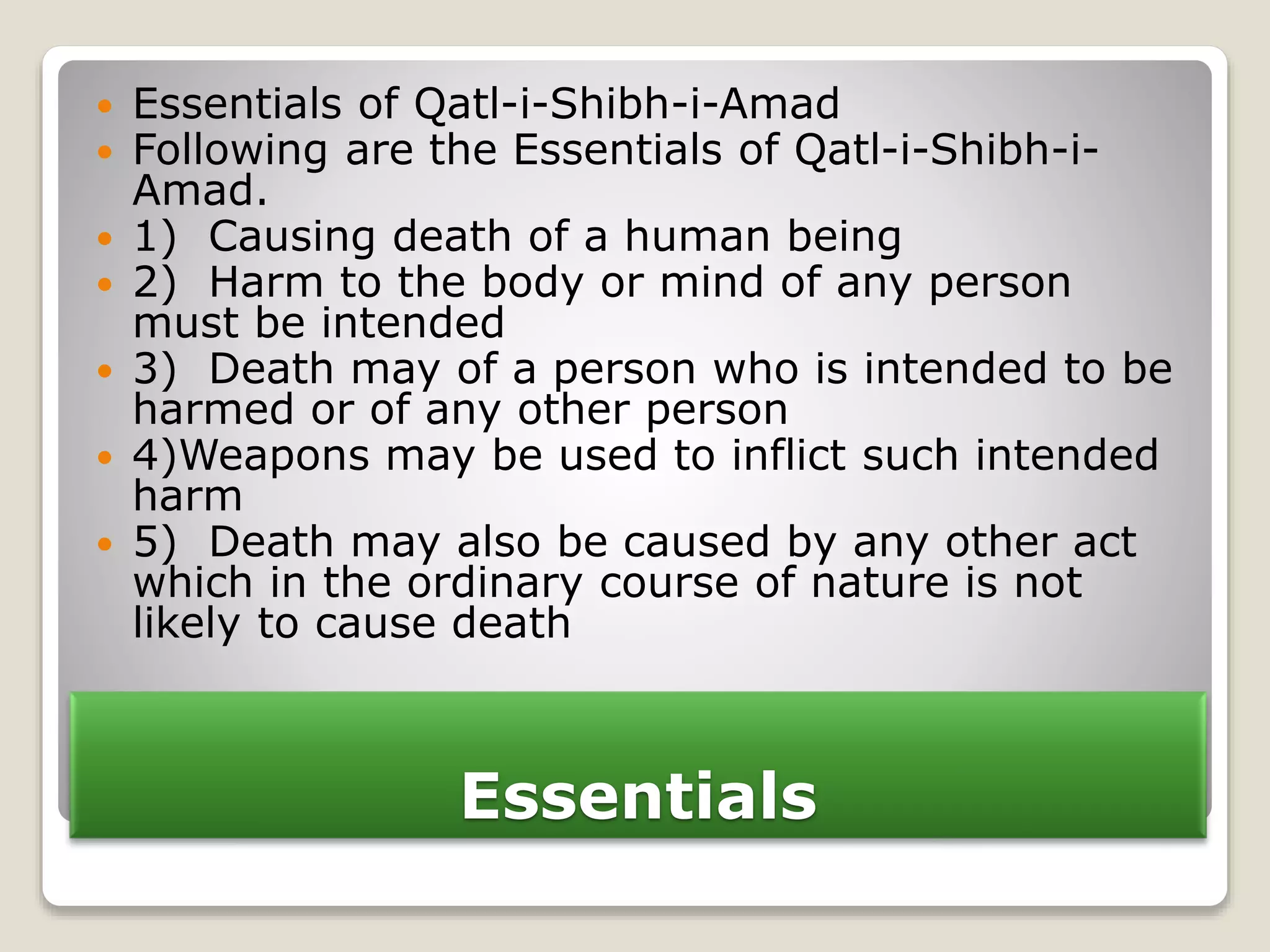
Essentials
 Essentials of Qatl-i-Shibh-i-Amad
 Following are the Essentials of Qatl-i-Shibh-i-
Amad.
 1) Causing death of a human being
 2) Harm to the body or mind of any person
must be intended
 3) Death may of a person who is intended to be
harmed or of any other person
 4)Weapons may be used to inflict such intended
harm
 5) Death may also be caused by any other act
which in the ordinary course of nature is not
likely to cause death
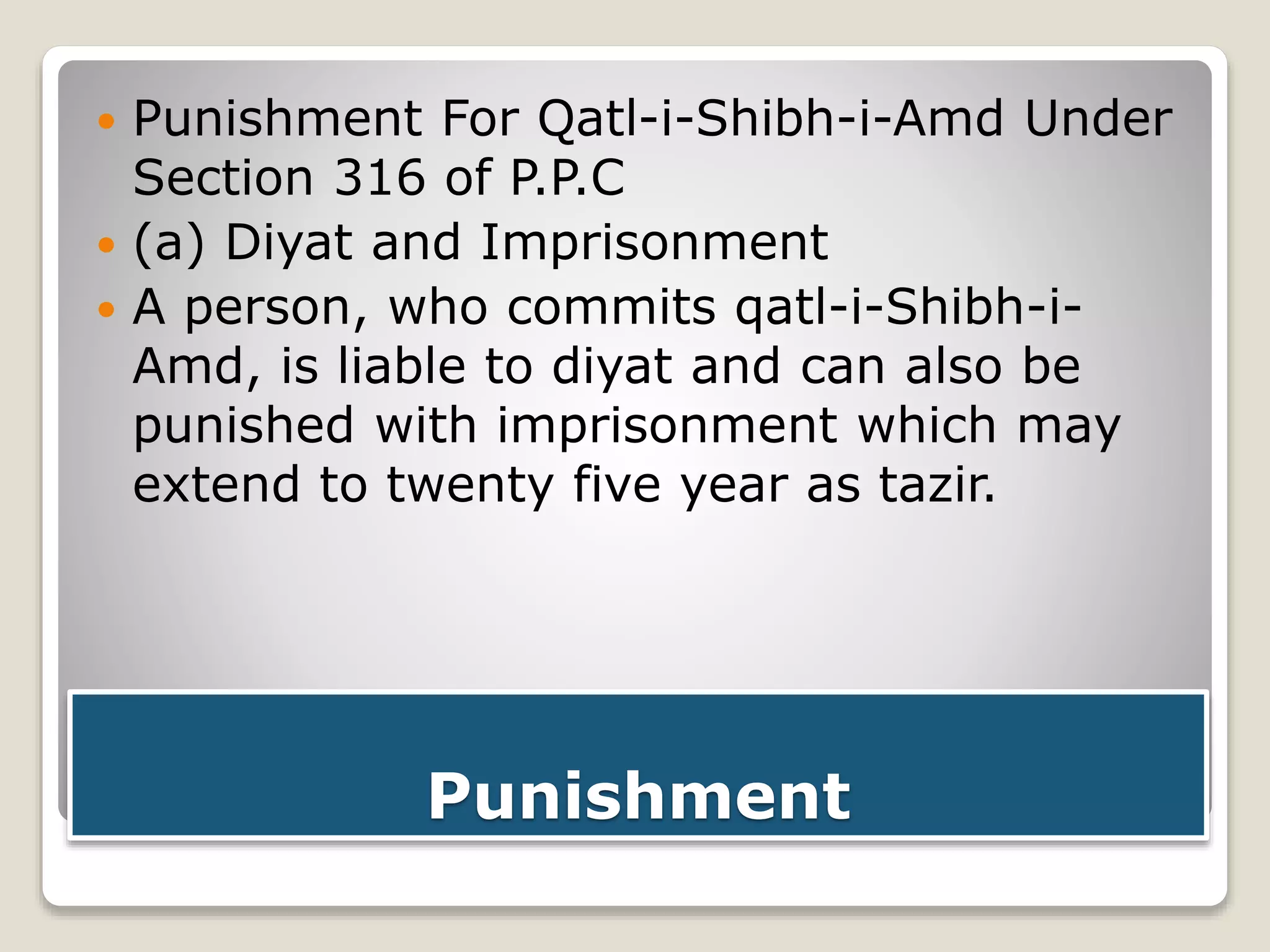
Punishment
 Punishment For Qatl-i-Shibh-i-Amd Under
Section 316 of P.P.C
 (a) Diyat and Imprisonment
 A person, who commits qatl-i-Shibh-i-
Amd, is liable to diyat and can also be
punished with imprisonment which may
extend to twenty five year as tazir.
Qatl-i-Khata
 (iii) Qatl-i-Khata
 When a person does not intend to cause
death of a person or cause harm to a
person, and causes death of such person
either by mistake of act or by mistake of
fact, he/she commits qatl-i-Khata.
Explanations
 Explanations
 A shoots at a deer but misses the target
and skills Z who is standing by A is guilty
of Qatal-i-Khata
 .
 A shoots at an object to be deer but it
turns out to be a human being A is guilty
of Qatl-i-Khata
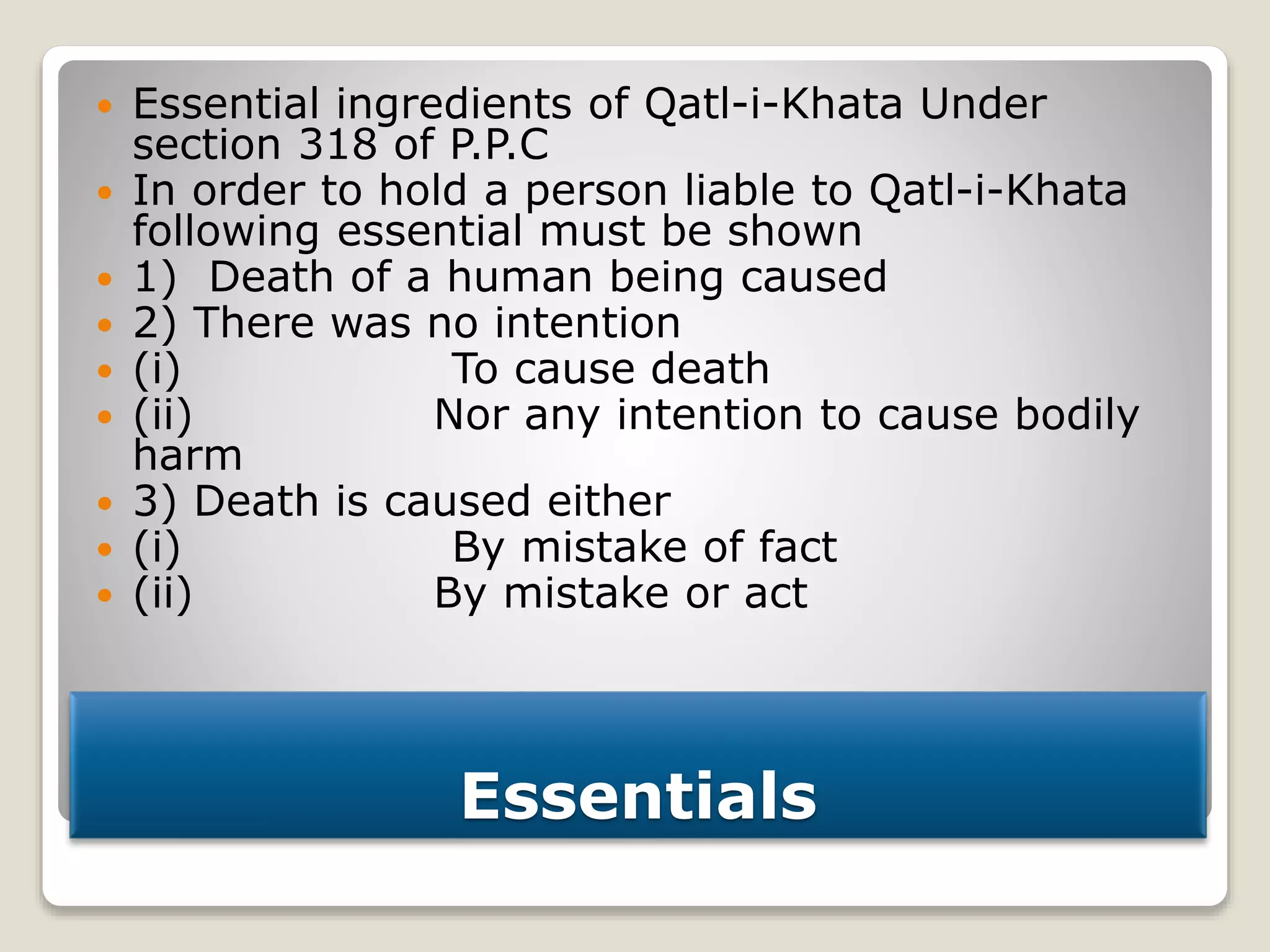
Essentials
 Essential ingredients of Qatl-i-Khata Under
section 318 of P.P.C
 In order to hold a person liable to Qatl-i-Khata
following essential must be shown
 1) Death of a human being caused
 2) There was no intention
 (i) To cause death
 (ii) Nor any intention to cause bodily
harm
 3) Death is caused either
 (i) By mistake of fact
 (ii) By mistake or act
Punishment
 Punishment of Qatl-i-Khata under section 319 of P.P.C
 (i) Diyat and Imprisonment
 A person who commits qatl-i-Khata, is liable to diyat.
 (ii) Punishment for Qatl-i-Khata by Any Rash or negligent
Act other than Rash or Negligent Driving
 A person, who commits qatl-i-Khata by any rash or
negligent act, which is other than rash or negligent driving,
he/she is not only liable to diyat, but is also punished with
imprisonment, which can extend to five years as tazir.
 (iii) Punishment by Rash or Negligent Driving
 A person, who commits qatl-i-Khata by rash or negligent
driving is not only liable to diyat, but is also punished with
imprisonment, which can extend to ten years.
Qatl-i-Bis-Sabab
 Qatl-i-Bis-Sabab
 When a person does not intend to cause
death of another person or cause harm to
another person, and does any unlawful
act, which becomes a cause of death of
this another person
Essentials
 Essentials ingredients of Qatl-i-Bis-Sabab
 Following are ingredients
 1) The death of a human being is caused
 2) There was no intention
 (i) To cause death, or
 (ii) Cause bodily harm to the
deceased
 3) An unlawful act is done by the offender
 4) Such unlawful act becomes the cause of
death of the deceased
 Punishment for Qatl-i-bis-sabab under
section 322 P.P.C
 Section 322 provides that whoever
commits Qatl-i-Bis-Sabab shall be liable to
Diyat only.

Qatl and its kinds (1)

  • 1.
  • 2.
    Qatl-e-Amd u/s 300 (i) Qatl-i-Amd  When a person intends to cause death or bodily injury to another person, does an act, which in ordinary course of nature is likely to cause death or which is done with knowledge that his act is so imminently dangerous that it must in all probability cause death, and causes death of such person, he/she commits qatl-i-amd.
  • 3.
    Essentials of Qatl-e-Amd Essential Ingredients of Qatl-e-Amd Under Section - 300 of P.P.C  The essential ingredients of the definition of Qatl-i- Amd as provided in the Pakistan Penal Code are as follows  1) Causing death of a human being  2) Such death must be caused by doing an act  3) With the intention of doing bodily injury to that person  4) The act in the ordinary course of nature is likely to cause death.  5) With the knowledge that the act is so imminently dangerous that it must in all probability cause death
  • 4.
    Illustrations  “A” shoots“Z” with the intention of killing him. “Z” dies in Consequences “A” commits this offence.
  • 5.
    Punishment of Qatl-e-Amd Followings punishments can be awarded against commission of Qatl-i-Amd  (i) Death as Qisas  A person, who commits Qatl-i-amd, can be punished with death as Qisas.  Qisas  Qisas means ‘to copy the other’ or ‘to follow the path followed by other’ or ‘to act like the act of another’. The basic principle of Qisas is similarity. If similarity of injury is not possible Qisas may not be enforce. In Qatl-i-Amd the difference between punishment of Qisas and punishment of death lies in the mode of execution of sentence.  (ii) Death or Imprisonment For life  The punishment of death or imprisonment for life as tazir especially when proof against commission of such qatl is not available through voluntary and true confession of convict before a court competent to try such qatl according to Article 17 of Qanun-e-Shahadat.  (iii) Imprisonment, which can extend to twenty five years  When punishment of Qisas is not applicable against commission of qatl-i-amd according to Injunctions of Islam, a person, who commits qatl-i-amd, can be punishment with imprisonment, which can extend to twenty-five years.
  • 6.
    Qatl Shibh-i-Amd  (ii)Qatl Shibh-i-Amd  When a person intends to cause harm to body or mind of any person, and causes death of that person or death of any other person by means of a weapon or an act which in ordinary course of nature is not likely to cause death, he/she commits qatl-shibh-i-amd.
  • 7.
    Illustration  Explanation  Ain order to cause hurt strikes Z with a stick which in ordinary course of nature is not likely to cause death, Z dies as a result of such hurt, A shall be guilty of Qatl-i-Shibh-i-Amd.
  • 8.
    Essentials  Essentials ofQatl-i-Shibh-i-Amad  Following are the Essentials of Qatl-i-Shibh-i- Amad.  1) Causing death of a human being  2) Harm to the body or mind of any person must be intended  3) Death may of a person who is intended to be harmed or of any other person  4)Weapons may be used to inflict such intended harm  5) Death may also be caused by any other act which in the ordinary course of nature is not likely to cause death
  • 9.
    Punishment  Punishment ForQatl-i-Shibh-i-Amd Under Section 316 of P.P.C  (a) Diyat and Imprisonment  A person, who commits qatl-i-Shibh-i- Amd, is liable to diyat and can also be punished with imprisonment which may extend to twenty five year as tazir.
  • 10.
    Qatl-i-Khata  (iii) Qatl-i-Khata When a person does not intend to cause death of a person or cause harm to a person, and causes death of such person either by mistake of act or by mistake of fact, he/she commits qatl-i-Khata.
  • 11.
    Explanations  Explanations  Ashoots at a deer but misses the target and skills Z who is standing by A is guilty of Qatal-i-Khata  .  A shoots at an object to be deer but it turns out to be a human being A is guilty of Qatl-i-Khata
  • 12.
    Essentials  Essential ingredientsof Qatl-i-Khata Under section 318 of P.P.C  In order to hold a person liable to Qatl-i-Khata following essential must be shown  1) Death of a human being caused  2) There was no intention  (i) To cause death  (ii) Nor any intention to cause bodily harm  3) Death is caused either  (i) By mistake of fact  (ii) By mistake or act
  • 13.
    Punishment  Punishment ofQatl-i-Khata under section 319 of P.P.C  (i) Diyat and Imprisonment  A person who commits qatl-i-Khata, is liable to diyat.  (ii) Punishment for Qatl-i-Khata by Any Rash or negligent Act other than Rash or Negligent Driving  A person, who commits qatl-i-Khata by any rash or negligent act, which is other than rash or negligent driving, he/she is not only liable to diyat, but is also punished with imprisonment, which can extend to five years as tazir.  (iii) Punishment by Rash or Negligent Driving  A person, who commits qatl-i-Khata by rash or negligent driving is not only liable to diyat, but is also punished with imprisonment, which can extend to ten years.
  • 14.
    Qatl-i-Bis-Sabab  Qatl-i-Bis-Sabab  Whena person does not intend to cause death of another person or cause harm to another person, and does any unlawful act, which becomes a cause of death of this another person
  • 15.
    Essentials  Essentials ingredientsof Qatl-i-Bis-Sabab  Following are ingredients  1) The death of a human being is caused  2) There was no intention  (i) To cause death, or  (ii) Cause bodily harm to the deceased  3) An unlawful act is done by the offender  4) Such unlawful act becomes the cause of death of the deceased
  • 16.
     Punishment forQatl-i-bis-sabab under section 322 P.P.C  Section 322 provides that whoever commits Qatl-i-Bis-Sabab shall be liable to Diyat only.