Many Health Systems Are Failing the
LGBTQ+ Community—Two Ways to Improve
© 2019 Health Catalyst
Proprietary. Feel free to share but we would appreciate a Health Catalyst citation.
Healthcare in the LGBTQ+ Community
For any healthcare consumer, finding the
right provider can be difficult. For members
of the LGBTQ+ community, this challenge
is amplified.
LGBTQ+ healthcare is multifaceted and
LGBTQ+ members often struggle for equity
in the U.S. healthcare system due to
stigma, stereotyping, lack of understanding,
or discrimination, contributing to increased
health risks and worse outcomes.
© 2019 Health Catalyst
Proprietary. Feel free to share but we would appreciate a Health Catalyst citation.
Healthcare in the LGBTQ+ Community
As a member of the Health Catalyst
Queers and Allies affinity group—a group
aimed at better understanding and
including members of the LGBTQ+
community—I want all my teammates to
feel valued, included, and empowered
to succeed.
The Queers and Allies group gives me an
opportunity to increase awareness about
the issues members of the LGBTQ+
community face and learn how to create
a safe environment in which they feel
accepted, valued, and supported.
© 2019 Health Catalyst
Proprietary. Feel free to share but we would appreciate a Health Catalyst citation.
Lack of Knowledge About the LGBTQ+ Community
Compromises Healthcare Delivery
I was recently talking with one of my teammates
about my early learning experiences as a newly
graduated registered nurse providing care to a
transgender patient.
At that time, my peers and I received little to no
training about caring for transgender people with
respect and sensitivity.
© 2019 Health Catalyst
Proprietary. Feel free to share but we would appreciate a Health Catalyst citation.
Lack of Knowledge About the LGBTQ+ Community
Compromises Healthcare Delivery
In this instance, the patient’s medical record
had two choices for “sex”—male or female.
The “male” option was marked, along with
the patient’s legal male name, rather than
her preferred female name.
The first day I cared for her, I addressed her
by her legal male name, inadvertently
upsetting her.
© 2019 Health Catalyst
Proprietary. Feel free to share but we would appreciate a Health Catalyst citation.
Lack of Knowledge About the LGBTQ+ Community
Compromises Healthcare Delivery
There was nowhere to document her preferred
female name, no mechanism for communica-
ting this information to the other staff, and no
effective way to prevent additional stress for
the patient as members of the care team
repeatedly addressed her using the incorrect
name and pronoun.
Ultimately, we hung a sign inside the patient’s
room—a common workaround for nurses
when we lack effective methods for handing
off critical information—with the patient’s
preferred name and pronouns in bold font.
© 2019 Health Catalyst
Proprietary. Feel free to share but we would appreciate a Health Catalyst citation.
LGBTQ+ Members Experience Stigma,
Discrimination, and Increased Health Risks
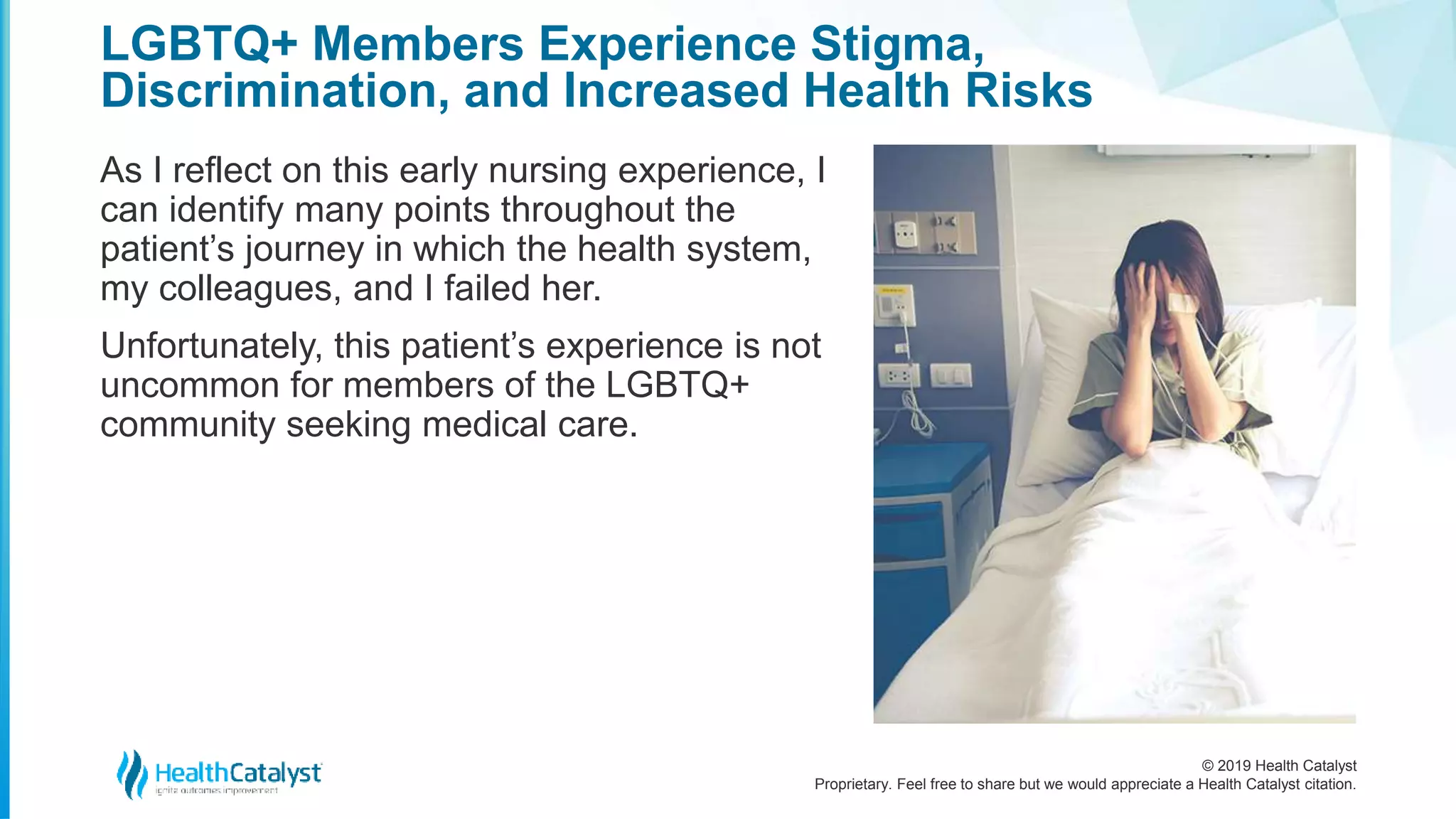
As I reflect on this early nursing experience, I
can identify many points throughout the
patient’s journey in which the health system,
my colleagues, and I failed her.
Unfortunately, this patient’s experience is not
uncommon for members of the LGBTQ+
community seeking medical care.
© 2019 Health Catalyst
Proprietary. Feel free to share but we would appreciate a Health Catalyst citation.
LGBTQ+ Members Experience Stigma,
Discrimination, and Increased Health Risks
This story illustrates the challenge
healthcare providers face and the critical
need to collect accurate sexual orientation
(SO) and gender identify (GI) information to
assess a person’s health and provide
competent care.
Without this information, providers struggle
to effectively identify health risks, offer the
right treatment, and address common health
disparities in the LGBTQ+ community.
© 2019 Health Catalyst
Proprietary. Feel free to share but we would appreciate a Health Catalyst citation.
LGBTQ+ Members Experience Stigma,
Discrimination, and Increased Health Risks
According to the Office of Disease Prevention and Health Promotion, LGBTQ+
people “face health disparities linked to societal stigma, discrimination, and
denial of their civil and human rights.” Some of these disparities can have
harmful, far-reaching effects on health:
Lesbians are more likely to
have risk factors for breast
cancer and less likely to
get preventive screenings
for breast and cervical
cancer.
Gay men have a higher
risk of HIV and other
sexually transmitted
diseases (STDs),
particularly among
communities of color.
Transgender individuals
are less likely to have
health insurance and have
a higher prevalence of
HIV/STDs as well as
mental health issues and
suicide.
Depression, illegal drug
use, risky sexual behavior,
and suicidality are even
higher among gay and
bisexual youth and among
transgender individuals
who are rejected by their
families.
Transgender women may have a
higher risk of breast cancer.
Lesbians experience higher rates of
substance abuse and smoking.
Gay men have increased risk for
prostate, testicular, and colon cancer.
© 2019 Health Catalyst
Proprietary. Feel free to share but we would appreciate a Health Catalyst citation.
LGBTQ+ Healthcare Dependent on Accurate Data
To reduce—and ultimately eliminate—
SO/GI disparities, organizations must
provide a welcoming, safe environment in
which LGBTQ+ people trust the healthcare
providers enough to share their SO/GI
information.
Despite recommendations to collect SO/GI
data in the EHR from the National Academy
of Medicine, the Joint Commission, and the
Health Resources and Services, most
healthcare organizations do not have a
system that accurately captures this data.
© 2019 Health Catalyst
Proprietary. Feel free to share but we would appreciate a Health Catalyst citation.
LGBTQ+ Healthcare Dependent on Accurate Data
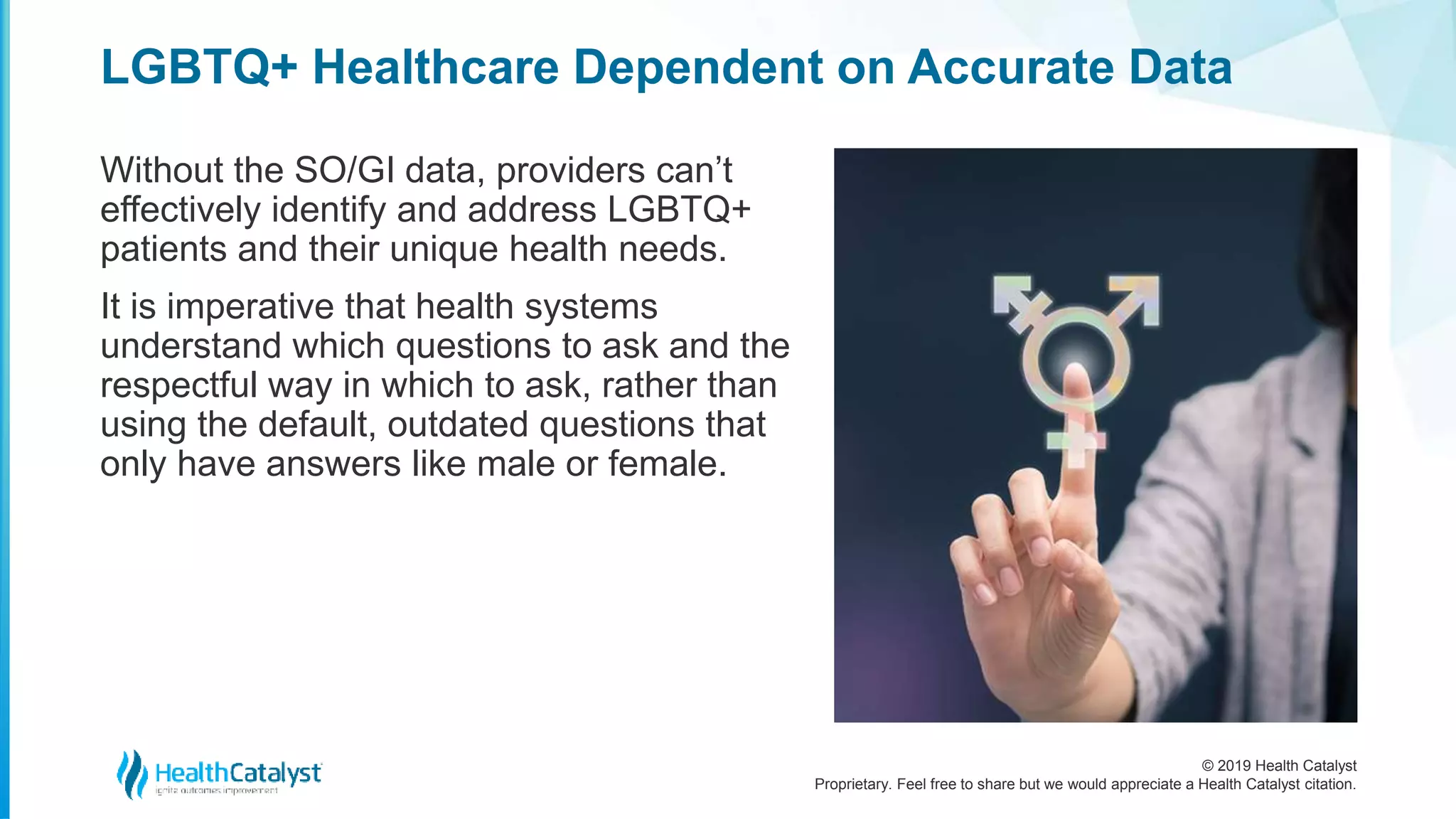
Without the SO/GI data, providers can’t
effectively identify and address LGBTQ+
patients and their unique health needs.
It is imperative that health systems
understand which questions to ask and the
respectful way in which to ask, rather than
using the default, outdated questions that
only have answers like male or female.
© 2019 Health Catalyst
Proprietary. Feel free to share but we would appreciate a Health Catalyst citation.
The CDC Advises on the Best Way to Collect Sexual
Orientation/Gender Identity Data
The CDC recommends that health systems
ask an updated list of questions and
responses that replace basic questions like,
“Sex: male or female?” on patient
information forms and in the EMR.
Asking SO/GI questions provide more
relevant clinical data, particularly for
transgender patients.
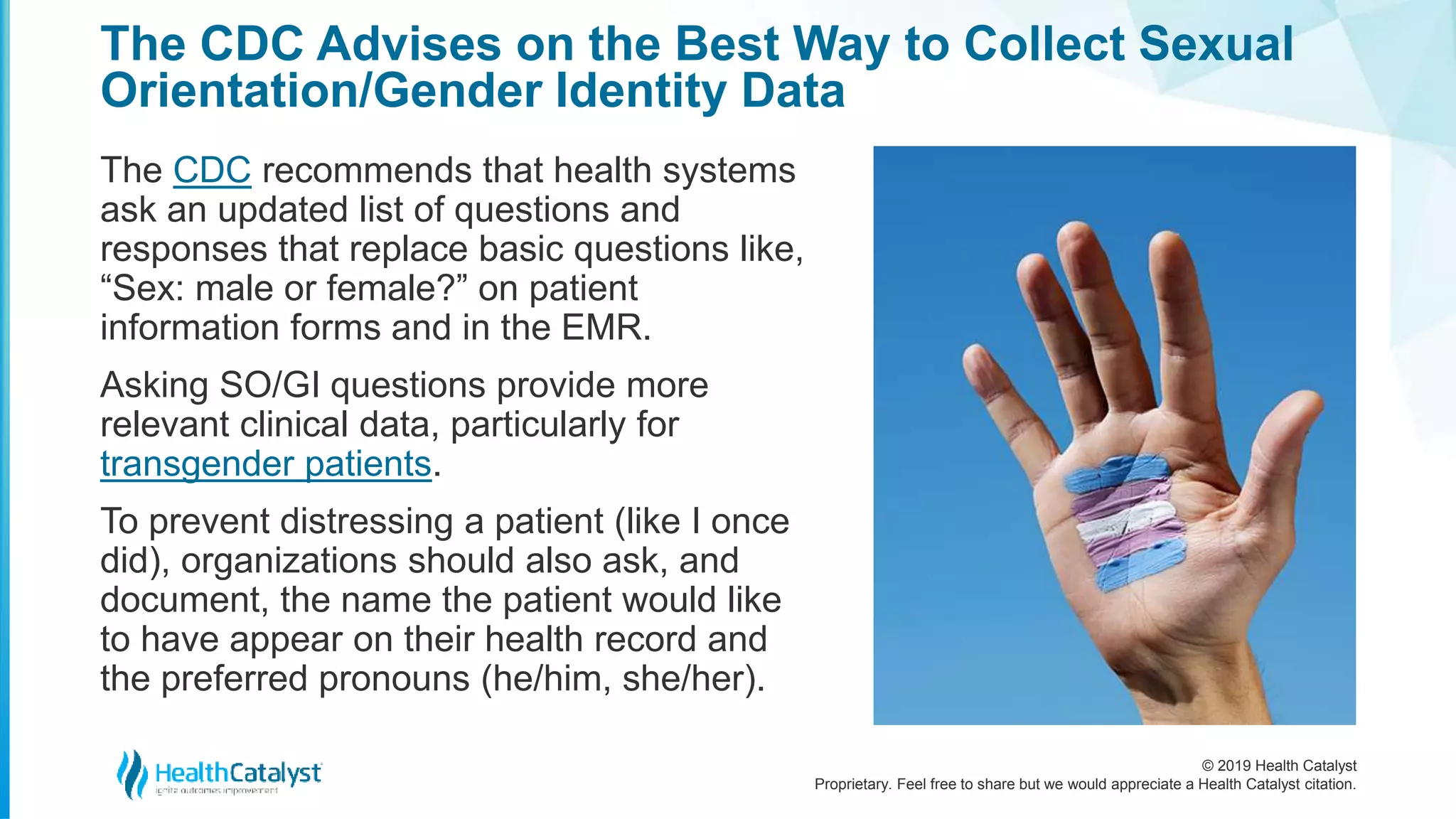
To prevent distressing a patient (like I once
did), organizations should also ask, and
document, the name the patient would like
to have appear on their health record and
the preferred pronouns (he/him, she/her).
© 2019 Health Catalyst
Proprietary. Feel free to share but we would appreciate a Health Catalyst citation.
The CDC Advises on the Best Way to Collect Sexual
Orientation/Gender Identity Data
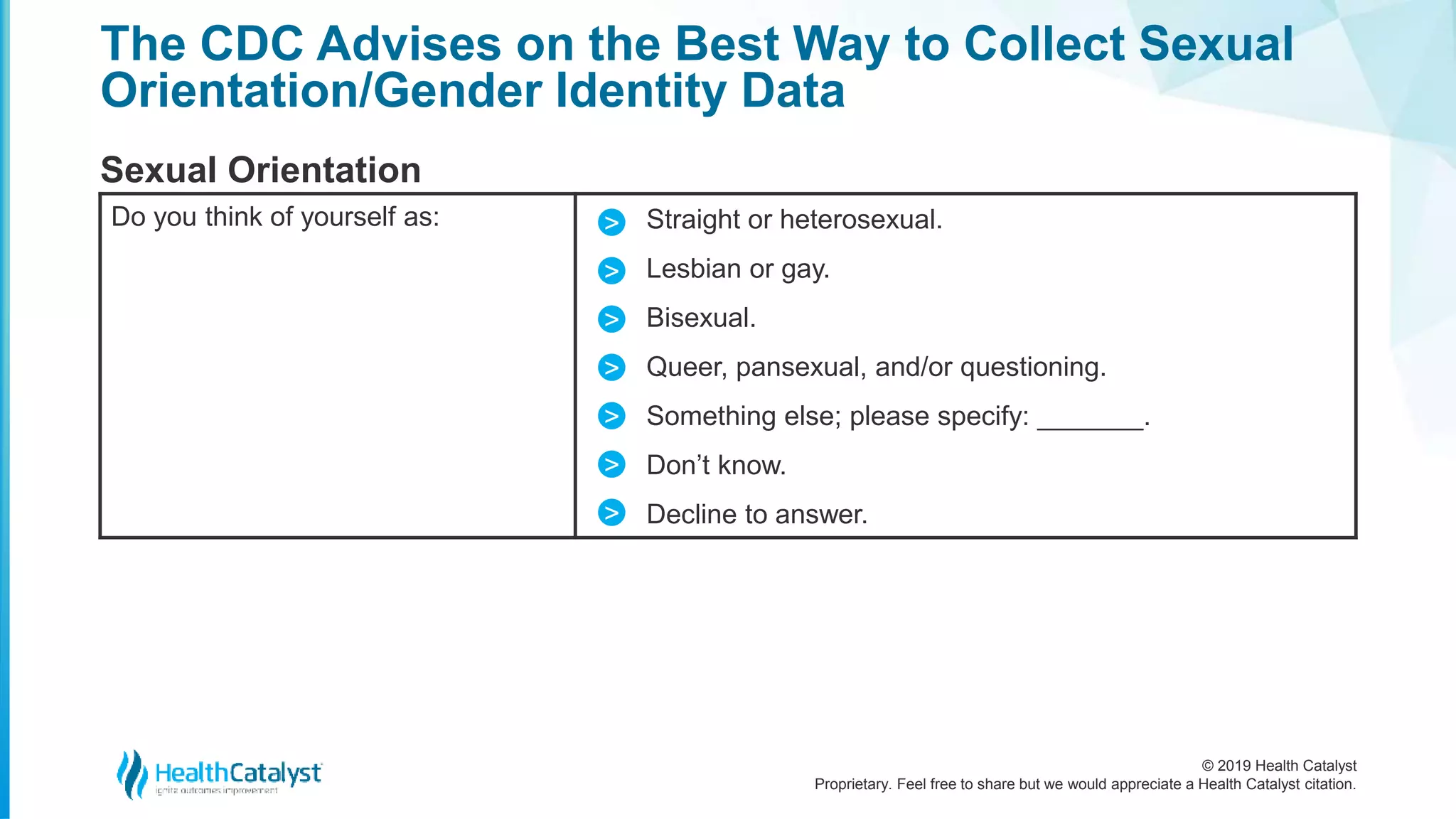
Sexual Orientation
Do you think of yourself as: Straight or heterosexual.
Lesbian or gay.
Bisexual.
Queer, pansexual, and/or questioning.
Something else; please specify: _______.
Don’t know.
Decline to answer.
>
>
>
>
>
>
>
© 2019 Health Catalyst
Proprietary. Feel free to share but we would appreciate a Health Catalyst citation.
The CDC Advises on the Best Way to Collect Sexual
Orientation/Gender Identity Data
Gender Identity
Do you think of yourself as: Male.
Female.
Transgender man/trans man/female-to-male (FTM).
Transgender woman/trans woman/male-to-female (MTF).
Genderqueer/Gender nonconforming neither exclusively
male nor female.
Additional gender category (or other); please
specify: ______________________.
Decline to answer.
What sex was originally listed on
your birth certificate?
Male.
Female.
Decline to answer.
>
>
>
>
>
>
>
>
>
>
© 2019 Health Catalyst
Proprietary. Feel free to share but we would appreciate a Health Catalyst citation.
Trust Proves Key to Collecting Accurate Health
Information, Providing Patient-Centric Care
The challenge of providing care to LGBTQ+
members also highlights the role of trust in
the clinical setting. If patients do not trust
providers or health systems, medical efforts
are futile.
However, if health systems and providers
take measures to learn more about
marginalized groups, like the LGBTQ+
community, address them with preferred
names, and collect information in a
sensitive way, trust will start to build.
© 2019 Health Catalyst
Proprietary. Feel free to share but we would appreciate a Health Catalyst citation.
Trust Proves Key to Collecting Accurate Health
Information, Providing Patient-Centric Care
When patients trust their providers and health
systems, they disclose honest, accurate
information about their gender, sexual orientation,
lifestyle, and even feel safe to ask questions.
With this increased knowledge, clinicians can
provide more targeted care to the patient and
provide comprehensive care—considering
factors, like lifestyle, that they may not have
known before—and help each patient reach
optimum health, while breaking down stigmas
about the LGBTQ+ community at the same time.
© 2019 Health Catalyst
Proprietary. Feel free to share but we would appreciate a Health Catalyst citation.
For more information:
“This book is a fantastic piece of work”
– Robert Lindeman MD, FAAP, Chief Physician Quality Officer
© 2019 Health Catalyst
Proprietary. Feel free to share but we would appreciate a Health Catalyst citation.
More about this topic
Link to original article for a more in-depth discussion.
Many Health Systems Are Failing the LGBTQ+ Community—Two Ways to Improve
The Top Five Recommendations for Improving the Patient Experience
Anne Marie Bickmore, Sr. VP, Company Operations; Kathleen Merkley, DNP, APRN, FNP, Sr. VP of Professional Services
Improve Patient Satisfaction: 5 Things Healthcare Organizations Can Learn From Disney
Josh Ferguson APRN, ACNP, ANP-BC, VP of Clinical Outcomes Improvement
How Great Patient Satisfaction Metrics Can Be Achieved in a Regional Medical Center
Greg Stock, MPA
Identifying Vulnerable Patients and Why They Matter
KimSu Marder, RN, CCM, Lead Care Manager
How to Use Data to Improve Patient Safety (Executive Report)
Stan Pestotnik, MS, RPh, Patient Safety Products, VP
© 2019 Health Catalyst
Proprietary. Feel free to share but we would appreciate a Health Catalyst citation.
Other Clinical Quality Improvement Resources
Click to read additional information at www.healthcatalyst.com
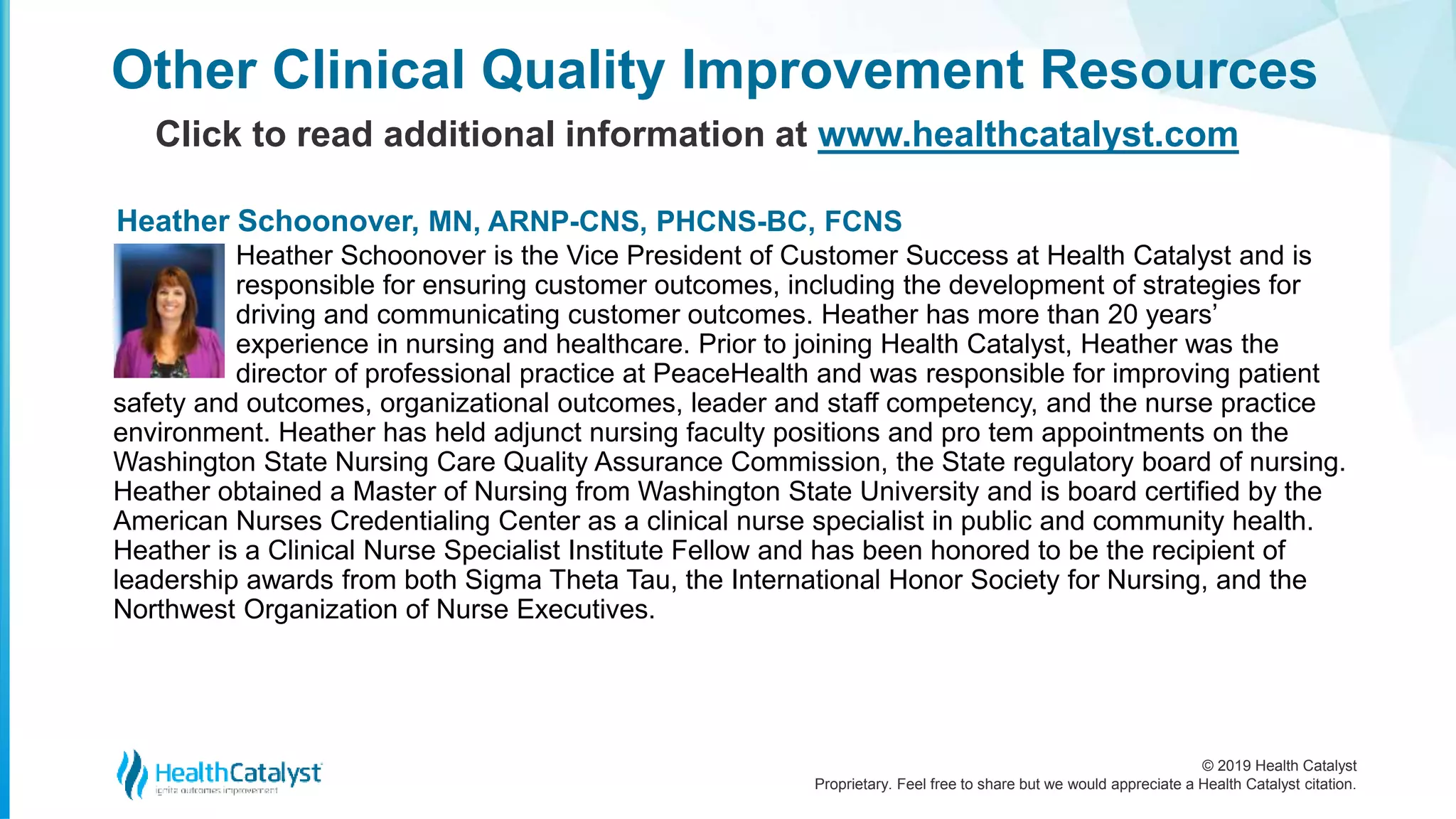
Heather Schoonover is the Vice President of Customer Success at Health Catalyst and is
responsible for ensuring customer outcomes, including the development of strategies for
driving and communicating customer outcomes. Heather has more than 20 years’
experience in nursing and healthcare. Prior to joining Health Catalyst, Heather was the
director of professional practice at PeaceHealth and was responsible for improving patient
safety and outcomes, organizational outcomes, leader and staff competency, and the nurse practice
environment. Heather has held adjunct nursing faculty positions and pro tem appointments on the
Washington State Nursing Care Quality Assurance Commission, the State regulatory board of nursing.
Heather obtained a Master of Nursing from Washington State University and is board certified by the
American Nurses Credentialing Center as a clinical nurse specialist in public and community health.
Heather is a Clinical Nurse Specialist Institute Fellow and has been honored to be the recipient of
leadership awards from both Sigma Theta Tau, the International Honor Society for Nursing, and the
Northwest Organization of Nurse Executives.
Heather Schoonover, MN, ARNP-CNS, PHCNS-BC, FCNS
© 2019 Health Catalyst
Proprietary. Feel free to share but we would appreciate a Health Catalyst citation.
Other Clinical Quality Improvement Resources
Click to read additional information at www.healthcatalyst.com
Health Catalyst is a mission-driven data warehousing, analytics and outcomes-improvement company
that helps healthcare organizations of all sizes improve clinical, financial, and operational outcomes
needed to improve population health and accountable care. Our proven enterprise data warehouse
(EDW) and analytics platform helps improve quality, add efficiency and lower costs in support of more
than 65 million patients for organizations ranging from the largest US health system to forward-thinking
physician practices.
Health Catalyst was recently named as the leader in the enterprise healthcare BI market in
improvement by KLAS, and has received numerous best-place-to work awards including Modern
Healthcare in 2013, 2014, and 2015, as well as other recognitions such as “Best Place to work for
Millenials, and a “Best Perks for Women.”

Many Health Systems Are Failing the LGBTQ+ Community—Two Ways to Improve

  • 1.
    Many Health SystemsAre Failing the LGBTQ+ Community—Two Ways to Improve
  • 2.
    © 2019 HealthCatalyst Proprietary. Feel free to share but we would appreciate a Health Catalyst citation. Healthcare in the LGBTQ+ Community For any healthcare consumer, finding the right provider can be difficult. For members of the LGBTQ+ community, this challenge is amplified. LGBTQ+ healthcare is multifaceted and LGBTQ+ members often struggle for equity in the U.S. healthcare system due to stigma, stereotyping, lack of understanding, or discrimination, contributing to increased health risks and worse outcomes.
  • 3.
    © 2019 HealthCatalyst Proprietary. Feel free to share but we would appreciate a Health Catalyst citation. Healthcare in the LGBTQ+ Community As a member of the Health Catalyst Queers and Allies affinity group—a group aimed at better understanding and including members of the LGBTQ+ community—I want all my teammates to feel valued, included, and empowered to succeed. The Queers and Allies group gives me an opportunity to increase awareness about the issues members of the LGBTQ+ community face and learn how to create a safe environment in which they feel accepted, valued, and supported.
  • 4.
    © 2019 HealthCatalyst Proprietary. Feel free to share but we would appreciate a Health Catalyst citation. Lack of Knowledge About the LGBTQ+ Community Compromises Healthcare Delivery I was recently talking with one of my teammates about my early learning experiences as a newly graduated registered nurse providing care to a transgender patient. At that time, my peers and I received little to no training about caring for transgender people with respect and sensitivity.
  • 5.
    © 2019 HealthCatalyst Proprietary. Feel free to share but we would appreciate a Health Catalyst citation. Lack of Knowledge About the LGBTQ+ Community Compromises Healthcare Delivery In this instance, the patient’s medical record had two choices for “sex”—male or female. The “male” option was marked, along with the patient’s legal male name, rather than her preferred female name. The first day I cared for her, I addressed her by her legal male name, inadvertently upsetting her.
  • 6.
    © 2019 HealthCatalyst Proprietary. Feel free to share but we would appreciate a Health Catalyst citation. Lack of Knowledge About the LGBTQ+ Community Compromises Healthcare Delivery There was nowhere to document her preferred female name, no mechanism for communica- ting this information to the other staff, and no effective way to prevent additional stress for the patient as members of the care team repeatedly addressed her using the incorrect name and pronoun. Ultimately, we hung a sign inside the patient’s room—a common workaround for nurses when we lack effective methods for handing off critical information—with the patient’s preferred name and pronouns in bold font.
  • 7.
    © 2019 HealthCatalyst Proprietary. Feel free to share but we would appreciate a Health Catalyst citation. LGBTQ+ Members Experience Stigma, Discrimination, and Increased Health Risks As I reflect on this early nursing experience, I can identify many points throughout the patient’s journey in which the health system, my colleagues, and I failed her. Unfortunately, this patient’s experience is not uncommon for members of the LGBTQ+ community seeking medical care.
  • 8.
    © 2019 HealthCatalyst Proprietary. Feel free to share but we would appreciate a Health Catalyst citation. LGBTQ+ Members Experience Stigma, Discrimination, and Increased Health Risks This story illustrates the challenge healthcare providers face and the critical need to collect accurate sexual orientation (SO) and gender identify (GI) information to assess a person’s health and provide competent care. Without this information, providers struggle to effectively identify health risks, offer the right treatment, and address common health disparities in the LGBTQ+ community.
  • 9.
    © 2019 HealthCatalyst Proprietary. Feel free to share but we would appreciate a Health Catalyst citation. LGBTQ+ Members Experience Stigma, Discrimination, and Increased Health Risks According to the Office of Disease Prevention and Health Promotion, LGBTQ+ people “face health disparities linked to societal stigma, discrimination, and denial of their civil and human rights.” Some of these disparities can have harmful, far-reaching effects on health: Lesbians are more likely to have risk factors for breast cancer and less likely to get preventive screenings for breast and cervical cancer. Gay men have a higher risk of HIV and other sexually transmitted diseases (STDs), particularly among communities of color. Transgender individuals are less likely to have health insurance and have a higher prevalence of HIV/STDs as well as mental health issues and suicide. Depression, illegal drug use, risky sexual behavior, and suicidality are even higher among gay and bisexual youth and among transgender individuals who are rejected by their families. Transgender women may have a higher risk of breast cancer. Lesbians experience higher rates of substance abuse and smoking. Gay men have increased risk for prostate, testicular, and colon cancer.
  • 10.
    © 2019 HealthCatalyst Proprietary. Feel free to share but we would appreciate a Health Catalyst citation. LGBTQ+ Healthcare Dependent on Accurate Data To reduce—and ultimately eliminate— SO/GI disparities, organizations must provide a welcoming, safe environment in which LGBTQ+ people trust the healthcare providers enough to share their SO/GI information. Despite recommendations to collect SO/GI data in the EHR from the National Academy of Medicine, the Joint Commission, and the Health Resources and Services, most healthcare organizations do not have a system that accurately captures this data.
  • 11.
    © 2019 HealthCatalyst Proprietary. Feel free to share but we would appreciate a Health Catalyst citation. LGBTQ+ Healthcare Dependent on Accurate Data Without the SO/GI data, providers can’t effectively identify and address LGBTQ+ patients and their unique health needs. It is imperative that health systems understand which questions to ask and the respectful way in which to ask, rather than using the default, outdated questions that only have answers like male or female.
  • 12.
    © 2019 HealthCatalyst Proprietary. Feel free to share but we would appreciate a Health Catalyst citation. The CDC Advises on the Best Way to Collect Sexual Orientation/Gender Identity Data The CDC recommends that health systems ask an updated list of questions and responses that replace basic questions like, “Sex: male or female?” on patient information forms and in the EMR. Asking SO/GI questions provide more relevant clinical data, particularly for transgender patients. To prevent distressing a patient (like I once did), organizations should also ask, and document, the name the patient would like to have appear on their health record and the preferred pronouns (he/him, she/her).
  • 13.
    © 2019 HealthCatalyst Proprietary. Feel free to share but we would appreciate a Health Catalyst citation. The CDC Advises on the Best Way to Collect Sexual Orientation/Gender Identity Data Sexual Orientation Do you think of yourself as: Straight or heterosexual. Lesbian or gay. Bisexual. Queer, pansexual, and/or questioning. Something else; please specify: _______. Don’t know. Decline to answer. > > > > > > >
  • 14.
    © 2019 HealthCatalyst Proprietary. Feel free to share but we would appreciate a Health Catalyst citation. The CDC Advises on the Best Way to Collect Sexual Orientation/Gender Identity Data Gender Identity Do you think of yourself as: Male. Female. Transgender man/trans man/female-to-male (FTM). Transgender woman/trans woman/male-to-female (MTF). Genderqueer/Gender nonconforming neither exclusively male nor female. Additional gender category (or other); please specify: ______________________. Decline to answer. What sex was originally listed on your birth certificate? Male. Female. Decline to answer. > > > > > > > > > >
  • 15.
    © 2019 HealthCatalyst Proprietary. Feel free to share but we would appreciate a Health Catalyst citation. Trust Proves Key to Collecting Accurate Health Information, Providing Patient-Centric Care The challenge of providing care to LGBTQ+ members also highlights the role of trust in the clinical setting. If patients do not trust providers or health systems, medical efforts are futile. However, if health systems and providers take measures to learn more about marginalized groups, like the LGBTQ+ community, address them with preferred names, and collect information in a sensitive way, trust will start to build.
  • 16.
    © 2019 HealthCatalyst Proprietary. Feel free to share but we would appreciate a Health Catalyst citation. Trust Proves Key to Collecting Accurate Health Information, Providing Patient-Centric Care When patients trust their providers and health systems, they disclose honest, accurate information about their gender, sexual orientation, lifestyle, and even feel safe to ask questions. With this increased knowledge, clinicians can provide more targeted care to the patient and provide comprehensive care—considering factors, like lifestyle, that they may not have known before—and help each patient reach optimum health, while breaking down stigmas about the LGBTQ+ community at the same time.
  • 17.
    © 2019 HealthCatalyst Proprietary. Feel free to share but we would appreciate a Health Catalyst citation. For more information: “This book is a fantastic piece of work” – Robert Lindeman MD, FAAP, Chief Physician Quality Officer
  • 18.
    © 2019 HealthCatalyst Proprietary. Feel free to share but we would appreciate a Health Catalyst citation. More about this topic Link to original article for a more in-depth discussion. Many Health Systems Are Failing the LGBTQ+ Community—Two Ways to Improve The Top Five Recommendations for Improving the Patient Experience Anne Marie Bickmore, Sr. VP, Company Operations; Kathleen Merkley, DNP, APRN, FNP, Sr. VP of Professional Services Improve Patient Satisfaction: 5 Things Healthcare Organizations Can Learn From Disney Josh Ferguson APRN, ACNP, ANP-BC, VP of Clinical Outcomes Improvement How Great Patient Satisfaction Metrics Can Be Achieved in a Regional Medical Center Greg Stock, MPA Identifying Vulnerable Patients and Why They Matter KimSu Marder, RN, CCM, Lead Care Manager How to Use Data to Improve Patient Safety (Executive Report) Stan Pestotnik, MS, RPh, Patient Safety Products, VP
  • 19.
    © 2019 HealthCatalyst Proprietary. Feel free to share but we would appreciate a Health Catalyst citation. Other Clinical Quality Improvement Resources Click to read additional information at www.healthcatalyst.com Heather Schoonover is the Vice President of Customer Success at Health Catalyst and is responsible for ensuring customer outcomes, including the development of strategies for driving and communicating customer outcomes. Heather has more than 20 years’ experience in nursing and healthcare. Prior to joining Health Catalyst, Heather was the director of professional practice at PeaceHealth and was responsible for improving patient safety and outcomes, organizational outcomes, leader and staff competency, and the nurse practice environment. Heather has held adjunct nursing faculty positions and pro tem appointments on the Washington State Nursing Care Quality Assurance Commission, the State regulatory board of nursing. Heather obtained a Master of Nursing from Washington State University and is board certified by the American Nurses Credentialing Center as a clinical nurse specialist in public and community health. Heather is a Clinical Nurse Specialist Institute Fellow and has been honored to be the recipient of leadership awards from both Sigma Theta Tau, the International Honor Society for Nursing, and the Northwest Organization of Nurse Executives. Heather Schoonover, MN, ARNP-CNS, PHCNS-BC, FCNS
  • 20.
    © 2019 HealthCatalyst Proprietary. Feel free to share but we would appreciate a Health Catalyst citation. Other Clinical Quality Improvement Resources Click to read additional information at www.healthcatalyst.com Health Catalyst is a mission-driven data warehousing, analytics and outcomes-improvement company that helps healthcare organizations of all sizes improve clinical, financial, and operational outcomes needed to improve population health and accountable care. Our proven enterprise data warehouse (EDW) and analytics platform helps improve quality, add efficiency and lower costs in support of more than 65 million patients for organizations ranging from the largest US health system to forward-thinking physician practices. Health Catalyst was recently named as the leader in the enterprise healthcare BI market in improvement by KLAS, and has received numerous best-place-to work awards including Modern Healthcare in 2013, 2014, and 2015, as well as other recognitions such as “Best Place to work for Millenials, and a “Best Perks for Women.”