© Health Catalyst. Confidential and Proprietary.
HAS 22 Day 2:
Healthcare Analytics’
Biggest Party Wraps Up
© Health Catalyst. Confidential and Proprietary.
Health Catalyst Editors
Article
Summary
Day 1 of HAS 22 may have looked like a hard act to
follow, but Day 2 did not disappoint! From early risers for
the fun run/walk to a full day of keynotes, featured
speakers, breakout sessions, and more, summit
attendees learned new ways to look at data and
analytics, how we relate to information and each other,
and new perspectives for making the healthcare
ecosystem–and world at large–a better place.
© Health Catalyst. Confidential and Proprietary.
HAS 22 Day 2
Day One of HAS 22 may have looked like a hard
act to follow, but Day Two did not disappoint!
From early risers for the fun run/walk to a full day
of keynotes, featured speakers, breakout
sessions, and more, summit attendees learned
new ways to look at data and analytics, how we
relate to information and each other, and new
perspectives for making the healthcare
ecosystem–and world at large–a better place.
Healthcare Analytics’ Biggest Party Wraps Up
© Health Catalyst. Confidential and Proprietary.
Featured Speaker Session:
Penny Wheeler, MD
© Health Catalyst. Confidential and Proprietary.
Featured Speaker Session
In short, it’s about meaning. After decades in
healthcare–as a practicing OBGYN, Chief
Clinical Officer, and CEO of Allina Health–
Penny Wheeler, MD, shared her insights on
Measures That (Really) Matter. Her leadership
lesson for HAS 22 attendees was “never forget
whom you’re serving and why.”
Penny Wheeler, MD, Former CEO, Allina Health
© Health Catalyst. Confidential and Proprietary.
Featured Speaker Session: Penny Wheeler, MD
The last few years have indelibly impacted
healthcare and highlighted social disparities.
In addition to a global pandemic, Allina
Health’s Minneapolis HQ placed them in the
middle of the unrest following George
Floyd’s murder. The organization was
determined to make and measure a
meaningful impact in its community.
How the World Has Turned
© Health Catalyst. Confidential and Proprietary.
Featured Speaker Session: Penny Wheeler, MD
Allina signed a pledge with healthcare systems, payers, and clinics, to fight the dual pandemic of
COVID and racism. And then they set about turning words into action.
What Is Asked of Us and How We Might Get There
They looked at their various roles and
where they could make a difference:
 Provider: Provide quality healthcare to all.
 Employer: Employ and promote diverse
groups.
 Purchaser: Invest in the right things,
people, and populations.
 Community member: Understand
community needs and how to best
partner with them. Then design for it.
They created a comprehensive scorecard
for patient-reported outcomes that are:
 Psychometrically sound.
 Person-centered.
 Meaningful to the person.
 Amenable to change.
 Implementable.
© Health Catalyst. Confidential and Proprietary.
Featured Speaker Session: Penny Wheeler, MD
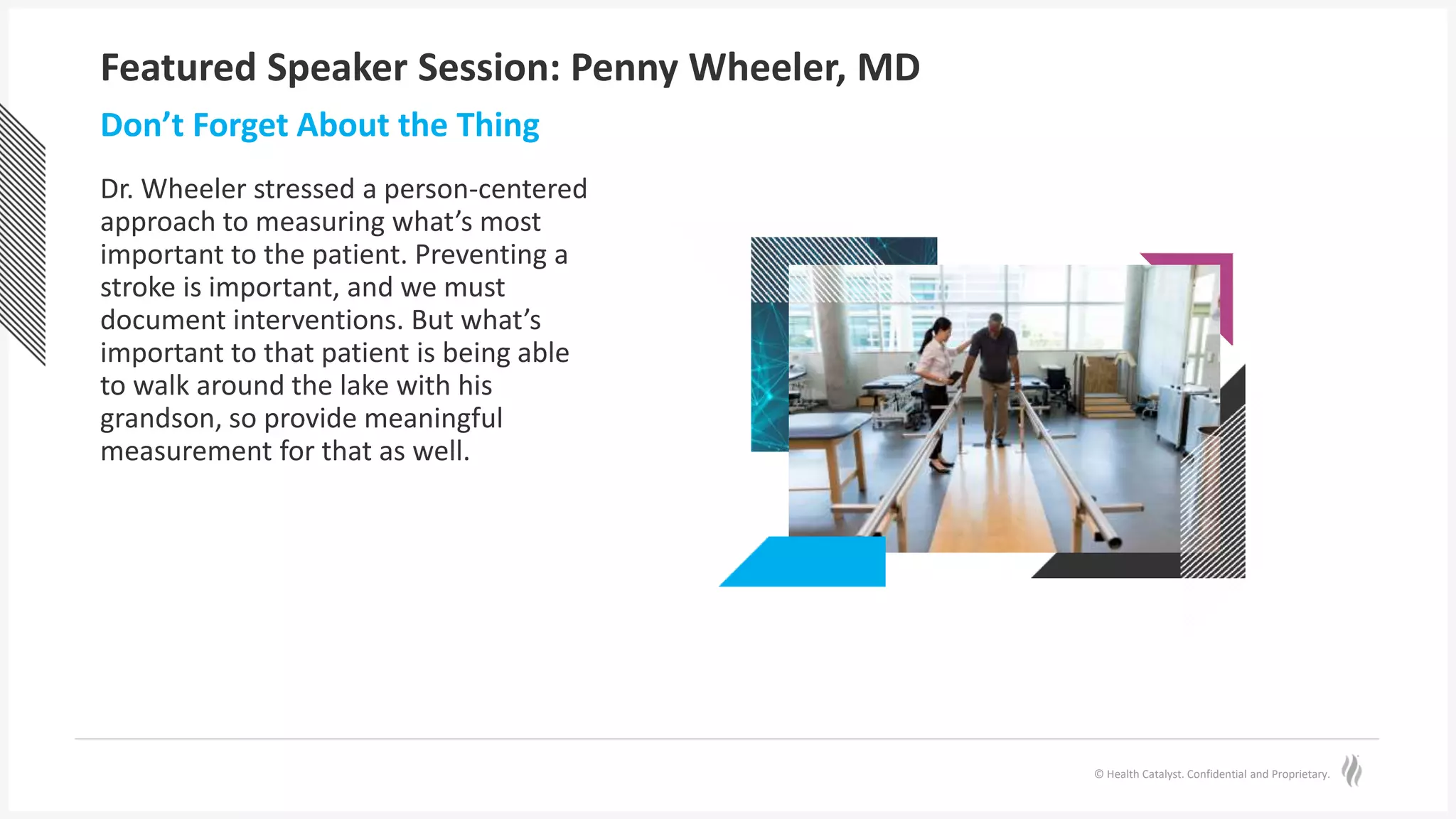
Dr. Wheeler stressed a person-centered
approach to measuring what’s most
important to the patient. Preventing a
stroke is important, and we must
document interventions. But what’s
important to that patient is being able
to walk around the lake with his
grandson, so provide meaningful
measurement for that as well.
Don’t Forget About the Thing
© Health Catalyst. Confidential and Proprietary.
Featured Speaker Session:
Matthew Luhn
© Health Catalyst. Confidential and Proprietary.
Featured Speaker Session
How do you tell a great story? In his keynote address, Matthew Luhn shared
how he approaches storytelling. As Lead Animator and Storyteller at Pixar
Studios, he brought audiences stories that were memorable, impactful, and
personal. Through movies like Toy Story, Up, and Ratatouille, he crafted stories
that made audiences feel empathy, anticipation, excitement, and happiness. He
shared how to create an inspiring story like those:
 A Great Hook. The average human attention span is 8 seconds – share something
unusual, or unexpected. Put the audience in the middle of the action or conflict to
really grab their attention. Take the ordinary and make it different – make your
audience curious about what’s coming next.
 Inspire Change. Great stories are about transformation – they inspire us that
change, try new things, and be better people.
Former Lead Animator and Storyteller, Pixar Studios
© Health Catalyst. Confidential and Proprietary.
Featured Speaker Session
How to create an inspiring story continued:
 Make a Connection. Stories can be universal or hyper-focused, but to connect with a
specific audience, they must be authentic – use themes like the desire for love, safety,
and freedom or fear of failure, abandonment, and not belonging to meaningfully impact
the audience.
 Don’t Neglect Structure: Every great story has a beginning, middle, and end. The
beginning gets the audience’s attention, the middle crafts the plot, and the end is the
most important part.
Luhn closed his remarks by reminding the audience that in the end, people will
remember how the story made them feel, those are the stories that will win.
Former Lead Animator and Storyteller, Pixar Studios
© Health Catalyst. Confidential and Proprietary.
Featured Speaker Session:
Jason Jones, PhD,
Stephanie Jackson, MD, FHM,
and Lisa Taylor, MS
© Health Catalyst. Confidential and Proprietary.
Featured Speaker Session
 Jason Jones, PhD, Chief Analytics and Data Science Officer, General Manager of Data and
Analytics Platform, Health Catalyst
 Stephanie Jackson, MD, FHM, Senior Vice President, Chief Clinical Officer, HonorHealth
 Lisa Taylor, MS, Vice President of Analytics, HonorHealth
Jason Jones, Stephanie Jackson, Lisa Taylor
Healthcare has largely focused its use of predictive and
prescriptive models at the point of care. Moving
forward, however, healthcare leadership is recognizing
critical opportunities for augmented intelligence (AI) at
the executive level. To dive deep into AI’s potential in
leadership decision making, Jason Jones, PhD, Chief
Analytics and Data Science Officer, General Manager of
Data and Analytics Platform, Health Catalyst, facilitated a
conversation with Stephanie Jackson, MD, FHM, Senior
Vice President, Chief Clinical Officer, and Lisa Taylor, MS,
Vice President of Analytics, both of HonorHealth.
© Health Catalyst. Confidential and Proprietary.
Featured Speaker Session
Jason Jones, Stephanie Jackson, Lisa Taylor
To explore the role of AI in executive decision
making, Dr. Jones asked Dr. Jackson for common
ground between executive and clinical decision
processes. Dr. Jones explained that as a clinician and
an executive, she tended to view her health system
as a patient (e.g., is it critical, needing moderate
care, healthy etc.). And like one treatment decision
will impact another aspect of a patient’s health, any
executive decision will impact another operational
area of the organization. Furthermore, like clinicians,
healthcare executives are also overburdened these
days. In short, if AI is valuable in clinical decision
making, given the parallels with healthcare
leadership, it can also be a meaningful tool at the
executive level.
© Health Catalyst. Confidential and Proprietary.
Featured Speaker Session
Jason Jones, Stephanie Jackson, Lisa Taylor
Taylor added that she’d like to see
healthcare leaders asking for more data
(clinical, operational, and financial) to
support expanded AI use. Data, she said,
should always be the first question in the
decision-making journey. Yet, that human
cognition must always accompany the
data, and even the analytics experts on
stage admitted that sometimes in
healthcare human judgement rightly
goes against the data.
© Health Catalyst. Confidential and Proprietary.
Featured Speaker Session
Jason Jones, Stephanie Jackson, Lisa Taylor
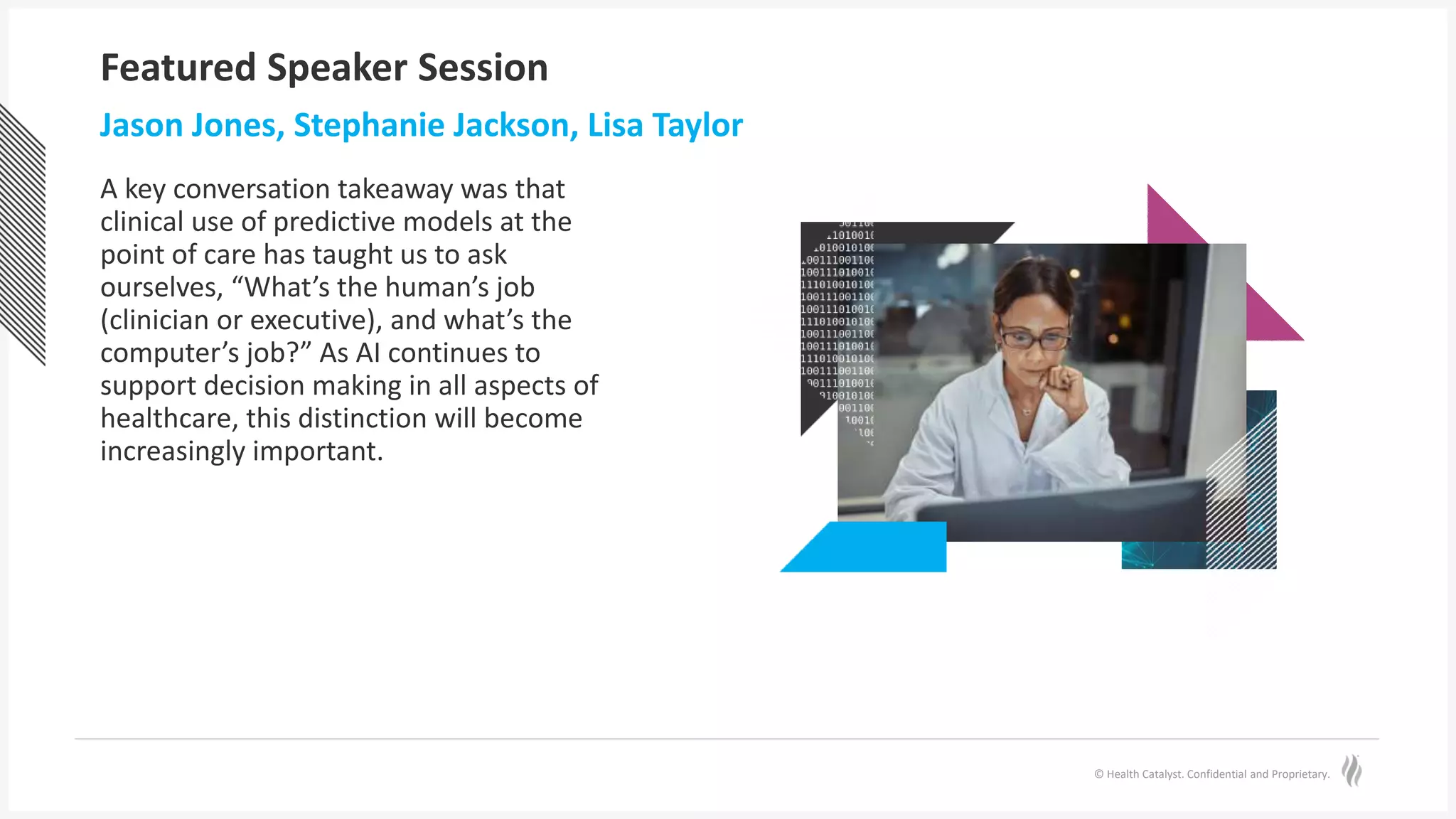
A key conversation takeaway was that
clinical use of predictive models at the
point of care has taught us to ask
ourselves, “What’s the human’s job
(clinician or executive), and what’s the
computer’s job?” As AI continues to
support decision making in all aspects of
healthcare, this distinction will become
increasingly important.
© Health Catalyst. Confidential and Proprietary.
Featured Breakout Session:
Creating Cultural Contagion
Within Your Health System
© Health Catalyst. Confidential and Proprietary.
Featured Breakout Session
 Marcus Collins, DBA, MBA, Top Booked Speaker, DE&I Thought Leader, Head of Strategy, Wieden+Kennedy
Creating Cultural Contagion Within Your Health System
Data-driven insights may be a gold standard at an analytics conference, but Marcus Collins, DBA,
MBA, questions the value of data unless we apply that information to real lives and experiences.
Collins says that while we have more data than ever, our ability to convert fact into something
meaningful hasn’t grown at the rate of acquisition. As a result, we’re mistaking information for
intimacy and never really getting to know the people behind the data. We’re experiencing a data
paradox—we have a lot of information but don’t really know much.
Marketers, researchers, policymakers, and others have relied on self-reported data, such as the
General Social Survey, which comes up short in meaning. Humans aren’t likely to self-report
accurately and are not inherently good at making projections. Collins says that savvy data users rely
on meaning over self-reported data.
© Health Catalyst. Confidential and Proprietary.
Featured Breakout Session
According to Collins, the field of ethnography closes the
gap between data and meaning, showing what people care
about and how they show up in the world. Ethnography
puts researchers in the subject’s field to see the world
through their eyes and understand how they make
meaning. Bringing it back to the human side of analytics,
Collins says the meaning-forward approach reminds us that
it’s our job in healthcare to understand why the
information is what it is, not just take data at face value.
Collins’s three recommendations for conducting field
ethnography and finding meaning include the following:
 Watch people with purpose (don’t look for answers, look for
questions).
 Ask “why” three times.
 Apply empathy.
Creating Cultural Contagion Within Your Health System
© Health Catalyst. Confidential and Proprietary.
Featured Breakout Speaker:
What You Can Learn from
100 Days of Rejection
© Health Catalyst. Confidential and Proprietary.
Featured Breakout Speaker
 Jia Jiang, Inspirational and Emotional Intelligence Speaker
What You Can Learn from 100 Days of Rejection
Innovators and forward-thinkers in any field, including
healthcare analytics, face the risk of rejection with each
new idea or approach. While fear of rejection is a
common human tendency, countless great experiences,
modern advances, and lives saved wouldn’t have
happened if their creators hadn’t taken a chance and
risked hearing “no” when they pitched their ideas.
As a young entrepreneur, Jia Jiang realized he had a lot
of big ideas that he wasn’t presenting and moving
forward due to fear of rejection. Committed to
overcoming this professional barrier, Jiang started
learning about “rejection therapy”—an approach to
exposing himself regularly to rejection, thereby
desensitizing himself from it.
© Health Catalyst. Confidential and Proprietary.
Featured Breakout Speaker
What You Can Learn from 100 Days of Rejection
Jiang set out on a 100-days-of-rejection project. He chose off-the-wall requests to
approach strangers with. Propositions included borrowing $100, asking for a “refill” on
his burger, and more. While strangers didn’t initially grant Jiang’s requests, he started
learning that when he asked “why” in response to rejection instead of immediately
retreating, he felt better about the encounter and more confident, even if he didn’t get
the thing he’d asked for. Eventually, Jiang’s commitment to staying engaged past
rejection started turning “nos” into “yeses.” With this approach, he ended up playing
soccer, in a stranger’s backyard, driving a police car, flying a gyroplane, and more.
Rejection, Jiang learned, is a numbers game. He found that if you talk to enough people
and try enough times (such as asking why), you’ll eventually get a yes. He also
discovered that rejection can serve as a moment of opportunity. Once you’ve asked for
something big and been rejected, you’ll likely have betting luck if you try again with a
more modest request.
© Health Catalyst. Confidential and Proprietary.
Featured Breakout Session:
What Is Making AI Fail?
Is it the Humans or Algorithms?
© Health Catalyst. Confidential and Proprietary.
Featured Breakout Session
 Taylor Davis, MStat, MBA, President, KLAS Research
What Is Making AI Fail? Is it the Humans or Algorithms?
Taylor Davis, KLAS Research President, has
gained significant insights into AI and
healthcare by speaking to many organizations
that have something in common: they’re
disappointed in their AI solution. As he dug
deeper into the “why” he concluded that AI
just isn’t enough on its own, but humans
combined with AI can be a powerful solution
for a number of healthcare challenges.
© Health Catalyst. Confidential and Proprietary.
Featured Breakout Session
He pointed out how computers and humans have different strengths, but
that they are very complementary. Healthcare organizations that focus on
building the right team to solve the right problem are seeing success in areas
like population health, sepsis, and others. Davis provided some advice:
 Pick a specific clinical problem that AI can solve – don’t try to apply AI where it
isn’t appropriate.
 Use the technology to do things like process massive amounts of data and apply
human skills to then act on that information.
 Continue to iterate and adjust until it’s a successful model.
When it comes to implementing an AI model, Davis noted that medical
leadership is essential to success as they set priorities for the organization.
Next focus on efforts where AI can drive results so that the effort can
maintain executive support. Don’t forget that AI is a new frontier and while it
has great potential to make a positive impact on healthcare, it’s going to take
time to realize its full potential.
What Is Making AI Fail? Is it the Humans or Algorithms?
© Health Catalyst. Confidential and Proprietary.
Featured Speaker Session:
Elana Meyers Taylor
© Health Catalyst. Confidential and Proprietary.
Featured Speaker Session
Elena Myers Taylor closed HAS 22 with an
inspiring speech highlighting the marriage of
humans and analytics to control what seems
uncontrollable and offering attendees lessons
learned on her way to Olympic Gold.
Elana Meyers Taylor, Five-Time Olympic Medalist, USA Bobsled
© Health Catalyst. Confidential and Proprietary.
Featured Speaker Session: Elana Meyers Taylor
She fought long-held perceptions that women could only
drive two-person bobsleds. To become the first-ever
female driver of four-person bobsleds, she had to recruit
a team, starting with her husband. While women turned
out in force to cheer her on, Elena’s husband warned
that many people didn’t support her—“Don’t let them
into her head.” Myers Taylor focused on her supporters
and teammates, blasting Taylor Swift’s “Shake it Off” into
her headphones to keep the negativity away and win.
Shake It Off
© Health Catalyst. Confidential and Proprietary.
Featured Speaker Session: Elana Meyers Taylor
Myers Taylor made it to the 2022 Beijing Olympics, only to have her teammate
husband, father, toddler son, and herself test positive for COVID-19. Isolated in
a small room alone, without even control over her diet, she focused on what
she had control over:
 Her thoughts.
 Her sleep.
 Physical workouts.
 Mental race preparation.
 Her son’s nutrition.
By controlling what she could in quarantine, Myers Taylor recovered to win
two medals in Beijing, making her the winningest Black athlete in the Winter
Olympics. The data and technology applied to her training and her bobsled
have helped her get to the starting line as prepared as possible, and her
human resilience and strength have sped her to the finish line.
Focus on What You Can Control
© Health Catalyst. Confidential and Proprietary.
1 The Healthcare Analytics Summit 2022: Back in Person!
3 HAS 21 Virtual in Review: Soaring Satisfaction Rates,
Attendee Profiles, and More
2 Health Catalyst Reveals Catalyst Awards Winners
Recognizing World-Class Healthcare Improvements
Here Are Some Articles We Suggest
Additional Reading
4 Health Catalyst Powers $1.5 Billion in Validated
Measurable Improvements
5 How to Use AI in Healthcare to Unlock Four Secrets in Your Data

HAS 22 Day 2: Healthcare Analytics’ Biggest Party Wraps Up

  • 1.
    © Health Catalyst.Confidential and Proprietary. HAS 22 Day 2: Healthcare Analytics’ Biggest Party Wraps Up
  • 2.
    © Health Catalyst.Confidential and Proprietary. Health Catalyst Editors
  • 3.
    Article Summary Day 1 ofHAS 22 may have looked like a hard act to follow, but Day 2 did not disappoint! From early risers for the fun run/walk to a full day of keynotes, featured speakers, breakout sessions, and more, summit attendees learned new ways to look at data and analytics, how we relate to information and each other, and new perspectives for making the healthcare ecosystem–and world at large–a better place.
  • 4.
    © Health Catalyst.Confidential and Proprietary. HAS 22 Day 2 Day One of HAS 22 may have looked like a hard act to follow, but Day Two did not disappoint! From early risers for the fun run/walk to a full day of keynotes, featured speakers, breakout sessions, and more, summit attendees learned new ways to look at data and analytics, how we relate to information and each other, and new perspectives for making the healthcare ecosystem–and world at large–a better place. Healthcare Analytics’ Biggest Party Wraps Up
  • 5.
    © Health Catalyst.Confidential and Proprietary. Featured Speaker Session: Penny Wheeler, MD
  • 6.
    © Health Catalyst.Confidential and Proprietary. Featured Speaker Session In short, it’s about meaning. After decades in healthcare–as a practicing OBGYN, Chief Clinical Officer, and CEO of Allina Health– Penny Wheeler, MD, shared her insights on Measures That (Really) Matter. Her leadership lesson for HAS 22 attendees was “never forget whom you’re serving and why.” Penny Wheeler, MD, Former CEO, Allina Health
  • 7.
    © Health Catalyst.Confidential and Proprietary. Featured Speaker Session: Penny Wheeler, MD The last few years have indelibly impacted healthcare and highlighted social disparities. In addition to a global pandemic, Allina Health’s Minneapolis HQ placed them in the middle of the unrest following George Floyd’s murder. The organization was determined to make and measure a meaningful impact in its community. How the World Has Turned
  • 8.
    © Health Catalyst.Confidential and Proprietary. Featured Speaker Session: Penny Wheeler, MD Allina signed a pledge with healthcare systems, payers, and clinics, to fight the dual pandemic of COVID and racism. And then they set about turning words into action. What Is Asked of Us and How We Might Get There They looked at their various roles and where they could make a difference:  Provider: Provide quality healthcare to all.  Employer: Employ and promote diverse groups.  Purchaser: Invest in the right things, people, and populations.  Community member: Understand community needs and how to best partner with them. Then design for it. They created a comprehensive scorecard for patient-reported outcomes that are:  Psychometrically sound.  Person-centered.  Meaningful to the person.  Amenable to change.  Implementable.
  • 9.
    © Health Catalyst.Confidential and Proprietary. Featured Speaker Session: Penny Wheeler, MD Dr. Wheeler stressed a person-centered approach to measuring what’s most important to the patient. Preventing a stroke is important, and we must document interventions. But what’s important to that patient is being able to walk around the lake with his grandson, so provide meaningful measurement for that as well. Don’t Forget About the Thing
  • 10.
    © Health Catalyst.Confidential and Proprietary. Featured Speaker Session: Matthew Luhn
  • 11.
    © Health Catalyst.Confidential and Proprietary. Featured Speaker Session How do you tell a great story? In his keynote address, Matthew Luhn shared how he approaches storytelling. As Lead Animator and Storyteller at Pixar Studios, he brought audiences stories that were memorable, impactful, and personal. Through movies like Toy Story, Up, and Ratatouille, he crafted stories that made audiences feel empathy, anticipation, excitement, and happiness. He shared how to create an inspiring story like those:  A Great Hook. The average human attention span is 8 seconds – share something unusual, or unexpected. Put the audience in the middle of the action or conflict to really grab their attention. Take the ordinary and make it different – make your audience curious about what’s coming next.  Inspire Change. Great stories are about transformation – they inspire us that change, try new things, and be better people. Former Lead Animator and Storyteller, Pixar Studios
  • 12.
    © Health Catalyst.Confidential and Proprietary. Featured Speaker Session How to create an inspiring story continued:  Make a Connection. Stories can be universal or hyper-focused, but to connect with a specific audience, they must be authentic – use themes like the desire for love, safety, and freedom or fear of failure, abandonment, and not belonging to meaningfully impact the audience.  Don’t Neglect Structure: Every great story has a beginning, middle, and end. The beginning gets the audience’s attention, the middle crafts the plot, and the end is the most important part. Luhn closed his remarks by reminding the audience that in the end, people will remember how the story made them feel, those are the stories that will win. Former Lead Animator and Storyteller, Pixar Studios
  • 13.
    © Health Catalyst.Confidential and Proprietary. Featured Speaker Session: Jason Jones, PhD, Stephanie Jackson, MD, FHM, and Lisa Taylor, MS
  • 14.
    © Health Catalyst.Confidential and Proprietary. Featured Speaker Session  Jason Jones, PhD, Chief Analytics and Data Science Officer, General Manager of Data and Analytics Platform, Health Catalyst  Stephanie Jackson, MD, FHM, Senior Vice President, Chief Clinical Officer, HonorHealth  Lisa Taylor, MS, Vice President of Analytics, HonorHealth Jason Jones, Stephanie Jackson, Lisa Taylor Healthcare has largely focused its use of predictive and prescriptive models at the point of care. Moving forward, however, healthcare leadership is recognizing critical opportunities for augmented intelligence (AI) at the executive level. To dive deep into AI’s potential in leadership decision making, Jason Jones, PhD, Chief Analytics and Data Science Officer, General Manager of Data and Analytics Platform, Health Catalyst, facilitated a conversation with Stephanie Jackson, MD, FHM, Senior Vice President, Chief Clinical Officer, and Lisa Taylor, MS, Vice President of Analytics, both of HonorHealth.
  • 15.
    © Health Catalyst.Confidential and Proprietary. Featured Speaker Session Jason Jones, Stephanie Jackson, Lisa Taylor To explore the role of AI in executive decision making, Dr. Jones asked Dr. Jackson for common ground between executive and clinical decision processes. Dr. Jones explained that as a clinician and an executive, she tended to view her health system as a patient (e.g., is it critical, needing moderate care, healthy etc.). And like one treatment decision will impact another aspect of a patient’s health, any executive decision will impact another operational area of the organization. Furthermore, like clinicians, healthcare executives are also overburdened these days. In short, if AI is valuable in clinical decision making, given the parallels with healthcare leadership, it can also be a meaningful tool at the executive level.
  • 16.
    © Health Catalyst.Confidential and Proprietary. Featured Speaker Session Jason Jones, Stephanie Jackson, Lisa Taylor Taylor added that she’d like to see healthcare leaders asking for more data (clinical, operational, and financial) to support expanded AI use. Data, she said, should always be the first question in the decision-making journey. Yet, that human cognition must always accompany the data, and even the analytics experts on stage admitted that sometimes in healthcare human judgement rightly goes against the data.
  • 17.
    © Health Catalyst.Confidential and Proprietary. Featured Speaker Session Jason Jones, Stephanie Jackson, Lisa Taylor A key conversation takeaway was that clinical use of predictive models at the point of care has taught us to ask ourselves, “What’s the human’s job (clinician or executive), and what’s the computer’s job?” As AI continues to support decision making in all aspects of healthcare, this distinction will become increasingly important.
  • 18.
    © Health Catalyst.Confidential and Proprietary. Featured Breakout Session: Creating Cultural Contagion Within Your Health System
  • 19.
    © Health Catalyst.Confidential and Proprietary. Featured Breakout Session  Marcus Collins, DBA, MBA, Top Booked Speaker, DE&I Thought Leader, Head of Strategy, Wieden+Kennedy Creating Cultural Contagion Within Your Health System Data-driven insights may be a gold standard at an analytics conference, but Marcus Collins, DBA, MBA, questions the value of data unless we apply that information to real lives and experiences. Collins says that while we have more data than ever, our ability to convert fact into something meaningful hasn’t grown at the rate of acquisition. As a result, we’re mistaking information for intimacy and never really getting to know the people behind the data. We’re experiencing a data paradox—we have a lot of information but don’t really know much. Marketers, researchers, policymakers, and others have relied on self-reported data, such as the General Social Survey, which comes up short in meaning. Humans aren’t likely to self-report accurately and are not inherently good at making projections. Collins says that savvy data users rely on meaning over self-reported data.
  • 20.
    © Health Catalyst.Confidential and Proprietary. Featured Breakout Session According to Collins, the field of ethnography closes the gap between data and meaning, showing what people care about and how they show up in the world. Ethnography puts researchers in the subject’s field to see the world through their eyes and understand how they make meaning. Bringing it back to the human side of analytics, Collins says the meaning-forward approach reminds us that it’s our job in healthcare to understand why the information is what it is, not just take data at face value. Collins’s three recommendations for conducting field ethnography and finding meaning include the following:  Watch people with purpose (don’t look for answers, look for questions).  Ask “why” three times.  Apply empathy. Creating Cultural Contagion Within Your Health System
  • 21.
    © Health Catalyst.Confidential and Proprietary. Featured Breakout Speaker: What You Can Learn from 100 Days of Rejection
  • 22.
    © Health Catalyst.Confidential and Proprietary. Featured Breakout Speaker  Jia Jiang, Inspirational and Emotional Intelligence Speaker What You Can Learn from 100 Days of Rejection Innovators and forward-thinkers in any field, including healthcare analytics, face the risk of rejection with each new idea or approach. While fear of rejection is a common human tendency, countless great experiences, modern advances, and lives saved wouldn’t have happened if their creators hadn’t taken a chance and risked hearing “no” when they pitched their ideas. As a young entrepreneur, Jia Jiang realized he had a lot of big ideas that he wasn’t presenting and moving forward due to fear of rejection. Committed to overcoming this professional barrier, Jiang started learning about “rejection therapy”—an approach to exposing himself regularly to rejection, thereby desensitizing himself from it.
  • 23.
    © Health Catalyst.Confidential and Proprietary. Featured Breakout Speaker What You Can Learn from 100 Days of Rejection Jiang set out on a 100-days-of-rejection project. He chose off-the-wall requests to approach strangers with. Propositions included borrowing $100, asking for a “refill” on his burger, and more. While strangers didn’t initially grant Jiang’s requests, he started learning that when he asked “why” in response to rejection instead of immediately retreating, he felt better about the encounter and more confident, even if he didn’t get the thing he’d asked for. Eventually, Jiang’s commitment to staying engaged past rejection started turning “nos” into “yeses.” With this approach, he ended up playing soccer, in a stranger’s backyard, driving a police car, flying a gyroplane, and more. Rejection, Jiang learned, is a numbers game. He found that if you talk to enough people and try enough times (such as asking why), you’ll eventually get a yes. He also discovered that rejection can serve as a moment of opportunity. Once you’ve asked for something big and been rejected, you’ll likely have betting luck if you try again with a more modest request.
  • 24.
    © Health Catalyst.Confidential and Proprietary. Featured Breakout Session: What Is Making AI Fail? Is it the Humans or Algorithms?
  • 25.
    © Health Catalyst.Confidential and Proprietary. Featured Breakout Session  Taylor Davis, MStat, MBA, President, KLAS Research What Is Making AI Fail? Is it the Humans or Algorithms? Taylor Davis, KLAS Research President, has gained significant insights into AI and healthcare by speaking to many organizations that have something in common: they’re disappointed in their AI solution. As he dug deeper into the “why” he concluded that AI just isn’t enough on its own, but humans combined with AI can be a powerful solution for a number of healthcare challenges.
  • 26.
    © Health Catalyst.Confidential and Proprietary. Featured Breakout Session He pointed out how computers and humans have different strengths, but that they are very complementary. Healthcare organizations that focus on building the right team to solve the right problem are seeing success in areas like population health, sepsis, and others. Davis provided some advice:  Pick a specific clinical problem that AI can solve – don’t try to apply AI where it isn’t appropriate.  Use the technology to do things like process massive amounts of data and apply human skills to then act on that information.  Continue to iterate and adjust until it’s a successful model. When it comes to implementing an AI model, Davis noted that medical leadership is essential to success as they set priorities for the organization. Next focus on efforts where AI can drive results so that the effort can maintain executive support. Don’t forget that AI is a new frontier and while it has great potential to make a positive impact on healthcare, it’s going to take time to realize its full potential. What Is Making AI Fail? Is it the Humans or Algorithms?
  • 27.
    © Health Catalyst.Confidential and Proprietary. Featured Speaker Session: Elana Meyers Taylor
  • 28.
    © Health Catalyst.Confidential and Proprietary. Featured Speaker Session Elena Myers Taylor closed HAS 22 with an inspiring speech highlighting the marriage of humans and analytics to control what seems uncontrollable and offering attendees lessons learned on her way to Olympic Gold. Elana Meyers Taylor, Five-Time Olympic Medalist, USA Bobsled
  • 29.
    © Health Catalyst.Confidential and Proprietary. Featured Speaker Session: Elana Meyers Taylor She fought long-held perceptions that women could only drive two-person bobsleds. To become the first-ever female driver of four-person bobsleds, she had to recruit a team, starting with her husband. While women turned out in force to cheer her on, Elena’s husband warned that many people didn’t support her—“Don’t let them into her head.” Myers Taylor focused on her supporters and teammates, blasting Taylor Swift’s “Shake it Off” into her headphones to keep the negativity away and win. Shake It Off
  • 30.
    © Health Catalyst.Confidential and Proprietary. Featured Speaker Session: Elana Meyers Taylor Myers Taylor made it to the 2022 Beijing Olympics, only to have her teammate husband, father, toddler son, and herself test positive for COVID-19. Isolated in a small room alone, without even control over her diet, she focused on what she had control over:  Her thoughts.  Her sleep.  Physical workouts.  Mental race preparation.  Her son’s nutrition. By controlling what she could in quarantine, Myers Taylor recovered to win two medals in Beijing, making her the winningest Black athlete in the Winter Olympics. The data and technology applied to her training and her bobsled have helped her get to the starting line as prepared as possible, and her human resilience and strength have sped her to the finish line. Focus on What You Can Control
  • 31.
    © Health Catalyst.Confidential and Proprietary. 1 The Healthcare Analytics Summit 2022: Back in Person! 3 HAS 21 Virtual in Review: Soaring Satisfaction Rates, Attendee Profiles, and More 2 Health Catalyst Reveals Catalyst Awards Winners Recognizing World-Class Healthcare Improvements Here Are Some Articles We Suggest Additional Reading 4 Health Catalyst Powers $1.5 Billion in Validated Measurable Improvements 5 How to Use AI in Healthcare to Unlock Four Secrets in Your Data