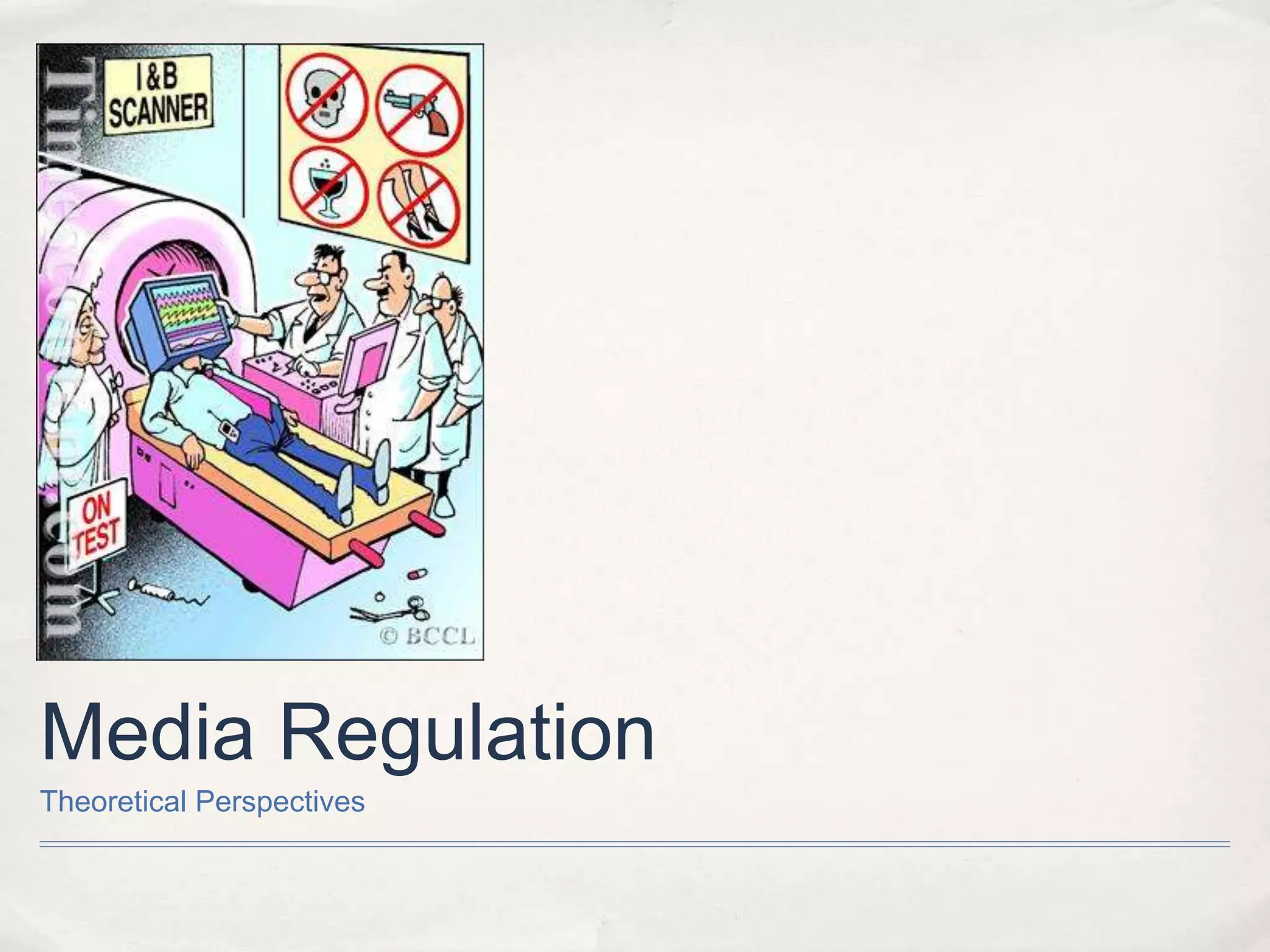
Media RegulationTheoretical Perspectives
The Byron Review 2008 - Government Commissioned There is no evidence of ‘desensitisation’ from playing video games; idea of games as addictive is based on prejudiceMedia may have some influence on negative behaviour in children, but it should not be singled out as a cause; specific sociocultural and psychological context is crucialDr. Tanya Byron
The Byron Review 2008 - Government Commissioned There is no evidence of ‘desensitisation’ from playing vide games; idea of games as addictive is based on prejudice
Douglas Gentile - Media Effects ResearcherOffers a range of scientific ‘proof’ that antisocial and dangerous behaviour increases due to playing violent video games
Mark Kermode - CriticThe public has a responsibility to look after itself and they aregiving this up to the regulatorsAccuses the BBFC of being more liberal in their classificationof ‘Arthouse’ cinema; taking into account assumptions about the white, middle-class,middle-aged audience
O Davey - CriticViolence plays a vital part in all our lives; it is often the catalyst for other emotions that lead to films being made that express these.Violence cannot be distinguished from film as we cannot distinguish violence from life
Martin Barker - Media Effects ResearcherWe need to see violence as it is part of real life and helps us to understand the world we live in.We are able to make a distinction between real and onscreen violence; it is the conent, not the amoaunt of violence that matters
Example
Example
FilmResearch by the BBFC has found that audiences are concerned about violence and drug-taking, rather than sex.Now, more films being passed at                  feature explicit sexual scenes, such as 9 Songs in 2005.
Video GamesThe current video game debate is the same as the video nasty debate of the 1980sRegulation is unlikely to declineDespite recent changes, the UK is still the most heavily regulated nation in EuropeFuture regulation of content will focus more on video games and interactive mediaLegislation will be needed to combat the increasing fluidity between different - and differently regulated - media

Contemporary Media Regulation Theory

  • 1.
  • 2.
    The Byron Review2008 - Government Commissioned There is no evidence of ‘desensitisation’ from playing video games; idea of games as addictive is based on prejudiceMedia may have some influence on negative behaviour in children, but it should not be singled out as a cause; specific sociocultural and psychological context is crucialDr. Tanya Byron
  • 3.
    The Byron Review2008 - Government Commissioned There is no evidence of ‘desensitisation’ from playing vide games; idea of games as addictive is based on prejudice
  • 4.
    Douglas Gentile -Media Effects ResearcherOffers a range of scientific ‘proof’ that antisocial and dangerous behaviour increases due to playing violent video games
  • 5.
    Mark Kermode -CriticThe public has a responsibility to look after itself and they aregiving this up to the regulatorsAccuses the BBFC of being more liberal in their classificationof ‘Arthouse’ cinema; taking into account assumptions about the white, middle-class,middle-aged audience
  • 6.
    O Davey -CriticViolence plays a vital part in all our lives; it is often the catalyst for other emotions that lead to films being made that express these.Violence cannot be distinguished from film as we cannot distinguish violence from life
  • 7.
    Martin Barker -Media Effects ResearcherWe need to see violence as it is part of real life and helps us to understand the world we live in.We are able to make a distinction between real and onscreen violence; it is the conent, not the amoaunt of violence that matters
  • 8.
  • 9.
  • 10.
    FilmResearch by theBBFC has found that audiences are concerned about violence and drug-taking, rather than sex.Now, more films being passed at feature explicit sexual scenes, such as 9 Songs in 2005.
  • 11.
    Video GamesThe currentvideo game debate is the same as the video nasty debate of the 1980sRegulation is unlikely to declineDespite recent changes, the UK is still the most heavily regulated nation in EuropeFuture regulation of content will focus more on video games and interactive mediaLegislation will be needed to combat the increasing fluidity between different - and differently regulated - media