The Importance of Building
Sidewalks & Bike Lanes In
Hawaii
Presentation By Bethany Anderson
The Problem
• Hawaii has very few areas with sidewalks
and not enough bike lanes; this makes it very
dangerous for community members to walk or
ride bikes and in doing so get exercise. There
is even a lack sidewalks surrounding several
schools including Waiakea Elementary.
Environmental Impact of driving
• The trip to and from school for most families is
approximately 2.5 miles, a 5 mile round trip.
• Approximately 529 pounds of CO2 and nitrous
oxide per car/per year gets pumped into the
atmosphere just driving your kids back and
forth to school (this doesn’t account for idling
while waiting for your child to exit the
building)
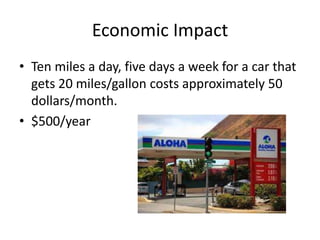
Economic Impact
• Ten miles a day, five days a week for a car that
gets 20 miles/gallon costs approximately 50
dollars/month.
• $500/year
Health Impacts of Driving
• Driving in the traffic that backs up during drop off
and pick up times can be very stressful, stress has
definite impacts on a person’s health and well-
being.
• A lack of exercise contributes to weight gain,
cholesterol, etc.
• Walking has many health benefits, including a
decreased risk of diabetes, cancer, heart disease.
Walking also boosts brain power and relieves
stress.
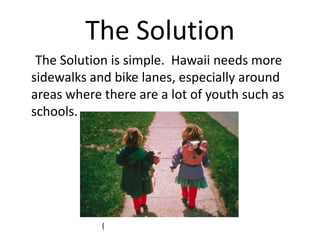
The Solution
The Solution is simple. Hawaii needs more
sidewalks and bike lanes, especially around
areas where there are a lot of youth such as
schools.
(
How Sidewalks Create More
Sustainable Lifestyles
Building more sidewalks and bike paths
would be sustainable because sidewalks
give individuals the opportunity to safely
walk instead of drive. With every person
who decides to walk instead of drive it
reduces Hawaii’s carbon footprint because
they are reducing the amount of carbon
dioxide released by their car.
Economic Benefits
• The cost of fuel is high. Walking whenever
possible will decrease fuel costs and make it
easier for families.
• Walking will have many health benefits,
decreasing medical costs.
• Having more sidewalks and bike lanes will
make Hilo a desirable place to be, increasing
property values.
Environmental Benefits
• Less cars…less CO2
• Less cars…less traffic
• Less cars…less noise
• Unintentional pedestrian
injuries are the second leading
cause of death in the United
States for children ages 5 to
14. Teenagers are now at
greatest risk. Teens have a
death rate twice that of
younger children and account
for half of all child pedestrian
injuries in the past five years.
The “Three Es” That Are Needed To Be
Successful
• 1. Education
• 2. Enforcement
• 3. Engineering
1. Education
Education programs teach motorists, pedestrians and
bicyclists about their responsibilities and about traffic
rules, while promoting activities that encourage
walking and biking. Teach bicycle and pedestrian safety
to students as part of their classroom curriculum.
Develop a safety campaign that promotes safe driving
through the use of banners, posters, promotions, and
direct appeals to the community.
2. Enforcement
Enforcement enlists the help of local police
departments to focus enforcement efforts in
problem areas and increase community
awareness of school safety issues. Beefing up
enforcement around schools helps keep drivers
on their best behavior. A consistent but random
presence of law enforcement will encourage
motorists to drive with care.
3. Engineering
Engineering tools include a variety of street
design techniques that can reduce traffic
volumes, decrease speed, and improve
safety. Some engineering solutions,
moreover, don’t require large expenditures,
such as posting signs, re-timing lights, or
repainting crosswalks and bike lanes.
Layout Of The Sidewalks
Sidewalks should be a minimum width to allow at least
two people to walk comfortably side by side (standards
outlined in the Americans with Disabilities Act, or ADA,
recommend at least five feet). Where large numbers of
children gather, sidewalks should be even wider with
clear landscaped edges to separate them from the
street. Sidewalks need to be flat, with curb cuts at
corners, but without sloping driveways.
Portland is widely considered one of the nation’s leaders in public transit. Its system
features the Free Rail Zone--a region of downtown Portland within which light rail and
streetcar rides are free all day, every day.
A bike lane…right along the interstate
San Bernadino is one of the worst
cities for public transit
• Only 8% of jobs are reachable via transit
within 90 minutes
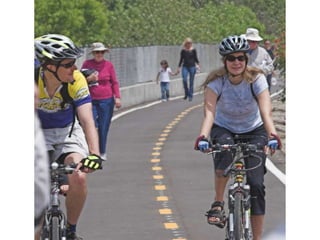
• Even in San Bernadino…ranked worst for
public transportation…there are safe biking
trails. The trail is along the river and many use
it.
Lower cost solution…
• Putting sidewalks in may be cost-prohibitive…roads
would have to be widened, among other things.
• Another option…would be to locate a place that
already has a path, that is safe and connects highly
populated subdivisions with the schools that service
them and the businesses that employ them.
• In addition…we have buses…but, we’d have to improve
the schedule…the schedule is not exactly consistent
and may be okay for holo holo…but, not so good for
getting to work or school on time.
Layout Of Bike Lanes
Hilo has bike lanes along some of its streets and these
are built according to existing regulations.
However, there is also the potential to develop bike
lanes/ pedestrian walkways that are not along existing
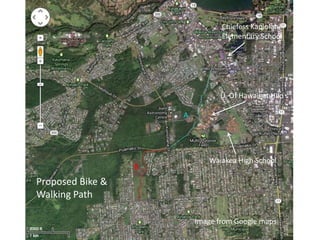
streets. For example, the Waiakea Stream flows
diagonally from upper Waiakea to downtown Hilo and
has existing utility roads along more than half of its
length. The following slide shows this potential route.
A
B
C
Proposed Bike &
Walking Path
Image from Google maps
U. Of Hawaii at HIlo
Waiakea High School
Chiefess Kapiolani
Elementary School
The Waiakea stream route includes a long section (see
“A”) on state land occupied by the University of Hawaii
at Hilo. Section “B” includes much open pasture land.
Section “C” is located on the grounds of Chiefess
Kapiolani Elementary School. All three sections already
have existing utility roads along much of their lengths.
Developing this path would decrease bicycle and foot
traffic along city streets and would actually provide a
shorter and safer route to the university, various public
schools, and to down town. When people feel safe
they will be encouraged to walk and ride their bikes.
References
• http://www.nhtsa.gov/people/injury/pedbimot/bike/Safe-Routes-2002/safe.html#1
• http://www.tahaksmidagisoolast.com/Koolitykid/Praktika/Loputoo/Pedestrianfatalityriskasafunctionofcarimpactspeed.pdf
• cms.sbcounty.gov
• 10 Best Cities for Public Transportation - US News and World Report
• The 10 Best (and 10 Worst) Cities For Public Transportation, The Atlantic

UNSDG #3 – Good Health and Wellbeing Building Sidewalks & Bike Lanes in Hawaii

  • 1.
    The Importance ofBuilding Sidewalks & Bike Lanes In Hawaii Presentation By Bethany Anderson
  • 2.
    The Problem • Hawaiihas very few areas with sidewalks and not enough bike lanes; this makes it very dangerous for community members to walk or ride bikes and in doing so get exercise. There is even a lack sidewalks surrounding several schools including Waiakea Elementary.
  • 3.
    Environmental Impact ofdriving • The trip to and from school for most families is approximately 2.5 miles, a 5 mile round trip. • Approximately 529 pounds of CO2 and nitrous oxide per car/per year gets pumped into the atmosphere just driving your kids back and forth to school (this doesn’t account for idling while waiting for your child to exit the building)
  • 4.
    Economic Impact • Tenmiles a day, five days a week for a car that gets 20 miles/gallon costs approximately 50 dollars/month. • $500/year
  • 5.
    Health Impacts ofDriving • Driving in the traffic that backs up during drop off and pick up times can be very stressful, stress has definite impacts on a person’s health and well- being. • A lack of exercise contributes to weight gain, cholesterol, etc. • Walking has many health benefits, including a decreased risk of diabetes, cancer, heart disease. Walking also boosts brain power and relieves stress.
  • 6.
    The Solution The Solutionis simple. Hawaii needs more sidewalks and bike lanes, especially around areas where there are a lot of youth such as schools. (
  • 7.
    How Sidewalks CreateMore Sustainable Lifestyles Building more sidewalks and bike paths would be sustainable because sidewalks give individuals the opportunity to safely walk instead of drive. With every person who decides to walk instead of drive it reduces Hawaii’s carbon footprint because they are reducing the amount of carbon dioxide released by their car.
  • 8.
    Economic Benefits • Thecost of fuel is high. Walking whenever possible will decrease fuel costs and make it easier for families. • Walking will have many health benefits, decreasing medical costs. • Having more sidewalks and bike lanes will make Hilo a desirable place to be, increasing property values.
  • 9.
    Environmental Benefits • Lesscars…less CO2 • Less cars…less traffic • Less cars…less noise
  • 10.
    • Unintentional pedestrian injuriesare the second leading cause of death in the United States for children ages 5 to 14. Teenagers are now at greatest risk. Teens have a death rate twice that of younger children and account for half of all child pedestrian injuries in the past five years.
  • 11.
    The “Three Es”That Are Needed To Be Successful • 1. Education • 2. Enforcement • 3. Engineering
  • 12.
    1. Education Education programsteach motorists, pedestrians and bicyclists about their responsibilities and about traffic rules, while promoting activities that encourage walking and biking. Teach bicycle and pedestrian safety to students as part of their classroom curriculum. Develop a safety campaign that promotes safe driving through the use of banners, posters, promotions, and direct appeals to the community.
  • 13.
    2. Enforcement Enforcement enliststhe help of local police departments to focus enforcement efforts in problem areas and increase community awareness of school safety issues. Beefing up enforcement around schools helps keep drivers on their best behavior. A consistent but random presence of law enforcement will encourage motorists to drive with care.
  • 14.
    3. Engineering Engineering toolsinclude a variety of street design techniques that can reduce traffic volumes, decrease speed, and improve safety. Some engineering solutions, moreover, don’t require large expenditures, such as posting signs, re-timing lights, or repainting crosswalks and bike lanes.
  • 15.
    Layout Of TheSidewalks Sidewalks should be a minimum width to allow at least two people to walk comfortably side by side (standards outlined in the Americans with Disabilities Act, or ADA, recommend at least five feet). Where large numbers of children gather, sidewalks should be even wider with clear landscaped edges to separate them from the street. Sidewalks need to be flat, with curb cuts at corners, but without sloping driveways.
  • 16.
    Portland is widelyconsidered one of the nation’s leaders in public transit. Its system features the Free Rail Zone--a region of downtown Portland within which light rail and streetcar rides are free all day, every day.
  • 18.
    A bike lane…rightalong the interstate
  • 19.
    San Bernadino isone of the worst cities for public transit • Only 8% of jobs are reachable via transit within 90 minutes • Even in San Bernadino…ranked worst for public transportation…there are safe biking trails. The trail is along the river and many use it.
  • 21.
    Lower cost solution… •Putting sidewalks in may be cost-prohibitive…roads would have to be widened, among other things. • Another option…would be to locate a place that already has a path, that is safe and connects highly populated subdivisions with the schools that service them and the businesses that employ them. • In addition…we have buses…but, we’d have to improve the schedule…the schedule is not exactly consistent and may be okay for holo holo…but, not so good for getting to work or school on time.
  • 22.
    Layout Of BikeLanes Hilo has bike lanes along some of its streets and these are built according to existing regulations. However, there is also the potential to develop bike lanes/ pedestrian walkways that are not along existing streets. For example, the Waiakea Stream flows diagonally from upper Waiakea to downtown Hilo and has existing utility roads along more than half of its length. The following slide shows this potential route.
  • 23.
    A B C Proposed Bike & WalkingPath Image from Google maps U. Of Hawaii at HIlo Waiakea High School Chiefess Kapiolani Elementary School
  • 24.
    The Waiakea streamroute includes a long section (see “A”) on state land occupied by the University of Hawaii at Hilo. Section “B” includes much open pasture land. Section “C” is located on the grounds of Chiefess Kapiolani Elementary School. All three sections already have existing utility roads along much of their lengths. Developing this path would decrease bicycle and foot traffic along city streets and would actually provide a shorter and safer route to the university, various public schools, and to down town. When people feel safe they will be encouraged to walk and ride their bikes.
  • 25.
    References • http://www.nhtsa.gov/people/injury/pedbimot/bike/Safe-Routes-2002/safe.html#1 • http://www.tahaksmidagisoolast.com/Koolitykid/Praktika/Loputoo/Pedestrianfatalityriskasafunctionofcarimpactspeed.pdf •cms.sbcounty.gov • 10 Best Cities for Public Transportation - US News and World Report • The 10 Best (and 10 Worst) Cities For Public Transportation, The Atlantic

Editor's Notes

  • #11 Key Findings2009 was the safest year on record in New York City history.Traffic fatalities in 2009 were down by 35% from 2001.NYC’s traffic fatality rate is about a quarter of the national rate and less than half the rate in the next 10 largest U.S. cities.Traffic crashes cost the City’s economy $4.29 billion annually.Pedestrians are 10 times more likely to die than a motor vehicle occupant in the event of a crash.Pedestrians accounted for 52% of traffic fatalities from 2005-2009.Driver inattention was cited in nearly 36% of crashes resulting in pedestrians killed or seriously injured.27% of fatal pedestrian crashes involved driver failure to yield.Pedestrian-vehicle crashes involving unsafe speeds are twice as deadly as other crashes.Serious pedestrian crashes are about two-thirds deadlier on major street corridors than on smaller local streets.Most New Yorkers do not know the city’s standard speed limit is 30 m.p.h.80% of crashes that kill or seriously injure pedestrians involve male drivers.79% of crashes that kill or seriously injure pedestrians involve private vehicles, not taxis, trucks and buses.Serious pedestrian crashes are about two-thirds deadlier on major street corridors than on smaller local streets.Manhattan has four times as many pedestrian killed or severely injured per mile of street compared to the other four boroughs.43% of pedestrians killed in Manhattan lived in other boroughs or outside New York City.2010-2011 Action Plan HighlightsBased on the findings of this study, DOT will undertake a comprehensive set of actions, including the following:Install countdown pedestrian signals at 1,500 intersectionsRe-engineer 60 miles of streets for greater pedestrian safety, according to corridor crash data.Re-engineer 20 intersections for pedestrian safety on major two-way streets.Launch a pilot program to test the safety performance of neighborhood 20 m.p.h zone.Implement pilot program to improve visibility at left turns along avenues in Manhattan.