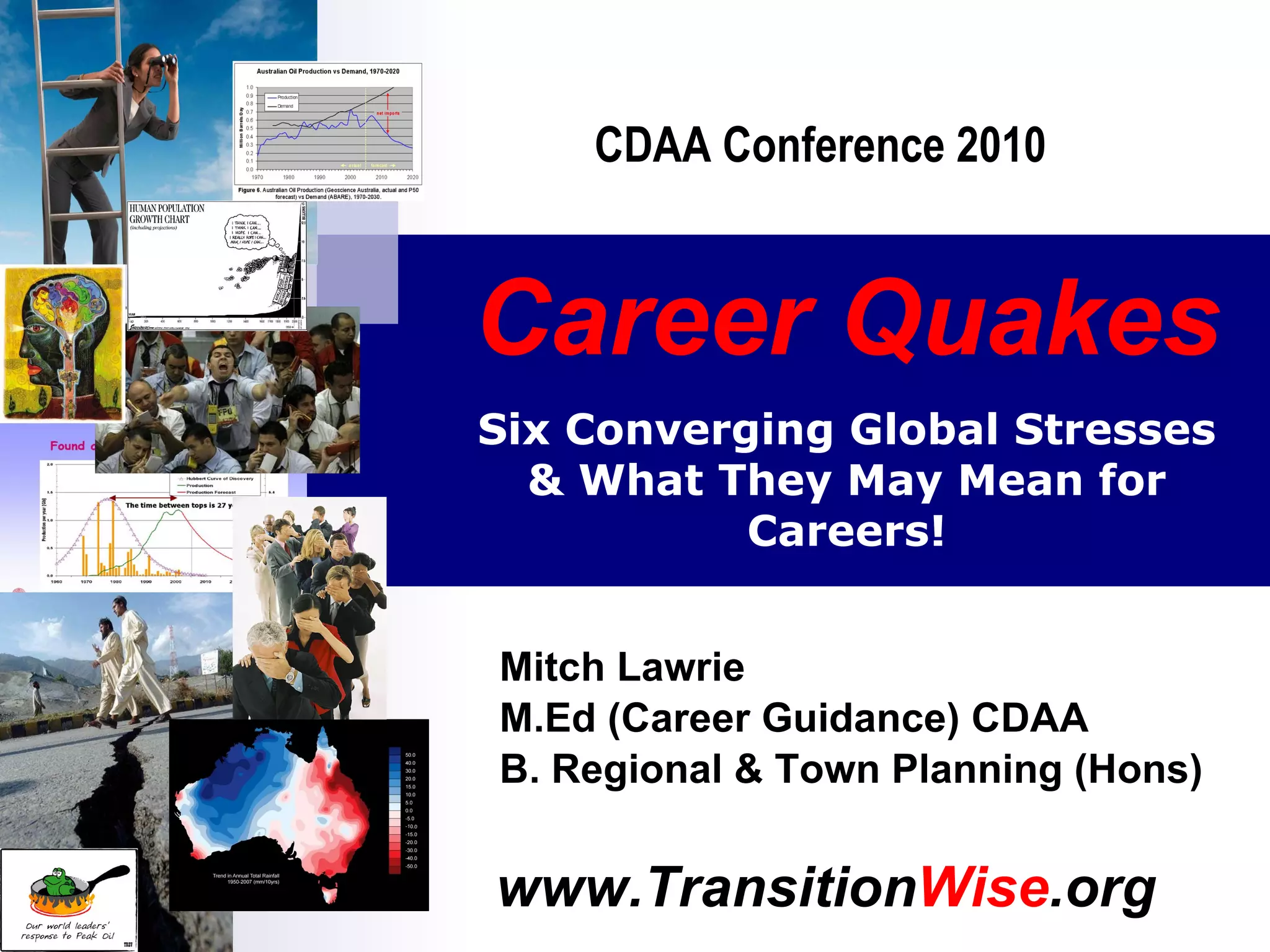
Career Quakes   Mitch Lawrie M.Ed (Career Guidance) CDAA B. Regional & Town Planning (Hons) Six Converging Global Stresses & What They May Mean for Careers! CDAA Conference 2010
Some Suggested “Ground Rules” Respect for everyone Remember... Time is precious Please ask... happy to answer questions but I will also need to keep things moving Please contribute... But don’t monopolize discussion Speak up so everyone can hear Self-responsibility – for what you give & gain from the workshop Mobile phones off Confidentiality
A Show of Hands... Who is familiar with “Peak Oil”? Who thinks it may be a problem for Australia? Who thinks climate change may be a problem for Australia? Who thinks exponential growth is an issue for us? Who has heard of the 1972 book “The Limits to Growth”? Anyone read it? Who thinks conventional economists have a good understanding of the economy and the world? Who thinks things will go on much the same and we’ll be having national conferences like this in 10 years time?
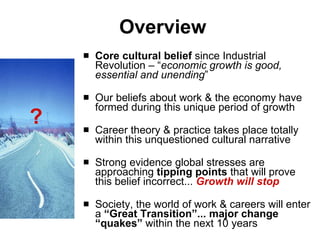
Overview Core cultural belief  since Industrial Revolution – “ economic growth is good, essential and unending ”  Our beliefs about work & the economy have formed during this unique period of growth Career theory & practice takes place totally within this unquestioned cultural narrative Strong evidence  global stresses are approaching  tipping points  that will prove this belief incorrect...  Growth will stop Society, the world of work & careers will enter a  “Great Transition”...   major change “quakes”  within the next 10 years ?
If True… Huge impacts on you  Personally Professionally And on your clients
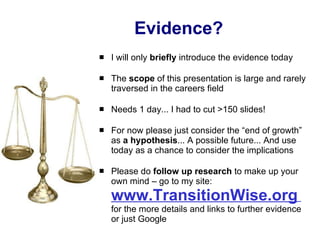
Evidence? I will only  briefly  introduce the evidence today  The  scope  of this presentation is large and rarely traversed in the careers field Needs 1 day... I had to cut >150 slides! For now please just consider the “end of growth” as  a hypothesis ... A possible future... And use today as a chance to consider the implications Please do  follow up research  to make up your own mind – go to my site:  www.TransitionWise.org   for the more details and links to further evidence or just Google
 
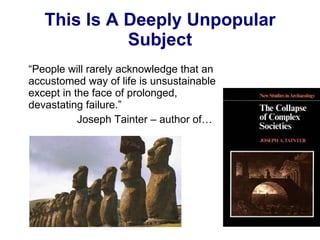
“ People will rarely acknowledge that an accustomed way of life is unsustainable except in the face of prolonged, devastating failure.” Joseph Tainter – author of…  This Is A Deeply Unpopular Subject
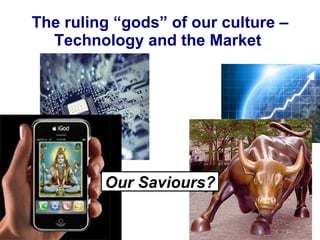
The ruling “gods” of our culture – Technology and the Market  Our Saviours?
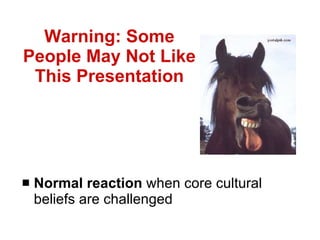
Warning: Some People May Not Like This Presentation Normal reaction  when core cultural beliefs are challenged
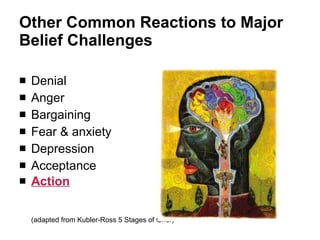
Other Common Reactions to Major Belief Challenges  Denial Anger Bargaining Fear & anxiety Depression Acceptance Action (adapted from Kubler-Ross 5 Stages of Grief)
Society In Denial Most societies are in  denial about what we are facing Politicians don’t like to bring bad news or oppose established paradigms…  prophets tend to get stoned , not re-elected It is  easy to belittle  a viewpoint which goes against the hugely dominant cultural narrative  Those who question the feasibility of never-ending growth are accused of being hysterical “ doomers” or being “negative ”
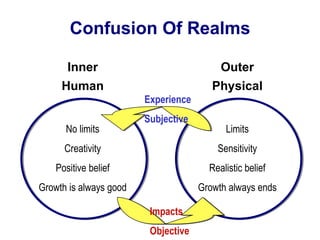
Confusion Of Realms Inner Human No limits Creativity Positive belief Growth is always good Outer Physical Limits Sensitivity Realistic belief Growth always ends Experience Subjective Impacts Objective
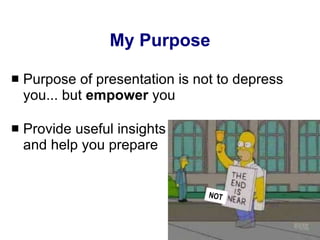
My Purpose Purpose of presentation is not to depress you... but  empower  you Provide useful insights  and help you prepare NOT
Workshop Outline Six Growing Global Stresses  (or “why growth will fail ”) Putting It All Together – Our Probable Future Labour Market and Career Impacts How Can We Prepare?
Global Stress 1 World Oil Production Limits - The Problem of “Peak Oil” Chapter 1
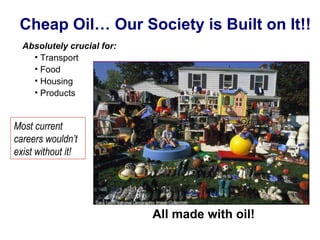
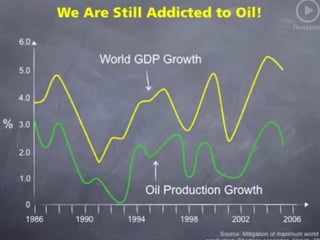
Cheap Oil… Our Society is Built on It!! All made with oil! Absolutely crucial for: Transport Food Housing Products  Most current careers wouldn’t exist without it!
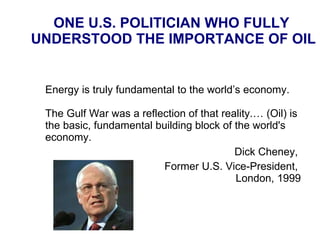
ONE U.S. POLITICIAN WHO FULLY  UNDERSTOOD THE IMPORTANCE OF OIL Energy is truly fundamental to the world’s economy.  The Gulf War was a reflection of that reality. … (Oil) is the basic, fundamental building block of the world's economy.  Dick Cheney,  Former U.S. Vice-President,  London, 1999
LOOMING WORLD OIL PROBLEMS: MYTHS AND REALITIES Keynote Address at  Largest Logistics Conference in Southern Hemisphere The Smart Conference 2007 Sydney  Roger H. Bezdek. Ph.D., President Management Information Services, Inc. Washington, D.C. USA
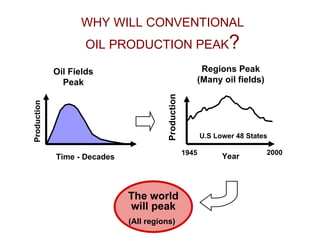
WHY WILL CONVENTIONAL OIL PRODUCTION PEAK ? Oil Fields Peak The world will peak (All regions)   Regions Peak  (Many oil fields)  Time - Decades Production 1945 2000 Year Production U.S Lower 48 States
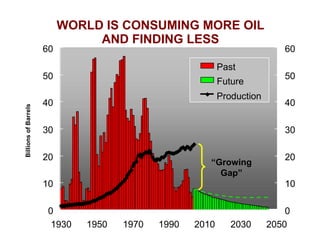
WORLD IS CONSUMING MORE OIL AND FINDING LESS Past discovery by ExxonMobil 0 10 20 30 40 50 60 1930 1950 1970 1990 2010 2030 2050 Billions of Barrels 0 10 20 30 40 50 60 Past Future Production “ Growing Gap”
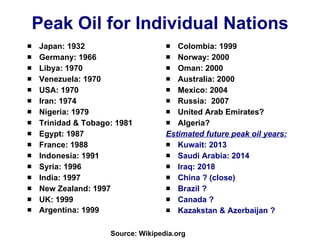
Peak Oil for Individual Nations Japan: 1932 Germany: 1966  Libya: 1970  Venezuela: 1970  USA: 1970 Iran: 1974  Nigeria: 1979  Trinidad & Tobago: 1981 Egypt: 1987 France: 1988  Indonesia: 1991 Syria: 1996 India: 1997  New Zealand: 1997 UK: 1999  Argentina: 1999   Colombia: 1999  Norway: 2000 Oman: 2000 Australia: 2000  Mexico: 2004 Russia:  2007 United Arab Emirates? Algeria? Estimated future peak oil years: Kuwait: 2013  Saudi Arabia: 2014  Iraq: 2018  China ? (close) Brazil ? Canada ? Kazakstan & Azerbaijan ? Source: Wikipedia.org
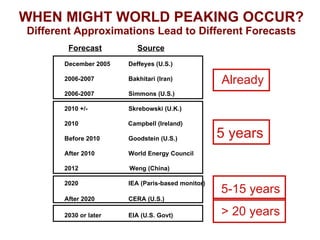
WHEN MIGHT WORLD PEAKING OCCUR? Different Approximations Lead to Different Forecasts Forecast   Source December 2005 Deffeyes (U.S.) 2006-2007 Bakhitari (Iran) 2006-2007 Simmons (U.S.) 2010 +/- Skrebowski (U.K.) 2010   Campbell (Ireland) Before 2010 Goodstein (U.S.) After 2010 World Energy Council 2012  Weng (China) 2020  IEA (Paris-based monitor) After 2020 CERA (U.S.) 2030 or later EIA (U.S. Govt) 5 years 5-15 years > 20 years Already
 
 
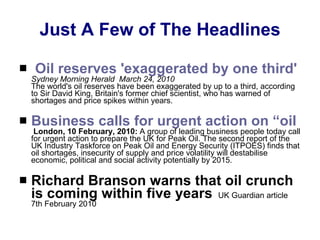
Just A Few of The Headlines   Oil reserves 'exaggerated by one third'   Sydney Morning Herald  March 24, 2010   The world's oil reserves have been exaggerated by up to a third, according to Sir David King, Britain's former chief scientist, who has warned of shortages and price spikes within years.  Business calls for urgent action on “oil crunch” threat to UK economy   London, 10 February, 2010:  A group of leading business people today call for urgent action to prepare the UK for Peak Oil. The second report of the UK Industry Taskforce on Peak Oil and Energy Security (ITPOES) finds that oil shortages, insecurity of supply and price volatility will destabilise economic, political and social activity potentially by 2015.  Richard Branson warns that oil crunch is coming within five years     UK Guardian article 7th February 2010
Queensland Oil Vulnerability Taskforce  Established by the Qld State Government in 2005… “ The Taskforce concludes that Queensland’s  vulnerability  to peaking of world oil supplies, and to world supply disruptions,  is particularly acute  given our oil supply and demand trends, as well as our regionally distributed population and industrial base.”
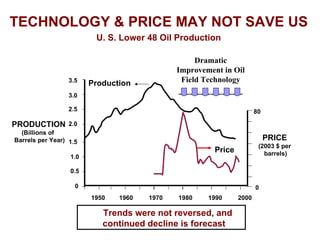
TECHNOLOGY & PRICE MAY NOT SAVE US U. S. Lower 48 Oil Production 3.5 3.0 2.5 2.0 1.5 1.0 0.5 0 80 0 Production Price Dramatic Improvement in Oil Field Technology PRODUCTION (Billions of  Barrels per Year) 1950  1960  1970  1980  1990  2000 Trends were not reversed, and continued decline is forecast PRICE (2003 $ per barrels)
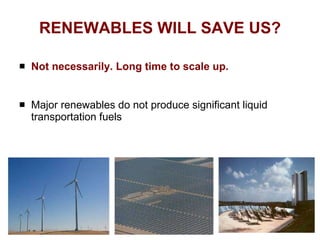
RENEWABLES WILL SAVE US? Not necessarily. Long time to scale up. Major renewables do not produce significant liquid transportation fuels
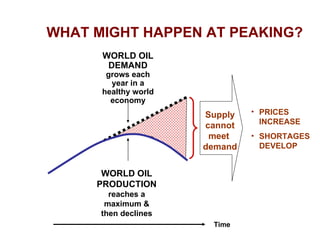
WHAT MIGHT HAPPEN AT PEAKING? WORLD OIL DEMAND  grows each year in a healthy world economy WORLD OIL PRODUCTION  reaches a maximum & then declines Supply cannot meet  demand PRICES INCREASE SHORTAGES DEVELOP Time
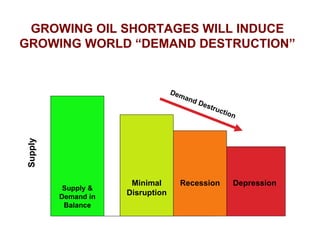
GROWING OIL SHORTAGES WILL INDUCE GROWING WORLD “DEMAND DESTRUCTION” Supply Supply & Demand in Balance Minimal Disruption Recession Depression Demand Destruction
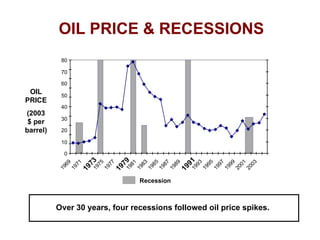
OIL PRICE & RECESSIONS 0 0.1 0.2 0.3 0.4 0.5 0.6 0.7 0.8 0.9 1 1969 1971 1973 1975 1977 1979 1981 1983 1985 1987 1989 1991 1993 1995 1997 1999 2001 2003 Recession OIL PRICE (2003 $ per barrel) Over 30 years, four recessions followed oil price spikes. 0 10 20 30 40 50 60 70 80
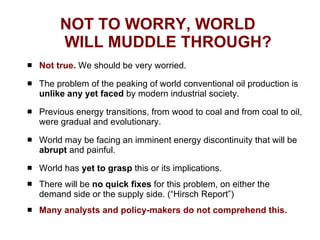
NOT TO WORRY, WORLD  WILL MUDDLE THROUGH? Not true.  We should be very worried. The problem of the peaking of world conventional oil production is  unlike any yet faced  by modern industrial society. Previous energy transitions, from wood to coal and from coal to oil, were gradual and evolutionary. World may be facing an imminent energy discontinuity that will be  abrupt  and painful.  World has  yet to grasp  this or its implications. There will be  no quick fixes  for this problem, on either the demand side or the supply side. (“Hirsch Report”) Many analysts and policy-makers do not comprehend this.
There’s the bad news and the good news...
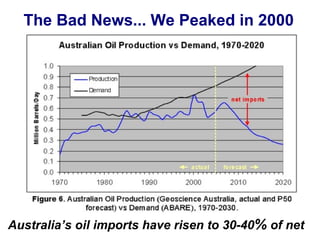
The Bad News... We Peaked in 2000 Australia’s oil imports have risen to 30-40 %  of net
CSIRO – Future Fuels Forum – 2008 Forum included:   Caltex Engineers Australia Holden NRMA Qld Rail Chevron Victorian Government Woolworths Australian Automobile Association Biofuels Association of Australia
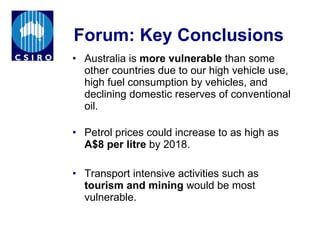
Forum: Key Conclusions Australia is  more vulnerable  than some other countries due to our high vehicle use, high fuel consumption by vehicles, and declining domestic reserves of conventional oil.  Petrol prices could increase to as high as  A$8 per litre  by 2018. Transport intensive activities such as  tourism and mining  would be most vulnerable.
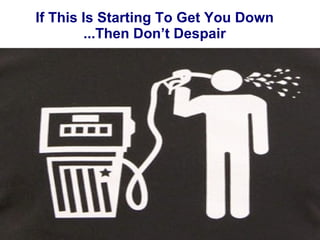
If This Is Starting To Get You Down ...Then Don’t Despair
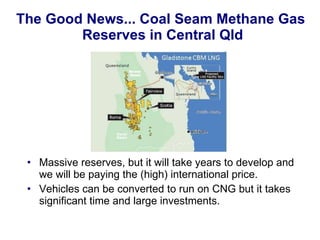
The Good News... Coal Seam Methane Gas  Reserves in Central Qld Massive reserves, but it will take years to develop and we will be paying the (high) international price. Vehicles can be converted to run on CNG but it takes significant time and large investments.
Where Does This Leave Australia? Better off than some countries but not immune ... All countries today are strongly linked in the global economy Will also need to cope with other global stresses around the same time
Global Stress 2 The Climate Change Wildcard Chapter 2
Confusing & Controversial! BUT....
“ In the end, it's important not to lose sight of the forest for the trees, where the ‘forest' refers to the totality of scientific evidence for global warming.” Richard L. Smith, in newsletter of American Statistical Association, Section on Statistics & the Environment,  Spring 2007 issue   Totality of Scientific Evidence is Clear
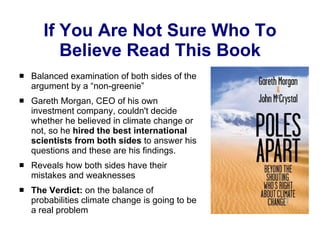
If You Are Not Sure Who To Believe Read This Book Balanced examination of both sides of the argument by a “non-greenie” Gareth Morgan, CEO of his own investment company, couldn't decide whether he believed in climate change or not, so he  hired the best international scientists from both sides  to answer his questions and these are his findings.  Reveals how both sides have their mistakes and weaknesses The Verdict:  on the balance of probabilities climate change is going to be a real problem
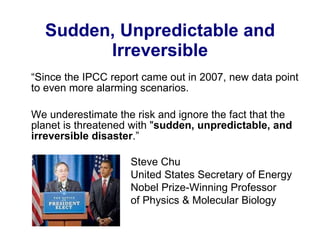
Sudden, Unpredictable and Irreversible “ Since the IPCC report came out in 2007, new data point to even more alarming scenarios. We underestimate the risk and ignore the fact that the planet is threatened with " sudden, unpredictable, and irreversible disaster .”   Steve Chu United States Secretary of Energy  Nobel Prize-Winning Professor  of Physics & Molecular Biology
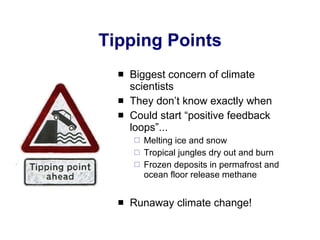
Tipping Points Biggest concern of climate scientists They don’t know exactly when Could start “positive feedback loops”...  Melting ice and snow Tropical jungles dry out and burn Frozen deposits in permafrost and ocean floor release methane  Runaway climate change!
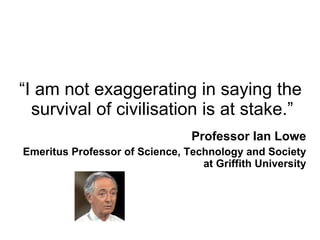
“ I am not exaggerating in saying the survival of civilisation is at stake.” Professor Ian Lowe Emeritus Professor of Science, Technology and Society at Griffith University
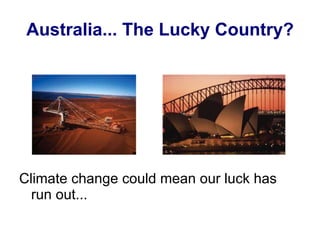
Australia... The Lucky Country? Climate change could mean our luck has run out...
Warning From The CSIRO Australia’s climate change impacts include:  More heatwaves Reductions in average rainfall More frequent El Nino events (droughts) Sea level rise
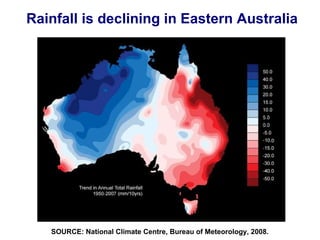
Rainfall is declining in Eastern Australia SOURCE: National Climate Centre, Bureau of Meteorology, 2008.
Warning From The Garnaut Report Mitigation will come too late to avoid substantial damage from climate change.  Not feasible for governments to underwrite maintenance of established patterns of life for all people in all places.
Global Stress 3 The Dangerous Nature of Exponential Growth - Ticking Time Bombs Chapter 3
“ The greatest shortcoming of the human race is our inability to understand the exponential function.” Al Bartlett Professor of Physics  University of Colorado
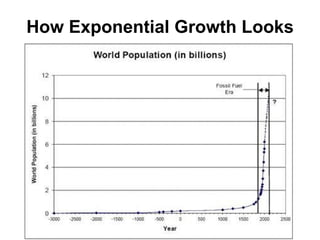
How Exponential Growth Looks
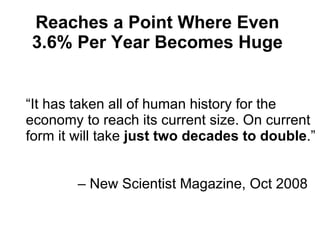
“ It has taken all of human history for the economy to reach its current size. On current form it will take  just   two decades to double .”    – New Scientist Magazine,  Oct 2008 Reaches a Point Where Even 3.6% Per Year Becomes Huge
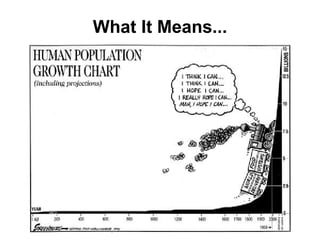
What It Means...
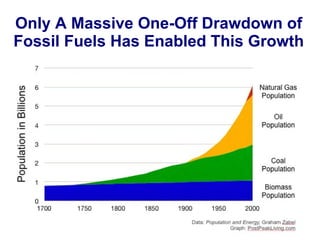
Only A Massive One-Off Drawdown of Fossil Fuels Has Enabled This Growth
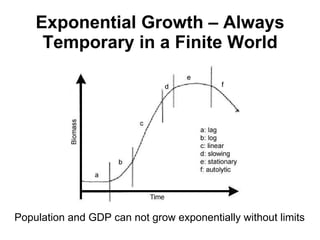
Exponential Growth – Always Temporary in a Finite World Population and GDP can not grow exponentially without limits
“ Anyone who believes exponential growth can go on forever in a finite world is either a madman or an economist."   Kenneth Boulding   (1910-1993) – Economist & Philosopher
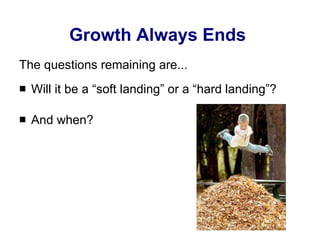
Growth Always Ends  The questions remaining are... Will it be a “soft landing” or a “hard landing”? And when?
Global Stress 4 Multiple  Other  Limits to Growth Chapter 4
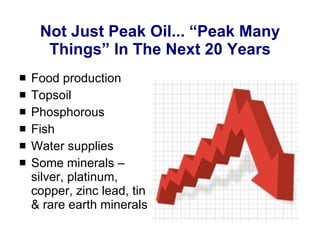
Not Just Peak Oil... “Peak Many Things” In The Next 20 Years Food production Topsoil Phosphorous Fish Water supplies Some minerals – silver, platinum, copper, zinc lead, tin & rare earth minerals
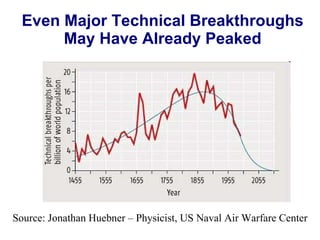
Even Major Technical Breakthroughs May Have Already Peaked Source: Jonathan Huebner – Physicist, US Naval Air Warfare Center
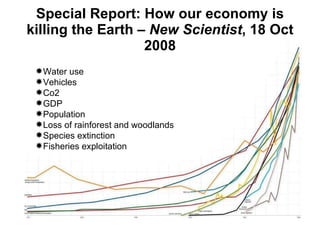
Special Report: How our economy is killing the Earth –  New Scientist , 18 Oct 2008 Water use Vehicles Co2 GDP Population Loss of rainforest and woodlands Species extinction Fisheries exploitation
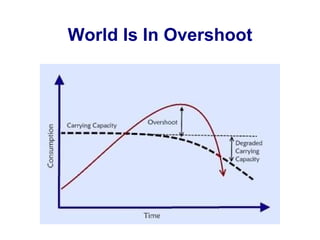
World Is In Overshoot
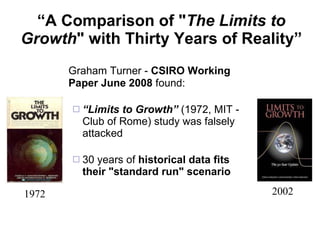
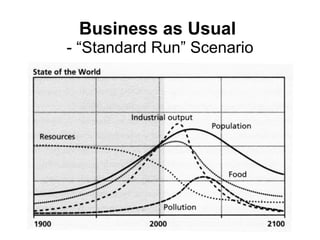
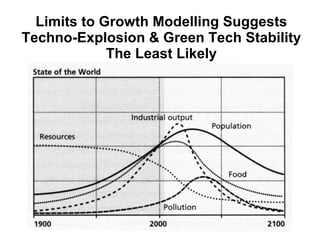
“ A Comparison of " The Limits to Growth " with Thirty Years of Reality” Graham Turner -  CSIRO Working Paper June 2008  found: “ Limits to Growth”  (1972, MIT - Club of Rome) study was falsely attacked 30 years of  historical data fits their "standard run" scenario 1972 2002
Business as Usual  - “Standard Run” Scenario
Other Findings from “Limits to Growth” Computer Simulation If you remove or raise one limit but keep growing exponentially you  encounter another  surprisingly soon Globalization  of trade means that most of the world will reach limits around the  same time If you put off early limits through economic and technological innovations you are more likely to run into  several limits  at about the same time Lesser developed countries likely to  fail first ... may then have a domino effect on other countries World will not totally run out of any one resource... what it  runs out of is the  ability to cope  due to multiple problems  impacting in a short time span
Ability to Cope... The Real Limit As  resources deplete ...  (e.g. peak oil) As  pollution levels rise ...  (e.g. climate change) The costs of compensating have to be paid out of current economic output,  leaving less and less for other uses , until economic output  itself begins to fall and  the industrial world begins  its terminal decline.
Technology & Markets – Best Case Assumptions Still Lead to Collapse “ In several scenarios we test accelerated technological advance and possible future technical leaps beyond these ‘normal’ improvements. What if materials are almost entirely recycled? What if land yield doubles again and yet again? What if emissions are reduced at 4% per year over the coming century? Even with the most effective technologies and the greatest economic resilience that we believe is possible,  if these are the only changes,  the model tends to generate  scenarios of collapse .”  ( The Limits to Growth – The Thirty Year Update  p. 204-5)
Confronting Reality… “In the 21st century, the human race must finally confront the reality that in the closed system that is planet earth, there are limits to growth. No matter how clever we are, there is no escaping the physical limits of the world's resources. The laws of physics trump the laws of economics every time.” Andrew McNamara,  Former Queensland Minister for Sustainability,  Climate Change and Innovation .
Global Stress 5 House of Cards Economic System Chapter 5
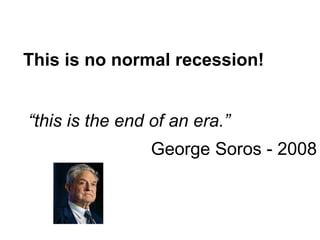
This is no normal recession!   “ this is the end of an era.” George Soros - 2008
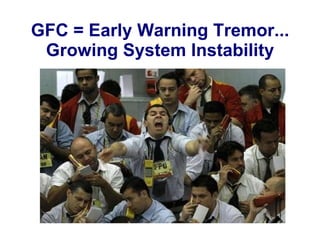
GFC = Early Warning Tremor... Growing System Instability
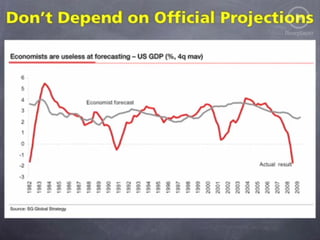
Mainstream Economics Is Misguided Failed to predict  or prevent GFC In fact, mainstream “Neoclassical” economics is  not a science  but a belief system based on false assumptions  Ignores  crucial real world issues – debt load, social costs, resource and ecological limits, how humans really behave Tends to serve the existing power structure Now giving  improbable predictions Unfortunately, government actions based on it!
“ Conventional economics is the dominant intellectual rationalization of today's world order. Breakdown will, all at once, discredit this rationalization and create intellectual space for new ideas to flourish.” Professor Thomas Homer-Dixon   Author of  The Upside of Down: Catastrophe, Creativity, and the Renewal of Civilization  - winner of the 2006 National Business Book Award
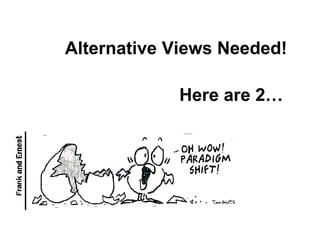
Alternative Views Needed! Here are 2…
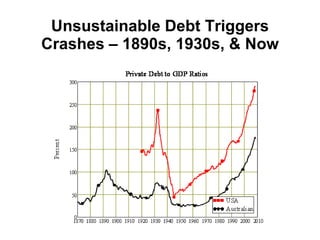
1. Debt Deflation Perspective “ Consumer debt expansion is the fuel that kept the U.S. economy alive.”   “ The growth of debt has outstripped the growth of income to such an extent that an increase in consumer credit and bank lending is not possible.” Paul Roberts  Former Secretary of the U.S. Treasury, 2008
Unsustainable Debt Triggers Crashes – 1890s, 1930s, & Now
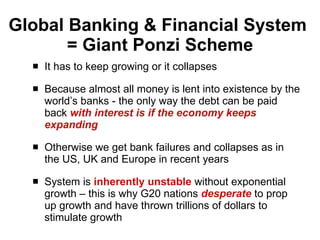
Global Banking & Financial System  = Giant Ponzi Scheme It has to keep growing or it collapses Because almost all money is lent into existence by the world’s banks - the only way the debt can be paid back  with interest is if the economy keeps expanding Otherwise we get bank failures and collapses as in the US, UK and Europe in recent years  System is  inherently unstable  without exponential growth – this is why G20 nations  desperate   to prop up growth and have thrown trillions of dollars to stimulate growth
 
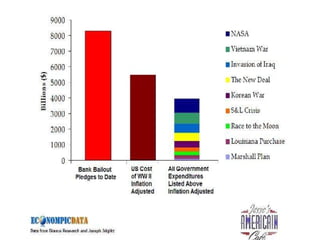
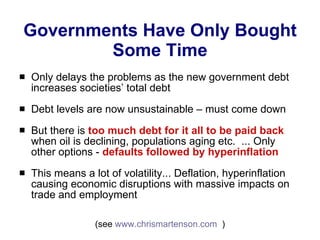
Governments Have Only Bought Some Time Only delays the problems as the new government debt increases societies’ total debt  Debt levels are now unsustainable – must come down  But there is  too much debt for it all to be paid back  when oil is declining, populations aging etc.  ... Only other options -  defaults followed by hyperinflation This means a lot of volatility... Deflation, hyperinflation causing economic disruptions with massive impacts on trade and employment (see  www.chrismartenson.com   )
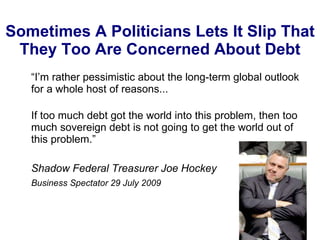
Sometimes A Politicians Lets It Slip That They Too Are Concerned About Debt “ I’m rather pessimistic about the long-term global outlook for a whole host of reasons... If too much debt got the world into this problem, then too much sovereign debt is not going to get the world out of this problem.” Shadow Federal Treasurer Joe Hockey Business Spectator 29 July 2009
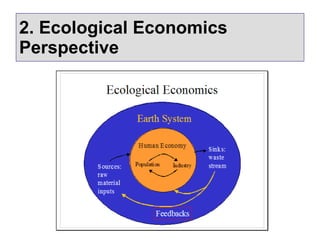
2. Ecological Economics Perspective
Once Again… Limits to Growth According to  Professor Herman Daly   (former Senior Economist at the World Bank and one of the founders of ecological economics )… Virtual assets (fiat money, bank lending, derivatives) are  growing exponentially  so large there will not be enough real, physical assets for them to claim in the future Real wealth is constrained by both  source end  (e.g. peak oil) and  sink end  (e.g. capacity of atmosphere to absorb CO2 – climate change) “ limits to growth” Real wealth limits will destabilise the paper wealth system
Global Stress 6 Black Swans – The Unknown Unexpected Chapter 6
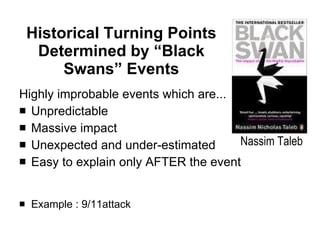
Historical Turning Points Determined by “Black Swans” Events Highly improbable events which are... Unpredictable Massive impact Unexpected and under-estimated Easy to explain only AFTER the event Example : 9/11attack Nassim Taleb
Black Swan Events An  over-populated, highly interconnected world is increasingly vulnerable  to things such as… Global virus pandemics Major terrorist attack (eg. Water supplies or dirty nuke) Middle East war or uprising cutting oil supplies – especially in Saudi Arabia or Iran Or some other natural or man-made disaster… most likely  none of the above … the unknown something we never saw coming!
Discuss in Groups of 3 What do you think the future will hold? How will this 6 global threats affect the next 10 years... And the next 100 years? Some volunteers can share with the group... 1 or 2 points of discussion from their triad
Putting It All Together - Our Probable Future Chapter 7
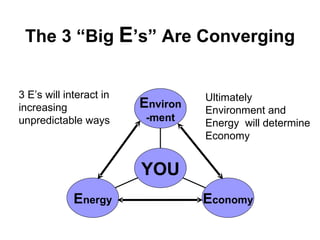
The 3 “Big  E ’s” Are Converging 3 E’s will interact in increasing unpredictable ways Ultimately Environment and Energy  will determine Economy E nviron -ment E conomy E nergy YOU
 
 
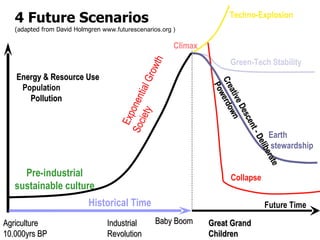
  Exponential Growth Society Energy & Resource Use Population Pollution  Climax Techno-Explosion Green-Tech Stability Earth stewardship Collapse Great Grand Children Agriculture 10.000yrs BP Industrial  Revolution Baby Boom Pre-industrial sustainable culture Historical Time Future Time Creative Descent - Deliberate Powerdown 4 Future Scenarios (adapted from David Holmgren  www.futurescenarios.org )
Limits to Growth Modelling Suggests Techno-Explosion & Green Tech Stability The Least Likely
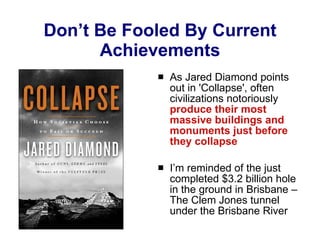
Don’t Be Fooled By Current Achievements As Jared Diamond points out in 'Collapse', often civilizations notoriously  produce their most massive buildings and monuments just before they collapse I’m reminded of the just completed  $3.2 billion hole in the ground in Brisbane – The Clem Jones tunnel under the Brisbane River
Important Points! How humane and positive the descent is depends on how soon we  abandon our denial and attempts to maintain growth economics   No growth in economic scale does  NOT have to mean no developments  in culture, appropriate technology, education, quality of life and human well being!
The Questions Are... Will we have a soft landing? Will the elites that run the  nexus of corporate-government power listen  in time? Will the  cultural tipping points  be reached in time? Will  enough people makes changes  in how they live, work and think to force change? Or will we have a hard crash!
At Some Point... Expect Some Shocks to the System “  ... empires behave like all complex adaptive systems. They function in apparent equilibrium for some unknowable period.  And then,  quite abruptly, they collapse .” Niall Ferguson - Professor at Harvard Business School
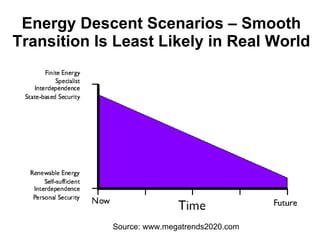
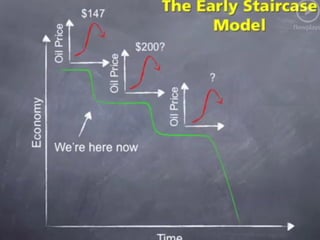
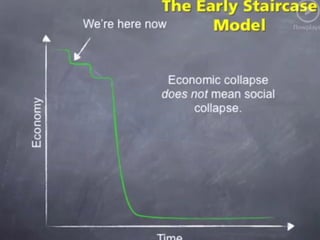
Energy Descent Scenarios – Smooth Transition Is Least Likely in Real World Source: www.megatrends2020.com
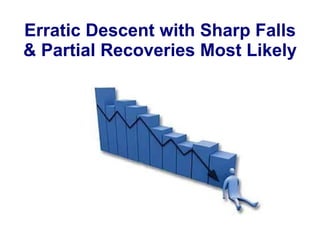
Erratic Descent with Sharp Falls & Partial Recoveries Most Likely
 
 
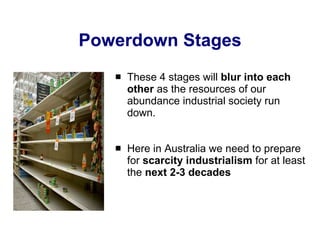
Powerdown Stages Four stages of dominant economic activity: Abundance industrialism   (current growth stage) Scarcity industrialism   (first decline stage - next few decades) Salvage societies  – when a civilization breaks down, the most efficient economies for a time are those that use its legacies as raw material  (latter half of this century) Ecotechnic societies  - ecologically balanced and fully sustainable  (next century) Adapted from “The Ecotechnic Future” by John Michael Greer
Powerdown Stages These 4 stages will  blur into each other  as the resources of our abundance industrial society run down. Here in Australia we need to prepare for  scarcity industrialism  for at least the  next 2-3 decades
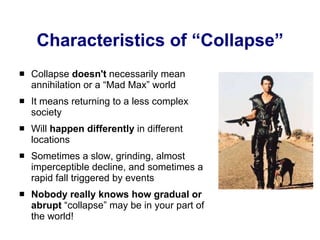
Characteristics of “Collapse” Collapse  doesn't  necessarily mean annihilation or a “Mad Max” world It means returning to a less complex society Will  happen differently  in different locations Sometimes a slow, grinding, almost imperceptible decline, and sometimes a rapid fall triggered by events Nobody really knows how gradual or abrupt  “collapse” may be in your part of the world!
Outlook Overall our society is most likely to be on a  bumpy plateau  for the next 10 years But some of the bumps could be quite surprising! The closer we get to 2020 the  higher the risk of a   sudden system failure  (hard crash)  as a result of a Black Swan event in combination with the other 5 global stresses
Labour Market & Career Impacts Chapter 8
Next 10 Years (My Expectations) May be as late as  2014  before world  oil demand recovers enough to reveal  oil production limits and create  very high oil prices . High oil prices will result in  many flow-on price rises Economy will contract  in real terms Areas remote  from major centres and cheap transport (train & ship) will especially suffer from higher costs for goods & services
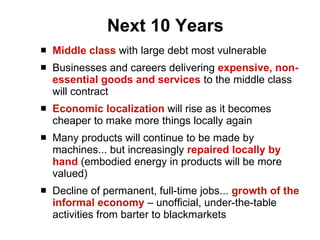
Next 10 Years Middle class  with large debt most vulnerable Businesses and careers delivering  expensive, non-essential goods and services  to the middle class will contract  Economic localization  will rise as it becomes cheaper to make more things locally again Many products will continue to be made by machines... but increasingly  repaired locally by hand  (embodied energy in products will be more valued) Decline of permanent, full-time jobs...  growth of the informal economy  – unofficial, under-the-table activities from barter to blackmarkets
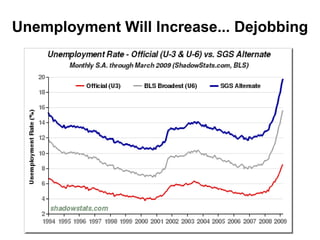
Unemployment Will Increase... Dejobbing
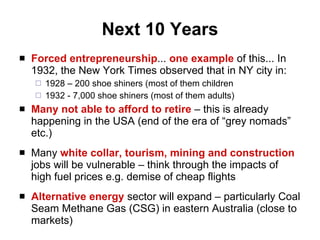
Next 10 Years Forced entrepreneurship ...  one example  of this... In 1932, the New York Times observed that in NY city in: 1928 – 200 shoe shiners (most of them children 1932 - 7,000 shoe shiners (most of them adults) Many not able to afford to retire  – this is already happening in the USA (end of the era of “grey nomads” etc.) Many  white collar, tourism, mining and construction  jobs will be vulnerable – think through the impacts of high fuel prices e.g. demise of cheap flights Alternative energy   sector will expand – particularly Coal Seam Methane Gas (CSG) in eastern Australia (close to markets)
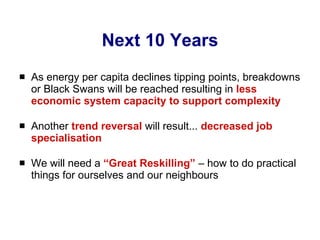
Next 10 Years As energy per capita declines tipping points, breakdowns or Black Swans will be reached resulting in  less economic system capacity to support complexity Another  trend reversal  will result...  decreased job specialisation We will need a  “Great Reskilling”  – how to do practical things for ourselves and our neighbours
Stepping Down Maslow’s Hierarchy of Needs Our economy is  mostly discretionary spending ... not needed for survival! Spending focus will shift to  lower order needs  – security and physical needs From  nice-to-have  things to  need-to-have  things
Job Shift – From Wants to Needs Discretionary Jobs   (nice-to-have things) Less employment here: Mobile dog baths Beautician Luxury goods salesperson Market analyst Tourism  Fitness trainer Party planner Spa installer Legal academic Stock broker Necessary Jobs   (need-to-have things) More employment here: Farmer Health practitioner Carpenter (e.g. altering large houses for higher occupancy) Plumber Security services and products Renewable energy installer Auto LPG converter Repairer Electrician
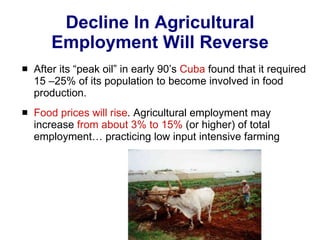
Decline In Agricultural Employment Will Reverse After its “peak oil” in early 90’s  Cuba  found that it required 15 –25% of its population to become involved in food production.  Food prices   will rise . Agricultural employment may increase  from about 3% to 15%  (or higher) of total employment… practicing low input intensive farming
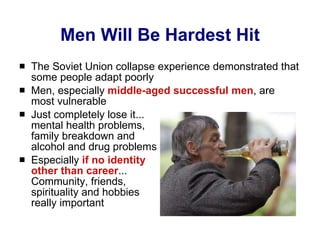
Men Will Be Hardest Hit The Soviet Union collapse experience demonstrated that some people adapt poorly Men, especially  middle-aged successful men , are most vulnerable Just completely lose it...  mental health problems,  family breakdown and  alcohol and drug problems Especially  if no identity  other than career ...  Community, friends,  spirituality and hobbies  really important
How Can We Prepare? Chapter 9
Powerdown & Career Development Even if you do not view this as the most likely future scenario the  magnitude of the potential impacts  in conjunction with the  precautionary principle  suggest it still deserves our attention. Career development is a specialised field which  will shrink  a lot if we do not adapt to be of value in the new era. Will need to  start preparing early  for these historical changes.
Group Discussion At your table  form small groups  (4-6 participants)  Find someone willing to  takes some notes  and later.... briefly share with all of us Brainstorm ideas  on how can we respond to these challenges and prepare in the following areas: Psychological strategies (for ourselves and others) Practical strategies (for ourselves and others) Career strategies (for ourselves and others) Career Development Practice strategies (for our daily work with clients or students)
We Need to Prepare… As individuals (psychologically and practically) As families and networks of friends  As workers (career managers) & business owners As communities As a nation
Some  to get you started...
Psychological Strategies
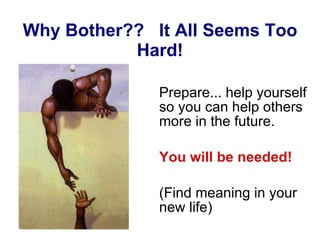
Why Bother??  It All Seems Too Hard! Prepare... help yourself so you can help others more in the future. You will be needed! (Find meaning in your new life)
Human Potential Is Still Amazing! Inner Human No limits Creativity Positive belief Growth is always good Outer Physical Limits Sensitivity Realistic belief Growth always ends Experience Subjective Impacts Objective
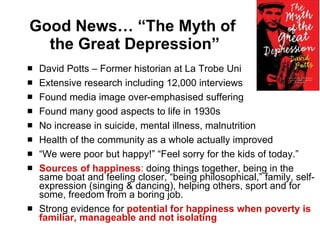
Good News… “The Myth of  the Great Depression” David Potts – Former historian at La Trobe Uni Extensive research including 12,000 interviews  Found media image over-emphasised suffering Found many good aspects to life in 1930s No increase in suicide, mental illness, malnutrition Health of the community as a whole actually improved  “ We were poor but happy!” “Feel sorry for the kids of today.” Sources of happiness :  doing things together, being in the same boat and feeling closer, “being philosophical,” family, self-expression (singing & dancing), helping others, sport and for some, freedom from a boring job. Strong evidence for  potential for happiness when poverty is familiar, manageable and not isolating
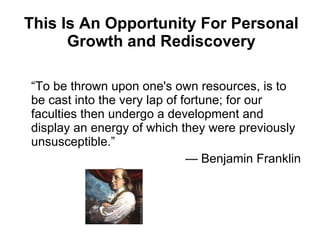
This Is An Opportunity For Personal Growth and Rediscovery “ To be thrown upon one's own resources, is to be cast into the very lap of fortune; for our faculties then undergo a development and display an energy of which they were previously unsusceptible.” —  Benjamin Franklin
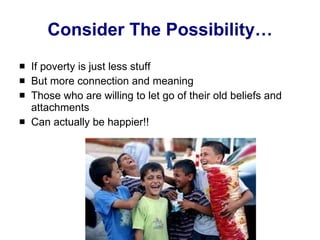
Consider The Possibility… If poverty is just less stuff But more connection and meaning Those who are willing to let go of their old beliefs and attachments Can actually be happier!!
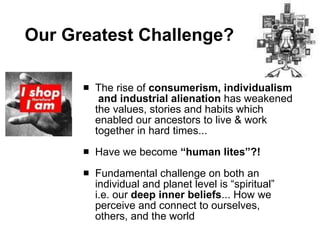
Our Greatest Challenge? The rise of  consumerism, individualism  and industrial alienation  has weakened the values, stories and habits which enabled our ancestors to live & work together in hard times...  Have we become  “human lites”?! Fundamental challenge on both an individual and planet level is “spiritual”  i.e. our  deep inner beliefs ... How we perceive and connect to ourselves, others, and the world
Practical  Strategies
Preparing For What? Two key scenarios  you may wish to prepare for: Economic contraction / hard times  (on the bumpy plateau) lower real incomes and higher unemployment e.g. the USA today Major System breakdowns   (a sharp drop) which may cause... Financial collapses  – banks, employers, government services , insurance companies, superannuation funds Disruptions to support systems  – infrastructure and “just in time” food & product delivery systems e.g. supermarkets, water and electricity
Risk Reduction Planning Decide to act  – if not ready…  educate yourself more on 6 Global Stresses and our predicament Identify and rank your   key threats Self assess  – Strengths, weaknesses, opportunities and threats of your and your situation Brainstorm and prioritize actions A list – easiest, quickest, cheapest B list – big, important needs C list – the rest
When Brainstorming Consider...  Life Areas = Your Resilience Zones Money Health Spirit Career Family Friends You
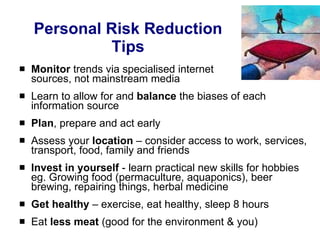
Personal Risk Reduction Tips Monitor  trends via specialised internet  sources, not mainstream media Learn to allow for and  balance  the biases of each information source Plan , prepare and act early Assess your  location  – consider access to work, services, transport, food, family and friends Invest in yourself  - learn practical new skills for hobbies eg. Growing food (permaculture, aquaponics), beer brewing, repairing things, herbal medicine Get healthy  – exercise, eat healthy, sleep 8 hours Eat  less meat  (good for the environment & you)
Personal Risk Reduction Tips Avoid “Affluenza”…  mindless consumerism and unproductive debt. Sell unnecessary consumer goods & toys (eg. power boats, vacation homes). Practice voluntary simplicity  Assess your  investments  – consider carefully what shares (if any)  and property you want to hold Increase  cash  and cash substitutes (gold & silver) Cultivate emotional resilience  - friends, community, spiritualty, exercise, flexible attitude, and a self-identity beyond your full-time job Store 1- 3 months food  at home (grains, beans, pastas, canned foods)
Personal Risk Reduction Tips Install solar  hot water, PV panels, and insulation while government support for these still exists Build  good relationships  with others with useful skills and resources… grow your community Support  community adaptations  such as farmer markets... trying to be an isolated individual survivalist is not practical Consider new  transport options  – public, bicycle,  LPG conversion, or electric conversion Remember… the better politicians/leaders  need all the  support  they can get.
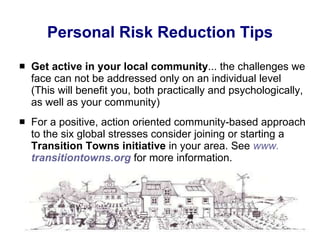
Personal Risk Reduction Tips Get active in your local community ... the challenges we face can not be addressed only on an individual level (This will benefit you, both practically and psychologically, as well as your community) For a positive, action oriented community-based approach to the six global stresses consider joining or starting a  Transition Towns initiative  in your area. See  www. transitiontowns .org  for more information.
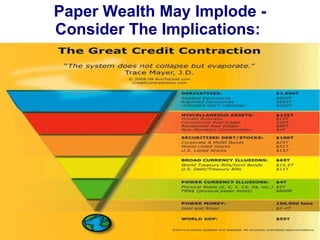
Paper Wealth May Implode - Consider The Implications:
Career  Strategies
Radical Implications for Careers First Revolution – Agriculture Second Revolution – Industry Third Revolution – Sustainable Steady-State Economy & Society   (or devolution - collapse survivalism)
In a Revolution You Are Either a... Revolutionary  – alert, self-aware,  informed, networked, opportunity  observant, self-directed & action -oriented Lucky bystander  – right skills, place,  time, and/or connections Victim  – reliant on the old institutions, ways & belief systems  (“Where’s my... Happy meal, remote, job, dole cheque??”)
When Looking for Solutions Remember... “ The most dynamic forces emerge from outside elite circles: geeks, iconoclasts and maligned populations” Joshua Ramo -  The Age of the Unthinkable – Why the New World Disorder Constantly Surprises Us and What We Can Do About It,  2009 That is to say… look to  the fringe   more than the traditional centre for  new ways to adapt to a changing  world
Reversing the “Great Deskilling”? Over the last 100 years we have lost the skills to meet most of our own needs – growing & producing many things in & around the home As energy and transport costs rise and complex global production, supply and distribution systems step down or breakdown there will be a return to meeting more needs locally “ Forced entrepreneurship”  trend – Laid off workers weary of looking for work, will create their own Practical short courses and hands-on apprenticeships  (whether formal or informal) enabling people to meet local needs will be needed
Career Risk Reduction Tips Assess  your current career… seek  “passion” career or  “defensive”  career Avoid  careers in industries highly dependent  on a growing economy and cheap oil  (e.g. tourism) Meet  local needs  in an economy which can no longer afford to transport food, materials, products, and people as much as in the past.  Practical skills  more valuable than non-essential specialized roles requiring an affluent society (Probably less demand for plastic surgeons, fashion consultants, interior designers, mortgage brokers, financial advisers, sales & marketing etc.) Plan   back-up   options  such as an auto electrician who develops an interest in electric cars.
Career Risk Reduction Tips Improve career resilience by developing a  diverse range  of skills and options Consider  decline-proof careers  – debt collectors, pawn shops, recycling & asset stripping, drugs & alcohol, security, military, essential public services, alternative medicine, alternative transport  (Google “Dmitry Orlov” for the Russian experience) Consider the  Green energy sector  as well as the oil and gas industry (rising prices & skills shortage) Avoid jobs requiring  long car commutes  to work
Some Possible Job Growth Areas - from The Clean Tech Revolution,   Pernick & Walker, 2008 Harness renewable materials and energy sources plus reduce the use of natural resources by using them more efficiently Jobs in production, management, deployment and distribution Job Areas: Solar Energy Wind power Other renewable energies – geothermal, wave, tidal Energy delivery - Smart grid and battery systems Biofuels and biomaterials Green buildings Personal and public transport Water provision (filtration, conservation, etc.) Natural Gas – conventional and unconventional
Career Development Practice Strategies
General Suggestions for Career Advisers Important for career advisers to  question   embedded societal beliefs and keep informed on the 6 Global Stresses Calm, balanced  risk management  approach recommended One major element to be incorporated into the career counselling process –  not the sole focus Need to deal  wisely  with institutional, political and practical realities
New Career Theories Needed With less stable occupations and work environments the person-environment fit model may be less useful   Approaches such as Jim Bright’s  Chaos Theory of Careers  more relevant to changing and chaotic systems In times of rapid change the best we can do may be an  open sharing  of what works and what doesn’t
Useful Career Guidance Distinctions Passion career or  practical career (defensive)? Pre- collapse career and  post-collapse careers Primary career and back-up options/skills
Where To From Here? Chapter 12
 
Websites for Learning More - Go to TransitionWise.org for these links & more Peak Oil Sites www.theoildrum.com  (world energy & the future issues) www.anz.theoildrum.com  (Australian focus on energy & the future) www.aspo-australia.org.au   Climate Change Sites www.climatechangeinaustralia.gov.au www.bom.gov.au/climate/change Economic Change Sites www.debtdeflation.com  (Prof. Steve Keen’s excellent blog)  www.chrismartenson.com  (see the “Crash Course”) Collapse Commentary (Worst-Case Scenario?) Sites www.carolynbaker.net  (compiled by a historian & psychotherapist) www. lifeaftertheoilcrash.net   (most famous peak oil “doomer” site) www.peakoilblues.com  (dealing with the psychological impacts)
Do A Course Sustainable Livelihoods: Now, In Transition and Post Peak   at www.PostPeakLiving.com
Final Thoughts… Nothing stays the same! Enjoy life, appreciate what you’ve got, but don’t get too attached to it. Remember “quality of life” is different from “standard of living.” Major change can be  paralysing or exciting  depending on your mindset – those who are mentally prepared will do much better.
To Wrap Things Up... Print clearly  your  email address  on the  if you want to receive an email with a link to the download of an  updated version of this powerpoint presentation . Place a  tick (  )  after your email address if you want to be added to a  Google Group  I’ll set up for those who want to continue dialogue and information sharing after the workshop If you found today valuable please write your name, position, and a  sentence or two feedback  that I may use on my TransitionWise.org website Thank you!
P.S.  Brief Action Plan Don’t waste this learning experience... What are you going to check out or do as a result of what you learnt? Write it down now!
Questions??

6 Growing Global Stresses and How to Handle Them

  • 1.
    Career Quakes Mitch Lawrie M.Ed (Career Guidance) CDAA B. Regional & Town Planning (Hons) Six Converging Global Stresses & What They May Mean for Careers! CDAA Conference 2010
  • 2.
    Some Suggested “GroundRules” Respect for everyone Remember... Time is precious Please ask... happy to answer questions but I will also need to keep things moving Please contribute... But don’t monopolize discussion Speak up so everyone can hear Self-responsibility – for what you give & gain from the workshop Mobile phones off Confidentiality
  • 3.
    A Show ofHands... Who is familiar with “Peak Oil”? Who thinks it may be a problem for Australia? Who thinks climate change may be a problem for Australia? Who thinks exponential growth is an issue for us? Who has heard of the 1972 book “The Limits to Growth”? Anyone read it? Who thinks conventional economists have a good understanding of the economy and the world? Who thinks things will go on much the same and we’ll be having national conferences like this in 10 years time?
  • 4.
    Overview Core culturalbelief since Industrial Revolution – “ economic growth is good, essential and unending ” Our beliefs about work & the economy have formed during this unique period of growth Career theory & practice takes place totally within this unquestioned cultural narrative Strong evidence global stresses are approaching tipping points that will prove this belief incorrect... Growth will stop Society, the world of work & careers will enter a “Great Transition”... major change “quakes” within the next 10 years ?
  • 5.
    If True… Hugeimpacts on you Personally Professionally And on your clients
  • 6.
    Evidence? I willonly briefly introduce the evidence today The scope of this presentation is large and rarely traversed in the careers field Needs 1 day... I had to cut >150 slides! For now please just consider the “end of growth” as a hypothesis ... A possible future... And use today as a chance to consider the implications Please do follow up research to make up your own mind – go to my site: www.TransitionWise.org for the more details and links to further evidence or just Google
  • 7.
  • 8.
    “ People willrarely acknowledge that an accustomed way of life is unsustainable except in the face of prolonged, devastating failure.” Joseph Tainter – author of… This Is A Deeply Unpopular Subject
  • 9.
    The ruling “gods”of our culture – Technology and the Market Our Saviours?
  • 10.
    Warning: Some PeopleMay Not Like This Presentation Normal reaction when core cultural beliefs are challenged
  • 11.
    Other Common Reactionsto Major Belief Challenges Denial Anger Bargaining Fear & anxiety Depression Acceptance Action (adapted from Kubler-Ross 5 Stages of Grief)
  • 12.
    Society In DenialMost societies are in denial about what we are facing Politicians don’t like to bring bad news or oppose established paradigms… prophets tend to get stoned , not re-elected It is easy to belittle a viewpoint which goes against the hugely dominant cultural narrative Those who question the feasibility of never-ending growth are accused of being hysterical “ doomers” or being “negative ”
  • 13.
    Confusion Of RealmsInner Human No limits Creativity Positive belief Growth is always good Outer Physical Limits Sensitivity Realistic belief Growth always ends Experience Subjective Impacts Objective
  • 14.
    My Purpose Purposeof presentation is not to depress you... but empower you Provide useful insights and help you prepare NOT
  • 15.
    Workshop Outline SixGrowing Global Stresses (or “why growth will fail ”) Putting It All Together – Our Probable Future Labour Market and Career Impacts How Can We Prepare?
  • 16.
    Global Stress 1World Oil Production Limits - The Problem of “Peak Oil” Chapter 1
  • 17.
    Cheap Oil… OurSociety is Built on It!! All made with oil! Absolutely crucial for: Transport Food Housing Products Most current careers wouldn’t exist without it!
  • 18.
    ONE U.S. POLITICIANWHO FULLY UNDERSTOOD THE IMPORTANCE OF OIL Energy is truly fundamental to the world’s economy. The Gulf War was a reflection of that reality. … (Oil) is the basic, fundamental building block of the world's economy. Dick Cheney, Former U.S. Vice-President, London, 1999
  • 19.
    LOOMING WORLD OILPROBLEMS: MYTHS AND REALITIES Keynote Address at Largest Logistics Conference in Southern Hemisphere The Smart Conference 2007 Sydney Roger H. Bezdek. Ph.D., President Management Information Services, Inc. Washington, D.C. USA
  • 20.
    WHY WILL CONVENTIONALOIL PRODUCTION PEAK ? Oil Fields Peak The world will peak (All regions) Regions Peak (Many oil fields) Time - Decades Production 1945 2000 Year Production U.S Lower 48 States
  • 21.
    WORLD IS CONSUMINGMORE OIL AND FINDING LESS Past discovery by ExxonMobil 0 10 20 30 40 50 60 1930 1950 1970 1990 2010 2030 2050 Billions of Barrels 0 10 20 30 40 50 60 Past Future Production “ Growing Gap”
  • 22.
    Peak Oil forIndividual Nations Japan: 1932 Germany: 1966 Libya: 1970 Venezuela: 1970 USA: 1970 Iran: 1974 Nigeria: 1979 Trinidad & Tobago: 1981 Egypt: 1987 France: 1988 Indonesia: 1991 Syria: 1996 India: 1997 New Zealand: 1997 UK: 1999 Argentina: 1999 Colombia: 1999 Norway: 2000 Oman: 2000 Australia: 2000 Mexico: 2004 Russia: 2007 United Arab Emirates? Algeria? Estimated future peak oil years: Kuwait: 2013 Saudi Arabia: 2014 Iraq: 2018 China ? (close) Brazil ? Canada ? Kazakstan & Azerbaijan ? Source: Wikipedia.org
  • 23.
    WHEN MIGHT WORLDPEAKING OCCUR? Different Approximations Lead to Different Forecasts Forecast Source December 2005 Deffeyes (U.S.) 2006-2007 Bakhitari (Iran) 2006-2007 Simmons (U.S.) 2010 +/- Skrebowski (U.K.) 2010 Campbell (Ireland) Before 2010 Goodstein (U.S.) After 2010 World Energy Council 2012 Weng (China) 2020 IEA (Paris-based monitor) After 2020 CERA (U.S.) 2030 or later EIA (U.S. Govt) 5 years 5-15 years > 20 years Already
  • 24.
  • 25.
  • 26.
    Just A Fewof The Headlines   Oil reserves 'exaggerated by one third' Sydney Morning Herald  March 24, 2010 The world's oil reserves have been exaggerated by up to a third, according to Sir David King, Britain's former chief scientist, who has warned of shortages and price spikes within years. Business calls for urgent action on “oil crunch” threat to UK economy London, 10 February, 2010: A group of leading business people today call for urgent action to prepare the UK for Peak Oil. The second report of the UK Industry Taskforce on Peak Oil and Energy Security (ITPOES) finds that oil shortages, insecurity of supply and price volatility will destabilise economic, political and social activity potentially by 2015. Richard Branson warns that oil crunch is coming within five years   UK Guardian article 7th February 2010
  • 27.
    Queensland Oil VulnerabilityTaskforce Established by the Qld State Government in 2005… “ The Taskforce concludes that Queensland’s vulnerability to peaking of world oil supplies, and to world supply disruptions, is particularly acute given our oil supply and demand trends, as well as our regionally distributed population and industrial base.”
  • 28.
    TECHNOLOGY & PRICEMAY NOT SAVE US U. S. Lower 48 Oil Production 3.5 3.0 2.5 2.0 1.5 1.0 0.5 0 80 0 Production Price Dramatic Improvement in Oil Field Technology PRODUCTION (Billions of Barrels per Year) 1950 1960 1970 1980 1990 2000 Trends were not reversed, and continued decline is forecast PRICE (2003 $ per barrels)
  • 29.
    RENEWABLES WILL SAVEUS? Not necessarily. Long time to scale up. Major renewables do not produce significant liquid transportation fuels
  • 30.
    WHAT MIGHT HAPPENAT PEAKING? WORLD OIL DEMAND grows each year in a healthy world economy WORLD OIL PRODUCTION reaches a maximum & then declines Supply cannot meet demand PRICES INCREASE SHORTAGES DEVELOP Time
  • 31.
    GROWING OIL SHORTAGESWILL INDUCE GROWING WORLD “DEMAND DESTRUCTION” Supply Supply & Demand in Balance Minimal Disruption Recession Depression Demand Destruction
  • 32.
    OIL PRICE &RECESSIONS 0 0.1 0.2 0.3 0.4 0.5 0.6 0.7 0.8 0.9 1 1969 1971 1973 1975 1977 1979 1981 1983 1985 1987 1989 1991 1993 1995 1997 1999 2001 2003 Recession OIL PRICE (2003 $ per barrel) Over 30 years, four recessions followed oil price spikes. 0 10 20 30 40 50 60 70 80
  • 33.
    NOT TO WORRY,WORLD WILL MUDDLE THROUGH? Not true. We should be very worried. The problem of the peaking of world conventional oil production is unlike any yet faced by modern industrial society. Previous energy transitions, from wood to coal and from coal to oil, were gradual and evolutionary. World may be facing an imminent energy discontinuity that will be abrupt and painful. World has yet to grasp this or its implications. There will be no quick fixes for this problem, on either the demand side or the supply side. (“Hirsch Report”) Many analysts and policy-makers do not comprehend this.
  • 34.
    There’s the badnews and the good news...
  • 35.
    The Bad News...We Peaked in 2000 Australia’s oil imports have risen to 30-40 % of net
  • 36.
    CSIRO – FutureFuels Forum – 2008 Forum included: Caltex Engineers Australia Holden NRMA Qld Rail Chevron Victorian Government Woolworths Australian Automobile Association Biofuels Association of Australia
  • 37.
    Forum: Key ConclusionsAustralia is more vulnerable than some other countries due to our high vehicle use, high fuel consumption by vehicles, and declining domestic reserves of conventional oil. Petrol prices could increase to as high as A$8 per litre by 2018. Transport intensive activities such as tourism and mining would be most vulnerable.
  • 38.
    If This IsStarting To Get You Down ...Then Don’t Despair
  • 39.
    The Good News...Coal Seam Methane Gas Reserves in Central Qld Massive reserves, but it will take years to develop and we will be paying the (high) international price. Vehicles can be converted to run on CNG but it takes significant time and large investments.
  • 40.
    Where Does ThisLeave Australia? Better off than some countries but not immune ... All countries today are strongly linked in the global economy Will also need to cope with other global stresses around the same time
  • 41.
    Global Stress 2The Climate Change Wildcard Chapter 2
  • 42.
  • 43.
    “ In theend, it's important not to lose sight of the forest for the trees, where the ‘forest' refers to the totality of scientific evidence for global warming.” Richard L. Smith, in newsletter of American Statistical Association, Section on Statistics & the Environment, Spring 2007 issue Totality of Scientific Evidence is Clear
  • 44.
    If You AreNot Sure Who To Believe Read This Book Balanced examination of both sides of the argument by a “non-greenie” Gareth Morgan, CEO of his own investment company, couldn't decide whether he believed in climate change or not, so he hired the best international scientists from both sides to answer his questions and these are his findings. Reveals how both sides have their mistakes and weaknesses The Verdict: on the balance of probabilities climate change is going to be a real problem
  • 45.
    Sudden, Unpredictable andIrreversible “ Since the IPCC report came out in 2007, new data point to even more alarming scenarios. We underestimate the risk and ignore the fact that the planet is threatened with " sudden, unpredictable, and irreversible disaster .” Steve Chu United States Secretary of Energy Nobel Prize-Winning Professor of Physics & Molecular Biology
  • 46.
    Tipping Points Biggestconcern of climate scientists They don’t know exactly when Could start “positive feedback loops”... Melting ice and snow Tropical jungles dry out and burn Frozen deposits in permafrost and ocean floor release methane Runaway climate change!
  • 47.
    “ I amnot exaggerating in saying the survival of civilisation is at stake.” Professor Ian Lowe Emeritus Professor of Science, Technology and Society at Griffith University
  • 48.
    Australia... The LuckyCountry? Climate change could mean our luck has run out...
  • 49.
    Warning From TheCSIRO Australia’s climate change impacts include: More heatwaves Reductions in average rainfall More frequent El Nino events (droughts) Sea level rise
  • 50.
    Rainfall is decliningin Eastern Australia SOURCE: National Climate Centre, Bureau of Meteorology, 2008.
  • 51.
    Warning From TheGarnaut Report Mitigation will come too late to avoid substantial damage from climate change. Not feasible for governments to underwrite maintenance of established patterns of life for all people in all places.
  • 52.
    Global Stress 3The Dangerous Nature of Exponential Growth - Ticking Time Bombs Chapter 3
  • 53.
    “ The greatestshortcoming of the human race is our inability to understand the exponential function.” Al Bartlett Professor of Physics University of Colorado
  • 54.
  • 55.
    “ It hastaken all of human history for the economy to reach its current size. On current form it will take just two decades to double .” – New Scientist Magazine, Oct 2008 Reaches a Point Where Even 3.6% Per Year Becomes Huge
  • 56.
  • 57.
    Only A MassiveOne-Off Drawdown of Fossil Fuels Has Enabled This Growth
  • 58.
    Exponential Growth –Always Temporary in a Finite World Population and GDP can not grow exponentially without limits
  • 59.
    “ Anyone whobelieves exponential growth can go on forever in a finite world is either a madman or an economist." Kenneth Boulding (1910-1993) – Economist & Philosopher
  • 60.
    Growth Always Ends The questions remaining are... Will it be a “soft landing” or a “hard landing”? And when?
  • 61.
    Global Stress 4Multiple Other Limits to Growth Chapter 4
  • 62.
    Not Just PeakOil... “Peak Many Things” In The Next 20 Years Food production Topsoil Phosphorous Fish Water supplies Some minerals – silver, platinum, copper, zinc lead, tin & rare earth minerals
  • 63.
    Even Major TechnicalBreakthroughs May Have Already Peaked Source: Jonathan Huebner – Physicist, US Naval Air Warfare Center
  • 64.
    Special Report: Howour economy is killing the Earth – New Scientist , 18 Oct 2008 Water use Vehicles Co2 GDP Population Loss of rainforest and woodlands Species extinction Fisheries exploitation
  • 65.
    World Is InOvershoot
  • 66.
    “ A Comparisonof " The Limits to Growth " with Thirty Years of Reality” Graham Turner - CSIRO Working Paper June 2008 found: “ Limits to Growth” (1972, MIT - Club of Rome) study was falsely attacked 30 years of historical data fits their "standard run" scenario 1972 2002
  • 67.
    Business as Usual - “Standard Run” Scenario
  • 68.
    Other Findings from“Limits to Growth” Computer Simulation If you remove or raise one limit but keep growing exponentially you encounter another surprisingly soon Globalization of trade means that most of the world will reach limits around the same time If you put off early limits through economic and technological innovations you are more likely to run into several limits at about the same time Lesser developed countries likely to fail first ... may then have a domino effect on other countries World will not totally run out of any one resource... what it runs out of is the ability to cope due to multiple problems impacting in a short time span
  • 69.
    Ability to Cope...The Real Limit As resources deplete ... (e.g. peak oil) As pollution levels rise ... (e.g. climate change) The costs of compensating have to be paid out of current economic output, leaving less and less for other uses , until economic output itself begins to fall and the industrial world begins its terminal decline.
  • 70.
    Technology & Markets– Best Case Assumptions Still Lead to Collapse “ In several scenarios we test accelerated technological advance and possible future technical leaps beyond these ‘normal’ improvements. What if materials are almost entirely recycled? What if land yield doubles again and yet again? What if emissions are reduced at 4% per year over the coming century? Even with the most effective technologies and the greatest economic resilience that we believe is possible, if these are the only changes, the model tends to generate scenarios of collapse .” ( The Limits to Growth – The Thirty Year Update p. 204-5)
  • 71.
    Confronting Reality… “Inthe 21st century, the human race must finally confront the reality that in the closed system that is planet earth, there are limits to growth. No matter how clever we are, there is no escaping the physical limits of the world's resources. The laws of physics trump the laws of economics every time.” Andrew McNamara, Former Queensland Minister for Sustainability, Climate Change and Innovation .
  • 72.
    Global Stress 5House of Cards Economic System Chapter 5
  • 73.
    This is nonormal recession! “ this is the end of an era.” George Soros - 2008
  • 74.
    GFC = EarlyWarning Tremor... Growing System Instability
  • 75.
    Mainstream Economics IsMisguided Failed to predict or prevent GFC In fact, mainstream “Neoclassical” economics is not a science but a belief system based on false assumptions Ignores crucial real world issues – debt load, social costs, resource and ecological limits, how humans really behave Tends to serve the existing power structure Now giving improbable predictions Unfortunately, government actions based on it!
  • 76.
    “ Conventional economicsis the dominant intellectual rationalization of today's world order. Breakdown will, all at once, discredit this rationalization and create intellectual space for new ideas to flourish.” Professor Thomas Homer-Dixon Author of The Upside of Down: Catastrophe, Creativity, and the Renewal of Civilization - winner of the 2006 National Business Book Award
  • 77.
  • 78.
    1. Debt DeflationPerspective “ Consumer debt expansion is the fuel that kept the U.S. economy alive.” “ The growth of debt has outstripped the growth of income to such an extent that an increase in consumer credit and bank lending is not possible.” Paul Roberts Former Secretary of the U.S. Treasury, 2008
  • 79.
    Unsustainable Debt TriggersCrashes – 1890s, 1930s, & Now
  • 80.
    Global Banking &Financial System = Giant Ponzi Scheme It has to keep growing or it collapses Because almost all money is lent into existence by the world’s banks - the only way the debt can be paid back with interest is if the economy keeps expanding Otherwise we get bank failures and collapses as in the US, UK and Europe in recent years System is inherently unstable without exponential growth – this is why G20 nations desperate to prop up growth and have thrown trillions of dollars to stimulate growth
  • 81.
  • 82.
    Governments Have OnlyBought Some Time Only delays the problems as the new government debt increases societies’ total debt Debt levels are now unsustainable – must come down But there is too much debt for it all to be paid back when oil is declining, populations aging etc. ... Only other options - defaults followed by hyperinflation This means a lot of volatility... Deflation, hyperinflation causing economic disruptions with massive impacts on trade and employment (see www.chrismartenson.com )
  • 83.
    Sometimes A PoliticiansLets It Slip That They Too Are Concerned About Debt “ I’m rather pessimistic about the long-term global outlook for a whole host of reasons... If too much debt got the world into this problem, then too much sovereign debt is not going to get the world out of this problem.” Shadow Federal Treasurer Joe Hockey Business Spectator 29 July 2009
  • 84.
  • 85.
    Once Again… Limitsto Growth According to Professor Herman Daly (former Senior Economist at the World Bank and one of the founders of ecological economics )… Virtual assets (fiat money, bank lending, derivatives) are growing exponentially so large there will not be enough real, physical assets for them to claim in the future Real wealth is constrained by both source end (e.g. peak oil) and sink end (e.g. capacity of atmosphere to absorb CO2 – climate change) “ limits to growth” Real wealth limits will destabilise the paper wealth system
  • 86.
    Global Stress 6Black Swans – The Unknown Unexpected Chapter 6
  • 87.
    Historical Turning PointsDetermined by “Black Swans” Events Highly improbable events which are... Unpredictable Massive impact Unexpected and under-estimated Easy to explain only AFTER the event Example : 9/11attack Nassim Taleb
  • 88.
    Black Swan EventsAn over-populated, highly interconnected world is increasingly vulnerable to things such as… Global virus pandemics Major terrorist attack (eg. Water supplies or dirty nuke) Middle East war or uprising cutting oil supplies – especially in Saudi Arabia or Iran Or some other natural or man-made disaster… most likely none of the above … the unknown something we never saw coming!
  • 89.
    Discuss in Groupsof 3 What do you think the future will hold? How will this 6 global threats affect the next 10 years... And the next 100 years? Some volunteers can share with the group... 1 or 2 points of discussion from their triad
  • 90.
    Putting It AllTogether - Our Probable Future Chapter 7
  • 91.
    The 3 “Big E ’s” Are Converging 3 E’s will interact in increasing unpredictable ways Ultimately Environment and Energy will determine Economy E nviron -ment E conomy E nergy YOU
  • 92.
  • 93.
  • 94.
    ExponentialGrowth Society Energy & Resource Use Population Pollution Climax Techno-Explosion Green-Tech Stability Earth stewardship Collapse Great Grand Children Agriculture 10.000yrs BP Industrial Revolution Baby Boom Pre-industrial sustainable culture Historical Time Future Time Creative Descent - Deliberate Powerdown 4 Future Scenarios (adapted from David Holmgren www.futurescenarios.org )
  • 95.
    Limits to GrowthModelling Suggests Techno-Explosion & Green Tech Stability The Least Likely
  • 96.
    Don’t Be FooledBy Current Achievements As Jared Diamond points out in 'Collapse', often civilizations notoriously produce their most massive buildings and monuments just before they collapse I’m reminded of the just completed $3.2 billion hole in the ground in Brisbane – The Clem Jones tunnel under the Brisbane River
  • 97.
    Important Points! Howhumane and positive the descent is depends on how soon we abandon our denial and attempts to maintain growth economics No growth in economic scale does NOT have to mean no developments in culture, appropriate technology, education, quality of life and human well being!
  • 98.
    The Questions Are...Will we have a soft landing? Will the elites that run the nexus of corporate-government power listen in time? Will the cultural tipping points be reached in time? Will enough people makes changes in how they live, work and think to force change? Or will we have a hard crash!
  • 99.
    At Some Point...Expect Some Shocks to the System “ ... empires behave like all complex adaptive systems. They function in apparent equilibrium for some unknowable period. And then, quite abruptly, they collapse .” Niall Ferguson - Professor at Harvard Business School
  • 100.
    Energy Descent Scenarios– Smooth Transition Is Least Likely in Real World Source: www.megatrends2020.com
  • 101.
    Erratic Descent withSharp Falls & Partial Recoveries Most Likely
  • 102.
  • 103.
  • 104.
    Powerdown Stages Fourstages of dominant economic activity: Abundance industrialism (current growth stage) Scarcity industrialism (first decline stage - next few decades) Salvage societies – when a civilization breaks down, the most efficient economies for a time are those that use its legacies as raw material (latter half of this century) Ecotechnic societies - ecologically balanced and fully sustainable (next century) Adapted from “The Ecotechnic Future” by John Michael Greer
  • 105.
    Powerdown Stages These4 stages will blur into each other as the resources of our abundance industrial society run down. Here in Australia we need to prepare for scarcity industrialism for at least the next 2-3 decades
  • 106.
    Characteristics of “Collapse”Collapse doesn't necessarily mean annihilation or a “Mad Max” world It means returning to a less complex society Will happen differently in different locations Sometimes a slow, grinding, almost imperceptible decline, and sometimes a rapid fall triggered by events Nobody really knows how gradual or abrupt “collapse” may be in your part of the world!
  • 107.
    Outlook Overall oursociety is most likely to be on a bumpy plateau for the next 10 years But some of the bumps could be quite surprising! The closer we get to 2020 the higher the risk of a sudden system failure (hard crash) as a result of a Black Swan event in combination with the other 5 global stresses
  • 108.
    Labour Market &Career Impacts Chapter 8
  • 109.
    Next 10 Years(My Expectations) May be as late as 2014 before world oil demand recovers enough to reveal oil production limits and create very high oil prices . High oil prices will result in many flow-on price rises Economy will contract in real terms Areas remote from major centres and cheap transport (train & ship) will especially suffer from higher costs for goods & services
  • 110.
    Next 10 YearsMiddle class with large debt most vulnerable Businesses and careers delivering expensive, non-essential goods and services to the middle class will contract Economic localization will rise as it becomes cheaper to make more things locally again Many products will continue to be made by machines... but increasingly repaired locally by hand (embodied energy in products will be more valued) Decline of permanent, full-time jobs... growth of the informal economy – unofficial, under-the-table activities from barter to blackmarkets
  • 111.
  • 112.
    Next 10 YearsForced entrepreneurship ... one example of this... In 1932, the New York Times observed that in NY city in: 1928 – 200 shoe shiners (most of them children 1932 - 7,000 shoe shiners (most of them adults) Many not able to afford to retire – this is already happening in the USA (end of the era of “grey nomads” etc.) Many white collar, tourism, mining and construction jobs will be vulnerable – think through the impacts of high fuel prices e.g. demise of cheap flights Alternative energy sector will expand – particularly Coal Seam Methane Gas (CSG) in eastern Australia (close to markets)
  • 113.
    Next 10 YearsAs energy per capita declines tipping points, breakdowns or Black Swans will be reached resulting in less economic system capacity to support complexity Another trend reversal will result... decreased job specialisation We will need a “Great Reskilling” – how to do practical things for ourselves and our neighbours
  • 114.
    Stepping Down Maslow’sHierarchy of Needs Our economy is mostly discretionary spending ... not needed for survival! Spending focus will shift to lower order needs – security and physical needs From nice-to-have things to need-to-have things
  • 115.
    Job Shift –From Wants to Needs Discretionary Jobs (nice-to-have things) Less employment here: Mobile dog baths Beautician Luxury goods salesperson Market analyst Tourism Fitness trainer Party planner Spa installer Legal academic Stock broker Necessary Jobs (need-to-have things) More employment here: Farmer Health practitioner Carpenter (e.g. altering large houses for higher occupancy) Plumber Security services and products Renewable energy installer Auto LPG converter Repairer Electrician
  • 116.
    Decline In AgriculturalEmployment Will Reverse After its “peak oil” in early 90’s Cuba found that it required 15 –25% of its population to become involved in food production. Food prices will rise . Agricultural employment may increase from about 3% to 15% (or higher) of total employment… practicing low input intensive farming
  • 117.
    Men Will BeHardest Hit The Soviet Union collapse experience demonstrated that some people adapt poorly Men, especially middle-aged successful men , are most vulnerable Just completely lose it... mental health problems, family breakdown and alcohol and drug problems Especially if no identity other than career ... Community, friends, spirituality and hobbies really important
  • 118.
    How Can WePrepare? Chapter 9
  • 119.
    Powerdown & CareerDevelopment Even if you do not view this as the most likely future scenario the magnitude of the potential impacts in conjunction with the precautionary principle suggest it still deserves our attention. Career development is a specialised field which will shrink a lot if we do not adapt to be of value in the new era. Will need to start preparing early for these historical changes.
  • 120.
    Group Discussion Atyour table form small groups (4-6 participants) Find someone willing to takes some notes and later.... briefly share with all of us Brainstorm ideas on how can we respond to these challenges and prepare in the following areas: Psychological strategies (for ourselves and others) Practical strategies (for ourselves and others) Career strategies (for ourselves and others) Career Development Practice strategies (for our daily work with clients or students)
  • 121.
    We Need toPrepare… As individuals (psychologically and practically) As families and networks of friends As workers (career managers) & business owners As communities As a nation
  • 122.
    Some toget you started...
  • 123.
  • 124.
    Why Bother?? It All Seems Too Hard! Prepare... help yourself so you can help others more in the future. You will be needed! (Find meaning in your new life)
  • 125.
    Human Potential IsStill Amazing! Inner Human No limits Creativity Positive belief Growth is always good Outer Physical Limits Sensitivity Realistic belief Growth always ends Experience Subjective Impacts Objective
  • 126.
    Good News… “TheMyth of the Great Depression” David Potts – Former historian at La Trobe Uni Extensive research including 12,000 interviews Found media image over-emphasised suffering Found many good aspects to life in 1930s No increase in suicide, mental illness, malnutrition Health of the community as a whole actually improved “ We were poor but happy!” “Feel sorry for the kids of today.” Sources of happiness : doing things together, being in the same boat and feeling closer, “being philosophical,” family, self-expression (singing & dancing), helping others, sport and for some, freedom from a boring job. Strong evidence for potential for happiness when poverty is familiar, manageable and not isolating
  • 127.
    This Is AnOpportunity For Personal Growth and Rediscovery “ To be thrown upon one's own resources, is to be cast into the very lap of fortune; for our faculties then undergo a development and display an energy of which they were previously unsusceptible.” — Benjamin Franklin
  • 128.
    Consider The Possibility…If poverty is just less stuff But more connection and meaning Those who are willing to let go of their old beliefs and attachments Can actually be happier!!
  • 129.
    Our Greatest Challenge?The rise of consumerism, individualism and industrial alienation has weakened the values, stories and habits which enabled our ancestors to live & work together in hard times... Have we become “human lites”?! Fundamental challenge on both an individual and planet level is “spiritual” i.e. our deep inner beliefs ... How we perceive and connect to ourselves, others, and the world
  • 130.
  • 131.
    Preparing For What?Two key scenarios you may wish to prepare for: Economic contraction / hard times (on the bumpy plateau) lower real incomes and higher unemployment e.g. the USA today Major System breakdowns (a sharp drop) which may cause... Financial collapses – banks, employers, government services , insurance companies, superannuation funds Disruptions to support systems – infrastructure and “just in time” food & product delivery systems e.g. supermarkets, water and electricity
  • 132.
    Risk Reduction PlanningDecide to act – if not ready… educate yourself more on 6 Global Stresses and our predicament Identify and rank your key threats Self assess – Strengths, weaknesses, opportunities and threats of your and your situation Brainstorm and prioritize actions A list – easiest, quickest, cheapest B list – big, important needs C list – the rest
  • 133.
    When Brainstorming Consider... Life Areas = Your Resilience Zones Money Health Spirit Career Family Friends You
  • 134.
    Personal Risk ReductionTips Monitor trends via specialised internet sources, not mainstream media Learn to allow for and balance the biases of each information source Plan , prepare and act early Assess your location – consider access to work, services, transport, food, family and friends Invest in yourself - learn practical new skills for hobbies eg. Growing food (permaculture, aquaponics), beer brewing, repairing things, herbal medicine Get healthy – exercise, eat healthy, sleep 8 hours Eat less meat (good for the environment & you)
  • 135.
    Personal Risk ReductionTips Avoid “Affluenza”… mindless consumerism and unproductive debt. Sell unnecessary consumer goods & toys (eg. power boats, vacation homes). Practice voluntary simplicity Assess your investments – consider carefully what shares (if any) and property you want to hold Increase cash and cash substitutes (gold & silver) Cultivate emotional resilience - friends, community, spiritualty, exercise, flexible attitude, and a self-identity beyond your full-time job Store 1- 3 months food at home (grains, beans, pastas, canned foods)
  • 136.
    Personal Risk ReductionTips Install solar hot water, PV panels, and insulation while government support for these still exists Build good relationships with others with useful skills and resources… grow your community Support community adaptations such as farmer markets... trying to be an isolated individual survivalist is not practical Consider new transport options – public, bicycle, LPG conversion, or electric conversion Remember… the better politicians/leaders need all the support they can get.
  • 137.
    Personal Risk ReductionTips Get active in your local community ... the challenges we face can not be addressed only on an individual level (This will benefit you, both practically and psychologically, as well as your community) For a positive, action oriented community-based approach to the six global stresses consider joining or starting a Transition Towns initiative in your area. See www. transitiontowns .org for more information.
  • 138.
    Paper Wealth MayImplode - Consider The Implications:
  • 139.
  • 140.
    Radical Implications forCareers First Revolution – Agriculture Second Revolution – Industry Third Revolution – Sustainable Steady-State Economy & Society (or devolution - collapse survivalism)
  • 141.
    In a RevolutionYou Are Either a... Revolutionary – alert, self-aware, informed, networked, opportunity observant, self-directed & action -oriented Lucky bystander – right skills, place, time, and/or connections Victim – reliant on the old institutions, ways & belief systems (“Where’s my... Happy meal, remote, job, dole cheque??”)
  • 142.
    When Looking forSolutions Remember... “ The most dynamic forces emerge from outside elite circles: geeks, iconoclasts and maligned populations” Joshua Ramo - The Age of the Unthinkable – Why the New World Disorder Constantly Surprises Us and What We Can Do About It, 2009 That is to say… look to the fringe more than the traditional centre for new ways to adapt to a changing world
  • 143.
    Reversing the “GreatDeskilling”? Over the last 100 years we have lost the skills to meet most of our own needs – growing & producing many things in & around the home As energy and transport costs rise and complex global production, supply and distribution systems step down or breakdown there will be a return to meeting more needs locally “ Forced entrepreneurship” trend – Laid off workers weary of looking for work, will create their own Practical short courses and hands-on apprenticeships (whether formal or informal) enabling people to meet local needs will be needed
  • 144.
    Career Risk ReductionTips Assess your current career… seek “passion” career or “defensive” career Avoid careers in industries highly dependent on a growing economy and cheap oil (e.g. tourism) Meet local needs in an economy which can no longer afford to transport food, materials, products, and people as much as in the past. Practical skills more valuable than non-essential specialized roles requiring an affluent society (Probably less demand for plastic surgeons, fashion consultants, interior designers, mortgage brokers, financial advisers, sales & marketing etc.) Plan back-up options such as an auto electrician who develops an interest in electric cars.
  • 145.
    Career Risk ReductionTips Improve career resilience by developing a diverse range of skills and options Consider decline-proof careers – debt collectors, pawn shops, recycling & asset stripping, drugs & alcohol, security, military, essential public services, alternative medicine, alternative transport (Google “Dmitry Orlov” for the Russian experience) Consider the Green energy sector as well as the oil and gas industry (rising prices & skills shortage) Avoid jobs requiring long car commutes to work
  • 146.
    Some Possible JobGrowth Areas - from The Clean Tech Revolution, Pernick & Walker, 2008 Harness renewable materials and energy sources plus reduce the use of natural resources by using them more efficiently Jobs in production, management, deployment and distribution Job Areas: Solar Energy Wind power Other renewable energies – geothermal, wave, tidal Energy delivery - Smart grid and battery systems Biofuels and biomaterials Green buildings Personal and public transport Water provision (filtration, conservation, etc.) Natural Gas – conventional and unconventional
  • 147.
  • 148.
    General Suggestions forCareer Advisers Important for career advisers to question embedded societal beliefs and keep informed on the 6 Global Stresses Calm, balanced risk management approach recommended One major element to be incorporated into the career counselling process – not the sole focus Need to deal wisely with institutional, political and practical realities
  • 149.
    New Career TheoriesNeeded With less stable occupations and work environments the person-environment fit model may be less useful Approaches such as Jim Bright’s Chaos Theory of Careers more relevant to changing and chaotic systems In times of rapid change the best we can do may be an open sharing of what works and what doesn’t
  • 150.
    Useful Career GuidanceDistinctions Passion career or practical career (defensive)? Pre- collapse career and post-collapse careers Primary career and back-up options/skills
  • 151.
    Where To FromHere? Chapter 12
  • 152.
  • 153.
    Websites for LearningMore - Go to TransitionWise.org for these links & more Peak Oil Sites www.theoildrum.com (world energy & the future issues) www.anz.theoildrum.com (Australian focus on energy & the future) www.aspo-australia.org.au Climate Change Sites www.climatechangeinaustralia.gov.au www.bom.gov.au/climate/change Economic Change Sites www.debtdeflation.com (Prof. Steve Keen’s excellent blog) www.chrismartenson.com (see the “Crash Course”) Collapse Commentary (Worst-Case Scenario?) Sites www.carolynbaker.net (compiled by a historian & psychotherapist) www. lifeaftertheoilcrash.net (most famous peak oil “doomer” site) www.peakoilblues.com (dealing with the psychological impacts)
  • 154.
    Do A CourseSustainable Livelihoods: Now, In Transition and Post Peak at www.PostPeakLiving.com
  • 155.
    Final Thoughts… Nothingstays the same! Enjoy life, appreciate what you’ve got, but don’t get too attached to it. Remember “quality of life” is different from “standard of living.” Major change can be paralysing or exciting depending on your mindset – those who are mentally prepared will do much better.
  • 156.
    To Wrap ThingsUp... Print clearly your email address on the if you want to receive an email with a link to the download of an updated version of this powerpoint presentation . Place a tick (  ) after your email address if you want to be added to a Google Group I’ll set up for those who want to continue dialogue and information sharing after the workshop If you found today valuable please write your name, position, and a sentence or two feedback that I may use on my TransitionWise.org website Thank you!
  • 157.
    P.S. BriefAction Plan Don’t waste this learning experience... What are you going to check out or do as a result of what you learnt? Write it down now!
  • 158.

Editor's Notes

  • #22 This shows the world situation. It is the most important slide I can show you. Exxon deserves huge credit for publishing it with good data and revisions properly backdated to discovery. World discovery has been falling relentlessly for 40 years. There is no good reason to expect the trend to change direction, so we can extrapolate it to indicate what is yet-to-find, shown in green. That might even be a bit optimistic. Consumption, shown in black, started to exceed discovery in 1981, and the gap is widening. We now use about five or six barrels for every one we find. Take a good look : it says it all.
  • #51 05/01/10 This map shows trends in rainfall since 1950. Specifically it shows that along most of Australia’s coast, where over 90% of Australia’s population lives, rainfall has substantially declined although it has increased in the sparely inhabited North West of Australia. As a result of less rain and increased evaporation, water security problems are projected to intensify by 2030 in southern and eastern Australia (IPCC, Working Group 2, 2007). This data and more support the projection made by CSIRO recently that droughts in NSW will be 70% more frequent and widespread with a temperature increase of greater than 1ºC. IPCC tells us that frequency will increase from an average of 3 droughts per decade to 4 droughts per decade by 2030. Note to presenters: Technically scientists will not yet make a direct claim that this drought is caused by climate change. Normally they would not make such a claim until they are 99% certain of that fact and that is not the case at the moment. Graeme Pearman tells us that the scientific community might not wait that long before making that statement – because of the magnitude of the impacts in this case – but it is still a matter of time before we can definitely say it is scientifically proven that this drought is due to global warming. BUT, several prominent studies (Nicholls 2004, Karoly and Braganza 2005) have linked record high temperatures during recent Australian droughts with Global Warming. A paper by leading IPCC scientists David Karoly (Melbourne Univeristy) and Karl Braganza (Bureau of Meteorology) shows that Australian temperature changes over the twentieth century were very unlikely to be due to natural climate variations alone. It is likely that there has been a significant contribution to the observed warming during the second half of the century from increasing atmospheric greenhouse gases and sulfate aerosols Source: Karoly and Braganza (2005). Attribution of Recent Temperature Changes in the Australian Region. Journal of Climate 18 :457-464. Renowned Australian meteorologist, Neville Nicholls (Monash University), has linked record high temperatures during recent Australian droughts with global warming. It is likely tthat future droughts will be warmer even if they are no drier - we have already started to see this happening. Source: Nicholls, N.(2004). The changing nature of Australian droughts, Climatic Change , 63 , 323-336.
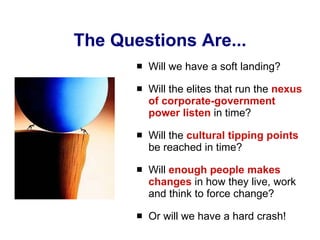
  • #65 Water use Vehicles Foreign investment Co2 Gdp Popn Loss of rainforest and woodlands Species extinction Fisheries exploitation Northern hemisphere average surface temp
  • #95 05/01/10 This is the richard heinberg idea, we are probably at peak everything in the next decade or so We have climbed the curve, now at a climax This is a historical moment of choice, we need to choose our future Where are we going, what the possible futures?This slide maps out the four possible futures, taken from research and a number of different writers… Techno-fantasy - technical fix for every solution - every limit will be overcome by technology, if run out of oil use nuclear, tar sands - tremendous emotional and psychological investment in this - article in New Scientist re renewable energies, if we exploit all possible renewable energy then will be much more than ever with oil Green tech stability - have to reduce a little but then can stabilise at high level of material affluence - green fix, use far less energy and resources - radical- not continued growth Earth stewardship - permaculture & transition solution - say need to find way to come down it - reduce levels of consumption & energy use, different ways of organising society and our lives which are more sustainable - option is that we are not going to fall down or but to come down in sensible way Mad max - nothing in place to help us manage the descent - banking system, grow and grow and now falling apart Then do credibility monitor for each Interesting to look at these scenarios as psychological positions One bit of psychology of change as how do we respond to having significant change being forced on us Technofantasy is position of denial- technology as god Mad max is polarity- anger or despair, doesn’t matter if wiped off planet as we are violent anyway, lots of suffering involved in that, lots of denial in there too, angry and despairing position to take. E.g. in US resilience so low and disbelief Lots of people are caught between those two, only two they can see Green tech stability- Interesting position- changed light bulbs but now go on holiday to canaries and keep on buying bananas, bargaining, we can scrape thru without changing too much if we are very good- very attractive to business Earth stewardship Sane acceptance, we come down off this curve and use it as an opportunity to increase quality of life and social justice… At moment of choice, need to focus our vision, make it into a turning point, The Great Turning