Volume 2, Number 2, – February 2007
It won’t just be through high
gasoline prices, either. Not only is
just about everything we buy
dependent on oil and gas, but
economic growth seems very
dependent on oil staying cheap. As
I will show later in this issue,
economic growth tends to slow or
reverse whenever the price of oil
rises rapidly, and commodities
declining in availability tend to
exhibit wild price swings—both up,
and down. So destructive spikes
and deceptive collapses should
characterize oil price movements
over the next few years.
It is unlikely, sadly, that the cause
of these swings will be readily
apparent for many years. There will
be unrest in Nigeria, hurricanes in
the Gulf of Mexico, drill rig shortages
here and short-sighted national oil
companies there—to provide
reassuring temporary explanations
for developing downturns, shortages
and price spikes. Someone, usually
in the pay of the oil companies, will
always be there to let us know that
things will be straightened out next
month, next quarter or next year,
and we won’t have to worry about
supplies in the future. And,
whenever prices drop for a while, as
The Economy Will Bring Peak Oil To You People you should
contact about peak oil:
•Senator Barbara Boxer
http://boxer.senate.gov/cont
act/email/policy.cfm
•Senator Dianne Feinstein
http://www.senate.gov/~fein
stein/email.html
•Congressman Sam Farr
1221 Longworth House
Office Building
Washington, DC 20515
(202) 225-2861
FAX (202) 225-6791
http://www.farr.house.gov/
•Governor Arnold Schw…
http://www.govmail.ca.gov
•President George Bush
http://www.whitehouse.gov/
Now you can contribute a
cent to SMC every time you
do a web search—just go to
www.goodsearch.com, enter
“Sustainable Monterey
County” in answer to the
“Who do you GoodSearch
for” question, and search .
Thanks to all those who
have contributed help and
funds to SMC
Mission: To ensure an orderly transition through the fossil fuel decline by
cooperatively developing a sustainable economy for Monterey County.
February 1, Thursday: SMC Discussion
Group: Economy, 6:45-9pm, Mty Youth
Center, 777 Pearl St.
February 17: SPG “Spring Cleaning, Keep it
Clean” event, Saturday, 10 am – 4 pm, PG
Natural History Museum
March 1, Thursday: SMC Discussion Group:
Food Security, 6:45-9pm, Mty Youth
Center, 777 Pearl St.
UPCOMING EVENTS
April 5, Thursday: SMC Discussion Group:
Transportation, 6:45-9pm, Mty Youth
Center, 777 Pearl St.
S U S T A I N A B L E M O N T E R E Y C O U N T Y
When delays are unavoidable in
responses to commodity
gluts and shortages, the
responses overshoot and
prices swing wildly.
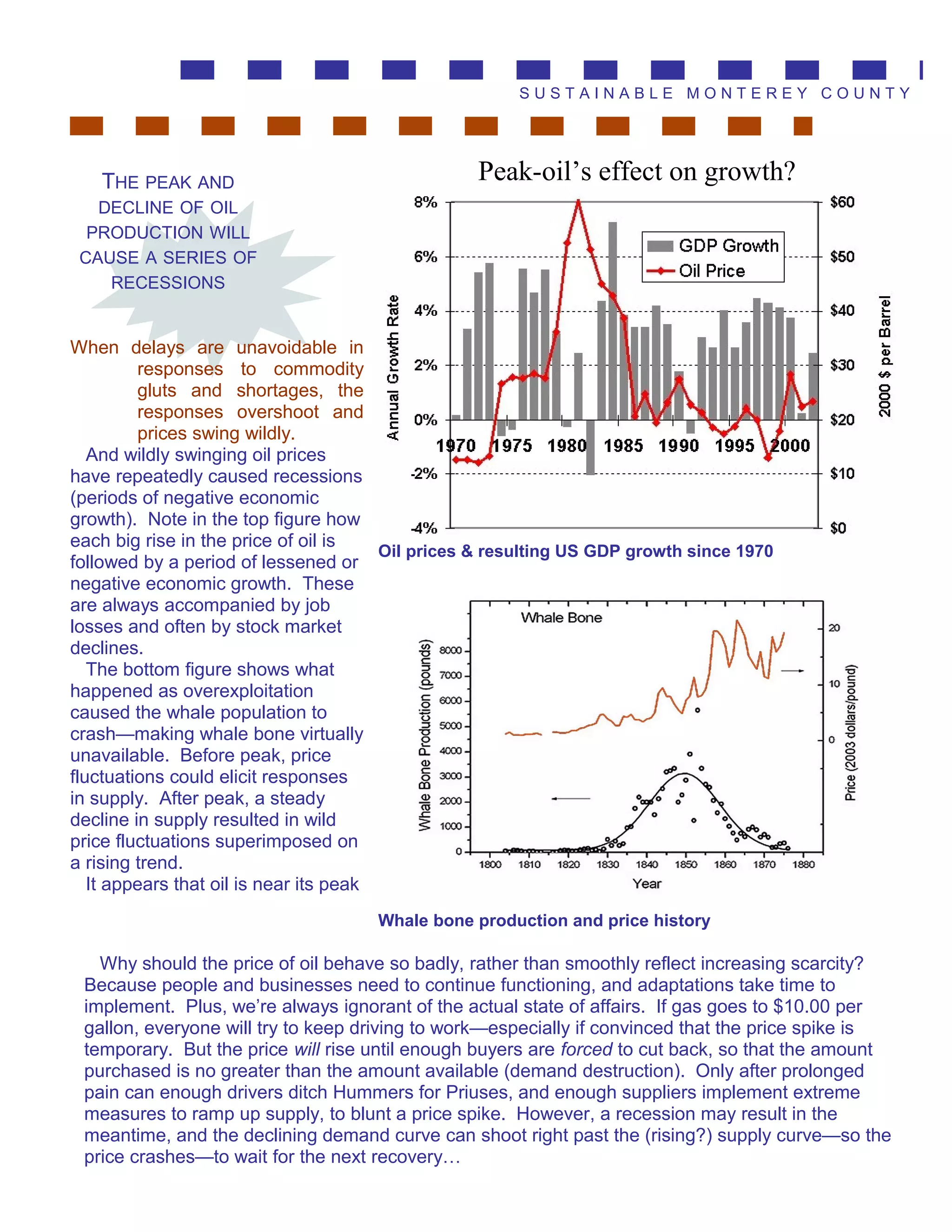
And wildly swinging oil prices
have repeatedly caused recessions
(periods of negative economic
growth). Note in the top figure how
each big rise in the price of oil is
followed by a period of lessened or
negative economic growth. These
are always accompanied by job
losses and often by stock market
declines.
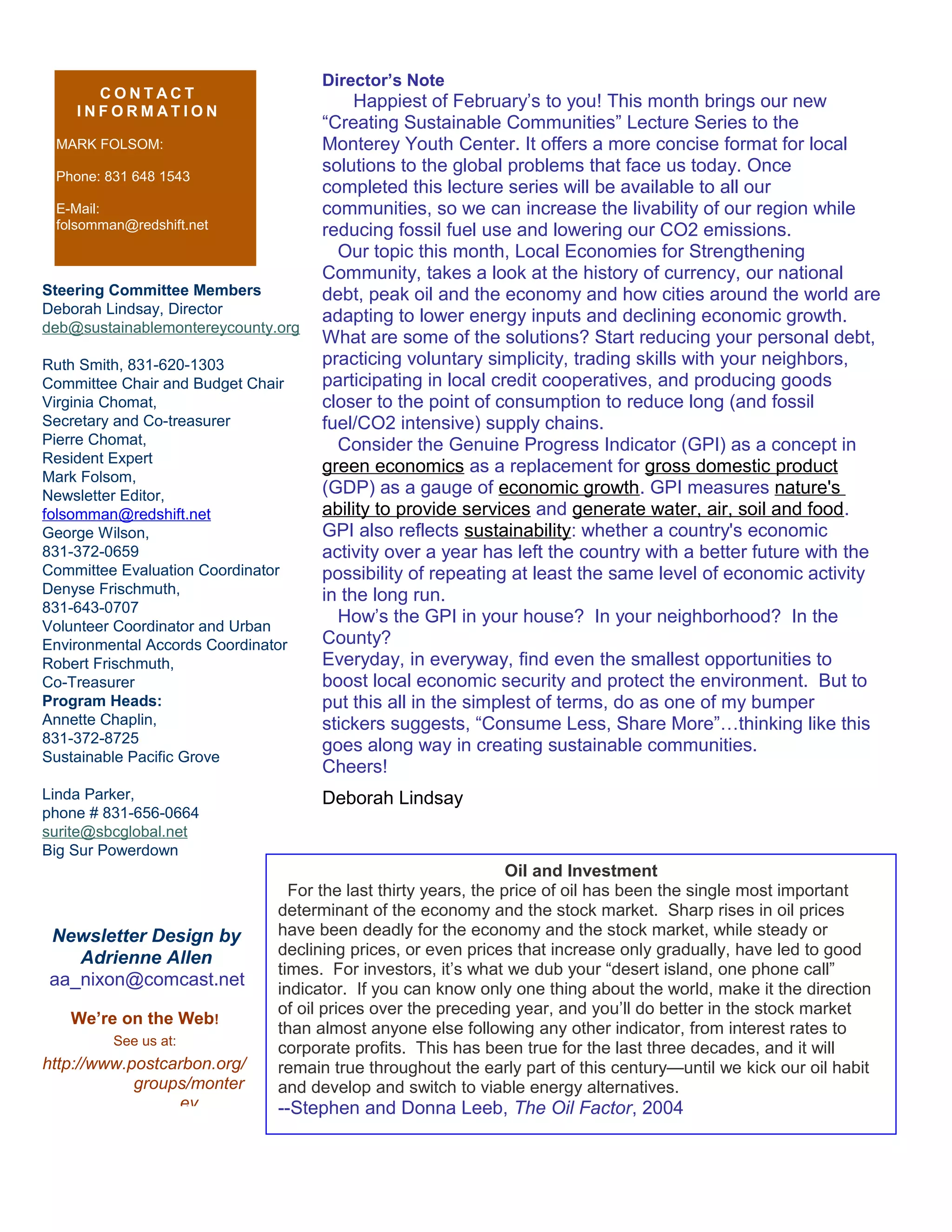
The bottom figure shows what
happened as overexploitation
caused the whale population to
crash—making whale bone virtually
unavailable. Before peak, price
fluctuations could elicit responses
in supply. After peak, a steady
decline in supply resulted in wild
price fluctuations superimposed on
a rising trend.
It appears that oil is near its peak
and the price swings have begun.
THE PEAK AND
DECLINE OF OIL
PRODUCTION WILL
CAUSE A SERIES OF
RECESSIONS
Peak-oil’s effect on growth?
Oil prices & resulting US GDP growth since 1970
Whale bone production and price history
Why should the price of oil behave so badly, rather than smoothly reflect increasing scarcity?
Because people and businesses need to continue functioning, and adaptations take time to
implement. Plus, we’re always ignorant of the actual state of affairs. If gas goes to $10.00 per
gallon, everyone will try to keep driving to work—especially if convinced that the price spike is
temporary. But the price will rise until enough buyers are forced to cut back, so that the amount
purchased is no greater than the amount available (demand destruction). Only after prolonged
pain can enough drivers ditch Hummers for Priuses, and enough suppliers implement extreme
measures to ramp up supply, to blunt a price spike. However, a recession may result in the
meantime, and the declining demand curve can shoot right past the (rising?) supply curve—so the
price crashes—to wait for the next recovery…
S U S T A I N A B L E M O N T E R E Y C O U N T Y
• Personal debt can make you vulnerable to economic downturns—get rid of it.
• Shorten or eliminate a long driving commute to stay afloat during price spikes or rationing.
• Get a very efficient car, if you must drive.
• Ride a bicycle wherever you can.
• Diversify investments, if you have some, especially against currency and sector risks.
• Insulate your living space.
• Make your lighting and heating as efficient as possible.
• Take political action to mitigate energy depletion, consistent with minimizing climate
change.
• Buy from local farmers and manufacturers.
• Get to know your neighbors.
• Reduce your material consumption in general.
YOU CAN DEFEND YOURSELF AGAINST PEAK OIL
It seems that Americansoften blame poverty on individuals,
rather than on the policy failures that lead to widespread
poverty. We continue to witness a colossal energy policy failure
—guess what comes next.
Further Reading
The Oil Drum http://www.theoildrum.com/
Association for the Study of Peak Oil--USA http://www.aspo-usa.com/
Energy Bulletin http://www.energybulletin.net
Oil Addiction: The World in Peril, Pierre Chomat
Beyond Oil, Kenneth Deffeyes
The Long Emergency, James Howard Kunstler
The Oil Depletion Protocol, Richard Heinberg
Steering Committee Members
Deborah Lindsay, Director
deb@sustainablemontereycounty.org
Ruth Smith, 831-620-1303
Committee Chair and Budget Chair
Virginia Chomat,
Secretary and Co-treasurer
Pierre Chomat,
Resident Expert
Mark Folsom,
Newsletter Editor,
folsomman@redshift.net
George Wilson,
831-372-0659
Committee Evaluation Coordinator
Denyse Frischmuth,
831-643-0707
Volunteer Coordinator and Urban
Environmental Accords Coordinator
Robert Frischmuth,
Co-Treasurer
Program Heads:
Annette Chaplin,
831-372-8725
Sustainable Pacific Grove
Linda Parker,
phone # 831-656-0664
surite@sbcglobal.net
Big Sur Powerdown
C O N T A C T
I N F O R M A T I O N
MARK FOLSOM:
Phone: 831 648 1543
E-Mail:
folsomman@redshift.net
We’re on the Web!
See us at:
http://www.postcarbon.org/
groups/monter
ey
Newsletter Design by
Adrienne Allen
aa_nixon@comcast.net
Director’s Note
Happiest of February’s to you! This month brings our new
“Creating Sustainable Communities” Lecture Series to the
Monterey Youth Center. It offers a more concise format for local
solutions to the global problems that face us today. Once
completed this lecture series will be available to all our
communities, so we can increase the livability of our region while
reducing fossil fuel use and lowering our CO2 emissions.
Our topic this month, Local Economies for Strengthening
Community, takes a look at the history of currency, our national
debt, peak oil and the economy and how cities around the world are
adapting to lower energy inputs and declining economic growth.
What are some of the solutions? Start reducing your personal debt,
practicing voluntary simplicity, trading skills with your neighbors,
participating in local credit cooperatives, and producing goods
closer to the point of consumption to reduce long (and fossil
fuel/CO2 intensive) supply chains.
Consider the Genuine Progress Indicator (GPI) as a concept in
green economics as a replacement for gross domestic product
(GDP) as a gauge of economic growth. GPI measures nature's
ability to provide services and generate water, air, soil and food.
GPI also reflects sustainability: whether a country's economic
activity over a year has left the country with a better future with the
possibility of repeating at least the same level of economic activity
in the long run.
How’s the GPI in your house? In your neighborhood? In the
County?
Everyday, in everyway, find even the smallest opportunities to
boost local economic security and protect the environment. But to
put this all in the simplest of terms, do as one of my bumper
stickers suggests, “Consume Less, Share More”…thinking like this
goes along way in creating sustainable communities.
Cheers!
Deborah Lindsay
Oil and Investment
For the last thirty years, the price of oil has been the single most important
determinant of the economy and the stock market. Sharp rises in oil prices
have been deadly for the economy and the stock market, while steady or
declining prices, or even prices that increase only gradually, have led to good
times. For investors, it’s what we dub your “desert island, one phone call”
indicator. If you can know only one thing about the world, make it the direction
of oil prices over the preceding year, and you’ll do better in the stock market
than almost anyone else following any other indicator, from interest rates to
corporate profits. This has been true for the last three decades, and it will
remain true throughout the early part of this century—until we kick our oil habit
and develop and switch to viable energy alternatives.
--Stephen and Donna Leeb, The Oil Factor, 2004

Smc Newsletter February 07

  • 1.
    Volume 2, Number2, – February 2007 It won’t just be through high gasoline prices, either. Not only is just about everything we buy dependent on oil and gas, but economic growth seems very dependent on oil staying cheap. As I will show later in this issue, economic growth tends to slow or reverse whenever the price of oil rises rapidly, and commodities declining in availability tend to exhibit wild price swings—both up, and down. So destructive spikes and deceptive collapses should characterize oil price movements over the next few years. It is unlikely, sadly, that the cause of these swings will be readily apparent for many years. There will be unrest in Nigeria, hurricanes in the Gulf of Mexico, drill rig shortages here and short-sighted national oil companies there—to provide reassuring temporary explanations for developing downturns, shortages and price spikes. Someone, usually in the pay of the oil companies, will always be there to let us know that things will be straightened out next month, next quarter or next year, and we won’t have to worry about supplies in the future. And, whenever prices drop for a while, as The Economy Will Bring Peak Oil To You People you should contact about peak oil: •Senator Barbara Boxer http://boxer.senate.gov/cont act/email/policy.cfm •Senator Dianne Feinstein http://www.senate.gov/~fein stein/email.html •Congressman Sam Farr 1221 Longworth House Office Building Washington, DC 20515 (202) 225-2861 FAX (202) 225-6791 http://www.farr.house.gov/ •Governor Arnold Schw… http://www.govmail.ca.gov •President George Bush http://www.whitehouse.gov/ Now you can contribute a cent to SMC every time you do a web search—just go to www.goodsearch.com, enter “Sustainable Monterey County” in answer to the “Who do you GoodSearch for” question, and search . Thanks to all those who have contributed help and funds to SMC Mission: To ensure an orderly transition through the fossil fuel decline by cooperatively developing a sustainable economy for Monterey County. February 1, Thursday: SMC Discussion Group: Economy, 6:45-9pm, Mty Youth Center, 777 Pearl St. February 17: SPG “Spring Cleaning, Keep it Clean” event, Saturday, 10 am – 4 pm, PG Natural History Museum March 1, Thursday: SMC Discussion Group: Food Security, 6:45-9pm, Mty Youth Center, 777 Pearl St. UPCOMING EVENTS April 5, Thursday: SMC Discussion Group: Transportation, 6:45-9pm, Mty Youth Center, 777 Pearl St.
  • 2.
    S U ST A I N A B L E M O N T E R E Y C O U N T Y When delays are unavoidable in responses to commodity gluts and shortages, the responses overshoot and prices swing wildly. And wildly swinging oil prices have repeatedly caused recessions (periods of negative economic growth). Note in the top figure how each big rise in the price of oil is followed by a period of lessened or negative economic growth. These are always accompanied by job losses and often by stock market declines. The bottom figure shows what happened as overexploitation caused the whale population to crash—making whale bone virtually unavailable. Before peak, price fluctuations could elicit responses in supply. After peak, a steady decline in supply resulted in wild price fluctuations superimposed on a rising trend. It appears that oil is near its peak and the price swings have begun. THE PEAK AND DECLINE OF OIL PRODUCTION WILL CAUSE A SERIES OF RECESSIONS Peak-oil’s effect on growth? Oil prices & resulting US GDP growth since 1970 Whale bone production and price history Why should the price of oil behave so badly, rather than smoothly reflect increasing scarcity? Because people and businesses need to continue functioning, and adaptations take time to implement. Plus, we’re always ignorant of the actual state of affairs. If gas goes to $10.00 per gallon, everyone will try to keep driving to work—especially if convinced that the price spike is temporary. But the price will rise until enough buyers are forced to cut back, so that the amount purchased is no greater than the amount available (demand destruction). Only after prolonged pain can enough drivers ditch Hummers for Priuses, and enough suppliers implement extreme measures to ramp up supply, to blunt a price spike. However, a recession may result in the meantime, and the declining demand curve can shoot right past the (rising?) supply curve—so the price crashes—to wait for the next recovery…
  • 3.
    S U ST A I N A B L E M O N T E R E Y C O U N T Y • Personal debt can make you vulnerable to economic downturns—get rid of it. • Shorten or eliminate a long driving commute to stay afloat during price spikes or rationing. • Get a very efficient car, if you must drive. • Ride a bicycle wherever you can. • Diversify investments, if you have some, especially against currency and sector risks. • Insulate your living space. • Make your lighting and heating as efficient as possible. • Take political action to mitigate energy depletion, consistent with minimizing climate change. • Buy from local farmers and manufacturers. • Get to know your neighbors. • Reduce your material consumption in general. YOU CAN DEFEND YOURSELF AGAINST PEAK OIL It seems that Americansoften blame poverty on individuals, rather than on the policy failures that lead to widespread poverty. We continue to witness a colossal energy policy failure —guess what comes next. Further Reading The Oil Drum http://www.theoildrum.com/ Association for the Study of Peak Oil--USA http://www.aspo-usa.com/ Energy Bulletin http://www.energybulletin.net Oil Addiction: The World in Peril, Pierre Chomat Beyond Oil, Kenneth Deffeyes The Long Emergency, James Howard Kunstler The Oil Depletion Protocol, Richard Heinberg
  • 4.
    Steering Committee Members DeborahLindsay, Director deb@sustainablemontereycounty.org Ruth Smith, 831-620-1303 Committee Chair and Budget Chair Virginia Chomat, Secretary and Co-treasurer Pierre Chomat, Resident Expert Mark Folsom, Newsletter Editor, folsomman@redshift.net George Wilson, 831-372-0659 Committee Evaluation Coordinator Denyse Frischmuth, 831-643-0707 Volunteer Coordinator and Urban Environmental Accords Coordinator Robert Frischmuth, Co-Treasurer Program Heads: Annette Chaplin, 831-372-8725 Sustainable Pacific Grove Linda Parker, phone # 831-656-0664 surite@sbcglobal.net Big Sur Powerdown C O N T A C T I N F O R M A T I O N MARK FOLSOM: Phone: 831 648 1543 E-Mail: folsomman@redshift.net We’re on the Web! See us at: http://www.postcarbon.org/ groups/monter ey Newsletter Design by Adrienne Allen aa_nixon@comcast.net Director’s Note Happiest of February’s to you! This month brings our new “Creating Sustainable Communities” Lecture Series to the Monterey Youth Center. It offers a more concise format for local solutions to the global problems that face us today. Once completed this lecture series will be available to all our communities, so we can increase the livability of our region while reducing fossil fuel use and lowering our CO2 emissions. Our topic this month, Local Economies for Strengthening Community, takes a look at the history of currency, our national debt, peak oil and the economy and how cities around the world are adapting to lower energy inputs and declining economic growth. What are some of the solutions? Start reducing your personal debt, practicing voluntary simplicity, trading skills with your neighbors, participating in local credit cooperatives, and producing goods closer to the point of consumption to reduce long (and fossil fuel/CO2 intensive) supply chains. Consider the Genuine Progress Indicator (GPI) as a concept in green economics as a replacement for gross domestic product (GDP) as a gauge of economic growth. GPI measures nature's ability to provide services and generate water, air, soil and food. GPI also reflects sustainability: whether a country's economic activity over a year has left the country with a better future with the possibility of repeating at least the same level of economic activity in the long run. How’s the GPI in your house? In your neighborhood? In the County? Everyday, in everyway, find even the smallest opportunities to boost local economic security and protect the environment. But to put this all in the simplest of terms, do as one of my bumper stickers suggests, “Consume Less, Share More”…thinking like this goes along way in creating sustainable communities. Cheers! Deborah Lindsay Oil and Investment For the last thirty years, the price of oil has been the single most important determinant of the economy and the stock market. Sharp rises in oil prices have been deadly for the economy and the stock market, while steady or declining prices, or even prices that increase only gradually, have led to good times. For investors, it’s what we dub your “desert island, one phone call” indicator. If you can know only one thing about the world, make it the direction of oil prices over the preceding year, and you’ll do better in the stock market than almost anyone else following any other indicator, from interest rates to corporate profits. This has been true for the last three decades, and it will remain true throughout the early part of this century—until we kick our oil habit and develop and switch to viable energy alternatives. --Stephen and Donna Leeb, The Oil Factor, 2004