Introduction
to
Video Compression


     Fast Forward Your Development   www.dsp-ip.com
Compression
           p
• Compression – Representing information by less
  bit than the original information
• Lossless Compression – Original information
  and compressed information are identical
                                    identical.
  example LZ, TAR and other compression
  techniques.
  techniques
• Lossy Compression – Compressed info is not the
  same as uncompressed info E ample MP3
            ncompressed info. Example: MP3,
  JPEG etc
•LLossy compression is often MODEL B
                   i i ft               Based  d
  Compression

      Fast Forward Your Development   www.dsp-ip.com
Compression terms
   p
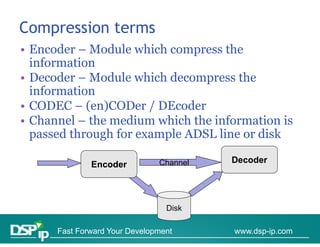
• Encoder – Module which compress the
  information
• Decoder – Module which decompress the
  information
• CODEC – (en)CODer / DEcoder
• Channel – the medium which the information is
  passed through for example ADSL line or disk

                               Channel   Decoder
              Encoder


                                 Disk

      Fast Forward Your Development      www.dsp-ip.com
Sampling
   p g
• Digitization of analog signal
• Voice - Sampling in time only The number of
                            only.
  samples per second is the Frequency – F. in
  telephony,
  telephony voice sampling frequency is 8KHz to
  transfer 4KHz of sound.
•IImage - SSampling in 2D space - F F O thi
                 li i             Fx, Fy. On this
  screen the images are sampled 1024x768
• Vid - S
  Video Sampling i 2D space and ti
                li in D            d time – F F
                                            Fx, Fy,
  Fn. On TV Fn is 25 or 30 fps (frames per second)


      Fast Forward Your Development    www.dsp-ip.com
Quantization
• Lowering the number of bits needed to describe
  an object
      object.
• For example I scored 66 in the test an object with
  100 steps need 7 description bits
                               bits.
• How is she looking ? 10 ! Needs only 5 bits for
  description.
  d     i ti
• Could we lower the number of bits more? What
  is th
  i the minimum?
           i i    ?
• Quantization is not always linear - ADPCM


      Fast Forward Your Development    www.dsp-ip.com
MODEL BASED COMPRESSION

Voice
  i
Audio
Video


        Fast Forward Your Development   www.dsp-ip.com
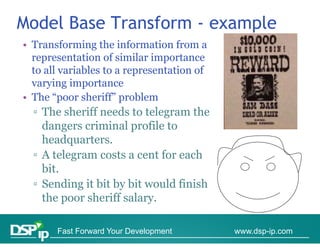
Model Base Transform - example
• Transforming the information from a
  representation of similar importance
  to all variables to a representation of
  varying importance
• Th “poor sheriff” problem
  The “        h iff”     bl
  ▫ The sheriff needs to telegram the
    dangers criminal profile t
    d          i i l      fil to
    headquarters.
  ▫ A telegram costs a cent for each
    bit.
  ▫ Sending it bit by bit would finish
    the poor sheriff salary.

       Fast Forward Your Development        www.dsp-ip.com
Solution
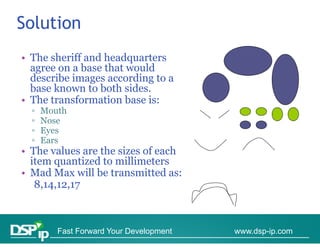
• The sheriff and headquarters
  agree on a b
             base that would
                   h      ld
  describe images according to a
  base known to both sides.
• The transformation base is:
  ▫   Mouth
  ▫   Nose
  ▫   Eyes
  ▫   Ears
• The values are the sizes of each
  item quantized to millimeters
• Mad Max will be transmitted as:
   8,14,12,17
   8 14 12 17


         Fast Forward Your Development   www.dsp-ip.com
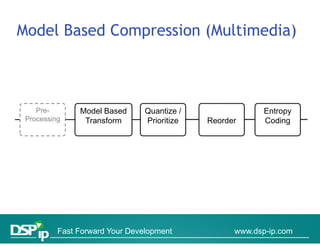
Model Based Compression (Multimedia)


    Pre-       Model Based      Quantize /                Entropy
 Processing     Transform       Prioritize   Reorder      Codingg


          Fast Forward Your Development            www.dsp-ip.com
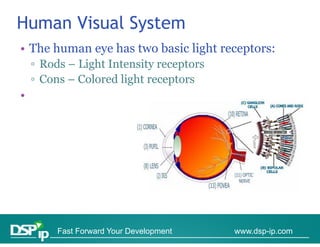
Human Visual System
• The human eye has two basic light receptors:
    ▫ Rods – Light Intensity receptors
    ▫ Cons – Colored light receptors
•


         Fast Forward Your Development   www.dsp-ip.com
The Human Eye
• Rods Concentration >> Cons Concentration
• Green Discrimination << Red, Blue
                          Red
  Discrimination
•LLow Frequency > High Frequency
      F           Hi h F


      Fast Forward Your Development   www.dsp-ip.com
Model Based transformations
• RGB (3 equally quantized colors) ->
                                    >
• YUV (Light Intensity + two color channels)
• Pi l based d
  Pixel b d domain -> F
                  i > Frequency d   domain
                                        i


      Fast Forward Your Development   www.dsp-ip.com
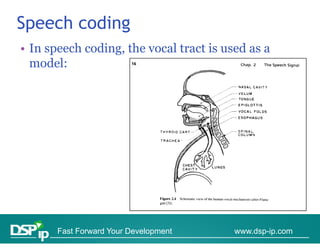
Speech coding
• In speech coding, the vocal tract is used as a
  model:


       Fast Forward Your Development     www.dsp-ip.com
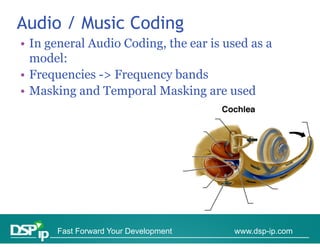
Audio / Music Coding
• In general Audio Coding, the ear is used as a
  model:
• Frequencies -> Frequency bands
• Masking and Temporal Masking are used


      Fast Forward Your Development    www.dsp-ip.com
IMAGE COMPRESSION


  Fast Forward Your Development   www.dsp-ip.com
What is a digital image?

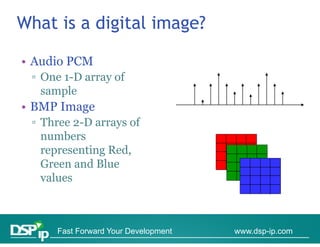
• Audio PCM
 ▫ One 1-D array of
   sample
• BMP Image
 ▫ Three 2-D arrays of
          2D
   numbers
   representing Red,
   Green and Blue
   values


     Fast Forward Your Development   www.dsp-ip.com
Image Compression? Why?

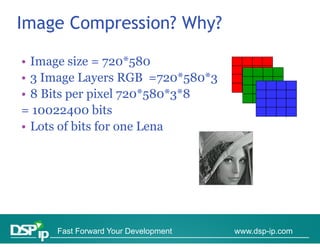
• Image size = 720*580
                720 580
• 3 Image Layers RGB =720*580*3
• 8 Bits per pixel 720*580*3*8
                   720 580 3 8
= 10022400 bits
• L t of bit f one L
  Lots f bits for     Lena


     Fast Forward Your Development   www.dsp-ip.com
Color matching
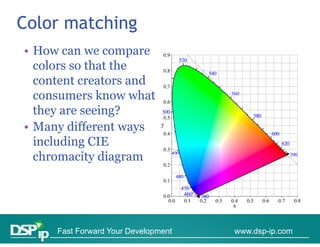
• How can we compare
  colors so that the
  content creators and
  consumers know what
              kno    hat
  they are seeing?
•MMany diff
        different ways
                 t
  including CIE
  chromacity di
   h       it diagram


      Fast Forward Your Development   www.dsp-ip.com
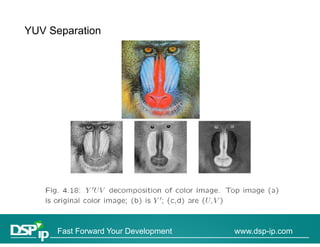
Video Color Transforms
 • Largely derived from older analog methods of coding
   color for TV. Luminance is separated from color
             TV
   information.
 • YIQ is used to transmit TV signals in North America and
   Japan.This coding also makes its way into VHS video
   tape coding in these countries since video tape
   technologies also use YIQ.
 • In Europe, video tape uses the PAL or SECAM codings,
   which are based on TV that uses a matrix transform
     hi h     b d           h               i      f
   called YUV.
 • Finally digital video mostly uses a matrix transform
   Finally,
   called YCbCr that is closely related to YUV


       Fast Forward Your Development        www.dsp-ip.com
YUV Separation


      Fast Forward Your Development   www.dsp-ip.com
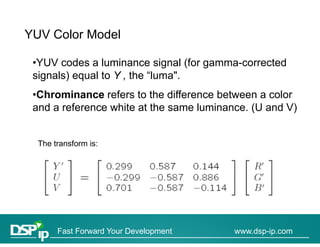
YUV Color Model

 •YUV codes a luminance signal (for gamma-corrected
 signals) equal to Y , the “luma".
 •Chrominance refers to the difference between a color
 and a reference white at the same luminance. (U and V)


  The transform is:


       Fast Forward Your Development      www.dsp-ip.com
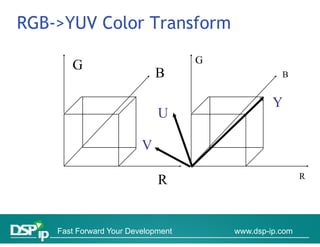
RGB->YUV Color Transform
                                    G
       G
                             B                     B


                                                 Y
                             U

                         V

                                                         R
                             R


    Fast Forward Your Development       www.dsp-ip.com
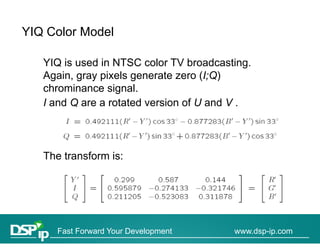
YIQ Color Model

   YIQ is used in NTSC color TV broadcasting.
                                  broadcasting
   Again, gray pixels generate zero (I;Q)
   chrominance signal.
                   g
   I and Q are a rotated version of U and V .


   The transform is:
   Th t     f    i


      Fast Forward Your Development       www.dsp-ip.com
YCbCr Color Model

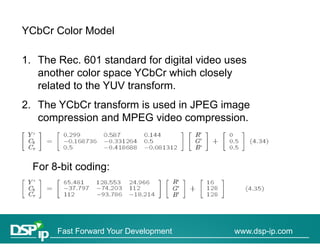
1. The Rec. 601 standard for digital video uses
   another color space YCbCr which closely
   related to the YUV transform.
2. The YCbCr transform is used in JPEG image
   compression and MPEG video compression.


  For 8-bit coding:


       Fast Forward Your Development        www.dsp-ip.com
Sampling
   p g
• Digitization of analog signal
• Voice - Sampling in time only The number of
                            only.
  samples per second is the Frequency – F. in
  telephony,
  telephony voice sampling frequency is 8KHz to
  transfer 4KHz of sound.
•IImage - SSampling in 2D space - F F O thi
                 li i             Fx, Fy. On this
  screen the images are sampled 1024x768
• Vid - S
  Video Sampling i 2D space and ti
                li in D            d time – F F
                                            Fx, Fy,
  Fn. On TV Fn is 25 or 30 fps (frames per second)


      Fast Forward Your Development    www.dsp-ip.com
Quantization
• Lowering the number of bits needed to describe
  an object
      object.
• For example I scored 66 in the test an object with
  100 steps need 7 description bits
                               bits.
• How is she looking ? 10 ! Needs only 5 bits for
  description.
  d     i ti
• Could we lower the number of bits more? What
  is th
  i the minimum?
           i i   ?
• How to describe an object with one bit?


      Fast Forward Your Development    www.dsp-ip.com
Color based decimation
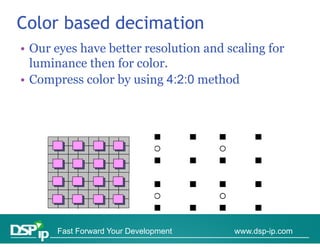
• Our eyes have better resolution and scaling for
  luminance then for color
                     color.
• Compress color by using 4:2:0 method


      Fast Forward Your Development    www.dsp-ip.com
Counting the bits
• How much can we save by color compression?
 ▫ 3*Image size in RGB 24 bit color representation
                                    representation.
 ▫ 1 + 2*1/4 Image size in 4:2:0 YUV representation.
 ▫ Compression ratio is 2 !!
• Actual saving is bigger due to different Y and UV
  quantization.
  quantization


      Fast Forward Your Development     www.dsp-ip.com
Linear Transform
• If the signal is formatted as a
           g                        • Energy compaction p p y
                                            gy     p       property:
  vector, a linear transform can      The transformed signal vector
  be formulated as a matrix-          has few, large coefficients and
  vector product that transform       many nearly zero small
  the signal into a different         coefficients. These few large
  domain.                             coefficients can be encoded
• Examples:                           efficiently with few bits while
   ▫ K-L Transform                    retaining the majority of
   ▫ Discrete Fourier Transform       energy of the original signal.
   ▫ Discrete cosine transform
   ▫ Discrete wavelet transform


         Fast Forward Your Development               www.dsp-ip.com
Block-based Image Coding

• Block-based image
  Block based                    • Advantages:
  coding scheme:                      ▫ Parallel processing can
  partitions the entire                 be applied to p
                                             pp       process
  image into 8 by 8 or                  individual blocks in
                                        parallel.
  16 by 16 (or other
                                      ▫ Redundant information
  size) blocks.                         in close proximity (like
• The coding algorithm                  cache)
  is applied to
  individual blocks
  independently.

      Fast Forward Your Development               www.dsp-ip.com
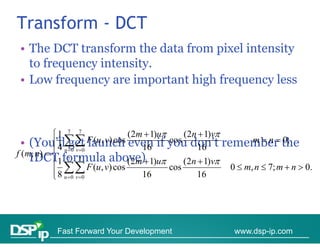
Transform - DCT
 • The DCT transform the data from pixel intensity
   to frequency intensity
                intensity.
 • Low frequency are important high frequency less


           1 7 7                    (2m  1)u     (2n  1)v
  • (You’ll F (u, v) cos even if you don’t remember the
            4 get launch
            u 0 v 0                  16
                                                cos
                                                        16
                                                                     m  n  0;
f (m, n)   7 7
    IDCT1f 
              formula above) 1)u (2n  1)v
                          l b (2m)
            8 
                       F (u , v) cos            cos            0  m, n  7; m  n  0.
            u 0 v 0                  16             16


            Fast Forward Your Development                       www.dsp-ip.com
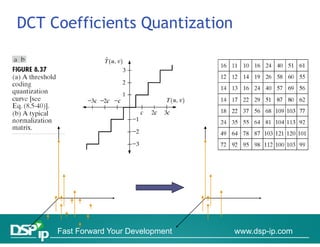
DCT Coefficients Quantization


     Fast Forward Your Development   www.dsp-ip.com
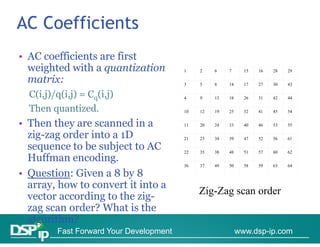
AC Coefficients
• AC coefficients are first
  weighted with a quantization
    i h d ih              i i            1    2    6    7      15   16   28   29

  matrix:                                3    5    8    14     17   27   30   43

  C(i,j)/q(i,j)
  C(i j)/q(i j) = Cq(i j)
                    (i,j)                4    9    13   18     26   31   42   44

  Then quantized.                        10   12   19   25     32   41   45   54


• Then they are scanned in a             11   20   24   33     40   46   53   55

  zig-zag order into a 1D                21   23   34   39     47   52   56   61

  sequence to be subject to AC           22   35   38   48     51   57   60   62
  Huffman encoding.
     ff          di
                                         36   37   49   50     58   59   63   64

• Question: Given a 8 by 8
  array,
  array how to convert it into a
                                              Zig-Zag scan order
  vector according to the zig-
  zag scan order? What is the
    g
  algorithm?
         Fast Forward Your Development                       www.dsp-ip.com
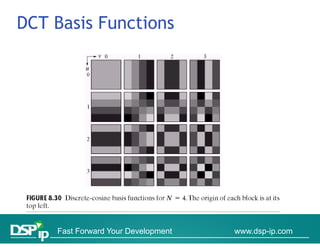
DCT Basis Functions


    Fast Forward Your Development   www.dsp-ip.com
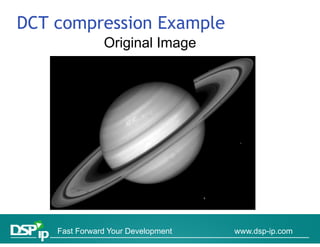
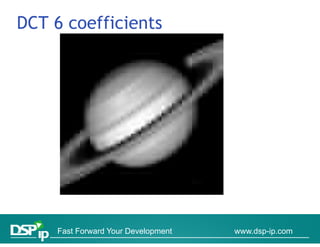
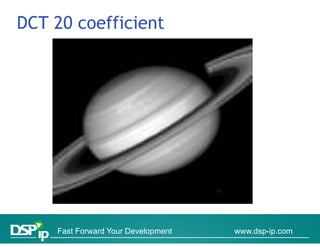
DCT compression Example
               Original Image


    Fast Forward Your Development   www.dsp-ip.com
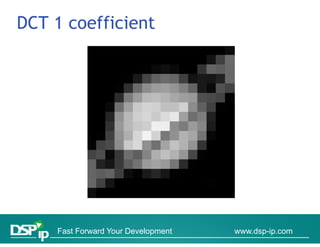
DCT 1 coefficient


    Fast Forward Your Development   www.dsp-ip.com
DCT 6 coefficients


     Fast Forward Your Development   www.dsp-ip.com
DCT 20 coefficient


    Fast Forward Your Development   www.dsp-ip.com
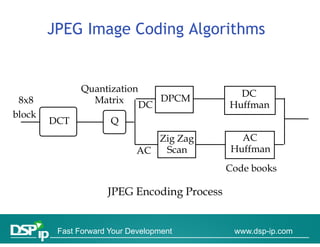
JPEG Image Coding Algorithms


               Q
               Quantization                    DC
 8x8             Matrix DC DPCM              Huffman
block
        DCT           Q
                                Zig Zag        AC
                             AC  Scan        Huffman
                                             Code books

                     JPEG Encoding Process


         Fast Forward Your Development        www.dsp-ip.com
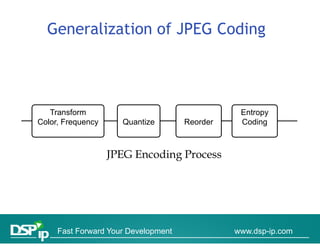
Generalization of JPEG Coding


   Transform                                   Entropy
Color,
Color Frequency     Quantize        Reorder    Coding


                  JPEG Encoding Process


    Fast Forward Your Development             www.dsp-ip.com
Video Coding Basics


Fast Forward Your Development   www.dsp-ip.com
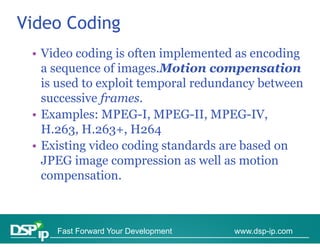
Video Coding
 • Video coding is often implemented as encoding
   a sequence of i
                f images.Motion compensation
                              i               i
   is used to exploit temporal redundancy between
   successive f
           i frames.
 • Examples: MPEG-I, MPEG-II, MPEG-IV,
   H.263, H.263+, H264
 • Existing video coding standards are based on
   JPEG image compression as well as motion
   compensation.


     Fast Forward Your Development   www.dsp-ip.com
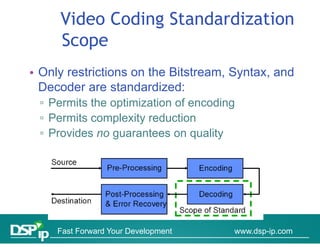
Video Coding Standardization
     Scope
• Only restrictions on the Bitstream, Syntax, and
  Decoder are standardized:
 ▫ Permits the optimization of encoding
 ▫ Permits complexity reduction
               p    y
 ▫ Provides no guarantees on quality


     Fast Forward Your Development    www.dsp-ip.com
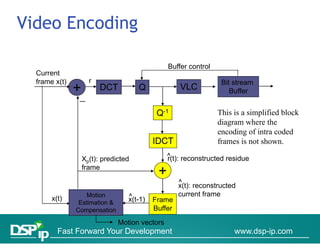
Video Encoding

                                                Buffer control
  Current
  frame x(t)         r                                            Bit stream
               +         DCT          Q             VLC              Buffer
                
                                            Q-1                  This is a simplified block
                                                                 diagram where the
                                                                 encoding of intra coded
                                           IDCT                  frames is not shown.

                   Xp(t): predicted             ^ reconstructed residue
                                                r(t):
                   frame
                                            +
                                                    ^(t)
                                                    x(t): reconstructed
                                                                t t d
                  Motion          ^                 current frame
       x(t)                       x(t-1)   Frame
                Estimation &
               Compensation                Buffer
                               Motion vectors
         Fast Forward Your Development                                www.dsp-ip.com
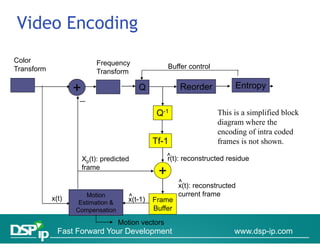
Video Encoding
Color                       Frequency
Transform                                           Buffer control
                            Transform

                   +                      Q             Reorder           Entropy
                    
                                                Q-1                  This is a simplified block
                                                                     diagram where the
                                                                     encoding of intra coded
                                               Tf-1                  frames is not shown.

                       Xp(t): predicted             ^ reconstructed residue
                                                    r(t):
                       frame
                                                +
                                                        ^(t)
                                                        x(t): reconstructed
                                                                    t t d
                      Motion          ^                 current frame
            x(t)                      x(t-1)   Frame
                    Estimation &
                   Compensation                Buffer
                                   Motion vectors
              Fast Forward Your Development                               www.dsp-ip.com
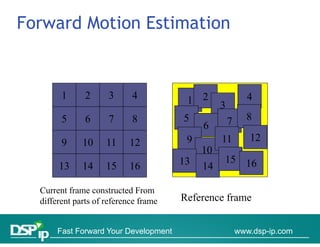
Forward Motion Estimation


        1      2     3      4           1 2                4
                                                 3
        5      6     7      8          5             7     8
                                            6
        9     10     11    12           9        11         12
                                            10
                                             0
                                       13        15 16
       13     14     15    16               14

  Current frame constructed From
  different parts of reference frame   Reference frame


       Fast Forward Your Development                     www.dsp-ip.com
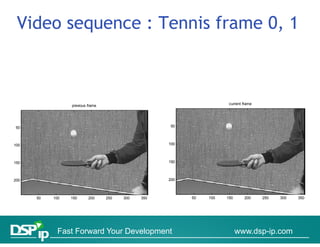
Video sequence : Tennis frame 0, 1


                 previous frame                                       current frame


50                                                  50


100                                                 100


150                                                 150


200                                                 200


      50   100   150      200     250   300   350         50   100   150      200     250   300   350


            Fast Forward Your Development                                  www.dsp-ip.com
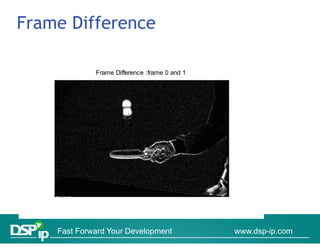
Frame Difference

             Frame Difference :frame 0 and 1


    Fast Forward Your Development              www.dsp-ip.com
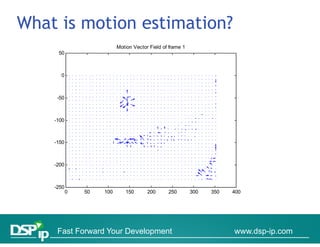
What is motion estimation?
                          Motion Vector Field of frame 1
     50


      0


     -50


    -100


    -150


    -200


    -250
           0   50   100      150       200      250        300   350   400


     Fast Forward Your Development                                     www.dsp-ip.com
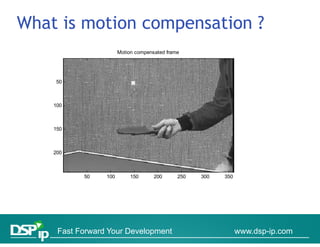
What is motion compensation ?
                       Motion compensated frame


    50


    100


    150


    200


           50    100        150      200      250   300   350


     Fast Forward Your Development                              www.dsp-ip.com
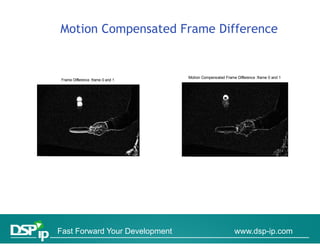
Motion Compensated Frame Difference
          p


                                   Motion Compensated Frame Difference :frame 0 and 1
 Frame Difference :frame 0 and 1


Fast Forward Your Development                              www.dsp-ip.com
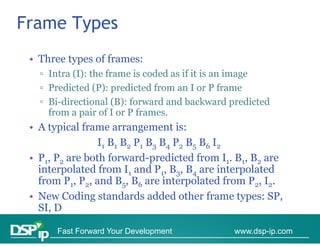
Frame Types
 • Three types of frames:
          yp
   ▫ Intra (I): the frame is coded as if it is an image
   ▫ Predicted (P): predicted from an I or P frame
   ▫ Bi-directional (B): forward and backward predicted
     from a pair of I or P frames.
 • A typical f
         i l frame arrangement i   is:
                 I1 B1 B2 P1 B3 B4 P2 B5 B6 I2
 • P1, P2 are b h f
              both forward-predicted f
                           d     di d from I1. B1, B2 are
   interpolated from I1 and P1, B3, B4 are interpolated
   from P1, P2, and B5, B6 are interpolated from P2, I2.
 • New Coding standards added other frame types: SP,
   SI, D

       Fast Forward Your Development          www.dsp-ip.com
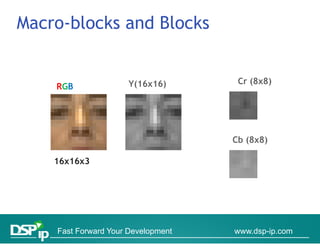
Macro-blocks and Blocks


                     Y(16x16)        Cr (8x8)
    RGB


                                    Cb (8x8)

    16x16x3


    Fast Forward Your Development   www.dsp-ip.com

Introduction To Video Compression

  • 1.
    Introduction to Video Compression Fast Forward Your Development www.dsp-ip.com
  • 2.
    Compression p • Compression – Representing information by less bit than the original information • Lossless Compression – Original information and compressed information are identical identical. example LZ, TAR and other compression techniques. techniques • Lossy Compression – Compressed info is not the same as uncompressed info E ample MP3 ncompressed info. Example: MP3, JPEG etc •LLossy compression is often MODEL B i i ft Based d Compression Fast Forward Your Development www.dsp-ip.com
  • 3.
    Compression terms p • Encoder – Module which compress the information • Decoder – Module which decompress the information • CODEC – (en)CODer / DEcoder • Channel – the medium which the information is passed through for example ADSL line or disk Channel Decoder Encoder Disk Fast Forward Your Development www.dsp-ip.com
  • 4.
    Sampling p g • Digitization of analog signal • Voice - Sampling in time only The number of only. samples per second is the Frequency – F. in telephony, telephony voice sampling frequency is 8KHz to transfer 4KHz of sound. •IImage - SSampling in 2D space - F F O thi li i Fx, Fy. On this screen the images are sampled 1024x768 • Vid - S Video Sampling i 2D space and ti li in D d time – F F Fx, Fy, Fn. On TV Fn is 25 or 30 fps (frames per second) Fast Forward Your Development www.dsp-ip.com
  • 5.
    Quantization • Lowering thenumber of bits needed to describe an object object. • For example I scored 66 in the test an object with 100 steps need 7 description bits bits. • How is she looking ? 10 ! Needs only 5 bits for description. d i ti • Could we lower the number of bits more? What is th i the minimum? i i ? • Quantization is not always linear - ADPCM Fast Forward Your Development www.dsp-ip.com
  • 6.
    MODEL BASED COMPRESSION Voice i Audio Video Fast Forward Your Development www.dsp-ip.com
  • 7.
    Model Base Transform- example • Transforming the information from a representation of similar importance to all variables to a representation of varying importance • Th “poor sheriff” problem The “ h iff” bl ▫ The sheriff needs to telegram the dangers criminal profile t d i i l fil to headquarters. ▫ A telegram costs a cent for each bit. ▫ Sending it bit by bit would finish the poor sheriff salary. Fast Forward Your Development www.dsp-ip.com
  • 8.
    Solution • The sheriffand headquarters agree on a b base that would h ld describe images according to a base known to both sides. • The transformation base is: ▫ Mouth ▫ Nose ▫ Eyes ▫ Ears • The values are the sizes of each item quantized to millimeters • Mad Max will be transmitted as: 8,14,12,17 8 14 12 17 Fast Forward Your Development www.dsp-ip.com
  • 9.
    Model Based Compression(Multimedia) Pre- Model Based Quantize / Entropy Processing Transform Prioritize Reorder Codingg Fast Forward Your Development www.dsp-ip.com
  • 10.
    Human Visual System •The human eye has two basic light receptors: ▫ Rods – Light Intensity receptors ▫ Cons – Colored light receptors • Fast Forward Your Development www.dsp-ip.com
  • 11.
    The Human Eye •Rods Concentration >> Cons Concentration • Green Discrimination << Red, Blue Red Discrimination •LLow Frequency > High Frequency F Hi h F Fast Forward Your Development www.dsp-ip.com
  • 12.
    Model Based transformations •RGB (3 equally quantized colors) -> > • YUV (Light Intensity + two color channels) • Pi l based d Pixel b d domain -> F i > Frequency d domain i Fast Forward Your Development www.dsp-ip.com
  • 13.
    Speech coding • Inspeech coding, the vocal tract is used as a model: Fast Forward Your Development www.dsp-ip.com
  • 14.
    Audio / MusicCoding • In general Audio Coding, the ear is used as a model: • Frequencies -> Frequency bands • Masking and Temporal Masking are used Fast Forward Your Development www.dsp-ip.com
  • 15.
    IMAGE COMPRESSION Fast Forward Your Development www.dsp-ip.com
  • 16.
    What is adigital image? • Audio PCM ▫ One 1-D array of sample • BMP Image ▫ Three 2-D arrays of 2D numbers representing Red, Green and Blue values Fast Forward Your Development www.dsp-ip.com
  • 17.
    Image Compression? Why? •Image size = 720*580 720 580 • 3 Image Layers RGB =720*580*3 • 8 Bits per pixel 720*580*3*8 720 580 3 8 = 10022400 bits • L t of bit f one L Lots f bits for Lena Fast Forward Your Development www.dsp-ip.com
  • 18.
    Color matching • Howcan we compare colors so that the content creators and consumers know what kno hat they are seeing? •MMany diff different ways t including CIE chromacity di h it diagram Fast Forward Your Development www.dsp-ip.com
  • 19.
    Video Color Transforms • Largely derived from older analog methods of coding color for TV. Luminance is separated from color TV information. • YIQ is used to transmit TV signals in North America and Japan.This coding also makes its way into VHS video tape coding in these countries since video tape technologies also use YIQ. • In Europe, video tape uses the PAL or SECAM codings, which are based on TV that uses a matrix transform hi h b d h i f called YUV. • Finally digital video mostly uses a matrix transform Finally, called YCbCr that is closely related to YUV Fast Forward Your Development www.dsp-ip.com
  • 20.
    YUV Separation Fast Forward Your Development www.dsp-ip.com
  • 21.
    YUV Color Model •YUV codes a luminance signal (for gamma-corrected signals) equal to Y , the “luma". •Chrominance refers to the difference between a color and a reference white at the same luminance. (U and V) The transform is: Fast Forward Your Development www.dsp-ip.com
  • 22.
    RGB->YUV Color Transform G G B B Y U V R R Fast Forward Your Development www.dsp-ip.com
  • 23.
    YIQ Color Model YIQ is used in NTSC color TV broadcasting. broadcasting Again, gray pixels generate zero (I;Q) chrominance signal. g I and Q are a rotated version of U and V . The transform is: Th t f i Fast Forward Your Development www.dsp-ip.com
  • 24.
    YCbCr Color Model 1.The Rec. 601 standard for digital video uses another color space YCbCr which closely related to the YUV transform. 2. The YCbCr transform is used in JPEG image compression and MPEG video compression. For 8-bit coding: Fast Forward Your Development www.dsp-ip.com
  • 25.
    Sampling p g • Digitization of analog signal • Voice - Sampling in time only The number of only. samples per second is the Frequency – F. in telephony, telephony voice sampling frequency is 8KHz to transfer 4KHz of sound. •IImage - SSampling in 2D space - F F O thi li i Fx, Fy. On this screen the images are sampled 1024x768 • Vid - S Video Sampling i 2D space and ti li in D d time – F F Fx, Fy, Fn. On TV Fn is 25 or 30 fps (frames per second) Fast Forward Your Development www.dsp-ip.com
  • 26.
    Quantization • Lowering thenumber of bits needed to describe an object object. • For example I scored 66 in the test an object with 100 steps need 7 description bits bits. • How is she looking ? 10 ! Needs only 5 bits for description. d i ti • Could we lower the number of bits more? What is th i the minimum? i i ? • How to describe an object with one bit? Fast Forward Your Development www.dsp-ip.com
  • 27.
    Color based decimation •Our eyes have better resolution and scaling for luminance then for color color. • Compress color by using 4:2:0 method Fast Forward Your Development www.dsp-ip.com
  • 28.
    Counting the bits •How much can we save by color compression? ▫ 3*Image size in RGB 24 bit color representation representation. ▫ 1 + 2*1/4 Image size in 4:2:0 YUV representation. ▫ Compression ratio is 2 !! • Actual saving is bigger due to different Y and UV quantization. quantization Fast Forward Your Development www.dsp-ip.com
  • 29.
    Linear Transform • Ifthe signal is formatted as a g • Energy compaction p p y gy p property: vector, a linear transform can The transformed signal vector be formulated as a matrix- has few, large coefficients and vector product that transform many nearly zero small the signal into a different coefficients. These few large domain. coefficients can be encoded • Examples: efficiently with few bits while ▫ K-L Transform retaining the majority of ▫ Discrete Fourier Transform energy of the original signal. ▫ Discrete cosine transform ▫ Discrete wavelet transform Fast Forward Your Development www.dsp-ip.com
  • 30.
    Block-based Image Coding •Block-based image Block based • Advantages: coding scheme: ▫ Parallel processing can partitions the entire be applied to p pp process image into 8 by 8 or individual blocks in parallel. 16 by 16 (or other ▫ Redundant information size) blocks. in close proximity (like • The coding algorithm cache) is applied to individual blocks independently. Fast Forward Your Development www.dsp-ip.com
  • 31.
    Transform - DCT • The DCT transform the data from pixel intensity to frequency intensity intensity. • Low frequency are important high frequency less 1 7 7 (2m  1)u (2n  1)v • (You’ll F (u, v) cos even if you don’t remember the  4 get launch  u 0 v 0 16 cos 16 m  n  0; f (m, n)   7 7 IDCT1f  formula above) 1)u (2n  1)v l b (2m)  8  F (u , v) cos cos 0  m, n  7; m  n  0.  u 0 v 0 16 16 Fast Forward Your Development www.dsp-ip.com
  • 32.
    DCT Coefficients Quantization Fast Forward Your Development www.dsp-ip.com
  • 33.
    AC Coefficients • ACcoefficients are first weighted with a quantization i h d ih i i 1 2 6 7 15 16 28 29 matrix: 3 5 8 14 17 27 30 43 C(i,j)/q(i,j) C(i j)/q(i j) = Cq(i j) (i,j) 4 9 13 18 26 31 42 44 Then quantized. 10 12 19 25 32 41 45 54 • Then they are scanned in a 11 20 24 33 40 46 53 55 zig-zag order into a 1D 21 23 34 39 47 52 56 61 sequence to be subject to AC 22 35 38 48 51 57 60 62 Huffman encoding. ff di 36 37 49 50 58 59 63 64 • Question: Given a 8 by 8 array, array how to convert it into a Zig-Zag scan order vector according to the zig- zag scan order? What is the g algorithm? Fast Forward Your Development www.dsp-ip.com
  • 34.
    DCT Basis Functions Fast Forward Your Development www.dsp-ip.com
  • 35.
    DCT compression Example Original Image Fast Forward Your Development www.dsp-ip.com
  • 36.
    DCT 1 coefficient Fast Forward Your Development www.dsp-ip.com
  • 37.
    DCT 6 coefficients Fast Forward Your Development www.dsp-ip.com
  • 38.
    DCT 20 coefficient Fast Forward Your Development www.dsp-ip.com
  • 39.
    JPEG Image CodingAlgorithms Q Quantization DC 8x8 Matrix DC DPCM Huffman block DCT Q Zig Zag AC AC Scan Huffman Code books JPEG Encoding Process Fast Forward Your Development www.dsp-ip.com
  • 40.
    Generalization of JPEGCoding Transform Entropy Color, Color Frequency Quantize Reorder Coding JPEG Encoding Process Fast Forward Your Development www.dsp-ip.com
  • 41.
    Video Coding Basics FastForward Your Development www.dsp-ip.com
  • 42.
    Video Coding •Video coding is often implemented as encoding a sequence of i f images.Motion compensation i i is used to exploit temporal redundancy between successive f i frames. • Examples: MPEG-I, MPEG-II, MPEG-IV, H.263, H.263+, H264 • Existing video coding standards are based on JPEG image compression as well as motion compensation. Fast Forward Your Development www.dsp-ip.com
  • 43.
    Video Coding Standardization Scope • Only restrictions on the Bitstream, Syntax, and Decoder are standardized: ▫ Permits the optimization of encoding ▫ Permits complexity reduction p y ▫ Provides no guarantees on quality Fast Forward Your Development www.dsp-ip.com
  • 44.
    Video Encoding Buffer control Current frame x(t) r Bit stream + DCT Q VLC Buffer  Q-1 This is a simplified block diagram where the encoding of intra coded IDCT frames is not shown. Xp(t): predicted ^ reconstructed residue r(t): frame + ^(t) x(t): reconstructed t t d Motion ^ current frame x(t) x(t-1) Frame Estimation & Compensation Buffer Motion vectors Fast Forward Your Development www.dsp-ip.com
  • 45.
    Video Encoding Color Frequency Transform Buffer control Transform + Q Reorder Entropy  Q-1 This is a simplified block diagram where the encoding of intra coded Tf-1 frames is not shown. Xp(t): predicted ^ reconstructed residue r(t): frame + ^(t) x(t): reconstructed t t d Motion ^ current frame x(t) x(t-1) Frame Estimation & Compensation Buffer Motion vectors Fast Forward Your Development www.dsp-ip.com
  • 46.
    Forward Motion Estimation 1 2 3 4 1 2 4 3 5 6 7 8 5 7 8 6 9 10 11 12 9 11 12 10 0 13 15 16 13 14 15 16 14 Current frame constructed From different parts of reference frame Reference frame Fast Forward Your Development www.dsp-ip.com
  • 47.
    Video sequence :Tennis frame 0, 1 previous frame current frame 50 50 100 100 150 150 200 200 50 100 150 200 250 300 350 50 100 150 200 250 300 350 Fast Forward Your Development www.dsp-ip.com
  • 48.
    Frame Difference Frame Difference :frame 0 and 1 Fast Forward Your Development www.dsp-ip.com
  • 49.
    What is motionestimation? Motion Vector Field of frame 1 50 0 -50 -100 -150 -200 -250 0 50 100 150 200 250 300 350 400 Fast Forward Your Development www.dsp-ip.com
  • 50.
    What is motioncompensation ? Motion compensated frame 50 100 150 200 50 100 150 200 250 300 350 Fast Forward Your Development www.dsp-ip.com
  • 51.
    Motion Compensated FrameDifference p Motion Compensated Frame Difference :frame 0 and 1 Frame Difference :frame 0 and 1 Fast Forward Your Development www.dsp-ip.com
  • 52.
    Frame Types •Three types of frames: yp ▫ Intra (I): the frame is coded as if it is an image ▫ Predicted (P): predicted from an I or P frame ▫ Bi-directional (B): forward and backward predicted from a pair of I or P frames. • A typical f i l frame arrangement i is: I1 B1 B2 P1 B3 B4 P2 B5 B6 I2 • P1, P2 are b h f both forward-predicted f d di d from I1. B1, B2 are interpolated from I1 and P1, B3, B4 are interpolated from P1, P2, and B5, B6 are interpolated from P2, I2. • New Coding standards added other frame types: SP, SI, D Fast Forward Your Development www.dsp-ip.com
  • 53.
    Macro-blocks and Blocks Y(16x16) Cr (8x8) RGB Cb (8x8) 16x16x3 Fast Forward Your Development www.dsp-ip.com