GPS TRACKING SOLUTIONS FOR
                      ROAD MAINTENANCE VEHICLES


October 2010   Author: Germain Proulx


               This guide was written to assist road authorities that are planning to
               acquire or enhance a GPS tracking system. It outlines typical
               requirements, common implementation challenges and how to
               address short versus long-term objectives. It compares available
               technologies, looking at functionality and cost trade-offs while
               considering technology trends.
GPS Tracking Solutions for Road Maintenance Vehicles


About the Author
Germain Proulx has over 30 years experience handling business and product development as well as
consulting in the wireless and fleet management markets. He has been involved in all aspects of wireless data
communication (private and public terrestrial networks, short-range and satellite services). He has participated
in the deployment of new hardware and software platforms as well as the integration of multi-vendor large
system components. He is now working for ACE, Accent Electronic Controls Inc., handling market development
of integrated solutions for specialized road maintenance fleet applications.

About ACE
ACE designs and manufactures products in Canada specifically targeting the road maintenance market.
Products include the CHLOROBITE™ and ECOBITE II™ electronic spreader controllers, the INFOBITE™
wireless GPS trip / activity reporting system, OPTIVALVE II™ and ECOVALVE™ hydraulic control valves
and the MANIMAX™ joystick plough controls. ACE is employee-owned and has been in business since 1997.
It is located in Quebec City and sells its products through a network of truck builders, resellers and integrators.
ACE products have been approved by all mainstream Canadian plow truck builders.


Table of Contents
INTRODUCTION......................................................................................................................................... 3
SYSTEM ARCHITECTURE ............................................................................................................................ 4
TECHNOLOGY MYTHS, CHOICES AND ALTERNATIVES ............................................................................ 5
 GPS (Global Positioning Satellite) System ................................................................................................................... 5
 Wireless Data Communication ........................................................................................................................................ 5
   Wide Area Networks (for real-time service) ............................................................................................................ 5
   Short-Range Yard-Area Networks (for non-real-time service) .............................................................................. 6
 Sensors and Other On-Board Systems .......................................................................................................................... 7
   Switches and mechanical sensors ................................................................................................................................. 7
   Spreader controllers ...................................................................................................................................................... 7
   Patrol Terminals .............................................................................................................................................................. 7
 GPS/AVL Software Applications ................................................................................................................................... 8
   Hosting .............................................................................................................................................................................. 8
   Mapping – Geographical Information System (GIS) .............................................................................................. 8
OPERATIONAL OBJECTIVES & SYSTEM REQUIREMENTS .......................................................................... 9
DEPLOYMENT CONSIDERATIONS ........................................................................................................... 12
CONTACT INFORMATION ....................................................................................................................... 13


                                                                                                                                                                      Page 2 of 13
GPS Tracking Solutions for Road Maintenance Vehicles


INTRODUCTION

                                      Choosing a GPS tracking system or adding functionality to
                                      an existing one can be a challenging task. Confusion reigns
                                      with so many offerings to choose from, interoperability (or
                                      lack of) with existing spreader controllers already installed,
                                      deciding between self-hosted or vendor hosted solutions
                                      with their respective cost and support options, whether a
                                      real-time and or non-real-time capability is required, the
                                      reputation of vendors and the reported satisfaction of their
                                      existing customers, the rapid changes and obsolescence of
                                      technical products, wireless systems and software
                                      applications.


                                      All of these concerns can challenge the best of us, but that’s
                                      not all… the different parties involved within your own
                                      organization will typically have different needs and
                                      concerns. A GPS tracking and information management
                                      system impacts many people, including your operators
                                      (work performance and oversight concerns), their
                                      supervisors (management ability), fleet maintenance and IT
                                      staff (technical support), public works management & CAOs
                                      (compliance with maintenance standards, budgets and
                                      liability) and sometimes elected officials who wish for
                                      improved oversight and accountability of road
                                      maintenance operations.


                                      In order to achieve the most appropriate system selection
                                      and implementation it is best to first establish your own
                                      objectives and determine what “must-have” versus “nice-to-
                                      have” features are required for your specific fleet and
                                      distinguish between short-term and longer-term objectives.


 “What’s right for you and your organization might not be what someone else is doing…”


                                                                                       Page 3 of 13
GPS Tracking Solutions for Road Maintenance Vehicles


SYSTEM ARCHITECTURE
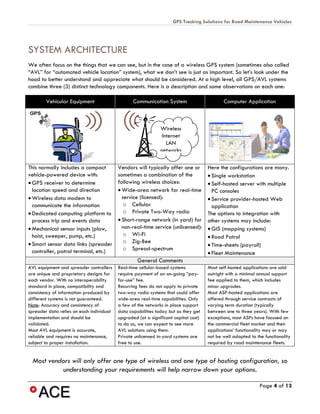
We often focus on the things that we can see, but in the case of a wireless GPS system (sometimes also called
“AVL” for “automated vehicle location” system), what we don’t see is just as important. So let’s look under the
hood to better understand and appreciate what should be considered. At a high level, all GPS/AVL systems
combine three (3) distinct technology components. Here is a description and some observations on each one:

        Vehicular Equipment                      Communication System                       Computer Application


                                                              Wireless
                                                               Internet
                                                                 LAN
                                                              networks

This normally includes a compact          Vendors will typically offer one or        Here the configurations are many.
vehicle-powered device with:              sometimes a combination of the             • Single workstation
• GPS receiver to determine               following wireless choices:                • Self-hosted server with multiple
  location speed and direction            • Wide-area network for real-time            PC consoles
• Wireless data modem to                    service (licensed):                      • Service provider-hosted Web
  communicate the information                o Cellular                                application
• Dedicated computing platform to            o Private Two-Way radio                 The options to integration with
  process trip and events data            • Short-range network (in yard) for        other systems may include:
• Mechanical sensor inputs (plow,           non-real-time service (unlicensed):      • GIS (mapping systems)
  hoist, sweeper, pump, etc.)                o Wi-Fi                                 • Road Patrol
• Smart sensor data links (spreader          o Zig-Bee
                                                                                     • Time-sheets (payroll)
  controller, patrol terminal, etc.)         o Spread-spectrum
                                                                                     • Fleet Maintenance
                                                   General Comments
AVL equipment and spreader controllers    Real-time cellular-based systems           Most self-hosted applications are sold
are unique and proprietary designs for    require payment of an on-going “pay-       outright with a minimal annual support
each vendor. With no interoperability     for-use” fee.                              fee applied to them, which includes
standard in place, compatibility and      Recurring fees do not apply to private     minor upgrades.
consistency of information produced by    two-way radio systems that could offer     Most ASP-hosted applications are
different systems is not guaranteed.      wide-area real-time capabilities. Only     offered through service contracts of
Note: Accuracy and consistency of         a few of the networks in place support     varying term duration (typically
spreader data relies on each individual   data capabilities today but as they get    between one to three years). With few
implementation and should be              upgraded (at a significant capital cost)   exceptions, most ASPs have focused on
validated.                                to do so, we can expect to see more        the commercial fleet market and their
Most AVL equipment is accurate,           AVL solutions using them.                  applications’ functionality may or may
reliable and requires no maintenance,     Private unlicensed in-yard systems are     not be well adapted to the functionality
subject to proper installation.           free to use.                               required by road maintenance fleets.


  Most vendors will only offer one type of wireless and one type of hosting configuration, so
           understanding your requirements will help narrow down your options.

                                                                                                              Page 4 of 13
GPS Tracking Solutions for Road Maintenance Vehicles


TECHNOLOGY MYTHS, CHOICES AND ALTERNATIVES
We will next discuss the underlying technologies involved in a GPS system and, where a choice has to be
made, how to distinguish which one will best suit your purpose. We might even clarify a few myths and false
perceptions in the process.

GPS (Global Positioning Satellite) System
The GPS system is strictly a position determination technology. It does not provide any communication
capability. GPS uses a constellation of dedicated satellites to send radio beacon signals to receiver chips in
our devices on the ground that determine the location of the device and a number of other parameters, such
as speed, direction, very accurate time, etc. GPS is a very mature and stable technology that is expected to
remain available in its current form for many years to come. Even as new devices change from time-to-time,
the fundamental functionality of GPS is not expected to become obsolete or impose changes for solution
providers to implement.
GPS accuracy is often a question. As long as the GPS receiver antenna has direct visibility to at least 50% of
the sky in order to properly receive the satellite radio signals, then most systems will deliver readings that are
about 10 meter accurate while stationary and 1to 2 meter accurate while moving. This is normally more than
enough to locate vehicles on roads and even determine which lane they are travelling on, assuming that the
map information is also detailed and accurate.

Wireless Data Communication
Most GPS systems rely on one form of wireless data communication or another to retrieve the location and
other information generated by the onboard equipment that records the vehicle’s whereabouts and activities.
Some are free to use, others require that a fee be paid to a wireless network operator.

Wide Area Networks (for real-time service)
In order to operate a GPS system that reflects the activities of your fleet in real-time or close to real time,
vehicles must be able to communicate back to a centrally located software application as they move or events
happen. Radio communication being what it is, no one can guarantee ubiquitous service everywhere and at all
times given that radio signals do not always reach in certain areas or when equipment is moved inside certain
types of buildings.
Sometimes, combinations of wireless technologies can fill the gap such as satellite communication for remote
areas, which is very expensive, or short-range for in-building. Combination systems are not broadly offered
due to their price, complexity and the rapid changes one finds in the wireless field.
So what happens when vehicles are not able to communicate? Your system should have a “store and forward”
capability that allows position and other event updates to be stored in the vehicle device with a time stamp
and transmitted as soon as the vehicle is able to communicate again.

CELLULAR DATA NETWORKS
Most application service providers (ASP) use cellular networks to communicate between their vehicle
equipment and software application. All cellular networks implement standard Internet Protocols (IP) today,
which, from a software point of view, makes it possible to use any cellular network. AVL solution providers

                                                                                                    Page 5 of 13
GPS Tracking Solutions for Road Maintenance Vehicles


normally buy the network service directly from a network operator, such as Rogers (GSM based network), Bell
or Telus (both CDMA based network). Since the cellular radio modems are typically embedded within the
AVL/GPS device and not normally interchangeable, and the network service is normally resold by the AVL
solution provider, it is not typically possible for end-users to choose which network their AVL system will
operate on, nor negotiate directly for wireless service.
Fortunately, most AVL applications do not use significant amounts of bandwidth compared to most browsing or
multi-media applications offered on hand-held wireless devices. Most of the monthly fees charged by AVL
solution providers have more to do with the GPS application than the wireless service itself. That being said,
most cellular providers operate with 12 month service plans and few offer seasonal plans. So if you may not
be able to lower your service fees to accommodate off-season periods.

PRIVATE TWO-WAY RADIO NETEWORKS
Almost all public works and road maintenance vehicles have been equipped with a private two-way radio
that supports as a minimum private press to talk (PTT) voice communication. Two types of networks can be
found: a) traditional two-way radio systems with dedicated voice channels for each user group and b) trunked
radio systems that share multiple radio channels amongst multiple user groups. The interest in using this
infrastructure to transmit GPS information in parallel with voice has been growing in recent years and stems
from the fact that no monthly fees need to be paid to a third party once the system is in place.
As it stands, most two-way or trunked radio systems used by road authorities do not support data
communication capabilities, but the technology has become available and started to be deployed, first in the
public safety market and is gradually finding its way in other government organizations. Upgrading radio
networks represents a major capital investment and adding optional data capabilities also involves additional
costs for both the infrastructure and the mobile radio equipment.
A few implementations have started to emerge, but very few AVL-GPS vendors have so far implemented their
applications over this type of wireless network. Over the long term, we can expect a gradual migration of
real-time AVL/GPS applications to data capable private networks as road authorities implement them.

Short-Range Yard-Area Networks (for non-real-time service)
When a GPS application is setup to record trip information and then download its logs upon the return of
vehicles to their yards, most vendors implement a short-range unlicensed and “free to use” network by
installing an inexpensive base station in the yard(s). There are a number of technologies that can be used this
way. All operate in the unlicensed radio spectrum, some follow industry standards to manage frequency
allocations others do not.
In many cases signal penetration from outside to within a building is possible if you plan to simply install the
base station indoors but coverage must always be validated, since the radios are designed to operate at low
power and building structures (especially metal buildings) will attenuate the radio coverage that can be
achieved. External antennas are an option for all short-range technologies to extend coverage.

WIRELESS LOCAL AREA NETWORKS (WI-FI, IEEE 802.11 A, B, G & N)
This is the wireless technology commonly used to link computer networks together. Network configuration,
access privileges and security is typically coordinated with and managed by your local IT organization, which
maintains responsibility for all wired and wireless local-area networks (LANs) that link the computer systems
within your organization. Only through proper configuration can Wi-Fi networks remain secure and protected
from unauthorized use.

                                                                                                  Page 6 of 13
GPS Tracking Solutions for Road Maintenance Vehicles


ZIG-BEE (IEEE 802.15.4)
This network technology, which is not as well known by consumers or the traditional IT community, is widely
used in industrial markets for remote sensor telemetry. It offers a great amount of functionality and flexibility
to interface many types of smart devices (that may not always be traditional computers) in a secure and
manageable environment.
One advantage of using Zig-Bee for the data collection of vehicle information is the ability to separate this
application from the rest of the computer networks, thus avoiding the security concerns that can arise when
sharing the same wireless technology as the computer network.

SPREAD-SPECTRUM
There are many unlicensed radio technologies that are often referred to as “spread spectrum” and are not
based on any industry standard. They are still used in fixed utility telemetry applications and at times have
been used in mobile applications. Although some may work well, the lack of technical standards results in
equipment from one vendor not being compatible with that of other vendors and creating customers’
dependence on single source solutions.

Sensors and Other On-Board Systems
Switches and mechanical sensors
A variety of mechanical sensors can be used to provide the necessary signal to AVL/GPS devices to record
events related to the use of different tools. Typically, one would detect the lowering or raising of a plow with
inductive proximity switches. The activation and deactivation of hydraulic functions like spreader conveyors,
sweepers, blowers, etc with hydraulic pressure switches and similarly with air pressure switches for
pneumatically driven functions.

Spreader controllers
Material spreading and patrolling functions are the most common mobile application that road authorities
look to integrate with their AVL/GPS systems.
The market is supplied electronic spreader controllers by about half a dozen vendors who provide their own
unique methods to share process data through different sorts of data links. There lies one of the great
challenges to mix products from different vendors since, without a standardized interface, the lack of
compatibility between different spreader controller and AVL/GPS vendors’ equipment can prevent you from
configuring a solution that works with your existing fleet configuration.
The number of AVL/GPS vendors that can provide integrated spreader data capabilities with multiple
vendors is very limited and even then, some of the integrations are not always fully functional, which
sometimes lead to obtaining inconsistent data for report and analysis. The implementations should be
demonstrated and proven prior to committing to large scale deployments. The AVL solutions that are offered
by spreader controller vendors may perform well but more often than not will only work with that vendor’s
brand of controller, which again limits your options to a single source.

Patrol Terminals
Patrolling functions have become increasingly regulated and integrated into the management of maintenance
operations. Since patrolling and road maintenance relate to the same geographical road data, one might
expect that these functions could be integrated within a single reporting and geographic information system

                                                                                                    Page 7 of 13
GPS Tracking Solutions for Road Maintenance Vehicles


(GIS). To date, this is rarely the case but we can expect vendors that offer one or the other solutions to
gradually integrate the other.
Another important choice involving electronic patrol solutions is the patrol terminal to be installed in the patrol
vehicle. So far, most solutions rely on ruggedized Windows notebooks, which are expensive but flexible to
adapt for applications programmers. One consideration in selecting the form factor of the input device used
by the patrolman is whether or not a simple form-fill user interface is required or a full color graphic display
required. If the application is expected to operate autonomously with all mapping data in the vehicle, then a
full Windows computer is appropriate. If only data collected in a form-like application is envisioned, simpler
and lower cost ruggedized terminals with a simplified form factor should be considered.

GPS/AVL Software Applications
Hosting
If you plan on hosting the application within your own organization you will likely need to buy a software
license and subscribe to an annual support agreement with the application vendor. The application may be
either web based, which only requires support on the server platform or client / server, which requires that an
application be installed and maintained on all computers where information will be viewed. Licensing fees
may be based on the size of the fleet or the number of computer consoles that can be linked to operate the
system.
In contrast, application service providers (ASP) offer their applications as a service and look for you to
subscribe to a monthly fee, typically per vehicle, for terms ranging between 1 to 3 years. ASPs operate their
own server and normally deliver the information through web browsers that require access to the Internet.
While this approach minimizes the up-front costs of implementation and IT support requirements, it also
commits you to paying ongoing fees indefinitely.

Mapping – Geographical Information System (GIS)
Whether you plan to use road maps as part of a real-time operation management console or to display
historical data, graphical maps have become widely used and greatly improved over the last few years. As
with GPS/AVL applications themselves, the mapping part of the service can be either self or ASP-hosted and
implemented through a client/server or web-based arrangement.
While aerial imagery (popularized by Google Maps and Microsoft Virtual Earth) can be eye-catching and
popular, the presentation of road conditions and maintenance operations is likely clearer to depict on more
traditional road maps. Although one does not preclude the other. The quality of road data that is now
available for free from service providers like Google and Microsoft is phenomenal but these public domain
services may not always have some of the more detailed road information (such as road classifications) that
might be available in-house and is of value in managing road operations.
One of the challenges in evaluating a GIS solution is determining whether road layer data is required or if
putting “dots on map” is all that you need. To decide, first establish if visualizing the whereabouts of your
vehicles on a map is sufficient or if a visual representation of the road status is required. Your organization
may also have GIS data that should be factored, such as specific road, signage, environmental data, that are
of value to your operation. If this is the case, you will look for a GIS capability that allows integration of your
data as well as the ability to work to visualize the different data sets in “layers”. The free Google Maps and
Microsoft Visual Earth services do not provide data layer functionality as may be required.

                                                                                                     Page 8 of 13
GPS Tracking Solutions for Road Maintenance Vehicles


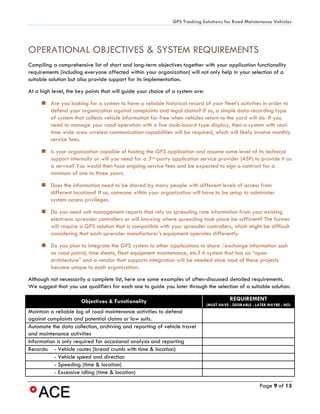
OPERATIONAL OBJECTIVES & SYSTEM REQUIREMENTS
Compiling a comprehensive list of short and long-term objectives together with your application functionality
requirements (including everyone affected within your organization) will not only help in your selection of a
suitable solution but also provide support for its implementation.
At a high level, the key points that will guide your choice of a system are:

      Are you looking for a system to have a reliable historical record of your fleet’s activities in order to
       defend your organization against complaints and legal claims? If so, a simple data-recording type
       of system that collects vehicle information for free when vehicles return to the yard will do. If you
       need to manage your road operation with a live dash-board type display, then a system with real-
       time wide area wireless communication capabilities will be required, which will likely involve monthly
       service fees.

      Is your organization capable of hosting the GPS application and assume some level of its technical
       support internally or will you need for a 3rd-party application service provider (ASP) to provide it as
       a service? You would then face ongoing service fees and be expected to sign a contract for a
       minimum of one to three years.

      Does the information need to be shared by many people with different levels of access from
       different locations? If so, someone within your organization will have to be setup to administer
       system access privileges.

      Do you need salt management reports that rely on spreading rate information from your existing
       electronic spreader controllers or will knowing where spreading took place be sufficient? The former
       will require a GPS solution that is compatible with your spreader controllers, which might be difficult
       considering that each spreader manufacturer’s equipment operates differently.

      Do you plan to integrate the GPS system to other applications to share /exchange information such
       as road patrol, time sheets, fleet equipment maintenance, etc.? A system that has an “open
       architecture” and a vendor that supports integration will be needed since most of these projects
       become unique to each organization.
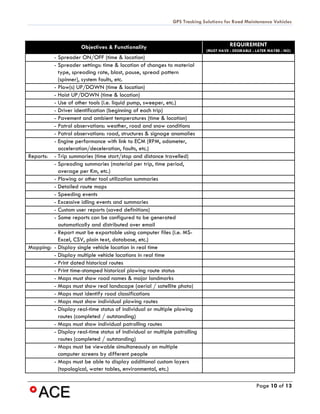
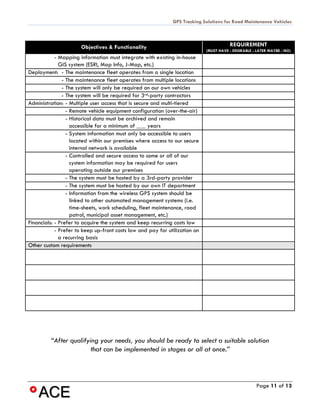
Although not necessarily a complete list, here are some examples of often-discussed detailed requirements.
We suggest that you use qualifiers for each one to guide you later through the selection of a suitable solution.

                      Objectives & Functionality                                          REQUIREMENT
                                                                               (MUST HAVE - DESIRABLE - LATER MAYBE - NO)
Maintain a reliable log of road maintenance activities to defend
against complaints and potential claims or law suits.
Automate the data collection, archiving and reporting of vehicle travel
and maintenance activities
Information is only required for occasional analysis and reporting
Records: - Vehicle routes (bread crumb with time & location)
           - Vehicle speed and direction
           - Speeding (time & location)
           - Excessive idling (time & location)

                                                                                                         Page 9 of 13
GPS Tracking Solutions for Road Maintenance Vehicles


                      Objectives & Functionality                                      REQUIREMENT
                                                                           (MUST HAVE - DESIRABLE - LATER MAYBE - NO)
         - Spreader ON/OFF (time & location)
         - Spreader settings: time & location of changes to material
           type, spreading rate, blast, pause, spread pattern
           (spinner), system faults, etc.
         - Plow(s) UP/DOWN (time & location)
         - Hoist UP/DOWN (time & location)
         - Use of other tools (i.e. liquid pump, sweeper, etc.)
         - Driver identification (beginning of each trip)
         - Pavement and ambient temperatures (time & location)
         - Patrol observations: weather, road and snow conditions
         - Patrol observations: road, structures & signage anomalies
         - Engine performance with link to ECM (RPM, odometer,
           acceleration/deceleration, faults, etc.)
Reports: - Trip summaries (time start/stop and distance travelled)
         - Spreading summaries (material per trip, time period,
           average per Km, etc.)
         - Plowing or other tool utilization summaries
         - Detailed route maps
         - Speeding events
         - Excessive idling events and summaries
         - Custom user reports (saved definitions)
         - Some reports can be configured to be generated
           automatically and distributed over email
         - Report must be exportable using computer files (i.e. MS-
           Excel, CSV, plain text, database, etc.)
Mapping: - Display single vehicle location in real time
         - Display multiple vehicle locations in real time
         - Print dated historical routes
         - Print time-stamped historical plowing route status
         - Maps must show road names & major landmarks
         - Maps must show real landscape (aerial / satellite photo)
         - Maps must identify road classifications
         - Maps must show individual plowing routes
         - Display real-time status of individual or multiple plowing
           routes (completed / outstanding)
         - Maps must show individual patrolling routes
         - Display real-time status of individual or multiple patrolling
           routes (completed / outstanding)
         - Maps must be viewable simultaneously on multiple
           computer screens by different people
         - Maps must be able to display additional custom layers
           (topological, water tables, environmental, etc.)

                                                                                                   Page 10 of 13
GPS Tracking Solutions for Road Maintenance Vehicles


                      Objectives & Functionality                                        REQUIREMENT
                                                                             (MUST HAVE - DESIRABLE - LATER MAYBE - NO)
            - Mapping information must integrate with existing in-house
              GIS system (ESRI, Map Info, J-Map, etc.)
Deployment: - The maintenance fleet operates from a single location
               - The maintenance fleet operates from multiple locations
               - The system will only be required on our own vehicles
               - The system will be required for 3rd-party contractors
Administration: - Multiple user access that is secure and multi-tiered
                 - Remote vehicle equipment configuration (over-the-air)
                 - Historical data must be archived and remain
                   accessible for a minimum of ___ years
                 - System information must only be accessible to users
                   located within our premises where access to our secure
                   internal network is available
                 - Controlled and secure access to some or all of our
                   system information may be required for users
                   operating outside our premises
                 - The system must be hosted by a 3rd-party provider
                 - The system must be hosted by our own IT department
                 - Information from the wireless GPS system should be
                   linked to other automated management systems (i.e.
                   time-sheets, work scheduling, fleet maintenance, road
                   patrol, municipal asset management, etc.)
Financials: - Prefer to acquire the system and keep recurring costs low
            - Prefer to keep up-front costs low and pay for utilization on
              a recurring basis
Other custom requirements


         “After qualifying your needs, you should be ready to select a suitable solution
                        that can be implemented in stages or all at once.”


                                                                                                     Page 11 of 13
GPS Tracking Solutions for Road Maintenance Vehicles


DEPLOYMENT CONSIDERATIONS
OK, so choosing a GPS solution is more complex than
buying new work equipment or commodities like
aggregate. You may also have heard horror stories
amongst your peers related to flawed system
implementations.
Hopefully you are not discouraged, realizing that one
can learn from others difficulties and that the
information in this guide will help you navigate through
your choices. Moving forward, here are a few more
points to consider:
    1. To get your organization to accept and support the implementation of your GPS system, discuss your
       intentions and share your findings with everyone affected.
           a. Operators may frown upon the notion of a new “big brother” looking over their shoulders.
                Once they appreciate that protecting their employers liability and doing so without adding
                paperwork are your main objectives, you may find that your responsible staff will endorse
                your initiative (while letting those with poor work ethics become more noticeable). Attempting
                to install a system covertly to avoid staff push back will only work (if at all) until the first time
                you question someone’s actions based on information you obtained from the system.
           b. Other groups in your organization may also endorse your plans if they find benefits for their
                own purpose; but beware that other people “wish lists” can also derail your initiative if their
                requirements are not practical or cannot be implemented at a reasonable cost.
    2. Clearly understand who (between the vendors and your internal staff) is to be responsible for:
           a. Equipment installation and transfers (vehicles and office computers)
           b. Operator training (vehicles and system administration)
           c. Technical support (vehicle equipment, software and computers)
           d. Interfacing to your spreaders or spreader controllers
           e. The accuracy of data generated by an integrated spreader / AVL solution
           f. Generating timely and meaningful reports
           g. Adding functionality and supporting the evolution of your solution as you introduce new
                vehicles, spreader controllers or mobile work processes that you want automated and
                integrated with your GPS/AVL system.
    3. Take the long view. Yes, you want a solution to address some immediate concerns, but one that can
       also evolve to accommodate longer-term objectives.
    4. Do a trial, especially if vendors offer favorable terms for you to do so. You will find that having a
       system in place is the best way to discover what it can do for you, how you and others might use it
       and to address everyone’s concerns. You might even discover features or benefits you overlooked.
    5. Keep vendors accountable. If a system does not do what was claimed by its representative, document
       discrepancies and insist on getting a remedy. Vendors might sometimes try to blame an issue on your
       lack of understanding to brush it under the carpet. At the same time, no technology is perfect and
       without limitations. So be attentive to the explanation and cooperate if possible to fix the issue.
    6. Don’t get blinded by the marvels of technology and whenever possible stick to the KISS principle
       “Keep It Simple Senior(a)”.

                                                                                                      Page 12 of 13
GPS Tracking Solutions for Road Maintenance Vehicles


CONTACT INFORMATION
              Germain Proulx
              420 Main Street East, #516, Milton, Ontario, Canada, L9T 5G3
              Phone: 416-907-0915     Fax: 888-900-9218
             Email: gproulx@aceelectronic.ca


                                                                           Page 13 of 13

Gps Tracking Systems For Road Maintenance Operations

  • 1.
    GPS TRACKING SOLUTIONSFOR ROAD MAINTENANCE VEHICLES October 2010 Author: Germain Proulx This guide was written to assist road authorities that are planning to acquire or enhance a GPS tracking system. It outlines typical requirements, common implementation challenges and how to address short versus long-term objectives. It compares available technologies, looking at functionality and cost trade-offs while considering technology trends.
  • 2.
    GPS Tracking Solutionsfor Road Maintenance Vehicles About the Author Germain Proulx has over 30 years experience handling business and product development as well as consulting in the wireless and fleet management markets. He has been involved in all aspects of wireless data communication (private and public terrestrial networks, short-range and satellite services). He has participated in the deployment of new hardware and software platforms as well as the integration of multi-vendor large system components. He is now working for ACE, Accent Electronic Controls Inc., handling market development of integrated solutions for specialized road maintenance fleet applications. About ACE ACE designs and manufactures products in Canada specifically targeting the road maintenance market. Products include the CHLOROBITE™ and ECOBITE II™ electronic spreader controllers, the INFOBITE™ wireless GPS trip / activity reporting system, OPTIVALVE II™ and ECOVALVE™ hydraulic control valves and the MANIMAX™ joystick plough controls. ACE is employee-owned and has been in business since 1997. It is located in Quebec City and sells its products through a network of truck builders, resellers and integrators. ACE products have been approved by all mainstream Canadian plow truck builders. Table of Contents INTRODUCTION......................................................................................................................................... 3 SYSTEM ARCHITECTURE ............................................................................................................................ 4 TECHNOLOGY MYTHS, CHOICES AND ALTERNATIVES ............................................................................ 5 GPS (Global Positioning Satellite) System ................................................................................................................... 5 Wireless Data Communication ........................................................................................................................................ 5 Wide Area Networks (for real-time service) ............................................................................................................ 5 Short-Range Yard-Area Networks (for non-real-time service) .............................................................................. 6 Sensors and Other On-Board Systems .......................................................................................................................... 7 Switches and mechanical sensors ................................................................................................................................. 7 Spreader controllers ...................................................................................................................................................... 7 Patrol Terminals .............................................................................................................................................................. 7 GPS/AVL Software Applications ................................................................................................................................... 8 Hosting .............................................................................................................................................................................. 8 Mapping – Geographical Information System (GIS) .............................................................................................. 8 OPERATIONAL OBJECTIVES & SYSTEM REQUIREMENTS .......................................................................... 9 DEPLOYMENT CONSIDERATIONS ........................................................................................................... 12 CONTACT INFORMATION ....................................................................................................................... 13 Page 2 of 13
  • 3.
    GPS Tracking Solutionsfor Road Maintenance Vehicles INTRODUCTION Choosing a GPS tracking system or adding functionality to an existing one can be a challenging task. Confusion reigns with so many offerings to choose from, interoperability (or lack of) with existing spreader controllers already installed, deciding between self-hosted or vendor hosted solutions with their respective cost and support options, whether a real-time and or non-real-time capability is required, the reputation of vendors and the reported satisfaction of their existing customers, the rapid changes and obsolescence of technical products, wireless systems and software applications. All of these concerns can challenge the best of us, but that’s not all… the different parties involved within your own organization will typically have different needs and concerns. A GPS tracking and information management system impacts many people, including your operators (work performance and oversight concerns), their supervisors (management ability), fleet maintenance and IT staff (technical support), public works management & CAOs (compliance with maintenance standards, budgets and liability) and sometimes elected officials who wish for improved oversight and accountability of road maintenance operations. In order to achieve the most appropriate system selection and implementation it is best to first establish your own objectives and determine what “must-have” versus “nice-to- have” features are required for your specific fleet and distinguish between short-term and longer-term objectives. “What’s right for you and your organization might not be what someone else is doing…” Page 3 of 13
  • 4.
    GPS Tracking Solutionsfor Road Maintenance Vehicles SYSTEM ARCHITECTURE We often focus on the things that we can see, but in the case of a wireless GPS system (sometimes also called “AVL” for “automated vehicle location” system), what we don’t see is just as important. So let’s look under the hood to better understand and appreciate what should be considered. At a high level, all GPS/AVL systems combine three (3) distinct technology components. Here is a description and some observations on each one: Vehicular Equipment Communication System Computer Application Wireless Internet LAN networks This normally includes a compact Vendors will typically offer one or Here the configurations are many. vehicle-powered device with: sometimes a combination of the • Single workstation • GPS receiver to determine following wireless choices: • Self-hosted server with multiple location speed and direction • Wide-area network for real-time PC consoles • Wireless data modem to service (licensed): • Service provider-hosted Web communicate the information o Cellular application • Dedicated computing platform to o Private Two-Way radio The options to integration with process trip and events data • Short-range network (in yard) for other systems may include: • Mechanical sensor inputs (plow, non-real-time service (unlicensed): • GIS (mapping systems) hoist, sweeper, pump, etc.) o Wi-Fi • Road Patrol • Smart sensor data links (spreader o Zig-Bee • Time-sheets (payroll) controller, patrol terminal, etc.) o Spread-spectrum • Fleet Maintenance General Comments AVL equipment and spreader controllers Real-time cellular-based systems Most self-hosted applications are sold are unique and proprietary designs for require payment of an on-going “pay- outright with a minimal annual support each vendor. With no interoperability for-use” fee. fee applied to them, which includes standard in place, compatibility and Recurring fees do not apply to private minor upgrades. consistency of information produced by two-way radio systems that could offer Most ASP-hosted applications are different systems is not guaranteed. wide-area real-time capabilities. Only offered through service contracts of Note: Accuracy and consistency of a few of the networks in place support varying term duration (typically spreader data relies on each individual data capabilities today but as they get between one to three years). With few implementation and should be upgraded (at a significant capital cost) exceptions, most ASPs have focused on validated. to do so, we can expect to see more the commercial fleet market and their Most AVL equipment is accurate, AVL solutions using them. applications’ functionality may or may reliable and requires no maintenance, Private unlicensed in-yard systems are not be well adapted to the functionality subject to proper installation. free to use. required by road maintenance fleets. Most vendors will only offer one type of wireless and one type of hosting configuration, so understanding your requirements will help narrow down your options. Page 4 of 13
  • 5.
    GPS Tracking Solutionsfor Road Maintenance Vehicles TECHNOLOGY MYTHS, CHOICES AND ALTERNATIVES We will next discuss the underlying technologies involved in a GPS system and, where a choice has to be made, how to distinguish which one will best suit your purpose. We might even clarify a few myths and false perceptions in the process. GPS (Global Positioning Satellite) System The GPS system is strictly a position determination technology. It does not provide any communication capability. GPS uses a constellation of dedicated satellites to send radio beacon signals to receiver chips in our devices on the ground that determine the location of the device and a number of other parameters, such as speed, direction, very accurate time, etc. GPS is a very mature and stable technology that is expected to remain available in its current form for many years to come. Even as new devices change from time-to-time, the fundamental functionality of GPS is not expected to become obsolete or impose changes for solution providers to implement. GPS accuracy is often a question. As long as the GPS receiver antenna has direct visibility to at least 50% of the sky in order to properly receive the satellite radio signals, then most systems will deliver readings that are about 10 meter accurate while stationary and 1to 2 meter accurate while moving. This is normally more than enough to locate vehicles on roads and even determine which lane they are travelling on, assuming that the map information is also detailed and accurate. Wireless Data Communication Most GPS systems rely on one form of wireless data communication or another to retrieve the location and other information generated by the onboard equipment that records the vehicle’s whereabouts and activities. Some are free to use, others require that a fee be paid to a wireless network operator. Wide Area Networks (for real-time service) In order to operate a GPS system that reflects the activities of your fleet in real-time or close to real time, vehicles must be able to communicate back to a centrally located software application as they move or events happen. Radio communication being what it is, no one can guarantee ubiquitous service everywhere and at all times given that radio signals do not always reach in certain areas or when equipment is moved inside certain types of buildings. Sometimes, combinations of wireless technologies can fill the gap such as satellite communication for remote areas, which is very expensive, or short-range for in-building. Combination systems are not broadly offered due to their price, complexity and the rapid changes one finds in the wireless field. So what happens when vehicles are not able to communicate? Your system should have a “store and forward” capability that allows position and other event updates to be stored in the vehicle device with a time stamp and transmitted as soon as the vehicle is able to communicate again. CELLULAR DATA NETWORKS Most application service providers (ASP) use cellular networks to communicate between their vehicle equipment and software application. All cellular networks implement standard Internet Protocols (IP) today, which, from a software point of view, makes it possible to use any cellular network. AVL solution providers Page 5 of 13
  • 6.
    GPS Tracking Solutionsfor Road Maintenance Vehicles normally buy the network service directly from a network operator, such as Rogers (GSM based network), Bell or Telus (both CDMA based network). Since the cellular radio modems are typically embedded within the AVL/GPS device and not normally interchangeable, and the network service is normally resold by the AVL solution provider, it is not typically possible for end-users to choose which network their AVL system will operate on, nor negotiate directly for wireless service. Fortunately, most AVL applications do not use significant amounts of bandwidth compared to most browsing or multi-media applications offered on hand-held wireless devices. Most of the monthly fees charged by AVL solution providers have more to do with the GPS application than the wireless service itself. That being said, most cellular providers operate with 12 month service plans and few offer seasonal plans. So if you may not be able to lower your service fees to accommodate off-season periods. PRIVATE TWO-WAY RADIO NETEWORKS Almost all public works and road maintenance vehicles have been equipped with a private two-way radio that supports as a minimum private press to talk (PTT) voice communication. Two types of networks can be found: a) traditional two-way radio systems with dedicated voice channels for each user group and b) trunked radio systems that share multiple radio channels amongst multiple user groups. The interest in using this infrastructure to transmit GPS information in parallel with voice has been growing in recent years and stems from the fact that no monthly fees need to be paid to a third party once the system is in place. As it stands, most two-way or trunked radio systems used by road authorities do not support data communication capabilities, but the technology has become available and started to be deployed, first in the public safety market and is gradually finding its way in other government organizations. Upgrading radio networks represents a major capital investment and adding optional data capabilities also involves additional costs for both the infrastructure and the mobile radio equipment. A few implementations have started to emerge, but very few AVL-GPS vendors have so far implemented their applications over this type of wireless network. Over the long term, we can expect a gradual migration of real-time AVL/GPS applications to data capable private networks as road authorities implement them. Short-Range Yard-Area Networks (for non-real-time service) When a GPS application is setup to record trip information and then download its logs upon the return of vehicles to their yards, most vendors implement a short-range unlicensed and “free to use” network by installing an inexpensive base station in the yard(s). There are a number of technologies that can be used this way. All operate in the unlicensed radio spectrum, some follow industry standards to manage frequency allocations others do not. In many cases signal penetration from outside to within a building is possible if you plan to simply install the base station indoors but coverage must always be validated, since the radios are designed to operate at low power and building structures (especially metal buildings) will attenuate the radio coverage that can be achieved. External antennas are an option for all short-range technologies to extend coverage. WIRELESS LOCAL AREA NETWORKS (WI-FI, IEEE 802.11 A, B, G & N) This is the wireless technology commonly used to link computer networks together. Network configuration, access privileges and security is typically coordinated with and managed by your local IT organization, which maintains responsibility for all wired and wireless local-area networks (LANs) that link the computer systems within your organization. Only through proper configuration can Wi-Fi networks remain secure and protected from unauthorized use. Page 6 of 13
  • 7.
    GPS Tracking Solutionsfor Road Maintenance Vehicles ZIG-BEE (IEEE 802.15.4) This network technology, which is not as well known by consumers or the traditional IT community, is widely used in industrial markets for remote sensor telemetry. It offers a great amount of functionality and flexibility to interface many types of smart devices (that may not always be traditional computers) in a secure and manageable environment. One advantage of using Zig-Bee for the data collection of vehicle information is the ability to separate this application from the rest of the computer networks, thus avoiding the security concerns that can arise when sharing the same wireless technology as the computer network. SPREAD-SPECTRUM There are many unlicensed radio technologies that are often referred to as “spread spectrum” and are not based on any industry standard. They are still used in fixed utility telemetry applications and at times have been used in mobile applications. Although some may work well, the lack of technical standards results in equipment from one vendor not being compatible with that of other vendors and creating customers’ dependence on single source solutions. Sensors and Other On-Board Systems Switches and mechanical sensors A variety of mechanical sensors can be used to provide the necessary signal to AVL/GPS devices to record events related to the use of different tools. Typically, one would detect the lowering or raising of a plow with inductive proximity switches. The activation and deactivation of hydraulic functions like spreader conveyors, sweepers, blowers, etc with hydraulic pressure switches and similarly with air pressure switches for pneumatically driven functions. Spreader controllers Material spreading and patrolling functions are the most common mobile application that road authorities look to integrate with their AVL/GPS systems. The market is supplied electronic spreader controllers by about half a dozen vendors who provide their own unique methods to share process data through different sorts of data links. There lies one of the great challenges to mix products from different vendors since, without a standardized interface, the lack of compatibility between different spreader controller and AVL/GPS vendors’ equipment can prevent you from configuring a solution that works with your existing fleet configuration. The number of AVL/GPS vendors that can provide integrated spreader data capabilities with multiple vendors is very limited and even then, some of the integrations are not always fully functional, which sometimes lead to obtaining inconsistent data for report and analysis. The implementations should be demonstrated and proven prior to committing to large scale deployments. The AVL solutions that are offered by spreader controller vendors may perform well but more often than not will only work with that vendor’s brand of controller, which again limits your options to a single source. Patrol Terminals Patrolling functions have become increasingly regulated and integrated into the management of maintenance operations. Since patrolling and road maintenance relate to the same geographical road data, one might expect that these functions could be integrated within a single reporting and geographic information system Page 7 of 13
  • 8.
    GPS Tracking Solutionsfor Road Maintenance Vehicles (GIS). To date, this is rarely the case but we can expect vendors that offer one or the other solutions to gradually integrate the other. Another important choice involving electronic patrol solutions is the patrol terminal to be installed in the patrol vehicle. So far, most solutions rely on ruggedized Windows notebooks, which are expensive but flexible to adapt for applications programmers. One consideration in selecting the form factor of the input device used by the patrolman is whether or not a simple form-fill user interface is required or a full color graphic display required. If the application is expected to operate autonomously with all mapping data in the vehicle, then a full Windows computer is appropriate. If only data collected in a form-like application is envisioned, simpler and lower cost ruggedized terminals with a simplified form factor should be considered. GPS/AVL Software Applications Hosting If you plan on hosting the application within your own organization you will likely need to buy a software license and subscribe to an annual support agreement with the application vendor. The application may be either web based, which only requires support on the server platform or client / server, which requires that an application be installed and maintained on all computers where information will be viewed. Licensing fees may be based on the size of the fleet or the number of computer consoles that can be linked to operate the system. In contrast, application service providers (ASP) offer their applications as a service and look for you to subscribe to a monthly fee, typically per vehicle, for terms ranging between 1 to 3 years. ASPs operate their own server and normally deliver the information through web browsers that require access to the Internet. While this approach minimizes the up-front costs of implementation and IT support requirements, it also commits you to paying ongoing fees indefinitely. Mapping – Geographical Information System (GIS) Whether you plan to use road maps as part of a real-time operation management console or to display historical data, graphical maps have become widely used and greatly improved over the last few years. As with GPS/AVL applications themselves, the mapping part of the service can be either self or ASP-hosted and implemented through a client/server or web-based arrangement. While aerial imagery (popularized by Google Maps and Microsoft Virtual Earth) can be eye-catching and popular, the presentation of road conditions and maintenance operations is likely clearer to depict on more traditional road maps. Although one does not preclude the other. The quality of road data that is now available for free from service providers like Google and Microsoft is phenomenal but these public domain services may not always have some of the more detailed road information (such as road classifications) that might be available in-house and is of value in managing road operations. One of the challenges in evaluating a GIS solution is determining whether road layer data is required or if putting “dots on map” is all that you need. To decide, first establish if visualizing the whereabouts of your vehicles on a map is sufficient or if a visual representation of the road status is required. Your organization may also have GIS data that should be factored, such as specific road, signage, environmental data, that are of value to your operation. If this is the case, you will look for a GIS capability that allows integration of your data as well as the ability to work to visualize the different data sets in “layers”. The free Google Maps and Microsoft Visual Earth services do not provide data layer functionality as may be required. Page 8 of 13
  • 9.
    GPS Tracking Solutionsfor Road Maintenance Vehicles OPERATIONAL OBJECTIVES & SYSTEM REQUIREMENTS Compiling a comprehensive list of short and long-term objectives together with your application functionality requirements (including everyone affected within your organization) will not only help in your selection of a suitable solution but also provide support for its implementation. At a high level, the key points that will guide your choice of a system are:  Are you looking for a system to have a reliable historical record of your fleet’s activities in order to defend your organization against complaints and legal claims? If so, a simple data-recording type of system that collects vehicle information for free when vehicles return to the yard will do. If you need to manage your road operation with a live dash-board type display, then a system with real- time wide area wireless communication capabilities will be required, which will likely involve monthly service fees.  Is your organization capable of hosting the GPS application and assume some level of its technical support internally or will you need for a 3rd-party application service provider (ASP) to provide it as a service? You would then face ongoing service fees and be expected to sign a contract for a minimum of one to three years.  Does the information need to be shared by many people with different levels of access from different locations? If so, someone within your organization will have to be setup to administer system access privileges.  Do you need salt management reports that rely on spreading rate information from your existing electronic spreader controllers or will knowing where spreading took place be sufficient? The former will require a GPS solution that is compatible with your spreader controllers, which might be difficult considering that each spreader manufacturer’s equipment operates differently.  Do you plan to integrate the GPS system to other applications to share /exchange information such as road patrol, time sheets, fleet equipment maintenance, etc.? A system that has an “open architecture” and a vendor that supports integration will be needed since most of these projects become unique to each organization. Although not necessarily a complete list, here are some examples of often-discussed detailed requirements. We suggest that you use qualifiers for each one to guide you later through the selection of a suitable solution. Objectives & Functionality REQUIREMENT (MUST HAVE - DESIRABLE - LATER MAYBE - NO) Maintain a reliable log of road maintenance activities to defend against complaints and potential claims or law suits. Automate the data collection, archiving and reporting of vehicle travel and maintenance activities Information is only required for occasional analysis and reporting Records: - Vehicle routes (bread crumb with time & location) - Vehicle speed and direction - Speeding (time & location) - Excessive idling (time & location) Page 9 of 13
  • 10.
    GPS Tracking Solutionsfor Road Maintenance Vehicles Objectives & Functionality REQUIREMENT (MUST HAVE - DESIRABLE - LATER MAYBE - NO) - Spreader ON/OFF (time & location) - Spreader settings: time & location of changes to material type, spreading rate, blast, pause, spread pattern (spinner), system faults, etc. - Plow(s) UP/DOWN (time & location) - Hoist UP/DOWN (time & location) - Use of other tools (i.e. liquid pump, sweeper, etc.) - Driver identification (beginning of each trip) - Pavement and ambient temperatures (time & location) - Patrol observations: weather, road and snow conditions - Patrol observations: road, structures & signage anomalies - Engine performance with link to ECM (RPM, odometer, acceleration/deceleration, faults, etc.) Reports: - Trip summaries (time start/stop and distance travelled) - Spreading summaries (material per trip, time period, average per Km, etc.) - Plowing or other tool utilization summaries - Detailed route maps - Speeding events - Excessive idling events and summaries - Custom user reports (saved definitions) - Some reports can be configured to be generated automatically and distributed over email - Report must be exportable using computer files (i.e. MS- Excel, CSV, plain text, database, etc.) Mapping: - Display single vehicle location in real time - Display multiple vehicle locations in real time - Print dated historical routes - Print time-stamped historical plowing route status - Maps must show road names & major landmarks - Maps must show real landscape (aerial / satellite photo) - Maps must identify road classifications - Maps must show individual plowing routes - Display real-time status of individual or multiple plowing routes (completed / outstanding) - Maps must show individual patrolling routes - Display real-time status of individual or multiple patrolling routes (completed / outstanding) - Maps must be viewable simultaneously on multiple computer screens by different people - Maps must be able to display additional custom layers (topological, water tables, environmental, etc.) Page 10 of 13
  • 11.
    GPS Tracking Solutionsfor Road Maintenance Vehicles Objectives & Functionality REQUIREMENT (MUST HAVE - DESIRABLE - LATER MAYBE - NO) - Mapping information must integrate with existing in-house GIS system (ESRI, Map Info, J-Map, etc.) Deployment: - The maintenance fleet operates from a single location - The maintenance fleet operates from multiple locations - The system will only be required on our own vehicles - The system will be required for 3rd-party contractors Administration: - Multiple user access that is secure and multi-tiered - Remote vehicle equipment configuration (over-the-air) - Historical data must be archived and remain accessible for a minimum of ___ years - System information must only be accessible to users located within our premises where access to our secure internal network is available - Controlled and secure access to some or all of our system information may be required for users operating outside our premises - The system must be hosted by a 3rd-party provider - The system must be hosted by our own IT department - Information from the wireless GPS system should be linked to other automated management systems (i.e. time-sheets, work scheduling, fleet maintenance, road patrol, municipal asset management, etc.) Financials: - Prefer to acquire the system and keep recurring costs low - Prefer to keep up-front costs low and pay for utilization on a recurring basis Other custom requirements “After qualifying your needs, you should be ready to select a suitable solution that can be implemented in stages or all at once.” Page 11 of 13
  • 12.
    GPS Tracking Solutionsfor Road Maintenance Vehicles DEPLOYMENT CONSIDERATIONS OK, so choosing a GPS solution is more complex than buying new work equipment or commodities like aggregate. You may also have heard horror stories amongst your peers related to flawed system implementations. Hopefully you are not discouraged, realizing that one can learn from others difficulties and that the information in this guide will help you navigate through your choices. Moving forward, here are a few more points to consider: 1. To get your organization to accept and support the implementation of your GPS system, discuss your intentions and share your findings with everyone affected. a. Operators may frown upon the notion of a new “big brother” looking over their shoulders. Once they appreciate that protecting their employers liability and doing so without adding paperwork are your main objectives, you may find that your responsible staff will endorse your initiative (while letting those with poor work ethics become more noticeable). Attempting to install a system covertly to avoid staff push back will only work (if at all) until the first time you question someone’s actions based on information you obtained from the system. b. Other groups in your organization may also endorse your plans if they find benefits for their own purpose; but beware that other people “wish lists” can also derail your initiative if their requirements are not practical or cannot be implemented at a reasonable cost. 2. Clearly understand who (between the vendors and your internal staff) is to be responsible for: a. Equipment installation and transfers (vehicles and office computers) b. Operator training (vehicles and system administration) c. Technical support (vehicle equipment, software and computers) d. Interfacing to your spreaders or spreader controllers e. The accuracy of data generated by an integrated spreader / AVL solution f. Generating timely and meaningful reports g. Adding functionality and supporting the evolution of your solution as you introduce new vehicles, spreader controllers or mobile work processes that you want automated and integrated with your GPS/AVL system. 3. Take the long view. Yes, you want a solution to address some immediate concerns, but one that can also evolve to accommodate longer-term objectives. 4. Do a trial, especially if vendors offer favorable terms for you to do so. You will find that having a system in place is the best way to discover what it can do for you, how you and others might use it and to address everyone’s concerns. You might even discover features or benefits you overlooked. 5. Keep vendors accountable. If a system does not do what was claimed by its representative, document discrepancies and insist on getting a remedy. Vendors might sometimes try to blame an issue on your lack of understanding to brush it under the carpet. At the same time, no technology is perfect and without limitations. So be attentive to the explanation and cooperate if possible to fix the issue. 6. Don’t get blinded by the marvels of technology and whenever possible stick to the KISS principle “Keep It Simple Senior(a)”. Page 12 of 13
  • 13.
    GPS Tracking Solutionsfor Road Maintenance Vehicles CONTACT INFORMATION Germain Proulx 420 Main Street East, #516, Milton, Ontario, Canada, L9T 5G3 Phone: 416-907-0915 Fax: 888-900-9218 Email: gproulx@aceelectronic.ca Page 13 of 13