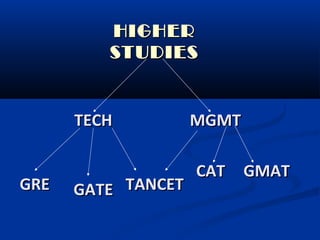
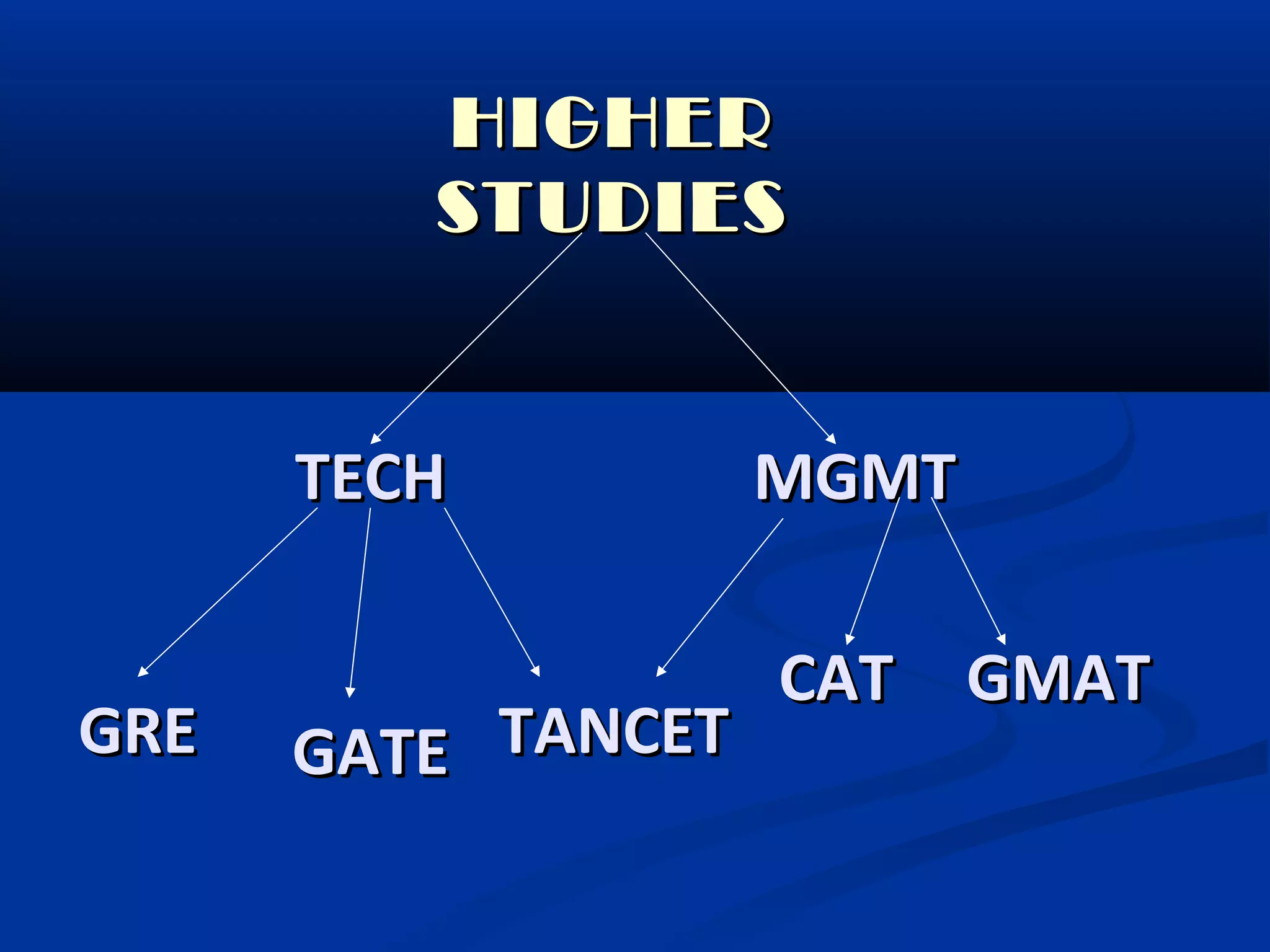








HIGHER
         STUDIES


      TECH          MGMT

                    CAT GMAT
GRE   GATE TANCET
GRE
GRE Test

The Graduate Record Examination is a
Standardized test that measures verbal,
mathematical and analytical skills. It is
intended to help the graduate schools (of
all fields other than business) assess the
potential of applicants for advanced study
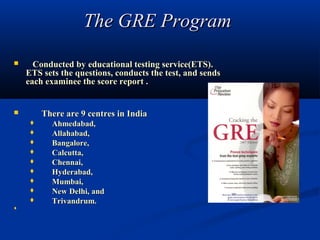
The GRE Program 
       Conducted by educational testing service(ETS).
      ETS sets the questions, conducts the test, and sends
      each examinee the score report .


             There are 9 centres in India
               Ahmedabad,
               Allahabad,
               Bangalore,
               Calcutta,
               Chennai,
               Hyderabad,
               Mumbai,
               New Delhi, and
               Trivandrum.
          
   
When is the GRE Test held?
   All-round-the-year

   five-days-a-week

   Registering at least 15 days in advance is mandatory.
Eligibility
   No restrictions based on age.

   The test scores are valid for 5 years,
    i.e., most universities accept scores up to five
    years old. But it is always better if your scores
    are recent (not older than 2 years).
How to Apply?
   Visit Prometric Centres.

   Registering Online: www.gre.org.
GRE General Test Overview
   Verbal Reasoning
   Quantitative Reasoning
   Analytical Writing
Verbal Section
   Antonyms 
   Analogies 
   Sentence Completions 
   Reading Comprehension 
Quantitative Section
   Arithmetic Questions 
   Algebra Questions 
   Geometry Questions 
       No Construction of Proof Questions 
   Data Analysis Questions
Analytical Writing Tasks 
   Present Your Views on an Issue (45 minutes,
    choice of 2 topics)
   Analyze an Argument (30 minutes)
   Each essay is scored on a 0-6 scale using
    holistic scoring
GRE SCORE PATTERN
   VERBAL               800
   QUANTITATIVE 800
           ------------------------------
           TOTAL 1600
           -------------------------------
   ANALYTICAL WRITING
    SCALE(0-6)
GRE Exam Fee
   Test fees for GRE Test may vary according to the
    country
   In India, this fee is US $140 (approx Rs. 7000),
    payable at the time of registration.
   You cannot pay in Indian Rupees.
   The payment can be made through a credit card
    which has global acceptance.
THE GRE PREP

Test Preparation Materials are available at
   the GRE Website:
     http://gre.org


       Download softwares, Test materials

       Use Standard Study materials like
        Princeton, Kaplan, etc

       Use Orkut & FaceBook
        Communities
Semesters

    Top US universities offer two main semester intakes:

    Fall Semester (September/October):
     This is the main intake and almost all programs are offered at this times.
     More financial aid is also available for this semester and as funds are
     allocated for the entire year during this time.

     Spring Semester (January/February):
     This is the mid-year intake. There is limited financial assistance available
     for this semester as most universities allocate funds to projects in the Fall
     semester.
Application Requirements
   Academic Records 
   Standardized Tests 
   Work Experience Details 
   Letters of Recommendation 
   Statement of Purpose (SOP) 
   Financial Support 
   Interviews (If applicable )
Financial Aid & Scholarships

   University Funding/Scholarships

   Loans from U.S. Banks

   Aid from Other Sources

   Loans and Support from your Home Country
Postgraduate Aid

   Tuition Waiver
   Scholarship / Fellowship
   Assistantship
Who Should Apply?
   Good Academic scores
   Decent scores (GRE, GMAT, TOEFL, IELTS)

   Increase opportunities for a teaching assistantship
   Specialize in a field or have a research interest to increase
    opportunities for research assistantships and grants
   Have outstanding letter(s) of recommendation and an
    impressive statement of purpose.
   Send a sample of professional writing, published or
    otherwise.
GATE

- Graduate Aptitude Test in
       Engineering
INTRO
 An all-India examination for PG in
  engineering
 Conducted in 8 zones across the

  country
 Conducted by the GATE committee

  that comprises IIS, Bangalore and 7
  IITs
 Exam mode: Mostly off-line

 Eligibility: B.E/B.Tech
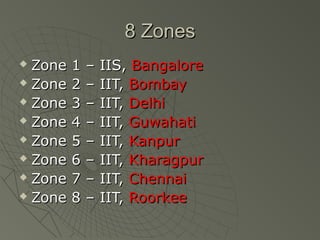
8 Zones
 Zone   1   –   IIS, Bangalore
 Zone   2   –   IIT, Bombay
 Zone   3   –   IIT, Delhi
 Zone   4   –   IIT, Guwahati
 Zone   5   –   IIT, Kanpur
 Zone   6   –   IIT, Kharagpur
 Zone   7   –   IIT, Chennai
 Zone   8   –   IIT, Roorkee
Why GATE?
 M.E/ M.Tech
 Specialize and further your interest

  in a specific area that may lead to
  PhD
 Faculty in Educational institutions

 R&D in big firms
EXAM PATTERN
 Single paper for 100 marks
 3 hrs

 60 objective questions

 Only one correct choice

 Negative marking
Type of questions
 Recall
 Comprehension

 Application

 Analysis & Synthesis
Mark distribution
 20 * 1                          1/3
 30 * 2                          2/3
 6 * 2  Common data Q1, Q2       2/3
 4 * 2  Linked answer Q1 <- Q2   2/3
Syllabi
   Engineering Mathematics
    • Probability – Permutation & Combination –
      Algebra – Set theroy – Numerical Methods –
      Calculus
   CS & IT
    • Digital logic – Computer Architecture -
      Algorithm & Programming – Data Structures –
      Theory of computation – Compiler design –
      Operating Systems – DBMS – S/W Engg. –
      Computer Networks – Web Technology
DATES
 Information brochure - Sep last
 week – Nov 1st week
 Application submission - Nov 1 st

 week
 Exam - 2nd Sunday of Feb

 Result – Middle of March
TANCET

• Tamil Nadu Common Entrance Test
• Self-financing professional, arts and science
  colleges
• M.Tech/ M.E./ MBA/ MCA/ M.Arch/
  M.Plan
DATES

• Application forms: Last week of March
• Submission: Last week of April
• Exam: Last week of May
MBA
• Eligibility
   – Any Bachelor’s degree


• Exam Pattern
   –   2 hours
   –   100 objective type questions
   –   1mark each
   –   1/5 for each wrong answer
Areas covered

•   Data Interpretation/ Data sufficiency
•   Comprehension
•   Mathematics (+2 and Graduation level)
•   English – Basic usage, grammar & punctuations
M.Tech/ M.E./ M.Arch/ M.Plan
• 2 hours duration
• 3 parts
   – Engineering Mathematics
      • 30 objective type questions
   – Basic engineering and sciences
      •   Minimum 30 questions to answer out of 45
      •   1 mark each
      •   -1/4 for incorrect answers
   – Specialization
      • Minimum 40 questions to answer out of 45
      • 1 mark each
      • -1/4 for incorrect answers
CAT
- Common Admission Test
Eligibility

 Any Bachelor’s degree
 Final year students can also apply                 (should
 submit the required mark sheets with in due date)
DURATION & PATTERN
 2 hrs and 30 mins   (includes initial 15 min tutorial)

 No Breaks
 60 Questions & 3 sections         (DO NOT TAKE FOR
 GRANTED)
  – Quantitative aptitude
  – Verbal
  – Data Interpretation
DATES
 Applications
  –   August last week to September last week
  –   2010* Aug 30 to Sep 27


 Exam dates
  –   Oct last week – Nov last week
  –   2010* Oct 27 to Nov 24
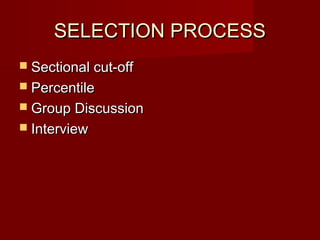
SELECTION PROCESS
 Sectional cut-off
 Percentile
 Group Discussion
 Interview
GMAT
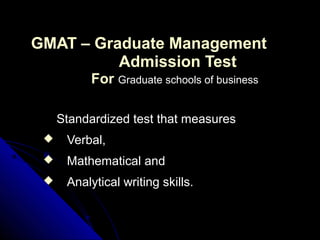
GMAT – Graduate Management
          Admission Test
          For Graduate schools of business

     Standardized test that measures
     Verbal,
     Mathematical and
     Analytical writing skills.
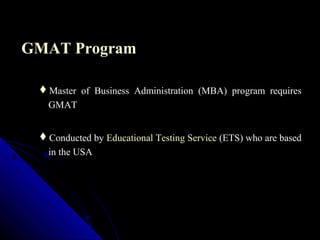
GMAT Program

 Master of Business Administration (MBA) program requires
  GMAT


 Conducted by Educational Testing Service (ETS) who are based
   in the USA
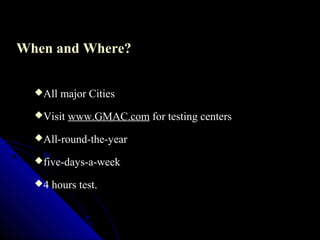
When and Where?

  All   major Cities
  Visit   www.GMAC.com for testing centers
  All-round-the-year

  five-days-a-week

  4   hours test.
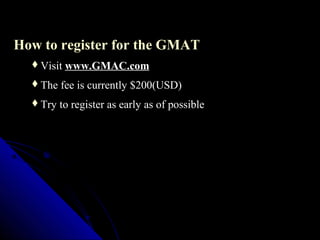
How to register for the GMAT
  Visit   www.GMAC.com
  The   fee is currently $200(USD)
  Try   to register as early as of possible
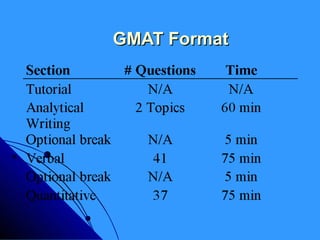
GMAT Format
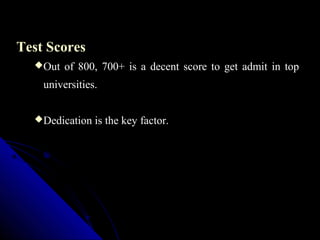
Test Scores
  Out   of 800, 700+ is a decent score to get admit in top
    universities.


  Dedication   is the key factor.
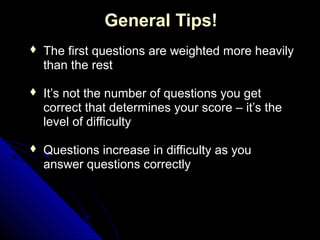
General Tips!
   The first questions are weighted more heavily
    than the rest

   It’s not the number of questions you get
    correct that determines your score – it’s the
    level of difficulty

   Questions increase in difficulty as you
    answer questions correctly
 Concentrate    on getting a series of questions in a row
  correct

 Answer     as many questions as possible

 If   you are not sure, guess!

 Pace    yourself, but be aware of your time

 Confirm    your answers only when confident

 Be    careful about exit and quit commands
After Exam
 Either you can apply by your own or you
 can approach consultancies for short
 listing the universities.

 Use   Orkut & Face book Communities.
Study Strategies
   Buy a book!
   Treat it like a class
     Commit   to specified study time(s)
   Test yourself realistically
     Do   use downloadable GMAT software
     Do   take full length test to identify weak
      areas and get rough estimate of score
     DO   NOT allow yourself to exceed time
      limits
     DO   NOT use calculators
ENGLISH
   PROFICIENCY


TOEFL        IELTS
TOEFL
ALL ABOUT TOEFL TEST

• The Test of English as a Foreign
  Language (TOEFL) is a standardized
  test designed to measure the ability
  to understand and to use English.

• Conducted by Educational Testing
  Service (ETS) worldwide.
WHY TOEFL?


Additionally, institutions such as government
agencies, licensing bodies, businesses, or
scholarship programs may require this test.
WHAT COMPRISES THE TOEFL
              EXAM?
•      4 hour test
•      Consists of the following four
    sections,

         – Reading
         – Listening
         – Speaking
         – Writing
• 3–5 passages, each approximately
  700 words in length and questions
  about the passages. The passages
  are on academic topics
• 6 passages -> Each 3–5 minutes in
  length and questions about the
  passages. These passages include 2
  student conversations and 4
  academic lectures or discussions.
• A conversation involves 2 speakers
• A lecture
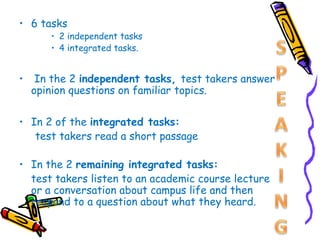
• 6 tasks
       • 2 independent tasks
       • 4 integrated tasks.


•    In the 2 independent tasks, test takers answer
    opinion questions on familiar topics.

• In 2 of the integrated tasks:
   test takers read a short passage

• In the 2 remaining integrated tasks:
  test takers listen to an academic course lecture
  or a conversation about campus life and then
  respond to a question about what they heard.
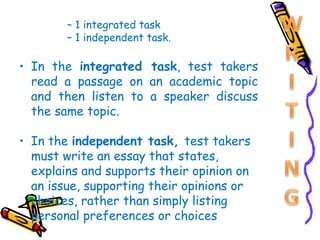
– 1 integrated task
        – 1 independent task.

• In the integrated task, test takers
  read a passage on an academic topic
  and then listen to a speaker discuss
  the same topic.

• In the independent task, test takers
  must write an essay that states,
  explains and supports their opinion on
  an issue, supporting their opinions or
  choices, rather than simply listing
  personal preferences or choices
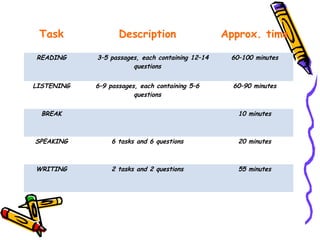
Task              Description                    Approx. time

READING     3–5 passages, each containing 12–14    60–100 minutes
                       questions


LISTENING   6–9 passages, each containing 5–6       60–90 minutes
                        questions

  BREAK                                              10 minutes


SPEAKING         6 tasks and 6 questions             20 minutes


WRITING          2 tasks and 2 questions             55 minutes
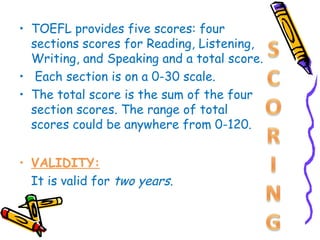
• TOEFL provides five scores: four
  sections scores for Reading, Listening,
  Writing, and Speaking and a total score.
• Each section is on a 0-30 scale.
• The total score is the sum of the four
  section scores. The range of total
  scores could be anywhere from 0-120.


• VALIDITY:
  It is valid for two years.
IELTS
www.britishcouncil.org
Hard work is the key to
THANK U!

Abrod studies

  • 1.
    HIGHER STUDIES TECH MGMT CAT GMAT GRE GATE TANCET
  • 2.
  • 3.
    GRE Test The GraduateRecord Examination is a Standardized test that measures verbal, mathematical and analytical skills. It is intended to help the graduate schools (of all fields other than business) assess the potential of applicants for advanced study
  • 4.
    The GRE Program   Conducted by educational testing service(ETS). ETS sets the questions, conducts the test, and sends each examinee the score report .  There are 9 centres in India  Ahmedabad,  Allahabad,  Bangalore,  Calcutta,  Chennai,  Hyderabad,  Mumbai,  New Delhi, and  Trivandrum.           
  • 5.
    When is theGRE Test held?  All-round-the-year  five-days-a-week  Registering at least 15 days in advance is mandatory.
  • 6.
    Eligibility  No restrictions based on age.  The test scores are valid for 5 years, i.e., most universities accept scores up to five years old. But it is always better if your scores are recent (not older than 2 years).
  • 7.
    How to Apply?  Visit Prometric Centres.  Registering Online: www.gre.org.
  • 8.
    GRE General Test Overview  Verbal Reasoning  Quantitative Reasoning  Analytical Writing
  • 9.
    Verbal Section  Antonyms   Analogies   Sentence Completions   Reading Comprehension 
  • 10.
    Quantitative Section  Arithmetic Questions   Algebra Questions   Geometry Questions   No Construction of Proof Questions   Data Analysis Questions
  • 11.
    Analytical Writing Tasks   Present Your Views on an Issue (45 minutes, choice of 2 topics)  Analyze an Argument (30 minutes)  Each essay is scored on a 0-6 scale using holistic scoring
  • 12.
    GRE SCORE PATTERN  VERBAL 800  QUANTITATIVE 800 ------------------------------ TOTAL 1600 -------------------------------  ANALYTICAL WRITING SCALE(0-6)
  • 13.
    GRE Exam Fee  Test fees for GRE Test may vary according to the country  In India, this fee is US $140 (approx Rs. 7000), payable at the time of registration.  You cannot pay in Indian Rupees.  The payment can be made through a credit card which has global acceptance.
  • 14.
    THE GRE PREP TestPreparation Materials are available at the GRE Website:  http://gre.org  Download softwares, Test materials  Use Standard Study materials like Princeton, Kaplan, etc  Use Orkut & FaceBook Communities
  • 15.
    Semesters Top US universities offer two main semester intakes:  Fall Semester (September/October): This is the main intake and almost all programs are offered at this times. More financial aid is also available for this semester and as funds are allocated for the entire year during this time.  Spring Semester (January/February): This is the mid-year intake. There is limited financial assistance available for this semester as most universities allocate funds to projects in the Fall semester.
  • 16.
    Application Requirements  Academic Records   Standardized Tests   Work Experience Details   Letters of Recommendation   Statement of Purpose (SOP)   Financial Support   Interviews (If applicable )
  • 17.
    Financial Aid &Scholarships  University Funding/Scholarships  Loans from U.S. Banks  Aid from Other Sources  Loans and Support from your Home Country
  • 18.
    Postgraduate Aid  Tuition Waiver  Scholarship / Fellowship  Assistantship
  • 19.
    Who Should Apply?  Good Academic scores  Decent scores (GRE, GMAT, TOEFL, IELTS)  Increase opportunities for a teaching assistantship  Specialize in a field or have a research interest to increase opportunities for research assistantships and grants  Have outstanding letter(s) of recommendation and an impressive statement of purpose.  Send a sample of professional writing, published or otherwise.
  • 20.
    GATE - Graduate AptitudeTest in Engineering
  • 21.
    INTRO  An all-Indiaexamination for PG in engineering  Conducted in 8 zones across the country  Conducted by the GATE committee that comprises IIS, Bangalore and 7 IITs  Exam mode: Mostly off-line  Eligibility: B.E/B.Tech
  • 22.
    8 Zones  Zone 1 – IIS, Bangalore  Zone 2 – IIT, Bombay  Zone 3 – IIT, Delhi  Zone 4 – IIT, Guwahati  Zone 5 – IIT, Kanpur  Zone 6 – IIT, Kharagpur  Zone 7 – IIT, Chennai  Zone 8 – IIT, Roorkee
  • 23.
    Why GATE?  M.E/M.Tech  Specialize and further your interest in a specific area that may lead to PhD  Faculty in Educational institutions  R&D in big firms
  • 24.
    EXAM PATTERN  Singlepaper for 100 marks  3 hrs  60 objective questions  Only one correct choice  Negative marking
  • 25.
    Type of questions Recall  Comprehension  Application  Analysis & Synthesis
  • 26.
    Mark distribution  20* 1 1/3  30 * 2 2/3  6 * 2 Common data Q1, Q2 2/3  4 * 2 Linked answer Q1 <- Q2 2/3
  • 27.
    Syllabi  Engineering Mathematics • Probability – Permutation & Combination – Algebra – Set theroy – Numerical Methods – Calculus  CS & IT • Digital logic – Computer Architecture - Algorithm & Programming – Data Structures – Theory of computation – Compiler design – Operating Systems – DBMS – S/W Engg. – Computer Networks – Web Technology
  • 28.
    DATES  Information brochure- Sep last week – Nov 1st week  Application submission - Nov 1 st week  Exam - 2nd Sunday of Feb  Result – Middle of March
  • 29.
    TANCET • Tamil NaduCommon Entrance Test • Self-financing professional, arts and science colleges • M.Tech/ M.E./ MBA/ MCA/ M.Arch/ M.Plan
  • 30.
    DATES • Application forms:Last week of March • Submission: Last week of April • Exam: Last week of May
  • 31.
    MBA • Eligibility – Any Bachelor’s degree • Exam Pattern – 2 hours – 100 objective type questions – 1mark each – 1/5 for each wrong answer
  • 32.
    Areas covered • Data Interpretation/ Data sufficiency • Comprehension • Mathematics (+2 and Graduation level) • English – Basic usage, grammar & punctuations
  • 33.
    M.Tech/ M.E./ M.Arch/M.Plan • 2 hours duration • 3 parts – Engineering Mathematics • 30 objective type questions – Basic engineering and sciences • Minimum 30 questions to answer out of 45 • 1 mark each • -1/4 for incorrect answers – Specialization • Minimum 40 questions to answer out of 45 • 1 mark each • -1/4 for incorrect answers
  • 34.
  • 35.
    Eligibility  Any Bachelor’sdegree  Final year students can also apply (should submit the required mark sheets with in due date)
  • 36.
    DURATION & PATTERN 2 hrs and 30 mins (includes initial 15 min tutorial)  No Breaks  60 Questions & 3 sections (DO NOT TAKE FOR GRANTED) – Quantitative aptitude – Verbal – Data Interpretation
  • 37.
    DATES  Applications – August last week to September last week – 2010* Aug 30 to Sep 27  Exam dates – Oct last week – Nov last week – 2010* Oct 27 to Nov 24
  • 38.
    SELECTION PROCESS  Sectionalcut-off  Percentile  Group Discussion  Interview
  • 39.
  • 40.
    GMAT – GraduateManagement Admission Test For Graduate schools of business Standardized test that measures  Verbal,  Mathematical and  Analytical writing skills.
  • 41.
    GMAT Program Masterof Business Administration (MBA) program requires GMAT Conducted by Educational Testing Service (ETS) who are based in the USA
  • 42.
    When and Where? All major Cities Visit www.GMAC.com for testing centers All-round-the-year five-days-a-week 4 hours test.
  • 43.
    How to registerfor the GMAT Visit www.GMAC.com The fee is currently $200(USD) Try to register as early as of possible
  • 44.
  • 45.
    Test Scores Out of 800, 700+ is a decent score to get admit in top universities. Dedication is the key factor.
  • 46.
    General Tips!  The first questions are weighted more heavily than the rest  It’s not the number of questions you get correct that determines your score – it’s the level of difficulty  Questions increase in difficulty as you answer questions correctly
  • 47.
     Concentrate on getting a series of questions in a row correct  Answer as many questions as possible  If you are not sure, guess!  Pace yourself, but be aware of your time  Confirm your answers only when confident  Be careful about exit and quit commands
  • 48.
    After Exam  Eitheryou can apply by your own or you can approach consultancies for short listing the universities.  Use Orkut & Face book Communities.
  • 49.
    Study Strategies  Buy a book!  Treat it like a class  Commit to specified study time(s)  Test yourself realistically  Do use downloadable GMAT software  Do take full length test to identify weak areas and get rough estimate of score  DO NOT allow yourself to exceed time limits  DO NOT use calculators
  • 50.
    ENGLISH PROFICIENCY TOEFL IELTS
  • 51.
  • 52.
    ALL ABOUT TOEFLTEST • The Test of English as a Foreign Language (TOEFL) is a standardized test designed to measure the ability to understand and to use English. • Conducted by Educational Testing Service (ETS) worldwide.
  • 53.
    WHY TOEFL? Additionally, institutionssuch as government agencies, licensing bodies, businesses, or scholarship programs may require this test.
  • 54.
    WHAT COMPRISES THETOEFL EXAM? • 4 hour test • Consists of the following four sections, – Reading – Listening – Speaking – Writing
  • 55.
    • 3–5 passages,each approximately 700 words in length and questions about the passages. The passages are on academic topics
  • 56.
    • 6 passages-> Each 3–5 minutes in length and questions about the passages. These passages include 2 student conversations and 4 academic lectures or discussions. • A conversation involves 2 speakers • A lecture
  • 57.
    • 6 tasks • 2 independent tasks • 4 integrated tasks. • In the 2 independent tasks, test takers answer opinion questions on familiar topics. • In 2 of the integrated tasks: test takers read a short passage • In the 2 remaining integrated tasks: test takers listen to an academic course lecture or a conversation about campus life and then respond to a question about what they heard.
  • 58.
    – 1 integratedtask – 1 independent task. • In the integrated task, test takers read a passage on an academic topic and then listen to a speaker discuss the same topic. • In the independent task, test takers must write an essay that states, explains and supports their opinion on an issue, supporting their opinions or choices, rather than simply listing personal preferences or choices
  • 59.
    Task Description Approx. time READING 3–5 passages, each containing 12–14 60–100 minutes questions LISTENING 6–9 passages, each containing 5–6 60–90 minutes questions BREAK 10 minutes SPEAKING 6 tasks and 6 questions 20 minutes WRITING 2 tasks and 2 questions 55 minutes
  • 60.
    • TOEFL providesfive scores: four sections scores for Reading, Listening, Writing, and Speaking and a total score. • Each section is on a 0-30 scale. • The total score is the sum of the four section scores. The range of total scores could be anywhere from 0-120. • VALIDITY: It is valid for two years.
  • 61.
  • 63.
  • 68.
    Hard work isthe key to
  • 69.