CAT vs. GATE: A Comparative
Analysis
SAFIR AFJAL ZAFIR
Introduction
• Welcome everyone to our presentation on the comparison between CAT
(Common Admission Test) and GATE (Graduate Aptitude Test in Engineering).
• Both CAT and GATE are crucial examinations in India, catering to different
academic and career aspirations.
• In this presentation, we'll explore the key differences, purposes, and significance
of these exams.
Overview
 CAT
 CAT is an entrance exam conducted for admission into various management programs in India.
 It is conducted by the Indian Institutes of Management (IIMs) on a rotational basis.
 CAT assesses candidates' quantitative aptitude, verbal ability, data interpretation, and logical reasoning.
 Successful candidates can secure admission to prestigious management institutions across the country.
 GATE
 GATE is an entrance exam conducted for admission into postgraduate engineering programs (M.E./M.Tech/Ph.D.) and for recruitment
to public sector companies.
 It is jointly conducted by the Indian Institute of Science (IISc) and seven Indian Institutes of Technology (IITs).
 GATE evaluates candidates' understanding of engineering and science subjects along with analytical and problem-solving skills.
Purpose and Scope
 CAT
 CAT primarily serves the purpose of selecting candidates for management programs.
 It is essential for students aspiring to pursue an MBA or equivalent degree.
 CAT scores are widely accepted by various management institutions, making it a popular choice for management aspirants.
 GATE
 GATE serves a dual purpose: postgraduate admissions and recruitment to public sector companies.
 GATE scores are used by several government organizations for hiring engineers in various disciplines.
 For students, GATE opens doors to pursue higher education in engineering and technology from reputed institutes.
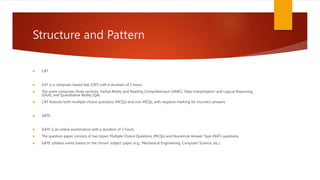
Structure and Pattern
 CAT
 CAT is a computer-based test (CBT) with a duration of 2 hours.
 The exam comprises three sections: Verbal Ability and Reading Comprehension (VARC), Data Interpretation and Logical Reasoning
(DILR), and Quantitative Ability (QA).
 CAT features both multiple-choice questions (MCQs) and non-MCQs, with negative marking for incorrect answers.
 GATE
 GATE is an online examination with a duration of 3 hours.
 The question paper consists of two types: Multiple Choice Questions (MCQs) and Numerical Answer Type (NAT) questions.
 GATE syllabus varies based on the chosen subject paper (e.g., Mechanical Engineering, Computer Science, etc.).
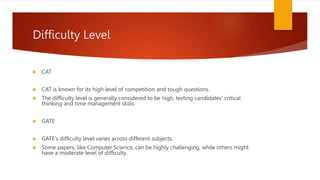
Difficulty Level
 CAT
 CAT is known for its high level of competition and tough questions.
 The difficulty level is generally considered to be high, testing candidates' critical
thinking and time management skills.
 GATE
 GATE's difficulty level varies across different subjects.
 Some papers, like Computer Science, can be highly challenging, while others might
have a moderate level of difficulty.
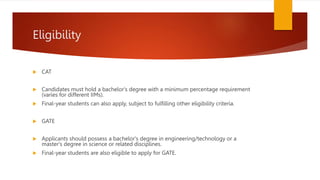
Eligibility
 CAT
 Candidates must hold a bachelor's degree with a minimum percentage requirement
(varies for different IIMs).
 Final-year students can also apply, subject to fulfilling other eligibility criteria.
 GATE
 Applicants should possess a bachelor's degree in engineering/technology or a
master's degree in science or related disciplines.
 Final-year students are also eligible to apply for GATE.
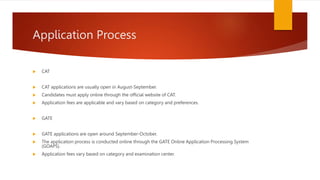
Application Process
 CAT
 CAT applications are usually open in August-September.
 Candidates must apply online through the official website of CAT.
 Application fees are applicable and vary based on category and preferences.
 GATE
 GATE applications are open around September-October.
 The application process is conducted online through the GATE Online Application Processing System
(GOAPS).
 Application fees vary based on category and examination center.
Score Validity
 CAT
 CAT scores are valid for one year and can be used for admissions in the
corresponding year.
 GATE
 GATE scores are valid for three years, allowing candidates to utilize them for
admissions or PSU recruitment during this period.

CAT vs GATE.pptx

  • 1.
    CAT vs. GATE:A Comparative Analysis SAFIR AFJAL ZAFIR
  • 2.
    Introduction • Welcome everyoneto our presentation on the comparison between CAT (Common Admission Test) and GATE (Graduate Aptitude Test in Engineering). • Both CAT and GATE are crucial examinations in India, catering to different academic and career aspirations. • In this presentation, we'll explore the key differences, purposes, and significance of these exams.
  • 3.
    Overview  CAT  CATis an entrance exam conducted for admission into various management programs in India.  It is conducted by the Indian Institutes of Management (IIMs) on a rotational basis.  CAT assesses candidates' quantitative aptitude, verbal ability, data interpretation, and logical reasoning.  Successful candidates can secure admission to prestigious management institutions across the country.  GATE  GATE is an entrance exam conducted for admission into postgraduate engineering programs (M.E./M.Tech/Ph.D.) and for recruitment to public sector companies.  It is jointly conducted by the Indian Institute of Science (IISc) and seven Indian Institutes of Technology (IITs).  GATE evaluates candidates' understanding of engineering and science subjects along with analytical and problem-solving skills.
  • 4.
    Purpose and Scope CAT  CAT primarily serves the purpose of selecting candidates for management programs.  It is essential for students aspiring to pursue an MBA or equivalent degree.  CAT scores are widely accepted by various management institutions, making it a popular choice for management aspirants.  GATE  GATE serves a dual purpose: postgraduate admissions and recruitment to public sector companies.  GATE scores are used by several government organizations for hiring engineers in various disciplines.  For students, GATE opens doors to pursue higher education in engineering and technology from reputed institutes.
  • 5.
    Structure and Pattern CAT  CAT is a computer-based test (CBT) with a duration of 2 hours.  The exam comprises three sections: Verbal Ability and Reading Comprehension (VARC), Data Interpretation and Logical Reasoning (DILR), and Quantitative Ability (QA).  CAT features both multiple-choice questions (MCQs) and non-MCQs, with negative marking for incorrect answers.  GATE  GATE is an online examination with a duration of 3 hours.  The question paper consists of two types: Multiple Choice Questions (MCQs) and Numerical Answer Type (NAT) questions.  GATE syllabus varies based on the chosen subject paper (e.g., Mechanical Engineering, Computer Science, etc.).
  • 6.
    Difficulty Level  CAT CAT is known for its high level of competition and tough questions.  The difficulty level is generally considered to be high, testing candidates' critical thinking and time management skills.  GATE  GATE's difficulty level varies across different subjects.  Some papers, like Computer Science, can be highly challenging, while others might have a moderate level of difficulty.
  • 7.
    Eligibility  CAT  Candidatesmust hold a bachelor's degree with a minimum percentage requirement (varies for different IIMs).  Final-year students can also apply, subject to fulfilling other eligibility criteria.  GATE  Applicants should possess a bachelor's degree in engineering/technology or a master's degree in science or related disciplines.  Final-year students are also eligible to apply for GATE.
  • 8.
    Application Process  CAT CAT applications are usually open in August-September.  Candidates must apply online through the official website of CAT.  Application fees are applicable and vary based on category and preferences.  GATE  GATE applications are open around September-October.  The application process is conducted online through the GATE Online Application Processing System (GOAPS).  Application fees vary based on category and examination center.
  • 9.
    Score Validity  CAT CAT scores are valid for one year and can be used for admissions in the corresponding year.  GATE  GATE scores are valid for three years, allowing candidates to utilize them for admissions or PSU recruitment during this period.