Strategic Application of Software Development Process for Business Oriented Projects Glenn Engstrand President and Founder Dynamical Software, Inc.
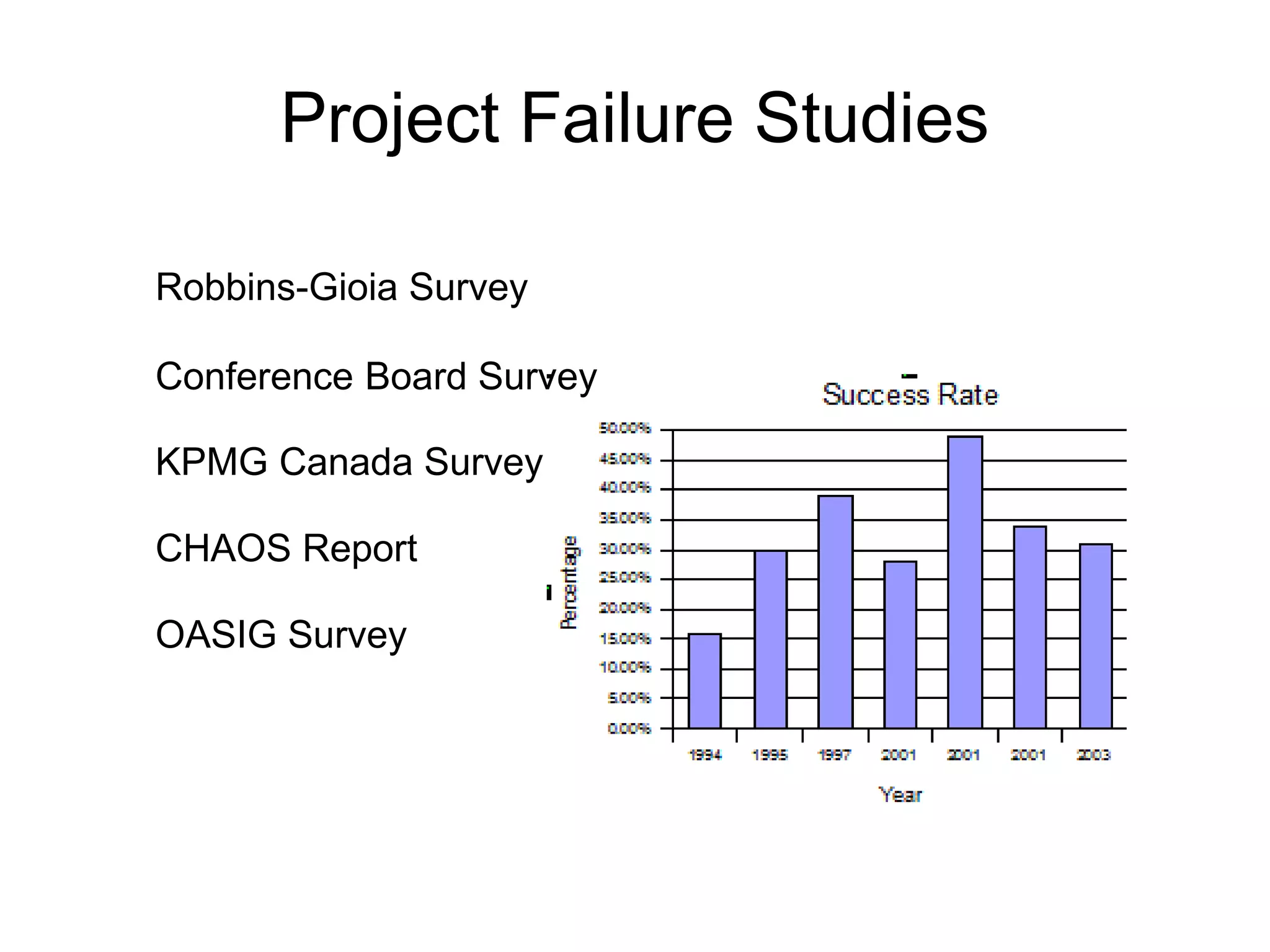
Project Failure Studies Robbins-Gioia Survey Conference   Board Survey KPMG Canada Survey CHAOS Report OASIG Survey
ACM Queue 1 Minute Risk Assessment Tool Use of Inappropriate Methodology Lack of Customer Involvement Lack of Formal Project Management Practices Dissimilarity to Previous Projects Project Complexity Requirements Volatility
IEEE Software Frequently Forgotten Fundamental Facts About Software Engineering Requirements Churn Overly Optimistic Estimates Rush to make deadlines increases technical debt Most Significant Phase is Feature Enhancement Maintenance Peer Review White box testing Quality Control
Why Projects Fail Information Overload Just Do It A new methodology is overly hyped resulting in high expectations with inappropriate and misplaced enthusiasm. An obsessive focus on meeting short term milestones and budgetary goals results in excessive technical debt resulting in rigidity over time.
Common Theme Lack of understanding as to how to apply fundamentally sound academic theory to practice in a business context.  The only thing that the customer is willing to directly pay for is code.
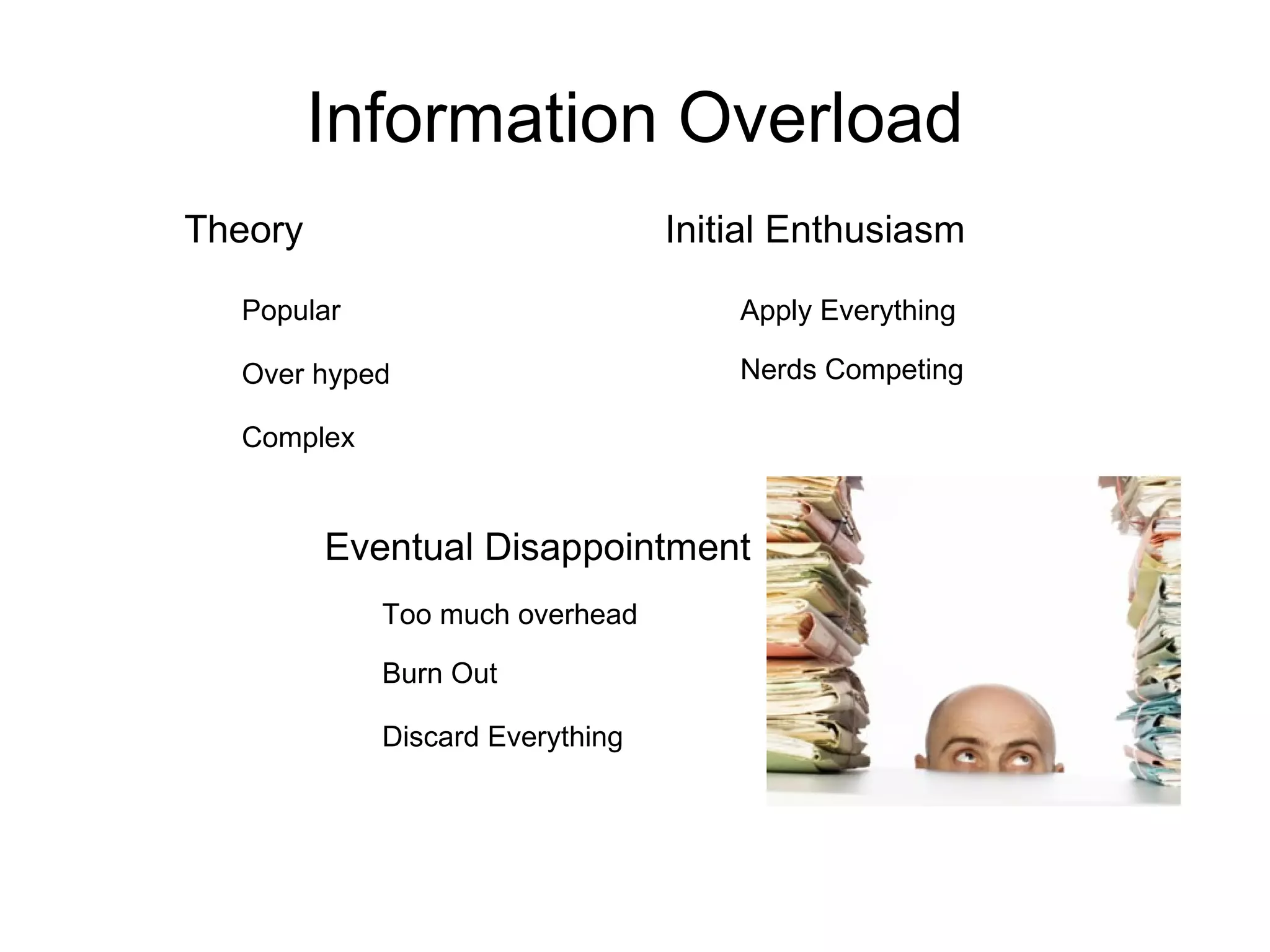
Information Overload Theory Popular Over hyped Complex Initial Enthusiasm Apply Everything Nerds Competing Eventual Disappointment Too much overhead Burn Out Discard Everything
Examples Computer Aided Software Engineering Rational Unified Process eXtreme Programming Agile Methodology SCRUM
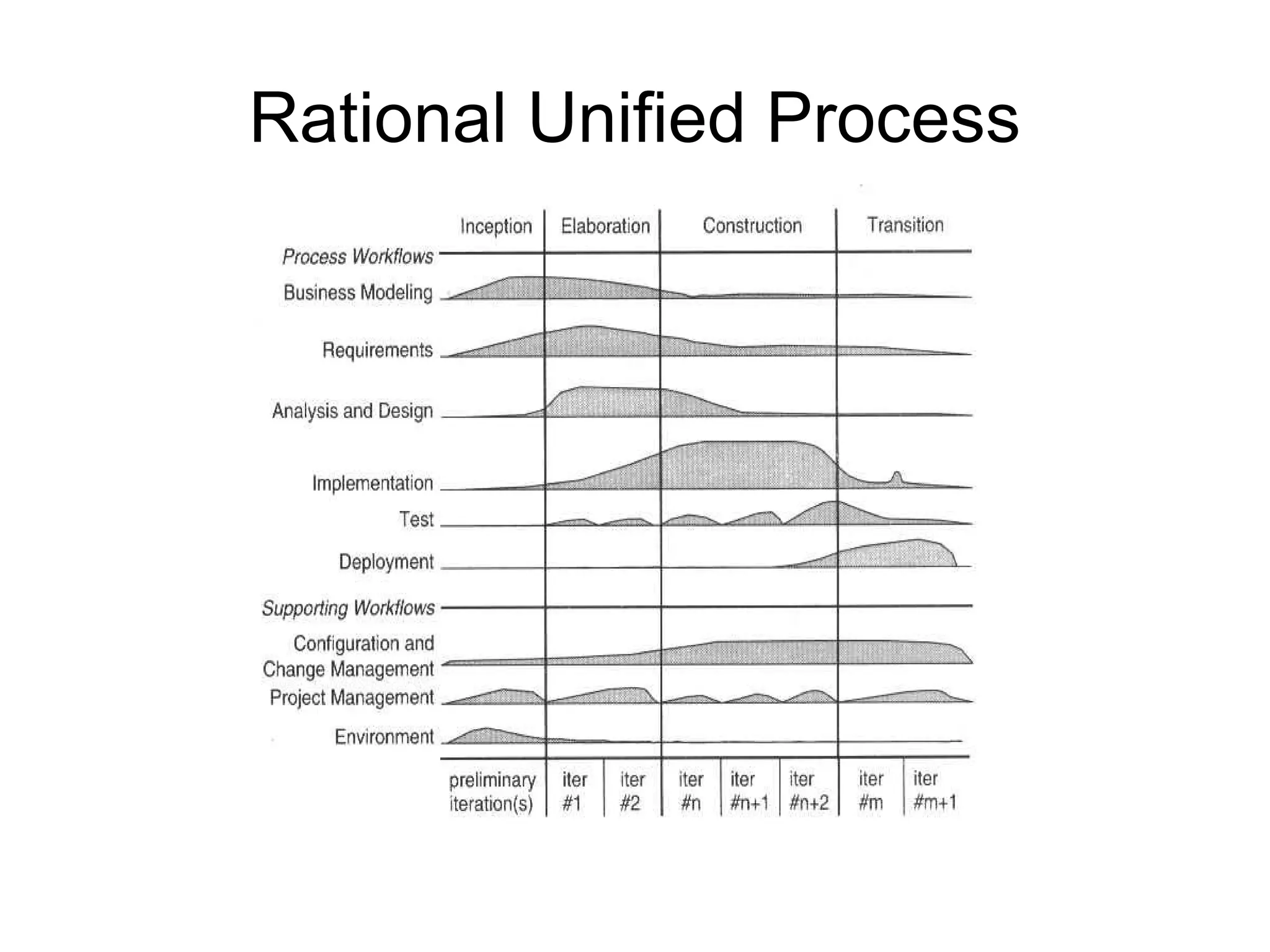
Rational Unified Process
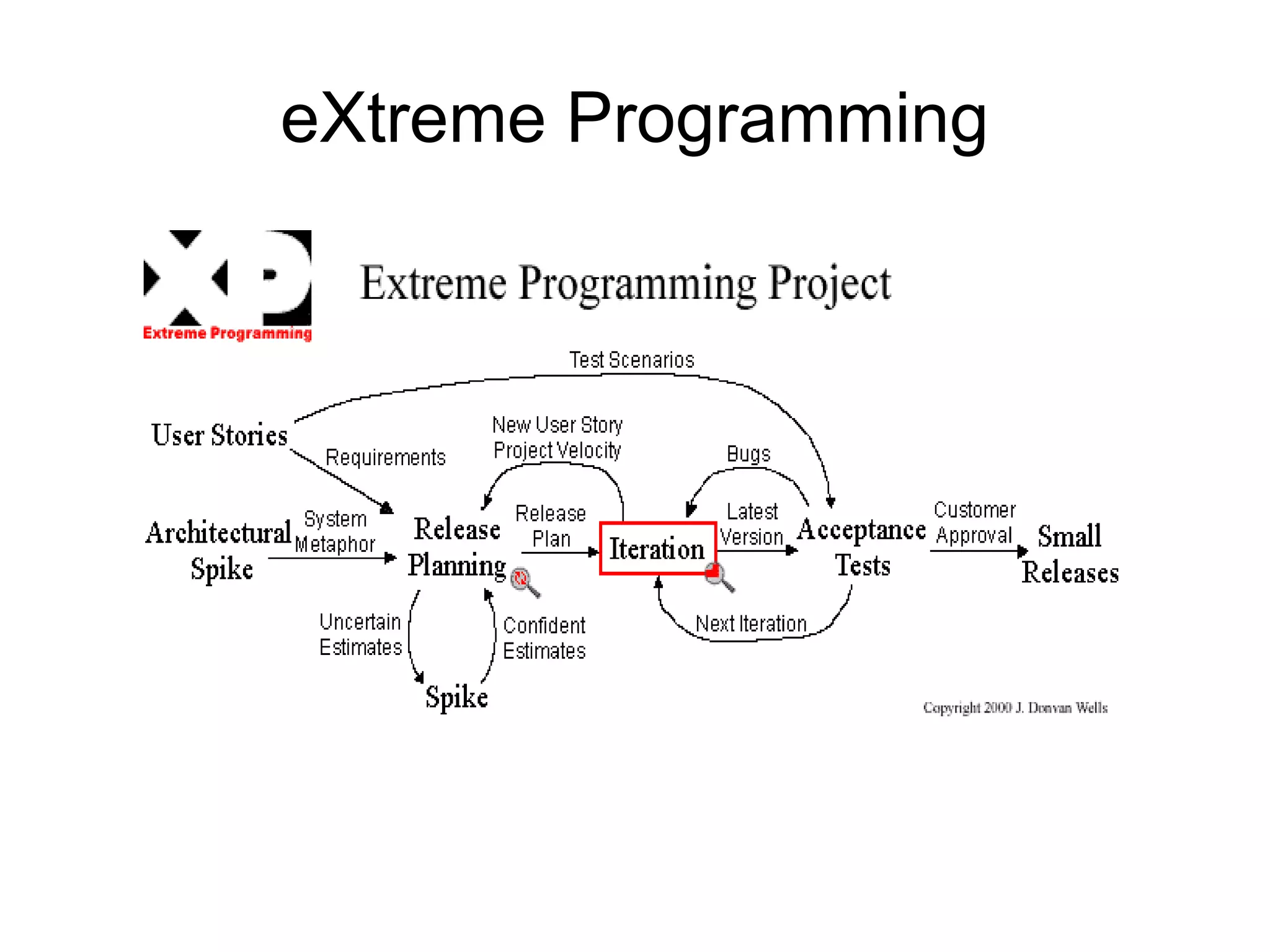
eXtreme Programming
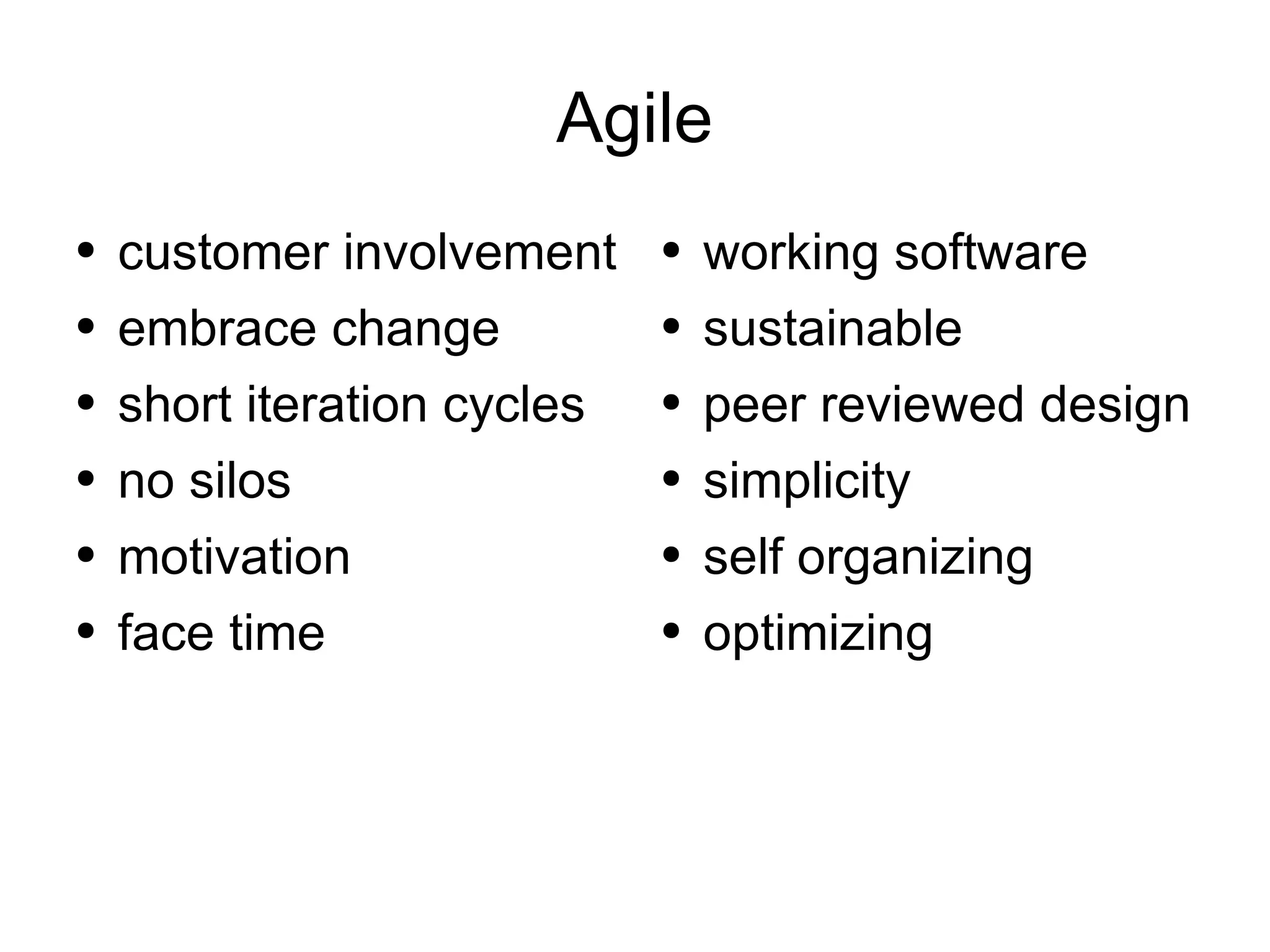
Agile customer involvement embrace change short iteration cycles no silos motivation face time working software sustainable peer reviewed design simplicity self organizing optimizing
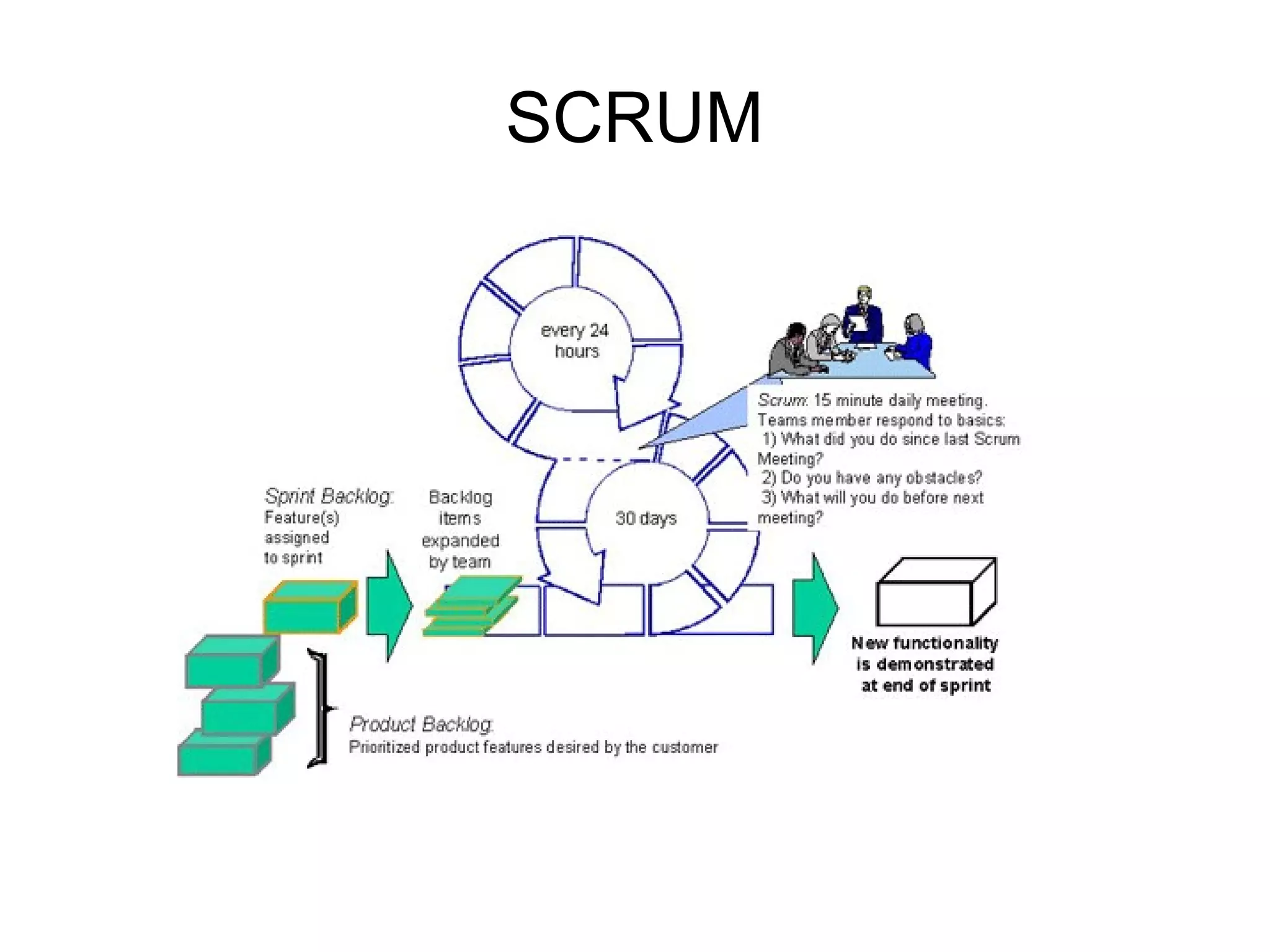
SCRUM
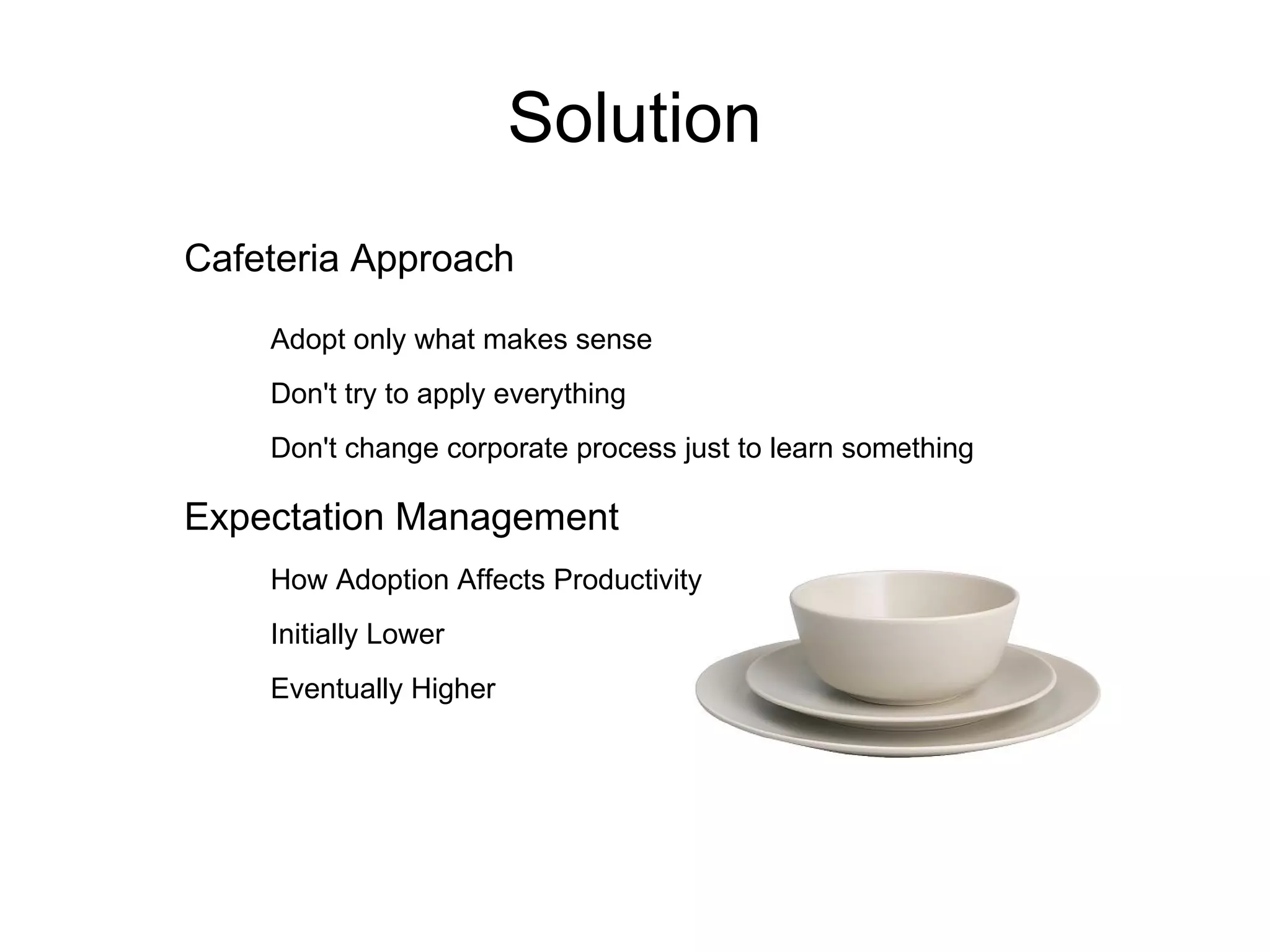
Solution Cafeteria Approach Adopt only what makes sense Don't try to apply everything Don't change corporate process just to learn something Expectation Management How Adoption Affects Productivity Initially Lower Eventually Higher
Just Do It The Pendulum Swings See Previous Scenario Penny Wise and Pound Foolish Developers Managers Under Educated Inexperienced Cheap Missed Milestones Time Micro Management Short Term Thinking
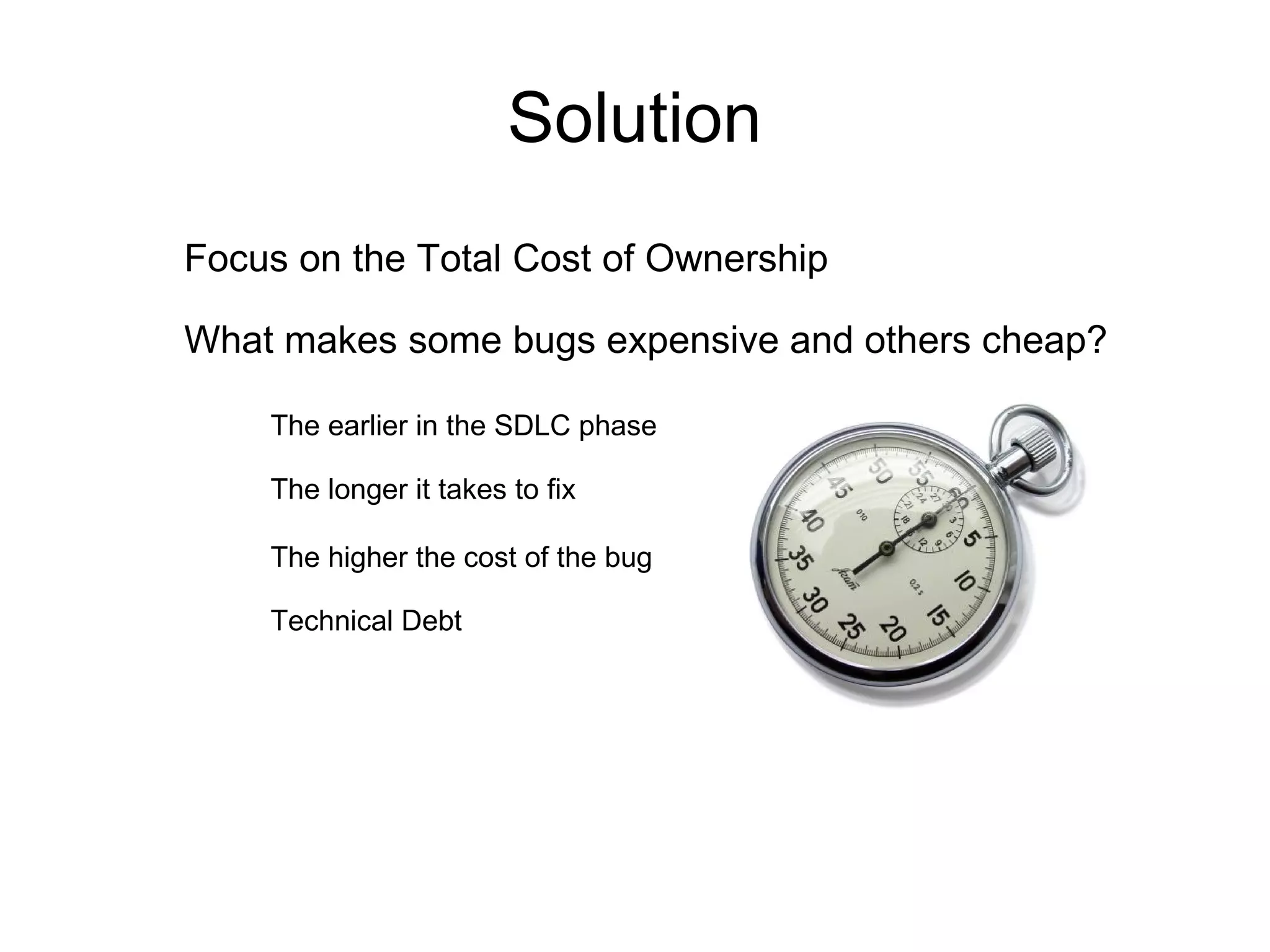
Solution Focus on the Total Cost of Ownership What makes some bugs expensive and others cheap? The earlier in the SDLC phase The longer it takes to fix The higher the cost of the bug Technical Debt
Capability Maturity Capability Maturity Model Software Engineering Institute Carnegie Mellon University Originally a USAF funded study Managing the Software Process Not just for software Now called CMMI (Integration)
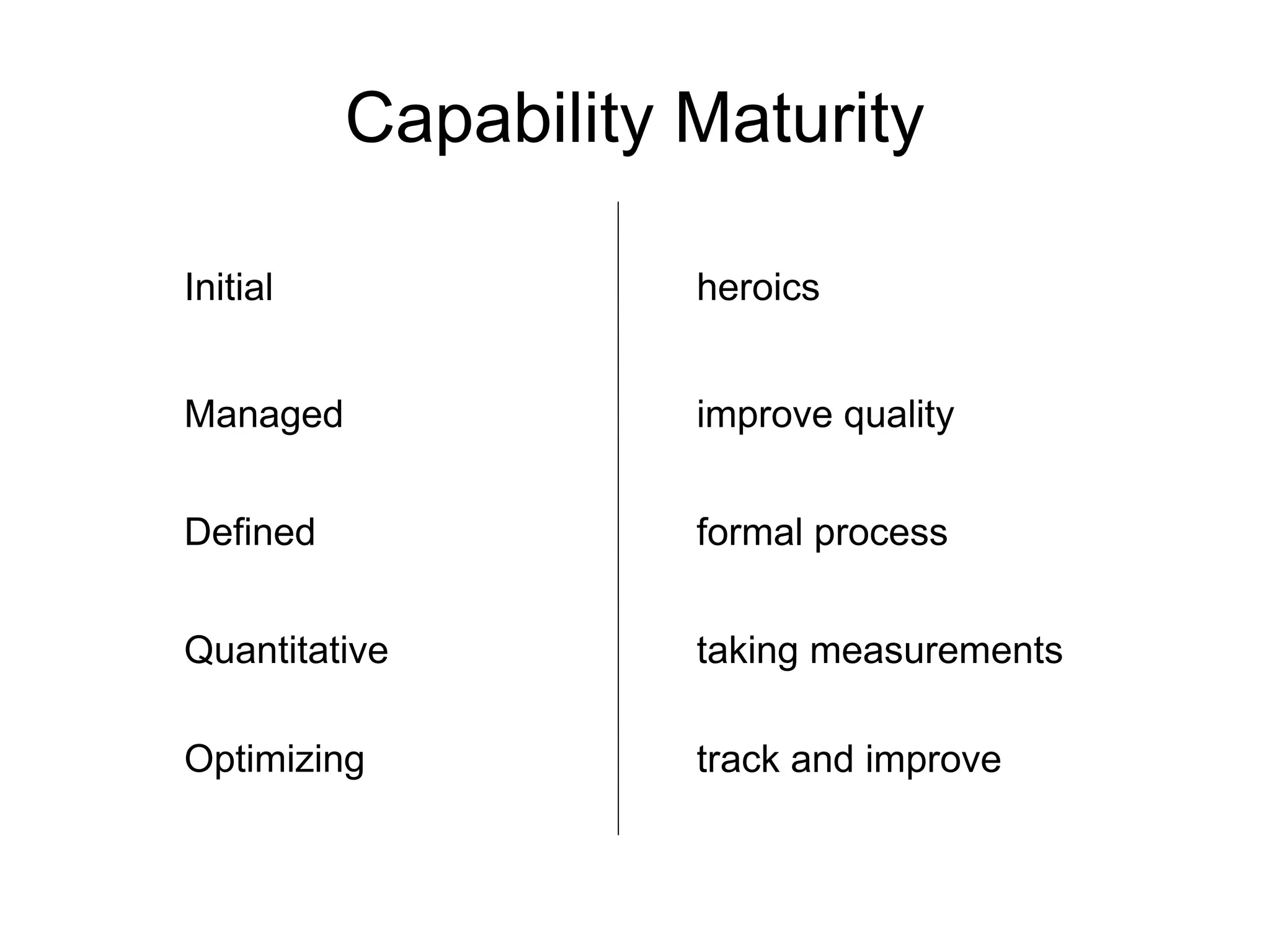
Capability Maturity Initial heroics Managed improve quality Defined formal process Quantitative taking measurements Optimizing track and improve
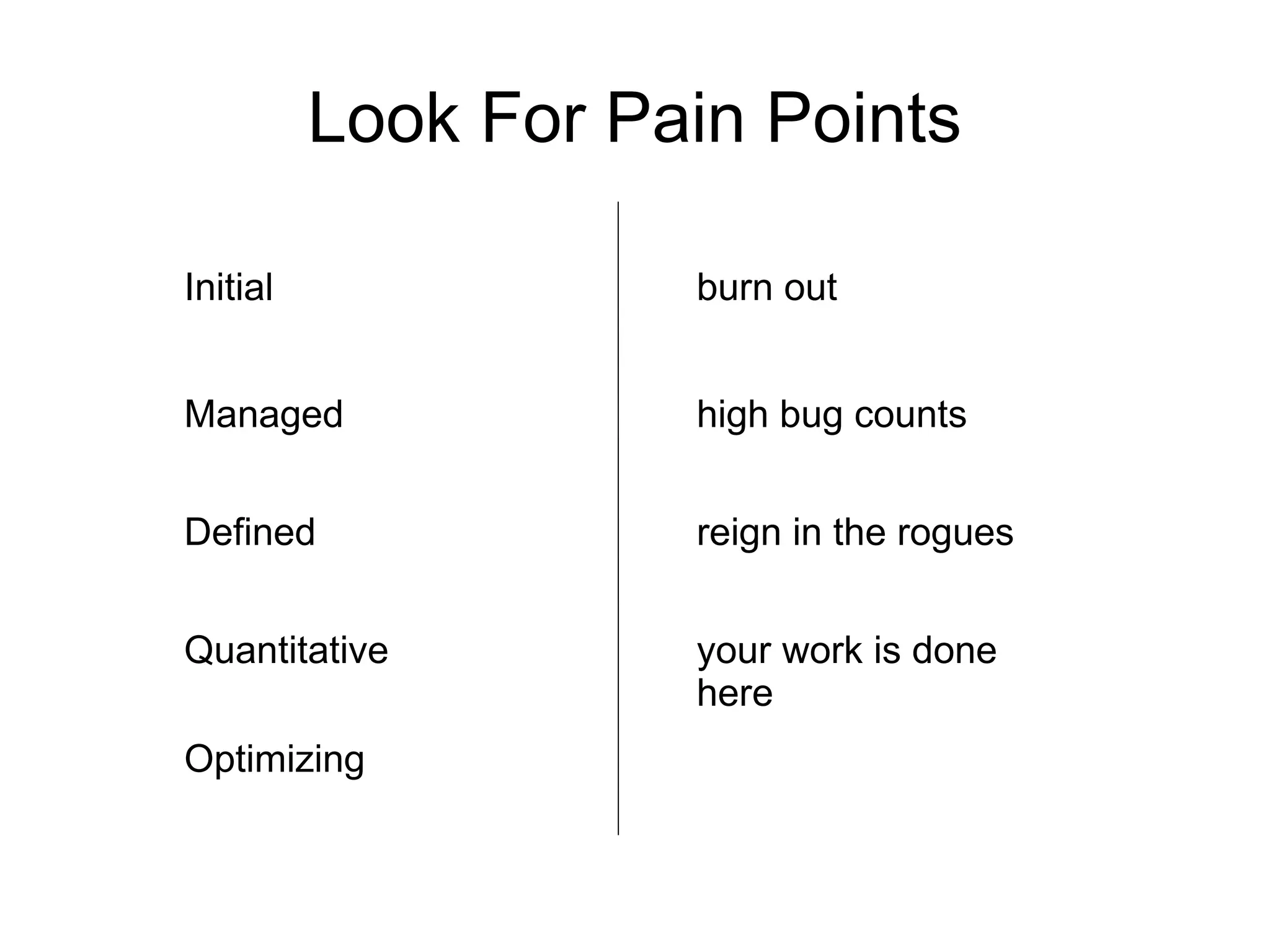
Look For Pain Points Initial burn out Managed high bug counts Defined reign in the rogues Quantitative your work is done here Optimizing
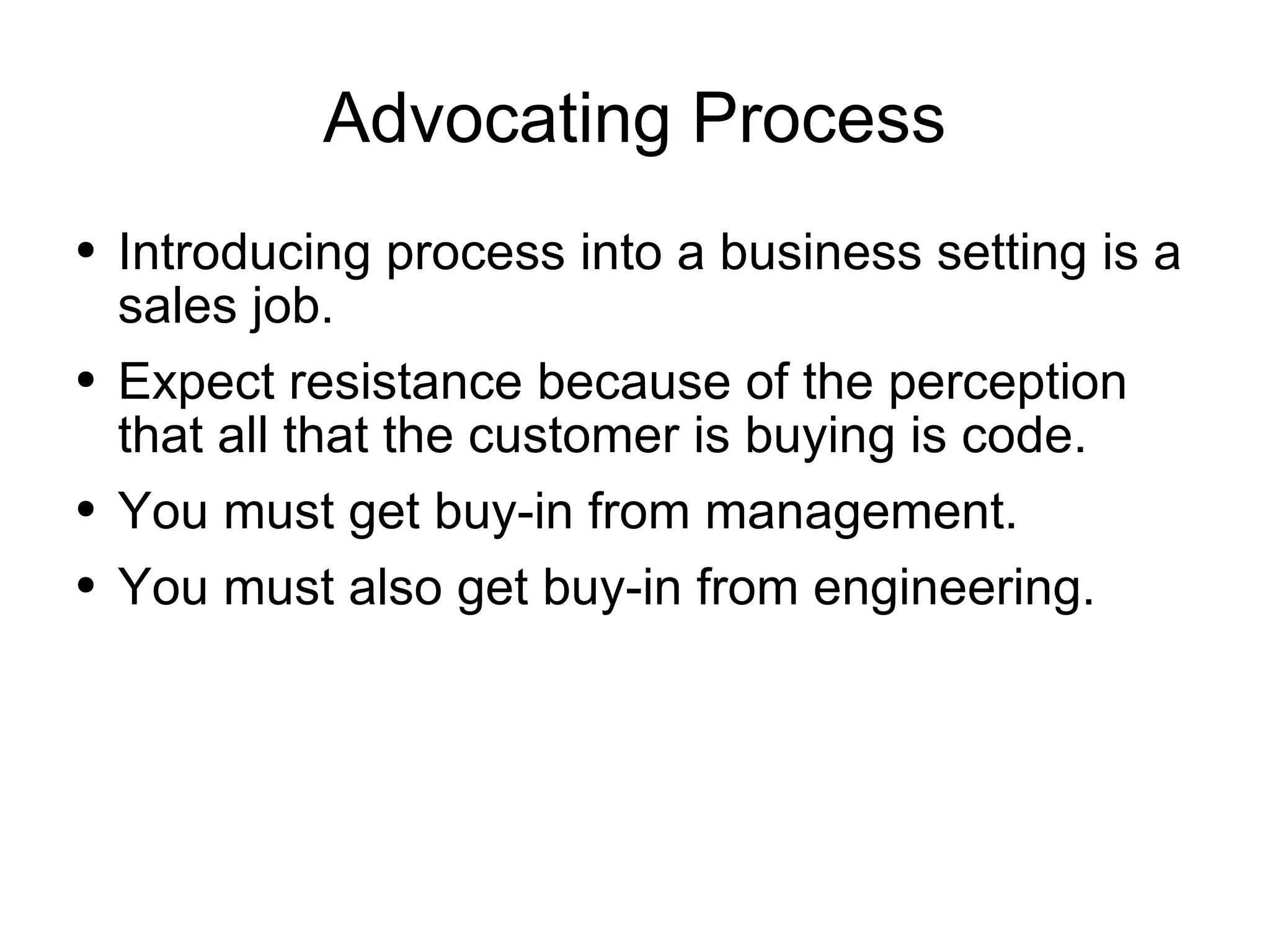
Advocating Process Introducing process into a business setting is a sales job. Expect resistance because of the perception that all that the customer is buying is code. You must get buy-in from management. You must also get buy-in from engineering.
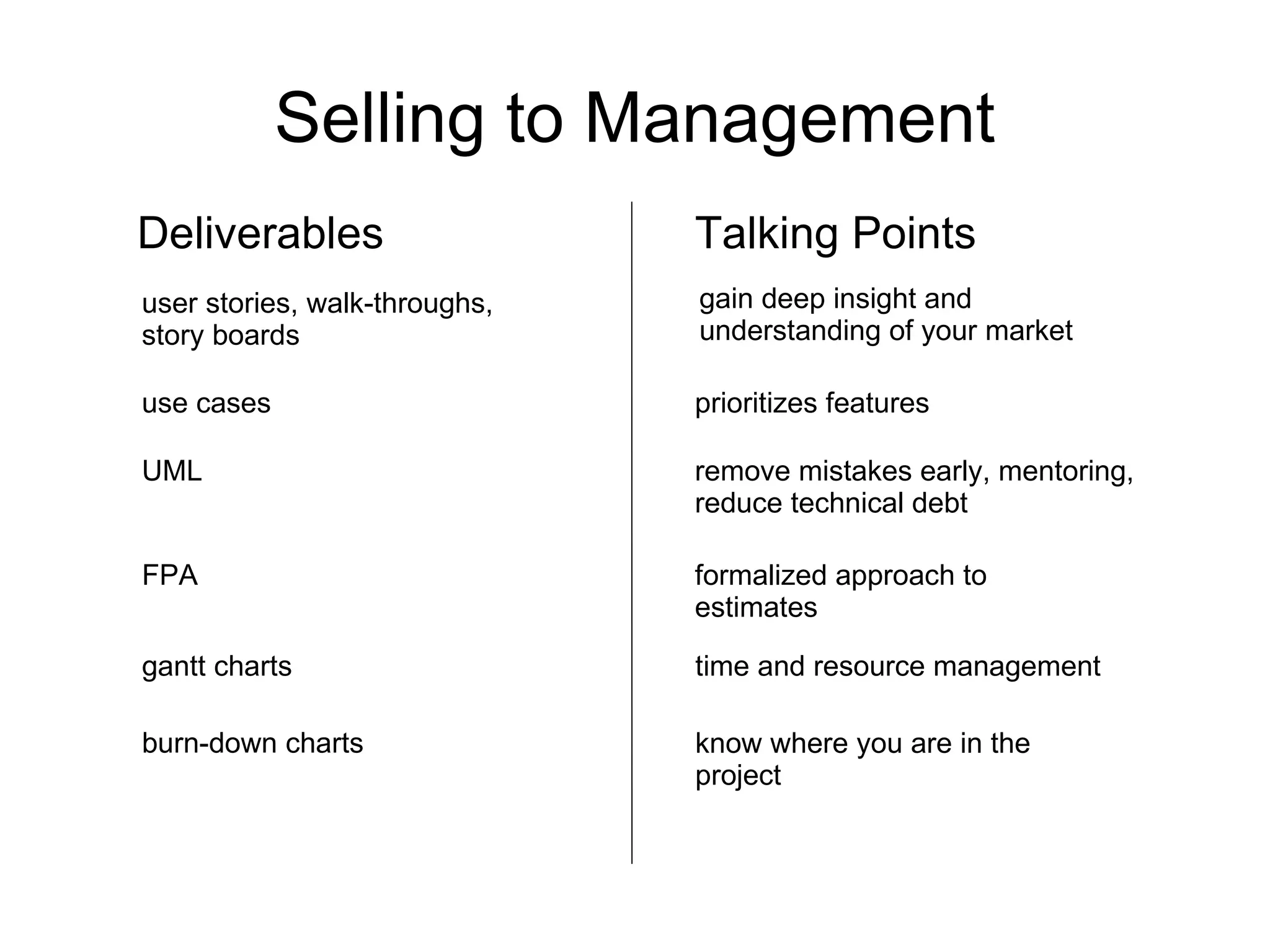
Selling to Management Deliverables Talking Points user stories, walk-throughs, story boards gain deep insight and  understanding of your market use cases prioritizes features UML remove mistakes early, mentoring, reduce technical debt FPA formalized approach to estimates gantt charts time and resource management burn-down charts know where you are in the project
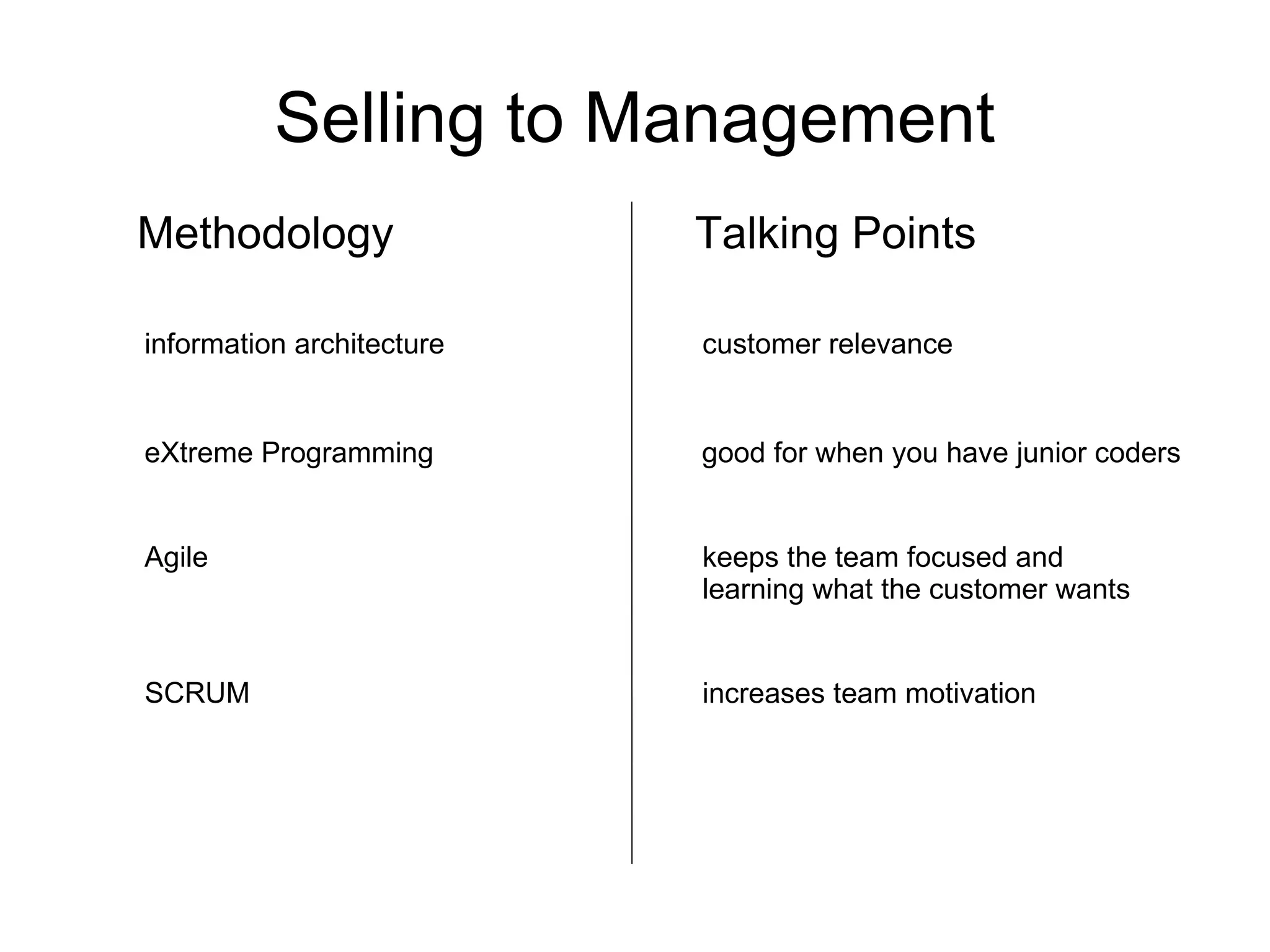
Selling to Management Methodology Talking Points information architecture customer relevance eXtreme Programming good for when you have junior coders Agile keeps the team focused and learning what the customer wants SCRUM increases team motivation
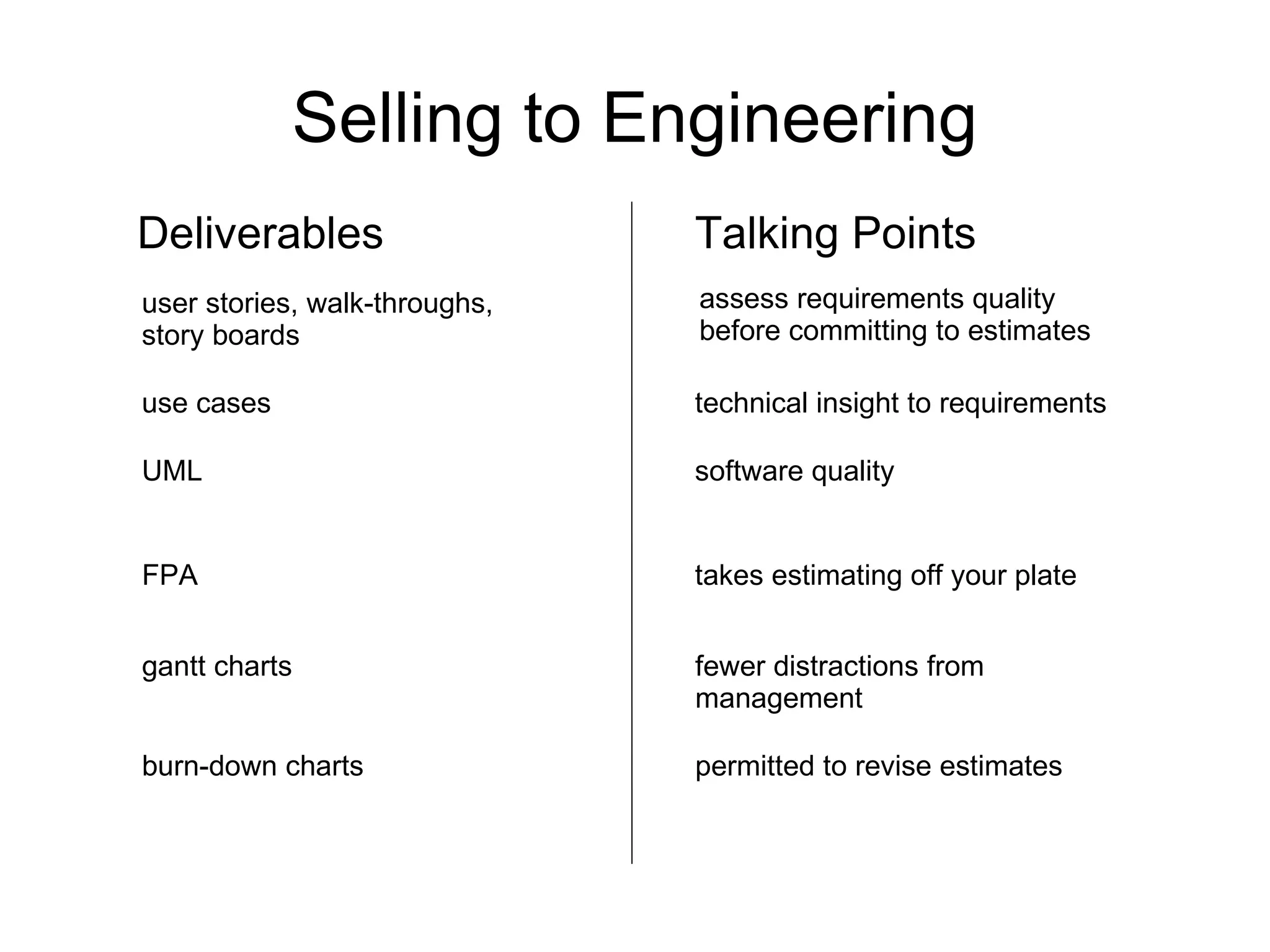
Selling to Engineering Deliverables Talking Points user stories, walk-throughs, story boards assess requirements quality before committing to estimates use cases technical insight to requirements UML software quality FPA takes estimating off your plate gantt charts fewer distractions from management burn-down charts permitted to revise estimates
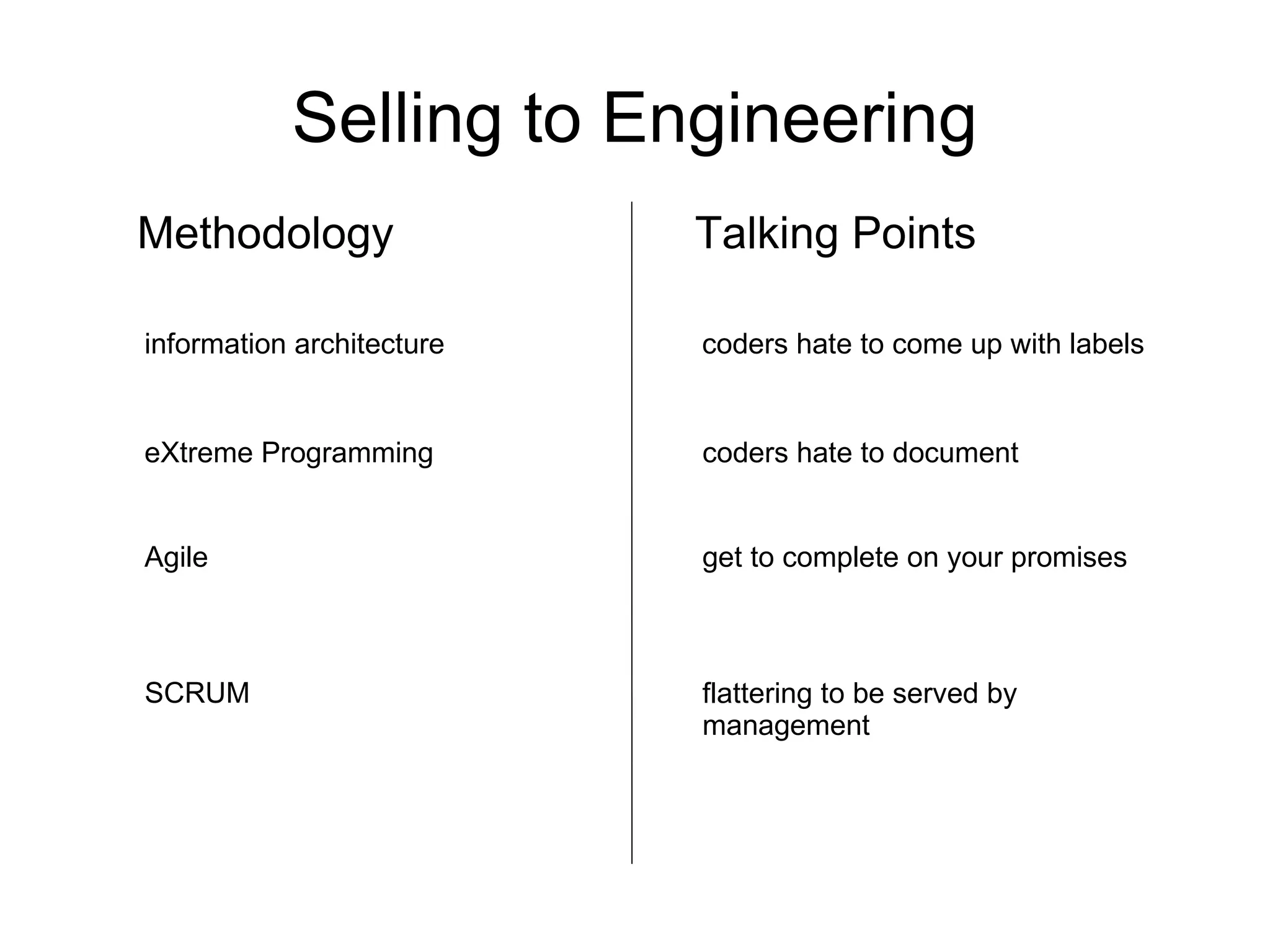
Selling to Engineering Methodology Talking Points information architecture coders hate to come up with labels eXtreme Programming coders hate to document Agile get to complete on your promises SCRUM flattering to be served by management
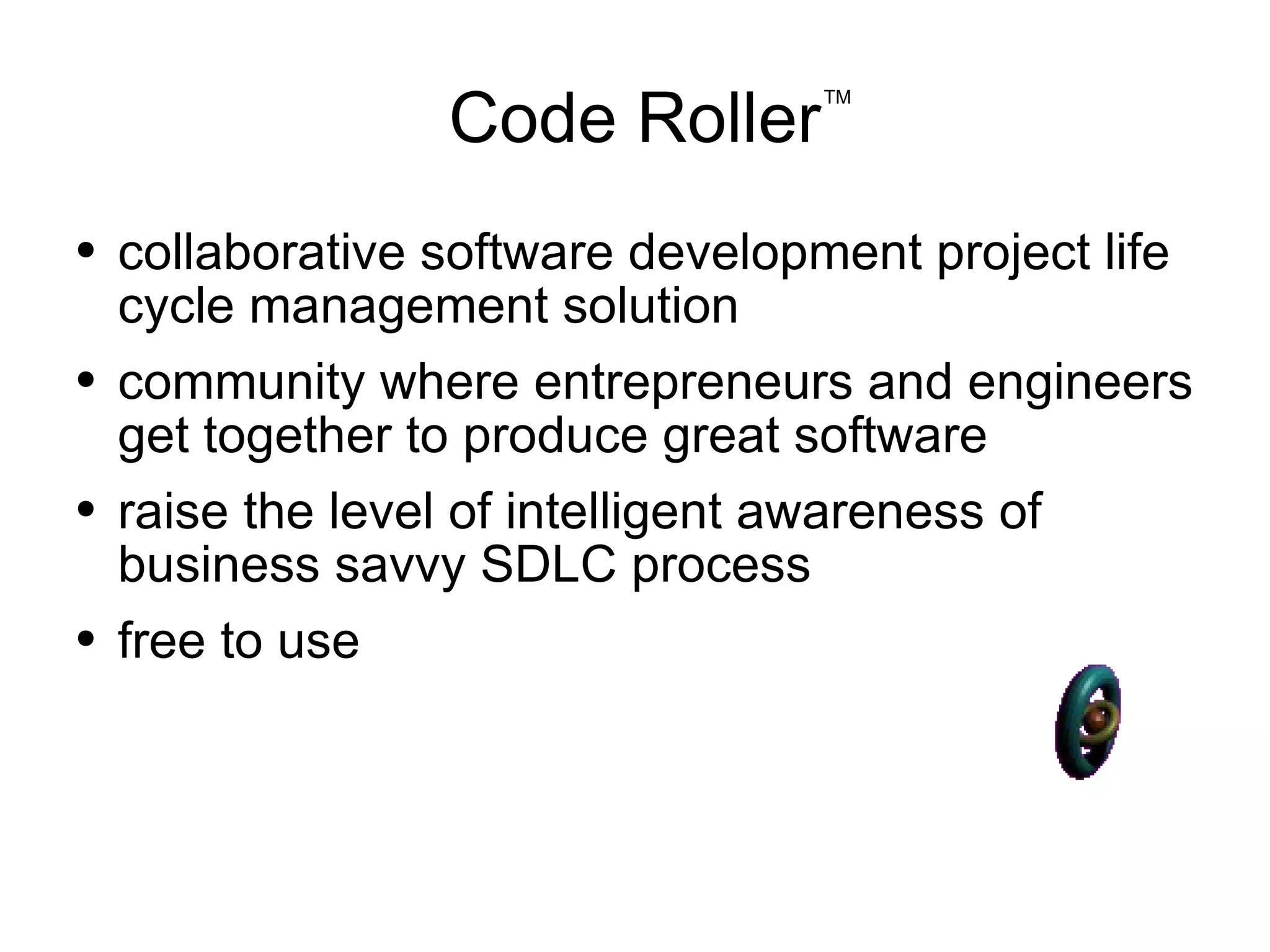
Code Roller collaborative software development project life cycle management solution community where entrepreneurs and engineers get together to produce great software raise the level of intelligent awareness of business savvy SDLC process free to use TM
Code Roller Collaborative Life cycle Intelligent Cybernetic Knowledge based Software Product Project Management TM
Code Roller requirements management change management configuration management release management records management compliance management content management TM
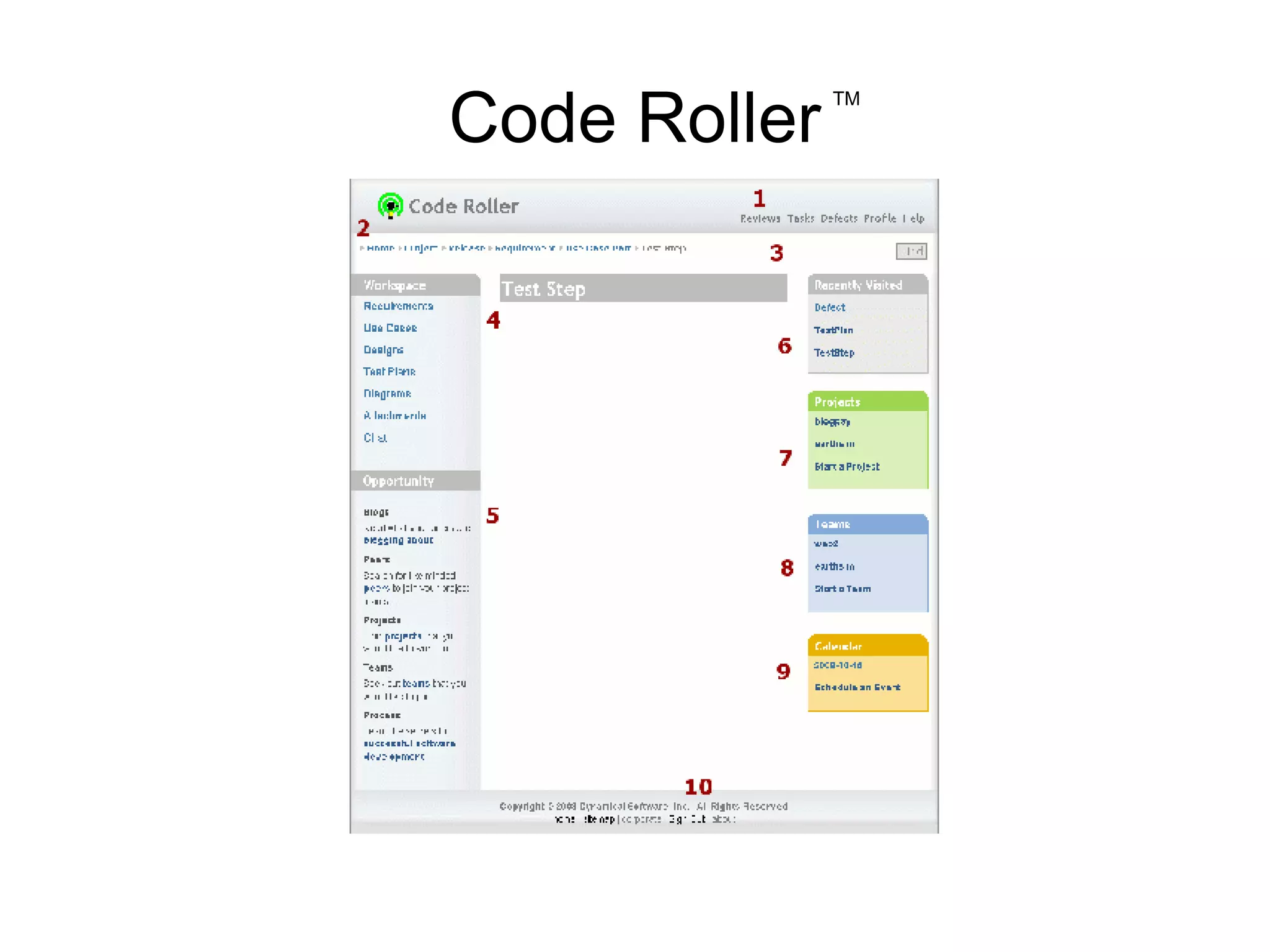
Code Roller TM
Thank You http://code-roller.com http://www.dynamicalsoftware.com [email_address]

Strategic Application of Software Development Process for Business Oriented Projects

  • 1.
    Strategic Application ofSoftware Development Process for Business Oriented Projects Glenn Engstrand President and Founder Dynamical Software, Inc.
  • 2.
    Project Failure StudiesRobbins-Gioia Survey Conference Board Survey KPMG Canada Survey CHAOS Report OASIG Survey
  • 3.
    ACM Queue 1Minute Risk Assessment Tool Use of Inappropriate Methodology Lack of Customer Involvement Lack of Formal Project Management Practices Dissimilarity to Previous Projects Project Complexity Requirements Volatility
  • 4.
    IEEE Software FrequentlyForgotten Fundamental Facts About Software Engineering Requirements Churn Overly Optimistic Estimates Rush to make deadlines increases technical debt Most Significant Phase is Feature Enhancement Maintenance Peer Review White box testing Quality Control
  • 5.
    Why Projects FailInformation Overload Just Do It A new methodology is overly hyped resulting in high expectations with inappropriate and misplaced enthusiasm. An obsessive focus on meeting short term milestones and budgetary goals results in excessive technical debt resulting in rigidity over time.
  • 6.
    Common Theme Lackof understanding as to how to apply fundamentally sound academic theory to practice in a business context. The only thing that the customer is willing to directly pay for is code.
  • 7.
    Information Overload TheoryPopular Over hyped Complex Initial Enthusiasm Apply Everything Nerds Competing Eventual Disappointment Too much overhead Burn Out Discard Everything
  • 8.
    Examples Computer AidedSoftware Engineering Rational Unified Process eXtreme Programming Agile Methodology SCRUM
  • 9.
  • 10.
  • 11.
    Agile customer involvementembrace change short iteration cycles no silos motivation face time working software sustainable peer reviewed design simplicity self organizing optimizing
  • 12.
  • 13.
    Solution Cafeteria ApproachAdopt only what makes sense Don't try to apply everything Don't change corporate process just to learn something Expectation Management How Adoption Affects Productivity Initially Lower Eventually Higher
  • 14.
    Just Do ItThe Pendulum Swings See Previous Scenario Penny Wise and Pound Foolish Developers Managers Under Educated Inexperienced Cheap Missed Milestones Time Micro Management Short Term Thinking
  • 15.
    Solution Focus onthe Total Cost of Ownership What makes some bugs expensive and others cheap? The earlier in the SDLC phase The longer it takes to fix The higher the cost of the bug Technical Debt
  • 16.
    Capability Maturity CapabilityMaturity Model Software Engineering Institute Carnegie Mellon University Originally a USAF funded study Managing the Software Process Not just for software Now called CMMI (Integration)
  • 17.
    Capability Maturity Initialheroics Managed improve quality Defined formal process Quantitative taking measurements Optimizing track and improve
  • 18.
    Look For PainPoints Initial burn out Managed high bug counts Defined reign in the rogues Quantitative your work is done here Optimizing
  • 19.
    Advocating Process Introducingprocess into a business setting is a sales job. Expect resistance because of the perception that all that the customer is buying is code. You must get buy-in from management. You must also get buy-in from engineering.
  • 20.
    Selling to ManagementDeliverables Talking Points user stories, walk-throughs, story boards gain deep insight and understanding of your market use cases prioritizes features UML remove mistakes early, mentoring, reduce technical debt FPA formalized approach to estimates gantt charts time and resource management burn-down charts know where you are in the project
  • 21.
    Selling to ManagementMethodology Talking Points information architecture customer relevance eXtreme Programming good for when you have junior coders Agile keeps the team focused and learning what the customer wants SCRUM increases team motivation
  • 22.
    Selling to EngineeringDeliverables Talking Points user stories, walk-throughs, story boards assess requirements quality before committing to estimates use cases technical insight to requirements UML software quality FPA takes estimating off your plate gantt charts fewer distractions from management burn-down charts permitted to revise estimates
  • 23.
    Selling to EngineeringMethodology Talking Points information architecture coders hate to come up with labels eXtreme Programming coders hate to document Agile get to complete on your promises SCRUM flattering to be served by management
  • 24.
    Code Roller collaborativesoftware development project life cycle management solution community where entrepreneurs and engineers get together to produce great software raise the level of intelligent awareness of business savvy SDLC process free to use TM
  • 25.
    Code Roller CollaborativeLife cycle Intelligent Cybernetic Knowledge based Software Product Project Management TM
  • 26.
    Code Roller requirementsmanagement change management configuration management release management records management compliance management content management TM
  • 27.
  • 28.
    Thank You http://code-roller.comhttp://www.dynamicalsoftware.com [email_address]

Editor's Notes

  • #2 Copyright (c) 2008 Dynamical Software, Inc. All Rights Reserved
  • #3 http://www.it-cortex.com/Stat_Failure_Rate.htm http://www.ibm.com/developerworks/rational/library/feb06/marasco/index.html http://www.spectrum.ieee.org/sep05/1685
  • #4 http://www.acmqueue.com/modules.php?name=Content&pa=showpage&pid=239
  • #5 http://www.dynamicalsoftware.com/cgi-bin/ViewBlogEntry.pl?id=15 http://www2.computer.org/portal/web/buildyourcareer/fa035
  • #10 http://www.ibm.com/developerworks/rational/library/content/03July/1000/1251/1251_bestpractices_TP026B.pdf
  • #11 http://www.extremeprogramming.org/
  • #12 http://agilemanifesto.org/
  • #13 http://www.controlchaos.com/
  • #17 http://www.sei.cmu.edu/cmm/
  • #25 http://www.dynamicalsoftware.com/cr/demo/engineers.php
  • #26 http://www.dynamicalsoftware.com/clicksppm.pdf