Introduction to
eXtreme Programming


    www.talkwiseconsulting.com
Contents

The problem
◦ Problems in software development
eXtreme Programming (XP)
◦   Values
◦   Practices
◦   Why XP works
◦   Benefits of XP
Conclusions
Resources
Problems in
 software development

Risks:
 Schedule slips
 Business misunderstood
 Defect rate
 Project cancelled
 System goes sour
 Business changes
Schedule slips
 Many projects are not delivered on time
 ◦ Examples: Word 1.0, Netscape 6
 Some deadlines cannot be moved
 ◦ Example: Y2K

 What if:
 most business value is delivered on time
Business misunderstood
 Without direct communication,
 developers have to guess what the
 customer wants.
 ◦ Example: The Orthodontics Project


 What if:
 an on-site customer steers development
Defect rate
 The software is put in production, but the
 defect rate is so high that it isn’t used.

 What if: you have automated testing
Project cancelled
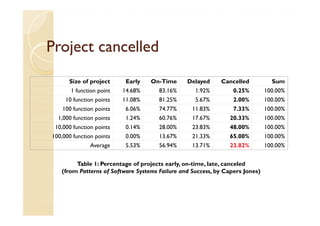
      Size of project      Early   On-Time      Delayed     Cancelled           Sum
       1 function point   14.68%      83.16%       1.92%         0.25%        100.00%
     10 function points   11.08%      81.25%       5.67%         2.00%        100.00%
    100 function points    6.06%      74.77%      11.83%         7.33%        100.00%
  1,000 function points    1.24%      60.76%      17.67%       20.33%         100.00%
 10,000 function points    0.14%      28.00%      23.83%       48.00%         100.00%
100,000 function points    0.00%      13.67%      21.33%       65.00%         100.00%
               Average     5.53%      56.94%      13.71%       23.82%         100.00%


        Table 1: Percentage of projects early, on-time, late, canceled
   (from Patterns of Software Systems Failure and Success, by Capers Jones)
Project cancelled

 What if:
 short releases deliver at least some useful
 working software, reflecting investment to
 date
System goes sour

Software is put into production successfully, but
after a couple of years the cost of making
changes or the defect rate rises so much that
the system must be replaced.

What if:
the design is simple and the code quality is high
Business changes

New laws, market changes: business
priorities change

What if:
the customer can change their mind,
substitute functionality, and change priorities
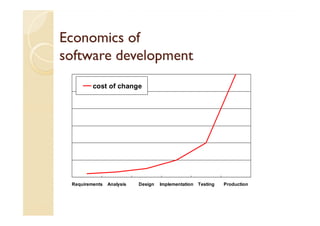
Economics of
software development
         cost of change


 Requirements   Analysis   Design   Implementation   Testing   Production
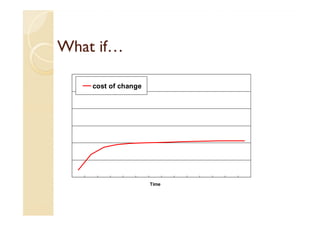
What if…

    cost of change


                     Time
eXtreme Programming
 A system of practices that a community
 of software developers is evolving to
 address the problems of quickly delivering
 quality software, and then evolving it to
 meet changing business needs.
eXtreme…

Taking proven practices to the extreme
  If testing is good, let everybody test all the time
  If code reviews are good, review all the time
  If design is good, refactor all the time
  If integration testing is good, integrate all the time
  If simplicity is good, do the simplest thing that could
  possibly work
  If short iterations are good, make them really, really
  short
XP values


Communication
Simplicity
Feedback
Courage
XP practices

The Planning Game*   Collective Ownership
Small Releases       Continuous Integration
Metaphor             40-Hour Week
Simple Design*       On-Site Customer
Testing*             Coding Standards
Refactoring*         Open workspace
Pair Programming*    Daily Schema migration
The Planning Game

Business writes a story describing desired
functionality
Stories are written on index cards
Development estimates stories
Velocity determines number of stories per
iteration
Business splits and prioritizes stories and
determines the composition of releases
Velocity is measured and adjusted every iteration
Customer steers development
Testing
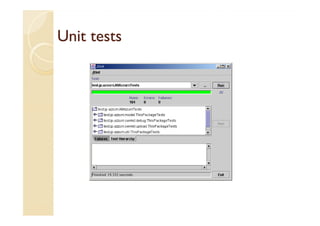
 Unit Tests and Functional Tests
 Test a little, code a little…
 ◦ “Test-first programming”
 Tests become the specification
 Tests give confidence in the system
 Tests give courage to change the system
Unit tests
Pair Programming

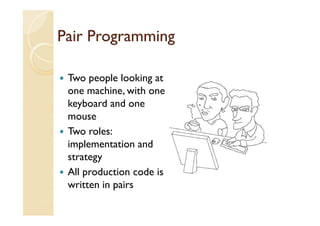
 Two people looking at
 one machine, with one
 keyboard and one
 mouse
 Two roles:
 implementation and
 strategy
 All production code is
 written in pairs
Pair Programming Benefits

15% less output than 2 solo programmers
Continuous code review: better design, fewer
defects
Confidence to add to or change the system
Discipline to always test and refactor
Teach each other how the system works (reduced
staffing risks)
Learn from partner’s knowledge and experience
(enhances technical skills)
Simple design

Do the simplest thing that could possibly
 work

 Passes all the tests
 No duplicate code
 States every intention
 Fewest possible classes and methods
Refactoring
 Design becomes everybody’s daily business
 Continuously improve quality of the code
 Unit Tests and Pair Programming give courage

Result:
 Fast development speed
 Code becomes easy to change
Why XP works

Light-weight: discipline without bureaucracy
Under stress, people do what is easiest
◦ All XP practices have short-term benefits as well
  as long-term benefits
Development as a Conversation
The code is the documentation
XP is fun
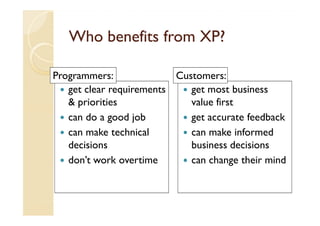
Who benefits from XP?

Programmers:              Customers:
   get clear requirements    get most business
   & priorities              value first
   can do a good job         get accurate feedback
   can make technical        can make informed
   decisions                 business decisions
   don’t work overtime       can change their mind
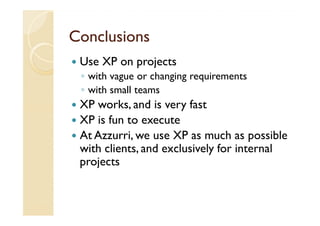
Conclusions
 Use XP on projects
 ◦ with vague or changing requirements
 ◦ with small teams
 XP works, and is very fast
 XP is fun to execute
 At Azzurri, we use XP as much as possible
 with clients, and exclusively for internal
 projects
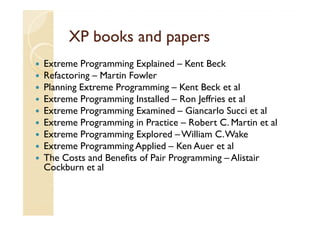
XP books and papers
Extreme Programming Explained – Kent Beck
Refactoring – Martin Fowler
Planning Extreme Programming – Kent Beck et al
Extreme Programming Installed – Ron Jeffries et al
Extreme Programming Examined – Giancarlo Succi et al
Extreme Programming in Practice – Robert C. Martin et al
Extreme Programming Explored – William C. Wake
Extreme Programming Applied – Ken Auer et al
The Costs and Benefits of Pair Programming – Alistair
Cockburn et al
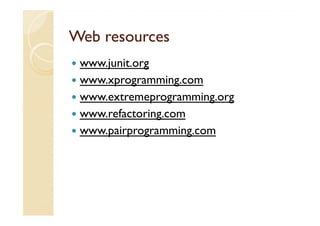
Web resources
 www.junit.org
 www.xprogramming.com
 www.extremeprogramming.org
 www.refactoring.com
 www.pairprogramming.com
Thank you

Extreme programming talk wise consulting - www.talkwiseconsulting

  • 1.
    Introduction to eXtreme Programming www.talkwiseconsulting.com
  • 2.
    Contents The problem ◦ Problemsin software development eXtreme Programming (XP) ◦ Values ◦ Practices ◦ Why XP works ◦ Benefits of XP Conclusions Resources
  • 3.
    Problems in softwaredevelopment Risks: Schedule slips Business misunderstood Defect rate Project cancelled System goes sour Business changes
  • 4.
    Schedule slips Manyprojects are not delivered on time ◦ Examples: Word 1.0, Netscape 6 Some deadlines cannot be moved ◦ Example: Y2K What if: most business value is delivered on time
  • 5.
    Business misunderstood Withoutdirect communication, developers have to guess what the customer wants. ◦ Example: The Orthodontics Project What if: an on-site customer steers development
  • 6.
    Defect rate Thesoftware is put in production, but the defect rate is so high that it isn’t used. What if: you have automated testing
  • 7.
    Project cancelled Size of project Early On-Time Delayed Cancelled Sum 1 function point 14.68% 83.16% 1.92% 0.25% 100.00% 10 function points 11.08% 81.25% 5.67% 2.00% 100.00% 100 function points 6.06% 74.77% 11.83% 7.33% 100.00% 1,000 function points 1.24% 60.76% 17.67% 20.33% 100.00% 10,000 function points 0.14% 28.00% 23.83% 48.00% 100.00% 100,000 function points 0.00% 13.67% 21.33% 65.00% 100.00% Average 5.53% 56.94% 13.71% 23.82% 100.00% Table 1: Percentage of projects early, on-time, late, canceled (from Patterns of Software Systems Failure and Success, by Capers Jones)
  • 8.
    Project cancelled Whatif: short releases deliver at least some useful working software, reflecting investment to date
  • 9.
    System goes sour Softwareis put into production successfully, but after a couple of years the cost of making changes or the defect rate rises so much that the system must be replaced. What if: the design is simple and the code quality is high
  • 10.
    Business changes New laws,market changes: business priorities change What if: the customer can change their mind, substitute functionality, and change priorities
  • 11.
    Economics of software development cost of change Requirements Analysis Design Implementation Testing Production
  • 12.
    What if… cost of change Time
  • 13.
    eXtreme Programming Asystem of practices that a community of software developers is evolving to address the problems of quickly delivering quality software, and then evolving it to meet changing business needs.
  • 14.
    eXtreme… Taking proven practicesto the extreme If testing is good, let everybody test all the time If code reviews are good, review all the time If design is good, refactor all the time If integration testing is good, integrate all the time If simplicity is good, do the simplest thing that could possibly work If short iterations are good, make them really, really short
  • 15.
  • 16.
    XP practices The PlanningGame* Collective Ownership Small Releases Continuous Integration Metaphor 40-Hour Week Simple Design* On-Site Customer Testing* Coding Standards Refactoring* Open workspace Pair Programming* Daily Schema migration
  • 17.
    The Planning Game Businesswrites a story describing desired functionality Stories are written on index cards Development estimates stories Velocity determines number of stories per iteration Business splits and prioritizes stories and determines the composition of releases Velocity is measured and adjusted every iteration Customer steers development
  • 18.
    Testing Unit Testsand Functional Tests Test a little, code a little… ◦ “Test-first programming” Tests become the specification Tests give confidence in the system Tests give courage to change the system
  • 19.
  • 20.
    Pair Programming Twopeople looking at one machine, with one keyboard and one mouse Two roles: implementation and strategy All production code is written in pairs
  • 21.
    Pair Programming Benefits 15%less output than 2 solo programmers Continuous code review: better design, fewer defects Confidence to add to or change the system Discipline to always test and refactor Teach each other how the system works (reduced staffing risks) Learn from partner’s knowledge and experience (enhances technical skills)
  • 22.
    Simple design Do thesimplest thing that could possibly work Passes all the tests No duplicate code States every intention Fewest possible classes and methods
  • 23.
    Refactoring Design becomeseverybody’s daily business Continuously improve quality of the code Unit Tests and Pair Programming give courage Result: Fast development speed Code becomes easy to change
  • 24.
    Why XP works Light-weight:discipline without bureaucracy Under stress, people do what is easiest ◦ All XP practices have short-term benefits as well as long-term benefits Development as a Conversation The code is the documentation XP is fun
  • 25.
    Who benefits fromXP? Programmers: Customers: get clear requirements get most business & priorities value first can do a good job get accurate feedback can make technical can make informed decisions business decisions don’t work overtime can change their mind
  • 26.
    Conclusions Use XPon projects ◦ with vague or changing requirements ◦ with small teams XP works, and is very fast XP is fun to execute At Azzurri, we use XP as much as possible with clients, and exclusively for internal projects
  • 27.
    XP books andpapers Extreme Programming Explained – Kent Beck Refactoring – Martin Fowler Planning Extreme Programming – Kent Beck et al Extreme Programming Installed – Ron Jeffries et al Extreme Programming Examined – Giancarlo Succi et al Extreme Programming in Practice – Robert C. Martin et al Extreme Programming Explored – William C. Wake Extreme Programming Applied – Ken Auer et al The Costs and Benefits of Pair Programming – Alistair Cockburn et al
  • 28.
    Web resources www.junit.org www.xprogramming.com www.extremeprogramming.org www.refactoring.com www.pairprogramming.com
  • 29.