Dr. T. Geetha
St. Mary’s College Thrissur
Chromatography
Chromatography – colored writing
Separation
Purification
Identification
Dr. T. Geetha, Asst. Professor, St. Marys College,
Thrissur
Principle
• Differential distribution of sample components between
two mutually immiscible phases –
stationary phase - fixed
mobile phase - moving
• Movement of mobile phase causes differential migration of sample
components
• Components possess different affinity for a adsorbent
• Migrates at different rates through the mobile phase
Dr. T. Geetha, Asst. Professor, St. Marys College,
Thrissur
Principle
•Different components emerge at different time
from the stationary phase
•Component having the weakest interaction with the
stationary phase comes out first
Dr. T. Geetha, Asst. Professor, St. Marys College,
Thrissur
Types of chromatography
Based on types of phases used
 Gas Liquid chromatography (GLC)
 Gas solid chromatography (GSC)
 Liquid liquid chromatography (LLC)
Liquid solid chromatography (LSC)
Dr. T. Geetha, Asst. Professor, St. Marys College,
Thrissur
Classification based on mechanism
•Adsorption chromatography
•LSC
•GSC
•Partition chromatography
•LLC
•GLC
Dr. T. Geetha, Asst. Professor, St. Marys College,
Thrissur
Classification based on technique
1. Column chromatography
- adsorbent column
2. Paper chromatography
- stationary liquid film on paper strip
3. Thin layer chromatography
- stationary film of liquid held on adsorbent
coating on a glass plate
Dr. T. Geetha, Asst. Professor, St. Marys College,
Thrissur
Liquid solid adsorption chromatography
•Column chromatography
•Selective adsorption of sample
components on a adsorbent column
like silica gel, alumina or cellulose
which constitutes stationary phase
•Petroleum ether, acetone, benzene –
mobile phase
Dr. T. Geetha, Asst. Professor, St. Marys College,
Thrissur
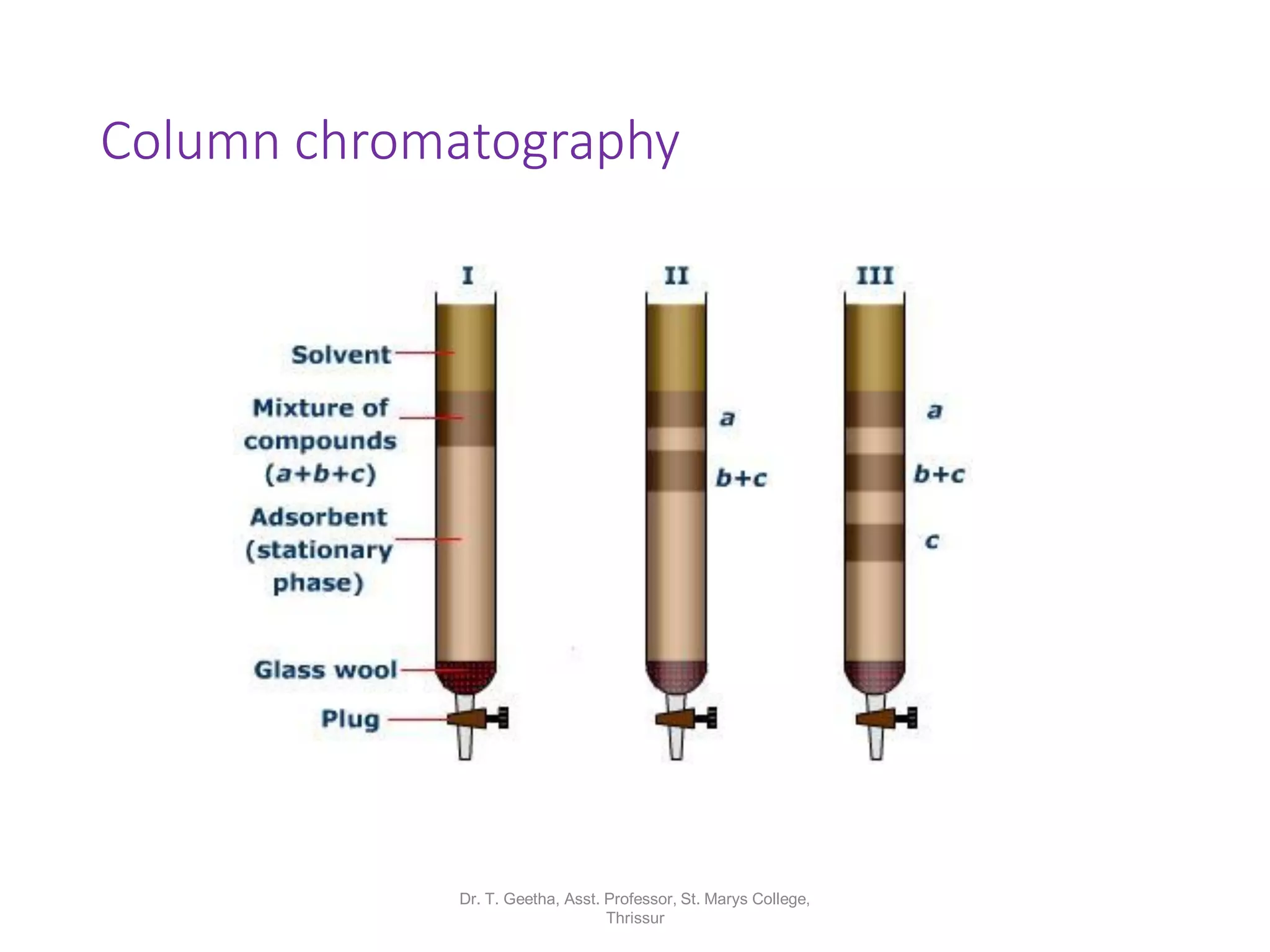
Column chromatography
•Adsorbent column – long glass tube with tap at
lower end packed uniformly with adsorbent
•Solution of mixture of components in solvent
introduced at top of column
•Different components adsorbed to different extends
Dr. T. Geetha, Asst. Professor, St. Marys College,
Thrissur
Column chromatography
•More readily adsorbed constituent held at the top
•Others with decreasing adsorbabilities held in
different bands along column
•Partial separation improved by passing additional
solvent – Development Of Chromatogram
Dr. T. Geetha, Asst. Professor, St. Marys College,
Thrissur
Column chromatography
Dr. T. Geetha, Asst. Professor, St. Marys College,
Thrissur
Column chromatography
•Individual component extracted from adsorbent by
passing suitable solvent down the column
•Components washed down one by one in the
increasing order of absorbability & collected in
separate fractions
Dr. T. Geetha, Asst. Professor, St. Marys College,
Thrissur
Column chromatography
•Most weakly absorbed component emerges first
•Strongly adsorbed component emerges last
Elution – process of dissolving out components from
adsorbent using a suitable solvent; solvent - eluent
Dr. T. Geetha, Asst. Professor, St. Marys College,
Thrissur
Column chromatography
o-nitroaniline & p-nitroaniline
Column – Alumina
Solvent – Benzene
Ortho component eluted first
Dr. T. Geetha, Asst. Professor, St. Marys College,
Thrissur
Application
• Quantitative separation of two or more similar organic
components of a mixture
• Purification of organic substance from contaminants
• Concentration of solutes from dilute solution
• Identification, separation & purification of natural
products
• Identification of industrial products
Dr. T. Geetha, Asst. Professor, St. Marys College,
Thrissur
Liquid Liquid Partition Chromatography
•Martin & Synge - 1941
•Nobel prize -1952
Archer J. P. Martin
R.L.M. Synge
Dr. T. Geetha, Asst. Professor, St. Marys College,
Thrissur
Liquid Liquid Partition Chromatography
Stationary phase
 Thin layer of liquid held on
the surface of porous inert
solid support
Cellulose, silica gel, starch,
calcite, kieselguhr
Mobile phase
Liquid immiscible with
stationary liquid phase
Dr. T. Geetha, Asst. Professor, St. Marys College,
Thrissur
Liquid Liquid Partition Chromatography
Principle
 different components of sample mixture have
different partition coefficients for a given pair of
immiscible liquids – distribute themselves to different
extends between two immiscible liquid phase – move
at different rates - separation
Dr. T. Geetha, Asst. Professor, St. Marys College,
Thrissur
Partition Column chromatography
•Stationary phase prepared
•Solution containing components made into a slurry
with solid adsorbent transferred to top of column
• Mobile phase introduced on top of column
Dr. T. Geetha, Asst. Professor, St. Marys College,
Thrissur
Partition Column chromatography
•As mobile phase moves down, partitioning of components
between two immiscible liquids take place
•Components which moves readily to stationary liquid phase –
retarded movement
•Components that moves readily to mobile phase – faster
movement
Dr. T. Geetha, Asst. Professor, St. Marys College,
Thrissur
Application
•Identification of organic & inorganic mixture
•Laboratory & industrial purification
•Quantitative separation of components – organic or
inorganic substance
Separation of Co & Ni
stationery phase - water supported on cellulose
Mobile phase - acetone containing HCl
Dr. T. Geetha, Asst. Professor, St. Marys College,
Thrissur
Paper chromatography
STATIONARY PHASE
• Film of liquid adsorbed on
paper mat made of highly
purified cellulose
MOBILE PHASE
• Another liquid percolating
over it
Dr. T. Geetha, Asst. Professor, St. Marys College, Thrissur
Liquid liquid Partition chromatography –Differential migration of the component
Dr. T. Geetha, Asst. Professor, St. Marys College,
Thrissur
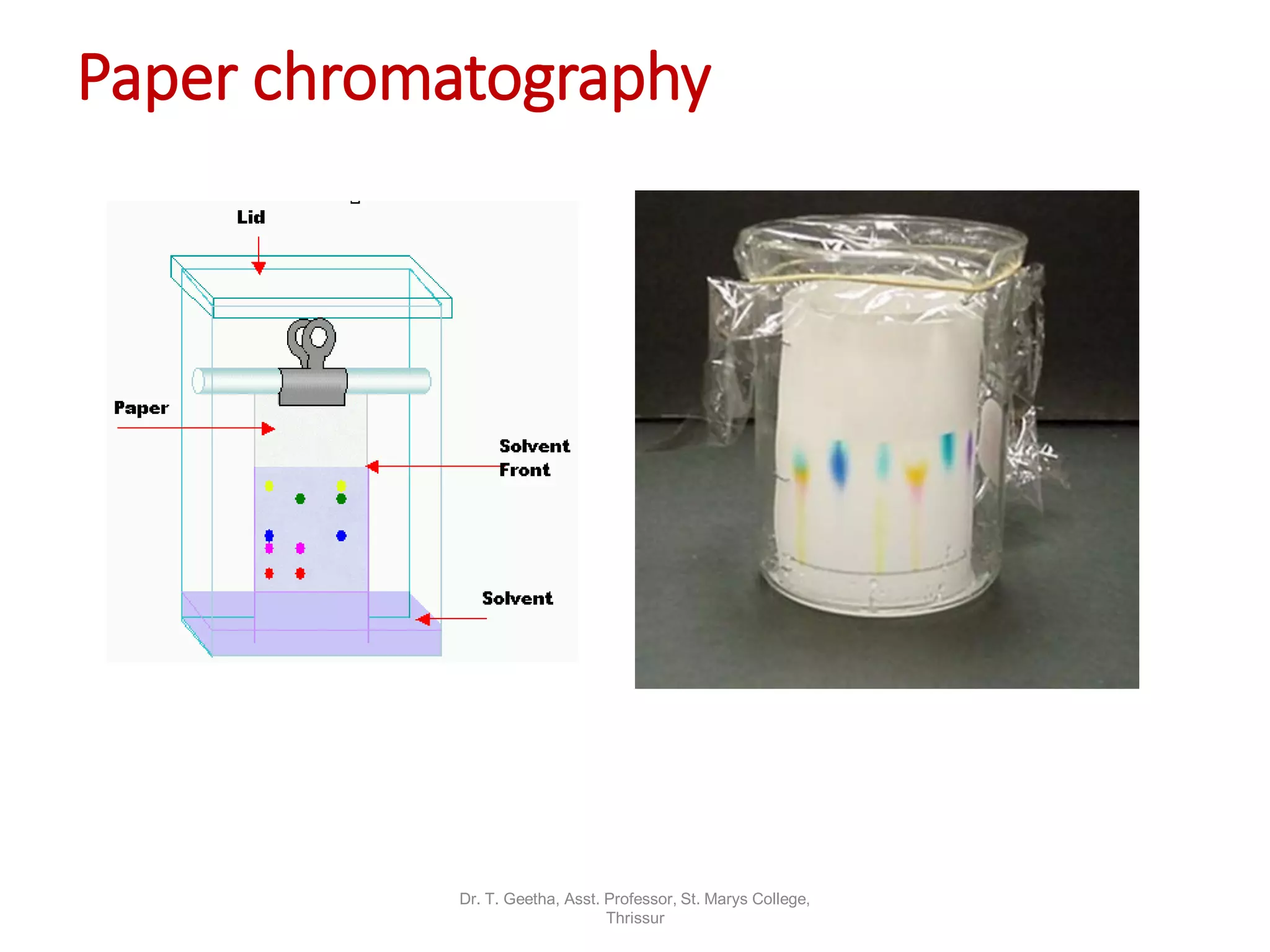
Apparatus
1. Support for paper
2. Solvent trough
3. Air tight glass cylinder
• Sample solution spotted near the lower edge of the paper strip &
dried
• Paper suspended in glass cylinder with lower end just dipping in
mobile phase
• Spotted position above solvent level
• Solvent ascends through paper by capillary action
• Components move at different rates on account of differential
distribution between the pair of miscible liquids
• Paper strip removed, solvent front marked & dried
• Coloured components appears as coloured spots at different
distance
• Position of colourless compounds determined by spraying with
sensitive reagent capable of forming coloured compounds
Dr. T. Geetha, Asst. Professor, St. Marys College,
Thrissur
Paper chromatography
Dr. T. Geetha, Asst. Professor, St. Marys College,
Thrissur
Applications
• Separation & identification of sample compounds present in trace quantity
• Separation of closely related compounds
• Quick check of purity of organic chemicals
• Detection of impurities in pharmaceuticals & food
• Detection of drugs & dopes
• Analysis of cosmetics
• Resolution of isomeric metal complexes
• Determination of metal in ore samples
Dr. T. Geetha, Asst. Professor, St. Marys College,
Thrissur
Thin Layer Chromatography
• Principle- Differential distribution or partition of components
between two immiscible phases brings about a difference in
their rate of migration – separation
• Stationary phase – film of liquid adsorbed on a uniform thin
layer of an adsorbent –silica gel, alumina or cellulose layer –
coated on glass or plastic plate
• Mobile phase – suitable solvent, immiscible with stationary
phase percolating over it
Dr. T. Geetha, Asst. Professor, St. Marys College,
Thrissur
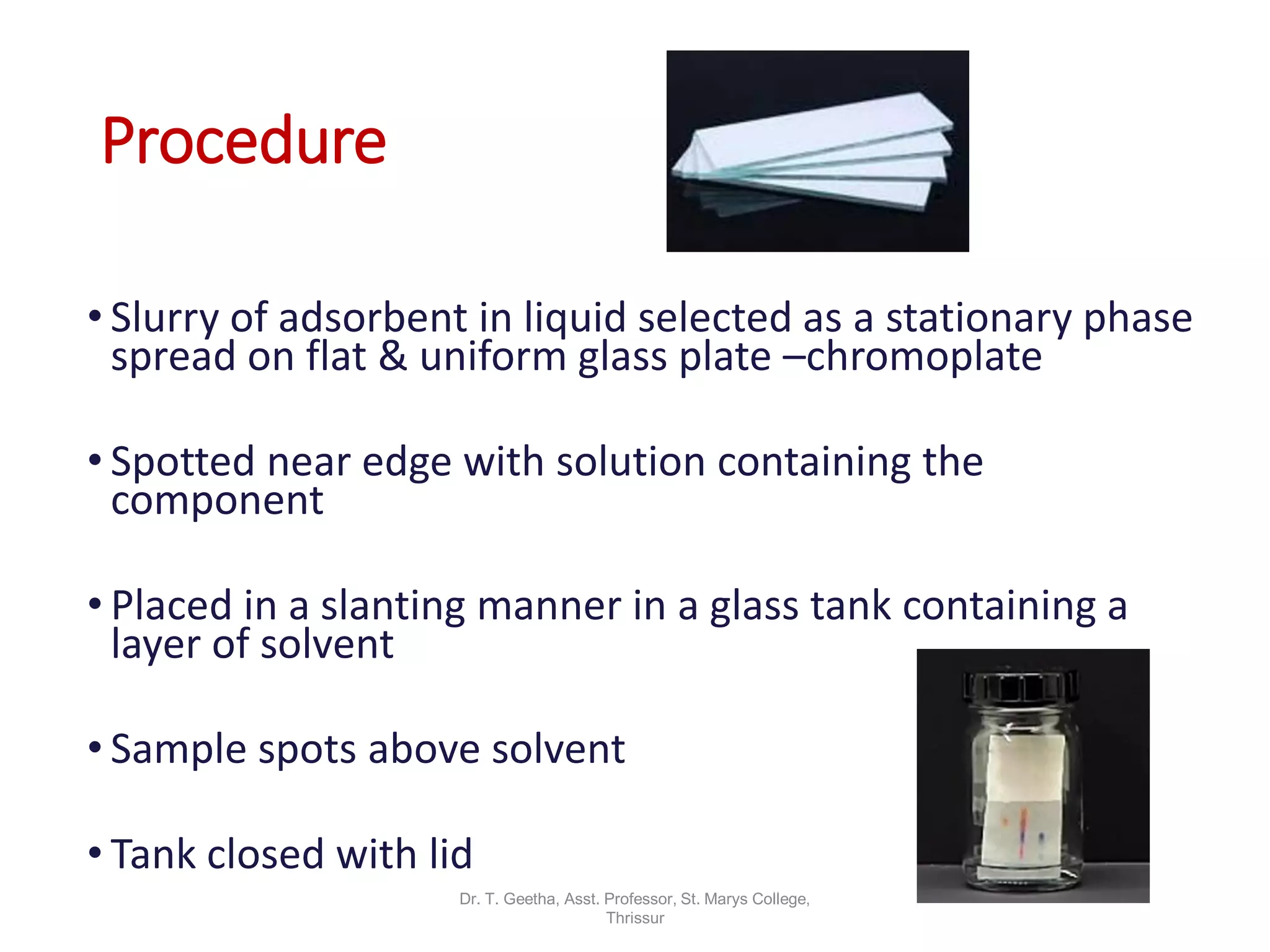
Procedure
• Slurry of adsorbent in liquid selected as a stationary phase
spread on flat & uniform glass plate –chromoplate
• Spotted near edge with solution containing the
component
• Placed in a slanting manner in a glass tank containing a
layer of solvent
• Sample spots above solvent
• Tank closed with lid
Dr. T. Geetha, Asst. Professor, St. Marys College,
Thrissur
• Mobile phase ascends by capillary action
• Sample components carried at different rate
• Components separated – compact spots
• Plate is taken out, solvent front marked, dried
• If components not coloured – sprayed with
suitable agents
• Spots may also be scraped, eluted, investigated
Dr. T. Geetha, Asst. Professor, St. Marys College,
Thrissur
Rf values
•Retention or retardation factor
•Ratio of distance traveled by a particular component to the
distance travelled by the solvent front during the same time
Rf =
Rf value depends on
• Solvent employed
• Temperature
• Nature of substance
• Quality of medium
Dr. T. Geetha, Asst. Professor, St. Marys College,
Thrissur
distance travelled by the components from origin line
distance travelled by the solvent front from the origin line in the same time
If other conditions are fixed, Rf is a
characteristic of a substance
Advantages
•Simple & efficient
•Versatile
•More reproducible
•Rapid separation, purification & identification even
if component is present in minute amounts
Dr. T. Geetha, Asst. Professor, St. Marys College,
Thrissur
Applications
1. Analysis of complex organic mixtures
2. Checking purity of samples & detection of contaminants
3. Identification & separation of drugs & plant extracts like
alkaloids
4. Separation & isolation of biochemical preparations
5. Mixtures of amino acids separated using a mixture of
chloroform, methanol, ammonium hydrate as solvent -
Detected by using reagent - ninhydrin
Dr. T. Geetha, Asst. Professor, St. Marys College,
Thrissur
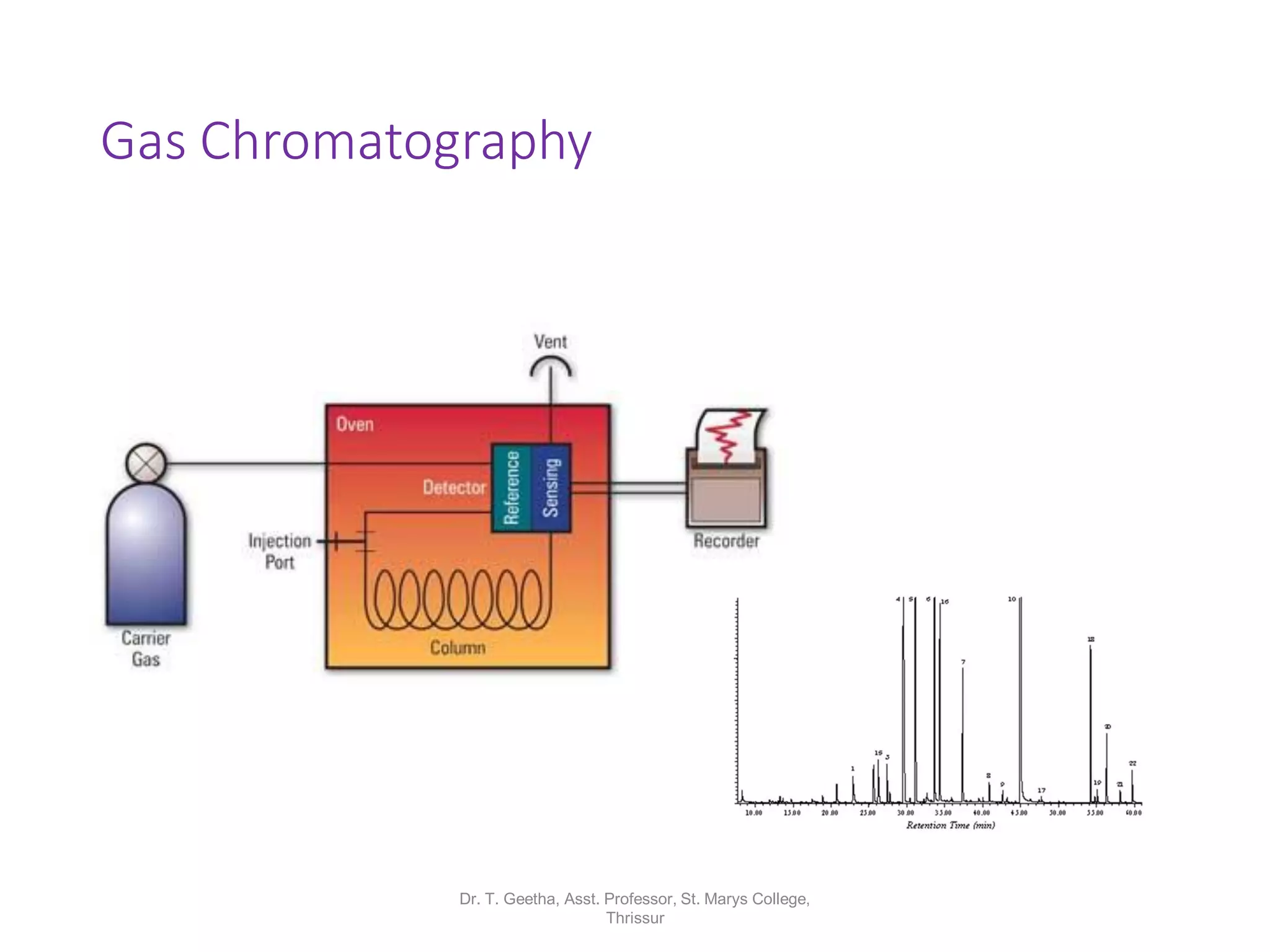
Gas Chromatography
•Gas liquid chromatography
•Gas solid chromatography
Dr. T. Geetha, Asst. Professor, St. Marys College,
Thrissur
Gas Liquid Chromatography
• Mobile phase – gas –pure chemically inert gas – He, Ar, N2, CO2 –
carrier gas
• Stationary phase – liquid immobilized on surface of inert solid
support – nonvolatile high boiling liquid – methyl silicone,
polyethylene glycol- support is often a coiled capillary column 15 to
100m long & 0.1 to 0.53 mm internal diameter
• Based on differential partitioning of the components of a sample in
the vapour phase between the mobile phase and stationary liquid
phase – differential migration of components - separation
Dr. T. Geetha, Asst. Professor, St. Marys College,
Thrissur
Procedure
Injection of sample
– microsyringe if sample is liquid
- gas tight syringe if sample gas
Sample in vapour state is carried onto column by carrier gas
Column maintained at constant T higher than B.Pt. of least boiling component in
sample mixture
Components differentially retained in the stationary phase reach the outlet at
different time
Components that comes out of the column are automatically detected by
detector
Intensity of detector signals recorded as a function of time – gas chromatogram
Dr. T. Geetha, Asst. Professor, St. Marys College,
Thrissur
Gas Chromatography
Dr. T. Geetha, Asst. Professor, St. Marys College,
Thrissur
Chromatogram
No. of peaks
Area under each peak
Retention time
No. of components in the
sample
Relative concentration of that
component in sample
Identify components
Dr. T. Geetha, Asst. Professor, St. Marys College,
Thrissur
Applications
• Separation of complex organic & biochemical systems
• Qualitative analysis of mixture of organic compounds like
natural products by retention time
• Confirms presence or absence of suspected compounds
• Separation of benzene and cyclohexane (nearly impossible
by conventional distillation) – easily done by GLC
• Separate detection of hundreds of different hydrocarbon in
gasoline
• Detection of traces of pesticides in food
Dr. T. Geetha, Asst. Professor, St. Marys College,
Thrissur
Applications
•Check the criteria of purity of organic compounds
•Superior fractionation qualities of GC combined
with Mass spectrometer, IR spectrometer, NMR etc
for qualitative & quantitative analysis
• Commonly used detectors – TCD(Thermal
conductivity Detector), FID (Flame Ionization
Detector)
Dr. T. Geetha, Asst. Professor, St. Marys College,
Thrissur
Relative merits
LSC
• Adsorbents commonly used
are commercially available at
low cost
• Choice of adsorbent limited
LLC
• Wide variety of liquid
combination available
• Grater selectivity ideal for
separation of compounds
ranging from small organic
molecules to large polymers,
at trace or macro levels
Dr. T. Geetha, Asst. Professor, St. Marys College,
Thrissur
Advantages of paper & thin layer
chromatography
• Simplicity
• Ease of performance
• High sensitivity
• Low cost
• Hassel free operation
• Minimum operation attention
• Can be combined with other methods of identification
Dr. T. Geetha, Asst. Professor, St. Marys College,
Thrissur
Relative merits of TLC over Paper
Chromatography
• Faster separation
• Higher sensitivity & resolving power
• Smaller sample size
• High reproducibility
• Withstands strong & corrosive solvents, components & spraying
reagents
Dr. T. Geetha, Asst. Professor, St. Marys College,
Thrissur
TLC & Paper chromatography
Planar Chromatography –
low quantitative accuracy
Precision
Qualitative & semi qualitative work
Dr. T. Geetha, Asst. Professor, St. Marys College,
Thrissur
GLC
Advantages
• Faster, efficient
• High sensitivity
• Low sample size
• Automation allows
unattended operation
• Predictability, accuracy
Disadvantage
• Suitable only for
compounds which are
itself thermally stable
& volatile or can be
converted to
derivatives with this
property
Dr. T. Geetha, Asst. Professor, St. Marys College,
Thrissur
Thank You
Dr. T. Geetha, Asst. Professor, St. Marys College,
Thrissur

Chromatography

  • 1.
    Dr. T. Geetha St.Mary’s College Thrissur
  • 2.
    Chromatography Chromatography – coloredwriting Separation Purification Identification Dr. T. Geetha, Asst. Professor, St. Marys College, Thrissur
  • 3.
    Principle • Differential distributionof sample components between two mutually immiscible phases – stationary phase - fixed mobile phase - moving • Movement of mobile phase causes differential migration of sample components • Components possess different affinity for a adsorbent • Migrates at different rates through the mobile phase Dr. T. Geetha, Asst. Professor, St. Marys College, Thrissur
  • 4.
    Principle •Different components emergeat different time from the stationary phase •Component having the weakest interaction with the stationary phase comes out first Dr. T. Geetha, Asst. Professor, St. Marys College, Thrissur
  • 5.
    Types of chromatography Basedon types of phases used  Gas Liquid chromatography (GLC)  Gas solid chromatography (GSC)  Liquid liquid chromatography (LLC) Liquid solid chromatography (LSC) Dr. T. Geetha, Asst. Professor, St. Marys College, Thrissur
  • 6.
    Classification based onmechanism •Adsorption chromatography •LSC •GSC •Partition chromatography •LLC •GLC Dr. T. Geetha, Asst. Professor, St. Marys College, Thrissur
  • 7.
    Classification based ontechnique 1. Column chromatography - adsorbent column 2. Paper chromatography - stationary liquid film on paper strip 3. Thin layer chromatography - stationary film of liquid held on adsorbent coating on a glass plate Dr. T. Geetha, Asst. Professor, St. Marys College, Thrissur
  • 8.
    Liquid solid adsorptionchromatography •Column chromatography •Selective adsorption of sample components on a adsorbent column like silica gel, alumina or cellulose which constitutes stationary phase •Petroleum ether, acetone, benzene – mobile phase Dr. T. Geetha, Asst. Professor, St. Marys College, Thrissur
  • 9.
    Column chromatography •Adsorbent column– long glass tube with tap at lower end packed uniformly with adsorbent •Solution of mixture of components in solvent introduced at top of column •Different components adsorbed to different extends Dr. T. Geetha, Asst. Professor, St. Marys College, Thrissur
  • 10.
    Column chromatography •More readilyadsorbed constituent held at the top •Others with decreasing adsorbabilities held in different bands along column •Partial separation improved by passing additional solvent – Development Of Chromatogram Dr. T. Geetha, Asst. Professor, St. Marys College, Thrissur
  • 11.
    Column chromatography Dr. T.Geetha, Asst. Professor, St. Marys College, Thrissur
  • 12.
    Column chromatography •Individual componentextracted from adsorbent by passing suitable solvent down the column •Components washed down one by one in the increasing order of absorbability & collected in separate fractions Dr. T. Geetha, Asst. Professor, St. Marys College, Thrissur
  • 13.
    Column chromatography •Most weaklyabsorbed component emerges first •Strongly adsorbed component emerges last Elution – process of dissolving out components from adsorbent using a suitable solvent; solvent - eluent Dr. T. Geetha, Asst. Professor, St. Marys College, Thrissur
  • 14.
    Column chromatography o-nitroaniline &p-nitroaniline Column – Alumina Solvent – Benzene Ortho component eluted first Dr. T. Geetha, Asst. Professor, St. Marys College, Thrissur
  • 15.
    Application • Quantitative separationof two or more similar organic components of a mixture • Purification of organic substance from contaminants • Concentration of solutes from dilute solution • Identification, separation & purification of natural products • Identification of industrial products Dr. T. Geetha, Asst. Professor, St. Marys College, Thrissur
  • 16.
    Liquid Liquid PartitionChromatography •Martin & Synge - 1941 •Nobel prize -1952 Archer J. P. Martin R.L.M. Synge Dr. T. Geetha, Asst. Professor, St. Marys College, Thrissur
  • 17.
    Liquid Liquid PartitionChromatography Stationary phase  Thin layer of liquid held on the surface of porous inert solid support Cellulose, silica gel, starch, calcite, kieselguhr Mobile phase Liquid immiscible with stationary liquid phase Dr. T. Geetha, Asst. Professor, St. Marys College, Thrissur
  • 18.
    Liquid Liquid PartitionChromatography Principle  different components of sample mixture have different partition coefficients for a given pair of immiscible liquids – distribute themselves to different extends between two immiscible liquid phase – move at different rates - separation Dr. T. Geetha, Asst. Professor, St. Marys College, Thrissur
  • 19.
    Partition Column chromatography •Stationaryphase prepared •Solution containing components made into a slurry with solid adsorbent transferred to top of column • Mobile phase introduced on top of column Dr. T. Geetha, Asst. Professor, St. Marys College, Thrissur
  • 20.
    Partition Column chromatography •Asmobile phase moves down, partitioning of components between two immiscible liquids take place •Components which moves readily to stationary liquid phase – retarded movement •Components that moves readily to mobile phase – faster movement Dr. T. Geetha, Asst. Professor, St. Marys College, Thrissur
  • 21.
    Application •Identification of organic& inorganic mixture •Laboratory & industrial purification •Quantitative separation of components – organic or inorganic substance Separation of Co & Ni stationery phase - water supported on cellulose Mobile phase - acetone containing HCl Dr. T. Geetha, Asst. Professor, St. Marys College, Thrissur
  • 22.
    Paper chromatography STATIONARY PHASE •Film of liquid adsorbed on paper mat made of highly purified cellulose MOBILE PHASE • Another liquid percolating over it Dr. T. Geetha, Asst. Professor, St. Marys College, Thrissur Liquid liquid Partition chromatography –Differential migration of the component
  • 23.
    Dr. T. Geetha,Asst. Professor, St. Marys College, Thrissur Apparatus 1. Support for paper 2. Solvent trough 3. Air tight glass cylinder • Sample solution spotted near the lower edge of the paper strip & dried • Paper suspended in glass cylinder with lower end just dipping in mobile phase • Spotted position above solvent level
  • 24.
    • Solvent ascendsthrough paper by capillary action • Components move at different rates on account of differential distribution between the pair of miscible liquids • Paper strip removed, solvent front marked & dried • Coloured components appears as coloured spots at different distance • Position of colourless compounds determined by spraying with sensitive reagent capable of forming coloured compounds Dr. T. Geetha, Asst. Professor, St. Marys College, Thrissur
  • 25.
    Paper chromatography Dr. T.Geetha, Asst. Professor, St. Marys College, Thrissur
  • 26.
    Applications • Separation &identification of sample compounds present in trace quantity • Separation of closely related compounds • Quick check of purity of organic chemicals • Detection of impurities in pharmaceuticals & food • Detection of drugs & dopes • Analysis of cosmetics • Resolution of isomeric metal complexes • Determination of metal in ore samples Dr. T. Geetha, Asst. Professor, St. Marys College, Thrissur
  • 27.
    Thin Layer Chromatography •Principle- Differential distribution or partition of components between two immiscible phases brings about a difference in their rate of migration – separation • Stationary phase – film of liquid adsorbed on a uniform thin layer of an adsorbent –silica gel, alumina or cellulose layer – coated on glass or plastic plate • Mobile phase – suitable solvent, immiscible with stationary phase percolating over it Dr. T. Geetha, Asst. Professor, St. Marys College, Thrissur
  • 28.
    Procedure • Slurry ofadsorbent in liquid selected as a stationary phase spread on flat & uniform glass plate –chromoplate • Spotted near edge with solution containing the component • Placed in a slanting manner in a glass tank containing a layer of solvent • Sample spots above solvent • Tank closed with lid Dr. T. Geetha, Asst. Professor, St. Marys College, Thrissur
  • 29.
    • Mobile phaseascends by capillary action • Sample components carried at different rate • Components separated – compact spots • Plate is taken out, solvent front marked, dried • If components not coloured – sprayed with suitable agents • Spots may also be scraped, eluted, investigated Dr. T. Geetha, Asst. Professor, St. Marys College, Thrissur
  • 30.
    Rf values •Retention orretardation factor •Ratio of distance traveled by a particular component to the distance travelled by the solvent front during the same time Rf = Rf value depends on • Solvent employed • Temperature • Nature of substance • Quality of medium Dr. T. Geetha, Asst. Professor, St. Marys College, Thrissur distance travelled by the components from origin line distance travelled by the solvent front from the origin line in the same time If other conditions are fixed, Rf is a characteristic of a substance
  • 31.
    Advantages •Simple & efficient •Versatile •Morereproducible •Rapid separation, purification & identification even if component is present in minute amounts Dr. T. Geetha, Asst. Professor, St. Marys College, Thrissur
  • 32.
    Applications 1. Analysis ofcomplex organic mixtures 2. Checking purity of samples & detection of contaminants 3. Identification & separation of drugs & plant extracts like alkaloids 4. Separation & isolation of biochemical preparations 5. Mixtures of amino acids separated using a mixture of chloroform, methanol, ammonium hydrate as solvent - Detected by using reagent - ninhydrin Dr. T. Geetha, Asst. Professor, St. Marys College, Thrissur
  • 33.
    Gas Chromatography •Gas liquidchromatography •Gas solid chromatography Dr. T. Geetha, Asst. Professor, St. Marys College, Thrissur
  • 34.
    Gas Liquid Chromatography •Mobile phase – gas –pure chemically inert gas – He, Ar, N2, CO2 – carrier gas • Stationary phase – liquid immobilized on surface of inert solid support – nonvolatile high boiling liquid – methyl silicone, polyethylene glycol- support is often a coiled capillary column 15 to 100m long & 0.1 to 0.53 mm internal diameter • Based on differential partitioning of the components of a sample in the vapour phase between the mobile phase and stationary liquid phase – differential migration of components - separation Dr. T. Geetha, Asst. Professor, St. Marys College, Thrissur
  • 35.
    Procedure Injection of sample –microsyringe if sample is liquid - gas tight syringe if sample gas Sample in vapour state is carried onto column by carrier gas Column maintained at constant T higher than B.Pt. of least boiling component in sample mixture Components differentially retained in the stationary phase reach the outlet at different time Components that comes out of the column are automatically detected by detector Intensity of detector signals recorded as a function of time – gas chromatogram Dr. T. Geetha, Asst. Professor, St. Marys College, Thrissur
  • 36.
    Gas Chromatography Dr. T.Geetha, Asst. Professor, St. Marys College, Thrissur
  • 37.
    Chromatogram No. of peaks Areaunder each peak Retention time No. of components in the sample Relative concentration of that component in sample Identify components Dr. T. Geetha, Asst. Professor, St. Marys College, Thrissur
  • 38.
    Applications • Separation ofcomplex organic & biochemical systems • Qualitative analysis of mixture of organic compounds like natural products by retention time • Confirms presence or absence of suspected compounds • Separation of benzene and cyclohexane (nearly impossible by conventional distillation) – easily done by GLC • Separate detection of hundreds of different hydrocarbon in gasoline • Detection of traces of pesticides in food Dr. T. Geetha, Asst. Professor, St. Marys College, Thrissur
  • 39.
    Applications •Check the criteriaof purity of organic compounds •Superior fractionation qualities of GC combined with Mass spectrometer, IR spectrometer, NMR etc for qualitative & quantitative analysis • Commonly used detectors – TCD(Thermal conductivity Detector), FID (Flame Ionization Detector) Dr. T. Geetha, Asst. Professor, St. Marys College, Thrissur
  • 40.
    Relative merits LSC • Adsorbentscommonly used are commercially available at low cost • Choice of adsorbent limited LLC • Wide variety of liquid combination available • Grater selectivity ideal for separation of compounds ranging from small organic molecules to large polymers, at trace or macro levels Dr. T. Geetha, Asst. Professor, St. Marys College, Thrissur
  • 41.
    Advantages of paper& thin layer chromatography • Simplicity • Ease of performance • High sensitivity • Low cost • Hassel free operation • Minimum operation attention • Can be combined with other methods of identification Dr. T. Geetha, Asst. Professor, St. Marys College, Thrissur
  • 42.
    Relative merits ofTLC over Paper Chromatography • Faster separation • Higher sensitivity & resolving power • Smaller sample size • High reproducibility • Withstands strong & corrosive solvents, components & spraying reagents Dr. T. Geetha, Asst. Professor, St. Marys College, Thrissur
  • 43.
    TLC & Paperchromatography Planar Chromatography – low quantitative accuracy Precision Qualitative & semi qualitative work Dr. T. Geetha, Asst. Professor, St. Marys College, Thrissur
  • 44.
    GLC Advantages • Faster, efficient •High sensitivity • Low sample size • Automation allows unattended operation • Predictability, accuracy Disadvantage • Suitable only for compounds which are itself thermally stable & volatile or can be converted to derivatives with this property Dr. T. Geetha, Asst. Professor, St. Marys College, Thrissur
  • 45.
    Thank You Dr. T.Geetha, Asst. Professor, St. Marys College, Thrissur