![The ORT plan takes shape as the product moves to during sample size determination, is the expected life
production and we can use the information from past products, distribution is a Weibull distribution with a shape parameter,
new product testing, and process and supply chain β, equal to 3.
assessments. The idea is to select testing for the ORT that will For the overall ORT plan, continue the analysis of failure
illuminate product life issues that will occur over a period of information along with product design, supply chain, and
time of interest. This period maybe the warranty period or the process changes. Look for evidence that process or material
expected useful life of the product, in some cases, we may variation would lead to a final product that is at risk for field
want to know the time to end of life. Whichever period is failure. This provides the guide to selecting specific testing
determined of interest, the selected testing should identify that will stress the product such that it will reveal product
failures over that period of time. It is beyond the scope of this failures over the period of time of interest. It is this linkage
paper to discuss the range of accelerated life testing that may between areas of greatest risk, the failure mechanism and the
be employed for this testing plan. selected test that permits the ORT to detect the effect of
With duration in mind, now review the history of similar assembled product variations on the product life.
products, if available, for the Pareto of field failures. The
historical field returns reflect a similar product population’s
5 SAMPLE SIZE DETERMINATION
performance with actual customers and in their environment in
real time, which is very difficult to replicate in the lab. They The question of sample size includes consideration of the
types of failures reflect the areas of possible weakness in the failure rate to detect, sampling confidence, test duration which
current design. is directly related to the acceleration factor above, and testing
For example, let’s consider a one-year warranty period capacity. It is rare that an ORT will test as many samples for
Pareto from a similar product produced over the past two as long as desired to detect a small failure rate with high
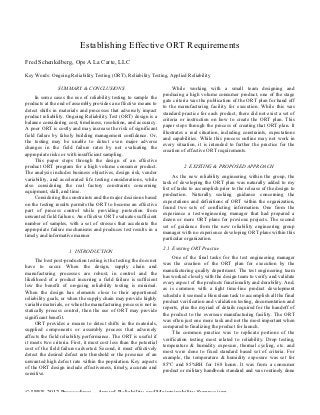
years. Figure 3 shows an example Pareto based on field confidence. The practical limits of the cost of samples, testing
returns. facilities capacities, and the cost penalty of finding the
unacceptable failure rate late.
A particular failure mechanism is only one way a system
Historical
Field
Returns
can fail. One way to use reliability apportionment is to
consider the major failure mechanisms of a system and
40
allocated a reliability target for each failure mechanism. This
%
of
total
returns
is like a reliability block diagram for system elements and
30
major components, just along the lines of failure mechanisms.
20
The results would be the same if each major element of a
10
system has a single dominate failure mechanism.
0
5.1 Initial Calculations
For the purpose of the example, let’s assume the
reliability allocation for corrosion failures is 99% reliable over
one year, or a 1% failure rate over the first year. Furthermore,
Figure 3 Historical Field Return information let’s assume the local policy concerning sampling a
population is to use a confidence value of 90%. To get an
estimate of the sample size, we can use the Success Run
In this example, let’s assume the design team changed the sample size formula [1] based on the binomial distribution.
type and robustness of the connectors among other design
changes. And, product testing has shown significant
improvement in avoiding bent pins thus reducing the risk for ln(1−C) (1)
n=
field failures. And, for this example, let’s assume the new ln(R)
design addresses the corrosion issue with a new coating step in
the process. Furthermore, the coating process window is small Where,
and even small variation in the process or materials results in n is the sample size
an unacceptable coating, which would lead to premature C is the statistical confidence
product failure due to corrosion. R is the reliability
During product development the design verification
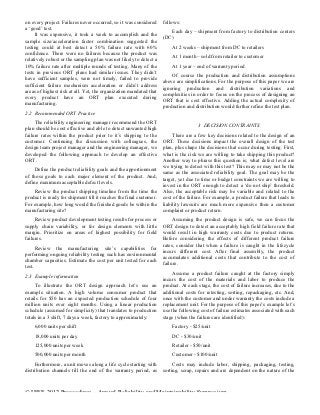
testing for the new coating found that using a specific Fixing confidence at three levels and plotting sample size
temperature, humidity and bias test (again beyond the scope of versus reliability shows the increase in sample size needed for
this paper to discuss the creation of a specific ALT) resulted in higher confidence and reliability. For a confidence of 90% to
an acceleration factor of 12. In other words a 12-day test at show at least 90% reliability, we need 22 samples. For higher
accelerated conditions would replicate a year’s worth of stress reliability the sample size increases dramatically as is apparent
as seen in the field. Another piece of information, useful in Figure 4.
© IEEE 2012 Proceedings – Annual Reliability and Maintainability Symposium](https://image.slidesharecdn.com/2012rm0025establishingeffectiveortrequirements-130114184501-phpapp02/85/2012-RAMS-Establishing-Effective-ORT-Requirements-4-320.jpg?cb=1358206067)
![a higher cost per unit, plus, more total units exposed. One way
to judge the two ORT plans is to assume the unknown true
failure rate is 1%, 2.5% and 5%, then estimate the cost of
unreliability based on the ability to detect the failure.
For the 1% failure rate, the test would confirm the
acceptable low failure rate and no action is taken to isolate and
inspect products. If the failure rate is 5%, both test plans
would find the unacceptably high defect rate, and we can
assume it would be just as the test ends, thus 12 and 24 days.
For the 2.5% defect rate, let’s assume the longer test takes the
full 24 days to spot the higher than acceptable failure rate.
And, let’s assume the 12 day test would take at least two
cycles to make the detection. To fully analyze the tradeoff,
construct OC curves or run simulations may be useful. Of
course the units under test may fail at any point during the test
Figure 4 Sample size versus reliability by confidence level period, according to the probability governed by the associated
Weibull distribution. If the failure occurs earlier than just at
Therefore, in order to detect a 1% defect rate that is the end of the testing, we would receive an indication of an
introduced into the product, we would need to run 229 unacceptable failure rate and enjoy fewer units exposed.
samples for two weeks under the determined test conditions to Another factor to consider is statistical error.
approximate one year of use. The acceptable field failure rate is 1%, thus any failures
over that rate we can consider as additional cost that has
5.2 Compromise Calculations
gotten past the ORT. Therefore, for the cost calculations, we
For the purpose of the example, let’s assume the testing subtract the cost of the associated returns from the first 1%.
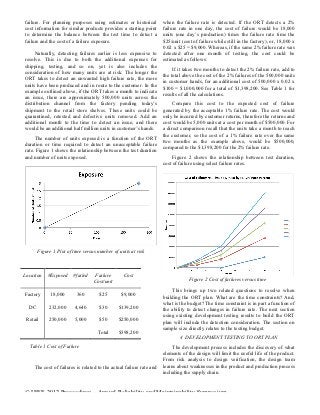
capacity is 50 units at any one time. Therefore, given 50 units, The following tables illustrate the comparison and
and solving equation 1 for reliability, we find we could detect associated costs assuming two failure rates, of 1.2% and 4.5%
a reliably of 95.5% over an approximate test time of two that are detected by the tests just as the test period ends.
weeks.
Another option is to the samples longer to achieve a better Actual Cost of Marginal Cost
resolution on reliability. Using a Weibayes formulation of the Failure Rate Unreliability ($) of Unreliability ($)
success run [2] to accommodate the Weibull distribution β = 1% 253,700
3, the formula is equation 2. 1.2% 304,440 50,740
4.5% 1,141,650 887,950
ln(1−C) Total 938,690
n= (2) Table 2 ORT plan with 24 day duration and 25 samples
m β ln(R)
Furthermore, let’s assume it takes 4 2-week test periods to
Where, detect the 1.2% defect using the shorter test plan. Thus, there
m is the number of lifetimes raised by β are 6 weeks of 1.2% defect rate product in the field producing
β is the Weibull distribution shape parameter 0.2% higher than acceptable returns at $100 per return. This
and, the other terms are the same as in equation 1. Note: results in an additional cost for 6 weeks x 125,000 units per
that when m=1 the equation reduces to that found in equation week x 0.002 failure rate x $100 per return for an additional
1. cost of $150,000.
Running the test twice as long sets m = 2, with a β = 3, we Actual Cost of Marginal Cost
find the 24 day test can detect a reliability of 99.4%. This is Failure Rate Unreliability ($) of Unreliability ($)
just over the desired goal of 99%, yet the testing takes twice as 1% 63,900
long, thus increasing the exposed number of units. Every 12 1.2% 76,680 12,780
days add another 25 samples, such that every two weeks the 6-weeks of 0.2% additional failures 150,000
month long results are available. 4.5% 287,550 223,650
For this simple example, the tradeoff becomes detecting Total 386,430
about a 4.5% defect rate in 12 days, or detecting a 1.2% defect Table 3 ORT plan with 12 day duration and 50 samples
rate in 24 days. The number of units exposed is 18,000 per
day, or 216,000 and 432,000, respectively. The shorter test plan, while designed to catch 4.5% failure
The cost of unreliability is slightly different since the rates, reduces the total number of samples exposed to return
longer duration test of 24 days will have some units exposed at over the target of 1%. The longer plan, in this simple
© IEEE 2012 Proceedings – Annual Reliability and Maintainability Symposium](https://image.slidesharecdn.com/2012rm0025establishingeffectiveortrequirements-130114184501-phpapp02/85/2012-RAMS-Establishing-Effective-ORT-Requirements-5-320.jpg?cb=1358206067)

Short paper on tradeoffs involved with designing an appropriate on going reliability test. Given at RAMS 2012. In some cases the use of reliability testing to sample the products at the end of assembly provides an effective means to detect shifts in materials and processes that adversely impact product reliability. Ongoing Reliability Test (ORT) design is a balance considering cost, timeliness, resolution, and accuracy. A poor ORT is costly and may increase the risk of significant field failure by falsely building management confidence. Or, the testing may be unable to detect even major adverse changes in the field failure rates by not evaluating the appropriate risks or with insufficient sampling. This paper steps through the design of an effective product ORT program for a high volume consumer product. The analysis includes business objectives, design risk, vendor variability, and accelerated life testing considerations, while also considering the real factory constraints concerning equipment, skill, and time. Considering the constraints and the major decisions based on the testing results permits the ORT to become an effective part of process control while providing protection from unwanted field failures. An effective ORT evaluates sufficient number of samples, with a set of stresses that accelerate the appropriate failure mechanisms and produces test results in a timely and informative manner


