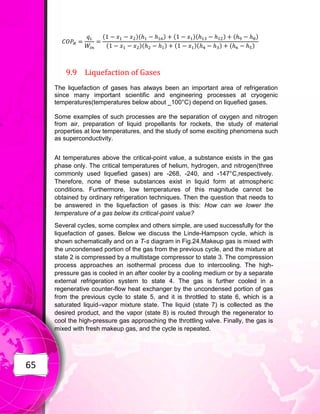
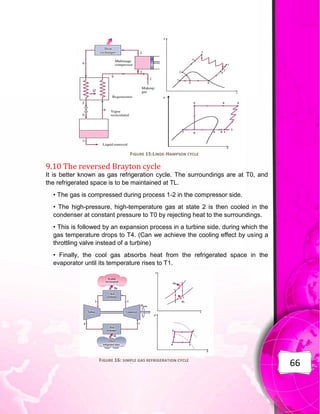
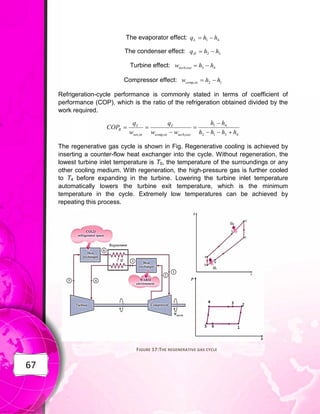
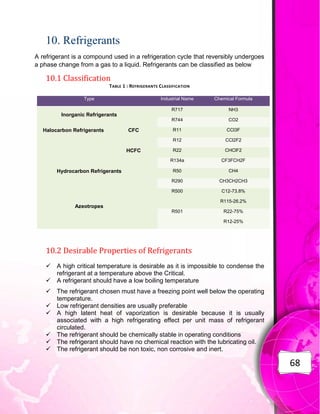
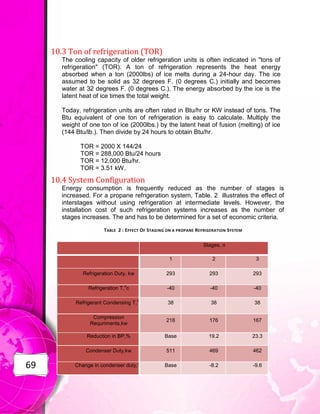
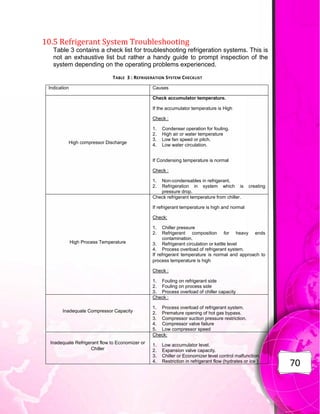
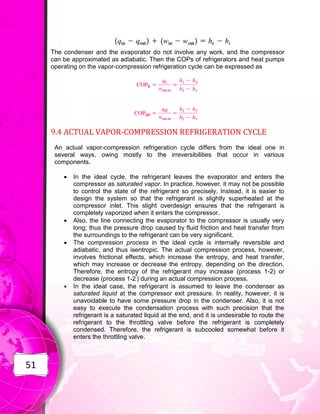
Liquefied Natural Gas (LNG) is produced by cooling natural gas into a liquid form at liquefaction plants. It is then stored or transported as a liquid and regasified at regasification plants before being used. Understanding the thermodynamics of LNG plants is important for analyzing and evaluating the processes involved. The document discusses key thermodynamic concepts like the first and second laws of thermodynamics, entropy, enthalpy, latent and sensible heat, and different refrigeration cycles used in LNG plants. It provides explanations of these concepts and their relevance to analyzing energy transfers and processes in LNG plants.



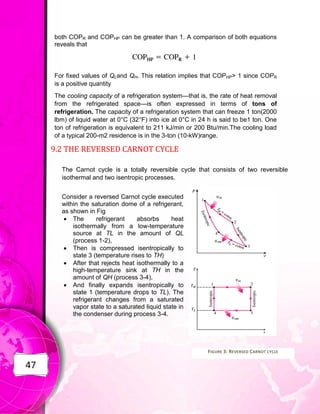
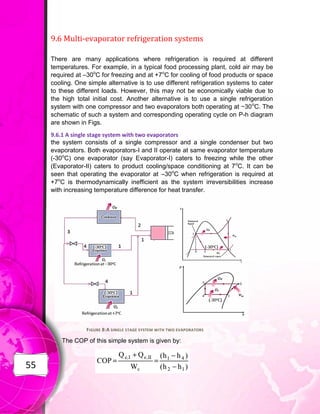
![38
Since the mass flow can expressed as
̇ ( )
The change in energy from the surrounding can be counted in
( ) ( ) ( ) ( )
General Form of the first law of thermodynamics will be
( ) ( )
It is mean with increasing the energy change of the system, the energy
change of the surrounding must be decrease so that the sum of both equals
zero
The final form after substitution for the open system will be
( ) ( ) ( )
̇ [ ( ) ( ) ( )]
( ) ( )
̇ *( ) ( ) ( ) ( )+
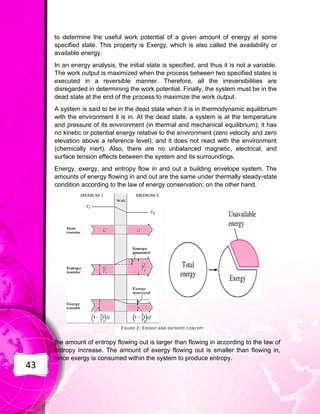
FIGURE 1: OPEN SYSTEM WITH ENERGY AND MASS FLOW](https://image.slidesharecdn.com/2-plantthermodynamic-230227214934-b45a7d5a/85/2-plant-thermodynamic-pdf-5-320.jpg)
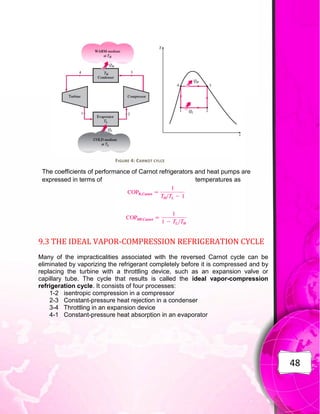
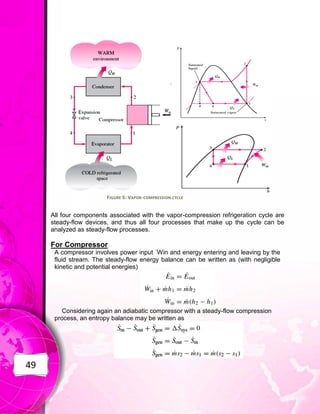
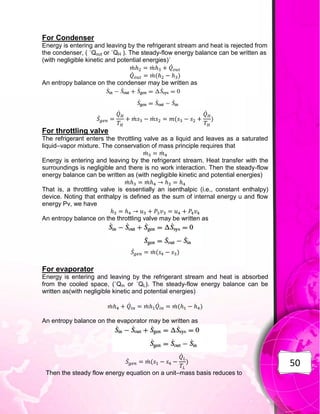
![56
9.6.2 Individual evaporators and a single compressor with a pressure-reducing valve
1. Individual expansion valves:
Figures show system schematic and P-h diagram of a multi-evaporator system
that uses two evaporators at two different temperatures and a single compressor.
This system also uses individual expansion valves and a pressure regulating
valve (PRV) for reducing the pressure from that corresponding to the high
temperature evaporator to the compressor suction pressure. The PRV also
maintains the required pressure in high temperature evaporator (Evaporator-II).
Compared to the earlier system, this system offers the advantage of higher
refrigeration effect at the high temperature evaporator [(h6-h4) against (h7-h5)].
However, this advantage is counterbalanced by higher specific work input due to
the operation of compressor in superheated region. Thus ultimately there may
not be any improvement in system COP due to this arrangement.
FIGURE 9:INDIVIDUAL EVAPORATORS, A SINGLE COMPRESSOR WITH A PRESSURE-REDUCING VALVE AND SINGLE
EXPANSION VALVE
The COP of the above system is given by:](https://image.slidesharecdn.com/2-plantthermodynamic-230227214934-b45a7d5a/85/2-plant-thermodynamic-pdf-23-320.jpg)