






ADAPTIVE NETWORKING PROTOCOL FOR RAPID MOBILE ENVIRONMENTS


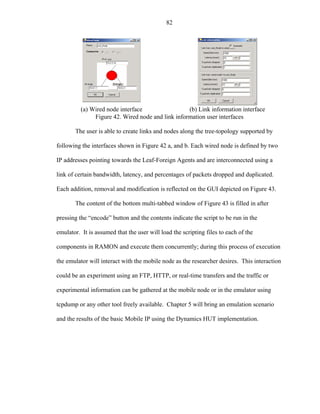
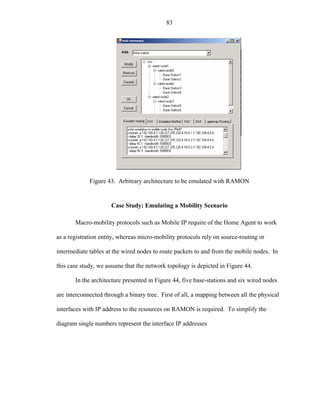
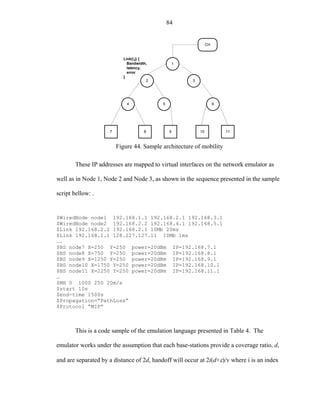
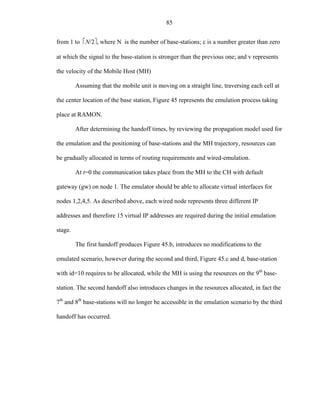
                             By

              EDWIN A. HERNANDEZ-MONDRAGON


      A DISSERTATION PRESENTED TO THE GRADUATE SCHOOL
     OF THE UNIVERSITY OF FLORIDA IN PARTIAL FULFILLMENT
            OF THE REQUIREMENTS FOR THE DEGREE OF
                     DOCTOR OF PHILOSOPHY

                   UNIVERSITY OF FLORIDA

                            2002
Copyright 2002

            by

Edwin A. Hernandez-Mondragon
To my family
ACKNOWLEDGMENTS


       I would like to thank God and the Virgin Mary for providing me with strength and

perseverance during my doctoral studies.

       I would like to acknowledge and thank the members of my supervisory

committee, Dr. Ifju, Dr. Sanders, Dr. McNair, Dr. Bermudez and very special

appreciation to my advisor and committee chair Dr. Sumi Helal, whose guidance and

trust, made this dissertation a reality. My gratitude also goes to Matt Grover for all the

Cisco APs and antennas.

       I would like thank my parents, Alcides and Gladys, for their unconditional love,

encouragement, advice, emails, calls, and all their support. I want to also thank my

brother, Fersan, and my sister-in-law, Yamileth, for their moral support in Florida. Also I

wish to thank my sisters, Doris and Cintya, for their love and appreciation.

       Last but not least, I want thank all my friends in Gainesville and abroad: Miguel,

Jose, Stefan, Vic, Hopi, Vanessa, Clarissa, Carlos, Juanfer, Maru, Jesus, the soccer team,

the folks at Salsa Nights, the GHFC fellows, and everyone who was involved in my work

and who offered their friendship and support.


                                             iv
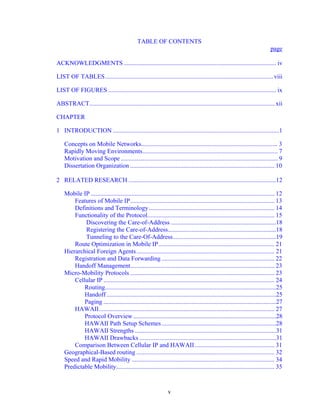
TABLE OF CONTENTS
                                                                                                                              page

ACKNOWLEDGMENTS ................................................................................................. iv

LIST OF TABLES........................................................................................................... viii

LIST OF FIGURES ........................................................................................................... ix

ABSTRACT...................................................................................................................... xii

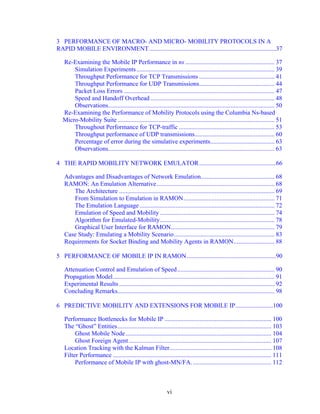
CHAPTER

1 INTRODUCTION ..........................................................................................................1

    Concepts on Mobile Networks....................................................................................... 3
    Rapidly Moving Environments...................................................................................... 7
    Motivation and Scope .................................................................................................... 9
    Dissertation Organization ............................................................................................ 10

2 RELATED RESEARCH ..............................................................................................12

    Mobile IP ..................................................................................................................... 12
        Features of Mobile IP............................................................................................ 13
        Definitions and Terminology ................................................................................ 14
        Functionality of the Protocol................................................................................. 15
            Discovering the Care-of-Address ...................................................................18
            Registering the Care-of-Address.....................................................................18
            Tunneling to the Care-Of-Address..................................................................19
        Route Optimization in Mobile IP.......................................................................... 21
    Hierarchical Foreign Agents ........................................................................................ 21
        Registration and Data Forwarding ........................................................................ 22
        Handoff Management............................................................................................ 23
    Micro-Mobility Protocols ............................................................................................ 23
        Cellular IP ............................................................................................................. 24
            Routing.............................................................................................................25
            Handoff ............................................................................................................25
            Paging ..............................................................................................................27
        HAWAII................................................................................................................ 27
            Protocol Overview ...........................................................................................28
            HAWAII Path Setup Schemes .........................................................................28
            HAWAII Strengths ..........................................................................................31
            HAWAII Drawbacks .......................................................................................31
        Comparison Between Cellular IP and HAWAII................................................... 31
    Geographical-Based routing ........................................................................................ 32
    Speed and Rapid Mobility ........................................................................................... 34
    Predictable Mobility..................................................................................................... 35


                                                                 v
3 PERFORMANCE OF MACRO- AND MICRO- MOBILITY PROTOCOLS IN A
RAPID MOBILE ENVIRONMENT.................................................................................37

  Re-Examining the Mobile IP Performance in ns ......................................................... 37
      Simulation Experiments ........................................................................................ 39
      Throughput Performance for TCP Transmissions ................................................ 41
      Throughput Performance for UDP Transmissions................................................ 44
      Packet Loss Errors ................................................................................................ 47
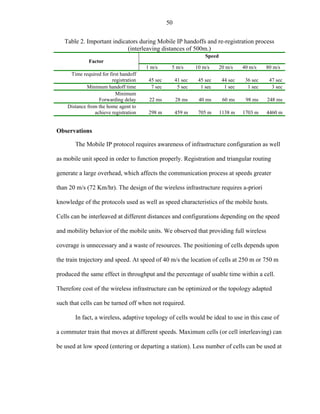
      Speed and Handoff Overhead ............................................................................... 48
      Observations.......................................................................................................... 50
  Re-Examining the Performance of Mobility Protocols using the Columbia Ns-based
  Micro-Mobility Suite .................................................................................................... 51
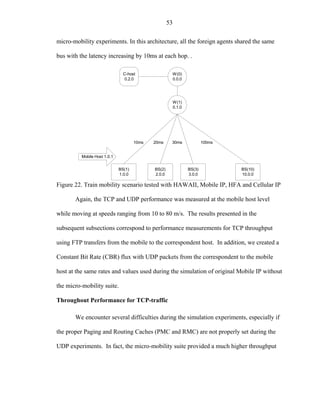
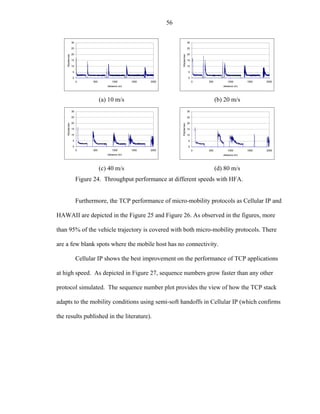
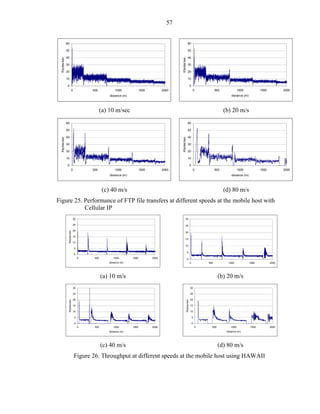
      Throughout Performance for TCP-traffic ............................................................. 53
      Throughput performance of UDP transmissions................................................... 60
      Percentage of error during the simulative experiments......................................... 63
      Observations.......................................................................................................... 63

4 THE RAPID MOBILITY NETWORK EMULATOR .................................................66

   Advantages and Disadvantages of Network Emulation............................................... 68
   RAMON: An Emulation Alternative ........................................................................... 68
      The Architecture ................................................................................................... 69
      From Simulation to Emulation in RAMON.......................................................... 71
      The Emulation Language ...................................................................................... 72
      Emulation of Speed and Mobility ......................................................................... 74
      Algorithm for Emulated-Mobility......................................................................... 78
      Graphical User Interface for RAMON.................................................................. 79
   Case Study: Emulating a Mobility Scenario................................................................ 83
   Requirements for Socket Binding and Mobility Agents in RAMON.......................... 88

5 PERFORMANCE OF MOBILE IP IN RAMON.........................................................90

   Attenuation Control and Emulation of Speed.............................................................. 90
   Propagation Model....................................................................................................... 91
   Experimental Results ................................................................................................... 92
   Concluding Remarks.................................................................................................... 98

6 PREDICTIVE MOBILITY AND EXTENSIONS FOR MOBILE IP........................100

   Performance Bottlenecks for Mobile IP .................................................................... 100
   The “Ghost” Entities .................................................................................................. 103
        Ghost Mobile Node ............................................................................................. 104
        Ghost Foreign Agent ........................................................................................... 107
   Location Tracking with the Kalman Filter................................................................. 108
   Filter Performance ..................................................................................................... 111
        Performance of Mobile IP with ghost-MN/FA. .................................................. 112


                                                             vi
7 SUMMARY AND FUTURE WORK ........................................................................115


APPENDIX

A SIMULATION SCRIPT IN NS FOR MACRO- and MICRO- MOBILITY ............119

B EMULATION CODE RAMON ................................................................................128

C MATLAB KALMAN FILTER FOR GHOST MN/FA .............................................135

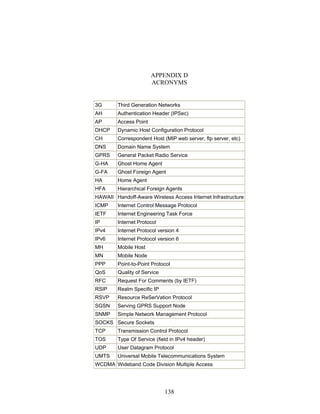
D ACRONYMS……………………………………………………………………….138


LIST OF REFERENCES.................................................................................................139

BIOGRAPHICAL SKETCH ...........................................................................................145


                                                         vii
LIST OF TABLES

Table                                                                                                        page


1 HAWAII strengths and drawbacks .............................................................................. 31

2 Important indicators during Mobile IP handoffs and re-registration process
     (interleaving distances of 500m.).......................................................................... 50

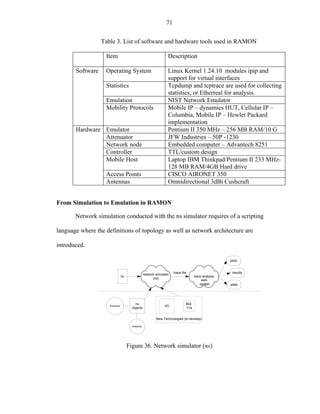
3 List of software and hardware tools used in RAMON ................................................ 71

4 Language used by the emulation script........................................................................ 73

5 Scenarios of mobility for the wireless LAN. ............................................................... 77

6 Routing table configuration throughout the emulation process................................... 87


                                                     viii
LIST OF FIGURES

Figure                                                                          page

1   Mobility scenario from a home to a foreign network                             5

2 Packet forwarding model                                                          7

3   IETF proposal for mobility                                                    13

4   Triangular routing and packet forwarding                                      15

5   Tunneling between the Home and Foreign Agent                                  17

6   Handoff and re-registration in Mobile IP                                      19

7   Tunneling using IP-in-IP encapsulation and minimal encapsulation              20

8   Hierarchical Foreign Agents                                                   22

9 Micro-mobility architecture                                                     24

10 Routing mechanism on Cellular IP                                               26

11 Handoff in Cellular IP                                                         26

12 Forwarding path setup in HAWAII                                                30

13 Signal propagation mode                                                        34

14 Network topology for a train environment simulated with ns                     40

15 Throughput of FTP traffic and interleaving distances of base stations          42

16 Throughput behavior at different speeds and base station separation distances with
     FTP traffic                                                                   44

17 Throughput of UDP traffic and interleaving distances of base stations (Speed = 20
     m/s)                                                                         46

18 Throughput behavior at different speeds and base station interleaving using UDP
     traffic                                                                      47


                                         ix
19 Percentage of packets dropped using UDP and TCP traffic                         48

20 Registration delay and the effect of speed with cell interleaving of 500m. (UDP
     traffic)                                                                      49

21 Infrastructure used for simulations on HAWAII, HFA, and Cellular IP             52

22 Train mobility scenario tested with HAWAII, Mobile IP, HFA and Cellular IP 53

23 Throughput of Mobile IP with no optimizations and FTP transfers                 55

24 Throughput performance at different speeds with HFA.                            56

25 Performance of FTP file transfers at different speeds at the mobile host
      with Cellular IP                                                             57

26 Throughput at different speeds at the mobile host using HAWAII                  57

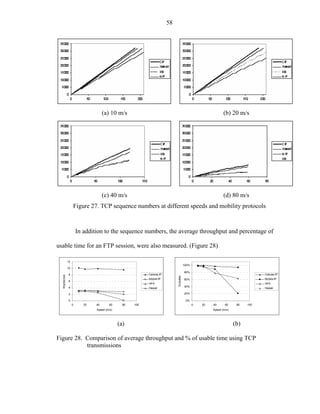
27 TCP sequence numbers at different speeds and mobility protocols                 58

28 Comparison of average throughput and % of usable time using TCP
     transmissions                                                                 58

29 Throughput of UDP transfers using Mobile IP                                     60

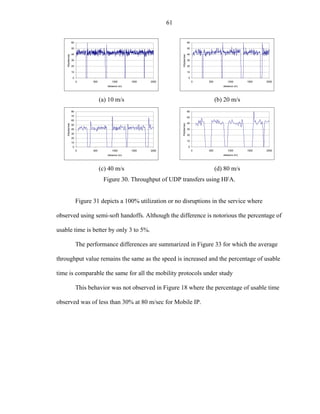
30 Throughput of UDP transfers using HFA.                                          61

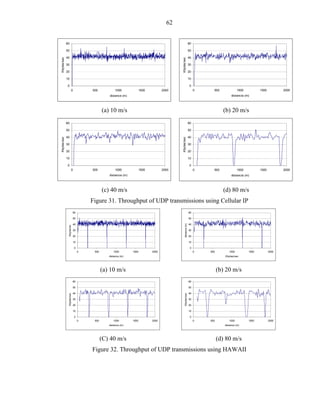
31 Throughput of UDP transmissions using Cellular IP                               62

32 Throughput of UDP transmissions using HAWAII                                    62

33 Average UDP throughput and percentage of usable time                            63

34 Percentage of packets dropped TCP/UDP combined                                 64

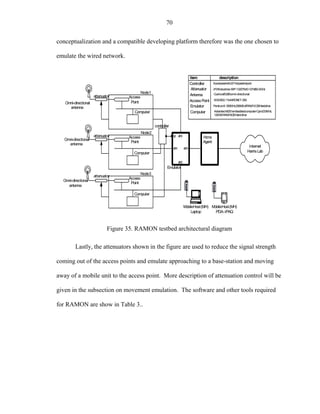
35 RAMON testbed architectural diagram                                             70

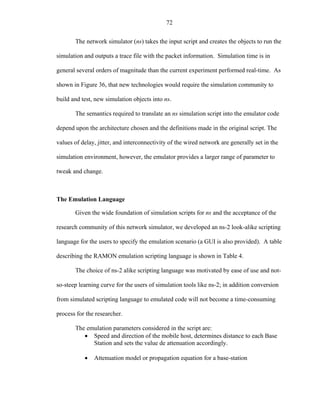
36 Network simulator (ns)                                                          71

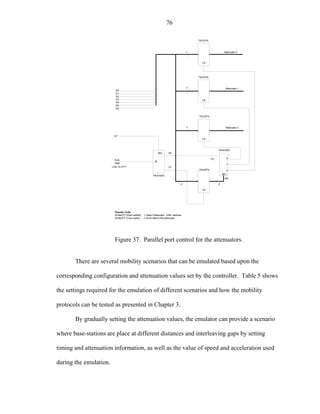
37 Parallel port control for the attenuators.                                      76

38 Data rates and path loss attenuation for CISCO AP-350                           77

39 Handoff sequence for emulation                                                  78

40 Graphical user interface for RAMON - CASE tool                                  80

41 GUI for the architecture to emulate and the scripting contents of each element in
     RAMON                                                                          81


                                           x
42 Wired node and link information user interfaces                               82

43 An arbitrary architecture to be emulated with RAMON                           83

44 Sample architecture of mobility                                               84

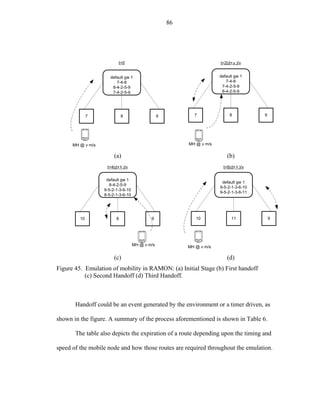
45 Emulation of mobility in RAMON: (a) Initial Stage (b) First handoff (c) Second
     Handoff (d) Third Handoff.                                                  86

46 Network emulator graphical interface.                                         88

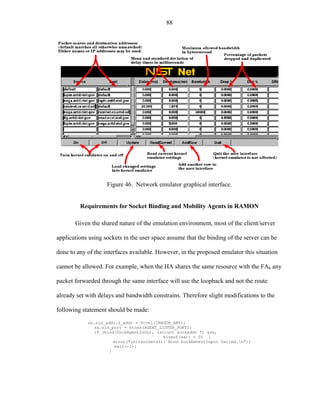
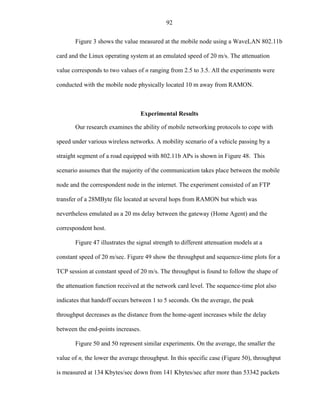
47 Experimental values of signal strength measured at the mobile node using three
     different attenuation patterns (speed = 20 m/s).                             93

48 A Simple mobility scenario emulated in RAMON                                  93

49 Throughput and time-sequence plot at 20m/s (squared)                          94

50 Throughput and time-sequence plot at 20m/s (n=2.5)                            95

51 Throughput and time-sequence plot at 20m/s (n=3.5)                            97

52 Average throughput and speed                                                  97

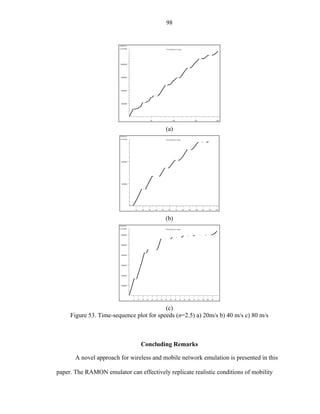
53 Time-sequence plot for speeds (n=2.5) a) 20m/s b) 40 m/s c) 80 m/s            98

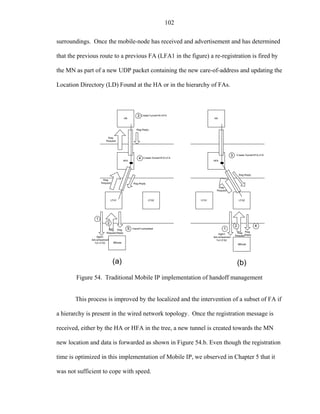
54 Traditional Mobile IP implementation of handoff management                   102

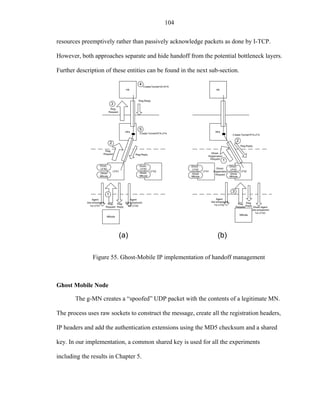
55 Ghost-Mobile IP implementation of handoff management                         104

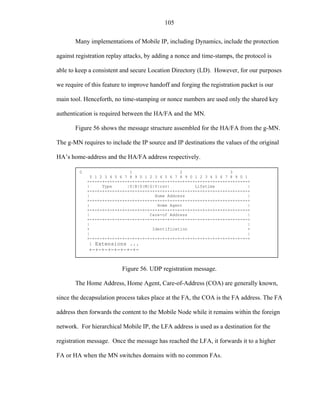
56 UDP registration message.                                                    105

57 Agent advertisement message in Mobile IP                                     108

58 Predicted and measurement location tracking of a mobile node using Kalman Filter.
      (T=5sec)                                                                111

59 Prediction error at different sampling intervals                             112

60 Performance improvement of ghosts extensions for Mobile IP                   113

61 Predicted Mobile IP Sequence-time plot (40 m/sec, n=2.5)                     114

62 Predicted Mobile IP Time-squence plot for (80 m/s and n=2.5)                 114


                                          xi
Abstract of Dissertation Presented to the Graduate School
                 of the University of Florida in Partial Fulfillment of the
                  Requirements for the Degree of Doctor of Philosophy

ADAPTIVE NETWORKING PROTOCOL FOR RAPID MOBILE ENVIRONMENTS

                                            By

                            Edwin A. Hernandez-Mondragon

                                      August 2002


Chair: Dr. Abdelsalam (Sumi) Helal
Department: Computer and Information Sciences and Engineering.

       This dissertation presents two novel contributions in the area or wireless

networks. The first one, the Rapid-Mobility Network Emulator (RAMON), was targeted

to study the performance of wireless protocols at high speed, evaluate handoff, and IEEE

802.11x technologies. RAMON is a development platform that combines emulation and

simulation to facilitate the analysis of performance bottlenecks in a quicker and more

efficient matter. Additionally, RAMON recreates more realistic environments for

wireless network protocols where attenuation, latency delay, and bandwidth can be

modified as required by the experimenter. The second contribution is a predictive

extension for Mobile IP using a Kalman filter. The forecasting of speed and trajectory

allows the protocol to avoid late registration and improve performance at high speed. We

added two new entities to the protocol: the ghost-mobile node and ghost foreign agent.

The entities preemptively react to the environment and allow much faster and quicker

handoff. The predictable protocol improves the performance of Mobile IP and proves the


                                            xii
feasibility of a wireless network infrastructure for vehicles traveling at speeds of up to 80

m/sec or 288 km/hr.


       .


                                             xiii
1


                                      CHAPTER 1
                                    INTRODUCTION


       In 1999, this research began with the investigation of Mobile IP and micro-

cellular protocols as part of a mobile computing class. We developed a simulator for

Mobile IP and a wireless infrastructure providing Internet connectivity to a railroad track.

Our main focus consisted in the study of the effects of speed in mobile protocols. Shortly

after creating our own application, we found a better simulation tool: the “Network

Simulator” (ns). Ns is a discrete event simulator targeted at networking research. Ns

provides substantial support for simulation of TCP, routing, and multicast protocols over

wired and wireless (local and satellite) networks. This research effort has received

contributions from the Lawrence Berkeley Laboratories (LBL), University of California

(Berkeley), Carnegie Mellon University (CMU), and many others.

       We created a commuter train scenario and studied the effects of speed in Mobile

IP. Our initial findings indicated that this protocol was not suitable for rapidly moving

vehicles; nevertheless, we observed several potential enhancements areas and prospective

paths for improvement.

       After the simulations and experiments with Mobile IP, micro-mobility protocols

became our area of interest. We kept the same simulation conditions that were set for the

Mobile IP experiments, and proceeded to reexamine micro-mobility protocols. During

this phase of experimentation, the performance results gathered with ns assumed a

simplified version of the mobility environment. At high speed, these simplifications led
2

to invalid results and therefore indicated that simulation was not the most appropriate

approach, in our journey to study velocity and mobility protocols. Early in May 2000, our

investigation was directed to combine simulation and emulation into one platform. The

initial steps towards a new emulation approach were made with inexpensive PC

equipment and a three 2 Mbps Access Points. Initially, we thought that emulation of

speed could be done entirely at the driver level; although technically feasible, we realized

that our major contribution would be the physical interaction with hardware stimulation.

Consequently, we decided to emulate speed using hardware attenuators and 3 dBi omni-

directional antennas. The hardware combination was able to change the signal strength

transmitted to the mobile node and emulate a mobility pattern.

       In the past few months, we have been creating hardware and software interfaces,

acquiring better access points, and completing our wireless emulator. This emulator

called RAMON or Rapid Mobility Network Emulator became our research and

development environment.

       Mobile IP was the first protocol being investigated in the emulator. We chose the

“Helsinki University of Technology”, Dynamics MIP, as the implementation to be used

during the experiments. RAMON was abstracted with an emulation language and

graphical user interfaces that facilitated the development of emulation environments.

RAMON also provided a more realistic platform in which improved versions of Mobile

IP and any other protocol can be developed, without creating an intermediate version of

the protocol in a simulation environment.

       Intrigued with the effects of speed and the reactive mechanisms of the Mobile IP

protocol, creating an improved version of Mobile IP was more feasible than before. The
3

new approach required a predictive mechanism (Kalman Filter) to allocate resources and

preemptively interact with network layers. Our results indicate that the improved

protocol raised the performance of Mobile IP in at least 30%.

       We now define several concepts found in mobile networks and describe the rest

of the structure followed in this dissertation.

                              Concepts on Mobile Networks

       Mobile networks challenge current paradigms of computing with varying

environments and scenarios characterized by sudden changes in bandwidth, error rates,

and latency for applications and system operations. Nomadic data in portable devices

make the current network protocols run short and supply insufficient solutions to solve

the mobility conditions of the new environment.

       A few years ago, the network infrastructure was a fixed variable that seldom

changed. Although this assumption was totally accurate for Local and Wide-area

Networks (LAN and WAN), it is obsolete for wireless situations. In fact, wireless

networks incorporate the user experience with a set of services and benefits derived from

the pervasive environment. Additionally, a wide variety of settings and conditions exist

while roaming among different localities or moving across different areas covered by the

wireless infrastructure. These new attributes derived from the network conditions require

adaptive protocols to be able to adjust themselves and allows the seamless offering of

uninterrupted services to client applications, as currently provided in a fixed network.

       Mobile users are nomadic since they connect from different access points during

the same network session and remain attached to the network while moving at any speed

within the globe, campus, or office. Furthermore, users move while network resources

(such as battery life and wireless bandwidth) are limited [Jin99]. Protocols should adapt
4

and provide nondisruptive connectivity to the mobile users. This adaptation process

requires predictable mechanisms and awareness of the physical conditions. In general, the

physical layer is aware of the changing media conditions. Some characteristics are

already detected in the lower layers of the stack. In fact when important changes happen

at a lower layer, they are usually hidden from higher layers [Sone01, Wu01]. Therefore,

information exchange between upper and lower layers of the stack is a key factor for

mobile networks. Additionally, knowledge of mobile user movement and connection

patterns can improve the session quality by predicting trajectories and allocating network

resources before they are required. Proper predictive strategies can indeed reduce the

requirements of network updates and handoff delays [Liu98, Lia99, and Su00]. Physical

parameters can also be used to locate users, track their position within different network

cells and develop new location management strategies [Bahl00b].

       Network-layer mobility is not supported by default in the Internet Protocol (IP)

and the traditional implementations of the Transport Control Protocol (TCP) are unable to

distinguish between handoff and congestion avoidance [Bala96, Jaco88]. In fact, the

Internet protocol suite was designed under the assumption that end systems are

stationary. Thus, as one network end moves, the network session is broken [Bha96]. For

the operating system, the session simply times out, and new kernel bindings are required

to support mobility.

       Network-layer mobility has been improved by the use of registered stations taking

care of the routing and forwarding of packets which destination is currently moving

[Bha96]. Mobile IP [Perk96a, Perk96b, and Perk02] is one of the proposed solutions

based on registration and packet forwarding. As shown in Figure 1, Mobile IP for IPv4
5

and IPv6 required of an entity called Home Agent (HA), who registers the position of the

Mobile Host (MH). Similar registration mechanisms can be found in the standard for

Global Systems for Mobile Communications (GSM), where the Home Location Register

(HLR) [Hill02] acts as the registration entity to maintain updated position and routing

information for the mobile nodes.


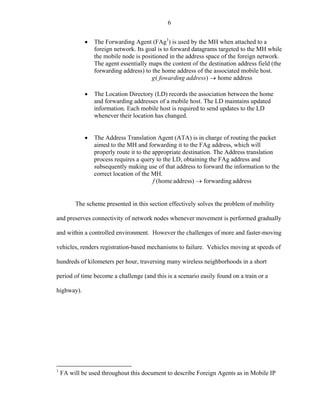
                                             Home
                                            network


                           Stationary
                              host

                                        Internet routing
                                                           Foreign Network


              Figure 1. Mobility scenario from a home to a foreign network


       The mobile node communicates with a destination node which can be a web- or

multimedia-based server also denominated as the Correspondent Host (CH). Once the

Correspondent Host (CH) sets a communication link with the MH, the registration

service at the HA intermediates the requests and encapsulates the packets coming from

the CH to the proper registration destiny found in its directory. Therefore, the MH must

update the HA continuously with the current information of the foreign network being

visited. The foreign network designates another entity, the Foreign Agent (FA), to

exchange information between the MH and the foreign network.

       As in Mobile IP, GSM networks counts with a Visitor Location Register (VLR) to

take care of the role of the FA. Indeed, a generalization of the different network

components used for the mobility environment is shown in Figure 2. [Bha96]. Those

components are:
6


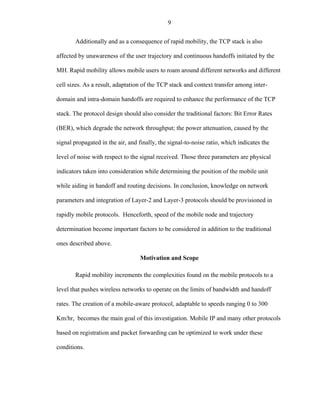
             •   The Forwarding Agent (FAg1) is used by the MH when attached to a
                 foreign network. Its goal is to forward datagrams targeted to the MH while
                 the mobile node is positioned in the address space of the foreign network.
                 The agent essentially maps the content of the destination address field (the
                 forwarding address) to the home address of the associated mobile host.
                                        g ( fowarding address) → home address

             •   The Location Directory (LD) records the association between the home
                 and forwarding addresses of a mobile host. The LD maintains updated
                 information. Each mobile host is required to send updates to the LD
                 whenever their location has changed.


             •   The Address Translation Agent (ATA) is in charge of routing the packet
                 aimed to the MH and forwarding it to the FAg address, which will
                 properly route it to the appropriate destination. The Address translation
                 process requires a query to the LD, obtaining the FAg address and
                 subsequently making use of that address to forward the information to the
                 correct location of the MH.
                                          f (home address) → forwarding address


         The scheme presented in this section effectively solves the problem of mobility

and preserves connectivity of network nodes whenever movement is performed gradually

and within a controlled environment. However the challenges of more and faster-moving

vehicles, renders registration-based mechanisms to failure. Vehicles moving at speeds of

hundreds of kilometers per hour, traversing many wireless neighborhoods in a short

period of time become a challenge (and this is a scenario easily found on a train or a

highway).


1
    FA will be used throughout this document to describe Foreign Agents as in Mobile IP
7

                                                                         Location Directory
                                                            Home             LD
                                                           network
                         Address Translation Agent

                                                                          Foreign Network
                          Source           f                Forwarding Agent
                                                                     g
                                         Cache
                                               Internet routing
                                                                                          MH

                            f: Home Address                   Forwarding Address
                            g: Forwarding Address             Home Address


                           Figure 2. Packet forwarding model


                            Rapidly Moving Environments

       The proliferation of wireless networks and high-speed internet access for the

transportation industry can be implemented with today’s technology and the use of

current Wi-Fi access points and network cards. Wi-Fi provides connection speeds of 1-

11Mbps [Bing00] and represents a potential option for the deployment of internet

connectivity on highways and train tracks. While 3G presents a promising solution for

future wireless subscribers, the bandwidth offered in 3G networks (CDMA200) for

vehicular speeds is in the range of 140 Kbps [Garg00]; consequently higher deployment

and licensing costs are expected. Vehicular routes of trains and highways can benefit

from Wireless LANs and supply end users with a communication scenario similar to

existing office and home environments (without expenditures on extra equipment or

technologies).

       As mentioned in the previous section, the mainstream solution for network-layer

mobility is solved by registering the movement of the mobile node to a centralized

database of location information or the Location Directory (LD). Although centralized

databases ease the solution for problems of authentication, accounting, and authorization
8

of mobile users in the network [Glass00], the LD might not be suitable for vehicular

applications. In fact, an LD might contain expired information of an MH already moved

to a different location, or cell, or the network delay might be intrinsically close or higher

than the dwell time of the MH. A solely registration-based solution is not a suitable for

rapidly moving environments [Hern01].

       Indeed, registration mechanisms represent a major obstacle for a wide deployment

of wireless networks in vehicular applications. The wireless technologies: IEEE 802.11a

and IEEE 802.11b [Ieee99a, Ieee99b] offer micro-cell coverage, high throughput, and

cheap deployment. The combination of these factors and the native characteristics of

Mobile IP metrics: network delay, handoff speeds, and the packet-forwarding entail of an

alternative approach bound for a less dependent registration protocol.

       In 802.11x, cells sizes from 50 to 1000 m, depending upon the throughput and

latency of the wireless technology in use. For example, 802.11b a network cell ranges

[Cis01] from 200 to 1000 m for indoor and outdoor environments, providing throughputs

of 1 to 11 Mbps. In fact, a cell diameter of 400 m and a mobile unit at 80 m/s generate a

dwell time of 5 s. Any authentication mechanism, network delay, or handoff initiated at

the mobile host will diminish the performance and use of the cell significantly by

assuming processing times on the order of one second (20% of the dwell time on the cell

at this speed). There is a trend for cell sizes to decrease in diameter (down to 50 m) while

network throughput increases to a range of 50-100 Mbps as described in the IEEE

802.11a standard. As a result, the mobility protocol in use (e.g. Mobile IP) requires

architecture and mobility awareness to adapt to the changing conditions of mobility.
9

       Additionally and as a consequence of rapid mobility, the TCP stack is also

affected by unawareness of the user trajectory and continuous handoffs initiated by the

MH. Rapid mobility allows mobile users to roam around different networks and different

cell sizes. As a result, adaptation of the TCP stack and context transfer among inter-

domain and intra-domain handoffs are required to enhance the performance of the TCP

stack. The protocol design should also consider the traditional factors: Bit Error Rates

(BER), which degrade the network throughput; the power attenuation, caused by the

signal propagated in the air, and finally, the signal-to-noise ratio, which indicates the

level of noise with respect to the signal received. Those three parameters are physical

indicators taken into consideration while determining the position of the mobile unit

while aiding in handoff and routing decisions. In conclusion, knowledge on network

parameters and integration of Layer-2 and Layer-3 protocols should be provisioned in

rapidly mobile protocols. Henceforth, speed of the mobile node and trajectory

determination become important factors to be considered in addition to the traditional

ones described above.

                                  Motivation and Scope

       Rapid mobility increments the complexities found on the mobile protocols to a

level that pushes wireless networks to operate on the limits of bandwidth and handoff

rates. The creation of a mobile-aware protocol, adaptable to speeds ranging 0 to 300

Km/hr, becomes the main goal of this investigation. Mobile IP and many other protocols

based on registration and packet forwarding can be optimized to work under these

conditions.
10

       Smooth handoff mechanism and geographical awareness are also explored to

improve the performance in terms of throughput and latency. Mobile IP already counts

with the foundations for authentication and security, as opposed to the absence of

authentication methods in micro-mobility protocols. This dissertation targets three

different arenas:

           •   A simulation study of Mobile IP and micro-mobility protocols (such as
               HAWAII, Hierarchical Foreign Agents, and Cellular IP). Simulated
               scenarios allowed the identification of performance bottlenecks,
               determination of network throughput, packet delay, and cell utilization.
               We also show that simulation is not enough to study rapid mobility.


           •   A wireless emulation platform for rapidly mobile networks “RAMON”.
               RAMON is a tool combining IEEE 802.11b wireless LAN technology and
               an abstraction language to emulate wireless scenarios. The emulator
               mimics realistic conditions and allows testing of mobile networking
               protocols at different speeds.


           •   A novel mobility protocol that exploits the trajectory estimation and
               predicted positioning patterns of the mobile node. The estimation or
               prediction of certain parameters is applied for advanced registration and
               reservation of resources, preemptively and not reactively.


                               Dissertation Organization

       Chapter 2 covers areas of related research in mobile network protocols (micro-

and macro-mobility), location tracking, and predictable methods for wireless networks.

Chapter 3 shows the simulation results of reexamining Mobile IP and three micro-

mobility protocols. The description of the emulation platform, RAMON, and the

proposed abstraction language are presented in Chapter 4. Chapter 5 discusses the

performance measurements for Mobile IP in the emulator and comparisons with the

simulated results. Chapter 6 introduces the fundamental concepts of ghost-Mobile Node
11

and ghost-Foreign Agent, as well as the Kalman Filter description used to predict the

mobile node trajectory. Finally, the last chapter includes conclusion, a summary of

contributions, and presents areas of future work.
CHAPTER 2
                                 RELATED RESEARCH


       This chapter introduces the concepts and protocols used for mobility at a Macro-

and Micro-levels. Mobile IP and hierarchical Foreign Agents are presented as part of

Macro-mobility models followed by Cellular IP and HAWAII as micro-mobility

protocols. In addition, we introduce several research remarks in terms of geographic

routing use and the effects of speed on macro-mobility protocols.


                                        Mobile IP

       Mobile IP (RFC 2002) [Perk96a, Perk02] a standard proposed by one of the

working groups within the Internet Engineering Task Force (IETF), was designed to

solve the problem of mobility by allowing the mobile node to use two IP addresses: a

fixed home address and a care-of address that changes at each new point of attachment.

As shown in Figure 3 the home network provides the mobile node with an IP address and

once the node moves to a different network it receives a care-of-address assigned by the

foreign network.


       The version of Mobile IP described in this section corresponds to IP version 4,

however Mobile IP will change with IP version 6 [Perk96a], which is the product of a

major effort within the IETF to engineer an eventual replacement for the current version

of IP. Although IPv6 will support mobility to a greater degree than IPv4, it will still need

Mobile IP to make mobility transparent to applications and higher-level protocols such as


                                             12
13

TCP. The following subsections will present the features of Mobile IP, and

supplementary definitions that are used throughout this proposal, as well as a description

of the protocol functionality.

                                                           Foreign
                                                            Agent
                     S                  MH                             MH
                                                             R4


                                 d      Home         d
                                        Agent


                     R1                  R2                  R3


                           Figure 3. IETF proposal for mobility

Features of Mobile IP

       The IETF proposal has become the most popular protocol for handling mobility in

the Internet. Mobile IP was designed with the following characteristics:

       •   No geographical limitations, in other words a user can take a PDA or laptop
           computer anywhere without losing the connection to the home network.

       •   No physical connection is required for mobile IP while the mobile node
           determines local IP routers and connects automatically.


       •   Modifications to other routers and hosts are not required as in many micro-
           mobility protocols. Indeed, other than mobile nodes and agents, the remaining
           routers and hosts will still use current IP implementation. Mobile IP leaves
           transport and higher protocols unaffected.

       •   No modifications to the current IP address and IP address format are required;
           the current IP address format remains the same.


       •   Secure mobility, since Authentication, Accounting, and Authorization (AAA)
           [Glas00] are performed at a centralized location, mobile IP can ensure that
           rights are being protected.
14


Definitions and Terminology

       There are several definitions and terms defining the mobile IP standard. First of

all a Host is any computer, not considered to be performing routing or bridging functions

while a Mobile Host (MH) represents a host that moves from place to place, indeed static

placement of computers becomes a non-valid assumption. Moreover a Correspondent

Host (CH) is a server or a station from the fixed or wired network that communicates

with another MH.

       The protocol also defines two types of addresses, the first one Home Address is

used to identify a Mobile Host in general the IP address originally assigned to the MH

either using Dynamic Host Configuration Protocol (DHCP) [Perk95] or manually

configured, while the second address corresponds to a Foreign Address which is used to

locate a Mobile Host at some particular instant of time at a different location or while

visiting a different network. Both addresses can be obtained using a DHCP server or any

other type of assignment done at the home or foreign networks.

       Since we count with a home and a foreign address, there are two entities in charge

of the home and the foreign networks. The Home Agent (HA), located at the home

network, redirects or tunnels packets from a Home Network to a Foreign Address of a

Mobile Host. Hence, the Home Network is the logical network on which a Mobile Host’s

Home Address resides. The second entity in this architecture corresponds to a Foreign

Agent (FA), located in the foreign network, offers a Foreign Address and performs a

mapping between that address and the Home Address of a Mobile Host. The FA also
15

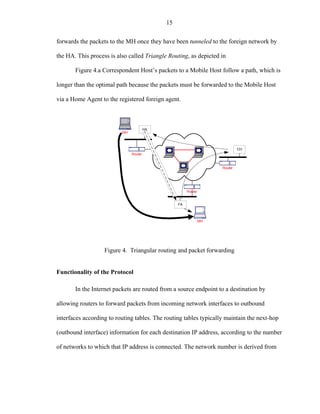
forwards the packets to the MH once they have been tunneled to the foreign network by

the HA. This process is also called Triangle Routing, as depicted in

       Figure 4.a Correspondent Host’s packets to a Mobile Host follow a path, which is

longer than the optimal path because the packets must be forwarded to the Mobile Host

via a Home Agent to the registered foreign agent.


                                        HA
                          MH


                                                                              CH
                               Router


                                                                     Router


                                                       Router


                                                  FA


                                                                MH


                   Figure 4. Triangular routing and packet forwarding


Functionality of the Protocol

       In the Internet packets are routed from a source endpoint to a destination by

allowing routers to forward packets from incoming network interfaces to outbound

interfaces according to routing tables. The routing tables typically maintain the next-hop

(outbound interface) information for each destination IP address, according to the number

of networks to which that IP address is connected. The network number is derived from
16

the IP address by masking off some of the low-order bits. Thus, the IP address typically

carries with it information that specifies the IP node's point of attachment.

       To maintain existing transport-layer connections as the mobile node moves from

place to place, it must keep its IP address the same. In TCP, each connection is composed

of two IP-addresses and two ports allowing identification of both connection endpoints.

Changing any of these four numbers will cause the connection to be disrupted and lost.

On the other hand, correct delivery of packets to the mobile node's current point of

attachment depends on the network number contained within the mobile node's IP

address, which changes at new points of attachment. To change the routing requires a

new IP address associated with the new point of attachment.

       As previously exposed, Mobile IP has been designed to solve this problem by

allowing the mobile node to use two IP addresses; the home address is static and used to

identify TCP connections and the care-of address changes at each new point of

attachment indicating the foreign network. The home address makes it appear that the

mobile node is continually able to receive data on its home network, where Mobile IP

requires the existence of a network node known as the home agent.

       Whenever the mobile node moves, it registers its new care-of address with its

home agent. To get a packet to a mobile node from its home network, the home agent

delivers the packet from the home network to the care-of address. The further delivery

requires that the packet be modified so that the care-of address appears as the destination

IP address. This modification can be understood as a packet transformation or, more

specifically, a redirection. When the packet arrives at the care-of address, the reverse

transformation is applied so that the packet once again appears to have the mobile node's
17

home address as the destination IP address. When the packet arrives at the mobile node,

addressed to the home address, it the layer-3 protocol in place, either TCP or UDP.

       In Mobile IP the home agent redirects packets from the home network to the care-

of address by constructing a new IP header that contains the mobile node's care-of

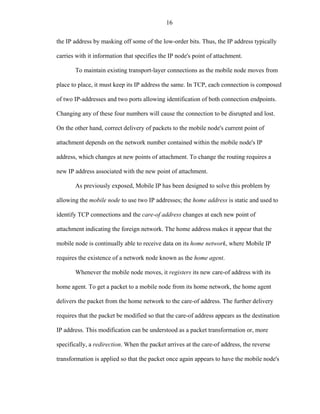
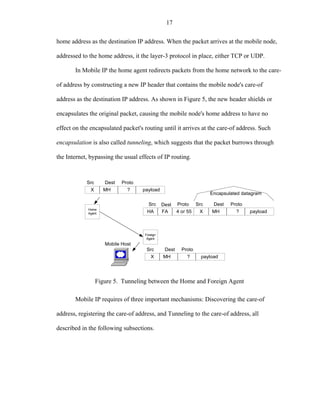
address as the destination IP address. As shown in Figure 5, the new header shields or

encapsulates the original packet, causing the mobile node's home address to have no

effect on the encapsulated packet's routing until it arrives at the care-of address. Such

encapsulation is also called tunneling, which suggests that the packet burrows through

the Internet, bypassing the usual effects of IP routing.


            Src      Dest   Proto
              X      MH       ?     payload
                                                                     Encapsulated datagram

                                      Src     Dest   Proto     Src    Dest   Proto
             Home
             Agent                   HA       FA     4 or 55    X    MH        ?     payload


                                    Foreign
                                     Agent
                     Mobile Host
                                     Src      Dest     Proto
                                      X       MH         ?       payload


                  Figure 5. Tunneling between the Home and Foreign Agent

       Mobile IP requires of three important mechanisms: Discovering the care-of

address, registering the care-of address, and Tunneling to the care-of address, all

described in the following subsections.
18

Discovering the Care-of-Address

       Home agents and foreign agents typically broadcast agent advertisements at

regular intervals. If a mobile node needs to get a care-of address and does not wish to

wait for the periodic advertisement, the mobile node can broadcast or multicast a

solicitation that will be answered by any foreign agent or home agent that receives it. If

advertisements are no longer detectable from a foreign agent that previously had offered

a care-of address to the mobile node, the mobile node should presume that the foreign

agent is no longer in range and should begin to hunt for a new care-of address, or

possibly use a care-of address known from advertisements it is still receiving.


Registering the Care-of-Address

       The registration message set by the mobile node to its home agent could either be

relayed by its foreign agent, or directly sent from the mobile node, depending on whether

or not the mobile node is able to dynamically acquire a transient IP address, which plays

a role as the care-of-address. Either way would work to get the request message out to the

home agent. To complete the registration procedure between both parties, two steps

should be performed: the home agent receives the registration request from the mobile

node, and the mobile node receives the registration reply from the home agent.

       The mobile node first sends a registration request containing the following

information: type, code, lifetime, home address, home agent, care-of address and

identification. After receiving the registration request from the mobile node, the home

agent should send a reply message containing the following information: type, code,

lifetime, home address, home agent and identification. Authentication occurs at this point

when the mobile node and home agent exchange Message Digest 5 challenges. For
19

security, the mobile node and home agent share a security association and so are able to

use MD5. The registration request must contain unique data so that two different

registrations will in practical terms never have the same MD5 hash.

       The triplet that contains the home address, care-of address, and registration

lifetime is called a binding for the mobile node. A registration request can be considered

a binding update sent by the mobile node. See Figure 6.


                  MH                           FA                        HA


            Send Solicitacions

                                      Send Advertisements

            Update Agent List


            Handoff necessary


           Registration Request

                                      Forwarding Request

                                                                  Registration Reply

                                       Forwarding Reply

                New COA


              Figure 6. Handoff and re-registration in Mobile IP [Widm00]


Tunneling to the Care-Of-Address

       The default encapsulation mechanism that must be supported by all mobility

agents using Mobile IP is IP-within-IP. Using IP-within-IP, the home agent inserts a new

IP header, called the tunnel header, in front of the IP header of any datagram addressed to

the mobile node's home address. The new tunnel header uses the mobile node's care-of

address as the destination IP address, or tunnel destination. The tunnel source IP address
20

is the home agent, and the tunnel header uses the number 4 as the higher-level protocol

number, indicating that the next protocol header is again an IP header. In IP-within-IP,

the entire original IP header is preserved as the first part of the payload of the tunnel

header. Therefore, to recover the original packet, the foreign agent merely has to

eliminate the tunnel header and deliver the rest to the mobile node.

       In a special case sometimes the tunnel header uses protocol number 55 as the

inner header. This happens when the home agent uses minimal encapsulation instead of

IP-within-IP. Processing for the minimal encapsulation header is slightly more

complicated than that for IP-within-IP, because some of the information from the tunnel

header is combined with the information in the inner minimal encapsulation header to

reconstitute the original IP header. On the other hand, header overhead is reduced.


 Figure 7. Tunneling using IP-in-IP encapsulation and minimal encapsulation [Solo98]
21


Route Optimization in Mobile IP

       IPv6 mobility borrows heavily from the route optimization ideas specified for

IPv4, [Perk01] particularly the idea of delivering binding updates directly to

correspondent nodes. When it knows the mobile node's current care-of address, a

correspondent node can deliver packets directly to the mobile node's home address

without any assistance from the home agent. Route optimization is likely to dramatically

improve performance for IPv6 mobile nodes. It is realistic to require this extra

functionality of all IPv6 nodes for two reasons. First, on a practical level, IPv6 standards

documents are still at an early stage of standardization, so it is possible to place additional

requirements on IPv6 nodes. Second, processing binding updates can be implemented as

a fairly simple modification to IPv6's use of the destination cache.


                               Hierarchical Foreign Agents

       Frequent handoff may produce constant packet loss due to the registration process

and before the next care-of-address is obtained by the mobile host. Speed aggravates this

performance problem. Hierarchical Foreign Agents [Perk96b, Cast98] (HFA) focuses on

the alleviation of this problem by organizing the FAs in a domain area with certain

hierarchy, more precisely a tree of FAs in order to handle local movement within a

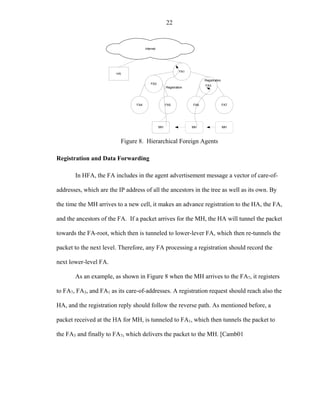
domain. As shown in Figure 8 to handle local movements within a domain the MH

chooses a closer registration point. The architecture requires traversing only a factor of

log(N) of FAs in order to register the binding update, where N corresponds to the number

of FAs in the network. However, the number of elements per domain increases

exponentially such that 2M-1 additional routers are required per domain with M cells.
22


                                       Internet


                                                                FA1
                        HA

                                                                            Registration
                                           FA2
                                                                            FA3
                                                       Registration


                                 FA4                   FA5            FA6                  FA7


                                                  MH                  MH                   MH


                          Figure 8. Hierarchical Foreign Agents

Registration and Data Forwarding

       In HFA, the FA includes in the agent advertisement message a vector of care-of-

addresses, which are the IP address of all the ancestors in the tree as well as its own. By

the time the MH arrives to a new cell, it makes an advance registration to the HA, the FA,

and the ancestors of the FA. If a packet arrives for the MH, the HA will tunnel the packet

towards the FA-root, which then is tunneled to lower-lever FA, which then re-tunnels the

packet to the next level. Therefore, any FA processing a registration should record the

next lower-level FA.

       As an example, as shown in Figure 8 when the MH arrives to the FA7, it registers

to FA7, FA3, and FA1 as its care-of-addresses. A registration request should reach also the

HA, and the registration reply should follow the reverse path. As mentioned before, a

packet received at the HA for MH, is tunneled to FA1, which then tunnels the packet to

the FA3 and finally to FA7, which delivers the packet to the MH. [Camb01
23


Handoff Management

       During Handoff, the MH compares the new vector of care-of-addresses with the

old one. Again, it chooses the lowest level address of the FA that appears in both-vectors

and sends a Regional Registration Request, which is processed by the FA. There is no

need to notify any higher-level FA about this handoff since those FA already points to the

proper location where to tunnel the packets for the MH. In Figure 8, the MH sends a

regional registration message to FA3, FA1 and the HA still maintains the proper

destination. When the MH moves to FA5 then it requires to the FA1, although several

handoffs have occurred the HA has not required to be updated and therefore the

registration overhead is greatly reduced.

                                Micro-Mobility Protocols

       Macro-mobility protocols introduce high overhead in terms of registration

messages, tunneling, triangular routing, and hard-handoff mechanisms. Several research

efforts [Camb01, Camb02, Ramj01] have improved the performance of Mobile IP by

creating domains of mobility where macro-mobility is executed at the level of inter-

domain handoff, while intra-domain is handled locally without intervention of the HA

and FAs.


       Figure 9 depicts the micro-mobility model used by Cellular IP and HAWAII and

how the network infrastructure manages handoff within the local domain while the inter-

domain handoff is taken care by the Mobile IP protocol. Additionally, micro-mobility

protocols provide paging information, as well as QoS mechanisms at the domain level.
24

In general micro-mobility protocols provide a highly optimized routing mechanism, with

memory less support for mobility and smoother handoffs.

        The following two sub-sections describe two micro-mobility protocols found in

the literature.


                                                             CH


                                                              Network


                     Home Domain
                        Router            HA                                                 FA      Foreign Domain
                                                                                                         Router
                                       root                                               root


                         home domain                                        foreign domain


                                              Movement between domains, HA is notified
                    MH
                             Movement within domain,                                     Movement within domain,
                                 HA not involved                                             HA not involved


                    Figure 9. Micro-mobility architecture [Camp01]


Cellular IP

        Although Mobile IP meets the goals of operational transparency and handoff

support, it is only optimized for slowly moving hosts and becomes inefficient in the case

of frequent migration. Mobile IP requires that the mobile hosts’ home agent be informed

whenever the host moves to a new Foreign Agent. During the update message phase,

packets will be forwarded to the old location and will not be delivered hence disturbing

active data transmission. In general Mobile IP is optimized for macro-level mobility and
25

relatively slow-moving hosts and hence results in huge delays with increasing handoff

frequency.

       Cellular IP [Camp01] is a host mobility protocol that is optimized for wireless

access networks and highly mobile hosts. Cellular IP incorporates a number of important

cellular principles but remains firmly based on IP design principles allowing Cellular IP

to scale from pico- to metropolitan area installations.

   The main design motivations for Cellular IP protocol are:
              • Easy global migration;
               •   Cheap passive connectivity;
               •   Flexible handoff support;
               •   Efficient location management;
               •   Simple memory less mobile host behavior
Routing

       Uplink packets are routed from mobile to the gateway on a hop-by-hop basis. The

path taken by these packets is cached in base stations. To route downlink packets

addressed to a mobile host the path used by recent packets transmitted by the host is

reversed. Base stations record the interface that was used earlier and use it to route

packets toward the gateway. As these packets are routed toward the gateway their route

information is recorded in the route cache. In the scenario illustrated in Figure 5 data

packets are transmitted by a mobile host with IP address X and enter BS2 through its

interface a. In the routing cache of BS2 this is indicated by a mapping (X,a).

Handoff

       There are two kinds of handoff in cellular IP: Hard and semi-soft handoff. The

first mechanism, hard handoff, requires the mobile host to tunes its radio to the new base

station and sends a route-update packet. There is latency equal to the time that elapses
26

between the handoff and the arrival of the first packet through the new route, which

causes some packet loss.
                                       Correspondant
                                            host


                                                                                Home
                                                      Mobile IP                 Agent
                                                  Internetworking


                                                        R
                            IP routing
                            IP tunneling
                            Cellular IP routing                                                    BS4
                                                                          BS2
                                                                                  b
                                                  BS1

                                                                                 a

                                                                                                         Mobile X

                                                                         BS3


                                                                                        Mobile X


                 Figure 10. Routing mechanism on Cellular IP [Valk99]

       The second type of handoff, semi-soft handoff, in order to reduce the latency

involved, the mobile host sends a “semi-soft packet” and reverts back to the old base

station while route cache mappings are configured. Once the configuration is completed a

regular handoff takes place ensuring that there is no packet loss.


                       Figure 11. Handoff in Cellular IP [Camp02]
27

Paging

         Paging occurs when a packet is addressed to an idle mobile host and the gateway

or base stations find no valid routing cache mapping for the destination. It is used to

avoid broadcast search procedures found in cellular systems. Base stations optionally

maintain paging cache to support paging. The paging cache has the same format as

routing cache except that the cache mappings have a longer timeout and they are updated

by any packet sent by mobile hosts including paging-update packets.


HAWAII

         In addition to Cellular IP and the deficiencies found in Mobile IP, Ramjee, et al.

proposed HAWAII (Handoff-Aware Wireless Access Internet Infrastructure) [Ramj99,

Ramj00] as an extension to Mobile IP that corrects the following deficiencies:

         •   In Mobile IP, user traffic is disrupted when the mobile host changes domains.
         •   In Mobile IP, costly updates to the home agent must be made for every
         domain change.
         •   When mobile hosts change domains, they acquire new network paths to the
         home agent. In turn, this requires the old QoS guarantee to be torn down, and a
         new one (along the new route) to be established. Because these QoS setups are
         costly, they should be minimized.
         •   The requirements for home and foreign agents incur a robustness penalty. This
         penalty should be reduced.


         Essentially, HAWAII attempts to improve Mobile IP performance by making the

assumption that most of the mobility is within a single logical administrative domain

which may be composed of many physical sub-domains. The HAWAII protocol is driven

by five design goals: limit the disruption to user traffic, enable the efficient use of access
28

network resources, a drive to enhance scalability, to provide intrinsic support for QoS,

and to enhance reliability.


Protocol Overview

       In HAWAII, a domain is a logical aggregation of networks that sit behind a

common router. When a mobile host is no longer in its home domain, then standard

Mobile IP routing occurs from the home agent to the domain router. The HAWAII

protocol operates inside the domain, between the domain router and the mobile host. It is

important to note that so long as the mobile host stays within this local domain, its care-

of address will not change. The protocol operates over the following types of messages:

   •   Path setup power-up message: This message constructs a route between the
       mobile host and the domain router. The domain router and all routers on the path
       only know this state information.
   •   Path setup update message: The mobile host uses this type of message to update
       the necessary routers that it has moved within the domain. The routers that receive
       this message are determined by the path setup scheme, to be discussed later.
   •   Path refresh message: The routing state in HAWAII is soft, so the mobile host
       must periodically send these messages so that the routers know that it is still alive,
       and that its state should be kept.


HAWAII Path Setup Schemes

       The following is a brief description of the path setup schemes followed in

HAWAII. The crossover router is a router that serves as a common parent to the two base

stations that are involved in the transition. During the course of the transition, this router

will stop sending to the old base station, and start sending to the new one. Furthermore,

no routing path information outside this router will change. The mechanisms to notify
29

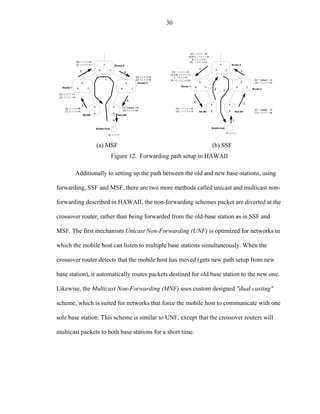
and maintain the routing information during handoff based on forwarding are two: The

first method Multiple Stream Forwarding (MSF) uses the standard IP routing

infrastructure in order to divert packets from the old base station to the new base station.

This method can transmit multiple out-of-order streams to the mobile host, and can be

subject to transient routing loops. As shown in Figure 12a, the first message corresponds

to the old base-station and updating of the route to the mobile host. After this step is

taken, the old base-station notifies the interface at A, about the mobile host’s new

interface and propagates the updates until all the intermediate routers have updated the

information for new interface used to forward de packets to the mobile host.

        The second technique using forwarding is called Single Stream Forwarding

(SSF): This scheme uses interface-based forwarding, a modification to the IP routers that

allows packets sent to the old base station to be diverted to the new base station in a

single stream. While SSF performs slightly better than MSF, this slight gain comes at the

expense of complex implementation. Figure 12b depicts the SSF mechanism, where the

first update is made at the new BS level, which starts propagating the changes throughout

the network until the old base-station gets notifies about the movement of the mobile

host.
30


                                                                                                                           (0):*, 1.1.1.1 ->B
                                                                                                                         (3):A,C, 1.1.1.1 -> B
                                                                                                                             B, 1.1.1.1->C
                    (0): 1.1.1.1->B                                                                                       (6) : *, 1.1.1.1->C
                    (3): 1.1.1.1->C             A          Router 0                                                                                      A               Router 0
                                                                                                                                     4
                        3                   B         C                                                                                              B           C                 3
                                                                       4                                (0):*, 1.1.1.1 ->C
                                                                                                      (4):A,B, 1.1.1.1 -> C
                                                                                   (0): 1.1.1.1->A        C, 1.1.1.1->A
                                                 1                                 (4): 1.1.1.1->B    (5) : C, 1.1.1.1->CA                                                                       (0):*, Default ->A
                            A                                          A             Router 2                                        A                                             A             (2):*, 1.1.1.1 -> B
                                                                                                                 Router 1        B        C                                    B           C
    Router 1        B           C                                  B           C                                                                     6                                         Router 2
                                                                                                                                                             7
 (0): 1.1.1.1 ->C
 (2): 1.1.1.1 ->A
                                                                           5
                                                                                                                                 5
                                                                                                                                                 A                   A                 2
                            2
                                      A                   A        (0): Default ->A
      (0): 1.1.1.1->B                                                                                      (0):*, 1.1.1.1 ->B
                                                                    (4): 1.1.1.1->B                                                                                                              (0):*, Default ->A
      (1): 1.1.1.1->A                                                                                      (5):*, 1.1.1.1 -> A       Old BS      B                   B        New BS
                                      B                   B                                                                                                                                      (1):*, 1.1.1.1 -> B
                            Old BS                            New BS

                                                          6                                                                                                               1


                                          Mobile Host                                                                                            Mobile Host

                                                                                                                                                                 IP: 1.1.1.1
                                                     IP: 1.1.1.1


                                          (a) MSF                                                                                                (b) SSF
                                                        Figure 12. Forwarding path setup in HAWAII

                Additionally to setting up the path between the old and new base-stations, using

forwarding, SSF and MSF, there are two more methods called unicast and multicast non-

forwarding described in HAWAII, the non-forwarding schemes packet are diverted at the

crossover router, rather than being forwarded from the old-base station as in SSF and

MSF. The first mechanism Unicast Non-Forwarding (UNF) is optimized for networks in

which the mobile host can listen to multiple base stations simultaneously. When the

crossover router detects that the mobile host has moved (gets new path setup from new

base station), it automatically routes packets destined for old base station to the new one.

Likewise, the Multicast Non-Forwarding (MNF) uses custom designed "dual-casting"

scheme, which is suited for networks that force the mobile host to communicate with one

sole base station. This scheme is similar to UNF, except that the crossover routers will

multicast packets to both base stations for a short time.
31


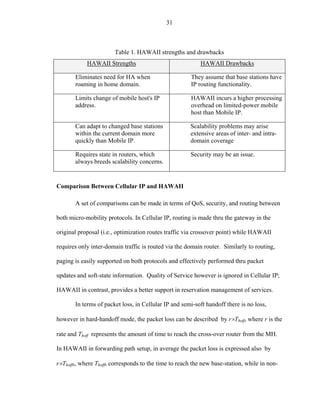
                       Table 1. HAWAII strengths and drawbacks
            HAWAII Strengths                               HAWAII Drawbacks

       Eliminates need for HA when                     They assume that base stations have
       roaming in home domain.                         IP routing functionality.

       Limits change of mobile host's IP               HAWAII incurs a higher processing
       address.                                        overhead on limited-power mobile
                                                       host than Mobile IP.

       Can adapt to changed base stations              Scalability problems may arise
       within the current domain more                  extensive areas of inter- and intra-
       quickly than Mobile IP.                         domain coverage

       Requires state in routers, which                Security may be an issue.
       always breeds scalability concerns.


Comparison Between Cellular IP and HAWAII

       A set of comparisons can be made in terms of QoS, security, and routing between

both micro-mobility protocols. In Cellular IP, routing is made thru the gateway in the

original proposal (i.e., optimization routes traffic via crossover point) while HAWAII

requires only inter-domain traffic is routed via the domain router. Similarly to routing,

paging is easily supported on both protocols and effectively performed thru packet

updates and soft-state information. Quality of Service however is ignored in Cellular IP;

HAWAII in contrast, provides a better support in reservation management of services.

       In terms of packet loss, in Cellular IP and semi-soft handoff there is no loss,

however in hard-handoff mode, the packet loss can be described by r×Thoff, where r is the

rate and Thoff represents the amount of time to reach the cross-over router from the MH.

In HAWAII in forwarding path setup, in average the packet loss is expressed also by

r×Thoffb, where Thoffb corresponds to the time to reach the new base-station, while in non-
32

forwarding mode corresponds to the same value as in Cellular IP or the time to reach the

cross-over router.

       In terms of latency, semi- and hard-handoff provide an average delay of 2Tg, or

the time to reach the gateway, while in HAWAII in average 2Thoffb

                              Geographical-Based routing

       Applications based on Geographical Position Systems (GPS) and Geographical

Information Systems (GIS) are heavily used by civil engineers. The same tools and

concepts can be also reused for location tracking of mobile nodes.

       Location Aided routing (LAR) [Ko98] assumes that GPS information is available

during routing in ad-hoc networks, additionally the use of GPS and Mobile IP [Erge02]

have shown improvements during handoff and registration. Other existing protocols such

as GeoCast [Nav97] use similar mechanisms for positioning and geographical addressing

during data delivery.

       GPS systems are expensive and consume battery power which might also be

required for the network card in a mobile unit. Indirect location determination has also de

determined through the measurement of signal strength and signal-to-noise ratio. The

RADAR project, research conducted at Microsoft Research by Bahl, et al. [Bahl00a,

Bahl00b], is an effort to provide location tracking and management for Wireless

Networks based on IEEE 802.11x using the signal strength level. This research initiative

is an example of how physical media information can be used to determine positioning

information of a mobile unit within an office environment. The location information is

calculated based on triangulation of the signal strength and IEEE 802.11 context

information.
33

       Many tracking systems use geographical information to page mobile users and

allocate resources in advance which in general improves the quality of service offered in

the wireless environment. RADAR uses signal strength information gathered at multiple

receiver locations to triangulate the user’s coordinates. In the RADAR system,

information regarding signal strength is gathered as a function of the user’s location.

       The input parameters used in the RADAR project correspond to the Signal

Strength (SS) in dBm which is given by the relationship 10 log10 ( s / 0.001) where s is

given in Watts. In addition, the Signal-to-Noise Ratio (SNR) is calculated thru the

formula 10 log10 ( s / n) in dBm that is merged with the signal strength value to create a

database of SNR and SS values as a function of the user’s location.

       Theoretical estimation of the distance between the transmitter and receiver can be

made by the path-loss equations proposed by Rappaport [Rapp02] using different

propagation models. As shown in Figure 13, the signal is transmitted by the base-station

node, the media or the geographical conditions produces certain attenuation and the noise

levels at the mobile node’s location is added to generate the current r(t) or received

measured signal strength.

       Mobile protocols targeted for rapidly moving vehicles can receive a great benefit

from geographical information direct or indirect measures. Henceforth, Chapter 5 and 6

will describe the determination of position and the implementation of the adaptive

protocol.
34


                                                                              r(t)
                                     x(t)
                                              Attenuation Model


                    RF transmitter                                     n(t)


                                     Figure 13. Signal propagation mode

                                            Speed and Rapid Mobility

         Speed has been researched mostly as part of ad-hoc networks and handoff rate is

usually related to infrastructure-based protocols. Speed could have a negative effect on

mobility, especially the performance of ad-hoc routing protocols. Holland, et al. [Holl99]

simulated several ad-hoc scenarios and showed that the average throughput decreases at

higher speeds. The results corresponded to a simulation performed in ns network

simulator [Fall00] focusing only on the performance of ad-hoc networks. The same

effects on throughput due to speed were measured by Gerla [Gerl99], while

experimenting with tree multicast strategies in ad-hoc networks at speeds up to 100

km/hr.

         Fladenmuller [Flad99] analyzed the effect of Mobile IP handoffs on the TCP

protocol. The issues addressed in [Cace96a] involve handoff as a dual process taking

effect in the wired and wireless networks. Although, no quantitative considerations on the

speed of mobile nodes were presented, a conclusion was drawn in terms of the effect of

pico-cells and highly frequent handoff as the main factor to modify the TCP and Mobile

IP protocols. Similarly, Caceres [Cace96a, Cace96b] proposed fast-retransmissions as a

solution to solve the problems related to hand-off. Although his protocol improves the
35

performance of TCP, it does not assert the issue of speed and how the retransmission

timers could be modified or calculated.

       Additionally, Balakrishnan [Bala95, Bala96] studied the protocols: Snoop, I-TCP

(Indirect TCP), and SACK (Selective acknowledgments). These protocols alleviate the

problems of TCP in wireless links and improve the performance during handoff. The first

protocol, called Snoop, is a software agent located at each base station, which attempts to

use multicast addresses to hide the location of mobile nodes. The second protocol, I-TCP

separates the wired and wireless links into two for the wireless and wired environments.

SACK has shown improvements in recovering from multiple packet losses within a

single transmission window. The results showed that these protocols improve the

performance of TCP under high BER (Bit Error Rate) links, and consequently can avoid

unnecessary activation of the congestion control protocol [Jaco88] during handoff. Again

I-TCP and SACK did not address the speed factor directly.

                                  Predictable Mobility

       Several approaches are found in the literature regarding predictable trajectory.

Liang and Hass [Lia99] provide a predictive-distance based location management

algorithm for a vehicle moving across two cells. Instead of a random walk model or

group mobility, their model provides a more realistic Gaussian-Markov state machine

where current user location is predicted given previous values of location and velocity.

       Liu, et al. [Liu98] proposed a more complex predictive mechanism for mobility

management in W-ATM (Wireless Asynchronous Transfer Mode) networks. The

algorithm is based on a Kalman Filter and the commonly known Hierarchical Location

Prediction algorithm (HLP). The algorithm combines location updating with location

prediction for resource reservation and allocation in W-ATM networks. Similarly, Liu
36

used a Mobility Motion Prediction (MMP) algorithm with a pattern-matching using the

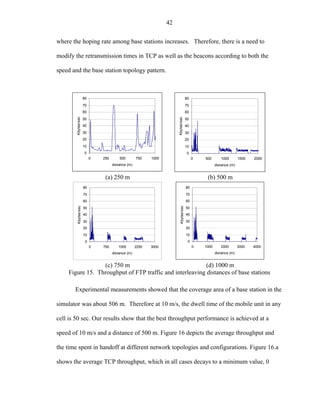
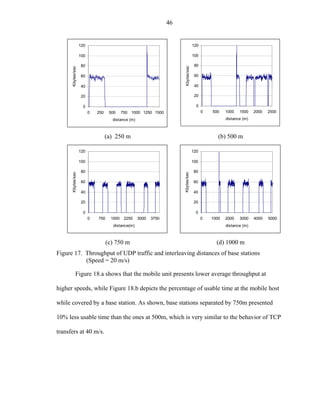
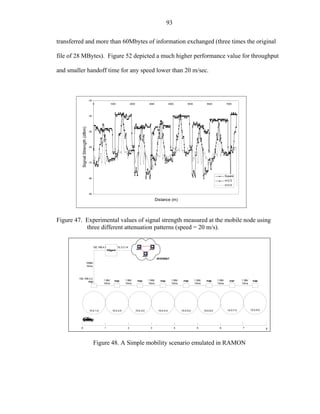
mobility patterns of the vehicles to estimate speed and improve handoff.

       Acampora and Naghshineh [Aca94] suggest the Virtual Connection Tree (VCT)

architecture to provide and allocate enough resources for mobile hosts in the network.

This approach is very similar to HAWAII and Cellular IP in the sense that mobility

trajectory is not known by the base-stations and many resources are allocated whether

used or not.

       Some other approaches to rapid mobility and predictable mobility include

dynamic programming and stochastic control [Reza95]. These approaches find the

optimal point while reducing the problem of handoff to a mobile node and two adjacent

cells. Their goal is to optimize the threshold of receive signal strength used for handoff

(based upon the mobility patterns and attenuation model)

       Levine [Levi95] proposes the concept of shadow cluster where the surrounding

cells to a mobile node become a shadowing cluster and packets are forward to the cluster

depending upon network and mobility conditions. However it is not clear how the

probability matrices and mobility patterns is fed up to the system of base-stations.

Levine’s proposal follows our proposal of ghost Mobile IP described in Chapter 6.

       Mobility prediction has also been a factor in Ad-hoc networks [Su00] where

predicting mobility based-upon GPS information shown improvement performance in

Distance Vector protocols.
37


                          CHAPTER 3
   PERFORMANCE OF MACRO- AND MICRO- MOBILITY PROTOCOLS IN A
                  RAPID MOBILE ENVIRONMENT


       The dissemination of mobile networks and the increasing demand for Internet

access in terrestrial vehicles makes commuter trains a suitable platform to provide

wireless access to the information superhighway. Internet applications such as browsing,

emailing, and audio/video streaming, currently common in wired networks, will be

demanded in this rapidly mobile environment. This translates to QoS requirements for

multimedia data from UDP- and TCP-based application sessions. Continuous

connectivity, responsiveness and steady throughput are among the important QoS

variables that have to be optimized throughout the train paths and trajectories. The first

sub-section presents the performance numbers of Mobile IP measured using the ns

network simulator [Hern01] and the CMU extensions for wireless networks [Mon98].

The second part of this chapter presents the experimental results for micro-mobility

protocols but using the IP-micro-mobility suite developed by Columbia University

[Valk99, Camb00] including performance values for Mobile IP, as well as Hierarchical

Foreign Agents and Celullar-IP. This chapter presents the simulative results made using

the ns using Mobile IP and the micro-mobility protocols.

                    Re-Examining the Mobile IP Performance in ns

       Mobile IP [Perk96, Solo98] is the proposed standard for IP mobility support by

the Internet Engineering Task Force (IETF). The standard defines three entities: mobile

node, home agent, and foreign agent. Each mobile node has a permanent IP address
38

assigned to a home network, also called home address. Once the mobile node decides to

move away from its home network, the new location of the mobile host is determined by

the care-of-address, which is a temporary IP address from the foreign network. In

addition to the addressing procedures, the standard proposes a mobility binding method

between the mobile node, the home and foreign agents. The way IP packets are routed

from the correspondent host towards the mobile unit is through tunneling of the packets

by the home agent to the care-of-address, bound by the mobile host. Once the packet

arrives to the destination, the foreign agent proceeds to remove the encapsulated

information and forwards it to the mobile node. This process is also called triangular

routing.

       This standard for mobility assumes relatively low speeds, which makes it very

suitable for macro-mobility and nomadic environments. However, high-speed commuter

trains move at speeds up to 288 Km/hr (0 to 80 m/s) which drastically reduces the

effectiveness of the Mobile IP protocol and diminishes the quality of its services.

       This section presents a performance analysis of Mobile IP under rapid mobility

conditions. We examine the effect of speed on throughput, delays, and packets drop rate

of UDP and TCP transfers. In our experiments, we manufacture speed as a product of two

factors: 1) the velocity of the mobile unit, and 2) the average (or fixed) interleaving

distance between base stations. We base our experiments on the IEEE 802.11 wireless

LAN technology [Ieee99a, Bing00], which represent the most appropriate MAC and

physical layers available today that can deliver high-speed services to commuter train

users (3G-NOW).
39


Simulation Experiments

       The results in this paper are based on simulation experiments performed within

the ns network simulator from Lawrence Berkeley National Laboratory (LBNL) [Fall00],

with extensions from the MONARCH project at Carnegie Mellon/Rice University

[Mona98]. We made use of the IEEE 802.11 MAC layer implementation as our physical

transport layer. The mobile host and base stations were configured with the standard

mobile node features defined by ns. The experiments were classified by traffic type: a)

UDP and b) TCP. For UDP, a back-to-back randomly generated 532 bytes packet was

sent at a constant rate of 0.8 Mb/sec to a destination in a wired network. While TCP

transfers consisted of an FTP session executed from the mobile node to the wired

network. The standard TCP implementation was used throughout the experiments. We

measured the performance in the opposite direction and the differences between both

experiments were minimal and only results of the former are presented in this paper.

       The network topology consisted of a set of base stations located at 250, 500, 750,

and 1000 meters away from each other, as depicted in Figure 14. The separation distance

between the base stations was considered an important experimental variable, provided

that at different speeds the mobile host will have different rendezvous periods with the

cell covered by a specific base station and that coverage area gaps might be present

throughout the train trajectory. In addition, infrastructure cost might be a factor that

requires certain spacing between base stations, and hence the importance of this variable.
40


                            INTERNET


                                            1              1

                                       1


                            1
         1        1                                                     gateway
                                                     Wired - nodes 5 Mb/2 ms


                                                                      5 Mb/2 ms


                                                     v           2 Mb / 10 ms           2 Mb / 10 ms


                                                                                                       Base Station N]
                                                                                                                    [
                                                         Home Agent         Base Station [1]


         Figure 14. Network topology for a train environment simulated with ns

       The architecture depicted in Figure 14 represents a realistic design that may be

used to cover a railroad track of a train. All foreign agents share a bus instead of a star

topology, which is unrealistic. The links between base stations are of 2 Mb/s and 10 ms

delay, the wired links are 5 Mb/s and 2 ms delay connections. All traffic is generated

from the mobile node to the farthest wired node show in the figure. We simulated one

mobile host moving from the origin (the home network) towards a destination following

a straight line, traversing a set of foreign nodes at a constant speed ranging from 0 to 80

m/s. It is not practical to simulate more than one mobile node, since internally in each

compartment a different LAN might coexist and the simulation only represents a mobile-

bridge or a router conducting the traffic from all the mobile stations inside the train cars.

       The main goal of this experimental study is to measure the effect of speed and the

interleaving of the base stations on the overall performance of the Mobile IP protocol.

The experiments, which were performed according to the topology presented in

       Figure 14, measured the network throughput at the destination node, overall

packet loss, and the overhead generated during handoff. The overhead of the registration
41

process or binding was measured as well at the mobile node, at different speed values. In

this paper, we present four experiments and their results:

       The first experiment measures the throughput of TCP transfers between the

mobile unit and a destination, at different mobile unit speeds and over a range of base

station interleaving distances

       Similarly, the second experiment measures throughput performance of UDP

packet transfers at a constant bit rate, also at different mobile unit speeds and over a

range of base station interleaving distances

       The third experiment quantifies and analyzes the packet loss error rate in TCP and

UDP transfers, under rapid mobility. Finally, the fourth experiment analyzes the delay

overhead and the effect of speed on the performance of the Mobile IP protocol and on the

cost-effectiveness of the wireless network topology design.


Throughput Performance for TCP Transmissions

       The effect of the interleaving distance of base stations can be observed in Figure

15. The figure depicts the TCP behavior at the destination node while the mobile node is

moving at a constant speed of 10 m/s. Figure 15.a represents a highly overlapped cell

configuration. As expected, handoff occurs constantly, which degrades throughput

performance. This represents a waste of resources since on the average; the throughput

remains the same as if the cells had interleaving distances of 500 or 750m. Figure 15.b,

c, and d describe similar experiments, where the base stations are separated by 500, 750,

and 1000 m, respectively. The forwarding delay is another factor that can be easily

confused with congestion delays. In fact, this behavior is observed at higher speeds,
42

where the hoping rate among base stations increases. Therefore, there is a need to

modify the retransmission times in TCP as well as the beacons according to both the

speed and the base station topology pattern.


                      80                                                              80
                      70                                                              70
                      60                                                              60
        Kbytes/sec


                                                                       Kbytes/sec
                      50                                                              50
                      40                                                              40
                      30                                                              30
                      20                                                              20
                      10                                                              10
                      0                                                               0
                           0   250       500        750    1000                            0   500       1000        1500   2000
                                     distance (m)                                                     distance (m)


                                (a) 250 m                                                       (b) 500 m
                      80                                                              80
                      70                                                              70
                      60                                                              60
                                                                         Kbytes/sec
         Kbytes/sec


                      50                                                              50
                      40                                                              40
                      30                                                              30
                      20                                                              20
                      10                                                              10
                       0                                                               0
                           0   750      1500        2250   3000                            0   1000      2000        3000   4000
                                     distance (m)                                                     distance (m)


                 (c) 750 m                                (d) 1000 m
    Figure 15. Throughput of FTP traffic and interleaving distances of base stations

       Experimental measurements showed that the coverage area of a base station in the

simulator was about 506 m. Therefore at 10 m/s, the dwell time of the mobile unit in any

cell is 50 sec. Our results show that the best throughput performance is achieved at a

speed of 10 m/s and a distance of 500 m. Figure 16 depicts the average throughput and

the time spent in handoff at different network topologies and configurations. Figure 16.a

shows the average TCP throughput, which in all cases decays to a minimum value, 0
43

Kbytes/sec, at a speed of 80 m/sec. Figure 16.b depicts the percentage of usable time at

the mobile host, or the time not in handoff. As shown, a distance of 750m between base

stations improves the usable time of the mobile host to transfer information at 40 m/s.

Additionally, highly overlapped cells with interleaving distances of 250 m, performs

much worse than interleaving cells at 500m, at speed of 20 m/s.

       The worst-case scenario was observed at 80 m/s where no transfers were

registered and the TCP throughput was almost zero. The main cause of error was

observed in the ARP packets being dropped (45%). A second cause of error that was

observed is packet loss at the queue interface (12%), since the packets can never be

routed from the mobile host to the destination network, and the remainder packets were

unable to find the proper route. At this speed, the mobile unit has traversed several cells

before it could reach a steady state. The registration time plus the round-trip time of the

link are such that the time spent in a cell ≈12 sec is not enough to reach the destination

host. In addition to the observed causes of errors, the transport protocol interprets the

increase in the round-trip time as congestion. The adaptation process is unaware that the

multi-hop topology increases the latency by hopping and due to registration and

forwarding delays after every handoff event.

       We conclude that the main bottleneck is the lack of awareness of the rapid

mobility environment on the part of the TCP and Mobile IP protocols. Mobile IP and its

inability to determine the proper location of the mobile unit limits the performance of the

communication links at high speeds. We will show the effect of the forwarding delay in

the next experiment by substituting UDP traffic for the TCP source used in this

experiment.
44

                                Figure 16.b. shows that at a speed of 40 m/s the usable time is the same for cells

interleaved at 750m and 250m. In other words, a configuration of 20 base stations and

750m of cell interleaving distance will have the same effect of a configuration of 60 base

stations separated by 250m. This observation can be used to reduce installation cost of

the wireless infrastructure, assuming that the mobile unit travels at a constant speed of 40

m/s.

                               60                                                                        100%
                                                                                                          90%
                               50                                                                         80%
       Throughput (Kbytes/s)


                                                                                     Time transmitting
                                                                                                         70%
                               40                                      250 m                                                                     250 m
                                                                                                         60%
                                                                       500 m                                                                     500 m
                               30                                                                        50%
                                                                       750 m                                                                     750 m
                                                                                                         40%
                               20                                      1000 m                            30%                                     1000 m
                                                                                                         20%
                               10
                                                                                                         10%
                               0                                                                          0%
                                    0    20   40       60   80   100                                            0   20       40        60   80
                                              Speed (m/s)                                                                Speed (m/s)


                                        (a) Average throughput
                                               (b) Percentage of usable time (not in
                                                             handoff)
Figure 16. Throughput behavior at different speeds and base station separation distances
           with FTP traffic

Throughput Performance for UDP Transmissions

                                Similar to the experiments performed using TCP traffic, several applications

require UDP to establish voice or video transfers. We used a CBR input at random

intervals with an average of 200 packets/sec and a packet size of 512 bytes. Figure 17

shows the throughput at a speed of 20 m/s with highly overlapped cells, or 250 m of

interleaving distances between two base stations and the non-overlapping cells at

distances of 1000 m.

                                Contrary to TCP, the UDP protocol allows us to determine the forwarding delay

and how the Mobile IP affects the performance of mobile computing at high speeds.
45

        Figure 17 depicts the throughput at the mobile host, which shows that when it

reaches the farthest base station, the average throughput remains almost unchanged, and

only the handoff time is affected. This differs from the behavior presented by the TCP

protocol in the same figure. In addition, UDP presented a much higher packet loss

ranging from 8 to 64%. Being a connection-less protocol, UDP shows no evidence of

throughput degradation, and it consistently converged to a constant throughput value, for

the same speed and different cell interleaving distances.

        Furthermore, Figure 17.a shows that there are at least 3 base stations with no use

during the registration process and first handoff period. The horizontal axis indicates the

distance in meters, and the points presented denote the location of each base station. It is

shown that at any cell interleaving distance the percentage of use of the cell is a little bit

more than 50%, in other words, half of the cell is not used properly and this is mainly due

the forwarding delay of the Mobile IP protocol. For example in Figure 17d, a base

station located at a distance of 2000m results in UDP transfer to start at 1900 m instead of

1500 m. The covered area is wasted on no less than 40%. This phenomenon

acknowledges the fact that the home agent's lack of awareness of the base station

interleaving pattern and speed of the mobile hosts could be costly in terms of delays and

installation costs.
46


                   120                                                               120

                   100                                                               100

                   80                                                                 80


                                                                        Kbytes/sec
      Kbytes/sec   60                                                                 60

                   40                                                                 40

                   20                                                                 20

                    0                                                                  0
                         0   250    500     750 1000 1250 1500                             0   500    1000   1500    2000   2500
                                     distance (m)                                                     distance (m)


                                   (a) 250 m                                                      (b) 500 m

                   120                                                               120

                   100                                                               100

                   80                                                                80
      Kbytes/sec


                                                                       Kbytes/sec
                   60                                                                60

                   40                                                                40

                   20                                                                20

                    0                                                                 0
                         0   750     1500    2250   3000   3750                            0   1000   2000   3000    4000   5000
                                      distance(m)                                                     distance (m)


                                   (c) 750 m                                                     (d) 1000 m
Figure 17. Throughput of UDP traffic and interleaving distances of base stations
           (Speed = 20 m/s)

             Figure 18.a shows that the mobile unit presents lower average throughput at

higher speeds, while Figure 18.b depicts the percentage of usable time at the mobile host

while covered by a base station. As shown, base stations separated by 750m presented

10% less usable time than the ones at 500m, which is very similar to the behavior of TCP

transfers at 40 m/s.
47


                         60                                                                           100%
                                                                                                       90%
                         50                                                                            80%


 Throughput (Kbytes/s)


                                                                                  Time transmitting
                                                                                                      70%
                         40                                         250 m                                                                      250 m
                                                                                                      60%
                                                                    500 m                                                                      500 m
                         30                                                                           50%
                                                                    750 m                                                                      750 m
                                                                                                      40%
                         20                                         1000 m                            30%                                      1000 m
                                                                                                      20%
                         10
                                                                                                      10%
                         0                                                                             0%
                              0      20   40        60   80   100                                            0   20   40      60    80   100

                                           Speed (m/s)                                                                Speed (m/s)


                                     (a) Average throughput
                                                  (b) Percentage of usable time (not in
                                                                handoff )
Figure 18. Throughput behavior at different speeds and base station interleaving using
           UDP traffic

Packet Loss Errors

                                  Packets are continuously dropped during handoff, and sporadically dropped

during data transfers performed through the wireless media. Figure 19 illustrates the

packet loss in TCP and UDP transmissions. It is expected that for TCP the packet loss is

lower than UDP since the former is a connection-oriented protocol. As shown, packet

loss for TCP at 80 m/s was almost 0% since the throughput was zero as well. The

percentage of packets dropped during the UDP session ranged from 0 to 60%. As shown,

the error is reduced to 20-30% at 80 m/s, which might be a consequence of the reduction

in the amount of packets transferred during 20% of usable time, and not 40% as in the 40

m/s case (Figure 18.b.).
48


                   60%                                                                        60%

                   50%                                                                        50%
 Packets dropped


                                                                            Packets dropped
                   40%                                                                        40%
                                                               250 m                                                                 250 m
                                                               500 m                                                                 500 m
                   30%                                                                        30%
                                                               750 m                                                                 750 m
                                                                                                                                     1000 m
                                                               1000 m
                   20%                                                                        20%

                   10%                                                                        10%

                   0%                                                                         0%
                         0        20       40        60   80                                        0   20       40        60   80
                                       Speed (m/s)                                                           Speed (m/s)


                                (a) TCP/FTP transfers                                                   (b) UDP Transfers
                               Figure 19. Percentage of packets dropped using UDP and TCP traffic


Speed and Handoff Overhead

                             The speed of a mobile unit and the forwarding delay from the home agent

determines how the cell interleaving can be reduced. Empirically, a methodology to

establish metrics for locating the base stations can be established. Figure 20 presents a

mobile host moving at a constant speeds ranging from 1 to 80 m/s while involved in UDP

transfers. Many cells are not active during the communication and handoff at higher

speeds, therefore, the proper setting for positioning the cells is very important. The

designer could use knowledge of the expected speed to reduce base station installation

cost or to power off cells at high speeds, and consequently reduce power consumption.

                             The measurements presented in this section correspond to the UDP traffic used

for section 4.2. As shown in Table 1, the registration time takes from 37 to 47s. This

time translated to distance is shown in Figure 20. At lower speeds, less than 10 m/s (36

km/hr), this is not a problem and registration occurs in the adjacent cell. However, at

higher speeds, greater than 20 m/s, there are a number of cells traversed by the mobile

unit that are not being used during the registration process. This observation also matches
49

many cells that are “not seen” by the mobile-unit and this number depends upon the

speed and mobility pattern of the train. In fact, if the cell size and the speed values range

between, 20 and 80 m/s, the registration occurs at the 3rd, 4th, and 10th cells, respectively.

For example, in Figure 20.f, the registration process occurs at 4000 m from the home

agent, or the 10th cell. Therefore the spacing between cells and the awareness of the

Mobile IP protocol to execute this routing is required for both the TCP and the UDP

protocols.

                              Speed = 1 m/s                                                Speed = 5 m/s                                            Speed = 10 m/s

                  120                                                      120                                                          120

                  100                                                      100                                                          100

                   80                                                       80                                                           80


                                                                                                                             Kbytes/s
                                                               Kbytes/s
      Kbytes/s


                   60                                                       60                                                           60

                   40                                                       40                                                           40

                   20                                                       20                                                           20

                    0                                                        0                                                            0
                        0   500   1000   1500    2000   2500                     0   500       1000   1500     2000   2500                    0   500   1000     1500    2000    2500
                                  distance (m)                                                 distance (m)                                              distance (m)


                            (a)                                                      (b)                                                          (c)

                              speed = 20 m/s                                               Speed = 40 m/s                                           Speed = 80 m/s

                  120                                                      120                                                          120

                  100                                                      100                                                          100

                   80                                                       80                                                           80
                                                                                                                             Kbytes/s
                                                                Kbytes/s
       Kbytes/s


                   60                                                       60                                                           60

                   40                                                       40                                                           40

                   20                                                       20                                                           20

                    0                                                        0                                                            0
                        0   500   1000   1500    2000   2500                     0   500    1000   1500 2000   2500   3000                    0   500   1000   1500     2000    2500
                                  distance (m)                                                 distance (m)                                             distance (m)


                            (d)                                                      (e)                                                          (f)

Figure 20. Registration delay and the effect of speed with cell interleaving of 500m.
           (UDP traffic)

            Table 2 also shows the forwarding delay at the cell where the first rendezvous

occurs between the mobile unit and the base station. At a speed of 80 m/s, the forwarding

delay corresponds to 248 ms. This value of forwarding delay increases when all the

foreign agents are in a multi-hop network. Under the assumptions presented in

            Figure 14, the delay increase is a consequence of the forwarding process, which

affects the topology throughout the trajectory of the train.
50

   Table 2. Important indicators during Mobile IP handoffs and re-registration process
                            (interleaving distances of 500m.)
                                                                   Speed
             Factor
                                       1 m/s      5 m/s        10 m/s      20 m/s    40 m/s    80 m/s
     Time required for first handoff
                        registration    45 sec        41 sec    45 sec      44 sec    36 sec    47 sec
             Minimum handoff time        7 sec         5 sec     1 sec       1 sec     1 sec     3 sec
                          Minimum
                  Forwarding delay      22 ms         28 ms     40 ms       60 ms     98 ms    248 ms
    Distance from the home agent to
                achieve registration    298 m         459 m     705 m      1138 m    1703 m    4460 m


Observations

       The Mobile IP protocol requires awareness of infrastructure configuration as well

as mobile unit speed in order to function properly. Registration and triangular routing

generate a large overhead, which affects the communication process at speeds greater

than 20 m/s (72 Km/hr). The design of the wireless infrastructure requires a-priori

knowledge of the protocols used as well as speed characteristics of the mobile hosts.

Cells can be interleaved at different distances and configurations depending on the speed

and mobility behavior of the mobile units. We observed that providing full wireless

coverage is unnecessary and a waste of resources. The positioning of cells depends upon

the train trajectory and speed. At speed of 40 m/s the location of cells at 250 m or 750 m

produced the same effect in throughput and the percentage of usable time within a cell.

Therefore cost of the wireless infrastructure can be optimized or the topology adapted

such that cells can be turned off when not required.

       In fact, a wireless, adaptive topology of cells would be ideal to use in this case of

a commuter train that moves at different speeds. Maximum cells (or cell interleaving) can

be used at low speed (entering or departing a station). Less number of cells can be used at
51

medium speeds (going through construction and semaphore zones). Finally, minimum

cells can be used at high speed (inter-city crossing).

       Mobile networking protocols, such as Mobile IP, are not designed to handle high-

speed gracefully. Such protocols produce considerable overhead and high forwarding

delay. We found out that protocols based on registration and non-aware packet re-routing

are not appropriate for speeds higher than 20 m/s.

Re-Examining the Performance of Mobility Protocols using the Columbia Ns-based
                                   Micro-Mobility Suite

       The previous subsection presented the experiments and simulations of the Mobile

IP protocol with no optimizations and including the two-ray ground attenuation model for

the entire simulation. Although both scenarios were modeled with ns, the micro-

mobility suite from Columbia assumed the following:

           •   A simple-distance propagation model replaced the two-ray ground model.
               This model allows the base-station to provide connectivity to a certain
               node when its location is within a range and zero connectivity when
               outside. The two-ray ground model used in the previous results was
               overridden. [Widm00]

           •   Base-upon the simplified propagation model, a new handoff algorithm was
               created by characterizing the distance where the mobile node is located
               with respect to the base-station, with the denominations of: near range, far
               range, and unreachable A mobile node will handoff according to a set of
               preference rules depending on the distance of the mobile host and a series
               of priorities in the base-stations. [Widm00]

       Since new simulative conditions and assumptions are made in the micro-mobility

suite, the Mobile IP simulation was reran and reexamined under the new conditions.

Hence, the same experiments simulated in the previous subsection, including the

performance on throughput and latency for UDP and TCP traces were measured again.
52

       Campbell, et al. [Camp00, Camp01] used a version of ns that included the

assumptions presented above and measured the performance of micro-mobility protocols

for the network topology shown in Figure 21. Although the results presented by

Campbell showed a great improvement on the performance of the protocols: HFA

[Perk96c], Cellular IP [Valk98], and Hawaii [Ramj99]. This chapter reexamines those

results and studies the effects of speed in micro-mobility protocols.

                                   C-host                    W(0)
                                   0.6.0                     0.0.0


                                                W(1)                         W(2)
                                                0.1.0                        0.2.0


                                        W(3)                 W4)                     W(5)
                                        0.3.0                0.4.0                   0.5.0


               Mobile Host 0.7.1


                               BS(1)               BS(2)             BS(3)              BS(4)
                               1.0.0               2.0.0             3.0.0              4.00


       Figure 21. Infrastructure used for simulations on HAWAII, HFA, and Cellular IP

       As shown in Figure 21 a set of intermediate nodes are required in HFA to

minimize the number of updates made to the root node or the Home Agent. Even though

a hierarchy improves the performance during handoff, also increases the number of

intermediate nodes. This increment on the number of resources involves a significant

raise in the cost of the network infrastructure and the number of intermediate nodes on

the network. In order to maintain a consistent experiment with the train scenario as in

Hernandez, et al. [Her01], the architecture on Figure 14 (also Figure 22) was used for the
53

micro-mobility experiments. In this architecture, all the foreign agents shared the same

bus with the latency increasing by 10ms at each hop. .

                                C-host                    W(0)
                                0.2.0                     0.0.0


                                                          W(1)
                                                          0.1.0


                                      10ms   20ms     30ms                100ms


          Mobile Host 1.0.1


                              BS(1)          BS(2)                BS(3)           BS(10)
                              1.0.0          2.0.0                3.0.0           10.0.0

Figure 22. Train mobility scenario tested with HAWAII, Mobile IP, HFA and Cellular IP

       Again, the TCP and UDP performance was measured at the mobile host level

while moving at speeds ranging from 10 to 80 m/s. The results presented in the

subsequent subsections correspond to performance measurements for TCP throughput

using FTP transfers from the mobile to the correspondent host. In addition, we created a

Constant Bit Rate (CBR) flux with UDP packets from the correspondent to the mobile

host at the same rates and values used during the simulation of original Mobile IP without

the micro-mobility suite.

Throughout Performance for TCP-traffic

       We encounter several difficulties during the simulation experiments, especially if

the proper Paging and Routing Caches (PMC and RMC) are not properly set during the

UDP experiments. In fact, the micro-mobility suite provided a much higher throughput
54

value for UDP in the Mobile IP plot as shown in Figure 29. UDP performance was not

investigated by Campbell et al. but those results are presented in this subsection.

       Additionally, all Cellular IP simulations were ran using “semi-soft” handoff, while

the size of the handoff buffer was kept the default value assumed to be 1, although this

parameter is not shown in the simulation code but in the documentation provided by

Columbia [Valk98].

       The cell coverage was set to supply a 30 m overlap area and a separation of 500

m between base-stations, as shown in Figure 22, the link delay increments from 10ms to

k×10 ms at the kth base-station as in the model shown in Figure 14.

       Figure 23 depicts the throughput of TCP transfers measured at the mobile unit. As

expected, the connectivity diminishes as the speed of the mobile host increases.

Although, Figure 23.a and Figure 15.b are the same experiment, the micro-mobility suite

provides a better performance given the simplicity of the model used and the

improvements in the handoff algorithm based upon the simple propagation model.

       In fact, connectivity is observed even at 80 m/s when no observations were

captured using a more complex propagation model and without the improved handoff

algorithm based on GPS (Global Positioning System) information available at the mobile

node; however, it’s not clear the mechanism used by Widmer [Wid00] in the creation of

the NOAH (Non Ad-Hoc routing agent)
55


                 30                                                                 30

                 25                                                                 25

                 20                                                                 20


    Kbytes/sec


                                                                       Kbytes/sec
                 15                                                                 15

                 10                                                                 10

                  5                                                                 5

                  0                                                                 0
                      0     500         1000        1500   2000                          0   500         1000        1500   2000
                                     distance (m)                                                     distance (m)


                                  (a) 10 m/s                                                       (b) 20 m/s
                 30                                                                 30

                 25                                                                 25

                 20                                                                 20
    Kbytes/sec


                                                                       Kbytes/sec
                 15                                                                 15

                 10                                                                 10

                 5                                                                  5

                 0                                                                  0
                      0     500         1000        1500   2000                          0   500         1000        1500   2000
                                     distance (m)                                                     distance (m)


                                  (c) 40 m/s                                                       (d) 80 m/s
                 Figure 23. Throughput of Mobile IP with no optimizations and FTP transfers

                      Therefore the improvement observed when using the micro-mobility suite is

greatly affected by the use of the NOAH agent during the simulations. As shown in the

figures, the performance of Mobile IP diminishes at higher rates of handoff and speeds.

Similarly, Figure 24 shows the performance of Hierarchical Foreign Agents (HFA)

performed as good as the simulated Mobile IP implementation [Hern01]. The hierarchy is

not exploited and the results shown here for HFA represent the worst-case scenario of an

unbalanced tree. The limited regionalization of the location updates reflects only when

the wired network provides a well balanced tree. Even though, this is the worst case

scenario for a hierarchical structure, Figure 24 depicts a better performance at speeds

greater than 40 m/s, which indicates that regionalization and location directory

distribution are key factors on the improvement of Mobile IP.

.
56


                 30                                                                 30

                 25                                                                 25

                 20                                                                 20


    Kbytes/sec


                                                                       Kbytes/sec
                 15                                                                 15

                 10                                                                 10

                 5                                                                   5

                 0                                                                   0
                      0     500         1000        1500   2000                          0   500         1000        1500   2000
                                     distance (m)                                                     distance (m)


                                  (a) 10 m/s                                                       (b) 20 m/s
                 30                                                                 30

                 25                                                                 25

                 20                                                                 20
    Kbytes/sec


                                                                       Kbytes/sec
                 15                                                                 15

                 10                                                                 10

                  5                                                                 5

                  0                                                                 0
                      0     500         1000        1500   2000                          0   500         1000        1500   2000
                                     distance (m)                                                     distance (m)


                                  (c) 40 m/s                                                       (d) 80 m/s
                      Figure 24. Throughput performance at different speeds with HFA.


                      Furthermore, the TCP performance of micro-mobility protocols as Cellular IP and

HAWAII are depicted in the Figure 25 and Figure 26. As observed in the figures, more

than 95% of the vehicle trajectory is covered with both micro-mobility protocols. There

are a few blank spots where the mobile host has no connectivity.

                      Cellular IP shows the best improvement on the performance of TCP applications

at high speed. As depicted in Figure 27, sequence numbers grow faster than any other

protocol simulated. The sequence number plot provides the view of how the TCP stack

adapts to the mobility conditions using semi-soft handoffs in Cellular IP (which confirms

the results published in the literature).
57


              60                                                                                         60

              50                                                                                         50

              40                                                                                         40
 Kbytes/sec


                                                                                          Kbytes/sec
              30                                                                                         30

              20                                                                                         20

              10                                                                                         10

              0                                                                                                 0
                        0            500            1000             1500          2000                             0             500              1000            1500          2000
                                               distance (m)                                                                                  distance (m)


                                           (a) 10 m/sec                                                                                 (b) 20 m/s
              60                                                                                         60

              50                                                                                         50

              40                                                                                         40
 Kbytes/sec


                                                                                          Kbytes/sec
              30                                                                                         30

              20                                                                                         20

              10                                                                                         10

              0                                                                                                 0
                        0            500            1000             1500          2000                             0             500              1000            1500          2000
                                               distance (m)                                                                                  distance (m)


                                            (c) 40 m/s                                                                                  (d) 80 m/s
Figure 25. Performance of FTP file transfers at different speeds at the mobile host with
           Cellular IP
                            30                                                                    30

                            25                                                                    25
                            20
               Kbytes/sec


                                                                                                  20
                            15
                                                                                                  15
                            10
                                                                                                  10
                            5
                                                                                                       5
                            0
                                 0    500         1000        1500          2000                       0
                                               distance (m)                                                     0           500           1000              1500          2000


                                            (a) 10 m/s                                                                              (b) 20 m/s
                            30                                                                                  30

                            25                                                                                  25

                            20                                                                                  20
                                                                                                   Kbytes/sec
               Kbytes/sec


                            15                                                                                  15

                            10                                                                                  10

                             5                                                                                      5

                             0                                                                                      0
                                 0    500         1000        1500          2000                                        0     500           1000            1500          2000
                                               distance (m)                                                                              distance (m)


                                            (c) 40 m/s                                                                              (d) 80 m/s
                            Figure 26. Throughput at different speeds at the mobile host using HAWAII
58


                                     (a) 10 m/s                                                                (b) 20 m/s


                                     (c) 40 m/s                                                                (d) 80 m/s
                    Figure 27. TCP sequence numbers at different speeds and mobility protocols


                        In addition to the sequence numbers, the average throughput and percentage of

usable time for an FTP session, were also measured. (Figure 28)

               12
                                                                                        100%
               10
                                                                                        80%
               8                                           Cellular-IP                                                            Cellular-IP
  Kbytes/sec


                                                                              %Usable


                                                           Mobile-IP                    60%                                       Mobile-IP
               6
                                                           HFA                                                                    HFA
               4                                                                        40%
                                                           Hawaii                                                                 Hawaii

               2                                                                        20%

               0                                                                         0%
                    0      20   40      60      80   100                                       0   20   40      60     80   100
                                Speed (m/s)                                                             Speed (m/s)


                                              (a)                                                                     (b)

Figure 28. Comparison of average throughput and % of usable time using TCP
           transmissions
59

       As depicted in the pictures, Cellular IP and HAWAII provide a better connectivity

with almost 100% of usable time, while Mobile IP depicted the worst behavior at 80 m/s.

The performance at 40 m/s averaged the other micro-mobility protocols, which was not

expected. Campbell [Camp02] showed a similar behavior for the micro-mobility

protocols where Hawaii and Cellular IP barely diminishes the throughput at 20

handoff/min.

       In Broch [Broc98] and Holland [Holl99] an increase on the average speed of

mobile units results in a much higher reduction of the performance and the average

throughput. In fact, Fladenmuller [Flad99] registered handoff times of at least 2 seconds

on a testbed using WaveLAN cards at 3Mbps. Similar results were explored by [Vat98]

and the effect of DHCP servers and clients in co-located care-of-addresses. Both papers

were consistent with the simulation done with ns and the initial settings used by

Hernandez [Hern01]

       Therefore the results shown here with Mobile IP indicate an inconsistency

between implementation for the simulation packages as well as for simulation

assumptions. For instance, Figure 28 shows the percentage of usable time at 40 m/s

shows that 80% of the time Mobile IP provides connectivity, whereas in Figure 16 only a

10% was observed.

       The incongruence in the results lead us to conclude that a minor modification on

handoff protocols and simplification of simulative assumptions causes great

improvements on the performance and misleading results. The assumptions made during

the simulations presented by Campbell, et al, [Camp02] and the use of the NOAH agent

augmented the performance numbers.
60


Throughput performance of UDP transmissions

                         Similar experimentation scenarios were conducted with the UDP protocol using a

Constant Bit Rate flow. However, the results for throughput on UDP transmissions were

not measured in [Camp02]. As shown in the Figure 29, Figure 30, Figure 31 and Figure

32, the micro-mobility protocols provide a minor improvement in the performance of

UDP transmissions on Mobile IP

               100                                                                     100
                90                                                                      90
                80                                                                      80
                70                                                                      70
  Kbytes/sec


                                                                          Kbytes/sec
                60                                                                      60
                50                                                                      50
                40                                                                      40
                30                                                                      30
                20                                                                      20
                10                                                                      10
                 0                                                                       0
                     0         500         1000        1500   2000                           0   500         1000        1500   2000
                                        distance (m)                                                      distance (m)


                                     (a) 10 m/s                                                        (b) 20 m/s
               100                                                                     100
                90                                                                      90
                80                                                                      80
                70                                                                      70
  Kbytes/sec


                                                                          Kbytes/sec


                60                                                                      60
                50                                                                      50
                40                                                                      40
                30                                                                      30
                20                                                                      20
                10                                                                      10
                 0                                                                       0
                     0         500         1000        1500   2000                           0   500         1000        1500   2000
                                        distance (m)                                                      distance (m)


                                     (c) 40 m/s                                                        (d) 80 m/s
                                     Figure 29. Throughput of UDP transfers using Mobile IP


                         In fact, at speeds raging from 10 to 40 m/sec, HAWAII, HFA, and Mobile IP

depict very similar performance values of throughput and usable time.
61


                 60                                                                  60

                 50                                                                  50

                 40                                                                  40


    Kbytes/sec


                                                                        Kbytes/sec
                 30                                                                  30

                 20                                                                  20

                 10                                                                  10

                 0                                                                    0
                      0      500         1000        1500   2000                          0   500         1000        1500   2000
                                      distance (m)                                                     distance (m)


                                   (a) 10 m/s                                                       (b) 20 m/s
                 80                                                                  60
                 70
                                                                                     50
                 60
                                                                                     40


                                                                        Kbytes/sec
    Kbytes/sec


                 50
                 40                                                                  30
                 30
                                                                                     20
                 20
                                                                                     10
                 10
                 0                                                                   0
                      0      500         1000        1500   2000                          0   500         1000        1500   2000
                                      distance (m)                                                     distance (m)


                                   (c) 40 m/s                                                       (d) 80 m/s
                                    Figure 30. Throughput of UDP transfers using HFA.


                      Figure 31 depicts a 100% utilization or no disruptions in the service where

observed using semi-soft handoffs. Although the difference is notorious the percentage of

usable time is better by only 3 to 5%.

                      The performance differences are summarized in Figure 33 for which the average

throughput value remains the same as the speed is increased and the percentage of usable

time is comparable the same for all the mobility protocols under study

                      This behavior was not observed in Figure 18 where the percentage of usable time

observed was of less than 30% at 80 m/sec for Mobile IP.
62


             60                                                                                              60

             50                                                                                              50

             40                                                                                              40
Kbytes/sec


                                                                                          Kbytes/sec
             30                                                                                              30

             20                                                                                              20

             10                                                                                              10

             0                                                                                               0
                      0             500            1000              1500          2000                           0     500              1000          1500          2000
                                              distance (m)                                                                          distancia (m)


                                           (a) 10 m/s                                                                         (b) 20 m/s
             60                                                                                              60

             50                                                                                              50

             40                                                                                              40
Kbytes/sec


                                                                                          Kbytes/sec
             30                                                                                              30

             20                                                                                              20

             10                                                                                              10

             0                                                                                               0
                      0             500            1000              1500          2000                           0     500              1000          1500          2000
                                              distancia (m)                                                                         distancia (m)


                                           (c) 40 m/s                                                                         (d) 80 m/s
                                    Figure 31. Throughput of UDP transmissions using Cellular IP
                           60                                                                                60

                           50                                                                                50

                           40                                                                                40
                                                                                              distance (m)
              Kbytes/ec


                           30                                                                                30

                           20                                                                                20

                           10                                                                                10

                           0                                                                                  0
                                0    500         1000         1500          2000                                  0   500         1000          1500          2000
                                              distance (m)                                                                     Kbytes/sec


                                           (a) 10 m/s                                                                       (b) 20 m/s
                           60                                                                                60

                           50                                                                                50

                           40                                                                                40
              Kbytes/sec


                                                                                              Kbytes/sec


                           30                                                                                30

                           20                                                                                20

                           10                                                                                10

                           0                                                                                  0
                                0    500         1000         1500          2000                                  0   500         1000          1500          2000
                                              distance (m)                                                                     distance (m)


                                           (C) 40 m/s                                                                       (d) 80 m/s
                                    Figure 32. Throughput of UDP transmissions using HAWAII
63


              60
                                                                                 100%
              50
                                                                                 80%
              40                                        Cellular-IP                                                       Cellular-IP
 Kbytes/sec


                                                                      % Usable
                                                        Mobile-IP                60%                                      Mobile-IP
              30
                                                        HFA                                                               HFA
              20                                                                 40%
                                                        Hawaii                                                            Hawaii

              10                                                                 20%

              0                                                                   0%
                   0      20   40      60    80   100                                   0   20   40      60    80   100
                               Speed (m/s)                                                       Speed (m/s)


                                       (a)                                                             (b)
                          Figure 33. Average UDP throughput and percentage of usable time

Percentage of error during the simulative experiments

                       Finally, another parameter measured during the simulations conducted was the

percentage of packets dropped or the error. As expected these values represent the

packets dropped due to UDP flows. There is a great different among the observed results

and the measured by Hernandez, et al. [Hern01]. Figure 19 shows an error value

fluctuating from 0 to 60% indicating also that the percentage of error increases for

Mobile IP with respect to the speed linearly. Improved mechanisms of buffering and

soft-handoff used by Cellular IP and HAWAII, reduced packet loss and indeed better

performance.

Observations

                       The simulation experiments conducted with the micro-mobility suite showed

inconsistencies with respect to the initial simulation of Mobile IP. The incongruence

result indicates that the implementation decisions made on the simulator as well as the

simulation assumptions used by the developer are not consistent and the results cannot be

fully trusted. For instance, Figure 28 shows the percentage of usable time at 40 m/s was
64

80% for Mobile IP, whereas in Figure 16 only a 10% observed, both simulations were

run using the same topology and physical conditions. We found that the main cause of

error is the utilization of the NOAH agent which augmented the performance numbers

and the results for Mobile IP by using an improved handoff mechanism and the

simplification of the propagation model.


                        18
                        16
                        14
                        12                                                      CIP
            Error (%)


                        10                                                      MIP
                         8                                                      Hawaii
                         6                                                      HFA
                         4
                         2
                         0
                             0     20       40      60       80      100
                                            Speed (m/s)


                        Figure 34. Percentage of packets dropped TCP/UDP combined

       Additionally, Figure 33 indicates a minor diminishment on performance of UDP

with respect to the speed of the vehicle. This fact contradicts other research efforts in

which the throughput value for UDP transfer decreases as speed increases [Broc98,

Holl99, and Hern01] for ad-hoc and infrastructure networks.

       Therefore, it is not clear whether or not the micro-mobility protocols performance

measured were outlined in a realistic scenario. This research has concentrated its effort

towards the creation of an emulation/simulation platform, in order to eradicate any

erroneous assumption or overestimation of the mobility protocols in 802.11b-based

networks.
65

       The emulation scenario permits the implementation of noble protocols based on

the predictability of speed and location of a mobile unit, In addition to improvements on

predictable handoff and movement mechanisms, and session transfer control with

network awareness can be placed into the TCP stack, by reusing the information found in

the physical layer.
CHAPTER 4
                  THE RAPID MOBILITY NETWORK EMULATOR


       We showed that the performance of mobility protocols greatly depends on

simulative assumptions made by the researcher, which in general affect the out coming

results of the experiments performed. The simplification of environmental parameters

reduces the simulation time as well as the implementation complexity. Realistic testing is

almost never conducted, and many simulation experiments are not replicable. In fact, the

lack of experimentation on real scenarios is a common factor in today’s research.

Pawlikowski, et al. [Paw02] determined that 76% of the authors in IEEE journals of

simulation-based papers were not concerned with the random nature of the results and

many other simulation studies were not replicable. Hence, the excessive use of simulation

tools opens the door for more realistic approaches using network emulation analysis and

experimentation which is easier to replicate.

       Emulation also brings several advantages over the simulation approach. Firstly,

applications at different network layers can be tested without special modifications on the

API of the target application by isolating the network and transport layers of the system

as an independent variable. Also, the implementation of network and lower-layer

protocols can be performed in the real scenario without first adjusting the implementation

to the constraints provided by the simulation environment. A very important advantage of

the emulation is found in the complexity of the algorithms and the computation time

required during simulation. For example, a Mobile IP simulation involving 1-mobile unit


                                            66
67

and 20 base-stations generates a 500 Mbytes trace file and more than 3 hrs of processing

on a heavy duty server for a simulation time of 600s. On the contrary an emulation

scenario takes the real-time stipulated in the clock or approximately 600 s.

       Our scenario with traveling vehicles at speeds ranging from 0 to 80 m/s (0 to 288

Km/hr), a very costly setting, is not an option for a full emulation environment. Thus, our

idea was define a suite of tools to experiment with existing mobility protocols and study

their behavior in high-speed mobile environments. RAMON combines software and

hardware components to produce realistic conditions and capture the limits of physics in

actual mobile systems. The emulator provides the necessary wireless and wired

infrastructure to allow experimental testing of access-points, network nodes, and antennas

in order to encourage the design of better mobile networking protocols. In RAMON, we

strive to expand the extent to which we use emulation by leveraging on existing

emulation tools.

       Many research efforts have been conducted for wired-network emulators. Several

of those are mainly focused to end-to-end network delay emulators for example:

           •   ENDE [Yeom01]: This emulator created at Texas A&M University,
               simulates the internet and end-to-end network delay using ICMP packets
               as a real time traffic source.

           •   ONE [All97]: The Ohio Network Emulator implements an emulator for
               transmission, queuing, and propagation delay for two computers
               interconnected by a router of a network representation.

           •   NIST net [NIST01]: The National Institute of Standards and Technology
               (NIST) counts with a network emulator that allows an inexpensive PC-
               based router to emulate numerous complex performance scenarios,
               including: tunable packet delay distributions, congestion and background
               loss, bandwidth limitation, and packet reordering / duplication.
68

       The RAMON testbed is an extension to the current available network emulators

but due to the nature of mobility in wireless networks, additional physical parameters

need to be modified in order to achieve mobility. We will describe the architecture of the

emulator and the methodology used to emulate a wireless scenario with RAMON. Also,

we describe the emulation scripting language and the graphical interfaces created.

                Advantages and Disadvantages of Network Emulation

       There are several advantages associated with the emulated experimentation over

the simulative approach. First of all, applications can be tested without special API

modifications or isolation of the network and transport layers of the system as an

independent variable. A very important advantage of the emulation is related to the

complexity of the algorithms and the computation time required during simulation. As

mentioned above a Mobile IP simulation required several hours but could be executed in

real-time (a few minutes).

       A big disadvantage for the emulation platform is the hardware requirement and

the cost involved in antennas and attenuators. In a network simulator, some lines of code

and compilation might be enough to implement a new type of antenna or more complex

topologies. Although expensive in hardware, emulation allows the implementation of

network and lower-layer protocols in the real scenario, reducing development time and

eliminating the API adjustments required in the simulation environment.

                          RAMON: An Emulation Alternative

       To perform mobile network emulation, certain things need to be considered. The

physical emulator needs to be connected, configured and setup; the necessary software

components need to be installed; and proper user interface needs to be provided for the
69

user to enter the parameters of emulation. Once the necessary parameters are provided,

it’s the emulator’s job to emulate the scenario.


The Architecture

       The design of mobile network emulator started with setting up a physical testbed

comprising some embedded computers, the mobility agents, IEEE 802.11b access points,

some networking hubs, attenuation control, and a centralized router. A laptop or a PDA

(iPAQ, Palm) can be used as mobile hosts. The movement of a mobile host is emulated

by following a pattern of attenuation of each access point antenna. Therefore, each access

point was connected to an attenuator, and all the attenuators connected to an attenuation

control unit.

       Figure 35 depicts the architecture of RAMON and the emulated infrastructure at

the levels of wireless and wired-networks. As shown in the picture, the emulator uses

three servers for mobility management and routing, each of the servers is loaded with

Linux (RedHat 7.1) as the main operating system. The Linux platform is widely

supported by the routing daemons and mobile protocols such as Cellular IP and Mobile

IP, among many others. [Vlak98, Perk96]

       For instance, in case of Mobile IP, the components called HA and FAs can be

easily mapped to the architecture above to Home Agent, Node 1, Node 2, and Node 3.

The figure also depicts the network emulator that represents the wired-infrastructure and

the interconnection of that infrastructure to the Campus network. The wired-network

emulator in the RAMON testbed could be any of the available in the public domain,

ENDE, NIST net, or ONE. However, the NIST net emulator provides a more robust
70

conceptualization and a compatible developing platform therefore was the one chosen to

emulate the wired network.


                                                                                   item                 description
                                                                                   Controller      8-portparallelto3/7-bitparallelport
                                                                                    Attenuator     JFWIndustries-50P-13207bit0-127dB0-3GHz
                                               Node1                                               Cushcraft3dBiomni-directional
                      attenuator                                                   Antenna
                                      Access
                                                                                   Access Point    IEEE802.11bAIRONET-350
   Omni-directional                    Point
     antenna                                                                       Emulator        PentiumII-350M 256M ofRAM GBHarddrive
                                                                                                                 Hz   B     /10
                                         Computer                                  Computer        Advantech8251embeddedcomputer-Cyrix233MHz,
                                                                                                   128 M RAM/ 6GBHarddrive
                                                                                                        B


                                                       controller
                                               Node2
                      attenuator      Access                        lp e 0
                                                                      t th                 Home
   Omni-directional
                                       Point                                               Agent
     antenna
                                                                    e1
                                                                    th        e3
                                                                              th
                                                                                                                                   Internet
                                        Computer                                                                                  Harris Lab

                                                                         e2
                                                                         th
                                                               Emulator
                                               Node3
                      attenuator
                                      Access
  Omni-directional
                                       Point
    antenna

                                        Computer


                                                                              MobileHost (MH) MobileHost (MH)
                                                                                   Laptop       PDA - iPAQ


                              Figure 35. RAMON testbed architectural diagram

          Lastly, the attenuators shown in the figure are used to reduce the signal strength

coming out of the access points and emulate approaching to a base-station and moving

away of a mobile unit to the access point. More description of attenuation control will be

given in the subsection on movement emulation. The software and other tools required

for RAMON are show in Table 3..
71

                  Table 3. List of software and hardware tools used in RAMON

                   Item                                             Description

       Software    Operating System                                 Linux Kernel 1.24.10 modules ipip and
                                                                    support for virtual interfaces
                   Statistics                                       Tcpdump and tcptrace are used for collecting
                                                                    statistics, or Etherreal for analysis.
                   Emulation                                        NIST Network Emulator
                   Mobility Protocols                               Mobile IP – dynamics HUT, Cellular IP –
                                                                    Columbia, Mobile IP – Hewlet Packard
                                                                    implementation
       Hardware Emulator                                            Pentium II 350 MHz – 256 MB RAM/10 G
                Attenuator                                          JFW Industries – 50P -1230
                Network node                                        Embedded computer – Advantech 8251
                Controller                                          TTL/custom design
                Mobile Host                                         Laptop IBM Thinkpad/Pentium II 233 MHz-
                                                                    128 MB RAM/4GB Hard drive
                   Access Points                                    CISCO AIRONET 350
                   Antennas                                         Omnidirectional 3dBi Cushcraft


From Simulation to Emulation in RAMON

       Network simulation conducted with the ns simulator requires of a scripting

language where the definitions of topology as well as network architecture are

introduced.

                                                                                                         plots


                                                                        trace file                        results
                                                    network simulator
                                 tcl                                                    trace analysis
                                                          (ns)
                                                                                             awk,
                                                                                            xgraph       stats


                                           ns                                    802.
                     protocols                                    4G
                                         objects                                 11a


                                                            New Technologies (to develop)

                                         networks


                                       Figure 36. Network simulator (ns)
72

       The network simulator (ns) takes the input script and creates the objects to run the

simulation and outputs a trace file with the packet information. Simulation time is in

general several orders of magnitude than the current experiment performed real-time. As

shown in Figure 36, that new technologies would require the simulation community to

build and test, new simulation objects into ns.

       The semantics required to translate an ns simulation script into the emulator code

depend upon the architecture chosen and the definitions made in the original script. The

values of delay, jitter, and interconnectivity of the wired network are generally set in the

simulation environment, however, the emulator provides a larger range of parameter to

tweak and change.


The Emulation Language

       Given the wide foundation of simulation scripts for ns and the acceptance of the

research community of this network simulator, we developed an ns-2 look-alike scripting

language for the users to specify the emulation scenario (a GUI is also provided). A table

describing the RAMON emulation scripting language is shown in Table 4.

       The choice of ns-2 alike scripting language was motivated by ease of use and not-

so-steep learning curve for the users of simulation tools like ns-2; in addition conversion

from simulated scripting language to emulated code will not become a time-consuming

process for the researcher.

       The emulation parameters considered in the script are:
          • Speed and direction of the mobile host, determines distance to each Base
             Station and sets the value de attenuation accordingly.

           •   Attenuation model or propagation equation for a base-station
73


           •   Location information and emulation of the wired-network infrastructure
               used by the wireless network.


           •   Emulation granularity of intervals of time required by the emulator to
               update the position and movement of the mobile node.

                      Table 4. Language used by the emulation script
 ns script                         Emulation script         Description
 $BS X_                            $BS name X=              Sets the coordinates of the
 $BS Y_                            $BS name Y=              Base-station
 set BS [$ns node IP]              $BS name IP=             Sets an IP Address for the
                                                            base-station
 set power 0.289                   $BS name power=xxx       The power level in mW in the
                                                            access-point
 Set HA… /FA…                      $HA name IP IP_gate      Sets the HA/FA at an IP
                                   $FA name IP1 IP2 IP3     address, it could be the same
                                                            as the BS . The FA could use
                                                            up to 3 addresses for HFA
                                                            implementations.
 set Mobile IP 1                   $protocol=”MIP“          The protocol being used
 set wiredNode [$ns node $IP]      $WiredNode name IP1      Creates a Wired Node with
                                   IP2 IP3                  three interfaces.
 $ns duplex-link $node1            $Link IP1 IP2 bw         Creates a Link between two
 $node2 $bw $latency               latency                  interfaces using certain
 DropTail                                                   bandwidth and latency values
 $ns at $time [$MH etdest x y      $MH time x y speed       Sets the destination position
 speed]                                                     and speed of mobile host.
                                                            Acceleration = 0.
 $ns at $time start                -                        Starts after it’s called
 $ns at $time end                  $end time                End of the emulation
 $set opt(prop)                    $Propagation=”TwoRa      Sets the propagation model
 Propagation/TwoRayGround          yGround”|”PathLoss”|a    being used.
                                   ny other.
 N/A                               $granularity X           Updates attenuation and speed
                                                            every X ms

       For instance, a base-station maps an access-point which at the same time is

connected to an attenuator controller. The controller allows the simulation of mobility

and handoff between base-stations. The X and Y values at the base-station with respect

to the original position of the mobile node at (0,0).
74

       $BS1 bs1 X = x
       $BS1 bs1 Y = y


       The creation of a wired node is similar as done in ns, with the exception that in

the emulator script requires of three IP addresses using the 4-byte notation.

TCL ns script                             Emulator
set WiredNode [$ns node 0.0.0]            $WiredNode [$ns node IP1 IP2 IP3]


       We assume that the wired architectures used for the different simulation occurs

using binary trees and therefore each network node defines three points of access or three

network interfaces.

       Additionally, links can be emulated as described by the simulator. For example,

the ns statement $ns duplex-link $WiredNode1 $WiredNode2 10Mb 2ms DropTail

allows the creation of a link between two wired nodes at 10 Mbps with an average delay

of 2 ms. The DropTail queuing model is the only available in the current emulator and

represents a simple FIFO queue with packet drops on overflow. However in the emulator,

instead of using the $WiredNode value, IP addresses should be used to link each other

and create the routes. The syntax used is:

       $Link $IP1 $IP2 $bw $latency

Emulation of Speed and Mobility

       In order to emulate speed, two factors should affect the mobile node: the received

signal strength and the signal-to-noise ratio. These factors can be varied at the network

card level, and they can emulate mobility by associating the mobile unit to a network

where the signal is automatically controlled.

       Signal strength can be varied with the aid of programmable attenuators, an a

simple model of attenuation is describe in (Eq 4.1)
75

                                                               2
                                                      χ 
                                    S r = S t Gt G r                                        (4.1)
                                                      4πd 


       Therefore the attenuation factor at different speeds depend on how the value of d

changes with respect of t, time. In other words, at constant speed v=d/t or v=vot+(at)2/2

for constant acceleration.

       The attenuation factor can be then written as shown in (Eq. 4.2), as the value

given by 20 log10(vt). The attenuator has a range from 0 to –127 dB for the JFW

Industries COP3012 [JFW01].

                                                                    λ 
        S r (dBW ) = S t (dBW ) + Gt (dBi ) + Gr (dBi ) + 20 log10      − 20 log10 (d )   (4.2)
                                                                    4π 

       Given other propagation models, different attenuation equations can be

implemented at the attenuation controller and therefore emulate different environments.

Even more complex models can be combined to improve the mobility conditions at the

emulator.

       Figure 37 depicts the diagram for the proposed attenuation control and

codification of the values on the Equation 2. The circuit takes D7 from the parallel port to

determine if the value to be written refers to the selected attenuator or the factor of

attenuation used for the simulation. Additionally, attenuation values can be set from any

range and can increase and decrease according to the model implemented in the

controller.
76

                                                                                         74LS374


                                                                                     7                        Attenuator 0


                                                                                           LD


                                                                                         74LS374


                                                                                     7                         Attenuator 1
                          D0
                          D1
                          D2
                          D3                                                               LD
                          D4
                          D5
                          D6


                                                                                         74LS374


                                                                                     7                         Attenuator 2


                         D7
                                                                                           LD


                                                                                                         74HC4051
                                                                SEL    S0

                                                                                                   LDi         0
                         Auto-
                                                           IN
                         feed
                                                                                                               1
                        Line 14 LPT1                                   S1
                                                                                         74LS374               2
                                                                                                             SEL
                                                          74HC4051
                                                                                                              AB

                                                                                 2                       2

                                                                                           LD


                          Pseudo Code
                          WriteLPT1(0xxx xxABb); // Select Attenuator <AB> address
                          WriteLPT1(1xxx xxxxb); // Write data to the attenuator


                          Figure 37. Parallel port control for the attenuators.


       There are several mobility scenarios that can be emulated based upon the

corresponding configuration and attenuation values set by the controller. Table 5 shows

the settings required for the emulation of different scenarios and how the mobility

protocols can be tested as presented in Chapter 3.

       By gradually setting the attenuation values, the emulator can provide a scenario

where base-stations are place at different distances and interleaving gaps by setting

timing and attenuation information, as well as the value of speed and acceleration used

during the emulation.
77

                                   Table 5. Scenarios of mobility for the wireless LAN.
Scenario                                Attenuator 0             Attenuator 1         Attenuator 2
No connectivity                               -127 dB                                                            -127 dB                               -127dB
Once cell                                     0 dB <set < -80 dB                                                 -127 dB                               -127dB
Two overlapped cells                          0 dB < set < -80 dB                                                0 dB < set < - 80 dB                  -127 dB
Three overlapped cells                        0 dB < set < -80 dB                                                0 dB < set < - 80 dB                  0 dB < set < - 80 dB


                     Mobility protocols, such as IEEE 802.11b, can automatically select a value of

bandwidth of 1,2,5, and 11 Mbps, at a signal strength of –94dBm, -91dBm, -86dBm, and

–82dBm respectively, which in open space represents a distance from the base-station of

550m, 400m, 270m, and 160m, respectively. This information correspond to a standard

Orinoco wireless network card with no external antenna [Ori01]

                     Similarly, the access point transmitting at 100mW (20dBm) provides a

theoretical attenuation and data rates as shown in from Figure 38, and based upon the

values provided by the manufactured [Cis01]

                                   distance (m)
               0                                                  12                                                                    distance (m)
                                                                                                                   0
             -10 1     101   201     301     401   501     601
                                                                  10                                                    0   100   200   300     400      500   600     700          800
             -20                                    PL(d) 100mW
                                                                                                                  -20
             -30                                    Data rate                                                                                                        PL(d) 1mW
                                                                       Data Rate (Mb/s)


                                                                  8
                                                                                               Path Loss (dBm)


             -40                                                                                                  -40
 PL (dBm)


                                                                                                                                                                     PL(d) (5mW)
             -50                                                  6                                                                                                  PL(d) (30mW)
                                                                                                                  -60
             -60
                                                                                                                                                                     PL(d) 100 mW
                                                                  4
             -70                                                                                                  -80
             -80
                                                                  2
             -90                                                                                                 -100
            -100                                                  0
                                                                                                                 -120


 (a) Path loss and data rate for Cisco AP-          (b) Path loss equations at different
                    350                             transmission power levels (n=2.5)
            Figure 38. Data rates and path loss attenuation for CISCO AP-350


                     Data rates of 11 Mbps can be maintained for 325m from the center for the cell

while dropping to 1Mbps at the extreme of the cell or at approximately 700 m with

100mW of transmission power in open space. As expressed by Equation 4.3, the power

received due to the path loss (PLrecv) is an expression where n is determined empirically
78

as well as P(do) is 40 dB at 2.4GHz. There are several variations to the path loss model or

shadowing model as found in the literature and not covered in detail here [Rapp95]

                                                           d
                       PLrecv = Ptx − P(d o ) − 10n log(      )                          (4.3)
                                                           do
Algorithm for Emulated-Mobility

       The semantics of the network emulation scripting language require the use of

network addresses and not only the base-station id. Henceforth, the emulation process is

as follows:


               4+3i                5+3i

                                                       RAMON        initial    expires
                                                        Node 1      3+3i       5+3i
                                                           Node 2   4+3i      3+3(i+1)
          Node 1          Node 2          Node 3
                                                           Node 3   5+3i      4+3(i+1)

                           3+3i


                       Figure 39. Handoff sequence for emulation


       As shown in Figure 39, at the ith handoff, Node 1, Node 2 and Node 3 are required

to represent the element in the network topology. In other words, routes and emulation

of wired lines between the MH and the CH can be initialized and expired accordingly.

The figure indicates that Node 1 requires being available at 3+3i handoffs and routes will

expire at 5+3i number of handoff expected by the MH. A handoff process is known since

the trajectory and range information is provided by the user. Each handoff instance

occurs. The basic emulation process is presented as follows:
79


       Emulation(MH, granularity)
       1.    initializeResources( )
       2.    DetermineRoutes(route[][], time_end[], trajectory(MH));
       3.    while timer() > end_simulation
       4.    do
       5.             if timer>=timer_end[k]
       6.                     then k++
       7.                           createRoute(route[k][1..3], time_end[k]);
       8.                           expireRoute(route[k-1][1..3])
       9.              emulateMovement(granularity, MH )
       10.   return


       First determines the routes and the emulation values for the link are calculated

thru the formula BW←MIN(BWk, BSi, BSj) and the Latency ←MAX(latencyk, BSi, BSj),

between two base-stations.

       1. emulateMOVEMENT(granularity, MH)
       2.     MH.x ←granularity×speedx + MH.x
       3.     MH.y ←granularity×speedy + MH.y
       4.     attenuator(0, distance(BSi, MH))
       5.     attenuator(1, distance(BSi+1, MH))
       6.     attenuator(2, distance(BSi+2, MH))
       7.     if expiredRoute(i) then i++;
       8. return MH


Graphical User Interface for RAMON

       In addition to defining the scripting language presented in Table 4, the

proliferation of windows based-computers and the codification process from the

emulation script into the real code and parameters used within the emulator required the

creation of a Computer Aided Software Engineering (CASE) tool. As depicted in Figure

40, the user is able to create a script as described earlier or design the emulated

architecture with the aid of some more user-friendly dialog boxes.

.
80


              Figure 40. Graphical user interface for RAMON - CASE tool


       Both, the Graphical User Interface (GUI) and scripting-based creation of

emulation scenarios are supported. The GUI will allow a much better visualization for the

emulated networks and protocols to test in the emulation platform. Previous work in the

Harris Networking and Communications Laboratory at the University of Florida has been

conducted towards the creation of ns scripts aided with a GUI, this work is called

CADHOC [Shah01] which is a tool targeted to investigate ad-hoc networks.


       Figure 41 depict the options and generated scripts to be placed in each of the

entities of RAMON. The user is able to add a root node, a wired node, or a base station.

The topologies that are currently supported by RAMON are any variation of a binary tree

for the wired nodes, and any combination of slightly overlapped base stations. In other

words, the base stations cannot be overlapped and should be geographically located

according to the timing restrictions shown in Figure 39 for a proper emulation of the
81

scenario. The application was created using the newly available .NET platform and the

C# programming language from Microsoft, Corp [Conr00, Gun01].


Figure 41. GUI for the architecture to emulate and the scripting contents of each
           element in RAMON


       This platform allows a fast deployment of the current emulation interface and the

proper dissemination of the use of the rapid mobile emulator on the internet, as part of a

remote experimentation project.
82


          (a) Wired node interface                 (b) Link information interface
               Figure 42. Wired node and link information user interfaces

       The user is able to create links and nodes along the tree-topology supported by

following the interfaces shown in Figure 42 a, and b. Each wired node is defined by two

IP addresses pointing towards the Leaf-Foreign Agents and are interconnected using a

link of certain bandwidth, latency, and percentages of packets dropped and duplicated.

Each addition, removal and modification is reflected on the GUI depicted on Figure 43.

       The content of the bottom multi-tabbed window of Figure 43 is filled in after

pressing the “encode” button and the contents indicate the script to be run in the

emulator. It is assumed that the user will load the scripting files to each of the

components in RAMON and execute them concurrently; during this process of execution

the emulator will interact with the mobile node as the researcher desires. This interaction

could be an experiment using an FTP, HTTP, or real-time transfers and the traffic or

experimental information can be gathered at the mobile node or in the emulator using

tcpdump or any other tool freely available. Chapter 5 will bring an emulation scenario

and the results of the basic Mobile IP using the Dynamics HUT implementation.
83


             Figure 43. Arbitrary architecture to be emulated with RAMON


                      Case Study: Emulating a Mobility Scenario

       Macro-mobility protocols such as Mobile IP require of the Home Agent to work

as a registration entity, whereas micro-mobility protocols rely on source-routing or

intermediate tables at the wired nodes to route packets to and from the mobile nodes. In

this case study, we assume that the network topology is depicted in Figure 44.

       In the architecture presented in Figure 44, five base-stations and six wired nodes

are interconnected through a binary tree. First of all, a mapping between all the physical

interfaces with IP address to the resources on RAMON is required. To simplify the

diagram single numbers represent the interface IP addresses
84


                                                                CH


                           Link(i,j) {
                             Bandwidth,            1
                             latency,
                             error
                           }
                                       2               3


                             4             5                         6


                     7               8         9           10            11


                         Figure 44. Sample architecture of mobility

        These IP addresses are mapped to virtual interfaces on the network emulator as

well as in Node 1, Node 2 and Node 3, as shown in the sequence presented in the sample

script bellow: .


$WiredNode node1 192.168.1.1 192.168.2.1 192.168.3.1
$WiredNode node2 192.168.2.2 192.168.4.1 192.168.5.1
$Link 192.168.2.2 192.168.2.1 10Mb 20ms
$Link 192.168.1.1 128.227.127.11 10Mb 1ms
….
$BS node7 X=250 Y=250 power=20dBm IP=192.168.7.1
$BS node8 X=750 Y=250 power=20dBm IP=192.168.8.1
$BS node9 X=1250 Y=250 power=20dBm IP=192.168.9.1
$BS node10 X=1750 Y=250 power=20dBm IP=192.168.10.1
$BS node11 X=2250 Y=250 power=20dBm IP=192.168.11.1
…
$MH 0 1000 250 20m/s
$start 10s
$end-time 1500s
$Propagation=”PathLoss”
$Protocol “MIP”


        This is a code sample of the emulation language presented in Table 4. The

emulator works under the assumption that each base-stations provide a coverage ratio, d,

and are separated by a distance of 2d, handoff will occur at 2i(d+ε)/v where i is an index
85


from 1 to N/2, where N is the number of base-stations; ε is a number greater than zero

at which the signal to the base-station is stronger than the previous one; and v represents

the velocity of the Mobile Host (MH)

         Assuming that the mobile unit is moving on a straight line, traversing each cell at

the center location of the base station, Figure 45 represents the emulation process taking

place at RAMON.

         After determining the handoff times, by reviewing the propagation model used for

the emulation and the positioning of base-stations and the MH trajectory, resources can

be gradually allocated in terms of routing requirements and wired-emulation.

         At t=0 the communication takes place from the MH to the CH with default

gateway (gw) on node 1. The emulator should be able to allocate virtual interfaces for

nodes 1,2,4,5. As described above, each wired node represents three different IP

addresses and therefore 15 virtual IP addresses are required during the initial emulation

stage.

         The first handoff produces Figure 45.b, introduces no modifications to the

emulated scenario, however during the second and third, Figure 45.c and d, base-station

with id=10 requires to be allocated, while the MH is using the resources on the 9th base-

station. The second handoff also introduces changes in the resources allocated, in fact the

7th and 8th base-stations will no longer be accessible in the emulation scenario by the third

handoff has occurred.
86


                             t=0                                       t=2(d+ ε )/v


                      default gw 1                                     default gw 1
                         7-4-8                                            7-4-8
                       8-4-2-5-9                                        7-4-2-5-9
                       7-4-2-5-9                                        8-4-2-5-9


              7              8                   9          7               8           9


      MH @ v m/s                                          MH @ v m/s

                        (a)                                                (b)
                    t=4(d+ ε )/v                                         t=6(d+ ε )/v


                    default gw 1
                                                                        default gw 1
                     8-4-2-5-9
                                                                       9-5-2-1-3-6-10
                   9-5-2-1-3-6-10
                                                                       9-5-2-1-3-6-11
                   8-5-2-1-3-6-10


         10              8                  9                10              11             9


                                    MH @ v m/s            MH @ v m/s

                        (c)                                                (d)
Figure 45. Emulation of mobility in RAMON: (a) Initial Stage (b) First handoff
           (c) Second Handoff (d) Third Handoff.


       Handoff could be an event generated by the environment or a timer driven, as

shown in the figure. A summary of the process aforementioned is shown in Table 6.

       The table also depicts the expiration of a route depending upon the timing and

speed of the mobile node and how those routes are required throughout the emulation.
87

       The Linux service route and cnistnet [NIST01] can be used to create the routes, as

well, as the creation of the emulation of the links. For route creation an example for a HA

routing the network 192.168.2.0 thru the interface 1.2 would be:

$route add –net 192.168.2.0 netmask 255.255.255.0 dev eth1:0


         Table 6. Routing table configuration throughout the emulation process
    RAMON element Starts             Expires      Network/host        Route
    Node 1        0                  4(d+ε)/v     7                   default gw 4
                  4(d+ε)/v              ∞         10                  default gw 6
    Node 2        2(d+ε)/v           4(d+ε)/v     8                   default gw 4
                  6(D+ε)/V              ∞         11                  default gw 6
       NODE 3     0                     ∞         9                   default gw 5
      NETWORK         0              2(d+ε)/v     1,2,4,5             default gw 1
     EMULATOR                                                         7-4-8
                                                                      7-4-2-5-8
                                                                      7-4-2-5-9
                        2(d+ε)/v     4(d+ε)/v     1,2,3,4,5,6         default gw 1
                                                                      7-4-8
                                                                      7-4-2-5-9
                                                                      8-4-2-5-9
                        4(d+ε)/v     6(d+ε)/v     1,2,3,4,5,6         default gw 1
                                                                      8-4-2-5-9
                                                                      8-5-2-1-3-6-10
                                                                      9-6-2-1-3-6-10
                        6(d+ε)/v         ∞        1,2,3,5,6           default gw 1
                                                                      9-5-2-1-3-6-10
                                                                      9-5-2-1-3-6-11
                                                                      10-6-11

       Similarly the point-to-point links are configuring with the netmask

255.255.255.255. While route provides the proper routing information, the bandwidth

and link emulation is done with cnistnet as follows:

       $cnistnet –a 192.168.2.0 192.168.1.2 --delay 2 –bandwidth 10
88


                    Figure 46. Network emulator graphical interface.


         Requirements for Socket Binding and Mobility Agents in RAMON

       Given the shared nature of the emulation environment, most of the client/server

applications using sockets in the user space assume that the binding of the server can be

done to any of the interfaces available. However, in the proposed emulator this situation

cannot be allowed. For example, when the HA shares the same resource with the FAk any

packet forwarded through the same interface will use the loopback and not the route

already set with delays and bandwidth constrains. Therefore slight modifications to the

following statement should be made:
            sa.sin_addr.s_addr = htonl(INADDR_ANY);
               sa.sin_port = htons(AGENT_LISTEN_PORT);
               if (bind(SockAgentInOut, (struct sockaddr *) &sa,
                                           sizeof(sa)) < 0) {
                       error("initsockets(): Bind SockAdvertInput failed.n");
                       exit(-1);
                     }
89

       The underlined piece of code should be changed to the specific IP address

configured at the specific interface. In other words:

         lip = ipt->table[ip_cnt].dwAddr;
         lnp = ipt->table[ip_cnt].dwMask;
         sa->sin_addr.s_addr = lip & lnp | ~lnp;


       By doing so the HA will only listen to the IP address specified and not to any

interface. The Mobile IP implementation we have chosen that fulfills these requirements

is the Helsinki University of Technology (HUT) which is called Dynamics [Fors99a,

Fors99b]
CHAPTER 5
                       PERFORMANCE OF MOBILE IP IN RAMON


       This chapter shows the performance results of a sample scenario emulated with

RAMON at different speeds and attenuation patterns. The attenuation was varied using

three functions while the performance of TCP transfers was being measured. An FTP

session of a 28 Mbyte file was kept alive and emulated movement, delay, and throughput

of the wired network was emulated for a mobile node traveling at speeds ranging from 20

to 80 m/sec.

                       Attenuation Control and Emulation of Speed

       As mentioned in Chapter 4, in order to emulate speed and mobility, two factors

should affect the mobile node: the received signal strength and the signal to noise ratio.

These factors can be varied from the access point and received at the client adapter

(network card) level. Mobility is then emulated by increasing the signal strength of one

AP and decreasing the other two, or the combination of any two or more APs (based on

the paths of mobility and the scenario). The association of the 802.11 client to the mobile

network is defined by the internal properties of the wireless card.

       For instance, Eq. 5.1 represents the path loss equation and the signal received by a

network node at a distance d from the AP.


           S r ( dBW ) = S t ( dBW ) + Gt ( dBi ) + Gr ( dBi ) − K o − n log10 (d )     (5. 1)

       The values of Gi indicate the gains at the both ends of the antenna, using the

isotropic in dBi. In other words, the signal strength received at the mobile node is the


                                                  90
91

summation of all the gains (St, Gi) minus the propagation loss due to fading of the signal.

This propagation loss depends on the many characteristics of the terrain and was

empirically defined by [Pahl95] using different values of Ko and n, depending upon

different terrain conditions at different frequency values.


                                      Propagation Model

       The experimental values and equations used for the propagation in RAMON

correspond to the modeling for indoor and micro-cellular environments [Pahl95], which

is depicted by Eq 5.2. The empirical model indicates that the attenuation is negligible at

closer distance from the antenna, and quickly logarithmically decays at certain distances

using different values of n and Ko, In this case 10, and 20 are used in Eq. 5.2.


                                     0,               d ≤ R / 100 d >= 1.2 R
                                                                                      (5.2)
                  A(d ) =     10 + n log( d ),        R / 100 < d ≤ 0.9 R
                          20 + 10(n + 1.3) log(d ),         d > 0 .9 R
                          


       In Eq 5.2, d is the distance between the AP and the mobile node and R is the cell

ratio (which has a value of 500 m). Also we used a simple square attenuation model,

which is used to simplify and determine the handoff rate.


                                   0   0 ≤ d ≤ 0.9 R
                           A(d ) =                                                    (5.3)
                                   128   d > 0.9 R


       Although, the models depicted several values of attenuation to use in the

attenuator, experimental measurements indicated that the valid range of attenuation was

from 0 to 60 dB, approximately. Anything bellow this value was affected by the AP

signal leakage, which is difficult to completely circumvent.
92

       Figure 3 shows the value measured at the mobile node using a WaveLAN 802.11b

card and the Linux operating system at an emulated speed of 20 m/s. The attenuation

value corresponds to two values of n ranging from 2.5 to 3.5. All the experiments were

conducted with the mobile node physically located 10 m away from RAMON.


                                  Experimental Results

       Our research examines the ability of mobile networking protocols to cope with

speed under various wireless networks. A mobility scenario of a vehicle passing by a

straight segment of a road equipped with 802.11b APs is shown in Figure 48. This

scenario assumes that the majority of the communication takes place between the mobile

node and the correspondent node in the internet. The experiment consisted of an FTP

transfer of a 28MByte file located at several hops from RAMON but which was

nevertheless emulated as a 20 ms delay between the gateway (Home Agent) and the

correspondent host.

       Figure 47 illustrates the signal strength to different attenuation models at a

constant speed of 20 m/sec. Figure 49 show the throughput and sequence-time plots for a

TCP session at constant speed of 20 m/s. The throughput is found to follow the shape of

the attenuation function received at the network card level. The sequence-time plot also

indicates that handoff occurs between 1 to 5 seconds. On the average, the peak

throughput decreases as the distance from the home-agent increases while the delay

between the end-points increases.

       Figure 50 and 50 represent similar experiments. On the average, the smaller the

value of n, the lower the average throughput. In this specific case (Figure 50), throughput

is measured at 134 Kbytes/sec down from 141 Kbytes/sec after more than 53342 packets
93

transferred and more than 60Mbytes of information exchanged (three times the original

file of 28 MBytes). Figure 52 depicted a much higher performance value for throughput

and smaller handoff time for any speed lower than 20 m/sec.


                                  -30
                                        0               1000               2000              3000                4000            5000             6000              7000


                                  -40
          Signal Strength (dBm)


                                  -50


                                  -60


                                  -70


                                                                                                                                                                   Square
                                  -80
                                                                                                                                                                   n=2.5
                                                                                                                                                                   n=3.5


                                  -90

                                                                                                     Distance (m)


Figure 47. Experimental values of signal strength measured at the mobile node using
           three different attenuation patterns (speed = 20 m/s).


                                        192.168.4.1            10.3.3.14
                                                      HAgent


                                                                                                     INTERNET
                            10Mb/
                            10ms


        192.168.4.2
                                                1 Mb/      FA2       1 Mb/         FA3       1 Mb/      FA4        1 Mb/     FA5        1 Mb/     FA6      1 Mb/      FA7      1 Mb/    FA8
               FA1
                                                10ms                 10ms                    10ms                  10ms                 10ms               10ms                10ms


                                  10.0.1.0               10.0.2.0                 10.0.3.0            10.0.4.0              10.0.5.0            10.0.6.0            10.0.7.0           10.0.8.0


         0                                       1                     2                      3                         4                5                  6                  7                  8


                                        Figure 48. A Simple mobility scenario emulated in RAMON
94


                                           (a)


                                           (b)

            Figure 49. Throughput and time-sequence plot at 20m/s (squared)


       This assertion is true as speed was increased and average values of throughput

and handoff delay were measured. We have used RAMON to verify previous simulation-

only results (using ns) obtained by other researchers, that studied Mobile IP performance

under different speeds. As depicted in Figure 52, the performance of Mobile IP is over-

estimated by using a simplified squared propagation model, at speeds smaller than 20

m/sec. As speed increases the card depends only on the variations of signal strength

detected to initiate handoff

       The behavior observed using the squared attenuation pattern is linear and at 80

m/s only reaches 60 Kbytes/sec. This final experiment at 80 m/sec required the FTP
95

session to be initiated before the emulation took place. This situation was not required at

any of the speeds lower than 80 m/sec. For the experiments where the FTP session was

initiated at the time the emulation started, the throughput value vas not greater than 12

Kbytes/sec. This fact can be observed in Figure 53 , where at speed of 80 m/sec, the

majority of data is transferred during the first 20 seconds of the emulation. This is also a

factor of the increasing delay of up to 100ms in the last base-station.

.


                                             (a)


                                          (b)
             Figure 50. Throughput and time-sequence plot at 20m/s (n=2.5)


       Figure 53.c) shows the time-sequence plot when using n=3.5 and the results

indicate that at higher distances from the base station, an increase in the delay of a few
96

hundred of milliseconds is enough to drop the bandwidth to almost zero after 30 seconds

of emulation

       Other test bed platforms and experimental results have related the handoff rate as

physical variable that is equivalent to speed, which is correct for a simple attenuation

model (Eq.5.3). Campbell, et al. [Camp01] presents the throughput as a function of the

handoff rate between two access points only, without considering signal strength effect or

any of the variable conditions included in RAMON, (e.g., increased delay on crossing

different access points, different attenuation models, realistic Mobile IP implementation,

among others). The results shown in this paper indicate that simply forcing handover

between two access points at different rates is not sufficient to demonstrate the effects of

speed on mobile protocols.

       Figure 52 depicts the difference on average throughput and speed using different

attenuation models. The figure shows a great level of degradation on the average value of

throughput as speed increased of at least 50% at 80 m/sec when compared to the average

throughput at 20 m/sec. This expected performance loss is greater than the expected by

Campbell [Camp01] of only 25% at 20 handoff/min or an equivalent speed value of 300

m/sec. (assuming a cell diameter of 1000 m) Lastly, we can assure that the effectiveness

of a handoff protocol needs to be thoroughly tested using emulated conditions that

resemble realistic scenarios. Therefore, in order to cope with the variability of signal

strength, network latency, and speed, an emulation environment as RAMON is very

much needed for the testing of mobile and wireless networks.
97


                                        (a)


                             (b)
Figure 51. Throughput and time-sequence plot at 20m/s (n=3.5)

                         180
                                                       Square
                                                       n=2.5
                         140                           n=3.5
            Kbytes/sec


                         100


                         60
                               0   20   40      60    80       100
                                        Speed (m/s)


          Figure 52. Average throughput and speed
98


                                          (a)


                                          (b)


                                          (c)
     Figure 53. Time-sequence plot for speeds (n=2.5) a) 20m/s b) 40 m/s c) 80 m/s


                                Concluding Remarks

       A novel approach for wireless and mobile network emulation is presented in this

paper. The RAMON emulator can effectively replicate realistic conditions of mobility
99

providing interesting insights and observations previously unknown and non-observed in

pure simulation experiments such as ns [Hern01]. Using RAMON, we have shown that

handoff and throughput change significantly with the attenuation model used in the study.

Therefore, a careful selection and capture of such models are necessary for obtaining

accurate data about the performance of a given wireless network.
CHAPTER 6
           PREDICTIVE MOBILITY AND EXTENSIONS FOR MOBILE IP


       As shown in previous chapters, registration and forwarding delay diminishes the

performance of mobility protocols during the updating process of the location directory at

the Home Agent or the hierarchy of foreign agents. In general, the creation of the

respective tunnels, the initialization of new bindings, and forwarding the data directed to

the mobile node are conducted in nonnegligible amount of time. The reactive Mobile IP

mechanisms scheme is unable to respond quickly enough to support rapid mobile

environments. This chapter introduces the predictable framework and the creation of two

new entities that extend the current Mobile IP implementation.

                        Performance Bottlenecks for Mobile IP

       In the majority of mobile networking protocols, the mobile node requires of

registration in order to maintain the home network aware of its mobility, the Home

Location Register (HLR) and the home agent structure used in Mobile IP [Perk96b] are

well known examples of mobile protocols. Hierarchical implementations of Mobile IP

[Fors99] ,such as the Dynamics Mobile IP, required of less initialization time than in non-

hierarchical implementations, although faster, tunnel initialization, binding updating and

handoff management takes a few seconds. Several experiments were conducted in

RAMON and using an agent advertisement time of 1 sec, with no agent solicitation

messages, handoff required approximately 2 to 10 seconds depending upon the speed of

the mobile host as depicted in Chapter 5.


                                            100
101

        In a rapid mobility, nonassisted and reactive handoff time is closed in magnitude

to the dwell time in the cell. In order to minimize this factor the mobile protocol should

be able to be preemptive and predict potential locations where the rapid mobile units are

about to cross and handoff will occur faster while maintaining connectivity even at high

speed. In general the inequality presented in Eq. 6.0 illustrates the scenario where the

Mobile IP actually works, although for scenarios where a cell size ranges between 500 to

1000 m. and the mobile unit travels at a speed of 80 m/s, the Tdwell time would be between

6 to 12 seconds, therefore any significant reduction on the handoff time and the

forwarding delays associated with the reactive approach taken by Mobile IP protocol will

allow a better utilization time of the cell.

                        Tdwell + Thandoff + ε >> T forward + Tregistration + δ        (6.0)

        The Mobile IP implementation used in RAMON assumes a hierarchy of foreign

agents and follows the majority of recommendations found in drafts for low-latency

handoff in Mobile IP [Elka01] and their own criteria for handoff management [Fors99a].

The Dynamics - HUT Mobile IP system, developed at Helsinki University of Technology

(HUT), is a hierarchical Mobile IPv4 solution for the Linux operating system. The

software consists of three independent daemon executables: Home Agent (HA), Foreign

Agent (FA) and Mobile Node (MN). Figure 54 shows the mechanism followed by the

default configuration of the protocol.. First the mobile node will receive an agent

advertisement message which is created by the FA and broadcasted using ICMP (Internet

Control Messaging Protocol). The advertisement message includes the default route as

well as the correspondent care-of-address of the mobile node. The Mobile Node receives

all the advertisement messages and determines which foreign agents are in its
102

surroundings. Once the mobile-node has received and advertisement and has determined

that the previous route to a previous FA (LFA1 in the figure) a re-registration is fired by

the MN as part of a new UDP packet containing the new care-of-address and updating the

Location Directory (LD) Found at the HA or in the hierarchy of FAs.


                                                      3     Create Tunnel HA-HFA
                                          HA                                                HA


                                                      Reg-Reply


                           Reg-
                          Request


                                                                                                             3    Create Tunnel HFA-LFA
                                                        4    Create Tunnel HFA-LFA
                                        HFA                                                 HFA


                                                                                                                     Reg-Reply
                      Reg-
                     Request                       Reg-Reply
                                                                                               Reg-
                                                                                              Request


                               LFA1                              LFA2                LFA1                            LFA2


                 1
                          2
                                                                                                                 2               4
                           Reg- Reg-           5   Hanof f completed                                1
                          Request Reply                                                         Agent             Reg- Reg-
                  Agent                                                                                          RequestReply
                                                                                            Adv ertisement
              Adv ertisement                                                                  f or LFA2
                f or LFA2       MNode
                                                                                                                     MNode


                                (a)                                                                                  (b)
        Figure 54. Traditional Mobile IP implementation of handoff management


       This process is improved by the localized and the intervention of a subset of FA if

a hierarchy is present in the wired network topology. Once the registration message is

received, either by the HA or HFA in the tree, a new tunnel is created towards the MN

new location and data is forwarded as shown in Figure 54.b. Even though the registration

time is optimized in this implementation of Mobile IP, we observed in Chapter 5 that it

was not sufficient to cope with speed.
103


                                  The “Ghost” Entities

       The Mobile IP reactive mechanism for handoff is not suitable for rapid-mobility.

We propose two new entities targeted to speed up handoff and improve the performance

of the hierarchical and non-hierarchical implementations of Mobile IP. Our proposals are:

            •   Ghost Mobile-Node (g-MN) moves with the MN along the different cells
                and follows a determined trajectory. The g-MN is a “virtual” repeater
                capable of registering and allocating resources in a predictive matter. The
                g-MN speeds up handoff and augments the performance of Mobile IP.
                The g-MN is cable of replicating the registration request, handling the
                creation of the tunnel, and replicating Authentication and Authorization
                information from the MN and act on behalf of the MN before is in the
                range of the new FA.

            •   Ghost Foreign Agent (g-FA) is an entity that receives a delegation of
                authority from the FA. The g-FA is created in the neighborhood of the
                FA. Its main role is to advertise the FA presence from a neighbor FA.

       Figure 55.a. shows how a g-FA acts on behalf of LFA2 (Leaf Foreign Agent), so

any MN can include that FA as a potential place for handoff when in LFA1 range. Once

the MN has moved to the vicinity of LFA2 (coming from LFA1), registrations has

already been done and resources have been allocated for the MN. Additionally, the g-FA

has updated the information of available FAs in the MN and handoff decisions can be

taken quicker. Another useful feature of the g-MN is the possibility of buffer all the

traffic coming from the Correspondent Host (CH) towards the MN during the handoff

process. This feature was not implemented in the current proposal for the g-MN and g-

FA.

       The goal of the duality (g-MN and g-FA) is very similar to the middleware used

in I-TCP [Bala95, Bala96] or the separation of the wired and the wireless

communication. The interaction performed by the duality (g-MN and g-FA) allocates
104

resources preemptively rather than passively acknowledge packets as done by I-TCP.

However, both approaches separate and hide handoff from the potential bottleneck layers.

Further description of these entities can be found in the next sub-section.

                                                   4
                                                        Create Tunnel HA-HFA
                                           HA                                                       HA


                                                   Reg-Reply
                                3
                                Reg-
                               Request


                                                   5
                                           HFA                                                     HFA
                                                    Create Tunnel HFA-LFA
                                                                                                                   Create Tunnel HFA-LFA

                                                                                                                       2
                               2
                                                                                                                           Reg-Reply

                         Reg-
                        Request                                                               Ghost-
                                                 Reg-Reply
                                                                                            Registration
                                                                                             Request
                                                                                                           1
                     Ghost -                       Ghost -                     Ghost -                           Ghost -
                      LFA2                          LFA3                        LFA3               Ghost-         LFA3
                                   LFA1                      LFA2                        LFA1    Registration              LFA2
                     Ghost                         Ghost                       Ghost                             Ghost
                                                                                                  Request
                     MNode                         MNode                       MNode                             MNode


                                                                                                                   3
                           1
                Agent                      Agent                                                    Agent
            Adv ertisement Reg-                                                                 Adv ertisement
                                  Reg- Adv ertisement                                             f or LFA2             Reg- Reg-
              f or LFA1   Request Reply  f or LFA2                                                                     Request Reply Ghost-Agent
                                                                                                                                    Adv ertisement
                                                                                                                                      f or LFA3
                                                                                                                         MNode
                           MNode


                                         (a)                                                         (b)

                Figure 55. Ghost-Mobile IP implementation of handoff management


Ghost Mobile Node

       The g-MN creates a “spoofed” UDP packet with the contents of a legitimate MN.

The process uses raw sockets to construct the message, create all the registration headers,

IP headers and add the authentication extensions using the MD5 checksum and a shared

key. In our implementation, a common shared key is used for all the experiments

including the results in Chapter 5.
105

       Many implementations of Mobile IP, including Dynamics, include the protection

against registration replay attacks, by adding a nonce and time-stamps, the protocol is

able to keep a consistent and secure Location Directory (LD). However, for our purposes

we require of this feature to improve handoff and forging the registration packet is our

main tool. Henceforth, no time-stamping or nonce numbers are used only the shared key

authentication is required between the HA/FA and the MN.

       Figure 56 shows the message structure assembled for the HA/FA from the g-MN.

The g-MN requires to include the IP source and IP destinations the values of the original

HA’s home-address and the HA/FA address respectively.

         0                     1                   2                   3
               0 1 2 3 4 5 6 7 8 9 0 1 2 3 4 5 6 7 8 9 0 1 2 3 4 5 6 7 8 9 0 1
             +-+-+-+-+-+-+-+-+-+-+-+-+-+-+-+-+-+-+-+-+-+-+-+-+-+-+-+-+-+-+-+-+
             |      Type      |S|B|D|M|G|V|rsv|          Lifetime              |
             +-+-+-+-+-+-+-+-+-+-+-+-+-+-+-+-+-+-+-+-+-+-+-+-+-+-+-+-+-+-+-+-+
             |                           Home Address                          |
             +-+-+-+-+-+-+-+-+-+-+-+-+-+-+-+-+-+-+-+-+-+-+-+-+-+-+-+-+-+-+-+-+
             |                            Home Agent                           |
             +-+-+-+-+-+-+-+-+-+-+-+-+-+-+-+-+-+-+-+-+-+-+-+-+-+-+-+-+-+-+-+-+
             |                         Care-of Address                         |
             +-+-+-+-+-+-+-+-+-+-+-+-+-+-+-+-+-+-+-+-+-+-+-+-+-+-+-+-+-+-+-+-+
             |                                                                 |
             +                          Identification                         +
             |                                                                 |
             +-+-+-+-+-+-+-+-+-+-+-+-+-+-+-+-+-+-+-+-+-+-+-+-+-+-+-+-+-+-+-+-+
             | Extensions ...
             +-+-+-+-+-+-+-+-


                           Figure 56. UDP registration message.

       The Home Address, Home Agent, Care-of-Address (COA) are generally known,

since the decapsulation process takes place at the FA, the COA is the FA address. The FA

address then forwards the content to the Mobile Node while it remains within the foreign

network. For hierarchical Mobile IP, the LFA address is used as a destination for the

registration message. Once the message has reached the LFA, it forwards it to a higher

FA or HA when the MN switches domains with no common FAs.
106

       Our implementation allows the use of any MN, while the code for the MN

remains untouched. During the absence of a g-MN, the MN falls back to the reactive

mechanisms of the Mobile IP. The algorithm used by the g-MN is the following:


       g-MN (Home Address, HomeAgentAddress)
       1.    while (true) do
       2.        FA ←FindClosestFA(MN)
       3..       if distance(FA, MN) within threshold then
       4.               HFA ←FindHighestFA(FA, HomeAgentAddress)
       5.               Register(FA, Home Address, HFA)
       6.    end


       We assumed that a Global Positioning System (GPS) is on board of the MN. A

substitute for GPS could be any other mechanism to triangulate the position of the MN

based-upon signal strength or thru the use of wireless sensors. .

       Other researchers have also determined the importance of GPS in Mobile IP and

routing protocols. A GPS and Mobile IP study was developed by Ergen [Erge02]. Ergen,

et al. indicates that the Advanced Traveler Information Systems (ATIS) are becoming a

popular tool for different transportation authorities around the United States. Los Angeles

and Seattle have deployed sensors and GPS equipped mobile vehicles to predict traffic,

avoid congestion, and maximize the utilization of roads and highways. Ergen reported

that the usage of GPS eliminates the packet loss during handoff and time interval between

packets is good enough to guarantee real-time data delivery.

       The g-MN algorithm requires of advanced knowledge of the distance in between

the MN and FAs, similarly to Ergen’s we used the location information to improve

handoff management. Our approach, instead of reacting to the coordinate location,

predicatively determines the distance to the following FA. The g-MN has already access
107

to the foreign network and resource allocation can take place before the arrival of the

mobile node..

       The messages created by the g-MN coexist with the MN registration mechanics.

Given the accuracy of the Kalman Filter and the dynamics of vehicular technology

higher-speeds does not allow sudden changes of direction. Therefore, as the vehicle’s

speed increases less the chances for random directions to be taken.

       An unresolved problem in our approach is the potential inconsistencies between

the location being updated and the resource allocated. Chances are that two registration

messages will point to two different HFA and two tunnels will be created. Tunnel

creation and packet forwarding took several seconds to be initialized; therefore pre-

registration process is less harmful than non-registering a-priori. The disadvantage is

waste of resources. A registration message issued to the HFA or HA would take a few

milliseconds to arrive and be processed. Therefore, an inaccurate registration will

diminish the overall performance. Full incorporation and awareness is required at the

Home Agent level in order to minimize the effect of g-MN erroneous registration.


Ghost Foreign Agent

       Each FA creates g-FA instances at the vicinity of FAs. The g-FA works as if the

signal strength of a certain FA was increased and the coverage area was “augmented” by

a certain factor. In fact, the approach taken by the g-FA is to increment the amount of

resources available. This virtual expansion of resources is very similar to Levine’s

proposal of “shadow clusters” [Levi95]. In shadow clusters, the mobile nodes inform the

base-stations about their location, trajectory and any other parameter required to allocate
108

resources in wireless-ATM networks using micro- and nano-cellular infrastructures. The

algorithm used by the g-FA is presented as follows:


g-FA(ForeignAgent)
      1. For each FA in Topology
      2.     if (distance(FA, ForeignAgent)>threshold) and (FA!=ForeignAgent)
      3.                    SendGhostAgentAdv(ForeignAgent, FA)
      4. end


         0                      1                   2                   3
               0 1 2 3 4 5 6 7 8 9 0 1 2 3 4 5 6 7 8 9 0 1 2 3 4 5 6 7 8 9 0 1
             +-+-+-+-+-+-+-+-+-+-+-+-+-+-+-+-+-+-+-+-+-+-+-+-+-+-+-+-+-+-+-+-+
             |      Type      |     Length     |        Sequence Number        |
             +-+-+-+-+-+-+-+-+-+-+-+-+-+-+-+-+-+-+-+-+-+-+-+-+-+-+-+-+-+-+-+-+
             |     Registration Lifetime       |R|B|H|F|M|G|V|    reserved     |
             +-+-+-+-+-+-+-+-+-+-+-+-+-+-+-+-+-+-+-+-+-+-+-+-+-+-+-+-+-+-+-+-+
             |                    zero or more Care-of Addresses               |
             |                                ...                              |


                   Figure 57. Agent advertisement message in Mobile IP


       The g-FA determines all the FA within a ratio (threshold) and creates an ICMP

packet with the information provided in Figure 57. The care-of-addresses is already a

persistent part of the FA configuration file and sequence numbers can be easily spoofed.

Additionally, the g-FA should assembly the raw socket using the FA address as a source

with a broadcast address as destination.


                       Location Tracking with the Kalman Filter

       The Kalman filter is used to determine the amount of time before the g-MN can

send a registration message and act on behalf of the real mobile node.

       Kalman filters have been used in numerous applications ranging from location

tracking and control of physical variables; wireless protocols are not the exception.

D. Dailey, et al... [Dail00] solves the problem of tracking a vehicle and the time to arrival
109

to a certain destination using the Kalman filter. The prediction done by the predictor is

used to inform bus riders and anyone with a smart phone the waiting time of a bus route

in Seattle, WA.

         The Kalman filter [Welc02] addresses the problem of trying to estimate the state:

x ∈ Rn of a discrete-time controlled process that is governed by a linear stochastic

difference equation. In general the process is composed of the state (Eq 6.1) and the

measurement vectors. (Eq 6.2)

         The Kalman filter assumes that there is a state vector x such that:


                                           x k = Ax k −1 + Bu k + wk −1                 (6.1)

         with a measurement vector z ∈ Rn such that::

                                           z k = Hx k + v k                             (6.2)

         The equations also include the values of wk and vk are random variables

representing the process noise of the measurement and state vectors. The matrices A,

B, and H relate the states and the dynamics of the system under study. In the Mobile IP

ghost-MN it will represent the velocity and position of the MN at any given time.

         In fact, Eq 6.3 shows the relationship of the state vector and the basic dynamics of

the Mobile Node and the well known relationship of a 2-D object moving at constant

speed.

                            x  1     0 t 0  x   wx 
                                              
                            y  0     1 0 t  y   w y 
                           v  = 0                  + s
                                        0 1 0  v x   wx 
                                                                                        (6.3)
                            x                 s 
                           v  0      0 0 1  v y   w y 
                            y                 
110

         The measurement vector zk = [x y]T is required to determine and use the

FindClosestFA() function in the g-MN algorithm, and is also required in the recursive

mechanics of the Kalman Filter. The filter uses an ongoing cycle which require of the

time-update equations to determine the state ahead of time and the measurement update

which is used to adjust the internal parameters of the filter. With these variables we pose

the problem as a linear Kalman Filter equation:

                                 X k = AX k −1 + wk                                     (6.4)
                                  Z k = Hz k + v k                                      (6.5)
where,

               1    0   t   0                                                 wx 
                                                                              
               0    1   0   t        1 0 0 0                  vs          wy 
             A=                : H = 0 1 0 0
                                              
                                                            vk =  
                                                                 v      wk =  s     (6.6)
                 0   0   1   0                                  y            w
                                                                              x
               0    0   0   1                                                ws 
                                                                               y

         The time-update equations for the Kalman Filter are presented bellow:

                                        x k = Ax k −1 + Bu k + wk −1                    (6.7)
                                          Pk = APk −1 A + Q
                                                        T
                                                                                        (6.8)


         In our scenario B=0 and Pk is the covariance matrix which is estimated from time

step k-1 to step k. The matrix Q = E{wk wkT }.

         For the measurement-update equations, the first equation (Eq 6.9) computes the

Kalman gain, Kk, the second equation (Eq 6.10) calculates the value of xk which is used in

Eq 6.7 to compute the predicted value of the state vector. The third equation (Eq 6.11)

updates the covariance matrix Pk.. The value of the co-variance matrix R=E{vk vkT] is

required and in general is the easier to determine since we know already how to measure

the position vector and we can easily dedicate some samples to determine the co-variance

of vk.
111

                                     −           −
                             K k = Pk H T ( HPk H T + R) −1                                (6.9)
                                      −                      −
                              x k = x k + K k ( z k − Hx k )                            (6.10)
                                                        −
                                Pk = ( I − K k H ) Pk                                   (6.11)

       We ran the algorithm several times in MATLAB and empirically determined the

values of the matrices R and Q, (Eq 6.12).

                                15 0 0 0 
                                          
                                 0 15 0 0                                100  0 
                    Q = 0.001 *                                            0 0.001
                                                            R = 0.000001 *            (6.12)
                                  0 0 1 0                                         
                                          
                                 0 0 0 1
                                          


                                    Filter Performance

       We ran several simulation experiments to determine the values of Q and R, while

measuring the performance of the filter assuming a GPS device at the MN broadcasting

the coordinates at any given time. Figure 58 shows the predicted and measured values of

x and y at a sampling rate of 1 sec and speeds ranging from 0 to 80m/s.


Figure 58. Predicted and measurement location tracking of a mobile node using Kalman
           Filter. (T=5sec)

       As expected, accuracy of the prediction diminishes as the sampling interval

increases, in our scenario the sampling interval is equivalent to the agent solicitation
112

timer. Figure 59 shows the level of uncertainty or predicted location could go from 10 to

100m with an agent solicitation timer of 1 to 5secs. Position update interval higher than

10 seconds are not suitable for our application scenario.


                Figure 59. Prediction error at different sampling intervals


Performance of Mobile IP with ghost-MN/FA.

       The implementation of the g-MN and g-FA was developed in C and the g-FA is

part of Dynamics HUT. The experiment conducted was the same as in Chapter 5 using

the emulated topology of Figure 48. The results shown in Figure 60 were calculated with

a tcpdump trace and analyzed with ethereal. In average, the predicted approach is better

in 30 to 50% for TCP average throughput. The performance improvement was observed

assuming the MN reported its position on 5 sec intervals. This enhancement is expected

since the tcp-sequence plot observed in Figure 53.b. the majority of packets are being
113

sent during the first few seconds of transmission and as successive handoff occur fewer

packets reach the destination nodes. In the same experiment ran with the filter and

g-MN there are certain handoff gaps and a small disruption due to a UDP registration

missing at the FA level.


           200


           160


           120


            80


            40                                          non-predicted
                                                        predicted
             0
                 0         20         40         60         80          100

        Figure 60. Performance improvement of ghosts extensions for Mobile IP

       Figure 61 and 62 show that more packets were transferred during the same

experimentation time. For 40 m/s and n=2.5 we observed that TCP registered almost 20

million packets transferred, while in the non-predictive case Figure 53.b about 14 million

packets arrived from the FTP server. On the other hand, Figure 62 shows that more than

10 million packets arrived to the mobile node using the predictive algorithm, while about

6 million made during the non-predictive case. This shows an improvement of

approximately 1.5 times on average.
114


         Figure 61. Predicted Mobile IP Sequence-time plot (40 m/sec, n=2.5)2


       Figure 62. Predicted Mobile IP Time-squence plot for (80 m/s and n=2.5)


2
  This plot made ethereal crash on a windows XP machine and had to be processed using
tcptrace and xplot in a Linux machine.
115


                                  CHAPTER 7
                           SUMMARY AND FUTURE WORK


       Mobile IP requires of registration, tunneling, and triangular routing in order to

provide a seamless roaming among foreign networks. The drawbacks of these

mechanisms are found in the large overhead required by the infrastructure, which affects

the communication process at speeds greater than 20 m/s (72 Km/hr). Traditionally, the

study and determination of the performance bottlenecks is done with network simulators.

One of the most commonly used simulators by the research community is ns or the

“network simulator”.

       With simulation experiments we found that the design of the wireless

infrastructure requires a-priori knowledge of the protocols used as well as speed

characteristics of the mobile hosts. Cells can be interleaved at different distances and

configurations depending on the speed and mobility behavior of the mobile units. We

observed that providing full wireless coverage is unnecessary and can represent a

potential a waste of resources at high speed.

       Mobile networking protocols, such as Mobile IP, are not designed to handle high-

speed gracefully. Such protocols produce considerable overhead and high forwarding

delay. We found out that protocols based on registration and non-aware packet re-routing

is not appropriate for speeds higher than 20 m/s.
116

       Additionally, we analyzed the micro-mobility protocols, HAWAII and Cellular

IP, both showed significant improvement in the simulator. However, the comparisons

made with Mobile IP under similar assumptions and simulation variables showed a

discrepancy with previous results and observations done with the more restrictive handoff

mechanisms as well as attenuation models.

       Since experimentation based-upon simulation software largely depends on the

assumptions and problem constraints, we decided to create an emulation platform tailored

to mimic a more realistic environment of rapidly moving nodes. The emulator, called

RAMON, effectively replicates realistic conditions of mobility providing interesting

insights and observations previously unknown and non-observed in simulation-based

experiments [Hern01].

       Handoff is stimulated with the aid of attenuators interacting with the signal

strength of the base-stations and the experimenter can interchange different attenuation

models. Additionally, latency and throughput are also modified in the emulated scenario.

The emulation language provides the abstraction to define the emulated scenario, and a

Graphical User Interface facilitates the schematic representation and graphical

visualization of the wired and wireless topology to be emulated.

       Using RAMON, we have shown that handoff and throughput change significantly

with the attenuation model used in the study. Therefore, a careful selection and capture of

such models are necessary for obtaining accurate data about the performance of a given

wireless network. RAMON indicated that highest performance bottleneck is found in the

creation of the tunnel and
117

       In a rapid mobility, nonassisted and reactive handoff time is closed in magnitude

to the dwell time in the cell. In order to minimize this factor, the mobile protocol should

be able to be preemptive and predict potential locations where the rapid mobile units are

forecasted to be positioned and handoff will occur faster even at high speed. We showed

that a Kalman filter can increase the location tracking capability of a mobile node and

greatly improve the mobility protocol. In fact, a Mobile IP can identify the predicted

path of a mobile node with an uncertainty level of 10 to 100m if the agent solicitation

timer of 1 to 5secs.

       We proposed two ghost-entities for Mobile IP that can interact on behalf of the

mobile node and foreign agent. These entities use predicted information to improve

performance of Mobile IP at high-speed. Our results showed that the predicting

mechanism improved the average throughout from 60 Kbytes/sec to 90 Kbytes/sec

(almost 1.5 times increase) at 80 m/s.. This improvement proves the necessity of more

preemptive protocols in rapid mobility scenarios.


                                       Future Work

       Future work should be conducted towards better predictable algorithms and

mechanisms to anticipate registration. Stochastic techniques can be combined or

compared with the extended version of the Kalman Filter. Other forecasting techniques,

such as Neural Networks and Machine learning, might show better results and adapt the

mobile protocol more efficiently.

       The current implementation of RAMON can emulate binary-tree and bus

topologies. The emulator requires to be extended and allow emulation of any topology

(e.g. grid, mesh). In addition, IEEE 802.11a and many 3G networks should be tested as
118

extensions for RAMON. RAMON presented several signal leakage problems which

might require of special covers or cables to reduce signal loss.

        RAMON needs improvements in the graphical interface and integration of

visualization tools for throughput, latency, and sequence-time plots.

        For long emulation intervals of time, RAMON will required better process

synchronization using logical clocks or the Network Time Protocol (NTP). The

inclusion of realistic GPS systems and emulated noise generation would recreate more

realistic scenarios.

        Finally, other protocols could benefit from the g-MN such as the Interlayer Layer

Collaboration Protocol (ILC-TCP) [Chin02] which interacts with the lower layers of the

stack to “freeze” TCP and acquired awareness of the wireless conditions.

        Mobile IP version 6 should be investigated with RAMON and predictable

protocols could be investigated further.
APPENDIX A
      SIMULATION SCRIPT IN NS FOR MACRO- AND MICRO- MOBILITY


#option
#ns simulation code for Cellular IP in the topology/Chapter 3 Topology
#use ns-micromobility to run it.
set opt(chan)           Channel/WirelessChannel
set opt(prop)           Propagation/TwoRayGround
set opt(netif)          Phy/WirelessPhy
set opt(mac)            Mac/802_11
set opt(ifq)            Queue/DropTail/PriQueue
set opt(ll)             LL
set opt(ant)            Antenna/OmniAntenna
set opt(x)              8000     ;# X & Y dimension of the topography
set opt(y)              8000      ;# hard wired for now...
set opt(rp)             NOAH     ;# rotuing protocls:
set opt(ifqlen)         50               ;# max packet in ifq
set opt(seed)           0.0
set opt(speed)          80
set opt(stop)           90.0             ;# simulation time
set opt(cc)             "off"
set opt(tr)             cip-out.tr       ;# trace file
set opt(cp)             ""
set opt(sc)             ""
set opt(ftp1-start)     1

# =================================================================

set num_wired_nodes    3
set num_bs_nodes       14
set num_wireless_nodes 1

set opt(nn)              16         ;# total number of wireless nodes

#==================================================================

# Other class settings

set AgentTrace                  ON
set RouterTrace                 OFF
set MacTrace                    OFF

LL set mindelay_                50us
LL set delay_                   25us

Agent/Null set sport_           0
Agent/Null set dport_           0

Agent/CBR set sport_            0
Agent/CBR set dport_            0

Agent/TCPSink set sport_        0
Agent/TCPSink set dport_        0

Agent/TCP set sport_            0
Agent/TCP set dport_            0
Agent/TCP set packetSize_       1460

Agent/TCP set dport_            0
Agent/TCP set packetSize_       1460


                                             119
120


Queue/DropTail/PriQueue set Prefer_Routing_Protocols         1

# unity gain, omni-directional antennas
# set up the antennas to be centered in the node and 1.5 meters above it
Antenna/OmniAntenna set X_ 0
Antenna/OmniAntenna set Y_ 0
Antenna/OmniAntenna set Z_ 1.5
Antenna/OmniAntenna set Gt_ 0.2
Antenna/OmniAntenna set Gr_ 0.2

# Initialize the SharedMedia interface with parameters to make
# it work like the 914MHz Lucent WaveLAN DSSS radio interface
Phy/WirelessPhy set CPThresh_ 10.0
Phy/WirelessPhy set CSThresh_ 1.559e-11
Phy/WirelessPhy set RXThresh_ 3.652e-10
Phy/WirelessPhy set Rb_ 2*1e6
Phy/WirelessPhy set freq_ 914e+6
Phy/WirelessPhy set L_ 1.0

# ==================================================================
source ../lib/ns-wireless-mip.tcl
source cipInit.tcl


Phy/WirelessPhy set Pt_ 0.002822

# intial setup - set addressing to hierarchical
set ns [new Simulator]

$ns   color   $cipfid($CIP_DATA)        blue
$ns   color   $cipfid($CIP_PAGING)      magenta
$ns   color   $cipfid($CIP_PAGE)        orange
$ns   color   $cipfid($CIP_ROUTE)       red

$ns set-address-format hierarchical

# set mobileIP flag; CIP still use some function of MIP
Simulator set mobile_ip_ 1

set   namtrace [open /dev/null w]
$ns   namtrace-all $namtrace
set   trace [open cip-tcp.tr w ]
$ns   trace-all $trace

set f1           [open throughput_cip$opt(speed).txt w]

AddrParams set domain_num_ 16
lappend cluster_num 3 1 1 1 1 1 1 1 1 1 1 1 1 1 1 1
AddrParams set cluster_num_ $cluster_num
lappend cluster_num 3 1 1 1 1 1 1 1 1 1 1 1 1 1 1 1
AddrParams set cluster_num_ $cluster_num
lappend eilastlevel 1 1 1 14 1 1 1 1 1 1 1 1 1 1 1 1 1 1
AddrParams set nodes_num_ $eilastlevel

## setup the wired nodes
    set W(0) [$ns node 0.0.0]
    set W(1) [$ns node 0.1.0]
## create corresponding host
    set CH   [$ns node 0.2.0]

## create common objects reqd for wireless sim.
if { $opt(x) == 0 || $opt(y) == 0 } {
        puts "No X-Y boundary values given for wireless topologyn"
}

set   chan          [new $opt(chan)]
set   prop          [new $opt(prop)]
set   topo          [new Topography]
set   tracefd       [open "cip-tcpudp"+$opt(speed)+"in" w]
121

# setup topography and propagation model
$topo load_flatgrid $opt(x) $opt(y)
$prop topography $topo

# Create God
create-god $opt(nn)

$ns node-config -mobileIP ON 
                 -adhocRouting NOAH 
                 -llType LL 
                 -macType Mac/802_11 
                 -ifqType Queue/DropTail/PriQueue 
                 -ifqLen 50 
                 -antType Antenna/OmniAntenna 
                 -propType Propagation/TwoRayGround 
                 -phyType Phy/WirelessPhy 
                 -channelType Channel/WirelessChannel 
                 -topoInstance $topo 
                 -wiredRouting ON 
                 -agentTrace ON 
                 -routerTrace OFF 
                 -macTrace ON

# Set tranmission Power so that overlapping area is desired
# Overlapping region between base stations
set overlap 30

set coverage [CellCoverage 1 1   500 500 $overlap]
Phy/WirelessPhy set Pt_ [SetPt   $coverage]
set power [Phy/WirelessPhy set   Pt_]

## setup Base Station nodes

# Base Station 1
$ns node-config -rxPower $power -txPower $power
set BS1 [$ns node 1.0.0]
[$BS1 set regagent_] priority 1


# Mobile Host
$ns node-config -wiredRouting OFF
$ns node-config -rxPower $power -txPower $power
set MH [$ns node 1.0.2]
$MH MakeMobile
$MH create-watchdog $W(0); # W(0) is GateWay node
$MH set cur_bs_node 0

# enable semisoft handoff
# $MH enable-semisoft

$ns node-config -wiredRouting ON

# Base Station 2
$ns node-config -rxPower $power -txPower $power
set BS2 [$ns node 2.0.0]

# Base Station 3
$ns node-config -rxPower $power -txPower $power
set BS3 [$ns node 3.0.0]

# Base Station 4
$ns node-config -rxPower $power -txPower $power
set BS4 [$ns node 4.0.0]

# Base Station 5
$ns node-config -rxPower $power -txPower $power
set BS5 [$ns node 5.0.0]

# Base Station 6
$ns node-config -rxPower $power -txPower $power
122

set BS6 [$ns node 6.0.0]

# Base Station 7
$ns node-config -rxPower $power -txPower $power
set BS7 [$ns node 7.0.0]

# Base Station 8
$ns node-config -rxPower $power -txPower $power
set BS8 [$ns node 8.0.0]

# Base Station 9
# Base Station 9
$ns node-config -rxPower $power -txPower $power
set BS9 [$ns node 9.0.0]

# Base Station 10
$ns node-config -rxPower $power -txPower $power
set BS10 [$ns node 10.0.0]

# Base Station 11
$ns node-config -rxPower $power -txPower $power
set BS11 [$ns node 11.0.0]

# Base Station 12
$ns node-config -rxPower $power -txPower $power
set BS12 [$ns node 12.0.0]

# Base Station 13
$ns node-config -rxPower $power -txPower $power
set BS13 [$ns node 13.0.0]

# Base Station 14
$ns node-config -rxPower $power -txPower $power
set BS14 [$ns node 14.0.0]

$BS1 set-base $BS1 [AddrParams set-hieraddr [$BS1 node-addr]]
$BS2 set-base $BS2 [AddrParams set-hieraddr [$BS2 node-addr]]
$BS3 set-base $BS3 [AddrParams set-hieraddr [$BS3 node-addr]]
$BS4 set-base $BS4 [AddrParams set-hieraddr [$BS4 node-addr]]
$BS5 set-base $BS5 [AddrParams set-hieraddr [$BS5 node-addr]]
$BS6 set-base $BS6 [AddrParams set-hieraddr [$BS6 node-addr]]
$BS7 set-base $BS7 [AddrParams set-hieraddr [$BS7 node-addr]]
$BS8 set-base $BS8 [AddrParams set-hieraddr [$BS8 node-addr]]
$BS9 set-base $BS9 [AddrParams set-hieraddr [$BS9 node-addr]]
$BS10 set-base $BS10 [AddrParams set-hieraddr [$BS10 node-addr]]
$BS11 set-base $BS11 [AddrParams set-hieraddr [$BS11 node-addr]]
$BS12 set-base $BS12 [AddrParams set-hieraddr [$BS12 node-addr]]
$BS13 set-base $BS13 [AddrParams set-hieraddr [$BS13 node-addr]]
$BS14 set-base $BS14 [AddrParams set-hieraddr [$BS14 node-addr]]


$ns   at   0.0   "$CH   label Corresponding_Host"
$ns   at   0.0   "$W(0) label GateWay"
$ns   at   0.0   "$W(1) label CIP_Node"
$ns   at   0.0   "$BS1 label BS1"
$ns   at   0.0   "$BS2 label BS2"
$ns   at   0.0   "$BS3 label BS3"
$ns   at   0.0   "$BS4 label BS4"
$ns   at   0.0   "$BS5 label BS5"
$ns   at   0.0   "$BS6 label BS6"
$ns   at   0.0   "$BS7 label BS7"
$ns   at   0.0   "$BS8 label BS8"
$ns   at   0.0   "$BS7 label BS7"
$ns   at   0.0   "$BS8 label BS8"
$ns   at   0.0   "$BS9 label BS9"
$ns   at   0.0   "$BS10 label BS10"
$ns   at   0.0   "$BS11 label BS11"
$ns   at   0.0   "$BS12 label BS12"
$ns   at   0.0   "$BS13 label BS13"
$ns   at   0.0   "$BS14 label BS14"
123

$BS1 color "red"
$BS2 color "red"
$BS3 color "red"
$BS4 color "red"
$BS5 color "red"
$BS6 color "red"
$BS7 color "red"
$BS8 color "red"
$BS9 color "red"
$BS10 color "red"
$BS11 color "red"
$BS12 color "red"
$BS13 color "red"
$BS14 color "red"


#Make node cipNode

#$W(0) cipEnabledNode
#$W(1) cipEnabledNode
#$W(2) cipEnabledNode
#$W(3) cipEnabledNode
#$W(4) cipEnabledNode
#$W(5) cipEnabledNode
#$BS1 cipEnabledNode
#$BS2 cipEnabledNode
#$BS3 cipEnabledNode
#$BS4 cipEnabledNode


#Create Page-update Cache & Route-update Cache

#$W(0)   MakePMC;   $W(0)   MakeRMC
#$W(1)   MakePMC;   $W(1)   MakeRMC
#$W(2)   MakePMC;   $W(2)   MakeRMC
#$W(3)   MakePMC;   $W(3)   MakeRMC
#$W(4)   MakePMC;   $W(4)   MakeRMC   # corrected by me
#$W(5)   MakePMC;   $W(5)   MakeRMC   # also corrected by me

#Make base station
$BS1 MakeBS
$BS2 MakeBS
$BS3 MakeBS

$BS2 MakeBS
$BS3 MakeBS
$BS4 MakeBS
$BS5 MakeBS
$BS6 MakeBS
$BS7 MakeBS
$BS8 MakeBS
$BS9 MakeBS
$BS10 MakeBS
$BS11 MakeBS
$BS12 MakeBS
$BS13 MakeBS
$BS14 MakeBS


#provide some co-ord (fixed) to these base-station nodes.

$BS1 set X_ 1.000000000000
$BS1 set Y_ 1.000000000000
$BS1 set Z_ 0.000000000000

$BS2 set X_ 353.000000000000
$BS2 set Y_ 353.000000000000
$BS2 set Z_ 0.000000000000
124

$BS3 set X_ 707.000000000000
$BS3 set Y_ 707.000000000000
$BS3 set Z_ 0.000000000000

$BS4 set X_ 1060.000000000000
$BS4 set Y_ 1060.000000000000
$BS4 set Z_ 0.000000000000

$BS5 set X_ 1414.000000000000
$BS5 set Y_ 1414.000000000000
$BS5 set Z_ 0.000000000000

$BS6 set X_ 1767.000000000000
$BS6 set Y_ 1767.000000000000
$BS6 set Z_ 0.000000000000

$BS7 set X_ 2121.000000000000
$BS7 set Y_ 2121.000000000000
$BS7 set Z_ 0.000000000000

$BS8 set X_ 2474.000000000000
$BS8 set Y_ 2474.000000000000
$BS8 set Z_ 0.000000000000

$BS9    set   X_   2828.000000000000
$BS9    set   Y_   2828.000000000000
$BS9    set   Z_   0.000000000000

$BS10 set X_ 3181.000000000000
$BS10 set Y_ 3181.000000000000
$BS10 set Z_ 0.000000000000

$BS11 set X_ 3535.000000000000
$BS11 set Y_ 3535.000000000000
$BS11 set Z_ 0.000000000000

$BS12 set X_ 3889.000000000000
$BS12 set Y_ 3889.000000000000
$BS12 set Z_ 0.000000000000

$BS13 set X_ 4242.000000000000
$BS13 set Y_ 4242.000000000000
$BS13 set Z_ 0.000000000000

$BS14 set X_ 5303..000000000000
$BS14 set Y_ 5303.000000000000
$BS14 set Z_ 0.000000000000


# movement of the MH

# starts to move towards other BS

set speed $opt(speed)
set spoint 1.0
set dpoint 5303.0

$MH set Y_ $spoint
$MH set X_ $spoint

$ns    at   1.0 "$MH setdest $dpoint $dpoint $speed"
$ns    at   1.0 "puts ...MH=============>>>($dpoint,$dpoint)"
$ns    at   $opt(stop) "$MH setdest $spoint $spoint $speed"
$ns    at   $opt(stop) "puts ($spoint,$spoint)<<<=============MH..."


if { $opt(x) == 0 || $opt(y) == 0 } {
        usage $argv0
        exit 1
}
125


if {$opt(seed) > 0} {
        puts "Seeding Random number generator with $opt(seed)n"
        ns-random $opt(seed)
        ns-random $opt(seed)
}

#
# Source the Connection and Movement scripts
#
if { $opt(cp) == "" } {
         puts "*** NOTE: no connection pattern specified."
         set opt(cp) "none"
} else {
         puts "Loading connection pattern..."
         source $opt(cp)
}

if { $opt(sc) == "" } {
         puts "*** NOTE: no scenario file specified."
         set opt(sc) "none"
} else {
         puts "Loading scenario file..."
         source $opt(sc)
         puts "Load complete..."
}

# create links between wired and BaseStation nodes
$ns duplex-link $CH   $W(0) 10Mb 2ms DropTail
$ns duplex-link $W(0) $W(1) 10Mb 2ms DropTail
$ns duplex-link $W(1) $BS1 10Mb 2ms DropTail
#$ns duplex-link $W(1) $W(3) 10Mb 2ms DropTail
#$ns duplex-link $W(1) $W(4) 10Mb 2ms DropTail
#$ns duplex-link $W(2) $W(5) 10Mb 2ms DropTail
$ns duplex-link $W(1) $BS2 10Mb 10ms DropTail
$ns duplex-link $W(1) $BS3 10Mb 20ms DropTail
$ns duplex-link $W(1) $BS4 10Mb 30ms DropTail
$ns duplex-link $W(1) $BS5 10Mb 40ms DropTail
$ns duplex-link $W(1) $BS6 10Mb 50ms DropTail
$ns duplex-link $W(1) $BS7 10Mb 60ms DropTail
$ns duplex-link $W(1) $BS8 10Mb 70ms DropTail
$ns duplex-link $W(1) $BS9 10Mb 80ms DropTail
$ns duplex-link $W(1) $BS10 10Mb 90ms DropTail
$ns duplex-link $W(1) $BS11 10Mb 100ms DropTail
$ns duplex-link $W(1) $BS12 10Mb 110ms DropTail
$ns duplex-link $W(1) $BS13 10Mb 120ms DropTail
$ns duplex-link $W(1) $BS14 10Mb 130ms DropTail

$ns duplex-link-op $CH   $W(0) orient right
$ns duplex-link-op $W(0) $W(1) orient right
$ns duplex-link-op $W(1) $BS1 orient down
#$ns duplex-link-op $W(1) $W(3) orient left-
#$ns duplex-link-op $W(1) $W(4) orient right-down
#$ns duplex-link-op $W(2) $W(5) orient right-down
$ns duplex-link-op $W(1) $BS2 orient right-down
$ns duplex-link-op $W(1) $BS3 orient right-down
$ns duplex-link-op $W(1) $BS2 orient right-down
$ns duplex-link-op $W(1) $BS3 orient right-down
$ns duplex-link-op $W(1) $BS4 orient right-down
$ns duplex-link-op $W(1) $BS5 orient right-down
$ns duplex-link-op $W(1) $BS6 orient right-down
$ns duplex-link-op $W(1) $BS7 orient right-down
$ns duplex-link-op $W(1) $BS8 orient right-down
$ns duplex-link-op $W(1) $BS9 orient right-down
$ns duplex-link-op $W(1) $BS10 orient right-down
$ns duplex-link-op $W(1) $BS11 orient right-down
$ns duplex-link-op $W(1) $BS12 orient right-down
$ns duplex-link-op $W(1) $BS13 orient right-down
$ns duplex-link-op $W(1) $BS14 orient right-down

#make it GW
126

#$W(0) MakeGW $CH

#connect leaf nodes to root node
#$W(0) cipConnectToRoot $CH
#$W(1) cipConnectToRoot $W(0)
#$W(2) cipConnectToRoot $W(0)
#$W(3) cipConnectToRoot $W(1)
#$W(4) cipConnectToRoot $W(1)
#$W(5) cipConnectToRoot $W(2)
#$BS1 cipConnectToRoot $W(3)
#$BS2 cipConnectToRoot $W(3)
#$BS3 cipConnectToRoot $W(4)
#$BS4 cipConnectToRoot $W(5)

#############################################

#Create a CBR agent and attach it to node CH
#set udp0 [new Agent/UDP]
#set cbr0 [new Application/Traffic/CBR]
#$ns attach-agent $MH $udp0
#$cbr0 set interval_ 0.005
#$cbr0 set packetSize_ 512
#$cbr0 set random_ 1
#$cbr0 set maxpkts_ 1000000
#$cbr0 attach-agent $udp0
#set null0 [new Agent/LossMonitor]
#$ns attach-agent $CH $null0
#$ns connect $udp0 $null0
#$ns at 1.0 "$cbr0 start"
##############################################

#$ns at 1.0 "record null0"

#Create a TCP agent and attach it to node CH

#-----------TCP/FTP--------------------------
set tcp1 [new Agent/TCP]
#-----------TCP/FTP--------------------------
set tcp1 [new Agent/TCP]
$tcp1 set class_ 2
set sink1 [new Agent/TCPSink]
$ns attach-agent $CH $tcp1
$ns attach-agent $MH $sink1
$ns connect $tcp1 $sink1
$tcp1 set window_ 32
$tcp1 set packetSize_ 512
set ftp1 [new Application/FTP]
$ftp1 set maxpkts 1000000000000
$ftp1 attach-agent $tcp1
$ns at 1.0 "$ftp1 start"

#set tcp1 [new Agent/TCP]
#set sink1 [new Agent/TCPSink]
#$ns attach-agent $CH $tcp1
#$ns attach-agent $MH $sink1
#$ns connect $tcp1 $sink1
#set ftp1 [new Application/FTP]
#$ftp1 attach-agent $tcp1
#$ns at 1.0 "$ftp1 start"
#############################################


# Certain amount of Mobile Host have to be initialized.
# Gather information only from one HOST MH(0)
proc record { sink } {
          #Get an instance of the simulator
          upvar $sink sink1
          global f1
          set ns [Simulator instance]
          #Set the time after which the procedure should be called again
127

              set time 0.25
              #How many bytes have been received by the traffic sinks?
              set bw1 [$sink1 set bytes_]
              set now [$ns now]
              puts $f1 "$now [expr $bw1/$time*8]"
              $sink1 set bytes_ 0
              $sink1 set nlost_ 0
              $ns at [expr $now+$time] "record null0"
    }


#
# Tell all the nodes when the simulation ends
#
#for {set i 0} {$i < $num_wireless_nodes } {incr i} {
#    $ns at $opt(stop).0000010 "$node_($i) reset";
#}
#    $ns at $opt(stop).0000010 "$node_($i) reset";
#}
#$ns at $opt(stop).0000010 "$BS1 reset";
#$ns at $opt(stop).0000010 "$BS2 reset";
#$ns at $opt(stop).0000010 "$BS3 reset";
#$ns at $opt(stop).0000010 "$BS4 reset";

$ns at $opt(stop).21 "finish"
$ns at $opt(stop).20 "puts "NS EXITING..." ; "
###$ns halt"

proc finish {} {
        global ns f1 trace namtrace
        $ns flush-trace
        close $namtrace
        close $f1
#       close $trace

            #puts "running nam..."
            #exec nam out.nam &
            puts "Finishing ns.."
            exit 0
}

puts $tracefd "M 0.0 nn $opt(nn) x $opt(x) y $opt(y) rp $opt(rp)"
puts $tracefd "M 0.0 sc $opt(sc) cp $opt(cp) seed $opt(seed)"
puts $tracefd "M 0.0 prop $opt(prop) ant $opt(ant)"

puts "Starting Simulation..."
$ns run
        .
APPENDIX B
                              EMULATION CODE RAMON


/*
EMULATOR CODE, Generated for a Network Shared-bus Topology of foreign      -------
agents. No Hiearchy available: Uses Parallel port/LPT1, make sure attenuators are
connected and LED indicator is ON.
By. Edwin A. Hernandez   June 29th, 2002.
Harris Laboratory – CISE Department
ehernand@cise.ufl.edu
http://www.harris.cise.ufl.edu/ramon/

*/
*/#include <stdio.h>
#include <unistd.h>
#include <math.h>
#include <string.h>
#include <asm/io.h>
#include <unistd.h>
#include <sys/types.h>
#include <sys/wait.h>
#include <sys/time.h>

#define   BASEPORT 0x378 /* lpt1 */
#define   STATUS   BASEPORT+1
#define   CONTROL BASEPORT+2
#define   MAX_BS_X   20
#define   MAX_BS_Y   1

/* prototype definitions */
void StartAP(int);
void StopAP(int);

/* REAL TIME CLOCK, returns current clock in micro-seconds */
double rtc()
{
        struct timeval time;
        gettimeofday(&time,NULL);
        return ( (double)(time.tv_sec*1000000+time.tv_usec) );
}

int writePort(int p){
          outb(p,   BASEPORT);
          outb(0x00, CONTROL);
          usleep(1000);
          outb(0x01, CONTROL);
          usleep(1000);
          outb(0x00, CONTROL);
}

/* According to Randy Katz
   Path Loss = Unit Loss + 10nlog(d) = kF + lW
             = 40dB + 10 nlog(d)
     n=2.5 for an office
   See literature
*/

float PLoss1(int n, float d){
    if (d>600)             return     80;
    if ((d<=600)&&(d>350)) return     40;


                                            128
129

      if ((d<=350)&&(d>200)) return 20
     if ((d<=350)&&(d>200)) return 20;
      if ((d<=200)&&(d>55)) return   8;
      if ((d<=55)&&(d>25))   return  4;
      if ((d<=25)&&(d>0))    return  0;
}


float PLoss2(int n, float d){
   if ((d<=490)&&(d>0))
        return 0.0;
   else
        return 128.0;
}


/* for Distances greater than 300m n=n+1.3         */
/* Path Loss equation model with two values of n */
/* do =1 */
float PLoss(int n, float d){
     /* it is only 20+ because we assume loss already from attenuators
        antenna and physical media existing do=10 */
   if (d<=20)
        return 0;
   if ((d>=20)&&(d<=450)){
        return 10 + 10*n*log10(d); /* + 10*2.5*log10(10); att of local room */
   }
   if (d>450)
        return 20+10*(n+1.3)*log10(d);
}


/* According to my lab this is the path loss */
/*    */
float PLoss3(int n, float d){
    float p;
    p = PLoss(n, d);
    if (p<=40)
       return 0;
    if (p>=95)
       return 128;
    return (55/55*p) - (55/35)*40;
}

/* Attenuation value to the Attenuator
   50P-1230 has 1, 2,4, 8, 16, and 64dB per pin,
   from the LSB to the MSB

     50P-1230 has 1, 2,4, 8, 16, and 64dB per pin,
     from the LSB to the MSB
*/

int Attenuator(float attenuation, int id){
    int value=0;
    if (attenuation<0)
             value = 128;
    else if (attenuation>127)
             value = 255;
    else value = 128 + (int) attenuation;
    if (id!=0)
        value = 128 + (255 - value) ; /* Attenuators 1 and 2 are inverted */
    return value;
}


/* Structure for the baseStation info */

typedef struct {
    float x, y;
    char name[20];
130

    int status;    /* TRUE ON, FALSE OFF */
    int power; /* 0=1mW, 1=5mW, 2=10mW, 3=20mW, 4=50mW,   5=100mW */
} baseStation;


typedef struct {
     float initX;
     float initY;
     float currentX;
     float currentY;
     float speed;
     float angle;
}mobileNode;


/* This area will read of the file to load the BS information */
baseStation** initializeBS(){
     int i;
     baseStation** bs;
     bs = (baseStation**)malloc(MAX_BS_X*MAX_BS_Y*sizeof(baseStation*));
     for (i=0;i<MAX_BS_X; i++)
         bs[i] = (baseStation*) malloc(MAX_BS_Y*sizeof(baseStation));
      bs[0]->x=500;
      bs[0]->y=250;
      bs[0]->status=0;
      strcpy(bs[0]->name,"bs-1");
   bs[0]->status=0;
      strcpy(bs[0]->name,"bs-1");
      bs[1]->x=1500;
      bs[1]->y=250;
      bs[1]->status=0;
      strcpy(bs[1]->name,"bs-2");
      bs[2]->x=2500;
      bs[2]->y=250;
      bs[2]->status=0;
      strcpy(bs[2]->name,"bs-3");
      bs[3]->x=3500;
      bs[3]->y=250;
      bs[3]->status=0;
      strcpy(bs[3]->name,"bs-4");
      bs[4]->x=4500;
      bs[4]->y=250;
      bs[4]->status=0;
      strcpy(bs[4]->name,"bs-5");
      bs[5]->x=5500;
      bs[5]->y=250;
      bs[5]->status=0;
      strcpy(bs[5]->name,"bs-6");
      bs[6]->x=6500;
      bs[6]->y=250;
      bs[6]->status=0;
      strcpy(bs[6]->name,"bs-7");
      bs[7]->x=7500;
      bs[7]->y=250;
      bs[7]->status=0;
      strcpy(bs[7]->name,"bs-8");
      bs[8]->x=8500;
      bs[8]->y=250;
      bs[8]->status=0;
      strcpy(bs[8]->name,"bs-9");
      return bs;
}

mobileNode* initializeMH(mobileNode* mh){
     printf("%xn", mh);
     mh->initX = 0.0;
     mh->initY = 250.0;
     mh->currentX = 0.0;
     mh->currentY = 250.0;
     mh->speed = 83.33333; /* in m/s */
     mh->angle = 0.0;    /* only 0 degress supported here */
131

     return mh;
}
}

/* requires delta time in seconds */
void updatePosition(mobileNode* mh, float dtime) {
    printf("MH at x=%f y=%f @%5.2fn", mh->currentX, mh->currentY, mh->speed);
    mh->currentX= mh->speed * dtime + mh->currentX;
   /* Angle not considered */
}

float distance(baseStation* bs, mobileNode* mh){
     float d = sqrt(pow(mh->currentX-(bs->x),2) + pow(mh->currentY-(bs->y), 2));
     /* printf("distance from %s %5.2f n", bs->name, d); */
     return d;
}

/* emulation Code */
void runEmulation(baseStation** bs, mobileNode* mh, float granularity){
    int i=0;
    int j1=0;
    int j2=1;
    int j3=2;
    double counter=0;
    double elapsed=0;
    float PathLoss1, PathLoss2, PathLoss3;
    float dist1, dist2, dist3;
    i=0;
    printf("Initializing emulation @ T=0 n");
    writePort(0); writePort(128);
    writePort(1); writePort(128);
    writePort(2); writePort(128);
    printf("Running emulation.... in 10 seconds , start FA1, FA2, FA3 n");
    for (i=0;i<=10;i++){
         usleep(1000000);
         printf("%d ...n",i+1);
    }
    printf("n Everybody must be associated to att0n");
    printf("MH %x at x=%f y=%f speed=%fn", mh, mh->currentX, mh->currentY, mh->speed);
    printf("Emulation granularity at %d secs ", (int) granularity/1000000);
    printf("Emulation information :n Node 1 t Node 2 t Node 3 n");
    printf("----------------------------------------------------------n");
    while (mh->currentX<=8000) {
            elapsed=rtc();
            dist1 = distance(bs[j1], mh);
            dist2 = distance(bs[j2], mh);
            dist3 = distance(bs[j3], mh);
            printf("n@@@@@@@@@@@@ ------->[ %8e ] --- ", elapsed);
            /* I rather turn off the BS if it's out of range */
      printf("n@@@@@@@@@@@@ ------->[ %8e ] --- ", elapsed);
            /* I rather turn off the BS if it's out of range */
              if ((dist1 >= 600) && (bs[j1]->status==0)){
                 printf("####### %s is going off n", bs[j1]->name);
                 StopAP(1);
                 bs[j1]->status = 1;
            }
            if ((dist1 < 600) && (bs[j1]->status==1)){
                 printf("####### %s is going ON n", bs[j1]->name);
                 StartAP(1);
                 bs[j1]->status = 0;
            }
            if ((dist1>=2000) && (dist1>dist2) && (dist1>dist3))
                  j1=j1+3;

           /* Same with BS2 */
           if ((dist2 >= 600) && (bs[j2]->status==0)){
               printf("####### %s is going off n", bs[j2]->name);
               StopAP(2);
               bs[j2]->status = 1;
           }
           if ((dist2 < 600) && (bs[j2]->status==1)){
132

               printf("####### %s is going ON n", bs[j2]->name);
               StartAP(2);
               bs[j2]->status = 0;
           }
           if ((dist2>=2000) && (dist2>dist1) && (dist2>dist3))
                j2=j2+3;

           /* Same with Bs3 */
           if ((dist3 >= 600) && (bs[j3]->status==0)){
               printf("###### %s is going off n", bs[j3]->name);
               StopAP(3);
               bs[j3]->status= 1;
           }
           if ((dist3 < 600) && (bs[j3]->status==1)){
               printf("###### %s is going ON n", bs[j3]->name);
               StartAP(3);
               bs[j3]->status = 0;
           }
           if ((dist3>=2000) && (dist3>dist1) && (dist3>dist2) && (j1>j3))
                j3=j3+3;

           PathLoss1= PLoss2(3.5, distance(bs[j1], mh));
           PathLoss2= PLoss2(3.5, distance(bs[j2], mh));
           PathLoss3= PLoss2(3.5, distance(bs[j3], mh));
           printf("Path Loss :");
           printf(" %2.2f %2.2f %2.2f n", PathLoss1, PathLoss2, PathLoss3);
           printf("Path Loss :");
           printf(" %2.2f %2.2f %2.2f n", PathLoss1, PathLoss2, PathLoss3);
           if (bs[j1]->status==0){
              writePort(0);
              writePort(Attenuator(PathLoss1, 0));
              printf("Port 0 -> %d t", Attenuator(PathLoss1, 0));
           }
           if (bs[j2]->status==0){
               writePort(1);
               printf(" Port 1 -> %d t", Attenuator(PathLoss2, 1));
               writePort(Attenuator(PathLoss2, 1));
           }
           if (bs[j3]->status==0){
               printf("Port 2 -> %d t", Attenuator(PathLoss3, 2));
               writePort(2);
               writePort(Attenuator(PathLoss3, 2));
           }
           printf("n");
           printf(" Bs->[%d] is %d bs->[%d] is %d, bs->[%d] is %d n", j1, bs[j1]-
>status, j2, bs[j2]->status, j3, bs[j3]->status );
           printf("Distances: %2.2f %2.2f %2.2f n", distance(bs[j1], mh),
distance(bs[j2], mh), distance(bs[j3], mh));
           updatePosition(mh, granularity/1000000); /* time in secs */
           elapsed=rtc()-elapsed;
           usleep(granularity-elapsed);
           printf("Adjusting counter by %8f usec ", elapsed);
           counter=0;
    }

}


void StartAP(int Id){
    pid_t pid;
    if ((pid =fork())<0)
               printf("Can't fork() -1 n");
         else if (pid==0) {
/*               printf("STOP APs %d.... n", Id); */
               if (Id==1)
                  execl("/bin/bash","bash","-
c","/root/experiment_1/turnon_1>/dev/null","",NULL);
               if (Id==2)
                  execl("/bin/bash","bash","-
c","/root/experiment_1/turnon_2>/dev/null","",NULL);
               if (Id==3)
133

                 execl("/bin/bash","bash","-
c","/root/experiment_1/turnon_3>/dev/null","",NULL);
    }
                 execl("/bin/bash","bash","-
c","/root/experiment_1/turnon_3>/dev/null","",NULL);
    }
    if (waitpid(pid, NULL, 0) < 0)
             printf("wait error on AP %d n", Id);

}


void StopAP(int Id){
    pid_t pid;
    if ((pid =fork())<0)
               printf("Can't fork() -1 n");
         else if (pid==0) {
/*               printf("STOP APs %d.... n", Id); */
               if (Id==1)
                   execl("/bin/bash","bash","-
c","/root/experiment_1/turnoff_1>/dev/null","",NULL);
               if (Id==2)
                   execl("/bin/bash","bash","-
c","/root/experiment_1/turnoff_2>/dev/null","",NULL);
               if (Id==3)
                   execl("/bin/bash","bash","-
c","/root/experiment_1/turnoff_3>/dev/null","",NULL);
    }
    if (waitpid(pid, NULL, 0) < 0)
        printf("wait error on AP %d n", Id);

}


int main(int argc, char **argv)
{
         int i=0;
         int j=0;
         int k=0;
         pid_t pid;
         char IN[10];
         baseStation** BS;
         mobileNode* MH=(mobileNode*)malloc(sizeof(mobileNode));
         /* Get access to the ports */
         if (ioperm(BASEPORT, 3, 1))
         {
               perror("ioperm"); exit(1);
         }
         printf("[ RAMON ] - mobile network emulation environment n");
         printf("Initializing BS.... n");
         printf("[ RAMON ] - mobile network emulation environment n");
         printf("Initializing BS.... n");
         BS = initializeBS();
         printf("Initializing MH.... n");
         MH = initializeMH(MH);
         printf("Starting APs .... if they were down, now are up n");
         StartAP(1);
         StartAP(2);
         StartAP(3);
         usleep(5000000);
         printf("*-----> MH at speed < %2.2f >", MH->speed);
         runEmulation(BS, MH, 1000000);
         printf("----------------- going back to Att0 -------->n");
         writePort(0); writePort(128);
         writePort(1); writePort(128);
         writePort(2); writePort(128);
         StartAP(1);
         StopAP(2);
         StopAP(3);
134

         /* We don't need the ports anymore */
          if (ioperm(BASEPORT, 3, 0)) {
             perror("ioperm");
             exit(1);
          }


         free(BS);
          free(MH);
          exit(0);
     }

     /* end of emulation.c */
;.
APPENDIX C
           MATLAB KALMAN FILTER FOR GHOST MN/FA


%Proof of the Kalman Filter
% Edwin Hernandez
% Basic kalman filter for the MIP implementation
% ---------------------------------------------------------------

t=0;

x_k=[0;
     0;
     20;
     20];

w_k=[1;
     2;
     5;
     5];

A=[1   0     t       0;
   0   1     0       t;
   0   0     1       0;
   0   0     0       1];

H=[1   0     0       0;
   0   1     0       0];

% Covariance matrix
P_k=eye(4);

% it's just an stimation;

z_k=[0;
     0;];


v_k=[2;
     1;];

% E{Wk Wk];
Q = [15 0        0     0;
     0 15        0     0;
     0   0       1     0;
     0   0       0     1]

Q=Q*0.00001;


                            135
136

%E[vk vk'];
R = [100     0;
     0     0.01];

R=R*0.0000001;

% Values of Time and speedx and speedy
%        time x      y
mvmnt = [0     0     0;
          5    5     5;
         10   14    24;
         15   20    22;
         20   45    60;
         25   56    30;
         30   70    70;
         35   80    20;
         50   60    140;
         55   90    50;
         60   90     4;
         65   100    2;
         70   120    10;
         75   125    25
         80   133    15;
         85   142    20;
         90   152    10;
         95    10    22;];


[L,C]=size(mvmnt);
x=10;
y=40;
T=1;
t=0;
i=0;

while (t<95)
    i=i+1;
    t=t+T
    j=0;

   while (j<L-1)
       j=j+1;
       if ((t>=mvmnt(j,1))&(t<mvmnt(j+1,1)))
           x=mvmnt(j,2)
           y=mvmnt(j,3)
        end
   end

   % x and y measured from the file.
   x_measured(i, 1) = x;
   x_measured(i, 2) = y;
   z_k = [x y]';

   % Predicted data
   xp_k=A*x_k; %+ w_k;
   PP_k=A*P_k*A' + Q;
137

            % z_k=H*x_k+v_k;
            x_predicted(i,1)=   xp_k(1, 1);
            x_predicted(i,2)=   xp_k(2, 1);

         % Predicting the future
          K_k = PP_k*H'* inv(H*PP_k*H'+ R);
          x_k = xp_k + K_k*(z_k - H*xp_k);
          P_k = (eye(4) - K_k*H)*PP_k;

      end

      index=1:1:i;
      plot(x_predicted(1:i, 1), x_predicted(1:i, 2), 'r--',
x_measured(1:i,1), x_measured(1:i, 2),'-+');
      title('Location tracking with Kalman Filter');
      legend('Predicted','measured');
APPENDIX D
                        ACRONYMS


3G       Third Generation Networks
AH       Authentication Header (IPSec)
AP       Access Point
DHCP     Dynamic Host Configuration Protocol
CH       Correspondent Host (MIP web server, ftp server, etc)
DNS      Domain Name System
GPRS     General Packet Radio Service
G-HA     Ghost Home Agent
G-FA     Ghost Foreign Agent
HA       Home Agent
HFA      Hierarchical Foreign Agents
HAWAII Handoff-Aware Wireless Access Internet Infrastructure
ICMP     Internet Control Message Protocol
IETF     Internet Engineering Task Force
IP       Internet Protocol
IPv4     Internet Protocol version 4
IPv6     Internet Protocol version 6
MH       Mobile Host
MN       Mobile Node
PPP      Point-to-Point Protocol
QoS      Quality of Service
RFC      Request For Comments (by IETF)
RSIP     Realm Specific IP
RSVP     Resource ReSerVation Protocol
SGSN     Serving GPRS Support Node
SNMP     Simple Network Management Protocol
SOCKS Secure Sockets
TCP      Transmission Control Protocol
TOS      Type Of Service (field in IPv4 header)
UDP      User Datagram Protocol
UMTS     Universal Mobile Telecommunications System
WCDMA Wideband Code Division Multiple Access


                              138
LIST OF REFERENCES


[Aca94]     Acampora A. and Naghshineh M. ”An architecture and methodology for
            mobile-executed hand-off in cellular ATM networks,” IEEE Journal of
            Selected Topics in Communications, Vol. 12, October 1994, pp.1365-1375.

[All97]     Allman M., Caldwell A., and Ostermann S. “ONE: The Ohio Network
            Emulator,” School of Electrical Engineering and Computer Science Ohio
            University TR-19972, Columbus, Ohio, August 1997.

[Bahl00a]   Bahl P., and Padmanabhan, V. “User Location and Tracking in an In-
            Building Radio Network,” Proceedings of IEEE Infocom 2000, Piscataway,
            NJ, March 2000, pp. 775-784.

[Bahl00b]   Bahl P., Padmanabhan V., and Balachandran A., “A Software System for
            Locating Mobile Users: Design, Evaluation, and Lessons”, Microsoft
            Research Technical Report MSR-TR-2000-12, Redmond, Washington,
            February 2000

[Bala95]    Balakrishnan H., Seshan S., and Katz R., “Improving reliable transport and
            handoff performance in cellular wireless networks,” ACM Wireless
            Networks, Vol. 1, No. 4, December 1995.

[Bala96]    Balakrishnan H., Padmanabhan V., Seshan S., and Katz R..”A comparison
            of mechanisms for improving TCP performance over wireless links,”
            Proceedings ACM SIGCOMM, Stanford, California, August 1996.

[Bha96]     Bhagwat P., Perkins, C., and Tripathi, S., “Network Layer Mobility: An
            architecture and Survey”, IEEE Personal Communications, Vol. 3. No. 3,
            June 1996, pp. 54-64.

[Bing00]    Bing B.. “High-speed wireless ATM and LANs”, Artech, Boston, MA,
            2000.


[Broc98]    Broch J., Johnson D. B., Maltz D. A., Hu J., and Jetcheva J.,”A
            performance comparison of multi-hop wireless ad-hoc network routing
            protocols”, Proceedings of MOBICOM 1998, Dallas, Texas, October. 1998,
            pp. 85-97.


                                        139
140

[Cace96a]   Caceres R., and Iftode L.,” Improving the performance of reliable transport
            protocols in mobile computing environments,” IEEE Journal of Selected
            Areas in Communications, Vol. 13, No. 5, November 1996, pp. 850-857.

[Cace96b]   Caceres R., and Padmanabhan V. "Fast and Scalable Handoffs for Wireless
            Internetworks.", Proceedings of MOBICOM 1996, November 1996, pp. 56-
            66.

[Camp00]    Campbell A. T., Gomez J., Kim S., Turanyi Z., Wan C-Y. and Valko
            A.,"Design, Implementation and Evaluation of Cellular IP", IEEE Personal
            Communications, Special Issue on IP-based Mobile Telecommunications
            Networks, Vol. 7, No. 4, August 2000, pp. 42-49.

[Camp01]    Campbell A. T., and Gomez J.,"IP Micro-Mobility Protocols", ACM
            SIGMOBILE Mobile Computer and Communication Review (MC2R),
            Vol. 4, No. 4, October 2001, pp. 45-54.

[Camp02]    Campbell A. T., Gomez, J., Kim, S., Turanyi, Z., Wan C-Y. and Valko
            A.,"Comparison of IP Micro-Mobility Protocols," IEEE Wireless
            Communications Magazine, Vol. 9, No. 1, February 2002.

[Cast98]    Castelluccia C.. “A Hierarchical Mobile IPv6 proposal”, Technical Report
            INRIA, France, November 1998.

[Chin02]    Chinta M., Helal A., and Hernandez E.. “ILC-TCP: An Interlayer
            Collaboration Protocol for TCP Performance Improvement in Mobile and
            Wireless Environments,” Submitted to the Fifth ACM International
            Workshop on Modeling, Analysis and Simulation of Wireless and Mobile
            Systems , September 2002, Atlanta, Georgia.

[Cis01]     CISCO Systems, Wireless Access Point,
            http://www.cisco.com/univercd/cc/td/doc/pcat/ao350ap.htm, May 2002.

[Con00]     J. Conrad, B.,Ullman C., Short S., Rama R., Schenken J., Harvey B.,
            Hollis B., Glynn J., and Dengler P., “Introducing .NET,” WROX press,
            Birmingham, UK, 2000.

[Dail99]    Dailey D., Wall Z., Maclean S., and Cathey F., “An Algorithm and
            Implementation to Predict the Arrival of Transit Vehicles,” IEEE ITSC'99,
            Tokyo, Japan, 5-8, October 1999.

[Elma01]    El Malki K., Calhoun P., Hiller T., Kempf J., McCann P., Singh A.,
            Soliman H., and Thalanany, S., “Low Latency Handoff in Mobile IPv4,”
            Internet draft submission, http://www.ietf.org/internet-drafts/draft-ietf-
            mobileip-lowlatency-handoffs-v4-03.txt, November 2001.
141

[Erge02]    Ergen M., Coleri S., Dundar B., Puri A., and Varaiya P., “Fast Handoff
            with GPS routing for Mobile IP”, IPCN 2002, April 2002, Paris, France.

[Fall00]    Fall K., and Varadhan K., “NS notes and documentation,” The VINT
            project, Lawrence Berkeley Labs, February 2000.
            http://www.isi.edu/nsnam/ns/

[Flad99]    Fladenmuller A., and De Silva, R.,“The effect of Mobile IP handoffs on the
            performance of TCP”, Mobile Networks and Applications, Vol. 4, No. 2,
            May 1999, pp. 131-135.

[Fors99a]   Forsberg, D., Malinen J.T., Malinen, J.K., Weckström, T., and Tiusanen,
            M., “Distributing Mobility Agents Hierarchically under Frequent Location
            Updates,” Sixth IEEE International Workshop on Mobile Multimedia
            Communications (MOMUC'99), San Diego 1999.
[Fors99b]   Forsberg, D, Malinen, J.T., Malinen, J.K., Weckström, T., and Tiusanen, M
            “Dynamics – HUT Mobile IP Technical Document,” Internet draft
            submission, October 1999.
[Garg00]    Garg V., “IS-95 CDMA and CDMA2000: Cellular/PCS Systems
            Implementation,” Prentice Hall, New York, NY, 2000.

[Gerl99]    Gerla M., Chiang C., and Zhang L.,“Tree multicast strategies in mobile,
            multihop wireless networks,” Mobile Networks and Applications, Vol.4,
            No. 3, October 1999, pp. 193-207

[Glass00]   Glass S., Hiller T., Jacobs A., and Perkins C,. “Mobile IP Authentication,
            Authorization and Accounting – RFC 2977,” IETF - Network Working
            Group, October 2000.

[Gun01]     Gunnerson E., “A programmer’s Introduction to C#,” 2nd Ed, A! Press,
            Berkeley, CA, 2001.

[Hern01]    Hernandez E., and Helal A., "Examining Mobile IP Performance in
            Rapidly Mobile Environments: The Case of a Commuter Train," IEEE
            Conference in Local Computer Networks, November 2001, Tampa, FL.

[Hill02]    Hillebrand F., “GSM & UMTS: The Creation of Global Mobile
            Communications,” John Wiley and Son’s, New York, NJ, December 2001.

[Holl99]    Holland G. and Vaidya N.,”Analysis of TCP performance over Mobile Ad-
            Hoc networks,” Proceedings of Mobicom 1999, Seattle, WA, 1999, pp 219-
            230.
142

[Ieee99a]   IEEE-board, “Part11: Wireless LAN Medium Access Control (MAC) and
            Physical Layer Specification (PHY),” Piscataway, New York, NJ, 1999.

[Ieee99b]   IEEE-board, “Part11: Wireless LAN Medium Access Control (MAC) and
            Physical Layer Specification (PHY), High-speed Physical Layer in the 5
            GHz Band,” Piscataway, New York, 1999.

[Jaco88]    Jacobson V., “Congestion avoidance and control,” Computer
            Communications Review, Vol. 18, No. 4, August 1988, pp. 314 – 329.

[Jin99]     Jing J., Helal A., and Elmagarmid A., “Client-Server Computing in Mobile
            environments,” ACM Transactions on Database Systems, Vol. 31, No. 2,
            June 1999.

[Ko98]      Ko Y.B., and Vaidya N.,”Location-aided Routing (LAR) in Mobile Ad-hoc
            Networks,” Proceedings of MOBICOM 1998, pp. 66-75, 1998

[Levi95]    Levine D., Akyildiz I., and Naghshineh M., “Shadow cluster concept for
            resource allocation and call admission in ATM-based wireless networks,”
            Proceedings of the Annual International Conference on Mobile Computing
            and Networking, Proceedings of MOBICOM 1995, New York, NY, pp.
            142-150

[Lia99]     Liang B., and Haass Z., “A predictive-distance based mobility management
            for PCS networks,” IEEE INFOCOM’99, March 1999, pp 1-7.

[Liu98]     Liu T., Bahl P., and Chlamtac I.,”Mobility Modeling, Location Tracking
            and Trajectory Prediction in Wireless Networks,” IEEE Journal on Special
            Areas in Communications, Vol. 16, No. 6, August 1998, pp. 922-936.

[Mon98]     CMU Monarch Project “CMU wireless extension to ns”, Carnegie Mellon
            University, August 1998. http://www.monarch.cs.cmu.edu/

[Nist01]    National Institute of Standards, Network Emulator, http://www.nist.gov/,
            May 2002.

[Nav97]     Navas J., and Imielinski T., “GeoCast – Geographic Addressing and
            Routing”, Proceedings MOBICOM 1997, September 1997, Hungary,
            pp.66-76.

[Ori01]     Orinoco Wireless, Wireless Card Specification,
            ftp://ftp.orinocowireless.com/pub/docs/ORINOCO, May 2002.

[Pahl95]    Pahlavan K., and Levesque A.,“Wireless Information Networks,” John
            Wiley & Son’s, New York, 1995
143

[Paw02]     Pawlikowski K., Jeong H, and Lee J., “On Credibility of Simulation
            Studies of Telecommunication Networks,” IEEE Communications
            Magazine, Vol. 40, No. 1, January 2002, pp.132-139.

[Perk95]    Perkins C. E., and Luo K., “Using DHCP with computers that move,”
            Wireless Networks, No.1, January, 1995, pp. 341-353.

[Perk96a]   Perkins C. E., and Johnson D. B., “Mobility support in Ipv6,” Proceedings
            of MOBICOM 1996, November 1996, New York, pp. 27-37.

[Perk96b]   Perkins C. E., “IP mobility support,” RFC 2002, IBM, October 1996.

[Perk96c]   Perkins C. E., “Mobile IP local registration with hierarchical foreign
            agents,” Internet Draft, Internet Engineering Task Force, February 1996.

[Perk99]    Perkins C. E. and Wang K.Y. “Optimized Smooth Handoffs in Mobile IP,”
            Proceedings of the IEEE Symposium on Computers and Communications,
            Red Sea, Egypt, July 1999.

[Perk01]    Perkins C. E. and Johnson D., “Mobile IP Route Optimizations – internet –
            draft,“ Internet draft submission, September 2001.

[Perk02]    Perkins C. E., “IP support for mobility: RFC-3002,” IETF-RFC, January
            2002.

[Ramj99]    Ramjee R., La Porta T., Thuel S., Varadhan K., and Wang S., “HAWAII: A
            Domain-based Approach for Supporting Mobility in Wide-area Wireless
            Networks ,“ International Conference on Network Protocols ICNP'99,
            October 199, Toronto, Canada.

[Ramj00]    Ramjee R. , La Porta T., Thuel S., Varadhan K., and Salgarelli L., “IP
            micro-mobility support using HAWAII ,” Internet draft submission, IETF,
            Jul 2000.

[Rapp02]    Rappaport T., “Wireless Communications: Principles and Applications,”
            Prentice Hall, New Jersey, 2002.

[Reza95]    Rezaiifar R., Makowski A., and Kumar S.,“Stochastic Control of Handoffs
            in Cellular Networks,” IEEE Journal of Selected Areas in Communication,
            Vol. 13, No. 7, September 1995, pp.1348-1362.

[Shah02]    Shah S., Hernandez E., and Helal A., "CAD-HOC: A CAD Like Tool for
            Generating Mobility Benchmarks in Ad-Hoc Networks," Proceedings of
            the second IEEE/IPSJ Symposium on Applications and the Internet
            (SAINT'02), February 2002, Nara, Japan.
144

[Snoe01]   Snoeren A., Balakrishnan H., and Frans M., “Reconsidering Internet
           Mobility,” Proceedings of the 8th Workshop on Hot Topics in Operating
           Systems, Germany, May 2001.

[Sta00]    Stallings C., “Computer Communication Networks,” McGraw Hill, New
           York, 2001.

[Solo98]   Solomon J. “Mobile IP,” Prentice Hall, New Jersey, 1998.

[Su00]     Su W., Lee S., and Gerla N., ”Mobility Prediction in Wireless Networks,”
           Proceedings of IEEE MILCOM 2000, Los Angeles, CA, Oct. 2000.

[Terz99]   Terzis A., Srivastava M., and Zhang L., “A Simple QoS Signaling Protocol
           for Mobile Hosts in the Integrated Services Internet,” Proceedings of IEEE
           INFOCOM99, March 1999.

[Valk98]   Valko A. G., Campbell A., and Gomez J., "Cellular IP," Internet Draft,
           draft-valko-cellularip-00.txt, November 1998.

[Valk99]   Valko A. G., "Cellular IP - A New Approach to Internet Host Mobility,"
           ACM Computer Communication Review, Vol. 29, No. 1, January 1999, pp.
           50-65.

[Wan98]    Wan Y., Chen W., and Ho J. “Performance analysis of Mobile IP extended
           with routing agents,” Proceedings of the 2nd European IASTED
           International Conference on Parallel and Distributed Systems, July 1998

[Widm00]   Widmer J. “Network simulations for a mobile network architecture for
           vehicles,” TR-00-09 International Computer Science Institute, Berkeley,
           CA, May 2000.

[Welc02]   Welch G., and Bishop G.. “An Introduction to the Kalman Filter,”
           University of North Carolina TR 95-041, UNC, Chapell Hill, North
           Carolina, 2002.

[Wu01]     Wu, J, Chen C., Huang N., and Ma G., “Intelligent handoff for Mobile
           Wireless Internet,” Mobile Networks and Applications, Vol. 6, No. 2,
           March 2001, pp. 67-79.

[Yeom01]   Yeom I., and Reddy A. “ENDE: An End-to-End Network Delay
           Emulator,” Multimedia Tools and Application, No.14, April 2001, pp. 269-
           296.
BIOGRAPHICAL SKETCH

       Edwin Hernandez was born in Tegucigalpa, Honduras on November 1st, 1974. He

conducted this undergraduate work in the Costa Rica Institute of Technology in Cartago,

Costa Rica, graduating with a B.S, in Electronics Engineering. In 1995, he went back to

his country and worked for the Central American Telecommunications Commission

(COMTELCA) and founded COMPUNET an internet service provider located in

Tegucigalpa, Honduras. In 1997, he was awarded a Fulbright scholarship to pursue his

Masters in Electrical and Computer Engineering at the University of Florida. He

graduated with his master’s degree in Electrical and Computer Engineering in 1999. He

immediately began a doctoral program in Computer and Information Science and

Engineering (in mobile computing).

       He also was runner-up and winner of the business plan competition at UF in 2001

and 2002 respectively. In 2001, he spent the summer in Microsoft Corporation where a

patent was filed for his work on a “Method and System for Managing Power

Consumption of a Network Interface Card in a Wireless Computing Device “. His plans

include a career in research and development in mobile computing with a strong

emphasis on entrepreneurship.

.


                                          145

Adaptive Networking Protocol for Rapid Mobility

  • 1.
    ADAPTIVE NETWORKING PROTOCOLFOR RAPID MOBILE ENVIRONMENTS By EDWIN A. HERNANDEZ-MONDRAGON A DISSERTATION PRESENTED TO THE GRADUATE SCHOOL OF THE UNIVERSITY OF FLORIDA IN PARTIAL FULFILLMENT OF THE REQUIREMENTS FOR THE DEGREE OF DOCTOR OF PHILOSOPHY UNIVERSITY OF FLORIDA 2002
  • 2.
    Copyright 2002 by Edwin A. Hernandez-Mondragon
  • 3.
  • 4.
    ACKNOWLEDGMENTS I would like to thank God and the Virgin Mary for providing me with strength and perseverance during my doctoral studies. I would like to acknowledge and thank the members of my supervisory committee, Dr. Ifju, Dr. Sanders, Dr. McNair, Dr. Bermudez and very special appreciation to my advisor and committee chair Dr. Sumi Helal, whose guidance and trust, made this dissertation a reality. My gratitude also goes to Matt Grover for all the Cisco APs and antennas. I would like thank my parents, Alcides and Gladys, for their unconditional love, encouragement, advice, emails, calls, and all their support. I want to also thank my brother, Fersan, and my sister-in-law, Yamileth, for their moral support in Florida. Also I wish to thank my sisters, Doris and Cintya, for their love and appreciation. Last but not least, I want thank all my friends in Gainesville and abroad: Miguel, Jose, Stefan, Vic, Hopi, Vanessa, Clarissa, Carlos, Juanfer, Maru, Jesus, the soccer team, the folks at Salsa Nights, the GHFC fellows, and everyone who was involved in my work and who offered their friendship and support. iv
  • 5.
    TABLE OF CONTENTS page ACKNOWLEDGMENTS ................................................................................................. iv LIST OF TABLES........................................................................................................... viii LIST OF FIGURES ........................................................................................................... ix ABSTRACT...................................................................................................................... xii CHAPTER 1 INTRODUCTION ..........................................................................................................1 Concepts on Mobile Networks....................................................................................... 3 Rapidly Moving Environments...................................................................................... 7 Motivation and Scope .................................................................................................... 9 Dissertation Organization ............................................................................................ 10 2 RELATED RESEARCH ..............................................................................................12 Mobile IP ..................................................................................................................... 12 Features of Mobile IP............................................................................................ 13 Definitions and Terminology ................................................................................ 14 Functionality of the Protocol................................................................................. 15 Discovering the Care-of-Address ...................................................................18 Registering the Care-of-Address.....................................................................18 Tunneling to the Care-Of-Address..................................................................19 Route Optimization in Mobile IP.......................................................................... 21 Hierarchical Foreign Agents ........................................................................................ 21 Registration and Data Forwarding ........................................................................ 22 Handoff Management............................................................................................ 23 Micro-Mobility Protocols ............................................................................................ 23 Cellular IP ............................................................................................................. 24 Routing.............................................................................................................25 Handoff ............................................................................................................25 Paging ..............................................................................................................27 HAWAII................................................................................................................ 27 Protocol Overview ...........................................................................................28 HAWAII Path Setup Schemes .........................................................................28 HAWAII Strengths ..........................................................................................31 HAWAII Drawbacks .......................................................................................31 Comparison Between Cellular IP and HAWAII................................................... 31 Geographical-Based routing ........................................................................................ 32 Speed and Rapid Mobility ........................................................................................... 34 Predictable Mobility..................................................................................................... 35 v
  • 6.
    3 PERFORMANCE OFMACRO- AND MICRO- MOBILITY PROTOCOLS IN A RAPID MOBILE ENVIRONMENT.................................................................................37 Re-Examining the Mobile IP Performance in ns ......................................................... 37 Simulation Experiments ........................................................................................ 39 Throughput Performance for TCP Transmissions ................................................ 41 Throughput Performance for UDP Transmissions................................................ 44 Packet Loss Errors ................................................................................................ 47 Speed and Handoff Overhead ............................................................................... 48 Observations.......................................................................................................... 50 Re-Examining the Performance of Mobility Protocols using the Columbia Ns-based Micro-Mobility Suite .................................................................................................... 51 Throughout Performance for TCP-traffic ............................................................. 53 Throughput performance of UDP transmissions................................................... 60 Percentage of error during the simulative experiments......................................... 63 Observations.......................................................................................................... 63 4 THE RAPID MOBILITY NETWORK EMULATOR .................................................66 Advantages and Disadvantages of Network Emulation............................................... 68 RAMON: An Emulation Alternative ........................................................................... 68 The Architecture ................................................................................................... 69 From Simulation to Emulation in RAMON.......................................................... 71 The Emulation Language ...................................................................................... 72 Emulation of Speed and Mobility ......................................................................... 74 Algorithm for Emulated-Mobility......................................................................... 78 Graphical User Interface for RAMON.................................................................. 79 Case Study: Emulating a Mobility Scenario................................................................ 83 Requirements for Socket Binding and Mobility Agents in RAMON.......................... 88 5 PERFORMANCE OF MOBILE IP IN RAMON.........................................................90 Attenuation Control and Emulation of Speed.............................................................. 90 Propagation Model....................................................................................................... 91 Experimental Results ................................................................................................... 92 Concluding Remarks.................................................................................................... 98 6 PREDICTIVE MOBILITY AND EXTENSIONS FOR MOBILE IP........................100 Performance Bottlenecks for Mobile IP .................................................................... 100 The “Ghost” Entities .................................................................................................. 103 Ghost Mobile Node ............................................................................................. 104 Ghost Foreign Agent ........................................................................................... 107 Location Tracking with the Kalman Filter................................................................. 108 Filter Performance ..................................................................................................... 111 Performance of Mobile IP with ghost-MN/FA. .................................................. 112 vi
  • 7.
    7 SUMMARY ANDFUTURE WORK ........................................................................115 APPENDIX A SIMULATION SCRIPT IN NS FOR MACRO- and MICRO- MOBILITY ............119 B EMULATION CODE RAMON ................................................................................128 C MATLAB KALMAN FILTER FOR GHOST MN/FA .............................................135 D ACRONYMS……………………………………………………………………….138 LIST OF REFERENCES.................................................................................................139 BIOGRAPHICAL SKETCH ...........................................................................................145 vii
  • 8.
    LIST OF TABLES Table page 1 HAWAII strengths and drawbacks .............................................................................. 31 2 Important indicators during Mobile IP handoffs and re-registration process (interleaving distances of 500m.).......................................................................... 50 3 List of software and hardware tools used in RAMON ................................................ 71 4 Language used by the emulation script........................................................................ 73 5 Scenarios of mobility for the wireless LAN. ............................................................... 77 6 Routing table configuration throughout the emulation process................................... 87 viii
  • 9.
    LIST OF FIGURES Figure page 1 Mobility scenario from a home to a foreign network 5 2 Packet forwarding model 7 3 IETF proposal for mobility 13 4 Triangular routing and packet forwarding 15 5 Tunneling between the Home and Foreign Agent 17 6 Handoff and re-registration in Mobile IP 19 7 Tunneling using IP-in-IP encapsulation and minimal encapsulation 20 8 Hierarchical Foreign Agents 22 9 Micro-mobility architecture 24 10 Routing mechanism on Cellular IP 26 11 Handoff in Cellular IP 26 12 Forwarding path setup in HAWAII 30 13 Signal propagation mode 34 14 Network topology for a train environment simulated with ns 40 15 Throughput of FTP traffic and interleaving distances of base stations 42 16 Throughput behavior at different speeds and base station separation distances with FTP traffic 44 17 Throughput of UDP traffic and interleaving distances of base stations (Speed = 20 m/s) 46 18 Throughput behavior at different speeds and base station interleaving using UDP traffic 47 ix
  • 10.
    19 Percentage ofpackets dropped using UDP and TCP traffic 48 20 Registration delay and the effect of speed with cell interleaving of 500m. (UDP traffic) 49 21 Infrastructure used for simulations on HAWAII, HFA, and Cellular IP 52 22 Train mobility scenario tested with HAWAII, Mobile IP, HFA and Cellular IP 53 23 Throughput of Mobile IP with no optimizations and FTP transfers 55 24 Throughput performance at different speeds with HFA. 56 25 Performance of FTP file transfers at different speeds at the mobile host with Cellular IP 57 26 Throughput at different speeds at the mobile host using HAWAII 57 27 TCP sequence numbers at different speeds and mobility protocols 58 28 Comparison of average throughput and % of usable time using TCP transmissions 58 29 Throughput of UDP transfers using Mobile IP 60 30 Throughput of UDP transfers using HFA. 61 31 Throughput of UDP transmissions using Cellular IP 62 32 Throughput of UDP transmissions using HAWAII 62 33 Average UDP throughput and percentage of usable time 63 34 Percentage of packets dropped TCP/UDP combined 64 35 RAMON testbed architectural diagram 70 36 Network simulator (ns) 71 37 Parallel port control for the attenuators. 76 38 Data rates and path loss attenuation for CISCO AP-350 77 39 Handoff sequence for emulation 78 40 Graphical user interface for RAMON - CASE tool 80 41 GUI for the architecture to emulate and the scripting contents of each element in RAMON 81 x
  • 11.
    42 Wired nodeand link information user interfaces 82 43 An arbitrary architecture to be emulated with RAMON 83 44 Sample architecture of mobility 84 45 Emulation of mobility in RAMON: (a) Initial Stage (b) First handoff (c) Second Handoff (d) Third Handoff. 86 46 Network emulator graphical interface. 88 47 Experimental values of signal strength measured at the mobile node using three different attenuation patterns (speed = 20 m/s). 93 48 A Simple mobility scenario emulated in RAMON 93 49 Throughput and time-sequence plot at 20m/s (squared) 94 50 Throughput and time-sequence plot at 20m/s (n=2.5) 95 51 Throughput and time-sequence plot at 20m/s (n=3.5) 97 52 Average throughput and speed 97 53 Time-sequence plot for speeds (n=2.5) a) 20m/s b) 40 m/s c) 80 m/s 98 54 Traditional Mobile IP implementation of handoff management 102 55 Ghost-Mobile IP implementation of handoff management 104 56 UDP registration message. 105 57 Agent advertisement message in Mobile IP 108 58 Predicted and measurement location tracking of a mobile node using Kalman Filter. (T=5sec) 111 59 Prediction error at different sampling intervals 112 60 Performance improvement of ghosts extensions for Mobile IP 113 61 Predicted Mobile IP Sequence-time plot (40 m/sec, n=2.5) 114 62 Predicted Mobile IP Time-squence plot for (80 m/s and n=2.5) 114 xi
  • 12.
    Abstract of DissertationPresented to the Graduate School of the University of Florida in Partial Fulfillment of the Requirements for the Degree of Doctor of Philosophy ADAPTIVE NETWORKING PROTOCOL FOR RAPID MOBILE ENVIRONMENTS By Edwin A. Hernandez-Mondragon August 2002 Chair: Dr. Abdelsalam (Sumi) Helal Department: Computer and Information Sciences and Engineering. This dissertation presents two novel contributions in the area or wireless networks. The first one, the Rapid-Mobility Network Emulator (RAMON), was targeted to study the performance of wireless protocols at high speed, evaluate handoff, and IEEE 802.11x technologies. RAMON is a development platform that combines emulation and simulation to facilitate the analysis of performance bottlenecks in a quicker and more efficient matter. Additionally, RAMON recreates more realistic environments for wireless network protocols where attenuation, latency delay, and bandwidth can be modified as required by the experimenter. The second contribution is a predictive extension for Mobile IP using a Kalman filter. The forecasting of speed and trajectory allows the protocol to avoid late registration and improve performance at high speed. We added two new entities to the protocol: the ghost-mobile node and ghost foreign agent. The entities preemptively react to the environment and allow much faster and quicker handoff. The predictable protocol improves the performance of Mobile IP and proves the xii
  • 13.
    feasibility of awireless network infrastructure for vehicles traveling at speeds of up to 80 m/sec or 288 km/hr. . xiii
  • 14.
    1 CHAPTER 1 INTRODUCTION In 1999, this research began with the investigation of Mobile IP and micro- cellular protocols as part of a mobile computing class. We developed a simulator for Mobile IP and a wireless infrastructure providing Internet connectivity to a railroad track. Our main focus consisted in the study of the effects of speed in mobile protocols. Shortly after creating our own application, we found a better simulation tool: the “Network Simulator” (ns). Ns is a discrete event simulator targeted at networking research. Ns provides substantial support for simulation of TCP, routing, and multicast protocols over wired and wireless (local and satellite) networks. This research effort has received contributions from the Lawrence Berkeley Laboratories (LBL), University of California (Berkeley), Carnegie Mellon University (CMU), and many others. We created a commuter train scenario and studied the effects of speed in Mobile IP. Our initial findings indicated that this protocol was not suitable for rapidly moving vehicles; nevertheless, we observed several potential enhancements areas and prospective paths for improvement. After the simulations and experiments with Mobile IP, micro-mobility protocols became our area of interest. We kept the same simulation conditions that were set for the Mobile IP experiments, and proceeded to reexamine micro-mobility protocols. During this phase of experimentation, the performance results gathered with ns assumed a simplified version of the mobility environment. At high speed, these simplifications led
  • 15.
    2 to invalid resultsand therefore indicated that simulation was not the most appropriate approach, in our journey to study velocity and mobility protocols. Early in May 2000, our investigation was directed to combine simulation and emulation into one platform. The initial steps towards a new emulation approach were made with inexpensive PC equipment and a three 2 Mbps Access Points. Initially, we thought that emulation of speed could be done entirely at the driver level; although technically feasible, we realized that our major contribution would be the physical interaction with hardware stimulation. Consequently, we decided to emulate speed using hardware attenuators and 3 dBi omni- directional antennas. The hardware combination was able to change the signal strength transmitted to the mobile node and emulate a mobility pattern. In the past few months, we have been creating hardware and software interfaces, acquiring better access points, and completing our wireless emulator. This emulator called RAMON or Rapid Mobility Network Emulator became our research and development environment. Mobile IP was the first protocol being investigated in the emulator. We chose the “Helsinki University of Technology”, Dynamics MIP, as the implementation to be used during the experiments. RAMON was abstracted with an emulation language and graphical user interfaces that facilitated the development of emulation environments. RAMON also provided a more realistic platform in which improved versions of Mobile IP and any other protocol can be developed, without creating an intermediate version of the protocol in a simulation environment. Intrigued with the effects of speed and the reactive mechanisms of the Mobile IP protocol, creating an improved version of Mobile IP was more feasible than before. The
  • 16.
    3 new approach requireda predictive mechanism (Kalman Filter) to allocate resources and preemptively interact with network layers. Our results indicate that the improved protocol raised the performance of Mobile IP in at least 30%. We now define several concepts found in mobile networks and describe the rest of the structure followed in this dissertation. Concepts on Mobile Networks Mobile networks challenge current paradigms of computing with varying environments and scenarios characterized by sudden changes in bandwidth, error rates, and latency for applications and system operations. Nomadic data in portable devices make the current network protocols run short and supply insufficient solutions to solve the mobility conditions of the new environment. A few years ago, the network infrastructure was a fixed variable that seldom changed. Although this assumption was totally accurate for Local and Wide-area Networks (LAN and WAN), it is obsolete for wireless situations. In fact, wireless networks incorporate the user experience with a set of services and benefits derived from the pervasive environment. Additionally, a wide variety of settings and conditions exist while roaming among different localities or moving across different areas covered by the wireless infrastructure. These new attributes derived from the network conditions require adaptive protocols to be able to adjust themselves and allows the seamless offering of uninterrupted services to client applications, as currently provided in a fixed network. Mobile users are nomadic since they connect from different access points during the same network session and remain attached to the network while moving at any speed within the globe, campus, or office. Furthermore, users move while network resources (such as battery life and wireless bandwidth) are limited [Jin99]. Protocols should adapt
  • 17.
    4 and provide nondisruptiveconnectivity to the mobile users. This adaptation process requires predictable mechanisms and awareness of the physical conditions. In general, the physical layer is aware of the changing media conditions. Some characteristics are already detected in the lower layers of the stack. In fact when important changes happen at a lower layer, they are usually hidden from higher layers [Sone01, Wu01]. Therefore, information exchange between upper and lower layers of the stack is a key factor for mobile networks. Additionally, knowledge of mobile user movement and connection patterns can improve the session quality by predicting trajectories and allocating network resources before they are required. Proper predictive strategies can indeed reduce the requirements of network updates and handoff delays [Liu98, Lia99, and Su00]. Physical parameters can also be used to locate users, track their position within different network cells and develop new location management strategies [Bahl00b]. Network-layer mobility is not supported by default in the Internet Protocol (IP) and the traditional implementations of the Transport Control Protocol (TCP) are unable to distinguish between handoff and congestion avoidance [Bala96, Jaco88]. In fact, the Internet protocol suite was designed under the assumption that end systems are stationary. Thus, as one network end moves, the network session is broken [Bha96]. For the operating system, the session simply times out, and new kernel bindings are required to support mobility. Network-layer mobility has been improved by the use of registered stations taking care of the routing and forwarding of packets which destination is currently moving [Bha96]. Mobile IP [Perk96a, Perk96b, and Perk02] is one of the proposed solutions based on registration and packet forwarding. As shown in Figure 1, Mobile IP for IPv4
  • 18.
    5 and IPv6 requiredof an entity called Home Agent (HA), who registers the position of the Mobile Host (MH). Similar registration mechanisms can be found in the standard for Global Systems for Mobile Communications (GSM), where the Home Location Register (HLR) [Hill02] acts as the registration entity to maintain updated position and routing information for the mobile nodes. Home network Stationary host Internet routing Foreign Network Figure 1. Mobility scenario from a home to a foreign network The mobile node communicates with a destination node which can be a web- or multimedia-based server also denominated as the Correspondent Host (CH). Once the Correspondent Host (CH) sets a communication link with the MH, the registration service at the HA intermediates the requests and encapsulates the packets coming from the CH to the proper registration destiny found in its directory. Therefore, the MH must update the HA continuously with the current information of the foreign network being visited. The foreign network designates another entity, the Foreign Agent (FA), to exchange information between the MH and the foreign network. As in Mobile IP, GSM networks counts with a Visitor Location Register (VLR) to take care of the role of the FA. Indeed, a generalization of the different network components used for the mobility environment is shown in Figure 2. [Bha96]. Those components are:
  • 19.
    6 • The Forwarding Agent (FAg1) is used by the MH when attached to a foreign network. Its goal is to forward datagrams targeted to the MH while the mobile node is positioned in the address space of the foreign network. The agent essentially maps the content of the destination address field (the forwarding address) to the home address of the associated mobile host. g ( fowarding address) → home address • The Location Directory (LD) records the association between the home and forwarding addresses of a mobile host. The LD maintains updated information. Each mobile host is required to send updates to the LD whenever their location has changed. • The Address Translation Agent (ATA) is in charge of routing the packet aimed to the MH and forwarding it to the FAg address, which will properly route it to the appropriate destination. The Address translation process requires a query to the LD, obtaining the FAg address and subsequently making use of that address to forward the information to the correct location of the MH. f (home address) → forwarding address The scheme presented in this section effectively solves the problem of mobility and preserves connectivity of network nodes whenever movement is performed gradually and within a controlled environment. However the challenges of more and faster-moving vehicles, renders registration-based mechanisms to failure. Vehicles moving at speeds of hundreds of kilometers per hour, traversing many wireless neighborhoods in a short period of time become a challenge (and this is a scenario easily found on a train or a highway). 1 FA will be used throughout this document to describe Foreign Agents as in Mobile IP
  • 20.
    7 Location Directory Home LD network Address Translation Agent Foreign Network Source f Forwarding Agent g Cache Internet routing MH f: Home Address Forwarding Address g: Forwarding Address Home Address Figure 2. Packet forwarding model Rapidly Moving Environments The proliferation of wireless networks and high-speed internet access for the transportation industry can be implemented with today’s technology and the use of current Wi-Fi access points and network cards. Wi-Fi provides connection speeds of 1- 11Mbps [Bing00] and represents a potential option for the deployment of internet connectivity on highways and train tracks. While 3G presents a promising solution for future wireless subscribers, the bandwidth offered in 3G networks (CDMA200) for vehicular speeds is in the range of 140 Kbps [Garg00]; consequently higher deployment and licensing costs are expected. Vehicular routes of trains and highways can benefit from Wireless LANs and supply end users with a communication scenario similar to existing office and home environments (without expenditures on extra equipment or technologies). As mentioned in the previous section, the mainstream solution for network-layer mobility is solved by registering the movement of the mobile node to a centralized database of location information or the Location Directory (LD). Although centralized databases ease the solution for problems of authentication, accounting, and authorization
  • 21.
    8 of mobile usersin the network [Glass00], the LD might not be suitable for vehicular applications. In fact, an LD might contain expired information of an MH already moved to a different location, or cell, or the network delay might be intrinsically close or higher than the dwell time of the MH. A solely registration-based solution is not a suitable for rapidly moving environments [Hern01]. Indeed, registration mechanisms represent a major obstacle for a wide deployment of wireless networks in vehicular applications. The wireless technologies: IEEE 802.11a and IEEE 802.11b [Ieee99a, Ieee99b] offer micro-cell coverage, high throughput, and cheap deployment. The combination of these factors and the native characteristics of Mobile IP metrics: network delay, handoff speeds, and the packet-forwarding entail of an alternative approach bound for a less dependent registration protocol. In 802.11x, cells sizes from 50 to 1000 m, depending upon the throughput and latency of the wireless technology in use. For example, 802.11b a network cell ranges [Cis01] from 200 to 1000 m for indoor and outdoor environments, providing throughputs of 1 to 11 Mbps. In fact, a cell diameter of 400 m and a mobile unit at 80 m/s generate a dwell time of 5 s. Any authentication mechanism, network delay, or handoff initiated at the mobile host will diminish the performance and use of the cell significantly by assuming processing times on the order of one second (20% of the dwell time on the cell at this speed). There is a trend for cell sizes to decrease in diameter (down to 50 m) while network throughput increases to a range of 50-100 Mbps as described in the IEEE 802.11a standard. As a result, the mobility protocol in use (e.g. Mobile IP) requires architecture and mobility awareness to adapt to the changing conditions of mobility.
  • 22.
    9 Additionally and as a consequence of rapid mobility, the TCP stack is also affected by unawareness of the user trajectory and continuous handoffs initiated by the MH. Rapid mobility allows mobile users to roam around different networks and different cell sizes. As a result, adaptation of the TCP stack and context transfer among inter- domain and intra-domain handoffs are required to enhance the performance of the TCP stack. The protocol design should also consider the traditional factors: Bit Error Rates (BER), which degrade the network throughput; the power attenuation, caused by the signal propagated in the air, and finally, the signal-to-noise ratio, which indicates the level of noise with respect to the signal received. Those three parameters are physical indicators taken into consideration while determining the position of the mobile unit while aiding in handoff and routing decisions. In conclusion, knowledge on network parameters and integration of Layer-2 and Layer-3 protocols should be provisioned in rapidly mobile protocols. Henceforth, speed of the mobile node and trajectory determination become important factors to be considered in addition to the traditional ones described above. Motivation and Scope Rapid mobility increments the complexities found on the mobile protocols to a level that pushes wireless networks to operate on the limits of bandwidth and handoff rates. The creation of a mobile-aware protocol, adaptable to speeds ranging 0 to 300 Km/hr, becomes the main goal of this investigation. Mobile IP and many other protocols based on registration and packet forwarding can be optimized to work under these conditions.
  • 23.
    10 Smooth handoff mechanism and geographical awareness are also explored to improve the performance in terms of throughput and latency. Mobile IP already counts with the foundations for authentication and security, as opposed to the absence of authentication methods in micro-mobility protocols. This dissertation targets three different arenas: • A simulation study of Mobile IP and micro-mobility protocols (such as HAWAII, Hierarchical Foreign Agents, and Cellular IP). Simulated scenarios allowed the identification of performance bottlenecks, determination of network throughput, packet delay, and cell utilization. We also show that simulation is not enough to study rapid mobility. • A wireless emulation platform for rapidly mobile networks “RAMON”. RAMON is a tool combining IEEE 802.11b wireless LAN technology and an abstraction language to emulate wireless scenarios. The emulator mimics realistic conditions and allows testing of mobile networking protocols at different speeds. • A novel mobility protocol that exploits the trajectory estimation and predicted positioning patterns of the mobile node. The estimation or prediction of certain parameters is applied for advanced registration and reservation of resources, preemptively and not reactively. Dissertation Organization Chapter 2 covers areas of related research in mobile network protocols (micro- and macro-mobility), location tracking, and predictable methods for wireless networks. Chapter 3 shows the simulation results of reexamining Mobile IP and three micro- mobility protocols. The description of the emulation platform, RAMON, and the proposed abstraction language are presented in Chapter 4. Chapter 5 discusses the performance measurements for Mobile IP in the emulator and comparisons with the simulated results. Chapter 6 introduces the fundamental concepts of ghost-Mobile Node
  • 24.
    11 and ghost-Foreign Agent,as well as the Kalman Filter description used to predict the mobile node trajectory. Finally, the last chapter includes conclusion, a summary of contributions, and presents areas of future work.
  • 25.
    CHAPTER 2 RELATED RESEARCH This chapter introduces the concepts and protocols used for mobility at a Macro- and Micro-levels. Mobile IP and hierarchical Foreign Agents are presented as part of Macro-mobility models followed by Cellular IP and HAWAII as micro-mobility protocols. In addition, we introduce several research remarks in terms of geographic routing use and the effects of speed on macro-mobility protocols. Mobile IP Mobile IP (RFC 2002) [Perk96a, Perk02] a standard proposed by one of the working groups within the Internet Engineering Task Force (IETF), was designed to solve the problem of mobility by allowing the mobile node to use two IP addresses: a fixed home address and a care-of address that changes at each new point of attachment. As shown in Figure 3 the home network provides the mobile node with an IP address and once the node moves to a different network it receives a care-of-address assigned by the foreign network. The version of Mobile IP described in this section corresponds to IP version 4, however Mobile IP will change with IP version 6 [Perk96a], which is the product of a major effort within the IETF to engineer an eventual replacement for the current version of IP. Although IPv6 will support mobility to a greater degree than IPv4, it will still need Mobile IP to make mobility transparent to applications and higher-level protocols such as 12
  • 26.
    13 TCP. The followingsubsections will present the features of Mobile IP, and supplementary definitions that are used throughout this proposal, as well as a description of the protocol functionality. Foreign Agent S MH MH R4 d Home d Agent R1 R2 R3 Figure 3. IETF proposal for mobility Features of Mobile IP The IETF proposal has become the most popular protocol for handling mobility in the Internet. Mobile IP was designed with the following characteristics: • No geographical limitations, in other words a user can take a PDA or laptop computer anywhere without losing the connection to the home network. • No physical connection is required for mobile IP while the mobile node determines local IP routers and connects automatically. • Modifications to other routers and hosts are not required as in many micro- mobility protocols. Indeed, other than mobile nodes and agents, the remaining routers and hosts will still use current IP implementation. Mobile IP leaves transport and higher protocols unaffected. • No modifications to the current IP address and IP address format are required; the current IP address format remains the same. • Secure mobility, since Authentication, Accounting, and Authorization (AAA) [Glas00] are performed at a centralized location, mobile IP can ensure that rights are being protected.
  • 27.
    14 Definitions and Terminology There are several definitions and terms defining the mobile IP standard. First of all a Host is any computer, not considered to be performing routing or bridging functions while a Mobile Host (MH) represents a host that moves from place to place, indeed static placement of computers becomes a non-valid assumption. Moreover a Correspondent Host (CH) is a server or a station from the fixed or wired network that communicates with another MH. The protocol also defines two types of addresses, the first one Home Address is used to identify a Mobile Host in general the IP address originally assigned to the MH either using Dynamic Host Configuration Protocol (DHCP) [Perk95] or manually configured, while the second address corresponds to a Foreign Address which is used to locate a Mobile Host at some particular instant of time at a different location or while visiting a different network. Both addresses can be obtained using a DHCP server or any other type of assignment done at the home or foreign networks. Since we count with a home and a foreign address, there are two entities in charge of the home and the foreign networks. The Home Agent (HA), located at the home network, redirects or tunnels packets from a Home Network to a Foreign Address of a Mobile Host. Hence, the Home Network is the logical network on which a Mobile Host’s Home Address resides. The second entity in this architecture corresponds to a Foreign Agent (FA), located in the foreign network, offers a Foreign Address and performs a mapping between that address and the Home Address of a Mobile Host. The FA also
  • 28.
    15 forwards the packetsto the MH once they have been tunneled to the foreign network by the HA. This process is also called Triangle Routing, as depicted in Figure 4.a Correspondent Host’s packets to a Mobile Host follow a path, which is longer than the optimal path because the packets must be forwarded to the Mobile Host via a Home Agent to the registered foreign agent. HA MH CH Router Router Router FA MH Figure 4. Triangular routing and packet forwarding Functionality of the Protocol In the Internet packets are routed from a source endpoint to a destination by allowing routers to forward packets from incoming network interfaces to outbound interfaces according to routing tables. The routing tables typically maintain the next-hop (outbound interface) information for each destination IP address, according to the number of networks to which that IP address is connected. The network number is derived from
  • 29.
    16 the IP addressby masking off some of the low-order bits. Thus, the IP address typically carries with it information that specifies the IP node's point of attachment. To maintain existing transport-layer connections as the mobile node moves from place to place, it must keep its IP address the same. In TCP, each connection is composed of two IP-addresses and two ports allowing identification of both connection endpoints. Changing any of these four numbers will cause the connection to be disrupted and lost. On the other hand, correct delivery of packets to the mobile node's current point of attachment depends on the network number contained within the mobile node's IP address, which changes at new points of attachment. To change the routing requires a new IP address associated with the new point of attachment. As previously exposed, Mobile IP has been designed to solve this problem by allowing the mobile node to use two IP addresses; the home address is static and used to identify TCP connections and the care-of address changes at each new point of attachment indicating the foreign network. The home address makes it appear that the mobile node is continually able to receive data on its home network, where Mobile IP requires the existence of a network node known as the home agent. Whenever the mobile node moves, it registers its new care-of address with its home agent. To get a packet to a mobile node from its home network, the home agent delivers the packet from the home network to the care-of address. The further delivery requires that the packet be modified so that the care-of address appears as the destination IP address. This modification can be understood as a packet transformation or, more specifically, a redirection. When the packet arrives at the care-of address, the reverse transformation is applied so that the packet once again appears to have the mobile node's
  • 30.
    17 home address asthe destination IP address. When the packet arrives at the mobile node, addressed to the home address, it the layer-3 protocol in place, either TCP or UDP. In Mobile IP the home agent redirects packets from the home network to the care- of address by constructing a new IP header that contains the mobile node's care-of address as the destination IP address. As shown in Figure 5, the new header shields or encapsulates the original packet, causing the mobile node's home address to have no effect on the encapsulated packet's routing until it arrives at the care-of address. Such encapsulation is also called tunneling, which suggests that the packet burrows through the Internet, bypassing the usual effects of IP routing. Src Dest Proto X MH ? payload Encapsulated datagram Src Dest Proto Src Dest Proto Home Agent HA FA 4 or 55 X MH ? payload Foreign Agent Mobile Host Src Dest Proto X MH ? payload Figure 5. Tunneling between the Home and Foreign Agent Mobile IP requires of three important mechanisms: Discovering the care-of address, registering the care-of address, and Tunneling to the care-of address, all described in the following subsections.
  • 31.
    18 Discovering the Care-of-Address Home agents and foreign agents typically broadcast agent advertisements at regular intervals. If a mobile node needs to get a care-of address and does not wish to wait for the periodic advertisement, the mobile node can broadcast or multicast a solicitation that will be answered by any foreign agent or home agent that receives it. If advertisements are no longer detectable from a foreign agent that previously had offered a care-of address to the mobile node, the mobile node should presume that the foreign agent is no longer in range and should begin to hunt for a new care-of address, or possibly use a care-of address known from advertisements it is still receiving. Registering the Care-of-Address The registration message set by the mobile node to its home agent could either be relayed by its foreign agent, or directly sent from the mobile node, depending on whether or not the mobile node is able to dynamically acquire a transient IP address, which plays a role as the care-of-address. Either way would work to get the request message out to the home agent. To complete the registration procedure between both parties, two steps should be performed: the home agent receives the registration request from the mobile node, and the mobile node receives the registration reply from the home agent. The mobile node first sends a registration request containing the following information: type, code, lifetime, home address, home agent, care-of address and identification. After receiving the registration request from the mobile node, the home agent should send a reply message containing the following information: type, code, lifetime, home address, home agent and identification. Authentication occurs at this point when the mobile node and home agent exchange Message Digest 5 challenges. For
  • 32.
    19 security, the mobilenode and home agent share a security association and so are able to use MD5. The registration request must contain unique data so that two different registrations will in practical terms never have the same MD5 hash. The triplet that contains the home address, care-of address, and registration lifetime is called a binding for the mobile node. A registration request can be considered a binding update sent by the mobile node. See Figure 6. MH FA HA Send Solicitacions Send Advertisements Update Agent List Handoff necessary Registration Request Forwarding Request Registration Reply Forwarding Reply New COA Figure 6. Handoff and re-registration in Mobile IP [Widm00] Tunneling to the Care-Of-Address The default encapsulation mechanism that must be supported by all mobility agents using Mobile IP is IP-within-IP. Using IP-within-IP, the home agent inserts a new IP header, called the tunnel header, in front of the IP header of any datagram addressed to the mobile node's home address. The new tunnel header uses the mobile node's care-of address as the destination IP address, or tunnel destination. The tunnel source IP address
  • 33.
    20 is the homeagent, and the tunnel header uses the number 4 as the higher-level protocol number, indicating that the next protocol header is again an IP header. In IP-within-IP, the entire original IP header is preserved as the first part of the payload of the tunnel header. Therefore, to recover the original packet, the foreign agent merely has to eliminate the tunnel header and deliver the rest to the mobile node. In a special case sometimes the tunnel header uses protocol number 55 as the inner header. This happens when the home agent uses minimal encapsulation instead of IP-within-IP. Processing for the minimal encapsulation header is slightly more complicated than that for IP-within-IP, because some of the information from the tunnel header is combined with the information in the inner minimal encapsulation header to reconstitute the original IP header. On the other hand, header overhead is reduced. Figure 7. Tunneling using IP-in-IP encapsulation and minimal encapsulation [Solo98]
  • 34.
    21 Route Optimization inMobile IP IPv6 mobility borrows heavily from the route optimization ideas specified for IPv4, [Perk01] particularly the idea of delivering binding updates directly to correspondent nodes. When it knows the mobile node's current care-of address, a correspondent node can deliver packets directly to the mobile node's home address without any assistance from the home agent. Route optimization is likely to dramatically improve performance for IPv6 mobile nodes. It is realistic to require this extra functionality of all IPv6 nodes for two reasons. First, on a practical level, IPv6 standards documents are still at an early stage of standardization, so it is possible to place additional requirements on IPv6 nodes. Second, processing binding updates can be implemented as a fairly simple modification to IPv6's use of the destination cache. Hierarchical Foreign Agents Frequent handoff may produce constant packet loss due to the registration process and before the next care-of-address is obtained by the mobile host. Speed aggravates this performance problem. Hierarchical Foreign Agents [Perk96b, Cast98] (HFA) focuses on the alleviation of this problem by organizing the FAs in a domain area with certain hierarchy, more precisely a tree of FAs in order to handle local movement within a domain. As shown in Figure 8 to handle local movements within a domain the MH chooses a closer registration point. The architecture requires traversing only a factor of log(N) of FAs in order to register the binding update, where N corresponds to the number of FAs in the network. However, the number of elements per domain increases exponentially such that 2M-1 additional routers are required per domain with M cells.
  • 35.
    22 Internet FA1 HA Registration FA2 FA3 Registration FA4 FA5 FA6 FA7 MH MH MH Figure 8. Hierarchical Foreign Agents Registration and Data Forwarding In HFA, the FA includes in the agent advertisement message a vector of care-of- addresses, which are the IP address of all the ancestors in the tree as well as its own. By the time the MH arrives to a new cell, it makes an advance registration to the HA, the FA, and the ancestors of the FA. If a packet arrives for the MH, the HA will tunnel the packet towards the FA-root, which then is tunneled to lower-lever FA, which then re-tunnels the packet to the next level. Therefore, any FA processing a registration should record the next lower-level FA. As an example, as shown in Figure 8 when the MH arrives to the FA7, it registers to FA7, FA3, and FA1 as its care-of-addresses. A registration request should reach also the HA, and the registration reply should follow the reverse path. As mentioned before, a packet received at the HA for MH, is tunneled to FA1, which then tunnels the packet to the FA3 and finally to FA7, which delivers the packet to the MH. [Camb01
  • 36.
    23 Handoff Management During Handoff, the MH compares the new vector of care-of-addresses with the old one. Again, it chooses the lowest level address of the FA that appears in both-vectors and sends a Regional Registration Request, which is processed by the FA. There is no need to notify any higher-level FA about this handoff since those FA already points to the proper location where to tunnel the packets for the MH. In Figure 8, the MH sends a regional registration message to FA3, FA1 and the HA still maintains the proper destination. When the MH moves to FA5 then it requires to the FA1, although several handoffs have occurred the HA has not required to be updated and therefore the registration overhead is greatly reduced. Micro-Mobility Protocols Macro-mobility protocols introduce high overhead in terms of registration messages, tunneling, triangular routing, and hard-handoff mechanisms. Several research efforts [Camb01, Camb02, Ramj01] have improved the performance of Mobile IP by creating domains of mobility where macro-mobility is executed at the level of inter- domain handoff, while intra-domain is handled locally without intervention of the HA and FAs. Figure 9 depicts the micro-mobility model used by Cellular IP and HAWAII and how the network infrastructure manages handoff within the local domain while the inter- domain handoff is taken care by the Mobile IP protocol. Additionally, micro-mobility protocols provide paging information, as well as QoS mechanisms at the domain level.
  • 37.
    24 In general micro-mobilityprotocols provide a highly optimized routing mechanism, with memory less support for mobility and smoother handoffs. The following two sub-sections describe two micro-mobility protocols found in the literature. CH Network Home Domain Router HA FA Foreign Domain Router root root home domain foreign domain Movement between domains, HA is notified MH Movement within domain, Movement within domain, HA not involved HA not involved Figure 9. Micro-mobility architecture [Camp01] Cellular IP Although Mobile IP meets the goals of operational transparency and handoff support, it is only optimized for slowly moving hosts and becomes inefficient in the case of frequent migration. Mobile IP requires that the mobile hosts’ home agent be informed whenever the host moves to a new Foreign Agent. During the update message phase, packets will be forwarded to the old location and will not be delivered hence disturbing active data transmission. In general Mobile IP is optimized for macro-level mobility and
  • 38.
    25 relatively slow-moving hostsand hence results in huge delays with increasing handoff frequency. Cellular IP [Camp01] is a host mobility protocol that is optimized for wireless access networks and highly mobile hosts. Cellular IP incorporates a number of important cellular principles but remains firmly based on IP design principles allowing Cellular IP to scale from pico- to metropolitan area installations. The main design motivations for Cellular IP protocol are: • Easy global migration; • Cheap passive connectivity; • Flexible handoff support; • Efficient location management; • Simple memory less mobile host behavior Routing Uplink packets are routed from mobile to the gateway on a hop-by-hop basis. The path taken by these packets is cached in base stations. To route downlink packets addressed to a mobile host the path used by recent packets transmitted by the host is reversed. Base stations record the interface that was used earlier and use it to route packets toward the gateway. As these packets are routed toward the gateway their route information is recorded in the route cache. In the scenario illustrated in Figure 5 data packets are transmitted by a mobile host with IP address X and enter BS2 through its interface a. In the routing cache of BS2 this is indicated by a mapping (X,a). Handoff There are two kinds of handoff in cellular IP: Hard and semi-soft handoff. The first mechanism, hard handoff, requires the mobile host to tunes its radio to the new base station and sends a route-update packet. There is latency equal to the time that elapses
  • 39.
    26 between the handoffand the arrival of the first packet through the new route, which causes some packet loss. Correspondant host Home Mobile IP Agent Internetworking R IP routing IP tunneling Cellular IP routing BS4 BS2 b BS1 a Mobile X BS3 Mobile X Figure 10. Routing mechanism on Cellular IP [Valk99] The second type of handoff, semi-soft handoff, in order to reduce the latency involved, the mobile host sends a “semi-soft packet” and reverts back to the old base station while route cache mappings are configured. Once the configuration is completed a regular handoff takes place ensuring that there is no packet loss. Figure 11. Handoff in Cellular IP [Camp02]
  • 40.
    27 Paging Paging occurs when a packet is addressed to an idle mobile host and the gateway or base stations find no valid routing cache mapping for the destination. It is used to avoid broadcast search procedures found in cellular systems. Base stations optionally maintain paging cache to support paging. The paging cache has the same format as routing cache except that the cache mappings have a longer timeout and they are updated by any packet sent by mobile hosts including paging-update packets. HAWAII In addition to Cellular IP and the deficiencies found in Mobile IP, Ramjee, et al. proposed HAWAII (Handoff-Aware Wireless Access Internet Infrastructure) [Ramj99, Ramj00] as an extension to Mobile IP that corrects the following deficiencies: • In Mobile IP, user traffic is disrupted when the mobile host changes domains. • In Mobile IP, costly updates to the home agent must be made for every domain change. • When mobile hosts change domains, they acquire new network paths to the home agent. In turn, this requires the old QoS guarantee to be torn down, and a new one (along the new route) to be established. Because these QoS setups are costly, they should be minimized. • The requirements for home and foreign agents incur a robustness penalty. This penalty should be reduced. Essentially, HAWAII attempts to improve Mobile IP performance by making the assumption that most of the mobility is within a single logical administrative domain which may be composed of many physical sub-domains. The HAWAII protocol is driven by five design goals: limit the disruption to user traffic, enable the efficient use of access
  • 41.
    28 network resources, adrive to enhance scalability, to provide intrinsic support for QoS, and to enhance reliability. Protocol Overview In HAWAII, a domain is a logical aggregation of networks that sit behind a common router. When a mobile host is no longer in its home domain, then standard Mobile IP routing occurs from the home agent to the domain router. The HAWAII protocol operates inside the domain, between the domain router and the mobile host. It is important to note that so long as the mobile host stays within this local domain, its care- of address will not change. The protocol operates over the following types of messages: • Path setup power-up message: This message constructs a route between the mobile host and the domain router. The domain router and all routers on the path only know this state information. • Path setup update message: The mobile host uses this type of message to update the necessary routers that it has moved within the domain. The routers that receive this message are determined by the path setup scheme, to be discussed later. • Path refresh message: The routing state in HAWAII is soft, so the mobile host must periodically send these messages so that the routers know that it is still alive, and that its state should be kept. HAWAII Path Setup Schemes The following is a brief description of the path setup schemes followed in HAWAII. The crossover router is a router that serves as a common parent to the two base stations that are involved in the transition. During the course of the transition, this router will stop sending to the old base station, and start sending to the new one. Furthermore, no routing path information outside this router will change. The mechanisms to notify
  • 42.
    29 and maintain therouting information during handoff based on forwarding are two: The first method Multiple Stream Forwarding (MSF) uses the standard IP routing infrastructure in order to divert packets from the old base station to the new base station. This method can transmit multiple out-of-order streams to the mobile host, and can be subject to transient routing loops. As shown in Figure 12a, the first message corresponds to the old base-station and updating of the route to the mobile host. After this step is taken, the old base-station notifies the interface at A, about the mobile host’s new interface and propagates the updates until all the intermediate routers have updated the information for new interface used to forward de packets to the mobile host. The second technique using forwarding is called Single Stream Forwarding (SSF): This scheme uses interface-based forwarding, a modification to the IP routers that allows packets sent to the old base station to be diverted to the new base station in a single stream. While SSF performs slightly better than MSF, this slight gain comes at the expense of complex implementation. Figure 12b depicts the SSF mechanism, where the first update is made at the new BS level, which starts propagating the changes throughout the network until the old base-station gets notifies about the movement of the mobile host.
  • 43.
    30 (0):*, 1.1.1.1 ->B (3):A,C, 1.1.1.1 -> B B, 1.1.1.1->C (0): 1.1.1.1->B (6) : *, 1.1.1.1->C (3): 1.1.1.1->C A Router 0 A Router 0 4 3 B C B C 3 4 (0):*, 1.1.1.1 ->C (4):A,B, 1.1.1.1 -> C (0): 1.1.1.1->A C, 1.1.1.1->A 1 (4): 1.1.1.1->B (5) : C, 1.1.1.1->CA (0):*, Default ->A A A Router 2 A A (2):*, 1.1.1.1 -> B Router 1 B C B C Router 1 B C B C 6 Router 2 7 (0): 1.1.1.1 ->C (2): 1.1.1.1 ->A 5 5 A A 2 2 A A (0): Default ->A (0): 1.1.1.1->B (0):*, 1.1.1.1 ->B (4): 1.1.1.1->B (0):*, Default ->A (1): 1.1.1.1->A (5):*, 1.1.1.1 -> A Old BS B B New BS B B (1):*, 1.1.1.1 -> B Old BS New BS 6 1 Mobile Host Mobile Host IP: 1.1.1.1 IP: 1.1.1.1 (a) MSF (b) SSF Figure 12. Forwarding path setup in HAWAII Additionally to setting up the path between the old and new base-stations, using forwarding, SSF and MSF, there are two more methods called unicast and multicast non- forwarding described in HAWAII, the non-forwarding schemes packet are diverted at the crossover router, rather than being forwarded from the old-base station as in SSF and MSF. The first mechanism Unicast Non-Forwarding (UNF) is optimized for networks in which the mobile host can listen to multiple base stations simultaneously. When the crossover router detects that the mobile host has moved (gets new path setup from new base station), it automatically routes packets destined for old base station to the new one. Likewise, the Multicast Non-Forwarding (MNF) uses custom designed "dual-casting" scheme, which is suited for networks that force the mobile host to communicate with one sole base station. This scheme is similar to UNF, except that the crossover routers will multicast packets to both base stations for a short time.
  • 44.
    31 Table 1. HAWAII strengths and drawbacks HAWAII Strengths HAWAII Drawbacks Eliminates need for HA when They assume that base stations have roaming in home domain. IP routing functionality. Limits change of mobile host's IP HAWAII incurs a higher processing address. overhead on limited-power mobile host than Mobile IP. Can adapt to changed base stations Scalability problems may arise within the current domain more extensive areas of inter- and intra- quickly than Mobile IP. domain coverage Requires state in routers, which Security may be an issue. always breeds scalability concerns. Comparison Between Cellular IP and HAWAII A set of comparisons can be made in terms of QoS, security, and routing between both micro-mobility protocols. In Cellular IP, routing is made thru the gateway in the original proposal (i.e., optimization routes traffic via crossover point) while HAWAII requires only inter-domain traffic is routed via the domain router. Similarly to routing, paging is easily supported on both protocols and effectively performed thru packet updates and soft-state information. Quality of Service however is ignored in Cellular IP; HAWAII in contrast, provides a better support in reservation management of services. In terms of packet loss, in Cellular IP and semi-soft handoff there is no loss, however in hard-handoff mode, the packet loss can be described by r×Thoff, where r is the rate and Thoff represents the amount of time to reach the cross-over router from the MH. In HAWAII in forwarding path setup, in average the packet loss is expressed also by r×Thoffb, where Thoffb corresponds to the time to reach the new base-station, while in non-
  • 45.
    32 forwarding mode correspondsto the same value as in Cellular IP or the time to reach the cross-over router. In terms of latency, semi- and hard-handoff provide an average delay of 2Tg, or the time to reach the gateway, while in HAWAII in average 2Thoffb Geographical-Based routing Applications based on Geographical Position Systems (GPS) and Geographical Information Systems (GIS) are heavily used by civil engineers. The same tools and concepts can be also reused for location tracking of mobile nodes. Location Aided routing (LAR) [Ko98] assumes that GPS information is available during routing in ad-hoc networks, additionally the use of GPS and Mobile IP [Erge02] have shown improvements during handoff and registration. Other existing protocols such as GeoCast [Nav97] use similar mechanisms for positioning and geographical addressing during data delivery. GPS systems are expensive and consume battery power which might also be required for the network card in a mobile unit. Indirect location determination has also de determined through the measurement of signal strength and signal-to-noise ratio. The RADAR project, research conducted at Microsoft Research by Bahl, et al. [Bahl00a, Bahl00b], is an effort to provide location tracking and management for Wireless Networks based on IEEE 802.11x using the signal strength level. This research initiative is an example of how physical media information can be used to determine positioning information of a mobile unit within an office environment. The location information is calculated based on triangulation of the signal strength and IEEE 802.11 context information.
  • 46.
    33 Many tracking systems use geographical information to page mobile users and allocate resources in advance which in general improves the quality of service offered in the wireless environment. RADAR uses signal strength information gathered at multiple receiver locations to triangulate the user’s coordinates. In the RADAR system, information regarding signal strength is gathered as a function of the user’s location. The input parameters used in the RADAR project correspond to the Signal Strength (SS) in dBm which is given by the relationship 10 log10 ( s / 0.001) where s is given in Watts. In addition, the Signal-to-Noise Ratio (SNR) is calculated thru the formula 10 log10 ( s / n) in dBm that is merged with the signal strength value to create a database of SNR and SS values as a function of the user’s location. Theoretical estimation of the distance between the transmitter and receiver can be made by the path-loss equations proposed by Rappaport [Rapp02] using different propagation models. As shown in Figure 13, the signal is transmitted by the base-station node, the media or the geographical conditions produces certain attenuation and the noise levels at the mobile node’s location is added to generate the current r(t) or received measured signal strength. Mobile protocols targeted for rapidly moving vehicles can receive a great benefit from geographical information direct or indirect measures. Henceforth, Chapter 5 and 6 will describe the determination of position and the implementation of the adaptive protocol.
  • 47.
    34 r(t) x(t) Attenuation Model RF transmitter n(t) Figure 13. Signal propagation mode Speed and Rapid Mobility Speed has been researched mostly as part of ad-hoc networks and handoff rate is usually related to infrastructure-based protocols. Speed could have a negative effect on mobility, especially the performance of ad-hoc routing protocols. Holland, et al. [Holl99] simulated several ad-hoc scenarios and showed that the average throughput decreases at higher speeds. The results corresponded to a simulation performed in ns network simulator [Fall00] focusing only on the performance of ad-hoc networks. The same effects on throughput due to speed were measured by Gerla [Gerl99], while experimenting with tree multicast strategies in ad-hoc networks at speeds up to 100 km/hr. Fladenmuller [Flad99] analyzed the effect of Mobile IP handoffs on the TCP protocol. The issues addressed in [Cace96a] involve handoff as a dual process taking effect in the wired and wireless networks. Although, no quantitative considerations on the speed of mobile nodes were presented, a conclusion was drawn in terms of the effect of pico-cells and highly frequent handoff as the main factor to modify the TCP and Mobile IP protocols. Similarly, Caceres [Cace96a, Cace96b] proposed fast-retransmissions as a solution to solve the problems related to hand-off. Although his protocol improves the
  • 48.
    35 performance of TCP,it does not assert the issue of speed and how the retransmission timers could be modified or calculated. Additionally, Balakrishnan [Bala95, Bala96] studied the protocols: Snoop, I-TCP (Indirect TCP), and SACK (Selective acknowledgments). These protocols alleviate the problems of TCP in wireless links and improve the performance during handoff. The first protocol, called Snoop, is a software agent located at each base station, which attempts to use multicast addresses to hide the location of mobile nodes. The second protocol, I-TCP separates the wired and wireless links into two for the wireless and wired environments. SACK has shown improvements in recovering from multiple packet losses within a single transmission window. The results showed that these protocols improve the performance of TCP under high BER (Bit Error Rate) links, and consequently can avoid unnecessary activation of the congestion control protocol [Jaco88] during handoff. Again I-TCP and SACK did not address the speed factor directly. Predictable Mobility Several approaches are found in the literature regarding predictable trajectory. Liang and Hass [Lia99] provide a predictive-distance based location management algorithm for a vehicle moving across two cells. Instead of a random walk model or group mobility, their model provides a more realistic Gaussian-Markov state machine where current user location is predicted given previous values of location and velocity. Liu, et al. [Liu98] proposed a more complex predictive mechanism for mobility management in W-ATM (Wireless Asynchronous Transfer Mode) networks. The algorithm is based on a Kalman Filter and the commonly known Hierarchical Location Prediction algorithm (HLP). The algorithm combines location updating with location prediction for resource reservation and allocation in W-ATM networks. Similarly, Liu
  • 49.
    36 used a MobilityMotion Prediction (MMP) algorithm with a pattern-matching using the mobility patterns of the vehicles to estimate speed and improve handoff. Acampora and Naghshineh [Aca94] suggest the Virtual Connection Tree (VCT) architecture to provide and allocate enough resources for mobile hosts in the network. This approach is very similar to HAWAII and Cellular IP in the sense that mobility trajectory is not known by the base-stations and many resources are allocated whether used or not. Some other approaches to rapid mobility and predictable mobility include dynamic programming and stochastic control [Reza95]. These approaches find the optimal point while reducing the problem of handoff to a mobile node and two adjacent cells. Their goal is to optimize the threshold of receive signal strength used for handoff (based upon the mobility patterns and attenuation model) Levine [Levi95] proposes the concept of shadow cluster where the surrounding cells to a mobile node become a shadowing cluster and packets are forward to the cluster depending upon network and mobility conditions. However it is not clear how the probability matrices and mobility patterns is fed up to the system of base-stations. Levine’s proposal follows our proposal of ghost Mobile IP described in Chapter 6. Mobility prediction has also been a factor in Ad-hoc networks [Su00] where predicting mobility based-upon GPS information shown improvement performance in Distance Vector protocols.
  • 50.
    37 CHAPTER 3 PERFORMANCE OF MACRO- AND MICRO- MOBILITY PROTOCOLS IN A RAPID MOBILE ENVIRONMENT The dissemination of mobile networks and the increasing demand for Internet access in terrestrial vehicles makes commuter trains a suitable platform to provide wireless access to the information superhighway. Internet applications such as browsing, emailing, and audio/video streaming, currently common in wired networks, will be demanded in this rapidly mobile environment. This translates to QoS requirements for multimedia data from UDP- and TCP-based application sessions. Continuous connectivity, responsiveness and steady throughput are among the important QoS variables that have to be optimized throughout the train paths and trajectories. The first sub-section presents the performance numbers of Mobile IP measured using the ns network simulator [Hern01] and the CMU extensions for wireless networks [Mon98]. The second part of this chapter presents the experimental results for micro-mobility protocols but using the IP-micro-mobility suite developed by Columbia University [Valk99, Camb00] including performance values for Mobile IP, as well as Hierarchical Foreign Agents and Celullar-IP. This chapter presents the simulative results made using the ns using Mobile IP and the micro-mobility protocols. Re-Examining the Mobile IP Performance in ns Mobile IP [Perk96, Solo98] is the proposed standard for IP mobility support by the Internet Engineering Task Force (IETF). The standard defines three entities: mobile node, home agent, and foreign agent. Each mobile node has a permanent IP address
  • 51.
    38 assigned to ahome network, also called home address. Once the mobile node decides to move away from its home network, the new location of the mobile host is determined by the care-of-address, which is a temporary IP address from the foreign network. In addition to the addressing procedures, the standard proposes a mobility binding method between the mobile node, the home and foreign agents. The way IP packets are routed from the correspondent host towards the mobile unit is through tunneling of the packets by the home agent to the care-of-address, bound by the mobile host. Once the packet arrives to the destination, the foreign agent proceeds to remove the encapsulated information and forwards it to the mobile node. This process is also called triangular routing. This standard for mobility assumes relatively low speeds, which makes it very suitable for macro-mobility and nomadic environments. However, high-speed commuter trains move at speeds up to 288 Km/hr (0 to 80 m/s) which drastically reduces the effectiveness of the Mobile IP protocol and diminishes the quality of its services. This section presents a performance analysis of Mobile IP under rapid mobility conditions. We examine the effect of speed on throughput, delays, and packets drop rate of UDP and TCP transfers. In our experiments, we manufacture speed as a product of two factors: 1) the velocity of the mobile unit, and 2) the average (or fixed) interleaving distance between base stations. We base our experiments on the IEEE 802.11 wireless LAN technology [Ieee99a, Bing00], which represent the most appropriate MAC and physical layers available today that can deliver high-speed services to commuter train users (3G-NOW).
  • 52.
    39 Simulation Experiments The results in this paper are based on simulation experiments performed within the ns network simulator from Lawrence Berkeley National Laboratory (LBNL) [Fall00], with extensions from the MONARCH project at Carnegie Mellon/Rice University [Mona98]. We made use of the IEEE 802.11 MAC layer implementation as our physical transport layer. The mobile host and base stations were configured with the standard mobile node features defined by ns. The experiments were classified by traffic type: a) UDP and b) TCP. For UDP, a back-to-back randomly generated 532 bytes packet was sent at a constant rate of 0.8 Mb/sec to a destination in a wired network. While TCP transfers consisted of an FTP session executed from the mobile node to the wired network. The standard TCP implementation was used throughout the experiments. We measured the performance in the opposite direction and the differences between both experiments were minimal and only results of the former are presented in this paper. The network topology consisted of a set of base stations located at 250, 500, 750, and 1000 meters away from each other, as depicted in Figure 14. The separation distance between the base stations was considered an important experimental variable, provided that at different speeds the mobile host will have different rendezvous periods with the cell covered by a specific base station and that coverage area gaps might be present throughout the train trajectory. In addition, infrastructure cost might be a factor that requires certain spacing between base stations, and hence the importance of this variable.
  • 53.
    40 INTERNET 1 1 1 1 1 1 gateway Wired - nodes 5 Mb/2 ms 5 Mb/2 ms v 2 Mb / 10 ms 2 Mb / 10 ms Base Station N] [ Home Agent Base Station [1] Figure 14. Network topology for a train environment simulated with ns The architecture depicted in Figure 14 represents a realistic design that may be used to cover a railroad track of a train. All foreign agents share a bus instead of a star topology, which is unrealistic. The links between base stations are of 2 Mb/s and 10 ms delay, the wired links are 5 Mb/s and 2 ms delay connections. All traffic is generated from the mobile node to the farthest wired node show in the figure. We simulated one mobile host moving from the origin (the home network) towards a destination following a straight line, traversing a set of foreign nodes at a constant speed ranging from 0 to 80 m/s. It is not practical to simulate more than one mobile node, since internally in each compartment a different LAN might coexist and the simulation only represents a mobile- bridge or a router conducting the traffic from all the mobile stations inside the train cars. The main goal of this experimental study is to measure the effect of speed and the interleaving of the base stations on the overall performance of the Mobile IP protocol. The experiments, which were performed according to the topology presented in Figure 14, measured the network throughput at the destination node, overall packet loss, and the overhead generated during handoff. The overhead of the registration
  • 54.
    41 process or bindingwas measured as well at the mobile node, at different speed values. In this paper, we present four experiments and their results: The first experiment measures the throughput of TCP transfers between the mobile unit and a destination, at different mobile unit speeds and over a range of base station interleaving distances Similarly, the second experiment measures throughput performance of UDP packet transfers at a constant bit rate, also at different mobile unit speeds and over a range of base station interleaving distances The third experiment quantifies and analyzes the packet loss error rate in TCP and UDP transfers, under rapid mobility. Finally, the fourth experiment analyzes the delay overhead and the effect of speed on the performance of the Mobile IP protocol and on the cost-effectiveness of the wireless network topology design. Throughput Performance for TCP Transmissions The effect of the interleaving distance of base stations can be observed in Figure 15. The figure depicts the TCP behavior at the destination node while the mobile node is moving at a constant speed of 10 m/s. Figure 15.a represents a highly overlapped cell configuration. As expected, handoff occurs constantly, which degrades throughput performance. This represents a waste of resources since on the average; the throughput remains the same as if the cells had interleaving distances of 500 or 750m. Figure 15.b, c, and d describe similar experiments, where the base stations are separated by 500, 750, and 1000 m, respectively. The forwarding delay is another factor that can be easily confused with congestion delays. In fact, this behavior is observed at higher speeds,
  • 55.
    42 where the hopingrate among base stations increases. Therefore, there is a need to modify the retransmission times in TCP as well as the beacons according to both the speed and the base station topology pattern. 80 80 70 70 60 60 Kbytes/sec Kbytes/sec 50 50 40 40 30 30 20 20 10 10 0 0 0 250 500 750 1000 0 500 1000 1500 2000 distance (m) distance (m) (a) 250 m (b) 500 m 80 80 70 70 60 60 Kbytes/sec Kbytes/sec 50 50 40 40 30 30 20 20 10 10 0 0 0 750 1500 2250 3000 0 1000 2000 3000 4000 distance (m) distance (m) (c) 750 m (d) 1000 m Figure 15. Throughput of FTP traffic and interleaving distances of base stations Experimental measurements showed that the coverage area of a base station in the simulator was about 506 m. Therefore at 10 m/s, the dwell time of the mobile unit in any cell is 50 sec. Our results show that the best throughput performance is achieved at a speed of 10 m/s and a distance of 500 m. Figure 16 depicts the average throughput and the time spent in handoff at different network topologies and configurations. Figure 16.a shows the average TCP throughput, which in all cases decays to a minimum value, 0
  • 56.
    43 Kbytes/sec, at aspeed of 80 m/sec. Figure 16.b depicts the percentage of usable time at the mobile host, or the time not in handoff. As shown, a distance of 750m between base stations improves the usable time of the mobile host to transfer information at 40 m/s. Additionally, highly overlapped cells with interleaving distances of 250 m, performs much worse than interleaving cells at 500m, at speed of 20 m/s. The worst-case scenario was observed at 80 m/s where no transfers were registered and the TCP throughput was almost zero. The main cause of error was observed in the ARP packets being dropped (45%). A second cause of error that was observed is packet loss at the queue interface (12%), since the packets can never be routed from the mobile host to the destination network, and the remainder packets were unable to find the proper route. At this speed, the mobile unit has traversed several cells before it could reach a steady state. The registration time plus the round-trip time of the link are such that the time spent in a cell ≈12 sec is not enough to reach the destination host. In addition to the observed causes of errors, the transport protocol interprets the increase in the round-trip time as congestion. The adaptation process is unaware that the multi-hop topology increases the latency by hopping and due to registration and forwarding delays after every handoff event. We conclude that the main bottleneck is the lack of awareness of the rapid mobility environment on the part of the TCP and Mobile IP protocols. Mobile IP and its inability to determine the proper location of the mobile unit limits the performance of the communication links at high speeds. We will show the effect of the forwarding delay in the next experiment by substituting UDP traffic for the TCP source used in this experiment.
  • 57.
    44 Figure 16.b. shows that at a speed of 40 m/s the usable time is the same for cells interleaved at 750m and 250m. In other words, a configuration of 20 base stations and 750m of cell interleaving distance will have the same effect of a configuration of 60 base stations separated by 250m. This observation can be used to reduce installation cost of the wireless infrastructure, assuming that the mobile unit travels at a constant speed of 40 m/s. 60 100% 90% 50 80% Throughput (Kbytes/s) Time transmitting 70% 40 250 m 250 m 60% 500 m 500 m 30 50% 750 m 750 m 40% 20 1000 m 30% 1000 m 20% 10 10% 0 0% 0 20 40 60 80 100 0 20 40 60 80 Speed (m/s) Speed (m/s) (a) Average throughput (b) Percentage of usable time (not in handoff) Figure 16. Throughput behavior at different speeds and base station separation distances with FTP traffic Throughput Performance for UDP Transmissions Similar to the experiments performed using TCP traffic, several applications require UDP to establish voice or video transfers. We used a CBR input at random intervals with an average of 200 packets/sec and a packet size of 512 bytes. Figure 17 shows the throughput at a speed of 20 m/s with highly overlapped cells, or 250 m of interleaving distances between two base stations and the non-overlapping cells at distances of 1000 m. Contrary to TCP, the UDP protocol allows us to determine the forwarding delay and how the Mobile IP affects the performance of mobile computing at high speeds.
  • 58.
    45 Figure 17 depicts the throughput at the mobile host, which shows that when it reaches the farthest base station, the average throughput remains almost unchanged, and only the handoff time is affected. This differs from the behavior presented by the TCP protocol in the same figure. In addition, UDP presented a much higher packet loss ranging from 8 to 64%. Being a connection-less protocol, UDP shows no evidence of throughput degradation, and it consistently converged to a constant throughput value, for the same speed and different cell interleaving distances. Furthermore, Figure 17.a shows that there are at least 3 base stations with no use during the registration process and first handoff period. The horizontal axis indicates the distance in meters, and the points presented denote the location of each base station. It is shown that at any cell interleaving distance the percentage of use of the cell is a little bit more than 50%, in other words, half of the cell is not used properly and this is mainly due the forwarding delay of the Mobile IP protocol. For example in Figure 17d, a base station located at a distance of 2000m results in UDP transfer to start at 1900 m instead of 1500 m. The covered area is wasted on no less than 40%. This phenomenon acknowledges the fact that the home agent's lack of awareness of the base station interleaving pattern and speed of the mobile hosts could be costly in terms of delays and installation costs.
  • 59.
    46 120 120 100 100 80 80 Kbytes/sec Kbytes/sec 60 60 40 40 20 20 0 0 0 250 500 750 1000 1250 1500 0 500 1000 1500 2000 2500 distance (m) distance (m) (a) 250 m (b) 500 m 120 120 100 100 80 80 Kbytes/sec Kbytes/sec 60 60 40 40 20 20 0 0 0 750 1500 2250 3000 3750 0 1000 2000 3000 4000 5000 distance(m) distance (m) (c) 750 m (d) 1000 m Figure 17. Throughput of UDP traffic and interleaving distances of base stations (Speed = 20 m/s) Figure 18.a shows that the mobile unit presents lower average throughput at higher speeds, while Figure 18.b depicts the percentage of usable time at the mobile host while covered by a base station. As shown, base stations separated by 750m presented 10% less usable time than the ones at 500m, which is very similar to the behavior of TCP transfers at 40 m/s.
  • 60.
    47 60 100% 90% 50 80% Throughput (Kbytes/s) Time transmitting 70% 40 250 m 250 m 60% 500 m 500 m 30 50% 750 m 750 m 40% 20 1000 m 30% 1000 m 20% 10 10% 0 0% 0 20 40 60 80 100 0 20 40 60 80 100 Speed (m/s) Speed (m/s) (a) Average throughput (b) Percentage of usable time (not in handoff ) Figure 18. Throughput behavior at different speeds and base station interleaving using UDP traffic Packet Loss Errors Packets are continuously dropped during handoff, and sporadically dropped during data transfers performed through the wireless media. Figure 19 illustrates the packet loss in TCP and UDP transmissions. It is expected that for TCP the packet loss is lower than UDP since the former is a connection-oriented protocol. As shown, packet loss for TCP at 80 m/s was almost 0% since the throughput was zero as well. The percentage of packets dropped during the UDP session ranged from 0 to 60%. As shown, the error is reduced to 20-30% at 80 m/s, which might be a consequence of the reduction in the amount of packets transferred during 20% of usable time, and not 40% as in the 40 m/s case (Figure 18.b.).
  • 61.
    48 60% 60% 50% 50% Packets dropped Packets dropped 40% 40% 250 m 250 m 500 m 500 m 30% 30% 750 m 750 m 1000 m 1000 m 20% 20% 10% 10% 0% 0% 0 20 40 60 80 0 20 40 60 80 Speed (m/s) Speed (m/s) (a) TCP/FTP transfers (b) UDP Transfers Figure 19. Percentage of packets dropped using UDP and TCP traffic Speed and Handoff Overhead The speed of a mobile unit and the forwarding delay from the home agent determines how the cell interleaving can be reduced. Empirically, a methodology to establish metrics for locating the base stations can be established. Figure 20 presents a mobile host moving at a constant speeds ranging from 1 to 80 m/s while involved in UDP transfers. Many cells are not active during the communication and handoff at higher speeds, therefore, the proper setting for positioning the cells is very important. The designer could use knowledge of the expected speed to reduce base station installation cost or to power off cells at high speeds, and consequently reduce power consumption. The measurements presented in this section correspond to the UDP traffic used for section 4.2. As shown in Table 1, the registration time takes from 37 to 47s. This time translated to distance is shown in Figure 20. At lower speeds, less than 10 m/s (36 km/hr), this is not a problem and registration occurs in the adjacent cell. However, at higher speeds, greater than 20 m/s, there are a number of cells traversed by the mobile unit that are not being used during the registration process. This observation also matches
  • 62.
    49 many cells thatare “not seen” by the mobile-unit and this number depends upon the speed and mobility pattern of the train. In fact, if the cell size and the speed values range between, 20 and 80 m/s, the registration occurs at the 3rd, 4th, and 10th cells, respectively. For example, in Figure 20.f, the registration process occurs at 4000 m from the home agent, or the 10th cell. Therefore the spacing between cells and the awareness of the Mobile IP protocol to execute this routing is required for both the TCP and the UDP protocols. Speed = 1 m/s Speed = 5 m/s Speed = 10 m/s 120 120 120 100 100 100 80 80 80 Kbytes/s Kbytes/s Kbytes/s 60 60 60 40 40 40 20 20 20 0 0 0 0 500 1000 1500 2000 2500 0 500 1000 1500 2000 2500 0 500 1000 1500 2000 2500 distance (m) distance (m) distance (m) (a) (b) (c) speed = 20 m/s Speed = 40 m/s Speed = 80 m/s 120 120 120 100 100 100 80 80 80 Kbytes/s Kbytes/s Kbytes/s 60 60 60 40 40 40 20 20 20 0 0 0 0 500 1000 1500 2000 2500 0 500 1000 1500 2000 2500 3000 0 500 1000 1500 2000 2500 distance (m) distance (m) distance (m) (d) (e) (f) Figure 20. Registration delay and the effect of speed with cell interleaving of 500m. (UDP traffic) Table 2 also shows the forwarding delay at the cell where the first rendezvous occurs between the mobile unit and the base station. At a speed of 80 m/s, the forwarding delay corresponds to 248 ms. This value of forwarding delay increases when all the foreign agents are in a multi-hop network. Under the assumptions presented in Figure 14, the delay increase is a consequence of the forwarding process, which affects the topology throughout the trajectory of the train.
  • 63.
    50 Table 2. Important indicators during Mobile IP handoffs and re-registration process (interleaving distances of 500m.) Speed Factor 1 m/s 5 m/s 10 m/s 20 m/s 40 m/s 80 m/s Time required for first handoff registration 45 sec 41 sec 45 sec 44 sec 36 sec 47 sec Minimum handoff time 7 sec 5 sec 1 sec 1 sec 1 sec 3 sec Minimum Forwarding delay 22 ms 28 ms 40 ms 60 ms 98 ms 248 ms Distance from the home agent to achieve registration 298 m 459 m 705 m 1138 m 1703 m 4460 m Observations The Mobile IP protocol requires awareness of infrastructure configuration as well as mobile unit speed in order to function properly. Registration and triangular routing generate a large overhead, which affects the communication process at speeds greater than 20 m/s (72 Km/hr). The design of the wireless infrastructure requires a-priori knowledge of the protocols used as well as speed characteristics of the mobile hosts. Cells can be interleaved at different distances and configurations depending on the speed and mobility behavior of the mobile units. We observed that providing full wireless coverage is unnecessary and a waste of resources. The positioning of cells depends upon the train trajectory and speed. At speed of 40 m/s the location of cells at 250 m or 750 m produced the same effect in throughput and the percentage of usable time within a cell. Therefore cost of the wireless infrastructure can be optimized or the topology adapted such that cells can be turned off when not required. In fact, a wireless, adaptive topology of cells would be ideal to use in this case of a commuter train that moves at different speeds. Maximum cells (or cell interleaving) can be used at low speed (entering or departing a station). Less number of cells can be used at
  • 64.
    51 medium speeds (goingthrough construction and semaphore zones). Finally, minimum cells can be used at high speed (inter-city crossing). Mobile networking protocols, such as Mobile IP, are not designed to handle high- speed gracefully. Such protocols produce considerable overhead and high forwarding delay. We found out that protocols based on registration and non-aware packet re-routing are not appropriate for speeds higher than 20 m/s. Re-Examining the Performance of Mobility Protocols using the Columbia Ns-based Micro-Mobility Suite The previous subsection presented the experiments and simulations of the Mobile IP protocol with no optimizations and including the two-ray ground attenuation model for the entire simulation. Although both scenarios were modeled with ns, the micro- mobility suite from Columbia assumed the following: • A simple-distance propagation model replaced the two-ray ground model. This model allows the base-station to provide connectivity to a certain node when its location is within a range and zero connectivity when outside. The two-ray ground model used in the previous results was overridden. [Widm00] • Base-upon the simplified propagation model, a new handoff algorithm was created by characterizing the distance where the mobile node is located with respect to the base-station, with the denominations of: near range, far range, and unreachable A mobile node will handoff according to a set of preference rules depending on the distance of the mobile host and a series of priorities in the base-stations. [Widm00] Since new simulative conditions and assumptions are made in the micro-mobility suite, the Mobile IP simulation was reran and reexamined under the new conditions. Hence, the same experiments simulated in the previous subsection, including the performance on throughput and latency for UDP and TCP traces were measured again.
  • 65.
    52 Campbell, et al. [Camp00, Camp01] used a version of ns that included the assumptions presented above and measured the performance of micro-mobility protocols for the network topology shown in Figure 21. Although the results presented by Campbell showed a great improvement on the performance of the protocols: HFA [Perk96c], Cellular IP [Valk98], and Hawaii [Ramj99]. This chapter reexamines those results and studies the effects of speed in micro-mobility protocols. C-host W(0) 0.6.0 0.0.0 W(1) W(2) 0.1.0 0.2.0 W(3) W4) W(5) 0.3.0 0.4.0 0.5.0 Mobile Host 0.7.1 BS(1) BS(2) BS(3) BS(4) 1.0.0 2.0.0 3.0.0 4.00 Figure 21. Infrastructure used for simulations on HAWAII, HFA, and Cellular IP As shown in Figure 21 a set of intermediate nodes are required in HFA to minimize the number of updates made to the root node or the Home Agent. Even though a hierarchy improves the performance during handoff, also increases the number of intermediate nodes. This increment on the number of resources involves a significant raise in the cost of the network infrastructure and the number of intermediate nodes on the network. In order to maintain a consistent experiment with the train scenario as in Hernandez, et al. [Her01], the architecture on Figure 14 (also Figure 22) was used for the
  • 66.
    53 micro-mobility experiments. Inthis architecture, all the foreign agents shared the same bus with the latency increasing by 10ms at each hop. . C-host W(0) 0.2.0 0.0.0 W(1) 0.1.0 10ms 20ms 30ms 100ms Mobile Host 1.0.1 BS(1) BS(2) BS(3) BS(10) 1.0.0 2.0.0 3.0.0 10.0.0 Figure 22. Train mobility scenario tested with HAWAII, Mobile IP, HFA and Cellular IP Again, the TCP and UDP performance was measured at the mobile host level while moving at speeds ranging from 10 to 80 m/s. The results presented in the subsequent subsections correspond to performance measurements for TCP throughput using FTP transfers from the mobile to the correspondent host. In addition, we created a Constant Bit Rate (CBR) flux with UDP packets from the correspondent to the mobile host at the same rates and values used during the simulation of original Mobile IP without the micro-mobility suite. Throughout Performance for TCP-traffic We encounter several difficulties during the simulation experiments, especially if the proper Paging and Routing Caches (PMC and RMC) are not properly set during the UDP experiments. In fact, the micro-mobility suite provided a much higher throughput
  • 67.
    54 value for UDPin the Mobile IP plot as shown in Figure 29. UDP performance was not investigated by Campbell et al. but those results are presented in this subsection. Additionally, all Cellular IP simulations were ran using “semi-soft” handoff, while the size of the handoff buffer was kept the default value assumed to be 1, although this parameter is not shown in the simulation code but in the documentation provided by Columbia [Valk98]. The cell coverage was set to supply a 30 m overlap area and a separation of 500 m between base-stations, as shown in Figure 22, the link delay increments from 10ms to k×10 ms at the kth base-station as in the model shown in Figure 14. Figure 23 depicts the throughput of TCP transfers measured at the mobile unit. As expected, the connectivity diminishes as the speed of the mobile host increases. Although, Figure 23.a and Figure 15.b are the same experiment, the micro-mobility suite provides a better performance given the simplicity of the model used and the improvements in the handoff algorithm based upon the simple propagation model. In fact, connectivity is observed even at 80 m/s when no observations were captured using a more complex propagation model and without the improved handoff algorithm based on GPS (Global Positioning System) information available at the mobile node; however, it’s not clear the mechanism used by Widmer [Wid00] in the creation of the NOAH (Non Ad-Hoc routing agent)
  • 68.
    55 30 30 25 25 20 20 Kbytes/sec Kbytes/sec 15 15 10 10 5 5 0 0 0 500 1000 1500 2000 0 500 1000 1500 2000 distance (m) distance (m) (a) 10 m/s (b) 20 m/s 30 30 25 25 20 20 Kbytes/sec Kbytes/sec 15 15 10 10 5 5 0 0 0 500 1000 1500 2000 0 500 1000 1500 2000 distance (m) distance (m) (c) 40 m/s (d) 80 m/s Figure 23. Throughput of Mobile IP with no optimizations and FTP transfers Therefore the improvement observed when using the micro-mobility suite is greatly affected by the use of the NOAH agent during the simulations. As shown in the figures, the performance of Mobile IP diminishes at higher rates of handoff and speeds. Similarly, Figure 24 shows the performance of Hierarchical Foreign Agents (HFA) performed as good as the simulated Mobile IP implementation [Hern01]. The hierarchy is not exploited and the results shown here for HFA represent the worst-case scenario of an unbalanced tree. The limited regionalization of the location updates reflects only when the wired network provides a well balanced tree. Even though, this is the worst case scenario for a hierarchical structure, Figure 24 depicts a better performance at speeds greater than 40 m/s, which indicates that regionalization and location directory distribution are key factors on the improvement of Mobile IP. .
  • 69.
    56 30 30 25 25 20 20 Kbytes/sec Kbytes/sec 15 15 10 10 5 5 0 0 0 500 1000 1500 2000 0 500 1000 1500 2000 distance (m) distance (m) (a) 10 m/s (b) 20 m/s 30 30 25 25 20 20 Kbytes/sec Kbytes/sec 15 15 10 10 5 5 0 0 0 500 1000 1500 2000 0 500 1000 1500 2000 distance (m) distance (m) (c) 40 m/s (d) 80 m/s Figure 24. Throughput performance at different speeds with HFA. Furthermore, the TCP performance of micro-mobility protocols as Cellular IP and HAWAII are depicted in the Figure 25 and Figure 26. As observed in the figures, more than 95% of the vehicle trajectory is covered with both micro-mobility protocols. There are a few blank spots where the mobile host has no connectivity. Cellular IP shows the best improvement on the performance of TCP applications at high speed. As depicted in Figure 27, sequence numbers grow faster than any other protocol simulated. The sequence number plot provides the view of how the TCP stack adapts to the mobility conditions using semi-soft handoffs in Cellular IP (which confirms the results published in the literature).
  • 70.
    57 60 60 50 50 40 40 Kbytes/sec Kbytes/sec 30 30 20 20 10 10 0 0 0 500 1000 1500 2000 0 500 1000 1500 2000 distance (m) distance (m) (a) 10 m/sec (b) 20 m/s 60 60 50 50 40 40 Kbytes/sec Kbytes/sec 30 30 20 20 10 10 0 0 0 500 1000 1500 2000 0 500 1000 1500 2000 distance (m) distance (m) (c) 40 m/s (d) 80 m/s Figure 25. Performance of FTP file transfers at different speeds at the mobile host with Cellular IP 30 30 25 25 20 Kbytes/sec 20 15 15 10 10 5 5 0 0 500 1000 1500 2000 0 distance (m) 0 500 1000 1500 2000 (a) 10 m/s (b) 20 m/s 30 30 25 25 20 20 Kbytes/sec Kbytes/sec 15 15 10 10 5 5 0 0 0 500 1000 1500 2000 0 500 1000 1500 2000 distance (m) distance (m) (c) 40 m/s (d) 80 m/s Figure 26. Throughput at different speeds at the mobile host using HAWAII
  • 71.
    58 (a) 10 m/s (b) 20 m/s (c) 40 m/s (d) 80 m/s Figure 27. TCP sequence numbers at different speeds and mobility protocols In addition to the sequence numbers, the average throughput and percentage of usable time for an FTP session, were also measured. (Figure 28) 12 100% 10 80% 8 Cellular-IP Cellular-IP Kbytes/sec %Usable Mobile-IP 60% Mobile-IP 6 HFA HFA 4 40% Hawaii Hawaii 2 20% 0 0% 0 20 40 60 80 100 0 20 40 60 80 100 Speed (m/s) Speed (m/s) (a) (b) Figure 28. Comparison of average throughput and % of usable time using TCP transmissions
  • 72.
    59 As depicted in the pictures, Cellular IP and HAWAII provide a better connectivity with almost 100% of usable time, while Mobile IP depicted the worst behavior at 80 m/s. The performance at 40 m/s averaged the other micro-mobility protocols, which was not expected. Campbell [Camp02] showed a similar behavior for the micro-mobility protocols where Hawaii and Cellular IP barely diminishes the throughput at 20 handoff/min. In Broch [Broc98] and Holland [Holl99] an increase on the average speed of mobile units results in a much higher reduction of the performance and the average throughput. In fact, Fladenmuller [Flad99] registered handoff times of at least 2 seconds on a testbed using WaveLAN cards at 3Mbps. Similar results were explored by [Vat98] and the effect of DHCP servers and clients in co-located care-of-addresses. Both papers were consistent with the simulation done with ns and the initial settings used by Hernandez [Hern01] Therefore the results shown here with Mobile IP indicate an inconsistency between implementation for the simulation packages as well as for simulation assumptions. For instance, Figure 28 shows the percentage of usable time at 40 m/s shows that 80% of the time Mobile IP provides connectivity, whereas in Figure 16 only a 10% was observed. The incongruence in the results lead us to conclude that a minor modification on handoff protocols and simplification of simulative assumptions causes great improvements on the performance and misleading results. The assumptions made during the simulations presented by Campbell, et al, [Camp02] and the use of the NOAH agent augmented the performance numbers.
  • 73.
    60 Throughput performance ofUDP transmissions Similar experimentation scenarios were conducted with the UDP protocol using a Constant Bit Rate flow. However, the results for throughput on UDP transmissions were not measured in [Camp02]. As shown in the Figure 29, Figure 30, Figure 31 and Figure 32, the micro-mobility protocols provide a minor improvement in the performance of UDP transmissions on Mobile IP 100 100 90 90 80 80 70 70 Kbytes/sec Kbytes/sec 60 60 50 50 40 40 30 30 20 20 10 10 0 0 0 500 1000 1500 2000 0 500 1000 1500 2000 distance (m) distance (m) (a) 10 m/s (b) 20 m/s 100 100 90 90 80 80 70 70 Kbytes/sec Kbytes/sec 60 60 50 50 40 40 30 30 20 20 10 10 0 0 0 500 1000 1500 2000 0 500 1000 1500 2000 distance (m) distance (m) (c) 40 m/s (d) 80 m/s Figure 29. Throughput of UDP transfers using Mobile IP In fact, at speeds raging from 10 to 40 m/sec, HAWAII, HFA, and Mobile IP depict very similar performance values of throughput and usable time.
  • 74.
    61 60 60 50 50 40 40 Kbytes/sec Kbytes/sec 30 30 20 20 10 10 0 0 0 500 1000 1500 2000 0 500 1000 1500 2000 distance (m) distance (m) (a) 10 m/s (b) 20 m/s 80 60 70 50 60 40 Kbytes/sec Kbytes/sec 50 40 30 30 20 20 10 10 0 0 0 500 1000 1500 2000 0 500 1000 1500 2000 distance (m) distance (m) (c) 40 m/s (d) 80 m/s Figure 30. Throughput of UDP transfers using HFA. Figure 31 depicts a 100% utilization or no disruptions in the service where observed using semi-soft handoffs. Although the difference is notorious the percentage of usable time is better by only 3 to 5%. The performance differences are summarized in Figure 33 for which the average throughput value remains the same as the speed is increased and the percentage of usable time is comparable the same for all the mobility protocols under study This behavior was not observed in Figure 18 where the percentage of usable time observed was of less than 30% at 80 m/sec for Mobile IP.
  • 75.
    62 60 60 50 50 40 40 Kbytes/sec Kbytes/sec 30 30 20 20 10 10 0 0 0 500 1000 1500 2000 0 500 1000 1500 2000 distance (m) distancia (m) (a) 10 m/s (b) 20 m/s 60 60 50 50 40 40 Kbytes/sec Kbytes/sec 30 30 20 20 10 10 0 0 0 500 1000 1500 2000 0 500 1000 1500 2000 distancia (m) distancia (m) (c) 40 m/s (d) 80 m/s Figure 31. Throughput of UDP transmissions using Cellular IP 60 60 50 50 40 40 distance (m) Kbytes/ec 30 30 20 20 10 10 0 0 0 500 1000 1500 2000 0 500 1000 1500 2000 distance (m) Kbytes/sec (a) 10 m/s (b) 20 m/s 60 60 50 50 40 40 Kbytes/sec Kbytes/sec 30 30 20 20 10 10 0 0 0 500 1000 1500 2000 0 500 1000 1500 2000 distance (m) distance (m) (C) 40 m/s (d) 80 m/s Figure 32. Throughput of UDP transmissions using HAWAII
  • 76.
    63 60 100% 50 80% 40 Cellular-IP Cellular-IP Kbytes/sec % Usable Mobile-IP 60% Mobile-IP 30 HFA HFA 20 40% Hawaii Hawaii 10 20% 0 0% 0 20 40 60 80 100 0 20 40 60 80 100 Speed (m/s) Speed (m/s) (a) (b) Figure 33. Average UDP throughput and percentage of usable time Percentage of error during the simulative experiments Finally, another parameter measured during the simulations conducted was the percentage of packets dropped or the error. As expected these values represent the packets dropped due to UDP flows. There is a great different among the observed results and the measured by Hernandez, et al. [Hern01]. Figure 19 shows an error value fluctuating from 0 to 60% indicating also that the percentage of error increases for Mobile IP with respect to the speed linearly. Improved mechanisms of buffering and soft-handoff used by Cellular IP and HAWAII, reduced packet loss and indeed better performance. Observations The simulation experiments conducted with the micro-mobility suite showed inconsistencies with respect to the initial simulation of Mobile IP. The incongruence result indicates that the implementation decisions made on the simulator as well as the simulation assumptions used by the developer are not consistent and the results cannot be fully trusted. For instance, Figure 28 shows the percentage of usable time at 40 m/s was
  • 77.
    64 80% for MobileIP, whereas in Figure 16 only a 10% observed, both simulations were run using the same topology and physical conditions. We found that the main cause of error is the utilization of the NOAH agent which augmented the performance numbers and the results for Mobile IP by using an improved handoff mechanism and the simplification of the propagation model. 18 16 14 12 CIP Error (%) 10 MIP 8 Hawaii 6 HFA 4 2 0 0 20 40 60 80 100 Speed (m/s) Figure 34. Percentage of packets dropped TCP/UDP combined Additionally, Figure 33 indicates a minor diminishment on performance of UDP with respect to the speed of the vehicle. This fact contradicts other research efforts in which the throughput value for UDP transfer decreases as speed increases [Broc98, Holl99, and Hern01] for ad-hoc and infrastructure networks. Therefore, it is not clear whether or not the micro-mobility protocols performance measured were outlined in a realistic scenario. This research has concentrated its effort towards the creation of an emulation/simulation platform, in order to eradicate any erroneous assumption or overestimation of the mobility protocols in 802.11b-based networks.
  • 78.
    65 The emulation scenario permits the implementation of noble protocols based on the predictability of speed and location of a mobile unit, In addition to improvements on predictable handoff and movement mechanisms, and session transfer control with network awareness can be placed into the TCP stack, by reusing the information found in the physical layer.
  • 79.
    CHAPTER 4 THE RAPID MOBILITY NETWORK EMULATOR We showed that the performance of mobility protocols greatly depends on simulative assumptions made by the researcher, which in general affect the out coming results of the experiments performed. The simplification of environmental parameters reduces the simulation time as well as the implementation complexity. Realistic testing is almost never conducted, and many simulation experiments are not replicable. In fact, the lack of experimentation on real scenarios is a common factor in today’s research. Pawlikowski, et al. [Paw02] determined that 76% of the authors in IEEE journals of simulation-based papers were not concerned with the random nature of the results and many other simulation studies were not replicable. Hence, the excessive use of simulation tools opens the door for more realistic approaches using network emulation analysis and experimentation which is easier to replicate. Emulation also brings several advantages over the simulation approach. Firstly, applications at different network layers can be tested without special modifications on the API of the target application by isolating the network and transport layers of the system as an independent variable. Also, the implementation of network and lower-layer protocols can be performed in the real scenario without first adjusting the implementation to the constraints provided by the simulation environment. A very important advantage of the emulation is found in the complexity of the algorithms and the computation time required during simulation. For example, a Mobile IP simulation involving 1-mobile unit 66
  • 80.
    67 and 20 base-stationsgenerates a 500 Mbytes trace file and more than 3 hrs of processing on a heavy duty server for a simulation time of 600s. On the contrary an emulation scenario takes the real-time stipulated in the clock or approximately 600 s. Our scenario with traveling vehicles at speeds ranging from 0 to 80 m/s (0 to 288 Km/hr), a very costly setting, is not an option for a full emulation environment. Thus, our idea was define a suite of tools to experiment with existing mobility protocols and study their behavior in high-speed mobile environments. RAMON combines software and hardware components to produce realistic conditions and capture the limits of physics in actual mobile systems. The emulator provides the necessary wireless and wired infrastructure to allow experimental testing of access-points, network nodes, and antennas in order to encourage the design of better mobile networking protocols. In RAMON, we strive to expand the extent to which we use emulation by leveraging on existing emulation tools. Many research efforts have been conducted for wired-network emulators. Several of those are mainly focused to end-to-end network delay emulators for example: • ENDE [Yeom01]: This emulator created at Texas A&M University, simulates the internet and end-to-end network delay using ICMP packets as a real time traffic source. • ONE [All97]: The Ohio Network Emulator implements an emulator for transmission, queuing, and propagation delay for two computers interconnected by a router of a network representation. • NIST net [NIST01]: The National Institute of Standards and Technology (NIST) counts with a network emulator that allows an inexpensive PC- based router to emulate numerous complex performance scenarios, including: tunable packet delay distributions, congestion and background loss, bandwidth limitation, and packet reordering / duplication.
  • 81.
    68 The RAMON testbed is an extension to the current available network emulators but due to the nature of mobility in wireless networks, additional physical parameters need to be modified in order to achieve mobility. We will describe the architecture of the emulator and the methodology used to emulate a wireless scenario with RAMON. Also, we describe the emulation scripting language and the graphical interfaces created. Advantages and Disadvantages of Network Emulation There are several advantages associated with the emulated experimentation over the simulative approach. First of all, applications can be tested without special API modifications or isolation of the network and transport layers of the system as an independent variable. A very important advantage of the emulation is related to the complexity of the algorithms and the computation time required during simulation. As mentioned above a Mobile IP simulation required several hours but could be executed in real-time (a few minutes). A big disadvantage for the emulation platform is the hardware requirement and the cost involved in antennas and attenuators. In a network simulator, some lines of code and compilation might be enough to implement a new type of antenna or more complex topologies. Although expensive in hardware, emulation allows the implementation of network and lower-layer protocols in the real scenario, reducing development time and eliminating the API adjustments required in the simulation environment. RAMON: An Emulation Alternative To perform mobile network emulation, certain things need to be considered. The physical emulator needs to be connected, configured and setup; the necessary software components need to be installed; and proper user interface needs to be provided for the
  • 82.
    69 user to enterthe parameters of emulation. Once the necessary parameters are provided, it’s the emulator’s job to emulate the scenario. The Architecture The design of mobile network emulator started with setting up a physical testbed comprising some embedded computers, the mobility agents, IEEE 802.11b access points, some networking hubs, attenuation control, and a centralized router. A laptop or a PDA (iPAQ, Palm) can be used as mobile hosts. The movement of a mobile host is emulated by following a pattern of attenuation of each access point antenna. Therefore, each access point was connected to an attenuator, and all the attenuators connected to an attenuation control unit. Figure 35 depicts the architecture of RAMON and the emulated infrastructure at the levels of wireless and wired-networks. As shown in the picture, the emulator uses three servers for mobility management and routing, each of the servers is loaded with Linux (RedHat 7.1) as the main operating system. The Linux platform is widely supported by the routing daemons and mobile protocols such as Cellular IP and Mobile IP, among many others. [Vlak98, Perk96] For instance, in case of Mobile IP, the components called HA and FAs can be easily mapped to the architecture above to Home Agent, Node 1, Node 2, and Node 3. The figure also depicts the network emulator that represents the wired-infrastructure and the interconnection of that infrastructure to the Campus network. The wired-network emulator in the RAMON testbed could be any of the available in the public domain, ENDE, NIST net, or ONE. However, the NIST net emulator provides a more robust
  • 83.
    70 conceptualization and acompatible developing platform therefore was the one chosen to emulate the wired network. item description Controller 8-portparallelto3/7-bitparallelport Attenuator JFWIndustries-50P-13207bit0-127dB0-3GHz Node1 Cushcraft3dBiomni-directional attenuator Antenna Access Access Point IEEE802.11bAIRONET-350 Omni-directional Point antenna Emulator PentiumII-350M 256M ofRAM GBHarddrive Hz B /10 Computer Computer Advantech8251embeddedcomputer-Cyrix233MHz, 128 M RAM/ 6GBHarddrive B controller Node2 attenuator Access lp e 0 t th Home Omni-directional Point Agent antenna e1 th e3 th Internet Computer Harris Lab e2 th Emulator Node3 attenuator Access Omni-directional Point antenna Computer MobileHost (MH) MobileHost (MH) Laptop PDA - iPAQ Figure 35. RAMON testbed architectural diagram Lastly, the attenuators shown in the figure are used to reduce the signal strength coming out of the access points and emulate approaching to a base-station and moving away of a mobile unit to the access point. More description of attenuation control will be given in the subsection on movement emulation. The software and other tools required for RAMON are show in Table 3..
  • 84.
    71 Table 3. List of software and hardware tools used in RAMON Item Description Software Operating System Linux Kernel 1.24.10 modules ipip and support for virtual interfaces Statistics Tcpdump and tcptrace are used for collecting statistics, or Etherreal for analysis. Emulation NIST Network Emulator Mobility Protocols Mobile IP – dynamics HUT, Cellular IP – Columbia, Mobile IP – Hewlet Packard implementation Hardware Emulator Pentium II 350 MHz – 256 MB RAM/10 G Attenuator JFW Industries – 50P -1230 Network node Embedded computer – Advantech 8251 Controller TTL/custom design Mobile Host Laptop IBM Thinkpad/Pentium II 233 MHz- 128 MB RAM/4GB Hard drive Access Points CISCO AIRONET 350 Antennas Omnidirectional 3dBi Cushcraft From Simulation to Emulation in RAMON Network simulation conducted with the ns simulator requires of a scripting language where the definitions of topology as well as network architecture are introduced. plots trace file results network simulator tcl trace analysis (ns) awk, xgraph stats ns 802. protocols 4G objects 11a New Technologies (to develop) networks Figure 36. Network simulator (ns)
  • 85.
    72 The network simulator (ns) takes the input script and creates the objects to run the simulation and outputs a trace file with the packet information. Simulation time is in general several orders of magnitude than the current experiment performed real-time. As shown in Figure 36, that new technologies would require the simulation community to build and test, new simulation objects into ns. The semantics required to translate an ns simulation script into the emulator code depend upon the architecture chosen and the definitions made in the original script. The values of delay, jitter, and interconnectivity of the wired network are generally set in the simulation environment, however, the emulator provides a larger range of parameter to tweak and change. The Emulation Language Given the wide foundation of simulation scripts for ns and the acceptance of the research community of this network simulator, we developed an ns-2 look-alike scripting language for the users to specify the emulation scenario (a GUI is also provided). A table describing the RAMON emulation scripting language is shown in Table 4. The choice of ns-2 alike scripting language was motivated by ease of use and not- so-steep learning curve for the users of simulation tools like ns-2; in addition conversion from simulated scripting language to emulated code will not become a time-consuming process for the researcher. The emulation parameters considered in the script are: • Speed and direction of the mobile host, determines distance to each Base Station and sets the value de attenuation accordingly. • Attenuation model or propagation equation for a base-station
  • 86.
    73 • Location information and emulation of the wired-network infrastructure used by the wireless network. • Emulation granularity of intervals of time required by the emulator to update the position and movement of the mobile node. Table 4. Language used by the emulation script ns script Emulation script Description $BS X_ $BS name X= Sets the coordinates of the $BS Y_ $BS name Y= Base-station set BS [$ns node IP] $BS name IP= Sets an IP Address for the base-station set power 0.289 $BS name power=xxx The power level in mW in the access-point Set HA… /FA… $HA name IP IP_gate Sets the HA/FA at an IP $FA name IP1 IP2 IP3 address, it could be the same as the BS . The FA could use up to 3 addresses for HFA implementations. set Mobile IP 1 $protocol=”MIP“ The protocol being used set wiredNode [$ns node $IP] $WiredNode name IP1 Creates a Wired Node with IP2 IP3 three interfaces. $ns duplex-link $node1 $Link IP1 IP2 bw Creates a Link between two $node2 $bw $latency latency interfaces using certain DropTail bandwidth and latency values $ns at $time [$MH etdest x y $MH time x y speed Sets the destination position speed] and speed of mobile host. Acceleration = 0. $ns at $time start - Starts after it’s called $ns at $time end $end time End of the emulation $set opt(prop) $Propagation=”TwoRa Sets the propagation model Propagation/TwoRayGround yGround”|”PathLoss”|a being used. ny other. N/A $granularity X Updates attenuation and speed every X ms For instance, a base-station maps an access-point which at the same time is connected to an attenuator controller. The controller allows the simulation of mobility and handoff between base-stations. The X and Y values at the base-station with respect to the original position of the mobile node at (0,0).
  • 87.
    74 $BS1 bs1 X = x $BS1 bs1 Y = y The creation of a wired node is similar as done in ns, with the exception that in the emulator script requires of three IP addresses using the 4-byte notation. TCL ns script Emulator set WiredNode [$ns node 0.0.0] $WiredNode [$ns node IP1 IP2 IP3] We assume that the wired architectures used for the different simulation occurs using binary trees and therefore each network node defines three points of access or three network interfaces. Additionally, links can be emulated as described by the simulator. For example, the ns statement $ns duplex-link $WiredNode1 $WiredNode2 10Mb 2ms DropTail allows the creation of a link between two wired nodes at 10 Mbps with an average delay of 2 ms. The DropTail queuing model is the only available in the current emulator and represents a simple FIFO queue with packet drops on overflow. However in the emulator, instead of using the $WiredNode value, IP addresses should be used to link each other and create the routes. The syntax used is: $Link $IP1 $IP2 $bw $latency Emulation of Speed and Mobility In order to emulate speed, two factors should affect the mobile node: the received signal strength and the signal-to-noise ratio. These factors can be varied at the network card level, and they can emulate mobility by associating the mobile unit to a network where the signal is automatically controlled. Signal strength can be varied with the aid of programmable attenuators, an a simple model of attenuation is describe in (Eq 4.1)
  • 88.
    75 2  χ  S r = S t Gt G r   (4.1)  4πd  Therefore the attenuation factor at different speeds depend on how the value of d changes with respect of t, time. In other words, at constant speed v=d/t or v=vot+(at)2/2 for constant acceleration. The attenuation factor can be then written as shown in (Eq. 4.2), as the value given by 20 log10(vt). The attenuator has a range from 0 to –127 dB for the JFW Industries COP3012 [JFW01].  λ  S r (dBW ) = S t (dBW ) + Gt (dBi ) + Gr (dBi ) + 20 log10   − 20 log10 (d ) (4.2)  4π  Given other propagation models, different attenuation equations can be implemented at the attenuation controller and therefore emulate different environments. Even more complex models can be combined to improve the mobility conditions at the emulator. Figure 37 depicts the diagram for the proposed attenuation control and codification of the values on the Equation 2. The circuit takes D7 from the parallel port to determine if the value to be written refers to the selected attenuator or the factor of attenuation used for the simulation. Additionally, attenuation values can be set from any range and can increase and decrease according to the model implemented in the controller.
  • 89.
    76 74LS374 7 Attenuator 0 LD 74LS374 7 Attenuator 1 D0 D1 D2 D3 LD D4 D5 D6 74LS374 7 Attenuator 2 D7 LD 74HC4051 SEL S0 LDi 0 Auto- IN feed 1 Line 14 LPT1 S1 74LS374 2 SEL 74HC4051 AB 2 2 LD Pseudo Code WriteLPT1(0xxx xxABb); // Select Attenuator <AB> address WriteLPT1(1xxx xxxxb); // Write data to the attenuator Figure 37. Parallel port control for the attenuators. There are several mobility scenarios that can be emulated based upon the corresponding configuration and attenuation values set by the controller. Table 5 shows the settings required for the emulation of different scenarios and how the mobility protocols can be tested as presented in Chapter 3. By gradually setting the attenuation values, the emulator can provide a scenario where base-stations are place at different distances and interleaving gaps by setting timing and attenuation information, as well as the value of speed and acceleration used during the emulation.
  • 90.
    77 Table 5. Scenarios of mobility for the wireless LAN. Scenario Attenuator 0 Attenuator 1 Attenuator 2 No connectivity -127 dB -127 dB -127dB Once cell 0 dB <set < -80 dB -127 dB -127dB Two overlapped cells 0 dB < set < -80 dB 0 dB < set < - 80 dB -127 dB Three overlapped cells 0 dB < set < -80 dB 0 dB < set < - 80 dB 0 dB < set < - 80 dB Mobility protocols, such as IEEE 802.11b, can automatically select a value of bandwidth of 1,2,5, and 11 Mbps, at a signal strength of –94dBm, -91dBm, -86dBm, and –82dBm respectively, which in open space represents a distance from the base-station of 550m, 400m, 270m, and 160m, respectively. This information correspond to a standard Orinoco wireless network card with no external antenna [Ori01] Similarly, the access point transmitting at 100mW (20dBm) provides a theoretical attenuation and data rates as shown in from Figure 38, and based upon the values provided by the manufactured [Cis01] distance (m) 0 12 distance (m) 0 -10 1 101 201 301 401 501 601 10 0 100 200 300 400 500 600 700 800 -20 PL(d) 100mW -20 -30 Data rate PL(d) 1mW Data Rate (Mb/s) 8 Path Loss (dBm) -40 -40 PL (dBm) PL(d) (5mW) -50 6 PL(d) (30mW) -60 -60 PL(d) 100 mW 4 -70 -80 -80 2 -90 -100 -100 0 -120 (a) Path loss and data rate for Cisco AP- (b) Path loss equations at different 350 transmission power levels (n=2.5) Figure 38. Data rates and path loss attenuation for CISCO AP-350 Data rates of 11 Mbps can be maintained for 325m from the center for the cell while dropping to 1Mbps at the extreme of the cell or at approximately 700 m with 100mW of transmission power in open space. As expressed by Equation 4.3, the power received due to the path loss (PLrecv) is an expression where n is determined empirically
  • 91.
    78 as well asP(do) is 40 dB at 2.4GHz. There are several variations to the path loss model or shadowing model as found in the literature and not covered in detail here [Rapp95] d PLrecv = Ptx − P(d o ) − 10n log( ) (4.3) do Algorithm for Emulated-Mobility The semantics of the network emulation scripting language require the use of network addresses and not only the base-station id. Henceforth, the emulation process is as follows: 4+3i 5+3i RAMON initial expires Node 1 3+3i 5+3i Node 2 4+3i 3+3(i+1) Node 1 Node 2 Node 3 Node 3 5+3i 4+3(i+1) 3+3i Figure 39. Handoff sequence for emulation As shown in Figure 39, at the ith handoff, Node 1, Node 2 and Node 3 are required to represent the element in the network topology. In other words, routes and emulation of wired lines between the MH and the CH can be initialized and expired accordingly. The figure indicates that Node 1 requires being available at 3+3i handoffs and routes will expire at 5+3i number of handoff expected by the MH. A handoff process is known since the trajectory and range information is provided by the user. Each handoff instance occurs. The basic emulation process is presented as follows:
  • 92.
    79 Emulation(MH, granularity) 1. initializeResources( ) 2. DetermineRoutes(route[][], time_end[], trajectory(MH)); 3. while timer() > end_simulation 4. do 5. if timer>=timer_end[k] 6. then k++ 7. createRoute(route[k][1..3], time_end[k]); 8. expireRoute(route[k-1][1..3]) 9. emulateMovement(granularity, MH ) 10. return First determines the routes and the emulation values for the link are calculated thru the formula BW←MIN(BWk, BSi, BSj) and the Latency ←MAX(latencyk, BSi, BSj), between two base-stations. 1. emulateMOVEMENT(granularity, MH) 2. MH.x ←granularity×speedx + MH.x 3. MH.y ←granularity×speedy + MH.y 4. attenuator(0, distance(BSi, MH)) 5. attenuator(1, distance(BSi+1, MH)) 6. attenuator(2, distance(BSi+2, MH)) 7. if expiredRoute(i) then i++; 8. return MH Graphical User Interface for RAMON In addition to defining the scripting language presented in Table 4, the proliferation of windows based-computers and the codification process from the emulation script into the real code and parameters used within the emulator required the creation of a Computer Aided Software Engineering (CASE) tool. As depicted in Figure 40, the user is able to create a script as described earlier or design the emulated architecture with the aid of some more user-friendly dialog boxes. .
  • 93.
    80 Figure 40. Graphical user interface for RAMON - CASE tool Both, the Graphical User Interface (GUI) and scripting-based creation of emulation scenarios are supported. The GUI will allow a much better visualization for the emulated networks and protocols to test in the emulation platform. Previous work in the Harris Networking and Communications Laboratory at the University of Florida has been conducted towards the creation of ns scripts aided with a GUI, this work is called CADHOC [Shah01] which is a tool targeted to investigate ad-hoc networks. Figure 41 depict the options and generated scripts to be placed in each of the entities of RAMON. The user is able to add a root node, a wired node, or a base station. The topologies that are currently supported by RAMON are any variation of a binary tree for the wired nodes, and any combination of slightly overlapped base stations. In other words, the base stations cannot be overlapped and should be geographically located according to the timing restrictions shown in Figure 39 for a proper emulation of the
  • 94.
    81 scenario. The applicationwas created using the newly available .NET platform and the C# programming language from Microsoft, Corp [Conr00, Gun01]. Figure 41. GUI for the architecture to emulate and the scripting contents of each element in RAMON This platform allows a fast deployment of the current emulation interface and the proper dissemination of the use of the rapid mobile emulator on the internet, as part of a remote experimentation project.
  • 95.
    82 (a) Wired node interface (b) Link information interface Figure 42. Wired node and link information user interfaces The user is able to create links and nodes along the tree-topology supported by following the interfaces shown in Figure 42 a, and b. Each wired node is defined by two IP addresses pointing towards the Leaf-Foreign Agents and are interconnected using a link of certain bandwidth, latency, and percentages of packets dropped and duplicated. Each addition, removal and modification is reflected on the GUI depicted on Figure 43. The content of the bottom multi-tabbed window of Figure 43 is filled in after pressing the “encode” button and the contents indicate the script to be run in the emulator. It is assumed that the user will load the scripting files to each of the components in RAMON and execute them concurrently; during this process of execution the emulator will interact with the mobile node as the researcher desires. This interaction could be an experiment using an FTP, HTTP, or real-time transfers and the traffic or experimental information can be gathered at the mobile node or in the emulator using tcpdump or any other tool freely available. Chapter 5 will bring an emulation scenario and the results of the basic Mobile IP using the Dynamics HUT implementation.
  • 96.
    83 Figure 43. Arbitrary architecture to be emulated with RAMON Case Study: Emulating a Mobility Scenario Macro-mobility protocols such as Mobile IP require of the Home Agent to work as a registration entity, whereas micro-mobility protocols rely on source-routing or intermediate tables at the wired nodes to route packets to and from the mobile nodes. In this case study, we assume that the network topology is depicted in Figure 44. In the architecture presented in Figure 44, five base-stations and six wired nodes are interconnected through a binary tree. First of all, a mapping between all the physical interfaces with IP address to the resources on RAMON is required. To simplify the diagram single numbers represent the interface IP addresses
  • 97.
    84 CH Link(i,j) { Bandwidth, 1 latency, error } 2 3 4 5 6 7 8 9 10 11 Figure 44. Sample architecture of mobility These IP addresses are mapped to virtual interfaces on the network emulator as well as in Node 1, Node 2 and Node 3, as shown in the sequence presented in the sample script bellow: . $WiredNode node1 192.168.1.1 192.168.2.1 192.168.3.1 $WiredNode node2 192.168.2.2 192.168.4.1 192.168.5.1 $Link 192.168.2.2 192.168.2.1 10Mb 20ms $Link 192.168.1.1 128.227.127.11 10Mb 1ms …. $BS node7 X=250 Y=250 power=20dBm IP=192.168.7.1 $BS node8 X=750 Y=250 power=20dBm IP=192.168.8.1 $BS node9 X=1250 Y=250 power=20dBm IP=192.168.9.1 $BS node10 X=1750 Y=250 power=20dBm IP=192.168.10.1 $BS node11 X=2250 Y=250 power=20dBm IP=192.168.11.1 … $MH 0 1000 250 20m/s $start 10s $end-time 1500s $Propagation=”PathLoss” $Protocol “MIP” This is a code sample of the emulation language presented in Table 4. The emulator works under the assumption that each base-stations provide a coverage ratio, d, and are separated by a distance of 2d, handoff will occur at 2i(d+ε)/v where i is an index
  • 98.
    85 from 1 toN/2, where N is the number of base-stations; ε is a number greater than zero at which the signal to the base-station is stronger than the previous one; and v represents the velocity of the Mobile Host (MH) Assuming that the mobile unit is moving on a straight line, traversing each cell at the center location of the base station, Figure 45 represents the emulation process taking place at RAMON. After determining the handoff times, by reviewing the propagation model used for the emulation and the positioning of base-stations and the MH trajectory, resources can be gradually allocated in terms of routing requirements and wired-emulation. At t=0 the communication takes place from the MH to the CH with default gateway (gw) on node 1. The emulator should be able to allocate virtual interfaces for nodes 1,2,4,5. As described above, each wired node represents three different IP addresses and therefore 15 virtual IP addresses are required during the initial emulation stage. The first handoff produces Figure 45.b, introduces no modifications to the emulated scenario, however during the second and third, Figure 45.c and d, base-station with id=10 requires to be allocated, while the MH is using the resources on the 9th base- station. The second handoff also introduces changes in the resources allocated, in fact the 7th and 8th base-stations will no longer be accessible in the emulation scenario by the third handoff has occurred.
  • 99.
    86 t=0 t=2(d+ ε )/v default gw 1 default gw 1 7-4-8 7-4-8 8-4-2-5-9 7-4-2-5-9 7-4-2-5-9 8-4-2-5-9 7 8 9 7 8 9 MH @ v m/s MH @ v m/s (a) (b) t=4(d+ ε )/v t=6(d+ ε )/v default gw 1 default gw 1 8-4-2-5-9 9-5-2-1-3-6-10 9-5-2-1-3-6-10 9-5-2-1-3-6-11 8-5-2-1-3-6-10 10 8 9 10 11 9 MH @ v m/s MH @ v m/s (c) (d) Figure 45. Emulation of mobility in RAMON: (a) Initial Stage (b) First handoff (c) Second Handoff (d) Third Handoff. Handoff could be an event generated by the environment or a timer driven, as shown in the figure. A summary of the process aforementioned is shown in Table 6. The table also depicts the expiration of a route depending upon the timing and speed of the mobile node and how those routes are required throughout the emulation.
  • 100.
    87 The Linux service route and cnistnet [NIST01] can be used to create the routes, as well, as the creation of the emulation of the links. For route creation an example for a HA routing the network 192.168.2.0 thru the interface 1.2 would be: $route add –net 192.168.2.0 netmask 255.255.255.0 dev eth1:0 Table 6. Routing table configuration throughout the emulation process RAMON element Starts Expires Network/host Route Node 1 0 4(d+ε)/v 7 default gw 4 4(d+ε)/v ∞ 10 default gw 6 Node 2 2(d+ε)/v 4(d+ε)/v 8 default gw 4 6(D+ε)/V ∞ 11 default gw 6 NODE 3 0 ∞ 9 default gw 5 NETWORK 0 2(d+ε)/v 1,2,4,5 default gw 1 EMULATOR 7-4-8 7-4-2-5-8 7-4-2-5-9 2(d+ε)/v 4(d+ε)/v 1,2,3,4,5,6 default gw 1 7-4-8 7-4-2-5-9 8-4-2-5-9 4(d+ε)/v 6(d+ε)/v 1,2,3,4,5,6 default gw 1 8-4-2-5-9 8-5-2-1-3-6-10 9-6-2-1-3-6-10 6(d+ε)/v ∞ 1,2,3,5,6 default gw 1 9-5-2-1-3-6-10 9-5-2-1-3-6-11 10-6-11 Similarly the point-to-point links are configuring with the netmask 255.255.255.255. While route provides the proper routing information, the bandwidth and link emulation is done with cnistnet as follows: $cnistnet –a 192.168.2.0 192.168.1.2 --delay 2 –bandwidth 10
  • 101.
    88 Figure 46. Network emulator graphical interface. Requirements for Socket Binding and Mobility Agents in RAMON Given the shared nature of the emulation environment, most of the client/server applications using sockets in the user space assume that the binding of the server can be done to any of the interfaces available. However, in the proposed emulator this situation cannot be allowed. For example, when the HA shares the same resource with the FAk any packet forwarded through the same interface will use the loopback and not the route already set with delays and bandwidth constrains. Therefore slight modifications to the following statement should be made: sa.sin_addr.s_addr = htonl(INADDR_ANY); sa.sin_port = htons(AGENT_LISTEN_PORT); if (bind(SockAgentInOut, (struct sockaddr *) &sa, sizeof(sa)) < 0) { error("initsockets(): Bind SockAdvertInput failed.n"); exit(-1); }
  • 102.
    89 The underlined piece of code should be changed to the specific IP address configured at the specific interface. In other words: lip = ipt->table[ip_cnt].dwAddr; lnp = ipt->table[ip_cnt].dwMask; sa->sin_addr.s_addr = lip & lnp | ~lnp; By doing so the HA will only listen to the IP address specified and not to any interface. The Mobile IP implementation we have chosen that fulfills these requirements is the Helsinki University of Technology (HUT) which is called Dynamics [Fors99a, Fors99b]
  • 103.
    CHAPTER 5 PERFORMANCE OF MOBILE IP IN RAMON This chapter shows the performance results of a sample scenario emulated with RAMON at different speeds and attenuation patterns. The attenuation was varied using three functions while the performance of TCP transfers was being measured. An FTP session of a 28 Mbyte file was kept alive and emulated movement, delay, and throughput of the wired network was emulated for a mobile node traveling at speeds ranging from 20 to 80 m/sec. Attenuation Control and Emulation of Speed As mentioned in Chapter 4, in order to emulate speed and mobility, two factors should affect the mobile node: the received signal strength and the signal to noise ratio. These factors can be varied from the access point and received at the client adapter (network card) level. Mobility is then emulated by increasing the signal strength of one AP and decreasing the other two, or the combination of any two or more APs (based on the paths of mobility and the scenario). The association of the 802.11 client to the mobile network is defined by the internal properties of the wireless card. For instance, Eq. 5.1 represents the path loss equation and the signal received by a network node at a distance d from the AP. S r ( dBW ) = S t ( dBW ) + Gt ( dBi ) + Gr ( dBi ) − K o − n log10 (d ) (5. 1) The values of Gi indicate the gains at the both ends of the antenna, using the isotropic in dBi. In other words, the signal strength received at the mobile node is the 90
  • 104.
    91 summation of allthe gains (St, Gi) minus the propagation loss due to fading of the signal. This propagation loss depends on the many characteristics of the terrain and was empirically defined by [Pahl95] using different values of Ko and n, depending upon different terrain conditions at different frequency values. Propagation Model The experimental values and equations used for the propagation in RAMON correspond to the modeling for indoor and micro-cellular environments [Pahl95], which is depicted by Eq 5.2. The empirical model indicates that the attenuation is negligible at closer distance from the antenna, and quickly logarithmically decays at certain distances using different values of n and Ko, In this case 10, and 20 are used in Eq. 5.2.  0, d ≤ R / 100 d >= 1.2 R  (5.2) A(d ) =  10 + n log( d ), R / 100 < d ≤ 0.9 R 20 + 10(n + 1.3) log(d ), d > 0 .9 R  In Eq 5.2, d is the distance between the AP and the mobile node and R is the cell ratio (which has a value of 500 m). Also we used a simple square attenuation model, which is used to simplify and determine the handoff rate. 0 0 ≤ d ≤ 0.9 R A(d ) =  (5.3) 128 d > 0.9 R Although, the models depicted several values of attenuation to use in the attenuator, experimental measurements indicated that the valid range of attenuation was from 0 to 60 dB, approximately. Anything bellow this value was affected by the AP signal leakage, which is difficult to completely circumvent.
  • 105.
    92 Figure 3 shows the value measured at the mobile node using a WaveLAN 802.11b card and the Linux operating system at an emulated speed of 20 m/s. The attenuation value corresponds to two values of n ranging from 2.5 to 3.5. All the experiments were conducted with the mobile node physically located 10 m away from RAMON. Experimental Results Our research examines the ability of mobile networking protocols to cope with speed under various wireless networks. A mobility scenario of a vehicle passing by a straight segment of a road equipped with 802.11b APs is shown in Figure 48. This scenario assumes that the majority of the communication takes place between the mobile node and the correspondent node in the internet. The experiment consisted of an FTP transfer of a 28MByte file located at several hops from RAMON but which was nevertheless emulated as a 20 ms delay between the gateway (Home Agent) and the correspondent host. Figure 47 illustrates the signal strength to different attenuation models at a constant speed of 20 m/sec. Figure 49 show the throughput and sequence-time plots for a TCP session at constant speed of 20 m/s. The throughput is found to follow the shape of the attenuation function received at the network card level. The sequence-time plot also indicates that handoff occurs between 1 to 5 seconds. On the average, the peak throughput decreases as the distance from the home-agent increases while the delay between the end-points increases. Figure 50 and 50 represent similar experiments. On the average, the smaller the value of n, the lower the average throughput. In this specific case (Figure 50), throughput is measured at 134 Kbytes/sec down from 141 Kbytes/sec after more than 53342 packets
  • 106.
    93 transferred and morethan 60Mbytes of information exchanged (three times the original file of 28 MBytes). Figure 52 depicted a much higher performance value for throughput and smaller handoff time for any speed lower than 20 m/sec. -30 0 1000 2000 3000 4000 5000 6000 7000 -40 Signal Strength (dBm) -50 -60 -70 Square -80 n=2.5 n=3.5 -90 Distance (m) Figure 47. Experimental values of signal strength measured at the mobile node using three different attenuation patterns (speed = 20 m/s). 192.168.4.1 10.3.3.14 HAgent INTERNET 10Mb/ 10ms 192.168.4.2 1 Mb/ FA2 1 Mb/ FA3 1 Mb/ FA4 1 Mb/ FA5 1 Mb/ FA6 1 Mb/ FA7 1 Mb/ FA8 FA1 10ms 10ms 10ms 10ms 10ms 10ms 10ms 10.0.1.0 10.0.2.0 10.0.3.0 10.0.4.0 10.0.5.0 10.0.6.0 10.0.7.0 10.0.8.0 0 1 2 3 4 5 6 7 8 Figure 48. A Simple mobility scenario emulated in RAMON
  • 107.
    94 (a) (b) Figure 49. Throughput and time-sequence plot at 20m/s (squared) This assertion is true as speed was increased and average values of throughput and handoff delay were measured. We have used RAMON to verify previous simulation- only results (using ns) obtained by other researchers, that studied Mobile IP performance under different speeds. As depicted in Figure 52, the performance of Mobile IP is over- estimated by using a simplified squared propagation model, at speeds smaller than 20 m/sec. As speed increases the card depends only on the variations of signal strength detected to initiate handoff The behavior observed using the squared attenuation pattern is linear and at 80 m/s only reaches 60 Kbytes/sec. This final experiment at 80 m/sec required the FTP
  • 108.
    95 session to beinitiated before the emulation took place. This situation was not required at any of the speeds lower than 80 m/sec. For the experiments where the FTP session was initiated at the time the emulation started, the throughput value vas not greater than 12 Kbytes/sec. This fact can be observed in Figure 53 , where at speed of 80 m/sec, the majority of data is transferred during the first 20 seconds of the emulation. This is also a factor of the increasing delay of up to 100ms in the last base-station. . (a) (b) Figure 50. Throughput and time-sequence plot at 20m/s (n=2.5) Figure 53.c) shows the time-sequence plot when using n=3.5 and the results indicate that at higher distances from the base station, an increase in the delay of a few
  • 109.
    96 hundred of millisecondsis enough to drop the bandwidth to almost zero after 30 seconds of emulation Other test bed platforms and experimental results have related the handoff rate as physical variable that is equivalent to speed, which is correct for a simple attenuation model (Eq.5.3). Campbell, et al. [Camp01] presents the throughput as a function of the handoff rate between two access points only, without considering signal strength effect or any of the variable conditions included in RAMON, (e.g., increased delay on crossing different access points, different attenuation models, realistic Mobile IP implementation, among others). The results shown in this paper indicate that simply forcing handover between two access points at different rates is not sufficient to demonstrate the effects of speed on mobile protocols. Figure 52 depicts the difference on average throughput and speed using different attenuation models. The figure shows a great level of degradation on the average value of throughput as speed increased of at least 50% at 80 m/sec when compared to the average throughput at 20 m/sec. This expected performance loss is greater than the expected by Campbell [Camp01] of only 25% at 20 handoff/min or an equivalent speed value of 300 m/sec. (assuming a cell diameter of 1000 m) Lastly, we can assure that the effectiveness of a handoff protocol needs to be thoroughly tested using emulated conditions that resemble realistic scenarios. Therefore, in order to cope with the variability of signal strength, network latency, and speed, an emulation environment as RAMON is very much needed for the testing of mobile and wireless networks.
  • 110.
    97 (a) (b) Figure 51. Throughput and time-sequence plot at 20m/s (n=3.5) 180 Square n=2.5 140 n=3.5 Kbytes/sec 100 60 0 20 40 60 80 100 Speed (m/s) Figure 52. Average throughput and speed
  • 111.
    98 (a) (b) (c) Figure 53. Time-sequence plot for speeds (n=2.5) a) 20m/s b) 40 m/s c) 80 m/s Concluding Remarks A novel approach for wireless and mobile network emulation is presented in this paper. The RAMON emulator can effectively replicate realistic conditions of mobility
  • 112.
    99 providing interesting insightsand observations previously unknown and non-observed in pure simulation experiments such as ns [Hern01]. Using RAMON, we have shown that handoff and throughput change significantly with the attenuation model used in the study. Therefore, a careful selection and capture of such models are necessary for obtaining accurate data about the performance of a given wireless network.
  • 113.
    CHAPTER 6 PREDICTIVE MOBILITY AND EXTENSIONS FOR MOBILE IP As shown in previous chapters, registration and forwarding delay diminishes the performance of mobility protocols during the updating process of the location directory at the Home Agent or the hierarchy of foreign agents. In general, the creation of the respective tunnels, the initialization of new bindings, and forwarding the data directed to the mobile node are conducted in nonnegligible amount of time. The reactive Mobile IP mechanisms scheme is unable to respond quickly enough to support rapid mobile environments. This chapter introduces the predictable framework and the creation of two new entities that extend the current Mobile IP implementation. Performance Bottlenecks for Mobile IP In the majority of mobile networking protocols, the mobile node requires of registration in order to maintain the home network aware of its mobility, the Home Location Register (HLR) and the home agent structure used in Mobile IP [Perk96b] are well known examples of mobile protocols. Hierarchical implementations of Mobile IP [Fors99] ,such as the Dynamics Mobile IP, required of less initialization time than in non- hierarchical implementations, although faster, tunnel initialization, binding updating and handoff management takes a few seconds. Several experiments were conducted in RAMON and using an agent advertisement time of 1 sec, with no agent solicitation messages, handoff required approximately 2 to 10 seconds depending upon the speed of the mobile host as depicted in Chapter 5. 100
  • 114.
    101 In a rapid mobility, nonassisted and reactive handoff time is closed in magnitude to the dwell time in the cell. In order to minimize this factor the mobile protocol should be able to be preemptive and predict potential locations where the rapid mobile units are about to cross and handoff will occur faster while maintaining connectivity even at high speed. In general the inequality presented in Eq. 6.0 illustrates the scenario where the Mobile IP actually works, although for scenarios where a cell size ranges between 500 to 1000 m. and the mobile unit travels at a speed of 80 m/s, the Tdwell time would be between 6 to 12 seconds, therefore any significant reduction on the handoff time and the forwarding delays associated with the reactive approach taken by Mobile IP protocol will allow a better utilization time of the cell. Tdwell + Thandoff + ε >> T forward + Tregistration + δ (6.0) The Mobile IP implementation used in RAMON assumes a hierarchy of foreign agents and follows the majority of recommendations found in drafts for low-latency handoff in Mobile IP [Elka01] and their own criteria for handoff management [Fors99a]. The Dynamics - HUT Mobile IP system, developed at Helsinki University of Technology (HUT), is a hierarchical Mobile IPv4 solution for the Linux operating system. The software consists of three independent daemon executables: Home Agent (HA), Foreign Agent (FA) and Mobile Node (MN). Figure 54 shows the mechanism followed by the default configuration of the protocol.. First the mobile node will receive an agent advertisement message which is created by the FA and broadcasted using ICMP (Internet Control Messaging Protocol). The advertisement message includes the default route as well as the correspondent care-of-address of the mobile node. The Mobile Node receives all the advertisement messages and determines which foreign agents are in its
  • 115.
    102 surroundings. Once themobile-node has received and advertisement and has determined that the previous route to a previous FA (LFA1 in the figure) a re-registration is fired by the MN as part of a new UDP packet containing the new care-of-address and updating the Location Directory (LD) Found at the HA or in the hierarchy of FAs. 3 Create Tunnel HA-HFA HA HA Reg-Reply Reg- Request 3 Create Tunnel HFA-LFA 4 Create Tunnel HFA-LFA HFA HFA Reg-Reply Reg- Request Reg-Reply Reg- Request LFA1 LFA2 LFA1 LFA2 1 2 2 4 Reg- Reg- 5 Hanof f completed 1 Request Reply Agent Reg- Reg- Agent RequestReply Adv ertisement Adv ertisement f or LFA2 f or LFA2 MNode MNode (a) (b) Figure 54. Traditional Mobile IP implementation of handoff management This process is improved by the localized and the intervention of a subset of FA if a hierarchy is present in the wired network topology. Once the registration message is received, either by the HA or HFA in the tree, a new tunnel is created towards the MN new location and data is forwarded as shown in Figure 54.b. Even though the registration time is optimized in this implementation of Mobile IP, we observed in Chapter 5 that it was not sufficient to cope with speed.
  • 116.
    103 The “Ghost” Entities The Mobile IP reactive mechanism for handoff is not suitable for rapid-mobility. We propose two new entities targeted to speed up handoff and improve the performance of the hierarchical and non-hierarchical implementations of Mobile IP. Our proposals are: • Ghost Mobile-Node (g-MN) moves with the MN along the different cells and follows a determined trajectory. The g-MN is a “virtual” repeater capable of registering and allocating resources in a predictive matter. The g-MN speeds up handoff and augments the performance of Mobile IP. The g-MN is cable of replicating the registration request, handling the creation of the tunnel, and replicating Authentication and Authorization information from the MN and act on behalf of the MN before is in the range of the new FA. • Ghost Foreign Agent (g-FA) is an entity that receives a delegation of authority from the FA. The g-FA is created in the neighborhood of the FA. Its main role is to advertise the FA presence from a neighbor FA. Figure 55.a. shows how a g-FA acts on behalf of LFA2 (Leaf Foreign Agent), so any MN can include that FA as a potential place for handoff when in LFA1 range. Once the MN has moved to the vicinity of LFA2 (coming from LFA1), registrations has already been done and resources have been allocated for the MN. Additionally, the g-FA has updated the information of available FAs in the MN and handoff decisions can be taken quicker. Another useful feature of the g-MN is the possibility of buffer all the traffic coming from the Correspondent Host (CH) towards the MN during the handoff process. This feature was not implemented in the current proposal for the g-MN and g- FA. The goal of the duality (g-MN and g-FA) is very similar to the middleware used in I-TCP [Bala95, Bala96] or the separation of the wired and the wireless communication. The interaction performed by the duality (g-MN and g-FA) allocates
  • 117.
    104 resources preemptively ratherthan passively acknowledge packets as done by I-TCP. However, both approaches separate and hide handoff from the potential bottleneck layers. Further description of these entities can be found in the next sub-section. 4 Create Tunnel HA-HFA HA HA Reg-Reply 3 Reg- Request 5 HFA HFA Create Tunnel HFA-LFA Create Tunnel HFA-LFA 2 2 Reg-Reply Reg- Request Ghost- Reg-Reply Registration Request 1 Ghost - Ghost - Ghost - Ghost - LFA2 LFA3 LFA3 Ghost- LFA3 LFA1 LFA2 LFA1 Registration LFA2 Ghost Ghost Ghost Ghost Request MNode MNode MNode MNode 3 1 Agent Agent Agent Adv ertisement Reg- Adv ertisement Reg- Adv ertisement f or LFA2 Reg- Reg- f or LFA1 Request Reply f or LFA2 Request Reply Ghost-Agent Adv ertisement f or LFA3 MNode MNode (a) (b) Figure 55. Ghost-Mobile IP implementation of handoff management Ghost Mobile Node The g-MN creates a “spoofed” UDP packet with the contents of a legitimate MN. The process uses raw sockets to construct the message, create all the registration headers, IP headers and add the authentication extensions using the MD5 checksum and a shared key. In our implementation, a common shared key is used for all the experiments including the results in Chapter 5.
  • 118.
    105 Many implementations of Mobile IP, including Dynamics, include the protection against registration replay attacks, by adding a nonce and time-stamps, the protocol is able to keep a consistent and secure Location Directory (LD). However, for our purposes we require of this feature to improve handoff and forging the registration packet is our main tool. Henceforth, no time-stamping or nonce numbers are used only the shared key authentication is required between the HA/FA and the MN. Figure 56 shows the message structure assembled for the HA/FA from the g-MN. The g-MN requires to include the IP source and IP destinations the values of the original HA’s home-address and the HA/FA address respectively. 0 1 2 3 0 1 2 3 4 5 6 7 8 9 0 1 2 3 4 5 6 7 8 9 0 1 2 3 4 5 6 7 8 9 0 1 +-+-+-+-+-+-+-+-+-+-+-+-+-+-+-+-+-+-+-+-+-+-+-+-+-+-+-+-+-+-+-+-+ | Type |S|B|D|M|G|V|rsv| Lifetime | +-+-+-+-+-+-+-+-+-+-+-+-+-+-+-+-+-+-+-+-+-+-+-+-+-+-+-+-+-+-+-+-+ | Home Address | +-+-+-+-+-+-+-+-+-+-+-+-+-+-+-+-+-+-+-+-+-+-+-+-+-+-+-+-+-+-+-+-+ | Home Agent | +-+-+-+-+-+-+-+-+-+-+-+-+-+-+-+-+-+-+-+-+-+-+-+-+-+-+-+-+-+-+-+-+ | Care-of Address | +-+-+-+-+-+-+-+-+-+-+-+-+-+-+-+-+-+-+-+-+-+-+-+-+-+-+-+-+-+-+-+-+ | | + Identification + | | +-+-+-+-+-+-+-+-+-+-+-+-+-+-+-+-+-+-+-+-+-+-+-+-+-+-+-+-+-+-+-+-+ | Extensions ... +-+-+-+-+-+-+-+- Figure 56. UDP registration message. The Home Address, Home Agent, Care-of-Address (COA) are generally known, since the decapsulation process takes place at the FA, the COA is the FA address. The FA address then forwards the content to the Mobile Node while it remains within the foreign network. For hierarchical Mobile IP, the LFA address is used as a destination for the registration message. Once the message has reached the LFA, it forwards it to a higher FA or HA when the MN switches domains with no common FAs.
  • 119.
    106 Our implementation allows the use of any MN, while the code for the MN remains untouched. During the absence of a g-MN, the MN falls back to the reactive mechanisms of the Mobile IP. The algorithm used by the g-MN is the following: g-MN (Home Address, HomeAgentAddress) 1. while (true) do 2. FA ←FindClosestFA(MN) 3.. if distance(FA, MN) within threshold then 4. HFA ←FindHighestFA(FA, HomeAgentAddress) 5. Register(FA, Home Address, HFA) 6. end We assumed that a Global Positioning System (GPS) is on board of the MN. A substitute for GPS could be any other mechanism to triangulate the position of the MN based-upon signal strength or thru the use of wireless sensors. . Other researchers have also determined the importance of GPS in Mobile IP and routing protocols. A GPS and Mobile IP study was developed by Ergen [Erge02]. Ergen, et al. indicates that the Advanced Traveler Information Systems (ATIS) are becoming a popular tool for different transportation authorities around the United States. Los Angeles and Seattle have deployed sensors and GPS equipped mobile vehicles to predict traffic, avoid congestion, and maximize the utilization of roads and highways. Ergen reported that the usage of GPS eliminates the packet loss during handoff and time interval between packets is good enough to guarantee real-time data delivery. The g-MN algorithm requires of advanced knowledge of the distance in between the MN and FAs, similarly to Ergen’s we used the location information to improve handoff management. Our approach, instead of reacting to the coordinate location, predicatively determines the distance to the following FA. The g-MN has already access
  • 120.
    107 to the foreignnetwork and resource allocation can take place before the arrival of the mobile node.. The messages created by the g-MN coexist with the MN registration mechanics. Given the accuracy of the Kalman Filter and the dynamics of vehicular technology higher-speeds does not allow sudden changes of direction. Therefore, as the vehicle’s speed increases less the chances for random directions to be taken. An unresolved problem in our approach is the potential inconsistencies between the location being updated and the resource allocated. Chances are that two registration messages will point to two different HFA and two tunnels will be created. Tunnel creation and packet forwarding took several seconds to be initialized; therefore pre- registration process is less harmful than non-registering a-priori. The disadvantage is waste of resources. A registration message issued to the HFA or HA would take a few milliseconds to arrive and be processed. Therefore, an inaccurate registration will diminish the overall performance. Full incorporation and awareness is required at the Home Agent level in order to minimize the effect of g-MN erroneous registration. Ghost Foreign Agent Each FA creates g-FA instances at the vicinity of FAs. The g-FA works as if the signal strength of a certain FA was increased and the coverage area was “augmented” by a certain factor. In fact, the approach taken by the g-FA is to increment the amount of resources available. This virtual expansion of resources is very similar to Levine’s proposal of “shadow clusters” [Levi95]. In shadow clusters, the mobile nodes inform the base-stations about their location, trajectory and any other parameter required to allocate
  • 121.
    108 resources in wireless-ATMnetworks using micro- and nano-cellular infrastructures. The algorithm used by the g-FA is presented as follows: g-FA(ForeignAgent) 1. For each FA in Topology 2. if (distance(FA, ForeignAgent)>threshold) and (FA!=ForeignAgent) 3. SendGhostAgentAdv(ForeignAgent, FA) 4. end 0 1 2 3 0 1 2 3 4 5 6 7 8 9 0 1 2 3 4 5 6 7 8 9 0 1 2 3 4 5 6 7 8 9 0 1 +-+-+-+-+-+-+-+-+-+-+-+-+-+-+-+-+-+-+-+-+-+-+-+-+-+-+-+-+-+-+-+-+ | Type | Length | Sequence Number | +-+-+-+-+-+-+-+-+-+-+-+-+-+-+-+-+-+-+-+-+-+-+-+-+-+-+-+-+-+-+-+-+ | Registration Lifetime |R|B|H|F|M|G|V| reserved | +-+-+-+-+-+-+-+-+-+-+-+-+-+-+-+-+-+-+-+-+-+-+-+-+-+-+-+-+-+-+-+-+ | zero or more Care-of Addresses | | ... | Figure 57. Agent advertisement message in Mobile IP The g-FA determines all the FA within a ratio (threshold) and creates an ICMP packet with the information provided in Figure 57. The care-of-addresses is already a persistent part of the FA configuration file and sequence numbers can be easily spoofed. Additionally, the g-FA should assembly the raw socket using the FA address as a source with a broadcast address as destination. Location Tracking with the Kalman Filter The Kalman filter is used to determine the amount of time before the g-MN can send a registration message and act on behalf of the real mobile node. Kalman filters have been used in numerous applications ranging from location tracking and control of physical variables; wireless protocols are not the exception. D. Dailey, et al... [Dail00] solves the problem of tracking a vehicle and the time to arrival
  • 122.
    109 to a certaindestination using the Kalman filter. The prediction done by the predictor is used to inform bus riders and anyone with a smart phone the waiting time of a bus route in Seattle, WA. The Kalman filter [Welc02] addresses the problem of trying to estimate the state: x ∈ Rn of a discrete-time controlled process that is governed by a linear stochastic difference equation. In general the process is composed of the state (Eq 6.1) and the measurement vectors. (Eq 6.2) The Kalman filter assumes that there is a state vector x such that: x k = Ax k −1 + Bu k + wk −1 (6.1) with a measurement vector z ∈ Rn such that:: z k = Hx k + v k (6.2) The equations also include the values of wk and vk are random variables representing the process noise of the measurement and state vectors. The matrices A, B, and H relate the states and the dynamics of the system under study. In the Mobile IP ghost-MN it will represent the velocity and position of the MN at any given time. In fact, Eq 6.3 shows the relationship of the state vector and the basic dynamics of the Mobile Node and the well known relationship of a 2-D object moving at constant speed.  x  1 0 t 0  x   wx          y  0 1 0 t  y   w y  v  = 0 + s 0 1 0  v x   wx  (6.3)  x     s  v  0 0 0 1  v y   w y   y     
  • 123.
    110 The measurement vector zk = [x y]T is required to determine and use the FindClosestFA() function in the g-MN algorithm, and is also required in the recursive mechanics of the Kalman Filter. The filter uses an ongoing cycle which require of the time-update equations to determine the state ahead of time and the measurement update which is used to adjust the internal parameters of the filter. With these variables we pose the problem as a linear Kalman Filter equation: X k = AX k −1 + wk (6.4) Z k = Hz k + v k (6.5) where, 1 0 t 0  wx      0 1 0 t 1 0 0 0  vs   wy  A=  : H = 0 1 0 0   vk =   v  wk =  s  (6.6) 0 0 1 0    y w    x 0 0 0 1  ws    y The time-update equations for the Kalman Filter are presented bellow: x k = Ax k −1 + Bu k + wk −1 (6.7) Pk = APk −1 A + Q T (6.8) In our scenario B=0 and Pk is the covariance matrix which is estimated from time step k-1 to step k. The matrix Q = E{wk wkT }. For the measurement-update equations, the first equation (Eq 6.9) computes the Kalman gain, Kk, the second equation (Eq 6.10) calculates the value of xk which is used in Eq 6.7 to compute the predicted value of the state vector. The third equation (Eq 6.11) updates the covariance matrix Pk.. The value of the co-variance matrix R=E{vk vkT] is required and in general is the easier to determine since we know already how to measure the position vector and we can easily dedicate some samples to determine the co-variance of vk.
  • 124.
    111 − − K k = Pk H T ( HPk H T + R) −1 (6.9) − − x k = x k + K k ( z k − Hx k ) (6.10) − Pk = ( I − K k H ) Pk (6.11) We ran the algorithm several times in MATLAB and empirically determined the values of the matrices R and Q, (Eq 6.12). 15 0 0 0     0 15 0 0  100 0  Q = 0.001 *   0 0.001 R = 0.000001 *   (6.12) 0 0 1 0      0 0 0 1   Filter Performance We ran several simulation experiments to determine the values of Q and R, while measuring the performance of the filter assuming a GPS device at the MN broadcasting the coordinates at any given time. Figure 58 shows the predicted and measured values of x and y at a sampling rate of 1 sec and speeds ranging from 0 to 80m/s. Figure 58. Predicted and measurement location tracking of a mobile node using Kalman Filter. (T=5sec) As expected, accuracy of the prediction diminishes as the sampling interval increases, in our scenario the sampling interval is equivalent to the agent solicitation
  • 125.
    112 timer. Figure 59shows the level of uncertainty or predicted location could go from 10 to 100m with an agent solicitation timer of 1 to 5secs. Position update interval higher than 10 seconds are not suitable for our application scenario. Figure 59. Prediction error at different sampling intervals Performance of Mobile IP with ghost-MN/FA. The implementation of the g-MN and g-FA was developed in C and the g-FA is part of Dynamics HUT. The experiment conducted was the same as in Chapter 5 using the emulated topology of Figure 48. The results shown in Figure 60 were calculated with a tcpdump trace and analyzed with ethereal. In average, the predicted approach is better in 30 to 50% for TCP average throughput. The performance improvement was observed assuming the MN reported its position on 5 sec intervals. This enhancement is expected since the tcp-sequence plot observed in Figure 53.b. the majority of packets are being
  • 126.
    113 sent during thefirst few seconds of transmission and as successive handoff occur fewer packets reach the destination nodes. In the same experiment ran with the filter and g-MN there are certain handoff gaps and a small disruption due to a UDP registration missing at the FA level. 200 160 120 80 40 non-predicted predicted 0 0 20 40 60 80 100 Figure 60. Performance improvement of ghosts extensions for Mobile IP Figure 61 and 62 show that more packets were transferred during the same experimentation time. For 40 m/s and n=2.5 we observed that TCP registered almost 20 million packets transferred, while in the non-predictive case Figure 53.b about 14 million packets arrived from the FTP server. On the other hand, Figure 62 shows that more than 10 million packets arrived to the mobile node using the predictive algorithm, while about 6 million made during the non-predictive case. This shows an improvement of approximately 1.5 times on average.
  • 127.
    114 Figure 61. Predicted Mobile IP Sequence-time plot (40 m/sec, n=2.5)2 Figure 62. Predicted Mobile IP Time-squence plot for (80 m/s and n=2.5) 2 This plot made ethereal crash on a windows XP machine and had to be processed using tcptrace and xplot in a Linux machine.
  • 128.
    115 CHAPTER 7 SUMMARY AND FUTURE WORK Mobile IP requires of registration, tunneling, and triangular routing in order to provide a seamless roaming among foreign networks. The drawbacks of these mechanisms are found in the large overhead required by the infrastructure, which affects the communication process at speeds greater than 20 m/s (72 Km/hr). Traditionally, the study and determination of the performance bottlenecks is done with network simulators. One of the most commonly used simulators by the research community is ns or the “network simulator”. With simulation experiments we found that the design of the wireless infrastructure requires a-priori knowledge of the protocols used as well as speed characteristics of the mobile hosts. Cells can be interleaved at different distances and configurations depending on the speed and mobility behavior of the mobile units. We observed that providing full wireless coverage is unnecessary and can represent a potential a waste of resources at high speed. Mobile networking protocols, such as Mobile IP, are not designed to handle high- speed gracefully. Such protocols produce considerable overhead and high forwarding delay. We found out that protocols based on registration and non-aware packet re-routing is not appropriate for speeds higher than 20 m/s.
  • 129.
    116 Additionally, we analyzed the micro-mobility protocols, HAWAII and Cellular IP, both showed significant improvement in the simulator. However, the comparisons made with Mobile IP under similar assumptions and simulation variables showed a discrepancy with previous results and observations done with the more restrictive handoff mechanisms as well as attenuation models. Since experimentation based-upon simulation software largely depends on the assumptions and problem constraints, we decided to create an emulation platform tailored to mimic a more realistic environment of rapidly moving nodes. The emulator, called RAMON, effectively replicates realistic conditions of mobility providing interesting insights and observations previously unknown and non-observed in simulation-based experiments [Hern01]. Handoff is stimulated with the aid of attenuators interacting with the signal strength of the base-stations and the experimenter can interchange different attenuation models. Additionally, latency and throughput are also modified in the emulated scenario. The emulation language provides the abstraction to define the emulated scenario, and a Graphical User Interface facilitates the schematic representation and graphical visualization of the wired and wireless topology to be emulated. Using RAMON, we have shown that handoff and throughput change significantly with the attenuation model used in the study. Therefore, a careful selection and capture of such models are necessary for obtaining accurate data about the performance of a given wireless network. RAMON indicated that highest performance bottleneck is found in the creation of the tunnel and
  • 130.
    117 In a rapid mobility, nonassisted and reactive handoff time is closed in magnitude to the dwell time in the cell. In order to minimize this factor, the mobile protocol should be able to be preemptive and predict potential locations where the rapid mobile units are forecasted to be positioned and handoff will occur faster even at high speed. We showed that a Kalman filter can increase the location tracking capability of a mobile node and greatly improve the mobility protocol. In fact, a Mobile IP can identify the predicted path of a mobile node with an uncertainty level of 10 to 100m if the agent solicitation timer of 1 to 5secs. We proposed two ghost-entities for Mobile IP that can interact on behalf of the mobile node and foreign agent. These entities use predicted information to improve performance of Mobile IP at high-speed. Our results showed that the predicting mechanism improved the average throughout from 60 Kbytes/sec to 90 Kbytes/sec (almost 1.5 times increase) at 80 m/s.. This improvement proves the necessity of more preemptive protocols in rapid mobility scenarios. Future Work Future work should be conducted towards better predictable algorithms and mechanisms to anticipate registration. Stochastic techniques can be combined or compared with the extended version of the Kalman Filter. Other forecasting techniques, such as Neural Networks and Machine learning, might show better results and adapt the mobile protocol more efficiently. The current implementation of RAMON can emulate binary-tree and bus topologies. The emulator requires to be extended and allow emulation of any topology (e.g. grid, mesh). In addition, IEEE 802.11a and many 3G networks should be tested as
  • 131.
    118 extensions for RAMON.RAMON presented several signal leakage problems which might require of special covers or cables to reduce signal loss. RAMON needs improvements in the graphical interface and integration of visualization tools for throughput, latency, and sequence-time plots. For long emulation intervals of time, RAMON will required better process synchronization using logical clocks or the Network Time Protocol (NTP). The inclusion of realistic GPS systems and emulated noise generation would recreate more realistic scenarios. Finally, other protocols could benefit from the g-MN such as the Interlayer Layer Collaboration Protocol (ILC-TCP) [Chin02] which interacts with the lower layers of the stack to “freeze” TCP and acquired awareness of the wireless conditions. Mobile IP version 6 should be investigated with RAMON and predictable protocols could be investigated further.
  • 132.
    APPENDIX A SIMULATION SCRIPT IN NS FOR MACRO- AND MICRO- MOBILITY #option #ns simulation code for Cellular IP in the topology/Chapter 3 Topology #use ns-micromobility to run it. set opt(chan) Channel/WirelessChannel set opt(prop) Propagation/TwoRayGround set opt(netif) Phy/WirelessPhy set opt(mac) Mac/802_11 set opt(ifq) Queue/DropTail/PriQueue set opt(ll) LL set opt(ant) Antenna/OmniAntenna set opt(x) 8000 ;# X & Y dimension of the topography set opt(y) 8000 ;# hard wired for now... set opt(rp) NOAH ;# rotuing protocls: set opt(ifqlen) 50 ;# max packet in ifq set opt(seed) 0.0 set opt(speed) 80 set opt(stop) 90.0 ;# simulation time set opt(cc) "off" set opt(tr) cip-out.tr ;# trace file set opt(cp) "" set opt(sc) "" set opt(ftp1-start) 1 # ================================================================= set num_wired_nodes 3 set num_bs_nodes 14 set num_wireless_nodes 1 set opt(nn) 16 ;# total number of wireless nodes #================================================================== # Other class settings set AgentTrace ON set RouterTrace OFF set MacTrace OFF LL set mindelay_ 50us LL set delay_ 25us Agent/Null set sport_ 0 Agent/Null set dport_ 0 Agent/CBR set sport_ 0 Agent/CBR set dport_ 0 Agent/TCPSink set sport_ 0 Agent/TCPSink set dport_ 0 Agent/TCP set sport_ 0 Agent/TCP set dport_ 0 Agent/TCP set packetSize_ 1460 Agent/TCP set dport_ 0 Agent/TCP set packetSize_ 1460 119
  • 133.
    120 Queue/DropTail/PriQueue set Prefer_Routing_Protocols 1 # unity gain, omni-directional antennas # set up the antennas to be centered in the node and 1.5 meters above it Antenna/OmniAntenna set X_ 0 Antenna/OmniAntenna set Y_ 0 Antenna/OmniAntenna set Z_ 1.5 Antenna/OmniAntenna set Gt_ 0.2 Antenna/OmniAntenna set Gr_ 0.2 # Initialize the SharedMedia interface with parameters to make # it work like the 914MHz Lucent WaveLAN DSSS radio interface Phy/WirelessPhy set CPThresh_ 10.0 Phy/WirelessPhy set CSThresh_ 1.559e-11 Phy/WirelessPhy set RXThresh_ 3.652e-10 Phy/WirelessPhy set Rb_ 2*1e6 Phy/WirelessPhy set freq_ 914e+6 Phy/WirelessPhy set L_ 1.0 # ================================================================== source ../lib/ns-wireless-mip.tcl source cipInit.tcl Phy/WirelessPhy set Pt_ 0.002822 # intial setup - set addressing to hierarchical set ns [new Simulator] $ns color $cipfid($CIP_DATA) blue $ns color $cipfid($CIP_PAGING) magenta $ns color $cipfid($CIP_PAGE) orange $ns color $cipfid($CIP_ROUTE) red $ns set-address-format hierarchical # set mobileIP flag; CIP still use some function of MIP Simulator set mobile_ip_ 1 set namtrace [open /dev/null w] $ns namtrace-all $namtrace set trace [open cip-tcp.tr w ] $ns trace-all $trace set f1 [open throughput_cip$opt(speed).txt w] AddrParams set domain_num_ 16 lappend cluster_num 3 1 1 1 1 1 1 1 1 1 1 1 1 1 1 1 AddrParams set cluster_num_ $cluster_num lappend cluster_num 3 1 1 1 1 1 1 1 1 1 1 1 1 1 1 1 AddrParams set cluster_num_ $cluster_num lappend eilastlevel 1 1 1 14 1 1 1 1 1 1 1 1 1 1 1 1 1 1 AddrParams set nodes_num_ $eilastlevel ## setup the wired nodes set W(0) [$ns node 0.0.0] set W(1) [$ns node 0.1.0] ## create corresponding host set CH [$ns node 0.2.0] ## create common objects reqd for wireless sim. if { $opt(x) == 0 || $opt(y) == 0 } { puts "No X-Y boundary values given for wireless topologyn" } set chan [new $opt(chan)] set prop [new $opt(prop)] set topo [new Topography] set tracefd [open "cip-tcpudp"+$opt(speed)+"in" w]
  • 134.
    121 # setup topographyand propagation model $topo load_flatgrid $opt(x) $opt(y) $prop topography $topo # Create God create-god $opt(nn) $ns node-config -mobileIP ON -adhocRouting NOAH -llType LL -macType Mac/802_11 -ifqType Queue/DropTail/PriQueue -ifqLen 50 -antType Antenna/OmniAntenna -propType Propagation/TwoRayGround -phyType Phy/WirelessPhy -channelType Channel/WirelessChannel -topoInstance $topo -wiredRouting ON -agentTrace ON -routerTrace OFF -macTrace ON # Set tranmission Power so that overlapping area is desired # Overlapping region between base stations set overlap 30 set coverage [CellCoverage 1 1 500 500 $overlap] Phy/WirelessPhy set Pt_ [SetPt $coverage] set power [Phy/WirelessPhy set Pt_] set power [Phy/WirelessPhy set Pt_] ## setup Base Station nodes # Base Station 1 $ns node-config -rxPower $power -txPower $power set BS1 [$ns node 1.0.0] [$BS1 set regagent_] priority 1 # Mobile Host $ns node-config -wiredRouting OFF $ns node-config -rxPower $power -txPower $power set MH [$ns node 1.0.2] $MH MakeMobile $MH create-watchdog $W(0); # W(0) is GateWay node $MH set cur_bs_node 0 # enable semisoft handoff # $MH enable-semisoft $ns node-config -wiredRouting ON # Base Station 2 $ns node-config -rxPower $power -txPower $power set BS2 [$ns node 2.0.0] # Base Station 3 $ns node-config -rxPower $power -txPower $power set BS3 [$ns node 3.0.0] # Base Station 4 $ns node-config -rxPower $power -txPower $power set BS4 [$ns node 4.0.0] # Base Station 5 $ns node-config -rxPower $power -txPower $power set BS5 [$ns node 5.0.0] # Base Station 6 $ns node-config -rxPower $power -txPower $power
  • 135.
    122 set BS6 [$nsnode 6.0.0] # Base Station 7 $ns node-config -rxPower $power -txPower $power set BS7 [$ns node 7.0.0] # Base Station 8 $ns node-config -rxPower $power -txPower $power set BS8 [$ns node 8.0.0] # Base Station 9 # Base Station 9 $ns node-config -rxPower $power -txPower $power set BS9 [$ns node 9.0.0] # Base Station 10 $ns node-config -rxPower $power -txPower $power set BS10 [$ns node 10.0.0] # Base Station 11 $ns node-config -rxPower $power -txPower $power set BS11 [$ns node 11.0.0] # Base Station 12 $ns node-config -rxPower $power -txPower $power set BS12 [$ns node 12.0.0] # Base Station 13 $ns node-config -rxPower $power -txPower $power set BS13 [$ns node 13.0.0] # Base Station 14 $ns node-config -rxPower $power -txPower $power set BS14 [$ns node 14.0.0] $BS1 set-base $BS1 [AddrParams set-hieraddr [$BS1 node-addr]] $BS2 set-base $BS2 [AddrParams set-hieraddr [$BS2 node-addr]] $BS3 set-base $BS3 [AddrParams set-hieraddr [$BS3 node-addr]] $BS4 set-base $BS4 [AddrParams set-hieraddr [$BS4 node-addr]] $BS5 set-base $BS5 [AddrParams set-hieraddr [$BS5 node-addr]] $BS6 set-base $BS6 [AddrParams set-hieraddr [$BS6 node-addr]] $BS7 set-base $BS7 [AddrParams set-hieraddr [$BS7 node-addr]] $BS8 set-base $BS8 [AddrParams set-hieraddr [$BS8 node-addr]] $BS9 set-base $BS9 [AddrParams set-hieraddr [$BS9 node-addr]] $BS10 set-base $BS10 [AddrParams set-hieraddr [$BS10 node-addr]] $BS11 set-base $BS11 [AddrParams set-hieraddr [$BS11 node-addr]] $BS12 set-base $BS12 [AddrParams set-hieraddr [$BS12 node-addr]] $BS13 set-base $BS13 [AddrParams set-hieraddr [$BS13 node-addr]] $BS14 set-base $BS14 [AddrParams set-hieraddr [$BS14 node-addr]] $ns at 0.0 "$CH label Corresponding_Host" $ns at 0.0 "$W(0) label GateWay" $ns at 0.0 "$W(1) label CIP_Node" $ns at 0.0 "$BS1 label BS1" $ns at 0.0 "$BS2 label BS2" $ns at 0.0 "$BS3 label BS3" $ns at 0.0 "$BS4 label BS4" $ns at 0.0 "$BS5 label BS5" $ns at 0.0 "$BS6 label BS6" $ns at 0.0 "$BS7 label BS7" $ns at 0.0 "$BS8 label BS8" $ns at 0.0 "$BS7 label BS7" $ns at 0.0 "$BS8 label BS8" $ns at 0.0 "$BS9 label BS9" $ns at 0.0 "$BS10 label BS10" $ns at 0.0 "$BS11 label BS11" $ns at 0.0 "$BS12 label BS12" $ns at 0.0 "$BS13 label BS13" $ns at 0.0 "$BS14 label BS14"
  • 136.
    123 $BS1 color "red" $BS2color "red" $BS3 color "red" $BS4 color "red" $BS5 color "red" $BS6 color "red" $BS7 color "red" $BS8 color "red" $BS9 color "red" $BS10 color "red" $BS11 color "red" $BS12 color "red" $BS13 color "red" $BS14 color "red" #Make node cipNode #$W(0) cipEnabledNode #$W(1) cipEnabledNode #$W(2) cipEnabledNode #$W(3) cipEnabledNode #$W(4) cipEnabledNode #$W(5) cipEnabledNode #$BS1 cipEnabledNode #$BS2 cipEnabledNode #$BS3 cipEnabledNode #$BS4 cipEnabledNode #Create Page-update Cache & Route-update Cache #$W(0) MakePMC; $W(0) MakeRMC #$W(1) MakePMC; $W(1) MakeRMC #$W(2) MakePMC; $W(2) MakeRMC #$W(3) MakePMC; $W(3) MakeRMC #$W(4) MakePMC; $W(4) MakeRMC # corrected by me #$W(5) MakePMC; $W(5) MakeRMC # also corrected by me #Make base station $BS1 MakeBS $BS2 MakeBS $BS3 MakeBS $BS2 MakeBS $BS3 MakeBS $BS4 MakeBS $BS5 MakeBS $BS6 MakeBS $BS7 MakeBS $BS8 MakeBS $BS9 MakeBS $BS10 MakeBS $BS11 MakeBS $BS12 MakeBS $BS13 MakeBS $BS14 MakeBS #provide some co-ord (fixed) to these base-station nodes. $BS1 set X_ 1.000000000000 $BS1 set Y_ 1.000000000000 $BS1 set Z_ 0.000000000000 $BS2 set X_ 353.000000000000 $BS2 set Y_ 353.000000000000 $BS2 set Z_ 0.000000000000
  • 137.
    124 $BS3 set X_707.000000000000 $BS3 set Y_ 707.000000000000 $BS3 set Z_ 0.000000000000 $BS4 set X_ 1060.000000000000 $BS4 set Y_ 1060.000000000000 $BS4 set Z_ 0.000000000000 $BS5 set X_ 1414.000000000000 $BS5 set Y_ 1414.000000000000 $BS5 set Z_ 0.000000000000 $BS6 set X_ 1767.000000000000 $BS6 set Y_ 1767.000000000000 $BS6 set Z_ 0.000000000000 $BS7 set X_ 2121.000000000000 $BS7 set Y_ 2121.000000000000 $BS7 set Z_ 0.000000000000 $BS8 set X_ 2474.000000000000 $BS8 set Y_ 2474.000000000000 $BS8 set Z_ 0.000000000000 $BS9 set X_ 2828.000000000000 $BS9 set X_ 2828.000000000000 $BS9 set Y_ 2828.000000000000 $BS9 set Z_ 0.000000000000 $BS10 set X_ 3181.000000000000 $BS10 set Y_ 3181.000000000000 $BS10 set Z_ 0.000000000000 $BS11 set X_ 3535.000000000000 $BS11 set Y_ 3535.000000000000 $BS11 set Z_ 0.000000000000 $BS12 set X_ 3889.000000000000 $BS12 set Y_ 3889.000000000000 $BS12 set Z_ 0.000000000000 $BS13 set X_ 4242.000000000000 $BS13 set Y_ 4242.000000000000 $BS13 set Z_ 0.000000000000 $BS14 set X_ 5303..000000000000 $BS14 set Y_ 5303.000000000000 $BS14 set Z_ 0.000000000000 # movement of the MH # starts to move towards other BS set speed $opt(speed) set spoint 1.0 set dpoint 5303.0 $MH set Y_ $spoint $MH set X_ $spoint $ns at 1.0 "$MH setdest $dpoint $dpoint $speed" $ns at 1.0 "puts ...MH=============>>>($dpoint,$dpoint)" $ns at $opt(stop) "$MH setdest $spoint $spoint $speed" $ns at $opt(stop) "puts ($spoint,$spoint)<<<=============MH..." if { $opt(x) == 0 || $opt(y) == 0 } { usage $argv0 exit 1 }
  • 138.
    125 if {$opt(seed) >0} { puts "Seeding Random number generator with $opt(seed)n" ns-random $opt(seed) ns-random $opt(seed) } # # Source the Connection and Movement scripts # if { $opt(cp) == "" } { puts "*** NOTE: no connection pattern specified." set opt(cp) "none" } else { puts "Loading connection pattern..." source $opt(cp) } if { $opt(sc) == "" } { puts "*** NOTE: no scenario file specified." set opt(sc) "none" } else { puts "Loading scenario file..." source $opt(sc) puts "Load complete..." } # create links between wired and BaseStation nodes $ns duplex-link $CH $W(0) 10Mb 2ms DropTail $ns duplex-link $W(0) $W(1) 10Mb 2ms DropTail $ns duplex-link $W(1) $BS1 10Mb 2ms DropTail #$ns duplex-link $W(1) $W(3) 10Mb 2ms DropTail #$ns duplex-link $W(1) $W(4) 10Mb 2ms DropTail #$ns duplex-link $W(2) $W(5) 10Mb 2ms DropTail $ns duplex-link $W(1) $BS2 10Mb 10ms DropTail $ns duplex-link $W(1) $BS3 10Mb 20ms DropTail $ns duplex-link $W(1) $BS4 10Mb 30ms DropTail $ns duplex-link $W(1) $BS5 10Mb 40ms DropTail $ns duplex-link $W(1) $BS6 10Mb 50ms DropTail $ns duplex-link $W(1) $BS7 10Mb 60ms DropTail $ns duplex-link $W(1) $BS8 10Mb 70ms DropTail $ns duplex-link $W(1) $BS9 10Mb 80ms DropTail $ns duplex-link $W(1) $BS10 10Mb 90ms DropTail $ns duplex-link $W(1) $BS11 10Mb 100ms DropTail $ns duplex-link $W(1) $BS12 10Mb 110ms DropTail $ns duplex-link $W(1) $BS13 10Mb 120ms DropTail $ns duplex-link $W(1) $BS14 10Mb 130ms DropTail $ns duplex-link-op $CH $W(0) orient right $ns duplex-link-op $W(0) $W(1) orient right $ns duplex-link-op $W(1) $BS1 orient down #$ns duplex-link-op $W(1) $W(3) orient left- #$ns duplex-link-op $W(1) $W(4) orient right-down #$ns duplex-link-op $W(2) $W(5) orient right-down $ns duplex-link-op $W(1) $BS2 orient right-down $ns duplex-link-op $W(1) $BS3 orient right-down $ns duplex-link-op $W(1) $BS2 orient right-down $ns duplex-link-op $W(1) $BS3 orient right-down $ns duplex-link-op $W(1) $BS4 orient right-down $ns duplex-link-op $W(1) $BS5 orient right-down $ns duplex-link-op $W(1) $BS6 orient right-down $ns duplex-link-op $W(1) $BS7 orient right-down $ns duplex-link-op $W(1) $BS8 orient right-down $ns duplex-link-op $W(1) $BS9 orient right-down $ns duplex-link-op $W(1) $BS10 orient right-down $ns duplex-link-op $W(1) $BS11 orient right-down $ns duplex-link-op $W(1) $BS12 orient right-down $ns duplex-link-op $W(1) $BS13 orient right-down $ns duplex-link-op $W(1) $BS14 orient right-down #make it GW
  • 139.
    126 #$W(0) MakeGW $CH #connectleaf nodes to root node #$W(0) cipConnectToRoot $CH #$W(1) cipConnectToRoot $W(0) #$W(2) cipConnectToRoot $W(0) #$W(3) cipConnectToRoot $W(1) #$W(4) cipConnectToRoot $W(1) #$W(5) cipConnectToRoot $W(2) #$BS1 cipConnectToRoot $W(3) #$BS2 cipConnectToRoot $W(3) #$BS3 cipConnectToRoot $W(4) #$BS4 cipConnectToRoot $W(5) ############################################# #Create a CBR agent and attach it to node CH #set udp0 [new Agent/UDP] #set cbr0 [new Application/Traffic/CBR] #$ns attach-agent $MH $udp0 #$cbr0 set interval_ 0.005 #$cbr0 set packetSize_ 512 #$cbr0 set random_ 1 #$cbr0 set maxpkts_ 1000000 #$cbr0 attach-agent $udp0 #set null0 [new Agent/LossMonitor] #$ns attach-agent $CH $null0 #$ns connect $udp0 $null0 #$ns at 1.0 "$cbr0 start" ############################################## #$ns at 1.0 "record null0" #Create a TCP agent and attach it to node CH #-----------TCP/FTP-------------------------- set tcp1 [new Agent/TCP] #-----------TCP/FTP-------------------------- set tcp1 [new Agent/TCP] $tcp1 set class_ 2 set sink1 [new Agent/TCPSink] $ns attach-agent $CH $tcp1 $ns attach-agent $MH $sink1 $ns connect $tcp1 $sink1 $tcp1 set window_ 32 $tcp1 set packetSize_ 512 set ftp1 [new Application/FTP] $ftp1 set maxpkts 1000000000000 $ftp1 attach-agent $tcp1 $ns at 1.0 "$ftp1 start" #set tcp1 [new Agent/TCP] #set sink1 [new Agent/TCPSink] #$ns attach-agent $CH $tcp1 #$ns attach-agent $MH $sink1 #$ns connect $tcp1 $sink1 #set ftp1 [new Application/FTP] #$ftp1 attach-agent $tcp1 #$ns at 1.0 "$ftp1 start" ############################################# # Certain amount of Mobile Host have to be initialized. # Gather information only from one HOST MH(0) proc record { sink } { #Get an instance of the simulator upvar $sink sink1 global f1 set ns [Simulator instance] #Set the time after which the procedure should be called again
  • 140.
    127 set time 0.25 #How many bytes have been received by the traffic sinks? set bw1 [$sink1 set bytes_] set now [$ns now] puts $f1 "$now [expr $bw1/$time*8]" $sink1 set bytes_ 0 $sink1 set nlost_ 0 $ns at [expr $now+$time] "record null0" } # # Tell all the nodes when the simulation ends # #for {set i 0} {$i < $num_wireless_nodes } {incr i} { # $ns at $opt(stop).0000010 "$node_($i) reset"; #} # $ns at $opt(stop).0000010 "$node_($i) reset"; #} #$ns at $opt(stop).0000010 "$BS1 reset"; #$ns at $opt(stop).0000010 "$BS2 reset"; #$ns at $opt(stop).0000010 "$BS3 reset"; #$ns at $opt(stop).0000010 "$BS4 reset"; $ns at $opt(stop).21 "finish" $ns at $opt(stop).20 "puts "NS EXITING..." ; " ###$ns halt" proc finish {} { global ns f1 trace namtrace $ns flush-trace close $namtrace close $f1 # close $trace #puts "running nam..." #exec nam out.nam & puts "Finishing ns.." exit 0 } puts $tracefd "M 0.0 nn $opt(nn) x $opt(x) y $opt(y) rp $opt(rp)" puts $tracefd "M 0.0 sc $opt(sc) cp $opt(cp) seed $opt(seed)" puts $tracefd "M 0.0 prop $opt(prop) ant $opt(ant)" puts "Starting Simulation..." $ns run .
  • 141.
    APPENDIX B EMULATION CODE RAMON /* EMULATOR CODE, Generated for a Network Shared-bus Topology of foreign ------- agents. No Hiearchy available: Uses Parallel port/LPT1, make sure attenuators are connected and LED indicator is ON. By. Edwin A. Hernandez June 29th, 2002. Harris Laboratory – CISE Department ehernand@cise.ufl.edu http://www.harris.cise.ufl.edu/ramon/ */ */#include <stdio.h> #include <unistd.h> #include <math.h> #include <string.h> #include <asm/io.h> #include <unistd.h> #include <sys/types.h> #include <sys/wait.h> #include <sys/time.h> #define BASEPORT 0x378 /* lpt1 */ #define STATUS BASEPORT+1 #define CONTROL BASEPORT+2 #define MAX_BS_X 20 #define MAX_BS_Y 1 /* prototype definitions */ void StartAP(int); void StopAP(int); /* REAL TIME CLOCK, returns current clock in micro-seconds */ double rtc() { struct timeval time; gettimeofday(&time,NULL); return ( (double)(time.tv_sec*1000000+time.tv_usec) ); } int writePort(int p){ outb(p, BASEPORT); outb(0x00, CONTROL); usleep(1000); outb(0x01, CONTROL); usleep(1000); outb(0x00, CONTROL); } /* According to Randy Katz Path Loss = Unit Loss + 10nlog(d) = kF + lW = 40dB + 10 nlog(d) n=2.5 for an office See literature */ float PLoss1(int n, float d){ if (d>600) return 80; if ((d<=600)&&(d>350)) return 40; 128
  • 142.
    129 if ((d<=350)&&(d>200)) return 20 if ((d<=350)&&(d>200)) return 20; if ((d<=200)&&(d>55)) return 8; if ((d<=55)&&(d>25)) return 4; if ((d<=25)&&(d>0)) return 0; } float PLoss2(int n, float d){ if ((d<=490)&&(d>0)) return 0.0; else return 128.0; } /* for Distances greater than 300m n=n+1.3 */ /* Path Loss equation model with two values of n */ /* do =1 */ float PLoss(int n, float d){ /* it is only 20+ because we assume loss already from attenuators antenna and physical media existing do=10 */ if (d<=20) return 0; if ((d>=20)&&(d<=450)){ return 10 + 10*n*log10(d); /* + 10*2.5*log10(10); att of local room */ } if (d>450) return 20+10*(n+1.3)*log10(d); } /* According to my lab this is the path loss */ /* */ float PLoss3(int n, float d){ float p; p = PLoss(n, d); if (p<=40) return 0; if (p>=95) return 128; return (55/55*p) - (55/35)*40; } /* Attenuation value to the Attenuator 50P-1230 has 1, 2,4, 8, 16, and 64dB per pin, from the LSB to the MSB 50P-1230 has 1, 2,4, 8, 16, and 64dB per pin, from the LSB to the MSB */ int Attenuator(float attenuation, int id){ int value=0; if (attenuation<0) value = 128; else if (attenuation>127) value = 255; else value = 128 + (int) attenuation; if (id!=0) value = 128 + (255 - value) ; /* Attenuators 1 and 2 are inverted */ return value; } /* Structure for the baseStation info */ typedef struct { float x, y; char name[20];
  • 143.
    130 int status; /* TRUE ON, FALSE OFF */ int power; /* 0=1mW, 1=5mW, 2=10mW, 3=20mW, 4=50mW, 5=100mW */ } baseStation; typedef struct { float initX; float initY; float currentX; float currentY; float speed; float angle; }mobileNode; /* This area will read of the file to load the BS information */ baseStation** initializeBS(){ int i; baseStation** bs; bs = (baseStation**)malloc(MAX_BS_X*MAX_BS_Y*sizeof(baseStation*)); for (i=0;i<MAX_BS_X; i++) bs[i] = (baseStation*) malloc(MAX_BS_Y*sizeof(baseStation)); bs[0]->x=500; bs[0]->y=250; bs[0]->status=0; strcpy(bs[0]->name,"bs-1"); bs[0]->status=0; strcpy(bs[0]->name,"bs-1"); bs[1]->x=1500; bs[1]->y=250; bs[1]->status=0; strcpy(bs[1]->name,"bs-2"); bs[2]->x=2500; bs[2]->y=250; bs[2]->status=0; strcpy(bs[2]->name,"bs-3"); bs[3]->x=3500; bs[3]->y=250; bs[3]->status=0; strcpy(bs[3]->name,"bs-4"); bs[4]->x=4500; bs[4]->y=250; bs[4]->status=0; strcpy(bs[4]->name,"bs-5"); bs[5]->x=5500; bs[5]->y=250; bs[5]->status=0; strcpy(bs[5]->name,"bs-6"); bs[6]->x=6500; bs[6]->y=250; bs[6]->status=0; strcpy(bs[6]->name,"bs-7"); bs[7]->x=7500; bs[7]->y=250; bs[7]->status=0; strcpy(bs[7]->name,"bs-8"); bs[8]->x=8500; bs[8]->y=250; bs[8]->status=0; strcpy(bs[8]->name,"bs-9"); return bs; } mobileNode* initializeMH(mobileNode* mh){ printf("%xn", mh); mh->initX = 0.0; mh->initY = 250.0; mh->currentX = 0.0; mh->currentY = 250.0; mh->speed = 83.33333; /* in m/s */ mh->angle = 0.0; /* only 0 degress supported here */
  • 144.
    131 return mh; } } /* requires delta time in seconds */ void updatePosition(mobileNode* mh, float dtime) { printf("MH at x=%f y=%f @%5.2fn", mh->currentX, mh->currentY, mh->speed); mh->currentX= mh->speed * dtime + mh->currentX; /* Angle not considered */ } float distance(baseStation* bs, mobileNode* mh){ float d = sqrt(pow(mh->currentX-(bs->x),2) + pow(mh->currentY-(bs->y), 2)); /* printf("distance from %s %5.2f n", bs->name, d); */ return d; } /* emulation Code */ void runEmulation(baseStation** bs, mobileNode* mh, float granularity){ int i=0; int j1=0; int j2=1; int j3=2; double counter=0; double elapsed=0; float PathLoss1, PathLoss2, PathLoss3; float dist1, dist2, dist3; i=0; printf("Initializing emulation @ T=0 n"); writePort(0); writePort(128); writePort(1); writePort(128); writePort(2); writePort(128); printf("Running emulation.... in 10 seconds , start FA1, FA2, FA3 n"); for (i=0;i<=10;i++){ usleep(1000000); printf("%d ...n",i+1); } printf("n Everybody must be associated to att0n"); printf("MH %x at x=%f y=%f speed=%fn", mh, mh->currentX, mh->currentY, mh->speed); printf("Emulation granularity at %d secs ", (int) granularity/1000000); printf("Emulation information :n Node 1 t Node 2 t Node 3 n"); printf("----------------------------------------------------------n"); while (mh->currentX<=8000) { elapsed=rtc(); dist1 = distance(bs[j1], mh); dist2 = distance(bs[j2], mh); dist3 = distance(bs[j3], mh); printf("n@@@@@@@@@@@@ ------->[ %8e ] --- ", elapsed); /* I rather turn off the BS if it's out of range */ printf("n@@@@@@@@@@@@ ------->[ %8e ] --- ", elapsed); /* I rather turn off the BS if it's out of range */ if ((dist1 >= 600) && (bs[j1]->status==0)){ printf("####### %s is going off n", bs[j1]->name); StopAP(1); bs[j1]->status = 1; } if ((dist1 < 600) && (bs[j1]->status==1)){ printf("####### %s is going ON n", bs[j1]->name); StartAP(1); bs[j1]->status = 0; } if ((dist1>=2000) && (dist1>dist2) && (dist1>dist3)) j1=j1+3; /* Same with BS2 */ if ((dist2 >= 600) && (bs[j2]->status==0)){ printf("####### %s is going off n", bs[j2]->name); StopAP(2); bs[j2]->status = 1; } if ((dist2 < 600) && (bs[j2]->status==1)){
  • 145.
    132 printf("####### %s is going ON n", bs[j2]->name); StartAP(2); bs[j2]->status = 0; } if ((dist2>=2000) && (dist2>dist1) && (dist2>dist3)) j2=j2+3; /* Same with Bs3 */ if ((dist3 >= 600) && (bs[j3]->status==0)){ printf("###### %s is going off n", bs[j3]->name); StopAP(3); bs[j3]->status= 1; } if ((dist3 < 600) && (bs[j3]->status==1)){ printf("###### %s is going ON n", bs[j3]->name); StartAP(3); bs[j3]->status = 0; } if ((dist3>=2000) && (dist3>dist1) && (dist3>dist2) && (j1>j3)) j3=j3+3; PathLoss1= PLoss2(3.5, distance(bs[j1], mh)); PathLoss2= PLoss2(3.5, distance(bs[j2], mh)); PathLoss3= PLoss2(3.5, distance(bs[j3], mh)); printf("Path Loss :"); printf(" %2.2f %2.2f %2.2f n", PathLoss1, PathLoss2, PathLoss3); printf("Path Loss :"); printf(" %2.2f %2.2f %2.2f n", PathLoss1, PathLoss2, PathLoss3); if (bs[j1]->status==0){ writePort(0); writePort(Attenuator(PathLoss1, 0)); printf("Port 0 -> %d t", Attenuator(PathLoss1, 0)); } if (bs[j2]->status==0){ writePort(1); printf(" Port 1 -> %d t", Attenuator(PathLoss2, 1)); writePort(Attenuator(PathLoss2, 1)); } if (bs[j3]->status==0){ printf("Port 2 -> %d t", Attenuator(PathLoss3, 2)); writePort(2); writePort(Attenuator(PathLoss3, 2)); } printf("n"); printf(" Bs->[%d] is %d bs->[%d] is %d, bs->[%d] is %d n", j1, bs[j1]- >status, j2, bs[j2]->status, j3, bs[j3]->status ); printf("Distances: %2.2f %2.2f %2.2f n", distance(bs[j1], mh), distance(bs[j2], mh), distance(bs[j3], mh)); updatePosition(mh, granularity/1000000); /* time in secs */ elapsed=rtc()-elapsed; usleep(granularity-elapsed); printf("Adjusting counter by %8f usec ", elapsed); counter=0; } } void StartAP(int Id){ pid_t pid; if ((pid =fork())<0) printf("Can't fork() -1 n"); else if (pid==0) { /* printf("STOP APs %d.... n", Id); */ if (Id==1) execl("/bin/bash","bash","- c","/root/experiment_1/turnon_1>/dev/null","",NULL); if (Id==2) execl("/bin/bash","bash","- c","/root/experiment_1/turnon_2>/dev/null","",NULL); if (Id==3)
  • 146.
    133 execl("/bin/bash","bash","- c","/root/experiment_1/turnon_3>/dev/null","",NULL); } execl("/bin/bash","bash","- c","/root/experiment_1/turnon_3>/dev/null","",NULL); } if (waitpid(pid, NULL, 0) < 0) printf("wait error on AP %d n", Id); } void StopAP(int Id){ pid_t pid; if ((pid =fork())<0) printf("Can't fork() -1 n"); else if (pid==0) { /* printf("STOP APs %d.... n", Id); */ if (Id==1) execl("/bin/bash","bash","- c","/root/experiment_1/turnoff_1>/dev/null","",NULL); if (Id==2) execl("/bin/bash","bash","- c","/root/experiment_1/turnoff_2>/dev/null","",NULL); if (Id==3) execl("/bin/bash","bash","- c","/root/experiment_1/turnoff_3>/dev/null","",NULL); } if (waitpid(pid, NULL, 0) < 0) printf("wait error on AP %d n", Id); } int main(int argc, char **argv) { int i=0; int j=0; int k=0; pid_t pid; char IN[10]; baseStation** BS; mobileNode* MH=(mobileNode*)malloc(sizeof(mobileNode)); /* Get access to the ports */ if (ioperm(BASEPORT, 3, 1)) { perror("ioperm"); exit(1); } printf("[ RAMON ] - mobile network emulation environment n"); printf("Initializing BS.... n"); printf("[ RAMON ] - mobile network emulation environment n"); printf("Initializing BS.... n"); BS = initializeBS(); printf("Initializing MH.... n"); MH = initializeMH(MH); printf("Starting APs .... if they were down, now are up n"); StartAP(1); StartAP(2); StartAP(3); usleep(5000000); printf("*-----> MH at speed < %2.2f >", MH->speed); runEmulation(BS, MH, 1000000); printf("----------------- going back to Att0 -------->n"); writePort(0); writePort(128); writePort(1); writePort(128); writePort(2); writePort(128); StartAP(1); StopAP(2); StopAP(3);
  • 147.
    134 /* We don't need the ports anymore */ if (ioperm(BASEPORT, 3, 0)) { perror("ioperm"); exit(1); } free(BS); free(MH); exit(0); } /* end of emulation.c */ ;.
  • 148.
    APPENDIX C MATLAB KALMAN FILTER FOR GHOST MN/FA %Proof of the Kalman Filter % Edwin Hernandez % Basic kalman filter for the MIP implementation % --------------------------------------------------------------- t=0; x_k=[0; 0; 20; 20]; w_k=[1; 2; 5; 5]; A=[1 0 t 0; 0 1 0 t; 0 0 1 0; 0 0 0 1]; H=[1 0 0 0; 0 1 0 0]; % Covariance matrix P_k=eye(4); % it's just an stimation; z_k=[0; 0;]; v_k=[2; 1;]; % E{Wk Wk]; Q = [15 0 0 0; 0 15 0 0; 0 0 1 0; 0 0 0 1] Q=Q*0.00001; 135
  • 149.
    136 %E[vk vk']; R =[100 0; 0 0.01]; R=R*0.0000001; % Values of Time and speedx and speedy % time x y mvmnt = [0 0 0; 5 5 5; 10 14 24; 15 20 22; 20 45 60; 25 56 30; 30 70 70; 35 80 20; 50 60 140; 55 90 50; 60 90 4; 65 100 2; 70 120 10; 75 125 25 80 133 15; 85 142 20; 90 152 10; 95 10 22;]; [L,C]=size(mvmnt); x=10; y=40; T=1; t=0; i=0; while (t<95) i=i+1; t=t+T j=0; while (j<L-1) j=j+1; if ((t>=mvmnt(j,1))&(t<mvmnt(j+1,1))) x=mvmnt(j,2) y=mvmnt(j,3) end end % x and y measured from the file. x_measured(i, 1) = x; x_measured(i, 2) = y; z_k = [x y]'; % Predicted data xp_k=A*x_k; %+ w_k; PP_k=A*P_k*A' + Q;
  • 150.
    137 % z_k=H*x_k+v_k; x_predicted(i,1)= xp_k(1, 1); x_predicted(i,2)= xp_k(2, 1); % Predicting the future K_k = PP_k*H'* inv(H*PP_k*H'+ R); x_k = xp_k + K_k*(z_k - H*xp_k); P_k = (eye(4) - K_k*H)*PP_k; end index=1:1:i; plot(x_predicted(1:i, 1), x_predicted(1:i, 2), 'r--', x_measured(1:i,1), x_measured(1:i, 2),'-+'); title('Location tracking with Kalman Filter'); legend('Predicted','measured');
  • 151.
    APPENDIX D ACRONYMS 3G Third Generation Networks AH Authentication Header (IPSec) AP Access Point DHCP Dynamic Host Configuration Protocol CH Correspondent Host (MIP web server, ftp server, etc) DNS Domain Name System GPRS General Packet Radio Service G-HA Ghost Home Agent G-FA Ghost Foreign Agent HA Home Agent HFA Hierarchical Foreign Agents HAWAII Handoff-Aware Wireless Access Internet Infrastructure ICMP Internet Control Message Protocol IETF Internet Engineering Task Force IP Internet Protocol IPv4 Internet Protocol version 4 IPv6 Internet Protocol version 6 MH Mobile Host MN Mobile Node PPP Point-to-Point Protocol QoS Quality of Service RFC Request For Comments (by IETF) RSIP Realm Specific IP RSVP Resource ReSerVation Protocol SGSN Serving GPRS Support Node SNMP Simple Network Management Protocol SOCKS Secure Sockets TCP Transmission Control Protocol TOS Type Of Service (field in IPv4 header) UDP User Datagram Protocol UMTS Universal Mobile Telecommunications System WCDMA Wideband Code Division Multiple Access 138
  • 152.
    LIST OF REFERENCES [Aca94] Acampora A. and Naghshineh M. ”An architecture and methodology for mobile-executed hand-off in cellular ATM networks,” IEEE Journal of Selected Topics in Communications, Vol. 12, October 1994, pp.1365-1375. [All97] Allman M., Caldwell A., and Ostermann S. “ONE: The Ohio Network Emulator,” School of Electrical Engineering and Computer Science Ohio University TR-19972, Columbus, Ohio, August 1997. [Bahl00a] Bahl P., and Padmanabhan, V. “User Location and Tracking in an In- Building Radio Network,” Proceedings of IEEE Infocom 2000, Piscataway, NJ, March 2000, pp. 775-784. [Bahl00b] Bahl P., Padmanabhan V., and Balachandran A., “A Software System for Locating Mobile Users: Design, Evaluation, and Lessons”, Microsoft Research Technical Report MSR-TR-2000-12, Redmond, Washington, February 2000 [Bala95] Balakrishnan H., Seshan S., and Katz R., “Improving reliable transport and handoff performance in cellular wireless networks,” ACM Wireless Networks, Vol. 1, No. 4, December 1995. [Bala96] Balakrishnan H., Padmanabhan V., Seshan S., and Katz R..”A comparison of mechanisms for improving TCP performance over wireless links,” Proceedings ACM SIGCOMM, Stanford, California, August 1996. [Bha96] Bhagwat P., Perkins, C., and Tripathi, S., “Network Layer Mobility: An architecture and Survey”, IEEE Personal Communications, Vol. 3. No. 3, June 1996, pp. 54-64. [Bing00] Bing B.. “High-speed wireless ATM and LANs”, Artech, Boston, MA, 2000. [Broc98] Broch J., Johnson D. B., Maltz D. A., Hu J., and Jetcheva J.,”A performance comparison of multi-hop wireless ad-hoc network routing protocols”, Proceedings of MOBICOM 1998, Dallas, Texas, October. 1998, pp. 85-97. 139
  • 153.
    140 [Cace96a] Caceres R., and Iftode L.,” Improving the performance of reliable transport protocols in mobile computing environments,” IEEE Journal of Selected Areas in Communications, Vol. 13, No. 5, November 1996, pp. 850-857. [Cace96b] Caceres R., and Padmanabhan V. "Fast and Scalable Handoffs for Wireless Internetworks.", Proceedings of MOBICOM 1996, November 1996, pp. 56- 66. [Camp00] Campbell A. T., Gomez J., Kim S., Turanyi Z., Wan C-Y. and Valko A.,"Design, Implementation and Evaluation of Cellular IP", IEEE Personal Communications, Special Issue on IP-based Mobile Telecommunications Networks, Vol. 7, No. 4, August 2000, pp. 42-49. [Camp01] Campbell A. T., and Gomez J.,"IP Micro-Mobility Protocols", ACM SIGMOBILE Mobile Computer and Communication Review (MC2R), Vol. 4, No. 4, October 2001, pp. 45-54. [Camp02] Campbell A. T., Gomez, J., Kim, S., Turanyi, Z., Wan C-Y. and Valko A.,"Comparison of IP Micro-Mobility Protocols," IEEE Wireless Communications Magazine, Vol. 9, No. 1, February 2002. [Cast98] Castelluccia C.. “A Hierarchical Mobile IPv6 proposal”, Technical Report INRIA, France, November 1998. [Chin02] Chinta M., Helal A., and Hernandez E.. “ILC-TCP: An Interlayer Collaboration Protocol for TCP Performance Improvement in Mobile and Wireless Environments,” Submitted to the Fifth ACM International Workshop on Modeling, Analysis and Simulation of Wireless and Mobile Systems , September 2002, Atlanta, Georgia. [Cis01] CISCO Systems, Wireless Access Point, http://www.cisco.com/univercd/cc/td/doc/pcat/ao350ap.htm, May 2002. [Con00] J. Conrad, B.,Ullman C., Short S., Rama R., Schenken J., Harvey B., Hollis B., Glynn J., and Dengler P., “Introducing .NET,” WROX press, Birmingham, UK, 2000. [Dail99] Dailey D., Wall Z., Maclean S., and Cathey F., “An Algorithm and Implementation to Predict the Arrival of Transit Vehicles,” IEEE ITSC'99, Tokyo, Japan, 5-8, October 1999. [Elma01] El Malki K., Calhoun P., Hiller T., Kempf J., McCann P., Singh A., Soliman H., and Thalanany, S., “Low Latency Handoff in Mobile IPv4,” Internet draft submission, http://www.ietf.org/internet-drafts/draft-ietf- mobileip-lowlatency-handoffs-v4-03.txt, November 2001.
  • 154.
    141 [Erge02] Ergen M., Coleri S., Dundar B., Puri A., and Varaiya P., “Fast Handoff with GPS routing for Mobile IP”, IPCN 2002, April 2002, Paris, France. [Fall00] Fall K., and Varadhan K., “NS notes and documentation,” The VINT project, Lawrence Berkeley Labs, February 2000. http://www.isi.edu/nsnam/ns/ [Flad99] Fladenmuller A., and De Silva, R.,“The effect of Mobile IP handoffs on the performance of TCP”, Mobile Networks and Applications, Vol. 4, No. 2, May 1999, pp. 131-135. [Fors99a] Forsberg, D., Malinen J.T., Malinen, J.K., Weckström, T., and Tiusanen, M., “Distributing Mobility Agents Hierarchically under Frequent Location Updates,” Sixth IEEE International Workshop on Mobile Multimedia Communications (MOMUC'99), San Diego 1999. [Fors99b] Forsberg, D, Malinen, J.T., Malinen, J.K., Weckström, T., and Tiusanen, M “Dynamics – HUT Mobile IP Technical Document,” Internet draft submission, October 1999. [Garg00] Garg V., “IS-95 CDMA and CDMA2000: Cellular/PCS Systems Implementation,” Prentice Hall, New York, NY, 2000. [Gerl99] Gerla M., Chiang C., and Zhang L.,“Tree multicast strategies in mobile, multihop wireless networks,” Mobile Networks and Applications, Vol.4, No. 3, October 1999, pp. 193-207 [Glass00] Glass S., Hiller T., Jacobs A., and Perkins C,. “Mobile IP Authentication, Authorization and Accounting – RFC 2977,” IETF - Network Working Group, October 2000. [Gun01] Gunnerson E., “A programmer’s Introduction to C#,” 2nd Ed, A! Press, Berkeley, CA, 2001. [Hern01] Hernandez E., and Helal A., "Examining Mobile IP Performance in Rapidly Mobile Environments: The Case of a Commuter Train," IEEE Conference in Local Computer Networks, November 2001, Tampa, FL. [Hill02] Hillebrand F., “GSM & UMTS: The Creation of Global Mobile Communications,” John Wiley and Son’s, New York, NJ, December 2001. [Holl99] Holland G. and Vaidya N.,”Analysis of TCP performance over Mobile Ad- Hoc networks,” Proceedings of Mobicom 1999, Seattle, WA, 1999, pp 219- 230.
  • 155.
    142 [Ieee99a] IEEE-board, “Part11: Wireless LAN Medium Access Control (MAC) and Physical Layer Specification (PHY),” Piscataway, New York, NJ, 1999. [Ieee99b] IEEE-board, “Part11: Wireless LAN Medium Access Control (MAC) and Physical Layer Specification (PHY), High-speed Physical Layer in the 5 GHz Band,” Piscataway, New York, 1999. [Jaco88] Jacobson V., “Congestion avoidance and control,” Computer Communications Review, Vol. 18, No. 4, August 1988, pp. 314 – 329. [Jin99] Jing J., Helal A., and Elmagarmid A., “Client-Server Computing in Mobile environments,” ACM Transactions on Database Systems, Vol. 31, No. 2, June 1999. [Ko98] Ko Y.B., and Vaidya N.,”Location-aided Routing (LAR) in Mobile Ad-hoc Networks,” Proceedings of MOBICOM 1998, pp. 66-75, 1998 [Levi95] Levine D., Akyildiz I., and Naghshineh M., “Shadow cluster concept for resource allocation and call admission in ATM-based wireless networks,” Proceedings of the Annual International Conference on Mobile Computing and Networking, Proceedings of MOBICOM 1995, New York, NY, pp. 142-150 [Lia99] Liang B., and Haass Z., “A predictive-distance based mobility management for PCS networks,” IEEE INFOCOM’99, March 1999, pp 1-7. [Liu98] Liu T., Bahl P., and Chlamtac I.,”Mobility Modeling, Location Tracking and Trajectory Prediction in Wireless Networks,” IEEE Journal on Special Areas in Communications, Vol. 16, No. 6, August 1998, pp. 922-936. [Mon98] CMU Monarch Project “CMU wireless extension to ns”, Carnegie Mellon University, August 1998. http://www.monarch.cs.cmu.edu/ [Nist01] National Institute of Standards, Network Emulator, http://www.nist.gov/, May 2002. [Nav97] Navas J., and Imielinski T., “GeoCast – Geographic Addressing and Routing”, Proceedings MOBICOM 1997, September 1997, Hungary, pp.66-76. [Ori01] Orinoco Wireless, Wireless Card Specification, ftp://ftp.orinocowireless.com/pub/docs/ORINOCO, May 2002. [Pahl95] Pahlavan K., and Levesque A.,“Wireless Information Networks,” John Wiley & Son’s, New York, 1995
  • 156.
    143 [Paw02] Pawlikowski K., Jeong H, and Lee J., “On Credibility of Simulation Studies of Telecommunication Networks,” IEEE Communications Magazine, Vol. 40, No. 1, January 2002, pp.132-139. [Perk95] Perkins C. E., and Luo K., “Using DHCP with computers that move,” Wireless Networks, No.1, January, 1995, pp. 341-353. [Perk96a] Perkins C. E., and Johnson D. B., “Mobility support in Ipv6,” Proceedings of MOBICOM 1996, November 1996, New York, pp. 27-37. [Perk96b] Perkins C. E., “IP mobility support,” RFC 2002, IBM, October 1996. [Perk96c] Perkins C. E., “Mobile IP local registration with hierarchical foreign agents,” Internet Draft, Internet Engineering Task Force, February 1996. [Perk99] Perkins C. E. and Wang K.Y. “Optimized Smooth Handoffs in Mobile IP,” Proceedings of the IEEE Symposium on Computers and Communications, Red Sea, Egypt, July 1999. [Perk01] Perkins C. E. and Johnson D., “Mobile IP Route Optimizations – internet – draft,“ Internet draft submission, September 2001. [Perk02] Perkins C. E., “IP support for mobility: RFC-3002,” IETF-RFC, January 2002. [Ramj99] Ramjee R., La Porta T., Thuel S., Varadhan K., and Wang S., “HAWAII: A Domain-based Approach for Supporting Mobility in Wide-area Wireless Networks ,“ International Conference on Network Protocols ICNP'99, October 199, Toronto, Canada. [Ramj00] Ramjee R. , La Porta T., Thuel S., Varadhan K., and Salgarelli L., “IP micro-mobility support using HAWAII ,” Internet draft submission, IETF, Jul 2000. [Rapp02] Rappaport T., “Wireless Communications: Principles and Applications,” Prentice Hall, New Jersey, 2002. [Reza95] Rezaiifar R., Makowski A., and Kumar S.,“Stochastic Control of Handoffs in Cellular Networks,” IEEE Journal of Selected Areas in Communication, Vol. 13, No. 7, September 1995, pp.1348-1362. [Shah02] Shah S., Hernandez E., and Helal A., "CAD-HOC: A CAD Like Tool for Generating Mobility Benchmarks in Ad-Hoc Networks," Proceedings of the second IEEE/IPSJ Symposium on Applications and the Internet (SAINT'02), February 2002, Nara, Japan.
  • 157.
    144 [Snoe01] Snoeren A., Balakrishnan H., and Frans M., “Reconsidering Internet Mobility,” Proceedings of the 8th Workshop on Hot Topics in Operating Systems, Germany, May 2001. [Sta00] Stallings C., “Computer Communication Networks,” McGraw Hill, New York, 2001. [Solo98] Solomon J. “Mobile IP,” Prentice Hall, New Jersey, 1998. [Su00] Su W., Lee S., and Gerla N., ”Mobility Prediction in Wireless Networks,” Proceedings of IEEE MILCOM 2000, Los Angeles, CA, Oct. 2000. [Terz99] Terzis A., Srivastava M., and Zhang L., “A Simple QoS Signaling Protocol for Mobile Hosts in the Integrated Services Internet,” Proceedings of IEEE INFOCOM99, March 1999. [Valk98] Valko A. G., Campbell A., and Gomez J., "Cellular IP," Internet Draft, draft-valko-cellularip-00.txt, November 1998. [Valk99] Valko A. G., "Cellular IP - A New Approach to Internet Host Mobility," ACM Computer Communication Review, Vol. 29, No. 1, January 1999, pp. 50-65. [Wan98] Wan Y., Chen W., and Ho J. “Performance analysis of Mobile IP extended with routing agents,” Proceedings of the 2nd European IASTED International Conference on Parallel and Distributed Systems, July 1998 [Widm00] Widmer J. “Network simulations for a mobile network architecture for vehicles,” TR-00-09 International Computer Science Institute, Berkeley, CA, May 2000. [Welc02] Welch G., and Bishop G.. “An Introduction to the Kalman Filter,” University of North Carolina TR 95-041, UNC, Chapell Hill, North Carolina, 2002. [Wu01] Wu, J, Chen C., Huang N., and Ma G., “Intelligent handoff for Mobile Wireless Internet,” Mobile Networks and Applications, Vol. 6, No. 2, March 2001, pp. 67-79. [Yeom01] Yeom I., and Reddy A. “ENDE: An End-to-End Network Delay Emulator,” Multimedia Tools and Application, No.14, April 2001, pp. 269- 296.
  • 158.
    BIOGRAPHICAL SKETCH Edwin Hernandez was born in Tegucigalpa, Honduras on November 1st, 1974. He conducted this undergraduate work in the Costa Rica Institute of Technology in Cartago, Costa Rica, graduating with a B.S, in Electronics Engineering. In 1995, he went back to his country and worked for the Central American Telecommunications Commission (COMTELCA) and founded COMPUNET an internet service provider located in Tegucigalpa, Honduras. In 1997, he was awarded a Fulbright scholarship to pursue his Masters in Electrical and Computer Engineering at the University of Florida. He graduated with his master’s degree in Electrical and Computer Engineering in 1999. He immediately began a doctoral program in Computer and Information Science and Engineering (in mobile computing). He also was runner-up and winner of the business plan competition at UF in 2001 and 2002 respectively. In 2001, he spent the summer in Microsoft Corporation where a patent was filed for his work on a “Method and System for Managing Power Consumption of a Network Interface Card in a Wireless Computing Device “. His plans include a career in research and development in mobile computing with a strong emphasis on entrepreneurship. . 145