Mobile Telecommunications Protocols For Data Networks Anna Hac
Mobile Telecommunications Protocols For Data Networks Anna Hac
Mobile Telecommunications Protocols For Data Networks Anna Hac
Mobile Telecommunications Protocols For Data Networks Anna Hac
Mobile Telecommunications Protocols For Data Networks Anna Hac
1.
Mobile Telecommunications ProtocolsFor Data
Networks Anna Hac download
https://ebookbell.com/product/mobile-telecommunications-
protocols-for-data-networks-anna-hac-922798
Explore and download more ebooks at ebookbell.com
2.
Here are somerecommended products that we believe you will be
interested in. You can click the link to download.
Mobile Telecommunications Protocols For Data Networks Anna Hac
https://ebookbell.com/product/mobile-telecommunications-protocols-for-
data-networks-anna-hac-4110908
Mobile Telecommunications In A Highspeed World Industry Structure
Strategic Behaviour And Socioeconomic Impact 1st Edition Peter Curwen
Jason Whalley
https://ebookbell.com/product/mobile-telecommunications-in-a-
highspeed-world-industry-structure-strategic-behaviour-and-
socioeconomic-impact-1st-edition-peter-curwen-jason-whalley-51675454
Economics Of Mobile Telecommunications 1st Edition Harald Gruber
https://ebookbell.com/product/economics-of-mobile-
telecommunications-1st-edition-harald-gruber-922682
The Internationalisation Of Mobile Telecommunications Strategic
Challenges In A Global Market Peter Curwen
https://ebookbell.com/product/the-internationalisation-of-mobile-
telecommunications-strategic-challenges-in-a-global-market-peter-
curwen-1208516
3.
The Economics OfMobile Telecommunications Harald Gruber
https://ebookbell.com/product/the-economics-of-mobile-
telecommunications-harald-gruber-1466506
Umts Universal Mobile Telecommunications System Tutorials Point
https://ebookbell.com/product/umts-universal-mobile-
telecommunications-system-tutorials-point-12142862
Umts The Physical Layer Of The Universal Mobile Telecommunications
System 1st Edition Dr Andreas Springer
https://ebookbell.com/product/umts-the-physical-layer-of-the-
universal-mobile-telecommunications-system-1st-edition-dr-andreas-
springer-4188676
Charging For Mobile Allip Telecommunications Wireless Communications
And Mobile Computing 1st Edition Yibing Lin
https://ebookbell.com/product/charging-for-mobile-allip-
telecommunications-wireless-communications-and-mobile-computing-1st-
edition-yibing-lin-2017088
The Telecommunications Handbook Engineering Guidelines For Fixed
Mobile And Satellite Systems 1st Edition Jyrki T J Penttinen
https://ebookbell.com/product/the-telecommunications-handbook-
engineering-guidelines-for-fixed-mobile-and-satellite-systems-1st-
edition-jyrki-t-j-penttinen-5033974
Copyright 2003John Wiley & Sons Ltd, The Atrium, Southern Gate, Chichester,
West Sussex PO19 8SQ, England
Telephone (+44) 1243 779777
Email (for orders and customer service enquiries): cs-books@wiley.co.uk
Visit our Home Page on www.wileyeurope.com or www.wiley.com
All Rights Reserved. No part of this publication may be reproduced, stored in a retrieval system or
transmitted in any form or by any means, electronic, mechanical, photocopying, recording, scanning or
otherwise, except under the terms of the Copyright, Designs and Patents Act 1988 or under the terms of
a licence issued by the Copyright Licensing Agency Ltd, 90 Tottenham Court Road, London W1T 4LP,
UK, without the permission in writing of the Publisher. Requests to the Publisher should be addressed
to the Permissions Department, John Wiley & Sons Ltd, The Atrium, Southern Gate, Chichester, West
Sussex PO19 8SQ, England, or emailed to permreq@wiley.co.uk, or faxed to (+44) 1243 770571.
This publication is designed to provide accurate and authoritative information in regard to the subject
matter covered. It is sold on the understanding that the Publisher is not engaged in rendering
professional services. If professional advice or other expert assistance is required, the services of a
competent professional should be sought.
Other Wiley Editorial Offices
John Wiley & Sons Inc., 111 River Street, Hoboken, NJ 07030, USA
Jossey-Bass, 989 Market Street, San Francisco, CA 94103-1741, USA
Wiley-VCH Verlag GmbH, Boschstr. 12, D-69469 Weinheim, Germany
John Wiley & Sons Australia Ltd, 33 Park Road, Milton, Queensland 4064, Australia
John Wiley & Sons (Asia) Pte Ltd, 2 Clementi Loop #02-01, Jin Xing Distripark, Singapore 129809
John Wiley & Sons Canada Ltd, 22 Worcester Road, Etobicoke, Ontario, Canada M9W 1L1
British Library Cataloguing in Publication Data
A catalogue record for this book is available from the British Library
ISBN 0-470-85056-6
Typeset in 10/12pt Times by Laserwords Private Limited, Chennai, India
Printed and bound in Great Britain by TJ International, Padstow, Cornwall
This book is printed on acid-free paper responsibly manufactured from sustainable forestry
in which at least two trees are planted for each one used for paper production.
9.
Contents
Preface ix
About theAuthor xiii
1 Mobile Agent Platforms and Systems 1
1.1 Mobile Agent Platforms 1
1.1.1 Grasshopper 2
1.1.2 Aglets 2
1.1.3 Concordia 3
1.1.4 Voyager 3
1.1.5 Odyssey 3
1.2 Multiagent Systems 3
1.2.1 Agent-based load control strategies 5
1.3 Summary 9
Problems to Chapter 1 10
2 Mobile Agent-based Service Implementation, Middleware,
and Configuration 11
2.1 Agent-based Service Implementation 11
2.2 Agent-based Middleware 17
2.3 Mobile Agent-based Service Configuration 23
2.4 Mobile Agent Implementation 28
2.5 Summary 29
Problems to Chapter 2 29
3 Wireless Local Area Networks 33
3.1 Virtual LANs 33
3.1.1 Workgroup management 35
3.1.2 Multicast groups 36
3.2 Wideband Wireless Local Access 37
3.2.1 Wideband wireless data access based on OFDM
and dynamic packet assignment 37
3.2.2 Wireless services support in local multipoint distribution
systems 39
10.
vi CONTENTS
3.2.3 MediaAccess Control (MAC) protocols for wideband
wireless local access 41
3.2.4 IEEE 802.11 41
3.2.5 ETSI HIPERLAN 44
3.2.6 Dynamic slot assignment 46
3.3 Summary 50
Problems to Chapter 3 51
4 Wireless Protocols 55
4.1 Wireless Protocol Requirements 56
4.2 MAC Protocol 56
4.3 Broadband Radio Access Integrated Network 58
4.4 Hybrid and Adaptive MAC Protocol 59
4.5 Adaptive Request Channel Multiple Access Protocol 60
4.6 Request/Acknowledgement Phase 61
4.7 Permission/Transmission Phase 62
4.8 Performance Analysis 65
4.9 Performance Measures 67
4.10 Summary 69
Problems to Chapter 4 70
5 Protocols for Wireless Applications 73
5.1 Wireless Applications and Devices 73
5.2 Mobile Access 79
5.3 XML Protocol 80
5.4 Data Encapsulation and Evolvability 82
5.5 Wireless Application Protocol (WAP) 85
5.6 Summary 88
Problems to Chapter 5 89
6 Network Architecture Supporting Wireless Applications 93
6.1 WAE Architecture 93
6.2 WTA Architecture 98
6.3 WAP Push Architecture 105
6.4 Summary 109
Problems to Chapter 6 109
7 XML, RDF, and CC/PP 111
7.1 XML Document 111
7.2 Resource Description Framework (RDF) 114
7.3 CC/PP – User Side Framework for Content Negotiation 119
7.4 CC/PP Exchange Protocol based on the HTTP Extension
Framework 129
7.5 Requirements for a CC/PP Framework, and the Architecture 132
11.
CONTENTS vii
7.6 Summary135
Problems to Chapter 7 135
8 Architecture of Wireless LANs 139
8.1 Radio Frequency Systems 140
8.2 Infrared Systems 141
8.3 Spread Spectrum Implementation 141
8.3.1 Direct sequence spread spectrum 141
8.3.2 Frequency hopping spread spectrum 142
8.3.3 WLAN industry standard 142
8.4 IEEE 802.11 WLAN Architecture 143
8.4.1 IEEE 802.11a and IEEE 802.11b 145
8.5 Bluetooth 146
8.5.1 Bluetooth architecture 147
8.5.2 Bluetooth applications 152
8.5.3 Bluetooth devices 154
8.6 Summary 157
Problems to Chapter 8 158
9 Routing Protocols in Mobile and Wireless Networks 163
9.1 Table-driven Routing Protocols 164
9.1.1 Destination-sequenced distance-vector routing 164
9.1.2 The wireless routing protocol 166
9.1.3 Global state routing 166
9.1.4 Fisheye state routing 167
9.1.5 Hierarchical state routing 167
9.1.6 Zone-based hierarchical link state routing protocol 168
9.1.7 Cluster-head gateway switch routing protocol 168
9.2 On-demand Routing Protocols 169
9.2.1 Temporally ordered routing algorithm 169
9.2.2 Dynamic source routing protocol 171
9.2.3 Cluster-based routing protocol 173
9.2.4 Ad hoc on-demand distance-vector routing 174
9.2.5 Signal stability-based adaptive routing 175
9.2.6 Associativity-based routing 176
9.2.7 Optimized link state routing 177
9.2.8 Zone routing protocol 177
9.2.9 Virtual subnets protocol 178
9.3 Summary 179
Problems to Chapter 9 179
10 Handoff in Mobile and Wireless Networks 181
10.1 Signaling Handoff Protocol in WATM Networks 184
10.2 Crossover Switch Discovery 185
12.
viii CONTENTS
10.3 ReroutingMethods 187
10.4 Optimized COS Discovery through Connection Grouping 188
10.5 Schedule-assisted Handoffs 189
10.6 Handoff in Low Earth Orbit (LEO) Satellite Networks 189
10.7 Predictive Reservation Policy 190
10.8 Chaining Approaches 191
10.8.1 Hop-limited handoff scheme 191
10.8.2 Chaining followed by make-break 191
10.9 Analysis of Chaining Handoff Approaches 193
10.10 Summary 194
Problems to Chapter 10 194
11 Signaling Traffic in Wireless ATM Networks 197
11.1 A Model of WATM Network 197
11.2 Chain Routing Algorithm 199
11.3 Implementation of the Handoff Scheme 202
11.4 Analysis of the Chain Routing Algorithm 203
11.4.1 Comparison of chain routing algorithm with hop-limited
method 203
11.4.2 Analysis of the signaling traffic cost 205
11.4.3 Handoff latency 207
11.5 Summary 210
Problems to Chapter 11 210
12 Two-phase Combined QoS-based Handoff Scheme 213
12.1 Wireless ATM Architecture 214
12.2 Mobility Support in Wireless ATM 217
12.3 Comparison of Rerouting Schemes 222
12.4 Maintaining the Cell Sequence During Path Optimization 224
12.5 Combined QoS-based Path Optimization Scheme 227
12.6 Summary 230
Problems to Chapter 12 230
References 233
Index 239
13.
Preface
Mobile telecommunications emergedas a technological marvel allowing for access to
personal and other services, devices, computation and communication, in any place and
at any time through effortless plug and play. This brilliant idea became possible as the
result of new technologies developed in the areas of computers and communications that
were made available and accessible to the user.
This book describes the recent advances in mobile telecommunications and their pro-
tocols. Wireless technologies that expanded to a wide spectrum and short-range access
allow a large number of customers to use the frequency spectrum when they need it.
Devices are used to communicate with the expanded network. Software systems evolved
to include mobile agents that carry service information that is compact enough to be
implemented in the end user devices.
The area of mobile telecommunications has been growing rapidly as new technologies
emerge. Mobile users are demanding fast and efficient connections that support data
applications. Extending wireless access to the applications requires creating mobile agents,
systems, and platforms to implement service configuration. Wireless Local Area Networks
(LANs) supporting a growing number of users and applications require wideband wireless
local access, wireless protocols, and virtual LANs. Wireless applications require protocols
and architecture supporting these applications. Wireless connection has to be provided by
the networks and protocols. Mobile networks must function efficiently by using their
protocols, performing routing and handoff for mobile users.
This book focuses on the newest technology for mobile telecommunications support-
ing data applications. The book provides a real application-oriented approach to solving
mobile communications and networking problems. The book addresses a broad range of
topics from mobile agents and wireless LANs to wireless application protocols, wireless
architecture, and mobile networks.
This book proposes a comprehensive design for mobile telecommunications including
mobile agents, access networks, application protocols, architecture, routing, and handoff.
For mobile users and data applications, these are new networking and communications
solutions, particularly for the LAN environment. The book describes the aspects of mobile
telecommunications for applications, networking, and transmission. Additionally, it intro-
duces and analyzes architecture and design issues in mobile communications and networks.
The book is organized into 12 chapters. The first seven chapters describe applications,
their protocols and mobile and wireless network support for them. Chapters 8 through
12 describe architecture of mobile and wireless networks, their protocols, and quality-of-
service (QoS) issues.
14.
x PREFACE
The goalof this book is to explain how to support modern mobile telecommunications,
which evolve toward value-added, on-demand services, in which the need for communica-
tion becomes frequent and ongoing, and the nature of the communication becomes more
complex. Mobile agents are used to enable on-demand provision of customized services.
Examples of mobile agent-based service implementation, middleware, and configuration
are introduced.
Mobile applications are supported by wireless LANs. Virtual LANs provide support
for workgroups that share the same servers and other resources over the network.
Orthogonal Frequency Division Multiplex (OFDM) allows individual channels to main-
tain their orthogonality, or distance, to adjacent channels. This technique allows data
symbols to be reliably extracted and multiple subchannels to overlap in the frequency
domain for increased spectral efficiency. The IEEE 802.11 standards group chose OFDM
modulation for wireless LANs operating at bit rates up to 54 Mb s−1
at 5 GHz.
Wideband Code Division Multiple Access (WCDMA) uses 5-MHz channels and sup-
ports circuit and packet data access at 384 kb s−1
nominal data rates for macrocellular
wireless access. WCDMA provides simultaneous voice and data services. WCDMA is
the radio interface technology for Universal Mobile Telecommunications System (UMTS)
networks.
Mobile applications and wireless LANs use wireless protocols. A Media Access Control
(MAC) protocol for a wireless LAN provides two types of data-transfer Service Access
Points (SAP): network and native. The network SAP offers an access to legacy network
protocols [e.g., IP (Internet Protocol)]. The native SAP provides an extended service
interface that may be used by custom network protocols or user applications capable of
fully exploiting the protocol-specific QoS parameters within the service area.
Limitations of power, available spectrum, and mobility cause wireless data networks to
have less bandwidth and more latency than traditional networks, as well as less connection
stability than other network technologies, and less predictable availability.
Mobile devices have a unique set of features that must be exposed into the World
Wide Web (WWW) in order to enable the creation of advanced telephony services such
as location-based services, intelligent network functionality, including integration into the
voice network, and voice/data integration.
The Wireless Application Protocol (WAP) architecture provides a scalable and exten-
sible environment for application development for mobile communication devices. The
WAP protocol stack has a layered design, and each layer is accessible by the layers above
and by other services and applications. The WAP layered architecture enables other ser-
vices and applications to use the features of the WAP stack through a set of well-defined
interfaces. External applications can access the session, transaction, security, and transport
layers directly.
The network architecture supporting wireless applications includes Wireless Appli-
cations Environment (WAE), Wireless Telephony Application (WTA), and WAP Push
framework. The WAE architecture is designed to support mobile terminals and network
applications using different languages and character sets.
WTA is an application framework for telephony services. The WTA user agent has the
capabilities for interfacing with mobile network services available to a mobile telephony
device, that is, setting up and receiving phone calls.
15.
PREFACE xi
The WAPPush framework introduces a means within the WAP effort to transmit
information to a device without a previous user action. In the client/server model, a client
requests a service or information from a server, which transmits information to the client.
In this pull technology, the client pulls information from the server.
Extensible Markup Language (XML) is an application profile or restricted form of the
Standard Generalized Markup Language (SGML). XML describes a class of data objects
called XML documents and partially describes the behavior of computer programs that
process them. Resource Description Framework (RDF) can be used to create a general,
yet extensible, framework for describing user preferences and device capabilities. This
information can be provided by the user to servers and content providers. The servers can
use this information describing the user’s preferences to customize the service or content
provided.
A Composite Capability/Preference Profile (CC/PP) is a collection of the capabilities
and preferences associated with the user and the agents used by the user to access the
World Wide Web (WWW). These user agents include the hardware platform, system
software, and applications used by the user.
In a wireless LAN, the connection between the client and the user exists through the use
of a wireless medium such as Radio Frequency (RF) or Infrared (IR) communications.
The wireless connection is most usually accomplished by the user having a handheld
terminal or a laptop computer that has an RF interface card installed inside the terminal
or through the PC (personal computer) card slot of the laptop. The client connection from
the wired LAN to the user is made through an Access Point (AP) that can support multiple
users simultaneously. The AP can reside at any node on the wired network and performs
as a gateway for wireless users’ data to be routed onto the wired network.
A wireless LAN is capable of operating at speeds in the range of 1 or 2, or 11 Mbps
depending on the actual system. These speeds are supported by the standard for wireless
LAN networks defined by the international body, the IEEE.
The network communications use a part of the radio spectrum that is designated as
license-free. In this band, of 2.4 to 2.5 GHz, the users can operate without a license when
they use equipment that has been approved for use in this license-free band. The 2.4-GHz
band has been designated as license-free by the International Telecommunications Union
(ITU) and is available for use, license-free in most countries in the world.
The ability to build a dynamically scalable network is critical to the viability of a
wireless LAN as it will inevitably be used in this mode. The interference rejection of
each node will be the limiting factor to the expandability of the network and its user
density in a given environment.
In ad hoc networks, all nodes are mobile and can be connected dynamically in an
arbitrary manner. All nodes of these networks behave as routers and take part in discovery
and maintenance of routes to other nodes in the network.
An ad hoc network is a collection of mobile nodes forming a temporary network
without the aid of any centralized administration or standard support services available
in conventional networks.
Ad hoc networks must deal with frequent changes in topology. Mobile nodes change
their network location and link status on a regular basis. New nodes may unexpectedly
16.
xii PREFACE
join thenetwork or existing nodes may leave or be turned off. Ad hoc routing protocols
must minimize the time required to converge after the topology changes.
The ad hoc routing protocols can be divided into two classes: table-driven and on-
demand routing on the basis of when and how the routes are discovered. In table-driven
routing protocols, consistent and up-to-date routing information to all nodes is maintained
at each node, whereas in on-demand routing, the routes are created only when desired by
the source host.
When the mobile end user moves from one AP to another AP, a handoff is required.
When the handoff occurs, the current QoS may not be supported by the new data path. In
this case, a negotiation is required to set up new QoS. Since a mobile user may be in the
access range of several APs, it will select the AP that provides the best QoS. During the
handoff, an old path is released and then a new path is established. Connection rerouting
schemes must exhibit low handoff latency, maintain efficient routes, and limit disruption
to continuous media traffic while minimizing reroute updates to the network switches
and nodes.
Basically, there are three connection rerouting approaches: full connection establish-
ment, partial connection re-establishment, and multicast connection re-establishment.
In the wireless Asynchronous Transfer Mode (ATM) network, a radio access layer
provides high-bandwidth wireless transmission with appropriate medium access control
and data link control. A mobile ATM network provides base stations (access points)
with appropriate support of mobility-related functions, such as handoff and location
management.
QoS-based rerouting algorithm is designed for the two-phase interswitch handoff scheme
for wireless ATM networks. Path extension is used for each inter-switch handoff, and path
optimization is invoked when the handoff path exceeds the delay constraint or maximum
path extension hops constraint. The path optimization schemes include combined QoS-
based, delay-based, and hop-based path rerouting schemes.
The content of the book is organized into 12 chapters as follows:
Chapter 1 introduces mobile agents and presents platforms and systems to imple-
ment agent-based services in the network. Chapter 2 describes mobile agent-based service
implementation. Mobile agent-based middleware and service configuration are introduced.
Mobile agent implementation is discussed.
Chapter 3 describes wireless LANs, introduces virtual LANs, and presents wideband
wireless local access. Chapter 4 describes wireless protocols.
Protocols for wireless applications are studied in Chapter 5. Wireless applications and
devices are discussed and wireless application protocol is introduced. Network architecture
supporting wireless applications is presented in Chapter 6. Extensible markup language,
resource description framework, and composite capability/preference profile are described
in Chapter 7.
Architecture of wireless LANs is studied in Chapter 8. The protocols supporting mobile
communications, IEEE 802.11 and Bluetooth, are described.
Routing protocols in mobile and wireless networks are presented in Chapter 9. Handoff
in mobile networks is described in Chapter 10. Signaling traffic in wireless networks is
studied in Chapter 11. Chapter 12 presents a two-phase combined handoff scheme in
wireless networks.
17.
About the Author
AnnaHać received her M.S. and Ph.D. degrees in Computer Science from the Department
of Electronics, Warsaw University of Technology, Poland, in 1977 and 1982, respectively.
She is a professor in the Department of Electrical Engineering, University of Hawaii at
Manoa, Honolulu. During her long and successful academic career, she has been a visiting
scientist at Imperial College, University of London, England, a postdoctoral fellow at the
University of California at Berkeley, an assistant professor of electrical engineering and
computer science at The Johns Hopkins University, a member of the technical staff at
AT&T Bell Laboratories, and a senior summer faculty fellow at the Naval Research
Laboratory.
Her research contributions include system and workload modeling, performance anal-
ysis, reliability, modeling process synchronization mechanisms for distributed systems,
distributed file systems, distributed algorithms, congestion control in high-speed networks,
reliable software architecture for switching systems, multimedia systems, and wireless
networks.
She has published more than 130 papers in archival journals and international con-
ference proceedings and is the author of a textbook Multimedia Applications Support for
Wireless ATM Networks (2000).
She is a member of the Editorial Board of the IEEE Transactions on Multimedia and is
on the Editorial Advisory Board of Wiley’s International Journal of Network Management.
18.
1
Mobile agent platforms
andsystems
Advanced service provisioning allows for rapid, cost-effective service deployment. Mod-
ern mobile telecommunications evolve towards value-added, on-demand services in which
the need for communication becomes frequent and ongoing, and the nature of the commu-
nication becomes more complex. The services of the future will be available ‘a la carte’,
allowing subscribers to receive content and applications when they want it.
Introducing Mobile Agents (MAs) within the network devices, Mobile Stations (MSs),
and Mobile Switching Centers (MSCs) provides the necessary flexibility into the network
and enhanced service delivery. MAs enable on-demand provision of customized services
via dynamic agent downloading from the provider system to the customer system or
directly to the network resources. MAs have the capability to migrate between networks,
to customize for the network, and to decentralize service control and management software
by bringing control and managements agents as close as possible to the resources.
MAs can be used in mobile networks to support advanced service provisioning, as well
as for personal communication, for mobility, and to support Virtual Home Environment
(VHE). The VHE agent enables individually subscribed and customized services to follow
their associated users to wherever they roam.
1.1 MOBILE AGENT PLATFORMS
Mobile Agent Technology (MAT) uses interworking between Mobile Agent Platforms
(MAPs). Several MAPs are based on Java. These platforms are Grasshopper, Aglets,
Concordia, Voyager, and Odyssey.
Each MAP has a class library that allows the user to develop agents and applications.
The core abstractions are common to most platforms since they are inherent in the MA
paradigm. These abstractions include agents, hosts, entry points, and proxies.
Mobile Telecommunications Protocols For Data Networks. Anna Hać
Copyright 2003 John Wiley & Sons, Ltd.
ISBN: 0-470-85056-6
19.
2 MOBILE AGENTPLATFORMS AND SYSTEMS
• Agents: In each platform, a base class provides the fundamental agent capability. In
some platforms this base class is used for all agents (static and mobile) while in others
there are two separate classes.
• Hosts: The terms hosts, environments, agencies, contexts, servers, and AgentPlaces are
used to refer to the components of the framework that must be installed at a computer
node and that provide the necessary runtime environment for the agents to execute.
• Entry points: The agents have to save the necessary state information to member
variables, allowing the entry point method to proceed depending on the state of the
computation. Platforms may have one or multiple entry points.
• Proxies: The proxy is a representative that an MA leaves when migrating from a node,
and it can be used to forward messages or method invocations to an MA in a location-
independent manner. Platforms may implement proxies in different ways. A significant
difference is whether the arbitrary methods of an agent can be called remotely through
the proxy. Platforms that support this functionality provide a utility that parses a MA’s
class and creates a corresponding proxy. In platforms where arbitrary Remote Method
Invocation (RMI) through a proxy is not supported, the proxy object provides only a
uniform, generic method to send messages, and therefore no proxy-generation utility
is required.
1.1.1 Grasshopper
The Grasshopper platform consists of a number of agencies (hosts) and a Region Registry
(a network-wide database of host and agent information) remotely connected via an Object
Request Broker (ORB). Agencies represent the runtime environments for MAs. Several
agencies can be grouped into one region represented by a region registry.
Remote interactions between the components of the Distributed Agent Environment
(DAE) are performed via an ORB. The Grasshopper’s Communication Service is a part of
each agency and region registry. The Grasshopper supports the following protocols: plain
sockets (with or without Secure Socket Layer, SSL), Common Object Request Broker
Architecture (CORBA) Internet Inter – ORB Protocol (IIOP), and RMI – with or without
SSL. Support for more protocols can be integrated into the communication service.
The Grasshopper platform conforms to the Object Management Group’s (OMG) Mobile
Agent System Interoperability Facility (MASIF) standard.
1.1.2 Aglets
Aglets (Agent applets) were developed by the IBM Tokyo Research Laboratory. The
Aglets class library provides an Application Programming Interface (API) that facilitates
the encoding of complex agent behavior. Particularly, the way the behavior of the base
Aglet class is extended resembles the way Web applets are programmed. Aglets can
cooperate with web browsers and Java applets.
The communication API used by Aglets is derived from MASIF standard. The default
implementation of the API is the Agent Transfer Protocol (ATP). ATP is an application
level protocol based on TCP and modeled on the Hypertext Transfer Protocol (HTTP)
for transmitting messages and MAs between the networked computers in which the hosts
20.
MULTIAGENT SYSTEMS 3
reside.The core Aglet runtime is independent of the transport protocol and accesses ATP
through a well-defined interface. Aglets use an interface, derived from MASIF standard,
for the internal communication between the runtime core and the communication system,
but do not export this interface as an external CORBA interface. The latest version of
Aglets supports ATP and RMI. A CORBA IIOP–based transport layer will be provided
in the future release of Aglets.
1.1.3 Concordia
Concordia was developed by Mitsubishi Electric Information Technology Center, USA.
The main component of the Concordia system is the Concordia server that provides for
the necessary runtime support. The server consists of components integrated to create
MA framework.
Concordia uses TCP/IP communication services. The communication among agents
and their migration employs Java’s RMI, where standard sockets are replaced by secure
sockets (SSL).
1.1.4 Voyager
Voyager developed by ObjectSpace is a Java-based MA system. Voyager relies exclu-
sively on the services of its supporting ORB. The core functionality of an ORB is to
facilitate interobject communication by shuttling messages to and from remote objects
and instantiating persistent distributed objects. Voyager’s ORB can facilitate only Java
objects, and this is not an OMG-compatible ORB.
Features supported by the Voyager’s ORB include migration of both agents and arbi-
trary Java object (a feature that does not exist in other MAPs), the ability to remote-enable
(instantiate) a class, remote execution of static methods, multicast messaging, synchronous
messages, and time-dependent garbage collection. ObjectSpace has implemented hooks
in the Voyager to support interworking with other ORBs.
1.1.5 Odyssey
Odyssey is a Java-based MAP implemented by General Magic. Odyssey uses Java’s RMI
for communication between Agents. The transport mechanism used for Agent migration
can be CORBA IIOP, Distributed Component Object Model (DCOM), or RMI. Agents
cannot call remotely the methods of other Agents but can engage with them in a meeting.
1.2 MULTIAGENT SYSTEMS
Agent-based technology offers a solution to the problem of designing efficient and flexible
network management strategies. The OMG has produced the MASIF, which focuses on
mobile agent (object) technology, in particular, allowing for the transfer of agents code
and state between heterogeneous agent platforms.
21.
4 MOBILE AGENTPLATFORMS AND SYSTEMS
The Intelligent Network (IN) was developed to introduce, control, and manage services
rapidly, cost effectively, and in a manner not dependent on equipment and software from
particular equipment manufactures. The architecture of an IN consists of the following
node types: Service Switching Points (SSPs), Service Control Points (SCPs), Service
Data Points (SDPs), and Intelligent Peripherals (IP). These nodes communicate with each
other by using a Signaling System No. 7 (SS7) network. SSPs facilitate end user access
to services by using trigger points for detection of service access codes. SCPs form the
core of the architecture; they receive service requests from SSPs and execute the service
logic. SCPs are assisted by SDPs, which store service/customer related data, and by IPs,
which provide services for interaction with end users (e.g., automated announcements or
data collection).
IN overloads occur when the load offered to one or more network resources (e.g.,
SCP processors) exceeds the resource’s maximum capacity. Because of the central role
played by the SCP, the overall goal of most IN load control mechanisms is to protect SCP
processors from overload. The goal is to provide customers with high service availability
and acceptable network response times, even during periods of high network loading.
Load control mechanisms are designed to be
• efficient – keeping SCP utilization high at all times;
• scalable – suited to all networks, regardless of their size and topology;
• responsive – reacting quickly to changes in the network or offered traffic levels;
• fair – distributing system capacity among network users and service providers in a
manner deemed fair by the network operator;
• stable – avoiding fluctuations or oscillations in resources utilization;
• simple – in terms of ease of implementation.
The majority of IN load control mechanisms are node-based, focusing on protect-
ing individual nodes in the network (typically SCPs) from overload. Jennings et al.
argue that node-based mechanisms cannot alone guarantee that desired Quality of Ser-
vice (QoS) levels are consistently achieved. The following observations support this
viewpoint:
• Most currently deployed node-based mechanisms were designed for standard telephony
traffic patterns. Present and future INs support a large number of heterogeneous services,
each exhibiting changing traffic characteristics that cannot be effectively controlled by
using node-based techniques.
• Existing node-based overload protection mechanisms serve to protect individual nodes
only and may cause the propagation of traffic congestion, resulting in adverse effects
on the service completion rates of the network as a whole.
• Typically node-based mechanisms do not interact effectively with the protection mech-
anisms that are incorporated into the signaling networks that carry information between
the nodes in a network.
• Node-based controls typically focus on SCP protection only.
• Telecommunications equipment manufactures implement node-based mechanisms on a
proprietary basis. This can lead to difficulties in effectively controlling traffic in INs
that contain heterogeneous types of equipment.
22.
MULTIAGENT SYSTEMS 5
Whileflexible and adaptable network-based load control mechanisms can be imple-
mented by using standard software engineering techniques, Jennings et al. argue that there
are many advantages of adopting an agent-based approach:
• Methodology: The agent paradigm encourages an information-centered approach to
application development; thus it provides a useful methodology for the development
of control mechanisms that require manipulation of large amounts of data collected
throughout the network.
• Agent communication languages: Advanced communication languages allow agents
to negotiate in advance the semantics of future communications. This is not present
in traditional communications protocols and can be used in mechanisms that adapt to
dynamic network environments in which, for instance, traffic patterns change as a result
of the introduction or withdrawal of services.
• Adaptivity: The agents adaptive behavior allows them to learn about the normal state
of the network and better-judge their choice of future actions.
• Openness: Agents can exchange data and apply it in different ways to achieve a common
goal. This means that equipment manufacturers can develop load control agents for their
own equipment, but these agents can still communicate with agents residing in other
equipment types.
• Scalability: The agent approach allows for increased scalability to larger networks. For
instance, an agent associated with a recently introduced piece of equipment can easily
incorporate itself into the agent community and learn from the other agents the range
of parameters that it should use for its load control algorithm.
• Robustness: Agents typically communicate asynchronously with each other and thus
are not dependent on the prompt delivery of interagent messages. The ability to act
even during interrupted communications (e.g., due to overload or network failures) is
a desirable attribute of a load control mechanism.
1.2.1 Agent-based load control strategies
The goal of the agent-based load control strategies is to allocate resources to the arriving
user service requests in an optimal way. There are three classes of agents that carry out
the tasks necessary to allocate IN resources in this optimal way:
• QUANTIFIER agents that monitor and predict the load and performance of SCP proces-
sors (and possibly other IN resources) and report this information to the other agents;
• DISTRIBUTOR agents that maintain an overview of the load and resource status in the
entire network and can play a controlling and supervisory role in resource allocation;
• ALLOCATOR agents that are associated with SSPs. They form a view of the load
situation in the network and the possibility of resource overload, based on their own
predictive algorithms and information received from the other agents. If these agents
perceive a danger of overload of resources, they throttle service requests on a prior-
ity basis.
The allocation of the processing capacity of a number of SCPs between requests for a
number of IN service types can be controlled by strategies using the agents: QUANTI-
FIERS, DISTRIBUTORS, and ALLOCATORS. A simple network containing SSPs and
23.
6 MOBILE AGENTPLATFORMS AND SYSTEMS
Q
Q Q
D
A A A
SS7 network
SCP2
SCP1 SCPN
SSP2
SSP1 SSPM
• • •
• • •
Q
A
D
Quantifier
Allocator
Distributor
Figure 1.1 Agent-based load control strategy.
SCPs, each supporting all service types, is shown in Figure 1.1 and is used to describe
agent-based load control strategies.
Computational markets, as applied to resource allocation problems, are generally imple-
mentations of the General Equilibrium Theory, developed in the field of microeconomics,
whereby agents in the market set prices and create bids for resources, on the basis of
demand-and-supply functions. Once equilibrium has been computed from the bids of all
the agents, the resources are allocated in accordance with the bids and the equilibrium
prices. The search for the market equilibrium can be implemented so that the customer
and producer submit bids to an auctioneer. From these bids, the auctioneer updates its
information and requests new bids in an iterative fashion. Once the market equilibrium
has been found, the allocation of goods is performed in accordance with the bids and
market prices.
In the market strategy, load control is carried out by means of tokens, which are
sold by MB-QUANTIFIER agents (MB indicates that the agent implements part of a
market-based strategy) of providers (SCP) and bought by MB-ALLOCATOR agents of
customers (SSP). The amount of tokens sold by an SCP controls the load offered to it,
and the amount of tokens bought by an SSP determines how many IN service requests
it can accept. Trading of tokens in an auction is carried out so that the common benefit
is maximized.
All SSPs contain a number of pools and tokens, one for each SCP and service class
pairing. Each time an SSP feeds an SCP with a service request, one token is removed from
the relevant pool. An empty pool indicates that the associated SCP cannot accept more
requests of that type from the SSP. Tokens are periodically assigned to pools by an MB-
DISTRIBUTOR, which uses an auction algorithm to calculate token allocations. Auctions
are centrally implemented by an MB-DISTRIBUTOR using bids received in the form of
messages every interval from all the MB-ALLOCATORS and MB-QUANTIFIERS in
the network.
24.
MULTIAGENT SYSTEMS 7
MB-QUANTIFIERbids consist of the unclaimed processing capability for the coming
interval and the processing requirements for each service class. MB-ALLOCATOR bids
consist of the number of expected IN service requests over the next interval for each
service class. These values are set to the numbers that arrived in the previous interval as
they are assumed to be reasonably accurate estimates.
The objective of the auction process is to maximize expected network profit over
the next interval by maximizing the increase in expected marginal utility, measured as
marginal gain over cost, for every token issued. The expected marginal gain associ-
ated with allocating an additional token to an MB-ALLOCATOR is defined as the profit
associated with consuming it times the probability that it will be consumed over the
auction interval. The expected marginal cost associated with issuing a token from an
MB-QUANTIFIER is defined as the ratio between the processing time consumed and the
remaining processing time. On the basis of these values, the MB-DISTRIBUTOR imple-
ments a maximization algorithm that is iterated to allocate all the available tokens. Tokens
are typically allocated to MB-ALLOCATORS with higher bids (i.e., those that expect
greater number of requests for service sessions that result in high profits) in preference
to those with lower bids.
The operation of the auction algorithm in which there is only one service class sup-
ported by the network is shown in Figure 1.2. In the first step, that is, Bid Submission, MB-
QUANTIFIERS and MB-ALLOCATORS submit their bids to the MB-DISTRIBUTOR,
which then executes the second step, that is, Auction Process. In this figure, dark circles
represent tokens, whereas light circles represent token requests; the auction algorithm
assigns tokens to token requests. Once the auction is completed, in the third step the
SCP
Q SCP Q
• • •
(2) Auction process
(3) Token allocation
(1) Bid submission
Request
Token
D
A A
SSP SSP
Figure 1.2 Auction algorithm with one service class in cooperative market strategy.
25.
8 MOBILE AGENTPLATFORMS AND SYSTEMS
values of token assignments are reported to the MB-ALLOCATORS, which use them to
admit service requests in the next time period.
The result of the auction process is that tokens are allocated to balance the arriving
traffic load across all SCPs, subject to maximizing the overall network profit.
The following load control strategy is based on Ant Colony Optimization, which is
the application of approaches based on the behavior of real ant colonies to optimization
problems. The operation of ant-based IN load control strategy is shown in Figure 1.3.
At intervals of length T , a mobile agent AB-ANT, where AB indicates ant-based
strategy, is generated for every service type at every SSP in the network and sent to a
selected SCP. Each SSP maintains pheromone tables for each service type, which contain
entries for all the SCPs in the network. These entries are the normalized probabilities, Pi
for choosing SCPi as the destination for an AB-ANT. The destination SCP of an AB-
ANT is selected using the information in the pheromone table following either the normal
scheme or the exploration scheme. The scheme used is selected at random, but with the
probability of using the normal scheme much higher than the exploration scheme.
In the normal scheme, the SCP is selected randomly, the probability of picking SCPi
being the probability Pi indicated in the pheromone table. In the exploration scheme, the
SCP is also selected randomly, and the probabilities of selecting all the SCPs are equal.
The purpose of the exploration scheme is to introduce an element of noise into the system
so that more performant SCPs can be found.
AB-ANTS travel to the designated SCP, where they interact with the local AB-
QUANTIFIER agent and then return to their originating SSP. They also keep track of
the time they have spent traversing the network. AB-ANTS arriving at the SCP request
information from the AB-QUANTIFIER on the currently expected average processing
STP
SCP1
SCP2
SCP3
P1
P1 > P3
P2 > P3
P2
P3
SCP1 SCP2 SCP3
STP
STP
STP
STP
STP
STP
STP
STP
STP
A A A
Q Q
Q
SSP SSP SSP
SS7
network
SCP
•
•
•
• •
Probability
Figure 1.3 Ant-based IN load control strategy.
26.
SUMMARY 9
times forthe service type of interest. Processing times reported are the processing time
for the initial message of the service session and the sum of the processing times for all
other messages. The separation between the processing times for the initial and subse-
quent messages is used to highlight the importance of the time spent processing the initial
message, by which time the service user would not have received any response from the
network. Reported processing times include those incurred in accessing information from
databases, which may be held in SDPs in other parts of the network.
Upon return to the SSP, the AB-ANT passes its gathered information to the AB-
ALLOCATOR, which then updates the pheromone table entries for its service type, using
the following formula.
Pi =
Pi + p
1 + p
where i indicates the visited SCP, and Pi is the probability of choosing SCPi. The prob-
ability Pj of choosing SCPj is
Pj =
Pj
1 + p
, j ∈ [1, N], j = i
with
p =
a
t1
+
b
t2
+
c
t3
+
d
t4
+ e
where a, b, c, d, and e are constants; t1 is time-elapsed traveling SSP → SCP; t2 is
expected mean SCP processing time for initial message; t3 is expected mean SCP pro-
cessing time for subsequent messages; t4 is time-elapsed traveling SCP → SSP.
The values of a, b, c, and d represent the relative importance the AB-ALLOCATOR
gives to each of the four measurements. Requests for service are routed to the SCP that has
the current highest priority value in the service’s pheromone table. Figure 1.3 illustrates
that in normal load conditions the operation of the strategy will mean that SCPs with
closer proximity to a source are more likely to be chosen as the destination for service
requests, the reason being that the delays AB-ANTS experience in traveling to and from
them are lower than for other SCPs.
1.3 SUMMARY
Each MAP has a class library that allows the user to develop agents and applications.
The core abstractions are common to most platforms since they are inherent in the MA
paradigm. These abstractions include agents, hosts, entry points, and proxies.
Agent-based technology offers a solution to the problem of designing efficient and
flexible network management strategies. The OMG has produced the MASIF standard,
which focuses on MA (object) technology, in particular, allowing for the transfer of agents
code and state between heterogeneous agent platforms.
Load control mechanisms are designed to be efficient, scalable, responsive, fair, stable,
and simple.
27.
10 MOBILE AGENTPLATFORMS AND SYSTEMS
The majority of IN load control mechanisms are node-based, focusing on protecting
individual nodes in the network (typically SCPs) from overload. Node-based mechanisms
cannot alone guarantee that desired QoS levels are consistently achieved.
Flexible and adaptable network-based load control mechanisms can be implemented by
using standard software engineering techniques. There are many advantages of adopting
an agent-based approach, which include methodology, agent communication languages,
adaptivity, openness, scalability, and robustness.
PROBLEMS TO CHAPTER 1
Mobile agent platforms and systems
Learning objectives
After completing this chapter, you are able to
• demonstrate an understanding of MAs;
• discuss what is meant by MA platforms;
• explain what agent-based technology is;
• demonstrate an improvement to network load control mechanisms;
• explain what an intelligent network is;
• discuss the node-based and agent-based approach.
Practice problems
1.1: What are the core abstractions common to most platforms in the mobile agent
paradigm?
1.2: What are the requirements for the load control mechanisms?
1.3: What are the advantages of using an agent-based approach to load control?
Practice problem solutions
1.1: The core abstractions common to most platforms in the mobile agent paradigm
include agents, hosts, entry points, and proxies.
1.2: Load control mechanisms are designed to be efficient, scalable, responsive, fair,
stable, and simple.
1.3: The advantages of adopting an agent-based approach to load control include
methodology, agent communication languages, adaptivity, openness, scalability, and
robustness.
28.
2
Mobile agent-based service
implementation,middleware,
and configuration
There are two agents groups: Intelligent Agents and Mobile Agents (MAs). Intelligent
Agents have the ability to learn and react. MAs can migrate between different hosts,
execute certain tasks, and collaborate with other agents.
In the Intelligent Network (IN) architecture, the control of the network resources is
performed by the signaling plane, whereas the service creation, deployment, and provi-
sioning is performed by the service plane. This separation allows introduction of new
services and service features without changing the basic functionality of the network for
the establishment and the release of resources such as calls and connections.
Traffic in the signaling network is reduced by moving services closer to the cus-
tomers, and the messages related to service control are handled locally. The overhead of
downloading service programs is done off-line and does not impact signaling performance.
MAs enable both temporal distribution (i.e., distribution over time) and spatial distri-
bution (i.e., distribution over different network nodes) of service logic.
MAs can be implemented in Java programming language. Additional features and
mechanisms supported and envisioned in Jini programming language allow for imple-
mentation of mobile devices in practical systems.
2.1 AGENT-BASED SERVICE IMPLEMENTATION
Distributed Object Technology (DOT) provides a Distributed Processing Environment
(DPE) to enable designers to create object-oriented distributed applications, which are not
necessarily aware of the physical layout of the underlying network structure hidden by
platform services. DOT-based specifications of DPEs, like CORBA 2.0, have been adopted
Mobile Telecommunications Protocols For Data Networks. Anna Hać
Copyright 2003 John Wiley Sons, Ltd.
ISBN: 0-470-85056-6
29.
12 MOBILE AGENT-BASEDSERVICE IMPLEMENTATION, MIDDLEWARE, AND CONFIGURATION
by the Telecommunications Information Networking Architecture (TINA) Consortium as
the basis for the distributed architecture.
Mobile Agent Technology (MAT) uses the capabilities provided by machine-indepen-
dent, interpreted languages like Java to deploy a framework in which applications can
roam between network nodes maintaining their execution status. MAT platforms are often
based on a CORBA DPE layer that allows distributed applications to dynamically recon-
figure their layout according, for instance, to processing needs. This way certain MAs may
have a CORBA interface enabling them to exploit the facilities offered by the distributed
objects communication infrastructure.
This framework provides service designers with additional flexibility by using CORBA
object location and object interfacing facilities, and by using code migration capabilities
to dynamically upgrade network nodes with new applications.
The application of DOT and MAT to the IN architecture provides benefits to the service
provisioning process as shown in Figure 2.1, with maintaining the basic principle of IN
related to call and service separation.
The introduction of DOT and MAT at the service design and deployment level allows
for reusability for easy and rapid deployment of services, extensibility towards new and
updated services, and flexibility of service design. The adoption of DOT and MAT within
the Service Switching Points (SSPs) allows for services distribution among the switches
with faster handling of service requests, more reliable service execution, and network
scalability.
In the IN architecture, the control of the network resources is performed by the signaling
plane, whereas the service creation, deployment, and provisioning is performed by the
service plane. This separation allows introduction of new services and service features
Intrinsic
bottlenecks in
traditional IN
can lead to poor
performances
New technologies
for network
unaware of
distributed
applications
High expenses
in switching
design and
maintenance
Mobile code
supports
dynamically
reconfigurable
network structures
Adaptive broadband service provisioning architecture
Open switching platforms able to accommodate mobile code
Figure 2.1 Application of DOT and MAT to the IN.
30.
AGENT-BASED SERVICE IMPLEMENTATION13
without changing the basic functionality of the network for the establishment and the
release of resources such as calls and connections.
In the IN architecture, the intelligence is kept inside the core network that reduces
the need to update the equipment of the Access Network (AN) representing the most
widespread and expensive portion of the overall network. The IN architecture shown in
Figure 2.2 comprises functional entities mapped into physical elements.
The communication between network entities is done through Signaling System No. 7
(SS7). The Intelligent Network Application Protocol (INAP) also uses SS7 for the IN
SCS
SCEF
SMS
SMAF
SMF
SCP
SDF
SCF
SSP
SSF
CCF
IP
SRF
Physical entities Functional entities
SCS
SMS
SCP
IP
Service
Creation System
Service
Management
System
Service
Control Point
Intelligent
Peripheral
SSP
Service
Switching Point
SSF
CCF
SDF
SCEF
SRF
SCF
SMF
SMAF
Service Switching
Function
Call Control
Function
Service Data
Function
Service Creation
Environment Function
Specialized Resource
Function
Service Control
Function
Service Management
Function
Service Management
Access Function
Figure 2.2 Deployment of functional entities to physical entities in the IN.
31.
14 MOBILE AGENT-BASEDSERVICE IMPLEMENTATION, MIDDLEWARE, AND CONFIGURATION
SMS
SCE
SSP
TE TE TE TE
SSP
MAP
1
3 . . . n
2
ORB
MAP
SCP SCP SCP
MAP MAP MAP
Signaling system #7
• • •
• • •
Figure 2.3 Introduction of DOT and MAT in the IN for service design, deployment, and
maintenance.
messages. IN architecture can support third-generation mobile systems and has the capacity
of the third-party call setup between IN and the Internet.
Figure 2.3 illustrates how DOT and MAT are introduced at the service design, deploy-
ment, and maintenance level. Services are designed as Java-based MAs in Service Creation
Environments (SCEs) and then transferred to the Service Control Points (SCPs) by using
capabilities provided by Mobile Agent Platforms (MAPs). In this architecture, SCPs
contain CORBA and MAT in their design. Service providers benefit from a flexible
service-provisioning environment by adopting object-oriented techniques for software
design and by using MAT facilities to apply immediate and sophisticated policies for
release distribution, update, and maintenance. Service Management System (SMS) stores
and distributes services and manages the running service instances.
MAPs are introduced in the switching nodes. CORBA method invocations are used
between SSPs and SCPs as an alternative to INAP as shown in Figure 2.4. The service
logic (arrow 1) can be duplicated and distributed to the SCPs (arrows 2, 3, n), and directly
to the SSPs. In this case, SS7 is only used for communication between SSPs.
This architecture with service distribution to the switches allows for faster handling of
service requests, higher reliability in handing the services, scalability, and reduction of
traffic in the signaling network.
Service requests are handled faster by using an agent in the switch that causes call
handling, which usually does not require the establishment of a transaction with an SCP
and the consequent exchange of messages in the network. Therefore, no complex protocol
stacks are needed below the application part. Instead, communication between internal
switch processes occurs.
32.
AGENT-BASED SERVICE IMPLEMENTATION15
SMS
SCE
MAP
1
3 . . . n
2
ORB
MAP
SCP SCP SCP
MAP MAP
TE TE
SSP
MAP
TE TE
SSP
MAP
MAP
Signaling system #7
• • •
Figure 2.4 Introduction of MAPs in the IN switches.
The impact of network faults on the behavior of service is reduced since the network is
accessed mainly to download the service logic. Network errors can occur during download-
ing Service Location Protocols (SLPs) (i.e., agent migration) or during a Remote Method
Invocation (RMI) (through CORBA infrastructure). These situations can be handled by
using persistent mechanisms. Most MATs offer persistent agent facilities and, for CORBA
objects, the Persistent Object Service (POS) can be used. This way service performance
degradation is reduced.
The problem of having centralized points is solved by distributing the service code
across the network, which has a larger number of switches than SCPs. Dynamic SLP/SDT
(Service Description Table) distribution allows IN services to be spread across the network
to satisfy higher demand for those services. The distribution is performed dynamically
when it is needed. In a distributed IN, the SLPs of the first IN calls are downloaded from
the SMS to the SCP and then executed in the SCP. When the capacity of IN calls in
SCP is exceeded, the SLPs are downloaded to the SSP, which must have the processing
power and infrastructure to accomplish the new tasks (i.e., the SSP must also provide
SCP functionality). This way the SCP can accommodate a higher number of calls and
is restricted to the user interaction functionality [Broadband Special Resource Function
(B-SRF) capability]. The distribution of the SLP to the attached SSPs can sustain the
additional processing required per call.
Traffic in the signaling network is reduced by moving services closer to the cus-
tomers, and the messages related to service control are handled locally. The overhead of
downloading service programs is done off-line and does not impact signaling performance.
The distribution of services to the switches does not affect the IN basic principle of
distinguishing between enriched call control (Call Control/Service Switching Functions,
CCF/SSF) and service intelligence (Service Control Function, SCF). The detection of IN
call attempts is still determined at call control level, and following that, an invocation of
IN facilities is done by the switch. The difference is now in the communication technology
33.
16 MOBILE AGENT-BASEDSERVICE IMPLEMENTATION, MIDDLEWARE, AND CONFIGURATION
7
F
8 9
R
4 5 6
1
0
* #
2 3
7
F
8 9
R
4 5 6
1
0
* #
2 3
7
F
8 9
R
4 5 6
1
0
* #
2 3
Agency
Agency
SCS
B-SCP
SEN
B-IP
SLP/
SDT
SMS
SCS
SMS
INAP
INAP
INAP
B-IP
B-SCP
B-SSP
Agency
Agency
Agency
INAP
INAP
B-SSP
B-SSCP
INAP
End user
devices
IN
Agent-based IN
SLP/
SDT
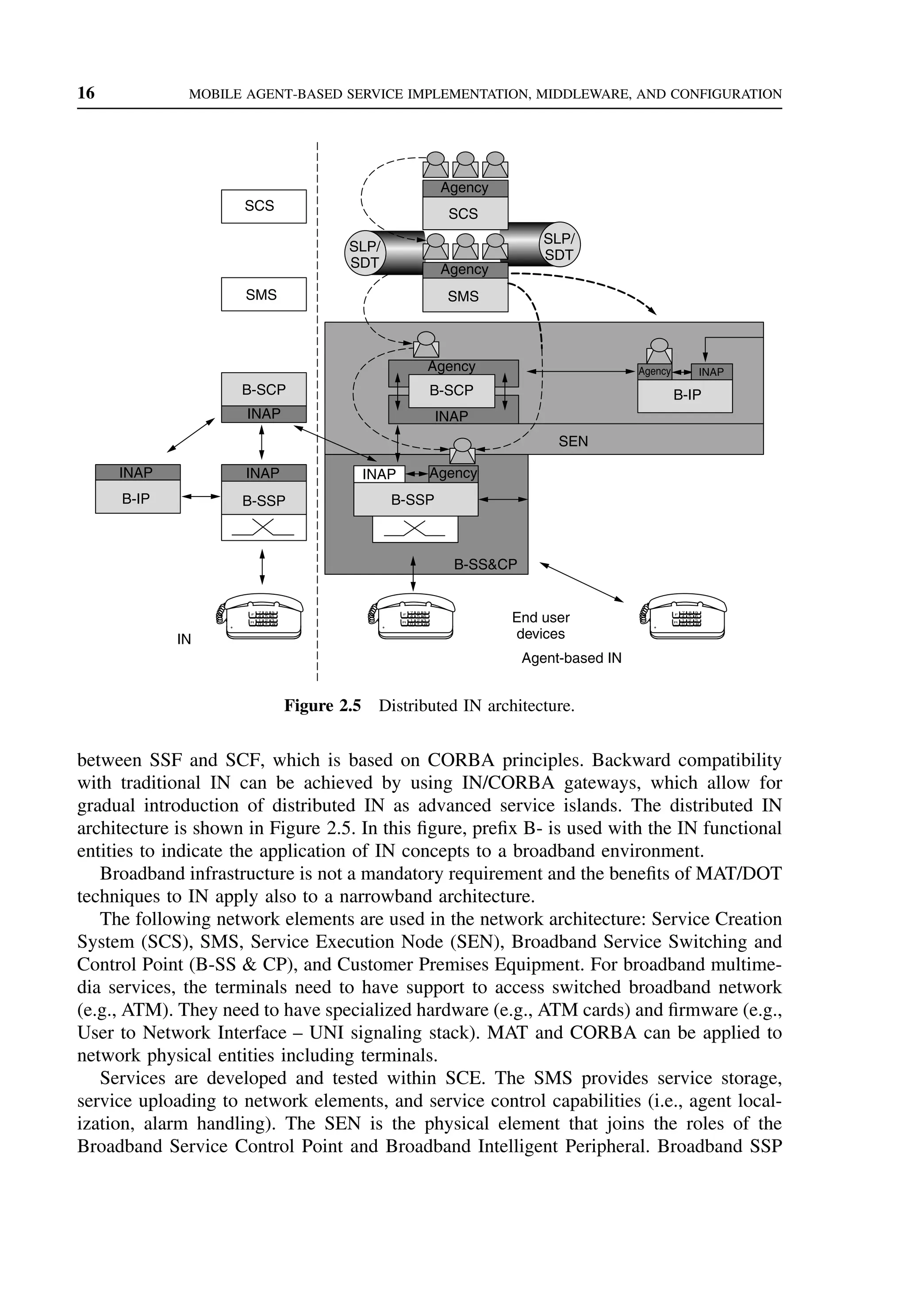
Figure 2.5 Distributed IN architecture.
between SSF and SCF, which is based on CORBA principles. Backward compatibility
with traditional IN can be achieved by using IN/CORBA gateways, which allow for
gradual introduction of distributed IN as advanced service islands. The distributed IN
architecture is shown in Figure 2.5. In this figure, prefix B- is used with the IN functional
entities to indicate the application of IN concepts to a broadband environment.
Broadband infrastructure is not a mandatory requirement and the benefits of MAT/DOT
techniques to IN apply also to a narrowband architecture.
The following network elements are used in the network architecture: Service Creation
System (SCS), SMS, Service Execution Node (SEN), Broadband Service Switching and
Control Point (B-SS CP), and Customer Premises Equipment. For broadband multime-
dia services, the terminals need to have support to access switched broadband network
(e.g., ATM). They need to have specialized hardware (e.g., ATM cards) and firmware (e.g.,
User to Network Interface – UNI signaling stack). MAT and CORBA can be applied to
network physical entities including terminals.
Services are developed and tested within SCE. The SMS provides service storage,
service uploading to network elements, and service control capabilities (i.e., agent local-
ization, alarm handling). The SEN is the physical element that joins the roles of the
Broadband Service Control Point and Broadband Intelligent Peripheral. Broadband SSP
34.
AGENT-BASED MIDDLEWARE 17
hasthe capability to locally execute services downloaded from the network and is named
B-SS CP.
In distributed IN where CORBA can be used for message exchange, generic program-
ming interfaces are available for developers. In this architecture, B-SCF, B-SDF, and
B-SRF are implemented as CORBA-based software components allowing DPE’s location
transparency and direct method invocation.
There are several benefits of distributed IN architecture. The network elements can
communicate in a homogeneous way. The SEN can be the contact point between the
users and the network. The operator can choose a distributed, centralized service or
mixed service.
Interactive Multimedia Retrieval (IMR) is an integrated multimedia service within the
framework of broadband IN. Broadband Video Telephone (BVT), is a real-time, multime-
dia, two-party service that provides two geographically separated users with the capability
of exchanging high-quality voice information, together with the transmission of high-
quality video data. BVT is offered by Broadband-Integrated Services Digital Network
(B-ISDN), which supports the facilities requested by the new generation of multimedia
workstations.
The BVT service uses mobility management procedures to enable users to register
at different (fixed) terminals. In a manner similar to the IMR and BVT services, the
realization of these procedures is based on DOT and MAT.
MAs enable both temporal distribution (i.e., distribution over time) and spatial dis-
tribution (i.e., distribution over different network nodes) of service logic. In multimedia
services, the porting of services usually occurs between IN elements of different types
(SSPs and SCPs), whereas in mobility services, the porting of services is usually between
modules of the same type (SCPs). These two approaches are not alternative and can be
combined; therefore, if multimedia services are offered to mobile users, then MAT can
be widespread in the IN architecture in the most effective way.
2.2 AGENT-BASED MIDDLEWARE
Terminal and user mobility are important aspects of communications systems. Laptop com-
puters, Personal Digital Assistants (PDAs), and mobile phones are the elements of mobile
office. The Agent-based Mobile Access to Multimedia Information Services (AMASE)
supports agent mobility.
A mobility system that can be accessed by a user from any kind of terminal must
have an appropriate device support and must be scalable, that is, the mobility system can
be installed on different kinds of devices, especially mobile devices with strict resource
constraints such as PDAs and mobile phones. A mobility system can be sized from a
full-fledged system to a subsystem until it reaches a size and complexity that matches the
constraints set by the devices involved and still provides all the required services.
The distributed AMASE Agent Environment comprises several devices and nodes,
each running one instance of the stand-alone AMASE Agent Platform, which can be
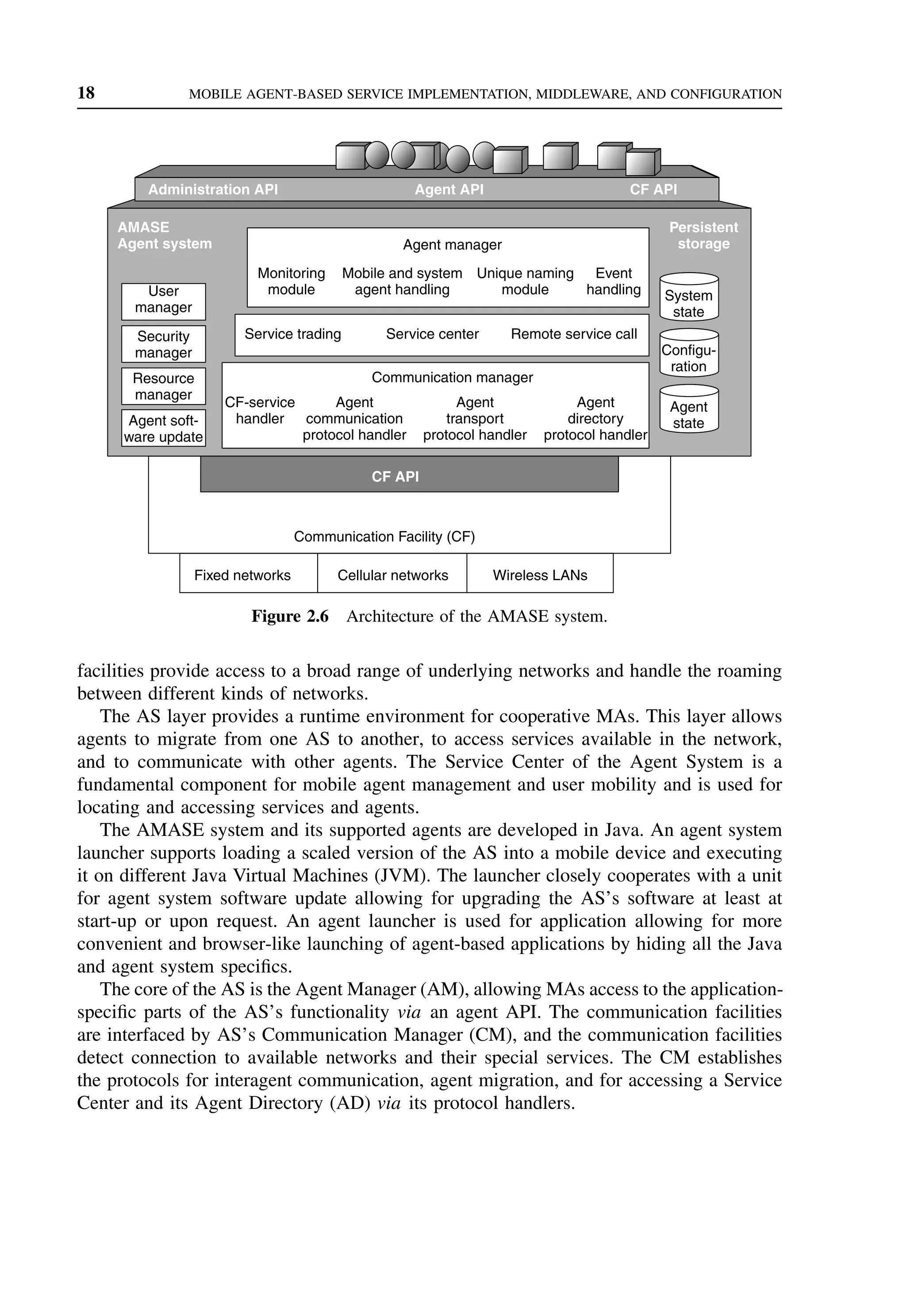
scaled to fit into different device types. The agent system shown in Figure 2.6 consists
of two layers, the Agents System (AS) and the communication facilities. Communication
35.
18 MOBILE AGENT-BASEDSERVICE IMPLEMENTATION, MIDDLEWARE, AND CONFIGURATION
Administration API CF API
Agent API
CF API
AMASE
Agent system
Persistent
storage
Agent manager
Communication manager
Monitoring
module
User
manager
Fixed networks Cellular networks Wireless LANs
Communication Facility (CF)
Security
manager
Resource
manager
Agent soft-
ware update
System
state
Configu-
ration
Agent
state
Mobile and system
agent handling
Unique naming
module
Event
handling
Service trading Service center Remote service call
CF-service
handler
Agent
communication
protocol handler
Agent
transport
protocol handler
Agent
directory
protocol handler
Figure 2.6 Architecture of the AMASE system.
facilities provide access to a broad range of underlying networks and handle the roaming
between different kinds of networks.
The AS layer provides a runtime environment for cooperative MAs. This layer allows
agents to migrate from one AS to another, to access services available in the network,
and to communicate with other agents. The Service Center of the Agent System is a
fundamental component for mobile agent management and user mobility and is used for
locating and accessing services and agents.
The AMASE system and its supported agents are developed in Java. An agent system
launcher supports loading a scaled version of the AS into a mobile device and executing
it on different Java Virtual Machines (JVM). The launcher closely cooperates with a unit
for agent system software update allowing for upgrading the AS’s software at least at
start-up or upon request. An agent launcher is used for application allowing for more
convenient and browser-like launching of agent-based applications by hiding all the Java
and agent system specifics.
The core of the AS is the Agent Manager (AM), allowing MAs access to the application-
specific parts of the AS’s functionality via an agent API. The communication facilities
are interfaced by AS’s Communication Manager (CM), and the communication facilities
detect connection to available networks and their special services. The CM establishes
the protocols for interagent communication, agent migration, and for accessing a Service
Center and its Agent Directory (AD) via its protocol handlers.
36.
AGENT-BASED MIDDLEWARE 19
ThePersistent Storage area is either located in the persistent memory area of the
underlying device, or on a magnetic medium. This area is needed to save agents and the
agent system state and configuration.
The CM comprises user and security managers that establish a user management and
allow for the enforcement of access policies. An additional resource manager provides
information about device utilization, for example, memory or agent population. A com-
ponent for dynamic updates of the agents’ software allows for versioning and updates of
agent classes.
The AM is responsible for controlling the agent population of the agent system. AM
allows for launching and termination of agents and provides them with the functionality
needed for migration, communication, service access, and so on. In AMASE environment,
there are MAs and system agents. MAs are created by application and they can roam
within the network. They are not allowed to access system resources for security reasons.
Usually these agents interact with the user for an initial configuration before they are
launched into the network. They allow the user to perform remote operations without a
constant network connection.
MAs and system agents are supported by the AS. System agents can access system
resources and become a mediator between the MAs and the system resources and the
services they need to access.
The AM cooperates with the user manager and the resource manager, which permits
them to assign detailed access rights to agents. Both agent types are maintained separately
by the AM, which supports a clearly defined type-dependent handling, for example, in case
of a shutdown. Agents are registered with the local AM, and MAs are also automatically
registered with the Service Center’s AD.
In Figure 2.6, the CM connects the entire agent system to the communication facilities,
which connect a device to the available networks. The CM surveys preconfigured ports on
sockets provided by the communication facilities to receive incoming messages. Agents
can be dispatched and handled by the AM. Each CM has access either to a local or
remote router provided by the agent-related directories. This router helps CM to find and
address the other agent systems. The CM is responsible for converting Java objects into
byte streams and is involved in synchronous communication, which requires temporal
suspension of agents.
CM and communication facilities optimize communication and connection handling.
The protocols consider network and device characteristics, and Quality of Service (QoS)
information. Connections are physically closed during timeouts but kept open virtually.
These operations that are transparent to the agents save connection costs and support
disconnected operations and user mobility. The following communications mechanisms
are provided by using the agent system communication manager, its protocol handlers,
and the underlying communication facilities:
• asynchronous one-way agent-to-agent messages;
• synchronous two-way agent-to-agent messages based on Remote Procedure Call
mechanisms;
37.
20 MOBILE AGENT-BASEDSERVICE IMPLEMENTATION, MIDDLEWARE, AND CONFIGURATION
• blackboards for local agent communication within agent systems – a blackboard is a
data area where agents can leave information that may be read and removed by other
agents under configurable access restrictions;
• postbox messages for specified agents; this is a message queue that belongs to a
single agent and which is located at a well-known location in the network that is
known to both the message senders and the postbox owner; the owner agent can
only read the box contents and remove the messages, and all other agents can drop
messages.
MAs are capable of migrating, which can occur at any time; thus, a mechanism is
needed to determine an agent’s current location. This mechanism is not necessary for
asynchronous communication and communication based on blackboards and postboxes; it
is inevitable for direct communication of agents. The Mobile Agent System Interoperabil-
ity Facility (MASIF) specifies a Mobile Agent Facility (MAF) component MAFFinder,
which is an abstract facility for mobile agent localization. MAFFinder is abstract because
it does not specify how the agents are to be localized – only that a presence of such
facility is required. Concepts for mobile agent localization include broadcast, forwarding,
and directory service/home registry.
AMASE system introduces a Service Center based on a directory service using general
mobile agent execution cycle. MAs are restricted in their size and complexity owing to
the costs of agent migration. MAs use services to execute the tasks required. The agents
contact a facility in the agent system that provides a naming or trading service and passes
information on the location of the requested services. This Service Center in AMASE
system is based on the concept introduced by the Java Agent Environment (JAE).
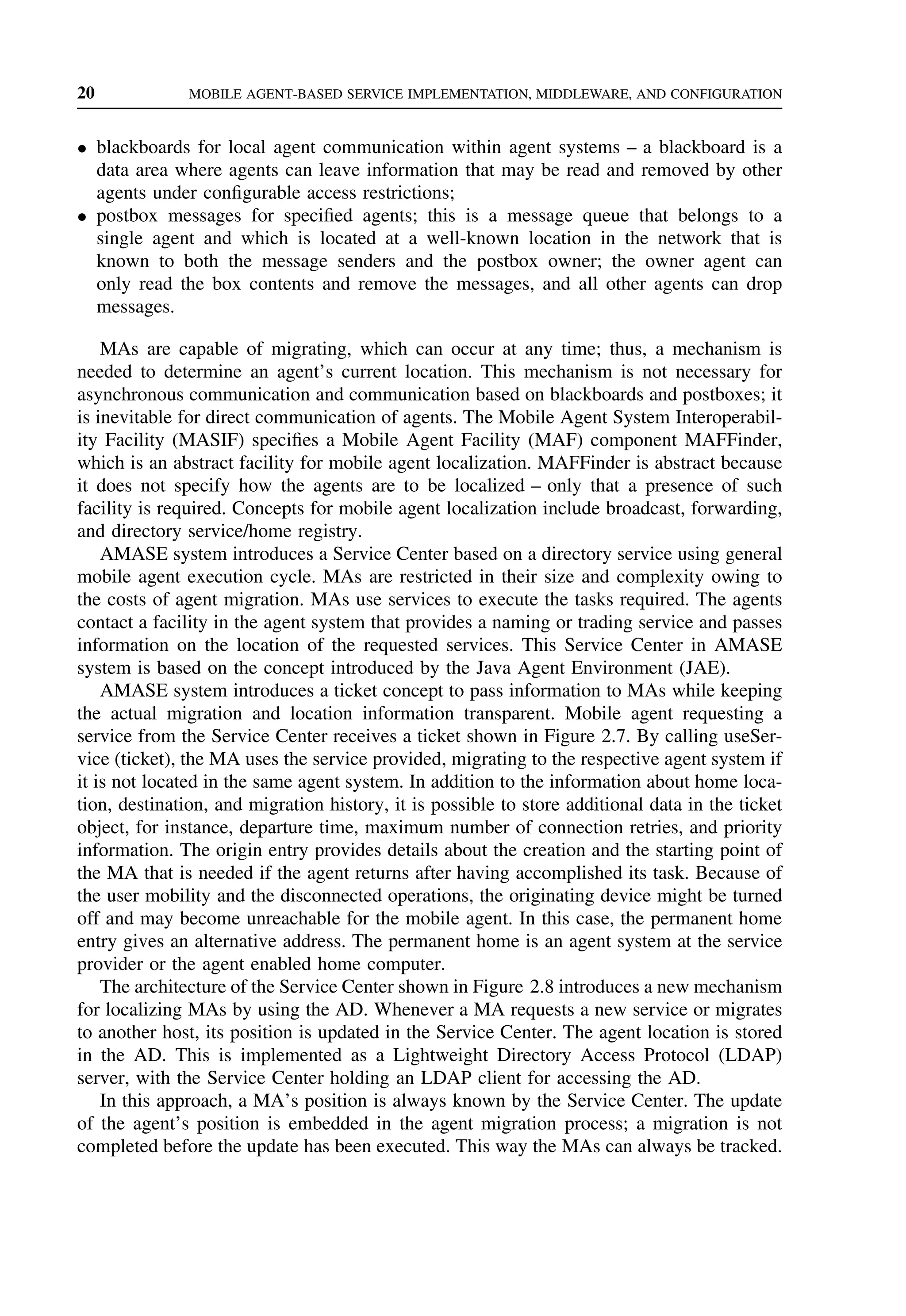
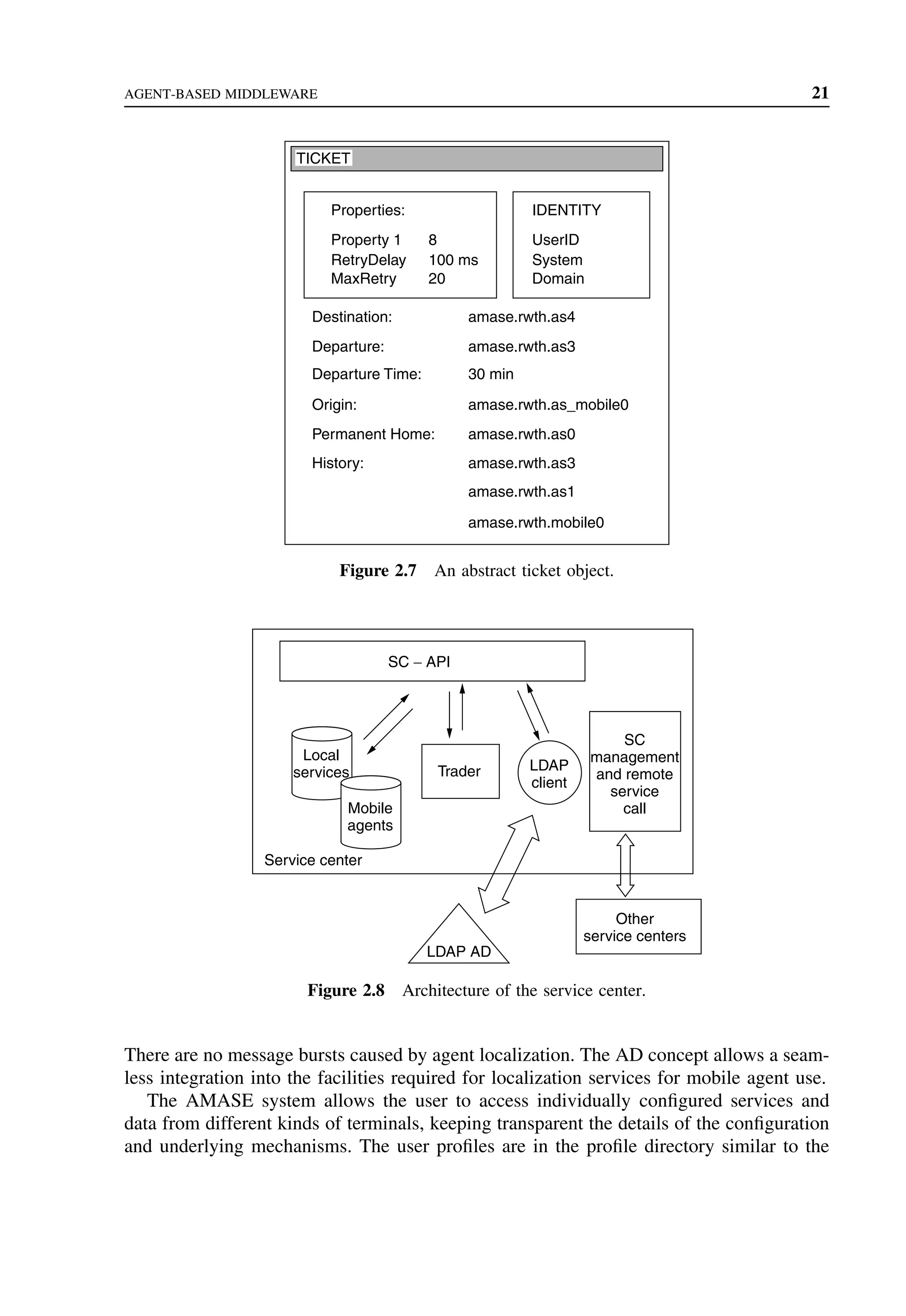
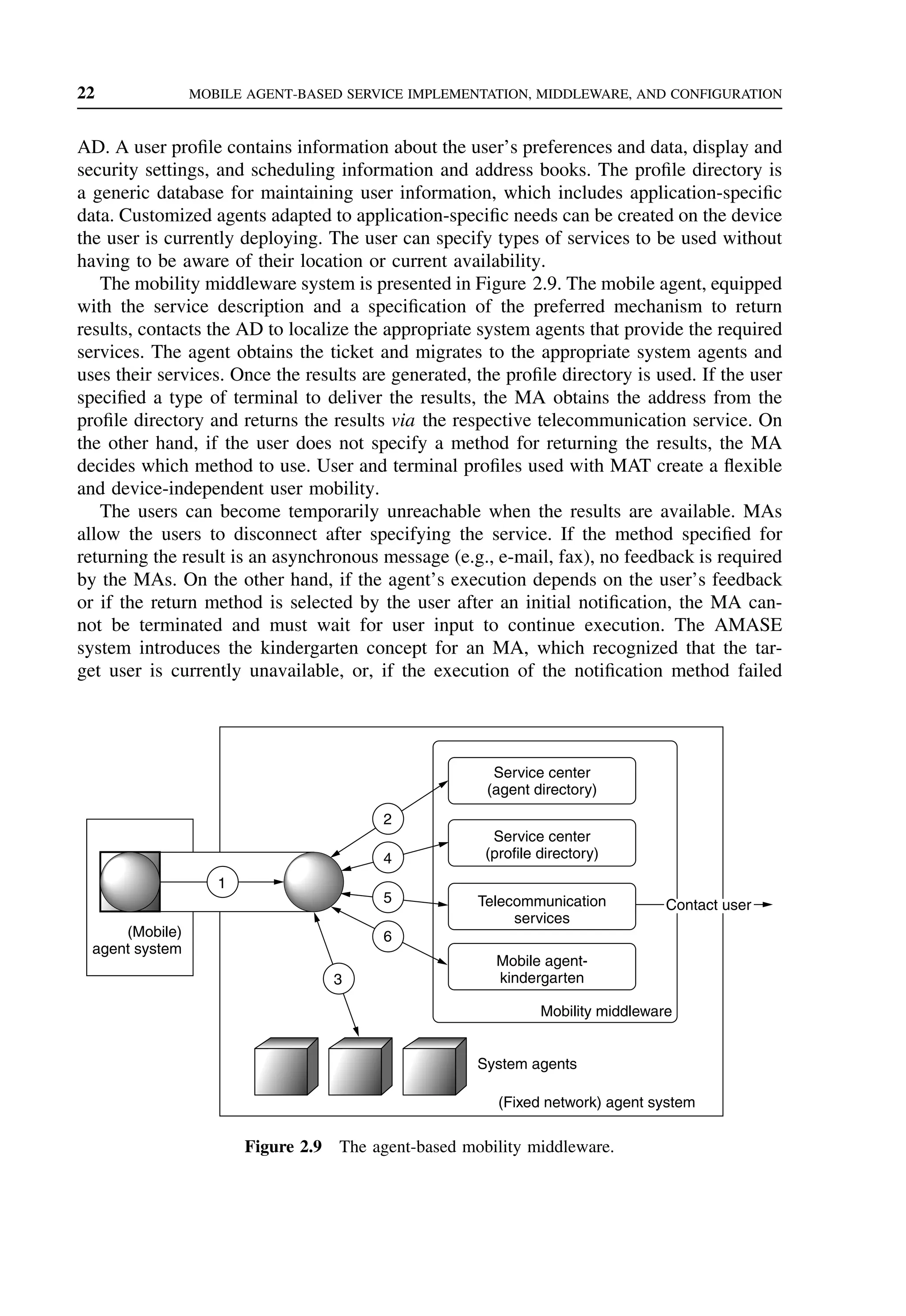
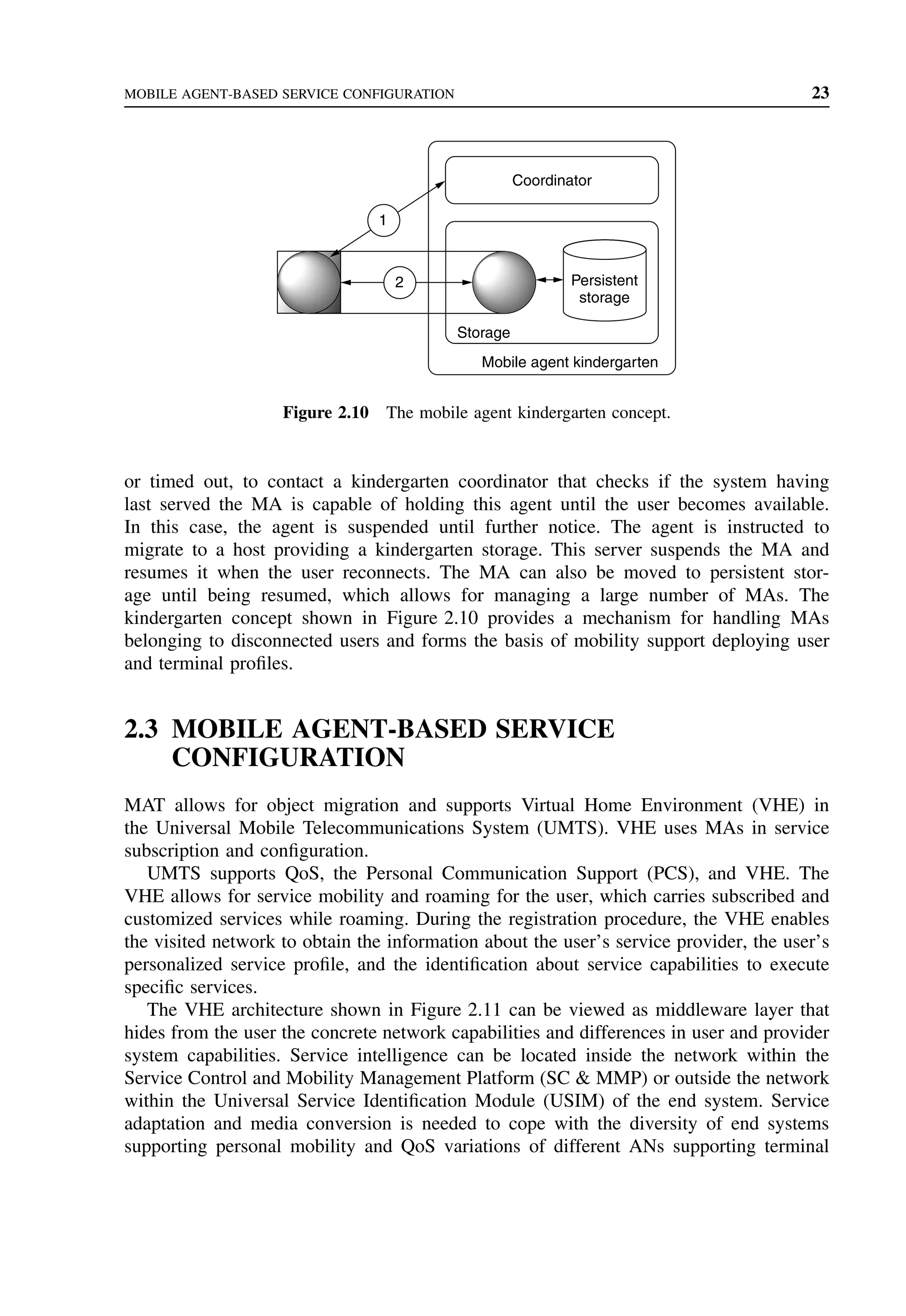
AMASE system introduces a ticket concept to pass information to MAs while keeping
the actual migration and location information transparent. Mobile agent requesting a
service from the Service Center receives a ticket shown in Figure 2.7. By calling useSer-
vice (ticket), the MA uses the service provided, migrating to the respective agent system if
it is not located in the same agent system. In addition to the information about home loca-
tion, destination, and migration history, it is possible to store additional data in the ticket
object, for instance, departure time, maximum number of connection retries, and priority
information. The origin entry provides details about the creation and the starting point of
the MA that is needed if the agent returns after having accomplished its task. Because of
the user mobility and the disconnected operations, the originating device might be turned
off and may become unreachable for the mobile agent. In this case, the permanent home
entry gives an alternative address. The permanent home is an agent system at the service
provider or the agent enabled home computer.
The architecture of the Service Center shown in Figure 2.8 introduces a new mechanism
for localizing MAs by using the AD. Whenever a MA requests a new service or migrates
to another host, its position is updated in the Service Center. The agent location is stored
in the AD. This is implemented as a Lightweight Directory Access Protocol (LDAP)
server, with the Service Center holding an LDAP client for accessing the AD.
In this approach, a MA’s position is always known by the Service Center. The update
of the agent’s position is embedded in the agent migration process; a migration is not
completed before the update has been executed. This way the MAs can always be tracked.
38.
AGENT-BASED MIDDLEWARE 21
Destination:
Departure:
DepartureTime:
Origin:
Permanent Home:
History:
amase.rwth.as4
amase.rwth.as3
30 min
amase.rwth.as_mobile0
amase.rwth.as0
amase.rwth.as3
amase.rwth.as1
amase.rwth.mobile0
Properties: IDENTITY
Property 1 UserID
RetryDelay System
MaxRetry
8
100 ms
20 Domain
TICKET
Figure 2.7 An abstract ticket object.
LDAP AD
Other
service centers
LDAP
client
Trader
Service center
SC
management
and remote
service
call
Local
services
Mobile
agents
SC − API
Figure 2.8 Architecture of the service center.
There are no message bursts caused by agent localization. The AD concept allows a seam-
less integration into the facilities required for localization services for mobile agent use.
The AMASE system allows the user to access individually configured services and
data from different kinds of terminals, keeping transparent the details of the configuration
and underlying mechanisms. The user profiles are in the profile directory similar to the
39.
22 MOBILE AGENT-BASEDSERVICE IMPLEMENTATION, MIDDLEWARE, AND CONFIGURATION
AD. A user profile contains information about the user’s preferences and data, display and
security settings, and scheduling information and address books. The profile directory is
a generic database for maintaining user information, which includes application-specific
data. Customized agents adapted to application-specific needs can be created on the device
the user is currently deploying. The user can specify types of services to be used without
having to be aware of their location or current availability.
The mobility middleware system is presented in Figure 2.9. The mobile agent, equipped
with the service description and a specification of the preferred mechanism to return
results, contacts the AD to localize the appropriate system agents that provide the required
services. The agent obtains the ticket and migrates to the appropriate system agents and
uses their services. Once the results are generated, the profile directory is used. If the user
specified a type of terminal to deliver the results, the MA obtains the address from the
profile directory and returns the results via the respective telecommunication service. On
the other hand, if the user does not specify a method for returning the results, the MA
decides which method to use. User and terminal profiles used with MAT create a flexible
and device-independent user mobility.
The users can become temporarily unreachable when the results are available. MAs
allow the users to disconnect after specifying the service. If the method specified for
returning the result is an asynchronous message (e.g., e-mail, fax), no feedback is required
by the MAs. On the other hand, if the agent’s execution depends on the user’s feedback
or if the return method is selected by the user after an initial notification, the MA can-
not be terminated and must wait for user input to continue execution. The AMASE
system introduces the kindergarten concept for an MA, which recognized that the tar-
get user is currently unavailable, or, if the execution of the notification method failed
Service center
(agent directory)
Service center
(profile directory)
Telecommunication
services
Mobile agent-
kindergarten
Mobility middleware
(Fixed network) agent system
System agents
Contact user
(Mobile)
agent system
3
6
5
4
2
1
Figure 2.9 The agent-based mobility middleware.
40.
MOBILE AGENT-BASED SERVICECONFIGURATION 23
2
Storage
Coordinator
Persistent
storage
Mobile agent kindergarten
1
Figure 2.10 The mobile agent kindergarten concept.
or timed out, to contact a kindergarten coordinator that checks if the system having
last served the MA is capable of holding this agent until the user becomes available.
In this case, the agent is suspended until further notice. The agent is instructed to
migrate to a host providing a kindergarten storage. This server suspends the MA and
resumes it when the user reconnects. The MA can also be moved to persistent stor-
age until being resumed, which allows for managing a large number of MAs. The
kindergarten concept shown in Figure 2.10 provides a mechanism for handling MAs
belonging to disconnected users and forms the basis of mobility support deploying user
and terminal profiles.
2.3 MOBILE AGENT-BASED SERVICE
CONFIGURATION
MAT allows for object migration and supports Virtual Home Environment (VHE) in
the Universal Mobile Telecommunications System (UMTS). VHE uses MAs in service
subscription and configuration.
UMTS supports QoS, the Personal Communication Support (PCS), and VHE. The
VHE allows for service mobility and roaming for the user, which carries subscribed and
customized services while roaming. During the registration procedure, the VHE enables
the visited network to obtain the information about the user’s service provider, the user’s
personalized service profile, and the identification about service capabilities to execute
specific services.
The VHE architecture shown in Figure 2.11 can be viewed as middleware layer that
hides from the user the concrete network capabilities and differences in user and provider
system capabilities. Service intelligence can be located inside the network within the
Service Control and Mobility Management Platform (SC MMP) or outside the network
within the Universal Service Identification Module (USIM) of the end system. Service
adaptation and media conversion is needed to cope with the diversity of end systems
supporting personal mobility and QoS variations of different ANs supporting terminal
41.
24 MOBILE AGENT-BASEDSERVICE IMPLEMENTATION, MIDDLEWARE, AND CONFIGURATION
Provider
systems
End
systems
Applications (subscribed services)
Virtual home environment
Transport networks
Figure 2.11 Virtual home environment.
mobility. The enhancements of service control intelligence during service execution and
dynamic subscription of a new third-party services should be allowed in the system.
The UMTS environment shown in Figure 2.12 consists of a terminal, the AN, the
SC MMP, and the third-party service provider. A user registers at the terminal that
presents services to the user. The user’s identification and authentication is handled by
the UMTS Subscriber Identity Module (USIM). The network access of the terminal is
managed by the access network. Fixed or mobile terminals are linked by the AN to the
SC MMP. The SC MMP contains service logic and is responsible for the mobility
management. Third-party service provides support supplementary services. A third-party
service provider has a connection to one or more SC MMPs and does not have its own
mobility management facilities.
A middleware layer is introduced in UMTS architecture in Figure 2.13. The middleware
consists of Distributed Agent Environment (DAE), for example, Grasshopper, which is
built on the top of DPE, for example, CORBA, and spans all potential end user systems
and provider systems. The nodes provide agent environments through middleware system
SCMMP
SCMMP
AN
AN
Mobile station
USIM
SCMMP
Third party SP
Third party SP
Third party SP
End user system Home provider system Other provider system Third party provider system
Figure 2.12 The main components of the third-generation mobile communication system.
42.
MOBILE AGENT-BASED SERVICECONFIGURATION 25
AN
Mobile station
USIM
Visited MSC Gateway MSC Third party service provider
Agency
Agency
Agency
Agents
DPE/DAE
Core
network
Agency
Figure 2.13 The distributed agent environment spanning across UMTS end user and
provider systems.
to enable downloading and migration of MAs. MAs contain intelligence related to mobility
management and service control (VHE control) and the end user application between the
involved system nodes, including the Mobile Stations (MSs).
In agent-based UMTS, a VHE-agent realizes the VHE concept; a Service Agent (SA)
represents a provided service; a Terminal Agent (TA) allows the terminal to inform the
provider system about its capabilities; and a Provider Agent (PA) realizes a trader within
the provider system, which manages all supported services (SA), that is, maintains an
overview of all available services within the provider domain.
The VHE allows individually subscribed and customized services to follow their associ-
ated users wherever they roam. The VHE-agent follows the user to the domain to which
the user is roaming. At every domain, the VHE-agent provides the user’s subscribed
services and configurations.
Agencies in the MS allow dynamic distribution of mobility management and service
control intelligence to be downloaded dynamically from the MS into the (visited) provider
system and from the (visited) provider system onto the MS, to be distributed within one
provider system at the most appropriate location and to be distributed between different
provider systems. The end systems through the USIM can take an active part in mobility
management and service control.
The PA residing in every provider domain contains the knowledge of all services
provided by this domain. The PA is designed as a trader in MASIF. The PA is the
initial contact point of the VHE-agent after the user is roamed to a new domain. The
PA is designated as a stationary agent since its task makes the migration of this agent
not necessary.
The SAs are located within the provider domain, or at the third-party service provider
domains, or at the user’s terminal. The Converter Agents (CAs) at the provider agency are
responsible for converting incoming and outgoing calls on the basis of user and terminal
requirements. This allows for support of services on terminals that cannot originally
43.
26 MOBILE AGENT-BASEDSERVICE IMPLEMENTATION, MIDDLEWARE, AND CONFIGURATION
USIM agency
Service agents
Service provider agency
Third party service agents
Converter agents
SA
SA SA
PA
VHE
TA
Outgoing
(access)
Incoming
Figure 2.14 Basic agent relationships.
present the service such as reading out a fax or e-mail on a telephone. The knowledge
of the terminal capabilities is maintained by the TA. Different types of agents and their
communication relationships are shown in Figure 2.14.
The VHE-agent can migrate from the provider domain from which the user comes to
the provider domain to which the user is roaming. Another possibility is to store a major
copy of the VHE-agent within the home service provider domain. Whenever the user
roams to a new provider domain, a copy of the VHE-agent migrates to this domain. The
VHE-agent can also be stored on the terminal agency. The VHE-agent migrates from the
terminal agency to the provider agency when the user roams to a new domain.
Dynamic subscription allows a user to subscribe to and to unsubscribe services. The
subscription component presents the entire set of provided services to the user. The
information can be retrieved during the registration procedure after the user roamed to a
new provider, and the subscription component requests the provider to get information
about provided services. The services of a new provider can also be concatenated to the
service list that is stored by the VHE. The network can provide a roaming broker that can
be contacted by the subscription component to get the information about service providers.
The abstract service subscription is present at the provider where the user roams.
The user registers at the new provider, and the VHE-agent contacts the PA to receive a
subscription interface to process the VHE request. The PA finds an SA that corresponds
to the abstract service description. The PA returns a reference to the existing SA that
matches with the service description. If there is no SA matching service description, the
PA finds a corresponding agent at different service providers. The PA explores possibilities
illustrated in Figure 2.15. The current service provider can contact other service providers,
or a roaming broker can be used, or the home service provider can provide a reference
to the service agent.
The User Interface Agent (UIA) is responsible for the presentation of the SA at
the user’s terminal. The UIA provides terminal-dependent service presentation capabil-
ities. The same service can be represented by many UIAs for terminals with different
capabilities. The VHE-agent decides which UIA download to the terminal as shown in
Figure 2.16. The VHE-agent contacts the TA, which resides on the terminal agency, that
44.
MOBILE AGENT-BASED SERVICECONFIGURATION 27
Third party service provider region
Third party SP agency
Roaming Broker Agency
Place
SA
PA
RBA
2 2
3
2
PA
TA VHE
SA
SA
Place Place
MSC agency
USIM agency
Mobile station
1
1
1 - Provider agent tries to find a service
agent in its own domain and with capabilities
that can be presented at the terminal of
the user
2 - Provider agent contacts the Roaming
Broker (RB). The RB tries to find a matching
service agent
3 - Provider agent contacts the home
service provider to get access to the
service agent
Home service provider region
Visited service provider region
PA
Place Place
Home service provider agency
SA
SA
Figure 2.15 Service access strategies.
1
4
2 3
Service provider region
TA
Place
SA
PA
VHE
Place
MSC agency
USIM agency
Mobile station
1- VHE-agent requests the Terminal Agent to
get properties of the terminal. This information
will be sent by the TA to the VHE-agent.
2 - The VHE-agent will request the provider
agent.
3 - To find a corresponding UIA.
4 - If a UIA was found, it will be downloaded to
the terminal agency.
Figure 2.16 The UIA selection procedure.
45.
28 MOBILE AGENT-BASEDSERVICE IMPLEMENTATION, MIDDLEWARE, AND CONFIGURATION
is, mobile station. This TA is device dependent and contains technical information about
the terminal. The VHE-agent requests the TA to get this information. The returned val-
ues are used by the VHE-agent to find a corresponding UIA. The service subscription
procedure is used to locate the UIA.
2.4 MOBILE AGENT IMPLEMENTATION
MAs can be implemented in Java programming language. Additional features and mech-
anisms supported and envisioned in Jini programming language allow for implementation
of mobile devices in practical systems.
The Jini vision introduced by Edwards allows for devices and software services to work
together in a simple, fast, and reliable manner. The requirements for devices and software
specify robust software infrastructure developed to support reliable systems. The devices
must be easy to use and administer, and should work instantly after being connected. The
software systems must be evolvable, and software services and devices should permit their
use without reconfiguration of the network. These devices form spontaneous communities
within dynamic networking.
Mobile code is used in several structures to support mobile applications. In Java pro-
gramming language, applets are used for small applications to be installed automatically
wherever they are needed and removed when their users do not need them. In the agent
paradigm, small, autonomous bits of code travel to search for desired data. The mobile
code is used for performance and autonomy. Agents can provide a better performance
as the code moves closer to data in the network. Agent autonomy allows the user to
log off or shut down the machine, and the agent that left the originator computer can
continue to run even if the originator disconnects. Java RMI allows for building various
distributed systems and can be used for automatic application installation or for building
agent-based systems. Mobile code in RMI is used for object-oriented networked systems
and it supports evolvable implementations of remote objects and new implementations of
parameter and return types. Jini uses mobile code to achieve maintenance, evolvability,
and ease of administration for networked devices and services. Jini is layered atop RMI,
allowing all the benefits of mobile code to be used by programs in Jini.
Jini supports spontaneously created self-healing communities of services, and it is
based on the concepts of discovery, lookup, leasing, remote events, and transactions.
Jini uses discovery protocols to find the available lookup services. The Multicast
Request Protocol is used to find the active lookup services after an application or service
becomes initiated. Lookup services announce their existence in the system by using the
Multicast Announcement Protocol. An application or service talks to the lookup service
by using the Unicast Discovery Protocol.
The lookup service is a process that has semantic information about available services.
The service items have proxy objects and attributes describing these services.
Jini concept of leasing allows the resource to be loaned to a customer for a fixed period
of time rather than granting access to a resource for an unlimited amount of time. This
ensures that the communities of services are stable, self-healing, and resilient to failures,
errors, and crashes.
46.
PROBLEMS TO CHAPTER2 29
Jini uses remote events to allow services to notify each other about the changes in
their state. These are messages sent as asynchronous notifications directly to a software
component and handled outside the normal flow of control of the component.
Computations involving multiple services reach safe and known state by using transac-
tions in Jini. Transactions provide atomicity, consistency, isolation, and durability to data
manipulations. All the operations under transactions are executed as an atomic operation.
Transactions ensure state consistency after completion. Transactions are isolated during
execution; they do not affect one another until completion. Transaction durability makes
the changes permanent.
2.5 SUMMARY
MAT uses the capabilities provided by machine-independent, interpreted languages like Java
to deploy a framework in which applications can roam between network nodes maintaining
their execution status. MAT platforms are often based on a CORBA DPE layer, which allows
distributed applications to dynamically reconfigure their layout according, for instance, to
processing needs. This way certain MAs may have a CORBA interface enabling them to
exploit the facilities offered by the distributed objects communication infrastructure.
The introduction of DOT and MAT at the service design and deployment level allows
for reusability for easy and rapid deployment of services, extensibility towards new and
updated services, and flexibility of service design.
The AS layer provides a runtime environment for cooperative MAs. This layer allows
agents to migrate from one AS to another, to access services available in the network, and
to communicate with other agents. The Service Center of Agent System is a fundamental
component for mobile agent management and user mobility and is used for locating and
accessing services and agents.
MAT allows for object migration and supports VHE in the UMTS. VHE uses MAs in
service subscription and configuration.
The UMTS environment consists of a terminal, the AN, the SC MMP, and the
third-party service provider.
In agent-based UMTS, a VHE-agent realizes the VHE concept; an SA represents a pro-
vided service; a TA allows the terminal to inform the provider system about its capabilities;
and a PA realizes a trader within the provider system, which manages all supported services
(SA), that is, maintains an overview of all available services within the provider domain.
PROBLEMS TO CHAPTER 2
Mobile agent-based service implementation, middleware, and configuration
Learning objectives
After completing this chapter, you are able to
• demonstrate an understanding of distributed object technology;
• discuss what is meant by intelligent agents;
47.
30 MOBILE AGENT-BASEDSERVICE IMPLEMENTATION, MIDDLEWARE, AND CONFIGURATION
• demonstrate an understanding of agent-based service implementation;
• explain how to handle service requests;
• explain temporal and spatial distribution of service logic;
• discuss multimedia services;
• demonstrate an understanding of a mobility system;
• explain what agent system, agent manager, and communication manager are;
• explain mobility middleware system;
• demonstrate an understanding of the Universal Mobile Telecommunications System
(UMTS);
• discuss what an agent-based UMTS is;
• demonstrate an understanding of the VHE concept;
• explain how the VHE-agent migrates in the system;
• explain dynamic subscription of services;
• demonstrate an understanding of mobile agent implementation in Java program-
ming language;
• demonstrate an understanding of mobile agent implementation in Jini program-
ming language.
Practice problems
2.1: What is the role of DPE in DOT?
2.2: What are the functions of Intelligent and Mobile Agents?
2.3: What distribution of service logic is enabled by Mobile Agents?
2.4: What are the requirements for a mobility system?
2.5: What is the role of the Agent System layer?
2.6: Where is the Persistent Storage located and why is it needed?
2.7: What is supported by the UMTS?
2.8: What are the elements of the UMTS environment?
2.9: How is the VHE concept realized in agent-based UMTS?
2.10: What is the role of dynamic subscription?
2.11: What is the role of the User Interface Agent (UIA)?
2.12: What are applets used for in Java programming language?
2.13: What is the concept of Jini programming language?
Practice solutions
2.1: DOT provides a DPE to enable designers to create object-oriented distributed appli-
cations, which are not necessarily aware of the physical layout of the underlying
network structure hidden by platform services.
2.2: Intelligent Agents have the ability to learn and react. MAs can migrate between
different hosts, execute certain tasks, and collaborate with other agents.
2.3: MAs enable both temporal distribution (i.e., distribution over time) and spatial
distribution (i.e., distribution over different network nodes) of service logic.
2.4: Mobility system that can be accessed by a user from any kind of terminal must
have an appropriate device support and must be scalable, that is, the mobility system
48.
PROBLEMS TO CHAPTER2 31
can be installed on different kinds of devices, especially mobile devices with strict
resource constraints such as PDAs and mobile phones. A mobility system can be
sized from a full-fledged system to a subsystem until it reaches a size and complexity
that matches the constraints set by the devices involved and still provides all the
required services.
2.5: The AS layer provides a runtime environment for cooperative MAs. This layer
allows agents to migrate from one AS to another, to access services available in
the network, and to communicate with other agents. The Service Center of AS is a
fundamental component for mobile agent management and user mobility, and it is
used for locating and accessing services and agents.
2.6: The Persistent Storage area is either located in the persistent memory area of the
underlying device or on a magnetic medium. This area is needed to save agents
and the agent system state and configuration.
2.7: UMTS supports QoS, the PCS, and VHE.
2.8: The UMTS environment consists of a terminal, the AN, the SC MMP, and the
third-party service provider.
2.9: In agent-based UMTS, a VHE-agent realizes the VHE concept; an SA represents a
provided service; a TA allows the terminal to inform the provider system about its
capabilities; and a PA realizes a trader within the provider system, which manages
all supported services (SA), that is, maintains an overview of all available services
within the provider domain.
2.10: Dynamic subscription allows a user to subscribe to and to unsubscribe services.
The subscription component presents the entire set of provided services to the user.
2.11: The UIA is responsible for the presentation of the SA at the user’s terminal. The
UIA provides terminal-dependent service presentation capabilities. The same service
can be represented by many UIAs for terminals with different capabilities.
2.12: In Java programming language, applets are used for small applications to be installed
automatically wherever they are needed, and removed when their users do not
need them.
2.13: Jini supports spontaneously created self-healing communities of services and is
based on the concepts of discovery, lookup, leasing, remote events, and transactions.
50.
3
Wireless local areanetworks
Virtual LANs provide support for workgroups that share the same servers and other
resources over the network. A flexible broadcast scope for workgroups is based on
Layer 3 (network). This solution uses multicast addressing, mobility support, and the
Dynamic Host Configuration Protocol (DHCP) for the IP. The hosts in the network are
connected to routers via point-to-point connections. The features used are included in
the IPv6 (Internet Protocol version 6) protocol stacks. Security can be achieved by using
authentication and encryption mechanisms for the IP. Flexible broadcast can be achieved
through enhancements to the IPv6 protocol stack and a DHCP extension for workgroups.
Orthogonal Frequency Division Multiplex (OFDM) is based on a mathematical concept
called Fast Fourier Transform (FFT), which allows individual channels to maintain their
orthogonality or distance to adjacent channels. This technique allows data symbols to
be reliably extracted and multiple subchannels to overlap in the frequency domain for
increased spectral efficiency. The IEEE 802.11 standards group chose OFDM modulation
for wireless LANs operating at bit rates up to 54 Mb s−1
at 5 GHz.
Wideband Code Division Multiple Access (WCDMA) uses 5 MHz channels and sup-
ports circuit and packet data access at 384 kb s−1
nominal data rates for macrocellular wire-
less access. WCDMA provides simultaneous voice and data services. WCDMA is the radio
interface technology for Universal Mobile Telecommunications System (UMTS) networks.
Dynamic Packet Assignment (DPA) is based on properties of an OFDM physical layer.
DPA reassigns transmission resources on a packet-by-packet basis using high-speed receiver
measurements. OFDM has orthogonal subchannels well defined in time–frequency grids,
and has the ability to rapidly measure interference or path loss parameters in parallel on all
candidate channels, either directly or on the basis of pilot tones.
3.1 VIRTUAL LANs
Virtual LANs provide support for workgroups. A LAN consists of one or more LAN
segments, and hosts on the same LAN segment can communicate directly through Layer 2
(link layer) without a router between them. These hosts share the same Layer 3 (network
Mobile Telecommunications Protocols For Data Networks. Anna Hać
Copyright ¶ 2003 John Wiley Sons, Ltd.
ISBN: 0-470-85056-6
51.
34 WIRELESS LOCALAREA NETWORKS
layer) subnet address, and communication between the hosts of one LAN segment remains
in this segment. Thus Layer 3 (network layer) subnet address forms a broadcast scope
that contains all hosts on the LAN segment.
The workgroups are groups of hosts sharing the same servers and other resources
over the network. The hosts of a workgroup are attached to the same LAN segment, and
broadcasting can be used for server detection, name resolution, and name reservation.
In a traditional LAN the broadcast scope is limited to one LAN segment. Switched LANs
use a switch infrastructure to connect several LAN segments over high-speed backbones.
Switched LANs share the Layer 3 (network layer) subnet address, but offer an increased
performance compared to traditional LANs, since not all hosts of a switched LAN have to
share the bandwidth of the same LAN segment. LAN segments connected over backbones
allow for distribution of hosts over larger areas than that covered by a single LAN segment.
Traditional switched LANs require a separate switch infrastructure for each workgroup
in the environment with several different workgroups using different LAN segments.
Virtual LANs are switched LANs using software configurable switch infrastructure. This
allows for creating several different broadcast scopes over the same switch infrastructure
and for easily changing the workgroup membership of individual LAN segments.
The disadvantage of virtual LANs is that a switch infrastructure is needed and admin-
istration includes Layers 2 and 3 (link and network). A desirable solution involves only
Layer 3 (network) and does not require special hardware.
Kurz et al. propose a flexible broadcast scope for workgroups based on Layer 3 (net-
work). This solution uses multicast addressing, mobility support, and the DHCP for the
IP. The hosts in the network are connected to routers via point-to-point connections. The
features used are included in the IPv6 protocol stacks. Security can be achieved by using
authentication and encryption mechanisms for the IP. Flexible broadcast can be achieved
through enhancements to the IPv6 protocol stack and a DHCP extension for workgroups.
In IPv6, a special address range is reserved for multicast addresses for each scope, and
a multicast is received only by those hosts in this scope that are configured to listen to
this specific multicast address. To address all hosts in a certain scope with a multicast, the
multicast must be made to the predefined all-nodes address, to which all hosts must listen.
When existing software using IPv4 (Internet Protocol version 4) is migrated to IPv6, the
IPv4 broadcasts are changed to multicasts to the all-nodes address, as this is the simplest
way to maintain the complete functionality of the software.
IPv6 multicasting can be used to form the broadcast scope of a workgroup. The
workgroup is the multicast group, whose hosts listen to the same multicast address, the
workgroup address. A host can listen to several multicast addresses at the same time and
can be a member of several workgroups.
Multicasting exists optionally for IPv4 and is limited by a maximum of hops. The
multicast in IPv6 is limited by its scope, which is the address range.
In a virtual LAN, the workgroup membership of a host is determined by configuration
of the switches. Kurz et al. propose that a host has to determine its workgroups and
their corresponding multicast addresses. Different workgroups are separated in Layer 3
(network) since each host has the possibility to address a specified subset of hosts of the
network using multicasting. All hosts can be connected directly to the routers, and the
members of different workgroups can share the same LAN segment.
52.
VIRTUAL LANs 35
Theadministration of the workgroups is designed by storing the information about
hosts and their workgroups in a central database in a DHCP server. The information is
distributed by using the Dynamic Host Configuration Protocol version 6 (DHCPv6).
3.1.1 Workgroup management
In a workgroup address configuration, the host sends a DHCP Request with a Workgroup
Address Extension to the DHCP Server. The DHCP Server replies with a Workgroup
Address Extension containing all workgroup addresses assigned to this host. After receiv-
ing the workgroup addresses, the host sends the Internet Control Message Protocol
version 6 (ICMPv6) Group Membership Report to each of its workgroup addresses to
inform the multicast routers about its new membership in these multicast groups.
After learning its workgroup addresses, the host has to configure its interfaces to listen
to these multicast addresses. The host has to change all outgoing multicasts to the all-
nodes address (which are equivalent to IPv4 broadcasts) to multicast to the workgroup
address of the host. This can be done by changing the IPv6 stack to intercept all outgoing
multicasts to the all-nodes address and to change this address to the workgroup addresses
of the host. If the host is a member of several workgroups, the multicast has to be sent
to all workgroup addresses of the host.
The purpose of DHCP is to provide hosts with addresses and other configuration
information. DHCP delivers the configuration data in extensions that are embedded in
request, reply, or reconfigure messages. The request message is used by the client to
request configuration data from the server, and the reply message is used by the server to
return the requested information to the client. If there is a change in the DHCP database,
the server uses the reconfigure message to notify the client about the change and to start
the new request reply cycle.
Kurz et al. introduce a DHCP Workgroup Address Extension to deliver workgroup
addresses to the host. In a DHCP Request the client must set the workgroup count to zero,
must not specify any workgroup addresses, and must specify its node name. In a DHCP
Reply the server must set the workgroup count to the number of workgroup addresses
existing for this client, include all workgroup addresses existing for this client, and use
the client’s node name. In a DHCP Reconfigure the server must set the workgroup count
to zero, must not specify any workgroup addresses, and must use the client’s node name.
Mobile hosts can be the members of workgroups. The Internet draft Mobility Support
in IPv6 proposes that a mobile host attached to a network segment other than its home
segment continues to keep its home address on the home segment and forms a global
care-of address for its new location. The binding update options included in IPv6 packets
are used to inform correspondent hosts as well as the home agent, a router that is on the
same segment as the home address of the mobile host, about its new care-of address. After
the home agent is informed about the new care-of address of the mobile host, the home
agent receives packets on the home segment addressed to the mobile host and tunnels
them to the care-of address of the mobile host.
Kurz et al. propose enhancements to the Internet draft Mobility Support in IPv6 for a
mobile workgroup member to send or receive multicast packets from its home network
and to participate in the multicast traffic of its group. If a mobile host leaves the scope
53.
36 WIRELESS LOCALAREA NETWORKS
of a multicast group it joined, the home agent must forward packets sent to the home
address of the mobile host and also all packets sent to the concerned multicast address.
The mobile host has to be able to send packets to the multicast address of its workgroup,
even though it is outside the scope of this address. This can only be done by tunneling
the packets to a host inside the scope of the multicast address and resending them from
that host. Since the home agent is on the segment associated with the home address of
the mobile host, the task of resending multicasts of a mobile host can also be taken over
by the home agent.
The Internet draft Mobility Support in IPv6 proposes a binding update option, which
is used to notify the home agent and other hosts about a new care-of address of a mobile
host. The original home link local address of the mobile host has to be specified in the
source address field in the IP header of the packet containing the binding update option.
It can also be specified in the home link local address field in the binding update option,
but a multicast address cannot be specified this way. Kurz et al. introduce an optional
field for a multicast address in the binding update option to inform the home agent about
workgroup addresses to which the mobile host listens. A field for the workgroup address
is used to indicate that there is a multicast group address specified in the option.
3.1.2 Multicast groups
A mobile host that left the scope of one of its multicast groups sends a binding update
option to its home agent to inform it about the new care-of address. A mobile host has
to specify its multicast group address in the binding update option. If the mobile host is
a member of several multicast groups, it has to send a binding update option for each of
its multicast groups.
A home agent notified by a binding update option about a multicast address for a
mobile host must join this multicast group and handle packets with this multicast address
in the destination address field in the same way as the packets with the home address
of the mobile node in this field. The mobile host must treat a received encapsulated
multicast packet in the same way as the packet received directly. The mobile host must
not send a binding update option to the address specified in the source address field of
an encapsulated multicast packet.
When sending a multicast packet to its multicast group, the mobile host has to use its
home address in the source address field of the multicast packet and tunnel this packet to
its home agent. When a home agent receives an encapsulated multicast packet in which
the source address field is the same as the home address of a mobile host served by it,
the home agent has to act like a router, receiving this multicast packet from the home
segment of the mobile host and additionally forwarding it to the home segment of the
mobile host.
This way of providing mobile workgroup members with the possibility to leave the
scope of the multicast address has a drawback that it may not scale well in the case of
broadcast intensive workgroup protocol stacks, since all the broadcasting traffic, which
was intended to remain in the limited area, has to be forwarded to the mobile node.
If many workgroup members use the possibility of global mobility, there is a risk of
overloading the Internet with workgroup broadcasting traffic.
54.
WIDEBAND WIRELESS LOCALACCESS 37
Virtual LANs enhance the flexibility of the available software without requiring any
changes to the software. The software adapted in the new IPv6 address space in the future
can be changed to use the all-nodes multicast address instead of IPv4 broadcast. When
using IPv6 multicasting, no special Virtual LAN switches and protocols are required, and
only small enhancements to IPv6 and DHCP are necessary. This solution can offer a
viable software alternative to Virtual LANs when faster routers are available.
3.2 WIDEBAND WIRELESS LOCAL ACCESS
3.2.1 Wideband wireless data access based on OFDM and dynamic
packet assignment
OFDM has been shown to be effective for digital audio and digital video broadcasting
at multimegabit rates. The IEEE 802.11 standards group chose OFDM modulation for
Wireless LANs operating at bit rates up to 54 Mb s−1
at 5 GHz.
OFDM has been widely used in broadcast systems, for example, for Digital Audio
Broadcasting (DAB) and for Digital Video Broadcasting (DVB). OFDM was selected for
these systems primarily because of its high spectral efficiency and multipath tolerance.
OFDM transmits data as a set of parallel low bandwidth (from 100 Hz to 50 kHz) carriers.
The frequency spacing between the carriers is a reciprocal of the useful symbol period. The
resulting carriers are orthogonal to each other, provided correct time windowing is used at
the receiver. The carriers are independent of each other even though their spectra overlap.
OFDM can be easily generated using an Inverse Fast Fourier Transform (IFFT) and it can
be received using an FFT. High data rate systems are achieved by using a large number of
carriers (i.e., 2000–8000 as used in DVB). OFDM allows for a high spectral efficiency as
the carrier power, and modulation scheme can be individually controlled for each carrier.
Chuang and Sollenberger proposed OFDM modulation combined with DPA, with wide-
band 5-MHz channels for high-speed packet data wireless access in macrocellular and
microcellular environments, supporting bit rates ranging from 2 to 10 Mb s−1
. OFDM can
largely eliminate the effects of intersymbol interference for high-speed transmission rates
in very dispersive environments. OFDM supports interference suppression and space–time
coding to enhance efficiency. DPA supports spectrum efficiency and high-rate data access.
Chuang and Sollenberger proposed DPA based on properties of an OFDM physical
layer. DPA reassigns transmission resources on a packet-by-packet basis using high-
speed receiver measurements. OFDM has orthogonal subchannels well defined in time–
frequency grids and has the ability to rapidly measure interference or path loss parameters
in parallel on all candidate channels, either directly or on the basis of pilot tones.
The protocol for a downlink comprises of four steps:
1. A packet page from a base station to a terminal.
2. Rapid measurements of resource usage by a terminal using the parallelism of an
OFDM receiver.
3. A short report from the terminal to the base station of the potential transmission quality
associated with each radio resource.
4. Selection of resources by the base and transmission of the data.
He was. Hehad a full. Three aces and a pair of kings. No wonder
he had been willing to back his luck. I don't know what his feelings
were when he found that I could show still more.
Fours. I think that takes it.
It did.
As I scooped the plunder, Silvester rose.
Show four whenever you like--eh, Townsend?
His tone was disagreeable, and meant to be.
I wish I could.
I should say that your wish was gratified. It occurs to me that
this is distinctly a game at which the soberest wins.
We looked at him. He looked back at us. He was evidently in a
state of mind in which he was disposed to pick a quarrel with us,
either separately or altogether. The thing to do was not to gratify his
whim. He treated Archie to a peculiarly impertinent stare. That was
an odd mistake of yours. I'm drunk, but I'm not drunk enough for
that, and I never could be. He gave Pendarvon a turn--You didn't
choose your cards badly. But it's only a question of courage. Take my
tip, next time you make it fours. He lurched away from the table.
I'm off. You're welcome to what you've got--cut it up between you.
He staggered from the room. Archie rose, intending, as host, to
see him off the premises. Pendarvon caught him by the arm.
Let the beggar see himself out. If we have luck he may break his
neck as he goes downstairs. He's made a bid for it. It seemed that
he had. We could hear him stumble down two or three steps at a
time. We listened. There was the sound of another stumble.
Pendarvon laughed. Bid number two.
57.
Directly afterwards weheard him fidgeting with the handle of the
front door. Archie grew restless.
He'll raise the dead if he goes on like that much longer. Let me
go down, and let him out.
We heard the door open, and immediately afterwards shut with a
bang.
He's let himself out. I fancy a little more rapidly than he
intended. I'll bet an even pony that he's gone face foremost into the
street. Let's hope it. Pendarvon picked up a pack of cards. It's my
deal. What are we going to do?
Getting up, Archie helped himself to another soda and whiskey.
Who'll have some? We both of us did. Let's play unlimited. I'm
sick of this. Pendarvon raised his glass.
Here's to you, Archie; you're a gambler.
I thank the stars I am. Have you any objection, Reggie?
I shrugged my shoulders, perceiving that remonstrance would be
thrown away.
I'm at your service.
Then we'll play unlimited.
And we did.
It was a warmish little game. There is something about unlimited
poker which appeals to one. The spirit of the gamble gets into one's
veins like the breath of the battle into the nostrils of the soldier. One
feels that it is a game for men, and that the manhood which is in
one has a chance to score. Archie evidently meant going for the
gloves. He never bet less than a hundred, and a thousand--in pencil
58.
on a scrapof paper--was as nothing to him. If we wanted to be in
that game we too had to treat thousands as if they had been
sovereigns. At the beginning the luck went round to him--possibly
because it took some little time to make his methods ours. He
bluffed outrageously. With a pair one was not disposed, at the
commencement, to pay a thousand to see his cards. The result was
that he scooped pool after pool. When he had made it plain that, if
we wanted him to show, we should have to pay, we began to pay.
And luck began!
The ante was fixed at a tenner. I was ante. The other two had
come in. Making good, I drew three to a pair of sevens, without
improving my hand. Pendarvon opened with a hundred, Archie
promptly making it five. I had not had a sight--I had had no cards--
for the last five hands. This time, the devil entering into me, I made
up my mind that I would find out what sort of game Archie was
playing, and have a view if it broke me. I saw his five hundred.
Pendarvon saw it too. Then Archie turned up a pair of knaves. I
yielded without showing, and to my surprise, Pendarvon did as I had
done. A pair of knaves seemed hardly worth fifteen hundred pounds.
It looked like easy earning.
The same thing went on time after time. Archie could not be
induced to see a man while he could keep on raising. The very next
hand, when we had both come in, Archie started with a five hundred
bet. So Pendarvon and I let him have the entries. And we had a
twenty pound pot.
We had gone right round and come back again to pairs, when
Pendarvon announced that he could open. He made it a hundred to
enter. Archie and I went in--though, so far as I was concerned, I had
an empty hand. Pendarvon took two, Archie stood pat, and I drew
five, finding myself in possession of a pair of aces. Pendarvon
started with five hundred pounds; we seemed to be getting
incapable of thinking of anything under. Archie raised him nine
59.
thousand five hundredpounds, tabling his IOU for a round ten
thousand. I retired; a pair of aces was not quite good enough for
that. If I was to be broken, I might just as well be broken for
something better. Pendarvon looked at Archie as if he would have
liked to have seen right into him.
Have you the Bank of England at your back?
What are you going to raise me? inquired Archie.
Nothing. I go. The courage is yours. I opened with a pair of
jacks.
Pendarvon showed them. I doubt if he had anything more. I
doubt if Archie had as much. But, still, ten thousand. The average
man is not inclined to go as far as that upon a pair of jacks. I could
see that Pendarvon felt that he had been bluffed. It put his back up.
He meant to be even with Archie--and he was.
Let me clearly understand what unlimited poker means. Does it
mean that I'm at liberty to put half a sheet of notepaper on the table
and say I raise a million?
Archie fired up at the innuendo Pendarvon's words seemed to
convey.
What do you mean by half a sheet of notepaper? Do you suggest
that my IOU is nothing but half a sheet of notepaper?
Not a bit of it. Why should I? My dear Archie, don't get warm.
Only we are none of us millionaires. I know I'm not. Ten thousand
pounds is a considerable sum to me. We, all of us, are playing on
the nod. Before you go any further suppose we name a date by
which all paper must be redeemed.
I'm willing.
60.
Suppose we saythat it must be redeemed within a week?
I'm willing again.
I also acquiesced. I saw the force of what he said, and I saw the
pull which it would give him over Archie. Where Archie was likely to
find such a sum as ten thousand pounds within a week was more
than I knew, and, unless I greatly erred, more than he knew either.
Pendarvon is a man of substance. His stannary dues alone are
supposed to average thirty or forty thousand pounds a year, and if it
came to a question of ready-money not improbably he could buy up
Archie lock, stock, and barrel, and scarcely feel that he had made a
purchase.
Archie must have been possessed by the very spirit of mischief.
He entirely refused to be out-crowed on his own dunghill--even
though he knew his rival to be the larger and the stronger bird.
Almost immediately afterwards Pendarvon started the betting with a
thousand pounds. Archie retorted by raising him fourteen thousand,
laying on the table his IOU for fifteen thousand pounds. I went. I
had two pairs, but the atmosphere promised to grow too hot for me.
Pendarvon laughed.
I'll see your raise.
He placed his own IOU on Archie's.
Three kings.
Archie faced them. Pendarvon laughed again. He threw his cards
away.
Too good!
He had supposed that Archie was bluffing--and had paid for his
supposition.
61.
The game fluctuated.Pendarvon had Archie once or twice upon
the hip, paring down his winnings. At last we came to what proved
to be the last, and hardest-fought-for pool of the sitting. It was a
pot. We had gone right through the hands. In the second round
Archie opened when it came to two pairs or better. He made it a
hundred to go in. I went in, though I had only queens. I kept the
pair and an ace, and took two--two more queens. Pendarvon and
Archie both stood pat. I perceived that the scent of a big battle was
coming into the air--when I saw my four queens, and made sure
that they were four queens, it did me good to smell it coming.
Archie began, for him, very modestly--with a five hundred bet. I
turned it into a thousand, which Pendarvon doubled. Then we went
at it, hammer and tongs. As I raised Archie, and Pendarvon every
time raised me, it made it impossible for Archie to even the bets,
and force a display. At last it grew too hot even for him. I reckoned
that I had thirty thousand in the pool. Pendarvon had made it
another four thousand for Archie to come in. Although he was
beginning to look as if he was not altogether enjoying himself, in he
came. I raised him. Pendarvon raised me. The betting went on. I
had IOU's for sixty thousand in the pool. The fates alone knew
where the cash was to come from if I lost--unless it came from Sir
Haselton Jardine, against which possibility the odds seemed pretty
strong. Pendarvon raised me five thousand more. Archie realised at
last that he could not see us unless we chose to let him--and that
we did not mean to let him. He threw down his cards with a curse--it
being a bad habit of his to use strong language when, if he only
knew it, milder words would serve him at least equally well. One can
damn so effectively with a softly-uttered blessing.
When Archie went I saw Pendarvon.
Fours, he said.
I felt a shudder go all down my back.
62.
Four what?
Tens.
Queens.
As Ifaced them, in its holy of holies my heart sang a loud Te
Deum. Pendarvon stood up, still laughing.
That's enough for me.
When I heard the peculiar something that was ringing in his
laughter, knowing the man as I did, I knew that Mr. Pendarvon
would watch for me and wait. His turn would come.
I'm hanged! cried Archie, if I haven't thrown my money clean
away!
He certainly had--that is, if his IOU's represented money, which
his best friend might be excused for doubting.
DAMON AND PYTHIAS:A MODERN
INSTANCE.
West Kensington.
Dear Mr. Townsend,--Will you come and dine with me one
evening next week? I am always free.
I want to ask your advice on a small personal concern. You know
the world so much better than I do.
Truly yours,
Helen Carruth.
The next morning, when I woke from dreams of poker, this was
the first letter which I opened. It was nicely written, in a small,
round hand, as clear as copperplate--somehow it did not strike me
as being the writing of a woman who did not know the world. Mrs.
Carruth seemed friendly. With a background of intentions, as usual?
What was the small personal concern? An excuse?--only that and
nothing more? I wondered.
I had to go down to Cockington by the afternoon train--to Dora,
and to Haselton Jardine. I should probably stay there till Tuesday or
Wednesday--it depended. I might make it Thursday with Mrs.
Carruth--if anything turned up at the last moment I could always
send an excuse. Something about the woman attracted me. A tête-
66.
à-tête might proveamusing. There and then I scribbled an
acceptance--appointing Thursday.
I was conscious of the possession of a head--the adventures of
the night had left the flavour of brandy behind. We had made up
accounts before we parted. There had been diversions! I had a nice
little pocketful of money. Pendarvon owed me seventeen thousand
odd, Archie owed him over four thousand, and me over thirty-five
thousand. As I surveyed Archie's heap of IOU's I felt that I had
better make early inquiries into the prices current of waste paper.
Pendarvon's seventeen thousand I would get within the week, or
mention it.
No need to trouble myself about Pendarvon. While I still was
fingering his paper, Burton brought me an envelope on which I
recognised his handwriting.
Mr. Pendarvon's servant waits for an answer, sir?
The envelope contained a cheque and note.
ARLINGTON STREET.
Friday.
Dear Townsend,--Enclosed find a cheque for £17,450. Short
reckonings make long friends. Please give IOU's to bearer.
Yours,
C. P.
I packed up his IOU in an envelope, with a word of thanks, and
handed them to Burton. Pendarvon was the sort of man one liked to
67.
play with--when onewon. He might not prove so pleasant an
opponent when one lost, and owed one's losings, and was pressed
for cash. Asking for no grace, he gave none. Archie would have to
find that four thousand in a week.
Poor dear old Archie!
What was I to do? I had as much chance of getting thirty-five
thousand pounds out of him as out of the first beggar I might meet
in the street. Well, I could afford to be magnanimous. I was like
unto him that expecteth nothing. I might let him off--if his beggarly,
but proud, Scotch blood would suffer it. It might be worth my while
to put him under an obligation.
He came in just as I had finished dressing--looking as if he had
been spending the time since I had seen him last in trying to find
that five and thirty thousand pounds. His eyes were bloodshot. His
face was white and drawn. He was a vivid illustration of the night it
must have been. Vouchsafing no greeting, sitting down without a
word, leaning on the handle of his stick, he stared at nothing with
his bloodshot eyes.
I opened the ball.
Are you coming down with me to Torquay by the three o'clock?
Silence. I suppose you haven't forgotten your engagement with
Jardine?
I can't keep it. For a sufficient reason.
What's that? Feel seedy? The run down will do you good. You'll
feel as fit as a fiddler by the time you get to Cockington.
That's not the reason.
What is it then? I suppose you're not going to throw them over--
they'll want your gun.
68.
The reason I'mnot going is because I have not sufficient money
with which to pay the fare.
I stared. I had not supposed the thing was so bad as that. Yet it
was characteristic. In one of his moods he was just the man to play
for his boots, and not miss them till he wanted to put them on.
I suppose you're joking.
By way of reply he relinquished his stick, stood up, and solemnly
turned out his pockets one by one. He held some coins out towards
me in his hand.
Six-and-ninepence. That represents my cash in hand. Of course,
there is always the pawnshop.
Stuff. You can always borrow.
I am glad to hear it. From whom? Give me the gentleman's
name. He is not known to me, I'll swear. I must be unknown to him,
or he would never lend.
Can't you do anything on a bit of stiff?
I repeat--give me the gentleman's name.
If it comes to that, I'll lend you a hundred or so to go on with
myself, as you very well know.
I owe you five and thirty thousand pounds already.
Look here, Archie, I don't want to make myself disagreeable, as
you believe, but when you like you can be about as much of an idiot
as they make them. Your proceedings last night would have been
more appropriate at a symposium in the county asylum. As to what
you say you owe me, we'll postpone the settling day, with your
permission, to when your ship comes home.
69.
The arrangement wasthat all paper was to be taken up within a
week.
Rubbish. You and I know what those sort of arrangements are
worth.
Are you suggesting that I'm a thief?
I'm doing nothing of the sort. I'm asserting that you're a fool.
Reggie!
Archie?
He glared at me so that, for a moment, I thought that he was
going to give further proof of the truth of my words upon the spot.
But he changed his mind. He dropped on to a chair with a sort of
gasp.
What you say is correct enough. I have no right to cavil. I thank
you for the word. He sat silent. Then he added, But it's not only
you I owe, I owe Pendarvon.
If you take my advice, you'll pay Pendarvon.
It's not advice I want; it's money. I owe the man, in round
numbers, four thousand five hundred pounds. I don't know where to
turn to raise four hundred.
My dear Archie, you must excuse my saying, that's your affair.
You would punt--although he gave you warning. The man lost
heavily himself. This morning he's sent me round a cheque to
settle.
He has, has he? He is an honest man. My God! what it is to have
money!
70.
That's nonsense. Ifyou were made of money you would not be
justified in playing as you played last night.
That's right. Give it me. I deserve it all. I wonder what my father
will think when he finds out, once more, what sort of son I am.
He'll think of the days of his own youth. When they are
confronted with similar revelations, all our fathers do.
I doubt it. I don't think my father was ever such as I am.
Certainly, he never bound himself to commit murder within a month.
I suppose that you have not forgotten that the Honour of the Club is
in my keeping.
I had not. I had very clearly understood that it was that fact
which had caused him to make the spectacle of himself which he
had done. I stood contemplating the fire, twisting Mrs. Carruth's
note between my fingers. He repeated his own words bitterly--The
Honour of the Club.
It's a pretty club.
My faith it is!
Your only bantling.
Don't say that. It's Pendarvon's. You know it is. It's the biggest
part of the debt I owe him. When I think of it, I feel like killing him.
Why don't you?
It's against the rules. You stood by the rules, and so will I.
Who are you going to kill?
For one thing, I shall kill my father. It will be as good as his
death-blow when he hears of the sort of thing I am.
71.
That sort ofmurder won't come within the scope of the
definition. If it did, possibly seven men out of ten would be entitled
to the diploma of the club. Archie, I'll make you a proposition. I'll
give you the money to pay Pendarvon, and I'll cry quits for what you
owe me, if you'll agree, since you must kill some one, to kill any
person I may nominate.
Reggie!--what devil's game are you up to now?
At present, none. At this moment I have not the faintest reason
to wish myself rid of any living creature. But before the end of the
month the situation may be altered. Is it a deal?
He hesitated; rose, and began to walk about the room. I watched
him as he did so. I noticed how he clasped and unclasped his hands.
He turned to me.
I agree.
I sat down, then and there, and wrote him an open cheque for
five thousand pounds.
The balance will enable you to rub along for a time. If you take
my tip, you'll let Pendarvon have his coin at once--before leaving
town.
He took the cheque. Scanning the figures, he began to fold it up
with nervous fingers. A smile--of a kind--wrinkled his lips.
What things we may become! If ever there was blood money,
this is it. And I'm a Beaupré. And do you know, Townsend, that for
ever so long I've been dreaming dreams. He looked up at me, with
a sudden flashing of his eyes. Dreams of Dora Jardine.
I turned again to the fire--smiling in my turn.
You told me so before.
72.
But I nevertold you what sort of dreams I had been dreaming. I
never told you how she fills all my veins till, in all the world, I see
nothing, think of nothing else, but her. I never told you how she is
with me by day and by night, sleeping and waking; that, wherever I
am, and whatever I do, I am always repeating to myself her name. I
never told you that the dreams which I have dreamed of her have
driven me mad. I never told you that.
With all due respect to you, I should hardly have believed you if
you had.
Why? Because I am the thing I am? There's the pity of it! I have
been so conscious of my unworthiness, so conscious that I never
could be worthy, that, constrained by some madness which I verily
believe is in my blood, I have become more unworthy still. He came
closer to me. His voice dropped to a sort of breathless whisper. And
yet, Reggie, do you know, I believe that, in spite of all, she cares for
me.
I think not.
He became, all at once, almost ferocious.
You think not! What right have you to think? How can you tell
what grounds I may have for my belief?
I turned to him. I had purposely kept my back towards him while
he had been indulging in his hysterical ravings. Now I was surprised
and amused to see what a change his hysterics had produced. His
cheeks were flushed. His eyes were flaming. He seemed to have
increased in stature. He seemed to have lost all traces of the hang-
dog air with which he had entered the room.
I ought, Archie, to have stopped you. If I remember rightly I did
stop you on a previous occasion. I have, I assure you, good cause
for thinking that your belief is an erroneous one; that cause is, that I
have reason to believe that she cares for me.
73.
For you--Reggie!
I willbe frank with you. With her father's express approval I am
going down to Cockington to-day in the character of Miss Jardine's
suitor.
You!--My God!
Very shortly I hope to receive your congratulations on the
confessedly undeserved good fortune which has dowered me with
such a wife.
But--the man was trembling so that he could scarcely speak--
you're--you're a murderer.
I am as you will shortly be. Let us hope that my man is not
listening to these plain truths. What then?
He began fumbling in his waistcoat pocket.
I won't have your money. You can't buy me body and soul--no,
not altogether. She shall know what manner of man you are.
He threw my cheque from him on to the floor.
I see. Having led me into crime, you are going to tell of me. Is
that sort of conduct in accordance with the Beaupré code of honour?
Are you sure that you are not proposing to play Judas merely
because I have conquered where you have failed?
No! No! I won't tell! I won't tell! You know I won't! But--that you
should be going to marry Dora Jardine!
He sank in a heap on to a chair, looking once more as pitiable an
object as one would care to see.
Come, Archie, pull yourself together. Have a drink, and play the
man. Pick up the cheque, run down with me to Cockington, and wish
74.
me luck uponthe road. Surely your own experience has taught you
that love's transferable. So long as one has an object it does not
much matter what it is, or whether it's in the singular or plural.
Between ourselves, I believe that Miss Whortleberry, the American
millionairess, is with the Jardines. You marry her--and her millions--I
promise you I won't tell.
My words did not seem to brighten him up to any considerable
extent. He sat staring with wide open eyes, almost like a man who
had been stricken with paralysis.
THE PROMISE.
But hewent with me to Cockington. More, he picked up the
cheque, and cashed it, and let Pendarvon have his money before he
went. He struck me as not being very far from drunk when we
started. Having commenced to drink, he kept at it like a fish. He was
in deliriously high spirits by the time we reached our journey's end. I
began to suspect that there was literal truth in what he had said;
that there was a strain of madness in his blood; and that,
consciously or otherwise, he was in actual training for a madhouse.
The more I considered it, the less his conduct for some time past
smacked to me of sanity.
It was past nine when we reached Jardine's. At the door they told
us that dinner had been kept waiting for our arrival. It was ready to
be served as soon as we appeared. Making a quick change, I hurried
down into the drawing-room. As I entered Dora Jardine advanced to
meet me.
We expected papa by the same train by which you came, but he
is detained in town. I have just had a telegram from him to say so.
He says that he hopes to be here for the shoot, so perhaps he will
come down by the mail--it gets here in the middle of the night, just
before four. I bowed. She added, in a lower tone of voice, Isn't it
odd how some people have too much to do, and others have too
little?
I am afraid, Miss Jardine, that such inequality is characteristic;
while, if you are referring particularly to me, I assure you that very
shortly I hope to be overwhelmed beneath the pressure of
innumerable engagements.
77.
She turned tothe others. I knew them all. There was her aunt,
Mrs. Crashaw, fat, not fair, and more than forty, a childless widow,
who was understood to be rich. Lady Mary Porteous, the Marquis of
Bodmin's sister, who was not so young as she had been. And there
was Miss Whortleberry, the daughter of Asa Whortleberry, late of
Chicago, and the present possessor of all his millions. Miss
Whortleberry was one of those young women who seem to be
America's most peculiar and special product. To look at she was a
graceful, slender little thing, with big eyes and a face that was
almost angelic in its innocence. An unsuspecting stranger might have
been excused for taking it for granted that in the frame of a delicate
girl there was the simple spirit of a child. A more prolonged
inspection would, however, have revealed to him the fact that her
costume was, to say the least of it, more suggestive of Paris than
Arcadia. But it was when she opened her mouth that she gave
herself away. Her voice, quite apart from its nasal twang, always
reminded me, in some queer way, of Lancashire streets; it was hard
and metallic. Her conceit was simply monumental. You could not talk
to her for half an hour without discovering that there was only one
heaven for her, and that was the heaven of dollars, and that, in her
own estimation at any rate, she was its uncrowned queen.
She was lolling back in a corner of a sofa as I advanced to her.
She vouchsafed me the tips of her fingers.
Ah, it's you.
That was all the greeting she condescended to bestow.
There were four men. George Innes--Lord George Innes--who, on
the strength of being one of the finest shots in England, is in hot
request wherever there are birds about. I believe Innes is one of the
cleanest living men I know. He is not rich, but, I take it, he lives
within his income. He is fond of a modest gamble, but he won't play
for big stakes, and he will only sit down where there's ready-money.
His manner is a trifle suggestive of a poker down his back, but if I
78.
had been runin a different mould I could have fraternised with
Innes. The man to me rings true--he is a man. He dislikes me--it is
perhaps, just as well for him that he should.
Then there was Tommy Verulam, an ass, if ever there was one. I
suppose he was there because of his father. I don't know what other
recommendation he has. Then there was Denton, the man who
writes. Personally, I have no taste for men who write. They may be
all right in print, but generally they are nothing out of it, and the
worst of it is, they are apt to think they are. And Silcox, M.P. I am
told that he is very popular in his party, as being the only man in the
Radical gang who is a fool, and knows it.
Presently Archie appeared. He was flushed. I thought he looked
uncommonly well. He is a handsome beggar in his way. Dora
received him with a something in her air which made his flush mount
higher. I guessed how she set all his pulses tingling. Even Miss
Whortleberry extended to him a welcome which, for her, was quite
affectionate--he was a son of the Duke of Glenlivet.
Dora went in with Innes, as being the biggest there. I came in
with the tail. We would change all that!
After dinner I made straight for the drawing-room. Something
seemed to tell me that I had better make the running while I could.
It was the pace which would win. Besides, the consciousness that I
was once more in Dora's near neighbourhood had on me the same
queer effect which it evidently had on Archie. I found her talking to
the Whortleberry. Presently the millionairess went off with Mary
Porteous. I had Dora to myself.
It was odd how the recognition of this fact gave me what
positively amounted to a thrill. And yet, for a moment or two,
neither of us spoke. She sat opening and shutting her fan. I sat and
watched her performance. And when I did speak at last, my voice
actually trembled.
79.
I have beenthinking of what you said to me the other evening.
What was that?
Have you forgotten?
Haven't you?
I could scarcely have been thinking of it if I had forgotten.
What did I say?
You gave me courage.
Courage?
Yes.
Were you in want of courage?
Of that particular sort of courage. Some men only get that
particular sort of courage from a woman. I know you gave it me.
She glanced up with those strange eyes of hers.
Tell me what you mean.
It would take me an hour to explain. Don't you know?
You never struck me as being in want of courage of any sort or
kind.
There was an ironic intonation in her voice, which, in some subtle
fashion, recalled her father.
Is that meant as a reproach?
80.
No. She hesitated,as if to consider. Then went on, It is not so
much your courage which I should have questioned, as the direction
in which it has been shown. It is a sufficiently rare quality to make it
unfortunate that any of it should be wasted. How much of it has
been wasted you know even better than I do.
I understand you. I thank you, not only for what you say, but
also for what you leave unsaid. I am not only going to turn over a
new leaf, Miss Jardine; I am going to commence a new volume.
Though I shall always feel, myself, that you have commenced it for
me.
I am content, so long as it is a volume of a certain kind.
What did she mean? I seldom knew quite what she did mean. She
puzzled me almost as much as her father. She was not like the
average girl one bit. As she looked at me with her curiously smiling
eyes, with the suggestion of strength which they conveyed to me, I
felt that it was probable that she knew much more of the contents of
my volume, the one which I claimed to be just closing, than I was
likely to know of hers.
Do you know, Miss Jardine, that you are making of me a
proselyte.
In what sense?
I have never, hitherto, believed in the influence of women. You
are making of me a believer.
That certain women have influence over certain men I think
there can be no doubt whatever. I have influence over you; you have
influence over me. Only--she stopped my speaking with a
movement of her fan--I should be on my guard against your
influence over me until I felt that my influence over you had
produced certain results.
81.
I suppose thatany attempts on my part to guard against your
influence would be vain.
You would not attempt to make them. You are not that kind of
man.
Miss Jardine!
You are not. You would not attempt to resist the influence of any
woman. You would rather welcome it as a sort of study in sensation,
as far as it would go. But it would not go far. It would soon reach a
bed-rock of resistance. As soon as it reached that rock it would
vanish into nothing.
You flatter me by making so close a study of my peculiarities.
I do not flatter you. I take an interest in you, because, for one
reason, you take an interest in me. Now, Mr. Townsend, I am sure
that I should find that bed-rock of resistance at a greater distance
from the surface. If ever you welcomed my influence you might find
it go much farther than you had at first intended. So I warn you in
advance.
I was silenced, not so much by her words as by her bearing. Her
eyes had an effect on me which no eyes had ever had on me before.
They mastered me, and made me conscious of a sense of
satisfaction at being mastered.
You make me afraid of you.
Just now you said I gave you courage.
The two things are compatible. Fear of you might give me
courage.
You mean fear of appearing contemptible to me?
82.
Exactly.
Then that sortof courage I should like to give you. A gleam
came into her eyes which was almost like a flash of lightning.
Perhaps I will.
Do I not tell you that you have given me a taste of it already?
We might have reached delicate ground. When a man and a
woman deal in personalities, and persevere in them, a situation of
some sort is apt to ensue. Archie's appearance postponed the crisis
which I was beginning to think was nearer even than I had
supposed. Archie seemed in a condition of almost feverish
exaltation. In the look with which he favoured me there was
something which certainly was not altogether friendly. Dora did not
seem to notice it. She welcomed him with a smile. As he sat down
on the other side of her I got up. I left them together.
Poor chap! I told myself as I strolled off, let him have his
innings. He must be badly burned or he would make a more
strenuous endeavour to avoid the fire.
Lounging into the little drawing-room beyond, I came into
collision with the aunt. She had the place to herself. She appeared to
be just waking up from the enjoyment of forty winks. I daresay if I
had not come upon the scene she would have had another. At the
sight of me she roused. She beckoned me to occupy an adjacent
chair. She was the aunt, and I still was unattached. I sat beside her.
What do you think of Dora? Her tone was confidential. She
spoke to me under cover of her handkerchief. Seeing that I was
puzzled, she explained--I mean, how do you think she's looking?
I think she's looking very well.
Isn't she! Wonderfully well! Don't you think she's lovely?
83.
I hardly knewwhat to say. She could scarcely expect me to be
ecstatic.
Indeed I do.
Of course you would! She smiled--such a smile. And she's all
she looks, and more. She is good as she is beautiful, and so clever.
Extraordinarily so! She's a wonderful girl! She closed her eyes, as if
the wonder was too great for visual contemplation. I often think
that it is unfortunate that she was not born a man.
You can scarcely expect me to agree with you there.
You wicked creature! She prodded me with her fat fingers in the
arm. Mrs. Crashaw was one of those old women who, whenever
they can, punctuate their remarks on the persons of their listeners.
She arranged her bracelets on her wrists. Haselton tells me that he
has a very high opinion of you, Mr. Townsend.
I am very glad to hear it. I only hope he does not think more
highly of me than I deserve.
I hope not. Young men nowadays are so wicked. They deserve
so little. As you probably are aware, Mr. Townsend, I am Haselton's
only sister. He reposes in me his entire confidence. He has no
secrets from me.
I believed her! She might be his only sister, but Sir Haselton
Jardine was as likely to repose his entire confidence in a woman of
Mrs. Crashaw's type as in the first town crier. Whatever he told her
would probably be told with, at least, one eye to advertisement.
My brother Haselton is a man of peculiar gifts. A remarkable
man. A man of genius if ever there was one. He is, of course,
respected by all of us, by his country and his Queen. He has a
marvellous knowledge of the world, and a great esteem for those
sacred things which are too often disregarded. And when I learn that
84.
Welcome to ourwebsite – the perfect destination for book lovers and
knowledge seekers. We believe that every book holds a new world,
offering opportunities for learning, discovery, and personal growth.
That’s why we are dedicated to bringing you a diverse collection of
books, ranging from classic literature and specialized publications to
self-development guides and children's books.
More than just a book-buying platform, we strive to be a bridge
connecting you with timeless cultural and intellectual values. With an
elegant, user-friendly interface and a smart search system, you can
quickly find the books that best suit your interests. Additionally,
our special promotions and home delivery services help you save time
and fully enjoy the joy of reading.
Join us on a journey of knowledge exploration, passion nurturing, and
personal growth every day!
ebookbell.com



![x PREFACE
The goal of this book is to explain how to support modern mobile telecommunications,
which evolve toward value-added, on-demand services, in which the need for communica-
tion becomes frequent and ongoing, and the nature of the communication becomes more
complex. Mobile agents are used to enable on-demand provision of customized services.
Examples of mobile agent-based service implementation, middleware, and configuration
are introduced.
Mobile applications are supported by wireless LANs. Virtual LANs provide support
for workgroups that share the same servers and other resources over the network.
Orthogonal Frequency Division Multiplex (OFDM) allows individual channels to main-
tain their orthogonality, or distance, to adjacent channels. This technique allows data
symbols to be reliably extracted and multiple subchannels to overlap in the frequency
domain for increased spectral efficiency. The IEEE 802.11 standards group chose OFDM
modulation for wireless LANs operating at bit rates up to 54 Mb s−1
at 5 GHz.
Wideband Code Division Multiple Access (WCDMA) uses 5-MHz channels and sup-
ports circuit and packet data access at 384 kb s−1
nominal data rates for macrocellular
wireless access. WCDMA provides simultaneous voice and data services. WCDMA is
the radio interface technology for Universal Mobile Telecommunications System (UMTS)
networks.
Mobile applications and wireless LANs use wireless protocols. A Media Access Control
(MAC) protocol for a wireless LAN provides two types of data-transfer Service Access
Points (SAP): network and native. The network SAP offers an access to legacy network
protocols [e.g., IP (Internet Protocol)]. The native SAP provides an extended service
interface that may be used by custom network protocols or user applications capable of
fully exploiting the protocol-specific QoS parameters within the service area.
Limitations of power, available spectrum, and mobility cause wireless data networks to
have less bandwidth and more latency than traditional networks, as well as less connection
stability than other network technologies, and less predictable availability.
Mobile devices have a unique set of features that must be exposed into the World
Wide Web (WWW) in order to enable the creation of advanced telephony services such
as location-based services, intelligent network functionality, including integration into the
voice network, and voice/data integration.
The Wireless Application Protocol (WAP) architecture provides a scalable and exten-
sible environment for application development for mobile communication devices. The
WAP protocol stack has a layered design, and each layer is accessible by the layers above
and by other services and applications. The WAP layered architecture enables other ser-
vices and applications to use the features of the WAP stack through a set of well-defined
interfaces. External applications can access the session, transaction, security, and transport
layers directly.
The network architecture supporting wireless applications includes Wireless Appli-
cations Environment (WAE), Wireless Telephony Application (WTA), and WAP Push
framework. The WAE architecture is designed to support mobile terminals and network
applications using different languages and character sets.
WTA is an application framework for telephony services. The WTA user agent has the
capabilities for interfacing with mobile network services available to a mobile telephony
device, that is, setting up and receiving phone calls.](https://image.slidesharecdn.com/461399-250520015412-5dfdffed/75/Mobile-Telecommunications-Protocols-For-Data-Networks-Anna-Hac-14-2048.jpg)

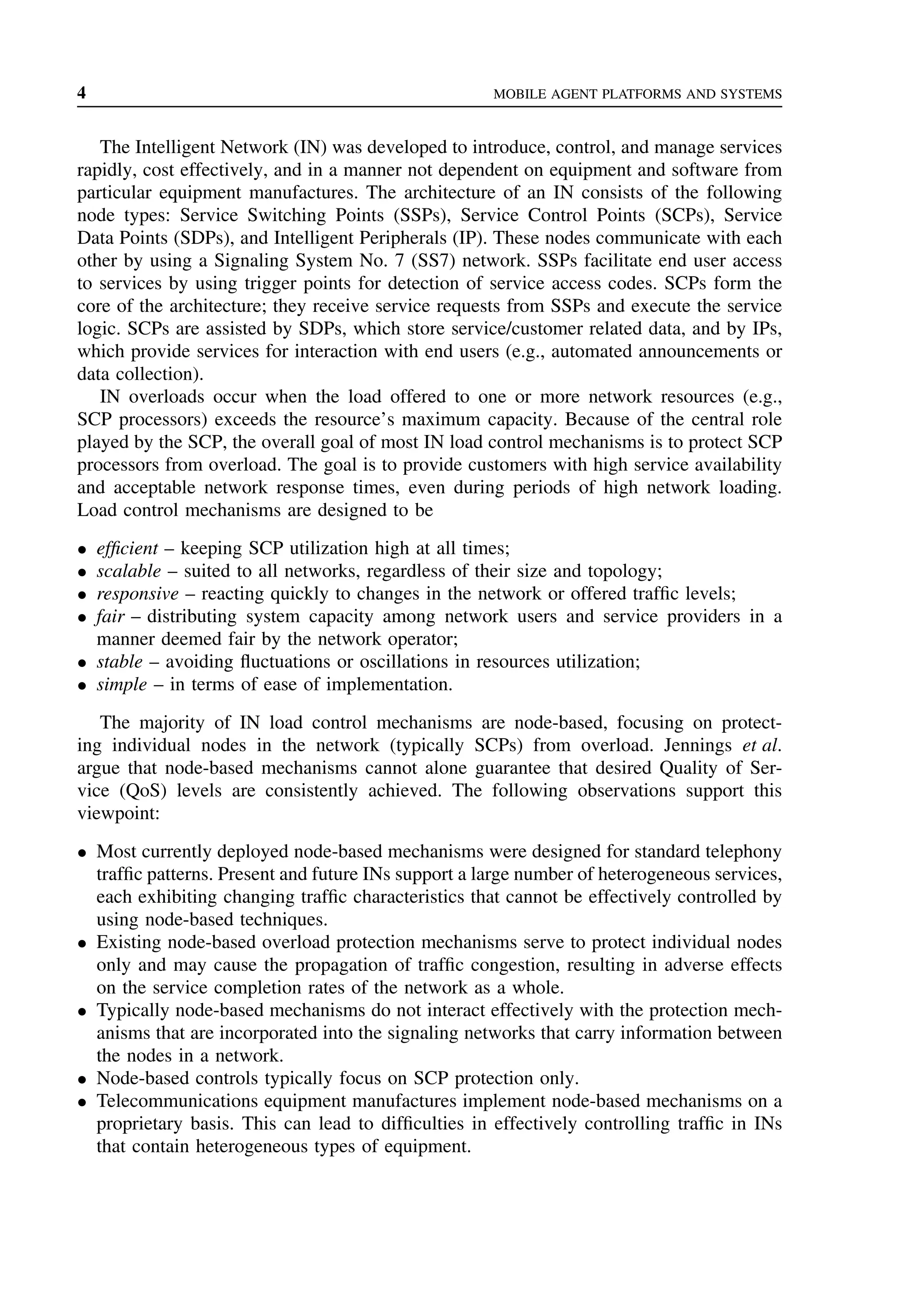
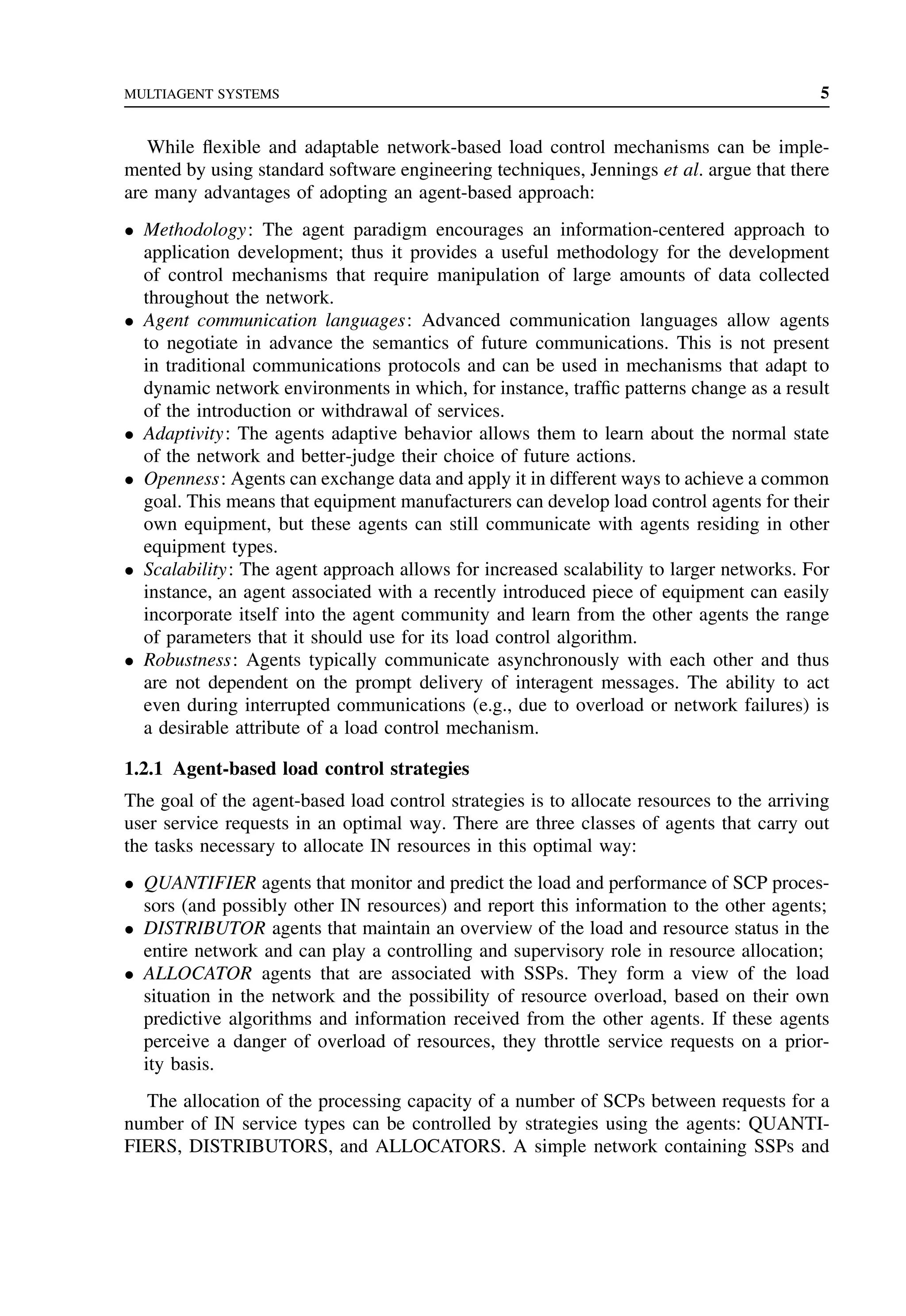
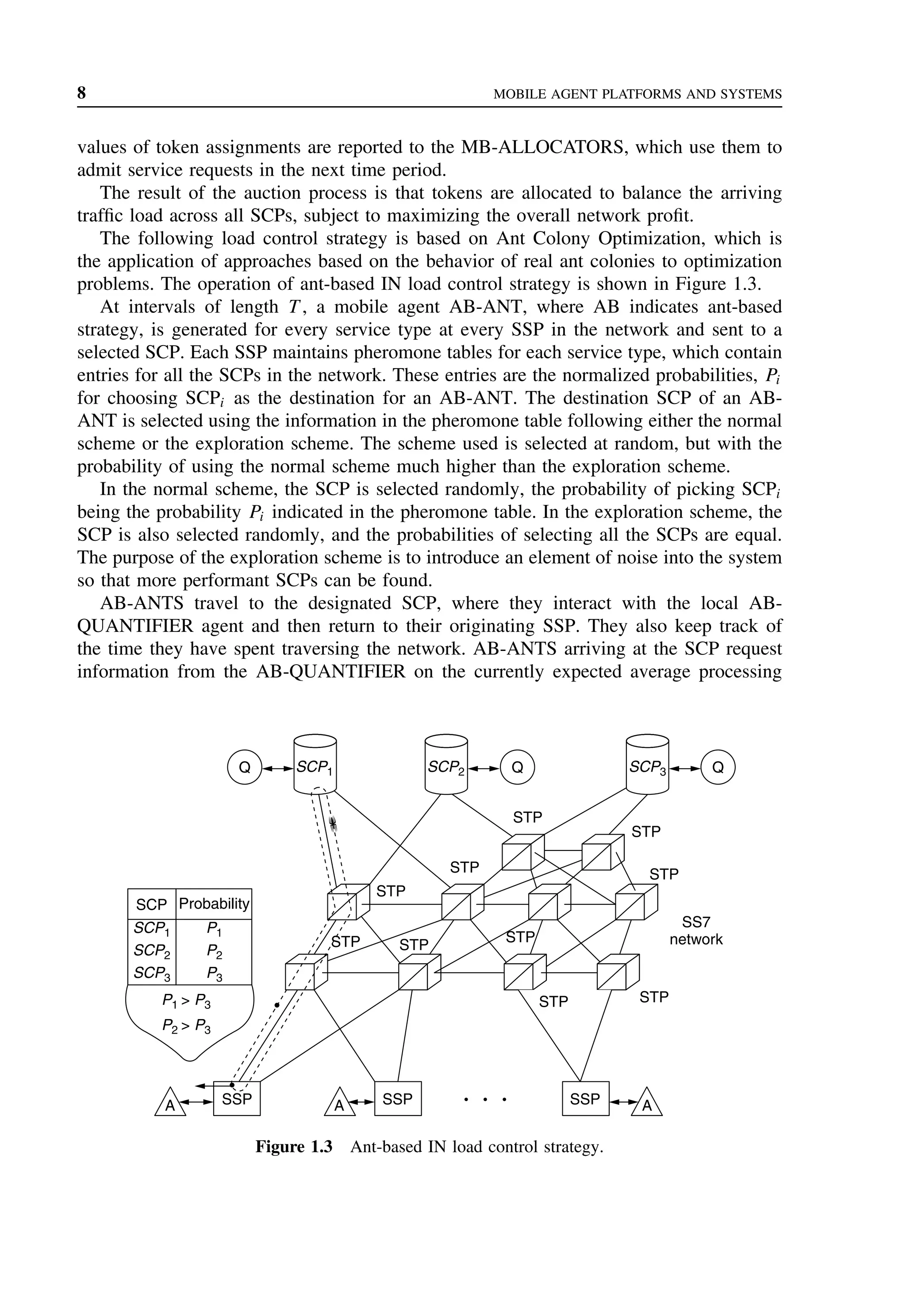
![SUMMARY 9
times for the service type of interest. Processing times reported are the processing time
for the initial message of the service session and the sum of the processing times for all
other messages. The separation between the processing times for the initial and subse-
quent messages is used to highlight the importance of the time spent processing the initial
message, by which time the service user would not have received any response from the
network. Reported processing times include those incurred in accessing information from
databases, which may be held in SDPs in other parts of the network.
Upon return to the SSP, the AB-ANT passes its gathered information to the AB-
ALLOCATOR, which then updates the pheromone table entries for its service type, using
the following formula.
Pi =
Pi + p
1 + p
where i indicates the visited SCP, and Pi is the probability of choosing SCPi. The prob-
ability Pj of choosing SCPj is
Pj =
Pj
1 + p
, j ∈ [1, N], j = i
with
p =
a
t1
+
b
t2
+
c
t3
+
d
t4
+ e
where a, b, c, d, and e are constants; t1 is time-elapsed traveling SSP → SCP; t2 is
expected mean SCP processing time for initial message; t3 is expected mean SCP pro-
cessing time for subsequent messages; t4 is time-elapsed traveling SCP → SSP.
The values of a, b, c, and d represent the relative importance the AB-ALLOCATOR
gives to each of the four measurements. Requests for service are routed to the SCP that has
the current highest priority value in the service’s pheromone table. Figure 1.3 illustrates
that in normal load conditions the operation of the strategy will mean that SCPs with
closer proximity to a source are more likely to be chosen as the destination for service
requests, the reason being that the delays AB-ANTS experience in traveling to and from
them are lower than for other SCPs.
1.3 SUMMARY
Each MAP has a class library that allows the user to develop agents and applications.
The core abstractions are common to most platforms since they are inherent in the MA
paradigm. These abstractions include agents, hosts, entry points, and proxies.
Agent-based technology offers a solution to the problem of designing efficient and
flexible network management strategies. The OMG has produced the MASIF standard,
which focuses on MA (object) technology, in particular, allowing for the transfer of agents
code and state between heterogeneous agent platforms.
Load control mechanisms are designed to be efficient, scalable, responsive, fair, stable,
and simple.](https://image.slidesharecdn.com/461399-250520015412-5dfdffed/75/Mobile-Telecommunications-Protocols-For-Data-Networks-Anna-Hac-26-2048.jpg)
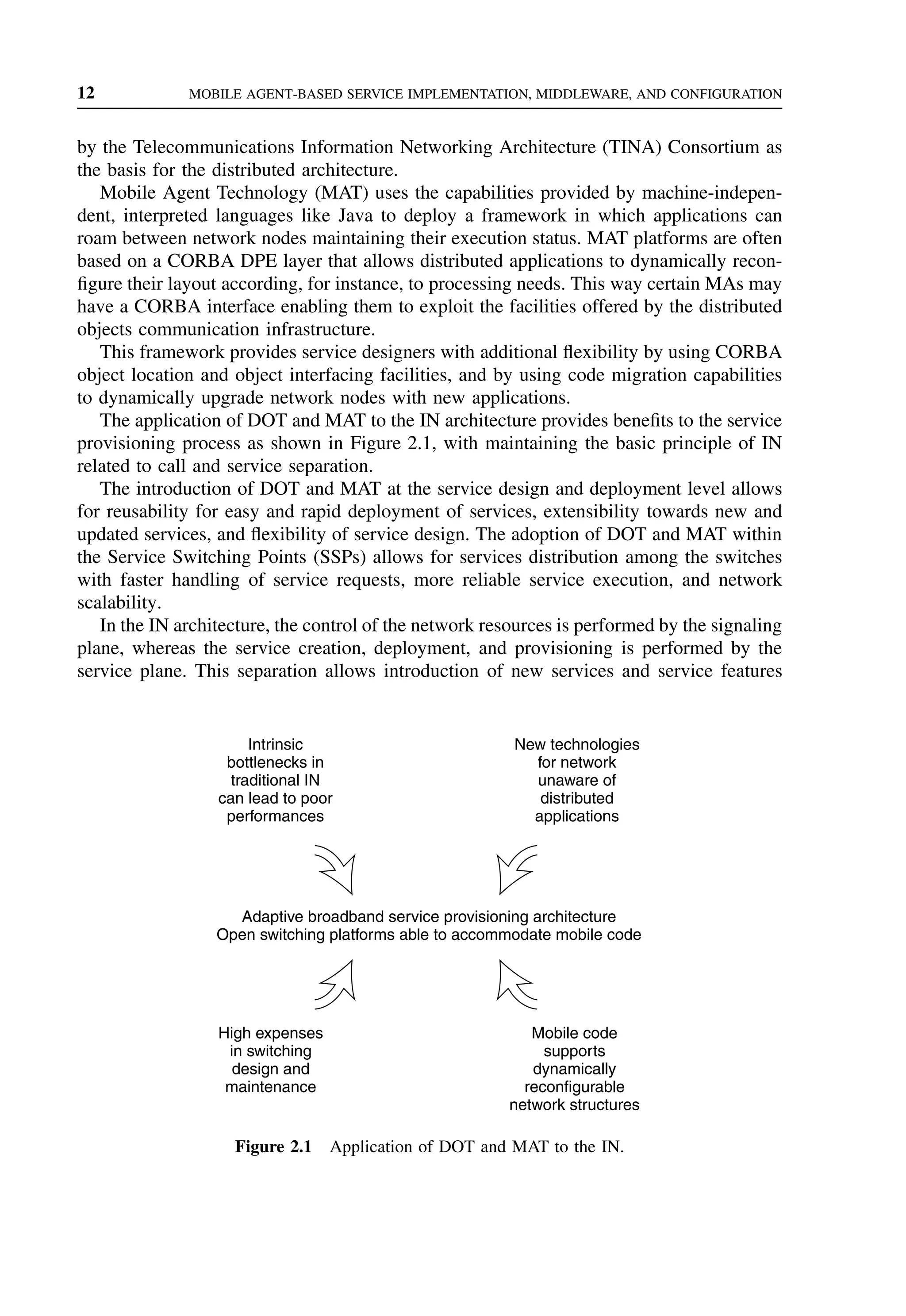
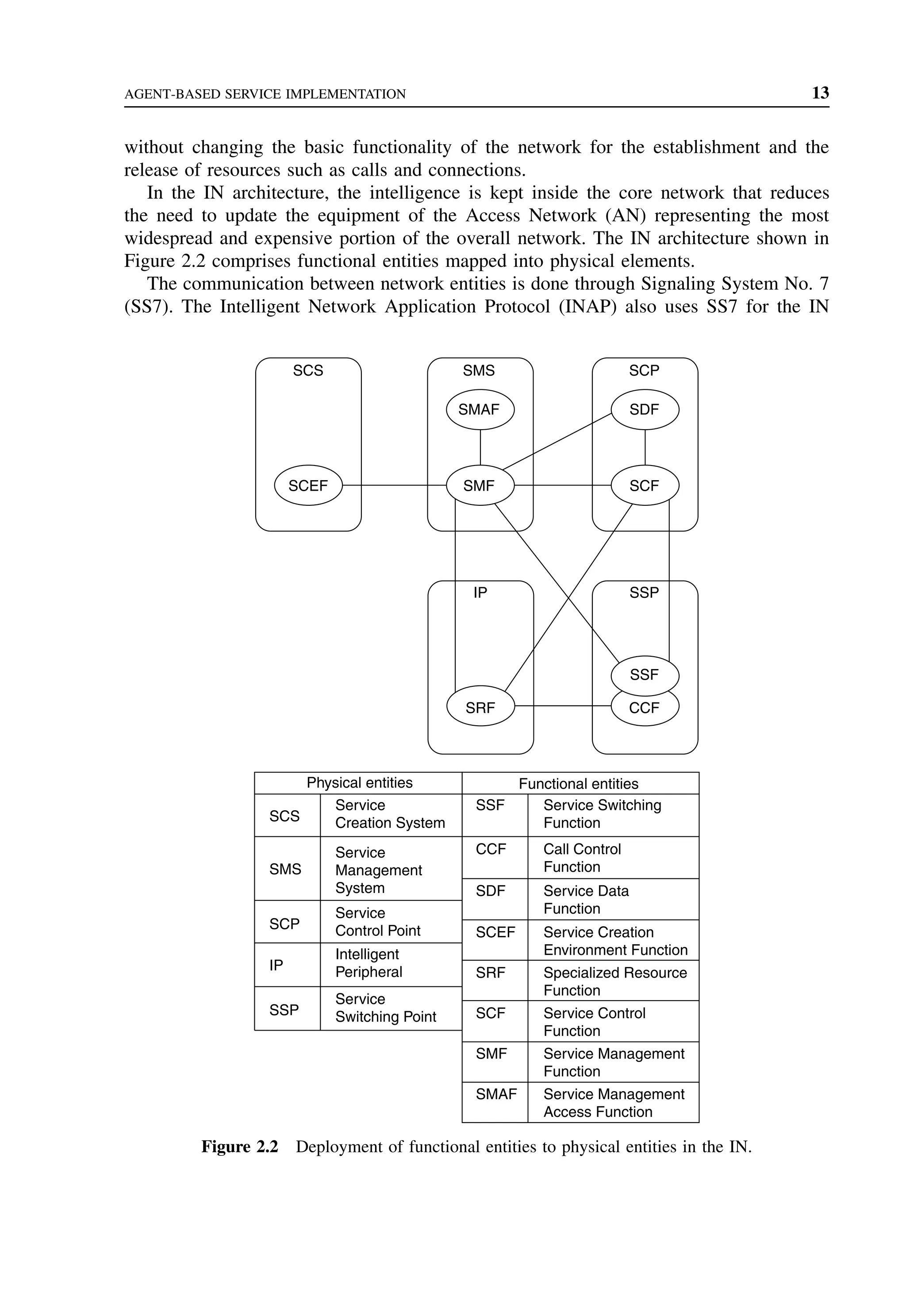
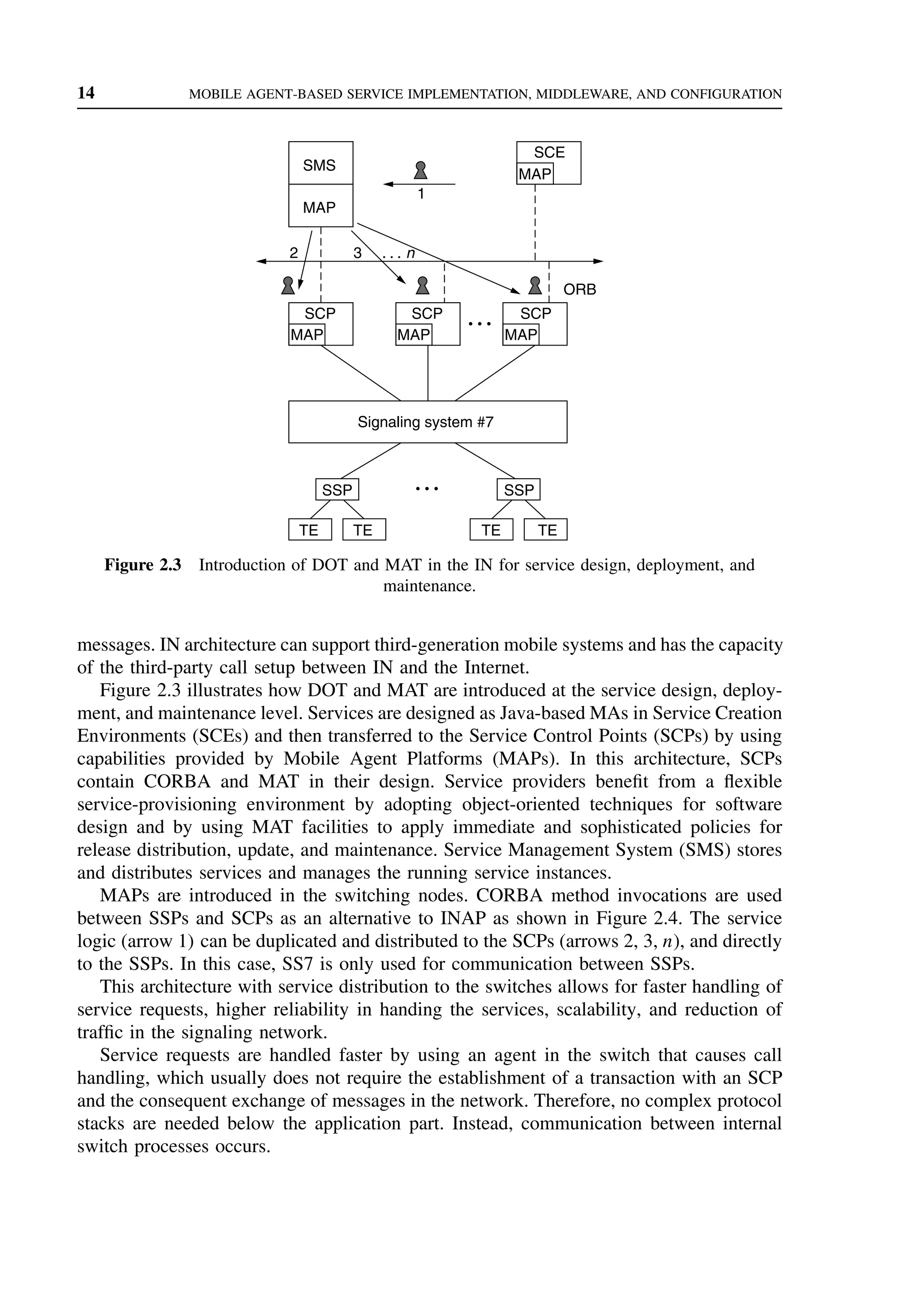
![AGENT-BASED SERVICE IMPLEMENTATION 15
SMS
SCE
MAP
1
3 . . . n
2
ORB
MAP
SCP SCP SCP
MAP MAP
TE TE
SSP
MAP
TE TE
SSP
MAP
MAP
Signaling system #7
• • •
Figure 2.4 Introduction of MAPs in the IN switches.
The impact of network faults on the behavior of service is reduced since the network is
accessed mainly to download the service logic. Network errors can occur during download-
ing Service Location Protocols (SLPs) (i.e., agent migration) or during a Remote Method
Invocation (RMI) (through CORBA infrastructure). These situations can be handled by
using persistent mechanisms. Most MATs offer persistent agent facilities and, for CORBA
objects, the Persistent Object Service (POS) can be used. This way service performance
degradation is reduced.
The problem of having centralized points is solved by distributing the service code
across the network, which has a larger number of switches than SCPs. Dynamic SLP/SDT
(Service Description Table) distribution allows IN services to be spread across the network
to satisfy higher demand for those services. The distribution is performed dynamically
when it is needed. In a distributed IN, the SLPs of the first IN calls are downloaded from
the SMS to the SCP and then executed in the SCP. When the capacity of IN calls in
SCP is exceeded, the SLPs are downloaded to the SSP, which must have the processing
power and infrastructure to accomplish the new tasks (i.e., the SSP must also provide
SCP functionality). This way the SCP can accommodate a higher number of calls and
is restricted to the user interaction functionality [Broadband Special Resource Function
(B-SRF) capability]. The distribution of the SLP to the attached SSPs can sustain the
additional processing required per call.
Traffic in the signaling network is reduced by moving services closer to the cus-
tomers, and the messages related to service control are handled locally. The overhead of
downloading service programs is done off-line and does not impact signaling performance.
The distribution of services to the switches does not affect the IN basic principle of
distinguishing between enriched call control (Call Control/Service Switching Functions,
CCF/SSF) and service intelligence (Service Control Function, SCF). The detection of IN
call attempts is still determined at call control level, and following that, an invocation of
IN facilities is done by the switch. The difference is now in the communication technology](https://image.slidesharecdn.com/461399-250520015412-5dfdffed/75/Mobile-Telecommunications-Protocols-For-Data-Networks-Anna-Hac-32-2048.jpg)