RCTQ
The
Philippine Professional Standards
for Teachers
RCTQ
We
sometimes
forget how
much things
change
over time
This is a Cargo
Plane in 1956.
It is transferring a
5MB IBM Hard
Drive.
In 2015:
A coin-sized flash
drive has a 128GB
of space
(~16 HD movies).
Source: http://forums.sherdog.com/threads/10-mb-hard-drive-
from-the-60s-pic-tech-brahs-gtfih.3500915/
RCTQ
General Information on
Department Order No. 42, s. 2017
“National Adoption and Implementation of the
Philippine Professional Standards for Teachers”
RCTQ
DepEd No. 42, s. 2017
Secretary Briones
signed into policy
DepEd Order No. 42,
S. 2017, The National
Adoption and
Implementation of the
Philippine Professional
Standards for
Teachers.
RCTQ
The PPST:
(i) sets clear expectations of teachers along well-defined
career stages of professional development from
beginning to distinguished practice;
(ii) engages teachers to embrace ongoing professional
learning for their professional development to enhance
their own teaching;
(iii) provides a framework of uniform measures to assess
teacher performance; and
(iv) provides a basis for building public confidence in and
support for the work of teachers.
DO 42, S. 2017
RCTQ
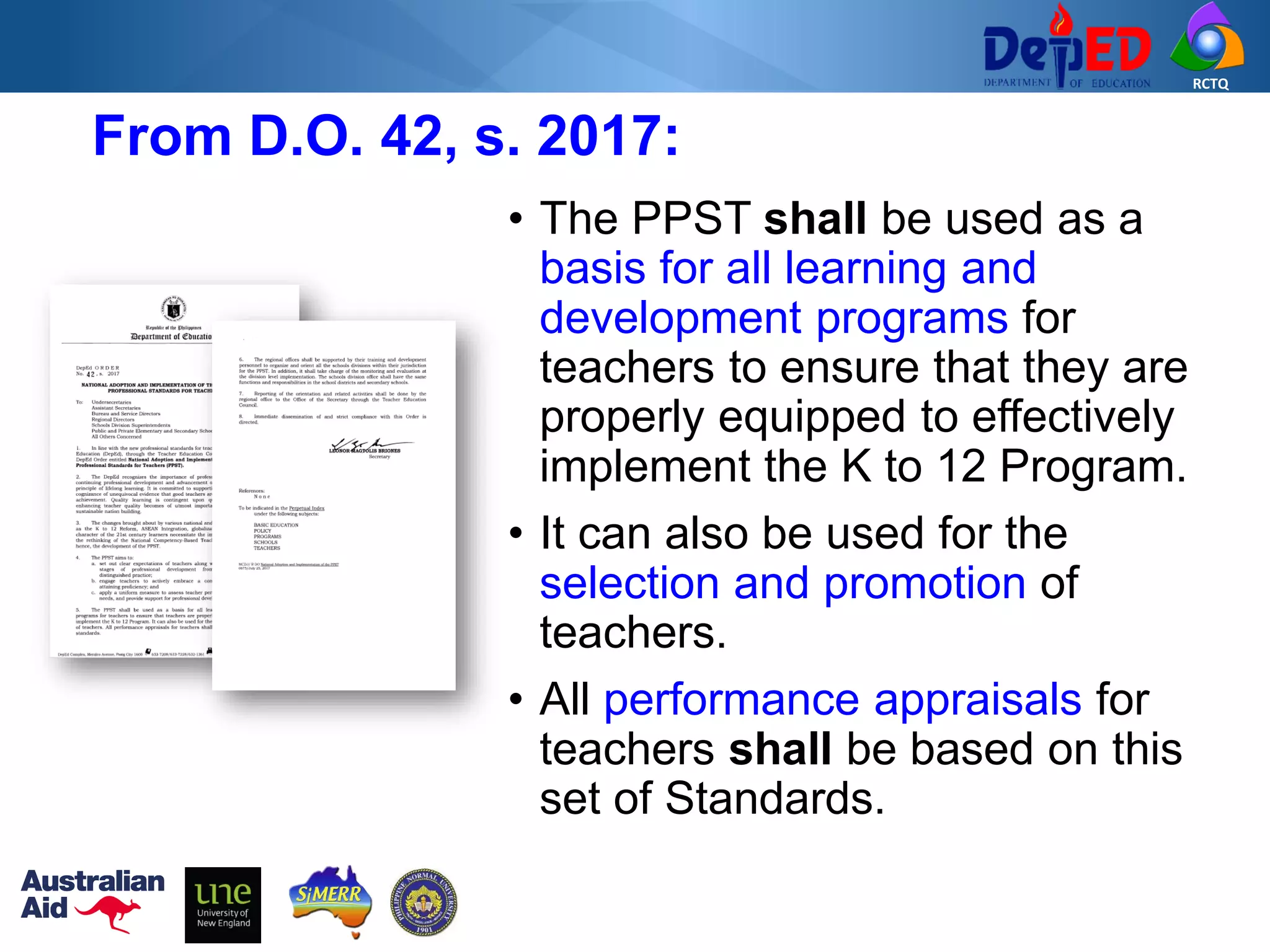
• The PPST shall be used as a
basis for all learning and
development programs for
teachers to ensure that they are
properly equipped to effectively
implement the K to 12 Program.
• It can also be used for the
selection and promotion of
teachers.
• All performance appraisals for
teachers shall be based on this
set of Standards.
From D.O. 42, s. 2017:
RCTQ
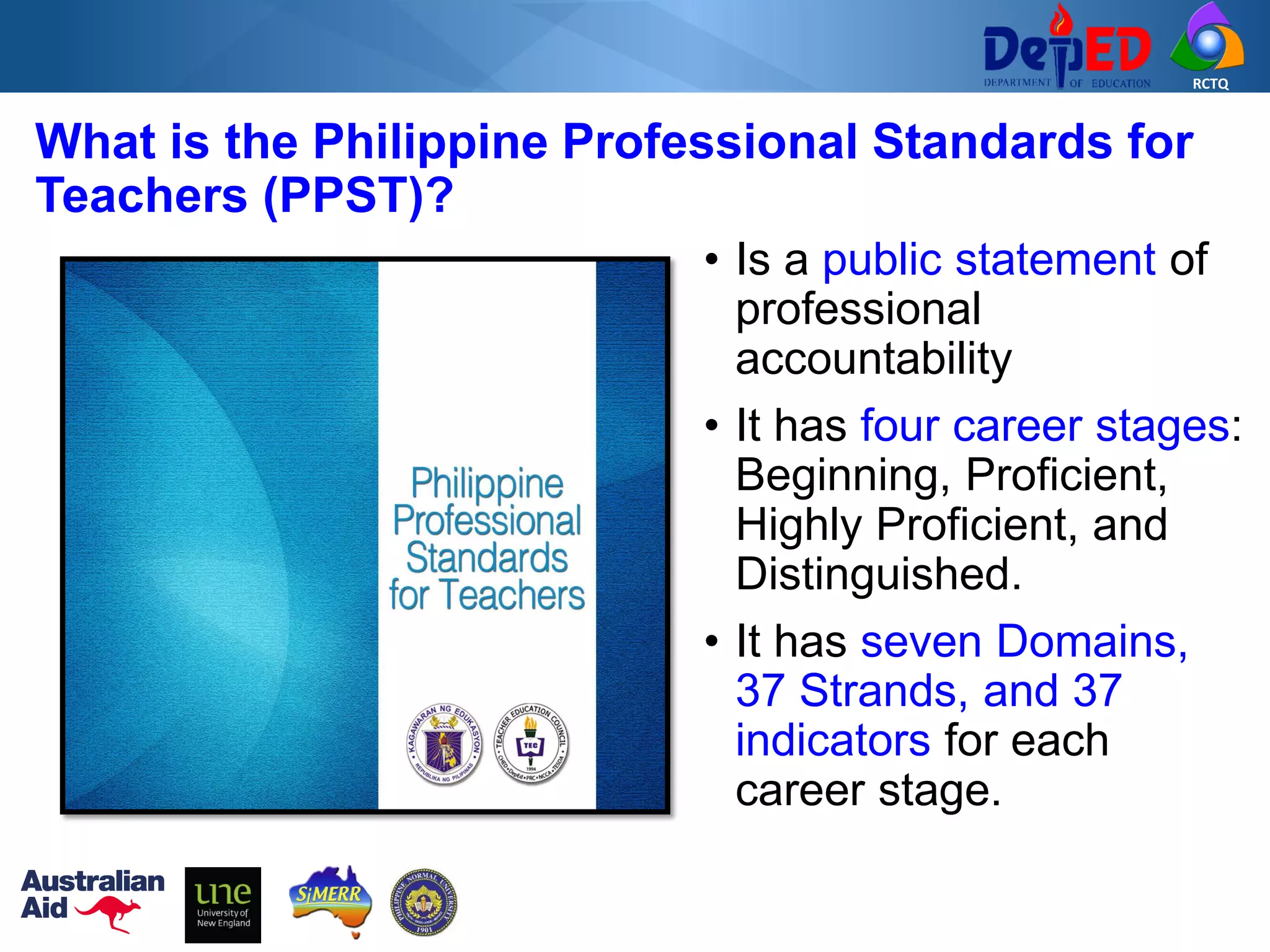
• Is a public statement of
professional
accountability
• It has four career stages:
Beginning, Proficient,
Highly Proficient, and
Distinguished.
• It has seven Domains,
37 Strands, and 37
indicators for each
career stage.
What is the Philippine Professional Standards for
Teachers (PPST)?
RCTQ
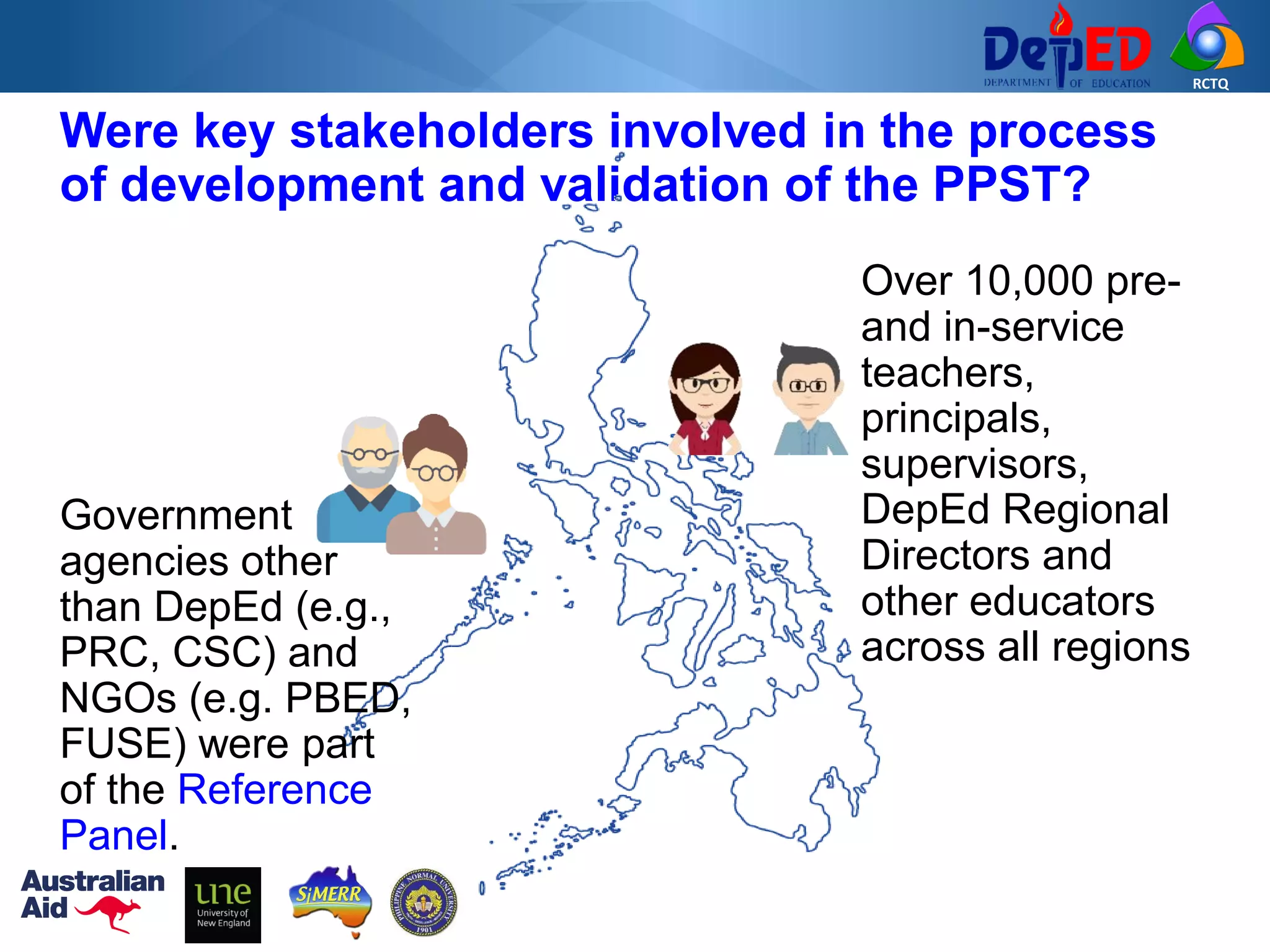
Were key stakeholders involved in the process
of development and validation of the PPST?
Over 10,000 pre-
and in-service
teachers,
principals,
supervisors,
DepEd Regional
Directors and
other educators
across all regions
Government
agencies other
than DepEd (e.g.,
PRC, CSC) and
NGOs (e.g. PBED,
FUSE) were part
of the Reference
Panel.
RCTQ
Rationale in the Development of the
Philippine Professional Standards for
Teachers
RCTQ
In 2013, RA 10533 (K to 12 Reform) was
signed into law
This prompted the:
• Need to revisit NCBTS as a Framework for Teacher
Quality, and address teacher quality requirements in the
K to 12 (e.g., content knowledge and pedagogy, career
stages)
(Work on teacher standards was approved by the Joint
Advisory Board chaired by Former Sec Armin Luistro)
RCTQ
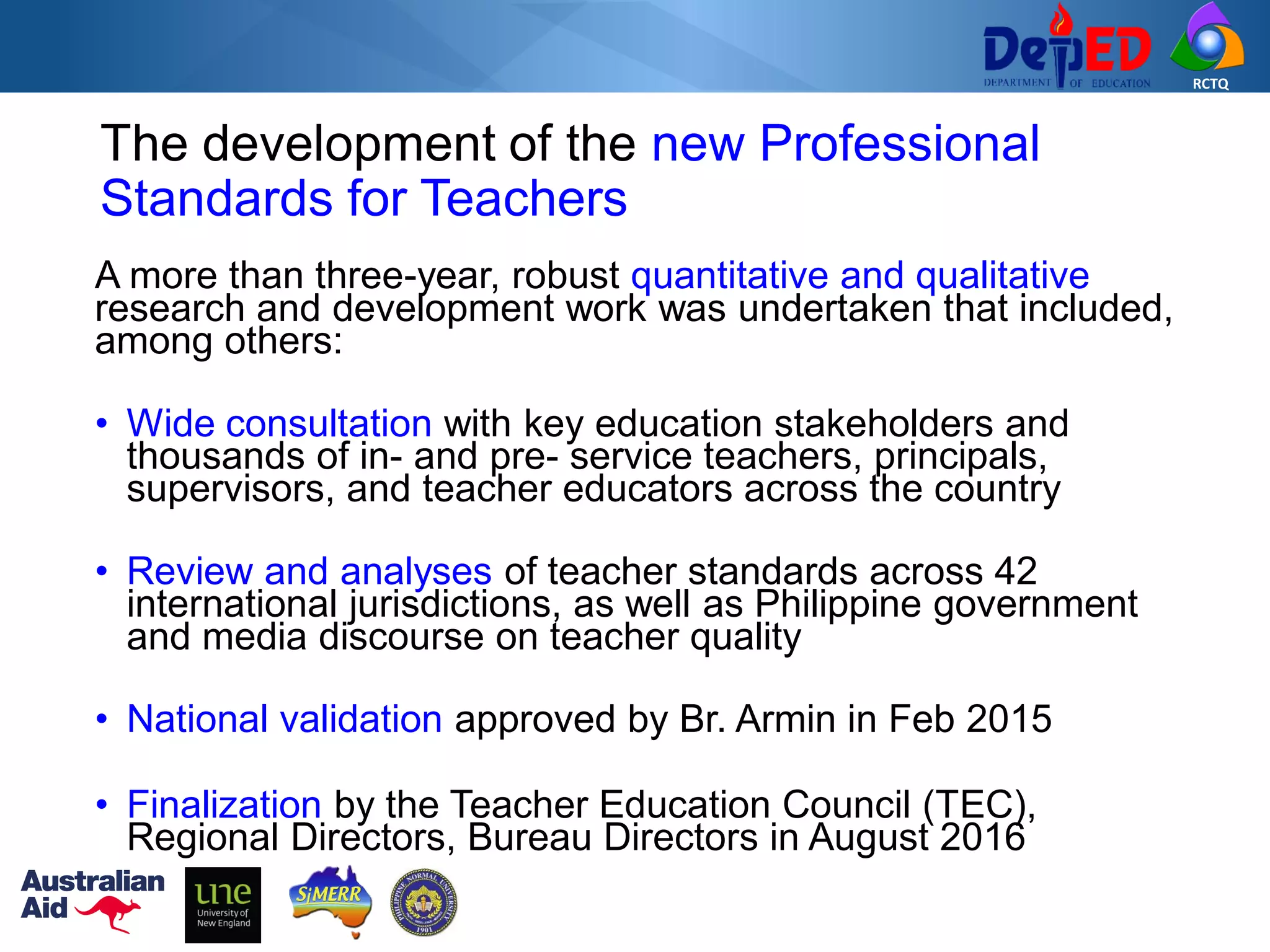
The development of the new Professional
Standards for Teachers
A more than three-year, robust quantitative and qualitative
research and development work was undertaken that included,
among others:
• Wide consultation with key education stakeholders and
thousands of in- and pre- service teachers, principals,
supervisors, and teacher educators across the country
• Review and analyses of teacher standards across 42
international jurisdictions, as well as Philippine government
and media discourse on teacher quality
• National validation approved by Br. Armin in Feb 2015
• Finalization by the Teacher Education Council (TEC),
Regional Directors, Bureau Directors in August 2016
RCTQ
“The quality of an
education system
cannot exceed
the quality of its
teachers.”
(McKinsey and Co., 2007)
“
”
RCTQ
Professional Standards:
• Is a public statement of professional
accountability
• Makes explicit what teachers should know, be
able to do and value in the profession
• Is sufficiently generic to represent practice
across Grade levels and subject areas
Internationally, Teacher Quality is articulated
in Professional Standards for Teachers
RCTQ
The Development and Validation of the
Philippine Professional Standards for
Teachers
RCTQ
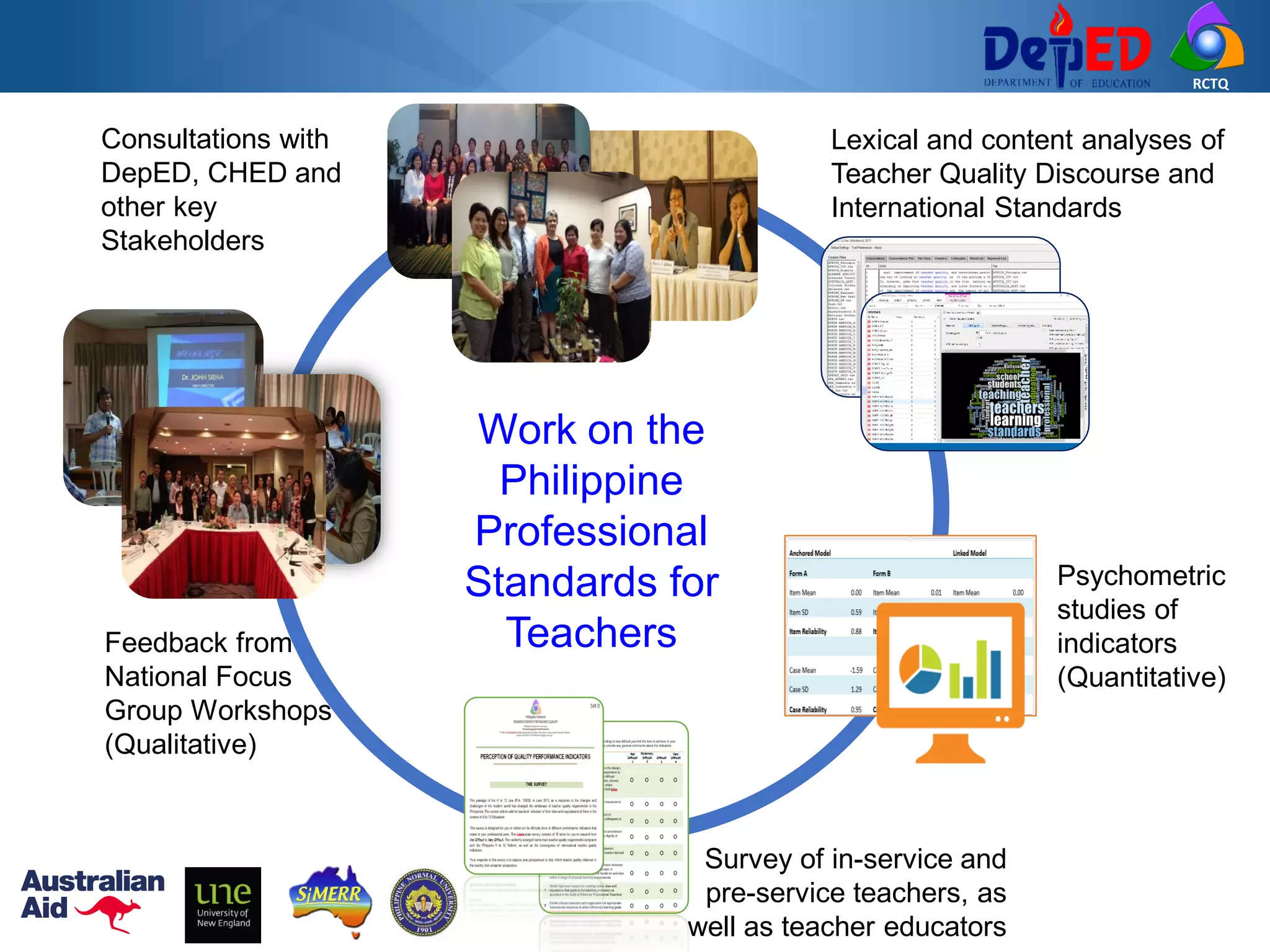
Feedback from
National Focus
Group Workshops
(Qualitative)
Psychometric
studies of
indicators
(Quantitative)
Consultations with
DepED, CHED and
other key
Stakeholders
Work on the
Philippine
Professional
Standards for
Teachers
Lexical and content analyses of
Teacher Quality Discourse and
International Standards
Survey of in-service and
pre-service teachers, as
well as teacher educators
RCTQ
Philippine Professional Standards for Teachers
as the New Framework for
Teacher Quality and Teacher Development
RCTQ
Stage 1
(Beginning)
Stage 2
(Proficient)
Stage 3
(Highly
Proficient)
Stage 4
(Distinguished)
Recruitment
and Hiring
Career Path
Classroom Observation Tool & Self-Assessment Tool
Targeted Professional Development and Teacher Training
Teacher Certification at Career
Stage 2, 3, 4 (?)
Rewards,
Compensation (?)
Teacher
Education
Teacher Entry
Requirement
Teacher Professional Development Framework
Teacher
Induction
Program
1 → 2
RCTQ
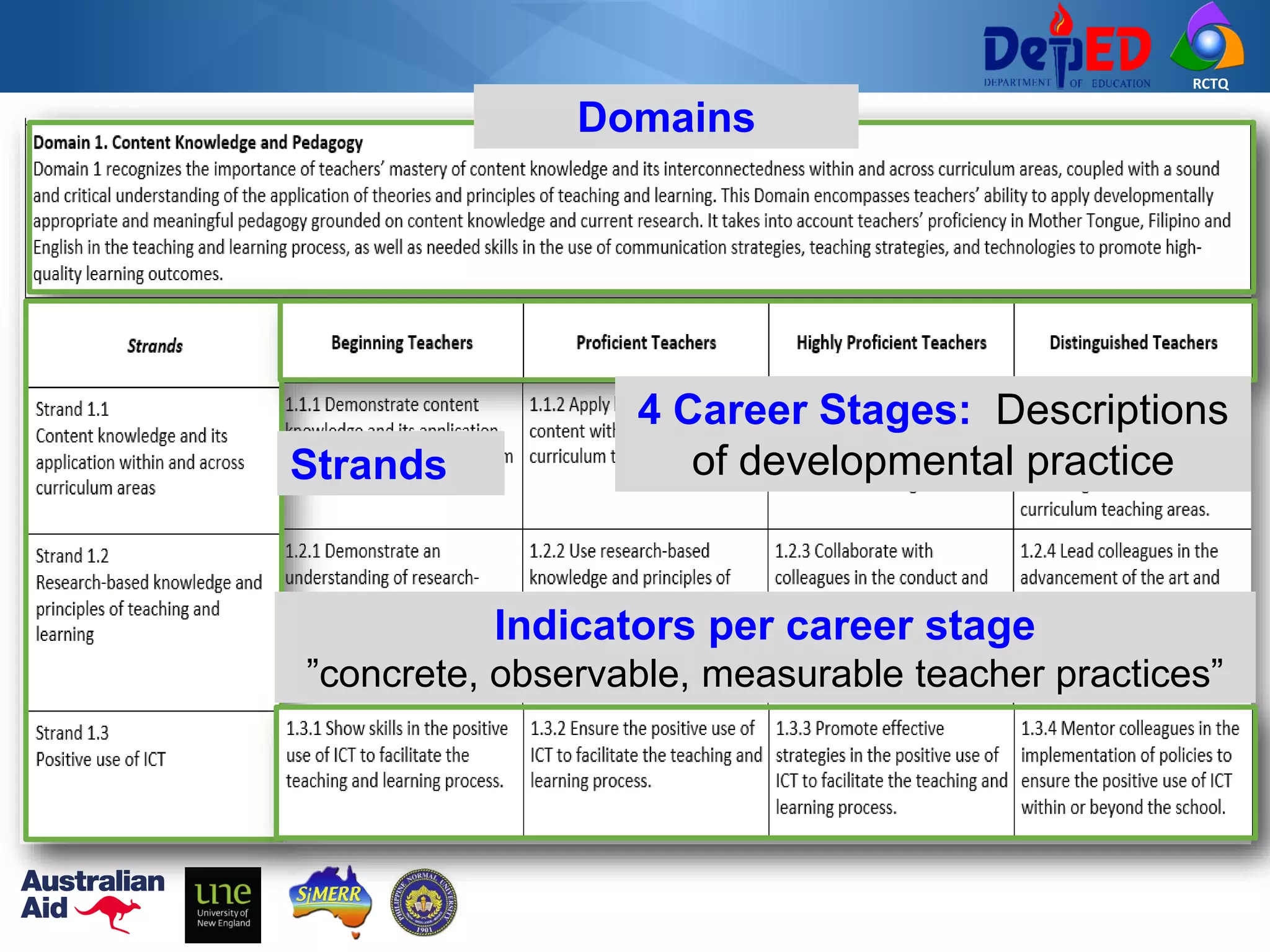
Domains
Strands
Indicators per career stage
”concrete, observable, measurable teacher practices”
4 Career Stages: Descriptions
of developmental practice
RCTQ
2 Learning Environment
3 Diversity of Learners
4 Curriculum and Planning
5 Assessment and Reporting
6 Community Linkages and
Professional Engagement
7 Personal Growth and Professional
Development
1 Content Knowledge and Pedagogy
Philippine Professional Standards for
Teachers Central to
the K to 12
Reform and
places, at
the
beginning,
the
importance
of teachers
knowing
their content
and knowing
how to
teach it.
Domains
RCTQ
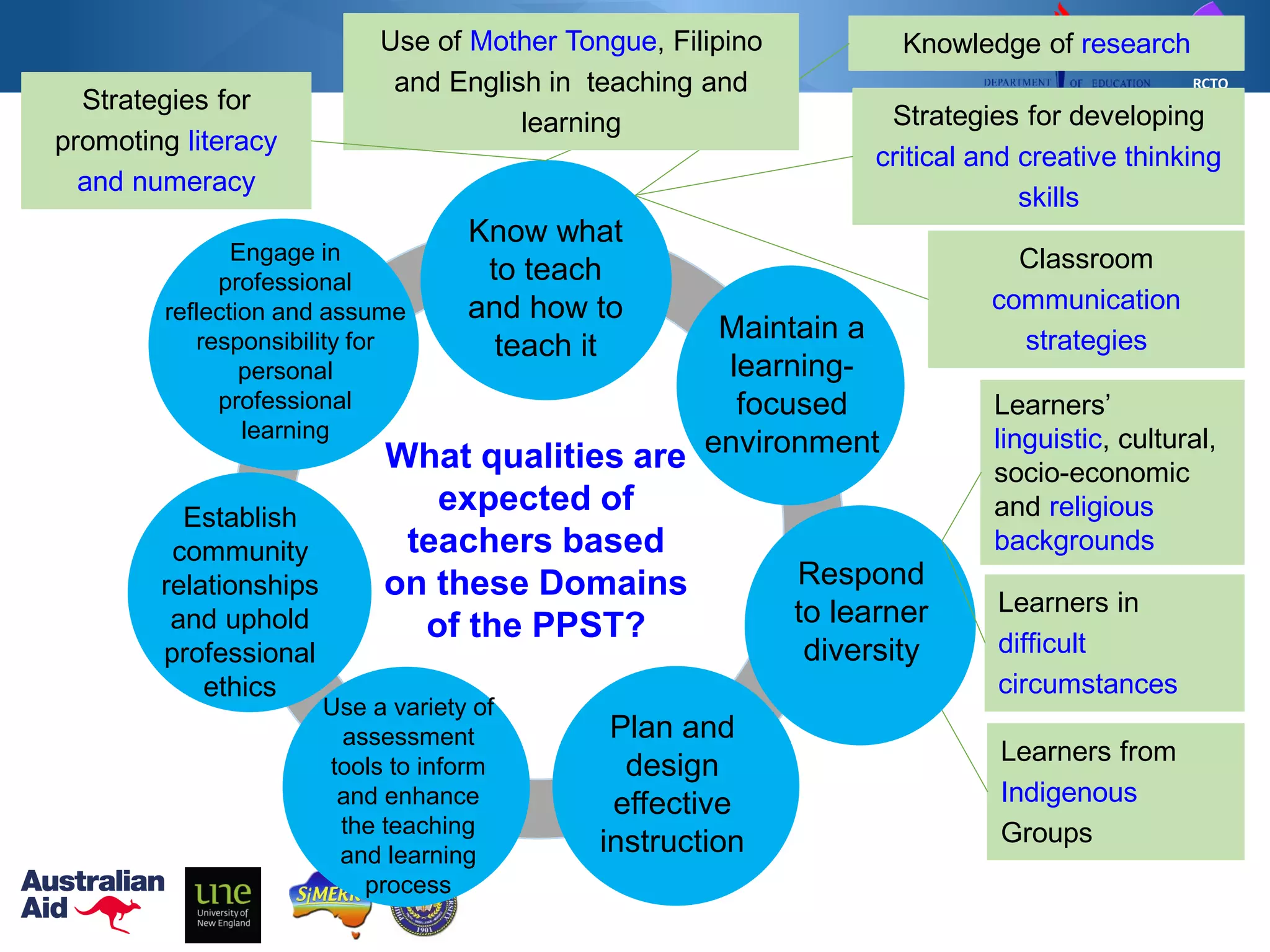
Engage in
professional
reflection and assume
responsibility for
personal
professional
learning
Classroom
communication
strategies
Strategies for developing
critical and creative thinking
skills
Knowledge of researchUse of Mother Tongue, Filipino
and English in teaching and
learning
Learners’
linguistic, cultural,
socio-economic
and religious
backgrounds
Learners from
Indigenous
Groups
Know what
to teach
and how to
teach it
Maintain a
learning-
focused
environment
Respond
to learner
diversity
Establish
community
relationships
and uphold
professional
ethics
Learners in
difficult
circumstances
What qualities are
expected of
teachers based
on these Domains
of the PPST?
Strategies for
promoting literacy
and numeracy
Use a variety of
assessment
tools to inform
and enhance
the teaching
and learning
process
Plan and
design
effective
instruction
RCTQ
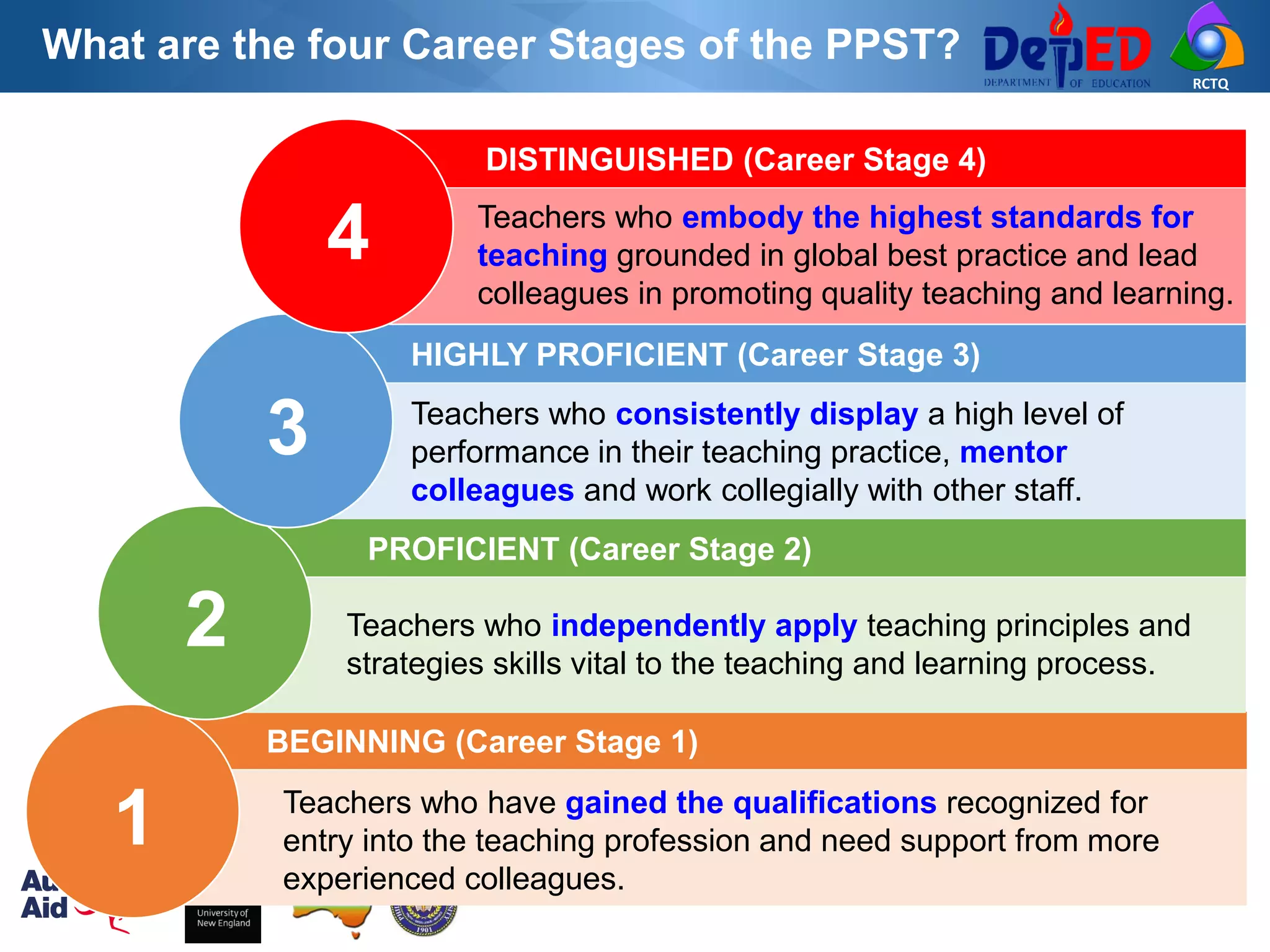
What are the four Career Stages of the PPST?
1 Teachers who have gained the qualifications recognized for
entry into the teaching profession and need support from more
experienced colleagues.
BEGINNING (Career Stage 1)
1
PROFICIENT (Career Stage 2)
2 Teachers who independently apply teaching principles and
strategies skills vital to the teaching and learning process.
HIGHLY PROFICIENT (Career Stage 3)
3 Teachers who consistently display a high level of
performance in their teaching practice, mentor
colleagues and work collegially with other staff.
DISTINGUISHED (Career Stage 4)
4 Teachers who embody the highest standards for
teaching grounded in global best practice and lead
colleagues in promoting quality teaching and learning.
RCTQ
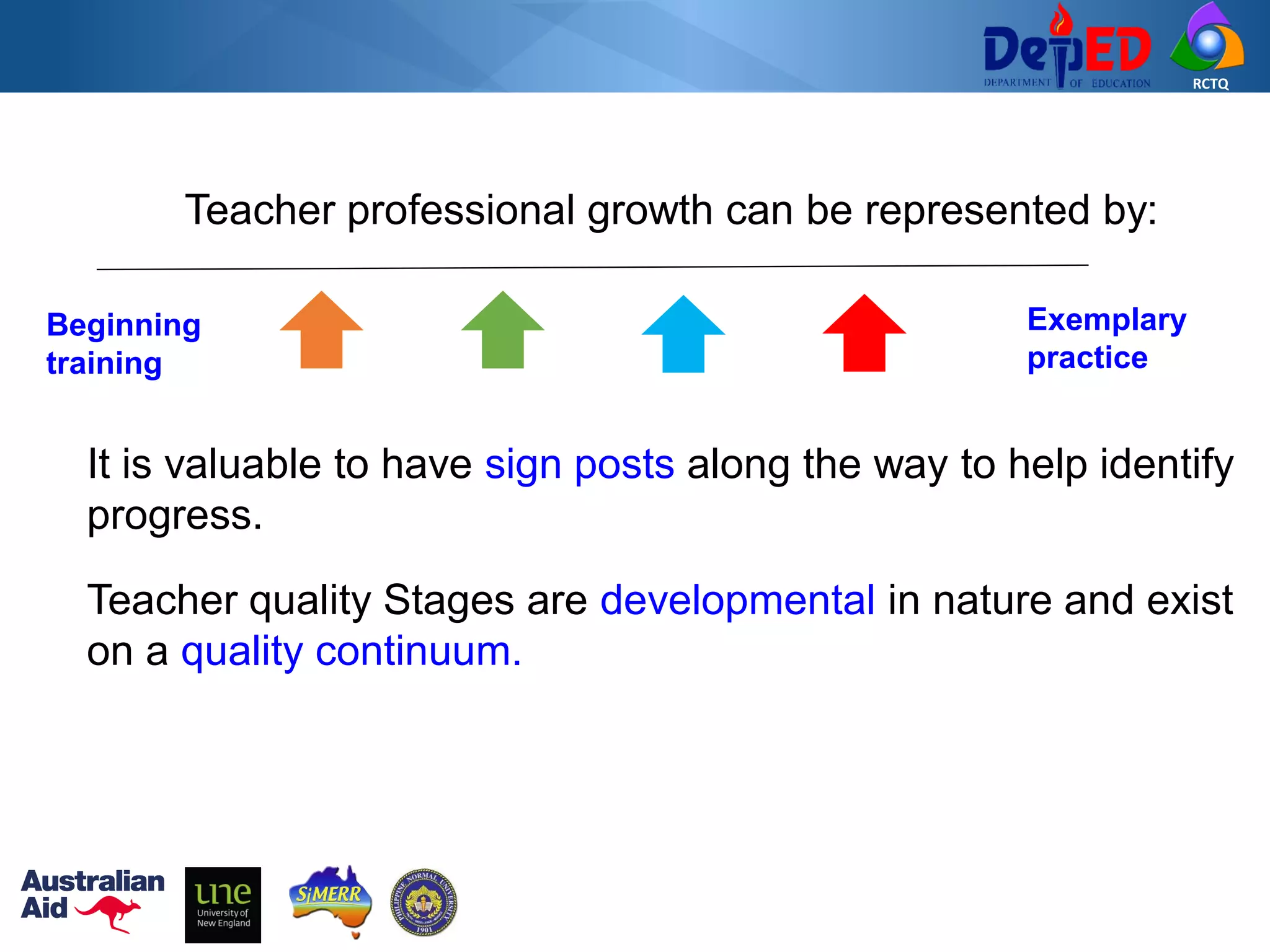
Teacher professional growth can be represented by:
It is valuable to have sign posts along the way to help identify
progress.
Beginning
training
Exemplary
practice
Teacher quality Stages are developmental in nature and exist
on a quality continuum.
RCTQ
1
2
3
4
5
6
7
8
9
10
11
12
13
14
15
16
17
18
19
20
21
22
23
24
25
26
27
28
29
30
31
32
33
34
35
36
37
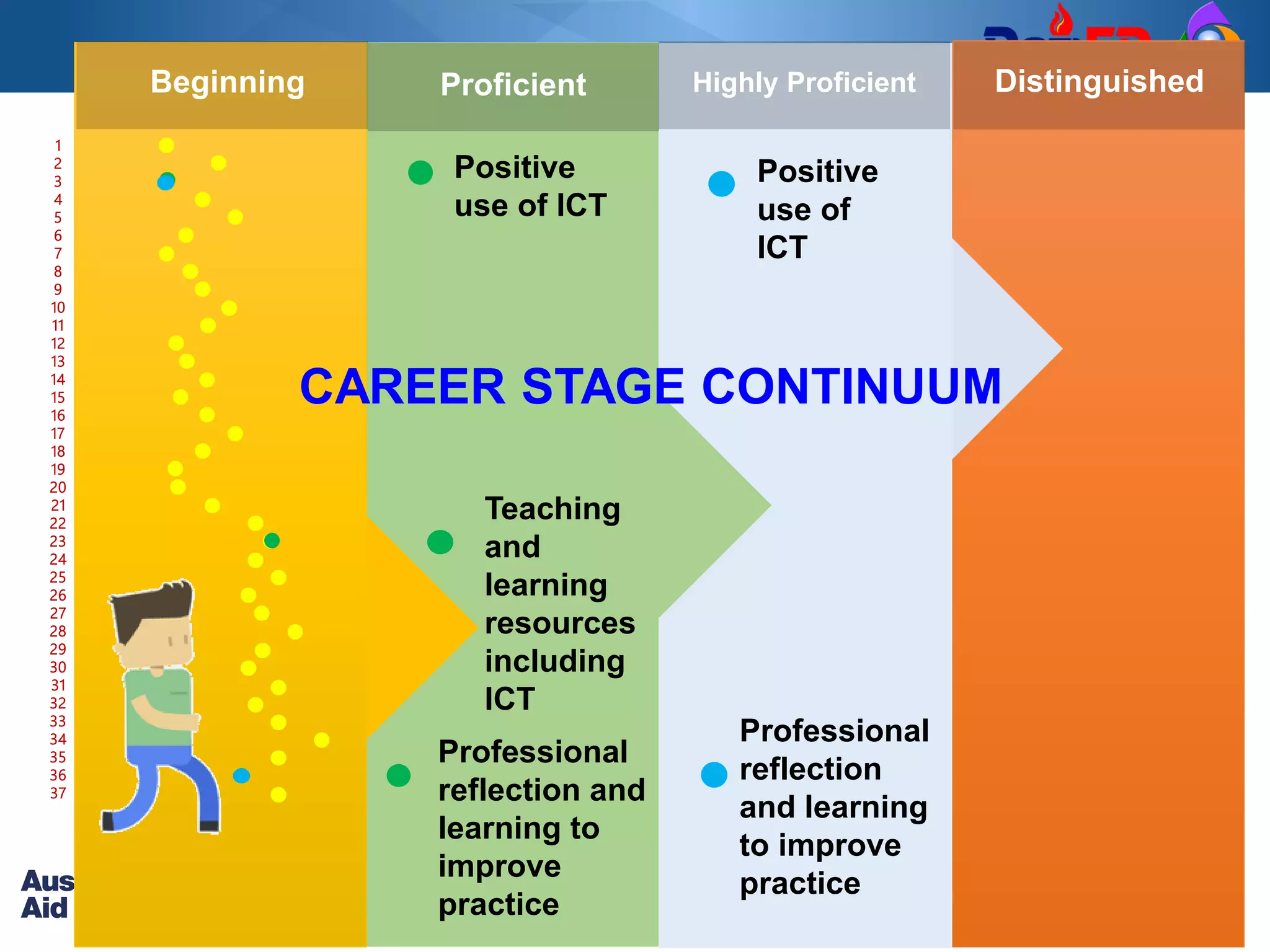
Beginning DistinguishedHighly ProficientProficient
Professional
reflection and
learning to
improve
practice
Positive
use of ICT
Positive
use of
ICT
Professional
reflection
and learning
to improve
practice
Teaching
and
learning
resources
including
ICT
CAREER STAGE CONTINUUM
RCTQ
Why are Career Stages important?
The description of standards
at different career stages
provides “a framework for the
teacher development continuum.”
(OECD,2005)
Teacher evaluation should be based
on professional teaching standards
and should be sophisticated enough
to assess teaching quality across
the continuum of development
from novice to expert teacher.
(Darling-Hammond in Strauss, 2012)
RCTQ
Career stage 1 offers:
▪ realistic requirements of teachers in training.
▪ TEIs what they need to guide the design of teacher
education programs and judge pre-service teacher
quality
Implications of Career Stages
Career stage 2:
▪ is for teachers of good quality in school and is what
teachers need to enjoy success and a sense of genuine
professionalism
▪ allows a focus for school-based induction for beginning
teachers.
RCTQ
Career stage 3 allows a focus on:
▪ high-quality teaching
▪ mentoring which is a defining characteristic of
a profession where established practitioners
exercise responsibility for the development of
their peers
Implications of Career Stages
Career stage 4:
▪ shows exemplary teaching
▪ is recognised as a leader and mentor in
teaching and curriculum.
RCTQ
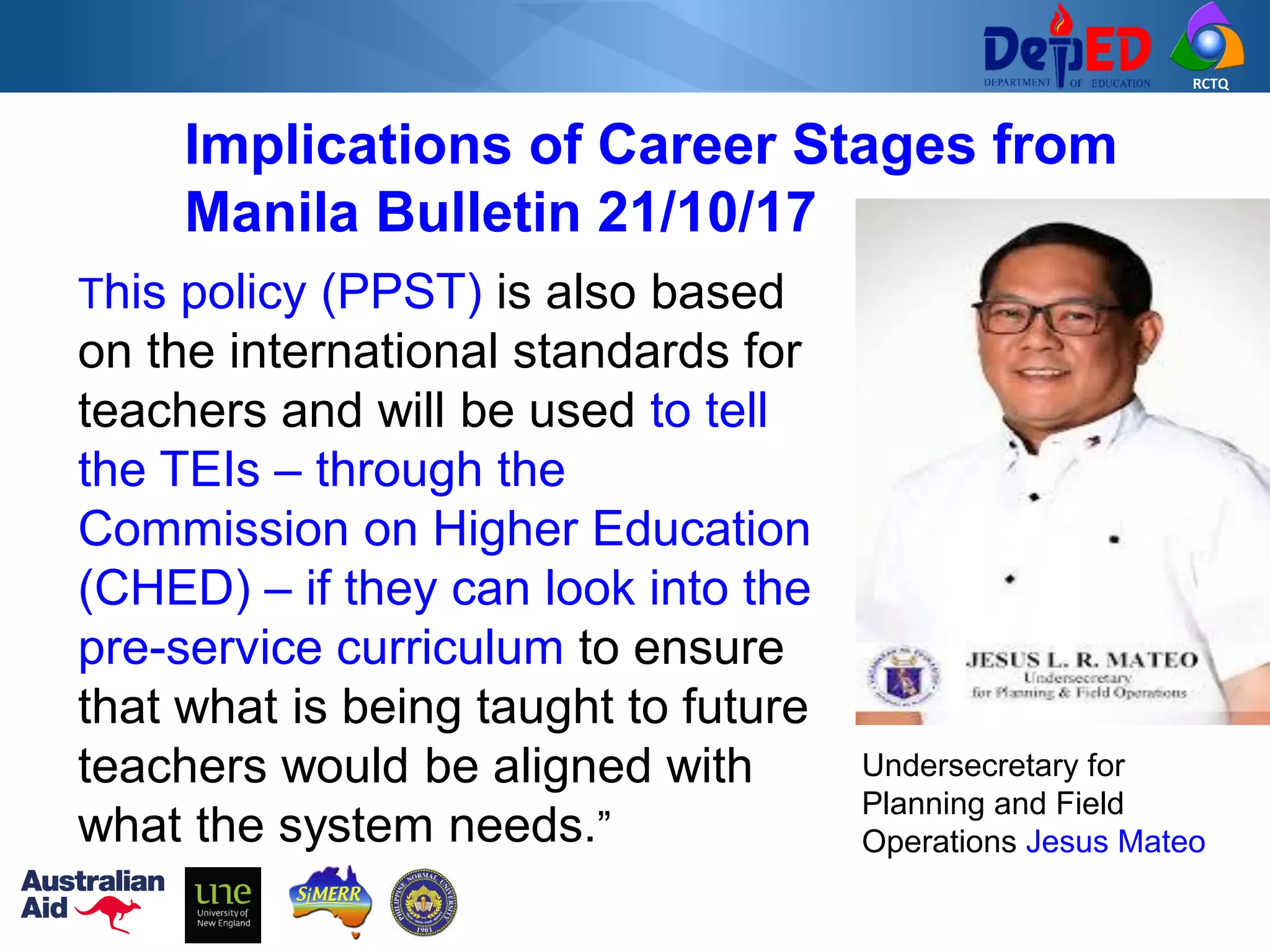
Implications of Career Stages from
Manila Bulletin 21/10/17
This policy (PPST) is also based
on the international standards for
teachers and will be used to tell
the TEIs – through the
Commission on Higher Education
(CHED) – if they can look into the
pre-service curriculum to ensure
that what is being taught to future
teachers would be aligned with
what the system needs.”
Undersecretary for
Planning and Field
Operations Jesus Mateo
RCTQ
▪ guide professional development that provides
achievable quality targets, focused advice and
feedback on performance
▪ achieve realistic outcomes of development of
practical quality in teaching
Developmental Career stages
can help teachers
The FOCUS for the NEXT FEW YEARS WILL be on
improved PROFESSIONAL LEARNING
RCTQ
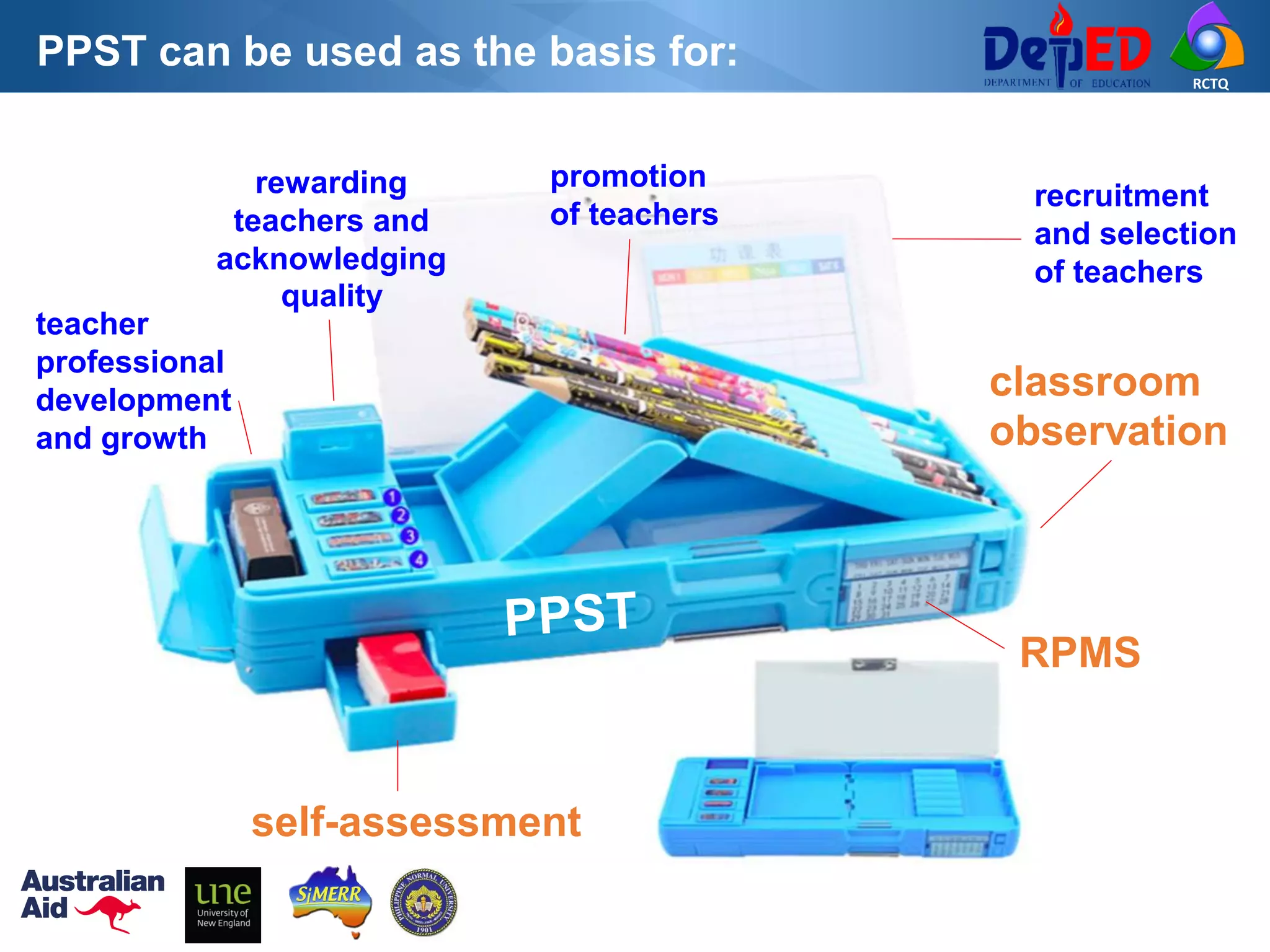
teacher
professional
development
and growth
PPST can be used as the basis for:
recruitment
and selection
of teachers
promotion
of teachers
rewarding
teachers and
acknowledging
quality
self-assessment
classroom
observation
RPMS
RCTQ
s
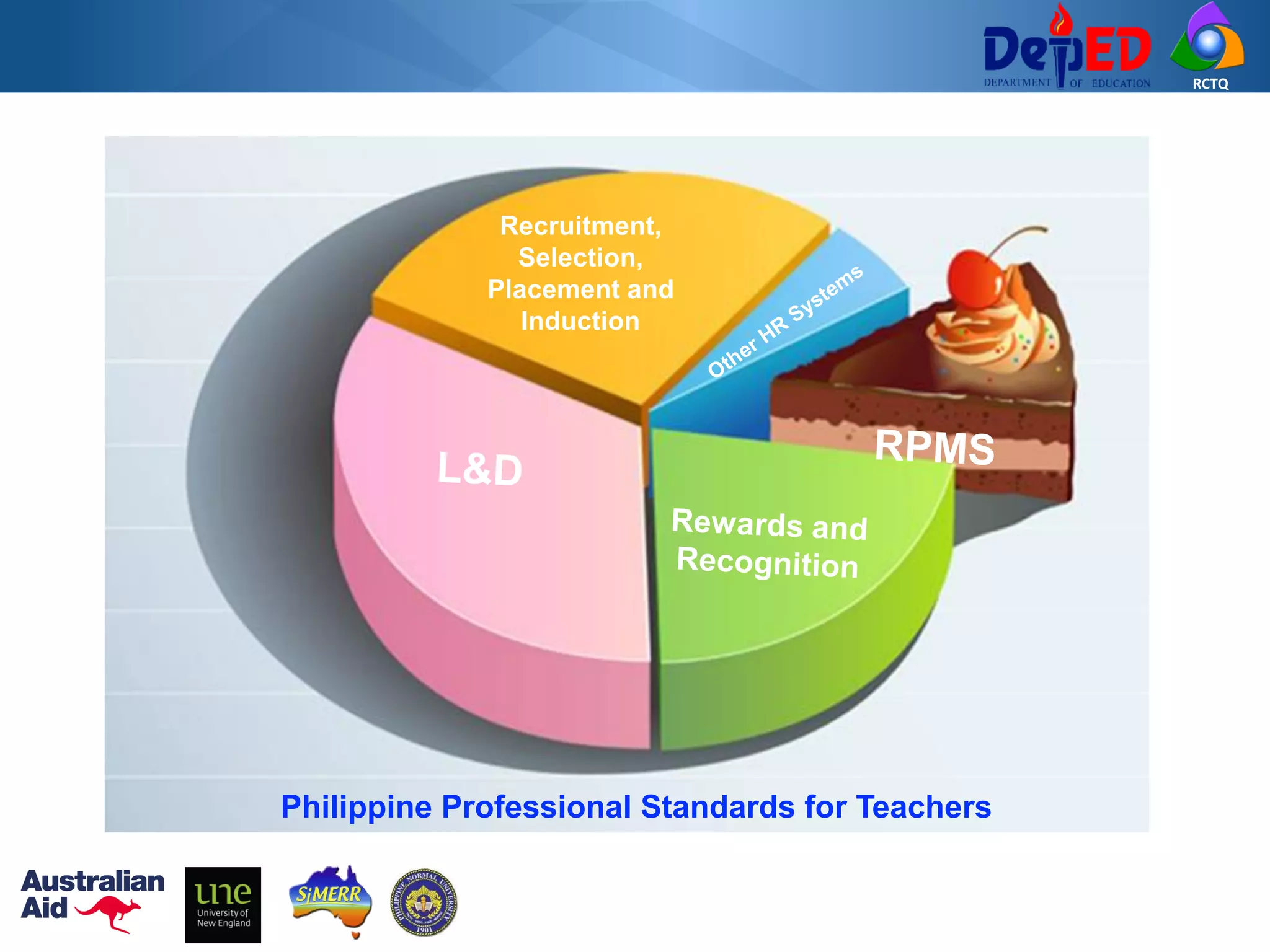
Recruitment,
Selection,
Placement and
Induction
Philippine Professional Standards for Teachers
RCTQ
Teacher Assessment based on the
Philippine Professional Standards
for Teachers
RCTQ
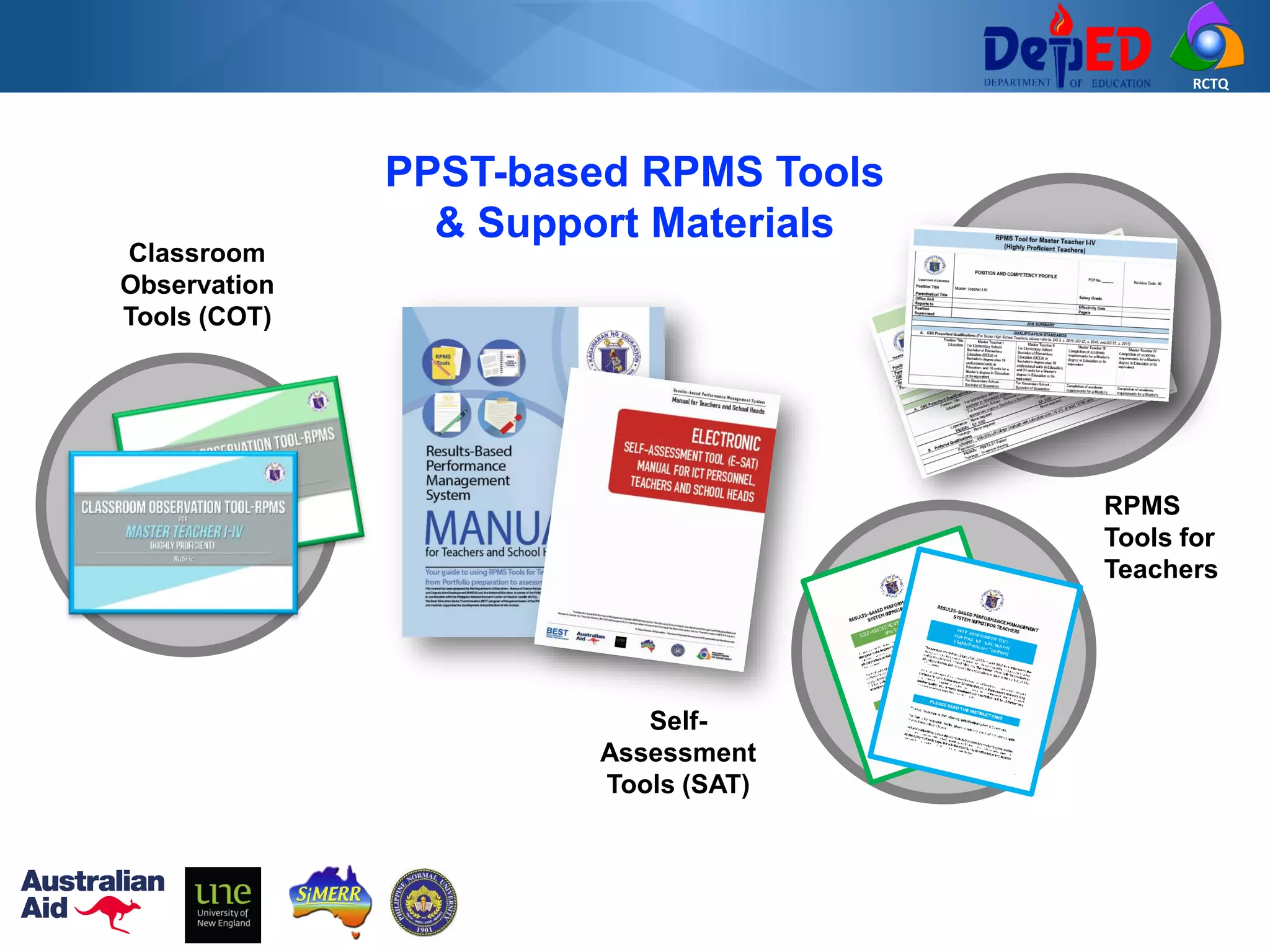
RPMS
Tools for
Teachers
Self-
Assessment
Tools (SAT)
Classroom
Observation
Tools (COT)
PPST-based RPMS Tools
& Support Materials
RCTQ
Three things that matter most in top school systems
(McKinsey, 2007)
Developing
them into
effective
instructors
Ensuring that
the system is able
to deliver the best
possible instruction
for every child
Getting the
right people to
become
teachers
RCTQ
Questions?
RCTQ
Presentation slides prepared by:
Dr. Gina O. Gonong
Director, RCTQ
Dr. John Pegg
Director, UNE-SiMERR, Australia
Michael Wilson I. Rosero
Project Development Officer III, BHROD-HRDD

03 The PPST

  • 1.
  • 2.
    RCTQ We sometimes forget how much things change overtime This is a Cargo Plane in 1956. It is transferring a 5MB IBM Hard Drive. In 2015: A coin-sized flash drive has a 128GB of space (~16 HD movies). Source: http://forums.sherdog.com/threads/10-mb-hard-drive- from-the-60s-pic-tech-brahs-gtfih.3500915/
  • 3.
    RCTQ General Information on DepartmentOrder No. 42, s. 2017 “National Adoption and Implementation of the Philippine Professional Standards for Teachers”
  • 4.
    RCTQ DepEd No. 42,s. 2017 Secretary Briones signed into policy DepEd Order No. 42, S. 2017, The National Adoption and Implementation of the Philippine Professional Standards for Teachers.
  • 5.
    RCTQ The PPST: (i) setsclear expectations of teachers along well-defined career stages of professional development from beginning to distinguished practice; (ii) engages teachers to embrace ongoing professional learning for their professional development to enhance their own teaching; (iii) provides a framework of uniform measures to assess teacher performance; and (iv) provides a basis for building public confidence in and support for the work of teachers. DO 42, S. 2017
  • 6.
    RCTQ • The PPSTshall be used as a basis for all learning and development programs for teachers to ensure that they are properly equipped to effectively implement the K to 12 Program. • It can also be used for the selection and promotion of teachers. • All performance appraisals for teachers shall be based on this set of Standards. From D.O. 42, s. 2017:
  • 7.
    RCTQ • Is apublic statement of professional accountability • It has four career stages: Beginning, Proficient, Highly Proficient, and Distinguished. • It has seven Domains, 37 Strands, and 37 indicators for each career stage. What is the Philippine Professional Standards for Teachers (PPST)?
  • 8.
    RCTQ Were key stakeholdersinvolved in the process of development and validation of the PPST? Over 10,000 pre- and in-service teachers, principals, supervisors, DepEd Regional Directors and other educators across all regions Government agencies other than DepEd (e.g., PRC, CSC) and NGOs (e.g. PBED, FUSE) were part of the Reference Panel.
  • 9.
    RCTQ Rationale in theDevelopment of the Philippine Professional Standards for Teachers
  • 10.
    RCTQ In 2013, RA10533 (K to 12 Reform) was signed into law This prompted the: • Need to revisit NCBTS as a Framework for Teacher Quality, and address teacher quality requirements in the K to 12 (e.g., content knowledge and pedagogy, career stages) (Work on teacher standards was approved by the Joint Advisory Board chaired by Former Sec Armin Luistro)
  • 11.
    RCTQ The development ofthe new Professional Standards for Teachers A more than three-year, robust quantitative and qualitative research and development work was undertaken that included, among others: • Wide consultation with key education stakeholders and thousands of in- and pre- service teachers, principals, supervisors, and teacher educators across the country • Review and analyses of teacher standards across 42 international jurisdictions, as well as Philippine government and media discourse on teacher quality • National validation approved by Br. Armin in Feb 2015 • Finalization by the Teacher Education Council (TEC), Regional Directors, Bureau Directors in August 2016
  • 12.
    RCTQ “The quality ofan education system cannot exceed the quality of its teachers.” (McKinsey and Co., 2007) “ ”
  • 13.
    RCTQ Professional Standards: • Isa public statement of professional accountability • Makes explicit what teachers should know, be able to do and value in the profession • Is sufficiently generic to represent practice across Grade levels and subject areas Internationally, Teacher Quality is articulated in Professional Standards for Teachers
  • 14.
    RCTQ The Development andValidation of the Philippine Professional Standards for Teachers
  • 15.
    RCTQ Feedback from National Focus GroupWorkshops (Qualitative) Psychometric studies of indicators (Quantitative) Consultations with DepED, CHED and other key Stakeholders Work on the Philippine Professional Standards for Teachers Lexical and content analyses of Teacher Quality Discourse and International Standards Survey of in-service and pre-service teachers, as well as teacher educators
  • 16.
    RCTQ Philippine Professional Standardsfor Teachers as the New Framework for Teacher Quality and Teacher Development
  • 17.
    RCTQ Stage 1 (Beginning) Stage 2 (Proficient) Stage3 (Highly Proficient) Stage 4 (Distinguished) Recruitment and Hiring Career Path Classroom Observation Tool & Self-Assessment Tool Targeted Professional Development and Teacher Training Teacher Certification at Career Stage 2, 3, 4 (?) Rewards, Compensation (?) Teacher Education Teacher Entry Requirement Teacher Professional Development Framework Teacher Induction Program 1 → 2
  • 18.
    RCTQ Domains Strands Indicators per careerstage ”concrete, observable, measurable teacher practices” 4 Career Stages: Descriptions of developmental practice
  • 19.
    RCTQ 2 Learning Environment 3Diversity of Learners 4 Curriculum and Planning 5 Assessment and Reporting 6 Community Linkages and Professional Engagement 7 Personal Growth and Professional Development 1 Content Knowledge and Pedagogy Philippine Professional Standards for Teachers Central to the K to 12 Reform and places, at the beginning, the importance of teachers knowing their content and knowing how to teach it. Domains
  • 20.
    RCTQ Engage in professional reflection andassume responsibility for personal professional learning Classroom communication strategies Strategies for developing critical and creative thinking skills Knowledge of researchUse of Mother Tongue, Filipino and English in teaching and learning Learners’ linguistic, cultural, socio-economic and religious backgrounds Learners from Indigenous Groups Know what to teach and how to teach it Maintain a learning- focused environment Respond to learner diversity Establish community relationships and uphold professional ethics Learners in difficult circumstances What qualities are expected of teachers based on these Domains of the PPST? Strategies for promoting literacy and numeracy Use a variety of assessment tools to inform and enhance the teaching and learning process Plan and design effective instruction
  • 21.
    RCTQ What are thefour Career Stages of the PPST? 1 Teachers who have gained the qualifications recognized for entry into the teaching profession and need support from more experienced colleagues. BEGINNING (Career Stage 1) 1 PROFICIENT (Career Stage 2) 2 Teachers who independently apply teaching principles and strategies skills vital to the teaching and learning process. HIGHLY PROFICIENT (Career Stage 3) 3 Teachers who consistently display a high level of performance in their teaching practice, mentor colleagues and work collegially with other staff. DISTINGUISHED (Career Stage 4) 4 Teachers who embody the highest standards for teaching grounded in global best practice and lead colleagues in promoting quality teaching and learning.
  • 22.
    RCTQ Teacher professional growthcan be represented by: It is valuable to have sign posts along the way to help identify progress. Beginning training Exemplary practice Teacher quality Stages are developmental in nature and exist on a quality continuum.
  • 23.
    RCTQ 1 2 3 4 5 6 7 8 9 10 11 12 13 14 15 16 17 18 19 20 21 22 23 24 25 26 27 28 29 30 31 32 33 34 35 36 37 Beginning DistinguishedHighly ProficientProficient Professional reflectionand learning to improve practice Positive use of ICT Positive use of ICT Professional reflection and learning to improve practice Teaching and learning resources including ICT CAREER STAGE CONTINUUM
  • 24.
    RCTQ Why are CareerStages important? The description of standards at different career stages provides “a framework for the teacher development continuum.” (OECD,2005) Teacher evaluation should be based on professional teaching standards and should be sophisticated enough to assess teaching quality across the continuum of development from novice to expert teacher. (Darling-Hammond in Strauss, 2012)
  • 25.
    RCTQ Career stage 1offers: ▪ realistic requirements of teachers in training. ▪ TEIs what they need to guide the design of teacher education programs and judge pre-service teacher quality Implications of Career Stages Career stage 2: ▪ is for teachers of good quality in school and is what teachers need to enjoy success and a sense of genuine professionalism ▪ allows a focus for school-based induction for beginning teachers.
  • 26.
    RCTQ Career stage 3allows a focus on: ▪ high-quality teaching ▪ mentoring which is a defining characteristic of a profession where established practitioners exercise responsibility for the development of their peers Implications of Career Stages Career stage 4: ▪ shows exemplary teaching ▪ is recognised as a leader and mentor in teaching and curriculum.
  • 27.
    RCTQ Implications of CareerStages from Manila Bulletin 21/10/17 This policy (PPST) is also based on the international standards for teachers and will be used to tell the TEIs – through the Commission on Higher Education (CHED) – if they can look into the pre-service curriculum to ensure that what is being taught to future teachers would be aligned with what the system needs.” Undersecretary for Planning and Field Operations Jesus Mateo
  • 28.
    RCTQ ▪ guide professionaldevelopment that provides achievable quality targets, focused advice and feedback on performance ▪ achieve realistic outcomes of development of practical quality in teaching Developmental Career stages can help teachers The FOCUS for the NEXT FEW YEARS WILL be on improved PROFESSIONAL LEARNING
  • 29.
    RCTQ teacher professional development and growth PPST canbe used as the basis for: recruitment and selection of teachers promotion of teachers rewarding teachers and acknowledging quality self-assessment classroom observation RPMS
  • 30.
  • 31.
    RCTQ Teacher Assessment basedon the Philippine Professional Standards for Teachers
  • 32.
  • 33.
    RCTQ Three things thatmatter most in top school systems (McKinsey, 2007) Developing them into effective instructors Ensuring that the system is able to deliver the best possible instruction for every child Getting the right people to become teachers
  • 34.
  • 35.
    RCTQ Presentation slides preparedby: Dr. Gina O. Gonong Director, RCTQ Dr. John Pegg Director, UNE-SiMERR, Australia Michael Wilson I. Rosero Project Development Officer III, BHROD-HRDD