Welcome to
Brain Rules for
Baby…
Book Club!
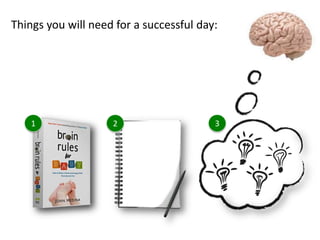
Things you will need for a successful day:
1 2 3
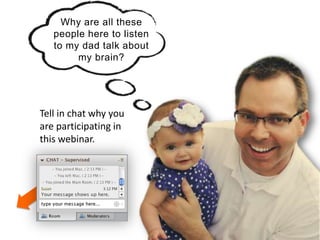
Why are all these
people here to listen
to my dad talk about
my brain?
Tell in chat why you
are participating in
this webinar.
2. Identifying and Activating Prior Knowledge
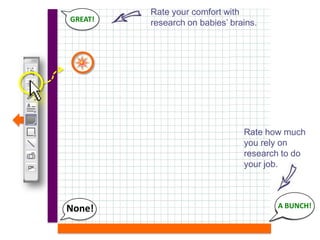
GREAT!
None! A BUNCH!
Rate how much
you rely on
research to do
your job.
Rate your comfort with
research on babies’ brains.
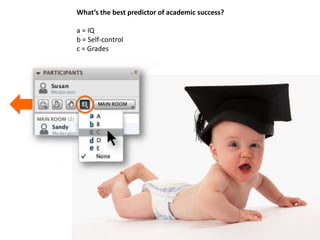
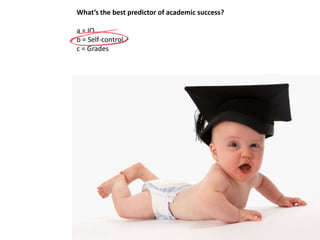
What’s the best predictor of academic success?
a = IQ
b = Self-control
c = Grades
What’s the best predictor of academic success?
a = IQ
b = Self-control
c = Grades
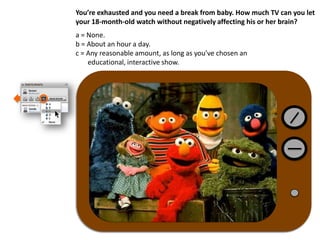
You’re exhausted and you need a break from baby. How much TV can you let
your 18-month-old watch without negatively affecting his or her brain?
a = None.
b = About an hour a day.
c = Any reasonable amount, as long as you’ve chosen an educational,
interactive show.
You’re exhausted and you need a break from baby. How much TV can you let
your 18-month-old watch without negatively affecting his or her brain?
a = None
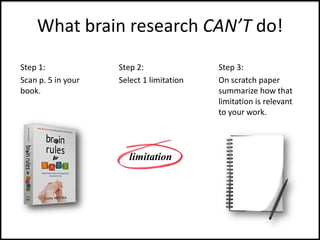
3. What Brain Science Can’t Do
Step 2:
Select 1 limitation
Step 1:
Scan p. 5 in your
book.
Step 3:
On scratch paper
summarize how that
limitation is relevant
to your work.
limitation
What brain research CAN’T do!
limitation
What brain research CAN’T do!
Post your thoughts in chat.
4. Nature vs. Nurture: the
Seed and Soil Analogy
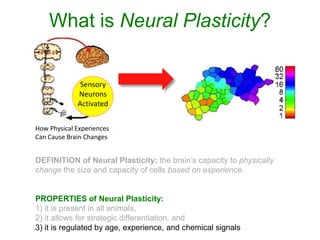
What is Neural Plasticity?
DEFINITION of Neural Plasticity: the brain’s capacity to physically
change the size and capacity of cells based on experience.
PROPERTIES of Neural Plasticity:
1) it is present in all animals,
2) it allows for strategic differentiation, and
3) it is regulated by age, experience, and chemical signals
Sensory
Neurons
Activated
How Physical Experiences
Can Cause Brain Changes
What Does the Brain-Changing Research Say?
Exposure to an enriched environment promotes
• neurochemical,
• structural and
• neurophysiological changes in the brain
What Does the Brain-Changing Research Say?
Exposure to an enriched environment promotes
• neurochemical,
• structural and
• neurophysiological changes in the brain
and is associated with
• enhanced synaptic plasticity and
• improved hippocampal-dependent learning.
McNair et al., (2007). Global changes in the hippocampal proteome following
exposure to an enriched environment. Journal of Neuroscience 145(2), 413-422.
doi:10.1016/j.neuroscience.2006.12.033
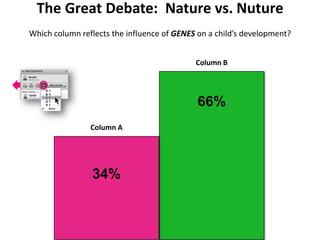
The Great Debate: Nature vs. Nuture
Which column reflects the influence of GENES on a child’s development?
66%
34%
Column A
Column B
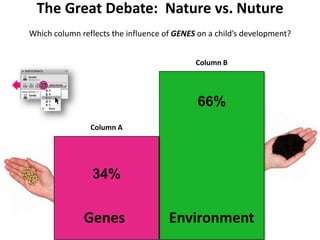
The Great Debate: Nature vs. Nuture
Which column reflects the influence of GENES on a child’s development?
66%
34%
Column A
Column B
Genes Environment
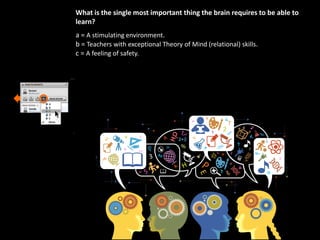
What is the single most important thing the brain requires to be able to
learn?
a = A stimulating environment.
b = Teachers with exceptional Theory of Mind (relational) skills.
c = A feeling of safety.
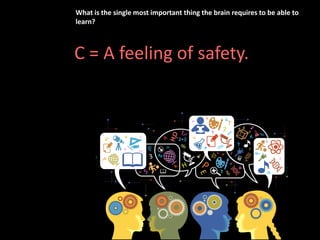
What is the single most important thing the brain requires to be able to
learn?
A = A stimulating environment.
B = Teachers with exceptional Theory of Mind (relational) skills.
C = A feeling of safety.
What’s the No. 1 factor that predicts how your child will turn out?
a = Providing a loving household.
b = How perfect a parent you are.
c = How you deal with your child’s intense emotions.

What’s the No. 1 factor that predicts how your child will turn out?
a = Providing a loving household.
b = How perfect a parent you are.
c = How you deal with your child’s intense emotions.
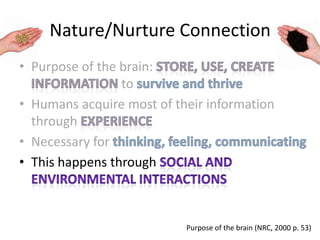
Nature/Nurture Connection
• Purpose of the brain:
to
• Humans acquire most of their information
through
• Necessary for
• This happens through
Purpose of the brain (NRC, 2000 p. 53)
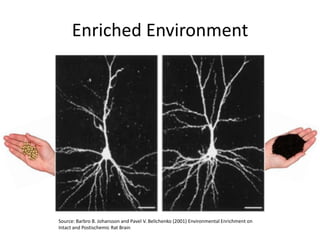
Enriched Environment
Source: Barbro B. Johansson and Pavel V. Belichenko (2001) Environmental Enrichment on
Intact and Postischemic Rat Brain
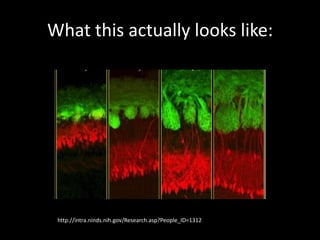
What this actually looks like:
http://intra.ninds.nih.gov/Research.asp?People_ID=1312
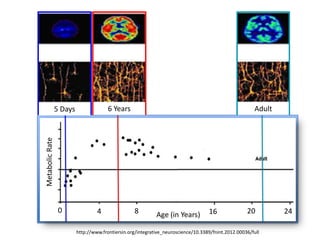
http://www.frontiersin.org/integrative_neuroscience/10.3389/fnint.2012.00036/full
5 Days 6 Years Adult
Age (in Years)
MetabolicRate
0 4 8 16 20 24
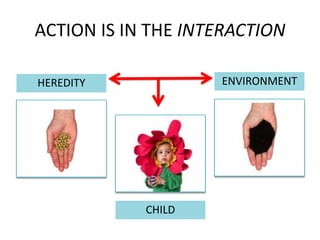
ACTION IS IN THE INTERACTION
HEREDITY
CHILD
ENVIRONMENT
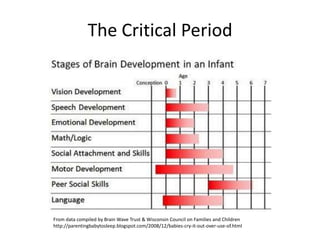
The Critical Period
From data compiled by Brain Wave Trust & Wisconsin Council on Families and Children
http://parentingbabytosleep.blogspot.com/2008/12/babies-cry-it-out-over-use-of.html
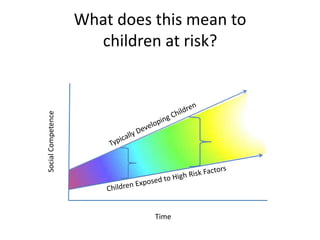
What does this mean to
children at risk?SocialCompetence
Time
What will give your child his or her best chance at happiness?
a = Having close friends.
b = Finding a satisfying career.
c = Living according to his or her values.
What will give your child his or her best chance at happiness?
a = Having close friends.
b = Finding a satisfying career.
c = Living according to his or her values.
At what point does research say that children stop asking
questions in school?
a = Elementary school. Kids learn very quickly that teachers
value the right answer more than a provocative question.
b = High school. Teenagers become absorbed in other critical
matters, such as that text message from Brendan or Kate –
what does it mean?
c = Never, really. Curiosity is an innate feature of the brain.
a = Elementary school. Kids learn very quickly
that teachers value the right answer more
than a provocative question.
At what point does research say that children stop asking
questions in school?
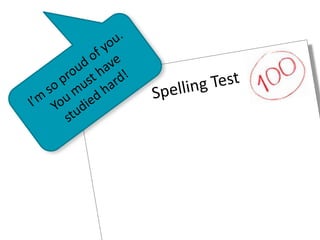
Your kid rocks a spelling test. What do you say?
a = “I knew you could do it. You’re so smart!”
b = “I’m so proud of you. You must have studied hard!”
c = Either one.
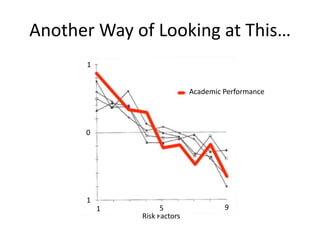
Another Way of Looking at This…
Risk Factors
Academic Performance
0
1
1
1 5 9
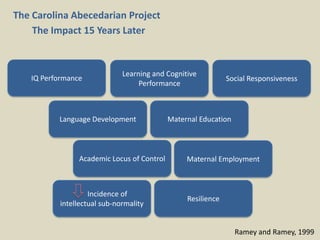
Ramey and Ramey, 1999
IQ Performance
Learning and Cognitive
Performance
Language Development
Resilience
Social Responsiveness
Academic Locus of Control
Maternal Education
Maternal Employment
Incidence of
intellectual sub-normality
The Carolina Abecedarian Project
The Impact 15 Years Later
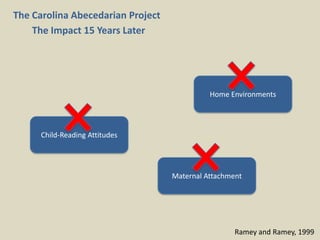
Child-Reading Attitudes
Home Environments
Maternal Attachment
Ramey and Ramey, 1999
The Carolina Abecedarian Project
The Impact 15 Years Later
Ramey and Ramey, 1999
The Carolina Abecedarian Project
Long-Term Benefits at Age 21
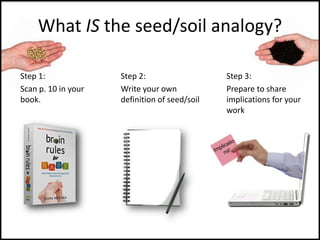
Step 2:
Write your own
definition of seed/soil
Step 1:
Scan p. 10 in your
book.
Step 3:
Prepare to share
implications for your
work
What IS the seed/soil analogy?
5. New Questions
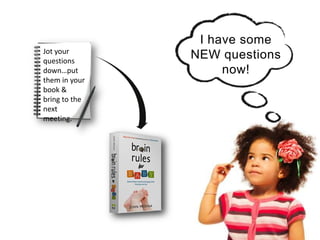
I have some
NEW questions
now!
Jot your
questions
down…put
them in your
book &
bring to the
next
meeting.
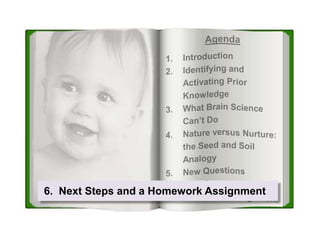
6. Next Steps and a Homework Assignment
At James Madison University’s Memorial Hall
Look for reminders in your email!
Part 2 – April 20th, 10:00-3:30 (face to face)
Part 3 – May 21st, 2:30-4:00 (online)
Hey, Jeremy,
this was a great
first session!
It sure was! I’m
looking forward to the
next session
April 20th @ JMU!
Until Next
Time…

Brain Rules for Babies Book Club - First Webinar

  • 1.
    Welcome to Brain Rulesfor Baby… Book Club!
  • 2.
    Things you willneed for a successful day: 1 2 3
  • 5.
    Why are allthese people here to listen to my dad talk about my brain? Tell in chat why you are participating in this webinar.
  • 6.
    2. Identifying andActivating Prior Knowledge
  • 7.
    GREAT! None! A BUNCH! Ratehow much you rely on research to do your job. Rate your comfort with research on babies’ brains.
  • 8.
    What’s the bestpredictor of academic success? a = IQ b = Self-control c = Grades
  • 9.
    What’s the bestpredictor of academic success? a = IQ b = Self-control c = Grades
  • 10.
    You’re exhausted andyou need a break from baby. How much TV can you let your 18-month-old watch without negatively affecting his or her brain? a = None. b = About an hour a day. c = Any reasonable amount, as long as you’ve chosen an educational, interactive show.
  • 11.
    You’re exhausted andyou need a break from baby. How much TV can you let your 18-month-old watch without negatively affecting his or her brain? a = None
  • 12.
    3. What BrainScience Can’t Do
  • 13.
    Step 2: Select 1limitation Step 1: Scan p. 5 in your book. Step 3: On scratch paper summarize how that limitation is relevant to your work. limitation What brain research CAN’T do!
  • 14.
    limitation What brain researchCAN’T do! Post your thoughts in chat.
  • 16.
    4. Nature vs.Nurture: the Seed and Soil Analogy
  • 17.
    What is NeuralPlasticity? DEFINITION of Neural Plasticity: the brain’s capacity to physically change the size and capacity of cells based on experience. PROPERTIES of Neural Plasticity: 1) it is present in all animals, 2) it allows for strategic differentiation, and 3) it is regulated by age, experience, and chemical signals Sensory Neurons Activated How Physical Experiences Can Cause Brain Changes
  • 18.
    What Does theBrain-Changing Research Say? Exposure to an enriched environment promotes • neurochemical, • structural and • neurophysiological changes in the brain
  • 19.
    What Does theBrain-Changing Research Say? Exposure to an enriched environment promotes • neurochemical, • structural and • neurophysiological changes in the brain and is associated with • enhanced synaptic plasticity and • improved hippocampal-dependent learning. McNair et al., (2007). Global changes in the hippocampal proteome following exposure to an enriched environment. Journal of Neuroscience 145(2), 413-422. doi:10.1016/j.neuroscience.2006.12.033
  • 20.
    The Great Debate:Nature vs. Nuture Which column reflects the influence of GENES on a child’s development? 66% 34% Column A Column B

  • 21.
    The Great Debate:Nature vs. Nuture Which column reflects the influence of GENES on a child’s development? 66% 34% Column A Column B Genes Environment
  • 22.
    What is thesingle most important thing the brain requires to be able to learn? a = A stimulating environment. b = Teachers with exceptional Theory of Mind (relational) skills. c = A feeling of safety.
  • 23.
    What is thesingle most important thing the brain requires to be able to learn? A = A stimulating environment. B = Teachers with exceptional Theory of Mind (relational) skills. C = A feeling of safety. C = A feeling of safety.
  • 24.
    What’s the No.1 factor that predicts how your child will turn out? a = Providing a loving household. b = How perfect a parent you are. c = How you deal with your child’s intense emotions.
  • 25.
    What’s the No.1 factor that predicts how your child will turn out? a = Providing a loving household. b = How perfect a parent you are. c = How you deal with your child’s intense emotions.
  • 26.
    Nature/Nurture Connection • Purposeof the brain: to • Humans acquire most of their information through • Necessary for • This happens through Purpose of the brain (NRC, 2000 p. 53)
  • 27.
    Enriched Environment Source: BarbroB. Johansson and Pavel V. Belichenko (2001) Environmental Enrichment on Intact and Postischemic Rat Brain
  • 28.
    What this actuallylooks like: http://intra.ninds.nih.gov/Research.asp?People_ID=1312
  • 29.
  • 30.
    ACTION IS INTHE INTERACTION HEREDITY CHILD ENVIRONMENT
  • 31.
    The Critical Period Fromdata compiled by Brain Wave Trust & Wisconsin Council on Families and Children http://parentingbabytosleep.blogspot.com/2008/12/babies-cry-it-out-over-use-of.html
  • 32.
    What does thismean to children at risk?SocialCompetence Time
  • 33.
    What will giveyour child his or her best chance at happiness? a = Having close friends. b = Finding a satisfying career. c = Living according to his or her values.
  • 34.
    What will giveyour child his or her best chance at happiness? a = Having close friends. b = Finding a satisfying career. c = Living according to his or her values.
  • 35.
    At what pointdoes research say that children stop asking questions in school? a = Elementary school. Kids learn very quickly that teachers value the right answer more than a provocative question. b = High school. Teenagers become absorbed in other critical matters, such as that text message from Brendan or Kate – what does it mean? c = Never, really. Curiosity is an innate feature of the brain.
  • 36.
    a = Elementaryschool. Kids learn very quickly that teachers value the right answer more than a provocative question. At what point does research say that children stop asking questions in school?
  • 37.
    Your kid rocksa spelling test. What do you say? a = “I knew you could do it. You’re so smart!” b = “I’m so proud of you. You must have studied hard!” c = Either one.
  • 39.
    Another Way ofLooking at This… Risk Factors Academic Performance 0 1 1 1 5 9
  • 40.
    Ramey and Ramey,1999 IQ Performance Learning and Cognitive Performance Language Development Resilience Social Responsiveness Academic Locus of Control Maternal Education Maternal Employment Incidence of intellectual sub-normality The Carolina Abecedarian Project The Impact 15 Years Later
  • 41.
    Child-Reading Attitudes Home Environments MaternalAttachment Ramey and Ramey, 1999 The Carolina Abecedarian Project The Impact 15 Years Later
  • 42.
    Ramey and Ramey,1999 The Carolina Abecedarian Project Long-Term Benefits at Age 21
  • 43.
    Step 2: Write yourown definition of seed/soil Step 1: Scan p. 10 in your book. Step 3: Prepare to share implications for your work What IS the seed/soil analogy?
  • 45.
  • 46.
    I have some NEWquestions now! Jot your questions down…put them in your book & bring to the next meeting.
  • 48.
    6. Next Stepsand a Homework Assignment
  • 49.
    At James MadisonUniversity’s Memorial Hall Look for reminders in your email! Part 2 – April 20th, 10:00-3:30 (face to face) Part 3 – May 21st, 2:30-4:00 (online) Hey, Jeremy, this was a great first session! It sure was! I’m looking forward to the next session April 20th @ JMU!
  • 51.

Editor's Notes

  • #2 3:37-3:38(1 min)Production Notes:[xxx]: Script:Cori: [introduce John]
  • #3 3:38-3:41 (3mins)Production Notes:[Susan]: Start timer for 2 minsScript:John:Things you will need for a successful day:Your copy of Brain Rules for Baby. How to Raise a Smart and Happy Child from Zero to Five.Something to write with and write on.A brain full of examples and experiences from your classroom, center, or role as an early childhood professional.We will give you a couple of minutes to gather these items…and when you are done…we’d like you to
  • #4 3:38-3:41 (3mins)Production Notes:[xxx]: Script:Complete the sentence at the bottom of this page by posting your thoughts in chat.[Respond to comments in chat before transitioning to the next slide (agenda)…work comments into your presentation if you can.]Cori: [read aloud postings and pitch to John for comment]
  • #5 3:41-3:42 (1 min)Production Notes:[xxx]: Script:John:
  • #6 3:42-3:44 (2mins)Production Notes:[xxx]: Script:John:[set up chat]Cori: [faciltate chat, summarize and pitch to John for response]John:
  • #7 3:44-3:45 (1 min)Production Notes:[Susan]: bring all participants back to the main room.Script:John:[reference breakout activity and insert transition]
  • #8 3:45-3:51 (6mins)Production Notes:[Susan]: Point to the shape tool as it is being described.Script:John:[USE STAR BURST…IF YOU HOLD YOUR MOUSE DOWN WHILE YOU MOVE IT, THE PARTICIPANTS WILL SEE THE STAR BURST MOVE ACROSS THE SCREEN] I’ll start with my rating on the purple column….then slide over to where I would rate on the orange line. This is the intersection between my comfort with research on babies’ brains and how much I rely on research to do my job, so I will make a mark on the whiteboard here.Cori:The starburst pointer tool is on the tool bar to the left of the whiteboard. Click on the second icon from the top of the tool bar. Select the starburst pointer with your cursor and then move the cursor to the the white board. Your cursor will turn into the starburst like the one in the orange circle on the whiteboard. To place your starburst on the the whiteboard, move your cursor to where you want it to be and click the mouse…it’s that easy. Go ahead and put put a starburst at the intersection of your comfort with research on babies’ brains and how much you rely on research to do your job.. It doesn’t have to be exact…just in the ballpark.John:Take a look at the whiteboard now that folks have marked their comfort with research on babies’ brains and their reliance on research in their work. Use chat to tell us something about what you see on the whiteboard. The chat box is at the bottom of your screen…type into the blank text field which has a grey smiley face at the end. When you have finished writing your thought, hit the return or enter button on your computer keyboard…that will send you comment to the public chat stream that we can all see.[insert transition]
  • #9 3:51-4:05 (14mins)Production Notes:[Susan]: Prep Polls (A-C)[Susan]: Prep Polls to not show individual answers.[Susan]: Point to features as Cori describes them.[Susan]: Publish poll results when prompted. Script:Cori: To complete the poll, look to the left of the slide an locate the participants’ box. At the very top of the box will be your name and just beneath your name will be four icons. The fourth icon to the left is a lower case a. Click on the a and you will get a pull down menu, like the one you see on screen. You will see three options, A, B, and C. The question we are responding to is “What’s the best predictor of academic success?” If you believe it is IQ, click on the capital letter A…if you believe it is self-control, click on the letter B, and if you believe it is grades, click on the letter C. Please note that the poll is completely confidential.If you are having difficulty with the poll tool, you can enter your vote by putting the letter in chat.I will give you about 30 seconds to re-read the question, decide upon your answer, and register your vote.[Count to 30 in your head.]Thank you! Susan will you please show us the results? Thank you. John, it looks like … What are your thoughts?John:
  • #10 3:51-4:05 (14mins)Production Notes:[xxx]: Script:John:
  • #11 3:51-4:05 (14mins)Production Notes:[Susan]: Prep Polls (A-C)[Susan]: Prep Polls to not show individual answers.[Susan]: Point to features as Cori describes them.[Susan]: Publish poll results when prompted. Script:Cori: Please register your answer to this poll question. [read question and answer options aloud.][Count to 30 in your head.]Thank you! Susan will you please show us the results? Thank you. John, it looks like … What are your thoughts?John:
  • #12 3:51-4:05 (14mins)Production Notes:[xxx]: Script:John:
  • #13 4:05-4:06 (1 min)Production Notes:[xxx]: Script:John:
  • #14 4:06-4:11 (5mins)Production Notes:[xxx]: Script:John:
  • #15 4:06-4:11 (5mins)Production Notes:[xxx]: Script:Cori:[ask participants to post their thoughts in chat, facilitate sharing, summarize postings, pitch questions or comments to John]
  • #16 4:11-4:14 (3mins)Production Notes:[Susan]: Use webtour to play “3 Myths” http://vimeo.com/15621485Script:John:[ask Susan to show the video]
  • #17 4:14-4:15 (1 min)Production Notes:[xxx]: Script:John:
  • #18 4:15-4:20 (4mins)Production Notes:[xxx]: Script:John:
  • #19 4:20-4:24 (4mins)Production Notes:[xxx]: Script:John:
  • #20 4:20-4:24 (4mins)Production Notes:[xxx]: Script:John:
  • #21 4:24-4:27 (3mins)Production Notes:[Susan]: Publish poll results when indicated[Susan]:Script:John:[set up the poll activity]Cori:As a reminder…To complete the poll, look to the left of the slide an locate the participants’ box. At the very top of the box will be your name and just beneath your name will be four icons. The fourth icon to the left is a lower case a. Click on the a and you will get a pull down menu, like the one you see on screen. You will see three options, A, B, and C, but for this poll you will need only A or B. To answer the question Which column reflects the influence of GENES on a child’s development, you can select A for the pink column or B for the Green column.If you are having difficulty with the poll tool, you can enter your vote by putting the letter in chat.[request Susan to publish the poll]John: [transition to the answer on the next slide]
  • #22 4:24-4:27 (3mins)Production Notes:[Susan]: Publish poll results when indicated[Susan]:Script:John:
  • #23 3:51-4:05 (14mins)Production Notes:[Susan]: Prep Polls (A-C)[Susan]: Prep Polls to not show individual answers.[Susan]: Point to features as Cori describes them.[Susan]: Publish poll results when prompted. Script:Cori:[set up the poll]I will give you about 30 seconds to re-read the question, decide upon your answer, and register your vote.[Count to 30 in your head.]Thank you! Susan will you please show us the results? Thank you. John, it looks like … What are your thoughts?John:
  • #24 3:51-4:05 (14mins)Production Notes:[xxx]: Script:John:
  • #25 3:51-4:05 (14mins)Production Notes:[Susan]: Prep Polls (A-C)[Susan]: Prep Polls to not show individual answers.[Susan]: Point to features as Cori describes them.[Susan]: Publish poll results when prompted. Script:Cori: Please register your answer to this poll question. [read question and answer options aloud.][Count to 30 in your head.]Thank you! Susan will you please show us the results? Thank you. John, it looks like … What are your thoughts?John:
  • #26 3:51-4:05 (14mins)Production Notes:[xxx]: Script:John:
  • #27 4:24-4:27 (3mins)Production Notes:[xxx]: Script:John:
  • #28 4:27-4:32 (5mins)Production Notes:[xxx]: Script:John:53)
  • #29 4:27-4:32 (5mins)Production Notes:[xxx]: Script:John:
  • #30 4:27-4:32 (5mins)Production Notes:[xxx]: Script:John:
  • #31 4:27-4:32 (5mins)Production Notes:[xxx]: Script:John:
  • #32 4:27-4:32 (5mins)Production Notes:[xxx]: Script:John:
  • #33 4:27-4:32 (5mins)Production Notes:[xxx]: Script:John:
  • #34 3:51-4:05 (14mins)Production Notes:[Susan]: Prep Polls (A-C)[Susan]: Prep Polls to not show individual answers.[Susan]: Point to features as Cori describes them.[Susan]: Publish poll results when prompted. Script:Cori: We have another lightening round of polls. [facilitate the polling][Count to 30 in your head.]Thank you! Susan will you please show us the results? Thank you. John, it looks like … What are your thoughts?John:
  • #35 3:51-4:05 (14mins)Production Notes:[xxx]: Script:John:
  • #36 3:51-4:05 (14mins)Production Notes:[Susan]: Prep Polls (A-C)[Susan]: Prep Polls to not show individual answers.[Susan]: Point to features as Cori describes them.[Susan]: Publish poll results when prompted. Script:Cori: Please register your answer to this poll question. [read question and answer options aloud.][Count to 30 in your head.]Thank you! Susan will you please show us the results? Thank you. John, it looks like … What are your thoughts?John:
  • #37 3:51-4:05 (14mins)Production Notes:[xxx]: Script:John:
  • #38 3:51-4:05 (14mins)Production Notes:[Susan]: Prep Polls (A-C)[Susan]: Prep Polls to not show individual answers.[Susan]: Point to features as Cori describes them.[Susan]: Publish poll results when prompted. Script:Cori: Please register your answer to this poll question. [read question and answer options aloud.][Count to 30 in your head.]Thank you! Susan will you please show us the results? Thank you. John, it looks like … What are your thoughts?John:
  • #39 3:51-4:05 (14mins)Production Notes:[xxx]: Script:John:
  • #40 4:27-4:32 (5mins)Production Notes:[xxx]: Script:John:
  • #41 4:32-4:34 (2mins)Production Notes:[xxx]: Script:John:
  • #42 4:32-4:34 (2mins)Production Notes:[xxx]: Script:John:
  • #43 4:34-4:36 (2mins)Production Notes:[xxx]: Script:John:Higher education levels achieved
  • #44 4:364:43 (7mins)Production Notes:[xxx]: Script:John:
  • #45 4:364:43 (7mins)Production Notes:[xxx]: Script:Cori:[invite participants to share their implications in chat and facilitate the sharing, summarize content, or pitch particular comments to John for response.]
  • #46 4:43-4:44 (1 min)Production Notes:[xxx]: Script:John:
  • #47 4:44-4:47 (3mins)Production Notes:[xxx]: Script:John:
  • #48 4:47-4:50 (3mins)Production Notes:[Susan]: http://player.vimeo.com/video/16335828Script:John:[ask Susan to show the video]
  • #49 4:50-4:51 (1 min)Production Notes:[Susan]:Script:John:
  • #50 4:51-4:56 (5 mins)Production Notes:[Susan]: Use pointerScript:John or Cori???
  • #51 4:51-4:56 (5 mins)Production Notes:[Susan]:Script:John:
  • #52 4:51-4:56 (5 mins)Production Notes:[Susan]:Script:John: