Bombay Cambridge Gurukul
CARING TO KNOW MORE:
THE PARENTS’ GUIDE TO
CHILD DEVELOPMENT
October 1st 2011
Even though we are all born with a brain, that
is not enough. What we do to provide it the
best support to develop, is important. The
science of brain development tells us that the
first five years of life are very important for
building the young child's brain.
The newest discoveries in
neuroscience in the past
few years are giving us
a whole new understanding
of how the brain develops.
Brain Development - Myth or Fact?
Myth At birth the brain is fully developed, just like
one's heart or stomach.
Fact - Most of the brain's cells are formed before
birth, but most of the connections among cells are
made during infancy and early childhood.
A newborn's brain is only about
one-quarter (25%) the size of
an adult's.
In the first year, it is 50% developed,
by 3 years, 80% and
by 5 years 90% development is complete.
Myth The brain's development depends
entirely on the genes with which you are born.
Fact - Early experience and interaction with
the environment are most critical in a child's
brain development. The connections between
brain cells in a child's brain are developing
constantly. Current research suggests that
about 30%-60% of our brain's wiring depends
on heredity, while about 40%-70% develops
based on interactions with the environment,
including parents.
Myth Talking to a baby is not important because
he or she can't understand what you are saying.
Fact - Talking to young children establishes
foundations for learning language during early
critical periods when learning is easiest for a
child.
Myth Children need special help and specific
educational toys to develop their brainpower.
Fact - What children need most is loving care
and new experiences, not special attention or
costly toys. Talking, singing, playing and
reading are some of the key activities that
build a child's brain.
Clear evidence has emerged that suggests that
activity, experience, attachment, and
stimulation (sensory experience) determine
the structure of the brain.
Imagine that a child's brain is like a house that
has just been built. The walls are up, the doors
are hung. Then you go to the store and buy
electrical wiring, switches, a fuse box and other
electrical supplies. You bring these supplies to
the new house and set them on the floor. Will
they work? Probably not. You first must string
the wiring and hook up all of the connections.
This is quite similar to the way our brains are
formed.
Early experiences have a decisive impact on the
actual architecture of the brain.
Synaptic density in the human brain
Critical Periods of Brain
Development
Every experience—
whether it is seeing one's first rainbow, riding a
bicycle, reading a book, sharing a joke--excites
certain neural circuits and leaves others inactive.
Those that are consistently turned on over time
will be strengthened, while those that are rarely
excited may be dropped away. Or, as
neuroscientists sometimes say,
"Cells that fire together, wire together."
Brain development does not stop after early
childhood, but it is the foundation upon which
the brain continues developing. Early childhood
is the time to build either a strong and
supportive, or fragile and unreliable foundation.
Construction of the brain is somewhat like the
construction of a house.
PHYSICAL
Gross motor: using large groups of muscles to sit,
stand, walk, run, etc., keeping balance, and
changing positions.
Fine motor: using hands to be able to eat, draw,
dress, play, write, and do many other things.
COGNITIVE
Using Language, speaking, using body language
and gestures, communicating, and understanding
what others say.
Thinking skills: including learning,
understanding, problem-solving,
reasoning, and remembering.
SOCIAL
Interacting with others, having relationships with
family, friends, and teachers, cooperating, and
being able to show good civic behavior in society.
EMOTIONAL
Being able to identify and understanding own
feelings, feelings of others, expressing feelings,
and building healthy relationships
As a parent, my concern usually is how do I help
my child learn better – our focus is more often
than not, on cognitive development or intellectual
development. Lets look at some common
questions that seem important to parents.
Question - How do a child's food habits and
nutrition affect brain development?
Answer - Some of the foods that aid in brain
functioning include proteins, unsaturated fats,
vegetables, complex carbohydrates and sugars.
Some of the specific foods that children should eat
more of to stimulate brain function and growth are
leafy green vegetables, fish (e.g., salmon), nuts,
lean meats, fresh fruits and dairy products. In
addition, drinking lots of water is helpful in
learning, maintaining energy levels and
attentiveness.
Question - What are the most important
ingredients in creating an enriched learning
environment for children?
Answer - Research on brain development has
shown that two key components enrich the
learning environment that stimulates brain
development.
First, children must be exposed to new
information and experiences that are challenging
and allow them to solve problems. Too much or
too little challenge leads to problems.
Second, children should be given feedback
about how they are learning. Feedback that is
constructive is usually
- Specific
- Immediate
- Gives a solution
Negative feedback
that involves rejection,
criticism, or ridicule can
cause children to give up trying new things.
Question - Can a child overcome the effects of
insufficient care or stimulation during the early
years of life?
Answer - Yes! Although the early years of a child's
development are tremendously important,
research also has shown the brain is capable of
overcoming many negative effects. During the first
12 to 14 years of life, a child's brain has
considerable opportunity to bounce back from
negative experiences and develop capacities that
were not nurtured in the early years.
Question - What are the best activities for my
children to engage in to enhance their overall
brain development?
Answer: Children benefit from a variety of different
activities. However, three critical activities that
contribute considerably to overall brain
development are music, art and physical activity.
Questions: Are there any differences in the
development of boys' and girls' brains?
Answer: Sex differences in the brain are reflected
in the somewhat different developmental
timetables of girls and boys. By most measures of
sensory and cognitive development, girls are
slightly more advanced: vision, hearing, memory,
smell, and touch are all more acute in female than
male infants. Girl babies also tend to be somewhat
more socially-attuned, and they generally lead
boys in the emergence of fine motor and language
skills.
Boys eventually catch up in many of these areas.
By age three, they tend to out-perform girls in one
cognitive area: visual-spatial integration, which is
involved in navigation, assembling jigsaw puzzles,
and certain types of hand-eye coordination.
It is important to emphasize that these findings
describe only the average differences between
boys and girls. In fact, the range of abilities within
either gender is much greater than the difference
between the "average girl" and the "average boy."
In other words, there are plenty of boys with
excellent verbal skills, and girls with excellent
visual-spatial ability.
Genes and hormones set the ball rolling, but they
do not fully account for sex differences in
children's brains. Experience also plays a
fundamental role. Consider, for example, the
"typical" boy, with his more advanced spatial
skills; he may well prefer activities like climbing or
pushing trucks around—all of which further hone
his visual-spatial skills. The "typical" girl, by
contrast, may gravitate more toward games with
dolls and siblings, which further reinforce her
verbal and social skills. In this way, initial
strengths are magnified into differences.
Day-to-Day Care of
Young Children’s Brains
Research on early brain development and school
readiness suggests the following guidelines for
the care of young children:
Ensure health, safety, and good nutrition: Teach
them about healthy habits and safe behaviors.
Develop a warm, caring relationship with
children: Show them that you care deeply about
them. Express joy in who they are. Help them to
feel safe and secure.
Recognize that each child is unique: Keep in
mind that from birth, children have different
temperaments, that they grow at their own
pace, and that this pace varies from child to
child. At the same time, have positive
expectations about what children can do and
hold on to the belief that every child can
succeed.
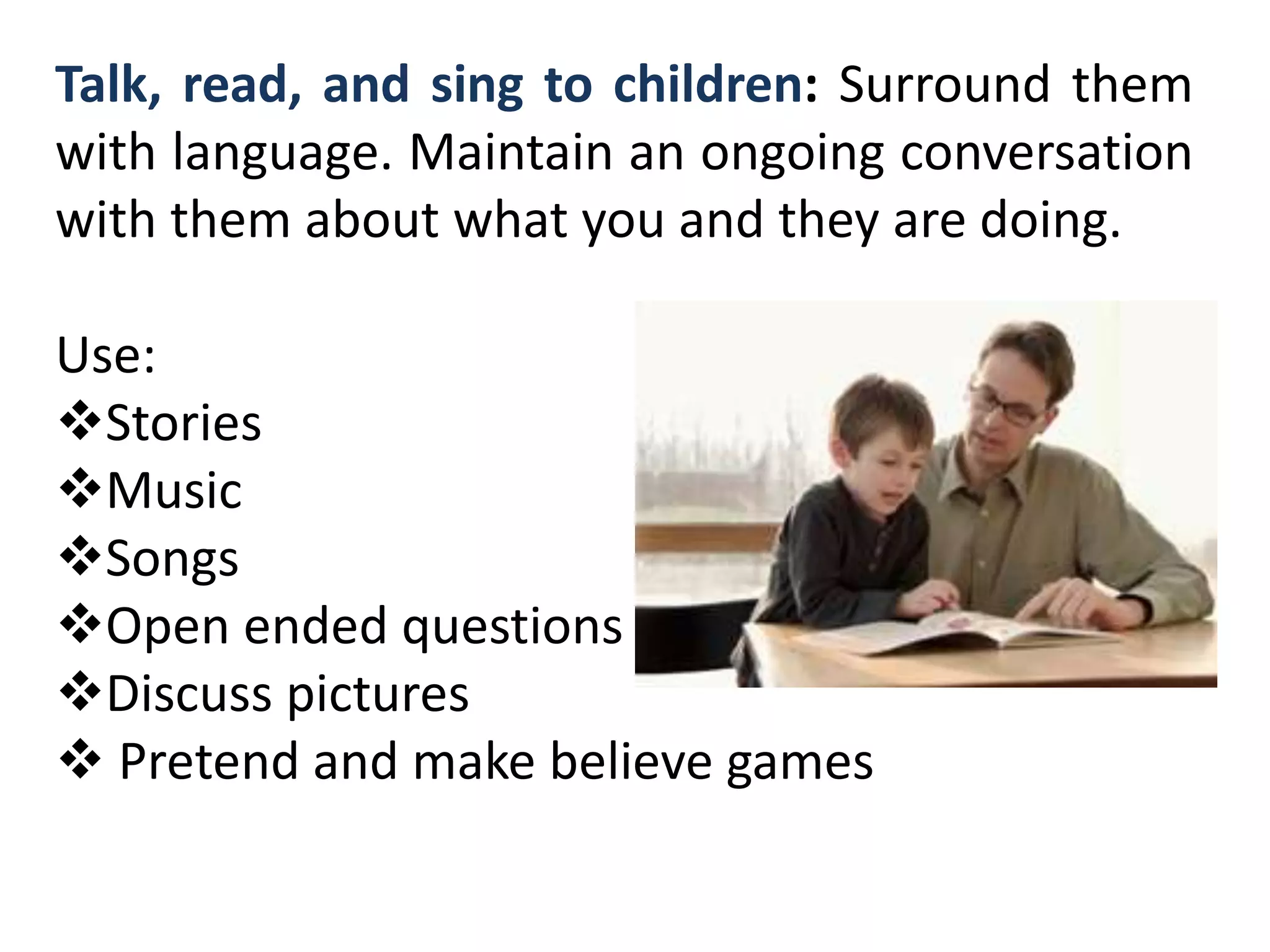
Talk, read, and sing to children: Surround them
with language. Maintain an ongoing conversation
with them about what you and they are doing.
Use:
Stories
Music
Songs
Open ended questions
Discuss pictures
 Pretend and make believe games
Use discipline to teach:
•Talk to children about what they seem to be
feeling and teach them words to describe those
feelings.
•Make it clear that while you might not like the
way they are behaving, you love them.
•Explain the rules and consequences of behavior
so children can learn the “why’s” behind what
you are asking them to do.
•Tell them what you want them to do, not just
what you don’t want them to do.
•Point out how their behavior affects others.
Establish routines: Create routines and rituals for
special times during the day like mealtime, nap
time, and bedtime. Try to be predictable so the
children know that they can count on you.
Limit television: Limit the time children spend
watching TV shows and Internet as well as the
type of shows they watch. Too much TV causes
over-stimulation of brain cells, and poor social
and physical activity. Be sure that what children
are watching is what you want them to learn, as
imitative behavior is maximum at this time.
Take care of yourself: You can best care for
young children when you are cared for as well.
Learn to cope with your stressors so that you
can help your child learn too. Your child’s well-
being depends on your health and well-being.
HELPING YOUR CHILD
MANAGE STRESS
Some signs of stress in children:
• Exhibits extremely fearful or timid behavior (bites
nails, sucks thumb, cries often, is extremely scared)
• Exhibits extremely aggressive behavior (throws
things, hits/bites, yells)
• Is unable to separate from parents without major
protest
• Is easily distracted and unable to concentrate on
any single activity for more than five minutes
• Has difficulty forming or expressing attachments
•Seems unhappy or sad much of the time
•Has trouble eating, sleeping, or using the toilet
•Seems unusually passive
•Avoids or seems aloof with other children and
adults
•Has difficulty managing fine or gross motor
function
• Frequent complaints of stomach ache or
headache
•Refuses to write or go to school
Parents and caregivers should take steps to create
an emotionally safe environment :
Encourage them to learn at their own pace
without experiencing pressure.
Avoid competition that causes sense of
inadequacy or failure.
Avoid comparison with other children or siblings.
Apply discipline appropriately. Do not beat, hit,
pinch, or threaten your child with violence.
Monitor children to ensure that they are
protected from interactions with potentially
abusive individuals.
The child has the best advantage when:
 Family members show love, care and support
for each other.
 Provide adequate guidance and modelling for
‘correct’ behavior, based on family rules or
cultural expectations.
 Are aware of healthy habits of eating, sleeping,
general habits and hygiene themselves.
 Balance interaction with family members as
with time for TV and Internet.
 Demonstrate healthy and responsible social
behavior, the greater the diversity of interaction,
the more is the child’s intelligence.
Are themselves balanced in their handling of
money, people, services – reflecting good ethical
and moral standards
Ensure that the child goes out to play for at
least 2 hours daily
 Provide a variety of games, toys, and story
books for the child at home
 Always praise the child’s
efforts at writing, reading,
drawing or any activity.
Show respect for the school and the child’s
teachers
 Are aware of the importance of coordinating
and sharing information with teachers
 Are able to follow recommendations for
seeking professional advice from health
professionals
 Ensure they follow-up on the
child’s school work daily
 Ensure that there is no
academic stress on the child (no tuition)
Brain research has shown
that too much stress early
in life can affect development
negatively. Stress causes a
chemical ‘cortisol’ to be released which can
destroy brain cells, and cause certain regions of
the brain to be smaller than normal.
In other words, the wiring of the brain can be
severely damaged or mis-wired if a child is
exposed to repeated and longtime stress
without the assistance of a caring adult.
EMOTIONAL INTELLIGENCE
The phrase was first developed in the 1980s and
asserts that emotional quotient or emotional
intelligence is as valuable as intellectual quotient
(IQ).
According to theories of brain function, a high
emotional quotient means someone is self-
confident, self-aware, and able to navigate
through difficult emotional times. EQ is often tied
directly to the degree of success one may have in
the workplace and in personal relationships.
Emotional intelligence consists of four core
abilities:
Self-awareness – The ability to recognize your
own emotions and how they affect your
thoughts and behavior, know your strengths
and weaknesses, and have self-confidence.
Self-management – The ability to control
impulsive feelings and behaviors, manage your
emotions in healthy ways, take initiative, follow
through on commitments, and adapt to
changing circumstances.
Social awareness – The ability to understand the
emotions, needs, and concerns of other people,
pick up on emotional cues, feel comfortable
socially, and recognize the power dynamics in a
group or organization.
Relationship management – The ability to
develop and maintain good relationships,
communicate clearly, inspire and influence
others, work well in a team, and manage conflict.
Emotional Quotient or EQ is one of the ways to
measure a person’s ability to be successful in life.
• Teaching our children emotional intelligence
skills gives them a better chance to use their
genetically given intellectual potential (IQ).
• People without emotional intelligence lack
self-restraint and would just do whatever their
impulses suggest.
•Those who are insensitive to the emotions in
others will not see the need to care for others.
Why is EQ more important than IQ?
• deal with threatening situations
• help others
• build conscience and moral autonomy
• be happy
• have mutual respect, empathy and
cooperative attitudes
• be responsible
Emotional Intelligence helps the child to:
Emotionally healthy children:
• Are better learners.
• Have fewer behaviour problems.
• Feel better about themselves.
• Are better able to resist peer pressure.
• Are less violent, more empathetic.
• Are better at resolving conflicts.
contd.
Emotionally healthy children:
•Are less likely to engage in self-
destructive behaviour (drugs, alcohol,
teenage pregnancy).
• Have more friends.
• Have better impulse control; are better
able to delay gratification.
• Are happier, healthier and more
"successful“.
Scientists have found that your relationship with
your child affects his brain in many ways. By
providing warm, responsive care, you strengthen
the biological systems that help him handle his
emotions.
Research also shows that
a strong, secure connection
with your child helps him
withstand the ordinary
stresses of daily life—
not just today, but in the
future as well.
What do parents want from their children?
- That they eat properly and stay healthy
- That they stay safe and practice safe behaviors
- They study and learn well
- They get along with people around them
What do children want from their parents?
- That they provide for their basic needs of food, shelter,
clothing
- That they guide them so they can stay safe
- That they love them even when they make mistakes
- That they guide them to become good people
Rather than perfect
your child,
perfect your relationship
with him/her!

parents guide to child development.pdf

  • 1.
  • 2.
    CARING TO KNOWMORE: THE PARENTS’ GUIDE TO CHILD DEVELOPMENT October 1st 2011
  • 3.
    Even though weare all born with a brain, that is not enough. What we do to provide it the best support to develop, is important. The science of brain development tells us that the first five years of life are very important for building the young child's brain. The newest discoveries in neuroscience in the past few years are giving us a whole new understanding of how the brain develops.
  • 4.
    Brain Development -Myth or Fact? Myth At birth the brain is fully developed, just like one's heart or stomach. Fact - Most of the brain's cells are formed before birth, but most of the connections among cells are made during infancy and early childhood. A newborn's brain is only about one-quarter (25%) the size of an adult's. In the first year, it is 50% developed, by 3 years, 80% and by 5 years 90% development is complete.
  • 5.
    Myth The brain'sdevelopment depends entirely on the genes with which you are born. Fact - Early experience and interaction with the environment are most critical in a child's brain development. The connections between brain cells in a child's brain are developing constantly. Current research suggests that about 30%-60% of our brain's wiring depends on heredity, while about 40%-70% develops based on interactions with the environment, including parents.
  • 6.
    Myth Talking toa baby is not important because he or she can't understand what you are saying. Fact - Talking to young children establishes foundations for learning language during early critical periods when learning is easiest for a child.
  • 7.
    Myth Children needspecial help and specific educational toys to develop their brainpower. Fact - What children need most is loving care and new experiences, not special attention or costly toys. Talking, singing, playing and reading are some of the key activities that build a child's brain. Clear evidence has emerged that suggests that activity, experience, attachment, and stimulation (sensory experience) determine the structure of the brain.
  • 8.
    Imagine that achild's brain is like a house that has just been built. The walls are up, the doors are hung. Then you go to the store and buy electrical wiring, switches, a fuse box and other electrical supplies. You bring these supplies to the new house and set them on the floor. Will they work? Probably not. You first must string the wiring and hook up all of the connections. This is quite similar to the way our brains are formed. Early experiences have a decisive impact on the actual architecture of the brain.
  • 9.
    Synaptic density inthe human brain
  • 10.
    Critical Periods ofBrain Development Every experience— whether it is seeing one's first rainbow, riding a bicycle, reading a book, sharing a joke--excites certain neural circuits and leaves others inactive. Those that are consistently turned on over time will be strengthened, while those that are rarely excited may be dropped away. Or, as neuroscientists sometimes say, "Cells that fire together, wire together."
  • 11.
    Brain development doesnot stop after early childhood, but it is the foundation upon which the brain continues developing. Early childhood is the time to build either a strong and supportive, or fragile and unreliable foundation. Construction of the brain is somewhat like the construction of a house.
  • 13.
    PHYSICAL Gross motor: usinglarge groups of muscles to sit, stand, walk, run, etc., keeping balance, and changing positions. Fine motor: using hands to be able to eat, draw, dress, play, write, and do many other things.
  • 14.
    COGNITIVE Using Language, speaking,using body language and gestures, communicating, and understanding what others say. Thinking skills: including learning, understanding, problem-solving, reasoning, and remembering. SOCIAL Interacting with others, having relationships with family, friends, and teachers, cooperating, and being able to show good civic behavior in society.
  • 15.
    EMOTIONAL Being able toidentify and understanding own feelings, feelings of others, expressing feelings, and building healthy relationships As a parent, my concern usually is how do I help my child learn better – our focus is more often than not, on cognitive development or intellectual development. Lets look at some common questions that seem important to parents.
  • 16.
    Question - Howdo a child's food habits and nutrition affect brain development? Answer - Some of the foods that aid in brain functioning include proteins, unsaturated fats, vegetables, complex carbohydrates and sugars. Some of the specific foods that children should eat more of to stimulate brain function and growth are leafy green vegetables, fish (e.g., salmon), nuts, lean meats, fresh fruits and dairy products. In addition, drinking lots of water is helpful in learning, maintaining energy levels and attentiveness.
  • 17.
    Question - Whatare the most important ingredients in creating an enriched learning environment for children? Answer - Research on brain development has shown that two key components enrich the learning environment that stimulates brain development. First, children must be exposed to new information and experiences that are challenging and allow them to solve problems. Too much or too little challenge leads to problems.
  • 18.
    Second, children shouldbe given feedback about how they are learning. Feedback that is constructive is usually - Specific - Immediate - Gives a solution Negative feedback that involves rejection, criticism, or ridicule can cause children to give up trying new things.
  • 19.
    Question - Cana child overcome the effects of insufficient care or stimulation during the early years of life? Answer - Yes! Although the early years of a child's development are tremendously important, research also has shown the brain is capable of overcoming many negative effects. During the first 12 to 14 years of life, a child's brain has considerable opportunity to bounce back from negative experiences and develop capacities that were not nurtured in the early years.
  • 20.
    Question - Whatare the best activities for my children to engage in to enhance their overall brain development? Answer: Children benefit from a variety of different activities. However, three critical activities that contribute considerably to overall brain development are music, art and physical activity.
  • 21.
    Questions: Are thereany differences in the development of boys' and girls' brains? Answer: Sex differences in the brain are reflected in the somewhat different developmental timetables of girls and boys. By most measures of sensory and cognitive development, girls are slightly more advanced: vision, hearing, memory, smell, and touch are all more acute in female than male infants. Girl babies also tend to be somewhat more socially-attuned, and they generally lead boys in the emergence of fine motor and language skills.
  • 22.
    Boys eventually catchup in many of these areas. By age three, they tend to out-perform girls in one cognitive area: visual-spatial integration, which is involved in navigation, assembling jigsaw puzzles, and certain types of hand-eye coordination. It is important to emphasize that these findings describe only the average differences between boys and girls. In fact, the range of abilities within either gender is much greater than the difference between the "average girl" and the "average boy." In other words, there are plenty of boys with excellent verbal skills, and girls with excellent visual-spatial ability.
  • 23.
    Genes and hormonesset the ball rolling, but they do not fully account for sex differences in children's brains. Experience also plays a fundamental role. Consider, for example, the "typical" boy, with his more advanced spatial skills; he may well prefer activities like climbing or pushing trucks around—all of which further hone his visual-spatial skills. The "typical" girl, by contrast, may gravitate more toward games with dolls and siblings, which further reinforce her verbal and social skills. In this way, initial strengths are magnified into differences.
  • 25.
    Day-to-Day Care of YoungChildren’s Brains Research on early brain development and school readiness suggests the following guidelines for the care of young children: Ensure health, safety, and good nutrition: Teach them about healthy habits and safe behaviors. Develop a warm, caring relationship with children: Show them that you care deeply about them. Express joy in who they are. Help them to feel safe and secure.
  • 26.
    Recognize that eachchild is unique: Keep in mind that from birth, children have different temperaments, that they grow at their own pace, and that this pace varies from child to child. At the same time, have positive expectations about what children can do and hold on to the belief that every child can succeed.
  • 27.
    Talk, read, andsing to children: Surround them with language. Maintain an ongoing conversation with them about what you and they are doing. Use: Stories Music Songs Open ended questions Discuss pictures  Pretend and make believe games
  • 28.
    Use discipline toteach: •Talk to children about what they seem to be feeling and teach them words to describe those feelings. •Make it clear that while you might not like the way they are behaving, you love them. •Explain the rules and consequences of behavior so children can learn the “why’s” behind what you are asking them to do. •Tell them what you want them to do, not just what you don’t want them to do. •Point out how their behavior affects others.
  • 29.
    Establish routines: Createroutines and rituals for special times during the day like mealtime, nap time, and bedtime. Try to be predictable so the children know that they can count on you. Limit television: Limit the time children spend watching TV shows and Internet as well as the type of shows they watch. Too much TV causes over-stimulation of brain cells, and poor social and physical activity. Be sure that what children are watching is what you want them to learn, as imitative behavior is maximum at this time.
  • 30.
    Take care ofyourself: You can best care for young children when you are cared for as well. Learn to cope with your stressors so that you can help your child learn too. Your child’s well- being depends on your health and well-being.
  • 31.
  • 32.
    Some signs ofstress in children: • Exhibits extremely fearful or timid behavior (bites nails, sucks thumb, cries often, is extremely scared) • Exhibits extremely aggressive behavior (throws things, hits/bites, yells) • Is unable to separate from parents without major protest • Is easily distracted and unable to concentrate on any single activity for more than five minutes • Has difficulty forming or expressing attachments
  • 33.
    •Seems unhappy orsad much of the time •Has trouble eating, sleeping, or using the toilet •Seems unusually passive •Avoids or seems aloof with other children and adults •Has difficulty managing fine or gross motor function • Frequent complaints of stomach ache or headache •Refuses to write or go to school
  • 34.
    Parents and caregiversshould take steps to create an emotionally safe environment : Encourage them to learn at their own pace without experiencing pressure. Avoid competition that causes sense of inadequacy or failure. Avoid comparison with other children or siblings. Apply discipline appropriately. Do not beat, hit, pinch, or threaten your child with violence. Monitor children to ensure that they are protected from interactions with potentially abusive individuals.
  • 35.
    The child hasthe best advantage when:  Family members show love, care and support for each other.  Provide adequate guidance and modelling for ‘correct’ behavior, based on family rules or cultural expectations.  Are aware of healthy habits of eating, sleeping, general habits and hygiene themselves.  Balance interaction with family members as with time for TV and Internet.  Demonstrate healthy and responsible social behavior, the greater the diversity of interaction, the more is the child’s intelligence.
  • 36.
    Are themselves balancedin their handling of money, people, services – reflecting good ethical and moral standards Ensure that the child goes out to play for at least 2 hours daily  Provide a variety of games, toys, and story books for the child at home  Always praise the child’s efforts at writing, reading, drawing or any activity.
  • 37.
    Show respect forthe school and the child’s teachers  Are aware of the importance of coordinating and sharing information with teachers  Are able to follow recommendations for seeking professional advice from health professionals  Ensure they follow-up on the child’s school work daily  Ensure that there is no academic stress on the child (no tuition)
  • 38.
    Brain research hasshown that too much stress early in life can affect development negatively. Stress causes a chemical ‘cortisol’ to be released which can destroy brain cells, and cause certain regions of the brain to be smaller than normal. In other words, the wiring of the brain can be severely damaged or mis-wired if a child is exposed to repeated and longtime stress without the assistance of a caring adult.
  • 40.
    EMOTIONAL INTELLIGENCE The phrasewas first developed in the 1980s and asserts that emotional quotient or emotional intelligence is as valuable as intellectual quotient (IQ). According to theories of brain function, a high emotional quotient means someone is self- confident, self-aware, and able to navigate through difficult emotional times. EQ is often tied directly to the degree of success one may have in the workplace and in personal relationships.
  • 41.
    Emotional intelligence consistsof four core abilities: Self-awareness – The ability to recognize your own emotions and how they affect your thoughts and behavior, know your strengths and weaknesses, and have self-confidence. Self-management – The ability to control impulsive feelings and behaviors, manage your emotions in healthy ways, take initiative, follow through on commitments, and adapt to changing circumstances.
  • 42.
    Social awareness –The ability to understand the emotions, needs, and concerns of other people, pick up on emotional cues, feel comfortable socially, and recognize the power dynamics in a group or organization. Relationship management – The ability to develop and maintain good relationships, communicate clearly, inspire and influence others, work well in a team, and manage conflict. Emotional Quotient or EQ is one of the ways to measure a person’s ability to be successful in life.
  • 43.
    • Teaching ourchildren emotional intelligence skills gives them a better chance to use their genetically given intellectual potential (IQ). • People without emotional intelligence lack self-restraint and would just do whatever their impulses suggest. •Those who are insensitive to the emotions in others will not see the need to care for others. Why is EQ more important than IQ?
  • 44.
    • deal withthreatening situations • help others • build conscience and moral autonomy • be happy • have mutual respect, empathy and cooperative attitudes • be responsible Emotional Intelligence helps the child to:
  • 45.
    Emotionally healthy children: •Are better learners. • Have fewer behaviour problems. • Feel better about themselves. • Are better able to resist peer pressure. • Are less violent, more empathetic. • Are better at resolving conflicts. contd.
  • 46.
    Emotionally healthy children: •Areless likely to engage in self- destructive behaviour (drugs, alcohol, teenage pregnancy). • Have more friends. • Have better impulse control; are better able to delay gratification. • Are happier, healthier and more "successful“.
  • 47.
    Scientists have foundthat your relationship with your child affects his brain in many ways. By providing warm, responsive care, you strengthen the biological systems that help him handle his emotions. Research also shows that a strong, secure connection with your child helps him withstand the ordinary stresses of daily life— not just today, but in the future as well.
  • 48.
    What do parentswant from their children? - That they eat properly and stay healthy - That they stay safe and practice safe behaviors - They study and learn well - They get along with people around them
  • 49.
    What do childrenwant from their parents? - That they provide for their basic needs of food, shelter, clothing - That they guide them so they can stay safe - That they love them even when they make mistakes - That they guide them to become good people
  • 50.
    Rather than perfect yourchild, perfect your relationship with him/her!