Structure of Hair Dr. Ali N. Syed Dr. Narjis A. Askar www.dralisyed.com (revised July 3, 2008)
 
The Cuticle The cuticle covers the hair fiber.  It is 5-10 layers in thickness (1).  In African descent hair there are less cuticle layers  (2 layers) in the kink. Function: It is responsible for shine and protects the inner structure. 1. C.R. Robbins in chemical and Physical Behavior of Human Hair.
Structure of Cuticle The Cuticle is made up of the following layers: 1.  The Epicuticle 2. The A-Layer 3.  The Exocuticle 4.  The Endocuticle The Cell  Membrane Complex Endocuticle Exocuticle Epicuticle A-Layer CMC
Epicuticle It is a thin material that covers the surface of hair. Chemically composed of lipids and Fibrous proteins. Function: It makes the cuticle resistant to chemical attacks. Epicuticle CMC
Surface Membrane of Cuticles Source:Menacham Lewin. 2007. P.339
A-Layer It is present beneath the epicuticle. Contains 35% cystine. The covalent crosslinking of proteins gives toughness to this layer. Function:  Makes the hair resistant to physical and chemical attacks. A-Layer CMC
Exocuticle Present beneath the A-Layer. Contains 15% cystine. Function:  Gives toughness to the cuticle. Exocuticle CMC
Endocuticle Present beneath the exocuticle, it is a soft layer. Contains 3% Cystine. This is the only layer that swells in the presence of water and the swelling causes the cuticle layers to stand out. Endocuticle CMC
Cell Membrane Complex It is present in between the cuticle cells. Made up of polysaccharides and lipids. Contains an important lipid called 18-MEA. Does not give any toughness to the cuticle. Function: It acts as a cement between the cuticle layers and holds them together. Helps in the transfer of actives from cuticle to cortex. CMC
In the case of high pH products like permanent colors, relaxers, bleaches, and permanent waves, penetration occurs through the swollen layers of the cuticle. Penetration through the cuticle layers
Shampoos and conditioners tend to  penetrate through the channels between cuticle layers and then through the junction of cuticle layers and the cortex. Penetration through the Cuticle Layers Penetration through the cuticle layers
Passage of Shampoo and Conditioner Ingredients from Cuticle to Cortex Passage of shampoo and conditioner ingredients occurs through the edges of cuticle layers into the Cortex through the junction of CMC with Cortex. Passage of shampoos and conditioners CMC Endocuticle Exocuticle Epicuticle A-Layer
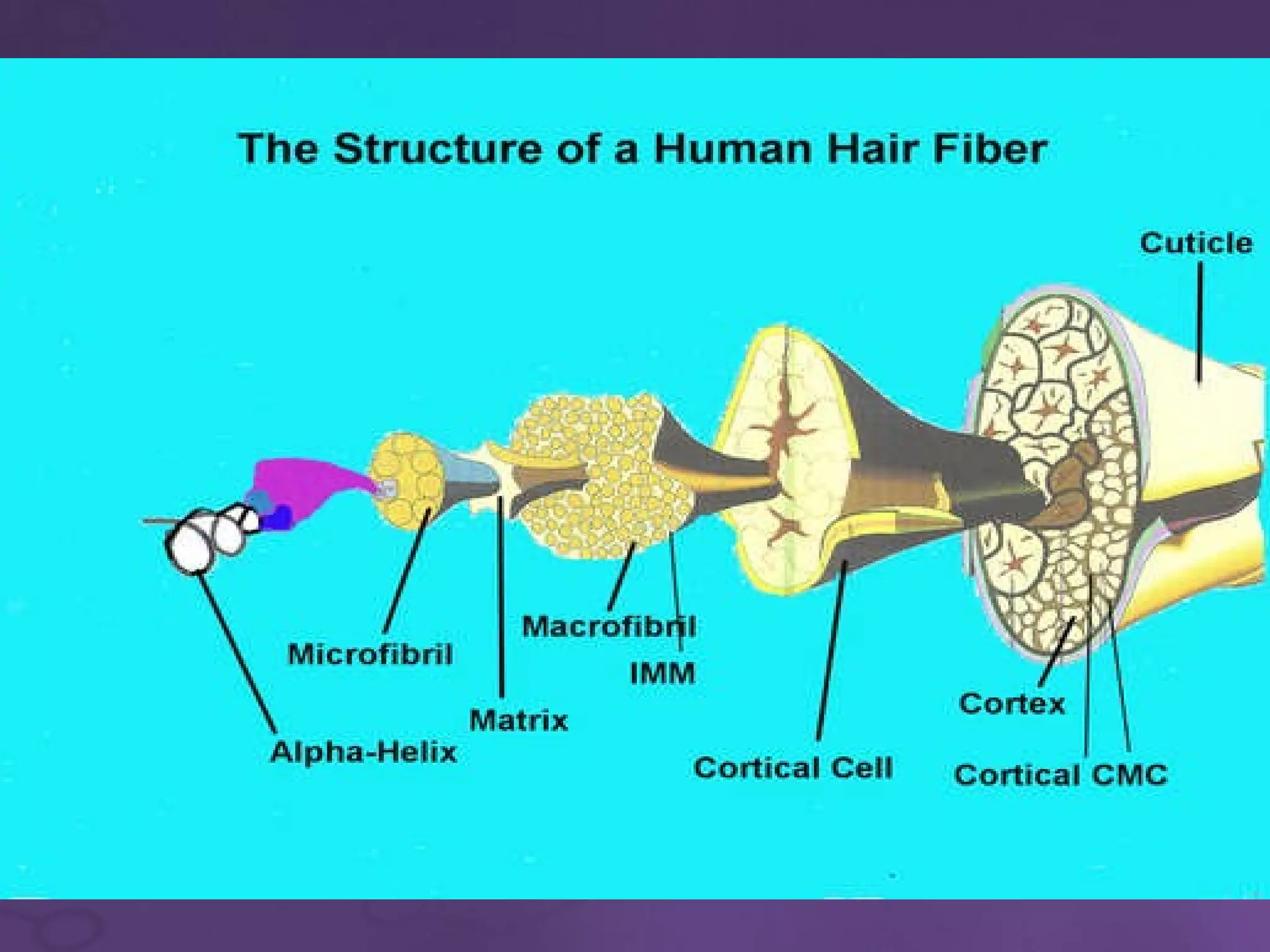
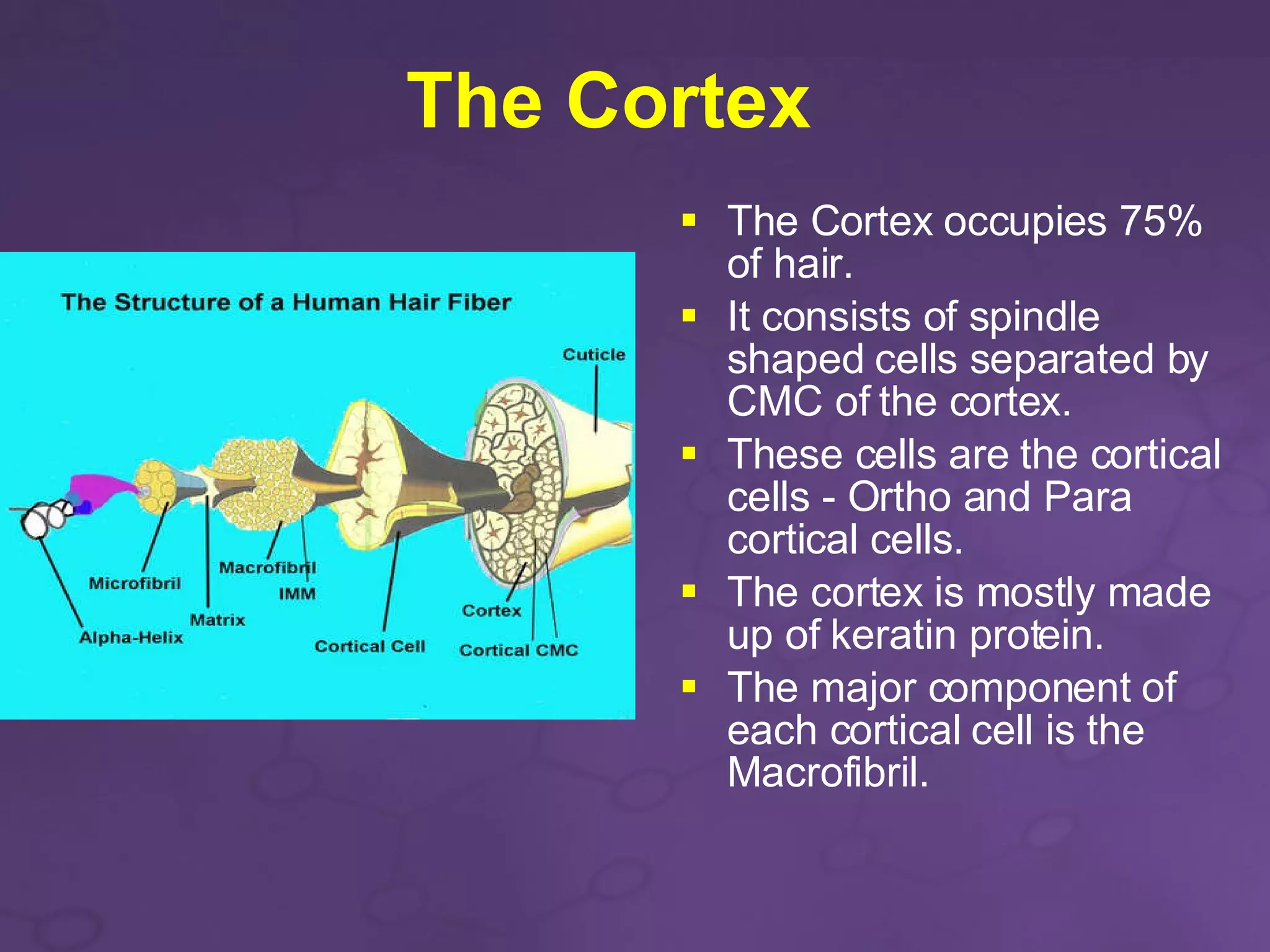
The Cortex The Cortex occupies 75% of hair. It consists of spindle shaped cells separated by CMC of the cortex. These cells are the cortical cells - Ortho and Para cortical cells. The cortex is mostly made up of keratin protein. The major component of each cortical cell is the Macrofibril.
 
Ortho and Para Cortical Cells – TMA Source: Menachem Lewin. (2007). Fiber Chemistry. P. 334
The Cortex – Hair Types Straight hair (Japanese, Chinese) are exclusively made up of Paracortical cells. African descent hair are made up of  equal rows of Ortho cortical and Paracortical cells Wavy hair (mixed race) are made up of  Paracortical cells with a narrow row of Orthocortical cells. Orthocortex Paracortex Cortical CMC
Differences Between Ortho and Para Cortical Cells: Paracortical cells are present in the inside of the crimp. More cystine than ortho Matrix in para is more than ortho. High thermal stability due to greater degree of stabilisation by disulfides . Orthocortical cells are present in the outside of the crimp Less cystine. Matrix is less. Low thermal stability due to low cystine Paracortical Orthocortical
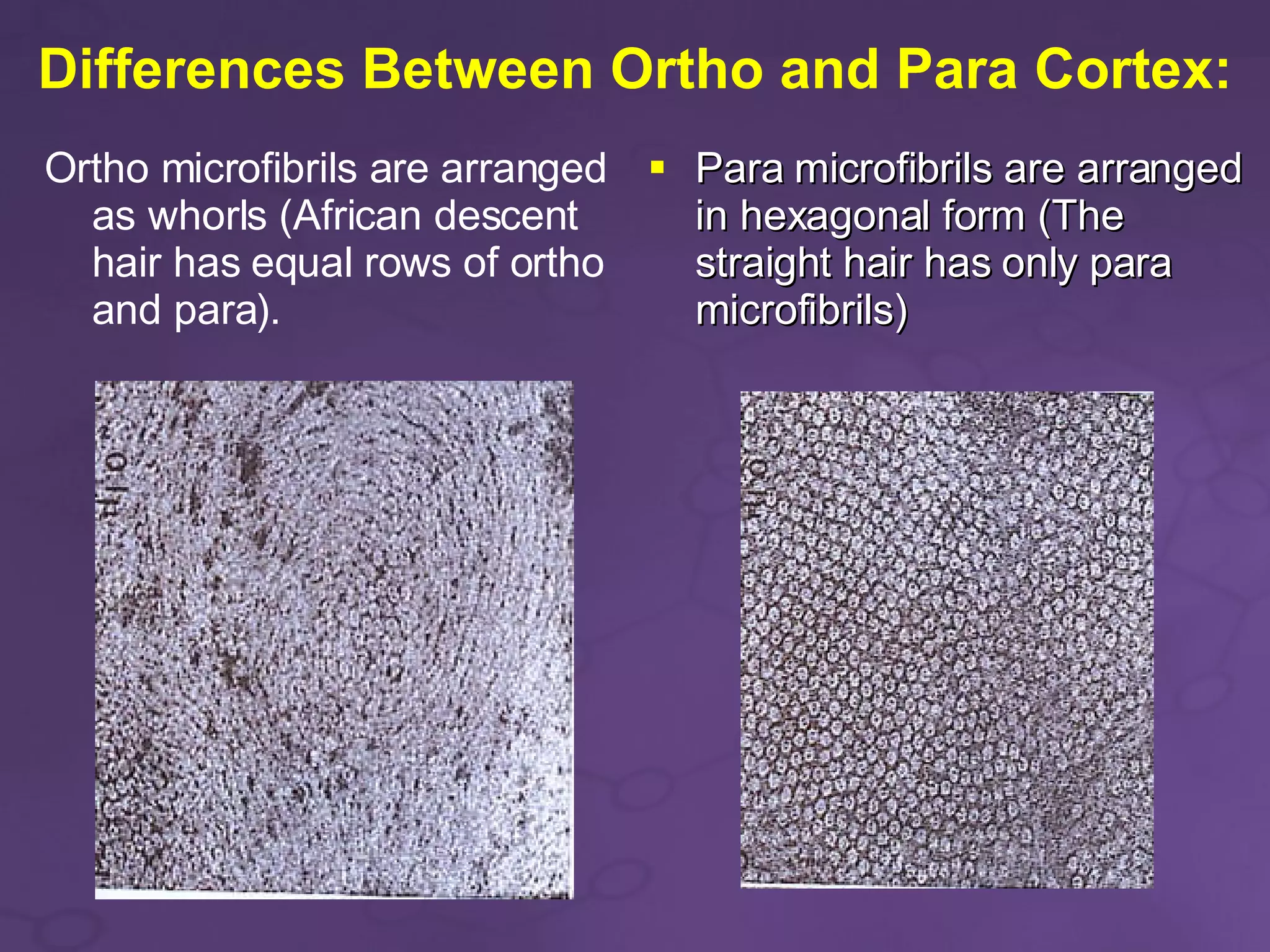
Para microfibrils are arranged in hexagonal form (The straight hair has only para microfibrils) Ortho microfibrils are arranged as whorls (African descent hair has equal rows of ortho and para). Differences Between Ortho and Para Cortex:
Hexagonal Array of Microfibrils.  Source: Menachem Levin.2007: Fiber Chemistry, p344
The Intermediate Filaments or Microfibrils The Intermediate filaments are embedded in the matrix as rods. Contain disulfide bonds and have a highly crosslinked structure. Do not swell in water. The Intermediate filaments are made up of 32 protein chains.
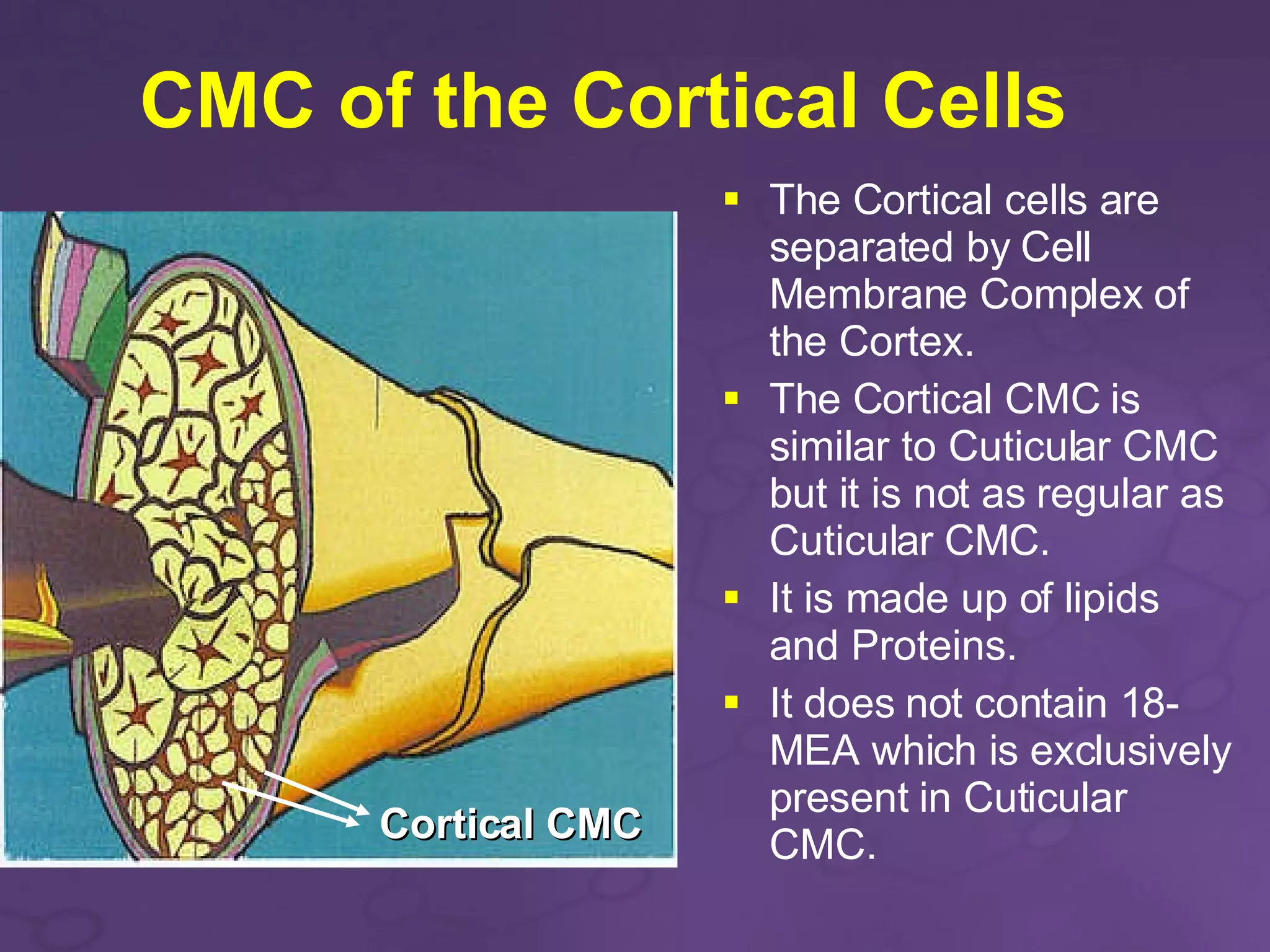
CMC of the Cortical Cells The Cortical cells are separated by Cell Membrane Complex of the Cortex. The Cortical CMC is similar to Cuticular CMC but it is not as regular as Cuticular CMC. It is made up of lipids and Proteins. It does not contain 18-MEA which is exclusively present in Cuticular CMC. Cortical CMC
The Macrofibrils The Macrofibrils are made up of Intermediate filaments or Microfibrils and Matrix. They are separated from each other by Intermacrofibrillar Matrix. The intermediate filaments (microfibrils) are highly organized structures. The matrix is a less organized structure. The Intermediate filaments (microfibrils) are surrounded by the Matrix . Macrofibrils Microfibrils Intermicrofibrillar matrix Matrix
The Matrix: The matrix occupies a large portion of the Macrofibrils. It contains a high amount of Cystine. Macrofibrils Microfibrils Intermicrofibrillar matrix Matrix
It contains disulfide bonds and is present as a lightly cross-linked gel. Because of a less crosslinked structure it swells in water. The Matrix:
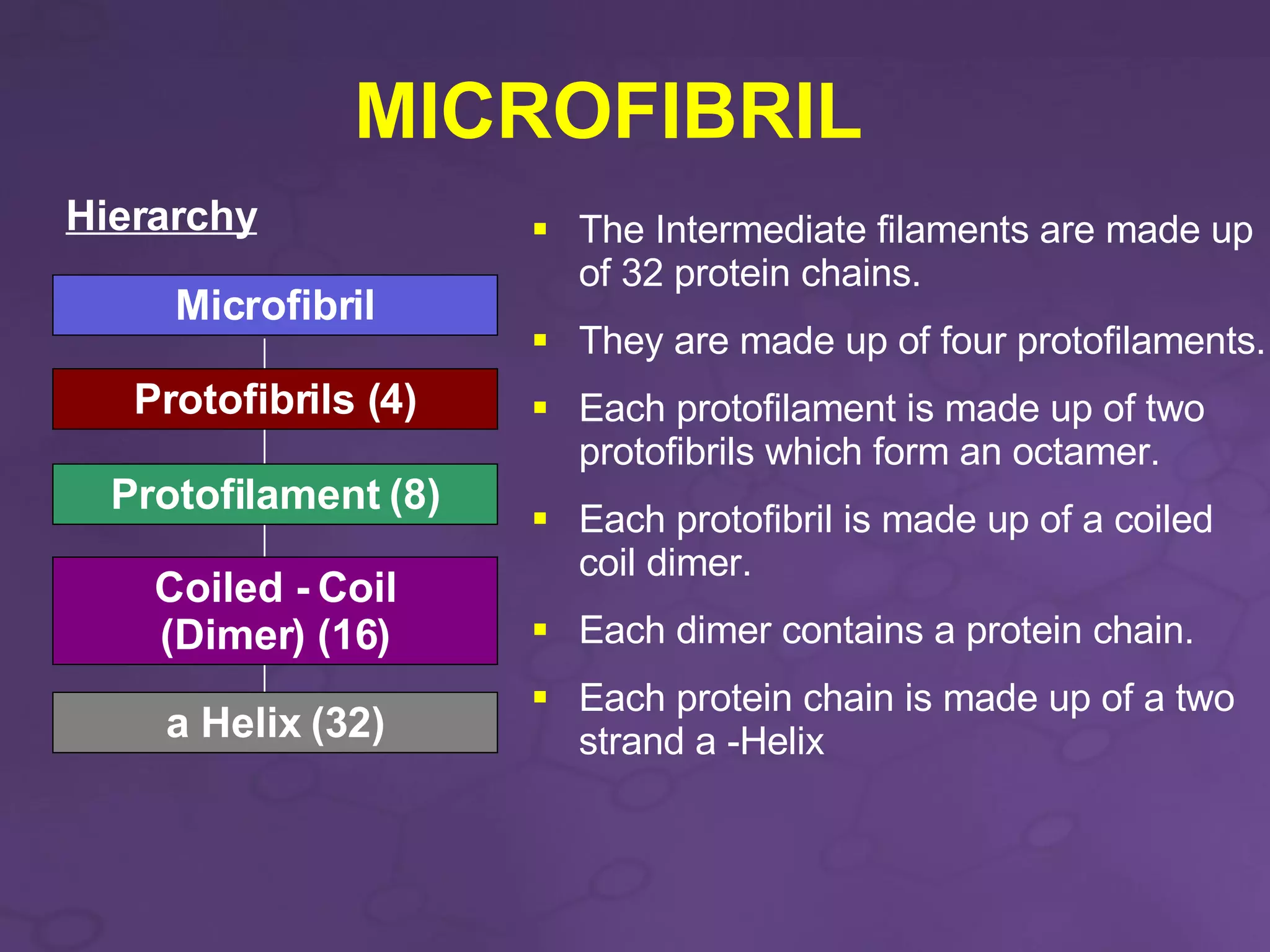
The Intermediate filaments are made up of 32 protein chains. They are made up of four protofilaments.  Each protofilament is made up of two protofibrils which form an octamer. Each protofibril is made up of a coiled coil dimer. Each dimer contains a protein chain. Each protein chain is made up of a two strand    -Helix The Intermediate Filaments or Microfibrils . Protein Chain Coiled-coil (Dimer) Profilament (Tetramer) Protofibril (Octamer) Microfibril 70 A
Monomer Dimer (2) Tetramer or Protofilament (4) Protofibril contains 2 protofilaments (4*2=8) Intermediate filament contains 4 protofibrils (8*4=32) The Intermediate Filaments or Microfibrils
MICROFIBRIL
MICROFIBRIL  Microfibril Protofibrils (4) Protofilament (8) Coiled - Coil (Dimer) (16) a  Helix (32) Hierarchy   The Intermediate filaments are made up of 32 protein chains. They are made up of four protofilaments. Each protofilament is made up of two protofibrils which form an octamer. Each protofibril is made up of a coiled coil dimer. Each dimer contains a protein chain. Each protein chain is made up of a two strand a -Helix
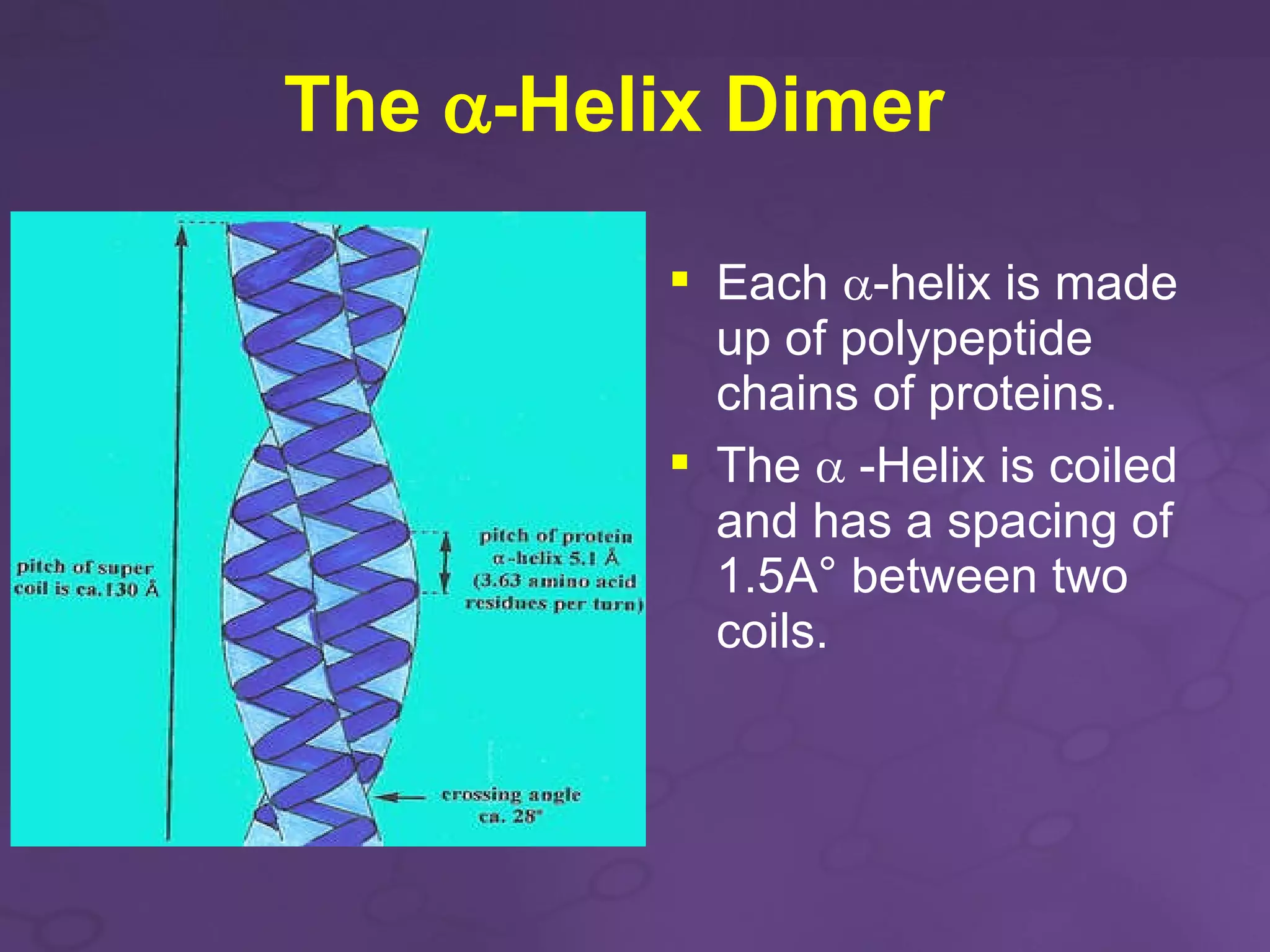
The   -Helix Dimer Each   -helix is made up of polypeptide chains of proteins. The    -Helix is coiled and has a spacing of 1.5A° between two coils.
The Polypeptide Chains The Polypeptide chains of   -Helix are made up of small units called Proteins. Proteins are straight chain Polymers made up of the smallest unit the Amino acids Proteins are linked together by the Peptide Bond.
The Amino acids There are 21 different Amino acids in hair and the Amino acid Cystine is present in the highest concentration. Amino acids contain a C-atom to which is attached a H-atom, a NH 2  group, a COOH group and a side chain R group.
The Medulla It is present in the center of the fiber. It contains hollow spaces filled with air separated by a proteinaceous network. It does not contain any Cystine.
The Melanin Granules Melanin is a natural pigment found mainly in the Cortex and sometimes in the Cuticle of dark hair. Melanin is of two types: Eumelanin the brown- black pigment found in dark hair. Pheomelanin the yellow-red pigment found in blond and red hair.

The Structure of Hair

  • 1.
    Structure of HairDr. Ali N. Syed Dr. Narjis A. Askar www.dralisyed.com (revised July 3, 2008)
  • 2.
  • 3.
    The Cuticle Thecuticle covers the hair fiber. It is 5-10 layers in thickness (1). In African descent hair there are less cuticle layers (2 layers) in the kink. Function: It is responsible for shine and protects the inner structure. 1. C.R. Robbins in chemical and Physical Behavior of Human Hair.
  • 4.
    Structure of CuticleThe Cuticle is made up of the following layers: 1. The Epicuticle 2. The A-Layer 3. The Exocuticle 4. The Endocuticle The Cell Membrane Complex Endocuticle Exocuticle Epicuticle A-Layer CMC
  • 5.
    Epicuticle It isa thin material that covers the surface of hair. Chemically composed of lipids and Fibrous proteins. Function: It makes the cuticle resistant to chemical attacks. Epicuticle CMC
  • 6.
    Surface Membrane ofCuticles Source:Menacham Lewin. 2007. P.339
  • 7.
    A-Layer It ispresent beneath the epicuticle. Contains 35% cystine. The covalent crosslinking of proteins gives toughness to this layer. Function: Makes the hair resistant to physical and chemical attacks. A-Layer CMC
  • 8.
    Exocuticle Present beneaththe A-Layer. Contains 15% cystine. Function: Gives toughness to the cuticle. Exocuticle CMC
  • 9.
    Endocuticle Present beneaththe exocuticle, it is a soft layer. Contains 3% Cystine. This is the only layer that swells in the presence of water and the swelling causes the cuticle layers to stand out. Endocuticle CMC
  • 10.
    Cell Membrane ComplexIt is present in between the cuticle cells. Made up of polysaccharides and lipids. Contains an important lipid called 18-MEA. Does not give any toughness to the cuticle. Function: It acts as a cement between the cuticle layers and holds them together. Helps in the transfer of actives from cuticle to cortex. CMC
  • 11.
    In the caseof high pH products like permanent colors, relaxers, bleaches, and permanent waves, penetration occurs through the swollen layers of the cuticle. Penetration through the cuticle layers
  • 12.
    Shampoos and conditionerstend to penetrate through the channels between cuticle layers and then through the junction of cuticle layers and the cortex. Penetration through the Cuticle Layers Penetration through the cuticle layers
  • 13.
    Passage of Shampooand Conditioner Ingredients from Cuticle to Cortex Passage of shampoo and conditioner ingredients occurs through the edges of cuticle layers into the Cortex through the junction of CMC with Cortex. Passage of shampoos and conditioners CMC Endocuticle Exocuticle Epicuticle A-Layer
  • 14.
    The Cortex TheCortex occupies 75% of hair. It consists of spindle shaped cells separated by CMC of the cortex. These cells are the cortical cells - Ortho and Para cortical cells. The cortex is mostly made up of keratin protein. The major component of each cortical cell is the Macrofibril.
  • 15.
  • 16.
    Ortho and ParaCortical Cells – TMA Source: Menachem Lewin. (2007). Fiber Chemistry. P. 334
  • 17.
    The Cortex –Hair Types Straight hair (Japanese, Chinese) are exclusively made up of Paracortical cells. African descent hair are made up of equal rows of Ortho cortical and Paracortical cells Wavy hair (mixed race) are made up of Paracortical cells with a narrow row of Orthocortical cells. Orthocortex Paracortex Cortical CMC
  • 18.
    Differences Between Orthoand Para Cortical Cells: Paracortical cells are present in the inside of the crimp. More cystine than ortho Matrix in para is more than ortho. High thermal stability due to greater degree of stabilisation by disulfides . Orthocortical cells are present in the outside of the crimp Less cystine. Matrix is less. Low thermal stability due to low cystine Paracortical Orthocortical
  • 19.
    Para microfibrils arearranged in hexagonal form (The straight hair has only para microfibrils) Ortho microfibrils are arranged as whorls (African descent hair has equal rows of ortho and para). Differences Between Ortho and Para Cortex:
  • 20.
    Hexagonal Array ofMicrofibrils. Source: Menachem Levin.2007: Fiber Chemistry, p344
  • 21.
    The Intermediate Filamentsor Microfibrils The Intermediate filaments are embedded in the matrix as rods. Contain disulfide bonds and have a highly crosslinked structure. Do not swell in water. The Intermediate filaments are made up of 32 protein chains.
  • 22.
    CMC of theCortical Cells The Cortical cells are separated by Cell Membrane Complex of the Cortex. The Cortical CMC is similar to Cuticular CMC but it is not as regular as Cuticular CMC. It is made up of lipids and Proteins. It does not contain 18-MEA which is exclusively present in Cuticular CMC. Cortical CMC
  • 23.
    The Macrofibrils TheMacrofibrils are made up of Intermediate filaments or Microfibrils and Matrix. They are separated from each other by Intermacrofibrillar Matrix. The intermediate filaments (microfibrils) are highly organized structures. The matrix is a less organized structure. The Intermediate filaments (microfibrils) are surrounded by the Matrix . Macrofibrils Microfibrils Intermicrofibrillar matrix Matrix
  • 24.
    The Matrix: Thematrix occupies a large portion of the Macrofibrils. It contains a high amount of Cystine. Macrofibrils Microfibrils Intermicrofibrillar matrix Matrix
  • 25.
    It contains disulfidebonds and is present as a lightly cross-linked gel. Because of a less crosslinked structure it swells in water. The Matrix:
  • 26.
    The Intermediate filamentsare made up of 32 protein chains. They are made up of four protofilaments. Each protofilament is made up of two protofibrils which form an octamer. Each protofibril is made up of a coiled coil dimer. Each dimer contains a protein chain. Each protein chain is made up of a two strand  -Helix The Intermediate Filaments or Microfibrils . Protein Chain Coiled-coil (Dimer) Profilament (Tetramer) Protofibril (Octamer) Microfibril 70 A
  • 27.
    Monomer Dimer (2)Tetramer or Protofilament (4) Protofibril contains 2 protofilaments (4*2=8) Intermediate filament contains 4 protofibrils (8*4=32) The Intermediate Filaments or Microfibrils
  • 28.
  • 29.
    MICROFIBRIL MicrofibrilProtofibrils (4) Protofilament (8) Coiled - Coil (Dimer) (16) a Helix (32) Hierarchy The Intermediate filaments are made up of 32 protein chains. They are made up of four protofilaments. Each protofilament is made up of two protofibrils which form an octamer. Each protofibril is made up of a coiled coil dimer. Each dimer contains a protein chain. Each protein chain is made up of a two strand a -Helix
  • 30.
    The -Helix Dimer Each  -helix is made up of polypeptide chains of proteins. The  -Helix is coiled and has a spacing of 1.5A° between two coils.
  • 31.
    The Polypeptide ChainsThe Polypeptide chains of  -Helix are made up of small units called Proteins. Proteins are straight chain Polymers made up of the smallest unit the Amino acids Proteins are linked together by the Peptide Bond.
  • 32.
    The Amino acidsThere are 21 different Amino acids in hair and the Amino acid Cystine is present in the highest concentration. Amino acids contain a C-atom to which is attached a H-atom, a NH 2 group, a COOH group and a side chain R group.
  • 33.
    The Medulla Itis present in the center of the fiber. It contains hollow spaces filled with air separated by a proteinaceous network. It does not contain any Cystine.
  • 34.
    The Melanin GranulesMelanin is a natural pigment found mainly in the Cortex and sometimes in the Cuticle of dark hair. Melanin is of two types: Eumelanin the brown- black pigment found in dark hair. Pheomelanin the yellow-red pigment found in blond and red hair.