Alphabet of Lines
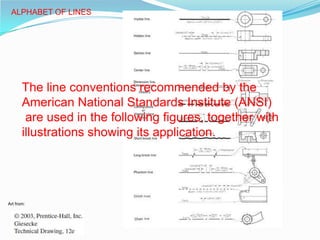
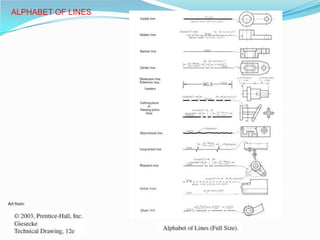
The line conventions recommended by the American National Standards Institute (ANSI) are used in the following figures, together with illustrations showing its application.
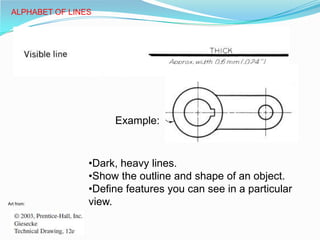
Example:Dark, heavy lines.
Show the outline and shape of an object.
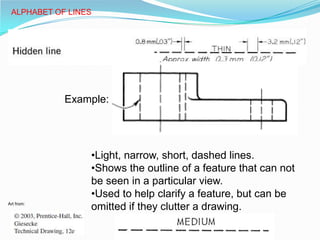
Define features you can see in a particular view.Example:Light, narrow, short, dashed lines.
Shows the outline of a feature that can not be seen in a particular view.
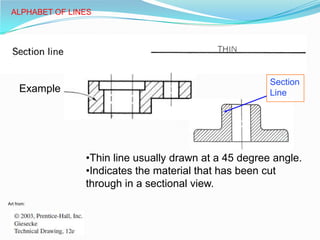
Used to help clarify a feature, but can be omitted if they clutter a drawing.SectionLineExampleThin line usually drawn at a 45 degree angle.
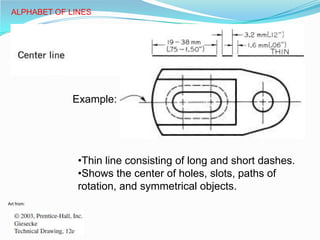
Indicates the material that has been cut through in a sectional view.Example:Thin line consisting of long and short dashes.
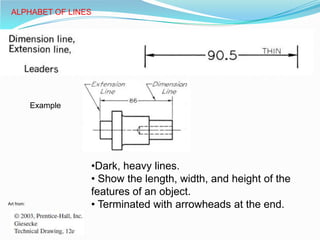
Shows the center of holes, slots, paths of rotation, and symmetrical objects.ExampleDark, heavy lines.
 Show the length, width, and height of the features of an object.
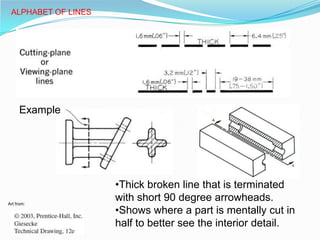
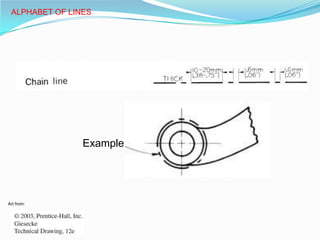
 Terminated with arrowheads at the end.ExampleThick broken line that is terminated with short 90 degree arrowheads.
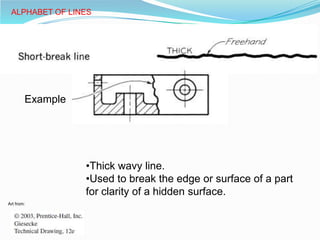
Shows where a part is mentally cut in half to better see the interior detail.ExampleThick wavy line.
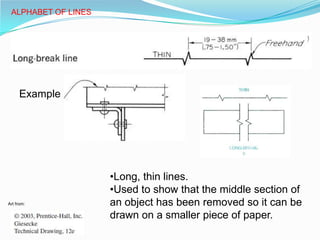
Used to break the edge or surface of a part for clarity of a hidden surface.ExampleLong, thin lines.
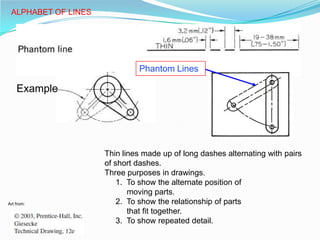
Used to show that the middle section of an object has been removed so it can be drawn on a smaller piece of paper.Phantom LinesExampleThin lines made up of long dashes alternating with pairs of short dashes.Three purposes in drawings.     1.  To show the alternate position of                   moving parts.     2.  To show the relationship of parts            that fit together.     3.  To show repeated detail.
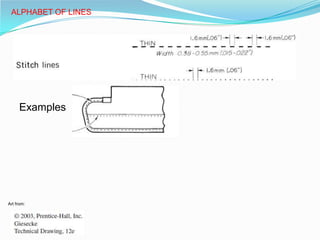
Examples

Alphabet Of Lines

  • 1.
  • 2.
    The line conventionsrecommended by the American National Standards Institute (ANSI) are used in the following figures, together with illustrations showing its application.
  • 3.
  • 4.
    Show the outlineand shape of an object.
  • 5.
    Define features youcan see in a particular view.Example:Light, narrow, short, dashed lines.
  • 6.
    Shows the outlineof a feature that can not be seen in a particular view.
  • 7.
    Used to helpclarify a feature, but can be omitted if they clutter a drawing.SectionLineExampleThin line usually drawn at a 45 degree angle.
  • 8.
    Indicates the materialthat has been cut through in a sectional view.Example:Thin line consisting of long and short dashes.
  • 9.
    Shows the centerof holes, slots, paths of rotation, and symmetrical objects.ExampleDark, heavy lines.
  • 10.
    Show thelength, width, and height of the features of an object.
  • 11.
    Terminated witharrowheads at the end.ExampleThick broken line that is terminated with short 90 degree arrowheads.
  • 12.
    Shows where apart is mentally cut in half to better see the interior detail.ExampleThick wavy line.
  • 13.
    Used to breakthe edge or surface of a part for clarity of a hidden surface.ExampleLong, thin lines.
  • 14.
    Used to showthat the middle section of an object has been removed so it can be drawn on a smaller piece of paper.Phantom LinesExampleThin lines made up of long dashes alternating with pairs of short dashes.Three purposes in drawings. 1. To show the alternate position of moving parts. 2. To show the relationship of parts that fit together. 3. To show repeated detail.
  • 15.