Advanced Temperature Transmitter ATT082
HART® protocol Model
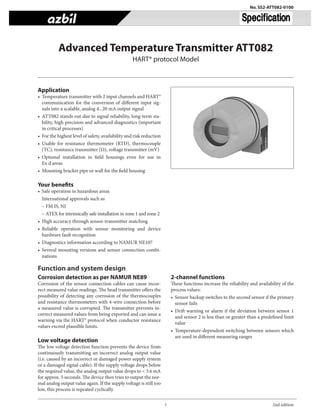
Application
•	 Temperature	transmitter	with	2	input	channels	and	HART®	
communication	for	the	conversion	of	different	input	sig-
nals	into	a	scalable,	analog	4...20	mA	output	signal
•	 ATT082	stands	out	due	to	signal	reliability,	long-term	sta-
bility,	high	precision	and	advanced	diagnostics	(important	
in	critical	processes)
•	 For	the	highest	level	of	safety,	availability	and	risk	reduction
•	 Usable	 for	 resistance	 thermometer	 (RTD),	 thermocouple	
(TC),	resistance	transmitter	(Ω),	voltage	transmitter	(mV)
•	 Optional	 installation	 in	 field	 housings	 even	 for	 use	 in		
Ex	d	areas
•	 Mounting	bracket	pipe	or	wall	for	the	field	housing
Your benefits
•	 Safe	operation	in	hazardous	areas
International	approvals	such	as
–	FM	IS,	NI
–		ATEX	for	intrinsically	safe	installation	in	zone	1	and	zone	2
•	 High	accuracy	through	sensor-transmitter	matching
•	 Reliable	 operation	 with	 sensor	 monitoring	 and	 device	
hardware	fault	recognition
•	 Diagnostics	information	according	to	NAMUR	NE107
•	 Several	mounting	versions	and	sensor	connection	combi-
nations
Function and system design
Corrosion detection as per NAMUR NE89
Corrosion	of	the	sensor	connection	cables	can	cause	incor-
rect	measured	value	readings.	The	head	transmitter	offers	the	
possibility	of	detecting	any	corrosion	of	the	thermocouples	
and	resistance	thermometers	with	4-wire	connection	before	
a	measured	value	is	corrupted.	The	transmitter	prevents	in-
correct	measured	values	from	being	exported	and	can	issue	a	
warning	via	the	HART®	protocol	when	conductor	resistance	
values	exceed	plausible	limits.
Low voltage detection
The	low	voltage	detection	function	prevents	the	device	from	
continuously	transmitting	an	incorrect	analog	output	value	
(i.e.	caused	by	an	incorrect	or	damaged	power	supply	system	
or	a	damaged	signal	cable).	If	the	supply	voltage	drops	below	
the	required	value,	the	analog	output	value	drops	to	<	3.6	mA	
for	approx.	5	seconds.	The	device	then	tries	to	output	the	nor-
mal	analog	output	value	again.	If	the	supply	voltage	is	still	too	
low,	this	process	is	repeated	cyclically.
No. SS2-ATT082-0100
2-channel functions
These	functions	increase	the	reliability	and	availability	of	the	
process	values:
•	 Sensor	backup	switches	to	the	second	sensor	if	the	primary	
sensor	fails
•	 Drift	warning	or	alarm	if	the	deviation	between	sensor	1	
and	sensor	2	is	less	than	or	greater	than	a	predefined	limit	
value
•	 Temperature-dependent	switching	between	sensors	which	
are	used	in	different	measuring	ranges
2nd	edition1
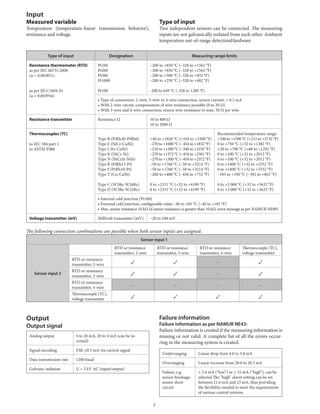
Input
Measured variable
Temperature	 (temperature-linear	 transmission	 behavior),	
resistance	and	voltage.
Type of input
Two	independent	sensors	can	be	connected.	The	measuring	
inputs	are	not	galvanically	isolated	from	each	other.	Ambient	
temperature	out-of-range	detectionHardware
Type of input Designation Measuring range limits
Resistance thermometer (RTD)
as	per	IEC	60751:2008
(α	=	0.003851)
as	per	JIS	C1604-81
(α	=	0.003916)
Pt100
Pt200
Pt500
Pt1000
Pt100
–200	to	+850	°C	(–328	to	+1562	°F)
–200	to	+500	°C	(–328	to	+932	°F)
–200	to	+250	°C	(–328	to	+482	°F)
-200	to	649	°C	(-328	to	1200	°F)
•	Type	of	connection:	2-wire,	3-wire	or	4-wire	connection,	sensor	current:	≤	0.3	mA
•	With	2-wire	circuit,	compensation	of	wire	resistance	possible	(0	to	30	Ω)
•	With	3-wire	and	4-wire	connection,	sensor	wire	resistance	to	max.	50	Ω	per	wire
Resistance transmitter Resistance	Ω 10	to	400	Ω
10	to	2000	Ω
Thermocouples (TC)
to	IEC	584	part	1
to	ASTM	E988
Type	B	(PtRh30-PtRh6)
Type	E	(NiCr-CuNi)
Type	J	(Fe-CuNi)
Type	K	(NiCr-Ni)
Type	N	(NiCrSi-NiSi)
Type	R	(PtRh13-Pt)
Type	S	(PtRh10-Pt)
Type	T	(Cu-CuNi)
Type	C	(W5Re-W26Re)
Type	D	(W3Re-W25Re)
+40	to	+1820	°C	(+104	to	+3308	°F)
–270	to	+1000	°C	(–454	to	+1832	°F)
–210	to	+1200	°C	(–346	to	+2192	°F)
–270	to	+1372	°C	(–454	to	+2501	°F)
–270	to	+1300	°C	(–454	to	+2372	°F)
–50	to	+1768	°C	(–58	to	+3214	°F)
–260	to	+400	°C	(–436	to	+752	°F)
0	to	+2315	°C	(+32	to	+4199	°F)
Recommended	temperature	range:
+100	to	+1500	°C	(+212	to	+2732	°F)
0	to	+750	°C	(+32	to	+1382	°F)
+20	to	+700	°C	(+68	to	+1292	°F)
0	to	+100	°C	(+32	to	+2012	°F)
0	to	+1400	°C	(+32	to	+2552	°F)
–185	to	+350	°C	(–301	to	+662	°F)
0	to	+2	000	°C	(+32	to	+3632	°F)
•	Internal	cold	junction	(Pt100)
•	External	cold	junction:	configurable	value	–40	to	+85	°C	(–40	to	+185	°F)
•	Max.	sensor	resistance	10	kΩ	(if	sensor	resistance	is	greater	than	10	kΩ,	error	message	as	per	NAMUR	NE89)
Voltage transmitter (mV) Millivolt	transmitter	(mV) –20	to	100	mV
The following connection combinations are possible when both sensor inputs are assigned:
Sensor input 1
Sensor input 2
RTD	or	resistance	
transmitter,	2-wire
RTD	or	resistance	
transmitter,	3-wire
RTD	or	resistance	
transmitter,	4-wire
Thermocouple	(TC),	
voltage	transmitter
RTD	or	resistance	
transmitter,	2-wire ✓ ✓ - ✓
RTD	or	resistance	
transmitter,	3-wire ✓ ✓ - ✓
RTD	or	resistance	
transmitter,	4-wire - - - -
Thermocouple	(TC),	
voltage	transmitter ✓ ✓ ✓ ✓
Output
Output signal
Analog	output 4	to	20	mA,	20	to	4	mA	(can	be	in-
verted)
Signal	encoding FSK	±0.5	mA	via	current	signal
Data	transmission	rate 1200	baud
Galvanic	isolation U	=	2	kV	AC	(input/output)
Failure information
Failure information as per NAMUR NE43:
Failure	information	is	created	if	the	measuring	information	is	
missing	or	not	valid.	A	complete	list	of	all	the	errors	occur-
ring	in	the	measuring	system	is	created.
Underranging Linear	drop	from	4.0	to	3.8	mA
Overranging Linear	increase	from	20.0	to	20.5	mA
Failure,	e.g.	
sensor	breakage;	
sensor	short	
circuit
≤	3.6	mA	(“low”)	or	≥	21	mA	(“high”),	can	be	
selected	The	“high”	alarm	setting	can	be	set	
between	21.6	mA	and	23	mA,	thus	providing	
the	flexibility	needed	to	meet	the	requirements	
of	various	control	systems.
2
Load
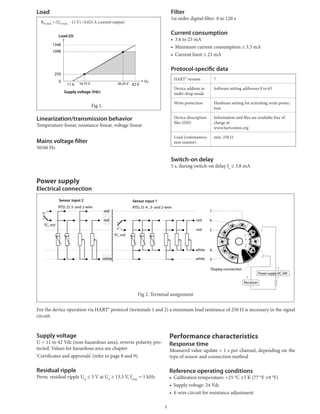
Rb	max.=	(Ub	max.	-	11	V)	/	0.023	A	(current	output)
Fig	1.		
Linearization/transmission behavior
Temperature-linear,	resistance-linear,	voltage-linear
Mains voltage filter
50/60	Hz
Filter
1st	order	digital	filter:	0	to	120	s
Current consumption
•	 3.6	to	23	mA
•	 Minimum	current	consumption	≤	3.5	mA
•	 Current	limit	≤	23	mA
Protocol-specific data
HART®	version 7
Device	address	in	
multi-drop	mode
Software	setting	addresses	0	to	63
Write	protection Hardware	setting	for	activating	write	protec-
tion
Device	description	
files	(DD)
Information	and	files	are	available	free	of	
charge	at:
www.hartcomm.org
Load	(communica-
tion	resistor)
min.	250	Ω
Switch-on delay
5	s,	during	switch-on	delay	Ia
	≤	3.8	mA
Ub
42 V
1348
1098
250
11 V
0
36.25 V16.75 V
Supply voltage (Vdc)
Load (Ω)
Power supply
Electrical connection
7
6
5
4
3
Sensor input 2 Sensor input 1
Display connection
Power supply DC 24V
Receiver
TC, mV
RTD, Ω: 4-, 3- and 2-wireRTD, Ω: 3- and 2-wire
TC, mV
white
red
red
white
white
red
red
Fig	2.	Terminal	assignment
For	the	device	operation	via	HART®	protocol	(terminals	1	and	2)	a	minimum	load	resistance	of	250	Ω	is	necessary	in	the	signal	
circuit.
Supply voltage
U	=	11	to	42	Vdc	(non-hazardous	area),	reverse	polarity	pro-
tected.	Values	for	hazardous	area	see	chapter
‘Certificates	and	approvals’	(refer	to	page	8	and	9).
Residual ripple
Perm.	residual	ripple	Uss
	≤	3	V	at	Ub
	≥	13.5	V,	fmax.
	=	1	kHz
Performance characteristics
Response time
Measured	value	update	<	1	s	per	channel,	depending	on	the	
type	of	sensor	and	connection	method
Reference operating conditions
•	 Calibration	temperature:	+25	°C	±5	K	(77	°F	±9	°F)
•	 Supply	voltage:	24	Vdc
•	 4-wire	circuit	for	resistance	adjustment
3
Maximum measured error
The	accuracy	data	are	typical	values	and	correspond	to	a	standard	deviation	of	±3	σ	(normal	distribution),	i.e.	99.8	%	of	all	the	
measured	values	achieve	the	given	values	or	better	values.
Designation/measuring range Performance characteristics
Digital D/A	1)
Resistance	thermometer	(RTD)
(3-wire,	4-wire)
Pt100
Pt500
Pt1000
Pt200
0.1	°C	(0.18	°F)
0.3	°C	(0.54	°F)
0.2	°C	(0.36	°F)
1.0	°C	(1.8	°F)
0.03	%
0.03	%
0.03	%
0.03	%
Resistance	thermometer	(RTD)
(2-wire)
Pt100
Pt500
Pt1000
Pt200
0.8	°C	(1.44	°F)
0.8	°C	(1.44	°F)
0.8°C	(1.44	°F)
1.5	°C	(2.7	°F)
0.03	%
0.03	%
0.03	%
0.03	%
Thermocouples	(TC) Type:	K,	J,	T,	E
Type:	N,	C,	D
Type:	S,	B,	R
0.25	°C	(0.45	°F)
0.5	°C	(0.9	°F)
1.0	°C	(1.8	°F)
0.03	%
0.03	%
0.03	%
Resistance	transmitters	(Ω) 10	to	400	Ω
10	to	2	000	Ω
±0.04	Ω
±0.8	Ω
0.03	%
0.03	%
Voltage	transmitter	(mV) –20	to	100	mV ±10	μV 0.03	%
1) % refers to the set span. Accuracy = digital + D/A accuracy
Physical input measuring range of sensors
10	to	400	Ω Pt100
10	to	2000	Ω Pt200,	Pt500,	Pt1000
–20	to	100	mV Thermocouples	type:	B,	C,	D,	E,	J,	K,	N,	R,	S,	T
Sensor adjustment
Sensor transmitter matching
RTD	sensors	are	one	of	the	most	linear	temperature	measur-
ing	elements.	Nevertheless,	the	output	must	be	linearized.	To	
significantly	 improve	 temperature	 measurement	 accuracy,	
the	device	allows	the	use	of	two	methods:
•	 Callendar-Van-Dusen	 coefficients	 (Pt100	 resistance	 ther-
mometer)
The	Callendar-Van-Dusen	equation	is	described	as:
RT
	=	R0
	
[1	+	AT	+	BT2	
+	C	(T	-	100)	T3
]
The	coefficients	A,	B	and	C	are	used	to	match	the	sensor	
(platinum)	and	transmitter	in	order	to	improve	the	accura-
cy	of	the	measuring	system.	The	coefficients	for	a	standard	
sensor	are	specified	in	IEC	751.	If	no	standard	sensor	is	
available	or	if	greater	accuracy	is	required,	the	coefficients	
for	each	sensor	can	be	determined	specifically	with	the	aid	
of	sensor	calibration.
•	 Linearization	 for	 copper/nickel	 resistance	 thermometers	
(RTD)
The	polynomial	equation	for	copper/nickel	is	as	follows:
RT
	=	R0
	
(1	+	AT	+	BT2
)
The	coefficients	A	and	B	are	used	for	the	linearization	of	
nickel	or	copper	resistance	thermometers	(RTD).
The	exact	values	of	the	coefficients	derive	from	the	calibra-
tion	data	and	are	specific	to	each	sensor.
Sensor	transmitter	matching	using	one	of	the	methods	ex-
plained	above	significantly	improves	the	temperature	mea-
surement	accuracy	of	the	entire	system.	This	is	because	the	
transmitter	uses	the	specific	data	pertaining	to	the	connected	
sensor	to	calculate	the	measured	temperature,	instead	of	us-
ing	the	standardized	sensor	curve	data.
1-point adjustment (offset)
Shifts	the	sensor	value
2-point adjustment (sensor trimming)
Correction	(slope	and	offset)	of	the	measured	sensor	value	at	
transmitter	input
Current trimming (current output fine adjust-
ment)
Correction	of	the	4	or	20	mA	current	output	value
Non-repeatability
Input
10	to	400	Ω 15	mΩ
10	to	2000	Ω 100	ppm	*	measured	value
–20	to	100	mV 4	μV
Output
≤	2	μA
Influence of the supply voltage
≤	±0.0025%/V,	with	reference	to	the	span
Long-term stability
≤	0.1	°C/year	(≤	0.18	°F/year)	or	≤	0.05	%/year
Data	under	reference	operating	conditions.	%	refers	to	the	set	
span.	The	larger	value	is	valid.
4
Influence of ambient temperature (temperature drift)
Total	temperature	drift	=	input	temperature	drift	+	output	temperature	drift
Impact on accuracy when ambient temperature changes by 1 K (1.8 °F):
Input	10	to	400	Ω Typ.	0.001	%	of	the	measured	value,	min.	1	mΩ
Input	10	to	2000	Ω Typ.	0.001	%	of	the	measured	value,	min.	10	mΩ
Input	–20	to	100	mV Typ.	0.001	%	of	the	measured	value,	min.	0.2	μV
Output	4	to	20	mA Typ.	0.0015	%	of	the	span
Typical sensitivity of resistance thermometers
Pt:	0.00385	*	Rnom
/K Cu:	0.0043	*	Rnom
/K Ni:	0.00617	*	Rnom
/K
Example	Pt100:	0.00385	*	100	Ω/K	=	0.385	Ω/K
Impact on accuracy when ambient temperature changes by 1 K (1.8 °F):
B:	9	μV/K	at
1000	°C	(1	832	°F)
C:	18	μV/K	at
1000	°C	(1	832	°F)
D:	20	μV/K	at
1000	°C	(1832	°F)
E:	81	μV/K	at
500	°C	(932	°F)
J:	56	μV/K	at
500	°C	(932	°F)
K:	43	μV/K	at
500	°C	(932	°F)
N:	38	μV/K	at
500	°C	(932	°F)
R:	13	μV/K	at
1000	°C	(1832	°F)
S:	11	μV/K	at
1000	°C	(1832	°F)
T:	46	μV/K	at
100	°C	(212	°F)
Example of calculating the measured error
with ambient temperature drift:
Input	temperature	drift	∆ϑ	=	10	K	(18	°F),	Pt100,	measuring	
range	0	to	100	°C	(32	to	212	°F).	Maximum	process	tempera-
ture:	100	°C	(212	°F)
Measured	resistance	value:	138.5	Ω	(IEC	60751)	at	maximum	
process	temperature
Typical	temperature	drift	in	Ω:	(0.001	%	of	138.5	Ω)	*	10	=	
0.01385	Ω
Conversion	to	Kelvin:	0.01385	Ω	/	0.385	Ω/K	=	0.04	K	(0.072	°F)
Influence of the reference junction (internal
cold junction)
Pt100	DIN	IEC	60751	Cl.	B	(internal	cold	junction	with	ther-
mocouples	TC)
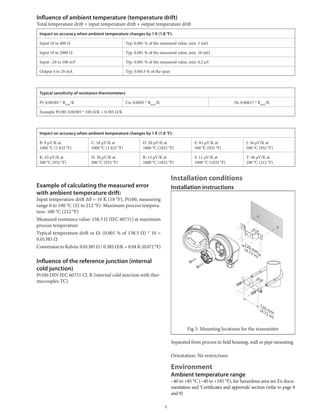
Installation conditions
Installation instructions
Fig	3.	Mounting	locations	for	the	transmitter
Separated	from	process	in	field	housing,	wall	or	pipe	mounting
Orientation:	No	restrictions
Environment
Ambient temperature range
–40	to	+85	°C	(–40	to	+185	°F),	for	hazardous	area	see	Ex	docu-
mentation	and	‘Certificates	and	approvals’	section	(refar	to	page	8	
and	9)
120 mm(4.72 in)
120 mm(4.72 in)
5
Storage temperature
–40	to	+100	°C	(–40	to	+212	°F)
Altitude
Up	to	4000	m	(4374.5	yards)	above	mean	sea	level	as	per	IEC	
61010-1
Climate class
As	per	IEC	60654-1,	Class	C
Humidity
•	 Condensation	permitted	as	per	IEC	60	068-2-33
•	 Max.	rel.	humidity:	95%	as	per	IEC	60068-2-30
Degree of protection
•	 IP	66/67
Vibration
25	to	100	Hz	for	4g	(increased	vibration	stress)	as	per	GL-
guidelines,	chapter	2,	edition	2003
Electromagnetic compatibility (EMC)
CE compliance
Electromagnetic	 compatibility	 in	 accordance	 with	 all	 the	
relevant	requirements	of	the	EN	61326	series	and	NAMUR	
Recommendation	EMC	(NE21).	Details	are	provided	in	the	
Declaration	of	Conformity.
ESD	(electrostatic	
discharge)
EN/IEC	61000-4-2 6	kV	cont.,	8	kV	air
Electromagnetic	
fields
EN/IEC	61000-4-3 0.08	to	2.7	GHz 10	V/m
Burst
(fast	transients)
EN/IEC	61000-4-4 2	kV
Surge
(surge	voltage)
EN/IEC	61000-4-5 0.5	kV	sym.
1	kV	assym.
Conducted	RF EN/IEC	61000-4-6 0.01	to	80	MHz 10	V
Measuring category
Measuring	category	II	as	per	IEC	61010-1.	The	measuring	
category	is	provided	for	measuring	on	power	circuits	that	are	
directly	connected	electrically	with	the	low-voltage	network.
Degree of contamination
Pollution	degree	2	as	per	IEC	61010-1.
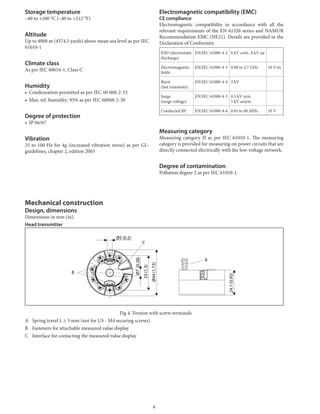
Mechanical construction
Design, dimensions
Dimensions	in	mm	(in).
Head transmitter
Fig	4.	Version	with	screw	terminals
A	 Spring	travel	L	≥	5	mm	(not	for	US	-	M4	securing	screws)
B	 Fasteners	for	attachable	measured	value	display
C	 Interface	for	contacting	the	measured	value	display
24.1(0.95)
33(1.3)
Ø44(1.73)
Ø7(0.28)
Ø5 (0.2)
B
C
A
6
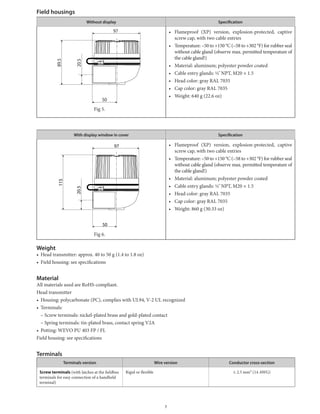
Field housings
Without display Specification
Fig	5.		
•	 Flameproof	 (XP)	 version,	 explosion-protected,	 captive	
screw	cap,	with	two	cable	entries
•	 Temperature:	–50	to	+150	°C	(–58	to	+302	°F)	for	rubber	seal	
without	cable	gland	(observe	max.	permitted	temperature	of	
the	cable	gland!)
•	 Material:	aluminum;	polyester	powder	coated
•	 Cable	entry	glands:	½˝NPT,	M20	×	1.5
•	 Head	color:	gray	RAL	7035
•	 Cap	color:	gray	RAL	7035
•	 Weight:	640	g	(22.6	oz)
With display window in cover Specification
Fig	6.		
•	 Flameproof	 (XP)	 version,	 explosion-protected,	 captive	
screw	cap,	with	two	cable	entries
•	 Temperature:	–50	to	+150	°C	(–58	to	+302	°F)	for	rubber	seal	
without	cable	gland	(observe	max.	permitted	temperature	of	
the	cable	gland!)
•	 Material:	aluminum;	polyester	powder	coated
•	 Cable	entry	glands:	½˝NPT,	M20	×	1.5
•	 Head	color:	gray	RAL	7035
•	 Cap	color:	gray	RAL	7035
•	 Weight:	860	g	(30.33	oz)
Weight
•	 Head	transmitter:	approx.	40	to	50	g	(1.4	to	1.8	oz)
•	 Field	housing:	see	specifications
Material
All	materials	used	are	RoHS-compliant.
Head	transmitter
•	 Housing:	polycarbonate	(PC),	complies	with	UL94,	V-2	UL	recognized
•	 Terminals:
–	Screw	terminals:	nickel-plated	brass	and	gold-plated	contact
–	Spring	terminals:	tin-plated	brass,	contact	spring	V2A
•	 Potting:	WEVO	PU	403	FP	/	FL
Field	housing:	see	specifications
Terminals
Terminals version Wire version Conductor cross-section
Screw terminals	(with	latches	at	the	fieldbus	
terminals	for	easy	connection	of	a	handheld
terminal)
Rigid	or	flexible ≤	2.5	mm²	(14	AWG)
97
89.5
50
20.5
97
115
50
20.5
7
Human interface
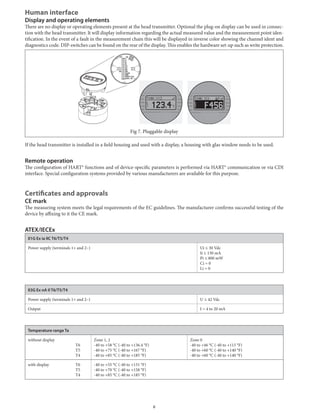
Display and operating elements
There	are	no	display	or	operating	elements	present	at	the	head	transmitter.	Optional	the	plug-on	display	can	be	used	in	connec-
tion	with	the	head	transmitter.	It	will	display	information	regarding	the	actual	measured	value	and	the	measurement	point	iden-
tification.	In	the	event	of	a	fault	in	the	measurement	chain	this	will	be	displayed	in	inverse	color	showing	the	channel	ident	and	
diagnostics	code.	DIP-switches	can	be	found	on	the	rear	of	the	display.	This	enables	the	hardware	set-up	such	as	write	protection.
Fig	7.	Pluggable	display
If	the	head	transmitter	is	installed	in	a	field	housing	and	used	with	a	display,	a	housing	with	glas	window	needs	to	be	used.
Remote operation
The	configuration	of	HART®	functions	and	of	device-specific	parameters	is	performed	via	HART®	communication	or	via	CDI	
interface.	Special	configuration	systems	provided	by	various	manufacturers	are	available	for	this	purpose.
Certificates and approvals
CE mark
The	measuring	system	meets	the	legal	requirements	of	the	EC	guidelines.	The	manufacturer	confirms	successful	testing	of	the	
device	by	affixing	to	it	the	CE	mark.
ATEX/IECEx
II1G Ex ia IIC T6/T5/T4
Power	supply	(terminals	1+	and	2–) Ui	≤	30	Vdc
Ii	≤	130	mA
Pi	≤	800	mW
Ci	≈	0
Li	≈	0
II3G Ex nA II T6/T5/T4
Power	supply	(terminals	1+	and	2–) U	≤	42	Vdc
Output I	=	4	to	20	mA
Temperature range Ta
without	display
	 T6
	 T5
	 T4
Zone	1,	2
-40	to	+58	°C	(-40	to	+136.4	°F)
-40	to	+75	°C	(-40	to	+167	°F)
-40	to	+85	°C	(-40	to	+185	°F)
Zone	0
-40	to	+46	°C	(-40	to	+115	°F)
-40	to	+60	°C	(-40	to	+140	°F)
with	display	 T6
	 T5
	 T4
-40	to	+55	°C	(-40	to	+131	°F)
-40	to	+70	°C	(-40	to	+158	°F)
-40	to	+85	°C	(-40	to	+185	°F)
8
• II 2G Ex d IIC T6...T4 Gb
• II 2D Ex tb IIIC T85 °C…T105 °C Db
Power	supply	(terminals	+	and	-) 9	to	32	Vdc
Temperature	range	 T6
	 T5
	 T4
-40	°C	≤	Ta	≤	+65	°C
-40	°C	≤	Ta	≤	+80	°C
-40	°C	≤	Ta	≤	+85	°C
Maximum	suface	temperature	housing	 T85	°C
	 T100	°C
	 T105	°C
-40	°C	≤	Ta	≤	+65	°C
-40	°C	≤	Ta	≤	+80	°C
-40	°C	≤	Ta	≤	+85	°C
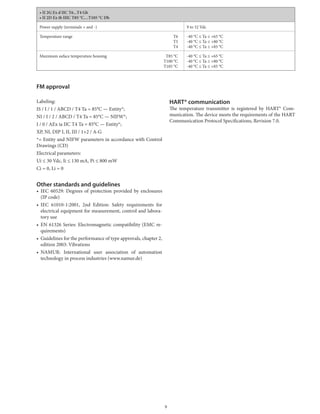
FM approval
Labeling:
IS	/	I	/	1	/	ABCD	/	T4	Ta	=	85°C	—	Entity*;
NI	/	I	/	2	/	ABCD	/	T4	Ta	=	85°C	—	NIFW*;
I	/	0	/	AEx	ia	IIC	T4	Ta	=	85°C	—	Entity*;
XP,	NI,	DIP	I,	II,	III	/	1+2	/	A-G
*=	Entity	and	NIFW	parameters	in	accordance	with	Control	
Drawings	(CD)
Electrical	parameters:
Ui	≤	30	Vdc,	Ii	≤	130	mA,	Pi	≤	800	mW
Ci	≈	0,	Li	≈	0
Other standards and guidelines
•	 IEC	60529:	Degrees	of	protection	provided	by	enclosures	
(IP	code)
•	 IEC	 61010-1:2001,	 2nd	 Edition:	 Safety	 requirements	 for	
electrical	equipment	for	measurement,	control	and	labora-
tory	use
•	 EN	61326	Series:	Electromagnetic	compatibility	(EMC	re-
quirements)
•	 Guidelines	for	the	performance	of	type	approvals,	chapter	2,	
edition	2003:	Vibrations
•	 NAMUR:	 International	 user	 association	 of	 automation	
technology	in	process	industries	(www.namur.de)
HART® communication
The	 temperature	 transmitter	 is	 registered	 by	 HART®	 Com-
munication.	The	device	meets	the	requirements	of	the	HART	
Communication	Protocol	Specifications,	Revision	7.0.
9
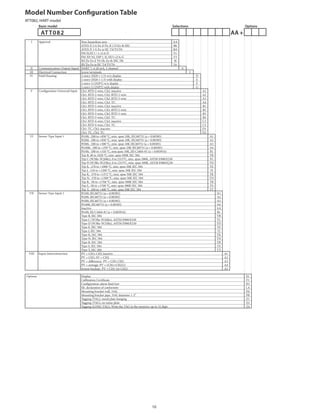
Model Number Configuration Table
ATT082, HART model
Basic model Selections Options
ATT082 - AA +
I Approval Non-hazardous	area	 AA
ATEX	II	2	G	Ex	d	T6,	II	2	D	Ex	tb	IIIC	 B6
ATEX	II	1	G	Ex	ia	IIC	T4/T5/T6	 BA
FM	IS,NI	I	/	1+2/A-D	 F1
FM	XP,	NI,	DIP	I,	II,	III/1+2/A-G	 F3
IECEx	Ex	d	T6	Gb,	Ex	tb	IIIC	Db I6
IECEx	Ex	ia	IIC	T4/T5/T6 IA
II Communication;	Output	Signal HART	7;	4-20	mA,	2	channel	 A
III Electrical	Connection Screw	terminals 2
IV Field	Housing 2	entry	(M20	×	1.5)	w/o	display D
2	entry	(M20	×	1.5)	with	display E
2	entry	(1/2NPT)	w/o	display F
2	entry	(1/2NPT)	with	display G
V Configuration	Universal	Input Ch1:	RTD	2-wire,	Ch2:	inactive	 A1
Ch1:	RTD	2-wire,	Ch2:	RTD	2-wire	 A2
Ch1:	RTD	2-wire,	Ch2:	RTD	3-wire	 A3
Ch1:	RTD	2-wire,	Ch2:	TC	 A4
Ch1:	RTD	3-wire,	Ch2:	inactive	 B1
Ch1:	RTD	3-wire,	Ch2:	RTD	2-wire	 B2
Ch1:	RTD	3-wire,	Ch2:	RTD	3-wire	 B3
Ch1:	RTD	3-wire,	Ch2:	TC	 B4
Ch1:	RTD	4-wire,	Ch2:	inactive	 C1
Ch1:	RTD	4-wire,	Ch2:	TC	 C2
Ch1:	TC,	Ch2:	inactive	 D1
Ch1:	TC,	Ch2:	TC	 D2
VI Sensor	Type	Input	1 Pt100,	-200	to	+850	°C,	min.	span	10K,	IEC60751	(a	=	0.00385)	 A1
Pt200,	-200	to	+850	°C,	min.	span	10K,	IEC60751	(a	=	0.00385)	 A2
Pt500,	-200	to	+500	°C,	min.	span	10K	IEC60751	(a	=	0.00385)	 A3
Pt1000,	-200	to	+250	°C,	min.	span	10K	IEC60751	(a	=	0.00385)	 A4
Pt100,	-200	to	+510	°C,	min.span	10K,	JIS	C1604-81	(a	=	0.003916)	 B1
Typ	B,	40	to	1820	°C,	min.	span	500K	IEC	584	 TB
Typ	C	(W5Re-W26Re),	0	to	2315°C,	min.	span	500K,	ASTM	E988/E230	 TC
Typ	D	(W3Re-W25Re),	0	to	2315°C,	min.	span	500K,	ASTM	E988/E230	 TD
Typ	E,	-270	to	+1000	°C,	min.	span	50K	IEC	584	 TE
Typ	J,	-210	to	+1200	°C,	min.	span	50K	IEC	584	 TJ
Typ	K,	-270	to	+1372	°C,	min.	span	50K	IEC	584	 TK
Typ	N,	-270	to	+1300	°C,	min.	span	50K	IEC	584	 TN
Typ	R,	-50	to	+1768	°C,	min.	span	500K	IEC	584	 TR
Typ	S,	-50	to	+1768	°C,	min.	span	500K	IEC	584	 TS
Typ	T,	-260	to	+400	°C,	min.	span	50K	IEC	584	 TT
VII Sensor	Type	Input	2 Pt100,	IEC60751	(a	=	0.00385)	 A1
Pt200,	IEC60751	(a	=	0.00385)	 A2
Pt500,	IEC60751	(a	=	0.00385)	 A3
Pt1000,	IEC60751	(a	=	0.00385)	 A4
Inactive	 AA
Pt100,	JIS	C1604-81	(a	=	0.003916)	 B1
Type	B,	IEC	584	 TB
Type	C	(W5Re-W26Re),	ASTM	E988/E230	 TC
Type	D	(W3Re-W25Re),	ASTM	E988/E230	 TD
Type	E,	IEC	584	 TE
Type	J,	IEC	584	 TJ
Type	K,	IEC	584	 TK
Type	N,	IEC	584	 TN
Type	R,	IEC	584	 TR
Type	S,	IEC	584	 TS
Type	T,	IEC	584	 TT
VIII Input;	Interconnection PV	=	CH1;	CH2	inactive	 A1
PV	=	CH1;	SV	=	CH2	 A2
PV	=	difference;		PV	=	CH1-CH2	 A3
PV	=	average;	PV	=	(CH1+CH2)/2	 A4
Sensor	backup;		PV	=	CH1	(or	CH2)	 A5
Options Display E1
Calibration	Certificate	 F1
Configuration	alarm	limit	low	 H1
SIL	declaration	of	conformity	 LA
Mounting	bracket	wall,	316L	 PA
Mounting	bracket	pipe,	316L	diameter	1-2”	 PB
Tagging	(TAG),	metal	plate	hanging Z1
Tagging	(TAG),	on	name	plate Z2
Tagging	(LONG	TAG),	Write	the	TAG	in	the	memory,	up	to	32	digit	 Z4
10
Dimentions
Output Side
Conduit Entries
M20×1.5
or
1/2 NPT
M4
Internal Ground Screw
57 115
21
21
89.5
94
97
5020.5
M20×1.5
or
1/2 NPT
Sensor Side
Conduit Entries
Without DisplayWith Display[Unit: mm]
Dimensions
for Mounting
Mounting to 2B Pipe
2B Pipe 120
140
120
140
(160.3 *1) (40.5 *1)
*1. Reference value of 2B Pipe
2B Pipe Bracket
(Option) 139.5
45
M4
External Ground Screw
M4
External Ground Screw
8
Mounting to Wall
4 × M6
12 Depth of Screw
Bracket
(Option)
2 × 6.5 Hole
(M6 Screw)
11
Please read the "Terms and Conditions" from the following URL before
ordering or use:
http://www.azbil.com/products/bi/order.html
(10)
2nd edition: Apr. 2015
1st edition: Jan. 2015
1-12-2 Kawana, Fujisawa
Kanagawa 251-8522 Japan
URL: http://www.azbil.com/
Specifications are subject to change without notice.
No part of this publication may be reproduced or duplicated
without the prior written permission of Azbil Corporation.12
Azbil North America, Inc.
9033 N. 24th Ave., Suite 6
Phoenix, AZ 85021
888-262-4639
602-216-8199
www.us.azbil.com

Advanced Industrial Temperature Transmitter

  • 1.
    Advanced Temperature TransmitterATT082 HART® protocol Model Application • Temperature transmitter with 2 input channels and HART® communication for the conversion of different input sig- nals into a scalable, analog 4...20 mA output signal • ATT082 stands out due to signal reliability, long-term sta- bility, high precision and advanced diagnostics (important in critical processes) • For the highest level of safety, availability and risk reduction • Usable for resistance thermometer (RTD), thermocouple (TC), resistance transmitter (Ω), voltage transmitter (mV) • Optional installation in field housings even for use in Ex d areas • Mounting bracket pipe or wall for the field housing Your benefits • Safe operation in hazardous areas International approvals such as – FM IS, NI – ATEX for intrinsically safe installation in zone 1 and zone 2 • High accuracy through sensor-transmitter matching • Reliable operation with sensor monitoring and device hardware fault recognition • Diagnostics information according to NAMUR NE107 • Several mounting versions and sensor connection combi- nations Function and system design Corrosion detection as per NAMUR NE89 Corrosion of the sensor connection cables can cause incor- rect measured value readings. The head transmitter offers the possibility of detecting any corrosion of the thermocouples and resistance thermometers with 4-wire connection before a measured value is corrupted. The transmitter prevents in- correct measured values from being exported and can issue a warning via the HART® protocol when conductor resistance values exceed plausible limits. Low voltage detection The low voltage detection function prevents the device from continuously transmitting an incorrect analog output value (i.e. caused by an incorrect or damaged power supply system or a damaged signal cable). If the supply voltage drops below the required value, the analog output value drops to < 3.6 mA for approx. 5 seconds. The device then tries to output the nor- mal analog output value again. If the supply voltage is still too low, this process is repeated cyclically. No. SS2-ATT082-0100 2-channel functions These functions increase the reliability and availability of the process values: • Sensor backup switches to the second sensor if the primary sensor fails • Drift warning or alarm if the deviation between sensor 1 and sensor 2 is less than or greater than a predefined limit value • Temperature-dependent switching between sensors which are used in different measuring ranges 2nd edition1
  • 2.
    Input Measured variable Temperature (temperature-linear transmission behavior), resistance and voltage. Type of input Two independent sensors can be connected. The measuring inputs are not galvanically isolated from each other. Ambient temperature out-of-range detectionHardware Type of input Designation Measuring range limits Resistance thermometer (RTD) as per IEC 60751:2008 (α = 0.003851) as per JIS C1604-81 (α = 0.003916) Pt100 Pt200 Pt500 Pt1000 Pt100 –200 to +850 °C (–328 to +1562 °F) –200 to +850 °C (–328 to +1562 °F) –200 to +500 °C (–328 to +932 °F) –200 to +250 °C (–328 to +482 °F) -200 to 649 °C (-328 to 1200 °F) • Type of connection: 2-wire, 3-wire or 4-wire connection, sensor current: ≤ 0.3 mA • With 2-wire circuit, compensation of wire resistance possible (0 to 30 Ω) • With 3-wire and 4-wire connection, sensor wire resistance to max. 50 Ω per wire Resistance transmitter Resistance Ω 10 to 400 Ω 10 to 2000 Ω Thermocouples (TC) to IEC 584 part 1 to ASTM E988 Type B (PtRh30-PtRh6) Type E (NiCr-CuNi) Type J (Fe-CuNi) Type K (NiCr-Ni) Type N (NiCrSi-NiSi) Type R (PtRh13-Pt) Type S (PtRh10-Pt) Type T (Cu-CuNi) Type C (W5Re-W26Re) Type D (W3Re-W25Re) +40 to +1820 °C (+104 to +3308 °F) –270 to +1000 °C (–454 to +1832 °F) –210 to +1200 °C (–346 to +2192 °F) –270 to +1372 °C (–454 to +2501 °F) –270 to +1300 °C (–454 to +2372 °F) –50 to +1768 °C (–58 to +3214 °F) –50 to +1768 °C (–58 to +3214 °F) –260 to +400 °C (–436 to +752 °F) 0 to +2315 °C (+32 to +4199 °F) 0 to +2315 °C (+32 to +4199 °F) Recommended temperature range: +100 to +1500 °C (+212 to +2732 °F) 0 to +750 °C (+32 to +1382 °F) +20 to +700 °C (+68 to +1292 °F) 0 to +100 °C (+32 to +2012 °F) 0 to +100 °C (+32 to +2012 °F) 0 to +1400 °C (+32 to +2552 °F) 0 to +1400 °C (+32 to +2552 °F) –185 to +350 °C (–301 to +662 °F) 0 to +2 000 °C (+32 to +3632 °F) 0 to +2 000 °C (+32 to +3632 °F) • Internal cold junction (Pt100) • External cold junction: configurable value –40 to +85 °C (–40 to +185 °F) • Max. sensor resistance 10 kΩ (if sensor resistance is greater than 10 kΩ, error message as per NAMUR NE89) Voltage transmitter (mV) Millivolt transmitter (mV) –20 to 100 mV The following connection combinations are possible when both sensor inputs are assigned: Sensor input 1 Sensor input 2 RTD or resistance transmitter, 2-wire RTD or resistance transmitter, 3-wire RTD or resistance transmitter, 4-wire Thermocouple (TC), voltage transmitter RTD or resistance transmitter, 2-wire ✓ ✓ - ✓ RTD or resistance transmitter, 3-wire ✓ ✓ - ✓ RTD or resistance transmitter, 4-wire - - - - Thermocouple (TC), voltage transmitter ✓ ✓ ✓ ✓ Output Output signal Analog output 4 to 20 mA, 20 to 4 mA (can be in- verted) Signal encoding FSK ±0.5 mA via current signal Data transmission rate 1200 baud Galvanic isolation U = 2 kV AC (input/output) Failure information Failure information as per NAMUR NE43: Failure information is created if the measuring information is missing or not valid. A complete list of all the errors occur- ring in the measuring system is created. Underranging Linear drop from 4.0 to 3.8 mA Overranging Linear increase from 20.0 to 20.5 mA Failure, e.g. sensor breakage; sensor short circuit ≤ 3.6 mA (“low”) or ≥ 21 mA (“high”), can be selected The “high” alarm setting can be set between 21.6 mA and 23 mA, thus providing the flexibility needed to meet the requirements of various control systems. 2
  • 3.
    Load Rb max.= (Ub max. - 11 V) / 0.023 A (current output) Fig 1. Linearization/transmission behavior Temperature-linear, resistance-linear, voltage-linear Mains voltagefilter 50/60 Hz Filter 1st order digital filter: 0 to 120 s Current consumption • 3.6 to 23 mA • Minimum current consumption ≤ 3.5 mA • Current limit ≤ 23 mA Protocol-specific data HART® version 7 Device address in multi-drop mode Software setting addresses 0 to 63 Write protection Hardware setting for activating write protec- tion Device description files (DD) Information and files are available free of charge at: www.hartcomm.org Load (communica- tion resistor) min. 250 Ω Switch-on delay 5 s, during switch-on delay Ia ≤ 3.8 mA Ub 42 V 1348 1098 250 11 V 0 36.25 V16.75 V Supply voltage (Vdc) Load (Ω) Power supply Electrical connection 7 6 5 4 3 Sensor input 2 Sensor input 1 Display connection Power supply DC 24V Receiver TC, mV RTD, Ω: 4-, 3- and 2-wireRTD, Ω: 3- and 2-wire TC, mV white red red white white red red Fig 2. Terminal assignment For the device operation via HART® protocol (terminals 1 and 2) a minimum load resistance of 250 Ω is necessary in the signal circuit. Supply voltage U = 11 to 42 Vdc (non-hazardous area), reverse polarity pro- tected. Values for hazardous area see chapter ‘Certificates and approvals’ (refer to page 8 and 9). Residual ripple Perm. residual ripple Uss ≤ 3 V at Ub ≥ 13.5 V, fmax. = 1 kHz Performance characteristics Response time Measured value update < 1 s per channel, depending on the type of sensor and connection method Reference operating conditions • Calibration temperature: +25 °C ±5 K (77 °F ±9 °F) • Supply voltage: 24 Vdc • 4-wire circuit for resistance adjustment 3
  • 4.
    Maximum measured error The accuracy data are typical values and correspond to a standard deviation of ±3 σ (normal distribution), i.e. 99.8 % of all the measured values achieve the given values or better values. Designation/measuringrange Performance characteristics Digital D/A 1) Resistance thermometer (RTD) (3-wire, 4-wire) Pt100 Pt500 Pt1000 Pt200 0.1 °C (0.18 °F) 0.3 °C (0.54 °F) 0.2 °C (0.36 °F) 1.0 °C (1.8 °F) 0.03 % 0.03 % 0.03 % 0.03 % Resistance thermometer (RTD) (2-wire) Pt100 Pt500 Pt1000 Pt200 0.8 °C (1.44 °F) 0.8 °C (1.44 °F) 0.8°C (1.44 °F) 1.5 °C (2.7 °F) 0.03 % 0.03 % 0.03 % 0.03 % Thermocouples (TC) Type: K, J, T, E Type: N, C, D Type: S, B, R 0.25 °C (0.45 °F) 0.5 °C (0.9 °F) 1.0 °C (1.8 °F) 0.03 % 0.03 % 0.03 % Resistance transmitters (Ω) 10 to 400 Ω 10 to 2 000 Ω ±0.04 Ω ±0.8 Ω 0.03 % 0.03 % Voltage transmitter (mV) –20 to 100 mV ±10 μV 0.03 % 1) % refers to the set span. Accuracy = digital + D/A accuracy Physical input measuring range of sensors 10 to 400 Ω Pt100 10 to 2000 Ω Pt200, Pt500, Pt1000 –20 to 100 mV Thermocouples type: B, C, D, E, J, K, N, R, S, T Sensor adjustment Sensor transmitter matching RTD sensors are one of the most linear temperature measur- ing elements. Nevertheless, the output must be linearized. To significantly improve temperature measurement accuracy, the device allows the use of two methods: • Callendar-Van-Dusen coefficients (Pt100 resistance ther- mometer) The Callendar-Van-Dusen equation is described as: RT = R0 [1 + AT + BT2 + C (T - 100) T3 ] The coefficients A, B and C are used to match the sensor (platinum) and transmitter in order to improve the accura- cy of the measuring system. The coefficients for a standard sensor are specified in IEC 751. If no standard sensor is available or if greater accuracy is required, the coefficients for each sensor can be determined specifically with the aid of sensor calibration. • Linearization for copper/nickel resistance thermometers (RTD) The polynomial equation for copper/nickel is as follows: RT = R0 (1 + AT + BT2 ) The coefficients A and B are used for the linearization of nickel or copper resistance thermometers (RTD). The exact values of the coefficients derive from the calibra- tion data and are specific to each sensor. Sensor transmitter matching using one of the methods ex- plained above significantly improves the temperature mea- surement accuracy of the entire system. This is because the transmitter uses the specific data pertaining to the connected sensor to calculate the measured temperature, instead of us- ing the standardized sensor curve data. 1-point adjustment (offset) Shifts the sensor value 2-point adjustment (sensor trimming) Correction (slope and offset) of the measured sensor value at transmitter input Current trimming (current output fine adjust- ment) Correction of the 4 or 20 mA current output value Non-repeatability Input 10 to 400 Ω 15 mΩ 10 to 2000 Ω 100 ppm * measured value –20 to 100 mV 4 μV Output ≤ 2 μA Influence of the supply voltage ≤ ±0.0025%/V, with reference to the span Long-term stability ≤ 0.1 °C/year (≤ 0.18 °F/year) or ≤ 0.05 %/year Data under reference operating conditions. % refers to the set span. The larger value is valid. 4
  • 5.
    Influence of ambienttemperature (temperature drift) Total temperature drift = input temperature drift + output temperature drift Impact on accuracy when ambient temperature changes by 1 K (1.8 °F): Input 10 to 400 Ω Typ. 0.001 % of the measured value, min. 1 mΩ Input 10 to 2000 Ω Typ. 0.001 % of the measured value, min. 10 mΩ Input –20 to 100 mV Typ. 0.001 % of the measured value, min. 0.2 μV Output 4 to 20 mA Typ. 0.0015 % of the span Typical sensitivity of resistance thermometers Pt: 0.00385 * Rnom /K Cu: 0.0043 * Rnom /K Ni: 0.00617 * Rnom /K Example Pt100: 0.00385 * 100 Ω/K = 0.385 Ω/K Impact on accuracy when ambient temperature changes by 1 K (1.8 °F): B: 9 μV/K at 1000 °C (1 832 °F) C: 18 μV/K at 1000 °C (1 832 °F) D: 20 μV/K at 1000 °C (1832 °F) E: 81 μV/K at 500 °C (932 °F) J: 56 μV/K at 500 °C (932 °F) K: 43 μV/K at 500 °C (932 °F) N: 38 μV/K at 500 °C (932 °F) R: 13 μV/K at 1000 °C (1832 °F) S: 11 μV/K at 1000 °C (1832 °F) T: 46 μV/K at 100 °C (212 °F) Example of calculating the measured error with ambient temperature drift: Input temperature drift ∆ϑ = 10 K (18 °F), Pt100, measuring range 0 to 100 °C (32 to 212 °F). Maximum process tempera- ture: 100 °C (212 °F) Measured resistance value: 138.5 Ω (IEC 60751) at maximum process temperature Typical temperature drift in Ω: (0.001 % of 138.5 Ω) * 10 = 0.01385 Ω Conversion to Kelvin: 0.01385 Ω / 0.385 Ω/K = 0.04 K (0.072 °F) Influence of the reference junction (internal cold junction) Pt100 DIN IEC 60751 Cl. B (internal cold junction with ther- mocouples TC) Installation conditions Installation instructions Fig 3. Mounting locations for the transmitter Separated from process in field housing, wall or pipe mounting Orientation: No restrictions Environment Ambient temperature range –40 to +85 °C (–40 to +185 °F), for hazardous area see Ex docu- mentation and ‘Certificates and approvals’ section (refar to page 8 and 9) 120 mm(4.72 in) 120 mm(4.72 in) 5
  • 6.
    Storage temperature –40 to +100 °C (–40 to +212 °F) Altitude Up to 4000 m (4374.5 yards) above mean sea level as per IEC 61010-1 Climate class As per IEC 60654-1, Class C Humidity • Condensation permitted as per IEC 60 068-2-33 • Max. rel. humidity: 95% as per IEC 60068-2-30 Degree of protection • IP 66/67 Vibration 25 to 100 Hz for 4g (increased vibration stress) as per GL- guidelines, chapter 2, edition 2003 Electromagnetic compatibility (EMC) CE compliance Electromagnetic compatibility in accordance with all the relevant requirements of the EN 61326 series and NAMUR Recommendation EMC (NE21). Details are provided in the Declaration of Conformity. ESD (electrostatic discharge) EN/IEC 61000-4-2 6 kV cont., 8 kV air Electromagnetic fields EN/IEC 61000-4-3 0.08 to 2.7 GHz 10 V/m Burst (fast transients) EN/IEC 61000-4-4 2 kV Surge (surge voltage) EN/IEC 61000-4-5 0.5 kV sym. 1 kV assym. Conducted RF EN/IEC 61000-4-6 0.01 to 80 MHz 10 V Measuring category Measuring category II as per IEC 61010-1. The measuring category is provided for measuring on power circuits that are directly connected electrically with the low-voltage network. Degree of contamination Pollution degree 2 as per IEC 61010-1. Mechanical construction Design, dimensions Dimensions in mm (in). Head transmitter Fig 4. Version with screw terminals A Spring travel L ≥ 5 mm (not for US - M4 securing screws) B Fasteners for attachable measured value display C Interface for contacting the measured value display 24.1(0.95) 33(1.3) Ø44(1.73) Ø7(0.28) Ø5 (0.2) B C A 6
  • 7.
    Field housings Without displaySpecification Fig 5. • Flameproof (XP) version, explosion-protected, captive screw cap, with two cable entries • Temperature: –50 to +150 °C (–58 to +302 °F) for rubber seal without cable gland (observe max. permitted temperature of the cable gland!) • Material: aluminum; polyester powder coated • Cable entry glands: ½˝NPT, M20 × 1.5 • Head color: gray RAL 7035 • Cap color: gray RAL 7035 • Weight: 640 g (22.6 oz) With display window in cover Specification Fig 6. • Flameproof (XP) version, explosion-protected, captive screw cap, with two cable entries • Temperature: –50 to +150 °C (–58 to +302 °F) for rubber seal without cable gland (observe max. permitted temperature of the cable gland!) • Material: aluminum; polyester powder coated • Cable entry glands: ½˝NPT, M20 × 1.5 • Head color: gray RAL 7035 • Cap color: gray RAL 7035 • Weight: 860 g (30.33 oz) Weight • Head transmitter: approx. 40 to 50 g (1.4 to 1.8 oz) • Field housing: see specifications Material All materials used are RoHS-compliant. Head transmitter • Housing: polycarbonate (PC), complies with UL94, V-2 UL recognized • Terminals: – Screw terminals: nickel-plated brass and gold-plated contact – Spring terminals: tin-plated brass, contact spring V2A • Potting: WEVO PU 403 FP / FL Field housing: see specifications Terminals Terminals version Wire version Conductor cross-section Screw terminals (with latches at the fieldbus terminals for easy connection of a handheld terminal) Rigid or flexible ≤ 2.5 mm² (14 AWG) 97 89.5 50 20.5 97 115 50 20.5 7
  • 8.
    Human interface Display andoperating elements There are no display or operating elements present at the head transmitter. Optional the plug-on display can be used in connec- tion with the head transmitter. It will display information regarding the actual measured value and the measurement point iden- tification. In the event of a fault in the measurement chain this will be displayed in inverse color showing the channel ident and diagnostics code. DIP-switches can be found on the rear of the display. This enables the hardware set-up such as write protection. Fig 7. Pluggable display If the head transmitter is installed in a field housing and used with a display, a housing with glas window needs to be used. Remote operation The configuration of HART® functions and of device-specific parameters is performed via HART® communication or via CDI interface. Special configuration systems provided by various manufacturers are available for this purpose. Certificates and approvals CE mark The measuring system meets the legal requirements of the EC guidelines. The manufacturer confirms successful testing of the device by affixing to it the CE mark. ATEX/IECEx II1G Ex ia IIC T6/T5/T4 Power supply (terminals 1+ and 2–) Ui ≤ 30 Vdc Ii ≤ 130 mA Pi ≤ 800 mW Ci ≈ 0 Li ≈ 0 II3G Ex nA II T6/T5/T4 Power supply (terminals 1+ and 2–) U ≤ 42 Vdc Output I = 4 to 20 mA Temperature range Ta without display T6 T5 T4 Zone 1, 2 -40 to +58 °C (-40 to +136.4 °F) -40 to +75 °C (-40 to +167 °F) -40 to +85 °C (-40 to +185 °F) Zone 0 -40 to +46 °C (-40 to +115 °F) -40 to +60 °C (-40 to +140 °F) -40 to +60 °C (-40 to +140 °F) with display T6 T5 T4 -40 to +55 °C (-40 to +131 °F) -40 to +70 °C (-40 to +158 °F) -40 to +85 °C (-40 to +185 °F) 8
  • 9.
    • II 2GEx d IIC T6...T4 Gb • II 2D Ex tb IIIC T85 °C…T105 °C Db Power supply (terminals + and -) 9 to 32 Vdc Temperature range T6 T5 T4 -40 °C ≤ Ta ≤ +65 °C -40 °C ≤ Ta ≤ +80 °C -40 °C ≤ Ta ≤ +85 °C Maximum suface temperature housing T85 °C T100 °C T105 °C -40 °C ≤ Ta ≤ +65 °C -40 °C ≤ Ta ≤ +80 °C -40 °C ≤ Ta ≤ +85 °C FM approval Labeling: IS / I / 1 / ABCD / T4 Ta = 85°C — Entity*; NI / I / 2 / ABCD / T4 Ta = 85°C — NIFW*; I / 0 / AEx ia IIC T4 Ta = 85°C — Entity*; XP, NI, DIP I, II, III / 1+2 / A-G *= Entity and NIFW parameters in accordance with Control Drawings (CD) Electrical parameters: Ui ≤ 30 Vdc, Ii ≤ 130 mA, Pi ≤ 800 mW Ci ≈ 0, Li ≈ 0 Other standards and guidelines • IEC 60529: Degrees of protection provided by enclosures (IP code) • IEC 61010-1:2001, 2nd Edition: Safety requirements for electrical equipment for measurement, control and labora- tory use • EN 61326 Series: Electromagnetic compatibility (EMC re- quirements) • Guidelines for the performance of type approvals, chapter 2, edition 2003: Vibrations • NAMUR: International user association of automation technology in process industries (www.namur.de) HART® communication The temperature transmitter is registered by HART® Com- munication. The device meets the requirements of the HART Communication Protocol Specifications, Revision 7.0. 9
  • 10.
    Model Number ConfigurationTable ATT082, HART model Basic model Selections Options ATT082 - AA + I Approval Non-hazardous area AA ATEX II 2 G Ex d T6, II 2 D Ex tb IIIC B6 ATEX II 1 G Ex ia IIC T4/T5/T6 BA FM IS,NI I / 1+2/A-D F1 FM XP, NI, DIP I, II, III/1+2/A-G F3 IECEx Ex d T6 Gb, Ex tb IIIC Db I6 IECEx Ex ia IIC T4/T5/T6 IA II Communication; Output Signal HART 7; 4-20 mA, 2 channel A III Electrical Connection Screw terminals 2 IV Field Housing 2 entry (M20 × 1.5) w/o display D 2 entry (M20 × 1.5) with display E 2 entry (1/2NPT) w/o display F 2 entry (1/2NPT) with display G V Configuration Universal Input Ch1: RTD 2-wire, Ch2: inactive A1 Ch1: RTD 2-wire, Ch2: RTD 2-wire A2 Ch1: RTD 2-wire, Ch2: RTD 3-wire A3 Ch1: RTD 2-wire, Ch2: TC A4 Ch1: RTD 3-wire, Ch2: inactive B1 Ch1: RTD 3-wire, Ch2: RTD 2-wire B2 Ch1: RTD 3-wire, Ch2: RTD 3-wire B3 Ch1: RTD 3-wire, Ch2: TC B4 Ch1: RTD 4-wire, Ch2: inactive C1 Ch1: RTD 4-wire, Ch2: TC C2 Ch1: TC, Ch2: inactive D1 Ch1: TC, Ch2: TC D2 VI Sensor Type Input 1 Pt100, -200 to +850 °C, min. span 10K, IEC60751 (a = 0.00385) A1 Pt200, -200 to +850 °C, min. span 10K, IEC60751 (a = 0.00385) A2 Pt500, -200 to +500 °C, min. span 10K IEC60751 (a = 0.00385) A3 Pt1000, -200 to +250 °C, min. span 10K IEC60751 (a = 0.00385) A4 Pt100, -200 to +510 °C, min.span 10K, JIS C1604-81 (a = 0.003916) B1 Typ B, 40 to 1820 °C, min. span 500K IEC 584 TB Typ C (W5Re-W26Re), 0 to 2315°C, min. span 500K, ASTM E988/E230 TC Typ D (W3Re-W25Re), 0 to 2315°C, min. span 500K, ASTM E988/E230 TD Typ E, -270 to +1000 °C, min. span 50K IEC 584 TE Typ J, -210 to +1200 °C, min. span 50K IEC 584 TJ Typ K, -270 to +1372 °C, min. span 50K IEC 584 TK Typ N, -270 to +1300 °C, min. span 50K IEC 584 TN Typ R, -50 to +1768 °C, min. span 500K IEC 584 TR Typ S, -50 to +1768 °C, min. span 500K IEC 584 TS Typ T, -260 to +400 °C, min. span 50K IEC 584 TT VII Sensor Type Input 2 Pt100, IEC60751 (a = 0.00385) A1 Pt200, IEC60751 (a = 0.00385) A2 Pt500, IEC60751 (a = 0.00385) A3 Pt1000, IEC60751 (a = 0.00385) A4 Inactive AA Pt100, JIS C1604-81 (a = 0.003916) B1 Type B, IEC 584 TB Type C (W5Re-W26Re), ASTM E988/E230 TC Type D (W3Re-W25Re), ASTM E988/E230 TD Type E, IEC 584 TE Type J, IEC 584 TJ Type K, IEC 584 TK Type N, IEC 584 TN Type R, IEC 584 TR Type S, IEC 584 TS Type T, IEC 584 TT VIII Input; Interconnection PV = CH1; CH2 inactive A1 PV = CH1; SV = CH2 A2 PV = difference; PV = CH1-CH2 A3 PV = average; PV = (CH1+CH2)/2 A4 Sensor backup; PV = CH1 (or CH2) A5 Options Display E1 Calibration Certificate F1 Configuration alarm limit low H1 SIL declaration of conformity LA Mounting bracket wall, 316L PA Mounting bracket pipe, 316L diameter 1-2” PB Tagging (TAG), metal plate hanging Z1 Tagging (TAG), on name plate Z2 Tagging (LONG TAG), Write the TAG in the memory, up to 32 digit Z4 10
  • 11.
    Dimentions Output Side Conduit Entries M20×1.5 or 1/2NPT M4 Internal Ground Screw 57 115 21 21 89.5 94 97 5020.5 M20×1.5 or 1/2 NPT Sensor Side Conduit Entries Without DisplayWith Display[Unit: mm] Dimensions for Mounting Mounting to 2B Pipe 2B Pipe 120 140 120 140 (160.3 *1) (40.5 *1) *1. Reference value of 2B Pipe 2B Pipe Bracket (Option) 139.5 45 M4 External Ground Screw M4 External Ground Screw 8 Mounting to Wall 4 × M6 12 Depth of Screw Bracket (Option) 2 × 6.5 Hole (M6 Screw) 11
  • 12.
    Please read the"Terms and Conditions" from the following URL before ordering or use: http://www.azbil.com/products/bi/order.html (10) 2nd edition: Apr. 2015 1st edition: Jan. 2015 1-12-2 Kawana, Fujisawa Kanagawa 251-8522 Japan URL: http://www.azbil.com/ Specifications are subject to change without notice. No part of this publication may be reproduced or duplicated without the prior written permission of Azbil Corporation.12 Azbil North America, Inc. 9033 N. 24th Ave., Suite 6 Phoenix, AZ 85021 888-262-4639 602-216-8199 www.us.azbil.com