Mathematical Content Conversions David McKain 9 th  September 2009
Outline Motivation Quick summary of mathematical formats LaTeX -> MathML conversion example Reality check Tools for LaTeX -> MathML Conversion techniques
Motivation: Philosophy Lots of content already out there in lots of different formats! One size never fits all TeX/LaTeX: concise, easy to author, hard to manipulate XML: verbose, hard(er) to author, easy to manipulate MathML is more complex than you think… So often needs converted between itself Prevent bit rot
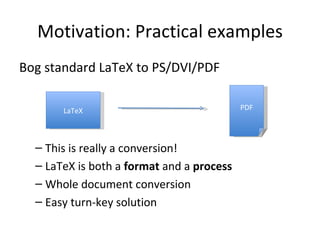
Motivation: Practical examples Bog standard LaTeX to PS/DVI/PDF This is really a conversion! LaTeX is both a  format  and a  process Whole document conversion Easy turn-key solution LaTeX PDF
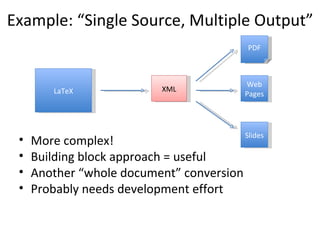
Example: “Single Source, Multiple Output”   More complex! Building block approach = useful Another “whole document” conversion Probably needs development effort PDF Slides LaTeX Web Pages XML
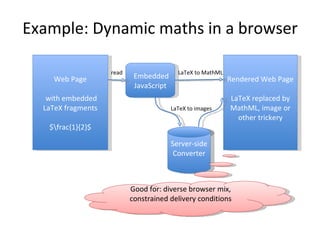
Example: Dynamic maths in a browser Server-side Converter Web Page with embedded LaTeX fragments $\frac{1}{2}$ Embedded JavaScript Rendered Web Page LaTeX replaced by MathML, image or other trickery read LaTeX to MathML LaTeX to images Good for: diverse browser mix, constrained delivery conditions
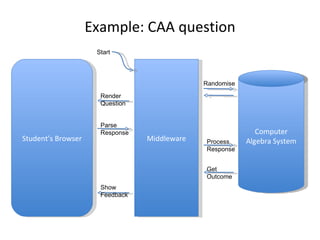
Example: CAA question Student’s Browser Middleware Computer Algebra System Parse Response Process Response Show Feedback Get Outcome Render Question Randomise Start
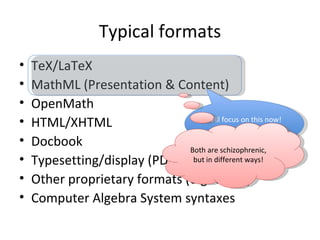
Typical formats TeX/LaTeX MathML (Presentation & Content) OpenMath HTML/XHTML Docbook Typesetting/display (PDF, PS, DVI) Other proprietary formats (e.g. Word) Computer Algebra System syntaxes Both are schizophrenic, but in different ways! Will focus on this now!
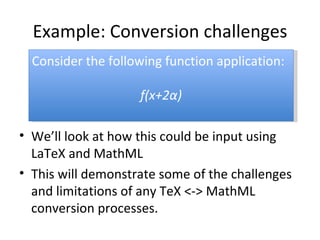
Example: Conversion challenges We’ll look at how this could be input using LaTeX and MathML This will demonstrate some of the challenges and limitations of any TeX <-> MathML conversion processes. Consider the following function application: f(x+2α)
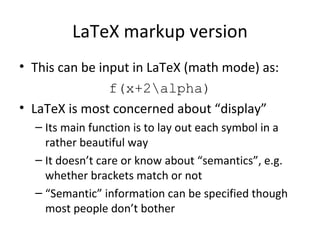
LaTeX markup version This can be input in LaTeX (math mode) as: f(x+2\alpha) LaTeX is most concerned about “display” Its main function is to lay out each symbol in a rather beautiful way It doesn’t care or know about “semantics”, e.g. whether brackets match or not “ Semantic” information can be specified though most people don’t bother
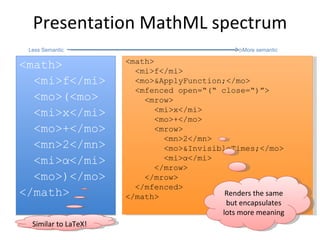
Presentation MathML spectrum <math> <mi>f</mi> <mo>(<mo> <mi>x</mi> <mo>+</mo> <mn>2</mn> <mi>α</mi> <mo>)</mo> </math> <math> <mi>f</mi> <mo>&ApplyFunction;</mo> <mfenced open=“(“ close=“)”> <mrow> <mi>x</mi> <mo>+</mo> <mrow> <mn>2</mn> <mo>&InvisibleTimes;</mo> <mi>α</mi> </mrow> </mrow> </mfenced> </math> Similar to LaTeX!  Renders the same but encapsulates lots more meaning More semantic Less Semantic
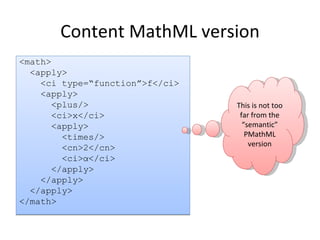
Content MathML version <math> <apply> <ci type=“function”>f</ci> <apply> <plus/> <ci>x</ci> <apply> <times/> <cn>2</cn> <ci>α</ci> </apply> </apply> </apply> </math> This is not too far from the “semantic” PMathML version
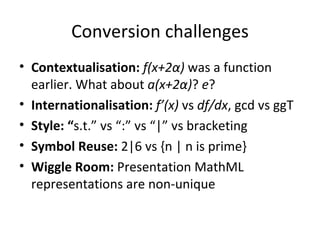
Conversion challenges Contextualisation:  f(x+2α)  was a function earlier. What about  a(x+2α) ?  e ? Internationalisation:  f’(x)  vs  df/dx , gcd vs ggT Style: “ s.t.” vs “:” vs “|” vs bracketing Symbol Reuse:  2|6 vs {n | n is prime}  Wiggle Room:  Presentation MathML representations are non-unique
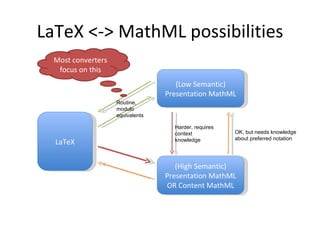
LaTeX <-> MathML possibilities LaTeX (Low Semantic) Presentation MathML (High Semantic) Presentation MathML OR Content MathML Routine, modulo equivalents Harder, requires context knowledge OK, but needs knowledge about preferred notation Most converters focus on this
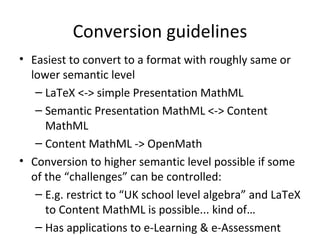
Conversion guidelines Easiest to convert to a format with roughly same or lower semantic level LaTeX <-> simple Presentation MathML Semantic Presentation MathML <-> Content MathML Content MathML -> OpenMath Conversion to higher semantic level possible if some of the “challenges” can be controlled: E.g. restrict to “UK school level algebra” and LaTeX to Content MathML is possible... kind of… Has applications to e-Learning & e-Assessment
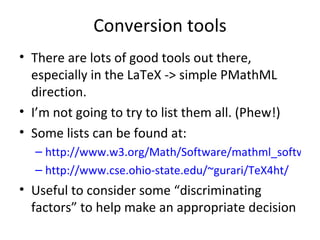
Conversion tools There are lots of good tools out there, especially in the LaTeX -> simple PMathML direction. I’m not going to try to list them all. (Phew!) Some lists can be found at: http://www.w3.org/Math/Software/mathml_software_cat_converters.html  http://www.cse.ohio-state.edu/~gurari/TeX4ht/ Useful to consider some “discriminating factors” to help make an appropriate decision
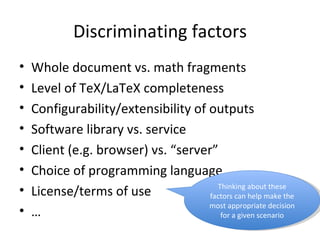
Discriminating factors Whole document vs. math fragments Level of TeX/LaTeX completeness Configurability/extensibility of outputs Software library vs. service Client (e.g. browser) vs. “server” Choice of programming language License/terms of use … Thinking about these factors can help make the most appropriate decision for a given scenario
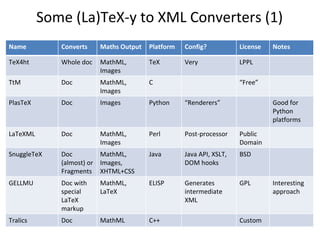
Some (La)TeX-y to XML Converters (1) Name Converts Maths Output Platform Config? License Notes TeX4ht Whole doc MathML, Images TeX Very LPPL TtM Doc MathML, Images C “ Free” PlasTeX Doc Images Python “ Renderers” Good for Python platforms LaTeXML Doc MathML, Images Perl Post-processor Public Domain SnuggleTeX Doc (almost) or Fragments MathML, Images, XHTML+CSS Java Java API, XSLT, DOM hooks BSD GELLMU Doc with special LaTeX markup MathML, LaTeX ELISP Generates intermediate XML GPL Interesting approach Tralics Doc MathML C++ Custom
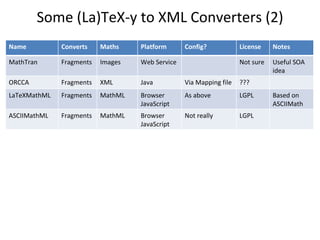
Some (La)TeX-y to XML Converters (2) Name Converts Maths Platform Config? License Notes MathTran Fragments Images Web Service Not sure Useful SOA idea ORCCA Fragments XML Java Via Mapping file ??? LaTeXMathML Fragments MathML Browser JavaScript As above LGPL Based on ASCIIMath ASCIIMathML Fragments MathML Browser JavaScript Not really LGPL
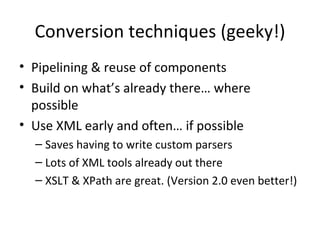
Conversion techniques (geeky!) Pipelining & reuse of components Build on what’s already there… where possible Use XML early and often… if possible Saves having to write custom parsers Lots of XML tools already out there XSLT & XPath are great. (Version 2.0 even better!)

Math content conversion

  • 1.
    Mathematical Content ConversionsDavid McKain 9 th September 2009
  • 2.
    Outline Motivation Quicksummary of mathematical formats LaTeX -> MathML conversion example Reality check Tools for LaTeX -> MathML Conversion techniques
  • 3.
    Motivation: Philosophy Lotsof content already out there in lots of different formats! One size never fits all TeX/LaTeX: concise, easy to author, hard to manipulate XML: verbose, hard(er) to author, easy to manipulate MathML is more complex than you think… So often needs converted between itself Prevent bit rot
  • 4.
    Motivation: Practical examplesBog standard LaTeX to PS/DVI/PDF This is really a conversion! LaTeX is both a format and a process Whole document conversion Easy turn-key solution LaTeX PDF
  • 5.
    Example: “Single Source,Multiple Output” More complex! Building block approach = useful Another “whole document” conversion Probably needs development effort PDF Slides LaTeX Web Pages XML
  • 6.
    Example: Dynamic mathsin a browser Server-side Converter Web Page with embedded LaTeX fragments $\frac{1}{2}$ Embedded JavaScript Rendered Web Page LaTeX replaced by MathML, image or other trickery read LaTeX to MathML LaTeX to images Good for: diverse browser mix, constrained delivery conditions
  • 7.
    Example: CAA questionStudent’s Browser Middleware Computer Algebra System Parse Response Process Response Show Feedback Get Outcome Render Question Randomise Start
  • 8.
    Typical formats TeX/LaTeXMathML (Presentation & Content) OpenMath HTML/XHTML Docbook Typesetting/display (PDF, PS, DVI) Other proprietary formats (e.g. Word) Computer Algebra System syntaxes Both are schizophrenic, but in different ways! Will focus on this now!
  • 9.
    Example: Conversion challengesWe’ll look at how this could be input using LaTeX and MathML This will demonstrate some of the challenges and limitations of any TeX <-> MathML conversion processes. Consider the following function application: f(x+2α)
  • 10.
    LaTeX markup versionThis can be input in LaTeX (math mode) as: f(x+2\alpha) LaTeX is most concerned about “display” Its main function is to lay out each symbol in a rather beautiful way It doesn’t care or know about “semantics”, e.g. whether brackets match or not “ Semantic” information can be specified though most people don’t bother
  • 11.
    Presentation MathML spectrum<math> <mi>f</mi> <mo>(<mo> <mi>x</mi> <mo>+</mo> <mn>2</mn> <mi>α</mi> <mo>)</mo> </math> <math> <mi>f</mi> <mo>&ApplyFunction;</mo> <mfenced open=“(“ close=“)”> <mrow> <mi>x</mi> <mo>+</mo> <mrow> <mn>2</mn> <mo>&InvisibleTimes;</mo> <mi>α</mi> </mrow> </mrow> </mfenced> </math> Similar to LaTeX! Renders the same but encapsulates lots more meaning More semantic Less Semantic
  • 12.
    Content MathML version<math> <apply> <ci type=“function”>f</ci> <apply> <plus/> <ci>x</ci> <apply> <times/> <cn>2</cn> <ci>α</ci> </apply> </apply> </apply> </math> This is not too far from the “semantic” PMathML version
  • 13.
    Conversion challenges Contextualisation: f(x+2α) was a function earlier. What about a(x+2α) ? e ? Internationalisation: f’(x) vs df/dx , gcd vs ggT Style: “ s.t.” vs “:” vs “|” vs bracketing Symbol Reuse: 2|6 vs {n | n is prime} Wiggle Room: Presentation MathML representations are non-unique
  • 14.
    LaTeX <-> MathMLpossibilities LaTeX (Low Semantic) Presentation MathML (High Semantic) Presentation MathML OR Content MathML Routine, modulo equivalents Harder, requires context knowledge OK, but needs knowledge about preferred notation Most converters focus on this
  • 15.
    Conversion guidelines Easiestto convert to a format with roughly same or lower semantic level LaTeX <-> simple Presentation MathML Semantic Presentation MathML <-> Content MathML Content MathML -> OpenMath Conversion to higher semantic level possible if some of the “challenges” can be controlled: E.g. restrict to “UK school level algebra” and LaTeX to Content MathML is possible... kind of… Has applications to e-Learning & e-Assessment
  • 16.
    Conversion tools Thereare lots of good tools out there, especially in the LaTeX -> simple PMathML direction. I’m not going to try to list them all. (Phew!) Some lists can be found at: http://www.w3.org/Math/Software/mathml_software_cat_converters.html http://www.cse.ohio-state.edu/~gurari/TeX4ht/ Useful to consider some “discriminating factors” to help make an appropriate decision
  • 17.
    Discriminating factors Wholedocument vs. math fragments Level of TeX/LaTeX completeness Configurability/extensibility of outputs Software library vs. service Client (e.g. browser) vs. “server” Choice of programming language License/terms of use … Thinking about these factors can help make the most appropriate decision for a given scenario
  • 18.
    Some (La)TeX-y toXML Converters (1) Name Converts Maths Output Platform Config? License Notes TeX4ht Whole doc MathML, Images TeX Very LPPL TtM Doc MathML, Images C “ Free” PlasTeX Doc Images Python “ Renderers” Good for Python platforms LaTeXML Doc MathML, Images Perl Post-processor Public Domain SnuggleTeX Doc (almost) or Fragments MathML, Images, XHTML+CSS Java Java API, XSLT, DOM hooks BSD GELLMU Doc with special LaTeX markup MathML, LaTeX ELISP Generates intermediate XML GPL Interesting approach Tralics Doc MathML C++ Custom
  • 19.
    Some (La)TeX-y toXML Converters (2) Name Converts Maths Platform Config? License Notes MathTran Fragments Images Web Service Not sure Useful SOA idea ORCCA Fragments XML Java Via Mapping file ??? LaTeXMathML Fragments MathML Browser JavaScript As above LGPL Based on ASCIIMath ASCIIMathML Fragments MathML Browser JavaScript Not really LGPL
  • 20.
    Conversion techniques (geeky!)Pipelining & reuse of components Build on what’s already there… where possible Use XML early and often… if possible Saves having to write custom parsers Lots of XML tools already out there XSLT & XPath are great. (Version 2.0 even better!)

Editor's Notes

  • #4 For XML, GUIs can alleviate authoring issues, though arguably haven’t succeeded yet.