What is FLSA?�
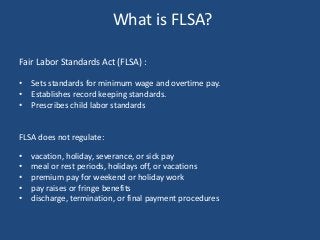
Fair Labor Standards Act (FLSA) :
Sets standards for minimum wage and overtime pay.
Establishes record keeping standards.
Prescribes child labor standards
FLSA does not regulate:�
vacation, holiday, severance, or sick pay
meal or rest periods, holidays off, or vacations
premium pay for weekend or holiday work
pay raises or fringe benefits
discharge, termination, or final payment procedures
FLSA Requirements
Minimum Wage Requirements
Overtime Pay Requirements
Record Keeping Requirements
Child Labor Restrictions
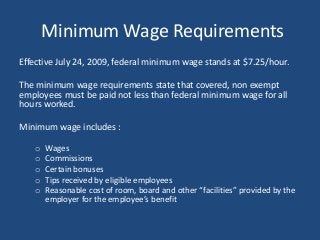
Minimum Wage Requirements
Effective July 24, 2009, federal minimum wage stands at $7.25/hour.
The minimum wage requirements state that covered, non exempt employees must be paid not less than federal minimum wage for all hours worked.
Minimum wage includes :�
Wages
Commissions
Certain bonuses
Tips received by eligible employees
Reasonable cost of room, board and other “facilities” provided by the employer for the employee’s benefit
Overtime Pay Requirements
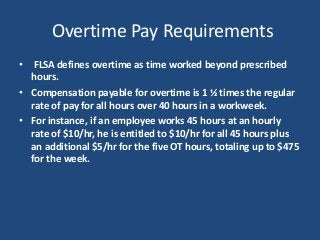
FLSA defines overtime as time worked beyond prescribed hours.
Compensation payable for overtime is 1 ½ times the regular rate of pay for all hours over 40 hours in a workweek.
For instance, if an employee works 45 hours at an hourly rate of $10/hr, he is entitled to $10/hr for all 45 hours plus an additional $5/hr for the five OT hours, totaling up to $475 for the week.
Record Keeping Requirements
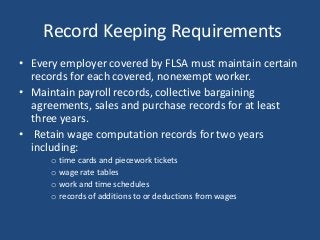
Every employer covered by FLSA must maintain certain records for each covered, nonexempt worker.
Maintain payroll records, collective bargaining agreements, sales and purchase records for at least three years.
Retain wage computation records for two years including:
time cards and piecework tickets
wage rate tables
work and time schedules
records of additions to or deductions from wages
Child Labor Rules
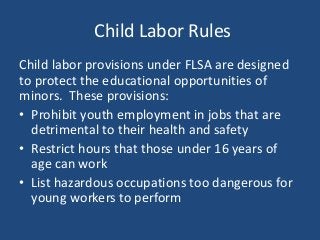
Child labor provisions under FLSA are designed to protect the educational opportunities of minors. These provisions:
Prohibit youth employment in jobs that are detrimental to their health and safety
Restrict hours that those under 16 years of age can work
List hazardous occupations too dangerous for young workers to perform
Want to learn more about FLSA, its requirements and best practices to comply with them? ComplianceOnline webinars and seminars are a great training resource. Check out the following links:
Fair Labor Standards Act: Are Your Employees Classified Correctly?
The In's and Out's of FLSA
How to Conduct FLSA Classification Self-Audit
Avoiding Costly Wage and Hour Problems
How to Pay Overtime Correctly under FLSA
Handling Supplemental Pay Under the FLSA
For More details visit us at:http://www.complianceonline.com/classifying-employees-under-flsa-webinar-training-703602-prdw?channel=flsappt
What is FLSA?�
Fair Labor Standards Act (FLSA) :
Sets standards for minimum wage and overtime pay.
Establishes record keeping standards.
Prescribes child labor standards