HOW TO VALIDATE YOUR CLIENT CHURN MODEL
PyData London 2019 Elena Sharova
2PyData London 2019
ABOUT ME
Senior Data Scientist at ITV since Jul-18
Previously worked for financial services
Have been using Python since 2013
Started building churn prediction models
at ITV for the HUB+ - ad-free VoD platform
3PyData London 2019
• Survival Analysis for Client Churn ………………………………………….. 3
• Overview of Kaplan–Meier estimator and
Cox Proportional Hazards Model (CPH) ………………………………………….. 4
• Fitting a CPH with lifelines ………………………………………….. 5
• CPH Model Assumptions ………………………………………….. 6
• Concordance Scores ………………………………………..... 7
• Residuals (martingale, deviance,
Schoenfeld) ………………………………………….. 8
• AUC for Survival Analysis ………………………………………….. 9
• Other Methods and Conclusions ………………………………………….. 10
TALK OUTLINE
4PyData London 2019
SURVIVAL ANALYSIS FOR CLIENT CHURN
Overview of Kaplan–Meier
estimator and Proportional
Hazards Model (CPH) Fitting
CPH with lifelines
CPH Model Assumptions
Concordance Scores
Residuals
AUC
Other Methods
Conclusions
5PyData London 2019
SURVIVAL ANALYSIS FOR CLIENT CHURN
• All subscribers eventually churn…
• The TIME TO EVENT (T) is what we want to model. T is a random variable.
• How to predict the length of subscription time?
– linear regression?
– KNN or decision trees regression?
Survival Analysis used in medical statistics:
– guarantees 𝑻 ≥ 𝟎
– provides a term-structure for tenures.
• This talk is about Cox Proportional Regression (non-time varying coefficients).
Survival Analysis
for Client Churn
6PyData London 2019
SURVIVAL ANALYSIS FOR CLIENT CHURN
Survival Analysis
for Client Churn
• How do we measure time and when does the
clock starts?
• Dealing with right-censored only.
• We assume that censorship time C is non-
informative, and T and C are independent.
• In reality this may not be the case:
- ITV schedule is seasonal
- some viewers prefer one genre over
others
Subscribers over time
t
7PyData London 2019
SURVIVAL ANALYSIS FOR CLIENT CHURN
Q – What data to calibrate the model on?
A – The data pertaining subscriptions only.
Q – What to do with those who churn and re-
subscribe?
A – Treat them separately. Depends on what the individual
subscriptions mean to the business financially (e.g. can add
tenures without discounting?).
Q – What features should be used?
A – Features that describe the subscribers but do not ‘leak’
information about tenure (e.g. exclude total monthly paid,
etc.)
Survival Analysis
for Client Churn
Subscribers over time
t
8PyData London 2019
Kaplan-Meier Estimator and
Cox Proportional Hazards Model
Survival Analysis for Client
Churn
CPH Model Assumptions
Concordance Scores
Residuals
AUC
Other Methods
Conclusions
9PyData London 2019
Kaplan-Meier and Cox Proportional Hazards Model (CPH)
Time to event T is a positive random variable. It has a pdf:
𝒇 𝒕 = lim
∆𝒕→𝟎+
𝟏
∆𝒕
𝑷(𝒕 ≤ 𝑻 < 𝒕 + ∆𝒕)
A survival function S(t) is a probability that an individual survives longer than t:
𝑺 𝒕 = 𝑷 𝑻 > 𝒕 = 𝟏 − 𝑷 𝑻 ≤ 𝒕 = 𝟏 −
𝟎
𝒕
𝒇 𝒖 𝒅𝒖
𝑺 𝒕 = 𝟏 − 𝑭(𝒕)
A hazard function is an instantaneous failure rate at time t given alive up to t:
𝒉 𝒕 = lim
∆𝒕→𝟎+
𝟏
∆𝒕
𝑷 𝒕 ≤ 𝑻 < 𝒕 + ∆𝒕 𝑻 ≥ 𝒕 =
𝒇 𝒕
𝑺(𝒕)
=
−𝒅 𝒍𝒏[𝑺 𝒕 ]
𝒅𝒕
A cumulative hazard function at time t:
𝑯(𝒕) =
𝟎
𝒕
𝒉 𝒖 𝒅𝒖 = −𝒍𝒏 [𝑺 𝒕 ]
Kaplan-Meier
and Cox
Proportional
Hazards
10PyData London 2019
Kaplan-Meier and Cox Proportional Hazards Model (CPH)
Kaplan-Meier
and Cox
Proportional
Hazards
11PyData London 2019
Kaplan-Meier and Cox Proportional Hazards Model (CPH)
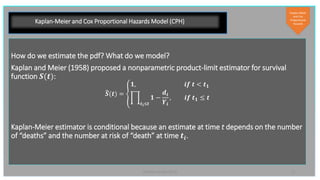
How do we estimate the pdf? What do we model?
Kaplan and Meier (1958) proposed a nonparametric product-limit estimator for survival
function 𝑺(𝒕):
𝑺(𝒕) =
𝟏, 𝒊𝒇 𝒕 < 𝒕 𝟏
𝒕 𝒊≤𝒕
𝟏 −
𝒅𝒊
𝒀𝒊
, 𝒊𝒇 𝒕 𝟏 ≤ 𝒕
Kaplan-Meier estimator is conditional because an estimate at time t depends on the number
of “deaths” and the number at risk of “death” at time 𝒕𝒊.
Kaplan-Meier
and Cox
Proportional
Hazards
12PyData London 2019
Kaplan-Meier and Cox Proportional Hazards Model (CPH)
Kaplan-Meier product-limit estimator example (telco dataset):
Kaplan-Meier
and Cox
Proportional
Hazards
removed observed censored entrance at risk survival
event_at 𝒅𝒊 𝒄𝒊 𝒀𝒊
0 4 0 4 4718 4718 =(1-0/4718) 1
1 417 257 160 0 4714 =1*(1-257/4714) 0.94548154
2 150 78 72 0 4297 =0.945*(1-78/4297) 0.92831897
3 136 64 72 0 4147 =0.928319*(1-64/4147) 0.9139924
4 120 54 66 0 4011 =0.91399*(1-54/4011) 0.90168497
13PyData London 2019
Kaplan-Meier and Cox Proportional Hazards Model (CPH)
𝑺(𝒕) is a product-limit of data-derived ratios. Additional information about subjects (e.g.
age, gender, etc.) is not taken into account.
Cox Proportional Hazards Model (1972) is a semi-parametric regression model for 𝒉 𝒕 .
Let’s say we have information (vector of k covariates 𝑿𝒊) for 𝒊 = 𝟏, … , 𝑵 individuals. We also
know their time-to-event and the outcome (death or censorship) - 𝑻𝒊, 𝜹𝒊, 𝑿𝒊 . Then:
𝒉𝒊 𝒕 = 𝒉 𝟎(𝒕) ∙ 𝒆𝒙𝒑(𝜷 𝟏 𝒙𝒊𝟏 + 𝜷 𝟐 𝒙𝒊𝟐 + ⋯ + 𝜷 𝒌 𝒙𝒊𝒌)
Kaplan-Meier
and Cox
Proportional
Hazards
Baseline hazard
function for
time t
Linear regression form
14PyData London 2019
Kaplan-Meier and Cox Proportional Hazards Model (CPH)
CPH 𝒉𝒊 𝒕 consists of:
-time-varying baseline hazard (same for all subjects, but varies with time)
-time-invariant partial hazard that depends on subject’s values for covariates.
hazard functions of two subjects 𝒉𝒊 𝒕 and 𝒉𝒋 𝒕 relate via a constant ratio of their partial hazards. This is the
reason for ‘proportional’ in CPH.
Python package can be used to fit CPH to data
(original developer Cameron Davidson-Pilon).
Other Python packages:
(original developer Sebastian Pölsterl).
Python package for modelling point Hawkes processes.
Implements CPH and Survival Forest.
Kaplan-Meier
and Cox
Proportional
Hazards
15PyData London 2019
Kaplan-Meier and Cox Proportional Hazards Model (CPH)
lifelines has a support channel: https://gitter.im/python-lifelines/Lobby
Kaplan-Meier
and Cox
Proportional
Hazards
16PyData London 2019
Kaplan-Meier and Cox Proportional Hazards Model (CPH)
Derivation in lifelines package:
Regression coefficients are found using MPLE and Newton-Raphson iterative search method.
Ties in T’s are resolved with Efron’s method.
The baseline hazard function is estimated from cumulative partial hazard estimates, grouped
by tenure.
Kaplan-Meier
and Cox
Proportional
Hazards
Standardised
covariates
17PyData London 2019
Kaplan-Meier and CPH Demo
Kaplan-Meier
and Cox
Proportional
Hazards
18PyData London 2019
CPH MODEL ASSUMPTIONS
Survival Analysis for Client
Churn
Overview of Kaplan–Meier
estimator and Proportional
Hazard Model (CPH) Fitting
CPH with lifelines
Concordance Scores
Residuals
AUC
Other Methods
Conclusions
19PyData London 2019
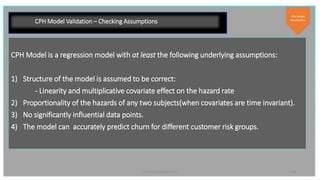
CPH Model Validation – Checking Assumptions
CPH Model is a regression model with at least the following underlying assumptions:
1) Structure of the model is assumed to be correct:
- Linearity and multiplicative covariate effect on the hazard rate
2) Proportionality of the hazards of any two subjects(when covariates are time invariant).
3) No significantly influential data points.
4) The model can accurately predict churn for different customer risk groups.
CPH Model
Assumptions
20PyData London 2019
CPH Model Assumptions
1) Structure of the model is assumed to be correct:
- Linearity and multiplicative covariate effect on
the hazard.
2) Proportionality of the hazards of any two subjects.
3) No significantly influential data points.
4) The model can accurately predict churn for different
customer risk groups.
CPH Model
Assumptions
1) Martingale Residuals*,
C-Index and Uno
Concordance
2) Schoenfeld Residuals
3) Deviance* and score
Residuals
4) AUC, Brier Score
Deviance residuals can also be used to
validate (1)
ASSUMPTIONS HOW TO CHECK
21PyData London 2019
Concordance Scores and Residuals
Survival Analysis for Client
Churn
Overview of Kaplan–Meier
estimator and Proportional
Hazard Model (CPH) Fitting
CPH with lifelines
CPH Model Assumptions
AUC
Other Methods
Conclusions
22PyData London 2019
Concordance Scores and Residuals – C-Score
Concordance Index Definition:
proportion of pairs that are concordant in duration T vs. estimated hazard H:
Scores and
Residuals
𝐻1 > 𝐻2
𝑇1 < 𝑇2
𝐻1 < 𝐻2
𝑇1 > 𝑇2
𝐻1 > 𝐻2
𝑇1 > 𝑇2
𝐻1 < 𝐻2
𝑇1 < 𝑇2
23PyData London 2019
Concordance Scores and Residuals – C-Score
lifelines package provides Concordance Index calculation.
Definition: proportion of pairs that are concordant in duration vs. estimated hazard.
Scores and
Residuals
In the absence of ties, C-score will make
𝑁!
𝑛!∙ 𝑁−𝑛 !
comparisons. Tied observations are
excluded from comparison (e.g. observation 3 cannot be compared to observation 4).
=15/26
(58%)
observation age observed duration p_hazard
0 10 1 6 0.775902
1 12 1 5 0.829296
2 15 1 4 0.916357
3 34 1 3 1.724427
4 9 1 3 0.750508
5 11 1 4 0.802155
6 22 1 7 1.156713
7 28 1 2 1.412327
24PyData London 2019
Concordance Scores and Residuals – C-Score
However, censored observations are compared even in the presence of ties.
Censored observation may result in the upward bias in C-score.
H. Uno et.al [2] proposed an estimator free of censoring distribution.
Definition:
proportion of pairs that are concordant in duration vs. estimated hazard,
weighted by censoring probability derived with Kaplan-Meier estimator
The observed difference between C-score and C-score IPCW depends on the distribution of
censorship and which records are censored.
*IPCW – inverse probability of censoring weights
Scores and
Residuals
25PyData London 2019
Martingale Residuals
Martingale residuals compare observed to expected at time T
𝒓𝒆𝒔 𝒎𝒂𝒓 = 𝒆𝒗𝒆𝒏𝒕 [𝟏 𝒐𝒓 𝟎]𝒊 − 𝑯𝒊,𝑻
𝒓𝒆𝒔 𝒎𝒂𝒓 in [1,-inf) for uncensored and in [0, -inf) for censored observations.
+ 𝒓𝒆𝒔 𝒎𝒂𝒓 → at T 𝑯𝒊,𝑻 was underestimated
- 𝒓𝒆𝒔 𝒎𝒂𝒓 → at T 𝑯𝒊,𝑻 was overestimated or
censored observation
Scores and
Residuals
26PyData London 2019
Martingale Residuals
Martingale residuals can be plotted against durations
Scores and
Residuals
Censored
observations with
12 and 24 months
durations
**skew makes it hard
to spot outliers
27PyData London 2019
Martingale Residuals
Martingale residuals can also be plotted against model covariates to
examine the relationship between model error and covariate values.
To spot non-linearity, add LOWESS lines [8] (scatterplot smoothing lines).
Scores and
Residuals
Sticky score = genre diversity
and monthly stickiness-loyalty
28PyData London 2019
Deviance Residuals
Deviance residual are a transformation on martingale residuals to achieve symmetry:
𝒓𝒆𝒔 𝒅𝒆𝒗 = 𝒔𝒊𝒈𝒏(𝒓𝒆𝒔 𝒎𝒂𝒓) ∙ −𝟐 ∙ 𝒓𝒆𝒔 𝒎𝒂𝒓 + 𝑰𝒊 ∙ log 𝐼𝑖 − 𝑟𝑒𝑠 𝑚𝑎𝑟
where 𝑰𝒊 is the event indicator for i’s observation.
Deviance residuals have the same sign as martingale residuals.
Can be used to examine the functional model fit and identification of highly influential data
points.
Scores and
Residuals
29PyData London 2019
Deviance Residuals
Deviance residuals plotted against model covariates to examine the
relationship between model error and covariate values.
Scores and
Residuals
Large sticky scores are generally
predictive of longer subscription
duration.
Sticky score = genre diversity and
monthly stickiness-loyalty
30PyData London 2019
Schoenfeld Residuals
Schoenfeld residuals are used to test the proportional hazards assumption.
It is defined for each covariate, as the difference between the observed and the average in
the risk-set at each duration.
• It is not defined for censored observation
Scores and
Residuals
31PyData London 2019
Schoenfeld Residuals
lifelines package implements scaled Schoenfeld residuals (scaled by the variance-covariance
matrix of coefficients)
Scores and
Residuals
LOWESS curves - locally estimated
scatterplot smoothing curves.
Deviations from a constant line are
violations of the PH assumption
32PyData London 2019
Scores and Residuals
HOW TO FIX IT?
Small concordance scores
 introduce new features (are you over or under-estimating the hazards?)
Large martingale residuals with non-random patterns (non-constant lowess lines)
 introduce interactive terms or consider squared, cubed, etc. covariates.
Proportionality assumption does not hold
 stratify by the covariate that breaks it or move to time-varying model. lifelines library allows to perform non-interactive
stratification, meaning that the baseline hazard function varies by the strata. There is also methods for an interaction-model
stratification where the regression coefficients vary by the strata [6].
Scores and
Residuals
33PyData London 2019
Scores and
Residuals
Scores and Residuals Demo
34PyData London 2019
Area Under the ROC Curve - AUC
Survival Analysis for Client
Churn
Overview of Kaplan–Meier
estimator and Proportional
Hazards Model (CPH) Fitting
CPH with lifelines
CPH Model Assumptions
Concordance Scores and
Residuals
Other Methods
Conclusions
35PyData London 2019
AUC For Survival Analysis
AUC is a measure of model’s sensitivity vs. specificity. Taking a set of covariates as M,
In survival analysis:
𝒔𝒆𝒏𝒔𝒊𝒕𝒊𝒗𝒊𝒕𝒚 = 𝑷(𝑴 > 𝒄|𝑻 ≤ 𝒕)
𝒔𝒑𝒆𝒄𝒊𝒇𝒊𝒄𝒊𝒕𝒚 = 𝑷(𝑴 ≤ 𝒄|𝑻 > 𝒕)
AUC is effectively covariates – to- outcome concordance score, and is calculated for each
tenure.
*scikit-survival implements AUC calculation for survival analysis. But there are many different
definitions in literature (see [3])
AUC
𝑇𝑃
𝑇𝑃 + 𝐹𝑁
𝑇𝑁
𝑇𝑁 + 𝐹𝑃
36PyData London 2019
AUC For Survival Analysis
We can calculate AUC for each covariate, tenure and compute an average AUC.
AUC
Here, mean AUC is 92.5%.
37PyData London 2019
AUC For Survival Analysis
A word of warning on AUC…
AUC
“Sensitivity and specificity only tell you something obliquely about prediction. They
tell you something about the observed error proportions for specific tests or
algorithms, but not about uncertainties for future observations or events and directly
about the quality of the prognostication.”
Drew Griffin Levy on https://www.fharrell.com/post/mlconfusion/
38PyData London 2019
Other Methods
Survival Analysis for Client
Churn
Overview of Kaplan–Meier
estimator and Proportional
Hazard Model (CPH) Fitting
CPH with lifelines
CPH Model Assumptions
Concordance Scores and
Residuals
AUC
Conclusions
39PyData London 2019
Brier Score
Brier Score* is a score function for accuracy of probabilistic prediction for some time T:
𝑩𝒓𝒊𝒆𝒓𝑺𝒄𝒐𝒓𝒆 𝑻 =
𝒊=𝟏
𝑵
𝒇𝒊,𝒕 − 𝑰𝒊,𝒕
𝟐
𝑵
The smaller the score the better the model is calibrated.
Output score should be compared with the score obtained using the ‘null model’ e.g.
Kaplan-Meier.
* Originally proposed by Glenn W. Brier in 1950
scikit-learn implements Brier score loss: sklearn.metrics.brier_score_loss
Other Methods
40PyData London 2019
Scores and AUC Tests
Concordance scores, AUC and Brier Score Loss can be estimated on out-of-sample
as well as out-of-time-sample data [7].
Other Methods
ttest
41PyData London 2019
Conclusions
lifelines and scikit-survival
* excellent tools to perform survival analysis
* come with good model validation utilities.
Survival Model Validation is extensively covered in biostatistics research and is becoming
more accessible through Python libraries to the data scientists.
It is important to use more than one validation tool to achieve better understanding of the
built model and greater confidence in its usability.
Conclusions
42PyData London 2019
References
[1] F.Harrell’s Blog on Statistically Efficient Ways to Quantify Added Predictive Value of New Measurements
https://www.fharrell.com/post/addvalue/
[2] H.Uno, et.al. “On the C-Statistics For Evaluating Overall Adequacy of Risk Prediction Procedures With Censored Survival Data.”
Harvard University Biostatistics Working Paper Series (101). 2009.
[3] P.J.Heagerty. Course slides: https://faculty.washington.edu/heagerty/Courses/Montpellier/montpelier-3.pdf
[4] lifelines package (citing): https://zenodo.org/record/3267531
[5] scikit-survival package (citing on bottom of the page): https://github.com/sebp/scikit-survival
[6] M.Abdelaal, S.Zakria. “Modelling Survival Data by Using Cox Regression Model”. American Journal of Theoretical and Applied
Statistics. 2015. 4(6). 504-512.
[7] E.Lima, C.Mues, B.Baesens. “Monitoring and backtesting churn models”, Expert Systems with Applications, 38, 2011 975-982.
[8] F.Harrell, K.Lee, D. Mark. “Multivariable Prognostic Models: Issues in Developing Models, Evaluating Assumptions and Adequacy, and
Measuring and Reducing Errors.” Statistics in Medicine, vol 15, 361-387, 1996.
43PyData London 2019
THANK YOU!
jupyter notebook on https://github.com/elena-sharova

How to Validate you Client Churn Model

  • 1.
    HOW TO VALIDATEYOUR CLIENT CHURN MODEL PyData London 2019 Elena Sharova
  • 2.
    2PyData London 2019 ABOUTME Senior Data Scientist at ITV since Jul-18 Previously worked for financial services Have been using Python since 2013 Started building churn prediction models at ITV for the HUB+ - ad-free VoD platform
  • 3.
    3PyData London 2019 •Survival Analysis for Client Churn ………………………………………….. 3 • Overview of Kaplan–Meier estimator and Cox Proportional Hazards Model (CPH) ………………………………………….. 4 • Fitting a CPH with lifelines ………………………………………….. 5 • CPH Model Assumptions ………………………………………….. 6 • Concordance Scores ………………………………………..... 7 • Residuals (martingale, deviance, Schoenfeld) ………………………………………….. 8 • AUC for Survival Analysis ………………………………………….. 9 • Other Methods and Conclusions ………………………………………….. 10 TALK OUTLINE
  • 4.
    4PyData London 2019 SURVIVALANALYSIS FOR CLIENT CHURN Overview of Kaplan–Meier estimator and Proportional Hazards Model (CPH) Fitting CPH with lifelines CPH Model Assumptions Concordance Scores Residuals AUC Other Methods Conclusions
  • 5.
    5PyData London 2019 SURVIVALANALYSIS FOR CLIENT CHURN • All subscribers eventually churn… • The TIME TO EVENT (T) is what we want to model. T is a random variable. • How to predict the length of subscription time? – linear regression? – KNN or decision trees regression? Survival Analysis used in medical statistics: – guarantees 𝑻 ≥ 𝟎 – provides a term-structure for tenures. • This talk is about Cox Proportional Regression (non-time varying coefficients). Survival Analysis for Client Churn
  • 6.
    6PyData London 2019 SURVIVALANALYSIS FOR CLIENT CHURN Survival Analysis for Client Churn • How do we measure time and when does the clock starts? • Dealing with right-censored only. • We assume that censorship time C is non- informative, and T and C are independent. • In reality this may not be the case: - ITV schedule is seasonal - some viewers prefer one genre over others Subscribers over time t
  • 7.
    7PyData London 2019 SURVIVALANALYSIS FOR CLIENT CHURN Q – What data to calibrate the model on? A – The data pertaining subscriptions only. Q – What to do with those who churn and re- subscribe? A – Treat them separately. Depends on what the individual subscriptions mean to the business financially (e.g. can add tenures without discounting?). Q – What features should be used? A – Features that describe the subscribers but do not ‘leak’ information about tenure (e.g. exclude total monthly paid, etc.) Survival Analysis for Client Churn Subscribers over time t
  • 8.
    8PyData London 2019 Kaplan-MeierEstimator and Cox Proportional Hazards Model Survival Analysis for Client Churn CPH Model Assumptions Concordance Scores Residuals AUC Other Methods Conclusions
  • 9.
    9PyData London 2019 Kaplan-Meierand Cox Proportional Hazards Model (CPH) Time to event T is a positive random variable. It has a pdf: 𝒇 𝒕 = lim ∆𝒕→𝟎+ 𝟏 ∆𝒕 𝑷(𝒕 ≤ 𝑻 < 𝒕 + ∆𝒕) A survival function S(t) is a probability that an individual survives longer than t: 𝑺 𝒕 = 𝑷 𝑻 > 𝒕 = 𝟏 − 𝑷 𝑻 ≤ 𝒕 = 𝟏 − 𝟎 𝒕 𝒇 𝒖 𝒅𝒖 𝑺 𝒕 = 𝟏 − 𝑭(𝒕) A hazard function is an instantaneous failure rate at time t given alive up to t: 𝒉 𝒕 = lim ∆𝒕→𝟎+ 𝟏 ∆𝒕 𝑷 𝒕 ≤ 𝑻 < 𝒕 + ∆𝒕 𝑻 ≥ 𝒕 = 𝒇 𝒕 𝑺(𝒕) = −𝒅 𝒍𝒏[𝑺 𝒕 ] 𝒅𝒕 A cumulative hazard function at time t: 𝑯(𝒕) = 𝟎 𝒕 𝒉 𝒖 𝒅𝒖 = −𝒍𝒏 [𝑺 𝒕 ] Kaplan-Meier and Cox Proportional Hazards
  • 10.
    10PyData London 2019 Kaplan-Meierand Cox Proportional Hazards Model (CPH) Kaplan-Meier and Cox Proportional Hazards
  • 11.
    11PyData London 2019 Kaplan-Meierand Cox Proportional Hazards Model (CPH) How do we estimate the pdf? What do we model? Kaplan and Meier (1958) proposed a nonparametric product-limit estimator for survival function 𝑺(𝒕): 𝑺(𝒕) = 𝟏, 𝒊𝒇 𝒕 < 𝒕 𝟏 𝒕 𝒊≤𝒕 𝟏 − 𝒅𝒊 𝒀𝒊 , 𝒊𝒇 𝒕 𝟏 ≤ 𝒕 Kaplan-Meier estimator is conditional because an estimate at time t depends on the number of “deaths” and the number at risk of “death” at time 𝒕𝒊. Kaplan-Meier and Cox Proportional Hazards
  • 12.
    12PyData London 2019 Kaplan-Meierand Cox Proportional Hazards Model (CPH) Kaplan-Meier product-limit estimator example (telco dataset): Kaplan-Meier and Cox Proportional Hazards removed observed censored entrance at risk survival event_at 𝒅𝒊 𝒄𝒊 𝒀𝒊 0 4 0 4 4718 4718 =(1-0/4718) 1 1 417 257 160 0 4714 =1*(1-257/4714) 0.94548154 2 150 78 72 0 4297 =0.945*(1-78/4297) 0.92831897 3 136 64 72 0 4147 =0.928319*(1-64/4147) 0.9139924 4 120 54 66 0 4011 =0.91399*(1-54/4011) 0.90168497
  • 13.
    13PyData London 2019 Kaplan-Meierand Cox Proportional Hazards Model (CPH) 𝑺(𝒕) is a product-limit of data-derived ratios. Additional information about subjects (e.g. age, gender, etc.) is not taken into account. Cox Proportional Hazards Model (1972) is a semi-parametric regression model for 𝒉 𝒕 . Let’s say we have information (vector of k covariates 𝑿𝒊) for 𝒊 = 𝟏, … , 𝑵 individuals. We also know their time-to-event and the outcome (death or censorship) - 𝑻𝒊, 𝜹𝒊, 𝑿𝒊 . Then: 𝒉𝒊 𝒕 = 𝒉 𝟎(𝒕) ∙ 𝒆𝒙𝒑(𝜷 𝟏 𝒙𝒊𝟏 + 𝜷 𝟐 𝒙𝒊𝟐 + ⋯ + 𝜷 𝒌 𝒙𝒊𝒌) Kaplan-Meier and Cox Proportional Hazards Baseline hazard function for time t Linear regression form
  • 14.
    14PyData London 2019 Kaplan-Meierand Cox Proportional Hazards Model (CPH) CPH 𝒉𝒊 𝒕 consists of: -time-varying baseline hazard (same for all subjects, but varies with time) -time-invariant partial hazard that depends on subject’s values for covariates. hazard functions of two subjects 𝒉𝒊 𝒕 and 𝒉𝒋 𝒕 relate via a constant ratio of their partial hazards. This is the reason for ‘proportional’ in CPH. Python package can be used to fit CPH to data (original developer Cameron Davidson-Pilon). Other Python packages: (original developer Sebastian Pölsterl). Python package for modelling point Hawkes processes. Implements CPH and Survival Forest. Kaplan-Meier and Cox Proportional Hazards
  • 15.
    15PyData London 2019 Kaplan-Meierand Cox Proportional Hazards Model (CPH) lifelines has a support channel: https://gitter.im/python-lifelines/Lobby Kaplan-Meier and Cox Proportional Hazards
  • 16.
    16PyData London 2019 Kaplan-Meierand Cox Proportional Hazards Model (CPH) Derivation in lifelines package: Regression coefficients are found using MPLE and Newton-Raphson iterative search method. Ties in T’s are resolved with Efron’s method. The baseline hazard function is estimated from cumulative partial hazard estimates, grouped by tenure. Kaplan-Meier and Cox Proportional Hazards Standardised covariates
  • 17.
    17PyData London 2019 Kaplan-Meierand CPH Demo Kaplan-Meier and Cox Proportional Hazards
  • 18.
    18PyData London 2019 CPHMODEL ASSUMPTIONS Survival Analysis for Client Churn Overview of Kaplan–Meier estimator and Proportional Hazard Model (CPH) Fitting CPH with lifelines Concordance Scores Residuals AUC Other Methods Conclusions
  • 19.
    19PyData London 2019 CPHModel Validation – Checking Assumptions CPH Model is a regression model with at least the following underlying assumptions: 1) Structure of the model is assumed to be correct: - Linearity and multiplicative covariate effect on the hazard rate 2) Proportionality of the hazards of any two subjects(when covariates are time invariant). 3) No significantly influential data points. 4) The model can accurately predict churn for different customer risk groups. CPH Model Assumptions
  • 20.
    20PyData London 2019 CPHModel Assumptions 1) Structure of the model is assumed to be correct: - Linearity and multiplicative covariate effect on the hazard. 2) Proportionality of the hazards of any two subjects. 3) No significantly influential data points. 4) The model can accurately predict churn for different customer risk groups. CPH Model Assumptions 1) Martingale Residuals*, C-Index and Uno Concordance 2) Schoenfeld Residuals 3) Deviance* and score Residuals 4) AUC, Brier Score Deviance residuals can also be used to validate (1) ASSUMPTIONS HOW TO CHECK
  • 21.
    21PyData London 2019 ConcordanceScores and Residuals Survival Analysis for Client Churn Overview of Kaplan–Meier estimator and Proportional Hazard Model (CPH) Fitting CPH with lifelines CPH Model Assumptions AUC Other Methods Conclusions
  • 22.
    22PyData London 2019 ConcordanceScores and Residuals – C-Score Concordance Index Definition: proportion of pairs that are concordant in duration T vs. estimated hazard H: Scores and Residuals 𝐻1 > 𝐻2 𝑇1 < 𝑇2 𝐻1 < 𝐻2 𝑇1 > 𝑇2 𝐻1 > 𝐻2 𝑇1 > 𝑇2 𝐻1 < 𝐻2 𝑇1 < 𝑇2
  • 23.
    23PyData London 2019 ConcordanceScores and Residuals – C-Score lifelines package provides Concordance Index calculation. Definition: proportion of pairs that are concordant in duration vs. estimated hazard. Scores and Residuals In the absence of ties, C-score will make 𝑁! 𝑛!∙ 𝑁−𝑛 ! comparisons. Tied observations are excluded from comparison (e.g. observation 3 cannot be compared to observation 4). =15/26 (58%) observation age observed duration p_hazard 0 10 1 6 0.775902 1 12 1 5 0.829296 2 15 1 4 0.916357 3 34 1 3 1.724427 4 9 1 3 0.750508 5 11 1 4 0.802155 6 22 1 7 1.156713 7 28 1 2 1.412327
  • 24.
    24PyData London 2019 ConcordanceScores and Residuals – C-Score However, censored observations are compared even in the presence of ties. Censored observation may result in the upward bias in C-score. H. Uno et.al [2] proposed an estimator free of censoring distribution. Definition: proportion of pairs that are concordant in duration vs. estimated hazard, weighted by censoring probability derived with Kaplan-Meier estimator The observed difference between C-score and C-score IPCW depends on the distribution of censorship and which records are censored. *IPCW – inverse probability of censoring weights Scores and Residuals
  • 25.
    25PyData London 2019 MartingaleResiduals Martingale residuals compare observed to expected at time T 𝒓𝒆𝒔 𝒎𝒂𝒓 = 𝒆𝒗𝒆𝒏𝒕 [𝟏 𝒐𝒓 𝟎]𝒊 − 𝑯𝒊,𝑻 𝒓𝒆𝒔 𝒎𝒂𝒓 in [1,-inf) for uncensored and in [0, -inf) for censored observations. + 𝒓𝒆𝒔 𝒎𝒂𝒓 → at T 𝑯𝒊,𝑻 was underestimated - 𝒓𝒆𝒔 𝒎𝒂𝒓 → at T 𝑯𝒊,𝑻 was overestimated or censored observation Scores and Residuals
  • 26.
    26PyData London 2019 MartingaleResiduals Martingale residuals can be plotted against durations Scores and Residuals Censored observations with 12 and 24 months durations **skew makes it hard to spot outliers
  • 27.
    27PyData London 2019 MartingaleResiduals Martingale residuals can also be plotted against model covariates to examine the relationship between model error and covariate values. To spot non-linearity, add LOWESS lines [8] (scatterplot smoothing lines). Scores and Residuals Sticky score = genre diversity and monthly stickiness-loyalty
  • 28.
    28PyData London 2019 DevianceResiduals Deviance residual are a transformation on martingale residuals to achieve symmetry: 𝒓𝒆𝒔 𝒅𝒆𝒗 = 𝒔𝒊𝒈𝒏(𝒓𝒆𝒔 𝒎𝒂𝒓) ∙ −𝟐 ∙ 𝒓𝒆𝒔 𝒎𝒂𝒓 + 𝑰𝒊 ∙ log 𝐼𝑖 − 𝑟𝑒𝑠 𝑚𝑎𝑟 where 𝑰𝒊 is the event indicator for i’s observation. Deviance residuals have the same sign as martingale residuals. Can be used to examine the functional model fit and identification of highly influential data points. Scores and Residuals
  • 29.
    29PyData London 2019 DevianceResiduals Deviance residuals plotted against model covariates to examine the relationship between model error and covariate values. Scores and Residuals Large sticky scores are generally predictive of longer subscription duration. Sticky score = genre diversity and monthly stickiness-loyalty
  • 30.
    30PyData London 2019 SchoenfeldResiduals Schoenfeld residuals are used to test the proportional hazards assumption. It is defined for each covariate, as the difference between the observed and the average in the risk-set at each duration. • It is not defined for censored observation Scores and Residuals
  • 31.
    31PyData London 2019 SchoenfeldResiduals lifelines package implements scaled Schoenfeld residuals (scaled by the variance-covariance matrix of coefficients) Scores and Residuals LOWESS curves - locally estimated scatterplot smoothing curves. Deviations from a constant line are violations of the PH assumption
  • 32.
    32PyData London 2019 Scoresand Residuals HOW TO FIX IT? Small concordance scores  introduce new features (are you over or under-estimating the hazards?) Large martingale residuals with non-random patterns (non-constant lowess lines)  introduce interactive terms or consider squared, cubed, etc. covariates. Proportionality assumption does not hold  stratify by the covariate that breaks it or move to time-varying model. lifelines library allows to perform non-interactive stratification, meaning that the baseline hazard function varies by the strata. There is also methods for an interaction-model stratification where the regression coefficients vary by the strata [6]. Scores and Residuals
  • 33.
    33PyData London 2019 Scoresand Residuals Scores and Residuals Demo
  • 34.
    34PyData London 2019 AreaUnder the ROC Curve - AUC Survival Analysis for Client Churn Overview of Kaplan–Meier estimator and Proportional Hazards Model (CPH) Fitting CPH with lifelines CPH Model Assumptions Concordance Scores and Residuals Other Methods Conclusions
  • 35.
    35PyData London 2019 AUCFor Survival Analysis AUC is a measure of model’s sensitivity vs. specificity. Taking a set of covariates as M, In survival analysis: 𝒔𝒆𝒏𝒔𝒊𝒕𝒊𝒗𝒊𝒕𝒚 = 𝑷(𝑴 > 𝒄|𝑻 ≤ 𝒕) 𝒔𝒑𝒆𝒄𝒊𝒇𝒊𝒄𝒊𝒕𝒚 = 𝑷(𝑴 ≤ 𝒄|𝑻 > 𝒕) AUC is effectively covariates – to- outcome concordance score, and is calculated for each tenure. *scikit-survival implements AUC calculation for survival analysis. But there are many different definitions in literature (see [3]) AUC 𝑇𝑃 𝑇𝑃 + 𝐹𝑁 𝑇𝑁 𝑇𝑁 + 𝐹𝑃
  • 36.
    36PyData London 2019 AUCFor Survival Analysis We can calculate AUC for each covariate, tenure and compute an average AUC. AUC Here, mean AUC is 92.5%.
  • 37.
    37PyData London 2019 AUCFor Survival Analysis A word of warning on AUC… AUC “Sensitivity and specificity only tell you something obliquely about prediction. They tell you something about the observed error proportions for specific tests or algorithms, but not about uncertainties for future observations or events and directly about the quality of the prognostication.” Drew Griffin Levy on https://www.fharrell.com/post/mlconfusion/
  • 38.
    38PyData London 2019 OtherMethods Survival Analysis for Client Churn Overview of Kaplan–Meier estimator and Proportional Hazard Model (CPH) Fitting CPH with lifelines CPH Model Assumptions Concordance Scores and Residuals AUC Conclusions
  • 39.
    39PyData London 2019 BrierScore Brier Score* is a score function for accuracy of probabilistic prediction for some time T: 𝑩𝒓𝒊𝒆𝒓𝑺𝒄𝒐𝒓𝒆 𝑻 = 𝒊=𝟏 𝑵 𝒇𝒊,𝒕 − 𝑰𝒊,𝒕 𝟐 𝑵 The smaller the score the better the model is calibrated. Output score should be compared with the score obtained using the ‘null model’ e.g. Kaplan-Meier. * Originally proposed by Glenn W. Brier in 1950 scikit-learn implements Brier score loss: sklearn.metrics.brier_score_loss Other Methods
  • 40.
    40PyData London 2019 Scoresand AUC Tests Concordance scores, AUC and Brier Score Loss can be estimated on out-of-sample as well as out-of-time-sample data [7]. Other Methods ttest
  • 41.
    41PyData London 2019 Conclusions lifelinesand scikit-survival * excellent tools to perform survival analysis * come with good model validation utilities. Survival Model Validation is extensively covered in biostatistics research and is becoming more accessible through Python libraries to the data scientists. It is important to use more than one validation tool to achieve better understanding of the built model and greater confidence in its usability. Conclusions
  • 42.
    42PyData London 2019 References [1]F.Harrell’s Blog on Statistically Efficient Ways to Quantify Added Predictive Value of New Measurements https://www.fharrell.com/post/addvalue/ [2] H.Uno, et.al. “On the C-Statistics For Evaluating Overall Adequacy of Risk Prediction Procedures With Censored Survival Data.” Harvard University Biostatistics Working Paper Series (101). 2009. [3] P.J.Heagerty. Course slides: https://faculty.washington.edu/heagerty/Courses/Montpellier/montpelier-3.pdf [4] lifelines package (citing): https://zenodo.org/record/3267531 [5] scikit-survival package (citing on bottom of the page): https://github.com/sebp/scikit-survival [6] M.Abdelaal, S.Zakria. “Modelling Survival Data by Using Cox Regression Model”. American Journal of Theoretical and Applied Statistics. 2015. 4(6). 504-512. [7] E.Lima, C.Mues, B.Baesens. “Monitoring and backtesting churn models”, Expert Systems with Applications, 38, 2011 975-982. [8] F.Harrell, K.Lee, D. Mark. “Multivariable Prognostic Models: Issues in Developing Models, Evaluating Assumptions and Adequacy, and Measuring and Reducing Errors.” Statistics in Medicine, vol 15, 361-387, 1996.
  • 43.
    43PyData London 2019 THANKYOU! jupyter notebook on https://github.com/elena-sharova