1
DEFCON 2018 USA
ALEXANDRE BORGES
RING 0/-2 ROOKITS :
COMPROMISING
DEFENSES
DEFCON 2018 - USA
ALEXANDREBORGES-MALWAREANDSECURITYRESEARCHER
PROFILE AND TOC
TOC:
• Introduction
• Rootkits: Ring 0
• Advanced Malwares and Rootkits: Ring -2
• Malware and Security Researcher.
• Consultant, Instructor and Speaker on
Malware Analysis, Memory Analysis, Digital
Forensics, Rootkits and Software Exploitation.
• Member of Digital Law and Compliance
Committee (CDDC/ SP)
• Reviewer member of the The Journal of Digital
Forensics, Security and Law.
• Refereer on Digital Investigation:The
International Journal of Digital Forensics &
Incident Response
• Instructor at Oracle, (ISC)2 and Ex-instructor
at Symantec.
2
DEFCON 2018 - USA
ALEXANDREBORGES-MALWAREANDSECURITYRESEARCHER
ACKNOWLEDGMENT
DEFCON 2018 - USA
3
Joanna Rutkowska
John Loucaides
Oleksandr Bazhaniuk
Sergey Bratus
Vicent Zimmer
Yuriy Bulygin
Xeno Kovah
Alex Bazhaniuk
Alex Matrosov
Andrew Furtak
Bruce Dang
Corey Kallenberg
Dmytro Oleksiuk
Engene Rodionov
These professionals deserve my sincere “thank you” and
deep respect for their researches on these topics. I have
learned from their explanations and articles. By the way, I
continue learning...
ALEXANDREBORGES-MALWAREANDSECURITYRESEARCHER
DEFCON 2018 - USA
4
INTRODUCTION
ALEXANDREBORGES-MALWAREANDSECURITYRESEARCHER
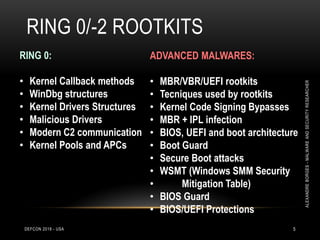
RING 0/-2 ROOTKITS
DEFCON 2018 - USA 5
ADVANCED MALWARES:
• MBR/VBR/UEFI rootkits
• Tecniques used by rootkits
• Kernel Code Signing Bypasses
• MBR + IPL infection
• BIOS, UEFI and boot architecture
• Boot Guard
• Secure Boot attacks
• WSMT (Windows SMM Security
• Mitigation Table)
• BIOS Guard
• BIOS/UEFI Protections
RING 0:
• Kernel Callback methods
• WinDbg structures
• Kernel Drivers Structures
• Malicious Drivers
• Modern C2 communication
• Kernel Pools and APCs
ALEXANDREBORGES-MALWAREANDSECURITYRESEARCHER
DEFCON 2018 - USA 6
ROOTKITS: RING 0
ALEXANDREBORGES-MALWAREANDSECURITYRESEARCHER
ROOTKITS: RING 0
7
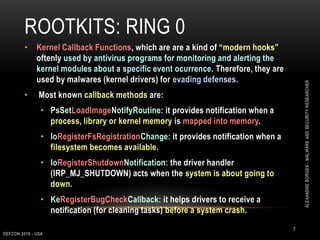
• Kernel Callback Functions, which are are a kind of “modern hooks”
oftenly used by antivirus programs for monitoring and alerting the
kernel modules about a specific event ocurrence. Therefore, they are
used by malwares (kernel drivers) for evading defenses.
• Most known callback methods are:
• PsSetLoadImageNotifyRoutine: it provides notification when a
process, library or kernel memory is mapped into memory.
• IoRegisterFsRegistrationChange: it provides notification when a
filesystem becomes available.
• IoRegisterShutdownNotification: the driver handler
(IRP_MJ_SHUTDOWN) acts when the system is about going to
down.
• KeRegisterBugCheckCallback: it helps drivers to receive a
notification (for cleaning tasks) before a system crash.
DEFCON 2018 - USA
ALEXANDREBORGES-MALWAREANDSECURITYRESEARCHER
ROOTKITS: RING 0
DEFCON 2018 - USA
8
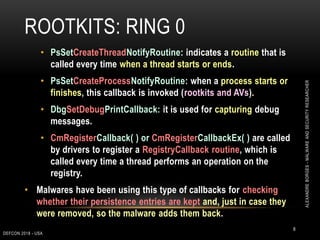
• PsSetCreateThreadNotifyRoutine: indicates a routine that is
called every time when a thread starts or ends.
• PsSetCreateProcessNotifyRoutine: when a process starts or
finishes, this callback is invoked (rootkits and AVs).
• DbgSetDebugPrintCallback: it is used for capturing debug
messages.
• CmRegisterCallback( ) or CmRegisterCallbackEx( ) are called
by drivers to register a RegistryCallback routine, which is
called every time a thread performs an operation on the
registry.
• Malwares have been using this type of callbacks for checking
whether their persistence entries are kept and, just in case they
were removed, so the malware adds them back.
ALEXANDREBORGES-MALWAREANDSECURITYRESEARCHER
ROOTKITS: RING 0
DEFCON 2018 - USA 9
0: kd> dd nt!CmpCallBackCount L1
fffff801`aa733fcc 00000002
0: kd> dps nt!CallbackListHead L2
fffff801`aa769190 ffffc000`c8d62db0
fffff801`aa769198 ffffc000`c932c8b0
0: kd> dt nt!_LIST_ENTRY ffffc000`c8d62db0
[ 0xffffc000`c932c8b0 - 0xfffff801`aa769190 ]
+0x000 Flink : 0xffffc000`c932c8b0 _LIST_ENTRY [
0xfffff801`aa769190 - 0xffffc000`c8d62db0 ]
+0x008 Blink : 0xfffff801`aa769190 _LIST_ENTRY [
0xffffc000`c8d62db0 - 0xffffc000`c932c8b0 ]
ALEXANDREBORGES-MALWAREANDSECURITYRESEARCHER
ROOTKITS: RING 0
DEFCON 2018 - USA 10
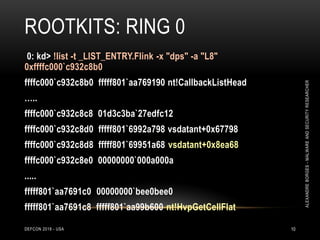
0: kd> !list -t _LIST_ENTRY.Flink -x "dps" -a "L8"
0xffffc000`c932c8b0
ffffc000`c932c8b0 fffff801`aa769190 nt!CallbackListHead
…..
ffffc000`c932c8c8 01d3c3ba`27edfc12
ffffc000`c932c8d0 fffff801`6992a798 vsdatant+0x67798
ffffc000`c932c8d8 fffff801`69951a68 vsdatant+0x8ea68
ffffc000`c932c8e0 00000000`000a000a
.....
fffff801`aa7691c0 00000000`bee0bee0
fffff801`aa7691c8 fffff801`aa99b600 nt!HvpGetCellFlat
ALEXANDREBORGES-MALWAREANDSECURITYRESEARCHER
ROOTKITS: RING 0
DEFCON 2018 - USA
11
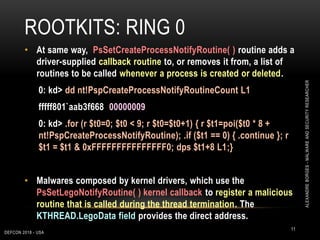
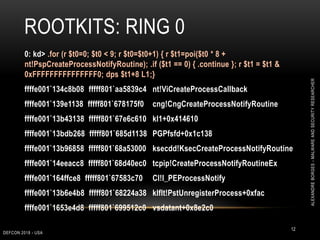
• At same way, PsSetCreateProcessNotifyRoutine( ) routine adds a
driver-supplied callback routine to, or removes it from, a list of
routines to be called whenever a process is created or deleted.
0: kd> dd nt!PspCreateProcessNotifyRoutineCount L1
fffff801`aab3f668 00000009
0: kd> .for (r $t0=0; $t0 < 9; r $t0=$t0+1) { r $t1=poi($t0 * 8 +
nt!PspCreateProcessNotifyRoutine); .if ($t1 == 0) { .continue }; r
$t1 = $t1 & 0xFFFFFFFFFFFFFFF0; dps $t1+8 L1;}
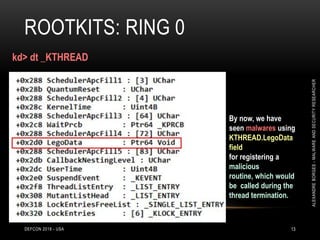
• Malwares composed by kernel drivers, which use the
PsSetLegoNotifyRoutine( ) kernel callback to register a malicious
routine that is called during the thread termination. The
KTHREAD.LegoData field provides the direct address.
ALEXANDREBORGES-MALWAREANDSECURITYRESEARCHER
ROOTKITS: RING 0
DEFCON 2018 - USA
12
0: kd> .for (r $t0=0; $t0 < 9; r $t0=$t0+1) { r $t1=poi($t0 * 8 +
nt!PspCreateProcessNotifyRoutine); .if ($t1 == 0) { .continue }; r $t1 = $t1 &
0xFFFFFFFFFFFFFFF0; dps $t1+8 L1;}
ffffe001`134c8b08 fffff801`aa5839c4 nt!ViCreateProcessCallback
ffffe001`139e1138 fffff801`678175f0 cng!CngCreateProcessNotifyRoutine
ffffe001`13b43138 fffff801`67e6c610 kl1+0x414610
ffffe001`13bdb268 fffff801`685d1138 PGPfsfd+0x1c138
ffffe001`13b96858 fffff801`68a53000 ksecdd!KsecCreateProcessNotifyRoutine
ffffe001`14eeacc8 fffff801`68d40ec0 tcpip!CreateProcessNotifyRoutineEx
ffffe001`164ffce8 fffff801`67583c70 CI!I_PEProcessNotify
ffffe001`13b6e4b8 fffff801`68224a38 klflt!PstUnregisterProcess+0xfac
ffffe001`1653e4d8 fffff801`699512c0 vsdatant+0x8e2c0
ALEXANDREBORGES-MALWAREANDSECURITYRESEARCHER
ROOTKITS: RING 0
DEFCON 2018 - USA 13
kd> dt _KTHREAD
By now, we have
seen malwares using
KTHREAD.LegoData
field
for registering a
malicious
routine, which would
be called during the
thread termination.
ALEXANDREBORGES-MALWAREANDSECURITYRESEARCHER
ROOTKITS: RING 0
DEFCON 2018 - USA
14
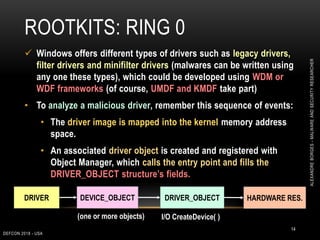
 Windows offers different types of drivers such as legacy drivers,
filter drivers and minifilter drivers (malwares can be written using
any one these types), which could be developed using WDM or
WDF frameworks (of course, UMDF and KMDF take part)
• To analyze a malicious driver, remember this sequence of events:
• The driver image is mapped into the kernel memory address
space.
• An associated driver object is created and registered with
Object Manager, which calls the entry point and fills the
DRIVER_OBJECT structure’s fields.
DRIVER DEVICE_OBJECT DRIVER_OBJECT HARDWARE RES.
I/O CreateDevice( )(one or more objects)
ALEXANDREBORGES-MALWAREANDSECURITYRESEARCHER
ROOTKITS: RING 0
DEFCON 2018 - USA
15
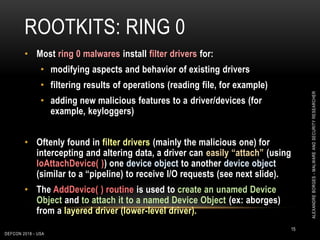
• Most ring 0 malwares install filter drivers for:
• modifying aspects and behavior of existing drivers
• filtering results of operations (reading file, for example)
• adding new malicious features to a driver/devices (for
example, keyloggers)
• Oftenly found in filter drivers (mainly the malicious one) for
intercepting and altering data, a driver can easily “attach” (using
IoAttachDevice( )) one device object to another device object
(similar to a “pipeline) to receive I/O requests (see next slide).
• The AddDevice( ) routine is used to create an unamed Device
Object and to attach it to a named Device Object (ex: aborges)
from a layered driver (lower-level driver).
ALEXANDREBORGES-MALWAREANDSECURITYRESEARCHER
ROOTKITS: RING 0
DEFCON 2018 - USA
16
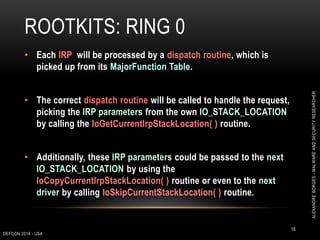
• Each IRP will be processed by a dispatch routine, which is
picked up from its MajorFunction Table.
• The correct dispatch routine will be called to handle the request,
picking the IRP parameters from the own IO_STACK_LOCATION
by calling the IoGetCurrentIrpStackLocation( ) routine.
• Additionally, these IRP parameters could be passed to the next
IO_STACK_LOCATION by using the
IoCopyCurrentIrpStackLocation( ) routine or even to the next
driver by calling IoSkipCurrentStackLocation( ) routine.
ALEXANDREBORGES-MALWAREANDSECURITYRESEARCHER
ROOTKITS: RING 0
DEFCON 2018 - USA 17
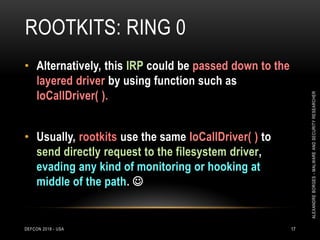
• Alternatively, this IRP could be passed down to the
layered driver by using function such as
IoCallDriver( ).
• Usually, rootkits use the same IoCallDriver( ) to
send directly request to the filesystem driver,
evading any kind of monitoring or hooking at
middle of the path. 
ALEXANDREBORGES-MALWAREANDSECURITYRESEARCHER
ROOTKITS: RING 0
18
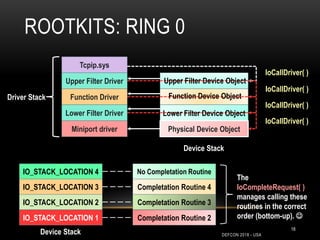
Tcpip.sys
Upper Filter Driver
Function Driver
Lower Filter Driver
Miniport driver Physical Device Object
Upper Filter Device Object
Function Device Object
Lower Filter Device Object
Driver Stack
IoCallDriver( )
IoCallDriver( )
IoCallDriver( )
IoCallDriver( )
Device Stack
IO_STACK_LOCATION 4
IO_STACK_LOCATION 3
IO_STACK_LOCATION 2
IO_STACK_LOCATION 1
No Completation Routine
Completation Routine 4
Completation Routine 3
Completation Routine 2
Device Stack
The
IoCompleteRequest( )
manages calling these
routines in the correct
order (bottom-up). 
DEFCON 2018 - USA
ROOTKITS: RING 0
DEFCON 2018 - USA 19
IO_STACK_LOCATION
IO_STACK_LOCATION
IO_STACK_LOCATION
..............
S
T
A
T
I
C
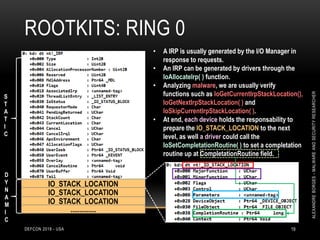
• A IRP is usually generated by the I/O Manager in
response to requests.
• An IRP can be generated by drivers through the
IoAllocateIrp( ) function.
• Analyzing malware, we are usually verify
functions such as IoGetCurrentIrpStackLocation(),
IoGetNextIrpStackLocation( ) and
IoSkipCurrentIrpStackLocation( ).
• At end, each device holds the responsability to
prepare the IO_STACK_LOCATION to the next
level, as well a driver could call the
IoSetCompletationRoutine( ) to set a completation
routine up at CompletationRoutine field.
D
Y
N
A
M
I
C
ALEXANDREBORGES-MALWAREANDSECURITYRESEARCHER
ROOTKITS: RING 0
DEFCON 2018 - USA
20
ALEXANDREBORGES-MALWAREANDSECURITYRESEARCHER
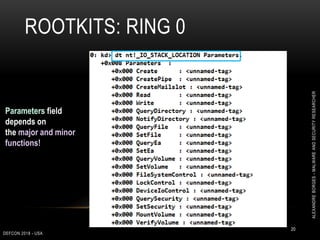
Parameters field
depends on
the major and minor
functions!
ROOTKITS: RING 0
DEFCON 2018 - USA
21
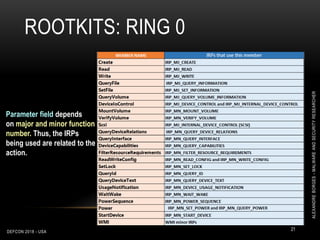
Parameter field depends
on major and minor function
number. Thus, the IRPs
being used are related to the
action.
ALEXANDREBORGES-MALWAREANDSECURITYRESEARCHER
ROOTKITS: RING 0
DEFCON 2018 - USA 22
ALEXANDREBORGES-MALWAREANDSECURITYRESEARCHER
ROOTKITS: RING 0
DEFCON 2018 - USA
23
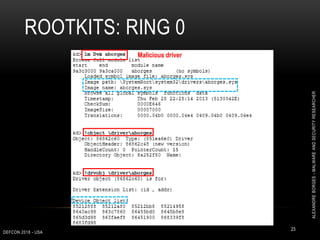
Malicious driver
rootkits: ring 0
ALEXANDREBORGES-MALWAREANDSECURITYRESEARCHER
ROOTKITS: RING 0
DEFCON 2018 - USA 24
ALEXANDREBORGES-MALWAREANDSECURITYRESEARCHER
ROOTKITS: RING 0
DEFCON 2018 - USA
25
ALEXANDREBORGES-MALWAREANDSECURITYRESEARCHER
ROOTKITS: RING 0
26
DEFCON 2018 - USA
ALEXANDREBORGES-MALWAREANDSECURITYRESEARCHER
ROOTKITS: RING 0
27
DEFCON 2018 - USA
ALEXANDREBORGES-MALWAREANDSECURITYRESEARCHER
ROOTKITS: RING 0
DEFCON 2018 - USA 28
ALEXANDREBORGES-MALWAREANDSECURITYRESEARCHER
ROOTKITS: RING 0
DEFCON 2018 - USA
29
• Naturally, as closest at bottom of device stack occurs the
infection (SCSI miniport drivers instead of targeting File
System Drivers), so more efficient it is.
• Nowadays, most monitoring tools try to detect strange
activities at upper layers.
• Malwares try to intercept requests (read / write operations)
from hard disk by manipulating the MajorFunction array
(IRP_MJ_DEVICE_CONTROL and
IRP_INTERNAL_CONTROL) of the DRIVER_OBJECT
structure. 
ALEXANDREBORGES-MALWAREANDSECURITYRESEARCHER
ROOTKITS: RING 0
DEFCON 2018 - USA
30
• Rootkits try to protect itself from being removed by
modifying routines such as IRP_MJ DEVICE_CONTROL and
hooking requests going to the disk (IOCTL_ATA_* and
IOCTL_SCSI_*).
• Another easy approach is to hook the DriverUnload( )
routine for preventing the rootkit of being unloaded.
• However, any used tricks must avoid touching critical areas
protected by KPP (Kernel Patch Guard) and one of tricky
methods for find which are those areas is trying the
following:
ALEXANDREBORGES-MALWAREANDSECURITYRESEARCHER
ROOTKITS: RING 0
DEFCON 2018 - USA
31
kd> !analyze –show 109
ALEXANDREBORGES-MALWAREANDSECURITYRESEARCHER
Thanks, Alex Ionescu 
ROOTKITS: RING 0
DEFCON 2018 - USA 32
• Most time, malwares have allocated a kind of hidden
filesytem in free sectors to store configuration files and
they are referred by random device object names generated
during the boot.
• Few authors of ring 0 malwares are careless because they
write malicious drivers that provide access to shared user-
mode buffers using Neither method (METHOD_NEITHER),
without any data validation, exposing it to memory
corruption and, most time, leakage of information.
Ridiculous. 
ALEXANDREBORGES-MALWAREANDSECURITYRESEARCHER
ROOTKITS: RING 0
DEFCON 2018 - USA
33
• Additionally, malwares composed by executable + drivers have
been using APLC (Advanced Local Procedure Call) in the
communication between user mode code and kernel drivers
instead of using only IOCTL commands.
• Remember APLC interprocess-communication technique has
been used since Windows Vista, as between lsass.exe and SRM(
Security Reference Monitor). Most analysts are not used to
seeing this approach.
• Malwares do not choose an specific driver during the boot for
injection, but try to randomly pick up a driver by parsing
structures such as _KLDR_DATA_TABLE_ENTRY.
ALEXANDREBORGES-MALWAREANDSECURITYRESEARCHER
ROOTKITS: RING 0
DEFCON 2018 - USA
34
• Certainly, hooking the filesystem driver access is always a
possible alternative:
• IoCreateFile( )  gets a handle to the filesystem.
• ObReferenceObjectByHandle( )  gets a pointer to
FILE_OBJECT represented by the handle.
• IoCreateDevice( )  creates a device object
(DEVICE_OBJECT) for use by a driver.
• IoGetRelatedDeviceObject( )  gets a pointer to
DEVICE_OBJECT.
• IoAttachDeviceToDeviceStack( )  creates a new device
object and attaches it to DEVICE_OBJECT pointer (previous
function).
ALEXANDREBORGES-MALWAREANDSECURITYRESEARCHER
ROOTKITS: RING 0
DEFCON 2018 - USA
35
• As it is done by AVs, malwares also hook functions such as
ZwCreate( ) for intercepting all opened requests sent to devices.

• After infecting a system by dropping kernel drivers, malwares
usually force the system reboot calling ZwRaiseHardError( )
function and specifying OptionShutdownSystem as 5th
parameter.
• Of course, it could be worse and the malware could use
IoRegisterShutdownNotification( ) routine registers the driver to
receive an IRP_MJ_SHUTDOWN IRP notification when the system
is shutdown for restoring the malicious driver in the next boot
just in case it is necessary.
ALEXANDREBORGES-MALWAREANDSECURITYRESEARCHER
ROOTKITS: RING 0
DEFCON 2018 - USA
36
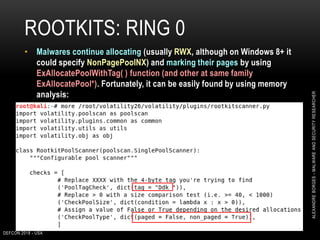
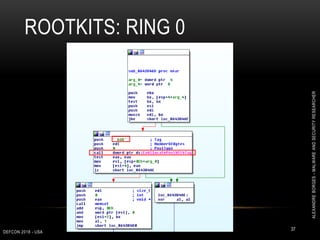
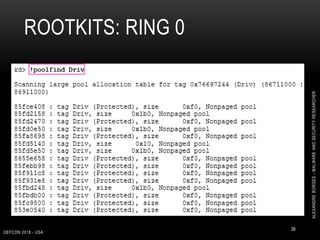
• Malwares continue allocating (usually RWX, although on Windows 8+ it
could specify NonPagePoolNX) and marking their pages by using
ExAllocatePoolWithTag( ) function (and other at same family
ExAllocatePool*). Fortunately, it can be easily found by using memory
analysis:
ALEXANDREBORGES-MALWAREANDSECURITYRESEARCHER
ROOTKITS: RING 0
DEFCON 2018 - USA
37
ALEXANDREBORGES-MALWAREANDSECURITYRESEARCHER
ROOTKITS: RING 0
DEFCON 2018 - USA
38
ALEXANDREBORGES-MALWAREANDSECURITYRESEARCHER
ROOTKITS: RING 0
DEFCON 2018 - USA 39
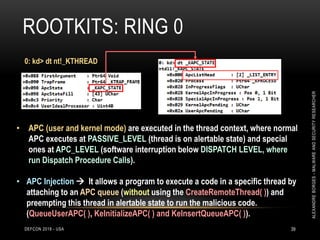
0: kd> dt nt!_KTHREAD
• APC (user and kernel mode) are executed in the thread context, where normal
APC executes at PASSIVE_LEVEL (thread is on alertable state) and special
ones at APC_LEVEL (software interruption below DISPATCH LEVEL, where
run Dispatch Procedure Calls).
• APC Injection  It allows a program to execute a code in a specific thread by
attaching to an APC queue (without using the CreateRemoteThread( )) and
preempting this thread in alertable state to run the malicious code.
(QueueUserAPC( ), KeInitializeAPC( ) and KeInsertQueueAPC( )).
ALEXANDREBORGES-MALWAREANDSECURITYRESEARCHER
DEFCON 2018 - USA
40
ADVANCED MALWARES
AND ROOTKITS RING -2
ALEXANDREBORGES-MALWAREANDSECURITYRESEARCHER
ADVANCED MALWARES
41
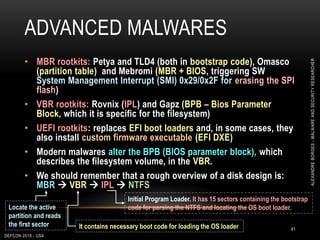
• MBR rootkits: Petya and TLD4 (both in bootstrap code), Omasco
(partition table) and Mebromi (MBR + BIOS, triggering SW
System Management Interrupt (SMI) 0x29/0x2F for erasing the SPI
flash)
• VBR rootkits: Rovnix (IPL) and Gapz (BPB – Bios Parameter
Block, which it is specific for the filesystem)
• UEFI rootkits: replaces EFI boot loaders and, in some cases, they
also install custom firmware executable (EFI DXE)
• Modern malwares alter the BPB (BIOS parameter block), which
describes the filesystem volume, in the VBR.
• We should remember that a rough overview of a disk design is:
MBR  VBR  IPL  NTFS
Initial Program Loader. It has 15 sectors containing the bootstrap
code for parsing the NTFS and locating the OS boot loader.Locate the active
partition and reads
the first sector It contains necessary boot code for loading the OS loader
DEFCON 2018 - USA
ALEXANDREBORGES-MALWAREANDSECURITYRESEARCHER
ADVANCED MALWARES
DEFCON 2018 - USA 42
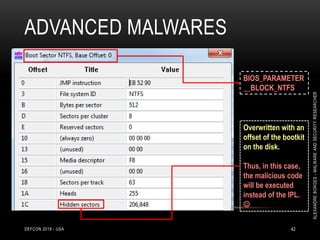
Overwritten with an
offset of the bootkit
on the disk.
Thus, in this case,
the malicious code
will be executed
instead of the IPL.

BIOS_PARAMETER
__BLOCK_NTFS
ALEXANDREBORGES-MALWAREANDSECURITYRESEARCHER
ADVANCED MALWARES
DEFCON 2018 - USA
43
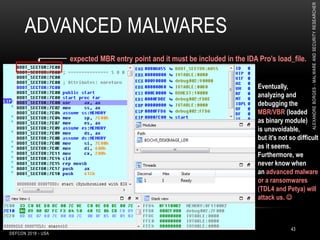
Eventually,
analyzing and
debugging the
MBR/VBR (loaded
as binary module)
is unavoidable,
but it’s not so difficult
as it seems.
Furthermore, we
never know when
an advanced malware
or a ransomwares
(TDL4 and Petya) will
attack us. 
expected MBR entry point and it must be included in the IDA Pro’s load_file.
ALEXANDREBORGES-MALWAREANDSECURITYRESEARCHER
ADVANCED MALWARES
DEFCON 2018 - USA
44
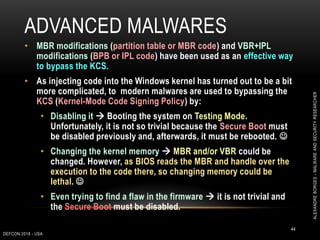
• MBR modifications (partition table or MBR code) and VBR+IPL
modifications (BPB or IPL code) have been used as an effective way
to bypass the KCS.
• As injecting code into the Windows kernel has turned out to be a bit
more complicated, to modern malwares are used to bypassing the
KCS (Kernel-Mode Code Signing Policy) by:
• Disabling it  Booting the system on Testing Mode.
Unfortunately, it is not so trivial because the Secure Boot must
be disabled previously and, afterwards, it must be rebooted. 
• Changing the kernel memory  MBR and/or VBR could be
changed. However, as BIOS reads the MBR and handle over the
execution to the code there, so changing memory could be
lethal. 
• Even trying to find a flaw in the firmware  it is not trivial and
the Secure Boot must be disabled.
ALEXANDREBORGES-MALWAREANDSECURITYRESEARCHER
ADVANCED MALWARES
DEFCON 2018 - USA
45
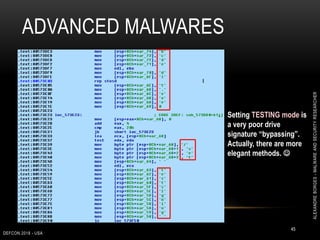
Setting TESTING mode is
a very poor drive
signature “bypassing”.
Actually, there are more
elegant methods. 
ALEXANDREBORGES-MALWAREANDSECURITYRESEARCHER
ADVANCED MALWARES
DEFCON 2018 - USA
46
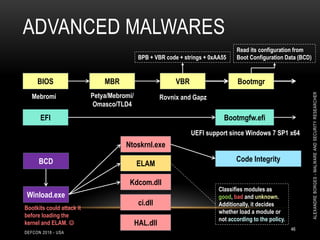
BIOS MBR
EFI
VBR Bootmgr
Bootmgfw.efi
BCD
Winload.exe
Kdcom.dll
ELAM
Ntoskrnl.exe
Code Integrity
Mebromi Petya/Mebromi/
Omasco/TLD4
Rovnix and Gapz
UEFI support since Windows 7 SP1 x64
BPB + VBR code + strings + 0xAA55
Read its configuration from
Boot Configuration Data (BCD)
ci.dll
HAL.dll
Classifies modules as
good, bad and unknown.
Additionally, it decides
whether load a module or
not according to the policy.
Bootkits could attack it
before loading the
kernel and ELAM. 
ALEXANDREBORGES-MALWAREANDSECURITYRESEARCHER
ADVANCED MALWARES
DEFCON 2018 - USA
47
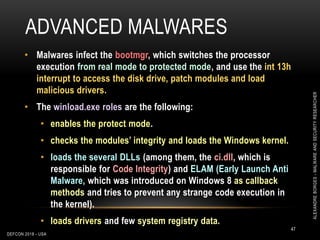
• Malwares infect the bootmgr, which switches the processor
execution from real mode to protected mode, and use the int 13h
interrupt to access the disk drive, patch modules and load
malicious drivers.
• The winload.exe roles are the following:
• enables the protect mode.
• checks the modules’ integrity and loads the Windows kernel.
• loads the several DLLs (among them, the ci.dll, which is
responsible for Code Integrity) and ELAM (Early Launch Anti
Malware, which was introduced on Windows 8 as callback
methods and tries to prevent any strange code execution in
the kernel).
• loads drivers and few system registry data.
ALEXANDREBORGES-MALWAREANDSECURITYRESEARCHER
ADVANCED MALWARES
DEFCON 2018 - USA
48
• Furthermore, if the integrity checking of the winload.exe is
subverted, so a malicious code could be injected into the
kernel because we wouldn’t have an integrity control
anymore.
• Most advanced rootkits continue storing/reading (opcode
0x42, 0x43 and 0x48) their configuration and payloads from
encrypted hidden filesystems (usually, FAT32) and
implementing modified symmetric algorithms (AES, RC4,
and so on) in these filesystems.
ALEXANDREBORGES-MALWAREANDSECURITYRESEARCHER
ADVANCED MALWARES
DEFCON 2018 - USA
49
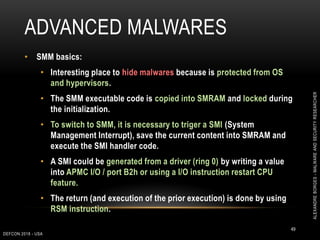
• SMM basics:
• Interesting place to hide malwares because is protected from OS
and hypervisors.
• The SMM executable code is copied into SMRAM and locked during
the initialization.
• To switch to SMM, it is necessary to triger a SMI (System
Management Interrupt), save the current content into SMRAM and
execute the SMI handler code.
• A SMI could be generated from a driver (ring 0) by writing a value
into APMC I/O / port B2h or using a I/O instruction restart CPU
feature.
• The return (and execution of the prior execution) is done by using
RSM instruction.
ALEXANDREBORGES-MALWAREANDSECURITYRESEARCHER
ADVANCED MALWARES
DEFCON 2018 - USA
50
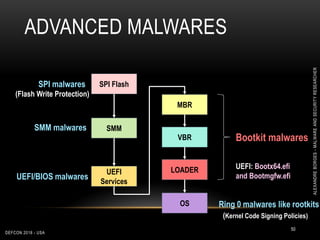
MBR
VBR
LOADER
OS
SPI Flash
Ring 0 malwares like rootkits
SPI malwares
Bootkit malwares
UEFI: Bootx64.efi
and Bootmgfw.efi
(Kernel Code Signing Policies)
UEFI
Services
SMMSMM malwares
UEFI/BIOS malwares
(Flash Write Protection)
ALEXANDREBORGES-MALWAREANDSECURITYRESEARCHER
ADVANCED MALWARES
DEFCON 2018 - USA
51
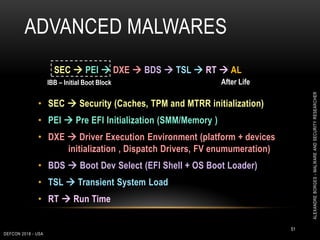
SEC  PEI  DXE  BDS  TSL  RT  AL
• SEC  Security (Caches, TPM and MTRR initialization)
• PEI  Pre EFI Initialization (SMM/Memory )
• DXE  Driver Execution Environment (platform + devices
initialization , Dispatch Drivers, FV enumumeration)
• BDS  Boot Dev Select (EFI Shell + OS Boot Loader)
• TSL  Transient System Load
• RT  Run Time
IBB – Initial Boot Block After Life
ALEXANDREBORGES-MALWAREANDSECURITYRESEARCHER
ADVANCED MALWARES
DEFCON 2018 - USA
52
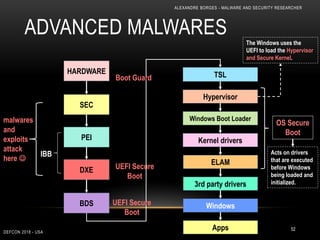
SEC
PEI
DXE
BDS
TSLHARDWARE
Boot Guard
OS Secure
Boot
UEFI Secure
Boot
UEFI Secure
Boot
IBB
malwares
and
exploits
attack
here 
Hypervisor
Windows Boot Loader
Kernel drivers
Windows
ELAM
3rd party drivers
Apps
The Windows uses the
UEFI to load the Hypervisor
and Secure Kernel.
Acts on drivers
that are executed
before Windows
being loaded and
initialized.
ALEXANDRE BORGES - MALWARE AND SECURITY RESEARCHER
ADVANCED MALWARES
DEFCON 2018 - USA
53
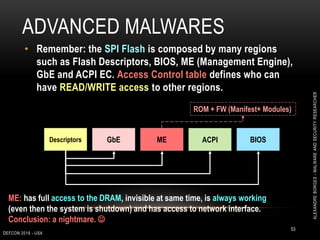
• Remember: the SPI Flash is composed by many regions
such as Flash Descriptors, BIOS, ME (Management Engine),
GbE and ACPI EC. Access Control table defines who can
have READ/WRITE access to other regions.
Descriptors GbE ME ACPI BIOS
ME: has full access to the DRAM, invisible at same time, is always working
(even then the system is shutdown) and has access to network interface.
Conclusion: a nightmare. 
ROM + FW (Manifest+ Modules)
ALEXANDREBORGES-MALWAREANDSECURITYRESEARCHER
ADVANCED MALWARES
DEFCON 2018 - USA
54
• Intel Boot Guard (controlled by ME), introduced by Intel, is
used to validate the boot process through flashing a public
key associated to BIOS signature into FPFs (Field
Programmable Fuses) from Intel ME.
• Obviously, few vendors have been leaving closemnt fuse
unset, so it could be lethal. 
• Of course, for a perfect Boot Guard working, the SPI region
must be locked and the Boot Guard configuration must be
set against a SMM driver rootkit. 
ALEXANDREBORGES-MALWAREANDSECURITYRESEARCHER
ADVANCED MALWARES
DEFCON 2018 - USA
55
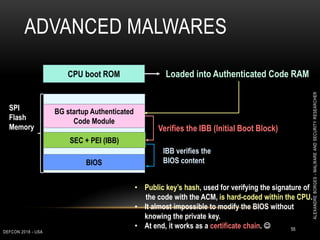
CPU boot ROM
BG startup Authenticated
Code Module
Loaded into Authenticated Code RAM
SEC + PEI (IBB)
Verifies the IBB (Initial Boot Block)
BIOS
• Public key’s hash, used for verifying the signature of
the code with the ACM, is hard-coded within the CPU.
• It almost impossible to modify the BIOS without
knowing the private key.
• At end, it works as a certificate chain. 
SPI
Flash
Memory
IBB verifies the
BIOS content
ALEXANDREBORGES-MALWAREANDSECURITYRESEARCHER
ADVANCED MALWARES
DEFCON 2018 - USA
56
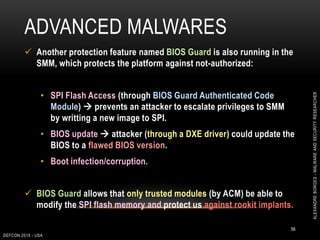
 Another protection feature named BIOS Guard is also running in the
SMM, which protects the platform against not-authorized:
• SPI Flash Access (through BIOS Guard Authenticated Code
Module)  prevents an attacker to escalate privileges to SMM
by writting a new image to SPI.
• BIOS update  attacker (through a DXE driver) could update the
BIOS to a flawed BIOS version.
• Boot infection/corruption.
 BIOS Guard allows that only trusted modules (by ACM) be able to
modify the SPI flash memory and protect us against rookit implants.
ALEXANDREBORGES-MALWAREANDSECURITYRESEARCHER
ADVANCED MALWARES
DEFCON 2018 - USA
57
• Secure Boot:
• Protects the entire path shown previously against
bootkit infection.
• Protects key components during kernel loading, key
drivers and important system files, requesting a valid
digital signature.
• Prevents loading of any code that are not associated a
valid digital signature.
ALEXANDREBORGES-MALWAREANDSECURITYRESEARCHER
ADVANCED MALWARES
DEFCON 2018 - USA
58
• Two essential items on Secure Boot are:
• Platform Key (PK – must be valid), which establishes a trust
relationship between the platform owner and the platform
firmware, verifies the Key Exchange Key (KEK).
• KEK, which establishes a trust relationship between the OS
and the platform firmware, verifies:
• Authorized Database (db)  contains authorized signing
certificates and digital signatures
• Forbidden Database (dbx)  contains forbidden
certificates and digital signatures.
ALEXANDREBORGES-MALWAREANDSECURITYRESEARCHER
ADVANCED MALWARES
DEFCON 2018 - USA
59
• Obviously, if the Platform Key is corrupted, everything is
not valid anymore because the SecureBoot turns out
disabled when this fact happens. 
• Unfortunately, few vendors continue storing important
Secure Boot settings in UEFI variables. However, if these
UEFI variables are exploited through ring 0/-2 malware or
bootkit, so the SecureBoot can be disabled.
ALEXANDREBORGES-MALWAREANDSECURITYRESEARCHER
ADVANCED MALWARES
DEFCON 2018 - USA
60
• Without ensuring the UEFI image integrity, a rookit could load
another UEFI image without being noticed. 
• UEFI BIOS supports TE (Terse Executable) format (signature
0x5A56 - VZ).
• As TE format doesn’t support signatures, BIOS shouldn’t load
this kind of image because Signature checking would be skipped.
• Therefore, a rootkit could try to replace the typical PE/COFF
loader by a TE EFI executable, so skipping the signature
checking and disabling the Secure Boot.
ALEXANDREBORGES-MALWAREANDSECURITYRESEARCHER
ADVANCED MALWARES
DEFCON 2018 - USA
61
 Fortunately, new releases of Windows 10 (version 1607 and
later) has introduced an interesting SMM protection known
as Windows SMM Security Mitigation Table (WSMT).
 In Windows 10, the firmware executing SMM must be
“authorized and trusted” by VBS (Virtualized Based
Security).
ALEXANDREBORGES-MALWAREANDSECURITYRESEARCHER
ADVANCED MALWARES
DEFCON 2018 - USA
62
• These SMM Protections flags that can be used to enable or
disable any WSMT feature.
• FIXED_COMM_BUFFERS: it guarantees that any input/output
buffers be filled by value within the expected memory
regions.
• SYSTEM_RESOURCE_PROTECTION: it works as an indication
that the system won’t allow out-of-band reconfiguration of
system resources.
• COMM_BUFFER_NESTED_PTR_PROTECTION: it is a
validation method that try to ensure that any pointer whith the
fixed communication buffer only refer to address ranges that
are within a pre-defined memory region.
ALEXANDREBORGES-MALWAREANDSECURITYRESEARCHER
ADVANCED MALWARES
DEFCON 2018 - USA
63
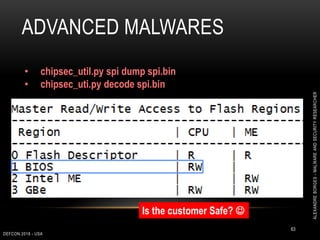
• chipsec_util.py spi dump spi.bin
• chipsec_uti.py decode spi.bin
Is the customer Safe? 
ALEXANDREBORGES-MALWAREANDSECURITYRESEARCHER
ADVANCED MALWARES
DEFCON 2018 - USA
64
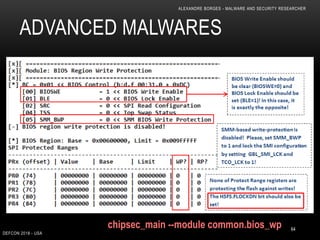
chipsec_main --module common.bios_wp
ALEXANDRE BORGES - MALWARE AND SECURITY RESEARCHER
ADVANCED MALWARES
DEFCON 2018 - USA
65
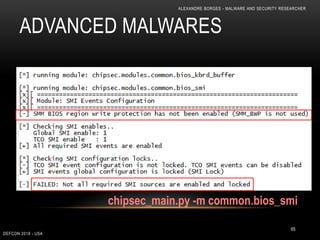
chipsec_main.py -m common.bios_smi
ALEXANDRE BORGES - MALWARE AND SECURITY RESEARCHER
ADVANCED MALWARES
DEFCON 2018 - USA
66
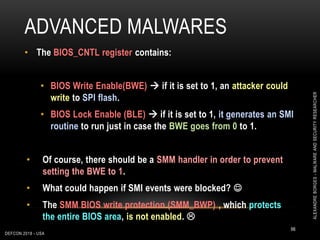
• The BIOS_CNTL register contains:
• BIOS Write Enable(BWE)  if it is set to 1, an attacker could
write to SPI flash.
• BIOS Lock Enable (BLE)  if it is set to 1, it generates an SMI
routine to run just in case the BWE goes from 0 to 1.
• Of course, there should be a SMM handler in order to prevent
setting the BWE to 1.
• What could happen if SMI events were blocked? 
• The SMM BIOS write protection (SMM_BWP) , which protects
the entire BIOS area, is not enabled. 
ALEXANDREBORGES-MALWAREANDSECURITYRESEARCHER
ADVANCED MALWARES
DEFCON 2018 - USA
67
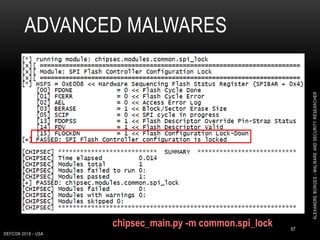
chipsec_main.py -m common.spi_lock
ALEXANDREBORGES-MALWAREANDSECURITYRESEARCHER
ADVANCED MALWARES
DEFCON 2018 - USA
68
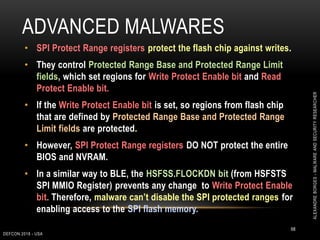
• SPI Protect Range registers protect the flash chip against writes.
• They control Protected Range Base and Protected Range Limit
fields, which set regions for Write Protect Enable bit and Read
Protect Enable bit.
• If the Write Protect Enable bit is set, so regions from flash chip
that are defined by Protected Range Base and Protected Range
Limit fields are protected.
• However, SPI Protect Range registers DO NOT protect the entire
BIOS and NVRAM.
• In a similar way to BLE, the HSFSS.FLOCKDN bit (from HSFSTS
SPI MMIO Register) prevents any change to Write Protect Enable
bit. Therefore, malware can’t disable the SPI protected ranges for
enabling access to the SPI flash memory.
ALEXANDREBORGES-MALWAREANDSECURITYRESEARCHER
ADVANCED MALWARES
DEFCON 2018 - USA
69
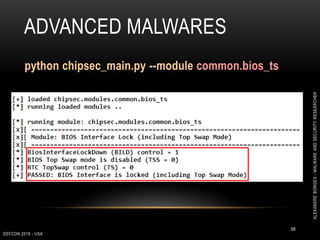
python chipsec_main.py --module common.bios_ts
ALEXANDREBORGES-MALWAREANDSECURITYRESEARCHER
ADVANCED MALWARES
DEFCON 2018 - USA
70
• Top Swap Mode, which is enabled by BUC.TS in Root Complex
range, is a feature that allows fault-tolerant update of the BIOS
boot-block.
• Therefore, when Top Swap Configuration and swap boot-block
range in SPI are not protected or even locked, any malware could
force an execution redirect of the reset vector to backup
bootblock because CPU will fetch the reset vector at 0xFFFEFFF0
instead of 0xFFFFFFF0 address.
• SMRR (System Management Range Registers) blocks the access
to SMRAM (range of DRAM that is reserved by BIOS SMI
handlers) while CPU is not in SMM mode, preventing it to execute
any SMI exploit on cache.
ALEXANDREBORGES-MALWAREANDSECURITYRESEARCHER
ADVANCED MALWARES
DEFCON 2018 - USA
71
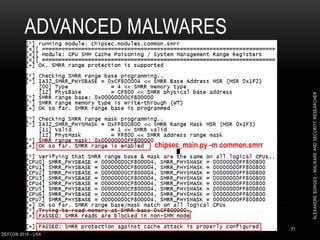
chipsec_main.py -m common.smrr
ALEXANDREBORGES-MALWAREANDSECURITYRESEARCHER
CONCLUSION
DEFCON 2018 - USA
72
• Most security professionals have been facing problems to
understand how to analyze malicious drivers because the
theory is huge and not easy.
• Real customers are not aware about ring -2 threats and they
don’t know how to update systems’ firmwares.
• All protections against implants are based on integrity
(digital certificate and signature). However, what would it
happen whether algorithms were broken (QC - quantum
computation)?
ALEXANDREBORGES-MALWAREANDSECURITYRESEARCHER
THANK YOU FOR ATTENDING MY TALK!
LinkedIn:
http://www.linkedin.com/in/aleborges
Twitter: @ale_sp_brazil
Website:
http://blackstormsecurity.com
E-mail:
alexandreborges@blackstormsecurity.
com
DEFCON 2018 - USA 73
ALEXANDREBORGES-MALWAREANDSECURITYRESEARCHER
• Malware and Security Researcher.
• Consultant, Instructor and Speaker on
Malware Analysis, Memory Analysis, Digital
Forensics, Rootkits and Software Exploitation.
• Member of Digital Law and Compliance
Committee (CDDC/ SP)
• Reviewer member of the The Journal of Digital
Forensics, Security and Law.
• Refereer on Digital Investigation:The
International Journal of Digital Forensics &
Incident Response
• Instructor at Oracle, (ISC)2 and Ex-instructor
at Symantec.

RING 0/-2 ROOKITS : COMPROMISING DEFENSES

  • 1.
    1 DEFCON 2018 USA ALEXANDREBORGES RING 0/-2 ROOKITS : COMPROMISING DEFENSES DEFCON 2018 - USA ALEXANDREBORGES-MALWAREANDSECURITYRESEARCHER
  • 2.
    PROFILE AND TOC TOC: •Introduction • Rootkits: Ring 0 • Advanced Malwares and Rootkits: Ring -2 • Malware and Security Researcher. • Consultant, Instructor and Speaker on Malware Analysis, Memory Analysis, Digital Forensics, Rootkits and Software Exploitation. • Member of Digital Law and Compliance Committee (CDDC/ SP) • Reviewer member of the The Journal of Digital Forensics, Security and Law. • Refereer on Digital Investigation:The International Journal of Digital Forensics & Incident Response • Instructor at Oracle, (ISC)2 and Ex-instructor at Symantec. 2 DEFCON 2018 - USA ALEXANDREBORGES-MALWAREANDSECURITYRESEARCHER
  • 3.
    ACKNOWLEDGMENT DEFCON 2018 -USA 3 Joanna Rutkowska John Loucaides Oleksandr Bazhaniuk Sergey Bratus Vicent Zimmer Yuriy Bulygin Xeno Kovah Alex Bazhaniuk Alex Matrosov Andrew Furtak Bruce Dang Corey Kallenberg Dmytro Oleksiuk Engene Rodionov These professionals deserve my sincere “thank you” and deep respect for their researches on these topics. I have learned from their explanations and articles. By the way, I continue learning... ALEXANDREBORGES-MALWAREANDSECURITYRESEARCHER
  • 4.
    DEFCON 2018 -USA 4 INTRODUCTION ALEXANDREBORGES-MALWAREANDSECURITYRESEARCHER
  • 5.
    RING 0/-2 ROOTKITS DEFCON2018 - USA 5 ADVANCED MALWARES: • MBR/VBR/UEFI rootkits • Tecniques used by rootkits • Kernel Code Signing Bypasses • MBR + IPL infection • BIOS, UEFI and boot architecture • Boot Guard • Secure Boot attacks • WSMT (Windows SMM Security • Mitigation Table) • BIOS Guard • BIOS/UEFI Protections RING 0: • Kernel Callback methods • WinDbg structures • Kernel Drivers Structures • Malicious Drivers • Modern C2 communication • Kernel Pools and APCs ALEXANDREBORGES-MALWAREANDSECURITYRESEARCHER
  • 6.
    DEFCON 2018 -USA 6 ROOTKITS: RING 0 ALEXANDREBORGES-MALWAREANDSECURITYRESEARCHER
  • 7.
    ROOTKITS: RING 0 7 •Kernel Callback Functions, which are are a kind of “modern hooks” oftenly used by antivirus programs for monitoring and alerting the kernel modules about a specific event ocurrence. Therefore, they are used by malwares (kernel drivers) for evading defenses. • Most known callback methods are: • PsSetLoadImageNotifyRoutine: it provides notification when a process, library or kernel memory is mapped into memory. • IoRegisterFsRegistrationChange: it provides notification when a filesystem becomes available. • IoRegisterShutdownNotification: the driver handler (IRP_MJ_SHUTDOWN) acts when the system is about going to down. • KeRegisterBugCheckCallback: it helps drivers to receive a notification (for cleaning tasks) before a system crash. DEFCON 2018 - USA ALEXANDREBORGES-MALWAREANDSECURITYRESEARCHER
  • 8.
    ROOTKITS: RING 0 DEFCON2018 - USA 8 • PsSetCreateThreadNotifyRoutine: indicates a routine that is called every time when a thread starts or ends. • PsSetCreateProcessNotifyRoutine: when a process starts or finishes, this callback is invoked (rootkits and AVs). • DbgSetDebugPrintCallback: it is used for capturing debug messages. • CmRegisterCallback( ) or CmRegisterCallbackEx( ) are called by drivers to register a RegistryCallback routine, which is called every time a thread performs an operation on the registry. • Malwares have been using this type of callbacks for checking whether their persistence entries are kept and, just in case they were removed, so the malware adds them back. ALEXANDREBORGES-MALWAREANDSECURITYRESEARCHER
  • 9.
    ROOTKITS: RING 0 DEFCON2018 - USA 9 0: kd> dd nt!CmpCallBackCount L1 fffff801`aa733fcc 00000002 0: kd> dps nt!CallbackListHead L2 fffff801`aa769190 ffffc000`c8d62db0 fffff801`aa769198 ffffc000`c932c8b0 0: kd> dt nt!_LIST_ENTRY ffffc000`c8d62db0 [ 0xffffc000`c932c8b0 - 0xfffff801`aa769190 ] +0x000 Flink : 0xffffc000`c932c8b0 _LIST_ENTRY [ 0xfffff801`aa769190 - 0xffffc000`c8d62db0 ] +0x008 Blink : 0xfffff801`aa769190 _LIST_ENTRY [ 0xffffc000`c8d62db0 - 0xffffc000`c932c8b0 ] ALEXANDREBORGES-MALWAREANDSECURITYRESEARCHER
  • 10.
    ROOTKITS: RING 0 DEFCON2018 - USA 10 0: kd> !list -t _LIST_ENTRY.Flink -x "dps" -a "L8" 0xffffc000`c932c8b0 ffffc000`c932c8b0 fffff801`aa769190 nt!CallbackListHead ….. ffffc000`c932c8c8 01d3c3ba`27edfc12 ffffc000`c932c8d0 fffff801`6992a798 vsdatant+0x67798 ffffc000`c932c8d8 fffff801`69951a68 vsdatant+0x8ea68 ffffc000`c932c8e0 00000000`000a000a ..... fffff801`aa7691c0 00000000`bee0bee0 fffff801`aa7691c8 fffff801`aa99b600 nt!HvpGetCellFlat ALEXANDREBORGES-MALWAREANDSECURITYRESEARCHER
  • 11.
    ROOTKITS: RING 0 DEFCON2018 - USA 11 • At same way, PsSetCreateProcessNotifyRoutine( ) routine adds a driver-supplied callback routine to, or removes it from, a list of routines to be called whenever a process is created or deleted. 0: kd> dd nt!PspCreateProcessNotifyRoutineCount L1 fffff801`aab3f668 00000009 0: kd> .for (r $t0=0; $t0 < 9; r $t0=$t0+1) { r $t1=poi($t0 * 8 + nt!PspCreateProcessNotifyRoutine); .if ($t1 == 0) { .continue }; r $t1 = $t1 & 0xFFFFFFFFFFFFFFF0; dps $t1+8 L1;} • Malwares composed by kernel drivers, which use the PsSetLegoNotifyRoutine( ) kernel callback to register a malicious routine that is called during the thread termination. The KTHREAD.LegoData field provides the direct address. ALEXANDREBORGES-MALWAREANDSECURITYRESEARCHER
  • 12.
    ROOTKITS: RING 0 DEFCON2018 - USA 12 0: kd> .for (r $t0=0; $t0 < 9; r $t0=$t0+1) { r $t1=poi($t0 * 8 + nt!PspCreateProcessNotifyRoutine); .if ($t1 == 0) { .continue }; r $t1 = $t1 & 0xFFFFFFFFFFFFFFF0; dps $t1+8 L1;} ffffe001`134c8b08 fffff801`aa5839c4 nt!ViCreateProcessCallback ffffe001`139e1138 fffff801`678175f0 cng!CngCreateProcessNotifyRoutine ffffe001`13b43138 fffff801`67e6c610 kl1+0x414610 ffffe001`13bdb268 fffff801`685d1138 PGPfsfd+0x1c138 ffffe001`13b96858 fffff801`68a53000 ksecdd!KsecCreateProcessNotifyRoutine ffffe001`14eeacc8 fffff801`68d40ec0 tcpip!CreateProcessNotifyRoutineEx ffffe001`164ffce8 fffff801`67583c70 CI!I_PEProcessNotify ffffe001`13b6e4b8 fffff801`68224a38 klflt!PstUnregisterProcess+0xfac ffffe001`1653e4d8 fffff801`699512c0 vsdatant+0x8e2c0 ALEXANDREBORGES-MALWAREANDSECURITYRESEARCHER
  • 13.
    ROOTKITS: RING 0 DEFCON2018 - USA 13 kd> dt _KTHREAD By now, we have seen malwares using KTHREAD.LegoData field for registering a malicious routine, which would be called during the thread termination. ALEXANDREBORGES-MALWAREANDSECURITYRESEARCHER
  • 14.
    ROOTKITS: RING 0 DEFCON2018 - USA 14  Windows offers different types of drivers such as legacy drivers, filter drivers and minifilter drivers (malwares can be written using any one these types), which could be developed using WDM or WDF frameworks (of course, UMDF and KMDF take part) • To analyze a malicious driver, remember this sequence of events: • The driver image is mapped into the kernel memory address space. • An associated driver object is created and registered with Object Manager, which calls the entry point and fills the DRIVER_OBJECT structure’s fields. DRIVER DEVICE_OBJECT DRIVER_OBJECT HARDWARE RES. I/O CreateDevice( )(one or more objects) ALEXANDREBORGES-MALWAREANDSECURITYRESEARCHER
  • 15.
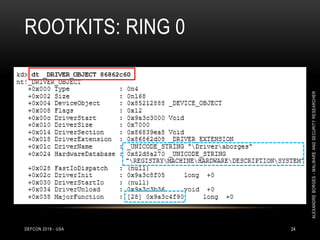
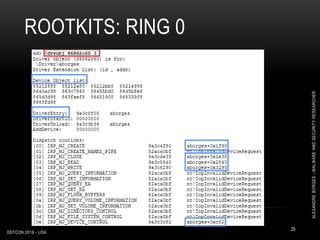
    ROOTKITS: RING 0 DEFCON2018 - USA 15 • Most ring 0 malwares install filter drivers for: • modifying aspects and behavior of existing drivers • filtering results of operations (reading file, for example) • adding new malicious features to a driver/devices (for example, keyloggers) • Oftenly found in filter drivers (mainly the malicious one) for intercepting and altering data, a driver can easily “attach” (using IoAttachDevice( )) one device object to another device object (similar to a “pipeline) to receive I/O requests (see next slide). • The AddDevice( ) routine is used to create an unamed Device Object and to attach it to a named Device Object (ex: aborges) from a layered driver (lower-level driver). ALEXANDREBORGES-MALWAREANDSECURITYRESEARCHER
  • 16.
    ROOTKITS: RING 0 DEFCON2018 - USA 16 • Each IRP will be processed by a dispatch routine, which is picked up from its MajorFunction Table. • The correct dispatch routine will be called to handle the request, picking the IRP parameters from the own IO_STACK_LOCATION by calling the IoGetCurrentIrpStackLocation( ) routine. • Additionally, these IRP parameters could be passed to the next IO_STACK_LOCATION by using the IoCopyCurrentIrpStackLocation( ) routine or even to the next driver by calling IoSkipCurrentStackLocation( ) routine. ALEXANDREBORGES-MALWAREANDSECURITYRESEARCHER
  • 17.
    ROOTKITS: RING 0 DEFCON2018 - USA 17 • Alternatively, this IRP could be passed down to the layered driver by using function such as IoCallDriver( ). • Usually, rootkits use the same IoCallDriver( ) to send directly request to the filesystem driver, evading any kind of monitoring or hooking at middle of the path.  ALEXANDREBORGES-MALWAREANDSECURITYRESEARCHER
  • 18.
    ROOTKITS: RING 0 18 Tcpip.sys UpperFilter Driver Function Driver Lower Filter Driver Miniport driver Physical Device Object Upper Filter Device Object Function Device Object Lower Filter Device Object Driver Stack IoCallDriver( ) IoCallDriver( ) IoCallDriver( ) IoCallDriver( ) Device Stack IO_STACK_LOCATION 4 IO_STACK_LOCATION 3 IO_STACK_LOCATION 2 IO_STACK_LOCATION 1 No Completation Routine Completation Routine 4 Completation Routine 3 Completation Routine 2 Device Stack The IoCompleteRequest( ) manages calling these routines in the correct order (bottom-up).  DEFCON 2018 - USA
  • 19.
    ROOTKITS: RING 0 DEFCON2018 - USA 19 IO_STACK_LOCATION IO_STACK_LOCATION IO_STACK_LOCATION .............. S T A T I C • A IRP is usually generated by the I/O Manager in response to requests. • An IRP can be generated by drivers through the IoAllocateIrp( ) function. • Analyzing malware, we are usually verify functions such as IoGetCurrentIrpStackLocation(), IoGetNextIrpStackLocation( ) and IoSkipCurrentIrpStackLocation( ). • At end, each device holds the responsability to prepare the IO_STACK_LOCATION to the next level, as well a driver could call the IoSetCompletationRoutine( ) to set a completation routine up at CompletationRoutine field. D Y N A M I C ALEXANDREBORGES-MALWAREANDSECURITYRESEARCHER
  • 20.
    ROOTKITS: RING 0 DEFCON2018 - USA 20 ALEXANDREBORGES-MALWAREANDSECURITYRESEARCHER Parameters field depends on the major and minor functions!
  • 21.
    ROOTKITS: RING 0 DEFCON2018 - USA 21 Parameter field depends on major and minor function number. Thus, the IRPs being used are related to the action. ALEXANDREBORGES-MALWAREANDSECURITYRESEARCHER
  • 22.
    ROOTKITS: RING 0 DEFCON2018 - USA 22 ALEXANDREBORGES-MALWAREANDSECURITYRESEARCHER
  • 23.
    ROOTKITS: RING 0 DEFCON2018 - USA 23 Malicious driver rootkits: ring 0 ALEXANDREBORGES-MALWAREANDSECURITYRESEARCHER
  • 24.
    ROOTKITS: RING 0 DEFCON2018 - USA 24 ALEXANDREBORGES-MALWAREANDSECURITYRESEARCHER
  • 25.
    ROOTKITS: RING 0 DEFCON2018 - USA 25 ALEXANDREBORGES-MALWAREANDSECURITYRESEARCHER
  • 26.
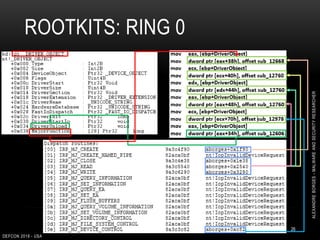
    ROOTKITS: RING 0 26 DEFCON2018 - USA ALEXANDREBORGES-MALWAREANDSECURITYRESEARCHER
  • 27.
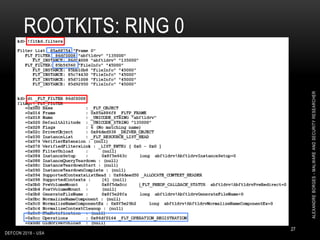
    ROOTKITS: RING 0 27 DEFCON2018 - USA ALEXANDREBORGES-MALWAREANDSECURITYRESEARCHER
  • 28.
    ROOTKITS: RING 0 DEFCON2018 - USA 28 ALEXANDREBORGES-MALWAREANDSECURITYRESEARCHER
  • 29.
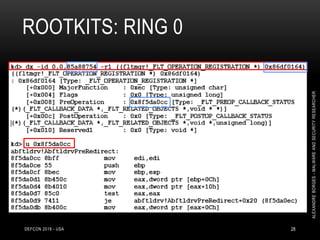
    ROOTKITS: RING 0 DEFCON2018 - USA 29 • Naturally, as closest at bottom of device stack occurs the infection (SCSI miniport drivers instead of targeting File System Drivers), so more efficient it is. • Nowadays, most monitoring tools try to detect strange activities at upper layers. • Malwares try to intercept requests (read / write operations) from hard disk by manipulating the MajorFunction array (IRP_MJ_DEVICE_CONTROL and IRP_INTERNAL_CONTROL) of the DRIVER_OBJECT structure.  ALEXANDREBORGES-MALWAREANDSECURITYRESEARCHER
  • 30.
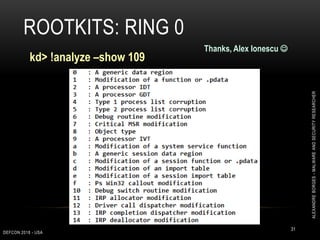
    ROOTKITS: RING 0 DEFCON2018 - USA 30 • Rootkits try to protect itself from being removed by modifying routines such as IRP_MJ DEVICE_CONTROL and hooking requests going to the disk (IOCTL_ATA_* and IOCTL_SCSI_*). • Another easy approach is to hook the DriverUnload( ) routine for preventing the rootkit of being unloaded. • However, any used tricks must avoid touching critical areas protected by KPP (Kernel Patch Guard) and one of tricky methods for find which are those areas is trying the following: ALEXANDREBORGES-MALWAREANDSECURITYRESEARCHER
  • 31.
    ROOTKITS: RING 0 DEFCON2018 - USA 31 kd> !analyze –show 109 ALEXANDREBORGES-MALWAREANDSECURITYRESEARCHER Thanks, Alex Ionescu 
  • 32.
    ROOTKITS: RING 0 DEFCON2018 - USA 32 • Most time, malwares have allocated a kind of hidden filesytem in free sectors to store configuration files and they are referred by random device object names generated during the boot. • Few authors of ring 0 malwares are careless because they write malicious drivers that provide access to shared user- mode buffers using Neither method (METHOD_NEITHER), without any data validation, exposing it to memory corruption and, most time, leakage of information. Ridiculous.  ALEXANDREBORGES-MALWAREANDSECURITYRESEARCHER
  • 33.
    ROOTKITS: RING 0 DEFCON2018 - USA 33 • Additionally, malwares composed by executable + drivers have been using APLC (Advanced Local Procedure Call) in the communication between user mode code and kernel drivers instead of using only IOCTL commands. • Remember APLC interprocess-communication technique has been used since Windows Vista, as between lsass.exe and SRM( Security Reference Monitor). Most analysts are not used to seeing this approach. • Malwares do not choose an specific driver during the boot for injection, but try to randomly pick up a driver by parsing structures such as _KLDR_DATA_TABLE_ENTRY. ALEXANDREBORGES-MALWAREANDSECURITYRESEARCHER
  • 34.
    ROOTKITS: RING 0 DEFCON2018 - USA 34 • Certainly, hooking the filesystem driver access is always a possible alternative: • IoCreateFile( )  gets a handle to the filesystem. • ObReferenceObjectByHandle( )  gets a pointer to FILE_OBJECT represented by the handle. • IoCreateDevice( )  creates a device object (DEVICE_OBJECT) for use by a driver. • IoGetRelatedDeviceObject( )  gets a pointer to DEVICE_OBJECT. • IoAttachDeviceToDeviceStack( )  creates a new device object and attaches it to DEVICE_OBJECT pointer (previous function). ALEXANDREBORGES-MALWAREANDSECURITYRESEARCHER
  • 35.
    ROOTKITS: RING 0 DEFCON2018 - USA 35 • As it is done by AVs, malwares also hook functions such as ZwCreate( ) for intercepting all opened requests sent to devices.  • After infecting a system by dropping kernel drivers, malwares usually force the system reboot calling ZwRaiseHardError( ) function and specifying OptionShutdownSystem as 5th parameter. • Of course, it could be worse and the malware could use IoRegisterShutdownNotification( ) routine registers the driver to receive an IRP_MJ_SHUTDOWN IRP notification when the system is shutdown for restoring the malicious driver in the next boot just in case it is necessary. ALEXANDREBORGES-MALWAREANDSECURITYRESEARCHER
  • 36.
    ROOTKITS: RING 0 DEFCON2018 - USA 36 • Malwares continue allocating (usually RWX, although on Windows 8+ it could specify NonPagePoolNX) and marking their pages by using ExAllocatePoolWithTag( ) function (and other at same family ExAllocatePool*). Fortunately, it can be easily found by using memory analysis: ALEXANDREBORGES-MALWAREANDSECURITYRESEARCHER
  • 37.
    ROOTKITS: RING 0 DEFCON2018 - USA 37 ALEXANDREBORGES-MALWAREANDSECURITYRESEARCHER
  • 38.
    ROOTKITS: RING 0 DEFCON2018 - USA 38 ALEXANDREBORGES-MALWAREANDSECURITYRESEARCHER
  • 39.
    ROOTKITS: RING 0 DEFCON2018 - USA 39 0: kd> dt nt!_KTHREAD • APC (user and kernel mode) are executed in the thread context, where normal APC executes at PASSIVE_LEVEL (thread is on alertable state) and special ones at APC_LEVEL (software interruption below DISPATCH LEVEL, where run Dispatch Procedure Calls). • APC Injection  It allows a program to execute a code in a specific thread by attaching to an APC queue (without using the CreateRemoteThread( )) and preempting this thread in alertable state to run the malicious code. (QueueUserAPC( ), KeInitializeAPC( ) and KeInsertQueueAPC( )). ALEXANDREBORGES-MALWAREANDSECURITYRESEARCHER
  • 40.
    DEFCON 2018 -USA 40 ADVANCED MALWARES AND ROOTKITS RING -2 ALEXANDREBORGES-MALWAREANDSECURITYRESEARCHER
  • 41.
    ADVANCED MALWARES 41 • MBRrootkits: Petya and TLD4 (both in bootstrap code), Omasco (partition table) and Mebromi (MBR + BIOS, triggering SW System Management Interrupt (SMI) 0x29/0x2F for erasing the SPI flash) • VBR rootkits: Rovnix (IPL) and Gapz (BPB – Bios Parameter Block, which it is specific for the filesystem) • UEFI rootkits: replaces EFI boot loaders and, in some cases, they also install custom firmware executable (EFI DXE) • Modern malwares alter the BPB (BIOS parameter block), which describes the filesystem volume, in the VBR. • We should remember that a rough overview of a disk design is: MBR  VBR  IPL  NTFS Initial Program Loader. It has 15 sectors containing the bootstrap code for parsing the NTFS and locating the OS boot loader.Locate the active partition and reads the first sector It contains necessary boot code for loading the OS loader DEFCON 2018 - USA ALEXANDREBORGES-MALWAREANDSECURITYRESEARCHER
  • 42.
    ADVANCED MALWARES DEFCON 2018- USA 42 Overwritten with an offset of the bootkit on the disk. Thus, in this case, the malicious code will be executed instead of the IPL.  BIOS_PARAMETER __BLOCK_NTFS ALEXANDREBORGES-MALWAREANDSECURITYRESEARCHER
  • 43.
    ADVANCED MALWARES DEFCON 2018- USA 43 Eventually, analyzing and debugging the MBR/VBR (loaded as binary module) is unavoidable, but it’s not so difficult as it seems. Furthermore, we never know when an advanced malware or a ransomwares (TDL4 and Petya) will attack us.  expected MBR entry point and it must be included in the IDA Pro’s load_file. ALEXANDREBORGES-MALWAREANDSECURITYRESEARCHER
  • 44.
    ADVANCED MALWARES DEFCON 2018- USA 44 • MBR modifications (partition table or MBR code) and VBR+IPL modifications (BPB or IPL code) have been used as an effective way to bypass the KCS. • As injecting code into the Windows kernel has turned out to be a bit more complicated, to modern malwares are used to bypassing the KCS (Kernel-Mode Code Signing Policy) by: • Disabling it  Booting the system on Testing Mode. Unfortunately, it is not so trivial because the Secure Boot must be disabled previously and, afterwards, it must be rebooted.  • Changing the kernel memory  MBR and/or VBR could be changed. However, as BIOS reads the MBR and handle over the execution to the code there, so changing memory could be lethal.  • Even trying to find a flaw in the firmware  it is not trivial and the Secure Boot must be disabled. ALEXANDREBORGES-MALWAREANDSECURITYRESEARCHER
  • 45.
    ADVANCED MALWARES DEFCON 2018- USA 45 Setting TESTING mode is a very poor drive signature “bypassing”. Actually, there are more elegant methods.  ALEXANDREBORGES-MALWAREANDSECURITYRESEARCHER
  • 46.
    ADVANCED MALWARES DEFCON 2018- USA 46 BIOS MBR EFI VBR Bootmgr Bootmgfw.efi BCD Winload.exe Kdcom.dll ELAM Ntoskrnl.exe Code Integrity Mebromi Petya/Mebromi/ Omasco/TLD4 Rovnix and Gapz UEFI support since Windows 7 SP1 x64 BPB + VBR code + strings + 0xAA55 Read its configuration from Boot Configuration Data (BCD) ci.dll HAL.dll Classifies modules as good, bad and unknown. Additionally, it decides whether load a module or not according to the policy. Bootkits could attack it before loading the kernel and ELAM.  ALEXANDREBORGES-MALWAREANDSECURITYRESEARCHER
  • 47.
    ADVANCED MALWARES DEFCON 2018- USA 47 • Malwares infect the bootmgr, which switches the processor execution from real mode to protected mode, and use the int 13h interrupt to access the disk drive, patch modules and load malicious drivers. • The winload.exe roles are the following: • enables the protect mode. • checks the modules’ integrity and loads the Windows kernel. • loads the several DLLs (among them, the ci.dll, which is responsible for Code Integrity) and ELAM (Early Launch Anti Malware, which was introduced on Windows 8 as callback methods and tries to prevent any strange code execution in the kernel). • loads drivers and few system registry data. ALEXANDREBORGES-MALWAREANDSECURITYRESEARCHER
  • 48.
    ADVANCED MALWARES DEFCON 2018- USA 48 • Furthermore, if the integrity checking of the winload.exe is subverted, so a malicious code could be injected into the kernel because we wouldn’t have an integrity control anymore. • Most advanced rootkits continue storing/reading (opcode 0x42, 0x43 and 0x48) their configuration and payloads from encrypted hidden filesystems (usually, FAT32) and implementing modified symmetric algorithms (AES, RC4, and so on) in these filesystems. ALEXANDREBORGES-MALWAREANDSECURITYRESEARCHER
  • 49.
    ADVANCED MALWARES DEFCON 2018- USA 49 • SMM basics: • Interesting place to hide malwares because is protected from OS and hypervisors. • The SMM executable code is copied into SMRAM and locked during the initialization. • To switch to SMM, it is necessary to triger a SMI (System Management Interrupt), save the current content into SMRAM and execute the SMI handler code. • A SMI could be generated from a driver (ring 0) by writing a value into APMC I/O / port B2h or using a I/O instruction restart CPU feature. • The return (and execution of the prior execution) is done by using RSM instruction. ALEXANDREBORGES-MALWAREANDSECURITYRESEARCHER
  • 50.
    ADVANCED MALWARES DEFCON 2018- USA 50 MBR VBR LOADER OS SPI Flash Ring 0 malwares like rootkits SPI malwares Bootkit malwares UEFI: Bootx64.efi and Bootmgfw.efi (Kernel Code Signing Policies) UEFI Services SMMSMM malwares UEFI/BIOS malwares (Flash Write Protection) ALEXANDREBORGES-MALWAREANDSECURITYRESEARCHER
  • 51.
    ADVANCED MALWARES DEFCON 2018- USA 51 SEC  PEI  DXE  BDS  TSL  RT  AL • SEC  Security (Caches, TPM and MTRR initialization) • PEI  Pre EFI Initialization (SMM/Memory ) • DXE  Driver Execution Environment (platform + devices initialization , Dispatch Drivers, FV enumumeration) • BDS  Boot Dev Select (EFI Shell + OS Boot Loader) • TSL  Transient System Load • RT  Run Time IBB – Initial Boot Block After Life ALEXANDREBORGES-MALWAREANDSECURITYRESEARCHER
  • 52.
    ADVANCED MALWARES DEFCON 2018- USA 52 SEC PEI DXE BDS TSLHARDWARE Boot Guard OS Secure Boot UEFI Secure Boot UEFI Secure Boot IBB malwares and exploits attack here  Hypervisor Windows Boot Loader Kernel drivers Windows ELAM 3rd party drivers Apps The Windows uses the UEFI to load the Hypervisor and Secure Kernel. Acts on drivers that are executed before Windows being loaded and initialized. ALEXANDRE BORGES - MALWARE AND SECURITY RESEARCHER
  • 53.
    ADVANCED MALWARES DEFCON 2018- USA 53 • Remember: the SPI Flash is composed by many regions such as Flash Descriptors, BIOS, ME (Management Engine), GbE and ACPI EC. Access Control table defines who can have READ/WRITE access to other regions. Descriptors GbE ME ACPI BIOS ME: has full access to the DRAM, invisible at same time, is always working (even then the system is shutdown) and has access to network interface. Conclusion: a nightmare.  ROM + FW (Manifest+ Modules) ALEXANDREBORGES-MALWAREANDSECURITYRESEARCHER
  • 54.
    ADVANCED MALWARES DEFCON 2018- USA 54 • Intel Boot Guard (controlled by ME), introduced by Intel, is used to validate the boot process through flashing a public key associated to BIOS signature into FPFs (Field Programmable Fuses) from Intel ME. • Obviously, few vendors have been leaving closemnt fuse unset, so it could be lethal.  • Of course, for a perfect Boot Guard working, the SPI region must be locked and the Boot Guard configuration must be set against a SMM driver rootkit.  ALEXANDREBORGES-MALWAREANDSECURITYRESEARCHER
  • 55.
    ADVANCED MALWARES DEFCON 2018- USA 55 CPU boot ROM BG startup Authenticated Code Module Loaded into Authenticated Code RAM SEC + PEI (IBB) Verifies the IBB (Initial Boot Block) BIOS • Public key’s hash, used for verifying the signature of the code with the ACM, is hard-coded within the CPU. • It almost impossible to modify the BIOS without knowing the private key. • At end, it works as a certificate chain.  SPI Flash Memory IBB verifies the BIOS content ALEXANDREBORGES-MALWAREANDSECURITYRESEARCHER
  • 56.
    ADVANCED MALWARES DEFCON 2018- USA 56  Another protection feature named BIOS Guard is also running in the SMM, which protects the platform against not-authorized: • SPI Flash Access (through BIOS Guard Authenticated Code Module)  prevents an attacker to escalate privileges to SMM by writting a new image to SPI. • BIOS update  attacker (through a DXE driver) could update the BIOS to a flawed BIOS version. • Boot infection/corruption.  BIOS Guard allows that only trusted modules (by ACM) be able to modify the SPI flash memory and protect us against rookit implants. ALEXANDREBORGES-MALWAREANDSECURITYRESEARCHER
  • 57.
    ADVANCED MALWARES DEFCON 2018- USA 57 • Secure Boot: • Protects the entire path shown previously against bootkit infection. • Protects key components during kernel loading, key drivers and important system files, requesting a valid digital signature. • Prevents loading of any code that are not associated a valid digital signature. ALEXANDREBORGES-MALWAREANDSECURITYRESEARCHER
  • 58.
    ADVANCED MALWARES DEFCON 2018- USA 58 • Two essential items on Secure Boot are: • Platform Key (PK – must be valid), which establishes a trust relationship between the platform owner and the platform firmware, verifies the Key Exchange Key (KEK). • KEK, which establishes a trust relationship between the OS and the platform firmware, verifies: • Authorized Database (db)  contains authorized signing certificates and digital signatures • Forbidden Database (dbx)  contains forbidden certificates and digital signatures. ALEXANDREBORGES-MALWAREANDSECURITYRESEARCHER
  • 59.
    ADVANCED MALWARES DEFCON 2018- USA 59 • Obviously, if the Platform Key is corrupted, everything is not valid anymore because the SecureBoot turns out disabled when this fact happens.  • Unfortunately, few vendors continue storing important Secure Boot settings in UEFI variables. However, if these UEFI variables are exploited through ring 0/-2 malware or bootkit, so the SecureBoot can be disabled. ALEXANDREBORGES-MALWAREANDSECURITYRESEARCHER
  • 60.
    ADVANCED MALWARES DEFCON 2018- USA 60 • Without ensuring the UEFI image integrity, a rookit could load another UEFI image without being noticed.  • UEFI BIOS supports TE (Terse Executable) format (signature 0x5A56 - VZ). • As TE format doesn’t support signatures, BIOS shouldn’t load this kind of image because Signature checking would be skipped. • Therefore, a rootkit could try to replace the typical PE/COFF loader by a TE EFI executable, so skipping the signature checking and disabling the Secure Boot. ALEXANDREBORGES-MALWAREANDSECURITYRESEARCHER
  • 61.
    ADVANCED MALWARES DEFCON 2018- USA 61  Fortunately, new releases of Windows 10 (version 1607 and later) has introduced an interesting SMM protection known as Windows SMM Security Mitigation Table (WSMT).  In Windows 10, the firmware executing SMM must be “authorized and trusted” by VBS (Virtualized Based Security). ALEXANDREBORGES-MALWAREANDSECURITYRESEARCHER
  • 62.
    ADVANCED MALWARES DEFCON 2018- USA 62 • These SMM Protections flags that can be used to enable or disable any WSMT feature. • FIXED_COMM_BUFFERS: it guarantees that any input/output buffers be filled by value within the expected memory regions. • SYSTEM_RESOURCE_PROTECTION: it works as an indication that the system won’t allow out-of-band reconfiguration of system resources. • COMM_BUFFER_NESTED_PTR_PROTECTION: it is a validation method that try to ensure that any pointer whith the fixed communication buffer only refer to address ranges that are within a pre-defined memory region. ALEXANDREBORGES-MALWAREANDSECURITYRESEARCHER
  • 63.
    ADVANCED MALWARES DEFCON 2018- USA 63 • chipsec_util.py spi dump spi.bin • chipsec_uti.py decode spi.bin Is the customer Safe?  ALEXANDREBORGES-MALWAREANDSECURITYRESEARCHER
  • 64.
    ADVANCED MALWARES DEFCON 2018- USA 64 chipsec_main --module common.bios_wp ALEXANDRE BORGES - MALWARE AND SECURITY RESEARCHER
  • 65.
    ADVANCED MALWARES DEFCON 2018- USA 65 chipsec_main.py -m common.bios_smi ALEXANDRE BORGES - MALWARE AND SECURITY RESEARCHER
  • 66.
    ADVANCED MALWARES DEFCON 2018- USA 66 • The BIOS_CNTL register contains: • BIOS Write Enable(BWE)  if it is set to 1, an attacker could write to SPI flash. • BIOS Lock Enable (BLE)  if it is set to 1, it generates an SMI routine to run just in case the BWE goes from 0 to 1. • Of course, there should be a SMM handler in order to prevent setting the BWE to 1. • What could happen if SMI events were blocked?  • The SMM BIOS write protection (SMM_BWP) , which protects the entire BIOS area, is not enabled.  ALEXANDREBORGES-MALWAREANDSECURITYRESEARCHER
  • 67.
    ADVANCED MALWARES DEFCON 2018- USA 67 chipsec_main.py -m common.spi_lock ALEXANDREBORGES-MALWAREANDSECURITYRESEARCHER
  • 68.
    ADVANCED MALWARES DEFCON 2018- USA 68 • SPI Protect Range registers protect the flash chip against writes. • They control Protected Range Base and Protected Range Limit fields, which set regions for Write Protect Enable bit and Read Protect Enable bit. • If the Write Protect Enable bit is set, so regions from flash chip that are defined by Protected Range Base and Protected Range Limit fields are protected. • However, SPI Protect Range registers DO NOT protect the entire BIOS and NVRAM. • In a similar way to BLE, the HSFSS.FLOCKDN bit (from HSFSTS SPI MMIO Register) prevents any change to Write Protect Enable bit. Therefore, malware can’t disable the SPI protected ranges for enabling access to the SPI flash memory. ALEXANDREBORGES-MALWAREANDSECURITYRESEARCHER
  • 69.
    ADVANCED MALWARES DEFCON 2018- USA 69 python chipsec_main.py --module common.bios_ts ALEXANDREBORGES-MALWAREANDSECURITYRESEARCHER
  • 70.
    ADVANCED MALWARES DEFCON 2018- USA 70 • Top Swap Mode, which is enabled by BUC.TS in Root Complex range, is a feature that allows fault-tolerant update of the BIOS boot-block. • Therefore, when Top Swap Configuration and swap boot-block range in SPI are not protected or even locked, any malware could force an execution redirect of the reset vector to backup bootblock because CPU will fetch the reset vector at 0xFFFEFFF0 instead of 0xFFFFFFF0 address. • SMRR (System Management Range Registers) blocks the access to SMRAM (range of DRAM that is reserved by BIOS SMI handlers) while CPU is not in SMM mode, preventing it to execute any SMI exploit on cache. ALEXANDREBORGES-MALWAREANDSECURITYRESEARCHER
  • 71.
    ADVANCED MALWARES DEFCON 2018- USA 71 chipsec_main.py -m common.smrr ALEXANDREBORGES-MALWAREANDSECURITYRESEARCHER
  • 72.
    CONCLUSION DEFCON 2018 -USA 72 • Most security professionals have been facing problems to understand how to analyze malicious drivers because the theory is huge and not easy. • Real customers are not aware about ring -2 threats and they don’t know how to update systems’ firmwares. • All protections against implants are based on integrity (digital certificate and signature). However, what would it happen whether algorithms were broken (QC - quantum computation)? ALEXANDREBORGES-MALWAREANDSECURITYRESEARCHER
  • 73.
    THANK YOU FORATTENDING MY TALK! LinkedIn: http://www.linkedin.com/in/aleborges Twitter: @ale_sp_brazil Website: http://blackstormsecurity.com E-mail: alexandreborges@blackstormsecurity. com DEFCON 2018 - USA 73 ALEXANDREBORGES-MALWAREANDSECURITYRESEARCHER • Malware and Security Researcher. • Consultant, Instructor and Speaker on Malware Analysis, Memory Analysis, Digital Forensics, Rootkits and Software Exploitation. • Member of Digital Law and Compliance Committee (CDDC/ SP) • Reviewer member of the The Journal of Digital Forensics, Security and Law. • Refereer on Digital Investigation:The International Journal of Digital Forensics & Incident Response • Instructor at Oracle, (ISC)2 and Ex-instructor at Symantec.