Logical Reasoning
When dealing with friends and colleagues, we find that what we say will often evoke a certain
response. That response can then lead to another, and so on.
 When we try to predict a conversation scenario or a potential discussion/argument, we are, in
effect, using logical reasoning.

That is, if you say A, then it is expected that the response will be B. This then will lead to
statement C, which will likely be responded to with statement D. This sort of logical reasoning,
done effectively, can help immensely with interpersonal relationships and can help solve (or
perhaps avoid) problems before they arise.

We do this often without being aware of the actual process. However, in mathematics, we more
formally make our students aware of this thinking process. We try to guide them or train them to
think logically. Whereas it can be argued that inductive thinking (Le., going from several specific
examples to a generalization) is more natural, the logical form of reasoning requires some
practice.
Maipa : mbel. Makan yuk
Ambar : Ah duluan aja deh,maipaa…..
Maipa : Temenin yuk mbel, males ni sendiri
Ambar : kagak ada duit tapi, bayarin ya..
….
….
….

Conversation between
2 single girls
The Logical Reasoning Strategy in
                  Everyday Life Problem-Solving Situations
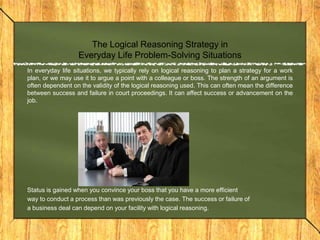
In everyday life situations, we typically rely on logical reasoning to plan a strategy for a work
plan, or we may use it to argue a point with a colleague or boss. The strength of an argument is
often dependent on the validity of the logical reasoning used. This can often mean the difference
between success and failure in court proceedings. It can affect success or advancement on the
job.


Status is gained when you convince your boss that you have a more efficient
way to conduct a process than was previously the case. The success or failure of
a business deal can depend on your facility with logical reasoning.
Applying the Logical Reasoning
          Strategy to Solve Mathematics Problems
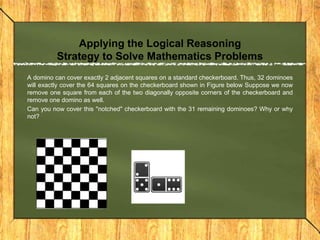
A domino can cover exactly 2 adjacent squares on a standard checkerboard. Thus, 32 dominoes
will exactly cover the 64 squares on the checkerboard shown in Figure below Suppose we now
remove one square from each of the two diagonally opposite corners of the checkerboard and
remove one domino as well.
Can you now cover this "notched" checkerboard with the 31 remaining dominoes? Why or why
not?
Applying the Logical Reasoning
          Strategy to Solve Mathematics Problems

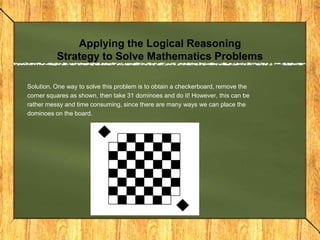
Solution. One way to solve this problem is to obtain a checkerboard, remove the
corner squares as shown, then take 31 dominoes and do it! However, this can be
rather messy and time consuming, since there are many ways we can place the
dominoes on the board.
Applying the Logical Reasoning
          Strategy to Solve Mathematics Problems
Instead, let's apply our strategy of logical reasoning to solve the problem.
Notice that one domino covers exactly two squares either horizontally or
vertically, one of which is black, the other white. On the 64-square checkerboard,
there were 32 white and 32 black squares in an alternating pattern to be covered.
This was easily done. In the notched checkerboard, however, we have removed
2 squares of the same color, black. This leaves us with 30 black squares and 32
white squares. Since a domino must always cover one of each color, it is
impossible to completely cover the notched checkerboard with the 31 dominoes.
Applying the Logical Reasoning
        Strategy to Solve Mathematics Problems

Mrs. Shuttleworth sold 51 jars of her homemade jam in exactly three days.
Each day she sold 2 more jars than she sold on the previous day. How
many jars did she sell on each day?
Applying the Logical Reasoning
          Strategy to Solve Mathematics Problems
Solution. Most students can approach the problem from an algebraic point of view:


x denotes the number of jars sold on the first day.
x + 2 denotes the number of jars sold on the second day.
x + 4 denotes the number of jars sold on the third day.
x + ( x + 2) + (x + 4) = 51
3x + 6 = 51
3x = 45
x = 15.
She sold 15 jars the first day, 17 jars the second day, and 19 jars the third day.
Now, let's look at this problem from the point of view of logical reasoning. She sold 51
jars on three days, an average of 17 jars per day. Because the difference between the
number sold on each day is a constant, the 17 represents the number sold on the
"middle" day. Thus on the day previous, she sold 17 - 2 or 15 jars and on the day
following, she sold 17 + 2 or 19 jars.
Applying the Logical Reasoning
         Strategy to Solve Mathematics Problems
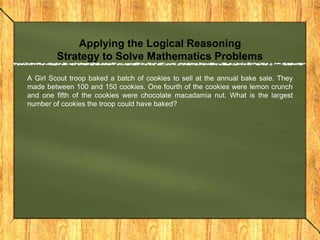
A Girl Scout troop baked a batch of cookies to sell at the annual bake sale. They
made between 100 and 150 cookies. One fourth of the cookies were lemon crunch
and one fifth of the cookies were chocolate macadamia nut. What is the largest
number of cookies the troop could have baked?
Applying the Logical Reasoning
          Strategy to Solve Mathematics Problems
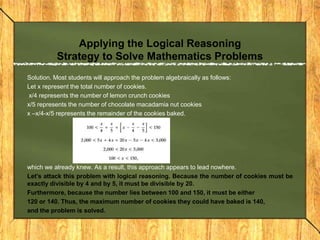
Solution. Most students will approach the problem algebraically as follows:
Let x represent the total number of cookies.
 x/4 represents the number of lemon crunch cookies
x/5 represents the number of chocolate macadamia nut cookies
x –x/4-x/5 represents the remainder of the cookies baked.


which we already knew. As a result, this approach appears to lead nowhere.
Let's attack this problem with logical reasoning. Because the number of cookies must be
exactly divisible by 4 and by 5, it must be divisible by 20.
Furthermore, because the number lies between 100 and 150, it must be either
120 or 140. Thus, the maximum number of cookies they could have baked is 140,
and the problem is solved.
Reference :
Problem Solving Strategies for Efficient and Elegant
Solutions (A Resource for the Mathematics Teacher)
Thank You

Problem solving strategy: logical reasoning

  • 1.
  • 2.
    When dealing withfriends and colleagues, we find that what we say will often evoke a certain response. That response can then lead to another, and so on. When we try to predict a conversation scenario or a potential discussion/argument, we are, in effect, using logical reasoning. That is, if you say A, then it is expected that the response will be B. This then will lead to statement C, which will likely be responded to with statement D. This sort of logical reasoning, done effectively, can help immensely with interpersonal relationships and can help solve (or perhaps avoid) problems before they arise. We do this often without being aware of the actual process. However, in mathematics, we more formally make our students aware of this thinking process. We try to guide them or train them to think logically. Whereas it can be argued that inductive thinking (Le., going from several specific examples to a generalization) is more natural, the logical form of reasoning requires some practice.
  • 3.
    Maipa : mbel.Makan yuk Ambar : Ah duluan aja deh,maipaa….. Maipa : Temenin yuk mbel, males ni sendiri Ambar : kagak ada duit tapi, bayarin ya.. …. …. …. Conversation between 2 single girls
  • 4.
    The Logical ReasoningStrategy in Everyday Life Problem-Solving Situations In everyday life situations, we typically rely on logical reasoning to plan a strategy for a work plan, or we may use it to argue a point with a colleague or boss. The strength of an argument is often dependent on the validity of the logical reasoning used. This can often mean the difference between success and failure in court proceedings. It can affect success or advancement on the job. Status is gained when you convince your boss that you have a more efficient way to conduct a process than was previously the case. The success or failure of a business deal can depend on your facility with logical reasoning.
  • 5.
    Applying the LogicalReasoning Strategy to Solve Mathematics Problems A domino can cover exactly 2 adjacent squares on a standard checkerboard. Thus, 32 dominoes will exactly cover the 64 squares on the checkerboard shown in Figure below Suppose we now remove one square from each of the two diagonally opposite corners of the checkerboard and remove one domino as well. Can you now cover this "notched" checkerboard with the 31 remaining dominoes? Why or why not?
  • 6.
    Applying the LogicalReasoning Strategy to Solve Mathematics Problems Solution. One way to solve this problem is to obtain a checkerboard, remove the corner squares as shown, then take 31 dominoes and do it! However, this can be rather messy and time consuming, since there are many ways we can place the dominoes on the board.
  • 7.
    Applying the LogicalReasoning Strategy to Solve Mathematics Problems Instead, let's apply our strategy of logical reasoning to solve the problem. Notice that one domino covers exactly two squares either horizontally or vertically, one of which is black, the other white. On the 64-square checkerboard, there were 32 white and 32 black squares in an alternating pattern to be covered. This was easily done. In the notched checkerboard, however, we have removed 2 squares of the same color, black. This leaves us with 30 black squares and 32 white squares. Since a domino must always cover one of each color, it is impossible to completely cover the notched checkerboard with the 31 dominoes.
  • 8.
    Applying the LogicalReasoning Strategy to Solve Mathematics Problems Mrs. Shuttleworth sold 51 jars of her homemade jam in exactly three days. Each day she sold 2 more jars than she sold on the previous day. How many jars did she sell on each day?
  • 9.
    Applying the LogicalReasoning Strategy to Solve Mathematics Problems Solution. Most students can approach the problem from an algebraic point of view: x denotes the number of jars sold on the first day. x + 2 denotes the number of jars sold on the second day. x + 4 denotes the number of jars sold on the third day. x + ( x + 2) + (x + 4) = 51 3x + 6 = 51 3x = 45 x = 15. She sold 15 jars the first day, 17 jars the second day, and 19 jars the third day. Now, let's look at this problem from the point of view of logical reasoning. She sold 51 jars on three days, an average of 17 jars per day. Because the difference between the number sold on each day is a constant, the 17 represents the number sold on the "middle" day. Thus on the day previous, she sold 17 - 2 or 15 jars and on the day following, she sold 17 + 2 or 19 jars.
  • 10.
    Applying the LogicalReasoning Strategy to Solve Mathematics Problems A Girl Scout troop baked a batch of cookies to sell at the annual bake sale. They made between 100 and 150 cookies. One fourth of the cookies were lemon crunch and one fifth of the cookies were chocolate macadamia nut. What is the largest number of cookies the troop could have baked?
  • 11.
    Applying the LogicalReasoning Strategy to Solve Mathematics Problems Solution. Most students will approach the problem algebraically as follows: Let x represent the total number of cookies. x/4 represents the number of lemon crunch cookies x/5 represents the number of chocolate macadamia nut cookies x –x/4-x/5 represents the remainder of the cookies baked. which we already knew. As a result, this approach appears to lead nowhere. Let's attack this problem with logical reasoning. Because the number of cookies must be exactly divisible by 4 and by 5, it must be divisible by 20. Furthermore, because the number lies between 100 and 150, it must be either 120 or 140. Thus, the maximum number of cookies they could have baked is 140, and the problem is solved.
  • 12.
    Reference : Problem SolvingStrategies for Efficient and Elegant Solutions (A Resource for the Mathematics Teacher)
  • 13.