Open Risk Analysis Software Data and Methodologies Christakis Mina Kyoto University Graduate School of Engineering Department of Urban Management Planning and Management Systems
Presentation Outline Introduction Open Risk Analysis Motivation The Free/Open Source Paradigm The  A lliance for  G lobal  O pen  R isk  A nalysis Open Risk Analysis Example: MIRISK Future Summary and Discussion
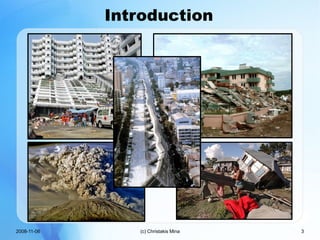
Introduction
Introduction
Open Risk Analysis Motivation Currently, researchers and practitioners in the  Disaster Risk Management  field lack  transparent methodologies , tools (e.g.  Software ) and  open data . A lot of research is being contacted in academic as well as non-profit and for-profit organizations, resulting in the creation of software and methodologies.  A  replication of effort  exists, though, due to the lack of  open and unified standards and a  common platform  to co-ordinate the efforts. In addition to that, open and easily accessible data are hard to found thus causing a  slow down  in the research progress.
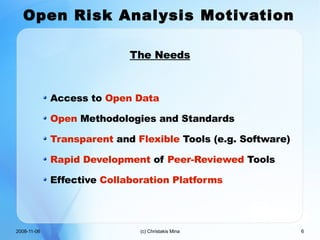
The Needs Access to  Open   Data Open  Methodologies and Standards Transparent  and  Flexible  Tools (e.g. Software) Rapid Development  of  Peer-Reviewed  Tools Effective  Collaboration Platforms Open Risk Analysis Motivation
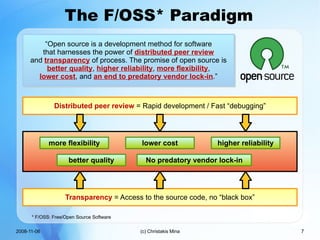
The F/OSS* Paradigm * F/OSS: Free/Open Source Software
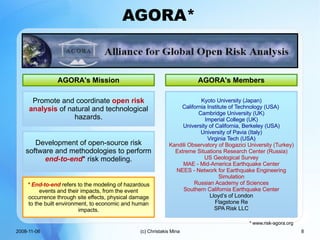
AGORA* Promote and coordinate  open risk analysis  of natural and technological hazards. Development of open-source risk software and methodologies to perform  end-to-end * risk modeling. *  End-to-end  refers to the modeling of hazardous events and their impacts, from the event occurrence through site effects, physical damage to the built environment, to economic and human impacts. Kyoto University   (Japan) California Institute of Technology (USA)  Cambridge University (UK) Imperial College (UK) University of California, Berkeley (USA) University of Pavia (Italy) Virginia Tech (USA) Kandili Observatory of Bogazici University (Turkey) Extreme Situations Research Center (Russia) US Geological Survey MAE - Mid-America Earthquake Center NEES - Network for Earthquake Engineering Simulation Russian Academy of Sciences Southern California Earthquake Center Lloyd’s of London Flagstone Re SPA Risk LLC * www.risk-agora.org
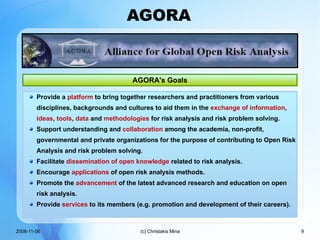
AGORA Provide a  platform  to bring together researchers and practitioners from various disciplines, backgrounds and cultures to aid them in the  exchange of information ,  ideas ,  tools ,  data  and  methodologies  for risk analysis and risk problem solving. Support understanding and  collaboration  among the academia, non-profit, governmental and private organizations for the purpose of contributing to Open Risk Analysis and risk problem solving. Facilitate  dissemination of open knowledge  related to risk analysis. Encourage  applications  of open risk analysis methods. Promote the  advancement  of the latest advanced research and education on open risk analysis. Provide  services  to its members (e.g. promotion and development of their careers).
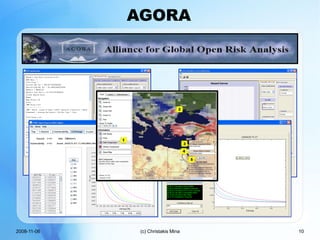
AGORA
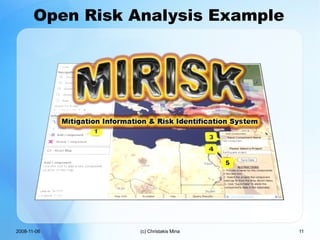
Open Risk Analysis Example
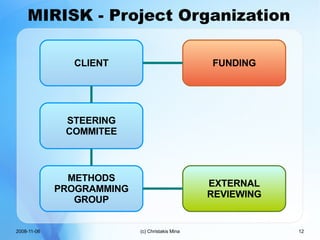
MIRISK - Project Organization CLIENT STEERING COMMITEE METHODS PROGRAMMING GROUP FUNDING EXTERNAL REVIEWING
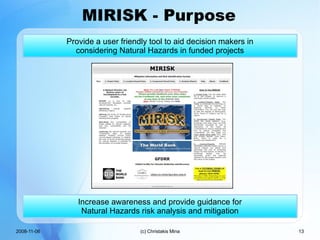
MIRISK - Purpose Provide a user friendly tool to aid decision makers in considering Natural Hazards in funded projects Increase awareness and provide guidance for Natural Hazards risk analysis and mitigation
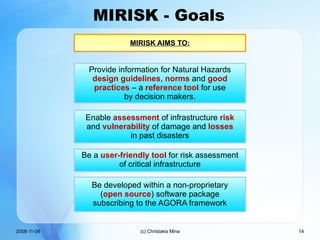
MIRISK - Goals Provide information for Natural Hazards  design guidelines ,  norms  and  good practices  – a  reference tool  for use by decision makers. Enable  assessment  of infrastructure  risk and  vulnerability  of damage and  losses in past disasters Be a  user-friendly tool  for risk assessment of critical infrastructure Be developed within a non-proprietary ( open source ) software package subscribing to the AGORA framework
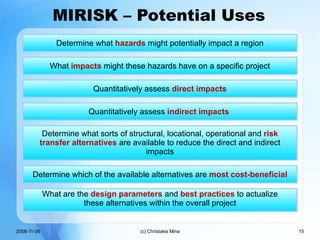
MIRISK – Potential Uses Determine what  hazards  might potentially impact a region What  impacts  might these hazards have on a specific project Quantitatively assess  direct impacts Quantitatively assess  indirect impacts  Determine what sorts of structural, locational, operational and  risk transfer alternatives  are available to reduce the direct and indirect impacts Determine which of the available alternatives are  most  cost-beneficial What are the  design parameters  and  best practices  to actualize these alternatives within the overall project
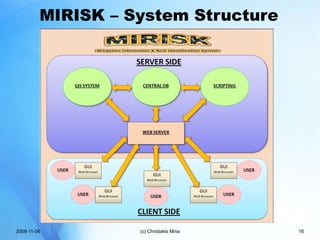
MIRISK – System Structure
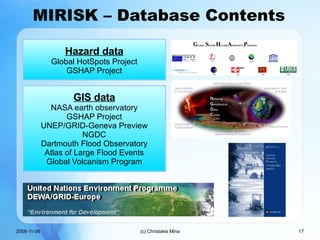
MIRISK – Database Contents Hazard data Global HotSpots Project GSHAP Project GIS data NASA earth observatory GSHAP Project UNEP/GRID-Geneva Preview NGDC Dartmouth Flood Observatory Atlas of Large Flood Events Global Volcanism Program
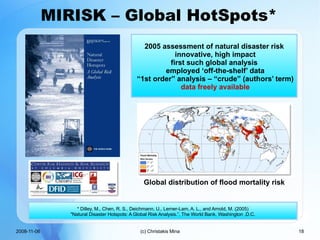
MIRISK – Global HotSpots* 2005 assessment of natural disaster risk innovative, high impact first such global analysis employed ‘off-the-shelf’ data “ 1st order” analysis – “crude” (authors’ term) data freely available Global distribution of flood mortality risk * Dilley, M., Chen, R. S., Deichmann, U., Lerner-Lam, A. L., and Arnold, M. (2005) "Natural Disaster Hotspots: A Global Risk Analysis.”, The World Bank, Washington ,D.C.
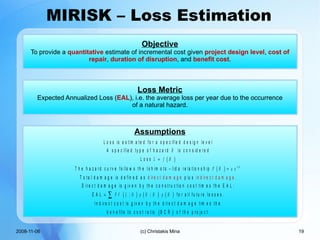
MIRISK – Loss Estimation Objective To provide a  quantitative  estimate of incremental cost given  project design level ,  cost of repair ,  duration of disruption , and  benefit cost . Loss Metric Expected Annualized Loss ( EAL ), i.e. the average loss per year due to the occurrence of a natural hazard. Assumptions
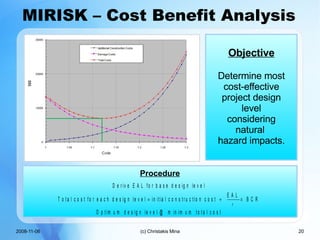
MIRISK – Cost Benefit Analysis Objective Determine most cost-effective project design level considering natural  hazard impacts. Procedure
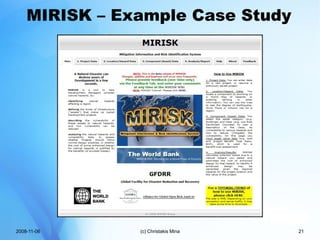
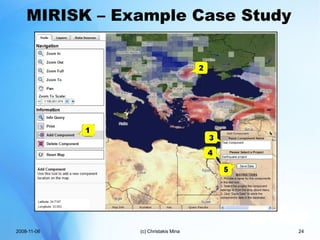
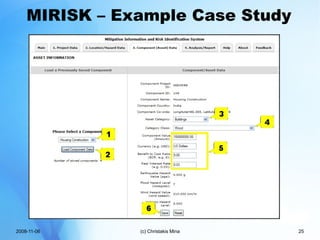
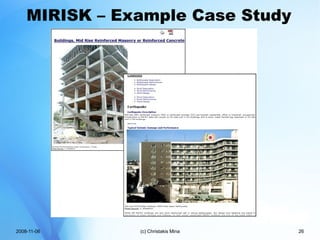
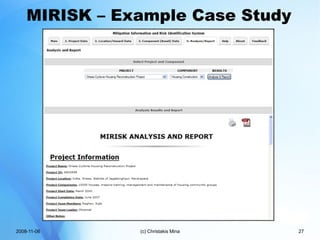
MIRISK – Example Case Study
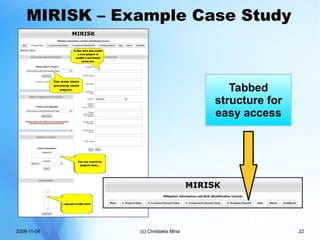
MIRISK – Example Case Study Tabbed structure for easy access
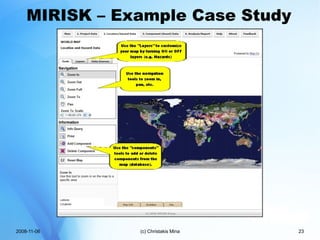
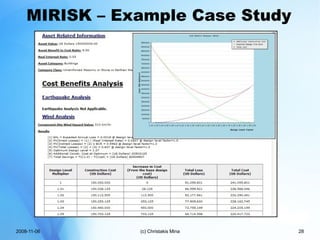
MIRISK – Example Case Study
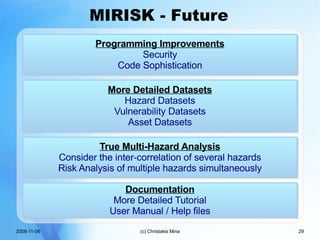
MIRISK - Future
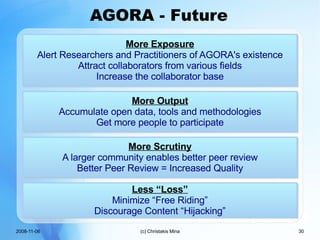
AGORA - Future
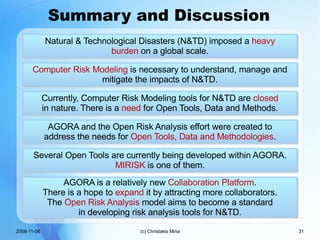
Summary and Discussion

Open Risk Analysis Software - Data And Methodologies

  • 1.
    Open Risk AnalysisSoftware Data and Methodologies Christakis Mina Kyoto University Graduate School of Engineering Department of Urban Management Planning and Management Systems
  • 2.
    Presentation Outline IntroductionOpen Risk Analysis Motivation The Free/Open Source Paradigm The A lliance for G lobal O pen R isk A nalysis Open Risk Analysis Example: MIRISK Future Summary and Discussion
  • 3.
  • 4.
  • 5.
    Open Risk AnalysisMotivation Currently, researchers and practitioners in the Disaster Risk Management field lack transparent methodologies , tools (e.g. Software ) and open data . A lot of research is being contacted in academic as well as non-profit and for-profit organizations, resulting in the creation of software and methodologies. A replication of effort exists, though, due to the lack of open and unified standards and a common platform to co-ordinate the efforts. In addition to that, open and easily accessible data are hard to found thus causing a slow down in the research progress.
  • 6.
    The Needs Accessto Open Data Open Methodologies and Standards Transparent and Flexible Tools (e.g. Software) Rapid Development of Peer-Reviewed Tools Effective Collaboration Platforms Open Risk Analysis Motivation
  • 7.
    The F/OSS* Paradigm* F/OSS: Free/Open Source Software
  • 8.
    AGORA* Promote andcoordinate open risk analysis of natural and technological hazards. Development of open-source risk software and methodologies to perform end-to-end * risk modeling. * End-to-end refers to the modeling of hazardous events and their impacts, from the event occurrence through site effects, physical damage to the built environment, to economic and human impacts. Kyoto University (Japan) California Institute of Technology (USA) Cambridge University (UK) Imperial College (UK) University of California, Berkeley (USA) University of Pavia (Italy) Virginia Tech (USA) Kandili Observatory of Bogazici University (Turkey) Extreme Situations Research Center (Russia) US Geological Survey MAE - Mid-America Earthquake Center NEES - Network for Earthquake Engineering Simulation Russian Academy of Sciences Southern California Earthquake Center Lloyd’s of London Flagstone Re SPA Risk LLC * www.risk-agora.org
  • 9.
    AGORA Provide a platform to bring together researchers and practitioners from various disciplines, backgrounds and cultures to aid them in the exchange of information , ideas , tools , data and methodologies for risk analysis and risk problem solving. Support understanding and collaboration among the academia, non-profit, governmental and private organizations for the purpose of contributing to Open Risk Analysis and risk problem solving. Facilitate dissemination of open knowledge related to risk analysis. Encourage applications of open risk analysis methods. Promote the advancement of the latest advanced research and education on open risk analysis. Provide services to its members (e.g. promotion and development of their careers).
  • 10.
  • 11.
  • 12.
    MIRISK - ProjectOrganization CLIENT STEERING COMMITEE METHODS PROGRAMMING GROUP FUNDING EXTERNAL REVIEWING
  • 13.
    MIRISK - PurposeProvide a user friendly tool to aid decision makers in considering Natural Hazards in funded projects Increase awareness and provide guidance for Natural Hazards risk analysis and mitigation
  • 14.
    MIRISK - GoalsProvide information for Natural Hazards design guidelines , norms and good practices – a reference tool for use by decision makers. Enable assessment of infrastructure risk and vulnerability of damage and losses in past disasters Be a user-friendly tool for risk assessment of critical infrastructure Be developed within a non-proprietary ( open source ) software package subscribing to the AGORA framework
  • 15.
    MIRISK – PotentialUses Determine what hazards might potentially impact a region What impacts might these hazards have on a specific project Quantitatively assess direct impacts Quantitatively assess indirect impacts Determine what sorts of structural, locational, operational and risk transfer alternatives are available to reduce the direct and indirect impacts Determine which of the available alternatives are most cost-beneficial What are the design parameters and best practices to actualize these alternatives within the overall project
  • 16.
  • 17.
    MIRISK – DatabaseContents Hazard data Global HotSpots Project GSHAP Project GIS data NASA earth observatory GSHAP Project UNEP/GRID-Geneva Preview NGDC Dartmouth Flood Observatory Atlas of Large Flood Events Global Volcanism Program
  • 18.
    MIRISK – GlobalHotSpots* 2005 assessment of natural disaster risk innovative, high impact first such global analysis employed ‘off-the-shelf’ data “ 1st order” analysis – “crude” (authors’ term) data freely available Global distribution of flood mortality risk * Dilley, M., Chen, R. S., Deichmann, U., Lerner-Lam, A. L., and Arnold, M. (2005) "Natural Disaster Hotspots: A Global Risk Analysis.”, The World Bank, Washington ,D.C.
  • 19.
    MIRISK – LossEstimation Objective To provide a quantitative estimate of incremental cost given project design level , cost of repair , duration of disruption , and benefit cost . Loss Metric Expected Annualized Loss ( EAL ), i.e. the average loss per year due to the occurrence of a natural hazard. Assumptions
  • 20.
    MIRISK – CostBenefit Analysis Objective Determine most cost-effective project design level considering natural hazard impacts. Procedure
  • 21.
  • 22.
    MIRISK – ExampleCase Study Tabbed structure for easy access
  • 23.
  • 24.
  • 25.
  • 26.
  • 27.
  • 28.
  • 29.
  • 30.
  • 31.